Inst for Humane Studies IHS
nb; some connections to ISI mistakenly made here eg cnp
see Koch-ademia for newer
see IER SPINOFF DENIAL
SAM ADAMS --> tp --> PLEDGE ZOMBIES
PUNKED THE CONV 6 26
TENN CTR FOR POL RES GORE HOUSE bs
THIEL SECRET CONF W/ TYLER COWEN RYAN STOWERS
:{CITIZENS UNITED amicus BRAD SMITH
Supreme Court Justices Antonin Scalia and have attended these events. (According to Salon, "Thomas claimed he just made "a brief drop-by" at the Koch brothers' January 2008 Palm Springs political retreat to give a talk; in fact he was reimbursed for four days of “transportation, meals and accommodations” by the Federalist Society.[56]"). The attendance of Thomas and Scalia has sparked debate over judicial ethics and the2010Citizens United decision.[57] Common Cause filed a petition with the Justice Department in January 2011 alleging a conflict of interest for these Justices, as David and Charles Koch operate foundations that contribute to political groups, which might benefit from relaxed campaign finance rules. ^[58] Common Cause has also noted that the Cato Institute, which Charles Koch founded, filed an amicus brief in Citizens United opposing campaign finance. ^[59] The Center for Competitive Politics also filed a brief in the case; the Center is headed by Bradley Smith, who is affiliated with the Institute for Humane Studies where Charles Koch is Chair of the board and funder. ^[60] SW ^koch ^ind
===
DESMOG SNIP
The Institute for Humane Studies provides $600,000in scholarships each year.
According to SourceWatch, the IHS acts as “a libertarian talent scout, identifying, developing, and supporting the brightest young libertarians it can find who are intent on a leveraged scholarly, or intellectual, career path.” In addition to the funding it receives from the Koch Family Foundations, the Institute for Humane Studies also receives donations from conservative foundations such as the Carthage Foundation, the Sarah Scaife Foundation, and the Lynde and Harry Bradley Foundation.
===
GREENPEACE
The Institute for Humane Studies, also at GMU and chaired by Charles Koch, was called “a haven for climate change deniers,” by Mother Jones, recruiting students to work for Koch-funded organizations that have battled climate change policy, clean energy development incentives and laws & regulations in the crosshairs of Koch Industries.
omfg
Koch and George Mason University - DeSmog
Koch and George Mason University
Funding and Connections
From 2005-2014, George Mason University (GMU) and affiliated centers have taken just under $80 million from Koch foundations.
The George Mason University Foundation received $46,527,725 from Koch foundations since 2005. The bulk of this funding has gone to GMU‘s Economics department and GMU‘s Law and Economics Center. This $46.5 million investment represents half of the $90 million total that Koch foundations have sent to college departments at over 360 universities since 2005.
Charles Koch continues to finance and govern two political influence groups hosted on GMU‘s Arlington, Virginia campus. Since 2005, Charles Koch’s foundation has given the Institute for Humane Studies $23,386,630, and provided $9,847,500 more to the Mercatus Center. Charles Koch is the chairman of the IHS, and has been directing the organization since the 1960s, before it re-located to GMU. Koch is also a director of the Mercatus Center, which he co-founded with Richard Fink.
In addition to financial ties, Koch has personnel involved with the university. Richard Fink, the vice president of Koch Industries, Inc., and the former president of the Charles G. Koch Foundation and the now-defunct Claude R. Lambe Foundation, serves on the board of directors of the Mercatus Center and the Institute for Humane Studies.
Richard Fink’s connection to George Mason University is strong. Besides teaching at the university from 1980-1986, Fink has also served on a number of boards at the university including the Institute for Humane Studies and the Center for the Study of Public Choice, the Board of Visitors, and the Student Affairs Committee.
Concerns over Koch and academic freedom for professors to teach material free of restrictions and stipulations in Koch-funded university departments have been raised by professors, students and academic freedom experts.
The Institute for Humane Studies
The Institute for Humane Studies (IHS) was founded by F.A. Harper in 1961 and has been associated with George Mason University since 1985. The mission of the IHS is “to support the achievement of a free society by discovering and facilitating the development of talented, productive students, scholars and other intellectuals who share a commitment to liberty and who demonstrate the potential to change significantly the current climate of opinion to one more congenial to the principles and practices of freedom.” The Institute for Humane Studies provides $600,000in scholarships each year.
According to SourceWatch, the IHS acts as “a libertarian talent scout, identifying, developing, and supporting the brightest young libertarians it can find who are intent on a leveraged scholarly, or intellectual, career path.” In addition to the funding it receives from the Koch Family Foundations, the Institute for Humane Studies also receives donations from conservative foundations such as the Carthage Foundation, the Sarah Scaife Foundation, and the Lynde and Harry Bradley Foundation.
Institute For Humane Studies underwriting High School Curriculum to promote Capitalism
According to leaked Google documents created by the Charles Koch Foundation, published by the Huffington Post, the IHS staff are involved in providing trainings and course content for high school teachers who are sympathetic to Charles Koch’s preferences for unregulated capitalism.
In some cases, IHS teaching videos have been flagged for misrepresenting facts to align with Koch’s political agenda. According to the Huffington Post:
Today, to teach its most controversial lessons, YE often relies on videos provided by the Charles Koch-chaired Institute for Humane Studies, which operates out of George Mason University in Virginia. The videos are produced and marketed under an institute arm called Learn Liberty, which offers dozens of educational videos on libertarian and conservative topics.
One such video Davis showed his students
. “Anti-gouging laws don’t do anything to address” shortages, the video’s narrator argues. Another video titled “Is There a Glass Ceiling?” asserts that th
. Women earn around 75 cents for every dollar earned by men, it says, but not because of discrimination in the labor market. Rather, it’s because of “differences in the choices that men and women make.”
Other Institute for Humane Studies videos on the syllabus inform students that the cost of living isn’t actually rising, that minimum wage laws harm workers and that the poor aren’t “really getting poorer.”
The Koch-funded high school training programs were also noted for listing specific ideological conclusions that high school students should learn from Koch-trained teachers:
YE‘s course materials reflect some of the initial thinking by the Koch associates charged with designing the course. In late 2009, the Koch group made a list of “common economic fallacies” that they believed should be repudiated. These included:
- Corporatism v. Free-market Capitalism
- Deregulation is what caused recession in 80s, Economic problems of today
- Rich get richer at the expense of the poor
- FDR/New Deal brought us out of the depression
- Government wealth transfer programs help the poor
- Private industry incapable of doing functions that public sector has always done
- Unions protect the employees
- People with the same job title should be paid the same amount …
- Minimum wage, “living wage,” laws are good for people/society
- Capitalist societies provide an environment for greed and materialism to flourish
- Socialist countries do just fine, people have great lives there (using this as proof that socialism works
They aimed to “inoculate” students against liberal ideas by assigning them to read passages from socialist and Marxist writers, whom they called “bad guys.” These readings would then be compared to works by the “good guys” – free-market economists like Friedrich Hayek and Ludwig von Mises.
IHS Internships
Charles Koch is the chairman of the Institute for Humane Studies. Every year the IHS hosts the Charles G. Koch Summer Fellow Program which offers an internship in public policy. The internship is a ten-week program that includes an opening seminar, the internship, and a closing seminar. The opening seminar involves lectures on public policy analysis, classical liberalism, and “persuasive communication.”
The internship entails working at a public policy think tank, either at the state or national level. Most or all of these placement organizations are financed by Charles Koch, such as the American Enterprise Institute, the Cato Institute, the Mercatus Center, the National Center for Policy Analysis, and the Institute for Justice. Policy interns may tackle a number of issues including environmental policy.
The Institute for Humane Studies also offers a journalism internship for which it seeks “writers for liberty.” No formal training in journalism is required and the internship offers a choice of three program areas: investigative, print, and broadcast.
The internship starts with a week-long seminar on journalism and free society, followed by a placement at different locations. Previous placements for print journalist interns have included the Pittsburgh-Tribune–owned by Richard Scaife, who is considered to be one of the founding fathers of the conservative movement in the U.S. Placements for interns in broadcast journalism have included FOX News.
The Institute for Humane Studies and Politopia
The Institute for Humane Studies also runs the website Politopia: The Land of Custom-Made Government. The purpose of this website is to promote a new political model that is different from the “old” left/right political model. In this model, politics are placed in the magical land of Politopia where, depending on where you live (north, west, east, or south), the politics of the land are different.
Politopia is presented as an unbiased educational tool. However, in its model, the role of the government in economic affairs decreases as one moves into the north, and increases as one moves farther south. Similarly, the government’s role in an individual’s daily affairs decreases as one moves west and increases as one moves east.
Historically, the geopolitical terms “west” and “north” have been identified with prosperity, freedom, affluence, industry, and development; whereas the terms “east” and “south” have been associated with poverty, oppression, communism, failure, disease, and insignificance. Interestingly, Politopia places libertarian and conservative values in the more “ideal” regions of the world.
The Mercatus Center
The Mercatus Center is a conservative think tank located at George Mason University. It is a sister organization to the Institute for Humane Studies. The Mercatus Center was originally founded at Rutgers University by Richard Fink in the late 1970s, under the name the Center for Market Processes.
Koch Industries began funding the organization when it moved to George Mason University in the 1980s, and still finances the centre today. In 1999, the organization was renamed the Mercatus Center. Charles Koch and Richard Fink serve on its board of directors.
The Mercatus Center believes that a gap exists between economic understanding and real-world decision and policy making. Its mission, therefore, is to bridge that gap and to “provide policy makers with the economic tools to make sense of today’s most pressing issues.”
The Wall Street Journal has called the Mercatus Center “the most important think tank you’ve never heard of,” and SourceWatch identifies the Mercatus Center as “one of the best-funded think tanks in the United States at the moment.” From 1999-2006, the Mercatus Center received a total of $2,670,662 in funding from conservative organizations, including $1.44 million from the Koch Family Charitable Foundations. Furthermore, between the years 2003 and 2007 the Mercatus Center received $160,000 in funding from ExxonMobil.
The Mercatus Center and Lobbying
According to PublicIntegrity.com, the Mercatus Center regularly lobbies in the federal government, including providing lawmakers with “Capitol Hill breakfasts and luncheons hosted by deregulation scholars.” Mercatus has been an effective machine for pushing Koch’s conservative political and economic values.
The Mercatus Center explicitly states that it does not engage in lobbying, and definitely “does not employ nor retain any registered lobbyists.” However, in 2005 Ohio Congressman Bob Ney, who has travelled on 19 occasions at the expense of the Mercatus Center, proposed a bill to amend the Clean Air Act. Ney’s bill called for the Secretary of Energy to build fifteen new oil refineries and sell them to private companies. Ney’s amendment not only fell in line with the position of the Mercatus Center, which had been trying to weaken the Clean Air Act, but it also seemed to benefit Koch Industries, Inc.–the largest private oil company in the United States and the Mercatus Center’s largest beneficiary.
Lobbying rules stipulate that any organization that spends more than $24,500 within a six-month period trying to influence government representatives, must register itself as a lobbying group. In both 2004 and 2005, the Mercatus Center spent over $55,000 on congressional travel. Furthermore, between 2000 and 2005 Mercatus spent $227,000on more than 400 trips by government officials and their aides. The Mercatus Center has never registered itself as lobbying group.
The Mercatus Center and The Clean Air Act
In 2002 the Mercatus Center led a focused attack on the Clean Air Act. This attack was led by Mercatus Center Distinguished Senior Scholar, Wendy Gramm. Gramm, who is an ardently opposes regulation in the energy sectors, asked for the reassessment of 44 of the Clean Air Act’s federal regulations. Regulations included in the Mercatus Center’s requests for review were: national public health standards for smog and soot, and standards for tailpipe exhaust pollution from gasoline vehicles, diesel vehicles, and heavy diesel trucks. As the non-profit group, Clean Air Trust highlighted, “Gramm would like to pull the plug on virtually every effective air pollution cleanup measure adopted in recent years.”
GMU Econ Professor Affiliated with Mercatus Center calls for “Less Democracy”
According to RawStory, citing GMU student paper the Fourth Estate, GMU Economics professor Garrett Jones called for “less democracy” in an event on campus:
Jones says that less democracy and more epistocracy could lead to better governance. Democracy leaves power to the majority while epistocracy allocates power to the knowledgeable. Jones did not imply that democracy should be eliminated, but lessened by 10% for the sake of long term economic growth.
According to Jones, less democracy would lead to better governance because politicians would be inclined to work on long term growth rather than spending to impress constituents during election season. Politicians try to please the public at the expense of neglecting long- term policies because they are elected through a democratic process.
Koch Academic Freedom Concerns:
GeoRge Mason University has taken over half of the $68 million that Charles Koch has sent to campuses since 2005 – over $35 million dollars.
Yet little information exists about Koch’s arrangement with GMU‘s Economics department, or the Law and Economics Center on GMU‘s Arlington campus. At schools like Florida State University, professors flagged Koch’s academic freedom violations. In an article titled Fine Print, Restrictive Grants, and Academic Freedom, written by two FSU Professors for the American Association of University Professors (AAUP), a primary concern was that Koch infuence could extend into the curriculum of FSU‘s economics department.
FSU and all other schools financed by Charles Koch are largely modeled off of Koch’s decades-long capture of George Mason University‘s economics department, where Koch Industries’ chief lobbyist Richard Fink used to work, along with a litany of other top Koch personnell.
Concerns over Koch and academic freedom at GMU have been raised by GMU students in 2014 and 2015, though the administration has refused and ignored calls to make Koch’s contracts with GMU transparent to tuition-paying students and tenured faculty alike. According to reporter Dan Berrett for Inside Higher Ed in 2011,
When asked for copies of the donor agreements, the university referred the request to the foundation, saying that – since they are held by a private nonprofit organization – such documents are not subject to freedom of information requirements, a position the foundation confirmed.
The faculty has made similar requests and been rebuffed by the foundation. Spurred by concerns over the relationship with the Koch Foundation, the Faculty Senate has formed a task force to examine the implications of all the funding agreements into which the university has entered.
“If we can’t have access to the agreements, it’s very difficult to determine where the intent lies,” said Peter M. Pober, chair of the Faculty Senate and professor of communications.
While many faculty members at George Mason acknowledged that private foundation support of a university’s academic programs is nothing new, Pober said the important line of distinction is at what point and how the private foundation exerts its influence. It is customary, he said, for a foundation to give money to study a particular discipline, whether it be free market economics or labor studies. But it is something else if the donation is contingent upon a scholar producing research with a predetermined outcome.
In 2014, George Mason University officials again refused to provide information to reporters regarding Koch’s financial arrangements with the school. For the Center for Public Integrity, Dave Levinthal wrote,
George Mason University donors “respect our academic freedom and understand they can’t influence what we do,” university spokesman Michael Sandler said. “Our president [Angel Cabrera] has made clear that if any donor ever threatened our academic freedom, we wouldn’t take their money.”
In an April 2013 question-and-answer session on Reddit.com, Cabrera said as much while responding to a question about Charles Koch’s involvement in George Mason University’s affairs.
Jennifer N. Victor, a George Mason University politics professor who specializes in how individuals and groups influence government, is nevertheless concerned.
George Mason University, she says, is earning a reputation for advocating political conservatism and libertarianism — a reputation she argues is “absolutely unwarranted,” as she’s sensed no pressure to teach a certain way or publish research that clings to a particular philosophy.
“It’s potentially damaging to the image and the reputation of the university and academia, rightly or wrongly, to be associated with ideological anything,” Victor said. “It’s contrary to what the goal of higher education is.”
A 2014 report by Greenpeace USA offers more examples of multi-million dollar contracts at Koch-funded schools, and the specific concerns regarding Koch and academic freedom. In response to increasing documentation by students, professors, reporters and activists that Charles Koch’s money erodes academic freedom, the Charles Koch Foundation placed a statement on its website, and began adding “academic freedom” provisions to university contracts like the University of Louisville
See PolluterWatch’s page on Charles Koch University Funding and the Koch Academic Freedom section below the funding database for a comprehensive list of documented concerns by professors, students and activists seeking more information on Koch-funded campus operations. SourceWatch has more on Koch and academic freedom.
---
---
flyer posted ucsc 4/13
---
desmog How a ‘Pro-Climate’ Charity Channelled Cash to a Koch-Funded Think Tank - DeSmog
A UK charity that portrays itself as a climate leader facilitated a £830,000 donation to the Mercatus Center, a conservative think tank heavily funded by U.S. oil billionaire Charles Koch, DeSmog can reveal.
The London-based Founders Pledge channels donations from entrepreneurs to charities – empowering business leaders “to do immense good”, according to its website.
This includes giving money to climate causes. The Founders Pledge runs a Climate Fund that claims to “find and fund impactful, neglected climate solutions” – having distributed almost $36 million from over 5,000 donors.
Donor Advised Funds (DAFs) like the one sponsored by the Founders Pledge allow wealthy individuals to anonymously distribute money and other assets. Research shows that DAFs are increasingly being used to funnel money to reactionary causes – including in the UK.
The Mercatus Center is a conservative “market oriented” think tank registered as a charity. Mercatus and its sister group the Institute for Humane Studies (IHS), both located at George Mason University, have been funded by American billionaire and oil magnate Charles Koch, co-founder of Koch Industries – the second-largest private company in the U.S.
The network of influence controlled and supported by Charles Koch and his late brother David includes “a web of interconnected, right-wing think tanks and advocacy groups”. The pair have piled millions of dollars into causes promoting climate disinformation, including buying credibility with large investments in academic institutions.
Between 2018 and 2022, George Mason was by far the biggest university in receipt of Charles Koch’s money. The three institutions – George Mason, Mercatus, and the IHS – received $128.6 million from four Koch foundations during the period. The Mercatus Center, which has called climate change “beneficial”, has also received funding from the oil major ExxonMobil.
And yet, the Founders Pledge – which distributes over £100 million annually and operates in the UK, Germany, and U.S. – has been featured in articles highlighting its green credentials and has been labelled as being among the most “high-impact, cost-effective, evidenced-based organisations” to donate through.
Firms operating DAFs have the right to refuse to give to certain causes, though in practice this rarely happens.
The Founders Pledge told DeSmog: “We tackle climate change as the global, long-term challenge it is, focusing on solutions that change trajectories, transform systems, reduce the biggest risks for devastating damage around the world, and that will be effective even if everything goes wrong.
“Among other efforts, we fund efforts to fast-track low-carbon technologies like advanced geothermal and to make new infrastructure as low-carbon as possible and look for ways to reduce future emissions from existing systems.”
The Mercatus Center did not respond to DeSmog’s request for comment.
The Mercatus Center and Charles Koch
DeSmog’s investigation finds that the Founders Pledge was used to donate almost £830,000 to the Mercatus Center in 2022.
Mercatus was originally founded – with grant funding from Charles Koch – by Richard Fink, an executive vice president and board member at Koch Industries who, along with Charles, still sits on the Mercatus board and has previously been described as “a fixture in Koch Industries”.
Brian Hooks, CEO and chair of the Koch-founded Stand Together Trust, also sits on the board alongside Emily Chamlee-Wright, president and CEO of the IHS.
Charles Koch is chairman emeritus of the IHS board, which is largely populated by George Mason professors and representatives from the Charles Koch Foundation and Stand Together. It has been described by Mother Jones as “a haven for climate deniers that receives funding from the Koch family foundations”.
The Koch Foundation has paid the salaries of Mercatus Center professors, which in turn have produced work arguing that “The evidence regarding global warming and human contribution to it is mixed, and as forecasts of anthropogenic warming get more refined, they predict less extreme warming.”
In 2020, the think tank was also accused of promoting “flawed” research to “hobble” environmental research in Australia, and it has previously suggested that climate change could be “beneficial” and make humanity “better off”.
The Institute for Humane Studies declined to offer an on the record comment.
Political Donations
The Founders Pledge received some £111 million in 2023, and distributed £101.4 million to various charitable causes.
Originating in the U.S. in the 1930s, DAFs are increasingly used by the wealthy to donate to political causes – and often those with reactionary beliefs. A 2024 study found that DAFs are more likely to be used for political donations than other funding methods, while they account for more than one-quarter of all contributions received by “anti-government and hate groups”.
Money from prominent DAFs has been used to finance the radical Project 2025 playbook for Donald Trump’s second term, to contribute to the coffers of groups campaigning against women’s and LGBTQ rights, and to prop up climate denial think tanks, all without the original donors having to disclose their identities.
As of 2023, roughly 2 million DAFs in the U.S. distributed $55 billion in grants to charitable organisations, while UK charities received £645 million from DAFs in the same year, according to the National Philanthropic Trust.
Speaking to DeSmog on the opacity of DAFs, Brian Mittendorf, a professor at Ohio State University and co-author of the aforementioned study, said that his research “shows that donor advised funds in the U.S. disproportionately fund politically engaged institutions” and that “one motivation for this could be to limit revelations about who funds political organisations.”
He added that “public disclosures by these organisations make it difficult to identify which fund provided money to which organisations and especially who gave money to those funds in the first place.”
“When private foundations distribute money to a donor advised fund prior to it being sent to the ultimate recipient, the paper trail is lost,” he said.
The Rise of DAFs in the UK
The practice of channelling political donations through DAFs now seems to be more commonplace in the UK.
One DAF supplier – called Prism The Gift Fund – has been used to distribute nearly £1.6 million since 2017 to a suite of right-wing think tanks and lobby groups including Policy Exchange, the Global Warming Policy Foundation, the Legatum Institute (now the Prosperity Institute), the Centre for Social Justice, and Henry Jackson Society.
The ultimate source of the funds are unknown.
Moreover, research into the transparency requirements surrounding DAFs suggest that the UK could even be lagging behind the U.S.
One key area is how grants are recorded. In the U.S., DAF providers are required to list most of the grants they pay out in their annual returns. Speaking to DeSmog, Mittendorf explained that suppliers of DAFs in the U.S. have to disclose who received a donation if it surpasses $5,000.
This differs from the UK, where there is no formal requirement for DAF providers to list their recipients, although some still choose to do so.
In the case of the Founders Pledge, while recipients of larger donations are named in its 2023 accounts, “grants less than £645,000” are recorded as one lump sum, with no way to tell where that money has gone to, in addition to not being able to tell where it has come from.
A spokesperson for the Charity Commission confirmed that, at present, recording requirements are minimal. “As DAFs are managed by the charities they reside in, our guidance for the parent charities/trustees is the same as for any other charity, rather than specifically for DAFs… No charities are required to list all the organisations they provide grants to.”
A spokesperson for another prominent DAF provider, The Charity Service, said that “the issues around transparency and DAFs is an interesting one especially as anonymous giving is one of the perceived benefits of giving through a DAF for many donors.”
Tom Brake, director of the campaign group Unlock Democracy, said: “The increasingly influential role think tanks have in our democracy must go hand-in-hand with greater transparency over who funds them and to what end. DAFs do the exact opposite, shielding those donating to think tanks and other organisations from public scrutiny.”
:{:{===}:
ggl ai 6 26
- Climate Change Skepticism: Critics and environmental advocacy groups (such as Greenpeace) have labeled the IHS a "haven for climate change deniers," noting that several associated faculty and guest lecturers have challenged established climate science. [1]
Internal Staff Scrutiny
- Affiliations with the Alt-Right: In 2019, the organization faced internal and public scrutiny when it was revealed that John Elliott, a former director of the IHS journalism internship program, had ties to the alt-right movement. IHS publicly reviewed the situation and stated they found no instances of Elliott exhibiting bigoted views during his tenure. [1] brimelow vdare?
---
SEE MAIN
Institute for Energy Research - DeSmog
Institute for Energy Research (IER)
Background
The Institute for Energy Research (IER) is a not-for-profit organization under Section 501(c)(3) of the Internal Revenue Code that “conducts intensive research and analysis on the functions, operations, and government regulation of global energy markets,” according to its website.
IER, founded in 1989 from a “predecessor non-profit organization,”1 maintains a focuson “energy analysis and free-market energy and environmental policy” with reports and analysis criticizing plans to lower emissions and attacking renewable energy.2
IER’s founder and CEO is Robert L. Bradley Jr., former Director of Policy Analysis at Enron. Bradley worked for over 16 years at Enron, also working as the speechwriter for Kenneth L. Lay, and wrote “Renewable Energy: Not Cheap, Not ‘Green’” (Cato Institute, 1997) where he voices his opposition of green energy. Bradley has worked with a range of free market think-tanks including the Cato Institute, Competitive Enterprise Institute, Institute of Economic Affairs in London, Center for Energy Economics, and theInstitute for Humane Studies (IHS) at George Mason University.3
The Institute for Energy Research supported and promoted both the “Spanish” and “Danish” studies critical of jobs in green energy, both of which have been debunked.4 According to the IER, efforts to reduce emissions to curb global warming would accomplish little at too great a cost.5 IER has promoted studies by The American Council for Capital Formation (ACCF), the National Association of Manufacturers (NAM), and the Heritage Foundation on the supposed costs of climate policy.6
Koch Connections
Documents obtained by the *Republic Report* revealed that Charles Koch was directly involved with the IER at its formation through the IER’s predecessor organization, The Institute for Humane Studies of Texas. ^7According to the Institute’s articles of incorporation filed in 1984, Koch was a member of the group’s board of directors.8
The Republic Report reports that the Institute for Humane Studies of Texas briefly lost its charter in 1989 for failure to pay the Texas state franchise tax. Four years later, incorporation documents reveal, the group rebranded as the Institute for Energy Research, or IER.9
Huffington Post describes how the IER became known for its role in advocating against tax subsidies on renewable energy, as well as the Environmental Protection Agency’s proposed limits on greenhouse gas emissions from power plants. The Institute for Energy Research (IER) has been criticized for its acceptance of funding from Koch family foundations, and the group’s president, Thomas Pyle, is a former lobbyist for Koch Industries.10
The American Energy Alliance
The American Energy Alliance (AEA) is the “advocacy arm” of the Institute for Energy Research, and describes itself as a “not-for-profit organization that engages in grassroots public policy advocacy and debate concerning energy and environmental policies.”11
Thomas Pyle, a former Koch and oil-industry lobbyist, is the President of both IER and the American Energy Alliance.12 ^13
IER has also been a member of the Sustainable Development Network, a group which shares staff and may have additional connections with the International Policy Network.
Stance on Climate Change
2015
“That human activity has increased the atmospheric concentration of CO2, a gas known to ‘force’ climate or increase temperatures while the Earth has warmed about 0.6 Degrees Celsius over the last one hundred years is generally accepted. How the climate works and the relationship of different variables remains to be determined.”14
2008
“Any discussion of climate change must keep in mind that the Earth’s climate is an extremely complex system. Even though significant advances in data collection and analysis have occurred over the past 30 years, much uncertainty remains.”15
“Climate changes naturally all the time, partly in predictable cycles, and partly in unpredictable shorter rhythms and rapid episodic shifts, some of the causes of which remain unknown. We are fortunate that our modern societies have developed during the last 10,000 years of benignly warm, interglacial climate. But for more than 90% of the last two million years, the climate has been colder, and generally much colder than today.”16
“A troubling aspect of the discussion of the discussion of Global Warming is the idea that our level of scientific understanding is perfect; or that we have little left to learn. As the previous discussion has shown, this is incorrect and many scientists disagree with the idea that the causes and consequences of warming are perfectly understood.”17
Funding
According to the IER website, the group is “funded entirely by tax deductible contributions from individuals, foundations and corporations. No financial support is sought for or accepted from government sources.”18
IER has received funding from fossil fuel interests and several conservative funding sources, including Donors Trust. The Conservative Transparency Database breaks down the Institute for Energy Research’s fundingas follows. Note that not individual funding data values have been verified by DeSmog.19
See attached spreadsheet for details on Institute for Energy Research funding by year (.xlsx)....$ # TABLES
---
greenpeACE
Institute for Humane Studies (IHS)
Koch Industries Climate Denial Front Group
$36,886,734 from Koch foundations, 1997-2017.
The Institute for Humane Studies at George Mason University offers scholarships and career training to libertarian students. Charles Koch is the Chairman of the IHS board of directors.
Mother Jones called the Institute for Human Studies a “haven for climate change deniers.” Several climate deniers have prominent positions at IHS, including: Robert Bradley, member of the Academic Review Committee and author of *Climate Alarmism Reconsidered* (2003); and Fred Singer, Research Professor at IHS.
A number of climate deniers who share affiliation with other Koch-funded organizations are guest lecturers for IHS. Examples include Bruce Yandle of Clemson University, among Charles Koch’s most-funded universities, who also serves as Senior Associate with the Property and Environment Research Center (PERC). Another example is Kenneth Green, Resident Scholar with the American Enterprise Institute (AEI) and the defunct Environmental Literacy Council, a group that pushed for teachers to present climate science as controversial.
IHS is a member of the State Policy Network.
---
http://www.rightwingwatch.org/post/koch-network-alums-are-going-full-on-white-nationalist/
This article was produced in collaboration with Sludge, an investigative money-in-politics news site. Visit readsludge.com to subscribe to its free weekly newsletter.
At a 1976 libertarian conference funded by oil executive Charles Koch, conservative think-tanker Leonard Liggio presented a paper on the Nazis’ success at recruiting youth to their movement. Liggio urged the clandestine group of wealthy libertarians to embrace the Nazis’ approach as a way to strengthen their own movement to slash taxes and gut regulations.
Now, decades later, multiple young men who have been affiliated with Koch’s powerful political network have been exposed as members of a white nationalist group.
“Koch’s academic operations are intended to develop extreme anti-government ideas and actions in students by exposing them to the Austrian school of economics and its various offshoots,” Ralph Wilson, co-founder of the Corporate Genome Project and former research director of UnKoch My Campus, told Sludge/Right Wing Watch. “These ideologies make moral arguments for free markets using an overly individualistic notion of ‘freedom’ that has fed and capitalized on the anti-social impulses of frustrated youth for several generations, including white nationalists, paleo-conservatives, neo-confederates, and neo-Nazis.”
Identity Evropa, which recently rebranded as the American Identity Movement, is a white nationalist group in the United States whose members appeared at the Unite the Right 2017 rally in Charlottesville, Virginia, and have, in other instances, been convicted of criminal activity pertaining to their ideology. The group, based near Washington, D.C., favors secrecy over visibility; it opts for unannounced banner-drops and flash rallies, and it emphasizes propaganda production over public presence. The group’s membership rolls and day-to-day operations were closely guarded before its chat logs were published by independent media nonprofit Unicorn Riot.
Since the chat logs were exposed, antifascist activists have worked to identify members of the organization using the internal discussions. One portion of the chat logs show Identity Evropa members discussing infiltrating local conservative clubs and offices with the hopes of attracting GOP supporters to their racist agenda. Other Identity Evropa-associated personalities have explicitly urgedtheir followers to place themselves in local Republican offices.
In early March, the antifascist blog IdentifyEvropa determined that Derek Magill, who spoke at an event hosted by the Koch-funded Institute for Humane Studies (IHS) in late 2017, is a member of Identity Evropa. Magill denied that the blog had correctly identified him, but its writers uncovered further evidence suggesting that their identification had been correct. Later that month, Unicorn Riot exposed Alex Witoslawski, the former regional field coordinator for the Koch-funded Leadership Institute, as a key Identity Evropa member. Witoslawski had hosted two media training sessions for Identity Evropa members and directed them to sign up for organizing training offered by a different conservative group, the Foundation for Applied Conservative Leadership.
Magill, a young self-proclaimed entrepreneur whose business appears to be defunct, spoke at an IHS entrepreneurship seminar in November 2017. The seminar was co-sponsored with the conservative John Templeton Foundation and Mississippi State University’s Institute for Market Studies, which the Charles Koch Foundation helped found in 2015 with a $365,000 commitment.
IHS told Right Wing Watch/Sludge that it “does not tolerate racism in any shape or form.”
“We work with thousands of people, and we do our best to evaluate each opportunity. Unfortunately, there’s no way to guarantee that a person’s public record is a perfect match for their private thoughts and behavior,” IHS wrote to Sludge/Right Wing Watch in a statement. “When we worked with Derek Magill, he was the director of marketing at Praxis, and we had no knowledge of racist comments, which represent the exact opposite of what we stand for and our values. We have not worked with Magill since 2017 and will not work with him in the future.”
Heidi Beirich, director of the Intelligence Project at the nonprofit Southern Poverty Law Center, told Sludge/Right Wing Watch that she wasn’t at all surprised to see young men leaving Koch-funded groups for white nationalist organizations.
“For some time, folks have joined the white nationalist movement after first moving through political operations,” Beirich said. “It’s actually a pretty common pattern where folks become more and more conservative and finally make their way into full-on white nationalism. Given the times now, where anti-immigrant and anti-Muslim views are common in the GOP and few in the party speak out against them or against Trump when he engages in xenophobia and racism, it actually makes sense to see young people being radicalized into white nationalism through these political activities.”
Charles Koch, currently on the IHS board of directors, has been a leader and key funder of IHS for decades. From 2013 to 2017, the Charles Koch Foundation gave nearly $20 million to IHS, according to tax records. The Charles Koch Institute gave over $275,000 to IHS, and Donors Trust, a dark-money vehicle favored by the Koch family, added nearly $1.1 million.
But IHS isn’t the only Koch-funded institution with connections to Magill. Before dropping out of the University of Michigan, Magill was president of the school’s chapter of the libertarian student group Young Americans for Liberty. He and his chapter were part of a lawsuit seeking reimbursement from the university for an event they hosted featuring an anti-affirmative action speaker. The group was represented by the anti-LGBTQ hate group Alliance Defending Freedom.
The Charles Koch Foundation donated over $2.3 million to the Young Americans for Liberty Foundation from 2013 to 2017, representing a large portion of the group’s revenue. Donors Trust gave $1.3 million, and the Charles Koch Institute added nearly $75,000 during that time period.
Magill’s connections to Koch-backed organizations don’t stop here. From 2016 to 2018, Magill wrote six articles for the Foundation for Economic Education (FEE), a conservative, free-market think tank, and he claims to have spoken there as well. FEE is a “strategic partner” of Young Americans for Liberty. From 2013 to 2017, FEE received close to $260,000 from the Charles Koch Foundation, more than $60,000 from the Charles Koch Institute, $440,000 from Donors Trust, and $5.2 million from its sister fund, Donors Capital Fund. Magill’s author page on FEE’s website was taken down in the past week.
FEE is also heavily funded by the John Templeton Foundation, which donated over $1.8 million in 2017 to fund a millennial outreach program intended “to dislodge collectivism from its ‘high ground’ position among the rising generation.” Koch ally Liggio attended FEE seminars as a young man in the 1950s and went on to lead the Templeton Foundation’s Religious Freedom Project.
Months after Magill’s stint with FEE appears to have ended, he was logged into Identity Evropa’s chatroom where he posted photos of mugs sold by fascist podcasts he claimed were spotted on his employee’s desk, expressed his relief that his parents were “woke” on the “Jewish Question” conspiracy theory, announced that he was invited to “sit on the board of directors of a very important academic organization,” and signaled his intention to register for Identity Evropa’s annual conference.
According to the antifascists who identified Magill’s connection to Identity Evropa, Magill “offers to pay legal costs and invest in the business ventures of [Identity Evropa] members as well as financially support [Identity Evropa] as a whole.”
Antifascist activists identified Magill by cross-referencing details from his personal life he shared with other Identity Evropa members with publicly available information online. When Magill contested the allegations, activists identified police records of Magill’s meeting with a detective regarding a check fraud complaint that occurred the day before he recounted the incident with Identity Evropa members.
The other Identity Evropa member linked to the Koch network, Witoslawski, also has connections to multiple operations. According to his LinkedIn page,Witoslawski was a regional field coordinator with the Koch-funded Leadership Institute from January 2016 to August 2017. According to Unicorn Riot, Witoslawski taught members of the white nationalist group about how to deflect questions about the organization that would reflect poorly on it, and in April 2018, he walked them through a communications strategy called “Leesburg Grid,” which is taught to conservative activists at Leadership Institute training sessions. He gave an additional seminar to Identity Evropa later that June.
[unicorn r slides? vid?]
Leadership Institute operates the website Campus Reform, a site that publishes stories about what it views as bias against conservative university students. In 2014, Campus Reform covered the University of Michigan affirmative action story, quoting Magill extensively.
Since 2013, the Leadership Institute has received $118,000 from the Charles Koch Foundation, $44,000 from the Charles Koch Institute, $715,000 from Donors Capital Fund, and $220,000 from Donors Trust, according to federal tax records.
Before his stint at the Leadership Institute, Witoslawski spent six months as the Illinois state chair of Young Americans for Liberty.
In 2015, Witoslawski worked for a Michigan ballot measure committee, Concerned Taxpayers of America, and before that, he spent three years at Campaign for Liberty, a nonprofit founded by former libertarian Congressman Ron Paul. His profile page on the group’s website includes a photo of Witoslawski with Paul’s son, Republican Sen. Rand Paul of Kentucky.
Witoslawki claims to have taken online courses at the Mises Academy, which is run by Austrian economics think tank Mises Institute. The institute, named after Austrian free-market economist Ludwig von Mises, is another beneficiary of the Koch network and has numerous ties to Koch-funded academics, some of whom have been associated with the neo-Confederate League of the South. Liggio sat in on Ludwig von Mises’ seminars at Georgetown University and New York University in the 1950s. Former Texas Rep. Ron Paul, who published a racist newsletter in the late 1980s and early 1990s, is a member of the Mises Institute board.
“The Mises Institute has spent decades legitimizing pro-corporate and white nationalist scholarship while radicalizing young scholars in the U.S. and abroad,” said Wilson, who has extensively researched the institute.
Witoslawski has volunteered himself as a public face for other far-right activists seeking to “infiltrate the mainstream,” and he has lent his Leadership Institute training to white nationalist YouTube audiences, blogs, and podcasts looking to advance their causes in the United States. Identity Evropa leader Patrick Casey invited Witoslawski to walk through the basics of grassroots organizing with the organization’s members, the Southern Poverty Law Center reported last year.
Witoslawski has also authored pieces published on Fash the Nation, a fascist podcast’s blog, including one that criticized conservative commentator Jordan Peterson for not recognizing “the problem with Jewish influence on society.”
“Jews are a foreign elite in Western society—an elite who earned their status through graft and ethnic nepotism, and who use their power to the detriment of the host countries in which they live in,” Witoslawski wrote in his March 24, 2018, column.
In apost taking issue with Jewish conservative media star Ben Shapiro, Witoslawski claimed that “culture is intrinsically linked with ethnicity, and for that reason alone, if we really are interested in conserving America’s traditions and heritage, we must preserve our country’s White heritage.”
Sludge/Right Wing Watch reached out to the Leadership Institute for comment on this story via a contact form listed on its website and Witoslawski via Facebook Messenger, but received no response.
Other GOP megadonors in the Koch network have also helped fund the organizations linked to Magill and Witoslawski. From 2013 to 2017, shipping supplies magnate Richard Uhlein, the fourth-biggest federal political donor of 2018 and a patron of Koch-backed political groups, gave $1 million each to the Leadership Institute and IHS through his family foundation. The family foundation of discount store magnate Art Pope, an IHS board member who co-founded the political nonprofit Americans for Prosperity with Charles and David Koch, gave over $1.6 million to IHS and $40,000 to FEE. The foundation of the parents of Education Sec. Betsy DeVos, gave $50,000 to the Leadership Institute from mid-2013 through mid-2018. DeVos’s in-laws have also attended Koch donor conferences.
“There is no question that the far right political world is radicalizing people into white nationalism and growing its ranks,” the Southern Poverty Law Center’s Beirich said. “Some of the GOP’s current positions on immigration are no different than those of white nationalists, so we shouldn’t be surprised. We even saw last week that a synagogue attacker followed this pathway, through conservative politics to Ben Shapiro and on to pure hatred. Unfortunately, this is becoming a more well worn path these days.”
Tags: Alt-Rightmoney in politicswhite nationalismFoundation for Economic EducationIdentity EvropaInstitute for Humane StudiesLeadership InstituteYoung Americans for Liberty
:{:{===}:
cmd stch 6 26
Institute for Humane Studies at George Mason University - DeSmog
DeSmog › Database Entries
The Institute for Humane Studies (IHS) at George Mason University is a non-profit organization hosted by George Mason University.
Thumbnail image
Koch and George Mason University - DeSmog
DeSmog › koch-and-george-mason-university
Institute For Humane Studies underwriting High School Curriculum to promote Capitalism · Corporatism v. · Deregulation is what caused recession in 80s, Economic ...
Thumbnail image
How Charles Koch Sent His Emissary to London to Launch Climate ...
DeSmog › 2014/11/26 › blundell-and-koch-empire
Nov 26, 2014 ... ... Institute of Economic Affairs (IEA) pamphlet: “I was sitting up in ... The event was hosted by the Institute for Humane Studies (IHS) ...
Thumbnail image
Center for Independent Education (CIE) - DeSmog
DeSmog › Database Entries
The Center for Independent Education and the Institute for Humane Studies co-sponsored a conference in Milwaukee on “compulsory schooling.” The conference ...
Thumbnail image
Aggregated Grants from the Charles G. Koch, David H ... - DeSmog
www.desmog.com › wp-content › uploads › files
File Format: PDF/Adobe Acrobat
Mar 10, 2016 ... Institute for Humane Studies. 3,111,457. American Museum of Natural History. 3,050,000. Deerfield Academy, Trustees of. 2,926,941. Metropolitan ...
Thumbnail image
How a 'Pro-Climate' Charity Channelled Cash to a Koch-Funded ...
DeSmog › 2025/10/15 › how-a-pro-climate-charity-channell...
Oct 15, 2025 ... The Institute for Humane Studies declined to offer an on the record comment. Political Donations. The Founders Pledge received some £111 ...
Thumbnail image
Greenpeace Airship Hovers Over Secretive Koch Summit ... - DeSmog
DeSmog › 2011/01/28 › greenpeace-airship-hovers-over-sec...
Jan 28, 2011 ... Top recipients in 2009 included The Institute for Humane Studies, the Mercatus Center, Americans for Prosperity, the Heritage Foundation and the ...
Thumbnail image
Institute for Energy Research (IER) - DeSmog
DeSmog › Database Entries
... Institute, Institute of Economic Affairs in London, Center for Energy Economics, and the Institute for Humane Studies (IHS) at George Mason University. 3 ...
Thumbnail image
Exclusive: Oil and Tobacco Explain Funding of Neoliberalism
DeSmog › 2014/10/03 › exclusive-oil-and-tobacco-explain-f...
Oct 3, 2014 ... Blundell was then head of the Institute of Humane Studies, with a reputation as “a highly effective manager and fundraiser”. Fisher had a ...
Thumbnail image
Bill of Rights Institute (BRI) - DeSmog
DeSmog › Database Entries
Zywicki is also a senior fellow at the Cato Institute and was the recipient of the Institute for Humane Studies 2009 Charles G. Koch Outstanding IHS Alum ...
THE CONV 6 26
---
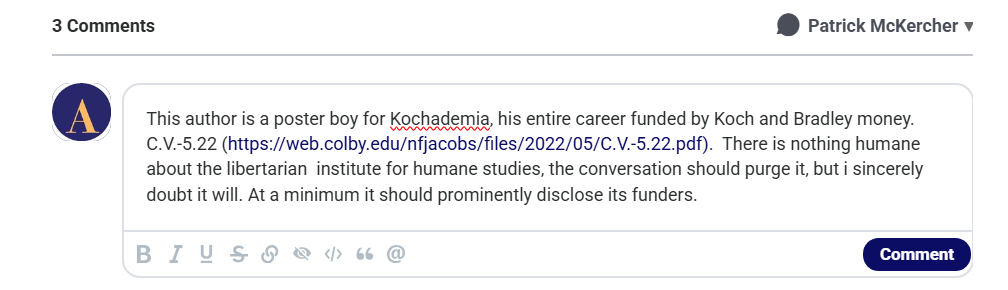
AN 6 26 HHMN COLBY IHS KOCHSUCKER
KOCH INCUBATOR
...
Research Fellowships Adam Smith Fellow, Mercatus Center at George Mason University 2017-2019 Beeke-Levy Fellowship, Franklin and Eleanor Roosevelt Institute 2018 Moody Foundation Research Fellow, Lyndon B. Johnson Presidential Library 2018 Humane Studies Fellowship, Institute for Humane Studies 2018 Arthur M. Schlesinger, Jr. Fellowship, John F. Kennedy Presidential Library 2017 Jack Miller Center Summer Fellow 2015 President's Fellowship, University of Virginia 2014-2019 Research Grants ARENA Centre for European Studies, SINGLEMARKETS 2022 McVey Data Science Initiative, Colby College 2021 Special Projects Initiative, Provost's Office, Colby College 2020 Hayek Fund for Scholars, Institute for Humane Studies 2020 Double-Hoo Undergraduate and Graduate Research Award, UVA 2018 Institute for Humane Studies Research Grant 2018 Graduate School of Arts and Sciences Council Competitive Research Grant, UVA 2018 Institute for Humane Studies Scholarship 2017 Conference and Travel Grant, American Political Science Association 2017, 2019 Bradley Fellowship, The Lynde & Harry Bradley Foundation 2015- 2017 AHSS Summer Research Award, UVA 2016 Department of Politics Research Grant, UVA 2016
....
nstructor of Record - Undergraduate Courses Introduction to American Politics Introduction to American State and Local Politics Concepts and Methods of Political Science Research Politics of Public Policy in the United States Law and Lawlessness in American Politics The American Presidency American Political Development Reinventing the Constitution for the 21st Century: Senior Seminar
Teaching Fellowships and Grants
Davis Artificial Intelligence Institute, Colby College 2021 Teaching Active Learning @ Colby Fellowship 2020 Teaching Inequality, Goldfarb Center at Colby College 2020
...
Nicholas Jacobs does not work for, consult, own shares in or receive funding from any company or organization that would benefit from this article, and has disclosed no relevant affiliations beyond their academic appointment.
this is from TC?
How much can free peoples achieve?
That question has animated the Institute for Humane Studies since 1961. Founded by Dr. F. A. “Baldy” Harper, a former economics professor at Cornell University, IHS was formed against a backdrop of a world still recovering from two world wars, widespread physical and economic devastation, and the early years of the Cold War. Construction of the Berlin Wall began just a few months after our doors opened.
From the beginning, IHS has advanced the frontiers of political, economic, cultural, and intellectual freedom. That has meant gathering and supporting generations of the world’s leading minds within the liberal tradition. When, in the 1970s, Soviet communism deprived millions of their lives and livelihoods, the Nobel-winning economist Friedrich Hayek was elaborating alternatives from our offices.
Today, with surging illiberalism at home and abroad threatening these same liberties and the human progress they unleash, IHS provides the rare spaces where liberals of all stripes—left, classical, and conservative—can unite behind the principles of freedom and human flourishing.
Though the world has changed much since our founding, IHS’s commitment to the principles of the liberal tradition hasn’t wavered. Nearly 65 years later, we’re still welcoming the dreamers and radicals and scholars working toward a freer, more prosperous, and more peaceful world.
BUSTED ON THIS
Since 2016, when Donald Trump shattered the Democrats’ blue wall by winning working-class voters across the Midwest, a cottage industry has sprung up on the left dedicated to answering a single question: How can Democrats win back the working class?
The answers come in different forms. Sometimes it is veteran Vermont Sen. Bernie Sanders – barnstorming red districts, railing against oligarchy and corporate greed.
Or it’s Connecticut Sen. Chris Murphy, who after the 2024 election declared, “Democrats must reclaim our identity as the party of the working class.”
Or the answer comes from a new generation of candidates – tattooed veterans, mechanics, bartenders – whose biography is supposed to do the political work that policy has not.
Graham Platner, the Maine Senate candidate who has become the left’s latest blue-collar savior, put the theory in its most unguarded form.
“We are in a form of class war,” he says. “And if the Democratic Party is going to have a future with working people, it needs to pick the side of working people.”
How does he define the working class? “Essentially everybody who isn’t making all their money on an immense amount of wealth.”
The theory is all the same: Somewhere out there is a latent working-class majority, held together by shared economic grievances, waiting to be politically reassembled to vote for Democrats. The New Deal did it – Democrats can do it again.
I’m a political scientist who has written extensively about rural and working-class communities. I believe it is an open question whether these reformist Democrats are really interested in understanding working-class voters on their own terms. Because working-class voters, as they tell us themselves, are not simply waiting to be activated by the right program, the right messenger, the right phrase. “Fight the oligarchy” probably isn’t going to do it.
Working-class voters have a worldview. For 50 years, it has been growing less compatible with the Democratic Party’s – not because working-class voters changed, but because Democrats did.
Working-class identity
Since the early 1950s, the American National Election Studies has asked respondents whether they think of themselves as members of the working class. This article uses my analysis of that data.
While a larger proportion of the electorate has obtained a college degree and household incomes have risen, the share of Americans who consider themselves working class has remained remarkably stable: roughly 35% of voters for the past 70 years, 38% in 2024.
Working-class identity is something more durable and culturally grounded than a description of who isn’t a billionaire. It is a specific way of looking at the world.
There are conventional ways to define the working class, but they often miss how people understand their own place in society. In the 2024 American National Election Studies, for example, 21% of those who identify as working class have a college degree, only 5% belong to a private-sector union, and 37% own stocks. Conversely, most Americans without a college degree do not identify as working class.
Working-class voters have never been a predominantly Democratic group – not even at the height of the New Deal coalition. Based on the American National Election Studies self-report measure, the working-class share of the Democratic coalition peaked around 56% in 1960 and has fallen more or less continuously since, sitting at just about 30% today.
Meanwhile, the share of working-class voters who identify as Democrats has been declining for half a century: A majority did so in 1958, but not since.
Working-class voters have not become Republicans. Only in 2020 and 2024 – the first time in the survey’s history – did more working-class voters identify as Republican than Democrat, and even then by narrow margins.
The data shows a working class that is politically homeless: estranged from the Democrats, not captured by the Republicans, stuck in the middle with diminishing attachment to either party.
Economic abandonment
So what drove them out?
A segment of the progressive left has a ready answer: Democrats abandoned working-class voters economically – on trade, wages and industrial policy. Working-class voters responded rationally. Fix the economics and the coalition comes back.
Trade is where the argument is strongest. In 1988, roughly 74% of both Democrats and working-class voters groups favored limits on imports to protect American jobs.
By 2024, only 26% of Democrats favored limits, while a majority – 54% – of working-class voters continued to do so.
Unlike most Democrats, many working-class communities do not see globalization in their interest. Running alongside the trade gap is a widening divide over values that no tariffs can fix.
What fairness requires
In 1984, Democrats and working-class voters broadly agreed that treating people more equally would mean fewer social problems. A divergence opened after 2008 and accelerated after 2016, with Democrats now 28 points more likely than working-class voters to think we should worry more about equality.
In 1986, half of mainstream Democrats and a slightly smaller percentage of working-class voters agreed with the idea that Black Americans don’t succeed because they don’t try hard enough. By 2024, Democratic agreement had collapsed to 13%. Working-class voters declined too, but to 32%.
The gap that opened between them is not primarily a story about rising working-class racial resentment. It is a story about the Democratic Party’s rapid post-2008 shift toward a worldview that places far greater explanatory weight on structural barriers and far less on individual effort and personal responsibility.
Working-class voters, who historically have understood their own lives through a framework of hard work and earned reward, did not shift so dramatically.
Alignment becomes division
On cultural questions, the pattern persists: Working-class voters did not move right in reactionary revolt. Democrats moved left.
In 1986, similar levels of Democrats and working-class voters agreed with the statement “This country would have many fewer problems if there were more emphasis on traditional family ties.” By 2024 a 25-point gap emerged.
On whether religion is an important part of their life: a near-zero gap through the early 1990s, but 17 points by 2024. On abortion, a 3-point gap in 1980 became 30 points in 2024. Regarding whether immigration levels should be increased, the two groups were virtually identical in 2000 – around 8% support – but by 2020 Democrats were at 48%, working-class voters at 24%.
But even where working-class voters nominally agree with a Democratic policy goal, they don’t trust the institution being asked to deliver it – a distrust decades in the making.
How the ‘system’ plays
In 1958, working-class voters and Democrats were within 5 points of each other on whether government wastes a lot of tax money. By 2024 that gap reached 27 points – not because working-class voters lurched toward anti-government extremism, but because mainstream Democrats became dramatically more trusting of government as an instrument of social change.
Working-class voters are 17 points more likely than Democrats to say people like them have no say in what government does. In 2024, 88% of working-class voters and 75% of Democrats said government is run by a few big interests. Both groups agree the system is captured.
Yet the Democratic policy response, invariably, is to expand the system.
On support for expanding government – from healthcare to jobs to environmental programs – Democrats and working-class voters have diverged dramatically since the 1980s. By 2024, there were approval gaps of between 20 and 30 points on providing government health insurance, environmental spending and a guaranteed jobs program.
On every major plank of the progressive economic agenda, Democrats are now substantially to the left of the workers they claim to champion.
Not all class war
Working-class voters have been telling pollsters for 60 years that the political system doesn’t hear them. Democrats, over the same period, have grown more comfortable with the institutions working-class voters have increasingly less faith in.
This distrust is the accumulated residue of specific experiences: deindustrialization that happened on government’s watch, trade deals that economists endorsed and workers paid for, a 2008 financial crisis response that saved the banks and foreclosed on their homes, an opioid epidemic that regulators missed entirely.
To be fair, this is precisely what the new crop of reform candidates say they want to fix. The argument that the right candidate can move the needle is not crazy. Candidate quality matters. Personal trust can substitute for institutional trust, at least at the margins.
But economic grievance politics is a very small slice of what working-class voters are telling us. The data documents a comprehensive, decades-long divergence in how working-class voters and mainstream Democrats understand fairness, government, personal responsibility and social change.
Reducing that to class war jams working-class voters into a prefabricated progressive agenda rather than taking seriously what they are actually saying.
Nicholas Jacobs, Goldfarb Family Distinguished Chair in American Government, Colby College; Institute for Humane Studies
This article is republished from The Conversation under a Creative Commons license. Read the original article.
nota bene the affiliation page is TC, not AN
Institute for Humane Studies on The Conversation
---
6 26 MANY MORE
May 22, 2026
Cuba needs a long‑term solution to its energy crisis
Luisa Blanco, Pepperdine University; Institute for Humane Studies and Isabella Elias, Pepperdine University
Short-term humanitarian aid won’t go far in alleviating Cuba’s long-term energy crisis.
May 18, 2026
Dark patterns on the web are designed to manipulate you – why aren’t they all illegal?
Gregory M. Dickinson, University of Nebraska-Lincoln; Institute for Humane Studies
Encountering a website that seems like it was designed to frustrate might leave you saying ‘there oughta be a law,’ but to have a case you need to show that the site tried to swindle you.
April 17, 2026
Trump sidelined Congress’ authority over war on Iran – and lawmakers allowed it, extending a 75‑year trend
Sarah Burns, Rochester Institute of Technology; Institute for Humane Studies and Robert Haswell, Carleton University
Congress has refused to exercise oversight of the Iran war, with Republicans nixing Democrats’ attempts to exercise legislators’ power over military engagements. That’s nothing new.
April 14, 2026
Industries most exposed to AI are not only seeing productivity gains but jobs and wage growth too
Christos Makridis, Arizona State University; Institute for Humane Studies
Estimates of artificial intelligence’s impact on jobs and the economy range from the apocalyptic to the utopian, but the data tells a more nuanced story.
March 26, 2026
Supreme Court’s tariff decision still leaves a ‘mess’ for companies trying to grab refunds
Peter R. Crabb, Northwest Nazarene University; Institute for Humane Studies and Alison Graham Larson, Northwest Nazarene University
Companies that had sued for tariff refunds are taking different approaches to getting their money back – or quitting the effort.
March 25, 2026
New federal student loan limits affect social work graduate students, with impacts for survivors of domestic violence in Colorado and elsewhere
Kaitlyn M. Sims, University of Denver; Institute for Humane Studies; Kaelyn Lara, University of Denver, and Leslie Carvalho, University of Denver
The status change may result in students avoiding degrees in nursing and social work.
March 5, 2026
We designed an AI tutor that helps college students reason rather than give them answers
Saharnaz Babaei-Balderlou, University of Wisconsin-La Crosse and Shishir Shakya, Appalachian State University; Institute for Humane Studies
A 2025 study shows that an AI-based tutor improves learning when it prompts reasoning and is paired with peer discussion.
March 5, 2026
Congress once fought to limit a president’s war powers − more than 50 years later, its successors are less willing to assert their authority
Sarah Burns, Rochester Institute of Technology; Institute for Humane Studies
At the tail end of the Vietnam War, Congress engaged in a breathtaking act of legislative assertion, affirming that lawmakers held the power to declare war – not the president.
February 27, 2026
Drug company ads are easy to blame for misleading patients and raising costs, but research shows they do help patients get needed treatment
Anna Chorniy, Icahn School of Medicine at Mount Sinai; Institute for Humane Studies
Officials and policymakers say direct-to-consumer drug advertising encourages patients to seek treatments they don’t need and raises heath care costs, but the true picture is more nuanced.
February 10, 2026
Local governments provide proof that polarization is not inevitable
Lauren Hall, Rochester Institute of Technology; Institute for Humane Studies
Partisan debates are less heated at the local level, providing lessons that might help calm the waters nationally.
February 3, 2026
Federal power meets local resistance in Minneapolis – a case study in how federalism staves off authoritarianism
Nicholas Jacobs, Colby College; Institute for Humane Studies
State resistance to federal immigration enforcement in Minnesota illustrates how federalism keeps authority divided and disputed.
January 30, 2026
I’m a former FBI agent who studies policing, and here’s how federal agents in Minneapolis are undermining basic law enforcement principles
Luke William Hunt, University of Alabama; Institute for Humane Studies
A policing scholar and former FBI special agent lays out the established principles of policing and constitutional law that govern how federal immigration enforcement efforts should be carried out.
January 29, 2026
Colorado has emergency domestic violence shelters in only half its counties, leaving survivors without safe housing options
Kaitlyn M. Sims, University of Denver; Institute for Humane Studies
A lack of shelters and affordable housing means survivors of domestic violence have few places to go.
January 21, 2026
Opera is not dying – but it needs a second act for the streaming era
Christos Makridis, Arizona State University; Institute for Humane Studies
Updated management practices and monetized digital production could help opera companies rely less on subscriptions and big donors for revenue – bolstering budgets.
January 14, 2026
Searching reporters’ homes, suing journalists and repressing citizen dissent are well‑known steps toward autocracy
Konstantin Zhukov, Indiana University; Institute for Humane Studies
President Donald Trump’s threats against independent media and free speech look a lot like the actions of autocrats elsewhere intent on undermining the institutions meant to keep them in check.
December 12, 2025
A Colorado guaranteed income program could help families, but the costs are high
Jennifer C. Greenfield, University of Denver; Kaitlyn M. Sims, University of Denver; Institute for Humane Studies, and Stefan Chavez-Norgaard, University of Denver
A few hundred extra dollars a month would go a long way for many Coloradans.
December 3, 2025
Federal funding cuts are only one problem facing America’s colleges and universities
Roger Meiners, University of Texas at Arlington and Andrew P. Morriss, Texas A&M University; Institute for Humane Studies
Amid federal funding cuts, the enrollment of both domestic and foreign students is falling at American colleges and universities.
December 2, 2025
Why protecting Colorado children from dying of domestic violence is such a hard problem
Kaitlyn M. Sims, University of Denver; Institute for Humane Studies
Lethal domestic violence is persistent, despite a statewide decline in overall homicides.
November 20, 2025
Farmers – long Trump backers – bear the costs of new tariffs, restricted immigration and slashed renewable energy subsidies
Kee Hyun Park, Nanyang Technological University; Institute for Humane Studies and Shannon P. Carcelli, University of Maryland
In the past, farmers have balanced their political beliefs against market logic. How much pressure can farmers endure?
---
NO Links
Visit theihs.org/
Are you an expert from this institution? Register to write
Article Feed
Authors
Adrian Lucardi
Associate Professor of Political Science, ITAM (Mexico); Institute for Humane Studies
Alasdair S. Roberts
Professor, School of Public Policy, UMass Amherst; Institute for Humane Studies
Alexander J. Stewart
Associate Professor of Informatics, Indiana University; Institute for Humane Studies
Andrew A. Schwartz
DeMuth Chair of Business Law, University of Colorado Boulder; Institute for Humane Studies
Andrew P. Morriss
Professor, Bush School & School of Law, Texas A&M University; Institute for Humane Studies
Anna Chorniy
Assistant Professor of Pediatrics, Icahn School of Medicine at Mount Sinai; Institute for Humane Studies
Ben Stickle
Professor of Criminal Justice Administration, Middle Tennessee State University; Institute for Humane Studies
Brandon L. Garrett
David W. Ichel Distinguished Professor of Law, Duke University; Institute for Humane Studies
Brian Fitzpatrick
Professor of Law, Vanderbilt University; Institute for Humane Studies
Christos Makridis
Associate Research Professor of Information Systems, Arizona State University; Institute for Humane Studies
Chris W. Surprenant
Professor of Ethics, Strategy, and Public Policy, University of New Orleans; Institute for Humane Studies
Ernesto Castañeda
Professor, and Director, Center for Latin American and Latino Studies, American University; Institute for Humane Studies
Georgi Gardiner
Associate Professor of Philosophy and Fellow of the University of Tennessee Humanities Center (UTHC), Tulane University; Institute for Humane Studies
Gregory M. Dickinson
Assistant Professor of Law, University of Nebraska-Lincoln; Institute for Humane Studies
Jennifer Lynn McCoy
Professor of Political Science, Georgia State University; Institute for Humane Studies
Jessica Flanigan
Professor of Leadership Studies and Philosophy, Politics, Economics and Law, University of Richmond; Institute for Humane Studies
Joan Ricart-Huguet
Assistant Professor, Loyola University Maryland and Postdoctoral Associate and Lecturer, Yale University; Institute for Humane Studies
John Iceland
Professor of Sociology and Demography, Penn State; Institute for Humane Studies
Jonathan Spiegler
PhD Student in Political Science, Michigan State University; Institute for Humane Studies
Kaitlyn M. Sims
Assistant Professor of Public Policy, University of Denver; Institute for Humane Studies
Kaleb Demerew
Assistant Professor of Political Science, West Texas A&M University; Institute for Humane Studies
Kee Hyun Park
Assistant Professor of International Political Economy, Nanyang Technological University; Institute for Humane Studies
Konstantin Zhukov
Assistant Professor of Economics, Indiana University; Institute for Humane Studies
Lauren Hall
Professor of Political Science and Associate Dean, Rochester Institute of Technology; Institute for Humane Studies
Luisa Blanco
Professor of Public Policy, Pepperdine University; Institute for Humane Studies
Luke William Hunt
Associate Professor of Philosophy, University of Alabama; Institute for Humane Studies
Matthew E. Kahn
Provost Professor of Economics and Spatial Sciences, USC Dornsife College of Letters, Arts and Sciences; Institute for Humane Studies
Matthew Levendusky
Professor of political science, University of Pennsylvania; Institute for Humane Studies
Nicholas Jacobs
Goldfarb Family Distinguished Chair in American Government, Colby College; Institute for Humane Studies
Peter R. Crabb
Professor of Finance and Economics, Northwest Nazarene University; Institute for Humane Studies
Rachel Wahl
Associate Professor of Education, University of Virginia; Institute for Humane Studies
Robert Boatright
Professor of Political Science, Clark University; Institute for Humane Studies
Rohan Shah
Assistant Professor of Economics, University of Mississippi; Institute for Humane Studies
Ryan D. Griffiths
Professor of Political Science, Syracuse University; Institute for Humane Studies
Ryan Muldoon
Associate Professor of Philosophy, University at Buffalo; Institute for Humane Studies
Sarah Burns
Associate Professor of Political Science, Rochester Institute of Technology; Institute for Humane Studies
Shishir Shakya
Assistant Professor of Economics, Appalachian State University; Institute for Humane Studies
Ting Zhang
Research Scholar of Orthopedics, University of Pittsburgh; Institute for Humane Studies
William J. Luther
Assistant Professor of Economics, Florida Atlantic University; Institute for Humane Studies
==
$25,386,167 from Koch foundations, 1997-2014
The Institute for Humane Studies at George Mason University offers scholarships and career training to libertarian students. Charles Koch is the Chairman of the IHS board of directors.
IHS is a member of the [State Policy Network](http://www.greenpeace.org/usa/en/campaigns/global-warming-and-energy/polluterwatch/koch-industries/state-policy-network-spn/?utma=1.834972712.1309880319.1345146585.1345148660.342&utmb=1.1.10.1345148660&utmc=1&utmx=-&utmz=1.1345137232.339.249.utmcsr=google|utmccn=%28organic%29|utmcmd=organic|utmctr=%28not%20provided%29&utmv=-&__utmk=254992904).
In a recent article, Mother Jones called the Institute for Human Studies a “haven for climate change deniers.” Several climate deniers have prominent positions at IHS, including: Robert Bradley, member of the Academic Review Committee and author of *Climate Alarmism Reconsidered* (2003); and Fred Singer, Research Professor at IHS.
A number of climate deniers who share affiliation with other Koch-funded organizations are guest lecturers for IHS. Examples include Bruce Yandle of Clemson University, among Charles Koch’s most-funded universities, who also serves as Senior Associate with the Property and Environment Research Center (PERC). Another example is Kenneth Green, Resident Scholar with the American Enterprise Institute (AEI) and the defunct Environmental Literacy Council, a group that pushed for teachers to present climate science as controversial.
http://www.greenpeace.org/usa/global-warming/climate-deniers/front-groups/institute-for-humane-studies-ihs/
==
The Institute for Humane Studies (IHS) is also a pet project of Charles Koch. IHS had revenue of almost $10 million last year, largely from his foundation, and spent almost $9 million to advance Charles' ideological agenda through projects like the "Koch Summer Fellowship."
IHS is also part of Koch's homage to F.A. Hayek,whose "Road to Serfdom," has been extolled by right-wingers who claim America is on that "road" and who have drunk the Koch Kool-Aid on what it calls the "free market" but what is really a corrupt form of crony capitalism that has undermined the U.S. economy.
Some followers of Hayek and of the immorality of :{Ayn Rand [26] have absurdly claimed that everything from Social Security to public schools to taxpayer-funded firefighters are signs that the U.S. is on the brink of communism. Such wild-eyed condemnations of American institutions might sound eerily reminiscent of big daddy Fred Koch's irrational screeds advancing the paranoid worldview of the John Birch Society, which in some ways has been re-born in the "Tea Party," with the help of two of Fred's sons, apples that did not fall far from the tree.}:
---
Koch and George Mason University
Funding and Connections
Since 1985, George Mason University (GMU), and its associated institutes and centers, has received more funding from the Koch Family Charitable Foundations than any other organization--a total of $29,604,354. The George Mason University Foundation has received the most funding, $20,297,143, while the Institute for Humane Studies has been directly given $3,111,457, the Mercatus Center $1,442,000, and George Mason University itself has received $4,753,754.
In addition to financial ties, Koch also has personnel involved with the university. Richard Fink, the vice president of Koch Industries, Inc., and the former president of the Charles G. Koch Foundation and the Claude R. Lambe Foundation, serves on the board of directors of the George Mason University Foundation and the Mercatus Center. Fink's connection to George Mason University is strong. Besides teaching at the university from 1980-1986, Fink has also served on a number of boards at the university including the Institute for Humane Studies and the Center for the Study of Public Choice, the Board of Visitors, and the Student Affairs Committee.
The Institute for Humane Studies
The Institute for Humane Studies (IHS) was founded by F.A. Harper in 1961 and has been associated with George Mason University since 1985. The mission of the IHS is "to support the achievement of a free society by discovering and facilitating the development of talented, productive students, scholars and other intellectuals who share a commitment to liberty and who demonstrate the potential to change significantly the current climate of opinion to one more congenial to the principles and practices of freedom." The Institute for Humane Studies provides $600,000in scholarships each year.
According to SourceWatch, the IHS acts as "a libertarian talent scout, identifying, developing, and supporting the brightest young libertarians it can find who are intent on a leveraged scholarly, or intellectual, career path." In addition to the funding it receives from the Koch Family Foundations, the Institute for Humane Studies also receives donations from conservative foundations such as the Carthage Foundation, the Sarah Scaife Foundation, and the Lynde and Harry Bradley Foundation.
IHS Internships
Charles Koch is the chairman of the Institute for Humane Studies. Every year the IHS hosts the Charles G. Koch Summer Fellow Program which offers an internship in public policy. The internship is a ten-week program that includes an opening seminar, the internship, and a closing seminar. The opening seminar involves lectures on public policy analysis, classical liberalism, and "persuasive communication."
The internship entails working at a public policy think tank, either at the state or national level.�� Placement organizations include the American Enterprise Institute, the Cato Institute, the Mercatus Center, the National Center for Policy Analysis, and the Institute for Justice. Policy interns may tackle a number of issues including environmental policy.
The Institute for Humane Studies also offers a journalism internship for which it seeks "writers for liberty." No formal training in journalism is required and the internship offers a choice of three program areas: investigative, print, and broadcast.
The internship starts with a week-long seminar on journalism and free society, followed by a placement at different locations. Previous placements for print journalist interns have included the Pittsburgh-Tribune--owned by Richard Scaife, who is considered to be one of the founding fathers of the conservative movement in the U.S. Placements for interns in broadcast journalism have included FOX News.
The Institute for Humane Studies and Politopia
The Institute for Humane Studies also runs the website Politopia: The Land of Custom-Made Government. The purpose of this website is to promote a new political model that is different from the "old" left/right political model. In this model, politics are placed in the magical land of Politopia where, depending on where you live (north, west, east, or south), the politics of the land are different.
Politopia is presented as an unbiased educational tool. However, in its model, the role of the government in economic affairs decreases as one moves into the north, and increases as one moves farther south. Similarly, the government's role in an individual's daily affairs decreases as one moves west and increases as one moves east.
Historically, the geopolitical terms "west" and "north" have been identified with prosperity, freedom, affluence, industry, and development; whereas the terms "east" and "south" have been associated with poverty, oppression, communism, failure, disease, and insignificance. Interestingly, Politopia places libertarian and conservative values in the more "ideal" regions of the world.
The Mercatus Center
The Mercatus Center is a conservative think tank located at George Mason University. It is a sister organization to the Institute for Humane Studies. The Mercatus Center was originally founded at Rutgers University by Richard Fink in the late 1970s, under the name the Center for Market Processes.
Koch Industries began funding the organization when it moved to George Mason University in the 1980s, and still finances the centre today. In 1999, the organization was renamed the Mercatus Center. Charles Koch and Richard Fink serve on its board of directors.
The Mercatus Center believes that a gap exists between economic understanding and real-world decision and policy making. Its mission, therefore, is to bridge that gap and to "provide policy makers with the economic tools to make sense of today's most pressing issues."
The Wall Street Journal has called the Mercatus Center "the most important think tank you've never heard of," and SourceWatch identifies the Mercatus Center as "one of the best-funded think tanks in the United States at the moment." From 1999-2006, the Mercatus Center received a total of $2,670,662 in funding from conservative organizations, including $1.44 million from the Koch Family Charitable Foundations. Furthermore, between the years 2003 and 2007 the Mercatus Center received $160,000 in funding from ExxonMobil.
The Mercatus Center and Lobbying
According to PublicIntegrity.com, the Mercatus Center regularly lobbies in the federal government, including providing lawmakers with "Capitol Hill breakfasts and luncheons hosted by deregulation scholars." Mercatus has been an effective machine for pushing Koch's conservative political and economic values.
The Mercatus Center explicitly states that it does not engage in lobbying, and definitely "does not employ nor retain any registered lobbyists." However, in 2005 Ohio Congressman Bob Ney, who has travelled on 19 occasions at the expense of the Mercatus Center, proposed a bill to amend the Clean Air Act. Ney's bill called for the Secretary of Energy to build fifteen new oil refineries and sell them to private companies. Ney's amendment not only fell in line with the position of the Mercatus Center, which had been trying to weaken the Clean Air Act, but it also seemed to benefit Koch Industries, Inc.--the largest private oil company in the United States and the Mercatus Center's largest beneficiary.
Lobbying rules stipulate that any organization that spends more than $24,500 within a six-month period trying to influence government representatives, must register itself as a lobbying group. In both 2004 and 2005, the Mercatus Center spent over $55,000 on congressional travel. Furthermore, between 2000 and 2005 Mercatus spent $227,000on more than 400 trips by government officials and their aides. The Mercatus Center has never registered itself as lobbying group.
The Mercatus Center and The Clean Air Act
In 2002 the Mercatus Center led a focused attack on the Clean Air Act. This attack was led by Mercatus Center Distinguished Senior Scholar,Wendy Gramm. Gramm, who is an ardently opposes regulation in the energy sectors, asked for the reassessment of 44 of the Clean Air Act's federal regulations. Regulations included in the Mercatus Center's requests for review were: national public health standards for smog and soot, and standards for tailpipe exhaust pollution from gasoline vehicles, diesel vehicles, and heavy diesel trucks. As the non-profit group, Clean Air Trust highlighted, "Gramm would like to pull the plug on virtually every effective air pollution cleanup measure adopted in recent years."
---
abetterearth.org 404 essay content on how ESA failed http://www.free-4u.com/abetterearth_essay_contest.htm
---
Few conservative activists went on to achieve the fame JAMES O’Keefedid for the 2009 sting he pulled with fellow activist Hannah Giles, posing as a pimp and prostitute inside ACORN offices, and secretly taping the advice they received. In the week since O’Keefe and three colleagues were arrested for apparently tampering with phones in the New Orleans office of Sen. Mary Landrieu (D-La.), national reporters have trained their eyes on organizations like the Collegiate Network and the Leadership Institute.
TheCNalso gave a grant to the Patriot (George Washington University) and The Counterweight (University of Minnesota-Morris), where O’Keefe’s accomplices Stan Dai and Joseph Basel, respectively, had worked in college. The Leadership Institute employed O’Keefe for a year to train conservative activists; while there, he formed a friendship with Ben Wetmore, another veteran campus conservative who put up the four activists at his home before the Landrieu escapade. But any attempt to make them the faces of conservative college journalism, argued Longwell, would be off-base.
“From what he’s said and what he’s doing, O’Keefe strikes me as an ideologue,” said Longwell. “To use him to define conservative campus journalism is silly.”
[BERMAN]
Longwell has gained some perspective on this. In 2005, she left the Intercollegiate Studies Institute–the umbrella organization that runs CN–for Berman and Company, a free-market public relations firm in Washington that aggravates liberals with dogged, smart-alecky campaigns against their causes. Also joining Berman was Justin Wilson, once the editor of CN’s paper at the University of Michigan, then another program director at CN. Both later worked with Bret Jacobson, formerly the editor of the CN’s paper at the University of Oregon. (Before she came to CN, Longwell worked at a CN paper at Kenyon College.)
In the years since, all three of them helped out with a punchy campaign against the Employee Free Choice Act–legislation that would make it easier for workers to form unions–at Berman’s Center on Union Facts. That campaign included ads that portrayed union organizers as thugs and undercover videos��conducted with more subtlety than O’Keefe, who would pose in costume–that captured union strategists shifting their strategy. One measure of how successful Berman and Company was at frustrating Democrats came when the late Sen. Ted Kennedy (D-Mass.) angrily ripped up one of the firm’s anti-EFCA newspaper ads in front of a cheering crowd of union workers.