stand together
---
incubator?
REBRAND? PASS THRU?
VOTER SUPPRESS?
MEDICARE?
amy swearer gun vs katie porter
Stand Together Fellowships also Fdn
SEE ABUNDANCE THIEL LONSDALE
Philanthropic Fundraising Services 10,190 followers
See all 12 employees on LinkedIn
VS COC?
If you are a social entrepreneur focused on tackling society's biggest challenges, apply for the Koch Associate Program today and unlock your full potential.
---
---
AI Overview
Tyler Cowen, Joe Lonsdale, and Stand Together are prominent figures and organizations driving the "Abundance Agenda", a cross-ideological movement focused on solving modern challenges—like sluggish economic growth, housing shortages, and over-regulation—by actively increasing the supply of innovation, technology, and foundational infrastructure. [1, 2, 3, 4]
The core connection between these thinkers, the foundation, and the abundance movement centers on the following key areas:
- Joe Lonsdale and Regulatory Reform
Joe Lonsdale and his network are actively pushing to dismantle bureaucratic barriers that slow down technological progress. Through the Abundance Institute and Stand Together Trust, Lonsdale helped raise funds to embed teams of "elite AI-native engineers" directly into federal agencies like the FDA. The goal is to slash review times for life-saving drugs and bring American regulatory speeds in line with international competitors. [1, 2, 3, 4]
- Tyler Cowen and Productivity
Economist Tyler Cowen popularized the concept of the "Great Stagnation", arguing that America went through a decades-long slowdown in technological progress. To combat this, he has been a major proponent of the "abundance agenda," championing robust economic growth, techno-optimism, and the swift integration of Artificial Intelligence to boost human productivity and cure long-term societal complacency. [1, , 3, 4, 5]
- The Stand Together Network
The philanthropic network Stand Together (founded by Charles Koch) provides strategic support and capital to organizations that bypass partisan stalemates to focus on practical, supply-side solutions. By partnering with thinkers like Cowen and entrepreneurs like Lonsdale, Stand Together advocates for dismantling self-imposed scarcity to foster abundance in energy, housing, healthcare, and technology. [1, 2, 4, 5]
[### America Needs More Techno-Optimism, with Marc ...

YouTube · a16z
23.5K+ views · 2 years ago](https://www.youtube.com/watch?v=rr3ErEa0kKA)
31:04
In this fireside chat, a16z Cofounder and General Partner Marc Andreessen sits down with economist, podcaster, and polymath Tyler Cowen to ...
Missing: STAND TOGETHER ABUNDANCE
[### The tech right and the MAGA right

Marginal REVOLUTION
https://marginalrevolution.com › 2025/06 › the-tech-rig...](https://marginalrevolution.com/marginalrevolution/2025/06/the-tech-right-and-the-maga-right.html)
Jun 20, 2025 — The tech right and the MAGA right. by Tyler Cowen June 20, 2025 at 12:30 am in. Current Affairs · Political Science.Read more
[### The rise of the abundance faction

Niskanen Center
https://www.niskanencenter.org › the-rise-of-the-abund...](https://www.niskanencenter.org/the-rise-of-the-abundance-faction/)
Jun 4, 2024 — By working within a party, the new supply-siders can boost their cause — and pull us away from left-right polarization.Read more
Missing: LONSDALE | Show results with: LONSDALE
[### American Optimist: Joe Lonsdale

Joe Lonsdale: American Optimist
https://www.americanoptimist.com](https://www.americanoptimist.com/)
When we work together toward an optimistic vision of the future, anything is possible. ... Tyler Cowen is a professor, best-selling author, blogger, podcaster, ...Read more
---
GGL 626
AI Overview
Joe Lonsdale, through the Abundance Institute and in partnership with Stand Together, champions an "Inclusive Abundance" economic framework. This movement actively pushes for regulatory reforms and technological acceleration across AI, biotech, and government administration to unlock human potential. [1, 2, 3, 4, 5]
Key Initiatives & Stances
- FDA Overhaul: Lonsdale raised millions to fund an "AI-native strike team" of software engineers and data scientists to place inside the FDA, aiming to cut red tape and accelerate clinical development. [1, 2, 3]
- Abundance Agenda: Both organizations support an innovation-driven economy, emphasizing that society can grow by solving big problems rather than operating on a zero-sum mentality. [1, 2]
- Tech Advocacy: Lonsdale regularly advocates for American competitiveness, supporting policies that foster fast and inclusive growth across technology sectors. [1, 2, 3]
Related Platforms & Perspectives
- To learn more about this philosophy, read the Inclusive Abundance Primer or explore the Stand Together Economy Issues page.
- Read Lonsdale’s original op-eds on pushing for these changes on his Joe Lonsdale Substack.
- Hear ongoing discussions about these and other technology policies directly on the American Optimist Podcast. [1, 2, 3]
===
milken
Brian is chairman and CEO of Stand Together and president of the Charles Koch Foundation. Previously, he served as executive director and chief operating officer of the Mercatus Center at George Mason University. Brian was named to the 2021 TIME100 Next list, featuring leaders who are shaping the future of their fields. He is co-author with Charles Koch of Believe in People: Bottom-Up Solutions for a Top-Down World. Brian serves on several boards, including the Mercatus Center, Institute for Humane Studies, Reason Foundation, and the Just Trust.
---
AI Overview ggl 6 26 pluralism bot up bs
Brian Hooks is the chairman and CEO of Stand Together and the president of the Charles Koch Foundation. He oversees a massive network of philanthropic and advocacy organizations heavily backed by Charles Koch, focusing on education, community improvement, and public policy.  , 2]
The key entities and their specific roles within this ecosystem include:
- Stand Together: The overarching philanthropic community and non-profit network founded by Charles Koch. It partners with over 700 business leaders and philanthropists to tackle societal challenges—ranging from addiction and mental health to criminal justice reform—by taking a bottom-up, non-partisan approach. [1, 2,
 ,
 , 5]
- Brian Hooks: As the top executive, he directs the strategy for both Stand Together and the Charles Koch Foundation. He co-authored the national bestseller Believe in People: Bottom-Up Solutions for a Top-Down World alongside Charles Koch and was named a TIME100 Next honoree. [1, 2]
- Institute for Humane Studies (IHS): A non-profit higher education organization that receives funding from the Charles Koch Foundation to support university professors, scholars, and students advancing the principles of freedom and classical liberalism. Hooks serves on the IHS board of directors. [1, 2, 3]
---
cmd
Koch Network Uses National Philanthropic Trust to Conceal Transactions - EXPOSEDbyCMD
Koch Network Uses National Philanthropic Trust to Conceal Transactions
|
August 11th, 2022
The National Philanthropic Trust helped Charles Koch’s tightly controlled network of nonprofits shield close to $100 million in donations and grants from public view between 2019 and 2021.
The Center for Media and Democracy (CMD) recently reported on the network’s 2019–20 finances, which ballooned to $2.2 billion in revenues in 2020, and the emergence of Chase Koch’s CCKC4 as a potentially major player on the U.S. political scene.
Despite receiving $1.2 billion in 2020, CCKC4 only disclosed making a single grant of $12.5 million to the National Philanthropic Trust (NPT). A massive donor-advised fund—independent from the Koch family—the NPT routes billions of dollars to thousands of charities, policy organizations, and nonprofits every year.
The NPT does not disclose its donors nor their designated recipients, an advantage it advertises to potential donors. While it does disclose the organizations it finances and some of its donors voluntarily disclose payments to the NPT, the information available makes it impossible to draw a line between specific donors and grantees.
This appears to be part of a recent trend. Corporate mega-donors use donor advised funds to anonymize funding to groups that influence policy making, including longtime climate change denial organizations with a history of support from the Koch family’s foundations.
CMD contacted a Koch Industries executive who serves as director of several of Charles Koch’s nonprofits for comment, but received no response.
“Having a 501(c)(4) make grants to a 501(c)(3) charity such as the Charles Koch Foundation or the National Philanthropic Trust is tax inefficient, as the 501(c)(4) is already exempt from tax and so does not need a charitable contribution deduction,” said Lloyd Hitoshi Mayer, a professor at the University of Notre Dame Law School. But “if the original, individual funder of the 501(c)(4) has already maxed out their charitable contribution deduction,” he added, “then it does not matter if they make a gift directly to a 501(c)(3) or have the 501(c)(4) do it instead.”
In recent years, the NPT also made major anonymous grants to two other organizations controlled by the Koch family.
One of those groups, Stand Together Trust, is central to Koch’s policy influence operation. Run by the Kochs and Koch Industries, it funds “social entrepreneurs” in education and a variety of public policy areas, and provides major financial support for Americans for Prosperity, Koch’s astroturf political advocacy group.
Annual grants from NPT to Stand Together Trust have soared from $1.05 million in 2019 to $9.75 million in 2020 and $20.15 million in 2021, according to a recent IRS filing obtained by CMD and previous filings compiled by ProPublica.
Another of Charles Koch’s organizations, the Stand Together Foundation, received more than $80 million from NPT between July 2019 and June 2021.
This philanthropic organization is focused on anti-poverty initiatives, but also serves to amplify Charles Koch’s free-market ideology. Virtually every grantee of the Foundation appears to be required to complete an “intensive six-month training designed to coach nonprofit leaders on business principles.” Called the Catalyst Program, it promulgates his trademarked business management philosophy, “Market-Based Management.”
Stand Together Foundation Key to Koch Rebranding Efforts
For the first eight decades of his life, Charles Koch was generally averse to charity. He preferred to send the vast majority of his “philanthropic” donations to political organizations that would advance his ideological and business interests, as Jane Mayer points out in her 2016 book Dark Money (pp. 147–148).
The Stand Together Foundation emerged publicly in 2015 as part of a public relations makeover in the wake of a decade of sustained public criticism of the Koch brothers’ business and political pursuits. Koch Industries was best known for its pollution, its support for climate change denial, its alleged theft of oil from the Osage Nation, and its pervasive political influence.
The rebrand appears to be working. In the past five years, Charles Koch and his staff have managed partnerships with musicians like and Guns ‘N’ Roses drummer . Celebrity athletes have also participated. Koch’s “Prime 5” collaboration involved retired football player Deion Sanders, and the LeBron James Family Foundation received a $575,000 grant from Koch’s Stand Together Chamber of Commerce in 2020. Charles Koch touts his collaboration with former political foe Van Jones, who allegedly thinks of his primary contact at Koch
 “
In sharp contrast, Koch’s historical political extremism—dating back to his work with the John Birch Society during the height of the Civil Rights Movement in the 1960s—continues unabated.
The Bill of Rights Institute, an organization operating out of Koch’s compound in Arlington, Virginia, was involved in efforts to whitewash the history of slavery in the U.S. in its lesson plans. Koch cash flowed to members of a network of neo-Confederates and white supremacists as recently as 2017. Since then, he has continued to support groups that manufacture hysteria over critical race theory, despite his public statements disavowing the trend.
Most recently, the Atlantic Council ceased its $4.5 million collaboration with the Charles Koch Institute after new staff hired from the Koch-founded Cato Institute advocated against focusing on Russia’s violations of human rights. This followed Koch Industries’ controversial refusal to discontinue its business operations in Russia immediately after Vladimir Putin ordered the invasion of Ukraine in February. By April, the company reversed its position following weeks of dogged investigations by journalist Judd Legum.
Still, many journalists seem less interested in scrutinizing Charles Koch’s controversial activities than they were during the Obama presidency. Whether or not his rebranding efforts have won over the media and the public, Charles Koch’s political operation and his influence continue to grow and spread as fast as his fortune.
*David Armiak contributed research to this report.
---
---
AP Published 7:16 AM PDT, September 29, 2021
DES MOINES, Iowa (AP) — As conservative political groups mobilize to ban in schools what they call critical race theory, one prominent backer of Republican causes and candidates is notably absent.
Leaders in the network built by the billionaire Koch family say they oppose government bans over teaching about race and history in schools. While they note they don’t agree with the ideas at the center of the fight, they argue the government bans, now enacted in 11 states, stifle debate essential to democracy.
“Using government to ban ideas, even those we disagree with, is also counter to core American principles — the principles that help drive social progress,” said Evan Feinberg, executive director of the Koch-affiliated Stand Together Foundation.
That position is in line with the network’s long-held libertarian streak. But it has sparked fresh charges of hypocrisy from the megadonor’s critics. After spending years pouring money into conservative groups, the Koch groups cannot distance themselves from the movement it helped build, they argue.
“They have this nice position they want to tout from a P.R. standpoint. But their money has gone to these groups that have the opposite effect on that agenda,” said Lisa Graves, board president for the liberal watchdog group Center for Media and Democracy.
The Koch organization first went public with its position last spring, as state lawmakers and conservative groups began passing legislation that bans from classrooms specific concepts, including the idea that racism is systemic in society and the U.S. legal system.
The efforts were prompted in part by backlash to The 1619 Project, a New York Times Magazine initiative aimed at rethinking the role of slavery in the nation’s history and development.
In a letter published in The Chronicle of Higher Education in May, Charlie Ruger, the Charles Koch Foundation’s vice president of philanthropy, described Republicans’ push to ban these concepts from schools as a gag on free expression.
“Both learning and research require openness to new ideas and the ability to argue productively,” Ruger wrote. “That requires standing against censorship.”
The Koch political behemoth — a multibillion-dollar umbrella of foundations and a political action committee — was built by brothers Charles and David Koch out of the family’s Kansas-based business empire during the 1980s and 1990s. Though David Koch died in 2018, the network has continued to pour hundreds of millions of dollars into organizations and politics that push for small government, lower taxes, deregulation, free speech, academic freedom and a conservative judiciary.
The organization’s opposition to the race and education bans has not kept the groups it has long supported out of the fight. In Wisconsin, parents seeking to recall school board members have received help this year from the Koch-supported Wisconsin Institute for Liberty and Law. The Milwaukee law firm received $310,000 from the Charles Koch Foundation for five years through 2019, the last year with public records available and before critical race theory flared as a GOP rallying point. The money was in the form of grants that were aimed at protecting free speech on college campuses, a Koch spokesman said.
The foundation and the Charles Koch Institute also contributed over the same period about $75,000 to State Policy Network, a conservative think tank that has promoted the bans. However, the grants, also before the 2021 wave of legislation, helped sponsor an annual meeting, an internship and a panel discussion on business, the Koch spokesman said.
Among the most prominent drivers behind the legislative bans was another Koch-backed group, the American Legislative Exchange Council. The Chicago-based conservative policymaking group provides model legislation for conservative lawmakers and has promoted measures to ban critical race theory in schools this year.
Stand Together and its related groups contributed $2.7 million to ALEC between 2015 and 2019.
None of it was targeted for limiting schools’ curriculum on history and race, and was awarded before the issue became a Republican priority, Stand Together spokesman Bill Riggs said.
In 2020, ALEC continued to receive money from two Koch foundations, donations that were earmarked for trade, regulatory and fiscal policy, as well as advocating free speech and providing scholarships, Riggs said.
Riggs did not disclose the 2020 total given. Only contributions through 2019 are searchable through publicly available tax documents. Contributions for 2020 won’t be available to the public until mid-November.
Riggs accused Koch critics of a “misinformation game” that suggests the network is secretly supporting a policy it does not. He noted Koch groups give to a broad spectrum of organizations that align with some of its founders’ values, if not all of their views.
The Charles Koch Foundation contributed to the Democratic-leaning Brookings Institution in 2018 and 2019 on issues related to foreign policy, Riggs said. Last year, the Koch network helped create Heal America, a faith-based program aimed at fighting “racial injustice with love and redemption,” according to its website. Dallas Mavericks owner Mark Cuban and television commentator Van Jones, a Democrat, have both participated in events.
Riggs declined to say whether the Koch network would refuse to contribute to groups supporting bans on teaching critical race theory, such as ALEC, noting it prescribes in grant agreements the purpose of the money. He also declined to say whether they would rethink support for political candidates who also back the policy.
The Koch-backed political action committee Americans for Prosperity Action spent at least $9.7 million backing North Carolina Republican Thom Tillis in his tough campaign for reelection to the Senate last year, according to Federal Election Commission reports.
Tillis was prominent sponsor of a measure this year to prohibit using of federal money to teach the 1619 Project in elementary, middle and high school. The bill has not advanced in the Democratic-controlled Senate.
Endorsements by Americans for Prosperity Action are based on several factors including voting records, statements, how they lead on lead on key issues, “as well as how they distinguish themselves as leaders capable of bringing people together to drive solutions,” Riggs said.
“But there is no single litmus test issue. We recognize no one is going to agree on everything,” he said.
Beaumont covers national politics for The Associated Press. He is based in Des Moines, Iowa.
---
---
mma 1 23
In an embarrassing attempt to undermine renewable energy, Fox host Jesse Watters platformed a fossil fuel industry-funded envoy flimsily disguised as an “ocean advocate” for Protect Our Coast NJ. Watters hosted self-described “Jersey Shore Lifer” Mike Dean, although he was misidentified on-screen as Mike Davis. Dean’s Twitter account demonstrates opposition to climate science, frequently retweeting Big Oil shill Steve Milloy and “#climatescam” posts.
dean – without evidence – blamed recent whale deaths in New Jersey on wind development and claimed, “The harms with these projects and the costs are limitless, and it’s really hard to find any benefits at all.” (While the cause of the deaths are not known yet, factors including oceanic plastic pollution, the presence of an anomalously large whale population in the area for this time of year due to warmer waters, and underwater sonar use by the military could all lead to these “unusual mortality events.”)
While Protect Our Coast NJ’s website boasts the group as “residents, homeowners, business owners, fishermen and visitors of the New Jersey coastal communities,” reporting has indicated that other interests are playing a part in the group’s activities. Popular Information’s Michael Thomas reported that the donation page redirects to a PayPal page for the Caesar Rodney Institute. The website also links to content from right-wing media’s favorite climate contrarian Michael Shellenberger. The Caesar Rodney Institute is a part of the State Policy Network, a network of conservative and libertarian think tanks.
The Caesar Rodney Institute has a history of hostility toward government environmental regulation and climate change mitigation policies. In 2021, the Caesar Rodney Institute’s Energy and Environment director, David Stevenson, a former member of the Trump EPA transition team, established the American Coalition for Ocean Protection (ACOP), a legal defense fund for groups to file lawsuits to fight offshore wind developments on the Eastern Seaboard. In 2022, the ACOP announced a partnership with Marc Morano’s Committee for a Constructive Tomorrow and the Heartland Institute to fend off a coastal Virginia offshore wind project.
As reported by The Intercept’s Lee Fang, the Caesar Rodney Institute has received funding from the American Energy Alliance, which in return was funded by fossil fuel insiders like the American Fuel and Petrochemical Manufacturers and Stand Together Chamber Commerce, a Koch Industries business trade group.
---
---
grassrootbeer connor g cmd 5 25 email gmail
Charles Koch’s fleet of organizations spent a combined net total of $833 million in 2023 to influence public policy, elections, and certain charitable causes — marking its highest spending total to date.
As with previous years, the vast majority of the Koch fleet’s spending came from organizations that are predominantly focused on politics and policy.
And as in the past, the lines between policy influence efforts and genuine philanthropy remain blurred. Charles Koch’s significant university funding fuels his political influence apparatus, while his charitable contributions share the same “Stand Together” branding as his policy-focused organizations.
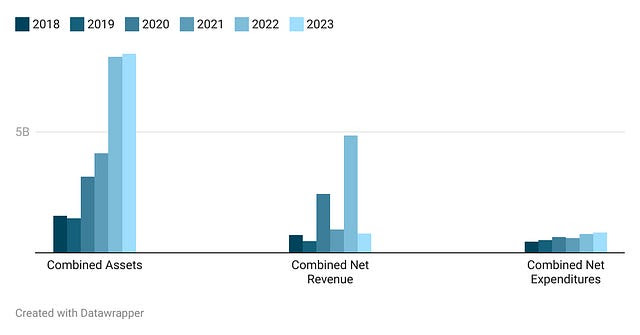
The Center for Media and Democracy (CMD) has conducted a comprehensive financial analysis of Charles Koch’s network of nonprofit and political organizations based on IRS tax records and U.S. Federal Election Commission (FEC) filings for the last six years available, 2018–23. Our most recent analysis for 2023 found:
- Combined assets remained relatively flat in 2023, totaling $8.2 billion across 34 distinct organizations.
- Total net revenue within the fleet dropped to a relative low of $624.3 million in 2023. This is largely due to the massive outlier transactions that took place in 2022, when Koch, Inc. (the company) transferred $4.3 billion in stock to the organization Believe in People, Inc.
- With a swollen war chest from massive private stock transfers, the Koch fleet’s net expenditures have climbed steadily since 2018, increasing by over $370 million (net).
- A total of $715 million circulated among 34 Koch-controlled organizations in 2023 — more than twice as much as the $331 million in intra-network spending in 2022.
- This $715 million accounts for the vast difference between gross revenue ($1.3 billion) and net revenue ($624 million), and between gross expenditures ($1.5 billion) and net expenditures ($833 million).
- Of the fleet’s combined gross expenditures, over 95% was spent by organizations that are predominantly focused on policy and politics.
- The remaining 4.6% of gross expenditures was reported by predominantly charitable groups having relatively little overlap with Koch’s political and policy goals. This includes the organization Movement Musick (previously known as Music C4, Inc.), which is controlled by Charles’ son Chase Koch and has been renamed several times.
Grassrootbeer Investigations posts are free!
Koch-Controlled Organizations Combined Financial Data
Create interactive, responsive & beautiful charts — no code required.
CMD’s analysis is based on the most recent IRS tax filings for 27 nonprofit organizations, in addition to the relevant disclosures of seven political action committees published by the FEC. The data builds upon similar investigations conducted in previous years and makes use of the same methodology previously disclosed.
Koch Begat Koch
While most of these organizations do not reveal their donors, grants that are disclosed show that the Koch fleet is relatively insular:
- Of the $363 million spent by the Stand Together Chamber of Commerce in 2023, over $156 million was sent to Americans for Prosperity (AFP) and its affiliated super PAC. Another $88.8 million was spent on employee salaries and benefits, indicating the scale of the fleet’s internal staffing network. Almost $60 million of the Stand Together Chamber’s spending is ambiguously listed as “other” expenses.
- More than $170 million of AFP’s $185 million budget -– 92% — came from two Koch-controlled organizations, the Stand Together Chamber of Commerce and Stand Together C4 Fund. All three groups operate out of the same office building in Arlington, VA.
- Two more groups operating out of the same office building received a similar proportion of their budgets from within the Koch fleet. The 501(c)(4) Yes Every Kid received 92% of its $8.7 million budget from the Stand Together C4 Fund. Its sister organization, the 501(c)(3) Yes Every Kid Foundation, received 87% of its $4 million budget from the Stand Together Trust.
- The Stand Together C4 Fund received 58% of its revenue from two large grants from other Koch-controlled groups: $213 million from Believe in People and $50 million from Key Change, which was previously named CCKC4.
- Nine Koch-controlled groups disclosed Stand Together Communications, an in-house public relations firm, as a top contractor in 2023, exceeding $107 million in combined contracts. Since 2018, the firm has received over $345 million in contract payments from Koch-controlled organizations.
- Another $20.5 million in 2023 contract payments were disclosed to i360, Koch’s AI-powered voter profiling and data company, which also conducts consulting services for many candidates and organizations outside of the Koch fleet.
On paper, 53% of the Koch fleet’s gross revenue came from other Koch-controlled groups. It is possible that additional funding ultimately came from Koch, Inc., or from wealthy business people and corporate heirs who coordinate their spending with the Koch family. The tax filings of key nonprofits do not disclose their donors, including the Stand Together Chamber of Commerce, which took in over $250 million in 2023, mostly from undisclosed sources.
Dark Money Grants
Koch continued to send millions of dollars to the National Philanthropic Trust (NPT), a multi-billion dollar donor-advised fund that serves to obscure the relationship between specific donors and grantees. A total of $3 million was granted to the trust in 2023 between two separate grants disclosed by the Stand Together Trust and the Knowledge & Progress Fund. Koch organizations have granted a total of $102.1 million to the NPT since 2019, representing 86% of Koch foundation grants to donor-advised funds in that timeframe.
Since 2005, Koch foundations have given a grand total of $138.2 million to donor-advised funds. 2019 was the first year the Koch fleet began passing grants through donor-advised funds like the NPT and the Fidelity Charitable Gift Fund instead of DonorsTrust. Previously, DonorsTrust and Donors Capital Fund received a combined $20.1 million from Koch foundations between 2005 and 2019.
Koch Grants to Universities
As with previous years, one of the larger net spenders within the Koch fleet was the Charles Koch Foundation, which focuses most of its grantmaking on higher education. In 2023 it granted $90.8 million to dozens of universities.
The Koch fleet has granted over $788 million to more than 500 universities since 2005, according to a recent analysis by CMD, in combination with older tax filing data. As CMD has previously reported, universities have long represented the foundation for Charles Koch’s overall policy influence strategy, prompting student and faculty resistance on many campuses.
The Mercatus Center and the Institute for Humane Studies (IHS) at George Mason University -– two organizations that have been controlled for decades by Koch, Inc.’s top executives -– continue to be major spenders within the Koch fleet. Mercatus, founded by Charles Koch and Richard Fink, acts as a strategic bridge between Koch’s university investments and its larger policy influence strategy, often advocating against policies and regulations that Koch, Inc. and other Mercatus sponsors seek to dismantle. The IHS serves as a key recruitment and training hub for the “talent pipeline” that Koch continues to prioritize.
George Mason University, Mercatus, and IHS have received over $305 million from Koch foundations since 2005, in addition to tens of millions in grants to GMU, IHS and Mercatus dating back to the mid 1980s.
Americans for Prosperity Priorities
Koch-controlled organizations were busy advancing a number of priorities in the realms of policy, lawsuits, and social issues in 2023. Much of this was conducted through AFP and its affiliated 501(c)(3) foundation and super PAC, which spent a combined total of $207 million that year:
- AFP Action, an FEC-registered super PAC, spent $30 million in 2023 as it warmed up for the 2024 elections, an effort that ultimately cost over $138 million during the two-year election cycle. The overwhelming majority of these funds were spent supporting Republican candidates and opposing Democrats.
- AFP endorsed staunchly anti-environmental gubernatorial candidates such as West Virginia’s Patrick Morrisey, Indiana’s Mike Braun, and Louisiana’s Jeff Landry, a climate change denier.
- As the fleet’s hub for “grassroots” activism, AFP continually orchestrated statements, reports, petitions, and events blaming then-President Biden for inflation, which many economists dismissed.
- AFP continued a long tradition of attacking worker’s unions. It encouraged Florida’s Republican Governor Ron DeSantis to “hold unions accountable,” fought against a repeal of the decade-old “right-to-work” anti-union law in Michigan, and condemned a strike by the United Auto Workers by unionized employees in Michigan and Ohio.
- 2023 was the busiest year in the anti-ESG (environmental, social, and governance investing) trend in the states, with 26 of the 48 total anti-ESG laws passed that year in 31 states. AFP, along with other heavily Koch-funded groups like the Texas Public Policy Foundation (TPPF), the Heritage Foundation, and the American Legislative Exchange Council, led a state and federal crusade against “ESG” risk assessments in investing as a means of shielding the fossil fuel industry from accountability for the investment risks posed by climate change and pollution.
- AFP celebrated a Supreme Court ruling in favor of a small business that refused to serve gay people. The ruling was opposed by the American Civil Liberties Union (ACLU). The Koch-funded Alliance Defending Freedom -– an extreme Christian hate group known for its discrimination against the LGBTQ population -– represented the plaintiff in the case.
- :{:{AFP released a statement praising Elon Musk’s “3 best changes” at X (Twitter), without noting the platform’s increased use by hate groups and its resulting drop in use and revenue. Koch has financed several organizations that are involved in a lobbying effort to shield big tech companies from antitrust laws.}:
- AFP’s Pennsylvania chapter continued to attack the Regional Greenhouse Gas Initiative (RGGI) -– a regional cap-and-trade partnership designed to reduce carbon emissions -– while Koch Supply and Trading was participating in RGGI trades.
Stand Together Trust Grantmaking in 2023
Koch’s advocacy activity was complemented by grantmaking activity run out of the Stand Together Trust, which has become the fleet’s primary funder of external policy influence groups in recent years. The Stand Together Trust spent $157 million in 2023, most of which was granted to other Koch-controlled organizations, as well as external organizations like the Foundation for Individual Rights and Expression (FIRE), the Cato Institute, and the TPFF. The trust also gave large grants to charitable organizations such as the Edward Charles Foundation -– which is itself a grantmaker -– and The Phoenix, an exercise-based drug rehab charity.
K–12 School Privatization
A combined $11.6 million was spent by Yes Every Kid (YEK) and the Yes Every Kid Foundation. YEK was founded on vague aspirations to “transform public education” by promoting school “choice,” evoking strong skepticism from teachers’ unions. YEK has a notable absence of educational professionals among its leadership, most of whom have backgrounds in politics, lobbying, and public relations.
Charles Koch has opposed unions of all kinds for decades, including teacher’s unions specifically. His fleet of organizations have long supported efforts to funnel money away from public to private schools. Some of Koch’s groups, such as the Bill of Rights Institute and Empowered (formerly “Youth Entrepreneurs”), work to inject controversial material into school curricula such as texts whitewashing the history of slavery in the U.S.
Philanthropy and Stand Together Music
While the fleet continued to focus spending on universities and policy influence groups, Charles and his son Chase Koch also cultivated social capital through their philanthropy in 2023.
Most of this nonpolitical philanthropy dates back to a questionable but successful public relations rebranding effort that began a decade ago and depends on the Stand Together Foundation as the primary grantmaker. The foundation spent over $62 million in 2023, most of which was on grants to organizations involved in relatively noncontroversial causes like youth mentorship and development, drug rehabilitation, and Christian charities.
With the increased leadership of Chase Koch, a guitarist in an active band, much of Koch’s philanthropic activity is focused on garnering partnerships with high-profile artists. Stand Together Music, a project brand operated by the Stand Together Chamber of Commerce, earned favorable media for its partnerships with big-name musicians including Machine Gun Kelly, Darryl “DMC” McDaniels, Pitbull, the Chainsmokers, and Aloe Blacc -– whose new album was named after Koch’s Stand Together brand. Favorable coverage of these collaborations runs in outlets funded by Stand Together, such as *SPIN*magazine.
Koch’s music-centered philanthropy received some critical coverage for its juxtapositional collaborations with politically progressive musicians like Tom Morello of Rage Against the Machine and Killer Mike of Run the Jewels. Killer Mike has continued working with the Koch family after initially signaling he wasn’t aware of who was behind Stand Together Music.
---
REF 2015 CPI
I HACE SERVAL COPIES EG KOCHADEMIA
Koch brothers' higher-ed investments advance political goals – Center for Public Integrity
Key findings:
- The Koch brothers use donations and key connections to amass clout on college campuses. The money often helps forward their political goals and to build a “talent pipeline” of libertarian-minded students.
- Koch-led charitable foundations combined to spread more than $19.3 million across 210 college campuses in 46 states in 2013, IRS filings show.
- At the center of the Koch college universe is George Mason University, recipient of $14.4 million from the Charles Koch Foundation in 2013.
- Charles Koch is a director of the George Mason-based Mercatus Center, which produces work that Congress increasingly cites in reports and bills
- Some strings attached: At the College of Charleston, the Charles Koch Foundation sought names and email addresses of any student participating in a Koch-sponsored class, and to be notified in advance of media outreach related to the school.
Last year, a top lieutenant of Charles and David Koch’s vast network of philanthropic institutions laid bare the billionaire brothers’ strategy to evangelize their gospel of economic freedom.
Political success, Kevin Gentry told a crowd of elite supporters attending the annual Koch confab in Dana Point, Calif., begins with reaching young minds in college lecture halls, thereby preparing bright, libertarian-leaning students to one day occupy the halls of political power.
“The [Koch] network is fully integrated, so it’s not just work at the universities with the students, but it’s also building state-based capabilities and election capabilities and integrating this talent pipeline,” he said.
“So you can see how this is useful to each other over time,” he continued. “No one else has this infrastructure. We’re very excited about doing it.”
The Center for Public Integrity obtained a previously unpublished audio recording of the meeting, which focused on the Kochs’ higher education funding strategy, from liberal activists who produce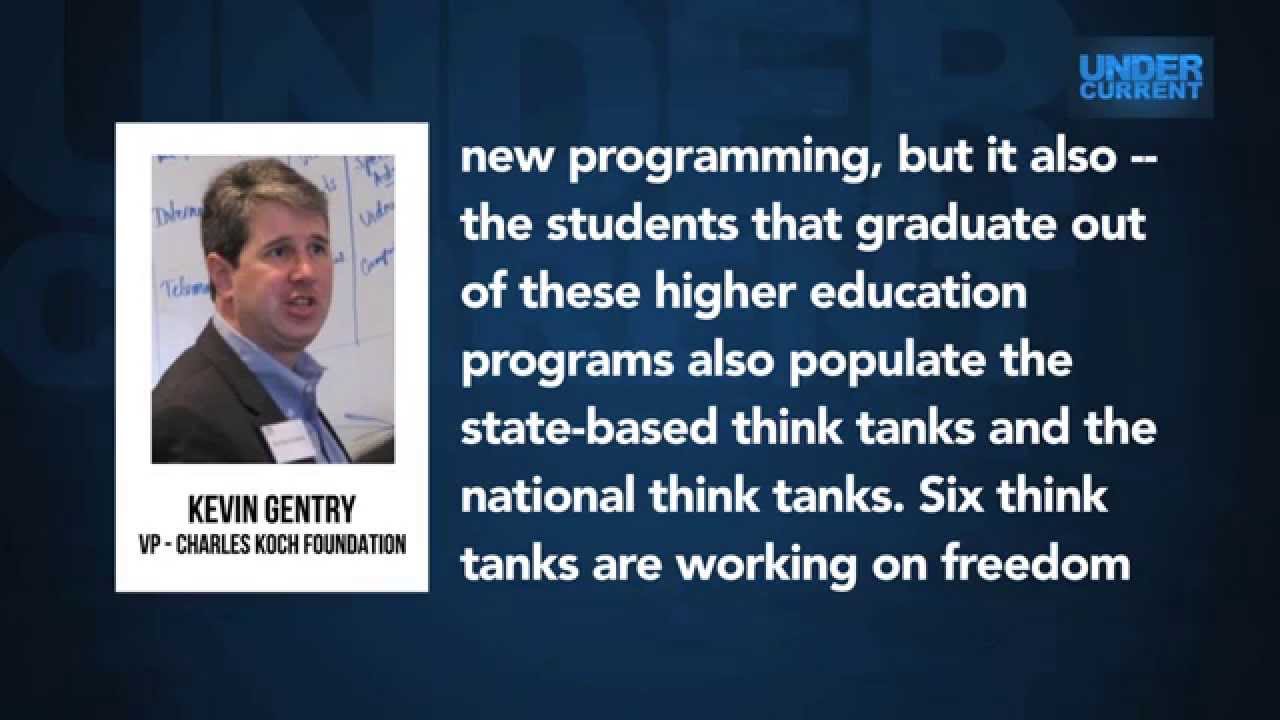 , an online video program. [VID]
Higher education has become a top Koch priority in recent years. And funding — as well as pushback against it — is increasing.
During 2013, a pair of private charitable foundations Charles Koch leads and personally bankrolls combined to spread more than $19.3 million across 210 college campuses in 46 states and the District of Columbia, according to a Center for Public Integrity analysis of Internal Revenue Service tax filings.
That represents a significant increase from the $12.7 million the Koch foundations distributed among 163 college campuses in 41 states and the District of Columbia during 2012. It’s also exponentially more than what the Koch foundations together spent directly on higher education a decade ago.
The Center for Public Integrity reviewed hundreds of private documents, emails and audio recordings that, along with interviews with more than 75 college officials, professors, students and others, indicate the Koch brothers’ spending on higher education is now a critical part of their broader campaign to infuse politics and government with free-market principles.
...
Spreading the free-market gospel
It is no secret that the Kochs’ network has invested hundreds of millions of hard-to-track dollars in conservative political nonprofits that influence elections. The brothers, who earned their billions leading private oil, chemical and manufacturing conglomerate Koch Industries Inc., were dominant forces in recent election cycles. They’re now poised to rank among the most influential Americans shaping next year’s presidential and congressional vote.

Much less well known: their activities on college campuses.
The Kochs are among many wealthy political patrons who give money to education, including conservative Robert McNair, independent Michael Bloomberg and liberal billionaire financier George Soros. (The Center for Public Integrity receives funding from the Open Society Foundations, which Soros funds. A complete list of Center for Public Integrity funders is found here.)
The Kochs’ giving, however, has a laser-like focus on a specific, politically relevant discipline — free market economics — unmatched by other political mega-donors. Koch officials routinely cultivate relationships with professors and deans and fund specific courses of economic study pitched by them.
Detractors argue the Koch brothers’ college-focused money, by helping advance a philosophy of economic liberty, is eroding a fundamental aspect of higher education: academic freedom.
But some conservatives and libertarians consider the Kochs’ investments in higher education a much-needed counterweight to an American higher education system that historically tilts leftward.
And they explain the Kochs’ decision to influence education most certainly does not spring, as many liberal partisans would like the body politic to believe, from the compulsions of steel-souled industrialists more concerned about fortune and power than, say, protecting the environment or helping the poor.
“Since the ‘60s, they’ve been imbued with the sense that the world would be a better place if the country instituted their libertarian values,” author Brian Doherty said of the brothers.
“For Charles, his time horizon, as he gets a little older, has become a little shorter. He has lots of money, and he wants to see action in his lifetime,” continued Doherty, the author of “Radicals for Capitalism: A Freewheeling History of the Modern American Libertarian Movement” and senior editor at Reason who’s interviewed both Koch brothers.
“I’m not doing anything I’m ashamed of,” Charles Koch himself told Forbes last month. “You’ve gotta change the hearts and minds of the people to understand what really makes society fairer and what’s going to change their lives. And it’s not more of this government control.”
The Kochs educational giving, while rarefied, isn’t the nation’s largest. With his wife, Betty, Gordon Moore, the co-founder of Intel, this year pledged $100 million to the California Institute of Technology — and allowed the school to spend it as it sees fit.
Koch defenders also note, accurately, that the pair has donated generously to educational causes not necessarily animated by political considerations: the Smithsonian, public television, media organizations, music scholarships, medical research and a variety of others. David Koch, for his part, has poured hundreds of millions of dollars into medicine and the arts over the years.
But it’s clear where there is an ideological bent to their giving: Tax returns, as well as emails and private documents exchanged among Charles Koch Foundation officers and various college and university officials, indicate the foundation’s commitment to funding academics is deep and growing. Koch education funding, which is almost singularly focused on economics, also sometimes comes with certain strings attached.
....
[DATA TABLE]
At the College of Charleston in South Carolina, for example, documents show the foundation wanted more than just academic excellence for its money. It wanted information about students it could potentially use for its own benefit — and influence over information officials at the public university disseminated about the Charles Koch Foundation.
It sought, for one, the names and email addresses — “preferably not ending in .edu” — of any student who participated in a Koch-sponsored class, reading group, club or fellowship. The stated purpose: “to notify students of opportunities” through both the Charles Koch Foundation and the Institute for Humane Studies at George Mason University.
And the foundation certainly did not want the College of Charleston to speak to news reporters about its Koch-funded programs without prior consent from the Charles Koch Foundation.
“[I]f you intend to engage in press releases or other media outreach associated with programmatic activities, please notify us in advance,” Charles Koch Foundation officials Charlie Ruger and Derek Johnson wrote Peter Calcagno, director of the College of Charleston’s Center for Public Choice and Market Process. “We consider media outreach a collaborative effort and would appreciate the opportunity to both assist and advise.”
Donors are often sent unpublished press releases about programs they fund “as a courtesy so that they will know the contents,” school spokesman Mike Robertson said.
At Florida State University, one of the nation’s top educational recipients of Koch foundation money this decade — about $1.38 million from 2010 through 2013 — a similar request is more direct.
“FSU will allow [the Charles Koch Foundation] to review and approve the text of any proposed publicity which includes mention of CKF,” reads a memorandum of understanding signed between the university and foundation in 2013.
Such provisions aren’t new at Florida State University: the Center for Public Integrity last year reported that the Charles Koch Foundation first attempted in 2007 to place specific conditions on its financial support of the school, when it initially considered providing funding.
Among the proposed conditions: Teachings must align with the libertarian economic philosophy of Charles Koch, the Charles Koch Foundation would maintain partial control over faculty hiring and the chairman of the school’s economics department — a prominent economic theorist — must stay in place for another three years despite his plans to step down.
Florida State University ultimately didn’t agree to the initial requests when, in 2008, it reached a funding agreement with the foundation. It’s also tightened and clarified policies that affect private donors’ contributions to the university.
Relationships between certain school officials and the Charles Koch Foundation personnel nevertheless blossomed. One gatekeeper to Charles Koch’s riches practically became family — if not by blood, then money.
“Thought you might want to see our ‘nephew!’” wrote executive assistant Tonja Guilford to David Rasmussen, her boss and dean of Florida State University’s College of Social Sciences and Public Policy.
Attached to the October 2014 email were photos of this “nephew” — the tow-headed toddler son of John C. Hardin, director of university relations for the Charles Koch Foundation.
Hardin and his family had previously visited with Florida State University officials in Tallahassee. Talk of future get-togethers, and more pictures of Hardin’s son in a Superman costume, aloft in his father’s arms, would follow.
“I was just thinking this morning I needed new pictures to post outside my door,” Guilford fawned to Hardin in an email. “He is just way too cute in his superman costume. He’s my ‘little’ superman – I just love him!”
Friend-raising
Rasmussen, who routinely pursues private funding on behalf of his department, declined interview requests from the Center for Public Integrity, as did Guilford.
Florida State University spokesman Dennis Schnittker described the email exchanges as “friendly correspondence between individuals,” adding that collegial communications are a valuable part of school culture.
“Most university presidents would tell you before you can fundraise, you have to ‘friend raise,’” Schnittker said.
Today, the Kochs’ friendship with Florida State University appears stronger than ever.
An email written in September 2014 by Jesse Colvin, Florida State University’s College of Social Sciences and Public Policy development director, indicates the Charles Koch Foundation is committed to funding the work of economic department doctoral students “during 2015-2016 and in subsequent years.”
A series of other meetings and conversations between Hardin, from the Charles Koch Foundation, and Florida State University officials followed, documents indicate.
In November 2014, Florida State University officials huddled in the office of newly installed university President John Thrasher for a meeting entitled “Koch briefing.” Schnittker, the university spokesman, said the meeting was an “opportunity for our new president to be briefed by university staff about a gift agreement that obviously preceded his tenure.” Hardin of the Charles Koch Foundation was not present, Schnittker said.
Meanwhile, when officials at the Florida State University Project on Accountable Justice went hunting for funding, the Charles Koch Foundation factored into their strategy.
The Koch brothers, after all, were telegraphing their intent to make criminal justice reform a personal priority, reasoning that “overcriminalization,” like overregulation of industry, is resulting in more Americans enjoying fewer economic freedoms.
Not everyone at the Florida State University Project on Accountable Justice appeared thrilled at pursuing Koch cash.
“I know you really hate them, but we really need to send them some stuff,” then-Chairman Allison DeFoor wrote Executive Director Deborrah Brodsky late last year. “They have money. We don’t.”
Reached separately by phone last week, DeFoor, an unabashed conservative, and Brodsky, a Canadian whose politics point more leftward, both laughed off the exchange as comedic banter between longtime colleagues.
But they confirmed they had pursued the Charles Koch Foundation. It hasn’t yet funded the project but did provide the organization “strategic support,” including co-hosting a forum on criminal justice.
DeFoor would conclude, following presentations in Washington, D.C., to both the Charles Koch Foundation and the conservative American Legislative Exchange Council, that Koch interest in issues the project researches “is sincere, potentially aggressive and deep.”
As a small, three-year-old “research- and evidence-based” program, the Florida State University Project on Accountable Justice will gladly take money from most anyone along the ideological spectrum who’s dedicated to its study of and work on criminal justice system reforms, Brodsky said. She counts liberal lions such as the American Civil Liberties Union, Southern Poverty Law Center and Human Rights Watch as partners.
The Charles Koch Foundation executives declined to be interviewed individually. Trice Jacobson, a foundation spokesperson, instead provided a statement that she said “captures what we all hope to share for this piece.”
“Like many charities, the Charles Koch Foundation recognizes the importance of supporting a diversity of ideas so scholars and students can continue to push the frontiers of knowledge and help people discover new and better ways to live fulfilling lives,” the statement read. “Our giving has expanded to support new research and programs on critical issues ranging from criminal justice reform to corporate welfare.”
In a separate statement of its “academic giving principles,” the Charles Koch Foundation asserts that it is “committed to advancing a marketplace of ideas and supporting a ‘Republic of Science’ where scholarship is free, open and subject to rigorous and honest intellectual challenge.”
It also notes that scholars and students “who are free to teach, learn, research, speak, critique and receive support for their work without interference” are in the “best position to discover the advances that will help improve well-being.”
 Institute for Humane Studies on the George Mason University Arlington campus. (Wikimedia Commons)
George Mason, aka Koch U
Nowhere is expanded Koch involvement in higher education more evident than at George Mason University, which receives more funding from the Kochs than any other school.
The large, diverse public school in northern Virginia, about 20 miles from the White House, today houses and lends its name to what’s effectively Charles Koch’s personal academic workshop. The Charles Koch Foundation in 2013 donated more than $14.4 million to George Mason University and the research centers it hosts. That’s on top of tens of millions in Koch dollars that George Mason University and the affiliated research centers have collectively received in recent years.
Charles Koch himself is a George Mason University fixture. He’s the recipient of an honorary doctorate in science from the university, which boasts a student population of more than 33,700. He is a director of the university-based Mercatus Center — Mercatus means “market” in Latin — that Charles Koch Foundation Vice President Ryan Stowers described at the 2014 Koch gathering in California as “critical” to advancing policy priorities.
Koch also enjoys the company of several current and former George Mason University affiliates who play multiple roles across the Koch brothers’ sprawling educational, corporate and political network.
Chief among them is Gentry, who presided over the Koch’s closed-door higher education workshop last year.
Gentry possesses unique knowledge about the interconnectivity of the Koch’s various interests and operations because he embodies its reach. He’s a Charles Koch Foundation vice president and a key fundraiser for the Kochs’ political action arm. He’s a former vice president of both the Mercatus Center and the Institute for Humane Studies at George Mason University. And today, he’s even Eastern vice chairman of the Republican Party of Virginia.
Brian Hooks, now president of the Charles Koch Foundation, is another key Koch network player.
Hooks served as the Mercatus Center’s executive director and chief operating officer from 2005 until 2014 and remains a Mercatus Center board member. The year Hooks took over, the Mercatus Center posted $4.9 million in total revenue, according to tax filings. The year he left, it posted nearly $20.7 million.
“Our job is to make sure that we’ve got a strategy for our work to have a disproportionate impact,” Hooks said at the Kochs’ conference in 2014, noting that the Mercatus Center is the “largest collection” of “free market faculty” at any university in the world. “These guys are producing research that groups in this network can rely on to advance economic freedom every single day.”

This previously unpublished recording of Koch aides discussing education funding strategy with potential donors was provided to the Center for Public Integrity by The Undercurrent, an online program produced by liberal political activists.
Scholarly research performed by academics at Koch-funded schools and programs is indeed sometimes used by Koch-backed nonprofit organizations that, in turn, overtly advocate for political candidates or causes.
For instance, to support assertions made in a recent, 67-page policy paper, Koch-supported American Encore regularly cites and quotes Mercatus Center research and mentions the center nearly a dozen times.
Among the academic work American Encore’s paper highlights: a 2014 Mercatus Center study by Keith Hall, a senior research fellow who had previously served as commissioner of the Bureau of Labor Statistics, and a 2014 commentary about a federal regulations tracking and measurement tool by Patrick A. McLaughlin, another senior research fellow.
“Yet another study has confirmed what we already knew — states with lower taxes do better,” read an article by the Kochs’ flagship nonprofit, Americans for Prosperity, about a study published July 7 by the Mercatus Center. “Overall, the rankings provide more evidence that economic freedom works, and bigger government means bigger trouble.”
And the 60 Plus Association, a retiree-focused nonprofit that’s benefited from tens of millions of dollars of the Koch brothers’ money over the years, for a time tapped Walter Williams, a George Mason University economics professor, syndicated columnist and Rush Limbaugh Show fill-in host, as a member of its “truth squad.” His mission: to “battle” against Democrats on Social Security and Medicare programs.
Congress takes notice
Congress is also paying more attention to the Mercatus Center, which from 1999 to 2008 was mentioned by name 32 times in either the Congressional Record or congressional committee reports. Since 2009, it’s been mentioned 93 times, often in reference to Mercatus Center faculty who were testifying before Congress.
This year, Congress even cited Mercatus Center research in the text of budget bills. House Concurrent Resolution 27 and Senate Concurrent Resolution 11 note that a Mercatus Center study “estimates that Obamacare will reduce employment by up to 3 percent, or about 4 million full-time equivalent workers.”
Mercatus Center Vice President Carrie Conko, while declining to address critics’ “ad hominem attacks” of Charles Koch, stressed the institution’s work is the product of hard work and high standards — not the whims of some patron puppet master.
“As a university research center, our scholarship is independent and subjected to rigorous peer review,” Conko said. “Our researchers are interested in understanding what shapes societies and economies and that covers a spectrum of research from the history of economic thought to the application of economics to questions of public policy.”
Conko also noted that the Mercatus Center abides by a strong conflict of interest and research independence policy, which she described as “stronger than those of most found with typical academic centers or departments.”
Mercatus Center officials note that the center isn’t part of George Mason University the same way as, say, its chemistry or psychology departments. Instead, it’s organized as a stand-alone nonprofit, and as such, George Mason University isn’t directly responsible for it.
The Mercatus Center doesn’t receive direct funding from George Mason University, Conko said.
But George Mason University and its students do receive millions of dollars in annual financial benefit from the Mercatus Center, according to federal tax filings.
That alone is a major incentive for a public university in Virginia, where state funding of higher education is dwindling, to host a privately funded operation on its campus — today, a fairly common practice among public schools.
The Mercatus Center spent $3.64 million during that time to “support graduate students at George Mason University” by “training future scholars and decision-makers to advance and apply a research agenda for understanding institutions and change,” according to a tax filing.
The Mercatus Center helped fund $1.82 million worth of communication efforts that included promoting its research and ideas “to the media and opinion shapers.”
And it made a $10,000 grant to the Atlas Economic Research Foundation, which operates a “global network of more than 400 free market organizations.” They include several Koch-backed nonprofit groups such as Americans for Prosperity, the American Legislative Exchange Council and Americans for Tax Reform.
McAuliffe mum?
The Mason-Mercatus-Koch nexus may seem like rich fodder for a Democrat such as Virginia Gov. Terry McAuliffe, whose national party brethren makes demonizing the Koch brothers a central strategy of their electoral and fundraising agenda.
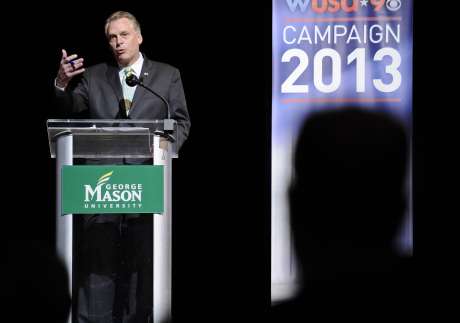 Virginia Democratic Gov. Terry McAuliffe speaks at the Battleground Forum in August 2013 at the Prince William campus of George Mason University in Manassas, Va.
Cliff Owen/AP
McAuliffe’s own political committee, Common Good VA, bashed the “ultra right wing Koch Brothers” in an email earlier this month, accusing them of working against “expanding health care for all” and “ensuring a living wage.”
But McAuliffe — the outspoken former chairman of both the Democratic National Committee and Hillary Clinton’s 2008 presidential campaign — declined Center for Public Integrity requests to discuss George Mason University’s relationship with the Koch brothers.
George Mason University’s top undergraduate leader, Student Body President Khushboo Bhatia, also declined comment.
University spokesman Michael Sandler explained that George Mason is among the nation’s most diverse campuses, and “this notion of diversity and inclusion that is so central to our mission applies to our donors, as well.”
Sandler said the university appreciates the Charles Koch Foundation’s donations, as well as those from thousands of other donors.
“While we are grateful for all of the gifts we receive, we value academic freedom above all else,” Sandler said. “This freedom allows our faculty and researchers to ask questions and make discoveries that others wouldn’t otherwise pursue, and we will not compromise that freedom for anything or anyone.”
Jennifer Victor, a George Mason University politics professor who specializes in how individuals and groups influence government, is skeptical.
George Mason University’s marriage to an ideologically motivated donor with a policy agenda to achieve “raises some eyebrows,” Victor said. “I don’t really see what Mason gets from them, and I don’t think the situation is healthy or consistent with the university’s teaching mission.”
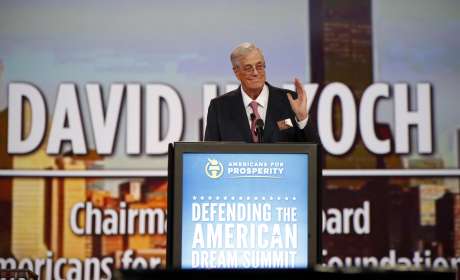 Chairman of the board of Americans for Prosperity Foundation David Koch speaks at the Defending the American Dream summit hosted by Americans for Prosperity at the Greater Columbus Convention Center in Columbus, Ohio, Friday, Aug. 21, 2015.
Paul Vernon/AP
No comment on Koch funding
Some college officials such as Sandler are willing to discuss the financial support their schools receive from Koch-run private foundations, with many emphasizing that gifts from donors, whether liberal or conservative, don’t affect coursework or the manner in which students learn. They also note that their schools receive hundreds, and sometimes thousands of contributions each year from individuals, private foundations and the like.
But it’s not uncommon for other school officials to button up.
Take Victor Nakas, a spokesman for The Catholic University of America in Washington, D.C.
Posed a series of questions about the $215,000 the university received in 2013 from the Charles Koch Foundation, he emailed a pair of dated press releases announcing grants.
“We will be unable to provide you with more than links to these announcements,” he said.
Follow-up messages went unreturned.
Michael Schoenfeld, the vice president for public affairs and government relations at Duke University, declined to say how the school used the $37,000 it recently received from the Charles Koch Foundation.
“As a rule, we do not comment on individual donors or contributions without the donor’s permission,” he explained.
Officials at Oklahoma State University likewise offered no details about how the school used the $69,000 the Charles Koch Foundation recently gave it.
Why the silence?
An email exchange between two Florida State University officials, obtained by the Center for Public Integrity, offers a measure of explanation.
In it, the officials indicate deep concern about the potential effects of releasing more information about the school’s moneyed donors in response to activist demands.
“[R]equiring donors to disclose more than they already do will likely result in fewer gifts and smaller gifts, and it will impose an additional administrative hurdle for the university,” wrote Thomas W. Jennings, vice president for university advancement, to David Coburn, Florida State University chief of staff.
Revealing donor gift agreements, even for donors who have not requested anonymity, might “have a negative effect on FSU’s relationships with many of its donors, who don’t want that kind of attention,” Jennings continued.
The University of North Carolina-Chapel Hill received $115,000 from the Charles Koch Foundation in 2013, one of nearly 100 schools that year to receive a five-figure contribution from a Koch foundation.
But that’s information not easily accessed by students. Whether by design, happenstance or ignorance, “most individuals don’t know where any of the university’s funds come from,” University of North Carolina-Chapel Hill Student Body President Houston Summers said.
University spokesman Jim Gregory confirmed the school received $110,000 for the Charles Koch Visiting Scholars Program in UNC-Chapel Hill’s Philosophy, Politics and Economics Program, conducted in collaboration with Duke University. Donors are allowed to remain anonymous, if they choose.
However, some universities are facing blowback over scant information about school donors from increasingly organized anti-Koch groups and activists.
The umbrella group UnKoch My Campus, for one, has staged protests, demanded meetings with administrators and launched chapters at George Mason University and Florida State University, among others. The organization accuses the Kochs and their allies of undermining issues many students care about, such as environmental protection, workers’ rights, healthcare expansion and public education.
Its immediate goal, beyond convincing colleges to de-Koch themselves?
“Transparency, because students should have the capability to be more aware of who’s funding their school and their education, and where funding might conflict with student interests,” said Kalin Jordan, an UnKoch My Campus organizer. “The universities — most don’t do a good job of informing students at all.”
Said Colin Nackerman, a student activist at George Mason University: “You should know, if you’re going into a classroom, that $30 million is going into your school from someone who wants you to think a certain way.”
Largely silent in the past, the Charles Koch Foundation has begun to push back at such dissenters.
“They don’t want students and scholars to expand their educational horizons,” Hardin, the foundation’s university relations director, wrote in a May 26 Wall Street Journal op-ed. “Rather than engage in a vigorous and civil debate about the merits of different ideas, they seek to prevent those with which they disagree from ever being heard.”
Liberals give big, too
If George Mason University is Charles Koch’s academic playground, Bard College is that of Democratic bankroller George Soros, often viewed as the Koch brothers’ pre-eminent liberal foil.
The tiny New York liberal arts school nestled along the Hudson River is renowned for both scholarship and hippy-dippyness. It received more than $11.2 million from Soros’ private foundation in 2013 — part of a $60 million, multiyear commitment.
But for Soros, himself a multibillionaire with wealth comparable to the Kochs, his contributions to Bard College aren’t generally earmarked for core academics or domestic political considerations.
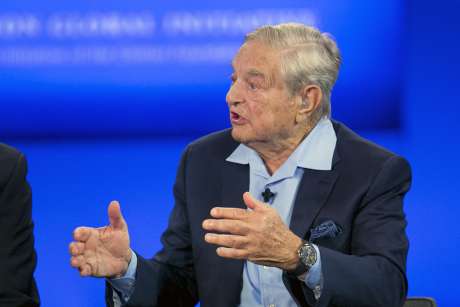 George Soros, Chairman of Soros Fund Management, talks during a television interview for CNN, Sunday, Sept. 27, 2015 at the Clinton Global Initiative in New York.
Mark Lennihan/AP
Instead, Soros’ money mainly helps fund Bard College’s Center for Civic Engagement, which houses a broad portfolio of both U.S. and overseas programs aimed at “advancing the ideals of an innovative, hands-on liberal arts education through a myriad of opportunities across the globe.”
This tracks with Soros’ broader tack on educational giving: The vast majority of his tens of millions of dollars in education-related contributions fund foreign schools and programs, particularly in Eastern Europe and the Middle East. (Soros lived his early life in Hungary, where as a Jew, he survived Nazi occupation before emigrating.)
Among the U.S. schools Soros does aid, many of his most sizable grants are earmarked for programs with international goals, such as $500,000 to Harvard University funding a project on economic growth in Albania, and $159,834 to The George Washington University in Washington, D.C., to “develop effective and influential public policy leaders in Central Asia.”
Soros’ foundation even gave George Mason University more than $22,500 — not to fund economics programs, but to organize meetings in Mexico and Peru about conflict reconciliation.
“As a general rule,” Soros said in 2011, “I do not support higher education in the United States.”
Soros does make exceptions.
An avowed advocate of campaign finance reform, Soros has used his private foundations to fund certain domestic college initiatives squarely rooted in American politics and elections.
One Soros foundation, for example, gave New York City’s Fordham University $200,000 in 2013 to study the “role of money in democratic process.”
The money is part of a $1 million, multi-year grant to determine how disclosure of campaign money influences voters — an awfully political endeavor by any measure.
But school officials say the research they conduct is free of outside influence and subject to the highest academic and legal reviews and standards.
“None of this work is ‘political’ per se in terms of any ideological dimensions … it is all strictly nonpartisan,” said Costas Panagopoulos, director of Fordham’s Center for Electoral Politics and Democracy, who is leading the program.
Penn State University’s economics department in 2013 benefited from $150,000 in Soros money to help build a research center focused in part on “interactions between new media and society.”
And the Ohio State University Research Foundation received $50,000 to conduct a research project aimed at better understanding the role independent expenditures play in federal elections and “how those expenditures influence the legislative process.”
Bard College officials do hear their share of criticism for taking a massive amount of money from Soros’ private foundation, said Jonathan Becker, the school’s vice president for academic affairs and director for civic engagement.
But, similar to some of the schools that accept Koch money, the school’s tenuous budget situation means that it’d take funding from just about anyone so long as the transaction was legal and wasn’t intended to fund an initiative “antithetical to our vision,” Becker said.
That vision, in the words of its student handbook, imagines a “supportive, intellectually rich environment where students can engage themselves to the fullest while respecting all members of the community.”
So what if the Charles Koch Foundation wanted to donate $1 million to Bard College?
Or $10 million?
“We would say ‘thank you,’ and we would cash the check quickly,” Becker said.
Other conservative donors
Unlike the Kochs, Soros and many other prominent political donors, both left and right of center, have charitable agendas that largely diverge from their domestic political agendas.
Robert McNair, the Houston Texans owner who this year alone has spread $3 million among five super PACs backing several Republican presidential candidates, used his private foundation to give millions of dollars to various medical schools and a scholarship program for doctors performing research in areas such as breast cancer, juvenile diabetes and neuroscience.
Sheldon and Miriam Adelson, two other top-shelf Republican donors whom 2016 presidential candidates have endlessly wooed, directed almost all of their university-related private foundation funding — millions of it in 2013 — to medical research.
A private foundation co-run by former World Wrestling Entertainment honcho Linda McMahon, a major GOP donor who herself twice unsuccessfully ran self-funded U.S. Senate campaigns, gave its most sizable, six-figure contributions to substance abuse help group Liberation Programs.
Then there’s one late Republican superdonor whose philanthropy has been at war with his political giving: Harold Simmons.
The Texas businessman bankrolled his eponymous foundation, but his liberal daughters run it. In doing so, they saw to it that Planned Parenthood — the ultimate Republican scourge of late — received more than $300,000 of his money during 2013. It’s also given hundreds of thousands of dollars to Public Campaign, a Washington, D.C.-based money-in-politics reform group also supported in 2013 with $300,000 from a private foundation led by liberal hedge fund manager Jonathan Soros, son of George Soros.
Money the Harold Simmons Foundation did give to colleges in 2013 mostly went toward infrastructure and general operating expenses.
University of Dayton says ‘no thanks’
While more schools than ever are engaging with Koch foundations, at least one school — the University of Dayton in Ohio — has seemingly soured on Koch cash, which it has previously accepted in five-figure amounts.
Jay Riestenberg, a research analyst at campaign reform advocacy group Common Cause and University of Dayton alumnus, earlier this year emailed the school’s Interim Provost Paul H. Benson, asking him if the University of Dayton is still funded by, or seeking new funding from Koch foundations.
Attached was an op-ed Riestenberg has written for the school’s student newspaper. In it, he explains that his education at the small Catholic school inspired him to care about other people, protect the environment and fight for social justice.
“UD accepting Koch funding is in clear violation of the institution’s Catholic Marianist values,” Riestenberg wrote in the April 28 email.
Benson replied later that night. His answer: The University of Dayton no longer accepts Koch cash, and it will not in the future — despite the efforts of Koch-backed organizations.
“There have been instances in which other foundations who are funded in part by the Koch Brothers have tried to interest us in establishing centers at UD,” Benson wrote Riestenberg. “We have not supported those proposals, precisely for the reasons you cite.”
Benson declined an interview request by the Center for Public Integrity.
In a statement, University of Dayton spokeswoman Cilla Shindell explained that the school did reject a recent proposal from a “foundation that is in part funded by the Koch family” because it “would have been structured in a way that would limit oversight by the university in such areas as curriculum and faculty hiring.”
She did not name the foundation.
---
AN 525 COMM DR
A letter that a group of 20 far-right House Republicans released earlier this week as part of a campaign in support of slashing Medicaid appears to have been authored by the head of a research institute with ties to the Koch network.
Politicoreported Friday that "digital metadata embedded in a PDF copy" of the letter that was circulated inside the House of Representatives "lists the author as Brian Blase, president of Paragon Health Institute."
InfluenceWatch notes that in 2021, Paragon received a nearly $2 million donation from Stand Together, "a right-libertarian funding organization that acts as the umbrella organization for the political network that is largely funded by right-leaning businessman and political donor Charles Koch."
Paragon recently urged federal policymakers to require states to conduct more frequent eligibility checks for Medicaid recipients in a purported effort to root out improper payments. Health policy advocates say such a change would make it more difficult for eligible enrollees to keep their Medicaid coverage.
The letter signed by Rep. Chip Roy (R-Texas) and other House Republicans aligns with Paragon's objectives, claiming that "political abuse" of Medicaid "is helping to bankrupt the federal government" and calling for "structural Medicaid reform" in the party's forthcoming reconciliation package.
Tony Carrk, executive director of the watchdog group Accountable.US, said in a statement that "you'd be hard pressed to find a more shameless example of congressional Republicans taking their cues from special interests at the cost of the American people than Chip Roy copying and pasting a letter directly from... special interests."
"This remarkably blatant kowtowing to conservative billionaires is a sad reflection of the congressional Republicans' willingness to make devastating cuts to Americans' healthcare to pay for lower taxes for the richest," said Carrk.
The letter was released as congressional Republicans grappled internally with how and how much to cut Medicaid as they seek to offset the massive projected costs of another round of tax breaks for the rich.
Earlier this week, as Common Dreamsreported, Rep. Don Bacon (R-Neb.) said he would not accept more than $500 billion in cuts to Medicaid over the next decade. Cuts of that magnitude would still be the largest in the program's history and would strip health coverage from tens of millions of people.
---
---
new 10 23 email
no lnx
‘Get the Right Cases to the Supreme Court’: Inside Charles Koch’s Network
Billionaire’s web of rightwing groups works to bring cases to court that could undermine core functionings of the US government
ED PILKINGTON AND NICK SURGEY
OCT 26
:
This article was produced in partnership with The Guardian
The Koch network, a web of rightwing groups cultivated by billionaire businessman Charles Koch and his late brother David Koch, is spearheading the attack on federal agencies and government regulations that dominates the US supreme court agenda this term.
The network has been working behind the scenes to bring cases before the court that, if successful, could undermine many of the core functionings of the US government. At least two of the biggest cases to be considered by the justices this term have been spurred by groups bankrolled and coordinated within the Koch universe.
Footage of an internal panel discussion between senior operatives from Koch entities held in the summer of 2022 reveals that the network has been quietly planning the current assault on the “administrative state”. The groups are seeking to exploit the supreme court’s new six-to-three rightwing majority secured by Donald Trump to dismantle vital executive powers.
Regulatory controls in their sights include environmental standards to combat pollution and the climate crisis, consumer protections against predatory lenders, and safeguards for workers’ rights. At stake is what the Strict Scrutiny podcast has called “the future of government as we know it”.
The footage, which is made public here for the first time, was obtained by the investigative watchdog Documented and shared with the Guardian. During the 37-minute panel discussion, legal strategists with several Koch-related groups expressed excitement that the new hard-right supreme court supermajority has created the potential for a concerted attack on the functions of federal agencies.
Jorge Lima, an economic policy strategist at the Koch network’s central coordinating group, Stand Together, said that the new composition of the court amounted to a huge “landscape opportunity, particularly on the administrative state. We’re doubling down on this strategy.”
Lima added: “Every dog has its day, and it’s a big day for the administrative state.”
Casey Mattox, a legal strategist at the main Koch advocacy group, Americans for Prosperity, argued that the supreme court was now “primed for a real change in the law” on federal regulations which he said amounted to a “paradigm shift”. Mattox said: “That’s why we are partnering with organizations that can get the right cases to the supreme court.”
The effort appears to have born fruit. Two of the most significant cases before the court in the 2023-24 term, brought with the backing of Koch-linked organizations, attempt to rein back the government’s power to impose regulations on corporations.
The prominence of the cases underlines how the libertarian empire created by the Kochs is still a force to be reckoned with within US politics. Since David Koch’s death in 2019, and the Koch network’s decision to come out in opposition to Trump ahead of next year’s presidential election, the network has receded from public attention.
But the scope of Charles Koch’s reach remains formidable, as was demonstrated earlier this month when the 87-year-old told Forbes that he had given $4.3bn of his Koch Industries stock to Believe in People, a newly-created group named after his book of the same title. He has transferred a further $975m to another new entity, CCKc4, which carries the initials of his son Chase Koch.
The massive combined $5.3bn in donations, one of the largest acts of giving to non-profits in US history, will ensure that the Koch influence will continue to push the US to the right for years to come. Undermining government regulations is central to those ambitions.
Lisa Graves, the executive director of the progressive watchdog True North Research who is a long-time Koch watcher, said that Charles Koch has shown a “fundamental hostility to government regulation” since his early political writings in the 1960s. “This is the through-line of his career. His business operations have a substantial self-interest in assailing regulations that impede his profits.”
Koch Industries is a conglomerate of energy and chemicals companies that stand to benefit if controls on pollution, workers’ rights and other aspects of public governance are rolled back. The firm is the second largest privately-owned company in the US.
Among the big administrative state cases that the justices will be considering this term is Loper Bright Enterprises v Raimondo, which seeks to overturn a 40-year precedent set by the supreme court itself. Known as Chevron, the ruling allows federal agencies the flexibility to reasonably interpret laws without interference from the courts as they regulate critical parts of public life, such as the environment and public safety.
Experts have warned that if Chevron is struck down, it could be a recipe for legal and administrative chaos. “We are talking about rules that protect us in so many ways – truckers who are too tired to drive on the highway, unsafe workplaces, and pollution of our water and the air we breathe,” Graves said.
The case was nominally brought by a New Jersey herring fishing company that objected to being charged by a federal agency that monitors its catch to prevent over-fishing. Behind the challenge is a conservative group called Cause of Action, which is intricately tied to the Koch network.
The chair of Cause of Action’s board, Brian Menckes, is general counsel of the Charles Koch Foundation. Cause of Action’s executive director, James Valvo, who is acting as one of the fishing company’s lawyers in the case, is the former head of policy of Americans for Prosperity.
A second lawyer representing the company, Eric Bolinder, holds dual roles as a counsel for Cause of Action and Americans for Prosperity.
In 2021 Cause of Action’s entire income of $375,000 came from Stand Together, the Koch network’s coordinating group, Bloomberg reported. The groups are also physically close: Cause of Action and Americans for Prosperity not only share the same address in Arlington, Virginia, they occupy the same office – suite 700.
Bolinder was one of the panel speakers at the 2022 Koch discussion on the administrative state. He framed the plan to use the supreme court to launch a legal attack on regulatory government as a states’ rights issue.
“As the federal government grabs more and more power, particularly to the regulatory state, the states become less and less important,” he said.
The Guardian contacted Stand Together and Cause of Action for comment. Cause of Action did not immediately reply.
Gretchen Reiter, Stand Together spokesman, said that the Loper Bright case was seeking “to restore one of the core tenets of our democracy: that Congress, not the administrative agency, makes the laws. Cause of Action Institute – which filed the lawsuit in 2020 – is representing family-run fishing companies that the federal government is forcing to pay a tax that Congress never authorized, and that violates our constitution’s separation of powers.”
Last week, the supreme court accepted a second case also challenging the Chevron precedent, which has now been consolidated with the fishermen’s petition. Relentless v Department of Commerce was also filed by a group with intimate connections to the Koch network, the New Civil Liberties Alliance (NCLA).
The organization, which claims to “protect constitutional freedoms from violations by the administrative state”, was founded in 2017 with seed money from the Charles Koch Foundation. Over five years, it has received more than $5m from the Koch network.
NCLA’s president, Mark Chenoweth, previously served as in-house counsel for Koch Industries.
NCLA submitted an amicus brief last week supporting another major challenge to regulatory agencies that will be heard by the supreme court this term. Securities and Exchange Commission (SEC) v Jarkesy threatens to gut the enforcement power of the SEC by curtailing its ability to fast-track cases of securities fraud through its own in-house administrative law judges.
A ruling against the SEC could drastically reduce the ability of numerous government agencies to enforce environmental and other standards.
The footage of the Koch panel discussion obtained by Documented reveals that the NCLA has been secretly lobbying for the Jarkesy case to reach the supreme court. Mattox said that “NCLA brought a lot of value to that case”.
He went on: “You won’t see them actually directly litigating on that case, but they’ve done a lot of work behind the scenes, and that speaks to the way that our community adds value here, because when we partner with people we look for results, not necessarily for headlines and attention-grabbing.”
There is a further twist to the issue of Koch influence on the supreme court’s docket this term. Last month, ProPublica revealed as part of its expose of ethical breaches by some justices, that the right-leaning Clarence Thomas had attended at least two Koch donor events where funds were raised to forward the Koch network’s mission – which includes bringing cases before the court.
The attack on the administrative state is central to the work of Americans for Prosperity, which boasts of its years-long campaign to challenge what it calls the “out-of-control regulatory environment imposed by Washington”. It organizes bus tours around the country, directly relating “red tape” on energy infrastructure projects to the high cost of fuel at the pump.
This has taken place while oil and gas giants such as Exxon, BP and Shell have posted record profits, and the world has increasingly felt the impact of climate change. Americans for Prosperity calls itself “the nation’s premier grassroots organization”, but according to an independent audit report from 2021, 94% of the $112m in cash it received that year came from just two donors.
---
---
4 23 gmail patm
in 2021, a fleet of 27 organizations controlled by Charles Koch and other Koch Industries executives spent a combined net total of $656.8 million on political and charitable causes.
This represents another consecutive year of record-breaking spending by Koch-affiliated nonprofit organizations, outdoing total net spending amounts of $524.9 million in 2019 and $639.4 million in 2020. These net totals account for expenditures between the groups, without double counting.
In this three-year period, Koch groups that are primarily focused on influencing American policy and politics accounted for more than 93% of the spending. Only 6% came from Koch foundations that predominantly support genuinely charitable causes—those that do not explicitly align with Charles Koch’s own economic interests or ideological policy goals.
An examination of Internal Revenue Service (IRS) and Federal Elections Commission (FEC) filings compiled by the Center for Media and Democracy (CMD) indicates that gross expenditures by Koch-controlled political and policy-focused organizations totaled $2.1 billion in the past three years of available records compared to $138 million in gross expenditures during the same period by organizations primary focused on charitable giving.
In 2021, the most recent year of IRS filings available, spending by groups CMD categorizes as charitable plummeted to a new low, accounting for only 4.4% of Koch’s overall nonprofit expenditures....
[table]
koch’s fleet continues to expand as well. Last year, staff members at Charles Koch’s organization Stand Together Chamber of Commerce founded a new 501(c)(4) organization called the Stand Together C4 Fund.
According to its IRS tax-exemption application, the new fund expected to raise $96 million and spend $78.2 million in the final quarter of 2022. The filing estimated that it would continue to raise between $90 and $100 million in both 2023 and 2024, and spend over $80 million each year.
Even before the advent of the Stand Together C4 Fund, Koch’s organizations continued to expand significantly. At the close of 2021, organizations that are ultimately under Charles Koch’s control had combined assets of $4.1 billion. This represents an increase of $1 billion over the previous year, and an increase of $2.7 billion since late 2019.
This marked expansion of Koch-controlled nonprofit organizations indicates that they are being positioned to be ever more major players in the realms of politics and policy.
Methodology
Revenue, Expenditure, and Asset Totals...
---
---
killed HR 1 for the ppl act:
A recording of a private conference call obtained by The New Yorker between a policy adviser to Senate Minority Leader Mitch McConnell and the leaders of several prominent conservative groups revealed that the Koch Brothers-affiliated advocacy group Stand Together had invested "substantial resources" researching H.R. 1's popularity and message-testing opposition talking points.The group had concluded not only that the bill is broadly popular with the American public, but that opposition messaging to it is largely ineffective and so turning public opinion against it would be "incredibly difficult." It found that the argument that the bill "stops billionaires from buying elections" is particularly resonantwith the public and conservatives should avoid publicly debating it, but instead attempt to stop the bill with legislative maneuvers such as the filibuster.[101]
---
under the dome strat means just buy reps , give up on BS public
https://www.alternet.org/2021/03/gop-donors/
The GOP's war on voting, while raging on in red states across the country, remains incredibly unpopular — and Republican megadonors are reportedly growing nervous.
Republican operatives are making a strategic pivot in their efforts to combat the For the People Act or H.R. 1, dismissing the notion of a broad messaging campaign to instead exert pressure on Congress to kill the bill, according to a private call obtained by The New Yorker. In the call, a policy adviser to Sen. Mitch McConnell, R-Ky., and several prominent right-wing advocacy groups expressed distress over the broad public support behind H.R. 1, the Democratic-backed ethics and voting overhaul that proponents claim will enshrine the electoral system in unprecedented transparency and accountability.
According to the New Yorker's Jane Meyer, the participants of the call "conceded that the bill, which would stem the flow of dark money from such political donors as the billionaire oil magnate Charles Koch, was so popular that it wasn't worth trying to mount a public-advocacy campaign to shift opinion."
"Instead," she explained, "a senior Koch operative said that opponents would be better off ignoring the will of American voters and trying to kill the bill in Congress."
On the call, Kyle McKenzie, the research director for Stand Together, a Koch-backed advocacy group, reportedly aired out concerns over the broad-based conservative support for H.R. 1. "There's a large, very large, chunk of conservatives who are supportive of these types of efforts," he warned. According to public opinion testing conducted by Stand Together, he noted, attempting to "engage with the other side" –– or combating the idea that the bill "stops billionaires from buying elections" –– is a losing battle. The only way to defeat it, he concluded, is by GOP obstructionism.
A small but vocal collection of conservative advocacy groups are nevertheless publicly campaigning against donor disclosure –– a provision H.R. 1 would mandate –– on account of potential harassment. For example, members on the call such as Gretchen Reiter, the senior vice-president of communications for Stand Together; Steve Donaldson, a policy adviser to McConnell; and Heather Lauer, the executive director of People United for Privacy, are expressly against donor disclosure for that very reason.
However, as the New Yorker noted, "Advocates for greater transparency in political spending argue that there is no serious evidence of any such harassment."
Many conservative advocacy groups are already holding the Congress's feet to the fire. Groups like Heritage Action, Tea Party Patriots Action, Family Research Council, and Freedom Workers held a rally in West Virginia urging Sen. Joe Manchin, D-W.Va., a conservative Democrat, to break ranks and oppose the bill, Meyer noted.[BUSSED IN. PAID PROTESTORS? BROOK BROS/]
According to Heritage Action press secretary Noah Weinrich, "The filibuster is really the only thing standing in the way of progressive far-left policies like H.R. 1, which is Pelosi's campaign to take over America's elections."
Liz Hempowicz, Director of Public Policy at The Project of Government Oversight, echoed a similar sentiment. "I think the bill will pass the House," she recently told Salon's Igor Derysh. "I think the Senate is a big question mark. It really comes down to whether Democrats are going to get rid of the filibuster."
However, Democrats are not unilaterally sold on nuking the filibuster. Both Sens. Manchin and Kyrsten Sinema, D-Ariz., have expressed an unwillingness to scrap it, rendering the 51-vote majority needed to do so untenable.
Last week, Manchin threw his support behind H.R. 1, but expressed that he still wants bipartisan support. "Pushing through legislation of this magnitude on a partisan basis may garner short-term benefits," he said in a statement, "but will inevitably only exacerbate the distrust that millions of Americans harbor against the U.S. government."
FROM YOUR SITE ARTICLES
- Trump's big money inaugural donors are fleeing the president ... ›
- A billionaire GOP donor is accused of a massive fraud scheme ... ›
- Prominent GOP 'mega-donors' enthusiastically supported ... ›
RELATED ARTICLES AROUND THE WEB
- Trump's convention cancellation is costing GOP donors millions ›
- GOP donors are hobnobbing in person again; Dems are sticking to ... ›
- Donor backlash fuels GOP alarm about Senate fundraising ›
---
---
mma 1 23
In an embarrassing attempt to undermine renewable energy, Fox host Jesse Watters platformed a fossil fuel industry-funded envoy flimsily disguised as an “ocean advocate” for Protect Our Coast NJ. Watters hosted self-described “Jersey Shore Lifer” Mike Dean, although he was misidentified on-screen as Mike Davis. Dean’s Twitter account demonstrates opposition to climate science, frequently retweeting Big Oil shill Steve Milloy and “#climatescam” posts.
dean – without evidence – blamed recent whale deaths in New Jersey on wind development and claimed, “The harms with these projects and the costs are limitless, and it’s really hard to find any benefits at all.” (While the cause of the deaths are not known yet, factors including oceanic plastic pollution, the presence of an anomalously large whale population in the area for this time of year due to warmer waters, and underwater sonar use by the military could all lead to these “unusual mortality events.”)
While Protect Our Coast NJ’s website boasts the group as “residents, homeowners, business owners, fishermen and visitors of the New Jersey coastal communities,” reporting has indicated that other interests are playing a part in the group’s activities. Popular Information’s Michael Thomas reported that the donation page redirects to a PayPal page for the Caesar Rodney Institute. The website also links to content from right-wing media’s favorite climate contrarian Michael Shellenberger. The Caesar Rodney Institute is a part of the State Policy Network, a network of conservative and libertarian think tanks.
The Caesar Rodney Institute has a history of hostility toward government environmental regulation and climate change mitigation policies. In 2021, the Caesar Rodney Institute’s Energy and Environment director, David Stevenson, a former member of the Trump EPA transition team, established the American Coalition for Ocean Protection (ACOP), a legal defense fund for groups to file lawsuits to fight offshore wind developments on the Eastern Seaboard. In 2022, the ACOP announced a partnership with Marc Morano’s Committee for a Constructive Tomorrow and the Heartland Institute to fend off a coastal Virginia offshore wind project.
As reported by The Intercept’s Lee Fang, the Caesar Rodney Institute has received funding from theAmerican Energy Alliance, which in return was funded by fossil fuel insiders like the American Fuel and Petrochemical Manufacturers and Stand Together Chamber Commerce, a Koch Industries business trade group.
---
---
https://www.alternet.org/2021/03/billionaire-elections/
A newly surfaced recording shows a senior adviser to Senate minority leader Mitch McConnell conspiring with the Koch brothers' network and other conservative groups to torpedo sweeping voting rights legislation.
The Jan. 8 recording obtained by **The New Yorker reveals leading conservative activists are alarmed by public support for House Resolution 1 and Senate Bill 1, commonly known as the For The People Act, and they privately admitted they had no effective way to counter the argument that billionaires should be able to buy elections.
"When presented with a very neutral description" of the bill, "people were generally supportive,"Kyle McKenzie, the research director for the Koch-run advocacy group Stand Together."The most worrisome part . . . is that conservatives were actually as supportive as the general public was when they read the neutral description."
"There's a large, very large, chunk of conservatives who are supportive of these types of efforts," he added.
The election reform bill, which would ban large, anonymous political donations, enjoys broad public support, and McKenzie told participants that Senate Republicans would need to use "under-the-dome" legislative tactics to stop the bill because generally everyone but them agreed billionaires should not be able to buy elections behind the scenes.
"Unfortunately, we've found that that is a winning message, for both the general public and also conservatives," McKenzie said.
The Koch-funded group had spent a lot of money to find persuasive arguments against the bill, but found that even claiming it would allow Rep. Alexandria Ocasio-Cortez (D-NY) to hold Trump administration officials accountable wasn't particularly effective.
"Sadly," he said, conservatives weren't even persuaded when the phrase "cancel culture" was tied to the bill.
"It really ranked at the bottom," McKenzie said. "That was definitely a little concerning for us."
FROM YOUR SITE ARTICLES
- Billionaires who bankrolled Trump donate $10 million to super PAC ... ›
- Netflix Billionaire Reed Hastings' Crusade to Replace Public School ... ›
- 'Like hitting the jackpot': Dallas billionaire natural gas producer ... ›
RELATED ARTICLES AROUND THE WEB
- Tech billionaire 2020 election donations: Final tally ›
- Can Billionaires Buy Elections? ›
- Billionaires Spent 41 Times More On 2016 Election Compared To ... ›
---
==
ref BBB
https://www.rollingstone.com/politics/politics-news/climate-koch-brothers-lobbying-biden-build-back-better-1234815/
no lnx many
The Koch Empire Goes All Out to Sink Joe Biden’s Agenda — and His Presidency, Too
The dark-money network is spending tens of millions to undermine Democrats’ effort to protect the climate and shore up the social safety net
By ANDY KROLL & GEOFF DEMBICKI
Charles Koch, chief executive officer of Koch Industries, at the Broadmoor Resort in Colorado Springs, 2019. (AP Photo]
With the fate of President Biden’s domestic agenda in the balance, an armada of right-wing dark-money groups aligned with the Koch political network is mobilizing to sink Biden’s $3.5-trillion Build Back Better plan and deal a devastating blow to his presidency.
The Koch network is one of the most extensive and well-funded political and policy operations in the country, having pledged to spend more than a billion dollars in the past four election cycles. The web of nonprofit groups funded by or affiliated with the Koch network — dubbed the “Kochtopus” by critics — broadly promotes an anti-government, libertarian-style vision for American life. In most cases, the donors who bankroll the network’s groups remain anonymous, playing a central role in the spike in dark-money spending in American politics.
RELATED STORIES
Democrats Got Serious About Taxing The Rich. Then Manchin Got Ready To Spike It
Trump Is Now Asking Putin to Dig Up Dirt on the Biden Family]
Koch-backed groups fiercely opposed Barack Obama’s Affordable Care Act and his cap-and-trade climate bill, successfully weakening the former and helping to kill the latter. The network’s groups have different mandates and focuses, including foreign policy, health care, and energy. At times, their libertarian leanings have found them making common cause with progressive groups — including by pushing to end the wars in Iraq and Afghanistan and to criticize government-mandated bans on racial-justice curriculums. But with a Democrat back in the White House, the Koch network of late has largely unified behind a push to stop Biden‘s agenda.
Koch-aligned groups are together spending millions of dollars on advertising, targeting moderate Democratic lawmakers, and pushing their influence in the halls of Congress to whittle down or outright kill the sweeping policy package, which would represent the largest expansion of the social safety net in the past 50 years and the biggest step toward addressing climate change in U.S. history.
“Fighting the reconciliation bill is a top priority for Charles Koch’s surrogates,” says Connor Gibson, founder of the corporate watchdog organization Grassrootbeer Investigations, who has spent years tracking Koch influence in the United States. “This is a viable threat for his network, and we can see that all the tentacles of the Kochtopus are out in full force trying to stop it from passing.”
This lobbying blitz comes at a critical moment for Biden’s agenda. Democratic leaders in Congress have pushed for a two-track strategy to pass a $1.2 trillion bipartisan infrastructure bill paired with the much larger $3.5 trillion Build Back Better Act, which contains many of the signature policies Biden campaigned on as a presidential candidate. Those policies include hundreds of billions of new spending on universal prekindergarten, major expansions to child-care and home health-care programs, free community college, and the biggest-ever investments in renewable energies, electric cars, and other climate-focused policies. But for the larger bill to pass, it’ll need to get through a closely divided House and get unanimous support from the 50 Senate Democrats, including centrists such as Joe Manchin of West Virginia and Kyrsten Sinema of Arizona.
While the Koch network refused to support Donald Trump in the 2016 and 2020 presidential elections, the dozens of groups who receive funding or support from the network spent heavily to elect Republican governors, House members, and U.S. senators. AFP Action, the Super PAC affiliate of the Koch network’s flagship group Americans for Prosperity, spent $47 million last year, all of it to elect Republicans and defeat Democrats in high-profile races. The PAC tied to the Libre Initiative, a Koch affiliate focused on Hispanic Americans, spent $1.3 million in other key races across the country, often to great effect.
After the Democratic Party took control of the House and Senate, albeit by slim majorities, the Koch network set its sights on the pillars of Biden’s policy agenda. Just days after the two Georgia Senate runoff victories, Koch operatives held a private conference call to strategize about how to kill a top Democratic policy priority, theFor the People Act, the most ambitious election-reform bill since Watergate. As the New Yorker reported, an official with Stand Together,a Koch-backed nonprofit, conceded that the bill’s provision requiring greater transparency of dark money was so popular that the Koch network and its allies couldn’t mount a public-pressure campaign to stop — instead, they would have to play the inside game, mounting a lobbying blitz targeting members of Congress if they wanted to stop the bill. Now, the Koch network has an even more sweeping piece of legislation in its sights, the centerpiece of Biden’s domestic policy agenda, the Build Back Better Act.
The tip of the spear for the Koch network in this pressure campaign is Americans for Prosperity. Led by longtime Koch operative Tim Phillips, AFP is spending seven figures on TV and digital ads opposing not only Biden’s $3.5 trillion Build Back Better Act but also the bipartisan infrastructure deal awaiting a vote in the House of Representatives.
AFP has adopted another tactic aimed at making Biden’s domestic agenda unpopular — hitching Biden’s plans with Sen. Bernie Sanders (I-Vt.), a progressive leader, while claiming that the Build Back Better package is the biggest spending bill in American history. One AFP ad says Biden’s policy package is “the last thing we need to recover from this pandemic,” adding, “Tell Congress to stop the Biden-Sanders spending spree.” The ads appear onFacebook, Google platforms (including YouTube), and on TV stations across the country.
The Koch-backed LIBRE Initiative is running ads against the reconciliation package in Texas, Florida, and Arizona “to inform Latinos about the negative effects of overspending and overtaxing.” The group’s president, Daniel Garza, explains in a release that he intends to “mobilize our grassroots army of volunteers and activists to hold our elected officials accountable.”
Yet another group with long-standing Koch network ties, the 60 Plus Association, has launched a multimillion-dollar ad blitz focused on the prescription-drug-reform policies in the Build Back Better Act. Founded in 1992, 60 Plus was originally conceived as the conservative movement’s answer to the AARP; over the years, it’s taken millions from Koch nonprofit groups and been used to attack Obamacare and Democratic candidates for office.Indeed, almost two decades ago, 60 Plus lobbied to eliminate Medicare’s ability to negotiate with drugmakers during a previous battle over drug prices.
In its new ad blitz, 60 Plus claims that the provisions included in Biden’s plan to allow for greater drug-price negotiation in Medicare would cause benefits for Medicare recipients to be slashed and make medication harder to obtain for doctors. Like AFP, 60 Plus describes the Biden plan as an “out-of-control spending spree.” However, PolitiFact slapped this claim by 60 Plus with a “False” rating, citing health care experts who said giving the government the ability to negotiate with drug companies shouldn’t lead to reduced access to key drugs for Medicare patients.
All told, these and more than 100 other similar groups, many of them linked to Koch, are mobilizing to fight the spending bill. “As your committee begins marking up the$3.5 trillion reckless tax-and-spend reconciliation proposal,” this large right-wing coalition said in a letter earlier this month to top congressional Democrats, “we write in opposition to any effort to raise taxes on American families and businesses.”
The threat comes not only in the form of corporate tax increases — although the financial impact could be substantial, given thatTrump-era tax cuts potentially saved the Koch brothers up to $1.4 billion, according to estimates from the group Americans for Tax Fairness; many of the Koch-backed groups fighting Biden’s spending package are also deeply concerned about the ambitious climate provisions the package contains.
Proposed policies include expanding tax credits for electric vehicles, as well as provisions pushing utilities to use clean energy instead of fossil fuels. Add up all the climate impacts, and this could reduce America’s carbon footprint by nearly 1 gigaton worth of greenhouse gas emissions, the research firm Rhodium Group estimates. This would represent some of the most significant action ever taken on climate change in the U.S.
But what’s good for the planet is potentially terrible for Koch’s bottom line. The Koch Industries subsidiary Flint Hills Resources, for instance, operates the largest oil refinery in Minnesota, capable of processing more than 300,000 barrels per day of crude oil, predominantly from the Canadian tar sands. The refinery is fed by a Koch-owned pipeline network spanning more than 500 miles.
“Charles Koch has so many different layers of interest in fossil fuel and petrochemical production that the Biden administration’s bill could cause the costs of his businesses to increase, and therefore his profits would drop,” Gibson explains.
Fighting climate action has for this reason long been a top policy priority for Koch’s network — and it’s animating dark-money opposition to the current $3.5 trillion spending package.
The Texas Public Policy Foundation calls the spending package’s climate provisions “incredibly expensive and harmful anti-energy policies that will cripple our economy, increase our dependence on foreign oil, and increase cost of living, especially for the poorest Americans.” The Austin-based think tank has received at least $3.6 million from foundations linked to Koch since 1998, the watchdog group Desmog calculates.
One of the signatories of the coalition letter opposing the plan isMyron Ebell, a Koch-linked energy punditand professional climate-change skeptic. As recently as 2016, Ebell said that while he now acknowledges climate change is real, he doesn’t think it’s a “rapid or a serious problem.”
The Koch crew is also stoking fears of inflation and skyrocketing prices for consumers if the bill passes. “Prices are rising everywhere, from the gas pump to the grocery store,” AFP recently tweeted.
Opponents of Biden’s Covid-19 relief measures and his domestic policy agenda have raised fears of inflation as a result of so much government spending. But earlier this month, a dozen Nobel Prize-winning economists published an open letter that argued inflation wasn’t nearly as big of a concern. More important, they wrote, was “reversing years of disinvestment in public goods and addressing the country’s long-term needs — including building toward sustainable and inclusive growth and facilitating our clean energy transition.”
The dark-money groups mobilizing against the plan don’t seem to care. The country might have problems — including soaring inequality and a collapsing climate — but, for the Koch empire, that’s just the cost of doing business.
In This Article: Charles Koch, Climate Change, Joe Biden
---
clarermonster
04.26.2023
New Koch
after the founder of a large foundation dies, his heirs often transform it. Compare industrial tycoon Henry Ford to the Ford Foundation, which rejects “the model of capitalism we have today.” But it is uniquely odd that Charles Koch’s enterprises have moved so far left while the donor remains alive. Billions of dollars are at stake.
Many current and former donor partners, grantees, and staff agree: “Old Koch” was about economic freedom and the core values that sustain a free society, but “New Koch” downplays or hides those values in order to appeal to the contemporary Left. Old Koch focused on getting government out of the way so that civil society could flourish. New Koch has largely skipped that step and moved on to “social entrepreneurship.”
Those outside the ideological network in which Koch is a major player (known as the “liberty movement”) should understand a few things. First, “Koch” means not just the Charles Koch Foundation (CKF) but the large family of organizations and projects that are run by or strongly influenced by Stand Together, the umbrella Koch organization. These include core programs such as the Koch Associate Program (KAP), organizations launched by Koch with varying degrees of independence like Americans for Prosperity (AFP), and well-funded Koch-adjacent organizations like the Institute for Humane Studies. Koch Industries’ annual revenue easily tops $100 billion.
In what follows, I show Koch’s leftward shift in rhetoric, ideology, politics, and philanthropy. The changes are dramatic and arresting.
Second, it gives me no pleasure to relate this situation. I am writing for the many who wish they could add their names. I am speaking up now, because if I don’t, we risk seeing billions of dollars work against what used to be Mr. Koch’s own noble principles.
Much of my evidence comes from public documents. Some key information comes from current or former insiders, reaching from board members to senior and mid-level staff. Some comes from current or former grantees or donor partners.
Not one of these current or former employees could be taken as disgruntled in the traditional sense—eager to avenge an adverse action or a slight taken personally. Neither am I, having worked at Koch before the shift. It was a great place to work. Most of my colleagues were rockstars across the whole five years I was there. It was Koch’s golden age. I left only to become a U.S. Department of Education appointee under Secretary Betsy DeVos.
My sources have dedicated significant time and effort, with success, to the classic Koch mission of human flourishing via economic freedom. When Koch lost that focus, it was no longer a home for them. The respectful thing was to challenge the inconsistencies and then, when that failed, to take the hint and leave (not all have left yet).
My nonpublic sources, of whom there are many, self-censor for a variety of reasons: they still work at Koch or elsewhere in the movement, their organizations or publications get Koch grants, they are still connected with Koch-adjacent partners, they fear the public eye, they prefer to stay positive, or they are too senior in their existing jobs.
I publish these findings out of concern. I want the best for Charles and his longtime mission. There is still time for New Koch to become American Freedom Koch once again.
The New Rhetoric
Koch’s rhetorical shift is easy to document. These changes evidently are designed to go down better with the values of Koch’s new partners on the ideological Left. They likely represent a true change in values and priorities, not merely a new outreach strategy.
One recent change sums it up. “Market-Based Management” (MBM) has been redesignated “Principle Based Management.” Koch Industries made this change to its business philosophy publicly between June and July of 2022, although some sources say it had been planned for a few years. KAP, an education program for early-career professionals, similarly changed its website sometime since last November.
MBM, Koch’s core management philosophy, was always based on principle, especially the principle that a firm should be run something like a free market, where value creation is rewarded and individual initiative is respected.
“Principle Based Management,” though it may signal a new emphasis on principle, really reflects the implementation of newprinciples to replace the old. And it appears that the “market” concept is now almost entirely absent from Koch’s self-understanding.
A key inflection point was in 2019 at internal staff and all-staff meetings. At that point, Koch had announced a rebrand called “Stand Together”—a name that evokes leftist “solidarity” over individualism. At the meeting, as one mid-level manager recalls, a senior leader announced that terms such as “liberty,” “freedom,” and “constitution” would be downplayed in public communications because those terms “alienate key audiences.”
Mr. Koch had called “capitalism” an incorrect term for his interests at least as early as 2016, but Stand Together and CKF have gone farther. “Economic freedom”—once the primary motivator of hundreds of millions of dollars of investment—is nowhere on the Stand Together Foundation’s website. The term is nowhere to be found in Stand Together’s Twitter history except in the context of women finding “true economic freedom,” and it is virtually absent from Stand Together’s website.
CKF last tweeted about “economic freedom” in August of 2021. “Economic freedom” and “free enterprise” are absent from CKF’s 2022 partner impactstatement. Don’t say freedom when you can say “bottom-up solutions.”
Mr. Koch’s 2020 book, Believe in People, had been largely completed in Old Koch style when it went through a complete rewrite. The earlier version was like his previous books, which had merged practical and intellectual wisdom to focus on what Old Koch called MBM and principled entrepreneurship. The new version became pablum: “What would it mean to truly believe in people?”
True enough, “Principled Entrepreneurship” remains a philanthropic focus area. But giving to formerly key partners in this area has diminished substantially or been cut off entirely. Meanwhile, Wichita-based Youth Entrepreneurs now does business under the name Empowered.
KAP now explains that it “equips associates with the tools, mindsets, and community to succeed as social entrepreneurs—individuals excited to find new and better ways to break barriers and eliminate injustice.” All parties involved can understand that “breaking barriers” and “eliminating injustice” are leftist buzzwords that signal openness to Critical Race Theory while flying under the radar of well-meaning but inattentive “compassionate conservatives.” As a result of KAP’s rhetorical changes, liberty-movement organizations can no longer presume that KAP alumni are ideologically aligned.
The mission of the Koch-adjacent Institute for Humane Studies (IHS), in 2011, wasto develop intellectuals to be able to “change the climate of opinion to one more congenial to the principles and practice of freedom.” Today, IHS works on “connecting and supporting” intellectuals who are “driving progress in critical conversations shaping the 21st century.”
Koch’s close partner, The Libre Initiative, used to promote itself as advancing “the principles and values of a free and open society…informing the U.S. Hispanic community about the benefits of a constitutionally limited government, property rights, rule of law, sound money supply and free enterprise.” By July of 2021, however, Libre had pivoted to explore “the solutions that create the freedom and opportunity people need to discover and develop their potential…quality education for our children, affordable health care for our families, a strong economy with good jobs, safer communities, and more.”
The main exception is close Koch partner Concerned Veterans for America, which has not changed its well-wrought mission. Libre does maintain a reasonably Old Koch statement on free markets. And some values, such as respect for individual autonomy, have not changed.
But group identity plays a much larger role today than ever. If Koch groups really still promote economic freedom, most of them are not clearly saying so.
Progressive Partners
In 2020, Stand Together tweeted that it “isn’t just an advocate for social justice.” Indeed, the Stand Together Foundation’s 2020 impact report has a section on “racial justice.” This new focus on race isn’t just a 2020 anomaly from the chaotic days of looting and arson. The changes have stuck.
Many investments across the board in economic liberty have been reduced or cut off, while Koch giving for social entrepreneurship has skyrocketed. The publicdisclosures do not do justice to this situation, since they fail to reflect coordinated giving from donor partners—including DonorsTrust and various individuals.
The proof is in Stand Together’s new range of partners, starting with “300+ Community-based groups tackling the root causes of poverty.” The politically correct Koch terms here are “economic progress” and “economic opportunity.”
Granted, down at the bottom of the page, Stand Together admits that policy victories include deregulation, cutting taxes, and freeing workers from occupational licenses. Stand Together calls these “pro-progress,” perhaps to stave off critiques that Koch is just promoting so-called “unbridled capitalism.”
Old Koch was not afraid to take a minority position that was correct on principle. It used to be a mark of disdain to say that a weak ally had painted its rear end white to run with the other antelopes. One source used this Old Koch trope to argue that New Koch was no longer so bold. Two other sources note that photos of Mr. Koch himself in the Arlington, VA office have largely disappeared.
Others note that Koch has brought on many people who are not interested in economic freedom and its benefits but in social justice and the various illiberal principles that usually travel with the term. In turn, they have made investments that would be unrecognizable as Old Koch priorities.
Take the Koch-adjacent IHS and Mercatus Center. IHS still claims to be “rooted in the classical liberal tradition.” But its program list shows that this isn’t your grandfather’s IHS. In March 2023, IHS began a new discussion group on “Race and Contemporary Political Life.” Participants discuss the problem of “the lack of a common language of or approach to racialized discourse,” “the discriminatory impacts of new technologies,” the “future of equity,” Noel Ignatiev’s argument that “Treason to Whiteness is Loyalty to Humanity,” and other works that appear to be rooted in Critical Race Theory far more than any ground of classical liberalism.
One of the latest IHS faculty fellows wrote in 2020 that unlike liberty-minded economist Thomas Sowell, “I believe we can harness [market] forces…to create a more equitable world,” especially when it comes to race and gender.
As for Mercatus, I have zero concern about most of the George Mason University faculty who engage with it. The Mercatus Center remains committed to “market-oriented ideas” and academic independence. But the faculty do not necessarily reflect leadership or programming. Some participants and leaders have expressed concern that Mercatus programs have become diluted by mixing leftist ideas and participants into the programming. And a new Mercatus board member wrote in March 2022, “My view is basically that nuclear war is worth risking for some things, (but) that’s a hard position to hold if you think the extinction of humanity is so bad that avoiding it trumps everything else.”
insert
joke batman movie?
~ sam bowman ukraine?
Count me against the extinction of humanity.
In the area of free speech, leadership took the edge off of defending “offensive” yet protected speech to focus on peace and harmony but compromised on peace as well as free speech. Stand Together condemned the Charlottesville violence in 2017 (as almost everyone else did), but it began to partner with leftist groups, and not just for criminal justice reform. The new partnerships, unfortunately, meant not condemning the 2020 race and “antifascist” riots, which would have alienated Koch’s new, progressive partners.
Meanwhile, in 2020, Koch’s Americans for Prosperity Foundation (AFPF) sought communications about or from private individuals to the U.S. Department of Commerce through an open records request. Apparently, these targets had registered concern about how social media companies were censoring speech. AFPF was on the other side.
Weaponizing FOIA to interfere with the First Amendment right of petition betrays a putative commitment to free speech. It’s wrong when the U.S. Department of Justice does it, and AFPF was wrong, too.
In fairness, the political arm of Americans for Prosperity (AFP), as a grassroots organization, is not an entirely top-down enterprise. Some of AFP’s national leaders and state chapters maintain a strong focus on liberty. Yet former AFP chair Frayda Levy reports that New Koch organizations became quite bureaucratic in order to avoid embarrassment or provocation to the Left. New Jersey AFP directors, for example, “had to fight to get approval of even the most meaningless press releases and/or testimony,” and most statements were “written more to assure no one could find anything offensive than to promote any policy.”
Another former senior AFP official agrees that under Old Koch, AFP state directors used to run their own state-level strategies “without corporate interference,” and AFP’s board had independent experience and wealth outside of Koch. This independence has reduced significantly in recent years.
The concern here is not that Old Koch was “conservative” before moving Left but that it was centrist or purple before turning blue. Even so, it is telling that Mr. Koch repudiated many of his earlier political partners, as others have described. Mr. Koch and donor partners dropped more than $400 million trying to elect the hapless Mitt Romney in 2012—an embarrassment that’s been hard to shake. I am reliably informed that after the death of David Koch in 2019, the vast majority of Koch giving to the Republican Governors Association ended abruptly. Koch stayed out of the 2020 presidential election.
After bleeding off too many former donor partners, however, Koch recently got back into the Republican game. Koch also made some strategic hires and developed at least one group in order to win back some conservative hearts, minds, and dollars.
One way to sum up: Around 2015, Koch began justifying its work with partners on the Left (including Democrats) by citing Frederick Douglass’s great line, “I would unite with anybody to do right and with nobody to do wrong.” For several years, the “anybody” needing justification were progressives such as Van Jones. Today, though, I suspect Koch uses Douglass to justify to left-wingpartners why Koch still gets along with Republicans and free marketers.
Why Did This Happen?
Koch’s donor partners have noticed the shift. The past few years have seen significant churn in the donor network who attend the periodic Koch gatherings. Some stalwarts love the “touchy-feely” changes. But others have become alienated and left for different, trustworthy networks. For better advice on coordinating their philanthropy, some have turned to The Philanthropy Roundtable, which now wears its conservative colors more brightly than ever.
Still other philanthropists and board members of Koch organizations remain in the network, but they cannot help asking: What caused these changes? Has Mr. Koch really transformed his thinking, and not just his strategy, to contradict billions of dollars’ worth of earlier philanthropy focused on a free society?
How much of the change is genuinely Mr. Koch’s rather than a function of those who are effectively in charge of his philanthropy? Where does “New Koch” end and Koch himself begin? How much of the change is about relationships with family members or preparation for the inevitably different values of his heirs?
The New York Times recently shed some light on this topic, featuring one of Mr. Koch’s children. It was not a friendly piece. It appears to confirm that a strong motivation for Koch’s shift is to be liked by the progressive elite. Though the piece highlighted differences between the generations, it served as one more reminder that Mr. Koch will never be anything other than a bogeyman to the Left, no matter how much he changes his rhetoric and giving.
Indeed, the Left hated, and generally still hates, Mr. Koch for his great success. It hates him for two main reasons. First, he has been wildly successful in generating wealth by providing superior value to customers, which anti-free market groups hate and see as an obstacle to their dystopian equity agenda.
Second, Mr. Koch facilitated great success in getting government out of the way, particularly in the United States, so that entrepreneurs and innovators could help society flourish and help bring the next billion people out of extreme poverty. Socialists and Communists hate it when the private sector and markets, as they inevitably do, outperform government control.
All of that hate takes a toll. It’s much easier to hang out with cool lefties and display one’s feathers around lefty issues that classical liberals can tolerate without alienating social justice warriors.
It’s much easier to stop talking so much about economic freedom and the problems of government interference in a free society, which draws critics from our cultural, corporate, and political elite, and to start talking about Believing in People.
Of course, it’s not wrong to support dynamic leaders who are transforming their communities for the better. A lot of the new partners are doing great work. In higher education, moreover, it might be right to substantially refocus on innovation while starving most of Koch’s traditional academic partners out of a broken system. Creative destruction is probably what postsecondary education needs most.
But compromising core values to keep friends on the Left is an enterprise-level mistake. Adapting to the Left’s mistaken view of how to enable human flourishing is antithetical both to liberty and to flourishing. Ceding liberty to one’s declared enemies is a clear error.
The Left has responded, predictably: Thanks for coming halfway to our side, but we still hate you. We’ll keep writing articles saying that Mr. Koch and his minions are irredeemably evil conservatives. The journalists who still write about Koch as the libertarian bogeyman (even worse, the ones who still write “Koch Brothers” years after David Koch left this world) have a lot of catching up to do.
You’ll never be good enough for us, the Left says; keep moving Left.
And like so many other foundations, unless something changes very soon, Koch will.
The current situation is unfortunate. Mr. Koch’s core views about the “science of liberty” have been largely correct, grounded in his reading and thinking across several disciplines, while his critics have been largely wrong. It is a mistake to let them laugh among themselves that they have successfully turned Charles Koch.

Adam Kissel is a former deputy assistant secretary for higher education programs at the U.S. Department of Education. He is a co-author of Slacking, which will be published by Encounter Books in May 2025.
---