Reason Magazine
see Reason fdn for older info (i confused human events?)
reason fdn has an amazing number of tags
beware reason mag 10 25 via yahoo
see ron bailey libtard POW GMO
perhaps neglected? losing status in alt rt trumplanda?
came up a bit in my review of uchic libertatians hayek buchanan etc
STOSSEL
AUSTRIAN VID
Politicians want to fix the economy. So why do they keep making it worse?
REASON
---
AN 2 26
Since returning to the White House almost 13 months ago, President Donald Trump and his allies have been pushing for federal prosecutions of critics and opponents — including former FBI Director James Comey, New York State Attorney General Letitia James and former National Security Adviser John Bolton (who served in the first Trump Administration but is now an outspoken critic of the president).
Other Trump foes who have been targeted by Trump allies in the U.S. Department of Justice (DOJ) include Sen. Mark Kelly (D-Arizona) and Sen. Elissa Slotkin (D-Michigan). In a video posted online in late 2025, Kelly and Slotkin, along with four Democrats serving in the U.S. House of Representatives, urged members of the U.S. Armed Forces to defy Trump if he asks them to do anything that is blatantly illegal.
In an article published by the libertarian Reason on February 18, reporter Jacob Sullum emphasizes that Trump's efforts to use DOJ against his critics is running into legal obstacles — from federal grand juries to judges in the lower federal courts.
"In 2013, several Republican senators questioned President Barack Obama's use of drones to kill suspected terrorists," Sullum explains. "The lawmakers, who included Sens. Rand Paul (R–Ky.), Ted Cruz (R–Texas), Mike Lee (R–Utah), and Marco Rubio (R–Fla.), were especially troubled by the possibility that drones might be deployed against American citizens on U.S. soil, which, they argued, would be clearly unlawful in the absence of an imminent threat. How would Republicans have reacted if Obama, assisted by a Justice Department eager to do his bidding, threatened to arrest and jail those critics? That is how President Donald Trump has responded to Democratic legislators who worry about his potentially illegal use of military power."
Sullum adds, however, that Trump's efforts to use DOJ against Kelly, Slotkin and four other Democrats for their video are hitting "roadblocks."
"Trump called the legislators 'TRAITORS' who had engaged in 'SEDITIOUS BEHAVIOR,'" the Reason journalist notes. "But nothing they did came close to meeting the elements of treason or seditious conspiracy…. In this case, a grand jury in Washington, D.C., declined to cooperate with Trump's vendetta. Two days later, U.S. District Judge Richard Leon, a George W. Bush appointee, ruled that the video was 'unquestionably protected' by the First Amendment."
Sullum adds, "Leon was responding to a lawsuit by Sen. Mark Kelly (D–Ariz.), a retired Navy captain whom Defense Secretary Pete Hegseth had censured for the video and other public comments that offended him. Hegseth, who equated criticism of him with 'conduct prejudicial to good order and discipline,' sought to punish Kelly, a member of the Senate Armed Services Committee, by reducing his retirement rank and pension."
Sullum argues that just as GOP Sens. Cruz and Paul were under no obligation to support Obama's policies when he was president, Kelly and other Democratic lawmakers have every right to call out Trump.
"Like the Republican senators who criticized Obama's military policies," Sullum writes, "Kelly and his Democratic colleagues indisputably have a right, as Americans and as legislators charged with overseeing the Pentagon, to speak their minds, even when it irks the president."
---
---
AN 2 26
During the 1980s, President Ronald Reagan led a fragile right-wing coalition that included everyone from neocons to libertarians to evangelical Christian fundamentalists and the Religious Right. There was plenty of infighting within the Reagan coalition back then; Sen. Barry Goldwater (R-Arizona) and the Moral Majority's Rev. Jerry Falwell Sr. were bitter foes. Now, in 2026 — more than a year into Donald Trump's second presidency — divisions on the right persist.
Some of Trump's most enthusiastic supporters are Religious Right evangelicals, while Never Trumpers include a variety of neocons and libertarians. In an op-ed published by the New York Times on February 9, Reason editor-in-chief Katherine Mangu-Ward lays out a variety of ways in which Trump's second presidency embodies everything that libertarians oppose.
"On immigration, speech and trade," Mangu-Ward warns, "Americans are living in a libertarian's nightmare. Masked federal officials are swarming areas far from the border, shooting American citizens and whisking away children in the name of immigration enforcement. Armed National Guardsmen walk the streets of several cities under the banner of vague emergency mandates to maintain law and order. Legal visa holders are being deported for expressing their opinions on Gaza and Charlie Kirk. Tariffs on China have been set at 10, 20, 54, 145 and 30 percent in just the last few months. The ownership of TikTok, Intel and U.S. Steel have all become matters in which the president has taken a personal interest — and threatened dire consequences if his wishes are not taken into account."
The Reason editor-in-chief continues, "These stories represent a terrifying pattern and an undeniable vindication of the long-held libertarian view that the steady growth in the size of the federal government and executive power would lead to precisely this kind of runaway authoritarianism."
" Trump 2.0," according to Mangu-Ward argues, "has made the libertarian case more obvious, even as libertarians have been consigned to the fringes."
"Consider Mr. Trump's record on free speech," Mangu-Ward argues. "For years, he has been threatening to give libel laws more bite and pull licenses from unsympathetic broadcasters…. Mr. Trump has a record of threatening media and platforms under various statutory and emergency authorities…. The good news is that Americans are increasingly waking up to the dark reality of our overbearing federal government."
The Reason editor-in-chief adds, "A Gallup survey released in October 2025 found that a record-high 62 percent say the federal government has 'too much power,' up from 51 percent a year ago and the highest since the question was first asked in 2002…. Similarly, Americans of all stripes have turned dramatically against Mr. Trump’s ICE (U.S. Immigration and Customs Enforcement) enforcement actions. There could be — a libertarian can still dream — a grass-roots movement to shrink government that doesn't end up co-opted by one of the major parties, as the Tea Party was."
---
---
beware reason mag 10 25 via yahoo
Trump Adds 3 More Names to the List of Enemies He Wants the Justice Department To Prosecute
Jacob Sullum
Thu, October 16, 2025
"Deranged Jack Smith, in my opinion, is a criminal," President Donald Trump said during a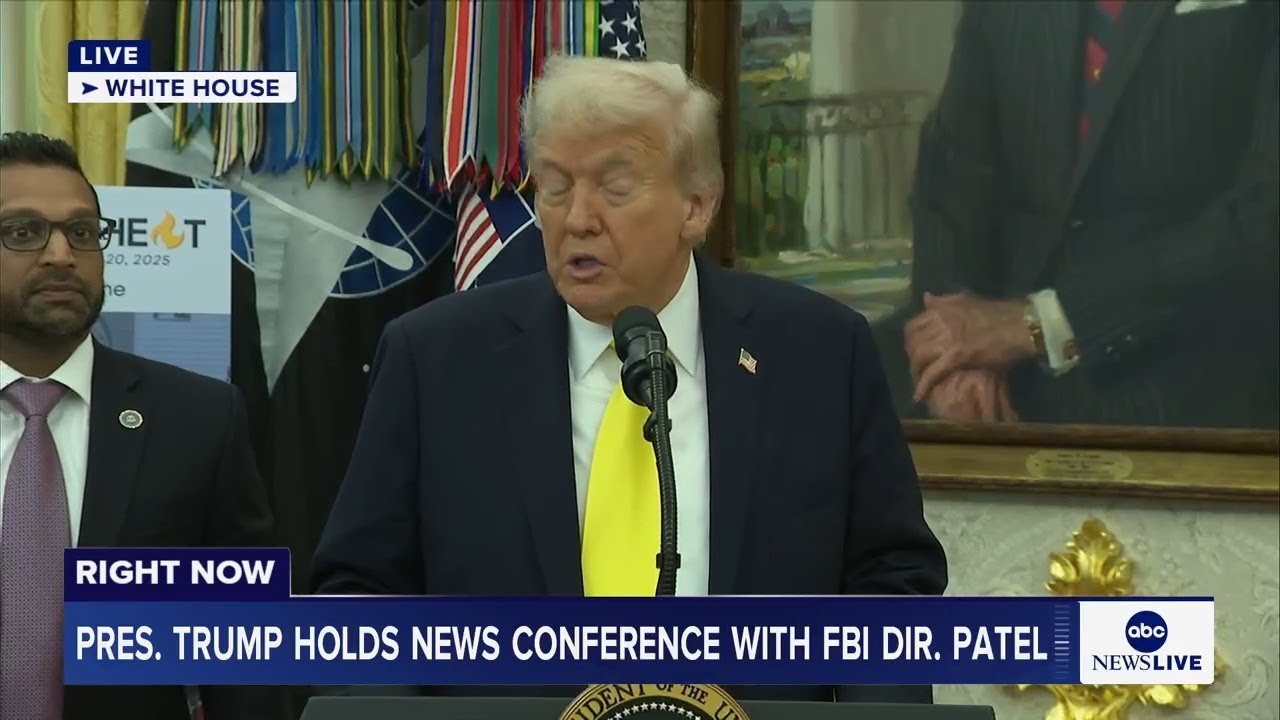 in the Oval Office on Wednesday. The sentiment was not new: Everyone knows that Trump has a grudge against Smith, the former special counsel who obtained two federal indictments against him, which Trump described as "the worst weaponization" of the justice system "in the history of the world." But the fact that the president offered his assessment of Smith alongside three top federal law enforcement officials—Attorney General Pam Bondi, Deputy Attorney General Todd Blanche, and FBI Director Kash Patel—made it seem more like marching orders than his usual airing of grievances.
Bondi, Blanche, and Patel are all Trump loyalists who previously worked for him personally. Bondi served on Trump's defense team during his first impeachment. Blanche represented him during his 2024 criminal trial in New York. Patel—the author of children's books detailing the travails of the wise and just "King Donald," who is able to triumph over his evil enemies with the help of "a wizard called Kash the Distinguished Discoverer"—served as a campaign surrogate and a go-between during the dispute over the presidential records that Trump took when he left the White House in January 2021. But in their current positions, Bondi, Blanche, and Patel are supposed to be working for the American people, and before their Senate confirmations all three promised to pursue justice rather than revenge.
How is that going? The dubious perjury indictment of former FBI Director James Comey, who earned a prominent spot on Trump's enemies list by overseeing the investigation of alleged ties between his 2016 campaign and the Russian government, came just five days before the statutory deadline and five days after the president publicly told Bondi that "we can't delay any longer." That Truth Social missive also mentioned the need to prosecute another Trump nemesis, New York Attorney General Letitia James, who last week was charged with mortgage fraud in an indictment obtained by the same neophyte prosecutor: Lindsey Halligan, a former Trump lawyer whom he appointed as the interim U.S. attorney for the Eastern District of Virginia after her predecessor proved insufficiently enthusiastic about pursuing cases against Comey and James.
Bondi and Blanche reportedly were also privately skeptical about the viability of those cases. The president nevertheless got what he wanted, which suggests the same thing could happen with Smith, regardless of Trump's inability to explain exactly what crime the former special counsel supposedly committed.
Trump alluded to an October 8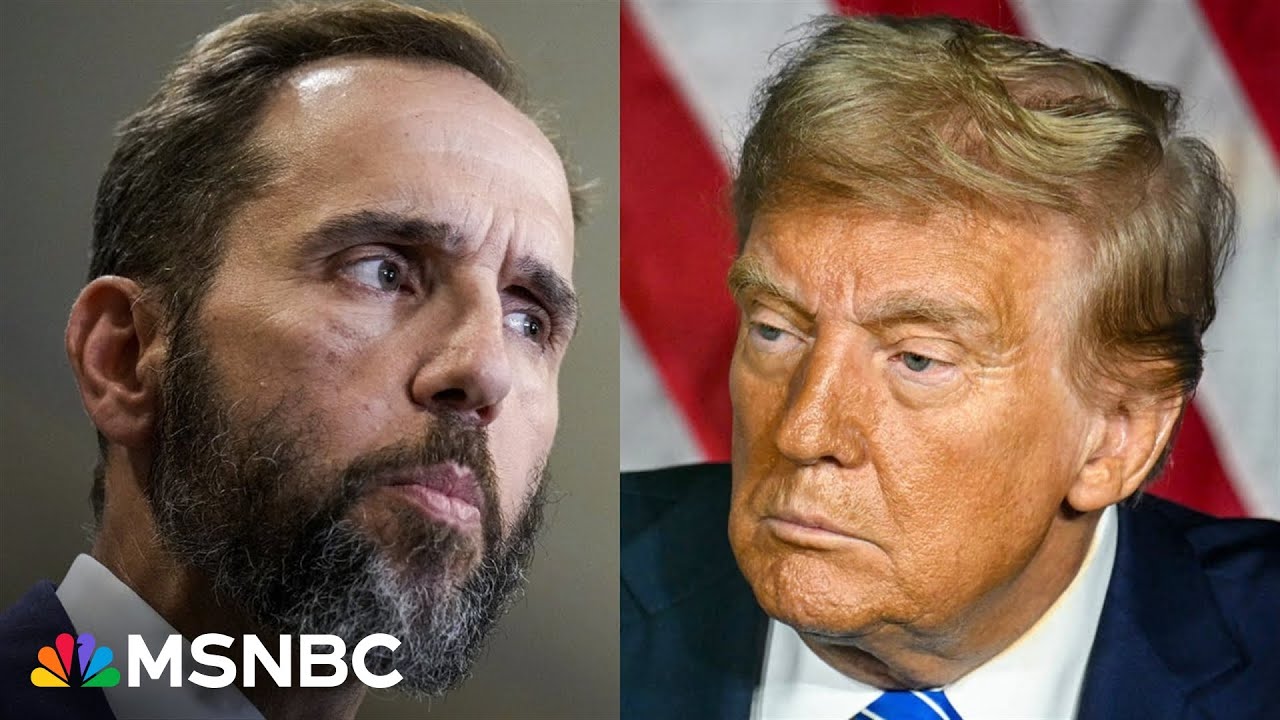 at University College London in which Smith defended his work on criminal cases that charged Trump with mishandling classified material after he left office and with illegally trying to overturn the results of the 2020 presidential election. Smith's interviewer at that event was former FBI General Counsel Andrew Weissmann, which reminded Trump that Weissmann also is "a bad guy" who probably should be prosecuted for something. "I hope they're gonna look into Weissmann too," he said.
Weissmann earned Trump's ire by participating in the Russia probe as part of former Special Counsel Robert Mueller's team. And while Trump was on the subject of people who had wronged him in one way or another, he added that Lisa Monaco, deputy attorney general during the Biden administration, likewise "should be looked at very strongly." Monaco, Trump explained, was Weissmann's "puppet," so she also should be punished.
"There was tremendous criminal activity," Trump averred. "You're talking about political crime….I hope they're looking at political crime because there's never been so much political crime against a political opponent as what I had to go through."
New York Timesreporter Glenn Thrush notes that Bondi, Blanche, and Patel "smiled, nodded and shuffled in place" as their boss suggested that the Justice Department should find charges to pin on Smith, Weissmann, and Monaco. But not to worry: Patel, during his confirmation hearing, promised there would be "no politicization at the FBI" and "no retributive actions" against the president's enemies.
Patel felt a need to offer those assurances because in 2023 he had published a book, Government Gangsters, that included an appendix listing 60 "Members of the Executive Branch Deep State," whom he described as "corrupt actors of the first order." Weissmann and Monaco were both on that list. Smith did not make the cut, possibly because he did not obtain the first indictment of Trump until June 2023, after Patel had finished his manuscript.
In any case, Patel assured the senators who confirmed him that, notwithstanding his promise to "come after" the anti-Trump "conspirators," he would not use his powers in service of the president's personal vendettas. Patel nevertheless portrayed the Comey indictment as a response to the "Russiagate Hoax," even though the charges against him were legally unrelated to that investigation.
Like Patel, Bondi was confirmed after promising to be guided by the facts and the law rather than the president's grudges. "The partisanship, the weaponization, will be gone," she declared. "America will have one tier of justice for all….There will never be an enemies list within the Department of Justice."
Blanche sang the same tune during his confirmation hearing. "Politics should never play a role in the Department of Justice," he said. "We will work to restore the American people's faith in our justice system."
Whether or not Bondi and Blanche meant those words when they said them, the president plainly does not share the vision they described. "They're all guilty as hell," Trump said in the Truth Social rant addressed to Bondi, which mentioned Adam Schiff, the not-yet-indicted Democratic senator from California (whom Trump also mentioned on Wednesday), along with Comey and James—a list to which he has now added three more names. Guilty of what? The Justice Department's job, as Trump sees it, is to figure that out.
The post Trump Adds 3 More Names to the List of Enemies He Wants the Justice Department To Prosecute appeared first on Reason.com.
---
---
9 25
AG Pam Bondi Says "We Can Prosecute You" for Refusing to Print Posters for Charlie Kirk Vigil
But there doesn't seem to be any federal law actually authorizing such prosecutions (or civil lawsuits).
Eugene Volokh | 9.16.2025
The Hill (Ashleigh Fields) reports:
Attorney General Pam Bondi on Monday said the Justice Department was investigating an incident involving a Michigan Office Depot employee who refused to print flyers advertising a vigil for conservative activist Charlie Kirk…. Office Depot said last week they removed the employee responsible for denying the order placed by the Kalamazoo County Republican Party.
Here's the Bondi quote, from Hannity on Fox, starting about 4:42:
Businesses cannot discriminate. If you wanna go in and print posters with Charlie's pictures on them for a vigil, you have to let them do that. We can prosecute you for that. But I have Harmeet Dhillon right now in our Civil Rights unit looking at that immediately, that Office Depot had done that. We're looking at that.
But no federal law, to my knowledge, purports to ban stores from discriminating based on the political expression of the material they're asked to print.
Title II of the Civil Rights Act of 1964 bans discrimination by certain places of public accommodation—such as restaurants, hotels, theaters, and places of public amusement—based on race, religion, and national origin. But it doesn't ban discrimination based on political views, and it doesn't apply to retailers, so it wouldn't apply here. It also bans discrimination based on disability, but that's not applicable here either. Businesses candiscriminate, just not on bases that the law forbids; and here, federal law doesn't appear to forbid this sort of discrimination.
Now some jurisdictions do ban political discrimination in places of public accommodation (see this article). If such a ban were applied to a print shop that deliberately refused to process an order based on its political content, then it might violate the First Amendment (see the concurrence in *Lexington-Fayette Urban County Human Rights Comm'n v. Hands On Originals* (Ky. 2019), a case in which Cato Institute and I filed an amicus brief making the First Amendment argument).
That First Amendment claim would be strengthened, of course, by 303 Creative LLC v. Elenis (2023), which recognized a First Amendment right not to create a website for same-sex weddings. It's conceivable that a court might limit the First Amendment defenses to small businesses where the owner would have to do the work personally; cf. Rumsfeld v. FAIR(2006), which upheld certain requirements that universities host certain speech, and distribute related speech, though perhaps the reasoning of 303 Creativewould apply even to a large business such as Office Depot.
But none of that even arises here, because those jurisdictions are certain cities and counties, some territories, D.C., and perhaps a few states. None of those laws applies to the Office Depot involved in this incident; and even if there was such a law in Michigan or in the town of Portage (where the store was apparently located), it wouldn't be enforced by the U.S. Justice Department. Perhaps I'm missing something here, but it's hard to see a credible legal basis for AG Bondi's statements.
Start your day with Reason
---
[ New York Post
‘Twitter Files’ journalist Matt Taibbi spars with Biden’s disinfo czar in censorship hearing: ‘We don’t need a truth squad’
"Twitter Files" journalist Matt Taibbi sparred with former President Joe Biden's onetime "disinformation czar" Nina Jankowicz during a...
.
2 days ago](https://nypost.com/2025/04/01/us-news/twitter-files-journalist-matt-taibbi-spars-with-bidens-disinfo-czar-in-censorship-hearing/)
[
 WSJ
WSJ Opinion: Matt Taibbi's 'Twitter Files' Testimony
Journalists Matt Taibbi and Michael Shellenberger testified before a congressional hearing on the growth of 'a censorship-industrial complex' that violates the...
.
Mar 9, 2023](https://www.wsj.com/video/wsj-opinion-matt-taibbi-twitter-files-testimony/CECB5252-9F58-40E2-AD77-281669275C5E)
[
 Reason Magazine
Democrats Threaten Matt Taibbi With Jail Time Over Twitter Files Testimony
The congresswoman's basis for accusing Taibbi of perjury is a handful of errors that he made during the publication of the Twitter Files. These...
.
Apr 20, 2023](https://reason.com/2023/04/20/matti-taibbi-stacey-plaskett-jail-time-twitter-files-perjury/)
AN 9 24
alternet-no lnx
Inside the billionaire's trick to keep people from voting
Thom Hartmann
September 23, 2024
Outside of Oprah Winfrey and Michael Jordan (and a hedge fund guy), just about all American billionaires are white. And while their white privilege helped most of them to become billionaires in the first place, for the politically active billionaires on the right, it’s their money that they care about the most.
Fred Koch, the founding patriarch of the Koch family, was an early supporter of the John Birch Society (JBS), which vigorously opposed any efforts to reduce the powers of the very wealthy white people or elevate the wealth or political power of poor or working-class people. Their most public positions in the 1950s and 1960s were against racial integration and communism— the ultimate method for leveling the fortunes of the rich. The JBS opposed virtually all “welfare” legislation, from Social Security to Medicare to unemployment insurance, calling it socialism and equating it with a softer version of communism. Around that same time, a Russian immigrant who’d fled the Soviet Union (her father had lost his pharmacy shop to the Bolshevik Revolution) came to America with dreams of becoming a great author or actress. Alisa Zinovyevna Rosenbaum chose the stage and pen name of Ayn Rand, and in the 1950s she wrote a rather simplistic novel celebrating inherited wealth.
In Atlas Shrugged, a young woman and her hapless brother inherit a railroad from their father and try to grow it strong over opposition from the unions, which want a safe workplace and reasonable pay. As George Monbiot wrote:
In a notorious passage, she argues that all the passengers in a train filled with poisoned fumes deserved their fate. One, for instance, was a teacher who taught children to be team players; one was a mother married to a civil servant, who cared for her children; one was a housewife “who believed that she had the right to elect politicians, of whom she knew nothing.”35
It means nothing, in other words, if average people are ground into the dirt. But when people who inherited wealth face challenges, particularly those from average working families, they should be able to utterly destroy them.
ALSO READ: Trump has a brand new front in the Haitian conspiracy push
In a subsequent novel, The Fountainhead, one of the “producers” of her mythology rapes a woman, but it’s all good because the woman decides that she enjoys it mid-rape. Monbiot boils it down simply: “Rand’s is the philosophy of the psychopath, a misanthropic fantasy of cruelty, revenge, and greed.”
While Fred Koch was helping the JBS in its fight against taxes and regulation, his sons were apparently reading Ayn Rand and taking her philosophy of radical selfishness to heart. They were also, by the 1970s, running the Koch oil operation and having constant struggles with regulators, particularly during the Carter administration.
Looking for political juice, David Koch joined and then largely took over the Libertarian Party in the late 1970s.
That political party had been created by the Foundation for Economic Education (FEE), a lobbying group formed in 1946 that represented the Big Three carmakers, the top three US oil companies, Monsanto, DuPont, GE, Merrill Lynch, Eli Lilly, and both US Steel and Republic Steel. Robert Welch, the founder of the John Birch Society, was on its board of directors, as were United Fruit president Herb Cornuelle; National Association of Manufacturers director and DuPont and GM board member Donaldson Brown; and Leonard Read, a longtime US Chamber of Commerce executive.
The mission of the new libertarian movement was straightforward: to lobby for the interests of big business and the uber-wealthy people that such business had created.
The same year that the FEE was created and they began the rollout of libertarianism, Congress busted an obscure University of Chicago economist named Milton Friedman for illegally shilling for the real estate industry.
As Mark Ames wrote:
The purpose of the FEE—and libertarianism, as it was originally created—was to supplement big business lobbying with a pseudo-intellectual, pseudo-economics rationale to back up its policy and legislative attacks on labor and government regulations.
This background is important in the Milton Friedman story because Friedman is a founder of libertarianism and neoliberalism, and because the corrupt lobbying deal he was busted playing a part in was arranged through the Foundation for Economic Education.36
Friedman was later implicated in the aftermath of the brutal and violent takedown of democracy in Chile, and his acolytes helped privatize the state-owned properties of the Soviet Union, creating the kleptocratic and oligarchic government that now runs Russia and many of the former Soviet states. Libertarianism, it turns out, has had real-world impacts, which include the deaths of hundreds of thousands.
No country has ever successfully established a libertarian form of economy or governance; it was, after all, a scam set up to front for the very rich, and the corporations that made them that way. But that hasn’t stopped libertarian and corporatist ideologues from trying.
While Chile and Russia are well-known examples, few Americans seem to remember how George W. Bush, Dick Cheney, and Donald Rumsfeld simply stood on the sidelines watching as the treasures of Iraq were looted after the United States took down their government.
It was to be a Grand Experiment: they’d finally prove that without government interference in a nation’s economy or social systems, an utopia would emerge. L. Paul Bremer was their front man, arriving in Iraq on May 2, 2003, to begin the process of “freeing” the country’s economy so that the world’s corporations would flood in and create a paradise.
As Naomi Klein wrote for Harper’s Magazine in an article titled “Baghdad Year Zero”:
The tone of Bremer’s tenure was set with his first major act on the job: he fired 500,000 state workers, most of them soldiers, but also doctors, nurses, teachers, publishers, and printers. Next, he flung open the country’s borders to absolutely unrestricted imports: no tariffs, no duties, no inspections, no taxes. Iraq, Bremer declared two weeks after he arrived, was “open for business.”
One month later, Bremer unveiled the centerpiece of his reforms. Before the invasion, Iraq’s non-oil-related economy had been dominated by 200 state-owned companies, which produced everything from cement to paper to washing machines. In June, Bremer flew to an economic summit in Jordan and announced that these firms would be privatized immediately. “Getting inefficient state enterprises into private hands,” he said, “is essential for Iraq’s economic recovery.” It would be the largest state liquidation sale since the collapse of the Soviet Union.37
Once again, Milton Friedman, the FEE’s heirs, and libertarianism made a few more billionaires and destroyed the lives of literally millions of people.
The source of the funds being channeled to Friedman back in 1949 was a man named Herbert Nelson, who was the chief lobbyist and executive vice president of the National Association of Real Estate Boards, which not only was opposed to rent control laws but also had one of the largest lobbying budgets in Washington, DC.
Congressional investigators found a letter he wrote in 1949 saying:
“I do not believe in democracy. I think it stinks. I don’t think anybody except direct taxpayers should be allowed to vote.
“I don’t believe women should be allowed to vote at all. Ever since they started, our public affairs have been in a worse mess than ever.”38
Although the details are still a bit fuzzy, it appears that libertarianism (and the creation of a political party using that name) was Nelson’s idea, or at least one he promoted vigorously. With a budget of over $60 million (in today’s dollars), Nelson hired the FEE to come up with a third party that would argue for the interests of the wealthy developers and landlords he represented. The FEE, in turn, hired Milton Friedman.
Reason Magazine, heavily funded by the Kochs, was the main voice of the libertarian movement in the 1970s, and in 1977 it published a fascinating article by Moshe Kroy that described how libertarians should market their free-market fundamentalism to skeptical Americans.
Noting that it was important not to lie to people outright, Kroy wrote:
“The point is that you can use tricks—and you’d better, if you really want libertarianism to have a fighting chance.”39
The tricks involved repackaging and reframing libertarian dogma and using “salesmanship.”
For example, Kroy asserted that the average person wouldn’t understand an abstraction like individual rights. So don’t even bother explaining how libertarianism would shrink government and empower corporations and the rich. “Instead,” Kroy wrote”
“[W]hat you can do is to explain to him that libertarianism is just against one thing: CRIME. By crime you mean just what he means: theft, robbery, kidnapping, enslavement. He will of course agree, because he thinks this is obvious. Then you just explain (at great length, and with many examples) that taxation is armed robbery, that inflation through deficit spending and money printing is theft—as well as forgery of money—that draft is basically kidnapping, etc.”40
This was something the average person could understand. The government that people thought would protect them from polluting corporations, would provide an efficient court and fiscal system to protect their jobs and bank accounts from corporate grifters, and would defend their lives in war if necessary—that government was, in fact, an evil thing.
If the billionaires could get the average American to look at government the way that oil, chemical, real estate, and banking industry billionaires did, and just elect politicians who were bought and paid for by those industries, then things would get very, very easy.
===
desmog fdn
Actions
May 6, 2019
Reason.comattempted to refute the findings of a UN-sponsored study on the rate of global species extinction. The report issued by the Intergovernmental Science-Policy Platform on Biodiversity and Ecosystem Services (IPBES) predicted that up to one million species would become extinct over the coming decades as a direct consequence of human activity, and recommended “transformative change” to halt the widespread destruction of global ecosystems. Reason categorized the study’s conclusion as another example in “a long line of apocalyptic extinction predictions.” [33], [34], [35]
April 22, 2016
Julian Morris, Vice President of research at the Reason Foundation, published an article in the Orange County Register titled “Climate pact likely to do more harm than good” where he contends that the agreement reached at the Paris COP21 climate conference would be “unlikely to significantly reduce any climate-related harms.” [31]
“[B]y slowing down the rate of innovation and economic growth across the world, it could seriously hinder adaptation. And those consequences could be dire, especially for the poor who currently suffer most from climate-related problems,” Morris writes. [31]
According to Julian Morris, “economic analyses suggest that global warming of up to 3 degrees Celsius above preindustrial levels could generate net benefits for humanity.” He lists benefits as decreased heating costs, fewer temperature-related deaths, and increases in global crop production. [31]
March, 2016
The Reason Foundation was one of nearly 100 think tanks named in a**subpoena to ExxonMobil for communications** since January 1, 1977 with groups addressing issues with respect to climate change. [30] AG walker]
Ronald Bailey, science correspondent at Reason magazine, describes the subpoena as a “anti-free-speech effort”and argues that they are “a huge step in the direction of using the courts to silence people who hold views that differ from those of powerful government officials.” [30]
Bailey notes that “Over the years I have worked with several groups listed in the USVI subpoena on a wide variety of public policy issues relevant to resisting government encroachments into free markets, mostly not having anything to do with climate change.” [30]
2015
Since Pope Francis released the Encyclical on the Environment, the Reason Foundation has released a number of articlescritical of him. Reason magazine has said Pope Francis “doesn’t really understand capitalism,” and “hates free markets.” [16], [17], [18]
August 6, 2015
The Reason Foundation released a study, titled “Assessing the Social Costs and Benefits of Regulating Carbon Emissions,” by Julian Morris(the Foundation’s Vice President of Research.)[20]
According to the Reason Foundation, the study “shows that estimates of the ‘social cost of carbon” have been falling’ — and would fall further if new scientific evidence were incorporated. The study calls into question the analyses used to underpin the Obama administration’s newClean Power Plan and other federal regulations targeting emissions of greenhouse gases.” [21]
August, 2015
Ronald Bailey, science correspondent for Reason Magazine, quotes the industry-funded American Enterprise Institute, as well as Patrick Michaels and Paul Knappenberger of the Cato Institute in an article titled “Obama’s Clean Power Plan Would Reduce Global Warming by -0.015 Degree By 2100.”[22]
In the piece, Bailey also promotes his book, The End of Doom: Environmental Renewal in the Twenty-first Century,where he says that “the [climate] models are running hotter than actual temperatures.” he admits that his book was made possible by the Cato Institute, which “generously provided me with a grant that allowed me the time to write The End of Doom.”
January, 2015
Reason magazine released an overall positive review of Alex Epstein‘s book, The Moral Case for Fossil Fuels. Epstein is the founder of the Center for Industrial Progress (:{CIP:(style="box-sizing:border-box"):}:), a group that regularly publishes articles “debunking” environmentalism, and promoting the oil and coal industries. [19]
According to Ronald Bailey, Alex Epstein “makes a persuasive case that cheap and abundant fossil fuels are critical to enabling billions to escape conditions of Malthusian privation.”
August 29, 2014
Reason‘s science correspondent Ronald Bailey published an articlewhere he claims that doing nothing to prevent climate change would result in the same cost as climate action:
“In other words, doing nothing about climate change will cost future generations roughly the same as doing something,” Bailey writes.[23]
May 21 – 23, 2012
The Reason Foundation is listed as an official Co-sponsor (:{PDF:(style="box-sizing:border-box"):}:) of the Heartland Institute‘s Seventh International Conference on Climate Change (ICCC7). [24]
June 7, 2002
Kenneth Green of the Reason Foundation signed a joint letter to President Bush on the :{EPA:(style="box-sizing:border-box"):}:‘s Climate Action Report.[25]
Those who sign the letter describe themselves as “opponents of the Kyoto Protocol and similar domestic proposals to ration energy,” and applaud Bush for his “resolution in the face of continuing environmentalalarmism.”
The letter describes the 2002 Climate Action Report as “a compilation and summary of junk science produced by the Clinton-Gore Administration in order to support their Kyoto agenda,” and urge the report to be withdrawn and “re-written on the basis of sound science.”
re bio bs above:
National Academy of Sciences Invites Creationists to Testify on the Validity of Biological Evolution: Well, Actually a Bunch Anti-Biotech Activists
RONALD BAILEY | 9.16.2014
Quackery
naturalnews
The National Academy would (I hope) never solicit testimony from creationists about the findings of evolutionary science. But when it comes to biotech crops, the National Academy has succumbed to the moral equivalent of listening to creationists. How? By inviting numerous neoluddite charlatans testify before a National Research Council (NRC) panel that is working on a new report evaluating the safety of modern biotech crops this week. The anti-technology activist groups that appeared before the NAS panel include the Center for Food Safety, Food and Water Watch, ETC Group, Institute for Responsible Technology, Union of Concerned Scientists and Consumers Union.
Jon Entine, who heads up the invaluable Genetic Literacy Project, also testified and warned the NAS panel about how inviting the claque of anti-biotechnology quacks to appear before them will backfire.
From Entine's testimony:
I don't question the sincerity of the concerns of those invited about the future of food and farming any more than I would question the fervent belief of a Young Earth Christian that the earth is 6,000 years old. And I appreciate the bind that you faced in organizing this project. While not respected in the broader science community, some of those invited are part of the public conversation, just as creationists are part of the debate over evolution.
You face pressure to demonstrate to skeptics of GE that the NRC and by proxy the American people are listening to their concerns. Perhaps it made sense to invite science's harshest critics. But panel members, don't assume that those who will have spoken will ultimately embrace this process. Emboldened by the implicit endorsement that an appearance at the Academy confers, they will resume their campaigns to scare the public about a safe technology. Don't be shocked that for years to come, they will make hay that they have been "consulted" by the National Academy of Sciences about GMOs. [OF COURSE HE LIST THIS IN HIS SHORT BONA FIDES ABOVE] Don't be surprised that when you issue your report in 2016, you will be ridiculed for holding what they will then characterize as a "rigged NRC process".
That's even more of a reason that if your goal is to demonstrate your leadership,it's critical that you speak out about what the consensus science shows—no wavering or hedging to appease critics that fail to use good science.You may have to take a forceful and uncomfortable stand in the face of vocal criticism. Science is not a democracy. We don't get to vote on whether a whale is a fish or a mammal…
The scientific consensus does not mean the public embraces sound science on GMOs anymore than the certainty of natural selection closes the public debate over evolution. Polls indicate half of Americans believe in creationism or God-guided evolution…
You, this panel have an opportunity to end this charade, this faux debate over GMO safety: There are simply no credible studies in top flight journals—and none that has been repeated—that suggest serious likely safety issues that would not also apply to conventional or organic foods.
Entine's whole testimony is well worth reading. Let's hope that the NRC panel takes it to heart.
For more background, see my article, "The Top 5 Lies About Biotech Crops."
Addendum: H&R commenter J. Browne sent me this relevant email which I asked to post:
I was on a National Research Center evaluation team a while ago as an external data analyst. We held three hearings on the topic and one of them was specifically to include viewpoints that were very much outside the norm in the field. Those individuals play their same tune years later, but the noise would have been much louder had they been excluded. This is something the NRC knows from experience.
So it doesn't seem odd to me that they would invite anti-biotech activists to a hearing on the topic. Now, if they give their views many pages in their report, then you have an argument. Entine's will have a point.
Good points. We will see how the NRC treats the charlatans in its report. Still, I think that Entine's point stands:
Don't be shocked that for years to come, they will make hay that they have been "consulted" by the National Academy of Sciences about GMOs. Don't be surprised that when you issue your report in 2016, you will be ridiculed for holding what they will then characterize as a "rigged NRC process".Don't be surprised that when you issue your report in 2016, you will be ridiculed for holding what they will then characterize as a "rigged NRC process".
NEXT: MoreObamacare Enrollment Data, More Obamacare Enrollment Questions
RONALD BAILEY is science correspondent at Reason.
BIOTECHNOLOGY
NATIONAL ACADEMY OF SCIENCES
SCIENCE
LUDDISM
MEDIA
https://reason.com/2006/09/22/confessions-of-an-alleged-exxo/
no lnx quite long
Confessions of an Alleged ExxonMobil Whore
Actually no one paid me to be wrong about global warming. Or anything else.
RONALD BAILEY | 9.22.2006 8:10 AM
"Exxon Misleads on Climate Change," according to Reuters earlier this week. The story, headlined around the globe, was based on a letter sent by the British Royal Society to the oil giant ExxonMobil accusing it of funding groups that misinform the public about the reality of man-made global warming. The prestigious Royal Society is the world's oldest scientific organization. The letter is from Bob Ward, the Society's senior manager for policy communication. Apparently speaking on behalf of the Society, Ward expresses his "disappointment at the inaccurate and misleading view of climate change" conveyed by an ExxonMobil's 2005 Corporate Citizenship report. Ward also says that he did a quick analysis of public policy organizations listed in ExxonMobil's 2005 Worldwide Corporate Giving report and found that "25 offered views consistent with the scientific literature" whereas Ward says he found 39 groups featuring information that "misrepresented the science of climate change."
It's safe to say that Ward may count the Reason Foundation, the nonprofit that publishes Reason magazine and Reason Online as one of the 39 groups that he believes misleads the public on the issue of climate change. If that's the case, then at least some of the information that Ward says "misrepresents" climate change science may be past articles written by me. So the question is: Why did I do it? Did ExxonMobil CEO Lee Raymond hand me brown paper bags filled with stacks of unmarked bills in the back of taxis while whispering, "Ron, we're counting on your widely read and highly influential articles to help stave off the Green onslaught against our soaring profits"? Or was I a simple-minded dupe, passing along misinformation supplied to me during expensive lunches at the Palm by corrupt scientists who had been paid off by the oil giant? Or perhaps I am just generally skeptical of end-of-the-world scenarios and believe, as Carl Sagan famously did, that "extraordinary claims require extraordinary evidence"?
I have been Reason's science correspondent for nearly eight years now. Well before I joined the magazine, I had been reporting and opining on environmental science and policy issues for various publications and as a producer of a number of national PBS television series. As far as I can tell my first published expression of skepticism with regard to catastrophic global warming was in a review of environmentalist Bill McKibben's The End of Nature that I wrote as a staff writer for Forbes magazine in October, 1989 (unfortunately not available online). In that review, I noted that NASA climate modeler James Hansen had testified before Congress a year earlier that he had detected global warming. In my review, I noted, "Hansen is a reputable scientist, but his views are by no means universally accepted." I then quoted a number of climatologists who were skeptical of man-made global warming including MIT's Richard Lindzen and Woods Hole Oceanographic Institution's Andrew Solow. Lindzen told me at the time, "We have no evidence whatsoever that greenhouse warming has begun." (Lindzen is still skeptical of catastrophic man-made global warming.) I would talk with them and many other climate scientists over the next decade and half as I continued to cover this issue.
My next prominent foray into the topic w...
cmd ~ USPO
Who is Richard Fink?
Charles Koch and Richard Fink go back forty years. Fink recently retired as vice president of Koch Industries where for decades he had held a seat on the board of the second largest privately controlled corporation in the U.S. Koch has been the CEO of the family business for more than 50 years. Fink began his career of political influence as an economics professor at Rutgers University and then George Mason University, where he helped launch what became the Mercatus Center with Koch to help operationalize his agenda through training a “cadre” to influence national policymakers in D.C.
In 1979, Koch created a group called Council for a Competitive Economy and Fink testified before the House Subcommittee on Postal Operations and Services calling for Congress to repeal the government “monopoly” on first class mail. In 1984, Charles Koch staked Fink at the successor to that group, dubbed Citizens for a Sound Economy (which is now called Americans for Prosperity), as a vehicle to influence the Reagan administration to advance Koch’s goals on privatization and other libertarian theories...
Alhough Koch had largely abandoned the Libertarian Party around this time in favor of trying to move the GOP toward his wide-reaching agenda, he did not abandon his policy goals. His agenda was to seek radical changes to limit the power of democratic government, using large steps and small steps to carve or chip away at it through any means available. (ITPI Executive Director, Donald Cohen, has documented how privatization as an economic strategy has grown into a political strategy.) Fink was also the Director of the Koch-funded and -created Center for the Study of Market Processes at George Mason University, which started in 1980. It is now known as the Mercatus Center.
Koch began funding his pet projects at that little-known public school in the D.C. suburbs four decades ago. To date, more than $100 million has come from the Koch fortune to the university, its law school, and other entities associated with the campus, like Koch’s Institute for Humane Studies. In the 1970s, Koch had focused his energies on building up the Libertarian Party (founded by another MIT grad, David Nolan, who joined the fraternity the Kochs had) and creating his own foundation, which became the Cato Institute. Back then, Cato operated almost as an adjunct to the Libertarian Party, with key staff like Ed Crane revolving between the two entities depending on the election season.
Cato also advanced Koch’s privatization ideology and continues to do so to this day, attacking the Postal Service in numerous ways. With Koch also becoming the biggest funder of the Libertarian Party in 1976, its platform expanded to include a host of items aligned with Koch’s agenda. For the first time that year its platform provided: “We propose the abolition of the governmental Postal Service…. Pending abolition, we call for an end to the monopoly system and for allowing free private competition in all aspects of postal service.” That was also in the party’s 1980 platform. That’s the year David Koch ran for vice president and spent more than $2 million to fund the party’s bid for the White House and to pull Reagan to the right.
Although it garnered less than 1 percent of the vote, the Libertarian Party’s sentiments were embraced by Reagan in many ways, such as his famous line at his inauguration that “government is not the solution to our problem, government is the problem.” Reagan created the Grace Commission, using the phrase “drain the swamp,” to deputize corporate leaders to identify government functions that could be outsourced or sold off to the private sector. Fink along with Citizens for a Sound Economy used the Grace Commission’s efforts to press for wide privatization. That Commission expressly recommended that the Postal Service outsource thousands of post offices (primarily rural ones) to the private sector to operate as limited service contract stations. That would have been a major step toward privatization, in the early 1980s, while yet another Koch man was pushing to privatize public institutions and functions at all levels of government, at home and abroad...
the Postal Service was not always the target for privatization or the equivalent by GOP-aligned policymakers. That agenda took hold in the 1980s. But the seed was planted a decade before that. In 1968, the libertarian Reason magazine published one of the first articles in the country asking “Why Not a Laissez Faire Postal System?”
Reason embraced the radical idea of getting rid of this public institution as part of its devotion to the libertarian theory that the free market knows best and can do best. This is rooted in part in Friedrich Hayek’s “Constitution of Liberty” (1960) and Milton Friedman’s “Capitalism and Freedom” (1962), two economists Koch has heavily promoted over the years. This line of attack on the Postal Service was very much against the tide of strong bipartisan public support for the post office. In 1970, Congress reaffirmed that the Postal Service was an essential public institution and public service.
Congress also limited its ability to close post offices, particularly in rural areas, even as the Postal Service changed in 1970 from a cabinet position to a government-owned corporation. (Federal Express [now FedEx] was launched in 1971 to provide private courier services for a premium.) In 1970, Congress affirmed that: “The United States Postal Service shall be operated as a basic and fundamental service provided to the people by the Government of the United States, authorized by the Constitution, created by Act of Congress, and supported by the people.”
Congress also said the Service's mission is “to bind the Nation together through the personal, educational, literary, and business correspondence of the people. It shall provide prompt, reliable, and efficient services to patrons in all areas and shall render postal services to all communities.”In 1970, MIT engineer Robert Poole bought Reasonand, with Tibor Machan and Manny Klausner, began operating it as a for-profit under the rubric Reason Enterprises. Reason needed ad revenues to survive, and it turns out Koch supplied a substantial portion of them along with loans.
It was Koch who staked Poole at the fledgling Reason in the early 1970s. In Poole’s history of the magazine marking its 10th anniversary in 1978, he thanked Koch, writing: “In the first few years of Reason’s California existence, one of its important sources of security was the long-term commitment of advertising by the Institute for Humane Studies and the Center for Independent Education. Ken Templeton, George Pearson, and Charles Koch of those institutions have been loyal friends and supporters over the years.” Koch himself founded the Center for Independent Education with Pearson in 1970, and then took over the Institute for Humane Studies after F.A. “Baldy” Harper died in 1973. In his tribute, Poole also singled out Koch as among a handful of individual donors who personally supported Reason in its first decade...
who is poole?
privatization was not even a gimmick let alone a word in the dictionary until a business writer named Peter Drucker predicted “reprivatization” of public functions in Europe in the late 1960s.Robert W. Poole Jr., an MIT engineer and fan of Ayn Rand, took it a step further in 1980 by popularizing the term “privatization.” After Robert Poole took over Reason magazine, Koch and his personal assistant, George Pearson, submitted articles to the magazine from its early days. In 1978, after consulting with Charles Koch, Poole co-founded the Reason Foundation, serving as its president and CEO from then until 2000.
He has advised the Reagan, George H.W. Bush, Clinton, and George W. Bush administrations on privatization and transportation policy. With Koch’s investment in Poole and Reason as his platform, Poole became the national expert on privatization. However—as Mark Ames noted in his profile of how Poole’s fee-based government helped spawn unjust municipalities like Ferguson, Missouri—Poole may have popularized the term but it was Nazi Germany that had coined the word “privatization.” Koch and Poole were aligned in other ways, with both of these MIT-trained engineers seeking to systematically inculcate people with libertarian theories and get those true believers into power.Poole described this goal in his 1971 essay “Leverage Points for Social Change” where he promoted the “permeation” of libertarians into key policy positions, noting that they only accounted for at most 0.05 percent of the U.S. population.
Koch would later note that permeation, or, in his words, “infiltration,” of government would only be successful if the libertarians who got in “reduce[d] government,” unlike Friedman whom Koch said did not. To help mark Reason’s 10th anniversary, Koch also engaged in a colloquy with Poole and others, about the “radical” nature of their theories and the need to attract followers. Koch noted: “For example, with Social Security, we can be very radical and say, ’Abolish Social Security’ … Or we can say, ’Well, it’s very complicated, and therefore we have to one-percent-a year move out of Social Security.’” That issue of the magazine also reprised one of the attacks on the Postal Service’s “first class mail monopoly.” As Poole recently wrote: “From January 1971 through June 1978 we published every month, like clockwork, but by 1977 it was clear that for Reason to have serious impact, we needed full-time paid staff and a serious budget for growth. Tibor, Manny, and I developed the plan for what became the Reason Foundation.
Thanks to an angel investor, we had enough funds to make the transition, and we opened our doors in downtown Santa Barbara in July 1978.” Thanks to research by Nancy MacLean in her book “Democracy in Chains,” we now know who that investor was. None other than Charles Koch—whom Poole didn’t mention in that 2016 retrospective; by that by the time the Koch name had become infamous. I had several visits … to discuss specific ideas the Reagan administration was considering, such as devolving federal functions to state and local government and privatizing the Postal Service. A Think Tank for Liberty (2018), p. 135. inthepublicinterest.org | The
:{
}:
[Billionaire Behind Efforts to Kill the U.S. Postal Service 15 ]
:{
}:
“On the tenth anniversary of Reason, in 1978, Poole convened a strategy session. Every man in the room looked toCharles Koch when talk turned to funding an infrastructure of ’professional libertarians,’ for who else could? The Wichita CEO was willing to commit the resources needed, he said, but with one condition: ’that libertarians must remain uncompromisingly radical.’ They had to forswear “the temptation” to “compromise” with those currently in positions of power. Any such conciliation, Koch warned, would ’destroy the movement.’ With Koch’s backing, Poole ’started working full-time for the cause,’ enlisting ’economic reasoning and evidence.’”
It was that meeting that led to the creation of the Reason Foundation, with Poole at the helm. The foundation became the publisher of the magazine and its own “think tank.” In 1979, Reason Foundation started full-scale operations and Poole devoted time to his opus on privatization, a book that melded his prior consulting work with the mission of Reason magazine. That book, “Cutting Back City Hall,” was published in 1980. Poole’s “catalytic” work on privatization helped spur more calls to privatize an array of public functions, including public schools. In his acknowledgements, Poole thanked “the Reason Foundation for allowing me to use their facilities during much of the time this book was in preparation.” But that sentence elided the reality, which was that Poole was the Reason Foundation and Koch was the angel investor in that enterprise to radically change American government. Poole’s book also contained a forward by William E. Simon, president of the John M. Olin Foundation, which had begun funding chairs for “free market” professors at universities across the country.
Simon suggested that municipal fire departments and tennis courts were “a form of local socialism.” Simon noted that Poole’s objective “is truly to subvert” local government functions by replacing them with private businesses, and he expressed the hope that it would “serve as a wellspring for changes that reach state and federal government as well.” Poole’s Koch-backed strategy and tactics would also reach governments beyond these shores, far exceeding Simon’s wishes. According to a biographer of United Kingdom Prime MinisterMargaret Thatcher, Poole’s book was seminal to her efforts to privatize or contract out key public functions—except that she refused to privatize the Royal Mail:“The intellectual case for ’contracting out’ came from an American MIT-trained policy wonk, Bob Poole, head of the Reason Foundation in Santa Barbara and author of a little book called ’Cutting Back on City Hall’… Everything—literally everything—could be outsourced and he littered his book with examples and figures…” Twenty-five years later, Thatcher would join Poole in celebrating privatization at the 20th anniversary of Reason’s Annual Privatization Report.”
That annual report was launched a few years after Poole’s book. Reason’s 1986 ”report on the status of privatization to date and important developments of that year … garnered enough attention from policymakers that Messrs. Koch and Poole determined that it was worth continuing.” The Koch that Reason was thanking for that publication was not Charles, however: “Reason owes a debt of gratitude to David Koch, and APR would not have flourished without his commitment to market-based tools that enable individuals, institutions, and societies to survive
[ inthepublicinterest.org | The Billionaire Behind Efforts to Kill the U.S. Postal Service 16]
and prosper. It is thanks to Mr. Koch’s vision and support that the Annual Privatization Report has become the nation’s foremost publication on privatization, outsourcing, and government reform.”
This report was issued on the eve of the push by Charles Koch’s Citizens for a Sound Economy, by his operative Richard Fink—and by James Miller, the OMB director Fink had helped win confirmation— to launch the Commission on Privatization. That commission, created by President Reagan, would recommend privatizing the Postal Service and other government functions. Koch family-controlled foundations have given the Reason Foundation at least $3 million— that is excluding more than a decade of tax filings that are unavailable. That tally also does not include funding from Koch Industries, if any, or from any personal checks from Charles or David Koch. It does not include the amount Charles Koch’s various groups spent on advertising in Reason over the past 40 years. …
Conclusion
The Postal Service has withstood more than two hundred years of dramatic changes in our country—until its very existence became a target of a billionaire devoted to the theory of privatizing government’s public functions in every way possible....
https://reason.com/2022/10/19/netflix-teams-up-with-the-obamas-to-produce-big-government-propaganda/
no lnx orig?
Netflix is paying President Barack Obama and Michelle Obama millions of dollars to produce shows for them.
:{
}:
The latest Obama documentary series is The G Word. "G" for government.
:{
}:
As Netflix documentaries go, this one is remarkably stupid. It's big government propaganda.
:{
}:
Obama begins by claiming that he does his own income taxes, saying, "It's actually easy."
:{
}:
I think he's joking, but it's not clear.
"I'm amazing at them," Obama continues hours later. "You can be, too, if you use the helpful tools found at IRS.gov."
But that's just silly. It's so complex that millions of us pay to get help.[intuit fuckery not here]
Obama's series is hosted by silly comedian Adam Conover. Conover, correctly, calls himself "an idiot."
He uses his time with the former president of the United States to make lame jokes and, at one point, to make sandwiches. He compliments Obama on how well he cuts the bread. It's not funny.
The series occasionally covers some serious issues—meat inspection, for example. But instead of honest reporting, actors do a skit suggesting that, without government, meat companies would sell us dead poisoned rats.[it did?]
"Food regulation was unbelievably successful," concludes Conover.
But food is largely safe today mostly because slaughterhouses cleaned themselves up way beyond what government requires. Companies don't want bad reputations.
One company executive showed me how they voluntarily do extra things like treat beef carcasses "with rinses and a 185-degree steam vacuum." Also, "equipment is routinely taken completely apart to be swab-tested."
By contrast, for 90 years, the U.S. Department of Agriculture inspected meat with a crude process called "poke and sniff." Inspectors stuck spikes into carcasses and smelled them. They kept using the same spikes, so they sometimes spread disease. The government only stopped poke and sniff in the 1990s.
A few times, Obama's series admits that government agencies mess things up. Conover mocks the Federal Emergency Management Agency (FEMA), "not a name you normally hear after the words 'did a great job.'"
:{
}:
No, but he then claims FEMA fails because it's underfunded, saying, "How many lives could have been saved if FEMA had had the resources they needed?"
:{
}:
That's ridiculous. FEMA doesn't fail because it lacks resources. U.S. disaster relief funds have increased by billions. FEMA fails because it's a government bureaucracy, and bureaucracies do wasteful things, like bring bottles of water to hurricane victims but then leave them at an airport.
:{
}:
The private sector is more efficient.
The G Word sneers at what it calls "this philosophy that the free market should be trusted over the government." But Walmart donates supplies much more efficiently than FEMA. They employ sophisticated weather tracking that helps them determine what assets are needed where. They get things to people because they lose money if they don't.
Obama's series smears those of us who are skeptical of government handouts.
"In the wake of the civil rights movement," claims Conover, "some Americans began to resent the fact that the government was now providing assistance to black and brown citizens."
What? We didn't resent welfare because we're racists. We objected because it created a new permanent underclass.
Handouts, President Ronald Reagan explained correctly, "discourage work."
So Obama's documentary depicts Reagan as a vicious surgeon cutting valuable government agencies, throwing them into a bucket labeled "free market."
:{
}:
But government wasn't cut under Reagan. Federal spending went up during his terms [military vs welfare? . It always goes up. At one point, the excesses were so grotesque that President Bill Clinton said, "The era of big government is over."
But it wasn't. It only grows. Today it's bigger than ever.
That's fine, says Conover, because Washington rescued us during the COVID shutdowns with "stimulus checks, small business loans, and corporate tax breaks!"
They don't mention how much of that money was stolen [by gop free mkt grover] or that their spending orgy brought 8 percent inflation.
For three hours, Obama and his sidekick say government should do more. Whatever the problem, their answer is always more government and more money.
:{
}:
Maybe someday a president will point out that government has no money of its own and that spending more than you have is a road to ruin.
Deceptive Art of Confirmation-Biased 'Science': Condemning Glyphosate
With a little conflict of interest thrown in
RONALD BAILEY | 10.31.2017
:{:(style="box-sizing:border-box;-webkit-font-smoothing:antialiased;display:inline-block;font-variant-numeric:normal;font-variant-east-asian:normal;text-rendering:auto;font-weight:900"):}::{:(style="box-sizing:border-box;-webkit-font-smoothing:antialiased;display:inline-block;font-variant-numeric:normal;font-variant-east-asian:normal;text-rendering:auto;font-weight:900"):}:
Anti-biotech activists hate the herbicide glyphosate, sold by Monsanto under the brand name Roundup. Those activists won a victory in 2015, when the World Health Organization's International Agency for Research on Cancer (IARC) issued a report classifying glyphosate as a "probable human carcinogen." That conclusion stood in stark contrast to the findings of every regulatory agency that has evaluated glyphosate over the past two decades, all of which have found the herbicide safe for people and the environment.
How did the World Health Organization diverge so sharply from the scientific consensus? By suppressing extensive evidence of glyphosate's safety. This month Reuters acquired a draft copy the IARC's glyphosate report. In the chapter on animal testing, references to numerous studies that found no link between glyphosate and cancer had been systematically deleted. The IARC refused to explain how that happened other than to refer to its consensus review process.
Meanwhile, a subsequent analysis of how the IARC evaluated the animal testing studies found that "the classification of glyphosate as a probable human carcinogen was the result of a flawed and incomplete summary of the experimental evidence." Many ongoing lawsuits against Monsanto allege that the plaintiffs contracted either non-Hodgkin's lymphoma (NHL) or multiple myeloma (MM) as a result of exposures to glyphosate. Researchers in a new review of human epidemiological studies reported that they "did not find support in the epidemiologic literature for a causal association between glyphosate and NHL or MM."
:{
I should note that one Christopher Portier chaired the Advisory Group to Recommend Priorities for IARC Monographs and later served as an invited specialist to the group that evaluated studies related to glyphosate and the risk of cancer.* After he retired from National Center for Environmental Health, Portier began working in 2013 as a senior scientist with the Environmental Defense Fund (EDF), an activist group that has long opposed many aspects of crop biotechnology and the use of glyphosate. In a 2014 letter to the journal Environmental Health Perspectives defending a scientifically discredited study on biotech corn, Portier listed only his affiliation with the IARC. The IARC did later disclose Portier's affiliation with EDF, but the agency apparently failed to consider the possibility that his work with anti-pesticide activist group might amount to a conflict of interest.
Nor is that Portier's only potential conflict of interest. Earlier this month, the European statistician David Zaruk reported that "during the same week that IARC had published its opinion on glyphosate's carcinogenicity, Christopher Portier signed a lucrative contract to be a litigation consultant for two law firms preparing to sue Monsanto on behalf of glyphosate cancer victims." Portier also agreed not to disclose publically his consulting arrangements with the law firms.
Over at Forbes, Albert Einstein College of Medicine cancer epidemiologist Geoffrey Kabat concludes, "All of this points to a trusted agency redacting the evidence to suit its predetermined and preferred story-line." That sounds entirely correct. The IARC's evaluation methodologies need to be dramatically overhauled and its leadership changed.
*[CORRECTION] Portier chaired the group that recommended IARC priorities for substances (including glyphosate) to be evaluated for carcinogencity through 2019, but served as an invited specialist with the group that concluded that glyphosate was a probable human carcinogen.
Disclosure: About three years ago I bought 100 shares of Monsanto with my own money for $109 per share. They were going yesterday at $121.30 per share.
}:
==
winner of ayn rand lookalike contest: off bs
Shikha Dalmia is a senior policy analyst at Reason Foundation, a nonprofit think tank advancing free minds and free markets. She is a Bloomberg View contributor and a columnist at the Washington Examiner, and she also writes regularly for Reason, The Wall Street Journal, USA Today,and numerous other publications. She considers herself to be a progressive libertarian and an agnostic with Buddhist longings and a Sufi soul. [cf FIRE scam]
Americans are so focused on the outrageous presidential candidacy of Donald Trump, we've largely missed one of the biggest political stories of 2016: the left's fearsome tactics to suppress its ideological opponents. Case in point: the liberal crusade to silence climate change dissenters.]
About 20 Democratic attorneys general have launched a campaign to go after ExxonMobil and other "corporate polluters" for allegedly disseminating "false" information about global warming. What did the Democratic Party do? Mock this campaign? No. Denounce it? Nope. Tell them to knock it off? Of course not. Instead, the Dems made this stance an official plank in their party platform, pledging to use the "Department of Justice to investigate alleged corporate fraud on the part of fossil fuel companies who have reportedly misled shareholders and the public on the scientific reality of climate change."
Eco-warriors claimto have internal memos that prove that ExxonMobil knew as far back as 1977, well before global warming achieved any sense of true public urgency, that doubling atmospheric carbon dioxide would produce a 2 to 3 degrees centigrade rise in global temperature. Liberals also claim that the company internally debated the impact of warming on its Arctic operations as far back as the early 1990s. But just like tobacco companies kept publicly denying the link between smoking and lung cancer even though they knew the truth, Exxon spent $30 million over the years to fund global warming "denialism" and stop action on climate change.
These claims are overblown at best.
First of all, comparing tobacco to fossil fuels is not just absurd, but malicious, given that smoking actually directly kills smokers. Now before you argue that global warming might one day kill people too, remember that fossil fuel is a source of cheap power without which countless millions of poor people, especially in Third World countries, would perish here and now, not in some distant future when the Earth heats up.
As for those so-called smoking gun memos, they were mere speculations that repeatedly and correctly emphasized the deep uncertainties in climate science at the time. And when the Intergovernmental Panel on Climate Change definitively declared in 2006 that the observed warming had human causes, my Reason colleague Ron Bailey has reported, ExxonMobil started warning investors that both climate change and the policies it spawned posed a risk to its business. It also switched from opposing climate change action to supporting a carbon tax.[did it stop funding denial after promising congress it wd?]
But none of this matters to global warming warriors who, in a zeal reminiscent of the great Spanish Inquisition, want to jail climate dissenters and have marked Exxon for "corporate death." To achieve that end, they are colluding with the Democratic Party and going after Exxon and any group that has had anything to do with climate change.
Last fall, a bunch of climate scientists at George Mason University dashed off a letter pressing the Justice Department to use the anti-mafia racketeering law called the RICO Act to investigate Exxon's alleged conspiracy of deceit. And instead of rejecting the suggestion outright, Attorney General Loretta Lynch referred the issue to the FBI, which is ominous enough.
Worse, this spring, some state attorneys general who are members of "AGs United for Clean Power" issued subpoenas to Exxon for all communication since 1977 with about 100 think tanks, advocacy groups, lobbyists, and university centers that it has funded (including Reason Foundation, where I work, which received funding from Exxon many moons ago). They also held a press conference — with none other than Al Gore [obligatory ox to gore] to add a touch of objectivity, no doubt — announcing their intention to get to the bottom of Exxon's conspiracy.
But the First Amendment protects all corporate lobbying — even deceptive corporate lobbying.[ dingdingding!] As such, this legal jihad is unlikely to result in charges. So what is its purpose? To harass Exxon to the point that it ends donations to outfits whose research and policy advocacy these AGs find threatening. When the Competitive Enterprise Institute, one of the listed groups, pointed out this gross abuse of power in an opinion piece, Claude Walker, the attorney general of the Virgin Islands, slapped it with a separate subpoena, demanding all correspondence with Exxon from 1997 to 2007.
Corporations usually succumb in the face of government harassment to avoid costly discovery and bad publicity. But this campaign is so beyond the pale that Exxon actually hinted that it would countersue and also filed for declaratory relief in a Texas district court on grounds that its constitutionally protected rights to free speech and due process, and against illegal searches and seizures, were being violated. Meanwhile,CEI filed a motion for**sanctions**against Walker, which would force him to pay its legal fees and possibly other damages. And the Energy and Environment Legal Institute, a free market legal group, FOIAed the emails of the so-called independent George Mason scientists who masterminded the missive to the Justice Department and has found clear evidence of not just collusionbetween them, various attorney generals, and other Democratic lawmakers, but also an effort to deceive reporters about it.
Such damning revelations have caused Walker — along with the attorneys general of Massachusetts and California — to back off. The only holdout in their cabal is New York's AG Eric Schneiderman, but he's playing a losing hand.
Still, this victory for constitutional liberties will be short lived if Hillary Clinton becomes president, given that the Democratic Party has officially declared its intention to continue to wage this war to silence climate change dissenters.
This is why it would behoove the GOP to put all of this centerstage in this election.
That would of course require a sane nominee interested less in himself and more in the Constitution. But Trump is so busy threatening even worse First Amendment violations to settle his own personal vendettas — for example, by threatening anti-trust action against Jeff Bezos, The Washington Post owner, for running "wrong" stories about him — that he has neither the interest nor the standing to expose the excesses of his political opponents.
Even if he loses, which, god willing, he will, this election will have been a huge missed opportunity to expose and moderate the agenda of the left. As things are shaping up in this awful campaign, regardless of what happens in November, free speech rights are in for a fight of their life in this country.
ref interesting link to legit left , so no fer of contamintion w/ truth apparently
theguardian.XXX/environment/climate-consensus-97-per-cent/2015/sep/29/is-the-fossil-fuel-industry-like-the-tobacco-industry-guilty-of-racketeering
http://www.motherjones.com/environment/2015/07/exxon-climate-change-email/
spoke too son on bravery:
http://nation.foxnews.com/2016/04/17/bill-nye-science-guy-open-criminal-charges-and-jail-time-climate-change-dissenters rolls to WT
http://www.washingtontimes.com/news/2016/apr/14/bill-nye-open-criminal-charges-jail-time-climate-c/
By Valerie Richardson - The Washington Times - Thursday, April 14, 2016
Bill Nye “the science guy” says in a video interview released Thursday that he is open to the idea of jailing those who deviate from the climate change consensus.
Asked about the heated rhetoric surrounding the climate change debate, such as Robert F. Kennedy Jr.’s previous comments that some climate skeptics should be prosecuted as war criminals, Mr. Nye replied, “We’ll see what happens.”
“Was it appropriate to jail the guys from Enron?” Mr. Nye asked in a video interview with Climate Depot’s Marc Morano. “We’ll see what happens. Was it appropriate to jail people from the cigarette industry who insisted that this addictive product was not addictive, and so on?”
“In these cases, for me, as a taxpayer and voter, the introduction of this extreme doubt about climate change is affecting my quality of life as a public citizen,” Mr. Nye said. “So I can see where people are very concerned about this, and they’re pursuing criminal investigations as well as engaging in discussions like this.”
Mr. Nye’s comments come with a coalition of liberal attorneys general pursuing companies that challenge the consensus of catastrophic climate change. Critics fear the campaign could chill research and free speech.
Virgin Islands Attorney General Claude E. Walker raised concerns about a government crackdown on dissent ..
==
ref reason
https://cei.org/blog/state-attorney-general-climate-change-investigations-are-unconstitutional
1/16 hans bader
Should government officials be able to cut off donations to groups because they employ people disparaged as “climate change deniers,” even if the group in question is a think tank that studies a wide range of topics, only a few of which relate to climate change at all, and the “denial” in question includes telling politically inconvenient truths about the cost of proposed climate change legislation? Only a single-issue zealot with ideological blinders and a contempt for the First Amendment would think so.
But that hasn’t stopped New York Attorney General Eric Schneiderman and California Attorney General Kamala Harris investigating Exxon, partly for making donations to think tanks like the American Enterprise Institute and groups like the American Legislative Exchange Council because these large organizations include a few people deemed “climate change deniers,” even though climate change has no relation to most of their activities. (I have been to many speeches and luncheons at AEI, and not a single one related to climate change or even energy or environmental policy.)
The First Amendment has long been interpreted as protecting corporate lobbying and donations, even to groups that allegedly deceive the public about important issues. For example, in *In re School Asbestos Litigation*, 46 F.3d 1284 (3d Cir. 1994), a federal appeals court ruled that the maker of an asbestos product could not be held liable for joining and financially supporting a trade association for makers of asbestos products, even though the trade association allegedly “disseminated misleading information about the danger of asbestos in schools directly to” the plaintiffs, where “at least some” of the trade association’s “activities were constitutionally protected.”
So even if being a “climate denier” were a crime (rather than constitutionally protected speech, as it in fact is), a donation to a non-profit that employs such a person would not be (especially given that a think tank like AEI also contains scholars whose positions on subjects like tax policy, labor law, property rights, and lawsuit abuse would be congenial to a corporation like Exxon).
In any event, judging from Schneiderman’s own remarks, Exxon did not engage in any deception about the health risks of its products when used (the way asbestos makers were accused of doing, and the way the big tobacco companies in factlong did), much less speech unprotected by the First Amendment. What angers Schneiderman most appears to be political opposition to certain controversial environmental legislation, not deception or views at odds with sound science: He is upset that Exxon had the temerity to note that policies advocated by climate change activists have real world costs, and may not be politically viable.
Schneiderman complains that Exxon noted that “switching over to renewables by the end of this century would raise energy costs” substantially, and that “Exxon Mobil essentially ruled out the possibility that governments would adopt climate policies stringent enough to force it to leave its reserves in the ground, saying that rising population and global energy demand would prevent that. ‘Meeting these needs will require all economic energy sources, especially oil and natural gas,’ it said.” (For a discussion of Exxon’s non-misleading positions about climate science, and why Schneiderman’s own complaint about it is at odds with actual climate data over the last 30 years, see this commentary by the liberal editor of The Washington Post, and this commentary at GlobalWarming.org.)
As Bloomberg put it, “On the face of it, the company’s research on climate change and its previous public positions on climate policy not only fail to amount to fraud, they aren’t even necessarily at odds. You might accept the reality of man-made global warming and still argue against strict new rules on emissions -- if, for example, you believe that such restrictions would do more harm than good. . . .that position isn’t indefensible, and certainly shouldn’t be illegal.”
So when I first read about state attorneys general investigating Exxon over its donations, and for allegedly minimizing the likelihood or ramifications of climate-change legislation, I wondered what was the point of such investigations, because any sanctions imposed on Exxon for such contributions would obviously run afoul of the First Amendment (as lawyers and newspapers like The Washington Postand USA Today have noted). As the Post’s Bob Samuelson noted earlier, ExxonMobil is being vilified for “expressing its opinions,” and exercising its constitutional right of free speech.
In so doing, I overlooked the likelihood that these investigations are designed not to uncover any wrongdoing, but simply to harass Exxon, by subjecting it to bad publicity and the costs of producing thousands of pages of documents in response to endless demands from partisan investigators. The process is the punishment.
Sadly, government officials can usually get away with this sort of abuse when they investigate conduct.But speech is a different matter. A prolonged investigation in response to someone’s speech can violate the First Amendment even when it never leads to a fine. For example, a federal appeals court ruled in *White v. Lee*, 227 F.3d 1214 (9th Cir. 2000) that lengthy, speech-chilling civil rights investigations by government officials can violate the First Amendment even when they are eventually dropped without imposing any fine or disciplinary action. It found this principle was so plain and obvious that it denied individual civil rights officials qualified immunity for investigating citizens for speaking out against a housing project for people protected by the Fair Housing Act.
Similarly, in *In re School Asbestos Litigation*, 46 F.3d 1284 (3d Cir. 1994), a federal appeals court found that the mere pendency of a lawsuit against a company for belonging to, and contributing to, a trade association, violated the First Amendment even if it would never ultimately be found liable based on that associational activity. Accordingly, it took the extraordinary step of granting a mandamus petition to order the lawsuit dismissed, even though the trial judge had refused to dismiss the lawsuit on summary judgment, and the denial of summary judgment is not ordinarily appealable at all.
As the appeals court explained, the mere existence of the lawsuit unconstitutionally chilled the company’s First Amendment rights: “while the district court’s ruling did not directly prohibit Pfizer from associating with the SBA during the remainder of the district court proceedings, there can be little question that in reality the district court ruling will powerfully inhibit Pfizer from doing so. Under the court’s reasoning, any further participation by Pfizer in SBA activities--any contributions, any attendance at meetings, etc.--would appear to constitute evidence of Pfizer’s participation in an ongoing conspiracy or concert of action and thus be admissible at trial to prove such claims.”
These state attorney general investigations similarly violate the First Amendment. The mere existence of Schneiderman’s protracted investigation of Exxon discourages it from contributing to groups like the American Enterprise Institute (AEI) and the American Legislative Exchange Council (ALEC), and chills its speech about climate-related legislation and its costs, in violation of the First Amendment.
Schneiderman has pressured Exxon not to fund groups like AEI and ALEC, complaining that “we know” Exxon has “been funding organizations that are even more aggressive climate change deniers. . . . like the American Enterprise Institute, ALEC, the American Legislative Exchange Council.”
These groups themselves can sue Schneiderman under the First Amendment, if Schneiderman’s pressure causes them to lose donations they would otherwise receive. Government officials cannot pressure a private party to take adverse action against a speaker. For example, the federal appeals court in New York ruled that a city official’s letter urging a billboard company to stop displaying a church’s anti-homosexuality billboard potentially violated the First Amendment, since the letter cited his “official authority as ‘Borough President of Staten Island’ and thus could constitute an “implicit” threat, even though the official lacked direct regulatory authority over the billboard company and did not explicitly threaten any reprisals. See Okwedy v. Molinari, 333 F.3d 339 (2d Cir. 2003). Similarly, it revived a free speech lawsuit by a businessman over a village official’s letter to Chamber of Commerce criticizing it for publishing the businessman’s ad critical of village policies in the Chamber’s publication.Rattner v. Netburn,930 F.2d 204 (2d Cir. 1991). For other, similar rulings, see Dossett v. First State Bank, 399 F.3d 940 (8th Cir. 2005), and Reuber v. U.S., 750 F.2d 1039 (D.C. Cir. 1985).
Schneiderman would probably argue that the federal courts lack jurisdiction over a lawsuit against him under the First Amendment. But a court ruled against a somewhat similar argument made by Mississippi Attorney General Jim Hood in Google v. Hood, 96 F.Supp.3d 584, 594-96 (N.D. Miss. 2015). Schneiderman’s argument would be substantially weaker than Hood’s.
Government retaliation for speech does not necessarily need to include explicit threats or pressure to violate the First Amendment. For example, if the government merely reprimands a public employee for his speech, or censures a private citizen for his speech, some courts find that to be a violation of the First Amendment. See, e.g., Columbus Education Association v. Columbus Board of Education, 623 F.2d 1155 (6th Cir. 1980) (government employee reprimand violated First Amendment).
==
mayer hit
Tuesday, Jan 19, 2016 · 11:49:06 AM PST · WeAreKochs
Now, there is an article running in Commentary Magazine entitled “The Hypocrisy of the Koch Haters”, which references a review of Jane Mayer’s book in its opening sentence. Not surprisingly, the author, Michael Rubin, is listed as a resident scholar at the American Enterprise Institute (AEI). According to ConservativeTransparency.org, the Charles G. Koch Charitable Foundation has directly contributed over $1.8 million to AEI between 2004 and 2014.
Tuesday, Jan 19, 2016 · 12:14:10 PM PST · WeAreKochs
Commentary Inc. appears to be the parent organization of Commentary Magazine (they share an address). It has received funding from DonorsTrust, Donors Capital Fund, and the Sarah Scaife Foundation. According to SourceWatch:
The twin Donors organizations are advertised as a way for very wealthy people and corporations to remain hidden when "funding sensitive or controversial issues," creating a lack of accountability.
The Scaife family, and its foundations, are covered in Jane Mayer’s book.
Tuesday, Jan 19, 2016 · 3:09:01 PM PST · WeAreKochs
Matt Welch’s bio lists him as the “Editor in Chief” of Reason magazine. He just tweeted out an article on Reason defending the Kochs’ support for criminal justice reform.
Follow
Matt Welch ? @MattWelch
Is the Kochs' Support for Criminal Justice Reform a P.R. Move? http://reason.com/blog/2016/01/19/is-the-kochs-support-for-criminal-justic …
7:07 AM - 19 Jan 2016
Photo published for Is the Kochs' Support for Criminal Justice Reform a P.R. Move?
Is the Kochs' Support for Criminal Justice Reform a P.R. Move?
Jane Mayer implies their interest in the issue is new while conceding it is not.
reason.com
2 2 Retweets 1 1 like
According to Pando, the Kochs have given “millions” to Reason. Pando also details Reason’s prior history of publishing holocaust denial and pro-apartheid content. The Kochs’ stood by Reason for all those years; I suppose it is a nice gesture for them to symbolically return the favor.
Follow
WeAreKochs @WeAreKochs
#Kochs gave "millions" to Reason, notable for its holocaust denial, pro-apartheid, history. https://pando.com/2014/07/24/as-reasons-editor-defends-its-racist-history-heres-a-copy-of-its-holocaust-denial-special-issue/ … https://twitter.com/MattWelch/status/689464237282832385 …
2:03 PM - 19 Jan 2016
Photo published for AsReason's editor defends its racist history, here's a copy of its holocaust denial "special issue"
As Reason's editor defends its racist history, here's a copy of its holocaust denial "special issue"
—Reason magazine, January 1976 Last weekend, I wrote about how Reason magazine — and their backers, the Koch brothers — was supporting a major push to further sell Silicon Valley on the “virtues” of...
pando.com
1 1 Retweet 1 1 like
Thursday, Jan 21, 2016 · 7:59:32 PM PST · WeAreKochs
The Acton Institute blog is lashing out at Jane Mayer with a blog post entitled “‘Dark Money’ and Leftist Hypocrisy”. According to Conservative Transparency, the Charles G. Koch Foundation directly gave the Acton Institute $50,000 in each of 2011 and 2013. In addition, DonorsTrust and Donors Capital Fund appear to be substantial contributors.
==
trashes solar subsidy
http://www.goodjobsfirst.org/news/cut-corporate-welfare-its-time-rein-crony-capitalism
duke and exelon?
http://www.seia.org/policy/finance-tax/1603-treasury-program
==
Fox News: John Stossel supporting e-cigarettes | E-Cigarette Forum
www.e-cigarette-forum.com › ... › Media and General News
1.
2.
Fox News: John Stossel Supporting E-Cigarettes - Vaping In The ...
www.vaportalk.com › ... › Vaping In The News
1.
:{==:(style="cursor:pointer;display:block;padding:7px 18px"):}:
It is a telling marker of the ideological cohesiveness and extremism of this core group of philanthropies that three of the five founding members, Joseph Coors, David Koch and Harry Bradley, were members and financial supporters [14] of the John Birch Society. The Scaife foundations, headed by Richard Mellon Scaife, are also involved, [15] albeit in less direct ways.
In the past 20 years this core group of funders has, by many reports, built and strategically linked an impressive array of almost 500 think tanks, centers, institutes and "concerned citizens groups" both within and outside of the academy. It is particularly telling to observe the funding sources of these organizations during the first 10-15 years of their existence, when their ideological identities were being established. A small sampling of these entities include the Cato Institute, [16] the Heritage Foundation, [17] the American Enterprise Institute, [18] the Manhattan Institute, [19] the Hoover Institution,[20] the Claremont Institute, [21] the **American Council of Trustees and Alumni,**[22] Middle East Forum,[23]Accuracy in Media, [24] and the National Association of Scholars, [25] as well as Horowitz's Center of the Study of Popular Culture. [26]
The absence of formal organizational linkages between the entities within these networks creates an illusion of independent analytical voices reaching similar conclusions about strategic policy issues, a technique known in the public relations industry as “astroturfing.” This network has developed an enormous capacity to generate “data” consistent with the targeted political agenda and world views of its core group of funders to quickly and redundantly represent these issues in the mainstream press by what appear to be the voices of independent analysts and to translate these viewpoints into public policy that serves the focused ideological agenda of this core group of funders. The Bradley Foundation under Michael Joyce's leadership has even established a publishing house, Encounter Books, [27] to ensure that grantees like Horowitz have a quasi-academic outlet for their viewpoints.
The degree of interconnectedness within this network of organizations is considerable but almost invisible to the casual observer. For example, when ACTA’s president, Anne Neal, introduced herself to the Select Committee on Academic Freedom in Higher Education in the Pennsylvania House of Representatives, she presented ACTA as “a bipartisan network of college and university trustees and alumni across the country dedicated to academic freedom.”
Full disclosure should have required some mention of the fact that ACTA (see funding sources above), which changed its name from the National Alumni Forum [28] in 1998, was established by theIntercollegiate Studies Institute [29] in 1994. The Intercollegiate Studies Institute in turn evolved from William Bennett’s Madison Center for Educational Affairs [30] and the Institute for Educational Affairs founded by Irving Kristol, Michael Joyce’s mentor, and William Simon, the first president of the John M. Olin Foundation. Bennett and Kristol also sit on ACTA’s Board of Directors. The remarkably consistent record of funding across all of the incarnations of this organization and the high degree of redundancy with Horowitz’s own, highly partisan Center for the Study of Popular Culture is not consistent with Neal’s definition of ACTA as an independent, non-partisan organization.
Another example illustrative of the quietly incestuous nature of this network is presented by an article by the Boston Globe columnist Cathy Young. The article is entitled “Liberal bias in the ivory tower” [31]and by all appearances is an independent opinion piece written by a regular Globe columnist.At the end of the article Young identifies herself as “a contributing editor at Reason Magazine.” What is undisclosed in the article is that Reason Magazine is the publication of the Reason Foundation, whose funding sources [32] are virtually the same as those funding Horowitz’s "Academic Bill of Rights" project and Neal’s ACTA.
Young’s premise for the article is stated in her opening sentence: “Yet another study has come out documenting what most conservatives consider to be blindingly obvious: the leftwing tilt of the American professoriate.” The study that she references [33] was conducted by Stanley Rothman, now emeritus professor at Smith College;S. Robert Lichter, emeritus professor at George Mason University;and Neil Nevitte of the University of Toronto, and was published in the online journal Forum. This study was also cited by Neal in her testimony in Pennsylvania. Young does not inform her readers that Rothman is director of the Center for the Study of Social and Political Change, [34] a center with funding sources that are remarkably redundant with Horowitz’s Center for the Study of Popular Culture. Lichter is also president of the Center for Media and Public Affairs, [35] which again has funding sources that are redundant with those referenced earlier.
In addition, a recent article in Fairness and Accuracy in Reporting [36] is highly critical of Lichter’s research methodology. Another example of such conflicted interests is provided by Professor Thomas Reeves. When Reeves writes in strong support of Horowitz’s proposals on the History News Network,[37] he fails to note that he is a spokesman for the California Association of Scholars, a branch of theNational Association of Scholars (see funding sources above) and that he is director of the Wisconsin Policy Research Institute, [38] which was, again, brought into being by the Olin and Bradley Foundations.
This manufactured drumbeat against “academic bias” is amplified by Stanley Kurtz [39] of the Hoover Institution (see funding sources above), Heather MacDonald, [40] a John M. Olin fellow at the Manhattan Institute (see funding sources above), and Brian C. Anderson, [41] editor of the Manhattan Institute’s City Journal and a former research fellow at the American Enterprise Institute (see funding sources above).
The relentlessness with which columnists and experts with direct funding relationships with Olin, Scaife, Bradley, Koch and Coors level charges of academic bias and assert the need for legislative reform of higher education is remarkable. The goal of this narrowly focused and ideologically driven public relations campaign can only be understood in terms of its fostering of a political climate in which federal regulatory “reform” of what is universally recognized as the finest system of higher education in the world, will be tolerated.
Indeed, as has been discussed, such regulatory oversight may already be in the offing. The academy stands today as one of the last spaces in America where the democratic ideas that shape the social, economic and political fabric of the nation can be openly and independently debated on the basis of their merits and without coercion or distortion from vested economic and political interests. It is certainly in the national interest that it remain such.
Author/s:
Alan Jones
Author's email:
info@insidehighered.com
Alan Jones is dean of the faculty and professor of psychology and neuroscience at Pitzer College.
Source URL: https://www.insidehighered.com/views/2006/06/16/jones?width=775&height=500&iframe=true
Reason is a libertarian magazine published by the Reason Foundation and formerly edited by Nick "The Jacket" Gillespie, who stepped down and let Matt Welch take over in 2008. Gillespie is now the Editor in Chief of Reason.com and Reason TV. Readers ofReason refer to themselves as "Reasonoids," which is reminiscent enough of Randroidto be unintentionally funny.
Reason tends to do pretty good work on civil liberties, pariticularly in its coverage ofdrug raids. However, they're bankrolled by the usual suspects, including the Kochtopusand Scaife Foundations, who appreciate the fact that Reason's answers to most problems are "deregulate it" or "privatize it." Reason has a long history, starting in 1968 as a mimeographed newsletter, predating the Kochtopus by several years and was not part of the stable of groups set up by Koch in the late 1970s although it has received Koch funding since.
Despite this, the signal-to-corporate astroturf ratio is much more even than most other libertarian think tanks. When it comes to environmental issues, they eschew outrightdenialism and criticize Republican inaction on climate change,[1] instead taking a position of minimization and support for (obviously) free market solutions to environmental problems (their favorite consultant on these issues tends to be Bjorn Lomborg, although they have run articles by noted denialist Patrick Michaels[2]). Their brand of libertarianism is much closer to Megan McArdle (minus the hardcore pro-war stance) than Ludwig von Mises. Onscience matters, their science editor Ronald Bailey has done some good work opposing intelligent design and creationism.[3][4]
The magazine was more hard-core libertarian in its early years, but by the 1980s and 1990s, under the editorial leadership of Virginia Postrel, it had swung to the right and was accused by some of embracing neoconservatism and turning its back on libertarianism.[5][6] The magazine's endorsement of the first Gulf War was particularly unpopular with its traditional readership. After 9/11, Reason underwent a fairly rapid swing back to the left in opposition to Bush's warmongering andclampdown on civil liberties. The Mises Institute, however, has never quite forgiven it for its dalliance with neoconservatism long ago (never mind that the Mises Institute was palling around with social conservatives from the paleoconservativemovement at the same time), so Reason is frequently a subject of disdain on the pages of Lew Rockwell's site.
After the election of Barack Obama, Reason's editorial platform returned to its pre-9/11 right-wing perspective, though libertarians insist that they are neither Republicans nor Democrats -- eschewing political affiliations and deriding the two-party system as mere "teams" playing games. This disdain for the two-party system does not, however, preclude the editorial support at Reason of certain wingnut Republican politicians (chiefly Rand Paul and a few Tea Party up-and-comers) who pay lip service to some libertarian principles while violating others.
The comments section on Reason's "Hit and Run" rivals Yahoo! News for being the worst hive of scum and villiany on the Internet, and provides plenty of evidence to conclude that Web 2.0 with its "anyone can comment on anything" model perhaps isn't such a good idea.
[edit]See also
[edit]External Links
[edit]Footnotes
- ↑ One such example: Republicans vs. the Environment by Steve Chapman
- ↑ Michaels' columns
- ↑ "Flunk this Movie"
- ↑ "Creation Summer Camp"
- ↑ SEK3's history of the libertarian movement, the "Center for a Stateless Society"
- ↑ Murray Rothbard, *The Irrepressable Rothbard*, p. 111-112 (I'm being repressed!)
==