mckinsey consult
---
see consultant and contractor
---==
The McKinsey Opioid Consultants Who Got Away
The Biden administration just delivered a sweetheart deal to its friends at McKinsey, letting the consulting giant off the hook for helping to “turbocharge” disastrous OxyContin sales.
an 1 25
===
A heat dome killed their residents. Now they’re suing Big Oil.
Multnomah County, Oregon, aims to put fossil fuel companies on trial for fueling climate disasters like the deadly 2021 heat dome.
Jun 23, 2023
Emily Sanders is the Center for Climate Integrity’s editorial lead. CCI staff writer Isabella Garcia, a Multnomah County resident, contributed to this reporting.*
As we approach the second anniversary of a deadly heat dome that devastated communities throughout the Pacific Northwest, an Oregon county is now suing Big Oil companies and their enablers to hold them accountable for the damage. Multnomah County is the first community to file a climate accountability lawsuit over the heat dome — which officials say killed 69 local residents, scientists say was “virtually impossible” without climate change, and county leaders say was fueled by the fossil fuel industry’s fraud.
Multnomah is charging some of the largest oil, gas, and coal companies — including Exxon, Chevron, Shell, BP, Koch Industries, Peabody, and others — with lying to “the County, the public, and the scientific community about the catastrophic harm” they knew fossil fuels would cause. The industry’s campaigns of disinformation, they say, delayed climate action for years and left residents to pay the ultimate price while the companies rake in record-breaking profits.
Like numerous other lawsuits filed in the United States to hold fossil fuel, tobacco, opioid, and other industries liable for damages they knowingly caused, Multnomah’s case charges the industry with violating fraud and tort laws, like negligence and public nuisance. The lawsuit says Big Oil should face a jury trial and pay more than $51.5 billion to help the county adapt and cover the costs of past and future climate disasters, including more frequent and extreme heatwaves and wildfires.
After voting yesterday afternoon to take legal action against Big Oil, county officials led hundreds of local residents and climate activists on a march to the Multnomah County Courthouse, where they held a press conference announcing the suit.
“The climate crisis is costing us money today, and will cost us more money in the future as we try to adapt,” Multnomah County Chair Jessica Vega Pederson said during the press conference Thursday. “We’re not looking for a payout, we’re looking to be paid back.”
Multnomah County Chair Jessica Vega Pederson is joined by fellow county commissioners in front of the Multnomah County Courthouse to file a climate accountability lawsuit against Big Oil, June 22, 2023. Credit: Isabella Garcia
Here are the highlights:
Multnomah experienced one of the deadliest climate disasters in U.S. history — and they say Big Oil should help pay for the damage.
In June 2021, the Pacific Northwest found itself trapped under an unrelenting heat dome, a phenomenon during which hot air remains in the atmosphere for several consecutive days and nights. In Multnomah County, temperatures rose to 108°, 112°, and 116°Fahrenheit — heat extreme enough to shut down bodily functions. Sixty nine people in the county lost their lives as a result — more heat deaths than have occurred in the entire state of Oregon over the past two decades.
“These were some of the most vulnerable people in Multnomah County, and in 2021 they paid the price that Big Oil ought to be covering for in our communities with their lives,” said Vega Pederson during the county commission’s board meeting introducing the lawsuit.
That harm wasn’t equally distributed, Vega Pederson explained: the elderly, those living alone, those experiencing homelessness, and people living in lower-income neighborhoods without air conditioning made up the majority of the county’s deaths.
Major oil and gas companies and their trade associations, the lawsuit argues, carried out a “scheme to rapaciously sell fossil fuel products and deceptively promote them as harmless to the environment, while they knew that carbon pollution emitted by their products into the atmosphere would likely cause deadly extreme heat events like that which devastated Multnomah County in late June and early July 2021.” Now the county, which experienced three times the typical annual amount of emergency visits from heat-related illness in one week and scrambled to open cooling centers and offer other life-saving provisions during the heat dome, says Big Oil should pay to protect its residents from future extreme heat events.
It’s the first time the oil industry has faced legal action for its role in causing an individual heat wave, which was made at least 150 times more likely by climate change, according to a peer reviewed study. The new charges are reflective of a growing field of attribution science, which can link disasters to climate change and even individual polluters.
Outside legal counsel Roger Worthington holding up a printed copy of the lawsuit in front of the Multnomah County Courthouse, June 22, 2023. Credit: Isabella Garcia
The case charges new defendants with climate deception.
Multnomah County is suing at least two new defendants that haven’t yet appeared in other climate accountability cases: the Western States Petroleum Trade Association, and the notorious consulting firm McKinsey and Company, which the suit says aided the fossil fuel companies in their efforts to “sow ‘scientific’ and public doubt in furtherance of their ceaseless, ravenous quest for more wealth.”
McKinsey is a global consulting firm that has worked with at least 43 of the world’s largest polluters and made tens of millions in profits from two of the biggest offenders — top clients Chevron and Saudi Aramco, according to the complaint. “McKinsey’s claims of commitment to environmental protectionism stand in stark contrast to the millions of dollars it has earned assisting its fossil fuel and mining company clients in promoting themes to deny the existence and/or gravity of [anthropogenic climate change]”, the lawsuit reads.
Climate activists marched with county leaders to file the climate accountability lawsuit in Oregon state court, June 22, 2023. Credit: Isabella Garcia
Western States Petroleum Association (WSPA) is the oldest petroleum trade association in the U.S., which represents fossil fuel companies operating in Arizona, California, Nevada, Oregon, and Washington. WSPA members include Exxon, Shell, Chevron, and BP, and the group “has engaged in a climate deception/misinformation campaign in Oregon to continue to further the business objectives of its carbon polluting members,” according to the complaint.
Multnomah County is the first local government to sue Big Oil since the Supreme Court cleared a path for similar climate accountability suits to move toward trial.
When the U.S. Supreme Court this spring refused to hear fossil fuel industry petitions to prevent similar cases from moving toward trial in state court, many predicted that it was just a matter of time until more communities filed suit. Multnomah County’s lawsuit is strong evidence that we can expect many more local governments to turn to the courts to make Big Oil pay.
---
drilled panel
600m$ settlement opiods?
---
Oversight Committee to Hold Hearing on McKinsey & Company’s Key Role in Nation’s Opioid Epidemic
Apr 22, 2022
Press Release
Hearing Follows Committee Staff Report Uncovering Major Conflicts of Interest in McKinsey’s Work for FDA and Opioid Companies
Washington D.C. (April 22, 2022)— On Wednesday, April 27, 2022, at 10:00 a.m. ET, Rep. Carolyn B. Maloney, the Chairwoman of the Committee on Oversight and Reform, will hold a hearing to examine the key role played by McKinsey in the opioid epidemic, a public health crisis that has killed half a million Americans and continues to claim tens of thousands of lives every year.
{The hearing will examine the findings of the Committee’s interim staff report that revealed McKinsey consultants frequently worked on Food and Drug Administration (FDA) contracts while also working for opioid manufacturers such as Purdue Pharma, and failed to disclose these conflicts of interest to the FDA—in apparent violation of contract requirements and federal law}:. The report also highlighted evidence that McKinsey used its government consulting work to solicit more business from opioid manufacturers and tried to influence government officials, including the Trump Administration’s Secretary of Health and Human Services Alex Azar, to advance the interests of its private sector opioid clients.}:}:}:}:
The Committee’s investigation aims to uncover the full scope of McKinsey’s conflicts of interest and other abusive practices in order to strengthen federal contracting laws and increase transparency in consulting projects for the federal government. To date, McKinsey has failed to fully cooperate with the Committee’s investigation and has refused to provide basic information about certain clients and the work McKinsey did for them.
| WHAT: | Full Committee hearing entitled, “McKinsey & Company’s Conduct and Conflicts at the Heart of the Opioid Epidemic” |
|---|---|
| WHEN: | Wednesday, April 27, 2022, at 10:00 a.m. ET |
| WHO: | Bob Sternfels Global Managing Partner McKinsey & Company The Honorable Maura Healey Attorney General of Massachusetts Jessica Tillipman Assistant Dean for Government Procurement Law Studies George Washington University Law School |
| WATCH: | A livestream will be available on :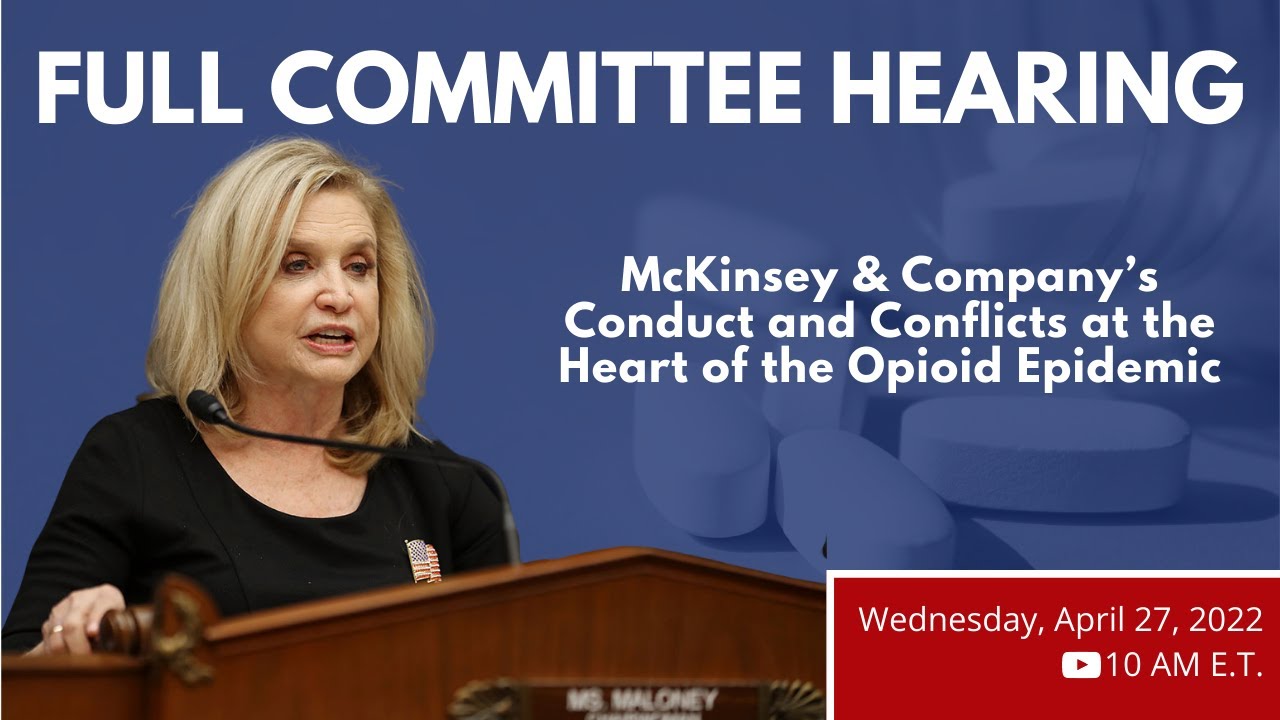 and the Committee on Oversight and Reform :{:{:{website:(style="box-sizing:border-box;outline-style:none !important"):}::(style="box-sizing:border-box;outline-style:none !important"):}::(style="box-sizing:border-box;outline-style:none !important"):}:. }: |
mckinsey coi?
https://www.alternet.org/2021/10/fda/
ian mcD
Series: McKinsey's Rules
When Consultants Work For Governments
Since 2008, McKinsey & Company has regularly advised the Food and Drug Administration's drug-regulation division, according to agency records. The consulting giant has had its hand in a range of important FDA projects, from revamping drug-approval processes to implementing new tools for monitoring the pharmaceutical industry.
During that same decade-plus span, as emerged in 2019, McKinsey counted among its clients many of the country's biggest drug companies — not least those responsible for making, distributing and selling the opioids that have ravaged communities across the United States, such as Purdue Pharma and Johnson & Johnson. At times, McKinsey consultants helped those drugmaker clients fend off costly FDA oversight — even as McKinsey colleagues assigned to the FDA were working to bolster the agency's regulation of the pharmaceutical market. In one instance, for example, McKinsey consultants helped Purdue and other opioid producers push the FDA to water down a proposed opioid-safety program. The opioid producer ultimately succeeded in weakening the program, even as overdose deaths mounted nationwide.
Yet McKinsey, which is famously secretive about its clientele, never disclosed its pharmaceutical company clients to the FDA, according to the agency. This year ProPublica submitted a Freedom of Information Act request to the FDA seeking records showing that McKensey had disclosed possible conflicts of interest to the agency's drug-regulation division as part of contracts spanning more than a decade and worth tens of millions of dollars. The agency responded recently that “after a diligent search of our files, we were unable to locate any records responsive to your request."
Federal procurement rules require U.S. government agencies to determine whether a contractor has any conflicts of interest. If serious enough, a conflict can disqualify the contractor from working on a given project. McKinsey's contracts with the FDA, which ProPublica obtained after filing a FOIA lawsuit, contained a standard provision obligating the firm to disclose to agency officials any possible organizational conflicts. One passage reads: “the Contractor agrees it shall make an immediate and full disclosure, in writing, to the Contracting Officer of any potential or actual organizational conflict of interest or the existence of any facts that may cause a reasonably prudent person to question the contractor's impartiality because of the appearance or existence of bias."
Agency officials rely on disclosure to ensure that they have the information they need to consider whether a contractor's other business relationships risk slanting its judgment.“Contractors have the obligation to disclose potential conflicts, and then the government has an obligation to figure out how to deal with it," said Jessica Tillipman, an assistant dean and government procurement law expert at George Washington University Law School.
Asked for comment, McKinsey did not assert that it disclosed potential conflicts to the FDA. But a spokesperson for the firm, Neil Grace, nonetheless maintained that “across more than a decade of service to the FDA, we have been fully transparent that we serve pharmaceutical and medical device companies. McKinsey's work with the FDA helped improve the agency's effectiveness through organizational, resourcing, business process, operational, digital, and technology improvements. To achieve its mission, the government regularly seeks support from additional experts who understand both the government's mission and the industries' practices. We take seriously our commitment to avoid conflicts and to serve the best interests of the FDA." (McKinsey is a sponsor of ProPublica's local virtual events programming.)
McKinsey's failure to disclose its industry engagements deprived the FDA of the opportunity to consider whether, for example, the overlap between McKinsey's government and pharmaceutical industry projects and the potential financial incentives at play constituted a conflict, experts said.
“For a contractor like McKinsey not to disclose the companies it is working for has all the appeal of the Addams Family on Halloween hiding Uncle Fester in the basement so as not to scare the neighborhood," said Charles Tiefer, a professor of government contracting at the University of Baltimore Law School.
A spokesperson for the FDA did not respond to requests for comment.
McKinsey's extensive opioidcompany consulting eventually began coming to light, starting with a 2019 ProPublica report. The firm's opioid work has provoked widespread criticism, spawned a welter of lawsuits and led the firm to pay nearly $600 million this year to settle legal claims made by all 50 states, as well as five U.S. territories and the District of Columbia. It also prompted McKinsey to issue a statement in which the firm acknowledged that it “fell short" of its standards in advising opioid makers while also denying that it “sought to increase overdoses or misuse and worsen a public health crisis." The firm pledged not to work on opioid-related projects going forward.
The lawsuits and public outrage have focused on the consulting firm's efforts to help increase (or “turbocharge," in McKinsey's parlance) sales of Purdue Pharma's highly addictive flagship opioid, OxyContin.But lately, concerns have begun to emerge about McKinsey's parallel assignments, which were worth upward of $50 million over about 12 years, for the nation's primary drug regulator. In a letter to the FDA in August, a bipartisan group of senators led by Sen. Maggie Hassan, D-N.H., asked the regulator to address “potential conflicts of interest that may have arisen" from McKinsey's work for both the agency and “a wide range of actors in the opioid industry, including many of the companies that played a pivotal role in fueling the opioid epidemic that our country now faces."
McKinsey, which has focused on counseling the CEOs of leading corporations for much of its nearly 100-year history, began expanding its public-sector practice in the United States around the time of its earliest FDA projects. McKinsey prides itself on its ability to act quickly and with discretion, and in its largely unregulated engagements for corporate clients, there are few impediments to the firm doing so.
In government consulting, however, the rules are far more stringent, and on several recent occasions, the firm has been caught refusing to abide by such strictures, including disclosure rules. Over the past couple of years, for example, McKinsey's bankruptcy-advisory practicehas paid more than $30 million to the Justice Department and one client's creditors to settle allegations that it failed to disclose potential conflicts, as required by the federal bankruptcy rules. Those allegations also prompted a federal criminal investigation of the firm. McKinsey has denied wrongdoing, and the investigation, which came to light in 2019, has not led to charges.
There are signs of overlap between McKinsey's government and industry engagements, though publicly available information about the firm's work for drug companies is limited. In one instance in 2008, which surfaced in a lawsuit against Purdue, the FDA told Purdue that it planned to require the company to submit a drug-safety plan for its bestselling drug, OxyContin. The company recognized that regulation of this sort threatened to cut into its sales margins, and according to McKinsey documents filed in federal court, top Purdue executives tasked the consultancy with devising a response to the FDA.
According to McKinsey PowerPoint slides, the firm proposed four options, among them suing the FDA to “delay" the imposition of a safety plan and to “band together" with other opioid producers to “formulate arguments to defend against strict treatment by the FDA." Purdue selected the latter, with McKinsey helping to implement the strategy. In 2009, McKinsey emails and slides show, its consultants prepared Purdue executives for at least two meetings with FDA officials. (One suggested answer to questions about who at Purdue would take personal responsibility for OxyContin overdoses: “We all feel responsible.")
In the meantime, according to a 2011 FDA contract, the agency's drug-regulation division hired McKinsey to develop a “new operating model" for the office responsible for developing drug-safety plans of the sort Purdue and its allies were fighting against, with the consultancy's help. Among McKinsey's tasks were defining the office's “strategic goals and objectives," including its “role in monitoring drug safety."
In 2012, the FDA issued a substantially watered-down version of the opioid-safety plan.
There's no evidence to suggest McKinsey's consultants at the FDA influenced the opioid-safety plan. But this apparent overlap between a government contract and an assignment for a commercial client reflects the type of issue an agency would want to consider when assessing whether a potential conflict of interest exists. Agencies are likeliest to identify a conflict “where an outside business venture is related directly to the subject matter of the procurement and structured such that there is a real economic incentive for biased performance," Keith Szeliga, a partner at the law firm Sheppard Mullin, wrote in a 2006 article in the Public Contract Law Journal.
A number of other McKinsey projects at the FDA, contracting records show, were also likely to have a financial impact on its pharmaceutical industry clients. In 2010, for example, the FDA hired the firm to help it develop a system to track and trace the distribution of potentially harmful prescription drugs. The contract required the firm to consult with “supply chain stakeholders," a category that potentially included a number of long-standing McKinsey clients. Hassan and her fellow senators, in their recent letter to the FDA, called this “an obvious conflict of interest."
Another contract, from 2014, tasked McKinsey with assessing the “strengths, limitations and appropriate use" of Sentinel, a system meant to monitor the safety of drugs once they're on the market. That project likewise called for McKinsey to interview “external stakeholders," including “industry organizations" and “drug and device industry leaders."
:{:(style="background-color:#ffffff;"):}:
The news of McKinsey's opioid work apparently did little to dampen the FDA's enthusiasm for the consultancy. In March 2019, just after the news broke, the agency signed a new contract with McKinsey — extending the firm's multiyear effort to help the FDA “modernize" the process by which it regulates new drugs.
aha pseudo-populism trashes expertise (of science and gubmint), free mkt says all gov't inept, the only real expert is pvt biz/accounting consultant, which lead to more hollowing out: mck wants to keep all data propietary so can sell to mult gov't agy
death spiral, pro pub 720:
Given that McKinsey consultants operate as advisers, with government officials charged with making final decisions, it can be hard to identify the firm’s responsibility for any given decision. But the firm’s government work has been steadily rising in the wake of a multidecade hollowing out of government (a trend McKinsey has promoted and ridden). Today, that increasingly means that if you examine the government’s response to the pandemic, you’re likely to find McKinsey’s fingerprints.
===
https://www.alternet.org/2020/07/how-mckinsey-is-making-100-million-and-counting-advising-on-the-governments-bumbling-coronavirus-response-propublica/
pro pub
In the middle of March, as the coronavirus pandemic was shutting down the country, McKinsey & Co., the giant management consulting firm, saw opportunity. The firm sprang into sales mode, deploying its partners across the country to seek contracts with federal agencies, state governments and city halls. Government organizations had been caught unprepared by the virus, and there was a lot of money to be made advising them on how to address it.
That month, a partner in McKinsey’s Washington, D.C., office,Scott Blackburn, got in touch with an old colleague. Deb Kramer had just been promoted to become an acting assistant undersecretary at the Department of Veterans Affairs, where Blackburn, whom McKinsey declined to make available for an interview, had held senior roles between 2014 and 2018. During that period, the two had overseen a major overhaul of the agency called “MyVA,” a project McKinsey had worked on as well. Blackburn had worked at McKinsey before going to the VA, and he returned to the firm afterward. He and Kramer were in touch repeatedly in the middle of March, according to a person familiar with the exchanges.
AD REMOVED FOR SUBSCRIBED USER
On March 19, Kramer made a highly unusual request: The VA, she said, needed to hire McKinsey within 24 hours. The VA runs a sprawling health care system that serves 9 million veterans, many of them older and plagued by chronic health problems, and typically takes many months to solicit and accept bids and vet bidders for a contract. The health system’s leadership wanted to sign a multimillion-dollar contract with McKinsey to spend up to a year consulting on “all aspects” of the system’s operations during the COVID-19 pandemic, Kramer told a VA contracting officer, Nathan Pennington. Pennington memorialized parts of the exchange in a public contracting document.
“There is no time to spare,” the contracting document stated, “every day wasted by a lack of situational awareness down to the community level, and the inability to model scenarios and test alternative courses of action, increases the risk to the citizens of this nation, to include Veterans and our own employees.” The VA, the document observed, needed help with “life-and-death decision-making today.”
The exigent circumstances left no time to seek competing bids or to fully vet McKinsey’s proposal, Kramer argued. It was the only contractor she and her colleagues were aware of that could provide the required services without needing “ramp-up” time the VA couldn’t afford. Pennington conducted no market research and only a minimal review of the cost, “as there was no time,” he wrote. Kramer approved the $12 million price tag. The contract was signed on March 20.
That would turn out to be just a down payment for McKinsey. Ten days later, the Defense Health Agency was added to the VA contract, upping its value to $22.5 million, and the week after, the Air Force hired McKinsey — also with a no-bid contract. The firm’s assignment for the Air Force was to serve on a task force developing a strategy to get defense contractors, many of them McKinsey clients, to produce medical supplies during the pandemic. To justify the $12 million value of that contract, an Air Force contracting document cited what the VA had agreed to pay McKinsey. It did not mention the VA price tag’s largely unvetted nature. Finally, in early May, the DHA expanded the scope of McKinsey’s work, signing an additional contract worth up to $6.1 million.
A VA spokeswoman, Christina Noel, said that the agency “adhered to all federal contracting laws” in hiring McKinsey and that “no-bid contracts can help provide VA the flexibility needed during this national emergency to deliver the services required to support clinical needs and save lives.” A DHA spokesman, Richard Breen, said McKinsey had “expertise needed and an existing contract with [the VA] for COVID-19 modeling support with a separate and distinct scope.” An Air Force spokesperson did not respond to emailed questions.
In a matter of weeks, McKinsey had extracted a total of $40.6 million in no-bid contracts out of its initial agreement with one federal agency. The firm has continued to scoop up COVID-19-related contracts for various governments since then. Altogether, in the four months since the pandemic started, the firm has been awarded work for state, city and federal agencies worth well over $100 million — and counting.
Many of the most prominent government pandemic efforts have been staffed with battalions of McKinsey’s trademark dark-suited young MBAs. The joint coronavirus task force operating out of the Federal Emergency Management Agency and Department of Health and Human Services enlisted McKinsey, on a pro bono basis, to help obtain medical supplies. New York Gov. Andrew Cuomo’s team hired McKinsey to draw on existing epidemiological models to project hospital capacity and medical supply needs. The Food and Drug Administration retained the firm to do data analysis.
Among states, California, Illinois, Massachusetts, New Jersey, Tennessee and Virginia have worked with McKinsey. (Comprehensive contracting data is not yet available, and only some states have revealed the dollar value of their contracts. For example, the contracts for New York and New Jersey represent a combined $18 million in revenue for the firm.) Cities including Atlanta, Chicago, Los Angeles, New Orleans and St. Louis have also used the firm during the pandemic.
It’s too early to fully judge these engagements, but a preliminary assessment shows mixed results. After early stumbles, New York state and New Jersey are doing relatively well. On the other hand, the FEMA/HHS task force has faced harsh criticism for a slow and dysfunctional effort to procure supplies. And project documents and interviews show that, at the VA, consultants have been slow to deliver urgently needed data. In other places, officials have denigrated McKinsey’s contributions. “Basically, they are compiling data for us,” a top official in Florida’s Miami-Dade County wrote in an internal email obtained by ProPublica. “And putting it in pretty formats.” That contract was for up to a month of work, with a price tag of up to $568,000, and the confusing set of reopening guidelines that emerged with McKinsey’s help has been widely panned.
McKinsey defended its work in a written statement the firm sent in the name of Liz Hilton Segel, its managing partner for North America operations: “Like many other companies, we chose to engage and do our part in helping governments fight this pandemic.” The statement noted that McKinsey “has the capabilities to support leaders and public servants who are navigating this humanitarian and economic crisis. … We are proud of the support we have provided to public sector leaders, front line staff and those engaged in fighting this pandemic.”
Given that McKinsey consultants operate as advisers, with government officials charged with making final decisions, it can be hard to identify the firm’s responsibility for any given decision. But the firm’s government work has been steadily rising in the wake of a multidecade hollowing out of government (a trend McKinsey has promoted and ridden). Today, that increasingly means that if you examine the government’s response to the pandemic, you’re likely to find McKinsey’s fingerprints.
Like countless organizations, McKinsey has been buffeted by the pandemic, encountering turbulence and uncertainty. For starters, the sputtering economy put many of its corporate clients under duress.
Then there was a bevy of self-inflicted problems.
McKinsey’s bankruptcy practice, which would normally thrive during hard times, has been under a “black cloud,” as a lawyer representing McKinsey put it in a court hearing in April. The firm’s practice has been dogged by a federal investigation into potentially criminal self-dealing and tied up in litigation with the founder of a rival firm over whether McKinsey properly disclosed possible conflicts of interest. (“McKinsey’s bankruptcy disclosure practices have always complied with the law,” Gary Pinkus, chairman of the firm’s North America operations, said in a written statement.)
More broadly McKinsey has seen its long-gilded reputation tarnished in recent years as government projects come under critical scrutiny. Media outlets, such as ProPublica, The New York Times and The Wall Street Journal, have investigated a variety of ethically and legally dubious actions. That included helping the Trump administration execute exclusionary immigration policies, corruption allegations against local companies McKinsey worked alongside in Mongolia and South Africa, and a pattern of hiring the children of high-ranking officials inSaudi Arabia. In each instance, McKinsey has denied wrongdoing. With $10 billion in annual revenues, the firm is now as big or bigger than many of its clients and has developed a culture that resists oversight.
In April, McKinsey was penalized for running afoul of the federal government. The General Services Administration, which oversees federal procurement, canceled two government-wide contracts, one of which had earned the firm nearly $1 billion between 2006 and 2019. In a report issued earlier by GSA’s internal watchdog, investigators revealed that McKinsey had refused to comply with an audit. Instead, the firm went over the head of a contracting officer and found a GSA supervisor who was willing to accommodate the firm. That supervisor worked with McKinsey to improperly inflate the contract prices, the investigators found, part of a troubling pattern of favoritism the supervisor showed toward McKinsey.
For nine months, GSA negotiated with McKinsey to lower its rates. McKinsey’s intransigence ultimately led officials to see cancellation as the best option, according to a statement from a senior GSA official, Julie Dunne. (DJ Carella, a spokesman for McKinsey, which denied wrongdoing, said in a statement, “We are disappointed with GSA’s decision and look forward to potentially returning to the GSA schedule in the future.”)
The fallout devastated the firm’s U.S. public-sector practice, current and former consultants say. “The public-sector practice was already underutilized after the [GSA] report,” one of them said. “And then it just stopped.”
For McKinsey, the pandemic provided a new opportunity to regain its foothold in the federal government. Coordination from the White House was inconsistent at best, and many state, federal and city agencies were already short staffed. Years of budget cuts and anti-big government policies had left them dependent on outside contractors even in ordinary circumstances.
So dependent that McKinsey consultants on the FEMA-HHS task force ended up working in the procurement process, according to a federal official briefed on the task force’s work. That was unfamiliar terrain for the McKinseyites. Crucial medical supplies from surgical masks to ventilators were scarce and the government had solicited offers from any vendors claiming to have access to the necessary supplies. As the offers came in, McKinsey consultants were among the task force members assigned to help vet them before forwarding them to federal procurement officers, the federal official said. Carella, the McKinsey spokesman, said the firm “did not ‘vet’ offers” of “PPE, ventilators or medical supplies,” but rather “helped the client assess the availability of life-saving equipment,” without making any decisions about what to pass on to contracting officers.
A FEMA spokeswoman, Janet Montesi, put it differently. The task force “vetted hundreds of leads for PPE that were passed along to FEMA and HHS,” she said in a statement. Responding to questions about McKinsey’s pro bono work for the task force, Montesi added that “the volunteers played an important role,” but career contracting officers followed legally required processes before entering into any contracts.
McKinsey consultants struggled to understand the complicated government procurement rules, according to the federal official. The career procurement officers found themselves rejecting what seemed like every other offer forwarded by the consultants and other task force members, because they ran afoul of various rules. “Even though a career employee can spot the problems quickly, you still have to stop doing your regular procurement work,” the official said. “That delays the whole process.”
In the weeks just after McKinsey signed its $12 million contract with the VA, Richard Stone, who runs the agency’s health care system, and his aides crowed about hiring the consultancy, according to federal officials who spoke with them at the time. Stone, a medical doctor who had worked as a consultant at Booz Allen Hamilton, seemed to lack faith in his own staff. The VA, he told one of the federal officials, was now “better prepared because we have private-sector capability.”
His enthusiasm didn’t last long. Kramer had insisted that only McKinsey could meet the VA’s needs immediately. Yet more than three weeks after the consultants started, they still hadn’t provided data and analysis on key parts of the VA health system. One of McKinsey’s daily PowerPoint updates for VA officials, dated from mid-April and obtained by ProPublica, shows that the consultants had yet to analyze the pandemic’s effect on two types of health care facilities most vulnerable to the coronavirus: VA-run nursing homes and VA facilities in rural parts of the country. The rural facilities alone serve 2.7 million veterans — more than a quarter of the veterans enrolled in the VA — and half of them are over 65 years old. These analyses, notes one of McKinsey’s slides, would be added “in the coming days.”
Also absent was data on medical supply capacity across the VA health system. Slides assessing conditions in numerous regions — including those facing some of the country’s worst outbreaks at the time, like New York City, Detroit and New Orleans — contained a placeholder for the missing data: “To be incorporated over the next few days.” (Hilton Segel, the McKinsey partner, seemed to blame the VA. “We conducted the analyses as the data was available so the client could make decisions in real time with the best available information,” she said in a written statement.)
Meanwhile, VA nurses and other front-line care providers were sounding the alarm about widespread shortfalls in personal protective equipment and other materials. With a complete void in McKinsey’s slides where the relevant data should’ve been, VA officials disputed that there was a supply shortfall, delaying the agency’s response. It wasn’t until late April that Stone acknowledged in an interview with The Washington Post that medical supplies were at “austerity levels” at some VA hospitals.
Noel, the VA spokeswoman, defended the consultants’ work. “McKinsey & Company is fully fulfilling the terms of its contract, providing timely, critical intelligence about capacity and utilization rates of non-VA health care facilities and other analytical services during VA’s response to COVID-19. This is a capability that VA does not have, and these services are vital.”
At congressional oversight hearings in recent weeks, questions about the sufficiency of the VA’s medical supply stores have persisted. Meanwhile, infections have been rising sharply in its facilities. A month ago, there were about 1,685 VA patients and employees with active COVID-19 cases. As of July 14, that number had jumped to 5,887.
McKinsey’s success cultivating government clients during the pandemic is, in many respects, the realization of a 70-year mission. The 1950s were when the firm began pushing the view that businessmen should supplant civil servants, particularly in the management positions tasked with putting policy into practice. The pitch was self-interested but well calibrated to appeal during the Cold War: The “free enterprise society” of the U.S. “dictates that industry should be given as extensive a role as possible,” McKinsey wrote in a 1960 report to the fledgling National Aeronautics and Space Administration.
NASA soon relied almost exclusively on outside contractors. By 1961, almost $850 million of the agency’s $1 billion budget went to aerospace contractors. NASA would become the template for “the emerging ‘hollowed-out’ structure of the contractor state,” the historian Christopher McKenna wrote in “The World’s Newest Profession,” his 2006 book on the consulting industry.
Over decades, McKinsey’s approach became self-reinforcing. As successive administrations chipped away at the civil service, politicians who advocate small government got the dysfunctional bureaucracy they had complained about all along, which helped them justify dismantling it further.
The upshot of this process can be seen throughout McKinsey’s coronavirus consulting. Stone, the VA health system head, thought a consulting firm made the VA better prepared. The Defense Health Agency provided “no staff support” for the head of its COVID-19 task force, according to a contracting document, prompting the agency to outsource that work to McKinsey. A senior official in Miami-Dade County had a more jaundiced view. She wrote in an email to a colleague that the firm’s consultants were merely “doing the research I am too burned out at this point to do” — adding that she was “quite flattered” that it took an entire team of high-priced consultants to replace her.
McKinsey’s business model also generates a second round of revenue from its government work: The firm effectively sells data it obtains from one government project to other agencies. McKinsey generally retains in its central databases anonymized work product from its engagements, so future consulting teams can get a head start on similar projects. Ordinarily, the federal government might be expected to put together that type of clearinghouse and share it with state and city governments free of charge. But in the absence of such a clearinghouse, McKinsey has something state, city and federal government agencies need, and access to government data has formed a core part of McKinsey’s COVID-19 pitch.
McKinsey’s data was one of the factors cited by VA officials to justify hiring the firm within 24 hours. As a contracting document explained: The firm “already possessed an immense amount of both global and community epidemiological data on COVID-19” the VA didn’t otherwise have access to. McKinsey customers pay not only in cash but by adding new data that the firm will be able to sell to the next customer.
Hiring McKinsey is a famously expensive proposition, even when compared with its leading competitors. A single junior consultant — typically a recent college or business school graduate — runs clients $67,500 per week, or $3.5 million annually. For $160,000 per week, you get two consultants, the second one mid-level.
To alleviate the sticker shock, McKinsey has lately offered a coronavirus discount. In project proposals, the firm branded these COVID-19 rates “philanthropic prices.” The reduced rates ranged from $125,000 per week (for the two-consultant package) to $178,000 (for five). In a separate column, a McKinsey pricing sheet played up pandemic-only add-ons, whose language read like action-figure packaging: “COVID team includes COVID analytics and best practices.”
In her statement, Hilton Segal, the McKinsey partner, noted that, when the pandemic began, the firm reduced its fees to the public sector “as part of our commitment to help. We made our intellectual property and capabilities available widely, including by setting up a COVID Response Center that provides free public access to insights from our research. Thousands of McKinsey colleagues stepped up to help — through client work, pro bono service, developing and publishing insights on the pandemic, and more.”
The firm’s work for Miami-Dade County suggests some clients get little in return,according to interviews, as well as emails and project documents obtained by ProPublica through a public records request. On a Friday in late April, Jennifer Moon received an email from a senior McKinsey partner. Moon is the budget director and a deputy mayor for Miami-Dade, and her boss, the mayor, wanted to hire McKinsey to help finalize guidelines for reopening the county’s economy, which he had shuttered over a month earlier. It fell to Moon to hammer out the details.
In his email, the McKinsey partner, Andre Dua, directed Moon’s attention to a pricing sheet listing what he called “our special Covid 19 pricing” and outlined the anticipated scope of the firm’s work. The proposal consisted largely of consulting buzzwords: variations on the word “analysis”; offers of “best practices,” “perspectives” and “decision-support.”
Moon could read between the lines, and she discerned a familiar set of tasks. “Here’s what the consultants will be doing,” she wrote, forwarding one of Dua’s emails to the county lawyer reviewing McKinsey’s contract. “Apparently, it takes 5 people with staff support to do what I’ve been doing myself.” The $142,000 per week it would cost was more than the combined annual salaries of the two staffers who had been helping Moon prepare the reopening plan — very ably, she noted in an email.
The reopening plan’s publication was imminent, and Moon didn’t expect the project to last longer than a month. But as contract negotiations unfolded, Dua and Geoff Bradford, a McKinsey contract manager, resisted the county’s attempts to limit the contract’s duration to four weeks. They wanted to keep the agreement as open-ended as possible to “provide flexibility.” What they meant by that, they explained in a series of emails, was the flexibility to expand the scope of the project and keep McKinsey’s consultants around longer.
Dua and Bradford also resisted county officials’ efforts to be transparent. McKinsey has a long-standing policy of refusing to reveal the names of its clients and demanding that clients likewise not reveal that they’ve retained McKinsey, unless they’re legally obligated to. Amid the pandemic, the firm has taken confidentiality a step further. McKinsey’s COVID-19 contracts still require that clients not disclose that they’ve hired the consultancy. But many of them now allow McKinsey to unilaterally “disclose that we have been retained by the Client and a general description of the Services.” The firm has taken advantage of that clause to market its government work online.
When the officials in Miami-Dade objected to the confidentiality clause, Dua took a firm line: removing it “will be a show stopper on our end.” Eventually Bradford allowed that the firm might budge, but only a little. McKinsey would consider letting county officials share its work product “with specific entities,” he wrote in a markup of McKinsey’s draft contract. But only “if we’re able to define those entities and can attach guardrails to such disclosure.” McKinsey insisted, in other words, that it should decide what the government could say — and to whom — about the advice it had been given.
As the project progressed, Moon’s initial skepticism was borne out. There were non-intuitive and innovative recommendations among the “best practices” for reopening the county. But many of them were obvious or had already been suggested by county staffers: “install Plexiglass barriers between cashier and customer,” for example. At times, it seemed as if the consultants were picking best practices at random: a slide on reopening construction sites recommended grouping workers into teams that not only work and eat together but “live” and “travel” together.
Myriam Marquez, communications director of the mayor of Miami-Dade County, didn’t respond to a request for comment. McKinsey’s statement noted that the firm’s “work with Miami-Dade County was focused on sharing insights and observed practices from governments and businesses around the world, as leaders navigated the uncertainty of reopening major sectors of their economy.”
In mid-May, Miami-Dade County issued its reopening plan, “The New Normal.” The document, which stretched to 175 pages, was widely panned for its needless complexity, which sewed confusion among the public. The plan structured reopening around two overlapping schemes. Five different colored “flags” represented different phases of reopening. Separately, five “archetypes” — a McKinsey innovation, emails and project documents show — grouped industry sectors and public spaces by how much human interaction they required: “can be performed remotely,” “lower proximity” and so on. Yet the five flags and the five archetypes didn’t align; one flag might cover two archetypes and vice versa. Imagine a stoplight where shapes have been added to the usual three-color scheme — a yellow square means something different from a yellow circle, which means something different from a red circle — and you’ll start to get a sense for the confusion the systems provoked. As the Miami Herald put it, echoing the local reaction in Florida-appropriate terms: “They’re just like the flags that lifeguards fly on their stands at the beach. Except more confusing.”
Xavier Suarez, a longtime county commissioner and former mayor of Miami, didn’t see what had been gained by pulling more than half a million dollars out of the county’s pandemic-hit budget to hire McKinsey. “It just strikes me as a colossal waste of money,” he told me. The firm’s “archetypes” certainly hadn’t added anything. “I remember reading about archetypes in psychology when we covered Carl Jung,” Suarez said. “It sounds like just the right kind of” — and here he paused for effect — “sesquipedalian word a consultant would come up with to try and sound smarter than you.”
Carlos Giménez, the mayor of Miami-Dade County and a political foe of Suarez, evidently came to agree. On June 19, his administration quietly posted a revised version of it. Notably scrubbed from the new “New Normal”: McKinsey’s archetypes. As of mid-July, COVID-19 cases continued to rise in Miami-Dade.
==
meh
https://www.mckinsey.com/business-functions/strategy-and-corporate-finance/our-insights/the-four-global-forces-breaking-all-the-trends
four global forces breaking all the trends
April2015 | Book Excerpt
By Richard Dobbs, James Manyika, and Jonathan Woetzel
The four global forces breaking all the trends
The world economy’s operating system is being rewritten. In this exclusive excerpt from the new book No Ordinary Disruption, its authors explain the trends reshaping the world and why leaders must adjust to a new reality.
In the Industrial Revolution of the late 18th and early 19th centuries, one new force changed everything. Today our world is undergoing an even more dramatic transition due to the confluence of four fundamental disruptive forces—any of which would rank among the greatest changes the global economy has ever seen. Compared with the Industrial Revolution, we estimate that this change is happening ten times faster and at 300 times the scale, or roughly 3,000 times the impact. Although we all know that these disruptions are happening, most of us fail to comprehend their full magnitude and the second- and third-order effects that will result. Much as waves can amplify one another, these trends are gaining strength, magnitude, and influence as they interact with, coincide with, and feed upon one another. Together, these four fundamental disruptive trends are producing monumental change.
1. Beyond Shanghai: The age of urbanization
The first trend is the shifting of the locus of economic activity and dynamism to emerging markets like China and to cities within those markets. These emerging markets are going through simultaneous industrial and urban revolutions, shifting the center of the world economy east and south at a speed never before witnessed. As recently as 2000, 95 percent of the Fortune Global 500—the world’s largest international companies including Airbus, IBM, Nestlé, Shell, and The Coca-Cola Company, to name a few—were headquartered in developed economies. By 2025, when China will be home to more large companies than either the United States or Europe, we expect nearly half of the world’s large companies—defined as those with revenue of $1 billion or more—to be headquartered in emerging markets. “Over the years, people in our headquarters, in Frankfurt, started complaining to me, ‘We don’t see you much around here anymore,’” said Josef Ackermann, the former chief executive officer of Deutsche Bank. “Well, there was a reason why: growth has moved elsewhere—to Asia, Latin America, the Middle East.”
Globalization for the little guy
Perhaps equally important, the locus of economic activity is shifting within these markets. The global urban population has been rising by an average of 65 million people annually during the past three decades, the equivalent of adding seven Chicagos a year, every year. Nearly half of global GDP growth between 2010 and 2025 will come from 440 cities in emerging markets—95 percent of them small- and medium-size cities that many Western executives may not even have heard of and couldn’t point to on a map.1 Yes, Mumbai, Dubai, and Shanghai are familiar. But what about Hsinchu, in northern Taiwan? Brazil’s Santa Catarina state, halfway between São Paulo and the Uruguayan border? Or Tianjin, a city that lies around 120 kilometers southeast of Beijing? In 2010, we estimated that the GDP of Tianjin was around $130 billion, making it around the same size as Stockholm, the capital of Sweden. By 2025, we estimate that the GDP of Tianjin will be around $625 billion—approximately that of all of Sweden.
2. The tip of the iceberg: Accelerating technological change
The second disruptive force is the acceleration in the scope, scale, and economic impact of technology. Technology—from the printing press to the steam engine and the Internet—has always been a great force in overturning the status quo. The difference today is the sheer ubiquity of technology in our lives and the speed of change. It took more than 50 years after the telephone was invented until half of American homes had one. It took radio 38 years to attract 50 million listeners. But Facebook attracted 6 million users in its first year and that number multiplied 100 times over the next five years. China’s mobile text- and voice-messaging service WeChat has 300 million users, more than the entire adult population of the United States. Accelerated adoption invites accelerated innovation. In 2009, two years after the iPhone’s launch, developers had created around 150,000 applications. By 2014, that number had hit 1.2 million, and users had downloaded more than 75 billion total apps, more than ten for every person on the planet. As fast as innovation has multiplied and spread in recent years, it is poised to change and grow at an exponential speed beyond the power of human intuition to anticipate.
Processing power and connectivity are only part of the story. Their impact is multiplied by the concomitant data revolution, which places unprecedented amounts of information in the hands of consumers and businesses alike, and the proliferation of technology-enabled business models, from online retail platforms like Alibaba to car-hailing apps like Uber. Thanks to these mutually amplifying forces, more and more people will enjoy a golden age of gadgetry, of instant communication, and of apparently boundless information. Technology offers the promise of economic progress for billions in emerging economies at a speed that would have been unimaginable without the mobile Internet. Twenty years ago, less than 3 percent of the world’s population had a mobile phone; now two-thirds of the world’s population has one, and one-third of all humans are able to communicate on the Internet.2 Technology allows businesses such as WhatsApp to start and gain scale with stunning speed while using little capital. Entrepreneurs and start-ups now frequently enjoy advantages over large, established businesses. The furious pace of technological adoption and innovation is shortening the life cycle of companies and forcing executives to make decisions and commit resources much more quickly.
- Getting old isn’t what it used to be: Responding to the challenges of an aging world
The human population is getting older. Fertility is falling, and the world’s population is graying dramatically. While aging has been evident in developed economies for some time—Japan and Russia have seen their populations decline over the past few years—the demographic deficit is now spreading to China and soon will reach Latin America. For the first time in human history, aging could mean that the planet’s population will plateau in most of the world. Thirty years ago, only a small share of the global population lived in the few countries with fertility rates substantially below those needed to replace each generation—2.1 children per woman. But by 2013, about 60 percent of the world’s population lived in countries with fertility rates below the replacement rate. This is a sea change. The European Commission expects that by 2060, Germany’s population will shrink by one-fifth, and the number of people of working age will fall from 54 million in 2010 to 36 million in 2060, a level that is forecast to be less than France’s. China’s labor force peaked in 2012, due to income-driven demographic trends. In Thailand, the fertility rate has fallen from 5 in the 1970s to 1.4 today. A smaller workforce will place a greater onus on productivity for driving growth and may cause us to rethink the economy’s potential. Caring for large numbers of elderly people will put severe pressure on government finances.
[Have you explored our latest insights on the nine global forces business leaders must be aware of today?
Read “The global forces inspiring a new narrative of progress” (April 2017)]
4. Trade, people, finance, and data: Greater global connections
The final disruptive force is the degree to which the world is much more connected through trade and through movements in capital, people, and information (data and communication)—what we call “flows.” Trade and finance have long been part of the globalization story but, in recent decades, there’s been a significant shift. Instead of a series of lines connecting major trading hubs in Europe and North America, the global trading system has expanded into a complex, intricate, sprawling web. Asia is becoming the world’s largest trading region. “South–south” flows between emerging markets have doubled their share of global trade over the past decade. The volume of trade between China and Africa rose from $9 billion in 2000 to $211 billion in 2012. Global capital flows expanded 25 times between 1980 and 2007. More than one billion people crossed borders in 2009, over five times the number in 1980. These three types of connections all paused during the global recession of 2008 and have recovered only slowly since. But the links forged by technology have marched on uninterrupted and with increasing speed, ushering in a dynamic new phase of globalization, creating unmatched opportunities, and fomenting unexpected volatility.
Resetting intuition
These four disruptions gathered pace, grew in scale, and started collectively to have a material impact on the world economy around the turn of the 21st century. Today, they are disrupting long-established patterns in virtually every market and every sector of the world economy—indeed, in every aspect of our lives. Everywhere we look, they are causing trends to break down, to break up, or simply to break. The fact that all four are happening at the same time means that our world is changing radically from the one in which many of us grew up, prospered, and formed the intuitions that are so vital to our decision making.
This can play havoc with forecasts and pro forma plans that were made simply by extrapolating recent experience into the near and distant future. Many of the assumptions, tendencies, and habits that had long proved so reliable have suddenly lost much of their resonance. We’ve never had more data and advice at our fingertips—literally. The iPhone or the Samsung Galaxy contains far more information and processing power than the original supercomputer. Yet we work in a world in which even, perhaps especially, professional forecasters are routinely caught unawares. That’s partly because intuition still underpins much of our decision making.
Our intuition has been formed by a set of experiences and ideas about how things worked during a time when changes were incremental and somewhat predictable. Globalization benefited the well established and well connected, opening up new markets with relative ease. Labor markets functioned quite reliably. Resource prices fell. But that’s not how things are working now—and it’s not how they are likely to work in the future. If we look at the world through a rearview mirror and make decisions on the basis of the intuition built on our experience, we could well be wrong. In the new world, executives, policy makers, and individuals all need to scrutinize their intuitions from first principles and boldly reset them if necessary. This is especially true for organizations that have enjoyed great success.
While it is full of opportunities, this era is deeply unsettling. And there is a great deal of work to be done. We need to realize that much of what we think we know about how the world works is wrong; to get a handle on the disruptive forces transforming the global economy; to identify the long-standing trends that are breaking; to develop the courage and foresight to clear the intellectual decks and prepare to respond. These lessons apply as much to policy makers as to business executives, and the process of resetting your internal navigation system can’t begin soon enough.
There is an urgent imperative to adjust to these new realities. Yet, for all the ingenuity, inventiveness, and imagination of the human race, we tend to be slow to adapt to change. There is a powerful human tendency to want the future to look much like the recent past. On these shoals, huge corporate vessels have repeatedly foundered. Revisiting our assumptions about the world we live in—and doing nothing—will leave many of us highly vulnerable. Gaining a clear-eyed perspective on how to negotiate the changing landscape will help us prepare to succeed.
This article is an edited excerpt from No Ordinary Disruption: The Four Global Forces Breaking All the Trends, (Public Affairs, May 2015).To learn more about it and order copies, please visit Amazon, Barnes & Noble, or other leading bookstores.
About the author(s)
Richard Dobbs is a director of the McKinsey Global Institute and a director in McKinsey’s London office, James Manyika is a director of the McKinsey Global Institute and a director in the San Francisco office, and Jonathan Woetzel is a director of the McKinsey Global Institute and a director in the Shanghai office.
==
==
https://boingboing.net/2019/12/18/spreadsheets-and-powerpoints.html
On this week's Intercepted podcast (MP3) (previously), host Jeremy Scahill (previously) takes a long, deep look at the history of McKinsey and Company, whose consultants are the architects of ICE's gulags, a failed, high-cost initiative to curb violence at Rikers Island that used falsified data to secure ongoing funding -- a company whose internal documents compare management consultants to "the Marine Corps, the Roman Catholic Church, and the Jesuits" and whose government contracts bill out freshly hired, inexperienced junior consultants at $3m/year.
McKinsey has played a role in many of capitalism's greatest hits, from the Enron collapse to the Saudi purge of dissidents that culminated in the murder and dismemberment of the journalist Jamal Khashoggi.
Scahill speaks to a variety of guests about how McKinsey grew to a global, multibillion-dollar enabler of despots, crooks, and murderers, including the health insurance whistleblower Wendell Potter (previously), whose must-read Twitter thread on Mayor Pete's "Medicare for Some" proposal is brutal and brilliant.
Scahill also talks with Propublica's Ian MacDougall (previously, the lawyer/journalist whose coverage of McKinsey has put the firm on its back foot.
As a bonus, the opening audio montage for this week's episode is stellar, even by Intercepted's high standards: it mashes up Trump with Dr Seuss, to startlingly good effect.
Capitalism’s Consigliere: McKinsey’s Work for Insurance Companies, ICE, Drug Manufacturers, and Despots [Intercepted/The Intercept]'
==
ref
https://theintercept.com/2019/12/18/capitalisms-consigliere-mckinseys-work-for-insurance-companies-ice-drug-manufacturers-and-despots/
POWERFUL GLOBAL consulting firm McKinsey is facing scrutiny over its work for a wide range of shady governments and companies. This week on Intercepted: Former senior health insurance executive-turned-whistleblower Wendell Potter explains McKinsey’s role in our insurance nightmare and how Democratic presidential candidate Pete Buttigieg is using industry talking points to attack Medicare for All. Potter also discusses his career working for insurance giants, soaring medical costs in the U.S., and his role in killing Hillary Clinton’s health care initiative in the 1990s.ProPublica reporter Ian MacDougall discusses McKinsey’s relationship with the Saudi regime, its work for Rikers Island, and how it helped push opioids to doctors and patients. MacDougall also lays out his reporting on how McKinsey’s work for Immigration and Customs Enforcement in detaining and deporting immigrants disturbed career immigration officials.
Also, the Justice Department’s inspector general blasted the FBI over its lies and omissions in obtaining a secret Foreign Intelligence Surveillance Act warrant to spy on Trump campaign operative Carter Page. Intercept co-founder Glenn Greenwald discusses how the report vindicates civil liberties activists and serves as a striking rebuke of the bipartisan love affair with law enforcement and intelligence agencies.
Transcription coming soon.
==
New York City Paid McKinsey Millions to Stem Jail Violence. Instead, Violence Soared.
The corporate consulting firm reported bogus numbers and flailed in a project at Rikers Island. Today, assaults and other attacks there are up almost 50%.
by Ian MacDougall
==
https://www.alternet.org/2019/12/a-consulting-firm-advised-ice-to-cut-migrants-food-and-medical-care-to-save-costs-worrying-agency-officials/
no lnx many
A consulting firm advised ICE to cut migrants’ food and medical care to save costs — worrying agency officials
Written by Ian MacDougall / ProPublica December 3, 2019
ProPublica is a Pulitzer Prize-winning investigative newsroom. Sign up for The Big Story newsletter to receive stories like this one in your inbox.
Just days after he took office in 2017, President Donald Trump set out to make good on his campaign pledge to halt illegal immigration. In a pair of executive orders, he ordered “all legally available resources” to be shifted to border detention facilities and called for hiring 10,000 new immigration officers.
The logistical challenges were daunting, but as luck would have it, Immigration and Customs Enforcement already had a partner on its payroll: McKinsey & Company, an international consulting firm brought on under the Obama administration to help engineer an “organizational transformation” in the ICE division charged with deporting migrants who are in the United States unlawfully.
ICE quickly redirected McKinsey toward helping the agency figure out how to execute the White House’s clampdown on illegal immigration.
But the money-saving recommendations the consultants came up with made some career ICE staff uncomfortable. They proposed cuts in spending on food for migrants, as well as on medical care and supervision of detainees, according to interviews with people who worked on the project for both ICE and McKinsey and 1,500 pages of documents obtained from the agency after ProPublica filed a lawsuit under the Freedom of Information Act.
McKinsey’s team also looked for ways to accelerate the deportation process, provoking worries among some ICE staff members that the recommendations risked short-circuiting due process protections for migrants fighting removal from the United States. The consultants, three people who worked on the project said, seemed focused solely on cutting costs and speeding up deportations — activities whose success could be measured in numbers — with little acknowledgment that these policies affected thousands of human beings.
In what one former official described as “heated meetings” with McKinsey consultants, agency staff members questioned whether saving pennies on food and medical care for detainees justified the potential human cost.
But the consulting firm’s sway at ICE grew to the point that McKinsey’s staff even ghostwrote a government contracting document that defined the consulting team’s own responsibilities and justified the firm’s retention, a contract extension worth $2.2 million. “Can they do that?” an ICE official wrote to a contracting officer in May 2017.
The response reflects how deeply ICE had come to rely on McKinsey’s assistance. “Well it obviously isn’t ideal to have a contractor tell us what we want to ask them to do,” the contracting officer replied. But unless someone from the government could articulate the agency’s objectives, the officer added, “what other option is there?” ICE extended the contract.
The New York Times reported last year that McKinsey ultimately did more than $20 million in consulting work for ICE, a commitment to one of the Trump administration’s most controversial endeavors that raised concerns among some of McKinsey’s employees and former partners.The firm’s global managing partner, Kevin Sneader, assured them in a 2018 email that the firm had never focused on developing, advising or implementing immigration policies. He said McKinsey “will not, under any circumstances, engage in work, anywhere in the world, that advances or assists policies that are at odds with our values.”
But the new documents and interviews reveal that the firm was deeply involved in executing policies fundamental to the Trump administration’s immigration crackdown. McKinsey’s recommendations for spending cuts went too far for some career ICE employees, and a number of the proposals were never implemented.
McKinsey has faced mounting scrutiny over the past two years, as reports by The New York Times, ProPublica and others have raised questions about whether the firm has crossed ethical and legal lines in pursuit of profit. The consultancy returned millions of dollars in fees after South African authorities implicated it in a profiteering scheme. The exposure of its history advising opioid makers on ways to bolster sales induced the usually secretive firm to declare publicly that its opioid work had ended. Last month, the Times reported that McKinsey’s bankruptcy practice is the subject of a federal criminal investigation. The firm has denied wrongdoing in each case, but it apologized for missteps in South Africa.
“The scope of our work, contractually agreed to during the Obama administration, was designed to help the agency find ways to operate more effectively and cost-efficiently,” a McKinsey spokesman said of the firm’s consulting for ICE. “The focus of our work did not change as a result of these executive orders.”
In a statement, ICE spokesman Bryan D. Cox said McKinsey’s work “yielded measurable improvements in mission outcomes, including a notable decrease in the time to remove aliens with a final order of removal.”
McKinsey responded quickly to Trump’s executive orders on immigration. On Feb. 13, the consultants presented ICE officials a set of “initiatives to improve ICE Hiring and address the Executive Order,” according to an accompanying slide deck.
Hiring 10,000 immigration officers was an immense undertaking, and similar attempts to swiftly ramp up staffing, under the administrations of George W. Bush and Barack Obama, ended badly. They resulted in lax hiring standards, according to experts, and a subsequent spike in misconduct and corruption cases among Border Patrol officers.
To expedite the process in 2017, McKinsey proposed hiring en masse, including what the consultants called “super one-stop hiring”: ICE could rent a gymnasium or similar space and compress the recruitment, screening and hiring process into a single day. The consultants, they wrote in a slide deck, aimed “to reduce time to hire by 30-50% (hundreds of days)” — significantly improving ICE’s capability to staff the president’s immigration crackdown.
By the summer of 2017, according to contracting records and a former ICE official, the agency had begun to adopt McKinsey’s proposals to speed up hiring. (ICE has hired only a fraction of the 10,000 officers called for because of budget constraints.)
Within months, McKinsey was making significant strides toward advancing the Trump administration’s policy goals. The firm’s work showed “quantifiable benefits,” ICE officials stated in an October 2017 contracting document, “including increased total removals and reductions in time to remove a detainee.”
As some McKinsey consultants worked on the staffing challenge, others took aim at the logistical hurdles posed by an expected influx of detainees flowing from the Trump administration’s directive to enforce immigration laws more strictly.
The consulting team became so driven to save money, people involved in the project said, that consultants sometimes ignored — and even complained to agency managers about — ICE staffers who objected that McKinsey’s cost-cutting proposals risked jeopardizing the health and safety of migrants.
Cox, the ICE spokesman, denied that McKinsey’s recommendations could harm the well-being or due process rights of detainees. McKinsey’s spokesman said the firm’s work aimed to identify where detention center contractors were overcharging ICE — long a concern of watchdog agencies — and to propose remedies.
McKinsey, the firm’s presentations show, pursued “detention savings opportunities” in blunt ways. The consultants encouraged ICE to adopt a “longer-term strategy” with “operational decisions to fill low cost beds before expensive beds.” In practice, that meant shunting detainees to less expensive — and sometimes less safe — facilities, often rural county jails.
“There’s a concerted effort to try to ship folks ICE sees as long-term detainees to these low-cost facilities run by local sheriffs’ offices where conditions are abysmal,” said Eunice Cho, a senior staff attorney at the American Civil Liberties Union who focuses on issues involving the detention of immigrants. (The ACLU has brought several lawsuits against ICE, including over its detention policies, during the Trump administration.)
McKinsey also looked to cut costs by lowering standards at ICE detention facilities, according to an internal ICE email and two former agency officials. McKinsey, an ICE supervisor wrote in an email dated March 30, 2017, was “looking for ways to cut or reduce standards because they are too costly,” albeit, the supervisor added, “without sacrificing quality, safety and mission.”
The consultants found it difficult to attach a dollar figure to the standards themselves, the former ICE officials said. So they shifted their focus to trimming operating costs at several detention centers and coaching agency officials as they renegotiated contracts with companies managing some of those facilities. The renegotiated contracts saved ICE $16 million, according to Cox, the ICE spokesman, who insisted that no “degradation to service” resulted.
One of Trump’s executive orders had directed immigration agencies to concentrate resources near the southern border, and the consultants prioritized slashing costs at those facilities.
The McKinsey proposals that most troubled agency staffers — like cutting spending on food, medical care and maintenance — were not incorporated into the new contracts, one former ICE official said. Internal project emails point to cutbacks in guard staffing as the source of most cost savings.
But the McKinsey recommendations remain on the books at ICE.The consultants analyzed how the agency could save money at detention centers beyond those where they helped renegotiate contracts — including several near the border, like ICE’s largest family detention facility, in Dilley, Texas — and Cox said these analyses remain reference points for future efforts to curb spending. A report issued this summer by the Department of Homeland Security’s inspector general raised concerns about food quality and upkeep at several ICE facilities, both categories on which McKinsey recommended ICE spend less.
McKinsey’s work at ICE ended in July 2018. Among agency officials, there was growing dissatisfaction with the consultants’ work, and leadership turnover in the agency had left the consulting firm with few defenders, two former ICE officials said.
But the firm’s work supporting the Trump administration’s immigration clampdown has continued. Just a week after Sneader announced that the ICE engagement was over, McKinsey signed a $2 million contract to advise Customs and Border Protection as it drafted a new border strategy to replace the Obama administration’s approach, and it has since signed still another contract with CBP — worth up to $8.4 million — that will keep the firm at the agency through September 2020 at least.
Among the border strategy priorities listed in McKinsey slide decks for the CBP are: “invest in impedance and denial capability,” “work with partner agencies and components to maximize programs that discourage illegal entries” and, in one instance, simply, “Wall.”
https://weather.com/en-CA/canada/science/news/2017-12-20-epa-scott-pruitt-lean-superfund-sites
Superfund Cleanup Process Raises Questions
By Marcus Stern
December 20, 2017
TWC Canada
The Environmental Protection Agency is hoping a business management system can help accelerate cleanup at toxic waste sites across America, but some agency insiders are worried it might also help polluting companies avoid a full cleanup.
Last summer, EPA Administrator Scott Pruitt hired governmentefficiency expert Henry Darwin to instill across the agency a management philosophy called “lean,” pioneered by Toyota to minimize waste on the factory floor.
Arizona Republican Gov. Doug Ducey credits Darwin’s “lean” with transforming his state government by getting it to think of itself as a company focused on its customer.
A training video for Arizona government workers makes clear just who that customer is, and it could raise some eyebrows.
“Let’s say, for example, your job is to write environmental permits,” explains the video’s narrator. “So your widget is a written permit. Who’s your customer? If you think it’s the general public because they benefit from clean air or water you’d be wrong. Who actually needs and uses the permit? It’s the industrial facility that can’t legally operate its business until the permit has been approved.”
Taxpayers might expect agencies such as the EPA to unreservedly safeguard the environment and public health. Nicole Darnall, a professor at Arizona State University’s School of Public Affairs, believes the general public is shortchanged when state or federal agencies view themselves as businesses and the industries they regulate as their customers.
“Government’s mission is bigger than delivering a product at the lowest possible price,” she said. “Investors benefit when more products are sold. However, taxpayers do not always benefit when more environmental permits are issued. Some may, but others may not, especially those with autoimmune or respiratory sensitivities.”
The shift in emphasis toward industry concerns has already surfaced at an open-pit sulphur mine in California called Leviathan. The EPA’s remediation project manager there left the agency last summer after she was told that “lean” principles were going to be instilled at the site, requiring her to curb her demands for more access to data about the extent of the pollution, she said.
“I just felt sick to my stomach,” said the former remediation scientist, Lynda Deschambault, who eventually became one of hundreds of EPA employees accepting early retirement packages this year....