COC5 CHAMBER KNEW
CURRENT 4 24
SEE TRADE GP
---
see SEC ESG 1st amend BS trade groups
see raga 3 partic soot
politico
more new business streams into Trump-linked firms
12/13/2024
*With Daniel Lippman
THE FIRMS SEEING A TRUMP BUMP:A handful of firms with ties to President-elect Donald Trump are still raking in new clients as inauguration day draws closer. Ballard Partners, run by Trump ally and fundraiser Brian Ballard and the K Street home of Attorney General-designate Pam Bondi, has added seven new clients since the election last month, according to PI’s analysis of disclosure filings.
— The slate of new clients includes the Toy Association, which brought the firm on this month to provide “guidance and advocacy related to tariffs;” the AI drone image processor Safe Pro Group, which retained Ballard to work on issues related to land mine detection; and Texas child welfare group Compass Connections, for which Ballard will lobby on undocumented migrant children’s safety while in federal custody.
— Mercury Public Affairs, the former K Street home of incoming chief of staff Susie Wiles, signed five new clients since the election, disclosures show, with all but one of the new registrations listing Trump adviser Bryan Lanza as working on the accounts. Among Lanza’s new clients are the tech giant HP and Flock Safety, which sells drones for first responders and is facing a privacy lawsuit over its AI-powered license plate recognition cameras.
— As PI wrote last week, Continental Strategy, led by Trump adviser Carlos Trujillo, has also seen a surge in federal lobbying business. The firm has added six new clients since the election, including three disclosed this week: the Recording Industry Association of America, tech conference eMerge Americas and Arizona State University.
OURA RING LOBBIES UP:Biometric smart ring company and newly minted defense contractor Oura Ring has hired its first federal lobbyists. J.A. Green and Company, which specializes in defense lobbying, began working for the Finnish company in October, according to a newly filed disclosure.
— The Pentagon’s Defense Health Agency in October awarded Oura Ring a $96 million contract for smart rings for personnel. The health tech company is also being tasked with providing data analysis to monitor “physiological stress, recovery, resilience, and wellbeing indicators” gathered by the rings, and “workforce wellbeing services including high-performance medicine, mindfulness training, leadership coaching, protective factors, and peer-to-peer support training,” according to an announcement.
TGIF and welcome to PI. Send tips: coprysko@politico.com. And be sure to follow me on X: @caitlinoprysko.
READY TO MAKE NICE, PART I:“Top executives in the technology industry have long been a target of Donald Trump’s vitriol. As he prepares to return to the White House, they’re lining up to gain favor with the president-elect. Some come bearing checkbooks,” The Washington Post’s Caroline O’Donovan, Josh Dawsey, Leo Sands and Pranshu Verma report.
— “Google CEO Sundar Pichai was scheduled for a sit-down with him on Thursday. Salesforce CEO and Time magazine owner Marc Benioff celebrated his publication naming of Trump ‘person of the year.’”
— Post owner and Amazon founder Jeff Bezos, meanwhile, aims to meet with Trump next week and has pledged to donate $1 million to Trump’s inaugural committee through Amazon and is planning to stream the ceremony online as an in-kind donation. The check will be joined by $1 million from the personal bank account of OpenAI Chief Executive Sam Altman, who has criticized Trump in the past, and another $1 million from Meta’s Mark Zuckerberg, who dined with Trump last month.
— “The corporate giants appear to be hoping for a fresh start with Trump, who has lambasted the industry as biased and anticompetitive” — and has announced plans to fill several key roles in his administration with officials who feel similarly — “and targeted some of the biggest tech companies with threats of punitive action.”
READY TO MAKE NICE, PART II:Republicans are about to assume control of Washington, and after four years of being on the outs with the GOP, the U.S. Chamber of Commerce’s hopes of mending ties have been placed on the shoulders of former Rep. Rodney Davis (R-Ill.), who sat down with our **Rachael Bade** this week to discuss how that project is going.
— Davis, who took the reins of the Chamber’s Hill lobbying operation this summer, repeatedly downplayed the notion of a falling out between Washington’s top business lobby and its future ruling class. He did concede there may be “some lingering frustrations” from “things that happened in the years past” — such as endorsing nearly two dozen vulnerable Democrats in 2020 and opposing Trump on issues like tariffs and the Paris climate accord.
— “But I have not witnessed that myself, with my interactions with my former colleagues,” he told Rachael. “What I have witnessed has been an outpouring of, ‘Hey, we want to continue — we want to work with you. We want to work with the Chamber.’”
— He pointed out that the Chamber endorsed more Republicans than Democrats this year and added that he remains close with and even discussed his new role with House leadership prior to it being announced. Davis also touted his campaign trail travel on behalf of House Republicans throughout the fall.
— Davis also told Rachael that he hadn’t spoken personally with Trump since Davis lost reelection in 2022 to a Trump-backed primary challenger and said he is “excited to be able to work with the Trump administration again” — even as one member of Trump world accused the Chamber of a tendency to “stab us in the back [with] one hand and shake our hand with the other.”
RELATED READ: “A Wish List From CEOs for the Trump Administration,” from The Wall Street Journal’s CEO Council.
===
wow time mag
... THE FIVE STEPS TO VICTORY
In Podhorzer’s presentations, winning the vote was only the first step to winning the election. After that came winning the count, winning the certification, winning the Electoral College and winning the transition–steps that are normally formalities but that he knew Trump would see as opportunities for disruption. Nowhere would that be more evident than in Michigan, where Trump’s pressure on local Republicans came perilously close to working–and where liberal and conservative pro-democracy forces joined to counter it.
It was around 10 p.m. on election night in Detroit when a flurry of texts lit up the phone of Art Reyes III. A busload of Republican election observers had arrived at the TCF Center, where votes were being tallied. They were crowding the vote-counting tables, refusing to wear masks, heckling the mostly Black workers. Reyes, a Flint native who leads We the People Michigan, was expecting this. For months, conservative groups had been sowing suspicion about urban vote fraud. “The language was, ‘They’re going to steal the election; there will be fraud in Detroit,’ long before any vote was cast,” Reyes says.
Trump supporters seek to disrupt the vote count at Detroit’s TCF Center on Nov. 4Elaine Cromie—Getty Images
He made his way to the arena and sent word to his network. Within 45 minutes, dozens of reinforcements had arrived. As they entered the arena to provide a counterweight to the GOP observers inside, Reyes took down their cell-phone numbers and added them to a massive text chain. Racial-justice activists from Detroit Will Breathe worked alongside suburban women from Fems for Dems and local elected officials. Reyes left at 3 a.m., handing the text chain over to a disability activist.
As they mapped out the steps in the election-certification process, activists settled on a strategy of foregrounding the people’s right to decide, demanding their voices be heard and calling attention to the racial implications of disenfranchising Black Detroiters. They flooded the Wayne County canvassing board’s Nov. 17 certification meeting with on-message testimony; despite a Trump tweet, the Republican board members certified Detroit’s votes.
Election boards were one pressure point; another was GOP-controlled legislatures, who Trump believed could declare the election void and appoint their own electors. And so the President invited the GOP leaders of the Michigan legislature, House Speaker Lee Chatfield and Senate majority leader Mike Shirkey, to Washington on Nov. 20.
It was a perilous moment. If Chatfield and Shirkey agreed to do Trump’s bidding, Republicans in other states might be similarly bullied. “I was concerned things were going to get weird,” says Jeff Timmer, a former Michigan GOP executive director turned anti-Trump activist. Norm Eisen describes it as “the scariest moment” of the entire election.
The democracy defenders launched a full-court press. Protect Democracy’s local contacts researched the lawmakers’ personal and political motives. Issue One ran television ads in Lansing. The Chamber’s Bradley kept close tabs on the process. Wamp, the former Republican Congressman, called his former colleague Mike Rogers, who wrote an op-ed for the Detroit newspapers urging officials to honor the will of the voters. Three former Michigan governors–Republicans John Engler and Rick Snyder and Democrat Jennifer Granholm–jointly called for Michigan’s electoral votes to be cast free of pressure from the White House. Engler, a former head of the Business Roundtable, made phone calls to influential donors and fellow GOP elder statesmen who could press the lawmakers privately.
The pro-democracy forces were up against a Trumpified Michigan GOP controlled by allies of Ronna McDaniel, the Republican National Committee chair, and Betsy DeVos, the former Education Secretary and a member of a billionaire family of GOP donors. On a call with his team on Nov. 18, Bassin vented that his side’s pressure was no match for what Trump could offer. “Of course he’s going to try to offer them something,” Bassin recalls thinking. “Head of the Space Force! Ambassador to wherever! We can’t compete with that by offering carrots. We need a stick.”
If Trump were to offer something in exchange for a personal favor, that would likely constitute bribery, Bassin reasoned. He phoned Richard Primus, a law professor at the University of Michigan, to see if Primus agreed and would make the argument publicly. Primus said he thought the meeting itself was inappropriate, and got to work on an op-ed for Politico warning that the state attorney general–a Democrat–would have no choice but to investigate. When the piece posted on Nov. 19, the attorney general’s communications director tweeted it. Protect Democracy soon got word that the lawmakers planned to bring lawyers to the meeting with Trump the next day.
Reyes’ activists scanned flight schedules and flocked to the airports on both ends of Shirkey’s journey to D.C., to underscore that the lawmakers were being scrutinized. After the meeting, the pair announced they’d pressed the President to deliver COVID relief for their constituents and informed him they saw no role in the election process. Then they went for a drink at the Trump hotel on Pennsylvania Avenue. A street artist projected their images onto the outside of the building along with the words THE WORLD IS WATCHING.
That left one last step: the state canvassing board, made up of two Democrats and two Republicans. One Republican, a Trumper employed by the DeVos family’s political nonprofit, was not expected to vote for certification. The other Republican on the board was a little-known lawyer named Aaron Van Langevelde. He sent no signals about what he planned to do, leaving everyone on edge.
When the meeting began, Reyes’s activists flooded the livestream and filled Twitter with their hashtag, #alleyesonmi. A board accustomed to attendance in the single digits suddenly faced an audience of thousands. In hours of testimony, the activists emphasized their message of respecting voters’ wishes and affirming democracy rather than scolding the officials. Van Langevelde quickly signaled he would follow precedent. The vote was 3-0 to certify; the other Republican abstained.
After that, the dominoes fell. Pennsylvania, Wisconsin and the rest of the states certified their electors. Republican officials in Arizona and Georgia stood up to Trump’s bullying. And the Electoral College voted on schedule on Dec. 14.
HOW CLOSE WE CAME...
---
an 6 24
billionaire Hank Meijer — one of the owners of the Midwest-based supermarket chain Meijer — showered the largest pro-corporate lobbying group in the country after it endorsed his son's U.S. House campaign, according to a new report.
In a Tuesday report, The Hill's Taylor Giorno wrote that Meijer donated approximately $800,000 to the U.S.Chamber of Commerce just days after the group threw its weight behind his son, Peter's 2022 Republican primary campaign for a Michigan House district. Following the wire transfer, the Chamber then earmarked $381,000 for "Media Advertisement – Energy and Taxes – Mentioning Rep. Peter Meijer," according to a Federal Election Commission (FEC) report.
That money was presumably used for the ad, "Thank you, Rep. Peter Meijer," which contains fine print at the end mentioning spending by the U.S. Chamber of Commerce. The Hill reported that because the group didn't specifically come out for or against Peter Meijer, they didn't have to disclose Hank Meijer's $800,000 donation.
READ MORE:Why this ex-House Republican who voted to impeach Trump is 'changing his tune' on 2024
Giorno further reported that Meijer attempted in 2020 to donate money using an LLC to a super PAC backing his son's campaign in that cycle. This prompted an official FEC complaint from the Campaign Legal Center (CLC), which is an anti-corruption watchdog group. Saurav Ghosh, who is the CLC's director of federal campaign finance reform, told the Hill that Peter Meijer's activities are a great example of the powerful and influential role that dark money plays in modern campaigns.
"They’re exploiting a legal loophole to help them conceal the sources of election spending in this race," Ghosh said. "And they’re doing it in a very sophisticated way, but ultimately the voters suffer as a result."
Currently, federal campaign finance law dictates that it is illegal for any coordination between a campaign and a funder on "independent expenditures," which is the term used for outside groups spending money to influence a race. However, the law currently doesn't classify the involvement of a candidate's family member as "coordination," meaning Hank Meijer's dark money spending is technically not illegal.
"The personal contribution made two years ago to the U.S. Chamber of Commerce Voter Education Fund was in full accordance with all laws and regulations," Meijer family spokesman Joh Truscott told the Hill.
READ MORE:'Not viable': Senate GOP's operation frets over wealthy anti-Trump Republican's Senate run
Peter Meijer was a member of Congress for just one term, and lost the 2022 Republican primary to John Gibbs, who worked in former President Donald Trump's White House. Gibbs then lost the general election to Democrat Hillary Scholten, who is now running for her second term to represent the Grand Rapids-area district.
Meijer attempted to re-enter the political arena with a campaign for Michigan's open U.S. Senate seat, which went up for grabs after Sen. Debbie Stabenow (D-Michigan) announced her retirement. However, his campaign failed to build enough traction, and he dropped out of the race in April. Trump-endorsed former Rep. Mike Rogers (R-Michigan) is expected to win the August 6 primary.
Hank Meijer and his family have a collective net worth in excess of $6 billion. The family owns roughly 230 Meijer grocery stores across the Midwest, bringing in annual revenue of approximately $20 billion, according to Forbes.
READ MORE:Michigan US Senate GOP candidate running on local roots is a registered voter in Florida
*Click here to read the Hill's full report.
===
3/24
wASHINGTON (AP) — A new Biden administration rule that sets tougher standards for deadly soot pollution faced a barrage of legal challenges Wednesday, as 25 Republican-led states and a host of business groups filed lawsuits seeking to block the rule in court.
Twenty-four states, led by attorneys general from Kentucky and West Virginia, filed a joint challenge stating that new Environmental Protection Agency rule would raise costs for manufacturers, utilities and families and could block new manufacturing plants and infrastructure such as roads and bridges. Texas filed a separate suit, as did business groups led by the U.S. Chamber of Commerce and National Association of Manufacturers.
“The EPA’s new rule has more to do with advancing President (Joe) Biden’s radical green agenda than protecting Kentuckians’ health or the environment, said Kentucky Attorney General Russell Coleman, who is leading the joint lawsuit along with West Virginia Attorney General Patrick Morrisey.
The EPA rule “will drive jobs and investment out of Kentucky and overseas, leaving employers and hardworking families to pay the price,” Coleman said.
READ MORE
Watchdog: EPA’s lead pipe fix sent about $3 billion to states based on unverified data
Racial bias did not shape Mississippi’s water funding decisions for capital city, EPA says
US’s largest public utility ignores warnings in moving forward with new natural gas plant
The soot rule is one of several EPA dictates under attack from industry groups and Republican-led states. The Supreme Court heard arguments last month on a GOP challenge to the agency’s “good neighbor rule,” which restricts smokestack emissions from power plants and other industrial sources that burden downwind areas.
Three energy-producing states — Ohio, Indiana and West Virginia — challenged the rule, along with the steel industry and other groups, calling it costly and ineffective. The rule is on hold in a dozen states because of the court challenges.
In opposing the soot rule, Republicans and industry groups say the United States already has some of the strictest air quality standards in the world — tougher than the European Union or major polluters such as China and India.
Tightening U.S. standards “wouldn’t improve public health, but it would put as many as 30% of all U.S. counties out of compliance under federal law, leading to aggressive new permitting requirements that could effectively block new economic activity,’' Coleman said.
The EPA rule sets maximum levels of fine particle pollution — more commonly known as soot — at 9 micrograms per cubic meter of air, down from 12 micrograms established a decade ago under the Obama administration.
Environmental and public health groups hailed the rule as a major step to improve the health of Americans, including future generations. EPA scientists have estimated exposure at previous limits contributed to thousands of early deaths from heart disease and lung cancer, along with other health problems.
EPA Administrator Michael Regan said the new soot rule, finalized last month, would create $46 billion in net health benefits by 2032, including prevention of up to 800,000 asthma attacks and 4,500 premature deaths. The rule will especially benefit children, older adults and those with heart and lung conditions, Regan said, as well as people in low-income and minority communities adversely affected by decades of industrial pollution.
“We do not have to sacrifice people to have a prosperous and booming economy,″ Regan said.
Biden is seeking reelection, and some fellow Democrats have warned that a tough new soot standard could harm his chances in key industrial states such as Pennsylvania, Michigan and Wisconsin.
The EPA and White House officials brushed aside those concerns, saying the industry has developed technical improvements to meet previous soot standards and can adapt to meet the new ones. Soot pollution has declined by 42% since 2000, even as the U.S. gross domestic product has increased by 52%, Regan said.
The new rule does not impose pollution controls on specific industries. Instead, it lowers the annual standard for fine particulate matter for overall air quality. The EPA will use air sampling to identify counties and other areas that do not meet the new standard. States would then have 18 months to develop compliance plans for those areas. States that do not meet the new standard by 2032 could face penalties, although EPA said it expects that 99% of U.S. counties will be able to meet the revised annual standard by 2032.
Industry groups and Republican officials dispute that and say a lower soot limit could put hundreds of U.S. counties out of compliance.
The U.S. Chamber of Commerce warned the White House in January that 43% of total particulate emissions come from wildfires, and called the pollution standard “the wrong tool to address this problem.’'
The EPA said it will work with states, counties and tribes to account for and respond to wildfires, an increasing source of soot pollution, especially in the West, where climate change has led to longer wildfire seasons, with more frequent and intense fires. The agency allows states and air agencies to request exemptions from air-quality standards due to “exceptional events,” including wildfires and prescribed fires.
Besides Kentucky, West Virginia and Texas, other states challenging the EPA rule include: Alabama, Alaska, Arkansas, Florida, Georgia, Idaho, Indiana, Iowa, Kansas, Louisiana, Mississippi, Missouri, Montana, Nebraska, North Dakota, Ohio, Oklahoma, South Carolina, South Dakota, Tennessee, Utah and Wyoming.
All three cases were filed before the U.S. Court of Appeals for the District of Columbia.
===
heated ref
EXECUTIVE SUMMARY
This joint staff report on Big Oil’s decades-long deception campaign is the culmination of a nearly three year-long investigation by the Democratic staff of the House Committee on Oversight and Accountability (House Oversight), which has worked with Democratic staff of the Senate Budget Committee staff during the 118th Congress.
The investigation, focused on ExxonMobil Corporation (Exxon), Chevron Corporation (Chevron), Shell USA Inc. (Shell), BP America Inc. (BP), the American Petroleum Institute (AI), and the Chamber of Commerce (the Chamber), provides a rare glimpse into the extensive efforts undertaken by fossil fuel companies to deceive the public and investors about their knowledge of the effects of their products on climate change and to undermine efforts to curb greenhouse gas emissions.
This final joint staff report builds on the House Oversight Committee’s earlier hearings, public memoranda, and document releases, and it presents new findings from the investigation.
The key findings include: Documents demonstrate for the first time that fossil fuel companies internally do not dispute that they have understood since at least the 1960s that burning fossil fuels causes climate change and then worked for decades to undermine public understanding of this fact and to deny the underlying science.
In fall 2015, blockbuster reporting by Inside Climate News and the Los Angeles Times revealed that Big Oil companies such as Exxon knew that burning fossil fuels was a major contributor to climate change. Companies publicly rejected the reporting at the time, but new documents corroborate the reporting and show that fossil fuel companies internally did not dispute the findings but tried to dismiss them as “hyperbolic” and “journalistic malpractice.” Big Oil’s deception campaign evolved from explicit denial of the basic science underlying climate change to deception, disinformation, and doublespeak.
The fossil fuel industry evolved from denying climate science to spreading disinformation and perpetuating doublespeak about the safety of natural gas and its commitment to reducing greenhouse gas emissions.
New documents demonstrate that Big Oil companies: seek to position natural gas as a “bridge fuel” between coal and cleaner, renewable energy, while enmeshing natural gas in the U.S. energy economy for the long-term; seek to portray natural gas as a green, climate-friendly fuel, while internally acknowledging that there is significant scientific evidence that the lifecycle emissions from gas are as bad as coal and are incompatible with scientific emissions reduction targets;
make public pledges to support the Paris Agreement and to achieve net zero emissions while internally recognizing that they could not achieve those goals or referring to them as outside of their business plans;
EXECUTIVE SUMMARY 2
privately lobby—either directly or through their trade associations— against pro-climate legislation and regulations that they publicly claimed to support;
publicly celebrate carbon capture technologies to help reduce harmful emissions while privately acknowledging that the technology is expensive and claiming that it cannot be scaled without federal government investment;
and publicly promoted algae-based biofuels as an innovative low-carbon technology while investing little in its research and development and then cancelling the programs entirely.
The fossil fuel industry relies on trade associations to spread confusing and misleading narratives and to lobby against climate action. Fossil fuel companies use trade associations, think tanks, and other nonprofits to influence public policy proposals and messaging, including API and the Chamber, as well as the Oil and Gas Climate Initiative, Natural Gas Supply Association, and Western States Petroleum Association.
New emails between fossil fuel executives and these groups demonstrate how the companies influenced and leveraged the associations and other organizations to control their messaging and use them to lobby for unpopular proposals that they do not want to be associated with.
The fossil fuel industry strategically partners with universities to lend an aura of credibility to its deception campaigns while also silencing opposition voices. Fossil fuel companies establish funded partnerships with academic institutions to enhance their credibility, shape academic research programs to provide studies supportive of a prolonged life for oil and gas, leverage the resulting research to their advantage, and bolster access to policymakers.
New documents reveal previously unknown funding levels and show how companies condition their funding on academics’ cooperation and alignment with companies’ business needs.
Additional documents demonstrate that companies actively tracked individuals and organizations critical of the industry and monitored their social media. All six entities—Exxon, Chevron, Shell, BP, API, and the Chamber—obstructed and delayed the Committees’ investigation.
Despite valid subpoenas, the entities refused to fully comply with the investigation, making baseless legal arguments and flouting longstanding congressional practices and norms for investigations.
The companies further obstructed the investigation by significantly redacting or entirely withholding more than 4,000 documents without any valid basis...
:{:{II. THE HOUSE OVERSIGHT COMMITTEE’S INVESTIGATION}:
On October 23, 2019, in view of the risks posed by climate change and public reporting about the role the fossil fuel industry has played in suppressing scientific evidence, the Subcommittee on Civil Rights and Civil Liberties of the House Oversight Committee held the first congressional hearing about climate denialism, “Examining the Oil Industry’s Efforts to Suppress the Truth About Climate Change.” At this hearing, former Exxon scientists confirmed that Exxon knew the reality of climate change as early as the 1970s but concealed that reality from the public. Dr. Martin Hoffert, a former Exxon consultant, testified that Exxon’s actions were “immoral” and “greatly set back efforts to address climate change.”10 }:
Two years later, on September 16, 2021, the House Oversight Committee launched an investigation into the fossil fuel industry’s decades-long deception campaign.11 The House Oversight Committee sent investigative letters to ExxonMobil (Exxon), BP America Inc. (BP), Shell Oil Company (Shell), Chevron Corporation (Chevron), the American Petroleum Institute (API), and the Chamber of Commerce (the Chamber). None of the entities met the deadline for responding to the Committee’s requests for information and documents, and each eventually ...
:{:{made only a limited production primarily containing non-substantive, trivial and publicly available materials such as press clippings, regulatory filings, and pages from the entities’ own websites. On October 21, 2021, the House Oversight Committee sent additional letters to all six entities, extending the production due date to October 25, 2021. Still, none of the entities made substantial productions of the key documents the House Oversight Committee requested.12 As a result of their initial obstruction, on November 2, 2021, the House Oversight Committee subpoenaed all six entities. 13
The subpoenas required the six entities to produce all documents dating from November 30, 2015, that (1) were sent, received, or created by board members and executives and related to climate change and clean energy, including documents addressing industry marketing and advertising on those topics; (2) were sufficient to demonstrate the amount and itemization of all direct or indirect funding to employees and external contractors related to climate change and clean energy; and (3) related to the entities’ plans to reduce greenhouse gases.14}:
:{:{ Even after receiving these subpoenas, the entities failed to comply fully— or, in some cases, at all—as discussed in Chapter 6 of this staff report. As part of its investigation, the House Oversight Committee also held hearings demonstrating the ways that Big Oil was fueling the climate crisis. At the first hearing, titled “Fueling the Climate Crisis: Exposing Big Oil’s Disinformation Campaign to Prevent Climate Action,” CEOs from Exxon, BP, Chevron, Shell, API, and the Chamber testified. House Oversight Committee Members questioned the CEOs about their organizations’ roles in the fossil fuel industry’s “long-running, industry-wide campaign to spread disinformation about the role of fossil fuels in causing global warming.”15}:
At the second hearing, titled “Fueling the Climate Crisis: Examining Big Oil’s Climate Pledges,” climate and environmental experts testified about “the urgent need for fossil fuel companies to fundamentally alter their operations and reduce emissions, and assess[ed] whether the companies’ climate pledges will meet that goal, or are instead just the latest example of climate disinformation.”16 At the final hearing, titled “Fueling the Climate Crisis: Examining Big Oil’s Prices, Profits, and Pledges,” individuals directly affected by the climate crisis offered firsthand accounts about surviving climate change-induced severe weather events. In a second panel,}:}:
...
:{:{experts on economic, environmental, and energy policy examined Exxon’s, Chevron’s, BP’s, and Shell’s record-breaking profits and the inadequacy of their climate pledges.17 In September 2022, in connection with that third hearing, and again in December 2022, the House Oversight Committee released memoranda and documents obtained by the Committee. These memoranda and documents showed that fossil fuel companies had misled the public and investors about their supposed commitments to reduce greenhouse gas emissions and had continued to obstruct the House Oversight Committee’s investigation despite being subpoenaed. 18}:
Alongside this joint staff report, the House Oversight Committee’s Democratic staff, at the direction of Ranking Member Jamie Raskin, is releasing additional documents obtained through the investigation commenced during the 117th Congress. These documents further demonstrate that fossil fuel companies—directly and through their trade associations—worked in concert to deceive the public and investors and to undermine efforts to curb greenhouse gas emissions}:
---
doublespk ch
:{:{...B. Emissions Reductions Policies}:
Beyond methane, companies contradicted their public positions supporting emissions reduction by directly lobbying against climate legislation and regulations or by funding candidates who opposed them. One series of documents highlights BP’s strategy to oppose climate policies. A document from 2016 states that its Communications and External Affairs (C&EA) “team exists entirely to protect BP’s license to operate in the U.S., help BP businesses achieve their objectives in the United States and protect the company’s reputation.”
The document instructs that those goals can be achieved by “develop[ing] and wag[ing] strategic campaigns that favorably influence legislative, regulatory and public opinion outcomes,” mitigating “the potentially harmful impact of ... detrimental policy and political developments,” and expanding “the company’s capacity to influence regulators on key climate-related initiatives.”137 A similar 2016 document emphasizes that BP’s primary goal was to remain “a trusted voice for those who can influence BP’s ability to operate in the U.S.,” including by “preventing harmful legislation or regulation (examples include climate, ozone, RFS, Dodd Frank, exports, and taxes.)”138 }:
In Alaska, BP’s C&EA team aimed to “support passage of LNG [liquid natural gas—or methane gas] project enabling legislation in 2016 and voter approval of a constitutional amendment on the November 2016 ballot.”139
A 2020 draft email shows BP mobilized its employees and retirees to elect preferred candidates in Texas who would oppose climate regulations. BP encouraged employees to contribute to BP’s employee PAC (BPEPAC). The email states that “BPEPAC is used to advance the interests of BP in America by making political contributions to candidates or organizations who share our philosophy on energy advancement and climate.
Contributions are approved by the BPEPAC Board to candidates based on recommendations from several stakeholders, including our government and public affairs team.”140 The draft email argues that “Texas [was] shifting politically,” meaning that:...
---
CHAPTER 4: FOSSIL FUEL INDUSTRY COLLABORATION
Fossil fuel companies rely on trade associations, think tanks, and other nonprofits to spread misleading narratives to the public, without having to put their names directly on advertisements, lobbying, or PR campaigns.186 They work together to ensure that their messaging and financial contributions to these third-party groups are consistent. Several documents uncovered in the course of the House Oversight Committee’s investigation showcase the collaboration between fossil fuel companies and their trade associations and other industry groups.
:{I.:{ FOSSIL FUEL INDUSTRY TRADE ASSOCIATIONS}: AND OTHER ORGANIZATIONS
An armada of trade associations, organizations, and coalitions works with and for fossil fuel companies to perpetuate deceptive and misleading industry narratives; API and the Chamber were direct subjects of the House Oversight Committee’s investigation. Documents also shed light on other organizations the fossil fuel companies coordinate with—or take advantage of—to obstruct climate progress. A. American Petroleum Institute API is the nation’s leading oil and gas trade organization. Its membership includes 600 oil and gas companies, including major corporations in upstream, midstream, and downstream operations such as BP, Chevron, Exxon, and Shell.187 Through initiatives like API Energy Excellence and the Climate Committee, API portrays itself as engaging in environmental and safety progress by encouraging the development of new technologies and transparent reporting.188}:
:{However, API’s Climate Action Framework, purportedly aimed at accelerating low-carbon technologies and innovation, mitigating emissions, and advocating for government carbon pricing policies, has been criticized for a “lack of specifics.”189 Its focus on carbon pricing was belied by an Exxon lobbyist “caught on camera ... saying that a carbon tax will never happen and that support for the measure was a public relations ploy intended to stall more serious measures.”190}:
API serves as a hub for industry coordination against climate progress. In 2018, Exxon CEO Darren Woods assumed the role of chairman of API’s board of directors. He emailed other board members, including representatives from Shell, BP, Chevron, Enbridge, Anadarko, Noble, Marathon, Phillips66, and Conoco, and noted that API’s upcoming Executive Committee meeting would include a “strategic alignment” segment to focus on “WHAT gaps we have vs. WHY we have them (i.e. no finger pointing/blame games).”
He described that the meeting’s objective was to “put together an assessment of API’s strengths, opportunities and ideas for potential improvements,” including “above and beyond advocacy priorities,” based on “an ExxonMobil view.” 191 This email illustrates that fossil fuel companies directly determine API’s strategy to undermine and oppose climate legislation and regulations.}:
...
B. United States Chamber of Commerce
The Chamber has long played an organizing and convening role for the fossil fuel industry, opposing climate action and preserving business as usual. In 2007, for example, the Chamber ran television advertisements against climate legislation claiming that it would prevent people from heating their homes and driving to work. The Chamber publicly opposed significant climate legislation including the Waxman-Markey cap-and-trade bill that died in the Senate in 2010.192 In 2014, the Chamber convened “about 30 corporate lawyers, coal lobbyists and Republican political strategists” to devise “a legal strategy for dismantling the climate change regulations” they expected to be promulgated by the Obama Administration.193
The Chamber has repeatedly been labeled one of the most powerful political opponents to climate progress in the United States.194 Last year, independent researchers at InfluenceMap released renewed evidence of the Chamber’s persistent lobbying against climate policies.
According to InfluenceMap, the Chamber has “continued opposition to meaningful legislation and regulation introduced by the federal government” while simultaneously issuing “positive PR […] to create the impression of reform for climate-conscious investors and corporate members.”195
As Politico explained, the InfluenceMap analysis demonstrated that the Chamber’s “positions on climate policies mostly reflect the views of its fossil fuel members.”196 Notably, the Chamber has refused to disclose, even to its members, the extent of its funding from fossil fuel interests.}:
The Chamber has opposed various legislative climate efforts.197 In 2022, the Chamber sought to block the Inflation Reduction Act, the most significant climate bill Congress has ever passed. It funded ads specifically aimed at pressuring the U.S. senators from Arizona to vote against the bill.198 On the regulatory side, the Chamber opposes the EPA’s recent “Power Plant Rule,” a proposed rule that would protect public health and reduce harmful pollutants while delivering up to $85 billion in climate and health benefits over the next two decades.199}:
:{The Chamber opposes EPA’s recent proposed rules for vehicle greenhouse gas emissions standards for light-, medium-, and heavy-duty vehicles.200
The Chamber opposed the Securities and Exchange Commission’s (SEC) proposed climate disclosure rules, writing that they “exceed the SEC’s lawful authority and are vast and unprecedented in their scope, complexity, rigidity and prescriptive particularity.”201
In courtrooms, as a litigant and as an amicus curiae, the Chamber has a long history of opposing climate rules and laws, and supporting deregulatory theories propounded by polluting industries to fetter people’s ability to protect themselves from pollution and climate harms.202}:}:
C. Oil and Gas Climate Initiative
:{:{OGCI is a CEO-led effort that claims to assist the oil and gas industry in curtailing its greenhouse gas emissions, primarily by advocating for CCUS and methane emissions reduction initiatives. Comprised of 12 of the world’s largest energy companies, OGCI members collectively account for approximately one-third of the global oil and gas supply.203}:
While OGCI attempts to}:
:{:{“promote a climate-friendly image,” its stated goal to reach net zero emissions omits Scope 3 emissions,—i.e., the emissions produced by the burning of fossil fuels for energy—which “make up the vast majority of an oil company’s total carbon footprint.”204 Members include BP, Chevron, Exxon, and Shell. Exxon and Chevron were initially hesitant about joining OGCI at its outset but ultimately became members in 2018.205 Documents demonstrate that Exxon hesitated because of concerns that the group was “very disorganized, its overarching propose [sic] / objective was generally unclear and that the governance was basically undefined.”206}:
Exxon revisited the matter in 2015 after Shell and BP had joined but still believed that the initiative was “more about ‘window dressing’ in preparation for COP21 [the 2015 UN Climate Change Conference] than trying to achieve lasting results.”207 Once Exxon did join the group, it provided “critical edits” for OGCI announcements, statements, and its annual report, with which Chevron was “generally aligned.” Some of these edits included removing references to the Paris Agreement and language that “potentially commits members to enhanced climate-related governance, strategy, risk management, and performance metrics and targets.”208 These memoranda demonstrate the collaboration among [no gfx]}:
:{:{fossil fuel companies to control messaging of organizations of which they are members to avoid additional commitments regarding climate.}:
D. Natural Gas Supply Association
The Natural Gas Supply Association (NGSA) is the sole domestic trade association focusing on producer-marketer issues within the natural gas industry.209 NGSA’s membership includes nine of the largest natural gas suppliers in the country, including BP, Chevron, Exxon, and Shell.210 The association is a partner organization of the Center for Liquefied Natural Gas, which advocates for the interests of the LNG industry.211 Publicly, NGSA expresses support for achieving economy-wide net-zero greenhouse gas emissions by 2050, in alignment with the Paris Agreement goals. 212 }:
But NGSA opposes certain “inappropriate” regulations that hinder its members’ ability to provide “affordable and reliable” natural gas—an objective that often conflicts with reducing greenhouse gas emissions.213 In June 2021, NGSA emailed its “Business Leadership Committee” asking for feedback from its members in crafting a response to Department of Energy Secretary Jennifer Granholm, who was quoted as saying that natural gas should only be considered clean in a Clean Energy Standard if combined with CCS. BP internally expressed concern that the “Administration [was] moving towards squeezing out gas” and asked, “what we need to be doing with Administration (besides pushing f
[no gfx]
...
E. Western States Petroleum Association
The Western States Petroleum Association (WSPA) is one of the oldest oil and gas trade associations in the United States. BP, Chevron, Exxon, and Shell are members, among others. InfluenceMap describes the organization as “actively engaged on climate policy with strongly negative positions, particularly on state-level policy in California, Washington, and Oregon.”215 WSPA has lobbied against bills designed to reduce emissions, including by working to establish a network of “citizen activist” groups in western states.216
Two key documents obtained by the House Oversight Committee reveal BP’s comprehensive campaign in Washington, in collaboration with WSPA, to oppose state and local policies that would have cut climate-warming emissions. After a Washington county proposed an ordinance that would require one of BP’s refineries to reduce its carbon emissions and make it more difficult to obtain permits to expand or upgrade refineries, BP launched a statewide campaign to oppose it. In an internal memorandum, BP outlined a planned “$300,000 advocacy campaign to build opposition to the proposal in its current form and persuade local officials to amend, postpone or give up on the plan.”217
The document noted that WSPA would “also run a coordinated $200,000 grassroots voter activation campaign on behalf of its membership.”218 In the memorandum, BP explained that, “given the opposition to our industry in this area of the United States[,] ... we are also developing a comprehensive Washington State strategy” for “managing business and reputational risk from our West Coast operations” in the long-term.219 A document from a few months after the memorandum shows how BP’s statewide strategy evolved. 220
In the document, BP identified a handful of key actions and investments to exert its influence in the region. BP planned to enhance “external education, community engagement, political influence and advocacy [that] can change the narrative, stem the flow of bad policy and create opportunities for business growth.”221 The team asked for a “significant increase in C&EA funding” as well as $2.5 million to construct a salmon hatchery that, officials believed, “would change the dynamic of how the public and elected officials view the refinery.” The team requested between $2.5 and $4.5 million for “hard persuasion” tactics, such as television advertising, and $300,000 for “soft persuasion” to be invested in the community and grow support that “will be helpful with elected officials.”222 BP believed that its Washington strategy was necessary because they feared that their reputation would “only get worse unless we change the public's perception of us and the elected official’s lack of respect for our business.”223
II. ABUSE OF THE NATIONAL PETROLEUM COUNCIL
The National Petroleum Council (NPC) serves as a domestic advisory committee representing oil and gas industry views to the Secretary of Energy. Housed within the Department of Energy’s Office of Fossil Energy and Carbon Management, NPC consists of approximately 200 individuals appointed by the Secretary. According to the agency, these members serve without compensation as representatives of industry or associated interests collectively, not as delegates of specific companies or affiliations.224
NPC members currently include David Lawler, Chairman and President of BP America Inc.; Michael Wirth, Chairman of the Board and CEO of Chevron Corporation; Darren Woods, Chairman, President, and CEO of ExxonMobil Corporation; and Gretchen Watkins, President of Shell USA Inc.225
Despite the agency’s assertion that members act independently, it is clear that the direct involvement of top fossil fuel executives has allowed them to influence NPC’s work in a way that benefits their companies’ interests.
For example, Exxon produced NPC’s Topic Paper #1, Role of Natural Gas in a Low Carbon Economy. In one of the later versions of this document, edits sent around by Southwestern Energy, a fossil fuel company, removed all references to natural gas’s “potential greater use to displace higher carbon intensive fossil fuels,” such as coal and oil, despite industry claims that natural gas is a bridge fuel between these more carbon intensive fossil fuels and a clean energy future.226 }:
NPC’s most recent report, released in 2019, focused on the expansion of carbon capture deployment domestically.227 Meeting minutes show that the report was led by BP America and included ExxonMobil, Total, and Occidental Oil and Gas Corporation among others, as part of the Coordinating Subcommittee (CSC) for the study. The meeting minutes show that McKinsey & Company would provide support to the study, including interviews with companies on the NPC study.228}:
:{:{CSC “agreed to work language to reduce reputation risk” for the fossil fuel companies involved.229 NPC’s report sought to describe a “roadmap” to scaling up carbon capture deployment in the energy and industrial sectors as a fossil fuel-friendly climate “solution.” The report did not mention that industry investment was inadequate to employ carbon capture technology at a scale necessary to meet ambitious climate targets. However, the cost should not have been any surprise to the companies. As far back as 2007, then-CEO of ExxonMobil and Chairman of NPC Lee Raymond acknowledged that carbon capture is “a huge, huge undertaking ... and the cost is going to be very, very significant.”230}:
Companies did not invest sufficiently in the technology, leading the IEA to characterize the fossil fuel industry’s reliance on carbon capture to reduce emissions as “an illusion.”231 Fossil fuel companies not only fail to invest in carbon capture technologies at scale but also then use the mere existence of the technologies to justify new oil and gas projects.}:}:
CHAPTER 5: TARGETING UNIVERSITIES, THE PRESS, AND CRITICS
I. CULTIVATING RELATIONSHIPS WITH ACADEMIC INSTITUTIONS ...
===
==
desmog 4 24
fossil fuel interest groups have mobilized quickly to oppose a new rule issued by the Biden administration designed to speed up America’s transition to hybrid and electric vehicles.
The rule, which the U.S. Environmental Protection Agency (EPA) finalized on March 20, limits emissions from tailpipes on new cars, starting in 2027.
Well before the EPA finalized the new standard, powerful corporate lobbies like the American Fuel & Petrochemical Manufacturers (AFPM) had already promised to spend at least a million dollars campaigning against the rule by falsely portraying it as a “ban” on new cars. The group’s
 warn viewers that their freedoms and choices “will soon be taking a back seat to big government.”
The EPA predicts that the change would result in around two-thirds of new vehicle sales being hybrid or electric by 2032 — up from around eight percent today.
Beyond stopping more than 7 billion tons of carbon pollution, the agency predicts that the rule could save drivers more than $60 billion in fuel and maintenance costs, according to an EPA fact sheet that accompanied the final rule. The pollution reduction benefits would particularly benefit Black and brown communities because they are disproportionately likely to suffer from air pollution.
“These strongest-ever pollution standards for cars solidify America’s leadership in building a clean transportation future and creating good-paying American jobs,” EPA administrator Michael S. Regan said in a statement.
Compared to the EPA’s initial proposal, the final rule was scaled back to give car manufacturers more time to comply, but the New York Times still described the new standard as “one of the most significant climate regulations in the nation’s history.”
The heads of AFPM and the American Petroleum Institute (API) — the leading trade group for the oil and gas industry — declared in a joint statement that the rule “will unequivocally eliminate most new gas cars and traditional hybrids from the U.S. market in less than a decade.”
In February, AFPM had already begun portraying the rule as a “car ban” and announced a “seven-figure issue campaign” featuring TV and digital ads, as well as billboards and text messages. Some of the efforts target electoral swing states, including Michigan, Wisconsin, and Pennsylvania. The group also launched a website that warns readers, in all caps, to “keep the government’s hands off our cars!”
Despite the industry’s attempt to misleadingly brand the new standard, “this is not a ban of internal combustion engines,” Margaret Wooldridge, a professor of mechanical engineering at the University of Michigan, said in a statement.
Last year, AFPM spent nearly $7 million lobbying the federal government — more than any year in its history — according to OpenSecrets.
The top two bills the group reported lobbying for are designed to prevent the EPA from finalizing or enforcing vehicle emissions standards. Both bills passed the House last year. (Chevron, API, Koch Industries, and Marathon Petroleum are among the other industry groups and companies that lobbied for these bills last year.)
In addition to lobbying Congress and running million-dollar public influence campaigns, corporate trade groups have increasingly used lawsuits and the threat of costly, time-consuming litigation to stop or delay climate-related regulations.
Earlier this month, for instance, the U.S. Securities and Exchange Commission (SEC) finalized a long-delayed rule that requires public companies to disclose some of their emissions and climate risks that could impact their businesses. While the published rule was substantially weaker than what the SEC originally proposed, the U.S. Chamber of Commerce was among a handful of conservative interest groups that immediately challenged the measure in court.
Another recent EPA rule targeting methane emissions also met with opposition from Republican officials and oil and gas interests, according to Politico.
And on March 6, barely a month after the EPA finalized a separate rule limiting soot pollution, API, the National Association of Manufacturers, and the Chamber were among eight trade groups that sued the agency in the D.C. Circuit court.
‘Prepared to challenge it in court’
In a blog post, AFPM claims that the EPA “does not have authority to overhaul the U.S. economy or transportation system or compel — directly or otherwise — the use of EVs to address vehicle emissions.”
Similar objections to the authority of federal agencies to issue regulations have found a receptive audience among the Supreme Court’s conservative majority.
If the EPA doesn’t undo the tailpipe emissions rule, “our organizations are certainly prepared to challenge it in court,” the AFPM and API CEOs said in the joint statement that followed the announcement.
In attacking the rule, corporate interest groups like AFPM are following a well-trod path of fighting new climate regulations on every playing field they can find.
During the Trump administration, AFPM helped lead a successful effort to weaken previous EPA fuel efficiency standards. The group helped marshal Republican governors to advocate for the rollback, while also supporting Energy4US, a front group that encouraged Americans to flood the EPA with public comments, as DeSmog previously reported.
“One of the big advantages that oil industry lobbyists like AFPM have is money, and AFPM certainly isn’t afraid to use it,” Jesse Coleman, a senior researcher at the investigative outlet Documented, told DeSmog in an email.
“Million dollar ad campaigns are an unfortunately common way for groups like AFPM to pressure legislators and regulators by raising the political temperature on an issue. Litigation slows things further, leading to years of delays in implementation.”
===
---
There were two main reasons why Move to Amend held a vigil and rally at the U.S. Chamber of Commerce during our recent trip to Washington, D.C. to lobby for HJR54, the We the People Amendment.}:
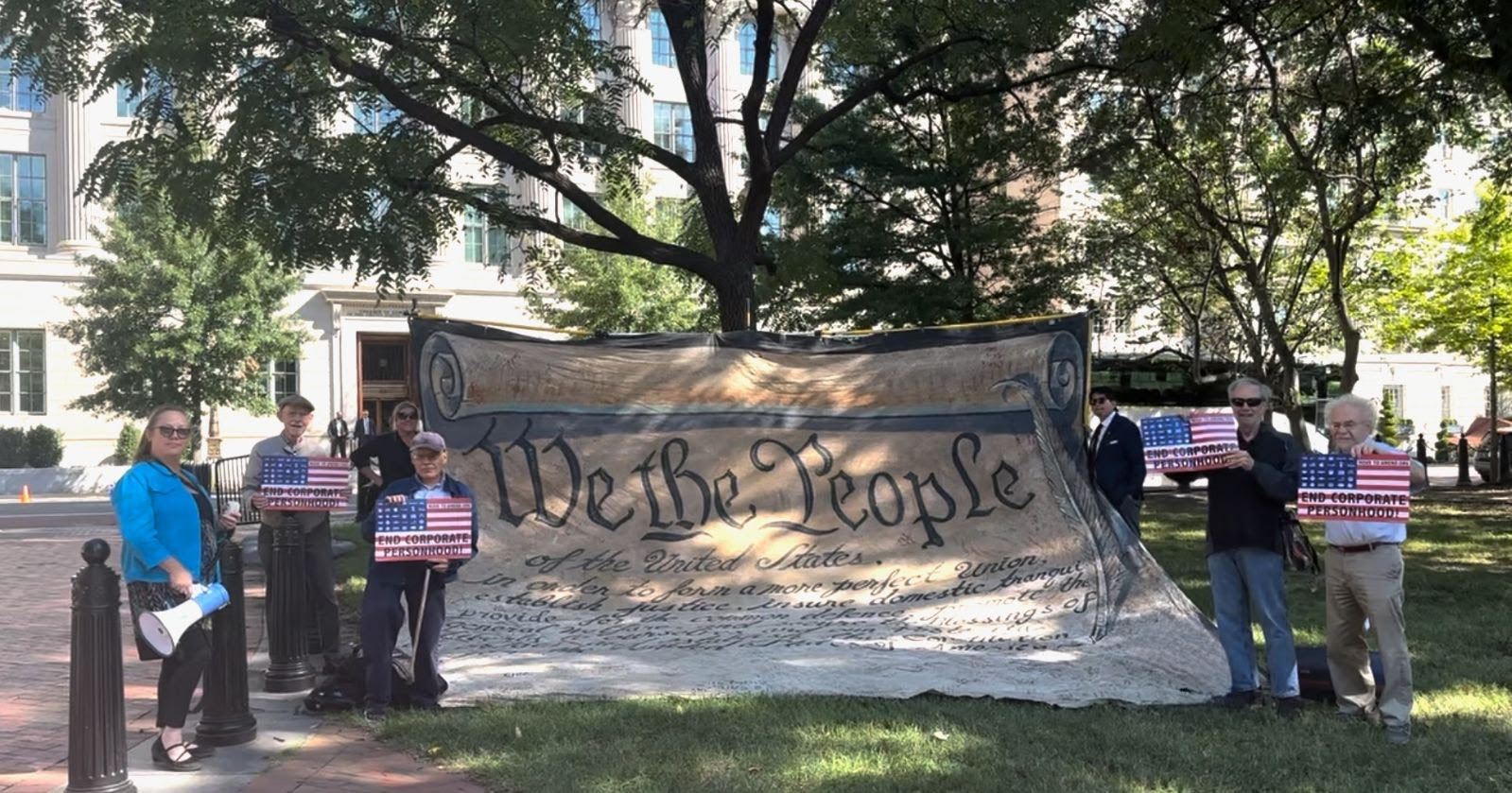
The two reasons were to highlight what the Chamber represents and what the Chamber does.
What the U.S. Chamber represents
The Chamber typifies the political power of large business corporations. Despite its claim of “representing the interests of more than 3 million businesses of all sizes, sectors, and regions,” a sizable majority of its board of directors are heads of larger corporate entities while its agenda overwhelmingly reflects the interests of large corporations, especially those of its major donors.
Only 18 donors contributed more than one-quarter of its 2021 revenue, 97% of its revenue came from just 1300 donations of at least $5000. The fact that the Chamber doesn’t legitimately represent small business interests and even local chambers of commerce led a decade ago to the "U.S. Chamber of Commerce Doesn't Speak for Me" campaign, supported by over 6,000 businesses signed on to the campaign and 32 local chambers of commerce.
Nevertheless, the Chamber is politically potent. They are the nation’s largest lobbying organization, having spent$1.85 billion between 1998 and 2023, $81 million alone in 2022. Their political campaign contributions in the 2022 election cycle totaled $3.5 million and outside spending on electioneering communication an additional 1.8 million. Their political investments have yielded significant returns, as the next section describes.
The Chamber also represents an aggressive promotion of big business as a political force to promote their legitimacy and interests over the last half-century, due to the Chamber’s role in implementing the “Powell memo.” Lewis Powell, a corporate lawyer and a board member of Phillip Morris Corporation, wrote a confidential memo for the U.S. Chamber of Commerce in response to the “American economic system [being] under broad attack.” coming from, among others, “perfectly respectable elements of society,” including “college campus, the pulpit, the media, the intellectual and literary journals, the arts and sciences, and from politicians.”
Lewis called for a corporate coordinated and well-funded campaign to influence the public on behalf of the role of corporate America by assertively opposing regulations, but also by infiltrating societal institutions (i.e. publishers, TV networks, universities, event courts). “The role of the National Chamber of Commerce is therefore vital,” Powell wrote.
The Chamber remains part of a broad pro-corporate institutional movement that seeks to change the culture, law and constitution that began in the early 1970’s with the Powell memo.
FYI, Powell was appointed to the Supreme Court in 1972 by Richard Nixon and ruled in favor of both the First National Bank v. Bellotti(that permitted corporations for the first time to donate to political campaigns) and Buckley v. Valeo (that equated money as free speech) decisions.
What the U.S. Chamber does
The Chamber promotes major corporate interests. If the interests of individuals, communities, smaller businesses, larger businesses that don’t donate to the Chamber or the environment get in the way, so be it.
A selection of many examples:
- The Chamber actively supports virtually all environmental deregulation, including those of the Trump administration. They opposed the climate provisions of the more recent Build Back Better and Inflation Reduction Act. InfluenceMap, a think tank that monitors corporate climate lobbying, gave the Chamber an “E-” grade for 25 out of 39 policy positions they took since 2017 being harmful to the climate.
- The Chamber fiercely opposed the Protecting the Right to Organize (PRO) Act, a “landmark worker empowerment, civil rights and economic stimulus legislation” promoted by the AFL-CIO. A Chamber lobbyist said there would be a "political price" to payfor any lawmakers who supported the bill, which the Chamber called a "litany of almost every failed idea from the past 30 years of labor policy." The bill never passed the Senate.
- The Chamber spent millions of dollars to defeat expanding the child tax credit (CTC) for one year under the Build Back Better bill in 2022. The anti-poverty measure was responsible in 2021 for reducing childhood poverty to its lowest level since 2009. A critical buffer to food insecurity, childhood poverty more than doubled in 2022 when the payments expired.
- The Chamber has lobbied against the Forced Arbitration Injustice Repeal Act — which would end compelled arbitration outside of a company (i.e. public courts and juries) on disputes related to employment, consumers, civil rights etc. They actively oppose legislation to break up alleged monopolies, calling it “penalizing success” (watch the 60 second video). They also organized a well-funded campaign against the Consumer Financial Protection Bureau, claiming that the new director is trying to “radically reshape ” financial regulation without proper jurisdiction.
- The Chamber opposed For the People Act, the most comprehensive democracy reform proposed legislation in several decades. They oppose campaign finance reform measures, even the past modest DISCLOSE Act that would have simply required any group that spends more than a certain amount on political campaigns to disclose its donors.
---
Move to Amend highlighted the political power of the U.S. Chamber of Commerce while in D.C. and even more now to underline the reality that organized vast economic power that has the legal and constitutional right to be converted to vast political power to influence public policies does not serve the common good. It’s unaccountable. It serves their interests, rather than those of individuals without political money to invest in the political system, of communities and of a natural world that is livable.
The only way to hold corporate entities like the Chamber accountable is constitutionally – to ensure that we have laws and regulations to protest people, communities and the natural world from private corporate decisions.
That’s why HJR54, the We the People Amendment, is so important. And that’s why we were in D.C. to lobby for it and why we protested at the U.S. Chamber of Commerce.
---
---
US Chamber of Commerce Has Helped Downplay the Climate Threat, a New Report Concludes
Brown University’s Climate and Development Lab reviewed 41 chamber pronouncements from 1989-2009 and found the trade association to be “a powerful force in obstructing climate action.”
June 29, 2021
For 20 years, the United States Chamber of Commerce has played a central role in national and global campaigns to thwart ambitious legislative efforts to curb the world’s rising carbon emissions and downplay the threat of climate change, according to a new report that analyzed dozens of documents issued by the nation’s biggest business association.
The report, published Tuesday by Brown University’s Climate and Development Lab, adds to a growing body of work that has revealed how the fossil fuel industry, and other organizations tied to its business interests, have spent decades mounting sophisticated messaging campaigns that have aimed to quell public concern over climate change and protect the bottom line of some of the world’s biggest corporations.
The Chamber of Commerce, during what the report called the “formative period” for U.S. climate policy from 1989 to 2009, consistently characterized climate science as needing more time to develop and said various solutions being proposed to reduce carbon emissions “would be harmful to the American economy and put us at disadvantage to other countries.” And the organization’s board of directors has more often included energy executives than owners of main street shops, the report said.
The chamber “has long been a powerful force obstructing climate action and an active funder, leader and participant of many countermovement groups,” the report said. “Chamber boardrooms and committees have long been staffed by executives from fossil fuel corporations like Shell, ConocoPhillips and Southern Company, whose leadership has helped shape its climate change strategies.”
Matt Letourneau, the chamber’s managing director of communications, declined to comment on the report, but pointed to the trade association’s recent commitments to addressing global warming.
In January, the chamber updated its climate stance, following other major U.S. lobbying groups like the American Bankers’ Association, by advocating for the need for market-based solutions to reduce greenhouse gas emissions, such as implementing carbon pricing or funding research in technologies like carbon capture and storage.
“We are proud of the work we’re doing across the broad Chamber membership to bring meaningful, achievable solutions to the global climate challenge,” Letourneau said in an email. “The business community is at the leading edge of innovation and investment in the technology necessary to reduce emissions, and will be an important voice in the international and domestic policy dialogue.”
Cole Triedman, a research graduate at Brown University who wrote the report, analyzed 41 official chamber documents on climate change between 1989 and 2009, finding that the trade group was tied to several major campaigns aimed at derailing national and international policy to tackle climate change.
The Chamber “channeled its influence through participation, funding and leadership of several coalitions, front groups, and ad-hoc groups opposed to climate action,” Triedman wrote. “These groups have often carried out the ‘dirty work’ of climate denial research and messaging, anti-climate policy advertising campaigns, and promotion of climate denying scientists.”
Most notable among those groups tied to the chamber was the Global Climate Coalition, the study said. For more than a decade, the group led an aggressive lobbying and public relations campaign against the idea that emissions of heat-trapping gases could lead to global warming, the New York Times reported in 2009.
The group was also significant in persuading the Bush administration in 2001 to pull out of the Kyoto Protocol, the first international treaty that aimed to tackle climate change by limiting countries’ carbon emissions, the Brown University report said.
Another major group the chamber helped to lead was the Partnership for a Better Energy Future, which “was completely dedicated to fighting Obama’s Clean Power Plan,” and on which former chamber executive Karen Harbert served as co-chair, Triedman said.
The Brown University report, one of the first to make a comprehensive analysis of the chamber’s climate stances, found that the group changed its messaging over the years from denying or ignoring the existence of climate change, to highlighting ambiguity about the scientific consensus and severity of climate change, to accepting climate change and promoting voluntary solutions to address it.
That pattern tracks with another recent study that looked at the messaging campaigns of oil giant ExxonMobil. That research analyzed language in public and internal Exxon documents and found that the oil major used “the subtle micro-politics of language to downplay its role in the climate crisis.”
A growing number of youth activists, who have re-energized the climate movement and pushed companies to take more progressive stances on addressing climate change, have faulted the chamber, including its new commitments on global warming, for “greenwashing”—making an official stance seem more environmentally friendly than it actually is.
A new youth-led campaign, Change the Chamber, aims to replace the trade group’s “pro-fossil fuel” board members with ones that will take stronger action on climate change.
The youth-led coalition, along with Climate Change Lobby, an international, grassroots lobbying group, released a report in 2020 suggesting that while the chamber publicly began to advocate for climate action in 2019, the trade group continued to lobby against legislation that would have likely advanced efforts to reduce carbon emissions and helped to mitigate negative consequences from industrial pollution.
The chamber in 2019 successfully lobbied the U.S. Senate to vote down a joint resolution to nullify the EPA’s repeal of the “Clean Power Plan,” which had introduced emission guidelines for states to follow in limiting carbon dioxide emissions from existing power plants, the report said. And in 2020, the chamber also successfully lobbied the Environmental Protection Agency to decline tightening environmental rules around PM 2.5 pollution, or fine particulate matter, which is tied to combustion of fossil fuels and is a leading cause of premature deaths in the United States and around the world.
Earlier this month, Change the Chamber urged the chamber’s member corporations in a letter to quit the association or risk being branded anti-climate action.
“The U.S. Chamber continues to use its political influence to promote public policy on climate issues that, if adopted, will contribute to catastrophic levels of climate change,” the youth-led campaign wrote in a statement. “Companies and brands that fund obstructionist lobbying groups in this ‘decade of action’ will likely become objects of public ire for the oncoming trauma resulting from climate change.”
---
31 pp
:{:{}:
}:
:{:{}:
}:
concl [redactions hilarious]
:{:{}:
}:
The American Petroleum Institute also improperly withheld documents from the Committee, including materials prepared for its Executive Committee and Board of Directors and relating to API’s activities surrounding major federal climate policy proposals. For example, API redacted emails to representatives of other oil and gas trade associations, including the American Gas Association and Independent Petroleum Association of America with the subject line “reconciliation coordination,” referring to the budget reconciliation bill that culminated in President Biden’s Inflation Reduction Act.114 API also redacted communications regarding pending Securities and Exchange Commission regulations that would require companies to disclose their climate impacts, and documents describing meetings with Administration officials, including a document outlining industry’s priorities for a March 22, 2021, meeting with President Biden’s then-National Climate Advisor Gina McCarthy.115
:{:{}:
}:
• The U.S. Chamber of Commerce has been especially obstructive and evasive in its response to the Committee’s subpoena. The Chamber excluded almost all internal documents from its production, preventing the Committee from evaluating whether external positioning and internal rhetoric are aligned. Instead, the Chamber produced documents that it knew were tangential to the Committee’s investigation, including mass mailer publications, newsletters, mass letters to Congress, mass emails to congressional staff, and press releases. The Chamber also produced printouts from its website, comment letters to federal agencies and departments, widely distributed event invitations, and daily news clippings— while refusing to produce the internal documents that are required by the Committee’s subpoena. The Committee continues to seek full compliance with its subpoenas in this investigation.
:{:{}:
}:
Despite obstruction from Big Oil over the last year, the Committee’s investigation has uncovered troubling evidence of a long-running greenwashing campaign by the fossil fuel industry—all while doubling down on long-term production of oil and gas and reaping record profits at the expense of American consumers. The evidence obtained by the Committee shows the vital importance of the Committee’s investigation to uncover the truth about Big Oil’s role in the climate crisis and the industry’s inaction and misinformation that continue to exacerbate the crisis.
---
an 11 22
Since early 2021, corporations that have played a major role in pushing inflation to a four-decade high in the United States have swarmed Capitol Hill with lobbyists to prevent Congress from passing legislation aimed at curbing companies' ability to price gouge consumers at will.
That's according to a report published Thursday by Public Citizen and the Groundwork Collaborative, which scoured federal lobbying disclosures to examine how trade groups and individual corporations have worked to shield their pricing power at the expense of the consumers.
The new report focuses specifically on 27 anti-price gouging and profiteering bills, none of which have fully passed and many of which failed to reach the floor for a vote after powerful corporate lobbying organizations—such as the drug industry's PhRMA and the Chamber of Commerce—"blanketed" the nation's capital with influence peddlers.
According to the Public Citizen and Groundwork's findings, "Corporations opposed to anti-price gouging and profiteering bills were responsible for more than 2,600 lobbyist engagements on Capitol Hill, while supporters of such legislation had fewer than 300: a 9-to-1 advantage for big business."
"H.R. 3, the Elijah E. Cummings' Lower Drug Costs Now Act (the signature drug pricing reform bill of the Democrats in the House) resulted in 1,157 lobbyist engagements, the most of any bill in this analysis," the report notes."Ninety-six percent of the engagements (1,110) came from corporations, trade groups, and non-profits opposed to the bill, giving the opposition a 24-to-1 advantage."
Though congressional Democrats ultimately passed scaled-back drug pricing reforms as part of their broader Inflation Reduction Act, Big Pharma has continued raising prices on lifesaving products and treatments after industry-backed lawmakers blocked bolder action. By one measure, the pharmaceutical industry has spent at least $147 million to obstruct efforts to bring down drug prices during the coronavirus pandemic.
"Corporate America deployed its overwhelming lobbying power to stop anti-price gouging and profiteering legislation to protect their record profits. It's all about money for them,"Mike Tanglis, a research director for Public Citizenand report co-author, said in a statement. "But for millions of Americans, it's about a lot more than just money. For those struggling to pay for prescription drugs, Big Pharma's price gouging can be a matter of life and death."
Corporate lobbyists have also targeted the Consumer Fuel Price Gouging Prevention Act, a bill that proposes giving the president the authority to prohibit oil and gas giants from increasing fuel prices to "unconscionably excessive" levels. The measure was fervently opposed by the Chamber of Commerce and the American Petroleum Institute, whose member list includes ExxonMobil and Chevron—fossil fuel behemoths that both reported sky-high profits last week.
The Consumer Fuel Price Gouging Prevention Act, which passed the Democratic-controlled House without any GOP support but stalled in the evenly divided Senate, has drawn 83 total lobbying engagements, nearly three-quarters of them from opponents of the bill, according to Public Citizen and Groundwork. Oil giants have also lobbied against a proposed windfall profits tax measure that has thus far failed to advance as prices at the pump remain elevated.
"This report highlights how the corporations fighting these bills have been the very ones responsible for jacking up prices on consumers and whose bottom line would be impacted the most if these bills were signed into law," said Michael Mitchell, Groundwork's director of policy and research and a co-author of the report. "Congress must rein in the unchecked and outsized power these megacorporations hold over our economy."
The report was released hours after the Federal Reserve announced yet another large interest rate hike despite growing warnings that its approach won't tackle the primary drivers of inflation, including ongoing supply chain issues and corporate profiteering. Fed Chair Jerome Powell didn't mention the latter factor during his statement to the press on Wednesday, and reporters neglected to ask him a single question about it.
Josh Bivens of the Economic Policy Institute estimated in September that "rising profit margins have accounted for roughly 40% of the rise in prices" since the second quarter of 2020.
In their new analysis, Public Citizen and Groundwork note that "booming corporate profits and fatter profit margins have not gone unnoticed."
"Consumers and policymakers alike have become increasingly aware that corporations are taking advantage of the moment and, in response, lawmakers have proposed various bills designed to hold corporations accountable and address rampant price gouging," the groups observe. "This report demonstrates that many of the same companies enjoying record profits— including household names such as Chevron, Johnson and Johnson, and Pfizer—are also deploying lobbyists to block these very proposals."
While welcoming recent passage of the Inflation Reduction Act as a step in the right direction, the report argues Congress must go much further to "address corporate concentration and rein in the unchecked power that these megacorporations exert on prices and our democracy."
"Policymakers should also consider enacting an excess profits tax to reduce the incentive for companies to engage in profiteering behavior," the report states. "To accomplish this, elected officials must push back against the lobbying onslaught by corporations very much invested in maintaining the status quo."
---
==
june 2022
https://www.vox.com/23058987/sec-climate-finance-disclosure
as drought spreads and sea levels rise, the economic impacts of climate change will run in the trillions of dollars. The insurance firm Swiss Re projects climate disasters would cost the world as much as $23 trillion by 2050, bigger than the impact from the pandemic and the Great Recession of 2009 combined.
It’s reasonable business planning to account for all this foreseeable risk — just like planning for cyberattacks or business disruptions from a pandemic. Last year, for instance, the US had to spend $145 billion dealing with floods, fires, and other climate-related disasters.
Yet somehow, climate change has fallen through the cracks of US financial regulation. Publicly traded companies are required to disclose information about “material” risks that affect their company regardless of their cause, from sanctions to supply chain chaos. But there are no uniform standards for disclosing how much fossil fuel pollution they generate or the impact that climate change could have on their future growth. Instead, companies have been left free to inflate their environmental progress, all with little scrutiny from the public.
This kind of information is, in theory, essential to a functioning free market, so investors can make decisions based on complete information. But fossil fuel interests, conservative ideologues, and corporate trade groups are striving to keep shareholders in the dark on climate risks.
The Biden administration is trying to make companies more publicly accountable for the risk of the climate crisis. A linchpin of Biden’s plan is a draft rule theSecurities and Exchange Commission (SEC)proposed in March. Over 500 pages, the SEC rule proposes that publicly traded companies disclose how climate change affects their business outlook and identify a board member or board committee to focus on climate-related risks.
Once the rule is finalized, companies will have to disclose how their operations are affected by extreme weather events and the impact of climate change on the short- and medium-term business outlook. They’ll also have to report the emissions both from their company’s operations and from how their products are used. This is particularly bad news for fossil fuel companies with business models predicated on selling pollution. Until this rule, they haven’t had to fully account for the environmental impact from things like selling gas that’s burned by consumers’ cars.
This is a rule, in other words, that helps the free market act like the free market, giving investors exactly the information they need to make the decisions,” Emory University business law expert George Georgiev said.
As the draft rule’s comment period came to a close, it’s clear any regulation on climate change faces serious headwinds. The loudest protests have come from right-wing groups and corporate-aligned nonprofits that have flooded the public comments with previews of the argument they’ll take to courts.
Plenty of businesses in the financial sector stand to benefit from this rule, like the investing giant BlackRock, which has pledged to align its assets with climate goals. But some could be hurt. The companies that benefit from greenwashing their climate commitments are doing everything they can to protect the chaotic status quo.
Financial transparency on climate change is hardly a radical idea
The SEC has required and standardized public company disclosures since 1933. In recent decades, the SEC has issued nonbinding guidance on how publicly traded companies should consider Covid-19 disruptions, Russia’s invasion of Ukraine, and even a feared “Y2K” meltdown at the turn of the 21st century, so the companies would meet their fiduciary duty.
But the SEC has been painfully slow on climate change. Right now, businesses disclose the risks and costs of their business on the climate on a voluntary, patchy basis with no clear standardization.
A 2020 Government Accountability Office surveyed 32 midsize and large publicly traded companies and found little consistency. Airlines, for example, used years anywhere between 1990 and 2017 as the baseline for calculating their climate footprint. Water companies have used completely different measurements for reporting water extraction. Some companies would just report carbon emissions, while others would report total greenhouse gas emissions (including sources like methane).
The proposed SEC rule cites other evidence of companies not paying attention to this risk, like an internal survey of climate-related keywords in companies’ 10-Ks between June 2019 and December 2020. They found only 31 percent mentioned climate change at all.
This information is not just to benefit climate change efforts; it is also useful to investors. It makes clearer, for instance, that a retail company’s warehouses might be threatened by increased flooding, that an airline company might have to ground more flights because of rising heat waves, or that a bank’s backing of major fossil fuel expansion has the strong chance of backfiring in a world that transitions to renewables. Without any regulation and standardization, companies will just continue to try to outshine one another on their environmental and social commitments without hard data to back it. This mismatch will become an existential risk to financial instability if, for example, extreme weather pummels a business that did not prepare accordingly.
Environmental activists have pushed for more from companies by proposing shareholder resolutions at annual meetings that ask for more transparency, but have met with mixed success in shareholder votes that don’t bind the company to taking action.
In this regulatory vacuum, voluntary global affiliations have cropped up, including the Net Zero Assets Managers Initiative, representing some $43 trillion in assets, and Climate Action 100+, representing more than $60 trillion. Another of these groups is run out of the Financial Stability Board as a Task Force on Climate-related Financial Disclosures (TCFD), a voluntary system that has grown to more than 3,000 companies. The task force’s recommendations tell companies to consider the short-, medium-, and long-term climate impacts, emissions that result from investment decisions, and their operations’ pollution, and account for the changing climate’s consequences for the business. The hundreds of companies that voluntarily comply with these standards aren’t necessarily green or good for the environment, but it’s an extra gold star for their sustainability transparency.
Eight countries, including the UK, have passed laws that will mirror the TFCD’s recommendations, but the US would remain an outlier without the SEC rule. “Investors put their money where they think there’s a good opportunity and good information,” said Steven Rothstein, managing director of the Ceres Accelerator for Sustainable Capital Markets. “If we don’t have good information, we run the risk of falling behind internationally.”
The SEC’s rule is basically the US playing catch-up, based on standards the mainstream corporate community aligned with TFCD have already backed.
Initially, companies will have to spend extra to comply with the rule — up to $530,000 a year for larger companies by the SEC’s estimate, but it will vary depending on how much companies are doing already on climate disclosure. Typically, the costs of rules shrink over time. Otherwise, the rule itself is quite modest. The SEC is “not saying you should or shouldn’t invest in climate products,” Rothstein said. “They’re just saying, tell investors what you’re doing and do it in a consistent way.”
Environmentalists and some Democratic lawmakers argue the SEC could be doing even more. The SEC does not change how companies disclose climate-related activities like PR campaigns and political influence, the kind of activities that tend to be outsourced to nonprofits that shield their activities from the public. In March, Sen. Sheldon Whitehouse (D-RI) called it a “failure of nerve that shies away from a perfectly legal, necessary response to the climate danger we face” because political efforts remain “the single most material disclosures a company could make to achieve climate safety.”
Right-wing groups claim financial transparency is an attack on free speech
Unsurprisingly, the SEC is facing immense pressure to withdraw this rule because of the same shadowy political spending that companies don’t have to disclose in the first place. Groups like the US Chamber of Commerce, the National Association of Manufacturers, Americans for Prosperity, and the Competitive Enterprise Institute have flooded the SEC with comments that argue company free speech would be violated.
Trade groups and right-wing think tanks have argued that requiring companies to report these emissions is akin to violating their First Amendment rights of free speech, pointing to a court case that ruled a regulation requiring the disclosure of conflict-zone minerals would amount to “compelled speech” and violated the companies’ rights.
The American Petroleum Institute, the oil industry lobby, has argued the rule “could raise serious First Amendment issues under recent applying strict scrutiny to content-based laws compelling speech.”
The argument has found purchase with conservative lawmakers, like West Virginia Attorney General Patrick Morrisey,who picked up the argument in his 2021 letter to Treasury last year. In Congress, 19 Republican senators argued in their submitted comments that the rule is “not within the SEC’s mission to protect investors, maintain fair, orderly, and efficient markets, and facilitate capital formation.” Another 40 Republican representatives wrote that the rule will act to “undermine and shame public companies,” while Republican attorneys general describes the rule as a “total reordering of [the SEC’s] present disclosure regime.”
The attack on regulation under the guise of First Amendment rights has become more familiar in recent years. “Unfortunately, the Supreme Court has been steadily giving corporations more and more leeway, more and more rights,” said Ciara Torres-Spelliscy, a corporate law expert who has published several books on corporate speech.
The court also opened the door to more of these lawsuits, striking down a California law that required nonprofits to disclose their donors, siding with the Americans for Prosperity Foundation’s argument against disclosing their donors and providing IRS 990 forms to the state. Other legal challenges to campaign finance laws and unions have used the First Amendment.
Legal experts supportive of the SEC rule consider the argument a long shot in courts. “I think that argument is really far-fetched,” Emory’s Georgiev said.
But it’s still worrisome. If it succeeds, whether in courts or as a scare tactic to get the SEC to backtrack, it sets a dangerous precedent for the financial system at large. “If this climate rule is violating the First Amendment, it’s been all nine decades [the SEC has been] violating the First Amendment,” Georgiev said. “They will definitely try it out in courts. At the end of the day, a lot of far-fetched arguments succeed in courts.”
---
https://www.documentcloud.org/documents/20892344-comments-to-sec-on-esg-rule#document/p33/a2075289
comments from acc chem, AEI, AFP, API, cato, cei heartland etc CTT,CoC p 105-115, co2 coalition, conoco phillips, enbridge, inst for free speech, heritage, nam, NMA, noia, lifepoerwed TPPF, WEA western energy? US oil and gas
Comments to SEC on ESG rule
supports principles based framework p. 1
Any reporting framework adopted by the rr Commission should be conductive to flexible and diverse climate change disclosures that reflect the different factors driving a company's business. p. 2
railroad industry has already taken steps to voluntarily comply with... SASB and TCFD... Adopting an existing, widely used program would lessen transition time. p. 2
not impose strict liability. furnish separately instead of file p. 2
Supports "furnishing" approach p. 5
We believe a business-specific "materiality standard that acknowledges differences across and within industries... p. 5
ACCinvolved in development of SASB standards, ACC member companies are using for voluntary disclosure p. 5
private market standard-setters often develop climate change disclosures with an implicit bias based on their perception of an industry's reputation p. 5
The liability standard imposed on information filed with the SEC is an inappropriate standard for such forward-looking and aspirational disclosures p. 6
ESG reporting "futile" p. 8
If public companies are driven to use the same (or similar) sets of assumptions about central parameters, a very real danger would arise of more-or-less homogenous predictions inconsistent with historical, ongoing, and prospective climate phenomena." p. 9
...and there is no evidence in support of the ubiquitous assertions of a climate "crisis," whether ongoing or looming, and no evidence in support of the even more extreme "existential threat" argument. p. 10
Again, public companies conducting climate "risk" analysis will have powerful incentives to choose among assumptions on future emissions and atmospheric concentrations, climate sensitivity, and other crucial parameters so as to insulate themselves from political attack, adverse regulatory actions, and litigation p. 14
Again, public companies conducting climate "risk" analysis will have powerful incentives to choose among assumptions on future emissions and atmospheric concentrations, climate sensitivity, and other crucial parameters so as to insulate themselves from political attack, adverse regulatory actions, and litigation p. 14
Those political pressures will lead public companies and government agencies not to consider the benefits of increasing atmospheric concentrations of GHG p. 14
...it is not easy to separate natural from anthropogenic effects on temperatures and other climate phenomena. p. 15
Accordingly, the data are unclear as to whether there is occurring an acceleration in sea level rise p. 16
The reality is that a "climate risk" disclosure requirement would be deeply speculative. p. 18
What about massive volcanic eruptions? Asteroid impacts? Powerful earthquakes? p. 19
Constitutional objection to ESG reporting p. 22
SEC Climate Disclosure Mandates Risk Compelling Speech at Odds with the First Amendment p. 23
...expressing views they may not hold or would prefer to express in different ways. p. 23
...could imply that the speaker had adopted a position on the topic of climate change... p. 24
Commissioner Hester Peirce identified some of the risk of compelled speech in this context during June 2019 remarks before the American Enterprise Institute, including public shaming and shunning based on nebulous, incomplete, arbitrary, inconsistent, and political information which would be incorporated as part of an SEC climate or ESG disclosure regime. p. 25
explain in a forthcoming article p. 25
...the evidence of ESG-certified investments -- whether by governments or third parties -- achieving financial or environmental objectives is likely overblown. p. 26
As Commissioner Peirce has articulated, the use of global, one-size-fits-all ESG and climate disclosure regimes may undermine the bottom-up, non-government innovations that respond to those investor and consumer interests p. 27
...represents a sweeping expansion of government power and mission creep for many parts of the federal government. p. 27
APIseeks to serve as a resource and an active participant p. 29
API developing framework based on EEI/AGA template p. 30
disclosure requirements beyond materiality "could raise serious First Amendment issues" p. 33
Central Hudson Doctrine p. 34
"industry issuers may be best positioned to define the standard for require climate disclosures" p. 34
API encourages SEC to view industry resources as key starting points for evaluating need to develop new reporting requirements p. 37
constitutional limitations on SEC's ability to require companies p. 38
look forward to working with SEC "through the rulemaking process" p. 40
ESG reporting "important" and AXPC is committed to "progress" p. 42
AXPCmetric framework and template p. 43
materiality is key p. 43
'neutrality'; any disclosures should not "discriminate against any economic sector or sectors" p. 44
urging adherence to procedural requirements/allowing additional input from industry p. 45
AXPC urges SEC not to include scope 3 emissions in reporting requirements p. 47
does not believe SEC should require auditing/believes companies should be able to rely on third party auditors p. 50
would urge Commission to not require certification of climate disclosures p. 51
"strong supports a 'comply or explain' framework" p. 51
unclear mandatory disclosure can provide a net benefit p. 53
the SEC is not tasked with environmental regulation p. 53
...also raises questions about the SEC's ability to evaluate prescriptive disclosure frameworks and fairly enforce compliance with them. p. 53
90% of the companies in the S&P 500 were publishing a sustainability report. p. 54
the SEC would be stepping in to pick "winners" and "losers" p. 55
Evolving understandings of climate change p. 56
Corporate environmental sustainability disclosures--and ESG disclosures more generally--have come to fruition as a result of exogenous demand for such information, and an industry has grown up around the provision of such information. p. 57
The SEC should not extend any climate change-related disclosures requirements to private companies. p. 59
"name and shame" -type of strategy p. 59
...the losses they may incur as climate policies devalue and strand their assets and courts compel them to pay compensation to climate change victims. p. 61
In practice, however, it is often hard to distinguish what component of current risks is due to climate change rather than just plain old climate. p. 62
Advocates for climate risk disclosure: p. 64
If the state of the world is improving, including in regard to cilmate-related risks, why now compel publicly-traded companies to quantify climate-related risks as though their financial lives depend on it? p. 72
Third, CO2 emissions have positive as well as negative externalities. p. 74
adaptation requires wealth, and mitigation targets that strand 42.1 percent fossil fuel industry assets by 2030 would destroy trillions of dollars of wealth. p. 77
The NetZero agenda is the political equivalent of war on the fossil fuel industry. p. 77
Death spiral p. 78
Disclosure advocates warn of a carbon bubble but the Paris treaty and NetZero agendas may be setting the stage for a green bubble. p. 85
Solyndra! p. 85
ESG exceeds powers of SECp. 93
...mission creep for the agency... p. 93
Accounting firms, consultants, and law firms with compliance practices can be expected to welcome more disclosure requirements for self-interested professional reasons. p. 97
the Scientification of Non-Knowledge p. 100
...some climate and ESG-themed disclosure mandates could become compelled speech thatconflicts with First Amendment protections. p. 100
At least some proposed climate disclosure provisions, by which companies must confess to having metaphorical blood on their hands with regard to future catastrophic effects of climate change, would face similar First Amendment concerns." p. 101
Should a U.S. firm end a contract with a textile factory in Bangladesh over the average age of its workers or will that simply cause those teenage employees and their families to fall even further into poverty when their factory closes? Isn't poverty alleviation itself a major ESG goal? p. 104
The agency should continue to defer to the materiality threshold to help continue to prevent securities from becoming politicized p. 107
companies are already required to disclose material ESG information under current law p. 108
advocating a flexible, principles-based approach with tailoring for different industries and companies p. 110
it is critical to avoid finding "fraud by hindsight" p. 110
Third-party standard setters may not be insulated enough from stakeholder and other policy agendas... important questions to answer about organizational governance, due process, and funding sources. p. 111
SEC should take a closer look at transparency and conflicts of interest [in third party ESG assessments] p. 112
SEC should allow a commensurate market-based approach to third-party assurance for climate-related reporting p. 113
Disclosure... should not be a tool for advancing political interests or achieving policy goals p. 113
Chevron has a "long history" of reporting on ESG p. 115
supports disclosure for "consistency and comparability of climate-related information" with existing frameworks and a phased approach p. 115
support for reporting times to line up with other agencies p. 116
Chevron working with API to develop 'voluntary template' p. 116
"Chevron's climate change reporting experience" p. 117
urging a "phased" approach p. 118
advocating for a principle-based approach rooted in 'materiality' p. 118
SEC should focus on "decision-useful information" p. 118
SEC should build on existing sustainability-related disclosure requirements p. 118
support for global sustainability standard; encouraging SEC to use TCFD framework/voluntary standards/private sector industry standards p. 119
Chevron offers assistance as the SEC "moves forward with Climate disclosure" p. 119
"There is no climate crisis" p. 120
"We have long recognized the need for action to address climate change" and "understand investor interest" in ESG p. 122
recommend SEC adopt existing reporting frameworks (TCDF, SASB) p. 122
standards-setting organizations and industry can successfully/should work together p. 123
phased approach / based in materiality / "harmonize" disclosure requirements with other sustainability reporting requirements p. 123
urging a "hybrid-approach" to disclosure: company specific while "minimizing categorical discrimination among industries" p. 123
data should be presented in way that is useful for investors p. 124
"materiality" for climate disclosures: "reasonable investor would consider it important in deciding how to vote" p. 124
should apply liability protections / ESG disclosures should be "furnished" not "filed" p. 125
Our members are leading the transition to the lower-carbon energy economy p. 127
brags about "recognizing the importance of climate change disclosure" p. 127
"we support the Commission's focus" p. 128
ESG requirement should be collab between registrants and investors, flexible, sector-specific p. 128
best to work with investors to disclose relevant information p. 129
"climate change data and disclosure are inherently uncertain" - companies should not be liable p. 130
"forward-looking societal climate impacts or other externalities" are not useful to investors/decision-making p. 131
"forward-looking societal climate impacts or other externalities" are not useful to investors/decision-making p. 131
should not be a one-size fits all approach p. 132
"caution against delegating the development of public-company disclosure requirements to NGOs or private companies" p. 134
"we recommend the Commission prioritize standards applicable to registrants subject to its rules" p. 139
advocating for ownEEI-AGA ESG/Sustainability Reporting Template p. 140
do not believe additional certifications or reviews are necessary p. 140
need to be careful that disclosures do not lead to additional litigation p. 141
"existing requirement to disclose material risk factors" re climate is sufficient p. 142
"our perspective is drawn from our long and sustained history of voluntary disclosure" related to ESG p. 148
ESG must remain rooted in SEC's mission "to protect investors; maintain fair, orderly and efficient markets; and facilitate capital formation" p. 149
SEC must remember "purpose of reporting": investors and materiality at forefront p. 149
need to allow degree of flexibility/customization p. 149
"harmonized and uniform global framework for climate change disclosure... seems unrealistic" p. 149
advocating for adoption of existing frameworks p. 149
disclosures "should be subject to a safe harbor or limitation on liability" p. 150
"phased approach" needed p. 150
"no statutory authority" for ESG disclosure p. 151
"compelling ESG information from companies... is the type of humanitarian and social benefit regulation that has been struck down as unconstitutional under the First Amendment" p. 151
SEC climate regulation "cannot overcome even Central Hudson intermediate scrutiny" p. 152
ESG regulation will have negative consequences p. 154
Climate Science "Highly Uncertain" p. 160
calls for policing of fund management firms for ESG fraud p. 162
arguing ESG is essentially a tax on workers p. 177
arguing ESG is essentially a tax on workers p. 177
"allow for flexible disclosure" but in support of "principle based framework" p. 184
Any rule is premature p. 201
supports "new regulatory framework" p. 213
supports "a systemic approach to addressing the climate challenge" p. 216
TPPF comment through "Life:Powered" p. 217
"Risks to Human Welfare from Climate Are Decreasing, Not Increasing" p. 218
Additional disclosure requirements will result in First Amendment violations p. 220
Example of conflict minerals disclosure.p. 220
WEA and USOGA Comment p. 222
"uncertainties" on "extent of anthropogenic contributions and the amount of warming " p. 223
WEA uses paper that critiques decades long campaign to promote misinformation on climate by oil and gas p. 226
Preference for SASB on governance issues p. 229
WEA questions SEC's sincerity p. 231
Original Document (PDF) »
Contributed by Jesse Coleman (Documented)
see Document
---
{{
an ah 8 22
https://www.alternet.org/2022/08/anonymous-dark-money-destructive-influemce/
when the U.S. Supreme Court handed down its controversial 5-4 ruling in Citizens United v. Federal Election Commissionin 2009, critics of the decision — including dissenters on the High Court — predicted that elections in the United States would be inundated with a flood of dark money. In his dissent, the late Justice John Paul Stevens, a Gerald R. Ford nominee, stressed that the ruling “threatens to undermine the integrity of elected institutions across the Nation” and warned, “A democracy cannot function effectively when its constituent members believe laws are being bought and sold.”
Thirteen years later, critics of the Citizens United decision continued to argue that Republican Stephens was spot on in his dissent. Articles on the influence of dark money have appeared in major publications, and New York Times reporters Kenneth P. Vogel and Shane Goldmacher, on August 22, reported that the largest political donation in U.S. history had come from “electronics manufacturing mogul”:{ Barre Seid — who gave $1.6 billion to a group led by GOP activist and Federalist Society Co-Chairman Leonard A. Leo.}:
Journalists David Sirota and Joel Warner examine the influence of dark money in an op-ed published by The Guardian GUKon August 29, citing Seid’s secretive donation as an especially blatant example.
“This week, the Lever, ProPublica and the New York Times discovered the largest known political advocacy donation in American history,” Sirota and Warner explain. “We exposed a reclusive billionaire’s secret transfer of $1.6bn to a political group controlled by the Republican operative Leonard Leo, who spearheaded the construction of a conservative Supreme Court supermajority to end abortion, block government regulations, stymie the fight against climate change and limit voting rights. This anonymous donation — which flowed to a tax-exempt trust that was never disclosed in any public record or database — was probably completely legal.”
Sirota and Warner continue, “Whether you support or abhor Leo’s crusade, we should be able to agree on one larger non-partisan principle: such enormous sums of money should not be able to influence elections, lawmakers, judicial nominations and public policy in secret. And we should not have to rely on a rare leak to learn basic campaign finance facts that should be freely available to anyone. Unfortunately, thanks to our outdated laws, those facts are now hidden behind anonymity, shell companies and shadowy political groups. America is long overdue for an overhaul of its political disclosure laws — and news organizations in particular should be leading the charge for reform.”
According to Sirota and Warner, dark money’s negative influence on U.S. politics is only “getting worse.”
“In 2020 alone, more than $1bn worth of dark money flooded around weak disclosure rules and into America’s elections, financing Super PACs, ad blitzes, mailers and door-knocking campaigns,” Sirota and Warner warn. “As millions of votes were swayed, reporters and the public had no knowledge of the money sources, or what policies they were buying. Heading into the 2022 election, the situation is getting worse. The two parties’ major Senate and House Super PACs are all being funded by anonymous dark money groups that are not required to disclose their donors.”
Sirota and Warner, however, do offer some “good news,” pointing out that the Disclose Act — a bill sponsored by Democratic Sen. Sheldon Whitehouse of Rhode Island — would “force dark money groups to disclose any of their donors who give more than $10,000, require shell companies spending money on elections to disclose their owners, and mandate that election ads list their sponsors’ major contributors.” And a separate Whitehouse-sponsored bill, they add, “would additionally require donor disclosure from shadowy groups lobbying the Supreme Court throughamicus briefs designed to tilt judicial rulings without letting the public know which billionaire or CEO’s thumb is on the scale.”
“In the landmark Citizens United ruling that unleashed the modern era of big money politics,” Sirota and Warner write, “the majority noted that while it was unwilling to permit political spending restrictions,it still held that ‘government may regulate corporate political speech through disclaimer and disclosure requirements.’ Those requirements are so desperately needed now — for the free press to play its vital role, and for voters to make informed decisions when they go to the polls.”
READ MORE:New report details Clarence Thomas’ 'shady ties to sprawling network of dark money'
---
https://yyy.theguardian.com/commentisfree/2022/aug/29/billions-in-dark-money-is-influencing-us-politics-we-need-disclosure-laws
no lnx
Billions in ‘dark money’ is influencing US politics. We need disclosure laws
David Sirota and Joel Warner
A donor secretly transferred $1.6bn to a Republican political group. Because of America’s lax laws, the donation was never disclosed in any public record or database
‘A billionaire transferred $1.6bn to a political group controlled by Republican operative Leonard Leo, who spearheaded the construction of a conservative supreme court supermajority to end abortion, block government regulations, stymie the fight against climate change and limit voting rights.’
Mon 29 Aug 2022
This week, the Lever, ProPublica and the New York Times discovered the largest known political advocacy donation in American history. We exposed a reclusive billionaire’s secret transfer of $1.6bn to a political group controlled by the Republican operative Leonard Leo, who spearheaded the construction of a conservative supreme court supermajority to end abortion, block government regulations, stymie the fight against climate change and limit voting rights.
This anonymous donation – which flowed to a tax-exempt trust that was never disclosed in any public record or database – was probably completely legal.
Whether you support or abhor Leo’s crusade, we should be able to agree on one larger non-partisan principle: such enormous sums of money should not be able to influence elections, lawmakers, judicial nominations and public policy in secret. And we should not have to rely on a rare leak to learn basic campaign finance facts that should be freely available to anyone.
---
lnx
unfortunately, thanks to our outdated laws, those facts are now hidden behind anonymity, shell companies and shadowy political groups. America is long overdue for an overhaul of its political disclosure laws – and news organizations in particular should be leading the charge for reform.
In the early 1970s, leaks and shoe-leather reporting by news organizations uncovered the Watergate scandal – the modern era’s foundational dark money exposé. That debacle birthed the original federal disclosure laws and a golden age of journalism. For a time, the new statutes allowed campaign finance reporting to become systematic, methodical and based on required disclosures, rather than sporadic, random and reliant on the goodwill of courageous whistleblowers.
A half-century later, however, the dark money practices of 50 years ago have again become normalized. In 2020 alone, more than $1bn worth of dark money flooded around weak disclosure rules and into America’s elections, financing Super Pacs, ad blitzes, mailers and door-knocking campaigns. As millions of votes were swayed, reporters and the public had no knowledge of the money sources, or what policies they were buying.
Heading into the 2022 election, the situation is getting worse. The two parties’ major Senate and House Super Pacs are all being funded by anonymous dark money groups that are not required to disclose their donors.
Advertisement
These problems aren’t unique to the campaign arena. Front groups are also shaping public policy, leaving reporters unable to tell voters who exactly is funding what. In the last few years, an anonymously funded group used post-election ads to successfully pressure lawmakers to water down landmark healthcare legislation designed to eliminate so-called “surprise” medical bills.
Similarly, Leo’s anonymously funded network spent tens of millions to boost the nomination campaigns of three conservative supreme court justices, after leading a campaign supporting Republicans’ refusal to hold a vote on Barack Obama’s 2016 high court nominee, Merrick Garland.
To be sure, news outlets can still cover the shrinking portion of the political finance system that still discloses some money flows to politicians, lobbyists and advocacy groups. And thankfully, there are occasionally disclosures like the Leo leak, which provide a fleeting glimpse into the real forces influencing sweeping policy decisions.
But for every sporadic leak, there are scores of secret donors systematically funneling ever more dark money into elections and legislative campaigns without ever being exposed – and they are reaping the rewards of corrupted public policy.
That’s the bad news. The good news is there is already a legislative blueprint for reform.
The Disclose Act, sponsored by the Democratic senator Sheldon Whitehouse, would force dark money groups to disclose any of their donors who give more than $10,000, require shell companies spending money on elections to disclose their owners, and mandate that election ads list their sponsors’ major contributors. These requirements would extend not only to election-related activity, but also to campaigns to influence governmental decisions – including judicial nominations.
A separate Whitehouse bill would additionally require donor disclosure from shadowy groups lobbying the supreme court through amicus briefs designed to tilt judicial rulings without letting the public know which billionaire or CEO’s thumb is on the scale. And other pending legislation would finally allow the Securities and Exchange Commission to require major corporations to more fully disclose their political spending.
Journalists should proudly advocate for laws like these, which allow us to tell the public what its government is doing. Our industry has done that before in defending open records laws, and we must do it now in advocating for new campaign finance disclosure rules.
In practice, that means reporters elevating the transparency issue and demanding answers from politicians about where they stand on disclosure laws – rather than ignoring or downplaying the rising tide of dark money now shaping every public policy in America.
Advertisement
It means newspaper editorial boards advocating for campaign finance reform.
It means media organizations lobbying for stronger disclosure laws at the federal, state and local levels.
It means the journalism industry participating in – and at times leading – this fight, rather than using objectivity as a cop-out.
This battle to update campaign finance disclosure laws and bring sunlight to the darkest of dark money already faces powerful opponents. In recent years, the US Chamber of Commerce and Koch Industries – which represent some of America’s biggest dark money spenders – have been lobbying against the Disclose Act, preventing it from advancing for more than a decade.
The Koch network recently convinced the supreme court’s conservative bloc to strike down a California law requiring non-profit dark money groups to at least disclose their major donors to state tax regulators, after spending to back some of those justices’ confirmations to the court.
Most recently, conservative groups and Republican state attorneys general have been trying to block a proposal to force companies to disclose greenhouse gas emissions by arguing that it is unlawful “compelled speech” – a preview of the argument they might use against new campaign finance transparency legislation.
Just as alarming, segments of the journalism industry itself have opposed transparency efforts.The National Association of Broadcasters (NAB) — which represents the major media outlets making huge profits off of dark money ads — tried to block a rule at the Federal Election Commission a decade ago to require TV and radio stations to disclose ad buys from political groups, arguing it would cost them advertising revenue.
The NAB has recently successfully opposed the Federal Communications Commission’s requirements that broadcasters disclose when foreign governments sponsor material. NAB is right now lobbying on the Disclose Act.
But this week’s revelations about history’s largest dark-money donation should be an alarm telling us that the status quo must change – and indeed it can change, even within the confines of the supreme court’s own precedents.
In the landmark Citizens United ruling that unleashed the modern era of big money politics, the majority noted that while it was unwilling to permit political spending restrictions, it still held that “government may regulate corporate political speech through disclaimer and disclosure requirements”.
Those requirements are so desperately needed now – for the free press to play its vital role, and for voters to make informed decisions when they go to the polls.
But the only chance it will happen is if news outlets and reporters get off the sidelines and enter the battle to secure what they need to do their jobs – and what we all need to preserve our democracy.
- David Sirota is an award-winning journalist who founded the investigative news outlet the Lever
- Joel Warner is the Lever’s managing editor
=}}:
---
[[why only one of big 4 out front?
BACK IN LATE 2021, as Russian President Vladimir Putin began mobilizing troops at the Ukraine border, the fossil fuel industry got its foot soldiers ready too. With the threat of Russian aggression and subsequent sanctions looming, gas prices were on the rise, and the fossil fuel industry wanted the public to know that there was only one culprit: climate policy.
“There are a lot of factors at play as to why energy prices are surging,” Mike Sommers, president of the American Petroleum Institute, or API, told CNBC at the time. “But certainly one of the key factors is that the Biden administration has made an effort to reduce production in the United States. One of their first acts, for example, was cutting off the Keystone XL pipeline. One of their second acts was cutting up leasing and permitting on federal lands, and then they cut off access to ANWR,” referring to the Arctic National Wildlife Refuge in Alaska.
He gave roughly the same interview every week for months. On March 7, two weeks after the invasion of Ukraine, he repeated it again, telling a CBS reporter, “You know, first they cut off the Keystone XL pipeline. Then they put a moratorium on leasing and permitting on federal lands and on offshore waters. And then they cut off supply from the Alaska natural national wildlife refuge.”
[no lnx]
that’s some consistent messaging! For the record, about 25 percent of fossil fuel drilling happens on public lands; the rest is entirely controlled by private companies. The fossil fuel industry is sitting on at least a decade’s worth of unused leases, so it’s unlikely that a lack of new leases has impacted current production or supply.
The Keystone XL pipeline was intended to transport tar sands oil from Canada to export terminals in the Gulf of Mexico, where two-thirds of it was earmarked for non-U.S. customers. It was nowhere near functional when it was canceled: About 8 percent of the pipeline had been built, and TC Energy, the company behind the project, still needed to find $6.9 billion of the $8 billion construction cost to finish it.
As for the Arctic National Wildlife Refuge, the holy grail for U.S. oil companies, it has been off-limits to oil drilling since 1977. For a brief moment in 2017, the Trump administration reversed that, but no major oil companies — no API members — even bid on leases.These are the only pieces of climate policy Sommers continuously referred to because they’re the only ones the Biden administration has actually managed to pass, but none of them have had any impact on the current supply of domestic oil and gas in the United States or the price at the pump.
But the facts don’t matter if you’re the first one to frame a story and you repeat it often enough.A new report out this week shows that consistent messaging, coordinated messengers, and a massive advertising blitz combined to deliver major policy wins to the fossil fuel industry as early as two weeks from the start of Russia’s invasion of Ukraine.
“On February 24, within hours of Putin’s invasion, I was just watching these serious patterns emerge,” said Christina Arena, a public relations and climate disinformation expert. Arena worked for the PR firm Edelman when it handled the API account, so she knows a campaign when she sees one. “API and other trade associations were echoing similar talking points immediately, anti-Biden talking points, anti-renewable energy talking points.” That kind of consistency and media training takes months, not days, to prep, she said.
That prompted Arena to reach out to InfluenceMap, a think tank that tracks the influence of corporate lobbying on climate policy. InfluenceMap teamed up with Media Matters for America and Triplecheck to look into what various fossil fuel interests were saying about Russia-Ukraine and how those messages were being amplified. The organizations’ resulting report pinpoints the top messages and messengers, and how they map to big policy wins.
Some of the findings are to be expected. API went big, as did Chevron, ConocoPhillips, and the U.S. Chamber of Commerce. The usual suspects amplified the industry’s messaging: Breitbart News, Fox News, conservative commentator Ben Shapiro, Texas Sen. Ted Cruz, Texas Gov. Greg Abbott, and Tennessee Sen. Marsha Blackburn.All told, API placed 651 Facebook ads from the end of January to April 1, reaching more than 19 million people.On February 24, the day of the invasion, API and its network got busy. “There’s a huge peak where we get to 100 fossil fuel misinformation posts that yielded over5 million likes, comments, and shares,” Arena noted.
[“I think you could call it a disinformation-driven heist of public policy.”
But there are some less expected findings too. After battling gas bans for two years, the gas side of the industry seems to have fully embraced the fact that the climate movement doesn’t see it as its friend anymore. Gas entities that joined the party include the American Gas Association (a trade group for gas utilities), Hess Corp., and Sempra Infrastructure.
The types of messages were also a surprise. After a decade or so of greenwashing, the fossil fuel industry is going full culture war. The report finds three key messages across hundreds of social media posts and media appearances: American fossil fuel production ensures freedom and national security; high gas prices are caused by climate policy, and the solution is more drilling; and climate change is something only liberal “woke” elites care about.
There’s also a push to convince people that some kind of Green New Deal-adjacent policy is in place and that is what’s driving up gas prices. “I think you could call it a disinformation-driven heist of public policy,” Arena said.
And there’s the timeline, and the dividends this campaign has paid to the industry. By mid-March, the Energy Department was starting to grant permits to increase the volume at some liquid natural gas export terminals. “So that’s two weeks maybe from the start of the crisis,” said Faye Holder, the lead author of the InfluenceMap report. “We’ve seen a heavy, heavy use of social media, both in advertising and organic content. And then they’re feeding off of media too. A lot of the things that are retweeted by API, for instance, are Mike Sommers on Fox News.”
By March 25, Biden was announcing a U.S.-European Union liquefied natural gas deal that the Trump administration had tried and failed to get done: 15 billion cubic meters in 2022, with a standing order for 50 billion cubic meters a year until 2030. “That’s just a little over four weeks. That’s a very short interval,” Arena said. “And I feel that interval should alarm lawmakers. It should alarm people in the climate community. That’s disaster capitalism.”
---
some lnx
...but there are some less expected findings too. After battling gas bans for two years, the gas side of the industry seems to have fully embraced the fact that the climate movement doesn’t see it as its friend anymore. Gas entities that joined the party include the American Gas Association (a trade group for gas utilities), Hess Corp., and Sempra Infrastructure.
The types of messages were also a surprise. After a decade or so of greenwashing, the fossil fuel industry is going full culture war. The report finds three key messages across hundreds of social media posts and media appearances: American fossil fuel production ensures freedom and national security; high gas prices are caused by climate policy, and the solution is more drilling; and climate change is something only liberal “woke” elites care about.
There’s also a push to convince people that some kind of Green New Deal-adjacent policy is in place and that is what’s driving up gas prices. “I think you could call it a disinformation-driven heist of public policy,” Arena said.
And there’s the timeline, and the dividends this campaign has paid to the industry. By mid-March, the Energy Department was starting to grant permits to increase the volume at some liquid natural gas export terminals. “So that’s two weeks maybe from the start of the crisis,” said Faye Holder, the lead author of the InfluenceMap report. “We’ve seen a heavy, heavy use of social media, both in advertising and organic content. And then they’re feeding off of media too. A lot of the things that are retweeted by API, for instance, are Mike Sommers on Fox News.”
By March 25, Biden was announcing a U.S.-European Union liquefied natural gas deal that the Trump administration had tried and failed to get done: 15 billion cubic meters in 2022, with a standing order for 50 billion cubic meters a year until 2030. “That’s just a little over four weeks. That’s a very short interval,” Arena said. “And I feel that interval should alarm lawmakers. It should alarm people in the climate community. That’s disaster capitalism.”
---
ref
https://influencemap.org/report/US-Oil-and-Gas-and-the-War-in-Ukraine-19009
How the US oil/gas sector is using the war in Ukraine to undermine Paris-aligned climate policy
See coverage in Agence France-Presse, Forbes Middle East, DeSmog, and The Intercept
This research details an active effort from the US oil and gas industry use the war in Ukraine to advocate for long-standing policy asks relating to the continued expansion of oil and gas. The research looks at the month following the invasion of Ukraine on the 24th February 2022. This has happened across social media, traditional media, public presentations, investor calls, and direct interactions with America’s policymakers. This lobbying behavior mirrors that seen from the oil and gas industry following the COVID-19 crisis.
The industry appears to be using a number of key narratives to push its pro-fossil fuel agenda, many of which appear to include misleading claims or misinformation. These narratives include blaming the Biden Administration's climate policies for the increase in gas prices, calling for the development of more US oil and gas to lower gas prices and increase energy security, promoting LNG as a clean solution to the US's 'allies'.
These narratives are being used to push for a long-term role for oil and fossil gas in the energy mix and appear to be targeted towards specific policy demands. These include advocating for policies which encourage new and/or increased oil and gas production, and rolling back previous climate policy decisions that limited the production of oil and gas or required climate considerations in new projects.
While calling for policies to increase the production of oil and gas, the oil and gas industry continues to actively oppose a number of state level policies designed to reduce the need for fossil fuels. These include opposing fossil gas bans in new buildings and electric vehicle mandates.
---
report
executive Summary :
This research details an active effort from the US oil and gas industry to use the war in Ukraine to advocate for long-standing policy asks relating to the continued expansion of oil and gas. This has happened across social media, traditional media, public presentations, investor calls, and direct interactions with America’s policymakers. This research focuses on the month following the invasion of Ukraine on February 24th, 2022.
The main actors identified in this briefing are the American Petroleum Institute, American Gas Association, National Association of Manufacturers, US Chamber of Commerce, and Consumer Energy Alliance. The lobbying evidence collected covers letters to policymakers, large social media advertising campaigns, and public statements by CEOs. The latter of which also includes speeches and media comments from company CEOs and presidents such as Mike Wirth from Chevron and Ryan Lance from ConocoPhillips.
The research identifies several key narratives used by the industry to push a pro-fossil fuel agenda during this period. Some of these narratives, particularly those about the causes of the current crises appear to include misleading claims or elements of misinformation. These narratives include: o That the Biden Administration's climate policies have caused a decrease in the supply of oil and gas, leading to high gas prices. A similar narrative used is that the Biden Administration's policies have undermined US energy independence, making America reliant on foreign oil. Both narratives have been found to be misleading by AFP fact-checker.
o That the way to fix gas prices and increase energy security/independence is to increase the supply of US oil and gas, which can be achieved through favorable government policies.
o That LNG is a clean, low-carbon source of energy that can help transition the energy mix and achieve emissions reduction goals. This claim has previously been regulated against by advertising authorities in the UK for containing misleading claims. Moreover, increasing the production of oil and gas is at odds with the advice of the Intergovernmental Panel on Climate Change in its latest report "Mitigation of Climate Change".
InfluenceMap has seen these narratives used by CEOs of major oil and gas companies in the US, particularly during CERAWeek, a major energy conference. For example, Ryan Lance, CEO...
conocoPhillips, stated that “poor energy policy, poor regulatory policy […] rapid push to renewable
energy and a maligning of the of fossil fuel industry" has led to the increase in gas prices.
These narratives have also been heavily pushed on social media. For example, between February
4th and March 31st, 2022, theAmerican Petroleum Institute created and ran an ad campaign
through its astroturf group, Energy Citizens, which consisted of 233 individual ads that were seen
roughly19.6 million times, equivalent to around 10% of all US users of Facebook (Q1 2022). All of
these ads promoted 'American-made energy' or 'energy independence'.
These narratives are being used to push for a long-term role for oil and fossil gas in the energy mix.
The companies and industry associations identified in the research appear to have targeted the
following policy issues:
o Introducing measures that encourage new and/or increased oil and gas production.
o Rolling back previous policy decisions that limit the production of oil and gas or introduce
considerations for climate change in approval processes for oil and gas production.
o Opposing current state-level policies that would reduce the need for oil and gas and
alleviate pressures stemming from demand for oil and gas.
Recent wins for the US oil and gas industry resulting from this lobbying include the rollback of the
FERC's proposal to consider climate change when permitting new gas projects on March 24th
2022, and the approval of two new LNG export terminals on March 16th 2022.]]
---
---
16 discourses
http://www.climatedevlab.brown.edu/uploads/2/8/4/0/28401609/chamber_of_obstruction_report.pdf
june 2021
This report should be cited as: Triedman, Cole. 2021. “Chamber of Obstruction: The U.S. Chamber of Commerce’s’ Shifting Discourses on Climate Change, 1989-2009.” Brown University Climate and Development Lab
Table of Contents
Executive Summary……………………………………………………………………... 2
Introduction……………………………………………………………………………….. 3
Research Methods……………………………………………………………................ 5
Key Findings……………………………………………………………………………….. 5
The Chamber Used 16 Climate Discourses………………………………....... 5
Discourses shifted strongly by presidential administration……………….. 9
From climate affirmation, to skepticism, to denial…………………………... 10
Global warming and the economy………………………………………………. 13
The Chamber presented climate change as unsolvable……………………. 15
The Chamber attacked policies when climate action loomed……………... 16
Bill Kovacs pushed the Chamber to more extreme positions…………….... 17
Key Documents…………………………………………………………………………….. 19
Discussion…………………………………………………………………………………... 25
Works Cited……………………………………………………………………………….... 29
Executive Summary
The United States Chamber of Commerce has been a central actor in the national and global countermovement
against ambitious action on climate change. During the formative period for climate change policy from 1989 to
2009, the U.S. Chamber mobilized a shifting set of discourses on the issue aimed at obstructing policy proposals
and treaties under consideration. This report analyzes how these discourses shifted through 41 primary source
documents from the Chamber over those years.
Seven key findings illuminate patterns in the Chamber’s dynamic climate discourses over the course of the 1989-
2009 period. First, the Chamber utilized 16 unique “discourses of delay” to discount climate science and dismiss
a series of policy proposals. Second, the frequency by which the Chamber employed these discourses shifted
significantly between presidential administrations. Third, after affirming climate science in an internal May 1989
presentation, the U.S. Chamber shifted to frequent climate skepticism that culminated in a public denial of climate
science during the ‘Scopes Monkey Trial’ moment of 2009. Fourth, after a decade of articulating a fundamental
conflict between climate action and economic prosperity, in the 2000’s the Chamber began suggesting that a
longterm, non-transformative strategy for climate progress– referred to as a ‘paradigm shift– could combine formerly
competing objectives.
Fifth, after delaying addressing whether or not climate change was a solvable challenge,
this paradigm shift coincided with the introduction of surrender discourses that discredited the possibility of
remedying climate change. Sixth, over the course of the 1989-2009 period, the Chamber tended to ‘diagnose’
climate change and policy challenges when significant climate policy opportunities were absent, and frame
discussions in prognostic, motivational, and policy-specific terms when they were present. Finally, the Chamber’s
messaging about climate change became markedly more extreme, dramatic, and aggressive during the 2000’s,
likely related to the hiring of William Kovacs as Vice President of its Environment, Technology, and Regulatory
Affairs group.
Overall, however, the U.S. Chamber combined these discourses to form a recurring argument: The climate change
problem is elusive and the science needs more time to develop, solutions being proposed would be harmful to the
American economy and put us at disadvantage to other countries, non-transformative solutions like technological
innovation and voluntary action are a viable strategy while scientific and policy issues get resolved.
This research shows how dynamic Chamber climate discourses were over the formative period for climate policy
in the United States. Arguably, these discourses and the pressure exerted by the Chamber and its members were
successful in delaying climate action for these crucial decades. While the recent shift in Chamber public discourse
towards the “inaction is not an option” message is encouraging for climate action advocates, the findings of this
analysis suggest a heightened level of scrutiny.
...finding 3: From climate affirmation, to skepticism, to denial
Over the course of the 1989-2009 period, the uncertainty of climate science was a key issue to the Chamber’s diagnostic framings about climate change. Overall, the Chamber’s messaging about climate science was chronologically bookended by glimpses of affirmation and denial, with a sea of skepticism and uncertainty in between. Skepticism towards the validity and usefulness of climate change science appear in 14 of 41 documents reviewed in this report, and was clearly an issue of major concern to the U.S. Chamber. One of the earliest documents framing climate science is the May 1989 Harvey Alterpresentation to the International Chamber of Commerce.
This document is unique in that it can be qualified as semi-internal, at least within elite business association circles.While we were unable to confirm the exact audience for this presentation, the “Key Documents” section explains why it is unlikely that the event to which this presentation was delivered was accessible or oriented to the public. This document is unique as the sole example of climate affirmation among 41 documents, delivered as the climate change countermovement’s defining networks and strategies were just materializing. However, the document is also unique for its contradictions: it presents still-relevant climate science in great depth, while also advancing climate skepticism discourses. The climate affirmation in this transcript is robust. It states that, “There is qualitative agreement among prognosticators that sea levels will rise, wetlands will flood, salt water will infuse fresh water supplies, and there will be changes in the distribution of tree and crop species and...[p10]
agricultural productivity,” and offers geography specific examples for each listed climate impact.39 At
the same time, the transcript highlights scientific
uncertainties, critiques the press for falsely
attributing natural disasters to climate change, and
asserts that how one interprets the available science
is a “value choice.”40 The speech concludes by
calling for non-transformative solutions including
continued research and voluntary energy efficiency
programs.
After this early example of affirmation of
climate science, Chamber discourses shifted
dramatically. In October 1989, Congressional
testimony delivered by Chamber representative
Susan Moya demonstrates that the Chamber was
already translating climate skepticism/uncertainty
discourses into policy. The testimony reads that,
“The Chamber is pleased that the assessment
documents required
by H.R. 2984 must
include a discussion
of the ‘scientific
uncertainties
associated with the
research and
assessment findings
and the degree to
which there is
disagreement on the validity, reliability, or meaning
of such research and assessment findings within the
scientific community’,” while withholding mention
of any of the science cited in Harvey Alter’s May
1989 presentation.41
In the years that followed, Chamber
documents not only express skepticism about climate
science, but obscure and omit it. While the
Chamber’s 1991 Building the National Business
Legislative Agenda document makes mention of
“possible global warming,”42 it adds that it “may not
be probable” and that “scientific models are not yet
able to predict accurately where and what changes ...
---
US Chamber of Commerce Implodes on Climate Policy - DeSmog
https://www.desmog.com › 2009 › 05 › 20 › us-chamber-commerce-implodes-climate-policy
William Kovacs, the Chamber's vice president for the environment has taken the bureaucratic low road, insisting that members are happy with the Chamber's stone age climate policy and that "so far, no companies have filed a motion that they want the chamber to revisit it."
US Chamber's Long History of Killing Clean Energy ... - DeSmog
https://www.desmog.com › 2009 › 10 › 21 › us-chambers-long-history-killing-clean-energy-policy
All cited embarrassment over Chamber climate policy as the cause. The Chamber brought this rift upon itself. Vice President Bill Kovacs triggered the humiliation during the summer when he suggested that the Environmental Protection Agency be subjected to a Scopes monkey trial to review the science behind man-made climate change.
:{:{PDF:(style="background-color:#d0d0d0ff"):}: Chamber of Obstruction: The U.S. Chamber of Commerce's ...}:
www.climatedevlab.brown.edu › uploads › 2 › 8 › 4 › 0 › 28401609 › chamber_of_obstruction_report.pdf
Finally, the Chamber's messaging about climate change became markedly more extreme, dramatic, and aggressive during the 2000's, likely related to the hiring of William Kovacs as Vice President of its Environment, Technology, and Regulatory Affairs group. Overall, however, the U.S. Chamber combined these discourses to form a recurring argument:
---