roundup glyphostate
---
no content 1/16 ?!
merri ok
120 bak
bayer massive stock loss post merger
BECK ACC TRUMP ADMIN?
RFK2 FAIL MAHA
SEE PESTICIDES
SEE SCOTUS 7 26
big legal loss CA and france
see seralini entine monsanto GMOnsanto tag
---
bee bak for lnx
---
-=-=
NOTE DEAR LEADER CAN NEVER FAIL, ONLY BE FAILED
throws wiles under bus, flavor vape
Joe Rogan and Calley Means suggest Trump was ignorant of his own DOJ’s intervention in the glyphosate case
Rogan has repeatedly raised concerns about the agrichemical glyphosate — though he gave Trump a pass after his administration supported the herbicide’s producer
MMA
November 6, 2026, episode of The Joe Rogan Experience
When Means said Trump hadn’t known his own Justice Department was supporting Bayer, Rogan called it “extraordinary” that unelected officials could push something through the Supreme Court “where the president doesn’t even know about it.”
MAHA activists have blamed the Trump administration for siding with Bayer, but Rogan and Means spun that decision into a grievance on Trump’s behalf.
But Trump was clearly part of the push to support the pesticide producers. On February 18, months before the Supreme Court ruled in favor of the Roundup maker, the president signed an executive order declaring domestic production of glyphosate critical to national security and directed the Secretary of Agriculture to ensure that any rules did not put “the corporate viability of any domestic producer of elemental phosphorus or glyphosate-based herbicides at risk.”
Rogan later asked Kennedy about glyphosate during his February 27 show, and the secretary defended the order Trump signed, arguing that losing access to the herbicide would threaten the U.S. food system. On March 19, Rogan acknowledged that Trump had signed the order, then returned to warning about long-term glyphosate exposure without directly criticizing the president’s actions.
And the Trump administration also took Bayer’s side in the Roundup case. In March, Trump’s Justice Department urged the Supreme Court to side with the company over whether federal law barred John Durnell’s claim that Monsanto (which Bayer acquired in 2018) failed to warn consumers about Roundup’s cancer risks. In June, the Court ruled that the Federal Insecticide, Fungicide, and Rodenticide Act “expressly preempts” the state law failure-to-warn claim, which would require Monsanto “to add a cancer warning to Roundup’s label.” The ruling reversed a lower court ruling that had upheld a jury award of more than $1 million.
//
03/16/26 12:22 PM EDT
03/30/26 1:39 PM EDT
MAHA is outraged over Supreme Court ruling that shields Monsanto owner Bayer from cancer liability
06/26/26
-=-=
mma
MAHA advocates are rallying against GOP “traitors” who passed the farm bill
Moms Across America founder Zen Honeycutt: “If the Republicans lose the midterm elections … this will be one of the reasons why”
Written by Alyssa Tirrell
Published 09/17/26
This week, the Senate Agriculture Committee passed the farm bill, a policy package that has repeatedly faced opposition from the “Make America Healthy Again” movement.
While the farm bill was being considered, MAHA advocates urged their followers to contact senators to vote “no,” arguing that the bill's language would fail to hold pesticide manufacturers accountable. Following the bill’s passage, advocates expressed frustration with Republican senators, highlighting tensions between a key faction of President Donald Trump's base and the broader GOP prior to the midterms.
This week: MAHA vs. the farm bill
As the Senate Agriculture Committee reconsidered the farm bill, MAHA advocates asked their followers to call senators and urge them not to pass a package that would delay pesticide reviews and cut funding for regenerative agriculture, a pesticide-free farming method.
Several major MAHA accounts, including Moms Across America, Kelly Ryerson (known online as Glyphosate Girl) and Courtney Swan, joined in a September 14 post on Instagram urging their followers to contact five Republican senators — Alabama’s Tommy Tuberville, Iowa’s Joni Ernst, Kansas’ Roger Marshall, North Dakota’s John Hoeven, and West Virginia’s Jim Justice — and tell them to vote “no” on the farm bill.
MAHA activist Alexandra Munoz shared the post and commented, “This bill must be stopped! Don’t let them deregulate pesticides more!” The post was further shared in an Instagram story by MAHA podcaster Alex Clark, and the MAHA Mom Coalition included the call to action in a series of posts critical of the bill.
Zen Honeycutt, founder of Moms Across America, posted a video Tuesday morning encouraging her audience to call their senators to vote “no” on the bill. In an additional video posted the following day, Honeycutt elaborated, “We just want to let them know we will be watching their vote.”
She added, “If the Republicans lose the midterm elections and they are voting — doing things like this, like voting party lines instead of listening to their constituents — this will be one of the reasons why."
On Wednesday, the farm bill passed the Senate Agriculture Committee in a vote along party lines. The stalemate was broken by Sen. Mitch McConnell (R-KY), who has been privately dealing with health issues since at least June and reportedly returned to the Senate in part to break the deadlock.
MAHA advocates responded by expressing frustration, particularly with Republican senators.
Vani Hari (known online as the Food Babe), Munoz, Ryerson, and Swan shared a post condemning the passage of the farm bill. Hari wrote, “What happened with the Farm Bill today is absolutely insulting to the American people. Congress had an opportunity to demand MORE accountability for the chemicals being sprayed on our food.” The caption included a “Traitor list” naming a dozen Republican senators.
Ryerson also separately posted an image of McConnell returning to the Senate with the caption, “Ailing Sen McConnell dragged in from medical leave to VOTE TO DEFUND REGEN AG and POSTPONE GLYPHOSATE REVIEW.”
In a new video, Honeycutt said, “We're very disappointed. I’m going to read the Republicans who voted for the farm bill, which is not what their constituents want.” She also claimed that McConnell “did not have the wherewithal, he was not in mental or physical fitness to be able to do that vote, that should absolutely not be allowed.”
She then read a list of Republican senators who voted to pass the bill, adding, “Folks, the Republicans need to hear from you.”
Recap: MAHA vs. glyphosate
This spring, the herbicide ingredient glyphosate became a particular rallying point for MAHA advocates as the Supreme Court prepared to hear a case that would shield Bayer, the manufacturer of the glyphosate-based Roundup, from liability. As CNBC reported, “The Environmental Protection Agency does not classify glyphosate as a carcinogen and does not require labels to disclose cancer risk, but the World Health Organization’s International Agency for Research on Cancer in 2015 said the chemical is ‘probably carcinogenic to humans.’”
The issue was further charged in March after the Trump administration, which had signed an executive order promoting glyphosate production in February, wrote an amicus brief to the Supreme Court in support of Bayer.
In response, MAHA advocates organized “The People vs. Poison” rally in D.C. on April 27. The protest prompted the House of Representatives to remove language from the farm bill that MAHA figures said would also have shielded pesticide manufacturers from liability. The bill passed the House without the pesticide protections just a few days later, and MAHA celebrated the win.
The victory was short-lived, however. In late June, the Supreme Court decided in favor of Bayer, finding that “that the company can't be sued in state courts because federal regulations have found a cancer link unlikely and do not require a warning label.”
Then, in early August, Senate Republicans voted down a Democrat-led amendment to the farm bill that would have allowed injured parties to file suit against pesticide companies. The legislation then stalled in committee, according to The Hill, thanks primarily to Democratic members who oppose a “provision in the bill that would require states to help cover the cost of Supplemental Nutrition Assistance Program (SNAP) funding.”
//
MAHA moms are taking on data centers
06/10/26
MAHA and wellness advocates sound the alarm after the primary defeat of Rep. Thomas Massie
05/21/26
MAHA is outraged over Supreme Court ruling that shields Monsanto owner Bayer from cancer liability
06/26/26
-=-=
-=-=
Corporate Constitutional Rights are Cancerous to Democracy
We must take these public health choices out of the hands of corporate executives and put corporations in their proper place: subservient to public welfare.
Kaitlin Sopoci-BelknapJudy Young
Jul 27, 2020 Common Dreams
Should constitutional rights be used to shield corporations from hiding their dangerous products from the public? A recent federal court decision says so.
Monsanto is the maker of Roundup which is used around the world as a weedkiller, a drying agent, and a desiccant to speed the harvest of corn, soybean, and wheat crops. Roundup’s active ingredient is glyphosate. In 2015, the International Agency for Research on Cancer (IARC) labeled the herbicide as “probably carcinogenic.” In 2017, the California Office of Environmental Health Hazard Assessment listed glyphosate as a cancer-causing chemical and California started listing Glyphosate in the list of chemicals known to cause cancer.
Dewayne Johnson v. Monsanto Company was the first Roundup cancer lawsuit to proceed to trial. The lawsuit alleged that exposure to Monsanto’s Roundup weed killer and its active ingredient, glyphosate, caused Dewayne Johnson, a groundskeeper, to develop non-Hodgkin lymphoma (NHL). The jury awarded Dewayne Johnson $289.2 million, making this a landmark Monsanto Roundup verdict.
The next two Roundup cancer lawsuits resulted in jury verdicts against Monsanto. The total damages awarded in these first three Roundup cancer lawsuits was $2.424 billion.
Since Monsanto introduced Roundup in the 1970s, Monsanto has denied claims that Roundup causes cancer. “But according to internal Monsanto emails now known throughout the world as The Monsanto Papers, Monsanto has known for several decades that Roundup (glyphosate) causes cancer. Rather than informing consumers about the glyphosate cancer risk, Monsanto buried the risks as sales of Roundup continued to skyrocket.”
Because of these Supreme Court invented Corporate Constitutional Rights, corporations enjoy more rights than people or their local governments to exercise police powers to protect the health, safety, and welfare of the people in their communities.
In 2015 the International Agency for Research on Cancer (IARC) found glyphosate to be “probably carcinogenic to humans.” It included a summary of a review of studies and a meta analysis that showed a significant increased risk of NHL for individuals exposed to Roundup.
Bayer purchased Monsanto in 2018. As a result of the first case in which Monsanto was found liable for the cancer caused by Roundup, tens of thousands of other lawsuits were filed against Monsanto. Bayer, now owner of Monsanto, has agreed to pay $10 billion for these legal claims that their product Roundup causes cancer.
“The Monsanto Papers tell an alarming story of ghostwriting, scientific manipulation, collusion with the Environmental Protection Agency (EPA), and previously undisclosed information about how the human body absorbs glyphosate. These documents, which Monsanto does not want you to see, provide a deeper understanding of the serious public health consequences surrounding Monsanto’s conduct in marketing Roundup.”
Based on California’s Prop 65, products that are found to cause cancer require businesses to “provide warnings to Californians about significant exposures to chemicals that cause cancer, birth defects, or other reproductive harm.”
Even in the face of Monsanto’s deceit and Bayer’s liability, U.S. federal appeals court Judge William Shubb wrote in National Association of Wheat Growers, et al. v. Becerra that mandating a cancer warning label on products which contain glyphosate, such as Roundup, would violate the corporation’s First Amendment rights by compelling them to echo a finding that the judge characterized as “not purely factual and uncontroversial.”
Judge Shubb wrote that California has other options to inform consumers that the state has determined that glyphosate is a carcinogen in ways that would not burden the free speech of corporations such as Bayer. The state could run advertising campaigns or post information on the internet. However, most consumers will never see a warning that is not on the label.
This story is strangely similar to the fossil fuel industry’s knowledge in the 1970s that burning fossil fuel was a major cause of climate change. Yet the fossil fuel industry covered up that information and published false information for decades and allowed the harm to continue unabated. Now, with the lawsuits against Monsanto in which plaintiffs were awarded jury verdicts totaling over $2 billion and the Monsanto Papers that show the same disturbing story of deceit and coverup, a federal court has ruled in favor of the corporations. The federal court ruling is based on the Supreme Court-invented Corporate Constitutional Rights (CCRs), the notion that corporations have constitutional rights such as First Amendment Free Speech rights. For the fossil fuel industry and climate change story, see “How Corporate Rule Fueled the Climate Crisis.”
926
...
Oil Corporations Invoke Numerous CCRs to Defend Against Their Climate Coverup and/or Resulting Damages
To date oil corporations have used one or more of the following CCRs as defenses in numerous lawsuits based on their climate cover up:
First Amendment, Fourth Amendment (overbroad subpoena), Fifth Amendment (takings clause), Fourteenth Amendment, Commerce Clause, Equal Protection Clause, and Contracts (“Impairments”) Clause. [4]
Oil Company Wins Lawsuit to Allow Fracking Based on CCRs Despite Ordinance Prohibiting It
SWEPI, LP v. Mora County, 81 F.Supp.3D 1075 (D.N.M. 2015)
SWEPI, Limited Partnership [5], entered into an oil-and-gas lease with the State of New Mexico in 2010. In 2013 the Mora County (New Mexico) Board of Commissioners adopted an Ordinance titled “Mora County Community Water Rights and Local Self-Government Ordinance” (Ordinance). In relevant part the Ordinance sought to protect the land, water, and rights of Mora County and its residents by prohibiting corporations from extracting water for use in the extraction of fossil fuels, depositing waste water, and maintaining infrastructure related to fossil fuel extraction. In other words, the Ordinance tried to ban hydraulic fracturing (“fracking”)
If corporations violated the Ordinance, it denied them the rights of persons afforded under the New Mexico and U.S. Constitutions. Further, the Ordinance refused to recognize the validity of a permit issued by any federal or state agency if it interfered with these rights. Preemption by state or federal law was recognized only if those laws expressly preempted County ordinances and charters, and provided greater protection for the health, safety, and welfare of Mora County’s people than County ordinances.
Violation of the Ordinance was a crime. SWEPI filed a complaint in 2014 seeking an injunction against the Ordinance. In 2015 the federal District Court ruled, in relevant part, that the Ordinance violated the Supremacy Clause and First Amendment rights of SWEPI, and invalidated the entire Ordinance.
The Court reasoned that, because the Supreme Court had established (actually, invented) the doctrine that corporations are persons under the Equal Protection Clause of the 14th Amendment they are entitled to its protections, including under the First and Fifth Amendments.
The Ordinance violated the Supremacy Clause because federal law supersedes a local ordinance and such an ordinance cannot nullify a constitutional right. The Ordinance violated the First Amendment because it was overbroad in that it absolutely prohibited all of SWEPI’s First Amendment rights. In a Pennsylvania case, the Court invalidated a similar ordinance but also found the arguments supporting it to be “frivolous” and ordered two attorneys for the environmental group representing the township to pay an energy limited liability company $52,000 in legal fees! [6]
Conclusion: This SWEPI case demonstrates three principles.
First, corporations have used their invented constitutional rights to continue the same activities that have caused global warming. Unless the Supreme Court has a change of heart (unlikely) or the People pass a constitutional
amendment eliminating CCRs, corporations will also attempt to evade liability for their decades-old climate cover up as evidenced by the cases cited in endnote 4.
Second, this case illustrates that CCRs allow unelected judges and justices to effectively override the authority of elected officials to carry out their duty to use the police power to protect the health, safety, and welfare of their residents. [7]
Third, local communities that lose control over their land can suffer very real harm. CCRs unjustly allow corporations to override the ability of local governments to care for the people of their communities.
Mora County’s Ordinance challenged the CCR doctrine, a legal fiction that threatened to contaminate the local community with highly toxic fracking wastewater. Some would say that the court made the correct decision because its ruling followed precedent. In response, all CCR cases rest upon a so-called foundation unsupported by history, legal authority, or logic. [8]
Further, as SWEPI illustrates, the CCR doctrine, by elevating the profit-making interests of corporations over the health and safety of natural persons, protects property at the expense of the actual human beings who created the corporations . This is inherently unjust and “in the face of injustice, all people have the right and moral duty to peacefully protest unjust laws.” [9] The solution to CCRs is Move to Amend’s We The People Amendment, HJR 48: https://www.movetoamend.org/amendment
Because of these Supreme Court invented Corporate Constitutional Rights, corporations enjoy more rights than people or their local governments to exercise police powers to protect the health, safety, and welfare of the people in their communities.
In expanding First Amendment free speech protection to corporate commercial speech, the federal courts have relied heavily on the notion that the public has a First Amendment right to hear what corporations have to say.
It turns out that what the public gets to hear is only what the corporations want us to hear which is whatever increases their profits or makes them look good. In this case, Monsanto did not want the public to hear that Roundup might cause cancer and used its so-called First Amendment constitutional right ‘not to speak’ to hide that information from the public to maintain its profits.
We must take these public health choices out of the hands of corporate executives and put corporations in their proper place: subservient to public welfare. The only way to do that is make clear that corporations do not have Constitutional rights and that these rights are meant for human beings, not artificial entities. The We the People Amendment to the Constitution, written by the Move to Amend coalition and introduced by Congresswoman Pramila Jayapal (WA) will do just that. House Joint Resolution 48 currently has 74 co-sponsors in the House of Representatives, and with rulings like National Association of Wheat Growers, et al. v. Becerra the long list of reasons for this critical amendment continues to grow. Join the movement to pass the We the People Amendment: https://www.movetoamend.org/motion.
4 REFS 3 404?
MTA HANDOUT RT NOT TO SPK
2020 8PP pt 3 fail xml
-=-=
---
-=-=
PETITION TO THE SUPREME COURT OF THE UNITED STATES AND TO THE U.S. CONGRESS
(By signing this form, you will be added to the Supreme Court petition and an email will be sent to your U.S. Representatives and Senators.)
Subject: Justice Clarence Thomas must recuse himself from Monsanto Co. v. Durnell, No. 24-1068, due to conflicts of interest undermining judicial impartiality.
To the Honorable Justices of the Supreme Court of the United States and the U.S. Congress:
We, the undersigned citizens, believe that Justice Clarence Thomas should recuse himself from participating in Monsanto Co. v. Durnell — a case docketed for the current term involving alleged harms from Monsanto’s Roundup herbicide — because of his previous employment with the company, his documented history of support for the company as a Senate aide, and longstanding ethical concerns related to his position on previous cases involving Monsanto — all of which give rise to reasonable questions about his impartiality.
Background
Monsanto Co. v. Durnell is a petition for writ of certiorari in which Monsanto seeks review of a state court judgment against it on claims that exposure to glyphosate — the active ingredient in Roundup — caused serious illness, and that Monsanto failed to warn consumers about the risks.
Grounds for Recusal
Under 28 U.S.C. § 455, federal judges and justices should disqualify themselves “in any proceeding in which their impartiality might reasonably be questioned,” including when they have a former professional relationship with a party.
1. Former Employment at Monsanto
- Early in his career, Clarence Thomas worked as an attorney for Monsanto Corporation in the late 1970s. Subsequently, as a Senate aide, it is documented that he relentlessly lobbied his boss on behalf of corporate interests, including Monsanto’s.
- Although more than four decades have passed, this prior professional relationship creates at least the appearance of bias when Thomas adjudicates cases involving his former employer — particularly given the seriousness and potential economic impact of disputes like Durnell.
- In past Supreme Court cases involving Monsanto, including Monsanto Co. v. Geertson Seed Farms (2010), Thomas did not recuse despite this connection, while other justices, like Justice Breyer, voluntarily stepped aside when they had distinct personal ties to the case.
2. Judicial Ethics and Public Confidence
- Supreme Court justices are not bound by the Judicial Code of Conduct that applies to lower federal judges, and are rarely required to explain recusal decisions. Still, experts and lawmakers have repeatedly noted that the Court’s legitimacy depends on avoiding even the appearance of partiality.
- Public trust in the judiciary is eroding, in part due to perceptions that justices participate in cases where conflicts should warrant recusal. Ensuring that Justice Thomas steps aside from Monsanto Co. v. Durnell would affirm the principle that justice must not only be done but be seen to be done.
3. Precedent and Standards
- In federal practice, judges routinely recuse themselves when a reasonable observer could question their impartiality, including when they previously represented a party in a matter substantially related to the case before the judge.
- Although recusal by a Supreme Court justice is discretionary, it is grounded in the same normative principles that apply across the judiciary: fairness, impartiality, and confidence in the rule of law....
-=-=
-=-=
an 7 26 grist
On a 200-acre farm and cattle ranch in Bandera, Texas, Mollie Engelhart grows organic produce, sells raw milk, and writes a daily column about the power of regenerative agriculture. She’s a farmer and a Make America Healthy Again mom who doesn’t like being called a MAHA mom. She prefers to think of herself as “MAHA-aligned.”
In May, Engelhart opened her ranch to a couple hundred pro-MAHA politicians, activists, and leaders for a two-day MAHA farming retreat. Department of Health and Human Services Secretary Robert F. Kennedy Jr., was there. Engelhart’s brother, Ryland, is one of the more well-known figureheads of the movement.
*This story was originally published by Grist. Sign up for Grist's weekly newsletter here.
Her biggest issue with the MAHA label is what she considers the “blue team or red team” politicization of it. Like many MAHA-aligned supporters, she voted for President Donald Trump in the last election largely because of RFK Jr.’s endorsement and their joint promise to clean up America’s chemical-laden food system. Back then, she had faith Trump would make good on that promise. But in the last year and half, that faith has frayed.
“I think that one hundred percent the MAHA movement is very disappointed and disenchanted, and I am not the only one,” said Engelhart. “MAHA voters are homeless.”
MAHA’s disenchantment with the Trump administration has much to do with its open support of Bayer, the manufacturer of the popular pesticide Roundup, which just won a Supreme Court case over the claim that the company failed to adequately warn users about the cancer risk of its weedkiller. First, the administration urged the Supreme Court to take up the case. Then, in February, the president signed an executive order that classified glyphosate-based herbicides like Roundup key to national security and called for increased domestic production of the chemical. In March, it was reported that top officials at the Environmental Protection Agency met with Bayer CEO to discuss “litigation” issues. The following month, the administration sent a lawyer to argue on behalf of the chemical company in a Supreme Court hearing.
Tens of thousands of plaintiffs had sued Bayer, alleging that the active ingredient in Roundup has caused cancer and other health issues and that the company failed to follow state laws when it did not include a warning about cancer risk on its label. But now, the court’s ruling means that states cannot mandate more information on the product’s label than required by federal law, and any such claims against Bayer will have limited pathways of legal recourse.
Just hours after the decision was released, Trump signed an executive order framed as boosting regenerative agriculture and American farm resilience. (Broadly speaking, the term “regenerative agriculture” refers to farming methodologies that boost soil health and its potential for carbon capture, though there is no federal standard or definition like there is for “organic,” leaving it open to interpretation — and, in some cases, greenwashing.) The contradictions between the two actions have sparked a new barrage of criticisms from MAHA voters. “It does seem a little schizophrenic,” said Engelhart. “None of us can be a one-issue voter anymore…I don’t think that anybody is just going to blindly go and vote for one party or another,” she added.
That sentiment is already showing up in the data, though the picture is far from clear-cut. Polling results from last October found that roughly 74 percent of MAHA-supporters identified as Republicans, with 59 percent also identifying as Make America Great Again supporters — the president’s most loyal base. Meanwhile, a POLITICO poll conducted this spring revealed that 47 percent of self-identified MAHA respondents who voted for Trump believe the administration has not done enough to “Make America Healthy Again.” And a Kaiser Family Foundation poll found that 28 percent of MAHA voters somewhat or strongly disapprove of the way the administration is handling food and vaccine policy, which may affect turnout in the midterm elections that could decide control of Congress. Limiting pesticide use, however, remains one of the movement’s defining causes, with 94 percent of MAHA adherents in favor of reducing exposure to harmful chemicals.
South Dakota farmer Jonathan Lundgren was at the White House on the day that the Supreme Court ruling was announced. Days earlier, he’d been invited to the Rose Garden for a dinner recognizing farmers and was asked to join Trump in the Oval Office for the signing of the regenerative agriculture executive order. Lundgren raises bees, sheep, and poultry, and grows flowers and apples on a 50-acre regenerative farm in Estelline, South Dakota. Like Engelhart, he shirks the political implication of identifying as MAHA, but considers himself aligned with the pro-regenerative agriculture and anti-pesticide faction of the movement.
“They needed some farmer faces to kind of give the whole thing a spin,” he said. Lundgren called the executive order “meaningful,” though it’s not lost on him that it doesn’t introduce new funding or regulations.
Experts say it doesn’t do much at all. “It may sound great, but fundamentally, there’s nothing really new or substantive or meaningful in the EO that I can see that actually changes the equation for how the administration treats regenerative agriculture,” said Mike Lavender, policy director at the National Sustainable Agriculture Coalition.
Inside the Oval Office meeting, Lundgren watched on as Kennedy’s team swiftly mobilized to try to soften the MAHA backlash to the Supreme Court ruling with the president’s executive order, which culminated in an explosive argument between a Department of Health and Human Services official and a top farming lobbyist who was concerned that the order would imply that there are safety issues in the U.S. food supply. Lundgren himself stopped using Roundup about eight years ago when he noticed that agrochemicals were “causing more problems than they were solving” on his farm. But he can’t escape the downwind effects of nearby farms that spray it. Right now, he’s watching scores of bees slow down before outright dying, and his orchard’s leaves cup from herbicide drift. Then there’s the human toll.
“We’re sick this time of year, and it’s a direct result of all of these pesticides being applied. My family is sick. That ain’t right,” Lundgren told Grist. His daughter is grappling with asthma and allergy flare-ups while his farm staff battles recurring headaches and fatigue. “It’s so intense that we call it in my community ‘The Spray Flu.’”
He says these dual actions by the administration, as well as the EPA’s recent approval of yet another batch of pesticides that contain PFAS, often called “forever chemicals,” have changed how he plans to vote in the midterms.
“We’re in a weird state right now that has never really happened before, where food safety and the health of our children is weighing very heavily on American politics,” said Lundgren. “This is far broader than the farming community. I think that this is consumers; I think this is parents; I think this is society at-large.”
Others argue that, despite the administration’s recent pro-regenerative ag messaging, Trump’s track record of anti-climate and pro-chemical policies has not helped the movement to clean up the food system, but hindered it.
Kelly Ryerson, a leading MAHA mom and co-founder of the farming organization American Regeneration, agrees that, when taken together, the ruling and the order reveal a disconnect. “It’s inconsistent, to say the least,” said Ryerson. “If Trump is going to be doing things like the Supreme Court situation, it’s certainly not what anyone voted for…it’ll be really hard to come back from this now.”
For Ryerson, a registered independent who voted for Trump, the two actions have shifted how she plans to approach the midterms. “I don’t care if they’re a Republican or Democrat, I’m going to support the candidate that wants to decrease toxic exposures,” she said.
This article originally appeared in Grist at https://grist.org/food-and-agriculture/trump-tried-to-appease-mahas-fury-over-roundup-it-backfired/.
Grist is a nonprofit, independent media organization dedicated to reporting on climate change.
---
---
07/02/26 MMA
---
---
07/01/26 MMA
---
Pro-Pesticide Measure Cut from Farm Bill Following Public Outcry
---
GGL 6 26
AI Overview
The original 2018 Farm Bill ( Descriptive Anchor Text Congress.gov) established agricultural policy for years but did not create broad liability shields for pesticide manufacturers. However, during the prolonged Farm Bill renewal process, lawmakers debated highly controversial language designed to immunize manufacturers of chemicals like glyphosate from lawsuits and to preempt local pesticide regulations (
 Descriptive Anchor Text Earth Island Institute). [1, 2, 3,
,
 ]
Here are the details of how the pesticide and herbicide provisions shaped the recent debate
The Battle Over Chemical Pesticides and Herbicides in the Farm Bill
During the legislative markup and floor votes in the House, contentious sections were introduced that deeply impacted the agrochemical debate:
- Pesticide Liability Shield: Draft provisions sought to prohibit lawsuits against chemical manufacturers if they failed to provide complete safety warnings (e.g., failure-to-warn claims regarding health conditions like cancer or Parkinson's disease). [1, 2, 3]
- Preemption of State/Local Bans: Proposed text aimed to strip local and state governments of their authority to impose stricter restrictions on pesticide use or labels than what the federal government dictates. [1, 2]
- Environmental Exemptions: Language was proposed to exempt certain EPA-registered pesticides from reviews otherwise required by the Endangered Species Act and the Clean Water Act. [1, 2]
Recent Legislative Action
These provisions faced massive pushback from public health advocates and bipartisan lawmakers. In a major floor vote, the House of Representatives successfully passed an amendment to strip these controversial liability protections and preemption measures from the Farm Bill. [1, 2]
Following the removal of this language, the broader Farm Bill advanced through the House, but continues to face a complex path as it moves to the Senate.
---
Pro-Pesticide Measure Cut from Farm Bill Following Public Outcry
EIJ APR 2026
Besieged by legal troubles, the pesticide industry had been working vigorously behind the scenes to pass a version of the 2026 Farm Bill that would have given the US Environmental Protection Agency (EPA) sole regulatory oversight over pesticide labeling. But faced with mounting opposition, especially from members of the Trump-leaning Make America Healthy Again (MAHA) movement, the Republican-controlled House today voted to strip the pro-pesticide policies from the Farm Bill, which sets the nation’s agriculture policy for five years.
The industry-backed text would have preempted state and local governments from setting their own, potentially more restrictive, labeling guidelines. Environmentalists, farmworker groups, and public health watchdog groups opposing the measure say the now-defeated provision was part of a concerted effort by pesticide manufacturers to shield themselves from legal liability.
“There’s a coordinated three-pronged strategy underway to shield chemical companies from accountability after dangerous pesticides have contaminated the environment and caused cancer, Parkinson’s, and birth defects,” says JW Glass, EPA policy specialist at the Center for Biological Diversity. The plan, he says, involves pushing for federal legislation that would concentrate all regulatory power over pesticide labeling in the hands of the EPA. It also lobbied the EPA to simultaneously reverse or loosen its pesticide-labeling regulations and pass state-level “failure-to-warn” legislation that would offer the industry legal immunity as long as their products comply with the EPA’s labeling requirements. Language in these bills also prohibits the EPA from approving a pesticide product label or taking action that is not in alignment with existing human health assessments or carcinogenic classification for the product.
The pesticide industry’s aggressive efforts to restrict labeling requirements appear to be prompted by several significant wins for consumer lawsuits against pesticide manufacturers in recent years. Court rulings on such suits in three states have required Bayer to pay more than $500 million in damages for failing to warn the public about the health risks of its Roundup herbicides. The Germany-based company, which inherited an avalanche of Roundup-related legal claims when it bought Monsanto in 2018, has already settled around 100,000 lawsuits and paid out over $11 billion in damages. But, according to the Lawsuit Information Center, as of April 27, another 61,000 cases against it are still pending in state and federal courts.
Similarly, ChemChina-Syngenta is facing more than 8,000 lawsuits in the United States over the links between its paraquat weed killer and increased rates of Parkinson’s disease. (Paraquat is banned in China and 70 other countries, but not in the US.) The company has begun to settle some of the lawsuits, but thousands more remain. In early March, Syngenta announced it would stop paraquat production by the end of June, but other manufacturers of the chemical will continue supplying it.
Naturally, this multi-billion-dollar industry is not going to sit still while the lawsuits and setbacks mount. Bayer has already publicly declared that it is “pursuing several measures to manage and mitigate the risks of Roundup litigation in the US.” The company is spearheading an alliance of some 110 agricultural organizations across the US, named Modern Ag Alliance, that is advocating for “farmers’ access to the crop protection tools” such as chemical pesticides and fertilizers, including Roundup and several others, that are known to be toxic to humans and the environment.
It is the Bayer-led Modern Ag Alliance that pushed for the Farm Bill measure. Its effort on that front traces to June 2023, when the alliance and other industry groups backed the so-called Agricultural Labeling Uniformity Act, which provides sweeping protections for pesticide companies. Proposed by Republican Representative Dusty Johnson from South Dakota, the measure ostensibly seeks to address the fragmented regulatory landscape for pesticide use in the country by reaffirming that under the Federal Insecticide, Fungicide, and Rodenticide Act (FIFRA), only the EPA can decide how pesticides should be labeled. It prohibits states and courts from requiring manufacturers to include health warnings not recognized by the EPA.
The bill made it only as far as the Congressional Subcommittee on Conservation, Research, and Biotechnology, but it resurfaced in 2025 as a rider to a Department of Interior appropriations bill. In January this year, following sustained resistance from food and farming watchdog groups, the rider was stripped from the bill.
But it returned again as part of the new Farm Bill introduced in February by House Agriculture Committee Chairman Glenn Thompson. The Republican representative from Pennsylvania’s 15th district received his biggest campaign contributions, incidentally, from the “Crop Production & Basic Processing” and “Agricultural Services/Products” industries. According to OpenSecrets.org, in 2023 to 2024, these contributions amounted to $367,990 and $270,180, respectively. According to a report by news site U.S. Right to Know and data from OpenSecrets.org, Bayer also spent $9.2 million in 2025 to hire lobbyists to push its agenda in Congress and other federal departments.
Though the provision has been stripped from the Farm Bill, the pesticide industry has other cards in play. Key among those is an effort to have the US Supreme Court overturn the 2023 ruling in the Monsanto v. Durnell case, wherein a Missouri court found that Monsanto (now Bayer Crop Science) had failed to warn the plaintiff, John Durnell, that glyphosate could cause cancer. Durnell, a gardener, had sued the company saying he developed non-Hodgkin’s lymphoma after more than 20 years using Roundup — the company’s popular weed killer whose active ingredient, glyphosate, has been linked to cancer by various studies. The EPA, however, says that the pesticide poses no risks to human health when used according to label instructions and doesn’t require a cancer warning (say, the way cigarettes do) on the product label.
The case, which the Supreme Court heard earlier this week, hinges on whether the EPA indeed is the sole authority with the power to implement pesticide label warnings. If the Supreme Court rules that it is, as Bayer contends, then pesticide manufacturers will get the immunity that they want — it will be harder for consumers to file similar lawsuits against not only Bayer, but other pesticide manufacturers, too.
The Trump administration has backed Bayer on this issue, and in February Trump issued an executive order to bump up glyphosate production, calling it necessary for “national security.” But this has put the administration at odds with its MAHA supporters, who staged a People vs. Poison rally along with other environmental groups outside the Supreme Court as it heard the case on Monday.
The court is expected to issue a ruling by late June or early July. Irrespective of how that ruling goes, the industry is pursuing yet another tactic — supporting a slew of state-level “pesticide immunity bills” that are largely similar to the federal Agricultural Labeling Uniformity Act in that they are aimed at limiting the industry’s liability in injury and product liability lawsuits by establishing the EPA as the sole labeling regulator. (According to a report in The American Prospect, the Modern Ag Alliance has been pushing state legislators to introduce these bills since 2024.)
So far, in 2026, at least 10 states have introduced such bills, and they already passed in North Dakota and Georgia last year. Here, for example, is language in Georgia’s Senate Bill 144, which Governor Kemp signed into law: “A manufacturer cannot be held liable for failing to warn consumers of health risks above those required by the United States Environmental Protection Agency with respect to pesticides.”
However, resistance to the industry’s efforts is mounting on both sides of the political aisle.
On April 22, representatives Chellie Pingree (D-Maine) and Thomas Massie (R-Kentucky) introduced an amendment to strip the immunity provision from the Farm Bill. “Big Chemical has spent years trying to buy exactly this kind of protection from Congress: immunity from lawsuits, weaker safeguards, and a federal override of state and local pesticide protections. This Farm Bill would hand it to them on a silver platter,” Pingree said in a press statement. “If a company’s product makes people sick, that company should be held accountable. If states and local communities want to put stronger protections in place, they should have every right to do so,” the statement said, while pointing out that just one state, Maine, has more than 30 state and local regulations related to pesticide use and warning requirements that would have been undermined or preempted under the pesticide provision in the Farm Bill.
Separately, last July, New Jersey Democratic Senator Cory Booker introduced legislation that would allow private citizens to sue pesticide manufacturers in federal court for harm caused by their products. The Pesticide Injury Accountability Act would amend the FIFRA to allow for “private right of action” for injuries caused by pesticides.
Booker has introduced much more extensive FIFRA amendments in past years that didn’t pass, and according to legal experts, there is little chance that this bill, which is currently sitting with the Senate Committee on Agriculture, Nutrition, and Forestry, will become law.
*Note: The Farm Bill is problematic on many other fronts. Learn more about those issues here.
---
MMA
05/29/26
---
march 2026 no till
A publicly released FOIA request shows that Trump administration officials arranged a meeting with Bayer executives in June 2025 to discuss legal issues, and the meeting memo states that Bayer will “provide a small thanks for updating the glyphosate web page and work on MAHA.” The scheduled meeting included Bayer CEO Bill Anderson, VP of Crop Science & Corporate Government Affairs Stephanie Lynn Murphy, and Federal Affairs Director Erick Lutt. The EPA officials include Ag Advisor Turner Bridgforth, Office of General Counsel (OGC) Sean Donahue, and Principal Deputy Assistant Administrator Nancy Beck.
All three EPA officials in the meeting had ties to the private agrochemical industry before joining the Trump administration. The meeting included discussions with the administration regarding Bayer’s litigation and labeling options for glyphosate, as well as its Supreme Court actions. Bayer also wanted an update on its Dicamba application, and the memo states the EPA could not legally move forward without considering public comments and obligations under the Endangered Species Act.
In 2026, President Trump signed an executive order declaring that domestic glyphosate production is a national security priority. The administration filed a brief supporting Bayer in its Supreme Court case, arguing that federal preemption overrides state “failure to warn” litigation. The Trump EPA also approved Dicamba for two years despite two federal court rulings in 2020 and 2024 that ruled the EPA’s previous approvals of Dicamba were unlawful.
Three significant actions were taken by the Trump administration to support Bayer and the agrichemical industry since the June meeting, which was held between Bayer and administration officials who have ties to the industry they are tasked with regulating.
Ag Advisor Bridgforth reached out to Donahue and Beck to ask them to review the meeting details so they could be prepared for the administration’s meeting with Bayer executives. Bridgforth worked as a government and industry affairs manager at Corteva Agriscience from 2022 until April 2025, when he took the role at the Trump EPA. Two months later, he was tasked with writing a memo and attending a meeting with Bayer’s CEO.
Donahue disclosed during his Senate confirmation hearing that his significant other is Trent Morse, who served as the deputy director of presidential personnel – a position that has “purview” over every political appointment. Senator Sheldon Whitehouse said Donahue “may be the most unfit nominee ever for any federal agency’s general counsel,” as his only experience was a year and a half working for a small Buffalo firm that fired him. Morse worked for Ballard Partners and Mercury before serving on the Trump/Vance transition team. Both firms are listed as lobbyist firms for Bayer. Donahue is one of the nine attorneys who signed the brief in support of Bayer’s Supreme Court case alongside three other attorneys with direct ties to Bayer.
The HighWire has previously reported about Beck as one of the Trump administration officials working in the EPA with direct ties to the chemical industry. Beck is the former director of the American Chemistry Council, of which Bayer is a member alongside ExxonMobil, BASF, and Dow, among others.
Bayer spends over $9 million annually to lobby state and federal governments. In 2020, the company created a $9.6 billion settlement fund to resolve 100,000+ pending cancer cases. Since then, there has been ongoing litigation and individual case settlements. The company has said it may have to withdraw Roundup from the market if it doesn’t receive some form of protection to prevent a cascade of lawsuits.
Earlier this month, a Missouri court gave preliminary approval for the company’s latest attempt to put an end to the continued litigation for claims that Roundup caused Non-Hodgkins Lymphoma. The settlement includes $7.25 billion to resolve existing NHL and future claims. There is a 90-day period for potential class members to be notified of the opportunity to opt out or file an objection. Following this period, the court will decide whether to grant final approval of the settlement. Bayer previously said it retains the right to cancel the settlement if too many people opt out.
Make America Healthy Again (MAHA) advocates have spoken out against the Trump administration and the EPA for supporting the agrichemical industry and Bayer following the Supreme Court brief, executive order signing, and dicamba approval. The FOIA request release shows the company has been in contact with the administration despite the opposition from MAHA advocates.
Secretary Kennedy issued a statement of support following Trump’s executive order, but later said on the that it was not something he was particularly happy with. He explained that the country’s agricultural system depends on glyphosate, which accounts for 99% of it, and that he supports the rationale behind the president’s executive order. Secretary Kennedy also said he didn’t like the administration’s support of Bayer in the Supreme Court preemption case that could provide the company a form of liability immunity.
Secretary Kennedy also said pesticides are poisons that are designed to kill all life. He explained how glyphosate dependency in the American food system degrades soil and increases farmers’ costs. He also said the residue levels in the food prevent American farms from being able to export their products to other countries.
The MAHA Strategy Report calls for more targeted use of pesticides to protect soil quality and to provide farmers with information to improve pollinator management. The report doesn’t explicitly link glyphosate or pesticide use to pollinator health, but scientific research shows a connection between glyphosate use and declining pollinator populations.
Steven Middendorp
Steven Middendorp is an investigative journalist, musician, and teacher. He has been a freelance writer and journalist for over 20 years. More recently, he has focused on issues dealing with corruption and negligence in the judicial system. He is a homesteading hobby farmer who encourages people to grow their own food, eat locally, and care for the land that provides sustenance to the community.
---
---
Bayer ‘Turns Over Every Stone’ to Stiff Roundup Cancer Victims - The American Prospect
*This is the first in a three-part series on Bayer’s crusade for immunity from Roundup-related cancer claims, published in partnership with theCenter for Media and Democracy. Read the second and third parts of the series.
The executive order President Trump signed in February protecting and encouraging the production of glyphosate, the primary ingredient in Roundup, is a major victory for Bayer AG, the German biotech giant that produces the notorious herbicide.
The company has been aggressively implementing its five-point plan to thwart the ability of cancer patients to sue over claims that it failed to warn them about the link between Roundup and non-Hodgkin lymphoma. But Bayer is not resting on its laurels, and is pushing for a more permanent win in the Supreme Court this spring—and eventually in Congress.
By the time Bayer introduced its plan to stem a flood of Roundup-related lawsuits in 2021, the company already owed billions in verdicts and settlements. Pricey verdicts over the carcinogenic product began to pop up around the country after a San Francisco school groundskeeper won a landmark $289-million damages award in the first failure-to-warn trial over Roundup’s link to cancer in August 2018—just two months after Bayer purchased Monsanto, the company that had been making Roundup.
Bayer has mounted an aggressive lobbying, public relations, and litigation campaign to shield the company from tens of thousands of similar lawsuits and protect its multibillion-dollar annual sales of glyphosate-based products—especially Roundup, the most widely used herbicide in the world.
When Bayer’s new CEO Bill Anderson came on board in 2023, he pledged to “contain” the company’s Roundup litigation woes by the end of this year and told shareholders that the company is “turning over every stone” to reach that goal.
Bayer earned $2.9 billion from glyphosate sales last year, according to its March 4 annual earnings report, but payouts for Roundup litigation have put the company in the red for the past three years. Bayer’s earnings report shows $1.3 billion in settlement and court judgment payments in 2025—marking a serious jump from the $528 million the company paid the previous year.
These financial and political factors raise the stakes for Bayer as it prepares to present oral arguments before the Supreme Court in a case called Monsanto Company v. Durnell. On April 27, the multinational will argue that it does not have to include a cancer warning on Roundup labels because the Environmental Protection Agency (EPA), relying on its 2020 findings that glyphosate is “unlikely to be a human carcinogen,” does not require a warning. Bayer claims that the Federal Insecticide, Fungicide, and Rodenticide Act (FIFRA), the statute that gives the EPA the authority to regulate pesticides, preempts any conflicting state laws or failure-to-warn claims.
Since Bayer’s lobbying efforts at the state and federal levels have produced mixed results, a win in the Supreme Court is key to its strategy for getting out of the red. Its repeated attempts to add immunity provisions to farm and appropriations bills have failed to get over the finish line to date, and only three of the 14 states in which Bayer has lobbied hard to push immunity legislation have actually passed laws to do that (see Part II of this series).
Bayer’s Investment in Trump Pays Off
Trump’s return to the White House created new opportunities for Bayer’s Roundup immunity campaign. Though the company had spent relatively little on political campaigns and federal elections in the past, it contributed $1 million to Trump’s 2025 inauguration, according to data compiled by OpenSecrets.
Bayer also spent $9.2 million in 2025 to hire scores of lobbyists from more than a dozen firms to push its agenda in Congress and multiple executive branch departments, according to a report by the public health research and news site U.S. Right to Know and data from OpenSecrets. Many of those lobbyists have close ties to members of the Trump administration, including Chief of Staff Susie Wiles and recently fired Attorney General Pam Bondi, giving Bayer an inside track at the White House, Department of Justice, EPA, and Department of Agriculture, among other offices and agencies.
Anderson, Bayer’s CEO, had multiple meetings with top administration officials—including Wiles—prior to Trump’s executive order, as both Politico and *The Guardian* reported.
And the pay-off has been enormous. The president’s executive order declares that “domestic production of elemental phosphorus and glyphosate-based herbicides is critical to the national defense.” Bayer is the sole domestic producer of these chemicals, used both for Roundup and to supply the U.S. military with munitions.
In justifying his executive order, Trump maintains that the production of these chemicals is a matter of national security—a finding that opens the door to his invocation of the Defense Production Act (DPA), a law typically reserved for when the country is at war so that the executive branch can compel private companies to produce products needed for national defense.
Critically, the president’s executive order invokes Section 707 of the DPA as a shield that prevents companies such as Bayer from lawsuits related to materials or products produced in accordance with the act.
The true impact of Trump’s executive order—which infuriated his supporters in the MAHA (Make America Healthy Again) movement—remains unclear until courts weigh in on the legality of his liability shield gambit.
In a late February post about the legal merits of the president’s order, Whitney Ray Di Bona, a consumer safety attorney for Drugwatch, pointed out that Section 707 has typically been used to guard against contract disputes and not tort liability. “The Defense Production Act was not written as a broad product liability shield,” she wrote. “But the language of Section 707 is not expressly limited either. Until a court applies it in this context, its reach remains uncertain. Whether this executive order ultimately protects Roundup from lawsuits is still an open question.”
While the DPA’s liability shield has not yet been tested in cases like those brought against Bayer, legal experts are sounding alarms about the potential implications of the order on the ability of future plaintiffs to sue.
William Boyd, a professor at UCLA School of Law and at the Institute of the Environment and Sustainability, calls the executive order “beyond extreme” and accused the Trump administration of “placating and protecting a German multinational company.”
Boyd disagrees with Di Bona and is concerned that the liability shield will provide blanket immunity. “While the liability protections here are forward looking (that is, they do not resolve Bayer’s existing liabilities from past glyphosate exposures, which is what the Supreme Court will soon be considering), the new protections give Bayer virtually complete liability protection going forward,” Boyd argues. “Bayer can now make and sell as much glyphosate as it wants to without having to worry about any additional new claims stemming from those sales.”
In other words, Trump’s invocation of the Section 707 liability shield may create a strong defense for Bayer against future Roundup-related litigation since the company will be able to argue that national security interests trump any potential injury caused by the herbicide.
Administration Backs Bayer’s Supreme Court Push
The Trump administration has also rallied to Bayer’s defense in the high-profile Supreme Court case that will be argued this week.
Bayer’s lawyers will attempt to convince the justices to rule that the company cannot be sued for failing to warn consumers about Roundup’s health risks because the EPA doesn’t require it to do so. The ruling has the potential to impact 67,000 outstanding lawsuits against Bayer.
“Almost every pesticide injury lawsuit filed in the past 10 years has included a claim that the pesticide manufacturer failed to warn the plaintiff of the health risks associated with using their product and that such failure caused the plaintiff’s injury,” according to Brigit Rollins, an attorney with the National Agricultural Law Center.
While this will be the first time such a case is heard by the country’s highest court, costly litigation surrounding Roundup predates Bayer’s 2018 purchase of Monsanto, which first introduced the popular pesticide to the market in 1971.
After a 2015 study by the World Health Organization’s International Agency for Research on Cancer (IARC) classified glyphosate as carcinogenic to humans, more than 100,000 lawsuits over Roundup were filed in courts throughout the country. The claims stem from the allegation that Monsanto—and now Bayer—knew that Roundup exposure could lead to cancer. Causes of action in these cases range from failure-to-warn to false advertising.
After the 2018 jury verdict in San Francisco, plaintiffs have been awarded more than $8 billion at trial. Additionally, the company agreed to settle mass litigation in multiple states for $10 billion in 2020 and received preliminary court approval for a $7.25 billion settlement in March of this year. According to the 2025 financial statement filed by Bayer, the company’s total liabilities related to litigation totaled $11.25 billion last year.
Bill Dodero, senior vice president and general counsel at Bayer, says that the latest settlement is intended to help the company’s imminent battle in the Supreme Court. “The proposed class, combined with Supreme Court review … are independently necessary and mutually reinforcing steps in the company’s multipronged strategy to significantly contain the Roundup litigation,” Dodero states in a March 4 press release.
At the heart of the case pending before the Supreme Court is a $1.2-million jury verdict from 2023 that was affirmed by the Missouri Court of Appeals last year. Bayer argues that the Supreme Court must intervene and resolve a circuit court split over the preemptive effects of FIFRA.
In effect, Bayer is arguing that all states are precluded from enforcing warning label requirements on Roundup given that the EPA ordered the removal of cancer-risk warning labels from glyphosate in 2019.
U.S. Solicitor General D. John Sauer has filed two briefs in support of Monsanto arguing that past court rulings have gotten the issue wrong and that the EPA’s approval of Roundup renders any state’s additional ruling on the subject inconsistent with federal law, and therefore any lawsuit based on state law moot.
“Three out of nine U.S. officials who signed the [latest] brief previously worked for law firms that have represented Bayer, raising questions about whether the Trump administration is providing special favors and benefits to Bayer and siding with a foreign corporation against Americans with cancer,” U.S. Right to Know reported.
The administration’s March 4 amicus brief in support of Bayer argues that without federal preemption, “All 50 states could pick their own warning regimes for health concerns, inhalation risks, first-aid procedures, or water quality, either legislatively or via jury trials … FIFRA rejects that state-by-state cacophony and vests EPA with responsibility to determine [which] pesticide warnings are necessary to protect human health and the environment.”
Bayer’s influence on the farming industry is reflected in the amici briefs filed with the Supreme Court, including one led by the American Farm Bureau Federation, the nation’s largest farming organization, along with 11 other agricultural groups. They argue that glyphosate is so vital to the American food system that pesticide manufacturers like Bayer must be protected at all costs.
On April 4, a coalition of public health, conservation, and sustainable agriculture groups filed a brief in opposition to Bayer. The company is trying to make “it and EPA be the sole arbiters of pesticides’ safety,” said George Kimbrell, the Center for Food Safety’s legal director. “Their position seeking to escape accountability for their toxic products is wrong [in] every possible way: legally, scientifically, and factually.”
Despite strong support from the Trump administration, Bayer has predicted that even if it wins a favorable ruling from the Supreme Court it would still not be completely insulated from future Roundup claims.
Regardless of the Durnell ruling, Bayer plans to continue its lobbying efforts in order to “curtail” pending lawsuits and future waves of litigation. “We’ve said many times that the size and complexity of the glyphosate litigation, as well as the uncertainties regarding the application of federal law, which impact our current and future crop protection portfolio, require a multipronged strategy and no one action by itself is going to bring closure or certainty.”
---
---
AOC
XO LEGAL IMMUNITY FOR BAYER, MTG DISCUSS CT?
JULY 7 2025 VISITOR LOGS FEB 18 TRUMP XO
FOIA SR ADVISOR OF RURAL AGRIC AFFAIRS SCOTUS
UPDATE EPA WWW
RFK2 SAID ASK YOU
EPA WITHDRAW CA WARNING --> SCOTUS
---
---
new rep The New Republic
For an uncomfortably long time on Monday, two lawmakers shouted at one another about climate change in a House Appropriations subcommittee hearing about the Trump administration’s proposed budget for the Environmental Protection Agency. One was EPA Administrator Lee Zeldin. The other was 83-year-old Congresswoman Rosa DeLauro, a Democrat from Connecticut. The spat did what Zeldin seemingly hoped it would: generate a viral moment for his boss and his boss’s base. It also helpfully distracted attention away from the ostensible purpose of the hearing: to discuss why Zeldin and the Trump administration want to cut in half the budget of the agency charged with protecting the country’s air and water.
It makes sense that Zeldin was eager to evade substantive questions about an EPA tenure spent giving generous giveaways to polluters, dismantling independent research, and hemorrhaging staff. He also didn’t talk too much about the White House’s plan to slash the EPA’s budget down to just $4.2 billion. Zeldin’s record, that is, has already earned the ire of Make American Healthy Again activists. This is an especially volatile week to court more of it. The Supreme Court and Congress are both hearing arguments this week about glyphosate—the active ingredient in the weedkiller Roundup, produced by the German chemicals giant Bayer AG. Several scientific studies have linked glyphosate to cancer, and it’s accordingly one of the MAHA movement’s least favorite substances.
No doubt Zeldin would rather be seen going toe-to-toe with an octogenarian than being confronted with the fact that his agency got a personal thank-you from Bayer for its work on glyphosate. Unfortunately for Zeldin, that confrontation was captured on camera too.
It would be easy for that to get lost in the news this week, or even in the flurry of glyphosate-related news. The Supreme Court is hearing oral argument in a case that could grant Bayer blanket immunity from being sued over glyphosate, and let the company off the hook for tens of thousands of dollars’ worth of lawsuits that claim Roundup caused non-Hodgkin lymphoma. The House is also due to take up this year’s Farm Bill, which currently includes a provision that would likewise bar states and courts from penalizing or holding “liable any entity for failing to comply with requirements that would require labeling or packaging that is in addition to or different from the labeling or packaging approved by the Administrator of the Environmental Protection Agency.”
:{:{Glyphosate has become an understandable cause célèbre for MAHA, and its advocates are rallying in Washington this week. For months now, they’ve been railing against Zeldin and other Republicans for awarding top positions and regulatory concessions to some of the country’s biggest polluters. At the end of March, some three dozen MAHA leaders sent a tensely worded letter to Zeldin chastising the EPA for continuing to “approve, expand, and normalize chemical exposures that directly undermine that goal, driven by the chemical industry lobbyists who occupy senior leadership positions at the agency.”}:
The group went on to state several specific demands to enact a “real MAHA agenda” at the EPA, largely focused on controlling harmful pesticides and microplastics. Even if MAHA’s beliefs and electoral potency remain up for debate, Republicans are certainly responsive to their concerns. This week’s dispute over glyphosate could spark the biggest showdown yet in an emerging MAGA-MAHA split.}:
The Trump administration has enthusiastically supported Bayer’s case not just for legal immunity but to produce and distribute even more glyphosate and phosphorous—two Bayer-made products. Trump signed an executive order in February invoking the Korean War–era Defense Production Act to deem their manufacturing “critical to the national defense.” The order also protects companies that make glyphosate and phosphorus from lawsuits related to materials or products produced in accordance with the act, i.e., glyphosate and phosphorous. Trump’s Justice Department has enthusiastically supported Bayer in its case before the Supreme Court—and received a crucial assist from Zeldin’s EPA.
Asked about this issue on Tuesday afternoon, Zeldin was considerably more subdued than he was when bickering with DeLauro. In her line of questioning, toward the end of the hearing, New York Congresswoman Alexandria Ocasio-Cortez drilled Zeldin over his agency’s communications with Bayer.
“Administrator Zeldin,” she asked, “have you ever participated in a meeting with Bayer where you discussed the legal or litigation issues that the company was facing?” Zeldin stated that he had only had a “brief meet and greet, and that topic did not come up.”
Again, Ocasio-Cortez asked whether the EPA had discussed the issue with Bayer. Zeldin doubled down. “I’m telling you 100 percent absolutely. Maybe there was some brainstorming that was done beforehand of potential topics, but that topic was not brought up.”
:{:{She then presented an internal EPA email from last June, obtained by the Center for Biological Diversity via the Freedom of Information Act. The email shows Zeldin’s senior adviser for agriculture and rural affairs—Henry Turner Bridgforth—discussing his conversation with Bayer in advance of the company’s June 17 meeting with senior agency officials. “After talking with Bayer’s team,” Bridgforth tells some of Zeldin’s top aides, including EPA general counsel Sean Donahue, “they are going to bring up some legal/judicial issues.”}:
Among the list of “Discussion Topics” included in Bridgforth’s subsequent memo was “Glyphosate: Bayer will want an update on EPA reg review, as well as give some updates of their own.” Another discussion item is “Supreme Court Action: Bayer will give an update to the Administrator on where they stand in litigation and labeling options.” The final discussion included in the memo is “Thanks: Bayer will provide a small thanks for updating the glyphosate web page and work on MAHA.”}:
The Center for Biological Diversity noted back in March, the EPA only updated its glyphosate web page once during that time, in May 2025. The change reflected the agency’s decision to withdraw its 2022 letter stating that California could require language on pesticide labels for products containing glyphosate—warning of cancer risk—so long as those labels also stated that the EPA did not agree with that conclusion. The Biden administration’s stance revised a Trump 1.0-era crackdown targeting California’s decision to label glyphosate as “probably carcinogenic to humans,” in line with the findings of the World Health Organization’s International Agency on the Research for Cancer, or IARC.
:{:{As Ocasio-Cortez pointed out while questioning Zeldin, Bayer’s argument to the Supreme Court relies heavily on the fact that—because these sorts of state-level warnings are now prohibited—the federal government’s assessment that Roundup is safe should insulate it from lawsuits over its failure to disclose that product’s cancer risk.}:
Essentially, Bayer is arguing that glyphosate is legally safe because the EPA said it was in 2020. And because disclosures about those risks no longer exist, Bayer argues that it can’t be sued for having failed to disclose cancer risks under state laws nullified by the EPA. Trump’s solicitor general filed a brief last December supporting Bayer’s position that federal law preempts states from adding warnings on pesticide labels beyond those established by the EPA. The solicitor general filed another in March further stating its support for that position. That second brief is supported by EPA general counsel Sean Donahue, who Bridgforth requested to attend the meeting with Bayer.}:
In response to Ocasio-Cortez’s questioning, Zeldin stumbled over a few words about an ongoing EPA assessment of glyphosate before being asked to respond in writing. The EPA has until October 1 to complete its review of glyphosate, which theoretically could conclude that it causes cancer. By that time, as Bayer is certainly aware, Congress already may have passed the Farm Bill’s protections for glyphosate and SCOTUS may have decided to grant Bayer blanket legal immunity.
If gripes about glyphosate were coming just from environmentalists (or cancer patients), then Zeldin might have an easier time brushing them off. But Republicans seem genuinely alarmed by the prospect that the MAHA base that was on their side when it came to vaccines could turn against the party’s deregulatory agenda. MAHA leaders’ letter to Zeldin from March spelled out several demands, largely focused on controlling harmful pesticides and microplastics: conducting an emergency review of pesticides banned elsewhere, closing loopholes for pesticides registration, shutting the “revolving door” between the EPA and polluting industries, protecting people from microplastics in drinking water, and enacting “a moratorium on permitting for new plastic production facilities and expansions of existing facilities.”
To meet these demands would undoubtedly enrage petrochemical companies and lobbyists that have been loyal Republican donors. In the 2024 election cycle, nearly 70 percent of campaign contributions from the American Chemistry Council, an industry lobby group, went to Republicans. Counting only contributions to political action committees, or PACs, that cycle, the split is even more dramatic: 77 percent of the ACC’s PAC donations went to Republican-aligned PACs.
This tension has yielded some awkward posturing from Zeldin and other officials eager to keep both MAHA and polluters happy. The EPA, for instance, recently broadcast plans to allegedly “unmake” plastic waste by supporting questionable technology known as “advanced recycling,” which uses chemicals to break down certain types of plastics. Typically, that happens through a process called pyrolysis. Petrochemical producers and lobby groups have advertised these expensive, polluting methods as preferable alternatives to policies that might actually force them to limit the production of plastics—a vanishingly small percentage of which (less than 10 percent) has ever been recycled. As ProPublica has reported, no more than 10 percent of plastics produced using pyrolysis are actually recycled.
Such oil-intensive processes have been found to release carcinogens, such as benzene and dioxins, into the atmosphere. Advanced recycling facilities have traditionally been regulated as incinerators under the Clean Air Act. Undergirding the EPA’s promotion of advanced recycling is a change long pushed by the American Chemistry Council that would instead regulate advanced recycling facilities as “manufacturing.” The change would mean that those facilities would have to account for fewer pollutants. And as the Natural Resources Defense Council’s John Walke told ABC News, the process by which the EPA is going about this could amount to an “immediate deregulation” of these facilities, “leaving a gap where no federal emissions standards would apply.”
Earlier this month, Zeldin and Kennedy announced “landmark, coordinated actions to address microplastics contamination.” In reality, they placed microplastics on a list of substances (the Contaminate Candidate List) that might eventually be considered contaminants, and then might at some point be regulated. Often, however, substances that end up on this list are never regulated. “This is the first step in a process that almost always leads to not regulating,” Suzanne Novak—a senior attorney and director of drinking water advocacy at Earthjustice—told Inside Climate News.
The alliance between MAHA types and the GOP has always been strange. Why did MAHA think its priorities could be defended by a party that has never exactly been shy about its loyalty to the corporate polluters? Whether or not MAHA supporters break up with the party—and whether or not those votes actually end up mattering—Lee Zeldin’s EPA has given them plenty to be angry about.
Kate Aronoff is a staff writer at The New Republic. She is the author of Overheated: How Capitalism Broke the Planet—and How We Fight Back and co-author of A Planet to Win: Why We Need a Green New Deal. Kate is also a fellow at the Roosevelt Institute, and serves in Dissent’s editorial board.
Read More:
Climate, Lee Zeldin, Environmental Protection Agency, MAHA, Glyphosate, Supreme Court
---
GUK
EPA chief met with Bayer CEO over supreme court fight, agency records show
This article is more than 1 month old
Top US regulators met with Bill Anderson to discuss ‘supreme court action’ over glyphosate weed killer
[Carey Gillam]
Fri 13 Mar 2026
Top US regulators met with Bill Anderson, Bayer’s CEO, last year to discuss “litigation” issues – including “supreme court action” over its glyphosate weed killer – just months before the Trump administration took a series of steps to boost Bayer’s case at the high court, internal government records show.
The 17 June meeting, between officials at the Environmental Protection Agency (EPA), Anderson and two other top Bayer executives, came as the Germany-based company was working to quash costly US litigation brought by tens of thousands of people who allege they developed cancer from their use of the company’s glyphosate-based herbicides, such as Roundup.
At the core of those lawsuits are claims that the company failed to warn users of the risk of cancer, as shown in several research studies over many years.
One of Bayer’sstated key strategies to try to end the litigation, which has so far cost Bayerbillions of dollars in settlements and jury verdict awards, is getting the supreme court to agree with Bayer’s argument that if the EPA does not require a cancer warning on its glyphosate products, the company cannot be held liable for failing to warn of a cancer risk.
While one appellate court has sided with Bayer, multiple other courts have rejected that preemption argument, as did the US solicitor general under the Biden administration. In contrast, the Trump administration has acted to defend and promote Bayer’s position and its glyphosate herbicides.
In a statement Bayer said the meeting at the EPA was a “normal part of the regulatory process” and that the company has been “transparent about our position” regarding glyphosate litigation.
The show of administration support has largely come after that 17 June meeting, which government email communications and visitor logs confirm took place with Anderson and the other Bayer executives arriving at the EPA on the appointed day a little before 1pm.
According to a 13 June internal EPA email planning for the meeting, Bayer’s team was “going to bring up some legal/judicial issues”, and discussion topics were to include “supreme court action”.
The company would “give an update to the administrator on where they stand in litigation and labeling options”, the planning email states.
The meeting came less than two weeks ahead of a request from the Supreme Court for the Trump administration’ Justice Department to weigh in on whether or not the court should agree to hear Bayer’s case.
The EPA officials attending the meeting with Bayer were to include Lee Zeldin, the agency’s administrator, along with Nancy Beck, formerly senior director at the American Chemistry Council who is now the EPA’s principal deputy assistant administrator in the Office of Chemical Safety and Pollution Prevention.
Sean Donahue, who was confirmed last May as the EPA’s general counsel, and Turner Bridgforth, senior adviser for Office of Agriculture and Rural Affairs at the EPA, were also to attend.
“It’s becoming abundantly clear that the political appointees at the EPA are more invested in protecting pesticide company profits than the health of Americans,” said Nathan Donley, environmental health science director for the Center for Biological Diversity, which obtained the email communications in a Freedom of Information Act request and provided them to the Guardian.
“When the CEO of one of the largest companies in the world is meeting with political appointees in a US regulatory office, it shows just how much power and influence these corporations have on decisions that can have very real consequences for the health of all Americans,” he said.
“The Trump EPA seeks input from a broad range of stakeholders, including MAHA advocates, doctors, scientists, farmers, and ranchers to ensure our policies are grounded in transparent, gold-standard science, and advance the Make America Healthy Again agenda,” Brigit Hirsh, the EPA press secretary, said in a statement. The meeting with Bayer was “a standard introductory meeting” and was not a meeting to discuss pending litigation, Hirsh said. She did not explain why the planning email for the meeting specifically said litigation would be discussed.
Multiple moves supporting Bayer
Since the meeting, the Trump administration’s support for Bayer has taken many forms.
In a 1 December filing with the US supreme court, D John Sauer, the solicitor general appointed by the Trump administration in April 2025, told the court that it should take up the Bayer case, and the supreme court subsequently agreed to do so, setting a hearing for 27 April.
---
---
MTA GMAIL 4 26 MIKE FERRER
...
A recent NY Times article featured the Bayer Corp. plant in Soda Springs, Idaho, that produces glyphosate, the cancer-causing active ingredient in Roundup, banned in Europe for decades. Significantly, it also explained that in the glyphosate production process, White Phosphorus (Willy Pete to the U.S. military) is a chemical precursor. Environmentalists can picket the plant because it produces glyphosate. Peace activists can do the same because of Willy Pete. What would be revolutionary would be for a joint action that focuses on corporations’ abuse of Constitutional protections on equal billing with the harms of glyphosate and Willy Pete.
...
---
---
an 4 26
This Monday, April 27, the U.S. Supreme Court is hearing oral arguments in Monsanto Company v. Durnell. At issue in the case, according to SCOTUSblog, is "whether the Federal Insecticide, Fungicide, and Rodenticide Act preempts a label-based failure-to-warn claim where" the Environmental Protection Agency (EPA) "has not required the warning."
The Monsanto in Monsanto Company v. Durnell is the Bayer-owned company Monsanto.
Carey Gillam, author of the 2018 book, "Whitewash: The Story of a Weed Killer, Cancer and the Corruption of Science," examines the case in an article published by The Guardian on April 27.
"The case centers on glyphosate, a weedkilling chemical used in the popular Roundup brand and numerous other herbicide products," Gillam explains. "The chemical has been scientifically linked to cancer in multiple studies, and was classified a probable human carcinogen by an arm of the World Health Organization in 2015. Monsanto, the company that introduced glyphosate to the world in the 1970s and is now a part of the German conglomerate Bayer, has spent the last decade fighting more than 100,000 lawsuits claiming it failed to warn customers of cancer risks."
Gillam continues, "While maintaining that its products don't cause cancer, Monsanto is asking the Supreme Court to rule that under the Federal Insecticide, Fungicide, and Rodenticide Act (FIFRA), it cannot be held liable for failing to warn of a cancer risk if the Environmental Protection Agency (EPA) has not found such a risk exists and not required such a warning. The EPA's position is that glyphosate is 'unlikely' to be carcinogenic."
Gillam notes that Bayer believes a ruling favorable to Monsanto in the case will put an end to the lawsuits, while Jim Jones — who served in the EPA under former President Barack Obama — filed an amicus brief against Monsanto.
Environmentalist Vani Hari agrees with Jones' position.
Hari told The Guardian, "The Trump administration should know that siding with Bayer over American families is a losing position. People expect leadership that puts their health first, not policies that protect corporations from being held responsible."
---
---
mma
Backlash from MAHA influencers and right-leaning podcasters over glyphosate is loud, but they still stop short of breaking with Trump
Despite calling the policy an “F-you to the MAHA movement,” influencers are maintaining alignment with Trump and RFK Jr.
Special ProgramsClimate & Energy
Written by Evlondo Cooper
Research contributions from Ilana Berger, Noah Dowe & Alex Kaplan
Published 03/30/26
Backlash from “Make America Healthy Again” influencers and right-leaning podcasters over the Trump administration’s February 18 executive order boosting domestic glyphosate production — the herbicide used in Roundup and widely identified by scientists as a carcinogen — has been loud and, at times, profane. But even when the policy is described as a betrayal, criticism is rarely directed at President Donald Trump or Health and Human Services Secretary Robert F. Kennedy Jr., instead being redirected in ways that preserve alignment with the administration.
During the March 23 episode of *The Shawn Ryan Show*, right-leaning podcast host Shawn Ryan expressed deep frustration with the executive order, saying, “Thank you, Trump. Thank you, RFK. Good fucking job. Way to fucking stick to your constituents.”
“Every fucking thing that came out of these guys' mouth is a fucking lie,” Ryan continued. “It makes me think, what is the fucking point of voting?”
He reiterated his frustration during the March 26 episode, questioning the administration's national security rationale for the order.
Ryan's anger stands out because he directly assigns responsibility to Trump and Kennedy for the administration's actions on glyphosate. But across the Make America Healthy Again movement, backlash to the order has largely followed a different pattern: Among right-leaning influencers and podcasters, criticism is severe, but responsibility is redirected away from Trump and Kennedy.
This dynamic isn’t new. MAHA influencers have repeatedly expressed outrage over the administration’s pesticide policy while failing to hold Trump or Kennedy accountable. Moms Across America founder Zen Honeycutt called the order “an egregious offense” and “a betrayal,” while adding that “Bobby is not in charge of Trump.” Food activist Vani Hari described “a level of anger and frustration like I’ve never witnessed before,” but noted, “Secretary Kennedy has done everything he said he’s going to do.” In February, podcaster Joe Rogan complained about glyphosate’s harms without directly referencing the administration's role in expanding its use.
The pattern became especially clear across multiple shows more recently. During the March 19 episode of *Critically Thinking with Dr. T and Dr. P*, Honeycutt said Trump’s glyphosate executive order “made me sick to my stomach,” called it “outrageous,” and said it was “an F-you to the MAHA movement.” But even as she condemned the policy, Honeycutt framed it as the product of pressure on Trump rather than a decision he owns. She pointed to chemical companies and people in his orbit, suggested he had been influenced or coerced, and ultimately returned to a message about consumer pressure and farmers choosing not to use glyphosate.
aha // DEEP STATE BS?
The same pattern reappeared on Rogan’s podcast that week. During the March 19 episode of *The Joe Rogan Experience*, Rogan acknowledged that “Trump passed an executive order” blocking efforts to restrict glyphosate use, but did not directly criticize him. Instead, he returned to familiar warnings about glyphosate, suggesting long-term exposure “can’t be good.”
During a March 20 appearance on *American Thought Leaders*, actor and MAHA supporter Rob Schneider criticized the administration’s move on glyphosate more directly. He said he was “very much angry” about the policy and accused the administration of giving Bayer protection for a “known cancer-causing agent.” But Schneider did not treat that anger as reason to break with Trump. Instead, he pointed to “captured agencies,” corporate influence, and a political system shaped by corporate power, while also describing himself as “a big fan of this administration.”
Across most of these examples, the criticism is severe, but responsibility is displaced, preserving alignment despite direct policy conflict. The policy can be described as dangerous — or even a “betrayal” — but the decision is attributed to external pressure, institutional capture, or surrounding actors rather than Trump himself.
The result is a movement willing to call the policy a betrayal without fully treating it as one
//
03/26/26 2:23 PM EDT
03/23/26 5:00 PM EDT
03/16/2
---
Joe Rogan gave RFK Jr. a platform to defend the administration’s embrace of glyphosate, but some other MAHA personalities aren’t letting it go so easily
MAHA-friendly Rogan previously emphasized the harms of glyphosate in the herbicide Roundup. A new interview with Robert F. Kennedy Jr. saw Rogan take a far more passive approach.
Special ProgramsClimate & Energy
Written by Ilana Berger
Published 03/16/26
In a February 27 interview with Health and Human Services Secretary Robert F. Kennedy Jr., podcaster Joe Rogan did not press the secretary on President Donald Trump’s recent executive order boosting the domestic production of the Roundup ingredient glyphosate, nor did he mention that the move, as well as other significant actions, angered MAHA influencers.
The White House’s executive order, which was announced on February 18, calls glyphosate a “cornerstone of this Nation’s agricultural productivity and rural economy.” Using the Defense Production Act, Trump is prioritizing production of glyphosate “over performance of any other contracts or orders” because he argues it is “central to American economic and national security."
For years, Kennedy was a strong opponent of glyphosate, much like the social media figures he was able to add to his coalition during his presidential campaign by promising to “Make America Healthy Again.” Prior to his appointment in the Trump administration, he was part of a legal team that won a lawsuit against Monsanto after “arguing that its Roundup weedkiller contributed to his client’s cancer."
Before this episode, Rogan had also spoken extensively about the harms of glyphosate. He has also praised the MAHA movement and platformed its leaders, and he’s been described as a “walking incubator for supplements" much like other MAHA figures who benefit tremendously from the $1.5 trillion global wellness market.
The executive order — and Kennedy’s support of it — has revealed some fractures in the MAHA-Trump alliance.
In a recent episode of Ask Dr. Drew, conservative host Drew Pinsky interviewed Hands Off My Food! author Dr. Sina McCullough, who has been featured in the MAHA Report newsletter. McCullough said that while she applauds Kennedy’s work, she’s worried that “the corruption, the loopholes that will always be there, the backdoor deals — that's government."
Pinksy echoed her frustration, saying, “The back room deals immediately causes me to wonder, how did we get red food dye back, why is red food dye back? Why is glyphosate back? What happened there? What’s going on?"
Zen Honeycutt, who founded the advocacy group Moms Across America, later told Pinsky that Trump is “sending a message to our legislators that he wants to prioritize glyphosate accessibility in America. … He wants to sort of protect glyphosate and its availability to the farmers, and this is extremely concerning to us.” In the interview, Honeycutt called the executive order “a betrayal."
Meanwhile, on MAHA Media Hub, MAHA Action President Tony Lyons said the Trump administration's support of Bayer in the Roundup lawsuit is a “mistake.”
While these figures are speaking out, Rogan stopped short of demanding accountability.
On his podcast, Rogan gave Kennedy an enormous platform to defend the executive order as a supposedly necessary response to “national security vulnerability” and claim that “we have addicted our farmers to these pesticides” who don't like using it.
:{Video
Citation
From the February 27, 2026, episode of The Joe Rogan Experience
Toward the end of the episode, Rogan asked Kennedy, “What was the recent ruling on glyphosate?"
Kennedy said that it was “not something I was particularly happy with — let me put it that way mildly" and highlighted his work getting “an $11 billion settlement with Monsanto." But he went on to defend the executive order, saying, “I also understand the president's point of view. The president didn't create this system. He's dealing with a problem that was created long before over the past 60 years."
Kennedy also argued that glyphosate is key to national security, because “if you got rid of it or if somebody else cut off our supply, it would destroy the American food system.”
The question came after Rogan claimed earlier in the podcast that he was “watching liberals, the people that are always worried about food ingredients, just dismissing all of this talk about preservatives and glyphosate.”
Some groups that are typically viewed as left-leaning on key issues and receive funding from progressive donors and foundations, such as the Center for Biological Diversity, the Natural Resources Defense Council, the Environmental Working Group, and Food & Water Watch, have long been critical of the herbicide. Their advocacy against glyphosate largely predates the MAHA movement.
In the interview, Kennedy also attempted to smooth over the different stances his Make America Healthy Again movement and the agriculture industry take on Roundup. He said that “we’ve got to transition off of glyphosate" and that “the farmers hate it."
“We all understand that this is a huge problem," Kennedy added, before highlighting a “billion-dollar commitment” made by Trump to support farming.
In reality, according to a statement from Modern Ag Alliance, numerous major farming groups including the American Farm Bureau Federation, the American Soybean Association, and the National Corn Growers Association have thanked Trump for the executive order.
The whole conversation stood in stark contrast to a 2023 interview Rogan did with Kennedy prior to his role in the Trump administration, when he himself was running for president. The podcaster asked about glyphosate, and Kennedy discussed the “many, many diseases that are linked to glyphosate exposure” and even suggested that glyphosate exposure may be “one of the reasons we had the highest death rate during COVID." He said that such “chronic disease … is bankrupting us."
:{Video
Citation
From the June 15, 2023, edition of The Joe Rogan Experience
Fast-forward to 2026, and Kennedy is deferring to Trump’s argument about Bayer, which acquired Monsanto in 2018. During the interview, Kennedy said that we do ultimately need to “transition” away from such chemicals but noted that Trump has said “we can't allow the company to go bankrupt."
At no point during the February 2026 interview did Rogan bring up Kennedy’s past campaign promise to put additional limitations on the pre-harvest use of glyphosate.
Rogan also did not mention the response to the executive order, which, as MAHA influencer Vani Hari put it, sparked “a level of anger and frustration like I’ve never seen before.” Hari, who is also known as The Food Babe, and the group Moms Across America have praised Rogan for discussing MAHA-related issues in the past.
This wasn’t the administration’s first slight against MAHA. In January, the Supreme Court agreed toreview a case that could result in limits on Bayer’s liability for failing to warn consumers about Roundup’s cancer risks on labels, and Trump’s Department of Justice filed a brief in support of Bayer.
Recent reporting has also revealed that “less than two weeks ahead of a request" from the Supreme Court for the Trump administration’s Department of Justice to weigh in on whether the court should hear Bayer’s case, Environmental Protection Agency Secretary Lee Zeldin met with Bayer’s CEO “to discuss ‘litigation’ issues — including ‘supreme court action’ over its glyphosate weed killer."
Influencer Kelly Ryerson, also known as Glyphosate Girl, highlighted the reporting on her Instagram page. “Many concerning discussion topics, but perhaps the most concerning is that Bayer planned to thank the EPA for their help updating the glyphosate web page (wonder how) and for working with MAHA," she wrote.
---
mma vid]
March 4, 2026, edition of MAHA Action's MAHA Media Hub, streamed on YouTube
TONY LYONS (MAHA ACTION PRESIDENT): Secretary Kennedy, as always, has our back. He has everyone's back and the administration is putting hundreds of millions of dollars towards digging us out of the glyphosate hole. But we have to remember that our voices transcend policies. We also have to remember that there are going to be setbacks, but that we have the opportunity to reverse 50 years of corruption in the next three years if we can stick together and stay focused. Secretary Kennedy said it best when he told the Austin audience, “I recognize that it would give me actual real power to make these kinds of changes, to push for these kinds of changes. For the last year, President Trump has let me go up against big pharma, big food, big insurance, big hospitals, and all of those other untouchables.” So we're moving forward, but these are very tough battles. And we, as the MAHA movement, won't ever give up.
Now we have to take the fight to the Supreme Court. Justices will soon hear arguments in Monsanto vs. Durnell. John Durnell is the man who developed non-Hodgkin's lymphoma after using Roundup for 20 years. And this has been true of so many others. And a jury of his peers found Monsanto liable.
So it's vital that we make our voices heard to the court. If Bayer Monsanto gets their way, state regulators will be prohibited from putting accurate warning labels on products like glyphosate, while people like John Durnell will effectively be prohibited from seeking justice before a jury in state courts, even when they face a terminal illness like he does. So MAHA can never support liability shields, not for pesticides, not for vaccines, and not for any other product. But we're always open to dialogue and debate to engaging with all stakeholders to get the job done and to come up with better answers.
So in this case, though, making matters worse, and more complicated, the Department of Justice filed a brief in support of Monsanto. But this is why MAHA is here. This is why we exist, to raise awareness when mistakes are made. And this is one such mistake. The brief does not match the long-held views of both Secretary Kennedy or President Trump. And our job then is to help this incredible administration not be swayed by the same corrupt forces that got us here in the first place. This is just going to be — it's going to be a constant battle, but one that I think that MAHA and the Trump administration can win together.
//
:{10/09/25
:{12/10/25
01/23/26
---}:
---
an 3 26
Mark Twain supposedly once said, “Never let the truth get in the way of a good story,” but there is a difference between a good story told in fun and a story (supposedly backed by independent scientific research) that people are led to believe because, well, science is supposed to be true. And so we come to the story of Roundup, the herbicide developed by Monsanto that swept the world because it worked and was the “safe” alternative to widely used weedkillers like Dicamba and 2,4-D,—it was said to be safer than table salt!
Roundup was developed in the 1970s as a non-selective herbicide, meaning it would kill almost any growing plant it touched. It was an effective burn-down herbicide farmers could apply prior to planting, and it assured an almost weed-free field at the beginning of the growing season. Roundup could be used in non-agricultural situations as well, to kill weeds and grass growing in sidewalk and patio cracks, around buildings, etc, but care was needed because, as noted, it was non-target and could kill whatever plant it touched.
For farmers, it worked well, except while it did kill growing weeds, buried weed seeds were not harmed, so a weed-free field at planting time did not ensure a weed-free field throughout the growing season. Weeds would continue to sprout, and more herbicide applications would be needed during the growing season.
Then Monsanto developed their big fix released in 1996, genetically engineered (GE) soybeans resistant to Roundup, followed by GE versions of other commodity crops: corn, cotton, sugar beet, and canola. Over-the-top spraying of these GE crops would kill everything but the crop, and Roundup became one of the most widely used herbicides in the world and GE crops came to dominate world commodity crop production.
Companies like Bayer have to protect their product and their profit even if they have to tell a few lies to do so.
While Monsanto sold Roundup with the slogan, “One spray is all you’ll ever need,” in time, it became clear that some weeds were developing resistance to Roundup and farmers were right back where they started, looking for herbicides that worked consistently. More genetic modifications were made to commodity crops making them resistant to other herbicides, like Dicamba and 2,4-D, the herbicides Roundup was supposed to have replaced. These multiple GE or “stacked” crops could be sprayed with a cocktail of herbicides, hopefully ensuring weed-free fields for the entire growing season.
Farmers are using more herbicide, even on the GE crops, and costs for GE seed have risen much faster than non-GE seed. Of course, the motive was never to reduce the farmer’s production costs or agricultural herbicide use but to increase it—that’s where the profit is.
For farmers who didn’t jump on the GE bandwagon, finding non-GE seed is often difficult. Even more onerous, some farmers have found it necessary to plant GE seed as a preventative measure because non-GE cropscan be damaged by chemical drift from neighboring GE fields.
So much for effectiveness, what about the safety of Roundup? In 2000 a study was published in the journal Regulatory Toxicology and Pharmacologythat deemed the active ingredient in Roundup (glyphosate) was safe and not a human health risk. Since then, that study has been cited consistently as proof of Roundup’s safety. Numerous other studies have shown that glyphosate could cause cancer and that the inert ingredients that are part of the patented Roundup formulation increase the toxicity of glyphosate. Further, the practice of using Roundup as a desiccant on small grain crops (oats, wheat, and barley) prior to harvest puts Roundup directly on grain that enters the human food chain.
Since acquiring Monsanto in 2018, Bayerhas paid out about $11 billion to settle almost 100,000 cancer-related lawsuits with approximately 61,000 still pending. In December of 2025 another blow to the claimed safety of Roundup came when the Regulatory Toxicology and Pharmacology journal withdrew the 2000 article that had touted Roundup’s safety. While the study claimed to be independent and peer reviewed, it has come to light that Monsanto’s scientists played a significant role in conceiving and writing the article. Oops.
For decades Roundup has been sold as an effective herbicide, one that was safe for humans and the environment, and without which “consequences would be dire.” Companies like Bayer have to protect their product and their profit even if they have to tell a few lies to do so. They claim to produce safe products that help farmers thrive—real independent research refutes that. Bayer and the agribusiness industry may be thriving, but farmers are not and in these times, too few people seem to care that lies are accepted as truth.
---
---
Tracing Bayer’s ties to power in Trump’s Washington
From lobby firms to top officials, a look at how Bayer built access and secured favors
Stacy Malkan | February 24, 2026
The White House invokes the Defense Production Act to guarantee supplies of elemental phosphorus and glyphosate-based herbicides. Regulators reapprove dicamba, a Bayer herbicide twice blocked by federal courts, and clear the way for new pesticides containing toxic, persistent PFAS “forever” chemicals.
And the U.S. Justice Department urges the U.S. Supreme Court to erase billions of dollars of Bayer’s liability for its glyphosate-based Roundup weed killer – placing the weight of the executive branch on the side of a foreign company against thousands of Americans who say Bayer’s products caused their cancers.
Over the past year, the administration under President Donald J. Trump has delivered a string of victories to Bayer, the German agrichemical and pharmaceutical giant that merged with Monsanto in 2018 to become the world’s leading manufacturer of genetically modified seeds and pesticides.
Pesticide industry influence in Washington is not new. The Biden administration also delivered wins to Bayer, including defending pesticide deregulatory measures. But Bayer’s big wins with the Trump administration come as the company seeks sweeping legal protections from cancer lawsuits – at a time when a growing body of scientific research links glyphosate to cancer and other chronic diseases, and cancer rates are rising among young people across the U.S. Corn Belt.
These favors to Bayer clash with Trump’s promise to “Make America Healthy Again,” which many supporters understood as a pledge to confront industries linked to chronic disease. They show how a foreign corporation can procure influence at the highest levels of the U.S. government and shape policies that impact health.
Our review of Bayer’s access in Washington found 16 key administration officials with ties to Bayer’s lobbying or legal network. Bayer and its lobbyists have access to people in power at the White House, U.S. Department of Agriculture, the Environmental Protection Agency and even those in high level positions closest to Trump.
Bayer also has a formidable lobbying force in Washington, with 45 people registered to lobby for Bayer under the Lobbying Disclosure Act, and at least 13 outside lobby firms – seven of which are now among the highest-paid firms in D.C. More than 30 senior officials at lobby firms retained by Bayer have direct ties to Trump, having worked in one or both of his administrations or political campaigns.
Taken together, these relationships describe a network of aligned actors positioned across the American institutions that write the rules for pesticides, enforce those rules, and defend them in court. The implications extend beyond one company or product line: Decisions shaped by Bayer’s access to the Trump administration are affecting pesticide regulation, how chemicals are assessed, our nation’s farm policy, and the ability of Americans to seek justice in court.
Bayer’s reach into to Trump’s inner circle
The most potent Bayer connections to the Trump administration involve a group of Florida lobbyists and former lobbyists who hold power in Trump’s Washington: Chief of Staff Susie Wiles, U.S. Attorney General Pam Bondi, and Brian Ballard, who employed both Bondi and Wiles as lobbyists for years before they joined the Trump administration.
Wiles, one of Trump’s most powerful advisors in Washington, worked for Ballard Partners as a lobbyist and then partner for a decade until 2022. From 2016 to 2022, she also worked as a senior advisor to Trump’s presidential campaigns.
Ballard raised more than $50 million for Trump’s 2024 campaign, and served on the 2024 inaugural and transition finance committees; he is widely seen as one of the most influential people in D.C. in who does not hold an official government title.
Ballard’s firm Ballard Partners became the highest-earning lobbying firm in D.C. in 2025, setting a record for the most lucrative year for any lobbying firm in U.S. history. The firm registered to lobby for Bayer in December 2024. The firm also now lobbies for the American Chemistry Council, a trade group that includes Bayer among its corporate members.
Both Ballard and his partner, Daniel McFaul, who served on Trump’s 2016-2017 presidential transition team, are registered to lobby for both Bayer and the American Chemistry Council. The two organizations have paid Ballard Partners a combined half million dollars since Trump was elected the second time, according to federal lobby disclosures.
One of the ACC’s priorities this year is revising the Toxics Substances Control Act, the nation’s main toxic chemicals law. A new Republican bill seeks to narrow the scientific evidence regulators can use to assess health risks and would give chemical companies a larger role in assessing how their products are evaluated.
As Attorney General, Bondi leads the Justice Department and wields broad power over federal legal strategy and the government’s positions in court. Like Wiles, Bondi moved back and forth between her lobbyist job at Ballard Partners and roles supporting Trump. Bondi joined Ballard Partners in January 2019 to launch and chair the firm’s corporate regulatory compliance practice. She left later that year to assist with Trump’s legal defense for his first impeachment inquiry, then rejoined Ballard Partners for five years from 2020 to 2025 before taking the top job in the Justice Department.
For more Ballard Partners executives with ties to Trump see our Bayer Lobby Tracker.
Another Bayer tie to Wiles is the lobbying and public relations firm Mercury Public Affairs.Trump’s chief of staff was co-chair of Mercury from 2022 to November 2024, immediately prior to joining the White House. The firm registered to lobby for Bayer in August 2025. While at Mercury, Wiles also served as co-chair of Trump’s presidential campaign in 2023 and 2024, according to financial disclosures.
Registered lobbyists for Bayer at Mercury Public Affairs include Bryan Lanza, who was deputy communications director for Trump’s 2016 campaign and communications director for Trump’s first presidential transition team. Lanza joined Mercury in 2017 and has been a frequent guest on cable news shows as a surrogate and for Trump.
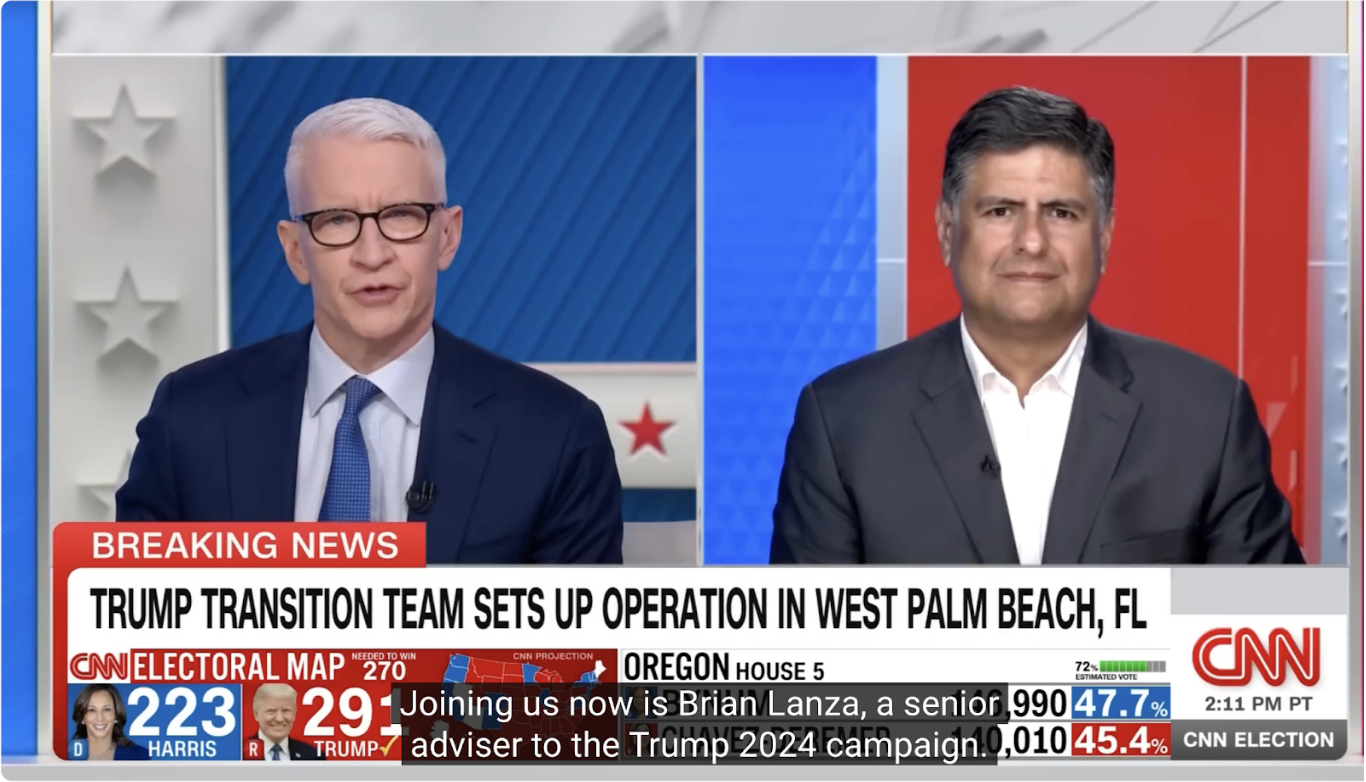
More Bayer ties to the White House
Another key White House aide with ties to Bayer’s legal network is Ryan Baasch, Trump’s deputy assistant to the President for economic policy. In this role, Baasch helps convert Trump’s economic agenda into coordinated federal policy. From 2016-2021, Baasch was an associate at Latham & Watkins, a law firm that represented Bayer on Roundup settlement issues and represented Monsanto in a case involving dicamba. The firm also represented Monsanto and CropLife America in a glyphosate warning case.
Another aide close to Trump in 2025, Trent Morse, was a senior associate at Ballard Partners from 2020 to 2022, then moved to Mercury Public Affairs as a senior vice president. As deputy assistant to the President and deputy director of presidential personnel for eight months, Morse was part of the team responsible for recruiting, vetting and recommending candidates for political appointments throughout the executive branch. He left the White House in August for a lobbying job.
USDA officials’ ties to Bayer
The U.S. Department of Agriculture oversees farm policy, crop systems, and biotechnology approvals, shaping the subsidies, research, and planting decisions that drive demand for Bayer’s seeds and chemicals. The agency has long faced criticism over its servility to the chemical industry, and the Trump administration is no exception. Current USDA officials with ties to Bayer and its chemical industry allies include:
- Stephen Vaden, deputy secretary of agriculture, is a former associate at Jones Day(2014–2017), a firm that represented Bayer on its acquisition of Monsanto, and Squire Patton Boggs (2011-2014), which represented Bayer and Monsanto in cases involving glyphosate and PCBs.
- Richard Fordyce,undersecretary for farm production and conservation, is the former agriculture business growth director for the public relations and marketing firm Osborn Barr Paramore (2021-2025), which was Bayer’s PR agency for years. A former director of the United Soybean Board, Fordyce was administrator of the Farm Service Agency in Trump’s first term.
- Scott Hutchins,undersecretary for research, education, economics & chief scientist, spent over 30 years at Dow AgroSciences (now Corteva), most recently as global R&D director. He served in this same USDA role in the first Trump administration.
- Pat Swanson,administrator of the Risk Management Agency, was a director for the lobby groups American Soybean Association and the Iowa Soybean Association, where she advocated for Bayer’s pesticides.
- Bill Beam,administrator of the Farm Service Agency, served for nine years on the United Soybean Board, which collaborates with Bayer on research initiatives. Beam previously served as the deputy administrator for farm programs at the FSA (2018–2021).
- Peter Laudeman, senior policy advisor for trade and foreign agricultural affairs, is a former political affairs manager of Corteva Agriscience (formerly DowDuPont) from 2020-2022, and legislative assistant for the National Corn Growers Association from 2018-2020.
Bayer’s pursuit of federal preemption
Bayer’s case before the Supreme Court has high stakes for public health protections and the legal right of individuals to hold companies accountable in court.
Federal preemption – the idea that federal law can override state law in some circumstances – has long been a priority for chemical and food companies that want a single, often weaker, national standard for regulation and liability, while consumer and health groups argue that states must retain the right to set higher health and safety standards.
The issue is central to Bayer’s case before the Supreme Court: the company argues that because the EPA approved glyphosate, cancer claims tied to Roundup should be barred under state failure-to-warn laws. The federal government’s position on whether pesticide approvals preempt state laws has shifted across administrations, underscoring how much the outcome depends on who holds power, and who influences it.
In May 2025, two appellate attorneys with deep experience at the U.S. Department of Justice, Jennifer Scheller Neumann and Amelia Yowell, joined Holland & Hart LLP,a firm that provides legal and lobbying services. A month earlier, the firm had registered to lobby for Bayer.
Neumann spent 20 years at the DOJ’s Environment and Natural Resources Division, most recently as chief of the appellate section overseeing all appellate litigation involving federal environmental laws. She was a signatory on the DOJ’s 2019 amicus brief in the Ninth Circuit Court of Appeals supporting Monsanto (now Bayer). The brief argues that EPA’s approval of glyphosate preempts state failure-to-warm laws.
The Biden administration reversed that position in 2022, urging the Supreme Court to reject Bayer’s case on the premise that federal pesticide law should not preempt state failure-to-warn laws.The Trump Justice Department reversed it again in 2025 – arguing the Biden-era position was wrong and that juries shouldn’t second-guess EPA science.
Oral arguments before the Supreme Court are scheduled for April 27. A win for Bayer could turn EPA pesticide approvals into a nationwide liability shield, elevating the agency’s slow and often industry-dominated chemical assessment process into a final word on pesticide safety, at a time when peer-reviewed research continues to emerge linking pesticide exposure to cancer, neurological harm, and other chronic illnesses.
As Nathan Donley of the Center for Biological Diversity warned, such a precedent would mean that “the only thing that matters legally in determining a pesticide’s safety is what EPA claims to be true, even if those claims completely ignore the best available science.”
Slashing capacity at EPA
Bayer allies also pervade the U.S. agency charged with protecting health and the environment – in positions where they influence what chemicals and pesticides are approved and how these products are regulated. Chemical industry lobbyists now occupy the top four jobs at the EPA’s Office of Chemical Safety and Pollution Prevention (OCSPP), the division in charge of regulating chemicals and pesticides. EPA officials loosened ethics standards to allow it.
Douglas Troutman, assistant administrator at OCSPP, is the former co-CEO and chief lobbyist for the American Cleaning Institute (ACI), which represents major chemical manufacturers. Troutman worked at the lobby group for 17 years before joining the Trump administration.
Nancy Beck, principal deputy assistant administrator at OCSPP, was a senior director at the American Chemistry Council – a lobby group representing Bayer, Dow Chemical, DuPont and other chemical manufacturers – from 2012 to 2017. In Trump’s first EPA, she held advisory roles within the White House at NEC and OMB. Between Trump administrations she worked at Hunton Andrews Kurth, a law firm that offers, among other services, glyphosate litigation defense to companies facing lawsuits from cancer claims.
Lynn Ann Dekleva OCSPP’s deputy assistant administrator for new chemicals, also held this role during the first Trump administration. In between, she was a senior director at the lobby group American Chemistry Council.She is a 30-year veteran of DuPont chemical company, where she workedas a program manager and engineer.
Kyle Kunkler, OCSPP deputy assistant administrator for pesticides, is a former pesticide industry lobbyist. He was director of government affairs, with a focus on biotech and pesticides, for the American Soybean Association from 2020-2025, and prior to that spent three years managing government affairs on food and agriculture for the Biotechnology Innovation Organization lobby group. CropLife America, the main lobby group for the pesticide industry, gave him a “Rising Star” award in 2020.
 *Bayer was a gold sponsor at CropLife America 2021 where Beck was a featured speaker alongside her colleague Matt Leopold, who was EPA’s top lawyer during the first Trump administration. Hunter Andrews Kurth is a leading firm for pesticide litigation.
---
More EPA officials with ties to Bayer include:
Steven Cook, deputy assistant administrator for the Office of Land and Emergency Management, oversees Superfund sites. Bayer is associated with several Superfund sites due to its pesticide and chemical manufacturing. Cook spent over 20 years as the in-house corporate counsel for LyondellBasell, one of the world’s largest plastics and chemical companies. LyondellBasell has a 50/50 joint venture with Bayer (a propylene oxide and styrene monomer plant). LyondellBasell CEO Peter Vanacker is board chair of the American Chemistry Council.
Aaron Szabo,assistant administrator for air and radiation (appointed in July 2025) was a partner and lobbyist at CGCN Group (2018–2023), which has been registered to lobby for the American Chemistry Council during the past decade. From 2023 to 2024, he was a senior director and attorney at Faegre Drinker Biddle & Reath, where he represented chemical interests, including the ACC, before returning to the EPA in January 2025.
Alex Dominguez,deputy assistant administrator for mobile sources, was a registered lobbyist with Massie Partners, where he represented the National Corn Growers Association, a group whose members are consumers of Bayer’s seeds and pesticides. He worked in that role from 2023 to January 2025.
More Trump officials tied to Bayer
As assistant secretary of legislation at the U.S. Department of Health and Human Services, Gary Andresis a primary liaison between HHS and Congress. He was previously the senior executive vice president of public affairs at the Biotechnology Innovation Organization, the main trade group for biotech companies including Bayer. At BIO, Andres directed the lobbying strategy for the entire biotech sector, which included defending the regulatory framework for GMOs and associated agrichemicals. He previously worked at lobbying firm Dutko Worldwide which has represented Bayer.
Secretary of Transportation Sean Duffy also has ties to a Bayer lobby firm; he was senior counsel and advisory board member of BGR Group from 2019 to 2023 and was a registered lobbyist for the firm in 2020, though there is no record of him lobbying for Bayer.
13 lobby firms working for Bayer in Washington
Bayer’s direct lobbying spending is significant, but its political influence expands considerably when viewed alongside allied trade and commodity groups that together form a well-financed and coordinated lobbying network. In 2025, Bayer retained at least 13 lobby firms and at least 49 registered lobbyists registered to lobby for the company (including Bayer’s six in-house lobbyists) as of the fourth quarter, federal disclosures show.
Bayer spent at least $9.19 million on federal lobbying last year. While it is not among the highest-spending single corporations lobbying in D.C., the agribusiness sector ranked ninth with $219.9 million in lobbying expenditures in 2025 – the highest year on record for the sector. We include the sector total because Bayer’s influence is amplified by an integrated industrial agribusiness system that acts in concert – from pesticide-dependent commodity crops to factory farms and ultra-processed food production – to shape policy in its favor.
Within the sector, groups directly lobbying for favorable pesticide policies include trade groups representing pesticide manufacturers – the American Chemistry CouncilandCropLife America – and commodity groups such as the National Corn Growers Association and American Soybean Association that rely on Bayer’s products.
These four groups spent a combined $22 million on federal lobbying in 2025, with 12 more outside lobby firms and 79 more registered lobbyists in the fourth quarter.
Bayer’s lobbying activity last year was its highest in recent years, but lower than the company’s peak in 2016, 2017 and 2018, just before the Bayer/Monsanto merger and following the 2015 WHO cancer agency finding that glyphosate is a probable human carcinogen.
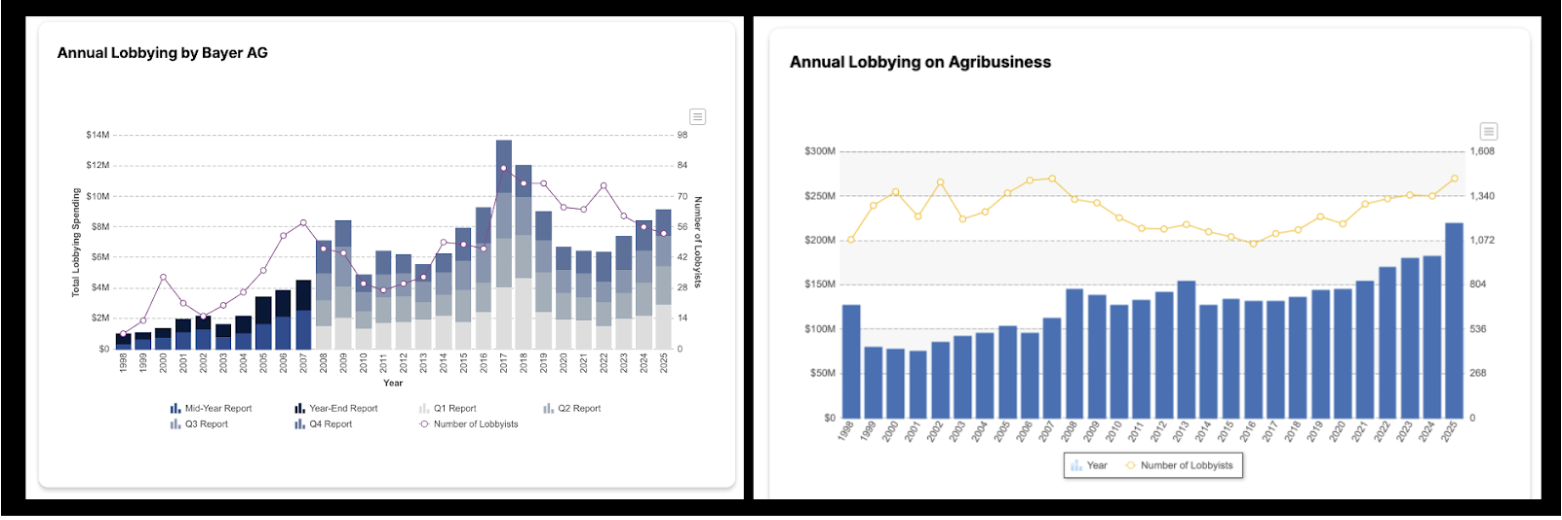 *Source: OpenSecrets
These numbers don’t reflect the whole picture of Bayer’s lobbying activities. The Lobbying Disclosure Act requires registration only after certain spending and activity thresholds are met, so public filings do not capture all of the paid influence work taking place in Washington.
They don’t reflect state-level activity, either. Pesticide related PAC spending surged in late 2024 as companies sought to limit damage awards in courts across the nation. In Iowa alone, Bayer spent a record amount last year trying to pass a state immunity bill critics called the Cancer Gag Act.
Read more about Bayer’s lobby force in our Bayer Lobby Tracker.
More lobbyists tied to Trump
Political scientists have long documented how lobbying shapes public policy by securing access to decision-makers, and helping corporations turn their priorities into laws and regulations. These dynamics help explain how companies like Bayer can translate access in Washington into concrete policy wins.
More than 30 people in leadership positions at lobby firms retained by Bayer have direct ties to Trump’s current or former administrations or presidential campaigns, our analysis shows. Many of these lobbyists are not personally registered to lobby for Bayer, but may be assisting in ways that do not trigger lobby registration, for example, advising the firm’s Bayer lobbyists.
As noted earlier, Ballard Partners – the firm that employed both Susie Wiles and Pam Bondi, and is run by one of Trump’s biggest political fundraisers – is a fundamental connection for Bayer o Trump’s orbit. In addition to Brian Ballard and Daniel McFaul, the two lobbyists at the firm who are registered to lobby for both Bayer and the American Chemistry Council, other partners at Ballard have connections to Trump:
Hunter Morgen, a D.C.-based partner in the firm, served over three years in senior positions during the first Trump administration – as special assistant to the President and senior advisor for policy and strategy in the White House working on trade and immigration issues with Peter Navarro and Stephen Miller. Prior to his White House role, Morgen was policy advisor for the State Department in the Office of Policy and Planning. He previously worked on Trump’s 2016 presidential campaign and transition team. In 2020, Trump appointed Morgen to the Presidential Council on Improving Federal Civil Architecture. Morgen – along with Brian Ballard, Daniel McFaul, Syl Lukas (a senior partner at Ballard) and Susie Wiles – were included among a list of donors invited to an October 2025 gala for Trump’s new $250 million East Wing ballroom.

Mike Rubino, another D.C. partner at Ballard, was among the first hires on Trump’s 2016 presidential campaign where he was a senior advisor directing operations in ten states and winning nine of them, according to his bio. He joined the first Trump administration as a senior official at HHS before leaving for the private sector where he worked alongside Corey Lewandowski, who is currently a key figure at the Department of Homeland Security.
Ballard D.C. Partner William Russell was the aide responsible for Trump’s daily travel and logistics for nearly four years of the first administration. Russell also worked on Trump’s 2016 and 2024 campaigns.
Brian Hughes, a partner at Mercury Public Affairs– the other lobby firm that previously employed Susie Wiles – was NASA chief of staff from May to December 2025. He joined Mercury in January 2026. Brian Hughes was Trump’s Florida campaign manager in 2024 and communications director for Trump’s transition team. Danielle Alvarez, another partner at Mercury, held communications and advisory roles in Trump’s 2020 and 2024 campaigns.
Other Bayer lobby firm ties to Trump’s White House include:
Amy Swonger, a principal at Invariant– a firm registered to lobby for Bayer – worked in the Executive Office of the President for most of Trump’s first term, as assistant to the president and as director and deputy director of legislative affairs.
Jordan Bonfitto,a director at Invariant, was a policy advisor at the National Economic Council in Trump’s first White House, focused on the agricultural and biotech portfolios. From February to October 2025, Bonfitto was the chief of staff for marketing and regulatory programs at the USDA under Secretary Brooke Rollins. He joined Invariant in November.
Other notable Bayer lobby firm ties to Trump:
Holland & Hart, a lobby firm Bayer retained in April 2025, employs former EPA Administrator Andrew Wheeler, who held the top job at EPA for part of Trump’s first term. Wheeler is a partner at the firm and head of federal affairs. Troy Lyons, a registered lobbyist for Bayer and senior director of federal affairs at Holland & Hart, held senior roles in Trump’s first EPA working under both Wheeler and Trump’s first EPA Administrator Scott Pruitt.
At BGR Government Affairs, several senior lobbyists have ties to Trump. Managing Director David Urban was a senior advisor on Trump’s 2016, 2020, and 2024 campaigns; Practice Head and Principal William Crozer left the firm during Trump’s first term to serve as special assistant to the president and deputy director of the White House Office of Intergovernmental Affairs; and PrincipalJoseph Lai was aspecial assistant to the President for legislative affairs (2017-2019), where he led the outreach and vote-counting efforts to confirm Justices Gorsuch and Kavanaugh, as well as other major appointees.
Akin Gump Strauss Hauer & Feld, longtime lobbyists for Bayer and Monsanto, also has notable advisors and partners with ties to Trump. Geoff Verhoff, senior advisor at the firm, served on the Trump-Pence victory finance leadership committee 2017-2021 and was the vice chair of the RNC Finance Committee in those years. Partner Kelly Ann Shaw, was deputy assistant to the President for international economic affairs and the U.S. lead negotiator (Sherpa) for the G7, G20, and APEC in 2018 and 2019. Senior Advisor Anna Abramdeputy commissioner for policy, legislation and international affairs at the FDA from 2017 to 2021.
For more ties between Bayer’s lobby firms, the Trump administration and other routes of influence see our lobby tracker:
This analysis of Bayer-Trump connections reflects only what is visible in public records. Additional financial, political, or personal ties – including undisclosed funding streams, if they exist – may remain hidden. This story is a work in progress. We will update it. You can help by sending us what you may know about ties between Bayer and the Trump administration, including the federal agencies. Contact Stacy Malkan via Signal or email stacy@usrtk.org.
Updates made February 26:
- Added another USDA official (Peter Laudeman) with ties to Bayer.
- Added total number of lobbyists and lobby firms retained by four trade and commodity groups that work closely with Bayer: American Chemistry Council, CropLife America, National Corn Growers Association and American Soybean Association.
Categories: Monsanto/Bayer, Pesticides Tags: Primary Article
===
MAJ REPT 2 26?
rfk glypho
1:01
or suppressed in many instances uh
1:03
studies about um Roundup. You know, one
1:07
of the biggest problems with Roundup in
1:09
my um perspective was
1:12
you're creating a monoulture
1:15
um
1:17
because of the way that the seeds if
1:21
they intermingle with anything else. I
1:22
mean, the way Roundup works is uh
1:25
Monsanto creates seeds for crops that
1:28
are resistant to Roundup so that you can
1:31
pour as much Roundup as you want on it.
1:33
Now, of course, one of the other
1:35
problems with when you feel like I can
1:38
go to town on this uh this uh pest this
1:41
uh herbicide is that it ends up rolling
1:43
into like washing into water areas and
1:48
uh it's a problem. But um here is Robert
1:52
Kennedy back in 2017.
1:56
His neck was significantly smaller than
1:58
it is now.
1:59
He looks he looks like pretty human. Uh
2:02
uh this is before his TRT
2:06
um and uh talking about his lawsuit
2:10
against Monsanto. We bring this up only
2017 VANDANNA SHIVA?!
3:46
And if you read all of these documents
3:48
that we've gotten from Monsanto and see
3:52
all the sneaky stuff that they do, one
3:55
of the most fearful things for them is
3:58
that somebody is going to do testing on
4:01
Roundup because even in their most
4:04
private emails to each other, they're
4:06
talking about
4:08
nobody's ever tested this and we know
4:10
that the formulation is much much more
4:13
toxic than the glyphosate.
4:16
Because the formulation has all these
4:18
surfactants in it and adgivants in it
4:20
that are intended to allow the
4:22
glyphosate
4:24
to slip through the bark of the plant
4:27
and through the coating of the plant.
4:29
And they allow also those same chemicals
4:33
also enable that molecule to to
4:36
penetrate the bloodb brain barrier and
4:38
get into the human system. And they're
4:40
toxic themselves.
4:42
And the synergistic toxicity is
4:44
something they've been able to keep the
4:46
regulatory agencies from ever looking at
4:49
that. The only thing they ever test is
4:51
pure glyphosate.
4:54
Nobody ever gets to test Roundup. And of
4:57
course, Roundup has many different
5:00
formulations, but they're all much more
5:03
toxic than glyphosate.
---
xo
NOTE BS RATIOnale MAHA
MMA
Rogan complains about glyphosate, then gives the administration a pass by ignoring Trump's recent executive order boosting the herbicide ingredient
Rogan attacked critics of Health Secretary Robert F. Kennedy Jr., who has voiced his support for the order
Special ProgramsClimate & Energy
Written by Ilana Berger
Published 02/25/26
Joe Rogan and a podcast guest recently praised Health and Human Services Secretary Robert F Kennedy Jr. just after complaining about the harms of glyphosate, the controversial herbicide that was recently bolstered in an executive order that Kennedy supported to the ire of the Make America Healthy Again community.
During the February 20 episode of his podcast, Rogan and his guest Matt McCusker, comedian and podcast host, suggested that glyphosate, the active ingredient in the herbicide Roundup, is responsible for rising rates of gluten intolerance. The two then touted some of Kennedy’s actions as health secretary so far.
Video
Citation
From the February 20, 2026, edition of The Joe Rogan Experience
They did not mention Kennedy’s support for a recent executive order that would protect domestic production of glyphosate and give it some immunity under the Defense Production Act that could shield its parent company from being sued for certain damages. George Kimbrell, legal director at the Center for Food Safety, told The New Lede that the order “is a transparent attempt to influence the Supreme Court to grant glyphosate-maker Monsanto/Bayer and other pesticide behemoths immunity from liability for the harms caused by their products.” McCusker mentioned that he could not have wheat due to an allergy, and Rogan replied, “A lot of people don't think it's actually the gluten. They think it's actually how they finish the crops with glyphosate, which kind of makes sense because, like, why are all these gluten intolerant — nobody heard about those in the ‘70s. There was no one gluten intolerant.”
Evidence directly linking glyphosate to gluten intolerance, which causes a sensitivity to a protein that’s found in some types of grains, or celiac disease, which causes an autoimmune response to gluten, is limited and hotly disputed by the scientific community. But the World Health Organization's International Agency for Research on Cancer has labeled the ingredient as a Group 2a carcinogen. A long-term, peer-reviewed study with contributions from research institutions in the U.S. and Europe reinforced the IARC’s findings in 2025.
Eliminating the agriculture industry’s dependence on glyphosate has been a goal of environmental organizations, as well as several groups and influencers who with the MAHA movement, which is closely associated with Kennedy. Kennedy himself is a long-time critic of glyphosate, and his promise to “ban that practice” during his presidential campaign helped build a voter base that would later throw their support behind the Trump administration.
But Kennedy is now facing backlash for reversing course and supporting a White House executive order that calls glyphosate a “cornerstone of this Nation’s agricultural productivity and rural economy.” Using the National Defense Production Act, Trump is allowing Roundup maker Bayer to prioritize production of the herbicide “over performance of any other contracts or orders” because it is “central to American economic and national security.”
Kennedy said that the order “puts America first where it matters most – our defense readiness and our food supply.” He also wrote on social media: “I support President Trump’s Executive Order to bring agricultural chemical production back to the United States and end our near-total reliance on adversarial nations.”
Rogan and McCusker didn’t mention this important development that has sparked MAHA outrage, even though Rogan has praised the movement and platformed its leaders. Instead, they attacked Kennedy’s critics, saying that “they’d rather commit suicide, they’d rather poison themselves, than admit that he’s right” about some of his other initiatives like changing the food pyramid and attempting to ban Red Dye 40.
Many allege they have already been poisoned by the herbicide Kennedy is now defending. Monsanto, which was acquired by Bayer in 2018, has faced hundreds of thousands of lawsuits from people who say that long-term exposure to glyphosate “caused them to develop non‑Hodgkin lymphoma (NHL) and other serious illnesses,” according to the law firm Wisner and Baum, which represented cancer patients in some of these lawsuits.
The recent executive order is consistent with the Trump administration’s efforts to ease regulations on chemicals and maintain the support of the industry, which has significant influence in the Environmental Protection Agency’s Office of Chemical Safety and Pollution Prevention. In December, MAHA influencers spearheaded a petition calling for Trump to oust EPA Secretary Lee Zeldin after the agency approved pesticides that contain several different pesticides that are classified by many as PFAS, or cancer-linked “forever chemicals.”
---
ref 1 xo
PROMOTING THE NATIONAL DEFENSE BY ENSURING AN ADEQUATE SUPPLY OF ELEMENTAL PHOSPHORUS AND GLYPHOSATE-BASED HERBICIDES
Executive Orders
February 18, 2026
By the authority vested in me as President by the Constitution and the laws of the United States of America, including the Defense Production Act of 1950, as amended (50 U.S.C. 4501 et seq.) (the “Act”), and section 301 of title 3, United States Code, it is hereby ordered:
_Section_ 1. _Policy and Findings_. Elemental phosphorus is pervasive in defense supply chains and is therefore crucial to military readiness and national defense. It is a key input in smoke, illumination, and incendiary devices and is a critical component for manufacturing the semiconductors that are central to numerous defense technologies, such as radar, solar cells, sensors, and optoelectronics. It is also increasingly important in modern lithium-ion battery chemistries used in a multitude of weapon-system supply chains. For these and other reasons, on November 7, 2025, the Department of the Interior, acting pursuant to the Energy Act of 2020, designated phosphate as a critical mineral.
Elemental phosphorus is also a critical precursor element for the production of glyphosate-based herbicides, which play a critical role in maintaining America’s agricultural advantage by enabling farmers to efficiently and cost-effectively produce food and livestock feed. As the most widely used crop protection tools in United States agriculture, glyphosate-based herbicides are a cornerstone of this Nation’s agricultural productivity and rural economy, allowing United States farmers and ranchers to maintain high yields and low production costs while ensuring that healthy, affordable food options remain within reach for all American families.
There is no direct one-for-one chemical alternative to glyphosate-based herbicides. Lack of access to glyphosate-based herbicides would critically jeopardize agricultural productivity, adding pressure to the domestic food system, and may result in a transition of cropland to other uses due to low productivity. Given the profit margins growers currently face, any major restrictions in access to glyphosate-based herbicides would result in economic losses for growers and make it untenable for them to meet growing food and feed demands.
:{:{Ensuring an adequate supply of elemental phosphorus and glyphosate-based herbicides is thus crucial to the national security and defense, including food-supply security, which is essential to protecting the health and safety of Americans. Nonetheless, the United States’ ability to domestically produce those critical inputs is extremely limited. Indeed, there is only a single domestic producer of elemental phosphorus and glyphosate-based herbicides, and this producer does not meet our annual needs for those inputs. }:
For that reason, more than 6,000,000 kilograms of elemental phosphorus are imported from other countries annually. Future reduction or the cessation of domestic production of elemental phosphorus and glyphosate-based herbicides would gravely threaten American national security by disrupting, and requiring the further offshoring of, this Nation’s defense supply chain including by having a debilitating impact on domestic agricultural capabilities.}:
I accordingly find that, consistent with the Department of the Interior’s designation, elemental phosphorus is a scarce material that is critical to national defense and security. Our Nation’s inadequate elemental phosphorus production, which must sustain both defense manufacturing and our significant agricultural needs, and the threat of increased domestic scarcity leave us vulnerable to hostile foreign actors and pose an imminent threat to military readiness.
Consistent with these findings, I find that ensuring robust domestic elemental phosphorus mining and United States-based production of glyphosate-based herbicides is central to American economic and national security. Without immediate Federal action, the United States remains inadequately equipped and vulnerable. Accordingly, I hereby find, pursuant to section 101 of the Act, that domestic elemental phosphorus and glyphosate-based herbicides meet the criteria specified in section 101(b) of the Act (50 U.S.C. 4511(b)).
:{_Sec_. _2_. _Ensuring an Adequate Supply of Elemental Phosphorus and Glyphosate-Based Herbicides_. (a)
Notwithstanding Executive Order 13603 of March 16, 2012 (National Defense Resources Preparedness), the authority of the President conferred by section 101 of the Act to require performance of contracts or orders (other than contracts of employment) to promote the national defense over performance of any other contracts or orders, to allocate materials, services, and facilities as deemed necessary or appropriate to promote the national defense, and to implement the Act in subchapter III of chapter 55 of title 50, United States Code (50 U.S.C. 4554, 4555, 4556, 4559, 4560), is delegated to the Secretary of Agriculture (Secretary) with respect to ensuring a continued and adequate supply of elemental phosphorus and glyphosate-based herbicides.}:
(b) The Secretary shall use the authority under section 101 of the Act (50 U.S.C. 4511), in consultation with the Secretary of War, to determine the proper nationwide priorities and allocation of all the materials, services, and facilities necessary to ensure a continued and adequate supply of elemental phosphorus and glyphosate-based herbicides.
(c) The Secretary shall issue such orders and adopt and revise appropriate rules and regulations as may be necessary to implement this order.
(d) In exercising the authority delegated in this section, the Secretary shall take into account the President’s judgment that domestic production of elemental phosphorus and glyphosate-based herbicides is critical to the national defense. Accordingly, the Secretary shall ensure that any order, rule, or regulation issued under this section does not place the corporate viability of any domestic producer of elemental phosphorus or glyphosate-based herbicides at risk.
_Sec_. _3_. _Immunity_. This order confers all immunity provided for in section 707 of the Act (50 U.S.C. 4557). Additionally, domestic producers of elemental phosphorus and glyphosate-based herbicides are required to comply with this order, in accordance with the provisions of 7 C.F.R. part 789.
_Sec_. _4_. _General Provisions_. (a) Nothing in this order shall be construed to impair or otherwise affect:
(i) the authority granted by law to an executive department or agency, or the head thereof; or
(ii) the functions of the Director of the Office of Management and Budget relating to budgetary, administrative, or legislative proposals.
(b) This order shall be implemented consistent with applicable law and subject to the availability of appropriations.
(c) This order is not intended to, and does not, create any right or benefit, substantive or procedural, enforceable at law or in equity by any party against the United States, its departments, agencies, or entities, its officers, employees, or agents, or any other person.
(d) The costs for publication of this order shall be borne by the Department of Agriculture.
DONALD J. TRUMP
THE WHITE HOUSE,
February 18, 2026.
REF 2 GUK
Trump has signed an executive order protecting production of glyphosate-based herbicides, such as Roundup, which some bodies and studies have linked to cancer and which are the subject of widespread US litigation.
The president’s move, which also seeks to provide “immunity” for makers of the herbicides, was strongly criticized by health and environmental advocates including some figures in the “Make America healthy again” (Maha) coalition.
The order also protects domestic production of phosphorus, which is used in making glyphosate and other agricultural chemicals, as well as a range of other products, including some in military defense.
Ensuring “robust domestic elemental phosphorus mining and United States-based production of glyphosate-based herbicides is central to American economic and national security”, the order states.
[
Bayer agrees to pay $7.25bn to settle Roundup weedkiller cancer lawsuits
Read more](https://www.theguardian.com/business/2026/feb/17/bayer-proposed-settlement-roundup-cancer-lawsuits)
The 18 February order cites authority under the Defense Production Act and instructs US Department of Agriculture secretary Brooke Rollins to issue orders and regulations as “may be necessary to implement this order”.
The White House said “the threat of reduced or ceased production” of phosphorous and glyphosate herbicides “gravely endangers national security and defense, which includes food-supply security”.
Neither the executive order nor the fact sheet the White House put out accompanying the order discloses that glyphosate-based herbicides have been linked to an array of cancers and other health problems in multiple independent research studies and by cancer experts of the World Health Organization (WHO).
The move by the White House comes as Roundup maker Bayer is facing tens of thousands of lawsuits alleging the company’s glyphosate herbicides cause cancer and the company failed to warn farmers and other users of the risks.
The company, which inherited the litigation when it bought Monsanto in 2018, has already paid out billions of dollars in settlements and jury verdicts and said this week it was proposing to pay $7.25bn in a class action settlement to try to head off future lawsuits.
Bayer has said that if it cannot find relief from the litigation, it may stop making glyphosate herbicides for the US agricultural market.
“This executive order reads like it was drafted in a chemical company boardroom,” said Vani Hari, a food activist, author and one of the grass roots leaders of the Maha coalition. “Calling it ‘national defense’ while expanding protections for toxic products is a dangerous misdirection. Real national security is protecting American families, farmers, and children.”
Kelly Ryerson, another key actor in the Maha movement who has been lobbying US regulators and lawmakers for restrictions on glyphosate and other pesticides, said the move by Trump is an insult to those who have largely supported the administration because of promises that Maha issues would be taken seriously.
Robert F Kennedy Jr, who was appointed by Trump as secretary of the US Department of Health and Human Services (HHS) and who heads a Maha commission set up by the White House, has a long history of criticizing glyphosate and its maker over the health harms tied to the herbicide. Both Trump and Kennedy had pledged to address health concerns about glyphosate and other pesticides.
“The President is making a mockery of the very voters who put his administration into office,” Ryerson said. “Expanding the production of glyphosate, a pesticide derided by the Maha movement, is a commitment to perpetuating the toxic, chemical food system that has created a sick and infertile American population.”
In response to questions about the executive order, Kennedy issued a statement saying that the order “puts America first where it matters most – our defense readiness and our food supply”.
Lori Ann Burd, environmental health program director at the Center for Biological Diversity, called the executive order “a sickening love letter from Trump to the largest pesticide companies in the world.
“It’s more proof that Trump doesn’t care at all about Americans’ health,” she said. “While he’s pandering to chemical companies the rest of the country, especially those who’ve been poisoned by pesticides, is rightfully asking ‘what about us?’”
[
Trump’s EPA reapproves contentious weedkiller dicamba for some GM crops
Read more](https://www.theguardian.com/us-news/2026/feb/08/epa-reapproves-contentious-weedkiller-dicamba)
Trump’s order contains a clause that “confers all immunity provided for in section 707 of the Act (50 U.S.C. 4557)” and states that “domestic producers of elemental phosphorus and glyphosate-based herbicides are required to comply with this order.” The act cited states that “no person shall be held liable” for “any act” resulting from compliance with an order issued pursuant to that law.
Bayer did not respond when asked how involved the company was in Trump’s executive order. But the company issued a statement saying: “President Trump’s Executive Order reinforces the critical need for US farmers to have access to essential, domestically produced crop protection tools such as glyphosate. We will comply with this order to produce glyphosate and elemental phosphorus.”
Bayer maintains that its glyphosate herbicides do not cause cancer and has been engaged in an array of tacticsto try to lift the litigation pressure, including pressing Congress for language in the farm billand other legislation that would restrict the ability of people to sue the company for failing to warn of cancer risks if the US Environmental Protection Agency (EPA) doesn’t require such warnings.
The company has already succeeded in getting laws protecting it from lawsuits passed in two states and is pressing for more state laws. It has also asked the US supreme court to rule in its favor on the issue of federal preemption of failure-to-warn lawsuits, and the high court has set a hearing for 27 April.
This story is co-published with the New Lede, a journalism project of the Environmental Working Group}:
---
Outrage mounts as Republicans in Congress move to protect ...}:
Sep 27, 2025 — ... glyphosate-based Roundup herbicide and other weed killers can affect its research and product development and other “important...

The Guardian

- Press conference on bill to create near-immunity shield for all ...
Jan 21, 2026 — by state trying to pull the wool over lawmakaker. eyes today Tennessee is in the crosshairs. that's why we're here at least five s...
IT s been seven years since Germany’s Bayerbought US agrochemical giant Monsanto, inheriting not only the company’s vast portfolio of seeds and pesticide products, but also more than 100,000 lawsuits alleging Monsanto’s popular Roundup herbicide causes cancer. Bayer, which has so far paid out billions of dollars in settlements and jury verdicts to cancer victims, has been working – so far in vain – to put an end to the litigation and to block any future such cases.
Now Bayer appears closer than ever to success, as many Republican congressional leaders push for measures that would effectively block lawsuits against pesticide makers around the country.
A groupfounded by Bayer called the Modern Ag Alliance is the face of the legislative push, advocating for liability shields they say are necessary to allow companies to continue to sell chemicals that farmers use to kill weeds and bugs in their fields.
“Without legislative action, a potential catastrophe is on the horizon that could result in many farmers going out of business and food prices rising even further,”the alliance, which represents more than 100 agricultural organizations, including farmers who grow wheat, corn, soybeans and other key food crops, warns on its website.
[
Weedkiller ingredient widely used in US can damage organs and gut bacteria, research shows
Read more](https://www.theguardian.com/environment/2025/jul/06/weedkiller-diquat-organ-damage-study)
The alliance has been lobbying for thepassage of state laws blocking such lawsuits. They’ve succeeded thus far in two states – Georgia and North Dakota – and continue to lobby for such laws in all 50 states.
But the immediate battleground is in the halls of Congress, where a provision tucked into a congressional appropriations bill is outraging consumer advocates, including those affiliated with the influential Make American Healthy Again (Maha) movement. Similar protective language for pesticide makers is expected to be included in the new farm bill as well.
“The audacity of elected officials voting for legislation to fully strip our legal rights away when injured by chemicals is stunning,” said Kelly Ryerson, a leading Maha advocate who has been lobbying lawmakers and her 84,000 social media followers to oppose pesticide company protections. “Especially in this age of Maha when an unprecedented number of Americans are rallying against toxins in food and the environment.”
‘Important investments’
Bayer has made it clear that changing laws in its favor is a priority. The company states on its website that without “legislative certainty”, lawsuits over its glyphosate-based Roundup herbicide and other weed killers can affect its research and product development and other “important investments”.
The Environmental Protection Agency (EPA) should be the ultimate arbiter of product safety and what warnings should be required on product labels, Bayer says. The company also says if the EPA approves a product label, consumers should not be able to sue companies for failing to warn of perceived risks.
In a statement to the Guardian, Bayer said federal legislation is “needed to ensure that states and courts do not take a position or action regarding product labels at odds with congressional intent, federal law and established scientific research and federal authority”.
Bayer has already removed glyphosate, classified as “probably” carcinogenic to humans by World Health Organization cancer experts, from consumer herbicide products. And the company has threatened to stop selling it to farmers if the litigation is not brought to an end.
The company disputes, however, that the appropriations bill will provide that certainty, saying in its statement that the language doesn’t prevent lawsuits and asserting it does is a “distortion of reality”.
The relevant section of the House version of the appropriations bill – section 453 – does not mention litigation or pesticide company liability. Section 453 simply says that no funds can be used to “issue or adopt any guidance or any policy, take any regulatory action, or approve any labeling or change to such labeling” inconsistent with the conclusion of an EPA human health assessment.
But critics say the language effectively would impede states and local governments from warning about risks of pesticides even in the face of new scientific findings about health harms if such warnings are not consistent with outdated EPA assessments. The EPA itself would not be able to update warnings without finalizing a new assessment, the critics say.
Due to the limits on warnings, consumers would find it nearly impossible to sue pesticide makers for failing to warn them of health risks if the EPA assessments do not support such warnings.
The language is “by design sneaky and complicated and hard to explain”, said Daniel Hinkle, senior state affairs counsel for the American Association for Justice, who has been lobbying against the action.
“Nobody thinks that a giant chemical company should be able to lie about the risks of using their product and get away with it. It’s just making sure that people understand that is what is at stake,” Hinkle said.
‘Very worried’
Representative Chellie Pingree, a Democrat from Maine who tried but failed to overturn the language in a, said she is “very worried” about the “outrageous” efforts to protect pesticide companies from litigation.
“We’re talking about chemicals here that are already prone to health risks,” Pingree said. “And the chemical industry is trying to keep that information from consumers … and then to have immunity from being responsible if you get cancer from being in the presence of these chemicals.”
The language is not currently included in the short-term government spending package being debated ahead of a looming government shutdown that would occur at the end of the month in the absence of continued spending authorization.
But it is expected to see support in both House and Senate appropriations bill versions once the short-term budget is resolved. The new farm bill is also expected to include language limiting or preventing pesticide injury lawsuits, with strong signals from Glenn Thompson, chair of the House committee on agriculture, favoring such protections.
Previously, Thompson has weighed in on the side of Bayer amid its ongoing efforts to get the supreme court to weigh in on federal “preemption” over pesticide regulation.
The involvement and influence of the Maha movement, made up of voters from both parties, is adding a bipartisan element to what otherwise might be a highly partisan fight.
Max Lugavere, a health journalist, author and podcaster who posted a photo of a Maha-related visit to the White House to his 1.1 million Instagram followers, said pushing lawmakers is important, but “awareness among everyday people is the first domino”.
Citing “growing evidence linking pesticides to health risks”, Lugavere said: “Stripping away legal recourse in these cases wouldn’t just be wrong, it would be [a] tragedy.”
For California lawyer Brent Wisner, who helped lead the early Roundup litigation against Bayer, the efforts by lawmakers to protect the company against future litigation is un-American and potentially unconstitutional.
“I don’t care what party you are in, if you get poisoned by a pesticide manufacturer you want to be able to sue. You need to be able to sue,” he said. “Bayer is paying millions of dollars to get these laws passed because it’s cheaper than it is to pay people they’ve given cancer to.”
*This story is co-published with the New Lede, a journalism project of the Environmental Working Group
---
---
maha?
health and Human Services Secretary Robert F. Kennedy Jr. raised his concerns about widely used herbicides containing glyphosate and atrazine, linking them to chronic disease, in a Thursday report by the Make America Healthy Again (MAHA) Commission.
Why It Matters
The report highlights two commonly used weed killers—glyphosate, the active ingredient in Roundup, and atrazine, another widely used herbicide for weed control.
In 2015, the International Agency for Research on Cancer classified glyphosate as "probably carcinogenic to humans." But the U.S. Environmental Protection Agency (EPA), which has reviewed and reevaluated its status, said in 2020, "glyphosate is unlikely to be a human carcinogen." There are conflicting opinions about the toxicity of pesticides and their potential health risks, as well as their impact on the food system and environment. Herbicides are classified as a type of pesticide.
President Donald Trump signed an executive order in February establishing the Make America Healthy Again Commission, which pledged to produce a report within the president's first few months back in office. The assessment, released Thursday, aims to lay the groundwork for understanding what Kennedy calls the "magnitude of crisis" in American children's declining health and the factors driving it.
As the nation's top health official, Kennedy has repeatedly raised concerns about chemicals in food and the environment and their connection to chronic disease. The report's first section focuses on the rise of ultra-processed foods, while the second addresses the "cumulative load of chemicals in our environment."
What To Know
The 69-page assessment took issue with common herbicides, saying that children are exposed to them through food, water, dust, lawn treatment and household sprays.
"The cumulative effect of multiple chemical exposures and impact on children over time is not fully understood," the report says, adding that data and research on the "complex mixtures of chemicals" children encounter have yet to be fully explored.
Kennedy has long opposed pesticides, having helped win a 2018 lawsuit filed against Monsanto, the original producer of Roundup.
Pesticides are widely used in farming across the U.S. In April, a group of 79 Republicans, including some Senators like Chuck Grassley of Iowa, wrote a letter to Kennedy, saying that "regular testing by DFA and USDA finds that more than 99% of all pesticide residues meet extremely conservative limits established by EPA."
As of 2017, the United States Geological Survey reported, "about 1 billion pounds of conventional pesticides are used each year" throughout the country.
Read more Robert F. Kennedy Jr.
Is the FDA Doing Enough About Food Additives?
The MAHA Commission's assessment received expected blowback from agricultural and farming associations, which largely rely on pesticides for their livelihood.
What People Are Saying
The National Corn Growers Association said in a statement:"The Make America Healthy Again Report is filled with fear-based rather than science-based information about pesticides. We are deeply troubled that claims of this magnitude are being made without any scientific basis or regard for a long history of EPA expert evaluations of these products."
American Soybean Association said in a statement: "The American Soybean Association strongly rebukes the May 22 Make America Healthy Again Commission report for being brazenly unscientific and damaging to consumer confidence in America's safe, reliable food system. Should the administration act on the report—which was drafted entirely behind closed doors—it will harm U.S. farmers, increase food costs for consumers, and worsen health outcomes for all Americans. ASA calls on President Trump, who has long been a friend of farmers, to step in and correct the Commission's deeply misguided report."
Dr. Michelle Perro, pediatrician, author and activist for children's health, told The New Lede: "While I support and applaud the MAHA focus on chronic diseases affecting our children, it is disheartening that it took us decades to get here. The environmental toxic impacts on our children's well-being has been known for decades, but not acted upon until now."
The National Council of Farmer Cooperatives said in a Thursday statement:"We have serious concerns over the assessment's allegations about pesticides. The report includes statements that do not reflect the wealth of evidence developed over decades by federal agencies such as the EPA and USDA on the safety of crop inputs and food production methods. These institutions have consistently reaffirmed the safety and efficacy of the systems that help feed our country and the world."
American Farm Bureau President Zippy Duvall said in a statement:"It is deeply troubling for the White House to endorse a report that sows seeds of doubt and fear about our food system and farming practices, then attempts to celebrate farmers and the critical role they play in producing the safest food supply in the world.
Farmers are identified as 'critical partners,' yet were excluded from development of the report, despite many requests for a seat at the table. The report also expresses a desire to ensure farmers continue to thrive, but undermining confidence in our food system directly contradicts that noble goal. The report spotlights outlier studies and presents unproven theories that feed a false narrative and only then does it acknowledge a mountain of evidence about the safety of our food system." zippy
What Happens Next
The report pledges to support "gold-standard scientific research" as part of its effort to address chronic disease. The assessment marks the first step toward developing the commission's strategy, which is due 180 days after Trump's February executive order establishing the panel.
===
---
no lnx in orfig (monsanto tag]
https://www.washingtontimes.com/news/2022/oct/10/monsantos-triumph-over-junk-science/
LAW_CRIME
MONSANTO
Illustration on resisting junk science by Linas Garsys/The Washington Times
COMMENTARY
By Tiger Joyce - - Monday, October 10, 2022
OPINION:[note no cya caveats]
One of the country’s most vilified companies prevailed in a recent jury trial against sympathetic witnesses in the “judicial hellhole®” that is the 21st Judicial District of Missouri. The story of how the truth won out over an elaborate scheme cooked up by junk scientists and the trial bar is worth exploring.
All 10 jurors in that St. Louis courtroom sided with Monsanto after a month of testimony that opened with plaintiffs brought to tears as they recalled the horror of learning of their diagnosis of non-Hodgkin’s lymphoma, a severe form of cancer. Expert witnesses testified that glyphosate, the active ingredient in Monsanto’s signature Roundup weedkiller, was to blame for triggering the disease.
The trial bar successfully monetized the same argument in June 2020, to the tune of over $10 billion in settlements and verdicts. Yet more trials are underway, featuring a long list of victims of non-Hodgkin’s lymphoma who were attracted by a $60 million advertising campaign holding out the hope of “substantial compensation.”
But the St. Louis case fell apart under cross-examination as their expert witnesses proved less than credible.
One of those expert witnesses, William Sawyer, advertised on his LinkedIn resume that he was a “board-certified toxicologist.” But when confronted on the stand, was forced to admit he was unable to obtain certification from the American Board of Toxicology after twice failing the required exam. Mr. Sawyer then turned to Robert O’Block, founder of the American College of Forensic Examiners, who supplied an appropriate diploma. However, Mr. O’Block was so willing to certify any paying customers thatsome reports say he once certified a cat.
Mr. Sawyer’s “career” as a full-time expert witness in glyphosate product liability trials has made him a millionaire. Billing $785 an hour, he’s collected $2.5 million from his testimony in four Roundup trials.
But at least Mr. Sawyer had academic training in toxicology. By contrast, fellow expert witness Charles Benbrook testified about glyphosate’s health effects despite having no training in medicine, chemistry or epidemiology. Mr. Benbrook, an economist, took a physics course in college — that’s the sum of his formal education in the sciences.
Mr. Benbrook runs the Heartland Health Research Alliance (HHRA), which produces studies linking cancer to herbicides such as Roundup, as well as competing herbicides like dicamba and 2,4-D. His studies are likely laying the groundwork for a future lawsuit against those products.
The trial bar values Mr. Benbrook’s endeavors, rewarding him $1.3 million for his testimony in addition to his $220,000 salary. The trial bar not only provides funding to Mr. Benbrook’s nonprofit, scientific research organization, but it also provides management direction. HHRA’s vice chair, Robin Greenwald, is a partner at Weitz & Luxenberg — one of the many firms suing Monsanto.
Trial lawyers funding and managing the organization producing “scientific” studies cited as evidence in a trial is a clear conflict of interest. But conflicts of interest aren’t new to Mr. Benbrook. A few years ago, he was caught coordinating his academic work with outside interests, forcing the New England Journal of Medicine to update a paper it published to reveal Mr. Benbrook’s previously undisclosed funding from litigators and the organic food industry. In April, Cornell University microbiologist Kathleen Hefferon pointed out that another scientific journal article co-authored by Mr. Benbrook violated clear ethical standards for peer review.
There’s a reason the trial bar turned to individuals with dubious credentials and a loose appreciation of ethical norms — the truth simply isn’t on their side.
Environmental safety agencies in the U.S., Canada, Brazil, Australia, New Zealand, Japan and the European Union have spent decades reviewing the health impacts of glyphosate. All agree that no credible evidence exists linking glyphosate to non-Hodgkin’s lymphoma.
But one outlier organization says otherwise. An advisory group of the International Agency for Research on Cancer (IARC) deemed glyphosate a “probable human carcinogen.” In 2017, a senior scientist on that IARC panel testified critical evidence favorable to glyphosate had been withheld and would likely have changed IARC’s conclusion. The panel, however, was run by Christopher Portier, a scientist who received $160,000 from litigators and worked under the direct supervision of Ms. Greenwald.
It seems that most evidence against Monsanto was produced by individuals under the direct financial sway of litigators.
It’s a tribute to the resilience of our judicial system that a set of brave jurors stood for the truth in this instance, but it’s also a warning. Judges and state legislatures across the country must implement reforms to align expert evidence standards with those set forth by the Federal Rules of Evidence and the Supreme Court. This will ensure jurors hear only evidence reflecting the true consensus of the scientific community and not unproven conclusions of paid litigation “experts.” Ultimately, the onus falls on individual judges to prevent lawsuit abuse and junk science in their courtrooms.
Tiger Joyce is president of the American Tort Reform Association. note no coi disclosures]
---
---
6 22 kpfa SCOTUS upheld (ca?) on roundup?!
---
---
Alex Berezow is the Vice President of Scientific Affairs of the American Council on Science and Health.[1]^
EXTERNAL LINKS
Desmog Blog, page on American Council on Science and Health[2]^
BMJ article on American Council on Science and Health[3]^
US Right to Know, page on American Council on Science and Health[4]^
SOURCES
- ↑ American Council on Science and Health, [1], organizational website, accessed March 2019.
- ↑ Desmog Blog, American Council on Science and Health, Accessed March 2019 https://www.desmogblog.com/american-council-science-and-health
- ↑ BMJ, Lobby Watch: American Council on Science and Health Accessed March 2019
- ↑ The American Council on Science and Health is a Corporate Front Group, Accessed March 2019 https://usrtk.org/hall-of-shame/why-you-cant-trust-the-american-council-on-science-and-health/
---
alex sci suppress
https://news.mongabay.com/2019/11/science-prevails-as-suspension-of-award-for-herbicide-research-is-reversed/
---
https://www.prwatch.org/news/2019/01/13440/corporate-front-group-american-council-science-and-health-smears-list-its-enemies
he industry front group American Council on Science and Health (ACSH) has created a clunky new website containing an intriguing list of its enemies.
You may find a few folks you know vilified there.
DeniersForHire.com was created in 2016, according to a proxy-cloaked WHOIS listing. The site was funded by ACSH and edited by Cameron English, who currently works for the Genetic Literacy Project (GLP). GLP is another industry front group, run by chemical company PR agent Jon Entine, who has long partnered with ACSH to defend the agrochemical industry. Entine blogs frequently on the ACSH site.
The "deniers" site hyperbolically states as its goal "to expose and neutralize anti-science activist threats to humanity" and features profiles of those who have been thorns in the side of the chemical industry and related groups: scientists, journalists, lawyers, policy experts, and non-profits. Among the "threats to humanity" is New York Times Pulitzer Prize-winning reporter Eric Lipton.
On the site, ACSH adopts language used by pro-science, consumer, and environmental groups to smear pro-science, consumer, and environmental groups. The term "deniers," for instance, invokes the phrase "climate change denier."
The website also calls the Center for Media and Democracy (CMD) a "dark money group"even though the group spends zero money in campaigns and elections. It calls the Organic Consumers Association -- which has long pushed for strict organic standards disavowing GMOs, radiation, and sludge -- an "industry front group."
Smeared by the site are scientists Tyrone Hayes, Stephanie Seneff, and Gilles-Éric Séralini;New York Times reporter Danny Hakim and columnist Mark Bittman; well-known food and science writer Michael Pollan; nutrition and food studies professor Marion Nestle; public interest groups like U.S. Right to Know, Greenpeace, Natural Resources Defense Council (NRDC), Sierra Club, the Environmental Working Group, and Union of Concerned Scientists; past and present CMD staff, and many other individuals ACSH does not like.
Greenpeace Research Specialist Connor Gibson says of the site: "Imitation is the most sincere form of flattery. I'll take it as a compliment to those of us who expose industry hacks posing as independent experts that industry shills are attempting to mimic good opposition research in an attempt to get the spotlight off of themselves."
"Deniers for Hire" Site Created by Industry Front Group
Where the "Deniers for Hire" site now says, at the bottom of each page, just "copyright 2018 | MH Newsdesk Lite by MH Themes,"it once stated more clearly, "funded by the non-profit pro-science consumer advocacy group American Council on Science and Health," as revealed by archives of the site on the WayBack Machine.
ACSH has long been notorious as an industry front group, funded by the seed and chemical giant Monsanto, among others. Ralph Nader was quoted in a 1991 book on corporate front groups as saying, "A consumer group is an organization which advocates the interests of unrepresented consumers and must either maintain its own intellectual independence or be directly accountable to its membership. In contrast, ACSH is a consumer front organization for its business backers. It has seized the language and style of the existing consumer organizations, but its real purpose, you might say, is to glove the hand that feeds it."
ACSH solicits funding from corporations and has defended a number of dubious products over the years, including DDT, asbestos, and Agent Orange. ACSH has been known to call environmentalists and consumer activists "terrorists."
Gary Ruskin, Co-Director of U.S. Right to Know said the website "seems typical of ACSH's work: attacks on those who question or criticize powerful corporations, brimming with hyperbole and errors of fact." He called it "wholly unsurprising," "standard corporate PR tactics" of an "increasingly desperate" agrochemical industry.
Ties to Jon Entine's GLP
Cameron English, whose biography calls him "the editor at Deniers for Hire, a project of the American Council on Science and Health," later went on to be "Senior Agricultural Genetics and Special Projects Editor" at GLP run by PR flack Jon Entine.
GLP is another industry front group, one which companies like Monsanto use "as platforms of support for industry spokespersons" in order to discredit such targets as the World Health Organization, according to a 2018 U.S. Congressional report.
Entine is a former producer with NBC and ABC News, whose books attacked the idea of socially responsible investing and the precautionary principle (Let Them Eat Precaution). He went on to join the American Enterprise Institute and has been "cultivated" by corporations like Syngenta(maker of pesticides, genetically engineered crop varieties, and more) as a trusted "third party" to accomplish items on their public relations wish lists.
The GLP website is owned by Entine's PR firm, ESG MediaMetrics, according to its WHOIS data. The website for ESG MediaMetrics has been removed, but archived versions of the firm's site show that its clients include Monsanto, the Vinyl Institute, and Merisant, a Monsanto spin-off that manufactured artificial sweeteners.

Both ACSH and GLP are listed as "industry partners" in internal Monsanto documents. And the targets of ACSH's "Deniers for Hire" "are also targets of the GLP," according to GMWatch (another target of the site).
U.S. Right to Know's Ruskin told CMD of being targeted by the site, "We laugh about it... It's just what happens these days when you try to stand up for consumers or public health."
Mary Bottari contributed to this article.
---
https://www.acsh.org/news/2016/09/02/pacific-standard-has-low-science-standards-9978
didn't slate do a deal with lomborg?
6/2016
i have been a long-time reader ofPacific Standard (once called Miller-McCune), a publication that tries to be the West Coast equivalent of The Atlantic.That is a fine mission because, as a Seattleite, I am keenly aware that there aren't many West Coast media outlets that capture the attention of the rest of the nation.
When I was still editor of RealClearScience(RCS), I frequently linked to Pacific Standard's content, particularly articles produced by Tom Jacobs, who was and continues to be a fine social science writer. However, in recent months, the magazine as a whole has become nearly unreadable. As its political cheerleading becomes more and more blatant, its standards for science journalism have fallen. I don't think that is a coincidence.
A few years ago, something similar happened at *Slate. At one time, *Slate was producing so much good science content that RCS would link to them several times per week. But when its science page became an extension of its political coverage (thanks largely to Phil Plait), RCS took them far less seriously. Despite the fact that we had a politically diverse editorial team, RCS was turned off by the one-sided politicization of science.
The latest exhibit on "how not to do science writing" comes once again from Pacific Standard, which covered a new paper from Science Advances on pesticide use among farmers who adopted GMOs. The article begins, "There is at least one potentially good thing about genetically modified crops."
Right off the bat, the author, Nathan Collins, is admitting his anti-GMO bias. If he believes that there is merely "one potentially good thing" about GMOs, then he has chosen to ignore the scientific consensus on GMOs, as well as the entire field of biotechnology -- which has done everything from creating specialized animal models for researchers and insulin for diabetics. But that journalistic tip-of-the-hand is forgivable; what he does next is not.
The gist of Mr. Collins' article is that pesticide use has increased and herbicide (glyphosate) resistance is spreading. The article's summary states, "In theory, Roundup Ready soybeans and the like should have reduced pesticide use. They haven't." But, that's highly misleading. Mr. Collins largely ignores other conclusions made by the researchers and uses the vague word pesticide when he should be making a crucial distinction between herbicides and insecticides.
As a general rule, herbicides and insecticides are much safer than they were in the past. Decreasing their application just for the sake of using fewer pesticides isn't necessarily a worthwhile goal. Still, it is worth differentiating between herbicides and insecticides, as each plays different roles in the ecosystem.
The authors of the paper indeed concluded that farmers who use glyphosate-resistant crops "used increasingly more herbicides relative to nonadopters" and that the spread of glyphosate-resistant weeds appears to be to blame. The upward trend in both glyphosate use and resistance is concerning and must be addressed. But they also clearly wrote in their abstract:
When pesticides are weighted by the environmental impact quotient, however, we find that (relative to nonadopters) GE [genetically engineered] adopters used about the same amount of soybean herbicides, 9.8% less of maize herbicides, and 10.4% less of maize insecticides.
In other words, when one factors in how damaging a particular pesticide is to the environment, GMOs have a pretty good record over the study period (1998-2011). That is because glyphosate is less toxic than many other herbicides and is even less toxic than caffeine. (To his credit, Mr. Collins acknowledges this.) Crucially, GMOs have caused a 10% drop in insecticide use.
However, Mr. Collins' article entirely ignores that. Instead, he focuses almost exclusively on the increasing trend of glyphosate use and resistance. Mr. Collins quotes the authors: "[T]he most striking trend has been an increase in the use of glyphosate." This is certainly true, especially for farmers who use genetically modified soybeans. These farmers have applied more herbicide than those who do not use genetically modified soybeans since 2003. But he left out the very previous sentence: "The rate of use of insecticides applied to maize fell from 0.2 kg/ha in 1998 to about 0.05 kg/ha in 2011, a 75% decrease."
That is a telling omission. It is difficult to come to any other conclusion than that it was purposeful.
In the Discussion, the authors once again clearly state:
Over the period 1998–2011, our results show that GE [genetically engineered] variety adoption reduced both herbicide and insecticide use in maize, while increasing herbicide use in soybeans. However, weighting pesticides by the EIQ lowers the difference in herbicide use by GT soybean adopters (such that the estimated average impact over the study period is statistically indistinguishable from zero). Adoption of Bt maize, on the other hand, is associated with a clearer decline in insecticide use.
And:
We find clear evidence of increasing herbicide use by GT [glyphosate-tolerant] variety adopters over time for both soybeans and maize, a finding that we attribute in part to the emergence of glyphosate weed resistance.
These conclusions add nothing substantive to the literature. While the authors' methods are new (and perhaps more accurate), there are no new takeaways. Both the overuse of glyphosate (and the subsequent resistance in weeds) and the drop in insecticide use have been documented before. Honestly, this isn't an article worthy of press attention... unless a writer is trying to politicize it.
There seems to be a greater lesson here for media outlets: Partisanship and science quality are inversely related.
bad code
Tags:
science journalismGMOPesticidesherbicidesinsecticidesgenetically modified crop
---
---
acsh
AAAS Runs Dishonest Glyphosate Story, Then Deletes It. Is Politics to Blame?
:{:{}:
}:
The American Association for the Advancement of Science is one of the foremost pro-science organizations in the world. Not only does it advocate for good science and science policy, it publishes Science, the prestigious journal read globally by millions. Unfortunately, AAAS has gotten a bit weird in recent months.
Read more
UK Parliament Endorses E-Cigarettes to Help Smokers. Will U.S. Follow?
U.S. public health agencies struggle to endorse an obvious solution to a true public health menace. Hopefully, the UK Parliament will provide a much-needed boost to the forces of common sense.
Read more
Glyphosateand Pesticides: Et Tu, Live Science?
:{:{}:
}:
Normally a reliable source of information, Live Science published an article that is a dream for anti-pesticide and anti-chemical fearmongers.
Read more
==
https://www.alternet.org/2021/03/roundup-cancer/
loki IMI
glyphosate is a broad-spectrum herbicide used to kill weeds and grasses that compete with food crops. First registered for use in the United States in 1974 by agrochemical giant Monsanto under the brand name Roundup, it is one of the most widely used weedkillers in the nation, from large-scale industrial farms to lawns and home gardens. The chemical is extremely effective at killing weeds, especially when used on Monsanto's "Roundup Ready" crops, such as soy, corn, canola, alfalfa and cotton that have been genetically modified to be resistant to glyphosate. More than 90% of corn, soybeans and upland cotton grown in the U.S. have been engineered to be resistant to herbicides like Roundup, according to the U.S. Department of Agriculture.
But a growing volume of scientific research has pointed to the negative impact that glyphosate has on human and environmental health. In 2014, for example, researchers at the International Agency for Research on Cancer (IARC) in Lyon, France, the cancer research arm of the World Health Organization, conducted a meta-analysis of more than 40 studies covering nearly three decades of research on the relationship between non-Hodgkin lymphoma (NHL), a type of cancer, and occupational exposure to agricultural pesticides. They concluded that there is "consistent evidence of positive associations" between glyphosate and an increased risk of NHL. The following year, IARC classified glyphosate as "probably carcinogenic to humans," noting that "Case-control studies of occupational exposure in the USA, Canada, and Sweden reported increased risks for non-Hodgkin lymphoma that persisted after adjustment for other pesticides."
More recently, a meta-analysis published in 2019 conducted by researchers from the University of California at Berkeley, the University of Washington in Seattle and the Icahn School of Medicine at Mount Sinai in New York found that glyphosate exposure raises cancer risk by 41%.The study's senior author Lianne Sheppard, a biostatistician and environmental and occupational health scientist at the University of Washington, told CNN that she was "convinced" of glyphosate's carcinogenic properties.
The sheer amount of glyphosate that has been used across the globe is stunning. In 2014, farmers sprayed enough of the herbicide to cover every acre of cropland in the world with nearly a half-pound of it, according to a 2016 study published in Environmental Sciences Europe. "No herbicide in the history of the world has ever been used this heavily," said the study's author Charles Benbrook, an agricultural economist. "It's a completely unprecedented case."
Since the IARC classification in 2015, several countries have banned or restricted the use of glyphosate. Last year, Austria became the first nation in the European Union (EU) to vote to ban its use completely (though the European Commission (EC) blocked the planned ban). Germany announced that it will be phased out by 2023. Nearly 20 other countries currently have some legislation around glyphosate, including France, the Netherlands, Italy, Belgium, Saudi Arabia, Thailand and Vietnam. The EC has approved its use in the EU until December 2022.
In the United States, individual states and municipalities have also moved to ban or restrict its use. In 2017, California became the first state to issue an official warning about glyphosate by adding the chemical to its Proposition 65 list of cancer-causing chemicals. Dozens of counties, cities and townships across the nation have adopted some sort of restrictions that limit or ban the use of glyphosate. Every single state has a Change.org petition requesting its governors to ban glyphosate. Several environmental, public health and consumer advocacy groups, including Friends of the Earth Action, Food & Water Action, Progress America and Corporate Accountability have sponsored a public petition urging the Environmental Protection Agency to ban the use of glyphosate.
There are also rising concerns about glyphosate's impact on wildlife and the natural environment. In 2019, researchers at the University of Florida published a study on the persistence of glyphosate in the environment. They found that the chemical accumulates in topsoil and has been detected in groundwater and surface water due to pesticide runoff from farms. "Owing to the relatively high mobility of glyphosate, the likelihood of a rise in surface and groundwater content in tandem with herbicide use is high," the study authors concluded. "Hence, potential routes of exposure into the environment, as well as the consequent implications on animals and humans, need to be explored more thoroughly."
Other research has revealed that exposure to glyphosate can impact the metabolism and reproductive functions of a variety of wildlife, including mussels, crayfish and other aquatic invertebrates. Studies also suggest that glyphosate exposure can harm the navigational ability and gut bacteria of bees, which are critical for crop and plant pollination. Researchers have also found that the herbicide causes neurological harm to mosquitoes, which are an important food source to a myriad of other species, including bats, birds, reptiles, amphibians and other insects, and also serve as plant pollinators.
Still, much more research is needed to know the full impacts of glyphosate on wildlife and the natural environment. "We've barely begun to investigate the microbiomes of animals and soil as possible targets for glyphosate toxicity," Nico van Straalen, an ecotoxicologist at Free University Amsterdam in the Netherlands, told Environmental Health News in 2019. And that's why the current body of research should trigger the use of the precautionary principle, a philosophical and legal approach used to pause the use of a new product or process when its ultimate impacts are unknown or disputed.
"When an activity raises threats of harm to human health or the environment, precautionary measures should be taken even if some cause and effect relationships are not fully established scientifically," said the International Federation of Gynecology and Obstetrics (FIGO), a nongovernmental organization focusing on women's health, in a 2019 statement. The group, which holds official consultive status with the United Nations, added, "We recommend that glyphosate exposure to populations should end with a full global phase out."
But while the pressure to eliminate glyphosate from store shelves and the food system in general mounts in tandem with the research revealing its negative effects, the market forces supporting its continued use are strong. Roundup is the bestselling weedkiller, accounting for 25% of all herbicides sold worldwide.
In 2015, Monsanto "made nearly $4.76 billion in sales and $1.9 billion in gross profits from herbicide products, mostly Roundup," notes financial blogger Maxx Chatsko on the Motley Fool. Unsurprisingly, Monsanto mounted a massive disinformation campaign to hide Roundup's potential link to cancer. "We now know they had pet journalists who pushed Monsanto propaganda under the guise of 'objective reporting,'" Tim Litzenburg, a partner with the law firm Kincheloe, Litzenburg & Pendleton who represents several plaintiffs suing Monsanto over Roundup, told the Guardian in 2019. "At the same time, the chemical company sought to amass dossiers to discredit those journalists who were brave enough to speak out against them."
In 2016, Bayer, a German multinational pharmaceutical company, took over Monsanto. But the $63-billion acquisition has been called a "merger failure" primarily due to the more than 13,000 legal claims concerning the fact that Monsanto did not warn farmers and consumers of its product's potential carcinogenic properties.
Even if glyphosate is banned on a large scale, the majority of farmers will turn to other herbicides, the effects of which will likely also be debated. "It's probable [the glyphosate issue] would have happened with whatever herbicide had been associated with the [genetically engineered] crop revolution," said Benbrook. "It just happened to be glyphosate."
And then there's Mother Nature, who in the end, always wins. Perhaps the ultimate solution is to eliminate chemicals from the way we grow our food and move toward organic farming, which not only has the potential to be scaled up to compete with industrial farming but is much less harmful to human and environmental health—if only the political will were there to make the transition. The Rodale Institute, a nonprofit that supports organic farming research, says that "the myth that organic food can't feed the world isn't just wrong, it's downright counterproductive."
"Plants will evolve resistance to anything," Franck Dayan, a weed scientist at Colorado State University in Fort Collins, told ScienceMag. "Whatever we do, we'll have to face the way nature works."
FROM YOUR SITE ARTICLES
- 'This decision is grave': How the Trump White House gave the green ... ›
- Bombshell documents reveal Monsanto colluded with Republicans ... ›
RELATED ARTICLES AROUND THE WEB
- Roundup Maker to Pay $10 Billion to Settle Cancer Suits - The New ... ›
- Does Roundup Cause Cancer? ›
- What you need to know about a popular weed killer's alleged link to ... ›
==
==
2x?
Corporations can legally put carcinogens in our food without warning labels. Here's why
Cheerios has so much glyphosate in it, it should be labeled as toxic. Corporate free speech precedents prevent that
MATTHEW ROZSA
JULY 14, 2019
A recent study by the Environmental Working Group revealed something horrifying: Glyphosate, the active ingredient in the popular weedkiller Roundup, was present in 17 of the 21 oat-based cereal and snack products at levels considered unsafe for children. That includes six different brands of Cheerios, one of the most popular American cereals.
I've written before about the limits of corporate free speech when it comes to public safety, but on that occasion I discussed this insofar as it involved corporate-sponsored climate change denialism. Yet here we have something more tangible, more direct: The safe glyphosate limit for children is 160 parts per billion (ppb), yet Honey Nut Cheerios Medley Crunch has 833 parts per billion and regular Cheerios has 729 ppb. While the potential risks of glyphosate are fiercely debated, many scientists believe that it is linked to cancer.
So if there are unsafe levels of glyphosate in a cereal popular with children, why isn't this disclosed on the cereal boxes? The complicated answer has to do with a legal case that defined free speech as something that non-human persons, like corporations, have a "right" to, in a sense. That sounds absurd, perhaps, and probably not something the framers of the constitution intended. Indeed, the idea of "corporate constitutional rights" is a relatively new one, yet one that corporations' legal arms fight tooth and nail to preserve.
There are several activist groups working to amend the constitution to undo the notion of corporate personhood and make it so that this mind-bending and harmful interpretation of corporate free speech is no longer enshrined in law. Move to Amend — as in, the constitution — is one such group. Salon interviewed ...What does glyphosate do to weeds?
There are several activist groups working to amend the constitution to undo the notion of corporate personhood and make it so that this mind-bending and harmful interpretation of corporate free speech is no longer enshrined in law. Move to Amend — as in, the constitution — is one such group. Salon interviewed Kaitlin Sopoci-Belknap, the National Director of Move to Amend, to understand how this weird legal situation came to exist.
Glyphosate is a non-selective herbicide, meaning it will kill most plants, not just weeds. It prevents plants from making certain proteins that are needed for plant growth.
What do peer-reviewed studies indicate it does to human beings and animals if they ingest it?
The International Agency for Research on Cancer (IARC) has labeled glyphosate as “probably carcinogenic” and the California Office of Environmental Health Hazard Assessment categorized it as a “chemical known to the state to cause cancer.”
How did glyphosate wind up in foods like breakfast cereals?
According to the U.S. Geological Survey, 250 million pounds of glyphosate are sprayed on American crops each year. Glyphosate is primarily used on Roundup Ready corn and soybeans that are genetically modified to withstand the toxin. Glyphosate is also sprayed on other non-GMO crops, like wheat, oats, barley and beans, right before harvest.
What have Monsanto and other companies done to suppress knowledge of its effects (lobbying, suppressing science, etc.)?
Monsanto has waged a sophisticated PR campaign to bully scientists and undermine findings that glyphosate is cancerous. In addition Monsanto and agribusiness leaders protecting the company's interests have a revolving door relationship with many agencies that are supposed to be overseeing and regulating the corporation. Monsanto and agribusiness associations have also made significant political contributions to Congressmembers like former Rep Lamar Smith from Texas who chaired the House Science, Space, and Technology Committee where he used his platform to undermine the [International Agency for Research on Cancer] when their cancer findings came out, accusing the agency of using "cherry-picked" science when determining that glyphosate is “probably carcinogenic.” ...Monsanto has argued that California's Prop 65 labeling law is a violation of the company's First Amendment right not to speak.
What is the boundary separating corporate free speech between their responsibility to the public health? Have those boundaries shifted over the years?
The courts have expanded the ability of corporations to overturn labeling requirements on a number of occasions over the last 35 years. In 1986 the Supreme Court decided that the Pacific Gas and Electric Company in California was not required to allow a consumer advocacy group to use the extra space in their billing envelope, upholding the corporation's right not to speak and protecting the corporation's “freedom of mind.”
In 1996 the U.S. Second Circuit Court of Appeals overturned a Vermont law requiring the labeling of all products containing bovine growth hormone and ruled that the right not to speak inheres in political and commercial speech alike and extends to statements of fact as well as statements of opinion.
In Nike v. Kasky in 2003the Supreme Court heard arguments on whether purposeful untruths in advertising are protected political speech before sending the case back to a California courtwhere it was settled in Kasky’s favor, finding that the state laws requiring truth in advertising had been violated. The question of whether the First Amendment gives a corporation the right to speak lies remains unsettled.
Legally speaking, why are companies allowed to have poisons in our foods without warning the public of that fact?
The Supreme Court never had the authority to determine that corporations have any Constitutional rights, including First Amendment rights. By granting corporations these powers, meant to be the ultimate protections for people from government overreach, it in effect means that in many ways regulatory agencies have no authority over corporate actions — even when those actions are determined to cause public harm. In cases involving the First Amendment right not to speak it is even more insidious because it means that their so-called right not to warn the public about their toxic products trumps our right to know what's in our food.
The only solution to this problem is to pass an amendment to the US Constitution to make clear that only human beings have Constitutional rights, and that government absolutely has the right to regulate corporations like Monsanto, so that they can no longer use the Constitution as a shield against public oversight and protection. The We the People Amendment will do just that.
MATTHEW ROZSA
Matthew Rozsa is a breaking news writer for Salon. He holds an MA in History from Rutgers University-Newark and is ABD in his PhD program in History at Lehigh University. His work has appeared in Mic, Quartz and MSNBC.
==
==
https://www.ecowatch.com/monsanto-glyphosate-studies-2645479132.html
A new investigation revealed that Monsanto funneled money to secretly fund academic studies that warned of catastrophic consequences to farmers if glyphosate was banned in the UK, according to research from the German watchdog LobbyControl, as The Guardian GUK reported.
The two studies in question come from 2010 and 2014, which was before the German chemical and pharmaceutical giant Bayer bought Monsanto in 2018. Upon learning of the secret funding, Bayer said the failure to disclose it violated the company's principles, according to The Guardian.
"This is an unacceptable form of opaque lobbying," said Ulrich Müller at LobbyControl, as The Guardian reported. "Citizens, media and decision-makers should know who pays for studies on subjects of public interest. The studies also used very high figures for the benefits of glyphosate and for possible losses in case of a ban. These extreme figures were then used to spin the debate."
However, the authors of the two studies said that the funding did not influence their findings. The 2010 study, called How Valuable is Glyphosate to UK Agriculture and the Environment? touted glyphosate for "a wide range of benefits to users." It said that glyphosate binds to soil and rarely leaches into groundwater. It does mention that glyphosate is sometimes found in surface water, but far below levels that would register as toxic. It then goes on to discuss how a ban of glyphosate would upend UK farming and gardening.
The 2014 study followed a similar line of reasoning. The study, titled Glyphosate Use on Combinable Crops in Europe: Implications for Agriculture and the Environment, also mentioned that glyphosate is highly water soluble and does not readily leach into soil or water and is found in less than 1 percent of water samples. It then goes on to assess "the value of glyphosate use across wheat, winter barley and oilseed rape in Europe."
And yet, one of the lead researchers Sarah Wynn said the funding did not influence her research. She told The Guardian, "As with other companies in our field, it is entirely normal for external organizations to fund research studies. However, it has always been our core principle that our research is never influenced in any way by those that fund us."
Wynn and her colleagues, unsurprisingly, came down in favor of continued glyphosate use. The research concluded, "the loss of glyphosate would cause very severe impacts on UK agriculture and the environment," as The Guardian reported. In the 2014 study they concluded that Europe would see a 20 percent fall in wheat and rapeseed production if glyphosate were banned.
Other researchers came to a different conclusion, noting that farming practices would change. The Andersons Centre at Oxford Economics challenged the conclusion of the Monsanto-funded studies.
In its report on a glyphosate ban in the UK, it said, "The Andersons Centre believe that this may be rather high given the mitigation efforts and the rotational changes discussed elsewhere. A similar process has been undertaken for all the major crops grown in the UK, using the best available data and knowledge of industry experts."
The 2010 and 2014 studies were instrumental in the lobbying efforts of the National Farmers Union and others to successfully campaign against a European ban of glyphosate in 2017, as The Guardian reported. The new revelations have spurred the National Farmers Union to note the source of the funding on its glyphosate information.
The National Farmers Union was not alone in using the research. Industry lobbyings groups the Glyphosate Task Force (now renamed the Glyphosate Renewal Group), also used the research, as did the Crop Protection Association, according to The Guardian.
related
EU Approval of Glyphosate Based on Review That Plagiarized ... ›
Monsanto Behind GOP Effort to Defund Cancer Researchers ›
EPA Ignored Scientific Research Showing Monsanto's Glyphosate ... ›
Glyphosate and cancer: The EPA may be wrong about dangers of ... ›
glyphosate monsanto science public health agriculture
---
---
https://www.ecowatch.com/glyphosate-cancer-epa-2644989354.html
PresidentDonald Trump's Environmental Protection Agency on Thursday wrapped up a regulatory review of the safety of the weedkiller glyphosate and found the chemical poses no risk to human health — a decision that was immediately decried by advocates as another indication of the closeness between the administration and private sector interests.
"The Trump EPA's assertion that glyphosate poses no risks to human health disregards independent science findings in favor of confidential industry research and industry profits," Lori Ann Burd, the Center for Biological Diversity's director of environmental health. "This administration's troubling allegiance to Bayer/Monsanto and the pesticide industry doesn't change the trove of peer-reviewed research by leading scientists finding troubling links between glyphosate and cancer." The EPA came to the conclusion after reviewing the chemical's effects on humans, but the determination is unlikely to change views on either side of the conflict over the chemical's safety.
"A whole lot of people will disagree" with the EPA, The conclusion reaffirms the agency's stance on glyphosate, the key ingredient in Bayer AG's Roundup, despite judgments by U.S. juries that have found that use of the weedkiller was responsible for plaintiffs' cancer in some trials.
...
In 2015, the World Health Organization's cancer arm classified glyphosate as "probably carcinogenic to humans."
There are reportedly tens of thousands of lawsuits against Bayer/Monsanto for the chemical's cancer links, and the company is considering settling the claims for between $10 and $12 billion.
Thursday's decision is not expected to have an effect on those suits. But the message the EPA is sending, the Center for Biological Diversity's Burd said, is clear.
"The EPA's pesticide office is clearly willing to bend over backwards, including disregarding its own guidelines for evaluating cancer risks, to give the industry what it wants," said Burd.
As Common Dreams has reported, Trump's EPA has been criticized by advocates for years for its closeness to Bayer/AG and its treatment of glyphosate.
Media strategist Jen Degtjarewsky gave a blunt assessment on the president's environmental record in the context of Thursday's ruling.
"It's open season on clean air, water, and soil," said Degtjarewsky.
==
https://theintercept.com/2019/08/23/monsanto-republicans-cancer-research
EMAILS SHOW MONSANTO ORCHESTRATED GOP EFFORT TO INTIMIDATE CANCER RESEARCHERS
Lee Fang
August 23 2019, 3:00 a.m.
IN 2015, the World Health Organization’s cancer research arm, the International Agency for Research on Cancer, classified glyphosate, an active ingredient in the herbicide Roundup, as a “probable carcinogen,” setting off a global debate about the world’s most popular weedkiller.
Over the last four years, Republicans in Congress have excoriated and pushed to defund the IARC, casting their defense of the chemical as a quest on behalf of small American farmers. Rep. Frank Lucas, R-Okla., has written that his outrage over the cancer research is on behalf of the “farmers and food manufacturers who rely on traditional farming methods to produce the food that fuels America — and the world.”
But according to a recent trove of documents, the ongoing political assault on the IARC has been scripted in part by Monsanto, the St. Louis-based chemical and seed conglomerate that produces Roundup and Roundup-resistant crops.
Roundup has been cash cow for the company since the 1970s, fueling billions of dollars in annual profits. Its use has skyrocketed in recent decades since the company developed genetically modified corn and other crops that are resistant to it; it is now the world’s leading herbicide.
A growing number of individuals say that Monsanto failed to warn consumers of the dangers of using Roundup and had marketed the chemical spray as harmless to humans, while internally recommending that its own employees use gloves and protective gear. Critics say that the Roundup formula used in the U.S. also contains a surfactant that makes the herbicide far more toxic than the variation of the spray sold in the European market.
Monsanto, which merged with German multinational pharmaceutical company Bayer AG last year, is facing as many as 11,000 cases relating to glyphosate. Last year, Dewayne Johnson, a former groundskeeper now dying of cancer, was the first to win his jury trial in San Francisco state court against Monsanto, alleging that years of using Roundup contributed to his non-Hodgkin’s lymphoma. Johnson was awarded $289 million by a jury, though a judge later reduced the amount to $78 million. Another plaintiff, Edwin Hardeman, also alleged that he spent decades spraying the glyphosate-based weedkiller with little to no protective gear and developed the same blood cancer, won a similar case in federal court this year.
[Plaintiff Dewayne Johnson after hearing the verdict in his case against Monsanto at the Superior Court of California in San Francisco on Aug. 10, 2018. Photo: Josh Edelson, Pool/AP]
The newly disclosed files, released by a plaintiff’s law firm, Baum Hedlund, include company emails, documents, and deposition transcripts showing that Monsanto lawyers and lobbyists guided lawmakers, coordinating efforts to question the IARC’s credibility and slash U.S. support for the international body.
The company has denied claims that its products cause cancer, and Monsanto lawyers have declared that Environmental Protection Agency’s designation of glyphosate as safe should clear the company of any legal liability. In a recent marketing campaign, Bayer touted its friendly cooperation with regulators as a sign that the public should have nothing to fear from its products.
But the documents also suggest that the firm has used its influence with lawmakers to antagonize regulators, applying pressure and investigative threats to shape the science used to research glyphosate and other controversial chemical compounds, as part of a larger campaign to silence critics and discredit the IARC.
IN JUNE 2015, Michael Dykes, then serving as Monsanto’s vice president of government affairs, laid out the company’s strategy for “managing the IARC issue,” following the cancer research center’s determination that March.
The company, he wrote in an email, had dispatched its team of lobbyists to brief “key staff at EPA, USTR, USDA, and the State Department as well as members of Congress” to raise concerns with the IARC’s scientific process, and with how the decision could impact agriculture as well as international trade. Lobbyists also met with an official at the Department of Health and Human Services; they saw the agency’s support as key “to secure a WHO clarification.”
Later in the year, Dykes updated the Monsanto team with plans to push back against the IARC, including the possible placement of advertisements — in the form of letters from third-party groups — in Capitol Hill newspapers, as well as preparation to use a Senate Agriculture Committee hearing as a venue to get the EPA to reaffirm support for glyphosate. “We will make sure Committee members ask EPA the glyphosate safety question,” Dykes wrote.
[Roundup weed killing products on May 14, 2019. Photo Illustration: Scott Olson/Getty Images
The following year, FTI Government Affairs, one of several consulting firms guiding Monsanto’s political response to the IARC decision, assisted GOP lawmakers with an effort to investigate U.S. support for the IARC.
In one email sent by Todd Rands, a former Monsanto attorney working with FTI, sent a draft of a letter ostensibly written by Rep. Rob Aderholt, R-Ala., a senior lawmaker on the House Appropriations Committee, addressed to Dr. Francis Collins, the director of the National Institutes for Health. NIH is the government agency responsible for most federal public health research and is the largest funder to the IARC. The letter, in fact, had been written by FTI consultants, along with Rands’s edits, accordingto his deposition testimony.
The FTI-written letter declared that glyphosate “does not cause cancer,” accused the IARC of peddling “bunk science,” and threatened a reassessment of the NIH budget to ensure that the agency is “committed to only funding organizations that produce information and conclusions based on sound science, robust processes, and credible methodology.”
During his deposition, Rands said that he believed it appropriate for Monsanto to draft a letter on behalf of a lawmaker to NIH, calling such ghostwriting a “common practice in Washington.”
It’s not clear what Aderholt’s office did with the FTI-authored letter. Aderholt’s office did not respond to a request for comment from The Intercept. On June 2, 2016, Aderholt sent a letter to NIH to request a briefing on the IARC’s designation of glyphosate as a probable carcinogen and “the standards that NIH places on research funded by the U.S. taxpayers,” a letter that mirrored many of the demands in the FTI letter, though it used different language.
More GOP letters and demands for investigation over NIH’s funding for IARC followed. Rep. Jason Chaffetz, R-Utah, then-chairman of the House Oversight Committee, Rep. Trey Gowdy, R-S.C., Chaffetz’s successor as Oversight chair, and Rep. Lamar Smith, R-Texas, then-chair of the House Science Committee, all called for inquiries into IARC funding and the designation of glyphosate as a carcinogen.
The Monsanto lobbyists closely conferred with the committees as they honed in on the IARC’s funding. Drew Feeley, an attorney for the GOP staff of the House Oversight Committee, emailed an FTI consultant to explain that his office was working to attach a line to a government budget bill designed “to apply to IARC” in order to slash its funding over the glyphosate issue. “Thanks again for coordinating,” Feeley wrote to the Monsanto consultant. Feeley, notably, is now serving as an attorney with the Council on Environmental Quality, the White House office that oversees environmental policy.
“We expect the House OGR investigation about IARC to expand as they move into the new administration,” wrote Rands, in an update to Monsanto colleagues.
Last year, under Smith, the House Science Committee devoted an entire committee hearing into questioning the IARC, with a focus on its conduct around glyphosate. Smith subsequently sent more letters to cancer researchers in Norway, demanding they “correct the flaws in IARC.” The House Appropriations Committee followed up by cutting $2 million in funding to the IARC, a symbolic move to distance the U.S. from the international body, which relies on a budget of around $40 million from a range of member countries.
THE CONGRESSIONAL OUTREACH was only part of a multifaceted effort to control the backlash sparked by the IARC designation.
In recent years, a great deal of new information has come to light around Monsanto’s work to conceal the potential health risks around glyphosate. Earlier this month, new documents revealed that Monsanto operated a “fusion center” to discredit critics of the company, including former Reuters journalist Carey Gillam, who has written extensively about glyphosate. The operation even monitored and considered legal action again singer Neil Young, a critic of Monsanto.
Le Monde, the French newspaper, published an award-winning investigation on the controversy, referring to the Monsanto-run campaign to discredit the IARC as an effort to “intimidate” the cancer research center.
A separate cache of litigation files, released in May, revealed that Monsanto also contracted with Hakluyt, a corporate intelligence firm, to keep close tabs on political elites in Washington. The company consulted with senior Trump and EPA officials, and confirmed that the administration would support Monsanto on glyphosate issues. “We have Monsanto’s back on pesticide regulation,” a domestic policy adviser in the White House told Hakluyt.
[pixA building on the campus of Monsanto headquarters in St. Louis on May 23, 2016. Photo: Michael B. Thomas/AFP/Getty Images
The last year has exposed other cloak-and-dagger tactics. The company was criticized for ghostwriting scientific studies on the safety of glyphosate, which were presented as independent research. At the San Francisco civil trial over glyphosate, an FTI consultant working for Monsanto was caught posing as a journalist working for the BBC and another British outlet.
And in 2017, one of the most stunning disclosures revealed that a senior EPA staffer, Jess Rowland, had quietly tipped Monsanto off to the fact that federal agencies had sought to reevaluate the safety of glyphosate, boasting to the company that he could “kill” federal investigations into glyphosate. Shortly before a crucial European Union vote on glyphosate products, the EPA suddenly released a report declaring the safety of the product. The document was later taken down because it had not yet been completed. One Monsanto official relayed to a colleague that Rowland had told him, “If I can kill this I should get a medal,” in regards to the glyphosate review conducted by the Agency for Toxic Substances and Disease Registry, a department of Health and Human Services.
After leaving the EPA, Rowland went to work in the private sector, consulting for chemical companies.
There’s also a revolving door between lawmakers supporting Monsanto and professionals working on behalf of the company. Shortly after retiring from Congress this year, following his investigation of the IARC, Lamar Smith took a job at Akin Gump Strauss Hauer & Feld LLP, a lobbying firm that represents Bayer-Monsanto’s interests in Washington.
==
no lnx
Corporations can legally put carcinogens in our food without warning labels. Here's why
Cheerios has so much glyphosate in it, it should be labeled as toxic. Corporate free speech precedents prevent that
MATTHEW ROZSA
JULY 14, 2019
A recent study by the Environmental Working Group revealed something horrifying: Glyphosate, the active ingredient in the popular weedkiller Roundup, was present in 17 of the 21 oat-based cereal and snack products at levels considered unsafe for children. That includes six different brands of Cheerios, one of the most popular American cereals.
I've written before about the limits of corporate free speech when it comes to public safety, but on that occasion I discussed this insofar as it involved corporate-sponsored climate change denialism. Yet here we have something more tangible, more direct: The safe glyphosate limit for children is 160 parts per billion (ppb), yet Honey Nut Cheerios Medley Crunch has 833 parts per billion and regular Cheerios has 729 ppb. While the potential risks of glyphosate are fiercely debated, many scientists believe that it is linked to cancer.
So if there are unsafe levels of glyphosate in a cereal popular with children, why isn't this disclosed on the cereal boxes? The complicated answer has to do with a legal case that defined free speech as something that non-human persons, like corporations, have a "right" to, in a sense. That sounds absurd, perhaps, and probably not something the framers of the constitution intended. Indeed, the idea of "corporate constitutional rights" is a relatively new one, yet one that corporations' legal arms fight tooth and nail to preserve.
There are several activist groups working to amend the constitution to undo the notion of corporate personhood and make it so that this mind-bending and harmful interpretation of corporate free speech is no longer enshrined in law. Move to Amend — as in, the constitution — is one such group.Salon interviewed Kaitlin Sopoci-Belknap, the National Director of Move to Amend,to understand how this weird legal situation came to exist.
:{:{}:
}:
What does glyphosate do to weeds?
:{:{}:
}:
Glyphosate is a non-selective herbicide, meaning it will kill most plants, not just weeds. It prevents plants from making certain proteins that are needed for plant growth.
:{:{}:
}:
What do peer-reviewed studies indicate it does to human beings and animals if they ingest it?
:{:{}:
}:
The International Agency for Research on Cancer (IARC) has labeled glyphosate as “probably carcinogenic” and the California Office of Environmental Health Hazard Assessment categorized it as a “chemical known to the state to cause cancer.”
:{:{}:
}:
How did glyphosate wind up in foods like breakfast cereals?
:{:{}:
}:
According to the U.S. Geological Survey, 250 million pounds of glyphosate are sprayed on American crops each year. Glyphosate is primarily used on Roundup Ready corn and soybeans that are genetically modified to withstand the toxin. Glyphosate is also sprayed on other non-GMO crops, like wheat, oats, barley and beans, right before harvest.
:{:{}:
}:
What have Monsanto and other companies done to suppress knowledge of its effects (lobbying, suppressing science, etc.)?
:{:{}:
}:
Monsanto has waged a sophisticated PR campaign to bully scientists and undermine findings that glyphosate is cancerous. In addition Monsanto and agribusiness leaders protecting the company's interests have a revolving door relationship with many agencies that are supposed to be overseeing and regulating the corporation. Monsanto and agribusiness associations have also made significant political contributions to Congressmembers like former Rep Lamar Smith from Texas who chaired the House Science, Space, and Technology Committee where he used his platform to undermine the [International Agency for Research on Cancer] when their cancer findings came out, accusing the agency of using "cherry-picked" science when determining that glyphosate is “probably carcinogenic.”
Good info on this is here.
Where do corporate constitutional rights play into why these companies don't have to have warnings about pesticides in their foods?
Monsanto has argued that California's Prop 65 labeling law is a violation of the company's First Amendment right not to speak.
What is the boundary separating corporate free speech between their responsibility to the public health? Have those boundaries shifted over the years?
The courts have expanded the ability of corporations to overturn labeling requirements on a number of occasions over the last 35 years. In 1986 the Supreme Court decided that the Pacific Gas and Electric Company in California was not required to allow a consumer advocacy group to use the extra space in their billing envelope, upholding the corporation's right not to speak and protecting the corporation's “freedom of mind.”
In 1996 the U.S. Second Circuit Court of Appeals overturned a Vermont law requiring the labeling of all products containing bovine growth hormone and ruled that the right not to speak inheres in political and commercial speech alike and extends to statements of fact as well as statements of opinion.
In Nike v. Kasky in 2003 the Supreme Court heard arguments on whether purposeful untruths in advertising are protected political speech before sending the case back to a California court where it was settled in Kasky’s favor, finding that the state laws requiring truth in advertising had been violated. The question of whether the First Amendment gives a corporation the right to speak lies remains unsettled.
Legally speaking, why are companies allowed to have poisons in our foods without warning the public of that fact?
The Supreme Court never had the authority to determine that corporations have any Constitutional rights, including First Amendment rights. By granting corporations these powers, meant to be the ultimate protections for people from government overreach, it in effect means that in many ways regulatory agencies have no authority over corporate actions — even when those actions are determined to cause public harm. In cases involving the First Amendment right not to speak it is even more insidious because it means that their so-called right not to warn the public about their toxic products trumps our right to know what's in our food.
The only solution to this problem is to pass an amendment to the US Constitution to make clear that only human beings have Constitutional rights, and that government absolutely has the right to regulate corporations like Monsanto, so that they can no longer use the Constitution as a shield against public oversight and protection. The We the People Amendment will do just that.
MATTHEW ROZSA
Matthew Rozsa is a breaking news writer for Salon. He holds an MA in History from Rutgers University-Newark and is ABD in his PhD program in History at Lehigh University. His work has appeared in Mic, Quartz and MSNBC.
==
==
https://www.yahoo.com/news/france-probes-alleged-monsanto-files-opinion-makers-215448544.html
oppo
paris (AFP) - France has opened an preliminary enquiry into alleged illegal files put together for US pesticides maker Monsanto on the views and pliability of hundreds of high-profile figures and media outlets.
Paris judicial police will carry out the probe following a complaint by the daily Le Monde and one of its journalists, whose names appear on the list, the Paris prosecutors office said.
Two anti-pesticide NGOs -- Foodwatch and Generations Futures -- are also preparing to lodge legal complaints over the alleged lists.
The investigators will look into the possible "collection of personal information by fraudulent, unfair or illicit means".
US giant Monsanto allegedly had public relations agency Fleishman Hillard draw up the files on the opinions of the targeted people and media bodies on the controversial weedkiller glyphosate and on genetically modified crops as well as their propensity to be influenced in their opinions.
Figuring on the list are politicians, scientists, journalists -- including four from AFP (Agence France-Presse). Information was collected on their views on pesticides and on Monsanto as well as their leisure pursuits, addresses and phone numbers, according to the France 2 public television channel.
Some of the names were listed under categories such as "priority targets" and "potential allies to recruit", according to reports.
France's former environment minister Segolene Royal, whose name was said to appear on the lists, said the allegation "says a lot about the methods of lobbyists... they carry out spying, infiltration, seek to influence, sometimes financially I imagine", adding that other companies are likely to indulge in similar practices.
Glyphosate developer Monsanto was convicted in the United States in 2018 and 2019 of not taking necessary steps to warn of the potential risks of Roundup -- their weed killer containing the chemical, which two California juries found caused cancer in two users.
German pharmaceutical firm Bayer, which bought Monsanto last year, announced last month that over 13,000 lawsuits related to the weed killer have been launched in the US.
There was no reaction late Friday from Bayer or Fleishman Hillard to the opening of the French investigation.
--
https://www.ecowatch.com/bayer-secret-list-of-monsanto-critics-2636999291.html
no lnx
==
'Huge Victory': French Court Finds Monsanto Guilty of Poisoning Farmer
https://www.commondreams.org/news/2019/04/12/huge-victory-french-court-finds-monsanto-guilty-poisoning-farmer
---
==
2 big ct loss --> settle 5 bill?$
4 key epa sci oppose current legal status, one ed imp peer jrl
kpfa 3/12 jess roland rev dr to chem gp; dessicant on wht and oats 9kids food, ~ ca bill)
Whitewash Bk USRTK Terry Gillam
40 mil lbs? to 300 m now, in rain
==
https://www.ecowatch.com/glyphosate-approval-eu-2626086402.html
EU Approval of Glyphosate Based on Review That Plagiarized Monsanto Studies
The European Union's license extension of the world's most popular weedkiller, glyphosate, was based on a review that heavily plagiarized industry studies, according to a report (pdf) commissioned by European parliamentarians (MEPs).
The new analysis released Tuesday compares whether a risk assessment of the controversial herbicide was actually authored by scientists representing Germany's Federal Institute for Risk Assessment (BfR) or by the European Glyphosate Task Force (GTF), an industry group that includes Monsanto, the manufacturer of glyphosate-based Roundup, in its ranks.
"Plagiarism was discovered exclusively in the chapters dealing with the assessment of published studies on health risks related to glyphosate," according to the report by plagiarism researcher Stefan Weber and biochemist Helmut Burtscher-Schaden. "In these chapters, 50.1 percent of the content was identified as plagiarism."
In one of their most "remarkable findings," the report's authors determined that even BfR's assessment methods were directly lifted from GTF text.
"The BfR had thus copied Monsanto's explanation of Monsanto's approach in evaluating the published literature, yet had presented it as the approach of the authority. This is a striking example of deception regarding true authorship," the report states.
The BfR and the European Food Safety Authority (EFSA) rejected the World Health Organization's International Agency for Research on Cancer's March 2015 classification of glyphosate as a possible carcinogen. The EFSA based its conclusion on the BfR's stance. Critics have previously accused both agencies of its close ties to the industry.
Weber pointed out to POLITICO that BfR's plagiarizing also means that dozens of studies dismissed by the Glyphosate Task Force were similarly disregarded by European food safety authorities.
"It is very concerning under the hypothesis that all these studies ignored are simply considered as not reliable," he said.
MEPs from the Greens, Socialists & Democrats and European United Left–Nordic Green Left parties commissioned the new report not long after the Guardian revealed that the BfR's glyphosate safety assessment copy-and-pasted large sections of text from a study conducted by Monsanto.
..[doc comp graf]
...
==
General Mills Faces Lawsuit Over Glyphosate in Cereals
Monsanto's—and now Bayer's—glyphosate problem is also a headache for General Mills. The Cheerios-maker could face a class action lawsuit alleging the company failed to warn consumers about traces of the controversial herbicide in its products.
A Florida woman filed the lawsuit Thursday in Miami federal court, according to Reuters. The move comes about a week after a California jury awarded $289 million to a school groundskeeper who claimed Monsanto's blockbuster weedkiller Roundup gave him cancer.
Plaintiff Mounira Doss cited the Environmental Working Group's (EWG) widely circulated report last week that found Cheerios contained 470 to 530 parts per billion (ppb) of glyphosate, Food Navigator reported. The U.S. Environmental Protection Agency (EPA) sets its tolerance for glyphosate at 30,000 ppb in grains and cereals but the EWG sets their health benchmark at 160 ppb.
The plaintiff said she never would have purchased the company's Cheerios and Honey Nut Cheerios had she known they contained the chemical, which the International Agency for Research on Cancer's (IARC) classified as a "probable human carcinogen" and is listed on California's Prop 65 list of cancer-causing chemicals, which was based on IARC's findings.
"Scientific evidence shows that even ultra-low levels of glyphosate may be harmful to human health," Doss said, as quoted by Food Navigator.
General Mills "failed to disclose or actively concealed information reasonable consumers need to know before purchasing" the cereals, she argued.
She claimed the company "knew or should have known that Cheerios and Honey Nut Cheerios contained glyphosate but withheld this information from consumers and the general public."
This is not the first time General Mills has faced a lawsuit over glyphosate in its products. In August 2016, consumer groups sued the company for allegedly mislabeling Nature Valley granola bars as "natural" when they contained residues of the chemical.
In response to the latest lawsuit, General Mills said its products are safe and meet regulatory safety levels.
"The EPA has researched this issue and has set rules that we follow as do farmers who grow crops including wheat and oats," Mike Siemienas, a spokesman for General Mills, told Food Navigator. "We continue to work closely with farmers, our suppliers and conservation organizations to minimize the use of pesticides on the crops and ingredients we use in our foods."
Roundup has been at the center of a wave of legal challenges over the years. The $289 million ruling against Monsanto this month could open the floodgates for thousands of other plaintiffs that believe glyphosate caused them or their loved ones to develop cancer.
Reuters reported Thursday that the German pharmaceutical giant is facing 8,000 U.S. lawsuits alone, up from the 5,200 it previously disclosed.
"The number of plaintiffs in both state and federal litigation is approximately 8,000 as of end-July. These numbers may rise or fall over time but our view is that the number is not indicative of the merits of the plaintiffs' cases," Bayer CEO Werner Baumann told analysts in a conference call on Thursday, as quoted by Reuters.
Bayer, which purchased Monsanto for $66 billion, vows to appeal the verdict and says glyphosate is safe and does not cause cancer.
==
OMG
yikes 818
https://www.ecowatch.com/generational-harm-of-pesticides-2596453994.html
Environmentally-Caused Disease Crisis? Pesticide Damage to DNA Found 'Programmed' Into Future Generations
When Dr. Paul Winchester, a pediatrician, moved to Indiana fromColoradoin 2002, he noticed something disturbing—a high number of birth defects.
"I was used to the number of birth defects I should see in a community hospital, and I saw many more in Indiana," said Winchester, who is medical director of the Neonatal and Intensive Care Unit at St. Francis Hospital in Indianapolis.
Winchester decided to investigate the reason for the higher numbers of birth defects. His research zeroed in on the herbicide atrazine, one of the most widely used herbicides in the U.S. and the most commonly detected pesticide in U.S. drinking water.
Winchester and several other researchers including Michael Skinner, professor of biology at Washington State University's Center for Reproductive Biology, conducted a study to see if there was a link between atrazine in drinking water and birth defects.
Studies have found that atrazine is an endocrine disruptor, a substance that can alter the human hormonal system. Atrazine was banned by the European Union because of its persistent groundwater contamination.
In their study, Winchester and his team found that concentrations of atrazine in drinking water were highest in May and June when farmers sprayed their fields with the herbicide. They also found that birth defects peaked during the same months indicating a close correlation.
"We plotted water concentrations and birth defects, and they fit like a hat," Winchester said.
Their study, which was funded by the Gerber Foundation, was published in 2017 on PLOS One.
Epigenetic Changes Programmed Into Future Generations
But the most disturbing finding was that atrazine had epigenetic effects. Epigenetics is the theory that environmental factors, such as diet, lifestyle choices and pesticides can impact the health of people who are exposed to them and also their descendants. Human DNA, according to epigenetics, is not unchangeable; it can be altered by such environmental factors. Epigenetic changes can be imprinted on the DNA of a fetus during pregnancy according to Winchester.
"If it is fixed then, it becomes inheritable and it becomes a trait that you can pass on to the next generation and the next and next."
Epigenetics is a fairly new concept that is slowly gaining acceptance.
"This is a really important concept that is difficult to teach the public, and when I say the public I include my clinical colleagues," Winchester said.
For the atrazine study, Winchester's team used Skinner's advanced technology to detect epigenetic changes—and resulting negative health impacts—over several generations of rats whose mothers were exposed to atrazine.
Common sense would seem to dictate that fewer negative health outcomes would be seen with subsequent generations. But the study found the opposite: There were more abnormalities and diseases in later generations of rats.The first generation of rats whose mother was exposed to atrazine weighed less than a group of control rats. The second generation weighed less but also had incidences of testicular disease and breast cancer. The third generation suffered the most problems, according to Winchester.
"We waited until the third generation, where no direct exposure (to atrazine) occurred, to ask if these epigenetic effects could be inherited, because there is no mechanism, no exposure, no toxicity that could explain a change in disease rates in the third generation. We found that 50 percent of offspring had multiple diseases, emotional and physical problems, hyperactivity, abnormal sperm, and premature puberty."
In an earlier study, Skinner found that the fungicide vinclozolin also caused inheritable diseases in rats. In all, he tested nearly 20 chemicals and found that all produce epigenetic effects, said Winchester.
"The most alarming (finding) to me is that almost every chemical tested including atrazine reduced fertility in the third generation of offspring."
Winchester called the discovery of the link between chemicals like pesticides and epigenetic changes leading to disease "the most important next discovery in all of medicine."
"What we are learning is that virtually every adult disease we have is going to be linked to epigenetic origins as well," he said.
More research needs to be done on the link between epigenetic effects and disease but Winchester says limited funding is available for such research.
"This is a huge thing that is going to change how we understand the origin of disease. But a big part of that is that it will change our interpretation of what chemicals are safe. In medicine I can't give a drug to somebody unless it has gone through a huge amount of testing. But all these chemicals haven't gone through anything like that. We've been experimented on for the last 70 years, and there's not one study on multigenerational effects."
Glyphosate Levels in Mothers Linked to Shorter Pregnancies
Winchester also co-authored a study published recently in Environmental Health that found detectable levels of glyphosate in the urine of 93 percent of a group of pregnant women in Central Indiana. The levels of glyphosate detected correlated with shorter pregnancies.
Again, the study raises concerns of possible epigenetic effects leading to disease in later generations.
"We are the first researchers in the U.S. to report that virtually every pregnant mother has glyphosate in her body at the time that she is creating fetal (epigenetic) imprints in her baby," Winchester said.
Winchester and his team focused on atrazine and glyphosate because they are the most heavily used pesticides in the U.S.
"That's the only reason they were chosen. We looked to see how commonly they are found in pregnant women, and we were mortified."
Winchester has been surprised by the lack of reaction to the glyphosate study.
"A chemical (glyphosate) that didn't come onto the scene until the 1970s has now managed to find its way into every single pregnant woman in the U.S, except seven percent of them. We thought that should be news. But in the current paradigm, which is definitely pro-business, the only thing companies have to prove is that it doesn't kill you if you drink it or take a big dose of it."
He sees a potentially catastrophic outcome resulting from the epigenetic damage caused by pesticides.
"Every one of the chemicals tested so far produces infertility, and the industrial world has reached the lowest level of fertility on record. We are below replacement levels in most industrialized countries including the U.S.This is looking at your own species extinction."
Winchester lays the blame at the feet of the U.S. Environmental Protection Agency, which doesn't consider epigenetic or generational effects of chemicals, and the pesticide and chemical manufacturers like Monsanto.
"They can sell all the Roundup they want, but if it's in me they are going to have to pay for that. Every molecule that I find is on them … What I want to know is: has my fetus had altered DNA imprinting because of this chemical? I have a right to know that. If we are going to have to wait 75 years to find out if my grandchildren are going to be affected by it, I think somebody has to pay. They better put a fund together. I want somebody's head to roll. I don't think that the EPA and Monsanto get to walk away."
Winchester connects an ancient expression to a modern health crisis.
"Even in the Bible, there is the saying, 'the sins of the father are visited upon his offspring.' Well, it turns out that they are."
==
==
https://www.alternet.org/news-amp-politics/monsanto-ordered-pay-massive-financial-damages-groundskeeper-who-said-roundup-gave
NEWS & POLITICS
Monsanto Ordered to Pay Massive Financial Damages to Groundskeeper Who Said Roundup Gave Him Deadly Cancer
A jury sided with the groundskeeper over the massive agriculture giant.
cody f
Monsanto has been ordered by a San Francisco juryto pay Dewayne Johnson a total of nearly $329 million in damages after he claimed in court that the company's product, Roundup, gave him cancer, NBC News reported.
Johnson, 42, worked as a groundskeeper and used Roundup, an herbicide, along with Ranger Pro, another Monsanto product, according to the report. He now has lymphoma, which many believe is caused by exposure to Roundup.
Monsanto has denied the Roundup causes cancer, but the jury, it seems, disagreed.
NBC News notes that this particular ruling does not have any direct effect on the other Roundup cases making their way through the courts.
“Today the jury confirmed what we have known since our investigation began — that Monsanto knew Roundup contained cancer-causing ingredients and failed to take this product off the shelf and protect consumers," said Micah Dortch of the Potts Law Firm, according to USA Today. "The company chose corporate profit and greed above humanity.”
Dortch was not directly involved in the case decided Friday, but his law firm represents more than a 100 client making related claims.
==
==
https://www.ecowatch.com/brazilian-judge-orders-glyphosate-suspension-2593579666.html
Federal Judge Bans Use of Glyphosate in Brazil
A federal judge in Brazil ordered the suspension of products containing glyphosate until the government re-evaluates the chemical's toxicology, Reuters reported Monday, citing legal papers.
The decision prohibits the registration of new products containing the herbicide and suspends existing registrations within the next 30 days, the report said.
The ruling affects Monsanto, the maker of glyphosate-based weedkillers such as Roundup and "Roundup Ready" seeds that are genetically modified to resist the chemical. Brazil happens to be the world's largest soybean producer and exporter and plants Monsanto's herbicide-tolerant soybeans on a wide scale, Reuters noted.
"I think the judge is wrong and that the decision will be revoked somehow," Director Luiz Lourenço of agribusiness industry association Abag told the news service. "It is impossible to do agriculture without these products."
Glyphosate is the world's most popular herbicide and has been at the center of controversy since 2015, when the chemical was classified as a "probable human carcinogen" by the World Health Organization's International Agency for Research on Cancer.
In the U.S., Monsanto is facing roughly 4,000 lawsuits from plaintiffs claiming that exposure to the herbicide caused them or their loved ones to develop non-Hodgkin lymphoma. The lawsuits also allege that the company suppressed scientific evidence related to the health risks of its weedkillers.
Monsanto, which was recently purchased by German pharmaceuticals giant Bayer for $62.5 billion, has adamantly defended the safety of its products.
In a statement given to Reuters, Monsanto said that glyphosate has been used for four decades in Brazil and that reviews worldwide have concluded the herbicide can be used safely. It also respects the procedures used by Anvisa, Brazil's national health authority, to ensure the chemical's safe use, the statement adde
...
==
together at last: https://www.ecowatch.com/glyphosate-sprayed-on-gmo-crops-linked-to-lake-eries-toxic-algae-bloom-1906543478.html
glyphosate Sprayed on GMO Crops Linked to Lake Erie’s Toxic Algae Bloom
Glyphosate, the controversial main ingredient in Monsanto's Roundup and other herbicides, is being connected to Lake Erie's troubling algae blooms, which has fouled drinking water and suffocated and killed marine life in recent years....
---
pathos:
term cancer
"I would never have sprayed the product around school grounds or around people if I thought it would cause them harm," the 46-year-old Dewayne "Lee" Johnson told the San Francisco Superior Court jury, as quoted by the San Francisco Chronicle. "They deserve better."
Dewayne Johnson v. Monsanto Company is considered a "bellwether" case. If Johnson is successful, it could open the door for roughly 4,000 other similar lawsuits against Monsanto. Conversely, if he loses, it could discourage the other cases.
The plaintiffs claim that exposure to Monsanto's glyphosate-based herbicide caused them or their loved ones to develop non-Hodgkin lymphoma (NHL). The lawsuits also allege that the company suppressed scientific evidence related to the health risks of its weedkillers.
https://www.ecowatch.com/monsanto-roundup-cancer-lawsuit-2589521100.html
==
did monsanto sell out b/c they knew about toxicity and wd be outed at some pt soon?]
https://www.alternet.org/food/new-study-epas-safe-levels-monsantos-glyphosate-food-arent-so-safe-after-all
op-ed by Katherine Paul, associate director of the Organic Consumers Association, was produced by Earth | Food | Life, a project of the Independent Media Institute.
Last summer, testing by the Organic Consumers Association (OCA) of Ben & Jerry’s popular ice cream flavors for the presence of glyphosate—the active ingredient in Monsanto's Roundup weedkiller—turned up positive results in 10 of 11 samples tested.
Critics fired back that the glyphosate levels we found were "well below" the levels that the U.S. Environmental Protection Agency (EPA) tells us are "safe." In other words, they said: Relax, a little bit of Monsanto Roundup weedkiller in your ice cream is nothing to fret over. But now a new pilot study, soon to be published in the scientific journal Environmental Health, suggests that EPA "safe" levels aren’t actually safe at all—especially for kids.
The Global Glyphosate Study pilot experimental phase, the first study of its kind, suggests that exposure to glyphosate at levels the EPA wants us to believe are "safe" can, in fact, lead to "certain important biological parameters, mainly relating to sexual development, genotoxicity and the alteration of the intestinal microbiome."
This new study follows on the heels of recent news that when glyphosate is combined with other chemicals to create the final weedkiller formulation, the herbicide is more toxic to human cells than glyphosate alone.
Most intriguing is the study’s mention of how glyphosate alters the intestinal microbiome, the collection of trillions of microbes—bacteria, viruses and single-cell eukaryotes—in our bodies that are critical to health.
But will this new evidence lead to a ban on glyphosate? It's hard to tell, given what is known about possible collusion in the past between Monsanto and the EPA to keep consumers in the dark about how toxic Roundup and glyphosate are to human health. Plus, this EPA favors hiding the truth about toxic chemicals from the public, over protecting the chemical industry’s image.
Why is this study different?
But a major legal battle is brewing. OCA, along with Beyond Pesticides, is involved in a lawsuit against Monsanto for falsely for misleading consumers who buy Roundup for their lawns about the product's safety. Monsanto tried to get the lawsuit dismissed, but a federal judge recently ruled in favor of allowing the lawsuit to proceed.
There have been many studies conducted on the potential health hazards of glyphosate, including the well-known Seralini study, which linked glyphosate to cancer in rats. But until now, there have been no long-term, peer-reviewed studies of the potential health impact of glyphosate exposure at levels lower than the EPA’s guidelines.
Why is that critical? Because it tells us that the EPA set its "allowable safe limits" without having any scientific evidence to back up the "safety" claim—because glyphosate had never been tested for potential human health effects at levels below those so-called safe limits.
The Ramazzini Institute’s Global Glyphosate Pilot,which is the first phase of a longer study to come, differs from previous studies in that it is the only comprehensive study of glyphosate. Previous studies have looked at toxicity and "omics" (genomics, proteomics or metabolomics—the study of genes, proteins and metabolites, respectively). But the Ramazzini multi-generational study covers toxicity, carcinogenicity, neurotoxicity, prenatal developmental toxicity, endocrine disruption and impact on the microbiome.
Why is this study critical for consumers?No other glyphosate studies have incorporated all of those elements.
Glyphosate contamination is widespread in the U.S. It’s in many foods, even those labeled "natural," including foods we feed our kids.
As long as the EPA sticks to its claim that there are "safe" levels of glyphosate contamination, nothing will change. If we want glyphosate banned, we need a comprehensive, long-term study of glyphosate’s adverse effect on human health, even at low levels.
According to the Ramazzini Institute, there are still "many large gaps in our knowledge regarding the health effects of glyphosate and glyphosate-based herbicides, especially at real-life exposure levels of the chemical." The main reasons for these gaps in our knowledge are, according to the Global Glyphosate website, are:
- Independent scientists have never had the funding available to create and carry out a comprehensive study
- Glyphosate industry safety studies on glyphosate have never concentrated on real-life exposure levels of the chemical
- Glyphosate industry safety studies on glyphosate are often ‘commercially confidential’ and kept hidden from the public and independent scientists, so cannot be independently evaluated
- Independent researchers have never before been able to call on the expert advice of a wide range of scientific experts during the creation of the protocol for the study
Can the scientists at the Ramazzini Institute fill in these gaps? The Institute has an impressive history of exposing the dangers—and reducing allowed limits—of multiple chemicals, including vinyl chloride, benzene and formaldehyde.
On glyphosate, the Institute claims that is "one of the only independent scientific bodies in the world that has the ability to create and carry out a comprehensive long-term study that will have the backing of a large number of global scientific experts as well as the general public."
Monsanto wasted no time in attacking the pilot study, and will no doubt ramp up a well-funded campaign to discredit the Ramazzini scientists—just as it did when the World Health Organization’s International Agency for Research Cancer classified glyphosate as a "probable human carcinogen.”
Time will tell. But for now, this new study is our best hope for ridding the world of glyphosate, once and for all.
==
https://www.ecowatch.com/glyphosate-cancer-lawsuits-2585689479.html
More Than 400 Glyphosate Cancer Lawsuits Can Go to Trial, Judge Rules
A federal judge presiding over more than 400 lawsuits claiming that glyphosate—the active ingredient in Monsanto's Roundup weed killer—causes cancer ruled Tuesday that the plaintiffs could present their evidence in court, ABC reported.
U.S. District Judge Vince Chhabria said the evidence presented by experts in March hearings linking glyphosate to a type of cancer called non-Hodgkin's lymphoma were "not junk science" and could be heard by a jury. However he also said the evidence was "rather weak" and that lawyers faced a "daunting challenge" in convincing him to let the jury hear evidence linking individual cancer cases to glyphosate.
...
---
618 ca
https://www.ecowatch.com/landmark-glyphosate-case-2571385642.html
---
==
history roundup
https://www.alternet.org/environment/glyphosate-monsantos-toxic-legacy
no link
Monsanto’s Toxic Legacy: An Investigative Reporter Talks Glyphosate
The American food system is dependent on harmful pesticides.
By Tracy Frisch / In These Times March 23, 2018, 12:01 PM GMT
Editor’s Note: In the following interview, for Acres U.S.A., Tracy Frisch interviews Carey Gillam about her first book: Whitewash: The Story of a Weed Killer, Cancer, and the Corruption of Science. Gillam, a “Kansas-based journalist turned glyphosate geek” has been a reporter for over 25 years, 17 of which were spent with Reuters covering, among other topics, economic policy, corporate earnings and commodities trading. In that time, Gillam’s reporting specialized on corporate agribusiness and the agrichemical industry. The public health deceptions she’s since uncovered are numerous. Two years ago she became Research Director with U.S. Right to Know, a nonprofit consumer group that “pursues truth and transparency in America’s food industry.”
This interview has been edited for length, but a link to the full (and more in-depth) conversation can be found at the bottom of the post.
Tracy Frisch: What’s the origin of the chemical that became the world’s most widely-used weed killer?
Carey Gillam: In 1950, while looking for new pharmaceuticals, the Swiss chemist Henri Martin synthesized the chemical we call glyphosate. … But it took Monsanto and John Franz, a young Monsanto chemist, to unlock the weed-killing magic within glyphosate and bring it to market as the highly profitable product Roundup. Franz discovered that glyphosate killed plants in 1970 and went on to receive great acclaim for his finding. In 1974, Monsanto rolled out Roundup as a very safe and effective weed killer, and it was quickly embraced for a number of different uses.
In your book, Whitewash, you note that the glyphosate patent was going to expire around the time that the first Roundup Ready crop—soybeans—entered the market.
This was certainly no accident. The company had very good sales over the years. But Monsanto discussed with investors its expectation that the glyphosate sales volumes would soar with the rollout of its Roundup Ready crops in the 1990s. Roundup use did explode, and Monsanto had fabulous sales. Selling the seeds and the herbicide that went along with the seeds was a really smart business play. Farmers that I interviewed did love it. For many years after these genetically engineered crops came out, Roundup was like gold.
When did Roundup start being widely used right before harvest?
That suggestion for glyphosate use came up fairly early on. Oklahoma wheat farmers thought that this could be helpful to them. The idea was to spray Roundup directly on your crops shortly before harvest to help them dry out. The problem, of course, is that this practice leaves higher residues of glyphosate in the finished products.
Glyphosate went on the market in 1974. In the late 1970s and the 1980s, fraudulent practices were discovered at IBT and Craven, two major testing laboratories that conducted many of the toxicological studies for Monsanto and other pesticide companies.
Three IBT officials were convicted of trying to defraud the government by covering up their research data. Though the company now claims it was a victim of the IBT fraud, Monsanto certainly had connections to it. A Monsanto employee had gone to work for IBT, was there during the scandal, and was charged in connection with falsification of scientific results. And Monsanto helped in his defense in the court case.
Even today, people still don’t know in which cases the EPA accepted the data sets from testing conducted at those discredited labs rather than insisting that the tests be redone.
There are still concerns that regulators may consider some tests done by these labs to be valid, though Monsanto will say that they had them all redone. But at this point we have a bigger concern. We now know that for many of the studies that the EPA relies on, Monsanto has worked very hard to manipulate the findings and the way they’re assessed. For instance, the documents we have show that the company has engaged in ghostwriting research papers that appear to be authored by scientists working independently of Monsanto.
Can you give an example of how Monsanto has influenced the EPA’s interpretation of a glyphosate study?
The 1983 mouse study illustrates a troubling dynamic. You can see in documents how Monsanto talked about what they did with that study and other studies, as far as regulators were concerned. The study in question involved 400 mice. The EPA’s toxicology experts looked at the study and came to the obvious conclusion: “This stuff causes cancer.” In the study, the mice, other than the controls, were dosed with glyphosate and some got these rare tumors. Monsanto’s response was to say, “You’re just not looking at it right. These tumors aren’t really due to glyphosate.” At first the EPA toxicologists held firm and remained outspoken. “Monsanto’s argument is unacceptable. Glyphosate is suspect. Our job is to protect the public, not the registrant.” They wrote words like these in memo after memo.
Monsanto then hired a pathologist who, they said in their internal email chain, would convince the EPA that they were wrong. Lo and behold, he told EPA that there was a tumor in the control group that nobody had noticed before. The EPA toxicologists continued to fight back. This went on and on. The EPA had a separate outside group look at it, which told the agency to have Monsanto redo the tests. Monsanto refused. A decade later, in 1993, the EPA finally relented. They accepted Monsanto’s study and conclusions and classified glyphosate as having no evidence of carcinogenicity. Some of the EPA scientists refused to sign off on that determination. This case shows how hard it has been for the EPA to stick with the findings of their own scientists. This has occurred repeatedly for Monsanto, with PCBs and dioxin. Companies like Monsanto have a lot of clout, and they use that power. Monsanto spends a lot of money on lobbyists and campaign contributions, and political appointees hold the top positions at the EPA.
We seem to be at a watershed moment right now. From the outside it looks like this started when the International Agency on Research on Cancer classified glyphosate as a probable human carcinogen. What do we know about how scientists make such assessments for IARC?
The International Agency on Research on Cancer is a unit of the World Health Organization that looks at different substances to determine their cancer hazard. As with the working group on glyphosate, the people that serve on IARC panels are independent scientists invited to participate. They work at academic universities and government agencies around the world and are not supposed to have any ties to industry or organizations. The World Health Organization does not employ them and they are not paid.
How is IARC’s work different than what the EPA does?
IARC looks at the best, most authoritative studies—only published, peer-reviewed research—whereas the EPA relies pretty heavily on studies and research presented by the companies themselves. A lot of those studies have not been published or peer reviewed. That’s a very big distinction.
I’m under the impression that the studies that chemical companies submit to the EPA are often confidential, so that independent scientists never get a chance to see it.
Yes. I’ve gotten copies of them myself, and every single page is stamped “Trade Secret. Confidential.” That is a problem. Over time, independent researchers and scientists have done a number of studies on glyphosate and Roundup, and they have found problems. And some of that is what IARC looked at and how they came to their conclusion.
The revelations coming out of Monsanto’s internal documents are breathtaking. Why are they being released?
These documents that I used for my book and that continue to churn out come from several sources. There are discovery documents coming out as a result of litigation against Monsanto. In them you see Monsanto’s internal conversations among themselves or with others in the industry. We’ve gotten documents through Freedom of Information from the EPA, the FDA, and other agencies. There are also state record requests, which we’ve gotten from state universities, that show various professors and other academics collaborating with Monsanto on certain issues—like Monsanto assigning them policy papers to write and drafting reports that would carry the names of these professors, though in reality Monsanto wrote them. Putting all these documents together gives a fairly complete picture of the deception that’s gone on for so long.
Do you think that IARC’s classification of glyphosate as a probable human carcinogen is what opened the floodgates to all the lawsuits against Monsanto?
It really is. The lawyers were aware of the research tying glyphosate and Roundup to non-Hodgkin’s lymphoma. But when IARC made its classification, it really did open the floodgates, and the lawsuits started piling on from people all over the United States who either have non-Hodgkin’s lymphoma, or family members who have already died from it. These are farmers and farm workers and others who were routinely exposed to glyphosate. Many of these farmers say they chose to use glyphosate because they had been led to believe it was so much safer than other herbicides.
As you have alluded to, one of Monsanto’s tactics to hide glyphosate’s health problems has been to work with academics as their paid operatives. Could you describe the behavior of one or two such scientists and their relationship to Monsanto?
There are academics all over the United States, Canada and Europe. Where Monsanto has forged collaborations or alliances to enlist these professors, they appear to be independent and neutral. Monsanto wants to leverage that to their benefit, and they talk about it. They have different ways of funding these academics, sometimes through grants or donations to their research programs or to their universities, or they may pay them as consultants. Bruce Chassy, for instance, was at the University of Illinois. Monsanto gave quite a bit of money to his program, funneled through the foundation there. They talk with Bruce Chassy about sending the money and about how much money. At the same time they’re communicating about things that Bruce Chassy can do that would be beneficial to their agenda. They have him traveling around the world, making presentations to policymakers in other countries about how wonderful and safe Monsanto’s products are.
Is he the one who was going to China without knowing what he’d be doing there?
Exactly. He was telling Monsanto, “I’m ready to go, but you haven’t told me what my mission is yet.” Monsanto was preparing slides and presentations and editing things for him. Their part in his appearances and articles was not disclosed, and that’s not what people expect when they think that they’re hearing from an esteemed, independent academic. It really made my jaw drop to read the emails where Monsanto wanted to set up a nonprofit organization to be used to promote its products and its agenda while attacking and discrediting scientists, journalists and other individuals who challenged the industry. They have set up a number of websites and nonprofits designed to look independent while they manipulate and influence media, public opinion, and, of course, lawmakers and regulators.
One notable example is Academics Review, a site that publishes pro-industry propaganda and attacks people who question the industry spin. In an email we’ve obtained that I talk about in my book, a Monsanto executive says, “From my perspective, the problem is one of expert engagement, and that could be solved by paying experts to provide responses. The key will be keeping Monsanto in the background so as not to harm the credibility of the information.” That’s so deceptive and unfair to people like farmers who just want the truth so they can make informed decisions. They deserve truth and transparency. I find such a concerted effort to deceive the public egregious.
The Séralini affair is another example of Monsanto tactics. What was unusual about the Séralini study?
The Séralini study was a two-year feeding study of rats that has become one of the most controversial of all the studies out there examining impacts of glyphosate and Roundup. It was published in 2012 in Food and Chemical Toxicology, but after a storm of protests engineered by Monsanto it was retracted and then republished in another journal. The study found health problems in rats fed genetically modified corn or given Roundup herbicide. The study ran much longer than most, and Séralini’s team said its work showed much deeper investigation was needed into the safety of GMO foods and of Roundup. Monsanto went after Séralini pretty hard with a variety of tactics. They got many different individuals to write letters of complaint and demand the journal retract the Séralini study. The documents show that Monsanto had a financial relationship both with the editor of the journal that ultimately retracted the study and with a scientist on the editorial board. The documents show that even though the company orchestrated the demand for a retraction, they wanted it to appear to be independent of the company’s influence.
Where do we find glyphosate in the environment?
It has been found in our rivers and streams, and in municipal drinking water supplies. These are the findings of government scientists at the U.S. Geological Survey—not some random, crazy scientists!
What about in soil? In terms of growing plants, isn’t that of great significance?
The soil is something that really concerns me. The presence of glyphosate affects the health and nutritional value of our food. A number of scientists have documented changes in the soil after multiple years of glyphosate use. They’ve shown that heavy glyphosate use, which is so common, affects soil properties, plant growth, and soil microorganisms. Over time, the health of soil microbial community is eroded, and the soil becomes almost sterile.
Is it true that glyphosate has a patent as an antimicrobial or antibiotic?
Scientists are seeing that with repeated applications of glyphosate the soil becomes bereft of its natural microbial community, which negatively impacts the crops that farmers are using glyphosate to protect. Plants lose access to the nutrients mediated by these soil organisms and become more vulnerable to disease. So then farmers use more fungicides and more fertilizer. Glyphosate is creating an environment that encourages more pesticide use and we are eating food with more pesticide residues. Our government has even documented this. In its latest report, 85 percent of the foods that the USDA tested showed pesticide residues, the highest level in more than a decade.
In Whitewash, you write about the failure of government agencies to test food for glyphosate residues, despite the existence of monitoring programs for many types of pesticides. How did they manage to avoid testing for glyphosate?
A number of years ago this became a pet peeve of mine. Every year the USDA and the FDA monitor food for pesticide residues. They’re required to do this testing and keep track of it in a database. This allows government agencies to determine if food producers are violating the allowable levels determined by the EPA for particular pesticides. The monitoring program also enables us to understand what we’re taking into our bodies. As I’ve stressed, glyphosate is the most widely used herbicide in history, but it’s the only pesticide that neither the USDA nor the FDA have tested for.(The USDA did one special project in 2011 looking at glyphosate residues in soybeans and found residues of the weed killer in more than 90 percent of the samples.) For decades they have refused to test for it. Many years ago I started asking them why they didn’t test for glyphosate. They told me that, first, it’s so safe so it doesn’t matter if they test for it. Second, they would say that it’s really expensive to test for. The third reason was, “We know that if it’s in the food, it’s probably not in very high amounts.” I found that laughable.
Don’t they require the pesticide manufacturer to provide a laboratory method for testing as part of its registration?
Wouldn’t that be a good idea? Actually, I don’t know. I think the companies do give a method, but that doesn’t mean the government agencies have the equipment to test for it. What they’ve told me is that doing the test is very expensive, and the methodology is very complicated. Interestingly, we know from internal documents that in 2017 the USDA was slated to start testing for glyphosate. They laid out what they were going to test. I was writing the story. Then early last year, shortly before they were supposed to start this program, they decided that they were going to continue to not test for glyphosate. The FDA has an even more interesting little saga. In early 2016, they said they were going to start some limited testing for glyphosate residues. I reported that in a big story that was picked up all over the place. The FDA was not happy that I reported that because they didn’t want people to know. That surprised me. If you’re a government agency and part of your job is to test food for pesticide residues, why wouldn’t you want to shout it from the rooftops when you’re finally going to start testing for the most widely used herbicide? You’d think they would be proud of it, but they weren’t.
Internal documents show that they did start testing and found residues that I suppose they didn’t anticipate, like glyphosate contamination in honey and oatmeal. One of the FDA chemists found pretty high levels of glyphosate in honey, even in the organic honey, which created quite an uproar. Beesare getting it from their environment, which is doused with glyphosate. In addition to farm fields, the herbicide is used on golf courses, parks, yards, playgrounds, roadsides, and other settings. Lawsuits have been filed against honey producers because of glyphosate being found. Yet EPA and FDA are remaining mum on this. After I reported on the oatmeal and the honey issues, the FDA glyphosate testing program was suspended. It was supposed to have resumed in 2017, but we haven’t heard anything. I recently received word that the FDA has explicitly told its scientists not to test any honey for glyphosate in 2018.
On top of that, didn’t the federal government bump the maximum residue level for glyphosate up many times higher than it used to be?
Yes. Over the years, the legal limits for residues of glyphosate have been raised many times, for many different foods and feed crops.
I loved that those members of the European Parliament did a urine test. What a great way to publicize glyphosate’s ubiquitousness!
When you have your own bodily fluid tested and you find that you have this pesticide in you, it really does resonate more. I’ve had my urine tested, and though I was on the very low side of the average among people tested at this particular laboratory, it still impacts you. You also realize that this is not the only pesticide you’re carrying around inside your body.
You reported that the average Member of Parliament had a 17 times greater concentration of glyphosate in their urine than the European drinking water standard.
Yes. That woke some people up a bit. With the license for glyphosate expiring in December, the European Union has been caught up in hot debate over whether to renew it. Parliament voted in October to ban glyphosate, but the member states have been struggling to reach a qualified majority on the re-authorization issue. It’s a very deeply divided situation. At the same time, the EPA is due to issue a new risk assessment of glyphosate.
Is the glyphosate saga indicative of the failure of mainstream chemical agriculture?
I say that Monsanto and glyphosate represent a poster child for a much larger problem—the pesticide treadmill. We’re stuck in a place of dependency, thinking that we can only grow food, manicure our lawns, and take care of our golf courses with an array of pesticides. It’s not good for our health or the environment, or for our future or that of our children.
I’m glad you included discussion of some front-line populations in your book. Why is glyphosate so widely used in Hawaii?
Hawaii has become a testing ground for Monsanto and other large seed companies. It offers an ideal year-round growing environment with its temperate climate, good rains, and sunshine. Some people call it a poison paradise. Big agrochemical and biotech companies have leased or purchased land there to test and grow their genetically engineered seeds. Glyphosate is one of the pesticides that they’ve been using, as well as a host of restricted-use pesticides. People there are very concerned that these pesticides are contributing to health problems.
What kinds of things are the citizens pushing for?
They’re scared and are trying to figure out what they can do to protect themselves. One of the main things they’ve asked for was transparency. Tell us what you’re spraying, how much you’re spraying, and when you’re spraying. The companies have even fought back on providing that information. People have also demanded increased buffer zones so there’s more distance between them and the pesticide spraying. Studies have found the pesticides in the water, soil, and dust, and the residue is in people’s homes and schools. It’s pervasive.
You wrote that weed scientists and others knew that the agricultural system Monsanto was promoting would be a perfect incubator for resistance, but neither Monsanto nor the EPA or USDA would listen to them. Where are we now?
It’s too late. I was reminded of how early people sounded the alarm bells on this problem. The weed scientists, who were in the best position to know, warned everybody, shortly after genetically engineered crops were introduced. They predicted that such extensive, repeated use of one chemical would create populations of resistant weeds and the herbicide wouldn’t be effective anymore. Monsanto brushed them off and convinced the EPA to ignore them, too. I remember talking to Monsanto about weed resistance issues and them telling me it wasn’t going to happen. Only after facts on the ground shifted and the company and the regulators could no longer deny the epidemic of resistant weeds did they get engaged. By that time, 2011 or 2012, the horse was already out of the barn. Farmers were using two and three times more glyphosate to try to kill these weeds. A lot of cotton farmers had to hire people to pull weeds by hand. It’s been extraordinarily costly in labor and decreased production.
Sounds like the worst of all worlds.
The chemical industry’s answer has been to pile on more chemicals. They’ve created crops with tolerance to both dicamba and glyphosate and to 2,4-D and glyphosate. This pesticide treadmill serves the chemical industry really well, but doesn’t benefit public or environmental health. Dicamba and 2,4-D have their own range of toxic problems. Dicamba especially is notorious for not staying where you put it. It volatilizes and drifts. It’s killing other farmers’ crops around the Midwest and South. Farmers who don’t have these specialty dicamba-tolerant seeds are finding their crops damaged or destroyed. It’s extremely costly. Farmers are suing and there are regulatory battles. It didn’t have to be this way at all.
Is there anything else you want to say about your book?
I hope that people understand that my book Whitewash is not aimed at Monsanto or at one particular chemical. I tried rather to use glyphosate and Monsanto as the storytelling vehicle to illuminate a much larger problem—our complacency with a pesticide-dependent system. It’s creating an unhealthy future for our children, which sets them up for a range of diseases, and it’s destructive to ecosystems. We’re smarter than this. The information is out there. We just need to pay attention to it. The book aims to help wake people up to that.
Whitewash: The Story of a Weed Killer, Cancer, and the Corruption of Science, by Carey Gillam. (Image: @CivilEats)
("Glyphosate: A Toxic Legacy" was originally published in the January 2018 issue of Acres U.S.A. and was reposted on Rural America In These Times with permission from Tracy Frisch. To view the interview in its entirety, please click here. For more information about Carey Gillam and her book, visit her website.)
Tracy Frisch is an independent journalist based in upstate New York near the Vermont border. In the 1990s and early 2000s, she worked as an advocate and organizer on pesticide and environmental health issues. She later promoted ecological agriculture with farmers and the local food movement. She can be reached at tracy.frisch@gmail.com.
---
---
https://www.ecowatch.com/cancer-warning-glyphosate-2540852295.html
A California federal judge ruled on Tuesday that the public does not need a warning label to inform us that cancer-causing and harmful chemicals in glyphosate herbicides are in our food or products, temporarily relieving manufacturers from the responsibility of being honest with their customers. At a time when more and more American families are struggling with diseases and their high cost, one man decided that it was an injustice to the chemical companies to have to tell us about the presence of their chemicals.
Senior United States District Judge William B. Shubb released his ruling regarding the case of Wheat Growers and Monsanto against the California Environmental Protection Agency (CA EPA), Office of Environmental Health Hazard Assessment (OEHHA) and the CA attorney general to remove glyphosate, the declared active chemical ingredient in Roundup, the most widely used herbicide in the world, from the CA Prop 65 carcinogen list, a law approved by California voters by ballot initiative in 1986.
The judge ruled that OEHHA can keep glyphosate on the Prop 65 carcinogen list but the manufacturers such as Monsanto and food producers will not have to label their products with a warning label. Normally, the law states that products containing chemicals on the list, above a certain level, must label their products within a year from the listing. The label would state, "WARNING this product contains a chemical known to the state of California to cause cancer or reproductive harm." The temporary preliminary injunction granted by the judge halts the impending labeling by manufacturers of products and foods containing glyphosate and allows them not to inform their customers of this fact ... that glyphosate has been found to cause cancer in animals and to be a probable human carcinogen....
==
https://www.ecowatch.com/monsanto-avaaz-glyphosate-2538134798.html
Monsanto 'Commands' Civic Group to Turn in All Communications Over Glyphosate
Avaaz, a civic campaigning network that counts roughly 45 million subscribers around the world, has been served with a 168-page subpoena on behalf of agribusiness giant Monsanto.
The document, dated Jan. 26 and sent from New York Supreme Court, "commands" the U.S.-based organization to turn in a decade's worth of internal communications by Friday, Feb. 23.
The subpoena specifically seeks a trove of documents and communications related to Avaaz's campaigns around regulating glyphosate—the controversial star ingredient in Monsanto's blockbuster weedkiller, Roundup. The organization says this includes their 2017 effort to stop the European Union from re-issuing a 15-year license for glyphosate; its 2013 effort to block a Monsanto genetically-modified seed factory in Argentina; and an ongoing campaign to stop the mega-merger between Monsanto and Bayer.As founder Ricken Patel and his team pointed out, that's "pretty much every single private email, document, note, chat or anything else that any Avaaz staffer has ever written or done on our campaigns to ban Monsanto's key herbicide, glyphosate."
...
[docs]
---
==
Monsanto's Roundup Destroys Healthy Microbes in Humans and in Soils 1/18. see Chemicals and GMO's.
---
https://www.acsh.org/news/2017/10/24/glyphosate-gate-iarcs-scientific-fraud-12014
BS berezow
he first director of IARC (the International Agency for Research on Cancer), Dr. John Higginson, was also a scientific advisor to the American Council on Science and Health Those were the glory days of IARC, which was founded for the purpose of identifying human carcinogens for further study and to guide health policy.
Unfortunately, much has changed since 1965. Fifty-two years after its inception, IARC has become a fringe group, seemingly more interested in scaring people than identifying actual health threats. Any organization that declares bacon to be as dangerous as plutonium has entirely lost its way.
Things started to unravel for IARC over a popular herbicide called glyphosate, which it considers a "probable human carcinogen." Every major science and regulatory body disagrees, including the U.S. EPA and the European Food Safety Authority (EFSA). Even the World Health Organization, which is the parent of IARC, believes that glyphosate doesn't cause cancer. What is going on?
We now have an answer. Thanks largely to the investigative work of David Zaruk on Science 2.0, The Times reports that Christopher Portier, a key IARC advisor who lobbied to have glyphosate listed as a carcinogen, accepted $160,000 from trial lawyers representing cancer patients who stood to profit handsomely by suing glyphosate manufacturers. Mr. Portier's failure to disclose such an obvious conflict of interest has exploded into a textbook case of scientific fraud.
Glyphosate-gate: A Case of Scientific Fraud
It gets worse. Reuters reports that evidence that glyphosate was harmless was intentionally edited out of an IARC monograph. The monograph also distorted other studies it cited, for instance, by concluding that the research found a link between glyphosate and cancer when the opposite was true. Furthermore, Reuters writes that "the agency won't say who made the changes or why." Sixteen scientists contacted by Reuters refused to answer any questions about the edits. That's not how science operates; that's how Fight Club operates.
Truly, it is difficult to overstate the seriousness of what IARC and Mr. Portier have done. As Dr. Zaruk writes for his Risk-Monger site, such behavior undermines not only the World Health Organization but the scientific enterprise itself. How can people trust health advice when the regulators who dispense it can be bought off by trial lawyers?
Sometimes, Money Matters
At ACSH, we believe that good science is good regardless of who pays for it -- be it academia, the government, non-profits, or industry. Scientific research must be judged on its merits alone. That's why people who cry, "Corporate shill!" are little more than conspiracy theorists.
However, bad science is another issue entirely. The vast majority of the time, bad science is promulgated by researchers or journalists who aren't good at their jobs or don't know any better. Occasionally, bad science is promoted by people who are being bought off. This is one of those times.
IARC has severely and perhaps irreparably damaged the reputation of the World Health Organization. Besides, given the sheer number of regulatory bureaucrats who already exist in the U.S., Europe, and elsewhere, IARC's role is redundant and only serves to add confusion rather than clarity.
It ought to be defunded and disbanded and we are recommending the U.S. government do just that.
==
==
https://www.ecowatch.com/monsanto-papers-2467891575.html
merger pending
==
http://www.alternet.org/food/only-one-out-11-popular-ben-jerrys-ice-cream-flavors-tested-negative-cancer-causing-herbicide
==
https://www.ecowatch.com/reuters-monsanto-2465156788.html
Are Corporate Ties Influencing Reuters Science Coverage?
By Stacy Malkan
Ever since they classified the world's most widely used herbicide as "probably carcinogenic to humans," a team of international scientists at the World Health Organization's (WHO) cancer research group have been under withering attack by the agrichemical industry and its surrogates.
In a front-pageseries, The Monsanto Papers, the French newspaper Le Monde described the attacks as "the pesticide giant's war on science," and reported, "to save glyphosate, the firm [Monsanto] undertook to harm the United Nations agency against cancer by all means."
One key weapon in industry's arsenal has been the reporting of Kate Kelland, a veteran Reuters reporter based in London.
With two industry-fed scoops and a special report, reinforced by her regular beat reporting, Kelland has aimed a torrent of critical reporting at the WHO's International Agency for Research on Cancer (IARC), portraying the group and its scientists as out of touch and unethical, and leveling accusations about conflicts of interest and suppressed information in their decision-making.
The IARC working group of scientists did not conduct new research, but reviewed years of published and peer-reviewed research before concluding that there was limited evidence of cancer in humans from real-world exposures to glyphosate and "sufficient" evidence of cancer in studies on animals. IARC also concluded there was strong evidence of genotoxicity for glyphosate alone, as well as glyphosate used in formulations such as Monsanto's Roundup brand of herbicide, whose use has increased dramatically as Monsanto has marketed crop strains genetically modified to be "Roundup Ready."
But in writing about the IARC decision, Kelland has ignored much of the published research backing the classification, and focused on industry talking points and criticisms of the scientists in seeking to diminish their analysis. Her reporting has relied heavily on pro-industry sources, while failing to disclose their industry connections; contained errors that Reuters has refused to correct; and presented cherry-picked information out of context from documents she did not provide to her readers.
Raising further questions about her objectivity as a science reporter are Kelland's ties to the Science Media Centre (SMC), a controversial nonprofit PR agency in the UK that connects scientists with reporters, and gets its largest block of funding from industry groups and companies, including chemical industry interests.
SMC, which has been called "science's PR agency," launched in 2002 partly as an effort to tamp down news stories driven by groups like Greenpeace and Friends of the Earth, according to its founding report. SMC has been accused of playing down the environmental and human health risks of some controversial products and technologies, according to multiple researchers who have studied the group.
Kelland's bias in favor of the group is evident, as she appears in the SMC promotional video and the SMC promotional report, regularly attends SMC briefings, speaks at SMC workshops and attended meetings in Indiato discuss setting up an SMC office there.
Neither Kelland nor her editors at Reuters would respond to questions about her relationship with SMC, or to specific criticisms about her reporting.
Fiona Fox, director of SMC, said her group did not work with Kelland on her IARC stories or provide sources beyond those included in SMC's press releases. It is clear, however, that Kelland's reporting on glyphosate and IARC mirrors the views put forth by SMC experts and industry groups on those topics.
Reuters Takes on Cancer Scientist
On June 14, Reuters published a special report by Kelland accusing Aaron Blair, an epidemiologist from the U.S. National Cancer Institute and chair of the IARC panel on glyphosate, of withholding important data from its cancer assessment.
Kelland's story went so far as to suggest that the information supposedly withheld could have changed IARC's conclusion that glyphosate is probably carcinogenic. Yet the data in question was but a small subset of epidemiology data gathered through a long-term project known as the Agricultural Health Study (AHS). An analysis of several years of data about glyphosate from the AHS had already been published and was considered by IARC, but a newer analysis of unfinished, unpublished data was not considered, because IARC rules call for relying only on published data.
Kelland's thesis that Blair withheld crucial data was at odds with the source documents on which she based her story, but she did not provide readers with links to any of those documents, so readers could not check the veracity of the claims for themselves. Her bombshell allegations were then widely circulated, repeated by reporters at other news outlets (includingMother Jones) and immediately deployed as a lobbying tool by the agrichemical industry.
After obtaining the actual source documents, Carey Gillam, a former Reuters reporter and now research director of U.S Right to Know (the nonprofit group where I also work), laid out multiple errors and omissions in Kelland's piece.
The analysis provides examples of key claims in Kelland's article, including a statement supposedly made by Blair, that are not supported by the 300-page deposition of Blair conducted by Monsanto's attorneys, or by other source documents.
Kelland's selective presentation of the Blair deposition also ignored what contradicted her thesis—for example, Blair's many affirmations of research showing glyphosate's connections to cancer, as Gillam wrote in a Huffington Post article.
Kelland inaccurately described Blair's deposition and related materials as "court documents," implying they were publicly available; in fact, they were not filed in court, and presumably were obtained from Monsanto's attorneys or surrogates. (The documents were available only to attorneys involved in the case, and plaintiff's attorneys have said they did not provide them to Kelland.)
Reuters has refused to correct the errors in the piece, including the false claim about the origin of the source documents and an inaccurate description of a key source, statistician Bob Tarone, as "independent of Monsanto." In fact, Tarone had received a consultancy payment from Monsanto for his efforts to discredit IARC.
In response to a USRTK request to correct or retract the Kelland article, Reutersglobal enterprises editor Mike Williams wrote in a June 23 email:
We have reviewed the article and the reporting on which it was based. That reporting included the deposition to which you refer, but was not confined to it. The reporter, Kate Kelland, was also in contact with all the people mentioned in the story and many others, and studied other documents. In the light of that review, we do not consider the article to be inaccurate or to warrant retraction.
Williams declined to address the false citing of "court documents" or the inaccurate description of Tarone as an independent source.
Since then, the lobbying tool Reuters handed to Monsanto has grown legs and run wild. A June 24 editorial by the St. Louis Post Dispatch added errors on top of the already misleading reporting. By mid-July, right-wing blogs were using the Reuters story to accuse IARC of defrauding U.S. taxpayers, pro-industry news sites were predicting the story would be "the final nail in the coffin" of cancer claims about glyphosate, and a fake science news group was promoting Kelland's story on Facebook with a phony headline claiming that IARC scientists had confessed to a cover-up.
Bacon Attack
This was not the first time Kelland had relied on Bob Tarone as a key source, and failed to disclose his industry connections, in an article attacking IARC.
An April 2016 special investigation by Kelland, Who Says Bacon Is Bad?, portrayed IARC as a confusing agency that is bad for science. The piece was built largely on quotes from Tarone, two other pro-industry sources whose industry connections were also not disclosed, and one anonymous observer.
IARC's methods are "poorly understood," "do not serve the public well," sometimes lack scientific rigor, are "not good for science," "not good for regulatory agencies" and do the public "a disservice," the critics said.
The agency, Tarone said, is "naïve, if not unscientific"—an accusation emphasized with capital letters in a sub-headline.
Tarone works for the pro-industry International Epidemiology Institute, and was once involved with a controversial cell phone study, funded in part by the cell phone industry, that found no cancer connection to cell phones, contrary to independently funded studies of the same issue.
The other critics in Kelland's bacon story were Paulo Boffetta, a controversial ex-IARC scientist who wrote a paper defending asbestos while also receiving money to defend the asbestos industry in court; and Geoffrey Kabat, who once partnered with a tobacco industry-funded scientist to write a paper defending secondhand smoke.
Kabat also serves on the advisory board of the American Council on Science and Health (ACSH), a corporate front group. The day the Reuters story hit, ACSH posted a blog item bragging that Kelland had used its advisor Kabat as a source to discredit IARC.
The industry connections of her sources, and their history of taking positions at odds with mainstream science, seems relevant, especially since the IARC bacon exposé was paired with a Kelland article about glyphosate that accused IARC advisor Chris Portier of bias because of his affiliation with an environmental group.
The conflict-of-interest framing served to discredit a letter, organized by Portier and signed by 94 scientists, that described "serious flaws" in a European Union risk assessment that exonerated glyphosate of cancer risk.
The Portier attack, and the good science/bad science theme, echoed through chemical industry PR channels on the same day the Kelland articles appeared.
IARC Pushes Back
In October 2016, in another exclusive scoop, Kelland portrayed IARC as a secretive organization that had asked its scientists to withhold documents pertaining to the glyphosate review. The article was based on correspondence provided to Kelland by a pro-industry law group.
In response, IARC took the unusual step of posting Kelland's questions and the answers they had sent her, which provided context left out of the Reuters story.
IARC explained that Monsanto's lawyers were asking scientists to turn over draft and deliberative documents, and in light of the ongoing lawsuits against Monsanto, "the scientists felt uncomfortable releasing these materials, and some felt that they were being intimidated." The agency said they had faced similar pressure in the past to release draft documents to support legal actions involving asbestos and tobacco, and that there was an attempt to draw deliberative IARC documents into PCB litigation.
The story didn't mention those examples, or the concerns about draft scientific documents ending up in lawsuits, but the piece was heavy on critiques of IARC, describing it as a group "at odds with scientists around the world," which "has caused controversy" with cancer assessments that "can cause unnecessary health scares."
IARC has "secret agendas" and its actions were "ridiculous," according to a Monsanto executive quoted in the story.
IARC wrote in response (emphasis in original):
The article by Reuters follows a pattern of consistent but misleading reports about the IARC Monographs Programme in some sections of the media beginning after glyphosate was classified as probably carcinogenic to humans.
IARC also pushed back on Kelland's reporting about Blair, noting the conflict of interest with her source Tarone and explaining that IARC's cancer evaluation program does not consider unpublished data, and "does not base its evaluations on opinions presented in media reports," but on the "systematic assembly and review of all publicly available and pertinent scientific studies, by independent experts, free from vested interests."
PR Agency Narrative
The Science Media Centre—which Kelland has said has influenced her reporting—does have vested interests, and has also been criticized for pushing pro-industry science views. Current and past funders include Monsanto, Bayer, DuPont, Coca-Cola and food and chemical industry trade groups, as well as government agencies, foundations and universities.
By all accounts, SMC is influential in shaping how the media cover certain science stories, often getting its expert reaction quotes in media stories and driving coverage with its press briefings.
As Kelland explained in the SMC promotional video, "By the end of a briefing, you understand what the story is and why it's important."
That is the point of the SMC effort: to signal to reporters whether stories or studies merit attention, and how they should be framed.
Sometimes, SMC experts downplay risk and offer assurances to the public about controversial products or technologies; for example, researchers have criticized SMC's media efforts on fracking, cell phone safety, Chronic Fatigue Syndrome and genetically engineered foods.
SMC campaigns sometimes feed into lobbying efforts. A 2013 Nature article explained how SMC turned the tide on media coverage of animal/human hybrid embryos away from ethical concerns and toward their importance as a research tool—and thus stopped government regulations.
The media researcher hired by SMC to analyze the effectiveness of that campaign, Andy Williams of Cardiff University, came to see the SMC model as problematic, worrying that it stifled debate. Williams described SMC briefings as tightly managed events pushing persuasive narratives.
On the topic of glyphosate cancer risk, SMC offers a clear narrative in its press releases.
The IARC cancer classification, according to SMC experts, "failed to include critical data," was based on "a rather selective review" and on evidence that "appears a bit thin" and "overall does not support such a high-level classification." Monsanto and other industrygroups promoted the quotes.
SMC experts had a much more favorable view of risk assessments conducted by the European Food Safety Authority (EFSA) and the European Chemicals Agency (ECHA), which cleared glyphosate of human cancer concerns.
EFSA's conclusion was "more scientific, pragmatic and balanced" than IARC's, and the ECHA report was objective, independent, comprehensive and "scientifically justified."
Kelland's reporting in Reuters echoes those pro-industry themes, and sometimes used the same experts, such as aNovember 2015 story about why European-based agencies gave contradictory advice about the cancer risk of glyphosate. Her story quoted two experts directly from an SMC release, then summarized their views:
In other words, IARC is tasked with highlighting anything that might in certain conditions, however rare, be able to cause cancer in people. EFSA, on the other hand, is concerned with real life risks and whether, in the case of glyphosate, there is evidence to show that when used in normal conditions, the pesticide poses an unacceptable risk to human health or the environment.
Kelland included two brief reactions from environmentalists: Greenpeace called the EFSA review "whitewash," and Jennifer Sass from the Natural Resources Defense Council said IARC's review was "a much more robust, scientifically defensible and public process involving an international committee of non-industry experts." (An NRDC statement on glyphosate put it this way: "IARC Got It Right, EFSA Got It From Monsanto").
Kelland's story followed up the environmental group comments with "critics of IARC ... say its hazard identification approach is becoming meaningless for consumers, who struggle to apply its advice to real life," and ends with quotes from a scientist who "declares an interest as having acted as a consultant for Monsanto."
When asked about the criticisms of pro-industry bias of the SMC, Fox responded:
We listen carefully to any criticism from the scientific community or news journalists working for UK media, but we do not receive criticism of pro-industry bias from these stakeholders. We reject the charge of pro-industry bias, and our work reflects the evidence and views of the 3,000 eminent scientific researchers on our database. As an independent press office focusing on some of the most controversial science stories, we fully expect criticism from groups outside mainstream science.
Expert Conflicts
Scientific experts do not always disclose their conflicts of interest in news releases issued by SMC, nor in their high-profile roles as decision-makers about the cancer risk of chemicals like glyphosate.
Frequent SMC expert Alan Boobis, professor of biochemical pharmacology at Imperial College London, offers views in SMC releases on aspartame ("not a concern"), glyphosate in urine (no concern), insecticides and birth defects ("premature to draw conclusions"), alcohol, GMO corn, trace metals, lab rodent diets and more.
The ECHA decision that glyphosate is not a carcinogen "is to be congratulated," according to Boobis, and the IARC decision that it is probably carcinogenic "is not a cause for undue alarm," because it did not take into account how pesticides are used in the real world.
Boobis declared no conflicts of interest in the IARC release or any of the earlier SMC releases that carry his quotes. But he then sparked a conflict-of-interest scandal when news broke that he held leadership positions with the International Life Sciences Institute (ILSI), a pro-industry group, at the same time he co-chaired a UN panel that found glyphosate unlikely to pose a cancer riskthrough diet. (Boobis is currently chair of the ILSI Board of Trustees, and vice president ad interim of ILSI/Europe).
ILSI has received six-figure donations from Monsanto and CropLife International, the pesticide trade association. Professor Angelo Moretto, who co-chaired the UN panel on glyphosate along with Boobis, also held a leadership role in ILSI. Yet the panel declared no conflicts of interest.
Kelland did not report on those conflicts, though she did write about the findings of the "UN experts" who exonerated glyphosate of cancer risk, and she once recycled a Boobis quote from an SMC press release for an article about tainted Irish pork. (The risk to consumers was low).
When asked about the SMC conflict of interest disclosure policy, and why Boobis' ISLI connection was not disclosed in SMC releases, Fox responded:
We ask all researchers we use to provide their COIs and proactively make those available to journalists. In line with several other COI policies, we are unable to investigate every COI, though we welcome journalists doing so.
Boobis could not be reached for comment, but told the Guardian, "My role in ILSI (and two of its branches) is as a public sector member and chair of their boards of trustees, positions which are not remunerated."
But the conflict "sparked furious condemnation from green MEPs and NGOs," the Guardian reported, "intensified by the [UN panel] report's release two days before an EU relicensing vote on glyphosate, which will be worth billions of dollars to industry."
And so goes it with the tangled web of influence involving corporations, science experts, media coverage and the high-stakes debate about glyphosate, now playing out on the world stage as Monsanto faces lawsuits over the chemical due to cancer claims, and seeks to complete a $66 billion deal with Bayer.
Meanwhile, in the U.S., as Bloomberg reported on July 13: Does the World's Top Weed Killer Cause Cancer? Trump's EPA Will Decide.
Stacy Malkan is co-founder and co-director of the consumer group U.S. Right to Know. Reposted with permission from FAIR.
===
==
https://www.ecowatch.com/general-mills-glyphosate-2464624927.html
Court Rules Against General Mills Motion to Dismiss, Says It's Reasonable Consumers Wouldn't Consider Glyphosate-Containing Nature Valley Granola Bars 'Natural'
Moms Across America, Organic Consumers Association and Beyond Pesticides announced Monday that the District of Columbia Superior Court has rejected General Mills' motion to dismiss a lawsuit brought by the three nonprofits against the maker of Nature Valley granola bars. The recent ruling upholds the right of nonprofits to bring these types of complaints against corporations. It also reinforces the notion that consumers can reasonably expect a product labeled "100% Natural" to be free of herbicides.
These three nonprofit groups sued General Mills in August 2016, for misleading the public by labeling Nature Valley brand granola bars as "Made with 100% NATURAL whole grain OATS" after tests revealed the presence of the chemical herbicide glyphosate, an ingredient in Monsanto's Roundup and hundreds of other glyphosate-based herbicides. The suit was brought on behalf of the nonprofits' members in Washington, DC, under the District of Columbia's Consumer Protection Procedures Act.
"This is a huge win for consumers," said Organic Consumers Association's international director Ronnie Cummins. "In making this ruling, the judge reinforced the right of consumers to have reasonable expectations about what a company means by 'natural.' The 'natural' food industry is estimated at $90 billion a year. By slapping the word 'natural' on products that contain pesticides and other unnatural substances, corporations deceive consumers, and cut into the market share for authentically labeled healthy and certified organic products."
Key findings from the DC Superior Court ruling include:
- The Court recognized that the 2012 Amendments to the DC Consumer Protection Procedures Act (CPPA) may have expanded the means by which nonprofits may bring representative actions.
- The Court rejected General Mills' argument that courts should defer to the FDA on possible future ruling re: "natural" food labeling, holding that it was up to the courts to decide what is or isn't misleading to consumers.
- The Court also noted that it does not appear likely that the FDA will issue a ruling on "natural" anytime soon—rejecting a common argument made by so many food producers seeking to avoid liability for their misrepresentations.
- The Court held that a reasonable jury could find that General Mills' "Made With 100% Natural Whole Grain Oats" claims were misleading to consumers.
"When a customer chooses a food product that says 100% Natural on the packaging, they do so because the food manufacturer has communicated to them, with that claim, that their products are without harmful, man-made chemicals," Zen Honeycutt, founder of Moms Across America, said. "We are very pleased that this case will be heard and misleading labeling will be addressed."
Jay Feldman, executive director of Beyond Pesticides, agrees. "In this case, consumer law is critical to rein in companies that deceive consumers with 'natural' labeling when their products contain ingredients that are grown with pesticides," Feldman said.
---
It's Official: California Lists Key Ingredient in Monsanto's Roundup as Cancer-Causing
https://www.ecowatch.com/glyphosate-cancer-2454487516.html
==
==
3/17
==
Appeals Court Denies Monsanto's Request for Reconsideration Post Controversial Reuters Story
Monsanto, the maker of the glyphosate-based herbicide Roundup, filed a motion June 16 in U.S. District Court, Northern District of California to reconsider the chemical's addition to California's Proposition 65 list of agents known to cause cancer.
The agrochemical giant made this move based on a June 14 Reuters investigation of Dr. Aaron Blair, a lead researcher on the World Health Organization's International Agency for Research on Cancer (IARC) committee, that classified glyphosate as a "2A probable human carcinogen" in March 2015.
On June 22, Monsanto's petition for review and application for stay were denied by the court.
Earlier this year, California became the first state to consider requiring Monsanto to label glyphosate as a chemical "known to the state to cause cancer" in accordance with the Safe Drinking Water and Toxic Enforcement Act of 1986, better known as Prop 65. The designation was compelled by the IARC's glyphosate classification.
Glyphosate is at the center of hundreds of cancer lawsuits in which plaintiffs across the U.S. claim that they or their loved ones developed non-Hodgkin's lymphoma due to exposure to Monsanto's Roundup, pointing in part to the IARC cancer classification.
But the St. Louis-based agrochemical maker has vehemently defended the safety of its star product and has previously attempted to block the herbicide from California's cancer list.
The Reuters piece accused Dr. Blair, a top epidemiologist from the U.S. National Cancer Institute, for failing to share "important" scientific data from the Agricultural Health Study (AHS) he conducted with other scientists to assess the herbicide glyphosate for the IARC. IARC scientists, including Dr. Blair, reviewed a wide body of published, peer-reviewed scientific research on glyphosate and determined in March of 2015 that glyphosate should be classified as a probable human carcinogen. The Reuters' article assumed that IARC scientists were unaware of the additional AHS data and that if the IARC had known of this missing data, its conclusion could have been different. However, Dr. Blair, who worked on the AHS study and the IARC analysis testified [starting on page 70] that he supported IARC's carcinogenicity finding notwithstanding the AHS results, repeatedly asserting that the AHS study was unfinished and unpublished, and IARC required that findings only rely upon studies that were complete, therefore the incomplete AHS data could not have been relied upon by IARC scientists.
Monsanto and its industry allies accused Blair of deliberately concealing data. Blair called the accusations "absolutely incorrect." Reuters reported that IARC is "sticking with its findings." As stated above, the organization only considers published, peer-reviewed research.
Some scientists have since voiced concerns with the AHS cited in the story. Michael Hansen, senior scientist at Consumers Union, said the Reuters report "omits the fact that the data from the other epidemiology studies (all case control studies), and the meta-analyses, clearly show a statistically significant increase in non-Hodgkin's lymphoma with glyphosate exposure."
Other concerns of the study include the failure to use an appropriate latency period for cancers, the control group having an elevated risk of non-Hodgkin's lymphoma and exposure misclassification.
Some consumer advocates have also suggested "flaws" within the Reuters story itself. Carey Gillam, a veteran journalist who spent 17 years at Reuters before joining the nonprofit consumer group U.S. Right to Know in 2016, claimed "Monsanto clearly planted that false and misleading story with Reuters and now is exploiting the carefully spun story to try to gain political advantage."
"A careful reading of the documents that the story is based on indicates that Reuters cherry-picked points that furthered Monsanto's agenda while ignoring points that ran counter to Monsanto's position," Gillam continued. "It certainly is also noteworthy that while Reuters described the documents as 'court documents,' implying their reporter got them through the court system rather than from Monsanto and friends, they were not in fact filed in court and so had to be hand-fed to Reuters. It's unfortunate that Reuters has allowed itself to be used to promote Monsanto's propaganda, but hopefully regulators can see through the ruse."
Robert F. Kennedy, Jr. called Monsanto's motion "a classic smoke and mirrors flimflam." The environmental attorney is co-leading lawsuits on behalf of dozens of California residents and hundreds of people with non-Hodgkin lymphoma throughout the U.S. who allege Roundup causes cancer.
"Its basis is the company's deceptive spin on a study so badly flawed that it could not pass peer review and was never published," Kennedy added. "Like all of its other products and campaigns, Monsanto's motion is equal parts poison, deception and chutzpah."
==
http://www.alternet.org/environment/monsanto-caught-warning-epa-about-activists
Recent news is revealing to the mainstream public that Monsanto has been covering up the carcinogenic effects of its best-selling glyphosate-based herbicides such as Roundup. Congressman Ted Lieu has called for a congressional hearing on glyphosate and the possible collusion.
Growing evidence is exposing the cozy and corrupt relationship between the chemical company and the EPA, which is supposed to be regulating its products.
Following the exposure of emails between Jess Rowlands of the EPA and Dan Jenkins, a Monsanto employee, one of the supporters of my group, Moms Across America, visited the EPA portal FOIA where they found and alerted me to a particular email. This separate email was also sent by Jenkins and addressed to four individual EPA employees.
In this previously undisclosed email, Jenkins clearly warned the EPA that Moms Across America, Dr. Edward Group, Truth in Labeling and a few others were demonstrating in Washington, D.C. at the Food Justice Rally against glyphosate in October 2015. This was the same time period that the EPA was expected to release a decision about the approval or denial of the license for glyphosate. The delay continues, and Roundup continues to pollute our food, water, air, streams, babies and children.
This email brings up a few important questions. What type of relationship does this Monsanto employee have in which he feels it is appropriate to warn the EPA of activists' behavior? Should chemical companies have relationships like this with taxpayer-funded federal employees? And in order to have this level of familiarity with so many important officials at the EPA, using what other forms of communication, and how often, have Monsanto employees colluded with the EPA, especially regarding the pending approval or denial of the license for glyphosate?
Representative Lieu told me he is concerned by reports that Monsanto and an EPA employee engaged in inappropriate conduct to stifle reviews of glyphosate. He has called for the EPA to look into any potential misconduct. Several other House Members have also expressed support. After over 20 years of deceitful slogans, the façade of a “sustainable agriculture company” is quickly unraveling for Monsanto. Consumers, parents, Congress members, doctors and scientists are seeing the Big Ag company for what it really is: a huge racket with the intention of colluding with and influencing public officials to retain their shareholder profits.
==
see MON 2:
ref ghost hack
https://www.nytimes.com/2017/03/14/business/monsanto-roundup-safety-lawsuit.html
he reputation of Roundup, whose active ingredient is the world’s most widely used weed killer, took a hit on Tuesday when a federal court unsealed documents raising questions about its safety and the research practices of its manufacturer, the chemical giant Monsanto.
Roundup and similar products are used around the world on everything from row crops to home gardens. It is Monsanto’s flagship product, and industry-funded research has long found it to be relatively safe. A case in federal court in San Francisco has challenged that conclusion, building on the findings of an international panel that claimed Roundup’s main ingredient might cause cancer.
The court documents included Monsanto’s internal emails and email traffic between the company and federal regulators. The records suggested that Monsanto had ghostwritten research that was later attributed to academics and indicated that a senior official at the Environmental Protection Agency had worked to quash a review of Roundup’s main ingredient, glyphosate, that was to have been conducted by the United States Department of Health and Human Services.
The documents also revealed that there was some disagreement within the E.P.A. over its own safety assessment.
yThe files were unsealed by Judge Vince Chhabria, who is presiding over litigation brought by people who claim to have developed non-Hodgkin’s lymphoma as a result of exposure to glyphosate. The litigation was touched off by a determination made nearly two years ago by the International Agency for Research on Cancer, a branch of the World Health Organization, that glyphosate was a probable carcinogen, citing research linking it to non-Hodgkin’s lymphoma.
Court records show that Monsanto was tipped off to the determination by a deputy division director at the E.P.A., Jess Rowland, months beforehand. That led the company to prepare a public relations assault on the finding well in advance of its publication. Monsanto executives, in their internal email traffic, also said Mr. Rowland had promised to beat back an effort by the Department of Health and Human Services to conduct its own review.
Dan Jenkins, a Monsanto executive, said in an email in 2015 that Mr. Rowland, referring to the other agency’s potential review, had told him, “If I can kill this, I should get a medal.” The review never took place. In another email, Mr. Jenkins noted to a colleague that Mr. Rowland was planning to retire and said he “could be useful as we move forward with ongoing glyphosate defense.”
The safety of glyphosate is not settled science. A number of agencies, including the European Food Safety Agency and the E.P.A., have disagreed with the international cancer agency, playing down concerns of a cancer risk, and Monsanto has vigorously defended glyphosate.
But the court records also reveal a level of debate within the E.P.A. The agency’s Office of Research and Development raised some concern about the robustness of an assessment carried out by the agency’s Office of Pesticide Programs, where Mr. Rowland was a senior official at the time, and recommended in December 2015 that it take steps to “strengthen” its “human health assessment.”
In a statement, Monsanto said, “Glyphosate is not a carcinogen.”
It added: “The allegation that glyphosate can cause cancer in humans is inconsistent with decades of comprehensive safety reviews by the leading regulatory authorities around the world. The plaintiffs have submitted isolated documents that are taken out of context.”
Newsletter Sign UpContinue reading the main story
The E.P.A. had no immediate comment, and Mr. Rowland could not be reached immediately.
Monsanto also rebutted suggestions that the disclosures highlighted concerns that the academic research it underwrites is compromised. Monsanto frequently cites such research to back up its safety claims on Roundup and pesticides.
In one email unsealed Tuesday, William F. Heydens, a Monsanto executive, told other company officials that they could ghostwrite research on glyphosate by hiring academics to put their names on papers that were actually written by Monsanto. “We would be keeping the cost down by us doing the writing and they would just edit & sign their names so to speak,” Mr. Heydens wrote, citing a previous instance in which he said the company had done this.
Asked about the exchange, Monsanto said in a second statement that its “scientists did not ghostwrite the paper” that was referred to or previous work, adding that a paper that eventually appeared “underwent the journal’s rigorous peer review process before it was published.”
David Kirkland, one of the scientists mentioned in the email, said in an interview, “I would not publish a document that had been written by someone else.” He added, “We had no interaction with Monsanto at all during the process of reviewing the data and writing the papers.”
The disclosures are the latest to raise concerns about the integrity of academic research financed by agrochemical companies. Last year, a review by The New York Times showed how the industry can manipulate academic research or misstate findings. Declarations of interest included in a Monsanto-financed paper on glyphosate that appeared in the journal Critical Reviews in Toxicology said panel members were recruited by a consulting firm. Email traffic made public shows that Monsanto officials discussed and debated scientists who should be considered, and shaped the project.
==
ref
no links
— The bee findings were not what Syngenta expected to hear.
The pesticide giant had commissioned James Cresswell, an expert in flowers and bees at the University of Exeter in England, to study why many of the world’s bee colonies were dying. Companies like Syngenta have long blamed a tiny bug called a varroa mite, rather than their own pesticides, for the bee decline.
Dr. Cresswell has also been skeptical of concerns raised about those pesticides, and even the extent of bee deaths. But his initial research in 2012 undercut concerns about varroa mites as well. So the company, based in Switzerland, began pressing him to consider new data and a different approach.
Looking back at his interactions with the company, Dr. Cresswell said in a recent interview that “Syngenta clearly has got an agenda.” In an email, he summed up that agenda: “It’s the varroa, stupid.”
For Dr. Cresswell, 54, the foray into corporate-backed research threw him into personal crisis. Some of his colleagues ostracized him. He found his principles tested. Even his wife and children had their doubts.
Continue reading the main story
RELATED COVERAGE
UNCERTAIN HARVEST
Doubts About the Promised Bounty of Genetically Modified Crops OCT. 29, 2016
UNCERTAIN HARVEST
This Pesticide Is Prohibited in Britain. Why Is It Still Being Exported? DEC. 20, 2016
UNCERTAIN HARVEST
Fact-Checking a Claim About a Weed Killer DEC. 20, 2016
Advertisement
Continue reading the main story
“They couldn’t believe I took the money,” he said of his family. “They imagined there was going to be an awful lot of pressure and thought I sold out.”
The corporate use of academia has been documented in fields like soft drinks and pharmaceuticals. But it is rare for an academic to provide an insider’s view of the relationships being forged with corporations, and the expectations that accompany them.
A review of Syngenta’s strategy shows that Dr. Cresswell’s experience fits in with practices used by American competitors like Monsanto and across the agrochemical industry. Scientists deliver outcomes favorable to companies, while university research departments court corporate support. Universities and regulators sacrifice full autonomy by signing confidentiality agreements. And academics sometimes double as paid consultants.
In Britain, Syngenta has built a network of academics and regulators, even recruiting the leading government scientist on the bee issue. In the United States, Syngenta pays academics like James W. Simpkins of West Virginia University, whose work has helped validate the safety of its products. Not only has Dr. Simpkins’s research been funded by Syngenta, he is also a $250-an-hour consultant for the company. And he teamed up with a Syngenta executive in a consulting venture, emails obtained by The New York Times show.
Dr. Simpkins did not comment. A spokesman for West Virginia University said his consulting work “was based on his 42 years of experience with reproductive neuroendocrinology.”
Scientists who cross agrochemical companies can find themselves at odds with the industry for years. One such scientist is Angelika Hilbeck, a researcher at the Swiss Federal Institute of Technology in Zurich. The industry has long since challenged her research, and she has been outspoken in challenging them back.
Going back to the 1990s, her research has found that genetically modified corn — intended to kill bugs that eat the plant — could harm beneficial insects as well. Back then, Syngenta had not yet been formed, but she said one of its predecessor companies, Ciba-Geigy, tried to stifle her research by citing a confidentiality agreement signed by her employer then, a Swiss government research center called Agroscope.
Uncertain Harvest
Examining the globe-spanning relationship of chemical companies, academics and regulators, and the powerful toxins and genetically modified seeds used to grow food in many parts of the world.
Doubts About the Promised Bounty of Genetically Modified CropsOCT. 29, 2016
GRAPHICS
Broken Promises of Genetically Modified CropsOCT. 29. 2016
This Pesticide Is Prohibited in Britain. Why Is It Still Being Exported?DEC. 20, 2016
Fact-Checking a Claim About a Weed KillerDEC. 20, 2016
Confidentiality agreements have become routine. The United States Department of Agriculture turned over 43 confidentiality agreements reached with Syngenta, Bayer and Monsanto since the beginning of 2010 after a Freedom of Information Act request. Agroscope turned over an additional five with Swiss agrochemical companies.
Many of the agreements highlight how regulators are often more like collaborators than watchdogs, exploring joint research and patent deals that they agree to keep secret.
One agreement between the U.S.D.A. and Syngenta, which came with a five-year nondisclosure term, covered things including “research and development activities,” “manufacturing processes” and “financial and marketing information related to crop protection and seed technologies.” In another agreement, a government scientist was barred even from disclosing sensitive information she heard at a symposium run by Monsanto.
The Agriculture Department, in a statement, said that without such agreements and partnerships, “many technological solutions would not make it to the public,” adding that research findings were released “objectively without inappropriate influence from internal or external partners.”
Luke Gibbs, a spokesman for Syngenta, which is now being acquired by the China National Chemical Corporation, said in a statement, “We are proud of the collaborations and partnerships we have built.”
“All researchers we partner with are free to express their views publicly in regard to our products and approaches,” he said. “Syngenta does not pressure academics to draw conclusions and allows unfettered and independent submission of any papers generated from commissioned research.”
A look at the experiences of the three scientists — Dr. Cresswell, Dr. Simpkins and Dr. Hilbeck — reveals the ways agrochemical companies shape scientific thought.
A Reluctant Partner
For James Cresswell, taking money from Syngenta was not an easy decision.
Dr. Cresswell has been a researcher at the University of Exeter, in England’s southwest, for a quarter-century, mostly exploring the esoterica of flower reproduction in papers with titles like “Conifer ovulate cones accumulate pollen principally by simple impaction.” He was not used to making headlines.
But about a half-decade ago, he became interested in the debate over neonicotinoids, a class of pesticide derived from nicotine, and their effects on bee health. Many studies linked the chemicals to a mysterious collapse of bee colonies that was in the news. Other studies, many backed by industry, pointed to the varroa mite, and some saw both factors at play.
Dr. Cresswell’s initial research led him to believe that concerns about the pesticides were overblown. In 2012, Syngenta offered to fund further research.
While many academics resisted efforts by The Times to examine their communications with Syngenta, Dr. Cresswell did not challenge a records request submitted to his university. And he spoke with candor....
NERVOUS BRKDWN?
Today, Dr. Cresswell has returned to less controversial areas of bee research. He says he respects scientists he has met from Syngenta, but views collaboration with industry as a Faustian bargain.
He called Syngenta “a kind of devil.”
“What I didn’t realize is that supping with them would actually have a broader impact on how the world sees me as a scientist,” he said. “That was my misjudgment.”
A Tangled Relationship
If some scientists struggle to reconcile themselves with taking corporate money, others embrace complex business relationships.
James W. Simpkins, a professor at West Virginia University and the director of its Center for Basic and Translational Stroke Research, is one of many outside academics whom Syngenta turns to for research.
He has focused on the Syngenta product atrazine — the second most popular weed killer in America, widely used on lawns and crops — often co-authoring research with Syngenta scientists.
Atrazine, banned in the European Union, has also been controversial in America. Most notably, Syngenta started a campaign to discredit Tyrone B. Hayes, a professor it once funded at the University of California, Berkeley, when Dr. Hayes found that atrazine changes the sex of frogs.
Dr. Simpkins has had a different relationship with the company. In 2003, he appeared before American regulators on Syngenta’s behalf, saying that “we can identify no biologically plausible mechanism by which atrazine leads to an increase in prostate cancer.”
Dr. Simpkins was also lead author of a 2011 study finding no support that atrazine causes breast cancer. And last year, he was part of a small team of Syngenta-backed scientists that fought California’s move to require that atrazine be sold with a warning label. He also recently edited a series of papers on atrazine for Syngenta, garnering praise from a senior researcher at the company,Charles Breckenridge, who wrote in an email that the “papers tell a simple, yet compelling story.”
The depth of the financial intertwining of Dr. Simpkins and Syngenta was laid out in nearly 2,000 pages of email traffic, obtained by The Times after a Freedom of Information Act request. Not only does Dr. Simpkins receive research grants, but the company also pays him $250 an hour as a consultant for his work on expert panels, studies and manuscripts, records show. Syngenta even asked Dr. Simpkins to contribute to Dr. Breckenridge’s annual performance review.
Asking outsiders to contribute to corporate reviews is not unusual. However, Dr. Simpkins is also described in the emails as a partner in a venture set up by Dr. Breckenridge called Quality Scientific Solutions to consult on pesticides and other issues.
West Virginia University’s website says that “research conducted at W.V.U. is data-driven, objective and independent” and “not influenced by any political agenda, business priority” or “funding source.” And John A. Bolt, a university spokesman, said that all of Dr. Simpkins’s Syngenta-related research had been conducted before Dr. Simpkins arrived at West Virginia in 2012.
Photo