Int'l Criminal Court ICC ICJ
---
1219 added ICJ PRIMARY EZ AND TARGET
gaza 4 24 see bibi
trump threat war crimes iran war 3
icc KHAN HIT 7/26 LINDSAY G
-=-=
-=-=
-=-=
AN 10 26
President Donald Trump's disappointment at not winning the Nobel Peace Prize was followed by a major move against the International Court, where this year's winner once served as a judge, with the timing suggesting retaliation.
On Friday, the Trump administration announced it was imposing sanctions on the International Criminal Court (ICC), aiming to weaken its operations by limiting financial transactions and possibly cutting off access to essential services.
The announcement followed the Norwegian Nobel Committee's decision to award the 2026 Nobel Peace Prize to Navi Pillay, a South African jurist who was a former judge of the ICC and who has been recognized for her work in promoting international law.
The close timing doesn't prove the sanctions were imposed in response to the Nobel Prize decision. As The New York Times reported, the administration had been planning the measures for months.
Marco Rubio, who is the Secretary of State, made it clear that Washington intended to severely limit the court's activities. Rubio stated, "Either the ICC will end its threats, or we will end the ICC."
The administration had earlier sanctioned individual judges and prosecutors. On Friday, however, it went much further by targeting the institution itself and could thus force banks, insurers and technology companies to sever ties with the court.
The Nobel Committee's decision gave the growing confrontation a rather unusual turn.
The Nobel winner, now 85, served on the ICC's Appeals Chamber from 2003 to 2008 and earlier led the United Nations' human rights office. She also led a U.N. commission that investigated the conflict in Gaza.
On Truth Social, Trump endorsed his former lawyers' criticism of her record.
When announcing her award, the Nobel Committee specifically pointed out the threats international judicial institutions face.
"The judges – those who guard the thin red line between order and chaos – are therefore highly deserving of our praise," the committee said.
The ICC swiftly denounced the sanctions imposed by Washington, accusing the administration of attempting to obstruct international justice. The court president, Tomoko Akane, said the institution would keep operating on its own even in the face of the restrictions.
The clash comes after Trump has on several occasions stated that he deserves the Nobel Peace Prize. Earlier this week, he said no one in the award's history deserved it more, based on his claim that he had settled eight wars.
The sanctions imposed on Friday also showed Washington's long-standing objections to the International Criminal Court conducting investigations that involve American military personnel and to the issuance of arrest warrants against Israeli leaders, including Prime Minister Benjamin Netanyahu.
The court, headquartered in the Netherlands, has 125 member states, including several American allies.
To avoid possible sanctions, its officials have already replaced Microsoft software and arranged alternative financial services.
-=-=
-=-=
Deadly US strike on Iran school may have been a war crime, UN report finds | CNN
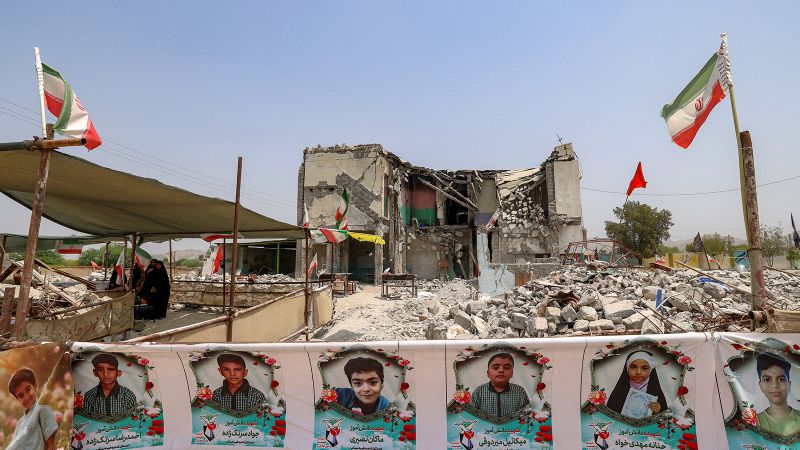
United Press International on Yahoo
U.N. investigator: U.S. strikes on alleged drug boats may be crimes against humanity
-=-=-
-----
7 26 RUBIO VICEROY VENEZ SOON CUBA SAYS WILL TEAR DOWN [WE BOMB BOATS]
RUBIO PAL
- hindrajabfoundation.org
- https://www.hindrajabfoundation.org › perpetrators › hind-rajab-foundation-files-icc-complaint-against-israeli-foreign-minister-gideon-saar-ahead-of-brussels-visit
Complaint Against Israeli Foreign Minister Gideon Sa'ar | THE HIND ...
- Feb 26, 2025February 16, 2025 - The Hague / Brussels The Hind Rajab Foundation has officially filed a complaint with the International Criminal Court (ICC), seeking an arrest warrant for Gideon Sa'ar, the Foreign Minister of Israel, for war crimes and crimes against humanity committed during Israel's ongoing military assault on Gaza since October 7, 2023. Sa'ar, a senior member of Netanyahu's ...

- Middle East Monitor
- https://www.middleeastmonitor.com › 20250217-pro-palestinian-ngo-files-complaint-with-icc-against-israeli-foreign-minister
Pro-Palestinian NGO files complaint with ICC against Israeli foreign ...
- Feb 17, 2025Belgium-based pro-Palestinian non-governmental organization the Hind Rajab Foundation has filed a complaint with the International Criminal Court (ICC) against Israeli Foreign Minister Gideon Saar ...
- CNN
- https://www.cnn.com › 2025 › 02 › 16 › middleeast › ngo-seeks-icc-arrest-warrant-israel-saar-intl-latam
Pro-Palestinian NGO seeks ICC arrest warrant for Israel's foreign minister
- Feb 16, 2025Pro-Palestinian NGO the Hind Rajab Foundation (HRF) has filed a complaint with the International Criminal Court (ICC) against Israeli Foreign Minister Gideon Sa'ar, seeking a warrant for his ...
-=-=
dn 9 26
-=-=
3RD ACT 1225 ANNIV OF UN DECL HU RTS
TRUMP ADMIN ASKING FOR PASS FROM ICC // BOAT STRIKES
---
[### Federal judge blocks US sanctions against UN rapporteur ...

Al Jazeera
https://www.aljazeera.com › ... › Israel-Palestine conflict](https://www.aljazeera.com/news/2026/5/14/federal-judge-blocks-us-sanctions-against-un-rapporteur-francesca-albanese)
11 hours ago — UN Human Rights Council Special Rapporteur Francesca Albanese was sanctioned in July 2025 after she publicly criticised Washington's policy on ...Read more

By Alex Milan Durie, AFP and Reuters
Published On 14 May 202614 May 2026
A federal judge has temporarily blocked United States sanctions against Francesca Albanese, a United Nations expert on the occupied Palestinian territory.
UN Human Rights Council Special Rapporteur Francesca Albanese was sanctioned in July 2025 after she publicly criticised Washington’s policy on Israel’s genocidal war against Palestinians in Gaza.
Recommended Stories
list of 3 items
- list 1 of 3Family of UN rapporteur Albanese sues Trump administration over sanctions
- list 2 of 3Israel systematically torturing Palestinians in custody, says UN expert
- list 3 of 3UN expert says world has given Israel ‘licence to torture Palestinians’
end of list
Albanese’s husband and daughter filed a lawsuit in February against the Trump administration over the sanctions. It argued that the sanctions were an effort to punish Albanese for bringing attention to Israel’s rights abuses against Palestinians.
In his court order on Wednesday, US District Judge Richard Leon granted a preliminary injunction against the sanctions.
He found that the Trump administration sought to regulate her speech because of the “idea or message expressed”.
“Albanese has done nothing more than speak,” judge Leon wrote in his memorandum opinion. “It is undisputed that her recommendations have no binding effect on the ICC’s actions – they are nothing more than her opinion.”
Albanese, who said the US sanctions were “calculated to weaken my mission” when they were first imposed, celebrated the ruling on social media.
“Thanks to my daughter and my husband for stepping up to defend me, and everyone who has helped so far,” Albanese said in a statement on X.
“Together we are One.”
[vid?]
Torture in Israeli prisons is institutionalised and normalised: Albanese
Sudan war enters new phase: Who controls what after four years
Israel’s Ben Gvir storms Al-Aqsa during Jerusalem Day march
Since 2022, Albanese, a legal scholar, has served as the special rapporteur for the West Bank and Gaza, where she monitors human rights abuses against Palestinians. The UN Human Rights Council selected her for the position.
The Trump administration sanctioned her last July, calling her “unfit” for her role and accusing her of “biased and malicious activities” against the US and its ally, Israel. Albanese had also recommended that the International Criminal Court (ICC) pursue war crimes prosecutions against Israeli and US nationals.
The sanctions barred the Italian lawyer and human rights expert from entering the US, using US banks and payment systems, and prevented anyone else in the US from doing business with her.
Albanese’s husband and her daughter, a US citizen, claimed in the lawsuit that the US sanctions were “effectively debanking her and making it nearly impossible to meet the needs of her daily life”.
wiki 7 25
:{:{Duterte's political positions have been described as populist,[28][29][30] as well as nationalist.[31][32][33] His political success has been aided by his vocal support for the extrajudicial killing of drug users and criminals.[34] His career has sparked numerous protests and attracted controversy, particularly over human rights issues and his controversial comments. Duterte has repeatedly confirmed to have personally killed criminal suspects during his term as mayor of Davao.[35][36]}:
Extrajudicial killings that were allegedly committed by the Davao Death Squad between 1998 and 2016 during Duterte's mayoralty have also been scrutinized by human-rights groups and the Office of the Ombudsman.[37][38] The victims were mainly alleged drug users, alleged petty criminals, and street children.[39][40] The International Criminal Court opened a preliminary investigation into Duterte's drug war in 2018,[41] prompting Duterte to withdraw the Philippines from that body in response.[42]
He is the only president in the history of the Philippines not to declare his assets and liabilities.[43] Duterte's popularity and domestic approval rating remained relatively high throughout his presidency, and by the end of his term he was the most popular post-People Power Revolution president.[44][45][46]}:
The International Criminal Court's investigation led to Duterte's arrest and transfer to The Hague on March 11, 2025, making him the first Philippine president to face an international tribunal and the first Asian leader to face a trial before the ICC.[47][48]
===
TRUTHOUT 12 24
THE
International Court of Justice (ICJ) has just completed hearings on the climate crisis in a case that could have critical consequences for the survival of future generations. From December 2-13, more than 100 states and organizations argued before the ICJ in landmark litigation that began five years ago when Pacific Islander law students initiated a grassroots movement that persuaded the UN General Assembly to request an advisory opinion from the ICJ.
“In The Hague, most of which lies below sea level, this has been a momentous two weeks,” environmental attorney Richard Harvey, who works for Greenpeace International and watched the historic proceedings, told Truthout. “The Cold War divided the world into East and West but climate change divides it into North and South: corporate petrostates against the Small Island Developing States and the rest.”
“Never before have the U.S., Russia, China, U.K., Saudi Arabia, Kuwait and OPEC [the Organization of the Petroleum Exporting Countries] lined up so explicitly against those who suffer the most from their greed,” Harvey said. “Corporate petrostates shamelessly asserted that peoples’ rights to self-determination, to life and to a clean, healthy and sustainable environment are, in essence, trumped by their right to fossil fuel profits.”
On March 29, 2023, the General Assembly adopted Resolution 77/276 that recognized “climate change is an unprecedented challenge of civilizational proportions and that the well-being of present and future generations of humankind depends on our immediate and urgent response to it.” The resolution directed the ICJ to render an advisory opinion on:
- The obligations of States under international law to protect the climate system and other parts of the environment from anthropogenic [caused by humans] emissions of greenhouse gases, now and in the future.
- The legal consequences for States that fail to do this and cause significant harm to present and future generations and other States (particularly small island developing States affected by adverse effects of climate change).
The campaign in the General Assembly was spearheaded by Vanuatu, a constellation of 83 small islands in the South Pacific and one of the states most vulnerable to climate change. The measure that was introduced by Vanuatu and co-sponsored by over 130 states took aim at the primary emitters of fossil fuels, of which the United States is the leading culprit.
Related Story
|
US Militarism Is a Leading Cause of the Climate Catastrophe
US military interventions are not just wars on people — they’re also wars on the climate.
By Marjorie Cohn , TruthoutSeptember 10, 2024
“Today, we find ourselves on the frontlines of a crisis we did not create ⎯ a crisis that threatens our very existence and that of so many other peoples who have come in unprecedented numbers to be heard by this Court,” Ralph Regenvanu, Vanuatu’s special envoy for climate change and environment, told the 15 judges. “The outcome of these proceedings will reverberate across generations, determining the fate of nations like mine and the future of our planet.”
The Climate Crisis Is “Existential” for Many Developing Countries
Many states, including Tuvalu, characterized the climate crisis as “existential.” Despite producing less than 0.01 percent of greenhouse gas emissions, Tuvalu is on a trajectory to be the first country completely lost to rising sea levels due to climate change. The Solomon Islands have already lost five islands and others face severe erosion. Several states cited extreme weather events, many quite recent, that have had disastrous consequences for their people.
“The cost of fossil fuel subsidies from States reached an all-time high of US$7 trillion in 2022,” more than 23 times the amount that developing countries strived to secure for climate finance at the recent COP29.
Elizabeth Exposto, chief of staff to the prime minister of Timor-Leste, which is acutely vulnerable to climate change, said, “The climate crisis that we face today is the result of the historical and ongoing actions of industrialised nations, which have reaped the benefits of rapid economic growth, powered by colonial exploitation and carbon-intensive industries and practices.” She also noted, “These nations, representing only a fraction of the global population, are overwhelmingly responsible for the climate crisis, and yet, the impacts of climate change do not respect borders.”
But Margaret Taylor, legal adviser to the U.S. Department of State, dismissed the idea that the worst offenders were most responsible for taking actions to remedy the harm they are causing to the developing states. She asserted that, “States’ current obligations in respect of mitigating greenhouse gas emissions do not vary based on differentiation between categories of States, such as those characterized as ‘developed’ and ‘developing.’”
Like other major emitting states, Russia contended that the 1.5 degrees centigrade temperature limit in the Paris agreement is not legally binding, international responsibility is only triggered at the moment the climate treaties came into force for each state, causation by a single state is impossible to prove, and the primary emitters are not responsible for harm that future generations will suffer.
Even though Palestine is responsible for less than 0.01 percent of global emissions, it suffers severe climate impacts that are intensified by Israel’s illegal occupation. It has led to “the violation of the Palestinian people’s inalienable right to control its territory, to have sovereignty over its resources and to be in command of its climate policies,” Ambassador Ammar Hijazi, permanent representative of the State of Palestine to International Organizations in the Netherlands, told the court.
Palestine’s representatives raised the significant linkage between occupation, militarism and climate justice. “Climate scientists have determined that the ongoing war in the Gaza Strip was responsible for emission of between 420,000 and 650,000 tonnes of carbon dioxide and other greenhouse gases in just the first 120 days, which is the period for which there is published data,” Kate Mackintosh argued for Palestine. “This is equivalent to the total annual emissions of 26 of the lowest-emitting States.”
“Although the occupying Power has a legal obligation to protect the environment and to conserve the natural resources of the occupied territory for the benefit of the protected population, this obligation is often violated, as the Court has already concluded in relation to Israel’s occupation of Palestine,” Mackintosh added. She was referring to the ICJ’s advisory opinion issued in July which concluded that Israel’s occupation of Palestinian territory is illegal.
Representatives from the Dominican Republic said that damages from climate change violate the fundamental right to survival — a right recognized by the ICJ in its advisory opinion on the Legality of the Threat or Use of Nuclear Weapons.
The Risks of Greenhouse Gas Emissions Have Been Known Since at Least the 1960s
Regenvanu from Vanuatu emphasized that “the unprecedented risks created by anthropogenic greenhouse gas emissions have been known since at least the 1960s,” citing an address by U.S. President Lyndon Johnson in 1965: “This generation has altered the composition of the atmosphere on a global scale through radioactive materials and a steady increase in carbon dioxide from the burning of fossil fuels.”
Referring to the Conference of the Parties to the UN Framework Convention on Climate Change (UNFCCC), Regenvanu noted, “For many peoples, including in Vanuatu, the prolonged and systematic failure of the COP process has cost them their well-being, their cultures and even their lives. There is an urgent need for a collective response to climate change grounded not in political convenience but in international law.”
Jorge Viñuales from the Melanesian Spearhead Group stated that emissions of greenhouse gases have increased more than 50 percent since 1990. He cited a report by the International Monetary Fund that “the cost of fossil fuel subsidies from States reached an all-time high of US$7 trillion in 2022,” more than 23 times the amount that developing countries strived to secure for climate finance at the recent COP29.
Fossil fuels account for 80 percent of global primary energy. Nearly 80 percent of historical greenhouse gases have come from the Group of 20 (G20), while developing countries contributed only 4 percent.
In its directive to the ICJ for an advisory opinion, the General Assembly resolution referenced several relevant sources of international law, including the UN Charter; the International Covenant on Civil and Political Rights; the International Covenant on Economic, Social and Cultural Rights; UNFCCC; the Paris Climate Agreement; the UN Convention on the Law of the Sea; the duty of due diligence; the Universal Declaration of Human Rights; the principle of prevention of significant harm to the environment; and the duty to protect and preserve the marine environment.
The Leading Greenhouse Gas Emitters Tried to Narrow Climate Change Law
Nevertheless, the leading greenhouse gas-emitting states argued that their international legal obligations did not go beyond those set forth in the UNFCCC and Paris agreement, an international treaty on climate change adopted by 196 Parties at the UN Climate Change Conference (COP21) in 2015 and entered into force in 2016.
But the overwhelming majority of states told the court that international law governing climate change also includes customary international law and human rights law.
“As the majority of the submissions have highlighted, for islands like Samoa, climate change is more than an environmental issue,” Peseta Noumea Simi, chief executive officer in Samoa’s Ministry of Foreign Affairs and Trade, said. “It is a health, food security, economic, social, cultural, human rights and security concern. As large ocean States, it fundamentally affects our ability to draw sustenance from the pristine oceans and seas that surround us.”
The Solomon Islands called for international legal protection for refugees displaced by climate change under international refugee law.
Some, like Ecuador, maintained that states which have significantly harmed the climate system, including harm caused by private contractors under its jurisdiction, must also be held accountable.
The Union of Comoros argued that breaches of the legal obligations owed to the international community as a whole (erga omnes) require reparations, including cessation of illegal acts, compensation for damage and loss, and financial support. Many of the states agreed that reparations must be paid, including restitution, compensation and satisfaction (for moral damages such as mental and emotional suffering). Some, including the African Union, mentioned debt cancellation (or at least debt relief) and structural reparation. Vietnam, which continues to suffer the effects of the U.S. military’s spraying of Agent Orange during the Vietnam War, suggested restorative measures for the national environment.
A Favorable Advisory Opinion From the ICJ Would Carry Great Moral Weight
During his first term, President Donald Trump withdrew the U.S. from the Paris agreement. President Joe Biden then rejoined the treaty in 2021. Now, Trump is preparing once again to leave the Paris agreement and has promised to increase fossil-fuel production.
Although an advisory opinion from the ICJ is not legally binding, it carries great moral weight. It could help climate activists hold polluting states accountable by providing legal support for climate litigation against their governments. Politicians could cite it to support the imposition of sanctions against states that fail to comply with their legal obligations. And diplomats could use it as a minimum standard in the next global climate change negotiations.
“The ICJ’s opinion will be published in 2025, just as the court celebrates its 80th birthday,” Harvey told Truthout. “I sincerely hope our colleagues threatened by rising sea levels, unbreathable air and deadly temperature increases will find its opinion a cause for celebration.”
On the last day of the hearings, Vishal Prasad, director of Pacific Islands Students Fighting Climate Change, presented the ICJ with the “People’s Petition: A Collective Climate Justice Call for the ICJ,” which quoted a young woman from the Micronesian island of Kiribati: “The ocean, once a nurturing mother, has become a vengeful giant, swallowing the land it once cradled. It no longer only gives life — it now takes it, inch by inch. Where it once offered sustenance, it now brings destruction, its rising tides a cold and unrelenting force that pulls homes, cultures, and futures into its depths.”
Prasad invoked the memory of his ancestors, who were guided across the Pacific islands by the stars, telling the judges: “Just as the wayfinders of the Pacific held the wisdom to guide us through the vast ocean to safe harbour, you hold the knowledge and the responsibility to guide the international community to ensure the protection of our collective future. And you can do this simply by applying international law to the conduct responsible for climate change.”
Indeed, Vanuatu’s Regenvanu told the ICJ, “Let us not allow future generations to look back and wonder why the cause of their doom was condoned.”
==
desmog 4 24
in a landmark hearing at the Inter-American Court of Human Rights, legal experts and campaigners argued that businesses, such as the fossil fuel and agriculture industries, have legal duties to stop climate-related human-rights breaches.
A panel of six judges met starting April 23 in Barbados at the University of West Indies for the hearing, which was dubbed “The climate emergency and human rights.” It opened with statements from Chile and Columbia, which had requested that the court provide an advisory opinion on climate change and human rights in 2023.
“The impact of this emergency is not the same for all,” said Sebastián Kraljevich, Chile’s permanent representative to the Organization of American States. “The Caribbean… as well as South America and Central America are highly vulnerable in human terms. We are affected in a way that is disproportionate to the responsibility of our communities in generating this emergency.”
Kraljevich added that climate change is especially devastating for children, Indigenous peoples, farming communities, and women. “This fact has been proven by the scientific community; the world is faced with a catastrophe. This court now has to define the legal consequences stemming from this.”
Representatives from the two countries asked the court to set out what responsibilities that states have to tackle climate change and how to stop the crisis from violating people’s human rights. They asked for specific clarity on children’s and women’s rights, environmental defenders, as well as common but differentiated responsibilities — wherein the wealthy countries most responsible for causing climate change take the lead in tackling it — and loss and damage.
The court then heard from officials from other nations, international bodies, and even ordinary citizens on the frontlines of the climate crisis.
Legal experts dominated the three-day hearing, held from April 23 to 25. Nikki Reisch, climate and energy director at the Center for International Environmental Law, argued that businesses have legal obligations to stop causing climate-related harms, whether or not governments are fulfilling their own obligations.
“It’s not possible to guarantee human rights without combating climate change,” said Reisch. “And it’s not possible to combat climate change without regulating business conduct, specifically the climate-destructive conduct of those industries that are the primary drivers of greenhouse gas emissions: the fossil fuel and agro-industrial sectors.”
The Costa Rica-based court was set up in 1979 to interpret and apply the American Convention on Human Rights, a treaty ratified by members of the Organization of American States. Twenty states have accepted its jurisdiction, including most Latin American countries and several Caribbean islands. Neither the U.S. nor Canada have done so.
The Inter-American Court of Human Rights is the third international court tasked with providing an advisory opinion on climate change, alongside the International Court of Justice and the International Tribunal for the Law of the Sea. However, the Inter-American court is the only one focusing specifically on human rights, and is generally considered the most progressive.
Reisch outlined the decades-long campaign of climate obstruction and deception conducted by the fossil fuel industry, agribusiness, and other large corporate actors, and told the court that governments were responsible for ensuring full and adequate reparation for the harms caused by such corporate conduct. “To fulfill their human rights obligations in the context of the climate emergency, states must confront the industries driving it and curb their capture of climate policy.”
Reisch’s comments were echoed by Sophie Marjanac, accountable corporations lead at the environmental law charity ClientEarth. Marjanac pointed to the United Nations (UN) Guiding Principles on Business and Human Rights, which set out state obligations to regulate companies to avoid human rights offenses “even when business activities are not prohibited in international law.”
UN experts have said states must enact climate due diligence rules over every part of a business’s activities to comply with the UN Guiding Principles, and last year sent a letter of concern to Saudi Arabian oil giant Aramco, saying its expansion and ongoing exploration of fossil fuels threaten human rights.
Marjanac also noted that the EU has recently approved — albeit in a watered down version — a law to make companies hunt down human rights abuse and environmental harm in their supply chains, and to adopt climate transition plans. She argued that detail of this new law “demonstrates that reducing emissions rapidly across all parts of the business is required to comply with corporate human rights responsibilities in respect of climate change.”
Marjanac also made the case to the court that governments were responsible for regulating all emissions generated by companies registered within their borders — including their broader Scope 3 emissions — as well as emissions from the extraction of fossil fuels within their territory that are sold onto the global market, and from fossil fuels financed by the state or by financial institutions registered there.
A recognition of this by the court “would close a significant loophole in international climate change law and confirm that states are responsible under international human rights law for the acts and omissions which facilitate the sale of fossil fuels on the global market,” said Marjanac. “Such a finding is also necessary to ensure that state measures are capable of being effective.”
During time set aside for questions, the court’s judges sought clarity on many issues, such as how to define states’ fair share of emission reduction, the role of the Paris Agreement in international law, and how to balance the phase-out of fossil fuels with ensuring a fair transition.
“It’s not possible to guarantee human rights without combating climate change. And it’s not possible to combat climate change without regulating business conduct.”
– Nikki Reisch
The sole corporate speaker at the Barbados hearing was Juan Sebastián Ortiz Mendieta, legal advisor for Colombia-based Grupo de Energía de Bogotá. The company transports and distributes gas and electricity in several Latin American countries.
Mendieta offered the court the company’s “technical” expertise, stressing that access to energy is fundamental to the expression of human rights, and saying it had to tread carefully in governing the pace of the move to renewables to ensure a just transition in Latin America.
One judge, Argentina’s Verónica Gómez, commented that she had expected more interventions from businesses during the hearing, and said she wanted to give the Colombian company space to make its case.
But many speakers sought to put the fossil fuel industry’s climate actions in the spotlight.
Maria Alejandra Serra Barney, associate legal counsel of Greenpeace International, asked the court to end the corporate “legacy of impunity.” “Large fossil fuel companies and agri-industry companies are some of the major financial entities of the world; some of them are even as powerful or more powerful financially than states,” she noted. “Their financial power and their influence on climate policy means that state action itself alone cannot fully prevent or repair the damage caused by their conduct.”
She drew parallels with a ruling by the court in March that Peru had violated the right to a healthy environment of people living in the country’s “most contaminated town.” The state was held responsible for widespread pollution caused by the La Oroya smelter complex, which was operated by Doe Run Peru (an indirect subsidiary of U.S.-based Doe Run Company) from 1997 to 2009.
The Inter-American Court of Human Rights has scheduled two more hearings in the Brazilian cities of Brasília and Manaus in May, after which it will start sifting through the huge volume of evidence it has gathered. The final advisory opinion is expected to be published towards the end of this year or early in 2025.
---
https://www.alternet.org/exceptions-to-american-exceptionalism-2023/
...In the Biden era, with the January 6th moment more or less behind us, we’re back to American exceptionalism, not that:{ } :{ }::{ever truly left it in the dust. And as}::{ }:TomDispatch regular:{ }::{Rebecca Gordon, author of}::{ }:American Nuremberg:{, reminds us today, lest you think otherwise, this country does remain all too exceptional, even if in ways that couldn’t be more unnerving. Let her explain.}::{ }::{Tom}:
American Exceptionalism on Full Display:Why This Country Might Want to Lower Its Expectations
Let me start with a confession: I no longer read all the way through newspaper stories about the war in Ukraine. After years of writing about war and torture, I’ve reached my limit. These days, I just can’t pore through the details of the ongoing nightmare there. It’s shameful, but I don’t want to know the names of the dead or examine images caught by brave photographers of half-exploded buildings, exposing details — a shoe, a chair, a doll, some half-destroyed possessions — of lives lost, while I remain safe and warm in San Francisco. Increasingly, I find that I just can’t bear it.
And so I scan the headlines and the opening paragraphs, picking up just enough to grasp the shape of Vladimir Putin’s horrific military strategy: the bombing of civilian targets like markets and apartment buildings, the attacks on the civilian power grid, and the outright murder of the residents of cities and towns occupied by Russian troops. And these aren’t aberrations in an otherwise lawfully conducted war. No, they represent an intentional strategy of terror, designed to demoralize civilians rather than defeat an enemy military. This means, of course, that they’re also war crimes: violations of the laws and customs of war as summarized in 2005 by the International Committee of the Red Cross (ICRC).
The first rule of war, as laid out by the ICRC, requires combatant countries to distinguish between (permitted) military and (prohibited) civilian targets. The second states that “acts or threats of violence the primary purpose of which is to spread terror among the civilian population” — an all-too-on-target summary of Russia’s war-making these last 10 months — “are prohibited.” Violating that prohibition is a crime.
The Great Exceptions
How should war criminals be held accountable for their actions? At the end of World War II, the victorious Allies answered this question with trials of major German and Japanese officials. The most famous of these were held in the German city of Nuremberg, where the first 22 defendants included former high government officials, military commanders, and propagandists of the Nazi regime, as well as the banker who built its war machine. All but three were convicted and 12 were hanged.
The architects of those Nuremberg trials — representatives of the United States, the Soviet Union, the United Kingdom, and France — intended them as a model of accountability for future wars. The best of those men (and most of them were men) recognized their debt to the future and knew they were establishing a precedent that might someday be held against their own nations. The chief prosecutor for the United States, Robert H. Jackson, put it this way: “We must not forget that the record on which we judge the defendants today is the record on which we will be judged tomorrow.”
Indeed, the Nuremberg jurists fully expected that the new United Nations would establish a permanent court where war criminals who couldn’t be tried in their home countries might be brought to justice. In the end, it took more than half a century to establish the International Criminal Court (ICC). Only in 1998 did 60 nations adopt the ICC’s founding document, the Rome Statute. Today, 123 countries have signed.
Russia is a major exception, which means that its nationals can’t be tried at the ICC for war crimes in Ukraine.And that includes the crime the Nuremberg tribunal identified as the source of all the rest of the war crimes the Nazis committed: launching an aggressive, unprovoked war.
Guess what other superpower has never signed the ICC? Here are a few hints:
- Its 2021 military budget dwarfed that of the next nine countries combined and was 1.5 times the size of what the world’s other 144 countries with such budgets spent on defense that year.
- Its president has just signed a $1.7 trillion spending bill for 2023, more than half of which is devoted to “defense” (and that, in turn, is only part of that country’s full national security budget).
- It operates roughly 750 publicly acknowledged military bases in at least 80 countries.
- In 2003, it began an aggressive, unprovoked (and disastrous) war by invading a country 6,900 miles away.
War Crimes? No, Thank You
Yes, the United States is that other Great Exception to the rules of war. While, in 2000, during the waning days of his presidency, Bill Clinton did sign the Rome Statute, the Senate never ratified it. Then, in 2002, as the Bush administration was ramping up its “global war on terror,” including its disastrous occupation of Afghanistan and an illegal CIA global torture program, the United States simply withdrew its signature entirely. Secretary of Defense Donald Rumsfeld then explained why this way:
[T]he ICC provisions claim the authority to detain and try American citizens — U.S. soldiers, sailors, airmen and Marines, as well as current and future officials — even though the United States has not given its consent to be bound by the treaty. When the ICC treaty enters into force this summer, U.S. citizens will be exposed to the risk of prosecution by a court that is unaccountable to the American people, and that has no obligation to respect the Constitutional rights of our citizens.
That August, in case the U.S. stance remained unclear to anyone, Congress passed, and President George W. Bush signed, the American Servicemembers Protection Act of 2002. As Human Rights Watch reported at the time, “The new law authorizes the use of military force to liberate any American or citizen of a U.S.-allied country being held by the [International Criminal] Court, which is located in The Hague.” Hence, its nickname: the “Hague Invasion Act.” A lesser-known provision also permitted the United States to withdraw military support from any nation that participates in the ICC.
The assumption built into Rumsfeld’s explanation was that there was something special — even exceptional — about U.S. citizens. Unlike the rest of the world, we have “Constitutional rights,” which apparently include the right to commit war crimes with impunity. Even if a citizen is convicted of such a crime in a U.S. court, he or she has a good chance of receiving a presidential pardon. And were such a person to turn out to be one of the “current and future officials” Rumsfeld mentioned, his or her chance of being hauled into court would be about the same as mine of someday being appointed secretary of defense.
The United States is not a member of the ICC, but, as it happens, Afghanistan is. In 2018, the court’s chief prosecutor, Fatou Bensouda, formally requested that a case be opened for war crimes committed in that country. The New York Times reported that Bensouda’s “inquiry would mostly focus on large-scale crimes against civilians attributed to the Taliban and Afghan government forces.” However, it would also examine “alleged C.I.A. and American military abuse in detention centers in Afghanistan in 2003 and 2004, and at sites in Poland, Lithuania, and Romania, putting the court directly at odds with the United States.”
Bensouda planned an evidence-gathering trip to the United States, but in April 2019, the Trump administration revoked her visa, preventing her from interviewing any witnesses here. It then followed up with financial sanctions on Bensouda and another ICC prosecutor, Phakiso Mochochoko.
Republicans like Bush and Trump are not, however, the only presidents to resist cooperating with the ICC. Objection to its jurisdiction has become remarkably bipartisan. It’s true that, in April 2021, President Joe Biden rescinded the strictures on Bensouda and Mochochoko, but not without emphasizing this exceptional nation’s opposition to the ICC as an appropriate venue for trying Americans. The preamble to his executive order notes that:
The United States continues to object to the International Criminal Court’s assertions of jurisdiction over personnel of such non-State Parties as the United States and its allies absent their consent or referral by the United Nations Security Council and will vigorously protect current and former United States personnel from any attempts to exercise such jurisdiction.
Neither Donald Rumsfeld nor Donald Trump could have said it more clearly.
So where do those potential Afghan cases stand today? A new prosecutor, Karim Khan, took over as 2021 ended. He announced that the investigation would indeed go forward, but that acts of the U.S. and allies like the United Kingdom would not be examined. He would instead focus on actions of the Taliban and the Afghan offshoot of the Islamic State. When it comes to potential war crimes, the United States remains the Great Exception.
In other words, although this country isn’t a member of the court, it wields more influence than many countries that are – all of which means that, in 2023, the United States is not in the best position when it comes to accusing Russia of horrifying war crimes in Ukraine.
What the Dickens?
I blame my seven decades of life for the way my mind can now meander. For me, “great exceptions” brings to mind Charles Dickens’s classic story Great Expectations. His novels exposed the cruel reality of life among the poor in an industrializing Great Britain, with special attention to the pain felt by children. Even folks whose only brush with Dickens was reading Oliver Twistor watching The Muppets Christmas Carol know what’s meant by the expression “Dickensian poverty.” It’s poverty with that extra twist of cruelty — the kind the American version of capitalism has so effectively perpetuated.
When it comes to poverty among children, the United States is indeed exceptional, even among the 38 largely high-income nations of the Organization for Economic Cooperation and Development (OECD). As of 2018, the average rate of child poverty in OECD countries was 12.8%. (In Finland and Denmark, it was only 4%!) For the United States, with the world’s highest gross domestic product, however, it was 21%.
Then, something remarkable happened. In year two of the Covid pandemic, Congress passed the American Rescue Plan, which (among other measures) expanded the child tax credit from $2,000 up to as much as $3,600 per child. The payments came in monthly installments and, unlike the Earned Income Credit, a family didn’t need to have any income to qualify. The result? An almost immediate 40% drop in child poverty. Imagine that!
Given such success, you might think that keeping an expanded child tax credit in place would be an obvious move. Saving little children from poverty! But if so, you’ve failed to take into account the Republican Party’s remarkable commitment to maintaining its version of American exceptionalism. One of the items that the party’s congressional representatives managed to get expunged from the $1.7 trillion 2023 appropriation bill was that very expanded child tax credit. It seems that cruelty to children was the Republican party’s price for funding government operations.
Charles Dickens would have recognized that exceptional — and gratuitous — piece of meanness.
The same bill, by the way, also thanks to Republican negotiators, ended universal federal public-school-lunch funding, put in place during the pandemic’s worst years. And lest you think the Republican concern with (extending) poverty ended with starving children, the bill also will allow states to resume kicking people off Medicaid (federally subsidized health care for low-income people) starting in April 2023. The Kaiser Family Foundation estimates that one in five Americans will lose access to medical care as a result.
Great expectations for 2023, indeed.
We’re the Exception!
There are, in fact, quite a number of other ways in which this country is also exceptional. Here are just a few of them:
- Children killed by guns each year. In the U.S. it’s 5.6 per 100,000. That’s seven times as high as the next highest country, Canada, at 0.8 per 100,000.
- Number of required paid days off per year. This country is exceptional here as well, with zero mandatory days off and 10 federal holidays annually. Even Mexico mandates six paid vacation days and seven holidays, for a total of 13. At the other end of the scale, Chile, France, Germany, South Korea, Spain, and the United Kingdom all require a combined total of more than 30 paid days off per year.
- Life expectancy. According to 2019 data, the latest available from the World Health Organization for 183 countries, U.S. average life expectancy at birth for both sexes is 78.5 years. Not too shabby, right? Until you realize that there are 40 countries with higher life expectancy than ours, including Japan at number one with 84.26 years, not to mention Chile, Greece, Peru, and Turkey, among many others.
- Economic inequality. The World Bank calculates a Gini coefficient of 41.5 for the United States in 2019. The Gini is a 0-to-100-point measure of inequality, with 0 being perfect equality. The World Bank lists the U.S. economy as more unequal than those of 142 other countries, including places as poor as Haiti and Niger. Incomes are certainly lower in those countries, but unlike the United States, the misery is spread around far more evenly.
- Women’s rights. The United States signed the United Nations Convention on the Elimination of All Forms of Discrimination against Women in 1980, but the Senate has never ratified it (thank you again, Republicans!), so it doesn’t carry the force of law here. Last year, the right-wing Supreme Court gave the Senate a helping hand with its decision in Dobbs v. Jackson Women’s Health Organizationto overturnRoe v. Wade. Since then, several state legislatures have rushed to join the handful of nations that outlaw all abortions. The good news is that voters in states from Kansas to Kentucky have ratified women’s bodily autonomy by rejecting anti-abortion ballot propositions.
- Greenhouse gas emissions. Well, hooray! We’re no longer number one in this category. China surpassed us in 2006. Still, give us full credit; we’re a strong second and remain historically the greatest greenhouse gas emitter of all time.
Make 2023 a (Less) Exceptional Year...
---
---
https://www.democracynow.org/2021/9/27/headlines/vanuatu_to_ask_for_icj_opinion_on_climate_crisis
Pacific Island nation of Vanuatu is asking the International Court of Justice to weigh in on the rights of its people to be protected from the climate catastrophe. Prime Minister Bob Loughman addressed the U.N. General Assembly Saturday.
Prime Minister Bob Loughman Weibur: “Limiting warming to near 1.5 degrees will be beyond reach. The issues are increasingly eluding the control of individual national governments.”
---
---
https://insideclimatenews.org/news/07042021/climate-crisis-ecocide-vanuatu-the-fifth-crime/
...no lnx
Across the globe, climate change is disrupting the reliable seasonal rhythms that have sustained human life for millenia, while hurricanes, floods and other climate-driven disasters have forced more than 10 million people from their homes in the last six months. Fossil fuel pollution has killed 9 million people annually in recent years, according to a study in Environmental Research, more than tuberculosis, malaria and AIDS combined.
One in four mammals are threatened with extinction. For amphibians, it’s four in 10.
Damage to nature has become so extensive and widespread around the world that many environmentalists speak of ecocide to describe numerous environmentally devastated hot spots:
Chernobyl, the Ukrainian nuclear plant that exploded in 1986 and left the now-deserted area dangerously radioactive;
The tar sands of northern Canada, where toxic waste pits and strip mines have replaced 400 square miles of boreal forest and boglands;
The Gulf of Mexico, site of the Deepwater Horizon disaster that killed 11 people, spilled at least 168 million gallons of crude oil into the ocean over 87 days and killed countless marine mammals, sea turtles, fish and migratory birds;
The Amazon, where rapid deforestation encouraged by Brazilian President Jair Bolsonaro prompted Joe Biden, during his presidential campaign, to propose a $20 billion rescue plan and threaten the Brazilian leader with economic sanctions.
Ecocide Hotspots
The campaign to criminalize ecocide is now moving from the fringe of advocacy into global diplomacy, pushed by a growing recognition among advocates and many political leaders that climate change and environmental causes are tied inherently to human rights and social justice.
The effort remains a long shot and is at least years from fruition, international and environmental law experts say. Advocates will have to navigate political tensions over whether national governments or the international community have ultimate control over natural resources. And they’ll likely face opposition from countries with high carbon emissions and deep ties to industrial development.
The environmentalists must also figure out how criminal law would address climate change, which has been driven by practices like burning coal and gasoline that are not only legal, but central to the global economy.
The campaign for an ecocide crime, however, is about more than law. Jojo Mehta, who launched the Stop Ecocide campaign in 2017, describes it as a moral and practical issue as well.
“We use criminal law to draw moral lines,” Mehta said. “We say something’s not accepted, your murder is not acceptable. And so, simply putting mass damage and destruction of nature below that red line actually makes a huge difference, and it will make a difference to the people that are financing what is going on.”...
---
an 221
in game-changer, ICC will take up Israeli war crimes and apartheid in Palestine
On Friday, the International Criminal Court found that it had jurisdiction to consider war crimes and crimes against humanity and the crime of apartheid in the Palestinian...
920 an
omg
us mil in afgan, but also israeli palestine
==
Pompeo called out for threatening families
Andrea Germanos / Common Dreams
Amnesty International on Wednesday rebuked Secretary of State Mike Pompeo over new comments bashing the International Criminal Court and threatening court staff—and their family members—investigating alleged war crimes committed by…
https://www.alternet.org/2020/03/mike-pompeo-called-out-for-threatening-families/
https://www.alternet.org/2020/03/evil-and-heartless-trump-administration-hits-iran-with-brutal-sanctions-amid-its-devastating-covid-19-outbreak/
==
:{ Pete Hegseth attacks the International Criminal Court: “These international bodies can turn and can turn against you”:(style="box-sizing:border-box"):}:
03/06/20 9:58 AM EST
==
https://www.alternet.org/2020/01/buried-in-the-trump-netanyahu-deal-is-an-effort-to-torpedo-a-war-crimes-investigation/
no lnx
Buried in the Trump-Netanyahu deal is an effort to ‘torpedo’ a war crimes investigation
[President Donald J. Trump and Vice President Mike Pence participate in an expanded bilateral meeting with Israeli Prime Minister Benjamin Netanyahu Monday, Jan. 27, 2020, in the Oval Office of the White House. (Official White House Photo by D. Myles Cullen)]
Written by Andrea Germanos / Common Dreams January 29, 2020
As the International Criminal Court moved forward this week with its investigation into alleged war crimes committed against Palestinians in the Occupied Territories, the White House’s new so-called “peace” plan includes a largely unreported provision that would end such efforts to hold the Israeli government to account.
The document, released Tuesday, was widely criticized as a “screw the Palestinians over harder non-peace plan” that lets Israel continue its illegal occupation and a “ludicrous” proposal that offers no path towards Palestinian statehood.
The plan’s architect, President Donald Trump’s son-in-law and White House advisor Jared Kushner, suggested Palestinians “take a cold shower” and accept it lest they “screw up,” he said, like with “every other opportunity that they’ve ever had in their existence.”
A portion of the document states that “the parties should conduct themselves in a manner that comports with this vision, and in a way that prepares their respective peoples for peace.” For the Palestinians, that means victims of war crimes should keep quiet.
The plan states, in part, that Palestinians must take “no action, and shall dismiss all pending actions, against the State of Israel, the United States, and any of their citizens before the International Criminal Court” and other tribunals.
A portion of the White House's "Peace to Prosperity" plan released Jan. 28, 2020.
The provision drew criticism from Amnesty International.
“A just and sustainable peace requires a plan that prioritizes the human rights of Palestinians and Israelis, and must include justice and reparation for victims of war crimes and other grave violations. This plan not only fails this fundamental test; it seeks to torpedo efforts towards justice for both Palestinians and Israelis that are currently under way,” said Philip Luther, the organization’s Middle East and North Africa research and advocacy director.
Netanyahu, who was indicted Tuesday on corruption charges and stood alongside Trump as he released the plan, reiterated his condemnation of the ICC this week.
In an interview set to air Thursday with Christian network TBN, he called on global powers to sanction the court over the probe.
“The U.S. government, under President Trump, has spoken forcefully against the ICC for this travesty, and I urge all your viewers to do the same. To ask for concrete actions, sanction against the international court, its officials, prosecutors, everyone,” he said, according to an excerpt of the interview released by the Israeli government.
The internation court, he continued, is “basically in a full-frontal attack on the democracies, both on the democracies’ right to defend themselves, and on Israel’s right, the Jewish people’s right, to live in their ancestral homeland, the Land of Israel.”
Michael Lynk, the U.N. special rapporteur for the situation of human rights in the Palestinian territory occupied since 1967, has a different perspective. In December, Lynk praised the possibility of justice the investigation could bring.
“Over the years, the international community has adopted hundreds of resolutions through the United Nations condemning various features of Israel’s entrenched occupation of the Palestinian territory. Yet rarely has it ever combined criticism with consequences for Israel,” he said. “Now, the possibility of accountability is finally on the horizon.”
Trump has bristled at the possibility of the probe into alleged Israeli wrongdoing as well.
In a statement last April celebrating his administration’s successful intimidation campaign to stop an ICC investigation into alleged war crimes the U.S. committed in Afghanistan, Trump said, “Any attempt to target American, Israeli, or allied personnel for prosecution will be met with a swift and vigorous response.”
Despite U.S. and Israeli objections to the ICC probe into war crimes in the West Bank and Gaza, the effort—at least at this point—continues to advance.
The ICC announced Tuesday that it set a March 16 deadline for Israel, Palestine, and alleged victims to submit documents to the court.
Situation in #Palestine: #ICC Pre-Trial Chamber I invites Palestine, #Israel, interested States & others to submit observations on the Prosecutor’s request related to the scope of the Court’s territorial jurisdiction. Read more ?https://t.co/cwIfEEfY0W
— Int’l Criminal Court (@IntlCrimCourt) January 28, 2020
ICC chief prosecutor Fatou Bensouda said in December that “there is a reasonable basis to proceed with an investigation into the situation in Palestine” as she was “satisfied that war crimes have been or are being committed in the West Bank, including East Jerusalem, and the Gaza Strip,” and “there are no substantial reasons to believe that an investigation would not serve the interests of justice.”
==
UN researcher hails ICC’s pursuit of war crimes probe in Palestine as ‘momentous step’
Jessica Corbett / Common Dreams
A United Nations human rights researcher on Tuesday hailed the International Criminal Court’s recent decision to pursue a formal investigation of alleged war crimes in Palestinian territories occupied by Israel…
==
==
1219
Aung San Suu Kyi Asks :{ICJ:(style="box-sizing:border-box"):}: to Drop Genocide Case Against Burma
==
https://www.alternet.org/2019/08/mike-pompeo-celebrates-the-defeat-of-an-international-probe-into-possible-u-s-war-crimes/
no lx
Mike Pompeo celebrates the defeat of an international probe into possible U.S. war crimes
Written by Andrea Germanos / Common Dreams August 28, 2019
Secretary of State Mike Pompeo on Tuesday affirmed President Donald Trump’s disdain for the International Criminal Court when he appeared to boast of the White House’s successful bullying effort to stop the court from launching a probe into possible war crimes committed by U.S. forces in Afghanistan.
Pompeo made the remarks in a “Celebrating Americanism in Our Foreign Policy” speech at the American Legion National Convention in Indianapolis
“Americanism means taking care of our own,” said Pompeo.
“We stopped international courts from prosecuting our service members,” Pompeo continued, adding that the potential probe “was an outrage.”
In April, the ICC announced that it rejected a probe into possible war crimes and crimes against humanity in Afghanistan. Outgoing ICC prosecutor Fatou Bensouda requested the investigation in 2017, saying at the time that there was a “reasonable basis to believe” that war crimes were committed by the Taliban, Afghan National Security Forces, U.S. armed forces, and the CIA. That move won the praise of human rights organizations and triggered over one million statements from alleged Afghan victims.
But the potential prosecutions also prompted threats from the White House, with Trump’s national security adviser, John Bolton, warning of sanctions against ICC officials if they moved ahead with probes into U.S. or Israeli war crimes.
Pompeo confirmed earlier this year that the administration would revoke or deny visas for ICC personnel who try to investigate or prosecute U.S. officials or key allies for potential war crimes. A month later, in April, the administration followed through and revoked prosecutor Bensouda’s visa for entry into the U.S.
Trump, for his part, celebrated the rejected war crimes probe as an “international victory.”
Human rights groups had a notably different takeaway.
“It is outrageous,” said Jamil Dakwar, director of ACLU’s group’s human rights program, “that victims of war crimes are far less likely to get justice for well-documented atrocities because of the Trump administration’s authoritarian efforts to sabotage an investigation before it could even get started.”
“No one except the world’s most brutal regimes win,” Dakwar said, “when we weaken and sabotage international institutions established to fight impunity and hold the human rights abusers accountable.”
==
==
https://www.desmogblog.com/2019/04/16/polly-higgins-lawyer-taking-big-oil-s-crimes-against-humanity
Polly Higgins is a woman on the hunt. And you get the sense that, after decades of working towards holding powerful polluters to account, her prey may finally be in sight.
“When you're looking at any crime, you're looking at who are your suspects,” she tells me in a soft Scottish accent that belies the hard truths she regularly delivers. “Within a corporate context, you're looking at CEOs and directors. Within a state context, it is ministers and Heads of State.”
“They're the ones where final responsibility rests for making the decisions that can adversely impact many hundreds of thousands, if not millions, and indeed — in the case of climate crime — billions of people.”
Climate activism is surging, with the school strikers chastising older generations for failing them, and Extinction Rebellion hitting headlines with its creative direct actions in the name of “climate justice”.
But Higgins has her own, more institutional approach to what she agrees is a looming climate crisis: making it illegal to deliberately destroy the environment. She is calling for the International Criminal Court in the Hague to recognise ‘ecocide’ as a crime against humanity, alongside genocide and war crimes. She explains:
“There's a growing recognition that a lot of campaigning is not getting us where we need to go, and just saying fossil fuel extraction should stop is not enough. It has to be criminalised.”
That’s why, in 2010, Higgins proposed an amendment to the Rome Statute — the treaty that established the International Criminal Court. It defined ecocide as “the extensive damage to, destruction of or loss of ecosystem(s) of a given territory, whether by human agency or by other causes, to such an extent that peaceful enjoyment by the inhabitants of that territory has been or will be severely diminished.”
Some countries, such as the UK, have national climate change laws that set legally-binding emissions reduction targets. And many have regulations that are meant to protect the environment from corporate activities that could destroy ecosystems.
But none currently have sufficient legislation to allow companies to be taken to court, and treated as criminals, for damaging the environment purely for profit.
As Higgins points out: “We have laws that are protecting dangerous industrial activities, such as fracking, despite the fact that there is an abundance of evidence that it is hugely harmful in terms of carbon emissions, biodiversity loss, and the catastrophic trauma it can cause communities that are impacted by it.”
But if there was an ecocide law, it would allow lawyers and campaigners to argue that such polluting activities were “a potential crime against humanity.”
Watch[ video]
Shell Knew
That may seem like a lofty ambition, particularly when the charge is being led by a small team from a one-room office in the quaint, pastoral and pleasant surroundings of Stroud. But renewed activism has shown there is a growing appetite to hold to account those responsible for the current and future impacts of climate change.
A recent report from thinktank InfluenceMap showed the world’s five largest listed oil and gas companies spent more than $1 billion lobbying to prevent climate change regulations — all while running public relations campaigns aimed at maintaining public support for climate action.
And the European Parliament last month held a hearing into Exxon’s decades-long support of climate science denial and lobbying, which followed fresh media revelations around Shell’s decades-old and hidden knowledge of the harm its products cause the climate.
Higgins is currently targeting Shell in particular. At the end of last year, her NGO, Mission Lifeforce, went to The Hague to announce that it would be undertaking an initial legal analysis to establish whether Shell could be guilty of ecocide.
She concedes that making that case won’t be easy.
“For us to establish that Shell — and indeed a whole industry — has undertaken a modus operandi that constitutes an inhumane act, there are a number of elements that we have to satisfy legally, one of them being intent.”
While the task will be difficult, Shell’s own actions could help to take it down. Citing the work of De Correspondent, the Climate Accountability Institute, and DeSmog, she says there are “a number of key points over time that suggest that Shell has decided to move forward with their industrial activities in the full knowledge of just how dangerous they are.”
She highlights recently-released documents that show Shell’s own internal scientific analysis revealed the dangers its products posed to the climate in the 1980s. Despite this, the company continued to fund groups that pushed climate science denial and failed to warn shareholders of the risks for decades.
Read DeSmog's ShellKnew investigation in full]
Motivation
It has taken years to get to what Higgins describes as “the first step” of holding these multi-billion dollar corporations to account. So what drives her to keep going — to keep taking on these hugely powerful opponents?
“I grew up in the countryside. I grew up loving the beauty of the wilderness of the west coast of Scotland. I spent my childhood holidaying in Wales. So I think it greatly informed what I'm doing now,” she says.
“It's just part and parcel of who I am, and I think if you fundamentally care about people and the planet then it's something you're just not going to be able to walk away from.”
She’s motivated by protecting the people affected by major polluters, just as much as she’s driven to protect the planet itself. That means facing up to some big political powers as well as Big Oil.
An international ecocide law “is not something that most western world governments will sign off on,” she admits. “This is something that small islands that are most adversely impacted will want to have legal redress for, which kind of plays into the David and Goliath aspect of it.”
“Although it will impact the whole of humanity, those on the frontline tend to be the small island states such as Tuvalu and Vanuatu. And, for them, climate collapse is an existential humanitarian crisis. So they're seeking ways to significantly abate the primary drivers of climate breakdown.”
That’s why she’s targeting the International Criminal Court, where each member has one vote, rather than more cumbersome and potentially unjust institutions like the UN Framework Convention on Climate Change, where small countries can find themselves crowded out or bullied. Higgins sees a more permanent law, rather than delicate political solutions, as the best way to give calls for climate action some teeth.
Legacy
A few weeks after we speak, Higgins is diagnosed with aggressive terminal cancer. It makes her efforts to create something more solid — a law, rather than a political solution — seem all the more pertinent.
Pushing for ecocide to be acknowledged as a crime is her way of “recognising that there's a current absence of proper political leadership on this issue,” and “where political will fails then the law can prevail.”
“Ultimately all of this is preventable and that's really what ecocide law is about.”
“It is fundamentally unjust to sit back and watch the destruction occurring,” she says.
Higgins is very good at explaining why an ecocide law could be effective, in theory. But there remain few mainstream campaign groups or political parties that back her cause. The UK’s Green Party in 2012 passed a resolution giving “wholehearted support for an international law of ecocide”. No other party has yet followed the Greens’ lead.
Higgins says that’s in part because hers is a movement that doesn’t wholly rely on public awareness “because it's not the number one issue of concern,” she says.
Instead, she has worked on “discerning who are my allies in this, and how to take this forward working with them behind the scenes.”
That doesn’t mean public support for the idea isn’t useful — “it does help to have public support without a doubt,” she acknowledges — it just may not be necessary. If the International Criminal Court agrees with her, her job is done.
That’s why her focus is on forging a new tool for campaigners — an ecocide law — rather than courting them.
As she says: “Where do you go when NGO campaigns have failed? Where do you go when countless petitions to governments get you nowhere?”
Her work has laid the groundwork for a new answer to those questions: For decades, people have taken to the streets. Thanks to Higgins’ work, perhaps one day, they will be able to take the prime suspects in climate atrocities to the criminal courts.
==
==
https://www.alternet.org/2019/03/mike-pompeo-lashes-out-at-the-international-criminal-court-to-shield-the-us-from-war-crimes-prosecutions/
Human rights defenders expressed outrage on Friday after Secretary of State Mike Pompeo revealed that the Trump administration is revoking or denying visas for any International Criminal Court (ICC) personnel who try to investigate or prosecute U.S. officials or key allies for potential war crimes.
The move, Pompeo confirmed to reporters Friday morning, is a direct response to ongoing effortsby the ICC to probe allegations of war crimes and crimes against humanity tied to the seemingly endless war in Afghanistan.
Jamil Dakwar, director of the ACLU’s Human Rights Program, was among those who spoke outagainst the decision. The ACLU currently represents Khaled El Masri, Suleiman Salim, and Mohamed Ben Soud, who were all detained and tortured in Afghanistan between 2003 and 2008.
“This is an unprecedented attempt to skirt international accountability for well-documented war crimes that haunt our clients to this day,” Dakwar said. “It reeks of the very totalitarian practices that are characteristic of the worst human rights abusers, and is a blatant effort to intimidate and retaliate against judges, prosecutors, and advocates seeking justice for victims of serious human rights abuses.”
Richard Dicker, international justice director at Human Rights Watch, called it “an outrageous effort to bully the court and deter scrutiny of U.S. conduct.” He encouraged ICC member countries to “publicly make clear that they will remain undaunted in their support for the ICC and will not tolerate U.S. obstruction.”
Daniel Balson, advocacy director at Amnesty International USA, noted that this is just “the latest attack on international justice and international institutions by an administration hellbent on rolling back human rights protections.”
Visa bans, as Balson pointed out, are “powerful tools typically reserved for the most serious of human rights abusers.”
But rather than targeting global criminals, the Trump administration has set its sights on the ICC—an impartial judicial body thataims to promote accountabilityunder international law by probing and prosecuting crimes of aggression, crimes against humanity, war crimes, and genocide.
The move is “is highly indicative of [the administration’s] culture of disregard for rights abuses,” said Balson. “Throwing roadblocks in front of the ICC’s investigation undermines justice not only for abuses committed in Afghanistan, but also for the millions of victims and survivors throughout the world who have experienced the most serious crimes under international law.”
Pompeo’s announcement came after John Bolton, President Donald Trump’s national security adviser and a longtime critic of the ICC, threatened to impose sanctions on court officials in September if they continued to pursue an investigation of potential crimes by U.S. civilians or military personnel in Afghanistan.
Echoing Bolton’s broader denunciations of the ICC last year, Pompeo on Friday highlighted that the United States—under both Democratic and Republican presidents—has refused to join the court for more than two decades “because of its broad, unaccountable prosecutorial powers and the threat it poses to American national sovereignty.”
Warning that “the court could eventually pursue politically motivated prosecutions of Americans,” the secretary of state told reporters that the Trump administration is “determined to protect the American and allied military and civilian personnel from living in fear of unjust prosecution for actions taken to defend our great nation.”
“These visa restrictions may also be used to deter ICC efforts to pursue allied personnel, including Israelis, without allies’ consent,” Pompeo added. “Implementation of this policy has already begun.”
Watch Pompeo’s full remarks to the media on Friday:
==
rivkin off bs:
Mr. Rivkin has been involved in numerous high-profile cases. He has represented the 26 States that havechallenged the constitutionality of the Patient Protection and Affordable Care Actand was the lead outside counsel in the District Court and Court of Appeals.
He also represented theRepublic of Croatia before theInternational Criminal Tribunal for the Former Yugoslavia and the International Court of Justice for a number of years on a wide range of issues involving international humanitarian law and the laws of war.
Mr. Rivkin also has considerable experience with litigation involving national security-related matters, including defending Bivens actions brought against former Secretary of Defense Donald H. Rumsfeld.
From 2004 through 2007, he served as an expert member of the United Nations Subcommission on the Promotion andProtection of Human Rights.
http://www.loc.gov/law/foreign-news/article/international-criminal-tribunal-for-the-former-yugoslavia-six-former-croatian-leaders-convicted-of-crimes-against-humanity/
International Criminal Tribunal for the Former Yugoslavia: Six Former Croatian Leaders Convicted of Crimes Against Humanity
(June 4, 2013) According to a press release from the International Criminal Tribunal for the Former Yugoslavia (ICTY), on May 29, 2013, the Tribunal convicted six former senior Croatian officials of “crimes against humanity, violations of the laws or customs of war, and grave breaches of the Geneva Conventions committed between 1992 and 1994.” (Press Release, ICTY, Six Senior Herceg-Bosna Officials Convicted (May 29, 2013).) The ICTY is a United Nations-established court, founded in 1993, that hears cases of war crimes that were committed in the 1990s in the Balkans. (About the ICTY, ICTY website (last visited May 31, 2013).)
In the recent case, the six leaders were found to have participated in a “joint criminal enterprise … with the objective of removing the Muslim population from the territories on which the Bosnian Croat leadership, acting in concert with the leadership of Croatia, wanted to establish Croat domination.” (Press Release, supra.) Of the six, four were found guilty of 22 counts of war crimes and crimes against humanity.
Jadranko PrliÄ, who had been President of the Croatian Defense Council (HVO)and of the Croatian Republic of Herceg-Bosna, was sentenced to 25 years of imprisonment; Bruno StojiÄ, who had headed the HVO Department of Defense, received a sentence of 20 years of imprisonment; and Milivoj PetkoviÄ, Chief of the main staff of the HVO and after that deputy commander of the HVO forces, also received a sentence of 20 years. Vlanetin ÄoriÄ, who was the chief of the Military Police Administration and then Minister of the Interior and who was also convicted of command responsibility for crimes outside of those included in the “joint criminal enterprise,” was sentenced to 16 years of imprisonment. Those additional crimes were carried out in October 1992 in the town of Prozor. (Id.)
One of the other two defendants, Slobodan Praljak, had been the Assistant Minister of Defense of Croatia and then commander of the HVO main staff; he was acquitted on two counts by a majority of the judges, but was sentenced to 20 years of imprisonment for 20 remaining counts. Berislav PusiÄ was unanimously acquitted of four charges but convicted of 18 and sentenced to ten years of imprisonment. He had been the head of the HVO commission charged with prisoner exchanges and of the commission that managed detention facilities. (Id.)
The joint criminal enterprise activities, which occurred from January 1993 to April 1994, included recruiting personnel and coordinating the operations that were judged by the ICTY to be the crimes against humanity in eight municipalities: Äapljina, Gornji Vakuf, Jablanica, Ljubuški, Mostar, Prozor, Stolac, and Vareš. In addition to the six defendants, theICTY named a number of other individuals as complicit in the crimes, including Franjo Tudjman, the President of the Republic of Croatia. (Id.; Endia Vereen, ICTY Convicts 6 Bosnian Croat Leaders of Crimes Against Humanity, PAPER CHASE NEWSBURST (May 29, 2013).)
The ICTY stated that the murders and cases of torture of the Muslims in the region “were not the random acts of a few unruly soldiers, but part of a plan to permanently remove Muslims from territory claimed by Bosnian Croats.” (Press Release, supra.)
The convictions in this case, which began in 2006, are the most recent ones obtained by the ICTY in its 20 years of operation. The ICTY has indicted 161 people for various violations of humanitarian law committed during the Yugoslavian conflict in the years 1991 to 2001.During the civil war in Bosnia alone, 100,000 people were killed and 2.2 million were left homeless. (Vereen, supra.)
Author: Constance Johnson
Topic: Genocide, Judiciary, Torture, War crimes
Jurisdiction: International Criminal Tribunal for the Former Yugoslavia
Date: June 4, 2013
International Tribunal for the Prosecution of Persons Responsible for Serious Violations of International Humanitarian Law Committed in the Territory of the Former Yugoslavia since 1991, more commonly referred to as the International Criminal Tribunal for the former Yugoslavia (ICTY), was a body of the United Nations established to prosecute serious crimes committed during the Yugoslav Wars, and to try their perpetrators. The tribunal was an ad hoc court located in The Hague, Netherlands.
The Court was established by Resolution 827 of the United Nations Security Council, which was passed on 25 May 1993. It had jurisdiction over four clusters of crimes committed on the territory of the former Yugoslavia since 1991: grave breaches of the Geneva Conventions, violations of the laws or customs of war, genocide, and crimes against humanity. The maximum sentence it could impose was life imprisonment. Various countries signed agreements with the UN to carry out custodial sentences.
A total of 161 persons were indicted; the final indictments were issued in December 2004, the last of which were confirmed and unsealed in the spring of 2005.[1] The final fugitive, Goran Hadžić, was arrested on 20 July 2011.[2] The final judgment was issued on 29 November 2017[3] and the institution formally ceased to exist on 31 December 2017.[4]
Residual functions of the ICTY, including oversight of sentences and consideration of any appeal proceedings initiated since 1 July 2013, are under the jurisdiction of a successor body, the Mechanism for International Criminal Tribunals.[5]
- :{1:(style="display:table-cell;padding-left:0px;padding-right:0.5em"):}::{History:(style="display:table-cell"):}:
- :{1.1:(style="display:table-cell;padding-left:0px;padding-right:0.5em"):}::{Creation:(style="display:table-cell"):}:
- :{1.2:(style="display:table-cell;padding-left:0px;padding-right:0.5em"):}::{Implementation:(style="display:table-cell"):}:
- :{1.3:(style="display:table-cell;padding-left:0px;padding-right:0.5em"):}::{Operation:(style="display:table-cell"):}:
- :{1.4:(style="display:table-cell;padding-left:0px;padding-right:0.5em"):}::{Accomplishments:(style="display:table-cell"):}:
- :{1.5:(style="display:table-cell;padding-left:0px;padding-right:0.5em"):}::{Closure:(style="display:table-cell"):}:
- :{2:(style="display:table-cell;padding-left:0px;padding-right:0.5em"):}::{Organization:(style="display:table-cell"):}:
- :{2.1:(style="display:table-cell;padding-left:0px;padding-right:0.5em"):}::{Prosecutors:(style="display:table-cell"):}:
- :{2.2:(style="display:table-cell;padding-left:0px;padding-right:0.5em"):}::{Chambers:(style="display:table-cell"):}:
- :{2.3:(style="display:table-cell;padding-left:0px;padding-right:0.5em"):}::{Registry:(style="display:table-cell"):}:
- :{2.4:(style="display:table-cell;padding-left:0px;padding-right:0.5em"):}::{Detention facilities:(style="display:table-cell"):}:
- :{3:(style="display:table-cell;padding-left:0px;padding-right:0.5em"):}::{Indictees:(style="display:table-cell"):}:
- :{4:(style="display:table-cell;padding-left:0px;padding-right:0.5em"):}::{Criticism:(style="display:table-cell"):}:
- :{5:(style="display:table-cell;padding-left:0px;padding-right:0.5em"):}::{See also:(style="display:table-cell"):}:
- :{6:(style="display:table-cell;padding-left:0px;padding-right:0.5em"):}::{References:(style="display:table-cell"):}:
- :{7:(style="display:table-cell;padding-left:0px;padding-right:0.5em"):}::{Further reading:(style="display:table-cell"):}:
- :{8:(style="display:table-cell;padding-left:0px;padding-right:0.5em"):}::{External links:(style="display:table-cell"):}:
History
Creation:{:(style="margin-right:0.25em"):}:[edit:{]}:
Report S/25704 of the UN Secretary-General, including the proposed Statute of the International Tribunal, approved byUN Security Council Resolution 827
United Nations Security Council Resolution 808 of 22 February 1993 decided that "an international tribunal shall be established for the prosecution of persons responsible for serious violations of international humanitarian law committed in the territory of the former Yugoslavia since 1991", and calling on the Secretary-General to "submit for consideration by the Council ... a report on all aspects of this matter, including specific proposals and where appropriate options ... taking into account suggestions put forward in this regard by Member States".[6]
The Court was originally proposed by German Foreign Minister Klaus Kinkel.[7] By 25 May 1993, the international community had tried to pressure the leaders of the former Yugoslavian republics diplomatically, militarily, politically, economically, and – with Resolution 827 – through juridical means. Resolution 827 of 25 May 1993 approved S/25704 report of the Secretary-General and adopted the Statute of the International Tribunal annexed to it, formally creating the ICTY. It would have jurisdiction over four clusters of crime committed on the territory of the former SFR Yugoslavia since 1991: grave breaches of the Geneva Conventions, violations of the laws or customs of war, genocide, and crime against humanity. The maximum sentence it can impose is life imprisonment.{First Annual Report of the ICTY – located on official website}
Implementation:{:(style="margin-right:0.25em"):}:[edit:{]}:
In 1993, the ICTY built its internal infrastructure. 17 states have signed an agreement with the ICTY to carry out custodial sentences.[8]
1993–1994: In the first year of its existence, the Tribunal laid the foundations for its existence as a judicial organ. The Tribunal established the legal framework for its operations by adopting the rules of procedure and evidence, as well as its rules of detention and directive for the assignment of defense counsel. Together these rules established a legal aid system for the Tribunal. As the ICTY is part of the United Nations and as it was the first international court for criminal justice, the development of a juridical infrastructure was considered quite a challenge. However after the first year the first ICTY judges had drafted and adopted all the rules for court proceedings.[9]
1994–1995: The ICTY established its offices within the Aegon Insurance Building in The Hague (which was, at the time, still partially in use by Aegon)[10] and detention facilities in Scheveningen in The Hague (the Netherlands). The ICTY hired now many staff members. By July 1994 there were sufficient staff members in the office of the prosecutor to begin field investigations and by November 1994 the first indictment was presented and confirmed. In 1995, the entire staff numbered more than 200 persons and came from all over the world. Moreover, some governments assigned their legally trained people to the ICTY.
Operation
The Tribunal building in The Hague
In 1994 the first indictment was issued against the Bosnian-Serb concentration camp commander Dragan Nikolić. This was followed on 13 February 1995 by two indictments comprising 21 individuals which were issued against a group of 21 Bosnian-Serbs charged with committing atrocities against Muslim and Croat civilian prisoners. While the war in the former Yugoslavia was still raging, the ICTY prosecutors showed that an international court was viable. However, no accused was arrested.[11]
The court confirmed eight indictments against 46 individuals and issued arrest warrants. Bosnian Serb indictee Duško Tadić became the subject of the Tribunal's first trial. Tadić was arrested by German police in Munich in 1994 for his alleged actions in the Prijedor region in Bosnia-Herzegovina (especially his actions in the Omarska, Trnopolje and Keraterm detention camps). He made his first appearance before the ICTY Trial Chamber on 26 April 1995, and pleaded not guilty to all of the charges in the indictment.[12]
1995–1996: Between June 1995 and June 1996, 10 public indictments had been confirmed against a total of 33 individuals. Six of the newly indicted persons were transferred in the Tribunal's detention unit. In addition to Duško Tadic, by June 1996 the tribunal had Tihomir Blaškić, Dražen Erdemović, Zejnil Delalić, Zdravko Mucić, Esad Landžo and Hazim Delić in custody. Erdemović became the first person to enter a guilty plea before the tribunal's court. Between 1995 and 1996, the ICTY dealt with miscellaneous cases involving several detainees, which never reached the trial stage.
Accomplishments
In 2004, the ICTY published a list of five accomplishments "in justice and law":[13][14]
- "Spearheading the shift from impunity to accountability", pointing out that, until very recently, it was the only court judging crimes committed as part of the Yugoslav conflict, since prosecutors in the former Yugoslavia were, as a rule, reluctant to prosecute such crimes;
- "Establishing the facts", highlighting the extensive evidence-gathering and lengthy findings of fact that Tribunal judgments produced;
- "Bringing justice to thousands of victims and giving them a voice", pointing out the large number of witnesses that had been brought before the Tribunal;
- "The accomplishments in international law", describing the fleshing out of several international criminal law concepts which had not been ruled on since the Nuremberg Trials;
- "Strengthening the Rule of Law", referring to the Tribunal's role in promoting the use of international standards in war crimes prosecutions by former Yugoslav republics.
Closure
The United Nations Security Council passed resolutions 1503 in August 2003 and 1534 in March 2004, which both called for the completion of all cases at both the ICTY and its sister tribunal, the International Criminal Tribunal for Rwanda (ICTR) by 2010.
In December 2010, the Security Council adopted Resolution 1966, which established the Mechanism for International Criminal Tribunals (MICT), a body intended to gradually assume residual functions from both the ICTY and the ICTR as they wound down their mandate. Resolution 1966 called upon the Tribunal to finish its work by 31 December 2014 to prepare for its closure and transfer of its responsibilities.[5]
In a Completion Strategy Report issued in May 2011, the ICTY indicated it aimed to complete all trials by the end of 2012 and all appeals by 2015, with the exception of Radovan Karadžićwhose trial was expected to end in 2014 andRatko Mladićand Goran Hadžić, who were at large at that time and were not arrested until later that year.[15]
The MICT's ICTY branch began functioning on 1 July 2013. Per the Transitional Arrangements adopted by the UN Security Council, the ICTY was to conduct and complete all outstanding first instance trials, including those of Karadžić, Mladić and Hadžić. The ICTY would also conduct and complete all appeal proceedings for which the notice of appeal against the judgement or sentence was filed before 1 July 2013. The MICT will handle any appeals for which notice is filed after that date.
The final ICTY trial to be completed in the first instance was that of Ratko Mladić, who was convicted on 22 November 2017.[16] The final case to be considered by the ICTY was an appeal proceeding encompassing six individuals, whose sentences were upheld on 29 November 2017.[17]
Organization:{:(style="margin-right:0.25em"):}:[edit:{]}:
While operating, the Tribunal employed around 900 staff.[18] Its organisational components were Chambers, Registry and the Office of the Prosecutor (OTP).
The Prosecutor was responsible for investigating crimes, gathering evidence and prosecutions and was head of the Office of the Prosecutor (OTP).[19] The Prosecutor was appointed by the UN Security Council upon nomination by the UN Secretary-General.[20]
The last prosecutor was Serge Brammertz. Previous Prosecutors have been Ramón Escovar Salom of Venezuela (1993–1994), however, he never took up that office, Richard Goldstone of South Africa (1994–1996), Louise Arbour of Canada (1996–1999), and Carla Del Ponte of Switzerland (1999–2007). Richard Goldstone, Louise Arbour and Carla Del Ponte also simultaneously served as the Prosecutor of the International Criminal Tribunal for Rwanda until 2003. Graham Blewitt [Australia] served as the Deputy Prosecutor from 1994 until 2004. David Tolbert, the President of the International Center for Transitional Justice, was also appointed Deputy Prosecutor of the ICTY in 2004.[21]
Chambers:{:(style="margin-right:0.25em"):}:[edit:{]}:
Chambers encompassed the judges and their aides. The Tribunal operated three Trial Chambers and one Appeals Chamber. The President of the Tribunal was also the presiding Judge of the Appeals Chamber.
Judges:{:(style="margin-right:0.25em"):}:[edit:{]}:
At the time of the court's dissolution, there were seven permanent judges and one ad hoc judge who served on the Tribunal.[22][23] A total of 86 judges have been appointed to the Tribunal from 52 United Nations member states. Of those judges, 51 were permanent judges, 36 were ad litem judges, and one was an ad hoc judge. Note that one judge served as both a permanent and ad litem judge, and another served as both a permanent and ad hoc judge.
UN member and observer states could each submit up to two nominees of different nationalities to the UN Secretary-General.[24] The UN Secretary-General submitted this list to the UN Security Council which selected from 28 to 42 nominees and submitted these nominees to the UN General Assembly.[24] The UN General Assembly then elected 14 judges from that list.[24] Judges served for four years and were eligible for re-election. The UN Secretary-General appointed replacements in case of vacancy for the remainder of the term of office concerned.[24]
On 21 October 2015, Judge Carmel Agius of Malta was elected President of the ICTY and Liu Daqun of China was elected Vice-President; they have assumed their positions on 17 November 2015.[25] His predecessors were Antonio Cassese of Italy (1993–1997), Gabrielle Kirk McDonald of the United States (1997–1999), Claude Jorda of France (1999–2002), Theodor Meron of the United States (2002–2005), Fausto Pocar of Italy(2005–2008), Patrick Robinson of Jamaica (2008–2011), and Theodor Meron (2011–2015).[22][26]
| Name[22][26][23] | State[22][26][23] | Position(s)[22][26][23] | Term began[22][26][23] | Term ended[22][26][23] |
|---|---|---|---|---|
| Georges Abi-Saab |  Egypt | Permanent | 17 November 1993 | 1 October 1995 |
| Koffi Afande |  Togo | Permanent | 12 December 2013 | 30 June 2016 |
| Antonio Cassese |  Italy | Permanent / President | 17 November 1993 | 17 February 2000 |
| Jules Deschênes |  Canada | Permanent | 17 November 1993 | 1 May 1997 |
| Adolphus Karibi-Whyte |  Nigeria | Permanent / Vice-President | 17 November 1993 | 16 November 1998 |
| Germain Le Foyer De Costil |  France | Permanent | 17 November 1993 | 1 January 1994 |
| Li Haopei |  China | Permanent | 17 November 1993 | 6 November 1997 |
| Gabrielle McDonald |  United States | Permanent / President | 17 November 1993 | 17 November 1999 |
| Elizabeth Odio Benito |  Costa Rica | Permanent / Vice-President | 17 November 1993 | 16 November 1998 |
| Rustam Sidhwa |  Pakistan | Permanent | 17 November 1993 | 15 July 1996 |
| Ninian Stephen |  Australia | Permanent | 17 November 1993 | 16 November 1997 |
| Lal Chand Vohrah |  Malaysia | Permanent | 17 November 1993 | 16 November 2001 |
| Claude Jorda | France | Permanent / President | 19 January 1994 | 11 March 2003 |
| Fouad Riad | Egypt | Permanent | 4 October 1995 | 16 November 2001 |
| Saad Saood Jan | Pakistan | Permanent | 4 September 1996 | 16 November 1998 |
| Mohamed Shahabuddeen |  Guyana | Permanent / Vice-President | 16 June 1997 | 10 May 2009 |
| Richard May |  United Kingdom | Permanent | 17 November 1997 | 17 March 2004 |
| Florence Mumba |  Zambia | Permanent / Vice-President | 17 November 1997 | 16 November 2005 |
| Rafael Nieto Navia |  Colombia | Permanent | 17 November 1997 | 16 November 2001 |
| Ad litem | 3 December 2001 | 5 December 2003 | 5 December 2003 | 5 December 2003 |
| Almiro Rodrigues |  Portugal | Permanent | 17 November 1997 | 16 November 2001 |
| Wang Tieya | China | Permanent | 17 November 1997 | 31 March 2000 |
| Patrick Robinson |  Jamaica | Permanent / President | 16 October 1998 | 8 April 2015 |
| Mohamed Bennouna |  Morocco | Permanent | 16 November 1998 | 28 February 2001 |
| David Hunt | Australia | Permanent | 16 November 1998 | 14 November 2003 |
| Patricia Wald | United States | Permanent | 17 November 1999 | 16 November 2001 |
| Liu Daqun | China | Permanent / Vice-President | 3 April 2000 | 31 December 2017 |
| Carmel Agius |  Malta | Permanent / President; Vice-President | 14 March 2001 | 31 December 2017 |
| Mohamed Fassi-Fihri | Morocco | Ad litem | 14 March 2001 | 16 November 2001 |
| 10 April 2002 | 1 November 2002 | 1 November 2002 | 1 November 2002 | 1 November 2002 |
| Theodor Meron | United States | Permanent / President | 14 March 2001 | 31 December 2017 |
| Fausto Pocar | Italy | Permanent / President | 14 March 2001 | 31 December 2017 |
| Mehmet Güney |  Turkey | Permanent | 11 July 2001 | 30 April 2015 |
| Maureen Clark |  Ireland | Ad litem | 6 September 2001 | 11 March 2003 |
| Fatoumata Diarra |  Mali | Ad litem | 6 September 2001 | 11 March 2003 |
| Ivana Janu |  Czech Republic | Ad litem | 6 September 2001 | 11 September 2004 |
| Amarjeet Singh |  Singapore | Ad litem | 6 September 2001 | 5 April 2002 |
| Chikako Taya |  Japan | Ad litem | 6 September 2001 | 1 September 2004 |
| Sharon Williams | Canada | Ad litem | 6 September 2001 | 17 October 2003 |
| Asoka de Zoysa Gunawardana |  Sri Lanka | Permanent | 4 October 2001 | 5 July 2003 |
| Amin El Mahdi | Egypt | Permanent | 17 November 2001 | 16 November 2005 |
| O-Gon Kwon |  Korea, South | Permanent / Vice-President | 17 November 2001 | 31 March 2016 |
| Alphons Orie |  Netherlands | Permanent | 17 November 2001 | 31 December 2017 |
| Wolfgang Schomburg |  Germany | Permanent | 17 November 2001 | 17 November 2008 |
| Per-Johan Lindholm |  Finland | Ad litem | 10 April 2002 | 17 October 2003 |
| Volodymyr Vasylenko |  Ukraine | Ad litem | 10 April 2002 | 25 January 2005 |
| Carmen Argibay |  Argentina | Ad litem | 5 November 2002 | 18 January 2005 |
| Joaquín Martín Canivell |  Spain | Ad litem | 2 May 2003 | 27 September 2006 |
| Inés Weinberg de Roca | Argentina | Permanent | 17 June 2003 | 15 August 2005 |
| Jean-Claude Antonetti | France | Permanent | 1 October 2003 | 31 March 2016 |
| Vonimbolana Rasoazanany |  Madagascar | Ad litem | 17 November 2003 | 16 March 2006 |
| Albertus Swart | Netherlands | Ad litem | 1 December 2003 | 16 March 2006 |
| Kevin Parker | Australia | Permanent / Vice-President | 8 December 2003 | 28 February 2011 |
| Krister Thelin |  Sweden | Ad litem | 15 December 2003 | 10 July 2008 |
| Chris Van Den Wyngaert |  Belgium | Permanent | 15 December 2003 | 31 August 2009 |
| Iain Bonomy | United Kingdom | Permanent | 7 June 2004 | 31 August 2009 |
| Hans Brydensholt |  Denmark | Ad litem | 21 September 2004 | 30 June 2006 |
| Albin Eser | Germany | Ad litem | 21 September 2004 | 30 June 2006 |
| Claude Hanoteau | France | Ad litem | 25 January 2005 | 27 September 2006 |
| György Szénási |  Hungary | Ad litem | 25 January 2005 | 30 May 2005 |
| Andrésia Vaz |  Senegal | Permanent | 15 August 2005 | 31 May 2013 |
| Bakone Moloto |  South Africa | Permanent | 17 November 2005 | 31 December 2017 |
| Frank Höpfel |  Austria | Ad litem | 2 December 2005 | 3 April 2008 |
| Janet Nosworthy | Jamaica | Ad litem | 2 December 2005 | 26 February 2009 |
| Árpád Prandler | Hungary | Ad litem | 7 April 2006 | 7 June 2013 |
| Stefan Trechsel |  Switzerland | Ad litem | 7 April 2006 | 7 June 2013 |
| Antoine Mindua |  Congo, Democratic Republic of the | Ad litem | 25 April 2006 | 30 July 2016 |
| Ali Nawaz Chowhan | Pakistan | Ad litem | 26 June 2006 | 26 February 2009 |
| Tsvetana Kamenova |  Bulgaria | Ad litem | 26 June 2006 | 26 February 2009 |
| Kimberly Prost | Canada | Ad litem | 3 July 2006 | 31 March 2010 |
| Ole Støle |  Norway | Ad litem | 13 July 2006 | 10 June 2010 |
| Frederik Harhoff |  Denmark | Ad litem | 9 January 2007 | 28 August 2013 |
| Flavia Lattanzi | Italy | Ad litem | 2 July 2007 | 31 March 2016 |
| Pedro David | Argentina | Ad litem | 27 February 2008 | 13 September 2011 |
| Elizabeth Gwaunza |  Zimbabwe | Ad litem | 3 March 2008 | 8 June 2013 |
| Michèle Picard | France | Ad litem | 3 March 2008 | 8 June 2013 |
| Uldis Kinis |  Latvia | Ad litem | 10 March 2008 | 18 April 2011 |
| Christoph Flügge | Germany | Permanent | 18 November 2008 | 31 December 2017 |
| Melville Baird |  Trinidad and Tobago | Ad litem | 15 December 2008 | 31 March 2016 |
| Burton Hall |  Bahamas, The | Permanent | 7 August 2009 | 30 July 2016 |
| Ad hoc | 3 October 2016 | 31 December 2017 | 31 December 2017 | 31 December 2017 |
| Howard Morrison | United Kingdom | Permanent | 31 August 2009 | 31 March 2016 |
| Guy Delvoie | Belgium | Permanent | 1 September 2009 | 30 July 2016 |
| Prisca Nyambe | Zambia | Ad litem | 1 December 2009 | 18 December 2012 |
| Arlette Ramaroson | Madagascar | Permanent | 19 October 2011 | 21 December 2015 |
| Khalida Khan | Pakistan | Permanent | 6 March 2012 | 21 December 2015 |
| Bakhtiyar Tuzmukhamedov |  Russia | Permanent | 1 June 2012 | 21 December 2015 |
| William Sekule |  Tanzania | Permanent | 18 March 2013 | 30 April 2015 |
| Mandiaye Niang | Senegal | Permanent | 30 October 2013 | 31 March 2016 |
Registry:{:(style="margin-right:0.25em"):}:[edit:{]}:
The Registry was responsible for handling the administration of the Tribunal; activities included keeping court records, translating court documents, transporting and accommodating those who appear to testify, operating the Public Information Section, and such general duties as payroll administration, personnel management and procurement. It was also responsible for the Detention Unit for indictees being held during their trial and the Legal Aid program for indictees who cannot pay for their own defence. It was headed by the Registrar, a position occupied over the years by Theo van Boven of the Netherlands (February 1994 to December 1994), Dorothée de Sampayo Garrido-Nijgh of the Netherlands (1995–2000), Hans Holthuis of the Netherlands (2001–2009), and John Hocking of Australia (May 2009 to December 2017).
Detention facilities:{:(style="margin-right:0.25em"):}:[edit:{]}:
A typical 10 m^2[27] single cell at the ICTY detention facilities
Those defendants on trial and those who were denied a provisional release were detained at the United Nations Detention Unit on the premises of the Penitentiary Institution Haaglanden, location Scheveningen in Belgisch Park, a suburb of The Hague, located some 3 km by road from the courthouse. The indicted were housed in private cells which had a toilet, shower, radio, satellite TV, personal computer (without internet access) and other luxuries. They were allowed to phone family and friends daily and could have conjugal visits. There was also a library, a gym and various rooms used for religious observances. The inmates were allowed to cook for themselves. All of the inmates mixed freely and were not segregated on the basis of nationality. As the cells were more akin to a university residence instead of a jail, some had derisively referred to the ICT as the "Hague Hilton".[28] The reason for this luxury relative to other prisons is that the first president of the court wanted to emphasise that the indictees were innocent until proven guilty.[29]
Indictees:{:(style="margin-right:0.25em"):}:[edit:{]}:
Main article: List of people indicted in the International Criminal Tribunal for the former Yugoslavia
The Tribunal indicted 161 individuals between 1997 and 2004 and completed proceedings with them as follows:[30][31]
- 111 had trials completed by the ICTY:
- 21 were acquitted by the ICTY:
- 18 acquittals have stood;
- 2 were originally acquitted by the ICTY, but following successful appeal by the prosecution the acquittals were overturned and a retrial is being conducted by the MICT; and
- 1 was acquitted by the ICTY, but the prosecution has filed an appeal to the MICT that is being considered
- 90 were convicted and sentenced by the ICTY:
- 81 were transferred to 14 different states where they served their prison sentences, had sentences that amounted to time spent in detention during trial, or died after conviction:
- 16 remain imprisoned;
- 56 completed their sentences;
- 9 died while completing their sentences or after conviction awaiting transfer
- 7 were convicted and sentenced, and remain in MICT detention awaiting transfer; and
- 2 were convicted and sentenced, but have filed appeals to the MICT that are being considered
- 81 were transferred to 14 different states where they served their prison sentences, had sentences that amounted to time spent in detention during trial, or died after conviction:
- 21 were acquitted by the ICTY:
- 13 had their cases transferred to courts in:
- Bosnia and Herzegovina (10);
- Croatia (2); and
- Serbia (1)
- 37 had their cases terminated prior to trial completion, because
- the indictments were withdrawn (20); or
- the indictees died before or after transfer to the Tribunal (17).
The indictees ranged from common soldiers to generals and police commanders all the way to prime ministers. Slobodan Milošević was the first sitting head of state indicted for war crimes.[32] Other "high level" indictees included Milan Babić, former President of the Republika Srpska Krajina; Ramush Haradinaj, former Prime Minister of Kosovo; Radovan Karadžić, former President of the Republika Srpska; Ratko Mladić, former Commander of the Bosnian Serb Army; and Ante Gotovina, former General of the Croatian Army.
The very first hearing at the ICTY was referral request in the Tadić case on 8 November 1994. Croat Serb General and former President of the Republic of Serbian Krajina Goran Hadžić was the last fugitive wanted by the Tribunal to be arrested on 20 July 2011.[2]
An additional 23 individuals have been the subject of contempt proceedings.[33]
Criticism
Skeptics argued that an international court could not function while the war in the former Yugoslavia was still going on. This would be a huge undertaking for any court, but for the ICTY it would be an even greater one, as the new tribunal still needed judges, a prosecutor, a registrar, investigative and support staff, an extensive interpretation and translation system, a legal aid structure, premises, equipment, courtrooms, detention facilities, guards and all the related funding.[citation ^needed]^
Criticisms of the court include:
- On 6 December 2006, the Tribunal at The Hague approved the use of force-feeding of Serbian politician Vojislav Šešelj. They decided it was not "torture, inhuman or degrading treatment if there is a medical necessity to do so... and if the manner in which the detainee is force-fed is not inhuman or degrading".[34]
- Reducing the indictment charges after the arrest of Ratko Mladić, Croatian officials publicly condemned chief prosecutor Serge Brammertz for his announcement that the former Bosnian Serb General, will be tried solely for crimes allegedly committed in Bosnia, not in Croatia.[35][36]
- Critics[37][who?] have questioned whether the Tribunal exacerbates tensions rather than promotes reconciliation,[38] as is claimed by Tribunal supporters. Polls show a generally negative reaction to the Tribunal among both Serbs and Croats.[38] A majority of Serbs and Croats have expressed doubts regarding the ICTY's integrity and question the tenability of its legal procedures.[38]
- 68% of indictees have been Serbs (or Montenegrins),[38] to the extent that a sizeable portion of the Bosnian Serb and Croatian Serb political and military leaderships have been indicted. Many have seen this as reflecting bias,[39] while the Tribunal's defenders have seen this as indicative of the actual proportion of crimes committed. However, Marko Hoare claimed that, aside from Milošević, only Momčilo Perišić (Chief of the General Staff of the Yugoslav Army), who was acquitted, has been indicted from the Serbian military or political top when it comes to wars in Croatia and Bosnia.[38]
- According to Hoare, a former employee at the ICTY,an investigative team worked on indictments of senior members of the "joint criminal enterprise", including not only Milošević but also Veljko Kadijević, Blagoje Adžić, Borisav Jović, Branko Kostić, Momir Bulatović and others. However, Hoare claims that, due to Carla del Ponte's intervention, these drafts were rejected, and the indictment limited to Milošević alone.[40]
- There have been allegations of censorship: in July 2011, the Appeals Chamber of ICTY confirmed the judgment of the Trial Chamber which found journalist and former Tribunal's OTP spokesperson Florence Hartmann guilty of contempt of court and fined her €7,000. She disclosed documents of FR Yugoslavia's Supreme Defense Council meetings and criticized the Tribunal for granting confidentiality of some information in them to protect Serbia's 'vital national interests' during Bosnia's lawsuit against the country for genocide in front of the International Court of Justice. Hartmann argued that Serbia was freed of the charge of genocide because ICTY redacted certain information in the Council meetings. Since these documents have in the meantime been made public by the ICTY itself, a group of organizations and individuals, who supported her, said that the Tribunal in this appellate proceedings "imposed a form of censorship aimed to protect the international judges from any form of criticism".[41] (France refused to extradite Hartmann to serve the prison sentence issued against her by the ICTY after she refused to pay the €7,000 fine.)
- Klaus-Peter:{Willsch compared the Ante Gotovina verdict, in which the late Croatian president Franjo Tuđman was posthumously found to have been participating in a Joint Criminal Enterprise, with the 897 Cadaver Synod trial in Rome, when Pope Stephen VI had the corpse of Pope Formosus exhumed, put on trial and posthumously convicted.[42]}:
- Some sentences have been considered too mild, even within the Tribunal,[43] complained at small sentences of convicted war criminals in comparison with their crimes. In 2010, Veselin Šljivančanin's sentence for his involvement in the Vukovar massacre was cut from 17 to 10 years, which caused outrage in Croatia. Upon hearing that news, Vesna Bosanac, who had been in charge of the Vukovar hospital during the fall of the city, said that the "ICTY is dead" for her: "For crimes that he [Šljivančanin], had committed in Vukovar, notably at Ovčara, he should have been jailed for life. I'm outraged.... The Hague(-based) tribunal has showed again that it is not a just tribunal."[44] Danijel Rehak, the head of Croatian Association of Prisoners in Serbian Concentration Camps, said, "The shock of families whose beloved ones were killed at Ovčara is unimaginable. The court made a crucial mistake by accepting a statement of a JNA officer to whom Šljivančanin was a commander. I cannot understand that".[44] Pavle Strugar's 8-year sentence for shelling of Dubrovnik, a UNESCO World Heritage Site, also caused outrage in Croatia.[45] Judge Kevin Parker (of Australia) was named in a Croatian journal (Nacional) as a main cause of the system's failure for having dismissed the testimonies of numerous witnesses.[45]
- Some of the defendants, such as Slobodan Milošević, claimed that the Court has no legal authority because it was established by the UN Security Council instead of the UN General Assembly and so had not been created on a broad international basis. The Tribunal was established on the basis of Chapter VII of the United Nations Charter; the relevant portion of which reads "the Security Council can take measures to maintain or restore international peace and security". The legal criticism has been succinctly stated in a memorandum issued by Austrian Professor Hans Köchler, which was submitted to the President of the Security Council in 1999. British Conservative Party MEP Daniel Hannan has called for the court to be abolished, claiming it is anti-democratic and a violation of national sovereignty.[46]
- The interactive thematic debate on the role of international criminal justice in reconciliation was convened on 10 April 2013 by the President of the General Assembly during the resumed part of the GA's 67th Session.[47] The debate was scheduled after the convictions of Ante Gotovina and Mladen Markač for inciting war crimes against Serbs in Croatia were overturned by an ICTY Appeals Panel in November 2012.[48]The ICTY president Theodor Meron announced that all three Hague war-crimes courts turned down the invitation of UNGA president to participate in the debate about their work.[49] The President of the General Assembly[who?] described Meron's refusal to participate ^[clarification^ ^needed]^ in this debate as scandalous.[50] He emphasized that he does not shy away from criticizing the ICTY, which has "convicted nobody for inciting crimes committed against Serbs in Croatia."[51] Tomislav Nikolić, the president of Serbia criticized the ICTY, claiming it did not contribute but hindered reconciliation in the former Yugoslavia. He added that although there is no significant ethnic disproportion among the number of casualties in the Yugoslav wars, the ICTY sentenced Serbs and ethnic Serbs to a combined total of 1150 years in prison while claiming that members of other ethnic groups have been sentenced to a total of 55 years for crimes against Serbs.[52] Vitaly Churkin, the ambassador of Russia to the UN, criticized the work of the ICTY, especially the overturned convictions of Gotovina and Ramush Haradinaj.[53]
- Regarding the final case on November 29, 2017 proceeding encompassing six Bosnian-Croat individuals, one of whom Slobodan Praljak in protest in court drank a poison and subsequently died,[54][55] the Prime Minister of Croatia Andrej Plenković claimed the verdict was "unjust" and Praljak's suicide "speaks of deep moral injustice to the six Croats, from Bosnia and Herzegovina and the Croat people". He criticized the verdict because it did not recognize the assistance and support provided by Croatia to Bosnia and Herzegovina and collaboration of both armies at a time when the neighboring state was faced with the "Greater-Serbian aggression" and when its territorial integrity was compromised, as well it alludes to the link between the then leadership of the Republic of Croatia, while in the previous verdict to Bosnian-Serb Ratko Mladićdoes not recognize the connection with Serbia's state officials at that time.[56][57]
Response to criticism
Supporters of the work of the ICTY responded to critics in various publications. In a response to David Harland's Selective Justice, Jelena Subotić, an assistant professor of political science at Georgia State University and author of Hijacked Justice: Dealing with the Past in the Balkans, responded that the critics of the Tribunal miss the point, "which is not to deliver justice for past wrongs equally for 'all sides', fostering reconciliation, but to carefully measure each case on its own merits ... We should judge the work of the tribunal by its legal expertise, not by the political outcomes we desire."[58]
Marko Hoare claims the accusations of the tribunal's "selective justice" stem from Serbian nationalist propaganda. He wrote: "This is, of course, the claim that hardline Serb nationalists and supporters of Slobodan Milosevic have been making for about the last two decades. Instead of carrying out any research into the actual record of the ICTY in order to support his thesis, Harland simply repeats a string of cliches of the kind that frequently appear in anti-Hague diatribes by Serb nationalists."[59]


