Supran, Geoffrey oresk
===
MERRI OK
5 24 senate oversight
===
ex knews 9 24
“Authenticating BP's commitment to low carbon.” That was the role BP’s public relations firm envisioned for Princeton University as a “partner” for the oil giant, as described in an internal 2017 strategy memo, even as the company would go on to increase fossil fuel production in the years to come. BP still sponsors Princeton’s Climate Mitigation Initiative seven years later.
That episode is just one example of how oil and gas companies have rooted themselves in universities’ climate and energy programs to greenwash their reputations and delay the transition to renewables, according to a study published last week in the peer-reviewed journal WIREs Climate Change.
Researchers found hundreds of instances of conflicts of interest between the fossil fuel industry and academic institutions across the U.S., U.K., Canada, Australia, and beyond — from companies heavily funding university research to representatives sitting on university boards, sponsoring scholarships, lectures, and academic posts, and advising curricula. Through that influence, the industry has helped steer research and conversations about climate solutions toward a focus on maintaining a role for oil and gas.
Yet these ties have been a vastly “under-researched vehicle of climate obstruction by the fossil fuel industry,” with only seven out of 14,000 articles about academic conflicts of interest from the past two decades focusing on Big Oil, the first-of-its-kind literature review found.
Geoffrey Supran, one of the study’s authors and an associate professor and director of the Climate Accountability Lab at the University of Miami, testified at a Senate Budget Committeehearing on climate disinformation in May, before lawmakers referred their investigation of oil companies to the Department of Justice. Supran and his colleagues say their research adds heft to legal and political investigations into the industry’s campaigns to obstruct climate action. Now, they call for more scholars to “engage urgently” on the topic of Big Oil’s relationships with universities.
I spoke with Supran about the new findings — and what can be done. Our interview, edited for length and clarity, is below.
You started researching this relationship between the fossil fuel industry and universities in 2017 — back then, it felt like the focus was primarily on divestment. Has the conversation around this issue changed since then, and what prompted this report?
I think that the tide is turning on this topic. At that point, the notion of academics speaking out against oil industry funding felt quite a bit more fringe. There has been a shift of intensity in climate activism worldwide that I think has normalized to some extent these kinds of calls for universities to take action. I’d say it’s partly thanks to the organizing of primarily students, for example at Campus Climate Network, who through petitions and open letters and divestment campaigns diversifying into also these dissociation campaigns, created more breathing room for academics to speak about this topic.
This study is the first in a series of studies that my Lab will be publishing over the coming year on this topic. Those take an increasingly empirical and quantitative approach to addressing this issue. They say that the first step to solving a problem is recognizing that there is one. It felt like an important first step to see what’s already known, in order to prioritize where we should go from here. Planting a flag in the sand in terms of codifying this as an important and formal topic of research, and calling for more research.
Some institutions, even in response to this study, have claimed that oil industry funders have no control over their research. How is it possible to show that these ties with industry are actually having an impact?
[The impacts have] already been proven when it comes to other industries that produce harmful or deadly products. There’s nothing materially different here: we have a self-interested industry funding to the tune of hundreds of millions of dollars academic institutions that are always strapped for cash, and you have humans — scientists — who are vulnerable to conflicts of interest and a potential biasing effect. It’s frankly unscientific for scientific institutions to ignore the conflicts of interest that already exist and to simply swat all these concerns away.
In 2022 [researchers] statistically proved that oil industry funding had a biasing effect on the sentiment of university center reports about natural gas. I'd like to see a university administrator argue with that. If people can come up with innovative ways to prove those biasing effects that will be really powerful, and in general we should look to the tobacco, pharmaceutical, and food literature for blueprints on how to do these things.
There are also more qualitative ways to demonstrate it — like an oil company touting its funding relationships with a university in order to green its image publicly or in response to accusations of its history of climate malfeasance. That’s happening completely out of the control of the university — it doesn’t matter whether the contractual relationship is benign, it doesn’t change the fact that the relationship is being weaponized by the oil company. This is a complicated topic, but certainly one that requires more scrutiny.
Right now, energy and climate journals are the Wild West compared to medical journals and public health journals when it comes to disclosing conflicts of interest. A first step that universities could take to help us investigate the potential impacts of these relationships would be to increase its transparency like we talk about in the report. It’s hard to know whether a contract is problematic when the contract is not publicly available, and the funder has not been disclosed on any public website… they’re not making it easy for us to answer that question, but all the current evidence puts the burden of proof on the universities.
How has the influence of other industries like tobacco and pharmaceuticals over academia been addressed, if it has, and what does that tell us about addressing the fossil fuel conflicts of interest?
When it comes to funding by tobacco and pharmaceutical industries, medical professionals and academic leaders have for decades recognized those conflicts of interest. There was a period during which lots of studies were conducted to measure the effects of those conflicts of interest, and there does actually appear to be a response to the evidence that these ties are causing bias. Part of the reason we’re pursuing all this research is to establish a similar academic evidence basis on which action can be taken. Activism also usually plays a central role, and amongst those studies a number of scholars were quite passionately calling for policy measures to be implemented.
It’s basically reinventing the wheel at this point — we should not have to publish the literally tens of thousands of academic papers that were published concerning tobacco and pharmaceutical funding in order to arrive at the same conclusion — the climate crisis doesn’t give us time for that. In part we wrote this literature review to make the point that there’s plenty of precedent for taking action in these kinds of situations. But our forthcoming work does make clearer and clearer the vast extent of the fossil fuel industry’s ties to academia, and hopefully that will help to make the case further.
In one of our forthcoming studies, we identify different approaches that could be applied from the past to fossil fuel industry induced conflicts of interest. They broadly range all the way from recognizing the problem to managing the conflict. You can have things like conflict of interest training for scientists. You can have more enforced disclosure policies. Should universities have more stringent conditions on which funders they are willing to do business with, or should they have stricter policies on the conditions that they permit in the contracts? We found cases of sponsorship contracts where oil companies get to decide which projects get funded. That seems like overreach by the oil industry into how scholarship is being done. There are a bunch of these measures and they've all been taken when it comes to junk food, pharmaceuticals, tobacco and so on. In general, none of them have been applied to fossil fuel funding yet.
Are there particular types of schools that are most likely to be influenced by the fossil fuel industry?
I can only answer this qualitatively for now, but some of our ongoing research as well as anecdotal insights from the literature review suggest that there are a couple of different types of universities that are targeted by the oil industry. One type is the East and West Coast academic elites, the Ivy Leagues and so on that have an international influence on climate policy and carry a heavy weight that the companies can leverage through association to green their image. Then you have heartland state universities, often more local, often in the backyard of the oil companies themselves. And there the strategy appears to be twofold — again, legitimize themselves and build social license in their backyard communities, and foster a talent pool from which to recruit. So exactly how this dynamic plays out, our ongoing research is still examining.
We’re still seeing Democrats — including President Biden and Vice President Harris — using “all of the above” energy framing, saying we can both continue producing fossil fuels while supporting a renewable energy transition, even while international scientific bodies say we have to stop using fossil fuels to avoid the most catastrophic climate impacts. Do you think the industry’s role at universities helped inform that narrative and make it a politically popular one?
Yeah, absolutely. The “all of the above” [framing] was an explicit strategy of BP — they developed that narrative years before politicians like Obama picked it up. They ran ads with pictures of natural gas next to renewables, conflating them. The fact that a few years later you had the oil industry also funding the MIT Energy Initiative’s “The Future of Natural Gas” report that was framing natural gas as “a bridge to a low carbon future” — all these different talking points were paired together in the Obama administration’s rhetoric on climate and energy.
I think you see the fingerprints of industry-funded research all over these common tropes and that’s exactly the kind of thing I was talking about in terms of potentially being able to trace ties from early funded research to ultimate policy implications. All the industry-funded research over the last few decades that normalized [carbon capture and storage] and “negative emissions” technologies that helped legitimize delayed action and over-reliance on these false solutions.
In the study you encourage universities to avoid becoming pawns for the oil and gas industry. What about students and academics — what can they do to guard against this influence?
The very simple answer is speak out. And one can do so in many ways — one is to get involved in the Campus Climate Network. Student led organizing, whether that be getting involved in the international organization or in setting up your own local university campaign. For the record, I should mention that I'm on the advisory board of CCN.
Scholars, students, and faculty, as members of the university, have unique firsthand insight at the grassroots level into what’s going on at their institution. And that information is powerful, especially when it’s pooled with similar insights from their peers at different universities around the country and around the world. So another answer to your question would be to get in touch with me and my colleagues or CCN because we are setting up frameworks to gather this information and build up the evidentiary basis that universities seem to need to take action on this.
The much more individual way is to educate themselves as scientists about the science of conflicts of interest and have their eyes open. It takes a while for the silly questions to be asked and answered over and over, and then action can begin.
---
heATED 5 23
Geoffrey Supran, the director of the Climate Accountability Lab at the University of Miami, is one of the country’s foremost experts on climate disinformation.
That’s why the former Harvard researcher was called to testify in the Senate Budget Committee’s hearing yesterday, titled “Denial, Disinformation, and Doublespeak: Big Oil’s Evolving Efforts to Avoid Accountability for Climate Change.”
Supran’s opening statement for the hearing included 120 cited sources, all of which he said “clearly demonstrate that the fossil fuel regime has deliberately denied Americans and Congress their right to be accurately informed about the climate crisis, just as tobacco companies misled Americans about the harms of smoking.”
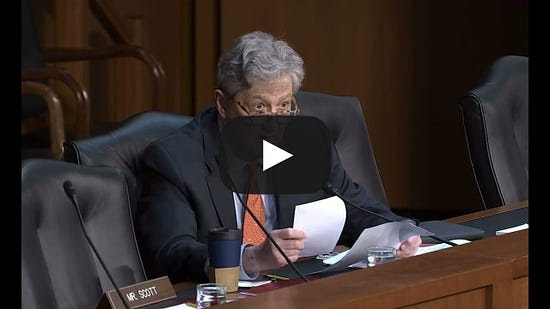
So when it came time for Senator John Kennedy—a heavily oil-funded Republican from Louisiana—to question Supran, one might have expected him to take issue with Supran’s sources or claims.
Instead, Kennedy attempted to discredit Supran personally, by tangentially associating him with a climate activist group that routinely calls politicians potty-mouth names. (The horror!)
[vid]
In an attempt to cast doubt on Supran’s credibility as an academic, Kennedy accused him of making social media posts “in support of” the youth-led direct action group Climate Defiance.
Kennedy:On December 14th, 2023, you tweeted in support of Climate Defiance. That's an entity that the Brookings Institute has called a “radical climate change group.” Is that correct?
Supran:I don’t recall, I’m afraid.
Kennedy:Would this be the same Climate Defiance—I'm looking at your tweet, you tweeted in support of them—that called, Senator Joe Biden a “sick fuck?”
Supran:I don’t know.
Kennedy:Would this be the same Climate Defiance that called Senator Lisa Murkowski a “murderer?”
Supran: I don’t know, but as I said in my statement…Kennedy:Would this be the same Climate Defiance who told the CEO of Exxon to “Eat shit, Darren?”
Supran:I’m not responsible for the statements of others.
Kennedy:Nice group you’re hanging around with, doc.
Visibly confused by the accusation, Supran asked to see the tweets in question. While he waited to receive them, Kennedy cast doubt on Supran’s ability to be objective as a researcher, repeatedly calling him “doc” and “good doctor.”
“Thank you for your ‘objective’ advice, doc,” Kennedy said. “I’d like to submit all of the good doctor’s objective tweets.”
But Supran had never actually posted or re-posted any of the profane name-calling statements Kennedy referenced. Supran had only ever re-postedone tweet from Climate Defiance in December, which had described the group’s preferred method for climate action: chasing down fossil fuel CEOs and politicians, rather than sending letters or signing petitions.
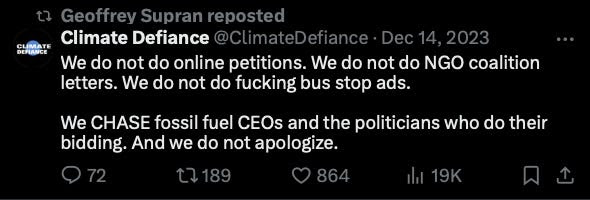 |
Kennedy was using Supran’s re-tweet of Climate Defiance to associate the academic with everything the activist group has ever said. “The line of questioning itself was a bad faith, ill-mannered, and failed attempt to bait me,” Supran told HEATED. “It is unfair and unrealistic for anyone to be held accountable for everything that an independent organization has ever said.”
At the time, though, Supran did not have a chance to explain or clarify this. He only interjected: “These are not my tweets. These are retweets”—which made it seem like he had, in fact, retweeted a statement calling Joe Biden a “sick fuck.”
To this, Kennedy exploded. “Do you often retweet stuff you don't support?” He said. “Is that what you're telling me, doc?”
“I just want to say, this form of character assassination is characteristic of the propaganda techniques of fossil fuel interests,” Supran said.
“Are you gonna call me a sick fuck??” Kennedy replied.
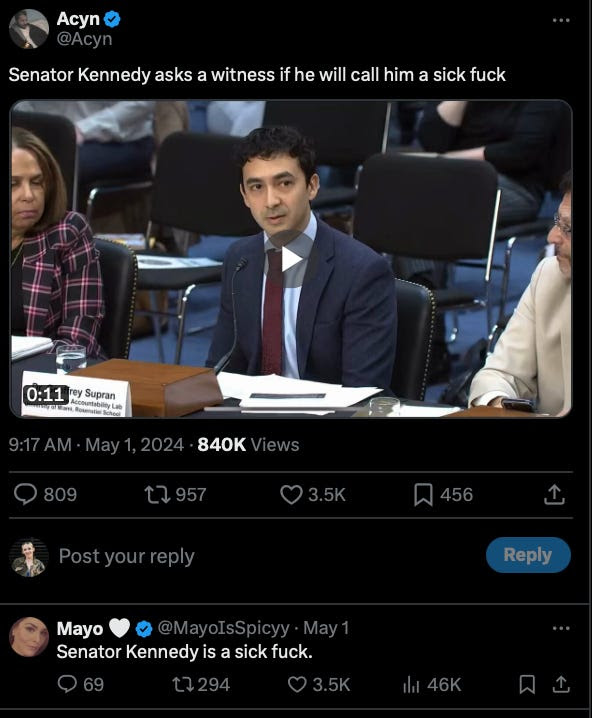
Shortly afterward, video clips of Kennedy’s “sick fuck” remark went viral—but not because of outrage at Supran.
 |
Source: X
In fact, they went viral in part because they were re-posted by Climate Defiance as a fundraising tool.
“We really struck a nerve,” the group said in an e-mail blast to its supporters about the exchange.
Indeed, Climate Defiance founder Michael Greenberg told HEATED that Kennedy’s meltdown was a powerful endorsement of his group’s aggressive tactics.
“It shows that this stuff is working and getting under peoples skin, and making people in power squirm,” he said. “The fact that an oil-funded Senator from Louisiana is referencing a group of young, broke kinds fighting for their lives shows the power of the movement we’re creating and the change we’re making.”
As for Supran, he told HEATED in a statement that he hopes the exchange can serve as an unorthodox educational tool:
More important than the Senator’s theatrics themselves is how they typify the hostile tactics that the fossil fuel industry and its allies have resorted to for decades to attack not just the message but the messenger.
It’s straight out of Big Tobacco’s playbook. In fact, research by John Cook and his colleagues has shown that character assassination has been one of the most common ways in which fossil fuel interests have attempted to deny accountability for the climate crisis.
The Senator’s behavior is also living proof of the influence of oil money on American politics. As I mentioned in my testimony, scholars at Yale and Cambridge have statistically shown that the more Congresspeople vote against the environment, the more money they get from oil companies.
Perhaps it’s just a coincidence that Senator Kennedy has taken $1.5 million from the oil and gas industry.
[vid]
5 24
algae pgm cancelled 2023
randall davis methane
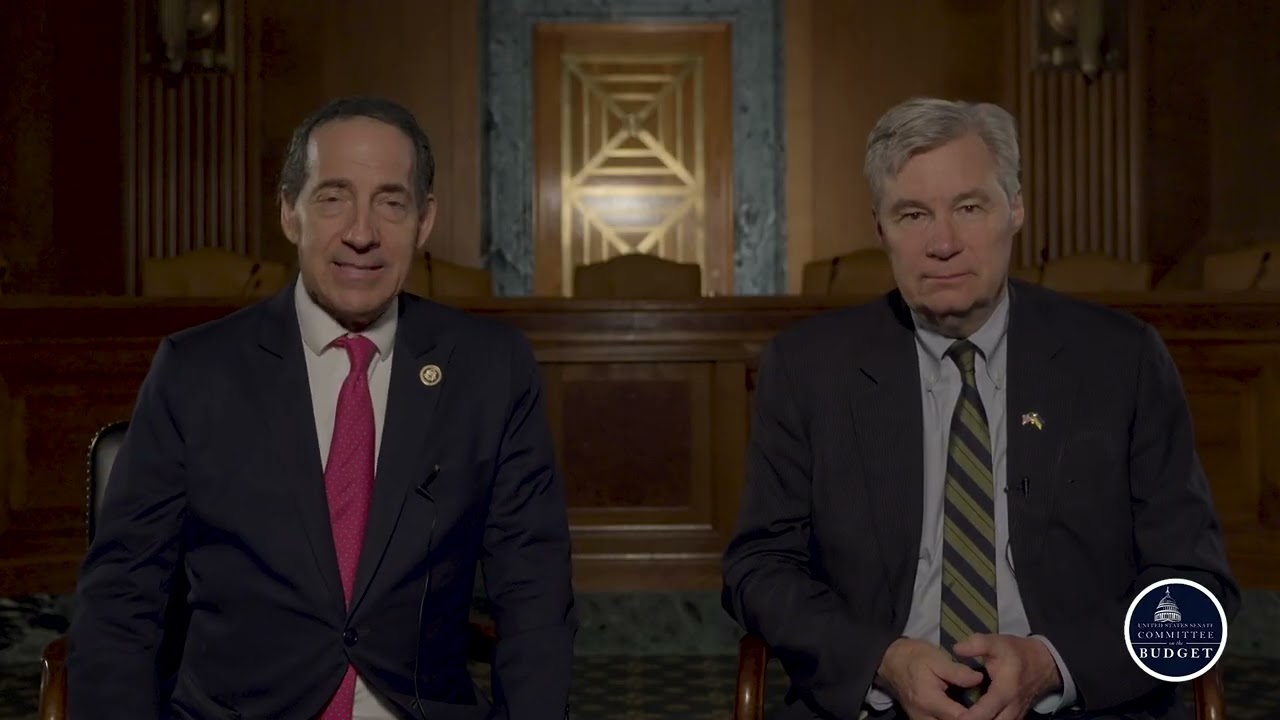
representative Jamie Raskin, left, and Senator Sheldon Whitehouse, right, speak in a video played during today’s hearing, Denial, Disinformation, and Doublespeak: Big Oil’s Evolving Efforts to Avoid Accountability for Climate Change.
A congressional investigation into Big Oil’s ongoing climate deception was revived yesterday with the release of thousands of documents and a joint report by the House and Senate members that further exposed the industry’s campaigns of “deception, disinformation, and doublespeak.”
In a Senate Budget Committee hearing chaired by Sheldon Whitehouse, witnesses drew parallels between Big Oil and Big Tobacco, lawmakers demanded accountability for the fossil fuel industry, and a former U.S. Department of Justice attorney suggested the agency could bring legal action against Big Oil.
“Fossil fuel companies publicly claim to be partners, if not leaders, in fashioning climate solutions, but our investigation exposed that as a fraud,” said House Oversight and Accountability Committee ranking member Jamie Raskin, who co-released the latest congressional findings and was the lead witness at today’s hearing. “Big Oil is not addressing the climate crisis, but profiting from it.”
The newly released documents reveal a lengthy pattern of oil companies publicly pledging their commitment to climate solutions while privately dismissing any intention to follow through.
One 2017 email from a BP executive ruminating on whether the U.S. might stay in the Paris Agreement offers a glimpse into the company’s view of participation in actions to address the climate crisis.
“All the benefits and few of the risks… no one is committed to anything, other than to stay in the game,” wrote global head of Sustainability and Climate Policy, Partnerships, and Stakeholder Relations Paul Jefferiss.
That same attitude was present in the companies’ own tactic of handling climate pledges. In an internal discussion two years later on how to respond to a press request for comment, Jefferiss said that “it goes a bit too far to state or imply support for net zero by 2050, because that would require policy likely to put some existing assets at risk, and we haven’t discussed that internally.” Still, he noted, “we need to stand by our public support for the Paris goals and the achievement of net zero.”
The evidence was first obtained after the House Oversight Committee subpoenaed Exxon, Chevron, Shell, BP, the American Petroleum Institute, and the U.S. Chamber of Commerce after launching that investigation in 2021, adding to a growing arsenal of proof that the companies and trade associations worked to minimize the dangers they knew fossil fuels would cause.
 |
“Talk green, act dirty”
The latest release of documents show oil companies using partnerships in academia to launder their greenwashing of fossil fuel products as climate solutions under the guise of university credibility — despite the companies’ internal knowledge of those products’ harm. One 2018 draft presentation from BP marked “Confidential” lays out a plan by the company to “advance and protect the role of gas — and BP — in the energy transition,” and recommends that BP fund Princeton University and Imperial College white papers that would posit “the role of gas as a friend to renewables.”
But BP knew that “Gas doesn’t support climate goals when you take methane emissions into account,” as stated by the title of another slide in that same presentation, featuring articles tying methane emissions from gas to climate change.
The committee’s probe is already having an impact. After E&E questioned Stanford about pre-publication access to research the university offered the American Petroleum Institute in 2017, as revealed in one of the committee’s unearthed documents, Stanford said it would begin an investigation into that research program.
The report also detailed the companies’ promotion of “pie in the sky technologies,” as Raskin put it this morning, like carbon capture and storage (CCS) and algae biofuels.
ExxonMobil spent upwards of $175 million dollars advertising their research into algae as a climate fix — almost half the $350 million it spent on actual research and development — even while admitting internally that the technology was “still decades away from the scale we need,” according to documents previously released through Congress’s investigation. After years of campaigns to promote algae and, in so doing, distract from the company’s growing investments in fossil fuels, the company dropped its funding of algae research projects last year.
New documents show Exxon employees hedging over algae advertisements they knew were misleading. “Need to be mindful that we’re not suggesting it’s ready to go large scale demo,” one employee emailed in a thread on a TV ad on algae that CEO Darren Woods had already “endorsed.”
“They were careful about the words to make sure it is indicating we hope to one day get there,” another employee responded. “The challenge is that the images have to be visually stimulating to get the audience engaged… it tested very well.”
Other documents spotlight Exxon’s CCS advertising campaigns that both feature and target young people through a “Kids series.”
“Kids is an over-performer in terms of our content. It humanizes ExxonMobil and is in an unexpected format,” said the company’s Digital and Social Media Manager, Jayme Meyer, in a 2019 email chain with Exxon’s Public and Government Affairs group.
“De-emphasize concept that catching carbon is difficult or hard,” Meyer writes in a summary of the group’s feedback. The solution provided in the email: end cards that say “Carbon capture and storage: Making a difference for future generations.”
As ExxonKnews and The Leverreported last week, Exxon is one of many oil and gas companies pushing to scale back new safety rules for carbon dioxide pipelines as the industry races for IRA tax credits from experimental CCS projects. Previous documents obtained by Congress show the companies internally admitting that though CCS is “complex, costly, and will require additional power,” it will “enable the use of petroleum and natural gas” for years to come.
“As a scholar of disinformation, I do not use the word ‘lie’ lightly, but no other word adequately describes the oil industry’s brazen efforts to mislead the public,” said Geoffrey Supran, a scholar of climate disinformation and director of Climate Accountability Lab at University of Miami, told Senators this morning during testimony.
The investigation further revealed how oil companies internally viewed the crisis their products were causing while they touted their ambitions to fight climate change. “The Challenge of Climate Change,” according to one 2016 presentation created by a Princeton researcher funded through BP’s Climate Mitigation Initiative, is the risk it posed to BP’s “core business” through a transition to cleaner sources of energy. That’s because “effective climate policies can emerge that discourage fossil fuel consumption… and that subsidize or otherwise promote efficiency and low carbon energy.”
BP, along with the other major oil companies, would use trade associations to lobby “against pro-climate legislation and regulations that they publicly claimed to support,” according to the House and Senate committees’ report. During a prior Congressional hearing in 2021, CEOs from all six entities refused to stop spending money to oppose climate action.
It’s “greenwashing 101,” said Supran: “talk green, act dirty.”
As payoff for its efforts to keep Americans hooked on a fossil fuel economy, the industry now reaps $750 billion in subsidies each year, Senator Whitehouse said in his opening remarks.
“What is protecting the massive fossil fuel subsidies? And what is preventing policies to reduce danger? It’s the same thing: the fossil fuel industry itself,” Whitehouse said.
All six entities obstructed the investigation, redacting thousands of documents unnecessarily and completely withholding many more, Whitehouse said.
The case for DOJ to step in
Sharon Eubanks, the former lead counsel for the Department of Justice who won the agency’s historic lawsuit against Big Tobacco, said during her testimony today that she observed “striking similarit[ies]” between the actions of the tobacco industry and those of the oil industry today — including the funneling of money into promoting “fake science,” and lying to the public and regulators “about what they knew about the harms of their products and when they knew it.”
Following the new revelations, Eubanks said there was “solid evidentiary basis to support more information being gathered on these companies, just as the Department of Justice investigated the tobacco industry and ultimately filed a civil racketeering case.”
“Complaints against the industry have similarities in the fraudulent acts and the government was successful in the tobacco case, so there is certainly an adequate legal foundation for litigation against this industry,” she said.
Last year, nearly two dozen House and Senate members wrote letters to Attorney General Merrick Garland urging the Department of Justice to either sue or investigate Big Oil for potential violations of federal law. In January, Representative Ted Lieu toldExxonKnews that new evidence of Shell’s early knowledge of climate change “provide additional evidence and make our calls for an investigation even more urgent.”
The mounting evidence released by Congress could provides even more fuel behind those requests.
As Raskin pointed out, holding the tobacco industry accountable in court had major implications for public health and safety. “The companies were ordered to cease and desist their propaganda and to start telling the truth,” he said. “Just insisting upon the truth has saved millions of lives.”
New lawsuits have been filed against Big Oil since Congress began its investigation — and some of those complaints cite documents obtained through congressional subpoenas, including by the City of Chicago, Pennsylvania’s Bucks County, Puerto Rico municipalities, and the Shoalwater Bay Indian Tribe.
Patrick Parenteau, a law professor at Vermont Law School, said the latest evidence could play a role in the lawsuits and eventually be considered at trial. “The case for recovery of damages is getting stronger all the time,” he said.
===
https://phys.org/news/2023-01-exxon-knew-decades-climate-science.html
New study puts a number on what 'Exxon knew' decades ago about climate science
 Summary of all global warming projections reported by ExxonMobil scientists in internal documents and peer-reviewed publications between 1977 and 2003 (gray lines), superimposed on historically observed temperature change (red). Solid gray lines indicate global warming projections modeled by ExxonMobil scientists themselves; dashed gray lines indicate projections internally reproduced by ExxonMobil scientists from third-party sources. Shades of gray scale with model start dates, from earliest (1977: lightest) to latest (2003: darkest). Credit: Geoffrey Supran
Climate projections reported by ExxonMobil scientists between 1977 and 2003 were accurate and skillful in predicting subsequent global warming and contradicted the company's public claims, a new Harvard study shows.
In the first ever systematic assessment of the fossil fuel industry's climate projections, researchers at Harvard University and the Potsdam Institute for Climate Impact Research have put a number on what 'Exxon knew' decades ago about climate science: that fossil fuel burning would lead to 0.20 ± 0.04 degrees Celsius of global warming per decade.
The findings, published in the peer-reviewed journalScienceand summarized by a single chart displaying every global warming projection reported by Exxon and ExxonMobil Corp scientists between 1977 and 2003, are based on statistical analyses of never-previously reported data buried in the company's own documents.
Although it has been widely reported that Exxon has known about the threat of global warming since the 1970s, this study is the first quantitative review of the company's early climate science. Previous research focused on Exxon's inconsistent internal and external rhetoric on climate change. This report dives into company data revealing that the company knew how much warming would occur with startling accuracy.
"We find that most of their projections accurately forecast warming consistent with subsequent observations," the report concludes. "Their projections were also consistent with, and at least as skillful as, those of independent academic and government models."
Using established IPCC statistical techniques, the study finds that 63-83% of global warming projections reported by ExxonMobil scientists were consistent with subsequently observed temperatures. Moreover, projections modeled by ExxonMobil scientists had an average 'skill score' of 72 ± 6 %, with the highest scoring 99%. For comparison, NASA scientist Dr. James Hansen's global warming predictions presented to the U.S. Congress in 1988 had skill scores ranging from 38% to 66%. (When we account for differences between forecast and observed atmospheric CO2 levels, the 'skill score' of projections modeled by ExxonMobil scientists was 75 ± 5%, with seven projections scoring 85% or above. Again, for comparison, Hansen's 1988 projections had corresponding skill scores of 28 to 81%.)
The study finds that "Exxon and ExxonMobil Corp also correctly rejected the prospect of a coming ice age, accurately predicted when human-caused global warming would first be detected, and reasonably estimated the 'carbon budget' for holding warming below 2°C. On each of these points, however, the company's public statements about climate science contradicted its own scientific data."
The study adds weight to ongoing legal and political investigations into ExxonMobil.
"These findings corroborate and add quantitative precision," the authors write, "to assertions by scholars, journalists, lawyers, politicians, and others that ExxonMobil accurately foresaw the threat of human-caused global warming, both prior and parallel to orchestrating lobbying and propaganda campaigns to delay climate action, and refute claims by ExxonMobil Corp and its defenders that these assertions are incorrect."
"This is the nail-in-the-coffin of ExxonMobil's claims that it has been falsely accused of climate malfeasance," commented lead author and Harvard University Research Associate Geoffrey Supran (Supran began as an Associate Professor of Environmental Science and Policy at the University of Miami's Rosenstiel School of Marine, Atmospheric, and Earth Science Jan 2023). "Our analysis shows that ExxonMobil's own data contradicted its public statements, which included exaggerating uncertainties, criticizing climate models, mythologizing global cooling, and feigning ignorance about when—or if—human-caused global warming would be measurable, all while staying silent on the threat of stranded fossil fuel assets."
The paper's Acknowledgments state that this research was supported by Harvard University Faculty Development Funds and by the Rockefeller Family Fund.
More information: G. Supran, Assessing ExxonMobil's global warming projections, Science (2023). DOI: 10.1126/science.abk0063. https://www.science.org/doi/10.1126/science.abk0063
Journal information: Science
===
===
LAWMAKERS STUDY BIG TOBACCO PERJURY BEFORE BIG OIL SHOWDOWN
October 27, 2021
:{
In The News
:{
Corbin Hiar
In April 1994, seven top tobacco CEOs testified to Congress that they didn’t believe nicotine was addictive. Two years later, they were all under federal investigation for potentially lying under oath and no longer leading their embattled cigarette companies.
Democrats believe the oil industry and trade association leaders appearing tomorrow at a high-profile hearing on climate change disinformation could meet a similar fate.
“The evidence is so incontrovertible that they’re going to really have a strong choice,” said Rep. Ro Khanna (D-Calif.), whose Oversight subcommittee is hosting the event. “Do they risk coming close to the line, to committing perjury, and go the way of the tobacco executives? Or do they do a full mea culpa and admit all of the wrongdoing and commit to change?”
But the political landscape today could make it harder for Khanna and Oversight and Reform Committee Chair Carolyn Maloney (D-N.Y.) to have the same swift impact as their counterparts did nearly three decades ago, according to congressional experts.
Maloney and Khanna, whose perjury warningcame during a call this week with the political action group Our Revolution, will face challenges from the unusual nature of the event. While they plan to preside over the hearing from behind the imposing dais of the hearing room, no witnesses will be seated at the table below them.
Because of remote hearing rules instituted at the beginning of the pandemic, the heads of Exxon Mobil Corp., Chevron Corp., BP America Inc., Shell Oil Co., the American Petroleum Institute and the U.S. Chamber of Commerce will all testify remotely. That’s despite the fact that API and the Chamber are both based in Washington (:{E&E Daily:(style="box-sizing:border-box"):}:, Oct. 25).
Democrats had initially asked the officials to appear in person. But Republicans on the committee objected, accusing the majority of treating the executives differently than other recent witnesses “simply because Democrats do not like them or want a photo opportunity.”
The hybrid format is likely to affect more than optics. For starters, it could ease the pressure on the industry witnesses.
“It’s a pretty different situation, isn’t it, testifying in your office or somewhere with your team around you rather than under the lights and cameras, in front of a live audience?” said Geoffrey Supran, a research associate at Harvard University.
Digital complications could also make it harder for Democrats to effectively cross-examine the executives in the limited time allowed by congressional rules.
“There’ll be delays and you talk over someone and then they didn’t hear the previous thing and then the time’s up,” said Supran, who’s studied the history of climate politics and met with Oversight staffers prepping for the hearing. “I definitely don’t think it will be a walk in the park.”
Then after the event, it may be harder than in the past for any revelations to reverberate widely, experts say. That’s because the U.S. information ecosystem has become increasingly fragmented, with a proliferation of partisan cable news channels and social media echo chambers.
“You wonder whether there’s really many people whose minds would be changed one way or the other by whatever comes out of the investigation,” said Michael Stern, a former Republican congressional lawyer who wrote a case study of the tobacco investigation. “The people who support the Democrats will believe the worst about the oil companies, and the people who oppose them won’t care.”
‘RIGHT IN FRONT OF YOU’
The oil and gas CEOs — whose companies provide the fuel, heat and power relied upon by millions of Americans — are also likely to be more difficult to villainize than cigarette chiefs.
“There is no redeeming argument to make for tobacco. It is clearly the leading cause of death and disease that is preventable,” said former Rep. Henry Waxman (D-Calif.), who led the 1994 hearing and has been talking with Khanna ahead of tomorrow’s event.
“Oil and other fossil fuels are part of our energy supply, which we depend on for the good of our economy,” he told E&E News. “But for the good of our planet, we’ve got to move away from them.
“What I think Congressman Khanna has got to do isshow that internal discussions by some of the people in the oil industry [aimed] to continue to mislead and deny the facts of what they were trying to do, which was to deny there was a connection between fossil fuels and climate change,” Waxman said.
Inside Climate News and other outlets have reported that Exxon and other oil majors were aware that burning oil, gas and coal is the primary driver of global warming. But the companies didn’t publicly acknowledge that fact for decades and gave tens of millions of dollars to groups that denied climate change or promoted discredited theories of why it is occurring.
It may be difficult for Khanna to shed new light on that history tomorrow. During the Our Revolution call, the Environment Subcommittee chair said the witnesses “have not been very cooperative in producing documents.”
“We’re prepared with a lot of evidence,” he said, but it’s “all frankly in the public record.”
After this story was published, Exxon pushed back on the claims of Waxman and Khanna.
“ExxonMobil has long acknowledged that climate change is real and poses serious risks,”spokesman Casey Nortonsaid in a statement. “We have been in communication with committee staff for months and have cooperated with the request for documents.”
If history is a guide, the hearing could shake loose additional internal documents.
Waxman recalled how, after the tobacco executives claimed they didn’t believe nicotine was addictive, “people within the industry started coming forward to say that they knew better.” Former Brown & Williamson Tobacco Corp. Vice President Jeffrey Wigand, for example, didn’t publicly reveal how the company had manipulated the nicotine levels in its cigarettes until a 1996 interview with the TV show “60 Minutes.”
It’s also difficult to immediately know which moments in an hours-long hearing will matter in the long run.
Sen. Ron Wyden (D-Ore.), who in 1994 was a junior member of Waxman’s Energy and Commerce subcommittee, said he only got tobacco executives to weigh in on nicotine because he realized no one else had done so.
“That really led to the $250 billion tax settlement with Medicaid, which meant millions of people got health care, because that question was asked,” he told reporters yesterday.
“Sometimes the question that really breaks it open is a simple one,” Wyden said. “It’s really right in front of you.”
}:}:
===
https://www.latimes.com/opinion/story/2021-10-27/op-ed-big-oil-congress-hearings
LAT no lnx
OPINION
Op-Ed: Will Congress expose Big Oil like it did Big Tobacco in the ’90s?
BY PATTI LYNN AND GEOFFREY SUPRAN
OCT. 27, 2021
On Thursday, executives from six major oil and gas corporations and trade associations — collectively dubbed the “Slippery Six” by advocates — will testify to Congress about their decades of climate denial and propaganda. The House Oversight Committee’s hearing, led by Reps. Carolyn Maloney (D-N.Y.) and Ro Khanna (D-Fremont), will consider testimony from leaders at ExxonMobil Corp, BP America, Chevron Corp. and Shell Oil, alongside the presidents of the U.S. Chamber of Commerce and American Petroleum Institute.
The outcome will be one indication of whether the fossil fuel industry’s lobbying-fueled stranglehold on science-based decision-making can be loosened in time to meaningfully confront the climate crisis. Twenty-seven years ago, similar hearings featuring tobacco industry executives led to litigation by 52 U.S. states and territories and industry restitution to the public. The stakes this time are at least as high: trillions of dollars in predicted loss and destruction from climate change. Big Oil is due its Big Tobacco moment.
FILE - In this Saturday, Sept. 18, 2021 file photo, emissions rise from the smokestacks at the Jeffrey Energy Center coal power plant as the suns sets, near Emmett, Kansas, United States. The world needs to more than halve production of coal, oil and gas in the coming decade to maintain a chance of keeping global warming from reaching dangerous levels, according to a U.N.-backed study released Wednesday. The report published by the U.N. Environment Program found that while governments have made ambitious pledges to curb greenhouse gas emissions, they are still planning to extract double the amount of fossil fuels in 2030?than what would be consistent with?the 2015 Paris climate accord’s goal of keeping global temperature rise below 1.5 Celsius (2.7 Fahrenheit). (AP Photo/Charlie Riedel, File)
WORLD & NATION
Despite climate pledges, countries are upping fossil fuel production plans, study says
Oct. 20, 2021
In 1994, tobacco executives stood before Congress and lied about the addictiveness of their products. The hearings had a ripple effect. As the tobacco industry’s history of deceit and harmful products was laid bare, its public credibility crumbled. Further legal action against tobacco companies ensued, most notably the Master Settlement Agreement four years later, which required the industry to pay out a minimum of $206 billion over the next 25 years. Laws were passed to curb youth addiction, and smoking rates fell.
Though insufficient to redress the lives lost, livelihoods ruined and staggering healthcare costs of tobacco, especially among low-income communities and communities of color, the agreement set a precedent for Congress to investigate an industry network that has misled the public and policymakers in an effort to deny the dangers of its products and derail regulation. The MSA required corporations to absorb some of their “externalized costs” for society, and complementary litigation yielded millions of damning internal documents.
This week lawmakers have a similar opportunity to accelerate corporate accountability, legal scrutiny and political progress — this time on the climate crisis. Over the past seven years, journalists and scholars (including one of us) have uncovered overwhelming evidence that ExxonMobil, Shell, Total, the American Petroleum Institute, the coal industry and other groups invested in fossil fuels have known for decades that their products could cause dangerous global warming.Yet, rather than warning the public or taking action, they waged disinformation and lobbying campaigns in efforts to mislead the public and undermine climate policies. From strategy to networks to personnel and rhetoric, these efforts to deny and delay come straight from Big Tobacco’s playbook.
In fact, Massachusetts, Rhode Island, Minnesota, the District of Columbia, New York City and over 20 other cities and counties have already sued ExxonMobil and other fossil fuel corporations for fraud, damages or denial.Advocates around the world are also pursuing legislative and regulatory action beyond the courtroom, such as establishing ecocide as an international crime.
In some cases, attribution science, which can assess the impact of global warming on extreme weather and trace emissions and climate damages to corporations, is making it easier to quantify the economic damages owed. In recent decades, nearly two-thirds of greenhouse gas emissions, more than 40% of temperature rise and more than 25% of sea level rise trace back to 90 major industrial carbon producers.
FILE - In this May 1, 2009 file photo, a crew member arrives by boat at th offshore oil drilling platform "Gail", operated by Venoco, Inc., off the coast near Santa Barbara, Calif. Leaders in the California Senate say they are introducing legislation to thwart President Donald Trump's attempts to expand offshore drilling through an executive order he signed Friday, April 28, 2017. (AP Photo/Chris Carlson, File)
[OPINION
Op-Ed: How Congress could curtail the Big Oil gravy train
Sept. 22, 2021]
The oil executives will likely do everything in their power to deflect attention away from this record. But members of Congress should force the CEOs to make a choice: Admit to their companies’ lies and risk further exposing themselves to legal scrutiny, or lie about past lies on climate science — a path in line with Big Tobacco’s undoing.
Historical parallels to tobacco industry tactics suggest that fossil fuel bosses may try to avoid getting caught in their own web of denial by calling climate change a “risk,” rather than what it is: real and human-caused. Tobacco historian Robert Proctor calls this hedging strategy “a kind of legal having-it-both-ways: an admission strong enough to ward off accusations of having failed to warn, yet weak enough to exculpate from charges of having marketed a deadly product.”
Expect also to see the Slippery Six shifting blame away from themselves and onto consumers by presenting the fossil fuel industry as an innocent supplier simply satisfying customer demand, and by positioning oil and gas companies as trustworthy innovators to be relied upon to invent silver bullet techno-fixes for this crisis. Front and center will be companies’ “net zero” pledges, which are inconsistent with the Paris agreement’s goal of holding global warming below 1.5 degrees Celsius, and which rely on economically unproven negative emissions technologies and offset schemes.
These messages of individualized responsibility and fossil fuels as the solution yield a “fossil fuel savior” framing of the climate crisis — again reflecting the playbook of Big Tobacco, which blames customers for choosing to smoke.
Lawmakers must see through Big Oil’s smoke and mirrors. As many politicians work tirelessly to build back greener and more equitably, let Thursday be the moment when they begin to take on the fossil fuel forces standing in the way.
Patti Lynn is executive director of Corporate Accountability, a nonprofit. Geoffrey Supran is a research fellow in the Department of the History of Science at Harvard University and director of climate accountability communication for the Climate Social Science Network.
===
===
https://yyy.theguardian.com/business/2020/jan/08/oil-companies-climate-crisis-pr-spending
no lnx nice gfx brulle
How the oil industry has spent billions to control the climate change conversation
‘From my perspective every indication of this evidence is once that closet door gets blown open, the skeletons are going to come tumbling out,’ said Geoffrey Supran.
Activists say Democratic climate proposals won’t be able to pass until lawmakers put a stop to oil companies trying to rebrand themselves
Emily Holden in Washington
Wed 8 Jan 2020
America’s oil companies are trying to rebrand themselves as part of the solution to the climate crisis, launching a campaign to counter top Democrats’ proposals to rapidly cut pollution from the power plants and cars that run on the industry’s petroleum and natural gas.
They say natural gas – a fossil fuel that emits heat-trapping carbon dioxide – is helping to slow climate disruption by providing an alternative to coal.
How vested interests tried to turn the world against climate science
Read more]
“We’re taking our message of energy progress to every corner of the country to show just what’s at stake in Washington and in state capitols around the country,” said Mike Sommers, CEO of the oil trade group the American Petroleum Institute (API), on a press call announcing the plan.
The campaign is part of a strategy in which the oil industry has funneled billions of dollars into its defense, threatening to outpace climate action advocates, say frustrated environmental activists who are increasingly calling on Democrats in Congress to take a tougher line on the sector.
But Sommers depicted a dark future if a presidential candidate who wants to ban fracking for natural gas wins the 2020 election: millions of jobs lost, hundreds of billions of dollars more for household energy costs and a global recession.
However, opponents of the industry say the only path to significant US climate action is through legislation and that lawmakers won’t be able to legislate unless they reveal how the industry has controlled the public dialogue around climate change and put a stop to its misdeeds.
Geoffrey Supran, a research associate who studies global warming politics at Harvard University, is urging House committees to demand more information from oil companies about their influence over public policy.Supran said obtaining corporate documents is “one of the most important actions Congress could take to address the climate crisis”.
“The reality is that as much as we know about fossil fuel interests’ denial and delay, we’ve really found those skeletons in the closet just by looking through a tiny keyhole – everything we know is based on just a few hundred documents scrounged from various sources,” Supran said. “From my perspective every indication of this evidence is once that closet door gets blown open, the skeletons are going to come tumbling out.”
Walking through Washington’s national airport this holiday season, travelers saw a type of advertisement that is becoming more mainstream – it pops up on social media, in commercial breaks for streaming video services, in newspapers and on the radio.A friendly-looking older woman in a hard hat beams at the camera. “Thanks to natural gas, the US is leading the way in reducing emissions,” the sign reads.
The ad campaign, called We’re On It, is sponsored by API – which represents the oil companies that have contributed significantly to the climate crisis.
While it’s true that US climate pollution is declining in large part because of the switch from coal to natural gas, scientists say far more drastic action is needed to slow climate change. And forecasts show natural gas threatening continued progress.
As the American public has become more aware of the climate crisis, oil companies have fought back.
:{
}:
Over roughly the last three decades, five major US oil companies have spent a total of at least $3.6bn on advertisements – not counting their investments in public relations programs like sponsored beach clean-ups, or their influence through trade associations, dark money groups and campaign donations.
Activists gather with signs outside the American Petroleum Institute during the global climate action week in Washington DC, on 23 September 2019.]
Advertising spending has increased as politicians have paid more attention to climate change and API’s campaign comes as progressive candidates bidding for the White House, such as the US senators Bernie Sanders and Elizabeth Warren, propose to ban fracking – a drilling method that has unlocked huge supplies of natural gas and driven down the cost of the fuel.
Any renewed investigation from Congress could reveal more about how the industry has tried to sway public opinion.
Investigative reporting has already shown that Exxon has known since at least the 1960s that its products were causing global warming. But Exxon has fought back, saying it is the victim of “a coordinated campaign perpetuated by activist groups with the aim of stigmatizing ExxonMobil”.
Exxon touts itself instead as an answer to the climate crisis. The top advertisement on Exxon’s YouTube page touts research on making biofuels from algae in order to cut climate pollution, but the technique is currently prohibitively expensive, and the research represents a tiny portion of Exxon’s budget.
In response to questions from the Guardian, an Exxon spokesman, Casey Norton, said Exxon is “committed to doing our part”.
“The world faces a dual challenge: meeting growing demand for energy while also reducing environmental impacts, including the risks of climate change,” Norton said.
Norton maintains that “all forms of energy are needed”, including natural gas and renewables, although scientists have concluded humans will have to stop using fossil fuels entirely to stem the crisis.
In the call with reporters, API’s CEO took a similar stance. He acknowledged the industry has a responsibility to help slow emissions that are causing rising temperatures, but he said the demand for affordable energy is growing and American fossil fuel companies will meet it.
Pressed to commit to any significant goal to curb emissions, Sommers said API could back some bipartisan legislation to incentivize technology that would capture carbon dioxide so that it cannot enter the atmosphere.[big pilot subsidized clean coal boondoggle just concert to anga]
“That’s legislation that’s supported by far-right Republicans and far-left Democrats, but it’s some place in the middle where we think we can meet and we can work together on this key priority,” Sommers said.
Critics of the oil industry say the Democrat-led House should be aggressive in seeking to counter the industry’s narrative. Some want Democrats to call executives into hearings and subpoena internal records about their influence campaigns – one of the most powerful tools available to Congress.
But that hasn’t happened. Instead of going directly for the oil companies, House committees have instead been holding dozens of hearings and introducing legislation about ways to cut pollution and help people affected by the climate crisis.
“Our oversight staff decided that OK, rather than kind of punching an industry that’s already pretty down in the public image, there are plenty of other things they also needed and wanted to pursue, so subpoenaing big oil just didn’t really rise to the top of the heap,” the staffer said.
Supran, who works with Harvard climate politics expert Naomi Oreskes, says they have a collection of information that could help Democrats determine which questions to ask and which documents to demand.
“Historical record points to a number of individuals, documents, and questions that could help Congress get to the bottom of how the fossil fuel regime misled America,” Supran said.
The other route – which Democrats are already pursuing – is state lawsuits against companies. But those challenges could take much longer and aren’t guaranteed to succeed.
Robert Brulle, a visiting professor of environmental sociology at Brown University who co-authored the research tallying oil spending on ads, said the findings are just the tip of the iceberg. Brulle has previously found that more than $2bn was spent lobbying Congress on climate legislation between 2000 and 2016.
He says lawmakers should investigate the oil industry the way the former congressman Henry Waxman took on tobacco companies in the 1990s.
“I think what we’ll find is that the fossil fuel campaigns are going to dwarf what the tobacco industry did. It’s an order of magnitude larger,” Brulle said.
Some accuse Democrats of fearing a backlash from the oil industry – which still donates to Democratic campaigns. They say moderate Democrats might be trying to stay civil with major companies because it will be easier to pass climate legislation with their support.
But it’s hard to imagine the industry backing substantial action that would limit oil production and use – which scientists say is required to avoid catastrophe.
I think what we’ll find is that the fossil fuel campaigns are going to dwarf what the tobacco industry did
Robert Brulle
So far, congressional efforts have only scratched the surface of the sector’s influence. In October, the oversight committee reviewed evidence of how much Exxon has known about the climate crisis and for how long. The Democrat-only climate committee in the Senate also held a hearing on dark money and climate change. The Rhode Island senator Sheldon Whitehouse urged his colleagues in the House to use their majority to get tougher with oil companies – subpoenaing their records if necessary.
“When we catch the fossil fuel industry spending money in these campaigns, we’re only seeing a sliver of the total operation,” Whitehouse said in a more recent interview with the Guardian. “I think it’s hard to counter their message effectively because remember – they have a $600bn annual subsidy that they’re defending, according to the [International Monetary Fund].
“The idea that some other entity, particularly some struggling charitable organization, is going to be able to go toe-to-toe in spending and outspend them is not really feasible.”
Despite fossil fuel companies massive spending, they have continued to lose public support. Elected officials just haven’t followed the shift.
:{
}:
A majority – 60% of Americans – want to “dramatically reduce” fossil fuel use in 10 or 20 years, according to Gallup. And between 2013 and 2019, the percentage of people who wanted to emphasize oil production has dropped from 46% to 28%.
“If you take climate change seriously, then you have to think about what your path is to getting a serious climate bill,” Whitehouse said. “And the path to a serious climate bill requires disabling the fossil fuel industry’s obstruction apparatus that has been the thing that has prevented that from happening.”
===
===
https://mahb.stanford.edu/wp-content/uploads/2021/07/America_Misled.pdf
supran oreskes
Contradictory contrarianism The most common denialist arguments have been shown to contain fatal assumptions or fallacies26. Climate deniers do not offer any rational explanation for why our climate is changing. Rather, denialist arguments are incoherent and often contradictory27. For example, deniers will seize on snowfall to claim that global warming is a hoax, while at the same time claiming that an extreme event such as a drought or wildfire cannot be attributed to climate change. This is incoherent because either extreme events can be a signal of climate change or they cannot be. Climate denial lacks consistency because it is not about scientific evidence—it is about how to continue business as usual in the face of climate disruption. Climate deniers reject climate science because they are averse to proposed or perceived solutions to climate change28.
...
Common Fallacies
Climate denial arguments can be summarized by the five techniques of science denial (summarized with the acronym FLICC): fake experts, logical fallacies, impossible expectation, cherry picking, and conspiracy theories29,30. Fake Experts Logical Fallacies Impossible Expectations Cherry Picking Conspiracy Theories Promoting dissenting non-experts as highly qualified while not having published any actual climate research and/or received any relevant education. Logically flawed arguments that lead to false conclusions. Common logical fallacies are red herrings, non sequiturs, and false dichotomies. Demanding unrealistic standards of certainty before acting on the science. A technique practised by the tobacco industry. Selectively choosing data that supports a desired conclusion that differs from the conclusion arising from all the available data32. Proposing a secret plan among a number of people, generally to implement a nefarious scheme such as conspiring to hide a truth or perpetuate misinformation. Climate deniers are more likely to be conspiracy theorists33
nice graphics throughout eg]
Deconstructing Denial
Figure 7 shows deconstructions of some of the most common myths about climate change. Determining the misleading techniques of a climate myth requires outlining the argument structure: listing any premises (starting assumptions) and the conclusion. This allows one to ascertain whether any premises are false, and/or whether the argument is logically invalid. Figure 7: Deconstruction of common climate myths. MYTH “Cold weather disproves global warming.” Premise 1 CHERRY PICKING IMPOSSIBLE EXPECTATIONS Some place is cold. Premise 2 No place can experience cold during global warming. Conclusion Global warming isn’t happening. Cherry Picking: Ignores that most of the globe is warm. Impossible Expectations: Global warming doesn’t mean cold events don’t happen, just that they’re less likely to happen. MYTH “Global warming stopped in 1998.” SLOTHFUL INDUCTION CHERRY PICKING Premise 1 The temperature trend since 1998 is statistically insignificant. Conclusion Global warming isn’t happening. Slothful Induction: Ignores other temperature records and measures of heat imbalance showing a significant warming trend. Cherry Picking: Trends over short periods do not lead to conclusions about
...
Conclusion Disinformation about climate change has a straightforward purpose—to block action on climate change. In America, it has largely succeeded, with policies to mitigate climate change stymied or delayed for decades. Meanwhile, climate change has intensified, causing impacts such as intensified extreme weather events, rising sea level, harmful effects on human health, and much more. Climate denial has seriously hurt the American people. The damage, deaths, and harm to people will continue to worsen if we don’t expose and discredit denial. This is not the first time that corporations prioritizing profits over people have caused great harm. The tobacco industry spent hundreds of millions of dollars disinforming the public about the health impacts of smoking in order to undermine tobacco control34,35. The World Health Organization estimates that six million people die every year from preventable tobaccocaused disease. Drawing on the tobacco industry’s playbook, fossil fuel companies have done the same on climate change, spending hundreds of millions of dollars confusing the public and delaying life-saving action. Their legacy is the death, destruction, and injustices of irreversible global warming. Big Oil is the new Big Tobacco.
===
===
you know you've made it when they do an infographic on ya:
https://eidclimate.org/activists-admit-climate-litigation-is-about-silencing-dissent-not-justice/
ACTIVISTS ADMIT CLIMATE LITIGATION IS ABOUT SILENCING DISSENT, NOT JUSTICE
DECEMBER 6, 2018 | SPENCER WALRATH
The #ExxonKnew campaign is about shutting down debate and clearing the way for fringe activists’ preferred climate policies, according to a new podcast produced and promoted by the flailing campaign.
The podcast, entitled Drilled,is the latest content inRichard Wiles’ web of climate groups rehashing the same story that’s been debunked again, and again, and again: that Exxon Mobil somehow hid information about climate change in order to continue profiting from petroleum.
But it was what podcast host Amy Westervelt admitted in the eighth episode that was the most revealing:
“Holding the industry accountable for manufacturing climate denial isn’t about finding a bad guy or even strictly about justice, although of course we love a good bad guy … it’s about putting climate denial to rest once and for all and removing key obstacles for action.” (emphasis added)
Westervelt’s admissions comes at a time when climate litigation is being thrown out by federal courts, partially because it is being driven more by politics than any sound legal theory. Westervelt’s comments could be used in the court room to get other lawsuits tossed, by suggesting the cases were brought in bad faith.

Follow the money behind Drilled
Propaganda Campaign
Westervelt calls Drilled a “true-crime” podcast, saying it’s about “one, long-running well-orchestrated campaign that spanned industries. It manipulated not only the media, but various institutions and the general public … I’m talking about patient zero in the U.S. propaganda war: the creation of climate denial.”
Westervelt should know all about propaganda campaigns, given that she’s in the middle of one. Drilleditself is more comedy than serious, investigative reporting, relying on sinister music and a one-sided cast of experts to repeat the same baseless accusations about the energy industry. At no point in her “reporting” does Westervelt note an attempt to reach out to any of the companies that are the subjects of her reporting.
In a rare move for climate activists, however, Westervelt does disclose funding for Drilled—it’s supported, in part, by the Institute for Governance and Sustainable Development. She also discloses that the executive producer is Richard Wiles, the publisher of Climate Liability News (CLN), an activist website designed to promote climate litigation. However, Westervelt never mentions that she writes for Climate Liability News nor does she disclose Richard Wiles’ and the IGSD’s relationship to the Center for Climate Integrity, which supports litigation against the energy industry through the Pay Up Climate Polluters PR campaign.
When All Else Fails, Blame the Russians
One of the most egregious moments in the series is when Katharine Hayhoe, an atmospheric scientist and professor of political science at Texas Tech University, claims that energy companies worked with Russian hackers to obtain scientists’ emails. The fallout—“climate gate”—she asserts, was created to stymie the Copenhagen Summit. Here she is in episode five:
“So, starting in 1988 they had already mobilized—the fossil fuel industry, the Koch brothers, to ask, you know, all of those think tanks and the dark money-funded organizations—they had already mobilized to the extent that once Kyoto came along they knew what to do. And it was dead in the water before it came home. But then with Copenhagen they had Obama, so they were like ‘uh-oh, you know, this guy could actually make something happen. We don’t have a Republican president.’ So, they had to really pull out the stops. And when I say they, it was not just the U.S. I mean, the emails that were hacked from the scientists? You know, that whole kind of ‘Climategate’ thing? That was directly in preparation for Copenhagen and it likely came from the Russians. I mean there’s no definitive answer yet but it’s more than likely, if you had to pick a country, it’d be the Russians.” (emphasis added)
To recap, Dr. Hayhoe made an incendiary and highly charged accusation – that energy companies worked with Russian hackers – andprovided literally no evidence for the claim.
Conflict of Interest for Thee, but Not for Me
Ben Franta, a Stanford Ph.D. student, also makes an appearance in the podcast, joining Westervelt to criticize university research funded by the energy industry:
“When you can successfully fund researchers of your choosing, then you get a whole host of benefits in return. It’s a very kind of multi-dimensional kickback process. So, I mean, for one, you shape the scientific discourse because it might be true that that researcher you’re funding would have done that research anyway, but they probably wouldn’t have done as much of it, because they wouldn’t have had the same resources. Their voice wouldn’t be as prominent because with that funding they gain prominence.”
Franta’s criticism hinges not on whether these researchers are doing bad or illegitimate work, but that they’re able to do more work because they received grants from companies. Franta’s work, meanwhile, is supported by IGSD, a relationship he doesn’t disclose, which makes his research vulnerable to the same criticism he levies against other researchers.
The same goes for Geoffrey Supran, whom Franta describes elsewhere as  .” Supran, the co-author of an op-ed with Franta, also appears in Drilledto discuss his research. Supran’s research (which was strongly criticized by an expert in the field) was funded by the anti-ExxonMobil Rockefeller Family Fund—a fact that also wasn’t disclosed in the podcast.
Coded Language Disguises Prejudice
While the entire premise of Drilledis that energy companies are inherently evil and must be silenced, the podcast and its host would also have you believe that those who oppose fossil fuels have a monopoly on intelligence and rational thought. Here’s the coded language she uses to describe the difference between think tanks who disagree on certain policy matters:
“New conservative think tanks, many of them funded by fossil fuel interests, including Exxon, Koch Industries and Peabody Coal, emerged in the early 1980s and they behaved very differently than the mainstream think tanks, most of which were started by progressives in the early twentieth century.
“In the same way that the new conservative media was bloated and angry where its predecessors had been straightforward and calm, this new breed of think tank was aggressive and opinionated, where the established think tanks had tended to be more scholarly and measured.”
Elsewhere, Westervelt and her guests were more straightforward with their bias. In the podcast’s second episode, #ExxonKnew activist Kert Davies reads from a survey that suggests “older, less educated males from larger households who are not typically active information seekers and are not likely to be ‘green’ consumers” are more receptive to messages that, as Davies puts it, reposition global warming as theory instead of fact. Of course, that line was actuallydescribing an audience receptive to “the statement that some members of the media scare the public about global warming to increase their audience and their influence.” But we digress.
Westervelt interjects: “Hmm, older men who are ‘not active information seekers.’ If you were living in America during the 2016 presidential campaign, that demographic might sound familiar.”
Just Another Prong in Activist Campaign
The timing of Drilled further suggests that this content is driven by its close ties to the PR campaign supporting the climate lawsuits. The podcast launched on November 14, 2018, the same day law firm Sher Edling filed suit in San Francisco on behalf of the Pacific Coast Federation of Fishermen’s Associations (PCFFA). The eight-episode series ends with an in-depth discussion (released on November 18) on how litigation against the energy industry is necessary and righteous for ensuring that climate activists are successful. The final episode features an interview with Noah Oppenheim, the PCFFA’s executive director who has his own ties to climate activist litigation.
It would surprise few if Sher Edling is working hand-in-hand with Wiles’ PR campaign and not disclosing it. Sher Edling has contracted with Resource Media, a non-profit PR firm funded by the Rockefellers, to promote its climate lawsuits. Wiles’ Pay Up Climate Polluters is getting media assistance from M+R, the same PR firm that was hired to promote Boulder’s climate lawsuit.
But take it from the host herself: climate activists aren’t using the court system for justice. They’re abusing it so they can shut down debate and enact their preferred policies. This podcast, like so much else with the climate litigation campaign, is simply another component in a broader PR stunt.
===
ref "expert"
https://eidclimate.org/expert-finds-no-scientific-support-study-claiming-exxon-misled-public-climate-change/
EXPERT FINDS ‘NO SCIENTIFIC SUPPORT’ FOR STUDY CLAIMING EXXON MISLED THE PUBLIC ON CLIMATE CHANGE
MARCH 1, 2018 | SPENCER WALRATH
A widely-covered study that claimed ExxonMobil misled the public on climate change is fatally flawed, according to a bombshell rebuttal published today by one of the foremost experts in content analysis. The original study, authored by Harvard University’s Geoffrey Supran and Naomi Oreskes, relies on data analysis that is “unreliable, invalid, biased, not generalizable, and not replicable,” according to the expert, whose methods were cited by Supran and Oreskes.
The academic rebuttal is the biggest blow yet to the activists-turned-researchers, and follows similar critiques by Energy In Depth and others.
The Supran/Oreskes study alleged that ExxonMobil had obscured the facts on climate change by producing internal research that conflicted with the company’s advertisements. But as Energy In Depth revealed at the time, Supran and Oreskes relied on an incomplete collection of “advertorials” compiled by Greenpeace; mischaracterized documents that acknowledged climate change as being an example of climate denial; and compared the research of Exxon with the “advertorials” of Mobil before the companies merged.
The latest rebuttal was written by Kimberly A. Neuendorf, Ph.D., a Cleveland State University professor with over 40 years’ experience in the field and who literally wrote the book on content analysis. Neuendorf’s textbook was actually cited by Supran and Oreskes as the source for their information on content analysis. ExxonMobil asked Neuendorf to review the Supran/Oreskes paper based on the authors’ reliance on Neuendorf’s methodology, although the company had no editorial control over Neuendorf’s conclusions.
Tom Johnson, a University of Texas journalism professor, told the Daily Callerthat “Neuendorf is one of the preeminent scholars in the field of document analysis.”
“’She literally wrote the book on content analysis and has an invaluable website connected to the page,’ Johnson said without weighing in on the report she conducted for Exxon. ‘She has conducted numerous content analyses. I would put her among the top three trusted sources on this topic.’”
Before delving into what Neuendorf said in her rebuttal, it’s worth recalling a few key facts about Supran and Oreskes.
The *New York Times* has labeled Naomi Oreskes as one of the ringleaders of the #ExxonKnew campaign, in part due to her work co-organizing and participating in the infamous 2012 La Jolla conference, where anti-fossil fuel activists developed their playbook for attacking the energy industry. Oreskes admitted under questioning from Members of Congress that she met with state attorneys general on several occasions to discuss potential investigations of ExxonMobil. She is also closely tied to Matt Pawa, the plaintiffs’ lawyer leading climate lawsuits against ExxonMobil in New York and California.
Supran, meanwhile, is heavily involved in the fossil fuel divestment movement and tried (unsuccessfully) to pressure the American Geophysical Union to disassociate itself with ExxonMobil. In May 2017 Supran suggested in an op-ed on Mashable that the homeless should be doing more to lower their carbon footprints.
Both Supran and Oreskes had publicly established their bias against ExxonMobil well before they published their study. As Energy in Depth wrote last summer:
“In one tweet from 2015, Oreskes wrote: ‘Did Exxon deliberately mislead the public on climate change? Hello. Of course they did!’
“The fact that Oreskes was declaring ExxonMobil was ‘misleading the public’ two years before her study was finished suggests she worked backwards from a conclusion.
“Oreskes has also publicly cheered on the Massachusetts Attorney General for her costly legal investigation into ExxonMobil’s statements on climate change.
“Supran, meanwhile, has tweeted that it’s a ‘sane’ position to suggest that ‘Exxon’s actions may have imperiled all of humanity…It’s time to divest.'”
The Supran/Oreskes study was funded by the Rockefeller Family Fund, the anti-fossil fuel group that has funded every step of the #ExxonKnew campaign, including the series of articles written by InsideClimate News and the Columbia School of Journalism that underpin this study. The study also relied on materials prepared by Rockefeller-funded groups, including Greenpeace and the Union of Concerned Scientists.
In her analysis of the Supran/Oreskes study, Neuendorf pulls no punches, writing:
“After a detailed review of the study, its supplementary information (“SI”), and the documents S&O [Supran and Oreskes] analyzed for their study, I have concluded that S&O’s content analysis does not support the study’s conclusions because of a variety of fundamental errors in their analysis.” (emphasis added)
Neuendorf identifies seven “fundamental flaws” that undermine the study, including non-representative sampling, inappropriate coding, and a heavy reliance on dubious consensus measurement. Adding to criticisms previously raised by Energy In Depth regarding Supran’s and Oreskes’ reliance on documents compiled by Greenpeace, Neuendorf writes:
“In general, there is no explanation of how documents were collected objectively via comparable techniques across document types, and, upon inspection, it is clear that numerous documents were hand-picked and not part of a comprehensive sampling strategy. Indeed, S&O admit that there are ‘countless additional climate change communications from ExxonMobil that could be included in future work’ (p. 2), thus undercutting the integrity of their own sampling.” (emphasis added)
She also had sharp critiques of Supran’s and Oreskes’ reliance on themselves and a fellow anti-fossil fuel activist Ploy Achakulwisut as the sole coders for their study:
“Content analysis coding ought to be conducted with coders who are at arm’s-length with regard to the research, in order to maximize objectivity. Optimally, coders should be blind to the research questions or goals. In the S&O study, the coders were not blind. In fact, they were as non-blind as could be imagined. They were the investigators themselves, as well as an affiliated graduate student. In this particular case, the problematic nature of informed coders is magnified by the coders’ long-time and intensive involvement in the popular communication of climate change. Further, two of the coders have publicly demonstrated particular biases that existed before the execution of the S&O study (Oreskes, 2004; Oreskes, 2015a, 2015b; Oreskes & Conway, 2010; Supran, 2016). (emphasis added)
Neuendorf also took issue with how the documents included in the Supran/Oreskes study were coded:
“S&O employ a coding scheme that includes bias, is complex and requires specialized expertise beyond the scheme, and instructs coders to engage in activities that are unacceptable for content analysis, including skimming, looking beyond the documents for context, and resolving coding ambiguities through discussion.” (emphasis added)
The Supran/Oreskes study also violates one of the most basic tenets of the scientific method, writes Neuendorf:
“Content analysis is optimally conducted within the framework of the scientific method. It is therefore important that the research be guided by specific hypotheses derived from broadly generalizable theory, or more general research questions optimally derived from theory or past scholarship. In this way, the relative objectivity of the research endeavor is supported. The S&O journal article does not present hypotheses or research questions.
“The S&O SI does indicate that ‘research questions’ were created (but not actually presented in the article or the SI) ‘in order to determine whether the corporation misled consumers and/or shareholders by making public statements that cast doubt on climate science and its implications, and which were at odds with available scientific information and with what the company knew’ (p. 1). This phrasing is more consistent with presuppositions than queries, revealing assumptions made by the researchers, and indicating a bias that precludes the study’s objectivity.
“Even more definitive, a public statement of the study’s major conclusion was made by one of the authors prior to the execution of the study. As noted above, Oreskes issued the following statement on social media on October 21, 2015: ‘Did Exxon deliberately mislead the public on climate change? Hello. Of course they did!’ (Oreskes, 2015b). This pre-study conclusion violates basic tenets of scientific research.” (emphasis added)
And finally, Neuendorf critiques Supran’s and Oreskes’ reliance on consensus measurement, “a method that does not appear to qualify as an accepted, scientific method:”
“Consensus measurement, in comparison to content analysis, is not a standard, time-honored research technique…In a sense, it seems to be a conclusion in search of a method, as S&O note it has been used to ‘quantify the consensus on AGW’ (p. 2)…
“As referred to in the S&O piece, consensus measurement seems to be located within the purview of a specific group of researchers. The investigators using consensus measurement seem to be a relatively small group, with inter-citation and self-citation notable (e.g., Anderegg & Goldsmith, 2014; Cook, 2016; Cook & Jacobs, 2014; Cook et al., 2013; Cook et al., 2016; Maibach & van der Linden, 2016; Oreskes, 2004). This type of interdependence has the potential to create an ‘echo chamber’ of reinforcing ideas, without critique and correction (see, e.g., Jankó, Vancsó, & Móricz, 2017).” (emphasis added)
Neuendorf’s findings raise serious questions about the quality of research that Supran and Oreskes published. As Neuendorf concludes in her paper, Supran and Oreskes “provide no scientific support for either a discrepancy among ExxonMobil’s climate change communications, or a claim that ExxonMobil misled the public.” Indeed, it is clearer now more than ever that it was Supran and Oreskes that misled the public on ExxonMobil.
==
---