Casey, Bob R Sen
===
beat 2014 hedge fund dave mccormick and pluto donors singer
LCV
2023 Score 94%
Lifetime Score 94%
---
no lnx
Meet the billionaires backing Republican Dave McCormick’s U.S. Senate run
Deep-pocketed Wall Street donors have lined up to donate to a super PAC backing the Republican Senate candidate
Matt Rourke / Associated Press
By Ryan W. Briggs and Sean Collins Walsh
Published Oct 31, 2024
Insurgent candidates frequently struggle to raise money against entrenched incumbents who already control the levers of power.
But Republican Dave McCormick, who is challenging three-term Democratic incumbent Bob Casey in Pennsylvania’s nationally watched U.S. Senate race, is not your average political newcomer.
A former CEO of the world’s largest hedge fund and a U.S. Treasury official in the George W. Bush administration, McCormick entered the race with a Rolodex of friends and supporters who are among the richest people on Earth. Many of them have stepped up by pouring millions into a super PAC backing the Republican.
Keystone Renewal PAC is the only major super PAC solely dedicated to Pennsylvania’s Senate race. A vast majority of the rest of the spending has come from the candidates’ campaigns or their parties’ Senate leadership funds.
The PAC has spent about $52 million, with three-quarters of its advertising dedicated to attacking Casey and a quarter to boosting McCormick, according to Open Secrets, the government transparency nonprofit.
A Keystone Renewal spokesperson said the PAC is “committed to educating the American public on Bob Casey's radical policy record that is responsible for the record-high inflation and open borders.”
“Dave McCormick is the only candidate that will fix what Bob Casey has done during his tenure in office, and deliver safety and prosperity,” the spokesperson said in a written statement.
At a Tuesday event in Allentown, Casey countered that McCormick was being propped up by “out-of-state billionaires coming into Pennsylvania to lecture us about who's going to be our senator, to lecture us about rights.”
More than $289 million has been spent on the race, and a majority of both candidates’ financial support comes from outside Pennsylvania, which is common in modern Senate contests. McCormick, however, has a greater share of donors from elsewhere.
Both candidates have raised millions through their campaigns and are also benefiting from heavy spending by their respective parties’ leadership. Senate Democrats’ super PAC, for instance, has spent $53 million to help Casey, according to Open Secrets, and it raises money from super-wealthy donors across the country, including some who donated anonymously through a “dark money” nonprofit.
Notably, Keystone Renewal has disclosed almost all of its individual donors and is not structured as a dark money organization.
In addition to members of the Perot, DeVos, and Pritzker families, here are some of the notable donors backing Keystone Renewal PAC:
Donated $15,000,000
Ken C. Griffin
The Harvard-educated billionaire owner of Citadel Securities, a financial services company, was a prominent supporter of Republican Nikki Haley’s insurgent primary bid against Donald Trump. Both Griffin and fellow billionaire Stephen A. Schwarzman (more on the Blackstone CEO later) hosted early fundraisers for McCormick’s failed 2022 Senate primary bid. This year, Griffin became the largest individual donor to Keystone Renewal.
“I proudly support leaders like David McCormick, who have a proven record of service and commitment to our country,” Griffin said on Wednesday. “We need leaders in Washington who are committed to securing our borders, stopping inflation, and ensuring a strong national defense."
Donated $3,300,000
Thomas Peterffy
Thomas Peterffy, Founder, Chairman and CEO of Interactive Brokers.
Associated Press
The Hungarian-born CEO of Interactive Brokers, a Wall Street brokerage firm, owns a mansion along Palm Beach’s “Billionaire’s Row,” near Mar-a-Lago, along with other McCormick donors like Steve Wynn. After offering tepid support in 2020, Peterffy has joined other billionaires in aggressively backing Trump this year, and even used his company to dive into the political betting craze to speculate on the outcome of the election. In 2022, Peterffy supported Mehmet Oz, who beat McCormick in the GOP primary. But this cycle he’s all in for McCormick.
“I think the battle over free enterprise versus a socialist nanny state is going to be decided in Pennsylvania over the next several years,” Peterffy said in an interview. “I like David McCormick. … I know him quite well. He’s been fantastic as a soldier, as an officer, and as a private enterprise person.”
Donated $3,000,000
Richard and Elizabeth Uihlein
A Uline delivery truck
JHVEPhoto
This Wisconsin couple cofounded industrial packing supply company Uline, whose success made both into billionaires. An heir to the Schlitz beer fortune, Richard Uihlein is a reclusive but prolific conservative donor – but has historically favored conservatives disruptors, from Pat Buchannon to the Tea Party movement. Elizabeth is a onetime Clinton voter who later embraced traditional economic conservatism. The middle ground: Dave McCormick.
Donated $2,250,000
Jeffrey Yass
Jeff Yass
Courtesy of the Yass Foundation for Education
As Pennsylvania’s richest man, the Montgomery County-based cofounder of the investment firm Susquehanna International Group has long used his fortune to promote conservative and libertarian goals, particularly private school voucher programs. This year, he has spent millions to support Pennsylvania Republicans through donations to a PAC called the Commonwealth Leaders Fund. He has separately donated to Keystone Renewal to support McCormick.
“I support candidates, such as Dave McCormick, who support school choice,” Yass said in a statement. Casey’s policies, he said, lead to “lower income children trapped in failing, public schools.”
Donated $2,000,000
Paul Singer
FILE - In this May 12, 2014, file photo, Paul Singer, founder and CEO of hedge fund Elliott Management Corporation, speaks at the Manhattan Institute for Policy Research Alexander Hamilton Award Dinner in New York. Prominent athenahealth investor Elliott Management Corp. is offering about $6.5 billion to take the medical billing software maker private after saying it has grown frustrated with the company's performance. Shares of athenahealth soared early Monday, May 7, 2018, after the shareholder outlined its proposal. (AP Photo/John Minchillo, File)
Associated Press
The New Jersey-born founder of Elliott Investment Management earned an immense fortune – and scorn – investing in distressed debt, notably buying up sovereign obligations from nations teetering on financial collapse The self-described libertarian has advanced varied causes, both advocating for government deregulation and promoting gay marriage. Singer initially supported Marco Rubio in the 2016 presidential campaign, only later warming to Trump. He has historically been one of the largest donors to Republican Senate campaigns, and individuals linked to Elliott Management made up the second-largest pool of donors to McCormick’s 2022 campaign, after Goldman Sachs.
Donated $2,000,000
Antonio Gracias
In this sketch former Tesla board member Antonio Gracias testifies in a courtroom in Wilmington, Del., on Wednesday, Nov. 16, 2022.
In this sketch former Tesla board member Antonio Gracias testifies in a courtroom in Wilmington, Del., on Wednesday, Nov. 16, 2022.
Elizabeth Williams via AP
Gracias is the founder of Valor Equity Partners, a $16 billion private equity firm. He is a confidant of Tesla owner Elon Musk, and earned much of his wealth from stock options in the electric car manufacturer, where he worked until 2021. Forbes values his net worth at $1.3 billion. He has donated to Keystone Renewal through a trust.
Donated $1,500,000
Jan Koum
Billionaire Jan Koum
Associated Press
Koum is a Ukranian American billionaire and former CEO of WhatsApp – a popular messaging program widely used internationally – and a fixture in Silicon Valley. Ethnically Jewish, Koum has donated extensively both to Ukranian wartime aid and pro-Israel groups. A major Haley backer, he has more recently donated to Keystone Renewal through an LLC.
Donated $1,500,000
Stephen A. Schwarzman
Stephen A. Schwarzman CEO Blackstone speaks during the session 'Shaping a New Market Architecture' at annual meeting of the World Economic Forum in Davos, Switzerland, Tuesday, Jan. 22, 2019. (AP Photo/Markus Schreiber)
Associated Press
The CEO of the Blackstone Group, a trillion-dollar global private equity firm, is associated through his company with aggressive buyouts of everything from the Hilton hotel chain to railroads and grocery stores. But he is also a Philadelphia-area native and a longtime donor to Republican causes – and among the most prominent Wall Street supporters of Trump’s latest presidential campaign. One of McCormick’s early political supporters, along with Griffin, Schwarzman is back this year. He is also pumping millions into the U.S. Senate candidacy of Republican Tim Sheehy in Montana.
Donated $1,000,000
Howard Lutnick
Howard Lutnick speaks before Republican presidential nominee former President Donald Trump at a campaign rally at Madison Square Garden, Sunday, Oct. 27, 2024, in New York. (AP Photo/Evan Vucci)
Associated Press
A Haverford College graduate who rose to the top of the financial services firm Cantor Fitzgerald, Lutnick stayed under the radar politically in 2016, but began hosting fundraisers for Trump in 2019. He has since been featured as an outspoken Trump surrogate, cochairing his transition team and even speaking at the recent Madison Square Garden rally.
Donated $1,000,000
Stephen Wynn
Stephen Wynn arrives at the State Department for the Kennedy Center Honors State Department Dinner on Saturday, Dec. 7, 2019, in Washington. (AP Photo/Kevin Wolf)
Associated Press
The founder of Wynn Resorts in 2018 stepped down as CEO of his eponymous hotel and casino empire amid sexual misconduct allegations that he has denied. Nonetheless, his donations continue to be welcomed by Republican political campaigns, and he served as a vice chairman of Trump's inauguration committee after the 2016 election and was a major donor in 2020.
The Inquirer attempted to contact all individual donors listed in this article and included comment from those who responded.
Meet the billionaires backing Republican Dave ...}:

Inquirer.com
https://www.inquirer.com › Politics › Philadelphia](https://www.inquirer.com/politics/philadelphia/inq2/dave-mccormick-super-pac-wall-street-donors-20241031.html)
---
an 11 24
Democrats may have lost the White House and their U.S. Senate majority, but one silver lining is that in nearly every battleground state, Republicans lost close Senate races.
According to USA TODAY, almost all of the Senate races in the states that decided the Electoral College majority — like Arizona, Michigan, Nevada, Pennsylvania and Wisconsin — broke for Democrats. The lone exception is Sen. Bob Casey (D-Pennsylvania), with the Associated Press (AP) calling the race for Republican Dave McCormick. This may change, however, as NBC News has yet to call the race and Casey has yet to officially concede. With 126,000 more votes that have yet to be counted, Casey is only behind McCormick by 41,000 ballots.
While the AP has yet to call the Arizona Senate race, Rep. Ruben Gallego (D-Arizona) currently leads Republican Kari Lake by roughly 30,000 votes. There are roughly 622,000 more outstanding ballots remaining. The bulk of those votes are in reliably Democratic Maricopa County, which houses Phoenix.
READ MORE:**'I can't vote for them': AZ Republicans explain why they're abandoning Trump and Kari Lake**
Some of the marquee Senate races that ended up in Democrats' favor include Rep. Elissa Slotkin (D-Michigan) defeating former Rep. Mike Rogers (R-Michigan) in the Mitten State, Sen. Tammy Baldwin (D-Wisconsin) winning a third six-year term over Republican businessman Eric Hovde in the Badger State and Sen. Jacky Rosen (D-Nevada) prevailing over Republican Sam Brown.
While red-state Democrats like Sens. Sherrod Brown (R-Ohio) and Jon Tester (D-Montana) lost their reelection battles, they still outperformed Vice President Kamala Harris by eight percentage points and 13 percentage points, respectively. And control of the House of Representatives still has yet to be determined, with neither party currently clinching the 218 seats needed for a majority in the lower chamber of Congress.
Democrats' strong performance in down-ballot races is particularly surprising given that President-elect Donald Trump swept Vice President Kamala Harris in almost all of those states (Arizona ballots are still being counted, but Trump is ahead). USA TODAY reported that even though Senate races are for federal office, voters often split tickets as they feel more personally connected to Senate candidates given their strong relationship with their home states.
"[V]oters in some places are making real distinctions to say this is not somebody who is aligned with Trump or represents him in the same way, or this is someone who has the state’s interest in mind in a way that other candidates don’t,” University of Wisconsin-Madison political science professor Barry Burden told the paper. “And that really is a different story from one state to the next.”
READ MORE:**GOP Senate candidate's business received millions from bank linked to Mexican drug cartel**
Democratic Senate candidates' success could also be chalked up to candidates staking out their own positions independent from President Joe Biden, whose popularity rating has been underwater for several years. While Gallego touted his positions on border security, Slotkin emphasized her pro-manufacturing industry positions, Rosen talked up her work with Republicans to improve Nevada's infrastructure and Baldwin embraced Wisconsin's farmers.
"[Swing state voters are] much more responsive to who the individuals are and to their performance in office and much less susceptible to the Washington style of defining politics," Burden said. He described voters who split their tickets between both parties as "more casual voters," though he observed that "they end up being the ones who make a big difference."
Click here to read USA TODAY's article in its entirety.
READ MORE:[Kari Lake gave election-denying speech in front of Confederate flag
---
BO camp w but beat?
The disappointments that Democrats suffered on Election Night 2024 included not only President-elect Donald Trump's decisive victory over Vice President Kamala Harris, but also, losing control of the U.S. Senate.
Republicans ousted Sen. Jon Tester in Montana and Sen. Sherrod Brown in Ohio. But the biggest U.S. Senate shocker of Election Night may be the defeat of three-term Sen. Bob Casey Jr.
The Associated Press (AP) has called Pennsylvania's U.S. Senate race for Republican Dave McCormick, who narrowly defeated Casey Jr.
READ MORE:Path forward' to Democrats winning may come sooner than you think: analysis
Like his father, the late Pennsylvania Gov. Bob Casey Sr., the younger Casey has been a fixture in Pennsylvania politics.
The older Casey, a critic of abortion, had his share of detractors in the Democratic Party's liberal/progressive wing. But his admirers — including former Pennsylvania Govs. Ed Rendell and Tom Ridge, and the late GOP Sen. Arlen Specter — applauded his ability to get things done along bipartisan lines.
Similarly, Casey Jr. ran as a staunch centrist when he ousted far-right Sen. Rick Santorum (R-Pennsylvania) in the blue wave of 2006. Casey Jr., reelected in 2012 and 2018, had a friendly rapport with GOP senators like Utah's Mitt Romney, Maine's Susan Collins and Alaska's Lisa Murkowski.
But in 2024, McCormick became the Republican who was able to oust three-term Casey Jr.
READ MORE:'Listen here, sweetheart': Possible Trump AG pick threatens NY’s Letitia James with 'prison'
On X, formerly Twitter, Democratic strategist Jordan Rhone described Casey Jr.'s defeat as a major upset.
Rhone tweeted, "This one is heartbreaking. @Bob_Casey has been a lifelong fighter for Pennsylvanians for nearly 30 years as an elected official. Losing him is like losing the father of Democratic politics in PA."
Journalist Sarah Wilson tweeted that Casey Jr., after 18 years, had been "edged out by McCormick by just 30,000 votes."
READ MORE: Possible Trump AG pick threatens to 'drag' Dems’ 'dead political bodies through the streets'
---
opponent
As a hedge fund manager, Pennsylvania Republican U.S. Senate candidate Dave McCormick's company held roughly $415 million in Russian sovereign bonds prior to Vladimir Putin's invasion of Ukraine.
According to a Thursday report in the Guardian, McCormick — who is running against three-term incumbent Sen. Bob Casey (D-Pennsylvania) — was found to have held the Russian debt through his firm, Bridgewater Associates, between 2017 and 2021. Sovereign debt is a major source of funding for countries to pay for operations and service debt, and has become increasingly subjected to sanctions since 2019.
McCormick has previously taken full ownership of Bridgewater's decisions during his tenure as CEO — a position he held until 2022, when he unsuccessfully ran in Pennsylvania's Republican Senate primary (he went on to lose to Mehmet Oz). to the American Enterprise Institute, McCormick told the audience: "Whatever we did I'm responsible for."
READ MORE:**PA GOP Senate candidate who says he 'started with nothing' actually grew up in a mansion**
The Guardian reported that U.S. Department of Labor 5500 forms show Bridgewater held $415.2 million in Russian sovereign bonds in 2017, $234.9 million in 2018, $36.5 million in 2019, $80.5 million in 2020 and $119.8 million in 2021. McCormick, who is a veteran of the first Gulf War, has positioned himself as a foreign policy hawk, accusing President Joe Biden of a "botched withdrawal from Afghanistan" and suggesting his foreign policy agenda was responsible for an "emboldened Russia waging war on Ukraine."
While the Republican Senate hopeful offloaded his firm's Russian debt prior to the Russian military's incursion across Ukrainian borders in 2022, he notably managed Russian debt many years after its illegal invasion of Crimea in 2014, which resulted in Russia getting booted from the G8 (now G7). After his annexation of Crimea, Putin also encouraged pro-Russian separatists in the Donbas region of eastern Ukraine — territory he has since illegally recognized as Russian.
Since Putin's invasion, the Congressional Research Service (CRS) has also found that Russian sovereign bonds have been subjected to increasingly punishing sanctions by the U.S. government. The CRS published a report in 2023 acknowledging that those sanctions now "restrict dealings with 80% of Russian banking sector assets."
"The Biden administration expanded sanctions on Russian sovereign debt... including prohibiting US financial institutions from processing debt payments from the Russian government to foreign investors," the CRS wrote. "As a result, Russia defaulted on its debt in June 2022."
READ MORE:[Republican who proposed eliminating Social Security wants Mitch McConnell's job
McCormick is currently polling within the margin of error of Casey, according to data compiled by FiveThirtyEight. Casey led by as much as 10 points in a late September poll, but a more recent Emerson College poll conducted in early October shows Casey's lead at just two percentage points.
In his first Senate run, McCormick was initially the Pennsylvania Republican Party's top choice among available candidates. However, a controversy involving a New Jersey residence and former President Donald Trump's endorsement of Mehmet Oz ultimately relegated McCormick to the sidelines. Oz later went on to lose to then-Lieutenant Governor John Fetterman in the general election.
Click here to read the Guardian's full report.
READ MORE:**Trump-endorsed Senate candidate doesn't think nursing home residents should vote**
===
Robert Patrick "Bob" Casey Jr. (born April 13, 1960) is an American attorney and politician, currently the senior United States Senator from Pennsylvania. He previously served as Pennsylvania Auditor General from 1997 to 2005 and as Pennsylvania Treasurer from 2005 to 2007.[1]
Born in Scranton, Pennsylvania, Casey is the son of Robert P. Casey, a former Governor of Pennsylvania. After graduating from Scranton Preparatory School in 1978, he attended the College of the Holy Cross. He received his law degree from the Columbus School of Law at The Catholic University of America. Casey practiced law in Scranton, Pennsylvania, before beginning his political career as Pennsylvania's Auditor General, a post to which he was elected to in 1996 and re-elected in 2000.
In the 2002 Pennsylvania gubernatorial election, Casey attempted to follow his father's footsteps in a run for Governor of Pennsylvania. He was defeated, however, in the Democratic primary by eventual general election victor Ed Rendell. After being term-limited out of his position as auditor general, Casey was elected state treasurer in the 2004 election.
Casey defeated incumbent Republican U.S. Senator Rick Santorum in the 2006 election. He was re-elected in 2012 and is the first Democrat to be elected to a full term and the first to win re-election to the U.S. Senate from Pennsylvania since Joseph S. Clark Jr. in 1962.[2]
Contents
- :{1:(style="display:table-cell;padding-left:0px;padding-right:0.5em"):}::{Early life, education, and law career}:
- :{2:(style="display:table-cell;padding-left:0px;padding-right:0.5em"):}::{Early political career}:
- :{3:(style="display:table-cell;padding-left:0px;padding-right:0.5em"):}::{U.S. Senate}:
- :{3.1:(style="display:table-cell;padding-left:0px;padding-right:0.5em"):}::{Elections}:
- :{3.2:(style="display:table-cell;padding-left:0px;padding-right:0.5em"):}::{Tenure}:
- :{3.2.1:(style="display:table-cell;padding-left:0px;padding-right:0.5em"):}::{PIPA}:
- :{3.2.2:(style="display:table-cell;padding-left:0px;padding-right:0.5em"):}::{Health care reform}:
- :{3.2.3:(style="display:table-cell;padding-left:0px;padding-right:0.5em"):}::{Immigration laws}:
- :{3.2.4:(style="display:table-cell;padding-left:0px;padding-right:0.5em"):}::{Abortion}:
- :{3.2.5:(style="display:table-cell;padding-left:0px;padding-right:0.5em"):}::{LGBT equality}:
- :{3.2.6:(style="display:table-cell;padding-left:0px;padding-right:0.5em"):}::{Birth control}:
- :{3.2.7:(style="display:table-cell;padding-left:0px;padding-right:0.5em"):}::{Economic}:
- :{3.2.8:(style="display:table-cell;padding-left:0px;padding-right:0.5em"):}::{Education}:
- :{3.2.9:(style="display:table-cell;padding-left:0px;padding-right:0.5em"):}::{Environment}:
- :{3.2.10:(style="display:table-cell;padding-left:0px;padding-right:0.5em"):}::{Judicial nominees}:
- :{3.2.11:(style="display:table-cell;padding-left:0px;padding-right:0.5em"):}::{Gun laws}:
- :{3.3:(style="display:table-cell;padding-left:0px;padding-right:0.5em"):}::{Committee assignments}:
- :{4:(style="display:table-cell;padding-left:0px;padding-right:0.5em"):}::{Electoral history}:
- :{5:(style="display:table-cell;padding-left:0px;padding-right:0.5em"):}::{Personal life}:
- :{6:(style="display:table-cell;padding-left:0px;padding-right:0.5em"):}::{References}:
- :{7:(style="display:table-cell;padding-left:0px;padding-right:0.5em"):}::{Further reading}:
- :{8:(style="display:table-cell;padding-left:0px;padding-right:0.5em"):}::{External links}:
Early life, education, and law career
Casey was born in Scranton, Pennsylvania, one of eight children of Ellen (née Harding) and Bob Casey, the 42nd governor of Pennsylvania. He is of Irish descent.[3]
Casey played basketball and graduated from Scranton Preparatory School in 1978. Following in his father's footsteps, he graduated from the College of the Holy Cross in 1982, and received a Juris Doctor (J.D.) degree from the Columbus School of Law at The Catholic University of America in 1988. Between college and law school, Casey served as a member of the Jesuit Volunteer Corps, and spent a year teaching 5th grade and coaching basketball at the Gesu School in inner city Philadelphia, Pennsylvania.
Casey practiced law in Scranton from 1991 until 1996.
Early political career
State Auditor General
Casey ran for and was elected Pennsylvania State Auditor General in 1996. He was re-elected in 2000, and served for two terms, from 1997 to 2005.[4]
In a 2002 PoliticsPA feature story designating politicians with yearbook superlatives, he was named the "Most Likely to Succeed."[5]
2002 gubernatorial election
Main article: Pennsylvania gubernatorial election, 2002
Casey attempted to follow in his father's footsteps by running for Pennsylvania Governor. Casey faced former Philadelphia mayor Ed Rendell in the Democratic primary election. The Pennsylvania Democratic Party threw their support behind Casey, whom they saw as a more electable candidate than Rendell. In a bitter primary, Rendell won the nomination by winning only 10 out of 67 counties: Philadelphia and its suburbs: Bucks, Chester, Montgomery, and Delaware, its Lehigh Valley exurbs: Berks, Lehigh and Northampton, and Centre County, the home of Penn State University.[6] Rendell went on to win the general election.
State Treasurer
In 2004, Casey, who was term limited in his auditor general position, ran for another statewide office. He was elected Pennsylvania State Treasurer on a platform advocating government accountability.[7]
U.S. Senate
Elections
2006
Main article: United States Senate election in Pennsylvania, 2006
In 2005, Casey received calls from U.S. Senator Chuck Schumer (D-NY), the chair of the Democratic Senatorial Campaign Committee, as well as Senator Harry Reid (D-NV), the Senate Minority Leader. Both men asked him to run for U.S. Senate in 2006 against Republican incumbent Rick Santorum. On March 5, 2005, Casey announced he would seek the Democratic nomination for the Senate race. Casey's run for the Senate was his fifth statewide campaign in nine years.
After he announced that he would run, Casey was almost immediately endorsed by Governor Ed Rendell, his primary election opponent from 2002.[8] He was endorsed by two Democrats who had been mentioned as possible U.S. Senate nominees: former Congressman Joe Hoeffel who ran against Pennsylvania's other Senator, Arlen Specter, in 2004, and former State Treasurer Barbara Hafer, whom many in the pro-choice movement attempted to convince to run against Casey in the Democratic primary.
In the Democratic primary, Casey faced two Democrats with more liberal viewpoints: college professor Chuck Pennacchio and pension lawyer Alan Sandals. Both argued that Casey's views on abortion and other social issues were too conservative for most Pennsylvania Democrats. However, Casey easily defeated both challengers in the May 16 primary, receiving 85% of the vote.
On election night, Casey won the race with 59% of the vote, compared to 41% for incumbent Senator Rick Santorum. Casey's margin of victory was the highest ever for a Democrat running for the United States Senate in Pennsylvania.[9] Casey's 17.4-point victory margin was the largest victory margin for a challenger to an incumbent Senator since James Abdnor unseated George McGovern by 18.8 points in 1980.
2012
Main article: United States Senate election in Pennsylvania, 2012
Casey was up for re-election in 2012, and stated his intention to seek re-election in late 2010.[10][11] His re-election prospects were uncertain. Observers noted that as the election approached, Casey, an early supporter of Obama, has "started to oppose the president outright or developed more nuanced responses to events that differentiate him from Mr. Obama. Analysts say Mr. Casey wants to put some distance between himself and a president whose job approval ratings in Pennsylvania are poor."[12] In October 2011, the National Journal noted that "the Scranton area is hugely important for 2012" for both Obama and Casey, but "the city has among the worst unemployment in the state, and it's filled with the blue-collar Dems who weren't very enthusiastic about Obama when he first ran for president. How Casey navigates his relationship with the president will speak volumes about his re-election prospects."[13] In December 2011, it was reported that the AFL–CIO would be spending "over $170,000" on pro-Casey TV ads.[14]
Casey easily defeated challenger Joseph Vodvarka in the spring Democratic primary, and faced former coal company owner and Republican nominee Tom Smith in the fall general election. He defeated Smith on November 6, 2012, to win a second term, making him the first Democrat elected to a second term in the Senate from Pennsylvania since Joe Clark's 1962 victory.
Tenure
[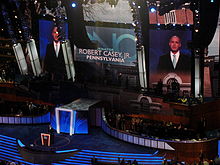 ](https://en.wikipedia.org/wiki/File:Bob_Casey,_Jr._DNC_2008.jpg)
Casey speaks during the second day of the 2008 Democratic National Convention in Denver, Colorado.
On March 28, 2008 Casey announced his endorsement of frontrunning candidate Senator Barack Obama in the Democratic Party presidential primary.[15] The Pennsylvania Report said that he "struck gold" by endorsing Obama early in the 2008 Democratic presidential primary, a move that gave him "inside access to the halls of the White House.".[16] Casey campaigned across Pennsylvania in support of Obama's candidacy in the months leading up to the primary in that state; they bowled together at Pleasant Valley Lanes in Altoona, Pennsylvania.
PIPA
Casey was among 41 Senators who co-sponsored S.968, the Preventing Real Online Threats to Economic Creativity and Theft of Intellectual Property (PROTECT IP) Act.[17]
Health care reform
Casey supported President Barack Obama's health reform legislation; he voted for the Patient Protection and Affordable Care Act in December 2009,[18] and he voted for the Health Care and Education Reconciliation Act of 2010.[19]
Bob Casey won a 2012 Champion for Children Award from First Focus in honor of his commitment to improving the lives of children.[20][21]
On September 27, 2013, Casey introduced the Children's Hospital GME Support Reauthorization Act of 2013 (S. 1557; 113th Congress) into the Senate. This bill would reauthorize a program that provides funding to children's hospitals in the United States to help with the training of graduate medical students.[22][23]
On March 25, 2014, Casey introduced the Emergency Medical Services for Children Reauthorization Act of 2014 (S. 2154; 113th Congress) into the Senate. The bill that would amend the Public Health Service Act to reauthorize the Emergency Medical Services for Children Program through FY2019.[24] The bill would authorize appropriations of about $20 million in 2015 and $101 million over the 2015-2019 period.[25] Casey argued that "this low-cost program has saved the lives of countless children and adolescents in the past 30 years, and I urge my colleagues to support this critically important program."[26]
Immigration laws
Casey supported the Secure Borders, Economic Opportunity and Immigration Reform Act of 2007 (S. 1348), a bill voted down in the 110th United States Congress, which could have provided a path to legal citizenship for undocumented persons currently residing in the United States. He has also supported the Clinton amendment, the Menendez amendment, and the Alaska amendments.[27]
During the 2006 Senate race, Casey also expressed support for the Comprehensive Immigration Reform Act of 2006, saying this: "if I were in the United States Senate I would vote yes."[28]
Abortion
Casey, like his father, is pro-life. He has publicly stated his support for overturning Roe v. Wade.[29] From Casey's election until Specter's party switch in April 2009, Pennsylvania had the distinction of being represented in the Senate by a pro-life Democrat and a pro-choice Republican (Arlen Specter).
He supports the Pregnant Women Support Act,[30] legislation that grew out of Democrats for Life of America's 95 -10 Initiative. The Initiative and the Pregnant Women Support Act seek to reduce the abortion rate by providing support to women in unplanned pregnancies. He expressed support for the confirmation of both John Roberts[31] and Samuel Alito[32] for seats on the Supreme Court of the United States; these judges are believed to be in favor of overturning Roe v. Wade. Casey also opposes the funding of embryonic stem-cell research.[33]
Casey voted against barring HHS grants to organizations that provide abortion services, where such services may often not be central to the organization’s chief purpose.[34] Casey also supports over-the-counter sale of emergency contraception,[35] and has voted to overturn the Mexico City Policy, which bars overseas organizations from using federal funds to perform or promote abortions as a method of family planning.[36] Casey's vote for overturning that policy has prompted some pro-life Republicans to question his pro-life commitment.[36][37]
In January 2010 during the Healthcare debates, Senator Bob Casey was heckled for his handling of the abortion provisions in the healthcare bill and for not taking a hard-line, uncompromising pro-life stance. Casey was the primary sponsor of an amendment to prevent government funds from being used for abortion services, but when he tried to organize a compromise that appealed to both Democrats and the party's lone holdout, Sen. Ben Nelson, he angered some religious groups.[38][39]
In 2011, Casey was rated by NARAL Pro-Choice America as "anti-choice" and was not endorsed in their election guide. That year, he voted against defunding Planned Parenthood, against H.R.1 and for cloture for the nomination of Goodwin Liu, earning him a 100% rating for those three votes.[40]
LGBT equality
Casey was a co-sponsor of and voted for the Don't Ask, Don't Tell Repeal Act of 2010.[41][42]
Casey was a co-sponsor of and voted for the Matthew Shepard Hate Crimes Prevention Act.
Casey is a co-sponsor of S. 1584 (Employment Non-Discrimination Act).[43]
Casey has been a longtime supporter of civil unions and as of April 2013, he announced his support of same-sex marriage.[44][45]
Casey on several occasions supported same sex partners adopting children,[46][47] and specifically expressed his opposition to legislation that would prohibit adoption by same-sex couples.[48]
Birth control
In an diocesan survey, Casey expressed support for "requiring employers or health insurance plans to cover contraceptives in their prescription drug plans". He also stated his support for "a provision in the state’s budget to fund contraceptive services."[47] Casey's views on this extend to the federal funding of contraception, which he also supports. However, Casey also opposes laws that would "force pharmacists to fill a prescription contrary to their moral beliefs."
Economic
On economic and education-based issues, Casey falls more closely in line with mainstream Democratic policies.
Casey's website reports he has also criticized what he views as "draconian cuts to Medicare and Medicaid," and has stated that Medicare Part D is "fundamentally flawed" and in need of a "complete overhaul." Furthermore, it states Casey's support for the Family and Medical Leave Expansion Act, which would expand the Family and Medical Leave Act, authored in the early 1990s by Connecticut Senator Chris Dodd, to companies with at least 25 employees.[49]
Casey is an opponent of privatizing Social Security,[50] and is a critic of many recent tax cuts, which he claims have "not caused the 'trickle-down' economic growth" that was promised from them. Casey had also criticized Santorum for voting against increasing the minimum wage.[51]
Casey voted in January 2010 to re-confirm Federal Reserve Chairman Ben Bernanke.[52]
Education
According to the candidates' questionnaire, Casey opposes school vouchers.[47]
Environment
Casey opposes drilling for oil in the Arctic National Wildlife Refuge. Instead, he supports increased federal investment in hybrid and alternative fuel technology to help wean the United States off of foreign oil.[53] In a debate, Casey criticized his Republican opponent Rick Santorum for not recognizing the danger of global warming.[54]He also supports increased funding for Brownfield cleanup, as well as a reinstatement of the polluter-pays principle for the Superfund program.[55]
Judicial nominees
Casey voted for the confirmation of both Sonia Sotomayor[56] and Elena Kagan to the Supreme Court of the United States.[57]
In March 2017, Casey announced that he would vote "no" on confirming Neil Gorsuch to the Supreme Court.[58]
Gun laws
Casey is generally considered a pro-gun rights senator and a strong supporter of the Second Amendment, voting against restriction of the amendment in 2012. In 2009, Casey voted to allow firearms in checked baggage on trains, and he has also voted against bills that would restrict gun ownership; in 2013 he voted to ban high-capacity magazines carrying over 10 rounds.[59] On April 17, 2013, Casey voted in favor of the Public Safety and Second Amendment Rights Protection Act to amend the background check process and require a background check for firearms transfers made at gun shows or on the internet.[60] His fellow Pennsylvania Senator Pat Toomey was a cosponsor in creating the bill.
Committee assignments
- Committee on Agriculture, Nutrition, and Forestry
- Committee on Finance
- Committee on Health, Education, Labor, and Pensions
- Special Committee on Aging (Ranking Member, 115th Congress)[62]
- Joint Economic Committee
==
sierra 5/15
BOB CASEY (D-PA) Joined the League: January 3, 2007 Hometown : Scranton, PA BIO: Pennsylvania families didn’t vote for dirty air, dirty water, or dirty fuels — and Senator Casey’s the kind of player who can help produce results in the field to do just that. He’s already showcased his talents by scoring big hits on climate action and clean energy this season and could contribute big things to the Keystone State throughout the season if he stays on the right track and focuses on protecting Pennsylvania’s families and communities. He whiffed on clean air earlier in the season by sponsoring a bad amendment to waive Clean Air Act requirements at plants that burn waste coal (a waste product of coal mining) — an amendment he thankfully failed to get across the plate.
QUOTED: “On global warming, I am taking a comprehensive approach that not only calls for mandatory reductions in global warming pollution, including carbon dioxide, but also puts pressure on other countries to reduce their emissions.”58 THIS SEASON: Senator Casey has voted right across the board on all climate and clean energy amendments this year. STATS: « Climate: « Clean Air: « Clean Energy: « Energy Efficiency: WHA
==