Griffin, Ken Citadel
---
CORRUPT GREENLAND 8 26
CORP ROLE
12 22 kpfa
17 (so gop) states pass laws to prot dark $
eg 1
in a state with a reputation for political scandal, Florida’s 2020 elections saw a particularly brazen scheme to swing three state Senate races.A “dark money” group sent out mailers promoting the campaigns of three “sham” candidates—in one case, diverting enough votes to a candidate with thesame last nameas former Democratic Sen. José Javier Rodríguez to defeat him. Rodríguez lost by just 32 votes, and Democratic candidates in the other two districts were defeated as well.
The Orlando Sentinel reported that the group behind the misleading mailers, which has renamed itself as Grow United, received a $1.15 million donation from an organization closely tied to the business trade association Associated Industries of Florida. A Dec. 2 Sentinel investigation detailed the group’s consultants’ close coordination withelectric monopoly Florida Power & Light, as well as the power utility’s ties to state Republican leaders, who control the chamber and can block bills like one that would empower solar electricity generators.
Florida organizations supporting Democrats also donated $700,000 to Grow United to obscure the funding source behind expenses like election mailers,a revelation that led to the resignation of a senior House adviser.
Last month, the Florida Department of Agriculture and Consumer Affairs launched an investigation into one of Grow United’s donors. The “sham” candidate in Rodriguez’s race pled guilty last August and is cooperating in testimony against the consultant who allegedly put him up to it, former Republican state Sen. Frank Artiles. Artiles has pled not guilty in the case.
With dark money rampant in the state, especially in state Democratic primaries, a Florida Republican is seeking to make it a crime for public officials to request or release information about the sources of money behind election spending by groups that are not required to reveal their donors.
In January, Republican Florida Rep. Toby Overdorf introduced the Personal Information Protection Act (H.B. 1547), which would prohibit public agencies from requesting that any individual, corporation, or other entity release personal information besides what is already required by campaign finance and other laws, or when they have a lawful warrant to seek the information. The bill would also prohibit agencies from publishing such information they may have in their possession. Florida Senator Joe Gruters introduced a similar bill in the Senate (S.B. 1848) that would do the same thing, but only for personal information of donors and other individuals affiliated with 501(c)(3) organizations, though its sponsor says he’s willing to broaden it to cover other types of groups. Each bill would allow for the right of civil action and violators could face possible prison time of up to 90 days.
The House version would prevent campaign finance regulators from trying to force non-disclosing organizations like (c)(4) nonprofits to reveal their donors when they spend money to influence elections in the state.
The new Florida bill is modeled after a policy propagated by the American Legislative Exchange Council (ALEC), a nonprofit that brings together corporate lobbyists with conservative lawmakers to advance legislation that favors business interests. Rep. Overdorf is one of about 31 Florida elected officials listed as ALEC members as of April 2021, according to a state public records request from the nonprofit Center for Media and Democracy (CMD). Gruters is the chair of the Florida Republican Party, re-elected to that position last month, and is a close ally of former President Trump, having co-chaired his 2016 state campaign.
In recent years, such bills criminalizing the disclosure of politically-active nonprofits’ donors have spread to a number of states, passing into law in 2021 in Arkansas, Iowa, South Dakota, and Tennessee.
“These types of bills are unnecessary—there are already constitutional protections for donors that would actually face threats, harassment, or reprisal from public identification—and their only true achievement may be to simply impede transparency for politically active nonprofits and make dark money darker,” said Aaron McKean, legal counsel for state and local reform at the nonpartisan Campaign Legal Center, which works to increase transparency in democracy.
“Voters have a right to know which wealthy special interests are spending big money to influence their vote and rig the political system in their favor,” said McKean. “Florida’s legislators should be focused on ensuring voters know the true sources of money used to influence elections.”
A poll commissioned by the Campaign Legal Center previously found strong bipartisan support for “publicly disclosing contributions to organizations involved in elections” so that wealthy special interests cannot operate with impunity and politicians can be held accountable.
florida has led the nation in public corruption convictions for much of the past couple decades. From 1976 to 2018, Florida was among the top 10 states in federal corruption convictions per 10,000 residents, according to a report from the University of Illinois at Chicago.
A longtime state ethics watchdog tells Sludge that the practice of routing funds through dark money groups will proliferate in the state until the Legislature has the political will to stop it.
“I don’t think there will be any reduction in dark money in elections, it’s just going to increase,” said Ben Wilcox, research director of the nonprofit Integrity Florida. “The campaign finance system in Florida is so dysfunctional, it makes this sort of activity so easy to do, and easy to hide the source of campaign donations. There are all sorts of loopholes.”
With the end of Florida’s legislative session coming next month and the bills not gathering co-sponsors, Wilcox thinks that the state’s investigation into the Grow United case has likely chilled their support this year. But Wilcox tells Sludge, “The fact that they filed the bills this year, to further protect the sources of dark money, it tells you whether or not the bills pass this year, they probably will come next year. The powers that be are intent on keeping dark money dark.”
Wilcox also pointed to a loophole in state campaign finance law that allows unlimited donations to state political committees controlled by politicians. “It’s a form of legal corruption,” he said.
“When you look at Florida Power & Light, they give the maximum to various candidates, and then all the big money goes into the political committees, donations of $100,000 and more.” State campaign finance records show that in recent years, the committee Friends of Ron DeSantis has received donations of over $10 million total from Citadel hedge fund manager and GOP megadonor Ken Griffin, $850,000 from investment company Spring Bay Capital, $200,000 from Kane Financial Services, and nearly $125,000 from the Florida Home Builders Association, among many others.
Last May, Gov. Ron DeSantis signed into law S.B. 1890, a bill sponsored by Republican State Sen. Ray Rodrigues, that would have set a $3,000 cap on contributions to political committees supporting or opposing constitutional amendments until the measure obtains enough valid signatures to qualify for the ballot. Florida lawmakers left untouched the ability for donors to make unlimited donations to candidates’ political committees. The law was blocked in federal court on July 1, the day it was slated to take effect, and in August Florida’s Attorney General did not appeal, leaving the injunction in place.
The Tampa Bay Times reported last month that lobbyist Jorge Chamizo provided the bill language to staff of Senate sponsor Gruters, working on behalf of two groups: People United for Privacy and Opportunity Solutions Project.According to CMD, which tracks dark money groups, People United for Privacy was formed by the State Policy Network, an umbrella organization of right-wing causes. Opportunity Solutions Project is the advocacy arm of the Florida-based Foundation for Government Accountability, a State Policy Network member.
This year, Jorge Chamizo is registered to lobby for a long list of business clients, including Associated Industries of Florida and Duke Energy, which was an ALEC member as recently as 2020. Other clients of Chamizo this year include Peoples Gas System, Tampa Electric Company, health insurer Anthem, health care provider Centene, and Uber.
KEN GRIFFIN BIG FUNDER FLORIDA, MOVED BIZ 2022? BEFORE BILLION TAX NY MPU? INDIAN ISLAND BUNKER MPU?
-=-=
-=-=
8 AUG 2026
GUK
An American oil company connected to Donald Trump is preparing to sink wells in remote Greenland despite not having received permission from the local authorities.
As the US president renews his threats to claim the vast Arctic territory, materials to prepare for drilling were brought ashore in recent days on Greenland’s eastern coast.
That has prompted Greenland’s government to issue a “strong warning” that no approval had been granted to land the kit. “All future logistical matters must be advised and approved by the mineral resources authority – before they are carried out,” the government said in a statement.
Two days later, Trump made his latest menacing post on Truth Social, showing himself looming over a Greenlandic village.

Trump’s Truth Social post. Illustration: truthsocial.com/realDonaldTrump
Executives of Greenland Energy, a Texas company set up last year, have claimed that $1tn of crude may lie beneath the Jameson Land region. They announced plans to spend $60m drilling two wells to find out.
Although Greenland stopped issuing new oil licences in 2021 on environmental grounds, a UK company called 80 Mile had secured exploration rights in Jameson Land. Greenland Energy’s corporate filings say it will take a majority stake in the project in exchange for funding the exploration, though it still needs government permission to proceed.
Licensed to drill? How a Trump-linked Texas oil company is elbowing its way into Greenland
Greenland Energy has retained Phil McGraw, better known as Dr Phil, a prominent rightwing former chatshow host who served on Trump’s religious freedom commission, to make a documentary series that will “capture the mission of these modern-day wildcatters”.
It has also appointed as a director a US navy veteran who is working on Golden Dome, the missile defence plan for which Trump says controlling Greenland is “vital”.
Larry Swets, Greenland Energy’s chair and a big shareholder, appears to enjoy access to Trump’s circle. He has said the oil project is “not related to American annexation”.
After a company representative falsely claimed at a Jameson Land community meeting in June that it had permission to land drilling equipment, Swets said: “Our enthusiasm for the project led us to communicate in a way that created confusion.”
But the next month, local people in the sparsely populated region noticed a tug pulling a barge shorewards and unloading a dozen containers. “The goal was to get the equipment onshore at Nunap Qeqqa [Jameson Land] in connection with planned oil exploration drilling,” the Greenland government’s statement said.
The Danish investigative outlet Danwatch quoted the head of the shipping company as confirming the delivery was for Greenland Energy.
Young arctic foxes in the tundra in Jameson Land. Photograph: Biosphoto/Alamy
Greenland Energy has declined to respond to questions from the Guardian. A letter it sent to shareholders on Thursday said: “Recent high-level meetings between project leadership and Greenlandic regulatory and oversight authorities have been constructive, and we continue to be encouraged by the progress being made toward the remaining approvals required for drilling.” It said that after those discussions, just one well would be drilled to begin with.
As a semi-autonomous territory of Denmark, decisions about Greenland’s natural resources rest with its local elected leaders, who now face a delicate decision. They could grant permission for oil drilling, even though the planned wells appear to fall within a conservation area protected by the Ramsar convention on wetlands. Or they could refuse and, some worry, give Trump a pretext to advance his imperialist agenda.
The Greenland government’s statement said it “would not be proportionate” to demand the equipment be removed. An application for permission remained under processing, it added.
A Greenland Energy representative has said a vessel carrying its 300 shipping containers of drilling equipment is to set sail from Canada on 12 September. Sinking the wells would begin in October.
Jeff Landry, the hard-right Louisiana governor serving as Trump’s Greenland envoy, has said Greenland could be pumping oil next year.
--=-=-
-=-=
GUK
Licensed to drill? How a Trump-linked Texas oil company is elbowing its way into Greenland
Greenland Energy says billions of barrels of crude could lie beneath territory and claims it has permission to bring drilling kit ashore – a claim denied by Nuuk
Thu 9 Jul 2026
On 10 June, a snowy-haired American in his 60s addressed the residents of a remote Greenland hamlet. He was there to tell them about a business venture supported by figures linked to Donald Trump. “So,” Robert Price said via an interpreter, “we have a project to drill for oil here.”
The Texas oil company that Price represents, Greenland Energy, hopes to prove that billions of barrels of crude lie underground by bringing in 300 shipping containers of drilling kit.
“We have the permit to put the equipment on the land,” footage of the gathering in Ittoqqortoormiit shows Price saying. “And then we’ve filed our permits – pending approval – to drill.”
But Greenland’s resources ministry said that contrary to Price’s claim, there were “no actually active permissions for any exploration activity or permissions for preparations for these activities”.
The dispute threatens a showdown between the Trump-linked backers of Greenland Energy and the authorities in the vast, sparsely populated territory. Trump’s lieutenants are using the prospect of an American oil find in Greenland to bolster their case for an American takeover.
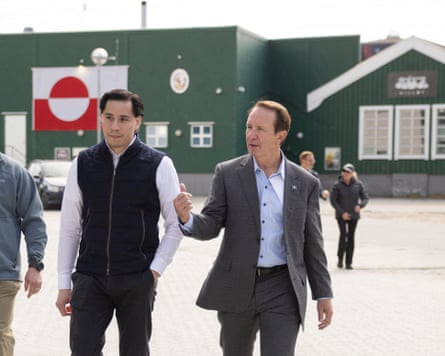
Jeff Landry, right, on a visit to Nuuk in May as Trump’s special envoy to Greenland. Landry said the territory ‘could be exporting 2m barrels of oil a day’. Photograph: Christian Klindt Soelbeck/Ritzau Scanpix/AFP/Getty
The US president’s special envoy to Greenland, the hard-right Louisiana governor, Jeff Landry, returned from a visit in May to declare on Fox News: “We need a deal. Greenland needs a deal. We could be – Greenland could be – exporting 2m barrels of oil a day right now.”
Landry, who says his task is to “make Greenland a part of the US”, added: “We could have those barrels on production within 10 months or so.”
Greenland Energy appears to be the only company making plans to drill in the territory. Despite seemingly not yet having permission, it has chartered an Arctic-going vessel to ferry its equipment 4,000km through icy waters to Greenland’s eastern coast.
Price, an energy industry veteran who has become the public face of the company, said the vessel would depart in two months, on 12 September, with drilling to begin in October. Halliburton, the giant Houston-based contractor once led by the former Republican vice-president Dick Cheney, will run the logistics.
Ever since Trump made his imperial desires for Greenland explicit, US business interests have been gaining footholds in its vast expanses. The ventures range from rare-earth minerals and hydroelectric power to bottling “luxury” spring water.
Greenlanders have watched nervously as Trump has exercised US military power and toyed with doing so in the Danish territory. The day after he sent special forces to snatch the leader of Venezuela, Trump said: “We do need Greenland, absolutely.” Trump cited oil as the reason the US needed to stamp its authority on Venezuela. The US has since extracted oil revenues of about $8bn with scant oversight.
Arriving at this week’s Nato summit in Turkey, Trump renewed his call for the US to wrest control of Greenland from Denmark.
Among those alarmed is Avaaraq Olsen, the mayor of the region that covers the capital, Nuuk, and extends east across Jameson Land, where the oil drilling is planned. She said she was “so afraid” that Americans striking oil could align with Trump’s plans.
“We are like the most peaceful place on Earth,” she said. “And we have always lived in peace and harmony. And suddenly there is all these Americans trying to take over.”
The coast of Jameson Land in north-east Greenland. Greenland Energy has chartered an Arctic-going vessel to ferry its equipment 4,000km through icy waters to Greenland’s eastern coast. Photograph: Biosphoto/Alamy
Licence to drill
Greenland stopped issuing licences to explore for oil in 2021 after 50 years of fruitless drilling. “The environmental consequences of oil exploration and extraction are too great,” a minister said at the time.
But a handful of licences remained valid. They included some covering a chunk of Jameson Land, a region closer to London than to Washington. These licences belong to a company registered in the UK called 80 Mile.
It is those licences that Greenland Energy, formed last year and listed on the Nasdaq stock exchange in New York, is hoping to exploit by putting up $60m to drill two wells in exchange for a majority stake in the project.
Price has claimed that crude worth $1tn (£750bn) could lie beneath Jameson Land. “I believe it’s there,” he said during the meeting in Ittoqqortoormiit, a settlement of 300 people in Jameson Land. “The scientists believe that it’s there. But until we drill these wells, we don’t know.”
The wells are expected to be drilled in an area protected by the global Ramsar Convention to preserve wetlands, which hosts important populations of wildlife including muskoxen. Photograph: Biosphoto/Alamy
The wells are expected to be drilled in an area protected by the global Ramsar Convention to preserve wetlands. David Boertmann, an expert on Greenland’s birds, said the conservation zone hosts important numbers of barnacle geese and pink-footed geese as well as whimbrel, golden plover, Sabine’s gull and snowy owl, plus muskoxen. Oil exploration activities could threaten the birds’ habitat, Boertmann said.
Greenland Energy’s stock market filings make clear that its plans can go ahead only if Greenland’s government grants permission for drilling and for it to take a stake in any oil extraction that follows.
Múte B Egede, Greenland’s minister for mineral resources, said Greenland Energy’s ‘statements to the public do not always reflect the actual situation’. Photograph: Mads Claus Rasmussen/EPA
There are signs that the government may be reluctant to do so. Days after Price’s comments, Greenland’s minister for mineral resources, Múte B Egede, said he could “understand if citizens are concerned” about the project’s connections to Trump.
He added: “Activities cannot be carried out until the necessary permits have been granted. I must say again that the company’s statements to the public do not always reflect the actual situation.”
Greenland Energy declined to respond to questions from the Guardian. But Larry Swets, a financier who is one of Greenland Energy’s biggest shareholders and serves as executive chair, has acknowledged: “Our enthusiasm for the project led us to communicate in a way that created confusion about who is responsible for what in Greenland – and that benefited no one, least of all the local communities closest to the project.”
The tundra of Jameson Land, which includes a conservation zone that is home to a number of bird populations. Photograph: Biosphoto/Alamy
Trump connections
At the Ittoqqortoormiit meeting, one person asked whether Swets had “close relations with Trump”. Price replied: “Not that I know of.”
Social media posts by Swets’s wife appear to show that this year she visited Trump’s Mar-a-Lago club. Swets did not respond to questions about whether he had accompanied his wife to Trump’s Florida residence, which serves as a presidential court away from the White House.
Although Swets has said the oil project is “not related to American annexation”, Greenland Energy’s connections to the US president are growing, as the company amasses an eclectic array of Trump-linked backers.
In April, the Wall Street billionaire Kenneth Griffin bought 9% of Greenland Energy’s shares. Griffin is a Republican mega-donor and, despite criticising the Trumps’ self-enrichment, gave $1m towards the president’s second inauguration.
Then in June, a US Navy veteran, Carol Craig, joined Greenland Energy’s board. Sidus Space, the defence tech company she founded, is working on Trump’s Golden Dome missile defence system. Trump has said that controlling Greenland, home to the US armed forces’ space base at Pituffik, is a “vital” part of the Golden Dome plan.
The same month, Greenland Energy announced a deal with Phil McGraw’s Envoy Media. Better known as Dr Phil, the TV personality’s 20 years hosting a talkshow that spun out of Oprah Winfrey’s show made him a household name in the US.
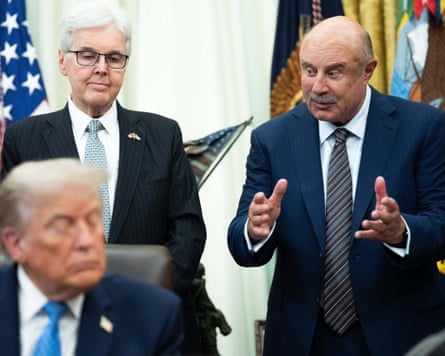
Phil McGraw, right, better known as Dr Phil, is making a documetary series about Greenland Energy. Photograph: Abaca/Shutterstock
McGraw spoke at a Trump rally in 2024. After Trump’s victory, McGraw “embedded” himself with ICE agents enforcing Trump’s immigration crackdown. His latest venture, a documentary series about Greenland Energy, will be broadcast on cable and social media and, according to the company, will “capture the mission of these modern-day wildcatters”.
Discussing the prospect of oil with Swets and Price in a YouTube curtain-raiser, McGraw says: “We’ve heard Trump talk about buying Greenland and everybody laughed, but actually there is some real value to Greenland.”
Days later, McGraw was in the Oval Office with Trump, saying how honoured he was to serve on the president’s Religious Liberty Commission. “Thank you very much, Phil,” Trump said. “I appreciate your support.”
Some Greenland Energy shareholders are hoping the president will show similar appreciation for its Arctic oil exploration. On a dedicated Telegram group, they discuss what might send the company’s stock price higher. Referring to a presidential plug for the company that could make them richer before a drop of oil has been drilled, they are hoping to secure what they are calling a “Trump pump”.
-=-=
an7 26
According to the latest reports, Ken Griffin — a prominent Republican donor who spent upwards of $100 million on the last election — has decided who to back in the 2028 presidential race.
Ken Griffiin is famously anti-MAGA, and this latest news represents a growing tide of Republicans who are backing Marco Rubio rather than Vance, the latter of whom was once considered the heir apparent to President Donald Trump but whose star has fallen in recent months.
Griffin’s intentions were revealed during the annual Allen & Company conference in Sun Valley, Idaho, where the billionaire hedge fund manager told financial journalist Andrew Ross Sorkin he was “predisposed” to support Rubio, whom he backed previously during the 2016 GOP primary. Notably, Griffin donated neither to President Donald Trump’s campaign nor his MAGA Inc. super PAC during the 2024 election, instead throwing his money and platform behind former U.S. Ambassador to the United Nations Nikki Haley.
Neither of the current White House officials has officially thrown their hat into the ring, and according to the Hill, “Vance and Rubio have repeatedly deflected regarding whether they will run to succeed the term-limited Trump in 2028 — with the latter telling Vanity Fair last year he will defer to Vance if the vice president seeks the nomination…Trump has not explicitly endorsed a candidate, with roughly 18 months to go before the Iowa Republican caucuses. But he said last month a Vance-Rubio ticket would be formidable for their Democratic opponents.”
While most polls show Vance firmly in the lead on the question of who will take the GOP nomination in 2028, Republican insiders have spoken of a “shadow” effort to get Rubio elected since early this year. At the same time, Vance experienced a string of high-profile embarrassments, arguably the most looming being the troubled negotiations for peace with Iran that he helmed and fumbled initially. And while he was getting hammered by bad headlines, Rubio was enjoying favorable press and assignments as he accompanied Trump to UFC fights and flew off to make nice with the Pope. As a result, there has been growing buzz around his candidacy.
Some in the Republican Party, however, say that Rubio’s 2028 chances have been overstated.
W. James Antle III of the American Conservative, for example, wrote, of Rubio “being feted as a throwback to pre-Trump Republicanism, which is also why he is currently being overrated for 2028. That’s not to say that a Rubio nomination can’t happen. There are, however, some roadblocks that are being widely ignored in favor of viral clips that make people misty-eyed for the return of Ronald Reagan.” He thinks Rubio will be unable to walk the “tightrope” between MAGA and those who want to see a “major departure” from Trump. Rubio has also been linked to the disastrous war with Iran, and he’s never fared well in a national election.
Conservative commentator Ann Coulter was more unvarnished in her assessment of Rubio, saying he was a “half-wit” whose presidency would be an “unmitigated disaster.”
5 26 krugman
AN 9 25
Trump megadonor and billionaire hedge fund manager Ken Griffin isn't afraid to criticize President Donald Trump or those who enable him.
In a Wall Street Journal (WSJ) opinion piece published Sunday, the founder/CEO of investment behemoth Citadel criticized Trump's attacks on the Federal Reserve and challenged the credibility of economic data used by the administration to justify the firing of the head of the Bureau of Labor Statistics. And the Murdoch-owned WSJ did a deep dive Monday into Griffin's resistance to Trump, calling him "the most outspoken critique from a business leader in Trump’s second term." The outlet noted that "other prominent executives haven’t seen upside in going against a president who singles out people or companies for retribution over alleged slights."
In his Sunday op-ed, which Griffin co-authored with University of Chicago professor Anil Kashyap, the Republican donor wrote that Trump's actions "raise inflation expectations, increase market risk premiums and weaken investor confidence in U.S. institutions."
READ MORE:'Deranged psychopath': Experts sound alarm over Trump's 'green light' of domestic violence
Griffin also defended the targets of Trump's attacks, with the Journal reporting that the wealthy investor "came to the defense of Walmart CEO Doug McMillon after Trump attacked him for raising prices in response to higher tariff costs."
"Shame on the administration for criticizing an American CEO, who has done an extraordinary job of helping to have people get more for their dollar, more for the hours they work, for just being honest,” said Griffin, who once called Trump a "three-time loser" at a June conference.
The Citadel billionaire donated over $100 million to conservative candidates — a third of what Tesla and SpaceX CEO Elon Musk gave — in the 2024 election cycle, but never directly contributed to Trump, saying he voted for him, but "not with a smile on my face," eventually plunking down $1 million to Trump's inaugural committee. It remains unclear whether Trump will set his sights on Griffin, given his reputation as a reliable donor to his party's candidates for Congress.
"Trump has reason to be diplomatic in his approach with Griffin as the GOP looks to the midterm elections," the WSJ said.
READ MORE:'Now this is bromance': Social media erupts over Trump's 'explicit love letter' to Epstein
Click here to read the WSJ's report in full (subscription required).
---
GGL AI INAUGR 8 25
Individuals and CEOs
- Sam Altman (OpenAI CEO): $1 million (personal donation)
- Jeff Bezos (Amazon founder): Attended inauguration and his company donated $1 million
- Mark Zuckerberg (Meta CEO): Attended inauguration and his company donated $1 million
- Elon Musk: Close adviser to Trump and attended the inauguration
- Tim Cook (Apple CEO): $1 million (personal donation)
- Dara Khosrowshahi (Uber CEO): $1 million (personal donation)
- Warren Stephens: $4 million (nominated Ambassador to the United Kingdom)
- Jared Isaacman: $2 million (nominated NASA administrator)
- Melissa Argyros: $2 million (nominated Ambassador to Latvia)
- Dan Newlin: $1 million
- Jeffrey Sprecher: $1 million (husband of Trump's Small Business Administrator appointee, Kelly Loeffler)
- Keith Rabois: $1 million
- Ken Howery: $1 million
- Ken Griffin: $1 million
- Miriam Adelson: $1 million
- Scott Bessent: $250,000 (nominated Treasury Secretary)
- Tilman Fertitta: $1 million (nominated Ambassador to Italy)
- Linda McMahon: $1 million (nominated Education Secretary)
- Howard Lutnick: Cantor Fitzgerald (his former employer) gave $1,047,000
- Jeffery Hildebrand: $500K (husband of Trump's Ambassador to Costa Rica nominee)
an 5 25
Over the years, Citadel CEO Ken C. Griffin has donated millions of dollars to Republican candidates and conservative causes — and he considers himself a supporter of President Donald Trump, not a Never Trumper. But the billionaire hedge fund manager, now 56, is being openly critical of Trump's steep new tariffs.
At the Milken Institute's Global Conference, Griffin told Politico, "Tariffs open the doors to crony capitalism. The government starts to pick winners and losers. I thought that would play out over the course of years. It's terrifying to watch this play out over the course of weeks."
Griffin added that Trump's handling of tariffs "very clear that we have roughly already — regretfully — unleashed an era of crony capitalism."
READ MORE: 'Farm bankruptcies' could 'surge' during Trump’s second term: study
In an article published by Politico on May 8, reporters Sam Sutton and Katy O'Donnell explain, "Griffin's frustration with Trump's policies reflected broader concerns at the conference over how the trade war could derail the U.S. economy. For Wall Street and industry elites at Milken, Trump's dismantling of global trade is forcing them to adjust — uncomfortably — to policies that they believe will disrupt the flow of capital into U.S. businesses and harm consumers. The lack of buy-in from Wall Street poses a major problem for the president because these are the people he needs to make his agenda work."
Griffin is warning that Trump's tariffs will lead to a weakening of the U.S. dollar.
The Citadel CEO told Politico, "Whether it’s a flat-screen TV or a new laptop, your dollar is just not going to go as far. This starts unfolding in the next couple weeks…. We all want to see the president succeed, whether you're in business and you're Republican, or you're a business and you're a Democrat. We need the president to succeed."
Griffin added, "There’s that fine line between constructive criticism and just being toxic."
READ MORE:Trump economy: Two things are going up and everything else is going down
*Read the full Politico article at this link.
---
has reich used the c word before?
rr an 11 23
as an ever-greater portion of the nation’s total wealth goes to the top, it’s hardly surprising that ever more of that wealth is corrupting American politics.
In the 2020 presidential election cycle, more than $14 billion went to federal candidates, party committees, and Super PACs — double the $7 billion doled out in the 2016 cycle.
Total giving in 2024 is bound to be much higher.
Most of that money is not supporting American democracy. Increasingly, it is supporting Donald Trump and his anti-democracy allies.
There is a certain logic to this.
As more and more wealth accumulates at the top, the moneyed interests fear that democratic majorities will take it away through higher taxes, stricter regulations (on everything from trade to climate change), enforcement of anti-monopoly laws, pro-union initiatives, and price controls.
So they’re sinking ever more of their wealth into anti-democracy candidates.
Donald Trump is going full fascist these days, and gaining the backing of prominent billionaires.
On Veterans Day, Trump pledged to “root out the communists, Marxists, fascists and the radical left thugs that live like vermin within the confines of our country,” whom he accused of doing anything “to destroy America and to destroy the American dream.” (Notably, he read these words from a teleprompter, meaning that they were intentional rather than part of another impromptu Trump rant.)
Days before, Trump claimed that undocumented immigrants were “poisoning the blood of our country.” The New York Times reports that he’s planning to round up millions of undocumented immigrants and detain them in sprawling camps while they wait to be expelled.
Trump has publicly vowed to appoint a special prosecutor to “ go after” President Joe Biden and his family, and has told advisers and friends that he wants the Justice Department to investigate officials who have criticized his time in office.
This is, quite simply, full-throated neofascism.
Who’s bankrolling all this? While Trump’s base is making small contributions, the big money is coming from some of the richest people in America.
During the first half of the year, multiple billionaires donated to the Trump-aligned Make America Great Again Inc. Super PAC.
Phil Ruffin (net worth $3.4 billion), the 88-year-old casino and hotel mogul, has given multiple $1 million donations.
Charles Kushner (family net worth $1.8 billion), the real estate mogul and father of Jared, who received a late-term pardon from Trump in December 2020, contributed $1 million in June.
Robert “Woody” Johnson (net worth $3.7 billion), Trump’s former ambassador to the United Kingdom and co-owner of the New York Jets, donated $1 million to the MAGA PAC in April.
And so on.
But Trump is not the only extremist pulling in big dollars. Nikki Haley — who appears moderate only relative to Trump’s blatant neofascism — proclaimed in her campaign launch that President Biden is promoting a “socialist” agenda.
During her two years as U.N. ambassador under Trump, Haley was a strong proponent of his so-called “zero tolerance” policy, under which thousands of migrant children were separated from their parents and guardians. She supported Trump’s decision to pull out of the U.N. Human Rights Council and to withdraw from the Iran nuclear deal.
Though she briefly criticized Trump for inciting the mob that attacked the U.S. Capitol on January 6, 2021, Haley soon defended Trump and called on Democratic lawmakers to “give the man a break” when they impeached him for a second time.
Haley recently told Kristen Welker of NBC’s “Meet the Press” that while Trump’s floating the idea of executing retired General Mark Milley might be “ irresponsible,” it does not disqualify him from running for the White House again.
Haley’s billionaire supporters include Stanley Druckenmiller, Eric Levine, and Republican megadonor Ken Griffin.
Notably, Haley has also gained the support of JPMorgan Chase’s chief executive, Jamie Dimon, who’s about as close as anyone in America comes to being a spokesperson for the business establishment. Dimon admires Haley’s recognition of the role that “business and government can play in driving growth by working together.”
The moneyed interests have been placing big bets on other Trumpist Republicans.
Peter Thiel, the multibillionaire tech financier who once wrote that “I no longer believe that freedom and democracy are compatible,” contributed more than $35 million to 16 federal-level Republican candidates in the 2022 campaign cycle, making him the 10th largest individual donor to either party.
Twelve of Thiel’s candidates won, including Ohio’s now Senator J.D. Vance, who alleged that the 2020 election was stolen and that Biden’s immigration policy has meant “ more Democrat voters pouring into this country.”
Republican House Majority Leader Steve Scalise is creating a new fundraising committee that will be soliciting contributions of up to $586,200 a pop.
Elon Musk is not a major financial contributor to Trump nor other anti-democracy candidates, but his power over one of the most influential megaphones in America gives him inordinate clout — which he is using to further the neofascist cause.
Witness Musk’s solicitude of Trump, his endorsement of antisemitic posts, his embrace of Tucker Carlson and white replacement theory, and his avowed skepticism toward democracy.
Democracy is compatible with capitalism only if democracy is in the driver’s seat, so it can rein in capitalism’s excesses.
But if capitalism and its moneyed interests are in charge, those excesses grow to the point where they are able to extinguish democracy and ride roughshod over the common good.
Hence the reason Trump’s neofascism, and the complicity of today’s Republican Party with it, are attracting the backing of some of the richest people in America.
What’s the alternative? A loud pro-democracy movement that fights against concentrated wealth at the top, enormous CEO pay packages, a politically powerful financial sector, and tax cuts for the wealthy and large corporations.
And fights for higher taxes on the top (including a wealth tax) to finance Medicare for all, affordable housing, and accessible child care and elder care.
The willingness to make this a fight — to name the moneyed interests backing neofascism, explain why they’re doing this, and mobilize and energize America against their agenda and in favor of democracy — is critical to winning the 2024 election and preserving and rebuilding American democracy.
Biden and the Democrats must take this on, loudly and clearly. (Incidentally, Biden’s age — Happy 81st, Joe! — would be far less of an issue if he showed the grit and guts to do this.)
===
---
an 10 23
billionaire investor Leon Cooperman — who has almost exclusively donated to Republicans throughout his career — recently issued a stern rebuke of former President Donald Trump.
In an interview with CNN, the Republican mega-donor who has most recently backed former New Jersey Governor and prominent Trump critic Chris Christie acknowledged that he "very reluctantly" voted for Joe Biden in 2020. However, he also warned voters of the dangers of a second Trump term.
"It would be terrible for the country if Donald Trump were reelected," Cooperman said. "He’s a divisive human being who belongs in jail."
Cooperman, who is chairman and CEO of the hedge fund Omega Advisors, said that Biden and Trump were both "bad choices." He added that if the major party nominees were Joe Biden and Donald Trump in 2024, he probably wouldn't vote at all.
"I’m looking for centrists, not radical left or right," he said.
The Wall Street titan's criticism of Trump stands out in particular due to his record as both a champion of GOP causes and vociferous crusader against Democrats. In 2021, he railed against Senator Elizabeth Warren's (D-Massachusetts) so-called "Ultra Millionaires Tax," which would have implemented a 2% annual tax on households with a net worth in excess of $50 million. Billionaires would pay 3% annually, according to Warren's proposal. Cooperman called Warren a "superficial, nasty hater" and a "political charlatan" when she was running for the 2020 Democratic presidential nomination.
The hedge fund CEO isn't the only Republican billionaire donor distancing himself from Trump. Ken Griffin, the founder of hedge fund Citadel, threw his weight behind Florida Governor Ron DeSantis last year and referred to the 45th president of the United States as a "three-time loser."
Blackstone CEO and co-founder Stephen Schwarzman backed Trump in 2020, but has since said he'll eventually put his money and support behind "a new generation of leaders." And Miriam Adelson — widow of deceased Republican billionaire Sheldon Adelson — is reportedly staying neutral in the 2024 Republican primary despite donating $90 million to a pro-Trump super PAC in 2020 and giving $800,000 of her own money to a joint fundraising effort run by Trump and the Republican Party.
READ MORE:Former Trump megadonor joins No Labels leadership
---
https://www.alternet.org/2022/07/billionaire-hedge-fund/
:{Series: The Secret IRS Files:(style="font-family:Merriweather"):}:
Inside the Tax Records of the .001%
For billionaire Ken Griffin, it was well worth spending $54 million to ensure he and other rich Illinoisans wouldn’t have to pay more tax.
By the time Illinois voters streamed into voting booths on Election Day in 2020, Griffin, then Illinois’ wealthiest resident, had made sure they’d heard plenty about why they should not vote to raise taxes on him and the state’s other rich people. His tens of millions paid for an unrelenting stream of ads and flyers against an initiative on that year’s ballot, which would have allowed Illinois lawmakers to join 32 other states in setting higher tax rates for the wealthy than for everyone else.
In the end, Griffin spent about $18 for every one of the 3.1 million votes against theinitiative. After initial optimism about its prospects, the measure came up hundreds of thousands of votes short and went down to defeat.
Rarely does the public get a clear view of the payoff for wealthy Americans who put their money down to achieve a political outcome. But in this case, ProPublica’s trove of IRS data can provide crucial context for the ballot fight. For Griffin and many of his fellow ultrawealthy Illinoisans, spending even such a vast amount was well worth it when compared with what a tax hike might have cost them.
According to the data, Griffin averaged an annual income of $1.7 billion from 2013 to 2018. That was the fourth-highest in the country, behind only the likes of Bill Gates.
Using that average income as a guideline, the new state tax increase, which aimed to raise the rate from 5% to 8% on the highest incomes, would have cost Griffin around $51 million every year in extra tax. In especially good years — in 2018, Griffin reported income of almost $2.9 billion — he might have been forced to pay more than $80 million more.
A Citadel spokesperson responding on Griffin’s behalf pointed out that, according to ProPublica’s previously published data, Griffin paid the second-highest amount of taxes of any American from 2013 to 2018. “Over the past decade,” he said in a statement, “it is almost a certainty that Ken has been the largest individual taxpayer in the State of Illinois — a state notorious for profligate spending and rampant corruption.” Griffin has said he’s not against raising taxes; he opposed the measure, he added in his statement, because “Illinois needs to put its fiscal house in order before burdening hard-working families with yet more taxes.”
The state’s current flat tax rate of 5% is far below the top rates in other large states run by Democrats like California and New York and comparable to those in some Republican-led states like Utah. Advocates for raising the rates on the wealthy in Illinois say the state needs additional revenue, pointing to its regular budget deficits and deep pension debts.
Not all Griffin’s political bets pay off. A candidate for Illinois governor he supported with tens of millions of dollars went down to defeat in June’s Republican primary. Meanwhile, even though the income tax initiative was defeated, Griffin announced last month that he was moving Citadel’s headquarters to Miami and relocating there himself.
Though no other donor to the anti-tax fight came close to matching the tens of millions that Griffin gave, others made contributions that were more than what most Illinois households earn in a year. ProPublica analyzed the tax data of nine other ultrawealthy supporters of Griffin’s anti-tax campaign. According to our estimate, this group of heirs and business owners, which includes some of the wealthiest people in Illinois, can expect to see a healthy return on their contributions and save millions in taxes over the coming years.
The math behind our estimate is simple: Wealthy Illinoisans will save about 3% of their income, because that was the size of the proposed tax increase on the wealthy. That’s essentially how Illinois’ state income taxes work for Illinois residents. With some adjustments, a state tax rate is applied to the income listed on their federal returns. ProPublica contacted all 10 of the anti-tax donors mentioned in this article and the accompanying chart. None challenged the methodology used to estimate their tax savings.
Richard Uihlein, who along with Griffin has emerged as a conservative megadonor on the national stage, pitched in $100,000 to the anti-tax campaign — for him a modest amount given his average annual income of $492 million in recent years. Through his family foundation, Uihlein has also given millions of dollars to the Illinois Policy Institute, a small-government group that fought the graduated tax plan. Uihlein’s average income would lead to about $15 million of annual tax savings from the defeat of the ballot initiative.
Sam Zell, the real estate mogul known in Chicago for putting together a leveraged buyout of the Tribune Company that preceded its bankruptcy, gave $1.1 million. Based on his recent income, he would save $1.6 million in taxes each year. A spokesperson for Zell declined to comment.
Patrick Ryan made his billions in insurance, and Northwestern University’s football stadium and basketball arena bear his family’s name, thanks to the hundreds of millions he’s given the school. He gave $1 million. His recent income suggests $2.1 million in annual tax savings.
Richard Colburn, whose billionaire family owns the electrical parts maker CED, gave $500,000 to the anti-tax campaign, which would help save him $5.5 million each year in taxes, according to our estimates. In an email message to ProPublica, Colburn said his reasons for opposing the graduated tax were simple: It would have “eaten substantially” into his investment earnings, some of which he passes on to a nonprofit foundation he manages. Like Griffin, he contended the state would not have used the money well.
“Though I enjoy living in the Chicago area, I could save immensely by moving to a lower-tax state, and therefore I ‘invested’ to limit the temptation on me to relocate,” Colburn wrote. “Another element of my ‘investment’ stems from my desire to limit the mis-spending by the State of Illinois that occurs every time Springfield has extra money.” (His full statement is here.)
Donald Wilson, founder of the trading firm DRW, gave $250,000 to the anti-tax campaign. That donation in particular looks modest when weighed against his potential tax savings: Based on Wilson’s average annual income of $114 million, the proposed tax increase would have cost him $3.5 million more every year.
Some of the contributions to the anti-tax campaign came from trusts, special legal entities often used by the wealthy to hide or protect assets, as well as to avoid the estate tax. Richard Stephenson, founder of a chain of for-profit hospitals called Cancer Treatment Centers of America, contributed $300,000 through his Celebrate Life Trust. Stephenson is a longtime Republican donor and such an enthusiast of Ayn Rand’s message of uncompromising self-interest that he was an executive producer on two movies based on the novel “Atlas Shrugged.”
Uihlein, Ryan, Wilson and Stephenson also did not respond to requests for comment.
One $25,000 contribution came from the Philip M. Friedmann Family Charitable Trust. Friedmann made his fortune by selling the greeting card company he co-founded to a private equity firm.
Friedmann’s trust, unlike Stephenson’s, is a personal foundation. That means Friedmann likely received a tax deduction for donating to his own organization, which then used some of the funds to fight an increase in his taxes.
The contribution to the anti-tax campaign by Friedmann’s foundation appears to have violated federal tax law, three nonprofit tax law experts told ProPublica. Personal foundations are prohibited from spending to try to influence legislation, a category that includes contributions to a ballot initiative committee, said Lloyd Hitoshi Mayer, a law professor at Notre Dame. Organizations that break that law are required to pay a penalty of up to 25% of the expenditure in addition to attempting to retrieve the money.
Although this prohibition is spelled out on the IRS’ online guide for private foundations, “smaller family foundations don’t always know the applicable rules,” said Ellen Aprill, a law professor at Loyola Marymount University.
Friedmann did not respond to requests for comment.
Illinois didn’t have an income tax of any kind until 1969, when a deal between GOP Gov. Richard Ogilvie and Democratic Chicago Mayor Richard J. Daley resulted in a flat statewide tax of 2.5% on individuals and 4% on corporations. Some Democrats said the tax disproportionately punished low-income families, and pushed for higher rates on the wealthy. But Republicans and other critics argued for expiration dates or rate limits, warning that otherwise lawmakers would simply keep hiking and expanding income taxes. The following year, a compromise was encoded in the state’s updated constitution. It clarified that the General Assembly had the power to impose an income tax but only “at a non-graduated rate.”
As the state’s fiscal problems grew in the following decades, governors and legislators repeatedly raised the flat tax rate until it was up to 5% on individuals. In 2014, multimillionaire private equity investor Bruce Rauner, a Republican backed by Griffin, was elected governor after promising to slash taxes, and the rate was lowered to 3.75%. But as Rauner fell into a bitter standoff with the Democratic-controlled General Assembly, the state went without a budget for more than two years, leaving it in an even deeper financial hole.
The General Assembly, including some Republicans, voted in 2017 to raise the income tax again, to 4.95% on individuals.
Democrat JB Pritzker, a billionaire investor whose family founded the Hyatt hotel chain, launched his campaign for governor by casting himself as a wealthy man who would fight for the middle class — and for a graduated tax that was less burdensome for low-income families than the flat-rate system. Rauner vowed to stop him. Their 2018 campaigns spent more than $250 million combined, including $22.5 million that Griffin gave to Rauner, before Pritzker won that November.
With the support of a committed and rich governor, a graduated income tax suddenly seemed possible in Illinois.
“That created a bunch of new momentum,” said Ralph Martire, executive director of the Center for Tax and Budget Accountability, a think tank that argued in favor of a graduated income tax. “That was enough political support to really get the grassroots groups working on it.”
Outside of a special convention, both the Illinois House and Senate must sign off on a state constitutional amendment by three-fifths majorities. Voters then need to approve it, either by a clear majority of all voters casting ballots in a general election or a three-fifths majority of those voting on the measure itself.
In 2019 the Senate and then the House each met that threshold, passing a measure that would eliminate the graduated income tax ban if voters approved an amendment. Companion legislation laid out what the new tax schedule would be: Rates would either drop or remain at 4.95% for people reporting income up to $250,000; they would climb from there, to a rate of 7.99% on individuals earning above $750,000 and couples above $1 million. The top rate was within the range of those in other Midwest states with graduated systems — higher than Missouri’s but lower than Iowa’s.
Supporters and opponents then had more than a year to make their cases.
Illinois election laws set some limits on campaign donations and spending. But the rules are riddled with loopholes, and they impose no limits on political committees formed to advocate for or against ballot initiatives like the income tax proposal.
Opponents of the graduated income tax formed at least five different campaign committees that raised nearly $63 million altogether. The best funded, by far, was the Coalition to Stop the Proposed Tax Hike Amendment, which collected almost $60 million, including the $54 million from Griffin. The coalition received most of its remaining money from other billionaires and millionaires, according to state campaign donation records.
On the other side, Pritzker created the Vote Yes for Fairness committee, plowing $58 million of his own fortune to support the “fair tax” campaign. Apart from Pritzker’s donations, the committee received just one $250 contribution, records show.
Griffin also launched other offensives. In October 2020, the Chicago Tribune reported that Griffin had lambasted Pritzker as “a shameless master of personal tax avoidance” in an email to Citadel’s Chicago staff.
The bulk of Pritzker’s wealth ($3.6 billion, according to Forbes) is in trusts, some domestic and some located offshore. Pritzker has said some were set up by his grandfather. As ProPublica reported last year, it was common for 20th century patriarchs to set up trusts that passed fortunes down through the generations free of estate taxes.
Pritzker has released his personal tax returns, but has not provided detailed information about the trusts. For 2020, Pritzker’s office released returns showing $5.1 million in personal income for the governor and his wife, MK. The domestic trusts benefiting the governor also paid $16.3 million in Illinois taxes and $69.6 million in federal taxes in 2020, according to Pritzker spokesperson Natalie Edelstein.
ProPublica’s IRS data does not shed light on those trusts. When ProPublica requested further detail, Edelstein said the governor is not releasing documents concerning the trusts because he “is not the only beneficiary, so he does not have authority to release all of the information.” She said that the governor had not personally accepted any disbursements from the offshore trusts, instead giving them to charity. She did not address whether the trusts had been set up to avoid estate taxes, only saying they were “established generations ago.”
At the height of the graduated income tax campaign, advertisements for and against the initiative seemed to be everywhere in Illinois — in mailboxes, online, all over the airwaves.
“You couldn’t even watch TV — it was just one ad after another,” recalled David Merriman, a public administration professor at the University of Illinois Chicago.
Merriman’s research had found that Illinois received less revenue from income taxes and placed a higher tax burden on low-income taxpayers than neighboring states with graduated systems, including states led by Republicans. But, perhaps predictably, the ads largely avoided policy discussions in favor of political appeals.
“At the worst possible time, Springfield politicians are pushing a constitutional amendment that would give them new powers to make it easier to raise taxes on all Illinois taxpayers,” a narrator in one anti-tax ad declared. “And if there’s one thing we know about Springfield politicians, it’s that you can’t trust them.”
The fair-tax campaign accused the rich of trying to fool middle-class families and claimed, based on the state Senate bill that had already passed, that as many as 97% of taxpayers would pay the same or less under the governor’s plan.
But voters weren’t convinced. Federal investigations of several Chicago and state politicians were making headlines, and Merriman said the graduated tax advocates failed to persuade voters that they would benefit from the amendment. The initiative failed by a vote of 53% to 47%.
“It showed just how distrustful everyone is of the government,” he said.
The big money battle has continued in the Illinois governor’s race this year. This January, Pritzker deposited $90 million into his own reelection fund — the largest single political contribution in Illinois in decades and probably ever. Under state election law, candidates can lift donation limits in a race by funding their own campaigns.
Several of the anti-tax funders contributed large sums to Republicans aiming to unseat Pritzker this fall. Once again, Griffin led the way, spending $50 million, but his handpicked candidate lost the GOP primary last week to Darren Bailey, a right-wing state senator propelled by more than $17 million Uihlein gave to his campaign and an aligned super PAC. Pritzker and the Democratic Governors Association also went head-to-head with Griffin, paying for ads attacking his candidate, Richard Irvin.
Bailey received an endorsement from Donald Trump the weekend before the election and finished with about 58% of the vote. Irvin faded to third place with 15%. In his election night victory speech, Bailey ripped Pritzker as an “out-of-touch, elitist billionaire.”
“Do you feel overtaxed?” Bailey called out to his supporters. Their response: “Yeah!”
By then, Griffin had made a big announcement that meant his state tax bill would plummet.
In a letter to Citadel employees, Griffin announced that he was moving the company’s headquarters to Miami and that he himself had already moved his family to the area.
Florida does not have a personal income tax. Experts told ProPublica Griffin will still pay some personal income tax in New York and Illinois since Citadel has offices there. But his bill is sure to shrink dramatically, likely saving him tens of millions a year.
In response to ProPublica’s questions, Citadel did not address whether taxes motivated his move. Instead, in its statement the spokesperson cited crime concerns as the prime motivator: “Ken left Illinois for a simple reason: the state is devolving into anarchy. Senseless violence is now part of daily life in Chicago.”
Griffin’s letter to Citadel staff also made no mention of taxes as being a reason for the move. Instead, it rhapsodized about how Miami “embodies the American Dream — embracing the possibilities of what can be achieved by a community working to build a future together.”
---
https://www.alternet.org/2022/04/propublica-nobody-actually-knows-rich/
s
eries: The Secret IRS Files
Inside the Tax Records of the .001%
Periodically, we get a glimpse into the financial lives of the ultrarich. A pro athlete signs a huge contract, a tech CEO sells a boatload of shares in their company, or a billionaire heir unloads a Manhattan penthouse. Based on these nuggets of information, the media speculates as to how much income the rich might bring in every year. But nobody actually knows.
Thanks to an analysis of its unprecedented trove of IRS data, ProPublica is revealing the 15 people who reported the most U.S. income on their taxes from 2013 to 2018, along with data for the rest of the top 400.
The analysis also shows how much they paid in federal income taxes — and it demonstrates how the American tax system, which theoretically makes the highest earners pay the highest income tax rates, fails to do so for the people at the very top of the income pyramid. The top 400 earners pay noticeably lower tax rates than the merely rich; and, if you include payroll taxes, a married couple making $200,000 a year could end up paying higher tax rates than a person making $200 million a year. (The full analysis is here; it includes selected names beyond the top 15.)
Names That Won’t Surprise You
Scan the names on the list of the top 15 income earners and you’re certain to recognize several names — or at least the names of the companies they founded. Bill Gates hasn’t been involved in the day-to-day operations of Microsoft for over a decade, yet he still earned the most during the years we studied, reporting an average yearly income of $2.85 billion — and an effective federal income tax rate of 18.4%. Steve Ballmer, his former colleague, is also a well-known public figure, both for his time as Microsoft CEO and his current ownership of the Los Angeles Clippers NBA team. Ballmer’s average annual reported income of $1.05 billion landed him in the 10th spot on the list, and his effective federal income tax rate was 14.1%. The other side of the PC/Mac wars is represented here by Laurene Powell Jobs, widow of Apple founder Steve Jobs. Her average reported income of $1.57 billion ranked fifth-highest; she paid an effective tax rate of 14.8%. (ProPublica sought comment from everyone mentioned in this article. Nobody disputed the numbers cited here. Unless otherwise noted, representatives for people named in this article either declined to comment, declined to comment on the record or did not respond to requests for comment.)
Another well-known billionaire sits just below Gates on the list: Media and tech mogul and former New York City mayor Michael Bloomberg, with an average reported income of just over $2 billion, paid an effective income tax rate of 4.1%, by far the lowest rate among the top 15. (A spokesperson told ProPublica for an earlier article that Bloomberg “pays the maximum tax rate on all federal, state, local and international taxable income as prescribed by law,” and cited Bloomberg’s philanthropic giving.)
The presence of Amazon founder Jeff Bezos — either the first- or second-wealthiest person in America, depending on the day — won’t shock most people, but Bezos’s annual reported income during these years of $832 million put him only at number 15. He paid an effective tax rate of 23.2%; as we’ve previously reported, Bezos had so little income in a couple of recent years that he was able to pay $0 in federal income taxes in those periods.
Who Are These Others and Why Are They Paying Higher Tax Rates?
Tech billionaires dominate the top 15, buthedge fund managers account for a full third of the names on this list, and some of their incomes were just as huge. Most of them paid relatively high effective tax rates, especially compared to most of the tech sector representatives. Hedge fund managers often make their money through short-term trades, which are taxed at a much higher rate than when tech titans cash in on long-term investments.
The highest-earning hedge funder is Ken Griffin, founder of the Chicago-based firm Citadel. From 2013 to 2018, he reported an average income of nearly $1.7 billion, putting him fourth on the list. Griffin paid a tax rate of 29.2% during these years. (A spokesperson for Griffin said the tax rates in the IRS data “significantly understate” what Griffin pays, because they were lowered by charitable contributions and do not reflect local and state taxes. He also said Griffin pays foreign taxes, which aren’t included in IRS calculations of effective tax rate.)
Israel Englander, co-founder of Millennium Management, paid at a 30.8% rate, while the co-founders of Two Sigma Investments, David Siegel and John Overdeck, paid tax rates of 31.6% and 34.2%, respectively.
Some of this variation in rates reflects how people structure their businesses under tax law. Income earned by publicly traded corporations is taxed at the company level. When it’s passed on to big shareholders, such as tech billionaires, it can come in the form of dividends, which are taxed at lower rates than ordinary income. By contrast, the income from some manufacturing companies and hedge funds flows directly to company owners, who pay taxes on it, resulting in higher effective tax rates on average.
Where Are the Heirs?
Lists of the world’s wealthiest individuals are always heavily populated by heirs, ranging from descendents of old money to scions of more recently minted fortunes. Dozens of heirs made ProPublica’s list of 400 biggest income earners. Descendents and relatives of Sam Walton, founder of Walmart, claim 11 spots.
The DeVos family, heirs to the Amway fortune, also have multiple members in the top 400. Perhaps the best known is Betsy DeVos, who served as U.S. secretary of education during the Donald Trump administration. With a reported annual income of $112 million, she was the 389th-highest earner in this period.
Much like the tech titans who top the list, most of these heirs get their income from dividends or long-term investments, which are taxed at a lower rate. Their effective tax rates ranged from as low as 10.6% for Betsy DeVos to a high of 23% paid by Walmart heir Tom Walton.
Don’t Forget the Deductions
Another key way that some top earners reduced their tax liability was to claim significant deductions, often in the form of large charitable contributions. This is particularly true for wealthy investors who are able to make their donations with shares of stock. Thanks to a generous provision of the tax code, they can then deduct the full value of the stock at its current price — without having to first sell it and pay capital gains tax.
Michael Bloomberg achieved a tax rate of 4.1% from 2013 to 2018 by taking annual deductions of more than $1 billion,mostly through charitable contributions. From 2013 to 2017, he also wrote off an average of $400 million each year from what he’d paid in state and local taxes. The 2018 tax overhaul limited that deduction to $10,000 — but also introduced a huge new deduction for pass-through companies that Bloomberg benefited from.
Wait — What About the Celebrities?
The earnings of actors, musicians and sports stars are a subject of nonstop scrutiny in the media, yet few celebrities cracked the list of the top 400 earners, which would have required them to report annual incomes of at least $110 million.
ProPublica’s trove has data on many celebrities. One who came close to the top 400 is basketball superstar LeBron James, who averaged $96 million a year in reported income. Grammy-winning singer Taylor Swift also came within reach of the top 400, averaging $82 million in reported income during these years. Actor George Clooney would have had to double his average income of $55 million to crack the top 400.
THE TOP 15
Here are the details on the top 15 income earners. Read the full analysis of the top 400 here.
For the full list of America’s top 400 income earners and their tax rates, along with our methodology, click here.
https://www.alternet.org/2020/12/loeffler-2649526867
roger salon
on Oct. 9, billionaire Ken Griffin, the head of amultinational financial services company, gave $2 million to a super PAC called Georgia United Victory (GUV), which had originally been launched by allies of Georgia Gov. Brian Kemp but at the time exclusively supported Sen. Kelly Loeffler's election campaign.
Griffin ranks among the richest people in America, and during the 2020 election cycle he spent at least $57 million to support conservative candidates, most of that on Republicans in tight U.S. Senate campaigns. He donated significant sums to support Sen. Susan Collins of Maine, Sen. Cory Gardner of Colorado, Sen. Martha McSally of Arizona and Michigan GOP candidate John James, among others. But his $2 million to GUV on Oct. 9 was one of his 10 largest contributions ever, and he had already given the Loeffler-centric PAC $1 million about five weeks earlier.
Most major Republican donors at that time were avoiding Loeffler's race, a nonpartisan "jungle primary" in which she faced not just Democrats like the Rev. Raphael Warnock — her current opponent in the Jan. 5 Georgia runoff election — but also Rep. Doug Collins, a conservative Republican closely allied with President Trump.
Furthermore, there was no indication that Loeffler needed the money. She is the richest member of Congress, with an estimated net worth of $800 million. After Kemp appointed her to the Senate last January to fill the seat left vacant by the retirement of Republican Sen. Johnny Isakson, she had promised to spend as much as $20 million funding her own campaign. She consistently told voters that her independent wealth conferred an advantage: She would not be bought by corporate interests.
Griffin's donation to GUV on Oct. 9 also came one day after the Wall Street Journal reported that one of his companies,Citadel Securities— a separate entity from the Citadel hedge fund, which Griffin also runs — had reached an initial agreement to buy one of its competitors, a company called IMC, for a price "in the tens of millions of dollars."
Citadel Securities is one of the world's leading "market makers" — meaning a company that quotes both a buy and a sell price for a trade, hoping to make a profit on the spread — and the proposed acquisition would make Citadel Securities the largest designated market maker, or DMM, on the New York Stock Exchange, with domain over trades for more than half of all securities listed on the exchange.
But before that could happen, management at the world's most famous stock exchange — a central institution in American capitalism since its founding in 1792 — had to approve the deal. That followed in due course, and according to a Citadel Securities press release, the acquisition of IMC was finalized on Nov. 18.
As it happens, Kelly Loeffler's husband, Jeffrey Sprecher, is chairman of the New York Stock Exchange — as well as founder and CEO of Intercontinental Exchange (ICE), the company that has owned the exchange since acquiring it in a $10.9 billion deal in 2013. Loeffler herself sits on a Senate committee that oversees Wall Street and the financial markets.
To be clear, there is no evidence of any illegality surrounding Griffin's contributions to the Loeffler super PAC. As for the Citadel Securities/IMC deal, a spokesperson for ICE, Sprecher's company, told Salon by email that NYSE approval "was a straightforward, staff-driven process that had zero involvement from Jeff."
After considerable discussion off the record, Zia Ahmed, a spokesperson for Griffin, issued a statement placing Griffin's donations to Loeffler in the larger context of his political giving in 2020:
Ken supported several diverse and talented Republican candidates in highly-contested races for Senate this year, including Sens. Collins, [Joni] Ernst and McSally, as well as John James. Sen. Loeffler is a successful businesswoman and an exceptionally strong member of the Senate, and Ken supported both Sen. Loeffler and Sen. [David] Perdue in the general and runoff elections.
Still, the circumstances and timing of the Loeffler donations remain distinctive, and serve to illustrate the haze of money, power and influence that surround the newly-minted Georgia senator, who walked away from an immensely lucrative career as a top executive within her husband's firm when she entered politics a little less than a year ago. Given Loeffler's connections, as well as the government oversight she now exercises over those connections, almost every contact she has with her husband's industry reverberates with potential conflicts of interest.
At the time of Griffin's donations, this had been made clear in months of reporting about Loeffler's wealth and corporate ties, as well as the widespread scrutiny she drew, along with several other senators, for a number of well-timed stock trades ahead of the coronavirus pandemic.
A Justice Department investigation later cleared Loeffler of criminal wrongdoing, but she and her husband liquidated all individual stocks — except for their shares of Sprecher's firm, Intercontinental Exchange, the parent company of NYSE.
On Nov. 18, the same day that Citadel Securities formally announced its purchase of IMC, with the runoff campaign between Loeffler and Warnock underway, Griffin gave $5,600 to the Senate Georgia Battleground Fund, a PAC established to support both Loeffler and Perdue (who also faces a Jan. 5 runoff). That curious amount may reflect a misunderstanding: A PAC can accept much larger sums, but in this instance Griffin gave the maximum any individual could have donated directly to the two runoff candidates.
The NYSE says that DMM firms like Citadel Securities are "the cornerstone of the NYSE market model." DMMs analyze market data to match buyers with sellers, executing trades both manually and electronically in real time, sometimes in flashes of a second. Their matchmaking also helps limit volatility, such as during this year, which has proved a boom time for Citadel. In return, DMMs collect small fees on massive numbers of transactions, scrape potentially useful data and, to some degree, shape markets.
Citadel Securities, however, also excels in high-frequency trading, where nanoseconds can make a difference. The combination presents the firm with a virtually inimitable advantage that has vaulted it to the top of its industry.
Ben Edwards, a securities law expert and professor at University of Las Vegas Nevada School of Law, told Salon that Citadel's purchase of IMC would give it a greater presence into the market, especially with the recent rise of app-based trading, an emergent focus for Citadel.
"As Citadel grows in size, its view of the market also expands — likely allowing Citadel to become even more efficient in market making and high-speed trading," Edwards said. "As retail trading expands with apps like Robinhood, market makers should profit significantly by executing uninformed trades."
Citadel Securities' buyout of IMC was a consequential transaction, according to the Wall Street Journal. It reduced the number of DMM firms on the world's most famous stock exchange from four to three, and gave Citadel oversight of daily transactions for more than 60% of NYSE listings, "potentially raising concerns that the DMM business is becoming overly concentrated," the Journal reported.
That consolidation was unlikely to impact the real-time experience of regular investors, Edwards told Salon, but the NYSE might see it as beneficial synchronicity.
"The NYSE may actually welcome Citadel's acquisition of a market maker because it aligns their interests to a greater degree," he said. "Although Citadel and NYSE may not always agree, Citadel's purchase of a NYSE market maker likely means that Citadel isn't going to undermine the NYSE or try to shift order flow away from the NYSE. If they did, it would result in less business for their market-making subsidiary."
Last year Citadel joined a number of other major firms — such as Merrill Lynch, JPMorgan, Fidelity Investments and Bank of America — in opening its own exchange, MEMX, that would compete with the NYSE directly.
"We will not fight it," Sprecher said on a call with investors after the MEMX announcement, a notably different approach than his purported detachment from Citadel Securities' bid for IMC. "We think it has spillover benefits for the New York Stock Exchange."
Sprecher and Griffin were the top two donors to Georgia United Victory, the pro-Loeffler PAC. The third-biggest donor gave $500,000. Again, Griffin was one of the biggest individual donors of the 2020 election cycle, ranking sixth out of all Americans, according to data compiled by OpenSecrets. Sprecher, too, has spent tens of millions of dollars, much of it on his wife's campaign.
But it's also true that before the Nov. 3 general election, GUV apparently received contributions from only a few donors. In the four months between the PAC's July launch and Election Day, Griffin and Sprecher were among only 26 contributors. Griffin's $3 million was exceeded only by Sprecher's $10.5 million, with all other GUV donors chipping in a combined total of about $3 million.
Otherwise, as mentioned above, major Republican donors mostly stayed away from Loeffler during the "jungle primary." That wasn't true of Griffin: Two of his 10 largest donations went to Loeffler, with the rest going to national Republican-oriented committees and to a PAC supporting John James, the Republican candidate taking on Democratic Sen. Gary Peters in Michigan.
In the period before the Nov. 3 election, GUV entirely deployed its resources in going after Rep. Doug Collins, Loeffler's principal Republican opponent, and did not spend a dime attacking Warnock or any other Democrat. From Election Day onward, GUV raised only about $2 million — and that came from 850 individual contributions, which together account for less than Griffin's two contributions before the election.
Collins attacked Loeffler's wealth and her stock trading scandal throughout the fall campaign. "Raising money — especially from small donors — is a great barometer of support and it is clear that Doug has a dedicated grassroots army marching with him," Collins campaign spokesperson Dan McLagan told ABC News in July. "Kelly Loeffler is mainly supported by Kelly Loeffler, her super wealthy stock-exchange-owning husband and a bunch of lobbyists. She leads a very small and lonely parade."
Collins, however, had also vigorously supported President Trump's 2017 tax bill, which disproportionately benefited corporate and financial interests and multinational firms. Between 2014 and 2016, Collins voted against multiple efforts to close offshore tax loopholes like the ones Loeffler and Sprecher have so successfully marketed through Intercontinental Exchange.
In other words, there are no obvious political or ideological reasons why Ken Griffin would value Kelly Loeffler so much higher than Doug Collins, or why he was evidently so much more invested in her success than were other GOP mega-donors. As noted above, however, Loeffler sits on the Senate committee that conducts oversight of stock trading.
"It's safe to assume that the donations are being made because Citadel stands to benefit by keeping her in office," Edwards told Salon. "It may be as simple as desiring to keep Republican control over the Senate. If Sen. Sherrod Brown [a liberal Ohio Democrat] gained control of the Senate Banking Committee, it could create political risk and increased oversight for the industry. Griffin may also believe that she's more likely to understand and support their industry than most because of her prior work and husband."
Loeffler estimated wealth of $800 million makes her by far the richest member of the Senate, but that's only 4% of Griffin's Bloomberg-estimated net worth of $20 billion, which makes him one of the 50 richest people in the U.S.
For millions of Americans, 2020 has been a financial nightmare, but for Griffin — who last year bought the most expensive home in the country, a Manhattan penthouse — it has been a bonanza. The acceleration in stock transactions has made Citadel Securities one of the financial world's biggest winners of 2020: The firm doubled its profits in the first half of the year as compared to 2019, increasing Griffin's personal net worth by about a third, or $5 billion, according to Bloomberg.
"Sen. Loeffler's close familial ties to market makers and the NYSE may make it less likely that she'd consider policy reforms which might benefit the public and hurt Griffin's business," Edwards said. "For example, a transaction-based tax would likely significantly shrink overall trading volume. That isn't something I'd expect her, Griffin or the NYSE to support."
While Griffin's $3 million might seem like pocket change for someone with his immense wealth, it is not paltry to most Americans, or to most political campaigns. Loeffler's campaign, for instance, raised $28 million in total, and only $3.8 million of that amount came from individual contributions. Another $23 million came from the candidate herself.
The Loeffler campaign did not reply to Salon's request for comment. Citadel Securities eventually provided a comment from Griffin's spokesperson, printed above in full.
FROM YOUR SITE ARTICLES
- Records suggest Sen. Kelly Loeffler took advantage of a Trump tax ... ›
- Kelly Loeffler's campaign condemns photo with longtime KKK ... ›
- Kelly Loeffler asked Donald Trump's supporters for money on Parler ... ›
RELATED ARTICLES AROUND THE WEB
- Loeffler campaign: She had 'no idea' she posed with neo-Nazi ›
- Candidate who embraces QAnon endorses Loeffler for Senate ›
- Daily Beast: Value of Kelly Loeffler's mansion mysteriously dropped ... ›
---
http://littlesis.org/person/15052/Kenneth_Griffin/political
US politicians supported by Kenneth Griffin
George W Bush (R)Paul Ryan (R)Mark Pryor (D)Elizabeth Hanford Dole (R)Mitt Romney (R)John Boehner (R)Rahm Emanuel (D)Mark Steven Kirk (R)Scott P Brown (R)Bill Nelson (D)$24,750$19,800$14,800$11,000$8,500$8,500$7,000$7,000$6,400$6,000
Political Organizations Supported
US Political organizations (such as PACs and party committees) supported by Kenneth Griffin
Restore Our Future PACAmerican CrossroadsRNC Republican National S...Republican National Commi...National Republican Senat...Democratic Congressional ...National Republican Congr...Managed Funds Association...Democratic Senatorial Cam...Americans for a Republica...$1,550,000$1,250,000$137,526$134,570$77,900$59,900
==
==
The rich aren’t merely different from you and me. … They’re ridiculous!
I mean the uber-rich, the billionaire barons of Wall Street who literally live above the real world and are clueless about the gross inequality their financial schemes are creating. Take Kenneth Griffin, a hedge fund tycoon who’s the latest gold medal champion of conspicuous consumption. He just paid an obscene $238 million for a sprawling 24,000-square-foot New York City penthouse located 79 stories above street level at Central Park South — a strip nicknamed “Billionaire Row.” Griffin’s splurge on three floors of the luxury building is the most expensive residential purchase in U.S. history, exceeding the excesses of robber barons in the Gilded Age.
Adding to the overindulgence, he will live in his mansion in the sky only occasionally, for he also has a little $60 million penthouse in Miami, a backup $122 million mansion in London and posh crash pads elsewhere. Griffin is the poster child for that disgraceful Trump-GOP tax cut for the superrich, which they passed by claiming that beneficiaries like Griffin would put their windfall into jobs and wage increases for the working class.
Interestingly, his exclusive new skyscraper residence replaces a modest, 20-story building of affordable, rent-controlled apartments where dozens of middle-class tenants lived. All of them were evicted by the corporate developers to provide opulent digs for a few house-hopping billionaires. That ought to be illegal, but instead a state law specifically empowers high-dollar landlords to toss out middle-class and low-income tenants, demolish their apartments and put up a swanky new building. If you wonder where inequality and America’s affordable-housing crisis comes from … there it is.
Yet, Griffin is so out of touch with reality that he has complained that rich elites like him have “insufficient influence” in politics. Really, Ken? Who had the political clout to eject dozens of families from their homes?
Once upon a time, there was a place where the prevailing ethic of the very richest people was that monetary self-indulgence was tacky, and they had an awareness that wealth was a matter of good fortune, carrying with it an obligation to the Common Good.
Believe it or not, that place was the USA! Where did it go?
The prevailing ethic of today’s billionaires club is one of entitlement, superiority and grandiosity — including flaunting their wealth like the robber barons of old. They’ve contrived a new Gilded Age of plutocratic privilege, with the same sort of excesses as the old one, erecting ostentatiously enormous residences. For example, a ludicrously large “house” is now under construction in Florida for one of our modern-day barons, boasting 11 kitchens, five swimming pools, and a 30-car garage.
A monument to garish greed.
Worse, the billionaire class is asserting its sense of plutocratic privilege by weaponizing their huge fortunes to get more for themselves at the expense of the rest of us. They’ve been spending massively (and often secretly) to build a culture of inequality across our land, using such ploys as the Republicans’ deplorable trillion-dollar tax giveaway to the rich. To their dismay, however, America’s workaday majority is rebelling, with newly elected democratic populists like Alexandria Ocasio-Cortez proposing a top tax rate of 70 percent on incomes above $10 million. “Oh, the horror!” shrieked billionaires like computer magnate Michael Dell: “Name a country where that’s worked,” he demanded dismissively.
Okay, Michael: How about the United States?
Yes, between the end of World War II in 1945 and Ronald Reagan’s start of coddle-the-rich government in 1981, the top tax rate never fell below 70 percent — and that was a period of unparalleled growth and prosperity for America’s middle class.
Dell, who lives in a sprawling 33,000-square-foot house with all the charm of a shopping mall, confuses value with money and has no grasp of the essential richness of American egalitarianism. We should not be listening to people like him (much less be governed by them) just because they are rich.
Populist author, public speaker and radio commentator Jim Hightower writes “The Hightower Lowdown,” a monthly newsletter chronicling the ongoing fights by America’s ordinary people against rule by plutocratic elites. Sign up at HightowerLowdown.org.
==
==
Ken Griffin interview: Billionaire talks politics and money
In a rare conversation, Griffin explains why the ultrawealthy have 'insufficient influence'
March 11, 2012|Melissa Harris' Chicago Confidential
Billionaire investor Kenneth Griffin, founder and chief executive of Chicago-based hedge fund Citadel, arguably is this city's only Wall Street titan.
Griffin, 43, who is also an active political donor, doesn't crave the limelight. But we've known a lot more about his financial dealings than his politics. Until now.
In a rare interview, Griffin reveals how the fallout from the 2008 financial crisis changed his industry's relationship with government — and not to his liking. He has responded by giving millions of dollars to candidates and political groups that support his belief in limited government.

"I spend way too much of my time thinking about politics these days because government is way too involved in financial markets these days," he said.
In the 2012 election cycle, Griffin (alone or in tandem with his wife Anne) has given $150,000 to Restore Our Future, the super PAC supporting Mitt Romney; more than $560,000 to the Republican Governors Association; and $300,000 to American Crossroads, founded by Republican strategists Ed Gillespie and Karl Rove.
According to Chicago magazine, the Griffins were the top donors in the 2010 election cycle to Republicans running for Illinois legislative seats. Also in 2010, Ken gave $500,000 to American Crossroads and $500,000 to Stand for Children Illinois, an education-reform group that helped win Chicago a longer school day and limited the chances of a Chicago teachers strike.
The Griffins also have given approximately $1.5 million over time to David and Charles Koch's conservative causes, which operate under the umbrella Americans for Prosperity.
Below is the transcript of the interview. Edits were made for clarity and to avoid repetition.
Q. Are you a Republican or a Democrat?
A. I'm a Reagan Republican.