alphabet googl
oddly? blank 1019
merri ok
SEE MALWARE SPYWARE ISRAEL PRESS SUPPRESS 10 26 ADS
SEE AI ~ REG
INAUG AND BALLROOM $
DEI TARGET
ggl3?
---
10 26 18TH ? RALLY? GGL KISSES OUR ASS TRUMP
-=-=-
10 26
NO LNX GFX
Federica Marsi
Published On 16 Oct 2026
16 Oct 2026
Just visiting a page or refreshing an app can be enough to fall victim to a malware attack in which your personal data is stolen from a laptop or phone, researchers have found. You are not even required to “click” on anything.
An Israeli spyware firm has been found to be behind the first-known instance of “zero-click” targeted advertising in which fraudsters or spies can steal private data and send it to external servers, with Al Jazeera journalists among the victims.
Recommended Stories
list 1 of 3A world on trial: How lawyers documenting Israeli abuse pay a price
list 2 of 3EU lawmaker investigating surveillance hacked by Israeli spyware, report says
list 3 of 3UK, US, Netherlands warn of Iran-linked spyware
end of list
In June 2025, 45 devices used by Al Jazeera staff – including several who reported on sensitive subjects – were targeted with spyware which installed itself without the need to open or download any files.
An investigation by the Canada-based academic research unit Citizen Lab, prompted by Al Jazeera’s initial internal probe into the issue, discovered that the Israeli company Candiru was behind the attacks.
Analysts say the findings are “incredibly concerning”, as they confirm the existence of a new global security threat. “We knew we were headed in this direction and now it is out in the public,” Remesh Srinivasan, professor of information studies at the University of California in Los Angeles, US, told Al Jazeera.
“This is the next level, because people are being microtargeted,” he said. “This is the point we’ve come to when it comes to surveillance.”
How ‘zero-click’ malware works
Al Jazeera’s in-house technology team first discovered unusual patterns on devices used by some journalists in 2024. Analysis of network logs provided to the Citizen Lab by Al Jazeera in 2025 provided a clear temporal signature of how the attack was executed.
Malicious advertisements were bought by Discover-Tech, an Israeli company presenting itself as a legitimate advertising firm, but which actually operates as a facilitator for mercenary spyware partners.
Its advertisement network identified Al Jazeera staff, then quietly redirected them to an infected server belonging to Candiru. The spyware firm was blacklisted by the US government in 2021, when Citizen Lab found it was responsible for the illegal hacking and surveillance of at least 100 activists, journalists and political activists across 10 countries.
Al Jazeera Media Network has condemned the targeting of its staff members’ devices and called for those responsible to be held accountable.
Cybersecurity analyst and author Eddy Willems said the advertisements used automatically infect devices the moment they pop up on the screen, but there is an important technical nuance. “Executing code inside the browser does not automatically give an attacker full control over the computer,” Willems told Al Jazeera.
“To escape the browser’s isolated environment – the ‘sandbox’ – the attacker may need a second vulnerability,” Willems said, adding that an advanced spyware operation can combine several vulnerabilities.
“The attacker attempts to exploit vulnerabilities to bypass security boundaries. This is precisely what makes this type of attack so dangerous,” the analyst said.
Once the device is infected, the malicious software is designed to collect a wide range of sensitive data, including files, documents, and browser data such as cookies, bookmarks, and saved credentials.
It can also capture keystrokes, take screenshots, record microphone and webcam input, and extract emails and messages from popular communication platforms. To avoid triggering security mechanisms, the spyware often uses encrypted communication channels and breaks up stolen data into smaller chunks sent over time.
Advertising: A new global security threat?
Analysts say Citizen Lab’s findings point to the escalation of an existing threat, which expands the scale and reach of traditional cyberattacks and makes them much harder to detect.
While “zero-click” attacks are not completely new, the findings outline a new technique through which online advertisements are used as a route to infection.
Stephen O’Shaughnessy, a lecturer in cybersecurity at the TU Dublin Blanchardstown campus in Ireland, explained that when a user opens a website or app, an automated auction sells the advertisement space in a fraction of a second. That auction shares data about the victim, including the device ID, IP address, rough location and the app or site they are on.
“Discover-Tech posed as an ordinary advertiser, used that data to find their target and win the auction for that person’s screen,” O’Shaughnessy told Al Jazeera. “Anyone with a phone or browser that shows ads can be reached, without the attacker needing their phone number or email.”
“Because no message or link is involved, there is almost nothing for the victim to notice,” he added.
Discover-Tech appeared on lists of “certified” and “approved” vendors maintained by Google and advertising industry association IAB Europe, and has served advertisements via major networks such as Google, Yandex and Beeswax.
In its report, Citizen Lab said this illustrates the structural flaws in the online advertising system, which essentially failed to detect or prevent the abuse.
Discover-Tech advertisements have popped up on devices used by personnel in national-security-sensitive networks around the world, including those of various ministries of defence, armed forces, national cyber agencies, intergovernmental organisations and media outlets, Citizen Lab found.
The research unit said these advertisements have also appeared on networks used by the United Nations, NATO, the European Parliament, the European Commission and the Council of the European Union’s General Secretariat.
‘Almost nobody was watching’
Government networks have also been targeted in at least 24 countries, including the United States, Italy, Denmark, Norway, Australia, Russia, Mexico and Israel itself. Networks of media organisations have also been targeted, mainly in Australia, Denmark and Sweden, according to Citizen Lab.
In a separate report, New York-based advertising security firm Confiant said its own investigations had found that some of Discover-Tech’s advertisements also appeared in critical networks used by the Pentagon, the United Nations International Atomic Energy Agency and the International Criminal Court.
O’Shaughnessy said infection has not been confirmed there – only profiling of users. “But that alone is concerning, he said. “The ad system was built to send code from strangers to billions of screens with pinpoint targeting. Almost nobody was watching it from a security angle.”
The analyst said the risk remains low for most people as these attacks are expensive and aimed at specific targets. “For individuals at high risk, like journalists and officials, the best first defence is to install an ad blocker, switch off their advertising ID through their phone’s privacy settings, keep everything updated, and turn on Lockdown Mode or Android’s Advanced Protection,” he said.
Precautions also need to be taken within the industry and at government level. “To combat this, the ad industry needs to properly vet who’s buying ads,” O’Shaughnessy said, while “regulators need to stop personal data being sprayed out to thousands of unknown bidders in every auction.”
//
Israeli ad-tech firm helped place spyware on Al Jazeera devices
Citizen Lab investigation says dozens of Al Jazeera devices were infected by malware planted through advertisements.
Published On 15 Oct 2026
15 Oct 2026
A general view shows the Al-Jazeera headquarter building in Doha, Qatar, May 11, 2022. REUTERS/Imad Creidi
From: NewsFeed
Israeli ‘ad’ firm helped infect spyware into Al Jazeera devices
An Israeli spyware disguised as a digital advertisement firm has targeted journalists’ devices at Al Jazeera.
Published On 15 Oct 2026
15 Oct 2026
00:56
Moroccan journalists recount years of surveillance amid new Amnesty claim
Amnesty cites a whistleblower’s account of how Morocco allegedly uses surveillance to silence journalists.
Published On 6 Oct 2026
6 Oct 2026
Moroccan journalist Omar Radi
-=-=
-=-=
AN KFF 10 26
A cadre of elite techies, financiers, and high-level Trump administration officials have spent a year quietly charting an extraordinary and rapid campaign to persuade Americans to use apps and other artificial intelligence-powered tools to manage their healthcare and medical records.
As that campaign has unfolded, administration officials have granted tech companies an unusual opportunity to nudge the nation’s health department toward a loosely regulated future for AI health apps in which the government reimburses them for services as it does medical professionals.
In February, federal health officials invited those businesses — including tech giants Microsoft, Anthropic, OpenAI, Apple, and Google — to a listening session on conversational AI products for patients, such as chatbots. Representatives from at least 35 industry organizations attended the meeting held by the Food and Drug Administration, which is responsible for regulating health apps as medical devices. Companies were prompted in advance to explain their AI products and how they access p
MUCH MORE
-=-=
-=-=
AN 2 26
President Donald Trump's Department of Homeland Security is employing a "secretive legal weapon" to target and surveil Americans, according to a new report.
The Washington Post on Tuesday relaying the story of a retiree who found himself on the receiving end of it after speaking out against the deportation case against an Afghan asylum seeker.
"He had decided that the America he believed in would not make it if people like him didn’t speak up, so on a cool, rainy morning in the suburbs of Philadelphia, Jon, 67 and recently retired, marched up to his study and began to type," the Post's report detailed. "He had just read about the U.S. Department of Homeland Security’s case against an Afghan it was trying to deport. The immigrant, identified in The Washington Post’s Oct. 30 investigation as H, had begged federal officials to reconsider, telling them the Taliban would kill him if he was returned to Afghanistan."
The retiree told the Post that he found the story "unconscionable," and after a quick Google search, he was able to find the email address of Joseph Dernbach, the lead prosecutor in H's case, named in the original story.
“Mr. Dernbach, don’t play Russian roulette with H’s life,” he wrote in an email. “Err on the side of caution. There’s a reason the US government along with many other governments don’t recognise the Taliban. Apply principles of common sense and decency.”
A little over five hours later, he received an email alert from Google notifying him that it had "received legal process from a Law Enforcement authority compelling the release of information related to your Google Account," listing the process as a subpoena and the authority as DHS. Not long after that alert, "men with badges" were at his door.
This was an example of an administrative subpoena – a tool that the federal government under Trump is increasingly leaning on — as they do not require authorizations from a judge or grand jury. "Tech experts and former agency staff" told the Post that thousands of these subpoenas are issued each year, potentially tens of thousands. They are "not subject to independent review, they can take just minutes to write up and, former staff say, officials throughout the agency, even in mid-level roles, have been given the authority to approve them."
"Though the U.S. government had been accused under previous administrations of overstepping laws and guidelines that restrict the subpoenas’ use, privacy and civil rights groups say that, under President Donald Trump, Homeland Security has weaponized the tool to strangle free speech," the report explained. "For many Americans, the anonymous ICE officer, masked and armed, represents Homeland Security’s most intimidating instrument, but the agency often targets people in a far more secretive way."
“There’s no oversight ahead of time, and there’s no ramifications for having abused it after the fact,” Jennifer Granick, an attorney for the American Civil Liberties Union, told the outlet. “As we are increasingly in a world where unmasking critics is important to the administration, this type of legal process is ripe for that kind of abuse.”
In a post to X, Drew Harwell, a technology reporter for the Post, decried these subpoenas as "a Kafkaesque form of domestic surveillance, intimidating Americans for lawful speech."
---
---
an 12 25
Donald Trump's Department of Justice is getting in on the push to force diversity programs out of American businesses with a "novel" interpretation of an 1863 fraud law, but an analysis from MS NOW found that this new "bullying" tactic amounts to "a complete waste of resources."
According to a recent report from the Wall Street Journal, the DOJ is now attempting to use the 1863 False Claims Act to go after companies that receive government money through federal contracts to make sure they do not have "diversity, equity and inclusion" programs in place. The report specifically singled out Verizon and Google's parent company, Alphabet, as some of the initial targets.
Trump issued an executive order in March calling for the end of all DEI initiatives in the federal government. His administration has also been aggressive in targeting such programs at private businesses with any means available to it, and major companies like Amazon, Target and Paramount opted to roll them back in response.
Examining the new legal tactic at the heart of this push, MS NOW's Hayes Brown explained that the False Claims Act was first introduced to take on defense contractors attempting to bilk the Union government for more money during the Civil War. Recently, it's mostly been used to go after healthcare companies suspected of overcharging the federal government.
This new intended use of the law by the Trump administration, holding companies liable and potentially leveling fines against them for having DEI programs in place while taking government money, would be a "novel" interpretation, Brown wrote, and one that "hasn’t been tested in court and could easily fall flat." Still, he argued, "the mere fact that DOJ is pursuing this route is chilling in and of itself."
Brown also noted that, by utilizing this novel approach to the False Claims Act, the Trump administration is shifting responsibility for its anti-DEI crusadeonto the DOJ from the department's civil rights division to its fraud division, which has been ordered to "aggressively" pursue the matter. Aside from being "clear politicization of the legal system," Brown also argued that it represents "a major waste of resources" for the DOJ, which has recently "been struggling with its workload" under Attorney General Pam Bondi's remaking of the department.
"Even if the cases go nowhere, or don’t result in charges, businesses with less money than Google may step up efforts to roll back their diversity programs," Brown concluded. "MAGA pours a lot of resources into achieving its goals, but it prefers that its targets for bullying comply in advance."
---
---
an 2 25
Google drops pledge not to use AI to develop weapons
---
CLI OBSTR ROBTS
Digital platforms have also been identified as sources of climate disinformation. Meta (Facebook), for instance, has overridden the determinations of its independent fact-checkers for climate science, allowed fossil fuel companies to purchase misleading ads, and limited the transparency and usefulness of its data sharing tool, Crowdtangle, relied upon by journalists and academics to analyze engagement with content on the platform.42 There are claims that Meta’s own Climate Science Center is underequipped to serve its purpose.
{One report estimated that Google alone received $23.7 million between 2020and 2022 from the five largest oil companies in the world (ExxonMobil,British Petroleum [BP], Chevron, Shell, and Aramco) to promote their advertising.43 }:}:}:
The nonprofit coalition Climate Action against Disinformation (CAAD) has found that the major tech platforms (TikTok, Meta, YouTube, and X)
:{:{have become “complicit” actors in the spread of climate denial, since “dis-information is now a guaranteed byproduct, if not a central part, of socialmedia companies’ business models.}:”44
Among several findings in the study,}:
X ranked last among platforms for its absence of policies on climate disin-
formation, lack of public transparency mechanisms, and failures of effective
policy enforcement.45...
biden lawsuit revealed, 90% no more growth possible, so just make search worse so we do it more
apple spy on users, no tell us, no opt out
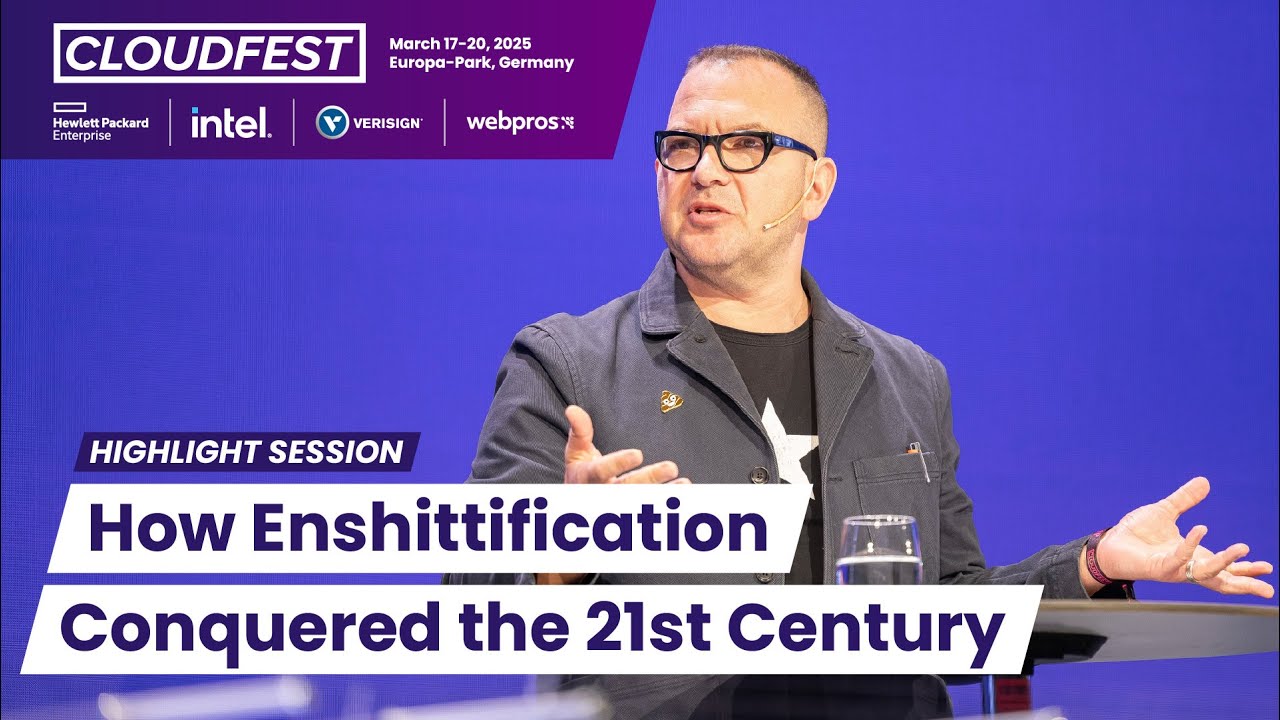
Cory Doctorow at CF 25: How Enshittification Conquered the 21st Century and How We Can Overthrow It
ggl and --- collude jedi blue?
cloudfest
---
---
an 1 25
In his farewell address, outgoing US President Joe Biden warned “an oligarchy is taking shape in America of extreme wealth, power and influence that literally threatens our entire democracy”.
The comment suggests that, under Donald Trump’s second term as president, it will be billionaires rather than the people who shape public policy.
There is certainly some evidence Biden’s ominous caution should be taken seriously. The world’s richest man and the owner of X, Elon Musk, has been a vocal supporter of the Republican candidate. Other billionaire tech moguls to visit Trump at his Mar-a-Lago mansion after his 2024 election victory include Meta’s Mark Zuckerberg, Amazon’s Jeff Bezos, Apple’s Tim Cook and Google chief executive Sundar Pichai.
There is nothing unusual about business leaders wanting the ear of an incoming president. What has concerned Biden and others is that so many of Trump’s influential backers also own media platforms and have the ability to sway public opinion.
Should these new tech titans be thought of as oligarchs?
What is an oligarchy?
Like many of the academic and scientific categories we still use today, oligarchy was originally defined by the Greek philosopher Aristotle.
In The Politics, he argued people are “political animals”, social by nature, and instinctively want to live in a community. He studied different governments of the ancient world and concluded there were six essential types.
A state could be ruled by a single leader, a small group of elites, or through mass participation of the people. If the leadership acted in the common advantage (koinê sumpheron), he termed these constitutions to be monarchy, aristocracy or polity, respectively.
If the constitutions became corrupt and the leadership acted only to advance their own self-interest, he labelled them tyranny, oligarchy and democracy.
[
So for Aristotle, an oligarchy is a corrupt form of government. It is when power is in the hands of a small group of elites who advance their own interests rather than the common good.
In Aristotelian terms, democracy is also a corrupt form of government in which the majority uses its power to abuse minorities. While the term democracy has been rehabilitated and is usually seen as a positive, the word oligarchy has retained its negative connotations.
When the United States was created, the founding fathers looked back to Aristotle, Polybius, Cicero and other ancient thinkers to try and create the best kind of constitution.
Following the Aristotelian tradition, they tried to design a mixed constitution where neither the one, the few nor the many could dominate the others. The president has great power. But their power is kept in check by Congress and the judiciary, which is in turn kept in check by the media and, ultimately, the people through regular elections.
Modern oligarchies
In modern politics, the term oligarch is most often used in a Russian context. After the collapse of the Soviet Union in 1991, opportunistic tycoons made enormous fortunes from buying up state assets such as energy companies and financial institutions, which also brought them significant political influence as a result.
Since Vladimir Putin became president in 2000, however, Russia has become increasingly authoritarian. While there is still an oligarchic class, their power has been reined in. They must not challenge Putin’s power or vision for the state.
Although China is ostensibly a communist state, the Gini index (the measure of social inequality) has blown out in recent years as a small group of elites become increasingly wealthy.
Despite the state’s official commitment to socialist principles, political scientist Ming Xia has argued China is now transitioning into a modern oligarchy.
What about the United States and Australia?
Despite Biden’s warning of a potential oligarchy, political scientists Martin Gilens and Benjamin Page argued back in 2014 the US already was one.
The US has the essential features of a liberal democracy (fair and regular elections, freedom of speech, and an independent press). But Gilens and Page worried large businesses and a small group of affluent citizens had a disproportionate influence on policy.
In Australia also, it could be argued an oligarchy is either emerging or has already taken hold.
Australia has a similar-sized economy to Russia and a growing list of billionaires who appear to have significant influence over government policy.
The power of the Murdoch family and their media empire is well-documented. We have also seen increased political activity from other billionaires including Gina Rinehart, Andrew Forrest and Clive Palmer – who went as far as to start his own political party.
There is no question billionaires in the US and Australia have enormous power and influence. But that in itself does not make an oligarchy.
In Aristotelian terms, the defining feature of an oligarchy is the ruling elite blatantly use their status for their own personal gain rather than the public good.
This is a moral judgement, and one that is increasingly hard to make when so many of the ultra-wealthy own traditional news media and social media platforms that can shape public opinion.
Nevertheless, any shift towards oligarchy should be a cause of alarm to all who value the long democratic tradition in both the US and Australia.
Whether it is a symptom of Trumpism, as Biden suggests, or part of a longer trend, strengthening our democratic institutions and curtailing the disinformation and misinformation that are all too prevalent on social media, is part of the solution.
Benjamin T. Jones, Senior Lecturer in History, CQUniversity Australia
This article is republished from The Conversation under a Creative Commons license. Read the original article.
===
---
mma
Google and Apple are hosting an app dedicated to TheDonald and other far-right forums that were banned from Reddit](
https://www.mediamatters.org/donald/google-and-apple-are-hosting-app-dedicated-thedonald-and-other-far-right-forums-were-banned)
06/05/24
==
Google Funds Climate Deniers
Jordan DavidsonOct. 11, 2019 10:24AM ESTBUSINESS
Google has continued to curry political favor with staunch conservatives by making substantial financial contributions to more than a dozen groups that deny that the climate crisis is real, as The Guardian revealed in a bombshell investigation.
The tech behemoth recently boasted about its net-zero emissions targets, its billions of dollars in wind and solar investments, and its CEO insisted that sustainability has been one of its earliest core values. However, that action has not stopped it from donating to organizations that have lobbied against climate legislation, questioned climate science or actively fought to reverse Obama-era environmental regulations.
A transparency document from Google shows that more than a dozen climate-science denying groups are among the organizations that "receive the most substantial contributions from Google's U.S. Government Affairs and Public Policy team."
One of the groups that have received support is the libertarian think-tank the Competitive Enterprise Institute (CEI), which was instrumental in convincing President Trump to leave the Paris agreement and has been critical of his administration for not dismantling enough environmental regulations, according to The Guardian.
Google has also made a substantial contribution to the American Conservative Union, which hosts the annual Conservative Political Action Committee, or CPAC — the conference where, earlier this year, Trump hugged a flag, called Elizabeth Warren Pocahontas, insulted the Green New Deal and said Congresswoman Ocasio-Cortez ranted like a lunatic, as USA Today reported.
The company is also a sponsor of the upcoming annual meeting of the State Policy Network (SPN), which is an umbrella for conservative groups like the Heartland Institute, which has denied climate science and criticized Greta Thunberg for "climate delusion hysterics," as The Guardian reported.
The Guardian also reported that SPN members recently created a "climate pledge" website that states, "our natural environment is getting better" and "there is no climate crisis."
These contributions stand in stark contrast to Google's public pledge to take urgent action on the climate crisis, according to The Independent. It also openly defies a 2014 statement from Google's former CEO Eric Schmidt who said on a radio show that it was wrong that Google supported a climate crisis-denying organization and that the company would not continue to do so.
As The Independent reported, a Google transparency statement distances itself from the entire ethos of the organizations it donates to. It states, "Google's sponsorship or collaboration with a third party organization doesn't mean that we endorse the organizations' entire agenda,its events or advocacy positions nor the views of its leaders or members."
In other words, Google will give money to groups whose climate science denial may be anathema to Google's position as long as those organizations do have some part of their agenda that is favorable to Google. In the case of these conservative organizations, Google supports their advocacy for deregulation.
In particular, Google wants to curry favor with conservatives to protect the Communications Decency Act, which was written in the 1990s and offers legal immunity to companies like Google and Facebook from third-party content that appears on their websites, according to The Guardian.
Essentially, it protects tech companies from being held liable for the content that appears on their websites.
Google's contributions to climate crisis deniers seem to be paying off. In a recent letter to members of Congress, CEI and other conservative groups called for the protection of section 230, arguing that it provided "new venues for conservative speech." It added that legislators who wanted to end the law are "well-meaning but mistaken."
In response to the revelations about where Google was making significant contributions, a spokesperson said to The Guardian, "We're hardly aloneamong companies that contribute to organizations while strongly disagreeing with them on climate policy."
Michael E. Mann
?
@MichaelEMann
"@Facebook Hires Koch-Funded Climate Deniers for 'Fact-Checking'" by @Andy_Rowell of @EcoWatch: https://www.ecowatch.com/facebook-factchecking-science-climate-denial-2635927165.html …
Facebook Hires Koch-Funded Climate Deniers for 'Fact-Checking'
Facebook CEO Mark Zuckerberg has given the contract to fight fake news to an organization that pushes fake news on climate change.
ecowatch.com
Google and Facebook Backed an Event Denying Climate Change ... ›
Following the Money That Undermines Climate Science - The New ... ›
These 3 American Tech Giants Sponsored a Political Event ... ›
==
ref
https://www.wired.com/story/google-and-facebook-backed-an-event-denying-climate-change/
google, Facebook, and Microsoft have publicly acknowledged the dangers of global warming, but last week they all sponsored a conference that promoted climate change denial to young libertarians.
All three tech companies were sponsors of LibertyCon, the annual convention of the libertarian group Students for Liberty, which took place in Washington, DC. Google was a platinum sponsor, ponying up $25,000, and Facebook and Microsoft each contributed $10,000 as gold sponsors. The donations put the tech companies in the top tier of the event’s backers. But the donations also put the firms in company with some of the event’s other sponsors, which included three groups known for their work attacking climate change science and trying to undermine efforts to reduce carbon emissions.
The WIRED Guide to Climate Change
Among the most notable was the CO2 Coalition,a group founded in 2015 to spread the “good news” about a greenhouse gas whose increase in the atmosphere is linked to potentially catastrophic climate change. The coalition is funded by conservative foundations that have backed other climate change denial efforts. These include the Mercer Family Foundation, which in recent years has donated hundreds of thousands of dollars to right-wing think tanks engaged in climate change denialism, and the Charles Koch Institute, the charitable arm of one of the brothers behind Koch Industries, the oil and gas behemoth.
In the LibertyCon exhibit hall, the CO2 Coalition handed out brochures that said its goal is to “explain how our lives and our planet Earth will be improved by additional atmospheric carbon dioxide.” One brochure claimed that “more carbon dioxide will help everyone, including future generations of our families” and that the “recent increase in CO2 levels has had a measurable, positive effect on plant life,” apparently because the greenhouse gas will make plants grow faster.
In a Saturday presentation, Caleb Rossiter, a retired statistics professor and a member of the coalition, gave a presentation titled “Let’s Talk About Not Talking: Should There Be ‘No Debate’ that Industrial Carbon Dioxide is Causing Climate Catastrophe?” In his presentation, Rossiter told the assembled students that the impact of climate change on weather patterns has been vastly exaggerated. “There has been no increase in storms, in intensity or frequency,” he said. “The data don’t show a worrisome trend.”
He insisted that when he hears the news that carbon dioxide levels in the atmosphere are rising, “I’m cheering!” That’s because, he said, carbon dioxide “is a fertilizer” that has made Africa greener and increased food production there, reducing human misery.
Rossiter also claimed that carbon dioxide emissions correlate with wealth and that the greenhouse gas “improves life expectancy” because poor countries that start burning fossil fuels have a more consistent power supply and can then clean up their water. “I’m happy when carbon dioxide is up, because it means poverty is down,” he declared.
“I come not to bury your carbon but to praise it,” he concluded.
Rossiter’s presentation puts him on the far fringes of the climate denial world. Not even Exxon is trying to make such arguments anymore. And it’s a long way from what Google, Facebook, and Microsoft have said about the dangers of carbon dioxide; all three companies have committed to reducing their own carbon footprints. Microsoft has pledged to cut carbon emissions by 75 percent by 2030. Google claims to be committed to a “zero carbon” future and is aggressively pursuing renewable energy sources for its operations to reduce its carbon footprint and help combat climate change. And Facebook founder Mark Zuckerberg criticized President Donald Trump after he announced that the United States would withdraw from the Paris climate accord, writing, “Stopping climate change is something we can only do as a global community, and we have to act together before it’s too late.”
The presence of the tech sponsors at a libertarian conference is not itself unusual, as governments around the globe move to try to regulate social media and online privacy. Tech companies see libertarians as natural allies in the fight against regulation. Indeed, Google sponsored two different sessions at the conference, one on why “permissionless innovation” needs to be defended and another on whether the government will “continue to let the Internet be awesome.” But the companies’ underwriting of a conference with a climate denier on the schedule shows the hazards of trying to advance a policy agenda through interest groups without also supporting their fringe elements.
The CO2 Coalition wasn’t the only group sponsoring LibertyCon that is known for its work undermining efforts to combat climate change. Along with Facebook and Microsoft, the Heartland Institute was also a gold sponsor of the event. Heartland is a longtime player in industry-funded efforts to undermine climate science and fend off efforts to reduce carbon emissions. The conservative Heritage Foundation, which pushed the Trump administration to withdraw from the Paris climate accords and has long featured experts who argue that global warming is a myth, was also a sponsor.
Microsoft did not respond to requests for comment. A Facebook spokesman responded to questions about its sponsorship of LibertyCon by sending a link to its political engagement page, which says, “Sometimes we support events that highlight Internet and social media issues” and features a long list of third-party groups it has worked with in the past. He noted that LibertyCon met its criteria for support and cited the number of sessions unrelated to climate change.
A spokesperson from Google defended the company’s LibertyCon sponsorship, saying, “Every year, we sponsor organizations from across the political spectrum to promote strong technology laws.As we make clear in our public policy transparency report, Google’s sponsorship or collaboration with a third party organization doesn’t mean that we endorse the organization’s entire agenda or agree with other speakers or sponsors."
==