billionaire 3 pluto-
1/ 22
see PLUTO 4 OLIG 12 24
Billionaire 3 pluto- BROLIGARCHY
SEE 2025 FOUR SIS
see buy election bribery/ prop initiatives
see trump trans 2 admin musk, vivek? jdv thiel VC, sec treas....PVT EQUITY HEDGE TEN BILLIONAIRES AND COUNTING CABINET
see harlan crow
see singer vulture scotus ~ AA and student debt
see FUNDERS
see hedge fund pvt equity
see tax dodge see voodoo
see dark $, see outside spending
see inequality polarization
see oligarch ussr, plutocrat SEE KLEPTO- KAKI CRONY CAPLISM
see bezos coi blue origin 10 24 fascism JRNL FAIL lat SOON
press suppression --> fascism “corporatism”
:{html :{ carnival
see musk dirty tricks musk and thiel S afrika? 1 mil lotto eACH DAY BUY VOTES
see dan snyder redskins
adelson transactional foreign policy, trump 1b$ for tax cut
===
an 12 24
tesla has big plant in china, thus he wants more investment
pres musk govt shutdn // kid cancer
'Unfathomable': Firefighters slam spending bill after Trump 'scuttled' 9/11 first-responders fund
===
rr AN 12 24
Today we don’t know if the United States government will shut down tomorrow because, first, Elon Musk followed by his co-president Donald Trump, persuaded House Republicans to vote against a compromise bill, and then, last night, Republicans couldn’t summon enough votes for a stripped-down continuing resolution because Trump insisted that it contain a measure lifting the debt ceiling.
This is not governing. Trump and the Republicans are not a governing party.
What’s the back story to all this? It’s the oligarchy that put Trump into the presidency.
A half-century ago, when America had a large and growing middle class, those on the “left” wanted stronger social safety nets and more public investment in schools, roads, and research. Those on the “right” sought greater reliance on the free market.
But as power and wealth have moved to the top, everyone else — whether on the old right or the old left — has become disempowered and less secure.
Today the great divide is not between left and right. It’s between democracy and oligarchy.
The word “oligarchy” comes from the Greek words meaning rule (arche) by the few (oligos). It refers to a government of and by a few exceedingly rich people or families who control the major institutions of society — and therefore have most power over other peoples’ lives.
So far, Trump has picked 13 billionaires for his administration. It’s the wealthiest in history, including the richest person in the world. They and Trump are part of the American oligarchy, even though Trump campaigned on being the “voice” of the working class.
America has experienced oligarchy twice before. Many of the men who founded America were slaveholding white oligarchs. At that time, the new nation did not have much of a middle class. Most white people were farmers, indentured servants, farm hands, traders, day laborers, and artisans. A fifth of the American population was Black, almost all of them enslaved.
A century later a new American oligarchy emerged comprised of men who amassed fortunes through their railroad, steel, oil, and financial empires — men such as J. Pierpont Morgan, John D. Rockefeller, Andrew Carnegie, Cornelius Vanderbilt, and Andrew Mellon. It was called the Gilded Age.
They ushered the nation into an industrial revolution that vastly expanded economic output. But they also corrupted government, brutally suppressed wages, generated unprecedented levels of inequality and urban poverty, pillaged rivals, shut down competitors, and made out like bandits — which is why they earned the sobriquet “robber barons.”
World War I and the Great Depression of the 1930s eroded most of the robber barons’ wealth, and much of their power was eliminated with the elections of Franklin D. Roosevelt in 1932 and Democratic majorities in the House and Senate.
America demanded fundamental reforms — a progressive income tax, corporate taxes, estate taxes, limits on the political power of large corporations, antitrust laws, laws enabling workers to form unions and requiring that employers negotiate with them, Social Security, the forty-hour workweek, unemployment insurance, civil rights and voting rights, and Medicare.
For the next half-century, the gains from growth were more widely shared and democracy became more responsive to the needs and aspirations of average Americans. During these years America created the largest middle class the world had ever seen.
There was still much to do: wider economic opportunities for Black people, Latinos, and women, protection of the environment. Yet by almost every measure the nation was making progress.
Starting around 1980, a third American oligarchy emerged.
Since then, the median wage of the bottom 90 percent has stagnated. The share of the nation’s wealth owned by the richest 400 Americans has quadrupled (from less than 1 percent to 3.5 percent) while the share owned by the entire bottom half of America has dropped to 1.3 percent, according to an analysis by my Berkeley colleagues Emmanuel Saez and Gabriel Zucman.
The richest 1 percent of Americans now has more wealth than the bottom 90 percent combined.
The only other country with similarly high levels of wealth concentration is Russia, another oligarchy.
All this has been accompanied by a dramatic increase in the political power of the super-wealthy and an equally dramatic decline in the political influence of everyone else.
While the Biden administration sought to realign America with its ideals, it did not and could not accomplish nearly enough. Trump’s lies and demagoguery exploited the anger and frustration of much of America — creating the false impression he was a tribune of the working class and an anti-establishment hero — thereby allowing the oligarchy to triumph.
In 2022, Elon Musk spent $44 billion to buy Twitter and turn it into his own personal political megaphone. Then, in 2024, he spent $277 million to get Trump elected, also using Twitter (now X) to amplify pro-Trump, anti-Harris messages.
These were good investments for Musk. Since Election Day, Musk’s fortune has increased by $170 billion. That’s because investors in Tesla and SpaceX have pushed their value into the stratosphere.
Trump has put Musk (and another billionaire, Vivek Ramaswamy) in charge of gutting government services in the name of “efficiency.” Musk’s investors assume that Musk will eliminate the health, safety, labor, and environmental regulations that have limited the profits of Musk-owned corporations, and that Trump will put more government money into SpaceX and xAI (Musk’s artificial intelligence company).
Unlike income or wealth, power is a zero-sum game. The more of it at the top, the less of it anywhere else.
The power shift across America is related to a tsunami of big money into politics. Corporate lobbying has soared. The voices of average people have been drowned out.
The American oligarchy is back, with a vengeance.
Not all wealthy people are culpable, of course. The abuse is occurring at the nexus of wealth and power, where those with great wealth use it to gain power and then utilize that power to accumulate more wealth. Today’s robber barons include Elon Musk, Jeff Bezos, Peter Thiel, David Sacks, Charles Koch, Jeff Yass, Ken Griffin, and Rupert Murdoch.
This is how oligarchy destroys democracy. As oligarchs fill the coffers of political candidates and deploy platoons of lobbyists and public relations flaks, they buy off democracy. Oligarchs know that politicians won’t bite the hands that feed them.
As long as they control the purse strings, there will be no meaningful response to the failure of most people’s paychecks to rise, nor to climate change, nor racism, nor the soaring costs of health insurance, pharmaceuticals, college, and housing, because those are not the main concerns of the oligarchy.
The oligarchs want lower taxes, which is what Trump, Musk, and other oligarchs are planning — an extension of the 2017 Trump tax cut, with an estimated price tag of at least $5 trillion.
They want no antitrust enforcement to puncture the power of their giant corporations. Instead, their corporations will grow larger, able to charge consumers even more. Trump is replacing Lina Khan, the trustbusting chair of the Federal Trade Commission, with a Trump crony.
There will be no meaningful constraint on Wall Street’s dangerous gambling addiction. The gambling will only increase.
Wall Street is already celebrating Trump’s victory. The stock market has reached new heights. But the stock market is inconsequential for most people, because the richest 1 percent own over half of all shares of stock owned by Americans while the richest 10 percent own over 90 percent.
There will be no limits to CEO pay. Wall Street hedge fund and private equity managers will also rake in billions more. Government will dole out even more corporate subsidies, bailouts, and loan guarantees while eliminating protections for consumers, workers, and the environment.
It will become a government for, of, and by the oligarchy.
The biggest divide in America today is not between “right” and “left,” or between Republicans and Democrats. It’s between democracy and oligarchy. The old labels — “right” and “left” — prevent most people from noticing they’re being shafted.
The propagandists and demagogues who protect the oligarchy stoke racial and ethnic resentments — describing human beings as illegal aliens, fueling hatred of immigrants, and spreading fears of communists and socialists.
This strategy gives the oligarchy freer rein: It distracts Americans from how the oligarchy is looting the nation, buying off politicians, and silencing critics. It causes Americans to hate each other so we don’t look upward and see where the wealth and power have really gone.
The way to overcome oligarchy is for the rest of us to join together and win America back, as we did in response to the oligarchy that dominated America’s last Gilded Age.
This will require a multiracial, multiethnic coalition of working-class, poor, and middle-class Americans fightingfordemocracy and againstconcentrated power and privilege.
It will require that the Democratic Party, or a new third party, tell the truth to the American people: that the major reason most peoples’ wages have gone nowhere and their jobs are less secure, why most families have to live paycheck to paycheck, why CEO pay has soared to 300 times the pay of the typical worker, and why billionaires are about to run our government, is because the market has been rigged against average working people by the oligarchy.
The agenda ahead is simply stated but it will not be easy to implement: We must get big money out of our politics. End corporate welfare and crony capitalism. Bust up monopolies. Stop voter suppression.
We must strengthen labor unions, give workers a stronger voice in their workplaces, create more employee-owned corporations, encourage worker cooperatives, fund and grow more state and local public banks, and develop other institutions of economic democracy.
This agenda is neither “right” nor “left.” It is the bedrock for everything else America must do.
It may seem an odd time in our history to suggest such reforms, but this is the best time. Trump and his oligarchy will inevitably overreach. The lesson from the last Gilded Age is that when the corruption and ensuing hardship become so blatant that they offend the values of the majority of Americans, the majority will rise up and demand real, systemic change.
It’s only a matter of time. A government shutdown that hurts average people, engineered by the richest person in the world, might just hasten it.
NOW READ:**Elon Musk shows Mike Johnson who's boss**
BIG PICTURE
'Quickly rot from within': Expert reveals 3 traits the US shares with declining empires
https://www.alternet.org/us-empire-decline/)
an 12 24
The United States is currently displaying several characteristics that have historically been seen by empires in decline, according to one social scientist.
Peter Turchin is one of the pioneers of "cliodynamics," which is the field of study concerning statistical analysis of historical dynamics of societies around the world. In a recent essay for the Guardian, Turchin wrote that he and his fellow researchers have noticed the U.S. having three key traits in common with past global hegemons just before a period of decline. Those three factors are "popular immiseration, elite overproduction and state breakdown."
Turchin explained that "popular immiseration" describes a breakdown of the social contract between workers, the private sector and the public sector, which he said began after the Republican assault in the New Deal that happened around the time former President Ronald Reagan took power. He noted that as "the power of unions was undermined," taxes on the richest Americans were "cut back," which was followed by stagnating wages and a decline in life expectancy.
READ MORE:['Not good enough anymore': Union leader explains why Dems lost economic argument to Trump
"With the incomes of workers effectively stuck, the fruits of economic growth were reaped by the elites instead. A perverse 'wealth pump' came into being, siphoning money from the poor and channelling it to the rich," he wrote. "In many ways, the last four decades call to mind what happened in the United States between 1870 and 1900 – the time of railroad fortunes and robber barons. If the postwar period was a golden age of broad-based prosperity, after 1980 we could be said to have entered a Second Gilded Age."
The second trait, which Turchin called "elite overproduction," involves a growing population of the "uber-rich," (which he defined as "those with fortunes greater than $10 million") and their influence in the public sphere. He noted that when adjusting for inflation, this population grew by tenfold over the last four decades. This has led to rich elites either running for office, like President-elect Donald Trump, or funding candidates for office, like many billionaires have done in recent cycles. He also pointed out that "counter-elites" will emerge who oppose the existing political establishment.
"The more members of this elite class there are, the more aspirants for political power a society contains," he wrote. "By the 2010s the social pyramid in the US had grown exceptionally top-heavy: there were too many wannabe leaders and moguls competing for a fixed number of positions in the upper echelons of politics and business."
"As battles between the ruling elites and counter-elites heat up, the norms governing public discourse unravel and trust in institutions declines," he continued. "The result is a loss of civic cohesiveness and sense of national cooperation – without which states quickly rot from within."
READ MORE:[Watch: JD Vance booed by room full of firefighters as he calls himself 'pro-worker'
Finally, Turchin opined that "state breakdown" will inevitably follow popular immiseration and elite overproduction. He argued that Democrats' loss in the November election "represents one battle in an ongoing revolutionary war," but that the goal of the new order is "far from assured" given that "opponents are pretty well entrenched in the bureaucracy and can effectively resist change."
"Popular discontent in the US has been building up for more than four decades. Many years of real prosperity would be needed to persuade the public that the country is back on the right track," he wrote. "So, for now, we can expect a lasting age of discord. Let’s hope that it won’t spill over into a hot civil war."
Click here to read Turchin's full essay in the Guardian.
READ MORE:['A corporate CEO's dream': Labor unions blast Trump-Vance ticket
---
===
AN 12 24
Patrick Soon-Shiong—the biotech billionaire whose moves as owner of the Los Angeles Times have prompted a wave of resignations and subscription cancellations—is reportedly now asking the paper's editorial board to refrain from publishing pieces about Republican President-elect Donald Trump.
Oliver Darcy's Status newsletter accused Soon-Shiong of "meddling for MAGA" by requesting that Times members of the board and opinion writers, according to an internal memo, "take a break from writing about Trump."
Based on the memo viewed by Darcy, Soon-Shiong has asked editors to send him "the text of every editorial and the name of its writer" prior to publication, prompting staff "concerns about the ability of the board to do its job without fear of retaliation," according to Status.
Darcy wrote that the memo came from staffers who "said they were notifying [executive editor Terry] Tang, who oversees both the newsroom and opinion section, of Soon-Shiong's alarming actions because the newspaper's ethics policy requires employees to report 'anything that might cast a shadow on the Times' reputation.'"
"Glad I already resigned or I would have to do it now."
Responding Wednesday to the Status report, former Times senior legal affairs columnist Harry Litman wrote on social media, "Glad I already resigned or I would have to do it now."
Darcy's newsletter follows reporting last week that Soon-Shiong scuppered a draft editorial criticizing some of Trump's Cabinet nominees, telling editors that it could not run unless accompanied by a piece presenting an opposing view.
Earlier this month, Soon-Shiong said he planned to embed an artificial intelligence-powered "bias meter" in Times articles and editorials.
Soon-Shiong—a surgeon by training—has praised three doctors tapped for Trump's Cabinet. He has also dined with Trump, calling it an "incredible honor."
While Soon-Shiong has owned the Times—for which he paid $500 million as part of a multi-outlet deal—since 2018, the extent of his involvement in the paper's operations made headlines in October after he blocked its editorial board from endorsing Vice President Kamala Harris for president.
The decision—which Soon-Shiong said was based partly on a desire for more balance in the Times opinion section and partly on Harris' complicity in the U.S.-backed Israeli war on Gaza—prompted the resignation of editorials editor Maria Garza.
Other resignations have followed as "morale in the newsroom has plummeted," according to Darcy.
Litman explained on his Substack following his resignation earlier this month that he does not "want to continue to work for a paper that is appeasing Trump and facilitating his assault on democratic rule for craven reasons."
"My resignation is a protest and visceral reaction against the conduct of the paper's owner, Dr. Patrick Soon-Shiong," he wrote. "Soon-Shiong has made several moves to force the paper, over the forceful objections of his staff, into a posture more sympathetic to Donald Trump."
Contrasting Soon-Shiong's hands-on leadership style with TheWashington Post's multicentibillionaire owner,Chicago Tribune contributor Steve Chapman wrote on social media:
Jeff Bezos: "Nobody ever wrecked the reputation of a respected newspaper as fast as I did." Patrick Soon-Shiong: "Hold my beer."
The Los Angeles TimestoldThe Guardian that its management team "is currently reviewing the concerns" expressed in the editors' memo.
an 12 24
Tesla/SpaceX CEO Elon Musk was a major donor to Donald Trump's 2024 campaign, and the president-elect has offered him a position in his second administration.
Trump has proposed a new agency that would be called the Department of Government Efficiency (DOGE), and he would like Musk to lead it along with MAGA businessman Vivek Ramaswamy.
Sen. Elizabeth Warren (D-Massachusetts), according to Washington Post reporter Michael Scherer, voiced her concerns about Musk, possible conflicts of interest and the incoming second Trump Administration in a letter sent to the president-elect on Monday, December 17 — and staffer Karoline Leavitt "responded by calling her 'Pocahontas.'"
READ MORE:['How long it’ll be until he sues an economist': Experts blast Trump's lawsuit against pollster
"Pocahontas" is an insult that Trump came up with for Warren in response to her claim to have some Native American ancestry. Trump repeatedly called her "Pocahontas" when she was running for in the 2020 Democratic presidential primary.
In her letter, Warren wrote, "Putting Mr. Musk in a position to influence billions of dollars of government contracts and regulatory enforcement without a stringent conflict of interest agreement in place is an invitation for corruption on a scale not seen in our lifetimes. As your Transition Team Ethics Plan makes clear, the role of government is not to line the pockets of the wealthiest Americans; a strong, enforceable ethics plan for the world’s richest man is a necessary first step for delivering on that promise."
Leavitt, according to Scherer, "did not address Musk’s ethics commitments in her response to the letter."
Leavitt, who Trump has chosen for White House press secretary, responded, "President Trump has assembled the most impressive and qualified team of innovators, entrepreneurs, and geniuses to advise and staff our government. Pocahontas can play political games and send toothless letters, but the Trump-Vance transition will continue to be held to the highest ethical and legal standards possible — a standard unfamiliar to a career politician whose societal impact is 1/1024th of Elon Musk's."
READ MORE:['Damning information mounts': Trump's 'worst' nominees could be in for a rude awakening
In her letter, Warren wanted to know if Musk plans to "recuse himself from matters affecting Tesla, Space X, X, or any other company he owns or in which he has a substantial investment."
The senator wrote, "Currently, the American public has no way of knowing whether the advice that he is whispering to you in secret is good for the country — or merely good for his own bottom line."
===
===
We unraveled the $122 million web of climate denial, political extremism, and Trump ties to Project 2025
Mapped: How 6 Billionaire Family Fortunes Fund Project 2025 - DeSmog
As scrutiny of Project 2025 continues to grow, defenders of the Heritage Foundation-led initiative, which would reshape federal governance and give the next Republican president unprecedented new powers, say it’s the criticism — not the 922-page plan itself — that’s too extreme.
In a piece published last month, Fox News cited prominent conservatives who feel there’s “nothing radical” about the endeavor. The Wall Street Journal’s editorial board has accused detractors of “panic-mongering” and tried to reframe Project 2025’s sprawling “Mandate for Leadership” blueprint as more boring than scary — a milquetoast white paper that simply “melds the work of some 400 scholars and analysts from an eclectic mix of center-right groups.” This echoes Heritage’s insistence that Project 2025, while conservative, is anything but fringe.
But the findings from DeSmog’s recent investigation into Project 2025’s funding sources tell a very different story. Our wide-ranging analysis of public financial disclosure forms found that the groups on Project 2025’s advisory board — whose experts largely helped to draft the plan — are heavily funded by just six family fortunes. Since 2020, foundations linked to these billionaire families have contributed over $122 million to Project 2025 groups, including at least 290 individual donations to 49 nonprofits that contributed to the Mandate for Leadership documents or are on the initiative’s advisory board. We’ve mapped the funding ties between the billionaire families and the Project 2025 individuals and organizations in an interactive graphic, below.
Groups that received funds from the six family fortunes are far from the political mainstream, according to DeSmog’s analysis, including entities that actively deny the science of anthropogenic climate change — as well as organizations that have been classified as hate groups by the Southern Poverty Law Center. DeSmog’s review also uncovered additional ties between the six families and the Trump/Vance ticket, though both candidates have tried to distance themselves from the initiative in recent months. Indeed, Richard and Elizabeth Uihlein — the billionaire founders of the Uline packaging company, whose charitable donations tie them closely to Project 2025 — are among the former president’s biggest donors.
Project 2025 styles itself as populist, moderate, and far from the politics of Washington. Heritage Foundation President Kevin D. Roberts hails it as a plan for the perennially downtrodden, hard-laboring folks “who shower afterwork instead of before.” Its funding sources — elite, extreme, and closely tied to the Trump campaign — suggest exactly the opposite.
The Donors
Though the Mandate pledges to “prioritize the economic prosperity of ordinary Americans” and pry influence away from “America’s corporate and political elites,” the funding that produced it comes from the upper echelons of the billionaire class.
And not just any billionaires. The six family dynasties providing significant support to Project 2025 — Bradley, Coors, Koch, Scaife, Seid, and Uihlein — all have long histories of fighting for financial and environmental deregulation. Three of the six families have promoted climate denial consistently enough to appear in DeSmog’s Climate Disinformation Database, which tracks the people and organizations doing the most to undermine decarbonization efforts.
They include oil and gas magnate Charles G. Koch and his Koch Family Foundations; the Scaife Family Foundations, which tap vast wealth from the Mellon aluminum, oil, and banking fortune; and chemicals-and-electronics industrialist Barre Seid, whose recent, record-setting $1.6 billion gift to a nonprofit controlled by Federalist Society co-chair Leonard A. Leo has been a major source of Project 2025 money.
While the Heritage Foundation suggests a diverse conservative coalition gave rise to the Mandate for Leadership, the six family fortunes’ giving patterns were remarkably similar. Of the 49 Project 2025 groups, 37 percent received funding from at least three of the six families. 70 percent of the 49 groups received funding from at least two of the families. (In a few cases, the donations were to sister 501(c)4 lobbying arms that share offices and staff.) The average donation was over $420,000.
*Related:See DeSmog’s coverage of Trump Megadonor Tim Dunn’s Plan That’s More Extreme Than Project 2025
Links to Climate Denial
For decades, oil and gas magnate Charles G. Koch and his late brother David fought vigorously for environmental deregulation, including by supporting groups that sow doubt about the science of manmade climate change. Foundations linked to Koch gave at least $9.6 billion to 15 Project 2025 groups since 2020. But four of the lesser-known families — Bradley, Scaife, Seid, and Uihlein — gave even more, and all six family fortunes helped to fund Project 2025 groups that have denied the science of manmade climate change.
Of the 10 groups that the six families funded most heavily, seven are in DeSmog’s Climate Disinformation Database. That includes more than $11 million to the Heritage Foundation; $8.3 million to Turning Point USA, which has provided a platform for well-known climate deniers like Alex Epstein; and $4.6 million to the Texas Public Policy Foundation, which in 2015 published an op-ed claiming warming is “obviously not initiated by the burning of fossil fuels”. In total, foundations linked to the six families gave to 15 Project 2025 groups with entries in DeSmog’s Climate Disinformation Database.
That wasn’t the only form of extremism DeSmog uncovered. Four Project 2025 organizations that received donations from the six billionaire fortunes since 2020 are classified as hate groups by the Southern Poverty Law Center (SPLC), a leading civil rights watchdog group. These include the Alliance Defending Freedom, an anti-LGBTQ group that received over $1.6 million in donations from Bradley and Koch; The Center for Immigration Studies, an anti-immigrant group that received $650,000 from Scaife; Eagle Forum, an anti-government and anti-immigrant group that received over $100,000 from Koch and Uihlein; and Family Research Council, an anti-abortion group that received $25,000 from Seid.
Of the six billionaire families, only Coors-linked foundations — run by heirs to the Coors brewing fortune — did not donate to at least one SPLC-designated hate group.
Links to the Trump Campaign
For months, Donald J. Trump has publicly disavowed Project 2025, claiming to know nothing about the initiative. That stance conflicts with subsequent media reports, including resurfaced video of the former president and current Republican presidential nominee saying, as a keynote speaker at a 2022 Heritage Foundation event, that Heritage would “lay the groundwork & detail plans for exactly what our movement will do.” The Washington Post reported that Trump flew in a private plane to the event with Heritage President Kevin Roberts.
Trump’s running mate, Ohio Senator JD Vance, has also been the subject of intense scrutiny for numerous ties to Project 2025 — including writing the foreword to Roberts’ forthcoming book. DeSmog’s investigation also uncovered numerous ties between Vance and Project 2025 advisory groups, including a previously unreported 2017 keynote speech at a Heritage event.
But while the candidates continue to downplay any Project 2025 connections, one link is unavoidable: a billionaire family that heavily supports Project 2025 groups is among their campaign’s biggest donors, according to Federal Election Commission data.
In May, Richard and Elizabeth Uihlein, the founders of the Uline packaging company, each donated $5 million to Make America Great Again, Inc., a super PAC supporting Trump’s reelection. That’s not including the more than $48 million Richard contributed to Restoration PAC, a pro-Trump political action committee, last quarter alone. Restoration PAC has spent over $12.9 million this year on political advertising, including ads supporting Trump and attacking his opponent, Vice President Kamala Harris.
Since 2020, the Ed Uihlein Foundation, which is run by the Uihleins and named in honor of Richard’s father, has donated at least $13.4 million to 13 different Project 2025 groups.
The map below is interactive. Click on a donor to see the groups it funded with dollar amounts, or a nonprofit to see which of the six family fortunes made donations.
[GFX]
---
---
see funder get gigs plums // TEN billionaire cabinet trans 2
an 12 24
President-elect Donald Trump pledged to fast-track permits and tamp down regulations, including environmental, for any entity that wants to invest $1 billion or more in America, while offering no specifics or parameters, including how the federal government could arbitrarily overrule state and local laws.
“Any person or company investing ONE BILLION DOLLARS, OR MORE, in the United States of America, will receive fully expedited approvals and permits, including, but in no way limited to, all Environmental approvals. GET READY TO ROCK!!!” Trump wrote on his Truth Social website.
During the campaign, Trump told oil and gas executives and lobbyists at a closed-door Mar-a-Lago fundraiser that if they invested $1 billion in his campaign, he would scale back or remove environmental regulations.
READ MORE: ‘Swarm of MAGA Attacks’ Making Hegseth Confirmation Seem More Likely: Report
“Attendees included executives from ExxonMobil, EQT Corporation and the American Petroleum Institute, which lobbies for the oil industry,” The New York Times had reported in May. “The event was organized by the oil billionaire Harold Hamm, who has for years helped to shape Republican energy policies.”
Trump has announced his nominee for Secretary of the Interior will be North Dakota Governor Doug Burgum.
“Under the National Environmental Policy Act,” Forbes reports, “the federal government is required to conduct environmental reviews before approving energy production plans, infrastructure builds and other projects. How Trump will help investors get around regulations isn’t clear, but Trump has vowed to increase domestic production of oil and natural gas, projects that are often stymied or killed in the regulatory process.”
Critics blasted Trump’s statement.
314Action, which says it is “the only organization in the nation focused on recruiting, training, and electing Democrats with a background in science to public office,” wrote: “To tackle the climate crisis, Congress needs to pass and enforce bold, evidence-based legislation. However, Donald Trump doesn’t believe that billionaires should have to follow the law. In his world, they can pay-to-play and bypass crucial environmental protections. That’s why we’ll always fight to #ElectScientists who will fight back against his anti-science agenda and hold these bad actors accountable.”
“A government of oligarchs that will exist to solely serve the interests of oligarchs while distracting working people with culture wars. Foreign corporations & persons can loot & pollute the US and bypass regs that protect the health of Americans as long as they got lots of cash,” observed MeidasTouch editor-in-chief Ron Filipkowski.
Journalist David Leavitt asked, “How many animals will go extinct because of this? How much quicker will this hasten the destruction of our planet?”
===
---
no lnx
Meet the billionaires backing Republican Dave McCormick’s U.S. Senate run
Deep-pocketed Wall Street donors have lined up to donate to a super PAC backing the Republican Senate candidate
Matt Rourke / Associated Press
By Ryan W. Briggs and Sean Collins Walsh
Published Oct 31, 2024
Insurgent candidates frequently struggle to raise money against entrenched incumbents who already control the levers of power.
But Republican Dave McCormick, who is challenging three-term Democratic incumbent Bob Casey in Pennsylvania’s nationally watched U.S. Senate race, is not your average political newcomer.
A former CEO of the world’s largest hedge fund and a U.S. Treasury official in the George W. Bush administration, McCormick entered the race with a Rolodex of friends and supporters who are among the richest people on Earth. Many of them have stepped up by pouring millions into a super PAC backing the Republican.
Keystone Renewal PAC is the only major super PAC solely dedicated to Pennsylvania’s Senate race. A vast majority of the rest of the spending has come from the candidates’ campaigns or their parties’ Senate leadership funds.
The PAC has spent about $52 million, with three-quarters of its advertising dedicated to attacking Casey and a quarter to boosting McCormick, according to Open Secrets, the government transparency nonprofit.
A Keystone Renewal spokesperson said the PAC is “committed to educating the American public on Bob Casey's radical policy record that is responsible for the record-high inflation and open borders.”
“Dave McCormick is the only candidate that will fix what Bob Casey has done during his tenure in office, and deliver safety and prosperity,” the spokesperson said in a written statement.
At a Tuesday event in Allentown, Casey countered that McCormick was being propped up by “out-of-state billionaires coming into Pennsylvania to lecture us about who's going to be our senator, to lecture us about rights.”
More than $289 million has been spent on the race, and a majority of both candidates’ financial support comes from outside Pennsylvania, which is common in modern Senate contests. McCormick, however, has a greater share of donors from elsewhere.
Both candidates have raised millions through their campaigns and are also benefiting from heavy spending by their respective parties’ leadership. Senate Democrats’ super PAC, for instance, has spent $53 million to help Casey, according to Open Secrets, and it raises money from super-wealthy donors across the country, including some who donated anonymously through a “dark money” nonprofit.
Notably, Keystone Renewal has disclosed almost all of its individual donors and is not structured as a dark money organization.
In addition to members of the Perot, DeVos, and Pritzker families, here are some of the notable donors backing Keystone Renewal PAC:
Donated $15,000,000
Ken C. Griffin
The Harvard-educated billionaire owner of Citadel Securities, a financial services company, was a prominent supporter of Republican Nikki Haley’s insurgent primary bid against Donald Trump. Both Griffin and fellow billionaire Stephen A. Schwarzman (more on the Blackstone CEO later) hosted early fundraisers for McCormick’s failed 2022 Senate primary bid. This year, Griffin became the largest individual donor to Keystone Renewal.
“I proudly support leaders like David McCormick, who have a proven record of service and commitment to our country,” Griffin said on Wednesday. “We need leaders in Washington who are committed to securing our borders, stopping inflation, and ensuring a strong national defense."
Donated $3,300,000
Thomas Peterffy
Thomas Peterffy, Founder, Chairman and CEO of Interactive Brokers.
Associated Press
The Hungarian-born CEO of Interactive Brokers, a Wall Street brokerage firm, owns a mansion along Palm Beach’s “Billionaire’s Row,” near Mar-a-Lago, along with other McCormick donors like Steve Wynn. After offering tepid support in 2020, Peterffy has joined other billionaires in aggressively backing Trump this year, and even used his company to dive into the political betting craze to speculate on the outcome of the election. In 2022, Peterffy supported Mehmet Oz, who beat McCormick in the GOP primary. But this cycle he’s all in for McCormick.
“I think the battle over free enterprise versus a socialist nanny state is going to be decided in Pennsylvania over the next several years,” Peterffy said in an interview. “I like David McCormick. … I know him quite well. He’s been fantastic as a soldier, as an officer, and as a private enterprise person.”
Donated $3,000,000
Richard and Elizabeth Uihlein
A Uline delivery truck
JHVEPhoto
This Wisconsin couple cofounded industrial packing supply company Uline, whose success made both into billionaires. An heir to the Schlitz beer fortune, Richard Uihlein is a reclusive but prolific conservative donor – but has historically favored conservatives disruptors, from Pat Buchannon to the Tea Party movement. Elizabeth is a onetime Clinton voter who later embraced traditional economic conservatism. The middle ground: Dave McCormick.
Donated $2,250,000
Jeffrey Yass
Jeff Yass
Courtesy of the Yass Foundation for Education
As Pennsylvania’s richest man, the Montgomery County-based cofounder of the investment firm Susquehanna International Group has long used his fortune to promote conservative and libertarian goals, particularly private school voucher programs. This year, he has spent millions to support Pennsylvania Republicans through donations to a PAC called the Commonwealth Leaders Fund. He has separately donated to Keystone Renewal to support McCormick.
“I support candidates, such as Dave McCormick, who support school choice,” Yass said in a statement. Casey’s policies, he said, lead to “lower income children trapped in failing, public schools.”
Donated $2,000,000
Paul Singer
FILE - In this May 12, 2014, file photo, Paul Singer, founder and CEO of hedge fund Elliott Management Corporation, speaks at the Manhattan Institute for Policy Research Alexander Hamilton Award Dinner in New York. Prominent athenahealth investor Elliott Management Corp. is offering about $6.5 billion to take the medical billing software maker private after saying it has grown frustrated with the company's performance. Shares of athenahealth soared early Monday, May 7, 2018, after the shareholder outlined its proposal. (AP Photo/John Minchillo, File)
Associated Press
The New Jersey-born founder of Elliott Investment Management earned an immense fortune – and scorn – investing in distressed debt, notably buying up sovereign obligations from nations teetering on financial collapse The self-described libertarian has advanced varied causes, both advocating for government deregulation and promoting gay marriage. Singer initially supported Marco Rubio in the 2016 presidential campaign, only later warming to Trump. He has historically been one of the largest donors to Republican Senate campaigns, and individuals linked to Elliott Management made up the second-largest pool of donors to McCormick’s 2022 campaign, after Goldman Sachs.
Donated $2,000,000
Antonio Gracias
In this sketch former Tesla board member Antonio Gracias testifies in a courtroom in Wilmington, Del., on Wednesday, Nov. 16, 2022.
In this sketch former Tesla board member Antonio Gracias testifies in a courtroom in Wilmington, Del., on Wednesday, Nov. 16, 2022.
Elizabeth Williams via AP
Gracias is the founder of Valor Equity Partners, a $16 billion private equity firm. He is a confidant of Tesla owner Elon Musk, and earned much of his wealth from stock options in the electric car manufacturer, where he worked until 2021. Forbes values his net worth at $1.3 billion. He has donated to Keystone Renewal through a trust.
Donated $1,500,000
Jan Koum
Billionaire Jan Koum
Associated Press
Koum is a Ukranian American billionaire and former CEO of WhatsApp – a popular messaging program widely used internationally – and a fixture in Silicon Valley. Ethnically Jewish, Koum has donated extensively both to Ukranian wartime aid and pro-Israel groups. A major Haley backer, he has more recently donated to Keystone Renewal through an LLC.
Donated $1,500,000
Stephen A. Schwarzman
Stephen A. Schwarzman CEO Blackstone speaks during the session 'Shaping a New Market Architecture' at annual meeting of the World Economic Forum in Davos, Switzerland, Tuesday, Jan. 22, 2019. (AP Photo/Markus Schreiber)
Associated Press
The CEO of the Blackstone Group, a trillion-dollar global private equity firm, is associated through his company with aggressive buyouts of everything from the Hilton hotel chain to railroads and grocery stores. But he is also a Philadelphia-area native and a longtime donor to Republican causes – and among the most prominent Wall Street supporters of Trump’s latest presidential campaign. One of McCormick’s early political supporters, along with Griffin, Schwarzman is back this year. He is also pumping millions into the U.S. Senate candidacy of Republican Tim Sheehy in Montana.
Donated $1,000,000
Howard Lutnick
Howard Lutnick speaks before Republican presidential nominee former President Donald Trump at a campaign rally at Madison Square Garden, Sunday, Oct. 27, 2024, in New York. (AP Photo/Evan Vucci)
Associated Press
A Haverford College graduate who rose to the top of the financial services firm Cantor Fitzgerald, Lutnick stayed under the radar politically in 2016, but began hosting fundraisers for Trump in 2019. He has since been featured as an outspoken Trump surrogate, cochairing his transition team and even speaking at the recent Madison Square Garden rally.
Donated $1,000,000
Stephen Wynn
Stephen Wynn arrives at the State Department for the Kennedy Center Honors State Department Dinner on Saturday, Dec. 7, 2019, in Washington. (AP Photo/Kevin Wolf)
Associated Press
The founder of Wynn Resorts in 2018 stepped down as CEO of his eponymous hotel and casino empire amid sexual misconduct allegations that he has denied. Nonetheless, his donations continue to be welcomed by Republican political campaigns, and he served as a vice chairman of Trump's inauguration committee after the 2016 election and was a major donor in 2020.
The Inquirer attempted to contact all individual donors listed in this article and included comment from those who responded.
Inquirer.com
https://www.inquirer.com › Politics › Philadelphia](
https://www.inquirer.com/politics/philadelphia/inq2/dave-mccormick-super-pac-wall-street-donors-20241031.html
---
no lnx 11 24
alternet-
The end of left-leaning news?
'Maximum chaos and upset': Rachel Maddow describes nightmare election scenario
Thom Hartmann
November 23, 2024
Have you heard that Comcast is planning to sell MSNBC? Is Rupert Murdoch planning to buy it? Will America’s media landscape soon resemble those of Hungary and Russia?
Without the rightwing media juggernaut, Donald Trump probably wouldn’t be president next year and wouldn’t have won in 2016. That said, the progressive media landscape looks like it might be about to get a whole lot worse.
Comcast, which owns NBC and its subsidiaries CNBC and MSNBC (among other media outlets) announced this week that they’ll be spinning off MSNBC (among others) next year.
And the consequences are already showing up. It was reported this week that Rachel Maddow just took a substantial annual pay-cut because of the uncertain future of the network.
In part, this probably reflects a belt-tightening at Comcast, but is also an indication of how legacy media — which now includes cable properties — are taking a hit from newer digital media, from social media to podcasts to web-based networks and programs.
The principal analyst and VP of content for the market research company eMarketer, Paul Verna, told the AP that:
“The writing is on the wall that the cable TV business is a dwindling business,” and, the AP noted, is “predicting future consolidation of the networks or acquisitions through private equity.”
Private equity (like Bain Capital) and large media operation acquisitions have a long history of gutting media properties to increase their profitability; often this includes what a study by Stanford University researchers described as a trend to “substitute coverage of local politics for coverage of national politics, and use more conservative framing.”
Air America radio (for which I wrote the original business plan and which carried my program) was on the air in virtually every major market in the United States, having leased over 50 major, high-powered radio stations from Clear Channel.
My program regularly beat Rush Limbaugh in the ratings: When I was invited to the Obama White House following that election, one person associated with the campaign noted to me privately that they believed Air America had played a meaningful role in Obama’s 2008 election.
That same year, Mitt Romney’s private equity company, Bain Capital, acquired Clear Channel and, in 2009, began reclaiming their stations, replacing Air America content with mostly sports. By coincidence, around that same time it appears Romney decided he’d run against Obama in the next election.
As Air America lost station after station, its ability to earn revenue through selling advertising collapsed. By 2010, the entire network was bankrupt just in time for Romney to run for president.
Will the same thing happen to MSNBC? Stay tuned.
Similarly, Republicans in Congress are salivating over Elon Musk’s rhetorical war with NPR after the network stopped using Xitter when Musk labeled the news network as “state-affiliated” media.
As the headline on Fox Business notes:
“Elon Musk renews calls to defund NPR after clip of CEO resurfaces on X: 'Your tax dollars' are paying for this.’”
Musk, of course, will be in charge of identifying those parts of government or institutions funded by government which can be cut to help pay for Trump’s planned $4 trillion in tax cuts for billionaires.
While it won’t fit her proposed new role as UN Ambassador, Congresswoman Elise Stefanik, a top member of Republican House leadership, was unambiguous, posting to Xitter: “I will DEFUND NPR.”
This is nothing new: Republicans in the House voted this past July to remove all federal funding for NPR by 2026; Musk and Ramaswamy, working hand-in-glove with Marjorie Taylor Greene (who was just made chairperson of the new subcommittee charged with implementing their recommendations) could probably speed up that timeline.
While NPR goes to great lengths to avoid political bias in their news (the Corporation for Public Broadcasting even hired last month, “in response to right-wing criticism,” multiple editors specifically to spot and stamp out any progressive perspectives that may creep into their reporting), if they were crippled, it’s safe to assume the roughly 1,500 rightwing hate radio stations in the country stand more than ready and willing to pick up their radio audience.
Rightwing billionaires brought us Fox “News,” Sinclair, two other web- and cable-based rightwing TV channels, nationwide networks of hate radio (now also in Spanish), tens of millions of dollars in subsidies to rightwing podcast hosts, and the destruction of about half the nation’s local newspapers.
Not to mention an entire network of billionaire-funded hard-right phony “pink slime” newspapers that pop up around the country every election year.
There’s no equivalent politically-tilted media systems on the left; Democratic-leaning billionaires have stayed out of the media space ever since Romney’s company took down Air America.
The closest TV and radio counterparts we have are Free Speech TV (available on the web, Dish, Sling, Roku, AppleTV, and DirecTV) and the Progress Channel on SiriusXM (my daily program is carried on both).
In the print media space, Substack is growing (although they also carry hard-right content) and provides a solid community of progressive publications (like HartmannReport.com), but that’s a drop in a much larger ocean; even The Washington Post and The New York Times don’t come close to the strength of editorial bias found in the Murdoch family’s The New York Post or The Wall Street Journal.
Publications like The New Republic, Mother Jones, The Nation, and The Guardian provide solid progressive content, but all have funding bases that are trivial compared to conservative publications supported by rightwing billionaire networks. Ditto for websites like Raw Story, Common Dreams, Alternet, LA Progressive, Democratic Underground, and Daily Kos.
As my old friend and the former CEO/founder of Air America, Jon Sinton, noted on his excellent “reluctant” Substack newsletter:
“The left-wing silo is barren. A couple of old line newspapers and magazines. MSNBC and a handful of smallish digital platforms and shows. Pod Save America stands nearly alone as a left-leaning podcast with a large audience.
“By contrast, the right-wing silo is vast and deep. It houses YouTubians, TikTokkers, broadcasters on Fox, Newsmax, Sinclair TV stations, and talk radio stations; posters on social media; and narrowcasters on myriad podcasts.”
All, I would add, heavily supported by rightwing billionaires. As Politico reported in 2014, the Heritage Foundation used to give $1 million a year to Sean Hannity and $2 million a year to Rush Limbaugh alone.
A close acquaintance who was, for years, a mid-level rightwing talk show host told me how a dozen or more times a year he’d give a speech at a random high school and would receive a check for $20,000-$30,000 by a rightwing foundation as a “speaking fee” each time. It was their way of supporting conservative talk radio.
Again, there is literally nothing like that on the left. Not even close.
I’ve repeatedly called for progressive billionaires to jump into the media space, and perhaps the Musk/Trump assaults that are coming will provoke some to act. It may be wishful thinking, but if it does happen it can’t come too soon.
In the meantime, we all must support (and share with our friends) those outlets where we find useful news and information; if we fail to, America’s media landscape may soon mirror Hungary’s and Russia’s with every station and publication praising Dear Leader 24/7/365.
NOW READ: The America-attacking Trump is coming for our military — and then he's coming for us
---
---
no lnx
:{alternet
US plutocrats $276 billion richer since Trump win—and the GOP wants to give them even more
Elon Musk attends the America First Policy Institute (AFPI) gala at Mar-A-Lago in Palm Beach, Florida, U.S., November 14, 2024. REUTERS/Carlos Barria
Jake Johnson and Common Dreams November 22, 2024
An analysis released Wednesday showed that the United States' 815 billionaires have seen their combined wealth surge by roughly $280 billion since Donald Trump's victory in the 2024 presidential election earlier this month, a finding that came as Republicans continued to lay the groundwork for another massive tax giveaway for the rich.
Citing Forbes data, Americans for Tax Fairness (ATF) noted that the collective net worth of the nation's billionaires jumped $276 billion between November 4—the day before Election Day—and November 12. Elon Musk, the world's wealthiest man and a Trump confidant, accounted for 20% of the total billionaire wealth surge, with his net worth growing by $57 billion in just a week.
ATF found that U.S. billionaire wealth is now at an all-time high of $6.7 trillion—a fact that hasn't deterred Republican lawmakers from pursuing additional tax cuts for the wealthiest Americans, which they want to pay for in part by slashing Medicaid and federal nutrition assistance.
"Among the tax handouts the GOP hopes to offer America's plutocrats is a weakening or elimination of the estate tax, the federal government's only curb on dynastic wealth," ATF noted. "As proof of the party's intent, the new Republican majority in the U.S. Senate has chosen as its next leader the chamber's main champion of estate-tax repeal, John Thune (R-S.D.)."
The group observed that scrapping the estate tax would save billionaire households an estimated $2.7 trillion while depriving "working Americans of the exact same amount of funding for vital public services like Medicare, childcare, education, and housing."
Since the highly regressive 2017 Trump-GOP tax cut that Republicans are looking to extend and expand, U.S. billionaire wealth has risen by $3.8 trillion—over 131%—according to ATF.
"Instead of addressing the nation's growing economic inequality and the growing shortfall in federal revenue, President Trump and congressional Republicans plan to make the situation even worse by enacting a new tax cut package that gives billionaires tax breaks on the backs of working people," the group said Wednesday. "This Republican tax plan will start with extending all the expiring provisions in the 2017 Trump law—which alone will balloon the federal debt by $5 trillion over the next decade—but will likely include new handouts to the very wealthy, such as elimination of the estate tax."
During a hearing on Wednesday, Sen. Elizabeth Warren (D-Mass.) voiced similar concerns about the Trump-GOP tax agenda, which also includes cutting the statutory corporate tax rate from 21% to 15%.
"President-elect Trump has proposed making every single 2017 tax cut for the wealthy permanent," Warren said during the Senate hearing. "In fact, he plans to go further by cutting the corporate tax rate even more, so that giant corporations making record profits off struggling Americans can shovel even more cash to their rich executives and shareholders."
"The tax fight is starting now, and every person in the United States, every person in the Senate, needs to show the American people what side we stand on," said Warren. "Will we sign our names to more giveaways to President-elect Trump's billionaire buddies, or will we fight for tax fairness for the American people?"
---
---
AN 11 24
November 5, 2024 wasn't just a good day for President-elect Donald Trump — it was also a big win for the world's wealthiest men, according to a new report.
CNN reported Thursday that in the immediate aftermath of the election, the net worths of the 10 richest billionaires in the world skyrocketed. The Bloomberg Billionaire Index, which tracks the growth and contraction in net worth of the super-rich in real time, showed that there was a $64 billion jump in the collective wealth of centabillionaires at the top of the list.
The biggest financial boon of the night went to Tesla and SpaceX CEO Elon Musk — who also owns X (formerly Twitter) — with the Bloomberg Billionaires Index pegging the Trump megadonors net worth at $290 billion. That's a $26.5 billion jump from before the election. Amazon founder Jeff Bezos saw his total wealth climb by more than $7.1 billion following the decision. And Oracle co-founder Larry Ellison (who backed Trump) saw his net worth grow by more than $5.5 billion on Wednesday.
READ MORE:GOP rep complains its 'ridiculous' for Harris to ask billionaires to 'pay their fair share'
Other ultra-high net worth individuals who saw their fortunes increase include Microsoft CEOs Bill Gates and Steve Ballmer, who come in at #6 and #10 on the Billionaire Index, respectively. Gates saw his net worth jump nearly $2 billion to $159 billion, and Ballmer got $2.81 billion more after the election, pegging his net worth at $146 billion.
Meanwhile, CNN reported that Google executives Larry Page and Sergey Brin (ranking at #7 and #8 on the index, respectively) also saw a significant bump in their net worths along with Berkshire Hathaway CEO Warren Buffett. None of those men publicly endorsed a candidate in this election cycle.
The spike in net worths of the 10 richest men is likely due to the value of their stock portfolios jumping significantly after Trump's election victory on Tuesday night, with ultra-high net worth individuals holding most of their assets in the form of company stock. According to CNN, the Dow Jones Industrial Average, the Nasdaq Composite and the S&P 500 Index all hit new record highs after Trump was elected to a second term. Investors are likely bullish on a second Trump term bringing about a new round of tax cuts for corporations and the wealthy.
"There is this huge perception of business friendly, tax-friendly regime coming into place, especially with [Republicans] winning the Senate," AgentSmyth chief operating officer Michael block told the network.
READ MORE:Trump raged at billionaire donors during private dinner and called Harris a slur: report
Trump's signature accomplishment in his first term was the Tax Cuts and Jobs Act of 2017, which provided roughly $1.5 trillion in federal income tax cuts — primarily to the richest Americans. The Center on Budget and Policy Priorities (CBPP) wrote in a report earlier this year that the top one percent of income earners will see an average tax cut of approximately $60,000 in 2025.
"As a share of after-tax income, tax cuts at the top — for both households in the top 1 percent and the top 5 percent — are more than triple the total value of the tax cuts received for people with incomes in the bottom 60 percent," CBPP researchers wrote.
Click here to read CNN's report in full.
READ MORE:'Absurd!' US billionaires pay lower tax rate than working class for first time
===
===
BB
Why are Jeff Bezos, Mark Zuckerberg, and Elon Musk are so happy today?
Because with Trump in office, they can realize their dream of becoming trillionaires. Here's what they xitted and threaded today:
- Musk: $285 billion: "It is morning in America again."
- Zuckerberg: $206 billion: "Congratulations to President Trump on a decisive victory. We have great opportunities ahead of us as a country. Looking forward to working with you and your administration."
- Bezos: $222 billion: "Big congratulations to our 45th and now 47th President on an extraordinary political comeback and decisive victory. No nation has bigger opportunities. Wishing @realDonaldTrump all success in leading and uniting the America we all love."`
---
===
11 6 24
KOS HUNTER
Disinformation kills democracies—and our political climate is now one in which disinformation runs roughshod over all else
*Originally posted at [The Journal of Uncharted Blue Places
Once again, Americans have voted to send Donald Trump scuttling back into the White House. We are all very worn and it's not a good morning for trying to piece together any grand narrative from that, and already on the various social platforms we're seeing Hot Takes from all of the people who have made lucrative careers about being very wrong about everything.
Rather than attempting one of their triple-bank-shot explanations for why Americans saw the ugliest campaign ever waged and still voted for the coup-attempting narcissistic criminal who headed it, I think simpler explanations will suffice. Trump did nothing he hasn't done for the last ten years. There were no October surprises. Disinformation flew fast and furious, as it has for the same ten years, and we knew it would. Indeed, the anecdotal voter interviews that have peppered the airwaves in the last six months have shown, incontrovertibly, that most voters believe very very false things and using those falsities to justify their ballots.
Here is what we know for certain:
1) Americans are much, much crueler people than we care to admit to ourselves. Trump closed out the campaign with overt racism and calls for ethnic cleansing, and Americans who voted him either liked the idea of ethnic cleansing very very much, cheering and egging him on, or at worst tut-tutted and claimed that it would be worth it because of some largely fictional belief about the economy being "better" back in the days of mass pandemic death.
This isn't particularly surprising. But we like to pretend it isn't there, even as Americans rally around monuments to murderous slaveholding rebels and set off pipe bombs to kill whoever their conspiracy theories have convinced them are enemies—the newspapers and television broadcasts go to great lengths to suppose that it is an expression of "economic anxiety" or that the people holding the torches only want their "culture" preserved. Pretending it isn't there is, in every generation, the primary tool used to defend those hatreds.
2) In nearly every modern election we've seen the same result play out: People vote, often overwhelmingly, to protect abortion rights, civil rights, voting rights, and other cornerstones of the Democratic Party agenda. Then they pull the lever or fill out the bubble to elect Republicans to be the ones in charge of enacting that agenda.
We can piss around with bank-shot explanations of this all we want, but voters are quite consistent in producing this result. Americans wantbroadly liberal policies—and they want them to be delivered by pompously religious white men.
The simplest explanation for that is the one Trump voters themselves bellow. Voters want broad rights when they think those rights will go to people like them—and absolutely do not want those same protections if they think someone who does not look like them will be in charge of dispensing them.
We see this play out in healthcare debates, where broad portions of the (Southern, especially) electorate overwhelmingly approve of "Obamacare" policies but would rather chew their own feet off than let a Black president hand them out. Donald Trump is the avatar for the oldest sort of "identity politics" the nation has: Racism. Misogyny. The American demand to gainonly if it involves taking from somebody else.
3) The most defining characteristic of this election, however, remains the same. It was a race held in a media environment in which factual information was not just deprioritized in favor of the stakeless professional gossipfests that every outlet insists to be the only true form of political coverage, but factual information was hidden from the public by those same sources. We heard all about Joe Biden's alleged unfitness for office because The New York Times publisher and editors yellow-journalismed their way into making it a supposedly defining moment.
In the meantime, Donald Trump's speeches show a man so reduced in form that many of his ramblings are literally incoherent—and you would not know that, if you did not have to watch a steady stream of them, because those same editors scraped his actual words out of their stories in favor of reporting what a spokesperson later claimed Trump "meant."
Flush all of that aside, and you would still be left with a social media and real-world media environment so stuffed with intentional disinformation that stumbling on true facts becomes a game of chance. Voter after voter responds to interviewer questions by saying nonsensical things that aren't true, but that they believe to be true. Voters believe that Trump will "protect" abortion rights because that's what they read—even as he brags of curtailing them. Voters believe Trump will only deport "bad" immigrants—even though the authors of those deportation policies insist that no, they mean to deport legal immigrants and the American children of legal immigrants both, whether criminal or pillars of their communities.
And that is because the media, the "free press" we like to blather on about with undeserved pride, has been fully and completely captured by (1) corporate entities that have a vested interest in feeding Americans some "truths" while hiding others, and (2) a collection of individual members of the billionaire class who dump more money into promoting intentional partisan disinformation than all of the rest of the American public can muster.
That's not democracy. You can't have democracy, if that's the playbook to be used; democracy hinges entirely on the ability of a citizenry to guide the direction of their country by examining the true state of the country and casting votes accordingly. If there is no true state to be determined—only a progression of "migrant caravans" that may or may not exist, or midwestern cities supposedly taken over by Muslims or captured by Columbian cartels, or a candidate who both brags of his anti-abortion record while well-dressed men on television claim the opposite—all of it is moot. The vote measures nothing. There are no "issues," only dueling slates of propaganda.
And that is not where we are heading. That is where we are. It has happened. It has been happening for decades. It accelerated when Rupert Murdoch and Roger Ailes launched an entire news network devoted to manipulating the information environment. It accelerated when we abandoned protections that had been set in place to ensure no one wealthy freak of nature could single-handedly control a large portion of the entire nation's communications apparatus. It is done.
And that is why the party that set a violent mob on the U.S. Capitol four years ago has seen no consequences, legal or otherwise, for an act of horrific betrayal. Those who own the media outlets insisted that the seditionists not be thrown out of our discourse, because the people who own the media outlets depend on those extremists to dismantle what they, too, need or want dismantled. The heads of CNN scrambled to find extremist voices willing and insistent on normalizing even criminal acts—and it has become a revolving door, as each of the extremists they bring to the air get ejected again after doing or saying something that can no longer be papered over. Jeff Bezos intervened to blunt The Washington Post's full assessment of Trump—because Jeff Bezos, the man, has a space program and government contracts to court.
As does his direct competitor, Elon Musk, a fellow billionaire who dismantled Twitter and replaced it with an engine to promote conspiracy theories and white supremacy.
Democracy cannot exist if facts do not exist, and political journalists, the parties, and the people who have purchased everything from our communications networks to their own Supreme Court justices are insistent, already, that facts do not exist.
That is where we are. Getting back will require defeating all of that—and a government soon to be headed by men who have very loudly declared their intent to never, ever give it back.
===
===
alternet-no lnx
Noblesse oblige is dead: Today’s wealthy elite just don’t give a damn
Scientists explain why the wealthy struggle with empathy
Thom Hartmann
October 30, 2024
Last Sunday the richest man in America — who owes most of his wealth to President Obama bailing out his electric car company and government contracts — endorsed a man for president who’s a naked racist, fascist, and xenophobe who famously said:
“My whole life I’ve been greedy, greedy, greedy. I’ve grabbed all the money I could get. I’m so greedy. … I want to grab all that money.”
Two days before, we learned that the billionaire owners of The LA Times and The Washington Post killed their own newspaper’s planned endorsements of the Harris presidential campaign, presumably to avoid angering Donald Trump so he wouldn’t mess with their business interests should he be elected.
“To hell with democracy,” they essentially said. “There’s money to be made!”
What ever happened to the sense of obligation that wealthy Americans used to feel to help out their country and her people in need?
Maybe it’s all the new money. Maybe it’s just good old-fashioned greed. Maybe it’s the nearly psychopathic drive to crush everything and everyone in your way to make that first billion dollars that twists people’s perspectives and their view of their fellow citizens.
Whatever it is, the concept of noblesse oblige — the obligation to give back to the society that helped make you rich — seems dead for today’s “conservatives” among the morbidly rich.
It wasn’t always this way.
— At 13, Andrew Carnegie came to this country from Scotland with his parents, his younger brother, and two dollars in their collective pocket; he became, within four decades, the richest man in the world. And he funded 2,509 libraries, ultimately giving away his entire fortune before the end of his life. “The man who dies thus rich dies disgraced,” he wrote in his book The Gospel of Wealth.
— Joe Kennedy was a bank president at 25 and a millionaire by 30; he and his wife Rose pounded into their children the idea that, because of their great wealth, they had an absolute obligation to serve their nation and its people, particularly those most in need. From that simple childhood instruction came Joe Jr., who died when his plane was shot down during WWII, and the political careers of John, Robert, and Ted Kennedy.
— Foundations established by the Ford, Mellon, and Rockefeller families have all done great good in America (until Timothy Mellon disgraced his family by giving millions to Trump), and self-made billionaires Bill Gates and Warren Buffett have made funding good works central to their lives by giving away most of their fortunes.
But that noble old concept is now lost on most among the current crop of billionaires and multimillionaires. Instead of devoting themselves and their fortunes to bettering our nation, so many are instead promoting climate change denial, funding politicians who promise them tax cuts, and spearheading efforts to strip America of its social safety net and public education system.
Changing attitudes toward wealth and success have been a hallmark of the post-Reagan “greed is good” era. When the Libertarian Party was started in the 1950s by the real estate lobby to provide a front to fight against rent control and low-income rent subsidies, it — along with Ayn Rand’s writings — provided the morbidly rich with a convenient excuse for greed.
If everybody acted with maximum greed at all times, they argued, all of that greed would power society toward a new utopian era. It was demonstrably a lie, but provided a great excuse for extremely wealthy individuals to back away from the philanthropy that helps America and its people, replacing those efforts by funding think tanks and politicians who champion more tax loopholes, deregulation, and voter suppression.
As John Kenneth Galbraith famously wrote:
“The modern conservative is engaged in one of man’s oldest exercises in moral philosophy; that is, the search for a superior moral justification for selfishness.”
These billionaires have also supported sycophantic scholars and media stars willing to promote the idea that they didn’t get rich because of luck or coming from wealthy families, but, rather because of their rare and extraordinary talent and brilliance.
To this bizarre end, at least one of today’s billionaires who came to America from South Africa seems committed to impregnating as many white women as possible to spread his good genes.
As the gap between the ultra-wealthy and everyone else has widened, we’ve experienced less social connection and empathy between economic classes.
America also now has the greatest income inequality in the developed world. The morbidly rich have largely separated themselves from the rest of us, traveling on private jets through private airports that don’t even check security, vacationing on their massive private yachts with Supreme Court justices, and living in gated compounds with round-the-clock security and live-in butlers, cooks, and nannies.
Another thing that may be causing so many of America’s billionaires to abandon philanthropic efforts to help the country that made them rich is the globalization of wealth.
Because many now run business empires that span the globe, they feel less tied to any particular local community or even to the United States. Others, wanting to continue to do business with authoritarian regimes, simply avoid doing anything here that might be seen as supportive of democracy or even of America.
Reagan’s massive income tax cuts, lowering the top bracket from 70 percent down into the twenties, give another strong incentive to obscenely wealthy individuals to hang onto every penny. When you’re no longer looking at high tax rates, you no longer need the tax breaks that come with charitable good works.
Finally, between the decline of social expectations of generosity and the fetishizing of capitalism, some billionaires are now embracing what they call “philanthrocapitalism.” Pushing everything from private prisons to private schools to privatizing Medicare and Social Security, they argue that the so-called “free market” will solve all social problems.
We thus need to create a cultural shift that reframes wealth not just as a privilege, but as a responsibility to contribute positively to society, bringing back the notion of noblesse oblige. This requires a multi-faceted approach involving education, incentives, and a redefinition of social norms.
We should teach the concept of noblesse oblige in our elementary schools, both to inculcate future individuals who may rise to great wealth and to give our people the ability to spot and shame those rich people who ignore their obligations to society.
Social recognition is another way to amplify noblesse oblige by publicly acknowledging and celebrating wealthy individuals and families whose generosity has had real and positive impact.
We also need to return to the tax incentives for philanthropy by returning to a top tax bracket well north of 50 percent which can be reduced through charitable contributions. Similarly, corporations should be both socially pushed and financially incentivized to consider their broader social impact.
Finally, let’s encourage and reward those filmmakers and television producers who embrace social issues like Frank Capra did with It’s a Wonderful Life.
We occasionally get a taste of this with movies like the Dark Knight series, where wealthy Bruce Wayne becomes Batman to help his city and its people, but more movies and TV shows with a message of social conscience and noblesse oblige could have a real impact on the generation coming up now.
The rich, as Jesus noted obliquely when speaking of the poor, will always be with us. But there are ways we as a society can encourage them to be less destructive of the public good. We should take them.
===
===
mma
Donald Trump’s authoritarian playbook to crush the free press in a second term
Written by Matt Gertz
Published 10/29/24
If Donald Trump returns to the White House, the fate of the U.S. press may rest on whether corporate executives who control mammoth multimedia conglomerates are willing to prioritize the journalistic credibility of the news outlets they oversee over their own business interests.
Trump will put wealthy media magnates to the test, forcing them to decide whether they are willing to suffer painful consequences for keeping their outlets free of influence, or whether they will either compel their journalists to knuckle under or sell their outlets to someone who will.
Trump spent his presidency demanding that his administration target his perceived political enemies with federal pressure — fromregulatory action to criminal investigations — and says he would be even less restrained in enacting “retribution” in a second term.
In recent months, prominent commentators have warned that the press could become such a target of Trump, whose own former top aides describe him as a fascist. New York Times Publisher A.G. Sulzberger, in an extraordinary warning in the pages of The Washington Post, wrote last month that Trump takes as his model Hungary’s autocrat Victor Orban, who has “effectively dismantled the news media in his country” as “a central pillar of Orban’s broader project to remake his country as an ‘illiberal democracy.’”
These fears that Trump would use a second term to crack down on the press are rational. The former president demands sycophantic coverage and describes those who do not provide it as the “enemy of the people.” Trump’s rhetoric and record show that he is keenly aware of the vulnerabilities some news outlets have and is eager to exploit them if he returns to the White House.
Corporate media owners are vulnerable to Trump’s pressure — and some are already bending
Trump’s presidency revealed the dark playbook he and his allies use against perceived enemies such as individual journalists. Its potential tactics include publicly denouncing reporters, stripping them of access, inciting supporters to target them with violence, threatening them with investigation, and sending federal agencies like the Justice Department after them. These heinous maneuvers could and likely would be used against journalists in a second Trump term.
But perhaps the greater threat to the free press as an institution comes from Trump’s ability to target for retaliation the corporate barons who control the newspapers, broadcast and cable networks, and other outlets that employ those journalists.
While some publications like the Times are functionally standalone journalism businesses, many others are either small divisions within massive multimedia companies whose executives are ultimately responsible to stockholders or privately held entities that represent a tiny fraction of their owner’s assets.
CNN is part of Warner Bros. Discovery, a publicly traded company that also owns film and TV studios, streaming services, and a host of other businesses.
Comcast provides cable and internet services to consumers and owns and operates broadcast and cable TV channels and a movie studio, in addition to overseeing NBC News and MSNBC.
CBS News is owned by Paramount Global. ABC News is part of the Walt Disney Co.
Jeff Bezos owns The Washington Post (where my wife works as letters and community editor) but his billions come from founding Amazon, which is the nation’s second-largest private employer with subsidiaries in industries from online retail to web services, artificial intelligence to groceries. Patrick Soon-Shiong used a fraction of the wealth he earned in biotech to purchase the Los Angeles Times.
Trump understands that those broader corporate structures create a host of potential vulnerabilities an authoritarian president with no interest in preserving the rule of law could utilize against the owners of news outlets that displease him. Individuals and corporations that own major news outlets have other business interests that may rely on government contracts or federal patents or regulators who oversee their mergers and acquisitions and other practices.
The former president knows that even if journalists want to stand up to him, he can force their outlets to change course by threatening corporate executives and owners who have different priorities.
Trump does not just lash out at the Post — he targets the “Amazon Washington Post.” When he goes after NBC and MSNBC, he calls out Comcast’s CEO by name. He shares attacks on Disney’s Bob Iger as part of his war on ABC News.
He is telegraphing the future trouble he may bring down on the corporate owners if they do not bring their news outlets to heel — and forcing those owners to determine how much pain they are willing to endure over a division that likely provides a small fraction of the overall corporation's revenues.
Some media owners seem to be responding to Trump’s authoritarian message in advance of Election Day. Bezos and Soon-Shiong both reportedly overruled the editorial boards of the papers they own and spiked planned editorials endorsing Vice President Kamala Harris’ presidential campaign in the final weeks of the race, while NBC will not air a documentary about the impact Trump’s administration had on migrant families until December. While all three have offered other explanations for their moves, observers have noted that their other business interests give each extensive exposure to a Trump presidency.
Corporate executives also know that there are rewards for knuckling under and following the paths of avowed pro-Trump figures like Rupert Murdoch, whose multimedia empire includes right-wing fixtures Fox News and the New York Post, and David Smith, whose Sinclair Broadcasting Group is a telecommunications giant that owns and programs scores of TV stations. Both received favorable regulatory treatment during Trump’s presidency.
Case study: How Trump could target CBS News in a second term
Others will come under increasing pressure if Trump returns to the White House. For example, the former president has decried the network’s editing of a 60 Minutes interview with Vice President Kamala Harris as “the biggest scandal in broadcast history” and said that CBS should be stripped of its broadcast license.
While Trump apparently lacks a clear understanding of how the government regulates news networks like CBS, he is making clear that he expects federal retribution against the network — and Paramount Global, its parent company, is acutely vulnerable to such retaliation.
Paramount Global, after a monthslong search for a buyer, agreed in July to a proposed merger with Skydance Media, the production company founded by filmmaker David Ellison. The deal will need to go through Justice Department antitrust regulators who, under a normal administration, are supposed to scrutinize its impact on media consolidation.
But Trump eschews the traditional independence of the Justice Department, seeing it instead as an extension of the president’s personal will. If he returns to the White House, it will be impossible to separate the DOJ’s handling of the Paramount-Skydance merger from his personal grudge with CBS News. And the executives of those companies will be pressed to respond.
What happens if Trump gets elected and the Justice Department derails the merger? If Trump’s associates tell Paramount executives that it might get back on track if CBS News provided more positive coverage of Trump’s administration, how would they respond?
Journalists at CBS News might resist that kind of pressure. But what would happen if Skydance’s Ellison suddenly got a call from Lachlan Murdoch suggesting that CBS News was holding up the deal and offering to buy it? If that hypothetical sounds far-fetched, consider that it is reportedly quite similar to reports about the Trump-era merger featuring the parent company of CNN.
Ellison doesn’t have roots in journalism; he’s a film producer and the son of the billionaire Oracle founder Larry Ellison. Does he — and other corporate owners like him — care more about the preservation of the free press than completing a megamerger?
We may find out.-
10 24 ymail judd pop info
owner Jeff Bezos spreads his hands after a ceremonial ribbon cutting during dedication ceremonies for the new Washington Post offices on January, 28, 2016 in Washington, DC. (Photo by Bill O'Leary/The Washington Post via Getty Images)
Jeff Bezos is the second-richest person in the world, with a net worth of approximately $211 billion. Most of Bezos' wealth is derived from his 9% stake in Amazon, the company he founded. Bezos also founded and owns Blue Origin, a private space exploration company worth billions.
Bezos also owns the Washington Post, which he purchased in 2013 for $250 million in cash. Is Bezos now making decisions at the Washington Post to protect and enhance the value of his other enterprises? Many current and former employees of the Washington Post believe so.
The business interests of Amazon and Blue Origin — and, therefore, Bezos — are inextricably linked to the federal government. Consider:
In 2021, Amazon was awarded a $10 billion cloud-computing contract with the National Security Agency. It also has a portion of a $9 billion cloud-computing contract inked in 2022 with the Department of Defense and a multi-billion dollar cloud-computing contract with the CIA.
In 2023, the Federal Trade Commission sued Amazon, alleging "the online retail and technology company is a monopolist that uses a set of interlocking anticompetitive and unfair strategies to illegally maintain its monopoly power." The lawsuit seeks "a permanent injunction in federal court that would prohibit Amazon from engaging in its unlawful conduct and pry loose Amazon’s monopolistic control to restore competition."
> In May 2023, Blue Origin was awarded a $3.4 billion contract to build a lunar lander for NASA. Between 2025 and 2029, the company is expected to compete for $5.6 billion in space launch contracts for the Pentagon.
The Washington Post, unlike Amazon and Blue Origin, has been a money loser for Bezos, reportedly running a deficit of $100 million last year. More importantly, Bezos believes that former President Trump's hostility toward the Washington Post, which produced critical coverage of Trump's presidency, cost his companies billions in government contracts. In 2019, Amazon sued the federal government for awarding a $10 billion cloud-computing contract to Microsoft, alleging that Amazon lost out on the contract based on Bezos' ownership of the Washington Post:
President Trump has made no secret of his personal dislike for Mr. Bezos, Amazon, and the Washington Post, or of his express desire to harm them. The seeds of this animus originate with the Washington Post's coverage of him before he even was elected President. That coverage placed Mr. Bezos, Amazon, and the Washington Post directly in the crosshairs of President Trump's wrath.
…After he assumed office, President Trump grew "obsessed" with Mr. Bezos and determined to "f'*** with him." His new powers expanded his ability to punish Mr. Bezos for the Washington Post's coverage of him
…President Trump has frequently referred to the "Amazon Washington Post" as a single entity, and he has frequently hurled invective against Amazon whenever the Washington Post publishes articles that he believes slight him or his Administration. President Trump has also repeatedly claimed the Washington Post is selling "fake news," and he has called it an "[e]nemy of the [p]eople[.]"
In a few months, it is possible that Trump will be president again. This time, Bezos faces an even more acute threat to his business interests. Elon Musk, who owns Blue Origin's chief rival SpaceX, has aligned himself closely with Trump, spending tens of millions in support of Trump's campaign and making appearances in swing states on Trump's behalf.
On Friday, days before the election, Washington Post publisher William Lewis — installed by Bezos earlier this year — announced that "the Washington Post will not be making an endorsement of a presidential candidate in this election." The announcement, less than 2 weeks before Election Day, was a break from decades of precedent. Bezos made the decision, according to the New York Times, after the Washington Post "editorial board had already drafted an endorsement of Vice President Kamala Harris."
Marty Baron, the former Executive Editor of the Washington Post, slammed Bezos' decision as "cowardice" and linked it to Bezos' desire to appease Trump. Baron said it would backfire, and Trump would "see this as an invitation to further intimidate owner [Bezos]."
Hours after Lewis published the announcement, Trump was seen meeting with Blue Origin CEO David Limp. Steven Cheung, the Trump campaign's chief spokesman, embraced the suggestion that the meeting and the announcement of the non-endorsement were linked.
Robert Kagan, who worked at the Washington Post for two decades and resigned immediately following Lewis' announcement, said the meeting was evidence of a quid pro quo. “Trump waited to make sure that Bezos did what he said he was going to do, and then met with the Blue Origin people,” Kagan told The Daily Beast. “Which tells us that there was an actual deal made, meaning that Bezos communicated, or through his people, communicated directly with Trump, and they set up this quid pro quo.”
According to CNN, "Amazon CEO Andy Jassy also recently reached out to check in" with Trump.
The apparent capitulation to Trump illustrates the danger of billionaires scooping up major media organizations as a side hustle. For nearly everyone, the price Bezos paid for the Washington Post is an unfathomable amount of money. For Bezos, it's less than half the $575 million he paid for his new 417-foot superyacht, Koru, and its 246-foot support yacht, Abeona, which has a helipad, accommodations for staff, and storage for smaller boats and jet skis.
Bezos did not get to the point where he could afford such yachts through his dedication to journalistic integrity. He became the second-wealthiest person in the world by prioritizing the bottom line. And it appears that continues to be his priority.
The Washington Post's incoherent defense
Lewis claims that the decision not to endorse a presidential candidate was based on principle. Specifically, Lewis says the decision was guided by the belief that the Washington Post's mission "is to provide through the newsroom nonpartisan news for all Americans, and thought-provoking, reported views from our opinion team to help our readers make up their own minds."
Lewis doesn't explain why, if that was the case, the Washington Post editorial board endorsed candidates for U.S. Senate and House earlier this month. If it is about the principle that readers should "make up their own minds," why does that principle only apply to presidential candidates?
Further, Lewis tried to insulate Bezos from the fallout. The Washington Post reported that the "decision to no longer publish presidential endorsements was made by The Post’s owner, Amazon founder Jeff Bezos, according to four people who were briefed on the decision."
Lewis attempted to undermine his own paper's reporting, claiming that "[r]eporting around the role of The Washington Post owner and the decision not to publish a presidential endorsement has been inaccurate." But Lewis did not directly dispute that it was Bezos' decision. Instead, he said only that Bezos "was not sent, did not read and did not opine on any draft" — a claim that no one actually made.
Washington Post staff was not buying it. 17 members of the paper's opinion staff signed onto a statement calling the decision not to endorse a "terrible mistake." The Washington Post Guild, the union that represents the paper's reporters, said in a statement that the decision "undercuts the work of our members at a time when we should be building our readers’ trust, not losing it." Legendary Washington Post journalists Carl Bernstein and Bob Woodward called the decision "surprising and disappointing, especially this late in the electoral process."
One could legitimately conclude that newspaper endorsements have outlived their usefulness. It is the timing and context of the Washington Post's change that is raising alarm bells.
The billionaire owner of the LA Times
Patrick Soon-Shiong, the billionaire owner of the LA Times, also abruptly demanded his publication stay neutral in the presidential election. Soon-Shiong bought the paper for $500 million in 2018.
Soon-Shiong is a healthcare and biotech entrepreneur whose companies rely on the federal government. His companies regularly seek FDA approval for new drugs, vaccines and therapies and federal funding for research.
The editorial board had planned to endorse Kamala Harris and publish a series of columns tentatively titled "The Case Against Trump." But in a post on X, Soon-Shiong said he offered the LA Times editorial board "the opportunity to draft a factual analysis of all the POSITIVE AND NEGATIVE policies by EACH candidate during their tenures at the White House, and how these policies affected the nation." Soon-Shiong said that "[i]nstead of adopting this path as suggested, the Editorial Board chose to remain silent and I accepted their decision."
Soon-Shiong did not explain why he did not demand a similar approach for U.S. House and Senate races, state ballot initiatives, and many other contests facing California voters. Beginning in September, the LA Times has endorsed in dozens of races up and down the ballot.
In response to the spiking of the presidential endorsement, 200 LA Times staff members signed an open letter calling on Soon-Shiong to "provide readers with an explanation for not issuing an endorsement, along with clarity about the broader endorsement process."
Three members of the paper's editorial board have resigned. "I am resigning because I want to make it clear that I am not okay with us being silent," Mariel Garza, the LA Times editorials editor, said. "In dangerous times, honest people need to stand up. This is how I’m standing up."
---
---
YiKES OMG SEE FAscism see pluto
an 10 24
Former Washington Post editor-at-large, Robert Kagan, revealed to The Daily Beast on Saturday that the newspaper's owner — Amazon's Jeff Bezos — and 2024 GOP nominee Donald Trump, allegedly agreed on a plan to "kill" thePost's endorsement of 2024 Democratic nominee, Kamala Harris, the news outlet reports.
The Beast notes:
Bezos knows first hand the consequences of criticizing the former president. The Post’s 2016 endorsement of Hillary Clinton is widely thought to have led to him losing out on a $10 billion cloud computing defense contract awarded by the Trump administration.
Following his Friday resignation from thePost,Kagan told the Beast "that Trump’s meeting with executives of Bezos’ Blue Origin space company the same day that the Amazonfounder killed a plan to support Harris was proof of the backroom deal."
READ MORE:['Bit of a panic': Trump adviser’s attack on bombshell WaPo report fact-checked by expert
The ex-Post editor said, "Trump waited to make sure that Bezos did what he said he was going to do, and then met with the Blue Origin people. Which tells us that there was an actual deal made, meaning that Bezos communicated, or through his people, communicated directly with Trump, and they set up this quid pro quo.”
Per the report, Kagan warned that this kind of "alleged collusion between" the billionaire tech founder and Trump "is just the beginning," and emphasized there will be "a lot of self censorship [in the media] and a lot of changing course just to be sure that they’re not going to be punished," if the MAGA leader wins the White House.
"This is what we have to look forward to," Kagan told the Post. "All Trump has to do is threaten the corporate chiefs who run these organizations with real financial loss, and they will bend the knee."
===
an 10 24
This is the time for political courage.
Instead, America’s highest-profile business leaders — Jamie Dimon of JPMorgan Chase; Bill Gates, the co-founder of Microsoft; and Warren Buffett of Berkshire Hathaway — are displaying political cowardice. They are afraid to publicly support Kamala Harris and speak openly of the dangers posed by Donald Trump.
According to The New York Times, Dimon has privately told associates he backs Harris. But in public he’s praising Donald Trump and leaving the door open to endorsing Trump.
Gates gave $50 million to the main outside fundraising group supporting Harris, but he won’t come out publicly for her.
Buffett, a longtime Democrat, wrote on Berkshire Hathaway’s website that he wouldn’t “endorse and support political candidates.”
Why are these business leaders so reluctant to come out for Harris?
Dimon has never been known for pulling his punches. He has held forth in public on everything from Ukraine to banking regulations. His widely read annual letter in April covers public issues in detail. “I’ve always been an American patriot, and my country is more important to me than my company,” he told analysts on a call this month.
Buffett, too, has in the past been open about his political views; he endorsed Barack Obama and Hillary Clinton and has publicly criticized Trump in previous election cycles.
Gates relishes his role as a public figure.
So why the timidity now?
It’s not as if we’re approaching a typical election in which it doesn’t much matter which side wins. This isn’t John McCain versus Barack Obama.
It’s fascism versus democracy. Trump has promised to take over the civil service, wreak vengeance on his enemies, and unleash the military on political opponents and on immigrants, even those here legally.
Even John F. Kelly, the former Marine general who was Trump’s longest-serving chief of staff, says Trump meets the definition of a fascist.
Last time he occupied the Oval Office, Trump brought America closer to a civil war than we’ve been since the actual Civil War. When he lost the 2020 election, he attempted a coup against the United States government. He was stopped only because several people around him were more loyal to America than to him.
But Trump has learned his lesson. If he gets another chance to sit in the Oval Office, he will surround himself with people who will do his bidding.
So why won’t Dimon, Gates, and Buffett speak out now?
Dimon has told associates he’s worried about Trump retaliating against perceived enemies.
That’s a real cause for worry. Trump has increasingly spoken of retribution. He says he’ll punish companies for taking actions he doesn’t like. (He threatened tariffs on John Deere, the farm equipment maker, if it went ahead with plans to move some jobs to Mexico.)
But doesn’t Trump’s thirst for vengeance and his attempt to intimidate critics even before he has the formal power to do so demand that America’s top business leaders summon the courage nowto let their voices be heard against him?
Shouldn’t they use their status to sound the alarm about Trump?
What’s the meaning of leadership if not having the courage to tell the public the truth, even at the cost of possible retribution?
The silence of Dimon, Gates, and Buffett cannot be justified by any notion of fiduciary duty to protect the value of the shares of investors in JPMorgan, Microsoft, or Berkshire Hathaway, respectively.
Quite the opposite. If American democracy is seriously jeopardized because Donald Trump is in the White House — as seems likely — the shareholders of these and every other American corporation will take it on the chin.
Political instability and uncertainty, attacks on the Constitution and Bill of Rights, and rejection of the rule of law will impose huge costs on the American economy. As David Firestone, deputy editor of theTimes editorial board, says, Dimon would be doing his shareholders “a better service by doing everything possible to prevent Trump’s election.”
Elon Musk has no qualms about endorsing Trump, creating a pro-Trump superPAC to which he donates hundreds of millions of dollars, turning his X platform into a cesspool of disinformation in favor of Trump and against Harris, and giving away a million dollars a day in raffles in battleground states on Trump’s behalf. So why on earth should Dimon, Gates, and Buffett feel that their hands are tied?
The silence of Dimon, Gates, and Buffett is indefensible. By remaining silent, they relinquish whatever claim they ever had to leadership in America. By saying nothing about the catastrophe that could befall us if Trump is elected, they can no longer pretend to speak for the common good.
Robert Reich is a professor of public policy at Berkeley and former secretary of labor. His writings can be found at[https://robertreich.substack.com/
Trump billionaire ally blames Biden for Russian invasion that happened under Bush
an 10 24
Billionaire Bill Ackman, a loyal Donald Trump supporter, on Wednesday slammed President Joe Biden for his contribution to Russia's invasion of the country of Georgia.
During an interview with CNBC' Squawk Box, the Chief Executive officer of Pershing Square Capital Management declared that the world became "a much, much more dangerous place" under President Joe Biden's administration.
"And the reason for that, in my view, has been the perception — and really the reality — of weakness in the executive branch," Ackman claimed.
READ MORE:'That wasn’t a Democrat': Trump ally corrected on CNN as he complains about Trump attacks
Squawk Box co-host Joe Kernen replied, "Starting with Afghanistan, I would think."
"Probably begins even before that," the MAGA ally said. "You can look at the acquisition of Georgia, the invasion of Georgia."
Ackman went on to say that the invasion happened during the [ex-President Barack] Obama era.
"But Biden really played a role," the billionaire claimed.
READ MORE:Trump’s current campaign manager shared statements blaming him for J6 'insurrection'
In 2018, former US Secretary of State Condoleezza Ricecommemorated the tenth anniversary of Russia's invasion of Georgia in an op-ed published by The Washington Post, She wrote, "Ten years agothis week, during the final year of George W. Bush’s presidency, Russia launched a full-scale invasion of Georgia." She also noted, "We in the Bush administration did recognize the looming danger of Russian military action in Georgia."
Watch the video below or at this link.
===
FORBES
NO LNX
Here Are Trump’s Top Billionaire Donors
here-are-trumps-top-billionaire-donors
:{Aug 14, 2024,
Some of the nation’s wealthiest people are powering Trump’s bid to return to the White House: His 26 biggest billionaire backers, worth a combined $143 billion, have poured $162 million into the effort so far.
By Leo Kamin, Contributor
“We need a leader who’s not in the pocket of big business, but answers to the working man,” declared Ohio Sen. J.D. Vance, Donald Trump’s vice presidential pick, at the Republican National Convention last month. “A leader who won’t sell out to multinational corporations, but will stand up for American companies and American industry.”
Federal Election Commission filings tell a slightly different story. Many of the nation’s richest individuals, including founders and executives at some of America’s biggest businesses, have backed the Trump-Vance ticket. In fact, 26 billionaires have already given more than $1 million apiece to pro-Trump PACs and committees. But there may still be something to Vance’s distinction between “multinational corporations” and “American companies”—at least when it comes to who supports Trump. Of the former president’s 26 biggest billionaire donors, 16 derive their fortunes from private, often family-held corporations based in the U.S. Many of them, like Diane Hendricks’ ABC Supply and Liz and Dick Uihlein’s Uline, openly celebrate their track record of operating mostly in the U.S. and generating American jobs.
The list includes a few heirs like Johnson & Johnson scion Woody Johnson and Miriam Adelson, the widow of casino magnate Sheldon Adelson. But the vast majority of the donors–22 out of 26–have built their own billion-dollar empires. The top industries among Trump’s top billionaire backers are casinos (4), finance (3) and oil and gas (3).
In an election year, money flows fast. Since Forbes first looked at Trump’s top billionaire backers two months ago, Adelson has rocketed up the ranks, now the fourth biggest donor after a huge lump sum gift in late May. (And she reportedly has plans that could soon take her to the top of the list.) Also new to the top 10 are stock exchange billionaire Jeff Sprecher and his wife, former senator Kelly Loeffler. Hendricks has also moved up, from fourth to third. Those moves pushed the New York Jets owner Woody Johnson and the Los Angeles real estate magnate Geoffrey Palmer out of the top 10.
Five of these donors have given to the newly-launched America PAC, which Elon Musk says he helped start. It was created in May and has already spent close to $8 million on pro-Trump field operations and text campaigns. It was widely reported that Musk had pledged $45 million a month to the super-PAC, though he has since said he will be supporting the group at a “much lower level”–and he has not reported a federal contribution since 2020. Musk may not yet make the list, but his longtime friend and investor Antonio Gracias does. He gave America PAC $1 million in June.
- Timothy Mellon
Donations to Trump groups: $76.5 million | Net worth: Nearly $1 billion
Mellon keeps a low profile–he’s rarely photographed and lists a P.O. box in a 1,000-person Wyoming town as his address–but no donor has made a bigger splash this election. An heir to an American fortune that dates back more than a century, he made some money of his own in the railroad industry. Mellon has given more than $75 million to a pro-Trump PAC (including a $50 million gift the day after Trump’s felony conviction) and another $25 million to support Robert F. Kennedy Jr.
headshots-trumpbidendonors-Linda McMahon by Chip Somodevilla-Getty Images
- Linda McMahon (spouse of Vince McMahon)
Donations to Trump groups: $16 million | Net worth: $3.1 billion
McMahon and her husband Vince (now disgraced by sexual misconduct allegations that he denies) built World Wrestling Entertainment into a billion-dollar entertainment juggernaut. She has been involved in politics for years, running unsuccessfully for Senate in Connecticut in 2010 and 2012 and then serving as head of the Small Business Administration under Trump. She’s still close to the center of the MAGA orbit, chairing the pro-Trump nonprofit America First Policy Institute, serving on the board of Truth Social’s parent company, Trump Media and Technology Group and having contributed more than $15 million to Trump’s PACs.
- Diane Hendricks
Donations to Trump groups: $6.3 million | Net worth: $20.9 billion
On the stage at the Republican National Convention in her home state of Wisconsin last month, Hendricks celebrated her title of America’s richest self-made woman, spoke about her pro-life views and accused the Biden-Harris administration of stifling entrepreneurship. A former Playboy bunny, her building materials company ABC Supply now does $20 billion in yearly revenue. “I know how hard it is to build a company from nothing,” she said. “And we need a president who understands that too.” She clearly believes Trump fits the bill: she has already poured more than $6 million into groups that support him.
- Miriam Adelson
Donations to Trump groups: $5.8 million | Net worth: $27.8 billion
A medical doctor and the widow of casino magnate and longtime Republican megadonor Sheldon Adelson, Israeli-born Miriam Adelson now owns a majority stake in the Las Vegas Sands casino empire and the NBA’s Dallas Mavericks. The Adelsons gave an eye-popping $220 million to Republican causes in 2020, and Miriam is continuing to give big sums in the wake of Sheldon’s death in 2021. She has spent more than $20 million this cycle, almost all of which came on a single day in May. According to a New York Times report, Adelson plans to spend more than $90 million to support Trump (she’s given $5.8 million so far), but she has a few requests: “Be less bombastic” and “speak more directly about the economy.” She may not follow through on the full amount though–over the weekend, the Times reported that she and Trump recently exchanged a series of angry texts, during which the former president said her PAC was run by “Republicans in name only.”
- Kelcy Warren
Donations to Trump groups: $5.8 million | Net worth: $6.2 billion
Warren’s publicly-listed Energy Transfer is best known for the highly controversial Dakota Access Pipeline, which Trump helped expedite in one of his first acts in office. Warren had given $100,000 to help elect him in 2016, then dropped more than $11 million in 2020. He’s shelled out close to $6 million this time around, though he also gave some money to Florida Gov. and Trump primary challenger Ron DeSantis last year.
- Timothy Dunn
Donations to Trump groups: $5 million | Net worth: $2.2 billion
Trump reportedly pushed for $1 billion in contributions from oil executives during a May meeting, but Dunn is among those who didn’t need any asking–he cut a $5 million check to Trump’s super-PAC back in December. Dunn’s West Texas-based well operator CrownQuest is one of the country’s largest private oil companies. He wasn’t on the Trump train in 2016, but he started donating in 2020 and has scaled up his giving to Trump and other Republicans this cycle.
- Elizabeth Uihlein
Donations to Trump groups: $5 million | Net worth: $6 billion
- Richard Uihlein
Donations to Trump groups: $5 million | Net worth: $6 billion
Liz and Dick Uihlein are among the GOP’s most generous donors, giving tens of millions per cycle. They started the packaging-materials company Uline from their basement in 1980. Now it does more than $6 billion per year in sales and the catalog–which ran to more than 800 pages this year–often includes political messages from Liz, the company’s president. In 2021, the catalog celebrated Trump’s “America First” trade policies and called out publicly-held companies for being “too concerned about their stock share price.” The Uihleins, meanwhile, own 100% of their company and can broadcast their political views and pour millions of dollars–$75 million so far this cycle–into Republican campaigns without worrying about what shareholders might think.
- Jeff Sprecher and Kelly Loeffler
Donations to Trump groups: $4.9 million | Net worth: $1.1 billion
Loeffler knows how expensive campaigns can be: She raised $92 million running for Senate in Georgia in 2020 but still lost to Raphael Warnock. Loeffler has been a donor longer than she has been a politician–she was briefly appointed to Georgia’s Senate seat in 2020, but she has been giving big sums to Republicans for over a decade. Her husband Jeff Sprecher is the founder of Intercontinental Exchange, which owns the New York Stock Exchange, and where Loeffler once served as an executive. Together, they’ve given nearly $5 million to back Trump. A spokesperson for Loeffler told Forbes that the couple also gave $1 million to help put on the Republican National Convention last month, which they consider to be a gift in support of Trump. And they plan to give more. Just this past weekend, the couple contributed another $170,000 to one of Trump’s committees at a fundraiser in Colorado.
- Phil Ruffin
Donations to Trump groups: $3.3 million | Net worth: $2.6 billion
Ruffin is a major Trump donor, but he is also a business partner and close friend. The two co-own the Trump International Hotel in Las Vegas, and Ruffin married his wife Oleksandra at Mar-a-Lago, where Trump served as his best man. Ruffin has stood behind Trump since 2016, but he upped the ante for 2024. His $3.3 million in gifts to Trump’s PACs and committees so far this cycle are more than his donations in the last two elections combined.
- Jimmy John Liautaud
Donations to Trump groups: $3.1 million | Net worth: $2.4 billion
Jimmy John turned the sandwich chain that he started in an Illinois garage into a 2,600-location empire, cashing out in 2016 when he sold the majority of his business to a private equity firm. Since then, he has gotten more involved in politics, as has his wife Leslie. She backed Trump in 2016 and 2020, but her husband hadn’t joined her until now. Jimmy John has wasted no time, giving $2.8 million to Trump groups so far, and Leslie has thrown in another $250,000.
- Geoffrey Palmer
Donations to Trump groups: $3 million | Net worth: $3.1 billion
Palmer’s real estate company owns more than 11,000 apartments in the Los Angeles area, making him one of the city’s largest landlords. He’s also perhaps the most controversial: Palmer has been involved in politics–in California and beyond–for decades, and he ran afoul of state campaign finance laws in the ’90s. He need not worry about that on the federal level, where super-PACs can accept unlimited sums. He gave more than $6 million to Trump-aligned PACs between 2016 and 2020, and he’s up to $3 million in 2024.
- Bernard Marcus
Donations to Trump groups: $2.7 million | Net worth: $9.9 billion
Marcus, 95, cofounded Home Depot with Arthur Blank in 1978. Over the years, the cofounders have gone to battle in federal elections, with Blank giving millions to Democrats while Marcus pours millions into the GOP. Marcus got into the MAGA movement early, donating more than $5 million to Trump-supporting super PACs in 2016 and another $10 million in 2020. An Atlanta resident, he has also spent big on the recent and highly pivotal Senate races in Georgia. Together with his wife Billi, Marcus has contributed $2.7 million to help elect Trump in 2024.
- Robert “Woody” Johnson
Donations to Trump groups: $2.7 million | Net worth: $3.3 billion
An heir to the Johnson & Johnson fortune and the owner of the New York Jets, Johnson served as Trump’s ambassador to the United Kingdom. While in office Trump reportedly asked him to help secure the British Open for his Scotland golf resort. The former ambassador couldn’t do that, but he’s proven a trusty fundraiser, giving $2.7 million, along with his wife Suzanne, and helping to court Republican megadonors who left the fold after Jan. 6, according to CNBC. After a Trump fundraiser in Palm Beach in April, he talked to Fox News about the state of the GOP donor class: “everybody’s back.”
- Kenny Troutt
Donations to Trump groups: $2.2 million | Net worth: $1.7 billion
Two things Troutt has been plowing his telecom fortune into: horses and Republican politicians. In 2018, he and his wife Lisa gave $1.3 million to the GOP’s midterm efforts–and his horse Justify became just the second to win the Triple Crown in the 21st century, bringing in almost $4 million in earnings. The couple have been Trump donors since 2016, though they gave some money to DeSantis during the primaries. Make no mistake, though: They’re firmly back on the Trump train, having now given more than $2 million to help return him to the White House.
- George Bishop
Donation to Trump groups: $2 million | Net worth: $3.2 billion
The 86-year-old started oil-and-gas producer GeoSouthern Energy in 1981, then cashed out, selling $6 billion in assets to Devon Energy in 2013. Bishop has been giving to Republican causes consistently since 2012, making six-figure donations to Trump in 2016 and 2020, before adding another comma to his contributions this cycle, with $1.5 million flowing into Trump’s PACs and committees. His wife Kathy chipped in with $500,000 of her own. The couple clearly have a lot to give. In 2023, they established a $100 million scholarship fund at George’s alma mater, Mississippi State University.
- J. Joe Ricketts
Donation to Trump groups: $2 million | Net worth: $3.6 billion
Ricketts, whose family owns the Chicago Cubs, capitalized on the online trading revolution to grow his small brokerage firm into the financial service giant TD Ameritrade, now a subsidiary of Charles Schwab. He and his wife Marlene–who poured $3 million into a Republican anti-Trump group back in 2016–have given a combined $2 million to Trump groups so far this cycle. But the TD Ameritrade fortune flows to both sides of the aisle: their daughter Laura, the first openly lesbian owner of a major sports franchise, has recently emerged as a prominent Democratic donor. “The free enterprise system and individualism have been at the heart of American prosperity,” J.Joe Ricketts said in a statement to Forbes explaining his support for Trump. “I support candidates who are committed to preserving those core American values.”
- Andrew Beal
Donations to Trump groups: $1.8 million | Net worth: $12.2 billion
Beal has made a fortune buying up distressed assets–including during the savings and loan crisis and in the wake of the great recession–and has made headlines for his high-stakes poker games and interest in math: In 1997, he established a $1 million prize for the first person to prove or disprove a conjecture he formulated based on Fermat’s Last Theorem. Lately, he’s increasingly bet big on Republican politics. Beal gave more than $4 million Trump committees and other GOP groups in 2020, and he has now put $1.8 million behind Trump’s 2024 bid.
- Cameron Winklevoss
Donations to Trump groups: $1.3 million | Net worth: $2.7 billion
headshots-trumpbidendonors-Tyler (r) Winklevoss by Michael Prince for Forbes_COMP_RGB-SL
Michael Prince for Forbes
- Tyler Winklevoss
Donations to Trump groups: $1.3 million | Net worth: $2.7 billion
The identical twins–jokingly referred to in “The Social Network” as the “Winklevii”—are best known for claiming that Mark Zuckerberg stole their idea for Facebook. They received $65 million in a 2008 settlement, which they plowed into timely investments in bitcoin and ethereum. The twins seem to do everything together. They rowed at Harvard and Oxford and at the 2008 Beijing Olympics and cofounded the Gemini crypto exchange (which, earlier this year, was forced by regulators to return $1.1 billion to customers after a fund it allowed users to lend their crypto to went bust). And they have made nearly identical contributions to pro-Trump groups this cycle: $1.3 million each. The youngest donors on the list, at 42, and newcomers to the MAGA fold, they represent a new wave of crypto enthusiast and tech founder Trump donors. Some of their contributions went to America PAC, a pro-Trump super-PAC that Elon Musk says he helped start.
- Don Ahern
Donations to Trump groups: $1.1 million | Net worth: $1 billion
Don Ahern owes much of his estimated $1 billion fortune to renting construction equipment. He also owns an off-the-strip Vegas hotel that has become a popular site for conservative gatherings–especially during the pandemic, when Ahern was willing to eat government fines for breaking social-distancing rules. He is a true Trump loyalist. Unlike some megadonors, Ahern didn’t throw any cash toward Trump’s primary challengers, and he has been giving to the 2024 effort for almost three years, with his total now up to $1.1 million.
:}:
- Roger Penske
Donations to Trump groups: $1.1 million | Net worth: $6.3 billion
The legendary race car driver built a multibillion-dollar auto business empire and expanded his racing legend as the owner of Team Penske, which has won the Indianapolis 500 20 times. For years, Penske wasn’t among the largest Republican donors, and he gave to Republican groups that opposed Trump during the 2016 primaries. But in 2019, the former president honored him with the Presidential Medal of Freedom, not long after Penske cut his first check to support Trump’s reelection. He’s back in for $1.1 million so far in 2024.
- Steve Wynn
Donations to Trump groups: $1.1 million | Net worth: $3.4 billion
Wynn’s last name is plastered on the sweeping facades of casinos in Vegas and Macau, but his ex-wife now controls the empire. He stepped down in the wake of sexual assault allegations he has denied in 2018, but that has not stopped his political giving. Wynn has donated more than $1 million to groups that support Trump this cycle. His wife Andrea also likes to cut huge checks to the GOP, though she is yet to back Trump.
- Richard Kurtz
Donations to Trump groups: $1 million | Net worth: $1 billion
In 2022, Forbes discovered that a series of anonymous donations to Dr. Mehmet Oz’s Senate campaign had come from Kurtz, a real estate tycoon, who, it turned out, was a billionaire. He no longer seems afraid to sign his checks with his own name. While he only really got started as a donor in 2022, he has made up for lost time, giving over $1 million to Trump’s 2024 effort. He was also one of the largest donors to vice presidential nominee J.D. Vance’s 2022 Senate bid. “I personally recommended [Vance] at a private dinner with President Trump,” he told Forbes. “I thought J.D. Vance would be an outstanding Vice President.”
25 (tie). Antonio Gracias
Donations to Trump groups: $1 million | Net worth: $1.2 billion
Gracias, who has his own private equity firm, built his fortune by making an early bet on Tesla. A friend of Elon Musk, he has been deeply involved in the car manufacturer’s operations, serving on the firm’s board for years and at times sleeping in Tesla plants while scrambling to fix supply chain issues. He also served on the board of SpaceX, another Musk enterprise where Gracias has a stake. Gracias’ campaign finance disclosures show a rapid political transformation–perhaps a parallel to Musk’s highly public shift toward the right. Just four years ago, Gracias was a major Biden donor, giving $360,000 to one of his fundraising committees. In 2024, he has given exclusively Republicans, including a $1 million check to the Musk-linked, pro-Trump America PAC.
:
25 (tie). Douglas Leone
Donations to Trump groups: $1 million | Net worth: $7.9 billion
Unlike many others on Silicon Valley’s right wing who have embraced the GOP more recently, Leone has been giving to Republican candidates for years. He ran the legendary VC firm Sequoia Capital, which helped him amass an estimated $7.8 billion fortune. Fellow Sequoia billionaire Michael Moritz is one of the top donors to the Harris (formerly Biden) campaign, but Leone is with Trump. He gave $1 million to America PAC in June, though he also gave $2 million to support DeSantis’ primary effort last year.
---
===}:
judd pop info ymail 10 24
Musk wears a black "Make America Great Again" ball cap while attending a campaign rally with former President Donald Trump on October 05, 2024, in Butler, Pennsylvania. (Photo by Anna Moneymaker/Getty Images)
This week, we learned that Elon Musk has donated tens of millions of dollars to help former President Donald Trump return to the White House. But he's not stopping there. Yesterday, Musk announced that he is holding "a series of talks throughout Pennsylvania" over the next few days.
There is just one problem: Musk's events are likely illegal.
Musk, of course, has the right to hold an event explaining why he supports Trump. But these events, hosted by America PAC, a Super PAC founded by Musk, are not open to everyone. To attend, people must sign Musk's petition supporting free speech and the right to bear arms and have already voted in Pennsylvania.
twt]
The problem is not the petition, but the requirement to vote to attend Musk's event. Federal law prohibits making or offering to make "an expenditure to any person, either to vote or withhold his vote, or to vote for or against any candidate." Violators can be fined or face up to one year in prison.
The legal problems with Musk's events were first noted by UCLA law professor Rick Hansen, a well-known expert in election law. Hansen explained that to violate the federal law that prohibits vote buying, "it is not necessary to offer that a person vote for or against a particular candidate." Any financial inducement to vote or not vote is enough. In this case, Musk is offering something valuable — an invite to hear him speak — in exchange for voting. "Just like one cannot give out free ice cream or car washes or concert tickets," Hansen writes, "one cannot give out free admission to hear a speech by a tech entrepreneur."
Earlier this month, Musk offered $47 to anyone who could recruit a registered voter in seven swing states, including Pennsylvania, to sign his petition. He said his goal was to get one million signers. The goal was to collect valuable contact information and demographic data of potential voters. While such tactics might be distasteful, they are not illegal. In that case, the $47 was not provided in exchange for voting. Rather, the payment was in exchange for recruiting a petition signer. Musk's group will likely use the data collected to convince that petition signer to vote, but a vote is not required for the payment.
In the case of his talks in Pennsylvania, however, Musk crossed the legal line, only allowing people to access his talks if they have voted. While the law is clear, whether or not anyone will enforce it is far less certain. Musk is accustomed to doing what he wants and, with plenty of resources for skilled legal representation, cleaning up the mess later.
Little else is known about the details of Musk's tour of Pennsylvania. According to the America PAC website, Musk was scheduled to hold an event in Philadelphia on Wednesday and Thursday. But, as of this writing, the times and locations of the events have not been released.
Musk has secretly been spending millions on right-wing causes since 2022
While Musk has recently emerged as one of the most powerful forces for Trump in this election cycle, he has actually been giving huge sums to conservative causes since 2022, according to reporting from the Wall Street Journal.
In 2022, Musk funded an ad blitz attacking Democrats on the economy, immigration, and transgender healthcare. The ads were run by a group called Citizens for Sanity, which got over $50 million of Musk’s money from a dark-money group called Building America’s Future (BAF).
Before Musk donated to BAF, the group’s operations were much smaller. In 2020, when it was founded, BAF only raised $300,000. In 2021, it raised $11 million. After Musk became a donor in 2022, its contributions nearly quintupled, reaching over $53 million.
Because BAF does not have to disclose its donors, it is not clear whether Musk has continued to fund it. But the group’s operations have remained extensive. In 2024, BAF has donated at least $22.8 million to right-wing political action committees.
Two PACs, Duty to America PAC and Future Coalition PAC, have been entirely funded by BAF, getting $16 million and $3 million, respectively.
Future Coalition PAC has used the cash to finance a controversial ad strategy. It is targeting Muslim and Arab-American voters in Michigan with anti-semitic ads about Vice President Kamala Harris’s husband Doug Emhoff, who is Jewish, and Harris’s stance on Israel, portraying her as a staunch Israel supporter. Simultaneously, the PAC is also taking out ads targeting Jewish voters in Pennsylvania, attacking Harris for being anti-Israel.
Another PAC that BAF has funded this cycle is Stand for Us PAC, which received $3.8 million from BAF. Stand for Us PAC has spent exclusively on state and local races, including in Missouri and West Virginia.
Trump is set to appear at a community roundtable hosted by BAF in Oakland, Michigan on Friday.
Musk's $75 million Super PAC
Filings released Tuesday reveal that Musk has donated nearly $75 million to America PAC. Musk gave the PAC $14.95 million in July, $30 million in August, and $30 million in September. Musk was the PAC’s only disclosed donor from July to September. The donations came after Musk said in March that he would not be donating to a presidential campaign.
From July to September, the PAC spent approximately $72 million, higher than “any other pro-Trump super PAC focused on turning out voters.” The PAC focuses on canvassing voters to increase early and mail-in voting in swing states, despite the fact that Musk routinely spreads misinformation about early voting to his 200 million followers on X, including that mail-in ballots are “insane” and “too risky.” Trump has reportedly “largely outsourced his 2024 campaign’s get-out-the-vote operation” to America PAC, partially made possible by a March Federal Election Commission (FEC) advisory opinion that allows canvassing operations to coordinate their message directly with a campaign....
===
180
an 10 24
for the first time in his career, billionaire investor Ben Horowitz donated to a political campaign earlier this summer when he gave to former President Donald Trump's 2024 campaign. But now he's doing an abrupt one-eighty.
Axios recently reported that Horowitz — one of the two main partners in the firm Andreessen Horowitz — is now throwing his considerable financial resources behind Vice President Kamala Harris' campaign in the final weeks of the election cycle. This comes despite him endorsing Trump in July, when President Joe Biden was still at the top of the Democratic ticket. Horowitz praised Harris and said he and his wife "will be making a significant donation" to the vice president.
...
===
kpfa
Mastering the Universe: The Obscene Wealth of the Ruling Class, What They Do with Their Money, and Why You Should Hate Them Even More by Rob Larson
---
nov 2023 an 2x?
With a government shutdown looming a week from today, the House of Representatives adjourned yesterday for the weekend after Speaker MAGA Mike Johnson failed to get a successful vote on two essential funding bills.
One, a transportation bill, would have gutted Amtrak, so a few east coast Republicans objected; the other, funding government operations and oversight of banks, went down in flames because it had a draconian anti-abortion provision built into it and Tuesday’s election appears to have spooked the GOP.
Just a week earlier, Florida Republican Senator Rick Scott — who became a near billionaire running a company convicted of the largest ($1.7 billion) Medicare fraud in American history and hails from Ron DeSantis’ home state — endorsed Donald Trump.
These stories are connected, and answer the question: “Why have Republicans in the House and Senate become so unable or unwilling to do the nation’s business?”
It turns out they actually want the chaos they’re creating, the government defaults, the mass shooters, the fights on school boards and city councils, the racist, antisemitic, and homophobic vigilantes. They think it will all work to their advantage: none of this is accidental.
They think it will discourage voters by amplifying American cynicism and discouragement, making it easier for them to take over.
Rick Scott is betting that when Trump becomes president and declares martial law on his first day, as he’s promised to do, morbidly rich people like Scott will be unscathed.
His vast wealth has always insulated him from having to interact shoulder-to-shoulder with the unwashed masses: private jets, exclusive clubs and restaurants, chauffeurs and butlers, a dedicated security detail and gated communities.
The billionaires and CEOs funding the Republicans in Congress who are disrupting our government believe the same thing. They think they’re invincible. They believe the GOP embrace of fascism to replace the democracy that is increasingly rejecting them at the polls will keep them safe.
They’re wrong.
From the time in 1980 when David Koch ran for Vice President on a platform of ending Social Security and Medicare along with gutting all federal support for education, healthcare, and “welfare” programs, “Libertarian” billionaires have worked to end every part of what they call “big government” that may help average working people, the environment, or the poor.
Reagan won the election that year, but Koch’s worldview prevailed, taking over the GOP.
Over the past 42 years, Reaganomics has moved over 60,000 factories and nearly 20 million good-paying manufacturing jobs overseas.
It’s cut taxes on billionaires to the point they pay an average 3.4% income tax (when they pay anything at all: Trump, taking in billions, paid $750 a year for almost two decades).
Reagan’s policies destroyed the American union movement and stole $51 trillion from working class people, putting almost every penny of it into the money bins of the GOP’s morbidly rich patrons.
Devastating the working class was actually part of the plan: now that the American middle class has gone from over 60% of us down to a mere 43%of us, Republicans are trying to harness the outrage people are feeling and then use it to tear our society apart.
Out of the chaos, they believe they can rebuild a nation on the foundations of hypermasculinity, racism, religious bigotry, misogyny, homophobia, and threats of violence. These are the weapons that every fascist leader in history has relied on, and in every case those leaders — from Mussolini to Hitler to Putin — were first heavily supported by the morbidly rich who thought they could “control the madman.”
Pro tip: you can’t control the madman.
Fritz Thyssen, the steel baron who was one of Germany’s richest industrialists in the 1930s, wrote a book about how he made the same bet American billionaires and Republican politicians are making today: he thought he could ride a tiger that would make him richer and it would never turn and devour him.
His book I Paid Hitler (my book-collecting father gave me a copy 51 years ago for my 21st birthday) — which lays out how he personally convinced Hindenberg to make Hitler Chancellor and raised the Nazi Party’s first 3 million Reichsmarks so they could win their first national election — reads like a modern-day tragedy.
At first, Thyssen got along with Hitler, even believed he was influencing the man, but when he began to object to some of the Nazi leader’s worse excesses he had to flee the country with his family to avoid being murdered.
Fascists play for keeps.
Just ask the families of the four police officers killed by Trump’s January 6th rioters. Or the mourning parents of over 1,000 children Trump stole at the southern border and then trafficked into a “Christian” adoption scam and are still missing.
Once they acquire power, fascists rarely relinquish it, regardless of how many people must die, how many lives are destroyed. When they fail to hold onto power, as Hitler did when he was arrested in the 1920s and Trump did in 2020, they fight like hell to regain it. And once they succeed, their commitment to revenge makes them ten times more deadly.
Speaker Mike Johnson and his House Republicans are making the same bet as the morbidly rich men who own them. They naively believe that fascist leaders like Trump actually care about “unborn children,” budget deficits, and Drag Queen Story Hour.
In fact, all America’s morbidly rich who fund the GOP care about is power and the obscene wealth that is protected by it. Everything else is chum they toss into the water to bring along the lowest-common-denominator voters. And once Trump seizes total power, he’ll turn on them, too.
Nonetheless, American billionaires are still funding and thus growing this fascist movement within the GOP, just like Fritz Thyssen did back in the day.
Pushing conspiracy theories. Casting minorities (gender, race, religion) and politicians as actual evil. Passing laws that increasingly narrow our democracy until one day there will only be one party governing this country and that party will be wholly beholden to them.
Can they pull it off? Can they create a righwing movement so powerful it will lock the Democratic Party out of national power forever? Will their stooges on the Supreme Court help them block future Democrats from the White House with more corrupt endorsements of political bribery, gerrymandering, and voter purges?
Or will the beast they’re empowering turn on them, like it did on Fritz Thyssen when he had to flee his homeland to avoid the brutal fate so many of his wealthy peers suffered?
Outlawing actual (as opposed to purely symbolic and impotent) opposition took a few months in Chile when Pinochet took over; it took about two years in Germany; arguably four or five years in Russia. If Trump, DeSantis, or somebody like them becomes president next year, it could happen very quickly. They even have a plan for it, called Project 2025 according to the Washington Post.
It can happen here. And the morbidly rich are not going to save us.
Next year’s election will determine the fate and future of what’s left of our democracy, so badly battered by bought-off and corrupt Republicans on the Supreme Court and in Congress: this cancer that started with Reagan and was put on steroids by Trump’s racist “birther” claims about Obama in 2008 has now fully metastasized across American society.
As long as our rightwing billionaires can keep their billions in dark-money “donations” relatively quiet and minimize outrage over their practice of nakedly purchasing elections, of carpet-bombing American homes with lie-filled television advertising, of turning the algorithmic social media screws to fill our nation with hate, the path we’re following won’t change.
That will take an overwhelming number of us waking up and becoming politically active.
And we’re going to have to get it done soon, while it’s still legal to write, protest, and vote. Because if Trump or someone like him is elected, all those rights will quickly vanish.
===
==
AN 7 24
Do you know about Donald J. Trump’s Executive Order 13950? If you don’t, be afraid. Be very afraid.
Just weeks before he was fired by America’s voters in 2020, President Trump issued this piece of nastiness which was quickly rescinded by just-inaugurated President Biden.
The Executive Order is a “DCL,” what the right-wing brilliantly calls a, “Divisive Concepts Law.” These DCL’s terrorize teachers with the threat of losing their jobs if they dare teach the truth of America’s racial history: That white people enslaved Africans, that the Klan enforced racial vote suppression with the hanging rope. And God forbid, they teach that women were banned from the vote until the 20th Century. The Executive Order bans teaching any historical facts if,
“….any individual should feel discomfort, guilt, anguish, or any other form of psychological distress on account of his or her race or sex….”
As a practical matter, it means teaching the truth of America’s racial stain will get you fired. In 2021, Tennessee high school teacher Matt Hawn lost his job because a student accused him of teaching—cover your children’s ears—“Critical Race Theory.” Hawn said he’d never heard of Critical Race Theory when he was canned.
(Critical Race Theory, taught in law schools, says many of America’s laws and their enforcement, contain a racial bias. Well, D’oh!].
On Thursday, Vice-President Harris told the American Federation of Teachers convention in Houston, epicenter of the anti-CRT hysteria,
“While you teach students about our nation's past, these extremists attack the freedom to learn and acknowledge our nation's true and full history; including book bans! Book bans — in this year 2024! Just think about it: we want to ban assault weapons and they want to ban books.”
It was a century ago, that Tennessee was the laughingstock of the nation for prosecuting a schoolteacher for telling his class about human evolution, a story recounted in the film, Inherit the Wind. Now, a hundred years later, Trumpsters are again passing wind over Tennessee.
And he’s baaaaack! Trump has put his fixation with censoring “divisive concepts” into the GOP platform. Details are provided in the Heritage Foundation’s Project 2025 master plan for the master race.
This ill wind originated in Georgia when Gov. Brian Kemp signed HB1084, threatening the jobs of teachers for teaching ‘divisive concepts’ that could make a white child feel “discomfort.”
Who would feel “discomfort” about the uncensored history of Georgia? Well, maybe it’s Gov. Kemp himself. Because it was the Kemp family, then known as the Habershams, that first brought Africans in chains to Georgia.
Maybe Kemp and family should feel a bit of discomfort. I spoke with Janie Banse, who told me she is she is heartsick that her cousin, Gov. Kemp, won’t admit that their family’s wealth originated in the African slave trade. Kemp’s ancestors held the largest auction of human beings in American history, still remembered by Black Georgians today as “Weeping Time,” when 436 men, women and their children were separated and sold.
Georgia’s HB 1084, passed in 2022,
Prohibit[s] the use of curricula that addresses the topics of slavery, racial oppression, racial segregation, or racial discrimination, including topics relating to the enactment and enforcement of laws resulting in racial oppression, segregation, and discrimination in a professionally and academically appropriate manner and without espousing personal political beliefs;
And what if a teacher expresses a personal distaste for slavery?
Since Georgia was among the first to pass a “DCL,” and at least 16 states have followed.
In Florida, Gov. Ron DeSantis, dubbed his DCL the “Stop WOKE Act.”
He banned the College Board’s AP African American Studies course and supported new Black history standards that include the requirement to teach, “how slaves developed skills which, in some instances, could be applied for their personal benefit.”
I can’t make this up.
Since 2021, at least 27 states have imposed or proposed bans or restrictions on teaching topics related to race and gender. Mississippi, Alabama, Arizona and Oklahoma all passed these Divisive Concepts laws. What do these states have in common? According to rankings by US News and World Report, they are all in the nation’s bottom third in educational achievement. Apparently, they won’t teach uncensored history—but then, it’s not clear that they teach much history at all.
Trump’s DLC brigade is not just putting a blindfold over students regarding slavery and Jim Crow. Oklahoma’s Divisive Concepts Law has effectively silenced the true story of the state that was once known officially as, “Indian Territory.”
Jim Gray, former Principal Chief of the Osage Nation, told me that teachers throughout the state have been yanking copies of David Grann’s book Killers of the Flower Moon off their classroom shelves. Killers, on which the Martin Scorsese/Leonardo DiCaprio movie is based, tells the true story about how, in the 1920s, over 100 Oklahoma Osage were murdered for their oil rights.
The insidious brilliance of the Oklahoma law is that it has a fuzzy general prohibition on “divisive” concepts—with teachers facing loss of their teaching credentials and the entire school district losing funding. Because teachers have to guess which books or films will get them fired, the result is mass self-censorship, with Killers culled from classrooms across the state.
A RAND corporation study found that a breathtaking two out of three K-12 teachers, “have decided on their own to limit instruction about political and social issues in the classroom.” Can you blame them?
Any student or parent can put a legal gun to a school principal’s head. But when the law says, “students,” as a practical matter, they don’t mean young kids on the Reservation. Every year, on April 22, Oklahoma celebrates “Sooner Rush Day”, the day in 1889, when any white man could simply stand on a plot of land and seize the surrounding 160 acres of what was, by treaty, Indian Territory. Indigenous kids have to re-enact the theft of their property whether they feel discomfort or not.
I have included this story of the Sooner Rush land grab in my documentary, Long Knife: the Osage Nation, Koch Oil and the new Killers of the Flower Moon. And for that alone, says Chief Gray, the chance it will screen in an Oklahoma school, even a state university, is zilch.
But some states are not shy about creating Black Lists of books to ban. Assigning anti-racist classics Huckleberry Finn or To Kill a Mockingbird, could kill a teacher’s career. PEN America counted 3,132 books banned in nine states in the 2022-23 school year.
Cui Bono? Who benefits from historical amnesia? Kemp alone was not the only white boy to make his fortune from a slaver’s whip. Historic amnesia is a profit center covering many historic misdeeds from Jim Crow to union busting to corporate corruption.
I found this out when I was physically ejected from the Georgia Historical Society in Savannah. I was having a polite interview with the Society’s in-house historian, Dr. Stan Deaton, who was explaining that the Klan took over control of the South when, in 1876, Republicans lost both the popular vote and the Electoral vote—yet a pact between the Klan-backed Southern Democrats and northern Republicans used a sly maneuver to overturn the vote and install the GOP candidate as President. It came down to one official, Dr. Deaton noted, then added, “We saw Mike Pence in that situation recently.”
The second the historian uttered the words, “Mike Pence,” the door flew open and the Society’s PR man halted the interview and expelled me from the building, saying, “We have to protect the new corporate donors on our board.”
I was curious. Who were these “donors” needing protection from history? I found their gala dinner on YouTube with their tuxedoed corporate money men: Georgia Pacific (owned by Koch Industries), Home Depot (owned by right-wing union buster Ken Langone), and Southern Company, whom I investigated some years ago for racketeering and the inexplicable death of whistleblowers. And the Chairman of the Historical Society? Gov. Brian Kemp.
Just below Savannah, at the Kemp family’s old plantation, I spoke with caretaker and Councilman Griffin Lotson whose own great-grandmother was sold at Weeping Time by Kemp’s progenitors.
Lotson emphasizes the connection between this legally enforced historical amnesia and the fight for voting rights. He says, “Suppressing history is suppressing the vote.”
Back in Oklahoma, the current Principal Chief of the Osage, Geoffrey Standing Bear, explained that if Oklahoma were to admit that its “Sooner Rush” was simply theft from the indigenous owners of the land, then it would force open eyes to what he calls, the “military occupation [of Native land] that continues today.”
Napoleon famously said, “History is a set of lies agreed upon.” Trump’s DCL crusade sees history as a set of truths silenced.
*Greg Palast (Rolling Stone, Guardian, BBC) is the author of The New York Times bestsellers including The Best Democracy Money Can Buy. His latest film is Vigilantes Inc.: America’s New Vote Suppression Hitmen to be released in September. GregPalast.com
---
---
an 6 24
billionaire Hank Meijer — one of the owners of the Midwest-based supermarket chain Meijer — showered the largest pro-corporate lobbying group in the country after it endorsed his son's U.S. House campaign, according to a new report.
In a Tuesday report, The Hill's Taylor Giorno wrote that Meijer donated approximately $800,000 to the U.S.Chamber of Commerce just days after the group threw its weight behind his son, Peter's 2022 Republican primary campaign for a Michigan House district. Following the wire transfer, the Chamber then earmarked $381,000 for "Media Advertisement – Energy and Taxes – Mentioning Rep. Peter Meijer," according to a Federal Election Commission (FEC) report.
That money was presumably used for the ad, "Thank you, Rep. Peter Meijer," which contains fine print at the end mentioning spending by the U.S. Chamber of Commerce. The Hill reported that because the group didn't specifically come out for or against Peter Meijer, they didn't have to disclose Hank Meijer's $800,000 donation.
READ MORE:Why this ex-House Republican who voted to impeach Trump is 'changing his tune' on 2024
Giorno further reported that Meijer attempted in 2020 to donate money using an LLC to a super PAC backing his son's campaign in that cycle. This prompted an official FEC complaint from the Campaign Legal Center (CLC), which is an anti-corruption watchdog group. Saurav Ghosh, who is the CLC's director of federal campaign finance reform, told the Hill that Peter Meijer's activities are a great example of the powerful and influential role that dark money plays in modern campaigns.
"They’re exploiting a legal loophole to help them conceal the sources of election spending in this race," Ghosh said. "And they’re doing it in a very sophisticated way, but ultimately the voters suffer as a result."
Currently, federal campaign finance law dictates that it is illegal for any coordination between a campaign and a funder on "independent expenditures," which is the term used for outside groups spending money to influence a race. However, the law currently doesn't classify the involvement of a candidate's family member as "coordination," meaning Hank Meijer's dark money spending is technically not illegal.
"The personal contribution made two years ago to the U.S. Chamber of Commerce Voter Education Fund was in full accordance with all laws and regulations," Meijer family spokesman Joh Truscott told the Hill.
READ MORE:'Not viable': Senate GOP's operation frets over wealthy anti-Trump Republican's Senate run
Peter Meijer was a member of Congress for just one term, and lost the 2022 Republican primary to John Gibbs, who worked in former President Donald Trump's White House. Gibbs then lost the general election to Democrat Hillary Scholten, who is now running for her second term to represent the Grand Rapids-area district.
Meijer attempted to re-enter the political arena with a campaign for Michigan's open U.S. Senate seat, which went up for grabs after Sen. Debbie Stabenow (D-Michigan) announced her retirement. However, his campaign failed to build enough traction, and he dropped out of the race in April. Trump-endorsed former Rep. Mike Rogers (R-Michigan) is expected to win the August 6 primary.
Hank Meijer and his family have a collective net worth in excess of $6 billion. The family owns roughly 230 Meijer grocery stores across the Midwest, bringing in annual revenue of approximately $20 billion, according to Forbes.
READ MORE:Michigan US Senate GOP candidate running on local roots is a registered voter in Florida
*Click here to read the Hill's full report.
===
an 6 24
the handful of U.S. Senate races that will decide partisan control of the upper chamber of Congress will come down to whether voters go with battle-tested, highly experienced Democrats or wealthy Republican political neophytes self-funding their campaigns, according to a new report.
On Wednesday, online news outlet NOTUS reported that the Republican Party's inability to fund Senate challengers' campaigns with small-dollar fundraising means the GOP is now depending on multimillionaire candidates to stay competitive with Democrats. Republican Senate primary winners in battleground states have mostly been businessmen with no prior experience in elected office, like Eric Hovde in Wisconsin, Dave McCormick in Pennsylvania, Bernie Moreno in Ohio and Tim Sheehy in Montana.
"We’ve focused on recruiting candidates who are really strong fundraisers or who are capable of making a personal investment in their campaign to try and close the money gap," an unnamed Republican aide told NOTUS.
READ MORE:**Busted: GOP Senate candidate running on rural roots grew up 'three miles from a Trader Joe's'**
Another unnamed senior GOP strategist speaking anonymously to NOTUS told the publication that the Republican Party' "shrinking small-dollar base has left it scrambling" in order to field competitive Senate candidates. The strategist added that the GOP's small-dollar donor base continues to shrink with every election cycle.
"You’re not going to make it up from there, so where are you going to do it?” the strategist said. “And that leaves you with people who have their own funds.”
The National Republican Senatorial Committee (NRSC), which is the GOP's Senate campaign arm, has still raised nearly $134 million for the 2024 cycle, according to Ballotpedia data as of April 30. That's more than the Democratic Senatorial Campaign Committee (DSCC) $116 million. However, the DSCC has $41 million in cash on hand compared to the NRSC's $36 million. And Democratic Senate candidates in battleground states still have a significant money advantage over their Republican candidates.
In 2024, Republicans need a net gain of just two Senate seats in order to retake the majority. with Sen. Joe Manchin (I-West Virginia) retiring in a state that's voted for Republican presidential candidates in the last six consecutive elections, that effectively means the GOP needs just one Democratic-held seat to flip. And with multiple Democratic candidates in red states like Montana and Ohio running for another term, the Senate could flip to Republican control by ousting Sens. Sherrod Brown (D-Ohio) or Jon Tester (D-Montana). The difference may come down to campaign cash.
READ MORE:**These 10 U.S. Senate seats are most likely to flip in 2024**
In the 2024 cycle, Tester has raised more than $36 million, and still has $11 million in cash on hand according to Opensecrets. Brown is similarly flush with cash, having raised more than $39 million with nearly $16 million on hand. Sen. Bob Casey (D-Pennsylvania), who is running for a fourth term this fall, has raised an impressive $23 million with almost $12 million still available to spend this cycle. Sen. Tammy Baldwin (D-Wisconsin) is still sitting on more than $10 million in cash on hand with more than $26 million raised so far.
According to Cook Political Report, Republicans are outside of the margin of error in the Pennsylvania and Wisconsin Senate races, meaning they'll be leaning heavily on Montana and Ohio in their effort to win back the Senate majority. Latest polling averages show Baldwin and Casey are nearly 10 points ahead of their Republican opponents. RealClearPolling figures show Brown leads Moreno by approximately five points in Ohio, and Tester has a similar lead over Sheehy in the Big Sky State.
===
bully = macho dictator
an 6 24
elon Musk and convicted felon Donald Trump have been in contact several times a month since their private meeting in March at the home of billionaire investor Nelson Peltz, according to The Wall Street Journal.They’re discussing an advisory role for Musk if Trump wins back the White House in November — potentially giving Musk influence over economic policy.
Musk has already briefed Trump about his plans to invest in a data-driven project to prevent voter fraud (which, as I noted yesterday, is almost nonexistent).
And Musk has committed his social media platform, X, to host live video town halls with Trump ahead of the election.
Musk is also using X to spread conspiracy theories that Democrats are intentionally “importing” millions of undocumented immigrants to vote in elections.
READ:**Buckle up for Trump's 'October Surprise'**
Musk has accused Biden of “treason” and claimed that if Democrats win control of the White House and Congress in November, America “will become a permanent one-party deep socialist state.”
What’s Musk’s motive? Not simply more money. Hell, he’s the second-richest man on the planet. He wants more power. Unaccountablepower.One route to unaccountable power is to hitch his fortune to convicted felon Trump.
Musk has been emulating Trump for years.
Consider Trump’s MO of treating underlings like dung. In 2022, Musk fired half of Twitter’s 7,500 employees, including teams devoted to combating election misinformation — and did it so haphazardly and arbitrarily that most had no idea they were fired until their email accounts were shut off.
This was after Musk fired Twitter’s executives “with cause” to avoid paying them the golden parachutes they were owed. And after he taunted Twitter and the law firm it worked with in its lawsuit against him, suggesting he would sue all of them.
Musk’s concern about the dwindling number of people seeing his tweets prompted him to convene a group of engineers to discover why his engagement numbers were tanking. When one of the company’s two remaining principal engineers explained it was likely due to waning public interest in Musk’s antics, Musk fired the engineer.
A few weeks ago, Musk laid off 14,000 Tesla workers. They discovered they no longer had jobs only when their keys to the parking lot no longer worked. In order to receive severance, they had to agree not to participate in any lawsuit or mass arbitration against the company or publicly defame Tesla.
Musk has also been copying Trump’s bombastic ridicule of anyone who gets in his way. When the British diver Vernon Unsworth rejected his help rescuing youth football players trapped in a cave in Thailand, Musk described him as “pedo guy.”
When the Securities and Exchange Commission went after Musk, he tweeted that the “E” in the SEC stands for “Elon’s.” (You can guess what the “S” and “C” stand for.)
Musk has copied Trump’s disregard for the law. During the pandemic, when public health authorities refused Musk permission to reopen his Tesla factory, he did it anyway.
Musk has been just as shameless as Trump when it comes to padding his pockets. In 2018, Musk got the richest pay package in U.S. corporate history, then worth around $56 billion. Earlier this year, a Delaware court voided that pay package, finding that the process to decide on it was “deeply flawed” because Tesla’s board hadn’t properly disclosed it to investors and had “barely” negotiated it with Musk.
In response to the Delaware court’s finding, Tesla’s board (that is, Musk) said it would ask shareholders to vote again on that same pay package at its annual meeting on June 13. In a letter to shareholders, Robyn Denholm, Tesla’s chair, wrote that the Delaware Court’s decision was “fundamentally unfair, and inconsistent with the will of stockholders who voted for it.”
Fundamentally unfair that Musk hadn’t been paid the exorbitant pay package that a court found to be illegal?
In effect, Musk got the giant multibillion-dollar package by extorting Tesla — implying that if the board refused to sign off on it, he’d devote even more of his time to his other businesses, like SpaceX or his xAI startup. The Delaware judge cited a meeting at which the board planned to ask Musk to commit a minimum level of time to Tesla but chickened out because, according to one participant, “‘that would have been like saying goodbye to Elon.’”
Treating employees like dung. Taunting and ridiculing opponents. Refusing to be held accountable or be bound by norms or even laws. Bullying adversaries. Demeaning critics. Craving attention. Self-promoting. Making gobs of money. Impetuous. Unpredictable. Autocratic. Vindictive. Utterly lacking in empathy.
Musk and Trump are different generations, of course. They possess different skills and occupy different roles in the bizarre firmament of America’s billionaire class. But both represent the emergence of a particularly ruthless and dangerous American power monger: the wildly disruptive narcissist.
Their singular goal is to imprint their giant egos on everyone else — to exercise raw power over people. To make others grovel.
They disdain democracy. Their politics might be called, instead, thugocracy.
They demean America with their brazen assertions of untrammeled power to dominate and force others to submit.
We used to call such behavior shameless. Now it’s just what Trump, Musk, and a few other super-rich (Peter Thiel, Bill Ackman, Stephen A. Schwarzman) do. It’s the new norm of the brazenly wealthy.
Shame once reenforced the common good. Through most of human history, survival depended on extended families, clans, and tribes. To be ostracized often meant death.
Charles Darwin, in his book The Expression of the Emotions in Man and Animals, thought shame may have evolved as a way to maintain social trust necessary for the survival of a group and, therefore, of its members.
In a 2012 paper, psychologists Matthew Feinberg and Dacher Keltner and sociologist Robb Willer found evidence that shame and embarrassment function as a kind of “nonverbal apology” for having done something that violates social norms. A display of embarrassment shows others that the embarrassed person is still aware of the group’s expectations and is still committed to the group’s well-being.
“Ignominy is universally acknowledged to be a worse punishment than death,” wrote Benjamin Rush, a signer of the Declaration of Independence who also sought to put an end to public stocks and whipping posts.
But shamelessness has gained a certain elan. Audacity, insolence, and impudence are welcomed. Irreverence is celebrated. Many Americans love Musk’s and Trump’s loutishness.
***
Why are so many Americans enthralled with Musk and Trump? What’s attractive about their thugocracy? Why are billionaires who violate the common good treated like Wild West outlaw heroes?
The answer, I believe, has a lot to do with America’s shameful degree of inequality.
A large portion of the American public projects its needs and fantasies on these billionaire thugs. People who have been bullied their whole lives wantsuperbullies capable of bullying everyone who’s been bullying them.
Read:[Buckle up for Trump's 'October Surprise'
*Robert Reich is a professor at Berkeley and was secretary of labor under Bill Clinton. You can find his writing at https://robertreich.substack.com/.
===
an 5 24
attorneys representing former President Donald Trump have sent a cease-and-desist letter to the producers of the fictionalized biopic The Apprentice, which depicts a younger Trump in an unflattering manner.
Variety reported Friday that the independently produced film, which premiered at the Cannes Film Festival, drew the attention of the Trump legal team due to one scene in particular. That scene reportedly shows Trump sexually assaulting his first wife, Ivana, based on an account she gave in a 1990 divorce deposition that she later retracted in 2015. The cease-and-desist letter warned filmmakers to not seek theatrical distribution in the U.S.
"This ‘film’ is pure malicious defamation, should not see the light of day, and doesn’t even deserve a place in the straight-to-DVD section of a bargain bin at a soon-to-be-closed discount movie store, it belongs in a dumpster fire," said Trump campaign spokesman Steven Cheung.
READ MORE:[Ivana Trump's Bedminster burial site might be a secret tax windfall, experts say
In an official statement, the producers of The Apprentice insisted that "the film is a fair and balanced portrait of the former president."
"We want everyone to see it and then decide," filmmakers said in response to the cease-and-desist letter.
According to Variety, the film also shows Trump taking amphetamines to lose weight, undergoing plastic surgery and liposuction as well as cutting deals with the mafia to build his real estate empire. Sebastian Stan plays Trump, and Jeremy Strong — known for his Kendall Roy character on the HBO show "Succession" — plays his mob-connected attorney, Roy Cohn.
The film's script was written by Vanity Fair special correspondent Gabriel Sherman, who covered the Trump administration for the outlet. During a press conference at Cannes, Director Ali Abbasi shrugged off the cease-and-desist letter, and added that he doesn't "necessarily think this is a film [Trump] would dislike."
READ MORE:['Awful day for the defense': tty says Trump lawyers 'struck out' with Costello testimony
"Everybody talks about [Trump] suing a lot of people — they don’t talk about his success rate though, you know," Abbasi said.
In addition to the former president's legal team, billionaire Dan Snyder — who helped fund production of the movie assuming it would be a flattering portrayal of Trump — is reportedly "furious" about the final result after a screening in February.
Currently, there is no set date for the film's release in the U.S., and there are no distribution deals in place. However, TIME reported that Abbasi hopes to have the film in American theaters by September, just before early voting begins in the 2024 election.
"We have a promotional event coming up called the U.S. election that’s going to help us with the movie," Abbasi said.
READ MORE:**(Opinion) America in the final stage of a 40-year transition**
Click here to read Variety's report in full.
===---
an 5 24 axios
alternet-no lnx
'All-cash home purchases' are exploding — here's why
Alex HendersonMay 13, 2024
In the United States, home ownership has long been viewed as a symbol of financial health and upward mobility. But in recent years, being able to afford the down payment needed to obtain a mortgage has become increasingly difficult —especially in pricy urban areas such as New York City, Seattle, San Franciso, Los Angeles and Boston.
According to Axios reporter Brianna Crane, "all-cash home purchases" are "on the rise" in the U.S. — an environment that clearly favors the rich when it comes to home ownership.
Drawing on recent data from Redfin, Crane explains, "Rich people can adapt to this pricey market more easily than typical buyers needing a loan…. Those winning in this economy treat homes like savings accounts, Redfin chief economist Daryl Fairweather says."
READ MORE:Economist Paul Krugman busts Ron DeSantis' newest 'intellectually bankrupt' battle
Crane adds, "It's a relatively safe place to store your cash, and you can always borrow against the home if need to tap into it."
According to Fairweather, sellers appreciate all-cash offers — while those wealthy enough to afford to home without a mortgage like to avoid having to pay interest.
Jeff Clay, a North Carolina-based real estate agent, told Axios, "You have to be a high-income earner/dual household" to purchase a home in his area.
"Mortgaged home sales are down year over year, per (Refin)," Crane reports. "Lack of affordability has pushed would-be first-time buyers to the sidelines."
READ MORE: 'Oxymoron': Nobel Prize economist dismantles 'neoliberal theorists' and 'unrestrained capitalism'
Read Axios' full report at this link.
FROM YOUR SITE ARTICLES
Robert Reich: There are only 5 ways to become a billionaire — and none of them involve being successful in free market capitalism ›
Georgia is 'booming' economically under Biden like it 'never did' under Trump ›
Economist Paul Krugman: How Trump will make life worse for his own voters ›
RELATED ARTICLES AROUND THE WEB
Why aren't Americans happier about the economy? | Robert Reich ... ›
Why Robert Reich Cares so Passionately about Economic Inequality ... ›
Opinion | Why Are Americans Still Down on the Economy? - The ... ›
---
an 5 24
an analysis published Friday by the renowned economist Gabriel Zucman shows that in 2018, U.S. billionaires paid a lower effective tax rate than working-class Americans for the first time in the nation's history, a data point that sparked a new flurry of calls for bold levies on the ultra-rich.
Published in The New York Times with the headline "It's Time to Tax the Billionaires," Zucman's analysis notes that billionaires pay so little in taxes relative to their vast fortunes because they "live off their wealth"—mostly in the form of stock holdings—rather than wages and salaries.
Stock gains aren't currently taxed in the U.S. until the underlying asset is sold, leaving billionaires like Amazon founder Jeff Bezos and Tesla CEO Elon Musk—a pair frequently competing to be the single richest man on the planet—with very little taxable income.
"But they can still make eye-popping purchases by borrowing against their assets," Zucman noted. "Mr. Musk, for example, used his shares in Tesla as collateral to rustle up around $13 billion in tax-free loans to put toward his acquisition of Twitter."
To begin reversing the decades-long trend of surging inequality that has weakened democratic institutions and undermined critical programs such as Social Security, Zucman made the case for a minimum tax on billionaires in the U.S. and around the world.
"The idea that billionaires should pay a minimum amount of income tax is not a radical idea," Zucman wrote Friday. "What is radical is continuing to allow the wealthiest people in the world to pay a smaller percentage in income tax than nearly everybody else. In liberal democracies, a wave of political sentiment is building, focused on rooting out the inequality that corrodes societies. A coordinated minimum tax on the super-rich will not fix capitalism. But it is a necessary first step."
Responding to those who claim a minimum tax would be impractical because "wealth is difficult to value," Zucman wrote that "this fear is overblown."
"According to my research, about 60% of U.S. billionaires' wealth is in stocks of publicly traded companies," the economist observed. "The rest is mostly ownership stakes in private businesses, which can be assigned a monetary value by looking at how the market values similar firms."
Since 2018, the final year examined in Zucman's analysis, the wealth of global billionaires has continued to explode while worker pay has been largely stagnant. As of last month, there were a record 2,781 billionaires worldwide with combined assets of $14.2 trillion.
The U.S. has more billionaires than any other country, with 813 individuals worth a combined $5.7 trillion.
"The ultra-wealthy are paying less in taxes than the bottom half of income earners. That's absurd!" Rakeen Mabud, chief economist at the Groundwork Collaborative, wrote in response to Zucman's analysis. "We've got to raise taxes on the wealthy and large corporations. Enough with the wealth hoarding. It's past time for us to take back what's ours."
U.S. Sen. Sheldon Whitehouse (D-R.I.), chair of the Senate Budget Committee, called the figures assembled by Zucman "disgraceful" and said that "not only can we fix this, we can make Social Security and Medicare safe and sound as far as the eye can see."
---
May 2, 2024 rw
Kate Riga @ Mediaite: Fearing Blowback, A Couple Arizona Senate Republicans Join Democrats To Repeal 1864 Abortion Ban
A couple Arizona Senate Republicans crossed over Wednesday to help Democrats repeal the state’s 1864 ban as national Republicans hope to avert electoral punishment.
- Jaxon White @ Lancaster Online: Conservative lawmakers, faith leaders meet with Christian dominionist activist in Harrisburg
Two Republican state lawmakers and several faith leaders were among those who met Wednesday with a controversial Christian activist to discuss promoting a prayer rally in Harrisburg ahead of the general election. Sean Feucht, an evangelical musician who has become increasingly active in politics, told several dozen people at the Capitol media center in Harrisburg that his organization, Let Us Worship, will host a prayer rally on the steps of the Pennsylvania Capitol in October to “prophesize over” the fall election.
- Angry White Men: AZ State Senator Anthony Kern Appears On Rumble Show Of Holocaust Denier Stew Peters
On May 1, 2024, AZ State Sen. Anthony Kern made a guest appearance on the Rumble show of Stew Peters. Peters is a Holocaust denier and Nazi sympathizer with a history of violent, racist, anti-LGBTQ, and antisemitic rhetoric. Kern, who was recently indicted for his role in Donald Trump’s fake electors plot, claimed that God was “raising up” Trump and Peters.
- David Badash @ The New Civil Rights Movement: MAGA State Superintendent Supports Chaplains in Public Schools – But Not From All Religions
As several Oklahoma news outlets report, there’s a wrinkle lawmakers may not have anticipated.
- Joe Jervis: MAGA Prophet: Trump Critics Will Be Struck With Boils
“My children, you are about to see biblical-type plagues strike some of your enemies, even on their faces. Boils will be seen. See who was infected by them. See how they will try to explain it away. But know your enemies are very afraid just as they were in Egypt.”
- Evan Vorpahl @ True North: True North Issues New Research Report Detailing Who Is Targeting State Courts to Limit Freedoms
True North is issuing a new research report shining a light on those men–Leonard Leo, Dick Uihlein, Charles Koch, and Jeff Yass–and right-wing groups targeting state courts and other levers of power to change the rules and limit our freedoms. This new report also documents how Leo used the Federalist Society to target state supreme courts and the judicial selection process in order to advance his agenda, and more.
---
---
alternet 2 24 NO LNX
Republicans don't even try to hide it anymore
February 06, 2024
Amazingly, the House managed to pass a piece of legislation Wednesday that both helps hungry kids and gives a boost to businesses that want to invest in future products. It was a compromise and neither side is ecstatic, but both Democrats and Republicans got something for their constituents.
Democrats got to lift 400,000 children and their families out of poverty, and the legislation will immediately carry an additional 3 million kids from “deep poverty” to mere poverty with an expanded child tax credit. Over the next year, reports the Center on Budget and Policy Priorities, the legislation will help over 16 million children growing up in low-income households.
That means those kids are more likely to grow up as healthy, well-adjusted, and productive members of society. Science tells us that reducing child poverty this way means there will be less child abuse, fewer divorces, and a healthier economy.
It could, in fact, save America as much as a trillion dollars a year or around 5.4 percent of GDP, which a groundbreaking 2018 study found was the cost to America of childhood poverty. Researchers at Washington University in St. Louise found that adults who experienced poverty during their childhood earned a total of $294 billion less in 2015 than their otherwise identical peers who did not experience poverty as kids.
Add that to the poverty-related costs associated with crime, child maltreatment, and homelessness and the researchers concluded that child poverty is costing the US an estimated $1.0298 trillion every year.
From the GOP’s viewpoint, the legislation’s corporate tax breaks would be a boon to American business. They encourage companies to invent new products with expanded research and development tax breaks, interest deductions, and tax credits for investing in new equipment.
Win-win, right? Sadly, no, according to some of the most powerful Republicans in the country.
The legislation is now heading to the US Senate, where Senator Mitt Romney, one of the richest legislators in the world, opposes it because, he suggests, helping out hungry kids will make them dependent on the government. The last thing Romney wants the government to do is take money from morbidly rich people like himself to lift poor kids out of misery.
The legislation’s help for the very poorest children in our country is, Romney says, “excessive,” and, he whines, creates “another entitlement program which is massively expensive.”
Romney, of course, should know all about entitlement programs: he’s worth hundreds of millions because, in no small part, of massive entitlement programs for morbidly rich people who run private equity operations.
They include “pass through” provisions that let them pay about half the normal income tax rate most Americans are hit with, zero-taxes on profits through Section 1202 of the tax code, and massive tax breaks through the QSBS provisions of the tax laws that billionaires’ lobbyists helped write.
“Massively expensive” doesn’t begin to quantify the largesse, the trillions of dollars, that regular taxpayers like you and me (and low income workers) shower on the morbidly rich like Romney. As the Peterson Foundation notes:
“In 2023, those breaks totaled about $1.8 trillion. To put that in perspective, that’s more than the government spends on Social Security, Medicare and Medicaid, or defense.”
But, still, Romney can’t stomach the idea that poor kids may make off with any of that government largess.
Neither, apparently, can the billionaires who fund Senator Chuck Grassley. As Democracy Labs pointed out yesterday, three of the wealthiest men in America fund the senator’s PAC and all benefited hugely from Trump’s tax cut for billionaires. And, as Democracy Labs noted:
“If only poor families could make big donations to Chuck Grassley, maybe he'd support the Child Tax Credit bill?”
Which perfectly captures the crisis of American capitalism and democracy we’re living through right now. After five corrupt Republicans on the Supreme Court took millions in gifts from billionaires and then legalized political bribery with Citizens United in 2010, most rational lawmaking has ground to a halt as special interest groups and rightwing billionaires pull the strings of Congress.
James Madison, the “Father of the Constitution,” warned us about this. Repeatedly.
When Alexander Hamilton finally talked him into co-writing the Federalist Papers with him (after 4 others turned Hamilton down or were ill), Madison focused his first contribution, what’s today known as Federalist 10, on how a group of rich people capturing government was the greatest threat to our republic.
“Among the numerous advantages promised by a well constructed Union,” he wrote in his first sentence, “none deserves to be more accurately developed than its tendency to break and control the violence of faction. The friend of popular governments never finds himself so much alarmed for their character and fate, as when he contemplates their propensity to this dangerous vice. …
“The instability, injustice, and confusion introduced into the public councils, have, in truth, been the mortal diseases under which popular governments have everywhere perished; as they continue to be the favorite and fruitful topics from which the adversaries to liberty derive their most specious declamations.”
So, what is a faction?
“By a faction,” Madison wrote, “I understand a number of citizens…who are united and actuated by some common impulse of passion, or of interest, adversed to the rights of other citizens, or to the permanent and aggregate interests of the community.” (emphasis mine)
“Adversed” being the word used back at that time to describe what we would mean today if we use the word “opposed.”
Factions, in other words, were groups of people who were openly and nakedly opposed to what was best for the nation because it might interfere with them getting richer and richer. And he saw them as the greatest danger this country faced.
Madison wasn’t talking about an abstraction or some highfalutin concept. He was talking about how some rich people will inevitably try to seize political power to screw everybody else. How, as he wrote, their own personal, selfish “interests” are opposed to the “permanent and aggregate interests of the community.”
“Property” today generally means land, but in 1788 it meant “wealth.” Madison came right out and said, in Federalist 10, that the interests of those with great wealth are typically very different from the interests of average Americans:
“But the most common and durable source of factions has been the various and unequal distribution of property. Those who hold and those who are without property have ever formed distinct interests in society.”
In fact, he said, one of the most important jobs of government is to prevent its own corruption by the very wealthy and powerful factions that today control the GOP:
“A landed interest, a manufacturing interest, a mercantile interest, a moneyed interest, with many lesser interests, grow up of necessity in civilized nations, and divide them into different classes, actuated by different sentiments and views. The regulation of these various and interfering interests forms the principal task of modern legislation....”
Madison said in a 1788 speech that there were “two cardinal objects of Government, the rights of persons, and the rights of property.” He added that if only the rights of property were written into the Constitution, the rich would ravage the few assets of the poor.
“Give all power to property,” Madison said, “and the indigent will be oppressed.”
In fact, Madison noted, all the former republics that he had studied in his five years of preparation for writing our Constitution had ended up corrupted by the political power of concentrated wealth.
“In all the Governments which were considered as beacons to republican patriots and lawgivers,” he added, “the rights of persons were subjected to those of property. The poor were sacrificed to the rich.”
Thus, wanting to establish a country where the rich didn’t end up running it as their own private kingdom or oligarchy, he proposed that the House of Representatives — the only branch elected directly by the people, and every two years at that — should solely have the power to raise taxes and spend federal funds.
And he didn’t want the ability to vote for members of Congress to be limited to those who owned property. When that had happened, in previous governments, as Madison pointed out, “the poor were sacrificed to the rich.”
“The time to guard against this danger is at the first forming of the Constitution,” he said in his speech. “Liberty not less than justice pleads for the policy here recommended. If all power be suffered to slide into hands [of the rich],” he warned, the American citizenry would “become the dupes and instruments of ambition, or their poverty and independence will render them the mercenary instruments of wealth.
“In either case liberty will be subverted; in the first by a despotism growing out of anarchy, in the second, by an oligarchy founded on corruption.”
And, indeed, the delegates assembled agreed. Only the House of Representatives, to this day, can initiate the process of raising taxes and spending money.
Madison’s mentor, Thomas Jefferson, agreed. In a 1787 letter to Edward Carrington, Jefferson wrote:
“It seems to be the law of our general nature, in spite of individual exceptions; and experience declares that man is the only animal which devours his own kind, for I can apply no milder term to the governments of Europe, and to the general prey of the rich on the poor.”
In an 1816 letter to Samuel Kercheval, Jefferson explained:
“I am not among those who fear the people. They, and not the rich, are our dependence for continued freedom.”
He added that if we ended up with an oligarchic government that was run, directly or indirectly, by the rich, America’s working people:
“[M]ust come to labor sixteen hours in the twenty-four ... and the sixteenth being insufficient to afford us bread, we must live, as they [poor Europeans] now do, on oatmeal and potatoes; have no time to think, no means of calling the mismanagers to account; but be glad to obtain subsistence by hiring ourselves to rivet their chains on the necks of our fellow sufferers.”
So here we have the author of the Declaration of Independence and the man who supervised the writing of the Constitution warning us that rich people would try to rise up and corrupt our government just to expand their own wealth.
They explicitly cautioned us that such a wealthy faction presents the greatest of all possible risks to a democratic republic.
Are we there yet? Mitt Romney and Chuck Grassley sure hope so…
---
===
an 12 23
a far-right Republican House lawmaker is alleging some members of Congress are compromised by “women, drugs, booze,” and suggested they are being blackmailed by Russia.
“This is how it works,” **U.S. Rep. Tim Burchett**(R-TN) told far-right podcast host Benny Johnson (video below). “You’re visiting, you’re out of the country, or out of town, or you’re in a motel or a bar in D.C., and some, whatever you’re, you’re into – women or men or whatever – comes up, and they’re very attractive, and they’re laughing at your jokes and, and they, and you’re buying them a drink, next thing you know you’re in the motel room with them naked.”
“And next thing you know, you know, you’re about to make a key vote and what happens?” Burchett continued. “Some well-dressed person comes up and whispers in your ear, ‘Hey, man, there’s tapes out on you,’ or, ‘Were you in a motel room, on, whatever with whoever?’ And then you’re like, ‘uh-oh,’ and [they] said, ‘You really ought not be voting for this thing.'”
Johnson described Burchett’s description as being “BLACKMAILED.”
READ MORE: ‘I Fought for It’: Republican Takes Credit for $650,000 in Federal Funds From Bill She Voted Against
“You got powerful people and they write the big checks,” Rep. Burchett said. “Let’s be honest and powerful people in this country, they write the big checks, and they, you know, they’re the ones out on the tarmac when the President comes and visits, and, whichever party they’re in, they’re always either out on the tarmac or in the private room. They’re the ones that write the big checks.”
“They don’t care who’s in, they hate this country, they hate what we’re about, but they love their portfolios and they love their money more than they do anything else,” Burchett continued. “And they protect it and they protect the people that do that and by doing so, you know, the old honeypot. The Russians do that. And I’m sure members of Congress have been caught up – why in the world would good conservatives vote for crazy stuff like what we’ve been saying out of Congress?”
“If it’s women, drugs, booze, it’ll find you in D.C. and in most elected offices, and that’s what people in power influence do. And it’s just, and I’ve been in this game my whole life has been 16 years in the state legislature in Tennessee and eight years as county mayor, and now I’m in my fifth year of Congress, but it’s just it. The stakes are higher but the with the game is still the same.”
===
---
12 23 an
america’s prestigious universities play a big role in determining who gets into America’s wealthy elite.
A degree from Harvard, Penn, or M.I.T., to take three examples, is a meal ticket to a lucrative job on Wall Street or a corporate law firm and to the richest and most influential people in the land.
But as America becomes increasingly stratified by wealth, those tickets are easily abused.
Universities that give preference in admissions to the children or grandchildren of major donors serve to widen inequality even further.
Universities that allow major donors to influence what is taught or expressed on campus could be seen to suppress ideas that threaten the wealthy — which could chill freedom of expression and fuel social resentment.

Which brings us to the latest imbroglio.
Last Tuesday, the presidents of the University of Pennsylvania, Harvard, and M.I.T. tried to give precise answers to questions from members of Congress about whether their university cultures had encouraged hostility towards Jews — hostility that has surged since Hamas’s October 7 attack on Israel and Israel’s attack on Gaza in response.
In their opening remarks, all three denied it, and repeatedly condemned antisemitism.
Then Elise Stefanik, a Republican representative from New York (and herself a Harvard graduate) asked a yes or no question: would calls for genocide of Jews on campus violate their codes of conduct or harassment policies?
The presidents hedged. “If the speech turns into conduct, yes, it can be harassment,” Penn’s president, M. Elizabeth Magill, a former dean of Stanford Law School, replied in lawyer-like fashion.
“I’m asking if specifically calling for the genocide of Jews — does that constitute bullying or harassment?” Stefanik pressed her point.
“If it is directed and severe or pervasive, it is harassment,” said Magill.
“So the answer is yes?”
“It is a context-dependent decision, congresswoman,” Magill said.
Faced with the same question, Harvard’s president, Claudine Gay, also temporized. “It can be,” she said, “depending on the context.”
The university presidents should have answered unambiguously and unequivocally that calls for genocide of any group are intolerable.
Their failure to do so has fueled a firestorm.
Ross Stevens, a hedge fund manager, said he would withdraw a $100 million gift to Penn. Other wealthy Penn donors called for Magill to resign.
Even prior to the hearing, a campaign had been launched by some of Wall Street’s most powerful figures to oust all three university presidents for failing to adequately condemn Hamas’s October 7 attack on Israel.
The influential board of advisers of Penn’s Wharton School’s, chaired by Marc Rowan of Apollo Global Management, one of the world’s largest private equity firms, called on alumni to withhold donations to Penn.
The billionaire investor Bill Ackman, Harvard alumnus and head of New York hedge fund Pershing Square Capital Management, called for the three university presidents to be fired.
The day after their testimony, Magill and Gay issued statements in efforts to contain the damage.
But on Saturday evening, after an emergency meeting of Penn’s board of trustees, Magill resigned under pressure.
Over the weekend, calls from donors for Harvard’s Claudine Gay to resign grew louder, as prominent donors demanded her ouster, too.
I can well understand the anger and frustration of these donors. In their congressional testimony, the university presidents should have been clearer that their institutions do not tolerate calls for genocide. Period.
But to use their power as major donors to force or seek the ouster of these presidents is almost as repugnant as the failures of these presidents to unambiguously condemn calls for genocide. It endangers the autonomy of America’s universities.
Who’s kidding whom? Those of us who have spent our lifetimes teaching in prestigious universities are well aware of the influence of big donors. The major job of today’s university presidents is to solicit money, and their largest targets are typically denizens of Wall Street.
For the same reason, boards of trustees are packed with wealthy alumni, often from the Street, who routinely veto candidates for university presidentships harboring views they find offensive.
But not until now have major donors so brazenly used their financial influence to hound presidents out of office for failing to come out as clearly as the donors would like on an issue of campus speech or expression.
As a Jew, I cannot help but worry, too, that the actions of these donors will fuel the very antisemitism they claim to oppose — based on the perilous stereotype of wealthy Jewish bankers controlling the world.
*Robert Reich is a professor at Berkeley and was secretary of labor under Bill Clinton. You can find his writing at https://robertreich.substack.com/.*
---
local-communities-not-on-board-with-tech-billionaires-planned-utopia
an 1123
union organizer Hill Harper — who is running in the Democratic primary for Michigan's open US Senate election in 2024 — tweeted that he turned down an eight-figure sum to drop out and primary a prominent House Democrat.
Harper took to X on Wednesday to comment on a Politico article about a major donor offering $20 million if Harper agreed to abandon his Senate run and campaign against Rep. Rashida Tlaib (D-Michigan). According to Politico, Detroit-based businessman Linden Nelson offered $10 million to Harper's campaign, along with an additional $10 million in super PAC support (classified as independent expenditures in federal elections) if Harper agreed to oppose Tlaib.
"I didn't intend for a private phone call to turn public. But now that it has, here’s the truth. One of AIPAC’s biggest donors offered $20m if I dropped out of the U.S. Senate race to run against @RashidaTlaib," Harper tweeted, tagging the Congresswoman's official account. "I said no. I won’t be bossed, bullied or bought."
While Harper called Nelson "one of AIPAC's biggest donors," the group — known as one of the most influential pro-Israel lobbying groups in Washington — told Politico that Nelson "has not contributed to AIPAC in over a decade." However, the publication clarified that Nelson has a history with the group, and has attended its conferences. Nelson has also donated to candidates who have challenged Tlaib in the past.
has reich used the c word before?
rr an 11 23
as an ever-greater portion of the nation’s total wealth goes to the top, it’s hardly surprising that ever more of that wealth is corrupting American politics.
In the 2020 presidential election cycle, more than $14 billion went to federal candidates, party committees, and Super PACs — double the $7 billion doled out in the 2016 cycle.
Total giving in 2024 is bound to be much higher.
Most of that money is not supporting American democracy. Increasingly, it is supporting Donald Trump and his anti-democracy allies.
There is a certain logic to this.
As more and more wealth accumulates at the top, the moneyed interests fear that democratic majorities will take it away through higher taxes, stricter regulations (on everything from trade to climate change), enforcement of anti-monopoly laws, pro-union initiatives, and price controls.
So they’re sinking ever more of their wealth into anti-democracy candidates.
Donald Trump is going full fascist these days, and gaining the backing of prominent billionaires.
On Veterans Day, Trump pledged to “root out the communists, Marxists, fascists and the radical left thugs that live like vermin within the confines of our country,” whom he accused of doing anything “to destroy America and to destroy the American dream.” (Notably, he read these words from a teleprompter, meaning that they were intentional rather than part of another impromptu Trump rant.)
Days before, Trump claimed that undocumented immigrants were “poisoning the blood of our country.” The New York Times reports that he’s planning to round up millions of undocumented immigrants and detain them in sprawling camps while they wait to be expelled.
Trump has publicly vowed to appoint a special prosecutor to “ go after” President Joe Biden and his family, and has told advisers and friends that he wants the Justice Department to investigate officials who have criticized his time in office.
This is, quite simply, full-throated neofascism.
Who’s bankrolling all this? While Trump’s base is making small contributions, the big money is coming from some of the richest people in America.
During the first half of the year, multiple billionaires donated to the Trump-aligned Make America Great Again Inc. Super PAC.
Phil Ruffin (net worth $3.4 billion), the 88-year-old casino and hotel mogul, has given multiple $1 million donations.
Charles Kushner (family net worth $1.8 billion), the real estate mogul and father of Jared, who received a late-term pardon from Trump in December 2020, contributed $1 million in June.
Robert “Woody” Johnson (net worth $3.7 billion), Trump’s former ambassador to the United Kingdom and co-owner of the New York Jets, donated $1 million to the MAGA PAC in April.
And so on.
But Trump is not the only extremist pulling in big dollars. Nikki Haley — who appears moderate only relative to Trump’s blatant neofascism — proclaimed in her campaign launch that President Biden is promoting a “socialist” agenda.
During her two years as U.N. ambassador under Trump, Haley was a strong proponent of his so-called “zero tolerance” policy, under which thousands of migrant children were separated from their parents and guardians. She supported Trump’s decision to pull out of the U.N. Human Rights Council and to withdraw from the Iran nuclear deal.
Though she briefly criticized Trump for inciting the mob that attacked the U.S. Capitol on January 6, 2021, Haley soon defended Trump and called on Democratic lawmakers to “give the man a break” when they impeached him for a second time.
Haley recently told Kristen Welker of NBC’s “Meet the Press” that while Trump’s floating the idea of executing retired General Mark Milley might be “ irresponsible,” it does not disqualify him from running for the White House again.
Haley’s billionaire supporters include Stanley Druckenmiller, Eric Levine, and Republican megadonor Ken Griffin.
Notably, Haley has also gained the support of JPMorgan Chase’s chief executive, Jamie Dimon, who’s about as close as anyone in America comes to being a spokesperson for the business establishment. Dimon admires Haley’s recognition of the role that “business and government can play in driving growth by working together.”
The moneyed interests have been placing big bets on other Trumpist Republicans.
Peter Thiel, the multibillionaire tech financier who once wrote that “I no longer believe that freedom and democracy are compatible,” contributed more than $35 million to 16 federal-level Republican candidates in the 2022 campaign cycle, making him the 10th largest individual donor to either party.
Twelve of Thiel’s candidates won, including Ohio’s now Senator J.D. Vance, who alleged that the 2020 election was stolen and that Biden’s immigration policy has meant “ more Democrat voters pouring into this country.”
Republican House Majority Leader Steve Scalise is creating a new fundraising committee that will be soliciting contributions of up to $586,200 a pop.
Elon Musk is not a major financial contributor to Trump nor other anti-democracy candidates, but his power over one of the most influential megaphones in America gives him inordinate clout — which he is using to further the neofascist cause.
Witness Musk’s solicitude of Trump, his endorsement of antisemitic posts, his embrace of Tucker Carlson and white replacement theory, and his avowed skepticism toward democracy.
Democracy is compatible with capitalism only if democracy is in the driver’s seat, so it can rein in capitalism’s excesses.
But if capitalism and its moneyed interests are in charge, those excesses grow to the point where they are able to extinguish democracy and ride roughshod over the common good.
Hence the reason Trump’s neofascism, and the complicity of today’s Republican Party with it, are attracting the backing of some of the richest people in America.
What’s the alternative? A loud pro-democracy movement that fights against concentrated wealth at the top, enormous CEO pay packages, a politically powerful financial sector, and tax cuts for the wealthy and large corporations.
And fights for higher taxes on the top (including a wealth tax) to finance Medicare for all, affordable housing, and accessible child care and elder care.
The willingness to make this a fight — to name the moneyed interests backing neofascism, explain why they’re doing this, and mobilize and energize America against their agenda and in favor of democracy — is critical to winning the 2024 election and preserving and rebuilding American democracy.
Biden and the Democrats must take this on, loudly and clearly. (Incidentally, Biden’s age — Happy 81st, Joe! — would be far less of an issue if he showed the grit and guts to do this.)
===
---
an 10 23
last night, United Auto Workers officials alerted local union leaders that the UAW has a tentative deal with Ford to end the strike against the automaker.
The UAW’s battle against the Big Three carmakers has centered on wages and the widening gap between the compensation of the automaker’s top executives and the wages of their average workers. Hopefully, the strike is about to lift the wages of autoworkers significantly.
But Shawn Fain, UAW president, has an even larger vision for where America should be heading. “Billionaires in my opinion don’t have a right to exist,” he says.
What Fain is getting at is that if American capitalism was working as it should, it wouldn’t be producing billionaires — especially when the typical worker’s wages have been nearly stagnant for three decades when adjusted for inflation.
He’s correct.

There are basically only five ways to accumulate a billion dollars and none of them has a legitimate role in free market capitalism.
The first is to exploit a monopoly.
Jamie Dimon is worth $1.6 billion. That’s not because he succeeded in the free market. In 2008, the government bailed out JPMorgan and other giant Wall Street banks because it considered them “too big to fail.”
That bailout created a hidden, government-provided insurance policy for the biggest banks, still in effect, with an estimated value to the banks of $34.1 billion a year. If JPMorgan weren’t so big and hadn’t received that hidden insurance, Dimon would be worth far less than $1.6 billion.
What about America’s much-vaunted entrepreneurs, such as Jeff Bezos, now worth $114 billion? You might say Bezos deserves this because he founded and built Amazon.
But Amazon is a monopolist. The federal government and 17 states have charged it with abusing its position in the marketplace to inflate prices, overcharge sellers, and stifle competition. To be sure, the case hasn’t yet been decided by the courts, but evidence of Amazon’s monopoly power is significant.
In addition, Amazon’s business is protected by a slew of patents granted by the U.S. government. They are very broad and have contributed to Amazon’s market power.
If the government enforced anti-monopoly laws, and didn’t give Amazon such broad patents, Bezos would be worth far less than $114 billion.
A second way to make a billion is to get insider information unavailable to other investors.
Hedge-fund maven Steven A. Cohen, worth $17.5 billion, headed up a hedge fund in which, according to a criminal complaint filed by the Justice Department, insider trading was “substantial, pervasive, and on a scale without known precedent in the hedge fund industry.” Nine of Cohen’s present or former employees pleaded guilty or were convicted. Cohen got off with a fine, changed the name of his firm, and apparently is back at the game.
Insider trading is endemic in C-suites, too. SEC researchers have found that corporate executives are twice as likely to sell their stock on the days following their own stock buyback announcements — the timing of which they determine — as they are in the days leading up to the announcements.
If government cracked down on insider trading, hedge-fund mavens and top corporate executives wouldn’t be raking in nearly as much.
A third way to make a billion is to buy off politicians.
The Trump tax cut was estimated to save Charles and the late David Koch and their Koch Industries an estimated $850 million to $1.4 billion a year, not even counting their tax savings on profits stored offshore and a shrunken estate tax. The Kochs and their affiliated groups spent some $20 million lobbying for the Trump tax cut, including political donations.
Not a bad return on their investment.If we had tough anti-corruption laws preventing political payoffs like this, the Kochs and other major political donors wouldn’t get the special tax breaks and other government subsidies that have enlarged their fortunes.
The fourth way to make a billion is to defraud investors.
Adam Neumann conned JPMorgan, SoftBank, and other investors to sink hundreds of millions into WeWork, an office-sharing startup. Neumann used some of the money to buy buildings he leased back to WeWork and to enjoy a lifestyle that included a $60 million private jet. WeWork never made a nickel of profit.
Elizabeth Holmes was convicted of fraud in connection with her blood-testing company, Theranos. Sam Bankman-Fried, former CEO of crypto-exchange FTX, is now facing federal fraud charges. Oh, and remember a guy named Donald Trump? He’s also now charged with fraud.
At least they were caught. Presumably, if we had tougher anti-fraud laws, more would be caught and we’d have fewer billionaires.
The fifth way to be a billionaire is to get the money from rich parents or relatives.
About 60 percent of all the wealth in America today is inherited, according to estimates by economist Thomas Piketty and his colleagues.
That’s because, under U.S. tax law — which is itself largely a product of lobbying by the wealthy — the capital gains of one generation are wiped out when those assets are transferred to the next, and the estate tax is so tiny that fewer than 0.2 percent of estates were subject to it last year.If unearned income were treated the same as earned income under the tax code, America’s non-working rich wouldn’t be billionaires. And if capital gains weren’t eliminated at death, many heirs wouldn’t be, either.
Now, don’t get me wrong. I’m not arguing against big rewards for entrepreneurs and inventors. The possibility of making a bundle has elicited innovations that benefit us all.
The question is one of scale. Do entrepreneurs and inventors need the incentive of billionsof dollars? Wouldn’t, say, a hundred million do?
The social costs of billionaires is substantial. Billionaires have purchased right-wing extremists on the Supreme Court, bought and either destroyed or subverted news organizations (such as the former Twitter), and turned their relationships with politicians into patronage troughs.
All of this has undermined the common good.
If capitalism were working as it should, billionaires wouldn’t exist. Shawn Fain is correct.
What do you think?
an 10 23
ultra-wealthy elites…Political corruption…Vast inequality…
These problems aren’t new — in the late 1800s they dominated the country during America’s first Gilded Age.
We overcame these abuses back then, and we can do it again.
Mark Twain coined the moniker “The Gilded Age”in his 1873 novel to describe the era in American history characterized by corruption and inequality that was masked by a thin layer of prosperity for a select few.
The end of the 19th century and start of the 20th marked a time of great invention — bustling railroads, telephones, motion pictures, electricity, automobiles — which changed American life forever.

But it was also an era of giant monopolies — oil, railroad, steel, finance — run by a small group of men who had grown rich beyond anything America had ever seen.
 From Robber Barons to Bezos: Is History Repeating Itself? | Robert Reic

They were known as “robber barons” because they ran competitors out of business, exploited workers, charged customers exorbitant prices, and lived like royalty as a result.
Money consumed politics. Robber barons and their lackeys donated bundles of cash to any lawmaker willing to do bidding on their behalf. And when lobbying wasn’t enough, the powerful turned to bribery — resulting in some of the mostinfamous political scandals in American history.
Thegap between the rich and poor in America reached astronomical levels. Large numbers of Americanslived in squalor.
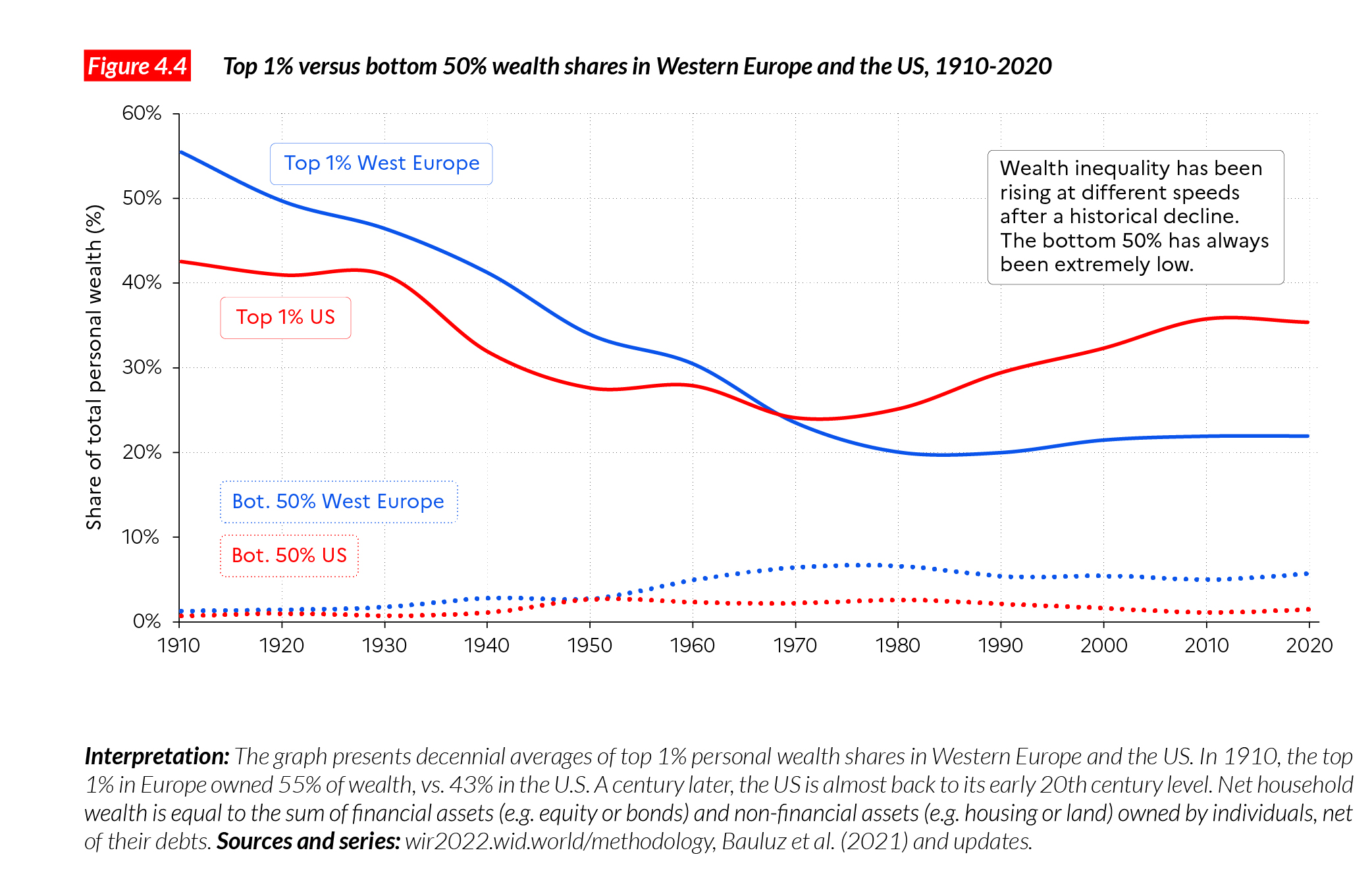
Anti-immigrant sentiment raged, leading to the enactment of racist laws to restrict immigration. And voter suppression, largely aimed at Black men who had recently won the right to vote, was rampant.
The era was also marked by dangerous working conditions. Children often as young as 10, but sometimes younger, worked brutal hours in sweatshops. Workers trying to organizelabor unions were attacked and killed.
It seemed as if American capitalism was out of control, and American democracy couldn’t do anything about it because it was bought and paid for by the rich.
But Americans were fed up, and they demanded reform. Many took to the streets in protest.
Investigative journalists, often called “muckrakers” then, helped amplify their cries by exposing what was occurring throughout the country.
And a new generation of political leaders rose to end the abuses.
Politicians like Teddy Roosevelt, who warned that, “a small class of enormously wealthy and economically powerful men, whose chief object is to hold and increase their power,” could destroy American democracy.
After becoming president in 1901, Roosevelt used the Sherman Antitrust Actto break up dozens of powerful corporations, including the giant Northern Securities Company which had come to dominate railroad transportation through a series of mergers.
Seeking to limit the vast fortunes that were creating a new American aristocracy, Congress enacted a progressive income tax through the 16th Amendment, as well as two wealth taxes.
The first wealth tax, in 1916, was the estate tax — a tax on the wealth someone accumulated during their lifetime, paid by the heirs who inherited it. The second tax on wealth, enacted in 1922, was a capital gains tax — a tax on the increased value of assets, paid when those assets were sold.
The reformers of the Gilded Age also stopped corporations from directly giving money to politicians or political candidates.
And then Teddy Roosevelt’s fifth cousin — you may have heard of him — continued the work through his New Deal programs — creating Social Security,unemployment insurance, a 40-hour workweek, and requiring that employers bargain in good faith with labor unions.
But following the death of FDR and the end of World War II, when America was building the largest middle class the world had ever seen — we seemed to forget about the abuses of the Gilded Age.
Now, more than a century later, America has entered a second Gilded Age.
It is also a time of extraordinary invention.
And a time when monopolies aretaking over vast swathes of the economy, so we must renew antitrust enforcement to bust up powerful companies.
Now, another generation of robber barons is accumulating unprecedented money and power. So once again, we must tax these exorbitant fortunes.
Wealthy individuals and big corporations are once again paying off lawmakers,sending them billions to conduct their political campaigns, even giving luxurious gifts to Supreme Court justices. So we need to protect our democracy from Big Money, just as we did before.
Voter suppression runs rampant in the states as during the first Gilded Age, making it harder for people of color to participate in what’s left of our democracy. So it’s once again critical to defend and expand voting rights.
Working people are once again being exploited and abused, child labor is returning, unions are busted, the poor are againliving in unhealthy conditions, homelessness is on the rise, and the gap between the ultra-rich and everyone else is nearly as large as in the first Gilded Age. So once again we need to protect the rights of workers to organize, invest in social safety nets, and revive guardrails to protect against the abuses of great wealth and power.
The question now is the same as it was at the start of the 20th century: Will we fight for an economy and a democracy that works for all rather than the few?
We’ve done it before. We can — and must — do it again.
https://www.alternet.org/news-politics/clarence-thomas-2663174649/
pp an 8 23
series: Friends of the Court: SCOTUS Justices’ Beneficial Relationships With Billionaire Donors
Supreme Court Justice Clarence Thomas’ decades-long friendship with real estate tycoon Harlan Crow and Samuel Alito’s luxury travel with billionaire Paul Singer have raised questions about influence and ethics at the nation's highest court.
During his three decades on the Supreme Court, Clarence Thomas has enjoyed steady access to a lifestyle most Americans can only imagine. A cadre of industry titans and ultrawealthy executives have treated him to far-flung vacations aboard their yachts, ushered him into the premium suites at sporting events and sent their private jets to fetch him — including, on more than one occasion, an entire 737. It’s a stream of luxury that is both more extensive and from a wider circle than has been previously understood.
Like clockwork, Thomas’ leisure activities have been underwritten by benefactors who share the ideology that drives his jurisprudence. Their gifts include:
At least 38 destination vacations, including a previously unreported voyage on a yacht around the Bahamas; 26 private jet flights, plus an additional eight by helicopter; a dozen VIP passes to professional and college sporting events, typically perched in the skybox; two stays at luxury resorts in Florida and Jamaica; and one standing invitation to an uber-exclusive golf club overlooking the Atlantic coast.
This accounting of Thomas’ travel, revealed for the first time here from an array of previously unavailable information, is the fullest to date of the generosity that has regularly afforded Thomas a lifestyle far beyond what his income could provide. And it is almost certainly an undercount.
While some of the hospitality, such as stays in personal homes, may not have required disclosure, Thomas appears to have violated the law by failing to disclose flights, yacht cruises and expensive sports tickets, according to ethics experts.
Perhaps even more significant, the pattern exposes consistent violations of judicial norms, experts, including seven current and former federal judges appointed by both parties, told ProPublica. “In my career I don’t remember ever seeing this degree of largesse given to anybody,” said Jeremy Fogel, a former federal judge who served for years on the judicial committee that reviews judges’ financial disclosures. “I think it’s unprecedented.”
This year, ProPublica revealed Texas real estate billionaire Harlan Crow’s generosity toward Thomas, including vacations, private jet flights, gifts, the purchase of his mother’s house in Georgia and tuition payments. In an April statement, the justice defended his relationship with Crow. The Crows “are among our dearest friends,” Thomas said. “As friends do, we have joined them on a number of family trips.”
The New York Times recently surfaced VIP treatment from wealthy businessmen he met through the Horatio Alger Association, an exclusive nonprofit. Among them were David Sokol, a former top executive at Berkshire Hathaway, and H. Wayne Huizenga, a billionaire who turned Blockbuster and Waste Management into national goliaths. (The Times noted Thomas gives access to the Supreme Court building for Horatio Alger events; ProPublica confirmed that the access has cost $1,500 or more in donations per person.)
Records and interviews show Thomas had another benefactor, oil baron Paul “Tony” Novelly, whose gifts to the justice have not previously been reported. ProPublica’s totals in this article include trips from Crow.
Each of these men — Novelly, Huizenga, Sokol and Crow — appears to have first met Thomas after he ascendedto the Supreme Court. With the exception of Crow, their names are nowhere in Thomas’ financial disclosures, where justices are required by law to publicly report most gifts.
The total value of the undisclosed trips they’ve given Thomas since 1991, the year he was appointed to the Supreme Court, is difficult to measure. But it’s likely in the millions.
Huizenga sent his personal 737 to pick Thomas up and bring him to South Florida at least twice, according to John Wener, a former flight attendant and chef on board the plane. If he were picked up in D.C., the five-hour round trip would have cost at least $130,000 each time had Thomas chartered the jet himself, according to estimates from jet charter companies. In February 2016, Thomas flew on Crow’s private jet from Washington to New Haven, Connecticut, before heading back on the jet just three hours later. ProPublica previously reported the flight, but newly obtained U.S. Marshals Service records reveal its purpose: Thomas met with several Yale Law School deans for a tour of the room where they planned to display a portrait of the justice. (Crow’s foundation also gave the school $105,000, earmarked for the “Justice Thomas Portrait Fund,” tax filings show.)
Don Fox, the former general counsel of the U.S. Office of Government Ethics and the senior ethics official in the executive branch, said, “It’s just the height of hypocrisy to wear the robes and live the lifestyle of a billionaire.” Taxpayers, he added, have the right to expect that Supreme Court justices are not living on the dime of others.
Fox, who worked under both Democrat and Republican administrations, said he advised every new political appointee the same thing: Your wealthy friends are the ones you had before you were appointed. “You don’t get to acquire any new ones,” he told them.
Thomas and Novelly did not respond to a detailed list of questions for this story. Huizenga died in 2018 and his son, who is the president of the family’s holding company, also did not respond to multiple requests for comment.
In a statement to ProPublica, Sokol said he’s been close friends with the Thomases for 21 years and acknowledged traveling with and occasionally hosting them. He defended the justice as upright and ethical. “We have never once discussed any pending court matter,” Sokol said. “Our conversations have always revolved around helping young people, sports, and family matters.”
“As to the use of private aviation,” he added, “I believe that given security concerns all of the Supreme Court justices should either fly privately or on governmental aircraft.”
The justices have said they follow court rules prohibiting them from accepting gifts from a group of people so frequently that “a reasonable person would believe that the public office is being used for private gain.” But what actually constitutes a gift under those rules is ambiguous and, in practice, justices have few restrictions on what they can accept. Other members of the court have accepted travel underwritten by wealthy businessmen and speaking invitations at universities. Stephen Breyer accepted a flight to a Nantucket wedding from a Democratic megadonor. Ruth Bader Ginsburg took a tour of Israel and Jordan paid for by an Israeli billionaire. Those gifts are public because Breyer and Ginsburg disclosed them.
Thomas, however, is apparently an extreme outlier for the volume and frequency of all the undisclosed vacations he’s received. He once complained that he sacrificed wealth to sit on the court, though he depicted the choice as a matter of conscience. “The job is not worth doing for what they pay,” he told the bar association in Savannah, Georgia, in 2001, “but it is worth doing for the principle.”
To track Thomas’ relationships and travel, ProPublica examined flight data, emails from airport and university officials, security detail records, tax court filings, meeting minutes and a trove of photographs from personal albums, including cards that Thomas’ wife, Ginni, sent to friends. In addition, reporters interviewed more than 100 eyewitnesses and other sources: jet and helicopter pilots, flight attendants, airport workers, yacht crew members, security guards, photographers, waitresses, caterers, chefs, drivers, river rafting guides and C-suite executives.
ProPublica has not identified any legal cases that Huizenga, Sokol or Novelly had at the Supreme Court during their documented relationships with Thomas, although they all work in industries significantly impacted by the court’s decisions.
In a small-circulation biography given to Huizenga’s friends and family, Thomas acknowledged that he and Huizenga discussed some of the billionaire’s companies but said their relationship was never transactional. “It wasn’t that kind of friendship,” he told the interviewer. The justice said they’d prefer to go to a small restaurant in a strip mall or sit on the billionaire’s lawn and drink tea or diet soda.
“We are in a society where everything is quid pro quo,” Thomas said, but not with the Huizengas. “I don’t do anything for them and they can’t do anything for me.”
“Four Lucky Couples”
On Labor Day weekend 2019, Thomas boarded a private plane in Washington, D.C., for the first leg of a sojourn out West. The vacation had been months in the making and, thanks to Sokol, it was all taken care of. He’s hosted the Thomases virtually every summer for a decade.
The first stop was the Great Plains. It was the home opener at the University of Nebraska-Lincoln, which Ginni Thomas had attended before transferring. The Thomases were joined there by other couples, including one of the justice’s most vocal advocates, Mark Paoletta, who then worked for the federal government, and his wife.
Sokol, a major university donor who graduated from the Omaha campus, arranged for the group to attend the football and volleyball games with all-access passes. Clarence Thomas met with the football team the day before the game. The group walked out of the tunnel before kickoff. During halftime, they stood on the sidelines to watch the marching band perform, at one point posing for a picture in the end zone: “The Sokols took four lucky couples to the first Nebraska footbal game of the season,” Ginni Thomas wrote in one of the card captions.
Sokol runs a private equity firm and now also chairs a holding company that owns large international shipping and power utility corporations. He resigned from Berkshire Hathaway in 2011 amid an internal investigation by the company that found he had violated its insider trading policy. (At the time, Sokol denied wrongdoing and said his resignation was unrelated to the episode; he was never indicted.)
That Saturday, the group watched both the football and volleyball games from luxury suites. The football skybox, which typically costs $40,000 annually, belonged to Tom Osborne, a former Republican congressman who was also the head coach of the team for 25 years. Hosting the Thomases had ripple effects. A local priest requested a ticket for his 87-year-old mother, but the volleyball coach had to tell him none was available. “All of our tickets have been taken for Clarence Thomas and his group,” the coach wrote.
The Thomases have been treated to at least seven University of Nebraska-Lincoln games — five arranged by Sokol — in recent years. The Times first reported on Thomas’ appearances at some of them.
Thomas has never reported any of those tickets on his yearly financial forms. Judiciary disclosure rules require that most gifts worth more than $415 be disclosed. “It’s so obvious,” said Richard Painter, former chief White House ethics lawyer for President George W. Bush. “It all has to be reported.” ProPublica identified more than 60 federal judges who disclosed tickets to sporting events between 2003 and 2019. In 1999, Thomas disclosed private flight and accommodations for the Daytona 500 but hasn’t reported any other sporting events before or since.
In a statement, Osborne confirmed Thomas has “watched a couple of football games” in his suite, which the university had given to him. He said he is “taxed” for the use of the suite but did not answer whether Thomas has ever reimbursed him. The University of Nebraska-Lincoln did not respond to requests for comment.
On Sunday, the morning after the football game in Nebraska, Sokol flew with Thomas by private jet to Sokol’s Paintbrush Ranch just outside Jackson Hole, Wyoming. The property, valued in the low eight figures, sits in the foothills of Shadow Mountain. A local radio personality said of the estate: “This is the ultimate home and it has the most iconic view of the Tetons I’ve seen. Ever.”
Sokol also owns a waterfront mansion in Fort Lauderdale, Florida, currently worth $20.1 million, where he’s hosted the Thomases as well, according to photos of the visits. The 12,800-square-foot property includes a home theater, elevator, walk-in wine cellar and yacht docking. (In addition, Sokol and Thomas have shared an opulent lodge together while vacationing at Crow’s private lakeside resort, Camp Topridge, in the Adirondacks.)
In Wyoming, the Thomases fished, rafted on the Snake River and sat by a campfire overlooking the Teton Range with the other couples. At one point, the Paolettas serenaded the justice with a song they wrote about him.
Like Thomas, Paoletta did not disclose the trip on his yearly financial filings. At the time, Paoletta was general counsel and the designated ethics official at the Office of Management and Budget. In a statement, Paoletta said he wasn’t required to disclose the trip because he had reimbursed Sokol, but he did not say how much or provide documentation of those payments. “I complied with all ethics laws and regulations,” Paoletta said.
Details of the vacation to Nebraska and Wyoming were drawn from photographs, trip planning emails and social media posts, as well as interviews with airport workers, local residents and others familiar with the travel, including river raft guides.
Since 1990, Sokol and his wife have donated more than $1 million to Republican politicians and groups, along with smaller amounts to Democrats. Last October, in New Orleans, Sokol made a direct reference to a pending Supreme Court case while addressing a group of former Horatio Alger scholarship recipients. (Thomas was not in attendance.)
The speech veered into territory that made many of those in attendance uncomfortable and left others appalled, emails and others messages show. Sokol, who has written extensively about American exceptionalism and the virtues of free enterprise, minimized slavery and systemic racism, some felt. He then criticized President Joe Biden’s student loan forgiveness plan, arguing Biden had overstepped the government’s authority, according to a recording of the speech obtained by ProPublica.
“It’s going to get overturned by the Supreme Court,” Sokol predicted, echoing a common legal commentary.
He was right. This summer, the court struck down Biden’s student loan forgiveness plan. Thomas voted in the majority.
Deep Sea Fishing in the Caribbean
Nearly every spring, Novelly, a billionaire who made his fortune storing and transporting petroleum, takes his two yachts on a fishing expedition to the Bahamas’ Exuma Islands. Photographs from the trips show porcelain beaches, cerulean waters and fresh mahi-mahi. Friends and family come and go for days at a time.
Three of Novelly’s former yacht workers, including a captain, told ProPublica they recall Thomas coming on board the vessels multiple times in recent years. Novelly’s local chauffeur in the Bahamas said his company once picked Thomas up from the billionaire’s private jet and drove him to the marina where one of the yachts, Le Montrachet, frequently docks.
Le Montrachet, named after the premium French wine, is a 126-foot luxury vessel complete with a full bar, multiple dining areas, a baby grand piano, accommodations for 10 guests and a handful of smaller fishing boats and jet skis. Novelly charges about $60,000 a week to outsiders who want to charter it.
Another past guest on Novelly’s yacht is “Alligator” Ron Bergeron, one of the biggest land and roadway developers in Florida.Around 2018, Novelly and Thomas went to Bergeron’s private ranch on the edge of the Everglades — a sprawling, gated estate with centuries-old cypress trees and an 1800s-style saloon on site. He described Novelly as a man who likes to share his success with others. “He’s very generous with all his friends,” Bergeron told ProPublica.
Bergeron said his conversations with Thomas at the ranch were strictly about charity work and not business. “You’re talking about a great man,” Bergeron said, “who gives his time to make a difference for America.”
Since 1999, Novelly’s family and companies have publicly disclosed at least $500,000 to conservative causes and Republican candidates in federal elections. (Before then, he had given to both parties.)
Novelly, who recently stepped down from his CEO roles, ran his business affairs aggressively, ending up on the wrong side of the government in at least two cases. He spends much of his time between St. Louis and Boca Raton, Florida, where he has a 23,000 square-foot palatial estate appraised at $22.2 million. In 2002, Novelly established residency and a holding company in the Virgin Islands. During a hearing with local officials, Novelly described the arrangement there as a “quid pro quo,” meaning the U.S. territory received a boost to the local economy in return for offering substantial tax breaks. The IRS would later call it an “abusive tax avoidance scheme” and pursued Novelly for millions in back taxesand penalties. Novelly denied the characterization and eventually settled with the government for a negotiated amount.
There’s no evidence his friendship with Thomas helped Novelly in one of his most significant disputes. In 2005, the Justice Department sued Novelly’s company, Apex Oil, because its corporate predecessor had contributed to a massive groundwater contamination beneath an Illinois village and then Apex refused to help with the cleanup. Apex argued the spill had occurred before the company went through a bankruptcy years earlier. Several judges ruled against Apex, which eventually appealed to the Supreme Court in 2010. The justices declined to hear the case, and the company had to pay about $150 million to help remove oil from the soil.
It’s not clear how Thomas voted in the case because such votes are not typically public. The vacations ProPublica identified appear to have occurred after the case was resolved.
In 2020, Apex Oil, Sokol and Crow helped fund a documentary defending Thomas as a response to an HBO film that was critical of the justice. Sokol called the HBO movie a “Molotov cocktail into our homes” and a prime example of America’s eroding civility.
The “Most Coveted” Invitation in the World
Thomas’ first billionaire benefactor is likely H. Wayne Huizenga, believed to be the only person in American history to build three separate Fortune 500 companies. One of the three was AutoNation, which Huizenga founded in 1996 before building it into the largest car dealer in the country. Between 1998 and 1999, Huizenga’s holding company spent $500,000 lobbying federal agencies that regulate the automotive industry,according to OpenSecrets data. Over the years, the Huizenga family and companies gave millions to state and federal Republican candidates and once threw a fundraiser for the Florida GOP that helped keep the party afloat for months.
The billionaire was known to regularly lavish gifts and perks on those in his orbit. He routinely took friends on opulent vacations. He paid his employees handsomely and sometimes covered their bills and personal expenses. On a whim, Huizenga once handed box tickets for the opera, which were worth thousands, to his caterer, Bob Leonardi.
“I led the life of a multimillionaire without being one,” Leonardi said.
For 20 years, Thomas benefited from Huizenga’s attention as well, availing himself of the billionaire’s fleet of aircraft and other luxuries. Huizenga took Thomas to see the Miami Dolphins and Florida Panthers several times between the mid-’90s and mid-2000s, according to interviews and photographs. Huizenga owned both teams at the time.
Executives saw Thomas around Huizenga’s office often. Richard Rochon, the former president of Huizenga Holdings, saidThomas once shadowed the billionaire during meetings. “He just wants to see what I do every day,” Rochon recalled Huizenga saying.
On at least two occasions, Thomas attended Huizenga’s birthday and Christmas parties, which the billionaire held inside his private hangar at the Fort Lauderdale airport. Van Poole, a lobbyist and former chairman of the Florida GOP, recalled riding down the elevator at the nearby Hyatt Pier 66 hotel — which Huizenga also controlled — when the Thomases stepped in with a security detail. The group discussed college sports and then traveled to the party together, Poole said.
Thomas occasionally flew on Huizenga’s helicopters, sometimes taking off from the roof of the corporate headquarters, and at least one of his Gulfstream jets around Florida, according to his former pilots. But the billionaire’s most luxurious planes were a pair of 737 jets he had retrofitted like a lounge, complete with recliners, love seats, mahogany dining and card tables and gourmet food.
At least two times in the mid 2000s, Huizenga sent one of them to pick up Thomas and deliver him to Fort Lauderdale, said John Wener, the flight attendant on board.
Wener recalled chatting with the justice about his nomination to the Supreme Court and the tumultuous Senate confirmation hearings after Thomas’ former aide, Anita Hill, accused him of sexual harassment. “He said, ‘Just imagine a job interview and you’re in front of 100 people that hate you,’” Wener recalled Thomas remarking. “‘How would that interview go?’”
In the early 2000s, Huizenga gave Thomas something that was priceless at the time: a standing invitation to his exclusive, members-only golf club, the Floridian. Designed by golf legend Gary Player, the course was lined with cottages for Huizenga’s friends, a yacht marina for them to dock and a helipad if they wanted to fly in. One family friend told the Huizenga family biographer that the Floridian was “the most coveted private golf invitation in the world.” Those who worked and played there said the membership rolls were a Rolodex of the rich, famous and powerful: From Michael Douglas and Rush Limbaugh to Michael Bloomberg and former Vice President Dan Quayle. Donald Trump once asked to be a member but Huizenga spurned him, according to three of Huizenga’s former employees.
All 200-plus members were “honorary” and didn’t pay dues — Huizenga covered everything. “It was a little slice of heaven, a magical place,” former media personality Matt Lauer told the biographer. “You drove through the gates and it was this fairytale land that he had created.”
It’s unclear if Thomas was a member or Huizenga’s frequent guest with similar privileges. The billionaire’s former personal photographer and two former golf pros at the club recalled seeing Thomas there multiple times over the years. One of Huizenga’s helicopter pilots said he had picked the justice up from the property. And a fifth employee, a former waitress and concierge, said she once served Thomas and Huizenga, who were wearing golf attire, as they dined alone in the enormous waterfront clubhouse for lunch. “Have you met a Supreme Court justice?” Huizenga asked the waitress before she took their order. “This is Clarence Thomas.”
Today, the Floridian, which the Huizenga family sold in 2010 before it underwent renovations, has a $150,000 initiation fee.
Paying for Access to the Supreme Court Chambers
Thomas first met Huizenga at a formal gala in Washington, D.C., in 1992, when they were both inducted into the Horatio Alger Association.Henry Kissinger and Maya Angelou were among the other honorees that year. The organization, named after the 19th-century novelist who popularized rags-to-riches folklore, gives millions in college scholarships each year and also brings together some of the country’s wealthiest, self-made business tycoons for opulent events. (In real life, Alger was a minister on Cape Cod who resigned from his parish after he was credibly accused of molesting boys.)
“We were proud to honor Justice Thomas more than 30 years ago,” an association spokesperson said in a statement, “and remain grateful for his continued involvement in our organization.” She said Thomas spends countless hours mentoring scholarship recipients.
Thomas appears to have met Huizenga, Sokol, Novelly and Bergeron through the organization. Several of Thomas’ trips to Florida in the 2000s appear to have been connected with the association. In that time period, he joined Huizenga at Horatio Alger scholarship ceremonies in South Florida, travel that the justice disclosed in several of his yearly financial filings.
However, he never identified Huizenga in any of his disclosures. The association spokesperson confirmed to ProPublica that the billionaire hosted those events “and covered all costs involved.”
Experts said that means Thomas’ disclosures would be, at a minimum, incomplete and misleading because the rules require federal judges to identify the source of the gifts they receive. “Source means the person or entity that paid for it,” said Kathleen Clark, a legal ethics authority at Washington University in St. Louis.
Belonging to the association has had its privileges. As part of a board meeting, the Thomases once went on a lavish trip to Jamaica, where they were hosted by a wealthy donor who owned a luxury hotel atop a former sugar plantation. Johnny Cash performed.Horatio Alger Association membership itself is worth at least $200,000,according to the organization’s meeting minutes in 2007, a sum that those who nominate a new member are responsible for raising in that person’s honor. The association spokesperson said there was no requirement to raise money for new members back when Thomas was inducted.
Thomas has likely helped the group earn many times that figure since then. Every year, the justice hosts an event for members inside the Supreme Court’s Great Hall. The Times previously reported that the event afforded the Horatio Alger Association unusual access to the court.
ProPublica examined boxes of the association’s historical archives, including financial records that show the group has required donations of at least $1,500 — $7,500 for nonmembers — to attend the Supreme Court event. In 2004, those who donated $100,000 for a table at the main ceremony got 10 seats inside the Supreme Court. In the judiciary’s code of conduct — which is general guidance that does not apply to Supreme Court justices, though they say they consult it — there is explicit language advising federal judges against using their position to fundraise for outside organizations.
But that’s what Thomas has done, said Virginia Canter, a former government ethics lawyer who served in administrations of both parties and reviewed the association’s financial records at ProPublica’s request.
“To use the Supreme Court to fundraise for somebody’s charity is, to me, an abuse of office,” she said. Canter acknowledged the organization may do good work, but that’s besides the point, she said, because wealthy donors aren’t supposed to be able to pay thousands of dollars to visit a justice inside the courthouse walls.
“It’s pay to play,” Canter added, “isn’t it?”
rs
cLARENCE THOMAS’ CONNECTIONS to wealth and expensive vacations run deeper than billionaire businessmanand Nazi-enthusiast Harlan Crow.The New York Timesreports that Thomas has milked relationships with the rich he made through the Horatio Alger Association of Distinguished Americans, a scholarship association, to benefit himself and his wife.
Because of their Horatio Alger connections, Thomas and his spouse, Virginia,have been invited to join luxurious vacations and parties in addition being granted V.I.P. access to sports events. Thanks to the association, Thomas also rubbed elbows with the likes of Oprah Winfrey and Ed McMahon during a lavish three-day Montana birthday party for billionaire industrialist Dennis Washington.
But the connections Thomas made through Horatio Alger have benefitted him beyond lavish trips. Thomas’ Horatio Alger contacts — including Washington as well as investor David Sokol, formerly of Berkshire Hathaway — helped fund a documentary that painted him in a heroic light after the premiere of an HBO movie that depicted Anita swHill during his confirmation hearings making sexual harassment allegations against Thomas. The Sokol family also hosted Thomas and his wife at their Montana ranch and their waterfront Florida estate. According to the Times, Thomas has not reported many of the benefits and gifts he has received from his rich and well-connected allies. The justice also declined to answer questions from the paper about the matter.
Early in his SCOTUS tenure, Thomas did report a number of personal gifts he received, including flights on private planes, cigars, and clothing. But after 2004, when The Los Angeles Times reported on his disclosures, Thomas ceased reporting to the court certain gifts and benefits he received. A ProPublica investigation in 2023 uncovered the justice’s close relationship with Crow, a GOP megadonor with a large collection of Nazi memorabilia and Hitler paintings, including trips on Crow’s private jet and yacht totaling tens of thousands and Crow’s purchase of the house where Thomas’ mother lived. Crow even paid tuition for Thomas’ nephew, who the Thomases were raising. After his relationship with Crow came to light, Thomas justified his lack of disclosures, claiming that “colleagues and others in the judiciary” advised him he did not need to report trips of “personal hospitality” from friends.
thomas has not only accepted benefits that granted him access to places he otherwise may not have gone, he also hosts the Horatio Alger Association’s induction ceremony for new members in the Supreme Court’s courtroom, which the Times notes is “unusual access” for an outside group. The association has parlayed the access Thomas gives them to fundraise for scholarships and events, per fundraising records reviewed by the Times.
The court this year updated its disclosure rules to mandate justices report private jet travel and comped stays at hotels and resorts, but there is an exception for “personal hospitality,” meaning food, accommodations, or entertainment that is not related to business.
DN 6 30/23 sackett v epa alito wife property lease;singer HEAD of manhat amicus; website gay marriage fake doc adf; missouri loan no $ 15 yrs, no intention, no knowledge used by AG for standing; KBJ scathing dissent let them eat cake obliviousness; change law no change life
https://www.alternet.org/otomayor-military-academies-arbitrariness-ruling/
===
https://www.businessinsider.com/sam-alito-luxury-fishing-trip-singer-block-student-loan-forgiveness-2023-6
biz insider
no lnx
Conservative Supreme Court Justice Sam Alito, Jr. took a fishing trip with a billionaire who has donated to — and serves as chairman for — a group that asked the Supreme Court to block student-loan forgiveness.
That news comes as borrowers are waiting for the Supreme Court to announce a decision this month on whether or not to uphold President Joe Biden's plan to cancel up to $20,000 for federal student-loans.
On Wednesday, ProPublica published an investigation on a vacation Alito took in July 2008 at a luxury fishing lodge in Alaska that reportedly cost over $1,000 a day. He was accompanied by Paul Singer, a billionaire whose hedge fund appeared before the Supreme Court at least ten times following the fishing trip and won votes from Alito in some of those cases.
As ProPublica reported, Singer has given over $80 million to Republican political groups — including the Manhattan Institute, a conservative think-tank for which Singer has served as chairman since 2008. That group also filed an amicus brief with the Supreme Court asking it to block Biden's relief plan — a decision the court is expected to hand down in the coming days.
"If the government's purpose were truly to reduce the harm of more frequent defaults, there are far more direct means available to that end," the Manhattan Institute wrote in its February brief referring borrowers who risked defaulted on their debt following the pandemic. "These include more aggressive measures to put borrowers on income-based repayment plans and, perhaps even more straightforward, waiving some of the legal consequences of missed payments."
"A $400 billion debt-forgiveness plan is a major policy decision that must be made by Congress, and Congress has declined to enact that policy," it added. "The administration's debt-forgiveness action should be vacated."
A spokesperson for Singer told ProPublica that Singer was not aware Alito would be on the fishing trip when he chose to attend, and that Singer "never discussed his business interests" with Alito during the trip. The spokesperson also said that Singer did not have "any pending matters before the Supreme Court, nor could Mr. Singer have anticipated in 2008 that a subsequent matter would arise that would merit Supreme Court review."
Meanwhile, instead of responding directly to ProPublica's questions on the investigation, Alito wrote an opinion piece published on Tuesday in the Wall Street Journal, in which the conservative justice denied the claims the investigation made and wrote that "I have spoken to Mr. Singer on no more than a handful of occasions, all of which (with the exception of small talk during a fishing trip 15 years ago) consisted of brief and casual comments at events attended by large groups."
"On no occasion have we discussed the activities of his businesses, and we have never talked about any case or issue before the Court," Alito wrote.
ProPublica also reported that Alito delivered a keynote address in 2010 for donors to the Manhattan Institute, during which Singer called Alito "a model Supreme Court justice" in his introduction. Of course, it's unclear how the Supreme Court will rule on Biden's student-debt relief plan — just as it's unclear how big of an influence donors could have on the impending decision.
Following ProPublica's report, advocacy group Student Borrower Protection Center sent a letter to Alito on Wednesday — obtained by Insider — that demanded he recuse himself from the two lawsuits seeking to block Biden's debt relief: Biden v. Nebraska, and Brown v. US Department of Education.
The SBPC wrote in its letter that the Job Creators Network, which represented the plaintiffs in Brown v. US Department of Education, received financial support from the Judicial Crisis Network — a group that Singer has donated to in the past.
"Paul Singer's direct and indirect financial ties to parties in Brown and amici in Brown and Nebraska raise serious questions about your ability to decide neutrally and impartially," the SBPC wrote.
Along with the conservative groups who filed amicus briefs on the issue earlier this year, Democratic lawmakers and advocates did the same — and expressed confidence in the legality of student-debt cancellation for millions of borrowers.
"As these diverse groups made clear today, student loan borrowers from all walks of life suffered profound financial harms during the pandemic and their continued recovery and successful repayment hinges on the Biden Administration's student debt relief plan," Education Secretary Miguel Cardona said of the briefs in January. "We will continue to defend our legal authority to provide the debt relief working and middle-class families clearly need and deserve."
POLITICS
Supreme Court Justice Samuel Alito wrote a WSJ op-ed instead of commenting for a story that revealed his ties to a billionaire who had 10 cases before SCOTUS
[[===
OMG evil crypto
https://www.alternet.org/gop-megadonor-citizen-ballot-initiatives/
https://yyy.theguardian.com/us-news/2023/jun/23/foundation-government-accountability-democracy
an 6 23
no lnx
This GOP megadonor is funding efforts to 'derail citizen-led ballot initiatives': report
Alex HendersonJune 23, 2023
Over the years, Illinois-based shipping magnates Richard and Elizabeth Uihlein have been major donors to the Republican Party. And these days, they have a preference for far-right MAGA candidates, including 2022 Pennsylvania gubernatorial nominee Doug Mastriano (who lost by double digits to Democratic now-Gov. Josh Shapiro).
In 2023, The Guardian reports, Richard Uihlein has been a major funder of a Florida-based group known as theFoundation for Government Accountability (FGA) — who are trying to make it more difficult to get initiatives on ballots.
The Guardian's Brendan Fischer, in an article published June 23, reports, "These efforts are designed to derail citizen-led ballot initiatives to protect abortion rights, raise the minimum wage or expand Medicaid. In effect, FGA and its allies seek to give 41 percent of the voting population an effective veto over the wishes of the other 59 percent."
READ MORE: 'A stark illustration of our broken campaign finance system': Here's how rich mega-doners hacked US politics
Fischer notes that in "at least four states," FGA has "lobbied or testified in favor of changing ballot initiative rules to enshrine minority rule."
He then explains, "The latest fight is in Ohio, where Republican lawmakers last month passed a measure requiring future constitutional amendments to receive at least 60 percent support from voters — rather than a simple majority — and that would make it harder for proposed amendments to make it on to the ballot. Ohioans will now vote in August on whether to approve the higher thresholds…. FGA's tactics in Ohio echo those used previously — and unsuccessfully — in Arkansas and South Dakota."
In 2021, Fischer reports, FGA "issued a legal memo arguing for the constitutionality of a 60 percent requirement for enacting ballot initiatives, and a report decrying how voters in red states like Missouri, Oklahoma and Nebraska had approved Medicaid expansion through the ballot initiative process."
READ MORE: Appeals court dismisses GOP megadonor’s lawsuit against Beto O’Rourke: report
The Guardian's full report is available at this link.
FROM YOUR SITE ARTICLES
Meet the billionaire Trump donor pushing for recall of Wisconsin’s governor over stay-at-home order after claiming 'the media is overblowing COVID-19' ›
GOP billionaire donor who funded Clarence Thomas’ lavish lifestyle also donated heavily to Sinema, Manchin ›
'You sort of just gasp': Clarence Thomas’ billionaire GOP donor hoards Hitler artifacts ›
RELATED ARTICLES AROUND THE WEB
How Richard Uihlein became one of the GOP's biggest megadonors ... ›
The Most Powerful Conservative Couple You've Never Heard Of ... ›
How the Uline Box Empire Has Fueled Election Denial — ProPublica ›
ref
no lnx
Florida group primarily funded by an Illinois billionaire is driving the recent attacks on direct democracy in states such as Ohio, Missouri, South Dakota and Arkansas.
The Foundation for Government Accountability, a Florida-based group affiliated with the alliance of conservative thinktanks called the State Policy Network, has played a key role in recent efforts to raise the threshold for passing citizen ballot initiatives from a simple majority to a supermajority, and to make it harder to place measures on the ballot in the first place.
These efforts are designed to derail citizen-led ballot initiatives to protect abortion rights, raise the minimum wage or expand Medicaid. In effect, FGA and its allies seek to give 41% of the voting population an effective veto over the wishes of the other 59%.
In at least four states, FGA and its lobbying arm, the Opportunity Solutions Project, have lobbied or testified in favor of changing ballot initiative rules to enshrine minority rule, and in some cases have financed ballot committees advocating for those changes. FGA has also issued reports, legal memos, op-eds and polling that advocate for gutting direct democracy.
The latest fight is in Ohio, where Republican lawmakers last month passed a measure requiring future constitutional amendments to receive at least 60% support from voters – rather than a simple majority – and that would make it harder for proposed amendments to make it on to the ballot. Ohioans will now vote in August on whether to approve the higher thresholds.
The controversial plan is designed to derail an abortion rights initiative expected to be on the ballot in November.
Deuel Ross, center, plaintiff’s counsel in Allen v Milligan, speaks with members of the press after oral arguments outside the supreme court on 4 October 2022.]
‘Historic and significant’: key lawyer’s verdict on Alabama supreme court ruling
Read more
When Ohio Republicans first proposed the supermajority requirement last year, a representative of FGA’s lobbying arm was the only person who testified in favor. FGA’s lobbying arm again testified in support of the proposal earlier this year, in hearings before the House and Senate. FGA argued that the proposal was necessary to“make it more difficult for out of state billionaires and dark money groups” to change Ohio law.
As the measure moved through Ohio’s Republican-controlled legislature, the Illinois billionaire Dick Uihlein gave $1.1m to the newly created “Save Our Constitution PAC”, which ran ads pressuring state lawmakers to support the measure; Uihlein is expected to contribute more as the August vote approaches.
A foundation controlled by Uihlein is also the largest known source of FGA’s funding, giving $17.6m since 2014. Uihlein has also been one of the key funders of election denial. Among other things, Uihlein has poured tens of millions into his “Restoration of America” network that promotes ludicrous election conspiracy theories and which created a controversial database that published voters’ personal information online in the name of uncovering election fraud. In the 2022 cycle, Dick Uihlein and his wife, Liz, were also top donors to election-denying candidates like the Pennsylvania gubernatorial hopeful Doug Mastriano and Nevada secretary of state candidate Jim Marchant.
FGA itself began to focus on “election integrity” in 2021, and boasted that it “achieved more than 70 election integrity policy wins across 19 states” last year.
FGA has also been promoting a supermajority requirement in Ohio and other states since at least 2021.
That year, FGA issued a legal memo arguing for the constitutionality of a 60% requirement for enacting ballot initiatives, and a report decrying how voters in red states like Missouri, Oklahoma and Nebraska had approved Medicaid expansion through the ballot initiative process. FGA and its lobbying arm also began testifying in support of state efforts to make it harder to enact ballot measures, andits in-house polling firm released Ohio polling showing voter support for a 60% threshold and for placing other restrictions on the initiative process.
FGA’s tactics in Ohio echo those used previously – and unsuccessfully – in Arkansas and South Dakota.
In Arkansas last year, FGA’s lobbying arm produced a fact sheet, an op-ed and social media posts advocating for Issue 2, which would have raised the ballot initiative threshold to 60%. As the billionaire-backed dark money group warned of “shady groups funded by billionaires you’ve never heard of” pushing ballot measures in Arkansas, it also gave $65,000 to the ballot committee advocating for the supermajority requirement. Arkansas voters defeated the measure by 19 percentage points.
In South Dakota, a representative of FGA’s lobbying arm testified in February 2021 in support of HJR 5003, which would require 60% approval for constitutional amendments. The legislation passed and was placed on the June 2022 ballot, with a goal of thwarting a Medicaid expansion initiative slated for the November 2022 ballot. FGA’s lobbying arm then gave $50,000 to the ballot committee advocating for the supermajority requirement – but voters rejected the measure by 35 points. Later that year, South Dakota voters approved Medicaid expansion.
FGA has also pressed Missouri lawmakers to create new hurdles for the initiative process.In 2021, FGA’s lobbying arm released polling claiming to show public support for “initiative integrity”, then sent a letter to Missouri legislative leadership arguing for a supermajority requirement and other changes to the initiative process. “Without reform,” the letter warned, “[o]ut-of-state billionaires will continue to pump millions of dollars to [promote] destructive, leftist policies like Medicaid expansion.” The group testified in support of Missouri HJR 22 that year, which would have created new requirements for putting measures on the ballot.
FGA’s lobbying arm would go on to testify in support offour different Missouri proposals to erect barriers to the ballot initiative process in 2022, and four more similar proposals this year. The Missouri house passed a measure to raise the initiative threshold, but it unexpectedly failed in the state senate.
This article was produced in partnership with Documented, an investigative watchdog and journalism project. Brendan Fischer is deputy executive director with Documented
LNX
==
--> CNN FAIL
https://www.mediamatters.org/cnn/outgoing-cnn-ceo-chris-licht-did-exactly-what-was-expected-him
6 23
Ousted CNN chief executive Chris Licht did exactly what his bosses wanted, ideologically repositioning the network in hopes of attracting Republican viewers. Now the network’s ratings are in the toilet, its reputation is damaged, and Licht is out after a devastating profile in The Atlantic — but there’s little reason to expect the situation to change.
Licht’s run at CNN ended on Wednesday after only 13 months. David Zaslav, the chief executive of CNN’s parent company, Warner Bros. Discovery, reportedly told staff at a meeting announcing the change that Licht “poured his heart and soul into this job” but that ultimately “for a number of reasons things didn’t work out.” Media accounts of Licht’s dismissal invariably point to the impact of a brutal Atlantic profile published on Friday, which triggered a newsroom revolt.
In that Atlantic profile, staff writer Tim Alberta detailed “the meltdown at CNN” under Licht, who comes across as an underprepared and ineffectual network president who is trying to undertake a doomed mission he does not seem to fully understand. Alberta writes:
When he took the helm of CNN, in May 2022, Licht had promised a reset with Republican voters—and with their leader. He had swaggered into the job, telling his employees that the network had lost its way under former President Jeff Zucker, that their hostile approach to Trump had alienated a broader viewership that craved sober, fact-driven coverage. These assertions thrust Licht into a two-front war: fighting to win back Republicans who had written off the network while also fighting to win over his own journalists, many of whom believed that their new boss was scapegoating them to appease his new boss, David Zaslav, who’d hired Licht with a decree to move CNN toward the ideological center.
Zaslav’sdesire to remake CNN by moving it toward the ideological right is shared by John Malone, a major Republican donor and Warner Bros. Discovery board member who has said he would like the network to be more like Fox News.
Their shared approach, as implemented by Licht, damaged CNN’s reputation by giving the right what it wanted. Licht fired harsh critics of former President Donald Trump, cozied up to Republican leaders, and made clear that he wanted a return to “both sides” journalism.
His work culminated with last month’s live town hall with Trump, who steamrolled CNN anchor Kaitlan Collins with lies and called her a “nasty person” on-air, as the live audience of his supporters cheered. The event drew devastating reviews from journalists inside CNN and out — but Licht staunchly defended it to his staff, and indeed, it seemed entirely in keeping with Zaslav’s vision for the network.
This version of CNN isn’t just journalistically indefensible — it’s also failed to attract an audience. In theory, catering to Republicans was supposed to lure viewers away from more right-wing outlets. In reality, there isn’t an audience for Fox Light: CNN’s viewership withered under Licht as viewers switched to MSNBC or away from cable news altogether. Zaslav and Malone don’t seem to care — they just want CNN to meet their ideological demands.
And that’s why Licht’s departure won’t end CNN’s problems. His successor may be canny enough not to put their office on a separate floor from CNN’s journalists, or to treat a reporter writing a profile like a personal therapist. But that person will likely get the same demands from Zaslav and Malone to move the network toward the right and away from the truth, and try to follow them.
an 6 23
https://www.alternet.org/senate-hopeful-low-cost-countries/
david McCormick, the former chief executive officer of the world's largest hedge fund, revealed in a March interview with Politico that he is weighing a run for the Republican nomination in Pennsylvania for the United States Senate in 2024.
"I believe that our political system always will self-correct," McCormick, who was defeated in the 2022 GOP Senate primary by failed candidate Mehmet Oz, told Politico. "We're in such a moment of self-correction in my opinion, and that's what I'm trying to do, is support that with the agenda here around educating our people and confronting China and securing America."
The Associated Press noted in April 2022 that "McCormick and his wife estimated the value of their assets between $116 million and $289 million, including a valuable stake in Bridgewater Associates."
READ MORE: 'Objectively Amazing': Economists cheer 'extraordinarily robust' jobs report
This week, Heartland Signal revealed that part of McCormick's massive net worth came from his experience consulting corporations on how to ship American jobs overseas.
"From 2001 to 2004,McCormick was the chief executive officer of a global software company called FreeMarkets. The company described its operations as a resource to help other businesses 'lower costs, reduce risks and increase profitability,'" Heartland Signal reported. "When FreeMarkets was purchased by Ariba in 2004, McCormick stayed and became the president of Ariba while FreeMarkets’ many services carried over, which included 'procurement outsourcing.'"
During McCormick's tenure as CEO, Ariba "released a guide for 'Low-Cost Country Sourcing,' which lays out strategies for businesses to cut costs and save money via shipping jobs overseas. The company also had a specific page on its website that outlined its strategy for 'low-cost country sourcing.' One of these 'low-cost countries' was India, which McCormick called an important location for country sourcing," Heartland Signal explained.
According to Heartland Signal, McCormick defended his work in 2004, stating that "big multinational companies are interested in doing business in India and, being in the business of spend management, we help them to work out what they buy and who they buy from. Services like the low-cost country sourcing program are a key differentiator for Ariba, as they enable it to offer complete spend management solutions to customers.
....
{{ ===
https://www.alternet.org/clarence-thomas-2659749180/
an 4 23
no lnx in orig?
'A flagrant violation': More legal, ethics experts slam Clarence Thomas over bombshell corruption allegations
David Badash andThe New Civil Rights Movement April 06, 2023
U.S. Supreme Court Justice Clarence Thomas is under fire after a bombshell ProPublica report detailed the expensive vacations he’s been given, gifts of a Republican megadonor, for more than two decades, without disclosing certain portions of them – which legal experts say he is required by federal law to do.
At issue are important questions of ethics and law.
The vacations, revealed in ProPublica’s extensive and detailed report Thursday, from a legal standpoint appear to be worth hundreds of thousands if not millions of dollars in total. From an ethical standpoint, some say, they have cost the institution of the Supreme Court further repetitional damage.
Justice Thomas at times was accompanied on these lavish trips by his wife Ginni Thomas, the far-right activist and lobbyist who worked behind the scenes to try to overturn the 2020 presidential election.
:{
}:
Together or apart, one person who joined them on these all-expenses-paid trips to private resorts via private jets and private yachts was the gift-giver: billionaire Dallas real estate magnate and GOP mega donor Harlan Crow.
READ MORE: For Decades Clarence Thomas Has Accepted Luxury Vacations from a GOP Megadonor Without Disclosing Them
ProPublicarevealed the details of one of Thomas’ almost yearly trips.
:{
}:
“In late June 2019, right after the U.S. Supreme Court released its final opinion of the term, Justice Clarence Thomas boarded a large private jet headed to Indonesia. He and his wife were going on vacation: nine days of island-hopping in a volcanic archipelago on a superyacht staffed by a coterie of attendants and a private chef,” ProPublica reports.
:{
}:
“If Thomas had chartered the plane and the 162-foot yacht himself, the total cost of the trip could have exceeded $500,000. Fortunately for him, that wasn’t necessary: He was on vacation with real estate magnate and Republican megadonor Harlan Crow, who owned the jet — and the yacht, too.”
Justice Thomas “has gone with Crow to the Bohemian Grove, the exclusive California all-male retreat, and to Crow’s sprawling ranch in East Texas. And Thomas typically spends about a week every summer at Crow’s private resort in the Adirondacks.”
Crow, who financially supports right wing causes, in 2011, according to Politico, contributed $500,000 to help Ginni Thomas start her consulting group, “Liberty Consulting, which boasts on its website using her ‘experience and connections’ to help clients with ‘governmental affairs efforts’ and political donation strategies.”
The ProPublica report includes an image of a painting that hangs at Crow’s private lakeside resort, Camp Topridge, in the Adirondacks that features shows Crow and Justice Thomas “smoking cigars at the resort. They are joined by lawyers Peter Rutledge, Leonard Leo and Mark Paoletta.”
READ MORE: Students Across the Country Walk Out of School to Protest Gun Violence After Nashville as TN House GOP Moves to Expel Dems
Leonard Leo is a vice president of The Federalist Society and sits on its board. The Federalist Society was the right-wing clearing house for most of Donald Trump’s federal court appointees, including his three Supreme Court nominees, and Leo is seen as the man behind those picks.
Meanwhile, legal experts are responding to the bombshell report, confirming ProPublica’s assertion that Thomas’ “failure to report the flights appears to violate a law passed after Watergate that requires justices, judges, members of Congress and federal officials to disclose most gifts, two ethics law experts said. He also should have disclosed his trips on the yacht, these experts said.”
Slate senior writer Mark Joseph Stern, an attorney who writes about the courts and the law and wrote a book on the Roberts Supreme Court, calls Justice Thomas’ actions “corruption.”
Stern observes that “federal law DOES require justices to disclose most gifts of value.”
“It’s clear that Thomas brazenly violated this law many times. We should call this what it is: corruption,” he says.
“Just to be clear here,” Stern adds, “it was a flagrant violation of federal law for Thomas to accept this wildly expensive luxury vacation without reporting it as a gift—his conduct isn’t just unseemly, it’s illegal.”
READ MORE: ‘They Had an Insider on SCOTUS’: Legal Experts Stunned by Bombshell Clarence Thomas Was Seen as ‘Key’ by Trump Lawyers
The award-winning investigative reporter for The New Yorker, Jane Mayer, pointing to ProPublica’s report, says: “This is why public trust in the Supreme Court is cratering.”
Leah Litman, Assistant Professor of Law and The University of Michigan School of Law, says, “no one is doing a better job at making the case that the Supreme Court is broken than … the Court and its Justices.”
Top national security attorney Brad Moss offers this exercise: “Change the name of the Justice to Kagan or Sotomayor, and the name of the donor to Soros. Then think about how Fox would react.”
Imani Gandy, Editor-at-Large covering courts and the law for Rewire News Group, does not mince words.
“Clarence Thomas should be impeached,” she says. “He broke the law.”
Attorney and former Biden deputy cabinet secretary, Cristóbal Alex asks, “How do you impeach a Supreme Court Justice?
“Besides being married to someone who conspired to overthrow our government, Justice Thomas has accepted what appears to be millions of dollars in undisclosed gifts,” Alex notes.
RELATED ARTICLES AROUND THE WEB
Justice Thomas: SCOTUS 'should reconsider' contraception, same ... ›
Clarence Thomas has waited over 30 years for this moment | CNN ... ›
A Timeline Of Clarence Thomas-Anita Hill Controversy As ... ›
https://www.alternet.org/clarence-thomas-2659747910/
an 4 23
no lnx
in the wake of the latest bombshell report revealing incriminating details about U.S. Supreme Court Justice Clarence Thomas' luxurious lifestyle, legal experts are weighing in with critical remarks and concerns as calls for accountability increase.
According to the new report:
"For more than two decades, Thomas has accepted luxury trips virtually every year from the Dallas businessman without disclosing them, documents and interviews show. A public servant who has asalary of $285,000, he has vacationed on [Harlan] Crow’s superyacht around the globe. He flies on Crow’s Bombardier Global 5000 jet. He has gone with Crow to the Bohemian Grove, the exclusive California all-male retreat, and to Crow’s sprawling ranch in East Texas. And Thomas typically spends about a week every summer at Crow’s private resort in the Adirondacks."
READ MORE: Clarence Thomas opposes a 'landmark precedent' guaranteeing defendants the right to counsel: legal columnist
The report also emphasized: “The extent and frequency of Crow’s apparent gifts to Thomas have no known precedent in the modern history of the U.S. Supreme Court.”
Now, legal experts have taken to Twitter with ethical concerns as they've pointed out the many issues with Thomas' conflicts of interest.
"There’s been a lot of talk by MAGA Republicans this week about the judge in NYC," former Trump administration official Olivia Troye tweeted. "If you want to talk about a judge & their family let’s talk about Justice Clarence Thomas & his wife Ginni…"
"Our country is poisoned from within," tweeted former Rep. Denver Riggleman (R-Va.). "Ethics be damned. And with his wife, Ginni, being a major GOP influencer with multiple organizations that funnel and accept money in GOP circles—and certified Q quack—Clarence Thomas should not be allowed anywhere near a judicial decision.…"
READ MORE: How Clarence Thomas went from a 'fringe figure with extremist views' to the Court’s 'center of gravity': report
Calls have also increased for Thomas to be impeached from the Supreme Court or held accountable amid reports on the latest findings.
"Google 'Clarence Thomas RV' and you'll find endless puff pieces about him and Ginni being ascetics who spend their free time with the common folk," Max Kennerly tweeted. "Turns out their vacations were really on private planes and superyachts — trips they concealed in violation of federal law."
"What is the penalty for violating the disclosure law? Would the DOJ need to first file a criminal complaint?" Chief financial correspondent Felix Salmon also asked.
According to a new report from The Washington Post, Supreme Court disclosures will likely hold justices accountable going forward.
:{
}:
"Supreme Court justices and all federal judges must provide a fuller public accounting of free trips, meals and other gifts they accept from corporations or other organizations, according to revised regulations quietly adopted this month," the report notes.
The latest controversy followsThomas' own remarks insisting that the Supreme Court was being "bullied" following the overturn of Roe v. Wade. At the time, Thomas also raised concerns about Americans disrespecting the government, a remark Truthout's Sharon Zhang described as a form of "glaring hypocrisy" given the Supreme Court justice's reputation.
The judicial system “can’t be an institution that can be bullied into giving you just the outcomes you want,” Thomas said, implying that the opposing views toward institutions “bode ill for a free society.” Per the report, Thomas also said, "Young people are especially guilty of disrespecting government institutions like courts."
Pushing back against the remarks, Zhang wrote:
Thomas’s comments sparked ire among abortion rights supporters, who pointed out the glaring hypocrisy of telling people to simply live with decisions made by 9 unelected judges with lifetime appointments who are not subject to any oversight. As political commentators pointed out, Republican attempts to overturn the 2020 presidential election are a prime example of people not being able to live with an outcome they don’t like — but Thomas has yet to condemn the anti-democratic campaign and coup attempt, perhaps because of his wife Ginni Thomas’s involvement in those events.
READ MORE: Here Are 5 of Clarence Thomas’ Worst Decisions - And Proof Judge Brett Kavanaugh Is Cut from the Same Cloth
FROM YOUR SITE ARTICLES
How Clarence Thomas went from a 'fringe figure with extremist views' to the Court’s 'center of gravity': report ›
What a Supreme Court impeachment from 1805 could mean for Clarence Thomas: historian ›
Ginni Thomas’ testimony to Jan. 6 committee sparks calls to investigate Clarence Thomas ›
RELATED ARTICLES AROUND THE WEB
Justice Thomas: SCOTUS 'should reconsider' contraception, same ... ›
A Timeline Of Clarence Thomas-Anita Hill Controversy As ... ›
Clarence Thomas has waited over 30 years for this moment | CNN ... ›
ref badash 11/22
https://www.thenewcivilrightsmovement.com/2022/11/they-had-an-insider-on-scotus-legal-experts-stunned-by-bombshell-clarence-thomas-was-seen-as-key-by-trump-lawyers/
Washington Post bombshell revealing Trump attorneys saw **Justice Clarence Thomas** as the key to getting the U.S. Supreme Court to overturn the 2020 election is leaving several legal experts stunned.
The Post reports eight emails “ordered released by U.S. District Judge David O. Carter of California, include correspondence between Trump lawyers Kenneth Chesebro, John Eastman and others discussing various legal strategies to convince Republican members of Congress to object to the official certification of electoral votes in a joint session of Congress on Jan. 6, 2021.”
In one email “from Chesebro to Eastman and several others sent on Dec. 31, 2020, Chesebro argued that [U.S. Supreme Court Justice Clarence] Thomas would ‘end up being key’ to asking the high court to overturn then-President-elect Joe Biden’s win in contested states.”
The Post states the email also says, “they should ‘frame things so that Thomas could be the one to issue some sort of stay or other circuit justice opinion saying Georgia is in legitimate doubt.'”
Politico’s Kyle Cheney sums up the scheme.
“Chesebro made the plan explicit: Get any remotely favorable ruling from a federal judge — not to win outright but to embolden GOP state legislatures, Congress or Pence to reverse the results.”
Politico‘s reporting includes copies of the redacted emails, and adds: “Chesebro contended that Thomas would be ‘our only chance to get a favorable judicial opinion by Jan. 6, which might hold up the Georgia count in Congress.'”
“I think I agree with this,” Eastman replied.
“Eastman,” Politico notes, “an architect of Trump’s last-ditch bid to subvert the 2020 election, once clerked for Thomas and had corresponded with his wife, Virginia, in the weeks before Jan. 6.”
READ MORE: Ginni Thomas Attempts to Influence Overturn of Election Even Wider Than Previously Known
“[I]f we can just get this case pending before the Supreme Court by Jan. 5,” Chesebro wrote in one email, “ideally with something positive written by a judge or justice, hopefully Thomas, I think it’s our best shot at holding up the count of a state in Congress.”
Richard Signorelli, a former Asst. U.S. Attorney for the Southern District of New York (SDNY) blasted both the Supreme Court Justice and his far right wing activist wife, **Ginni Thomas**.
“They had a damn insider on SCOTUS who they thought would help them overthrow our democracy,” Signorelli tweeted. “He’s married to a deranged MAGA cult member. He won’t even recuse himself.”
Former Harvard Constitutional Law professor Laurence Tribe blasted Chesebro.
“We now learn that Ken Chesebro saw Justice Thomas as Trump’s ‘only chance’ to stop the 2020 election from being duly certified. Such abhorrent abuse of an attorney’s license to practice law should be strictly disciplined and perhaps criminally prosecuted,” he tweeted.
Attorney and writer Rachel Solar, pointing to the Politico article asks: “When is it enough???? His wife is an insurrectionist He refuses to recuse He’s the Trump election-denial go-to? Come on.”
Journalist Helen Kennedy goes one step further.
“Hey look! It wasn’t just critics of the Supreme Court who thought Clarence Thomas was corrupted – Trump’s lawyers said so too in secret emails just revealed.”
===}}
^===^
no choice
no lnx
Starbucks CEO Schultz refuses to testify on union-busting before Sanders’ committee
.
Julia Conley and Common Dreams February 15, 2023
an 2 23 boddie
Democratic strategists and top Wall Street giants hail President Joe Biden's billionaire tax proposal as "dead on arrival," CNBC reports.
The plan, which Biden announced during his 2023 State of the Union address,ensures "the ultra-wealthy would owe an annual tax of 20% on unrealized gains or losses in the value of those assets, whether or not they had actually pocketed that gain by selling them," according to CNBC.
Chairman of investment advisory firm Signum Global and 2020 Biden supporter, Charles Myers said Biden's plan is"dead on arrival."
READ MORE:**Here are 10 ways billionaires avoid taxes on an epic scale**
However, other billionaire investors are "skeptical" about its intention, worried that their wealth will be negatively impacted.
Because of this longtime skepticism, Democratic political strategist Jake Dilemani said, "I don’t think anyone realistically expects a billionaire’s tax, in its current proposed form, to come to fruition this year or next."
Dilemani added, "Within the Democratic party, there is dissention regarding how to move this forward, particularly with unrealized gains being part of the equation."
Contrary to fellow investors, billionaire banker Leon Cooperman, who voted for Biden in 2020, told CNBC Biden's proposal is "DOA and stupid to boot." Cooperman opted to "accuse Democrats of deliberately misleading people about how the billionaire tax proposal would work."
READ MORE:**'Every billionaire is a policy failure': Oxfam blasts gathering of world's rich in Davos**
He said Democrats "lie about the taxes billionaires pay, as they include unrealized gains as part of income."
Jared Bernstein, White House economist, argued this is not the case. He told “unrealized gains” will not be taxed as part of the plan.
"What it really is, or at least the way we see, it is a prepayment or withholding tax on future capital gains," he said.
Per CNBC, last month, lawmakers from California, New York, Washington, Connecticut, Illinois, Maryland, Minnesota and Hawaii established _{Fund our Future}_, "a national effort to move wealth tax measures across the country."
New York Democratic State Senator Gustavo Rivera said in the group's statement, "The ultra-rich benefit from our communities, from our public infrastructure and the labor of working families. And because of our backwards tax system, they can avoid paying the taxes that they owe."
He noted, "We must restructure our tax system for fairness."
Arizona Senator KyrstenSinema, who recently registered as Independent after identifying as a Democrat for years, could influence the success of the proposal "if she were to publicly endorse the plan," according to CNBC.
The senator asserted her openness to the possibility of a billionaire income tax, Bloomberg reports, in 2021 when Senator Ron Wyden (D-OH), proposed a similar plan.
Hannah Hurley, Sinema's spokeswoman said, "As always, Kyrsten welcomes the opportunity to review and discuss changes to the tax code, including this proposal from the President."
CNBC's full report is available to read at this link.
READ MORE:**How Republicans are aiming to 'protect tax cheaters' with new bill: report**
tool superdonors:
2012
https://publicintegrity.org/topics/politics/super-donor-profiles/
donor profile: American Federation of Teachers
by Paul Abowd and Alexandra Duszak December 21, 2012
American Federation of Teachers Ranking: 15 Total contributions to super PACs: $5.8 million* $2 million to Majority PAC (pro-Democratic) $1.5 million to Priorities USA Action (pro-Barack Obama) $1.1 million to Workers’ Voice (pro-Democratic), formerly known as AFL-CIO Workers’ Voices PAC $700,000 to House Majority PAC (pro-Democratic) $250,000 to DGA Action (pro-Democratic) $100,000 to Ohio Families […]
Donor profile: AFSCME
by Reity O'Brien December 21, 2012
Donor profile: American Federation of Teachers
by Paul Abowd and Alexandra Duszak December 21, 2012
Donor profile: Michael Bloomberg
by Alexandra Duszak December 21, 2012
Donor profile: Plumbers and Pipefitters Union
by Paul Abowd December 21, 2012
Donor profile: George Soros
by Alexandra Duszak December 21, 2012
Donor profile: Joe Craft
by Michael Beckel December 21, 2012
Donor profile: William S. Rose (Specialty Group)
by Michael Beckel December 21, 2012
Donor profile: Republican Governors Association
by Alexandra Duszak and John Dunbar October 28, 2012
Donor profile: Joe Ricketts
by Reity O'Brien October 23, 2012
Donor profile: United Auto Workers
by Alexandra Duszak October 23, 2012

Pro-GOP donor one-upped by boss’s support of Democratic PAC
by John Dunbar September 28, 2012
Donor profile: Steve and Amber Mostyn
by Reity O'Brien September 28, 2012
Donor profile: James H. Simons
by Alexandra Duszak September 28, 2012
Donor profile: Robert Mercer
by Reity O'Brien August 23, 2012
Donor profile: Robert Rowling
by Alexandra Duszak August 22, 2012
Donor profile: Service Employees International Union
Donor profile: Harlan Crow
by Rachael Marcus July 30, 2012
Donor profile: John Childs
by Rachael Marcus July 30, 2012
Donor profile: William “Bill” Koch
no lnx
Donor profile: Fred Eychaner
by Michael Beckel July 30, 2012
Top 10 donors make up a third of donations to super PACs
by John Dunbar and Michael Beckel April 26, 2012
Donor profile: Harold Simmons
by Alexandra Duszak and Dave Levinthal April 26, 2012
Donor profile: Sheldon Adelson
by Alexandra Duszak April 26, 2012
Donor profile: Bob Perry
by Alexandra Duszak April 26, 2012
Donor profile: Peter Thiel
by Alexandra Duszak April 26, 2012
Donor profile: Cooperative of American Physicians
by Alexandra Duszak April 26, 2012
Donor profile: Foster Friess
by Rachael Marcus April 26, 2012
Donor profile: National Education Association
by Paul Abowd April 26, 2012
Donor profile: Jerry Perenchio
by Rachael Marcus April 26, 2012many more pages
an 1 23 maya
Billionaire Kelcy Warren is suing former Texas Democratic gubernatorial candidate Beto O’Rourke for defamation after he publicly denounced Warren’s $1 million donation to Texas Governor Greg Abbott’s 2021 campaign, Truthout reports.
Truthout reporters Andy Lee Roth and Steve Macek analyzed the pending lawsuit — which was originally reported by Jordan Uhl at Lever News — and what the legal action means for the future of the relationship between money and political campaigns.
The donation was reported by the Texas Ethic Commission and Federal Election Commission to be the “single largest donation” towards any political campaign — both state and federal.
READ MORE:**How Donald Trump's massive 'dark money machine' is 'designed to confuse': report**
The former Texas congressman has called out Governor Abbott in the past for not holding the Texas oil and gas companies from which Warren’s company, Energy Transfer Partners, makes a billion-dollar profit.
Despite Warren’s claim that O’Rourke's public criticism is defamation because hesuffered “mental anguish,”Lee Roth and Macek offer three reasons why the lawsuit likely won’t go anywhere:
- First, truth often prevails in defamation cases. And the assertion that Warren’s top-dollar donation influenced the campaign outcome is “likely true.”
- Lee Roth and Macek highlight that subjective opinions “are not generally actionable.” And O’Rourke’s criticism is based on his opinion of the billionaire’s contribution, but his critique also sits on “factual evidence”.
- Warren, who is worth $5 billion, is considered a “public figure” by the Supreme Court’s definition: someone with “general fame or notoriety in the community and pervasive involvement in ordering the affairs of society.” There’s proof that Warren has donated to a long list of political candidates across the country, to political actions committees, proving his “pervasive involvement” in campaigns. Therefore, it would be difficult to prove that O’Rourke exhibited “malice” or “knowingly uttered falsehoods or, at least, acted in reckless disregard of the truth — in order to claim any damages.”
Nonetheless, as Uhl wrote, the legal action against O’Rourke still “could send an intimidating message to political candidates across the country: if you suggest billionaire donors buy political influence, you could face severe punishment.”
Additionally, Lee Roth and Macek assert that the lawsuit is an example of a strategic lawsuit against public participation (SLAPP), which are defined as “attempts to use civil tort action to stifle political expression.”
And although SLAPPs are not legal in Texas, the lawsuit also exemplifies use “of the legal tactic to deter critical speech,” Uhl reports.
Nonetheless, The Texas Citizen Participation Act (TCPA) says that people like O’Rourke who are “defendants of frivolous SLAPP actions” — and being sued for exercising the freedom of speech — can request that the case be dismissed.
In their conclusion, Lee Roth and Macek warn this specific lawsuit is a direct reflection of dark money groups' influence on political campaigns. The writers also pointed to a recentProject Censored report that found GOP lawmakers continue to push legislation that makes "it more difficult, if not impossible, to identify the sources of dark money contributions, ultimately shielding them from public scrutiny.”
Read the full report at Truthout.
READ MORE: Dark money groups pump nearly $90 million into "independent state legislature" case
elon diamond mine?
sonali an 1 23
https://www.alternet.org/nepotism-babies-myth-american-meritocracy/
There is a common feeling that many of us have experienced in professional or academic environments, especially when we struggle against gender or racial bias. It’s called “imposter syndrome”—the feeling that one doesn’t deserve one’s position and that others will discover this lack of competence at any moment. I felt this way as a female graduate student in a science field in the 1990s. I felt it as a young journalist of color in a white-dominated industry.
This article was produced by Economy for All, a project of the Independent Media Institute.
The rich and the elite among us appear to feel the opposite—that they are deserving of unearned privilege. A recent series of stories in New York Magazine headlined “The Year of the Nepo Baby” has struck a chord among those who are being outed for having benefited from insider status. Nepo babies are the children of the rich and famous, the ones who are borne of naked nepotism and whose ubiquity exposes the myth of American meritocracy. Nepo babies can be found everywhere there is power.
The New York Magazine stories have predictably generated defensive responses from nepo babies. Jamie Lee Curtis, actor and daughter of famed Hollywood stars Janet Leigh and Tony Curtis, wrote a lengthy post on Instagram defending her status. Although she admitted that she benefitted from her parents’ fame—“I have navigated 44 years with the advantages my associated and reflected fame brought me, I don’t pretend there aren’t any”—she also clapped back at critics, saying she was tired of assumptions that a nepo baby like her “would somehow have no talent whatsoever.” Curtis went further in claiming that the current focus on people like her was “designed to try to diminish and denigrate and hurt.”
Curtis is clearly a talented actor, of that there is no doubt. But, in defending her privilege from critique, she reveals just how deserving she considers herself. It is the converse of imposter syndrome—the insider syndrome.
The act of calling out nepotism doesn’t necessarily imply that nepo babies are not talented. (Nepo babies are sometimes talented—and sometimes not.) It means pointing out that some talented people are able to benefit from family connections and fame that other equally talented people are not able to.
The critique is intended to call out elitism, not “diminish,” “denigrate” or “hurt,” as Curtis accuses journalists of doing. Journalism that exposes power and its corruptive influence among elites punches up, not down. Curtis is hardly a disadvantaged person whose well-being will suffer from such coverage. Rather, stories pointing out her parental advantages could potentially help to even the playing field so that it is unacceptable in the future to consider family connections in film and TV auditions.
Recall the college admissions scandal of 2019 when it was revealed—again through good journalism—that wealthy parents like TV star Lori Loughlin used all the power and money at their disposal to bend the rules of elite school admissions for their children. Many of those children may well have deserved to get into the schools they attended. But, in the face of stiff competition, untold numbers of equally deserving youth who did not have powerful and wealthy parents willing to break rules were not admitted. Now, many of those same nepo babies’ parents who were tried and convicted are using their money and connections to win shortened prison sentences.
But Hollywood celebrities, however much they enjoy prestige and privilege, are an easy target. Nepotism is rife in all the halls of power—in the world of art, sports, and even journalism, and especially in corporate and political circles.
Billionaires (especially those in tech) may propagate the myth of the merit-based American dream, but some of the most dramatic success stories began with a parent using their wealth or connections to give their child the upper hand. Take Bill Gates, the founder of Microsoft, who became one of the world’s wealthiest people in his 30s. Gates’s early success was largely due to the well-documented connections that his parents flexed on his behalf to get his fledgling company off the ground. Other tech nepo babies include Facebook founder Mark Zuckerberg, whose father loaned him $100,000 to start his company, and Amazon founder Jeff Bezos, whose parents were early investors in his online retail business to the tune of nearly $250,000.
Nepotism is part of the fabric of capitalism. For centuries, unfair advantages were available to those who have historically faced fewer hurdles, through the sheer luck of being born into a family with wealth, connections, or respect within their field. Indeed, in order to beat back the imposter syndrome, many advise channeling the unearned confidence of a mediocre straight white man.
Our economy is rigged to encourage nepotism by ensuring that the already wealthy pass their wealth—and by extension the power that their money buys—to their children. The Center on Budget and Policy Priorities (CBPP) pointed out how the tax code is written in order to benefit the moneyed classes. According to a CBPP report, “High-income, and especially high-wealth, filers enjoy a number of generous tax benefits that can dramatically lower their tax bills.”
Nepo babies who defend their status reinforce the notion that wealth, fame, and privilege equal brilliance, talent, and genius. The reality is that the privileged among us simply have the means to cheat. The rest of us are sold the lie that working hard will bring rewards—rather than unearned wealth.
This, in turn, encourages cheating among those who cannot rely on nepotism to gain power. One well-known example of the “fake-it-till-you-make-it” approach is Anna Sorokin, a woman whose fabricated lies about wealth and power landed her in prison and made her the focus of a Netflix show. Sorokin faked being a nepo baby—a German heiress—in order to live a lavish lifestyle. Sorokin learned that to gain the edge that moneyed elites have, one must internalize the insider syndrome.
Republican Congressman George Santos, who was recently exposed as a fraud for lying about his work experience, wealth, and even ethnicity, is another prime example. His political party has made a habit of encouraging (real or fake) nepo babies like Donald Trump, who openly admitted to tax avoidance in a debate and whose company was convicted of criminal tax fraud.
The GOP has for years led the charge to protect the interests of the wealthy while insisting on means testing and drug testing for the rest of us to receive benefits.
In truth, the emperor has no clothes. The meritocracy of American capitalism is a myth built on smoke and mirrors, on lies and false confidence. The current long-overdue conversation around nepo babies may help to further class consciousness among Americans who may see a bit more clearly now just how scantily clad the emperor really is.
Author Bio: Sonali Kolhatkar is an award-winning multimedia journalist. She is the founder, host, and executive producer of “Rising Up With Sonali,” a weekly television and radio show that airs on Free Speech TV and Pacifica stations. Her forthcoming book is *Rising Up: The Power of Narrative in Pursuing Racial Justice* (City Lights Books, 2023). She is a writing fellow for the Economy for All project at the Independent Media Institute and the racial justice and civil liberties editor at Yes! Magazine. She serves as the co-director of the nonprofit solidarity organization the Afghan Women’s Mission and is a co-author of Bleeding Afghanistan. She also sits on the board of directors of Justice Action Center, an immigrant rights organization.
an maya 1 23
For nearly half a century, billionaire Charles Koch has quietly _{funded, initiated, and supported}_ efforts to _{dismantle democracy}_ in the United States, two professors wrote for Progressive Magazine.
Nancy MacLean, the William H. Chafe distinguished professor of History and Public Policy at Duke University, and Lisa Graves, executive director of _{True North Research}_ and a co-creator of the websites Koch Exposed and Koch Docs, detailed a seemingly never-ending list of ways one of the richest people in the world and his wealthy allies continue to “divide the American electorate.”
The conservative American Legislative Exchange Council (ALEC), which has long been funded by Koch and his late brother, David, has strategized on ways to enforce voter suppression efforts by passing voter ID laws – which began when Barack Obama was first elected in 2008.
READ MORE:_{**How Koch Industries is fighting democracy both 'at home and abroad': journalist**}_
Last year, the Center for Media and Democracy, for which Graves sits on the board, found that a handful of Koch-backed groups collectively _{spent more than $1 billion}_ on the 2020 election.
One of the organizations, Americans for Prosperity, spent around $70 million leading up to the 2022 midterms, involving itself in over 450 races on efforts that heavily targeted swing voters.
Soon after the election, Koch released *Believe in People: Bottom-Up Solutions for a Top-Down World*, a book in which he claimed he was ready for “a final act building bridges across political divides.” No more political involvement. MacLean and Graves noted that a few days prior to the book release, The Wall Street Journal published an article titled, “Charles Koch Says His Partisanship Was a Mistake.”
The book even contained phrases like, “Boy, did we screw up.” “What a mess!” “This is crazy! Are we going to have a civil war?” He had convinced the public that his time toying with democracy was over.
READ MORE:_{**Charles Koch must be held accountable for his climate disinformation campaign**}_
But, MacLean and Graves said that “mainstream news editors seemed to forget that” they were reporting on “a specialist in strategic disinformation, who had perfected the practice of deceiving the public during his network’s three decades of climate change denial” – a mastermind of finesse.
Even with that, what Maclean and Graves call Koch’s “most diabolical” move thus far, is how he bandwagoned the “white supremacist” reaction to nationwide civil unrest following George Floyd’s murder in 2020, by initiating a campaign that geared fear-mongering language towards the idea of teaching race in schools – also known as critical race theory.
The Koch network proceeded to fund organizations that actively fought against CRT, although a spokesperson from a Koch-funded group claims that is untrue.
Two examples of Kock-backed anti-CRT initiatives include ALEC’s financial support of a workshop titled “Against Critical Theory’s Onslaught,” featuring the main figurehead of anti-CRT rhetoric, Christopher Rufo in 2020; and when a coalition of Koch-funded groups including the Manhattan Institute and Heritage Foundation advocated against the idea of teaching race in schools in a published letter.
READ MORE:_{**'That's oligarchy': Bernie Sanders batters billionaires over election spending**}_
Aside from funding organizations that promote anti-CRT language, Koch also funds Independent Women’s Forum (IWF) and Independent Women’s Voice (IWV), which work in tandem to promote anti-trans language. For example, the groups created a “Women’s Bill of Rights” which asserts that trans women are not women.
MacLean and Graves wrote, “Just as Koch-funded operations weaponize and intensify racism to secure political power, they also exploit and escalate misogyny, homophobia, and transphobia by any means to boost Republican power.”
Despite his claim that he was removing himself from politics two years ago, it’s clear that with the success of a majority conservative Supreme Court, the continued push to control the bodies of women; anti-CRT, anti-trans, and other discriminatory laws that Koch’s behind-the-scenes funding and staunch support of those who can bring he and his allies' vision of a fully dismantled democracy to life presses on.
https://www.alternet.org/2019/11/robert-reich-there-are-only-5-ways-to-become-a-billionaire-and-none-of-them-involve-being-successful-in-free-market-capitalism
Billionaires are wailing that Elizabeth Warren’s and Bernie Sanders’s wealth tax proposals are attacks on free market capitalism.
Warren “vilifies successful people,” says Jamie Dimon, CEO of JPMorgan Chase.
Rubbish. There are basically only five ways to accumulate a billion dollars, and none of them has to do with being successful in free market capitalism.
The first way is to exploit a monopoly.
Jamie Dimon is worth $1.6 billion. That’s not because he succeeded in the free market. In 2008 the government bailed out JPMorgan and four other giant Wall Street banks because it considered them “too big to fail.”
That bailout is a hidden insurance policy, still in effect, with an estimated value to the big banks of $83 billion a year. If JPMorgan weren’t so big and was therefore allowed to fail, Dimon would be worth far less than $1.6 billion.
What about America’s much-vaulted entrepreneurs, such as Jeff Bezos, now worth $110 billion? You might say Bezos deserves this because he founded and built Amazon.
But Amazon is a monopolist with nearly 50 percent of all e-commerce retail sales in America, and e-commerce is one of the biggest sectors of retail sales. In addition, Amazon’s business is protected by a slew of patents granted by the U.S. government.
If the government enforced anti-monopoly laws, and didn’t give Amazon such broad patents,Bezos would be worth far less than $110 billion.
A second way to make a billion is to get insider information unavailable to other investors.
Hedge-fund maven Steven A. Cohen, worth $12.8 billion, headed up a hedge fund firm in which, according to a criminal complaint filed by the Justice Department, insider trading was “substantial, pervasive, and on a scale without known precedent in the hedge fund industry.” Nine of Cohen’s present or former employees pleaded guilty or were convicted. Cohen got off with a fine, changed the name of his firm, and apparently is back at the game.
Insider trading is endemic in C-suites, too. SEC researchers have found that corporate executives are twice as likely to sell their stock on the days following their own stock buyback announcements as they are in the days leading up to the announcements.
If government cracked down on insider-trading, hedge-fund mavens and top corporate executives wouldn’t be raking in so much money.
A third way to make a billion is to buy off politicians.
The Trump tax cut is estimated to save Charles and the late David Koch and their Koch Industries an estimated $1 to $1.4 billion a year, not even counting their tax savings on profits stored offshore and a shrunken estate tax. The Kochs and their affiliated groups spent some $20 million lobbying for the Trump tax cut, including political donations. Not a bad return on investment.
If we had tough anti-corruption laws preventing political payoffs, the Kochs and other high-rollers wouldn’t get the special tax breaks and other subsidies that have enlarged their fortunes.
The fourth way to make a billion is to extort big investors.
Adam Neumann conned JP Morgan, SoftBank, and other investors to sink hundreds of millions into WeWork, an office-sharing startup. Neumann used some of the money to buy buildings he leased back to WeWork and to enjoy a lifestyle that included a $60 million private jet. WeWork never made a nickel of profit.
A few months ago, after Neumann was forced to disclose his personal conflicts of interest, WeWork’s initial public offering fell apart and the company’s estimated value plummeted. To salvage what they could, investors paid him over $1 billion to exit the board and give up his voting rights. Most other WeWork employees were left holding near-worthless stock options. Thousands were set to be laid off.
If we had tougher anti-fraud laws, Neumann and others like him wouldn’t be billionaires.
The fifth way to be a billionaire is to get the money from rich parents or relatives.
About 60 percent of all the wealth in America today is inherited, according to estimates by economist Thomas Piketty and his colleagues. That’s because, under U.S. tax law – which is itself largely a product of lobbying by the wealthy – the capital gains of one generation are wiped out when those assets are transferred to the next, and the estate tax is so tiny that fewer than 0.2 percent of estates were subject to it last year.
If unearned income were treated the same as earned income under the tax code, America’s non-working rich wouldn’t be billionaires. And if capital gains weren’t eliminated at death, many heirs wouldn’t be, either.
Capitalism doesn’t work well with monopolies, insider-trading, political payoffs, fraud, and large amounts of inherited wealth. Billionaires who don’t like Sanders’s and Warren’s wealth tax should at least support reforms that end these anti-capitalist advantages.
https://www.alternet.org/2022/11/gop-megadonors-funding-election-denial/
In an article published on November 3, the Daily Beast’s Roger Sollenberger reported that “nearly 80 percent” of the $1.7 million that right-wing shipping magnates Dick and Elizabeth Uihlein donated to Republican candidates “between January 7, 2021 and August 31, 2022” went to “campaigns or committees tied to the 147 Republicans who voted, on January 6, (2021), to overturn President Joe Biden’s victory.” But their fondness for MAGA election denialists, according to Sollenberger, goes beyond donations.
Sollenberger, writing for the Beast in an article published on November 28, reports that in 2021, Arizona Republican Party Vice Chair Gina Swobodawas hired as executive director for “the Uihlein-backed dark money nonprofit Restoration Action Inc.” Her salary was $108,750 per year.
“Swoboda, a former Trump campaign official and the vice chair of the Arizona Republican Party, is now leading a misguided charge against the ballot count in that state on behalf of GOP gubernatorial candidateKari Lake,” Sollenberger explains. “Swoboda currently serves as ‘election integrity’ coordinator for Lake, whose repeated false claims of voter fraud have ingratiated her to former President Donald Trump and who still refuses to acknowledge her election loss to (Democratic Arizona Secretary of State) Katie Hobbs.”
The Beast reporter continues, “After the election, Lake promoted Swoboda’s appearance on a right-wing podcast. In addition to hiring Swoboda, the filing shows Restoration Action’s accounts swelling for the second year in a row. According to the filing, in the 12 months following the January 6 attack on the Capitol, Restoration Action’s revenue topped $20.5 million — double what the group raised in 2020, and light years beyond its $64,000 haul in 2019.”
Sollenberger notes that Restoration Action is “tied to the larger Restoration of America network, funded almost exclusively by the Uihleins.”
Brendan Fischer, who serves as deputy executive director of the watchdog group Documented, told the Beast, “Restoration Action is a hub for election denial, including funding some of the key players pushing election falsehoods in Arizona at the moment. This is a reminder that there’s big money behind the push to undermine democracy. Through Restoration Action and other entities, an array of groups pushing election conspiracy theories are backed by literally tens of millions of dollars from just one billionaire couple.”
Restoration America, according to Sollenberger, “also threw $600,000 to the super PAC affiliated with January 6 rally organizer Tea Party Patriots” and “another $1.5 million…. to the Lawyers Democracy Fund, a conservative dark money group that advocates for changes in election law.”
“The group sent another half a million toFight Voter Fraud,which has also pushed baseless claims of election malfeasance, including in 2021,” Sollenberger reports. “Another recipient, the Liberty Initiative Fund,donated $675,000 to a group fighting for more restrictive voter ID requirements in Michigan. That Michigan group raised $2.2 million total, with $1.5 million coming from Uihlein himself.
READ MORE:'Selling the Big Lie': Reporter unloads on Kari Lake after her campaign ends in defeat
nice ~ to elite eco-hyp BS
With the United Nations Climate Change Conference underway in Egypt, Oxfam on Monday released a report highlighting how billionaires' investments produce massive amounts of planet-heating emissions that must be reined in to ensure a habitable planet.
The group's analysis—**Carbon Billionaires: The Investment Emissions of the World's Richest People**—reveals that the investments of 125 billionaires emit 393 million tonnes of carbon dioxide equivalent (CO2e) each year, or the same as the entirety of France.
Putting that figure into an individual context, the report explains that the annual average tops 3.1 million tonnes of CO2e per billionaire—or over a million times higher than the 2.76 tonnes that is the average for people worldwide who are in the bottom 90%.
"These few billionaires together have 'investment emissions' that equal the carbon footprints of entire countries like France, Egypt, or Argentina," said Nafkote Dabi, climate change lead at Oxfam, in a statement. "The major and growing responsibility of wealthy people for overall emissions is rarely discussed or considered in climate policymaking. This has to change."
Dabi declared that "these billionaire investors at the top of the corporate pyramid have huge responsibility for driving climate breakdown. They have escaped accountability for too long."
"Emissions from billionaire lifestyles, their private jets, and yachts are thousands of times the average person, which is already completely unacceptable," she noted. "But if we look at emissions from their investments, then their carbon emissions are over a million times higher."
The report similarly stresses that "by looking at how the richest behave as investors, we can demonstrate not just their role as consumers of carbon but also their role as wealth holders who own, control, shape and financially profit from production processes that release greenhouse gases (GHGs) into the atmosphere."
"Ordinary citizens often do not have a lot of control over their energy choices, particularly those in low- or middle-income groups. Poor public transport options can mean that people are forced to drive to work, for example," the document points out. "In contrast, investors can choose where they put their money."
"They can choose to put it into fossil fuel industries or other highly polluting activities, or into the activities of other corporate actors that are clearly failing to do enough to reduce their carbon emissions," the report continues. "The decisions that investors make now can potentially determine our emissions for decades to come—for instance, bad decisions on infrastructure investments can commit us to high levels of GHGs far into the future.[twt]
according to Oxfam: "24% of billionaire investments in our sample are in the consumer discretionary sector, with 18% in consumer staples and 11% in financials. In terms of high-polluting industries, 7% of investments are in energy and 7% in materials. By comparison, energy corporates make up 4.7% of the S&P 500 and materials make up 2.5%."
The document further notes that "there is one renewable energy company in our sample."
Climate scientists along with energy, health, and policy experts continue to stress the need for governments across the globe to swiftly and dramatically strengthen plans to cut GHG emissions, especially if there is any hope of meeting the 1.5°C Paris agreement target.
Speaking from the COP27 summit in Sharm El-Sheikh on Monday, U.N. Secretary-General António Guterres warned that "we are on a highway to climate hell with our foot on the accelerator" and advocated for "greater urgency, stronger action, and effective accountability."
oligarchy corp media
https://www.alternet.org/2022/08/sean-hannity-2657922552/
On Thursday, August 18, CNN announced that it had canceled the Sunday-morning show “Reliable Sources” and that host Brian Stelter would be leaving the network. Reportedly, CNN’s new CEO and chairman, Chris Licht — who has said that he wants more “straight news reporting” and less commentary at CNN — disliked “Reliable Sources” and viewed Stelter, who spent a lot of time debunking Fox News hosts, as overly opinionated.
Liberal economist Robert Reich, in an op-ed published by The Guardian GUK on August 24, is highly critical of CNN’s decision to cancel “Reliable Sources” — and he views it as a glaring example of CNN changing for the worse. Reich, who served as secretary of labor in the Clinton Administration and teaches at the University of California, Berkeley, essentially argues that if “Reliable Sources” had been canceled because it had terrible ratings, that would be one thing. But he implies that Stelter was fired for political reasons and a misguided effort to offer “balanced journalism” at a time when extremists who are threatening U.S. democracy have no interest in balance.
“For several years,” Reich observes, “Brian Stelter’s Sunday show on CNN, ‘Reliable Sources,’ has been a reliable source of intelligent criticism of Fox News, right-wing media in general, Trumpism, and the increasingly authoritarian lurch of the Republican Party. Last week, CNN abruptly canceled the show and effectively fired Stelter and his staff. Why? The show was commercially successful. Its ratings have suffered somewhat lately, but it was doing better than several of CNN’s prime-time shows.”
READ MORE: CNN is seeking a 'cease-fire with Fox News' under its new president: report
Reich adds that “there appears to be more to” the cancelation of “Reliable Sources” than Licht’s view of Stelter’s “opinionated style.”
“Licht has told CNN staff they should stop referring to Donald Trump’s ‘Big Lie’ because the phrase sounds like a Democratic Party talking point,” Reich notes. “Licht also wants more ‘straight news reporting,’ along with more conservative guests. What’s motivating Licht? Follow the money. CNN’s new corporate overseer is Warner Brothers Discovery Inc., which now owns what used to be Time Warner, including CNN. The CEO of Warner Brothers Discovery is David Zaslav. Zaslav has been prodding Licht to reposition CNN to the center, and be a network preferred by ‘everybody.… Republicans, Democrats.’ But CNN is never going to be the network preferred by Republicans. Fox News has that sewn up.”
Reich continues, “As Republicans move further rightward into the netherworld of authoritarianism, there’s even less possibility that CNN’s news coverage will be able to satisfy them. Nor should CNN even try. If we’ve learned anything from Trump and his lapdogs at Fox News, it’s that facts, data and logic are no longer relevant to the Republican base. Even ‘straight news reporting’ depends on what stories are featured, which facts are highlighted and the context surrounding the news. This necessitates judgment and values.”
Liberal Washington Post opinion columnist Greg Sargent has stressed that when mainstream news outlets are reporting on someone as far to the right as Doug Mastriano, the GOP gubernatorial nominee in Pennsylvania, they shouldn’t normalize extremism in the name of “balance.” And Reich, similarly, argues that “straight news reporting” becomes problematic if it downplays attacks on democracy.
READ MORE:**CNN cuts off Republican strategist for blaming 'both sides' for January 6th**
“The anti-democracy movement in America, as elsewhere, is among the biggest issues confronting us today,” Reich warns. “Is reporting on it considered ‘straight news’ or ‘opinion?’ Wouldn’t failing to report on it in a way that sounded alarms be a gross dereliction of duty? Besides, how is it possible to report on (former President Donald) Trump or Rudy Giuliani or any number of today’s Republican leaders and not speak of the Big Lie, or say they’ve broken norms, if not laws? So, what’s motivating Zaslav? Keep following the money.”
Reich adds, “The leading shareholder in Warner Brothers Discovery is John Malone, a multibillionaire cable magnate. Malone was a chief architect in the merger of Discovery and CNN. Malone describes himself as a ‘libertarian,’ although he travels in right-wing Republican circles. In 2005, he held 32 percent of the shares of Rupert Murdoch’s News Corporation. He is on the board of directors of the Cato Institute. In 2017, he donated $250,000 to Trump’s inauguration. Malone has said he wants CNN to be more like Fox News because, in his view, Fox News has ‘actual journalism.’ Malone also wants the ‘news’ portion of CNN to be ‘more centrist.’”
On the final broadcast of “Reliable Sources,” Stelter stressed that it’s “not partisan” to defend “democracy” or “stand up to demagogues” and that “we must make sure we don’t give platforms to those who are lying to our faces” — and Reich applauds that statement.
“Sadly, there are still many in America — and not just billionaires like Malone — who believe that holding Trump accountable for what he has done, and continues to do, to this country is a form of partisanship, and that such partisanship has no place in so-called ‘balanced journalism,’” Reich writes. “This view is itself dangerous.”
an 922
After the U.S. Supreme Court announced its ruling in Dobbs v. Jackson Women’s Health Organization and officially overturned Roe v. Wade after 49 years, Billie Joe Armstrong — long-time lead singer for the punk/alternative rock band Green Day — expressed his outrage by telling a crowd in London that he planned to renounce his U.S. citizenship and move to the U.K. The London crowd cheered with applause when Armstrong declared that he no longer wanted to live in “that miserable f*****g excuse for a country.”
Whether or not the 50-year-old Armstrong will actually follow through remains to be seen, but if he did apply for citizenship in another developed country, he would have a good shot at being accepted — as the Green Day frontman is incredibly wealthy. Immigration laws in the U.K., Canada, Continental Europe, Australia and other parts of the developed world can be notoriously difficult for U.S. citizens, but they are easier to navigate if one has a lot of money. And according to a report by Mother Jones’ Michael Mechanic, wealthy Americans who are worried about the United States’ future have been seriously pursuing their dual citizenship options.
Mechanic, in an article published by Mother Jones on September 21, reports that the United States’ “societal dysfunction has progressed to the point where many well-heeled Americans are looking for an escape hatch.”
“This is not a time of optimism in America,” Mechanic reports. “People are reeling from inflation, gun violence, partisan rancor, race-baiting, a ruthlessly divisive Supreme Court decision, the long tail of a pandemic, and the very real prospect of political violence. A significant majority of the public, polls suggest, thinks the nation is headed in a bad direction. Nearly three-quarters of the people NBC News polled in August said as much, and more than a third predicted that things would get worse over the next five years.”
Mechanic cites David Lesperance, a Canada-born attorney who now lives in Poland, as an example of someone who specializes in “arranging foreign citizenships for extraordinarily wealthy people, from athletes and celebrities to founders, investors, and corporate bigwigs with assets ranging from about $25 million to $20 billion.”
“Over the years, Lesperance — who now lives in Gdynia, Poland — has helped hundreds of ultra-high-net-worth Americans relinquish their U.S. citizenship, usually in order to escape the long arm of the IRS,” Mechanic explains. “The United States is the only country besides Somalia that imposes taxes based on citizenship, not residency. Other U.S. clients just want a contingency plan — a legal ‘go bag’ containing an extra passport or two — that a family might deploy if the taxman ever gets too aggressive.”
Mechanic goes on to report that Lesperance and a Massachusetts-based attorney he often works with, Melvin Warshaw, have recently been observing a new trend that Lesperance describes as “clients engaging us not for tax reasons, but rather, to have an alternative should the U.S. turn into MAGA America.”
READ MORE:**'Pro-life' right-wingers call for executions and civil war over abortion rights**
One American who really did renounce her U.S. citizenship is rock/R&B icon Tina Turner, who speaks fluent German and now lives in Switzerland. But according to Warshaw, Americans who are looking at dual citizenship options for political reasons aren’t necessarily planning to give up their U.S. citizenship. Warshaw says of these Americans, “They’re saying, ‘I want options. I don’t mind paying high income tax. It’s just things are getting real hot in the kitchen, and I want the ability to bug out — to go somewhere else for a while, because I don’t know what’s going to happen in the 2022 election. And I have little kids. I want a safe place for them.’”
Mechanic notes that “recent developments, particularly the Supreme Court’s reversal of Roe v. Wade, have fueled demand for dual citizenship even among the non-wealthy,” adding, “But securing one is pricey if you don’t have a relative who is a citizen elsewhere.”
According to Lesperance, affluent Americans who are looking into dual citizenship with other countries fear political violence, authoritarianism and instability in the U.S.
Lesperance told Mother Jones, “There’s a significant fear there. They look at the daily news, they see, ‘OK, (Supreme Court Justice Samuel) Alito said this (the Dobbs decision) only deals with abortion, and (Justice Clarence) Thomas goes on in his dissent to say, no, we’re winding up for this. We’re throwing it back to the states.’ And then, they see politicians talking about a nationwide ban on abortion.”
Mechanic reports, “They are concerned, roughly in this order, Lesperance says, about the state of American democracy —
voter suppression, rejection of election outcomes, MAGA subversion — the outlawing of abortion and what the (Supreme) Court may do next, and the specter of domestic terrorism and mass shooting events. They aren’t necessarily liberal. One client, a billionaire hedge-funder who would call himself a Reagan Republican, Lesperance says, just didn’t want his little kids to have to deal with the trauma of active shooter drills at school…. The new clients also include ‘a bunch’ of former high-level government officials who served under Presidents Barack Obama and George W. Bush.”
Lesperance told Mother Jones, “Remember, to a MAGA, you’re a RINO if you served for W….. (They) really got freaked out, not only by Dobbs, but also, by Trump’s announcement that he’s gonna get rid of the civil service and replace it with loyal flunkies.”
Lesperance stressed that these clients — both liberals and non-MAGA conservatives — haven’t necessarily given up on the U.S., but they are looking for a possible escape route if things turn really ugly.
Lesperance told Mother Jones “They’re sitting there saying, ‘I have a giant target on my back. So, yes, I’m gonna vote. Yes, I’m gonna join organizations and fund organizations to get voter registration. I’ll call that fire prevention, but I’m also gonna get fire insurance. And you know, depending on the outcome in the midterms, and what outcome comes in the general, I want to be able to bug out — and I want to take my family.’”
READ MORE:**What could a second American civil war look like?**
an 7 22
Republican candidates and lawmakers are facing great challenges in the areas of campaign fundraising. A new analysis is explaining how they are being out-fundraised by their Democratic counterparts. According to Axios' Lachlan Markay, the biggest financial difference centers on grassroots contributions.
Lachlan explained the bigger picture writing, "Inflation, Trump-induced donor fatigue, and other factors are impacting the GOP grassroots, prompting Republican candidates to rely more heavily on high-dollar donors."
However, while the average Republican candidate is facing challenges securing small-dollar donations, Lachlan noted the one Republican who isn't having that problem. He noted that former President Donald Trump is "seeing huge small-dollar fundraising success" and "has hoovered up more than $60 million from under-$200 donors this cycle."
READ MORE: [Far-right Arizona GOP candidates are bringing in big bucks ahead of the primary election
But, unfortunately for the Republican Party, Trump's massive haul isn't much of a benefit for the political party, collectively. Adding to that, he still isn't an official political candidate for any upcoming election. According to the report, only one Republican lawmaker is having substantial success with small-dollar donations: Sen. Ron Johnson (R-Wisc.)
So what's holding the Republican Party's campaign fundraising together? "High-dollar donors," according to Lachlan, are still their driving force.
"The GOP's high-dollar donors are keeping the money race competitive," he wrote. "And Republicans' national party committees are breaking fundraising records."
He noted, "Super PACs backing candidates such as Ohio's J.D. Vance and Arizona's Blake Masters are making up for some fundraising shortfalls. Others, such as Pennsylvania's Mehmet Oz, are pouring millions into their own campaigns."
READ MORE: Just 27 billionaires have spent $90 million to buy GOP congress: report
The top Republican super PACs are "the Senate Leadership Fund and the Congressional Leadership Fund"as they are "both out-raising their Democratic counterparts by substantial margins."
Lachlan concluded, "The GOP's fundraising problems — in addition to the elevation of flawed or extreme candidates — are contributing to fears of a Senate debacle in what should be a favorable political environment for Republicans."
https://www.alternet.org/2022/07/billionaires-gop-congress/
no lnx table grfx
Just 27 billionaires have spent $90 million to buy GOP congress: report
[ brk windows london? ]
Rupert Murdoch receiving the 2015 Global Leadership Award, Wikimedia Commons
Kenny Stancil and Common Dreams July 19, 2022
A few dozen billionaires are spending tens of millions of dollars on the 2022 midterm elections—mostly to support Republican candidates, including many who have parroted the dangerous lie that the 2020 presidential election was stolen—in a bid to ensure that Congress is full of lawmakers willing "to make their wealthy benefactors even richer," according to a fresh analysis.
Titled Billionaires Buying Elections, the report from Americans for Tax Fairness (ATF) details how "billionaires are increasingly using their personal fortunes and the profits of connected corporations to drown out regular voters' voices and elect hand-picked candidates who further rig the nation's economy—especially the tax system."
A pair of super PACs tasked with securing Republican majorities in the House and Senate—the Congressional Leadership Fund (CLF) and the [cnp?] Senate Leadership Fund (SLF)—raised a combined $188.3 million through the first 16 months of the 2022 campaign cycle, according to ATF. Nearly half—$89.4 million, or 48%—came from just 27 billionaires. A whopping 86% of the GOP's billionaire money came from "Wall Street tycoons" who are arguably the biggest beneficiaries of glaring loopholes in the tax code.
The Democratic counterparts of those two super PACs—the House Majority PAC and the Senate Majority PAC—raised a combined $154 million over the same time period. A smaller share—$25.8 million, or 17%—came from 19 billionaires. A majority of billionaire contributions to Democratic candidates also came from the finance and investment sector (35%), but other industries were also well-represented, including cryptocurrency (26%), and tech (18%).
"Unlike candidates and party committees, super PACs can raise unlimited donations from individuals and corporations," ATF explained. "In return they are not supposed to coordinate activities with the campaigns they support but instead act independently, though that rule is often flouted."
Top billionaire donors to congressional super PACs include hedge fund magnate Ken Griffin, who has given more than $28.5 million to CLF and SLF, and private equity mogul Stephen Schwarzman, who has pumped $20 million into the GOP's two super PACs.
"Anti-democratic vote-buying," ATF wrote, "has been facilitated by—and is facilitating—the accelerating wealth growth of the billionaire class and the record profits of the corporations they own."
The combined net worth of the nation's roughly 750 billionaires surged by $2 trillion, or 70%, during the first two years of the Covid-19 pandemic. The collective wealth of the 27 billionaires bankrolling the GOP's super PACs alone soared by $82.4 billion over that time period, meaning that the $89.4 million they have donated to CLF and SLF constitutes less than 0.1% of their overall pandemic-era gains.
Meanwhile, the return on that modest investment could amount to billions of dollars if Republicans take back Congress in November and preserve their 2017 tax cuts or further slash taxes on superrich people and the corporations they own.
Over a recent nine-year period, the 400 wealthiest people in the U.S. paid an average effective federal income tax rate of just 8.2% when the increased value of their stock holdings is included in their income. That is a lower rate than the nationwide average of 13.3% in 2019.
As ATF explained, focusing on contributions to congressional super PACs fails "to capture the full political influence of billionaires, who in addition to personal donations also steer money to favored candidates from related corporations and organizations."
Billionaires are among the ultrawealthy Americans who control corporations through their extensive stock holdings. Many corporate giants have been distorting the upcoming midterms, ATF pointed out, by spending tens of millions to help GOP candidates who have vowed to defend special tax breaks for the top 1% get elected, including 144 far-right members of Congress who voted to overturn President Joe Biden's electoral victory.
According to the report, seven powerful corporations—AT&T, Chevron, ExxonMobil, FedEx, GM, Merck, and UPS—have collectively given nearly $1.5 million to dozens of election deniers and various Republican PACs and election committees this campaign cycle. The companies' demonstrated lack of concern for democracy, ATF noted, likely stems from their desire to keep dodging taxes. In 2021, these firms paid an average federal income tax rate of just 2.7% on a combined $78.4 billion in profits.
Notably, Peter Thiel, the co-founder of PayPal who is worth about $5 billion and openly opposed to democracy, has been spending big on his preferred Republican candidates but not through the GOP's congressional super PACs.
Thiel "has so far spent almost $30 million through super PACs supporting the 2022 senatorial bids of two former employees who share his anti-democratic and anti-tax beliefs," ATF found. "J.D. Vance won the Ohio Republican U.S. Senate primary thanks in part to Thiel's $15 million in spending. Blake Masters has a fighting chance in Arizona's GOP U.S. Senate primary in August due to Thiel's $13.5 million in contributions."
Another source of "billionaire dominance of campaign financing, especially on the Republican side," wrote ATF, are so-called "dark money" groups, which are not required to disclose the identity of their donors. Some dark money groups—including Club for Growth, which has received $32 million from billionaire Wall Street trader Jeffrey Yass over the years—are "notorious for having bankrolled insurrectionist members of Congress" like Sen. Josh Hawley (R-Mo.) and Lauren Boebert (R-Colo.), ATF noted.
According to the report:
Politically active billionaire Charles Koch has not personally donated to either GOP super PAC this cycle, but his corporation—Koch Industries—has so far given them a total of $1.75 million.
Two of the biggest "dark money" groups, which do not disclose their donors, are essentially sister groups to thetwo congressional GOP super PACs. American Action Networkgave at least $26 million to CLF in the 2020 cycle and $18.7 million so far this cycle.One Nation donated $77.5 million to SLF last cycle and has given $16.5 million so far this cycle.
The ability of the nation's wealthiest individuals to translate their disproportionate economic power into political clout has increased exponentially since the U.S. Supreme Court's 2010 Citizens United decision eliminated effective limits on campaign contributions.
According to the report:
Billionaires pumped $1.2 billion into the 2020 elections, almost 40 times more than the $31 million they donated in 2010, when the Citizens United rules were first in effect. In the 2020 election cycle, billionaires contributed nearly $1 out of every $10, while making up just 0.01% of all donors contributing more than $200.
Billionaires donated almost $240 million to the combined campaign efforts of Donald Trump's two runs for president. Over half came from just one billionaire household, that of casino magnate Sheldon Adelson (who has since died).
"Billionaires, who are used to buying whatever they want, have increasingly dedicated their almost unlimited resources to buying American elections," Frank Clemente, executive director of ATF, said in a statement.
"The problem is what's good for billionaires—including cutting taxes on the rich and corporations—is bad for working families," said Clemente. "We need to rein in billionaire political and economic power through campaign finance reforms and tax reforms such as a billionaires income tax."
Several legislative proposals have emerged to tax the increased value of assets owned by the nation's wealthiest households each year regardless of whether they sell or keep them, which would ensure that income derived from wealth is taxed more like income earned from work.
:{
}:
Biden's plan would raise an estimated $360 billion over 10 years, while Sen. Ron Wyden's (D-Ore.) plan would raise an estimated $550 billion over a decade, and Rep. Jamaal Bowman's (D-N.Y.) proposal possibly even more.
:{
}:
Billionaire-backed Democratic Sen. Joe Manchin (W.Va.), however, has joined Senate Republicans in opposing such a measure.
YIKES SEE AMICUS
:{
}:
attempt to use NAACP v Ala/14th to make corp dark $ CONST PROTECTED?!
...
The negative effects that these new amicus campaigns have on our democ-
racy are twofold. The wealthy few fund the campaigns, excluding the majority
of Americans from the process and exacerbating preexisting countermajoritarian
and inequality concerns. And without a mechanism for disclosure, the general
public currently does not, and cannot, know how judicial reasoning is influenced
by masked private actors.
...
Donors have reaped enormous returns on their investments. As I have doc-
umented, the :{Roberts Court has handed down over eighty partisan Republican
5-4 decisions}: 87 that benefit an easily identifiable Republican Party-donor inter-
est.88
:{:{These include decisions that remove constraints on anonymous giving
(e.g., Citizens United v. FEC, 89 Americans for Prosperity Foundation v. Bonta 90}:), as
well as decisions that weaken the power of countervailing institutions like labor
unions}: (e.g., Janus v. American Federation of State, City & Municipal Employees,
158:{
Council 3191), regulatory agencies (}:e.g., Seila Law v. Consumer Financial Protection
Bureau92), and the civil jury (e.g., Epic Systems Corp. v. Lewis93).
The effects of this litigation strategy on our democracy are frightening: the
courts are becoming an arena for enacting policies by judicial decree that are too
unpopular to pass through democratically elected legislatures. These coordi-
nated efforts warp the judiciary toward anonymous, ultrawealthy donor inter-
ests, all without the public ever learning about the role of dark-money interests
in shaping the law. The Supreme Court was already, by its nature, an avenue for
countermajoritarian ideas and policies to prosper.
But as Barry Friedman ex-
plains, especially when the Court is acting during a period of judicial suprem-
acy—as it arguably is now—the countermajoritarian aspect of the institution will
flourish.94 Alongside those concerns, the emergence of the dark-money amicus
machine increases the probability that the Court’s rulings will run counter to the
will of the American people (i.e., counter to democracy), and instead for the
benefit of the hidden interests that had a secret hand in putting Justices on the
Court and then filed masked amicus briefs...
151
:{Sure enough,:{ Chief Justice Roberts’s}: ruling in favor of the Koch network—a:{6-3 decision with all Republican-appointed Justices in the majority—cast doubt}:
on the constitutionality of disclosure requirements of any kind, turbocharging
the kind of secretive influence through which the Koch operation and its allies
already dominate the public sphere.}:56
:{
}:
:{:{Significantly, many of the donors behind these amici lobbied for the confir-}:
mation of the Justices hearing the case. For instance, Americans for Prosperity,
the 501(c)(4) group directly affiliated with the plaintiff Foundation, spent “mil-
lions” of dollars on a “Full Scale Campaign” to confirm Justice Barrett to the
bench while AFPF’s cert petition was pending before the Court.}:57
Yet, in spite of all this lobbying on her behalf by an affiliate of one of the parties, Justice Barrett
rebuffed calls for her recusal in this matter by me and others—a recusal seem-
ingly required under the Court’s own due-process precedent58—and heard the
case anyway.59
:{
}:
D. Amicus Briefs and Dark-Money Influence on the Courts
:{
}:
Amicus briefs play an important role in the appellate process. Indeed, I have
filed many myself.60 Interested parties should be able to use amicus briefs to ad-
vance their view of the law or their conception of the public interest or to educate
...
https://www.yalelawjournal.org/pdf/F7.WhitehouseFinalDraftWeb_v4zwakx5.pdf
https://www.alternet.org/2022/07/billionaire-hedge-fund/
Series: The Secret IRS Files
Inside the Tax Records of the .001%
For billionaire Ken Griffin, it was well worth spending $54 million to ensure he and other rich Illinoisans wouldn’t have to pay more tax.
By the time Illinois voters streamed into voting booths on Election Day in 2020, Griffin, then Illinois’ wealthiest resident, had made sure they’d heard plenty about why they should not vote to raise taxes on him and the state’s other rich people. His tens of millions paid for an unrelenting stream of ads and flyers against an initiative on that year’s ballot, which would have allowed Illinois lawmakers to join 32 other states in setting higher tax rates for the wealthy than for everyone else.
In the end, Griffin spent about $18 for every one of the 3.1 million votes against theinitiative. After initial optimism about its prospects, the measure came up hundreds of thousands of votes short and went down to defeat.
Rarely does the public get a clear view of the payoff for wealthy Americans who put their money down to achieve a political outcome. But in this case, ProPublica’s trove of IRS data can provide crucial context for the ballot fight. For Griffin and many of his fellow ultrawealthy Illinoisans, spending even such a vast amount was well worth it when compared with what a tax hike might have cost them.
According to the data, Griffin averaged an annual income of $1.7 billion from 2013 to 2018. That was the fourth-highest in the country, behind only the likes of Bill Gates.
Using that average income as a guideline, the new state tax increase, which aimed to raise the rate from 5% to 8% on the highest incomes, would have cost Griffin around $51 million every year in extra tax. In especially good years — in 2018, Griffin reported income of almost $2.9 billion — he might have been forced to pay more than $80 million more.
A Citadel spokesperson responding on Griffin’s behalf pointed out that, according to ProPublica’s previously published data, Griffin paid the second-highest amount of taxes of any American from 2013 to 2018. “Over the past decade,” he said in a statement, “it is almost a certainty that Ken has been the largest individual taxpayer in the State of Illinois — a state notorious for profligate spending and rampant corruption.” Griffin has said he’s not against raising taxes; he opposed the measure, he added in his statement, because “Illinois needs to put its fiscal house in order before burdening hard-working families with yet more taxes.”
The state’s current flat tax rate of 5% is far below the top rates in other large states run by Democrats like California and New York and comparable to those in some Republican-led states like Utah. Advocates for raising the rates on the wealthy in Illinois say the state needs additional revenue, pointing to its regular budget deficits and deep pension debts.
Not all Griffin’s political bets pay off. A candidate for Illinois governor he supported with tens of millions of dollars went down to defeat in June’s Republican primary. Meanwhile, even though the income tax initiative was defeated, Griffin announced last month that he was moving Citadel’s headquarters to Miami and relocating there himself.
Though no other donor to the anti-tax fight came close to matching the tens of millions that Griffin gave, others made contributions that were more than what most Illinois households earn in a year. ProPublica analyzed the tax data of nine other ultrawealthy supporters of Griffin’s anti-tax campaign. According to our estimate, this group of heirs and business owners, which includes some of the wealthiest people in Illinois, can expect to see a healthy return on their contributions and save millions in taxes over the coming years.
The math behind our estimate is simple: Wealthy Illinoisans will save about 3% of their income, because that was the size of the proposed tax increase on the wealthy. That’s essentially how Illinois’ state income taxes work for Illinois residents. With some adjustments, a state tax rate is applied to the income listed on their federal returns. ProPublica contacted all 10 of the anti-tax donors mentioned in this article and the accompanying chart. None challenged the methodology used to estimate their tax savings.
Richard Uihlein, who along with Griffin has emerged as a conservative megadonor on the national stage, pitched in $100,000 to the anti-tax campaign — for him a modest amount given his average annual income of $492 million in recent years. Through his family foundation, Uihlein has also given millions of dollars to the Illinois Policy Institute, a small-government group that fought the graduated tax plan. Uihlein’s average income would lead to about $15 million of annual tax savings from the defeat of the ballot initiative.
Sam Zell, the real estate mogul known in Chicago for putting together a leveraged buyout of the Tribune Company that preceded its bankruptcy, gave $1.1 million. Based on his recent income, he would save $1.6 million in taxes each year. A spokesperson for Zell declined to comment.
Patrick Ryan made his billions in insurance, and Northwestern University’s football stadium and basketball arena bear his family’s name, thanks to the hundreds of millions he’s given the school. He gave $1 million. His recent income suggests $2.1 million in annual tax savings.
Richard Colburn, whose billionaire family owns the electrical parts maker CED, gave $500,000 to the anti-tax campaign, which would help save him $5.5 million each year in taxes, according to our estimates. In an email message to ProPublica, Colburn said his reasons for opposing the graduated tax were simple: It would have “eaten substantially” into his investment earnings, some of which he passes on to a nonprofit foundation he manages. Like Griffin, he contended the state would not have used the money well.
“Though I enjoy living in the Chicago area, I could save immensely by moving to a lower-tax state, and therefore I ‘invested’ to limit the temptation on me to relocate,” Colburn wrote. “Another element of my ‘investment’ stems from my desire to limit the mis-spending by the State of Illinois that occurs every time Springfield has extra money.” (His full statement is here.)
Donald Wilson, founder of the trading firm DRW, gave $250,000 to the anti-tax campaign. That donation in particular looks modest when weighed against his potential tax savings: Based on Wilson’s average annual income of $114 million, the proposed tax increase would have cost him $3.5 million more every year.
Some of the contributions to the anti-tax campaign came from trusts, special legal entities often used by the wealthy to hide or protect assets, as well as to avoid the estate tax. Richard Stephenson, founder of a chain of for-profit hospitals called Cancer Treatment Centers of America, contributed $300,000 through his Celebrate Life Trust. Stephenson is a longtime Republican donor and such an enthusiast of Ayn Rand’s message of uncompromising self-interest that he was an executive producer on two movies based on the novel “Atlas Shrugged.”
Uihlein, Ryan, Wilson and Stephenson also did not respond to requests for comment.
One $25,000 contribution came from the Philip M. Friedmann Family Charitable Trust. Friedmann made his fortune by selling the greeting card company he co-founded to a private equity firm.
Friedmann’s trust, unlike Stephenson’s, is a personal foundation. That means Friedmann likely received a tax deduction for donating to his own organization, which then used some of the funds to fight an increase in his taxes.
The contribution to the anti-tax campaign by Friedmann’s foundation appears to have violated federal tax law, three nonprofit tax law experts told ProPublica. Personal foundations are prohibited from spending to try to influence legislation, a category that includes contributions to a ballot initiative committee, said Lloyd Hitoshi Mayer, a law professor at Notre Dame. Organizations that break that law are required to pay a penalty of up to 25% of the expenditure in addition to attempting to retrieve the money.
Although this prohibition is spelled out on the IRS’ online guide for private foundations, “smaller family foundations don’t always know the applicable rules,” said Ellen Aprill, a law professor at Loyola Marymount University.
Friedmann did not respond to requests for comment.....
Opinion | Meet the Real Dark Money GOP Donors Who Funded Those Who Voted to Overturn the Election | Alex Kotch (commondreams.org)
:{
}:
meet the Real Dark Money GOP Donors Who Funded Those Who Voted to Overturn the Election
Major companies and executives of Wall Street firms, fossil fuel businesses, a casino empire, and a shipping giant supplied super PACs and other outside spending groups with hundreds of millions of dollars to elect the Republican election deniers.
January 28, 2021 by Exposed (Center by Media & Democracy)
In the days following the deadly Capitol insurrection by white supremacists, QAnon adherents, and other Donald Trump supporters, media outlets including the Center for Media and Democracy (CMD) have reported on the corporate PACs behind campaign donations that helped elect the scores of Republican House and Senate members who, just hours after the insurrection, voted to reject President Joe Biden’s victories in multiple states. In response, many of these companies have pledged to halt donations to the election deniers or pause campaign donations altogether.
But wealthy conservatives and corporations spent far more money on independent groups that paid for ads and other election expenditures to help 106 out of the 147 members of Congress take office. These Republican politicians would go on to use the “Big Lie” of alleged voter fraud as an excuse to overturn a valid, democratic election that didn’t go their way.
Major companies and executives of Wall Street firms, fossil fuel businesses, a casino empire, and a shipping giant supplied super PACs and other outside spending groups with hundreds of millions of dollars to elect the Republican election deniers in just their most recent elections alone. Among the top donors were Miriam Adelson and her recently deceased husband, casino magnate Sheldon Adelson, hedge fund CEO Ken Griffin, Mellon steel fortune heir Timothy Mellon, Blackstone CEO Stephen Schwarzman, and Uline owner Richard Uihlein.
Some of these top donors run companies that have halted their campaign donations to the election objectors, yet the donors themselves have not promised to change their contribution habits.
Donations to politicians’ campaigns and traditional PACs have strict limits, but contributions to super PACs, 501(c)(4) social welfare nonprofits, and trade associations have no restrictions. Thus, conservative oligarchs and their companies have been able to flood elections with enormous amounts of money that helped elect senators such as Josh Hawley (R-MO) and Ted Cruz (TX), who led the push to invalidate the election results in their chamber, and representatives including extremist freshmen Lauren Boebert (R-CO), Madison Cawthorn (R-NC), and QAnon adherent Marjorie Taylor Greene (R-GA).
Using Federal Election Commission (FEC) data, some of it compiled by the Center for Responsive Politics,CMD has identified 40 political super PACs, trade associations, or other committees that spent over $100,000 to help elect at least one of the 147 Republicans in their most recent elections, as well as the top donors to these spending groups.For House members, this includes 2020 only; for senators, who have six-year terms, their most recent elections were either in 2016, 2018, or 2020.
The 40 spending groups pumped at least $272 million into election ads and other expenditures to seat 106 of the Republican election objectors.
The top-spending groups include the Congressional Leadership Fund ($67.9 million in the 2020 elections), the Senate Leadership Fund ($40.3 million over the 2018 and 2020 elections), the National Republican Congressional Committee (NRCC; $39.1 million in 2020), the New Republican PAC ($29.5 million 2018 backing Sen. Rick Scott of Florida), and Club for Growth Action ($19.4 million, mostly in 2020).
The Club for Growth PAC, which is subject to $5,000 individual donation limits, spent $315,000 to boost the campaigns of more than 20 election deniers in 2018 and 2020. But its affiliated super PACs, Club for Growth Action and CFGA Missouri, spent a combined $22.7 million to elect election deniers, making it the fifth-highest outside spending group. It also donated to additional spending groups the Congressional Leadership Fund (CLF), Protect Freedom PAC, and Texans Are.
The biggest beneficiary of this outside spending isHawley,who at times appears to be a self-styled right-wing populist, yet got $41.2 million of assistance from mostly billionaire- and multi-millionaire-funded super PACs in his 2018 Senate victory.
Scott had the second-highest total, benefiting from $35.1 million of outside spending, followed by Kansas Sen. Roger Marshall ($29.8 million), New Mexico Rep. Yvette Herrell ($12.3 million), and California Rep. Mike Garcia ($11.5 million).
Top Donors
CMD identified thousands of donors to the outside groups that spent to help seat one or more of the Republican election deniers in their most recent elections, accounting for nearly $1.7 billion in contributions.
The top ten individuals or families combined to donate nearly $500 million to outside groups that helped seat the election deniers. Some were also among the biggest direct donors to the campaigns of the members of Congress who voted against the valid election, according to research by OpenSecrets.org.
...
no lnx
#1 Miriam and Sheldon Adelson: $191.4 million
via U.S. Air Force
Atop the list of megadonors are billionaires Miriam Adelson and her recently deceased husband, Sheldon Adelson, who ran the Sands casino empire and strongly supported Trump. Together they gave over $191 million to six super PACs and two party-aligned groups, the NRCC and the National Republican Senatorial Committee (NRSC), helping to seat dozens of politicians who denied the results of the election.
2. Ken Griffin: $59.8 million
via David Rubenstein/YouTube
The CEO of hedge fund Citadel gave to five super PACs, the NRCC, and the NRSC. Griffin had an alleged dispute with Trump in 2018, but that didn’t stop him from bankrolling the party of Trump in the 2020 elections. In 2018, he gave $10 million to the pro-Rick Scott super PAC, New Republican PAC.
3. Timothy Mellon: $50 million
via BMRR/Wikimedia
An heir to his family’s steel fortune and majority owner of Pan Am Systems, Mellon gave huge donations to two super PACs and a smaller contribution to NRCC in 2020. Mellon, who used racist stereotypes in his autobiography, has emerged only recently as one of Trump and the Republican Party’s biggest donors.
4. Stephen and Christine Schwarzman: $46 million
via World Economic Forum/Flickr
The CEO of Blackstone and his wife, Christine, are near the top of the right-wing donor list, having given the bulk of their donations to the Senate Leadership Fund (SLF), a super PAC tied to Senate Minority Leader Mitch McConnell (R-KY). Blackstone, a private equity firm, is the world’s biggest landlord. Stephen Schwarzman has been one of Trump’s most generous and most faithful supporters. Even after Trump lost the election in November he told business leaders that Trump had the right to challenge the results and “took issue with suggestions made during the meeting that the U.S. could be on the verge of a coup,” according to the Financial Times.
OpenSecrets Election Denier Campaign Donation rank: #3 ($326,000)
5. Liz and Richard Uihlein: $43.4 million
via Uline/YouTube
The Illinois-based Uihleins, who own and operate the Uline shipping supply company, gave tens of millions to an array of spending groups, including $35.7 million to Club for Growth Action and its state affiliate CFG Action Missouri.
Richard Uihlein was recently exposed as a major funder of the Tea Party Patriots, a group that helped organize a rally on Jan. 6 that led to the march and insurrection at the Capitol. CMD broke the news that Uihlein was one of the first two proven donors to far-right media outlet The Federalist.
OpenSecrets Election Denier Campaign Donation rank: #8 ($242,000)
6. Jeff Yass: $33.3 million
via Marshall Segal/Flickr
The managing director of investment firm Susquehanna International Group and a board member of the libertarian Cato Institute, Yass was also a top donor to Club for Growth Action, giving the group $24.5 million from 2018 to 2020. He also gave $8.6 million to Protect Freedom PAC, which spent in favor of extremists such as Boebert and Cawthorn in the 2020 cycle.
- Reyes Family: $21.5 million
The West Palm Beach, Florida-based Reyes family, which amassed its wealth from a food and beverage distribution business, spent tens of millions of dollars to help elect election objectors. J. Christopher, M. Jude, and David K. Reyes put the bulk of their money into SLF but also funded the New Republican PAC, among other committees.
8. Ricketts Family: $18.1 million
Joe and Pete Ricketts (credit: Cornstalker/Wikimedia and Gage Skidmore/Flickr)
The GOP megadonors in the Ricketts family did their part to help elect the objectors, donating over $18 million to super PACs, including the Ending Spending Action Fund and Citizens for Free Enterprise. Patriarch Joe Ricketts, the founder of TD Ameritrade, his wife, Marlene, and their son, Pete, the governor of Nebraska, all donated. The family owns the Chicago Cubs baseball team, and Joe and Marlene’s son, Todd, took over from disgraced right-wing bankroller Steve Wynn as finance chair of the Republican National Committee. In October 2020, the company of fellow right-wing billionaire Charles Schwab acquired TD Ameritrade.
9. Charles and Helen Schwab: $17.2 million
Schwab Bank shut down its PAC entirely after bad press surrounding the insurrection, but its founder and chairman, Charles Schwab, and his wife, Helen, have remained silent about their future plans. The company did not respond to The Daily Poster’s questions about the Schwabs’ massive donations to outside spending groups, which included $11.1 million to SLF and $2.5 million to CLF.
10. Bernard and Billi Marcus: $14.7 million
Home Depot co-founder Bernard Marcus and his wife, Billi, gave their biggest contributions to CLF and SLF.
OpenSecrets Election Denier Campaign Donation rank: #2 ($331,000)
Other top donors include hedge fund manager Paul Singer ($13.9 million) and chicken farming tycoon Ronald Cameron ($13.4 million), who ranks at No. 11 on OpenSecrets’ list of campaign donors to the election deniers ($208,000). Cameron’s Mountaire Corporation added $500,000 each to CLF and SLF.
Despite numerous sexual misconduct allegations that led to his resignation from his own resort company, Steve Wynn’s money is still welcome in Republican political circles. The Republican National Committee, of which Wynn was previously finance chairman, never returned his donations, and in 2020 committees such as the Senate Leadership Fund ($9 million), the Congressional Leadership Fund ($1 million), and the NRSC ($177,500) enjoyed his largesse. He gave a total of $12.6 million to outside groups that backed election deniers in their most recent elections.
Additional megadonors include Ronald Lauder, chair ofEstee Lauder ($5.2 million), the family of Trump’s Education Sec.Betsy DeVos ($4.4 million), members of the Walton family and Walmart fortune ($2 million), Fox Corporation’s Rupert and Lachlan Murdoch ($2 million), and Federalist Society board member C. Boyden Gray ($1.8 million).
CNBC reports that with fewer PAC donations, Republicans are worried about 2022 fundraising and plan to appeal to their biggest individual financiers for even more cash. Fundraisers will attempt to keep the money flowing from bigwigs including Schwarzman, Griffin, and Singer.
:{
}:
Koch is Key Coup Attempt Funder
Koch Industries, the fossil fuel conglomerate led by billionaire libertarian Charles Koch, was the biggest corporate donor to these spending groups at $13.75 million. The company gave $10 million to Americans for Prosperity Action (AFPA), the super PAC affiliated with Koch’s premier political advocacy group, Americans for Prosperity (AFP), and doled out additional money to three other super PACs. AFPA, for its part, spent over $9.5 million backing the electoral objectors, and AFP spent close to $4 million in 2018 mostly opposing then-Sen. Claire McCaskill in order to elect Hawley.
Freedom Partners Action Fund, another super PAC in the Koch political network, gave AFPA $11.5 million in 2018 and 2019.
Koch Industries’ PAC is also in the mix, giving $210,000 to the NRCC in the 2020 election cycle and $600,000 to the NRSC from 2016 to 2020. Koch PAC is also the biggest donor to the campaigns of the election-denying members of Congress, having contributed over $930,000 to their campaigns, according to a Center for Responsive Politics analysis.
Charles Koch and his wife, Elizabeth, each gave $471,000 to the NRSC, and their son, Chase, added $369,000. Chase’s wife, Anna, Koch’s late brother, David, and his David’s wife, Julia, all gave donations to the NRSC well into the six figures.
Much of AFP’s funding comes from other Koch-run groups. In 2019, for example, Koch’s Stand Together Chamber of Commerce provided $40.5 million out of AFP’s $54.5 million in total revenue. Many of the individual donors to AFP and other Koch groups, such as Cameron, Griffin, Singer, Schwab, and Schwarzman, are among the biggest contributors to outside groups that helped elect the election deniers.
Corporate Complicity
A number of other corporations, including many fossil fuel companies, and their PACs gave significant amounts to spending groups that helped elect the Republican objectors.
In addition, the watchdog group Public Citizen reports that fossil fuel companies’ PACs and executives gave $8.8 million to the campaigns of the election deniers and GOP party committees that helped elect them and Trump.
Despite numerous companies limiting or ending their political donations, many major oil and gas firms such as Chevron, ConocoPhillips, Exxon, and Phillips 66 had not done so at the time of this reporting.
Top corporate donors to outside groups include:
Chevron (oil and gas): $7.3 million to CLF and SLF.
Hillwood Development Company (real estate): $6.1 million to CLF and SLF. Its chairman, Ross Perot, Jr.,gave $648,000 to the NRCC and NRSC and, with his wife, Sarah Fullinwider, gave over $190,000 to the election deniers’ campaigns.
RAI Services Company (tobacco): $3.1 million. The PAC of its parent company, Reynolds American, added $115,000 to the NRCC and NRSC.
Pilot Corporation (oil and gas): $2.6 million to SLC and New Republican PAC. The company is owned by the family of former Tennessee governor Bill Haslam, and family members contributed a total of over $1.2 million to the NRCC, NRSC, and CLF.
TRT Holdings (hospitality): $2 million. This Dallas-based holding company, which owns the Omni Hotels chain, is owned and led by Robert Rowling, who, with his wife, Terry, donated $2.3 million to three super PACs and the NRCC and NRSC.
Valero (oil and gas): $3.7 million. Valero and Valero Services gave $3.15 million to three super PACs, including the pro-Cruz Texans Are PAC, and the company’s PAC added $558,000 to the NRCC and NRSC. Valero announced after the insurrection that it would halt all federal contributions indefinitely.
Marathon Petroleum (oil and gas): $2.4 million. The company gave $2 million to CLF and SLF, and two company PACs added a total of $390,000 to the NRCC and NRSC.
ConocoPhillips (oil and gas): $2.25 million to CLF and SLF.
Wheatland Tube (steel manufacturing): $1.75 million to America First Action.
Boeing (aerospace): $1.4 million. Boeing’s PAC contributed $1 million to SLC and $375,000 to the NRCC and NRSC, as well as $567,000 to the election objectors’ campaigns, according to OpenSecrets.
GEO Group (private prisons): $1.3 million. Three subsidiaries of the private prison giant combined to give large donations to CLF, SLF, and the New Republican PAC.
Murray Energy (coal): $1.2 million, including $1 million to America First Action, with the company PAC adding $10,000 to the NRSC.
Other companies that contributed at least $1 million to relevant outside groups include OTA Holdings, NextEra Energy,CL Machinery Company, Don McGill Toyota of Katy (Texas), Global Fibers Investments, Tanglewood Property Management, and Tesoro Companies.
Dark Money
Multiple nonprofits and trade associations, which are not required to disclose their donors, served as major funding vehicles for GOP outside spending to boost the election-denying members of Congress. Trade groups are largely funded by their corporate members. Dark money groups also made election expenditures themselves.
One Nation, a 501(c)(4) nonprofit that’s affiliated with the Senate Leadership Fund, gave the latter group $62.6 million in the 2020 cycle and $18.6 million in 2018, for a total of $81.2 million, making it the second-biggest funder of the outside spending groups that backed the 106 Republican election deniers.
The American Action Network, also a 501(c)(4) nonprofit, gave $29.4 million to CLF in 2020.
The U.S. Chamber of Commerce spent $1.9 million on independent expenditures backing Sens. Scott, Cindy Hyde-Smith (MS), and Marshall as well as Rep. Tom Tiffany (R-WI).
The anti-abortion Susan B. Anthony Listgave close to $1.8 million to Women Speak Out PAC, which made elections expenditures benefiting five GOP House election deniers.
Celebrate Life Trust, which is connected to Cancer Treatment Centers of America founder and chairman Richard Stephenson’s family foundation, donated $3.2 million total to SLC and FreedomWorks for America. The trust’s donation of $550,000 to FreedomWorks for America indicates that Stephenson provided the funds, and he personally donated $200,000 to New Republican PAC. Stephenson is on the board of the affiliated FreedomWorks 501(c)(4)nonprofit.
:{
}:
Traditional PACs affiliated with dark money groups also make independent expenditures backing the election deniers.
:{
}:
The trade group the National Association of Realtors donated nearly $6.6 million to SLF. The group’s PAC spent $142,000 on independent expenditures backing three election deniers, including Kansas Sen. Marshall, and the group itself spent another $43,000 in favor of five election deniers.
The National Rifle Association’s Political Victory Fund, a PAC that is subject to donation limits, made $2.6 million worth of independent expenditures to boost the campaigns of dozens of election deniers, including GOP House members Andy Biggs and Paul Gosar, whom “Stop the Steal” organizer Ali Alexander claimed helped him plan the January 6 rally. The NRA’s biggest expenditures aided Hawley in 2018 ($1.4 million), and it spent in favor of extremists Boebert and Greene, among others. The PAC donated $120,000 to the NRSC.
Democratic Donors
Michael Bloomberg, a former Republican who ran in the Democratic presidential primary in 2020, gave $500,000 to theWith Honor Fund, a super PAC that spends money to elect military veterans fromboth parties,in October 2020. In that cycle, the With Honor Fund spent $453,000 on independent expenditures boosting five House Republicans who attempted to overturn the election results.
In 2020, Jacklyn and Miguel Bezos, the parents of Amazon CEO Jeff Bezos, each gave over $1 million to the With Honor Fund. In the 2018 cycle, Jeff Bezos was the super PAC’s biggest donor.
The super PAC affiliated with the Environmental Defense Fund, EDF Action Votes, mostly supports Democrats, but in 2020 it backed three Republicans. The PAC spent $100,000 to boost Florida Repubican Rep. Brian Mast, who went on to vote against the election results.The majority of EDF Action Votes’ funding comes from its dark money affiliate, the Environmental Defense Action Fund, but Environmental Defense Fund trustee Susan Mandel, whose husband runs a hedge fund, is the biggest individual donor of 2020 ($6 million).
:{
}:
----
:{
table 1
Outside Groups Helped Seat Election Deniers
106 Republican senators and representatives benefited from spending by outside groups
identified by CMD that spent at least $100,000 to help one or more of them win office.
Josh Hawley MOS2 Senate $41,169,601
Rick Scott FLS1 Senate $35,142,565
Roger Marshall KSS1 Senate $29,758,263
Yvette Herrell NM02 House $12,254,552
Mike Garcia CA25 House $11,478,494
Carlos Gimenez FL26 House $9,000,755
Ted Cruz TXS2 Senate $8,462,169
Beth Van Duyne TX24 House $8,408,488
Matt Rosendale MT01 House $8,139,859
Stephanie Bice OK05 House $8,098,654
Michelle Fischbach MN07 House $7,928,459
Dan Bishop NC09 House $7,216,969
Nicole Malliotakis NY11 House $6,873,112
Troy Nehls TX22 House $6,803,378
Burgess Owens UT04 House $6,752,572
Scott Perry PA10 House $5,381,625
Jeff Van Drew NJ02 House $5,074,715
Lauren Boebert CO03 House $4,917,827
Cindy Hyde-Smith MSS1 Senate $4,889,860
Steve Chabot OH01 House $4,647,357
p 1 of 6
table 2
Top 10 Donors to Outside Spending Groups Backing Election Deniers
miriam and Sheldon Adelson TOTAL $191,453,200
America First Action $10,000,000
Congressional Leadership Fund $50,000,000
Ending Spending Action Fund $2,000,000
National Republican Congressional Committee $532,500
National Republican Senatorial Committee $1,420,700
New Republican PAC $5,000,000
Republican Jewish Committee Victory Fund $2,500,000
Senate Leadership Fund $120,000,000
Ken Griffin ...
Congressional Leadership Fund $10,000,000
Ending Spending Action Fund $900,000
Missouri Rising Action $250,000
National Republican Congressional Committee $497,000
National Republican Senatorial Committee $1,168,500
TOTAL $59,815,500?
top Donors to Outside Spending Groups Backing Election Deniers
Over 120 donors or donor families gave $500,000 or more to outside political groups that made
independent expenditures supporting at least one of the 147 GOP members of Congress who voted against the 2020 presidential election results
or attacking their opponents in their most recent elections.
1 Miriam and Sheldon Adelson Adelson Drug Clinic/Las Vegas Sands $191,453,200
2 Ken Griffin Citadel $59,815,500
3 Timothy Mellon Pan Am Systems $50,035,500
4 Stephen and Christine Schwarzman Blackstone $45,774,600
5 Richard and Liz Uihlein Uline $43,422,148
6 Jeff Yass Susquehanna International Group $33,303,000
7 Reyes Family Reyes Holdings $21,491,600
8 Ricketts Family TD Ameritrade $18,106,700
9 Charles and Helen Schwab Charles Schwab & Company $17,235,000
10 Bernard and Billi Marcus Home Depot $14,674,100
11 Paul Singer Elliott Management $13,877,400
12 Ronald Cameron Mountaire Corporation $13,355,800
13 Warren Stephens (incl. trust) Stephens Inc. $13,172,700
14 Patrick G. and Shirley Ryan Ryan Specialty Group $12,700,000
15 Steve Wynn Valmore Management $12,634,700
16 Craig J. and Janet J. Duchossois The Duchossois Group $7,544,200
17 Geoffrey H. Palmer G.H. Palmer Associates $7,066,400
18 Fertitta Family Zuffa/Red Rock Resorts $6,876,600
19 Walter W. Buckley, Jr. Actua $5,325,500
20 Virginia James The Hickory Foundation $5,250,30o
}:
no lnx twt
as ballot counting to determine the outcome of the 2020 U.S. Presidential election continues in swing states, right-wing operatives with ties to the influential Christian Right group Council for National Policy (CNP) are organizing daily #StoptheSteal protests. #StoptheSteal, a “coalition/team effort” that The Washington Post reported yesterday was shut down on Facebook, and FreedomWorks are promoting and hosting rallies across the country based on the false claim that Joe Biden’s growing lead is based on election fraud.
Facebook spokesman Andy Stone announced in a statement that its banning of the #StoptheSteal group page with 360,000 members was due to it being “organized around the delegitimization of the election process, and we saw worrying calls for violence from some members of the group.”
The new #StoptheSteal site was registered on November 4 by viceandvictory.com in Fort Worth, Texas. Vice and Victory is nothing but a landing page for Twitter, Instagram, and Facebook accounts. An examination of the three, leads to one individual: Ali Akbar AKA Ali Alexander.
Akbar, who has a book written on him titled “Vice and Victory,” has taken on the name Ali Alexander to distance himself from his past legal troubles. In 2007, he pled guilty to felony property theft in Fort Worth, and in 2008 he pled guilty to a felony charge of credit card abuse, reported the daily dot.
Alexander’s homepage, which links to his blog for subscribers and offers a “Persuasion Masterclass” for $199, links to StoptheSteal.us, as does his Twitter profile.
Alexander calls himself an “interpreter of energy for this period,” and is Pro-Trump influencer on Twitter with over 140,000 followers. It is unclear who funds Alexander’s activities, but Politico noted in 2018 that Robert Mercer, one of the “blow-it-all-up billionaires” behind the rise of Trump, gave a PAC Alexander advises $60,000.
Alexander, a former member of CNP, announced the StoptheSteal.us site with a video and a tweet, “Proud to be working with these patriots to Save the Election,” and listed 15 Twitter handles.
Proud to be working with these patriots to Save the Election@ScottPresler @alexbruesewitz @Cernovich @EagleEdMartin @KylieJaneKremer @AmyKremer @thecjpearson @JackPosobiec @debostic @MichaelCoudrey @hollandcourtney @stclairashley @BrandonStraka @DrPaulGosar @ReaganBabe pic.twitter.com/9otKQA7tWv
— Ali stopthesteal.us (@ali) November 5, 2020
Many of the individuals listed are organizers of individual states protests. Jack Posobiec, a correspondent for the far-Right One America News Network, and pro-Trump activistScott Preslerare leading a protest at the capitol in Harrisburg, Pennsylvania.
Georgia protests held yesterday at in Atlanta and Savannah were led by Kylie Kremer, executive director of the Women for Trump PAC; right-wing activist CJ Pearson; former congressional staffer Daniel Bostic; and Amy Kremer, chair of Women for America First and co-founder of Women for Trump. Women for Trump’s co-founder Caroline Wetherington is a member of the CNP.
Trumpist Courtney Holland and right-wing social media operative Mike Coudrey are listed as organizers of a protest scheduled for 6 p.m. tonight at the Nevada Clark County Elections Department in Las Vegas.
Right-wing social media influencer Brandon Straka and Amy Kremer led a Detroit, Michigan protest this morning at the TCF Center, where ballots were being counted. Protesters blocked a bridge, and at least one arrest was reported.
Protests at the capitol in Madison, Wisconsin yesterday, today, and tomorrow are being led by Alex Bruesewitz, co-founder and CEO of the PR firm X Strategies.
Although not listed in Alexander’s tweet, Turning Point USA‘s founder and president Charlie Kirk is listed as leading an Arizona protest at the Maricopa Tabulation Center in Phoenix at 6 p.m. this evening. Kirk is also a CNP member.
Ed Martin, president of the Phyllis Schlafly Eagles, listed by Alexander as a partner in the tweet above, is also a member of the CNP.
Early today, Alexander announced protests for every state capital tomorrow at noon.
We want everyone at their state capitols on Saturday at noon. #StopTheSteal @BrandonStraka @ScottPresler @AmyKremer @tracybeanz @alexbruesewitz @stclairashley @EagleEdMartin @JackPosobiec @Cernovich @hollandcourtney @RyanAFournier @thecjpearson
Peaceful Protest
— Ali stopthesteal.us (@ali) November 6, 2020
FreedomWorks, led by president Adam Brandon, who also serves on the advisory council for Turning Point USA and the CNP Action Board of Directors, is also organizing “Protect the Vote” protests in Pennsylvania, Michigan, Wisconsin, Arizona, and Oklahoma today. The times of the events do not match the #StoptheSteal events.
FreedomWorks, a group that grew out of a Charles Koch-founded organization and that helped launch the Tea Party in 2009, was also behind many of the protests to reopen the economy amidst the pandemic this year, as the Center for Media and Democracy (CMD) reported.
A number of CNP members are major donors to FreedomWorks.Lawson Bader, president of DonorsTrust and Donors Capital Fund is a CNP member. DonorsTrust has given $3.4 million (2006-2018) and Donors Capital Fund another $667,000 (2008-2016) to FreedomWorks.
Bradley Foundation president and CEO Richard Graber is a CNP member.Bradley has given FreedomWorks $1.2 million (2007-2017) and disclosed another $100,000 this year to fund FreedomWorks “Save Our Country initiative,” as CMD first reported.
Heather Higgins is a CNP Gold Circle member, and her Randolph Foundation gave FreedomWorks $10,000 in 2017.
The Richard and Helen DeVos Foundation gave FreedomWorks $600,000 (2009-2011). Richard DeVos is a former CNP member.
Tea Party Patriots Action (TPPA) announced this morning that it is “working with FreedomWorks, Turning Points, Heritage, and countless social media influencers” to promote and hold “Protect the Vote” rallies in Georgia, Arizona, Michigan, and Pennsylvania. TPPA’s honorary chairman Jenny Beth Martin serves on the CNP Executive Committee and a number of those working at the Heritage Foundation are also members.
CNP is deeply tied to the Trump administration. In August, Trump himself spoke to CNP on the last day of the meeting, where he repeatedly thanked the Christian Right group for its leadership.
Trump’s vice president Mike Pence went further in thanking CNP in November 2019, for “standing by him” and for giving him counsel “every single day.” Pence later followed up in March of this year in a letter made public by investigative researcher Brent Allpress, in which he “thanked the Council for National Policy for your support and for consistently amplifying the agenda of President Trump and our Administration.”
Brent Allpress contributed research on #StoptheSteal and Vice and Victory for this report.
About David Armiak
==
an 5 22
Republican Florida Governor Ron DeSantis, who is seeking a second term this November as a springboard to run for president in 2024, is backed financially by some of the wealthiest private donors in the United States.
According to an analysis published by correspondent Zac Anderson in Wednesday's Herald Tribune, "dozens of billionaires and billionaire family members with a net worth of $275 billion have donated to DeSantis’ reelection effort, a level of billionaire support one expert called 'extraordinary.'"
Anderson revealed that 42 individuals with net worths of 10-plus digits – or three commas – have invested at least $12.45 million of their cash in DeSantis, who has championed extreme right-wing policies in the Sunshine State and seeks to take his crusade nationwide.
The figures are staggering, per Anderson's reporting:
:{Total billionaire donors: At least 42
Total contributions from billionaires: At least $12.5 million}:
State with most DeSantis billionaire contributions: Florida at 12, followed by New York with six, and Texas with five
Billionaire donor with highest net worth: Julia Koch and family at $62.2 billion
Billionaire donor who gave the most: Ken Griffin at $5 million
Billionaire donor who gave the least: Stanley Hubbard at $10,000
Number of billionaires who have given DeSantis at least six figures: 25
Number of states with billionaire DeSantis donors: 15
Other notable names pumping DeSantis full of campaign sugar include:
- Publix supermarket heiress and financier of the January 6th, 2021 Capitol insurrection Julie Jenkins Fancelli (family net worth $8.8 billion
- Former President Donald Trump's Secretary of Education and Amway heiress Betsy DeVos as well as three of her kin (family net worth $5.4 billion)
- Ex-San Francisco 49ers owner, real estate mogul, and Trump-pardoned Louisiana gambling bribe recipient Edward DeBartolo Jr. (family net worth $2.5 billion).
The story continues here (subscription required).
https://www.alternet.org/2022/05/robert-reich-gop-culture-wars/
Former United States Secretary of Labor Robert Reich posted a new video on Tuesday in which he enumerated the parallels between Russian President Vladimir Putin's propaganda and the messaging emanating from the GOP and its media pundits.
"Why do Putin and the Republican Party sound so much alike? Simple," Reich began. "Their culture wars have similar agendas. Both are trying to distract attention from the economic looting by their respective oligarchies."
Reich explained that figures like ex-President Donald Trump, Fox News stooge Tucker Carlson, Florida Governor Ron DeSantis (R), and the right-wing at large have a vested interest in keeping the American population divided because their ultimate collective goal is total economic domination.
"Sowing racism, homophobia, and transphobia creates life-or-death dangers for many people in our society. For both Putin and the American right, it serves to divert attention from the economic plunder by the ultra-rich," he said "They want people to fear one another rather than unite behind higher wages, better working conditions, and a fairer economy — and against authoritarianism."
Reich then offered some advice on what can be done about it.
"To fight back, we must fight widening inequality while defending marginalized communities from these demagogues’ attacks. The real threat is not diverse identities – it’s corporate greed and political corruption," Reich concluded. "We have to see the culture wars waged by Putin and America’s right for the cynical strategies they are, and build a future in which prosperity is widely shared."
Watch below:
https://www.alternet.org/2022/05/jeff-bezos/
5 22 an
uS ranked world’s biggest perpetrator of financial secrecy: 'A shameful distinction'
A global index published Tuesday ranks the United States as the world's leading perpetrator of financial secrecy, citing the country's refusal to share key information with the tax...
an 5 22
Liberal economist Robert Reich examines a disturbing trend in an op-ed published by The Guardian GUK] on May 23: millionaires and billionaires funding Republican candidates who are overtly anti-democracy.
“Decades ago,” Reich writes, “America’s monied interests bankrolled a Republican establishment that believed in fiscal conservatism, anti-communism and constitutional democracy. Today’s billionaire class is pushing a radically anti-democratic agenda for America — backing Trump’s lie that the 2020 election was stolen, calling for restrictions on voting and even questioning the value of democracy."
[twt]
in an op-ed for the Cato Institute’s website back in 2009, Peter Thiel wrote, “I no longer believe that freedom and democracy are compatible.” Thiel has also written that the term “capitalist democracy” is an oxymoron. And such statements, according to Reich, speak volumes about his outlook.
“Thiel has donated at least $10m to the Arizona Republican primary race of Blake Masters, who also claims Trump won the 2020 election and admires Lee Kuan Yew, the authoritarian founder of modern Singapore,” Reich notes. “The former generation of wealthy conservatives backed candidates like Barry Goldwater, who wanted to conserve American institutions. Thiel and his fellow billionaires in the anti-democracy movement don’t want to conserve much of anything — at least not anything that occurred after the 1920s, which includes Social Security, civil rights, and even women’s right to vote.”
On May 19 and 20, the Conservative Political Action Conference (CPAC) held an event in Budapest, Hungary, where the keynote speaker was Hungarian Prime Minister Viktor Orbán. The fact that so many MAGA Republicans hold Orbán in high regard, according to Reich, speaks volumes about their authoritarian outlook.
“The Hungarian prime minister Viktor Orbán and his ruling Fidesz party have become a prominent source of inspiration for America’s anti-democracy movement,” Reich warns. “Steve Bannon, Trump’s former adviser, describes Orbán’s agenda as that of a ‘Trump before Trump’…. Orbán has used his opposition to immigration, LGBTQ+ rights, abortion and religions other than Christianity as cover for his move toward autocracy — rigging Hungary’s election laws so his party stays in power, capturing independent agencies, controlling the judiciary and muzzling the press…. Tucker Carlson — Fox News’ progenitor of White replacement theory — broadcast his show from Budapest.”
Reich wraps up his op-ed by stressing that Thiel’s agenda is a recipe for authoritarianism.
“Peter Thiel may define freedom as the capacity to amass extraordinary wealth without paying taxes on it, but most of us define it as living under the rule of law with rights against arbitrary authority and a voice in what is decided,” Reich writes. “If we want to guard what is left of our freedom, we will need to meet today’s anti-democracy movement with a bold pro-democracy movement that protects the institutions of self-government from authoritarian strongmen like Trump and his wannabes, and from big money like Peter Thiel’s.”
https://www.alternet.org/2022/05/ted-cruz-2657329267/
no lnx doc twt
Supreme Court hands Ted Cruz lucrative $555,000 win by declaring campaign finance rule violates free speech
David Badash and The New Civil Rights Movement May 16, 2022
In a 6-3 decision Monday the U.S. Supreme Court handed Texas Republican Senator Ted Cruz a lucrative win, declaring a federal rule limiting the amount a candidate who loans money to their own campaign can be repaid violates the free speech clause of the First Amendment.
“With the latest SCOTUS decision to further deregulate campaign finance, the Texas senator will be able pay himself back with fresh donor money,” HuffPost reports, adding that Cruz can now “hit up donors to help pay himself back for the $555,000 he loaned to his campaigns in 2012 and 2018.”
Possibly the most consequential result of the ruling is it “could also enable politicians to personally make money on their campaigns by charging interest on loans later repaid by donors.”
Chief Justice John Roberts authored the majority opinion, which was joined by all conservatives on the bench. Justice Elena Kagan authored the minority opinion, which was joined by the liberals.
“And as they paid him, so he will pay them,” Justice Kagan, warning of corruption, wrote in her dissent. “In the coming months and years, they receive government benefits ― maybe favorable legislation, maybe prized appointments, maybe lucrative contracts. The politician is happy; the donors are happy. The only loser is the public. It inevitably suffers fromgovernment corruption.”
“Cruz,” HuffPost notes, “will be able to raise $555,000 and put it in his own pocket immediately. For that, he can thank the six conservative justices ― three of whom he voted to confirm.”
ref https://www.alternet.org/2022/04/how-inequality-is-imperling-democracy/
https://www.citizen.org/article/oligarch-overload/
no lnx no grafx, jANUARY 15, 2020
Oligarch Overload
How Ultra-Rich Donors Have Flooded American Politics With Cash Since Citizens United
By ALAN ZIBEL
DOWNLOAD THE FULL REPORT 489.4 KB
Just 25 ultra-rich individual political donors, including numerous billionaires, have poured nearly $1.4 billion into super PACs in the decade since the U.S. Supreme Court opened the doors to a massive influx of big money in politics.
A Public Citizen analysis found that the political donations of these 25 people and their spouses amounted to nearly half of nearly $3 billion in total individual super PAC donations from 2010-2020, demonstrating the surging influence of mega-donors on American politics over the past decade.
Public Citizen also analyzed super PAC and campaign donations in more than 16,700 zip codes and found that the largest political donors in the top10 majority white zip codes gave $1.85 billion from 2010 through 2018, while the biggest political donors in the top 10 majority-minority zip codes gave $179 million in the same time period.
top 25
aDELSON, SHELDON & MIRIAM
$292,005,000
STEYER, THOMAS F.
$255,067,382
BLOOMBERG, MICHAEL
$155,180,624
UIHLEIN, RICHARD & ELIZABETH
$72,288,500
EYCHANER, FRED
$63,900,000
SIMONS, JAMES & MARILYN
$61,925,000
SUSSMAN, DONALD
$57,315,000
RICKETTS, JOE & MARLENE
$46,055,000
SINGER, PAUL
$45,191,676
SOROS, GEORGE
$44,115,250
GRIFFIN, KENNETH
$34,375,000
PERRY, BOB
$32,300,000
MERCER, ROBERT AND DIANA
$27,201,204
SIMMONS, HAROLD C.
$25,865,000
MOSKOVITZ, DUSTIN & TUNA, CARI
$22,509,250
MARCUS, BERNARD
$21,679,600
SABAN, HAIM & CHERYL....
$18,510,853
PRITZKER, JAY ROBERT & MARY KATHRYN
$18,305,848
SCHWARZMAN, STEPHEN A.
$15,650,000
MARCUS, GEORGE M.
$15,510,250
PALMER, GEOFF
$12,900,000
STEPHENS, WARREN A.
$12,675,000
CAMERON, RONALD M.
$12,650,000
YASS, JEFF
$11,318,000
BEZOS, JEFF
$10,129,170
Super PACs are political action groups that can take unlimited donations and make unlimited election expenditures so long as they do not directly coordinate with candidates’ campaigns. Their growth of Super PACs comes in the wake of the U.S. Supreme Court’s 2010 Citizens United v. Federal Election Commission decision. That decision allowed unlimited contributions from corporations and wealthy individuals to influence elections. Individual donors are the primary funders of super PACs, which are required to disclose their donors, unlike “dark money” nonprofits, which are not required to do so.
Key Findings
Public Citizen’s analysis of Federal Election Commission data on more than 150,000 individual contributors to super PACs since 2020 found that:
Just 25 ultra-wealthy donors have made up nearly half (47 percent) of all contributions by individuals to super PACs since 2010, providing about $1.4 billion in super PAC contributions out of nearly $3 billion in super PAC contributions from individuals.
The five largest individual super PAC contributors donated a combined $838 million to super PACs, or 28 percent of all donations.
In the early years of the post-Citizens United era, the amount of money donated to outside spending groups was heavily tilted in favor of Republicans. But Democrats have become increasingly reliant on super PAC funding from hedge fund managers, bankers and other financial executives supplied. The financial industry represented 74% of funding for pro-Democrat outside spending efforts in the 2017-2018 cycle compared with 25% of funding for pro-Republican efforts, a 2019 Public Citizen analysis found. In the 2017-2018 cycle the top individual donors gave $359 million, or 52 percent, to outside spending groups benefiting Democrats and $312 million, or 45 percent, to benefiting Republicans.
Even before the rise of Super PACs and unlimited donations, low-income, majority-minority districts were highly under-represented among campaign contributions. The biggest donors traditionally have been highly concentrated in New York, Washington D.C., Chicago and other big cities.
For example, the top contributing zip code to presidential campaigns during the 2004 election cycle was 10021, on Manhattan’s Upper East Side. Contributors in that one exclusive zip code sent $4.2 million to presidential candidates that year, according to a report on donations of over $200 by Public Campaign, the Fannie Lou Hamer Project and the William C. Velasquez Institute. That one zip code provided more presidential campaign money than the 377 zip codes with the largest proportion of African Americans and the 365 zip codes with the largest proportion of Latino or Hispanic Americans, according to the report. Public Campaign also analyzed the 2000 and 2002 election cycles found that nearly 90 percent of $2 billion in contributions of more than $200 came from zip codes that were majority non-Hispanic white. By comparison, under 2 percent of all campaign funds came from majority Latino zip codes and 3 percent from majority African American zip codes.
Another released in 2016 by Demos, found that, among donors to presidential campaigns that year, 91 percent were white.White men made up nearly half of donors that year, even though they are only 35 percent of the adult population. Whites made up more than 90 percent of federal election donors in the 2012 and 2014 election cycles, and 94 percent of donors giving more than $5,000 in the 2014 election cycle. White men were 64 percent of Trump’s donors but only 33 percent of Hillary Clinton’s donors. Both candidates relied on the wealthy for funding: Clinton raised 42 percent of her money from millionaires, who represent 3 percent of the adult population, while Trump raised 27 percent from millionaires, the report found.
Taken together, this research highlights the extraordinary influence of the wealthiest, most powerful elements of American society on our campaign finance system. While the country has become more diverse over the past 15 years, the gap in political influence between majority-white areas remains extraordinary. In a new analysis, Public Citizen examined the geographic concentration of both individual and Super PAC donors from 2010-2018 and matched that data to U.S. Census demographic information. Even controlling for the much larger size the white population in America, households in majority-white zip codes donate far more money than black or Hispanic political donors.
Zip Code Analysis
The analysis of political donations from 16,752 zip codes found that from 2010 through 2018:
Political donors in the top 10 majority white zip codes for campaign donations gave $874 million to candidates, while the top 10 majority-white zip codes for super PAC donations gave $977 million, for a total of $1.85 billion.
Political donors in 10 majority-minority zip codes for campaign donations gave $111 million to candidates, while the top 10 majority minority zip codes for super PAC donations gave $68 million, for a total of $179 million.
Political donors in all 15,411 majority-white zip codes analyzed gave about $7 billion, or $84 per household, to political campaigns and nearly $2.8 billion, or $33 per household, to super PACs.
Political donors in all 1,341 majority-minority zip codes analyzed gave $352 million, or $28 per household, to political campaigns and more than $100 million, or $8 per household, to super PACs.
Top Super PAC Contribution Zip Codes, Majority NonHispanic White
ZIP CITY STATE SUPERPAC 2010-2018 HOUSEHOLDS MEDIAN HOUSEHOLD INCOME NON HISPANIC WHITE
89109 Las Vegas NV $197,587,825 3972 $46,875 52.5%
10022 New York NY $169,620,382 17873 $133,208 83.4%
20036 Washington DC $111,941,268 4171 $80,977 72.8%
89145 Las Vegas NV $100,494,072 9614 $56,424 63.3%
20005 Washington DC $94,261,730 8172 $94,506 56.2%
10019 New York NY $76,129,783 24512 $99,063 64.5%
60614 Chicago IL $69,166,610 33591 $100,116 81.6%
60045 Lake Forest IL $63,766,938 7317 $176,108 91.7%
10010 New York NY $47,066,514 15972 $115,084 68.9%
60611 Chicago IL $46,645,483 20487 $96,040 75.8%
90067 Los Angeles CA $37,893,657 1342 $123,889 75.8%
10075 New York NY $35,791,129 11373 $129,594 83.3%
60603 Chicago IL $32,543,403 563 $140,114 58.6%
33301 Fort Lauderdale FL $28,862,211 7571 $85,219 78.9%
20003 Washington DC $26,136,608 12394 $118,607 68.4%
60606 Chicago IL $26,088,582 1979 $139,179 69.8%
33401 West Palm Beach FL $25,567,700 11221 $46,571 52.8%
72201 Little Rock AR $24,354,750 602 $69,118 74.6%
75219 Dallas TX $22,859,204 13990 $67,311 67.0%
82922 Bondurant WY $22,855,000 107 $83,510 100.0%
68131 Omaha NE $21,963,200 5495 $35,630 58.8%
11733 East Setauket NY $21,451,162 5613 $147,330 85.9%
10573 Port Chester NY $21,089,472 12360 $76,097 51.4%
30327 Atlanta GA $19,583,097 9333 $148,480 85.3%
75225 Dallas TX $18,602,724 8846 $173,828 92.6%
Source: Public Citizen analysis of 2010-2018 data from Maplight (campaign contributions over $200 ) Federal Election Commission (Super PAC contributions)
Top Campaign Contribution Zip Codes, Majority NonHispanic White
ZIP CITY STATE INDIVIDUAL 2010-2018 HOUSEHOLDS MEDIAN HOUSEHOLD INCOME NON HISPANIC WHITE
20005 Washington DC $232,095,563 8172 $94,506 56.2%
20004 Washington DC $163,742,226 1163 $144,583 73.1%
20036 Washington DC $138,287,162 4171 $80,977 72.8%
22314 Alexandria VA $111,721,751 17096 $122,689 76.8%
20003 Washington DC $65,782,614 12394 $118,607 68.4%
60611 Chicago IL $36,245,855 20487 $96,040 75.8%
22102 McLean VA $34,087,905 10400 $114,310 63.4%
22209 Arlington VA $32,156,215 7183 $106,424 65.2%
10021 New York NY $30,571,736 24912 $123,842 81.5%
10024 New York NY $30,285,758 28418 $126,107 80.0%
10022 New York NY $29,777,216 17873 $133,208 83.4%
10023 New York NY $29,235,762 33133 $123,951 76.2%
22202 Arlington VA $29,180,947 12940 $107,760 66.3%
20007 Washington DC $28,163,907 11885 $123,154 77.6%
22042 Falls Church VA $27,349,046 12190 $103,119 55.5%
22101 McLean VA $25,627,953 10457 $190,009 79.7%
20815 Chevy Chase MD $24,162,785 12953 $150,313 80.7%
19103 Philadelphia PA $23,982,924 14496 $70,638 75.5%
20016 Washington DC $23,628,056 13757 $140,545 80.0%
10128 New York NY $22,860,145 31644 $111,937 74.0%
22203 Arlington VA $22,694,110 11736 $104,171 67.8%
20008 Washington DC $22,071,823 15611 $120,342 75.3%
20814 Bethesda MD $20,750,965 12925 $120,632 75.1%
10028 New York NY $19,444,641 26435 $119,203 84.7%
10065 New York NY $19,323,942 15878 $124,322 85.0%
Source: Public Citizen analysis of 2010-2018 data from Maplight (campaign contributions over
$200 ) Federal Election Commission (Super PAC contributions)
==
https://www.alternet.org/2022/02/billionaire/
comm dr
over the next few decades, the richest American families could avoid paying about $8.4 trillion in taxes, or more than four times the cost of the stalled Build Back Better package, according to a report released Wednesday.
The Americans for Tax Fairness report—entitled Dynasty Trusts: Giant Tax Loopholes that Supercharge Wealth Accumulation—urges Congress to fix the federal tax code to address dynastic wealth.
The new analysis details how loopholes have made the payment of estate, gift, and generation-skipping taxes—collectively called wealth-transfer taxes—effectively optional for the "ultrawealthy" and thereby accelerate the "accumulation of dynastic wealth."
"Ultrarich families use dynasty trusts—the term for a variety of wealth-accumulating structures that remain in place for multiple generations—to ensure their fortunes cascade down to children, grandchildren, and beyond undiminished by wealth-transfer taxes," the report explains.
Some U.S. states, such as South Dakota, have even changed their laws on dynasty trusts to attract wealthy residents, as Chuck Collins of the Institute for Policy highlighted last year.
The new report notes that U.S. lawmakers aren't planning to address the issue, even if the Senate passes a version of a House-approved package:
The Build Back Better (BBB) legislation now before Congress—otherwise a vehicle for significant progressive tax reform—does nothing to directly reverse this toxic accumulation of dynastic wealth. Moreover, some dynasty trust reforms that were included in the bill passed by the House Ways and Means Committee in September 2021 were stripped out before the House voted on the measure in November.
The BBB bill needs full support from Senate Democrats to pass. Sen. Joe Manchin (D-W.Va.)—one of the primary reasons the legislation hasn't reached President Joe Biden's desk—said Tuesday that it is "dead."
However, Americans for Tax Fairnessstill uses the whittled-down BBB package to illustrate just how much money wealthy Americans can hoard for their families in the years ahead thanks to the U.S. tax system.
"The tax savings for the richest families could be about $8.4 trillion over the next 24 years or so if the current 40% estate tax rate remains in place," the report states. "That's the equivalent of more than four Build Back Better plans costing $1.75 trillion each over 10 years."
The report adds that "about half of the $8.4 trillion is equivalent to the cost of the expanded child tax credit, which was included in the House-passed BBB bill and is estimated to reduce childhood poverty by 40%, for 24 years at $160 billion a year." [twt]
"This hoarding of wealth is inexcusable," declared the report's principal author, Bob Lord, who practiced estate law for 30 years before joining Americans for Tax Fairness as tax counsel.
"The BBB legislation now before the U.S. Senate should be amended to close loopholes in the three components of America's wealth transfer tax system: the estate, gift, and generation-skipping tax," he asserted. "Effective reforms have already been developed—all that's needed is for Congress to recognize the urgency to act now."
The group's new analysis and call for action come after Americans for Tax Fairness estimated last month that the 10 wealthiest billionaires in the United States have become approximately $1 billion richer collectively every day of the Covid-19 pandemic.
Wednesday's report contains a warning about that group of ultra-billionaires, mentioning by name Amazon's Jeff Bezos, Facebook's Mark Zuckerberg, and Elon Musk of Telsa and SpaceX.
"As much as familiar fortunes have blossomed in the low-regulation, low-tax, wealth-worshiping environment of the previous 40 years," the report says, "the next 40 and beyond could see the rise of economic dynasties that will make the old money look small."
Along with closing dynasty-trust tax loopholes, Americans for Tax Fairness urges reforms that would "curb the year-to-year accumulation of wealth in existing trusts." Specifically, it calls for a new income-tax bracket "on undistributed trust income in excess of $250,000 that is five percentage points higher than the maximum income-tax bracket for individuals."
Noting a proposal from Sen. Elizabeth Warren (D-Mass.), the group also encourages U.S. lawmakers to "impose an annual 2% wealth tax on the portion of a dynasty trust's holdings that exceed $50 million, and an additional 1% on dynasty trust accumulations in excess of $1 billion."
"The choice is clear," according to the report. "We can fix our broken estate and gift tax system and stop the concentration of an ever-larger share of America's wealth inside enormous dynasty trusts, or we can trust our democracy to a handful of trillionaire trust fund babies."
"Fortunately, we know what needs to be done," the report concludes. "The sole remaining challenge is to summon the courage to stand up to the holders of dynastic wealth and their enablers."
https://www.alternet.org/2022/02/book-burners/
The moral panic currently sweeping America about Critical Race Theory (CRT) has been covered ad nauseum by the press and commentators across the political spectrum. That’s what typically happens with moral panics (more on that in a moment).
What nobody is talking about, though, is thewhyof this particular issue at this particular time. As a result, we’re mistaking thetoolfor thegoal.
Moral panics, when driven by politicians, are usually just tools. This CRT moral panic is a tool being used by a coalition of interests to achieve their own goals, none of which have anything to do with teaching or not-teaching the history of race in America.
Here’s how it works:
- Imagine you’re part of a group of libertarian billionaires who don’t believe in public education and who see any such sort of taxpayer-funded effort to improve “the underclasses” as an absurd waste of the tax dollars you “worked so hard to earn” and the “gummint” now wants to take away from you “at the barrel of a gun.”
- Imagine you’re a leader in the Republican Party who’s seeing the average age of the Fox audience — 70 — as a threat to your own political longevity because old white people don’t go into politics and you need 30- and 40-year-olds to learn their basic political skills locally (like on a school board) so you can groom and propel them up into state or federal politics.
- Imagine you’re a multimillionaire white evangelical preacher who’s looking for an issue you can use to more tightly bind your congregation — your donors — to you by portraying yourself as a crusader who’s going to save their children from a horrible fate.
- Imagine you’re a white supremacist militia leader who’s looking to expand his base by bringing in white middle-class adults and therefore you need an issue to get yourself into the headlines “taking on authorities” but that won’t also end with you going to jail.
- Imagine you’re a Republican politician who’s looking at a serious challenge in the upcoming primary elections and you need an issue that’ll be both popular and energizing for your base voters, even if the larger population doesn’t much care, because base voters are all you care about in the upcoming primary.
These are the goal-oriented “crisis actors” who’ve brought us the moral panic around Critical Race Theory that has now morphed into a book-banning frenzy.
It has deep roots.
- The movement to entirely privatize public education in America began in a big way after the 1954 Brown v Board Supreme Court decision that ended legal racial segregation in our public schools. Entire counties shut down their schools and a new industry of all-white “Christian academies” popped up all over the country.
- Talk radio in the 1970s (I was in the business then) was often dominated by arguments against unionized public schools funded by property taxes, with the mantra of “I understand about paying taxes for police and fire, but I don’t have kids so why should I pay?” or “My kids are grown now, why should I pay?”
- The Charter School industry evolved out of this with Reagan’s encouragement and in some parts of America now dominates the education scene. And a moral panic about CRT is made-to-order to take down what’s left of our taxpayer-funded unionized-teacher-run public schools.
- This is now big business. In Washington, DC, for example, there are now as many charter schools making profits for their investors as there are public schools. The continuing existence of free public education represents a lost profit opportunity.
As billionaire former Education Secretary Betsy DeVos recently wrote for Fox “News,
” it appears she believes the best solution is just to kill off unionized public education because it can never be reformed:
“Because wokeness is the left’s religion, ‘banning’ critical race theory or the 1619 Project won’t fix the problem. The liberal education establishment will simply rename, rebrand, or repackage these insidious ideas to get around so-called bans.”
These are the very simple and easily identifiedgoalsof the Republican movement to “ban Critical Race Theory.”
Thetoolthey’re using is a new moral panic.
- If you’re old enough to remember the 1980s, you can recall when Tipper Gore and James Baker’s wife Susan were worried that song lyrics were going to corrupt a generation of Americans (tell that to Ari Melber). Or the McMartin pre-school satanic ritual abuse hysteria, that ran for much of the decade.
- In the 1990s, after a young British girl died of an ecstasy overdose, there was a moral panic around “Rave Culture,” and much of the multi-million-dollar advertising campaign that kicked it off was funded by alcohol companies that saw the upswing in drug use by young adults as a threat to their bottom lines.
- Since then we’ve seen national panics that just happened to politically or financially (or both) benefit Republican politicians ranging from Islamophobia to Trump’s Birther claims against Obama to Southern border caravans to the “bathroom hysteria” directed against trans schoolchildren just a few years ago.
In this context, we can understand how a disparate group of billionaires,
Republican politicians, televangelists, media outlets and white supremacist militias might find common cause around a new and exciting moral panic.
Thus, today’s Critical Race Theory hysteria.
Each group wins something substantial — particularly the billionaires and Republicans, as is usually the case — and the only losers are Black people and schoolkids. And, of course, objective real history, which is just a throwaway casualty to the people funding and promoting the hysteria.
Because “history” and schoolkids don’t vote, and Republicans have figured out how to make it very, very hard for Black voters to overcome everything from being purged off voting rolls to having to stand in line for hours to being given “provisional ballots” that are never counted.
By December of 2024 — and maybe December of this year — the elections will be over and the whole freak-out around reinventing American history will have gone away, the same way nobody today is seriously working to push “bathroom bills” in state legislatures.
But don’t worry: it’ll be replaced by a brand new Republican moral panic that targets another convenient and vulnerable group.
Will it be Hispanics (race)? Sikhs (religion)? Lesbians (gender/sexuality)?
You can bet that today’s version of Newt Gingrich/Frank Luntz is focus-grouping it right now
no lnx twt an 1 22
Kyrsten Sinema is raking in cash from GOP and fossil fuel donors — but it may not be enough to win re-election
Meaghan Ellis February 01, 2022
Sen. Kyrsten Sinema (D-Ariz.) is amassing a sizable war chest as a result of Republican donors, according to new financial disclosures. But a new analysis explains why money may not even be enough to secure Sinema's re-election.
According to new Federal Election Commission (FEC) filings, the lawmaker raked in approximately $1.6 million in the 4th quarter of 2021. The New York Times' Shane Goldmacher recently took to Twitter with details about the donations Sinema has received as he revealed the names of some of her biggest donors.
Per The Rolling Stone, Goldmacher noted that Sinema's big donors include: "Harlan Crow, a massive GOP donor the Texas Tribune called 'one of the biggest whales in the country'; Ken Langone, another massive GOP donor who felt 'betrayed' by Trump and switched to Biden; Nelson Peltz, the aforementioned Manchin confidante; andMiguel B. 'Mike' Fernandez, a Florida health care billionairewho threw his fortune behind Hillary in 2016 after Jeb Bush fizzled out."
In addition to the donors Goldmacher listed, Sinema has attracted Republican fossil fuel donors like Continental Resources chairman Harold Hamm and ConocoPhillipsCEO Ryan Lance. Republican voters have also applauded Sinema for her adamant support of the Senate filibuster.
But despite raking in the big bucks, Sinema still faces a number of obstacles that could compromise her chances of re-election. According to the analysis written by The Intelligencer's Ed Kilgore, money from Republican donors won't necessarily help Sinema win over Democratic voters. In fact, Kilgore explains why Sinema's war chest likely will not prove to be beneficial on the Republican side either.
Kilgore argues that Sinema's moderate stance on key issues and voting record won't be enough to win unwavering support from Republican voters.
"Trouble is, smiling upon a pol for screwing up the hated opposition party’s agenda is not the same as voting to reelect her," Kilgore wrote. "According to FiveThirtyEight’s analysis of Sinema’s voting during her two years in the Senate when Trump was president, she voted with the 45th president half the time. That was about the same as Manchin’s level, but far lower than nearly all Republicans. The GOP is a party with extremely low tolerance for dissidence."
Voter registration is another barrier. "The Republican voters who give Sinema favorable ratings can’t cross over to support her in a Democratic primary," Kilgore explained, adding, "and aren’t going to vote for her in a general election against an actual Republican."
Sinema could also end up splitting the vote with a Democratic opponent that hopes to unseat her. But Kilgore is confident about one thing. He wrote, "Whether you view her as a brave and principled dissident or a scurrilous traitor, Sinema is probably, from a political point of view, toast."
aha omg yikes none of these ppl have been pro-democracy, at least when it conflicts w/ profits; zuck says pro regulation as deflection of blame? or // exxon on carbo tax, knowsit will not happen so lip service?
https://www.alternet.org/2022/01/billionaires-2656489510/
me truthout
Billionaire election spending has drastically increased over the last 12 years as a result of the U.S. Supreme Court's Citizens United ruling, according to TruthOut.
Americans For Fair Taxation (AFFT)recently analyzed data that breaks down election campaign contributions. Their assessment suggests that there is an upward trend in billionaire donations to political campaigns. Per the assessment, "billionaires have increased their donations from $31 million total during the 2010 election cycle to a whopping $1.2 billion in the 2020 election cycle, or about 39 times more."
In short, the amount spent in just 2020 accounts for almost 40% of all billionaire political campaign donations since 1990. In fact, spending in the four-year span between 2012 and 2016 is an indication of how trends have changed dramatically.
In 2016, billionaires spent approximately $682 million in campaign donations as opposed to just $233 million back in 2012. So how did the Citizens Unitedruling open this door?
Per Truthout:
"In January of 2010, conservative Supreme Court justices ruled in their Citizens United decision that restricting corporate donations was a violation of corporations’ First Amendment rights – a decision that granted individual rights to corporations and enabled them to spend unlimited amounts of money on campaign contributions. As a result of this decision, vast amounts of money from corporate and deep-pocketed interests have been funneled into elections."
Frank Clemente, executive director of Americans for Tax Fairness released a statement criticizing the court's decision describing it as "weak taxation of the wealthy" and "anemic regulation."
“On this anniversary of the disastrous Citizens United decision, the escalating campaign donations of billionaires offer the clearest argument possible for why we have to get big money out of politics,” said Clemente. “Weak taxation of the wealthy combined with anemic regulation of campaign fundraising have handed America’s billionaires outsized political influence to go along with their huge economic clout.”
AFFT also released a statement criticizing the ruling.
“Corporations are not people, and billionaires shouldn’t get to use their enormous wealth to pick and choose who they want in office,” Americans for Tax Fairness wrote. “It’s well beyond time for Citizens United to go, and to put real action towards getting big money out of politics. Our democracy depends on it.”
BAK OF TWO
no lnx twit nice table
https://www.alternet.org/2022/01/us-billionaires/
Top 10 US billionaires got $1 billion richer every day of pandemic
Jake Johnson and Common Dreams January 20, 2022
The 10 wealthiest billionaires in the U.S. have added roughly $1 billion to their collective fortune every day—or around $12,600 per second—since the beginning of the coronavirus pandemic, which has killed millions of people across the globe and thrown countless lives into chaos.
The billionaire wealth update comes courtesy of the progressive advocacy group Americans for Tax Fairness (ATF), which released an analysis Wednesday estimating that the combined net worth of the 10 richest people in the U.S. has more than doubled since March 2020, reaching $1.35 trillion this week.
"The pandemic has been very good to American billionaires, especially the top 10," said ATF executive director Frank Clemente, who noted that billionaires' pandemic profits will likely not be taxed because they consist largely of unrealized capital gains.
Sen. Ron Wyden's (D-Ore.) proposal to subject the unrealized capital gains of the mega-wealthy to taxation has gone nowhere in Congress.
"Their obscene rise in wealth—all of it potentially untaxed—stands in stark contrast to the lot of America's working families, who've struggled through almost two years of a health crisis and economic uncertainty including most recently, rising prices," Clemente said. "Chairman Wyden's Billionaires Income Tax would better align the fortunes of America's richest of the rich with the needs of average Americans."
[nice table/stats]
ATF's analysis is the latest in a series of new studies highlighting the extent to which the coronavirus pandemic has accelerated the decades-long trend of soaring wealth inequality in the U.S. and worldwide.
Earlier this week, as Common Dreams reported,Oxfam International released an analysis showing that the 10 richest men in the world have doubled their combined wealth since the pandemic began. Meanwhile, the anti-poverty group noted, "the incomes of 99% of humanity are worse off because of Covid-19."
On Tuesday, a coalition of progressive organizations including the Fight Inequality Alliance and the Institute for Policy Studies estimated that a modest annual wealth tax on global millionaires and billionaires would raise $2.52 trillion dollars a year, enough money to lift 2.3 billion people out of poverty.
In an open letter published Wednesday morning, a group of more than 100 rich individuals voiced support for such a tax, warning that "history paints a pretty bleak picture of what the endgame of extremely unequal societies looks like."
"For all our well-being—rich and poor alike—it's time to confront inequality and choose to tax the rich," reads the letter, which was addressed to political and economic elites. "If you don't, then all the private talks won’t change what's coming—it's taxes or pitchforks. Let's listen to history and choose wisely."
see big report that rich have no taxable income like wages, just assets
an ah 921
In order to fund his "human infrastructure" proposals, President Joe Biden has recommended increasing taxes on the wealthiest Americans — including inheritance taxes. Republicans and corporate lobbyists are claiming that doing so would punish blue-collar businesses.But liberal Washington Post opinion writer Greg Sargent, this week in his column, notes that this claim is also being promoted by a centrist Democrat: former Sen. Heidi Heitkamp, now a lobbyist.
"Of all the insulting lies we've heard about Democratic proposals to tax the rich," Sargent writes, "perhaps the worst is the idea that they would devastate owners and operators of family farms…. As president, Donald Trump embellished this further, adding the idea that estate taxes threaten salt-of-the-earth family-owned trucking businesses. Now, a new version of this line is back — only this time, it's being pushed by a Democrat who's advocating against a key tax provision in President Biden's $3.5 trillion 'human infrastructure' plan."
Sargent continues, "A swarm of lobbyists is gearing up against Democratic efforts to tax corporations and the wealthy to fund major investments in our people and in preserving the future home of human civilization. One thing the lobbyists want to protect is a loophole allowing untold inherited wealth to escape taxation."
The New York Times recently reported that Democratic proponents of Biden's inheritance tax proposals are saying that rural swing voters would not be affected by them. But Heitkamp, according to Sargent, is "pushing the argument that taxation at death is bad politics."
Sargent argues that the lobbying against Biden's tax proposals isn't motivated by a desire to protect family farms and blue-collar businesses, but to shield the ultra-wealthy from the taxes they are dodging.
"As it is, wealth and investment income are not taxed as labor income is," Sargent explains. "So, those amassing large fortunes often already receive privileged tax treatment. But in addition, when estates are passed down to heirs, for tax purposes, assets are assigned the value they have at that point of transfer. If assets are then sold later, they're taxed based on their appreciation in value from that point, effectively allowing all the appreciation before then to permanently escape taxation. This is one way billionaires can get away with paying so little in income taxes relative to their wealth, whereas most Americans have income taxes taken from each paycheck."
Sargent adds, "Biden's plan would combat this. It would tax those assets based on their appreciation from the original point of acquisition, thus taxing all that unrealized value. That's what lobbyists want to prevent. One of them is Heidi Heitkamp, the former Democratic senator from North Dakota."
https://www.alternet.org/2021/09/america-s-ultra-wealthy-is-responsible-for-28-of-unpaid-taxes-in-us-report/
https://www.propublica.org/series/the-secret-irs-files
https://www.propublica.org/article/lord-of-the-roths-how-tech-mogul-peter-thiel-turned-a-retirement-account-for-the-middle-class-into-a-5-billion-dollar-tax-free-piggy-bank
quite long
no lx grads animation
billionaire Peter Thiel, a founder of PayPal, has publicly condemned “confiscatory taxes.” He’s been a major funder of one of the most prominent anti-tax political action committees in the country. And he’s bankrolled a group that promotes building floating nations that would impose no compulsory income taxes.
The Secret IRS Files: Trove of Never-Before-Seen Records Reveal How the Wealthiest Avoid Income Tax]
But Thiel doesn’t need a man-made island to avoid paying taxes. He has something just as effective: a Roth individual retirement account.
:{
}:
Over the last 20 years, Thiel has quietly turned his Roth IRA — a humdrum retirement vehicle intended to spur Americans to save for their golden years — into a gargantuan tax-exempt piggy bank, confidential Internal Revenue Service data shows. Using stock deals unavailable to most people, Thiel has taken a retirement account worth less than $2,000 in 1999 and spun it into a $5 billion windfall.
To put that into perspective, here’s how much the average Roth was worth at the end of 2018: $39,108.
And here’s how much $5 billion is: If every one of the 2.3 million people in Houston, Texas, were to deposit $2,000 into a bank today, those accounts still wouldn’t equal what Thiel has in his Roth IRA.
What’s more, as long as Thiel waits to withdraw his money until April 2027, when he is six months shy of his 60th birthday, he will never have to pay a penny of tax on those billions.
ProPublica has obtained a trove of IRS tax return data on thousands of the country’s wealthiest people, covering more than 15 years. This data provides, for the first time, an inside look at the financial lives of the richest Americans, those whose stratospheric fortunes put them among history’s wealthiest individuals.
What this secret information reveals is that while most Americans are dutifully paying taxes — chipping in their part to fund the military, highways and safety-net programs — the country’s richest citizens are finding ways to sidestep the tax system.
One of the most surprising of these techniques involves the Roth IRA, which limits most people to contributing just $6,000 each year.
The late Sen. William Roth Jr., a Delaware Republican, pushed through a law establishing the Roth IRA in 1997 to allow “hard-working, middle-class Americans” to stow money away, tax-free, for retirement. The Clinton administration didn’t want to give a fat tax break to wealthy people who were likely to save anyway, so it blocked Americans making more than $110,000 ($160,000 for a couple) per year from using them and capped annual contributions back then at $2,000.
Yet, from the start, a small number of entrepreneurs, like Thiel, made an end run around the rules: Open a Roth with $2,000 or less. Get a sweetheart deal to buy a stake in a startup that has a good chance of one day exploding in value. Pay just fractions of a penny per share, a price low enough to buy huge numbers of shares. Watch as all the gains on that stock — no matter how giant — are shielded from taxes forever, as long as the IRA remains untouched until age 59 and a half. Then use the proceeds, still inside the Roth, to make other investments.
About a decade after the creation of the Roth, Congress made it even easier to turn the accounts into mammoth tax shelters. It allowed everyone — including the very richest Americans — to take money they’d stowed in less favorable traditional retirement accounts and, after paying a one-time tax, shift them to a Roth where their money could grow unchecked by Uncle Sam — a Bermuda-style tax haven right here in the U.S.
To identify those who have amassed fortunes in retirement accounts, ProPublica scoured the tax return data of the ultrawealthy for IRA accounts valued at more than $20 million. Reporters also examined Securities and Exchange Commission filings, court documents and other records, including a memo detailing Thiel’s wealth that was included in his 2005 application for residency in New Zealand.
Among this rarefied group, ProPublica found, the term “individual retirement account” has become a misnomer. Rather than a way to build a nest egg for old age, the accounts have morphed into supercharged investment vehicles subsidized by American taxpayers. Ted Weschler, a deputy of Warren Buffett at Berkshire Hathaway, had $264.4 million in his Roth account at the end of 2018. Hedge fund manager Randall Smith, whose Alden Global Capital has gutted newspapers around the country, had $252.6 million in his.
Buffett, one of the richest men in the world and a vocal supporter of higher taxes on the rich, also is making use of a Roth. At the end of 2018, Buffett had $20.2 million in it. Former Renaissance Technologies hedge fund manager Robert Mercer had $31.5 million in his Roth, the records show.
Buffett didn’t respond to questions sent by email. Mercer couldn’t be reached for comment, and his accountants and attorneys didn’t respond to requests to accept questions on his behalf. Smith also couldn’t be reached for comment, and an employee at his hedge fund repeatedly hung up when ProPublica reporters identified themselves. Other representatives for Smith and his hedge fund didn’t respond.
In a written statement, Weschler said his retirement account relied on publicly traded investments and strategies available to all taxpayers. Nevertheless, he said he supports reforming the system....
https://www.alternet.org/2021/05/billionaire/
As we're struggling to recover from Trump's half-million unnecessary Covid deaths here in America, fighting to get a clear picture of how extensive the sedition was among Republicans in Congress around January 6th, and trying to pass legislation to ensure clean and safe elections and put the country back into shape, dark money, foreign oligarchs and rightwing media groups are hard at work tearing this nation apart.
This article was originally published at The Hartmann Report
And they're having considerable success.
About 75 percent of Americans trusted the federal government to "do what is right" when polled during most of the last years of the Eisenhower 1950s administration and early years of Lyndon B. Johnson's 1960s presidency.
In 2019, when the Pew Research Center released its most recent poll of public trust in the government, only 17 percent of Americans trusted their government. It's so bad that throughout 2020 armed protesters showed up nationwide to protest the "tyranny" of having to wear masks during a pandemic, and then stormed the Capitol in an attempt to overturn the election, all cheered on by the then-President of the United States and multiple rightwing media outlets.
This is no accident; it's the result of a five-decades-long campaign by some of America's richest people to tear apart the governing fabric of our nation, formally kicked off by their man, Ronald Reagan, proudly proclaiming at his January 20, 1981, inauguration that, "[G]overnment is not the solution to our problem; government is the problem."
Put yourself in the place of the heirs to a multimillion-dollar fossil fuel empire, a situation akin to the "heroic" brother and sister who inherited a railroad from their dad in Ayn Rand's novel Atlas Shrugged:
- If you don't have to pay to dispose of cancer-causing byproducts from your refineries but can simply vent them into the air, and you make more money.
- If you can cut wages and threaten employees because they don't have a union, you make more money.
- If you can run a pipeline across sacred Native American land atop a major national aquifer with minimal safety oversight, you make more money.
- If you can hide your money from the IRS because the agency has had its budget slashed so badly that it can no longer do expensive audits of morbidly rich people, you can keep more of the money you've made.
- If you can get the government to cut social programs and public education, thus lowering your taxes, you can keep more of the money you've made.
So how do you pull this off, when every one of these things hurts average Americans?
Easy. Just embark on a 50-year-long campaign, through think tanks, right-wing media, and massive PR efforts to convince average Americans that government is the cause of, not the solution to, their problems. Convince working-class Americans that gutting government is a good thing that will ultimately help them in some mystical, magical way through the incredible "invisible hand" of the marketplace.
Lewis Powell, a lawyer for Big Tobacco, launched the movement to do just this with his infamous memo in 1971, and billionaires have funded and promoted politicians who jump on board the "government is evil" bandwagon ever since.
And it's largely worked, if the "trust in government" statistics compiled by the Pew Research Center since 1958 are accurate.
Years ago I was up late one night watching, as I recall, Bloomberg News on a hotel TV. The American host was interviewing a very wealthy German businessman at a conference in Singapore.
Amidst questions about the business climate and the conference, the host asked the German businessman what tax rate he was "suffering under" in his home country. As I recall, the businessman said, "A bit over 60 percent, when everything is included."
"How can you handle that?" asked the host, incredulous.
The German shrugged his shoulders and moved the conversation to another topic.
A few minutes later, the American reporter, still all wound up by the tax question, again asked the businessman how he could possibly live in a country with such a high tax rate on very wealthy and successful people. Again, the German deferred and changed the subject.
The reporter went for a third try. "Why don't you lead a revolt against those high taxes?" he asked, his tone implying the businessman was badly in need of some good old American rebellion-making.
The German businessman paused for a long moment and then leaned forward, putting his elbows on his knees, his clasped hands in front of him pointing at the reporter as if in prayer.
He stared at the man for another long moment and then, in the tone of voice an adult uses to correct a spoiled child, said simply, "I don't want to be a rich man in a poor country."
There are a few wealthy Americans who understand this. But the billionaires and foreign oligarchs who fund the Republican Party and right-wing media think it's perfectly fine to rip the financial and political guts out of their own nation and turn its people against each other if it makes them a few extra bucks.
They've funded and facilitated movements like the Tea Party and rightwing paramilitaries, media outlets like Fox News and Breitbart, and organizations like the Federalist Society, the Heritage Foundation, and ALEC. They throw piles of money at Republican politicians, so long as they never stray far from the "deregulate, cut, denigrate" line about American government. They sponsor climate denial to increase their own profits.
And over and over again, they've been successfully pulling this off for the past 50 years. The most recent example is the disaster we're seeing in Arizona where the majority of Republicans in the Arizona Senate, totally owned by rightwing billionaires, went along with Trump and started a phony "audit"to further erode Americans' faith in our government. Reaganism has become Trumpism, and it's all pointing toward destroying faith in democracy in America just to make a buck.
Similarly, a Morning Consult poll about saving Americans from the Covid crisis a few months ago had this headline: "With Congressional Stimulus Fight Looming, 76% of Voters Back $1.9 Trillion Plan, Including 60% of Republicans." Yet every single billionaire-owned Republican in Congress opposed it, and now they're opposing President Biden's efforts to rebuild our infrastructure, both hard and soft.
As this nation recovers from a deadly pandemic that — unnecessarily — killed more than 500,000 of our fellow citizens, and struggles with rightwing hate groups that are trying to provoke a second Civil War, let's remember how this all came about. And all for a few extra pieces of gold.
FROM YOUR SITE ARTICLES
- DOJ reveals a foreign billionaire's plot to funnel large sums of ... ›
- Hedge fund billionaire mocked as a 'crybaby' after whining on air ... ›
- Robert Reich: There are only 5 ways to become a billionaire — and ... ›
RELATED ARTICLES AROUND THE WEB
- Bloomberg Billionaires Index ›
- Little Island, a park built by a billionaire, further transforms ... ›
- Crypto Market Prices: $ASS Coin, SuperDoge Billionaires Prosper ... ›
now 1220 4 centabilioaires
fresh aire weds 12/20 chuck collins Inst for Pol studies
This is FRESH AIR. I'm Terry Gross. While millions of Americans have lost their jobs because of the pandemic, the combined wealth of just 10 billionaires has increased by more than $127 billion since the beginning of the pandemic. Those billionaires include the principal owners of Amazon, Instacart, Walmart and Tyson Foods. My guest, Chuck Collins, has been writing about that and how the pandemic has increased income inequality in the U.S. Economic inequality has been his subject since he was 26 and gave away his inheritance. Collins is the great-grandson of Oscar Mayer, the founder of the meatpacking company famous for its hot dogs, the Oscar Mayer wiener, and the Wienermobile.
Collins is the director of the Program on Inequality and the Common Good at the Institute for Policy Studies, where he co-edits inequality.org. His books include "Born On Third Base: A One Percenter Makes The Case For Tackling Inequality, Bringing Wealth Home, And Committing To The Common Good" and the forthcoming "The Wealth Hoarders: How Billionaires Pay Millions To Hide Trillions." That book is scheduled for publication in March. Chuck Collins, welcome to FRESH AIR. It's a pleasure to have you on our show.
CHUCK COLLINS: Thanks for having me.
GROSS: Who are the billionaires who made the most money since the start of the pandemic?
COLLINS: Well, there's an overall trend. You know, 657 billionaires have seen their combined wealth go up a trillion since mid-March. But there's a couple that have just seen their wealth surge. Elon Musk seen his wealth go up almost 500%, 120 billion. Jeff Bezos has seen his wealth go up about 74 billion, an increase of 65%. And there's a guy, Dan Gilbert, who's the Quicken Loans founder, CEO, his wealth has gone up 600% - almost 38 billion. So it's a surge of wealth for some. You know, some have ridden the stock market. But others have just seen - they've kind of delinked from the amount of wealth they had before.
GROSS: So is the numbers that you're giving us, is that linked to the stock market? - because the stock market fluctuates so much. It can go up, you know, hundreds of points or go down hundreds of points.
COLLINS: Yeah. The stock market has been steadily going up as well. But some of these billionaires have just seen their wealth surge, you know, in the double digits or much higher than the market itself. I mean, four billionaires - Jeff Bezos, Elon Musk, Bill Gates, Mark Zuckerberg - now have a net worth of about 550 billion combined. And the whole group of U.S. billionaires now has a combined wealth of 4 trillion, which is double the wealth of the bottom half of all U.S. households, you know, in the United States. So they are seeing their fortunes accelerateduring the pandemic....
https://marker.medium.com/welcome-to-the-hunger-games-economy-7e44665d88e1
Welcome to the Hunger Games Economy
An exclusive excerpt from Scott Galloway’s new book, ‘Post Corona’
tequila habitat
https://theintercept.com/2020/12/09/barbuda-resorts-dejoria-de-niro/
why asuide from amazon bezos and mebbe zuck wd billionaiores profit so much from covid?
sjmn
By Farhad Manjoo
When I called up Chuck Collins on Tuesday afternoon, I found him glued to one of the grimmest new metrics documenting America's economic and social unraveling.
Collins is a scholar of inequality at the Institute for Policy Studies, a progressive think tank, and since March he has been tracking how the collective wealth of American billionaires has been affected by the coronavirus pandemic. In previous recessions, Collins said, billionaires were hit along with the rest of us; it took almost three years for Forbes' 400 richest people to recover losses incurred in 2008's Great Recession.
But in the coronavirus recession of 2020, most billionaires have not lost their shirts. Instead, they've put on bejeweled overcoats and gloves made of spun gold - that is, they've gotten richer than ever before.
On Tuesday, as the stock market hit a record, Collins was watching the billionaires cross a depressing threshold: $1 trillion.
That is the amount of new wealth American billionaires have amassed since March, at the start of the lockdowns that state and local governments imposed to curb the pandemic.
On March 18, according to a report Collins and his colleagues published last week, America's 614 billionaires were worth a combined $2.95 trillion. When the markets closed Tuesday, there were 650 billionaires and their combined wealth was now close to $4 trillion. In the worst economic crisis since the 1930s, American billionaires' wealth grew by a third.
It is difficult to think of a more succinctly obscene illustration of the unfairness of the American economic and political system.
"The economy is now wired 'heads you win, tails I lose,' to funnel wealth to the top," Collins told me.
Billionaires amassed their new billions just as millions of other Americans plunged into dire financial straits. More than 20 million people lost their jobs at the start of the pandemic. As Congress lazily contemplates whether or not to bother to continue to provide economic assistance to America's neediest, as many as 13 million people are at risk of losing the expanded benefits that keep them just beyond the grip of hunger and homelessness....
https://www.alternet.org/2020/10/billionaires-rich/
igor salon
Billionaire wealth increased to $10.2 trillion through the end of July, setting a new record amid the coronavirus pandemic even as millions of unemployed people fall into poverty.
Wealth held by billionaires around the world rose to $10.2 trillion in July, up from the previous record of $8.9 trillion in 2017, according to an analysis by Swiss bank UBS and consulting firm PwC.
The number of billionaires also rose from 2,158 in 2017 to 2,189 this summer, according to the report.
Not all billionaires saw their wealth increase, though some saw their wealth rise by close to 50%. Health care billionaires, for example, saw their wealth increase by 50%. Technology billionaires saw their wealth rise by 42.5%. Billionaires in the entertainment, financial services, materials, and real estate sectors saw increases of 10% or less.
While the UBS analysis looked at billionaires around the world, a separate analysis by the Institute for Policy Studies and Americans for Tax Fairness found that billionaire wealth in the United States has grown by $792 billion, or 27%, since the beginning of coronavirus lockdowns in March. The combined wealth of American billionaires now tops $3.7 trillion.
Some prominent billionaires have done particularly well. Amazon CEO Jeff Bezos has seen his wealth rise more than 60% during the pandemic to $195 billion through late August, according to the analysis. Tesla CEO Elon Musk saw his wealth more than triple to $85 billion over that time frame.
The study pointed to President Donald Trump's 2017 tax cuts, which helped billionaires keep more of their earnings. The UBS study noted that Trump's desired capital gains tax cut, billed as a pandemic-related stimulus, would overwhelmingly favor the richest Americans.
"For billionaires, this is a heads-we win, tails-you-lose economy, boosted by Trump policies to funnel wealth to the top," Chuck Collins, the head of the Institute for Policy Studies' Program on Inequality, said in a news release.
"The pandemic profiteering of America's billionaires shows taxes on the wealthy must go up substantially to narrow the wealth gap and raise revenue vital for our big climb back from disaster," added Frank Clemente, executive director of Americans for Tax Fairness. "By demanding even more tax cuts for the rich at this crucial moment President Trump shows he is as out of touch with our nation's needs as America's billionaires are disconnected from our nation's misery."
Some executives, like Zoom CEO Eric Yuan and Bezos, have profited from a boom in business caused by the lockdowns. Others have profited directly from government aid distributed to their companies. But most billionaires saw their wealth increase due to rising investments, buoyed by a stock market surge propped up by government assistance.
The rising wealth amid an economically devastating pandemic threatens to deepen longstanding inequalities.
"Extreme wealth concentration is an ugly phenomenon from a moral perspective, but it's also economically and socially destructive," Luke Hilyard, the executive director of the High Pay Center, a think tank that focuses on excessive executive pay, told The Guardian.guk "Anyone accumulating riches on this scale could easily afford to raise the pay of the employees who generate their wealth, or contribute a great deal more in taxes to support vital public services, while remaining very well rewarded for whatever successes they've achieved. The findings from the UBS report showing that the super-rich are getting even richer are a sign that capitalism isn't working as it should."
UBS executive Josef Stadler also acknowledged that billionaires could face societal backlash over their growing wealth as many people face months if not years of struggles.
"We're at an inflection point," he told the outlet. "Wealth concentration is as high as in 1905, this is something billionaires are concerned about. The problem is the power of interest on interest – that makes big money bigger and, the question is to what extent is that sustainable and at what point will society intervene and strike back?"
But it's far from the first time that billionaires profited while millions suffered. The Institute for Policy Studies found that the wealthiest 400 billionaires in the US not only recovered from the 2008 recession within three years but increased their wealth by 80% over the following decade. By comparison, the bottom 80% of earners have still not recovered.
While government intervention has helped billionaires accumulate even more wealth, the lack of government action since the spring has resulted in an estimated 8 million Americans falling into poverty since May, according to a study from researchers at Columbia University. The lack of additional stimulus payments and the expiration of enhanced federal unemployment benefits has resulted in 6 million Americans falling into poverty over just the last three months, according to a study from researchers at the University of Chicago and Notre Dame.
The problem has been even worse globally. Between 88 million and 114 million people around the world have fallen into extreme poverty, defined as living on less than $1.90 per day, since the pandemic hit, according to the World Bank. There are now more than 700 million people living in extreme poverty and researchers expected that number to keep rising.
"This is the worst setback that we've witnessed in a generation," Carolina Sánchez-Páramo, the global director of the World Bank's Poverty and Equity Global Practice, told The Wall Street Journal.
World Bank Group President David Malpass argued in a speech this month that the problem is worse in developing economies because "rich countries" have the resources to expand sweeping "government spending programs" while poorer economies have few tools to mitigate the economic damage.
The US, by contrast, should be doing better if not for Republican reluctance to increased government relief. Federal Reserve Chairman Jerome Powell warned Congress last month that inaction in the face of growing inequality would be highly damaging to the economic recovery.
"Those are things that hold back our economy," he said at a news conference. "If we want to have the highest potential output and the best output for our economy, we need that prosperity to be very broadly spread."
Many analysts have also faulted Powell and the Fed for contributing to the growing inequality with policies "disproportionately benefiting stockholders," according to the Associated Press.
Just as the coronavirus has exposed longstanding health disparities between the richest and poorest Americans, the growing inequality is largely the result of a "catastrophic failure to tackle inequality" well before the pandemic struck, according to a report from Oxfam International.
"Governments' catastrophic failure to tackle inequality meant the majority of the world's countries were critically ill-equipped to weather the pandemic," said Oxfam interim executive director Chema Vera. "No country on earth was trying hard enough to reduce inequality and ordinary people are bearing the brunt of this crisis as a result. Millions of people have been pushed into poverty and hunger and there have been countless unnecessary deaths."
FROM YOUR SITE ARTICLES
- Economist Thomas Piketty: Coronavirus pandemic has exposed the ... ›
- No, we're not all in this together — the super-rich are cheating America ›
- Trump is overseeing a historic transfer of wealth to the super-rich as ... ›
RELATED ARTICLES AROUND THE WEB
- Wealth of US billionaires rises by nearly a third during pandemic ... ›
- American billionaires got $434 billion richer during the pandemic ›
- Billionaires are getting even richer from the pandemic. Enough is ... ›
DN 920
==
beware forbes mag 420
Here Are The Billionaires Backing Donald Trump’s Campaign
Michela Tindera Forbes Staff
Money & Politics
The richest president in American history has gotten financial support from nearly one in 10 U.S. billionaires.
Nearly five years ago Donald Trump descended an escalator inside Trump Tower and announced a long-shot bid to become president of the United States. Standing on a stage in the building’s lobby, in front of eight American flags, he spoke to a gaggle of cameras. “I’m using my own money,” Trump said, indicating that he would self-fund his campaign. “I’m not using the lobbyists. I’m not using donors. I don’t care. I’m really rich.”
:{
}:
How times have changed. Now in the midst of his reelection campaign, President Trump has accepted donations from 80 billionaires and their spouses, according to a review of Federal Election Commission filings. Fifty-one moguls donated in their own names. Seven others are married to people who did. In other words, 9% of America’s billionaires, who together are worth a combined $210 billion—either directly or through their spouse—have pitched in to cover the costs of Trump’s 2020 campaign.
Tracking Billionaire Donations Over Time
Forbes mined more than 2.5 million entries in the Federal Election Commission database to identify Trump’s richest donors. We searched for contributions made to the president’s campaign committee, Donald J. Trump For President. Our analysis begins on inauguration day, 2017, when Trump officially filed papers for his reelection effort, and ends on February 29, 2020, the latest date for which the campaign has submitted federal filings. (By contrast, Barack Obama didn’t begin seeking contributions to his election campaign until the third year of his presidency.)
Most of the donors, some 56%, live in just three states: Florida, New York and Texas. More than three-quarters are self-made. The rest inherited small fortunes and grew them into bigger ones. They come from all sorts of industries—real estate, energy, sports and so on. But one-fifth of the donors got rich in finance & investments. That group includes titans like Blackstone CEO Stephen Schwarzman, hedge funder John Paulson and retired Franklin Templeton chief Charles B. Johnson. About 10% of the donors made their money in real estate, including Trump’s fellow New York City billionaire, Richard LeFrak. Shopping mall magnate Edward DeBartolo pitched in $3,000 with his wife Cynthia; Trump later pardoned him, in February.
Texas banker Andy Beal, who Forbes estimates is worth $8.1 billion, has given more money to the Trump Victory joint fundraising committee than any other individual billionaire, according to federal filings. Since 2017 Beal, whose bank was once a senior lender to Trump Entertainment Resorts, has donated more than $1 million over many months. That’s nearly twice as much as he gave during the 2016 campaign. (And just $12,200 less than the combined sum TD Ameritrade AMTD’s Joe Ricketts and his wife Marlene gave.) Brothers and casino magnates Lorenzo and Frank Fertitta, along with their wives, meanwhile, gave $1.4 million to Trump Victory in one single day last October.
How Donald Trump's Donors Got Rich
Some donors made one large contribution early in the Trump presidency, like Revlon chairman Ronald Perelman, who gave $125,000 to Trump Victory in September 2017. Others have contributed multiple times over the last three years. Fifty-one percent of Trump’s billionaire donors did not give to the president’s 2016 campaign. U-Haul billionaire E. Joe Shoen made his first-ever contribution to Trump Victory, $35,500, in February 2020. “President Trump has done an outstanding job and certainly merits my vote,” Shoen says. (Forbes reached out to all of Trump’s donors, nearly all of whom declined to comment on the record.)
Nearly all the money coming from billionaires traveled through something called a joint fundraising committee.By law, no individual can donate more than $5,600 to an official presidential campaign. But anyone can give bigger sums to joint fundraising committees, which gather funds for specific campaigns and political parties. President Trump has two major joint fundraising committees, Trump Victory and Trump Make America Great Again Committee, which collect money for his campaign, the Republican National Committee and other state-level RNC groups. Forty-five billionaire donors have pitched in more than $100,000 each to Trump’s joint fundraising committees.
Some of the donors who supported Trump during his initial run received roles thatgave them access to the president. WWE cofounder Linda McMahon, who contributed $152,700 to Trump Victory in 2016, was appointed by Trump to head the Small Business Administration. She stepped down from her position last year to run a pro-Trump super PAC called America First Action. She has since given more than $2.7 million to that PAC, money that’s not included in this tally because super PACs are technically independent of campaigns.
Not all of Trump’s 2016 billionaire supporters are still giving—at least not yet. Private equity titan Stephen Feinberg gave $339,400 to Trump Victory last election,and Carl Icahn chipped in $200,000.Neither has donated to Trump since his inauguration. Jennifer Pritzker, heir to the Hyatt hotel fortune, contributed $250,000 to Trump Victory in 2016. A transgender woman, Pritzker spoke out against Trump’s transgender military ban, and last year, she donated $1,000 to the campaign of Democratic presidential candidate Pete Buttigieg.
Amid all this support, however, one billionaire stands out for having donated no money to his reelection campaign. That billionaire is Donald Trump.
Trump’s billionaire backers, ordered by amount given:[graf?]
Contributions made by nearly all donors were made to two joint fundraising committees, Trump Make America Great Again Committee or Trump Victory and then transferred in part to the Donald J. Trump For President Committee.
Methodology:
Forbes looked for donations from those who appeared as part of the 614 American billionaires on the 2020 World’s Billionaires list published April 7, 2020, and all of their publicly identifiable spouses. We used that list to search Federal Election Commission filings, which show donations to candidate committees. We counted individual itemized contributions made in increments of at least $100 to the Donald J. Trump For President campaign committee, then reviewed addresses and employment information to confirm identities. We counted contributions that were transferred in from joint fundraising committees Trump Victory and Trump Make America Great Again Committee. We left out donations made to super PACs, counting just the money that went straight to Trump’s campaign. We reached out to every person we found to get their feedback. It’s possible we missed someone. We’ll continue searching through the 2020 election.
Additional reporting by Giacomo Tognini.
Send me a secure tip.
Michela Tindera
Staff writer at Forbes. Email me at mtindera@forbes.com and follow me on Twitter @mtindera07.
==
https://www.alternet.org/2019/12/worlds-500-richest-people-gained-1-2-trillion-in-wealth-in-2019-analysis/
no lnx graf
World’s 500 richest people gained $1.2 trillion in wealth in 2019: Analysis
Written by Jake Johnson / Common Dreams December 27, 2019
The 500 richest people in the world, all of whom are billionaires, gained a combined $1.2 trillion in wealth in 2019, further exacerbating inequities that have not been seen since the late 1920s.
That’s according to a new Bloomberg analysis published Friday, which found that the planet’s 500 richest people saw their collective net worth soar by 25 percent to $5.9 trillion over the last year.
“In the U.S., the richest 0.1 percent control a bigger share of the pie than at any time since 1929,” Bloomberg noted. “The 172 American billionaires on the Bloomberg ranking added $500 billion, with Facebook Inc.’s Mark Zuckerberg up $27.3 billion and Microsoft Corp. co-founder Bill Gates [rising] $22.7 billion.”
According to the Bloomberg Billionaires Index, eight of the 10 richest people in the world are from the U.S.
Amazon CEO Jeff Bezos lost nearly $9 billion in wealth in 2019, according to Bloomberg, but he will still likely end the year as the richest man in the world with a total net worth of $116 billion.
The analysis comes as 2020 Democratic presidential candidates, particularly Sens. Bernie Sanders (I-Vt.) and Elizabeth Warren (D-Mass.), have made tackling inequality a key component of their policy platforms.
Warren has proposed an annual two percent tax on assets over $50 million and a three percent tax on assets above $1 billion.
Sanders, who has said he does not believe billionaires should exist, is calling for a wealth tax that would slash the fortunes of U.S. billionaires in half over 15 years, according to his campaign.
“A small handful of billionaires should not be able to accumulate more money than they could spend in 10 lifetimes,” Sanders said in September, “while millions of Americans are living in poverty and dying because they can’t afford healthcare.”
an 1219
Bloomberg and Steyer have spent six times as much on TV ads as all of the other Democratic candidates combined
Joshua Holland
==
==
https://theintercept.com/2019/11/27/iran-environmentalists-panthera-thomas-kaplan/
==
an 1219
no lnx
Why is the media so obsessed with what Wall Street and billionaires think of Elizabeth Warren?
Written by Eric Boehlert / Daily Kos December 1, 2019
It turns out the media’s obsession with the superrich isn’t confined to the world of celebrity and entertainment. In politics, the press also seems utterly fascinated with how the 0.1% live, and especially what their political leanings are. For the 2020 campaign, that means a barrage of coverage about what Wall Street bankers and billionaires think about Elizabeth Warren and her populist agenda. They don’t trust her! Some like her! Some won’t donate! On and on it goes, as the press scurries to document the opinions of the superwealthy, but there’s no explanation for why they’re supposed to matter so much.
“From corporate boardrooms to breakfast meetings, investor conferences to charity galas, Ms. Warren’s rise in the Democratic primary polls is rattling bankers, investors and their affluent clients, who see in the Massachusetts senator a formidable opponent who could damage not only their industry but their way of life,” read a typical passage from The New York Times recently, as the press continues to be deeply fascinated with what the financial community thinks of the Democratic nominee, and keeps treating financial opinions as important political news.
The headlines keep coming:
“As Warren Gains in Race, Wall Street Sounds the Alarm”
“Wall Street donors are so worried about Elizabeth Warren that they are snubbing Democrats in 2020 Senate races”
“In a Pick-Your-Poison Election, Wall Street Likes Warren Over Trump”
“Warren has a plan for Wall Street — and Wall Street isn’t panicking”
“Elizabeth Warren is winning grudging respect among some on Wall Street”
“Warren Would Take Billionaires Down a Few Billion Pegs”
“The Wall Streeters who actually like Elizabeth Warren”
The never-ending emphasis sends a clear message that the votes and donations of Wall Street bankers and billionaires matter more than other people’s. But they don’t. It’s reminiscent of the media’s 2016 campaign obsession with coal miners, followed close by its obsession with those who have manufacturing jobs, which sent the obvious signal that white working-class male voters were the ones who counted the most.
It’s clear that Warren’s agenda, and her rise in the polls, have gotten the attention of Wall Street. She’s running on a billionaire wealth tax to help pay for her $52 trillion Medicare for All plan. Her wealth tax proposal would also impose a 2% tax on net worth between $50 million and $1 billion. “Our democracy has been hijacked by the rich and the powerful,” Warren often says on the campaign trail.
Buy why is the press so hypersensitive to Wall Street’s take on Warren? Obviously, Democrats have never been the election darlings of Wall Street executives and billionaires, who traditionally vote Republican. So it’s not as if it’s a natural constituency for reporters to focus on during the Democratic primary. Yes, there is a portion of that financial audience that donates to Democrats, and most candidates want to keep receiving that money. But those donations pale in comparison to the small-donor, grassroots money that fuels most Democratic campaigns these days.
Yet again and again, journalists push the premise that it’s a big problem that Wall Street isn’t supporting a prominent Democrat this election. For instance, the Times recently interviewed “more than two dozen hedge-fund managers, private-equity and bank officials, analysts and lobbyists” to find out what they thought, and feared, about Warren’s campaign. CNBC also checked in with “hedge fund managers and private equity executives” to chronicle their Warren complaints. And I’m just wondering: On paper, is it possible to find a coalition of voters less likely to support a Democrat than hedge-fund managers, private-equity and bank officials, analysts and lobbyists? I seriously doubt it. That’s like doing a news report on how college history professors aren’t supporting Trump in 2020. Yes, and … ?
The press focus reflects the media’s worshipful culture of the superrich and its conviction that of course it matters if they don’t like a Democrat, even though it doesn’t really matter much at all. Billionaire Leon Cooperman made headlines when he posted a whiny open letter to Warren, castigating her policies and claiming she was beating up on the rich. But why does his opinion even constitute news? “The fact that each random billionaire’s thoughts on Elizabeth Warren is a news story is itself a powerful demonstration of the disproportionate political influence of the very rich,” Matthew Yglesias noted on Twitter.
The fact is that financiers are not an integral part of the Warren campaign. Through the first three quarters of the year, she raised just $215,000 from people in the securities and investment industry, according to the Center for Responsive Politics. And that’s typical for Democrats who simply don’t pull huge donation numbers from that industry. Through the third quarter, Pete Buttigieg had raised $935,000, trailed by Cory Booker who has raised $927,000 from the finance industry, Joe Biden ($889,000), and Kamala Harris ($765,000), according to figures from the center.
Warren’s populist agenda has clearly sparked concerns from Wall Street financiers and billionaires. But the press shouldn’t pretend that those voices matter more than those of everyday voters in the Democratic election season.
Eric Boehlert is a veteran progressive writer and media analyst, formerly with Media Matters and Salon. He is the author of Lapdogs: How the Press Rolled Over for Bush and Bloggers on the Bus. You can follow him on Twitter @EricBoehlert.
==
https://boingboing.net/2019/11/22/save-dot-org.html
Civil society groups protest the sale of .ORG to a private equity fund and a collection of Republican billionaires
11/19
Earlier this month, management of the .org top-level domain underwent a radical shift: first, ICANN dropped price-caps on .org domains, and then the Internet Societ (ISOC) flogged the registry off to Ethos Capital, a private equity fund, and a consortium of three families of Republican billionaires: the Perots, the Romneys, and the Johnsons. Read the rest
==
cooperman hedge fund former GS
https://www.alternet.org/2019/11/billionaire-curses-out-elizabeth-warren-to-a-reporter-over-her-powerful-new-ad/
https://www.alternet.org/2019/11/the-ultra-wealthy-are-more-likely-to-lie-cheat-and-steal-than-the-rest-of-us-why-should-we-care-what-they-think-about-politics/
no lnx
The ultra-wealthy are more likely to lie, cheat and steal than the rest of us. Why should we care what they think about politics?
Steve Mnuchin and wife Louise Linton. (AP Photo/Jacquelyn Martin)
Written by Joshua Holland November 7, 2019
Over the past couple of weeks, the political press has quoted a veritable parade of whiny billionaires complaining about Sen. Elizabeth Warren’s proposed wealth tax. John Arnold, “a billionaire investor and philanthropist,” said it would kill charities. JPMorgan Chase CEO Jamie Dimon, who is not known for being a delicate flower himself, complained that Warren “uses some pretty harsh words” to describe the billionaire class. Bill Gates joked that it might compel him to vote for Donald Trump. And Leon Cooperman actually cried about it, moaning “this is the f**king American Dream she is s**tting on.”
Warren’s campaign, meanwhile, is fundraising on their tears.
Keep in mind that her tax would only apply to that portion of a person’s wealth exceeding $50 million. (One economist interviewed by Fox News said, “Well…$50 million is big, but it’s not as big as you think.” He’s obviously a ridiculous person.)
The answer to the question in the headline above is that ultra-elite opinion is objectively more important than yours or mine. You’re not going to get a sit-down with your Senator or the next president if you shell out a donation of $50 or $100, but large donors have opportunities to directly influence politicians. They mingle with high-profile journalists and regulators and cultural creators. They fund university chairs and think-tanks and their opinions are sought after by cable news producers and the people who put together those ubiquitous “ideas festivals.”
But while their views do carry outsized weight, that doesn’t mean that we should care what they think. Because the reality is that while it’s certainly wrong to say that the ultra-rich are uniformly corrupt or that working people are consistently virtuous, studies show that “high status” individuals tend to hold an outsized sense of entitlement, and as a result of that, they’re more likely than average people to bend the rules or twist the truth in order to satisfy their desires.
In 2013, I wrote about the work ofPaul Piff, a professor of psychology at UC Berkeley who had conducted (and continues to conduct) a series of experiments designed to find out if the wealthy really are fundamentally different than the rest of us.
[In a study] published in the current Personality and Social Psychology Bulletin, Paul Piff of UC Berkeley conducted five experiments which demonstrated that “higher social class is associated with increased entitlement and narcissism.” Given the opportunity, Piff also found that they were more likely to check themselves out in a mirror than were those of lesser means.
Piff looked at how participants scored on a standard scale of “psychological entitlement,” and found that those of a high social class — based on income levels, education and occupational prestige — were more likely to say “I honestly feel I’m just more deserving than others,” while people further down the social ladder were likelier to respond, “I do not necessarily deserve special treatment.”
In an earlier study, published last year in the Proceedings of the National Academy of Sciences, Piff and four researchers from the University of Toronto conducted a series of experiments which found that “upper-class individuals behave more unethically than lower-class individuals.” This included being more likely to “display unethical decision-making,” steal, lie during a negotiation and cheat in order to win a contest.
In one telling experiment, the researchers observed a busy intersection, and found that drivers of luxury cars were more likely to cut off other drivers and less likely to stop for pedestrians crossing the street than those behind the wheels of more modest vehicles. “In our crosswalk study, none of the cars in the beater-car category drove through the crosswalk,” Piff told The New York Times. “But you see this huge boost in a driver’s likelihood to commit infractions in more expensive cars.” He added: “BMW drivers are the worst.”
Summing up previous research on the topic, Piff notes that upper-class individuals also “showed reduced sensitivity to others’ suffering” as compared with working- and middle-class people.
“Lower-class individuals are more likely to spend time taking care of others, and they are more embedded in social networks that depend on mutual aid. By contrast, upper-class individuals prioritize independence from others: They are less motivated than lower-class individuals to build social relationships and instead seek to differentiate themselves from others.”
This is all perfectly consistent with these billionaires freaking out over Warren’s wealth tax. Although their vast fortunes are a result of structural changes in the economy that have shifted trillions of dollars from labor to capital and allowed the uber-wealthy to pay a fraction of the taxes they did in the post-World War II era, they think they earned every penny and are entitled to tell us how much they’re willing to fork over in taxes. Because they tend to have a “reduced sensitivity to others’ suffering” than the rest of us, the fact that Warren wants to use those revenues to expand access to health care and education and get people out from under crushing student debt burdens isn’t all that salient to them. And when they are asked for their opinions about the issues of the day, they’re happy to offer mendacious excuses for why they shouldn’t have to pay their fair share.
==
CEOs of major companies who donate to abortion ban politicians.
Check out other recent posts on Eyes on the Ties,including an expose on the hedge fund-backed thing tank that published a blog post sympathizing with the killer of the Christchurch attack (our post invited a response from the powerful Partnership for NYC) and our piece on the major banks and hedge funds that sponsored an NYC awards ceremony for Brazil’s far-right president, Jair Bolsonaro (under pressure, Bolsonaro canceled his trip to the event).
==
==
The rich aren’t merely different from you and me. … They’re ridiculous!
I mean the uber-rich, the billionaire barons of Wall Street who literally live above the real world and are clueless about the gross inequality their financial schemes are creating. Take Kenneth Griffin, a hedge fund tycoon who’s the latest gold medal champion of conspicuous consumption. He just paid an obscene $238 million for a sprawling 24,000-square-foot New York City penthouse located 79 stories above street level at Central Park South — a strip nicknamed “Billionaire Row.” Griffin’s splurge on three floors of the luxury building is the most expensive residential purchase in U.S. history, exceeding the excesses of robber barons in the Gilded Age.
Adding to the overindulgence, he will live in his mansion in the sky only occasionally, for he also has a little $60 million penthouse in Miami, a backup $122 million mansion in London and posh crash pads elsewhere. Griffin is the poster child for that disgraceful Trump-GOP tax cut for the superrich, which they passed by claiming that beneficiaries like Griffin would put their windfall into jobs and wage increases for the working class.
Interestingly, his exclusive new skyscraper residence replaces a modest, 20-story building of affordable, rent-controlled apartments where dozens of middle-class tenants lived. All of them were evicted by the corporate developers to provide opulent digs for a few house-hopping billionaires. That ought to be illegal, but instead a state law specifically empowers high-dollar landlords to toss out middle-class and low-income tenants, demolish their apartments and put up a swanky new building. If you wonder where inequality and America’s affordable-housing crisis comes from … there it is.
Yet, Griffin is so out of touch with reality that he has complained that rich elites like him have “insufficient influence” in politics. Really, Ken? Who had the political clout to eject dozens of families from their homes?
Once upon a time, there was a place where the prevailing ethic of the very richest people was that monetary self-indulgence was tacky, and they had an awareness that wealth was a matter of good fortune, carrying with it an obligation to the Common Good.
Believe it or not, that place was the USA! Where did it go?
The prevailing ethic of today’s billionaires club is one of entitlement, superiority and grandiosity — including flaunting their wealth like the robber barons of old. They’ve contrived a new Gilded Age of plutocratic privilege, with the same sort of excesses as the old one, erecting ostentatiously enormous residences. For example, a ludicrously large “house” is now under construction in Florida for one of our modern-day barons, boasting 11 kitchens, five swimming pools, and a 30-car garage.
A monument to garish greed.
Worse, the billionaire class is asserting its sense of plutocratic privilege by weaponizing their huge fortunes to get more for themselves at the expense of the rest of us. They’ve been spending massively (and often secretly) to build a culture of inequality across our land, using such ploys as the Republicans’ deplorable trillion-dollar tax giveaway to the rich. To their dismay, however, America’s workaday majority is rebelling, with newly elected democratic populists like Alexandria Ocasio-Cortez proposing a top tax rate of 70 percent on incomes above $10 million. “Oh, the horror!” shrieked billionaires like computer magnate Michael Dell: “Name a country where that’s worked,” he demanded dismissively.
Okay, Michael: How about the United States?
Yes, between the end of World War II in 1945 and Ronald Reagan’s start of coddle-the-rich government in 1981, the top tax rate never fell below 70 percent — and that was a period of unparalleled growth and prosperity for America’s middle class.
Dell, who lives in a sprawling 33,000-square-foot house with all the charm of a shopping mall, confuses value with money and has no grasp of the essential richness of American egalitarianism. We should not be listening to people like him (much less be governed by them) just because they are rich.
Populist author, public speaker and radio commentator Jim Hightower writes “The Hightower Lowdown,” a monthly newsletter chronicling the ongoing fights by America’s ordinary people against rule by plutocratic elites. Sign up at HightowerLowdown.org.
==
https://www.alternet.org/2019/01/watch-this-historian-call-out-davos-elite-to-their-faces-stop-talking-about-philanthropy-and-pay-higher-taxes/
While the private jets have mostly left the airport outside of Davos, Switzerland following the conclusion of this year’s World Economic Forum, a little noticed exchange that took place during the annual gathering has picked up steam in recent days showing what it looks like when some of the world’s richest people are confronted by someone willing to call literal “bullshit” on the we-can-save-the-world-with-charity mantra that dominates among the global elite.
:{
}:
If the world’s richest and most powerful are worried about a so-called popular “backlash” in response to the global economic system they defend—and largely control—Rutger Berman, a Dutch historian and author of the book Utopia for Realists, during a panel last week titled “The Cost of Inequality,” said the pathway is not complicated. “The answer,” he said, “is very simple: Just stop talking about philanthropy, and start talking about taxes.”
“I mean we can talk for a very long time about all these stupid philanthropy schemes,” Bregman added. “We can invite [U2 frontman] Bono once more. But, come on, we’ve got to be talking about taxes. That’s it. Taxes, taxes, taxes. All the rest is bullshit in my opinion.”
Watch the following clip put out by Now This:
Embedded video
NowThis
?
@nowthisnews
‘It feels like I’m at a firefighters conference and no one’s allowed to speak about water.’ — This historian wasn’t afraid to confront the billionaires at Davos about their greed
88.1K
4:33 PM - Jan 28, 2019
:{
}:
Also on the Davos panel with Bregman was Winnie Byanyima, executive director of Oxfam International. Just last week, as the WEF summit was just opening, Oxfam released a report on global inequality showing that just26 billionaires now own as much wealth as the world’s 3.8 poorest billion people.
:{
}:
“We have a tax system that leaks so much, that allows $170 billion of money every year to be taken to tax havens and to be denied the developing countries that need that money most,” said Byanyima during the panel. “So we have to look at the business model, and we have to look at the role of governments to tax and plow back money into people’s lives.”
As the video clip began to go viral in the wake of the Davos’ gathering, the media team for Sen. Bernie Sanders (I-Vt.)—who has continued to put global inequality and the idea of a “rigged” economy at the heart of his political message—snagged the central claims of Bregman’s remarks and on Tuesday put out this version:
Embedded video
Bernie Sanders
?
@SenSanders
We have a rigged tax code that has essentially legalized tax-dodging for large corporations and the world's wealthiest individuals. It is time to end these egregious loopholes and make the wealthy pay their fair share.
11.1K
12:18 PM - Jan 29, 2019
4,349 people are talking about this
Twitter Ads info and privacy
“We have a rigged tax code that has essentially legalized tax-dodging for large corporations and the world’s wealthiest individuals,” said Sanders. “It is time to end these egregious loopholes and make the wealthy pay their fair share.”
==
==
https://www.alternet.org/while-rest-world-burned-billionaires-made-more-money-2017-any-other-year-history
During a year in which so much of the world faced deep poverty, the corrosive effects of austerity, and extreme weather caused by the worsening human-caused climate crisis—from devastating hurricanes to deadly wildfires and floods—one class of individuals raked in more money in 2017 than any other year in recorded history: the world's billionaires.
"No money for health or infrastructure, all the money in the world for yachts."
—Josh Shepperd
According to the Swiss bank UBS's fifth annual billionaires report published on Friday, billionaires across the globe increased their wealth by $1.4 trillion last year—an astonishing 20 percent—bringing their combined wealth to $8.9 trillion.
"The past 30 years have seen far greater wealth creation than theGilded Age," the UBS report notes. "That period bred generations of families in the U.S. and Europe who went on to influence business, banking, politics, philanthropy, and the arts for more than 100 years."
UBS estimates that the world now has a total of 2,158 billionaires, with 179 billionaires created last year. The United States alone is home to 585 billionaires—the most in the world—up from 563 in 2017.
Meanwhile, according to a June report by U.N. Special Rapporteur on Extreme Poverty and Human Rights Philip Alston, 18.5 million Americans live in extreme poverty and "5.3 million live in Third World conditions of absolute poverty."
A significant percentage of the "newly created" billionaires are hardly the self-made men—and they are overwhelmingly men—of popular lore. According to UBS, 40 of the 179 new billionaires created last year inherited their wealth—a trend that has driven an explosion of wealth inequality over the past several decades.
According to UBS, this trend will continue to accelerate over the next 20 years, given that there are currently 701 billionaires over the age of 70.
"A major wealth transition has begun. Over the past five years (2012–2017), the sum passed by deceased billionaires to beneficiaries has grown by an average of 17 percent each year," the UBS report concludes. "Over the next two decades we expect a wealth transition of $3.4 trillion worldwide—almost 40 percent of current total billionaire wealth."
https://www.alternet.org/they-think-it-would-be-fun-run-newspaper-billionaires-buying-media-another-step-toward-oligarchy
FAIR
announcement that Time magazine would be bought by software CEO Marc Benioff highlighted the growing trend of billionaires buying up media outlets. While media moguls have always been wealthy—with press barons (Rupert Murdoch, Michael Bloomberg, Donald Newhouse, etc.) still well-represented on Forbes’ running list of the world’s billionaires—what distinguishes this new breed of press magnate is that they bought their media properties with fortunes made in other industries.
Some, like Benioff, come out of the tech industry; tech tycoons like Amazon’s Jeff Bezos, eBay’s Pierre Omidyar and Steve Jobs’ widow Laurene Powell Jobs have profited from a tech boom (or bubble) that gives them plenty of cash to spend. Others come out of the financial sector, which has doubled its share of the US economy over the past 70 years. Real estate developer Mort Zuckerman—who owned The Atlantic from 1980–1999, the Daily News from 1993–2017, and still owns US News & World Report, which he bought in 1984—was a harbinger of non-media money coming into the media sector.
Wherever their money comes from, the new moguls’ interest in buying up outlets is generally less the direct profit involved—media profits are typically declining as the old local monopoly model erodes—and more the power that comes with control of the public conversation. Being a latter-day Citizen Kane is a personal ego boost, to be sure, and provides a platform for an individual ideology—whether it’s Philip Anschutz’s social conservatism or Omidyar’s civil libertarianism.
But it also can be a tool to advance more personal interests: Sheldon Adelson is a fervent supporter of Israel and its Likud Party, but he bought a Las Vegas paper when it was running critical coverage of a lawsuit that threatened to shut him out of the gambling business. Bezos’ purchase of the Washington Postinstantly made him the most powerful media figure in the nation’s capital—a handy position to be in when your company is seeking multi-billion-dollar government contracts.
Whatever the motivation, billionaires buying up media is another step toward oligarchy, as a handful of super-wealthy individuals assume power over crucial news outlets, both locally and nationally.
Research: John McCullough
Billionaire
Media Owned Net Worth Source of Wealth
Jeff BezosWashington Post$112 billionAmazonWarren BuffettBuffalo News,
Omaha World-Herald,
Business Wire, etc.$84 billionFinanceSheldon AdelsonLas Vegas Review-Journal$39 billionCasinosLaurene Powell JobsThe Atlantic$19 billionApple
Philip :{Anschutz Weekly Standard, Washington Examiner,
Oklahoman,
Colorado Springs Gazette$13}:billionOil
Pierre OmidyarThe Intercept$11 billioneBay
Patrick Soon-ShiongLA Times,
San Diego Union-Tribune$8 billionBiotech
Marc BenioffTime$5 billionTech
Mort ZuckermanUS News & World Report$2.8 billionReal estate
Glen TaylorMinnesota Star-Tribune$2.6 billionPrinting
John HenryBoston Globe$2.5 billionFinance
Joe MansuetoInc., Fast Company$2.5 billionFinance
==
==
USA oligarch study:
https://www.vox.com/2016/5/9/11502464/gilens-page-oligarchy-study
...
I reached out to Gilens and Page (2014) to see what they made of the emerging critique of their work, and in particular the one included in the Bashir and Branham/Soroka/Wlezien papers.
Gilens made four main points. First, the definition of "rich" here is "at the 90th percentile of the income distribution." Households at the 90th percentile currently make $160,000 a year. They're rich, for sure, but not superrich. It's impractical to use surveys to measure the opinions of the ultra rich (millionaires, billionaires), but Gilens argues that their opinions would diverge from the middle class more dramatically. That might be, but it's somewhat orthogonal to the claims about the influence of the 90th percentile made in the original Gilens/Page paper.
Second, he insists that the issues where the rich win despite middle-class opposition are important ones relating to redistribution and economic policy. But Branham, Soroka, and Wlezien found that win rates for the rich weren't significantly different between economic and social issues.
Third, he writes that even though the middle class and rich agree on most things, "a political system that responds to the preferences of average citizens is profoundly different from one in which average citizens get their way only when they happen to agree with the preferences of the well to-do." This is a fair point, but again, the average citizen does not onlywin when they agree with the well-to-do. When they disagree, they win about half the time anyway.
Finally, Gilens argues that the use of "win rates" by Branham, Soroka, and Wlezien is misleading. By focusing on whether majorities of each group support a policy, they ignore gradations in the level of support. He also takes issue with them lumping in wins that consisted of a policy not passing — pretty common in a system with strong status quo bias, like American politics — with ones that consisted of a policy passing, a much rarer event:
When the rich (but not the middle-class) favor a policy, the policy is adopted 37 percent of the time; when the middle-class (but not the rich) favor a policy, the policy is adopted 26 percent of the time. Conversely, when the rich (but not the middle-class) oppose a policy, the policy fails 74 percent of the time and when the middle-class (but not the rich) oppose a policy, the policy fails 63 percent of the time."
In other words, the tiny gap in win rates gets somewhat wider when you break it down a little. Branham, Soroka, and Wlezien say this criticism misses the point. "While the rich do slightly better when explicitly taking into account the status quo, the rich still do not dominate the middle," they note. The middle class still gets its preferred policies enacted 26 percent of the time even when the rich are opposed. The picture Gilens and Page painted of a world where the opinions of the middle class literally count for nothing doesn't hold up.
"Our argument is not that American democracy is perfect," they say in a prepared response to Gilens. "Our paper responds to a specific claim made by Gilens and Page, namely, that when a majority of citizens disagrees with economic elites or with organized interests, they generally lose." That contention, they argue, is vastly overstated.
===
==
wolff says via oxfam that increase in uber wealth 4k billioaires wd lift all out of extreme poverty 1.90/day
https://www.oxfam.org/en/pressroom/pressreleases/2018-01-22/richest-1-percent-bagged-82-percent-wealth-created-last-year
Richest 1 percent bagged 82 percent of wealth created last year - poorest half of humanity got nothing
Published:
22 January 2018
Eighty-two percent of the wealth generated last year went to the richest one percent of the global population, while the 3.7 billion people who make up the poorest half of the world saw no increase in their wealth, according to a new Oxfam report released today. The report is being launched as political and business elites gather for the World Economic Forum in Davos, Switzerland.
‘Reward Work, Not Wealth’ reveals how the global economy enables a wealthy elite to accumulate vast fortunes while hundreds of millions of people are struggling to survive on poverty pay.
- Billionaire wealth has risen by an annual average of 13 percent since 2010 – six times faster than the wages of ordinary workers, which have risen by a yearly average of just 2 percent. The number of billionaires rose at an unprecedented rate of one every two days between March 2016 and March 2017.
- It takes just four daysfor a CEO from one of the top five global fashion brands to earn what a Bangladeshi garment worker will earn in her lifetime. In the US, it takes slightly over one working day for a CEO to earn what an ordinary worker makes in a year.
- It would cost $2.2 billion a yearto increase the wages of all 2.5 million Vietnamese garment workers to a living wage. This is about a third of the amount paid out to wealthy shareholders by the top 5 companies in the garment sector in 2016.
Oxfam’s report outlines the key factors driving up rewards for shareholders and corpo
==
https://www.opensecrets.org/news/2016/10/liberal-big-money-is-pouring-into-elections/
If you think campaign finance is just a right-wing billionaires’ spending spree, take another look. Liberal money has been pouring into federal elections in recent years.
In 2012, when post-Citizen United money started flowing in earnest, wealthy Republicans took the leading roles. The number of individuals making contributions of $1 million or more grew from 16 in 2010 to 108 in 2012. That year, 69 percent of the $380 million coming from the top 100 individual donors was conservative money.
This election, liberal benefactors have worked to close the gap. So far this cycle, about 40 percent of the $558 million provided by the top 100 donors has come from Democrats.
In fact, seven of the 10 biggest donors this cycle are liberal, with the top slot occupied by climate change activist Tom Steyer. The San Francisco billionaire has spent a total of about $39 million so far, with most of it going to his own super PAC, NextGen Climate Action. NextGen, in turn, has spent more than $4.5 million opposing GOP presidential nominee Donald Trump.
Now, don’t get us wrong: Most of the big money goes to outside groups like super PACs, and conservative groups are outspending liberal ones by almost two-to-one. But individual liberal donors come close to holding their own versus conservative ones in the upper reaches of those who have given most.
More from Dems or less from Republicans?
While liberal megadonors have gained ground this cycle over the last presidential election, the 2014 midterms saw them actually out in front: 61.5 percent of funds from the 100 biggest individual donors came from liberals; conservatives on the list gave just $112 million, roughly, of the $303 million total.

Current top donor Tom Steyer has been making small contributions since the early 1990s, but he wasn’t close to making the top donors roster until 2014, when he forked over $75 million. That was twice as much as second-place donor Michael Bloomberg, even though the New York news mogul had doubled his outlays from $14 million in 2012 to $28.5 million — most of which went to his super PAC, Independence USA PAC. And it was almost seven times the sum given by the biggest conservative megadonor, Paul Singer.
Campaign Finance Institute Executive Director Michael Malbin said top liberal donors may have arrived on the scene more slowly because they took more time to learn how to exploit the new landscape and build their own full-blown political staffs. Unlike Steyer and Bloomberg, who were using their own super PACs, conservative donors were giving to large existing outside spending groups such as American Crossroads in 2012.
Public Citizen lobbyist Craig Holman said another factor was the “Obama Phenomenon,” which allowed Democrats to avoid relying on large scale donations in 2012.
“Obama excelled at candidate fundraising,” Holman said. “Though he also made use of super PACs — where megadonors contribute — most of his money came in direct and limited candidate contributions. Super PACs were not the chief fundraising vehicles for Democrats until 2014.”
In a marked difference with then-GOP presidential hopeful Mitt Romney’s campaign, 43 percent of President Barack Obama’s $540 million in individual contributions came from donations of $200 or less in 2012.
Big liberal donations seem to have accelerated even more this cycle.
New York financier Donald Sussman, long a source of largess in Democratic politics, had only given $1.6 million by the end of the 2012 cycle, but has already spent about $26 million so far this cycle. Most of that has gone to Priorities USA Action in support of Democratic presidential nominee Hillary Clinton.
Money from liberal megadonors may be on the rise this cycle “because they are aghast at the thought of a Trump presidency and are putting their money where there brains and hearts are,” said Miriam Galston, a law professor at George Washington University.
That’s what has brought Hungarian-born investor George Soros out of his self-imposed dormancy as a big donor since his vigorous, but unsuccessful, 2004 effort against former President George W. Bush. Soros had said Trump and Sen. Ted Cruz are “doing the work of ISIS.”
This cycle to date, he has given $17 million, mainly to Priorities USA Action and to House Majority PAC.
So where are the conservative megadonors?
Republicans lost two of their biggest donors in 2013. Texas homebuilder Bob J. Perry and a fellow Texan, Harold Simmons, gave a combined $50 million in the last presidential election cycle, mostly to conservative outside groups such as American Crossroads and Restore Our Future (the pro-Romney super PAC) in 2012. But both passed away the next year.
Las Vegas casino mogul Sheldon Adelson is still around, but he has been relatively quiet until now.
In the 2012 cycle, Adelson dumped a total of $93 million into the system, making him by far the single biggest individual donor.
The GOP billionaire wrote several $5 million checks to Winning our Future, a super PAC backing former House Speaker Newt Gingrich‘s presidential bid. When Gingrich dropped out of the race, Adelson quickly shifted gears and continued funding Restore our Future and American Crossroads.
This year, he halted at a mere $1.7 million until summer, when he and his wife Miriam each gave $10 million to the Senate Leadership Fund to back Republican Senate candidates.
Adelson has recently committed to giving more than $40 million by the end of this cycle to super PACs supporting congressional bids. And two GOP operatives told the *Guardian* that Adelson had given $10 million to a 501(c)(4) group called One Nation this year, though the group has not confirmed that. The “social welfare” organization isn’t required to disclose its donors.
That group is the successor to Crossroads GPS, a dark money outfit masterminded by GOP operative Karl Rove that was very active in previous election cycles but faded as it became mired in a long battle with the IRS. One Nation has already spent at least $25 million on broadcast time this cycle, according to an analysis of FCC political ad buy records, but FEC data shows only about $1.5 million in expenditures by the group because its spending prior to early September didn’t have to be reported to the agency.
One Nation and other 501(c) groups demonstrate a major caveat to any list of top donors: Unless there’s a leak, there’s no way to know whether individuals are giving heavily to nondisclosing groups.
Adelson appears finally to be coming off the sidelines in the presidential contest, though: He has recently pledged at least $25 million to a pro-Trump dark money group, 45Committee, and an associated super PAC, Future45, according to Politico. The groups are run by Todd Ricketts, whose family owns the Chicago Cubs and has a history of big Republican donations; he’s urging other Republicans to fall in line. According to *CNN*, a Ricketts family insider said the family now has $35 million in the bank thanks to Adelson and is planning on boosting the number up to $70 million exclusively for the presidential bid.
“There is a substantial appetite for a nondisclosing vehicle, because it’s embarrassing to support Trump,” a GOP finance insider told Politico. “There are more donors who are willing to support Donald anonymously than with their names on it.”
Ironically, earlier in the year, the Ricketts family helped lead the #NeverTrump movement, giving millions to Our Principles PAC in an effort to stop the combative billionaire from winning the Republican nomination. And they weren’t alone in not supporting Trump — which makes this cycle far different from 2012, when the biggest conservative spenders almost unanimously funneled the majority of their dollars to super PACs of similar purpose, American Crossroads and Restore Our Future, to attack President Obama and support Romney.
Another big donor to Our Principles? New York hedge funder Singer, who had spent $3.7 million, mostly on congressional elections, by the end of 2012; he has spent about $19.7 million already in 2015-16.
Earlier this year, Singer gave $5 million to Conservative Solutions PAC in support of former Republican candidate Sen. Marco Rubio (R-FL) and $2.5 million to Our Principles PAC, attacking Trump.
Singer still has not joined the Trump bandwagon. Since the Republican primaries ended, he’s been focusing entirely on congressional bids, records show.
One of the few Republican top contributors who declared relatively early for the GOP nominee is another hedge fund manager, Robert Mercer. As the biggest conservative donor this cycle, Mercer has given $22.6 million so far, more than three times the $6 million he invested four years ago.
He began 2015 by dumping $11 million into an outside group backing Cruz called Keep the Promise I and then focused mainly on funding down-ticket races until after the super PAC refurbished itself as Make America Number 1 in late June 2016. The New Yorker has since given additional $2 million to the super PAC aiming to “defeat crooked Hillary.“
Mercer’s daughter Rebekah Mercer has been running the anti-Hillary group since September.
==
http://individual-contributors.insidegov.com/
:{:{ Contributor}:}: | :{:{ Total Contributions}:}:through 2014 | :{:{ Cycles}:}: |
|---|---|---|
|
Occupation: Candidate Employer: Candidate Location: Stamford, Connecticut Add to Compare | $92.5 MILLION Leans Republican |
|
|
Occupation: CEO Employer: Las Vegas Sands Corporation Location: Las Vegas, Nevada Add to Compare | $51.5 MILLION Leans Republican |
|
| ADVERTISEMENT | ADVERTISEMENT | ADVERTISEMENT |
|
Occupation: Physician Employer: Adelson Clinic Location: Las Vegas, Nevada Add to Compare | $42.8 MILLION Leans Republican |
|
|
Occupation: Home Builder Employer: Perry Homes Location: Houston, Texas Add to Compare | $34.6 MILLION Leans Republican |
|
|
Occupation: President Employer: Newsweb Location: Chicago, Illinois Add to Compare | $30.2 MILLION Leans Democratic |
|
|
Occupation: Entrepreneur Employer: Contran Corporation Location: Dallas, Texas Add to Compare | $29.7 MILLION Leans Republican |
|
|
Occupation: Founder Employer: Fahr Location: San Francisco, California Add to Compare | $20.5 MILLION Leans Democratic |
|
|
Occupation: Mayor Employer: City Of New York Location: New York, New York Add to Compare | $20.1 MILLION Leans Democratic |
|
|
Occupation: Lieutenant Governor Employer: State Of Texas Location: Austin, Texas Add to Compare | $17.3 MILLION Leans Republican |
|
|
Occupation: Entrepreneur Employer: Self-Employed Location: Little Jackson Hole, Wyoming Add to Compare | $15.3 MILLION Leans Republican |
|
|
Occupation: Lamont Digital Systems Location: Greenwich, Connecticut Add to Compare | $14 MILLION Leans Democratic |
|
|
Occupation: Philanthropist Employer: Euclidean Capital Location: New York, New York Add to Compare | $13.3 MILLION Leans Democratic |
|
|
Occupation: Greer Industries, Inc. Employer: Greer Industries Location: Morgantown, West Virginia Add to Compare | $13.2 MILLION Leans Republican |
|
|
Occupation: Chairman Employer: Saban Entertainment Location: Los Angeles, California Add to Compare | $12.7 MILLION Leans Democratic |
|
|
Occupation: Program Manager Employer: Pederson Group Location: Phoenix, Arizona Add to Compare | $11.1 MILLION Leans Democratic |
|
|
Occupation: Executive Employer: Chartwell Partners Location: Los Angeles, California Add to Compare | $9.57 MILLION Leans Republican |
|
|
Occupation: Chairman/CEO Employer: J.W. Childs Associates Location: Vero Beach, Florida Add to Compare | $8.75 MILLION Leans Republican |
|
|
Occupation: Financial Consultant Employer: Renaissance Technologies Corp. Location: East Setauket, New York Add to Compare | $8.75 MILLION Leans Republican |
|
|
Occupation: Film Producer Employer: Shangri-La Entertainment Location: Los Angeles, California Add to Compare | $8.5 MILLION Leans Democratic |
|
|
Occupation: CEO Employer: Bls Investments Location: New York, New York Add to Compare | $8.12 MILLION Leans Democratic |
|
|
Occupation: Congressman Employer: United States House Location: Denver, Colorado Add to Compare | $8.02 MILLION Leans Democratic |
|
==
http://ecowatch.com/2016/01/19/global-wealth-gap/
ere 62 people own the same amount of wealth as the world’s poorest 3.6 billion people, according to an Oxfam report published on Monday. This number has fallen dramatically from 388 as recently as 2010 and 80 last year.
The above chart shows what size transport the billionaires would fit on. Photo credit: Oxfam
The report, An Economy for the 1 Percent, found that the wealth of the poorest half of the world’s population has fallen by a trillion dollars since 2010.
“This 41 percent drop has occurred despite the global population increasing by around 400 million people during that period,” Oxfam said. “Meanwhile the wealth of the richest 62 has increased by more than half a trillion dollars to $1.76 trillion.”
Using data from Credit Suisse, Oxfam also found that the richest 1 percent now has as much wealth as the rest of the world combined.
“It is simply unacceptable that the poorest half of the world population owns no more than a small group of the global super-rich—so few, you could fit them all on a single coach,” Mark Goldring, Oxfam Great Britain chief executive, said.
The report comes ahead of the World Economic Forum, an annual gathering of financial and political elites in Davos, Switzerland, which will take place Jan. 20 to Jan. 23.
“World leaders’ concern about the escalating inequality crisis has so far not translated into concrete action to ensure that those at the bottom get their fair share of economic growth,” Goldring said. “In a world where one in nine people go to bed hungry every night we cannot afford to carry on giving the richest an ever bigger slice of the cake.
“It is no longer good enough for the richest to pretend that their wealth benefits the rest of us when the facts show that the recent explosion in the wealth of the super-rich has come at the expense of the poorest.
“Ending extreme poverty requires world leaders to tackle the growing gap between the richest and the rest which has trapped hundreds of millions of people in a life of poverty, hunger and sickness.”
62 billionaires own as much as the poorest half of the world's population, Oxfam reports https://t.co/Vastbkwkzn pic.twitter.com/H4iuGxN2y4
— Press Association (@PA) January 18, 2016
The wealth of the richest 62 was calculated using Forbes‘ billionaires list. The list of 62 includes Bill Gates, Warren Buffett, the Koch brothers and the Walmart heirs.
David and Charles Koch, principle owners of Koch Industries, are tied for sixth place on Forbes’ billionaire list with each having an estimated net worth of $42.9 billion. The Koch brothers stand out with the second largest private company by revenue in the U.S.
“Few outside business circles know … how pervasive their company’s industrial influence is on our everyday lives,” explained Popular Mechanics.
The Rolling Stone reported:
“The volume of Koch Industries’ toxic output is staggering. According to the University of Massachusetts Amherst’s Political Economy Research Institute, only three companies rank among the top 30 polluters of America’s air, water and climate: ExxonMobil, American Electric Power and Koch Industries.
Thanks in part to its 2005 purchase of paper-mill giant Georgia-Pacific, Koch Industries dumps more pollutants into the nation’s waterways than General Electric and International Paper combined. The company ranks 13th in the nation for toxic air pollution. Koch’s climate pollution, meanwhile, outpaces oil giants including Valero, Chevron and Shell. Across its businesses, Koch generates 24 million metric tons of greenhouse gases a year.”
And they’ve used their vast wealth to back candidates and legislation that weaken environmental regulations that safeguard human health. Their network of conservative mega-donors, or the Freedom Partners Chamber of Commerce, raised $400 million in the 2012 election, and they plan to spend $889 million for the 2016 presidential race, according to the The Washington Post.
// 158 fams:
==
http://www.nytimes.com/**2015/08/**02/us/small-pool-of-rich-donors-dominates-election-giving.html
Fewer than four hundred families are responsible for almost half the money raised in the 2016 presidential campaign, a concentration of political donors that is unprecedented in the modern era.
The vast majority of the $388 million backing presidential candidates this year is being channeled to groups that can accept unlimited contributions in support of candidates from almost any source. The speed with which such “super PACs” can raise money — sometimes bringing in tens of millions of dollars from a few businesses or individuals in a matter of days — has allowed them to build enormous campaign war chests in a fraction of the time that it would take the candidates, who are restricted in how much they can accept from a single donor.
Super PACs supporting Jeb Bush have raised over $108 million dollars.‘Super PACs’ Spent Millions Before Candidates Announced, Filings ShowJULY 31, 2015
video The Age of Super PACsJULY 7, 2015
Senator Ted Cruz of Texas at an Armed Services Committee hearing on Wednesday.First Draft: The Man Behind the $10 Million Donation to a Ted Cruz ‘Super PAC’JULY 31, 2015
Jeb Bush spoke at the National Urban League convention in Fort Lauderdale, Fla., on Friday.First Draft: Mysterious $1 Million Donor Helps Bush ‘Super PAC’ Meet Fund-Raising GoalJULY 31, 2015
Gov. Chris Christie of New Jersey spoke with guests gathered for a campaign event at a sports bar-restaurant in Davenport, Iowa, this week.First Draft: Chris Christie ‘Super PAC’ Raises $11 Million From a Handful of DonorsJULY 31, 2015
Former Gov. Jeb Bush of Florida participated in a town hall-style meeting in Gorham, N.H., last week.First Draft: Familiar Names Gave Big to Jeb Bush-Aligned ‘Super PAC’JULY 31, 2015
Marco Rubio and Norman Braman at a bipartisan rally for Israel in 2012. Positions on Israel helped bring them together.Billionaire Lifts Marco Rubio, Politically and PersonallyMAY 9, 2015
Robert MercerHedge-Fund Magnate Robert Mercer Emerges as a Generous Backer of CruzAPRIL 10, 2015
Who Is Running for President?JAN. 30, 2015
A New York Times analysis of Federal Election Commission reports and Internal Revenue Service records shows that the fund-raising arms race has made most of the presidential hopefuls deeply dependent on a small pool of the richest Americans. The concentration of donors is greatest on the Republican side, according to the Times analysis, where consultants and lawyers have pushed more aggressively to exploit the looser fund-raising rules that have fueled the rise of super PACs. Just 130 or so families and their businesses provided more than half the money raised through June by Republican candidates and their super PACs.
GRAPHIC
Million-Dollar Donors in the 2016 Presidential Race
More than 30 individuals or corporations have given $1 million or more, based on the super PACs that have filed so far.
OPEN GRAPHIC
“The question is whether we are in a new Gilded Age or well beyond it — to a Platinum Age,” said Michael J. Malbin, president of the Campaign Finance Institute, which tracks the flow of campaign money.
The intensifying reliance on big money in politics mirrors the concentration of American wealth more broadly. In an era when a tiny fraction of the country’s population has accumulated a huge proportion of its wealth, the rich have also been empowered by the Supreme Court’s Citizens United decision and other regulatory changes to spend more on elections.
To peruse the top donors in presidential politics is to take a cross section of the wealthiest 1 percent of Americans. At least 67 are billionaires or married to one, according to Forbes. Some of the donors inherited wealth, but many are self-made: publicity-shy investors who earned billions in high-frequency trading, oilmen made rich by the fracking boom, and entrepreneurs whosebets in the health care industry have made them both wealthy and politically connected. There are polo enthusiasts, sports team owners and even presidents.
:{
}:
“In the donor world, it is primarily a love of economic freedom,” said Chart Westcott, a Dallas private equity investor who has contributed $200,000 to Unintimidated PAC, a group backing Gov. Scott Walker of Wisconsin. “That’s the biggest drive for most donors — more prosperity for the country as a whole, as well as for themselves.”
Editorial: Republicans Audition for Big Money JULY 31, 2015
At least $13.5 million of the $20 million raised by Mr. Walker’s super PAC came from just four donors: the Wisconsin roofing billionaire and union foe Diane Hendricks; the Ricketts family of Nebraska and Illinois; the New York investor Len Blavatnik; and the Uihlein family of Illinois, whose members descend from the founders of the Joseph Schlitz Brewing Company.
Out of the $16 million raised by Conservative Solutions PAC, which is supporting Senator Marco Rubio of Florida, $12.5 million came from just four donors, including Norman Braman, a billionaire auto dealer and longtime patron of Mr. Rubio, and the tech investor Larry Ellison.
Senator Ted Cruz of Texas, a favorite of the Tea Party movement, has raised the most cash from the fewest donors. A collection of super PACs supporting Mr. Cruz raised $37 million, nearly all of it from three families. Robert Mercer, a deeply private hedge fund investor from New York, contributed $11 million, making him the top known political donor in the country so far this election cycle.
The Wilks family of Texas, which earned billions in the fracking boom, gave $15 million to back Mr. Cruz’s bid. Toby Neugebauer, a private equity investor in Puerto Rico — a home he adopted two years ago that has more favorable tax laws — gave $10 million.
Continue reading the main story
First Draft Newsletter
Subscribe for updates on the 2016 presidential race, the White House and Congress, delivered to your inbox Monday - Friday.
The super PAC set up by allies of Jeb Bush collected by far the most money, $103 million, given by thousands of donors. But a relatively small number provided the bulk. At least 26 individuals or companies contributed more than $1 million to the group, including Mike Fernandez, a Cuban-American billionaire who with his family gave more than $3 million; Francis Rooney, a former ambassador to the Vatican, who gave more than $2 million; and Helen Schwab, wife of the investor Charles R. Schwab, who gave $1.5 million.
Hillary Rodham Clinton’s super PAC, Priorities USA, brought in $15 million, most of it from nine donors giving $1 million each. But Mrs. Clinton and the other Democratic candidates have raised most of their cash directly to their campaigns, from a much larger number of donors giving relatively smaller checks.
A few donors, with strong ties to various Republican circles, gave to more than one candidate: Annette Simmons, widow of the billionaire and major Republican donor Harold Simmons, gave $100,000 each to groups backing Mr. Walker and Mr. Bush.
Many of the country’s biggest donors are not only financial peers but also friends, members of an elite class of contributors who gather at events like the Club for Growth’s annual Palm Beach retreat on the right, and the closed-door meetings of the Democracy Alliance on the left. Almost half live within a few metropolitan areas, sometimes in the same buildings: near Dallas, Houston and New York City, or across the sunny sprawl of southern Florida.
Photo
Larry Ellison, the chief executive of Oracle, also contributed to the Conservative Solutions PAC. Credit Kimberly White/Getty Images
But millions of dollars also came from corporate entities with no clear link to a known individual or business: One million-dollar donor to the pro-Bush super PAC is Jasper Reserves, a limited liability corporation established two years ago in West Virginia, where records provided few clues about its owners.
Big donors are not only patrons of the candidates but also confidantes, with great access to the candidates — and, sometimes, business before them.
Mr. Braman has previously subsidized Mr. Rubio’s salary, and employed his wife. Mr. Fernandez, who became a billionaire after building several health care companies, emailed with Mr. Bush often when he was governor of Florida to ask about doing business with the state, Mr. Bush’s emails show.
The largest single donation to America Leads, a group supporting Gov. Chris Christie of New Jersey, came from a Boston investor seeking to build a $4 billion casino resort there. At least five donors to Mr. Walker’s super PAC are companies that received hundreds of thousands of dollars in aid from Wisconsin’s economic development agency, according to state records.
Continue reading the main story
GRAPHIC
Which Presidential Candidates Are Winning the Money Race
See how the latest fund-raising numbers from the campaigns and outside groups stack up.
OPEN GRAPHIC
The findings also hint at two sides to the Supreme Court’s multiyear drive to deregulate the nation’s campaign finance rules, which have whittled away at limits on giving by the rich. Super PACs, unleashed by the Citizens United decision, have become de facto campaign arms, increasingly undertaking the core costs — advertising, polling and travel, for example — once assumed by candidates, who are limited to raising $2,700 per donor.
“The 2016 presidential candidates and their individual-candidate super PACs are wiping out the nation’s anticorruption candidate contribution limits,” said Fred Wertheimer, the president of Democracy 21, which favors tighter limits on political money.
But the looser rules for super PACs have also helped expand the pool of candidates, letting a small number of very wealthy people jump-start contenders who might otherwise not make it to the first primary contests next year. The super PAC backing Mike Huckabee, the former Arkansas governor, raised almost all of its money — about $3 million — from the poultry magnate Ronald Cameron, for example. A Philadelphia-area options trader and a San Francisco tech investor have provided more than half the money to super PACs supporting Senator Rand Paul of Kentucky.
“Most start-up operations need an angel investor: someone who believes in the project and the candidate and puts money in to make it viable,” said David Keating, president of the Center for Competitive Politics, which pushes for fewer limits on campaign giving. He said the potential for corruption was minimal.
“Are they going to return people’s phone calls? Yeah, I’m sure they’re going to return people’s phone calls,” Mr. Keating said. “But I don’t think it’s going to drive policy.”
==
12/15
==
http://nymag.com/daily/intelligencer/2015/12/gop-billionaires-cant-seem-to-buy-this-election.html
...
Rove’s 2012 crash is having profound effects on the 2016 Republican primary. To begin with, George W. Bush’s Brain is no longer considered much of a brain. “I gave Rove $500,000. What did I get for it? Nothing!” Langone told me. Two of Rove’s most generous 2012 funders, Texas billionaires Bob Perry and Harold Simmons, have since passed away, and their heirs have turned off the cash spigot. “Everyone is still shocked Romney lost,” says Simmons’s widow, Annette. “I haven’t committed at all.” So far this year, Crossroads has raised just $784,000, according to the Center for Responsive Politics. Rove insists he’s still a player. “We’ll be involved in the Senate races,” he told me. “Depending on who the presidential nominee is, we may be involved in that, but that’s a long way off.” What Rove is not is anywhere near the center of the Republican Party. “But for his perch on Fox News, Karl would be in political Siberia,” says a top Republican strategist. “The going joke is that he must have a picture of Roger Ailes in his underwear to keep his contract.”
It’s not just that Rove is personally marginalized. Donors have awakened to the realization that topflight consultants can earn millions from campaigns regardless of whether they win. “It bothers a lot of people that politics has become a cottage industry. Everyone is taking a piece of this and a slice of that,” says California winemaker John Jordan, a former Rove donor. “Crossroads treated me like a child with these investor conference calls where they wouldn’t tell you what was really going on. They offered platitudes and a newsletter.”
Working under the assumption that they can support a campaign better themselves, donors are building their own organizations, staffed by operatives who report to them. “A lot of people who felt betrayed in 2012 set out to build political structures,” says Kellyanne Conway, president of the pro–Ted Cruz super-pac Keep the Promise I, which is backed by hedge-fund billionaire Robert Mercer. Mercer is a prime example of the new breed of activist donor. This presidential cycle, he has donated more than $30 million to a quartet of pro-Cruz super-pacs. A computer scientist by training, Mercer is also part owner of a political data firm called Cambridge Analytica, which boasts on its website that it employs “psychographic profiling” to recruit voters. As a result, Mercer’s pacs have shunned the traditional strategy of saturation TV coverage. Instead, Mercer is focused on targeted radio buys, digital outreach, and field organizing.
The savviest GOP candidates have capitalized on this shift. In fact, Cruz’s campaign fund-raising apparatus seems designed to let donors roll up their sleeves. Cruz contributors can specify how they want their money spent, much in the way universities allow benefactors to earmark their donations for a new science wing or aquatics center. “If you’re a donor, you can say, ‘I want to see this money used for Iowa,’ ” one strategist told me. “It’s a way to entice donors. They look at it like fantasy football.”
The new billionaire-backed operations style themselves as models of superior sophistication. During the last Republican primary, Sheldon Adelson bankrolled Newt Gingrich’s campaign essentially by writing blank checks with little or no oversight. Compare that to the super-pac funded by Chicago Cubs owner Joe Ricketts, who has his own political staff and demands accountability. “I’m used to saying the Ricketts’ spend their super-pac money like it’s their own money — because it is,” the family’s political adviser, Brian Baker, told me.
Or look at the network being built byElliott Management founder Paul Singer. In 2014, Singer created the American Opportunity Alliance, a group of roughly 40 Republican financiers who gather regularly for secret meetings with candidates. This fall, Singer threw his weight behind Marco Rubioand urged his members to do the same. In the general election, Singer will be a player with America Rising, the opposition-research firm headed by Romney’s dark-arts wizard Matt Rhoades. Instead of funding TV ads, Rhoades’s group offers Singer more predictable returns: It is narrowly focused on digging up dirt on Democrats, for example by sending video trackers to events in order to build a library of unflattering material.
It’s all about retaining control. In October, billionaire investor Carl Icahn announced he was launching a $150 million super-pac to lobby for corporate tax reform. “At the risk of being immodest, we have one of the best records on Wall Street. And I like doing things myself,” he told me. “Too many cooks spoil the soup.”
John Jordan now supports Republican candidates through his own super-pac, which applies the lessons he’s learned from winemaking. He, too, is backing Marco Rubio. “I know really well how to sell things. I make my own ads,” Jordan said. “The quality of ads produced by most of the ad-makers is just so bad that they’re ineffective. Have you looked at Jeb’s ads? They’re terrible! It’s unforgivable.”
Perhaps Bush is the perfect case study: The candidate who has underperformed the most is the one with a 2012-style campaign, who steered all his major donors into one super-pac. That organization, Right to Rise USA, is run by the grizzled strategist Mike Murphy, who succeeded in bundling a $100 million war chest and is now finding himself on the receiving end of donor backlash. Last month, for instance, a group of major Bush supporters held a conference call to vent about Murphy after he outlined his strategy in an interview to Bloomberg Politics. “These guys got rip-shit,” said one person briefed on the call.
--
Rubio's main backer, Paul Singer, uses his American Opportunity Alliance super PAC to fund "digging up dirt on Democrats, for example by sending video trackers to events in order to build a library of unflattering material."
lilsis
rr:
| 3 | Warren Buffett CEO at Berkshire Hathaway, Investor |
|---|---|
| 133 | Philip Anschutz Billionaire |
| 205 | Dennis R Washington Ranks 61st in Forbes 400 Richest Americans 2009. Moved up from 88th in 2008. |
| 216 | Sam Zell Chairman, Equity Group Investments |
--
oil:
| Rank | Name | Name |
|---|---|---|
| 12 | Charles G. Koch Libertarian billionaire scion of the Koch empire. | Charles G. Koch Libertarian billionaire scion of the Koch empire. |
| 13 | David Koch Richest man in New York | David Koch Richest man in New York |
| 78 | Harold G Hamm Oil and gas billionaire | Harold G Hamm Oil and gas billionaire |
| 88 | George Kaiser :{Energy investor | Philanthropist}: |
| 100 | Harold Simmons Entrepreneur, Contran Corp. | Harold Simmons Entrepreneur, Contran Corp. |
| 110 | Richard Kinder Oil pipeline billionaire; Kinder Morgan Energy Partners | Richard Kinder Oil pipeline billionaire; Kinder Morgan Energy Partners |
| 133 | Philip Anschutz Billionaire | Philip Anschutz Billionaire |
| 193 | Jeffery Hildebrand President and Chief Executive Officer, Hilcorp Energy Company | Jeffery Hildebrand President and Chief Executive Officer, Hilcorp Energy Company |
| 205 | Ray L Hunt Chairman of the Board, President and CEO, Hunt Consolidated, Inc. | Ray L Hunt Chairman of the Board, President and CEO, Hunt Consolidated, Inc. |
| 221 | Robert Rowling Investor, TRT Holdings, Inc. | Robert Rowling Investor, TRT Holdings, Inc. |
| 270 | Randa Duncan Williams Heir to oil pipeline billions | Randa Duncan Williams Heir to oil pipeline billions |
| 270 | Milane Duncan Frantz One of four heirs to the energy-pipeline fortune of Dan Duncan | Milane Duncan Frantz One of four heirs to the energy-pipeline fortune of Dan Duncan |
| 276 | William Koch founder of Oxbow Carbon; brother of David and Charles Koch | William Koch founder of Oxbow Carbon; brother of David and Charles Koch |
| 304 | Robert Bass Oak Hill Capital Management founder and Texan billionaire | Robert Bass Oak Hill Capital Management founder and Texan billionaire |
| 314 | Lynn Schusterman | Lynn Schusterman |
| 418 | Rodney Lewis Natural gas billionaire | Rodney Lewis Natural gas billionaire |
| 442 | Timothy Headington Headington Oil & Joule Hotel | Timothy Headington Headington Oil & Joule Hotel |
| 464 | R. Earl Holding CEO, Sinclair Oil | R. Earl Holding CEO, Sinclair Oil |
| 546 | Kelcy L Warren Energy Transfer Equity Natural Gas CEO | Kelcy L Warren Energy Transfer Equity Natural Gas CEO |
| 546 | Richard Rainwater Mesa Petroleum | Richard Rainwater Mesa Petroleum |
| 578 | George L Lindemann CEO and president of Metro Mobile Communications, Inc. | George L Lindemann CEO and president of Metro Mobile Communications, Inc. |
| 578 | George P Mitchell wildcatter who pioneered "fracking" in Texas | George P Mitchell wildcatter who pioneered "fracking" in Texas |
| 601 | Lee Bass | Lee Bass |
| 601 | Sid Bass Texas oil billionaire | Sid Bass Texas oil billionaire |
| 601 | Robert Rich Jr Nondairy creamer heir, billionaire | Robert Rich Jr Nondairy creamer heir, billionaire |
| 634 | Gordon Getty One of 5 sons of J. Paul Getty, Sr.; managed family fortune after his father's death | Gordon Getty One of 5 sons of J. Paul Getty, Sr.; managed family fortune after his father's death |
| 634 | John Catsimatidis Owner, chairman, and president of Red Apple Group and Gristedes Foods | John Catsimatidis Owner, chairman, and president of Red Apple Group and Gristedes Foods |
| 634 | Jerry Jones Dallas Cowboys owner | Jerry Jones Dallas Cowboys owner |
| 683 | David Bonderman Co founder, TPG Capital | David Bonderman Co founder, TPG Capital |
| 683 | James Coulter Venture capitalist billionaire | James Coulter Venture capitalist billionaire |
| 764 | S Daniel Abraham Slim-Fast billionaire | S Daniel Abraham Slim-Fast billionaire |
| 764 | Gerald J Ford Texas banking billionaire | Gerald J Ford Texas banking billionaire |
| 804 | Gary Magness cable, investments | Gary Magness cable, investments |
| 854 | Ray C Davis Oil pipeline billionaire | Ray C Davis Oil pipeline billionaire |
| 854 | Edward Bass Bass Enterprises Production, among biggest private oil companies | Edward Bass Bass Enterprises Production, among biggest private oil companies |
| 854 | Robert McNair Energy billionaire; owns NFL Houston Texans franchise | Robert McNair Energy billionaire; owns NFL Houston Texans franchise |
| 913 | Herbert A Allen Billionaire investment banker | Herbert A Allen Billionaire investment banker |
| 913 | T Boone Pickens Oil man, Chairman and CEO BP Capital, life long republican, large donor to swift boat veterans for truth, now an environmental activist | T Boone Pickens Oil man, Chairman and CEO BP Capital, life long republican, large donor to swift boat veterans for truth, now an environmental activist |
| 913 | Joe Craft President, chief executive officer and director of Alliance Resource Partners LP | Joe Craft President, chief executive officer and director of Alliance Resource Partners LP |
| 1075 | Aubrey K McClendon Chairman of Chesapeake Energy | Aubrey K McClendon Chairman of Chesapeake Energy |
| 1075 | Kenneth S Adams Jr Adams Resources & Energy CEO, football billionaire | Kenneth S Adams Jr Adams Resources & Energy CEO, football billionaire |
| 1075 | William Moncrief Jr Moncrief Oil | William Moncrief Jr Moncrief Oil |
==
Big Money: 2.5 Billion Dollars, One Suspicious Vehicle, and a Pimp—on the Trail of the Ultra-Rich Hijacking American Politics Hardcover – June 3, 2014
by Kenneth P. Vogel (Author)
http://www.alternet.org/economy/meet-hedge-funders-and-billionaires-who-pillage-under-shield-philanthropy
Meet the Hedge Funders and Billionaires Who Pillage Under the Shield of Philanthropy
For every dollar they give, they take 44 from the rest of us.
By Lynn Stuart Parramore / AlterNet July 29, 2015
114 COMMENTS
America’s parasitical oligarchs are masters of public relations. One of their favorite tactics is to masquerade as defenders of the common folk while neatly arranging things behind the scenes so that they can continue to plunder unimpeded. Perhaps nowhere is this sleight of hand displayed so artfully as it is at a particular high-profile charity with the nerve to bill itself as itself as “New York's largest poverty-fighting organization.”
British novelist Anthony Trollope once wrote, “I have sometimes thought that there is no being so venomous, so bloodthirsty as a professed philanthropist.”
Meet the benevolent patrons of the Robin Hood Foundation.
Robin Hood in Reverse
The Robin Hood Foundation, named for that green-jerkined hero of redistribution who stole from the rich to give to the poor, is run, ironically, by some of the most rapacious capitalists the country has ever produced — men who make robber barons of previous generations look like small-time crooks. Founded by hedge fund mogul Paul Tudor Jones, the foundation boasts 19 billionaires on its leadership boards and committees, the likes of which include this sample of American plutocracy:
-Hedge fund billionaire Steven A. Cohen, who, when he is not being probed for insider trading (his company, SAC Capital Advisors, pled guilty to securities and wire fraud) is busy throwing parties for himself worthy of a Roman emperor at his Hamptons palace and bragging about his $700 million art collection. He suspends a 13-foot shark in formaldehyde from the ceiling his office, perhaps as an avatar of his business practices.
-Billionaire Home Depot founder Ken Langone, who threatened to turn off the charity donations if Pope Francis dared to continue criticizing capitalism and inequality, and also likened the plight of the wealthy in America to Nazi Germany. The GOP megadonor doesn’t care for bank regulation and it’s no surprise that he is the main booster for New Jersey Governor Chris Christie’s presidential bid, as his plan to shred Social Security is a fond wish of the tycoon’s.
- Hedge fund billionaire Stanley Druckenmiller, funder of right-wing causes who dedicates himself to spreading deficit hysteria and ginning up generational warfare on college campuses by trying to convince young people that they are being robbed by seniors using Social Security and Medicare. A long-time anti-tax crusader and supporter of such anti-labor enthusiasts as Wisconsin Governor Scott Walker, Druckenmiller warned President Obama that any attempt to tax the rich to pay for social services for the poor would be futile.
By occupation (the more useless and parasitical the better), it comes as no surprise that 12 of the 19 men in leadership positions at the Robin Hood Foundation happen to be hedge fund managers. A group called Hedge Clippers, supported by a coalition of labor unions and community groups and devoted to exposing how billionaires scheme to inflate their wealth and influence, has pointed out in a scathing report that the Robin Hood Foundation has close ties to an organization called the Managed Funds Association (MFA) that — shocker! —lobbies tirelessly for unjustified tax breaks for hedgies. Paul Tudor Jones’s top deputy, John Torell, chairs the MFA, and 31 members of Robin Hood’s governing board and leadership committees are executives at firms that belong to the highest membership levels of the organization.
The MFA was relatively small until 2007, when Congress started eyeing the “carried interest” tax loophole. Then it brought out the heavy artillery to protect elites from paying their fair share. The carried interest loophole is the MFA’s top priority.
The King of Scams
The carried interest loophole, as economist Dean Baker put it, is likely the worst of all the “sneaky and squirrelly ways that the rich use to escape their tax liability.” It goes down like this: Hedge fund managers brazenly claim they deserve to pay a special low tax rate on the money they earn overseeing the funds they manage because, um, it’s not guaranteed. So they pay 20 percent instead of the 39.6 percent they would pay if the money were taxed as ordinary income. They get very rich from this windfall, just ask Mitt Romney. But you know what? Lots of workers have no guarantee about the money they’ll earn, from people selling cars to the guy who just served you a burger. Do they get a special tax rate? No, they don’t. They pay full freight. In fact, almost nobody’s income is guaranteed. You could get a pay cut tomorrow. Or a pink slip. Do you still pay regular income tax? Yep, you do.
This unfair tax break basically allows hedge fund managers to screw their fellow Americans out of money that could do things the illustrious patrons of the Robin Hood Foundation claim are so dear to their hearts, like building schools and feeding the poor. According to a Congressional Research Service cited in the Hedge Clippers report, closing the carried interest loophole would generate $17 billion a year. How many hungry children in New York City could that feed? All of them?
The loophole makes absolutely no economic or social sense, it’s just a way for the rich to say, hey, we’re powerful enough to lobby for this insanity, so you little people just go ahead and pay for that airport where our private jets are about to land and that road where our Porsches and limos cruise. It’s a middle finger held up to every hard-working person in America. Dirt kicked in the face of the poor.
It’s a driver of inequality and encourages risky speculation on Wall Street. Hillary Clinton, perhaps hoping to ward off the threat of Bernie Sanders, has been making noise about closing the carried interest loophole, which many a politician has made before. Given the cultural focus on inequality and the egregiousness of the policy, it may just be vulnerable. Let’s hope so.
Den of Thieves
The mission statement of the Robin Hood Foundation brays about all the funding it provides for school programs, generating “meaningful results for families in New York's poorest neighborhoods.” Soup kitchens! Homeless shelters! Job training! The tuxedoed tycoons throw money at all these causes “to give New York’s neediest citizens the tools they need to build better lives.”
How far does this largesse actually go toward ameliorating New York’s poverty problem? Unsurprisingly, not very far at all. In fact, as Hedge Clippers points out, the poverty rate in the city has grown over the course of the Robin Hood Foundation’s history, from 20 percent in 1990 to 21.2 percent in 2012.
Guess what’s also grown? The bank accounts of 19 billionaires on the Robin Hood Foundation’s boards, which have ballooned 93 percent since 2008.
Hedge Clippers applied a delicious tactic to expose the hypocrisy at the heart of the Robin Hood Foundation with stark mathematical precision— they used the organizations own metrics as an analytical tool. The foundation is famed for using grantee evaluations, cost-benefit analyses, and performance measures, including a metrics system freakishly named “relentless monetization.” So the Clippers applied these methods to the foundation’s hedge fund backers themselves, systematically exposing the degree to which they increase inequality and poverty.
How bad it is? A chilling ratio summarizes just how bad— 44:1. That is to say, for every dollar the Robin Hood Foundation hedge fund managers studied give to the organization’s antipoverty efforts, they soak up $44 from the public in the form of tax avoidance and anti-tax advocacy. The authors of the report believe that to be a conservative estimate.
Take the case of Steve Cohen, he of the shark in formaldehyde, and board member emeritus of the Robin Hood Foundation.
The tally of his recent donations to the foundation: $4,850,000.
The estimated amount he ripped off the public in 2014 by paying special low tax rates: $1,300,000,000.
Quite a difference.
When they aren’t advocating tax swindles, members of the Robin Hood Foundation put in plenty of time fighting fair wages, trying to shred the social safety net, and killing worker protections through their associations with organizations like the Manhattan Institute, the Partnership for New York City (the voice of big business in NYC and a big foe of paid sick leave), and Fix the Debt (a notorious group devoted to crushing Social Security and Medicare).
When you think about it, it looks as if the Robin Hood Foundation members are actively trying to strip the public and strangle working people to such a degree that poverty and nickels thrown by billionaires will be all that’s left of America. The rest of us will all be living in Sherwood Forest.
The Robin Hood Foundation’s new motto: Increasing poverty is our business.
Lynn Parramore is contributing editor at AlterNet. She is cofounder of Recessionwire, founding editor of New Deal 2.0, and author of "Reading the Sphinx: Ancient Egypt in Nineteenth-Century Literary Culture." She received her Ph.D. in English and cultural theory from NYU, and she serves on the editorial board of Lapham's Quarterly.
txt backup
billionaire715
see bundlers, inequality, financial, dark $ ....
The WaPo noted there was some resistence to Jeb’s lobbying reforms in the beltway. No kidding.
This week's news provided an additional counterpoint underscoring why reversing decades of economic policies creating America’s inequality quagmire is so hard. Tuesday was the fifth anniversary of the Dodd-Frank reform law, which was passed to rein in Wall Street excess after 2008’s global financial meltdown.
The White House issued a long release touting the law’s stronger consumer protections, which have stopped commercial banks from gouging customers. It’s collected and paid back $10.1 billion to 17 million people, it said, and tried to make financial institutions more transparent and curb excess risk. The GOP has not fought the law like Obamacare;instead it's blocked one-third of its rules from taking effect, complaining all along that it would harm the economy.
Meanwhile, outsized CEO pay—the most easily understood indice of greed—is still sky high. Two high-profile Wall Streeters, Goldman-Sachs CEO Lloyd Blankfein and JP Morgan CEO Jamie Dimon—just joined the ranks of the world’s billionaires. So the financial reform law, imperfect as it may be and hated by the GOP, has not exactly been bad for Wall Street's elite.
2015 forbes released its annual Billionaires List this week, with 536 of the world’s 1,826 billionaires residing in the United States. Among those American billionaires, 49 are from Texas.
The list ranked a record number of billionaires this year—a 181-person increase from 2014’s list of 1,645. Aggregate net worth on the list totaled $7.05 trillion this year, with average net worth of individuals on the list coming in at $3.86 billion. Only California and New York had more billionaires than Texas, and of the 49 Texas billionaires, 22 hail from Dallas-Fort Worth.
Among the top 500 of the world’s billionaires are these 16 Texans, listed in order of real-time net worth as of March 4, 2015:
Alice Walton, Fort Worth- #11, $38.1 billion
Michael Dell, Austin – #47, $18.8 billion
Charles Butt, San Antonio – #94, $12 billion
Richard Kinder, Houston – #100, $11.8 billion
Andrew Beal, Dallas – #105, $11.7 billion
Dannine Avara, Houston – #230, $6.2 billion
Scott Duncan, Houston – #230, $6.2 billion
Milane Frantz, Houston – #230, $6.2 billion
Kelcy Warren, Dallas – #230, $6.5 billion
Randa Williams, Houston – #240, $5.8 billion
Ray Lee Hunt, Dallas – #265, $5.5 billion
Robert Rowling, Dallas – #277, $5.6 billion
Jeffery Hildebrand, Houston – #318, $4.6 billion
Trevor Rees-Jones, Dallas – #381, $4.3 billion
Jerry Jones, Dallas – #393, $4.2 billion
H. Ross Perot Sr., Dallas – #462, $3.7 billion
Other Texans on the list are, in order of net worth:
Dan Friedkin, Houston
Ray Davis, Dallas
Mark Cuban, Dallas
John Paul DeJoria, Austin
Richard Rainwater, Fort Worth
Robert Bass, Fort Worth
George Bishop, The Woodlands
John Arnold, Houston
David Bonderman, Fort Worth
Tilman Fertitta, Houston
Timothy Headington, Dallas
Robert McNair, Houston
Drayton McClane Jr., Temple
Fayez Sarofim, Houston
Gerald Ford, Dallas
Rodney Lewis, San Antonio
Edward Bass, Fort Worth
Lee Bass, Fort Worth
Billy Joe “Red” McCombs, San Antonio
Ross Perot Jr., Dallas
Sid Bass, Fort Worth
Herbert Hunt, Dallas
Joe Jamail, Houston
Leslie Alexander, Houston
David Booth, Austin
Darwin Deason, Dallas
Paul Foster, El Paso
Christopher Goldsbury, San Antonio
Todd Wagner, Dallas
Kenny Troutt, Dallas
Dan Wilks, Cisco
Farris Wilks, Cisco
James Leininger, San Antonio
see beef subsidies:
Some of America's biggest welfare ranchers:
David and Charles Koch (Koch Industries)
The brothers hold a half-dozen grazing permits on public land in Montana to go with its 300,000-acre Matador Ranch there. The brothers are tied for fourth place on Forbes 2014 400 Richest People in America list (net worth: $ 42 billion each). The Koch family ($ 89 billion) is #2 on Forbes Richest Families list; Koch Industries is #2 on Forbes America's Largest Private Companies list, ($ 115 billion in sales).
J.R. Simplot Corp.
The largest U.S. public lands ranching entity (with an estimated 2 to 3 million acres of allotments in CA, ID, NV, OR and UT) is #63 on Forbes 2014 list of America's Largest Private Companies ($ 5.8 billion in sales). In 2014, the family was #29 on Forbes list of America’s Richest Families (net worth: $ 8 billion).
Bruce McCaw (McCaw Cellular)
McCaw was #382 on Forbes 400 list of America’s Richest People in 2005 (net worth: $ 925 million). Through his 9 sprawling ranches, he controls a significant number of public grazing leases in ID and possibly NV. One of them (Camas Creek ranch) includes 272,000 acres of Federal grazing allotments in Idaho's Camas Prairie. Grazing permitted to his other ranches could easily double or triple that to a million acres or more.
Barrick Gold
The Canadian mining company is one of the two largest public lands ranchers in NV, ranking 771st on Forbes Global 2000 list of the World’s Biggest Public Companies in 2014, (sales: $ 12.56 billion). Like many other large public lands ranchers, Barrick buys ranches to secure water rights.
Southern Nevada Water Authority (SNWA)
The supplier of drinking water to Las Vegas is a large NV public lands rancher with an estimated 1 million acres of public grazing allotments. Like Barrick Gold, it, buys up private ranches to gain their water rights.
W. Barron Hilton (Hilton Hotels)
The hotel heir dropped off Forbes Billionaires list (ranked #459 in 2011) as well as its list of the 400 Richest Americans (#144 in 2010), with a net worth of $ 2.5 billion. He died in 2013.
Though records are hard to pin down, Hilton's heirs inherited a ranching operation in the CA-NV border area, which has been known to have vast public lands grazing allotments permitted to it.
Mary Hewlett-Jaffe (Hewlett-Packard)
Jaffe holds the largest BLM public lands grazing permit in central ID and is among the top 15 public lands ranchers in the state (estimated at under 200,000 acres that are said to be in extremely degraded condition, according to sources).
James Barta (Sav-Rx.com)
Barta is not on any Forbes rich lists, but owns one of the largest cattle ranching operations in the U.S., according to his attorneys. Barta holds grazing permits to nearly 900,000 acres of public grazing allotments in connection with two properties: White Horse Ranch (in OR) and Soldier Meadows (in NV). Barta may have additional NV grazing leases through two other ranches in NV, according to Jon Marvel, founder of Western Watersheds Project.
T. Wright Dickinson
Though not on any Forbes list, the Dickinson family is a large public lands rancher, with grazing permits estimated at more than a half million acres of CO, UT and WY public lands under its LLC, Vermillion Ranches. Dickinson is a former County commissioner and proponent of county efforts to gain control of federal lands, according to the Denver Post.
Stan Kroenke (Kroenke Group) & Ann Walton Kroenke (Walmart)
With just two of his ranches (in MT and WY) totaling 664,000 acres (not including public grazing allotments), Kroenke is one of the ten top land owners in the U.S. In 2014, he ranked #89 on Forbes list of the 400 Richest Americans, #247 on its Billionaires list, and #5 on its list of Richest American Sports Team Owners (net worth: $ 5.8 billion). His wife, Ann Walton Kroenke (net worth: $ 5.6 billion), was #261 on Forbes Billionaires list and #11 on its list of America’s Richest Women.
Family of Robert Earl Holding (Sinclair Oil and hotels)
Forbes ranks the family #87 on its 2014 list of America’s Richest Families (net worth: $ 2.7 billion). With 400,000 acres of land, the family is the 19th largest private land owner in the US, according to the 2014 Land Report 100. This includes land that Forbes reported “may be the largest ranching operation in the Rocky Mountains.” Public grazing leases are associated with some of the family’s WY and possibly MT holdings, according to Jon Marvel, founder of Western Watersheds.
Ted Turner
He's the second largest U.S. land owner (2 million acres in 6 states), is estimated to hold grazing leases in MT and NM (estimated at as much as 300,000 acres), and owns the world's largest bison herd. Forbes ranked him #296 on its 2014 list of the 400 Richest Americans and #818 on its global Billionaires list (net worth: $ 2.2 billion).
==
http://www.alternet.org/print/economy/meet-billionaires-using-their-immense-wealth-make-life-miserable-ordinary-americans
http://www.nytimes.com/2014/03/16/science/billionaires-with-big-ideas-are-privatizing-american-science.html?_r=0
...
Chronic racial and gender imbalances amongst the super-rich only add to their detachment from the world around them. Despite the glitter and visibility of black and Latino celebrities, black and Latino wealth is the lowest on record. The annual list of America’s richest four-hundred people, generated by Forbes, highlights alarming realities.
Even though they make up half of the U.S. population, only 48 women are on the list. Only one Latino, Jorge Perez, and one African-American, Oprah Winfrey, are on it as well. The list indicates an even starker truth. Even in rapidly diversifying present-day America, close to 100 percent of America’s wealthiest households are white; 96 percent to be exact. These whopping wealth inequities underscore that the super wealthy occupy a world apart from the rest of us, one that is growing more distant.
Reinforced by political access, national economic policy, and their own echo chamber of social networks and media outlets, their world has an outsized influence on and negative consequences for the reality lived by everyone else.
Wealth and its discontents
The latest glimpse into the Oz-like mind of the superrich erupted when Perkins fired off a screed to The Wall Street Journal on January 25. His letter to the editor was sparked by anger at San Francisco’s anti-gentrification protests centered on Google’s private bus network used to ferry employees to the company’s campus 35 miles away. In his note Perkins railed against “progressive radicalism,” and declared that there were “parallels” between Hitler’s Germany and “the progressive war on the American 1 percent, namely the ‘rich.’” Even though Perkins gave a partial apology for some of his words days later, the damage was done. In response to his screed, Nobel-prize winning economist Paul Krugman penned an op-ed titled, “Paranoia of the Plutocrats.”
The problem with Perkins’ paranoia is that he is not alone in it. Despite the fact that the top 1 percent has captured nine out of 10 dollars of all the wealth added to the economy since 2000, there is a pervasive sense that they are the ones facing persecution and denigration. As wealth therapist Jamie Trager-Muney told Politico, “I think that with Occupy Wall Street there was a sense of the heat getting turned up and a feeling of vilification and potential danger.” But as Krugman points out the real danger in America is poverty and inequality. There is “strong evidence that high inequality leads to worse health and higher mortality,” he writes. Being poor, rather than being rich, is what kills.
Regardless of the facts, the issue is that what the rich actually believe about themselves and about everyone else has an excessive impact on American society. As was laid out in a reportlast year by the think tank Demos, wealthy individuals are far more likely vote and contribute to political campaigns. Those making over $150,000 showed up at the polls nearly twice the rate as those making less than $20,000. In 2012, just 41,000 Americans — out of a total population of 310 million — gave $2,600 or more to presidential campaigns that year. But these contributions made up nearly one out of four dollars raised that year meaning that these individuals’ impact on presidential fundraising was 2,500 times greater than their actual percentage of the population.
....http://www.alternet.org/news-amp-politics/great-isolation-1
==
oligarchs trash the planet for profit http://ifg.org/pdf/IFG_plutonomy_Part2.pdf
http://bigthink.com/econ201/mobility-hasnt-changed-but-it-means-less-than-it-used-to
The combined wealth of the world's richest 85 people is now equivalent to that owned by half of the world's population – or 3.5 billion of the poorest people – according to a new report from Oxfam.
In a report titled "Working for the Few" released Monday, the global aid and development organization detailed the extent of global economic inequality created by the rapidly increasing wealth of the richest, warning of the major risks it poses to "human progress."
According to the report, 210 people have become billionaires in the past year, joining a select group of 1,426 individuals with a combined net worth of $5.4 trillion.
It added that the wealth of the richest one percent of people in the world now amounts to $110 trillion, or 65 times the total wealth of the bottom half of the world's population.
"This massive concentration of economic resources in the hands of fewer people presents a significant threat to inclusive political and economic systems," the report said....
http://www.nbcnews.com/business/worlds-85-richest-have-same-wealth-3-5-billion-poorest-2D11958883
http://www.alternet.org/print/economy/philanthropy-trouble
AlterNet [1] / By Prashanth Kamalakanthan [2]
How Billionaire 'Philanthropy' Is Fueling Inequality and Helping To Destroy the Country
August 14, 2013 |
Peter Buffett, the second son of billionaire investor Warren Buffett, worries that the state of philanthropy in America “just keeps the existing structure of inequality in place.” At meetings of charitable foundations, he says “you witness heads of state meeting with investment managers and corporate leaders. All are searching for answers with their right hand to problems that others in the room have created with their left.”
Describing the stunning growth of what he calls a “charitable-industrial complex,” his recent New York Times op-ed reads inconfessional style [3]: “People (including me) who had very little knowledge of a particular place would think that they could solve a local problem.”
An insider’s critique from someone like Peter Buffett is certainly welcome. Charitable giving, after all, has seen a meteoric rise in recent years, virtually unchanged amid a historic global recession. In what the National Committee for Responsive Philanthropy calls a “New Gilded Age of Philanthropy,” [4] the ballooning fortunes of the 1% seem to mirror levels of giving by foundations:
[img]
(Source: National Committee for Responsive Philanthropy [4])
As Buffett suggests, this growth in elite largesse, totaling $316 billion [5] in 2012, has done little to combat economic inequality. But the problem isn’t just one of ineffectiveness. A recent paper [6] published in the Journal of Economic Inequality shows philanthropy hasn’t simply failed to meet its goals; it’s made the situation worse.
"Using measures of both absolute and relative inequality,” the study’s authors conclude, “we have shown that philanthropy may actually exacerbate inequality, instead of reducing it.”
It’s hard to believe that all the industrial titans and Wall Street tycoons shelling out billions on charitable projects don’t understand this. They spend their lives swimming in numbers. What, then, might their real goals be? A closer look at how the world’s wealthiest are choosing to give away their money provides clues. While pretending to fix inequality, contemporary philanthropy’s actual role has been to strengthen the arrangements that make gross inequality possible in the first place. It has become a weapon in the class warfare of the 1%, the carrot to win people over to their ideology complementing the stick of political spending to coerce them into the same.
The Koch brothers
David and Charles Koch, together worth $35 billion [7], have perfected this philanthropic misanthropy perhaps better than anyone else. Their Kansas-based Koch Industries is the second largest private company in the country after Cargill, with annual revenues estimated to surpass $100 billion [7]. Together they control [8] thousands of miles of oil pipelines from Alaska to Texas; fertilizers, minerals and biofuels; Brawny paper towels, Dixie cups and Lycra.
A research team at American University [9] found that from 2007 to 2011, Koch foundations gave $41.2 million to 89 nonprofits and sponsored an annual libertarian conference. The report details how Koch Industries’ $53.9 million federal and state lobbying budget routinely goes hand-in-glove with Koch-affiliated nonprofits’ “public advocacy” for reasons having little to do with the public and everything to do with the brothers’ sprawling business interests. Koch lobbyists advocate for bills like the Energy Tax Prevention Act — which sought to roll back the Supreme Court ruling allowing EPA regulation of greenhouse gases — that are then supported in congressional testimony by “experts” from Koch-funded nonprofits.
Though private foundations cannot legally “be organized or operated for the benefit of private interests,” the study’s authors note that IRS enforcement is largely “sporadic and somewhat mysterious,” and even in the case of an investigation communications between the foundation and the government are generally kept from the public. The Koch nonprofit machine has exploited this loophole for all it’s worth, testifying before congressional committees at least 49 times since 2007.
For decades, Koch philanthropy has also waged ideological warfare within U.S. universities, contributing over $30 million to 221 universities since just 2011. Here, the payoff couldn’t be plainer. A 2012 report in Academe documented the Koch-funded coup [10] in Florida State University’s economics department, showing how “in exchange for his ‘gift,’ the donor got to assign specific readings, select speakers brought to campus and instruct them with regard to the focus of their lectures, shape the curriculum with new courses and specify the number of students in the courses, name the program’s director, and initiate a student club.”
The Charles G. Koch Foundation gave FSU $1.5 million to sponsor two assistant professors, fund fellowships and shape curricula promoting free-enterprise doctrine. It then created an advisory board to distribute money to faculty and ensure their work aligned with the foundation’s ideology.
The Kochs have tapped many useful allies, academic and non, in their collegiate ploys. A year before the FSU story, Inside Higher Ed[11] exposed how administrators at Clemson University cultivated the Koch Foundation to build its “Institute for the Study of Capitalism,” receiving $1 million for the effort. BB&T, the financial institution whose former chairman and CEO John Allison heads the Koch-backed Cato Institute, regularly pays universities to chair favorable professors, typically in economics. Cooperative institutions are rewarded with Koch dollars as a bonus. American University’s Investigative Reporting Workshop found 10 such universities, where BB&T-chaired professors coincided with Koch cashflow.
Art Pope
James “Art” Pope, a founding board member of the Kochs’ conservative advocacy group Americans for Prosperity, took the brothers’ brand of charitable devastation and concentrated it at the state level. He is, as the New Yorker’s Jane Meyer put it [12], the “conservative multimillionaire [who] has taken control in North Carolina,” a discount retail baron that has used his unrivaled influence as the state’ssingle largest political donor [13] to literally buy his way into office [14]. While his network of conservative foundations continues steering the debate rightward, Pope puts policies in motion as the state’s deputy budget director.
The Institute for Southern Studies [13] has extensively documented how Pope uses his family nonprofit — the John William Pope Foundation, worth nearly $150 million [15] — to pour tax-exempt donations into thinly veiled conservative advocacy groups like the John W. Pope Civitas Institute, the John Locke Foundation and the Pope Center for Higher Education Policy. Over the years, these groups have worked closely with Tea Party organizers [16], attacked climate science [17] (and scientists [18]) and generally championed free market principles.
Pope’s is an impressive empire of shell charities: his foundation spends more than two-thirds of its money providing some 90% [19] of the funding for North Carolina’s leading conservative organizations, at most of which he enjoys a leadership role. In 2010, three of these groups — Civitas Action, Real Jobs NC and Americans for Prosperity — banded together with Pope and his family to flood [20] North Carolina’s legislative races and stage the first Republican takeover of the state since 1896 [21].
Since then, Pope’s puppeteering has pushed North Carolina into free-fall, galvanizing the grassroots, Moral Monday [22] opposition that’sspreading across the country [23]. Policies long advocated by Pope foundations are now proposed and enacted on a daily basis, seeking to eliminate corporate and income taxes [24], shrink healthcare coverage [25], gut environmental regulations [26], remove early education opportunities [27], oppose public transit [28] and defund public schools [29] and higher education [30].
It’s this last foray that student groups like the North Carolina Student Power Union [31] are fiercely resisting, mounting a statewide campaign against Art Pope’s involvement in the University of North Carolina system. In exchange for his foundation’s more than two dozen grants over the past 15 years, last year Pope was rewarded [32] with a seat on UNC’s “blue ribbon” panel to craft a five-year strategic plan for the 16-campus system. Students claim the move defies UNC’s mandate for public accountability, reeking of blatant corruption.
Pope is hardly an educator, and his gifts [33] demonstrate a Koch-like determination to indoctrinate college students at any cost, bidding to bring them into the fold while they’re young. His past contributions include $900,000 for pro-free market political science program [34]at North Carolina State University; an attempted $10 million [35] for a UNC program in “Western civilization,” later diverted to football coaches’ salaries after widespread outcry; and a similarly ill-fated $600,000 attempt to launch a constitutional law center [36] led by the director of a Pope-funded nonprofit at North Carolina Central University.
Bill and Melinda Gates
But it’s not just rightwing demagogues who have [21] “drank all the Tea Party they could drink and sniffed all the Koch they could sniff” using charity to further their political agenda. Bill and Melinda Gates’ own liberal-leaning, $36.4 billion [37] charitable foundation, by far the world’s largest, has long been scrutinized for attempting to fix with one hand the problems it creates with another. In 2007, the Los Angeles Times [38] uncovered “hundreds of Gates Foundation investments — totaling at least $8.7 billion, or 41% of its assets… in companies that countered the foundation’s charitable goals or socially concerned philosophy.”
These included endowment holdings in top polluters like ConocoPhillips and Dow Chemical Co., oil refineries and paper mills that sicken the children whose parents the foundation treats for AIDS, and “pharmaceutical companies that price drugs beyond the reach of AIDS patients the foundation is trying to treat.”
The Gates Foundation’s dealings with lifesaving drugs in particular showcase the contradictions of today’s philanthrocapitalism. [39]
Although leading global health campaigners [40] want an end to Big Pharma’s monopoly drug patents to increase affordability in poorer countries, the Gates Foundation opposes any changes to existing intellectual property law. Advocates for loosening IP regulations point out that doing so would both lower prices by encouraging generic competition and enable innovation outside of patent-hoarding companies. This proposal, however, threatens multinational pharmaceutical corporations, well-represented [40] among foundation leadership, as well as monopolistic firms like Microsoft, which as late as 2007 was lobbying the G8 to tighten global intellectual property protection — a move Oxfam has consistently warned [41] spells disaster for the health crisis in the Global South.
The Timesreport traces the effects of this position on the ground, quoting an intellectual property expert [38] who claims the foundation’s stance makes “medicines available only to a narrow spectrum of a rich elite in a developing country” in a form of “pharmaceutical apartheid.” As millions of impoverished AIDS and HIV patients are priced out of the market, lucrative patents allow the world’s top 10 drug companies to collect some $80 billion in profit annually. And Gates sure won’t stop them.
Boards of broken trust
The overtures by Art Pope and the Kochs show how the American university itself has lately emerged as a hub of misanthrope philanthropy, offering both opportunities for long-term indoctrination as well as short-term plunder. A 2010 Chronicle of Higher Education study [42] found that boards of trustees, many composed of top university donors tasked with making decisions that “profoundly affect everyone on the campus,” frequently conduct business with trustee-affiliated companies. According to the Chronicle, one in four boards at private colleges have such financial ties, signing contracts involving “banks, law firms, construction companies, and insurance conglomerates” linked to trustees. And the trend is accelerating, with 58% of colleges (64% among private institutions) now allowing business relationships with trustees, as opposed to 46% just two years ago.
These sorts of boardroom entanglements have led universities into profoundly embarrassing situations, like the fallout at Dartmouth [43]after the 2008 financial crisis. As Todd Zywicki, a former Dartmouth trustee, later wrote, “The large contributions that were their ticket on to the board were functionally a mere downpayment for the fees that they would later receive for managing [44] half a billion dollars of Dartmouth’s endowment,” 14% of which was at one point invested in trustee-affiliated hedge funds and private equity. By 2009, Dartmouth’s Wall Street-heavy board had packed 67.5% of its endowment into risky instruments, ending in a catastrophic crash thatdeepened the university’s debt and forced its credit downgrading [45].
Kenneth Langone, the $1.1 billion investor [46] who founded Home Depot, recently made headlines for similarly capitalizing on his neatly purchased trustee appointment. His $200 million donation to NYU’s medical center, the largest in the institution’s history, earned him the renaming of the facility (it’s now the Langone Medical Center [47]) along with what is now the Stern School of Business’s Langone Part-Time MBA. Also part of the deal was his appointment as vice co-chair of NYU and its medical center’s board of trustees [48], a position he abused in July [49] to email staff about donating to the reelection campaigns of his favorite (very corporate-friendly) members of Congress. Coming as the “medical school clamps down increasingly on salaries and tenure,” employees reported feeling threatened and pressured to follow through.
More broadly, the Langone board at NYU has produced a string of harshly condemned decisions [50] that in many ways encapsulate the world his brand of giving is working to create. It’s a closed circle of wealth, where money flows between toward massive expansion projects [51] and million-dollar payouts [46] for star staff’s condominiums while NYU students [52], among the nation’s most indebted, are left in the dust.
The change we need
For all its failures, today’s philanthropy continues to succeed as a form of self-therapy for the world’s rich. The philanthropic elite have won out in a not-so-pretty world of entrenched and widening inequality, and their charitable giving helps hide the ugly truth of the situation — from us as well as themselves. Ruinously for us, though, the ways in which our misanthrope philanthropists contribute are significantly deepening the crisis at hand.
Of course, there are occasional flickers of light that emerge from the nonprofit world. Foundations like Marian Wright Edelman’sChildren’s Defense Fund [53], growing out of Martin Luther King, Jr.’s Poor People’s Campaign to advocate for working-class families, and the new International Organization for a Participatory Society [54], seeking to build a bottom-up, classless global society, work for the poor and powerless in important ways. Still, trapped in the logic of competing cashflows, these groups are overshadowed by their misanthropic counterparts.
To echo Peter Buffett’s call, what we need is “systemic change… built from the ground up.” No more scraps from the rich kids’ table. The idiosyncratic, undemocratic “giving back” of the world’s wealthiest in the end gives to nobody but themselves, some [55] more brazenly than others. As philanthropy analyst Michael Edwards asks: “Would philanthrocapitalism have helped fund the civil rights movement in the US? I hope so, but it wasn’t ‘data driven,’ it didn’t operate through competition, it couldn’t generate much revenue, and it didn’t measure its impact in terms of the numbers of people who were served each day. Yet it changed the world forever.”
We’re all still waiting for the change we really need, not the kind dropped from swollen pockets.
See more stories tagged with:
philanthropy [56]
Source URL: http://www.alternet.org/economy/philanthropy-trouble
Links:
[1] http://alternet.org
[2] http://www.alternet.org/authors/prashanth-kamalakanthan
[3] http://www.nytimes.com/2013/07/27/opinion/the-charitable-industrial-complex.html?_r=0
[4] http://www.ncrp.org/files/rp-articles/ResponsivePhilanthropy_Winter2011-12_Laskowski.pdf
[5] http://www.cnbc.com/id/100831257
[6] http://ideas.repec.org/a/kap/jecinq/v9y2011i1p1-21.html
[7] http://www.newyorker.com/reporting/2010/08/30/100830fa_fact_mayer?currentPage=all
[8] http://www.kochind.com/FactsSheets/KochFacts.aspx
[9] http://investigativereportingworkshop.org/investigations/the_koch_club/story/Koch_millions_spread_influence_through_nonprofits/
[10] http://www.aaup.org/article/fine-print-restrictive-grants-and-academic-freedom#.Uf__hVNQ1EN
[11] http://www.insidehighered.com/news/2011/06/28/koch_foundation_gifts_to_colleges_and_universities_draw_scrutiny
[12] http://www.newyorker.com/reporting/2011/10/10/111010fa_fact_mayer
[13] http://www.southernstudies.org/2011/01/investigative-series-how-pope-reigns.html
[14] http://www.huffingtonpost.com/2012/12/21/art-pope-koch-brothers_n_2342932.html
[15] http://www.newyorker.com/reporting/2011/10/10/111010fa_fact_mayer?currentPage=all
[16] http://www.southernstudies.org/2010/10/art-pope-still-dancing-at-the-tea-party.html
[17] http://www.southernstudies.org/2010/10/a-pope-of-climate-denial.html
[18] http://www.southernstudies.org/2011/11/special-investigation-whos-behind-the-information-attacks-on-climate-scientists.html
[19] http://www.southernstudies.org/2010/10/blessed-to-have-a-pope.html
[20] http://www.artpopeexposed.com/explainer_how_much_did_art_pope_really_spend
[21] http://www.thenation.com/article/175328/north-carolinas-moral-mondays
[22] https://twitter.com/MoralMondays
[23] http://www.carolinamercury.com/2013/08/thousands-attend-mountain-moral-monday-protests-spread-to-chicago-and-oakland/
[24] http://www.nccivitas.org/2012/new-report-touts-benefits-from-replacing-the-north-carolina-income-tax-with-consumption-based-tax/
[25] http://www.johnlocke.org/newsletters/research/2013-07-25-om9498jb60qcklc3e6g74ijo37-health-update.html
[26] http://www.johnlocke.org/agenda2012/4b-renewableenergy.html
[27] http://www.johnlocke.org/agenda2012/2k-earlychildhoodeducation.html
[28] http://www.johnlocke.org/agenda2012/6b-urbanrailtransit.html
[29] http://www.johnlocke.org/agenda2012/2f-publicschoolfinance.html
[30] http://www.johnlocke.org/agenda2012/2m-highereducationpolicy.html
[31] http://www.indyweek.com/citizen/archives/2012/09/28/art-pope-and-the-future-of-education-in-north-carolina
[32] http://www.northcarolina.edu/news/index.php?code=homepage&actn=view&article_id=208271
[33] http://www.southernstudies.org/2012/09/art-pope-translates-dollars-into-influence-at-unc.html
[34] http://www.artpope.com/philantropy/
[35] http://www.aaup.org/AAUP/pubsres/academe/2012/MJ/Feat/mele.htm
[36] http://www.newsobserver.com/2011/10/01/1530376/nccu-law-idea-pulled.html
[37] http://www.gatesfoundation.org/who-we-are/general-information/foundation-factsheet
[38] http://www.latimes.com/news/la-na-gatesx07jan07,0,2533850.story
[39] http://www.foreignpolicy.com/articles/2009/11/30/the_big_thinkers_of_giving
[40] http://newint.org/features/2012/04/01/bill-gates-charitable-giving-ethics/
[41] http://www.oxfam.org/en/grow/category/freetags/intellectual-property
[42] http://chronicle.com/article/Divided-Loyalties-Conflicts/64629/
[43] http://www.popecenter.org/commentaries/article.html?id=2779
[44] http://www.dartblog.com/data/2012/05/010228.php
[45] http://chronicle.com/article/Dartmouth-College-Its-Bond/47641
[46] http://blogs.villagevoice.com/runninscared/2013/06/kenneth_g_lango.php
[47] http://www.nyu.edu/about/news-publications/news/2008/04/16/nyu_medical_center_changes.html
[48] http://www.nyu.edu/about/leadership-university-administration/board-of-trustees.html
[49] http://www.nypost.com/p/news/business/have_seat_the_nyu_big_will_dun_you_wWzyF666utNUDoYPlaqULL
[50] http://nplusonemag.com/no-confidence
[51] http://now.msn.com/nyu-expansion-causes-student-debt-controversy
[52] http://www.nytimes.com/2012/04/26/opinion/expand-minds-not-the-nyu-campus.html?_r=0
[53] http://www.childrensdefense.org/
[54] http://www.iopsociety.org/about
[55] http://www.alternet.org/corporate-accountability-and-workplace/meet-private-equity-tycoon-forefront-americas-new-phony
[56] http://www.alternet.org/tags/philanthropy
[57] http://www.alternet.org/%2Bnew_src%2B
http://www.muckety.com/maps/restore/2038788B3FEB6698337A48A2BF7EB8C9.png?width=645&height=500
1 Sheldon Adelson & family (see profile) $93.3 million Republican
2 Harold Simmons & wife, companies (see profile) $30.9 million Republican
3 Bob Perry (see profile) $23.5 million Republican
4 Fred Eychaner (see profile) $14.1 million Democratic
5 Joe Ricketts (see profile) $13.1 million Republican
6 William S. Rose (Specialty Group) (see profile) $12.1 million Republican
7 United Auto Workers (see profile) $11.8 million Democratic
8 National Education Association (see profile) $10.8 million Democratic
9 Michael Bloomberg (see profile) $10 million Independent
10 Republican Governors Association (see profile) $9.8 million Republican
11 James H. Simons (see profile) $9.6 million Democratic
12 AFSCME (see profile) $8.2 million Democratic
13 AFL-CIO (see profile) $7.4 million Democratic
14 Robert B. Rowling (see profile) $6.1 million Republican
15 American Federation of Teachers (see profile) $5.8 million Democratic
16 Robert Mercer (see profile) $5.5 million Republican
17 Steve and Amber Mostyn (see profile) $5.2 million Democratic
18 George Soros* & family (see profile) $5.1 million Democratic
19 William Koch (see profile) $4.8 million Republican
20 Peter Thiel (see profile) $4.7 million Republican
21 SEIU (see profile) $4.4 million Democratic
21 Joe Craft (see profile) $4.4 million Republican
23 John Childs (see profile) $4.2 million Republican
23 Plumbers and Pipefitters Union (see profile) $4.2 million Democratic
25 Jerry Perenchio (see profile) $4.1 million Republican
AlterNet [1] / By Lynn Stuart Parramore [2]
comments_image
10 Worst People on Forbes 2013 Billionaires List
March 12, 2013 |
It will hardly come as a surprise that the rich got richer in 2013. Didn’t happen to you, did it? The combined wealth of the world's billionaires hit an all-time high of 5.4 trillion, up from 4.6 trillion in 2012.
The Forbes list of billionaires is brimming over with oligarchs, monopolists, thugs, miscreants, and hustlers. Not to mention right-wingers, narcissists, and parasitic predators. The only thing missing is the king of Mexian drug lords, Joaquin"El Chapo" Guzman, whose assets were evidently too hard to calculate this year.
Putting together a list of the worst individuals in this group is a daunting task: How to choose, for example, between telecom monopolists? The richest person in the world, Mexican mogul Carlos Slim Helu, is certainly no friend of humanity, but Silvio Berlusconi, with his special brand of Technicolor depravity, managed to edge him out. There are hundreds of garden-variety jerks to choose from, along with several dozen egregious SOBs like GoDaddy’s Bob Parsons who deserve dishonorable mention. And there should be a whole separate list of Russian oligarchs. Alas, one runs out of space and time.
While not comprehensive, here, in no particular order, are some of the biggest creeps on the 2013 roster.
- The Koch brothers: Charles Koch ($34 bn), David Koch ($34 bn), William Koch ($4 bn)
Where to begin? David and Charles, the brothers still with Koch industries, are among the world’s biggest polluters, for starters. Bill Koch, who split off from the family company, is a world-class weirdo who devotes himself to things like building a faux Western town [3] solely for his amusement and buying a $2 million photo of Billy the Kid [4]. Though not as active in bankrolling GOP pols as his brothers, Bill was a big supporter of fellow 1 percent jerk Mitt Romney and has found time to fight against America’s first offshore wind farm in Massachusetts. As for David and Charles, they have won a permanent spot in the Public Menace Hall of Fame, kicking their fellow human beings in the face with everything from funding climate change denial to strangling democracy. They have striven mightily to reshape America into a Tea Party nightmare, and have plenty of money to continue their mission.
- Rupert Murdoch ($11.2 bn)
Murdoch, the Australian media tycoon, has dedicated himself to coarsening the public sphere through the misinformation, intolerance, and contempt of ordinary people promoted through his News Corp. Politicians woo him for his cash and the vast influence of his newspapers, magazines and TV networks, creating a foul nexus of influence that is corrosive to democracy. Be it union busting, race-baiting, or monopolistic business practices, Murdoch has been there, done that. Lately, he has found himself embroiled in a hacking scandal [5] in which employees of his newspapers were caught doing just about anything, including bribing police and hacking into the phone of a murdered schoolgirl, to get a story. Murdoch recently tweeted [6] what he considered a joke about an obese woman who fell through a New York sidewalk, asking if she got fat from food stamps and welfare.
- Gina Rinehart ($17 bn)
If there is a hell for those who hate working people, Australian mining mogul Gina Rinehart occupies the innermost circle, right there in Satan’s maw. The richest woman in the Asia/Pacific region likes to share her obscene philosophy of wealth [7], and recently made a case for $2 dollar-a-day pay. She also instructed poor people to stop being jealous of the rich and to focus on working harder, and drinking and smoking less. She has blamed Australia’s economic problems [8] on a socialist anti-business agenda, but of course Rinehart, who inherited a $30 billion fortune, has never had a real job. She does have her own Facebook fanpage, “F*ck Gina Rinehart [9],” which boasts nearly 38,000 likes.
- The Walton family: Christy Walton and family ($28.2 bn), Jim Walton ($26.7 bn), Alice Walton ($26.3 bn), S. Robson (Rob) Walton ($26.1 bn), Anne Walton Kroenke, ($4.5 bn), Nancy Walton Laurie ($3.9 bn)
The Walton family is the richest in the U.S. and heirs to the retail juggernaut Walmart. They collectively claim 0.14 percent of the country’s entire wealth [10], or to put it another way, they are worth as much as the bottom 41 percent of all Americans [11] combined. Their legacy is a grotesque business model that depends on pushing down wages and sinking living standards for millions of Americans. Rob is chairman of the board of directors of a company that pays its full-time hourly employees an average of $12.50 and has a policy [12] of keeping them part-time so they don’t even earn that. The Waltons are big-time funders of conservative causes, with special emphasis on undermining public education [13]. Jim Walton, who serves as the chairman for the Walton-owned Arvest bank, is particularly active in injecting his family’s ill-gotten gains into politics.
- Sheldon Adelson ($36.5 bn)
The casino mogul Sheldon Adelson is known as a backer of hawkish pro-Israel groups and a supporter of right-wingers both in America and Israel. In 2012, he spent more than any American in history funneling money –at least $100 million [14] – mostly to various conservative candidates. Next to the Koch brothers, he’s been just about the biggest bankroller of the right. He’s also a poster child for corruption. Recently, Adelson admitted that his Las Vegas Sands Corporation likely broke the law by bribing Chinese officials [15] in order to expand business opportunities and to raise money for his various projects [16].
- Silvio Berlusconi ($6.2 bn)
Berlusconi, one of Italy's longest serving post-war prime ministers, is a telecom monopolist whose nauseating personality and image have dominated the country and brought corruption and sex scandals to new heights. With his notorious “bunga-bunga” parties, he has normalized a special brand of cheesy misogyny and crepuscular excess that has made him the model for goatish gazillionaires across the world. When confronted with accusations that he'd paid for sex with an underage Moroccan prostitute, he replied [17], "At least I'm not gay." Belusconi’s criminal record is long and impressive, including tax fraud, bribery and the illegal financing of political parties. But he has deployed a creative means of avoiding being locked up: make up new laws [18]. Last week, he was convicted of wiretapping in a bank deal and sentenced to a year in jail. [19] But this will not prevent him from participating in the next government and evidently has not changed public opinion in Italy. Why should it? He’s been committing crimes and getting away with it for decades.
- Carl Icahn ($20 bn)
Icahn’s face should be placed beside the term “corporate raider” in any dictionary of financial chicanery. C.E. Meyer, the chairman of Trans World Airlines, which was taken over by Icahn, famously called him [20] “one of the greediest men on earth.” Also referred to as “Icahn the Barbarian,” his specialty has been taking over a company, selling its assets to pay the debt used for the purchase, and sending jobs down the toilet while enriching himself. The elderly vulture capitalist has lately been thinking about his legacy and is attempting to rebrand himself as a “shareholder activist.” That’s rather a tall order for the man who, along with Ivan Boesky, served as the inspiration for Gordon Gekko in the film Wall Street.
- Donald Trump ($3.2 bn)
Famed for the assholic mantra “You’re fired!” from his reality show venture, Trump is as shallow and thuggish a 1 percenter as you’re likely to find anywhere. He is a congenital liar, having delivered whoppers on his net worth [21], his business deals [22], and, well, just about anything else he talks about for more than five minutes. He used the 2012 election cycle as a forum for personal ego boosting and the spreading of lies, including the idiotic notion that Obama is not a natural-born citizen. Fun fact: Trump used deferrments to avoid service [23] in the Vietnam War, but lied and said it was because he had a high draft number.
- Peter Peterson ($1.3 bn)
Private equity mogul Pete Peterson, who founded the Blackstone Group with Stephen Schwarzman (also on our list) has a very straightforward agenda. He wants to kill Social Security and Medicare, the programs that keep millions of American out of poverty. His strategy is to channel gargantuan amounts of money into stoking nonsensical deficit hysteria. His focus on austerity policies, which have proved disastrous around the world, particularly in places like the U.K., makes him an economic quack, but one who has found willing ears among fools and knaves. Peterson has pushed his messaging into popular culture, he has held high-profile summits, and he has enlisted hordes of wealthy politicians, like Erskine Bowles and Alan Simpson, to carry his water in Washington. He is a driving force behind the “Fix the Debt” campaign, a consortium of corporate honchos and rich individuals who have attempted to bring deficit scare-mongering to D.C. in order to achieve cuts to vital programs and further strip hardworking Americans of their dignity.
- Stephen Schwarzman ($6.5 bn)
The Blackstone Group's co-founder Stephen Schwarzman, described as “private equity’s designated villain [24]” in the New Yorker, is fond of throwing lavish parties for himself, including an infamous $3 millon birthday fete in June 2007 at New York City's Park Avenue Armory. The party, which went down in history as a show-stopping hymn to bad taste, featured a marching band and a 50-foot silkscreen recreation of Schwarzman's own $40 million apartment. Revellers included Bill Clinton and Cardinal Edward Egan, now considered a dark horse for pope. A couple of months later, the economy tanked, thanks in part to the mismanagement and excess debt of the unregulated private equity firms that have served to weaken the real economy. Most recently, Schwarzman captured headlines by comparing raising taxes [25] on private equity fatcats like himself to Hitler’s invasion of Poland. Seriously! He is reportedly outraged that persons like himself have been the subject of contempt [26] since the financial crisis. The heart bleeds.
hmmn: http://www.newsmeat.com/billionaire_political_donations/
Meet the billionaires funding the 2012 Republican primary season
five donors find themselves in the spotlight: Texas billionaire Harold Simmons, casino moguls Sheldon and Miriam Adelson, Paypal co-founder (and Facebook investor) Peter Thiel, and Houston home-builder Bob Perry
$30.4 million donated by the five people, the largest donations going to the Super PACs Winning Our Future and Endorse Liberty; however, American Crossroads leads the pack with $15 million collected source
» A massive financial mind share: That’s almost $1 out of every $4 collected by all super PACs this election cycle, and certainly seems to explain exactly how we ended up with the remaining crop of Republican candidates that we have. Bob Perry is a former Tim Pawlenty supporter who switched to Team Romney with a $1 million dollar donation, while the Adelsons — who are ready to boost their support for Winning The Future from $10 million to $20 million — have provided the lifeblood of the Gingrich campaign. Of the remaining four candidates, only Rick Santorum finds himself without support, via Super PAC donations, from one of these five wealthy conservatives.
...
http://maplight.org/
Waitt isn't the only billionaire who has recently returned to political giving. Leo Linbeck III, a Texas real estate magnate with a thin record of donations, gave nearly a million dollars to launch the Campaign for Primary Accountability, dedicated to make life miserable for longtime incumbents. Louisiana oil billionaire William Doré, content to sit on the political sidelines for years, gave $1.5 million to a super-PAC supporting former Pennsylvania Sen. Rick Santorum's presidential campaign. TD Ameritrade's Joe Ricketts, who six years ago didn't even donate to his son's US Senate campaign, has signaled his intention to spend $10 million trying to take down Obama this summer and fall. Super-PACs are the hot new accessory for the über-rich....http://www.motherjones.com/politics/2012/06/ted-waitt-icpurple-super-pac
...There are now economic studies that confirm what Americans have been sensing in their own lives, though the mainstream U.S. news media tends to attribute these trends to cultural changes, rather than political choices.
For instance, the Washington Post published a lengthy front-page article on June 19, describing the findings of researchers who gained access to economic data from the Internal Revenue Service which revealed which categories of taxpayers were making the high incomes.
To the surprise of some observers, the big bucks were not flowing primarily to athletes or actors or even stock market speculators. America’s new super-rich were mostly corporate chieftains.
As the Post’s Peter Whoriskey framed the story, U.S. business underwent a cultural transformation from the 1970s when chief executives believed more in sharing the wealth than they do today.
The article cites a U.S. dairy company CEO from the 1970s, Kenneth J. Douglas, who earned the equivalent of about $1 million a year. He lived comfortably but not ostentatiously. Douglas had an office on the second floor of a milk distribution center, and he turned down raises because he felt it would hurt morale at the plant, Whoriskey reported.
However, just a few decades later, Gregg L. Engles, the current CEO of the same company, Dean Foods, averages about 10 times what Douglas made. Engles works in a glittering high-rise office building in Dallas; owns a vacation estate in Vail, Colorado; belongs to four golf clubs; and travels in a $10 million corporate jet. He apparently has little concern about what his workers think.
“The evolution of executive grandeur – from very comfortable to jet-setting – reflects one of the primary reasons that the gap between those with the highest incomes and everyone else is widening,” Whoriskey reported.
“For years, statistics have depicted growing income disparity in the United States, and it has reached levels not seen since the Great Depression. In 2008, the last year for which data are available, for example, the top 0.1 percent of earners took in more than 10 percent of the personal income in the United States, including capital gains, and the top 1 percent took in more than 20 percent.
“But economists had little idea who these people were. How many were Wall Street financiers? Sports stars? Entrepreneurs? Economists could only speculate, and debates over what is fair stalled. Now a mounting body of economic research indicates that the rise in pay for company executives is a critical feature in the widening income gap.”
Jet-Setting Execs
The Post article continued: “The largest single chunk of the highest-income earners, it turns out, are executives and other managers in firms, according to a landmark analysis of tax returns by economists Jon Bakija, Adam Cole and Bradley T. Heim. These are not just executives from Wall Street, either, but from companies in even relatively mundane fields such as the milk business.
“The top 0.1 percent of earners make about $1.7 million or more, including capital gains. Of those, 41 percent were executives, managers and supervisors at non-financial companies, according to the analysis, with nearly half of them deriving most of their income from their ownership in privately-held firms.
“An additional 18 percent were managers at financial firms or financial professionals at any sort of firm. In all, nearly 60 percent fell into one of those two categories. Other recent research, moreover, indicates that executive compensation at the nation’s largest firms has roughly quadrupled in real terms since the 1970s, even as pay for 90 percent of America has stalled.”
While these new statistics are striking – suggesting a broader problem with high-level greed than might have been believed – the Post ducked any political analysis that would have laid blame on Ronald Reagan and various right-wing economic theories.
In a follow-up editorial on June 26, the Post lamented the nation’s growing income inequality but shied away from proposing higher marginal tax rates on the rich or faulting the past several decades of low tax rates. Instead, the Post suggested perhaps going after deductions on employer-provided health insurance and mortgage interest, tax breaks that also help middle-class families.
...
http://www.commondreams.org/view/2011/06/28-12
hightower:
Corporation & products Total contribution Percentage contributed
Bob Perry
Billionaire Houston developer. NOTE: An additional $1,284,600 was donated by Mrs. Bob Perry. $10,517,050 92% to GOP
Jerry Perenchio
Multi-billionaire Hollywood media mogul. $4,150,313 52% to GOP
0% to Dem
48% to other
Rob Rowling
Billionaire, owner of Gold's Gym, Omni Hotels, etc $2,818,964 100% to GOP
Parker Collier
Florida developer who has given most of her money to Republicans outside of her state. $1,239,014 100% to GOP
Paul Singer
Founder of a $7 billion hedge fund (Elliott Associates) and long time right wing funder, including helping finance the infamous Swift Boat Veterans for Truth front group used by the GOP to attack John Kerry in 2004. (*Libertarians) $1,069,658 81% to GOP
19% to Libs*
Charles Schwab
Billionaire founder of his eponymous investment firm and longtime GOP partisan. $933,550 100% to GOP
Jackson Stephens
Funded the ultra-conservative Club for Growth. $765,406 95% to GOP
John Childs
Billionaire founder of JW Childs, a Boston private equity firm specializing in takeovers of consumer product corporations and health care companies. $712,300 99% to GOP
Harlan Crow
Billionaire owner of Trammel Crow Company and Crow Holdings, huge developers and investors in everything from hotels to hedge funds. $616,863 96% to GOP
Harold Simmons
Billionaire toxic waste disposal operator and funder of right-wing groups and candidates [NOTE: sued by his own daughters for illegally forging campaign contributions in their names without their knowledge or permission. Settled with them for $50 million.] $614,800 88% to GOP
John Chambers
CEO of Cisco Systems, a Silicon Valley giant. $582,100 72% to GOP
John Nau
Owner of the Houston distributor of Budweiser products and other beverages. $504,974
[UPDATED]Virtually all of the $4.7 million raised by Karl Rove's new conservative outfit was contributed by just four billionaires, three of whom are based in Dallas, Texas, and two of whom made their fortune in the oil and gas industry.
The IRS filing of American Crossroads, an outside 527 group that was conceived by Rove and ex-RNC chair Ed Gillespie, gives a good taste of who is funding the GOP effort to make big gains in the House and Senate come the fall. The group has already burned through $600,000 on ads attacking Senate Majority Leader Harry Reid, who is facing a reelection contest against Republican Sharron Angle (see one of the spots below). Chaired by another ex-RNC chair, Mike Duncan, American Crossroads has pledged to raise $50 million to beat Democrats in the midterms and has been seen by some as a competitor to the Republican National Committee itself.
And despite the group's description of itself as "grassroots," Salon's review of its IRS filings show that four billionaires have contributed 97 percent of the $4.7 million it has raised to date. There are no limits on how much corporations, unions, and individuals can donate to 527 groups. Here's a guide to American Crossroads' four donors:
Trevor Rees-Jones, president of Dallas-based Chief Oil and Gas, gave a $1 million donation to American Crossroads just as the group was starting in April. That's small money for Rees-Jones, who, Forbes estimated in 2009, amassed a $1.5 billion fortune investing in gas prospects around America. He has also been a big donor to John McCain and the Texas Republican Party, Politico reported.
Bradley Wayne Hughes, chairman of Public Storage Inc, is American Crossroads' biggest donor, contributing $1.55 million to date. Hughes founded Public Storage in 1972 and the company has grown into a self-storage behemouth with over 2,000 locations. Worth $3.9 billion, he lives in Lexington, KY, where he actively raises thoroughbred horses at Spendthrift Farm. (Hughes' son, B. Wayne Hughes Jr., is on the board of former Senator Norm Coleman's new conservative group, the American Action Network.)
A company called Southwest Louisiana Land LLC donated $1 million to American Crossroads in June. It turns out Southwest, which doesn't have much of a public footprint, is owned by Dallas billionaire investor Harold Simmons -- no stranger to conservative causes. Since the 1980s, he has ponied up for everthing from Oliver North's defense fund, to Newt Gingrich's PAC, to the Swift Boat Veterans for Truth in 2004, to the American Issues Project, a group that ran ads attempting to tie Obama to Bill Ayers in 2008 (Simmons was the sole funder of the Ayers effort, giving nearly $3 million.) Simmons is worth $4.5 billion.
TRT Holdings, owned by Dallas' Robert Rowling, gave American Crossroads $1 million. Rowling, whose firm owns Omni Hotels and Gold's Gym, got started at his father's successful company, Tana Oil & Gas. He's now worth $4.4 billion. In 2004 Rowling gave $1 million to Progress for America, an outside group backing President Bush's reelection.
It's also important to note that American Crossroads has set up a partner organization called American Crossroads GPS that, because it has a different tax status, does not have to reveal any donor information and is also more limited in spending its money on campaigns (Politico has more on this). American Crossroads GPS took in over $5 million in June, and we'll likely nver know who is putting up the money.
The Billionaires Behind Newt’s ‘American Solutions For Winning The Future’
The same old men that propelled George W. Bush into office in 2000 and 2004 are behind Newt Gingrich’s multimillion-dollar front group, American Solutions for Winning the Future (ASWF). ASWF has capitalized on the energy crisis caused by the Bush presidency to promote a “Drill Here, Drill Now, Pay Less” campaign. Although the campaign’s priorities are just a rebranding of an oil-company agenda, ASWF’s well-funded drill-drill-drill message has achieved significant success, with 1.3 million people signing their petition:
We, therefore, the undersigned citizens of the United States, petition the U.S. Congress to act immediately to lower gasoline prices (and diesel and other fuel prices) by authorizing the exploration of proven energy reserves to reduce our dependence on foreign energy sources from unstable countries.
The Wonk Room has covered in depth how the “solutions” promoted by “environmentalist” Newt Gingrich: increased offshore drilling, oil shale mining, coal-to-liquids, and tar sands — would be ecological disasters without economic benefit, except for Big Oil executives and their even wealthier investors. That group has likewise prospered richly under Bush, while the rest of the nation falls into disrepair.
So who is behind ASWF? The key funder is right-wing casino kingpin Sheldon Adelson, who has pumped over $3 million into the organization since its beginning in 2006. Adelson is flanked by 56 other such donors who have given at least $10,000. Donors can give unlimited amounts to this 527 corporation, making it an ideal mechanism for the superrich to influence the presidential season. In the first of a Wonk Room series, we discuss the seven right-wing billionaires bankrolling this “non-partisan” organization:
The ASWF Billionaires
SHELDON ADELSON
Net Worth: $26.0 billion
Donations to ASWF: $3,066,340
Bush Pioneer
The Casino Kingpin
BACKGROUND: The third richest man in America, Adelson made his first millions with the dot-com trade show Comdex, then purchased the Las Vegas Sands Hotel and Casino, tearing it down to construct the Venetian in 1999. Since he took the Sands Corporation public in 2004 and began establishing casinos for the Asian market in Macao, his wealth has ballooned at a rate of “almost $1 million an hour” to $26 billion, mostly in China. A major GOP donor, Adelson sits on the board of the “conservative Republican Jewish Coalition.” Armed with, in his language, a “big pair of brass monkeys,” Adelson “is fiercely opposed to a two-state solution” in Israel. In addition to supplying over $3 million to ASWF, Adelson co-founded Freedom’s Watch, a “big neoconservative slush fund” with ties to the American Enterprise Institute.
QUOTES:
“You know, I am the richest Jew in the world.” [New Yorker, 6/30/08]
“We’re the largest investor of any kind in the history of China.” [New Yorker, 6/30/08]
On AIPAC’s support for aid to Palestinians: “If someone is going to jump off a bridge, it is incumbent upon their friends to dissuade them.” [Jewish Telegraphic Agency, 11/15/07]
“Why is it fair that I should be paying a higher percentage of taxes than anyone else?” [New Yorker, 6/30/08]
CARL LINDNER
Net Worth: $2.3 billion
Donations to ASWF: $650,000
Bush Pioneer
The Banana Republican
BACKGROUND: Carl Lindner, Jr., “a Cincinnati businessman with international interests ranging from banking to bananas, is one of the nation’s wealthiest men” and “gives heavily to political campaigns.” He built a dairy empire into the holding company American Financial Group, making giant profits off the savings and loan industry, junk bonds, and Chiquita Brands International Inc., where he “oversaw the payment of roughly $1.7 million to a Colombian paramilitary group.” Using political connections in the 1990s, “Lindner opened European markets for Chiquita bananas,” but “it came at a high cost: more expensive goods for American citizens; the threat of fewer jobs in industries that buy American-manufactured steel; and certain economic instability for Caribbean and African nations and its citizens.”
GEORGE ARGYROS
Net Worth: $1.7 billion
Donations to ASWF: $25,000
Bush Pioneer
Mr. Ambassador
BACKGROUND: Making a fortune in Orange County real estate, Argyros diversified into interests such as the Seattle Mariners, the Apria home health-care giant, and the investment firm Westar Capital. Argyros’s real estate company, Arnel Management Co., gouged thousands of tenants out of millions of dollars in security deposits and illegal fees. After raising $30 million for George W. Bush’s election, Argyros was appointed ambassador to Spain in 2001, despite not even speaking the language.
QUOTES: On the unpopularity of the Bush administration in Spain: “It’s not always easy when people aren’t in agreement with all the questions, but they’ll never be in agreement with everything — not even my wife.” [El País, 2/6/04]
“It’s an especially opportune time for exporters, since the U.S. is essentially on sale because of the low dollar.” [Orange County Business Journal, 3/04]
“The bombings, which were tragic in Spain, on that Thursday of March 11, certainly had an effect on the elections in Spain. And that was the intended purpose of the bombings. The timing could not have been better as far as the Al Qaeda is concerned.” [Fox News, 6/23/05]
STANLEY STUB HUBBARD
Net Worth: $1.6 billion
Donations to ASWF: $100,000
The TV Guy
BACKGROUND: The Hubbard Broadcasting Company, founded by Stanley E. Hubbard in Minneapolis-St. Paul, Minnesota, has become a television giant under the stewardship of his son, Stanley S., who spent the 1980s working to make digital satellite television a reality. He dominates Twin Cities politics and media, calling up news anchors if he disagrees with their coverage, and his corporation, which owns the Reelz channel, is a consistent enemy of unionization.
QUOTES:
“You know, blacks obviously are just as good as whites and they need to hear that . . . I think Jesse Jackson is the single worst enemy of the black people. If he didn’t have people thinking they weren’t good enough, he wouldn’t have any followers.” [Corporate Report Minnesota, 1/91]
“If I couldn’t work here, I would do anything. I would work at anything. My wife and I talk about it, if we couldn’t be here, we would be hired help. . . . I would be a butler and she would be a maid. We don’t have a problem, but so many do when it comes to finding good help. I think we would know how to treat people.” [Corporate Report Minnesota, 1/91]
“Well, I think the thing [my father] taught me and taught all of us, more than anything else, was integrity, that the number of the byword in this world is integrity. You tell the truth, you don’t lie, you don’t cheat.” [CNN, 6/24/96]
PETER THIEL
Peter Thiel
Net Worth: $1.2 billion
Donations to ASWF: $100,000
The Techno-Libertarian
BACKGROUND: A self-described “staunch libertarian” who made his first millions as a co-founder of Pay Pal, 40-year-old Stanford-educated Peter Thiel has become a hedge fund billionaire by betting on rising oil prices and investing in dot-coms such as Facebook and LinkedIn. In the words of Wired journalist Alexis Madrigal, Thiel supports a “deep, crazy future, where you would be able to do whatever you want — radical freedom — the Internet as tool to absolutely transform both your body and the government.”
QUOTES:
“In the culture, everything’s forced toward a shorter time horizon. As a libertarian, I tend to blame the government for a lot of this, because socialized welfare, socialized health care, and socialized retirement programs all encourage people not to think about the future.” [Reason Magazine, 5/1/08]
RICHARD T. ‘DICK’ FARMER
Dick Farmer
Net Worth: $1.0 billion
Donations to ASWF: $100,000
Bush Pioneer
The Right-Wing Rag Man
BACKGROUND: Cincinnati’s other billionaire, Dick Farmer owns Cintas Corporation, the “nation’s largest uniform rental company.” With deep ties to Washington conservatives, Cintas has successfully fought environmental and labor regulations for its industrial laundries. However, its continued union-busting, labor abuses and even postal fraud are costing the corporation millions in fees. In the 2000 election cycle, “Farmer gave $721,000 to the Republicans, making him the second-largest individual donor to the GOP.”
QUOTES:
“I don’t expect any special treatment when I give my money. All I want is decent government.” [Cincinnati Enquirer, 1997]
“If you think I’m giving money to get access to [President Bush], you’re crazy. I’m just trying to get the right guy elected. That’s all I care about.” [Washington Post, 3/17/04]
ROGER MILLIKEN
Net Worth: $1.0 billion
Donations to ASWF: $10,000
GOPAC
The Globalist Protectionist
BACKGROUND: Milliken is a “billionaire textile magnate from South Carolina, founding member of the conservative movement, and patron of right-wing causes for almost 50 years” — from William F. Buckley and Barry Goldwater to Richard Nixon and Newt Gingrich. Fiercely anti-union and proud of his company’s “culture of secrecy,” Milliken also is famously protectionist. In 1994, Milliken funneled over $2 million to Pat Buchanan to fight the General Agreement on Tariffs and Trade and aid his 1996 run. However, as Ryan Lizza wrote in the New Republic, “Although Milliken is the chairman of the Crafted With Pride in the USA Council, the union and business coalition that has spent millions on ads suggesting that imports are hurting the economy, for decades now he has bought only foreign-made machinery to produce his American textiles.”
http://en.wikipedia.org/wiki/Category:American_billionaires
The following 200 pages are in this category, out of 344 total. This list may not reflect recent changes (learn more).
A
John Abele
S. Daniel Abraham
Sheldon Adelson
Guma Aguiar
Paul Allen
John Edward Anderson
Leonore Annenberg
Wallis Annenberg
Walter Annenberg
Philip Anschutz
Mary Anselmo
Barbara Cox Anthony
George Argyros
Micky Arison
Shari Arison
Ted Arison
Roland Arnall
John D. Arnold
John Arrillaga
B
Louis Bacon
Thomas H. Bailey
Steve Ballmer
Tom Barrack
Ed Bass
Lee Marshall Bass
Robert Bass
Sid Bass
Frank Batten
Andrew Beal
Riley P. Bechtel
Stephen Bechtel, Jr.
Clayton Bennett
Carl Berg
Jeff Bezos
Leon Black
Arthur Blank
Leonard Blavatnik
Michael Bloomberg
Ernie Boch, Jr.
David Bonderman
Franklin Otis Booth, Jr.
Amar Bose
Donald Bren
Sergey Brin
Eli Broad
Edgar Bronfman, Jr.
Warren Buffett
Ronald Burkle
Gary Burrell
Charles Butt
C
John Calamos
Clive Calder
James R. Cargill
Margaret Anne Cargill
Alan Casden
S. Truett Cathy
Anne Cox Chambers
Charles Dolan
Steven A. Cohen
William Cook (entrepreneur)
David C. Copley
James Coulter (financier)
Lester Crown
Mark Cuban
D
Ray Dalio
Daniel A. D'Aniello
William Davidson
D cont.
Barbara Davis
Marvin Davis
Fred De Luca
John Paul DeJoria
Michael Dell
Richard DeVos
Barry Diller
John Doerr
Ray Dolby
Stanley Druckenmiller
Doris Duke
Dan Duncan
E
Richard Egan (businessman)
Larry Ellison
Archie Aldis Emmerson
Jeffrey Epstein
Charlie Ergen
Eric Schmidt
F
Chuck Feeney
David Filo
Donald Fisher
Kenneth Fisher
Thomas Flatley
J. Christopher Flowers
Jim France
Sidney Frank
Thomas H. Friedkin
Foster Friess
G
Bill Gates
Edward Gaylord
David Geffen
Gordon Getty
J. Paul Getty
George N. Gillett, Jr.
Malcolm Glazer
Tom Golisano
James Goodnight
Alec Gores
Tom Gores
David Gottesman
Chryss Goulandris
Pincus Green
Kenneth C. Griffin
William H. Gross
H
Bill Hambrecht
Marguerite Harbert
Sidney Harman
Bill Haslam
George Randolph Hearst III
George Randolph Hearst, Jr.
Leona Helmsley
Ken Hendricks
Tom Hicks
Steven Hicks
Larry Hillblom
Barron Hilton
Robert Holding
Amos Hostetter, Jr.
Ming Hsieh
B. Wayne Hughes
Howard Hughes
Ray Lee Hunt
Jon Huntsman, Sr.
Barbara Hutton
I
Carl Icahn
Erskine Bronson Ingram
Martha Rivers Ingram
J
Jess Stonestreet Jackson, Jr.
Joe Jamail
James Jannard
Steve Jobs
Abigail Johnson
Barbara Piasecka Johnson
Charles Bartlett Johnson
Edward Johnson, III
Robert L. Johnson
Rupert Johnson, Jr.
Samuel Curtis Johnson, Jr.
Jerry Jones
Paul Tudor Jones
K
George Kaiser
Min Kao
Peter Kellogg
James C. Kennedy
Kirk Kerkorian
Vinod Khosla
Richard Kinder
Randal J. Kirk
John Kluge
Phil Knight
Bill Koch (businessman)
Charles G. Koch
David H. Koch
Jerome Kohlberg, Jr.
Herbert Kohler, Jr.
Bruce Kovner
Henry Kravis
John Krehbiel, Jr.
Ann Walton Kroenke
Stan Kroenke
L
Edward Lampert
Leonard Lauder
Ronald Lauder
Ralph Lauren
Thomas H. Lee
Fred A. Lennon
Al Lerner
Leon Levy
Peter Lewis (businessman)
Edward Linde
Carl Lindner, Jr.
Leonard Litwin
George Lucas
Daniel K. Ludwig
M
Craig McCaw
Aubrey McClendon
Patrick Joseph McGovern
Bob McNair
C. Edward McVaney
Maloof family
George J. Maloof, Jr.
Alfred E. Mann
Joe Mansueto
Bernard Marcus
Roger Marino
Donald Marron
Forrest Mars, Jr.
Jacqueline Mars
John Franklyn Mars
Manny Mashouf
Matthew Pritzker
Fred Meijer (businessman)
John Menard, Jr.
--
M
Michael Milken
Robert Warren Miller
Howard Milstein
Paul Milstein
George P. Mitchell
William Moncrief
Gordon Moore
Jim Moran (automotive)
William Morean
Arte Moreno
Manuel Moroun
Charlie Munger
Rupert Murdoch
David H. Murdock
N
Marshall Naify
Robert Naify
Donald Newhouse
Samuel Irving Newhouse, Jr.
Samuel Irving Newhouse, Sr.
Henry Nicholas
Larry Nichols
O
Pierre Omidyar
Bernard Osher
P
David Packard
Larry Page
Max Palevsky
John Paulson
Nelson Peltz
Ronald Perelman
Ross Perot
Peter George Peterson
T. Boone Pickens
Jeffry Picower
Carl Pohlad
Michael F. Price
Pritzker family
Anthony Pritzker
Daniel Pritzker
J.B. Pritzker
Jay Pritzker
Linda Pritzker
Nicholas J. Pritzker
Penny Pritzker
Robert Pritzker
Thomas Pritzker
R
Richard Rainwater
Raj Rajaratnam
Mitchell Rales
R cont.
Steven M. Rales
Sumner Redstone
Trevor Rees-Jones
Ira Rennert
Marc Rich
Sid W. Richardson
George R. Roberts
Arthur Rock
David Rockefeller
Edward P. Roski
Stephen M. Ross
Wilbur Ross
Robert Rowling
David Rubenstein
S
Haim Saban
John Sall
Henry Samueli
Herbert Sandler
Marion Sandler
David I Saperstein
Tamir Sapir
Harry Sargeant III
Fayez Sarofim
Richard Mellon Scaife
Dwight Schar
Howard Schultz
Richard M. Schulze
Charles R. Schwab
Stephen A. Schwarzman
Sheldon Solow
Walter Shorenstein
Thomas Siebel
Larry Silverstein
Harold Simmons
Herbert Simon (real estate)
Norton Simon
James Harris Simons
J. R. Simplot
Jeffrey Skoll
John A. Sobrato
Patrick Soon-Shiong
James LeVoy Sorenson
George Soros
Alex Spanos
John Sperling
Peter Sperling
Steven Spielberg
Allen Stanford
S cont.
John W. Stanton
George Steinbrenner
Jackson T. Stephens
Leonard N. Stern
Max Stern (businessman)
Jon Stryker
Pat Stryker
T
Glen Taylor
Jack C. Taylor
David Tepper
Peter Thiel
James S. Tisch
Joan Tisch
Jonathan Tisch
Laurence Tisch
Kenny Troutt
Donald Trump
U
Steven F. Udvar-Házy
V
Jay Van Andel
Hope Hill Van Beuren
Alberto Vilar
W
Romesh Wadhwani
Ted Waitt
Walton family
Alice Walton
Christy Walton
Jim Walton
S. Robson Walton
Sam Walton
Roger Wang
Tom L. Ward
Ty Warner
Dennis Washington
Bruce Wasserstein
Les Wexner
Dean White
Meg Whitman
Arthur L. Williams, Jr.
Oprah Winfrey
Chin-Cheng Wu
Steve Wynn (entrepreneur)
Y
Jerry Yang (entrepreneur)
Z
Sam Zell
William Bernard Ziff, Jr.
Anita Zucker
Jerry Zucker (businessman)
Mark Zuckerberg
Mortimer Zuckerman
CA
The Chron describes Crane as a Democrat, who was an adviser to Gov. Arnold Schwarzenegger, and now lectures on public policy at Stanford University and serves on the UC Board of Regents and the California High-Speed Rail Authority.
But Haaland points out that Crane is also the multi-millionaire former investment banker who donated $37, 500 to Public Defender Jeff Adachi’s failed Measure B, last fall.
“And the Capitol Weekly reported that after Schwarzenegger’s 2005 State of the State Address, Crane said he would support any effort by the Governor to eliminate pensions for government workers, which he described as ‘burdensome special privileges,’” Haaland continued in a recent Facebook post.
Actually, Crane went a whole lot further than that, according to a 2006 blog post that describes Crane’s free-market economic philosophy as sounding “distinctly libertarian.”
“He advocates against government intervention in private business and touts his admiration for conservative economist Milton Friedman,” wrote UC Berkeley graduate and former Capitol Weekly reporter Shane Goldmacher on the California Observer blog.
Goldmacher also noted that Crane called defined benefit pensions "non-market deals,” saw minimum wage as a "market distorting mechanism,” and endorsed Schwarzenegger’s defined contribution pension proposal in 2005.
"All the governor proposed would be a limitation to some of these special privileges held by government employees, “ Crane reportedly said.
But Crane isn’t the only billionaire behind Measure B’s curtain. As Haaland points out in a recent SEIU flyer that says, “Beware the Billionaires, Stop the Attacks on Public Workers,” one of Prop. B’s biggest donors was Howard Leach, a billionaire financier and investor who served as George W. Bush’s ambassador to France.
“”Leach was a Republican ‘pioneer,’ raising more than $100,000 for Bush’s campaign,” the SEIU flyer notes. “He also contributes to the Republican Governors’ Association, whose main objective was the election of the new crop of conservative governors pushing anti-worker measures in Florida, Ohio, New Jersey, Wisconsin and other states.”
The SEIU flyer also identifies billionaire venture capitalist, Michael Moritz, as “a major financial backer of Ohio Governor John Kasich and contributed to the Ohio Republican Party Central Committee.”
http://www.sfbg.com/politics/2011/03/01/beware-billionaires-behind-pension-reform
Rupert Murdoch’s Donald Trump Nightmare: He Can’t Control the Monster Fox News Created
Even the powerful mogul can’t stop his biggest media asset from acting as Trump’s biggest booster.
By Sophia Tesfaye / Salon July 22, 2015
36 COMMENTS
If there seems to be a split in the way Rupert Murdoch-owned media outlets are covering the presidential campaign of Donald Trump that’s because one of Murdoch’s holdings is reportedly out of control — Murdoch can’t get Fox News to stop positively covering The Donald.
According to New York Magazine’s Gabriel Sherman, the conservative media mogul has been unsuccessful in his attempt to wield influence over the editorial decisions of Fox News CEO Roger Ailes. Sherman reports that Ailes has pushed Fox’s on-air personalities to defend Trump’s controversial comments in recent weeks, boasting that the conservative network was covering the Trump campaign to his personal specifications. For his part, Murdoch appears to be dead set against a Trump candidacy, publicly blasting the Republican’s incendiary rhetoric:
Trump, who has a longstanding relationship with Fox News, met with Ailes for an extended lunch around the time of his announcement and has called the cable news executive “one of the great geniuses in television history.” During the month of June, Trump appeared on Fox 10 times, amounting to 1 hour and 48 minutes of free airtime from the network and it’s become evident that there is little Murdoch can do to stop it. According to Sherman, Murdoch, whose 21st Century Fox is the parent company of Fox News, recently called Ailes to ask him to “back off the Trump coverage.” Trump was back on “Fox & Friends“, a show where he held weekly appearances before entering the presidential race, this morning to push-back against all of the negative scrutiny his stunt giving out Lindsey Graham’s personal cell number generated. Per usual, the host provided Trump his softball interview. And as Sherman points out, “yesterday, at a campaign event in South Carolina where he gave out Lindsey Graham’s personal cell-phone number, Trump heaped praise on Fox & Friends’ Doocy, Brian Kilmeade, and Elisabeth and Hasselbeck, ‘They’re great people.’” Sherman, a veteran Fox News observer, describes “Fox & Friends” as “a show that is used by Ailes to inject his point of view into debates.”
And as the New York Times explains, there is little Murdoch can do to wrangle editorial control over the network from Ailes: “As the creator of the highest-rated cable news channel in the country (even surpassing ESPN in total viewers on some nights) and one of the most profitable assets in Mr. Murdoch’s film and television company, 21st Century Fox, Mr. Ailes has been given the freedom to operate largely outside the purview of Mr. Murdoch.”
So, for now, Murdoch’s control is relegated to the front page of the NY Post, the editorial page of the Wall Street Journal and his personal Twitter account. But the head of one of the most powerful media conglomerates in the world can’t stop his biggest media asset from acting as Trump’s biggest booster, as the carnival barker marches his campaign to the first Republican debate stage — on Fox News.