steven marshall raga
mofo 6 23 ESG, juliana INTERVENORS
no merri
SEE PFAS THUS MOFO
paxton flynn bossie DON JR LEWANDOWSKY
SEE LIE PWR ANY MENS, GERRY, ROBO-CALL TRUMP COUP SEDITION
LUTHER STRANGE
~ DACA
TPPF
see voter suppression
see amicus 2
see raga team red
bak 7 26
---
3 /24 no more judge shopping?
---
http://www.ago.alabama.gov/News-1024
---
jULIANA INTERVENORS
STEVE MARSHALL Attorney General of Alabama
Edmund G. LaCour Jr. (AL Bar No. 9182-U81L) Solicitor General Thomas A. Wilson (AL Bar No. 1494-D25C) Deputy Solicitor General STATE OF ALABAMA OFFICE OF THE ATTORNEY GENERAL 501 Washington Ave. Montgomery, AL 36130 Telephone: (334) 242-7300 Fax: (334) 353-8400 Edmund.LaCour@AlabamaAG.gov Thomas.Wilson@AlabamaAG.gov Counsel for Proposed Defendant-Intervenor State of Alabama [additional counsel listed on signature page] UNITED STATES DISTRICT COURT DISTRICT OF OREGON EUGENE DIVISION KELSEY CASCADIA ROSE JULIANA, et al., Plaintiffs, v. UNITED STATES OF AMERICA, et al., Defendants. Case No. 6:15-cv-01517-AA
PROPOSED DEFENDANT-INTERVENORS STATES OF ALABAMA, ALASKA, ARKANSAS, GEORGIA, INDIANA, KANSAS, LOUISIANA, MISSISSIPPI, MISSOURI, MONTANA, NEBRASKA, NORTH DAKOTA, OHIO, OKLAHOMA, SOUTH CAROLINA, TEXAS, UTAH, AND WEST VIRGINIA’S REPLY MEMORANDUM IN SUPPORT OF MOTION FOR LIMITED INTERVENTION. (ECF Nos. 475, 508, 509)
---
-=-=
https://arkansasadvocate.com/2024/03/18/to-boost-trump-gop-attorneys-general-charge-into-battle-over-state-election-rules/
To boost Trump, GOP attorneys general charge into battle over state election rules
By
Zachary Roth
-
March 18, 2024
A loose coalition of Republican-led states, often led by Alabama Attorney General Steve Marshall, shown above, has advanced a string of arguments that appear designed to lay the groundwork for GOP legal victories in the event of a contested presidential vote. (Stew Milne for Alabama Reflector)
With less than six months before voting begins, the legal jousting over the rules for the 2024 election is already underway. And former President Donald Trump’s campaign is getting support from allies who have stayed mostly under the national radar: red-state attorneys general.
In court filings made in recent months, these chief state legal officers have advanced a string of arguments — some strikingly far-reaching — that appear designed to lay the groundwork for Republican legal victories in the event of a contested presidential vote, or to otherwise boost Trump and the GOP.
Often led by Alabama Attorney General Steve Marshall, a loose coalition of Republican-led states has submitted briefs urging judges to:
Throw out certain mail ballots,
Weaken long-standing protections against racial discrimination in voting,
Green-light gerrymandered district maps,
And empower partisan state legislatures, rather than courts, to set election rules.
“These are all setting up an argument, potentially, to say that the 2024 election was flawed because of all these state practices that are questionable,” said Paul Nolette, a political science professor at Marquette University in Milwaukee who has written in depth on the role of state AGs. “The AGs just have been critical in pushing these arguments.”
Marshall’s office did not respond to a request to comment for this story. But last month Marshall also led a coalition of red states in submitting an amicus brief urging the Supreme Court to pause Trump’s election subversion trial tied to the events of Jan. 6, 2021 — a stance that aligned the group perfectly with the interests of the Trump campaign.
And in 2020, many of these same state AGs, including Marshall, sought to have the courts overturn Trump’s election loss.
An election decided in the courts?
The danger of outright election subversion this year appears to have receded somewhat, election law experts have said, thanks to important federal legislation and the results of the last midterms. But the chances that the election will be contested, and ultimately settled in the courts, remain very high.
In that scenario, advocates and experts say, these Republican AGs look well-placed to provide the kinds of conservative legal arguments that could prove pivotal, both by directly influencing court decisions and by infiltrating the broader public debate.
But many of these claims, democracy advocates warn — especially those that support new voting restrictions, reduce the power of minority voters, or undermine courts’ authority to set election rules — could threaten fair elections.
“A huge part of the overall anti-democracy movement is really based on continuing to find ways to use legal tactics as a jumping-off point to spread the election denier message,” said Lizzie Ulmer, senior vice president of strategy and communications for States United Democracy Center, a pro-democracy group.
“There are good and pro-democracy state AGs on both sides of the aisle. But the truth is there are AGs in office right now that have the potential to do real harm. And we’ve seen that in the past and we’re seeing it today.”
Growing politicization
The involvement of the Republican AGs in elections cases with national stakes marks the latest step in a decades-long trend toward AGs taking on more politicized roles.
In less polarized times, experts say, state AGs mostly presented as apolitical prosecutors, and frequently teamed up across party lines to tackle issues of public concern.
That began to shift in earnest during the George W. Bush administration, when Democratic AGs used a series of splashy lawsuits against Wall Street firms and corporate polluters, among others, to advance national policy and political goals — and to boost their own national profiles.
But in the Trump era, the shift has intensified. Several close observers said a key moment came in 2017, when Republicans sought to oust then-Virginia AG Mark Herring, a Democrat — ending a long-standing custom in which neither party spent money targeting incumbent AGs of the other party. Herring ultimately won re-election, but that cycle saw record campaign spending on AG races.
In Republican-led states, the politicization of AG offices reached its height around the 2020 election, centered around the Republican Attorneys General Association, an advocacy group for Republican AGs. In the leadup to the events of Jan. 6, 2021, the group’s fundraising arm, the Rule of Law Defense Fund, sent robocalls urging people to gather for a march to the U.S. Capitol to “stop the steal” and “protect the integrity of our elections.”
Marshall, the Alabama AG, served as chair of RLDF at the time, and has said he was unaware of the robocalls. He has declined to say whether RAGA or RLDF staff were at the Capitol on Jan. 6, and his office has denied public records requests by the Alabama Political Reporter for his calendars covering the period.
Along with other Republican AGs, Marshall sought to cast doubt on the 2020 election results, telling Newsmax not long after the vote: “We obviously have concerns about some of the issues, specifically of irregularities and fraud in other places.”
On Dec. 10, 2020, Marshall and other Republican AGs joined Trump for a meeting at the White House. A day earlier, Marshall had announced that Alabama would join a lawsuit filed by Texas Attorney General Ken Paxton seeking to overturn the results in Pennsylvania and three other states narrowly won by Joe Biden. Seventeen Republican-led states ultimately signed on to the Texas case.
Idaho AG disagreed
One state that didn’t join the suit was Idaho, whose AG at the time, Republican Lawrence Wasden, saw the Texas lawsuit as an improper attempt to use the AG’s office to make policy — and to interfere in other states’ business.
“The policy-making function under both the state and federal constitutions is clearly put in the hands of the legislative branch of government,” Wasden told States Newsroom. “The AG is an executive officer, and does not have those powers. That’s not how we should make public policy.”
After 20 years in office, Wasden lost his 2022 re-election bid in the Republican primary to former U.S. Rep. Raul Labrador — a defeat Wasden attributes to GOP voter anger at his decision not to join the Texas case. But he hasn’t wavered in his view that it was the right call.
“If Texas can control or influence the outcome of the election in Pennsylvania, then California can influence the election in Idaho,” Wasden said. “And that is not how federalism works.”
Labrador was elected attorney general later that year, and has signed Idaho on to several of the elections cases brought by Republican AGs.
As for Marshall, in 2021, he withdrew Alabama from the bipartisan National Association of Attorneys General, saying the group had “moved too far to the left.” The next year, Texas, Missouri, and Montana followed suit.
In 2022, Marshall declined to say, when asked under oath while testifying before Congress, that Biden was “duly elected,” answering only that “he is the president of this country.”
Months later, Marshall was elected chair of RAGA. Now, he’s leading the charge among Republican AGs on election cases with an eye on 2024.
Weakening voting protections
Marshall has battled on behalf of strict voting laws in his own state.
His office energetically, and successfully, fought off a 2020 court challenge to an Alabama law that bars people with past convictions from casting a ballot. In that year’s election, he also succeeded in getting the Supreme Court to block an effort to allow curbside voting, which voting advocates said could offer easier access for elderly and disabled voters .
But it’s Marshall’s work on behalf of Republicans looking to influence election rules far beyond the Yellowhammer State that could have an even greater impact.
In January, Marshall led a coalition of 17 red states that submitted an amicus brief supporting a bid by national Republicans to require Pennsylvania to reject mail ballots with incorrect or missing dates.
In Pennsylvania’s 2020 election, there were over 10,000 such ballots, and how the case is resolved could help determine the winner of this pivotal swing state, if the result is very close. Democrats have voted by mail at significantly higher rates than Republicans in recent elections.
But the impact could be broader still. A district court found last year that the missing or incorrect dates are irrelevant to establishing a vote’s legitimacy.
That means, the court ruled, that under the materiality provision of civil rights law — first included in the 1964 Civil Rights Act, then extended to cover non-federal elections in the Voting Rights Act the following year — a missing or incorrect date can’t be used as a reason to reject a vote.
In their brief, Alabama and the other states called the district court’s ruling “seriously misguided.”
They argued that the materiality provision should be read more narrowly, and doesn’t bar states from imposing reasonable ballot integrity measures. And, they claimed, the provision contains no “private right of action,” meaning it can be enforced only by the U.S. Justice Department, not by the civil rights groups involved in the Pennsylvania case.
By itself, making the materiality provision harder to use would likely have only a limited impact, since it hasn’t been among the tools most commonly used to protect voting rights, noted Cameron Kistler, counsel at Protect Democracy, a nonpartisan democracy advocacy group.
But, he said, it comes in the context of other ongoing conservative legal attacks on voting protections — including attempts to weaken the Voting Rights Act, and suggestions by the Supreme Court that it may lower the level of scrutiny it applies to voting laws that are accused of harming voters.
“The tools that you’d use to ensure free and fair elections are slowly being pulled away,” said Kistler. “When you take them all together, that’s when it starts to get really problematic.”
Voting Rights Act
As if to prove the point, a separate amicus brief submitted in December by Marshall’s office argued that Section 2 of the Voting Rights Act — the law’s most important plank, since the Supreme Court neutered Section 5 a decade ago — also contains no private right of action.
Marshall and his allies were urging a federal appeals court to reverse a ruling striking down Louisiana’s congressional map as a racial gerrymander under Section 2.
The notion that Section 2 contains no private right of action had until recently been seen by many advocates as outlandish. But a federal judge endorsed it in a separate 2022 case involving an Arkansas redistricting plan, brought by Arkansas Attorney General Tim Griffin, a Republican, who has signed his state on to several of Marshall’s amicus briefs. That decision was upheld on appeal in December.
Arkansas Attorney General Tim Griffin. (John Sykes/Arkansas Advocate)
The issue is likely to come before the Supreme Court. A ruling for Arkansas could dramatically limit the power of the VRA to stop racial discrimination in voting.
Separately, Marshall has sought to defend Alabama’s own redistricting plan. In arguing that the state should not have to draw a new map with an additional majority-Black district, his office adopted an interpretation of the VRA that, experts said, would have made it all but impossible to use for stopping racial gerrymanders.
Nicholas Stephanopoulos, a prominent election law scholar at Harvard Law School, has called Alabama’s approach to the question “directly contrary to 40 years of precedent.”
The claim was too extreme even for the conservative-dominated Supreme Court, which ultimately ordered Alabama to create a new map.
In response, Marshall signaled an agenda that went well beyond Alabama.
“There should be nothing more offensive to the people of our great state than to be sidelined in 2023 by a view of Alabama that is stuck in 1963,” he said in a statement. “This racial agenda is pressed by left-wing activists, not just in Alabama, but in any Republican state where it might advantage Democrats.”
And he compared the ruling, which aimed to empower Black voters, with Jim Crow.
“If this brazen and divisive commandeering is permitted without even a whisper of concern from other quarters, America’s congressional elections as we know them will never be the same,” Marshall continued. “We will be grouped together by race alone, with counties and cities split down the middle—the same way that we were so wrongfully segregated once before.”
Marshall also led a coalition of 18 GOP-led states that filed a 2021 amicus brief supporting Arizona’s defense of a law requiring voters who don’t sign their mail ballots to do so by 7 p.m. on election night.
The issue may seem minor, but Marshall’s brief invoked a far more fundamental question, arguing that state legislatures, not the courts, are in charge of setting election rules.
“The U.S. Constitution is unambiguous about the right of state legislatures to determine the manner of holding elections within their respective states,” wrote Marshall. “Accordingly, state legislatures, not federal courts, are vested with the legal authority to determine state election laws. Court attempts to micromanage election laws duly passed by state legislatures conflict with our constitutional structure and legal precedent.”
When North Carolina brought a version of this claim — known as the Independent State Legislature Theory — to the Supreme Court last year, experts warned that it could radically reshape election law, giving partisan state lawmakers almost unfettered power to make the rules. The Justices ultimately rejected the argument.
Why AGs enjoy influence
Advocates say it’s difficult to assess whether, and to what extent, courts are swayed by amicus briefs. But, they add, the role of state AGs as their state’s chief legal officer gives their claims an invaluable sheen of authority.
“State AGs are taken seriously because of the governmental role they play, in a way that parties, who do not have a governmental role, typically are not,” said Dax Goldstein, a senior counsel at States United Democracy Center. “So there’s a real difference between a sitting AG filing a brief and (Donald Trump lawyer) John Eastman filing a brief.”
In addition, since a 2007 Supreme Court ruling in a case where a group of states led by Massachusetts sued the George W. Bush administration’s Environmental Protection Agency, states have enjoyed more power than individual plaintiffs to bring lawsuits on public policy issues.
“States have a greater ability to bring legal challenges than private citizens do,” said Kistler. “So when you have these super active state officials with a greater ability to bring cases than private parties and a judiciary that’s willing to entertain the cases, it makes a difference.”
Nolette, the Marquette political scientist, noted that if the AGs’ series of briefs in election cases appear coordinated, it’s no accident.
“There’s a lot of strategy that goes into planning these far-reaching arguments,” Nolette said, adding that AGs of both parties use their partisan organizations — the Republican Attorney Generals Association, and the Democratic Attorney Generals Association — to align their efforts and figure out the venues where they might have the most chance of success.
“It’s almost like buying a lottery ticket, trying to boost the chances of those arguments taking hold somewhere,” Nolette continued. “And once they get one district court judge to agree with it, then it moves them to a different state of respectability. It’s like, well, a federal judge has agreed with us, so this is a legitimate argument, even if it was considered totally out there in previous years.”
Ralph Chapoco contributed to this report.
-=-=
Attorney General Marshall Fights to Defend President Trump’s Executive Order on Election Integrity
View PDF
For Immediate Release:
April 23, 2026
For press inquiries only, contact:
Amanda Priest (334) 322-5694
William Califf (334) 604-3230
(Montgomery, Ala.) – Alabama Attorney General Steve Marshall and 11 other state attorneys general sought court permission to intervene in five pending lawsuits to defend President Trump’s executive order requiring federal agencies to provide resources to states to help secure elections and ensure that voting rolls are accurate.
On March 31, 2026, President Trump issued Executive Order No. 14399, entitled “Ensuring Citizenship Verification and Integrity in Federal Elections,” to assist the states in guarding their elections. The order enhances election security through two main initiatives.
First, the order requires federal agencies to compile a “State Citizenship List” for state election officials, listing potential voters who are confirmed U.S. citizens, over 18, and residents of the state.
Second, the order instructs the U.S. Postal Service to develop rules for mail-in and absentee ballots to improve security and reliability. Under the order, the Postal Service could implement tracking barcodes for “Official Election Mail,” allow states to provide lists of eligible absentee voters for ballot delivery, and prohibit the transmission of ballots from unidentified individuals.
Left-leaning activists and progressive states led by California immediately challenged the order as unlawful. If successful, the lawsuits would derail an opportunity for states like Alabama to work with the federal government to ensure that voter rolls are accurate, secure, and up to date, and that only lawfully registered voters may vote in elections.
“California doesn’t want anyone checking their voter rolls — and that tells you everything you need to know. Alabama didn’t sue to stop election security; we’re here to defend it. This coalition will not let activist lawsuits strip states of the tools they need to ensure that only lawful votes are counted,” Attorney General Marshall said.
Attorney General Marshall joined a coalition led by the attorney general of Missouri to intervene in two lawsuits in the U.S. District Court for the District of Massachusetts and three lawsuits in the U.S. District Court for the District of Columbia. The coalition argues that access to the federal resources is important to states to enable them to guard the integrity of American elections.
In addition to Alabama, attorneys general from the following states joined the Missouri-led filing: Florida, Indiana, Kansas, Louisiana, Montana, Nebraska, Oklahoma, South Carolina, South Dakota, and Texas.
The full Motion to Intervene can be read here.
---
2018 3M PFAS RAGA FUCKERY
political-chemicals-cleanup-3m-1012445
By Annie Snider11/23/2018
Chemical industry giant 3M is waging an aggressive campaign to stave off new regulations and potentially billions of dollars in damages stemming from a contamination crisis that has fouled tens of millions of Americans’ drinking water.
The Minnesota-based company is putting its lobbying muscle to work in Washington and courting the support of state attorneys general as it faces potentially massive financial liability for toxic pollution linked to two of its nonstick and water repellent chemicals, which have turned up in the water supplies of more than 1,500 U.S. communities.
A key component of 3M’s campaign to fend off government action is a new industry advocacy group that began weighing into the debate this summer, arguing that the chemicals don’t pose a health threat — a conclusion that numerous government agencies and independent studies have disputed. The industry group’s efforts to raise doubts about the science have caused alarm among public health watchdogs who call them reminiscent of the tobacco industry’s old playbook.
3M’s combative posture contrasts with a more conciliatory approach taken by other giant companies that have been implicated in the pollution crisis, as well as the industry’s primary lobbying group, the American Chemistry Council. Those organizations have supported federal efforts to evaluate and regulate the chemicals, banking on the Trump administration to deliver industry-friendly rules.
But as the chemicals’ original and biggest manufacturer, 3M faces a different scale of risk.
A glimpse at the scope of its potential liability emerged in February, when 3M reached an $850 million settlement with Minnesota for damage the company’s chemicals caused to the state’s drinking water. New York state soon filed its own lawsuit, and outgoing Republican Michigan Gov. Rick Snyder asked his state’s attorney general to pursue litigation as well. Meanwhile, dozens of other personal injury, class-action and property damage lawsuits are piling up against the company across the country. Altogether, industry experts say the company’s liability could reach the tens of billions of dollars.
Joshua Aguilar, an equity analyst with Morningstar, said analysts view the Minnesota settlement as a one-off event, at least for now, but that the litigation from other states and class-action suits could threaten the company’s value.
“If you have different jurisdictions where this becomes serious, you have to settle one, you have to settle another, it becomes a contagion effect,” he said.
The chemicals, known as PFOA and PFOS, have been used for five decades in products ranging from firefighting foam to Teflon to 3M’s signature Scotchgard. They take years to break down in the environment, giving them the nickname “forever chemicals.” They also accumulate in human bodies, where they have been linked to kidney and testicular cancer, immune disorders and other ailments — and have been found in more than 99 percent of Americans’ blood.
Communities from New York to Michigan to Colorado have been in an uproar as more contaminations have come to light. Earlier this year, POLITICO reported that the Trump administration sought to block a federal study finding they pose a danger at lower levels than the EPA previously deemed safe — a conclusion one White House said warned could be “a public relations nightmare.” That study, published by an agency of the CDC, finally came out this summer.
3M did not respond to multiple questions from POLITICO about its political activity and lobbying around the chemicals, which are part of a broader category of substances known as PFAS. But it acknowledged its membership in the new advocacy group, the Responsible Science Policy Coalition, as well as being a member of other business-oriented organizations such as the U.S. Chamber of Commerce, the National Association of Manufacturers, the Business Roundtable and the American Chemistry Council.
“3M is a technology and manufacturing company committed to scientific research and environmental stewardship,” company spokesperson Fanna Haile-Selassie said in a statement. She noted that the company, which lobbies on a wide variety of topics from taxes to health care, “voluntarily discloses its political activities and the public policy reasons behind them.”
An industry source with knowledge of the Responsible Science Policy Coalition said 3M is its main backer.
3M’s political action committee poured money into state-level campaigns this year including to attorney general candidates in Michigan, Ohio, California and Alabama — all states with major PFAS contaminations. The company also made its first contributions since at least 2013, totaling more than $36,000, to the Republican Attorneys General Association and its Democratic counterpart. Those groups, in turn, donate millions to their parties’ candidates for state attorney general without disclosing which contributions were directed by which corporate donors.
Some attorneys general have proven receptive to the company’s message.
In Alabama, where the chemicals made by 3M’s manufacturing plant in Decatur have contaminated the Tennessee River, a drinking water source for 4.7 million people, the freshly reelected attorney general has refused to join a drinking water utility’s lawsuit against the company. GOP Attorney General Steve Marshall received $2,000 from 3M’s political action campaign, and RAGA gave $735,000 during his bruising primary — a contribution that both Republicans and Democrats in the state argue violates Alabama’s ban on contributions between political action committees. Records do not indicate whether 3M directed any of its RAGA donations to him.
The northern Alabama water utility that supplies some of the state’s poorest communities with water drawn from just downstream of the 3M plant has sued the company over the contamination. The water utility’s manager formally requested Marshall’s help in the litigation an Oct. 12 letter, and said that Marshall’s predecessor, former Alabama Attorney General Luther Strange, had been collaborating with the water utility on the issue before Strange was appointed to the state’s open U.S. Senate seat in February 2017. But Marshall told a Huntsville television station last month that he is trying to determine whether his office has a role in the contamination case, WHNT-TV reported.
“I’m not the environmental watchdog,” he told the station. “My job is to make sure that we enforce the laws and do things that are appropriate for the people of this state.”
Marshall’s office declined to respond to POLITICO’s queries about the campaign contributions or his stance on the lawsuit.
State attorneys general were also the audience for the first public appearance of the Responsible Science Policy Coalition.
The coalition’s lobbyist warned against acting too fast to regulate the chemicals when he spoke on a panel at the Conference of Western Attorneys General in New Mexico in July.
“So much of what you see in emerging chemicals is people jump forward because of public pressure and things like that, make decisions, but then as more science emerges, we realize, ‘Oh, maybe that wasn’t the right decision,’ and it’s very hard to pull things back once you’ve done them,” lobbyist Jonathan Gledhill told the attorneys general, according to  posted online by the conference.
Representatives of the coalition have also met with several congressional offices and EPA political appointees in recent months, arguing that “the weight of current scientific evidence does not show that PFOS or PFOA cause adverse health effects in humans at current levels of exposure.” That conclusion flies in the face of findings by leading independent scientific researchers, EPA and the CDC.
The lobby group contends it is simply interested in assuring a sound process.
“The Coalition supports EPA’s ongoing efforts to evaluate and develop appropriate regulations and guidance for PFAS and to collaborate on testing, remediation and research that will help assist federal agencies, states and communities to more comprehensively evaluate PFAS occurrences,” coalition attorney James Votaw said in a statement to POLITICO.
But Michael Halpern, deputy director of the Center for Science and Democracy at the Union of Concerned Scientists, called the strategy a classic industry approach to delaying and undermining regulations.
“The goal is to stave off regulation by questioning the science,” Halpern said. He likened the new industry group to a similarly named organization, the Advancement of Sound Science Coalition, that the tobacco industry used in the early 1990s to attack EPA’s findings on secondhand smoke.
Briefing materials from the Responsible Science Policy Coalition obtained by POLITICO feature charts comparing the average concentration of the chemicals in Americans’ blood with the levels at which the chemicals have been found to harm animals in industry-backed studies. The implication is that humans’ exposure is far below the level that causes harm.
But David Savitz, an epidemiologist at Brown University’s School of Public Health, called the approach “disingenuous.” He said scientists recognize that humans’ bodies aren’t the same as those of lab animals, and they adjust the comparisons to account for those differences.
Moreover, he said, looking at the average person’s exposure is misleading because people living near contaminated hotspots, like manufacturing sites or military bases, have far higher risks.
Indeed, 3M’s own internal documents, which were handed to the Minnesota attorney general’s office as part of the lawsuit that settled in February, show that the company has known since the 1970s that the chemicals were toxic, according to reporting by The Intercept.
The coalition’s efforts to question the chemicals’ harm have set off alarm bells on Capitol Hill, where Sen. Tom Carper of Delaware, the top Democrat on the Senate Environment and Public Works Committee, pressed Trump administration officials during a recent hearing to dispute the group’s arguments that the chemicals aren’t linked to illnesses.
“What this country needs is responsible regulation to protect the public’s health and the environment, not more efforts to delay solutions and downplay risks,” Carper said in a statement to POLITICO.
3M’s campaign against government regulation has even caused concern from others within industry. DuPont, which faces major liabilities for PFOA, and the industry’s biggest lobbying group, the American Chemistry Council, have backed EPA’s efforts to evaluate and regulate the chemicals, banking on the Trump administration to write the most industry-friendly regulations that they can hope for.
“You are never going to have a more favorable administration than this administration to set standards,” a person in the industry said, speaking on the condition of anonymity to discuss internal industry discussions. “It doesn’t get any better than this.”
Former EPA Administrator Scott Pruitt committed to taking the first step toward potentially regulating PFOA and PFOS in drinking water and setting cleanup standards. His successor, acting Administrator Andrew Wheeler, has reiterated that pledge.
Asked about agency officials’ meetings with 3M and the new coalition, EPA spokeswoman Molly Block said they have met with a “variety” of individuals and officials about the chemicals. She said the agency will issue a plan that outlines short- and long-term steps for dealing with the chemicals.
Still, a version of the strategy 3M is deploying at the national level has already borne fruit in the company’s home state of Minnesota. There, years before this February’s hefty legal settlement, 3M persuaded lawmakers and regulators to pull back from formally declaring the chemicals hazardous — a designation that could have brought even wider-reaching legal consequences.
But now the company is facing a new challenge, from a novel legal technique aimed at short-circuiting 3M’s efforts to question the science.
As part of a class-action lawsuit brought on behalf of residents near DuPont’s Teflon manufacturing plant in Parkersburg, W.Va., a decade and a half ago, DuPont agreed to do medical monitoring and to convene an independent science panel to evaluate PFOA’s health effects. Those studies produced the lion’s share of evidence about the chemical’s effects on human health. And crucially, the settlement required that the company not only fund the independent research but be bound by its findings.
This February, that science led to a settlement between DuPont and residents affected by its plant’s water contamination, with the company agreeing to pay $670 million to 3,550 residents.
The Cincinnati attorney behind that suit has since filed a new lawsuit, on behalf of an Ohio firefighter, that seeks to create another independent science panel that would look at PFOA, PFOS and other chemicals in the class, whose findings would bind 3M, DuPont, Chemours and other major manufacturers of the chemicals.
“There is tremendous fear, anxiety, and uncertainty across the country as to the serious public health threat posed by PFAS contamination,” the attorney, Robert Bilott, said in a news release announcing the lawsuit in October. “This lawsuit could provide a mechanism for addressing and resolving those concerns through a truly comprehensive and independent, science-based process paid for by those that actually created the problem — and not by the American taxpayers.”
Filed Under:
---
===
ymail 4 24
our best attempt at visually depicting a shadowy pollution-laden effort to influence U.S. courts. Look, we’re not illustrators, OK?
At the Society of Environmental Journalists conference this year, we heard about a promising legal case that experts believe actually has a real shot at holding the fossil fuel industry accountable for climate change.
City & County of Honolulu v. Sunoco LPis the first climate liability lawsuit against fossil fuel companies to be greenlit for trial, expected later this year. In it, Honolulu accuses several oil and gas giants of misleading its citizens about the environmental consequences of fossil fuels for decades, and seeks financial compensation for past, present, and future damages to the region.
As a trial comes closer, however, we learned that the lawsuit is facing more and more serious obstacles. Most notably, last week, a plethora of fossil fuel-funded groups–including the American Petroleum Institute–filed petitions asking the U.S. Supreme Court to step in and stop the trial from moving forward.
In addition, a whopping 20 Republican state attorneys generalalso filed a petition asking the Supreme Court to do the same. So it’s not just industry groups: nearly half of the country’s chief legal officers are asking the nation’s top court to intervene in a local government’s climate lawsuit.
How did this happen? If you only read Fox, or other conservative news, you’d likely believe that these state attorneys general were acting on behalf of their citizens, out of deep legal concern they all just so happened to share.
But this is not the whole story. In reality, the state AG petition is part of the organized effort by the fossil fuel industry to kill all formal efforts to hold corporations accountable for the climate crisis—both in the litigation space, and beyond.
RAGA: A legal group fueled by oil and gas
To understand how these 20 state attorneys general are connected to the fossil fuel industry, you first must understand The Republican Attorneys General Association, known as RAGA.
“RAGA is a pay to play group,” says Lisa Graves, the executive director of the watchdog group True North Research. “It was created to allow industries to wash money into RAGA, which RAGA then uses to fuel the election campaigns and ambitions of AGs.”
RAGA’s name is not on the Hawaii brief, and beyond its official X account posting a news story about it, it has not publicly admitted its involvement. But the self-described group of “conservative fighters,” which includes 28 Republican attorneys general among its members, has endorsed every single attorney general involved.
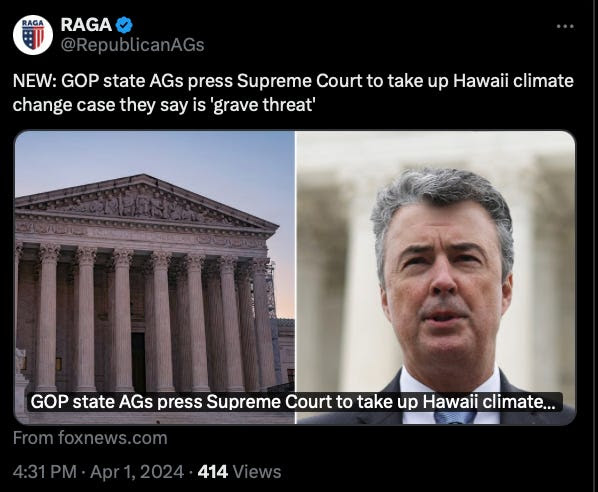 ||
A screenshot of RAGA’s post about the Hawaii case brief. Source: X
According to research by HEATED and the Center for Media and Democracy, all 20 state attorneys general that signed the amicus brief are not only featured on RAGA’s website, but many were elected with RAGA’s help.
The lead counsel for the amicus brief, Alabama attorney general Steve Marshall, was the organization’s chair in 2023. Three attorneys general have served on RAGA’s executive committee (Indiana, Mississippi, and Utah), and five have been chairs or vice chairs (Alabama, Georgia, Montana, South Carolina, and Utah).
At least six AGs won their elections with the support and funding of RAGA, including the attorneys general from Oklahoma, Missouri, Kentucky, Louisiana, Iowa, and Idaho. In a statement last year, RAGA celebrated “a 100 percent success rate for RAGA in the 2023 election cycle.” This included the election of Louisiana AG Liz Murrill, which the organization supported with “a substantial, statewide paid advertising campaign.”
“These AGs, their political futures are underwritten by RAGA,” Graves said. “And who underwrites RAGA? The fossil fuel industry, along with Leonard Leo.”
RAGA did not respond to our requests for comment; when HEATED called executive director Pete Bisbee, he said he doesn’t speak to journalists, referred us to a spokesperson, and hung up. (Bisbee has previously been under fire leading the organization that paid for robocalls encouraging former President Trump supporters to protest the election results at the Capitol on Jan 6.)
But public statements, donations, and recordings of private meetings reveal RAGA’s deep ties to the fossil fuel industry. In 2023 alone, RAGA received more than $15 million in donations, and more than $1 million of those contributions came from the fossil fuel industry, according to HEATED’s analysis of IRS tax forms. Over the last decade, RAGA has accepted more than $10 million from fossil fuel companies, electric utilities, and industry trade groups.
Among RAGA’s donors are Koch Industries, Exxon, Chevron, ConocoPhillips, the American Petroleum Institute, and American Fuel and Petrochemical Manufacturers (AFPM)—and these donors have pushed AGs to adopt an aggressive anti-climate strategy.
How RAGA connects fossil fuel companies to AGs
To connect AGs with the priorities of donors, RAGA offers different tiers of access for different amounts of donations. “It’s not technically money laundering, but it has that appearance,” Graves said.
RAGA members who pay annual fees of $25,000 can help shape the organization’s legal strategy via “online RAGA briefing rooms,” for example. And members who pay more than $125,000 are given access to private meetings with attorney generals and invitations to in-person events with them, according to documents obtained by*The New York Times* in 2014.
In 2016, the Center for Media and Democracy obtained audio from one of those events. Titled “Climate Change Debate: How Speech is Being Stifled,” the session included former Alabama attorney general Luther Strange; AFPM president Chet Thompson;and noted fossil-funded climate denier Myron Ebell.
Together, they talked about the importance of protecting ExxonMobil from lawsuits like Honolulu’s. “We’re facing a coordinated campaign to demonize, weaken and try to destroy the industry,” Thompson said.
But Thompson also said stopping climate liability lawsuits would not be enough to protect the fossil fuel industry. What the industry really needed, he said, was protection from nearly all federal environmental regulation.
What followed was years of litigation led by Republican attorneys general against every environmental regulation worrying Thompson, and more.
RAGA’s goal: industry capture of the U.S. legal system
In 2021, 20 AGs sued the EPA to block its power plant emissions rules, which Thompson specifically called out in the panel. West Virginia v. EPAultimately went to the Supreme Court, whose ruling significantly decreased the EPA’s authority to regulate emissions.
In 2023, 25 Republican AGs sued the Department of Labor over retirement funds that considered ESG factors, including fossil fuel divestment. Thompson had called out divestment in the panel, too.
In 2024, 10 Republican attorneys general, all members of RAGA, sued the SEC over its climate disclosure rules, which Thompson also called out in the session.
RAGA members have also brought lawsuits fighting the Clean Water Act, limits on vehicle emissions, and the LNG exports pause—all while being paid by the industries that profit from pollution.
But the suits brought by RAGA members aren’t limited to the federal government. They’re also trying to stop localities like Honolulu from trying climate liability cases in state courts. RAGA, and the corporations it defends, want these cases tried in federal courts, where Republican-appointed federal judges are more likely to rule in the fossil fuel industry’s favor.
In fact, the same funders who helped appoint ultra-conservative judges to federal courts also donate to RAGA. Among RAGA’s top donors is the dark money group The Concord Fund, which is affiliated with the Federalist Society’s co-chairman Leonard Leo. Leo is credited with playing moving the federal court system to the right, and was instrumental in appointing multiple conservative justices to the U.S. Supreme Court, including Justices Alito, Roberts, Gorsuch, Kavanaugh, and Coney Barrett.
That network of industry influence has purchased the current anti-regulatory legal environment—and RAGA plays an essential role. "These AGs are willing to let the planet burn as they continue to take funding through RAGA from this industry," Graves said.
Former Hawaii Supreme Court Justice Michael Wilson went one step further in describing the effect of RAGA in fighting climate change.
“The AGs are violating their public duty to protect the future of their citizenry,” he said. “This partisan political use of the rule of law is what has caused the judicial branch of government to descend to its lowest level of public approval in recorded history.”
Further reading:
- The Low-Key Republican Officials Quietly Dismantling All of Our Rights. Slate, April 2024
Key quote: ”This agenda to use the Supreme Court to strip us of our rights, to use the court to make it harder for us to deal with climate change, to use the court to roll back reproductive rights, gay marriage, and more. These are all part and parcel of Leo’s agenda and these attorneys general are on that agenda.”
- These Attorneys General Are Defending the Fossil Fuel Industry, Not Their States. The Equation, March 2023
Key quote: “According to the nonpartisan National Association of Attorneys General, a state attorney general’s job is to represent the public interest—not private, special interests—by, among other things, ‘enforcing federal and state environmental laws.’ Attorneys general in the five states most vulnerable to climate change, however, are doing the exact opposite: Instead of defending their constituents, they are defending the fossil fuel industry.”
- Lobbyists, Bearing Gifts, Pursue Attorneys General. The New York Times, October 2014
Key quote: “But success did not come in court or at a negotiating table. Instead, it came at the opulent Loews Santa Monica Beach Hotel in California, with its panoramic ocean views, where more than a dozen state attorneys general had gathered last year for cocktails, dinners and fund-raisers organized by the Democratic Attorneys General Association.”
---
===
ggl 7 26
To boost Trump, GOP attorneys general charge into battle ...

https://stateline.org › 2024/03/20 › to-boost-trump-gop...
Mar 20, 2024 — Marshall was elected chair of RAGA. Now, he's leading the charge among Republican AGs on election cases with an eye on 2024.
Missing: gerry | Show results with: gerry
Attorney General Marshall Fights to Defend President ...

Alabama Attorney General's Office (.gov)
https://www.alabamaag.gov › attorney-general-marshall-...
Apr 23, 2026 — Attorney General Steve Marshall and 11 other state attorneys general sought court permission to intervene in five pending lawsuits to defend ...
Missing: raga gerry
Steve Marshall (@SteveMarshall.gop)

As Attorney General, I've stood shoulder to shoulder with President Trump to fight to take our country back! In the Senate, I'll continue to stand with Trump ...Read more
Missing: gerry | Show results with: gerry
Alabama AG joins legal fight over Trump voter roll order

https://www.alreporter.com › 2026/04/24 › alabama-ag...
Apr 24, 2026 — Steve Marshall joined a group of attorneys general seeking to defend an executive order involving voter roll management in court.
Who Is Steve Marshall? And Why Is Corporate America Still ...

https://capitalandmain.com › LATEST NEWS
Mar 28, 2022 — Marshall chaired the political arm of the Republican Attorneys General Association (RAGA) at the very time the group was funding robocalls ...
Yaffee: Now President Trump can nominate Steve Marshall ...

https://yellowhammernews.com › News
May 22, 2026 — Marshall was also ahead of the curve on the issue of racial gerrymandering, arguing against it in front of the U.S. Supreme Court in 2023.
What does Steve Marshall leave behind?

https://alabamareflector.com › 2026/05/26 › what-does-...
May 26, 2026 — He finished over 70,000 votes behind U.S. Rep. Barry Moore, R-Enterprise, His platform was pro-gun; pro-Trump; anti-abortion rights and anti- ...
Missing: raga | Show results with: raga
'I most certainly don't back up': Steve Marshall vows to stay ...

https://1819news.com › news › item › i-most-certainly-...
Jan 19, 2026 — Alabama Attorney General Steve Marshall is staying in the Senate race despite President Donald Trump's endorsement of U.S. Rep. Barry Moore ...Read more
Steve Marshall

https://ballotpedia.org › Steve_Marshall
Steve Marshall (Republican Party) is the Attorney General of Alabama. He assumed office on February 10, 2017. His current term ends on January 18, 2027.Read more
Missing: raga | Show results with: raga
Alabama AG working with Trump to cut off UAB grants ...

https://www.yahoo.com › news › politics › articles › ala...
1 day ago — The Alabama Attorney General's office says it is working with the Trump administration to cut off more than $750,000 in research grants that ...Read more
---
trump scotus immunity amicus
DAILY BEAST no lnx $
TRUMPLANDsubvertical orientation badge
The Unhinged Arguments the Supreme Court Is Fielding on Trump Immunity
BUNKER MENTALITY
“Friend of the court” arguments are coming from across the political spectrum—and are showing the potential consequences of siding with Trump on immunity.
Jose Pagliery
Political Investigations Reporter
Published Mar. 30, 2024
Retired American generals vehemently say that no, Donald Trump cannot deploy SEAL Team 6 to kill a political rival. Gun groups howl that the United States is turning into Communist China. And a convicted Jan. 6 rioter warns that President Joe Biden could someday get sued over the death of a jogger in Georgia.
These are among the 18 various groups that shared their wisdom with the Supreme Court earlier this month, filing amicus briefs on the same day that Trump told the high court why he should be able to dodge a federal prosecution for trying to overturn the 2020 election on false pretenses.
Department of Justice Special Counsel Jack Smith’s election interference case against Trump has finally reached the nation’s highest judicial authority, which will determine whether the business tycoon can be put on trial. The timing of the nine justices’ eventual decision will determine if the presumptive 2024 Republican presidential nominee is to face trial in court before Election Day in November.
But ahead of oral arguments next month, the Supreme Court is already getting inundated with all kinds of opinions about the main question in the case: whether a former president enjoys immunity for actions made while at the White House.
The Daily Beast reviewed the litany of uninvited legal arguments spanning 599 pages, ranging from breathless reiterations of Trump’s claims to head-turning warnings. Yet all bear the signs of a historic case that could determine the fate of the election, if not American democracy.
The most unusual and unexpected amicus brief comes from three former high-ranking military leaders: Retired Lt. Gen. Keith Kellogg, who served as Trump’s own acting national security adviser; Robert Wilkie, who served as Trump’s Veterans Affairs Department secretary; and retired Lt. Gen. William “Jerry” Boykin, who once led the Army’s elite commandos in Delta Force and Green Berets.
The three former military men felt it necessary to join together and address—in public and at the national level—one of the crazier Trump legal arguments: that Trump’s immunity from criminal prosecution is so beyond question that it would allow him to order the assassination of his political enemies.
“No—the president cannot order SEAL Team Six to assassinate his political rival and have the military carry out such an order,” they clarified, marking the first time former military leadership has ever had to utter such a phrase in court.
The trio went further, pointing out that a Reagan-era executive order already prohibits anyone acting on behalf of the United States government from taking part in an assassination. They dedicated a significant portion of their 18-page court filing to making clear that military officers would be legally justified in refusing to even carry out an official order from their commander-in-chief, an assertion rarely made by military brass—and one that underlies just how stark their concerns are at this point.
“That a person is a political rival of the president is neither a justification nor an excuse for an unlawful killing. And deliberately carrying out an order to murder such a person would be acting upon a premeditated design to kill or an intent to kill. Therefore, any officer engaged in murder on the orders of a president would be subject to the death penalty or life in prison—and the officer would know it,” they wrote.
Meanwhile, the vast majority of the other amici curiae—the so-called “friends of the court” who weighed in to give the Supreme Court their two cents—largely sided with Trump.
The right-wing nonprofit America’s Future—which screened a bonkers QAnon Hollywood conspiracy “documentary” at Mar-a-Lago earlier this week—joined forces with Gun Owners of America and similar firearms associations to warn the high court that Smith’s prosecution was making the United States look more like China, Russia, or Zimbabwe.
“The prosecution of President Trump by the Biden Administration has a parallel to a recent event in Communist China,” they wrote, recalling the way former Chinese President Hu Jintao has vanished from public view ever since he was mysteriously escorted out of a public ceremony where he had been sitting next to his successor, Xi Jinping.
The United States is heading down that same route, they warned, lamenting “the explosion of lawfare” aimed at Trump for doing what they deemed totally sensible political speech—an argument that rests, in part, on the gun-toting petitioners’ continued rejection of the 2020 election results. They referenced Trump’s “supposed” defeat in Arizona and Georgia.
The real danger here, though, is that while Trump is currently polling strong, the gun groups concede that “the effect of a conviction may be very different and could determine the outcome of the election.”
But it wasn’t the conglomeration of Second Amendment enthusiasts that made a veiled threat over the high court decision. That came from an Alabama electrical engineer who’s become a political financier.
In his court filing, Shaun McCutcheon describes himself as “a successful, self-made American businessman and constitutional patriot.” And he warned Supreme Court justices that the country’s MAGA loyalists aren’t going to suddenly start trusting the U.S. court system to select fair-minded jurors.
“The former President’s tens of millions of supporters cannot reasonably be expected to accept the typical legal fictions of voir dire under such extreme circumstances,” his lawyer wrote.
McCutcheon assigns malicious intent to the Special Counsel’s decision to indict Trump in the largely liberal District of Columbia—never mind that the U.S. Constitution’s Sixth Amendment ensures that a person will be subjected to a speedy and public trial by an impartial jury drawn from the district where his alleged crime was committed, which in this case was the White House.
“A prosecutor appointed by a partisan presidential appointee of the opposing political party may prosecute a former president in a hand-picked venue deeply hostile to that former president, his beliefs, political expression, and legacy,” his lawyer wrote.
While the Supreme Court received various interpretations of presidential immunity that cast the Special Counsel’s investigations as a severe threat to the functions of the commander-in-chief’s job, the sharpest example came from someone who knows a thing or two about Trump’s insurrection.
In his brief, Treniss Evans argued that if Trump can be put on trial for allegedly masterminding a months-long and multi-pronged attack on U.S. democracy, then President Biden could be held personally responsible for the death in February of Georgia nursing student Laken Riley, given that an allegedly undocumented Venezuelan man was arrested for her killing.
“If a President doesn’t have immunity from prosecution for his actions, what prevents Georgia murder victim Laken Riley’s family from suing Joe Biden for allowing her illegal migrant murderer into the USA? Or what if hundreds of families all sued, seriatim?” his lawyer wrote, using the Latin phrase that means “one-by-one.”
Evans made the filing through his “legal advocacy group,” which bears the emotionally charged name Condemned USA. He trivialized Trump’s 2020 election fraud claims, but then went on to assert that Trump and his followers can’t possibly be accused of trying to stop certification of the election with a violent riot because technically Jan. 6, 2021, was just the official counting of the already certified votes before Congress.
The Supreme Court justices will get the sense that this topic is deeply personal for Evans. After all, his brief says right up top that “Mr. Evans has been investigating and reporting events of January 6th since January 6th, 2021. He was present at the Capitol on that day.”
In reality, he was in the violent crowd, held a bullhorn, and entered the Capitol—only to be identified by a Facebook tipster, arrested in Texas two months after the insurrection, and eventually sentenced to three years’ probation. To convince the federal judge to go easy on him, his other lawyer wrote that “Mr. Evans is quite self-reproving, sincerely remorseful, and duly contrite. He is embarrassed of this criminal conduct and the shame he has brought upon himself and his family. He has entered his plea of guilty voluntarily.”
But his March 19 brief before the Supreme Court doesn’t exactly hint at that remorse, nor does it morph into any critique of the man who called on him and others to show up that day and march on the Capitol Building.
Yet another legal advocacy firm asked the Supreme Court to give even more deference to Trump for the actions that led up to the disaster at the tail end of his presidency. The Christian Family Coalition Florida, a conservative Miami group that recently lent its support to Gov. Ron DeSantis’ crackdown on transgender kids in girls’ sports teams, reduced Trump’s election interference efforts to merely “core political speech.” And it would give future politicians carte blanche to lie—and follow through with those lies—regardless of their claim’s merit.
“For the sake of the presidency and the nation, criminal liability cannot turn on a mere factual dispute over whether an ex-president’s communications in challenging an election were ‘knowingly false,’” a lawyer for the group wrote.
In this Trump case, justices also heard from a favorite villain of the American progressive movement: Citizens United, the nonprofit behind the Supreme Court’s 2010 landmark decision that opened the door to having corporations spend unlimited funds on elections.
The group joined with two former U.S. Attorneys General: the Reagan administration’s Edwin Meese III, and the George W. Bush administration’s Michael B. Mukasey. Together, they tried to strip the current team of federal prosecutors going after Trump from any legitimacy.
They argued that Smith “wields tremendous power, effectively answerable to no one, by design.” And they contend that’s something he can’t do without the Senate’s confirmation. Instead, they say, AG Merrick Garland should have taken the same approach he did with the separate Hunter Biden investigation and tap an existing, Senate-confirmed federal prosecutor in charge of a regional office, like Delaware U.S. Attorney David Weiss.
The two conservative former AGs and the nonprofit also claim that most cabinet officials have the authority to appoint officers—minus the Justice Department, a proposition that would give the heads of Agriculture, Education and Homeland Security departments more leeway than the nation’s attorney general. And they warn that Garland’s actions could “create by regulation an entire shadow Department of Justice.”
But leave it to a consortium of 18 state attorneys general—all pro-Trump Republicans led by Alabama AG Steve Marshall—to make the one point everyone can probably agree on.
“If he had not been president, none of this would be happening,” they wrote.
Political Investigations Reporter
@Jose_Pagliery
jose.pagliery@thedailybeast.com
---
an 3 24
with less than six months before voting begins, the legal jousting over the rules for the 2024 election is already underway. And former President Donald Trump’s campaign is getting support from allies who have stayed mostly under the national radar: red-state attorneys general.
In court filings made in recent months, these chief state legal officers have advanced a string of arguments — some strikingly far-reaching — that appear designed to lay the groundwork for Republican legal victories in the event of a contested presidential vote, or to otherwise boost Trump and the GOP.
Often led by Alabama Attorney General Steve Marshall, a loose coalition of Republican-led states has submitted briefs urging judges to throw out certain mail ballots.Weaken long-standing protections against racial discrimination in voting.
“These are all setting up an argument, potentially, to say that the 2024 election was flawed because of all these state practices that are questionable,” said Paul Nolette, a political science professor at Marquette University in Milwaukee who has written in depth on the role of state AGs. “The AGs just have been critical in pushing these arguments.”
Marshall’s office did not respond to a request to comment for this story. But last month Marshall also led a coalition of red states in submitting an amicus brief urging the Supreme Court to pause Trump’s election subversion trial tied to the events of Jan. 6, 2021 — a stance that aligned the group perfectly with the interests of the Trump campaign.
And in 2020, many of these same state AGs, including Marshall, sought to have the courts overturn Trump’s election loss.
An election decided in the courts?
The danger of outright election subversion this year appears to have receded somewhat, election law experts have said, thanks to important federal legislation and the results of the last midterms. But the chances that the election will be contested, and ultimately settled in the courts, remain very high.
In that scenario, advocates and experts say, these Republican AGs look well-placed to provide the kinds of conservative legal arguments that could prove pivotal, both by directly influencing court decisions and by infiltrating the broader public debate.
But many of these claims, democracy advocates warn — especially those that support new voting restrictions, reduce the power of minority voters, or undermine courts’ authority to set election rules — could threaten fair elections.
“A huge part of the overall anti-democracy movement is really based on continuing to find ways to use legal tactics as a jumping-off point to spread the election denier message,” said Lizzie Ulmer, senior vice president of strategy and communications for States United Democracy Center, a pro-democracy group.
“There are good and pro-democracy state AGs on both sides of the aisle. But the truth is there are AGs in office right now that have the potential to do real harm. And we’ve seen that in the past and we’re seeing it today.”
Growing politicization
The involvement of the Republican AGs in elections cases with national stakes marks the latest step in a decadeslong trend toward AGs taking on more politicized roles.
In less polarized times, experts say, state AGs mostly presented as apolitical prosecutors, and frequently teamed up across party lines to tackle issues of public concern.
How a new way to vote is gaining traction in states — and could transform US politics
That began to shift in earnest during the George W. Bush administration, when Democratic AGs used a series of splashy lawsuits against Wall Street firms and corporate polluters, among others, to advance national policy and political goals — and to boost their own national profiles.
But in the Trump era, the shift has intensified. Several close observers said a key moment came in 2017, when Republicans sought to oust then-Virginia AG Mark Herring, a Democrat — ending a long-standing custom in which neither party spent money targeting incumbent AGs of the other party. Herring ultimately won reelection, but that cycle saw record campaign spending on AG races.
In Republican-led states, the politicization of AG offices reached its height around the 2020 election, centered around the Republican Attorneys General Association, an advocacy group for Republican AGs. In the leadup to the events of Jan. 6, 2021, the group’s fundraising arm, the Rule of Law Defense Fund, sent robocalls urging people to gather for a march to the U.S. Capitol to “stop the steal” and “protect the integrity of our elections.”
Marshall, the Alabama AG, served as chair of RLDF at the time, and has said he was unaware of the robocalls. He has declined to say whether RAGA or RLDF staff were at the Capitol on Jan. 6, and his office has denied public records requests by the Alabama Political Reporter for his calendars covering the period.
Along with other Republican AGs, Marshall sought to cast doubt on the 2020 election results, telling Newsmax not long after the vote: “We obviously have concerns about some of the issues, specifically of irregularities and fraud in other places.”
On Dec. 10, 2020, Marshall and other Republican AGs joined Trump for a meeting at the White House. A day earlier, Marshall had announced that Alabama would join a lawsuit filed by Texas Attorney General Ken Paxton seeking to overturn the results in Pennsylvania and three other states narrowly won by Joe Biden. Seventeen Republican-led states ultimately signed on to the Texas case.
Idaho AG disagreed
One state that didn’t join the suit was Idaho, whose AG at the time, Republican Lawrence Wasden, saw the Texas lawsuit as an improper attempt to use the AG’s office to make policy — and to interfere in other states’ business.
“The policy-making function under both the state and federal constitutions is clearly put in the hands of the legislative branch of government,” Wasden told States Newsroom. “The AG is an executive officer, and does not have those powers. That’s not how we should make public policy.”
After 20 years in office, Wasden lost his 2022 reelection bid in the Republican primary to former U.S. Rep. Raul Labrador — a defeat Wasden attributes to GOP voter anger at his decision not to join the Texas case. But he hasn’t wavered in his view that it was the right call.
“If Texas can control or influence the outcome of the election in Pennsylvania, then California can influence the election in Idaho,” Wasden said. “And that is not how federalism works.”
Labrador was elected attorney general later that year, and has signed Idaho on to several of the elections cases brought by Republican AGs.
Raúl Labrador, who won his race for attorney general in 2022, has signed Idaho on to several of the elections cases brought by other Republican AGs. Otto Kitsinger for Idaho Capital Sun
As for Marshall, in 2021, he withdrew Alabama from the bipartisan National Association of Attorneys General, saying the group had “moved too far to the left.” The next year, Texas, Missouri and Montana followed suit.
In 2022, Marshall declined to say, when asked under oath while testifying before Congress, that Biden was “duly elected,” answering only that “he is the president of this country.”
Months later, Marshall was elected chair of RAGA. Now, he’s leading the charge among Republican AGs on election cases with an eye on 2024.
Weakening voting protections
Marshall has battled on behalf of strict voting laws in his own state.
His office energetically, and successfully, fought off a 2020 court challenge to an Alabama law that bars people with past convictions from casting a ballot. In that year’s election, he also succeeded in getting the Supreme Court to block an effort to allow curbside voting, which voting advocates said could offer easier access for elderly and disabled voters.
But it’s Marshall’s work on behalf of Republicans looking to influence election rules far beyond the Yellowhammer State that could have an even greater impact.
In January, Marshall led a coalition of 17 red states that submitted an amicus brief supporting a bid by national Republicans to require Pennsylvania to reject mail ballots with incorrect or missing dates.
In Pennsylvania’s 2020 election, there were over 10,000 such ballots, and how the case is resolved could help determine the winner of this pivotal swing state, if the result is very close. Democrats have voted by mail at significantly higher rates than Republicans in recent elections.
But the impact could be broader still. A district court found last year that the missing or incorrect dates are irrelevant to establishing a vote’s legitimacy.
That means, the court ruled, that under the materiality provision of civil rights law — first included in the 1964 Civil Rights Act, then extended to cover non-federal elections in the Voting Rights Act the following year — a missing or incorrect date can’t be used as a reason to reject a vote.
In their brief, Alabama and the other states called the district court’s ruling “seriously misguided.”
They argued that the materiality provision should be read more narrowly, and doesn’t bar states from imposing reasonable ballot integrity measures. And, they claimed, the provision contains no “private right of action,” meaning it can be enforced only by the U.S. Justice Department, not by the civil rights groups involved in the Pennsylvania case.
By itself, making the materiality provision harder to use would likely have only a limited impact, since it hasn’t been among the tools most commonly used to protect voting rights, noted Cameron Kistler, counsel at Protect Democracy, a nonpartisan democracy advocacy group.
But, he said, it comes in the context of other ongoing conservative legal attacks on voting protections — including attempts to weaken the Voting Rights Act, and suggestions by the Supreme Court that it may lower the level of scrutiny it applies to voting laws that are accused of harming voters.
“The tools that you’d use to ensure free and fair elections are slowly being pulled away,” said Kistler. “When you take them all together, that’s when it starts to get really problematic.”
Voting Rights Act
As if to prove the point, a separate amicus brief submitted in December by Marshall’s office argued that Section 2 of the Voting Rights Act — the law’s most important plank, since the Supreme Court neutered Section 5 a decade ago — also contains no private right of action.
Marshall and his allies were urging a federal appeals court to reverse a ruling striking down Louisiana’s congressional map as a racial gerrymander under Section 2.
The notion that Section 2 contains no private right of action had until recently been seen by many advocates as outlandish. But a federal judge endorsed it in a separate 2022 case involving an Arkansas redistricting plan, brought by Arkansas Attorney General Tim Griffin, a Republican, who has signed his state on to several of Marshall’s amicus briefs. That decision was upheld on appeal in December.
The issue is likely to come before the Supreme Court. A ruling for Arkansas could dramatically limit the power of the VRA to stop racial discrimination in voting.
Separately, Marshall has sought to defend Alabama’s own redistricting plan. In arguing that the state should not have to draw a new map with an additional majority-Black district, his office adopted an interpretation of the VRA that, experts said, would have made it all but impossible to use for stopping racial gerrymanders.
Nicholas Stephanopoulos, a prominent election law scholar at Harvard Law School, has called Alabama’s approach to the question “directly contrary to 40 years of precedent.”
The claim was too extreme even for the conservative-dominated Supreme Court, which ultimately ordered Alabama to create a new map.
In response, Marshall signaled an agenda that went well beyond Alabama.
“There should be nothing more offensive to the people of our great state than to be sidelined in 2023 by a view of Alabama that is stuck in 1963,” he said in a statement. “This racial agenda is pressed by left-wing activists, not just in Alabama, but in any Republican state where it might advantage Democrats.”
And he compared the ruling, which aimed to empower Black voters, with Jim Crow.
“If this brazen and divisive commandeering is permitted without even a whisper of concern from other quarters, America’s congressional elections as we know them will never be the same,” Marshall continued. “We will be grouped together by race alone, with counties and cities split down the middle—the same way that we were so wrongfully segregated once before.”
Marshall also led a coalition of 18 GOP-led states that filed a 2021 amicus brief supporting Arizona’s defense of a law requiring voters who don’t sign their mail ballots to do so by 7 p.m. on election night.
The issue may seem minor, but Marshall’s brief invoked a far more fundamental question, arguing that state legislatures, not the courts, are in charge of setting election rules.
“The U.S. Constitution is unambiguous about the right of state legislatures to determine the manner of holding elections within their respective states,” wrote Marshall. “Accordingly, state legislatures, not federal courts, are vested with the legal authority to determine state election laws. Court attempts to micromanage election laws duly passed by state legislatures conflict with our constitutional structure and legal precedent.”
When North Carolina brought a version of this claim — known as the Independent State Legislature Theory — to the Supreme Court last year, experts warned that it could radically reshape election law, giving partisan state lawmakers almost unfettered power to make the rules. The Justices ultimately rejected the argument.
Why AGs enjoy influence
Advocates say it’s difficult to assess whether, and to what extent, courts are swayed by amicus briefs. But, they add, the role of state AGs as their state’s chief legal officer gives their claims an invaluable sheen of authority.
GOP backs voting by mail, yet turns to courts to restrict it in battleground states
“State AGs are taken seriously because of the governmental role they play, in a way that parties, who do not have a governmental role, typically are not,” said Dax Goldstein, a senior counsel at States United Democracy Center. “So there’s a real difference between a sitting AG filing a brief and [Donald Trump lawyer] John Eastman filing a brief.”
In addition, since a 2007 Supreme Court ruling in a case where a group of states led by Massachusetts sued the George W. Bush administration’s Environmental Protection Agency, states have enjoyed more power than individual plaintiffs to bring lawsuits on public policy issues.
“States have a greater ability to bring legal challenges than private citizens do,” said Kistler. “So when you have these super active state officials with a greater ability to bring cases than private parties and a judiciary that’s willing to entertain the cases, it makes a difference.”
Nolette, the Marquette political scientist, noted that if the AGs’ series of briefs in election cases appear coordinated, it’s no accident.
“There’s a lot of strategy that goes into planning these far-reaching arguments,” Nolette said, adding that AGs of both parties use their partisan organizations — the Republican Attorney Generals Association, and the Democratic Attorney Generals Association — to align their efforts and figure out the venues where they might have the most chance of success.
“It’s almost like buying a lottery ticket, trying to boost the chances of those arguments taking hold somewhere,” Nolette continued. “And once they get one district court judge to agree with it, then it moves them to a different state of respectability. It’s like, well, a federal judge has agreed with us, so this is a legitimate argument, even if it was considered totally out there in previous years.”
*Ralph Chapoco contributed to this report.
Stateline is part of States Newsroom, a nonprofit news network
https://podtail.com/en/podcast/drilled/the-anti-esg-campaign-gets-a-boost-from-raga/
no lnx
The Anti-ESG Campaign Gets a Boost from RAGA - Transcripts
June 13, 2023
Ever since the Securities and Exchange Commission announced its intention to make Environmental Social and Governance metrics actually mean something to investors, polluting industries have suddenly turned on ESG. Now that fight has a legal strategy, being carried out by the Republican Attorneys General Association.
Transcript: https://www.steno.ai/drilled/the-anti-esg-campaign-gets-a-boost-from-raga
Hello and welcome back to Drilled, I'm Amy Westervelt. We've talked before on this show about the growing backlash against taking environmental, social, and governance, or ESG, factors into consideration when it comes to investing. The watchdog group Documented first revealed last year that state treasurers were getting in on the action, kicking woke investment firms likeBlackRock out of their states. Back then I wondered when the attorneys general would show up to join the fray, and now sure enough, they are here. The Republican Attorneys General Association, RAGA, our old favorite, has come to play in the anti-ESG space. But first, a quick reminder, why all this upset about ESG all of a sudden in the first place? Good question. For a really long time, oil companies actually kind of loved ESG. It was all very loose and self-reported, and it gave them a way to unlock so-called green capital. But in 2021, the Securities and Exchange Commission, the SEC, looked around and went, huh, there are all these different SEG ratings, and some of them seem a little scammy, and no one knows what these disclosures even really mean. These are the kinds of things it's our job to clean up. So we are going to provide formal guidance on climate risk disclosure.
And that is when you start to see corporate interests, fossil fuel companies, and right-wing politicians lose their minds over ESG. Because all of a sudden, they couldn't just write whatever they wanted to in a report, they might have to actually disclose what their real climate risks are.
Speaker 5 00:02:16
Here is Jesse Coleman withDocumented. I think that a lot of this, both the legislative side, this legal strategy, the strategy of using state treasurers to pressure asset managers into attack climate disclosure, all of this is really mostly aimed at SEC scope three emissions disclosure requirements coming, you know, supposedly coming soon
Speaker 4 00:02:43
in the next couple of months, even. Wait, sorry, I'm gonna pause to define scope three. That means how your product's actually being used, not how you're making it, which is a big deal for especially heavy polluting industries
Speaker 5 00:02:58
like oil and gas companies, for example. Yeah, yeah, it's a really big deal. Whereas ESG, having a non-standardized ESG disclosure is no big deal to a major company. The SEC coming and saying, how much carbon emissions are you really responsible for? Not just, you know, what you're claiming you're responsible for, but if you're an oil company, for example, how much carbon are you actually putting in the atmosphere from everything that you've gotten from underground? What is your real impact? And that is a really big deal. It's probably one of the biggest climate policy issues in play right now. So, you know, in my opinion, a lot of this anti-ESG stuff, which doesn't make a lot of sense on its face, you know, these state bills that have passed in some states and been introduced in a ton of states, the actual thing that those bills are gonna do, they're not gonna have a really big impact. And sort of this antitrust stuff is very similar in the sense that, you know, the claims are kind of weak and it's hard to say exactly what the impact is gonna be specifically. But at the same time, it's building up all of this pressure and it's building up all of this political inertia that is all aimed at opposing, disclosing climate emissions. And that's what this SEC rule would do when it comes out, is that it would require publicly traded companies to disclose those emissions.
So, you know, in my opinion,
that's the real goal, is to keep that from happening. You may have heard Jesse mention there the words antitrust. That is where the Republican Attorney's General Association comes into the picture. Back in June, 2021, a guy named Jason Isaac, who spearheads the Texas Public Policy Foundation's work on energy, went to a meeting of the American Legislative Exchange Council, ALEC, with an idea for a legal strategy that he thought could take ESG down.
Speaker 7 00:05:04
Documented shared audio from that meeting with us. Yes, so earlier, a couple months ago,our state affairs committee voted nine to nothing. So, broad bipartisan support, every single member voted in support to give the committee subpoena authority.
Speaker 6 00:05:16
So, they have sent out a couple months ago,
Speaker 7 00:05:24
our state some paper documents to find out where this collusion is happening. We anticipate truckloads of documents being delivered. And so, we look forward to the Texas Public Policy Foundation to going through those meticulously, because we believe that there is, and we actually partner with C. Boyden Gray, Boyden Gray Associates law firm out of Washington, D.C. Corporate collusion, liability risk for the ESG agenda to charge higher fees and rig the market. We believe that there's antitrust violations. This is really kind of geared towards our attorneys general to lay the foundation for antitrust violations on this corporate collusion. Find out the connections with the Glasgow Financial Alliance for net zero, which has over, I think, $100 trillion under managed assets in there. And there are the connections with the glad zero, this Paris Accord, which is net zero. So, I hope our committee gets a ton of paper back
Speaker 1 00:06:23
from these large financial institutions.
Speaker 7 00:06:28
Hope our committee gets in the courts and our attorneys generalaround the country filed antitrust violations.
Speaker 4 00:06:34
So, yeah, cartels colluding for decarbonization.What the hell is he talking about here?We're gonna try to answer that question right after this quick break. And we're back. So, after COP26 in Glasgow, insurers and asset managers, both formed groups focused on ESG. In both cases, these firms were saying, look, all sorts of environmental and social factors can impact our bottom line, and we would like to know what those risks might be so we can factor that into our decision-making around what to ensure and what to invest in. But according to Isaac, these firms talking to each other, issuing joint statements about what kind of information they'd like to see from companies, that's colluding to rig the market. In the wake of that 2021 ALEC meeting you heard Isaac talking at before, not only did Texas continue with the investigation Isaac mentioned, but Arizona Attorney General, Mark Bernovich, opened an investigation into ESG investing. And Raga coordinated a letter to various asset managers and politicians with more than a dozen attorneys general signed on, stating their concern that ESG investing might actually be an antitrust violation.
Speaker 5 00:08:13
Here's Jesse Coleman again. We started to see some of the bright lights of the Republican Attorneys General Association file various kinds of legal attacks on ESG issues, whether that's going directly after asset managers and asking them questions about their net zero commitments, or that's going directly after ratings agencies
Speaker 4 00:08:38
and saying that you're boycotting fossil fuels. And they seem to have coalesced around this idea of painting ESG as some sort of corporate collusion, you know, building an antitrust case. Can you explain what the thinking is there,
what they're trying to prove?
The allegation is that a lot of large asset managers get together in a shadowy cabal and they plan to collude to reduce carbon emissions. The reason these groups are alleging antitrust violations is that antitrust violations are very scary to companies. If a jury finds you guilty of an antitrust violation, it's very expensive. And it's a pretty hard bar to meet. And most experts are saying that the antitrust allegations that are coming from these people that are opposing climate policy, they probably don't have a leg to stand on, but a lot like slap suits and other kinds of legal tools that are used to silence people, just defending against the antitrust allegation is very, very expensive. So, you know, you see companies really backing away from participation in these kind of global groups that are trying to address climate emissions and trying to address investment
10:08
in the fossil fuel industry by large asset managers. In 2022, Alec once again held a meeting with a session on how to handle ESG at the state level. And again, the antitrust strategy was front and center. This time, Isaac was in the room cheering on new proponents of the strategy, including Will Hild with Consumers Research, which is funded by former Federalist Society President Leonard Leo, Paul Watkins, who used to work in the Arizona Attorney General's office and now runs an outfit called Fusion Law, advising on these sorts of strategies. Andy Puzder, former CEO of the Food Conglomerate that is home to Wendy's and Hardee's, and Catherine Gonzalez with the Heritage Foundation. Puzder kicked things off by comparing ESG investors
11:03
to, not kidding here, the Nazis. I wanna tell you, ESG investing is socialism in sheep's clothing. I mean, this is the challenge of your generation. My father's generation's challenge was the Nazis, who, by the way, were, of course, very proud socialists. The challenge of my generation was the communists, who were, of course, very committed socialists. The challenge of your generation is ESG investing, and it's more insidious than communism or the Nazis. It's the thing they're doing it. So ESG, Environmental Social and Governance. Like, how bad could that be, right? It sounds so innocuous, but it's a ruse. It's a ruse to conceal the fact that it's a direct threat to our founding principles.
11:53
It's a threat to our democracy. How bad could that be, right?
Speaker 4 00:11:55
It's a threat to our democracy.
Speaker 6 00:12:02
Hild and Watkins kept it focused on the litigation strategy. They get in rooms and they talk about they're gonna set a policy across the market. Now, it's been a while since I was in law school,
but when I was there, that was antitrust 101. And that's why you see U.S. senators saying this is potentially criminal antitrust liability.
Speaker 4 00:12:22
You see AG saying that they're going to investigate. And again,I have yet to speak with a single legal expert who thinks that this strategy could actually win in court. But like we said before, that is not necessarily the point. It's already having a chilling effect on investment firms and insurance companies in these net zero groups. And now that Republicans have control of the House, it's the focus of a series of oversight committee hearings too. The first one happened back in May and featured the attorneys general of Utah and Alabama as witnesses.
Speaker 1 00:13:00
Here'sSean Reyes, attorney general of Utah. But ever since the signing of the Paris Agreement, there's been anopen conspiracy to bypass Congress using the power of horizontal agreements by key players in our financial system. Some of these groups are Climate Action 100, the Glasgow Alliance for Net Zero, which include the largest asset managers, banks and insurance companies globally. These horizontal organizations seek to use their collective market power over tens of trillions in assets
to force burdensome changes on American companies.
amy: The Democrats witnessed during this hearing, Illinois State Treasurer Michael Frerichs gave a great and completely non-climate related example
of where ESG can safeguard profits. The more data we as investors have, the better informed our decisions are when selecting investments over the long term. ESG is about looking at a wider range of risks and value opportunities that could have a material financial impact on investment performance. For example, if you're investing in apharmaceutical company, it's thinking about whether that company has exposure to massive lawsuits because of its role in the opioid epidemic. Our approach is to integrate material ESG factors into investment decisions along with many other considerations. We are not ignoring traditional financial factors like profitability and credit worthiness. We are integrating more data into our decisions
to give us a better idea of risk and growth prospects. Frerichs also pointed out that limiting the information investors can get about the companies they're investing in
is the exact opposite of a free market idea. This pushback is anti-free market and anti-investor. It is misleading and it is harmful. It harms retirement savers, pensioners, working people, businesses, and it harms America. This coordinated campaign is focused on ESG investing. Most people don't know what ESG is. ESG is data. ESG is simply additional information that investment professionals use to assess risk and return prospects. It is about value, not about values. In order to maximize returns, an investor must be able to manage and mitigate risk. The more data we as investors have, the better informed our decisions are when selecting investments over the long term. ESG is about looking at a wider range of risks and value opportunities.
It could have a material financial impact
on investment performance. Last week, the House Oversight Committee held its second hearing on this subject,
calling on none other than Jason Isaac himself to testify. I'm Jason Isaac. I'm the director of LifePowered, a national initiative of the Texas Public Policy Foundation to raise America's energy IQ. And I live a high carbon lifestyle. And I think the rest of the world should too. That's why I refer to the ESG agenda as the China ESG agenda. It does very little to help Americans. It does everything to help the Chinese Communist Party. And again, making energy expensive, scarce and government controlled. This body, the United States Congress has not ratified the Paris Treaty. It is not the law of the land here in the United States, butto force an American entrepreneur to admit that his company will comply with that
is just mind blowing to me.
Whether the committee will hold a third hearing remains to be seen. I'm not sure the anti-ESG bench of experts rolls that deep. Plus, while these ideas might get folks at an ALEC meeting riled up, they're remarkably unpopular with American voters, including the majority of Republican voters. New Mexico rep Melanie Stansberry
made that point at last week's hearing. What I find particularly strange about this conversation is that over 63% of American voters actually oppose, directly oppose, any kind of government interference in investing strategies. And the vast majority of Republicans oppose it as well. And when you look at the bigger picture, when you look at what the American people are actually asking Congress to do, asking businesses in the private sector to do, almost 70% of Americans are in support of actions to address climate change,
to transition to a clean energy economy. Whether the SEC will be swayed by the antitrust argument remains to be seen.
That's it for this week. Thanks for listening, and we'll see you next time. Drilled is an original critical frequency production. Our producer is Sarah Ventre. Sound design, mixing, and mastering are by Peter Duff, who also wrote our original score. Our first amendment attorney is James Wheatman at the First Amendment Project. And the show is reported, written, and hosted by me, Amy Westervelt.
==
https://newrepublic.com/article/172636/esg-house-oversight-conspiracy
may 11 no lnx
QANON REBOOT
Republicans Are Truly Losing Their Minds Over ESG
Right-wingers at a House Oversight Committee hearing Tuesday insisted this boring investment strategy is some kind of global conspiracy.
Steve Marshall speaks at a podium in front of the Supreme Court building.
Alabama Attorney General Steve Marshall, who testified at Tuesday’s hearing on ESG, speaks to members of the press in October 2022.
On Tuesday, the House Oversight Committee convened a hearing on environmental, social, and governance, or ESG, investing criteria. For over a year now, Republicans have been trying to turn this obscure three-letter acronym into a full-fledged culture war.So far, the right has expressed its complaints about ESG via a word salad whose components don’t share much of a relationship either to reality or one another. This pattern persisted on Tuesday, when the word “cabal” was used at least three times in reference to allegedly “woke” investors.
ESG criteria, in reality, refer to the broad set of data that investors look at to determine a company’s impact on the world and the impact the world might have on it. In other words, it’s not just about whether a company is “good” according to some abstract set of values. It represents another way of factoring risk exposure into investment—something financiers have been doing for centuries.
“Elites from around the globe have formed alliances to coordinate together to implement woke climate policy.”
:{
}:
The two witnesses Republicans summoned to this week’s committee hearing weren’t economists or investment professionals, who might be familiar with these criteria or risk assessment in general, butattorneys general from Utah and Alabama, respectively: Sean Reyes and Steve Marshall. Whatever ESG actually means, to them and other anti-ESG crusaders, is mostly irrelevant. For those trying to understand their crusade, the hearing showed that it’s best to think of ESG as a canvas onto which the right projects its own plans and anxieties.
If you’ve heard of Marshall, it may well be because he’s spent considerable time since 2020 trying to overturn the results of that year’s presidential election, and shield other Republicans from accountability for spreading lies about it. Both he and Marshall joined fellow red states attorneys general in filing a brief with the Supreme Court supporting Trump’s claims about election fraud.Marshall, for his part, was serving as head of the Rule of Law Defense Fund that year, which sent out robocalls encouraging Trump supporters to flock to the Capitol on January 6.RLDF—whose donors include the Edison Electric Institution and the Judicial Crisis Network—is also a sister organization of the Republican Attorneys General Association, or RAGA, which Marshall was appointed chair of after continuing to deny, in 2022, that Joe Biden won the 2020 election.
:{
}:
Generous RAGA donors have included Koch Industries, Chevron, Exxon, Fox, andTikTok. ProPublica recently reported that companies that initially withdrew funds from RAGA over its role in the January 6 attack are back, including Amazon, Walmart, and JPMorgan Chase’s PAC. Overall, RAGA revenues jumped 68 percent in 2022.
In his testimony, Marshall—who chairs a secretive organization pushing a clandestine political agenda through undemocratic means—accused a “cabal of global elites” of being “clearly connected through various alliances” to try to force an ESG agenda onto an unwilling public. Reyes similarly accused “woke investors” like Blackrock of being part of an “organized syndicate of pressure” that is engaged in an “open conspiracy to bypass Congress.” Answering big policy questions like decarbonization, he argued, “is the role of the people’s elected representatives in a democracy—including each of you in Congress, state elected officials, and local leaders—not unelected bureaucrats or foreign governments.”
In other words, someone who’s spent the last several years attempting to overturn the results of a democratic election took to the Capitol on Tuesday to accuse an ill-defined set of actors of trying to sidestep democracy by asking companies if climate-fueled droughts, floods, and fires (for instance) might have some impact on their operations.And while claiming only to want investors to adhere to fiduciary duty, Republicans failed to mention that much of Wall Street’s wariness around investing in new fossil fuel production has nothing to do with a “woke” agenda: Before the pandemic, energy companies on the S&P 500 were underperforming every other sector on that index, and had spent a decade lagging behind as they binged cash on rapid drilling through the shale boom. Its fortunes have changed in recent years, but investors and oil and gas industry managers themselves are urging modesty on exploration and production precisely so that they can make more money.
“People don’t like men. People don’t like people with a European background, that sort of thing.”
“Elites from around the globe have formed alliances to coordinate together to implement woke climate policy,” Marshall said in his opening statement. “These schemes undermine our system of government because unelected elites are making policy decisions outside of democratic processes.” The footnote on that sentence in his pre-written testimony references Consumers Research, which is funded by millions of dollars in undisclosed donations and advised by right-wing legal guru Leonard Leo.
Republicans on the committee responded enthusiastically to this opening salvo. Wisconsin Republican Glenn Grothman asked Marshall whether “ESG” might influence decisions over who companies hire or put on corporate boards. “Right now there’s certain disfavored groups in our society,” Grothman mused. “People don’t like men. People don’t like people with a European background, that sort of thing. Could this be something where you’re encouraging businesses not to hire or promote people from certain unfavored groups.” In a moment dripping with irony, Texas Representative Pete Sessions decried “activist government making decisions on behalf of free people” in service of his larger point, supporting efforts to limit financial institutions’ decision-making power—and even what kind of data can be made available to them—in order to curb the spread of ESG.
It would be a fool’s errand to try to find much coherence in the right’s screeds against supposedly woke investors—who don’t really seem to exist. But today’s Oversight hearing might have accidentally illustrateda good rule of thumb: Whatever Republicans accuse the “ESG movement” of doing is something they’re probably already doing themselves.
Kate Aronoff @KateAronoff
Kate Aronoff is a staff writer at The New Republic.
steve marshall
https://www.alternet.org/alabama-attorney-general-abortion-pills/
==
https://www.alreporter.com/2021/01/26/trump-appointee-says-tuberville-raga-director-met-with-trump-family-top-advisors-on-eve-of-capitol-attack/
no lnx
lAST UPDATED ON JANUARY 27, 2021,
Update: Sen. Tommy Tuberville, through a spokeswoman, denied attending the Jan. 5 meeting. Facebook and Instagram posts appear to tell a different story.
The night before the deadly attack on the U.S. Capitol, Alabama Republican Senator Tommy Tuberville and the then-director of the Republican Attorneys General Association met with then-President Donald Trump’s sons and close advisers, according to a social media post by a Nebraska Republican who at the time was a Trump administration appointee.
Charles W. Herbster, who was then the national chairman of the Agriculture and Rural Advisory Committee in Trump’s administration, in a Facebook post at 8:33 p.m. on Jan. 5 said that he was standing “in the private residence of the President at Trump International with the following patriots who are joining me in a battle for justice and truth.”
Tuberville, through a spokeswoman Tuesday, told APR that he did not attend a Jan. 5 meeting at the Trump International Hotel in Washington.
Among the attendees, according to Herbster’s post, were Tuberville, former RAGA director Adam Piper, Donald Trump Jr., Eric Trump, Trump’s former National Security Advisor Michael Flynn, adviser Peter Navarro, Trump’s 2016 campaign manager Corey Lewandowski and 2016 deputy campaign manager David Bossie.
RAGA’s dark-money fundraising arm, the Rule of Law Defense Fund, led by Alabama Attorney General Steve Marshall, paid for robocalls directing people to the March to Save America and rally, which took place just before the Capitol attack.
Herbster attended the Jan. 6 rally, but said he left before the riot, according to the Omaha World-Herald. The newspaper also reported that Herbster “also met Tuesday in Trump’s private residence in his Washington, D.C., hotel with Trump’s sons, Donald Jr. and Eric, and other campaign advisers.”
“They discussed how to pressure more members of Congress to object to the Electoral College results that made Joe Biden the winner,” The Omaha World-Herald reported.
Flynn earlier on Jan. 5 spoke at a rally of pro-Trump supporters in support of Trump’s baseless claims of widespread election fraud.
“We stand at a crucible moment in United States history. This country is awake now,” Flynn told the crowd, according to numerous news outlets.
Congressman Mo Brooks, R-Alabama, spoke at the rally prior to the Capitol attack, telling the crowd: “Today is the day that American patriots start taking down names and kicking ass.” Right-wing political activist and an organizer of the Jan. 6 “Stop the Steal” rally, Ali Alexander, in videos posted on social media claimed that Brooks was involved in the planning of the rally that day, meant to pressure lawmakers inside the Capitol as they prepared to vote on certifying the Electoral College votes.
The Jan. 5 meeting, as discussed in the Facebook post, was first reported by journalist Seth Abramson on Tuesday. Abramson in his article states that it’s unclear if Trump himself attended the Jan. 5 meeting at his hotel.
“I’ve dedicated my life to promoting and preserving the American Dream. Tonight, as I look at our nation’s flag, I’m reminded of the battles and blood spilled to protect our way of life,” Herbster wrote in his post:
Charles W. Herbster, who was then the national chairman of the Agriculture and Rural Advisory Committee in Trump’s administration, in a Facebook post at 8:33 p.m. on Jan. 5 said that he was standing “in the private residence of the President at Trump International with the following patriots who are joining me in a battle for justice and truth.”
In numerous photos posted to his Facebook page in the months prior to the Jan. 5 meeting, Herbster can be seen posing with Trump and Trump’s sons and close advisors.
APR sent questions to a Tuberville spokesperson asking whether the senator had attended a Jan. 5 meeting with Trump, Piper and others at his hotel, and if so, why was he called to the meeting and what was discussed. The Tuberville spokeswoman replied in an email: “the answers to your questions are No and Not Applicable.” Attempts to contact Herbster on Tuesday were unsuccessful.
As pro-Trump supporters, far-right groups and militia members were breaking into the U.S. Capitol on Jan. 6, Trump and his attorney Rudy Giuliani both mistakenly called Republican Sen. Mike Lee of Utah while trying to call Tuberville, according to multiple news accounts, a recording of a voicemail message by Giuliani left for Tuberville and statements by Lee.
In the recorded voicemail message mistakenly left on Lee’s phone, first reported by The Dispatch, Giuliani asks Tuberville to stall the counting of electoral votes.
“I want to discuss with you how they’re trying to rush this hearing and how we need you, our Republican friends, to try to just slow it down so we can get these legislatures to get more information to you,” Giuliani said in a voicemail.
Piper resigned as director of RAGA on Jan. 12 following much public scrutiny over robocalls paid for by the Rule of Law Defense Fund.
“Every decision Adam made on behalf of RLDF was with the best of intentions and with the organization’s best interests in mind,” Marshall said in a statement at the time. “Adam leaves a void that will be difficult to replace, but we wish Adam well as he pursues other opportunities that will allow him to spend more time with his family.”
Marshall has not publicly said why Piper resigned. Attempts to reach Piper for comment Tuesday were not successful.
RLDF was listed as a participating organization for the Jan. 6 “March to Save America” on the march’s website. The website is now down, but archived versions show RLDF as a participating group. Prior to the protest, RLDF sent out robocalls detailing when and where citizens should meet for the Jan. 6 rally, which was first reported by the watchdog investigative journalism group Documented.
“I’m calling for the Rule of Law Defense Fund with an important message,” the robocall stated, according to Documented. “The march to save America is tomorrow in Washington D.C. at the Ellipse in President’s Park between E St. and Constitution Avenue on the south side of the White House, with doors opening at 7:00 a.m. At 1:00 p.m., we will march to the Capitol building and call on Congress to stop the steal. We are hoping patriots like you will join us to continue to fight to protect the integrity of our elections. For more information, visit MarchtoSaveAmerica.com. This call is paid for and authorized by the Rule of Law Defense Fund, 202-796-5838.”
“Serving Republican attorneys general has been the honor of a lifetime and honestly a dream job,” Piper said in a statement on his resignation, according to the Associated Press.
In a statement to APR on Jan. 7, after APR’s story on the matter had published earlier that day, Piper said neither RAGA nor RLDF was involved with the planning of the rally and seemed to place the blame on staff.
“The Republican Attorneys General Association and Rule of Law Defense Fund had no involvement in the planning, sponsoring, or the organization of yesterday’s rally,” Piper said in the statement at the time. “No Republican AG authorized the staff’s decision to amplify a colleague speaking at the rally. Organizationally and individually, we strongly condemn and disavow the events which occurred. Yesterday was a dark day in American history and those involved in the violence and destruction of property must be prosecuted and held accountable.”
Marshall, in a statement to APR on Jan. 8, blamed unnamed RLDF staff and said he was not aware of his organization’s involvement:
“I was unaware of unauthorized decisions made by RLDF staff with regard to this week’s rally. Despite currently transitioning into my role as the newly elected chairman of RLDF, it is unacceptable that I was neither consulted about nor informed of those decisions. I have directed an internal review of this matter. As I said yesterday, I condemn, in the strongest possible terms, the actions of those who attempted to storm the U.S. Capitol, a place where passionate but peaceful protestors had gathered and lawmakers debated inside. Our country is built upon the foundation of the rule of law. American democracy guarantees the right of peaceful protest. Those who chose to engage in violence and anarchy should and will be held accountable under the law.”
Marshall, speaking to The Montgomery Advertiser on Jan. 12, after a press conference on human trafficking and before Piper’s resignation was announced, said the internal review was ongoing. Asked by the Advertiser whether he felt Trump bore any responsibility for the violence at the Capitol on Wednesday, and for comment on Trump’s potential impeachment, Marshall declined to comment.
“I didn’t see anything about the rally,” Marshall said, according to the newspaper. “I don’t know anything about his remarks.”
APR’s questions to Marshall’s office Tuesday about the status of Marshall’s investigation into the matter, and whether he has learned of Piper’s possible attendance at that Jan. 5 meeting, weren’t immediately answered.
Have a question or a scoop? Send us a tip. We'll track it down.
In this article:Alabama Attorney General Steve Marshall, Featured, Former President Donald Trump, Sen. Tommy Tuberville, U.S. Capitol attack
WRITTEN BY
Eddie Burkhalter is a reporter at the Alabama Political Reporter. You can email him at eburkhalter@alreporter.com or reach him via Twitter.
crew 1/22
corporate and industry PACs have also continued to support the Republican state attorneys generalwho attempted to invalidate the election results in four battleground states by falsely claiming that election procedures in Pennsylvania, Georgia, Michigan, and Wisconsin violated federal law. Twenty companies including Boeing, Walmart, and Home Depot have donated $60,200 through their federal PACs to 12 attorneys general involved in the lawsuit, which was led by Texas Attorney General Ken Paxton. Alabama Attorney General Steve Marshallcollected the most in donations, bringing in $14,500. He is the head of the Rule of Law Defense Fund, a dark money organization that paid for robocalls promoting the “Save America” rally held on January 6 before the insurrection....
Corporate and industry PACs have also contributed to the Republican state attorneys general who attempted to invalidate the election results by joining a lawsuit, led by Texas Attorney General Ken Paxton, against four battleground states won by Biden. Twenty industry donors including Boeing, Walmart and Home Depot have donated $60,200 through their federal PACs to Paxton and eleven other attorneys general who joined that lawsuit, attempting to decertify the results. The four states received historic turnout from voters of color.
Steve Marshall, attorney general of Alabama, has raised the most from these donors, taking in $14,500. He is the head of the Rule of Law Defense Fund, a dark money organization that paid for robocalls detailing when and where individuals should meet for the “Save America” rally held before the insurrection took place at the Capitol. His efforts to undermine the results of the 2020 presidential election perpetuated the myth that it was stolen, while robocalls by RLDF urged rallygoers to “march to the Capitol” and “call on Congress to stop the steal.”
Texas Attorney General Ken Paxtonpulled in $6,000 from the Texas Farm Bureau and Valero Energy since leading the charge to invalidate millions of people’s votes. Attorney General Sean Reyes of Utah backed the lawsuit, further eroding confidence in this country’s democratic system. He pulled in $7,500 from two donors, including Home Depot.
Companies that cut checks to these election objectors had also made commitments about confronting systemic racism in this country. Only their efforts to curb racism apparently don’t include their political giving. Cigna, which shared its “resolute belief in diversity [and] inclusion” and described intolerance “as not only unacceptable, but as the antithesis of everything [they] stand for,” offered contributions to Florida Attorney General and former RLDF board member Ashley Moody. Walmart, which committed $100 million over five years to build a “center on racial equity” to address systemic racism, contributed to Marshall. Home Depot gave $1 million to the Lawyers Committee for Civil Rights Under Law “in support of its vital work to secure civil rights and equal justice for all,” then turned around and donated to Reyes.
These billion dollar corporations have contradicted their public commitments to racial justice by bankrolling attorneys general sowing doubt about a fair election in states like Georgia, which have historically suppressed Black voters. By funding these officials, the same companies claiming to support racial justice are giving political power to an anti-democratic and racist agenda.
... criticism mounts for the Republican Attorneys General Association and its dark-money nonprofit, the Rule of Law Defense Fund, for the latter’s role in aiding the protest that resulted in a deadly riot at the U.S. Capitol, questions remain about what Republican attorneys general knew of that aid.
The Democrat Attorneys General Association and the Southern Poverty Law Center have both issued statements condemning the Republican Attorneys General Association and its policy arm, the Rule of Law Defense Fund, which is headed by Alabama Attorney General Steve Marshall.
At least five people, including Capitol Police Officer Brian Sicknick, have been killed related to the siege. Ashli Babbit, 35, was shot by a Capitol Police officer when she tried to crawl through a broken window inside the Capitol during the siege. Another Capitol Police officer, Howard Liebengood, who responded to the attack, died Saturday off duty, marking the second Capitol Police officer death since Wednesday. Police did not release his cause of death.
Marshall in a statement Friday said he was unaware the nonprofit he leads made “decisions” with regard to the rally, and condemned the violence that followed.
PAXTON SPOKE
https://www.alternet.org/2021/01/state-attorney-general
As more and more detail emerges about the events in the nation's capital Wednesday, it becomes clearer that this was a planned revolt and that it was organized within the Republican establishment. So much so that the Republican Association of Attorneys General (RAGA)—the chief Republican law enforcement officers for their states—used its dark money group to help organize the mob. The Rule of Law Defense Fund (RLDF), a "nonprofit" set up by the RAGA, appears in a list of groups "Participating in the March to Save America" along with Stop the Steal, Turning Point Action, Tea Party Patriots, and others.
The RLDF sent out a robocall to activists saying: "The march to save America is tomorrow in Washington D.C. at the Ellipse in President's Park between E St. and Constitution Avenue on the south side of the White House, with doors opening at 7:00 a.m." So they're making sure everyone knows where to go. It gets worse. "At 1:00 p.m., we will march to the Capitol building and call on congress to stop the steal. We are hopingpatriotslike you will join us to continue tofight to protect the integrity of our elections." The call gives a web address, MarchtoSaveAmerica.com, and concludes: "This call is paid for and authorized by the Rule of Law Defense Fund." Again, this is coming from state attorneys general, the people elected to uphold and enforce the rule of law.
RAGA's chair, Georgia Attorney General Chris Carr, insists he "unequivocally had no knowledge or involvement" in the robocall and "is working diligently to determine how this situation occurred and ensure that it does not happen again."
The executive director of RAGA, Adam Piper, had the gall to issue a statement saying that the RAGA and RLDF "had no involvement in the planning, sponsoring or the organization of Wednesday's event" despite the fact that they are listed on the website as an organizing entity of the event and they sent the goddamned robocall telling everyone where to go and what the agenda for the coup would be. So that's believable. He added: "No Republican AG authorized the staff's decision to amplify a colleague speaking at the event."So we had nothing to do with it, but if we had anything to do with it, it's the staff's fault.
Few are buying that load, particularly the Democratic Attorneys General Association. Co-Chairs Massachusetts AG Maura Healey and Nevada AG Aaron Ford released a scathing statement:
"The continued peddling of conspiracy theories and pandering to President Trump's dangerous lies by the Republican Attorneys General Association, the Rule of Law Defense Fund, and some current and former Republican Attorneys General has gone unchecked for too long. Current and former Republican AGs have been directly involved with efforts to undermine the results of the 2020 presidential election, and now the party of so-called 'law and order' played a role in recruiting the domestic terrorists who breached the U.S. Capitol to attack Vice President Mike Pence for doing his Constitutionally-mandated job to certify the Electoral College.""RAGA, RLDF—and the Republican AGs who blindly take their support—have no legal or moral ground on which to stand here: the organization paid for robocalls to recruit attendees, it was listed as a sponsor of the event, its former Chair [paxton] spoke at the rally that incited a mob, and former GOP AG Josh Hawley led the effort in Congress to undermine the election."
The DAGA is calling out every state Republican attorney general to "publicly distance themselves from the Republican Attorneys General Association and its leadership," and for every donor to the group, corporate or individual to "abstain from further supporting an organization that makes such a mockery of the rule of law and our beloved democracy." Speaking of those corporate donors, they're a who's who of dark money, including "Koch Industries ($375k), Comcast Corporation ($200k), Walmart ($140k), Home Depot ($125k), Amazon ($100k), TikTok ($75k), 1-800 Contacts ($51k), Chevron ($50k), The National Rifle Association ($50k), Monsanto ($50k), Facebook ($50k), Fox Corporation ($50k), Uber ($50k), Coca Cola ($50k), Exxon ($50k), and Google($25k)."
https://www.alreporter.com/2021/01/08/alabama-ag-says-hell-investigate-his-groups-role-in-deadly-riot/
no lnx
Alabama AG says he’ll investigate his group’s role in deadly riot
Alabama Attorney General Steve Marshall said he’s unaware the group he leads was involved in the rally.
Eddie Burkhalter Published 24 hours ago on January 8, 2021By Eddie Burkhalter
Alabama Attorney General Steve Marshall in a statement to APR on Friday said he was unaware the nonprofit he leads made “decisions” with regard to the rally that later devolved into an insurrection at the Capitol on Wednesday in Washington D.C.
:{
}:
Marshall heads the Republican Attorneys General Association’s policy branch, the dark-money nonprofit Rule of Law Defense Fund, which is listed as a participating organization for the March to Save America on the march’s website, as are the groups Stop the Steal, Tea Party Patriots and Turning Point Action.
Prior to the protest, RLDF sent out robocalls detailing when and where citizens should meet, which was first reported by Documented.
“We will march to the Capitol building and call on Congress to stop the steal,” the robocall says, as recorded by Documented. “We are hoping patriots like you will join us to continue to fight to protect the integrity of our elections. For more information, visit MarchtoSaveAmerica.com. This call is paid for and authorized by the Rule of Law Defense Fund.”
Marshall said in a statement:
“I was unaware of unauthorized decisions made by RLDF staff with regard to this week’s rally. Despite currently transitioning into my role as the newly elected chairman of RLDF, it is unacceptable that I was neither consulted about nor informed of those decisions. I have directed an internal review of this matter. As I said yesterday, I condemn, in the strongest possible terms, the actions of those who attempted to storm the U.S. Capitol, a place where passionate but peaceful protestors had gathered and lawmakers debated inside.Our country is built upon the foundation of the rule of law. American democracy guarantees the right of peaceful protest. Those who chose to engage in violence and anarchy should and will be held accountable under the law.”
“We have no further comment,” reads a message from Marshall’s communications director, Mike Lewis, which accompanied Marshall’s statement.
APR’s attempts to contact RLDF and Marshall, through his office, on Thursday were unsuccessful, but RAGA’s executive director, Adam Piper, sent a statement to APR blaming staff for the nonprofit’s role in the rally:
“The Republican Attorneys General Association and Rule of Law Defense Fund had no involvement in the planning, sponsoring, or the organization of yesterday’s rally. No Republican AG authorized the staff’s decision to amplify a colleague speaking at the rally. Organizationally and individually, we strongly condemn and disavow the events which occurred. Yesterday was a dark day in American history and those involved in the violence and destruction of property must be prosecuted and held accountable.”
Wednesday’s riots and insurrection resulted in one woman’s death after she was shot by police while entering the Capitol, and the deaths of three others due to “medical emergencies” during the riot, including one Alabama man, Kevin Greeson of Athens. Another Alabama man, 70-year-old Lonnie Coffman of Falkvillle, was arrested near the Capitol and charged with firearms crimes. The New York Times reported a 70-year-old Alabama man was arrested with a gun and ingredients to make Molotov cocktails.
U.S. Capitol Police Officer Brian Sicknick died at approximately 9:30 p.m. on Thursday after being injured by rioters during the Capitol siege Wednesday, Capitol Police said.
The website for the rally — marchtosaveamerica.com — is now down, but from the earliest archived version available, on Jan. 3, RAGA is listed as one of the 10 “coalition partners.” Later that same day, in a separate archived version of the site, RAGA was no longer listed as a participant but was instead replaced with RLDF.
Marshall isn’t the only state attorney general distancing himself from any connection to planning the rally that resulted in violence and death. Arkansas Attorney General Leslie Rutledge, an executive board member at RAGA, denied any knowledgeof the group and its policy arm being involved in the rally, according to the Arkansas Times.
“I had no knowledge or role regarding any efforts made by RAGA or RLDF as to this issue. Contact RAGA or RLDF for any further questions,” Rutledge told the outlet in a statement.
Texas Attorney General Ken Paxton, a former RAGA chairman and former RAGA executive committee member, spoke at the Wednesday rally just before riots broke out.
:{
}:
“The message goes on. We will not quit fighting,” Paxton told the crowd.
Marshall in a statement on Wednesday condemned the violence at the Capitol:
“I condemn, in the strongest possible terms, the actions of those who today attempted to storm the Capitol, a place where passionate but peaceful protestors had gathered and lawmakers debated inside. Our country is built upon the foundation of the rule of law. American democracy guarantees the right of peaceful protest. Those who chose to engage in violence and anarchy should and will be held accountable under the law. I stand by the brave men and women of law enforcement as they work to restore order. God bless the Capitol Police and all members of law enforcement who, as always, have showed such great courage in protecting their fellow man.”
Marshall was named to RAGA’s executive committee in November 2018, and became a member of the organization after being appointed the state’s attorney general by Gov. Robert Bentley in February 2017.
“I am honored to lead RAGA’s policy branch, the Rule of Law Defense Fund, and bring conservative attorneys general together in promotion of federalism, freedom, and the rule of law,” Marshall said in a Nov. 10 statement to RAGA.
Steve Marshall (born October 26, 1964) is the 48th Attorney General of Alabama, after being appointed by governor**Robert J. Bentley**[defunct scandal] to fill the vacancy caused by previous attorney general Luther Strange's appointment to the United States Senate. Prior to his role as attorney general, Marshall served as Marshall County district attorney for 16 years.[1]
- :{1:(style="display:table-cell;padding-left:0px;padding-right:0.5em"):}::{Early life:(style="display:table-cell"):}:
- :{2:(style="display:table-cell;padding-left:0px;padding-right:0.5em"):}::{Attorney General of Alabama:(style="display:table-cell"):}:
- :{3:(style="display:table-cell;padding-left:0px;padding-right:0.5em"):}::{Personal life:(style="display:table-cell"):}:
- :{4:(style="display:table-cell;padding-left:0px;padding-right:0.5em"):}::{References:(style="display:table-cell"):}:
Early life[
Marshall was born October 26, 1964, in Atmore, Alabama, the only child of the late Conrad, a representative for a sporting goods manufacturer, and Mary Jo Marshall, a secretary.
Attorney General of Alabama[
Appointment[
Marshall was appointed by governor Robert J. Bentley to fill the vacancy caused by previous attorney general Luther Strange's appointment to the United States Senate. Marshall will serve until January 2019, when Strange's original term expires.[2]
Controversy
In 2017, immediately after Birmingham Mayor William A. Bell draped a Confederate memorial with plastic and surrounded it with plywood with the rationale "This country should in no way tolerate the hatred that the KKK, neo-Nazis, fascists and other hate groups spew", Marshall sued Bell and the City for violating a state law that prohibits the "relocation, removal, alteration, or other disturbance of any monument on public property that has been in place for 40 years or more" making it very clear that the Alabama Memorial Preservation Act would be aggressively enforced.[3][4]
In July 2017, Texas Attorney General Ken Paxton led a group of Republican Attorneys General from nine other states, including Marshall, plus Idaho Governor Butch Otter, in threatening the Donald J. Trump administration that they would litigate if the president did not terminate the Deferred Action for Childhood Arrivals (DACA) policy that had been put into place by president Barack Obama. Tennessee Attorney General Herbert H. Slatery, III subsequently reversed his position and withdrew his participation from the proposed suit on August 31st. Slatery went further to urge passage of the DREAM Act.[5][6] The other Attorneys General who joined in making the threats against Trump includedLawrence Wasden of Idaho, Leslie Rutledge of Arkansas, Derek Schmidt of Kansas, Jeff Landry of Louisiana, Doug Peterson of Nebraska, Alan Wilson of South Carolina, and Patrick Morriseyof West Virginia.[7]
Personal life[]
Marshall is married to the former Bridgette Gentry.[] They have one daughter, Faith Marshall, 20, who is a student at Snead State Community College .
He is an elder at LifePoint Church in Albertville.[8]
References[
- :{Jump up:(style="user-select:none;top:-99999px;clip:rect(1px 1px 1px 1px);overflow:hidden;position:absolute !important;padding:0px !important;border:0px !important;height:1px !important;width:1px !important"):}:^ Gattis, Paul (2017-02-10). "Steve Marshall named Alabama attorney general by Gov. Robert Bentley". AL.com. Retrieved 2017-02-12.
- :{Jump up:(style="user-select:none;top:-99999px;clip:rect(1px 1px 1px 1px);overflow:hidden;position:absolute !important;padding:0px !important;border:0px !important;height:1px !important;width:1px !important"):}:^ Aiello, Claire (2017-02-10). "Marshall County DA appointed to State Attorney General post". WHNT.com. Retrieved 2017-02-12.
- :{Jump up:(style="user-select:none;top:-99999px;clip:rect(1px 1px 1px 1px);overflow:hidden;position:absolute !important;padding:0px !important;border:0px !important;height:1px !important;width:1px !important"):}:^ https://amp.cnn.com/cnn/2017/08/15/us/confederate-memorial-removal-us-trnd/index.html
- :{Jump up:(style="user-select:none;top:-99999px;clip:rect(1px 1px 1px 1px);overflow:hidden;position:absolute !important;padding:0px !important;border:0px !important;height:1px !important;width:1px !important"):}:^ http://yellowhammernews.com/faithandculture/alabama-ag-steve-marshall-sues-birmingham-mayor-for-covering-confederate-statue-lhuff/amp/
- :{Jump up:(style="user-select:none;top:-99999px;clip:rect(1px 1px 1px 1px);overflow:hidden;position:absolute !important;padding:0px !important;border:0px !important;height:1px !important;width:1px !important"):}:^ Tennessee’s attorney general: I’ve changed my mind, DACA is good, pass the DREAM Act, Vox.com, Dara Linddara, September 1, 2017. Retrieved September 2, 2017.
- :{Jump up:(style="user-select:none;top:-99999px;clip:rect(1px 1px 1px 1px);overflow:hidden;position:absolute !important;padding:0px !important;border:0px !important;height:1px !important;width:1px !important"):}:^ Texas leads 10 states in urging Trump to end Obama-era immigration program, Texas Tribune, Julián Aguilar, June 29, 2017. Retrieved September 2, 2017.
- :{Jump up:(style="user-select:none;top:-99999px;clip:rect(1px 1px 1px 1px);overflow:hidden;position:absolute !important;padding:0px !important;border:0px !important;height:1px !important;width:1px !important"):}:^ SPLC denounces letter from 10 Attorneys General seeking "cruel and heartless" repeal of DACA, Southern Poverty Law Center, June 30, 2017. Retrieved September 2, 2017.
- :{Jump up:(style="user-select:none;top:-99999px;clip:rect(1px 1px 1px 1px);overflow:hidden;position:absolute !important;padding:0px !important;border:0px !important;height:1px !important;width:1px !important"):}:^ http://ago.state.al.us/page-biography
| Legal offices | Legal offices | Legal offices |
|---|---|---|
Preceded by |
2017–present | Incumbent |
|
<ul style="margin: 0px; padding: 0px; list-style-image: url(" data:image="data:image" svg="svg" xml="xml" c="C" fxml="Fxml" version="version" d="D" encoding="encoding" utf-8="UTF-8" f="F" e="E" a="A" csvg="Csvg" http="http" fwww.w3.org="Fwww.w3.org" f2000="F2000" fsvg="Fsvg" width="width" height="height" ccircle="Ccircle" cx="cx" cy="cy" r="r" fill="fill" display="display" inline="inline" white-space="white-space" nowrap="nowrap" line-height="line-height" inherit="inherit" xmlns="xmlns" xmlns:data="data"><font size="4" face="Times New Roman"></font><li class="nv-view" style="margin: 0px; display: inline; word-spacing: -0.125em;"><font size="4" face="Times New Roman"><font size="4" face="Times New Roman"><font size="4" face="Times New Roman"><font size="4" face="Times New Roman"><font size="4" face="Times New Roman"><font size="4" face="Times New Roman"><font size="4" face="Times New Roman"><font size="4" face="Times New Roman"><font size="4" face="Times New Roman"><font size="4" face="Times New Roman"><font size="4" face="Times New Roman"><font size="4" face="Times New Roman"><font size="4" face="Times New Roman"><font size="4" face="Times New Roman"><font size="4" face="Times New Roman"><font size="4" face="Times New Roman"><font size="4" face="Times New Roman"><font size="4" face="Times New Roman"><font size="4" face="Times New Roman"><font size="4" face="Times New Roman"><font size="4" face="Times New Roman"><font size="4" face="Times New Roman"><font size="4" face="Times New Roman"><font size="4" face="Times New Roman"><font size="4" face="Times New Roman"><font size="4" face="Times New Roman"><font size="4" face="Times New Roman"><font size="4" face="Times New Roman"><a href="https://en.wikipedia.org/wiki/Template:U.S._state_attorneys_general" title="Template:U.S. state attorneys general" style="text-decoration-line: none; background: none;"><abbr title="View this template" style="border: none; cursor: inherit; text-decoration-line: none; text-decoration-style: initial; font-variant-numeric: normal; font-variant-caps: small-caps; background: none transparent; box-shadow: none;">v</abbr></a></font></font></font></font></font></font></font></font></font></font></font></font></font></font></font></font></font></font></font></font></font></font></font></font></font></font></font></font></li><li class="nv-talk" style="margin: 0px; display: inline; word-spacing: -0.125em;"><a href="https://en.wikipedia.org/wiki/Template_talk:U.S._state_attorneys_general" title="Template talk:U.S. state attorneys general" style="text-decoration-line: none; background: none;"><abbr title="Discuss this template" style="border: none; cursor: inherit; text-decoration-line: none; text-decoration-style: initial; font-variant-numeric: normal; font-variant-caps: small-caps; background: none transparent; box-shadow: none;">t</abbr></a></li><li class="nv-edit" style="margin: 0px; display: inline; word-spacing: -0.125em;"><a class="external text" href="https://en.wikipedia.org/w/index.php?title=Template:U.S._state_attorneys_general&action=edit" style="text-decoration-line: none; background: none !important; padding: 0px !important;"><abbr title="Edit this template" style="border: none; cursor: inherit; text-decoration-line: none; text-decoration-style: initial; font-variant-numeric: normal; font-variant-caps: small-caps; background: none transparent; box-shadow: none;">e</abbr></a></li></ul> Attorneys General of the United States |
|
<ul style="margin: 0px; padding: 0px; list-style-image: url(" data:image="data:image" svg="svg" xml="xml" c="C" fxml="Fxml" version="version" d="D" encoding="encoding" utf-8="UTF-8" f="F" e="E" a="A" csvg="Csvg" http="http" fwww.w3.org="Fwww.w3.org" f2000="F2000" fsvg="Fsvg" width="width" height="height" ccircle="Ccircle" cx="cx" cy="cy" r="r" fill="fill" display="display" inline="inline" white-space="white-space" nowrap="nowrap" line-height="line-height" inherit="inherit" xmlns="xmlns" xmlns:data="data"><font size="4" face="Times New Roman"></font><li class="nv-view" style="margin: 0px; display: inline; word-spacing: -0.125em;"><font size="4" face="Times New Roman"><font size="4" face="Times New Roman"><font size="4" face="Times New Roman"><font size="4" face="Times New Roman"><font size="4" face="Times New Roman"><font size="4" face="Times New Roman"><font size="4" face="Times New Roman"><font size="4" face="Times New Roman"><font size="4" face="Times New Roman"><font size="4" face="Times New Roman"><font size="4" face="Times New Roman"><font size="4" face="Times New Roman"><font size="4" face="Times New Roman"><font size="4" face="Times New Roman"><font size="4" face="Times New Roman"><font size="4" face="Times New Roman"><font size="4" face="Times New Roman"><font size="4" face="Times New Roman"><font size="4" face="Times New Roman"><font size="4" face="Times New Roman"><font size="4" face="Times New Roman"><font size="4" face="Times New Roman"><font size="4" face="Times New Roman"><font size="4" face="Times New Roman"><font size="4" face="Times New Roman"><font size="4" face="Times New Roman"><font size="4" face="Times New Roman"><font size="4" face="Times New Roman"><a href="https://en.wikipedia.org/wiki/Template:Current_Alabama_statewide_political_officials" title="Template:Current Alabama statewide political officials" style="text-decoration-line: none; background: none;"><abbr title="View this template" style="border: none; cursor: inherit; text-decoration-line: none; text-decoration-style: initial; font-variant-numeric: normal; font-variant-caps: small-caps; background: none transparent; box-shadow: none;">v</abbr></a></font></font></font></font></font></font></font></font></font></font></font></font></font></font></font></font></font></font></font></font></font></font></font></font></font></font></font></font></li><li class="nv-talk" style="margin: 0px; display: inline; word-spacing: -0.125em;"><a href="https://en.wikipedia.org/wiki/Template_talk:Current_Alabama_statewide_political_officials" title="Template talk:Current Alabama statewide political officials" style="text-decoration-line: none; background: none;"><abbr title="Discuss this template" style="border: none; cursor: inherit; text-decoration-line: none; text-decoration-style: initial; font-variant-numeric: normal; font-variant-caps: small-caps; background: none transparent; box-shadow: none;">t</abbr></a></li><li class="nv-edit" style="margin: 0px; display: inline; word-spacing: -0.125em;"><a class="external text" href="https://en.wikipedia.org/w/index.php?title=Template:Current_Alabama_statewide_political_officials&action=edit" style="text-decoration-line: none; background: none !important; padding: 0px !important;"><abbr title="Edit this template" style="border: none; cursor: inherit; text-decoration-line: none; text-decoration-style: initial; font-variant-numeric: normal; font-variant-caps: small-caps; background: none transparent; box-shadow: none;">e</abbr></a></li></ul> Current statewide political officials of Alabama |
 | This Alabama-related article is a stub. You can help Wikipedia by expanding it. |
- 1964 births
- Living people
- Alabama Attorneys General
- District attorneys
- Alabama Republicans
- People from Marshall County, Alabama
- University of Alabama alumni
- University of North Carolina alumni
- Alabama stubs