Alabama
SEE TWO BAK
see south, 2 americas, EJ
coal ash SLAPP EJ activist legal suppression
bak 1219
===
===
7 Things You Need to Know About ETP’s Lawsuit Against Greenpeace - Greenpeace USA
12 2017
Learn how an abusive lawsuit is part of a dangerous trend of companies trying to silence dissent.
Energy Transfer Partners (ETP) – the company behind the Dakota Access Pipeline – has filed a lawsuit against Greenpeace and others, in its latest attempt to silence advocacy work and attack the fundamental right to free speech.
In response to the powerful alliance of Indigenous communities and climate activists who stood in opposition to the Dakota Access pipeline at Standing Rock, ETP has filed this SLAPP lawsuit claiming nearly a billion dollars in damages. on behalf of Energy Transfer. Here’s what you need to know about the suit.
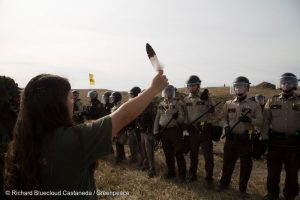
A phalanx of National Guard and police advance toward water protectors in Standing Rock.
1. What is a ‘SLAPP’ suit?
SLAPP stands for “Strategic Lawsuit Against Public Participation.” As the name implies, corporations, using this tactic are trying to shut down public participation. SLAPPs are generally filed without any kind of legal merit. The purpose of a SLAPP is to censor, intimidate, and silence critics by burdening them with legal claims and costs until they’re forced to abandon their criticism or opposition.
2. Why is ETP using a SLAPP?
ETP is SLAPPing its critics in an attempt to shut them up – or even better, to shut them down. ETP is suing Greenpeace for at least USD $900million. The corporation’s hope is that the prospect of having to pay this – or at least of spending a lot of time and legal costs on fighting the lawsuit – will intimidate Greenpeace and others into silence.
The goal of this suit is to silence opposition by misrepresenting what happened on the ground at Standing Rock — making outrageous and racist claims that big environmental organizations like Greenpeace orchestrated the Indigenous-led movement at Standing Rock.
3. This is a worrying trend
In 2016, Canadian company Resolute filed a SLAPP suit against Greenpeace, which was dismissed in full by a US federal judge. But the use of this dirty tactic by corporations is on the rise. As we face an upswing in a new global right-wing agenda, governments and corporations around the world are attempting to chip away at free speech. And it’s not just about environmental groups, either. The SLAPP suit is designed to send a loud message so that any activist or public-interest advocacy group that takes on giant corporations will have to think twice before standing up for what they believe in.
4. Who’s behind this suit
Just like the Resolute case, this one was filed by Michael Bowe. Bowe is also a member of Trump’s personal legal team, and part of the law firm Kasowitz Benson Torres – founded and run by Marc E. Kasowitz, Trump’s personal lawyer. The Times once described Kasowitz as “the Donald Trump of lawyering”. Bowe has publicly stated that he’s in conversations with other corporations considering filing their own SLAPPs against Greenpeace – suggesting this bullying and anti-democratic tactic is being shopped around to the highest bidder.
5. This is not a one-off.
There are many, many examples of SLAPP suits, here are a couple you may have heard of.
Earlier this year, coal magnate Bob Murray sued John Oliver after*Last Week Tonight*ran a segment on Coal – which prominently featured Murray. In the last 15 years, Murray and/or his company have also sued various other journalists.
The ACLU represented individuals in Uniontown, Alabama — a poor town predominantly made up of people of color — who were sued by Green Group Holdings for $30 million for standing up to a coal ash landfill in their town. The company revealed its motives when its lawyers approached the individuals in an attempt to cut a deal – if they agreed to give Green Group access to their electronic devices, access to their future social media postings, and extensive details about their group’s membership, advocacy and communications with other environmental groups.
Due to public outcry and the support of the ACLU, the residents reached a settlement in February and Green Group Holdings agreed to better environmental protections — but they shouldn’t have had to deal with this corporate bullying in the first place. There are hundreds of others across America and beyond who won’t be so lucky.
People march in support of the Standing Rock Nation at the Civic Center Plaza of San Francisco. The protest was one of many in a global day of action against the Dakota Access Pipeline (DAPL) calling on the U.S. Army Corps of Engineers to cancel the permit for the project.
6. They’re clutching at straws… [vid]
Just like in the , ETP is using the Racketeering Influenced and Corrupt Organizations Act (RICO) – a law which was originally created to prosecute the mafia – to claim treble damages and inflate the amount of money it is able to demand. In their lawsuit, ETP claims thatGreenpeace led a corrupt environmentalist enterprise that “cynically planted radical, violent eco-terrorists on the ground amongst the protesters, and directly funded their operations” – a baseless attempt to mislabel legal advocacy as criminal conduct through the use of these racketeering laws, and present constitutionally-protected free speech as defamatory. It’s as ridiculous as it sounds…
7. We can fight this
ETP and other corporate bullies are blatantly trying to stifle free speech and our right to peacefully protest. So let’s show them that that’s not going to happen: Refuse to be silent. Defend free speech. And let’s continue standing up for what is right.
You can take action against this SLAPP here and find more information about how you can fight back against SLAPPs generally.
===
===
stinktank
...API has championed charter schools in Alabama.[15] It strongly supports the Alabama Accountability Act, which expanded school choice and school vouchers in the state.[16][17] API was a proponent of both the Marriage Act, passed in 1998, and Alabama Amendment 774, which was approved by 81% of Alabama voters in 2006.[18]
In 2014, API released a report titled Alabama's Environment 2014: Six Critical Indicators. It covered energy, air quality, water quality, forests and land, toxic release inventory and climate change. It provided a positive outlook on the state of the environment, arguing that the nation's air quality and the environment in general are improving.[19][20][21]...
===
no lnx
FEBRUARY 22, 2021
Conservation Alabama released their scorecards last week for the Alabama congressional delegation’s performance during the second session of the 116th Congress, which ended in early January. All nine members of the Alabama delegation were scored on the League of Conservation Voters’ 2020 National Environmental Scorecard. Congresswoman Terri Sewell, D-Alabama, earned the highest score with a 90.
“As a Representative of constituents who are disproportionately impacted by environmental injustices, like the Superfund Site in North Birmingham or the landfill in Uniontown, I am proud to fight for stronger environmental protections for our communities,” Sewell said. “I am proud to receive the highest score from the League of Conservation Voters in Alabama’s Congressional Delegation. I remain committed to doing everything in my power to ensure we create a better, healthier, and more equitable environment for future generations.”
Tammy Monistere is the Executive Director at Conservation Alabama.
“Her votes in 2020 ushered in full funding for the Land and Water Conservation Fund and eliminated harmful pollutants from entering our waterways,” Monistere said. “We are grateful for her work protecting the people and places of Alabama.”
The average House score for Alabama congress members was 15 percent and the average Senate score was 35 percent.
Senate:
Sen. Richard Shelby, R-Alabama, received a 0 score from the group.
Sen. Doug Jones, D-Alabama, received a 69.
House of Representatives:
Rep. Bradley Byrne, R-Alabama, received a 0.
Rep. Martha Roby, R-Alabama, got a 5.
Rep. Mike Rogers, R-Alabama, scored a 5.
Rep. Robert Aderholt, R-Alabama, also received a score of 5.
Rep. Mo Brooks, R-Alabama, received a 0 for his work.
Rep. Gary Palmer, R-Alabama, also scored a 0.
Congressmen Jerry Carl and Barry Moore, as well as Sen. Tommy Tuberville, were just sworn in last month as the replacements for Byrne, Roby and Jones.
Sewell is now serving in her sixth term representing Alabama’s 7th Congressional District.
LCV has published a National Environmental Scorecard every Congress since 1970. The group claims that the Scorecard represents the consensus of experts from more than 20 respected environmental and conservation organizations who selected the key votes on which members of Congress should be scored. LCV scores votes on environmental justice, public health, public lands and wildlife conservation, democracy, and spending for environmental programs.
===
920
alabama Public Service Commission Upholds and Increases 'Sun Tax' on Solar Power Users
:{BY: JAMES BRUGGERS
Opponents say the monthly fee slashes solar customers’ savings in half and amounts to a disincentive to generate electricity from sunlight. Read More}:
===
==
2012?
But it was over climate change that Cuccinelli would make his greatest mark.
He put Virginia out in front—along with Texas and Alabama—as one of the first states to sue the Obama administration over the Environmental Protection Agency's endangerment finding on greenhouse gases.
==
==
https://www.alternet.org/2020/01/roy-moore-sues-right-wing-publication-for-reporting-sexual-misconduct-allegations/
no lnx
Roy Moore sues right-wing publication for reporting sexual misconduct allegations
Written by Alex Henderson January 29, 2020
One of the most stunning political events of 2017 occurred when Republican Roy Moore — who was inundated with sexual misconduct allegations involving teenage girls — lost to Democrat Doug Jones in Alabama’s U.S. Senate race. Although Alabama is a deeply Republican state that President Donald Trump is almost certain to carry in November, Moore was a badly flawed candidate; regardless, Moore is hoping to run against Jones again this year. And his response to negative publicity from the Washington Examiner is filing a $40 million lawsuit against the right-wing publication.
The Washington Examiner, although clearly conservative, has published a series of articles discussing the sexual misconduct allegations against Moore. In the lawsuit, a 2019 article by journalist Tiana Lowe for the Examiner is described as “libelous” and lacking a “factual basis.”
Legal reporter Jerry Lambe, in a January 28 article for Law & Crime, describes Moore’s lawsuit against the Examiner as full of holes.
“Moore’s complaint appeared to falsely convey the publicly available facts and drastically misconstrue the legal threshold required to prove defamation against a public person in claiming that the story exhibited a ‘reckless disregard for the truth,’” Lambe explains, adding that Lowe’s reporting “was based on more than a dozen allegations and witness statements covered by every major news outlet in the nation.”
On May 28, 2019, the Examiner published a blistering op-ed by Lowe headlined “If Alabamans Vote for Roy Moore, They Deserve Doug Jones.”
Lowe, in her op-ed, stressed, “If Alabamans willfully choose Moore this time, kneecaping their odds of winning the election, they will deserve every insult lobbed their way — and they will deserve every left-wing progressive Democratic vote cast in the Senate on their behalf by Doug Jones.”
Lowe’s description of Jones as a “left-wing progressive” is way off base; the Alabama senator is quite centrist, and philosophically, he has much more in common with Sen. Kyrsten Sinema of Arizona and Sen. Joe Manchin of West Virginia than he does with staunch progressives like Sen. Bernie Sanders or Sen. Elizabeth Warren. But Lowe speaks for many on the right when she says that nominating Moore to run against Jones a second time would be political suicide for the Republican Party, which may or may not lose control of the U.S. Senate in November.
Republican Bradley Byrne, who served in the Alabama State Senate in the 2000s, announced in February 2019 that he would be seeking the GOP nomination to run against Jones. Republican strategists have asserted that he would have an easier time defeating Jones than Moore.
Scott Wong
@scottwongDC
"I welcome [Judge Moore] to the race,” @BradleyByrne says, adding that Moore can't win the GOP nomination.
“I think people are very concerned that we Republicans lost a U.S. Senate seat because he was our nominee in 2017, and we don’t need to do that again." https://twitter.com/scottwongDC/status/1133431343734501377 …
Scott Wong
@scottwongDC
JUDGE ROY MOORE to announce Senate bid soon? GOP rival @BradleyByrne says Moore camp is telling him to expect a JUNE launch #ALSEN https://thehill.com/homenews/house/445781-gop-candidate-expects-roy-moore-to-announce-senate-bid-in-june#.XO11CeRwf1g.twitter …
===
==
https://www.alternet.org/2019/12/how-some-alabama-county-sheriffs-force-their-inmates-into-medical-debt
no lnx
How some Alabama county sheriffs force their inmates into medical debt
Written by ProPublica December 26, 2019
This article was produced in partnership with AL.com, which is a member of the ProPublica Local Reporting Network.
In Alabama, the county in which you’re arrested could be the deciding factor in who will be financially responsible for your medical bills behind bars.
:{
}:
In Baldwin County, known for its white-sand Gulf Coast beaches and waterfront communities, the sheriff’s office ensures that inmates in the county jail do not have to pay anything more than a $15 copayment for medical care.
:{
}:
“Inmates are not billed for the full cost of any medical care either inside or outside” the jail, Sheriff Hoss Mack said in an email. “Alabama Code Title 14 assigns financial responsibility of inmates’ medical treatment to the department where they are being held.”
:{
}:
Just across the bay in Mobile County, home to one of the busiest ports in the U.S. and the eponymous city of nearly 200,000 people built around it, Sheriff Sam Cochran takes a different tack: Some of his inmates are personally on the hook for the full cost of medically necessary care they receive from outside doctors while incarcerated, even if they are awaiting trial.
The difference between the two sheriffs’ approaches demonstrates the unique power Alabama sheriffs have to set their own rules and answer only to voters. Legal experts and civil rights advocates say sheriffs like Cochran are likely violating both state law and the Eighth Amendment of the U.S. Constitution, which prohibits cruel and unusual punishment and excessive fines.
It’s not just happening in Mobile County. In multiple instances confirmed by AL.com and ProPublica, inmates have had medical bills sent to collections while they were still behind bars, damaging their credit and putting pressure on their family members to pay up to ensure the care continued.
Brandon DeLaFosse is among them. He was arrested on domestic violence, burglary and robbery charges and booked into the Mobile County Metro Jail in November 2018, three months after he underwent surgery on his inner ear. Since then, he has received bills totaling thousands of dollars for necessary follow-up appointments and tests, some of which have gone to collections while he remains behind bars.
“He keeps getting bills in the mail,” said Alicia DeLaFosse, Brandon’s mother, who has paid hundreds of dollars for care he has received while in custody. “It’s all money he owes from going back and forth to the doctor.”
Like many inmates, DeLaFosse doesn’t have significant income or access to public or private insurance in jail.
Alabama law is clear: If an “inmate develops a medical condition which requires immediate treatment at a medical-care facility outside the county jail, the department shall be financially responsible for the cost of the treatment of the inmate.”
:{
}:
But Cochran said when the jail’s doctors determine inmates need care that goes beyond what in-house medical staff and contracted outpatient providers can handle, they are often taken to private medical professionals who do not have contracts with the jail. And he allows those medical providers to bill at least some of those inmates directly.
“When that person is taken out to that private medical facility or something like that, then, yeah, they’re going to bill him for that treatment,” Cochran said during an interview in his office last month. “It’s a more than reasonable thing to do.”
Asked later about the details of Brandon DeLaFosse’s case and how the practice squares with state and federal law, Cochran provided an email written by Trey Oliver, warden of the Mobile County Metro Jail.
Oliver wrote that inmates are required to pay “when they have a follow-up procedure or visit from a surgery conducted prior to being booked.”
As for DeLaFosse, Oliver wrote, “There was a follow up visit or two and his mother agreed to pay it beforehand.”
Most jails and prisons across Alabama and the U.S. either have doctors and nurses on staff or contract with outside companies to provide medical care in their lockups. It’s not uncommon for inmates to be charged low copays — typically less than $20 — for medications and medical services.
But requiring inmates to foot the bill for their health care takes that practice to another level.
That’s “like charging them for their own food,” said John Lentine, a Birmingham criminal defense attorney and adjunct law professor at Samford University’s Cumberland School of Law and the Birmingham School of Law. “To me it’s a basic human rights kind of thing.”
Michele Deitch, a senior lecturer at the University of Texas at Austin’s School of Law and Lyndon B. Johnson School of Public Affairs, said the practice is “absolutely” unconstitutional.
“There is a constitutional obligation to provide health care that meets the serious medical needs of people who are incarcerated,” said Deitch, who co-wrote the American Bar Association’s Standards on Treatment of Prisoners. “That’s not negotiable.”
The tactic is another way in which sheriffs across Alabama are avoiding financial responsibility for inmate medical care. AL.com and ProPublica reported in September that many sheriffs in Alabama and across the country are finding ways to release inmates from jail just before they incur expensive hospital bills, a tactic known as “medical bond.”
In several recent cases, incarcerated people around the country have successfully challenged policies restricting their access to free medical care in prison.
Last year, a federal court ruled that transgender inmates in Missouri’s state prisons have a right to receive hormone therapy free of charge while incarcerated, regardless of whether they were already receiving the treatments when they were taken into custody. And this year, prisoners in Minnesota reached a settlement with the state’s Department of Corrections that requires the prison system to provide prisoners who have Hepatitis C with expensive drugs that often cure the infection.
AL.com and ProPublica attempted to contact the sheriffs of all 67 counties in Alabama via email or phone to ask whether they allow inmates to be billed for care they receive while incarcerated. Of those, 13 sheriffs and one chief deputy responded. The sheriff of Mobile County and chief deputy of Jackson County each said they allow providers to bill inmates for necessary care in certain situations. Ten sheriffs said they do not allow inmates to be billed. Two others declined to comment.
“I’m Still Getting Bills”
Days after Thanksgiving last year, Brandon DeLaFosse was arrested in Mississippi on outstanding warrants stemming from an incident earlier that month in Mobile County, Alabama.
The then-28-year-old was driven back to Mobile, where he stayed in the county jail until Feb. 28, when he was sentenced to three years in prison.
DeLaFosse’s health problems continued behind bars. Since his ear surgery last year, he has suffered from persistent ear infections and severe hearing loss.
And his bills are piling up.
In between Marlboro Lights and peanut butter-and-syrup sandwiches at her Irvington home last month, DeLaFosse’s mother, Alicia, said she spends many hours each week making calls, sending emails and conducting research to advocate on behalf of her son.
She said a steady stream of medical bills addressed to her son has arrived at her house since his arrest. Billing records show that she has spent more than $600 on his care since his arrest, and more than $1,000 in outstanding bills have gone to debt collection.
On Dec. 6, 2018, while he was in the Mobile County Metro Jail, Brandon DeLaFosse was taken to see an ear, nose and throat specialist at Providence Hospital in Mobile for a surgery follow-up visit recommended by the doctor. But first, his mother said, jail staff required her to make a payment to the doctor’s office. After the appointment, the hospital’s billing department sent a bill for $729 for tests he underwent that day to Alicia DeLaFosse’s house.
“The way the nurse at the jail explained it to me is because it was something that didn’t happen at the jail, it’s preexisting. … I had to go pay for it myself,” she said. “For the jail to allow him to go see the doctor, I had to go to the doctor’s office and pay $125 first.”
A registered nurse at the jail in Mobile noted in Brandon DeLaFosse’s medical record that his mother made a payment and that the nurse had scheduled a follow-up visit for later that month. In January 2019, a nurse practitioner at the jail wrote a note in his file stating she would request another follow-up appointment with his doctor “with the expectation that it is handled in the usual fashion with his mother arranging for payment.”
“I don’t think it’s fair. They’re responsible for my medical care, so why should it be coming out of my pockets or my family’s pockets?” Brandon DeLaFosse said in a jailhouse phone call.
Cochran, the Mobile County sheriff, said via email that he views the situation as a “legal dispute between [Brandon DeLaFosse], us and our contracted provider. I know of no complaint or claim made against us.”
“The mom agreed to pay [the] bill. Looks like she reneged,” Cochran wrote. “Otherwise if it would have been medically necessary our contracted folks would have handled.”
Alicia DeLaFosse said she “didn’t renege” and paid for all of the medical costs she knew about in advance.
Brandon DeLaFosse continued to be billed for outside medical care after he was moved to state prison. On July 23, nearly five months after his sentence began, he saw a doctor and underwent tests at Providence Hospital. He was sent a bill for $224.70 for outpatient diagnostics administered that day, plus $71.98 for the doctor visit.
That shouldn’t have happened, a spokeswoman for the Alabama Department of Corrections said in a statement.
“By ADOC’S policy, all inmates in the care, custody, and control of any ADOC correctional facility are not charged or responsible for community-based medical care or mental health services,” the spokeswoman, Samantha Banks, said.
Any state prisoners “incorrectly” billed for outpatient medical care should notify the provider that they were incarcerated at the time, the statement explained. “The medical provider should submit to the Department the appropriate paperwork and any outstanding inmate medical bills will be directed to the appropriate payer.”
State prisoners in Arizona have reported similar issues with providers billing them directly for medical care they received while incarcerated, as KJZZ radio reported this year. Like in Alabama, the Arizona Department of Corrections has said the bills were sent out in error and that the department or its medical contractor would pay the inmates’ bills.
But that’s a vastly different situation than the one facing inmates in some Alabama counties, where sheriff’s offices are not chalking up such bills to error and are in fact deliberately choosing to avoid paying medical bills for inmates in their charge.
Constitutional Question
Though the public often has little sympathy for inmates, incarcerated people do have clear rights, particularly when it comes to health care behind bars.
Alabama law states that “necessary clothing and bedding must be furnished by the sheriff or jailer, at the expense of the county, to those prisoners who are unable to provide them for themselves, and also necessary medicines and medical attention to those who are sick or injured, when they are unable to provide them for themselves.”
In another section of the state code, a definition of a county inmate includes an explicit reference to their health care being provided for: “any person being held in a public institution under the administrative control and responsibility of the county sheriff and for whom the county is responsible for the provision of medical care.”
Brandon Blankenship, an assistant professor of law and ethics at the University of Alabama at Birmingham, said that allowing inmates to be billed for care that they receive while incarcerated amounts to cruel and unusual punishment and that the bills are excessive fines.
“I don’t think it’s ever been challenged in court in Alabama, but from where I’m sitting, the answer to me is that, no, it’s certainly not constitutional under the Eighth Amendment.”
The tactics of some Alabama sheriffs stand in sharp contrast to what’s going on elsewhere in the country. This year, California and Illinois banned the practice of charging inmates copays, and a number of other states have taken, or are considering, steps to rein in the practice.
“They usually cannot afford even a $5 copay, so the idea that they could pay thousands of dollars for these services is laughable from a practical perspective and it’s downright evil on many different levels,” said Deitch, the University of Texas at Austin professor.
In 1983, the U.S. Supreme Court decided a seminal case, City of Revere v. Massachusetts General Hospital, involving a person who was hurt during an arrest and taken to a hospital. The court ruled that “as long as the governmental entity ensures that the medical care needed is in fact provided, the Constitution does not dictate how the cost of that care should be allocated as between the entity and the provider of the care. That is a matter of state law.”
But that ruling did not answer the question of whether inmates can be stuck with the bill.
“We don’t have any clear Supreme Court ruling,” said Fred Cohen, a professor emeritus at the University at Albany’s School of Criminal Justice who has decades of experience in corrections law and serves as executive editor of Correctional Law Reporter.
Cohen said he believes there is a good case to be made that the practice of allowing inmates to be billed for medical care violates their constitutional rights.
“I don’t think it’s an open policy question in that inmates should not be required to pay,” he said. “I think it could be held unconstitutional by the right court.”
Different Systems
Several days after Charles Tillman was booked into the Washington County Jail in March 2018, his left testicle became severely inflamed. He told a guard, and on March 22, Tillman was taken to Washington County Hospital for treatment and an ultrasound.
The 40-year-old, who has a long rap sheet, was driven back to the jail following the appointment and was released from the facility the following day. (The Washington County Sheriff’s Office confirmed the dates of his incarceration. But the nature of his offense was not clear based on court records, and the sheriff’s office would not discuss his charges during a phone call with Tillman and a reporter.)
It wasn’t until weeks later that Tillman learned that he had been billed directly for that visit and that the debt had been sent to a collector, upending his credit. He showed AL.com and ProPublica a copy of his credit report showing it had been negatively affected by unpaid medical bills.
“They tried to get me to sign paperwork but I refused to sign it, the hospital bill saying I was responsible for it.”
As of this month, Tillman still owed $1,856.42 for medical care he received at Washington County Hospital. The hospital confirmed that it treated him during each of his brief incarcerations in the jail in February 2017, March 2018 and September 2018.
“I got the bills at my [home] address,” said Tillman, who has since been released. “They’re on my credit report now as negative marks — that’s what’s keeping me from getting a car right now.”
Washington County Sheriff Richard Stringer was unable to explain Tillman’s situation, saying the county’s policy is to pay for all medical costs for inmates who aren’t covered by insurance.
“That’s not standard procedure,” Stringer said. “It would have to be an unusual case for that to happen, and I don’t keep up with every case that comes in. But no, that’s not our policy.“
Hundreds of miles northeast, Rocky Harnen, chief deputy of the Jackson County Sheriff’s Office, said preexisting conditions should be inmates’ responsibility.
“If it’s something preexisting, say diabetes or something, and you’ve got to go to the doctor every now and then, then that’s their responsibility to pay for that,” he said.
“If it’s going to your own doctor, they would be responsible for that. I guess they would bill them at their house. The taxpayers shouldn’t be responsible for ongoing issues that are preexisting.”
Harnen referred subsequent questions about the legality of the practice to County Attorney John Porter, who did not cite any laws that allowed it.
“I can’t say that there’s not any medical care that they have to pay for,” Porter said.
Asked if inmates sometimes have to pay for outpatient care for preexisting conditions, he said, “I wouldn’t say that that’s incorrect. … I can’t give you a blanket answer to that but it would be depending on the circumstances.”
That’s not the way inmate health care works in many county jails across Alabama. In Etowah County, northeast of Birmingham, inmates are never billed for care they receive while incarcerated, according to Sheriff Jonathon Horton.
“We provide medical services for inmates in our care so they should not receive any bills,” Horton said. “They shouldn’t be billed. That’s my understanding.”
Lauderdale County Sheriff Rick Singleton said that he would love to have inmates in his jail in northwest Alabama foot the bill for certain types of medical care, but that he is not legally able to do so. For instance, he said he would like to have avoided the $300,000 the county once had to pay for open heart surgery for “the town drunk” arrested on a public intoxication charge.
“If they’re in jail on public intoxication and they’ve got preexisting health conditions, I don’t think the taxpayer should have to foot the bill to pay for it,” Singleton said. “If they get injured inside the jail or they get sick inside the jail, we of course pay for it. But my issue is with having to pay for preexisting conditions. But we have to do it.”
===
call made by 1st al AA woman DA?
Charges Dropped Against Pregnant Shooting Victim Amid Outcry Over the Criminalization of Pregnancy
dn 719
Following immense public pressure, prosecutors in Alabama have dropped manslaughter changers against Marshae Jones, a 28-year-old African-American woman whose pregnancy ended after she was shot in the stomach by a coworker. Local police accused Jones of starting the fight that led to the shooting in the parking lot of a Dollar General store outside of Birmingham. A grand jury then indicted Jones on manslaughter but dismissed any charges against the shooter. The case drew national outcry from women’s rights advocates concerned about the criminalization of pregnant women and the legal implications of so-called fetal personhood. The National Abortion Federation, along with the Yellowhammer Fund and other reproductive justice advocacy groups, launched a successful campaign to get the charges against Jones dropped. Alabama is one of 38 states to have a fetal homicide law. We speak with Lynn Paltrow, founder and executive director of National Advocates for Pregnant Women.
===
==
kos 419
AL-Sen: On Thursday, Alabama Secretary of State John Merrill publicly expressed interest in seeking the GOP nod to challenge Democratic Sen. Doug Jones and said he was looking to decide around Memorial Day. Merrill has served as Alabama's chief elections officer since 2015, and he's been a strong proponent of its strict voter ID laws while minimizing their consequences.
In 2015, Merrill defended then-Gov. Robert Bentley's decision to close 31 driver's license offices, many located in predominantly black counties, by insisting that the move wouldn't make it harder to black citizens to register to vote. Bentley and his allies argued this was merely a cost-saving move and had no other intent. However, an investigation from the U.S. Department of Transportation concluded that this very much caused "a disparate and adverse impact on the basis of race." Those cost savings also reportedly amounted to no more than $300,000, money that was almost certainly lost in the legal battles over the policy.
Unfortunately, Merrill has not gotten any better over the years. In 2016, he blasted the idea of automatic voter registration declaring, "If you're too sorry or lazy to get up off of your rear and to go register to vote, or to register electronically, and then to go vote, then you don't deserve that privilege."
Merrill even invoked the civil rights movement as his justification. After describing how people fought and died "because of their desire to ensure that everybody that wanted to had the right to register to vote and participate in the process," Merrill insisted "I'm not going to cheapen the work that they did." He went on to say, "I'm not going to embarrass them by allowing somebody that's too sorry to get up off of their rear end to go register to vote?or now, because of what we've done, turn the computer on and register to vote?because they think they deserve the right because they've turned 18."...
==
https://www.motherjones.com/environment/2019/03/3-things-to-know-tornadoes-alabama/
A spate of tornadoes ravaged Alabama on Sunday and left at least 23 people dead, ranging in age from 6 to 89 years old. First responders are still sorting through the wreckage, and close to 100 people are recovering from injuries sustained in the deadly storms, which a local sheriff described as if someone “took a giant knife and just scraped the ground.”
As emergency managers and local officials scramble to contain the damage, here’s what you need to know:
This was not just one storm, but eight
The storm commanding the most attention—a 170 mph twister that destroyed dozens of homes and businesses across roughly 30 miles of Lee County—was not the only tornado that hit Alabama. The National Weather Service tracked seven other storms across the state on Sunday, including one that crossed the border into Georgia, where it also produced damage, according to the NWS. Severe weather associated with the tornadoes also affected Louisiana, Mississippi, Florida, and South Carolina.
The most dangerous storm by far struck rural pockets of Lee County, which is one of the more urban counties in the state and that includes the campus of Auburn University. Sunday’s 27-mile-long tornado has already killed nearly two dozen people, exceeding the combined total of all tornado-related deaths from last year, according to a database maintained by the NWS’s Storm Prediction Center.
Among the dead were seven members of one family, the Alabama Media Group reported.
Trump asked FEMA to give Alabama “A Plus treatment”
In contrast to states like California, where Donald Trump has threatened to withhold aid after a horrific wildfire season, the president tweeted Monday that Alabama should receive the “A Plus treatment” from the Federal Emergency Management Agency.
[twt]EMA, which is part of the Department of Homeland Security, does not currently have a permanent director. Its last director, Brock Long, resigned in February after being accused of misusing department vehicles. In response to the recent storms, FEMA has already sent staffers to assist state emergency management officers in Alabama, a department spokesperson told USA Today.
The impact from tornadoes has generally been getting worse
The Lee County twister is the deadliest on record since an Oklahoma storm killed 24 people in 2013. It may also be a harbinger of even more damaging storms to come. The problem, researchers from Villanova University and Northern Illinois University detailed in 2016, is increasing development and population growth in “at-risk” areas. The result could be “average annual tornado impacts” that are projected to be “6 to 36 times greater in 2100 than 1940.”
Stephen Strader, one of the researchers behind the 2016 study, noted on Twitter this week that the storm primarily affected areas in rural Alabama with a preponderance of mobile homes. “Bad situation with already many fatalities,” he said. “I suspect many of these occurred in mobile homes.”
Sen. Bernie Sanders (I-Vt.), who officially launched his second presidential campaign this week, went even further in a Facebook post Monday. “The science is clear, climate change is making extreme weather events, including tornadoes, worse,” he wrote.
In fact, there is no scientific consensus on how climate change affects tornadoes, though generally, global warming is believed to make extreme weather events—from hurricanes to cold snaps—more deadly for reasons that do not necessarily apply to tornadoes. “No known scientific studies have established a cause-and-effect relationship between tornadoes and climate warming,” E&E News reported Tuesday. “But scientists do say they are witnessing macro-scale changes in tornado frequency and variability across the United States.” The site noted that “in the 1980s, tornadoes damaged an average of nine counties per year,” but between 2007 and 2016, “tornadoes damaged an average of 21 counties annually.”
===
How 8 Alabama sheriffs who lost reelection purposely made life harder for their successors
==
m moore 11/9 after escalator fired, booked 2 venue, so went on to mobile ala
==
https://www.alternet.org/civil-liberties/how-private-probation-companies-make-money-americans-they-trap-criminal-justice
Marietta Conner watched the judge expectantly. The 63-year-old assistant ministerhad just pled guilty to “fail[ing] to yield to a pedestrian”—a criminal misdemeanor in Georgia—and did not have enough money to pay her $140 fine. The judge ordered that she be put on probation. But instead of county probation, Conner was assigned a private probation company supposed to mimic normal court probabation: meet with her once a month through a probation officer, collect payments and confirm her work and address. In the end, the company sapped Conner of well over the original amount of the fine, andeven dangled an arrest warrant over her head when it erroneously claimed she had missed a payment.
Conner was lucky. She knew someone at the Southern Center for Human Rights who helped her escape the trap the correctional corporation tried to put her in. Yet for hundreds of thousands of others on probation through a private company, the experience routinely entails prolonged harassment, indebtedness and even imprisonment—and sometimes all with the blessing of a judge.
To be ensnared in America’s system of mass incarceration is to be in prison, on parole, or on probation. In 2012 1 in every 35 American adults was trapped in the criminal justice system. The surging number of people whose lives necessitate constant surveillance and management has exploded the coffers of state and federal budgets, and rather than reform heavy-handed laws to ease this burden on public funds, elected leaders have contracted incarceration services out to companies with a moneyed interest in jailing more Americans.
The private prison industry has stoked the outrage of progressives and civil libertarians for years, as has the practice of prosecutors pushing plea bargains with heavy parole, but an equally dangerous phenomenon is the rise of private probation businesses across the country. Since the 1970s, the private probation industry has expanded into at least 20 states—most concentrated in the South—and nearly all of its companies are entirely supported by the fees paid to them by the probationers they “serve.” In the last few years, many of these businesses have been given more power to pursue and imprison probationers, playing a starring role in what one federal judge called a “judicially sanctioned extortion racket.”
When someone is convicted of a misdemeanor crime, he or she is often placed on probation by a judge either in lieu of minor prison time or as part of a payment plan to pay off court fines levied for his charge. Traditionally, the purpose of probation has been to facilitate the rehabilitation of the probationer through constant contact with a representative of the court (a probation officer), although this concept may be farcical in an age when an adult can be placed under “community supervision” for jaywalking. With privatized supervision, the offenders are required to report monthly to a contractor acting in the same capacity as a probation officer, and they must also pay a monthly fee to the company on top of the fines they owe the court.
The distinction between fee and fine is important because, as noted by the Economist, it is through fees that private probation companies can afford to pay the salaries of their staff. A report from the Criminal Justice Review explained that “Private agencies…rely on the probationer’s paying a supervision fee to remain solvent.” Solvency, however, is hardly a concern for many of these corporations, some of which have amassed tens of millions of dollars annually off the fees they charge probationers.
One such company is Sentinel Offender Services, whose combined operations in four different states brought in $30 million in 2009, according to an investigation by NBC. The company has faced many legal challenges on the grounds that its employees demand payment for fees from poor probationers and then issue arrest warrants when they cannot pay, without consideration for their financial situation. Marietta Conner, the impoverished pastor, was under the supervision of Sentinel.
Although a 1983 federal ruling said that probationers cannot be jailed for being indigent, Sentinel has regularly issued arrest warrants for probationers delinquent on their payments, and has even extended the probationary sentences of thousands—illegally—in order to wrest more money from them. Sentinel has terrorized so many lives a Georgia court recently ruled that the company might have to refund thousands of payments to former probationers who had the unfortunate luck to be supervised by a company that “links its probation officers’ performance evaluations to the amount of money collected from probationers,” according to a 2010 ACLU report.
Sentinel is just one in a vanguard of 34 probation corporations in Georgia pushing to have more power to hunt down delinquent probationers. A new bill up for a vote in theGeorgia’s House of Representatives, greased for quick passage by funds from industry lobbyists would give private probation officers increased “immunity from liability” and grant them more discretion to extend a person’s probation—and by extension, prolong a probationer’s “payment period.”
Some courts have actually been complicit in the racket. A circuit court in Alabama ruled in 2012 that the local municipal judiciary in Harpersville, Alabamahad operated “debtor’s prisons” together with the private probation firm Judicial Correctional Services by turning over poor misdemeanor defendants to JCS and then allowing the company to fleece them for every cent they had.
In the event that the probationers couldn’t pay their monthly fees to the company—as was the case for many probationers in the nation’s fourth poorest state—they were thrown in jail without a trial at the behest of JCS and under the blessing of the Harpersville court, who would then doom already-indigent defendants to an inescapable pit of debt by piling even more fines and fees. The presiding judge who ruled against Harpersville was scandalized so deeply by the JCS-judiciary collusion that he accused the local court of “violating almost every safeguard afforded by the United States Constitution [and] the laws of the state of Alabama.” Meanwhile, JCS continues to operatein 69 cities throughout four different states.
Perhaps the most pernicious feature of these businesses is how they enable local municipalities to perpetuate debtor’s prisons across the country. In Florida, birthplace of modern privatized probation, courts permit correctional firms to tack on a 40% surcharge on top of the debt a delinquent probationer already owes, as detailed in an investigation by the Brennan Center for Justice. The investigation also found that courts in Missouri regularly condemn people to prison when they cannot pay off the fees imposed by probation companies, and in Illinois, corporations shakedown impoverished probationers for 30% more of their standing debt if they miss payments. In total, the report found that nine states charged probationers excessive fees “payable to private debt collection firms”—in other words, private probation companies.
Efforts to resist the abuses of the private probation system have been scattered and slow building. In addition to the class-action lawsuits filed against Sentinel in Georgia and JCS in Alabama, an Idaho-based probation company was sued in 2011 for perpetually increasing probationer’s sentencesby manipulating the results of drug tests (testing positive for drugs is usually a violation of probation and can mean further penalties). That same year in Tennessee, a group of former probationer’s filed a successful lawsuit against the owner of a company called Providence Community Corrections for having “forced them to overpay” and holding them on probation “longer than necessary.”
Yet despite a proliferation of lawsuits across the country, municipalities seem to show no less willingness to contract out probation services. In addition to the 20 or so states that now allow some form of privatized probation, a state senator in at least one other place—Nebraska—has inquired with policy experts about implementing the correctional model in his home state.
It does not take a legal expert to discern how for-profit correctional services threaten the freedom of Americans. Private probationary companies exist only as long as there is a steady supply of probationers from whom to extract payment, and these companies grow only if the number of people on probation grows. As evidenced further by the case of prison contractors, some of which have compelled state governors to keep prisons 90% full, a privatized correctional model maintains the American system of mass incarceration by further building it into an industry.
--
==
Alabama doesn't need "folks in Washington" or "out-of-state liberals" instructing the state on what it should do with Confederate monuments, Gov. Kay Ivey said Tuesday.
Ivey, during a campaign appearance in Foley, defended a new campaign ad released earlier in the day that touted the Alabama Memorial Preservation Act of 2017, which she signed into lawless than 11 months ago.
"I believe the people agreed with that decision and support in protecting our historical monuments," Ivey said after speaking at a Baldwin County Young Republicans function. Her appearance also occurred one day before the Reckon by AL.comGOP governor's debate at 7 p.m. Wednesday at the Lyric Fine Arts Theatre in Birmingham. Ivey said she does not plan to attend.
"We can't and shouldn't even try to charge or erase or tear down our history. We must learn from our history," Ivey said.
The law requires local governments to obtain state permission before altering or renaming historically significant buildings and monuments that date back to 40 years or longer. The law also creates a 11-member commission which is charged with determining whether historic buildings or monuments can be moved or renamed.
===
no lnxgraphic/info
https://www.motherjones.com/politics/2014/10/judicial-elections-citizens-united-karl-rove/
Is Your Judge for Sale?
Thanks to Karl Rove and Citizens United, judicial elections have been overtaken by secretive interest groups, nasty ads, and the constant hustle for campaign cash.
:{
}:
ANDY KROLLNOVEMBER/DECEMBER 2014 ISSUE
The 30-second TV spot is stark and brutal. First it shows the bespectacled face of candidate Louis Butler, then a grainy mug shot of an ex-con. “Louis Butler worked to put criminals on the street,” the narrator warns, “like Reuben Lee Mitchell, who raped an 11-year-old girl with learning disabilities.” After Mitchell’s release from prison, the narrator continues, he raped again. “Can Wisconsin families feel safe with Louis Butler?”
This attack ad wasn’t from a bitterly fought congressional race. It was from a 2008 campaign for state Supreme Court justice—a position that until recently was considered above the fray of partisan politics. Butler, the first African American Supreme Court justice in Wisconsin history,was defending his seat against a trial court judge whose campaign tactic recalled the GOP’s infamous Willie Horton hit job on Michael Dukakis during the 1988 presidential campaign. Long before ascending to his state’s highest court, Butler had been assigned as Reuben Lee Mitchell’s public defender—he wasn’t the judge in the case, as the nasty ad implied.
Butler’s opponent, Michael Gableman, had been showered with campaign donations from business leaders, who were keenly aware of Butler’s role in two decisions. One was a 4-3 ruling to strike down a $350,000 limit on so-called pain-and-suffering damages in malpractice suits. The other held that if an individual harmed by lead paint exposure couldn’t identify the producer, then multiple paint companies could be held liable under a legal theory known as “risk contribution.”
Read our graphical explainer on how dark money is taking over judicial elections.
While Butler’s and Gableman’s campaigns spent a combined total of $1.2 million on the race, outside groups aligned with the US Chamber of Commerce and the state’s labor unions spent $3.6 million, funding 89 percent of all the TV ads. Butler was the first sitting justice to get booted from the court in 40 years.
By 2011, with Wisconsin reeling from political battles over Gov. Scott Walker’s union-busting agenda, the next Supreme Court race was equally ugly. This time it was conservative Justice David Prosserdefending his seat; a misleading ad from a partisan group backing his opponent claimed that Prosser, as a district attorney in 1978, had helped cover up sexual abuse of two young boys at the hands of a Catholic priest. (The abuse had only emerged years later; the victims called the ad “offensive, inaccurate, and out of context.”)
Although Prosser successfully defended his seat, he says that the election—which saw nearly$5 million in total campaign spending—poisoned relationships on the court. The tension boiled over weeks later, when Prosser and Ann Walsh Bradley, a liberal justice, engaged in an argument that got physical as four of their fellow justices looked on. Bradley claimed Prosser choked her, while Prosser said he raised his hands in self-defense as Bradley charged at him. In police interviews, two conservative justices sided with Prosser, and two liberal justices with Bradley. Investigations by the county sheriff, the local DA, and a special independent prosecutor all cleared Prosser of any wrongdoing, but the controversy still festers. When I spoke with Prosser in September, written in chalk on the sidewalk outside the state Capitol was an invitation to visit him for “free chokes.”
“They wanted to make sure we were punished for our decision and that other judges witnessed that,” says former Iowa Supreme Court Justice Marsha Ternus.
Bitter, costly judicial elections are by no means unique to Wisconsin. These days, as more candidates for the bench face rough contests—buffeted increasingly by outside money, thanks to the US Supreme Court’s 2010 decision in Citizens United—state judges around the country often raise six- and seven-figure sums, mount statewide campaigns, and fend off attack ads from groups that don’t disclose their donors. This trend has escalated over the last decade and a half as partisan groups realize that donating to judges can get them more influence, for less money, than bankrolling legislative campaigns.After all, the donors often end up with business before the very judges they are helping elect.
These are also the judges that most citizens who interact with the system have to face. Can Americans still trust in getting their fair day in court?
Court cases that make big news are usually in the federal system, where most judges are appointed by the president and confirmed by the Senate. Yet the vast majority of justice is done at the state level, where more than 100 million cases are filed annually (versus about 400,000 in federal courts). The nation’s approximately 30,000 state court judges vastly outnumber their federal counterparts, and 85 percent of them will stand in at least one election during their career.
No two states pick their judges exactly the same way. Some hold partisan judicial elections, others have nonpartisan elections, and still others use merit selection—that’s when legal experts select a short list of qualified candidates, the governor appoints one to the bench, and that judge later stands in a retention election.
The system has its roots in the Panic of 1837, a mini-depression fueled by rampant cronyism and massive overspending by corrupt governors and legislatures. Partisan elections replaced the tradition of elected officials appointing their friends to the bench, but for decades connections and loyalty still mattered most, with party bosses determining who won. Eventually states embraced nonpartisan elections and merit selection, and for most of the 20th century, judicial elections were a little-noticed corner of American politics.
Still, on occasion a contentious race attracted national attention. In 1977, Rose Birdbecame the first woman appointed to the California Supreme Court and its first female chief justice. An avowed foe of capital punishment, she voted to vacate all 61 death penalty verdicts that came before her, prompting Republican Gov. George Deukmejian to label her a “soft-on-crime liberal.” With Bird up for retention in 1986, oil and agribusiness companies, which generally saw Bird’s liberal views as a threat to their interests, poured more than $5.6 million into a campaign that would unseat her. It was an early glimpse of a reliable strategy for big business: Using the soft-on-crime theme to oust judges considered unfriendly to corporations.
Around that time, a political consultant by the name of Karl Rove was plotting his own assault on the Texas Supreme Court. Rove had helped launch the “tort wars” in response to what some Republicans saw as a court system too cozy with trial lawyers and too eager to slam corporations with hefty judgments that Rove had dubbed “junk lawsuits.”
Running on the slogan “Clean Slate ’88,” conservative candidates backed by Rove’s operation won five of the six open seats on the Texas Supreme Court. Not long after, Rove teamed up with the Business Council of Alabama to engineer a similar Republican takeover in that state.
Direct spending on supreme court races, 2000-14
Two years later, the US Chamber of Commerce, under the leadership of an aggressive new president named Tom Donohue, picked up on Rove’s strategy.Pledging to “play hardball” against “frivolous” lawsuits, the Chamber spent $10 million on judicial races in 2000 alone. It pumped $4.4 million into Ohio’s Supreme Court election—the largest expenditure from a single source on a court race in US history. In the following years, the Chamber injected tens of millions into races in Illinois, Michigan, Mississippi, and Wisconsin. Corporate America had grasped the potential to install friendly judges who could crack down on costly class actions and neutralize the efforts of consumer advocates. “We’re clearly engaged in hand-to-hand combat,” as Donohue put it, “and we’ve got to step it up if we’re going to survive.”
Unions spent millions on these races as well—particularly across the Upper Midwest, as labor leaders recognized they could get a great return on investment by backing justices sympathetic to workers’ rights. As an official with the Ohio AFL-CIO once said: “We figured out a long time ago that it’s easier to elect seven judges than to elect 132 legislators.”
A major showdown came in 2004, in West Virginia’s Supreme Court election.Don Blankenship, the former CEO of Massey Energy, donated $3 million to Republican candidate Brent Benjamin. Meanwhile, a nonprofit funded primarily by Massey Energy ran TV ads accusing incumbent Justice Warren McGraw of getting a child rapist out of prison and into a job at a high school. After Benjamin won, the investment paid off big time: He later cast the deciding vote to overturn a lower court’s $50 million verdict against Massey Energy. Two years later, the US Supreme Court ruled that Benjamin should have recused himself. It overturned the decision and sent the case back to West Virginia. (Massey Energy ultimately prevailed in state court.)
Corporate interests also reaped a huge return on investment in the 2004 Supreme Court election in Illinois. Five years earlier, a jury had handed down a $1.19 billion penalty to the insurance company State Farm for requiring millions of claimants to accept subpar replacement auto parts. State Farm and its employees—working through the US Chamber, the Illinois Republican Party, and an Illinois-based tort reform group—steered $4 million to elect a sympathetic judge named Lloyd Karmeier to the Supreme Court, which was considering State Farm’s appeal of the auto parts verdict. Karmeier, his opponent, and various outside groups spent a record $9.3 million on the race. Karmeier, who would later acknowledge that the sum was “obscene,” won easily. And the millions State Farm spent were a pittance compared with what it gained: The next year, Karmeier cast the deciding vote to overturn the more than $1 billion verdict against State Farm.
Up to this point, the big spenders were mostly targeting contested judicial elections—ones in which a candidate challenged a sitting justice. Then came the Iowa Supreme Court’s 2009 decision in Varnum v. Brien, in which the seven justices unanimously ruled that the state’s ban on same-sex marriage violated the state constitution. Social-conservative groups leapt into action, targeting three of the seven justices who were up for retention election—ones where voters only check “yes” or “no.” The National Organization for Marriage and its allies spent nearly $1 million and defeated all three. “They wanted to make sure we were punished for our decision and that other judges witnessed that so they wouldn’t do it either,” former Justice Marsha Ternus told me.
The strategy of turning sleepy retention elections into political showdowns has been spreading. In Florida’s 2012 retention elections, theKoch-backed Americans for Prosperityand the Republican Party of Florida spent hundreds of thousands of dollars to unseat three sitting justices. A group called Defend Justice From Politics spent $3.1 million on the justices’ behalf, helping them prevail. In Michigan in 2012, two anonymously funded nonprofits, the Judicial Crisis Network and Americans for Job Security, poured $2.1 million into attack ads against five judges on Michigan’s 6th Circuit Court, though the judges won out. And earlier this year,Tennessee’s lieutenant governor, Ron Ramsey, took it upon himself to spearhead an effort to unseat three sitting state Supreme Court justices—and, along with them, the attorney general, who is appointed by the court. Ramsey’s PAC pumped $425,000 into a group running negative ads that blasted the three justices as “liberal on crime”and for “helping advance Obamacare.”Funds were also contributed by Americans for Prosperity and the GOP’s State Government Leadership Foundation, which said it planned to spend an additional $5 million in 2014 on judicial races in North Carolina, Tennessee, and elsewhere.
Though the three Tennessee justices prevailed in the end, one of them, Connie Clark, told me she’s concerned about the precedent set by the fight. “As long as there are no limits on outside money,” she says, “then this will become the new normal.”
The transformation of judicial campaigns has alarmed another veteran of the court system. “Judicial elections pose a serious threat,” former US Supreme Court Justice Sandra Day O’Connor told Mother Jones. “If judicial decisions are in fact not fair and impartial—or even if they are perceived as being biased—the basis of support for our courts crumbles.”
Initially, the 2011-12 election season—the first full cycle since Citizens United—saw a modest dip in overall reported spending on state judicial races, compared to four years earlier. But that is likely because much of the new spending does not have to be disclosed or tracked. This year, for example, Americans for Prosperity-Tennesseeannounced a “major new effort” to educate the public about the “liberal records” of the three justices—and not a penny of that spending was reported to the state. The outside spending on judicial races that we do know about rose to a record-high $24.9 million—a nearly sevenfold increase since 2000, and now accounting for 40 percent of the total spending on these campaigns.
Direct vs. outside judicial spending (in 2014 dollars)
Recent research suggests this flood of political money could be influencing judges’ decisions. Emory University analyzed 2,345 state supreme court decisions from all 50 states between 2010 and 2012 and concluded that the more campaign money justices received from business interests, the more likely they were to vote in favor of businesses appearing before them. (Interestingly, the study found a stronger tie between business donations and Democratic justices’ decisions. Republican justices, it speculated, were already more favorably inclined toward business interests, so the campaign money didn’t make as much of a difference.) Another analysis, by the left-leaning think tank Center for American Progress, suggested that as more money was spent on soft-on-crime attack ads in campaigns, justices were increasingly siding with the prosecution.
The public may be starting to catch on: A 2013 poll by Justice at Stake, a nonprofit group focused on reforming the system, found that 87 percent of Americans believe that campaign donations could influence court rulings. “You can’t expect judges to act like Huey Long on the campaign trail and expect them to be Solomon in the courtroom,” says Bert Brandenburg, the group’s executive director.
A case pending before the US Supreme Court could inject even more politics into judicial races. In Lanell Williams-Yulee v. the Florida Bar, a county-level judge wants the nation’s high court to strike down laws in 30 states blocking judges from personally asking donors for campaign cash. In those states, treasurers and fundraising consultants typically make the ask on behalf of a judicial candidate. Only nine states currently allow judges to solicit donations directly for their campaigns, but in those states, “the road to victory begins with the solicitation of money,” Wallace Jefferson, the former chief justice of the Texas Supreme Court, has written. “The ‘ask’ is undignified, and the ‘give’ is fairly compelled.” For those fighting to insulate judges from electoral politics, the elimination of the fundraising ban would be yet another step in the wrong direction.
Some researchers dispute the notion that rough-and-tumble judicial elections are a problem. One recent Michigan State University study of supreme court races concluded that attack ads did not hurt incumbents in partisan elections. Other studies found that nonpartisan elections are less likely to draw a challenger, are less competitive even when there is a challenger, and attract fewer voters than partisan elections do.
The debate boils down to a fundamental notion: whether the judicial branch of government is unique from the other two and should be insulated from politics. With court integrity hanging in the balance, should judges be chosen the same way we pick presidents and members of Congress?
Randy Shepard, who served as the chief justice of the Indiana Supreme Court for 25 years, retired from the court in 2012 as the longest-serving state chief justice in American history. A lifelong Republican in a red state, Shepard has gone through the merit selection process and run in multiple elections. “What’s at stake in these big-money elections is the promise of due process and an impartial court,” he told me. “Do I as a citizen walk into that courtroom standing on a relatively level playing field?”
He offered up a hypothetical from a law review article he wrote that, he proudly noted, was cited by Justices Ruth Bader Ginsburg and Anthony Kennedy in the Massey Energy case—the one where the high court ruled that a judge who’d received massive campaign contributions connected to a company had to recuse himself from a case involving that company. “Say you’re going before a trial judge making a decision about the custody of your grandchildren, and your evil son-in-law or daughter-in-law had made a very large contribution to the judge. How would you feel about that? You wouldn’t feel very optimistic, would you?”
==
==
https://www.democracynow.org/2018/3/9/how_an_alabama_town_is_fighting_against
Uniontown, Alabama, have lived with the Arrowhead landfill, which is twice the size of New York’s Central Park, have protested shipments of toxic coal ash—the residual byproduct of burning coal—from a massive spill in Kingston, Tennessee, believed to be the largest coal ash disaster in U.S. history. For two years, nearly 4 million tons of coal ash was also shipped by rail from a mostly white Tennessee county to Uniontown. Coal ash contains toxins, including arsenic, mercury and boron, that can affect the nervous and reproductive systems and cause other health problems. According to the EPA, people living within a mile of unlined coal ash storage ponds have a one-in-50 risk of developing cancer. In 2013, some Uniontown residents filed a complaint under Title VI of the Civil Rights Act. This week, the EPA dismissed the claim, saying there was “insufficient evidence.” We speak with Ben Eaton, vice president of Black Belt Citizens Fighting for Health and Justice and a resident of Uniontown, Alabama; and with Mustafa Santiago Ali, former head of the EPA’s environmental justice program.
==
==
https://www.ecowatch.com/birmingham-toxic-waste-2525969194.html
In Alabama, a Cleanup Unearths Toxins—and Scandal
By Matt Smith
Lot by lot, backhoes and dump trucks are scraping and hauling away yards on the north side of Birmingham to remove soil laced with heavy metals and other industrial wastes—the legacy of this city's years as a steelmaking power.
Federal prosecutors say that effort also uncovered something else: a scheme to save polluters millions by putting the neighborhood's representative in Montgomery on their payroll.
Former State Rep. Oliver Robinson, a five-term Democrat, pleaded guilty in September to taking $360,000 in bribes and agreed to cooperate with investigators. Three weeks later, a federal grand jury indicted acoal company executive and two lawyers accused of funneling money to Robinson so he'd fight efforts to widen the cleanup.
"What they did was pretty simple: It was cheaper to buy off a politician, or politicians, and coerce them into preventing any sort of liability than it would have been to clean up their mess," said Michael Hansen, executive director of the Greater Birmingham Alliance to Stop Pollution (GASP).
David Roberson, a lobbyist and vice president for regulatory affairs at the Drummond Company, and attorneys Steven McKinney and Joel Gilbert, of the Southeastern powerhouse firm Balch and Bingham, have pleaded not guilty and are scheduled to go on trial in June. "All three men deny the charges, and must be presumed innocent," Drummond said in a company statement issued after the indictments.
The mills that once gave Birmingham the nickname "Pittsburgh of the South" are fewer and smaller today, but several companies are still in the steel business. One of them is Drummond, which runs one of two plants that superheat coal in ovens to produce the high-carbon coke that fuels the furnaces.
North Birmingham and sister neighborhoods Collegeville, Harriman Park and Fairmont sit between those coke plants to the east and one of the biggest remaining mills to the west. During the era of segregation, African-Americans were forced to live in these same neighborhoods. Even today, the surrounding industries release more than 1.5 million pounds of toxic byproducts a year, including tens of thousands of pounds from each of the coke plants.
...
...
""You can see it," said Chester Wallace, president of the North Birmingham Community Coalition, who grew up in Collegeville. "When it rains you can see where the pollutants are coming in from the various plants in the water, from the various colors in the runoff. You can see it in the discoloration of the plants. You can see the soot on houses. If you hang clothes out, you'll see it outside."
Residents talk about friends and neighbors who've died ofcancer or children who struggle with asthma, fearing the soot that sticks to their siding and cars is more than a nuisance. Charlie Powell, head of a neighborhood group called PANIC—People Against Neighborhood Industrial Contamination—said more studies need to be done into whether there's a link between the visible pollution and the ailments that have claimed their friends. But he added, "There's got to be a connection there in some kind of way."
In 2013, the EPA declared more than 1,000 acres of the neighborhoods a Superfund site after finding the soil was laced with arsenic, lead and benzo(a)pyrene, a coal byproduct which causes cancer. It named five companies, including Drummond, as potentially responsible for the pollution and cleanup costs and started to work digging up 400 yards.
The EPA was asked to expand that site into another Birmingham neighborhood and the small suburb of Tarrant, where Drummond's plant is located. The agency also began weighing whether to add the north Birmingham site to the National Priorities List, which would allow regulators to clean up the site first and seek repayment from responsible parties later.
That could have left those companies on the hook for tens of millions of dollars. So Drummond got to work fighting the proposal, both directly—arguing to the EPA that there was no evidence of pollution that could be linked to the plant in the proposed expansion —and, according to prosecutors, by enlisting Robinson to secretly lobby on its behalf.
Roberson, Gilbert and McKinney are accused of using a consulting contract to funnel thousands of dollars a month through a nonprofit they set up to one created by Robinson, a onetime local basketball standout who played a year with the NBA's San Antonio Spurs. In exchange, prosecutors say Robinson lobbied the EPA and the state Environmental Management Commission to oppose expanding the north Birmingham site, arguing it would destroy his constituents' property values. He also voted for a state House resolution condemning "EPA's overreach." Roberson drafted the resolution, which then-Gov. Robert Bentley later signed, according to the indictment.
Drummond said its lawyers "engaged theOliver Robinson Foundationto perform community outreach in connection with the matter, and Drummond understood this process was lawful and proper."
Robinson, who had resigned from the House before his indictment, won't be sentenced until after the upcoming trial. His lawyer, Richard Jaffe, told Sierra he's "proud of the truthfulness and remorse he continues to express."
Wallace said he was "totally disappointed" in Robinson, while Powell said the former legislator "defrauded the whole neighborhood."
"He got $300,000 or $400,000. What good does it do when he's in jail?" Powell said. "There needs to be a lesson to anybody who's playing with people's lives. I don't see how he could sleep at night about that."
The case is another ethical embarrassment for a state government that's seen the heads of all three branches removed from office for misconduct in the past two years. In additions, an earlier federal probe that examined EPA-required sewer improvements in Birmingham led to a raft of convictions and guilty pleas by bankers and politicians, including the city's ex-mayor, and the eventual bankruptcy of surrounding Jefferson County.
The EPA has cleaned up 320 North Birmingham lots so far, at a cost of about $25 million, according to agency spokesman James Pinkney. The work is expected to last about two more years.
"One of the largest challenges to completing work at this site is connecting with the owners of both occupied and vacant properties," Pinkney told Sierra via e-mail.
Reposted with permission from our media associate SIERRA Magazine.
RELATED ARTICLES AROUND THE WEB
- Hundreds of Offshore Fracking Wells Dump Billions of Gallons of Oil ... ›
- Cleanup Process in the North Birmingham Environmental ... ›
===
===
https://www.alternet.org/election-03918/can-democrats-extend-blue-wave-swept-doug-jones-office-2018
...Jones’ victory was many things. It was a triumph for grassroots organizing in a state that hadn’t seen a Democratic upset in years. It was an affirmation that a good candidate can inspire people to turn out in droves to defeat a bad candidate who turns off his party’s base and the public. And it was perhaps a sign that voters have had enough of the tribalism that infects modern politics, epitomized by the GOP under Donald Trump.
But how much of what Jones accomplished in Alabama can be applied or repeated elsewhere? In some ways, his election was a special case. Sex scandal-plagued Roy Moore was a truly terrible candidate. Most establishment Republicans avoided him or kept away until the end—like President Trump and the national party committees. It was also a surprise that might not have happened if Sen. Richard Shelby hadn't told fellow Republicans to write in another name—not Moore's. (There were nearly 23,000 write-in votes; 2,100 more than Jones' margin of victory.)
While these dynamics are unlikely to recur in 2018, there are takeaways from Alabama that apply to the most critical congressional and gubernatorial races next year. That's when two-thirds of the Senate contests are incumbent Democrats facing re-election and Democrats need 24 seats to retake the House. While there are unknowns, such as how much the GOP tax plan and Trump will weigh down Republican candidates, there is a starting-line landscape found in red-run states like Alabama. That's where the GOP has spent this decade creating supermajorities and voting rules that benefit them and undermine Democrats.
That red-state gaming of the electoral field begins with extreme redistricting, or segregating each party’s reliable voters to give GOP candidates a 6-to-8 percent lead in their districts. It continues by suppressing Democratic turnout via stricter voter ID requirements, which knocks off another 2 to 3 percent in the fall, followed by other voter suppression measures. (These figures are cited in court rulings, congressional studies and academic papers.)
Jones’ victory underscores key lessons about the hurdles facing Democrats next year in states like Florida, Georgia, North Carolina, Pennsylvania, Ohio, Wisconsin and Michigan. The big takeaway, as evidenced by every major election in 2017, including Alabama, is that winning takes a giant turnout wave supporting Democrats, and a corresponding average turnout from Republican voters.
Wave Elections and Turnout
That's the pattern that voter turnout experts saw in Alabama. The wave was most visibly led by the African-American community, whose voting rights heritage gave the nation Dr. Martin Luther King Jr. and a moral imperative to vote no matter what. But there was also high pro-Jones turnout in college towns and among suburbanites, many of whom voted for Trump in 2016. These trends were noted on Twitter posts by election experts Tuesday and in analyses of media exit poll data on Wednesday.
The first sign that Jones could win was seen in the extraordinary high turnout by African Americans.
“Amazing: turnout is at 72%-77% of ‘16 presidential race in heavily black counties, but just 55%-60% in rural white counties. Black voters punching above their weight tonight & giving Jones a chance,” tweeted the Cook Political Report’s David Wasserman on Tuesday as the precinct-by-precinct returns were rolling in.
“To win, Jones needs: 1) Ridiculous Dem margins in Birmingham/Montgomery 2) Strong crossover from college whites in Huntsville/Shelby 3) Not much drop-off from '16 turnout in Black Belt 4) Weak/typical off year turnout among non-college whites,” Wasserman predicted on Tuesday. On Wednesday, he tweeted. “What happened last night? All four of these things.”
“Hot takes that #ALSEN Republicans stayed home I think are incorrect,” McDonald tweeted. “Turnout is typically low in a special special election. Republican counties turned out at a rate we might typically expect, perhaps even more so given the competitive race. Democrat turnout was through the roof.”Michael McDonald, a University of Florida professor and turnout expert, debunked the claim that Alabama Republicans stayed home. What happened, he said, was that the state's GOP base behaved just as predicted in any off-year special election.
The pro-GOP Weekly Standard also noted that many whites voted for Jones as well.
“Jones won a substantial number of white voters,” David Byler noted. “According to exit polls, Jones won 31 percent of white voters and 96 percent of black voters. Typically, Democrats win large majorities of black voters in southern states while losing many white voters. In 2012, the exit polls showed President Obama earning 15 percent of the white vote. And while exit polls do have their disadvantages, it’s worth noting that the New York Times’ Upshot also estimated that Obama won 16 percent of the white vote in 2012. Jones did significantly better with white voters while still holding onto lopsided margins with black voters.”
The New York Times noted Jones won big among women in upscale suburbs, generally a Republican haven. That figure is not surprising, given that several Alabama women said Moore had sexually preyed on them in their teen years, while Jones was a prosecutor who convicted KKK members whose bombs killed several black teenage girls.
Momentum Going Into 2018
Looking to 2018, it’s clear the electorate’s energy and enthusiasm have shifted from Republicans and independents electing Trump to growing factions backing Democratic candidates. In every major election this year, Democrats have done far better than expected. But that doesn’t mean they won on Election Day.
Jon Ossoff, in Georgia’s sixth U.S. House district, who lost amid dubious vote counts—and post-Election Day disclosures that the state had destroyed his race's vote count records—still did better than any Democrat in his district in years.
Last month in Virginia, Democrat Ralph Northam won the governor’s race and a surge of voters backing Democrats brought the party to the brink of retaking the House of Delegates, despite a 2011 gerrymander that gave the GOP a supermajority. The GOP is up by two seats, while four races are being recounted, starting this week.
Jones’ victory is also remarkable because Alabamians experienced voter suppression tactics, according to accounts posted on Twitter by political reporters and election protection attorneys. These obstructions that can make the difference in close elections.
On Tuesday, many polling places were unprepared and experienced long lines. There were voting machine breakdowns and shortages. There was police intimidation of voters, checking IDs for people with outstanding fines. There were voters that had been incorrectly purged. There were others complaints of voters not receiving absentee ballots. There was confusion over poorly designed ballots. All of these are unnecessary hurdles to what should be a straightforward process.
Election observers squarely blamed Alabama’s hyper-partisan GOP Secretary of State, John Merrill, for much of that dysfunction. Merrill’s low voter turnout estimates left polls unprepared for Tuesday’s turnout, which one turnout expert said was “bordering on malpractice.” As late as Tuesday on national TV, Merrill predicted only 25 percent of the state’s 3.3 million registered voters would turn out, when 40 percent did—a figure every academic turnout expert had predicted based on recent special elections.
Fair-minded Americans should be cheered by Alabama’s results. For once, a deserving candidate, supported by a diverse and energized grassroots coalition, inspired a flood of citizens to turn out and not be deterred from voting. But it took a giant wave just to barely beat an unusually bad candidate, including an unexpected last-minute assist from the state's senior Republican senator.
Democrats will have to repeat this giant wave in 2018 to breach the red-state barriers that stand between them and winning back control of Congress and key governorships. In red-run swing states that should be politically purple, the GOP has a 10 percent starting line advantage. Even with a large turnout wave, there's no telling what surprises await—for better or worse....
==
==
Sincerely, Donald van der Vaart, Secretary North Carolina Department of Environmental Quality
Lance LeFleur, Director Alabama Department of Environmental Management
=
http://www.alternet.org/environment/heres-what-you-need-know-about-americas-biggest-greenhouse-gas-polluter
Up close, the biggest emitter of greenhouse gases in the U.S. isn't as big as you'd expect it to be. From most angles, you can't even see it until you're right on top of it.
But hit the right gap in the rolling hills of north-central Alabama, and the James H. Miller Jr. Electric Generating Plant looms large even from miles away. Nestled on about 800 acres on the Locust Fork of the Black Warrior River, the plant is one of Alabama Power's coal-burning workhorses, putting out enough electricity to power about a million homes. It virtually never stops running—and never stops producing carbon dioxide and other greenhouse gases.
As the view shifts, so does public opinion.
From certain angles, the plant is a pollution-belching monster harming both the environment and the health of communities. Change your perspective a bit, and Miller is a source of good-paying jobs, a means to raise a family in an area where economic opportunities are thin.
Paul Dollar, 75, who has lived just a few hundred yards from the plant property for more than 30 years, sees Miller both ways. On one hand, there's dust and noise: "This thing I believe is getting my health and it's bothering me." On the other, Dollar and his daughter Tammy can name a dozen friends, relatives and neighbors who work for the plant, its contractors, or in one of the related service industries.
"To their credit, Alabama Power is a good corporate citizen. They provide good jobs. They do a lot in the community for charity and such," said Scotty Colson, a lawyer in Birmingham, 16 miles southeast of the plant. But "you don't get the impression that [pollution] is a high priority. They're pretty much OK with shifting the cost onto people who have a problem with what their byproduct is."
Alabama Power is a subsidiary of the Southern Company, which owns 11 utilities in nine states. Southern has spent nearly $12 billion on pollution controls at its plants since 1990 and "is committed to comply with all environmental laws and regulations," spokesman Terrell McCollum wrote in a statement for this article.
But Colson, a clean-air advocate, said those costs have been passed on to customers—both directly on their utility bills and indirectly through impacts on health and climate.
"They start putting the onus on everybody else," he said, "when in fact they have spent quite a lot with lobbying to fight regulations and delay regulations." Southern spent more than all but a dozen other U.S. companies on federal lobbying during the 2016 election cycle, according to the Center for Responsive Politics—nearly $14 million.
Colson has lived in the Birmingham area for all of his 58 years and fought asthma for most of them. Miller's discharges of greenhouse gases and noxious substances have taken a toll, he said, not only on the environment but also on his lungs.
"You rationalize it by saying, 'I'm taking care of my family first,'" he said. "You rationalize it by saying, 'Oh, it really doesn't do any harm.' That's your basic climate denial and science denial, which is epidemic in some areas here."
But the science doesn't lie. Researchers around the world have repeatedly offered proof that climate change is happening and that humans are causing it....
==
==
church in Alabama is well on its way to having its own police force. On Tuesday, Alabama state senators voted overwhelmingly in favor of a bill that would allow Briarwood Presbyterian, in suburban Birmingham, to have its own cops. Now the proposed legislation heads to thedesk of Governor Kay Ivey, who was sworn in days ago after Robert Brentley resigned in disgrace over a sex scandal.
Alabama Senate Bill 193 is sponsored by Republican Majority Leader J.T. "Jabo" Waggoner, who has represented the district for nearly 30 years, making him one of the longest-serving -- and most powerful -- senators in the state legislature. The bill would endow the church with the power to “appoint and employ one or more persons to act as police officers,” and would give members of the church police department “all of the powers of law enforcement officers in this state.”
Spokesperson Matt Moore said in a recent statement that Briarwood Presbyterian needs its own armed police force to protect its 4,100 parishioners, as well as its on-site K-12 school and seminary.
"After the shooting at Sandy Hook and in the wake of similar assaults at churches and schools, Briarwood recognized the need to provide qualified first responders to coordinate with local law enforcement," Moore stated in the message. "The sole purpose of this proposed legislation is to provide a safe environment for the church, its members, students and guests."
"We've got over 30,000 events a year that take place at Briarwood - going on all day, all night, at the school, at the church, at the seminary," Briarwood attorney Eric Johnston, who wrote much of the language in the bill, told AL.com. "We have to hire policemen all the time. It would be so much easier to have someone on staff."
The myriad glaring problems with Briarwood having its own, private police department was not lost on all members of Alabama’s state Congress. A previous version of the bill made it through the Senate last year, but was never signed by the Governor. At the time, Senate Democrat Hank Sanders, who represents Selma, said the legislation would likely “start an avalanche of private police forces with public authority."
Police corruption, which has long been an issue in law enforcement departments around the country, should be an even greater concern for Briarwood’s private force. Opponents of the bill have questioned whether church law enforcement would properly handle illegal activity, such as a drug investigation that took place at its K-12 school in 2015. Rodger Smitherman, a Senate Democrat from Birmingham, told NBC News he doesn’t think that will pose a real problem because the church promised it wouldn’t.
"I voted to get it out of committee after getting assurances that they would act like a real police force and they would not be an agency that covers things up," Smitherman said. The lawmaker did go on to acknowledge that there are “valid constitutional concerns.”
Randall Marshall, the legal director of the Alabama, was more pointed in his criticisms of the bill.
"It's our view this would plainly be unconstitutional," Marshall wrote in a letter to the legislature cited by NBC. "Vesting state police powers in a church police force violated the Establishment Clause of the First Amendment. These bills unnecessarily carve out special programs for religious organizations and inextricably intertwine state authority and power with church operations."
Meanwhile, another bill in the the Alabama House would permit “designated members” of a church to “to carry firearms for the protection of the congregation.” As the Huffington Post points out, these bills are particularly troubling, considering how nonexistent gun control already is in Alabama. “The state does not require a background check prior to private gun sales, nor does it prohibit the transfer or possession of assault weapons, 50 caliber rifles, or large capacity ammunition magazines,” the outlet notes. “And firearm owners are not required to register their weapons.”
Briarwood administrators have admitted to the that the megachurch hasn’t been targeted by threats or violence, such as those endured by mosques around the country. Maybe Muslim houses of worship in Alabama should also consider proposing bills to have their own police departments, since legislators should logically be all for it.
==
=
UNC Press - Baptized in PCBs
www.uncpress.unc.edu/.../boo...
University of North Carolina at Chapel Hill
Paper. ISBN 978-1-4696-2729-8. Published: February 2016. Baptized in PCBs. Race, Pollution, and Justice in an All-American Town. By Ellen Griffith Spears ...
---
http://www.amazon.com/Baptized-PCBs-Pollution-Justice-AllAmerican/dp/1482970155
In the mid 1990s, residents of Anniston, Alabama, began a legal fight against the agrochemical company Monsanto over the dumping of PCBs in the city's historically African American and white working class west side. Simultaneously, Anniston environmentalists sought to safely eliminate chemical weaponry that had been secretly stockpiled near the city during the Cold War. In this probing work, Ellen Griffith Spears offers a compelling narrative of Anniston's battles for environmental justice, exposing how systemic racial and class inequalities reinforced during the Jim Crow era played out in these intense contemporary social movements. Spears focuses attention on key figures who shaped Anniston from Monsanto's founders to white and African American activists to the ordinary Anniston residents whose lives and health were deeply affected by the town's military industrial history and the legacy of racism. Situating the personal struggles and triumphs of Anniston residents within a larger national story of regulatory regimes and legal strategies that have affected toxic towns across America, Spears unflinchingly explores the causes and implications of environmental inequalities, showing how civil rights movement activism undergirded Anniston's campaigns for redemption and justice.
Baptized in PCBs: Race, Pollution, and Justice in an All-
...
www.amazon.com › Books › History › Americas
Amazon.com, Inc.
Baptized in PCBs: Race, Pollution, and Justice in an All-... and over one million other books are available for Amazon Kindle. ... Baptized in PCBs: Race, Pollution, and Justice in an AllAmerican Town MP3 CD – Audiobook, MP3 Audio. ... Save Big On Open-Box & Pre-owned: Buy "Baptized in ...
===
http://www.lawyersgunsmoneyblog.com/2015/04/book-review-ellen-griffith-spears-baptized-in-pcbs-race-pollution-and-justice-in-an-all-american-town
...
Ellen Spears’ new environmental history of the chemical industry in Anniston, Alabama is a worthy addition to the literature on environmental justice. She tells the story of Anniston, a city noted for the burning of the Freedom Riders bus in 1961, through both the narrative of civil rights and also the narrative of a modern postwar New South city dominated by the military-industrial complex. Monsanto sited one of its largest plants in Anniston and poisoned the poor and African-American part of the city with massive PCB production. Yet even as the environmental movement fought against PCB production and succeeding in ending the production of these extremely toxic substances in Anniston, Monsanto never got around to telling the local people what was in their soil and water. This quite readable story of race, environmental justice, and chemical corporate greed in one southern city is well worth the time of interested general readers.
Anniston was more of a postbellum southern city and as a representative of the New South, it cultivated both an industry-friendly pose and a city leadership that attempted moderation on racial issues, albeit well within a Jim Crow framework. Even during the bus bombings, the city’s leadership attempted to distance itself from this violence, although without granting rights to African-Americans. Like other New South cities, it attempted to cultivate a reputation of civility, even as its white citizens acted violently toward blacks. In the early 20th century, it began attracting attention from the growing chemical industry.
This growing chemical industry merged with the militarization of the United States after World War II, as national sacrifice zones developed to develop the weapons the U.S. wanted to fight the Cold War. Of course, most of these places took advantage of those who were poor and people of color. So the Mormon and Paiute downwinders of Nevada and Utah, the poor whites living outside of Oak Ridge, Tennessee, and the African-Americans of Anniston became those who would have to live with the impact of this production. As Spears notes, “pollution is related to other forms of inequality,” and disadvantaged people struggling for basic rights in this nation also struggled to maintain control over their bodies from the vast pollution around them because they were so poor. For wealthier and whiter Anniston in most of the 20th century, pollution was simply the price of progress. And with nonexistent or limited regulation, the corporations simply had no need to tell local people what was happening.
Monsanto developed in St. Louis in 1901 and became a major player in the synthetic chemical industry by World War I. It began expanding its product lines after World War I and entered the nascent PCB market in the 1930s. From very early, Monsanto knew of PCBs dangers because some of its workers got sick and died from exposure. But many of the laborers in the Anniston plant were African-American and so the need to tell them about any of these health issues was essentially nonexistent. Instead, Monsanto tried to shape public relations around the chemicals, assuring the public of their safety and value. That worked for awhile locally, but nationally, the environmental movement began organizing against DDT, PCBs, and other chemicals poisoning the nation. The company had a lot of lose with PCB regulations and bans and its hired scientists went so far as to commit outright fraud in their scientific reports about the safety of PCBs. It worried about being held legally responsible for all its pollution as early as 1970, as up to 80 pounds of PCBs were coming out of the plant in a single day. Finally, PCB production was banned in the United States in 1979 and Monsanto adjusted very nicely.
Through all of this, even as Monsanto was warning its industrial customers about handling PCBs, the company said absolutely nothing to the people who lived near the plant.As public knowledge of the dangers of PCBs built in the nation, activist groups began in Anniston. These usually developed out of the civil rights movement, as activists by the late 1970s started noticing the correlation between impoverished black parts of the country and where corporations and the government sited toxicity. African-Americans in Anniston had long been concerned about the impact of the factory on their community. They soon built upon the nascent environmental justice movement and began organizing to keep themselves and their neighborhoods safe. Making this all the more important was U.S. Army plans to build an incinerator in Anniston to burn chemical weapons stored at the Anniston Army Depot as the Cold War ran down. Both corporate and government entities were actively degrading the bodies of the largely African-American population living near these facilities.
With the discovery of deformed fish in nearby streams, the movement to hold Monsanto accountable really took off in the early 1990s. The activists took Monsanto to court both for compensation for the PCBs and to stop the development of the incinerator. Of course, Monsanto contested every claim. When one scientist based his expert opinion of Monsanto’s culpability by noting the high rates of PCBs in local residents’ blood, the company’s lawyers called him a “fringe scientist.” The company claimed it simply had no idea how contaminated west Anniston was and besides, it was “not a liability issue anymore because it happened so long ago”(257). But in 2003, the lawsuits finally ended with Monsanto agreeing to a $400 million settlement. Yet the attorneys received 40 percent of this money because they were working on a percentage, leaving a great deal of resentment over the attorney fees and a continuing struggle to recoup some of that money today. Plus the cleanup procedures uprooted people from their homes, disrupted ways of life, and destroyed communities. There was no real win for the people who Monsanto had made suffer.
This review is a bit unbalanced compared to the focus of the book. If I have any criticism of the book, it’s that the in depth discussions of the trials and aftermath might be a bit lengthy, taking up about third of the book. Yet while not every detail might be of particular use to scholars, it probably does engage general readers who are interested in how the case developed and who wins and who loses in these struggles. Overall, it’s a very good book, a quality addition to the literature, and likely on my syllabus the next time I teach a graduate seminar in Environmental History.
---
Book Review: Ellen Griffith Spears: Baptized in PCBs: Race ...
www.lawyersgunsmoneyblog.com › General
Apr 25, 2015 - Ellen Spears' new environmental history of the chemical industry in Anniston, Alabama is a worthy addition to the literature on environmental ...
==
3 Toxins Found in the Cord Blood of Every One of the 10 Newborns Tested National media outlets, public health officials and Congress have all focused recently on lead contamination in drinking water. The tainted water in Flint, Michigan, Newark, New Jersey and many other communities around the country poses a serious, potentially lifelong public health threat to millions.
Most of us encounter chemicals that can cause brain damage, cancer and other serious health problems in a place critical to human development—the mother’s womb. But industrial pollution in people happens long before they take their first sip of water. Most of us encounter chemicals that can cause brain damage, cancer and other serious health problems in a place critical to human development—the mother’s womb.
In 2009, Environmental Working Group (EWG) conducted a pioneering study testing the umbilical cord blood of 10 babies for toxic chemicals. In all, the tests found more than 230 industrial pollutants across the 10 samples. Among those that were in the cord blood of every one of the 10 newborns werelead, mercury and polychlorinated biphenyls (PCBs). 4/16
=
http://ecowatch.com/2016/03/15/robert-kennedy-jr-monsanto-rider/
==
Alabama passed an all-encompassing law to protect private property rights against the tyranny of Agenda 21. SB 477, known as the “Due Process for Property Rights” Act was passed in both the Alabama House and Senate, and signed into law by Governor Robert Bentley.
http://occupycorporatism.com/9-states-outlawed-agenda-21-protect-property-rights/
==
The group’s fund-raising shot upward, bolstered by bigger contributions from longtime donors — such as tobacco, pharmaceutical and telecommunications interests — and new money from the growing network of post-Citizens Unitedconservative political groups. By Election Day, the leadership committee would raise$30 million, its biggest two-year haul ever.
The bulk of that money went into a carefully laid assault on Democratic lawmakers in 19 states, planned in tandem with efforts by the Republican Governors Association. In some states, the groups handed cash directly to state parties or candidates. Elsewhere, they spent millions on hard-to-track radio and television advertisements.
The leadership committee’s nationwide base of donors lent candidates distance from the source of the money benefiting them, and allowed the committee to maneuver around varying rules that apply to campaign spending in different states. Instead of spending money where it was raised, the Republican State Leadership Committee could allocate checks to affiliates in other states. Other checks could be pooled into a central fund in Washington and then distributed in large chunks to state Republican Parties, to candidates or to campaigns by independent groups.
Alabama was an obvious target. Long after its voters had become overwhelmingly Republican, Alabama retained Democratic majorities in the Legislature. Mr. Hubbard, himself a state representative, and officials at the leadership committee believed just one well-organized push would send the Democrats into permanent minority status.
Yet state law prohibited corporations from giving more than $500. And other potential donors were unwilling to give to the party at all, in case the takeover effort failed. “There were a lot of people and companies who didn’t want to give to us directly because they feared the Democrats,” Mr. Hubbard said.
Many of those donors were willing, however, to give to a Republican group in Washington. After meeting with leadership committee officials, Mr. Hubbard, along with his finance chairman, State Senator Del Marsh, began raising money for the group. If they did well enough, Mr. Hubbard believed, the leadership committee would make a similar investment in Alabama.
“We had to become players for them,” said Mr. Hubbard. “Their job is to flip legislatures, and we wanted them to help us flip Alabama.”
During the 2010 cycle, the leadership committee took in close to a million dollars from Alabama donors. And over the same period, the group directed about $1.4 million into an Alabama-registered political action committee, all of it from out-of-state corporations. Because the state allowed unlimited transfers between political action committees and parties — a loophole long exploited by Democrats and Republicans alike — the leadership committee could shuffle all of that money to the state party and a pair of committees controlled by Mr. Hubbard and his team.
The arrangement also offered donors a way to help Mr. Hubbard without their checks showing up on the Alabama party’s public filings. One such supporter was the Poarch Band of CreekIndians, which operates several large casinos on tribal land in Alabama.
The tribe was wary of the rapid expansion of non-Indian gambling in the state, particularly the proliferation of small bingo parlors competing with their resort casinos, and stood to benefit if antigambling Republicans took control of the Legislature. But precisely because they opposed gambling, few Republican state lawmakers or candidates would accept the tribe’s contributions.
After meeting with Mr. Marsh and other Republicans, said Robert R. McGhee, director of government affairs for the tribe, the tribe chose a different approach: It donated $350,000 to the leadership committee. When the contributions were later disclosed, critics accused Mr. Hubbard of using the Washington group to launder the money by exchanging it with other contributions.
A spokesman for the leadership committee said that the Poarch Creek contributions had been allocated to the group’s administrative account, to pay for overhead and other expenses, and that the staff members involved in arranging the checks no longer worked at the organization. Mr. Hubbard said there had been no agreement to directly swap cash.
“The conversation was, ‘I’ve got some people in Alabama who are very interested in giving money to help elect Republicans to state legislatures, and I would hope that if we help raise money for you, you will help us win in Alabama,’ ” Mr. Hubbard said.
Launch media viewerGun-rights advocates at the Democratic-controlled State Capitol in Denver on Jan. 9. Matthew Staver for The New York Times
Swap or no swap, public records suggest that many of the contributions the leadership committee raised in Alabama made their way to races in other states.
About $260,000 from Alabama donors, for example, was assigned to a Pennsylvania account originally set up to collect checks from federal political action committees. (Pennsylvania is one of a handful of states that allow such contributions to be spent directly on state races.) But none of the money raised was spent in Pennsylvania. Instead, the Alabama contributions were pooled with hundreds of thousands of dollars in political action committee checks and individual contributions from around the country. Beginning in August 2010, the leadership committee transferred $860,000 from the Pennsylvania account to the Republican Party in Iowa to assist its candidates.
The Republican Governors Association made similar transfers. In Michigan, for example, a political action committee set up by the governors association raised $8.4 million. Virtually all of it came from a roster of elite donors outside Michigan, such asBob Perry, the Texas homebuilder, and David Koch, the billionaire industrialist. Most of that money was transferred to the Michigan Republican Party.
While out-of-state donors were funneling millions of dollars into Michigan, Republicans were sending millions of dollars back out to the governors association in Washington. All told, Michigan donors contributed $8.5 million to the association. That is roughly as much as the group spent on independent advertisements to help elect the Republican candidate for governor, Rick Snyder, on top of the money transferred directly for the Michigan party.
Rich Robinson, the head of the Michigan Campaign Finance Network, a watchdog group, said he believed the transactions were designed in part to allow Michigan businesses, which could not give directly to Mr. Snyder, to exchange their contributions for money from out-of-state individual donors, who could legally donate. “It appeared to be a currency swap to obfuscate the actual sources of money,” Mr. Robinson said. “I had never seen anything like this before, particularly at this scale.”
More than $5 million of the Michigan money raised by the governors association, for example, was a corporate money from the Michigan Chamber of Commerce. Two million dollars of that went to association affiliates in Maine and Florida, where corporate contributions are legal.
A spokesman for the governors association, Jon Thompson, said that all of its contributions had been disclosed in campaign filings and that the association made sure its transfer stayed within each state’s restrictions on the size and source of contributions. “The R.G.A. raises funds to elect and support Republican governors,” Mr. Thompson said, “and we invest that money in full compliance of the law wherever we see any opportunity to make a difference in accomplishing our objective.”
Only when the dust from the 2010 elections settled did the full scale of the Republicans’ success become clear.
The governors association spent $99 million and ended with Republican control of 29 governorships, up from 23, the highest number for either party in a decade. Republicans controlled 25 legislatures around the country, up from 14, including in pivotal swing states such as North Carolina, Wisconsin, Ohio and Pennsylvania. In Alabama, Republicans won supermajorities in both houses of the Legislature. Mr. Hubbard’s colleagues elected him speaker of the Assembly, while Mr. Marsh became Senate leader.
The Alabama Republican Party’s finances during that period have since come under scrutiny: Some of the party’s records have been subpoenaed by the Alabama attorney general, Luther Strange, a Republican, though the scope of his office’s inquiry is unclear, and Mr. Hubbard has denied any wrongdoing.
But the impact of Republican governance in Alabama has been undeniable. In the party’s first year in control, the Legislature passed — and the governor signed — more than 30 major pieces of legislation, including new tax breaks for businesses, ethics overhauls and restrictions on abortion and union organizing.
nick c nyt
===
bbb: baldwin cty Ala similar scam ousted gov don siegelman, rove et al went after, fed judge said DOJ shd be investigated, and dismissed charges, overturned by scotus 260; congr hearings stalled b/c rove refused to testify and b2 admin lost docs. gop said trouble w/ tabulaor but gave printout that DS won and sent all home, then redid # and posted on cty probate ct website, .23% win for Riley 2002 p261 (tho no change in downballot); next aM CANVASS BD BLOCKED ENTRY, ALL GOP; statue says certify fri, but did immediately; demaned recount as alw allows, but AG Bill Pryor cited obascure law; rove imported in 1994 by Biz Council of Al to get state and esp judicual postions 263 crooks and 8:1 al scotus; al gop kudos to Kitty McCullough, aka kelly kimbrough, rove partner at KR &Co 264 prtoer get fed judge gig from b2, hey dind that book of payoff gigs; she got help from Dan Gans, electronic vote expert who had worked for riley, then alex strat gp JA bragged on riley win 265
===
http://www.projectcensored.org/top-stories/articles/24-alabama-farmers-look-to-replace-migrants-with-prisoners/
Alabama’s expansive anti-immigrant law, HB56, has been so economically devastating that farmers in the state sought legislation to force hard labor on prison inmates eligible for work release programs, to “help farms fill the gap and find sufficient labor.” The state’s Department of Corrections opposed the legislation, noting that its approximately 2,000 prisoners eligible for work release already have jobs, and that “the prison system isn’t the solution to worker shortages caused by the law.”
Censored News Cluster: Women and Gender, Race and Ethnicity
Agence France-Presse, “Alabama Farmers Look to Replace Migrants with Prisoners,” Raw Story, December 6, 2011,http://www.rawstory.com/rs/2011/12/06/alabama-farmers-look-to-replace-migrants-with-prisoners.
CanyonWren, “Of Course! Inmate Labor in Place of Migrants in Alabama,” Daily Kos(blog), December 8, 2011,http://www.dailykos.com/story/2011/12/08/1043143/-Of-Course!-Inmate-Labor-in-Place-of-Migrants-in-Alabama.
Mike Elk and Bob Sloan, “The Hidden History of ALEC and Prison Labor,” Nation, August 1, 2011,http://www.thenation.com/article/162478/hidden-history-alec-and-prison-labor.
:{:{:{:{
}:}:}:}:
Published on The Nation (http://www.thenation.com)
---
The Hidden History of ALEC and Prison Labor
Mike Elk and Bob Sloan | August 1, 2011
This article is part of aNationseries exposing the American Legislative Exchange Council, in collaboration with the Center For Media and Democracy.John Nichols introduces [1] the series.
The breaded chicken patty your child bites into at school may have been made by a worker earning twenty cents an hour, not in a faraway country, but by a member of an invisible American workforce: prisoners. At the Union Correctional Facility, a maximum security prison in Florida, inmates from a nearby lower-security prison manufacture tons of processed beef, chicken and pork for Prison Rehabilitative Industries and Diversified Enterprises [2] (PRIDE), a privately held non-profit corporation that operates the state’s forty-one work programs. In addition to processed food, PRIDE’s website reveals an array of products for sale through contracts with private companies, from eyeglasses to office furniture, to be shipped from a distribution center in Florida to businesses across the US. PRIDE boasts that its work programs are “designed to provide vocational training, to improve prison security, to reduce the cost of state government, and to promote the rehabilitation of the state inmates.”
Although a wide variety of goods have long been produced by state and federal prisoners for the US government—license plates are the classic example, with more recent contracts including everything from guided missile parts to the solar panels powering government buildings—prison labor for the private sector was legally barred for years, to avoid unfair competition with private companies. But this has changed thanks to the American Legislative Exchange Council (ALEC), its Prison Industries Act, and a little-known federal program known as PIE (the Prison Industries Enhancement Certification Program [3]). While much has been written about prison labor in the past several years, these forces, which have driven its expansion, remain largely unknown.
Somewhat more familiar is ALEC’s instrumental role in the explosion of the US prison population in the past few decades. ALEC helped pioneer some of the toughest sentencing laws on the books today, like mandatory minimums for non-violent drug offenders, “three strikes” laws, and “truth in sentencing” laws. In 1995 alone, ALEC’s Truth in Sentencing Act [4] was signed into law in twenty-five states. (Then State Rep. Scott Walker was an ALEC member when he sponsored Wisconsin's truth-in-sentencing laws and, according to PR Watch, used its statistics to make the case for the law.) More recently, ALEC has proposed innovative “solutions” to the overcrowding it helped create, such as privatizing the parole process through “the proven success of the private bail bond industry,” as it recommended in 2007. (The American Bail Coalition is an executive member of ALEC’s Public Safety and Elections Task Force.) ALEC has also worked to pass state laws to create private for-profit prisons, a boon to two of its major corporate sponsors: Corrections Corporation of America and Geo Group (formerly Wackenhut Corrections), the largest private prison firms in the country. An *In These Times* investigation [5] last summer revealed that ALEC arranged secret meetings between Arizona’s state legislators and CCA to draft what became SB 1070, Arizona’s notorious immigration law, to keep CCA prisons flush with immigrant detainees. ALEC has proven expertly capable of devising endless ways to help private corporations benefit from the country’s massive prison population.
That mass incarceration would create a huge captive workforce was anticipated long before the US prison population reached its peak—and at a time when the concept of “rehabilitation” was still considered part of the mission of prisons. First created by Congress in 1979, the PIE program was designed “to encourage states and units of local government to establish employment opportunities for prisoners that approximate private sector work opportunities,” according to PRIDE’s website. The benefits to big corporations were clear—a “readily available workforce” for the private sector and “a cost-effective way to occupy a portion of the ever-growing offender/inmate population” for prison officials—yet from its founding until the mid-1990s, few states participated in the program.
This started to change in 1993, when Texas State Representative and ALEC member Ray Allen crafted the Texas Prison Industries Act, which aimed to expand the PIE program. After it passed in Texas, Allen advocated that it be duplicated across the country. In 1995, ALEC’s Prison Industries Act was born.
This Prison Industries Act as printed in ALEC’s 1995 state legislation sourcebook, “provides for the employment of inmate labor in state correctional institutions and in the private manufacturing of certain products under specific conditions.” These conditions, defined by the PIE program, are supposed to include requirements that “inmates must be paid at the prevailing wage rate” and that the “any room and board deductions…are reasonable and are used to defray the costs of inmate incarceration.” (Some states charge prisoners for room and board, ostensibly to offset the cost of prisons for taxpayers. In Florida, for example, prisoners are paid minimum wage for PIE-certified labor, but 40 percent is taken out of their accounts for this purpose.)
The Prison Industries Act sought to change this, inventing the “private sector prison industry expansion account,” to absorb such deductions, and stipulating that the money should be used to, among other things: “construct work facilities, recruit corporations to participate as private sector industries programs, and pay costs of the authority and department in implementing [these programs].” Thus, money that was taken from inmate wages to offset the costs of incarceration would increasingly go to expanding prison industries. In 2000, Florida passed a law that mirrored the Prison Industries Act and created the Prison Industries Trust Fund, its own version of the private sector prison industry expansion account, deliberately designed to help expand prison labor for private industries.
The Prison Industries Act was also written to exploit a critical PIE loophole that seemed to suggest that its rules did not apply to prisoner-made goods that were not shipped across state lines. It allowed a third-party company to set up a local address in a state that makes prison goods, buy goods from a prison factory, sell those products locally or surreptitiously ship them across state borders. It helped that by 1995 oversight of the PIE program had been effectively squashed, transferred from the Department of Justice’s Bureau of Justice Assistance [6] to the National Correctional Industries Association [7] (NCIA), a private trade organization that happened to be represented by Allen’s lobbying firm, Service House, Inc. In 2003, Allen became the Texas House Chairman of the Corrections Committee and began peddling the Prison Industries Act and other legislation beneficial to CCA and Geo Group, like the Private Correctional Facilities Act [8]. Soon thereafter he became Chairman of ALEC’s Criminal Justice (now Public Safety and Elections) Task Force. He resigned from the state legislature in 2006 while under investigation for his unethical lobbying practices. He was hired soon after as a lobbyist for Geo Group.
Today’s chair of ALEC’s Public Safety and Elections Task force is state Representative Jerry Madden of Texas, where the Prison Industries Act originated eighteen years ago. According to a 2010 report from NCIA, as of last summer there were "thirty jurisdictions with active [PIE] operations." These included such states as Arizona, Arkansas, California, Colorado, Florida, Georgia, Hawaii, Idaho, Indiana, Iowa, Kansas, Louisiana, Maine, Maryland, Minnesota, and twelve more. Four more states are now looking to get involved as well; Kentucky, Michigan and Pennsylvania have introduced legislation and New Hampshire is in the process of applying for PIE certification. Today these state’s legislation are based upon an updated version of the Prison Industries Act [9], which ALEC amended in 2004.
Prison labor has already started to undercut the business of corporations that don’t use it. In Florida, PRIDE has become one of the largest printing corporations in the state, its cheap labor having a significant impact upon smaller local printers. This scenario is playing out in states across the country. In addition to Florida's forty-one prison industries, California alone has sixty. Another 100 or so are scattered throughout other states. What's more, several states are looking to replace public sector workers with prison labor. In Wisconsin Governor Walker’s recent assault on collective bargaining opened the door to the use of prisoners in public sector jobs in Racine, where inmates are now doing landscaping, painting, and other maintenance work. According to the Capitol Times, “inmates are not paid for their work, but receive time off their sentences.” The same is occurring in Virginia, Ohio, New Jersey, Florida and Georgia, all states with GOP Assembly majorities and Republican governors. Much of ALEC’s proposed labor legislation, implemented state by state is allowing replacement of public workers with prisoners.
“It’s bad enough that our companies have to compete with exploited and forced labor in China,” says Scott Paul Executive Director of the Alliance for American Manufacturing, a coalition of business and unions. “They shouldn’t have to compete against prison labor here at home. The goal should be for other nations to aspire to the quality of life that Americans enjoy, not to discard our efforts through a downward competitive spiral.”
Alex Friedmann, associate editor of Prison Legal News, says prison labor is part of a “confluence of similar interests” among politicians and corporations, long referred to as the “prison industrial complex.” As decades of model legislation reveals, ALEC has been at the center of this confluence. “This has been ongoing for decades, with prison privatization contributing to the escalation of incarceration rates in the US,” Friedmann says. Just as mass incarceration has burdened American taxpayers in major prison states, so is the use of inmate labor contributing to lost jobs, unemployment and decreased wages among workers—while corporate profits soar.
---
Source URL: http://www.thenation.com/article/162478/hidden-history-alec-and-prison-labor
Links:
[1] http://www.thenation.com/article/161978/alec-exposed
[2] http://www.pride-enterprises.org/
[3] http://www.ojp.usdoj.gov/BJA/grant/piecp.html
[4] http://alecexposed.org/w/images/1/19/7D11-Truth_in_Sentencing_Act_Exposed.pdf
[5] http://www.inthesetimes.com/article/6084/corporate_con_game/
[6] http://www.ojp.usdoj.gov/BJA/
[7] http://www.nationalcia.org/
[8] http://www.heartland.org/custom/semod_policybot/pdf/6263.pdf
[9] http://alecexposed.org/w/images/4/4d/7N4-Prison_Industries_Act_Exposed.pdf
Student Researcher: Liliana Valdez-Madera (Santa Rosa Junior College)
==
US atty 8 firing not as imp as what the rest did, prosc demos eg don siegelman (faces 8 yrs in jail) Gov Ala rove's best friend's wife Canary
appted a contrib to nonpaid position (B2 did 100)
also demo mayor in Al etc invesitgated right before elections; also demo mayor in Al etc invesitgated (right before elections) 85% demos
===
Agenda 21: Robert Bentley, Alabama Governor, Refuses To Explain Ban Of UN Sustainability Program
Posted: 07/17/2012 4:42 pm Updated: 07/17/2012 6:23 pm
he Republican governor of Alabama declined to say why he signed a bill banning the United Nations Agenda 21 sustainability program in his state.
"I am not going to answer that," Gov. Robert Bentley (R) said when The Huffington Post asked about the decision at this weekend's National Governors Association conference in Williamsburg, Va.
Bentley signed the legislation last month, making Alabama the first state in the country to ban the environmental treaty, which does not carry the force of law in the United States. Before answering the question, a Bentley aide told the governor that he didn't have to answer questions about Agenda 21.
Bentley signed the legislation, which has become a top issue for Republicans around the country, in early June and has not addressed the reasons behind his decision. The law prohibits state, county and local governments in Alabama from adopting policies and programs that originated as part of Agenda 21, including laws regarding property rights.The law says that private property cannot be taken by governments without a due process being used, a common fear expressed by Agenda 21 opponents.
Agenda 21 was adopted in 1992 at an international climate change summit in Brazil but has not been ratified by the Senate.The treaty has, however, been endorsed by all four presidents since it was adopted.
As part of the treaty, the International Council for Local Environmental Initiatives was created to help local governments implement Agenda 21's recommendations, which includeimplementing bike paths, solar panels and land use ordinances. ICLEI has been a frequent target for Agenda 21 opponents, who believe it is a way for the U.N. to take a stronger grip on U.S. policy.
The Republican National Committee has come out against Agenda 21, along with the state legislatures in Kansas, Tennessee and New Hampshire. Arizona legislators defeated a resolution opposing the treaty earlier this year.
During debate in the Kansas House of Representatives, Agenda 21 opponents claimed that 600 local land use boards nationally have been "infiltrated" by ICLEI. They also said Agenda 21's "radical" agenda is "destructive to the American way of life." The debate included comparisons between the treaty and the assassination of President John F. Kennedy. One opponent of the Agenda 21 opposition resolution, Kansas Rep. Mike Slattery (D-Mission) called his colleagues "stupid" for having the debate.
The New Hampshire House debate was similar to the Kansas one, minus the Kennedy comparison. A New Hampshire Democrat told HuffPost that he questioned the thinking behind the opposition.
"Agenda 21 has become one of those issues that the far right has latched on to," New Hampshire Rep. Christopher Serlin (D-Portsmouth) told HuffPost in May. "It is real tinfoil hat material. It is scary people think this way." http://www.huffingtonpost.com/2012/07/17/agenda-21-ban-alabama_n_1680565.html?ir=Green
uc coc ~epa: At issue is a scientific finding issued by the EPA last year concluding that greenhouse gases are a threat to human health, due to the lower air quality, extreme weather events, and heat waves caused by rising temperatures. The chamber announced its intent to sue the EPA last month in an attempt to have the endangerment finding, as it's known, tossed out. The big-business lobby has been joined by a collection of trade groups like the American Farm Bureau Federation, the American Petroleum Institute, the National Association of Manufacturers, and the National Mining Association; free-market think tanks such as FreedomWorks and the Competitive Enterprise Institute; and the attorneys general of Texas, Alabama, and Virginia.