SAVE right whales
SEE SHILLENBERGER 3
brown rept
Fifth,}:
“Established entities” are represented in gray. These entities predate the
current anti-offshore wind movement and do not fall into any of the
categories above. Finally, a thick black circle outlines groups that have
received at least $20,000 from the Charles Koch Foundation, the Charles
Koch Institute, DonorsTrust, SPN, or the American Fuel and Petro-
chemical Manufacturers Association between 2017 and 2021.
The map centers three coalitions whose membership is represented
with dashed lines: Save Right Whales, SPN, and ACOP. Members of each
coalition share goals and resource. Without these coalitions, the move-
ment against offshore wind would more closely resemble discrete, iso-
lated battles against individual energy projects.
A close look at the Save Right Whales coalition reveals its recency – it
formed in 2021 – and the outsized role of two experienced individual
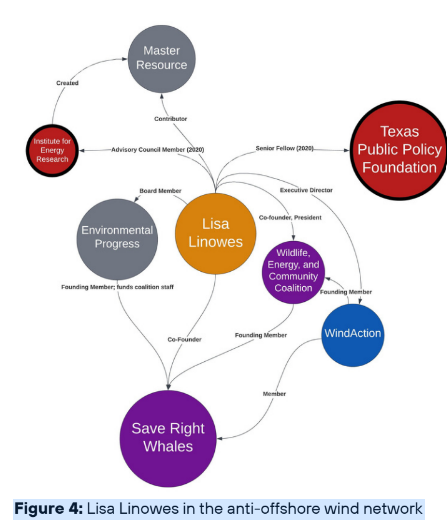
members. Coalition co-founder Lisa Linowes also appears in leadership
of three of the coalition’s eleven member organizations [56]. Michael
Shellenberger, a frequent renewable energy critic [62] and indepen-
dently a member of Save Right Whales, also leads the nonprofit that
dedicates paid staff to maintaining the coalition [56].
By contrast, the State Policy Network (SPN) is the nation’s most
prominent network of conservative state-level think tanks. It seeks to
“limit government and advance market-friendly public policy at the
state and local levels” [63]. The network’s president has likened the
group to the home goods store IKEA for its “catalog” of policies designed
for assembly at the state level that advance the network’s national goals
[64]. The third coalition, ACOP, was “formed to share information, re-
sources, and strategies to protect our beach communities from perma-
nent interference in established patterns of ocean front life” [65].
Fig. 1. Network map of the anti-offshore wind movement (first published by Slevin et al. [56]). [56]).
Critically, five of its founding members were SPN-affiliated think tanks
spread across five states. The other six founding members were local
wind turbine opposition groups [65].
In addition to the think tanks with ACOP membership, additional
groups with SPN connections have entered the picture. In 2023, Linowes
published a report on the cost of renewable energy in Massachusetts
with a grant from an SPN partner in that state [66]. In 2024, the net-
work’s Rhode Island affiliate – another group classified as climate
denying by Brulle et al. [29] – published an 80-minute interview with
the president of a local anti-offshore wind group [67].
There are two other informal but critical groups of actors in this
network. The upper left corner exhibits many actors who have been
fighting against wind power for over a decade. They offer public re-
lations knowledge, strategy, and policy experience. Experienced in-
dividuals such as Droz and North American Platform Against Wind
Turbines CEO Sherri Lange now contribute to wind turbine opposition
via anti-offshore wind content published on the blog MasterResource, a
project of the Institute for Energy Research [56]. This climate denial
think tank received over $150,000 from Koch family charitable foun-
dations between 2017 and 2021.
In the upper right section, commercial fishers and their advocacy
organizations tie into the network. The five fishing organizations rep-
resented in blue are each tied to the Responsible Offshore Development
Alliance (RODA), which describes itself as “a broad membership-based
coalition of fishing industry associations and fishing companies with
an interest in improving the compatibility of new offshore development
with their businesses” [68]. These five organizations were also plaintiffs
in a lawsuit filed by the Texas Public Policy Foundation [56], an SPN
affiliate that has, in recent years, become one of the nation’s most
prolific and powerful renewable energy opposition groups [69].
RODA ties into the anti-offshore wind network a second time as they
were legally represented by prominent lawyers Nancie and Roger Mar-
zulla in the coalition’s lawsuit against a New England offshore wind
project. The Marzullas are contributors at the fossil fuel-backed Feder-
alist Society and were leaders of a now-defunct property rights advocacy
group that was part of the climate denialist Cooler Heads Coalition [55].
Roger Marzulla also represented Save Right Whales, Green Oceans, the
New England Fishermen’s Stewardship Association, and other plaintiffs
in a January 2024 lawsuit intended to reverse federal approvals of two
offshore wind energy projects in New England [7].
An examination of network members’ financial backings may reveal
additional influence (Table 1). Between 2017 and 2021, SPN, the
Charles Koch Foundation, Charles Koch Institute, DonorsTrust, and the
American Fuel and Petrochemical Manufacturers Association contrib-
uted more than $8.9 million to the five think tanks that appear in
ACOP’s founding membership. Most of these are full-service think tanks
that work on many issues, but such support builds their capacity to have
an impact on climate policy opposition. These donors also contributed
over $7.2 million to the Texas Public Policy Foundation, which filed the
lawsuit in which the five RODA affiliates are plaintiffs, and which
Table 1
Table of contributions from fossil fuel interests and dark money groups to organizations in the anti-offshore wind network.
---
23 PP REPORT 2023?
Whale advocates and fishing groups constitute
an unusual, contradictory alliance. Save Right
Whales and RODA attack offshore wind farms
together, though the fishing industry is one of the
most significant threats to whales on the East
Coast. According to NOAA, fishing gear
entanglement has caused 65% of documented
right whale deaths, injuries, and morbidities since
2017.35
collaborations with other interest groups such as
traditional environmentalists, the Tea Party, and
property rights organizations. The document also
recommends “joining forces” with think tanks like
Heartland, CEI, and CFACT – which were
represented at the conference.
There are many links between that era and
current anti-OSW actors. Droz and Porter’s
strategy memo recommended working with the
North American Platform Against Windpower,
whose CEO, Sherri Lange, currently writes anti-
OSW stories for MasterResource. a blog run by the
Institute for Energy Research– another climate
denial think tank recommended by Droz.40 41 42 43
Droz is a “principal” at the blog. Lisa Linowes, co-
founder of Save Right Whales, is a contributor
there.43 The climate denial think tanks that
appeared at the 2012 conference and in the
The Origin of a Network
While recent years have seen a rise in opposition
to offshore wind, the involvement of conservative
think tanks appears to have been seeded a decade
ago. In 2012, as a senior fellow at the American
6
This campaign “must appear
as a ‘groundswell’ among
grass roots.”
Tradition Institute, a
climate denial think tank,
John Droz helped organize
an energy conference that
emerged as “a Who’s Who
of climate deniers and... local residents around the
country who are trying to block projects.”36 37
Representatives of think tanks deeply involved in
the climate denial movement were present at the
anti-wind conference, including the Committee for
a Constructive Tomorrow (CFACT), the
Competitive Enterprise Institute (CEI), The
Heartland Institute, the State Policy Network, and
the American Legislative Exchange Council
(ALEC).38
Prior to this 2012 conference, Droz edited a
strategy memo written by Illinois-based anti-OSW
attorney Rich Porter that outlined a “national
professional PR campaign” to cause “subversion in
message of [wind] industry so that it effectively
becomes so bad no one wants to admit in public
they are for it (much like wind has done to coal, by
turning green to black and clean to dirty).”39 This
campaign “must appear as a ‘groundswell’ among
grass roots.” The tactics delineated in this memo
include trainings for local anti-OSW groups,
coordinated messaging and advertisements, and
strategy memo also play
key roles in the current
iteration of offshore
wind opposition. Droz
still frequently co-signs
anti-climate policy comments and letters with
obstructionist think tanks including CFACT,
Heartland, and David Stevenson, who represents
the Caesar Rodney Institute.44 45 46 47
Droz has also trained thousands of people on
anti-wind strategies.48 Together, these experienced
anti-OSW activists and think tanks deploy tactics in
line with those outlined by Droz and Porter: shared
messaging, support for local opposition groups, and
occasional outright “astroturfing” (creating fake
grassroots groups).
CFACT, Heartland, and David Stevenson’s ACOP
co-founded a new coalition, Save the Whale
Coalition, which advanced unfounded concerns
that the construction of offshore wind turbines
would be a death knell for endangered right
whales.49 It is not surprising that Save The Whale
Coalition has applied similar arguments as Save
Right Whales, as they share member groups and a
:{:{:{potent – though misleading – message thatappeals to self-identified concerned}:
environmentalists.
Climate denial think tanks are key links between
the past and present of anti-wind action. They
orchestrate the “appear[ance] as a ‘groundswell’
among grass roots” that Droz and Porter wrote
about. While local groups appear at the forefront of
the current anti-OSW movement on the East
Coast, they're often entwined with seasoned
climate denial organizations that operate
sophisticated campaigns to sway public opinion
and policy sentiment against wind energy.
Financial Flows
7
The Donors
We identified several key donors that help make
this network run: the Charles Koch Foundation; the
Charles Koch Institute; DonorsTrust; the State
Policy Network; and the American Fuel and
Petrochemical Manufacturers Association. These
donors all have intimate ties to the fossil fuel
industry, and many have a clear history of
establishing astroturf groups that appear to be a
groundswell. Over the last five years, organizations
active in the fight against offshore wind have been
receiving a steady flow of funds from prominent
donors affiliated with the Koch network and the
fossil fuel industry.
Several of these selected donors hardly need an
introduction. The Charles Koch Foundation, Charles
Koch Institute, and DonorsTrust are key charitable
wings of the sprawling Koch network of donors,
think tanks, and astroturf groups that advance
right-wing causes, especially obstruction to climate
policy.50 51 52 The network began blocking climate
action and obfuscating climate science in 1991, in a
confluence of fossil fuel industry self-interest and
:{anti-regulatory ideology.53}
:
The State Policy Network (SPN) is another key
player in the Koch network. As represented in our
map, it is a climate denial group and a coalition, as
well as a significant donor. This is because SPN
develops and disburses financial support and
ready-made policy to its member groups in all fifty
states. For example, SPN groups recently passed a
series of laws preempting bans on gas hookups in
buildings.54
In 2013, SPN president Tracie Sharp said that
the group follows a model much like IKEA. SPN
provides “raw materials” and helps its member
groups assemble policies and campaigns that fight
battles in state politics. “Pick what you need,” she
said, “and customize it for what works best for
you.”55 SPN has received more than $24 million
from the Koch dark money channel DonorsTrust
between 2019 and 2021, and more than $132,000
from the Charles Koch Foundation itself between
2017 and 2021.56
“It’s all funded by people who have a world view
that’s really in opposition to any kind of collective
action to resolve inequities in our society,” said
Charles Siler, a former employee for two SPN-
affiliated groups. “It’s all about undermining and
destroying collective power, because it’s the only
opposition that wealthy people actually face.”57
Between 2017 and 2021, SPN spent a total of
$870,000 on five of its affiliates that are members
of ACOP: the Caesar Rodney Institute; the John
Locke Foundation; the Mackinac Center; the
Thomas Jefferson Institute; and the Maine Policy
:{Institute.58
Given the explicit intent of SPN member}:
groups to customize national scale policy, and
Sharp’s admission that “[SPN’s] grants are driven
by donor intent,” the line between fossil fuel
funding, SPN, and local anti-OSW groups along the
Eastern seaboard is not a difficult one to draw.59
Finally, the American Fuel and Petrochemical
Manufacturers Association is a trade association
that represents 98% of American oil refining
capacity.60 Its board consists of fossil fuel and
chemical industry representatives, which include
Marathon Petroleum, CITGO Petroleum, and the
chemical production wings of ExxonMobil and
Chevron.61 With $145,000 in contributions to
Heartland, $50,000 to SPN, and $20,000 directly
to the Caesar Rodney Institute between 2017 and
2021, the American Fuel and Petrochemical
Manufacturers Association greases the gears of
some of the most substantial actors in the anti-
... FI 3 FLOW CHART
offshore wind network.62
8
The Recipients and their Roles
The Texas Public Policy Foundation (TPPF),
which has featured prominently as an ally of actors
in the movement against offshore wind, is one of
the largest recipients of oil, gas and dark money
funds. It received more than $6.6 million from the
Charles Koch Foundation and Charles Koch
Institute between 2017 and 2021.63 64 It also
accepted more than $490,000 from DonorsTrust in
2021, nearly quintupling what it had received in the
previous two years combined.65 TPPF is a climate
denial group that published four articles and videos
deriding wind power in the month of September,
2023 alone.66 These pieces, with titles such as
“Green Garbage” and “The Biden Administration’s
offshore wind junk heap” play up the downsides of
offshore wind– and the latter claims without
evidence that offshore wind is killing whales.67
“Green Garbage” was written by Carson Clayton,
who directs TPPF’s Life:Powered campaign that
makes “the moral case for fossil fuels.”68 Though
Texas generates almost a third of its energy from
wind power, TPPF fights against renewable energy
policy and defends the fossil fuel industry on a
national scale.69 70
These financial ties directly trickle down to the
local anti-OSW groups. Free of charge, TPPF
launched a lawsuit against an offshore wind project
on behalf of six companies and organizations
involved in the fishing industry.71 Meghan Lapp, a
fishing industry spokeswoman whose employer,
Seafreeze, is represented in the suit, indicated that
she was willing to look past TPPF’s climate change
denial. “The fishing industry needed somebody to
represent them,” she said.72
Like TPPF, funds from the Mercatus Center can
be directly traced to the new movement against
offshore wind. The Mercatus Center, a right-wing
think tank based at George Mason University, has
become a poster child for Koch influence. It was
founded by the Kochs in the 1980s, and by 2010 it
had received more than $30 million from the Koch
family foundations.73 A former Koch staffer referred
to Mercatus as “a lobbying group disguised as a
disinterested academic program.”74
In 2022, Mercatus contributed $20,000 to
Environmental Progress, whose paid staff support
Save Right Whales.75 It was Mercatus’s first
contribution to Environmental Progress. Now, Save
Right Whales directs visitors on its website to
contribute to Environmental Progress as a way of
supporting the coalition.76
Environmental Progress has also received
$295,500 from Vanguard Charitable and $587,600
from Schwab Charitable Fund, two donor-advised
funds.77 78 Donor-advised funds often function as
mediating links between donor and recipient,
obscuring who the real donor is. This makes them
ideal for the climate denial movement.79 Both
Vanguard Charitable and Schwab Charitable Fund
have been identified to be large financial
contributors of the climate change
countermovement.80 81 82
Furthermore, since 2019, Environmental Progress
has accepted $125,000 from the Rodel Charitable
Foundation which is committed to the
“advancement of nuclear energy because our
current technologies (particularly wind, solar and
hydro power) will not produce enough energy
supply to significantly reduce the use of fossil fuel
sources.”83 84
Michael Shellenberger, the founding president of
Environmental Progress, has ties to the Nuclear
Energy Institute, which includes utilities and fossil
fuel-affiliated companies such as Dominion Energy
and Duke Energy.85 86 Shellenberger is also on the
advisory board of Alliance for Responsible
Citizenship, which has stated, “Nuclear +
petrochemicals...will keep us going” and includes
prolific climate obstructionist Bjørn Lomborg and
Republican presidential candidate Vivek
Ramaswamy on its board.87
There are other examples of organizations using
other actors in the network for fundraising
purposes. Just as Save Right Whales raises money
through Environmental Progress, contributions on
the Delaware-based anti-OSW group Save Our
Beach View’s web page went to the Caesar
Rodney Institute, a State Policy Network member
group that received at least $44,000 from
DonorsTrust and the American Fuel and
Petrochemical Manufacturers’ Association
between 2017 and 2021.88 89 90
U.S. Rep. Jeff Van Drew (R-NJ) spoke at a
fundraiser for the Caesar Rodney Institute on
November 2nd, 2023, entitled “Protecting
Delaware’s Coastal Beauty.”91 Rep. Van Drew had
previously spoken at a July fundraiser for Defend
Brigantine Beach, an anti-OSW group in New
Jersey. Bob Stern, president of Save Long Beach
Island, also spoke. So did Mike Dean, a member of
Protect Our Coast NJ, who had recently appeared
on a Fox News segment baselessly blaming
offshore wind for killing whales.92 93 Whale
conservation and other anti-OSW rhetoric became
a key talking point for Republicans in New Jersey
during the 2023 election season, but those who
adopted it failed to make expected gains.94
ideal for the climate denial movement.79 Both
Vanguard Charitable and Schwab Charitable Fund
have been identified to be large financial
contributors of the climate change
countermovement.80 81 82
Furthermore, since 2019, Environmental Progress
has accepted $125,000 from the Rodel Charitable
Foundation which is committed to the
“advancement of nuclear energy because our
current technologies (particularly wind, solar and
hydro power) will not produce enough energy
supply to significantly reduce the use of fossil fuel
sources.”83 84
Michael Shellenberger, the founding president of
Environmental Progress, has ties to the Nuclear
Energy Institute, which includes utilities and fossil
fuel-affiliated companies such as Dominion Energy
:{:{and Duke Energy.85 86}:
Shellenberger is also on the}:
advisory board of Alliance for Responsible
Citizenship, which has stated, “Nuclear +
petrochemicals...will keep us going” and includes
prolific climate obstructionist Bjørn Lomborg and
Republican presidential candidate Vivek
Ramaswamy on its board.87
...
9
The flow of dollars from right-wing megadonors
and think tanks is critical to the activities of the
anti-OSW movement, but money only tells one part
of the story. Without financial strings attached,
individuals and organizations with widely varying
missions and degrees of national influence have
engaged in complex trades of information and
tactics that have helped advance the movement.
When a leader of one offshore wind group speaks
at another’s event, or when an article published by
a prominent national think tank appears in an anti-
OSW facebook group, talking points and strategies
spread across the movement.
Information in the anti-OSW network flows
circularly. Just as anti-OSW articles by climate
denial think tanks are republished on Facebook by
leaders of local-level anti-OSW groups, those
leaders also appear at events, fundraisers, and in
media produced by national groups. Actors in the
movement reinforce one another. A select few
individuals are likely responsible for relaying an
outsized amount of information in the anti-OSW
movement. Many actors wear many hats, moving
between different roles at groups that fill different
roles in the movement.
For example, MasterResource, the “free-market
energy blog” created by the Institute for Energy
Research, published a piece in May, 2023
describing how Si Kinsella, a resident of Suffolk
County, New York, was suing to slow down the
construction of an offshore wind project.95 The
author of the piece, Sherri Lange, is the CEO of the
North American Platform Against Wind Power, a
coalition that claims to have 480 members in 22
countries.96 97 Kinsella is a member of Save Right
Whales, which was co-founded by Lisa Linowes–
herself a MasterResource contributor who has held
positions at two climate denial think tanks in the
past several years, including the Texas Public
Policy Foundation.98 99 The other is the Institute for
Energy Research, which founded and produces
MasterResource. 100 101
10
Figure 4: Lisa Linowes in the anti-offshore wind network
David Stevenson and the Caesar Rodney
Institute also exhibit unusual centrality in the anti-
OSW network. To block a local offshore wind
project in Delaware, they founded Save Our Beach
View, a grassroots-appearing member of ACOP.
Stevenson also leads ACOP, which uses the Caesar
Rodney Institute’s tax-deductible non-profit status
to fundraise.102 103 104 105
Stevenson and his Caesar Rodney Institute
sent out 35,000 mailers filled with misinformation
to coastal Delaware residents in 2018, which it
parlayed into $50,000 in raised funds and 700 new
members for Save Our Beach Views.106 The think
tank’s work on Save Our Beach View and ACOP
was acknowledged by SPN on the national level
when it named the Caesar Rodney Institute as a
2023 finalist for its “Best Issue Campaign.”107
Stevenson also appeared as a “witness” at a
“field hearing” hosted by Rep. Van Drew in March,
entitled “An Examination Into Offshore Wind
Industrialization.” This event is one of many in the
last few years designed to inform the public of the
treacheries of offshore wind.
Many of the other witnesses at Van Drew’s
event, all of whom gave speeches, are tightly
interwoven in our map. Meghan Lapp, the
Seafreeze policy liaison and Texas Public Policy
Foundation plaintiff was one of them. So was
Michael Donohue, described by Van Drew’s office
only as a former New Jersey Superior Court
Judge.”108 Donohue is also the Special Counsel on
Offshore Wind to Cape May County (MD) as it
attempts to beat back a local offshore wind project.
Additionally, he chairs the Cape May County GOP,
which endorsed Van Drew after the congressman
switched parties in 2019.109
Whales, which was co-founded by Lisa Linowes–
herself a MasterResource contributor who has held
positions at two climate denial think tanks in the
past several years, including the Texas Public
Policy Foundation.98 99 The other is the Institute for
Energy Research, which founded and produces
MasterResource. 100 101
10
Figure 4: Lisa Linowes in the anti-offshore wind network
David Stevenson and the Caesar Rodney
Institute also exhibit unusual centrality in the anti-
OSW network. To block a local offshore wind
project in Delaware, they founded Save Our Beach
View, a grassroots-appearing member of ACOP.
Stevenson also leads ACOP, which uses the Caesar
Rodney Institute’s tax-deductible non-profit status
to fundraise.102 103 104 105
Stevenson and his Caesar Rodney Institute
sent out 35,000 mailers filled with misinformation
to coastal Delaware residents in 2018, which it
parlayed into $50,000 in raised funds and 700 new
members for Save Our Beach Views.106 The think
tank’s work on Save Our Beach View and ACOP
was acknowledged by SPN on the national level
Figure 5: David Stevenson and the Caesar Rodney Institute
are central to the anti-offshore wind network.
There is other evidence of how information
flows between actors across our map. Mary Chalke,
the Nantucket Residents Against Turbines co-
director who appeared at the 2021 press
conference with Stevenson, also appeared at a
...
concl
Also, this map has a focus on the American East
Coast, but offshore wind opposition has also
appeared in the Great Lakes, Canada, and
Australia. Emerging research in Australia has
identified similar anti-OSW rhetoric promulgated by
actors in the Atlas Network, which includes the
Caesar Rodney Institute, the Heartland Institute,
the John Locke Foundation, and other think tanks
involved in the American fight against offshore
wind.123 Research is needed to understand any
potential ties between East Coast actors and these
efforts. Finally, new and updated financial
information is needed to assess new and expanded
ties between organizations in the network. Our
research on financial flows is constrained by the
release of IRS information, most of which predates
the rapid rise of the network.
As money and information flow through this
network, local activists are emboldened to build
new roadblocks for offshore wind projects. No
longer on the fringes of energy policy and regional
political agendas, they draw strength from
prominent elected officials and some of the most
powerful financial interests in the county. This is no
coincidence. Offshore wind opposition is a vital tool
for fossil fuel interests to delay the renewable
energy transition. This briefing provides an initial
map so those involved – and those affected – can
begin to understand this complex network.
---