Marzulla, R esq
lawyer for farmers on water oregon cheney
NO MERRI
married to nancie doj
---
climate development lab
false and injurious claims
the future of climate denial ]
https://youtu.be/_OBlKRdH6A4)
Meet the lawyers blocking offshore wind
SIMON CLARK? WINDS BS ASTRO SHILLENBERGER
political targeting
short 
---
---
NYT
NO LNX
Law Firm Pressures Brown University to Erase Research on Anti-Wind Groups
The firm, which represents opponents of offshore wind, said it would complain to Brown’s federal and private funding sources.
Lisa Friedman
By Lisa Friedman
Aug. 25, 2025
A law firm representing opponents of offshore wind farms is demanding that Brown University retract research that details links between the fossil fuel industry and anti-wind groups.
The firm, Marzulla Law L.L.C., which has close ties to the conservative legal movement, called the research “false and injurious” and said it would complain to Brown’s public and private funders, including the Energy Department, the National Science Foundation and the Mellon Foundation.
A spokesman for the university, Brian E. Clark, did not comment directly on the law firm’s demands but said the university intended to uphold its principles of academic freedom.
“Scholars shape their own research and course of instruction at Brown,” Mr. Clark said in a statement. “One principle that is core to research at Brown is the ability for scholars to discuss contested topics and themes and to have those topics openly debated.”
Roger J. Marzulla, a founding partner of the firm, did not respond to email and telephone requests for comment.
The demands come at a precarious time for the nation’s universities, which have become targets of a pressure campaign conducted by the Trump administration. Last month, Brown struck a deal with the government to restore lost federal research funding and end investigations into alleged discrimination.
The Trump administration is trying to stop the country’s nascent wind industry, a source of energy that President Trump has disparaged since he failed to stop an offshore wind farm from being built within view of one of his Scottish golf courses.
Marzulla Law L.L.C. is representing several groups that are fighting offshore wind, including Green Oceans, a nonprofit organization that is trying to overturn federal permits for Revolution Wind, a 65-turbine wind farm off the coast of Rhode Island.
That $6.2 billion project is nearly built, but on Friday the Trump administration ordered construction to stop, citing unspecified concerns.
In an Aug. 11 letter to Brown’s general counsel, Mr. Marzulla objected to research published by the Climate and Development Lab at Brown that found that Green Oceans had spread misinformation about climate change and operated as part of “a fossil-fuel-funded disinformation network.”
Mark Herr, a spokesman for Green Oceans, said in a statement that Green Oceans was a local and nonpartisan group, adding, “We have no association with the fossil fuel industry nor any conservative political groups.”
“These oft-repeated lies are designed to discredit the messenger while preventing the public from absorbing the substance of our valid and well-researched concerns,” he said.
J. Timmons Roberts, who leads the Climate and Development Lab, said in an interview that his students had found that groups fighting offshore wind “have chosen to get in bed with some of the most anti-environment and anti-climate actors.” He called the letter “strategic harassment to shut me up and waste my time and make me more cautious.”
Lauren Kurtz, the executive director of the Climate Science Legal Defense Fund, a nonprofit organization that provides legal aid to climate scientists, called the letter academic harassment.
“It definitely struck me that they were dangling the possibility of getting the Trump administration involved,” Ms. Kurtz said. “It seems to me like they’re trying to bully Brown and their researchers.”
The Climate and Development Lab, founded in 2010, is a student and faculty research organization. Nearly three years ago, students began looking into groups fighting offshore wind off the coast of Rhode Island.
Their research does not accuse Green Ocean of accepting money from fossil fuel companies, but it highlights the similarities between arguments made by Green Ocean and those advanced by fossil fuel groups that spread climate misinformation.
A new publication issued by the Climate Development Lab on Friday maps connections between groups that oppose offshore wind and the law firms that represent them, and uses Marzulla Law as a case study. It describes the firm as having “a history of advancing anti-environmental lawsuits and significant ties with the fossil fuel industry.”
Mr. Marzulla and his wife, Nancie, who together founded the firm in 1997, both previously worked at Mountain States Legal Foundation, a conservative public interest law firm based in Colorado.
Mr. Marzulla took over as head of the foundation in 1981, and later the couple founded the Defenders of Property Rights, which defended private property owners from what they viewed as cumbersome environmental regulations. Defenders of Property Rights joined the Cooler Heads Coalition, a group of organizations that rejected the scientific finding that the burning of fossil fuels was driving climate change.
Lisa Friedman is a Times reporter who writes about how governments are addressing climate change and the effects of those policies on communities.
A version of this article appears in print on , Section A, Page 9 of the New York edition with the headline: Right-Wing Firm Presses Brown Over Wind Study.
---
---
Managing Editor
September 14, 2025
This past July, Brown made a deal with the Trump administration to restore the University’s federal funds. But the deal was not the end of threats to Brown’s research funding.
On Aug. 11, Brown received a letter from Marzulla Law, a law firm with close ties to the conservative legal movement, on behalf of Green Oceans, a local anti-offshore wind group. In the letter, the law firm demanded the University retract three publications from 2023 and 2024 authored by researchers at the Climate and Development Lab, claiming that the publications contained “materially false claims” about the nonprofit and caused “significant harm.”
In the letter, which was obtained by The Herald, the firm stated they are “preparing coordinated reports to key public and private funding bodies,” including the National Science Foundation, Department of Energy and the Mellon Foundation. The letter stated that “Green Oceans will consider all available legal remedies” if the University does not comply.
In an email to The Herald, Barbara Chapman P’18 P’20, a Green Oceans trustee and member of the litigation team, wrote that the organization believes it has the grounds for further legal action.
“The publications contain provably false statements that have damaged Green Oceans’ reputation and fundraising and have been amplified by others,” Chapman wrote.
In a statement to The Herald, University Spokesperson Brian Clark affirmed Brown’s commitment to “academic freedom” and the right of faculty to “shape their own research and course of instruction at Brown.”
Marzulla Law’s threats of endangering federal funding would likely not apply to the CDL, which is privately funded and does not receive support from the sources that the law firm listed in its letter, according to the head of the center, Timmons Roberts, who is a professor of environment, society and sociology.
As a think tank that studies climate change policy based within the Institute at Brown for Environment and Society, one of the CDL’s primary research areas is the “seemingly grassroots and sometimes actually grassroots” organizations that oppose the development of offshore wind plants in the northeastern United States, said undergraduate CDL researcher Charlotte Calkins ’27.
This includes tracking the connections between anti-offshore wind groups, their lawyers, the fossil fuel industry and right-wing think tanks, Calkins continued.
In an interview with The Herald, Roberts said the CDL aims to understand what players are blocking climate change and how they are doing so. The original assumption of climate researchers was that as scientists discovered solutions to climate change, people would “naturally, automatically” shift away from using fossil fuels, he said.
“But of course, that was quite naive,” Roberts added.
Fossil fuel companies stand to lose revenue as reliance on renewable energy grows, he said. “So they are actively engaged in trying to undermine, stop, slow and roll back that transition that just has to happen.”
Since the CDL began publishing research about Green Oceans a few years ago, they have received multiple complaints from the group, which organizes against the development of offshore wind turbine farms in Rhode Island and Massachusetts. Green Oceans has also demanded that academic journals remove research conducted by the CDL. But the August letter was the first time they directly threatened Brown’s research funding, according to Roberts.
Isaac Slevin ’25, the first author on two of the targeted papers, called anti-wind groups’ criticism of his research “unsubstantiated.” The CDL has also sent letters pushing back against the claims and have faced no subsequent legal action.
Roberts feels confident that the CDL will be safe against legal threats.
“There’s some language in here about documented, ongoing harm, and it’s quite hard to imagine that this is real harm,” he said. He pointed to the “hundreds of thousands of dollars” raised by Green Oceans and their substantial national influence as evidence of the group’s success.
Green Oceans disagrees.
“The harm has escalated,” Chapman wrote. “The CDL publications have been widely amplified, used to exclude our participation in public forums, and have contributed to a hostile environment.”
It remains unclear if Marzulla Law actually has the sway necessary with public or private sources to pose an actual threat to Brown’s research funding. The firm did not respond to a request for comment.
Chapman wrote to The Herald that Green Oceans is “not asking anyone to stop supporting research at Brown,” but rather “asking funders and administrators to ensure that work bearing Brown’s name meets basic standards of accuracy, disclosure, and fairness.”
On Sept. 2, Green Oceans filed a memorandum in support of the Trump administration’s order halting construction on Revolution Wind, a $4 billion project to construct a wind farm that would have powered over 350,000 homes across Rhode Island and Connecticut. The construction of Revolution Wind was 80% complete when construction was halted.
Nancie and Roger Marzulla, co-founders of Marzulla Law, were listed as their attorneys on Green Oceans’s memorandum. Green Oceans also provided recommendations to senior officials in the Interior Department about how to cancel offshore wind leases, according to emails obtained by Politico.
In an Aug. 27 statement, they claimed that they “have never received funding from the fossil fuel industry or related organizations.”
But the CDL’s research never claimed that Green Oceans directly received funding from fossil fuel companies, according to Roberts, Slevin and Calkins. A key point in the research, Slevin said, is that the connections between local anti-offshore wind groups and fossil fuel companies extend far beyond the money.
Following the funds that groups receive from companies with anti-renewable energy interests, such as fossil fuel corporations is useful, but “cannot be the only framework that we work through, because it writes local agencies out of the picture,” Slevin told The Herald.
The CDL’s research instead explores “information subsidies,” which are lines of reasoning, talking points and terminology that “trickle down” to local groups from fossil fuel-funded think tanks, Calkins explained. Although the local groups may not directly be tied to fossil fuel companies, their lawyers and information sources may be closer, the CDL’s research posits.
In their statement to The Herald, Green Oceans maintains that the CDL’s research is false.
“Questioning whether offshore wind delivers real climate benefits while inflicting undeniable environmental harm is not spreading misinformation; rather it represents responsible science and public advocacy,” Chapman wrote.
According to Roberts, legal complaints like the Aug. 11 letter appear to have the “intent to silence our voices.” But he and his team feel even more inclined to continue their work.
Less than two weeks after the Aug. 11 letter, the CDL published a new report showing the Marzullas at the center of a web of “anti-environmental litigation and lobbying, and deep ties to fossil fuel interests,” the report says. The firm has a history of environmental litigation in federal courts, defending clients such as developers and local coalitions, according to the CDL report.
A version of the paper had already been drafted when they received the letter, Roberts said, and the notice “made me want to quickly put it up.”
Slevin said he feels that it symbolizes a bigger “political vibe shift” where universities are targets of “bullying.”
“I think if you’re doing effective environmental work, I would hope that you’re pissing off arms of the fossil fuel industry and their allies,” he added.
ELise Haulund
Elise Haulund is the managing editor of production and development for The Herald's 136th Editorial Board. She is from Redondo Beach, CA. Concentrating in English and biology, she has a passion for exploring the intersection between STEM and the humanities. Outside of writing, researching and editing, she enjoys ballet-dancing, cafe-hopping and bullet-journaling.
---
---
eletrek
Scientist exposes anti-wind groups as oil-funded. Now they want to silence him.
:{ Jameson Dow | Aug 25 2025 -
Oil-funded groups are engaging in strategic harassment to stop scientists from revealing the nature of their politically-linked disinformation networks – in what should be a surprise to nobody.
A new report came out last week from the Climate & Development Lab (CDL) at Brown University, titled “Legal Entanglements: Mapping Connections of Anti-Offshore Wind Groups and their Lawyers in the Eastern United States.”
The study focuses on several examples of law firms with connections to anti-wind groups, the fossil fuel industry, and the American political right wing. These fossil-funded groups have spread disinformation to slow the adoption of clean and cheap wind power, in order to keep America addicted to the poison that the fossil fuel industry wants to keep selling us.
The lab is headed by J Timmons Roberts, but the research was done by various students and faculty at at the lab. The new report builds onformer research by the CDL cataloguing extensive connections between these groups and the dark money networks that fund the anti-wind movement.
Why the East Coast needs offshore wind
Offshore wind, especially in the North Atlantic, is a cheap and abundant form of energy that is heretofore relatively untapped in the US. It also has very little environmental cost, given that its carbon emissions and land use are both zero, and wind tends to be quite consistent over the ocean, making it more reliable as a power source.
Many other countries have successfully implemented offshore wind projects to bring this cheap and clean power to their populaces, with particular booms in China, the UK, Vietnam, Germany and several other Northern European countries (like Denmark, where many large wind power companies are based).
And wind is important for the global transition to renewable energy and the fight against climate change. As a zero-emission power source, it’s essential for meeting the US East Coast’s climate and renewable energy goals, and could provide a huge chunk of the power needs for the entire US Eastern seaboard, where the country’s population is clustered.
However, offshore wind has recently encountered setbacks due to the spread of disinformation from fossil-funded networks, which has made its way into the popular conception and into right-wing politics. (Nevertheless, Americans of all political stripes still support greater deployment of offshore wind)
How and why fossil fuel companies oppose wind
Fossil fuel companies oppose wind power because it would help to wean America off of fossil fuels, displacing coal and methane generation for electricity and enabling greater electrification of the vehicle fleet to wean us off of oil. All of these would result in air quality improvements, cost reductions, health improvements and avoidance of climate change – which are all anathema to themost deadly industry the world has ever seen.
So, fossil fuel companies have developed and funded a complicated network of fake public interest groups, politicians and lawyers to oppose wind power by spreading disinformation. And the CDL’s report highlights how certain legal firms have received funding from fossil fuel companies and/or given support to these fake public interest groups in attempts to sue wind projects out of existence.
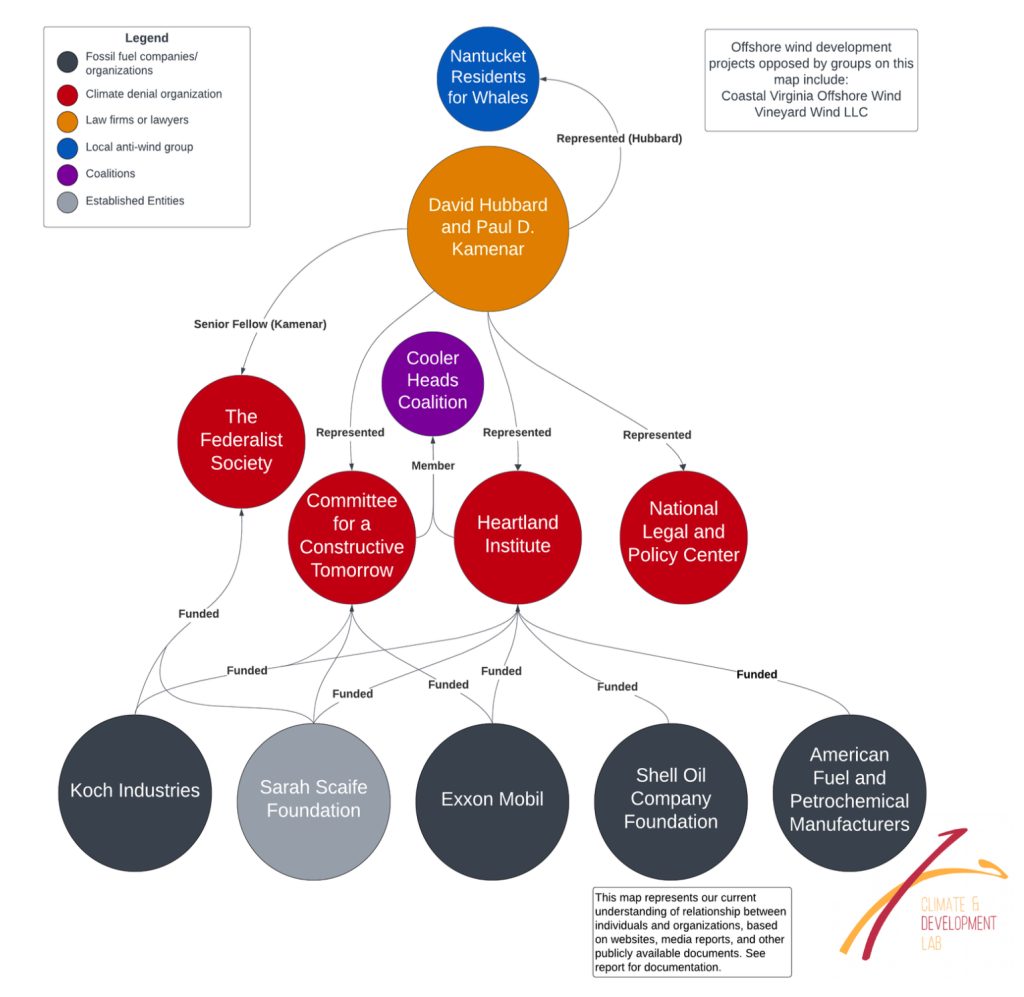 One of many diagrams in the report showing these anti-wind legal networks
While many of these lawsuits have been unsuccessful, they can still add delays to a project, making it more expensive and slower to deploy (which then makes your electricity more expensive). In some cases, the delays can result in project cancellation, like when oil billionaire William Koch sued Cape Wind out of existence via a fake public interest group called the Alliance to Protect Nantucket Sound.
In the report, five specific legal networks are highlighted in particular, showing how each is related to fossil fuels and science denial. The networks have provided representation, written comments, filed lawsuits and otherwise spread disinformation in an attempt to stop the public good that offshore wind power represents.
The nature of the disinformation
The disinformation largely focuses on the North Atlantic Right Whale, a whale whose population is currently experiencing an “unusual mortality event” due to changing climate and Atlantic shipping and fishing.
Anti-wind groups have invoked laws like the Endangers Species Act and Marine Mammal Protection Act, despite the fact that the products of the industry they are funded by are the deadliest thing for marine life.
Burning oil raises both the temperature and acidity of our oceans, disrupting marine ecosystems in profound ways. For example, North Atlantic krill populations have dropped by 50% due to ocean warming driven by fossil fuel use. Krill are the main food source for the North Atlantic Right Whale, which anti-wind groups claim to be interested in protecting, but are in fact aiding the decline of.
Further, whale populations are directly harmed by vessel strikes, which are the leading direct cause of death for North Atlantic Right Whales in recent years. And29% of those vessels are carrying oil across the globe – shipments that would be unnecessary if transportation were powered by clean renewable energy instead of deadly oil. Not only that, but some of the exact same groups that oppose wind also opposed draft regulations to reduce vessel strikes, showing that they are actually interested in continuing to harm whales, not protecting them.
Law firm responds to the truth by pressuring university to hide it
One of the law firms highlighted in the report, Marzulla Law, sent a letter threatening its authors. Marzulla Law said it would complain to mommy… I mean, Brown’s funding sources, including the US Department of Energy which a former oil executive is currently squatting as the head of, in an attempt to get the entirety of Brown University’s funding pulled if the CDL doesn’t self-censor its research findings.
The CDL itself is not funded by the Department of Energy, Roberts said to Bloomberg, so the threat isn’t even related to CDL’s funding sources, but to Brown University’s as a whole.
Marzulla Law represented one of the disinformation groups which the CDL has highlighted before, the deceptively-named “Green Oceans.” Green Oceans opposed the Revolution Wind project, which was halted on Friday over fake national security concerns by a convicted felon who is Constitutionally barred from holding office in the US, despite the project already being 80% finished, costing the US billions in waste and increased utility bills.
Mike Herr, a spokesman for Green Oceans said “these oft-repeated lies are designed to discredit the messenger while preventing the public from absorbing the substance of our valid and well-researched concerns,” which is itself an example of the very thing he’s wrongly accusing the researchers of.
Herr’s organizationlies about offshore wind, and their attack on science (through their law firm) is designed to discredit the messenger while preventing the public from absorbing the substance of valid and well-researched concerns: the connection between fossil fuels, the republican party, and disinformation that keeps us from embracing superior forms of cheaper, cleaner energy like wind.
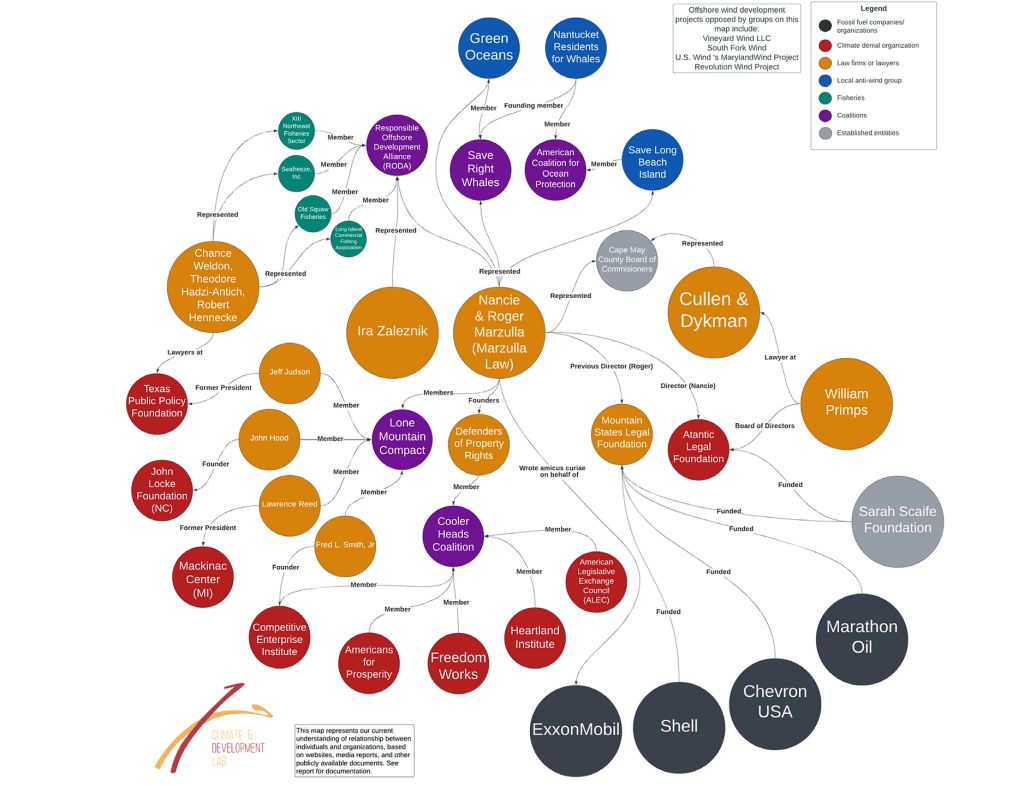 Marzulla Law is deeply tied to anti-wind networks, far-right and climate denial foundations, and oil companies
Discrediting science and knowledge is increasingly becoming a feature of the American right wing, which is currently on a crusade against universities as it tries to make America stupider.
Roberts called Marzulla’s response “strategic harassment to shut me up and waste my time and make me more cautious,” which is a common reaction faced by truth-tellers in this day and age, particularly when funding from the largest and most deadly industry on the planet, which has repeatedly shown its interest in propaganda, is involved.
Top comment by Lee
Liked by 30 people
Everything wrong with the USA right now is because Trump has made lying acceptable. Imagine if USA believed in the Truth. All these law companies and Fossil Fuels companies would be prosecuted.
For its part, Brown University did not comment on Marzulla’s demands, but did state that “Scholars shape their own research and course of instruction at Brown. One principle that is core to research at Brown is the ability for scholars to discuss contested topics and themes and to have those topics openly debated.”
However, Brown is one of the universities which recently kowtowed to the idiotic demands of an inept moron, making its words about academic independence ring somewhat hollow. We’ll have to see if they step up to defend truth this time around, or bend the knee to one of the dumbest people on the planet once again, if it comes to that.
---
[### Blowing in the Wind: Offshore Wind Turbines

Marzulla Law, LLC
https://marzulla.com › blog › blowing-in-the-wind-offsh...](https://marzulla.com/blog/blowing-in-the-wind-offshore-wind-turbines/)
Jan 21, 2025 — This website provides general information about our firm. This information does not offer specific legal advice and use of this information does ...Read more
Missing: MARZULA | Show results with: MARZULA
[### Roger J. Marzulla

Wikipedia
https://en.wikipedia.org › wiki › Roger_J._Marzulla](https://en.wikipedia.org/wiki/Roger_J._Marzulla)
Marzulla (born August 12, 1947) is an American attorney ... In 2025, the law firm was notable for representing groups that sought to block offshore wind projects.Read more
Missing: MARZULA | Show results with: MARZULA
[### Law Firm Pressures Brown University to Erase Research ...

The New York Times
https://www.nytimes.com › 2025/08/25 › climate › bro...](https://www.nytimes.com/2025/08/25/climate/brown-university-offshore-wind-marzulla.html)
Aug 25, 2025 — Marzulla Law L.L.C. is representing several groups that are fighting offshore wind, including Green Oceans, a nonprofit organization that is ...Read more
Missing: MARZULA | Show results with: MARZULA
[### Marzulla Law Takes Offshore Wind Turbines to Supreme ...

Marzulla Law, LLC
https://marzulla.com › blog › marzulla-law-takes-offshor...](https://marzulla.com/blog/marzulla-law-takes-offshore-wind-turbines-to-supreme-court/)
Mar 25, 2025 — Our firm filed a petition for a writ of certiorari in the US Supreme Court to review the US Court of Appeals for the First Circuit's December 2024 decision.Read more
Missing: MARZULA | Show results with: MARZULA
[### Law firm threatens Brown's funding over research about ...

The Brown Daily Herald
https://www.browndailyherald.com › article › 2025/09](https://www.browndailyherald.com/article/2025/09/law-firm-threatens-browns-funding-over-research-about-anti-offshore-wind-groups)
Sep 14, 2025 — Representing local anti-offshore wind group Green Oceans, Marzulla Law sent a letter to the University demanding research by the Climate and ...Read more
Missing: MARZULA | Show results with: MARZULA
[### Law Firm Threatens Brown Climate Researchers

Inside Higher Ed
https://www.insidehighered.com › news › 2025/08/26 › l...](https://www.insidehighered.com/news/quick-takes/2025/08/26/law-firm-threatens-brown-climate-researchers)
Aug 26, 2025 — A law firm representing anti–wind energy groups is demanding that Brown University researchers retract findings linking those groups to the ...
[### Offshore wind fight lining lawyers' pockets

Saving Seafood
https://www.savingseafood.org › News › Law](https://www.savingseafood.org/news/law/offshore-wind-fight-lining-lawyers-pockets/)
Nov 7, 2025 — ... Marzulla Law, which was hired last year to fight the Bureau of Ocean Energy Management's approval of the US Wind project off Maryland's coast.Read more
Missing: MARZULA ATTORNEY
[### Vineyard Wind survives its years of legal drama. Trump's ...

Clark Mindock | Substack
https://www.landmark.earth › trump-offshore-wind-vin...](https://www.landmark.earth/p/trump-offshore-wind-vineyard-lawsuits-climate-change)
Dec 9, 2024 — Roger Marzulla, an attorney who represented fishing industry and business interests in litigation challenging the Vineyard Wind project, told ...Read more
Missing: MARZULA | Show results with: MARZULA
[### Meet the lawyers blocking offshore wind

Instagram · simonoxfphys
15.3K+ likes · 2 months ago](https://www.instagram.com/reel/DQEdULCke8R/)
Working with many suspicious community groups to delay and even cancel offshore wind projects that they felt threatened by. They exposed this ...Read more
Missing: MARZULA ATTORNEY
[### RODA asks Supreme Court to hear Vineyard Wind case

National Fisherman
https://www.nationalfisherman.com › northeast › roda-a...](https://www.nationalfisherman.com/northeast/roda-asks-supreme-court-to-hear-vineyard-wind-case)
Mar 11, 2025 — The case was brought March 5 on behalf of fishermen by attorneys Nancie G. Marzulla and Roger J. Marzulla of the Washington D.C. law firm ...Read more
Missing: MARZULA | Show results with: MARZULA
---
12 25
[### Law Firm Pressures Brown University to Erase Research ...

The New York Times
https://www.nytimes.com › 2025/08/25 › climate › bro...](https://www.nytimes.com/2025/08/25/climate/brown-university-offshore-wind-marzulla.html)
Aug 25, 2025 — Marzulla Law L.L.C. is representing several groups that are fighting offshore wind, including Green Oceans, a nonprofit organization that is ...Read more
Missing: MARZULA | Show results with: MARZULA
[### Law firm threatens Brown's funding over research about ...

The Brown Daily Herald
https://www.browndailyherald.com › article › 2025/09](https://www.browndailyherald.com/article/2025/09/law-firm-threatens-browns-funding-over-research-about-anti-offshore-wind-groups)
Sep 14, 2025 — Representing local anti-offshore wind group Green Oceans, Marzulla Law sent a letter to the University demanding research by the Climate and ...Read more
Missing: MARZULA | Show results with: MARZULA
[### Case: Green Oceans v. US Department of the Interior

Civil Rights Litigation Clearinghouse
https://clearinghouse.net › case](https://clearinghouse.net/case/46981/)
This case challenges agency approval of two energy projects, South Fork Wind Project and Revolution Wind Project, that have purported detrimental ...Read more
Missing: MARZULA | Show results with: MARZULA
[### Green Oceans Asks Brown University to Retract Reports ...

ecoRI News
https://ecori.org › green-oceans-asks-brown-university-t...](https://ecori.org/green-oceans-asks-brown-university-to-retract-reports-about-anti-wind-organization/)
Aug 25, 2025 — PROVIDENCE — A law firm representing the anti-wind energy group Green Oceans sent a letter to Brown University earlier this month, ...Read more
Missing: MARZULA | Show results with: MARZULA
[### Green Oceans Files Motion for Summary Judgment to ...

Business Wire
https://www.businesswire.com › news › home › Green-O...](https://www.businesswire.com/news/home/20250903221909/en/Green-Oceans-Files-Motion-for-Summary-Judgment-to-Vacate-Federal-Approvals-for-Revolution-Wind)
Sep 3, 2025 — Green Oceans' lawyer, Roger J. Marzulla, served as Assistant Attorney General in charge of the U.S. Justice Department's Environment and Natural ...Read more
Missing: MARZULA | Show results with: MARZULA
[### Offshore Wind Opponents Target Work of Brown University

Energy Connects
https://www.energyconnects.com › News › Renewables](https://www.energyconnects.com/news/renewables/2025/august/offshore-wind-opponents-target-work-of-brown-university-researcher/)
Aug 25, 2025 — The group sent the latest letter via Marzulla Law, dated Aug. 11, 2025. Green Oceans asked for “immediate corrective action by Brown ...Read more
Missing: MARZULA | Show results with: MARZULA
[### Meet the lawyers blocking offshore wind

Instagram · simonoxfphys
15.3K+ likes · 2 months ago](https://www.instagram.com/reel/DQEdULCke8R/)
{They've been objected to by a community group called green oceans* due to the potential disruption of marine habitats by the wind turbines and in ...Read more}:
Missing: MARZULA ATTORNEY
[### Scientist exposes anti-wind groups as oil-funded. Now they ...

Electrek
https://electrek.co › 2025/08/25 › scientist-exposes-anti-...](https://electrek.co/2025/08/25/scientist-exposes-anti-wind-groups-as-oil-funded-now-they-want-to-silence-him/)
Aug 25, 2025 — Marzulla Law represented one of the disinformation groups which the CDL has highlighted before, the deceptively-named “Green Oceans.” Green ...Read more
Missing: MARZULA ATTORNEY
[### GREEN OCEANS v. UNITED STATES DEPARTMENT OF ... CourtListener
https://www.courtlistener.com › docket › parties › green-...](https://www.courtlistener.com/docket/68164402/parties/green-oceans-v-united-states-department-of-the-interior/)
Jan 16, 2024 — ATTORNEY TO BE NOTICED. Plaintiff. 226 OCEAN AVENUE MOONWATCH, LLC. Represented by. Roger Joseph Marzulla. (202) 822-6760. Fax: (202) 822-6774.Read more
[### Offshore Wind Opponents Target Work of Brown University ...

Financial Post
https://financialpost.com › pmn › business-pmn › offsh...](https://financialpost.com/pmn/business-pmn/offshore-wind-opponents-target-work-of-brown-university-researcher)
Aug 25, 2025 — The group sent the latest letter via Marzulla Law, dated Aug. 11, 2025. Green Oceans asked for “immediate corrective action by Brown ...Read more
Missing: MARZULA | Show results with: MARZULA
---
san jose
President of Mountain States Legal Foundation,
def of pr rolls to his firm
- Nancie G. Marzulla and Roger J. Marzulla to Speak at the 60th Rocky Mountain Mineral Law Institute
- Marzulla Law ranked nationally as a “Tier 1” firm by Best Law Firms
- Roger Marzulla Testifies to Endangered Species Act Congressional Working Group Forum
---
http://www.colorado.edu/AmStudies/lewis/west/rebelslostcause.pdf
==
| Robert Bork | Government | 1-Mar-1927 | 19-Dec-2012 | Fired Archibald Cox, later got himself borked |
|---|---|---|---|---|
| Larry Craig | Politician | 20-Jul-1945 | US Senator from Idaho, 1990-2009 | |
| T. Kenneth Cribb | Activist | 7-Aug-1948 | Conservative activist | |
| Ken Cuccinelli | Politician | 30-Jul-1968 | Virginia Attorney General, 2010-14 | |
| Becky Norton Dunlop | Government | 2-Oct-1951 | Conservative activist | |
| Orrin Hatch | Politician | 22-Mar-1934 | US Senator from Utah | |
| Ed Meese | Government | 2-Dec-1931 | US Attorney General, 1985-88 | |
| Richard Pombo | Politician | 8-Jan-1961 | Congressman from California, 1993-2007 | |
| Lamar Smith | Politician | 19-Nov-1947 | Congressman, Texas 21st |
==
Wise Use Movement/Behind the Wise Use Movement's victory in Klamath
This article was first published as "Fish Out of Water: Behind the Wise Use Movement's Victory in Klamath"in PR Watch, Volume 11, No. 1, 1st Quarter 2004. It original article was authored by Sheldon Rampton and is used here with permission. As with all SourceWatch articles, feel free to edit and revise.
Coming at the end of the summer of 2002, it was the worst fishery disaster that anyone had seen in the history of the Klamath watershed--a massive die-off of an estimated 34,000 chinook, coho and steelhead salmon on the Klamath River near the California-Oregon border. In a single blow, more than 30 percent of the entire year's salmon run was wiped out.
"It's a lot larger than anything I've seen reported on the TV news or in the newspapers," said Walt Lara of the Yurok Tribal Council, one of the Native American tribes that fishes in Klamath. "The whole chinook run will be impacted, probably by 85 to 95 percent. And the fish are dying as we speak. They're swimming around in circles. They bump up against your legs when you're standing in the water. These are beautiful, chrome-bright fish that are dying, not fish that are already spawned out." The immediate physical cause of the die-off was stress, warm water conditions, and overcrowding due to low water levels, which biologists and environmentalists attribute to a new Bush administration water strategy that redirected water from salmon to farmers.
The real cause, however, was political, the culmination of a century of misguided government policy capped by a fiercepropaganda war that united government water agencies, wealthy farm interests, corporate-funded think tanks and far-right conspiracy theorists in a campaign whose stated objective was to "save farmers" but whose actual purpose was to gut theEndangered Species Act.
The salmon died because of decisions made to benefit agribusiness at the expense of the environment, sports anglers and Native American tribes that derive an important portion of their income from the fish.
Contents [hide] |
Too Little Water, Too Many Users
Thanks largely to decisions made in the early part of the 20th century, Klamath Basin is caught up in a classic resource war between competing economic interests--the sort of conflict that has shaped politics in the American West since the wars between cattle ranching and sheep grazing.
In the early 1900s, Teddy Roosevelt designated the area--a naturally arid region that receives less annual rainfall than the Yuma Desert--as a "reclamation project" to be overseen by the newly-created U.S. Bureau of Reclamation.
In the language of the time, "reclamation" meant the building of dams and other systems for the massive diversion of water so it could serve agricultural production. "At that time, society's values demanded that the 'worthless' swamps be drained and the fertile land cultivated. More farmland would produce more food to nourish a hungry and expanding nation," says Phil Norton, manager at the Klamath Basin National Wildlife Refuge--a refuge that, ironically, was created with the same stroke of Roosevelt's pen that created the reclamation project. No one realized at the time that the vision of Roosevelt the conservationist would collide with the vision of Roosevelt the nation-builder.
The government transformed 80 percent of the area's 350,000 acres of wetlands into cropland. Waters were diverted from lakes and rivers to create an irrigation system.
By the 1980s, however, there simply wasn't enough water for fish and farmers alike. Constant draining lowered water levels in Klamath Lake, and fish populations declined. In 1986, Native American tribes asked the the U.S. Fish and Wildlife Service to protect two species of suckerfish in the Klamath Basin by recognizing them as endangered species. The coho salmon was later added to the endangered list.
"The bureau's dams and water diversions are a major reason why Klamath River salmon runs, once the third-biggest on the West Coast, have been nearly wiped out," said WaterWatch of Oregon's Bob Hunter. "And the Klamath basin is not unusual. The bureau has been a big factor in the crash of native fish populations across the West."
Low water levels have historically contributed to fish die-offs in the Klamath area. Low water levels raise the temperature, leading to quicker algae growth that in turn reduce the amount of dissolved oxygen, which fish need to survive. Additional stress to fish population comes from water pollution, as agricultural runoff laced with pesticides, fertilizers, and animal waste flows from the Klamath Irrigation Project down the Klamath Straits Drain and into the Klamath River.
When drought punished the west in 2001, conservation groups sued successfully to ensure that water would be provided at survival levels for endangered sucker fish in Upper Klamath Lake and threatened Coho salmon in the Klamath River. As a result, 90 percent of the farmers dependent on water from the Upper Klamath Lake were told that they wouldn't get any water that year.
Long accustomed to having the first priority for water deliveries, farmers responded with protests.
Wise Guys
For the anti-environmental "wise use" movement, the conflict in Klamath was an ideal publicity vehicle: an opportunity to broadcast messages its founders have been carefully honing for more than a decade.
The "wise use" movement began as a fundraising project of two political entrepreneurs: Ron Arnold and Alan Gottlieb, a professional fundraiser whose Center for the Defense of Free Enterprise reportedly takes in about $5 million per year for various right-wing causes. Funded in part by timber, mining and chemical companies, wise use organizers have aggressively promoted disinformation campaigns that discredit environmentalists by calling them "pagans," "eco-nazis" and "communists." At their founding conference, held in 1988, wise use organizers placed abolition or "reform" of the Endangered Species Act on its short list of movement objectives.
In a 1991 interview with Outside magazine, Arnold explained that he chose the term "wise use" because the phrase was ambiguous and fit neatly in newspaper headlines. "Facts don't matter; in politics perception is reality," he said. According to William Kevin Burke, who profiled the wise use movement for Public Eye magazine, this emphasis on perception over reality typifies the wise use outreach strategy.
"The movement's signature public relations tactic is to frame complex environmental and economic issues in simple, scapegoating terms that benefit its corporate backers," Burke said. "In the movement's Pacific Northwest birthplace, wise users harp on a supposed battle for survival between spotted owls and the families of the men and women who make their livings harvesting and milling the old growth timber that is the owl's habitat.
w to speak in sound bites. Messages such as 'jobs versus owls' have been adapted to a variety of environmental issues and have helped spark an anti-green backlash that has defeated river protection efforts and threatens to open millions of acres of wilderness to resource extraction."
To mobilize its troops, the wise use movement uses standard PR techniques of astroturf organizing, a corporate version of grassroots organizing that recruits rank-and-file citizen activists in support of corporate agendas. Campaigns & Electionsmagazine defines "astroturf organizing" as a "grassroots program that involves the instant manufacturing of public support for a point of view in which either uninformed activists are recruited or means of deception are used to recruit them."
"Pro-industry citizen activist groups can do things the industry can't," explained Arnold in a candid talk to the Ontario Forest Industries Association. "It can form coalitions to build real political clout. It can be an effective and convincing advocate for your industry. It can evoke powerful archetypes such as the sanctity of the family, the virtue of the close-knit community, the natural wisdom of the rural dweller, and many others I'm sure you can think of. It can use the tactic of the intelligent attack against environmentalists and take the battle to them instead of forever responding to environmentalist initiatives. And it can turn the public against your enemies."
In the Klamath water conflict, the wise use movement followed this strategy to the letter. The "jobs versus owls" message was rescripted as "farmers versus fish." Some of the tactics used in Klamath were modeled directly after civil disobedience actions in Nevada, where wise use activists bulldozed through a road closed by a Forest Ranger, threatened public officials with violence, and organized a "shovel brigade" to rebuild a road that had been closed to protect trout.
In Klamath, protesters used similar civil disobedience tactics, forcibly breaking through the headgate on several occasions to release water, destroying public property in the process. These acts of vandalism generated intense media coverage and also forced the government to spend some $800,000 on security measures including barbed wire-topped fencing, surveillance cameras and round-the-clock guards.
"When they got their water cut back and decided to make a fight of it, it almost immediately attracted a bunch of people from wise use like People for the USA and the Shovel Brigade, the true believers," says Felice Pace of the Klamath Forest Alliance, a local environmental group. "Part of the reason they got attracted is that we have a high number of People for the USA chapters right here. We already had this tradition of right-wing anti-environmentalism."
"The Klamath Basin water war also represents a subtle coming-of-age for the so-called wise-use movement," reported theSeattle Times. "Residents here work with the same wise-use groups and admit they took the idea for some demonstrations from Nevada. But here, farmers and merchants are media-savvy, producing videotapes of their plight, and staging less-threatening demonstrations of civil disobedience. Klamath irrigators are even represented by a lobbying firm that employs former U.S. Rep. Bob Smith, R-OR, the onetime chair of the House Agriculture Committee."
The conflict in Klamath marked a coming-of-age in another sense as well. The wise use movement began as a largely synthetic grassroots movement, created at the behest of major corporations and industries. Klamath showed that the anti-environmental movement has developed genuine strength at the grassroots, with its own cadre of committed, passionate activists.
"When you went down to the parking lot where the rallies were held, you'd see more license plates from Idaho than you'd see from Oregon," recalls Felice Pace. "The grassroots guys who came out weren't folks with a lot of money. If you looked at their rigs with the bumper stickers all over them, you could tell that they're not rich folks. They're like retired mill workers and stuff. I was there a lot, and I'd go down onto the grounds and talk to people, and it seemed to be truly grassroots to me. It didn't seem to be directed from anywhere else. It was people who maybe have read Ron Arnold's book and definitely subscribe to his ideas, but I've known some of the people who were involved personally for 25 years. I saw no evidence that somebody was pulling the strings from somewhere else."
Fish Stories
Many of the reports on the Klamath controversy accused the government of sacrificing people for fish. They often failed to mention, even in passing, the other people involved in the equation, including the Native American tribes--the Hupa, Yurok and Karok, not to mention the Klamath, for which the region was named--that have lived and fished in the area since before Europeans arrived. Irrigators complained that the government had promised they would have water for their crops "forever" and then reneged on the promise--again without mentioning that the Native American tribes had received the same promise from the government in a treaty that was signed in 1864.
"We're not like other people. We eat fish daily. We're canning fish. We're smoking fish, and we're eating it at the table fresh," said Sue Masten, chairwoman of the Yurok Tribe. "The government promised to protect the resources we depend on for our very survival, and that's not something that should be taken lightly."
"I heard a farmer who lost his water saying he felt like he was part of a big government experiment," commented Adrian Witcraft, a member of the Klamath Tribes. "All I can say is, welcome to the party."
Almost without exception, the national press corps portrayed the conflict exactly as the irrigators portrayed it--as a conflict between farmers and the endangered "sucker fish," a term preferred by the farmers because of its negative connotations. (The tribes prefer to call it "mullet.") Salmon--by far the more economically significant species--were rarely mentioned. One restaurant in Klamath Falls, Oregon sold a "Sucker Fish Sandwich" (actually made of cod) with proceeds going to fight theEndangered Species Act.
The ratcheting rhetoric and resulting tensions got so bad, according to the Portland Oregonian, that environmentalists were warned to stay out of town because their personal safety could be in danger, and members of the Klamath tribes were afraid to shop in Klamath Falls, where they faced racial taunts comparing them to endangered sucker fish.
The "people versus fish" rhetoric also ignored people like the residents of Bonanza, Oregon, a small town inside the Klamath Basin that was once known for the purity of its water but now relies on bottled water or boiling now that toxic runoff from the farmers has contaminated their wells and natural springs with toxins, algae and coliform bacteria. Last year at the peak of the water controversy, the town council voted to sue the Klamath Basin Irrigation District, notwithstanding threats from farmers who showed up en masse to challenge the council's authority. "Whenever we have meetings, we get shouted down, overpowered," said former Bonanza City Councilman Bob Hoylman, who ultimately resigned his position because of the rising tensions and death threats.
The loss of water was undeniably a wrenching shock to the farmers affected by the cutoff, but their losses actually pale compared to the loss of an estimated 7,000 coastal fishing jobs over the past three decades due to species decline in the Klamath River--a decline caused by water depletion and pollution for which farmers and ranchers are primarily responsible. While outsiders portrayed the farmers as put-upon victims, Tom Stockley, a former commercial salmon fisherman from the area, flatly characterizes the farmers as "water robbers."
Natural Wisdom of the Rural Dweller
One of the great ironies of the Klamath water controversy is that even as they invoked myths of rugged self-reliance and railed against the government, the farmers and their allies lobbied simultaneously for government handouts on a massive scale. Even prior to the eruption of the water controversy in the summer of 2001, more than half the annual income from farms and ranches in the area came from federal crop supports.
To compensate for losses due to the water policy, the U.S. Congress approved another $20 million in aid to 1,110 Klamath Project irrigators in the Supplemental Appropriations Act of 2001. The states of California and Oregon came up with $10.5 million for emergency well-drilling and other purposes. The USDA supplied $225,000 to help livestock owners install pipes, troughs and wells, and another $1.3 million went to help farmers plant cover crops. The U.S. Bureau of Reclamation spent $2.5 million purchasing water from well-holders to supply farmers and wildlife refuges, plus another $2.7 million paid to farmers for idling 17,000 acres under its Pilot Irrigation Demand Reduction Program.
"Over the course of the summer and fall of 2001, $48,625,000 in government assistance flowed into the Klamath Project," says James McCarthy of the Klamath Forest Alliance. "Some funding plans targeted those facing true hardship, but much assistance was not need-based. In some cases farm families struggling to get by with no water received the same aid as neighbors irrigating normally with water from wells drilled with public funds."
In fact, McCarthy says, "irrigators--and in particular the larger operators within the Tulelake Irrigation District (TID)--reaped an unprecedented cash windfall in 2001. According to a recent report by the economics consulting firm ECONorthwest, farms in Klamath County producing at least $10,000 in annual sales yielded an average of $34 per acre net cash return in 1997. In 2001, a Klamath Project farm earned a minimum of $129 an acre in federal assistance. In 1997, the average 1,089 acre Klamath County farm enjoyed a net cash return of $36,904. In 2001, a Klamath Project farm of the same size received a minimum of $140,481 from the government, regardless of past economic output."
The US Patriot Act
Irrigators also sought to build sympathy for their cause by pointing out that some of the farmers in Klamath Basin were veterans who received government land grants after World Wars I and II. (In fact, the Klamath project started before either World War had even broken out.)
An article by American Legion editor Jeff Stoffer played up the patriotic angle, depicting the irrigators as a "country-western version of the Great American Dream" and quoting hyperbolic statements of outrage from area veterans like George Smith, who drove an ambulance during World War II. "They couldn't have done us any more harm with an atomic bomb," Smith said of the government's water policy.
Stoffer also quoted Marty Macy, president of the Tulelake Growers Association, who dismissed proposals to ease water demand by buying out some of the farmers. "You don't compensate a veteran who survived the Bataan Death March by telling him we're going to pay you off so you can leave," Macy said, characterizing the water conflict as an attempt at "rural cleansing" by "environmental organizations, federal bureaucracies, Klamath and Yurok tribes."
"It's going to happen everywhere in the West," chimed in Marion Palmer, a veteran of World War II whose father also fought in World War I.
The Plot Thickens
Supporters of the Klamath farmers frequently lapsed into conspiracy-theory rhetoric. In a column titled "A Radical Reality," Bill Kennedy of the Family Farm Alliance recounted a conversation with Klamath Water Users Association Executive Director Dan Keppen about "those in the extreme environmental movement" who "want to paint themselves as conservationists." In reality, Kennedy said, "The goal is not to conserve anything. These extreme groups want to destroy our production, our infrastructure and our communities. ... Once our industry has been abandoned in favor of imported food and fiber, our nation will be at the mercy of countries with socialist agendas."
Similar rhetoric came from Tom DeWeese, a long-time PR professional who runs a think tank called the American Policy Center that specializes in appeals to the looney fringe of the far right. DeWeese called the government's water policy "an attack on sanity itself. It lacks all rationality. It is an attack on these farmers, but it is also yet another example of the way radical environmentalists continue to attack on the most essential elements of the West's economic life; farming, ranching, mining and the timber industries. It is ultimately an attack on every American's property rights because ownership of any land anywhere can be destroyed by simply asserting that an endangered species exists on it or may at some time use it. ... The agenda of these radical environmentalists is aimed directly at the destruction of our nation's economic base."
Farmers became a totem throughout the United States for right-wing talk show hosts and opponents of the Endangered Species Act. Former Idaho Congresswoman Helen Chenoweth addressed pro-farm protesters, telling them they were in the middle of a revolution and were at war with "green bigots who call themselves environmentalists." She told the people "it's time to fight."
Groups participating in support of the Klamath irrigators included Frontiers of Freedom, Defenders of Property Rights, and theAmerican Land Rights Association. In the state of Washington, KeepAndBearArms.com, a pro-gun web site, announced that the "Washington State Tyranny Response Team" was sponsoring a fund drive to assist the Klamath farmers. The National Center for Public Policy Analysis, a conservative think tank, declared that "farmers and ranchers are becoming the real endangered species."
The cause of the Klamath irrigators was also taken up by the National Endangered Species Act Reform Coalition (NESARC), which the Environmental Working Group describes as a "industry front group brought into existence in 1991 to 'reform' protections under the Endangered Species Act, making them more industry friendly. Members include the American Petroleum Institute, American Farm Bureau Federation, American Public Power Association, National Association of Homebuilders, and other utilities, mining, hydropower, and development groups with a financial interest in seeing the Endangered Species Act weakened." A number of state and national water lobbies are also members, including theAssociation of California Water Agencies, the National Rural Water Association, the National Water Resources Association, and water agencies in states including Nevada, New Mexico, Colorado, Oregon, Idaho, Utah, Washington and Wyoming.
The Republican Party adopted Klamath as a cause, with state politicians including Oregon Senator Gordon Smith and Congressmen Greg Walden and Wally Herger speaking at pro-farmer rallies.
Al King, Chairman of the Klamath County Republican Central Committee and Vice Chairman of the state party, spoke at the annual "Fly In for Freedom" of the Alliance for America, another anti-environmental group affiliated with the wise use movement.
"Farmers, ranchers, foresters, ski operators, and others bear all the burden from the Endangered Species Act, but the federal agencies that make the decisions get off scot-free," King told the rally. "Federal agencies have used the ESA to ruin land values and to even take property from landowners. When a federal agency causes these losses because of the ESA, the federal government should be required to repay the full financial loss to the owner."
Legal Eagles
In addition to think tanks, politicians and grassroots support, the farmers received legal assistance from Marzulla and Marzulla, a law firm with longstanding ties to the wise use movement through organizations such as Defenders of Property Rights and the Mountain States Legal Foundation.
Additional legal support came from the Pacific Legal Foundation, an organization that sees itself as a "conservative counterpart to the American Civil Liberties Union." Whereas the ACLU focuses on defending freedom of speech and expression, the PLF--funded by right-wing mainstays such as the John M. Olin Foundation and the Castle Rock Foundation--specializes in lawsuits that defend landowners against environmental regulations.
PLF sued in U.S. District Court on behalf of farmers, demanding the removal of coho salmon from the Endangered Species Act and the release of water for their crops. "For over 30 years, environmental purists have actively promoted the pantheistic notion that plant and animal life rank higher on the species hierarchy than people," explained PLF Vice President Dave Stirling, a conservative Republican and former chief deputy attorney general in California.
"What we are trying to do there is basically raise the public's awareness of just exactly what is going on with the ESA, what it really means when a species is listed," said PLF attorney Russell Brooks in an interview with the National Water Resources Association (NWRA). A federation of state organizations whose membership includes rural water districts, municipal water entities and commercial companies, the NWRA is one of the more powerful water industry lobbying groups.
Brooks said the Endangered Species Act "is not just about taking care of furry little critters that have a large amount of public support. What it really means is that firefighters are dying in fires because they can't get water due to ESA restrictions. It means that houses are being flooded because the Army Corp of Engineers can't repair a levy due to ESA restrictions. It means that needed schools and hospitals either can't be built or end up being built at a far greater cost many years later because of ESA restrictions and permitting requirements. We are trying to raise awareness that the Endangered Species Act simply does not consider people. It only considers protecting species at any costs, at all costs, and no matter what the costs. Therefore, the ESA is a bad law because it doesn't consider the real world effects on people."
"Well, we certainly look forward to working with you on your Endangered Species Act Reform Project and please keep us informed of everything that you are doing with that," responded the NWRA interviewer. "Is there anything NWRA members can do to assist you now?"
"Beyond the fight in courts of law, we all must also fight in the court of public opinion," Brooks replied.
In March 2002, the Bush administration sided with the farmers and withdrew "critical habitat" designations for 19 species of threatened and endangered salmon and steelhead in California, Oregon, Washington and Idaho. "The Marine Fisheries Service said fish would not be harmed by the decision," reported Los Angeles Times writer Elizabeth Shogren.
On March 29, Secretary of the Interior Gale Norton and Secretary of Agriculture Ann Veneman personally attended a ceremony to mark the opening of canal headgates to deliver water to farmers in the Klamath Project. "We are pleased to be able to open these headgates to provide water to farmers," Norton said, adding, "our goals are to protect farm families, restore the health of the ecosystem, honor our trust responsibilities to tribes and recover endangered species." The fish die-off began a few months later.
On November 2, 2002, the Portland Oregonian reported that the Bush administration "withheld reports that concluded buying out farms in the Klamath Basin and leaving their irrigation water in the Klamath River would create a thriving downstream fishery and expanded recreation with a value that far exceeds that of the farms. ... Three reports by U.S. Geological Survey economists and other researchers were completed last year and went through review by outside scientists. But their submission to scientific journals has been delayed by high administration officials, said Andrew Sleeper, a consulting statistician who helped write one of the reports.
"They are basically holding it up for publication for some internal political reasons," Sleeper said.
GLG Research partners with organizations seeking efficient, targeted connections to insight.
We provide access to primary research for a wide range of companies: financial and investment institutions, life science companies, the Fortune 1000 and entrepreneurs around the globe. We can connect you with essential and timely expertise that can lead to understanding the industries, markets and issues integral to shaping your business's success. Our extensive and rigorous compliance framework enables our clients' best practices while connecting them to the most relevant insights.
Roger J. Marzulla (1988-1989)
Early History/Schooling: Roger Joseph Marzulla was born in Glendale, California. Marzulla received his bachelor’s degree from Santa Clara University in 1968 and graduated magna cum laude from the University of Santa Clara School of Law in 1971.
Tenure as AAG: In 1983 Roger joined the Justice Department as Special Litigation Counsel. He was subsequently promoted to Deputy Assistant Attorney General and, in 1987, was confirmed by the Senate as Assistant Attorney General in charge of the Environment and Natural Resources Division. At the Justice Department, Roger helped create litigation strategies for government programs as diverse as Superfund, the Clean Air Act, off-shore oil leasing, environmental crimes, federal facility clean-up, wetlands, endangered species and hazardous waste enforcement, as well as Presidential Order EO 12,630 (Government Interference with Private Property Rights).
Career: As Assistant Attorney General in charge of the U.S. Justice Department’s Environment and Natural Resources Division, Roger learned firsthand the operations and litigation styles of his client agencies: EPA, Interior Department, Bureau of Reclamation, Fish and Wildlife Service, National Marine Fisheries Service, Department of Transportation, Department of Commerce. In 1997, he co-founded Marzulla Law, where he brings to bear more than 35 years of expertise representing companies and individuals in industries as diverse as land and project development, aerospace, chemicals, oil and gas, mining, timber, manufacturing, computers, agriculture and water service.
Roger began his legal career as a trial lawyer in San Jose, California. As a partner in Matthews & Marzulla he represented developers, title and construction companies, shopping centers, apartment owners and lenders in litigation throughout California. In 1981 he moved to Denver to become President of Mountain States Legal Foundation, litigating environmental and natural resource cases across the West. In 1989 Roger returned to private law practice, successively heading the environmental law practices of the Powell, Goldstein and Akin, Gump law firms.
Since 1997, as a partner in Marzulla Law, Roger has continued to represent corporate and business clients in a wide array of environmental and property issues in courts across the country, frequently in litigation against the United States. He also assists clients in attaining compliance with environmental, health and safety regulation, and in avoiding risks in transactions.
Personal: Roger has been recognized by Chambers as one of the nation’s top water lawyers, and by Best Lawyers and Washingtonian Magazine in the field of Environmental Law.
Mr. Marzulla has lectured and published widely on environmental and natural resource issues, including hazardous waste, environmental crimes, oil and mineral exploration, wetlands and environmental litigation. He is co-author of Property Rights: Understanding Government Takings and Environmental Regulationand authored the following publications:
- Comprehensive Analysis of the New Clean Air Act Amendments (BNA 1992)
- “Nowhere to Run, Nowhere to Hide: Criminal Liability for Violations of Environmental Statutes in the 1990s," Columbia Journal of Environmental Law (1991)
- Environmental Due Diligence: The Complete Resource Guide for Real Estate Lenders, Buyers, Sellers, and Attorneys (BNA 1989)
- “Parallel Civil and Criminal Proceedings: Environmental Double Exposure?” White-Collar Crime Reporter (March 1990)
- The American Heritage Rivers Initiative: A Magnificent Idea or the Great Land/Power Grab? (National Legal Center for the Public Interest 1998)
- American Values - An Environmental Vision, The Environmental Policy Analysis Network (1996)
- Defense of Environmental Crimes (BNA 1995)
- “Presumed Guilty: Wetlands Criminal Prosecutions,” Farmers, Ranchers and Environmental Law (1995)
- This material is based on the review of a variety of historical sources, and its accuracy cannot be guaranteed. If you have any corrections or additional information about this individual or about the history of the Division, please contactENRD.