Nicaragua
daniel flipped?
noam points out only ctry in central am not sending refugees to caravan had an army to defend itself from US?!
---
MMA
FOX NOTICIAS HOST: "NICARAGUA COULD BE NEXT IN LINE" AFTER CUBA 06/18/26
---
https://www.bbc.com/news/science-environment-58508001
no lnx pix
Record number of environmental activists murdered
By Claire Marshall
BBC Environment & Rural Affairs Correspondent
Published 13 September
image captionSouth African environmental activist Fikile Ntshangase was shot dead in her own home
A record number of activists working to protect the environment and land rights were murdered last year, according to a report by a campaign group.
227 people were killed around the world in 2020, the highest number recorded for a second consecutive year, the report from Global Witness said.
Almost a third of the murders were reportedly linked to resource exploitation - logging, mining, large-scale agribusiness, hydroelectric dams and other infrastructure.
The report called the victims "environmental defenders" killed for protecting natural resources that need to be preserved, including forests, water supplies and oceans.
Since the Paris Agreement on climate change was signed in 2015, the organisation says on average four activists have been killed each week.
It said this "shocking figure" was likely to be an underestimate because of growing restrictions on journalists and other civic freedoms.
Logging was the industry linked to the most murders with 23 cases - with attacks in Brazil, Nicaragua, Peru and the Philippines.
Indigenous peoples, most often on the frontline of climate change, accounted for a further one third of cases. Colombia had the highest recorded attacks, with 65 people killed last year.
'Unbearably heavy burden'
A senior campaigner for Global Witness, Chris Madden, called on governments to "get serious about protecting defenders." He said companies must start "putting people and planet before profit' or he warned that "both climate breakdown and the killings" would continue.
"This dataset is another stark reminder that fighting the climate crisis carries an unbearably heavy burden for some, who risk their lives to save the forests, rivers and biospheres that are essential to counteract unsustainable global warming. This must stop''.
The organisation called on governments to formally recognise the human right to a safe, healthy and sustainable environment, and ensure commitments made at November's UN climate change conference, COP26, integrate human rights protections.
In response, COP26 president Alok Sharma told the BBC he had "prioritised meeting people on the front line of climate change," to ensure the voices of all are heard."
'Shot dead in her living room'
Those murdered includedSouth African Fikile Ntshangase, 65, who was involved in a legal dispute over the extension of an opencast mine operated by Tendele Coal near Somkhele in KwaZulu-Natal province. She was shot dead in her own living room.
Her daughter, Malungelo Xhakaza, 31, said her "mother's struggle lives on." She said: "To this day no arrests have been made in the investigation into my mother's murder. There has been no accountability. It seems to me that someone wants this mine expansion and the extraction to go ahead, no matter the cost."
Petmin Limited, which owns the Somkhele mine through its subsidiary Tendele Coal Mining, told Global Witness that it "acknowledges community tensions may have been a factor in Fikile's death." The company said it "strongly condemns any form of violence or intimidation" and has offered full co-operation with the police.
Óscar Eyraud Adams
image captionÓscar Eyraud was killed in his home in Mexico in 2020
The killings also included Óscar Eyraud Adams, who was murdered in Mexico in September 2020. He was working to help the indigenous Kumiai community in Baja California have better access to water.
Global Witness said activists still under threat included communities in Guapinol in Honduras, where dozens of people have been protesting against an iron oxide mining concession that was granted by the central government in a protected area. Campaigners believe the Guapinol river, a vital water source, is threatened. The organisation says "many community members remain incarcerated."
rude awake 11/13/20 Howard Buffet report on agric; Task force on the Am; N's Failed Revo Oakland Inst ; corps cda, ortega fam; John Perry fake name promote coerced quote student on uprising 2018?
1120 ew
large landslide caused by torrential rains during Hurricane Eta buried half a small village's residents, leaving the other half searching for family members and neighbors in Guatemala on Tuesday, The Washington Post reported.
Officials deemed Queja, a farming community of a few hundred residents, "uninhabitable," and ended rescue operations, calling for the survivors to abandon the area now mostly covered in tons of rock and mud. 99 people were reported missing, with 44 confirmed deaths.
Mayor Ovidio Choc, representing the San Cristobal Verapaz region, including Queja, said the evacuated village would be declared a cemetery.
The former director of Guatemala's national disaster management agency said the country is ranked among the highest risk countries for natural disasters, based on data by the World Risk Index.
"It is a structural problem that is linked not only the threat or the probability of producing elements like Eta, but rather other factors that make us vulnerable and are directly tied to the development of the country," Alejandro Maldonado said, The Washington Post reported.
The inability to invest in mitigation plans, and deforestation were likely to be circumstances that caused the landslide, noted Maldonado.
The residents of Queja are the latest addition of what is being called the "great climate migration." Climate change is causing sea level rise and extreme weather conditions, such as intense heat, drought, wildfires and enlarged hurricanes and typhoons, which induce mudslides, landslides and flooding, forcing many to flee their homes, never to return.
And climate refugees are predicted to increase in number in the coming years as more natural disasters occur. According to Ecological Threat Register, a September 2020 report by the non-profit think tank Institute for Economics & Peace, one billion people live in areas were there is not enough infrastructure in place to combat ecological changes.
2020 already claims the largest number of hurricanes and wildfires ever recorded.
Eta first made landfall just south of Puerto Cabezas, a city on Nicaragua's Caribbean coast on Nov. 3, as a Category 4 hurricane, causing 140 mph winds, massive downpours and destructive flooding to several countries in Central America, including Panama, Costa Rica and Honduras.
Hurricane Eta is expected to hit Florida's Gulf Coast in its fourth landfall on Wednesday, as a Category 1 hurricane, bumped up from a subtropical storm with rains hitting southern Florida on Sunday and Monday. While diminished in intensity from its peak in Central America, landslides and flooding are expected.
- One Billion People May Become Climate Refugees By 2050 ... ›
- Louisiana's Vanishing Island: America's First Climate Refugees ... ›
- 'People are dying': how the climate crisis has sparked an exodus to ... ›
- How Climate Change Is Fuelling the U.S. Border Crisis | The New ... ›
- The Great Climate Migration Has Begun - The New York Times ›
https://www.rightwingwatch.org/post/trump-cabinet-bible-study-leader-sets-up-ministry-for-nicaraguan-strongman-sanctioned-by-u-s
Ralph Drollinger, whose ministry runs Bible studies for members of President Donald Trump’s cabinet and the U.S. Congress that are meant to “disciple” public officials to his particular “very conservative” interpretation of Christianity, traveled to Nicaragua this month at the invitation of President Daniel Ortega to discuss setting up similar Bible studies for Nicaraguan officials.
Drollinger spoke at a massive public gathering celebrating the 40th anniversary of the Sandinista revolution. Drollinger’s visit, and his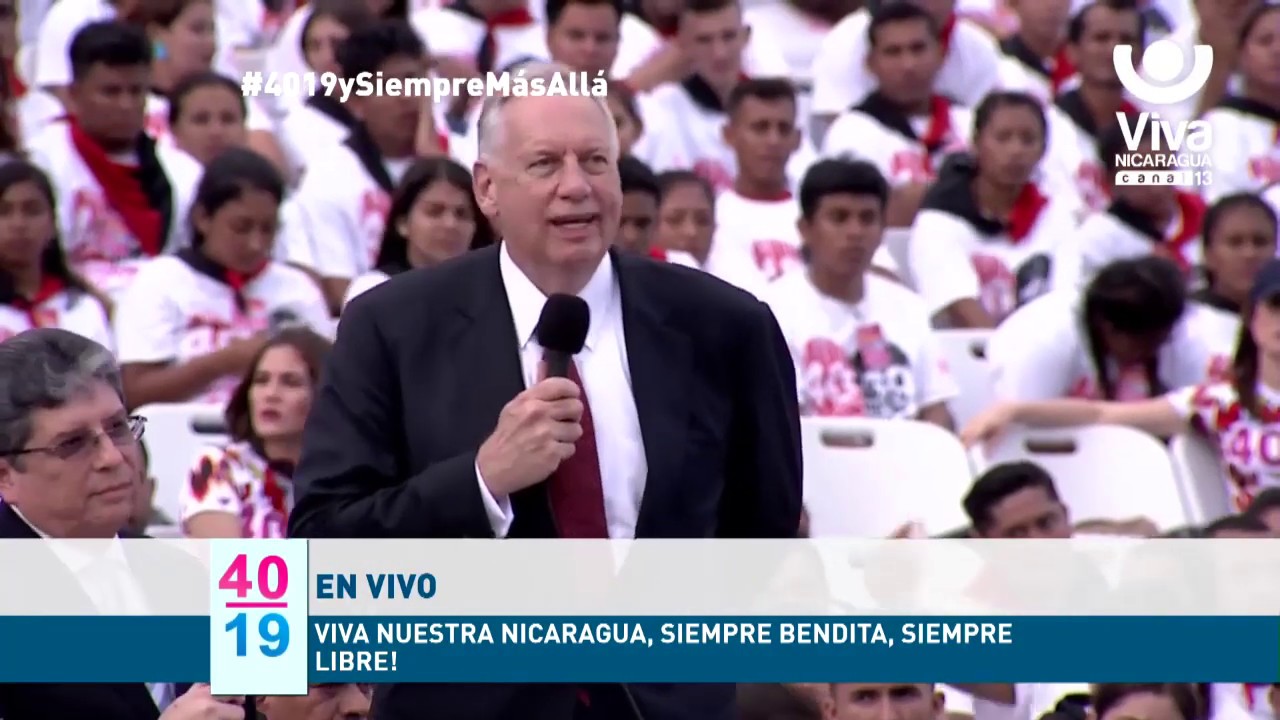 for Ortega and his wife and Vice President Rosario Murillo, are striking in light of the intense criticism of the Ortega-Murillo regime by the U.S. government, which as recently as April expanded sanctions against individuals and institutions associated with the government–not to mention the disconnect between Ortega and Drollinger’s political backgrounds.
In an announcement of the most recent sanctions–against a bank and the son of the president and vice president—the U.S. undersecretary of the Treasury for Terrorism and Financial Intelligence said, “President Ortega, Vice President Murillo, and members of their inner circle continue to engage in blatant corruption, violence, and violations of basic human rights.” The government has also been criticized by international human rights advocates.
The latest U.S. sanctions came about one year after Nicaraguan officials and their allies killed hundreds of people and jailed or drove into exile thousands more in a violent crackdown on political protesters. Ortega, who has faced “persistent accusations” of election fraud, has consolidated his power, changed the constitution to eliminate term limits, and blocked opposition candidates from running for office. In August 2018, the Washington Post reported that “police and masked gunmen working with them have hunted down opposition leaders and protesters by the hundreds” and that many “have been killed, arrested, or disappeared.” In September, the BBC reported that the government had ordered the U.N. Commission on Human Rights to leave the country after it criticized the government’s use of excessive force against protesters and torture of detainees.
This April, the newspaper El País reported that repression under Ortega “has worsened during this year.” It cited a move by police to prevent regime opponents “from mobilizing in the streets of Managua.”
:{But there was no mention of any of that unpleasantness in Drollinger’s }:{ at the July 19 celebration. He began his remarks by bringing greetings from the U.S. }::{House of Representatives Bible study, the Senate Bible study, and “the U.S. White House cabinet member Bible study.”}:
Drollinger pronounced himself “blessed” and “honored” by the invitation to come to Nicaragua for the celebration and to talk about creating Bible studies for government officials. “In the United States of America, we have found amongst our political leaders, that it is essential they have a Bible teacher in their midst,” Drollinger said. He reiterated that point, saying “we have found in our nation, that it’s an important aspect of our government to have a Bible teacher in the midst of our political leaders.”
“Mrs. Vice President has said you are a Christian nation,” he told the crowd. “In America, we view ourselves as a Christian nation. But what is a Christian nation? A Christian nation is a Christian nation to the degree that the people in the nation reflect the attributes of God.”
Drollinger went on to say that it falls to the institution of the church to reflect the mercy, grace, love, patience and kindness of God, adding that other attributes include justice and righteousness, which God has “asked the state to manifest.”
We are personally to manifest the attributes of God’s justice and righteousness in our personal and our national life. And so to the degree that we reflect the love of Christ, to the degree that we reflect the mercy of Christ, to the degree that we reflect the grace of Christ, to the degree that we reflect the patience of Christ, to the degree that we reflect the justice of Christ, to the degree that our nation and our personal lives reflect the righteousness of Christ, is the degree to which we are or are not a Christian nation.
Let’s pause for a moment to remind ourselves what Drollinger and his Capitol Ministries teach about what God wants from public officials. Drollinger believes he has been called by God with a very specific purpose—to convert and “disciple” public officials at every level of government to his biblical worldview. Drollinger teaches public officials that the Bible endorses or mandates right-wing policy positions on economics, immigration, environmental regulation, abortion, LGBTQ equality, and the death penalty. Drollinger teaches that the government’s job is to “quell evil” and that governments and public officials “must send a constant message that sin will be punished.” He also teaches that the Bible promotes distinct gender roles, and he will not allow women to be Bible study leaders.
Drollinger’s teachings are reflected in his handbook for Christian public officials: Oaks in Office: Biblical Essays for Political Leaders. Capitol Ministries says that the Spanish-language edition is soon to be released and “will be used in the discipleship of the nation’s leaders.” Another Drollinger book, “Rebuilding America: The Biblical Blueprint,” has also been translated into Spanish and Portuguese with a new title, “Rebuilding a Nation.”
What might motivate Ortega and Murillo to invite Drollinger to Nicaragua and give him a speaking platform at a major national celebration? It’s a way to publicly wrap themselves in the mantle of Christianity, and perhaps poke a finger in the eye of the U.S. Treasury and State Departments by going over officials’ heads, so to speak, to an American who brags of his access at the highest levels of the U.S. government, including the White House.
This wouldn’t be the first time that Ortega and his wife have used religion for political purposes. A 2018 Washington Post article entitled “From Rebel to Strongman,” noted that when Ortega returned to office in 2006 a decade and a half after he was ousted by voters, he had “amped up his talk of peace and Christian values.” The BBC quoted Ortega saying in 2006, “Jesus Christ is my hero now.” According to Capitol Ministries, Ortega’s invitation said, “We know if the people that God has trusted with the destiny of a nation are born again, our legislators will legislate according to the Bible.”
By one estimate, Nicaragua is about one-half Catholic and one-third evangelical. While Ortega’s opposition to abortion has undoubtedly pleased church leaders from both groups, the government became increasingly hostile to the Catholic Church during the past year over some church leaders’ criticism of his abuses of power.
Foreign Policy reported last August, “In recent weeks, Nicaraguan President Daniel Ortega and forces loyal to him have targeted clergy, profaning and destroying Catholic churches, even killing those who seek refuge within them.” Foreign Policy noted that Vice President Mike Pence had slammed the Nicaraguan government for “virtually waging war on the Catholic Church and those calling for democracy and national dialogue.”
It’s worth noting that Drollinger has seemingly little tolerance for those whose take on Christianity or biblical interpretation differs from his own. He has called the Catholic Church “the world’s largest false religion.”
Given the hostility between the Nicaraguan government and the Catholic Church, the public embrace of Drollinger could be seen as a way for Ortega and Murillo to portray their government as publicly aligned with Christianity in spite of their feud with Catholic leaders.
Indeed, in April, shortly after presidential son Laureano Ortega Murillo was hit with sanctions by the U.S. government, he took part in an evangelical gathering where Managua Mayor Reyna Rueda was given the microphone to thank God for “the peace that reigns in our country.”
The appearance generated some side-eye reporting on the leaders’ newfound enthusiasms. “Until recently, it was normal to see the Ortega Murillo family attending mass,” noted La Presna. “But since the dictatorship declared the Catholic Church as an enemy, they have moved closer to certain evangelical leaders, whose position during the crisis that Nicaragua is going through has been silence.”
La Prensa quoted Eliseo Nunez, a former deputy and member of the Broad Front for Democracy (FAD) portraying the ruling family as unprincipled and willing to do anything to maintain their hold on power. He accused Ortega of “taking advantage of the opportunism of a few pastors” in order to falsely portray all evangelicals as his supporters. There were also some Catholic leaders present at the July 19 celebration, La Presna reported, including a priest who asked Drollinger to intercede with the U.S. government to lift its sanctions.
Capitol Ministries’ own reporting about Drollinger’s public appearance in Nicaragua, which includes a link to the video of his “sermon,” states, “Drollinger explained that in the Bible, God doesn’t talk about ‘Christian nations,’ that only individuals can become Christians by being forgiven for sin through the atoning work of Jesus Christ.” But that’s not accurate, according to the video of Drollinger’s remarks at the political rally. At no point does he “explain” that “God doesn’t talk about ‘Christian nations’”—nor does he talk on that video about “individuals becoming forgiven for sin through the atoning work of Jesus Christ.” [See update below for Capitol Ministries’ explanation.]
“A ‘Christian nation’ per se, doesn’t exist,” continues the Capitol Ministries blog post, “Nations can only be so-called ‘Christian’ to the extent that their laws and people are guided by Christian principles, two of which are righteousness and justice, Drollinger said.
Drollinger did not tell the crowd in Managua that a “Christian nation” doesn’t exist. As noted above, he did say that what makes a nation a Christian nation is that its people and leaders reflect what he calls the attributes of God. He prayed that the people, government officials and country of Nicaragua would reflect the attributes of God, and added, “May God cement these ideas as to what is a Christian nation.”
This apparent misrepresentation* of his public remarks, at least those captured on the video shared by Capitol Ministries itself, may reflect the group’s sensitivity to how researchers and reporters have characterized Drollinger’s positions on church-state separation—he says he supports institutional separation, but not influential separation—and on Christian nationalism, which he has denounced.
Drollinger’s public remarks were translated into Spanish by Oscar Zamora, Capitol Ministries’ Peru-based director for Latin America. Zamora reported that he recently met with Nicaraguan congressional leaders and with General Inspector Jaime Vanegas “who asked me to give a word to almost 200 police officers who were waiting for me at an auditorium next door.” He also said he had met with Managua Mayor Rueda.
After the trip, Capitol Ministries announced that Bible studies for Nicaragua’s cabinet and National Assembly deputies will be led by Arsenio Herrera, who reportedly pastors the largest evangelical church in Managua. Herrera, described as the “spiritual son” of the late American missionary David Spencer, has his own ambitious plans to have a church in every city in the country to go along with his TV ministries. “We are a national church,” he said in 2015. A few years ago he told the Daystar network that he is “believing for the transformation of the nation.” Daystar described him as “working to establish the Kingdom of God in Nicaragua.”
Capitol Ministries says it “has planted ministries in 24 foreign federal capitals and has an objective of establishing 200 ministries in 200 foreign nations in the years to come.” It says that since Zamora’s appointment as Latin America director, “ministries have been birthed in Honduras, Uruguay, Ecuador, Mexico, and Costa Rica.” And it has asked its supporters to pray “for upcoming launches in the federal capitals of Brasilia, Brazil on August 29, and Panama City, Panama on October 22.”
*Update: After this blog post was published, Capitol Ministries contacted Right Wing Watch to let us know that its story about Drollinger’s Nicaragua trip has been edited to clarify that the comments attributed to him that do not appear in the video were meant to be described as things he said later to “explain” the “intent” of his talk in Nicaragua. With this clarification, the CM post no longer appears to report inaccurately what he told the crowd; readers can judge for themselves how closely his actual remarks, which described what makes a nation a Christian nation, matched what Capitol Ministries says was his intent.
==
https://web.stanford.edu/group/arts/nicaragua/discovery_eng/timeline/
keene and shirley lobby?
1980: Political control is shifted to a five-member junta, which rules Nicaragua from 1980 to 1985. Among the junta members is Violeta Chamorro, the widow of the late journalist, Joaquín Chamorro.
1985: FSLN's presidential candidate, Daniel Ortega takes office and declares a state of national emergency, suspending civil rights. The Iran-Contra Affair begins. This U.S.-orchestrated operation secretly channels funds to the Contras soldiers, which is in direct violation with the Boland Amendment.
1988: Nicaragua is a disaster zone, ravaged by civil war and the onslaught of Hurricane Hugo. President Ortega agrees to the first round of peace talks with Contra leaders. A temporary truce is reached in March.
1990: The moderate UNO Coalition candidate, Violeta Chamorro is elected president of Nicaragua. Chamorro improves diplomatic relations with the U.S. At this time, the FSLN party still holds the majority of popular support in Nicaragua.
==
https://www.vox.com/policy-and-politics/2018/11/1/18052666/john-bolton-troika-tyranny
N ational Security Adviser John Bolton’s ultra-hawkish speech on US foreign policy toward Cuba, Venezuela, and Nicaragua scheduled for delivery this afternoon in Miami is, in part, about John Bolton’s longtime ultra-hawkishness. But the timing of the speech is all about cynical politics.
There’s a certain irony in Bolton appealing to a community that fled oppression in Cuba and found prosperity on American shores even as President Donald Trump’s closing argument in the 2018 midterms is demagogic fear-mongering about would-be asylum-seekers from Central America. But Bolton’s charge against the “Troika of Tyranny” encompassing Cuba, Venezuela, and Nicaragua comes today not despite Trump’s anti-immigrant rantings, but precisely because of them.
After all, while an effort to put anti-immigrant themes front and center is a plausible strategy for shoring up the GOP’s position in a boatful of Midwestern races, it’s also a potential problem in the Sunshine State.
Republicans have relied for generations on the loyal support of Cuban-American voters in South Florida, and the risk of alienating them with nonstop politics of racial fear-mongering is very real. The Cuban vote is influential in a troika of South Florida House seats — FL-26 (currently rated as a tossup), FL-27 (currently rated as likely Democratic), and FL-25 (currently rated as leaning Republican). These three seats, all currently GOP-held, would on their own represent more than 10 percent of the gains Democrats need to secure a majority in the House.
Meanwhile, Democrats have also opened up narrow leads in the statewide races for both governor and senator in Florida.
This is all just one slice of the overall midterm battleground. And across the country as a whole, a focus on immigration likely does work in the GOP’s favor — which is exactly why Democrats are trying to keep attention on health care. But there’s enough at stake in Florida that Republicans can’t afford to just write it off, and the anti-Latino themes the president is emphasizing are likely counterproductive in these key races.
A renewed emphasis on the Latin American Cold War to help remind Florida’s Cuban-American population of why they became Republicans in the first place and to try to convince them that the GOP is still the party of Ronald Reagan could be just what the doctor ordered.
It’s unusual to deliver a major foreign policy speech not pegged to any particular external event right in the closing days of a political campaign. But it’s also unusual to be dispatching thousands of soldiers to the border to stop a caravan that is still weeks away from arriving — if it ever does arrive.
Drastic last-minute moves on both fronts — moves that invoke contradictory themes — are confusing and likely unproductive from a foreign policy standpoint. But Trump is not one to put the niceties of the policymaking process over the partisan political needs of the moment. And he’s certainly not one to worry too much about whether or not he is putting forward a coherent agenda regarding the merits of people who flee bleak conditions in Latin America to seek a better life in the United States.
==
- U.S. Imposes Sanctions on Venezuela and Cuba
- U.N. Adopts Resolution to End U.S. Embargo on Cuba for 27th Time
==
==
http://www.risingupwithsonali.com/putting-deadly-nicaragua-protests-into-context/
COURTNEY MORRIS – The US State Department has ordered family members of US Embassy staff in Nicaragua to evacuate the Central American nation. Deadly protests that have claimed at least 27 lives have rocked the nation after President Daniel Ortega announced an overhaul to the social security system.
Among those who died was a journalist who was shot while in the middle of a Facebook live video. Protesters have been firing homemade mortars while police are being accused of heavy handedness. On Friday the government ordered National Army troops to protect government buildings.
Even though President Ortega has said the pension reforms were canceled, a broader disaffection with his presidency has set in and protests have continued.
Founding Fakers by Franklin Foer
http://www.tnr.com/doc.mhtml?i=20030818&s=foer081803
... the Reagan administration, by all accounts, engineered the political leadership of the Contras, falling in love with a series of counterrevolutionaries ... One such leader was Adolfo Calero, who became Washington's Contra of choice in the mid-'80s. After graduating from Notre Dame, Calero had gone on to run Managua's Coca-Cola bottling plant ... and helped launch the Authentic Conservative Party ... when the Sadinisitas seized power ... a life of exile in Miami ... made him an easy sell to American conservatives, a pitch enhanced by Calero's alliance with Republican consultant Roger Stone, from UNITA's lobbying firm. In direct-mail solicitations, Stone compared Calero to Washington at Valley Forge. ...
Nicaragua may let Chinese company build a canal to rival Panama’s
By John Upton
It would take an estimated 11 years and $40 billion to excavate a proposed canal through 130 miles of Nicaragua to link the Atlantic and Pacific oceans, providing shippers with an alternative route to the Panama Canal. And the project would have a huge environmental impact on the country, slicing through rainforest and messing with waterways.
But enough already with boring facts and details. President Daniel Ortega is trying to ram the project through his country's congress faster than Dick Cheney rammed America's Patriot Act through after 9/11.
http://www.thirdworldtraveler.com/Public_Relations/ToxicSludge.html
 Toxic Sludge is Good for You -- The Torturers' Lobby
The Torturers' Lobby, Propaganda, & Public Relations
The Torturers' Lobby & Grenada
The Torturers' Lobby & Nicaragua
The Torturers' Lobby & Central America
Dirty Little Wars (Nicaragua)
exerpted from the book
Toxic Sludge Is Good For You:
Lies, Damn Lies and the Public Relations Industry
"The Torturers' Lobby"
by John Stauber and Sheldon Rampton

Central America's revolutionary movements were too strong to be dislodged with a weekend war like the ones in Grenada and Panama. A longer-term, more sophisticated strategy was needed-one that kept US troops out of the line of fire while enabling the Pentagon to confront "the enemy." The strategy that carried the day in Washington became known as the doctrine of "low-intensity conflict." As Sara Miles observed in her landmark 1986 analysis, Its name comes from its place on the intensity spectrum of warfare which ascends from civil disorders, through classical wars, to nuclear holocaust.... "This kind of conflict is more accurately described as revolutionary and counterrevolutionary warfare," explains Col. John Waghelstein, currently commander of the Army's Seventh Special Forces. He warns that the term "low-intensity" is misleading, as it describes the level of violence strictly from a military viewpoint In fact, Waghelstein argues, this type of conflict involves "political, economic, and psychological warfare, with the military being a distant fourth in many cases. In perhaps the most candid definition given by a US official, Waghelstein declares that low-intensity conflict is total war at the grassroots level."
The 1979 Sandinista revolution, which overthrew the Somoza dictatorship in Nicaragua, rang alarm bells in Washington. The Somoza family had ruled the country for 45 years after coming to power by murdering its enemies. It was notorious for corruption and violence, but it was also considered an unwavering ally of the United States.
Anastasio Somoza was also one of the first Latin American dictators to recognize the value of a good flack, hiring the Mackenzie and McCheyne PR firm in New York, along with lobbyist William Cramer, a former Republican congressman from Florida. In 1978, Somoza's last full year in power, Mackenzie and McCheyne received over $300,000 in fees from the Somoza government. As the revolution gained momentum, Mackenzie and McCheyne partner Ian Mackenzie was dispatched to counter negative reports characterizing the dictator as corrupt, authoritarian, crude, cruel and overweight. "The president is totally different from what people think," Mackenzie said. "He is intelligent, most capable, warm-hearted. He is loyal and strong with his friends, compassionate with his enemies.... By the sheer law of averages, Somoza has to have done some good. Even Mussolini did some good for Italy." As an example of the freedom that existed under the Somoza regime, Mackenzie pointed to Nicaragua's opposition newspaper, La Prensa.
Two months later, La Prensa editor Pedro Joaquin Chamorro was gunned down in the street by Somoza's business partners, triggering a paralyzing nationwide strike demanding Somoza's resignation. Somoza hired a new flack, paying $7,000 per month for the services of Norman L. Wolfson of the New York PR firm of Norman, Lawrence, Patterson & Farrell. As Somoza's air force was decimating Nicaraguan cities with aerial bombings during its final campaign of terror, Wolfson-who didn't speak Spanish complained to who ever would listen that reporters were trying to "knock down" Somoza and had not "been entirely fair." (Wolfson's memoir of his experience, titled "Selling Somoza: The Lost Cause of a PR Man," appeared in the July 20, 1979, issue of William Buckley's conservative National Review, which was on sale at newsstands on July 19, the day Somoza fled the country. In it, Wolfson describes his client as "a spoiled brat who had evolved into middle age, a know-it-all who asked for advice and couldn't take it, a boor, a rude, overbearing bully" who fantasized about crushing the genitals of journalists.)
By the time Somoza fled Nicaragua, his family had accumulated wealth estimated at $400 to $500 million. Meanwhile, half the country's population was illiterate. One in three infants born to poor Nicaraguans died before the age of one. More than 20,000 Nicaraguans suffered from advanced tuberculosis. The victorious Sandinistas launched ambitious, popular vaccination and education programs. They also broke new ground in foreign policy, seeking alliances with Cuba and the Soviet Union. A line in the country's new national anthem-"We fight the Yankees, enemies of humanity"-showed just how far they intended to take Nicaragua from the Somoza days of dependence and fealty to the United States.
The "low-intensity" strategy aimed at undermining the Sandinistas was an ambitious concept, uniting Vietnam-era counterinsurgency with civic action initiatives, psychological warfare, public relations activities and civilian "development assistance" projects traditionally considered beyond the sphere of military responsibilities. On the economic level, the US pressured international financial institutions to cut off loans to Nicaragua and imposed a debilitating trade embargo. On the political front, the US promoted carefully stage-managed elections in El Salvador and Honduras. Psychological operations against Nicaragua ranged from sabotage attacks to radio propaganda broadcasts. On the military level, US strategy was designed to avoid the commitment of US ground troops, while doing everything possible to create the fear of a US invasion.
The US also brought together Somoza's dispersed National Guard and reorganized it into what became known as the contra army. At worst the contras had no political leadership, so the White House recruited a group of disaffected Nicaraguan businessmen and scripted speeches to help them pose as the contras' "civilian leadership." The civilian leaders included Edgar Chamorro, a Managua advertising executive who later became disaffected with the cause. Chamorro complained bitterly in his 1987 book, Packaging the Contras: A Case of CIA Disinformation, that the US had used him as a civilian figurehead for an army over which he had no real control.
The CIA paid Chamorro a salary of $2,000 per month plus expenses for his work, which included bribing Honduran journalists and broadcasters to write and speak favorably about the contras and to attack the Nicaraguan government and call for its overthrow. "Approximately 15 Honduran journalists and broadcasters were on the CIA's payroll, and our influence was thereby extended to every major Honduran newspaper and radio and television station," Chamorro said.
In 1983, the Reagan Administration began a series of major military maneuvers in Honduras, coordinated with contra units and the Salvadoran military. The maneuvers were carefully staged to create the impression that they were preludes to a US invasion of Nicaragua. In reality, as Miles observed, "The maneuvers were not a preparation or cover for the war: they were the embodiment of the war. . . Fears that the Administration may be threatening to invade have been an integral part of the plan at the psychological level. . . The first goal . . . was to squeeze the economy by forcing a massive diversion of resources into defense.... Next came psychological operations to feed on the conflict: leaflets distributed throughout the country urged Nicaraguan youths to escape the "totalitarian Marxist draft; radio stations of the Nicaraguan Democratic Force (FDN) in Honduras urged revolt against 'the communists who spend our national treasure on bullets instead of food."
The Reagan administration faced a scandal in 1984 with the disclosure that the CIA had produced a training manual for the contras titled Psychological Operations in Guerrilla Warfare. The strategy outlined in the text include recommendations for selective assassination of Nicaraguan government officials. Critics charged the CIA with encouraging indiscriminate assassination of civilians. Miles observed, however, that the actual intent of the document was more subtle: "There is a conscious effort to reduce the presence of the civilian government, to remove successful social programs and the ideological influence that comes with them.... In practice, this means the targeted torture and assassination of teachers, health workers, agricultural technicians and their collaborators in the community This is not, as many critics charge, "indiscriminate violence against civilians." . . . Rather, the violence is part of a logical and systematic policy, and reflects the changing pattern of the war.
from the book:
Toxic Sludge Is Good For You:
Lies, Damn Lies and the Public Relations Industry