Decision Support in Context
[Dave Snowden 2022-12-22]
Separating Situational assessment and decision-making
- In the Cynefin eco-system of naturalizing sense-making, situational assessment has to be divorced as far as possible from any determination of future actions
- Humans by their nature generally assess a situation based on their preference for action
- One preference is to use dichotomies
- Consider the two-column tables with past sin vilified by exaggeration on the left, and future virtue idealized on the right
- Seeing action as “either/or” can miss the “both/and”
- Some prefer that assessments should always be formal and explicit so as to be seen as transparent and above board
- But often the process continues informally such as a conversation held during a coffee break or a quick chat in the hallway or restroom
- These discussions are able to resolve conflicts that enable a decision to be made
Decision by Consent
- Decision by unilateral authority tends to poor quality decisions with little buy-in, while a decision by consensus simply takes too long
- Jason Yip proposes that decision by consent is the best compromise between those.
- Consent cannot just be verbal, it has to translate into action
- So we need to add a dimension between the ostensive and the real, between apparent and real consent to the mix
Time and timeliness
- In some contexts, the absolute authority will gain rapid consensus and consent
- In others, one or other or neither
- Jason makes the point that reversibility is a factor
- If you can step back and reverse something then it’s safe-to-fail
- If you can’t then you need to hold the decision as long as possible (i.e., liminality)
- He talks about the “last responsible moment” from the Poppendieck book Implementing Lean Software Development
- An EUFG clear rule is about taking decisive decisions in a crisis not to resolve the problem, but to create sufficient stability to allow new options and possibilities to emerge
- Time, of course, is linked to consequence, and there its not just about what we do, its also about what we don’t do
- A sin of omission is as mortal as one of commission
Preferred decision styles
- Actors in the DM process have a preferred decision-making style
- As people become powerful it is increasingly unlikely they will hear dissenting viewpoints, but it is increasingly necessary that they should
- To achieve consent, ideally every person would be aware of and respect different styles
Switch from DM Behaviour to DM Process with methods & tools
- While the preceding has been primarily about human behaviour, what we really need to think about people acting collectively through process, not idealized behavioural characteristics of individuals or leaders
- For background info on the k types, read Rethinking Known-Unknown-Unknowable matrix
- 3-by-3 is very much a speculation, a way of talking about things
- It’s not something I would fight on the barricades to preserve
- Having three categories is just for ease of communication
- Also still playing with it and made some changes as a result of the social media exchanges
- Changed Ontology* to What can be known by the organisation
- Not the same thing as known to others
- “can be known” is the key phrase
- It is about the nature of reality
- Epistemology* became What the decision-maker is aware of and/or is able to act on
- The able to act on qualification as a lot of senior decision-making is political in nature
- Each axis is a spectrum
- In practice the boundaries are fluid and blurred
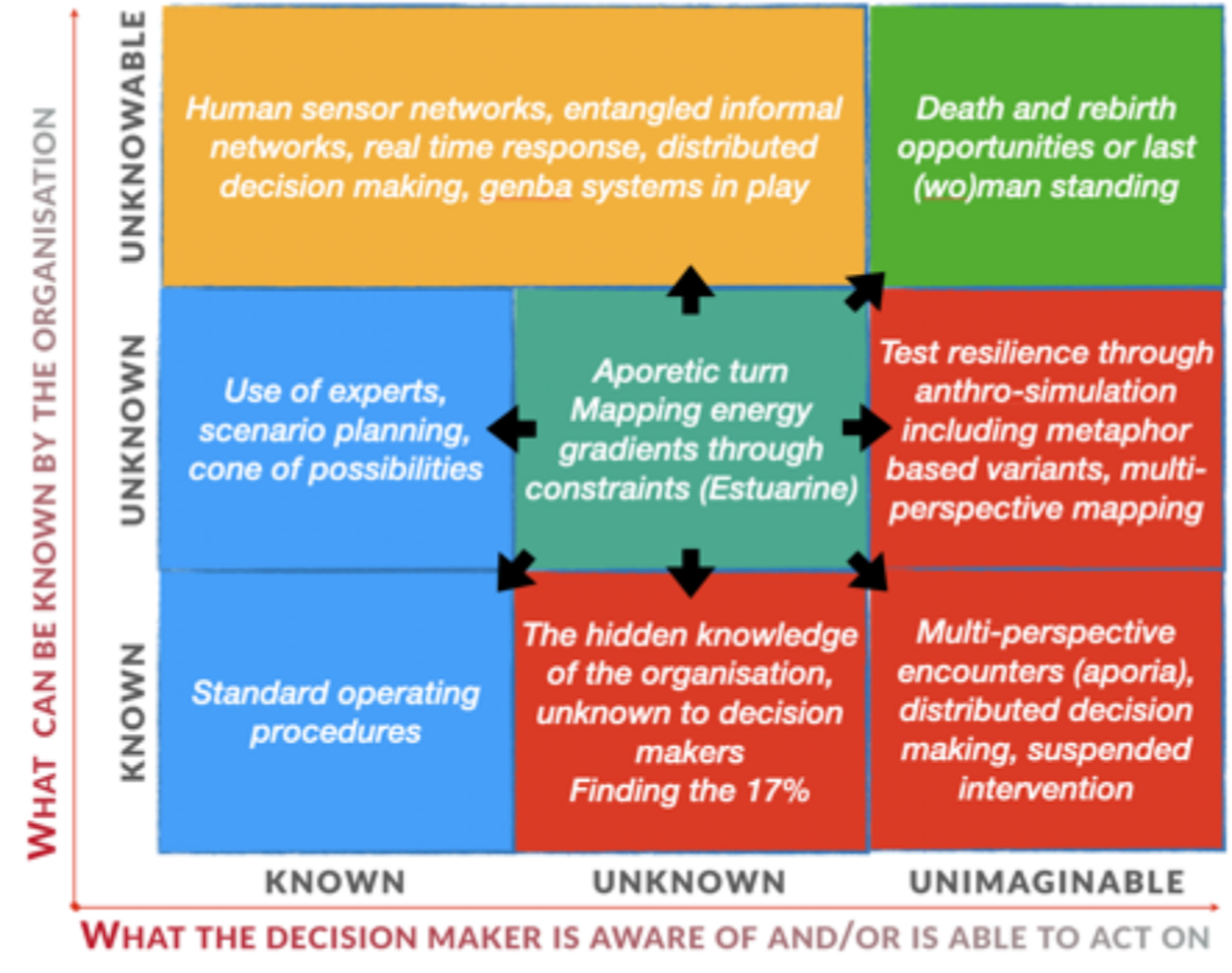
- We can start to make some statements about methods and tools to improve decision making and do so by colour
BLUE
- Represent the two Ordered domains of Cynefin
- Known Known (Clear domain)
- .20 Known Unknown (Complicated domain)
- Methods and tools are well-known and well-documented
- Why Scenario Planning is placed here
- Reality of scenario creation is limited in its effectiveness to what people with credibility can imagine and take action from as a result
- In effect it is more inductive than abductive
- More dependent on past knowledge that is appropriate for high levels of uncertainty
- But otherwise, there is not much to be said about these two areas
- They are part and parcel of Business as Usual (BAU)
ORANGE
- Dealing with things that are Unknowable until they happen has become easier in recent years
- Solution is similar to where the issue is Known or Unknown to decision-makers
- No need to worry, hence combining the boxes
- Major area of our work on Resilience
- All about creating an ecosystem that can respond to the unknowable and that involves fast feedback loops and decision-making at the point of need without reference back up the chain of command
- A lot of the EUFG is about requiring human sensor networks, stimulation of informal networks, real-time response capability
- Methods include Entangled Trios
- Tools include the Genba version of SenseMaker®
GREEN
- Dull green (middle) is the area of Unknown Unknowns (Complex domain)
- All about changing your understanding of the situation by changing the dispositional state of the system and the propensities of its modulators so you can navigate it safely
- EUFG describes this as the Aporetic turn, the point at which you realize that you have to think anew and act anew in order to even understand the problem
- Aporetic turn refers to the method of intentionally creating doubt and paradox, so we may explore the many contrasting truths present in this space
- That allows you to recognize different issues and approaches and there will be several, hence all the arrows
- Estuarine Mapping method is also designed for this as it doesn’t say what you should do, it tells you what the energy gradients are
- By taking action to reduce the time or energy to modify constraints you allow novel solutions to emerge
- Red/Blue teaming of the energy/time map and comparison of the two can also provide insight
- Bright green (top right) area is where the Unknowable meets the Unimaginable
-
- Position where the business is failing (nearing tipping point of no return)
- Holding on no longer has value
- Just need to let go and allow something new to emerge
- May include a personal decision to leave the organization
- Alternately could be emergence of a serendipitous opportunity
- May include a personal decision to hang around and ride the Purple loop
RED
- Politics start to creep in and it’s not an area you can address by admonishing leaders to be servant, enterprising, open to novelty, etc.
- Unknown known
- The things known lower down in the organisation of which Senior Management is unaware
- Often filtered out for psychological safety fears (telling powerful people what they don’t want to hear rarely goes well)
- Knowledge Mapping process maps the knowledge, especially the tacit knowledge of the organisation to things that are keeping decision-makers awake at night
- Another process is using human sensor networks to create real-time awareness of people who are thinking differently – the 17% who have seen a gorilla that others can imagine could exist
- Unimaginable Known
- A few people are aware of a significant event potentially emerging but it is so far-reaching that it challenges the organization’s ability to fully comprehend its implications or imagine its happening
- One way to escape this red area is to change an Unimaginable into a Imagined
- Method is to probe by launching multiple small nudges to raise
- Favourable consequence is a shift to the A/C domain
- If Distributing decision-making is also a factor which can include an agreement not to intervene for a period to “see what develops”
- Unimaginable Unknown
- Everyone is in the same vessel of Ignorance
- Key is to test org resilience and ability to survive
- Methods include multi-perspective mapping using the SenseMaker® MassSense
- Tools for experimenting, sense-making, and learning