Habeas Corpus
See also: Void Judgment ; Kangaroo Court; Jurisdiction; Due Process of Law




Literally, have the body, or the body of the crime (injury).
1. The right of the Accused to be informed of the nature and cause of an arrest, to confront the injured party, and to examine him concerning the injury.
2. The privilege of another to request a public officer, who is holding someone under arrest, to bring forth the prisoner and answer to the lawfulness of the arrest.
3. Legal action, through which a prisoner can be released from unlawful detention.
If you do a plea bargain:
- You can never appeal
- It is NOT a void Judgment
- You can not do a Habeas Corpus
Anyone can do a habeas corpus for anyone else. Any sovereign can come to the aid of another sovereign.
According to the U.S. Constitution, habeas corpus is referred to as a "privilege" rather than a right. Specifically, Article I, Section 9, Clause 2 of the Constitution states:"The Privilege of the Writ of Habeas Corpus shall not be suspended, unless when in Cases of Rebellion or Invasion the public Safety may require it."24
This clause is known as the Suspension Clause. While the Constitution uses the term "privilege," the interpretation and application of habeas corpus in U.S. law has evolved over time:
- The Constitution does not explicitly create a right to habeas corpus, but rather prohibits its suspension except under specific circumstances 4.
- Federal statutes have provided federal courts with the authority to grant habeas relief, expanding its scope over time 4.
- The Supreme Court has interpreted the Suspension Clause as affirmatively guaranteeing some form of habeas corpus review. In Boumediene v. Bush (2008), the Court held that the Clause does not simply restrain Congress's ability to suspend existing habeas statutes but affirmatively guarantees prisoners a forum to challenge the legality of their detention 2.
- Habeas corpus is often referred to as a fundamental instrument for safeguarding individual freedom against arbitrary state action, despite its constitutional designation as a "privilege" 4.
- The right to petition for a writ of habeas corpus is considered one of the most important human rights in the United States 5.
So while the Constitution technically refers to habeas corpus as a "privilege," its treatment in U.S. law and jurisprudence has elevated it to a status more akin to a fundamental right, albeit one that can be suspended under certain extreme circumstances.
Legal Principle Behind Suspension of Habeas Corpus:
The principle behind the suspension of habeas corpus stems from the need to prioritize public safety or national security during extraordinary circumstances, such as war, rebellion, or severe public emergency. Habeas corpus, Latin for "you shall have the body," is a fundamental legal right that protects individuals from unlawful or indefinite detention by requiring authorities to justify the detention before a court. Suspension of this right is constitutionally permitted in the U.S. under Article I, Section 9, Clause 2, which states: "The Privilege of the Writ of Habeas Corpus shall not be suspended, unless when in Cases of Rebellion or Invasion the public Safety may require it." This clause reflects a balance between individual liberty and governmental authority, allowing temporary suspension only in extreme situations where normal judicial processes might undermine critical state functions.
Historically, suspensions have been rare and controversial, often justified by the executive branch (with or without legislative approval) to detain individuals deemed threats without immediate judicial oversight. Examples include President Lincoln's suspension during the Civil War and measures during World War II. The principle hinges on the idea that extraordinary times may necessitate extraordinary measures, but it is constrained by the requirement that such suspensions be temporary and justified by clear exigency.
Effect on Someone Charged with a Crime:
When habeas corpus is suspended, the effects on someone charged with a crime (or detained without formal charges) are profound:
Detention Without Judicial Review: The individual can be held indefinitely without the right to challenge the legality of their detention in court. Normally, habeas corpus allows a detainee to petition a judge to review whether their imprisonment is lawful (e.g., based on sufficient evidence or proper procedure). Suspension removes this safeguard, meaning the government can detain someone without presenting evidence or formal charges.
Loss of Due Process Protections: Suspension often accompanies broader emergency powers, which may weaken other due process rights, such as the right to a speedy trial or access to counsel. For someone charged with a crime, this could mean prolonged pre-trial detention without the ability to contest the charges or conditions of confinement.
Potential for Arbitrary Detention: Without habeas corpus, the risk of arbitrary or politically motivated detention increases. An individual could be held based on suspicion, association, or vague allegations (e.g., as an "enemy combatant" in wartime) without a mechanism to challenge the basis of their detention.
Limited Recourse: While other legal remedies (e.g., civil lawsuits) might theoretically remain, the practical ability to pursue them is often curtailed in emergencies, especially if courts defer to executive authority or if the detainee lacks access to legal representation.
Qualifications and Context:
Suspension does not negate all rights; for example, constitutional protections like the prohibition on ex post facto laws or the right to a jury trial (where applicable) may still apply unless separately curtailed.
In practice, suspensions are often limited to specific contexts (e.g., wartime detainees) and may not affect all criminal defendants broadly.
Courts have historically scrutinized suspensions post hoc, as seen in cases like Ex parte Milligan (1866), where the Supreme Court ruled that habeas corpus cannot be suspended for civilians where civil courts remain operational.
Modern legal frameworks, such as post-9/11 detainee policies, show that suspensions or their equivalents (e.g., denying habeas to "unlawful combatants") remain contentious and subject to legal challenges when normal judicial processes are available.
In summary, suspending habeas corpus is grounded in the constitutional allowance for emergency measures but drastically undermines an individual's ability to contest detention, leaving those charged with crimes vulnerable to prolonged, unreviewable incarceration.
State Prisoner Self Help Packet:
A federal petition for writ of habeas corpus under 28 U.S.C. § 2254 is used by a (1) state prisoner (2) being held in state custody (3) to challenge the validity of a state criminal conviction or sentence (4) for the purpose of obtaining release from custody.
RULES GOVERNING SECTION 2254 CASES IN THE UNITED STATES
Videos
Evoking habeas corpus, closing statements
This is an “extraordinary” writ. Words that anyone in jail or prison want to hear are : habeas corpus, to explain why its holding you. It means “have the body, or produce the body”.
Habeas corpus ad subjiciendum Dates from the 17th century. A writ directed to someone detaining another person and commanding that the detainee be brought to court, usually shortened to habeas corpus It’s a fundamental protection against executive punishment without due process.
The Bill of Rights were amendments after the Constitution was written. However, when you look at the Constitution itself, its the only right listed directly in the Constitution:
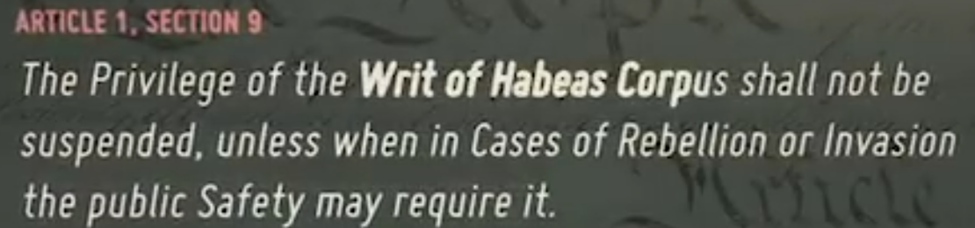
One reason its in the Constitution instead of the Bill of Rights is, its more about the structure of government and to reinforce the Separation of Powers / Balance of Power to make sure all three branches cooperate in order to deny someone liberty. Even after the Constitution was ratified, the framers wanted to spell out that the habeas right should be protected by the judiciary. The very first law passed by the very first congress gave the courts the power the hear habeas petitions, the Judiciary Act of 1789, Without habeas this country could have secret detentions in which people would disappear, you wouldn’t know why or where they’d gone. Maybe you would never see them again.
The American founders said we need to check the abuse of power by dividing power among the tree branches. In order to deprive someone of their rights, all three branches had to agree. Without habeas, the executive branch could just go around and round up its enemies without any accountability and lock them up forever, no one would even know.
It goes back to at least the Magna Carta.
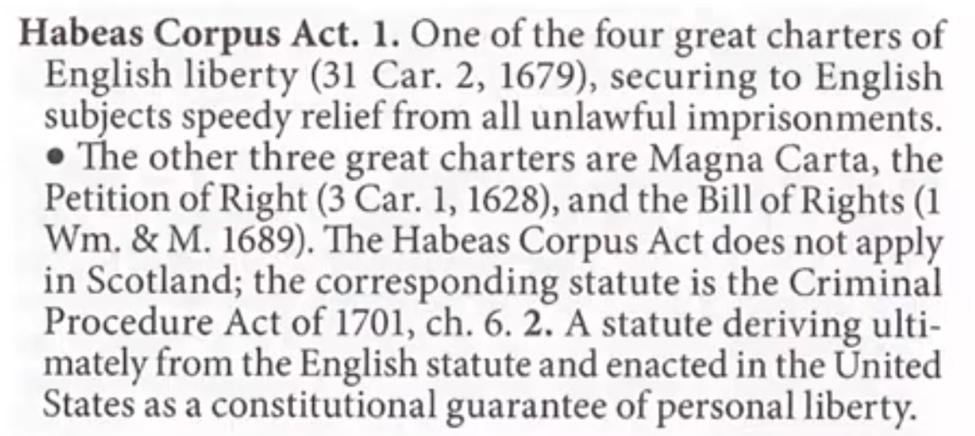
While the King’s power was limited on British soil, colonists in America were routinely locked up by the King’s military without a hearing or trial. To the founders this wasn’t just a liberty but a power to limit the executive branch. The executive can lock you up but you have the right to challenge the executive in court. Congress has the power to suspend habeas corpus in cases of rebellion or invasion (the suspension clause). Invaders don’t enjoy the right of Habeas Corpus because they don’t belong here.
The basic premise behind habeas corpus is that you cannot be held against your will without just cause. To put it another way, you cannot be jailed if there are no charges against you. If you are being held, and you demand it, the courts must issue a writ of habeas corpus, which forces those holding you to answer as to why. If there is no good or compelling reason, the court must set you free. It is important to note that of all the civil liberties we take for granted today as a part of the Bill of Rights, the importance of habeas corpus is illustrated by the fact that it was the sole liberty thought important enough to be included in the original text of the Constitution.
It’s a writ employed to bring a person before a court, most frequently to ensure that the person’s imprisonment or detention is not illegal. In addition to being used to test the legality of an arrest or commitment, the writ may be used to obtain a judicial review of (1) the regularity of the extradition process, (2) the right to or amount of bail, or (3) the jurisdiction of a court that has imposed a criminal sentence.
Equity was merged with common law to eliminate habeas corpus. What was going on in England was you had chancery, you had the high court, you had superior court, supreme court, you had all the courts they were making good money operating courts. Habeas corpus orders were flying all over England, it was being used for venue shopping. So, the solution was to get a case out of chancery and over to equity, to the King’s Bench and the High Court. The position became, “If you want to be a judge you’re going to have to hear equity, maritime, everything that’s before you. No more shuffling these people around, no more venue shopping (Forum Shopping). You’re not going to cut a better deal somewhere else.
U.S. Constitution, Article 1, Section 9, Clause 2,
The Privilege of the Writ of Habeas Corpus shall not be suspended, unless when in Cases of Rebellion or Invasion the public Safety may require it.
Arkansas Constitution: Article 2, Sec. 11
The privilege of the writ of habeas corpus shall not be suspended, except by the General Assembly, in case of rebellion, insurrection or invasion, when the public safety may require it.
This refers to Habeas Corpus as a privilege, its not a privilege its a right. The right of Habeas Corpus stems from the 6th Amendment, due process. The court may not usurp a right.
Federal Form “AO 242” , this is a statutory form required for federal cases. In civil cases write your own non-statutory habeas corpus.
History of Suspension of Habeas Corpus:
1861:
Lincoln Suspends Writ Of Habeas Corpus In Md.
Citing the threat to the Union posed by Confederate spies, President Abraham Lincoln suspends the writ of habeas corpus in Maryland and parts of Midwestern states. Habeas corpus is the right to challenge the lawfulness of a prisoner’s detention before a court in a timely manner. The suspension allows suspected spies to be held indefinitely without formal charges. Chief Justice, Roger Taney, ruled that Lincoln had violated the Constitution. He said the suspension clause is in Article 1, which spells out the powers of congress. Habeas can only be suspended by an act of congress and not the president and the prisoners had to appear in court. Lincoln ignored Taney.
Lincoln Suspends Habeas Corpus For All States
Citing threats to the Union, President Abraham Lincoln suspends the writ of habeas corpus for all states. Article I, Section 9 - Suspension Clause of the Constitution permits such a suspension only “when in cases of rebellion or invasion the public safety may require it.” (Habeas corpus is Latin for “You have the body,” and the writ is used to challenge the legality of a prisoner’s detention.) Although the U.S. Supreme Court later will rule that only Congress has the power to suspend the writ, Lincoln ignores the high court.
Chief Justice Rejects Lincoln’s Right To Suspend Habeas Corpus
John Merryman is a Maryland citizen who supports the Confederates. Charged with assisting the rebellion, he is arrested. Chief Justice Roger Taney issues a writ of habeas corpus, requiring the military commander to bring Merryman before the U.S. Supreme Court. The commander refuses because of President Abraham Lincoln’s executive order suspending habeas corpus (a legal procedure through which a prisoner can challenge his detention).
Taney writes an opinion condemning Lincoln’s order as unconstitutional and declaring that Merryman is free. Taney sends a copy of his opinion to Lincoln, who ignores it and later goes before Congress to defend his right to suspend habeas corpus.
World War II
Another president, Franklin D. Roosevelt, sought to suspend Habeas corpus, afraid of a Japanese attack on the west coast. He ordered 120,000 people of Japanese descent rounded up, 2/3 were American citizens, and put in internment camps for fear they might be disloyal. There were no hearings, no chance to appeal being locked up. A few challenged that scheme: Hirabayashi vs U.S. ; Korematsu vs U.S. . It went to the Supreme Court which said this was something the federal government was entitled to do during war. Justices have given the government the benefit of the doubt in times of war because the president gets briefings about national security, updates on battles and locations of the enemy. Since the internments, times have changed. The justices learned that the government misled it during the war so the court has pushed the president to protect civil liberties while also protecting the nation. The court has become open to more sophisticated solutions. Legal solutions giving the president the authority to do quite a lot, but don’t give the president as commander in chief, to run roughshod over civil rights guaranteed by the Constitution. That’s what happened after 9/11.
9/11
The Guantanamo Cases:
History shows that when the nation is at war, feeling that its security is at risk, and the people are afraid, the balance between national security and rights guaranteed by the Constitution can falter. The Constitution is at its most vulnerable when we’re in a crisis.
Associate Justice, Supreme Court, Anthony Kennedy: “We have to remember that the law and the Constitution are for hard times as well as good times. Our liberties are most in danger in times of crisis.”
Associate Justice, Supreme Court, Stephen G. Breyer: “The Constitution applies in wartime as in peacetime.... and, after all, that’s what we’re fighting for, the constitutional values that that constitution embodies.”
Those values include fundamental rights guaranteed by the Constitution. But who guarantees them, especially in a time of war?
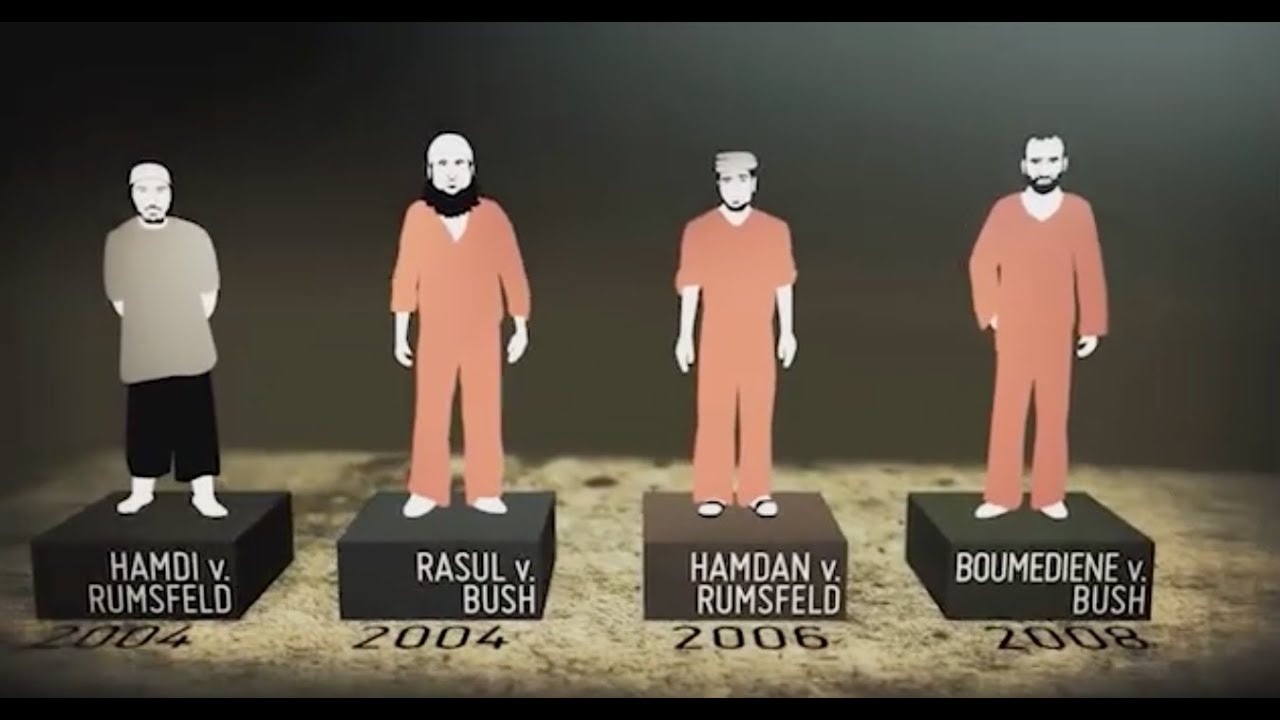
After the attacks of 9/11, as America fought two wars abroad, all three branches of the federal government fought over the balance between national security and civil liberties. The fight escalated over four Supreme Court cases; Hamdi v Rumsfeld ; Rasul v. Bush ; Hamdan v. Rumsfeld ; Boumediene v. Bush. When the political branches don’t protect people’s rights in the time of war, the duty falls to the courts and if they don’t do it, no one will. At the heart of it all was the right of Habeas Corpus.
After the attacks on 9/11 Bush declared a general war on terror. This was not a conventional war fought on a battlefield. Bush was going after terrorists all over the world and congress supported him. Congress passed a resolution to authorize the military to attack, hunt down, capture and kill those responsible. But there was a problem, its not always clear if the person you are dealing with is a terrorist or not. In most cases in our judicial system its not enough to say we think this person is dangerous and might do something bad in the future. There must be proof they have broken the law before you can detain them.
The executive branch announced it was going to label “war on terror” prisons, “enemy combatants” and limit their rights. No habeas corpus, no access to the judiciary. The president wanted to hold them as long as he thought necessary and didn’t want them to be able to challenge his authority in court.
The Bush administration took the position they could label someone an “enemy combatant” and by doing so, deprive them of the most foundational rights including the writ of habeas corpus.
The first two Guantanamo cases were decided on the same day. In Hamdi v Rumsfeld Hamdi was a U.S. citizen arrested in Afghanistan and held without charges in the United States. He wasn’t allowed to have a lawyer. His dad filed a habeas corpus to petition to get him into court where the Constitution gives him due process rights.
Several things are needed for someone to try to demonstrate innocence. You’d need someone who isn’t committed to either side (due process). You’d need the federal government to tell them “here’s why we think you’re a terrorist” ; the defendant needs an opportunity to rebut those charges ; they might need to call witnesses and a lawyer would be helpful.
The government argued that calling Hamdi an enemy combatant was enough to hold him and limit his due process rights during wartime. The Supreme Court ruled in favor of Hamdi. A U.S. citizen, even one labeled an enemy combatant, is entitled to due process guaranteed by the Constitution. Associate justice, Sandra Day O’Connor wrote “a state of war is not a blank check.”
In Rasul v. Bush Rasul was not a U.S. citizen and he was not being held on U.S. soil, but in Guantanamo Bay prison in Cuba. Guantanamo is technically part of the sovereign territory of Cuba. Its a U.S. Naval Base on the island of Cuba. We know from those inside the administration, the reason they chose Guantanamo was to prevent the federal courts from having access to habeas corpus jurisdiction on the theory that habeas corpus jurisdiction for the federal government jurisdiction only reaches as far as American territory. One attorney said it was the legal equivalent of outer space. Rasul argued that the federal government controlled everything about Guantanamo so it had to follow the habeas laws of the United States. The Supreme Court agreed and said Guantanamo is within the jurisdiction of the United States so the president can’t issue an order that breaks the law.
The court says habeas has no territorial limit and applies to non-US citizens in Guantanamo. But the political branches didn’t back down. Congress backed the president and passed a new law, The Detainee Treatment Act of 2005. It said enemy combatants could not be tried in federal courts and courts cannot hear cases brought by foreign Guantanamo detainees. Even the Supreme Court, even the case it was scheduled to hear, Hamdan v. Rumsfeld .Ahmed Hamdan, Osama bin Laden's former chauffeur. Hamdan was captured by Afghan forces and imprisoned by the U.S. military in Guantanamo Bay. The U.S. government classified him an “unprivileged belligerent”. The question here was, who can try him? Bush insisted he had the power to create military commissions that could try enemy combatants in secret, with fewer rights. Bush said he gets to set up the process, he gets to enforce it, he gets to rule on whether or not its constitutional and the federal court should have no business reviewing what he’s doing.
This case was taken to the Supreme Court, it was about the simple idea, that one man say so, no matter how wise he is, is not enough in the eyes of the American system to change the ground rules and deprive people of their most basic rights.
This time the court didn’t back down. It said it could hear the case. It said the president’s military commissions were a violation of the separation of powers because they were doing things beyond what congress said they could. The court ruled that the presidents military commissions did not meet the standard of the Military Code of Military Justice and even violated international law. It said that the military trials the president set up in Guantanamo Bay violated the Constitutions guarantee of separation of powers. The court said the prisoners at Guantanmo Bay had the right to see the evidence against them, had the right to attend their own trials and appeals had to be heard outside of the executive branch. It also reminded the president it must obey the law. It struck down the military commissions and said military tribunals would have to be set up that protect the rights the law guarantees.
For the president and congress, this was the last straw. Congress said, “Ok, under the statue we had in place the court has determined both the citizen and noncitizen in Guantanamo get habeas review. But we don’t want that to be the case so we’ll change the statute.”
Congress passed the S.3930 Military Commissions Act of 2006 which sets parameters for holding and interrogating detainees and for a court system to try them, as a direct response to the court’s Hamdan decision. It denied enemy combatants at Guantanamo habeas in any federal court in all cases without exception. Scholars called this one of the most important war time decisions of the last 50 years.
Boumediene v. Bush was a case brought by another group of detainees at Guantanamo Bay, including Boumediene, arguing that they were being held unlawfully. This claim was that the new statute that said that people at Guantanamo don’t get habeas is unconstitutional. The question was, do they have a constitutional right? The court had to decide if the congress and president had the right to write a new law denying habeas, or is habeas a constitutional guarantee, even for enemy combatants who are not U.S. citizens held at Guantanamo. The court said, yes, there is a constitutional right. The procedures that the president and congress set up aren’t adequate so these people must be given the right to petition for habeas corpus.
This time the court put its foot down. Writing for a 5 to 4 majority, Justice Anthony Kennedy told the president and congress that they can’t have court substitutes for this fundamental right. Kennedy wrote, “The laws and Constitution are designed to survive and remain in force, in extraordinary times.” This time the court demanded a balance between national security and civil liberties. After years spent at Guantanamo each of these men saw their charges dropped because of the right of habeas corpus.
The USA PATRIOT Act of 2001 includes an application for a writ of habeas corpus. The 2005 USA PATRIOT Improvement and Reauthorization Act states that a habeas corpus proceeding is not pending until the application is filed.
The USA PATRIOT Act does not suspend habeas corpus. It also does not apply to education records subject to a court order.
8 U.S. Code § 1226a covers mandatory detention of suspected terrorists, habeas corpus, and judicial review.
Arguments to bring up in Habeas Corpus:
- You can do it
- A “Best Friend” can do it
- Handwritten is better if you are in their jail. There should be handwriting in there because that’s common law. “Non-statutory” should be written in to the Habeas Corpus.
- All you really need is 1 good point of law
- Show that you were denied due process
- When you are denied due process, the court loses subject matter jurisdiction
- When they lose jurisdiction, it becomes a void judgment
- If you are in their jail because of a void judgment, the remedy is Habeas corpus
- It is NON discretionary - A person affected by both a void or voidable order has the right – ex debito justitiae – to have the order set aside (which means that the Court does not have discretion to refuse to set aside the order or to go into the merits of the case) (Lord Green in Craig v Kanssen (1943) KB 256
(see Kangaroo Courts)
When the kangaroo court denies Due Process of Law, its a nullity. This is used for habeas corpus.
“Not every action by any judge is in exercise of his judicial function. It is not a judicial function for a Judge to commit an intentional tort even though the tort occurs in the Courthouse, when a judge acts as a Trespasser of the Law, when a judge does not follow the law, the judge loses subject matter jurisdiction and the Judge’s orders are void, of no legal force of effect.” Yates vs. Village of Hoffman Estates
“Where a court failed to observe safeguards, it amounts to denial of due process of law, court is deprived of juris.” Merritt v. Hunter, C.A. Kansas 170 F2d 738
When a court denies Due Process of Law, it loses jurisdiction.
“Where a court failed to observe safeguards, it amounts to denial of due process of law, court is deprived of juris.” Merritt v. Hunter, C.A. Kansas 170 F2d 738
“Where there is no jurisdiction there is no judge; the proceeding is as nothing. Such has been the law from the days of the Marshalsea, 10 Coke 68; also Bradley v Fisher, 13 Wall 335, 352.” Manning v. Ketcham , 58 F.2d 948
The judgment of conviction pronounced by court without jurisdiction is void, and one imprisoned thereunder may obtain release by habeas corpus. Johnson v. Lewis, 144 U.S. 653
A computer generated warrant that is not signed by a judge is not a lawful fourth amendment warrant and this can be used as an argument in habeas corpus. (see Warrant)
Example of arguments used in a successful habeas corpus:
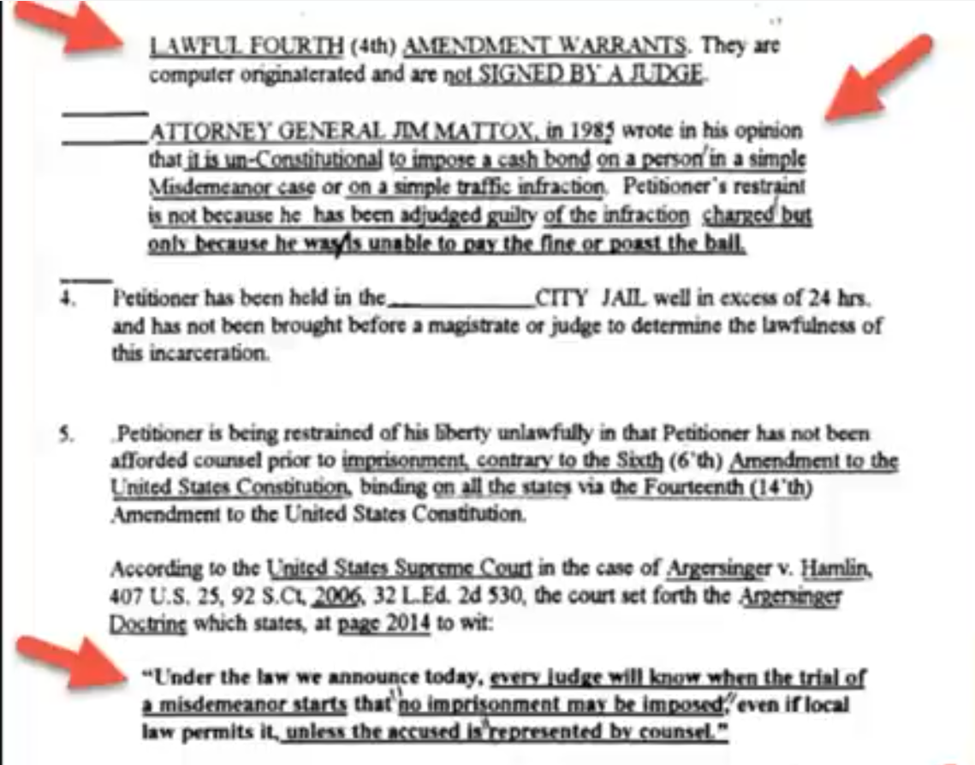
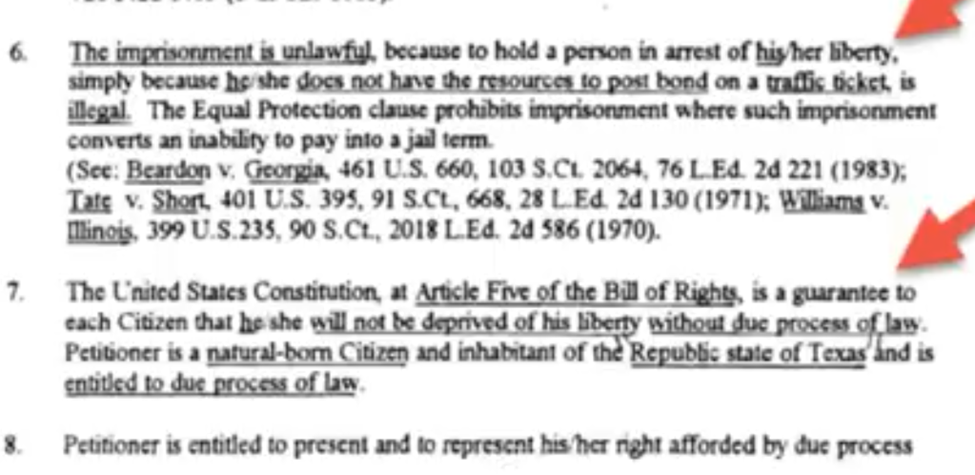
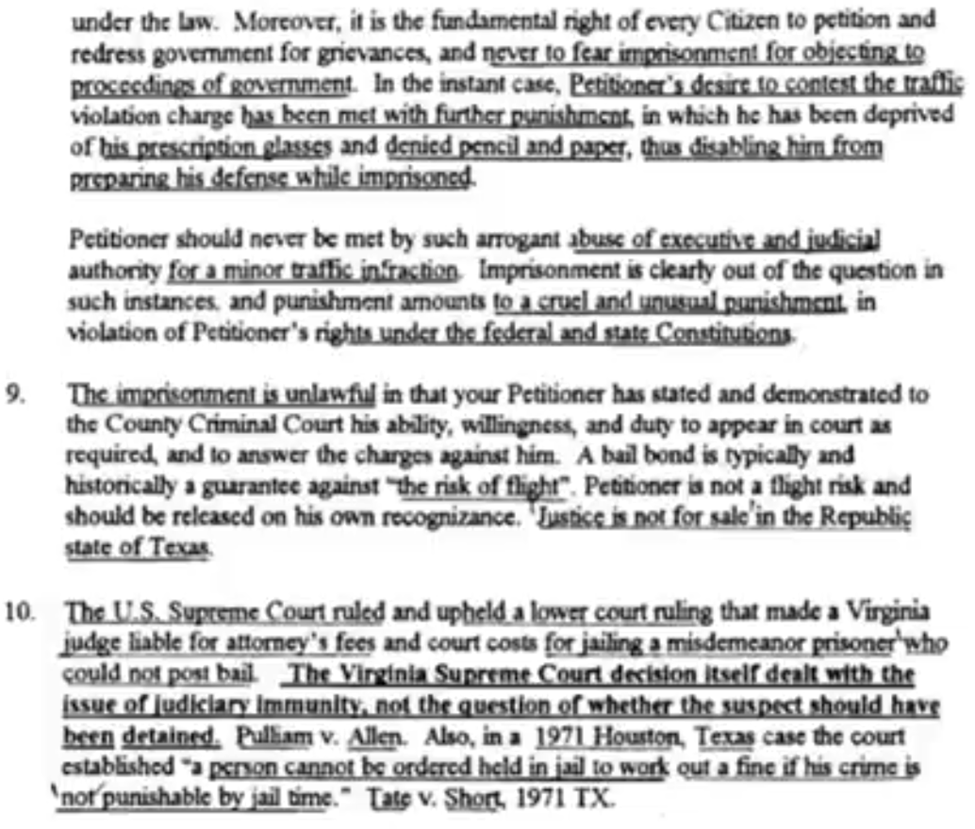
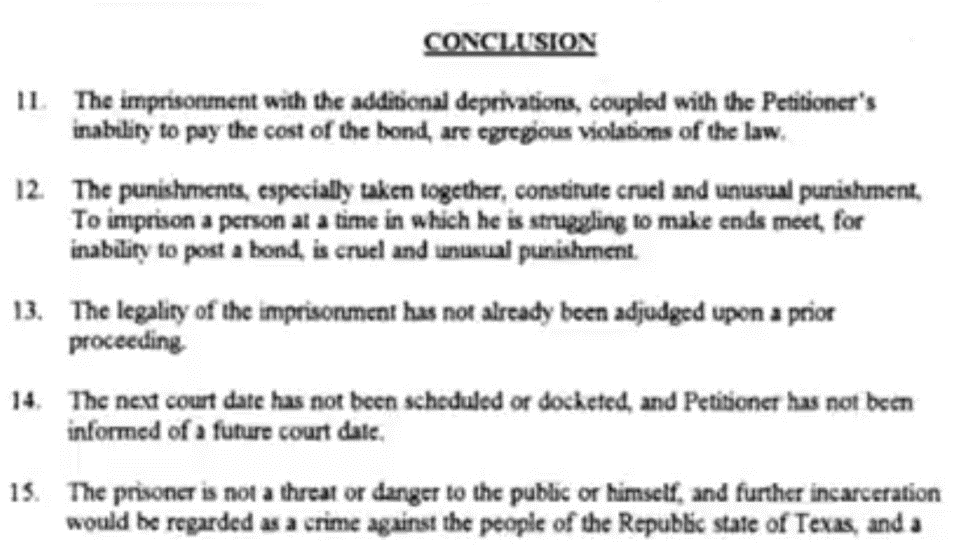
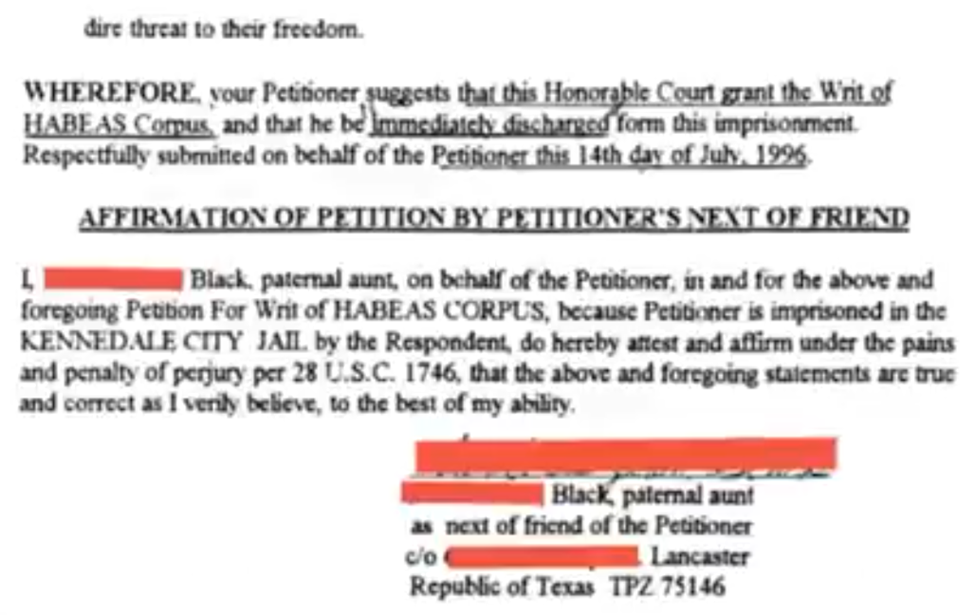
See Example for further details
Different Types of Habeas Corpus
Note: Today, some of these processes have been usurped, some exist today, some do not.
Habeas corpus ad deliberandum et recipiendum
Dates from the 17th century. A writ used to remove a person for trial from one county to the county where the person allegedly committed the offense. Extradition.
Habeas corpus ad faciendum et recipiendum / Also termed habeas corpus cum causa.
Dates from the 17th century. A writ used in civil cases to remove the case, and also the body of the defendant, from an inferior court to a superior court. See Certiorari. (meaning into the Supreme Court) If you follow due process and submit this through the legislature, the Supreme Court can exercise its discretionary jurisdiction through certiorari and grant certiorari
Habeas corpus ad prosequendum dates from 1865. A writ used in criminal cases to bring before a court a prisoner to be tried on charges other than those for which the prisoner is currently being confined.
Habeas corpus ad respondendum : Dates from the 17th century. A writ used in civil cases to remove a person from one court’s custody into that of another court, in which the person may then be sued.
Habeas corpus ad satisfaciendum: Dates from the 17th century. In England, a writ used to bring a prisoner against whom a judgment has been entered to some superior court so that the plaintiff can proceed to execute that judgment.
Habeas corpus ad testificandum; Dates from the 17th century. A writ used in civil and criminal cases to bring a prisoner to court to testify.