Kariba REDD+
Inferred Project Structure and Actors
Kariba REDD+ is modeled in this brain as a Project located in Zimbabwe, with the following key actors linked:
- South Pole – international carbon finance and project development partner (parent link).
- Carbon Green Africa – local project developer / implementer (company; tagged
Project Developer). - Carbon Green Investments – investment/finance entity associated with the Kariba structure (tagged
Investor / Funder). - Environmental Services, Inc. – technical service provider, likely a validation and/or verification body (tagged
Validator / VVB). - ImpactChoice – retail / tokenization / marketplace partner (tagged
Retail / Tokenization Partner). - Black Crystal – local partner (e.g., consulting, stakeholder engagement or services) involved in the project.
- Kariba Trust – trust structure associated with the project (see linked thought).
- EARTH Token – tokenization/crypto product linked to Kariba-backed environmental assets.
Key personnel connected to Kariba REDD+ and/or Carbon Green Africa include:
Charles Ndondo, Pieter Bezuidenhout, Rory Muil, Rob Lee, Celia Whelan, Susan Childes, Robert Hume, Pieter Bezuidenhout, Steve Wentzel, Abel Marcarini, Yougha von Laer, Florian Reimer, Tilmann Silber, Christian Dannecker, and others.
This structure is inferred from existing links and may need refinement as additional project documentation is added.
Web-sourced details (snapshot 2026-01)
- Scale & location: Launched in 2011, Kariba REDD+ covers roughly 750,000–785,000 ha of Miombo/Mopane woodland in four districts on the southern shores of Lake Kariba (Binga, Nyaminyami, Hurungwe, Mbire), connecting multiple national parks and safari areas.
- Purpose: Community-based forest protection / avoided deforestation (REDD+), aiming to reduce deforestation and land degradation while funding local development (clinics, boreholes, conservation agriculture, beekeeping, school support, etc.).
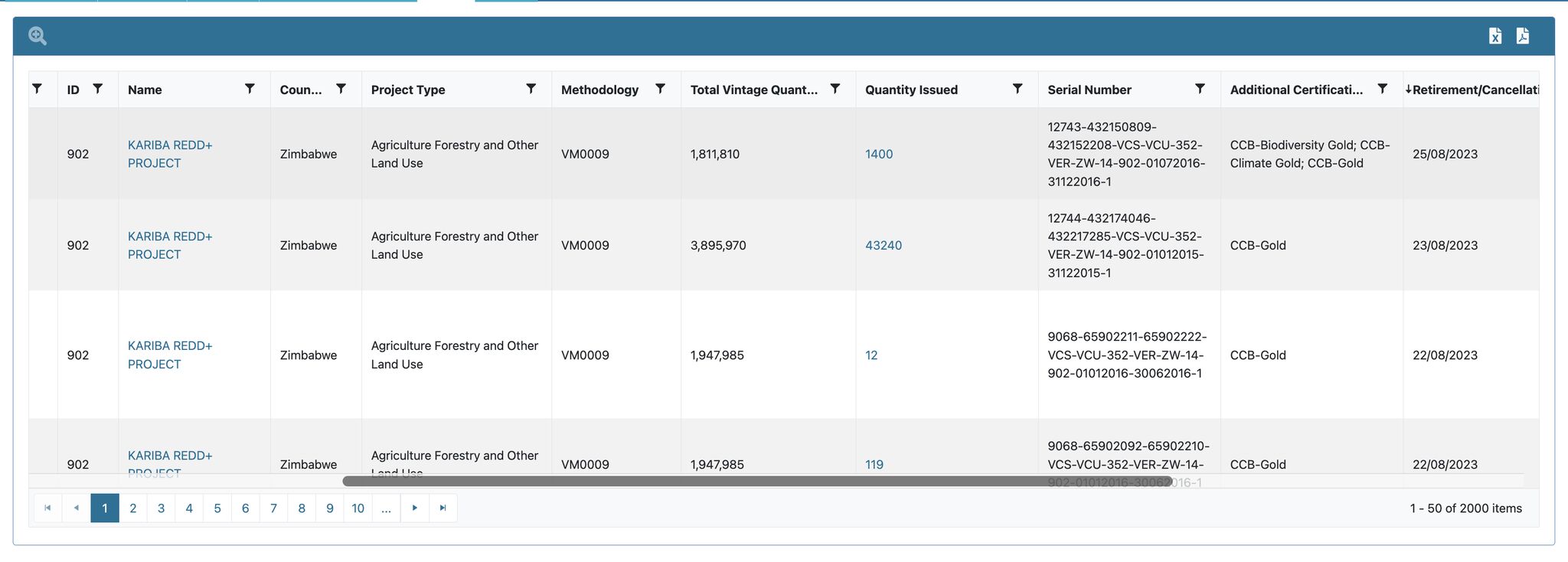
- Registry & ID: Historically registered under Verra’s VCS program as project VCS 902, using methodology VM0009 for improved forest management / REDD+. Verra suspended the project in October 2023 after media allegations and later conducted an in-depth carbon-accounting review.
- Over-crediting dispute: In a September 2025 communication, Verra stated that under VM0009 it had "over credited" Kariba by c. 15.22 million VCUs, cancelling a large volume of already-issued credits and triggering an ongoing dispute with the project proponent, Carbon Green Investments (CGI).
- Project revenues & benefit sharing: Public reporting from Zimbabwean sources indicates Kariba generated well over US$100m in revenue by the late 2010s–early 2020s, with a stated revenue split of approx. 20% communities / 30% government / 50% administering corporations. Community funds are reported to finance borehole repairs, farming inputs, bee-keeping, market access, etc.
- South Pole relationship: South Pole acted for years as carbon asset developer / marketing partner, then terminated its contract with CGI on 27 Oct 2023, citing emerging allegations and confirming that all carbon certification and credit-related responsibilities for Kariba now sit with CGI.
- Withdrawal from Verra: On 30 May 2024, Carbon Green Investments publicly announced that it was withdrawing the Kariba REDD+ and Chirisa REDD+ projects from the Verra VCS GHG Program after ~12 years, citing communication delays, inadequate engagement, operational inefficiencies and reputational/financial impacts. CGI stated its intention to re-register the projects under an alternative GHG program.
(This section summarizes external reporting as of January 2026; it should be read as a description of public claims and actions by Verra, South Pole, CGI and Zimbabwean media, not as a forensic conclusion.)