Tether Crypto Launder
---
LUTNICK?!
NEPO?
DUCK 5 26
- Bloomberg
As Lutnick Sold Cantor to His Children, Tether Gave Them a Loan
Mar 18, 2026As Lutnick Sold Cantor to His Children, Tether Gave Them a Loan Representatives for the financial services firm and the US Commerce secretary's family declined to reveal the amount.
dekleptocracy.substack.com
https://dekleptocracy.substack.com › p › howard-lutnicks-custody-relationship
Howard Lutnick's Custody Relationship with Tether
Dec 4, 2025Howard Lutnick's Cantor Fitzgerald has served as Tether's primary custodian since late 2021, managing the stablecoin's assets. By late 2024, Cantor reportedly held custody of approximately 80% of Tether's $132 billion in backing assets, with more recent reports indicating 99% of Tether's Treasury holdings are now custodied by Cantor. This arrangement earns Cantor "tens of millions ...
- [
banking.senate.gov
Warren, Wyden Probe National Security Risks Surrounding Reported ...
Apr 30, 2026April 30, 2026 Warren, Wyden Probe National Security Risks Surrounding Reported Lutnick-Tether Loan " (A)s Congress considers digital asset market structure legislation, we must ensure that politically connected crypto interests do not receive special treatment and undermine our national
...

smartmoneymindset.com
Unmasking the Controversial Crypto Connections: Trump Cabinet Member's ...
May 16, 2025Lutnick and his family have been tied to various business ventures in El Salvador, particularly in the cryptocurrency sector, which has flourished under Bukele's leadership. The Bukele administration has embraced Bitcoin and other digital currencies, allowing firms like Tether to operate with minimal regulations and tax burdens.
- [
banking.senate.gov
---}:
GIZMODO
Commerce Secretary Howard Lutnick faced questions this week about his visit to the private island of the late sex trafficker Jeffrey Epstein, as well as the fact that stablecoin issuer Tether hasn’t been audited. At first glance, it may not seem like those two issues are related in any way. But they’re intertwined in an environment where crypto prices are plummeting, and Tether potentially poses a risk to the broader economy. Fundamentally, the question is: How much can you trust Howard Lutnick?
Previously, Lutnick has made a big show of saying that while he was Epstein’s next-door neighbor on Manhattan’s Upper East Side, he didn’t have anything to do with the sex offender after a 2005 visit to his home gave him the creeps. Lutnick said that he saw a massage table during a visit to Epstein’s home and was made uneasy by the fact that he said he got massages frequently.
“My wife and I decided that I will never be in the room with that disgusting person ever again,” Lutnick told the New York Post podcast back in October. “So I was never in the room with him socially, for business, or even philanthropy.”
A visit in 2005 would have happened before Epstein was arrested for solicitation of a minor in 2006 and his sweetheart plea deal with federal prosecutors in 2008.
But this week, Lutnick was forced to acknowledge he did have interactions with Epstein well beyond 2005, including a visit to his Caribbean island, Little St. James, in 2012. Speaking at a Senate Appropriations Committee hearing on Tuesday, Lutnick was scheduled to testify on subjects like how the Commerce Department helps build broadband networks. Instead, he fielded questions about stuff like Epstein.
“I did have lunch with him, as I was on a boat going across on a family vacation,” Lutnick said about his 2012 visit to Epstein’s island. “My wife was with me, as were my four children and nannies. I had another couple, they were there as well, with their children. And we had lunch on the island. That is true. For an hour. And we left with all of my children, with my nannies, with my wife.”
Lutnick’s name appears in the Epstein files more than 250 times, according to the New York Times. The files show other interactions, including a meeting for drinks in 2011 and Epstein’s desire to meet Lutnick’s nanny in 2013. The Commerce Secretary testified Tuesday that he doesn’t know if Epstein met with the nanny and didn’t know what it was about.
As the Atlantic puts it, Lutnick’s story doesn’t make any sense. You can’t claim that you had nothing to do with Epstein after 2005 and then fess up to visiting the island of the most notorious sex criminal in modern American history in 2012, only after documents come out.
How much more is there to learn about Lutnick’s relationship with Epstein, whether it’s in the redacted Epstein files or from other sources? It’s a simple matter of credibility. Which brings us to questions that Lutnick faced about cryptocurrency.
Lutnick was asked about Tether during a hearing on, since the Commerce Secretary’s firm, Cantor Fitzgerald, holds a 5% stake in the company. Cantor Fitzgerald is also the asset manager for Tether.
“Generally speaking, I absolutely agree with you, Tether should be audited,” said Lutnick. “I don’t have anything to do with it, but I agree with you that tether should be audited.”
Lutnick has reportedly divested himself of his holdings, but his sons, Brandon and Kyle Lutnick, now run Cantor Fitzgerald. Brandon Lutnick, who’s just 27 years old, said during a conference in May 2025 that he personally checked Tether’s reserves. Your faith in the stability of Tether relies on the Lutnick family because there hasn’t been an independent audit of its books, no matter how much Howard Lutnick says he supports one.
Why does it matter what happens to Tether? Because it’s central to the crypto economy in a way that could create serious problems if it fails. Tether’s usefulness as a stablecoin is only sustained if people think it’s backed by something of value. If Tether is shown to not be backed by real assets and depegs, becoming worth significantly less than one American dollar for an extended period of time, faith in the entire system collapses. And that’s important because stablecoins are used to swap out cryptocurrencies like Bitcoin and Ether to convert them into fiat currency. They’re the dollar replacement in the system as people buy and sell crypto.
Democratic opposition has called out Howard Lutnick’s conflicts of interest and the dangers they pose to the broader economy. When Sen. Elizabeth Warren, a Democrat from Massachusetts, was opposing Lutnick’s nomination as Commerce Secretary, she specifically called out his relationship with Tether.
“You cannot serve as a booster for Tether while impartially fulfilling the Department of Commerce’s mission to ‘create the conditions for economic growth and opportunity for all communities’ as ‘economic growth has taken on increased importance for national security,’” Sen. Warren said in a statement at the time.
Crypto is teetering on the edge of the abyss these days. Bitcoin has fallen 50% since its all-time high in October, currently trading at around $65,000. And there are plenty of traders who expect it to fall even further, with some alt-coins getting hit even harder. The question is whether this collapse in price will spiral even further out of control should Tether’s reserves prove to be a mirage.
Tether says it’s backed by about $122 billion in U.S. Treasury bills, accounting for roughly 83% of its reserves. But without an audit, you just have to take the word of people like Howard Lutnick.
Lutnick is arguably under more pressure to resign than any other member of Trump’s cabinet. Semafor quoted an unnamed person “close to the White House” who acknowledged the heat, explaining that visiting Epstein’s island is “sort of the red line.” Even President Trump hadn’t been on the island, as far as anyone can tell based on the publicly available documents. Though, as Epstein’s “best friend,” Trump is certainly connected to the scandal in plenty of other ways. The president’s name appears in the new files over a million times, according to Rep. Jamie Raskin, a Democrat from Maryland.
Lutnick seemed to think it was exculpatory that he brought his family to Epstein’s island and invoked his wife in his defense on Tuesday.
“I know, and my wife knows, that I have done absolutely nothing wrong in any possible regard,” Lutnick said. “I have nothing to hide, absolutely nothing.”
---
wiki
Before his role in the Trump administration, Hines cofounded the investment firm called Nxum Capital with his father Todd Hines.[33] In August 2025 Hines began working for El Salvadorian cryptocurrency firm Tether, the largest stablecoin issuer in the world, in order to run its operations in the United States.[34] In this role, Hines was tasked with aiding the expansion of the company further into the US.[35] In September Hines was named CEO of Tether U.S.[36]
---
10 25 ggl
AI Overview
In January 2025, Tether, the largest stablecoin issuer, announced its decision to relocate its global headquarters to El Salvador
. The move was prompted by El Salvador's supportive crypto policies and the company's acquisition of a Digital Asset Service Provider (DASP) license in the country.
Reasons for the relocation
- Favorable crypto environment: El Salvador, under President Nayib Bukele, has positioned itself as a crypto hub since it became the first country to adopt Bitcoin as legal tender in 2021.
- Regulatory approval: Tether obtained a DASP license from El Salvador's National Commission of Digital Assets (CNAD), a critical step that gave the company official approval to operate its USDT stablecoin within the nation.
- Expansion plans: As part of the move, Tether announced plans to hire 100 Salvadoran employees over several years. CEO Paolo Ardoino and other co-founders also moved their residences to the country.
- Strategic play: The move is also viewed by some observers as a strategic way to operate in a more lenient regulatory environment and potentially avoid increasing scrutiny in other jurisdictions, particularly the United States.
Tether's deepening ties with El Salvador
- Gold reserves: In September 2025, Tether announced it was deepening its connection to gold, a move that coincided with the country's central bank making its first bullion purchase in 35 years.
- Bitcoin reserves: Tether has also become deeply involved with El Salvador's Bitcoin holdings. An investigation in March 2025 revealed that nearly all the bitcoin in the government's strategic reserve originated from Bitfinex, Tether's sister company.
- Legal influence: Executives from Tether and Bitfinex reportedly helped draft El Salvador's Digital Asset Issuance Law.
- Plan ₿ Forum: In September 2024, Tether announced it would host the Plan ₿ Forum in El Salvador in 2025, an event focused on furthering the adoption of Bitcoin and blockchain technology.
Concerns and scrutiny
- Regulatory leniency: While El Salvador's embrace of crypto has attracted companies, critics have raised concerns over the country's comparatively relaxed regulatory framework. El Salvador's stablecoin law requires licensed issuers to provide audited financial statements, a standard Tether has resisted elsewhere.
- Bukele regime ties: Tether's move and deep ties to President Bukele's government, which has been criticized for authoritarianism and human rights abuses, have also attracted scrutiny.
- Financial reporting: Tether's financial reporting and the composition of its reserves have long been a subject of controversy, with the company facing persistent questions regarding transparency.
---
guk
Trump cabinet member’s links to El Salvador crypto firm under scrutiny
Commerce chief Howard Lutnick’s firm backed controversial crypto giant Tether as Bukele ties deepened
Wed 14 May 2025
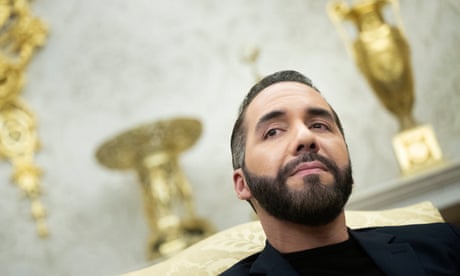
Trump administration’s commerce secretary, Howard Lutnick, and his family have had extensive business interests linked to El Salvador, whose authoritarian leader Nayib Bukele has grown close to the White House and who has courted controversy by imprisoning people deported from the US in an immigration crackdown.
El Salvador also plays host to a booming cryptocurrency and new media industry, which has numerous ties to Donald Trump allies who are seeking to make money from various ventures which have sometimes drawn the attention of authorities or ethics watchdogs.
Securities and Exchange Commission and Office of Government Ethics (OGE) filings, along with public records in the US and El Salvador, indicate that Cantor Fitzgerald, the firm Lutnick headed until weeks ago before handing off to a management team including two of his sons, holds an effective 5% stake in the cryptocurrency firm Tether, has negotiated several investments on behalf of the highly profitable company, and is custodian of the US treasury holdings from which those profits arise.
The Guardian contacted the commerce department’s public affairs office seeking comment from Lutnick on this reporting and received no response.
One of Cantor’s investments was a $775m purchase of shares in Rumble, a Trump-aligned video platform, in a deal that closed in February. Just ahead of that deal closing, Rumble inked another deal to provide cloud services to El Salvador’s government, with Bukele’s regime saying the arrangement rested on shared values of “freedom, innovation and prosperity”.
[
Does Nayib Bukele’s campaign against democracy give a blueprint for Trump?
Read more](https://www.theguardian.com/world/2025/may/06/el-salvador-nayib-bukele-model-trump)
As well as facilitating the buy – which allowed Rumble insiders to cash out with nine- and 10-figure windfalls – Cantor has been a longterm investor in Rumble since it sponsored the special purpose acquisition company (Spac) that took the platform public.
Tether relocated to El Salvador in January, where the regime allows crypto firms to operate tax- and regulation-free – and has taken advantage of further tax breaks to accumulate real estate in downtown San Salvador alongside transplanted US crypto influencers and members of Bukele’s family.
New York Times reporting this week revealed some of the relationships previously scandal-plagued for Tether have become more palatable in Washington during the Trump administration, but not the extent of the company’s ties to El Salvador.
Cantor and Lutnick’s El Salvador deals raise further questions about the Trump administration’s deepening involvement with Bukele’s authoritarian regime, which has imprisoned 2% of its population during a two-year “state of exception”, which has consolidated Bukele’s power during a harsh crackdown on criminal gangs.
They also raise questions about the direction of cryptocurrency regulations after Tether’s founder, Giancarlo Devasini, reportedly told associates in November that Lutnick would “use his political clout” to lift the regulatory scrutiny that has plagued the troubled firm for almost a decade.
Tether
Tether – which reportedly mints the world’s most traded cryptocurrency – has attracted controversy since it was founded in 2014 alongside sister company Bitfinex, a cryptocurrency exchange by Devasini, an Italian former cosmetic surgeon who has relocated to El Salvador.
Increasingly, it also attracted hostile attention from US regulators. As recently as October, the Wall Street Journal reported that the Manhattan US attorney’s office was investigating Tether for its use in sanctions busting, money laundering, and “to fund illegal activities such as the drug trade, terrorism and hacking”.
That was the 19th time that Tether had attracted US government action, according to reporting at Protos, a cryptocurrency watchdog outlet. Many previous investigations and prosecutions alleged a fundamental fraud at the heart of Tether’s business.
The main product, USDT, is a stablecoin, a cryptocurrency whose value is exactly equivalent to that of the US dollar.
As the name implies, stablecoins are intended to offer a stable reservoir of value amid the volatility of crypto markets, allowing investors to trade, invest and transfer funds in dollar-equivalent values.
Its dollar equivalence is purportedly secured by an amount of US dollars, or easily converted equivalent assets, so that any holder can convert their USDT into dollars at any time. In theory, the company derives its profits from interest on the holdings that back its cryptocurrency.
But cryptocurrency traders, critics, government agencies and law enforcement have persistently questioned whether Tether holds reserves equivalent to the USDTs it has issued.
In 2021, Tether and Bitfinex agreed to jointly settle a Commodity Futures Trading Commission (CFTC) suit with a payment of $42.5m, with $41m of that coming from Tether.
In their statement on the fines, CFTC said: “From at least June 1, 2016 to February 25, 2019, Tether misrepresented to customers and the market that Tether maintained sufficient U.S. dollar reserves to back every USDT in circulation.”
Instead, the statement said: Tether had “relied upon unregulated entities and certain third-parties to hold funds comprising the reserves; co-mingled reserve funds with Bitfinex’s operational and customer funds; and held reserves in non-fiat financial products”.
The same year, they had paid $18.5m to the New York attorney general’s office to settle a suit that foreshadowed the circumstances surrounding the collapse of cryptocurrency exchange FTX. The attorney general’s office alleged that Tether had commingled client and corporate funds to cover up an $850m shortfall in their reserves.
As part of the settlement, Tether and Bitfinex were not required to admit wrongdoing.
In January, Protos reported in summary that the company had “lied repeatedly about the quality and quantity of its backing”.
The company has also resisted compliance with regulations designed to ensure that stablecoins including USDT have sufficient backing.
[
Critics slam deregulation of crypto as Trump family expands its footprint in industry
Read more](https://www.theguardian.com/us-news/2025/apr/14/critics-slam-deregulation-of-crypto-as-trump-family-expands-its-footprint-in-industry)
Tether is not currently listed on European exchanges because of the company’s refusal to comply with the European Union’s Markets in Crypto-Assets (Mica) framework, effective from 1 January. It requires stable issuers operating in Europe to obtain authorization as an electronic money institution, and to hold at least 60% of their reserve assets in European banks.
Other allegations have probed Tether’s knowledge and involvement in the use of the token in illicit activities like sanctions busting and trafficking.
Ricardo Valencia, an assistant professor at California State University, Fullerton, and a former staffer at the Salvadorian US embassy under a previous administration, said that the growing relationship between Tether and the Bukele regime was unsurprising.
While the Trump regime was exploiting the “crypto gulag horror movie” of Cecot, a destination of summarily deported immigrants under Trump, both the US administration and Tether were exploiting the fact that “you can pay the Salvadoran government to do shady deals for a fee,” Valencia said.
Lutnick and Tether
The extent of Lutnick’s relationship with Tether only fully came to light during his confirmation hearings in January, when US senators including Democrat Elizabeth Warren sought to shed light on how entwined Lutnick’s business affairs were with the cryptocurrency firm.
On 27 January, just ahead of those hearings, Warren sent a letter to Lutnick that in part said: “Your deep involvement with and support for Tether, a known facilitator of criminal activity that has been described as ‘outlaws’ favorite cryptocurrency,’ raises concerns about your judgment and ability to put the interests of the American people ahead of your own financial interests.”
In the hearings, Lutnick disclosed that a 2024 deal gave Cantor a convertible bond equivalent to a 5% stake in Tether, whose value he put at $600m. Meanwhile, according to the Wall Street Journal, Cantor “holds most of Tether’s $134 billion in assets, largely US Treasury bills, in exchange for tens of millions of dollars in fees each year”.
The relationship began at a time when Tether was in perhaps its deepest crisis. After they had paid the combined $61m in settlement funds to the New York attorney general and CFTC, Tether’s Bahamian bankers lost their ability to process international payments, cutting them off from customers. Reportedly, an investment adviser from their original bank connected them to Lutnick.
According to the Wall Street Journal, Lutnick personally traveled to meet Devasini, the Tether founder, in the Bahamas in late 2021 to determine whether the company had the assets it claimed to have.
Last July, he told a crypto conference that at that time, “I said: ‘Show me the money’”, and that “we found every penny, and they had every penny, but they had it in what I would call some pretty godforsaken places.”
Previous reports have suggested that at times, Tether’s backing has carried significant proportions of so-called “commercial paper”: undertakings from other companies to repay loans at a future date.
Cantor later became Tether’s asset manager, and its position as a so-called primary dealer in the treasury market meant that it could liquidate assets with relative ease. The firm also reportedly won the business of some crypto-trading firms who are Tether customers.
El Salvador
Even before relocating and re-incorporating in El Salvador, Tether’s managers apparently exercised significant influence in Bukele’s crypto-happy regime.
Salvadoran media reports show that Max Keiser and Stacy Herbert, US crypto advocates who head El Salvador’s national bitcoin office, are also investors in Bitfinex, the cryptocurrency exchange that was founded by Tether’s Devasini and whose management overlaps with the stablecoin firm.
In 2023, Salvadoran newspaper El Faro called the office they run “Bitfinex’s puppet embedded in the Salvadoran state”.
That year, Tether announced a $250m investment in Bukele’s project that sought to harness geothermal energy to fuel bitcoin mining at a so-called “Volcano Energy” park.
The company also planned to collaborate in the issuance of bonds to finance the construction of a planned bitcoin city in the country, though that project never came to fruition.
More recently, Tether identities have been on a real estate spending spree in the country.
According to reports, Devasini bought a house in San Salvador for $2m.
He also reportedly bought a historic hotel building in downtown San Salvador in a joint venture with Keiser. This purchase of “a prime location in the historic center”, according to El Faro, came into force after the regime exempted investors in that part of town from income tax.
Tether’s CEO, Paolo Ardoino, bought two plots of land in the port city of La Libertad, in a deal that revealed he had been naturalized as a Salvadorian citizen.
Tether is also set to receive tax concessions for a planned 70-storey headquarters tower in San Salvador.
The Rumble deal
In the Rumble deal, concluded on 7 February, Tether Holdings handed $775m to Rumble, with $525m earmarked for a “self-tender offer” for a share buyback, and another $250m hitting Rumble’s balance sheet for “growth initiatives”, according to the announcement.
Weeks after the announcement, Rumble and El Salvador announced their partnership on cloud services infrastructure, despite the country announcing a separate deal with cloud titans Google in 2023.
Market analysts say this makes Tether the single largest shareholder in the company, with just more than 20% of all outstanding shares.
But the deal also put constraints on Tether’s influence over Rumble. According to Rumble’s 20 December press release and the SEC filing announcing the deal, “Rumble’s existing Board and governance structure, including Chris Pavlovski’s super-majority voting control, will remain unchanged”, and “Tether will own a minority position in our outstanding common stock but will not have the right to designate any members of the Board”.
This lack of say in Rumble’s operations is not offset by the likelihood of near-term profits.
[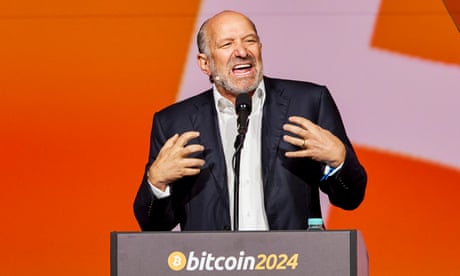
From crypto bro to commerce secretary pick: Howard Lutnick’s glaring conflict of interest
Read more](https://www.theguardian.com/us-news/2025/jan/22/howard-lutnick-secretary-commerce-nominee)
Writing on the Tether-Rumble deal when it was announced in December, financial news site Sherwood reported that “by any conventional metric, Rumble is just a really, really bad business”, noting that “in Q3 2023, it lost $29m on $18m in revenue, and in Q3 2024 it lost $32m on $25m in revenue”.
Sherwood also noted that “the company’s cash and cash equivalents shrank from $218m at the beginning of the year to $131m at the end of September” and that “at its current pace the company would be running low on cash within the next 12 months”, since “despite its revenue growth, Rumble’s losses have grown even faster”.
Rumble’s Trump connection
Tether’s interest in buying into Rumble – even without any significant say over its operations – may be explained by its alignment with the Trump administration.
The company’s central offering is an “anti-woke” video platform that won favor among Maga influencers beginning in 2020, amid crackdowns on pandemic and election disinformation on leading platforms such as YouTube.
At that time, Rumble leaned into an anti-“cancel culture” pitch, offered signing deals to rightwing, conspiracy-minded and contrarian creators such as Andrew Tate, Tulsi Gabbard and Glenn Greenwald, and positioned itself as a pillar of a rightwing “parallel economy” of explicitly ideological, Maga-forward companies advocating for an ideologically inflected vision of “free speech”.
In its first round of venture capital funding in 2021, lead investors were rightwing billionaire Peter Thiel and JD Vance’s venture fund, Narya Capital. Vance and Thiel reportedly exited their investments after Rumble went public in September 2022.
In 2022, Trump’s Truth Social platform, operated by Trump Media and Technology Group, became the first outside publisher to adopt Rumble’s ad network, an alternative to dominant players such as Google’s AdSense. At that time, Rumble’s CEO said the ad network’s mission was to “fight back against cancel culture”.
At the beginning of 2023, the company inked a “seven-figure” deal with Donald Trump Jr to exclusively carry his biweekly livestream show, Triggered.
Rumble sued the government of Brazil, alongside Trump Media, over a Brazilian judge’s order that the platforms remove accounts of a supporter of Brazil’s former president, Jair Bolsonaro.
On 12 February, Pavlovski was given a “new media” seat at the White House’s daily press conference, where he told spokesperson Karoline Leavitt “Rumble was a victim of censorship at the hands of multiple foreign governments” and asked: “Can you describe what the administration will do to protect US interests and values worldwide?”
Lutnick’s end
Via Cantor, Lutnick was also deeply involved with Rumble.
Under Lutnick, Cantor “made a fortune, thanks to a favorable deal structure”, according to Forbes when it sponsored the special purpose acquisition company that took Rumble public in 2022.
Spacs allow private companies to go public by merging with a shell company set up to explore such merger opportunities. They have been popular in the last half-decade because they enable companies to avoid the investor and regulatory scrutiny that comes ahead of a more conventional initial public offering.
Spac sponsors, such as Cantor, are generally issued with stocks and warrants in the eventual public company with little downside risk. In the Rumble Spac, 12m shares, or 4.6% of the total, were issued to “Sponsor Related Parties” according to Securities and Exchange Commission filings.
Prospectuses filed by Rumble show that at the time the company went public, several people and entities related to Lutnick and his family had also been dealt in. Lutnick 2020 Descendants Trust UA had 375,000 shares; his wife, Allison Lutnick, had 50,000 shares; and his sister, Edith Lutnick, had 35,000 shares.
This may be the source of the holdings disclosed in Cantor’s most recent holdings report, filed on 14 February, which indicates that the company he led holds 9.3m Rumble shares, which at that time they valued at over $120m.
Lutnick personally owned between $1m and $5m worth of Rumble stock according to his Office of Government Ethics filings.
Finally, Cantor was the placement agent for Tether’s buy-in to Rumble. Normally such a role attracts fees, but Lutnick said at his confirmation hearing that on this occasion Cantor waived them.
Rumble
Rumble had several officers and shareholders besides Lutnick who have since gone on to serve in the Trump administration.
Tech-right ideologue and venture capitalist David Sacks resigned from Rumble’s board in December “to pursue a position in government”, according to a 13 December SEC filing. He now serves as the Trump administration’s “crypto czar”.
Sacks joined the board in 2023 after Rumble acquired Callin, the podcasting and livestreaming platform he founded, and Locals, a crowdfunding platform fronted by rightwing comedian Dave Rubin that Sacks had backed.
Any share sales he made in the February deal were not subject to insider trading disclosures. However, the most recent filing detailing Sacks interest in the company from last July shows him increasing his shareholding to just over 571,000 shares, a position being worth over $4.2m in the Tether deal.
[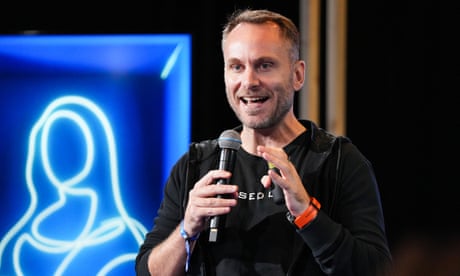
Crypto giant Tether CEO on cooperating with Trump administration: ‘We’ve never been shady’
Read more](https://www.theguardian.com/technology/2025/mar/07/tether-crypto-trump-interview)
Ethan Fallang, formerly a board member of Rumble and Narya Capital – the Vance-founded venture firm – resigned in January to work in government, according to SEC filings. The most recent documentation of his holdings while he was still on the board show him owning some 27,000 shares.
Although he is not subject to insider trading disclosures, filings show that Trump’s deputy FBI director, Dan Bongino, has maintained his 5.72% share in Rumble since it went public. No OGE agreements or disclosures for Bongino have been made public to date.
OGE disclosures do indicate that on the way into their jobs, Bongino’s new boss, Kash Patel, held between $1,001 and $15,000 worth of stock; transportation secretary Sean Duffy held between $1,000 and $15,000; and the director of national intelligence, Gabbard, held between $100,001 and $250,000 of the stock.
Patel, Gabbard and Lutnick all undertook to divest themselves of holdings including their interest in Rumble within 90 days of taking office, according to their OGE agreements.
---
wiki lutnick
In January 2017, Anshu Jain, a former Deutsche Bank executive, joined Cantor Fitzgerald as its president;[39] Jain died in 2022.[40]:{:{ By September 2018, Lutnick was worth US$1.5 billion, according to the Bloomberg Billionaires Index.[41] Since 2020, Cantor Fitzgerald has invested in cryptocurrency, particularly Tether, a major cryptocurrency company which has been implicated in money laundering and sanctions evasion by regimes in Russia, Iran, and North Korea.[42]}:
In July 2024, Lutnick and presidential candidate Donald Trump spoke at a Bitcoin conference in Nashville, Tennessee, in which Lutnick announced Cantor Fitzgerald would open a US$2 billion lending facility with Bitcoin as collateral.[43] As of October, Cantor Fitzgerald manages the majority of Tether's reserve assets, including over US$80 billion in Treasury securities.[44] The firm has also invested in political endeavors, including by encouraging Rumble, an alt-tech video hosting company, to go public, advising a business operated by Omeed Malik, and investing in Strive Enterprises, an asset management company owned by Vivek Ramaswamy.[45]}:
In February 2025, after being confirmed by the Senate as the United States secretary of commerce, Lutnick named his sons, Brandon and Kyle, who were in their 20s, as chairman and executive vice chairman, respectively. In addition, Sage Kelly, Pascal Bandelier, and Christian Wall were named to lead Cantor's investment banking, equities, and fixed income divisions, respectively.[46]
---
talk 10 25
I am moving off a large block of duplicate content from the Bitfinex article. I'll put it here in case editors want to use it.
Reporters from Bloomberg, following reports that tether pricing was manipulated on the Kraken exchange, found evidence that these prices were also manipulated. Red flags included small orders moving the price as much as larger orders, and "oddly specific order sizes—many going out to five decimal points, with some repeating frequently." These oddly sized orders might have been used to signal wash trades in automated trading programs, according to New York University Professor Rosa Abrantes-Metz and former Federal Reserve bank examiner Mark Williams.[1]
A spokesperson for Bitfinex and Tether has said that the CEO of both firms is Jan Ludovicus van der Velde.[2][3] Subpoenas from the U.S. Commodity Futures Trading Commission were sent to both Bitfinex and Tether on December 6, 2017.[3]
Tether has repeatedly claimed that they would present audits showing that the amount of tethers outstanding are backed one-to-one by U.S. dollars on deposit.[4] They have failed to do so. A posting on their website in June 2018 showed a report by the law firm Freeh, Sporkin & Sullivan LLP (FSS) which appeared to confirm that the issued tethers were fully backed by dollars. However, FSS stated "FSS is not an accounting firm and did not perform the above review and confirmations using Generally Accepted Accounting Principles," and "The above confirmation of bank and tether balances should not be construed as the results of an audit and were not conducted in accordance with Generally Accepted Auditing Standards."[5][6]
Stuart Hoegner, Tether’s general counsel said "the bottom line is an audit cannot be obtained. The big four firms are anathema to that level of risk. We’ve gone for what we think is the next best thing."[7]
Research by John M. Griffin and Amin Shams in 2018 suggests that trading associated with increases in the amount of tether and associated trading at Bitfinex account for about half of the price increase in bitcoin in late 2017.[8][9]
---
tether, often referred to by its currency codes USD₮ and USDT, is a cryptocurrency stablecoin launched by Tether Limited Inc. in 2014.[3][4] It is pegged to the United States dollar, and is distinct from a central bank digital currency (CBDC). As of 1 August 2024, Tether reported having $118.4 billion in reserves, including $5.3 billion in excess reserves. In the second quarter of 2024, the company achieved profit of $1.3 billion, contributing to a total profit of $5.2 billion for the first half of the year. Tether Limited also disclosed a net equity of $11.9 billion, and the stablecoin's market capitalization exceeded $114 billion.[5][6]
Tether is the largest cryptocurrency in terms of trading volume, holding 70% of the market share among stablecoins. In 2019, it surpassed bitcoin to become the most traded cryptocurrency globally.[7][8][9] As of July 2024, Tether has more than 350 million users worldwide.[10] Tether Limited is owned by iFinex, a company based in the British Virgin Islands which also operates the Bitfinex cryptocurrency exchange.[11] As of January 2024, Tether's official website lists fourteen protocols and blockchains on which Tether has been minted.[1] Tether faces criticism regarding the transparency and verifiability of its claimed fiat reserves.[12]
History
Creation
In 2012, J. R. Willett published a whitepaper that described the possibility of building new cryptocurrencies on top of the bitcoin blockchain.[citation ^needed] Willett went on to help implement this idea in the cryptocurrency Mastercoin, which had an associated Mastercoin Foundation (later renamed the Omni Foundation)[13][non-primary ^source ^needed] to promote the use of this new "second layer".[citation ^needed] The Mastercoin protocol became the technological foundation of the Tether cryptocurrency, and Brock Pierce (one of the original members of Mastercoin Foundation) became a co-founder of Tether while Tether founder Craig Sellars became the CTO of the Mastercoin Foundation.[14]
The precursor to Tether, originally named "Realcoin", was announced in July 2014 by co-founders Brock Pierce, Reeve Collins, and Craig Sellars as a Santa Monica-based startup.[15] The first tokens were issued on 6 October 2014, on the bitcoin blockchain.[16][non-primary ^source ^needed] Realcoin used bitcoin's computer infrastructure to exchange property and execute contracts without third-party intermediaries, opening up bitcoin's network to a variety of commercial uses. Realcoin worked with banks, digital-currency exchanges, and ATM providers to become "gateways" for buying, trading, or redeeming realcoins around the world.[14]
On 20 November 2014, Tether CEO Reeve Collins announced the project was being renamed to "Tether".[citation ^needed] The company also announced it was entering private beta, which supported a "Tether+ token" for three currencies: USTether (US+) for United States dollars, EuroTether (EU+) for euros, and YenTether (JP+) for Japanese yen. Tether Holdings Limited is incorporated in the British Virgin Islands with offices in Switzerland, without giving details, and has never submitted to an independent audit.[17][18] In July 2022, Tether started releasing quarterly attestations by the accounting company BDO Italia. According to The Wall Street Journal, "since at least 2017, Tether has been assuring investors that it will get audited, though it has yet to deliver", and the quarterly attestations are "snapshots of a company's assets held at one moment in time with less rigorous standards than audits."[19]
2015–2016
In January 2015, the cryptocurrency exchange Bitfinex enabled trading of Tether on their platform. In 2018, Phil Potter, the chief strategy officer for Bitfinex, left the company after the Paradise Papers leaks in November 2017 named Bitfinex officials Philip Potter and Giancarlo Devasini as responsible for setting up Tether Holdings Limited in the British Virgin Islands in 2014.[20] The Financial Times reported in 2022 that Devasini and Jan Ludovicus van der Velde founded two companies in 2012 and 2014, respectively, Bitfinex and Tether.[21][22] Tether Limited is a fully owned subsidiary of British Virgin Islands–based Tether Holdings Limited.[17]
For a short period, Tether managed United States dollar transactions through Taiwanese banks, which worked with Wells Fargo to enable the transfer of funds outside of Taiwan. On 18 April 2017, Tether shared that these international transfers had come to a stop.[citation ^needed] Tether issues tokens on Algorand, Avalanche, Celo, Ethereum, EOS, Liquid Network, Near, Polygon, Solana, Bitcoin Cash's Standard Ledger Protocol, Statemint, Tezos, and Tron.[23][non-primary ^source ^needed]
There are a total of five distinct Tether tokens: United States dollar tether (USD₮) on bitcoin's Omni layer, euro tether (EUR₮) on bitcoin's Omni layer, United States dollar tether (USD₮) as an ERC-20 token, and euro tether (EUR₮) as an ERC-20 token, and added in 2020 United States dollar tether (USD₮) as a TRC-20 token on the TRON network.[citation ^needed] In August 2024, Tether announced that they would be launching a stablecoin pegged to the United Arab Emirates dirham. The dirham, like several Gulf currencies, is pegged to the United States dollar.[4]
2017–2018
From January 2017 to September 2018, the amount of tethers outstanding grew from about $10 million to about $2.8 billion. In early 2018, Tether accounted for about 10% of the trading volume of bitcoin, but during the summer of 2018, it accounted for up to 80% of bitcoin volume.[24] More than $500 million of Tether was issued in August 2018.[25][26] On 15 October 2018, the tether price briefly fell to $0.88 due to the perceived credit risk as traders on Bitfinex exchanged tether for bitcoin, driving up the price of bitcoin.[27]
The Wall Street Journal reported that in late 2018, Tether Holdings Ltd former co-owner Stephen Moore discussed efforts by a major Tether trader in China to "circumvent the banking system by providing fake sales invoices and contracts for each deposit and withdrawal", and the report quoted a Moore email in which he admitted signing these fake invoices and contracts but said he "would not want to argue any of the above in a potential fraud/money laundering case."[28] Tether released a response calling the report "wholly inaccurate and misleading" but did not cite any specific inaccuracies.[29]
2019–2023
In 2019, Tether surpassed bitcoin in trading volume with the highest daily and monthly trading volume of any cryptocurrency on the market.[7] As of July 2021, Tether is tied to half of all bitcoin trades.[30] Also in 2021, the company was fined by the CFTC for only maintaining full reserves during 27.6% of the days in the period from 2016 to 2018[31] as well as for failing to present audits showing sufficient asset reserves.[32][33][34] In May 2022, Tether launched its MXNT token pegged to Mexico's peso as a "testing ground" in Latin America.[35] Also in 2022, Tether remained strong during a time when several once-reputable companies in crypto and banking collapsed. Tether's nearest competitor, Circle, experienced a faltered growth to the point where its $24 billion of USDC was worth barely more than a quarter of Tether's stash.[36]
In October 2023, Paolo Ardoino, the chief technology officer for Tether, was promoted to CEO.[37] He has led the company since December 2023, succeeding current CEO Jean-Louis van der Velde.[37] In October 2023, The Wall Street Journal reported that Tether has been increasingly showing up in investigations tied to money laundering, terror financing, and sanctions evasion. Research firm Elliptic later disputed the report's accuracy, saying it has engaged with The Wall Street Journal to correct misinterpretations of the level of crypto fundraising by Hamas.[38] In response, the company published a blog post denying inadequate customer due diligence and screening practices. It described how they have aided governments with criminal investigations, helping freeze $835 million in assets linked to theft.[39] The company reported in 2024 that they have worked with more than 140 law enforcement offices across 45 jurisdictions to assist cases involving illicit stablecoin use.[40]
In May 2023, Tether announced plans to establish a bitcoin mining operation in Uruguay using renewable energy and investing its resources into renewable energy production. Uruguay sources more than 98% of its electricity output from renewable energy sources, primarily wind and hydropower.[41] In June 2023, Tether Operations Limited held meetings with governmental structures and signed a memorandum with the Government of Georgia. The partnership will create a special fund for local startups and aid in developing blockchain technologies in Georgia.[42]
In November 2023, Tether announced that it plans to invest about half a billion dollars over the next six months to become one of the world's top bitcoin miners. That investment includes part of a $610 million credit facility that Tether had extended to publicly traded bitcoin mining company Northern Data AG after acquiring shares in the Frankfurt-based firm in September.[43] In December 2023, Lugano, Switzerland, started to accept cryptocurrencies, including the Tether stablecoin, for paying taxes, fines, and all other invoices.[44] According to a report by blockchain analytics company TRM Labs, Tether was the most used stablecoin for criminal activity throughout 2023, having been connected to $19.3 billion in illicit transactions. The amount was larger in the previous year, with $24.7 billion worth of transactions linked to criminal activity in 2022.[45]
2024–present
According to comments made in January 2024 by Cantor Fitzgerald CEO Howard Lutnick, that company was acting as custodian for Tether's reserves.[46] During a February 2024 Congressional hearing, Minnesota Congressman Tom Emmer, a cryptocurrency supporter, called The Wall Street Journal's October 2023 article "erroneous", observing that federal reports on global financial crimes showed the actual amount of cryptocurrency used by these groups to be "significantly smaller" than what was reported by media outlets.[47][48]
In the first quarter of 2024, Tether's profit was $4.52 billion. U.S. Treasury securities were a major contributor to its net profits. Tether also profited from its positions in gold and bitcoin.[49] Tether announced in April 2024 that they invested $200 million from their excess reserves into Blackrock Neutro, a U.S. based brain-chip company that makes brain-to-computer interfaces, including neural implants that can allow people to control computers and prosthetic arms without moving.[50]
In May 2024, Tether announced it would restructure into four divisions focused on artificial intelligence, bitcoin mining, education, and stablecoins. According to Ardoino, the company's ownership structure had not changed.[51] Also in 2015, Tether acquired a $100 million stake in Bitdeer, a bitcoin miner that split from Bitmain, via a private placement, with options to acquire another $50 million at $5.00 per share.[52] In July 2024, Tether, Tron, and blockchain analysis firm TRM Labs formed an alliance intended to curb illicit spending on the Tether and Tron blockchains. As of September 2024, the T3 Financial Crime Unit had frozen about $12 million in USDT linked to scams and fraud, and had identified eleven victims.[40]
Tether reported in August 2024 that their profit during the first half of the year was $5.2 billion, with a net operating profit of $1.3 billion during the second quarter alone. Tether also reported that it holds more than $97.6 billion in U.S. Treasuries, making them one of the largest buyers of Treasury bills in the world, more than many countries.[53] In October 2024, The Wall Street Journal reported Tether was the target of a federal criminal investigation for possible violations of sanctions and anti-money-laundering rules.[54] In December 2024, Tether announced a $775 million investment in Rumble, an alternative video hosting platform known for its predominantly right-wing user base.[55][56][57] In September 2025 former Trump administration official Bo Hines was named CEO of Tether U.S, the company's US arm.[58]
In October 2025, Tether nominated two candidates to join the board of Juventus, as part of its 10.7% stake in the club which was purchased earlier in the year.[59]
Lobbying and political influence
In 2025, Tether was one of the donors who funded the White House's East Wing demolition, and planned building of a ballroom.[60]
Alleged price manipulation
Academic research
Research by Griffin and Shams found that bitcoin prices increased after Tether minted new USD₮ during market downturns. They speculated this was an attempt at market manipulation.[61] Tether and its affiliated cryptocurrency exchange, Bitfinex, contested these findings, accusing the authors of cherry-picking data and working with an incomplete dataset.[62][non-primary ^source ^needed] Later research found additional evidence of stablecoin activity influencing cryptocurrency prices. For instance, a 2021 study observed unusually high cryptocurrency returns in the 24 hours before and after stablecoin issuances.[63] In 2022, another study found that bitcoin prices increased following public announcements by Whale Alert on Twitter about Tether minting USDT.[64]
Media research
Bloomberg News reporters found irregularities on the Kraken cryptocurrency exchange, with small market orders moving the market price of Tether as much as larger market orders from 1 May 2018 to 22 June 2018.[65] New York University Professor Rosa Abrantes-Metz and Federal Reserve bank examiner Mark Williams suggested the unusual order sizes were indicative of wash trading by automated trading programs.[65] Kraken offered a rebuttal of these claims, stating that Bloomberg News misunderstood the concept of stablecoin and that the market price of Tether was not greatly influenced by market order size because Tether was a stablecoin pegged to the United States dollar.[66][non-primary ^source ^needed] The user responsible for unusual order sizes also confirmed that the oddly specific order sizes and decimal places were "randomly selected".[66][non-primary ^source ^needed] The Kraken cryptocurrency exchange rebuttal of the Bloomberg News findings were later supported by academic research concerning the stability of stablecoins.[67]
Legal research
On 20 November 2018, Bloomberg reported that U.S. federal prosecutors are investigating whether Tether was used to manipulate the price of bitcoin.[68][69] According to Tether's website, Tether can be newly issued by purchase for dollars or redeemed by exchanges and qualified corporate customers, excluding U.S.-based customers. Journalist Jon Evans stated that he has yet to find publicly verifiable examples of a purchase of newly issued tether or a redemption in the year ending August 2018.[70]
Security and liquidity
Tether claims that it intends to hold all United States dollars in reserve to meet customer withdrawals upon demand. It was unable to meet all withdrawal requests in 2017.[71] Tether purports to make reserve account holdings transparent via external audit; however, Tether never produced an audit showing it had the purported reserve.[24] In January 2018 Tether announced that they no longer had a relationship with their auditor.[72]
About $31 million USDT tokens were stolen from Tether in November 2017.[73] Later analysis of the bitcoin distributed ledger showed a close connection between the Tether hack and the January 2015 hack of Bitstamp.[citation ^needed] In response to the theft, Tether suspended trading, and stated it would roll out new software to implement an emergency "hard fork" to render all of the tokens that Tether identified as stolen in the heist untradeable. Tether has stated that as of 19 December 2017, it has re-enabled limited cryptocurrency wallet services and has begun processing the backlog of pending trades.[citation ^needed] On 19 September 2022, due to an ongoing lawsuit in New York District Court, Bitfinex and Tether (referred to in court records as B/T) were ordered to produce documents showing the backing of USDT, which is still pending.[74]
On 20 November 2023, Tether reported that together with OKX, it had frozen $225 million worth of its cryptocurrency, which had been linked to a human trafficking group in Southeast Asia responsible for a global pig butchering scam. Tether claimed the freeze had been done at the request of the U.S. Secret Service and that it was the largest-ever freeze of its token.[75][76] Erin West, deputy district attorney for Santa Clara County, California, told Newsweek that Tether's move represents a decision to declare open season on fraud proceeds.[77]
In December 2023, Tether CEO Paolo Ardoino told members of House Financial Services and Senate Banking that the company has been strengthening its relationships with law enforcement and taking new steps to strengthen sanctions controls. Ardoino emphasized Tether's decision to disable its tokens in all wallets associated with the Office of Foreign Assets Control (OFAC) sanction list.[78] In the letter, Ardoino reported that Tether had assisted the U.S. Department of Justice, U.S. Secret Service, and Federal Bureau of Investigation (FBI) in freezing 326 wallets controlling 435 million USDT; however, these frozen wallets appear to contain fewer tokens than the stated sum. Ardoino also revealed that Tether had collaborated with the U.S. Secret Service and is working with the FBI.[78]
In March 2024, Tether was acknowledged in an announcement from Morris Pasqual, the Acting U.S. Attorney based out of Chicago, and FBI Special Agent-in-Charge Robert W. "Wes" Wheeler, Jr. for its role in seizing $1.4 million worth of Tether linked to a tech scam network.[79] In August 2024, Tether was also acknowledged in an announcement from the U.S. Attorney for eastern North Carolina, Michael Easley, and FBI Charlotte Special Agent in Charge Robert M. DeWitt for their role in effectuating the seizure of $5 million worth of Tether stolen through a pig butchering scam.[citation ^needed]
Questions about dollar reserves
In September 2017, Tether published a memorandum from a public accounting firm that Tether Limited claimed showed that tethers were fully backed by United States dollars;[80][non-primary ^source ^needed] however, according to The New York Times, independent attorney Lewis Cohen stated the document, because of the careful way it was phrased, does not prove that the Tether coins are backed by dollars.[20] The documents also fail to ascertain whether the balances in question are otherwise encumbered.[71] The accounting firm specifically stated: "This information is intended solely to assist the management of Tether Limited ... and is not intended to be, and should not be, used or relied upon by any other party."[80]
Tether has failed to present audits showing that the amount of tethers outstanding are backed one-to-one by United States dollars on deposit despite repeated claims that they would.[81] A June 2018 attempt at an audit was posted on their website in June 2018 which showed a report by the law firm Freeh, Sporkin & Sullivan LLP (FSS), which appeared to confirm that dollars fully backed the issued tethers; however, FSS stated that "FSS is not an accounting firm and did not perform the above review and confirmations using Generally Accepted Accounting Principles", and added: "The above confirmation of bank and tether balances should not be construed as the results of an audit and were not conducted in accordance with Generally Accepted Auditing Standards."[33] Stuart Hoegner, Tether's general counsel said "the bottom line is an audit cannot be obtained. The big four firms are anathema to that level of risk. We've gone for what we think is the next best thing."[81]
At the end of 2023, Tether reported holding $63 billion of U.S. Treasuries, $3.5 billion of precious metals, $2.8 billion of bitcoin, $3.8 billion of other investments, and $4.8 billion of secured loans in its reserves.[82] In January 2024, Cantor Fitzgerald's CEO Howard Lutnick said his firm reviewed Tether's assets and confirmed Tether held assets of approximately $86 billion to back $83 billion of its stablecoin.[83] The majority of Tether's reserves held in cash and cash equivalents are U.S. T-Bills, accounting for $72.6 billion.[84] In Tether's attestation of the second quarter of 2024, it reported that it held nearly $98 billion in U.S. Treasuries. If Tether were a country, it would be the 18th largest holder of U.S. debt among nations.[5][6]
Legal cases
New York Attorney General's case against iFinex
On 25 April 2019, New York Attorney General Letitia James (prosecution) filed a lawsuit against iFinex (defendant)—the parent company of Tether Limited and the Bitfinex cryptocurrency exchange.[85][86] The prosecution claimed that the Bitfinex cryptocurrency exchange had been unable to secure a reliable fiat banking relationship, so it had entrusted US$1 billion to the Panamanian payment processing firm Crypto Capital Corp.[85][86] The prosecution alleged that funds were commingled with corporate and client deposits and that no contract was ever signed with Crypto Capital.[85][86] The prosecution speculated that Crypto Capital Corp had lost or stolen the money, and executives at Bitfinex and Tether Limited had been unable to recover up to US$850 million of funds.[85][86] The prosecution accused iFinex, Bitfinex, and Tether Limited of using Tether Limited to cover up the shortfall.[85][86]
On 26 April 2019, iFinex contested claims that funds had been lost or stolen by Crypto Capital Corp, stating that funds had been seized, and Bitfinex sought release of the funds.[87] Crypto Capital Corp told Bitfinex the seizures were temporary and presented excuses as to why the funds could not be released to Bitfinex (Case Point 33).[87] Crypto Capital Corp stated that in May 2018 the government of Poland had frozen a Crypto Capital Corp bank account holding at least US$340 million of Bitfinex funds (Case Point No. 33); and between April and July 2018, a Crypto Capital Corp account in Portugal containing around $150 million of Bitfinex funds had also been frozen (Case Point No. 34).[87] The principals of Crypto Capital Corp were later arrested.[88] During the case, iFinex contested claims that Tether Limited had been used to cover up alleged losses, stating that Bitfinex had borrowed US$400 million from Tether Limited due to the inability to access seized funds from Crypto Capital Corp (Case Point No. 38).[87] Bitfinex stated they had fully repaid the loans with interest to Tether Limited by 5 February 2021.[89][non-primary ^source ^needed]
On 17 February 2021, iFinex settled the legal dispute with the New York Attorney General's office. iFinex, Bitfinex, and Tether Limited did not admit any wrongdoing and paid US$18.5 million to settle the case.[90] On 6 May 2021, New York Supreme Court Judge Joel M. Cohen granted iFinex's motion to modify the injunction because the New York Attorney General's office's accusations were too general and lacked specificity, stating the prosecution's case was "couched in exceedingly sweeping terms" and "injunctions must be specific".[91][non-primary ^source ^needed]
U.S. Commodity Futures Trading Commission (CFTC)
On 5 December 2017, the U.S. Commodity Futures Trading Commission (prosecution) issued subpoenas to Bitfinex and Tether Limited concerning the backing of minted USD₮.[92] Before 25 February 2019, Tether Limited's terms stated: "Every tether is always backed 1-to-1, by traditional currency held in our reserves. So 1 USDT is always equivalent to 1 USD."[34] After 25 February 2019, Tether Limited revised their terms to instead claim that "Tether Tokens are 100% backed by Tether's Reserves", defining said "reserves" as "traditional currency and cash equivalents and, from time to time, may include other assets and receivables from loans made by Tether to third parties, which may include affiliated entities."[34] On 30 April 2019, iFinex (defendant)—the parent company of Tether Limited and the Bitfinex cryptocurrency exchange—issued an affidavit asserting that minted USD₮ was 74% backed by a narrow definition of cash and cash equivalents, with the remaining 26% supposedly backed by other assets.[93]
On 15 October 2021, Tether Limited paid a fine of US$41.6 million for inaccurately claiming that minted USD₮ were 100% backed by fiat USD when they were not—even by Tether Limited's affidavit, they were only backed by a combination of fiat USD and other assets such as "unsecured receivables, commercial papers, funds held by third parties, and other non-fiat assets" (supposedly at 100% in total).[34] Tether Limited responded by revising their claims to state: "All Tether tokens are pegged at 1-to-1 with a matching fiat currency and are backed 100% by Tether's reserves."[94] From 2017 to 2022, Tether Limited released assurance reports, including in September 2017,[95] June 2018,[96] November 2018,[97] February 2021,[98] March 2021,[99] April 2021,[100] June 2021,[101] September 2021,[102] and May 2022,[103][non-primary ^source ^needed] attesting to the 100% backing of minted USD₮. In May 2021, Tether published a report showing that 2.9% of Tether was backed by fiat USD, with over 49.6% backed by commercial paper, and the remaining amount backed by other assets.[104][105] Tether Limited continues to refuse to allow an independent audit to verify its claims of full backing. In October 2022, Tether reported reducing its commercial paper holdings to zero, replacing them with U.S. treasury bills.[106]
See also
References
---