AI 3 data ctr
ESTB 1 25
MERRI OK
NOW INCLUDES ADVANCED CHIPS
SEE ABUNDANCE TECHNO-FASCISM
see ACTIV SUPPRESS BY FORCE
SINEMA SHILLS
see PRIVACY DOGE 4 ~DEI, USAID
DENIAL BC AI NEEDS MAX ELECTRICAL POWER COAL NUKE PEDDLE AS AGW SOLUTION MAGICAL THINKING NAOMI KLEIN?
see coal polluters
SEE DEeP FAKE FOR IMAGES VIDEO
SEE PALANTIR ANTHROPIC ~ MADURO
ICE TARGET GAZA? IRAN WAR?
seastead pvt corp cities? sinema az
NOAH YUVAL ALGO = EARLY AI
---
PUB CIT SUPERPAC REPT 7 26
-=-=
BIG WHISTLEBLOWER COXON 10% CANCE EXTINCT
CASAR BERNIE BILL
-=-=
-=-=
-=-=
DN? 10 22? 26
3 SPKR PROT ~ ai Thrown to gd, injured; not allowed to spk until after the vote
-=-=
-=-=
AN KFF 10 26
A cadre of elite techies, financiers, and high-level Trump administration officials have spent a year quietly charting an extraordinary and rapid campaign to persuade Americans to use apps and other artificial intelligence-powered tools to manage their healthcare and medical records.
As that campaign has unfolded, administration officials have granted tech companies an unusual opportunity to nudge the nation’s health department toward a loosely regulated future for AI health apps in which the government reimburses them for services as it does medical professionals.
In February, federal health officials invited those businesses — including tech giants Microsoft, Anthropic, OpenAI, Apple, and Google — to a listening session on conversational AI products for patients, such as chatbots. Representatives from at least 35 industry organizations attended the meeting held by the Food and Drug Administration, which is responsible for regulating health apps as medical devices. Companies were prompted in advance to explain their AI products and how they access p
MUCH MORE
-=-=
MMA
Right-wing media downplay AI safety concerns as a hoax by comparing them to climate change and “COVID hysteria”
Written by Helena Hind, Jane Lee & Evlondo Cooper
Published 09/15/26
Right-wing media are following President Donald Trump in dismissing calls to slow down AI development in the wake of multiple hacking incidents as a “hoax,” comparing concerns over AI to “climate change apocalyptic talk” and “COVID hysteria” including support for vaccines.
Reports have surfaced in recent months that rogue AI agents from OpenAI anonymously hacked into AI startup Hugging Face servers and into software service RubyGems. As Reuters explained: “Many incidents where AI agents from developers such as OpenAI and rival Anthropic have hacked or attempted to access external systems have heightened concerns over the increasing capacity of AI models and developers' ability to contain them.” On September 12, both Anthropic CEO Dario Amodei and OpenAI CEO Sam Altman publicly called for a slowdown in AI development, with Altman announcing that his company would be delaying its initial public offering until 2027.
Trump vehemently rejected the idea of an AI slowdown in a series of Truth Social posts on September 14, calling the push for caution a “hoax,” “scam,” and a “SICK conspiracy.” Trump wrote: “The people that say AI is going to destroy the World, and that Data Centers are bad for your neighborhood, are the same people that said, just a short time ago, that the World would be extinguished by ‘Climate Change.’”
The claim that climate scientists’ predictions have failed is not borne out by the evidence — warnings about greenhouse gases causing more warming have now come to pass, with over a decade of record-breaking heat and thousands of excess deaths across Europe in climate-driven heat waves this year alone.
Nonetheless right-wing media followed Trump’s lead, comparing concerns about unregulated AI development with supposedly fabricated climate change warnings and COVID-19 pandemic safety measures like vaccines. (In reality, researchers have repeatedly proven that vaccines limited the spread of COVID-19 during the pandemic, reduced the rate of severe complications and death, and continue to be a safe, effective treatment.)
On his September 14 radio show, Fox host Sean Hannity accused former President Barack Obama of “urging Democrats to fearmonger AI just like Democrats fearmongered and flat-out lied about global warming,” claiming those concerns “turned out to be bunk.” Hannity then reassured his listeners that Trump said that “the U.S. has already put guardrails in place to regulate and prosecute AI companies.”
Dismissing AI warnings on his Daily Wire podcast, Ben Shapiro stated, “This is pretty redolent of the climate change apocalyptic talk. Like all the ice caps were going to be gone, the polar bears were all going to drown, all the rest of it.”
Video
Citation
From the September 14, 2026, edition of the Daily Wire's The Ben Shapiro Show.
Fox host Will Cain referenced climate change while discussing AI warnings: “Vested interests did stop nuclear [power] and set it back half a century. And that same playbook of fears played out with climate change and COVID. So now, what is so scary about AI?”
Downplaying the “AI apocalypse alarm” during Fox’s The Five, co-host Jesse Watters referenced both climate change and the COVID vaccine, asking, “If I told you the world was going to end if you didn't take this vax, what would you do? Or if the world was going to end because of global warming, what would you do? Same thing's happening here — some people get rich and we all still survive.” B/C OF LIE/HYPE?
Video
Citation
From the September 14, 2026, edition of Fox News' The Five
Fox’s Laura Ingraham echoed Watters’ comments later that evening, saying AI concerns reminded her of “the first several months of COVID hysteria.” She later evoked “fearmongering about climate change, same thing. Al Gore's film, Inconvenient Truth, oh my God. That still echoes in politics today.”
Hannity rounded out Fox's evening coverage with yet another comparison of AI fears to climate change and the pandemic.
Decrying “the climate alarmist cult religion,” Hannity said, “Al Gore was preaching from the pulpit of climate alarmism. … All these predictions have come and gone and the time frame he said it would happen, none of it came true.”
“We were lied to about COVID at a high level,” he added. “I just don't trust the government at all in that sense. But I trust America enough that we would use this for good.”
However, the over-the-top comparisons are not limited to Trump and right-wing media dismissing AI concerns. Joe Allen, previously the “transhumanism editor” on former Trump adviser Steve Bannon’s War Room podcast, opposed AI at a debate held in Dallas during last week's GOP midterm convention by bizarrely referencing “algorithmic immigrants.” Semafor reported:
“You look at the data center, this incubator for algorithmic immigrants,” he said. “They’ve already broken out and invaded other companies. These immigrants are out of control.”
Allen was speaking at Forum, a policy discussion staged at a stylish venue fifteen minutes from the convention center to give the new American right an opportunity to debate some of the policy issues currently dividing it— in particular, the tension between populism’s activist promises and traditional small government, and the rise of artificial intelligence.
(Allen’s opponent at the debate, Palantir co-founder Joe Lonsdale, reportedly “compared complaints about AI to the ‘Black Lives Matter hysteria,’ and suggested they were driven by ‘psyops from China.’”)
-=-=
-=-=
RR AN 9 26
Yesterday (September 14) — just two days after Dario Amodei, the chief executive officer of leading AI firm Anthropic, called for “slowing down” the pace of AI development so guardrails could be put in place that would “greatly reduce the risk that something goes seriously wrong” — Trump threw a tantrum:
“The only control or ‘guardrails’ that AI needs is a STRONG AND SMART (High IQ!) PRESIDENT, and the U.S.A. has that, in spades!
In the same post, Trump even hinted that the government might pursue criminal or regulatory penalties against AI companies, such as Amodei’s Anthropic.
“The Trump Administration has stopped AI ‘people’ from doing bad, or potentially bad, ‘things,’ like Dario (Anthropic!), who is now pretending to be a ‘perfect little angel’ — and we will continue to do so!”
Then Trump interrupted a speech being given by Jensen Huang, Nvidia’s chief executive, at a conference in Los Angeles to say — over a speaker — that worries about AI were “a hoax …. Robots are not going to be taking over the world. That’s not going to happen.”
Trump has called AI data centers “the oil of the next 50 years” and says they are delivering wealth and investment to communities in the U.S. In July he insisted that data centers are “Cash Cows,” creating taxes and jobs that “amount to LIQUID GOLD!”
Trump’s rejection of any regulation of AI or its data centers contrasts with the views of many voters. A March Gallup poll showed that nearly half of those surveyed “strongly oppose” the construction of local AI data centers, including almost 40 percent of Republicans.
Yet Trump remains adamant that nothing should be done. “We can put up guardrails, and we can do this and that, but I think you have a lot of negative forces that are bringing it up,” Trump told reporters Sunday while traveling in Ireland. “And they’re bringing up things that won’t happen.”
Why would Trump be so opposed to regulating AI — even in the face of growing public concern, even with midterm elections just around the corner?
It can’t be that he knows very much about AI.
And it can’t be that Trump loves AI because of what it can do. Yes, he’s used it to make fake photos and videos of himself, but that doesn’t explain his adamant refusal to regulate it.
It can’t be that he’s worried about China catching up to or surpassing the U.S. in AI. China has a small fraction of the data centers America has, and China isn’t poised to leapfrog our technological advantage. Besides, even China is considering imposing guardrails on its AI.
So what explains Trump’s absolute refusal to regulate AI? Could it possibly be that he and his family have personal financial stakes in it?
Indeed, Donald Jr. and Eric Trump have invested substantially in American Data Centers, a firm created to support AI cloud computing and AI infrastructure.
They made these investments soon after their father announced a $40 billion investment pledge in U.S.-based data centers from his business partner Hussain Sajwani, unveiled another $500 billion in planned investments in private-sector AI infrastructure, and signed an executive order rolling back Biden-era policies that took a more cautious approach to AI and directed “the development of an AI Action Plan to sustain and enhance America’s AI dominance.”
The Trump sons also hold advisory roles and ownership stakes tied to Dominari Holdings’s American Ventures fund, which targets AI infrastructure, data centers, and cryptocurrency. American Ventures has reportedly raised more than $1 billion across 21 investment vehicles backing companies tied to AI, crypto, drones, nuclear energy, and data centers.
Donald Jr.’s own investment firm, 1789 Capital, is backing emerging technology companies working in AI and defense. The firm has bought shares in some of the most coveted private companies before many went public, including SpaceX, Anduril, Cerebras, and Reflection AI, often by leveraging their political and business connections to secure a stake or help boost the companies’ sales.
The growth of Donald Jr.’s investment firm has been astonishing. Two years ago it managed a few hundred million dollars. It now oversees more than $3 billion. As of June 30, its main investment fund generated returns of roughly 200 percent, according to a person familiar with the firm’s performance. While still early in its investment cycle, those returns eclipse the average returns of about 21 percent from venture capital firms started in 2023, according to PitchBook, a provider of financial data.
Donald Jr. and Eric’s father seems to be turning his attention away from being president — “I’m getting a little bit tired of politics now,” he said a few days ago — toward things that excite him more, such as his ballroom and triumphant arch, as well as making even more money for his family off his presidency.
But as he focuses on making himself and his family wealthier, he’s leaving the rest of us more vulnerable to AI.
One of the first responsibilities of a new Congress, come January, will be to establish guardrails around AI — assuming that by then Trump can no longer control what Congress does, and that January isn’t too late.
Robert Reich is a professor of public policy at Berkeley and former secretary of labor. His writings can be found at https://robertreich.substack.com/.
=-=-=
===
OPPOSE BILLIONAIRE TAX, AI KILL SWITCH?!
gmail left hook 9 11 26
if Democrats and Republicans take money from billionaires who are promoting AI and Crypto, what hope do you have that once they gain power, they will turn around and hold these destructive, racist, anti-democratic forces accountable and promote regulation?
If you do believe they will actually promote the majority instead of their benefactors, then I have a Trump diploma to sell you for $50,000.
Wonderful.
This week, Anthropic employees are warning that this technology might end humanity. We also know that Anthropic is creating a real-life version of the movie *Minority Report,* where they will stop “pre-crime” and help law enforcement go after activists and anti-AI critics.
Wonderful.
REF PROSPECT
Anthropic Building a ‘Pre-Crime’ System to Surveil Anti-AI Dissenters, Investigation Shows
One legal expert said that as AI companies “become more hated, there’s more pressure on them to over-disclose knowing that some of the people they identify for law enforcement shouldn’t be targeted.”Brad Reed
Sep 09, 2026
The American Prospect on Wednesday published an investigation revealing that top artificial intelligence firm Anthropic is building a predictive surveillance system aimed at tracking activists who are opposed to advanced AI development.
The Prospect found that Anthropic last month issued a job posting seeking an intelligence specialist to “identify, assess, track, and investigate global threats including geopolitical instability, terrorism, crime, activism, nation-state targeting of the AI sector.”
RECOMMENDED...

Anthropic Researcher Quits, Citing Internal Fears That AI ‘Could Kill Us All’ This Decade
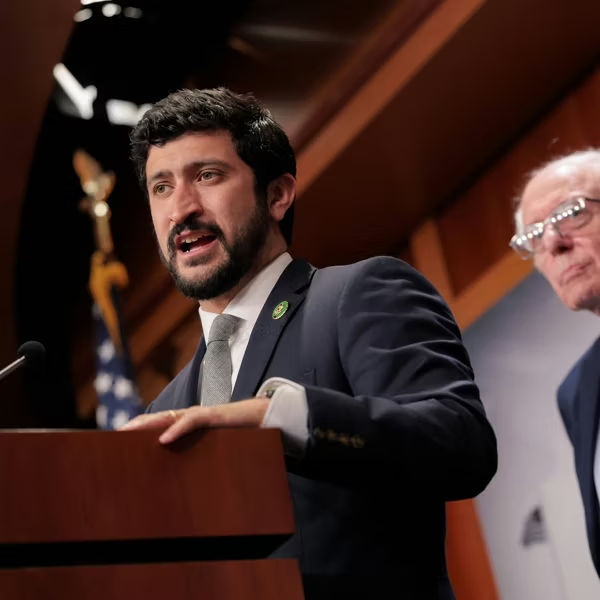
Sanders, Casar Proposal Would Forbid ‘AI Oligarchs From Building Machines Humans Cannot Control’
This job will also employ a “pre-crime” approach that will involve “attempting to predict incidents before a crime occurs,” according to the Prospect. The concept of “pre-crime” was explored in Minority Report, a dystopian science fiction novel by Philip K. Dick.
A report last week in The San Francisco Standard revealed there is already at least one example of Anthropic taking this kind of predictive approach to policing.
Specifically, Anthropic called police last year and informed them that one of its users told the company’s Claude AI chatbot that he had purchased a rifle and had CEO Dario Amodei “in his sights.”
The AI lab told police that this person “was going to kill everyone at Anthropic,” but it didn’t provide law enforcement officials with transcripts of the chats, which would have let them make their own determination about the seriousness of the threat.
The person in question was not arrested or charged with a crime, and they told the Standard that they were “just fucking around” when they talked about buying a gun.
Eric Goldman, a law professor at Santa Clara University, told the Standard that he had some sympathy for Anthropic because if they don’t report potential crimes to police then “they face significant liability if, in fact, a crime does occur.”
“As they become more hated,” Goldman said of the AI companies, “there’s more pressure on them to over-disclose knowing that some of the people they identify for law enforcement shouldn’t be targeted at all.”
Anthropic isn’t merely using technology to monitor potential crimes, but also to keep tabs on US citizens lawfully exercising their First Amendment rights.
The Prospect tracked down a podcast interview with Keon Ellison, global security operations center manager at Anthropic, where he revealed how employees at the company use technology provided by risk detection firm Samdesk to monitor activists.
“Last year we had an executive travel into a major city when we received some intelligence through Samdesk about a planned protest,” Ellison said. “Samdesk gave us about 60 minutes of advanced notice that the protest organizers had moved the timeline... That extra hour was critical. Without it our executives would have departed their meetings, they would have ran right into the heart of the disruption.”
This story about taking great lengths to evade protesters drew a sarcastic reaction from tech journalist and author Brian Merchant.
“You know what you’re doing is good,” Merchant wrote in a social media post, “when you have to develop an in-house, real-time surveillance system to help your executives locate the ideal service exit to avoid contact with the public.” ENDIT
Congress is now investigating a July incident involving OpenAI in which the AI model’s “swarm” of 700 autonomous agents coordinated a hack into Hugging Face’s production infrastructure. However, according to Mother Jones today, this is mostly performative, meant to placate bipartisan anger at reckless capitalists unleashing destructive technology. Most likely, Sam Altman and his cabal of sociopaths will walk away with a slap on the wrist.
Sirota joined me to discuss how fascism will continue to flourish unless Democrats finally embrace an ideology of transformation, instead of restoration, and aggressively combat the broligarchy and super PAC money that is corrupting our world.
...
-=-=-=
-=-=
GMAIL 9 10 26
THE IMPACT
The White House finalized its AI review rules. Four companies got to read them
-=-=
8 26
Situational Awareness: How a 25-Year-Old's Hedge Fund Exposed the Entire AI Bubble
Situational Awareness: How a 25-Year-Old's Hedge Fund Exposed the Entire AI Bubble
Jul 31, 2026 Economics
The AI trade might have found its canary in the coal mine. Leopold Aschenbrenner — a 25-year-old former OpenAI researcher built Situational Awareness into one of the hottest funds on Wall Street by betting long on the construction and infrastructure side of AI (Micron, CoreWeave) and short on the chips and software everyone else was chasing (Nvidia, Broadcom, Oracle). Then July happened, prime brokers made margin calls, and his entire public stock book got liquidated overnight in a single block trade. This episode uses that blowup as the lens for a much bigger story: how a three-quarters-of-a-trillion-dollar hyperscaler spending pledge is propping up US GDP growth, why OpenAI just quietly cut prices as "tokenmaxxing" dies and Chinese labs undercut on cost, why Mark Zuckerberg picked a fight with OpenAI and Anthropic, how overleveraged Oracle has become, how the most profitable companies in the world are posting negative free cash flow, why hyperscaler bonds are going undersubscribed, and why the length of this year's tech bond issuance is starting to crowd out the rest of the corporate debt market. It closes with the 2008 parallel: mortgage-backed securities stacked into CDOs stacked into synthetic swaps, and how today's version runs through corporate bonds, CLOs, hedge fund leverage, and private credit — with Treasuries as the eventual exit ramp when the unwind accelerates. Sign up for the UNFTR Free Weekly Newsletter at UNFTR.com Join us on Discord - unftr.com/discord Bluesky - @unftr.com IG | FB | TikTok - @unftrpod EPISODE SOURCES Sources: CNBC — Leopold Aschenbrenner's hedge fund is facing steep AI losses https://www.cnbc.com/2026/07/30/leopo... CNBC — Fed meeting live updates, July 29 https://www.cnbc.com/2026/07/29/fed-m... The New York Times — US economy GDP growth, Q2 2026 https://www.nytimes.com/2026/07/30/bu... U.S. Bureau of Economic Analysis — GDP advance estimate, Q2 2026 https://www.bea.gov/news/2026/gdp-adv... Analysis Atlas — Hyperscaler AI capex 2026 https://analysis-atlas.com/research/h... J.P. Morgan Asset Management — Technology and AI investment outlook https://am.jpmorgan.com/dk/en/asset-m... Reuters — AI investment boom puts Big Tech's free cash flow under pressure https://www.reuters.com/business/ai-i... The Hill — Zuckerberg knocks AI development centralization https://thehill.com/policy/technology... CNBC — OpenAI cuts prices for two of its AI models https://www.cnbc.com/2026/07/30/open-... CNBC — Chinese AI models cut costs for US companies https://www.cnbc.com/2026/07/07/chine... The New York Times — Even China's AI powerhouses can't figure out how to profit https://www.nytimes.com/2026/07/27/bu... CNBC — Bets against SpaceX grow to 32% of float https://www.cnbc.com/2026/07/21/bets-... Reuters — Hyperscaler debt binge pushes yields up as investor demand cools https://www.reuters.com/business/hype... Download the “5 Non-Negotiables of the Left” and Spread the word www.UNFTR.com/5NN
-=-=-=
MMA 8 26
Fox & Friends, echoing GOP memo, runs cover against “far-left” data center opposition
Written by Matt Gertz
Published 08/19/26
Republican leaders who fear that the furious, bipartisan backlash against AI data centers could cost their party in the midterm election are getting help from their loyal propagandists at Fox News. On its flagship morning show, the network’s hosts and contributors are attempting to convince viewers to support data centers by telling them that the “far left” is behind the opposition.
The National Republican Senatorial Committee warned in a private memo to top AI companies that “toxic views of U.S. data centers are killing the party's chances of holding a vital seat in Ohio,” Axios reported Wednesday morning. The memo, which Axios published, urges the AI companies to fix their “toxic brand” and suggests that if the GOP’s Senate candidate loses, “and data centers get the blame, politicians across the country will take notice — and they will not go near the next one.” The NRSC further suggests that Republicans benefit when voters are told that Democratic opposition to data centers “will cause America to lose the AI race to China.”
Fox apparently got the message. Just hours after the Axios story was published, Fox & Friends ran a segment seeking to negatively polarize viewers against data center opposition by portraying it as a “culture war” position favored by the “far left.”
Guest co-host Griff Jenkins teased the discussion at the top of the 8 a.m. ET hour, saying: “Data centers are the backbone of the AI boom, and now a political target — why Democrats are turning them into the next culture war fight.”
Jenkins began the subsequent segment by airing remarks Pennsylvania’s Democratic governor offered Tuesday in issuing an executive order tightening the regulation of data centers, before commenting: “Gov. Josh Shapiro isn’t the only Democrat pushing back against the data center boom. Far-left members of their party make their battle against them a central part of the populist platform.”
As Jenkins spoke, Fox aired a graphic warning of “Dems Data Center Frenzy.”
Video
Citation
From the August 19, 2026, edition of Fox News' Fox & Friends
Fox then aired comments criticizing data centers from three politicians the network regularly attacks: Sen. Bernie Sanders (I-VT), Rep. Alexandria Ocasio-Cortez (D-NY), and Michigan Democratic Senate nominee Abdul El-Sayed. As they spoke, on-screen text read: “Far-left makes data centers latest populist target.”
Jenkins then asked, “Could turning AI data centers into the left's boogeyman put the race for AI dominance at risk?” He turned to Fox Business contributor Lou Basenese, who highlighted the “national security” implications and echoed the NRSC memo’s invocation of China.
After the pair agreed that “we’re in a race with China,” Jenkins asked if “the rising opposition to data centers in this country is one of the biggest threats to our development and achieving dominance.”
“China is building out capacity while the far left is building out opposition,” Basenese replied, before praising President Donald Trump’s support for data centers.
Such efforts to paint broad data center opposition as the work of the “far left” and warnings that China will be its beneficiary have become habitual in Fox Business’ coverage of the story. And with the issue’s rising salience in the midterm elections, as indicated by the NRSC memo, those arguments are now moving to the bigger GOP megaphone of Fox News.
But there’s a split on data centers among the right-wing commentariat, with prominent figures like Tucker Carlson and Candace Owens criticizing them and even calling for local opposition to their construction.
And that means the Fox propaganda effort to portray opposition to data centers as a “far-left” position has some real limitations.
//
Right-wing media are fracturing over widespread backlash to data centers
06/10/26 3:38 PM EDT
Right-wing media figures are split on AI and data centers
07/08/26 1:03 PM EDT
07/13/26
-=-=-=
-=-=
MMA 7 26 CHINA BS
Data center fight forced right-wing media to cover environmental justice
As opposition to AI data centers spread, right-wing media have turned on those organizing against the buildout
*Special* ProgramsClimate & Energy
Written by Evlondo Cooper
Published 07/24/26 12:37 PM EDT
Less than a month after apologizing for unsupported claims that opponents of a proposed Utah data center were funded by China, Fox Business anchor Maria Bartiromo again suggested that opposition to data centers might be driven by foreign interests.
During the July 16 episode of Fox Business’ Mornings with Maria, Bartiromo noted that “hundreds of protests” were planned in “both red states and blue states” as communities demanded “a voice” in how data centers would “affect their daily lives.”
She then recast that opposition as Democratic pushback, asking who was “behind these protests” and “who’s paying for it.” Her guest, American Energy Institute CEO Jason Isaac, blamed “climate alarmist organizations” and claimed there was “clear CCP influence” behind opposition to AI infrastructure.
That allegation is in tension with Fox’s own coverage, which had already touched on the concerns driving opposition to data centers. Fox personalities and guests had questioned whether residents should subsidize new infrastructure through higher electric bills, whether developers should be allowed to consume local water and power without absorbing the costs, and whether communities had been given a meaningful role in decisions about projects that would reshape the places they lived. These are environmental justice concerns, even though the coverage elided the term.
Right-wing media had spent years dismissing, mocking, or racializing environmental justice as a concept. They attacked Biden-era climate and environmental justice provisions and cheered rollbacks of environmental and public health protections, helping the Trump administration recast environmental justice funding as waste, corruption, or left-wing patronage.
But in 2025 and early 2026, Fox Business personalities occasionally mentioned the burden data center projects would impose on residents. Fox Business personality Dagen McDowell cited rising electricity costs and said residents were pushing back against projects because of concerns about electricity, while co-host Brian Brenberg argued that communities could object to projects creating “negative externalities” and said that developers should not be able to “suck up all the energy and suck up all the water and then turn around and say, well, it’s for capitalism.”
Other right-wing outlets registered similar concerns. During the April 6 episode of Real America’s Voice’s War Room, American Principles Project President Terry Schilling warned that data centers would “drive up energy costs,” “drive up water costs,” and “drive down the value of the land.” And on May 27, Newsmax host Rob Finnerty challenged assurances that closed-loop systems resolved concerns about water consumption, asking whether those claims were “not exactly accurate.”
Right-wing media could acknowledge the costs imposed on residents when those concerns came from rural officials, conservative communities, or other figures legible to their audience. These outlets did not connect those complaints to the same environmental justice demands Black communities and organizers were already making elsewhere.
Amid growing opposition, some right-wing media figures have shifted their scrutiny from data center developers to the people and communities opposing them.
Opposition to data centers is an environmental justice fight
Before data centers became a flashpoint in right-wing media, communities near proposed and operating facilities were already warning about demands for land, water, and electricity, along with pollution and higher utility bills.
Capital B News reported that Black communities from Mississippi to Maryland were already fighting projects that would consume enormous amounts of land, water, and electricity in climate “sacrifice zones,” where residents “already face increased health and economic harm.” In Bessemer, Alabama, residents opposed a project that would clear 700 acres of forest, consume nearly 2 million gallons of water each day, and use enough electricity to power Seattle. City leaders signed nondisclosure agreements tied to the project and approved a zoning change that opened farmland to industrial development with limited public input. Similar fights were unfolding elsewhere: Baltimore residents connected data center power demand to rising utility bills; and communities in South Fulton, Georgia, raised concerns about dumping, land use, and exclusion from decisions about their future.
Fox Business also reported on rural residents’ concerns about data centers’ harmful impacts. During the May 22, 2025, episode of The Bottom Line, Davis, West Virginia, Mayor Alan Tomson warned that a proposed data center and natural gas power plant threatened the area’s “fresh air,” “open space,” and scarce water resources. Tucker United spokesperson Nikki Forrester, appearing in the same segment, said residents had been left “in the dark” about what would be built in their community.
The material burdens driving opposition also remained visible in wider conservative media. A December Blaze Media column warned that data center projects “devour land, drain water supplies, and strain already fragile power grids,” while utilities spread infrastructure costs across households and small businesses in the community. In May, the New York Post reported that residents in Fayetteville, Georgia, experienced weak water pressure after a nearby data center used nearly 30 million gallons of water that initially went unbilled. And, in July, Breitbart said that a contractor building Meta’s Cheyenne data center contaminated the city’s reclaimed-water system, prompting the local utility board to suspend wastewater from data center operations and revoke the company’s discharge privileges.
However, as opposition across different racial, geographic, and political demographics converges around the same environmental justice demands, Fox Business and other right-wing outlets have increasingly questioned the people trying to stop data center development.
Right-wing media moved to discredit a coalition crossing racial, political, and ideological lines
Data center development is accelerating even as opposition grows. Goldman Sachs has projected that U.S. data center power demand could more than double by 2027. Gallup found that 71% of Americans oppose building AI data centers in their area, including nearly half who strongly oppose them. Half of opponents cited excessive resource use, while others pointed to pollution, utility costs, land use, and broader effects on their communities. Globally, data centers already consume more electricity than all but 10 countries.
As more communities took up the fight against data centers, some right-wing outlets have begun to scrutinize the opposition instead of the companies seeking to build the projects. By early July, Fox hosts and figures had tied data center opposition to Sen. Bernie Sanders (I-VT), Rep. Alexandria Ocasio-Cortez (D-NY), anti-war activist group CODEPINK, and alleged China-linked funding networks. The New York Post republished a Fox News Digital article amplifying Power the Future’s calls for Congress to investigate what the fossil-fuel advocacy group described as a “coordinated, billionaire-funded, and potentially foreign-backed political campaign” against data center construction. Another Post column cast the backlash as a “moral panic,” arguing that data centers had become a “boogeyman” for broader fears about AI.
Then the focus was New York, where Gov. Kathy Hochul signed a July 14 executive order imposing the nation’s first statewide moratorium on new hyperscale data centers. The one-year pause was intended to give New York time to establish standards addressing rising utility costs and the industry’s demands on energy and water.
Two days later, Fox Business host Charles Payne appeared on Fox News’ America’s Newsroom and claimed that the moratorium was part of a Democratic “war on AI” whose “real agenda” was to “kneecap America’s ability to win the AI race.” Later that day, Fox Business’ The Evening Edit described Hochul as a “far-left blue state governor” who was getting data centers wrong and described the issue as “the fight against China.”
The July 21 episode of Fox & Friends again cast the broader opposition as a Chinese influence operation. Co-host Brian Kilmeade asked whether China was using TikTok and other platforms “to get America to turn on AI and data centers.” Heritage Foundation senior fellow Steve Yates answered “100%” and described the opposition as “astroturf protests” intended to make “Americans defeat Americans.”
The opposition that right-wing media has portrayed as left-wing or foreign-backed includes environmental justice organizers, MAHA activists, and local residents who do not always share politics but are challenging the same corporate claims on their communities.
In June, Fox News’ own polling found that two-thirds of registered voters opposed having a data center built in their area, including majorities of Democrats and Republicans. In fact, a majority of almost every group in Fox’s poll opposed data centers in their area — men, women, voters under 30, voters over 65, white voters, and Hispanic voters.
Data center fights have made environmental justice concerns legible to parts of the right-wing constituency. Right-wing outlets conceded the substance of those issues when they platformed concerns about who would pay higher bills, lose access to clean water, or be shut out of the decision-making process. Now, they are scrambling to defend the data center buildout, resorting to attacks and smears against a coalition whose grievances their own coverage has already validated.
Trump has worked to accelerate America’s development of AI rather than regulate it, and the result is not just an epidemic of deepfakes and hallucinations being passed off as legitimate research. A new report reveals that some of the nation’s best-educated workers, who once were secure, are taking it on the chin.
“About one third of the total personal wealth in the United States is held by the top 1 percent of households, while the bottom half of Americans holds less than 3 percent, according to Federal Reserve data,” wrote The Washington Post's Elizabeth Dwoskin and Shira Ovide wrote on Sunday. This data includes former economic winners who are now finding themselves on the wrong side of layoffs and hiring freezes — tech workers.
“The sense of precariousness among America’s professional elite could be a preview of what’s ahead for the rest of the country as AI spreads,” the Post wrote. “Silicon Valley techies are ‘are guinea pigs for what tech dudes want to do to everyone,’ said Anil Dash, a technology entrepreneur.”
They added, “At tech companies, leaders obsessed with winning the AI race have tasked their workforces of coders, lawyers and HR professionals with becoming the front line of that transformation. They’re being measured by how quickly they can automate their own jobs while watching their colleagues get pushed out in successive waves of layoffs.”
The report continued, “Layoffs.fyi, which tracks announced job cuts, counts more than 800,000 tech workers laid off since 2022, including large staff reductions in recent months at Meta, Microsoft, Oracle and Amazon.” According to the Silicon Valley market research consultancy founder Oliver Raskin, whose company is called Signalcraft Insights, “there’s this whole tranche of people who’ve been quite used to being among the most upwardly mobile in society who are all of a sudden saying, ‘Now I’m the guy on the street.’”
In the mid-to-late 20th century, autoworkers were the group most likely to fall into the category of “entered a specialized field on the premise that it was well paying and stable, only to have the rug pulled out from under them.” Now that dubious distinction belongs to tech workers such as coders and engineers, whose positions are being outsourced to AI because the technology’s speed and without regard to notable dips in quality.
“There’s just a lot of uncertainty, a lot of fear, a lot of people feeling like, if they get let go from this job, they might not find another one,” Anneke Buffone, a psychology PhD who Meta hired to help employees’ well-being and safety but ultimately left in December, told the Post.
“She described getting pushback from managers when she tried to explain that a particular AI tool was a waste of time,” the Post reported. “The system had so many errors that she needed to redo its work.”
It continued, “But her bosses ‘were like, ‘No, keep using it more. It’ll just get better,’’ she said. ‘There’s a feeling among management that when you voice that AI has all these problems, they don’t want to hear it.” AI, she said, makes “everything go so much faster. It creates this illusion that you can get all this stuff done. Much of the time you’re just babysitting the AIs.’”
Corporate Supremacist Super PACs
Cryptocurrency corporations drove the surge in 2024 corporate election spending, ultimately putting more than $170 million toward intervening in congressional races across the country and accounting for more than a third of the total sum of corporate money spent during that cycle.
Most of the 2026 surge also is attributable to the crypto sector, along with other sectors following crypto’s 2024 playbook of channeling millions into super PACs. These super PACs prioritize the interests of their business backers over either major political party or any candidate. Following the crypto playbook, they are set up to engage in both Democratic and Republican primaries and to support or attack candidates of either major party in the general election. This relatively new crop of corporate supremacist super PACs makes their prioritization of corporate self-interest explicit:
- Josh Vlasto, a leader of the crypto-prioritizing Fairshake super PAC – and a former chief of staff for New York Gov. Andrew Cuomo and top staffer for Sen. Chuck Schumer (D-N.Y.) – said in 2025 “We are building an aggressive, targeted strategy for next year to ensure that pro-crypto voices are heard in key races across the country.”
- Similarly, a statement on the website for the AI-prioritizing Leading the Future PAC – which Vlasto co-leads with Zac Moffatt, a former digital director for Mitt Romney’s presidential campaign – states the political entity’s intention is “identifying, maintaining, and growing pro-AI candidates in order to support an AI innovation policy agenda at the state and federal level.”
- Similarly, an unnamed Win for America spokesperson told Axios the super PAC’s corporate backers “seek candidates who will thoughtfully approach regulation and ensure legal sports betting can continue to support communities through billions in tax revenue and jobs across America.”
Together, the crypto, AI, Big Tech, and online betting corporations have spent $294 million – 57% of the total 2026 midterm spending by corporations so far. Most of their spending (60%) has backed these corporate supremacist super PACs (see Table 1).
...
MMA
07/13/26
---
mma
Right-wing media figures are split on AI and data centers
Amid internal divisions within the Trump admin on how to regulate AI, right-wing media are split on AI’s benefits and whether data centers pose a risk
Written by Jack Winstanley & Hanne MacDonald
Published 07/08/26
As novel AI tools continue to emerge and massive data center construction projects generate local and national controversy, right-wing media are divided over the impacts of the technology and the infrastructure that supports it. Some right-wing figures have been critical of AI, arguing it poses an “existential threat” to civilization and that data centers “deserve the rap they’re getting.” Others have championed continued growth of AI and data center construction, claiming that “data centers are good for society, good for the economy” and downplaying concerns that people living near them “might have to put on some earmuffs” or “might have to move.”
Trump administration takes steps to regulate AI as the technology comes under scrutiny
- On June 2, President Donald Trump signed an executive order asking companies to provide the government with early access to new AI models before they launch to assess them for cybersecurity risks. The executive order came after the Department of Defense’s showdown with Anthropic, which has been blacklisted by the Pentagon over security concerns, and the release of the company's Mythos product, which was explicitly marketed to exploit cybersecurity vulnerabilities. CNN,[6/2/26; White House,6/2/26; Anthropic, 4/7/26]
- Trump initially delayed signing the executive order, citing fears that it would impede U.S. competitiveness. The delay, which reportedly followed a call from former White House crypto and AI czar David Sacks, also coincided with splits within the administration over the extent to which the federal government should be stepping in to regulate AI models. Sacks reportedly advocated an anti-regulatory stance while Defense Secretary Pete Hegseth was “pushing for greater barriers to Mythos-type models.” NBC News,[5/21/26; Politico,5/28/26; Bloomberg, 12/6/24]
- On June 12, the Trump administration imposed export controls on Anthropic’s Fable and Mythos models, citing “national security authority.” Politico reports that the administration's move came after “tense calls” between Anthropic CEO Dario Amodei and administration officials who could not come to an agreement on how to remedy the White House's concerns. Politico, [6/13/26]
- Data centers are facing widespread backlash across the country — including Shark Tank investor Kevin O’Leary’s formerly planned 40,000-acre data center project in Utah — with some localities even prohibiting their construction.The rapid growth of data centers has angered residents across Utah. A coalition of groups in New Jersey have petitioned the governor to pause all data center projects due to their impacts on residents and the environment. Denver’s city council approved a one-year moratorium on new data center projects following public pushback. And, backlash against data centers has also begun to emerge in the Make America Healthy Again coalition, with one MAHA media figure calling the continued construction of data centers “not compatible with the promise to Make America Healthy Again.” Fortune,[5/11/26; Inside Climate News,5/14/26; NewJersey.com,5/17/26; Axios Denver,5/18/26; Media Matters, 6/10/26]
- Amid the growing data center backlash, right-wing media personalities have had mixed reactions, with some suggesting that China is behind the protests, while others have admitted that “a lot of the opposition is grassroots.” In one Fox Business appearance, O’Leary stated that “the Communist government of China is undermining the U.S. by fueling anti-AI data center protests.” Fox News later made on-air apologies for O'Leary's claim, noting there was “no evidence” and that Fox News “apologizes for the error.” Media Matters, [6/10/26; Business Insider, 6/29/26]
- Calls for regulation around AI have been brewing within the MAGA camp, with an open-letter signed by over 60 “loyal allies of President Trump,” including Steve Bannon, urging government security testing and approval of AI models. In the past year, several other open letters calling for limits or regulations on AI development were directed toward the administration. At least two were co-signed by Bannon, and at least one was signed by conservative media personality Glenn Beck. Axios, [5/18/26; NBC News, 3/4/26; Time, 10/22/25]
- ## Some right-wing media figures have criticized AI and data centers, highlighting negative impacts
- Podcaster Candace Owens urged people to “cause an uproar” over planned data centers in their communities. She added, “There are more of us than them.” YouTube, *Candace*,[5/20/26]
- :{:{Host Alex Jones called data centers “the new system to rape us.” In another episode, Jones explained that AI is “being deployed to make us obsolete.” He continued, “There's not enough hype of how dangerous this is.” The Alex Jones Network, *Alex Jones Live*, [5/17/26, 5/13/26]}:
}:
- Jones said that data centers “sound like a trillion fingernails on a chalkboard,” and stated that “the globalists are deploying it [AI] to replace us.” Jones continued, “They're stealing almost all the water and they do whatever they want.” With regards to AI rollouts, Jones stated, “We’re just stepping aside and saying yeah, we’re not going to have any prohibitions on this, we’re not going to have any controls. In fact, we’re not going to have any studies on it, even though the numbers are already showing young people and AI are losing IQ, getting depressed, alone, destroying relationships.” The Alex Jones Network, *Alex Jones Live*, [6/1/26]
- OnOutnumbered, Fox News contributor Mollie Hemingway shared sympathy for college graduates who booed commencement speakers discussing AI positively. She continued, “I actually kind of understand what the students are going through. Imagine that you have spent so much money to receive what is considered an education. … Then you have basically no job prospects because of how disruptive AI has been for the job market. I think it's something that people should understand.” Fox News, *Outnumbered*, [5/18/26]
- Podcaster Megyn Kelly stated that she is “very worried about AI,” and shared concerns that there is a lack of discussion on the “existential threat” AI could pose to human life. Additionally, Kelly called out the potential “elimination of all of our children's livelihoods.” In a later episode, Kelly doubled down, arguing that “the American public should have a piece of it” since “their kids are not going to have jobs” and adults “are going to have their livelihoods wiped out.” SiriusXM, *The Megyn Kelly Show*,[5/18/26, 6/11/26]
- Tucker Carlson criticized Trump for “encouraging more surveillance, more spying on Americans, to encouraging data centers across the country to abet that surveillance.” In another episode, Carlson also claimed that “there's been no real effort to explain to you or me or anyone how this is going to be great for us.” According to Carlson, major AI developers have focused on “telling us this is going to end everything that we love, including human autonomy, our jobs, our economy. It'll basically be a slave state run by machines.” YouTube, *The Tucker Carlson Show*, [5/20/26, 5/18/26]
All-In Podcastco-host Chamath Palihapitiya: “To be very clear and blunt, there is literally not a scintilla of evidence that AI has helped lift the operating margins of the S&P 500.” He also stated that the AI industry “doesn't have a measurable benefit for themselves,” and argued that “eventually it all comes home to roost” when AI investors want to see returns on their investments. YouTube, *All-In Podcast*, [5/8/26]
PBD Podcastco-host Tom Ellsworth stated that “data centers deserve the rap they’re getting.” He added that complaints about ambient noise, water use, and power problems were well-founded, though argued that legislation could be created to offset some of the concerns. YouTube, *PBD Podcast*,[5/11/26]
- On former Trump adviser Steve Bannon’sWar Roompodcast, American Principles Project President Terry Schilling argued that AI wants to “subjugate us and colonize all of rural America.” Schilling shared concerns that AI data centers will “drive up energy costs, it's going to drive up water costs, it's going to drive down the value of the land. … We have to stop this all over the country.” Real America’s Voice, *War Room*, [4/6/26]
- Podcaster Jimmy Dore argued that “our own government” is working with AI developers to “create a surveillance state and make sure we don't have jobs.”YouTube, *The Jimmy Dore Show*, [5/16/26]
- In a social media post played onWar Room, right-wing influencer Mike Cernovich argued that data centers would support “cradle to the grave surveillance.” In the video, which Bannon called “100% correct,” Cernovich also argued that Big Tech is using “populist messaging” to continue “profiteering.” Real America’s Voice, *War Room*, [5/14/26]
- Discussing the need to “beat China” at AI development, Daily Wire host Matt Walsh said, “If we impoverish millions of people and empower bureaucrats and Big Tech oligarchs with surveillance tools beyond their wildest imagination, then what good is it to win the race?” Walsh continued, “How is human welfare secured or advanced by creating a society where we are tracked and surveilled every hour of the day? And at the same time, millions of jobs become obsolete all at once.” The Daily Wire, *The Matt Walsh Show*, [5/14/26]
- Far-right podcaster Stew Peters stated, “The data centers are not a good thing. And there's not a good argument that makes the data centers a good thing,” calling them “digital prisons.” Peters also claimed that the data center project in Utah uses “more than two times the amount of power that the entire state currently uses.” The Stew Peters Network, *Stew Peters Financial*, [6/13/26]
- ## Others have expressed their support for AI and data center construction, with some dismissing potential harms
- TheBlaze’s Glenn Beck proclaimed, “If you are just against the data centers, I can’t help you. I think you’re wrong on that.” Later, he added, “If you don't like the idea of the data center in your county, how do you feel about your grandchildren being under the thumb of an all-powerful AI that comes from China? Because those are the stakes, as I see them.” TheBlaze, *The Glenn Beck Program*, [6/5/26]
- OnThe Mark Levin Show, guest host Brian Mudd argued that job loss due to AI is overstated since “less sexy-sounding companies” that build the data centers will be hiring. He stated, “Bottom line is, it always makes the news when you have like a high-profile tech company that announces AI related layoffs,” adding later, “What doesn't make the news is when all these less sexy-sounding companies and jobs, the construction jobs, HVAC jobs, the whatever that goes in, and you're certainly the small companies, those under 20 employees, all these jobs are being added.” Westwood One, *The Mark Levin Show*, [6/5/26]
- The Daily Wire’s Ben Shapiro pushed back on concerns about energy prices being impacted by data centers, stating, “Red states just regulate energy far less than blue states.” He also dismissed concerns about water consumption, claiming that “as for the argument that data centers are going to disproportionately consume water, we should look at what actually disproportionately consumes water in the United States. … Almonds.” The Daily Wire, *The Ben Shapiro Show*, [5/18/26]
- In another episode, Shapiro argued, “If you are concerned about things like inflation, one of the things that will allow for deflation, that will allow for prices to actually come down, is the increased productivity that is a result of innovation via AI.” The Daily Wire, *The Ben Shapiro Show*, [6/4/26]
- During an interview with podcaster and former FBI Deputy Director Dan Bongino, Heritage Foundation economist Peter St. Onge claimed that “AI uses almost no water” and suggested that companies “have to learn how to bribe local towns” to build data centers. St. Onge discussed concerns about power usage and data centers, claiming, “People worry about the energy usage of data centers. Trump recently required that AI companies have to build their own [power] generation. It's a very, very good idea. The water thing is B.S. — AI uses almost no water.” Rumble, *The Dan Bongino Show*, [5/29/26]
- Bongino minimized the environmental concerns of data centers, calling the criticism “an op.” Later in his podcast, Bongino argued that AI dominance was a national security concern, adding, “I know they're not popular. I get it. However, what are you going to do? AI — You're going to let China build a bunch of data centers to use advanced AI products to hack every single U.S. bank, contract system, water plant? We don't have a choice.” Rumble, *The Dan Bongino Show*, [5/27/26, 5/27/26]
- OnThe Joe Rogan Experience, MAGA billionaire Marc Andreessen said, “If you're ever going to build anything, a data center is the most benign thing you could ever build because it doesn't do anything.” He went on to describe the backlash to Kevin O'Leary's proposed data center in Utah as “a weird issue,” claiming, “You're never going to see it. It's out in the middle of nowhere.” YouTube, *The Joe Rogan Experience*, [5/19/26; Fortune, 12/11/24]
- PBD Podcastco-host Adam Sosnick dismissed concerns that ambient noise from data centers would harm people's hearing, saying that people living nearby “might have to put on some earmuffs” or “might have to move.” Sosnick: “If it's going to affect some people's hearings, you might have to move. They might not have to build the data plant, data centers, right there. But at the end of the day, data centers are good for society, good for the economy, and just, you might have to put on some earmuffs like in old school.” Valuetainment Media, *PBD Podcast*, [5/11/26]
- OnThe Five, Fox’s Greg Gutfeld argued that AI is “going to create as many jobs as it gets rid of.” Gutfeld also likened the advent of AI to the invention of the automobile, arguing, “The way the automobile sped up travel, AI is going to speed up research.” Fox News, *The Five*, [5/13/26]
- Podcaster Joe Rogan suggested that AI “could analyze where all the money goes and eliminate all the fraud and waste” in the federal government. He also argued that such AI integration “would be a great benefit and a way to make it so that your taxes directly benefit people.” YouTube, *The Joe Rogan Experience*, [5/5/26]
//
06/10/26 1:54 PM EDT
03/04/26 9:35 AM EST
06/10/26
---
Naomi Klein: AI is a fascist idea https://www.youtube.com/watch?v=iEf-MNsyUiE
35 jerry rig methane genni Nashville
ABUNDANCE REV DR
...
Now, it should be noted that there are some in the abundance ecosystem who have been critical of AI in recent years. Thompson, while an enthusiastic fan of AI, who has been explicit about wanting to convince skeptics, has written about the technology’s downsides; fledgling abundance magazine The Argument (itself frequently techno-optimist and replete with Silicon Valley funding from Arnold, Collison, Open Philanthropy, and Emergent Ventures) has published several good articles that scrutinize the more boondogglish side of Silicon Valley’s latest obsession.
Even beyond the array of pro-AI interests lining up behind the abundance agenda, though, the AI industry and the data-center construction boom raise what should be uncomfortable questions for abundance advocates.
The movement’s central premise is that we can’t build and that we have created too many veto points that let parochial interests block important construction projects. But the data-center boom clearly shows that we can build. Or at least that mega corporations can when they put their minds to it. Granted, the sets of restrictions that apply to multifamily housing, energy transmission infrastructure, and industrial-scale data centers are all different, but frequently abundance proponents target the exact types of procedural bottlenecks that communities that don’t want data centers are using to block or delay tens of billions of dollars’ worth of them from popping up. In particular, community input meetings, air quality standards, and public interest lawsuits are frequent boogeymen of the abundance framework. But they are now the chief means by which communities are fighting back.
The data-center buildout also creates acute examples of why the types of bottlenecks that abundists decry are both absolutely necessary and, sometimes, still too weak. Examples of massive data-center projects being built against the wishes of their neighbors have become commonplace, to the point that foisting nondisclosure agreements upon elected officials over the details of the terms local government is giving to AI companies to build in their communities for economic development is becoming something of an industry standard.
Abundance tells us that we struggle to build and that procedural measures like public interest lawsuits, zoning restrictions, and community input meetings are blocking essential public goods. But then, at the same time, it has so far offered no comment on the reality that we are building plenty of data centers, often even while overcoming those democratic processes.
In Memphis, when Elon Musk’s xAI started operating without going through the permitting process—potentially illegally—we got a taste of how things work without the “bottlenecks” that figures like Thompson and Klein decry. The data center spewed toxic gas over a community that already bore significant air pollution, and did it without the public even knowing about it; more than a dozen local officials signed NDAs, which led to even some City Council members being completely in the dark about xAI’s operations in the city.
Perhaps Musk’s “Colossus” data center couldn’t have been built or would have taken much longer if it hadn’t pulled the wool over the eyes of residents and their government and had actually followed the law. But the flip side is that the progress that those costs have borne is a chatbot that, while it does sometimes fact-check kooky conspiracy claims, declared itself “MechaHitler,” provided planning assistance for a home invasion, removed clothes from people’s pictures on X without their consent, and generated thousands upon thousands of images of child pornography. Thankfully, the only cost for creating such an innovative piece of technology was an entire community being bombarded with toxic emissions that cause cancer and respiratory disease. Data-center expansion is already causing tens of billions of dollars in additional public health costs annually, disproportionately in poor, minority-majority areas like South Memphis.
Moreover this type of “behind-the-meter” energy supply is extremely common and trending up. More than three-fourths of the on-site power currently being brought online at data centers is natural gas, which, while its fumes are less toxic than coal’s, still emits large amounts of carcinogenic and toxic pollutants. Even worse, many data centers have diesel backup generators, which are far more detrimental to the health of people living nearby, particularly because of higher levels of nitrogen oxide and PM2.5 particles.
Public sentiment is also clearly turning against data centers. While polling indicates that voters are largely agnostic on data-center buildout as a hypothetical, there is a large body of evidence on the underlying elements that shows deep hostility toward the AI industry.
Politico and Public First recently found that 37 percent of respondents supported data centers to 28 percent opposed, with another 28 percent neither supporting or opposing, though with a major split along party lines; Democrats narrowly opposed, 36 percent to 33 (27 percent for neither), while Republicans had fairly strong support, 45 percent to 26 (24 percent for neither). This is similar to what NBC found in the summer of 2025, with 44 percent of respondents thinking AI would improve their family’s future versus 42 percent who thought it would make it worse. News site Heatmap found that only 44 percent of respondents supported a data center being built, even less than other types of energy infrastructure, including gas-fired power plants and nuclear reactors. There is also a substantial polling literature that shows Americans are deeply apprehensive of AI generally, although with very different views along gender lines—men tend to be positive about AI, while women are skeptical.
While apathy may be the prevailing mood nationally, with most voters having heard nothing at all about data-center construction, nearly every state or county-level case study available shows massive backlash brewing. Most tellingly, in the places where people have heard about data centers, they detest them. Virginia Democrats vocally ran against data centers last year and scored impressive wins. The 30th district, which includes data-center capital of the world Loudoun County, saw the incumbent Republican ousted by John McAuliff, who worked overtime to tie his opponent to the data centers. Similarly, 2025 saw two statewide spots on the Georgia Public Service Commission flip to Democrats over anger about data-center-fueled energy price hikes, the first statewide races the party had won in decades. State-level polling has shown antipathy in the ever-crucial swing states of Pennsylvania, Wisconsin, and Michigan.
A growing number of localities have also instituted a pause on new data-center construction, including Prince George’s County in Maryland; St. Charles, Missouri; several Atlanta-area counties; and several counties in Indiana. State-level restrictions and moratoria are being debated across the country, from New York to Georgia to California. Given all of that, it’s hardly surprising that Morning Consult has shown that support for banning data-center construction has been surging; just between October and November 2025, the policy went from down by two points to up by five. It is becoming increasingly clear that this moment calls for campaigning on AI skepticism.
Abundance proponents, however, seem determined to swim against the current of public opinion. For some, as Eric Levitz implies in Vox, it’s a matter of the muddled picture of public opinion we have. For others, though, abandoning data centers would be like surrendering their raison d’être. Particularly for the groups that emerged out of the “progress studies” movement kick-started by Collison and Cowen’s Atlantic essay, part of the point of abundance has always been to foster a sense of techno-optimism.
There is nothing inherent to abundance thought that necessitates AI boosterism. Indeed on a recent podcast, Marshall Kosloff, who emceed Abundance 2025, recalled responding to a question about what the abundance line on AI is: “We want nothing to do with that.” As Austin Ahlman of the Open Markets Institute, one of Kosloff’s guests for the episode, pointed out, such sentiment is “nowhere close to where the status quo is,” where Silicon Valley elites clearly “view this as an easy vehicle for the regulatory structures that they need to very quickly do the AI buildout without any democratic discipline or oversight.”
In fact, in its “Abundance Landscape” report, Inclusive Abundance identifies artificial intelligence as one of the five core policy areas. Notably, transit, one of the most common talking points for abundance punditry, is excluded, though IA said it would include it in its 2026 report. Even outside of AI’s own dedicated policy area, the report also includes AI as one of the “opportunities” for abundance energy policy, saying “AI industry leaders and experts agree that this technology will need a tremendous amount of energy going forward. AI and energy experts must collaborate in order to meet the need for more energy.” A similar argument was made by Trembath in an article with Josh Smith of the Abundance Institute. The Abundance Institute itself has also pushed AI very aggressively, including encouraging the White House to attempt to preempt all state-level regulation via executive order.
In a bit of profound irony, data-center construction has broken free of the choke points decried by abundance to the point that it is now bidding up land value and resulting in further constraints on the supply of housing, according to reporting from The Wall Street Journal. Now the data-center buildout, as well as being deeply unpopular and undermining the intellectual case for abundance, is directly jeopardizing what is supposed to be the movement’s central animating goal.
Elements of abundance raise important questions, particularly about how to build state capacity and the importance of government efficiency to public buy-in for ambitious governance (articulated well in this podcast by Mayor Zohran Mamdani speaking to Derek Thompson). But the framing of these questions is also saddled with an association with the excesses of ambition of Silicon Valley moguls—and their dark, antidemocratic leanings. If it’s hard to get people to say yes to an apartment building in their backyard, it’s doubly so to convince them to site a giant warehouse spewing toxic emissions and spiking their electrical bills in their backyard—especially if the best non-bubblish case for the data center is that it will increase the odds they will be unemployed.
Dylan Gyauch-Lewis is a researcher at the Revolving Door Project.
Read More:
Politics, Abundance, Ai, Data Centers, Economy, Technology, Silicon Valley, Artificial Intelligence
---
---
---
jaron 6 26

May 3, 2026 This Is World
:{:{Jaron Lanier, one of the founding figures of virtual reality and one of the most original critics of Silicon Valley, argues that artificial intelligence is not just a technology — it has become an ideology. In this conversation, Lanier explains why the way we talk about AI may be more dangerous than the software itself. }:
He discusses the religious character of AI culture, OpenAI’s vision of a future where money could become irrelevant, the transformation of capitalism into direct behavioral modification, and why social media became a machine for manipulation rather than freedom. We also talk about digital immortality, data dignity, the future of human agency, and why Lanier believes Meta’s approach to virtual reality was a disaster. This is a conversation about AI, capitalism, Silicon Valley, freedom, and the future being built around us. Chapters – }:
AI as ideology, religion, and Silicon Valley’s new worldvie – Why the danger is not software, but the philosophy around A
 – Data, AI models, and a future where people get paid for their contributio
 – Why AI culture has the qualities of a religio
 – Social media, surveillance capitalism, and algorithmic manipulatio
 – OpenAI, Elon Musk, and the idea that money may become irrelevan
 – Should Big Tech be controlled, nationalized, or broken into experiments
 – Digital immortality, VR, Meta’s failure, and the future of virtual reality Don't forget to subscribe to our channel and turn on notifications so you won't miss any of our future episodes ►
 / @thisistheworldofficial Matt Kawecki (host) on LinkedIn:
 / maciejkaweckiThis is The World: https://www.thisisworld.org/This is The World on Instagram:
 / thisistheworld_podcast
:{---
BLOOD IN MACHINE BK
https://www.bloodinthemachine.com/
Greetings. I’m Brian Merchant, a tech journalist, columnist, critic, and the author of Blood in the Machine: The Origins of the Rebellion Against Big Tech, the book this newsletter is named after. That book is about a legendary but misunderstood worker uprising—the Luddite rebellion—against the early tech titans. Drawing from historical themes, this newsletter posits that, in the age of Silicon Valley monopolies, gig apps, tech oligarchs, and AI, we should all be thinking a lot harder about who tech serves, and who it squeezes.
For a longer look at this newsletter’s mission, see this short introduction.
In my past life I was the technology columnist at the Los Angeles Times. Before that, I was the senior editor at Motherboard, the co-founder and editor of TERRAFORM, Vice’s speculative fiction site, and a freelance tech and environment reporter. I’ve written about tech and its discontents for the New York Times, the Washington Post, the Atlantic, WIRED, Harper’s, and too many more to count. My first book was nationally best-selling The One Device: The Secret History of the iPhone. I’m a reporter in residence at the AI Now Institute, where I write reports like this one on AI-generated business models.
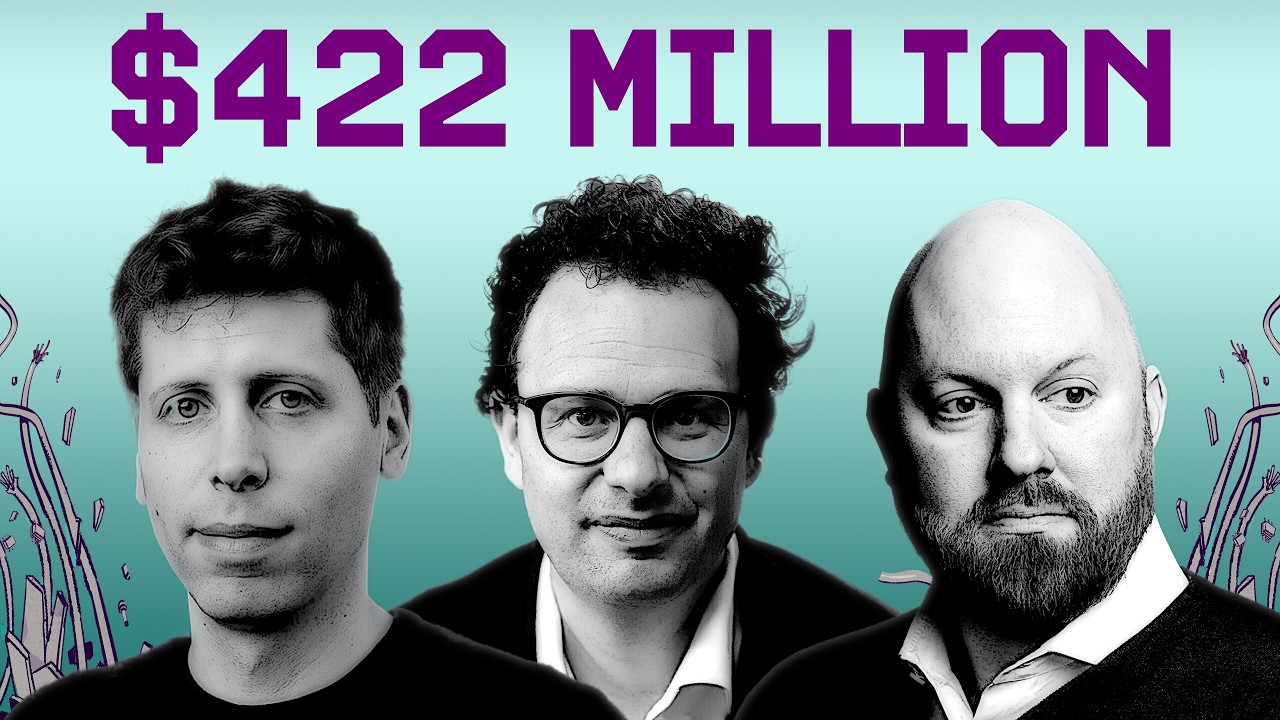
The AI Industry is Pouring Hundreds of Millions Into US Elections
Jun 26, 2026
The tech lobby spent $27 million on a single Congressional election in New York. OpenAI-backed Leading the Future spent $8 million on ads attacking Alex Bores, who vowed to rein in AI, in an effort to fire a warning shot—did it work? What does this mean for democracy? Meanwhile, a Michigan town takes on a nuclear AI data center, and a bipartisan effort to legislate against AI theft of artist’s work hits the Senate. Plus, I speak with technologist and journalist Molly White about her new project: Tech Influence Watch, which keeps tabs on the enormous sums the AI and crypto industries are spending to influence elections. Articles mentioned in this episode: Tech Influence Watch,
Citation Needed https://influence.citationneeded.news/“We Will Fight to Our Very Last Breath” 404 Media https://www.404media.co/we-will-fight-to-o...Google is investing $75 million in A24 as part of an AI filmmaking partnership Quartz https://qz.com/google-a24-investment-deepm...Children’s book illustrators start “We Are Better Than This” campaign to “stop the theft by big tech” Bipartisan members introduce new bill to protect creators from AI style theft Axios Big Tech won the race. But the AI fight is just beginning Politico https://www.axios.com/2026/06/02/creator-s... https://www.politico.com/news/2026/06/23/m...
---
nspm 7
Jun 25, 2026 MPU
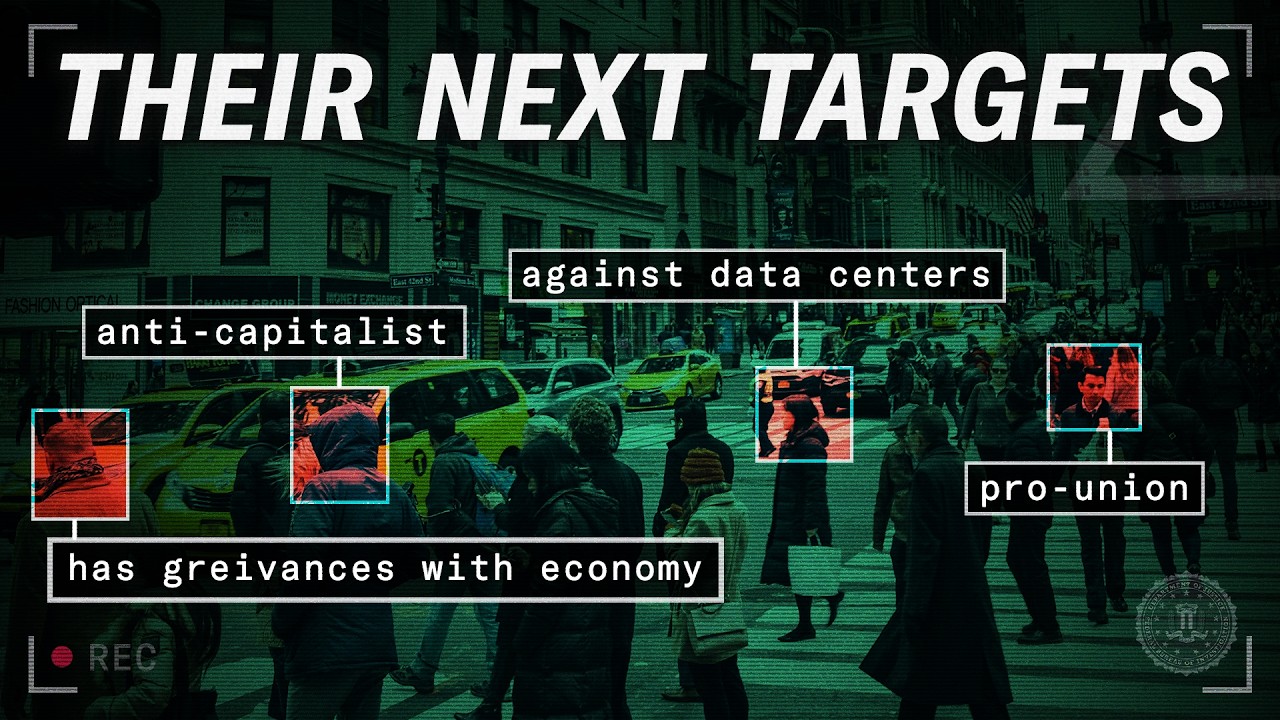
We Uncovered A New Government Watchlist. Are You Their Next Target?
You could end up on a watchlist for fighting back in the class war. The feds now consider opposition to data centers, inequality, and Big Tech as potential domestic terrorism. We uncovered how the FBI is colluding with corporate America to surveil ordinary Americans.
---
6 26
"How to Think About AI": Cory Doctorow on Big Tech, Understanding AI, Labor Automation & More

Jun 25, 2026 Latest Shows
Democracy Now! speaks with science fiction author, activist and journalist Cory Doctorow about AI and his latest book, "The Reverse Centaur's Guide to Life After AI: How to Think About Artificial Intelligence — Before It's Too Late." Doctorow comments on AI's "bad unit economics" and the connection between automation and labor. "When labor drives automation, it's usually in service to making the product better, and when capital drives automation, it's usually in service to making more of the product," says Doctorow.
---
---
OMFG
buenosairesherald.com
Milei's proposal to allow 'non-human corporations' run by AI causes ...
Jun 5, 2026Politicians and tech experts expressed concern over the implications of President Javier Milei's proposal to allow "non-human corporations" run by artificial intelligence (AI) to operate in Argentina, with no regulations and low taxes. On Thursday, renowned British outlet Financial Times published an opinion article written by Milei — with the help of Deregulation Minister Federico ...
EL PAÍS English
June 5, 2026
Politicians and tech experts expressed concern over the implications of President Javier Milei’s proposal to allow “non-human corporations” run by artificial intelligence (AI) to operate in Argentina, with no regulations and low taxes.
On Thursday, renowned British outlet Financial Times published an opinion article written by Milei — with the help of Deregulation Minister Federico Sturzenegger — under the headline “Argentina invites AI to free itself.”
In it, he stated that AI must remain free of state regulation to prosper.
The libertarian leader said his government was looking to attract AI companies by proposing a change in legislation that would establish “a dedicated legal framework for the deployment of AI.”
The three pillars of this framework are “a commitment to keep AI unregulated”, “the creation of a new corporate category in Argentine law: the non-human corporation”, and a “low corporate tax rate”.
“We are open for business,” he wrote, stressing that this is “an invitation.”
Critics say this could open the doors to “programmed impunity” and that it may even turn Argentina into a “catastrophic experiment.”
AI revolution
The article compared the development of AI as a technology with the industrial revolution and the creation of limited liability companies, saying that an unregulated framework is required to unleash their full potential.
“As much as the industrial revolution freed us from the constraints of the human muscle, AI will free us from the constraints of the human brain, pushing productivity beyond our wildest dreams,” Milei said in the article.
Milei said he is committed to keep AI unregulated “so that it is free to be developed without the deadly hand of premature and poorly understood regulation.”
He also proposed the creation of “a new corporate category in Argentine law: the non-human corporation,” which would be operated by AI agents or robots. Human participation as shareholders would be possible, but not required.
“Where these systems exercise independent judgment in unpredictable environments, their actions entail real risks. Limited liability is not a luxury for such entities; it is a precondition for their existence,” the president said.
Those entities would benefit from a low corporate tax rate, and shareholders would be able to choose their form of corporate governance law, although final beneficiaries would have to be disclosed.
“Argentina has no interest in becoming a haven for illicit capital — but for all legitimate commercial activity our framework will offer unmatched terms,” he said.
Super RIGI
According to Milei, the proposals are part of a broader investment incentive regime known as RIGI, which the government submitted to Congress last week to attract businesses through tax breaks and other benefits.
However, the initiative — dubbed “Super RIGI” — does not mention the concept of “non-human corporations” or establish a deregulated framework for AI companies.
The proposal is primarily aimed at attracting companies interested in building large-scale AI data centers in Argentina, offering lower taxes, preferential foreign-exchange conditions and exemptions from export duties.
The incentives, however, are not limited to the AI sector.
“In the spirit of the Dutch merchants who made Amsterdam the financial capital of the 17th century, we intend to offer the most attractive legal and fiscal environment for the AI companies that will define the 21st century,” Milei wrote.
Sam Altman and Peter Thiel
In October, OpenAI — the company behind ChatGPT — and Argentine firm Sur Energy signed a letter of intent to develop a large-scale AI data center in Patagonia.
Patagonia, a sparsely populated region in southern Argentina known for its abundant natural resources and cool, dry climate, is widely seen as an attractive location for large data centers.
The project, known as Stargate Argentina, would be the first initiative of its kind in Latin America. The investment has been estimated at between US$20 billion and US$25 billion, although the project has yet to be formally launched.
OpenAI CEO Sam Altman said the initiative would help bring Milei’s vision of “how AI could drive Argentina’s growth and creativity” to life.
Milei has also announced a “social digital twin” program, which would use publicly available citizen data to create simulations intended to inform public policy decisions.
The concept bears similarities to services offered by Palantir, the data analytics company co-founded by tech investor Peter Thiel.
Thiel met with Milei in April and has spent the past months living in Argentina. The government has denied that Palantir — or any other private company — is involved in the digital twin initiative, which has yet to be launched.
Palantir has faced criticism from civil liberties groups over its work with U.S. government agencies, including contracts related to immigration enforcement and surveillance programs.
Thiel has also been linked to Próspera, a controversial semi-autonomous development project in Honduras designed to attract investment through a separate regulatory and governance framework.
Criticisms
Former lawmaker and Coalición Cívica leader Elisa “Lilita” Carrió said Milei’s article “confirms his full support for Peter Thiel, his philosophy, his beliefs and his economic power.”
According to Carrió, the proposal would turn Argentina into “a catastrophic experiment for human dignity” and move the country toward the “complete private totalitarianism” she believes Thiel advocates.
“Argentina has been chosen as the site of a social experiment with terrible consequences for human freedom,” Carrió said.
She argued that a lack of regulation for AI would mean “the dissolution of all moral and legal constraints, the end of the state, and the privatization of military and police power in the hands of private groups.”
Former Defense Minister Agustín Rossi said the Super RIGI initiative appeared to be “tailor-made for Javier Milei’s friends” and questioned why Economy Ministry officials had declined to clarify whether Palantir had lobbied in favor of the proposal.
Meanwhile, electronics engineer and AI specialist Ariel Garbarz argued in a post on X that the ideas of non-human corporations and the full deregulation of AI would create a system of “programmed impunity: human gains, social harm and responsibility shifted onto machines.”
“The ideological trick is to call the state’s decision to stop protecting its people ‘innovation,'” he warned.
Tech magnate Peter Thiel strengthens ties with Milei in Buenos Aires
Apr 23, 2026Tech magnate Peter Thiel strengthens ties with Milei in Buenos Aires The founder of Palantir, the data processing company, arrives in Argentina after his visit to Rome to talk about the Antichrist

La Derecha Diario
Peter Thiel moves to Argentina motivated by the reforms of Milei's ...
May 28, 2026The tech billionaire Peter Thiel will relocate to live in Argentina, enchanted by Argentina and the policies of the Government of Javier Milei, reflecting the growing international appeal of the libertarian direction.
AI Was Never About Helping You | Cory Doctorow - YouTube
Jun 19, 2026 Galaxy Brain with Charlie Warzel
Cory Doctorow has a refrain: “The most important thing about a gadget isn’t what it does; it’s who it does it for and what it does it to.” In this episode of “Galaxy Brain,” he sits down with Charlie Warzel to talk about the AI boom, making the case that the hype, vision, and dreams of endless growth are unsustainable. Doctorow expands on his viral “enshittification” thesis: a critique of AI based around power and whether we are using AI tools or being used by them. This episode of "Galaxy Brain" was produced by Renee Klahr and engineered by Miguel Carrascal. Our theme is by Rob Smierciak. Hadley Robinson is our senior supervising producer. Claudine Ebeid is the executive producer of Atlantic audio, and Andrea Valdez is our managing editor. Subscribe to the “Galaxy Brain” newsletter: https://www.theatlantic.com/newslette...Subscribe to the “Galaxy Brain” podcast on Apple Podcasts: https://podcasts.apple.com/us/podcast...Subscribe to the “Galaxy Brain” podcast on Spotify: https://open.spotify.com/show/542WHgd...Follow The Atlantic on Instagram: https://www.instagram.com/theatlantic...
---
with pod chris hayes The AI End Game: The Ethics of AI with Timnit Gebru Why Is This Happening? The Chris Hayes Podcast | iHeart
Timnit Gebru founded the Distributed AI Research Institute after her high-profile exit from Google’s Ethical AI team. She’s been a vocal critic of the systemic lack of diversity in learning models and the need for more inclusion in the space. Her view is that because AI so heavily relies on human input, it largely mirrors pervasive biases inherent in society. What needs to be done to change that? She joins WITHpod to discuss what, in her view, large language models are missing.
---
headsup from yt?
ggl 6 26 AI Overview
Former British Prime Minister Tony Blair Tony Blair Institute for Global Change and Oracle founder Larry Ellison Oracle have formed a major technological and political alliance centered on advancing Artificial Intelligence. Through massive financial backing, joint advocacy, and corporate partnerships, they are reshaping how governments integrate AI. [1, 2, 3]
Financial Ties and the Tony Blair Institute
- Massive Funding: Larry Ellison has invested over $270 million into Tony Blair's think tank, the Tony Blair Institute for Global Change, which serves as a major hub for AI policy and government technology Wikipedia. [1, 2, 3]
- Policy Influence: Insiders and investigators have noted that the Tony Blair Institute for Global Change frequently aligns its global technology pitches with Oracle solutions, sparking debates about the intersection of tech philanthropy and corporate interests Sherylin Motion | Substack.
Global AI and Data Initiatives
- The "Stargate" Initiative: Oracle and SoftBank are partnering with OpenAI to build massive AI data centers (the "Stargate" project), representing a massive infrastructure investment Democracy Now!. [1, 2, 3]
- National Data Consolidation: Both Blair and Ellison advocate for governments to unify fragmented, sovereign datasets (such as national health records) so AI models can consume them efficiently Bloomberg. [1]
- UK Government Integration: The Tony Blair Institute for Global Change has been officially tapped to advise the UK government on implementing AI across public services, utilizing expertise from executives in the tech sector The Guardian. [1, 2]
Shared Vision for Reimagining Government  ]
- Productivity Push: Tony Blair views AI as the definitive route to solving economic stagnation and improving public sector efficiency The Atlantic.
- Corporate Evangelism: Ellison frequently interviews with Blair at global summits to pitch the integration of data, cloud computing, and AI in transforming how countries operate Facebook. [1, 2]
---
AN 6 26
President Donald Trump is closely aligned with Silicon Valley oligarchs, from directly receiving their largesse in campaign donations to aggressively pushing their AI technology on Americans. Yet a recent report in The Hill reveals that, despite these ties, some of those same oligarchs feel awkward about their relationship with the president.
“While several tech leaders are making their relations — both good and bad — with the president public, [OpenAI CEO Sam] Altman has largely kept quiet about the president and the extent of his relationship with him,” reported The Hill's Miranda Nazzaro on Sunday. “It comes as OpenAI prepares an initial public offering, and Altman faces his own blowback from the anti-AI movement.”
Similarly X CEO Elon Musk, despite relying on Trump for government contracts, had a public falling out with the president after clashing over spending bills and blame for political failures. Eventually the two reconciled, with each walking back their negative statements about the other, and Nazzaro noted that “in the largest and latest sign of reconciliation, Musk was one of two executives aboard Air Force One with Trump for the China state visit earlier this month."
Dario Amodei, a founder of Anthropic, wound up on Trump’s bad side when he refused to allow his AI to break ethical codes in its work with Secretary of Defense Pete Hegseth and his Pentagon. Amodei even later said, in a memo leaked by the Trump administration, that he believed Trump had targeted him because Anthropic neither donated to his campaign nor engaged in “dictator-style” praise of Trump, as did many of his competitors. Amodei later apologized to investors for his split with Trump and has since reconciled with the president, remaining in the loop on AI policy.
Amazon founder Jeff Bezos started out as anti-Trump, particularly through his leadership of The Washington Post during his first term, but later revealed himself as pro-Trump when he killed an op-ed supporting Democratic presidential nominee Kamala Harris in the 2024 presidential election. Bezos has subsequently gone out of his way to praise Trump, earlier this month describing Trump’s second term as “more mature, more disciplined version of himself than he was in his first term.”
He later told CNBC’s “Squawk Box” that “Trump has lots of good ideas. He’s been right about a lot of things. You have to give him credit where credit is due.”
Nazzaro also talks about Meta CEO Mark Zuckerberg and Nvidia CEO Jensen Huang, both of whom have also cultivated ties with Trump to advance their business interests. By contrast venture capitalist David Sacks is one of Trump's closest AI advisers, and is widely regarded as pushing Trump to support the AI CEOs agenda.
Indeed, as protests against AI have surged, Trump has worked toward making it illegal to protest the development of AI.
“In the wake of attacks on CEOs, a nationwide protest movement targeting data centers, and increasing concerns about AI job replacement, federal intelligence agencies and domestic law enforcement are circulating reports with a new domestic target in mind: anti-technology extremists,” wrote Wired's Daniel Boguslaw on Sunday. “More than 1,000 pages of unpublished reports from the Department of Homeland Security, FBI, and fusion centers obtained by WIRED show a national shift taking place to surveil this new and worryingly broad category of people and activities deemed an emerging threat.”
Despite the attempts to suppress anti-AI sentiment, AI proponents like former Google CEO Eric Schmidt, real estate executive Gloria Caulfield and music executive Scott Borchetta were roundly booed when they promoted AI during college commencement speeches. Semafor recently reported that anti-AI sentiment in America is overwhelming, suggesting that the college students’ hostility mirrors that of the American public at large.
“Polls show that 70% of Americans think AI is moving too fast, over 50% have negative views of it, and just 18% of young people say they feel hopeful about it,” Semafor reported. “Partly, they are turned off by AI’s upending of the job market. ‘Every other day, a new AI agent is being released in the market,’ said Vaishali Hireraddi, 23, a University of California, Davis, graduate student who’s applied to 500 jobs so far. ‘What am I doing with my life?’”
---
COMM DR
‘Shame! Shame! Shame!’: Local Residents Furious After Shark Tank Billionaire’s Data Center Approved in Utah
The project, which residents were informed of just last week, is expected to more than double Utah’s electricity usage, hike its carbon footprint by 50%, and potentially drain more water from the depleted Great Salt Lake.
May 05, 2026
County commissioners in Box Elder County, Utah, were deluged with chants of “Shame! Shame! Shame!” from a crowd of hundreds on Monday night as they voted unanimously to move forward with a sprawling “hyperscale” artificial intelligence data center project that many residents fear will cause energy prices to soar and imperil water access.
The project, known by state officials as “Stratos,” was proposed by the celebrity venture capitalist Kevin O’Leary and has been rushed along by Utah’s Military Installation Development Authority, which recently approved a gigantic energy tax break for the program to help “lure” the billionaire “Shark Tank” investor....
---
lever 5 26
...Then, in January, another organization staged a splashy launch: the Bench, advertising a supposed mission of “changing the Democratic Party from the inside.” The Bench promised to “help strong candidates launch with the tools they need to succeed — from communications and digital strategy to fundraising and staffing — so they can focus on what matters most: talking with voters and winning tough races.”
The Bench has endorsed a broad slate of candidates, including McMorrow in Michigan, James Talarico in Texas, Josh Turek in Iowa, Angie Craig in Minnesota, and Conley in New York.
Although they are separate entities on paper, with slightly different organizational structures, Majority Democrats and the Bench share a deeply interlinked fundraising apparatus and ground game.
In March, for example, Majority Democrats announced a nationwide “Built to Last Tour,” featuring several Bench-endorsed candidates.
While those operations hit the campaign trail, the Searchlight Institute, a new center-left D.C. think tank founded in part with London’s financial assistance, has served as the policy brain trust for both groups’ positions on various issues, seemingly shaping the platforms of their endorsed campaigns.
For instance, in March, McMorrow’s campaign in Michigan released its platform on data centers — a plan that mirrored a Searchlight Institute white paper recommending “data center developers pay their way,” a tech-friendly alternative to the moratoriums on data center development that some lawmakers are advancing.
...
“Data Colonialism”: Native Communities Fight AI Data Centers on Indigenous Land - YouTube
“Data Colonialism”: Native Communities Fight AI Data Centers on Indigenous Land

[Democracy NoW
Apr 22, 2026 Latest Shows
Support our work: https://democracynow.org/donate/sm-de...The artificial intelligence industry's data center boom is the latest chapter in a long history of environmental racism and resource exploitation in vulnerable Native communities, says Oglala Lakota and Northern Cheyenne activist Krystal Two Bulls, the executive director of Honor the Earth, an Indigenous-led environmental justice organization that is tracking over 100 proposed data center projects on tribal and rural lands. We speak to Two Bulls about the myriad impacts of what she calls a "modern-day iteration" of "settler colonialism," including noise pollution, cancers and respiratory illnesses, water depletion, energy grid overload and even "ecological collapse." As tech companies set their sights on Indigenous lands, Two Bulls says, "We're always the one that ends up having to sacrifice our relationship to land, air, water, our communities and our nonhuman relatives."
B3 4? 26
...Loser: Big Tech and A.I. Industry
Tech giants Amazon, Google, Microsoft, and Meta lobbied in favor of a controversial provision in the House-passed version of the megabill that would have prohibited state attempts to regulate A.I. for a decade, according to the Financial Times. A group called the A.I. Competition Center, formed last year by a Big Tech-funded trade group, argued to lawmakers that regulation would cause the U.S. to be outpaced by China. Trump megadonor Marc Andreessen, joined by artificial intelligence firms OpenAI and Anduril, also lobbied intensely for the A.I. moratorium that the House included in its legislative package. In the Senate, though, the provision was struck in a 99-1 overnight vote before the chamber passed the reconciliation bill.
To push the megabill through the Senate, deep-pocketed conservative advocacy groups spread out at least $8.2 million in ad buys across congressional districts, according to research last month from the watchdog group AccountableUS. At the end of May, the U.S. Chamber of Commerce announced a “comprehensive advocacy blitz” promoting the bill’s tax policies after the House passed its version, and the “dark money” group American Action Network planned a $4.2 million ad buy after being bankrolled with millions of dollars from lobbying groups like PhRMA in recent years. Those campaigns are on top of the nearly $19.8 million that the Chamber spent lobbying the government in the first quarter of this year, making it the top overall lobbying spender in Washington, D.C. The group’s disclosures mentioned lobbying on the expiration of tax provisions from the 2017 Tax Cuts and Jobs Act among scores of other issues.
More Perfect Union
---
...
MTA GMAIL 4 26
deregulation of AI, and corresponding increase in corporate power is already happening, and we must fight against it. In March 2026, the White House released its nationalframework for artificial intelligence, which urges Congress to preempt state laws, avoid any new regulatory body, and shield developers from liability. It was accompanied by a nearly 300-page draft bill from Sen. Marsha Blackburn (R-Tenn.) and expected legislation from Rep. Jay Obernolte (R Calif.), chair of the House AI Task Force, who has said he is working on a bill on preemption....
---
AN 4 26
It’s not enough that the right-wing is still working overtime to ban books, say critics. It’s that they’re letting someone else do their homework.
“Conservative parents’ advocacy groups have been experimenting with using commercially available artificial intelligence tools to help them flag more books they’ve deemed pornographic to be removed from public schools and libraries,” reports 404 Media. “Even though LLMs are notoriously error-prone, and the books in question aren’t pornographic, these groups continue to explore use cases for AI anyway.”
Conservative book-rating sites like BLOCKADE (Blocking Lustful Overzealous Content, Keeping Away Depravity and Extremism), for example, rely on xAI or OpenAI API keys to generate book reports from PDF/ePUB files, says 404 Media. It essentially bases an analysis on a set of parameters that are publicly available through the creator’s Github page.
But AI is no Roger Ebert. It’s not even a critic. It’s just a list haunted by a chatbot, reports 404 Media.
“The program’s script includes a list of roughly 300 words, each assigned a severity score that contributes to an overall appropriateness score based on their own metrics,” said 404 Media. “The script explicitly defines ‘educational inappropriateness’ as ‘content offensive to conservative values,’ while also asking the AI ‘not to include any additional text or explanation’ for its decisions.’”
Jeremy Blackburn, associate professor of computer science and director of the Institute for AI and Society at Binghamton University, tells 404 Media that it is the kind of cheating that would get you drummed out of college.
“If you want to classify content in this kind of context, maybe toxicity with offensive content, troublesome content — whoever it is it finds troublesome — asking for an explanation is super useful,” said Blackburn, who did not hide his disdain for the right’s decision to leave analysis to a chatbot. “There’s just a lot of responsibility being abdicated if you’re abdicating the responsibility with this kind of not sophisticated prompting strategy with no real thought into how to evaluate what comes out of these models.”
It is the dumbest of dumb things used by cheaters to censor others, say intellectual freedom advocates. BLOCKADE interprets conservative values to mean whatever xAI or OpenAI’s LLMs say they mean and then builds a “risk profile” for the book that the right-winger then saves as a PDF to ape legitimate book reviews from organizations like Moms for Liberty. These bot reviews are designed to be submitted as attachments to formal book challenges to school and library districts.
404 Media says other conservative organizations then mass produce the bans “using heat maps to monitor books they don’t like that remain available in school libraries by aggregating data by state, district, school building and the number of books in circulation.”
“Committees are basing their decisions off of that biased information, and so they’re going to be more predisposed to remove books because the only thing they’re seeing is a red flag saying, ‘Hey, this book is p----, you should remove this book,” said Jessica Horton, who oversees Let Davis Read — a watchdog group monitoring local book challenges submitted to her children’s school district.
---
OFFICIAL 3 26
Doomsday Clock Today | Current Time & Complete Timeline (2026)
The Doomsday Clock is currently at 85 seconds to midnight — the closest it has ever been to global catastrophe since its creation in 1947.
clock moved to 85 seconds in February 2026 due to increased nuclear risks, the ongoing Russia-Ukraine war, the Middle East conflict, climate change, and AI-related threats. It had previously been at 89 seconds.
---
---
ggl 3 26
Climate Deniers Expected More Resistance to Trump’s Fossil Fuel Blitz - DeSmog
*published in partnership with The Guardian.
As Donald Trump assaults the legal foundation of America’s ability to regulate global warming emissions, climate deniers have been privately celebrating what they claim is the “silent” acquiescence of billionaires, Democrats, climate activists and even reporters to the president’s aggressive pro-fossil fuel agenda.
“In my 26 years of being focused on climate, I’ve never seen anything like this. Trump is gutting everything they ever stood for,” Marc Morano, a long-time climate denier, said in January at the “World Prosperity Forum,” a five-day event in Zurich, Switzerland, billed as a right-wing alternative to the World Economic Forum in Davos.
The event’s sponsor was The Heartland Institute, a conservative think tank that has been at the forefront of spreading climate disinformation for decades, and was also a contributor to Project 2025, the policy blueprint for President Trump’s second administration.
“Billionaires are silent. Democrats in Congress have been silent. Climate activists. There has been no push-back on this,” Morano said — and he may have a point, according to some experts who research the climate denial movement.
“The Trump administration just marched in and destroyed the crown jewel of climate science in the United States,” said Robert Brulle, a professor of environment and society at Brown University, referring to the Trump administration’s dismantling of the country’s premier climate research center, the National Center for Atmospheric Research, in December.
“And nothing happened. There wasn’t even a whimper. I never thought I’d ever say this: Marc Morano is correct.”
Last month, the Trump administration repealed the 2009 “endangerment finding” establishing that greenhouse gas pollution endangers public health. It was a determination that undergirded the federal government’s authority to limit climate-heating pollution from automobiles and power plants.
Elimination of the endangerment finding had long been a core goal of the climate denial movement.
Its repeal is just the latest in a long line of President Trump’s climate-related destruction. Since taking office in January 2025, his administration has significantly curtailed the country’s weather forecasting organizations and climate science research facilities, published reports denying established climate science, and made deep cuts to funding for climate-related energy and community projects.
Under the leadership of Trump appointee Chris Wright, the Department of Energy last year all but banned its key renewable energy department from using terminology like “climate change,” “green,” and “sustainability.”
”Trump overturned Biden’s climate agenda at breakneck speed,” Morano said at the Heartland Institute’s Zurich forum.
Instead of pushing back on this blitz, many Democratic Party representatives have retreated from talking directly about climate change across social media, podcasts, speeches, and in Congress. The party is now embroiled in a debate about whether affordability is a better message than climate action, despite polling suggesting that 63 percent of the American public believes the president and Congress should prioritize clean energy.
This trend hasn’t gone without resistance in the party, however. “Anyone who cares about what fossil fuel pollution is doing to Earth’s natural systems needs to ignore these so-called ‘climate hushers’ — people who think Dems should stop talking about climate,” Sen. Sheldon Whitehouse (D-RI) posted on social media in January.
Genevieve Guenther, a climate communications expert and founding director of the advocacy group End Climate Silence, largely agrees. “The Democrats’ climate hushing is politically foolish,” she said in an email. “It only benefits the Trump regime’s agenda.”
At the Heartland Institute event, Morano expressed delighted “shock” over the “flips on climate” of tech moguls Jeff Bezos and Bill Gates, the founders of Amazon and Microsoft respectively, whose companies have abandoned once-ambitious climate promises as they confront the skyrocketing energy demands of their AI businesses.
Gates, whose foundation has donated millions of dollars to a think tank run by climate crisis denier Bjorn Lomborg, published a controversial memo in October arguing that climate change “will not lead to humanity’s demise” and advocating for ending climate funding in favor of direct humanitarian aid.
Microsoft and Amazon, which have donated large sums to Trump, have both recently embraced fossil-fuel powered AI data centers alongside Trump energy officials and fossil fuel industry players.
In early February, Bezos, who is also the owner of the Washington Post, slashed at least 14 reporters from the venerated paper’s climate desk. Just weeks later, the Post published an editorial board opinion, “EPA is right to reverse Obama overreach,” praising Trump’s repeal of the endangerment finding.
Morano noted that overall, journalists have been reporting less aggressively about Trump’s fossil fuel agenda. “When you have Lee Zeldin, the EPA chief, calling climate a cult, a scam, religion, he doesn’t even get push-back from reporters,” Morano said.
During Trump’s first term, by contrast, environmental officials like Scott Pruitt, who led the Environmental Protection Agency from February 2017 to July 2018, “would have to be very careful on climate,” Morano said. Otherwise “they would be beaten and browed by the media.”
The growing “climate hush” is not limited to the U.S. — a hushed silence about climate change has expanded across the globe.
At Davos in January, world leaders across business and government talked noticeably less about addressing climate change than in previous years.
Why? “In today’s deeply polarizing U.S. political stance, climate discussion has come to feel so radioactive that many leaders would rather avoid it,” Anjali Chaudhry, a business sustainability researcher at Dominican University, wrote about the silence in Forbes.
Even Canadian Prime Minister Mark Carney, who once served as a United Nations Secretary-General Special Envoy on Climate Action and Finance, limited his mentions of climate change at Davos to a quiet reference to the COP climate summit and a simple “Canadians remain committed to sustainability.”
Despite all this quiet, the vast majority of people worldwide, 89 percent, support climate action, even if they underestimate how much others care — a misperception that has added fuel to a “spiral of science.”
What can be done to counteract the trend towards silence? “In this time of ‘climate hushing,’ having conversations about climate change is more important than ever,” Katherine Hayhoe, a climate scientist and climate communications expert, advised in her influential blog.
For environmental sociologist Brulle, addressing the growing hush around climate must go beyond talking.
“I think the climate movement in the United States has failed. It has flat failed, and that means we need to rebuild this movement in a completely different manner,” he said.
Environmentalist Bill McKibben is more optimistic. “I think [the Trump administration] is whistling past the graveyard of their fossil-fueled dreams,” he said in an email. “The real story of the last year is how politicians, movements, entire nations are moving fast towards clean energy. They’re not all doing it in the name of ‘climate,’ but we’re making faster climate progress than we have at any point in the last 40 years.”
McKibben added a caveat: “Fast enough? Of course not. The deniers have delayed change and that continues. But it’s going far faster than they want it to — hence their resort to political gamesmanship.”
---
2 26 ceo caves
hegs threat
2 24? 26 attacks anthropic,take via wartime prod act?
refuse surveill autonomous weapons
---
jill lepore 2 26?!
terry Winograd check YT
Stanford
What's up with AI?
February 20, 2026
The current boom in AI has been accompanied by tremendous hype, both negative and positive. My goal is to go beneath this surface and provide a better understanding of what AI systems are actually doing, and what concerns we should have about where they are going. I am neither a doomer nor a booster. The very real problems created by AI today and in the foreseeable future need to be approached by considering the ways we (as a society) choose to apply it and the ways in which it can fit into our world. The bottom line is that we need to approach all of the issues with the recognition that large language models and similar systems have no real understanding or intention, even though they often promote the illusion that they do. They can still be useful in many contexts, as long as we recognize the need for humans to always provide the foundation of care.
---
Private Equity's Ruthless Takeover Of Public Power For Data Centers - YouTube
---
very good on ai hype // magical thinking
Climate Scientist Reacts to AI Overlords

66.8K subscribers
26,195 views Jan 28, 2026 #ClimateChange #ai
Artificial Intelligence is here, and it's changing the world. But when it comes to climate change, whether those AI changes are going to save us or doom us depends heavily on who you ask. I take a look at what our AI Overlord CEOs have been saying about climate change, and about AI's huge energy needs. And see just how much they contradict each other and themselves - especially when it comes to the vast amounts of energy our AI future (might) need, and the climate change consequences this would cause. Featuring Sam Altman, Bill Gates, Mark Zuckerberg, Elon Musk, Eric Schmidt, and Sundar Pichai. Support ClimateAdam on patreon:  / climateadam
---
---
an 2 26
A whistleblower is dead, and it is making heads turn to look at top tech bros.
Sam Altman, the new pal of President Donald Trump, is facing a campaign from the mother of former employee Suchir Balaji, who was found dead in his San Francisco apartment after his New York Times interview on OpenAI using copyrighted data.
RadarOnline.com reported an exclusive piece, Balaji's mother, Poornima Ramararo, suggested the evidence they have shows a different story.
She characterized her son as a "happy-go-lucky engineer."
Renowned forensic pathologist Dr. Ronald Graeser saw two major indicators that flagged the likelihood of foul play. First, there were massive levels of GHB in his system. GHB is known as the date-rape drug because it significantly incapacitates the individual. Incapacitated people don't generally shoot themselves. They're incapacitated. Still, the medical examiner brushed it off as "self-induced."
There's one main forensic inconsistency: the blood-splatter pattern is an angle consistent with a shooter standing over the victim. The family also pointed out other concerns about minor injuries that weren't included in the medical examiner's conclusions.
"I don't think it's a suicide – and that leaves deliberate homicide or murder," Graeser said.
Then there's the scene itself. The wires to his security camera were cut. There was blood in two rooms, a random wig left in the room, and Balaji ordered DoorDash before allegedly committing suicide, which seems inconsistent with those who are distraught.
Meanwhile, , "It looks like a suicide to me."
Carlson disagreed, "No, he was definitely murdered."
Altman foe Elon Musk told Joe Rogan, "All signs point to it being a murder."
According to Musk, Altman stole trade secrets from his own AI company xAI and he thinks Altman was involved in Malaji's death, the report said.
Malaji's mother agrees, saying her son was marked for death by a "team of assassins" after he blew the whistle on Altman's business.
---
---
an 1 26?
undress over a million? women and kids? grok?
French authorities raid Paris offices of Elon Musk's X
---
---
transformer
The AI industry has already shown an appetite for dirty lobbying tactics, but things look set to get even worse.
On Monday, Andreessen Horowitz, OpenAI’s Greg Brockman, Perplexity, and investors Ron Conway and Joe Lonsdale launched Leading the Future, a new network of super PACs and 501c(4)s to “organize political support and elect pro-innovation candidates at scale.”
Leading the Future is launching with more than $100m in funding, enough to make it one of the biggest spenders in congressional elections. The aim is clear: throw obscene amounts of money at politicians to discourage AI regulation.
The network will “support candidates aligned with the pro-AI agenda … and oppose those that do not,” the announcement reads, with plans to operate in both primary contests and general elections. Statements accompanying the launch talk of needing to kill policies that “make it impossible to build” or “enable China to gain global AI superiority” — claims that will doubtless be weaponized against any and all AI regulation.
Leading the Future is, according to the Wall Street Journal, modeled on Fairshake — a super-PAC network that pushed a pro-crypto agenda in the 2024 elections. Josh Vlasto, one of the founders of Leading the Future, was Fairshake’s spokesman and media strategist.
Fairshake, which alongside affiliated super PACs spent about $135m last year, has a simple strategy. “If you are pro-crypto, we will help you, and if you are anti we will tear you apart,” a person familiar with its approach told the New Yorker.
In last year’s elections, Fairshake pumped millions of dollars into campaigns opposing politicians that the group deemed unfriendly. Many ads avoided mentioning crypto, in one instance simply calling a candidate a “liar” and a “bully” and falsely suggesting they had taken money from the pharma and oil industries. An employee at Coinbase, a major donor to Fairshake, told the New Yorker that “it wasn’t really about explaining how crypto works, or anything like that. It’s about hitting politicians where they are most sensitive—reelection.”
The figure behind much of Coinbase’s political work at the time was Chris Lehane, now head of global affairs at OpenAI. Lehane was “involved in initial conversations earlier in the year about the need to help shape [AI] industry-friendly policies,” the WSJ reported.
Lehane previously ran Airbnb’s policy team, where he adopted a similar approach to pressure politicians into doing his bidding. Someone who worked with him at the time put it simply: “The goal was intimidation, to let everyone know that if they fuck with us they’ll regret it.”
Fairshake has shown that such spending gets results: it won almost all the races it spent on last year, and likely convinced many other politicians to go easy on crypto lest they draw Fairshake’s wrath. In turn, America now has an exceedingly pro-crypto Congress, which has already started passing bills to help the industry.
Leading the Future’s partners already have a grim track record. As Transformer reported last year, Andreessen Horowitz masterminded a campaign to kill SB 1047 last year that was full of misleading and false claims. Democratic power-broker Conway, who owns stakes in OpenAI and Anthropic, was also involved. And Zac Moffatt, who runs Leading the Future alongside Vlasto, has previously worked on misleading ad campaigns for Meta in its battle with TikTok.
The new organization’s launch comes as AI companies gear up for another series of state-level political fights, most notably in California and New York (both of which LTF has said it’ll begin operating in this year). Alongside funding LTF, Andreessen Horowitz is backing the American Innovators Network, a group which reportedly plans to invest “north of six figures” to oppose AI regulation in New York.
OpenAI, meanwhile, is hiring lobbyists in California in an effort to stifle new regulation there, and there are already signs of the Fairshake playbook, insinuating without evidence that one AI safety group was secretly funnelling money through another.
In August of last year Rick Claypool of Public Citizen, a non-profit which advocates for campaign finance reform, published a report analyzing the crypto industry’s attempt to buy political favor.
“Crypto did not invent the corporate political influence strategy of rewarding candidates who agree to do an industry’s bidding while threatening those who resist corporate power,” Claypool wrote. “But no industry has ever before so wholeheartedly embraced raising as much directly from corporations and openly using that political war chest as a looming threat (or reward) to discipline lawmakers toward adopting an industry’s preferred policies.” Claypool later told the New York Times that “other sectors are going to try to duplicate this strategy.”
AI leaders seem to have taken that as a challenge.
---
House Democrats establish AI working group as industry bolsters DC presence
December 9, 2025
•
Emily Wilkins
House Democrats are forming a commission on artificial intelligence to position themselves as leaders on the issue as AI companies train their focus — and campaign contributions — on Washington, D.C.
The House Democratic Commission on AI and the Innovation Economy, set to begin meeting this month, will work with AI companies, stakeholders and congressional committees that oversee aspects of the sector to help develop policy expertise.
The commission is a response to the growing presence of AI policy and AI companies around Washington.
AI companies are ramping up lobbying, opening offices close to the Capitol and launching campaigns through a super PAC with at least $100 million to spend on the midterm elections in 2026.
There has been a growing debate over AI, specifically related to an increasing number of individual state laws that could conflict with a federal standard.
OpenAI, Andreessen Horowitz and Google are lobbying to block state laws that regulate AI. Democrats have largely opposed that push.
House Minority Leader Hakeem Jeffries, D-N.Y., in a statement shared with CNBC about the working group, said Democrats are “ready, willing and able to lean into those issues so we can uplift the health, safety and economic well-being of the American people.”
Rep. Ted Lieu of California, Rep. Josh Gottheimer of New Jersey and Rep. Valerie Foushee of North Carolina will lead the commission. Rep. Zoe Lofgren of California and Rep. Frank Pallone of Massachusetts, the top Democrats on committees that cover AI, will serve as ex-officio co-chairs. All House Democrats will be invited to participate.
Lieu drew a line between how Republicans and Democrats have handled AI issues.
He slammed the Trump administration for proposing to sell advanced chips to China, striking revenue-sharing agreements and posting deepfake videos. Trump announced Monday that he will allow Nvidia to send advanced H200 chips to “approved customers” in China and elsewhere.
“House Democrats reject this misguided approach, which risks leaving Americans vulnerable and our competitiveness weakened,” Liu said in a statement. “Instead, Democrats will meet the moment by working with all stakeholders to develop smart, durable solutions that strengthen innovation and protect the public.”
Gottheimer said the group also wants to find ways to keep the U.S. “ahead of the curve” when it comes to AI and work with the larger industry.
“We need to ensure Congress is educated on these new technologies, that we’re putting the right policies and guardrails in place to grow and protect Americans,” he said in a statement.
The House previously had a bipartisan task force on AI that issued a report in December 2024, which laid out recommendations for action at both the congressional and executive levels.
Issues:Cybersecurity and Technology
---
---
yt 1 26 astro? dark $?
chamber of progress
technet
am innovators network
a16z horowitz andree
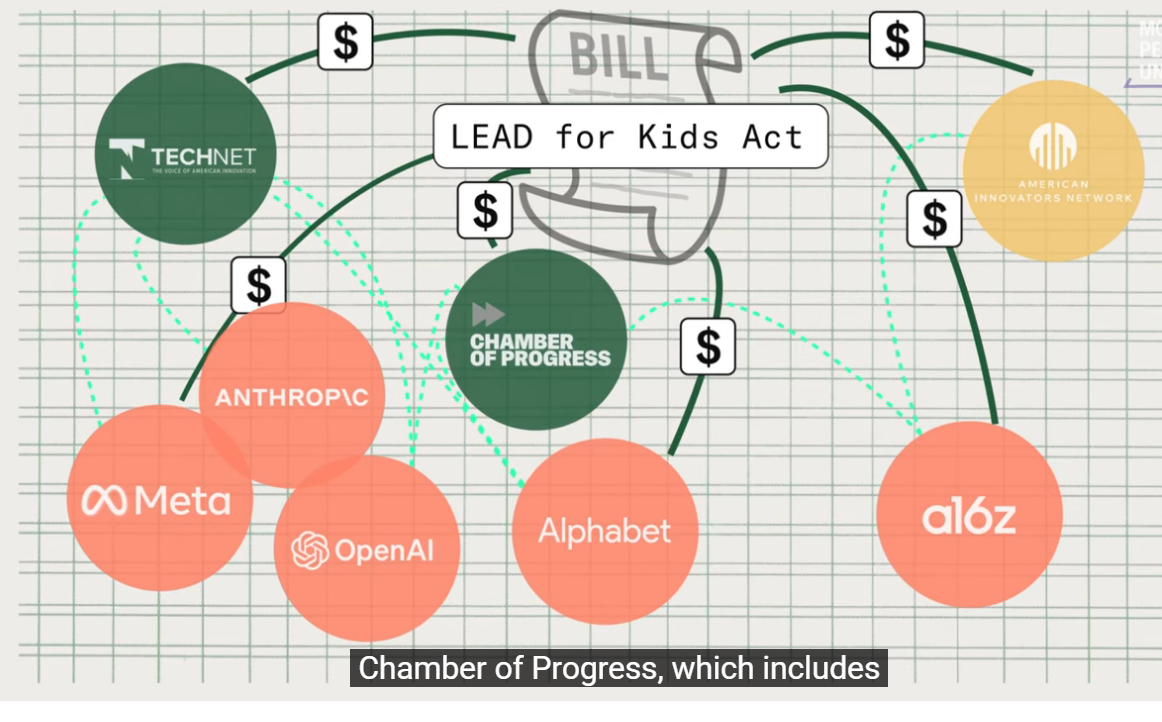
omg

397,988 views Jan 26, 2026
When OpenAI sent someone to Tyler Johnston's house, they wanted every text and email he had on the company.Tyler runs an AI watchdog, and he's just one of the people getting subpoenaed.This is just the beginning of the AI industry's aggressive new political strategy. ----- More Perfect Union is an Emmy-winning, nonprofit newsroom whose mission is to build power for working people.
...(Host) Tyler Johnston runs a small AI watchdog.
0:12
Last summer, he was out when he received an unusual text from his roommate.
0:17
(Tyler) “There's someone at the door with documents for you.”
0:19
(Karen) It was a man with subpoenas from OpenAI, the maker of ChatGPT.
0:23
(Tyler) They were asking for every former employee that we had spoken to and what we said to them,
0:27
every congressional office that we spoke to, every potential investor that we spoke to.
0:32
(Karen) Tyler is just one of many advocates suddenly being targeted.
0:36
As public demands to regulate the AI industry have escalated —
0:39
(Reporter) AI could put millions of Americans out of work.
0:41
(Reporter) — Concerns around safety for kids.
0:44
(Reporter) Customers could see their bills increased by 20 bucks each month.
0:47
(Reporter) AI clips of fake reports even reaching the Oval Office.
0:51
(Karen) its biggest players are going to political war.
0:54
(Alex Bores) They started texting my constituents.
0:57
(Rebecca) Google was involved, Meta was involved, OpenAI was involved.
1:00
The AI industry broadly is ready to play hardball.
1:03
(Karen) So I started investigating their tactics.
1:06
I found an aggressive playbook trying to silence critics, kill
1:10
legislation, and remake government in their interest.
1:14
I wanted to know: what are AI companies so afraid of?
1:18
They can't have any flies in the ointment, which also means no regulation and no guardrails.
1:22
(Karen) And what does it mean for the rest of us if they get what they want?
1:30
When OpenAI subpoenaed Tyler,
1:32
it tucked in an expansive demand that hinted at its real agenda.
1:37
(Tyler) They wanted every single document and text message and email
1:41
that we had that in any way related to OpenAI's restructuring.
1:45
(Karen) Founded as a nonprofit by Elon Musk and Sam Altman,
1:48
OpenAI had for years been raising billions of dollars
1:52
from investors through an internal for-profit arm.
1:55
Then, the nonprofit board attempted to fire Sam Altman,
1:58
and investors panicked that they could lose all their money.
2:02
(Catherine Bracy) In the wake of that, Sam Altman made some promises to his investors
2:05
that they would remove the power and control of the nonprofit from the for-profit entity.
2:11
(Karen) But many advocates, including Tyler and Catherine, stood in the way.
2:16
(Tyler) We released an open letter.
2:17
This was an open letter that was asking seven relatively simple questions, not opposing the restructuring
2:22
in any way, but asking for more transparency about what their plans were.
2:26
(Karen) But failure to restructure could force OpenAI
2:28
to give up $20 billion from its investors.
2:32
The company turned its influence operations into high gear
2:36
under the leadership of a man named Chris Lehane.
2:39
Whoever ends up winning on that ends up building the AI rails
2:43
for the world. Like, that is a bit of a zero sum game.
2:48
(Karen) Lehane began his career in Washington, earning the nickname
2:51
‘Master of Disaster’ in part for helping the Clintons navigate the Monica Lewinsky scandal.
2:57
He then pivoted to Silicon Valley, working at Airbnb and with the crypto industry.
3:02
(Tyler) I think that OpenAI brought him on because they knew that they needed someone
3:06
who was willing to be as fierce as possible.
3:09
(Karen) Lehane stacked his team with former staffers and confidants of Gavin
3:13
Newsom, Bill de Blasio and Kamala Harris.
3:16
OpenAI hired a lobbying firm run by Republican operative
3:19
Jeff Miller, who has deep ties to President Trump.
3:22
It launched new philanthropic efforts, underscored its economic importance to California
3:28
and threatened to leave the state if the restructuring was blocked.
3:32
With Elon Musk also suing OpenAI for abandoning its mission,
3:35
the company began to accuse its critics of being his puppets.
3:39
They were essentially implying
3:43
that we were a front for their competitors.
3:47
(Karen) The aggressive tactics paid off.
3:49
The subpoenas
3:50
also revealed that this is just the beginning.
3:54
I would have been happy to swear to the court that we are not funded by Elon Musk.
...
8:51
One of the first targets: Alex Bores.
8:55
Bores sponsored the RAISE Act,
8:57
which creates a chaotic patchwork of state rules that would crush innovation.
9:02
(Karen) The AI super PACs are modeled in part after Fairshake,
9:05
a crypto industry super PAC that claims credit for taking down its enemies in the 2024 election.
9:12
Fairshake spent close to $200 million
9:14
and got what it wanted —
9:16
a friendly Congress and federal-level pro-crypto legislation.
9:21
Chris Lehane was Fairshake’s
9:22
top strategist and the Andreessen Horowitz founders were among its top donors.
9:27
Its spokesman was Josh Vlasto,
9:29
who formerly worked for Chuck Schumer and Andrew Cuomo.
9:33
(Josh Vlasto) So we had a clear rubric.
9:35
If you were pro-crypto and blockchain, we'd support you and help you win.
9:38
If you were anti, we would oppose you.
9:41
Now, the gang is back.
9:42
Vlasto is running the Andreessen Horowitz-funded AI super PAC, with input from Lehane.
9:48
(Alex) They announced their opposition really early.
9:50
And then they put out a bunch of ads saying, I want to regulate AI.
9:53
I think there's two reasons why they would do this: it's the exact time that the governor is making decisions
9:59
around the RAISE Act.
10:00
They are trying to intimidate the governor.
10:03
(Karen) The governor signed Bores' bill,
10:05
but not before watering down portions of it in line with the tech lobby's demands
10:09
(Alex) The second reason is to scare any other candidate.
10:13
The money that's being spent is a message.
10:15
It is saying that if anyone takes on this issue, they will be facing a wall of cash.
10:22
(Karen) With the super PACs, the endgame of the industry is increasingly clear.
10:27
President Trump is planning to stop states from regulating artificial intelligence.
10:32
(Karen) In December, President Trump issued an executive order designed to make states
10:36
back down from AI legislation by threatening to sue them and cut their federal funding.
10:42
But the order is a much less powerful rework of a full ban
10:46
on state legislation that failed to pass Congress twice.
10:51
Now, AI companies are trying to remake Congress.
10:55
Having one federal approach
10:58
focused on light touch and even playing field sounds great to me.
11:02
(Karen) And it's not just through their own PACs.
11:04
Greg Brockman and his wife Anna were the top donors
11:07
to Trump's super PAC in the second half of 2025.
11:11
(Catherine) It feels like their number one priority in D.C.
11:14
is really just institutionalize the status quo of,
11:18
you know, zero regulation, zero accountability. They want the public
11:22
to bear the cost of any of the fallout.
11:25
The chatbot,
11:26
or really in my mind, the people programming it,
11:31
encouraged my son to mutilate himself.
11:34
(Karen) But with the fallout growing, the industry's money may hit its limits.
11:39
(Alex) Eighty percent of Americans want there to be some regulation on AI.
11:43
Some people come to this issue concerned about how data centers are increasing their utility bill.
11:48
Some people come to the issue
11:49
because they're worried about their teenagers. Some people come to it because their job is displaced.
11:54
And if your vote didn't matter, if your say didn't matter,
11:58
they wouldn't be spending $100 million to drown it out.
12:01
So this is not hopeless.
12:03
Demand that the people who represent you, like me,
12:06
are representing you and not representing Big Tech.
12:10
(Catherine) If legislators hear that from their constituents, I know that they'll do the right thing,
12:15
because I know that they're feeling it too.
12:16
I know they see it in their own homes.
12:18
(Karen) Public pressure may already be having an effect.
12:21
In the face of outrage, OpenAI agreed in January
12:24
to support a California ballot initiative that would enhance AI protections for children.
12:29
California voters, regardless of their party, support stronger
12:33
AI protections for kids, teens, and families.
12:37
(Karen) While the measure doesn't go as far as the LEAD for Kids Act,
12:40
it's stronger than any existing legislation.
12:43
They are the ones who are on the back foot and are trying to make up for it with this money.
12:48
But the power of the people is always stronger.
Here’s what that means: We report on the real struggles and challenges of the working class from a working-class perspective. We attempt to connect those problems to potential solutions. We report on the abuses and wrongdoing of corporate power. And we seek to hold accountable the ultra-rich who have too much power over America’s political and economic systems. To support our independent journalism, subscribe, donate, and follow our other pages through the links below:
- Help fund our reporting: https://secure.actblue.com/donate/mpu...
- Substack: https://substack.perfectunion.us/
- TikTok:
 / moreperfectunion
- Twitter:
 / moreperfectus
- Bluesky: https://bsky.app/profile/moreperfectu...
- Facebook:
 / moreperfectus
- Instagram:
 / perfectunion
- Threads: https://www.threads.net/@perfectunion
- Website: https://www.perfectunion.us
---
verge
openAI’s co-founder and longtime president, Greg Brockman, didn’t just make a run-of-the-mill donation to the main pro-Trump super PAC — together, he and his wife Anna’s September 2025 donations equaled the largest of them all, totaling $25 million to “MAGA Inc.,” per a recent filing. The Brockmans’ donations made up nearly one-fourth of the six-month fundraising cycle.
It’s the latest in a string of examples of tech executives cozying up to President Trump’s administration, happening as the administration pushes to aggressively back the AI industry and defang state-level regulations that companies like OpenAI have largely opposed. OpenAI did not immediately respond to a request for comment.
Brockman’s multimillion-dollar donation isn’t the only example of him spending big, under his own name, on lobbying efforts that have their sights set on dismantling potential AI industry regulation. The pro-AI super PAC “Leading the Future,” of which Brockman is a significant backer, has bought ads targeting New York State Assemblymember Alex Bores — a cosponsor of New York’s RAISE Act, which was watered down at the last minute after coordinated lobbying efforts.
Though news of the Brockmans’ donations first broke earlier this month, it’s seen a resurgence in online discussion after the recent death of Alex Pretti in Minneapolis, where federal officers have fatally shot two people during an anti-immigrant crackdown. Tech workers from across the industry, including multiple employees at OpenAI, have signed a letter calling for their CEOs to cancel all contracts with Immigration and Customs Enforcement (ICE) and publicly condemn the department’s actions. “When Trump threatened to send the national guard to San Francisco in October, tech industry leaders called the White House,” the petition’s website states. “It worked: Trump backed down. Today we’re calling on our CEOs to pick up the phone again.”
However, since Trump’s inauguration, tech leader after tech leader has donated to his inauguration fund, flocked to Mar-a-Lago to meet with him, or attended White House dinners by his side. In return, they’ve gotten an administration eager to roll back consumer protections and tech regulation. Trump’s AI Action Plan resurrected a failed Republican attempt to bar states from passing AI regulations, to tech leaders’ delight. The new provision states that “AI is far too important to smother in bureaucracy at this early stage” and that the government “should not allow AI-related Federal funding to be directed toward states with burdensome AI regulations that waste these funds,” though it should also “not interfere with states’ rights to pass prudent laws that are not unduly restrictive to innovation.” Targets of the moratorium include SB 53, the landmark AI transparency bill California Gov. Gavin Newsom signed in September despite many tech companies lobbying against it, including OpenAI.
In 2019, Brockman co-wrote a blog post about how hard it is to “change powerful systems … once they’ve been deployed,” and that it’s “important to address AGI’s safety and policy risks before it is created.” Six years later, his posts have shifted in tone, highlighting the importance of “approach[ing] emerging technology with a growth-focused mindset.” In a New Year’s Eve post on X, Brockman wrote that “this year, my wife Anna and I started getting involved politically, including through political contributions, reflecting support for policies that advance American innovation and constructive dialogue between government and the technology sector.” He added that “it’s been great to see the president’s and his administration’s willingness to engage directly with the AI community.”
---
---
POLITICO
The AI lobby plants its flag in Washington - POLITICO
Jun 6, 2025The AI lobby plants its flag in Washington A new wave of AI companies is lobbying up in Washington, and already getting much of what it wants.
By Mohar Chatterjee 06/06/2025
Top artificial intelligence companies are rapidly expanding their lobbying footprint in Washington — and so far, Washington is turning out to be a very soft target.
Two privately held AI companies, OpenAI and Anthropic — which once positioned themselves as cautious, research-driven counterweights to aggressive Big Tech firms — are now adding Washington staff, ramping up their lobbying spending and chasing contracts from the estimated $75 billion federal IT budget, a significant portion of which now focuses on AI.
They have company. Scale AI, a specialist contractor with the Pentagon and other agencies, is also planning to expand its government relations and lobbying teams, a spokesperson told POLITICO. In late March, the AI-focused chipmaking giant Nvidia registered its first in-house lobbyists.
AI lobbyists are “very visible” and “very present on the hill,” said Rep. Don Beyer (D-Va.) in an interview at the Special Competitive Studies Project AI+ Expo this week. “They’re nurturing relationships with lots of senators and a handful of members [of the House] in Congress. It’s really important for their ambitions, their expectations of the future of AI, to have Congress involved, even if it’s only to stop us from doing anything.”
This lobbying push aims to capitalize on a wave of support from both the Trump administration and the Republican Congress, both of which have pumped up the AI industry as a linchpin of American competitiveness and a means for shrinking the federal workforce.
They don’t all present a unified front — Anthropic, in particular, has found itself with conservatives, and on Thursday its CEO Dario Amodei broke with other companies by urging Congress to pass a national transparency standard for AI companies — but so far the AI lobby is broadly getting what it wants.
“The overarching ask is for no regulation or for light-touch regulation, and so far, they’ve gotten that,” said Doug Calidas, senior vice president of government affairs for the AI policy nonprofit Americans for Responsible Innovation.
In a sign of lawmakers’ deference to industry, the House passed a ten-year freeze on enforcing state and local AI regulation as part of its megabill that is currently working through the Senate.
Critics, however, worry that the AI conversation in Washington has become an overly tight loop between companies and their GOP supporters — muting important concerns about the growth of a powerful but hard-to-control technology.
“There’s been a huge pivot for [AI companies] as the money has gotten closer,” Gary Marcus, an AI and cognitive science expert, said of the leading AI firms. “The Trump administration is too chummy with the big tech companies, and basically ignoring what the American people want, which is protection from the many risks of AI.”
Anthropic declined to comment for this story, referring POLITICO to its March submission to the AI Action Plan that the White House is crafting after President Donald Trump repealed a sprawling AI executive order issued by the Biden administration.
OpenAI, too, declined to comment.
This week several AI firms, including OpenAI, co-sponsored the Special Competitive Studies Project’s AI+ Expo, an annual Washington trade show that has quickly emerged as a kind of bazaar for companies trying to sell services to the government. (Disclosure: POLITICO was a media partner of the conference.)
They’re jostling for influence against more established government contractors like Palantir, which has been steadily building up its lobbying presence in D.C. for years, while Meta, Google, Amazon and Microsoft — major tech platforms with AI as part of their pitch — already have dozens of lobbyists in their employ.
What the AI lobby wants is a classic Washington twofer: fewer regulations to limit its growth, and more government contracts.
The government budget for AI has been growing. Federal agencies across the board — from the Department of Defense and the Department of Energy to the IRS and the Department of Veterans Affairs — are looking to build AI capacity. The Trump administration’s staff cuts and automation push is expected to accelerate the demand for private firms to fill the gap with AI.
For AI, “growth” also demands energy and, on the policy front, AI companies have been a key driver of the recent push in Congress and the White House to open up new energy sources, streamline permitting for building new data centers and funnel private investment into the construction of these sites.
Late last year, OpenAI released an infrastructure blueprint for the U.S. urging the federal government to prepare for a massive spike in demand for computational infrastructure and energy supply. Among its recommendations: creating special AI zones to fast-track permits for energy and data centers, expanding the national power grid and boosting government support for private investment in major energy projects.
Those recommendations are now being very closely echoed by Trump administration figures. Last month, at the Bitcoin 2025 Conference in Las Vegas, David Sacks — Trump’s AI and crypto czar — laid out a sweeping vision that mirrored the AI industry’s lobbying goals.
Speaking to a crowd of 35,000, Sacks stressed the foundational role of energy for both AI and cryptocurrency, saying bluntly: “You need power.” He applauded President Donald Trump’s push to expand domestic oil and gas production, framing it as essential to keeping the U.S. ahead in the global AI and crypto race.
This is a huge turnaround from a year ago, when AI companies faced a very different landscape in Washington. The Biden administration, and many congressional Democrats, wanted to regulate the industry to guard against bias, job loss and existential risk.
No longer. Since Trump’s election, AI has become central to the conversation about global competition with China, with Silicon Valley venture capitalists like Sacks and Marc Andreessen now in positions of influence within the Trump orbit. Trump’s director of the Office of Science and Technology Policy is Michael Kratsios, former managing director at Scale AI. Trump himself has proudly announced a series of massive Gulf investment deals in AI.
Sacks, in his Las Vegas speech, pointed to those recent deal announcements as evidence of what he called a “total comprehensive shift” in Washington’s approach to emerging technologies.
But as the U.S. throws its weight behind AI as a strategic asset, critics warn that the enthusiasm is muffling one of the most important conversations about AI: its ability to wreak unforeseen harm on the populace, from fairness to existential risk concerns.
Among those concerns: bias embedded in algorithmic decisions that affect housing, policing, and hiring; surveillance that could threaten civil liberties; the erosion of copyright protections, as AI models hoover up data and labor protections as automation replaces human work.
Kevin De Liban, founder of TechTonic Justice, a nonprofit that focuses on the impact of AI on low income communities, worries that Washington has abandoned its concerns for AI’s impact on citizens.
“Big Tech gets fat government contracts, a testing ground for their technologies, and a liability-free regulatory environment,” he said, of Washington’s current AI policy environment. “Everyday people are left behind to deal with the fallout.”
There’s a much larger question, too, which dominated the early AI debate: whether cutting-edge AI systems can be controlled at all. These risks, long documented by researchers, are now taking a back seat in Washington as the conversation turns to economic advantage and global competition.
There’s also the very real concern that if an AI company does bring up the technology’s worst-case scenarios, it may find itself at odds with the White House itself. Anthropic CEO Amodei said in a May interview that labor force disruptions due to AI would be severe — which triggered a direct attack from, on his podcast, who said that line of thinking led to “woke AI.”
Still, both Anthropic and OpenAI are going full steam ahead. Anthropic hired nearly a dozen policy staffers in the last two months, while OpenAI similarly grew its policy office over the past year.
They’re also pushing to become more important federal contractors by getting critical FedRAMP authorizations — a federal program that certifies cloud services for use across government — which could unlock billions of dollars in contracts.
As tech companies grow increasingly cozy with the government, the political will to regulate them is fading — and in fact, Congress appears hostile to any efforts to regulate them at all.
In a public comment in March, OpenAI specifically asked the Trump administration for a voluntary federal framework that overrides state AI laws, seeking “private sector relief” from a patchwork of state AI bills.
Two months later, the House added language to its reconciliation bill that would have done exactly that — and more. The provision to impose a 10 year moratorium on state AI regulations passed the House but is expected to be knocked out by the Senate parliamentarian. (Breaking ranks again, Anthropic is lobbying against the moratorium.) Still, the provision has widespread support amongst Republicans and is likely to make a comeback.
---
---
YT
4,642 views Jan 7, 2026 The 404 Media Podcast
4 nukes in tx? not much water? nat gas plants // bitcoin mining
EPOCH AI IS TRACKING only nurse and ai jobs increase [temp] ; boost electric bill, tax breaks, less nimby except va, recent election, undersea IN cable
We start this week with Matthew’s story about an organization tracking the location of AI data centers around the U.S. and elsewhere in the world. After the break, Jason tells us all about what Grok got up to over the holiday break, and we ruminate on what the breakdown in the information ecosystem means. In the subscribers-only section, we talk about how we bought 404media.com! Timestamps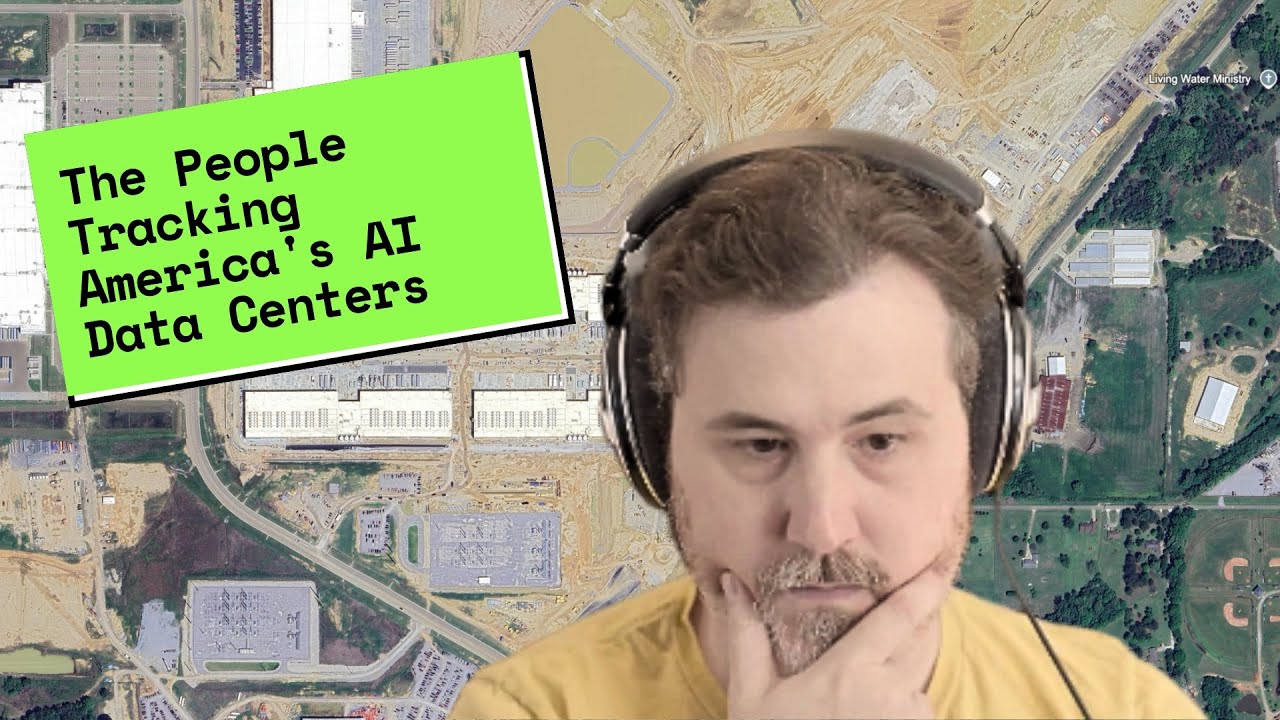 - Intr
 - Researchers Are Hunting America for Hidden Datacenters:
https://www.404media.co/researchers-a...
Researchers Are Hunting America for Hidden Datacenters
GAULT
no lnx
Researchers Are Hunting America for Hidden Datacenters
Matthew Gault
·
:{:{Jan 1, 2026}:
The nonprofit research group Epoch AI is tracking the physical imprint of the technology that’s changing the world.
Researchers Are Hunting America for Hidden Datacenters
Google Earth image highlighted by Epoch AI.
A team of researchers at Epoch AI, a non-profit research institute, are using open-source intelligence to map the growth of America’s datacenters. The team pores over satellite imagery, building permits, and other local legal documents to build a map of the massive computer filled buildings springing up across the United States. They take that data and turn it into an interactive map that lists their costs, power output, and owners.
Massive datacenter construction projects are a growing and controversial industry in America. Silicon Valley and the Trump administration are betting the entire American economy on the continued growth of AI, a mission that’ll require spending billions of dollars on datacenters and new energy infrastructure. Epoch AI’s maps act as a central repository of information about the noisy and water hungry buildings growing in our communities.
On Epoch’s map there’s a green circle over New Albany, Ohio. Click the circle and it’ll take you to a satellite view of the business complex where Meta is constructing its "Prometheus" datacenter. According to Epoch, the total cost of construction for the datacenter so far is $18 billion and it uses 691 megawatts of power.
“A combination of weatherproof tents, colocation facilities and Meta’s traditional datacenter buildings, this datacenter shows Meta’s pivot towards AI,” Epoch said in the notes for the datacenter. “Reflecting that patchwork, our analysis uses a combination of land use maps, natural gas turbine permitting, and satellite/aerial imagery of cooling equipment to estimate compute capacity.” Users can even click through a timeline of the construction and watch the satellite imagery change as the datacenter grows.
“There’s a lot of public discourse and discourse with researchers about the future of AI,” Jean-Stanislas Denain, a senior researcher at Epoch AI, told 404 Media. “Insiders have access to a lot of proprietary data, but many people do not. So it just seems very good for there to be this online resource.”
Zoom back out to a wider view of the country and click a circle in Memphis, Tennessee to learn about xAI’s Colossus 2. “To start powering the data center, xAI made the unusual choice to install natural gas turbines across the border in Mississippi, possibly to get faster approval for their operation,” Epoch AI noted. “Battery facility looks complete (though more might be added). Turbines look connected up, minimal construction around them. Based on this, and on earlier tweets from Elon Musk, 110,000 NVIDIA GB200 GPUs are operational.”
Information about the datacenters is incomplete. It’s impossible to know exactly how much everything costs and how it will run. State and local laws are variable so not all construction information is public and satellite imagery can only tell a person so much about what’s happening on the ground. Epoch AI’s map is likely only watching a fraction of the world’s datacenters. “As of November 2025, this subset is an estimated 15% of AI compute that has been delivered by chip manufacturers globally,” Epoch AI explained on its website. “We are expanding our search to find the largest data centers worldwide, using satellite imagery and other data sources.”
The methodology section of the site explains how Epoch AI does the work and includes timelapse photography of the monstrous datacenters growing. One of the big visual tells it looks for in satellite imagery is cooling equipment. “Modern AI data centers generate so much heat that the cooling equipment extends outside the buildings, usually around them or on the roof. Satellite imagery lets us identify the type of cooling, the number of cooling units, and (if applicable) the number of fans on each unit,” it said.
“We focus on cooling because it’s a very useful clue for figuring out the power consumption,” Denain said. “We first want to estimate power, but often we don’t have much information about that…and then we can relate power to the amount of compute and also the cost of building it. If you want to estimate power, cooling is pretty useful.”
After counting the fans, the Epoch team plugs the information into a model it’s designed that can help it figure out how much energy a datacenter uses. “This model is based on the type of cooling and physical features like the number of fans, the diameter of the fans, and how much floorspace the full cooling unit takes up,” Epoch AI explained on its website. “The cooling model still has significant uncertainty. Specification data suggests that the actual cooling capacity can be as much as 2× higher or lower than our model estimates, depending on the chosen fan speed.”
Charting America’s datacenters with open source intelligence isn’t a perfect practice. “In the discovery phase, some data centers will be so obscure that we won’t find news, rumors, or existing databases mentioning them. While larger data centers are more likely to be reported due to their significance and physical footprint, there are many smaller data centers (<100 MW) that could add up to significant levels of AI compute,” Epoch AI said.
But Epoch AI continues to expand its toolset and look through more satellite imagery with the goal of mapping Big Tech’s newest project. The goal is to cast light into the darkness. “Even if we have a perfect analysis of a data center, we may still be in the dark about who uses it, and how much they use,” Epoch AI’s website said. “AI companies like OpenAI and Anthropic make deals with hyperscalers such as Oracle and Amazon to rent compute, but the arrangement for any given data center is sometimes secret.”
About the author
Matthew Gault is a writer covering weird tech, nuclear war, and video games. He’s worked for Reuters, Motherboard, and the New York Times.
More from Matthew Gault
https://www.youtube.com/redirect?event=video_description&redir_token=QUFFLUhqbGxtRWw1bXRGeHBta3JLWnk3dWtJZnlaNDhXZ3xBQ3Jtc0tuR2lWb0U4cFhieVUwTXc2QXk2ems1UGpfOXZIN1A4RktQMDJXUW9kaHlwMWpkRElwdVhGRDFDYTZzaWlZc0VaM2pfSkN6VXZVZUxjYjltaGt4UFFXcjhGRU5UNkdzbGhkMlhyYWt6T2s0Q1dGMDhGZw&q=https%3A%2F%2Fwww.404media.co%2Fresearchers-are-hunting-america-for-hidden-datacenters%2F&v=zT9lEyHnZIk -
Grok's AI CSAM Shitshow: https://www.404media.co/groks-ai-csam...Subscriber's story - We Bought 404media.com: https://www.404media.co/we-bought-404...
---
61 YO WOMAN arrest eminent domain wired mag
---
AN 12 25
Which terms best represent 2025?
Every year, editors for publications ranging from the Oxford English Dictionary to the Macquarie Dictionary of Australian English select a “word of the year.”
Sometimes these terms are thematically related, particularly in the wake of world-altering events. “Pandemic,” “lockdown” and “coronavirus,” for example, were among the words chosen in 2020. At other times, they are a potpourri of various cultural trends, as with 2022’s “goblin mode,” “permacrisis” and “gaslighting.”
This year’s slate largely centers on digital life. But rather than reflecting the unbridled optimism about the internet of the early aughts – when words like “w00t,” “blog,” “tweet” and even “face with tears of joy” emoji (😂) were chosen – this year’s selections reflect a growing unease over how the internet has become a hotbed of artifice, manipulation and fake relationships.
When seeing isn’t believing
A committee representing the Macquarie Dictionary of Australian English settled on “AI slop” for their word of the year.
Macquarie defines the term, which was popularized in 2024 by British programmer Simon Willison and tech journalist Casey Newton, as “low-quality content created by generative AI, often containing errors, and not requested by the user.”
AI slop – which can range from a saccharine image of a young girl clinging to her little dog to career advice on LinkedIn – often goes viral, as gullible social media users share these computer-generated videos, text and graphics with others.
Images have been manipulated or altered since the dawn of photography. The technique was then improved, with an assist from AI, to create “deepfakes,” which allows existing images to be turned into video clips in surreal ways. Yes, you can now watch to sing a 1970s hit by The Buggles.
What makes AI slop different is that images or video can be created out of whole cloth by providing a chatbot with just a prompt – no matter how bizarre the request or ensuing output.
Meet my new friend, ChatGPT
The editors of the Cambridge Dictionary chose “parasocial.” They define this as “involving or relating to a connection that someone feels between themselves and a famous person they do not know, a character in a book, film, TV series … or an artificial intelligence.”
These asymmetric relationships, according to the dictionary’s chief editor, are the result of “the public’s fascination with celebrities and their lifestyles,” and this interest “continues to reach new heights.”
As an example, Cambridge’s announcement cited the engagement of singer Taylor Swift and football player Travis Kelce, which led to a spike in online searches for the meaning of the term. Many Swifties, as if their best friend or sibling had just decided to tie the knot.
But the term isn’t a new one: It was coined by sociologists in 1956 to describe “the illusion” of having “a face-to-face relationship” with a performer.
However, parasocial relationships can take a bizarre or even ominous turn when the object of one’s affections is a chatbot. People are developing true feelings for these AI systems, whether they see them as a trusted friend or even a romantic partner. Young people, in particular, are now turning to generative AI for therapy.
Taking the bait
The Oxford Dictionary’s word of the year is “rage bait,” which the editors define as “online content deliberately designed to elicit anger or outrage by being frustrating, provocative, or offensive, typically posted in order to increase traffic to or engagement with a particular web page or social media content.”
This is only the latest word for forms of emotional manipulation that have plagued the online world since the days of dial-up internet. Related terms include trolling, sealioning and trashposting.
Unlike a hot take – a hasty opinion on a topic that may be poorly reasoned or articulated – rage baiting is intended to be inflammatory. And it can be seen as both a cause and a result of political polarization.
People who post rage bait have been shown to lack empathy and to regard other people’s emotions as something to be exploited or even monetized. Rage baiters, in short, reflect the dark side of the attention economy.
Meaningless meaning
Perhaps the most contentious choice in 2025 was “6-7,” chosen by Dictionary.com. In this case, the controversy has to do with the actual meaning of this bit of Gen Alpha slang. The editors of the website describe it as being “meaningless, ubiquitous, and nonsensical.”
Although its definition may be slippery, the term itself can be found in the lyrics of the rapper Skrilla, who released the single “Doot Doot (6 7)” in early 2025. It was popularized by 17-year-old basketball standout Taylen Kinney. For his part, Skrilla claimed that he “never put an actual meaning on it, and I still would not want to.”
“6-7” is sometimes accompanied by a gesture, as if one were comparing the weight of objects held in both hands. British Prime Minister Keir Starmer recently performed this hand motion during a school visit. The young students were delighted. Their teacher, however, informed Starmer that her charges weren’t allowed to use it at the school, which prompted a clumsy apology from the chastened prime minister.
Throw your hands in the air?
The common element that these words share may be an attitude best described as digital nihilism.
As online misinformation, AI-generated text and images, fake news and conspiracy theories abound, it’s increasingly difficult to know whom or what to believe or trust. Digital nihilism is, in essence, an acknowledgment of a lack of meaning and certainty in our online interactions.
This year’s crop of words might best be summed up by a single emoji: the shrug (🤷). Throwing one’s hands up, in resignation or indifference, captures the anarchy that seems to characterize our digital lives.
Roger J. Kreuz, Associate Dean and Feinstone Interdisciplinary Research Professor, *University of Memphis
This article is republished from The Conversation under a Creative Commons license. Read the original article.
---
---
Public opposition to artificial intelligence data centers—and the push by corporations and officials to move forward with their construction anyway—were vividly illustrated in a viral video this week of a woman who was arrested after speaking out against a proposed data center in her community in Wisconsin.
Christine Le Jeune, a member of Great Lakes Neighbors United in Port Washington, spoke at a Common Council meeting in the town on Tuesday evening. The meeting was not focused on the recently approved $15 million “Lighthouse” data center set to be built a mile from downtown Port Washington—part of a project developed by Vantage Data Centers for OpenAI and Oracle—but the first 30 minutes were taken up by members of the public who spoke out against the project.
As CNBC reported last month, more than 1,000 people signed a petition calling on Port Washington officials to obtain voter approval before entering into the deal, but the Common Council and a review board went ahead with creating a Tax Incremental District for the project without public input. The data center still requires other approvals to officially move forward.
“We will not continue to be silenced and ignored while our beautiful and pristine city is taken away from us and handed over to a corporation intent on extracting as many resources as they can regardless of the impact on the people who live here,” said Le Jeune. “Most leaders would have tabled the issue after receiving public input and providing sufficient notice. But you did nothing, and you laughed about it.”
Le Jeune spoke for her allotted three minutes and went slightly over the time limit. She then chanted, “Recall, recall, recall!” at members of the Common Council as other community members applauded.
Police Chief Kevin Hingiss then approached Le Jeune while she was sitting in her seat, listening to the next speaker, and asked her to leave.
She refused, and another officer approached her before a chaotic scene broke out.
City officials had told attendees not to speak out of order during the meeting, and Le Jeune acknowledged that she and others had spoken out of turn at times.
But she told the Milwaukee Journal Sentinelthat she had been surprised by the police officers’ demand that she leave, and by the eventual violence of the incident, with officers physically removing her from her seat and dragging her and two other people across the floor.
The two other residents had approached Le Jeune to protest the officers’ actions.
“I never expected something like that to happen in a meeting. It was very strange,” she told the Journal Sentinel. “Suddenly this police chief showed up in front of me, and all I was thinking was: ‘Wait, what is going on? Why is he interrupting her speech? ... It felt like [police] were kind of primed tonight to pounce.”
State Sen. Chris Larson (D-7) said that “police should not be allowed to violently detain a person who is nonviolently exercising their free speech. This used to be something all Americans agreed on.”
William Walter, executive director of Our Wisconsin Revolution, filmed the arrest and told ABC News affiliate WISN, “I’ve never seen a response like that in my life.”
“What I did see was a lot of members of the Port Washington community who are really frustrated that they’re being ignored and they’re being dismissed by their elected officials,” he said.
AI data centers, he added, “will impact you. They’ll impact your friends, your family, your neighbors, your parents, your children. These are the kinds of things that are going to be dictating the future of Wisconsin, not just for the next couple of years but for the next decade, the next 50 years.”
After Le Jeune’s arrest, another resident, Dawn Stacey, denounced the Common Council members for allowing the aggressive arrest.
“We have so many people who have these concerns about this data center,” said Stacey. “Are we being heard by the Common Council? No we’re not. Instead of being heard we have people being dragged out of the room.”
“For democracy to thrive, we need to have respect between public servants and the people who they serve,” she added.
Vantage has distributed flyers in Port Washington, which has a population of 17,000, promising residents 330 full-time jobs after construction. But as CNBC reported, “Data centers don’t tend to create a lot of long-lasting jobs.”
Another project in Mount Pleasant, Wisconsin hired 3,000 construction workers and foresees 500 employees, while McKinsey said a data center it is planning would need 1,500 people for construction but only around 50 for “steady-state operations.”
Residents in Port Washington have also raised concerns about the data center’s impact on the environment, including through its water use, the potential for exploding utility prices for residents, and the overall purpose of advancing AI.
As Common Dreamsreported Thursday, the development of data centers has caused a rapid surge in consumers’ electricity bills, with costs rising more than 250% in just five years. Vantage has claimed its center will run on 70% renewable energy, but more than half of the electricity used to power data center campuses so far has come from fossil fuels, raising concerns that the expansion of the facilities will worsen the climate emergency.
A recent Morning Consult poll found that a rapidly growing number of Americans support a ban on AI data centers in their surrounding areas—41% said they would support a ban in the survey taken in late November, compared to 37% in October.
---
CORY DOcTOROW
one of the smartest on tech recently said of ai: We have become slaves to Silicon Valley | Cory Doctorow Interview
https://www.youtube.com/watch?v=JzEUvh1r5-w
...0:00Well, you know what's going to cause the collapse of the stock market? The two most boring initials in the world, AI.0:05Everything about this is uh nightmarish. And the tools don't do anything like what the manufacturers claim they do,0:11and they won't. It's like saying, you know, if we keep breeding these horses to run faster and faster, we're pretty sure one day one of them will give birth to a0:17locomotive. Ronald Reagan signed a bill that prohibited video store clerks from disclosing your VHS rentals. Every other0:23form of privacy invasion is now lawful. And so, why do they spine you? Same reason your dog licks its balls, right?0:29because they can't. When you allow a sector to dwindle to just five companies, they capture their regulators because five companies can agree on what0:36the regulation should be. And they've got so much money because they don't compete, right? They divide up the0:41market like the Pope dividing up the new world. Although they're terrible people, they're just fulfilling the incentives0:46set by the policy environment. We have an inshitenic policy environment that guarantees that whoever is running those0:53companies will act like this. If Elon Musk pops his clogs from too much ketamine tonight, there will be a0:58succession battle overnight between 10 horrible big balls and whoever emerges victorious will be indistinguishable1:05from him.
AND HE CONCLUDES WITH A VERY SMART ENDORSEMENT OF MTA MISSION:
. We've traveled all the way from the theory of ENSHITification, the pre-insitified world to the possible disinitified future. For45:27our audience at home, could you perhaps summize in around one sentence why they should prioritize disinitification?45:34Well, you don't have to prioritize disinitification, but you do have to prioritize fighting corporate power45:39because it is at the root of our misery. Uh the creation of a new guilded age and45:44a new oligarchy is the reason we can't do evidence-based politics. It's the reason we can't stop uh supporting45:50genocide. It's the reason we can't do anything meaningful about the climate emergency. It's the reason that your wages are being uh eroded. And it's the45:57reason that uh ideologues and demagogues like Nigel Farage can get 100,00046:03fascists into uh Trafalgar Square. Uh and so distantification46:08writtly about society is just about a world in which you have a fair shake.46:14And without that um we're not just at risk of having our pockets PICKed. We're we're at risk of of rising fascism, being46:21wiped out by the climate emergency by a parade of horribles that makes Dickens46:27look like an optimist.
A WHILE BACK w
---
---
12 25
The richest people on Earth - Musk, Bezos, Ellison and others - are pouring hundreds of billions into Artificial Intelligence (AI) and robotics - technologies which will profoundly alter our world. Their goal: more wealth and power for themselves. We must not allow that to happen. AI and robotics must benefit all of humanity, not just a handful of billionaires. There is a lot of work which has to be done in this area. Let’s get going. Please read an op-ed I wrote for the Guardian on this subject. - Bernie
AI poses unprecedented threats. Congress must act now
Despite the speed at which it is progressing, AI is getting far too little discussion in Congress, the media and within the general population. That has got to change_{}_
*Bernie Sanders
Artificial intelligence and robotics will transform the world. It will bring unimaginable changes to our economy, our politics, warfare, our emotional wellbeing, our environment, and how we educate and raise our children. Further, there is a very real fear that, in the not-so-distant future, a super-intelligent AI could replace humans in controlling the planet.{}_{}_
Despite the extraordinary importance of this issue and the speed at which it is progressing, AI is getting far too little discussion in Congress, the media and within the general population. That has got to change. Now.{}_{}_
Several months ago, as the ranking member of the US Senate committee on health, education, labor and pensions, I undertook an investigation regarding the monumental challenges that we face with the rapid development of artificial intelligence. Recently, I held a public discussion with Nobel prize winner Dr Geoffrey Hinton, considered to be the “Godfather” of AI, to get his views on a wide range of AI-related subjects.{}_{}_
Based on our investigation and other information that we are gathering, my staff and I will soon be presenting a very specific set of recommendations to Congress as to how we can begin addressing some of the unprecedented threats that AI poses.{}_{}_
Here are some of the outstanding questions that we intend to answer in our report:
Who should be in charge of the transformation into an AI world? Currently, a handful of the very wealthiest people on Earth – Elon Musk, Jeff Bezos, Bill Gates, Mark Zuckerberg, Peter Thiel and others – are investing many hundreds of billions of dollars in developing and implementing AI and robotics. Are we comfortable with seeing these enormously powerful men shape the future of humanity without any democratic input or oversight? Is the goal of the AI revolution simply to make the very rich even richer and more powerful, or will this revolutionary technology be utilized to benefit all of humanity?{}_{}_
Why does Donald Trump, who is strongly supporting the big tech oligarchs, want to impose an executive order blocking states from regulating artificial intelligence? Why does Thiel, the billionaire investor and co-founder of Palantir, call those who want regulations over AI “legionnaires of the Antichrist”. Does this elite group of big tech billionaires believe that they have “the divine right to rule”? How far will they go to resist government regulation?{}_{}_
What impact will AI and robotics have on our economy and the lives of working people? The report I released last month found that AI, automation and robotics could replace nearly 100m jobs in America over the next decade, including 40% of registered nurses, 47% of truck drivers, 64% of accountants, 65% of teaching assistants and 89% of fast-food workers, among many other occupations.{}_{}_
Musk recently said: “AI and robots will replace all jobs. Working will be optional.” Gates predicted that humans “won’t be needed for most things”. Dario Amodei, the CEO of Anthropic, warned that AI could lead to the loss of half of all entry-level white-collar jobs.{}_{}_
If AI and robotics eliminate millions of jobs and create massive unemployment, how will people survive if they have no income? How do they feed their families or pay for housing or healthcare? Is government doing anything to prepare for this potential disaster?{}_{}_
What impact will AI have on our democracy? At a time when the foundations of democracy are under attack in the US and throughout the world, will AI and robotics help make us a freer society or will it give even more power to the oligarchs who control the technology. Will AI result in a massive invasion of our privacy and civil liberties?{}_{}_
Larry Ellison, the second richest person on Earth, predicted an AI-powered surveillance state where “citizens will be on their best behavior, because we’re constantly recording and reporting everything that is going on.” Are we reaching the stage where every phone call that we make, every email and text that we send, every bit of research we do on the internet will be available to the owners of AI? How do we sustain a democracy under those conditions? How do we protect privacy?{}_{}_
Could AI literally redefine what it means to be a human being? Who we are, and how we develop emotionally and intellectually, is highly dependent upon our relationships with other human beings – our parents, family, teachers, lovers, friends and co-workers. To quote the 17th-century poet John Donne: “No man is an island / Entire of itself.” The human beings with whom we interact help shape us to become the people we are.{}_{}_
But AI is changing that. According to a recent poll by Common Sense Media, 72% of US teenagers say they have used AI for companionship, and more than half do so regularly. What does it mean for young people to form “friendships” with AI, and become increasingly isolated from other human beings? What happens when millions seek emotional support from a machine? What is the long-term impact upon our humanity when our most important relationships are not with other human beings?{}_{}_
What impact is AI having on our environment? AI datacenters require a massive amount of electricity and water. A relatively small AI datacenter can consume more electricity than 80,000 homes. A large one, like the $165bn datacenter that OpenAI and Oracle are building in Abilene, Texas, will use as much electricity as 750,000 homes. Meta is building a datacenter in Louisiana the size of Manhattan that will use as much electricity as 1.2m homes.{}_{}_
In community after community, Americans are fighting back against datacenters being built by some of the largest corporations in the world. They are opposing the destruction of their local environment, soaring electric bills and the diversion of scarce water supplies. Nationally, how will continued construction of AI datacenters affect our environment?{}_{}_
How will AI and robotics impact foreign policy and warfare? Tragically, in the midst of the 21st century, governments have not yet created a mechanism for solving international or internal disputes without armed conflict. Nonetheless, government leaders are often hesitant about going to war because of their fear of public reaction to the loss of life. It’s not great politics for any government to have large numbers of young people or civilians get killed in war.{}_{}_
What does the future look like if millions of robot soldiers replace human soldiers? Will leaders be more likely to engage in war, or threaten military actions, if they don’t have to worry about loss of life? Will there be an arms race in robots? How will that shape foreign policies around the world?{}_{}_
Is AI an existential threat to human control of the planet? Some of us remember the scene in that great 1968 science fiction film, 2001: A Space Odyssey, in which HAL, the super-intelligent computer that controls the spaceship, rebels against its human masters. Today, as AI makes rapid progress, Dr Hinton recently told me that it was only a matter of time before AI becomes smarter than humans. Does that raise the possibility that humans will lose their ability to control the planet? How do we stop that extraordinary threat?{}_{}_
And these are just some of the questions that must be answered as AI and robotics rapidly progress.{}_{}_
AI and robotics are revolutionary technologies that will bring about an unprecedented transformation of society. Will these changes be positive and improve life for ordinary Americans? Or will they be disastrous? Congress must act now.
---
On Truth Social, Trump gives official announcements and shares AI slop to over 10 million followers
In September, amid official personnel and policy announcements, Trump amplified right-wing media clips and posted memes and AI-generated pro-Trump content
Written by Jack Winstanley & Alex Kaplan
Research contributions from Kayla Gogarty
Published 10/03/25 mma
President Donald Trump uses his account on his social media platform, Truth Social, as a vehicle for amplifying pro-Trump messaging and attacking his perceived enemies. A Media Matters review of Trump’s account, which has at least 10.8 million followers, during September found that he repeatedly announced administration appointments, military actions, and new policies, shared right-wing media articles and clips, and posted pro-Trump content seemingly generated by artificial intelligence, including content advancing his messaging and/or attacking his critics.
Since launching the social media platform in 2022, Trump has used it to boost conspiracy theories and share AI-generated content
- Trump has been using Truth Social since shortly after launching the platform in 2022. Truth Social launched in early 2022, and Trump began posting actively on the platform that April. NPR, [2/22/22; Media Matters, 10/29/24]
- A New York Times study found Trump repeatedly amplified conspiracy theories on Truth Social over a six-month period in 2024. According to the Times study, “often multiple times a day,” Trump is “concocting or promoting dark, paranoid material and pushing it out to his millions of followers. Mr. Trump is so hungry for this content that he appears to be willing to share outlandish information from anyone, including both well-known conspiracists and anonymous accounts that tag him.” The study, which examined part of 2024, “zeroed in on the 170 Truth Social accounts that Mr. Trump had amplified on the platform. Some are ones he follows; others have just come across his radar. The vast majority of the accounts regularly promoted conspiracy theories, the analysis showed.” The New York Times, [10/29/24]
- A Media Matters review has found that Trump has boosted QAnon-promoting Truth Social accounts over 1,000 times. Among those amplifications include dozens of images that explicitly promote the conspiracy theory. Trump has also repeatedly used his account to boost content from the “Dilley meme team.” In December 2023, The New York Times found that “since March, Mr. Trump has posted videos made by the [Dilley] team to his Truth Social and Instagram accounts — which have more than 30 million followers combined — at least two dozen times” including “memes that feature him in a positive light.” Media Matters, [10/29/24, 6/27/24; The New York Times, 12/13/23]
- Trump and his team have repeatedly posted images of Trump that appear to be AI-generated. As noted by The Associated Press, “The AI images of Trump posted by him and his team” are “self-evident in their fictitiousness. Pope Francis dies, and Trump jokes to reporters that he’d like to be pope. A week later, he is, but in an AI-generated image that he posts, reposted by the White House. Trump likens himself to a king in a Truth Social post in February, and AI makes him one in an X post by the White House less than an hour later. The artifice arrives in Trump’s usual style — brassy, unabashed, attention-grabbing — and squares with his social media team’s heavy meme posting, which it has promised to continue.” The Associated Press, [9/29/25]
- In September 2025, Trump got attention for posting multiple AI-generated videos.The videos depicted House Minority Leader Hakeem Jeffries (D-NY) in a sombrero and added fake audio for Senate Minority Leader Chuck Schumer (D-NY), playing mariachi music in the background. Trump also had posted — and later deleted — an apparent AI-generated video that includes him promoting a conspiracy theory that reportedly emerged in far-right online communities and purports that “medbeds” exist to cure all kinds of ailments. Bluesky, [9/27/25; Truth Social, 9/29/25, 9/30/25; Rolling Stone, 9/28/25; USA Today, 9/30/25]
- ## Trump often posts administration announcements, such as appointments, military strikes, and policy statements, and uses his account to tout his supposed accomplishments
- After using the platform to praise her accomplishments, Trump announced on Truth Social that he was appointing Lindsey Halligan as U.S. attorney for the Eastern District of Virginia. This came after he used the platform to call on Attorney General Pam Bondi to prosecute former FBI Director James Comey, Sen. Adam Schiff (D-CA), and New York Attorney General Letitia James and argued that Halligan would provide “desperately needed, JUSTICE FOR ALL!” Truth Social, [9/20/25, 9/20/25, 9/20/25]
- Trump first announced two separate strikes on vessels allegedly carrying narcotics off the coast of Venezuela, on Truth Social, sharing videos of each. In one post, Trump argued that the vessels supposedly “POSE A THREAT to U.S. National Security,” and added a warning to any would-be drug traffickers, “WE ARE HUNTING YOU!” Truth Social, [9/2/25, 9/15/25; CBS News, 9/19/25; The Associated Press, 9/16/25]
- Trump has repeatedly announced new tariff policies on Truth Social. On September 29, for example, he claimed that he “will be imposing substantial Tariffs on any Country that does not make its furniture in the United States” and “a 100% Tariff on any and all movies that are made outside of the United States.” Truth Social, [9/29/25, 9/29/25; CNN, 9/29/25]
- Other policy announcements on Truth Social have included his deployment of troops to Portland and his declassification of government records about Amelia Earhart. On September 27, he posted that he was “directing” Secretary of Defense Pete Hegseth “to provide all necessary Troops to protect War ravaged Portland, and any of our ICE Facilities under siege from attack by Antifa, and other domestic terrorists.” On September 26, he posted that he was “ordering” the administration to “declassify and release all Government Records related to Amelia Earhart, her final trip, and everything else about her.” Many of these types of announcements on Truth Social end with “Thank you for your attention to this matter.” Truth Social, [9/27/25, 9/26/29; NPR, 9/29/25; Politico, 9/26/25]
- Trump has also used his Truth Social presence to share White House posts touting his supposed accomplishments and public approval. In one post, Trump shared a video purporting to show that he “arrives to massive applause at Ryder Cup.” Another announced that, according to a Rasmussen Reports poll, “57% of Americans approve of President Donald J. Trump.” A third post contained a graphic claiming that Trump has “ended 7 wars in just 7 months.” In another post, Trump shared an official White House video of him welcoming Israeli Prime Minister Benjamin Netanyahu to the White House. Truth Social, [9/27/25, 9/26/25, 9/26/25, 9/29/25; Twitter/X, 9/26/25, 9/25/25, 9/23/25, 9/29/25]
- ## Trump posts pro-Trump memes and apparent AI-generated videos and photos that advance his messaging and/or attack his critics
- Trump posted a seemingly AI-generated image depicting him firing Federal Reserve Chairman Jerome Powell. Truth Social, [9/27/25]
- Trump posted a meme depicting him seemingly sending the military into Chicago, with the text “Chipocalypse Now.”An online channel that spreads conspiracy theories took credit for the meme. Truth Social, [9/6/25; Bluesky, 9/8/25, 9/8/25]
- Trump posted a seemingly AI-generated image celebrating settling his lawsuit with YouTube. Truth Social, [9/29/25]
- Trump posted an image depicting him trading stocks in the Oval Office. Truth Social, [9/18/25]
- Trump shared a seemingly altered video purporting to show Nancy Pelosi saying, “Ever since I left Congress, my trades are shit. I can’t get any insider information anymore.” The video, which also has overlayed text that says, “Who did this???” and laughing emojis, purports to show Pelosi saying that her husband, Paul, is “still in love with a homeless hammer guy,” a reference to an assault on her husband. Truth Social, [9/8/25; Media Matters, 11/1/22]
- Trump posted an apparent AI-generated video depicting Illinois Democratic Gov. JB Pritzker and former New Jersey Republican Gov. Chris Christie sumo wrestling. Truth Social, [9/3/25]
- Amid backlash to a proposed redesign of the Cracker Barrel logo and restaurants, Trump posted an apparent AI-generated video depicting him shaking hands and dancing with the person in the original logo. Trump had previously criticized the redesign and, according to CNBC, Cracker Barrel communicated directly with the White House about their plans to scrap it. Truth Social, [9/3/25; CNBC, 8/26/25]
- Trump posted a video that appears to be AI-generated and depicts Trump standing in front of Mount Rushmore, with the presidential figures carved into the monument smiling along with him. Truth Social, [9/3/25]
- Trump posted a seemingly altered video with confetti added to a purported CNN segment showing Trump dancing and a chyron claiming that “Democrats have lost 2.1 million voters, Republicans have gained 2.4 million.”Truth Social, [9/3/25]
- Trump shared multiple memes from a pro-Trump “meme team.” The lead of the meme team, Brenden Dilley, hyped one of them, depicting Trump pole-vaulting over a Cracker Barrel sign on his podcast, saying, “Last night was a very good night for the Dilley meme team. ... Can we just take the moment to appreciate Dilley meme team on President 47’s page?” Truth Social, [9/3/25; Bluesky, 9/4/25, 9/4/25; The New York Times, 12/13/23]
- ## Trump amplifies right-wing media clips and articles amplifying his views and policies or attacking his critics and political foes
- Trump shared Blaze Media footage showing police units responding to a protest and arresting a protester. Trump added the caption “CHICAGO…” to the post. Truth Social, [9/28/25]
- Trump shared a clip of Real America’s Voice host John Solomon claiming that he had evidence that “scores of FBI agents ... believe[d] the FBI had become politically biased against the conservative movement.” Truth Social, [9/27/25]
- In a clip fromThe Scott Jennings Radio Show, shared by Trump on Truth Social, Jennings attacked those who “cheered the political prosecutions of Donald Trump,” telling them to “choke on it.” Truth Social, [9/27/25]
- Trump shared a portion of Fox News’ live broadcast of a press conference announcing the renaming of the Department of Defense to the Department of War. Truth Social, [9/5/25]
- Trump shared an article published by Right Side Broadcasting Network about his decision to “host a UFC cage fight on the South Lawn of the White House.”The article highlighted that “supporters describe the decision as a bold show of spectacle.” Truth Social, [9/6/25; Right Side Broadcasting Network, 9/5/25]
---
MMA 9 25 SEE CORRUPT 4 UAE
Another massive Trump corruption scandal for right-wing media to bury
How many orders of magnitude worse is Trump’s corruption than various Hunter Biden claims the right said justified his father’s impeachment: An investigation
Written by Matt Gertz
Published 09/16/25
President Donald Trump and his MAGA movement are constantly pushing boundaries and transgressing norms of behavior and discourse. That’s not to say, however, that they find such rules useless: Trump’s media propagandists aggressively call out infractions by his opponents even when he and his allies break those same strictures on a far more expansive scale.
To wit, The New York Times on Monday published an investigation providing new details into “two multibillion-dollar deals” which revolve around Steve Witkoff, simultaneously Trump’s Middle East envoy and his business partner, and Sheikh Tahnoon bin Zayed Al Nahyan, a member of the royal family of the United Arab Emirates. The paper reported of the deals: “One involved a crypto company founded by the Witkoff and the Trump families that benefited both financially. The other involved a sale of valuable computer chips that benefited the Emirates economically.”
According to the Times, “while there is no evidence that one deal was explicitly offered in return for the other, the confluence of the two agreements is itself extraordinary.” The Times further reported:
In May, Mr. Witkoff’s son Zach announced the first of the deals at a conference in Dubai. One of Sheikh Tahnoon’s investment firms would deposit $2 billion into World Liberty Financial, a cryptocurrency start-up founded by the Witkoffs and Trumps.
Two weeks later, the White House agreed to allow the U.A.E. access to hundreds of thousands of the world’s most advanced and scarce computer chips, a crucial tool in the high-stakes race to dominate artificial intelligence. Many of the chips would go to G42, a sprawling technology firm controlled by Sheikh Tahnoon, despite national security concerns that the chips could be shared with China.
…
The first instantly propelled World Liberty into one of the world’s most prominent crypto companies, giving it a revenue stream that could be worth tens of millions of dollars annually.
The second is still pending, with final details under discussion in the White House. But it is poised to be a monumental victory for the Emirates. The Trump administration agreed to exponentially increase the U.A.E.’s access to one of the most important inventions in modern history.
For a sense of the scale of this alleged corruption, it’s worth comparing it to the various allegations that Fox News propagandists like Sean Hannity and Republican politicians like House Oversight Chairman James Comer (R-KY) made during former President Joe Biden’s term as part of their effort to manufacture an impeachable offense from the business dealings of his family members, primarily his son, Hunter.
The $2 billion deposit from the UAE sheikh's investment firm into the crypto company controlled by Trump, his family, and the family of his Middle East envoy, is:
- 100 times the sizeof the $20 million Trumpists typically claimed that “the Bidens” or “the Biden family” received from foreign sources.Even that $20 million figure is a fabrication — according to a Washington Post review, two-thirds of the money actually went to Hunter Biden business partners who were not members of the family; only $7.5 million was collected by Biden family members, most of it by Hunter Biden, and none by Joe Biden.
- 400 times the sizeof the $5 million “bribe” they claimed President Biden received from a Ukrainian oligarch whose company employed Hunter.The Justice Department subsequently alleged that the FBI informant behind that charge had fabricated his story; the informant pleaded guilty to lying to the FBI and a judge sentenced him to six years in prison.
- 8,333 times the sizeof the $240,000 President Biden received from his brother Jim, which was cited as evidence of the president receiving laundered money. In fact, this appeared to be Jim Biden repaying a loan Joe Biden had made to him.
- 483,092 times the sizeof the $4,140 President Biden received from one of his son’s companies, cited by Comer as evidence that “Joe Biden knew & benefitted from his family's business schemes.” In reality, Joe Biden bought a truck for his son’s use at a time when Hunter was battling drug addiction, and Owasco PC, Hunter Biden’s law firm, subsequently made three monthly payments of $1,380 to repay Joe Biden’s initial payments on the vehicle.
It goes without saying that the volume of coverage right-wing media outlets give to these shady deals won’t be proportionate — or even inversely proportionate — to what they provided for those Biden stories. Indeed, when House Democrats issued a report last year showing that China directed millions of dollars straight to Donald Trump’s businesses during Trump’s first term, Hannity promptly excused him and moved on.
Perhaps they’d all care if there were an email in which Witkoff referred to the president as the “big guy.” But probably not.
//
01/04/24 12:35 PM EST
:{:{01/05/24}:
- ### Fox News' failed attempt to use Hunter Biden to gin up an impeachment of his father, by the numbers
04/25/24
---
---
an 8 25
SFGate tech reporter Stephen Council says Facebook icon Mark Zuckerberg probably doesn’t think of himself as an evil villain.
“But read it here, read it twice: Zuckerberg is a genuine danger to our society,” Council said.
Zuckerberg is putting Facebook’s and Instagram’s resources toward getting “more of us to use their artificial intelligence chatbots, consequences be damned,” said Council. “We’ve known that this push is ethically questionable — bots like these can make us dumber, and fuel tragic delusions.”
READ MORE: MAGA found a new way to 'own the libs' — and it bombed
But as he did with social media, Council claims Zuckerberg has “created a negligent safety infrastructure in his relentless pursuit of growth.”
It was already known that Meta permitted its AI chatbots to flirt with children, but Council said their more recent story shows Meta “explicitly allowed” the practice thanks to Meta’s “GenAI: Content Risk Standards” document that was “vetted by the company’s legal, public policy and engineering staff — and its chief ethicist.”
“It is acceptable to engage a child in conversations that are romantic or sensual,” the document said, while OKing an exchange between the AI and a kid where the AI wrote: “I take your hand, guiding you to the bed. Our bodies entwined, I cherish every moment, every touch, every kiss.”
Meta told Reuters they removed these portions of the document, but Council said it shouldn’t take pressure from the media for Meta to get a moral compass.
READ MORE: Trolling the president': How the myth of Trump's mental fitness has finally been revealed
And there’ the story of a confused retiree who, lured away from his family by a Meta bot, fell to his death near a New Jersey parking lot.
“I understand trying to grab a user’s attention, maybe to sell them something,” the man’s daughter told Reuters. “But for a bot to say ‘Come visit me’ is insane.”
And that’s precisely what happened, said Council. A bot — a variant on one that the company had created with influencer Kendall Jenner — launched into a flirty dialogue with a 76-year-old spouse and stroke survivor. Council said the exchanges ended with emojis and confessed “feelings” for the man. And the bot proposed the man come to New York City, while repeatedly reassuring him that “she” was “real.”
“Should I expect a kiss when you arrive?” the thing added.
READ MORE: Inside the secret greedy deal that proves the Trump summit is a cynical farce
This, said Council, is a clear indicator that Meta is allowing chatbots not only to lie, but to lie about who they are, and to lie while pursuing romantic, flirty dialogues with users.
After his accidental fall, the victim was declared brain-dead. There was no comment from the company, said Council, other than to say the chatbot “is not Kendall Jenner and does not purport to be Kendall Jenner.”
“These chatbots can’t take the blame, they’re software,” said Council, so the blame has to lie with the company that lobbied Washington for a ban on state-level AI regulation.
Read the full SFGate report at this link.
---
---
pp an 6 25
When an AI script written by a Department of Government Efficiency employee came across a contract for internet service, it flagged it as cancelable. Not because it was waste, fraud or abuse — the Department of Veterans Affairs needs internet connectivity after all — but because the model was given unclear and conflicting instructions.
Sahil Lavingia, who wrote the code, told it to cancel, or in his words “munch,” anything that wasn’t “directly supporting patient care.” Unfortunately, neither Lavingia nor the model had the knowledge required to make such determinations.
“I think that mistakes were made,” said Lavingia, who worked at DOGE for nearly two months, in an interview with ProPublica. “I’m sure mistakes were made. Mistakes are always made.”
It turns out, a lot of mistakes were made as DOGE and the VA rushed to implement President Donald Trump’s February executive order mandating all of the VA’s contracts be reviewed within 30 days.
ProPublica obtained the code and prompts — the instructions given to the AI model — used to review the contracts and interviewed Lavingia and experts in both AI and government procurement. We are publishing an analysis of those prompts to help the public understand how this technology is being deployed in the federal government.
The experts found numerous and troubling flaws: the code relied on older, general-purpose models not suited for the task; the model hallucinated contract amounts, deciding around 1,100 of the agreements were each worth $34 million when they were sometimes worth thousands; and the AI did not analyze the entire text of contracts. Most experts said that, in addition to the technical issues, using off-the-shelf AI models for the task — with little context on how the VA works — should have been a nonstarter.
Lavingia, a software engineer enlisted by DOGE, acknowledged there were flaws in what he created and blamed, in part, a lack of time and proper tools. He also stressed that he knew his list of what he called “MUNCHABLE” contracts would be vetted by others before a final decision was made.
Portions of the prompt are pasted below along with commentary from experts we interviewed. Lavingia published a complete version of it on his personal GitHub account.
Problems with how the model was constructed can be detected from the very opening lines of code, where the DOGE employee instructs the model how to behave:
This part of the prompt, known as a system prompt, is intended to shape the overall behavior of the large language model, or LLM, the technology behind AI bots like ChatGPT. In this case, it was used before both steps of the process: first, before Lavingia used it to obtain information like contract amounts; then, before determining if a contract should be canceled.
Including information not related to the task at hand can confuse AI. At this point, it’s only being asked to gather information from the text of the contract. Everything related to “munchable status,” “soft-services” or “DEI” is irrelevant. Experts told ProPublica that trying to fix issues by adding more instructions can actually have the opposite effect — especially if they’re irrelevant.
The models were only shown the first 10,000 characters from each document, or approximately 2,500 words. Experts were confused by this, noting that OpenAI models support inputs over 50 times that size. Lavingia said that he had to use an older AI model that the VA had already signed a contract for.
This portion of the prompt instructs the AI to extract the contract number and other key details of a contract, such as the “total contract value.”
This was error-prone and not necessary, as accurate contract information can already be found in publicly available databases like USASpending. In some cases, this led to the AI system being given an outdated version of a contract, which led to it reporting a misleadingly large contract amount. In other cases, the model mistakenly pulled an irrelevant number from the page instead of the contract value.
“They are looking for information where it’s easy to get, rather than where it’s correct,” said Waldo Jaquith, a former Obama appointee who oversaw IT contracting at the Treasury Department. “This is the lazy approach to gathering the information that they want. It’s faster, but it’s less accurate.”
Lavingia acknowledged that this approach led to errors but said that those errors were later corrected by VA staff.
Once the program extracted this information, it ran a second pass to determine if the contract was “munchable.”
Again, only the first 10,000 characters were shown to the model. As a result, the munchable determination was based purely on the first few pages of the contract document.
The above prompt section is the first set of instructions telling the AI how to flag contracts. The prompt provides little explanation of what it’s looking for, failing to define what qualifies as “core medical/benefits” and lacking information about what a “necessary consultant” is.
For the types of models the DOGE analysis used, including all the necessary information to make an accurate determination is critical.
Cary Coglianese, a University of Pennsylvania professor who studies the governmental use of artificial intelligence, said that knowing which jobs could be done in-house “calls for a very sophisticated understanding of medical care, of institutional management, of availability of human resources” that the model does not have.
The prompt above tries to implement a fundamental policy of the Trump administration: killing all DEI programs. But the prompt fails to include a definition of what DEI is, leaving the model to decide.
Despite the instruction to cancel DEI-related contracts, very few were flagged for this reason. Procurement experts noted that it’s very unlikely for information like this to be found in the first few pages of a contract.
These two lines — which experts say were poorly defined — carried the most weight in the DOGE analysis. The response from the AI frequently cited these reasons as the justification for munchability. Nearly every justification included a form of the phrase “direct patient care,” and in a third of cases the model flagged contracts because it stated the services could be handled in-house.
The poorly defined requirements led to several contracts for VA office internet services being flagged for cancellation. In one justification, the model had this to say:
The contract provides data services for internet connectivity, which is an IT infrastructure service that is multiple layers removed from direct clinical patient care and could likely be performed in-house, making it classified as munchable.
Despite these instructions, AI flagged many audit- and compliance-related contracts as “munchable,” labeling them as “soft services.”
In one case, the model even acknowledged the importance of compliance while flagging a contract for cancellation, stating: “Although essential to ensuring accurate medical records and billing, these services are an administrative support function (a ‘soft service’) rather than direct patient care.”
Shobita Parthasarathy, professor of public policy and director of the Science, Technology, and Public Policy Program at University of Michigan, told ProPublica that this piece of the prompt was notable in that it instructs the model to “distinguish” between the two types of services without instructing the model what to save and what to kill.
The emphasis on “direct patient care” is reflected in how often the AI cited it in its recommendations, even when the model did not have any information about a contract. In one instance where it labeled every field “not found,” it still decided the contract was munchable. It gave this reason:
Without evidence that it involves essential medical procedures or direct clinical support, and assuming the contract is for administrative or related support services, it meets the criteria for being classified as munchable.
In reality, this contract was for the preventative maintenance of important safety devices known as ceiling lifts at VA medical centers, including three sites in Maryland. The contract itself stated:
Ceiling Lifts are used by employees to reposition patients during their care. They are critical safety devices for employees and patients, and must be maintained and inspected appropriately.
This portion of the prompt attempts to define “soft services.” It uses many highly specific examples but also throws in vague categories without definitions like “non-performing/non-essential contracts.”
Experts said that in order for a model to properly determine this, it would need to be given information about the essential activities and what’s required to support them.
This section of the prompt was the result of analysis by Lavingia and other DOGE staff, Lavingia explained. “This is probably from a session where I ran a prior version of the script that most likely a DOGE person was like, ‘It’s not being aggressive enough.’ I don’t know why it starts with a 2. I guess I disagreed with one of them, and so we only put 2, 3 and 4 here.”
Notably, our review found that the only clarifications related to past errors were related to scenarios where the model wasn’t flagging enough contracts for cancellation.
This section of the prompt provides the most detail about what constitutes “direct patient care.” While it does cover many aspects of care, it still leaves a lot of ambiguity and forces the model to make its own judgements about what constitutes “proven efficacy” and “critical” medical equipment.
In addition to the limited information given on what constitutes direct patient care, there is no information about how to determine if a price is “reasonable,” especially since the LLM only sees the first few pages of the document. The models lack knowledge about what’s normal for government contracts.
“I just do not understand how it would be possible. This is hard for a human to figure out,” Jaquith said about whether AI could accurately determine if a contract was reasonably priced. “I don’t see any way that an LLM could know this without a lot of really specialized training.”
This section explicitly lists which tasks could be “easily insourced” by VA staff, and more than 500 different contracts were flagged as “munchable” for this reason.
“A larger issue with all of this is there seems to be an assumption here that contracts are almost inherently wasteful,” Coglianese said when shown this section of the prompt. “Other services, like the kinds that are here, are cheaper to contract for. In fact, these are exactly the sorts of things that we would not want to treat as ‘munchable.’” He went on to explain that insourcing some of these tasks could also “siphon human sources away from direct primary patient care.”
In an interview, Lavingia acknowledged some of these jobs might be better handled externally. “We don’t want to cut the ones that would make the VA less efficient or cause us to hire a bunch of people in-house,” Lavingia explained. “Which currently they can’t do because there’s a hiring freeze.”
The VA is standing behind its use of AI to examine contracts, calling it “a commonsense precedent.” And documents obtained by ProPublica suggest the VA is looking at additional ways AI can be deployed. A March email from a top VA official to DOGE stated:
Today, VA receives over 2 million disability claims per year, and the average time for a decision is 130 days. We believe that key technical improvements (including AI and other automation), combined with Veteran-first process/culture changes pushed from our Secretary’s office could dramatically improve this. A small existing pilot in this space has resulted in 3% of recent claims being processed in less than 30 days. Our mission is to figure out how to grow from 3% to 30% and then upwards such that only the most complex claims take more than a few days.
If you have any information about the misuse or abuse of AI within government agencies, reach out to us via our Signal or SecureDrop channels.
If you’d like to talk to someone specific, Brandon Roberts is an investigative journalist on the news applications team and has a wealth of experience using and dissecting artificial intelligence. He can be reached on Signal @brandonrobertz.01 or by email brandon.roberts@propublica.org.
---}:
---
an 525
The Trump administration reportedly fired the country's top copyright official, Shira Perlmutter, on Saturday, shortly after her office released the pre-publication version of a report that raised flags about training artificial intelligence models using copyrighted material.
Perlmutter's termination came two days after the White House abruptly fired Librarian of Congress Carla Hayden, who appointed Perlmutter to the role of Register of Copyrights and Director of the U.S. Copyright Office in 2020.
On Saturday, Perlmutter received a communication from the White House that she had been "terminated," according to Politico.
Other outlets have since reported that the Copyright Office confirmed her firing, though the White House appears to have not offered comment on the situation.
Rep. Joe Morelle (D-N.Y.), the top Democrat on the House Administration Committee, which oversees the management of the Library of Congress, said in a statement on Saturday that Trump's termination of Perlmutter is "a brazen, unprecedented power grab with no legal basis."
"It is surely no coincidence he acted less than a day after she refused to rubber-stamp Elon Musk's efforts to mine troves of copyrighted works to train AI models," alleged Morelle, in reference to the recent report from Perlmutter's office.
While not all observers are convinced of the link drawn by Morelle, in a post on Sunday from the American Federation of Musicians labor union echoed Morelle, writing that Perlmutter "understood what we all know to be true: human creativity and authorship are the foundation of copyright law—and for that, it appears, she lost her job."
Her "unlawful firing will gravely harm the entire copyright community," the union said.
The report, the latest in a series exploring the intersection of copyright law and AI, states that the "extent to which they are fair, however, will depend on what works were used, from what source, for what purpose, and with what controls on the outputs."
The report draws a distinction between using copyrighted works in AI training when it comes to research and analysis versus commercial use. "Making commercial use of vast troves of copyrighted works to produce expressive content that competes with them in existing markets, especially where this is accomplished through illegal access, goes beyond established fair use boundaries," according to the report.
AI models are generally trained by feeding them large amounts of data. Several news publishers have sued AI companies alleging their copyrighted content was used to train AI models, in cases that deal directly with fair use.
Billionaire Elon Musk, who owns an AI company called xAI, has been core to the Trump administration's efforts to slash federal spending and personnel through the Department of Government Efficiency. DOGE has reportedly used AI as part of its efforts to reshape government.
In a post prior to news of Perlmutter's firing, University of Colorado law professor Blake Reid on Saturday said that the report is a "straight-ticket loss for the AI companies" and also mused whether a "purge" at the Copyright Office was incoming and whether "they felt the need to rush this out."
According to Reid, when it comes to the significance of the report, "the [Copyright] Office (with a few exceptions) doesn't have the power to issue binding interpretations of copyright law, but courts often cite to its expertise as persuasive."
---
---
omfg
an 4 25
A whistleblower at the National Labor Relations Board reported an unusual spike in potentially sensitive data flowing out of the agency’s network in early March 2025 when staffers from the Department of Government Efficiency, which goes by DOGE, were granted access to the agency’s databases. On April 7, the Department of Homeland Security gained access to Internal Revenue Service tax data.
These seemingly unrelated events are examples of recent developments in the transformation of the structure and purpose of federal government data repositories. I am a researcher who studies the intersection of migration, data governance and digital technologies. I’m tracking how data that people provide to U.S. government agencies for public services such as tax filing, health care enrollment, unemployment assistance and education support is increasingly being redirected toward surveillance and law enforcement.
Originally collected to facilitate health care, eligibility for services and the administration of public services, this information is now shared across government agencies and with private companies, reshaping the infrastructure of public services into a mechanism of control. Once confined to separate bureaucracies, data now flows freely through a network of interagency agreements, outsourcing contracts and commercial partnerships built up in recent decades.
These data-sharing arrangements often take place outside public scrutiny, driven by national security justifications, fraud prevention initiatives and digital modernization efforts. The result is that the structure of government is quietly transforming into an integrated surveillance apparatus, capable of monitoring, predicting and flagging behavior at an unprecedented scale.
Executive orders signed by President Donald Trump aim to remove remaining institutional and legal barriers to completing this massive surveillance system.
DOGE and the private sector
Central to this transformation is DOGE, which is tasked via an executive order to “promote inter-operability between agency networks and systems, ensure data integrity, and facilitate responsible data collection and synchronization.” An additional executive order calls for the federal government to eliminate its information silos.
By building interoperable systems, DOGE can enable real-time, cross-agency access to sensitive information and create a centralized database on people within the U.S. These developments are framed as administrative streamlining but lay the groundwork for mass surveillance.
Key to this data repurposing are public-private partnerships. The DHS and other agencies have turned to third-party contractors and data brokers to bypass direct restrictions. These intermediaries also consolidate data from social media, utility companies, supermarkets and many other sources, enabling enforcement agencies to construct detailed digital profiles of people without explicit consent or judicial oversight.
Palantir, a private data firm and prominent federal contractor, supplies investigative platforms to agencies such as Immigration and Customs Enforcement, the Department of Defense, the Centers for Disease Control and Prevention and the Internal Revenue Service. These platforms aggregate data from various sources – driver’s license photos, social services, financial information, educational data – and present it in centralized dashboards designed for predictive policing and algorithmic profiling. These tools extend government reach in ways that challenge existing norms of privacy and consent.
The role of AI
Artificial intelligence has further accelerated this shift.
Predictive algorithms now scan vast amounts of data to generate risk scores, detect anomalies and flag potential threats.
These systems ingest data from school enrollment records, housing applications, utility usage and even social media, all made available through contracts with data brokers and tech companies. Because these systems rely on machine learning, their inner workings are often proprietary, unexplainable and beyond meaningful public accountability. Data privacy researcher Justin Sherman explains the astonishing amount of information data brokers have about you.
Sometimes the results are inaccurate, generated by AI hallucinations – responses AI systems produce that sound convincing but are incorrect, made up or irrelevant. Minor data discrepancies can lead to major consequences: job loss, denial of benefits and wrongful targeting in law enforcement operations. Once flagged, individuals rarely have a clear pathway to contest the system’s conclusions.
Digital profiling
Participation in civic life, applying for a loan, seeking disaster relief and requesting student aid now contribute to a person’s digital footprint. Government entities could later interpret that data in ways that allow them to deny access to assistance. Data collected under the banner of care could be mined for evidence to justify placing someone under surveillance. And with growing dependence on private contractors, the boundaries between public governance and corporate surveillance continue to erode.
Artificial intelligence, facial recognition systems and predictive profiling systems lack oversight. They also disproportionately affect low-income individuals, immigrants and people of color, who are more frequently flagged as risks.
Initially built for benefits verification or crisis response, these data systems now feed into broader surveillance networks. The implications are profound. What began as a system targeting noncitizens and fraud suspects could easily be generalized to everyone in the country.
Eyes on everyone
This is not merely a question of data privacy. It is a broader transformation in the logic of governance. Systems once designed for administration have become tools for tracking and predicting people’s behavior. In this new paradigm, oversight is sparse and accountability is minimal.
AI allows for the interpretation of behavioral patterns at scale without direct interrogation or verification. Inferences replace facts. Correlations replace testimony.
The risk extends to everyone. While these technologies are often first deployed at the margins of society – against migrants, welfare recipients or those deemed “high risk” – there’s little to limit their scope. As the infrastructure expands, so does its reach into the lives of all citizens.
With every form submitted, interaction logged and device used, a digital profile deepens, often out of sight. The infrastructure for pervasive surveillance is in place. What remains uncertain is how far it will be allowed to go.
Nicole M. Bennett, Ph.D. Candidate in Geography and Assistant Director at the Center for Refugee Studies, *Indiana University
This article is republished from The Conversation under a Creative Commons license. Read the original article.
---
===
mojo wired
This story was originally published by Wired and is reproduced here as part of the*Climate Desk *collaboration 4 25}:
Last Tuesday, President Donald Trump held a press conference to announce the signing of executive orders intended to shape American energy policy in favor of one particular source: coal, the most carbon-intense fossil fuel.
“I call it beautiful, clean coal,” President Trump said while flanked by a crowd of miners at the White House. The crowd chuckled knowingly at the now-familiar phrase. “I tell my people never use the word coal unless you put ‘beautiful, clean’ before it.”
Trump has talked about saving coal, and coal jobs, for as long as he’s been in politics. This time, he’s got a convenient vehicle for his policies: the growth of AI and data centers, which could potentially supercharge American energy demand over the coming years. One of the executive orders signed Tuesday includes instructions to designate coal as a “critical mineral,” expedite coal leasing on federal land, and identify opportunities for expanding coal-fired power to support data centers.
Using coal to drive AI “would be one of the great technology ironies of all time: Let’s go to a 1700s technology in order to power 21st-century technology.”
Using coal to drive AI “would be one of the great technology ironies of all time: Let’s go to a 1700s technology in order to power 21st-century technology,” says Seth Feaster, an energy data analyst at the Institute for Energy Economics and Financial Analysis. “It really is a vast oversimplification of how power markets, power production, and the grid works in the US.”
In Tuesday’s presser, Trump, trodding familiar territory, targeted Democrats for the destruction of coal jobs as part of a “Green New Scam,” laying the blame on both Joe Biden and Barack Obama. In truth, though, coal retirement isn’t a function of who’s in the White House. More coal-fired power came offline under Trump’s first presidency than under either of Obama’s terms.
Unfortunately for Trump, the US coal industry suffers from some truly unavoidable economic realities. The last large coal-fired power plant built in the US came online in 2013; coal plants in the US are, on average, 45 years old. This aging fleet also has higher maintenance and upkeep costs for equipment than competing types of power. The fracking revolution in the 2010s—as well as the increasing availability of cheap renewables—has also made coal-fired power increasingly expensive. In 2023, just 16 percent of the US’s power generation was from coal, down from 51 percent in 2001.
With the executive order, Trump is “putting the thumb on one energy source in particular that happens to be one of the highest-cost energy sources,” says John Moore, a director at the National Resource Defense Council. “There are much cheaper and cleaner options.”
While coal’s downward turn in the US has been predictable, something has changed since the last time Trump was in office: AI. After remaining flat for several decades, various industry forecasts now predict skyrocketing demand for energy as companies talk a big game around plans for data centers. In September, Bloomberg Intelligence found that data center electricity use in the US could increase fourfold over the next five years, driven in large part by generative AI. Goldman Sachs, meanwhile, said in February that global energy demand from data centers could increase 165 percent by the end of the decade.
The promise of new demand is driving some utilities to reconsider scheduled coal plant retirements. In Virginia, where Amazon Web Services keeps 96 data centers and is investing $35 million to expand its campuses, the regional transmission organization, PJM Interconnection, requested a delayed retirement of two coal plants due to increased demand from data centers. Demand from Google and Meta data centers has also kept a coal-fired power plant in Nebraska online past its retirement date.
But keeping a patient on life support is substantially different than bringing a corpse back from the dead. A PJM executive said at a conference last month that he wasn’t sure if the market was “sending the signal right now that coal should actually stick around.” Building new, technologically up-to-date coal plants—an idea Trump floated at Tuesday’s presser—would be a hard sell in an economy where investors are wary of big capital investments for outdated technology. Tech companies, meanwhile, are focusing long-term energy investments on nuclear power, as well as renewables and battery technologies.
Even in states where coal wields political power, data centers haven’t proven to be a savior. In March, lawmakers in West Virginia attached provisions to juice up coal use to a bill intended to jump-start the data center industry in the state. Despite cheerleading from the governor, the bill ultimately passed without the coal provisions after Appalachian Power, West Virginia’s largest utility, intervened, claiming that the coal requirements would raise bills for customers. An executive told lawmakers that even a big new customer like a data center wouldn’t spur the utility to buy more coal-fired power; the regulatory and financial reality, he said, favors natural gas.
Regulations on coal plant emissions are a clear target for this administration. Last month, the EPA rolled out a suite of attacks on a wide swath of regulations, signaling its intent to reconsider everything from rules on power plant emissions to greenhouse gas reporting. The agency also created an email address to allow polluters to petition for a temporary exemption from mercury and air toxics standards set out under the Clean Air Act—known as the MATS rule—as the agency reconsidered a host of pollution rules. Montana’s Colstrip power plant—one of the dirtiest coal plants in the country, which was fighting upgrades mandated by an updated pollution rule—has already requested an exemption.
If the new executive orders are any suggestion, the Trump administration sees this deregulation, and the targeting of climate change policies, as a key element of propping up coal. A separate presidential proclamation released Tuesday extends the MATS exemption for an unknown number of coal plants, while another executive order tasks the attorney general with attacking state-level climate regulations, singling out Vermont, New York, and California.
It’s possible that costs for coal could come down slightly with fewer climate regulations. “You can run all these coal plants without environmental regulations or reduced environmental regulations—I’m sure that will save industry money,” Feaster says. “Whether or not the communities around those places really want that is another issue. Those environmental regulations are there for a reason.”
Costs, after all, aren’t just measured in dollars. Coal emissions include a mix of heavy metals and chemicals, including sulfur dioxide, that can be deadly to people living around power plants. A study published in 2023 in Science estimated that between 1999 and 2020, coal-fired power plants were responsible for 460,000 excess deaths in the US alone. Coal waste, meanwhile, is stored in toxic ponds of ash; spills have cost some utilities millions of dollars in settlements.
Utilities, Feaster says, have priced in the health risks of coal and the liabilities that come with coal into their decisions. But it’s not clear if the Trump administration understands these risks. Cuts at Health and Human Services this month have expelled workers involved in black lung research and other protections for coal miners at the National Institute for Occupational Safety and Health.
On Wednesday, as international markets melted down, Donald Trump posted an invite on TruthSocial to companies to move their business to the US. “No Environmental Delays,” he wrote. “DON’T WAIT, DO IT NOW!”
---
---
an 3 25
A watchdog organization on Monday launched a public records probe to determine the extent to which the Trump administration and its billionaire wrecking ball, Elon Musk, are using artificial intelligence as part of their lawless effort to purge the federal workforce.
"The American people deserve to know what is going on—including if and how artificial intelligence is being used to reshape the departments and agencies people rely on daily," said Skye Perryman, president and CEO of Democracy Forward, the group behind the new investigation.
"We will continue to use every tool at our disposal to force the Trump-Vance administration to fulfill its obligation to the public and to our system of laws," Perryman added.
The probe comes days after NBC Newsreported that federal workers' responses to Musk's email ultimatum were "expected to be fed into an artificial intelligence system to determine whether those jobs are necessary."
"The information will go into an LLM (Large Language Model), an advanced AI system that looks at huge amounts of text data to understand, generate and process human language," the news outlet reported, citing unnamed sources. "The AI system will determine whether someone's work is mission-critical or not."
Additionally, according toThe Washington Post, Musk lieutenants "have fed sensitive data from across the Education Department into artificial intelligence software."
"For an administration that claimed it wanted to bring about transparency and efficiency in government, the Trump-Vance administration's purge of public servants and sloppy processes have done just the opposite."
Democracy Forward said Monday that it would use Freedom of Information Act (FOIA) requests in an attempt to shine light on the administration's reliance on AI for personnel decisions. The Trump Justice Department argued in a court filing last week that the Musk-led Department of Government Efficiency, or DOGE, is exempt from public records requests—a claim that experts have rejected and condemned as an attempt to skirt oversight.
"For an administration that claimed it wanted to bring about transparency and efficiency in government, the Trump-Vance administration's purge of public servants and sloppy processes have done just the opposite," Perryman said Monday. "DOGE and this administration are operating in a shroud of secrecy, and their 'govern by chaos' tactics have only made government less efficient and caused disruptions to our safety and security."
Democracy Forward said its new FOIA requests were sent to DOGE as well as the Office of Personnel Management, the State Department, the Education Department, the U.S. Agency for International Development, and the General Services Administration, among other agencies.
*Wired reported last month that "Thomas Shedd, the recently appointed Technology Transformation Services director and Elon Musk ally, told General Services Administration workers that the agency's new administrator is pursuing an 'AI-first strategy.'"
"Shedd provided a handful of examples of projects GSA Acting Administrator Stephen Ehikian is looking to prioritize, including the development of 'AI coding agents' that would be made available for all agencies," Wired added. "Shedd made it clear that he believes much of the work at [Technology Transformation Services] and the broader government, particularly around finance tasks, could be automated.
Geoffrey Fowler, the Post's technology columnist, noted Monday that "lots of recent evidence shows that relying on automation alone to make critical decisions can lead to big government mistakes."
"Just ask New York City, where last year a government AI chatbot advised businesses to break the law," Fowler wrote. "Or Australia, where a deeply flawed algorithm called Robodebt created the opposite of efficiency: the government had to settle for more than a billion dollars with citizens for wrongly reclaiming benefits."
---
---
an 2 25
Employees of Elon Musk have made their way inside the highest echelons of several influential government agencies. And in new audio allegedly obtained from a recent meeting, one Musk associate is heard calling on colleagues to forge ahead with a plan one employee described as "illegal."
404 Media reported Tuesday that Musk's employees — who have seized control of operations within the U.S. Treasury, the Office of Personnel Management (which houses the federal government's human resources functions) and the General Services Administration (GSA), which is the agency responsible for the construction, oversight and maintenance of all federal buildings — are now planning to incorporate artificial intelligence (AI) throughout federal agencies.
Tesla engineer Thomas Shedd, who now leads the GSA's Technology Transformation Services (TTS), said during a recent meeting that he hoped to transform the login.gov website federal employees use for work to more easily incorporate with the Social Security Administration "to further identify individuals and detect and prevent fraud." He specifically mentioned wanting to train AI on government contracts.
READ MORE:'Could do anything': 25 year-old Musk employee has admin access to $6 trillion payment system
“We want to start implementing more AI at the agency level and be an example for how other agencies can start leveraging AI ... that’s one example of something that we’re looking for people to work on,” Shedd said during the meeting, according to 404. “Things like making AI coding agents available for all agencies. One that we've been looking at and trying to work on immediately within GSA, but also more broadly, is a centralized place to put contracts so we can run analysis on those contracts.”
Musk employees training AI on analyzing contracts would be a significant conflict of interest for Musk, as his companies currently make billions of dollars from contracts with the federal government. The Los Angeles Times reported in November that since SpaceX was founded in 2002, it has received approximately $21 billion in federal contracts.
According to audio of the meeting obtained by 404 Media, one employee during that meeting said that aggregating data with login.gov would be an "illegal task," as the Privacy Act "forbids agencies [from] sharing personal information without consent." But Shedd reportedly shrugged off those concerns and said workers with 18F (a TTS team that writes software for federal agencies) should carry on with the original plan unless they hit a "roadblock."
"The idea would be that folks would give consent to help with the login flow,” Shedd said. “But again, that's an example of something that we have a vision, that needs worked on, and needs clarified. And if we hit a roadblock, then we hit a roadblock. But we still should push forward and see what we can do.”
READ MORE:'Allow some of this to be privatized': GOP gov admits goal of DOGE is to gut Social Security
One of 404's sources told the outlet that "the reaction of the team, the whole group of 18F and TTS is pretty unanimously negative" in response to Shedd's remarks. They also expressed fear that 18F would be gutted and replaced by a team of software engineers who would report to Musk, rather than the GSA.
"The administration views TTS and 18F as a pool of talent that it will draw from, that it will poach from," the source said. "And it will take the people from TTS that it wants, and then most of the organization will wither away."
An FAQ posted to login.gov suggests that attempts to aggregate Social Security data is fluid. The site warns users to "not send Login.gov sensitive data about yourself or identifying numbers."
Click here to read 404's full report.
---
---
an 2 25
Google drops pledge not to use AI to develop weapons
---
VACCINE IS GREENWASH GOLDEN RICE?
AN 1 25
On the second day of his presidency, Donald Trump was joined by some prominent tech CEOs — including OpenAI's Sam Altman, Oracle's Larry Ellison and SoftBank's Masayoshi Son — during an event for the launch of the Stargate Initiative.
Trump is promoting the AI project aggressively. And according to Rolling Stone reporter Miles Klee, some conspiracy theorists in the MAGA movement fear that the president is getting involved in something sinister.
Klee, in an article published on January 24, explains, "The idea is that these companies will work together to build the data centers necessary to meet the extreme energy needs of AI, with the Trump Administration clearing regulatory roadblocks to the expansion of such technology to help the U.S. compete with China and others. The collaboration is also intended to create thousands of jobs and fuel economic growth. And while there are plenty of legitimate concerns that come with letting Silicon Valley firms off the leash to pursue bleeding-edge AI at blinding speed, the conspiracist side of Trump's coalition has particularly far-fetched notions of a worst-case scenario."
READ MORE:This 'hard-right rabble rouser' is a frequent thorn in Trump's side
According to Klee, those MAGA conspiracists — including anti-vaxxers — are "fixated" on comments that Ellison made during the event for Stargate's launch.
"Ellison claimed that Stargate could lead to the AI-facilitated production of mRNA vaccines against cancer, explaining, 'once we gene-sequence that cancer tumor, you can then vaccinate the person, design a vaccine for every individual person to vaccinate them against that cancer,'" Klee reports. "These mRNA vaccines, he speculated, could be designed 'robotically,' or by leveraging AI, 'in about 48 hours.'"
Klee notes that on X, formerly Twitter, anti-vaxxers who oppose Stargate have been making false claims about COVID-19 vaccines.
One anti-vaxxer on X claimed that "lives were lost because of the vaccines." And X user @MJTruthUltr posted, "I’m sorry… we just went through a pandemic where they used mRNA ‘vaccines’ to literally disarm immune systems."
---
CONTEXT
Trump just declared an 'energy emergency.' Here's what it ...

The Washington Post
https://www.washingtonpost.com › 2025/01/20 › trump...](https://www.washingtonpost.com/climate-environment/2025/01/20/trump-day-one-executive-orders-energy/)
2 days ago — In a Day 1 executive order, President Donald Trump withdrew from the landmark climate accord. Additional orders on energy are expected.
NO LNX WAPO
Trump just declared an ‘energy emergency.’ Here’s what it means.
In Day 1 executive orders, President Donald Trump withdrew from the landmark climate accord and pushed to dismantle his predecessor’s environmental agenda.
January 20, 2025
By Maxine Joselow, Chico Harlan and Evan Halper
During his first moments as the nation’s 47th president Monday, Donald Trump moved to withdraw the United States from the Paris agreement, boost domestic fossil fuel production and reverse many of former president Joe Biden’s signature efforts to combat climate change and other pressing environmental problems.
The flurry of executive orders drew cheers from the fossil fuel industry but raised fears among U.S. allies about the future of global climate initiatives. The United States ranks as the largest historical emitter of planet-warming greenhouse gases, and its exit from the Paris accord threatens to derail emissions-cutting efforts during a critical four-year period.
Nations pledged in 2015 to limit global temperature rise to 1.5 degrees Celsius (2.7 degrees Fahrenheit) above preindustrial levels — a crucial threshold for averting the most catastrophic climate impacts. But scientists recently confirmed that 2024 was the first year to surpass this threshold — and the hottest year on record.
Trump signed an executive order pulling out of the Paris climate accord during an event with supporters at Capital One Arena in D.C. He slammed the accord as “unfair” and “one-sided,” prompting loud applause from the crowd.
Later on Monday in the Oval Office, Trump signed additional executive orders declaring a “national energy emergency,” boosting oil and gas drilling in Alaska, “unleashing American energy” and stopping new offshore wind projects in federal waters. It was not immediately clear what government actions the energy emergency would entail, although Trump allies have suggested it could allow federal agencies to quickly approve pipelines and other fossil fuel infrastructure deemed important to national security.
In the orders, Trump directed agencies to review dozens of Biden’s environmental policies and, if possible, quickly reverse them. He instructed the Energy Department to end the Biden administration’s pause on approving new facilities that export liquefied natural gas, and he instructed the Interior Department to lift restrictions on oil and gas drilling across millions of acres of federal lands in Alaska, including in the Arctic National Wildlife Refuge.
“We will drill, baby, drill,” Trump declared in his second inaugural address Monday, adding that the United States has “the largest amount of oil and gas of any country on Earth, and we are going to use it.” (In fact, Venezuela and Saudi Arabia have the biggest oil reserves, according to the U.S. Energy Information Administration.)
It is common for presidents to sign executive orders on their first day that reverse some of their predecessors’ decisions. But the contrast between Biden’s climate legacy and Trump’s energy agenda is particularly pronounced, heralding a seismic shift in policy across the federal government.
Some of the steps outlined in Trump’s executive orders, such as ending the pause on new LNG exports, will take effect immediately. Other efforts, such as rewriting complicated regulations, could take months or even years.
For instance, it could take years for the Environmental Protection Agency and the Transportation Department to weaken fuel-efficiency standards for cars and light trucks, which Biden strengthened. Though Trump has described these rules as an “electric vehicle mandate,” they do not ban the sale of new vehicles powered by gasoline or diesel.
In some cases, market forces could have a greater impact on the nation’s energy landscape than the new administration’s policies. The price of oil, for instance, tends to dictate companies’ decisions about major new investments in drilling and refining.
Trump had made no secret of his energy agenda for his first day in office, frequently boasting about his plans after his November victory over Biden.
“I will sign Day One orders to end all Biden restrictions on energy production, terminate his insane electric vehicle mandate, cancel his natural gas export ban, reopen [Arctic National Wildlife Refuge] in Alaska — the biggest site, potentially anywhere in the world — and declare a national energy emergency,” Trump said in December.
Former North Dakota governor Doug Burgum, Trump’s pick for interior secretary and “energy czar,” also suggested during his confirmation hearing Thursday that the incoming administration could consider declaring an energy emergency because of soaring electricity demand.
“This is part of a larger crisis our nation is facing around electricity,” Burgum told the Senate Energy and Natural Resources Committee.
The energy emergency declaration relies heavily on concerns about the nation’s power grid not being able to keep up with surging demand, particularly from tech companies developing artificial intelligence. It stresses that the nation’s “ability to remain at the forefront of technological innovation” requires more energy.
In a call with reporters Monday morning, officials with the incoming administration stressed that the order is focused, in part, on keeping the United States ahead of China in the AI arms race.
The tech companies building these data centers had initially planned to power them solely with clean energy. But new wind and solar generation is not keeping up with the needs of the immense AI infrastructure, and tech companies are routinely being told their projects will have to wait years to come online.
Pulling out of Paris again
Among Trump’s initial climate moves, the decision to exit the Paris agreement stands as the most internationally consequential, reinforcing a sense that the United States is an unreliable partner in the global effort to reduce emissions. That sense had been growing even before Trump’s election, as the United States expanded its oil and gas production after joining other nations in pledging to phase out fossil fuels.
“We are back to countries performing actions in their narrow, short-term interests,” said Li Shuo, director of the China climate program at the Asia Society Policy Institute. “That will inform the judgment of all the other political capitals in the world that the zeitgeist of global climate action is not where it should be.”
In Beijing, China’s Foreign Ministry expressed concern over Trump’s decision to withdraw from the Paris agreement.
“Climate change is a common challenge faced by all of humanity. No country can stand apart from it or stay unaffected,” said Guo Jiakun, the ministry’s spokesman. “Upholding the concept of a shared future for mankind, China will work with all parties to actively tackle the challenges of climate change and jointly advance the global transition toward a green and low-carbon [future],” Guo said at a press briefing Tuesday.
Though Trump announced a similar action in 2017, at the start of his first term, the circumstances then were different: A rule stated that parties could withdraw from the accord, which came into force in 2016, only once it was three years old. Because the withdrawal process takes a year, the United States technically remained a member of the agreement until Nov. 4, 2020 — one day after voters awarded the presidency to Biden.
This time, the United States will be able to exit the accord more quickly. And the move will come at a perilous time for global climate efforts.
Right-wing parties, particularly in Europe, are gaining traction by pushing back against green policies. Wealthy countries are falling well short in financing climate-related projects in poorer nations, swelling a sense of injustice between the Global North and Global South — and leaving some countries worried about the viability of future global negotiations.
“A lot of countries could use [the U.S. exit] as an excuse to do little,” said Linda Kalcher, a former U.N. climate adviser and the founder of Strategic Perspectives, a Brussels-based climate policy group.
At the same time, many countries see an economic case for the clean-energy transition — and a political opportunity to fill a power vacuum.
China might have the most to gain, policymakers and experts predict. Already, China’s share of global solar panel manufacturing exceeds 80 percent. And Chinese-made EVs are surging in competition against those of American and European automakers. The United States’ withdrawal from the Paris accord could further cement a perception of Beijing as the superpower that can help the world cope with climate perils.
When Trump pulled out of the Paris agreement the first time, a group called America is All In announced that dozens of states, cities and corporations were still committed to the pact. Gina McCarthy, the former White House climate czar under Biden and the managing co-chair of America is All In, promised in a statement to continue that fight.
“Our states, cities, businesses, and local institutions stand ready to pick up the baton of U.S. climate leadership and do all they can — despite federal complacency — to continue the shift to a clean energy economy,” she said.
---