Genius Crypto 3
---
estb 1 26
DARK MONEY SUPERPAC MAGA INC 2024 SHERROD BROWN, AGAIN 2026 MIDTERMS? // AI
SEE BUY ELECTION
see corrupt 3
FAIL 5 DOWN 97%
GRIFT BANNON
LIBTARD ORIGINS
SEE TRUMP FAILSON ZACH WITKIFF WORLD LIBERTY ARAB
---
-=-=
THOM 10 26
...Trump’s meme coin buyers have lost 97 percent of their “investments,” so naturally he’s throwing another dinner to sell more of them. As Lisa Needham lays out at Aaron Rupar’s Public Notice, the top 185 holders of $TRUMP will “win” seats at a November 22 gala at his Virginia golf club, complete with a swag bag of Trump cologne, and the four biggest buyers get an 18-karat gold Trump watch. The so-called coin peaked above $73 and now trades around $1.79. Trump is making billions off crypto while the suckers who bought his and Melania’s meme coins were out $3.81 billion by the end of June.
...
-=-=
RWW 10 26
- Jeff Stein @ The Washington Sun: Want Dinner With the President? Buy His Meme Coin.
The $Trump meme coin is offering buyers a new “exclusive” opportunity to meet the president.
-=-=
-=-=
TECH INFL WATCH
The stakes are high
The scale of industry spending is fueling overt government corruption. The deregulatory agenda they’re buying poses urgent threats to financial stability, consumer protection, and democracy itself.
Bubble chart of largest spenders. Top are Andreessen Horowitz ($93.5M), Elon Musk ($85.2M), Jeff Yass ($83.8M), Coinbase ($59.3M), Ripple Labs ($55.1M), Crypto.com ($38.7M), OpenAI ($37.6M), Anthropic ($20M)
-=-=
AN 9 26 CRYPTO KRIGMAN
On Tuesday, a Nobel Prize-winning economist warned that a “scheme” is in the works to influence the midterm results and buy the favor of the winning candidates, having already bought favor with President Donald Trump and his sons. This is according to Paul Krugman, who warns that while cryptocurrency “has not succeeded in creating a viable business in the normal sense, it has been extraordinarily successful at buying political influence – and they’re set to do it again.”
“The midterm elections look – based upon polling, based upon just impressions – look like a big blue wave,” says Krugman. “Elliot Morris gives the Democrats a 97 percent chance of taking the House and two-to-one odds of taking the Senate. But there’s still a few weeks to go and it looks like there’s a big wave of right-wing money that’s going to come crashing in. We don’t know how effective that will be. The role of money in politics, particularly of last-minute advertising blitzes, is somewhat unclear. But it is coming and crypto is going to be a pretty big part of it.” He notes that the crypto industry spent big in 2024 and is poised to spend even more in 2026 – an unusual move for a midterm cycle.
“But this industry is going to go all in,” asserts Krugman. “The crypto political strategy has been to knock out candidates that it considers hostile, and that is a strategy that was very effective in the last election cycle.” He explains that the crypto industry spent big to defeat crypto-skeptical Democrats in favor of potential allies, whether Republican or Democrat. In Ohio, for example, the crypto industry spent $38 million to flip a blue Senate seat red, and this year they’ve spent another $30 million to prevent Democrat Sherrod Brown from winning the seat back.
“Crypto became seen in Washington as a force to be afraid of” after victories like Ohio, but according to Krugman, it is “still barely used for legitimate transactions.” Instead, he explains, it is “pretty much only for criminal activities, including, by the way, Iranian efforts to bypass U.S. sanctions.” According to the Federal Reserve, notes Krugman, only 2 percent of Americans have actually used crypto to buy something other than assets, “but the political effectiveness has been huge, and it has intimidated a lot of politicians. Back in February, Chuck Schumer warned his colleagues not to do too much to offend Fairshake, the big crypto lobbying group. Crypto has also, in addition to campaign contributions, done a lot of what in the old days we would call bribery. There’s a lot of money that flows from the crypto industry to politicians and their relatives, and not just Trump… it’s an industry that has developed a really effective political strategy. They couldn’t actually produce stuff, but if we count the $1.4 billion or so that Trump personally has made from crypto as part of its campaign contributions, then crypto may be the biggest single political financial force out there.”
If the blue wave does come, warns Krugman, the crypto industry will not stop peddling its influence just because a particular seat has turned Democrat, and it may even resort to outright “bribery.” But, he asserts, buying Democratic influence is “a completely different universe from the Trumpian Republican Party, and so the crypto industry knows that if Democrats really do sweep, if this is a blue wave which brings them not just the House but the Senate, it will be a less favorable environment, so their scam will be greatly endangered.”
So as crypto seeks to exert its influence after the election, concludes Krugman, “I guess we’re going to learn something about how much of a democracy we remain. I mean, yes, a vote is a vote, even if it’s a vote that was influenced by money, but we’re going to find out: can a wave of largely corrupt money – clearly totally corrupt in the case of crypto, but largely corrupt in other cases – can a wave of corrupt money stop a popular electoral uprising against a really disastrous administration and its allies in Congress?”
-=-=
-=-=
MTA GMAIL 8 28 26
A new class of political kingmakers is emerging in the 2026 elections—and they are not voters.
Artificial-intelligence, cryptocurrency and online-gambling corporations have poured approximately $344 million into efforts to influence the 2026 federal elections. Overall, corporations contributed a record $646 million to Super PACs and other political committees during the 18 months ending in June 2026—already 40 percent more than the $461 million disclosed during the entire 2024 election cycle. These totals exclude undisclosed contributions to dark-money organizations, meaning the true level of corporate political spending is likely even higher.
Companies including Coinbase, Ripple, OpenAI, Anthropic and DraftKings are helping build political operations designed to shape congressional races and the regulations governing their industries...
-=-=
-=-=
Ripple Co-Founder Leads $40M Push to Counter California Wealth Tax
crypto tax
Ripple
Ripple co-founder Chris Larsen and Tim Draper launched Grow California, a $40 million political initiative targeting moderate legislators to counter a proposed wealth tax.
Crypto Journalist
Anas Hassan
Last updated:
February 1, 2026
Don't miss out on the hottest presales right now
Explore Now
Ripple Co-Founder Leads $40M Push to Counter California Wealth Tax
Ripple co-founder Chris Larsen and venture capitalist Tim Draper have launched Grow California, a $40 million political initiative designed to elect moderate state legislators and push back against labor unions, with a proposed wealth tax serving as the primary catalyst for Silicon Valley’s latest political mobilization.
According to NYT, the effort, which began with $5 million checks from each founder in September, represents one of the most significant financial commitments from the tech and crypto sectors to reshape California politics.
The ballot measure that triggered this response, backed by Service Employees International Union-United Healthcare Workers West, would impose a one-time 5% tax on net worth exceeding $1 billion, including unrealized gains on assets not yet sold.
“Whoever designed that wealth tax in the unions — wow,” Larsen said. “They woke up the sleeping giant like I have never seen.“
Ripple California Wealth Tax - Chris Larsen Image
Ripple co-founder Chris Larsen. | Source: Bloomberg
Tech Billionaires Challenge Union Influence With Business-Friendly Candidates
Larsen, whose net worth is nearly $15 billion from Ripple holdings and crypto assets, said he expects to personally commit $30 million to the organization.
“If it takes a couple of cycles, fine — that’s what we’re here for,” he told The New York Times when asked about potential November losses.
The group plans to target about a dozen state legislative seats this year, focusing on public safety, homelessness, and budget discipline, according to Shaudi Fulp, the former Sacramento lobbyist leading daily operations.
While Democrats control more than two-thirds of seats in both legislative chambers, Grow California will not engage in the 2026 gubernatorial race or expensive ballot proposition campaigns.
Both founders come from the crypto industry, though they stress that the initiative does not represent the interests of the crypto sector specifically.
Larsen acknowledged learning lessons from Fairshake, the crypto super PAC backed by Ripple that spent over $100 million shaping the current Congress.
Draper, known for Bitcoin-themed accessories and his persistent campaign to split California into multiple states, did not respond to requests for comment.
“The government unions do a great job,” Larsen said, adding with a laugh, “I have respect for the job that they’ve done. They show up, and they’re there consistently. But that’s going to clash with a lot of the things that are going to make California successful if there’s no counterforce.“
California Crypto Politics Intensifies Amid Governor Race And Regulatory Expansion
The wealth tax debate coincides with former Assembly member Ian Calderon’s entry into the 2026 gubernatorial race on a pro-Bitcoin platform.
Calderon, 39, who served as Assembly Majority Leader from 2016 to 2020, declared his vision for California to become “the undisputed leader on Bitcoin” in his campaign announcement video.
Meanwhile, Governor Gavin Newsom has intensified criticism of President Donald Trump’s crypto-related pardons, launching a state-backed website tracking what his office calls “criminal cronies.“
The site prominently features Binance founder Changpeng Zhao, who received a full pardon in October after serving four months for Bank Secrecy Act violations, and Ross Ulbricht, whose life sentence for Silk Road operations was commuted.
Beyond political battles, California continues advancing digital asset infrastructure through the Digital Financial Assets Law, which takes effect in July 2025 and requires all crypto service providers to obtain state licenses.
The Assembly also unanimously passed AB 1180 in June, creating a pilot program for state fee payments using digital assets that runs through 2031.
Global Tax Frameworks Contrast California’s Uncertain Trajectory
While California debates wealth taxation, other jurisdictions are implementing clearer crypto tax structures.
Japan’s 2026 tax reform blueprint reduces crypto taxation from up to 55% to a flat 20% for specified digital assets handled by registered businesses, though the exact qualifying criteria remain undefined.
Similarly, the European Union’s DAC8 tax transparency law took effect on January 1, requiring crypto exchanges and service providers to collect and report user information to national tax authorities, with data sharing between EU countries beginning July 1.
“Tax authorities now have an automated dashboard tracking your digital assets,” wrote Bitcoin educator Heidi Chakos.
However, just like California, South Korea faces mounting uncertainty over its repeatedly delayed crypto tax regime, now scheduled for January 2027 despite lacking essential infrastructure.
Switzerland also postponed the automatic exchange of crypto account information with foreign tax authorities until at least 2027, though legal frameworks take effect in January 2026.
-=-=
8 26
Actor Ben McKenzie Delivers A POWERFUL Speech At Senate Hearing
Aug 18, 2026 #News #Politics #BreakingNews
Actor and author Ben McKenzie delivered sharp testimony before the U.S. Senate Committee on Banking, Housing, and Urban Affairs.
TOUGH AND CLEAR TRUMP FAM WITCOFF LUTNICK?
=-=-=
an 8 26
President Donald Trump’s latest effort to seemingly profit off of his office is, according to some online conservative commenters, not merely unethical — it could seriously harm the US economy.
“The most corrupt family in American history,” former Rep. Joe Walsh (R-IL) wrote on X on Sunday. He cited a recent Wall Street Journal report on how a Trump appointee smoothed the path for his family-owned cryptocurrency firm to become an official bank. “And they can be so openly, so obscenely, corrupt because we don’t have a Congress, and because way too many Americans just don’t care. What a damn shame.”
Another conservative, The Bulwark founder Sarah Longwell, posted on X that this demonstrates how they are “the Trump crime family.”
The pair of conservatives were referring to a recent report by The Wall Street Journal's Vicky Ge Huang on how the Trump-controlled government body the Office of the Comptroller of the Currency granted preliminary conditional approval to turn World Liberty Financial into a bank.
“Upon final approval, World Liberty Trust will operate as a federally chartered national trust bank,” Huang wrote. “The charter will allow World Liberty to issue, redeem and safeguard USD1, the dollar-backed stablecoin that World Liberty launched last year. The stablecoin, whose reserves are currently custodied with BitGo, has a market value of about $4 billion.”
Because Trump has already profited immensely from cryptocurrency since starting his second term, the timing of the announcement exacerbates the prevailing impression that he operates with no regard for his myriad conflicts of interest.
“The approval comes as President Trump’s $1.4 billion earnings from his memecoin and crypto ventures have become the biggest roadblock for passing a landmark bill that would create a comprehensive regulatory framework for digital assets,” Huang explained. “The Clarity Act has stalled, driven in part by disagreements over ethics language that would prohibit government officials from profiting off digital assets. The bill is scheduled for a procedural vote on Sept. 15.”
The journalist added, “President Trump and his two sons helped launch World Liberty in late 2024 as a decentralized finance, or DeFi, project that would offer borrowing, lending and trading services. Those features still haven’t become available, but World Liberty now offers borrowing and lending through a partnership with Dolomite.”
Huang continued, “The crypto empire has created a huge chunk of his family’s recent windfalls. In 2025, he earned more than $500 million in proceeds from selling World Liberty’s token, WLFI, and an additional $263 million connected to the sale of equity in World Liberty to a group of investors led by Sheikh Tahnoon bin Zayed al Nahyan, a United Arab Emirates royal.”
Conservatives are not alone in denouncing Trump’s new band. Left-wing commentator Hasan Piker posted on X that “even [Turkish dictator Recep] Erdoğan and [Russian dictator Vladimir] Putin have to hide their corruption,” while Trump and his family “are doing it out in the open and there are still cattle that think he’s the second coming
More succinctly, Mother Jones journalist David Corn wrote that “suckers await.”
-=-=
=-=-=
Crypto’s Diminished Power, For Now | Eleanor Davis-Diver | TMR
Crypto’s Diminished Power, For Now | Eleanor Davis-Diver | TMR

- The American Prospect
- https://prospect.org › 2026 › 07 › 24 › crypto-clarity-act-genius-trump-republicans-senate-fairshake
Crypto Boosters See a Lack of CLARITY - The American Prospect
- Jul 24, 2026After spending hundreds of millions on Congress to advance their market structure bill, the CLARITY Act, the crypto industry faces one giant obstacle: Donald Trump's corruption.

- The American Prospect
- https://prospect.org › 2026 › 08 › 10 › crypto-democrats-ghosting-industry-clarity-act
Crypto Democrats Are Ghosting the Industry - The American Prospect
- 7 days agoThe crypto industry was hoping the threat posed by their $136 million war chest would scare enough Democrats to win the 60 votes necessary to overcome a filibuster before the August recess began, and the future of the legislation would become all that much more uncertain ahead of the November midterms. More from Eleanor Davis-Diver

- Democratic Underground
- https://www.democraticunderground.com › 100221397983
Crypto Boosters See a Lack of CLARITY by Eleanor Davis-Diver ...
- Jul 24, 2026Crypto Boosters See a Lack of CLARITY by Eleanor Davis-Diver At the end of June, crypto super PAC Fairshake had almost $127 million cash on hand, second among outside campaign groups only to the primary Republican PAC, the Senate Leadership Fund.

- Scoop.it
- https://www.scoop.it › topic › surfing-the-broadband-bit-stream › p › 4171761172 › 2026 › 06 › 27 › crypto-industry-gets-its-way-on-genius-act-rulemaking-by-eleanor-davis-diver-the-american-prospect-prospect-org
Crypto Industry Gets Its Way on GENIUS Act Rule... - Scoop.it
- Jun 24, 2026Crypto Industry Gets Its Way on GENIUS Act Rulemaking | by Eleanor Davis-Diver | The American Prospect | Prospect.org From prospect.org - June 24, 2:00 AM

- Democratic Underground
- https://www.democraticunderground.com › 100221353052
The Project Crypto Scheme by Eleanor Davis-Diver - Democratic ...
- Jul 6, 2026The Project Crypto Scheme by Eleanor Davis-Diver In a bombshell financial disclosure report released last week, Donald Trump revealed he brought in $1.4 billion from cryptocurrency ventures in the first year of his second term.
It Takes a 'Very Stable Genius' to Push the Genius Act

https://www.nytimes.com › 2025/07/29 › opinion › tru...
Jul 29, 2025 — The president's family stands to make hundreds of millions of dollars from its cryptocurrency ventures.
Missing: BLASTO A16 ANDREESSEN
---
07/07/2026
by
- Eric Lipton and David Yaffe-Bellany @ The New York Times: Nearly a Million Investors Lost a Total of $3.8 Billion on Trump Crypto Coin
A report from a cryptocurrency analytics firm details how those who bought the Trump memecoin have fared, with most retail investors having lost money while sophisticated traders did better.
---
MADE 2.3B$ CRYPTO = LOSS FROM WALLETS
AN 7 26
In the wake of financial disclosures showing that President Donald Trump has profited wildly off his presidency over the past year, the Newsweek editors have published a detailed analysis in which they assert that he is “raking in eye-watering sums of money from cryptocurrency gamblers, most of whom were losers in this trade, and also his supporters.”
According to Newsweek, while his supporters theoretically set out to “drain the swamp” in corrupt Washington, “The truth is, MAGA always knew Trump was like this. In fact, it’s a big part of why they backed him in the first place.”
As Newsweek details, “Trump’s 2025 disclosure lists CIC Digital LLC, described as wholly owned by the Donald J. Trump Revocable Trust, receiving royalties from a license agreement with Celebration Coins and reports the amount as $635,068,835. The same filing reports $236.25 million in token-sale proceeds distributed by World Liberty Financial, plus $65.6 million from the sale of equity in its holding company. Those numbers are politically explosive… because they involve a sitting president, his family business network and an industry his administration is figuring out how to, and if it should, regulate.”
Critics say crypto is “a haven for criminals and scammers,” and Newsweek suggests it’s the most “Trumpian” of Trump’s grifts yet.
“The $TRUMP coin launched days before Trump returned to office and surged from under $10 to as high as $74.59 before falling back, with four-fifths of its supply held by CIC Digital and an entity called Fight Fight Fight,” explains Newsweek. “The coin described itself as ‘an expression of support,’ not an investment or a security — a distinction that should have cooled anyone foolish enough to be treating it as a retirement plan.”
Ultimately, “there were losses, though not for Trump. Roughly two-thirds of investors in the memecoin are underwater, according to the Wall Street Journal, and the Reuters tally put buyers’ collective losses near the family’s $2.3 billion in gains.”
As Newsweek notes, “No supporter deserves to be fleeced because a favorite leader put his name on a speculative asset,” but “the naivete defense has limits.” Experts and regulators have long warned not only about the “exceptionally volatile and speculative” nature of crypto, which poses a significant risk of total loss, but about the shady nature of Trump’s dealings. With that in mind, “a voter can call Trump’s crypto dealings unseemly all they like, but a speculator who bought a president-branded token after years of such warnings has a hard time arguing the house owed him a win.”
According to Newsweek, “It is easy to see the new crypto numbers as a betrayal of Trump’s voters, many of whom are struggling middle-and-working class voters who can never hope to own even a tiny fraction, if that, of what these deals alone made for him. But this is the kind of transaction many Trump supporters were primed to admire… The problem was not his instinct for aggressive self-interest, in Trump’s telling, but stupid leaders who failed to turn pursuit of self-interest into national advantage.”
Whether all the crypto corruption scandal will impact Trump depends on “how his voters parse it, especially those who bought the coin and experienced losses — as personal betrayal, or as the cost of playing near power. Will the Trump supporters among the two-thirds of memecoin buyers now sitting on losses begin to defect, or simply shrug and stay with him?”
GGL 7 26
Your query likely refers to a convergence of recent venture capital news, political PACs, and federal crypto legislation involving Andreessen Horowitz (a16z). [1, 2]
- Ex-Partner's Critique: John O'Farrell, a former general partner at Andreessen Horowitz, published a New York Times op-ed criticizing the firm and its leadership for "political infiltration" in the AI and tech industries, specifically condemning political action committees (PACs) backed by the firm. [1]
- The GENIUS Act: a16z actively lobbied for the GENIUS Act—landmark bipartisan legislation establishing a federal regulatory framework for dollar-pegged stablecoins. The bill sets statutory boundaries for the SEC and CFTC and provides a clear pathway for state and federal stablecoin issuers. [1, 2, 3, 4]
- Crypto Lobbying & Industry Shifts: While a16z supported the GENIUS Act and raised a $2.2 billion fifth crypto fund, industry dynamics have shifted. For instance, Coinbase and a16z recently split over regulatory disagreements regarding stablecoin yields in related draft legislation. [1, 2, 3, 4]
---
GGL 5 26
5 days ago](https://www.houstonpublicmedia.org/articles/news/politics/election-2026/2026/05/14/551963/texas-james-talarico-super-pac-donors-lone-star-rising-dark-money-democratic-billionaires/)
[

WBEZ Chicago
Cryptocurrency, AI join in $31 million super PAC blitz in 4 congressional primaries
Together with pro-Israel funds, the tech money is swamping Democratic rivals in the Chicago area, and according to one government watchdog,...
.
Mar 13, 2026](https://www.wbez.org/government-politics/elections/2026/03/13/cryptocurrency-ai-join-in-31-million-super-pac-blitz-in-four-congressional-primaries)
[

Capitol News Illinois](https://capitolnewsillinois.com/news/what-political-insiders-are-saying-about-the-upcoming-illinois-primary-election/)
---
INDEP UK
...“Today at Trump National Doral Miami, we witnessed an unforgettable moment,” Burns wrote on social media before emphasizing that the gilded effigy was not a false idol.
“Let me be clear: this is not a golden calf,” he said. “This statue is a celebration of life. It is a symbol of resilience, freedom, patriotism, strength, and the will power to keep fighting for the future of America.”
open image in gallery
A pastor dedicated a 22-foot golden statue of Donald Trump at his golf course in Florida on Wednesday, saying it 'stands as a reminder of the hand of God and His protection over President Trump’s life' (Getty Images)
The massive statue was commissioned by a collective of crypto investors and created by sculptor Alan Cottrill (Getty Images)
Burns, who previously described the president as divinely appointed, added that the sculpture stands as a reminder that God is protecting Trump’s life — in a nod to the multiple assassination attempts he has survived.
At one point during the proceedings, Burns held his cell phone up to the microphone, and the president’s voice rang out.
“I want to thank Mark Burns, a pastor, he’s a good pastor, he's a good man,” Trump said. “I’ve known him a long time, he’s been with me from the beginning, right from the beginning, maybe about two days later.”
“I want to thank everybody there,” he added. “I know it was done from love.”
The statue — which rises 15 feet atop a 7-foot base — was commissioned and bankrolled by a collective of crypto investors seeking to boost visibility for their memecoin, $PATRIOT, according to The Daily Beast.
open image in gallery
Pastor Mark Burns has been a longtime supporter of the president and served as his informal spiritual adviser. Here, he is pictured speaking at a Trump rally in 2016 (AFP via Getty Images)
Sculptor Alan Cottrill told The Times in February that he agreed to create the bronze figure for $300,000 but complained that the investors were slow in paying. In November he proposed coating it in gold leaf.
His suggestion went down like an offering of water “to a person dying of thirst,” he said. “Immediately everybody jumped on board.”
---
GMAIL
Star of ‘The O.C.’ and ‘Gotham’ talks to Mehdi about his investigation into cryptocurrency, the ‘golden age of fraud’, and which Dems should “get the f*ck out of the party.”
Would you be surprised to find out that one of the leading investigators into the cryptocurrency industry is… a former teen heartthrob from the early 2000s TV series ‘The O.C.’?
Ben McKenziebecame famous for playing bad boy Ryan Atwood in the hit 2003 drama, but he may end up being remembered for his work investigating and speaking out against the opaque crypto industry.
Ben is the writer, director, and star of the new documentary, ‘Everyone Is Lying To You For Money’, which documents his years-long look into the scammy, fraudulent, and oftentimes criminal world of cryptocurrency. He met up with Mehdiin Washington D.C. to talk about his new film:
---
---
PSW 4 26 CORRUPT STATS $ TRUMP KIDS BARRON
ARAB JUSTIN SUN SUE LIBERTY, DRONE PLUS GOLF MERGER
Apr 22, 2026 Pod Save the World
Tommy and Ben break down another chaotic and consequential week in global affairs. Trump blinks and extends the ceasefire with Iran, but the Strait of Hormuz remains closed as US-Iran negotiations stall. Meanwhile, an internal power struggle between Iran's elected leaders and military is complicating talks, and the human cost for ordinary Iranians continues to mount. In Lebanon, Trump stunned Israeli Prime Minister Bibi Netanyahu by publicly ordering Israel to stop bombing, but the IDF continues to occupy southern Lebanon, and an explosive image of an IDF soldier desecrating a statue of Jesus Christ threatens to erode evangelical support for Israel.
The guys also dig into the sprawling conflicts of interest and corruption plaguing Trump's foreign policy team: Jared Kushner's billion-dollar Gulf slush fund, Don Jr. and Eric Trump’s drone grift, and the Trump family’s foray into the crypto and fusion energy business. Finally, they talk about the historic election results in Hungary and Bulgaria,
Trump’s slow-rolling regime change efforts in Cuba, and reports that FBI Director Kash Patel is such a sloppy drunk that he’s become a threat to national security. Then Tommy is joined by former USAID official Nicholas Enrich to talk about his new book, Into the Wood Chipper: A Whistleblower’s Account of How the Trump Administration Shredded USAID. Preorder Ben’s book All We Say: The Battle for American Identity: A History in 15 Speeches and subscribe to his Substack here.
---
---
AN 4 26
President Donald Trump's profits from the presidency continue to grow, and so do the funds flowing to his friends and family.
NBC News Miami walked through some of the recent updates on Trump World's profits, which are scoring billions.
“I don’t think there’s any line right now between policy decisions and political calculations and the interest of the Trump family,” said presidential historian Julian Zelizer, from Princeton University.
Trump's conflicts of interest aren't new; they were a concern even before he entered the White House in 2017, when he said he would put his businesses into a "blind trust." It never happened, and he claimed that he knew nothing about the Trump Organization, as his sons were running the business. Indeed, they managed to negotiate
The White House and the Trump Organization claim there are no ethical issues. When Donald Trump Jr. was asked about profits from failed cryptocurrency during a conference, he complained, "Frankly, it’s gotten old."
However, during the first term, the Trump Org. wasn't doing deals in foreign countries. There were minor deals like trademarks in China and shortly after the first term, two Trump advisors were given billions by the Saudi Public Investment Fund (PIF): Jared Kushner, Trump's son-in-law, and Trump's former Treasury secretary, Steve Mnuchin.
In the first year of the second term, the Trump Org. has made deals all over the Middle East, including eight agreements, but not directly with foreign governments.
"But governments in authoritarian and one-party states rarely take a hands-off approach — especially when the business belongs to a sitting president," the report said.
That's particularly the case for the Saudis. Currently, a real estate tycoon with close ties to the royal family is developing a project. It will be a “Trump Plaza” resort on the Red Sea.
In Qatar, for example, Trump not only scored a multi-million-dollar plane that taxpayers retrofitted for him, but a Trump golf club and villa project is currently under development. The company that is part of the operation is owned by the Qatari government. The same thing is happening in Vietnam, where the *New York Times*reported the government took land from farmers to build a Trump resort. The report said that the government violated its own laws to do it. The country’s deputy prime minister signed off on the Trump Org. deal in a ceremony, the AP reported.
Meanwhile, what the countries got in return came from the United States. Qatar got U.S. technology, Vietnam got tariff relief and Saudi Arabia scored fighter jets.
The Trump Organization reinforced that none of its deals are done with foreign governments. The claim is that it is a coincidence that after deals were done in those countries, the government got something it needed.
A year after a deal was struck, it was exposed by the *Wall Street Journal* in January. Before the inauguration, a company linked to the UAE government, run by a member of the royal family, bought $500 million in crypto from Trump's "World Liberty Financial."
Then, another UAE company invested in Binance, an offshore cryptocurrency exchange, with $2 billion in digital currency called stablecoin, which came from the Trumps' World Liberty Financial.
"That allowed the Trump company that received the dollars to put it in safe investments such as bonds or money market funds and keep the tens of millions of dollars in interest for itself," the report said.
Suddenly, the new Trump government reversed restrictions on the UAE's access to U.S. chips. Binance founder Changpeng Zhao got a pardon from Trump, even though he'd pleaded guilty. He maintains that there was no connection between the Trump deals and his pardon.
World Liberty also denies any conflicts of interest.
It's only a portion of the cryptocurrency deals, the report said.
The White House alleged that any suggestion that the moves weren't "ethically sound" is either "ill-informed or malicious." It also falsely claimed that Trump's assets are in a trust managed by his children. While Trump pledged to have a blind trust in 2017, it never happened, a Common Cause investigation showed. In the new administration, Trump put about $4 billion in shares of his media company into a trust. There is no "blind trust" in the new administration either. There is, however, a revocable trust, that covers all of Trump's assets and is run by Donald Trump Jr.
The arguments from the White House "are belied by Trump’s failure to limit the appearance or reality that he is using his power to reward people who help enrich him," said *Mother Jones* in a March report. "Trump continues to benefit from the family companies now run by his sons, and ethics experts note that because Trump has not set up a blind trust, the president can keep track of who is paying or investing in those firms in hopes of influencing him."
NBC said that the Trump Organization claims it is “fully compliant with all applicable ethics and conflicts of interest laws” and added, “the implication that politics has enriched the Trump family is unfounded."
Trump, in January, told *The New York Times* that when it comes to potential conflicts of interest, “I prohibited them from doing business in my first term, and I got absolutely no credit for it. I didn’t have to do that. And it’s really unfair to them."
He added, "I found out that nobody cared, and I’m allowed to."
In January 2026, the Pew Research Center found that 42 percent of Trump voters were confident in his ethics. That said, in January 2025, that number was 55 percent. So, he's fallen 13 percent in a year, NBC cited.
In that same year, Forbes estimates Trump has increased his net worth by 60 percent, to $6.3 billion. Before he entered the White House, the Trump Organization was struggling, the report said.
Meanwhile, Donald Trump Jr. started a private club in the Georgetown neighborhood of Washington, D.C. There is a $500,000 "initiation fee." NBC compared it to the Yellowstone Club in Montana. In that case, members get access to multiple resorts, 50 ski trails and more than a dozen restaurants across an area the size of Manhattan. Don Jr.'s club is in a basement and is called the "Executive Branch."
"Meanwhile, as the two oldest brothers’ new drone company" is asking for Pentagon contracts and other government deals that would ensure the Trump's score taxpayer dollars for their companies. There are already companies with government contracts that one or both of the Trump sons have an ownership stake in. It includes a rocket motor maker, an AI chip supplyer and data analytics company, government records show, according to NBC.
When asked about the potential conflicts of interest, a spokesperson for Don Jr. said he doesn't "interface" with the government on companies in his portfolio. He complained that he shouldn't have to stop "living his life and making a living to provide for his five kids just because his dad is president." He said it "is, quite frankly, a laughable and ridiculous standard."
The report closed by saying, "A new investment firm that the brothers joined as advisers last year has raised $345 million in an initial public offering to buy stakes in U.S. companies designed to help their father revive America’s manufacturing base. After the AP asked Trump’s chief business lawyer about language in a regulatory filing stating the firm would target companies seeking federal grants, tax credits and government contracts, he filed a new document with that language removed."
Commenting on it, the Princeton historian, Zelizer, said that he thinks future presidents will be more restrained or be forced to be more restrained.
“[Trump] has shown politically there is no price to be paid to making money,” he said. “You know you can go there.”
:{---
---
an 3 26
Conservative Dispatch CEO and editor Steve Hayes visited Bonita Springs, Florida, during campaign season and says he found the kind of political personalities you get in “Trump country.”
Former U.S. Rep. Madison Cawthorn was one of the first personalities Heyes shined a light on trying to nab Florida’s 19th Congressional District. In his article, titled “Meet the Has-Beens, Never-Weres, and Felon Locked in a Trumpy Primary,” he makes clear he is not impressed.
“That Cawthorn is a viable candidate — indeed, given his name recognition and MAGAworld celebrity status, he’s considered a real contender—says a lot about the contest in this dark red corner of Florida’s Gulf Coast and about the state of the Republican Party in the Trump era,” said Hayes, recounting Cawthorn’s congressional service beginning “with a rousing speech to the pro-Trump mob at the U.S. Capitol on January 6, 2021,” where he praised the mob’s “willingness to fight, declared the 2020 election fraudulent, and later voted against certification.”
But that same career ended with “a flurry of bizarre and discrediting moments over the weeks leading up to the GOP primary for his reelection campaign,” said Hayes.
“A week after he lost that primary contest, the House Ethics Committee announced it was investigating the congressman for a possible improper relationship with a staffer and for a potential conflict of interest in his promotion of the LGB (Let’s Go Brandon) cryptocurrency,” for which he was ultimately fined $15,000,” said Hayes.
Another Trump Republican with a legal background would be former New York U.S. Rep. Chris Collins, who was charged with lying to the FBI in 2018, on top of charges related to insider trading. Republican leaders stripped Collins of his committee assignments. And even though he initially insisted on his innocence, two months later he accepted a plea deal. Three months after that he confessed his guilt at his sentencing hearing.
“Jonathan Barr, another lawyer for Collins, told Judge Vernon Broderick: ‘He accepted responsibility for his crimes, he has demonstrated sincere remorse. There is no excuse for the conduct. He doesn’t make any excuses for the conduct,” reports Hayes.
At the community meeting in Florida Hayes said Collins “used his opening remarks to emphasize (again and again) his coziness with Trump, [but] he left out the best evidence of their close relationship: Trump pardoned Collins after his guilty pleas and let him out of prison just two months into a two-year sentence.
But being an ally of Trump is what really matters in this deep-red Trump district, said Hayes. In fact, of all the candidates (and there are many more than Cawthorne and Collins) the only candidate whose website didn’t lead with Trump is Jim Oberweis, said Hayes. But of course his campaign—like all the others—is “nudging the White House political team for a Trump endorsement.
Every candidate is allied on policy, so the only advantage is which one gets the presidential nod, said Hayes.
“Nobody’s really campaigning — except to campaign to Trump,” said Francis Rooney, the former representative for the district. “The idea of Trump, the impact of Trump and MAGA is so overwhelming right now that the people want to be in that tent. And so they’re focusing on the things that are going to get the attention of the MAGA leadership.”
---
---
no lnx
Trump's new hustles demand a day of reckoning
Thom Hartmann March 01, 2026
On Tuesday night in the State of the Union, we watched the most corrupt president (and presidency) in the history of America lie his way through a fascist-friendly speech. He didn’t mention how rich he’s made himself and his kids off the presidency, as he tried to paint in a good light what is, frankly, the most dishonorable, unprincipled, and criminal regime in the history of the free world.
On Tuesday night in the State of the Union, we watched the most corrupt president (and presidency) in the history of America lie his way through a fascist-friendly speech. He didn’t mention how rich he’s made himself and his kids off the presidency, as he tried to paint in a good light what is, frankly, the most dishonorable, unprincipled, and criminal regime in the history of the free world.
Rumors have been flying for years — ever since Rudy Giuliani apparently confessed during Trump’s first term he and Trump were selling pardons for $2 million each and splitting the money — that Trump is at it again, taking what look like bribes for everything from pardons to business deals to regulatory and tariff relief. And the evidence is piling up in ways that are unmistakable.
For example, Judd Legum’s Popular Info news site is reporting that the parent company of crypto.com has made a series of “donations” to Trump’s main SuperPAC, MAGA Inc., amounting to $35 million.
That SuperPAC has already paid tens of millions for Trump’s legal fees, apparently including personal defense lawyers and business deal lawyers, and can hang onto that money to support Trump’s lavish lifestyle once he leaves office.
Shortly after the last donation, as Legum reports:
“25 days later, on February 17, the Trump administration’s Commodities Futures Trading Commission (CFTC), intervened on Crypto.com’s behalf in high-stakes lawsuit in federal court.”
But that’s just the tip of this particular iceberg. Crypto.com also runs prediction markets, the slick new way to get around laws regulating gambling, and recently cut a deal with Trump’s media company (which owns and runs his Truth Social site that’s so badly Nazi-infested and whose majority stockholder is Trump himself) to offer prediction market products through Truth Social or the company that owns it.
Then there’s the report from The New York Times that lays out how the United Arab Emirates (UAE) desperately wanted to buy super-high-tech chips from the US to kick-start their move from being a petrostate into becoming the Silicon Valley of the Middle East. The only problem was that they have a military cooperation agreement with China, and the US was concerned that they’d funnel some of the chips to that country.
So, the UAE “invested” $500 million in Trump’s new crypto scheme. As the Times laid out:
“An investment firm tied to the United Arab Emirates purchased nearly half of the Trump family’s cryptocurrency company last year, making the family business partners with the U.A.E. even as President Trump negotiated foreign policy matters with the Middle Eastern nation …“At the same time that the crypto deal came together, the Emirati government secured an agreement with the Trump administration for the export of hundreds of thousands of advanced chips to power A.I. technology.”
Similarly, after Trump and his son-in-law Jared Kushner backed the Saudi‑UAE blockade of Qatar and defended the crown prince after the Khashoggi killing, the Saudi’s gave Kushner $2 billion to fund his investment firm. No droids in that car!
Not to mention the millions that the Saudi’s gave Trump’s tacky golf motels to put on their LIV Golf Tournaments. Or the millions he makes by forcing the Secret Service to pay to follow him to his golf courses and Mar-a-Lago, along with a regular army of foreign governments and corporations seeking favors, as CREW just exposed.
Or when Ivanka Trump was the “senior White House advisor” as she and her father were managing a trade and tech confrontation with China and that government “gave” her at least 34 Chinese trademarks worth millions.
Immediately thereafter, Trump suddenly reversed course to “save” Chinese telecom giant ZTE and later moved to ease pressure on Huawei via temporary licenses, despite U.S. national‑security warnings. She and her husband reportedly made as much as $640 million during their time exploiting the White House in Trump’s first term.
Trump’s boys are opening Trump-branded hotel/golf deals all over the world in countries that have had contentious relationships with the United States, mostly because of authoritarianism and corruption, with hundreds of millions to billions of dollars flowing into the Trump family’s money bin.
They include: India, Indonesia, Oman, Vietnam, Romania, Bali (Indonesia), Maldives, Qatar, and Saudi Arabia. Or all other the corrupt “deals” making Trump’s two oldest sons mindbogglingly rich that Liz Dye documents.
And, of course, it works both ways. When Pam Bondi was Florida Attorney General, her office opened an investigation on behalf of Floridians who’d been ripped off by Trump’s scam Trump University. Trump had his fake charity — which was later closed down for fraud — write her campaign an illegal $25,000 check and suddenly the investigation vanished.
And then there’s Trump’s pardon pipeline.
Consider Changpeng Zhao, the billionaire founder of Binance. Zhao pleaded guilty to violating U.S. anti-money-laundering laws, agreed to massive financial penalties, but was thrown into prison nonetheless. Not long after, Trump granted him clemency as Binance worked out a $2 billion stablecoin deal anchored in a Trump entity.
Or take Ross Ulbricht, the Silk Road operator serving a life sentence. Ulbricht ran what was allegedly the world’s largest hub for trading in illegal guns, narcotics, and human trafficking. Nonetheless, Trump gave him a pardon, stunning the legal world.
Other recipients have included well-connected political allies and donors, such as former Las Vegas council member Michele Fiore — convicted of wire fraud — whose sentence was vacated despite a jury verdict, and extremist figures like Enrique Tarrio, the leader of the Proud Boys pardoned after participating in the January 6 insurrection.
Even British billionaire Joe Lewis was pardoned for insider-trading convictions, again showing how Trump’s clemency has disproportionately flowed to the wealthy and well-connected.
None of this should surprise Americans; a jury of his peers found Trump’s little personal corporation guilty of felony tax fraud and fined it over a half-billion dollars (which apparently has yet to be paid). And he was personally convicted of 34 felonies involving falsification of business documents in a successful effort to rig the 2016 election by preventing the public from learning of his relationship with Stormy Daniels.
Since his inauguration just 14 months ago, Trump’s personal wealth has increased by an estimated $4 billion. Not bad for a guy who could have been headed to prison if he hadn’t gotten elected president. After all, both Brazil and South Korea just gave their former presidents long prison terms for trying to pull off what Trump tried to do on Jan. 6, 2021.
This is the most corrupt administration in the history of America, with Trump following Vladimir Putin’s formula for becoming wildly rich step-by-step. And somehow Fox “News” and the rightwing echo chamber never seem to report on any of it…
Thom Hartmann is a New York Times best-selling author and SiriusXM talk show host. His Substack can be found here.
REF
https://popular.info/p/days-after-5m-donation-trump-administration
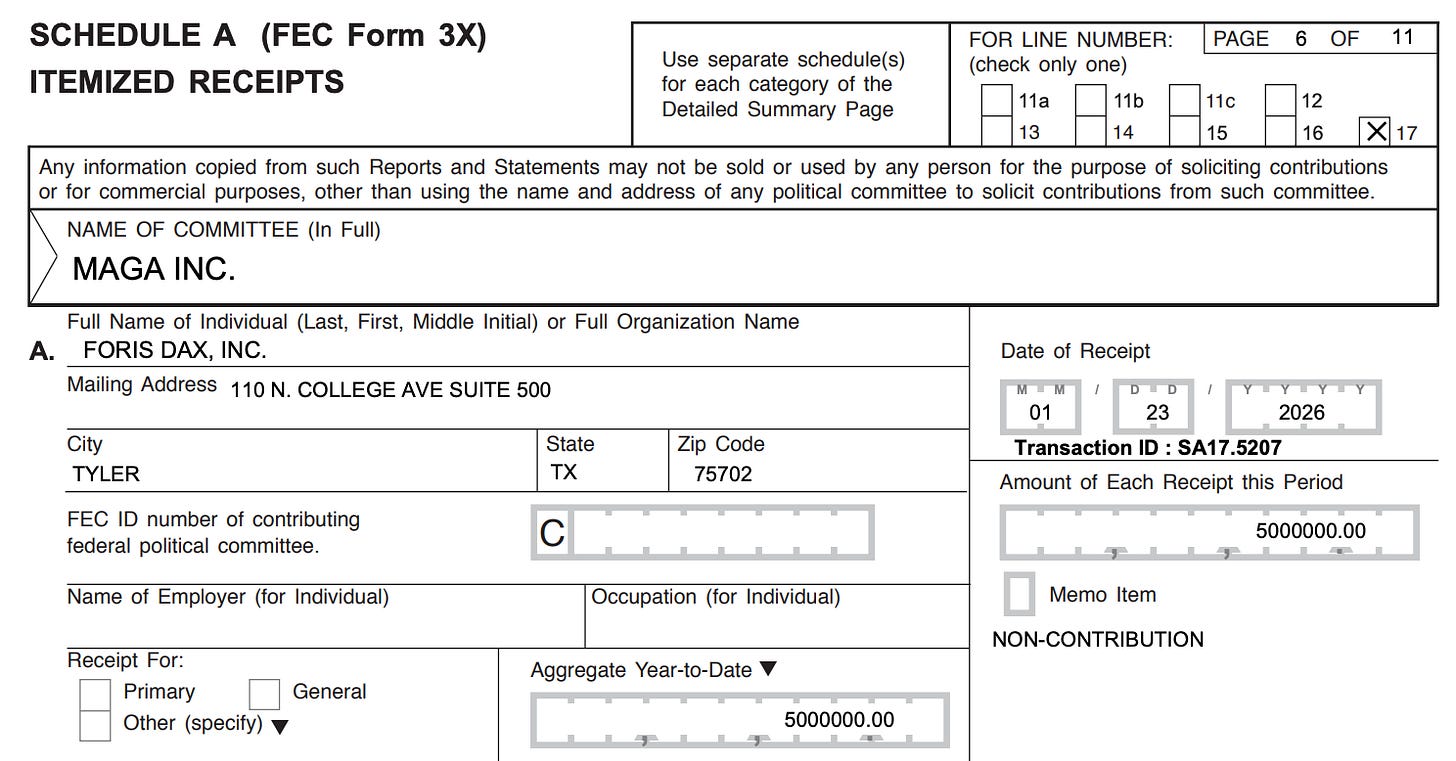
In a document quietly filed with the Federal Election Commission on Friday night, MAGA Inc., the primary Super PAC supporting President Trump, revealed that it received a $5 million donation from Crypto.com on January 23, 2026. The donation was made in the name of Crypto.com’s parent company, Foris Dax, Inc.1
[ ](https://substackcdn.com/image/fetch/$s_!-wdV!,f_auto,q_auto:good,fl_progressive:steep/https%3A%2F%2Fsubstack-post-media.s3.amazonaws.com%2Fpublic%2Fimages%2F21ce65d6-4c52-4c62-8b01-42836f6e0187_1488x778.png)
25 days later, on February 17, the Trump administration’s Commodities Futures Trading Commission (CFTC), intervened on Crypto.com’s behalf in high-stakes lawsuit in federal court.
Last year, Crypto.com sued the Nevada Gaming Control Board, arguing that it has the right to offer “prediction markets” on the outcome of sporting events without obtaining a Nevada gaming license. In October 2025, a federal court denied Crypto.com an injunction, and the company is now appealing the decision.
In addition to filing a formal amicus brief in support of Crypto.com’s appeal, CFTC chairman Mike Selig published an op-ed supporting Crypto.com’s position in the Wall Street Journal and posted a video supporting Crypto.com on X.
The timing of CFTC’s intervention raises serious ethical questions.
Selig, during his November 2025 confirmation hearing, was asked whether he believed it was legal for prediction markets to offer contracts on sporting events without complying with state law. Selig testified that the issue is “working its way through the courts, and so I will respect the decisions of those courts.”
He was also asked directly if he considered placing a bet on the outcome of a football game to be “gambling,” which would place it outside the jurisdiction of the CFTC:
Senator SCHIFF. Well, I mean, let me just ask—maybe even break it down more simply. If you and I bet on who wins the Bills game tomorrow, would you consider that gambling?
Mr. SELIG. Senator, on this issue, I would look to the courts, so I would look to what the courts say about that issue.
In a matter of weeks, Selig went from telling Senators under oath that he would defer to the courts on the issue to arguing on behalf of Crypto.com that the courts have erred.
He publicly announced he was considering intervening in the case during a public appearance on January 29 — less than a week after Crypto.com’s $5 million contribution to MAGA Inc. “I’ve directed CFTC staff to reassess the commission’s participation in matters currently pending before the federal district and circuit courts,” Selig said during his first public remarks as CFTC chairman.
On February 5, Selig explicitly stated that he believed it was legal for prediction markets to offer bets on sports, regardless of whether the company complied with state law.
[Mike Selig@MichaelSelig Strong Disagree.
Chris Christie @GovChristie
I believe Prediction Markets are violating the law. In 40 states we have regulated betting that can’t market to teenagers, pays state taxes, protects game integrity & reports suspicious activity to law enforcement. Prediction markets do none of that at all https://t.co/3dMAnS44Ex
2:06 PM · Feb 5, 2026 · 237K Views
114 Replies · 87 Reposts · 645 Likes](https://x.com/MichaelSelig/status/2019533204068393280?s=20)
Few companies have spent more money to ingratiate themselves politically with Trump than Crypto.com. Including the $5 million in January, Crypto.com has donated a total of $35 million to MAGA Inc. since 2025. It is the Super PAC’s largest donor, accounting for more than 10% of total funds.
Prior to its support for MAGA Inc, Crypto.com’s only political giving was a $1 million donation to Trump’s second inauguration in 2025.
Crypto.com has also formed an extensive partnership with Trump Media and Technology Group (TMTG), Trump’s money-losing media conglomerate that has recently pivoted into cryptocurrency and nuclear fusion. Among other integrations, Crypto.com and TMTG announced in October that Crypto.com would integrate its prediction market with Truth Social, TMTG’s social network. The joint venture will be called Truth Predict. President Trump is TMTG’s largest shareholder.
Crypto.com’s thin legal argument
Crypto.com and other prediction markets — and now the CFTC — argue that creating markets for sporting events is fundamentally different than sports gambling. In practice, however, it looks identical.
[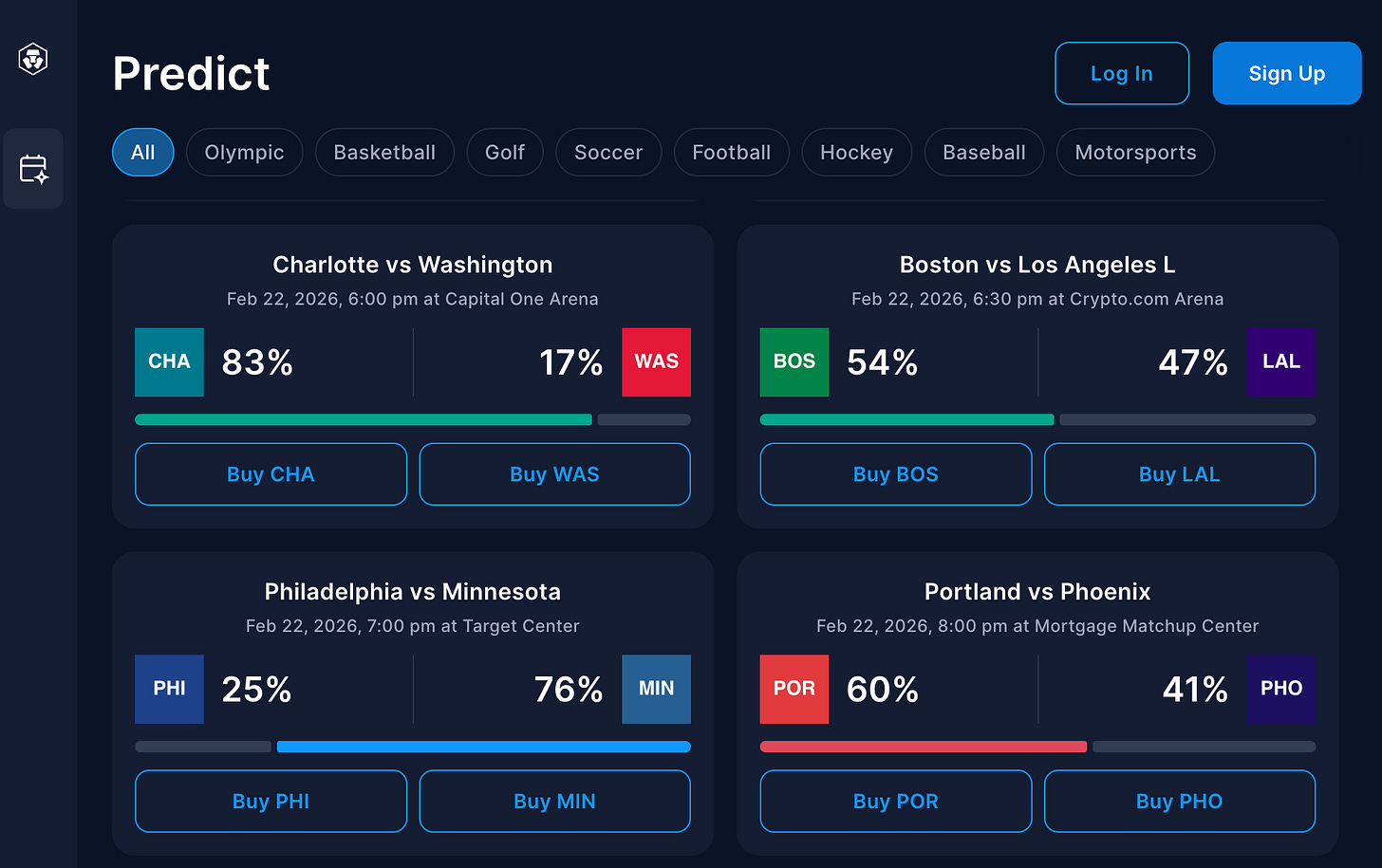 ](https://substackcdn.com/image/fetch/$s_!4ZwJ!,f_auto,q_auto:good,fl_progressive:steep/https%3A%2F%2Fsubstack-post-media.s3.amazonaws.com%2Fpublic%2Fimages%2F39b482a5-9a7e-475a-8dfa-353636dc271f_1926x1210.png)A screenshot from Crypto.com’s prediction market.
The CFTC has jurisdiction over event-related contracts or “swaps” that provide “for any purchase, sale, payment, or delivery… that is dependent on the occurrence, nonoccurrence, or the extent of the occurrence of an event or contingency associated with a potential financial, economic, or commercial consequence.” (Emphasis added.)
The traditional example of this is a contract to buy corn at a certain price in the future. This serves as an economic hedge against price fluctuations that can affect producers of tortilla chips, for example.
There are theoretical arguments that betting on the outcome of a sporting event could serve as an economic hedge. The CFTC, in its brief in support of Crypto.com, tries to make this argument:
Broadly speaking, sporting events are economic enterprises that generate billions of dollars in economic activity and materially affect both regional and national markets… For these reasons, hotels likely adjust pricing models, restaurants expand staffing to accommodate increased demand, vendors increase supply orders, and cities allocate resources to accommodate projected crowds. All of these decisions pose economic risk, which is precisely the type of economic exposure that derivatives markets are designed to mitigate.
Of course, this is not how prediction markets on sporting events are used. No one is wagering on a basketball game to hedge against hotels raising prices. They are used by people who want to gamble on sports, particularly in states where sports gambling is not currently legal. On popular prediction markets like Kalshi, sports betting accounts for over 90% of all trading volume.
Utah Governor Spencer Cox (R) mocked Selig’s position on X. “I don’t remember the CFTC having authority over the ‘derivative market’ of LeBron James rebounds,” Cox wrote. “These prediction markets you are breathlessly defending are gambling—pure and simple.”
The district court noted that, under Crypto.com’s interpretation, if every bet on a sporting event qualified as a “swap” subject to the exclusive jurisdiction of the CFTC. That would mean it would no longer be permissible for people to place sports bets in casinos. “Had Congress intended such a sea change in the regulatory landscape, it surely would have said so,” the district court wrote.
The designation of the $5 million from Foris Dax as a “NON-CONTRIBUTION” in the image refers to the fact that it is a donation to a Super PAC, which is not subject to FEC contribution limits or the prohibition on corporate contributions.
---
---
---
GIZMODO
Commerce Secretary Howard Lutnick faced questions this week about his visit to the private island of the late sex trafficker Jeffrey Epstein, as well as the fact that stablecoin issuer Tether hasn’t been audited. At first glance, it may not seem like those two issues are related in any way. But they’re intertwined in an environment where crypto prices are plummeting, and Tether potentially poses a risk to the broader economy. Fundamentally, the question is: How much can you trust Howard Lutnick?
Previously, Lutnick has made a big show of saying that while he was Epstein’s next-door neighbor on Manhattan’s Upper East Side, he didn’t have anything to do with the sex offender after a 2005 visit to his home gave him the creeps. Lutnick said that he saw a massage table during a visit to Epstein’s home and was made uneasy by the fact that he said he got massages frequently.
“My wife and I decided that I will never be in the room with that disgusting person ever again,” Lutnick told the New York Post podcast back in October. “So I was never in the room with him socially, for business, or even philanthropy.”
A visit in 2005 would have happened before Epstein was arrested for solicitation of a minor in 2006 and his sweetheart plea deal with federal prosecutors in 2008.
But this week, Lutnick was forced to acknowledge he did have interactions with Epstein well beyond 2005, including a visit to his Caribbean island, Little St. James, in 2012. Speaking at a Senate Appropriations Committee hearing on Tuesday, Lutnick was scheduled to testify on subjects like how the Commerce Department helps build broadband networks. Instead, he fielded questions about stuff like Epstein.
“I did have lunch with him, as I was on a boat going across on a family vacation,” Lutnick said about his 2012 visit to Epstein’s island. “My wife was with me, as were my four children and nannies. I had another couple, they were there as well, with their children. And we had lunch on the island. That is true. For an hour. And we left with all of my children, with my nannies, with my wife.”
Lutnick’s name appears in the Epstein files more than 250 times, according to the New York Times. The files show other interactions, including a meeting for drinks in 2011 and Epstein’s desire to meet Lutnick’s nanny in 2013. The Commerce Secretary testified Tuesday that he doesn’t know if Epstein met with the nanny and didn’t know what it was about.
As the Atlantic puts it, Lutnick’s story doesn’t make any sense. You can’t claim that you had nothing to do with Epstein after 2005 and then fess up to visiting the island of the most notorious sex criminal in modern American history in 2012, only after documents come out.
How much more is there to learn about Lutnick’s relationship with Epstein, whether it’s in the redacted Epstein files or from other sources? It’s a simple matter of credibility. Which brings us to questions that Lutnick faced about cryptocurrency.
Lutnick was asked about Tether during a hearing on, since the Commerce Secretary’s firm, Cantor Fitzgerald, holds a 5% stake in the company. Cantor Fitzgerald is also the asset manager for Tether.
“Generally speaking, I absolutely agree with you, Tether should be audited,” said Lutnick. “I don’t have anything to do with it, but I agree with you that tether should be audited.”
Lutnick has reportedly divested himself of his holdings, but his sons, Brandon and Kyle Lutnick, now run Cantor Fitzgerald. Brandon Lutnick, who’s just 27 years old, said during a conference in May 2025 that he personally checked Tether’s reserves. Your faith in the stability of Tether relies on the Lutnick family because there hasn’t been an independent audit of its books, no matter how much Howard Lutnick says he supports one.
Why does it matter what happens to Tether? Because it’s central to the crypto economy in a way that could create serious problems if it fails. Tether’s usefulness as a stablecoin is only sustained if people think it’s backed by something of value. If Tether is shown to not be backed by real assets and depegs, becoming worth significantly less than one American dollar for an extended period of time, faith in the entire system collapses. And that’s important because stablecoins are used to swap out cryptocurrencies like Bitcoin and Ether to convert them into fiat currency. They’re the dollar replacement in the system as people buy and sell crypto.
Democratic opposition has called out Howard Lutnick’s conflicts of interest and the dangers they pose to the broader economy. When Sen. Elizabeth Warren, a Democrat from Massachusetts, was opposing Lutnick’s nomination as Commerce Secretary, she specifically called out his relationship with Tether.
“You cannot serve as a booster for Tether while impartially fulfilling the Department of Commerce’s mission to ‘create the conditions for economic growth and opportunity for all communities’ as ‘economic growth has taken on increased importance for national security,’” Sen. Warren said in a statement at the time.
Crypto is teetering on the edge of the abyss these days. Bitcoin has fallen 50% since its all-time high in October, currently trading at around $65,000. And there are plenty of traders who expect it to fall even further, with some alt-coins getting hit even harder. The question is whether this collapse in price will spiral even further out of control should Tether’s reserves prove to be a mirage.
Tether says it’s backed by about $122 billion in U.S. Treasury bills, accounting for roughly 83% of its reserves. But without an audit, you just have to take the word of people like Howard Lutnick.
Lutnick is arguably under more pressure to resign than any other member of Trump’s cabinet. Semafor quoted an unnamed person “close to the White House” who acknowledged the heat, explaining that visiting Epstein’s island is “sort of the red line.” Even President Trump hadn’t been on the island, as far as anyone can tell based on the publicly available documents. Though, as Epstein’s “best friend,” Trump is certainly connected to the scandal in plenty of other ways. The president’s name appears in the new files over a million times, according to Rep. Jamie Raskin, a Democrat from Maryland.
Lutnick seemed to think it was exculpatory that he brought his family to Epstein’s island and invoked his wife in his defense on Tuesday.
“I know, and my wife knows, that I have done absolutely nothing wrong in any possible regard,” Lutnick said. “I have nothing to hide, absolutely nothing.”
---
---
AN 2 26
Gizmodo reported on Donald Trump Jr. and Eric Trump’s Wednesday Mar-a-Lago conference pushing their family crypto company, World Liberty Financial.
“In many ways, it’s a victory lap for the Trump family, a recognition that there is no mechanism available to stop the unprecedented corruption that’s being done out in the open, as foreign governments and U.S.-based executives jostle to please the Trump regime and profit from their proximity to political power,” reports Gizmodo.
“We were the most canceled people in the world in 2020, 2021,” Eric Trump told CNBC host Sara Eisen. “And it’s really great to almost have this retribution where all of a sudden we start pushing an agenda. Our agenda was to modernize finance, to allow that to never, ever, ever happen to anybody again.”
“The part Eric Trump is leaving out,” said Gizmodo writer Matt Novak, “is President Trump’s attempt at a self-coup on Jan. 6, 2021, sending a violent mob to storm the U.S. Capitol in a bid to remain in power after losing the 2020 election. The president was banned from the major social media platforms, and his family was cut off from some banking opportunities over his effort to overthrow the government. The president has since sued JPMorgan Chase and CEO Jamie Dimon over the moves.”
Gizmodo also reports the Trump sons “bragged” to CNBC about how opening their own crypto company has given them “credibility.” But Gizmodo counters that World Liberty Financial’s stablecoin, USD1, is “a fiat-backed cryptocurrency that the Trumps have tried to tout as a brilliant hedge against the traditional financial system, an argument that doesn’t make much sense given how dependent it is on that same system for stability.”
Donald Trump Jr. remains irritated that the family was briefly debanked, and he did not appreciate how banks could drop a customer at their own discretion.
“Crypto totally democratizes the ability for people to transact, to do finance, to get the loans that they need for businesses that make sense. That didn’t exist for everyone,” said Donald Trump Jr., which is a “frankly idiotic” suggestion said Novak.
“Just last year, World Liberty blacklisted Justin Sun’s blockchain address, which has over 595 million WLFI tokens, due to suspicious transactions,” said Gizmodo. “… Every financial institution, whether it’s focused on crypto or traditional banking, has to follow certain laws and regulations and has the discretion to lock up funds or boot anyone it doesn’t like.”
When Eisen asked the Trump sons about the $187 million paid to Trump family reps by people connected to the Emirati royal family, Donald Trump Jr. insisted that his father had “nothing to do with it” and that the UAE investment wasn’t at all related to the AI chips that President Donald Trump immediately granted the UAE access to after their generosity.
“We’ve been dealing with the conflict-of-interest stuff for years. And they tried all this nonsense the first time around. Frankly, it’s gotten old,” Donald Trump Jr. told Eisen.
Novak points out that Jr. is referring to the fact that “no other White House in modern history has seen the president and his family profit in such a galling way.”
---}:
---
August 4, 2025
Trump’s MAGA Inc. SuperPAC Donor List is Littered with Corporate and Billionaire Influence Buyers
WASHINGTON D.C. — President Trump’s MAGA Inc. SuperPAC received $1 million or more from 58 donors since January, according to the SuperPAC’s most recent campaign finance disclosure filed last week.
The million-dollar donor list includes numerous corporate and billionaire donors with interests in influencing the Trump administration, including two crypto companies that were facing SEC investigations that have since been dropped and a seller of “skin substitute” products that benefited from the delay of a Biden-era Medicare rule to limit spending on their products.
“The real question this mega-donor list raises is not ‘how much,’ but ‘who from?’” said Jon Golinger, democracy advocate for Public Citizen. “By taking contributions from wealthy individuals and industries who want something from government, Trump’s SuperPAC has used pay-to-play to raise big money from special interests like a legalized shakedown.”
Public Citizen analyzed the new MAGA Inc. SuperPAC filing with the Federal Election Commission, covering the period of January 1 – June 30, 2025, and found the following:
- Corporations gave $73.2 million
- Billionaires gave $49.2 million
- Cryptocurrency corporations, executives, and investors gave $41.7 million
- Fossil fuel corporations and executives gave $26.8 million
- Healthcare corporations and executives gave $12 million
- Donations of $1 million or more from corporations and billionaires included:
- $25 million (combined) from Energy Transfer LP and CEO Kelcy Warren. Energy Transfer is suing the Pipeline and Hazardous Materials Safety Administration, asking a judge to declare the agency’s in-house enforcement system unconstitutional.
- $16 million from Jeff Yass, a billionaire who owns a stake in TikTok’s parent company. TikTok is facing a Department of Justice lawsuit alleging violations of the Children’s Online Privacy Protection Act.
- $10 million in February 2025 from Foris Dax, Inc., which operates Crypto.com. Crypto.com was under investigation by the SEC over allegations of allegedly trading unregistered securities. The SEC investigation was reportedly dropped in March 2025.
- $5 million from the “skin substitute” company Extremity Care. In April 2025, the Trump Administration postponed implementation of a Biden-era rule that would limit Medicare spending on skin substitute products.
- $1 million (combined) in January 2025 from Gemini Trust Company (DBA Gemini) co-founders Cameron and Tyler Winklevoss. At that time, Gemini was under investigation by the SEC for allegedly trading unregistered securities. The SEC investigation was reportedly dropped in February 2025.
---
---
An 2 26}:
President Donald Trump’s top adviser Steve Bannon is ensnared in a cryptocurrency scandal — although in Bannon’s case, the controversy comes with a literally profane twist.
A Missouri investor named Andrew Barr is suing Bannon over a failed cryptocoin called “F—— Joe Biden” (FJB), according to The Bulwark. Barr alleges that he lost almost $59,000 investing in the FJB coin and is seeking to sue Bannon in a class action suit that would also include MAGA bigwigs like political operative Boris Epshteyn. Barr also claims that Bannon and the other FJB executives demanded an unusually high 8 percent fee on transactions on the grounds that 5 percent would go to charitable donations like veterans’ care, but has not lived up to that promise.
The FJB coin, which was supposedly going to one day power an “uncancelable” economy under Trump, plummeted in value under Bannon’s and Epshteyn’s management. The lawsuit also alleges that $2.7 million in value intended to go to charity or marketing has instead vanished unaccounted for. Despite enlisting top MAGA figures like Benny Johnson and Jack Posobiec to promote the coin, the FJB coin never became a lucrative venture. Finally the lawsuit points to public discussions among FJB executives which suggest they were aware something was amiss with their financial product.
“Top coin administrator Sarah Abdul and programmer Chase Bailey offered their lament over an alleged $120,000 payment from FJB to Epshteyn’s friends for lackluster services,” The Bulwark reported regarding a Discord conversation among FJB executives. “But, they concluded, it was ‘drops in the bucket’ compared to more serious financial mismanagement, which they didn’t spell out. Abdul told Bailey the management of the coin’s money was ‘worse than I ever imagined,’ according to the lawsuit.”
The Bulwark quoted Bailey as replying, “This looks sooooo neglegent [sic].”
This is not the first time Trump and his administration’s figures have gotten involved in cryptocurrency scandals. The Abu Dhabi royal family invested $500 million in the Trump family’s cryptocurrency coin; later, after Trump became president, the United Arab Emirates received access to highly sensitive AI technology. The Wall Street Journal reported that the deal involved “pay half up front, steering $187 million to Trump family entities” and at the same time “at least $31 million was also slated to flow to entities affiliated with” the family of Trump’s Middle East envoy Steve Witkoff. Democratic strategist David Axelrod described this as “an earthquake of a scandal” while Protect Democracy director Ian Bassin commented “amazingly, this has all but fallen out of the news."
In addition to Trump himself, Trump’s attorney Todd Blanche was accused by the ethics watchdog Campaign Legal Center of owning at least $159,000 in cryptocurrency assets when he ordered an end to all investigations into cryptocurrency companies. Blanche had previously signed an ethics agreement promising to dump his cryptocurrency holdings within 90 days of being confirmed, but instead did not divest until more than a month after his cryptocurrency memo. Even then he did so transferring them to his adult children and a grandchild, which though legal skirts the spirit of the law.
Despite the Trump administration’s abundant promises that cryptocurrency would lead to immense profits, the market has fallen more than 50 percent since its October peak with no end in sight.
“I’ve never seen people so dispirited about the crypto industry before, even at the lowest lows," Nic Carter, founding partner of the crypto investment firm Castle Island Ventures, told Politico. "Psychologically, this feels really hard for people to handle.”
Carter later added, “The rapture didn’t happen, we’re just stuck here on Earth and it sucks.”
---
---
5418639-crypto-lobby-trump-stablecoin-bill
The cryptocurrency lobby rapidly expanded its presence on Capitol Hill in recent months as lawmakers took their first bite at legislation to regulate digital currency, according to disclosures filed this week.
At least 27 crypto companies or advocates filed their first-ever lobbying disclosures this year across some 20 firms, reflecting an increasing appetite for influence in a more crypto-friendly Washington.
The newcomers originate from all corners of the industry. There’s betting website Polymarket, a gaming company that created an NFT version of the White House Easter egg hunt, and a Seychelles-based exchange that cannot operate in the U.S. market due to a federal money laundering settlement.
Together, they spent nearly $2.8 million between April 1 and June 30 on lobbying landmark legislation promoting digital assets to the Treasury Department and the Securities and Exchange Commission, and a host of other issues relevant to blockchain infrastructure — an increasingly sprawling ecosystem that some hope could one day be as ubiquitous as the internet.
The push has paid off for crypto so far. The GENIUS Act, a bill with bipartisan support signed by President Trumplast week, has been regarded as the government’s “seal of approval” on the industry. The law sets up a regulatory framework for stablecoins, a type of cryptocurrency that is theoretically pegged to the U.S. dollar or another reference asset.
The House also advanced several other landmark bills during its monumental “crypto week,” which featured high-profile lobbying stunts such as vending machines around the Capitol and the National Mall with customized chocolate bars urging “yes” votes, bankrolled by the crypto exchange Coinbase.
Lobbying expenses that week were not covered in the second quarter disclosures.
At least 73 companies or associations focused on crypto disclosed federal lobbying activities, to the tune of about $11.4 million — a total that doesn’t include spending from investment firms such as Andreessen Horowitz ($790,000) or BlackRock ($810,000) that have substantial crypto interests but also lobbied on a suite of other financial regulation issues.
KuCoin, a cryptocurrency exchange based in Seychelles, spent the most on lobbying of any of the new companies, doling out $1 million in the second quarter on issues “related to crypto legislation and regulations” — more than industry giants Coinbase ($970,000), Crypto.com ($430,000) and the Blockchain Association ($490,000), which represents more than 100 crypto companies.
But KuCoin isn’t even allowed to operate in the U.S. market for at least the next two years; in January, the exchange pleaded guilty for failing to properly vet its users in what the Justice Department said was a violation of federal regulations combating money laundering. KuCoin also agreed to pay a fine of $300 million.
Still, the broader industry’s enthusiasm coincides with a historically crypto-friendly White House — a marked change from the often-wary Bidenadministration. Trump, himself once a crypto skeptic, now owns a spread of tokens and cryptocurrencies, which Forbes estimated in June accounted for about 60 percent of his personal net worth.
Crypto executives who packed the White House for the GENIUS Act signing earlier this week hailed the moment as “surreal” and “historic.”
“The overarching problem that the industry has faced in the last eight years is not, I would say, the inability to build things, but rather the inability to understand how what is being built interacts with existing law and regulation,” said Miller Whitehouse-Levine, the CEO of the Solana Policy Institute, which advocates for decentralized networks built on blockchain technology.
Solana, which spent $560,000 this quarter, is one of several blockchain platforms on which users can build all sorts of software: a boba rewards program, a ticketing platform, and a 5G cell network are recent examples. There’s also cryptocurrency hosted on the framework, including $TRUMP and $MELANIA, meme coins owned by the president’s family.
Some crypto firms are still focused on currency issues; Bitdeer Technologies, which operates computing facilities that mine Bitcoin, spent $250,000.
But many of the companies making their voices heard in Washington want to use cryptocurrencies — or blockchain, their underlying technology — for a host of other financial products and technologies.
Polymarket, filing under the name Blockratize, is new to lobbying this year and spent $90,000 last quarter. The company allows users to make bets using cryptocurrency on basically any event: the 2028 presidential election, whether President Trump will pardon Jeffrey Epstein’saccomplice Ghislaine Maxwell, or even the price of other cryptocurrencies in the near future.
Gala Games, which paid out $50,000 in lobbying, helped sponsor the White House’s annual Easter Egg Roll — a partnership that included their development of an online Easter egg hunt where users could collect NFT eggs. The company hosts online games that pay out crypto tokens as rewards.
After the successful passage of the GENIUS Act, crypto companies are now hoping the Senate will next advance the Clarity Act, which would stake out a blueprint for how federal regulatory agencies will oversee crypto firms. A bill banning the Federal Reserve from issuing a cryptocurrency, seen as a competitor to stablecoins, has also attracted support from the sector.
But questions linger about the future of the famously volatile industry, and Whitehouse-Levine said he is worried about another sea change after the “extreme whiplash” between presidential administrations.
“The pendulum, you know, I think was at one extreme and is now swung in the opposite direction,” he said. “My greatest fear is the possibility … of that pendulum swinging back to the same extent it just swung.”
---
---
wired
On July 18, after more than a decade of legal uncertainty, US lawmakers finally brought part of the crypto industry into the regulatory fold. The newly signed Guiding and Establishing National Innovation for US Stablecoins (GENIUS) Act requires issuers of stablecoins—cryptocurrencies that claim a value tied to a more stable asset—to fully back their tokens with cash or short-term Treasury bonds, submit to audits, and follow anti-money-laundering rules, among other conditions. In an effort to cement stablecoins as a form of “digital cash” rather than a place to park money, the law also bars stablecoin issuers from paying interest.
But crucially, the law doesn’t ban crypto exchanges from offering customers rewards on their stablecoin holdings, meaning stablecoin holders are still able to receive financial incentives that look a lot like interest. Today, Coinbase customers can earn a 4.1 percent annual reward if they hold a stablecoin called USDC on the platform. The return is similar to what customers might expect from a high-yield savings account.
Banking industry groups say this represents a major regulatory loophole and could push people to take their money out of banks and put it in crypto exchanges, which continue to be far less regulated. Some crypto exchanges offer higher rewards than what’s available from a high-yield savings account (while rates vary, many offer an annual yield of 4.25 percent). Kraken, for example, promotes 5.5 percent “rewards on your USDC holdings.”
Featured Video
Matt Smith Answers The Web's Most Searched Questions
Even without rewards, stablecoins pose a potential risk for consumers compared to bank deposits and cash. Unlike checking or savings accounts, cryptocurrencies are not FDIC-insured, meaning that if a stablecoin issuer collapses, the US government won’t directly step in to make consumer deposits whole.
Some regulators and crypto advocates say the GENIUS Act’s stringent reserve requirements and bankruptcy protections obviate the need for FDIC insurance. But stablecoins have collapsed in the past, and research from the Bank for International Settlements (BIS) suggests that even the “least volatile” stablecoins, like the ones now the standard under GENIUS, “rarely trade exactly at par” to the value they claim to have. This brings into question “stablecoins’ ability to serve as a reliable means of payment,” BIS researchers write.
Research from the Federal Reserve Bank of Kansas City suggests increased demand for stablecoins could have knock-on effects for the economy. “If stablecoins are purchased out of bank deposit accounts, that necessarily means that there are less funds available for banks to loan,” says Stefan Jacewitz, assistant vice president of the Kansas City Fed. He says incentives like rewards “could induce shifts in funding that are faster and larger than they would have been otherwise.”
In April, the Treasury Department released a report suggesting consumers may move as much as $6.6 trillion out of bank deposits and into stablecoins, partially as a result of the GENIUS Act. If that happens, it could reduce the funds banks have available to lend, and consumers and businesses may face higher borrowing costs in the long run, according to research by the American Bankers Association, a prominent industry group.
Crypto advocates see things differently. They claim stablecoin rewards create healthy market pressure and could drive big banks to provide more competitive interest rates in an effort to keep customer deposits.
“To call this a trillion-dollar fight would be an understatement: This is highly fraught territory that banks have jealously guarded,” says former Republican representative Patrick McHenry of North Carolina, who served as chair of the House Financial Services Committee until January 2025.
A study commissioned by Coinbase predicts a maximum decrease in banks’ deposits of 6.1 percent. Looking at community banks specifically, the report does not find a statistically significant effect on deposits under what it sees as likelier market-growth projections for stablecoins. Meanwhile, Dante Disparte, chief strategy officer and head of global policy at Circle, the issuer of USDC, has written that “today's generation of successful stablecoins have increased dollar deposits in the U.S. and global banking system,” adding that the prohibition on interest from stablecoin issuers represents “a measure that would protect the deposit base.”
The Compromise
In the four years it took to push stablecoin legislation over the finish line, most lawmakers in Congress agreed that stablecoin issuers should not pay interest. “The drafters understood that [stablecoins are] a different kind of instrument: digital cash, a digital dollar, not a security instrument that provides a return,” says Corey Then, deputy general counsel of global policy at Circle.
In March, Coinbase CEO Brian Armstrong weighed in. On X, he suggested customers should be allowed to earn interest on stablecoins. He likened the arrangement to “an ordinary savings account, without the onerous disclosure requirements and tax implications imposed by securities laws.”
The rest of the story—as told by Ron Hammond, who recently worked as a senior lobbyist on behalf of the Blockchain Association, a prominent crypto industry group—goes something like this: Eventually, the banking industry agreed to a deal, which included the sought-after prohibition on stablecoin issuers paying interest. But the provision still left some room for crypto exchanges to provide users with a monetary incentive for holding stablecoins. Hammond says some crypto companies had hoped interest would be explicitly allowed, but prominent crypto groups were willing to agree to a compromise.
“The world of crypto, at the very least, was successful in getting language that opens the door for them to provide some type of reward that either is yield or something that resembles yield,” says McHenry, the former chair of the House Financial Services Committee, who now serves as the vice-chair of Ondo, a blockchain-focused financial markets company.
The fact that banking industry groups are now sounding the alarm about stablecoins frustrates some crypto industry experts. “Raising concerns about stablecoin rewards at this stage feels disingenuous and overlooks the extensive debate that shaped the GENIUS Act,” says Cody Carbone, CEO of the Digital Chamber, a crypto-focused advocacy and lobbying group. “Banking industry representatives were fully engaged throughout the process, alongside crypto stakeholders, and the final language, which permits stablecoin-related rewards offered by exchanges and affiliated platforms, was a direct product of those discussions.”
A Second Chance
The crypto industry might have been willing to compromise in part because it didn’t want to expend too much political capital on a bill it viewed as a test case for broader crypto regulation. “The concern for the crypto industry was, ‘If we start having hiccups with the stablecoin bill—the easy bill—the odds of us getting past it significantly go down, and then the odds of us getting to the market structure bill are near zero for these next two years,’” Hammond says.
The bill he is referring to is what’s known as the CLARITY Act, which attempts to create a regulatory framework for products and financial platforms operating on the blockchain, much like the laws already governing traditional financial entities like stock markets, banks, and institutional investors. The act has passed in the House; a Senate version of the bill is expected in September. Days after the GENIUS Act was signed, Senate drafters of the CLARITY Act published a request for information that asks whether legislation should limit or prohibit systems like stablecoin rewards.
The CLARITY Act gives both the crypto and banking industries a second chance to push through provisions that did not make it into the GENIUS Act. Paul Merski, executive vice president of congressional relations for the Independent Community Bankers of America, community banks’ primary lobbying and advocacy group, says the ICBA will fight any language that threatens “the underlying premise of not paying interest”—which he claims the GENIUS Act provided. “We addressed it in the bill that addressed stablecoin issuers, and we'll make sure it's addressed in the market structure legislation as well, so it doesn't create a loophole,” he says.
“Here's the problem with having two legislative packages move at different speeds: The losers in the last round will come back for another round, and the winners will have to relitigate,” says McHenry. “So we're back for round two, where everything is relitigated from round one. It makes round two more difficult.”
As the CLARITY Act moves through Congress, banks are also making their own public moves into stablecoins. Citigroup and Bank of America have signaled that they may issue their own stablecoins. Meanwhile, PNC Bank and JPMorganChase have launched partnerships with Coinbase. In JPMorgan’s case, this partnership allows customers to directly link their bank accounts to their crypto wallets as soon as next year.
JPMorgan is also piloting a “deposit token” system, which features much of the same technology as stablecoins without the need to shore up the token’s reserves at a 1:1 ratio, which is a requirement for stablecoins under the GENIUS Act. Ultimately, if the CLARITY Act results in a ban on stablecoin “rewards,” banks may regain the upper hand in the possibly multitrillion-dollar fight over deposits and the interest rates accompanying them.
“The banking trades clearly missed it and GENIUS got past them, and they rarely let something like that happen,” McHenry says. “I think they're back: They're back in a hardcore way, and the stakes are high.”
---