bukele prez NAYIB
trump mass deport gulag oops // rubio
fascism tucker musk trump gaetz crypto
threaten judges // musk trump
ISIS STYLE VIDEO, CONC CAMP // PVT PRISON
shielded tren de a gang by extradition?
musk ?! send tesla protesters
COOL DICTATOR Juan Wick fla nightclub prod clothes
crypto-currency
STATE OF EXCEPTION
see cpac inaug
---
The Roots of Bukele’s Gulag — Bunk History
---
- June 2024: Milei traveled to El Salvador to attend Bukele’s second presidential inauguration. [1]
- September 2024: Bukele visited Argentina to meet with Milei at the Casa Rosada, discussing cooperative efforts in nuclear energy, security, and commerce.
---
2x?
AN OCT 2026
Threats against federal judges in the United States have reached record levels this year, with the U.S. Marshals Service investigating more than 500 threats by September — a surge legal observers say reflects rising politicized hostility toward the judiciary.
In an article for the Guardianpublished Sunday, investigative journalist Jason Wilson argued that El Salvador’s president Nayib Bukele is seeking to export his authoritarian playbook to the U.S. by calling on President Donald Trump to impeach “corrupt judges.”
Wilson noted that Bukele has made repeated public attacks on the US judiciary — including describing the country as “facing a judicial coup” — and that his latest call was amplified by pro‑MAGA figures such as tech billionaire Elon Musk.
He writes that the timing of this intervention is significant, as the U.S. judiciary is already under unprecedented pressure from threats, harassment, and rhetorical assaults tied to the current Trump administration. Wilson cites figures showing hundreds of threats to federal judges in 2025, plus numerous instances of attacks on judges at the local level.
The writer traced Bukele’s tactics back to actions his government took in 2021, when loyalist legislators dismissed constitutional court justices and the attorney general to install allies. He argued that although the U.S. system makes removal of judges difficult, the tactic being tested is not direct removal but delegitimisation and intimidation.
According to Wilson, the Trump administration is using sustained attacks on the judiciary, repeating claims that courts are not co‑equal branches and targeting judges who rule against it, as a tool to discourage judicial review. He warned that consistent threats and undermining of institutional legitimacy may lead judges to hesitate in decisions that conflict with the administration’s agenda, weakening one of democracy’s key checks.
The article quoted Heidi Beirich, the co-founder of the Global Project Against Hate and Extremism, who said: “Trump’s threats against judges have definitely driven online vitriol at judges and calls for impeachment. Targeting the judiciary is one more step in Trump’s march towards authoritarianism.”
"That march towards authoritarianism has been well-trodden in recent years in several countries, including by Bukele," the article noted.
---
ggl ai 10 25
Concerns and scrutiny
- Regulatory leniency: While El Salvador's embrace of crypto has attracted companies, critics have raised concerns over the country's comparatively relaxed regulatory framework. El Salvador's stablecoin law requires licensed issuers to provide audited financial statements, a standard Tether has resisted elsewhere.
- Bukele regime ties: Tether's move and deep ties to President Bukele's government, which has been criticized for authoritarianism and human rights abuses, have also attracted scrutiny.
- Financial reporting: Tether's financial reporting and the composition of its reserves have long been a subject of controversy, with the company facing persistent questions regarding transparency.
---}:
AN 9 25
U.S. President Donald Trump's administration earned condemnation from Amnesty International on Thursday over its leaked plans to downplay human rights violations in countries favored by the American government.
News of the plan was originally reported on Wednesday by The Washington Post, which documented how the administration has been revising State Department reports on human rights in El Salvador, Israel, and Russia to "strike all references to LGBTQ+ individuals or crimes against them." The Post also added that "the descriptions of government abuses that do remain have been softened."
In the case of El Salvador, where the administration earlier this year began lawlessly shipping immigrants deported from the United States, the administration's report stated that were "no credible reports of significant human rights abuses" there, even though a State Department report under former President Joe Biden's administration issued last year documented "significant human rights issues" in the country.
Human rights violations against LGBTQ+ people were deleted from the State Department's report on Russia, while the report on Israel deleted references to Israeli Prime Minister Benjamin Netanyahu's corruption trial and to his government's threats to the country's independent judiciary.
Amanda Klasing, Amnesty International USA's national director of government relations and advocacy, ripped the administration for selectively whitewashing human rights records of nations favored by the president.
"The leaked chapters of the latest Annual Human Rights Report reveal a disturbing effort by the Trump administration to purposefully fail to fully capture the alarming and growing attacks on human rights in certain countries around the globe," she said. "Alarmingly, we understand that the mandate from Secretary Rubio was... to go back and wipe out portions of the reports that had already been written—to delete stories from survivors of human rights violations."
Klasing went on to accuse the administration of turning the human rights report "into yet another tool to obscure facts to push forward anti-rights policy choices."
She also emphasized that "it would be a travesty and subversion of congressional intent to downplay or ignore human rights violations faced by marginalized populations including refugees and asylum seekers, women and girls, Indigenous people, ethnic and religious minorities, and LGBTQI+ people throughout the world."
An unnamed State Department official this week told the Post that the administration was merely simplifying the human rights reports to make them more "readable."
"The 2024 Human Rights report has been restructured in a way that removes redundancies, increases report readability, and is more responsive to the legislative mandate that underpins the report," the official said. "The human rights report focuses on core issues."
NOW READ:DOJ memo reveals Trump’s dark plan for a new Red Scare — and it may be perfectly legal
---
===
U.S. President Donald Trump's administration earned condemnation from Amnesty International on Thursday over its leaked plans to downplay human rights violations in countries favored by the American government.
News of the plan was originally reported on Wednesday by The Washington Post, which documented how the administration has been revising State Department reports on human rights in El Salvador, Israel, and Russia to "strike all references to LGBTQ+ individuals or crimes against them." The Post also added that "the descriptions of government abuses that do remain have been softened."
In the case of El Salvador, where the administration earlier this year began lawlessly shipping immigrants deported from the United States, the administration's report stated that were "no credible reports of significant human rights abuses" there, even though a State Department report under former President Joe Biden's administration issued last year documented "significant human rights issues" in the country.
Human rights violations against LGBTQ+ people were deleted from the State Department's report on Russia, while the report on Israel deleted references to Israeli Prime Minister Benjamin Netanyahu's corruption trial and to his government's threats to the country's independent judiciary.
Amanda Klasing, Amnesty International USA's national director of government relations and advocacy, ripped the administration for selectively whitewashing human rights records of nations favored by the president.
"The leaked chapters of the latest Annual Human Rights Report reveal a disturbing effort by the Trump administration to purposefully fail to fully capture the alarming and growing attacks on human rights in certain countries around the globe," she said. "Alarmingly, we understand that the mandate from Secretary Rubio was... to go back and wipe out portions of the reports that had already been written—to delete stories from survivors of human rights violations."
Klasing went on to accuse the administration of turning the human rights report "into yet another tool to obscure facts to push forward anti-rights policy choices."
She also emphasized that "it would be a travesty and subversion of congressional intent to downplay or ignore human rights violations faced by marginalized populations including refugees and asylum seekers, women and girls, Indigenous people, ethnic and religious minorities, and LGBTQI+ people throughout the world."
An unnamed State Department official this week told the Post that the administration was merely simplifying the human rights reports to make them more "readable."
"The 2024 Human Rights report has been restructured in a way that removes redundancies, increases report readability, and is more responsive to the legislative mandate that underpins the report," the official said. "The human rights report focuses on core issues."
NOW READ:DOJ memo reveals Trump’s dark plan for a new Red Scare — and it may be perfectly legal
---
AN PP 6 25
OMG
- Investigation Impeded: Despite Salvadoran President Nayib Bukele’s crime fighter reputation, his top aides blocked extraditions of MS-13 leaders to the U.S., officials say.
- Money Laundering Inquiry: U.S. agents drew up a request to examine whether Bukele and senior officials had diverted USAID funds to help out MS-13 gang members.
- Salvadoran Allies Threatened: Law enforcement officials had to flee El Salvador after facing harassment and threats from the country’s government.
These highlights were written by the reporters and editors who worked on this story.
In mid-April, President Donald Trump sat down in the Oval Office with President Nayib Bukele of El Salvador to celebrate a new partnership. They had recently negotiated an extraordinary deal in which El Salvador agreed to incarcerate in a maximum security prison hundreds of Venezuelan immigrants that the Trump administration had labeled as violent criminals, though few had been convicted of such crimes. The U.S. also sent back accused members of the notorious Salvadoran gang MS-13 — which both the U.S. and El Salvador have designated as a terrorist organization.
Bukele’s presidency has been defined by his successful crackdown against MS-13. He has jailed tens of thousands of alleged gang members, transforming one of the hemisphere’s most dangerous nations into one of its safest. Although human rights groups have criticized his tactics, Bukele remains extremely popular in El Salvador.
During their meeting at the White House, Trump praised his guest as “one hell of a president.” He shook Bukele’s hand, saying, “We appreciate working with you because you want to stop crime and so do we.”
A long-running U.S. investigation of MS-13 has uncovered evidence at odds with Bukele’s reputation as a crime fighter. The inquiry, which began as an effort to dismantle the gang’s leadership, expanded to focus on whether the Bukele government cut a secret deal with MS-13 in the early years of his presidency.
New reporting on that investigation by ProPublica shows that senior officials in Bukele’s government repeatedly impeded the work of a U.S. task force as it pursued evidence of possible wrongdoing by the Salvadoran president and his inner circle.
Bukele’s allies secretly blocked extraditions of gang leaders whom U.S. agents viewed as potential witnesses to the negotiations and persecuted Salvadoran law enforcement officials who helped the task force, according to exclusive interviews with current and former U.S. and Salvadoran officials, newly obtained internal documents and court records from both countries.
In a previously unreported development, federal agents came to suspect that Bukele and members of his inner circle had diverted U.S. aid funds to the gang as part of the alleged deal to provide it with money and power in exchange for votes and reduced homicide rates. In 2021, agents drew up a request to review U.S. bank accounts held by Salvadoran political figures to look for evidence of money laundering related to the suspected diversion of U.S. funds. The list of names assembled by the agents included Bukele, senior officials and their relatives, according to documents viewed by ProPublica.
“Information obtained through investigation has revealed that the individuals contained within this submission are heavily engaged with MS-13 and are laundering funds from illicit business where MS-13 are involved,” the agents wrote. The people on the list “are also believed to have been funding MS-13 to support political campaigns and MS-13 have received political funds.”
The outcome of the request is not known, but its existence shows that the U.S. investigation had widened to examine suspected corruption at high levels of the Bukele government.
The investigation was led by Joint Task Force Vulcan, a multiagency law enforcement team created at Trump’s request in 2019. Agents found evidence that the Bukele government tried to cover up the pact by preventing the extraditions of gang leaders who faced U.S. charges that include ordering the murders of U.S. citizens and plotting to assassinate an FBI agent.
In addition, U.S. officials helped at least eight of their counterparts in Salvadoran law enforcement flee the country and resettle in the United States or elsewhere because they feared retaliation by their own government, current and former U.S. officials said.
It has been clear from the beginning what Trump wants from El Salvador: an ally who would accept, and even imprison, deportees. Less clear has been what Bukele might want from the United States. In striking the deal with the Salvadoran president, Trump has effectively undercut the Vulcan investigation and shielded Bukele from further scrutiny, current and former U.S. officials said.
Veterans of the Vulcan team are “concerned that all their work, the millions of dollars that were spent, going all over the United States, El Salvador, Guatemala, Mexico, that it will be weakened for political reasons,” said a U.S. official familiar with the investigation.
The task force worked closely with the Salvadoran attorney general’s office, whose prosecutors shared evidence from their own investigation of the gang negotiations and suspected graft in the Bukele government, according to current and former U.S. and Salvadoran officials.
“There was good information on corruption between the gang and the Bukele administration,” Christopher Musto, a former senior official at Homeland Security Investigations, or HSI, who worked on Vulcan, said about the Salvadoran investigation. “It was a great case.”
In May 2021, Bukele’s legislative majority in Congress ousted the attorney general and justices of the Supreme Court, which oversees extradition requests. Within seven months, newly installed justices reversed or halted six requests for senior gang leaders wanted in the U.S., according to interviews and documents.
“Bukele’s people were coming to the Supreme Court and saying under no circumstances are we extraditing the MS-13 leaders,” said the U.S. official familiar with the investigation. “‘Delay, interfere, undermine, do what you have to do.’”
Senior Bukele officials helped an MS-13 leader with a pending extradition order escape from prison, according to court records, U.S. officials and Salvadoran news reports. At least three other top gang leaders were released from Salvadoran custody after the U.S. filed extradition requests for them, according to Justice Department documents.
Published accounts in the United States and El Salvador have reported allegations that Bukele also pushed for the return of MS-13 leaders to prevent them from testifying in U.S. courts about the pact. Despite his government’s refusal to extradite gang bosses to the United States, the Trump administration in March deported one MS-13 leader accused of terrorism. The Justice Department is now seeking to dismiss charges against a second leader, which would allow him to be sent back to El Salvador, according to recent court filings.
The Justice Department declined to comment in response to questions sent by ProPublica. The State Department referred questions to the Justice Department.
A White House spokesperson did not respond to detailed questions.
“President Trump is committed to keeping his promises to the American people and removing dangerous criminals and terrorist illegals who pose a threat to the American public,” said Abigail Jackson, a White House spokesperson. “We are grateful for President Bukele’s partnership.”
Bukele, the Salvadoran Ministry of Foreign Affairs and the Salvadoran Supreme Court did not respond to lists of questions. Bukele has repeatedly denied making any agreement with MS-13. The Trump administration’s deportation of MS-13 members to El Salvador, he said in a post on X, will enable security forces to dismantle the gang.
“This will help us finalize intelligence gathering and go after the last remnants of MS-13, including its former and new members, money, weapons, drugs, hideouts, collaborators, and sponsors,” the post said.
“Just Fear”
Bukele was elected president of El Salvador in February 2019, promising to fight the country’s ingrained political corruption and pervasive gang violence, which he called “one of the greatest challenges” facing the nation.
During his first term, Trump also made MS-13 a high-profile foe, calling it “probably the meanest, worst gang in the world.” In August 2019, Attorney General William P. Barr created the Vulcan task force, teaming federal prosecutors with agents of the FBI, Homeland Security Investigations, Drug Enforcement Administration and other agencies. The goal: Eradicate MS-13.
For decades, MS-13 has bedeviled law enforcement in the Americas with its vast reach, extreme violence and complex culture. The initials stand for “Mara Salvatrucha.” “Mara” means a swarm, while “salvatrucha” has been said to refer to a clever Salvadoran, according to interviews and an academic study. The number represents the 13th letter of the alphabet, M, in homage to the Mexican Mafia, the powerful Southern California prison gang.
MS-13 emerged in the 1980s in Los Angeles among Salvadoran youths whose families had fled a bloody civil war. The gang expanded throughout the diaspora and, as the U.S. deported planeloads of ex-convicts starting in the 1990s, took root in El Salvador. Although most of the leaders were serving sentences in El Salvador, a jailhouse council of 14 bosses, known as the “Ranfla,” used cellphones to micromanage criminal activities in U.S. cities thousands of miles away.
The gang developed a reputation for torturing, brutalizing and dismembering its victims. Barr has called it “a death cult” in which violence is more important than riches.
“It was like a very violent mom-and-pop operation where the cousins and second cousins all want to be a part of it,” said Carlos Ortiz, who served as the HSI attaché in El Salvador from 2018 to 2024. “Minimal money, compared to others. Even though it’s an organization, a lot of it is just fear. Fear of the high-ranking bosses among the rest of the gang, that’s what drives it.”
Trained with military weapons, MS-13 warred with security forces in El Salvador, took over neighborhoods and generated one of the world’s worst homicide rates, driving an exodus of immigrants reminiscent of the 1980s. The Salvadoran Supreme Court designated the gang as a terrorist organization in 2015.
The Vulcan task force had about 30 members, including prosecutors, agents and analysts. Its director, John J. Durham, was a federal prosecutor in the Eastern District of New York who had spent a decade pursuing MS-13 cliques on Long Island. Members of the task force worked from bases around the country and traveled to Mexico and Central America.
One of the founding investigators, Newark FBI agent Daniel Brunner, spoke fluent Spanish and had worked gangs for seven years. He became a roving specialist providing expertise, communications intelligence and court transcripts, sometimes in person and sometimes from a distance.
“Our idea was that Vulcan was like a SEAL Team 6, going in to help the different districts build cases,” Brunner, who is now retired, said in an interview.
Vulcan built on the longtime U.S. presence and extensive influence in El Salvador, where the embassy has long funded and trained law enforcement agencies. FBI agents and others were embedded as advisers in police anti-gang and homicide units and worked with prosecution teams led by Attorney General Raúl Melara.
The U.S. task force modeled its strategy on the ones used against Mexican cartels and Colombian narcoguerrillas: Break the power of the MS-13 bosses by extraditing them to face trial and prison in the United States.
On Jan. 14, 2021, six days before the end of the Trump administration, Durham and FBI Director Christopher A. Wray joined acting Attorney General Jeffrey A. Rosen when he announced “the highest-reaching and most sweeping indictment targeting MS-13 and its command and control structure in U.S. history.”
Prosecutors charged the 14 members of the leadership council with major crimes including conspiracy to support and finance narcoterrorism. For more than two decades, the Ranfla ran a criminal network in the United States, Mexico and Central America that sanctioned the murders of Americans and trafficked drugs and arms, the indictment alleged.
The indictment contained a stunning charge: MS-13 bosses had taken the extraordinary step of giving an order, or “green light,” to assassinate an FBI agent working with local investigators in El Salvador. Embassy officials learned of the threat and evacuated the agent, according to interviews.
It is highly unusual for Latin American criminal groups to target a U.S. agent — they have learned that it invites an overwhelming law enforcement response. The assassination plot was a sign that the U.S. crackdown had rattled the gang chiefs, current and former officials said.
Vulcan on the Hunt
In conversations with American officials as president-elect, Bukele promised cooperation and welcomed their support against gangs and graft, even in his own Nuevas Ideas party, according to current and former U.S. officials.
At a press event about the Vulcan task force in 2020, Trump asserted that in the past El Salvador “did not cooperate with the United States at all,” but now it had become a strong law enforcement partner.
Already, though, there had been news accounts alleging that Bukele had cut deals with gangs when he was mayor of San Salvador. Vulcan investigators quickly found evidence that top aides to the new president were negotiating a new pact with gang chiefs, according to interviews.
For more than a decade, MS-13’s control of the streets had made it a political force. It could deliver votes, ignite mayhem or impose order. A series of politicians had held talks with gang leaders to seek electoral support and reductions in violence in return for improved prison conditions and perks such as prostitutes and big-screen televisions.
The Bukele government adopted a more sophisticated bargaining strategy, according to current and former U.S. and Salvadoran officials. During secret meetings in prisons and other sites, the president’s emissaries offered MS-13 leaders political power and financial incentives if they lowered the homicide rate and marshaled support for the Nuevas Ideas party, according to current and former U.S. and Salvadoran officials and court documents.
The chief negotiator was Carlos Marroquín, a former rap artist and confidant of the president. Bukele had appointed him the director of a new Justice Ministry program known as “Reconstruction of the Social Fabric” that operated in impoverished communities.
Marroquín promised the Ranfla a central role in developing the program, control of neighborhood youth centers, power over urban turf and other financial and political benefits, according to current and former U.S. officials, court documents and Treasury Department sanctions. Informants and communications intercepts indicated that some of the resources going to MS-13 came from U.S. government aid, a violation of U.S. law, according to interviews and documents.
“Money was going from us, from USAID, through to this social fabric group,” a former federal law enforcement official said. “They’re supposed to be building things and getting skills and learning. It was funding the gangs.”
Vulcan also gained information from two highly placed Salvadoran officials involved in the talks with MS-13. The officials provided inside information to U.S. agents about the negotiations, which they said Bukele directed, according to interviews.
The accumulating evidence about the gang pact and the suspected misuse of U.S. funds spurred the task force to broaden its initial focus and target alleged corruption in the Bukele government, current and former U.S. officials said.
In April 2021, federal agents prepared a list of powerful Salvadorans for a financial review by the U.S. Treasury Department. Bukele was one of the 15 names. So were Marroquín; Osiris Luna, the director of the national prison system and another alleged organizer of the gang talks; Martha Carolina Recinos, the president’s chief of staff; and other political figures and their relatives. The request asked the Treasury Department to search for possible illicit transactions in any bank accounts held in the United States by those on the list, according to documents seen by ProPublica.
The Vulcan task force was seeking evidence in U.S. banks of money laundering tied to the diversion of USAID funding through the gang pact, the documents showed. Agents explained that the task force had “uncovered information that MS-13 members are in close contact with politically exposed persons in El Salvador,” referring to prominent government figures.
“The USAID funding is believed to have been laundered by the individuals submitted in this request,” who were suspected of “facilitating, supporting and promoting MS-13 through their official positions,” said the request, which was viewed by ProPublica.
Made under section 314A of the USA Patriot Act, the request for a canvass of U.S. banks requires that investigators show reasonable suspicion rather than probable cause, which is a higher standard. The outcome of the request is unknown. The Treasury Department declined to comment. U.S. prosecutors have not publicly accused Bukele and the others of crimes related to USAID funds.
As U.S. investigators advanced in this political direction, they gained valuable information from the Salvadoran prosecutors who were pressing their own investigation of the gangs and the Bukele administration.
Known in English as Operation Cathedral, their probe was as ambitious and sensitive as the U.S. one. Investigators had documented the secret jailhouse deals with MS-13 and the official attempts to cover them up. They also pursued leads that revealed alleged widespread corruption involving the country’s COVID-19 relief programs, according to current and former U.S. and Salvadoran officials and documents. Political tensions increased as the Salvadoran prosecutors targeted the president’s inner circle and raided government offices, clashing with police who tried to stop them from searching the Health Ministry in one incident.
April 2021 was also when a delegation led by Attorney General Melara came to Washington to meet with leaders of Vulcan and other senior U.S. officials. The prosecutors laid out their case against prominent figures in the Bukele government. The “impressive” presentation, a former U.S. federal law enforcement official said, cited videos, phone intercepts and other evidence showing that Marroquín, prisons director Luna and others had clandestinely arranged for government negotiators and gang leaders to enter and leave prisons, smuggled in phones and destroyed logs of prison visits.
“Melara was very nervous because of the very high level of the people he was investigating,” a former U.S. federal law enforcement official said.
Melara declined to comment, saying he does not discuss his work as attorney general.
Interference
On May 1, 2021 — soon after Melara and his team met with U.S. investigators — the Salvadoran Legislature, controlled by Bukele, voted to expel the attorney general and five justices on the Supreme Court.
The purge was a decisive step by Bukele to centralize power. It drew international condemnation. In El Salvador, critics denounced the president’s actions as a “self-coup.” On his Twitter page, Bukele began calling himself “the world’s coolest dictator.”
For Vulcan, the expulsions marked a dramatic shift in its investigation. The Supreme Court justices had signaled their willingness to sign off on some extraditions. Melara had been a helpful ally who reportedly pledged to do “everything necessary” to extradite the Ranfla members, many of whom were in custody in El Salvador. But it soon became clear that the government was no longer interested in handing over senior gang leaders.
“The next prosecutors were not willing to work with us,” said Musto, the former HSI official. “We were not closed out, but all these things that we had in place that we were moving to getting people back here slowed down to a snail’s pace.”
The first clash came over Armando Melgar Diaz, an alleged MS-13 leader who acted as a middleman between gangs in the United States and senior leaders in El Salvador. Melgar, known as “Blue,” had ordered the kidnapping of a family in Oklahoma that owed the gangs $145,000, collected money from a drug ring operating out of restaurants in Maryland and Virginia and was involved with killings in the U.S., according to an indictment and interviews with U.S. officials. He was the first MS-13 member to be accused under terrorism laws.
The newly constituted Supreme Court voted to approve Melgar’s extradition but then reversed its decision, announcing that the matter needed further study. Later, Bukele’s new attorney general asked for a halt to the extradition. The reason: The United States had failed to guarantee that it would not seek the death penalty or life in prison, sentences not allowed under Salvadoran law.
The rationale made no sense to Vulcan prosecutors. The Justice Department had already promised that it would not pursue such punishments against Melgar, according to records and interviews. U.S. and Salvadoran officials attributed the sudden reversal to fear that Melgar could link Bukele and his government to the pact with MS-13.
“Melgar Diaz was going to be the test case,” Musto said. “It was going to be an easy win for Vulcan.”
Information obtained by U.S. agents included allegations that Bukele’s judicial adviser, Conan Castro-Ramírez, had called one of the new Supreme Court justices and told him to find ways to stop the extradition of Melgar, according to interviews. When the justice objected, saying that the extradition had already been approved, Castro allegedly ordered him to reverse it. “That’s why we put you there,” he said, according to the interviews.
The State Department sanctioned Castro for his role in assisting in the “inappropriate removal” of the Supreme Court justices and the attorney general. Castro did not respond to attempts to contact him.
A Salvadoran court sentenced Melgar to 39 years in prison for conspiracy to commit homicide, among other crimes. He was the first MS-13 leader whose extradition was blocked. Soon after, the U.S. extradition requests for other gang chiefs ran into opposition.
“Bukele and his government are using the entire state apparatus to prevent these people from being extradited,” a person with knowledge of the Salvadoran judicial system said in a recent interview.
Miguel Ángel Flores Durel, a newly appointed Supreme Court justice who reportedly had served as a lawyer for a top MS-13 leader, made sure that the requests were never granted, according to the person with knowledge of El Salvador’s judicial system. Flores instructed colleagues “do not work on extraditions at all,” the person said.
In July 2022, El Salvador agreed to extradite two lower-ranking MS-13 members charged with the murders of Salvadoran immigrants in Long Island in 2016 and 2017 in which victims were butchered with axes and machetes. The Supreme Court also approved the return of Salvadorans not affiliated with the gang who were accused in the U.S. of crimes such as murder.
This was a deliberate strategy, the person said. Flores said that El Salvador needed to continue some extraditions in order to “calm” U.S. officials, who were complaining about the lack of cooperation with Vulcan, the person said. (Flores died in 2023.)
It didn’t work. The extradition of other criminals by the Bukele-aligned Supreme Court only emphasized the lack of cooperation on requests for the senior MS-13 leaders.
“We were never told officially that it wouldn’t happen, but it became impossible,” said Brunner, the former FBI agent.
In October 2022, Bukele’s new attorney general announced that criminals would first have to serve their sentence in El Salvador before being sent to the U.S. — an interpretation of the country’s extradition treaty that differed from the previous Supreme Court.
“We aren’t going to be sending Salvadorans without them first paying for the crimes they have committed” in El Salvador, Rodolfo Delgado said.
Threats and Roadblocks
The Bukele government’s interference with the U.S. investigation went beyond blocking extraditions, U.S. officials said.
Senior Bukele allies also waged a campaign of harassment and intimidation against the Salvadoran officials who had investigated corruption and assisted the Vulcan task force, according to interviews with current and former U.S. and Salvadoran officials.
The government threatened officials with arrest and sent police patrols to their homes, according to current and former U.S. and Salvadoran officials. At least eight senior Salvadoran law enforcement and judicial officials fled El Salvador for the United States and elsewhere. Vulcan provided them with travel money, language classes, housing and help gaining legal immigration status and finding jobs. In one instance, a U.S. Embassy official escorted a Salvadoran prosecutor out of the country because American officials believed his life was in danger, according to an official familiar with the incident.
The Salvadoran government also weakened special “vetted units” of the police that had worked with the FBI and other U.S. agencies, according to current and former U.S. officials.
Bukele’s allies didn’t stop there. They allegedly helped the escape or release from prison of at least four members of the MS-13 leadership council sought by Vulcan for alleged crimes in the U.S., according to interviews, court documents and press reports.
Elmer Canales-Rivera, alias “Crook de Hollywood,” was one of the most wanted of the Ranfla members. He had been imprisoned for several murders in El Salvador, including a case in which he reportedly helped suffocate and drown in insecticide a gang member who violated orders. In the United States, prosecutors had accused him of orchestrating murders and kidnapping across the nation for more than 20 years.
In November 2021, Canales escaped from prison. El Faro, a prominent investigative news outlet, and other Salvadoran media published stories that detailed how Marroquín had escorted Canales from the prison. The articles featured taped calls between gang members and a person identified as Marroquín discussing his role in the escape, along with photos of officials apparently attempting to remove jail logs to conceal their presence at the prison.
Canales was caught in Mexico and turned over to U.S. authorities. Currently in prison awaiting trial, he has pleaded not guilty.
Over the next several months, three other MS-13 leaders disappeared from Salvadoran prisons, causing Durham, the head of the task force, to express his concern in a letter to the judge in New York overseeing the cases. At the time the Bukele administration had received extradition requests and Interpol notices, he wrote, the leaders had been in custody. Salvadoran media later reported that the country’s Supreme Court had formally denied the extradition requests for the three men.
The purge of the Supreme Court and prosecutors, the blocked extraditions and the disappearance of the MS-13 gang members marked a significant deterioration in relations between Bukele and the administration of President Joe Biden. Agencies across the government began looking for ways to push El Salvador to cooperate.
Acting U.S. Ambassador Jean Manes announced a “pause” in relations with El Salvador and left the country. A veteran diplomat who had previously served in El Salvador, Manes had pressured Bukele in public and private, criticizing the extradition delays and his increasingly authoritarian rule, according to State Department officials.
“What are we seeing now? It is a decline in democracy,” Manes said shortly before her departure.
In December 2021, the Treasury Department issued sanctions against Bukele aides Luna, Marroquín and Recinos, blocking them from conducting financial transactions in the United States because of alleged corruption. None of them responded to questions sent to a Bukele spokesperson.
Nonetheless, former members of the task force said they felt that the Biden administration treated Vulcan as a lower priority and cut its resources. They said Biden officials saw the task force as a Trump initiative and wanted to focus on other law enforcement targets, such as human trafficking.
“As soon as the Biden administration came in, we were slowed down,” Brunner said. “There was a lot more red tape we had to go through.” Former Biden officials denied this was the case.
Whatever truce had existed between the Salvadoran government and MS-13 collapsed in March 2022. The country descended into chaos. Over one three-day period, some 80 people were killed in gang-related violence.
Bukele reacted forcefully. He declared a nationwide “state of exception” that suspended constitutional protections. Police began rounding up thousands of accused gang members and others. He announced the construction of the megaprison known as CECOT.
The policies proved tremendously popular. Murder rates dropped dramatically, though human rights advocates criticized the loss of civil liberties. Bukele dismissed their complaints.
“Some say we have put thousands in prison, but the reality is that we have set millions free,” he has said, an assertion he repeated to Trump in the Oval Office.
The Turnaround
Despite the harsh treatment of gang members — an estimated 14,500 people are now held in CECOT — one thing did not change: The Bukele government continued to refuse to extradite senior MS-13 leaders to the United States.
The reasons for Bukele’s alleged protection of the gang leadership versus his relentless pursuit of the rank and file are the subject of speculation in both the United States and El Salvador. One possible explanation, according to current and former U.S. and Salvadoran officials: Bukele is aware that Vulcan was gathering evidence that could lead to criminal charges and political damage. The imprisoned leaders are potential witnesses to his alleged deal with MS-13, while El Salvador’s street-level gangsters are not.
In February 2023, the Justice Department unsealed an indictment for another group of leaders, most of whom operated a tier below the Ranfla, relaying its directives to gangsters on the streets. The 13 defendants were accused of terrorism and drug smuggling, among other charges.
The U.S. announced it would “explore options for their extradition with the government of El Salvador.” The Justice Department declined to say whether any such requests had been made.
In filing the charges, prosecutors made their strongest public accusations yet about deals between the Bukele government and the gangs. Without naming the president or his allies, prosecutors alleged that MS-13 leaders agreed to use their vast political influence to turn out votes for candidates belonging to Bukele’s Nuevas Ideas party in legislative elections in 2021.
The gang bosses also “agreed to reduce the number of public murders in El Salvador, which politically benefited the government of El Salvador, by creating the perception that the government was reducing the murder rate,” the indictment said.
As part of the arrangement, the senior MS-13 leaders demanded that the Bukele government refuse to extradite them, the indictment said. The alleged condition appears to be in effect. To date, none of the extradition requests for more than a dozen high-ranking gang members has been approved.
In the face of obstacles, Vulcan relied increasingly on the Mexican government for help. During the past four years, Mexican authorities have captured nine of the 27 MS-13 leaders named in the indictments and deported them to the United States, where they were arrested. This year, prosecutors obtained guilty pleas to terrorism charges from two lower-ranking bosses, including one who prosecutors said had helped implement the deal between the Bukele administration and the gang. Sentencing for the men is pending.
Since Trump took office this year, his administration has redirected Vulcan’s mission to also target Tren de Aragua, a Venezuelan gang that the president has put in the spotlight.
There has been a remarkable recent development related to MS-13, however. After more than five years leading the Vulcan task force, Durham wrote letters asking the judge overseeing the cases to dismiss charges against two gang leaders in U.S. custody, allowing them to be deported to El Salvador. The letters were dated March 11 and April 1, weeks after the Trump administration began negotiating the mass deportation deal with Bukele’s government.
César Humberto López Larios, a member of the Ranfla known as “Greñas,” had his charges dismissed and was returned to El Salvador with more than 250 Venezuelans and Salvadorans sent to CECOT as part of the Trump administration’s mass deportation of migrants on March 15. López, identified in media reports, is featured in a slickly produced video posted by Bukele on X, kneeling in the prison, his head shaved. He had pleaded not guilty to the charges against him.
Then, in April, Durham asked for the dismissal of terrorism charges against a lower-ranking MS-13 prisoner, Vladimir Antonio Arevalo-Chavez, alias “Vampiro,” according to recently unsealed court records. His defense lawyers are seeking to stall the request to give them time to fight his deportation to El Salvador. He has pleaded not guilty.
Durham acknowledged in his letters to the judge that the evidence against the two men is “strong.” After millions spent on an operation involving investigators and prosecutors from the U.S., El Salvador and other countries, Vulcan had amassed a trove of evidence aimed at incarcerating the MS-13 leaders who had overseen the killings, rapes and beatings of Americans. Prosecutors told defense attorneys they had more than 92,903 pages of discovery, including 600 pages of transcribed phone intercepts, 21 boxes of documents from prosecutors in El Salvador and 11 gigabytes of audio files.
Durham said prosecutors were dropping their pursuit of the cases “due to geopolitical and national security concerns.”
It was like a reverse extradition. Trump was giving Bukele the kind of high-level criminals that the United States had never received from El Salvador.
During the negotiations over the use of El Salvador’s prison, Trump officials agreed to pay some $6 million to house the deported men and acceded to an additional demand.
Bukele had one specific request, according to Milena Mayorga, his ambassador to the United States.
“I want you to send me the gang leaders who are in the United States,” she quoted Bukele as telling U.S. Secretary of State Marco Rubio.
For Bukele, she said in a , it was “a matter of honor.”
Mica Rosenberg contributed reporting, and Doris Burke contributed research.
---
7 25 no talk?
Nayib Armando Bukele Ortez (Spanish: [naˈʝiβ buˈkele]; born 24 July 1981) is a Salvadoran politician and businessman who has served as the 81st president of El Salvador since 2019.
In 1999, Bukele established an advertising company and worked at an advertising company owned by his father, Armando Bukele Kattán. Both companies advertised election campaigns for the Farabundo Martí National Liberation Front (FMLN) political party. Bukele entered politics in 2011. In 2012, he joined the FMLN and was elected mayor of Nuevo Cuscatlán. Bukele served until his 2015 election as Mayor of San Salvador, where he served until 2018. In 2017, Bukele was ousted from the FMLN. He founded the Nuevas Ideas political party shortly afterward and pursued a presidential campaign in 2019. After the Supreme Electoral Court (TSE) refused to register his party, Bukele ran for president with the Grand Alliance for National Unity (GANA) and won with 53 percent of the vote.
:{:{In July 2019, Bukele implemented the Territorial Control Plan to reduce El Salvador's 2019 homicide rate of 38 per 100,000 people. Homicides fell by 50 percent during Bukele's first year in office. Digital news outlet El Faro and the United States Department of State accused Bukele's government of secretly negotiating with gangs to reduce the homicide rate. After 87 people were killed by gangs over one weekend in March 2022, Bukele initiated a nationwide crackdown on gangs, resulting in the arrests of over 85,000 people with alleged gang affiliations by December 2024.}:
El Salvador's homicide rate decreased to 1.9 homicides per 100,000 in 2024, one of the lowest in the Americas. Bukele passed a law in 2021 that made bitcoin legal tender in El Salvador and promoted plans to build Bitcoin City. By 2025, El Salvador's bitcoin experiment had largely been unsuccessful. In June 2023, the Legislative Assembly approved Bukele's proposals to reduce the number of municipalities from 262 to 44 and the number of seats in the legislature from 84 to 60. He ran for re-election in the 2024 presidential election and won with 85 percent of the vote after the Supreme Court of Justice reinterpreted the constitution's ban on consecutive re-election.}:
:{:{Bukele is highly popular in El Salvador, where he has held a job approval rating above 75% during his entire presidency and averages above 90% approval. He is also popular throughout Latin America. Before his presidency, Bukele considered himself a member of the radical left. Although he has not explicitly aligned himself with any political ideology, political analysts have described Bukele as both a populist and a conservative. Bukele has been described by some as authoritarian[3] and an autocrat.}:
Critics say El Salvador has experienced democratic backsliding under Bukele, as he has dismantled democratic institutions, curtailed political and civil liberties, and attacked independent media and the political opposition. In February 2020, Bukele ordered 40 soldiers into the Legislative Assembly building to intimidate lawmakers into approving a US$109 million loan for the Territorial Control Plan. After Nuevas Ideas won a supermajority in the 2021 legislative election, Bukele's allies in the legislature voted to replace the attorney general and all five justices of the Supreme Court of Justice's Constitutional Chamber. Bukele has attacked journalists and news outlets on social media, drawing allegations of press censorship.}:
Early life
Nayib Armando Bukele Ortez was born on 24 July 1981 in San Salvador, El Salvador.[4] His father was Armando Bukele Kattán, a businessman and industrial chemist,[5][6] and his mother is Olga Marina Ortez. Bukele's father died in 2015.[7] Bukele was the couple's first child. He has three younger brothers, Karim, Yusef, and Ibrajim, and has four paternal half sisters and two paternal half brothers.[4][8] Bukele's father converted from Christianity to Islam in the 1980s, became an imam, and founded four mosques in El Salvador.[6] Bukele's mother is Catholic.[7] Bukele's paternal grandparents were Palestinian Christians who emigrated to El Salvador from Jerusalem and Bethlehem in 1921. His maternal grandfather was Greek Orthodox, and his maternal grandmother was Catholic.[5]
Bukele completed his secondary education at the Escuela Panamericana in 1999 at age 18.[6][7] Bukele enrolled at Central American University in San Salvador to study judicial science, aspiring to become a lawyer,[6][7] but dropped out to work for the Nölck advertising agency, one of his father's businesses.[9] Nölck campaigned for the Farabundo Martí National Liberation Front (FMLN), a left-wing Salvadoran political party.[10]
In 1999, Bukele founded marketing company Obermet, also known as 4am Saatchi & Saatchi El Salvador, and was its president from 1999 to 2006 and from 2010 to 2012.[9][11] The company ran political advertising for the FMLN presidential campaigns of Schafik Hándal in 2004 and Mauricio Funes in 2009.[7][12]: 239 Bukele was president of Yamaha Motors El Salvador, a company that sells and distributes Yamaha products in El Salvador, from 2009 to 2012.[13] During Bukele's business career, he called himself a "businessman with a great future" ("empresario con gran futuro").[10]
Early political career
Mayor of Nuevo Cuscatlán
In 2011, Bukele announced that he would enter politics as a member of the FMLN[7] to break out of "his comfort zone" ("su zona de confort") as a businessman.[10] Officially joining the party in 2012,[14] he campaigned for the mayoralty of Nuevo Cuscatlán, a municipality in the department of La Libertad, part of the San Salvador metropolitan area. Bukele's campaign was supported by the Democratic Change party.[7] He was elected mayor of Nuevo Cuscatlán in March 2012 with 51.67 percent of the vote, defeating primary challenger Tomás Rodríguez of the Nationalist Republican Alliance (ARENA).[15] Bukele took office on 1 May 2012[7] as the country's youngest mayor.[10]
Bukele created a scholarship program for youths in the municipality,[7] donating his $2,000 salary to fund the program.[13] Bukele launched Sphere PM, a project that launched a high-altitude balloon to an altitude of 100,000 feet (30,000 m) and took pictures of El Salvador, in August 2014.[16] He stated that Sphere PM's goal was to promote education in science and technology to dissuade the municipality's youth from crime.[17] Bukele spoke at United Nations headquarters about projects he had undertaken as mayor of Nuevo Cuscatlán as part of the November 2014 World Cities Day.[18] In January 2015, he inaugurated a $1.7 million boulevard connecting Nuevo Cuscatlán with Huizúcar and Antiguo Cuscatlán.[19] Bukele did much of his mayoral work with funding from ALBA Petróleos, owned by the Venezuelan oil company PDVSA.[12]: 239
Mayor of San Salvador
In August 2014, Bukele announced that he would seek election as mayor of San Salvador in the 2015 elections.[7] His candidacy was confirmed by FMLN secretary-general Medardo González on 19 August 2014.[20] Bukele delegated administration of Nuevo Cuscatlán to council member Michelle Sol in February 2015 to focus on his campaign.[21] During his campaign, that was supported by the Salvadoran Progressive Party [es], FMLN party leadership called Bukele the party's "crown jewel" ("joya de la corona"). Bukele's campaign used catchphrases such as "we have to change history" ("tenemos que cambiar la historia") and "together we will go forward" ("juntos saldremos adelante") to rally support from young voters.[10]
His primary opponent was Edwin Zamora, a businessman and Legislative Assembly deputy from ARENA. Bukele led Zamora in opinion polls before the election.[10] He defeated Zamora with 50.38 percent of the vote on 1 March 2015, and took office on 1 May.[7] Bukele appointed a cousin, Hassan, and his half-brother Yamil to administrative positions on the San Salvador municipal council. The appointments were criticized by ARENA and FMLN politicians.[22]
Bukele at the opening of the La Colmenita children's theater, January 2016At the 18th summit of the Union of Ibero-American Capital Cities, April 2018
As mayor, Bukele began a "reordering" ("reordenamiento") to revitalize the city's historic downtown area and combat crime.[23] On the day Bukele took office, he reverted the names of two streets in San Salvador (Calle Mayor Roberto D'Aubuisson and Boulevard Coronel José Arturo Castellanos) to Calle San Antonio Abad and Boulevard Venezuela respectively. Both names had been changed by Bukele's predecessor, Norman Quijano. Zamora, who had become a member of San Salvador's municipal council, stated that the names were reverted due to flaws in the initial renaming process.[24] He added that another street would be named in honor of Castellanos, who provided fake Salvadoran passports to 40,000 Central European Jews to help them escape the Holocaust.[22] Bukele renamed 89 Avenida Norte in honor of Castellanos in June 2016.[25]
In December 2016, Bukele inaugurated the Cuscatlán Market to encourage street vendors to relocate their businesses.[26] Many vendors refused to move, despite the market.[23] Some accused him of negotiating with gangs to organize its construction, since it was located in gang-controlled territory.[7] In January 2016, Bukele began a "San Salvador 100% Illuminated" campaign to "have a light on every corner of San Salvador" to combat crime in the city. The campaign was completed by May 2016.[23] He also installed video-surveillance cameras in parts of San Salvador that were severely affected by crime.[7] Bukele inaugurated the renovated downtown Gerardo Barrios Plaza in October 2017,[27] and the new downtown Lineal Plaza in April 2018.[28]
Bukele created a scholarship program, known as the Dalton Project and funded by his salary,[9] for youth in San Salvador to prevent them from joining gangs.[7] Bukele also created the My New School project to modernize San Salvador's primary schools.[7] In May 2015, he signed an agreement with Panama City mayor José Blandón to establish a sister city relationship between San Salvador and Panama City.[29] In November 2015, Bukele signed an agreement with the Spanish National League of Professional Football to promote sports for San Salvador's youth.[30]
In September 2016, Bukele visited Washington, D.C. and met with Mayor Muriel Bowser to discuss the implementation of urban-development projects. Bukele received the keys to the city of Gaithersburg, Maryland, and 11 September was designated the "Day of Mayor Nayib Bukele" ("Día del alcalde Nayib Bukele").[31] He visited Taipei in February 2017 and met with Taiwanese president Tsai Ing-wen to "enhance" the sister-city relationship between San Salvador and Taipei.[32] In February 2018, Bukele attended the 32nd International Mayors Conference in Jerusalem[5] and prayed at the Western Wall.[33]
Troll Center case
In January 2016, the El Diario de Hoy and La Prensa Gráfica newspapers reported that the Búnker digital-programming company had created mirror sites of the newspapers in June 2015 and posted false information in an attempt to damage their reputations; the newspapers described the incident as a cyberattack. In a subsequent investigation by the office of the attorney general (FGR), Bukele allegedly instructed a Twitter user to create the mirror sites. Bukele denied involvement in the creation of the mirror sites.[34][35] The incident became known as the "Troll Center" case.[34] Five people were charged in relation to the case, but the charges were dropped in December 2017.[36]
On 4 July 2017, Bukele sued La Prensa Gráfica for $6 million, alleging that the newspaper had defamed and slandered him in its reporting of the cyberattacks by "falsely" ("falsamente") connecting him to the Troll Center case and "damag[ing] [Bukele's] image" ("dañó la imagen del señor alcalde"). Later that month, a court dismissed Bukele's lawsuit and three other courts rejected his appeals.[37] In December 2018, the FGR stated that it had reviewed information supposedly linking Bukele's cell phone to the cyberattacks.[38]
Expulsion from the FMLN
 Then-mayor Bukele with President Salvador Sánchez Cerén of the FMLN, May 2015.
Bukele's relationship with the FMLN began to deteriorate after he became mayor of San Salvador.[39] He clashed with other party members on Twitter,[7] and frequently resisted FMLN party leadership.[12]: 239 Bukele was a strong critic of Salvador Sánchez Cerén, the FMLN president of El Salvador who was elected in 2014.[39] He threatened to leave the party in 2015 if the FMLN-led government reappointed Luis Martínez as the country's attorney general, describing Martínez as "a gangster, very corrupt, [and] the worst of the worst". The FMLN relented and replaced Martínez, and Bukele later admitted that his threat to leave the party "was a bluff".[23]
In September 2017, San Salvador FMLN member Xóchitl Marchelli alleged that Bukele had thrown an apple at her, calling her a "damn traitor" ("maldita traidora") and a "witch" ("bruja").[40] Bukele did not attend an FMLN ethics tribunal on 7 October 2017, saying that the tribunal was biased in favor of Marchelli.[41] On 10 October 2017, he was expelled from the party after the tribunal determined that he had engaged in "defamatory acts" ("actos difamatorios") against the party, showed "disrespect" ("irrespeto") for women's rights and the party's statutes, and made "disqualifying comments" ("comentarios descalificadores") to party members.[42]
Marchelli sued Bukele through the Specialized Investigative Court, but sent a letter to the court in October 2018 saying that she would no longer pursue the matter for health reasons.[43] Despite Marchelli's withdrawal, the FGR proceeded with the case. On 29 March 2019, the Specialized Sentencing Court acquitted Bukele.[44]
In the 2018 legislative and municipal elections, where Bukele was favored to win re-election before his expulsion,[14] the FMLN had its worst performance since 1994, the party's first election. It lost six seats in the Legislative Assembly, and 16 municipalities.[45] During the election, Bukele called on his supporters nationwide to spoil their vote or stay home on election day rather than support the FMLN.[46]: 137 In February 2019, FMLN presidential communications secretary Roberto Lorenzana stated that Bukele's expulsion was a mistake that cost the party votes.[47] In 2025, Bukele remarked that he was "mistaken" ("equivocado") for having previously voted for the FMLN.[48]
2019 presidential election
Further information: 2019 Salvadoran presidential election
Bukele's popularity as mayor of San Salvador led some journalists to believe that he would run for president in 2019,[12]: 239 but he denied that he would.[23] He eventually expressed interest in running for president with the FMLN, but the party did not consider him as its vice-presidential nominee. He wrote on social media that the FMLN had purged him,[12]: 240–241 and portrayed himself as an independent politician who rejected the country's political system.[14]
On 15 October 2017, Bukele announced his intention to run for president in 2019 and form a new political party.[49] He announced the establishment of the Nuevas Ideas party on 25 October 2017 on social media, saying that Nuevas Ideas would seek to remove ARENA and the FMLN from power.[50] During his presidential campaign, Bukele and a network of YouTubers, bloggers, and internet trolls attempted to discredit ARENA and the FMLN.[12]: 242 Bukele tried to associate the two parties with the governments of previous presidents that were marred by corruption, using slogans such as "There's enough money when nobody steals" and "Return what was stolen".[39] His campaign promises included the creation of an international commission to combat corruption, the development of a trans-national railroad and a new airport, job opportunities for Salvadorans, and reduced crime.[51][52]
Bukele on election day, February 2019
For Bukele to run for president with Nuevas Ideas, he had to get the party registered with the Supreme Electoral Court (TSE).[53] Although Nuevas Ideas had enough signatures to register,[54] Bukele believed that the TSE would not register the party before the 29 July 2018 presidential nomination deadline.[7][55]
Bukele registered as a member of Democratic Change and sought the party's presidential nomination before the deadline, but the TSE canceled the party's registration four days before the deadline because Democratic Change failed to receive over 50,000 votes during the 2015 legislative elections. On 29 July 2018, Bukele registered with the right-wing Grand Alliance for National Unity (GANA) and received the party's presidential nomination. He selected Félix Ulloa, a lawyer, as his vice-presidential candidate.[7][55]
Bukele used social media such as Facebook, Instagram, and Twitter extensively throughout his campaign to communicate with his supporters.[56] He did not attend either of the two presidential debates, in December 2018 and January 2019, despite saying that he would attend, claiming that the debate rules were not explained to him.[57][58] Bukele was the election's front-runner,[56] leading virtually every poll by a substantial margin. His three opponents were ARENA's[b] Carlos Calleja, a businessman who owned the Super Selectos supermarket chain; the FMLN's former minister of foreign affairs Hugo Martínez, and Vamos' Josué Alvarado, a businessman.[51][60] On election day, 3 February 2019, Bukele defeated Calleja, Martínez, and Alvarado with 53.1 percent of the vote. He was the first presidential candidate to be elected since José Napoleón Duarte (1984–1989) who was not a member of ARENA or the FMLN.[56][61]
Presidency
Inaugurations
:{[
[ ](https://en.wikipedia.org/wiki/File:INVESTIDURA_PRESIDENCIAL_DE_NAYIB_BUKELE_%2853761248912%29.jpg)
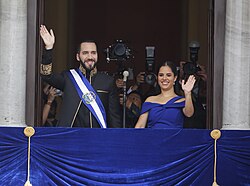
Bukele at his first (top) and second inaugurations
Bukele's first presidential inauguration was held on 1 June 2019.[12]: 244 He became the 81st president of El Salvador as well as the country's youngest president at the age of 37.[62] Bukele held the inauguration ceremony at the National Palace due to its location in Gerardo Barrios Plaza (renovated by Bukele as mayor of San Salvador) instead of in the Blue Room (meeting room) of the Legislative Assembly in an effort to portray himself as focusing his presidency on the people. Bukele's supporters booed and jeered at the Legislative Assembly deputies as they were introduced.[12]: 244 He announced a sixteen-person cabinet composed of eight men and eight women.[63]
Bukele's second presidential inauguration was held on 1 June 2024, again at the National Palace.[64] During the inauguration, the Armed Forces of El Salvador (FAES) staged a military parade as a show of force[65] and Bukele wore a Napoleonic-cut jacket with gold trim to evoke the image of Venezuelan liberator Simón Bolívar.[66] He described his second inauguration as "the most important moment in our recent history" ("el momento más importante de nuestra historia reciente").[65]
Crime
See also: Crime in El Salvador
During Bukele's presidential campaign, he promised to bring an end to gang violence in El Salvador;[52] El Salvador was considered one of the world's most dangerous countries due to its gang violence.[67] Most of El Salvador's violent crimes were committed by MS-13 and the 18th Street gang (Barrio 18). Although they are El Salvador's largest gangs, both originated in Los Angeles. MS-13 was formed in the 1980s by Salvadoran refugees fleeing El Salvador's civil war. The 18th Street gang was formed in the 1960s by Mexican immigrants. Much of the gang violence stemmed from income inequality, poverty, poor schools, a lack of job opportunities, and high urbanization.[68]: 2–3
El Salvador's homicide rate peaked at 107 homicides per 100,000 people in 2015.[69] El Salvador's homicide rate had decreased to 38 homicides per 100,000 people by 2019, still one of the world's highest.[70][71] Gangs controlled parts of El Salvador,[12]: 237 and ordered business owners to pay renta (extortion) for protection or face violence.[23] In early 2019, there were an estimated 67,000 gang members in El Salvador.[52] During his presidency, Bukele enacted tough-on-crime policies that scholars have characterized as successfully reducing gang activity and violent crime, at the cost of arbitrary arrest and alleged widespread human rights abuses.[72]: 84
Territorial Control Plan
On 19 June 2019, Bukele announced that his government would implement a seven-phase security Territorial Control Plan that sought to disrupt gang finances.[73] The plan began that night at midnight.[74] Phase one, known as "preparation", called for members of the country's security forces — the Armed Forces of El Salvador and the National Civil Police (PNC) — to be stationed in 12 of the country's 262 municipalities at locations where gangs were known to collect renta.[75] The government also implemented a temporary state of emergency in El Salvador's 28 prisons, putting them on lockdown and banning visitors.[76]
:{[
ps://en.wikipedia.org/wiki/File:Nayib_Bukele_%E2%80%93_Territorial_Control_Plan_phase_two.jpg)Bukele and members of his cabinet discussing phase two of the Territorial Control Plan, July 2019}:
Phase two of the plan, known as "opportunity", began in July 2019 and called for the creation of programs and initiatives to prevent youths predisposed to crime from engaging in criminal activity. The programs and initiatives included creating scholarships, building schools and sports centers, and improving healthcare. Bukele established the Social Fabric Revitalization Unit to implement the phase.[77] Phase three, known as "modernization", began in August 2019 and called for the improvement of equipment used by the country's security forces; it included issuing new weapons, gear, helicopters, and drones to the security forces.[78] Phase four, known as "incursion", began in July 2021 when the security forces began patrolling areas with a high gang presence that were considered difficult to access.[79]
Phase five, known as "extraction", began in November 2022. Security forces were ordered to "surround large cities and extract the terrorists [gang members] who [were] hiding within the communities, without giving them the slightest possibility of escape".[80] Phase six, known as "integration", began in September 2023, when Bukele established the National Integration Directory to combat poverty and unemployment.[81] Details about phase seven, that has not yet been implemented, are not publicly known.[82]
El Salvador's homicide rate has decreased every year of Bukele's presidency, a downward trend that began in 2016.[83] According to the Salvadoran government, the country's homicide rate was 38 per 100,000 people in 2019;[71] 19.7 per 100,000 in 2020;[84] 17.6 per 100,000 in 2021;[85] 7.8 per 100,000 in 2022;[86] 2.4 per 100,000 in 2023;[87] and 1.9 per 100,000 in 2024. Bukele has attributed the decline to his security policies.[88]
According to Celia Medrano [es], a human-rights lawyer and former general coordinator of the Commission for the Defense of Human Rights of Central America, it is "impossible" ("imposible") to verify the Salvadoran government's homicide figures because there is "no public access" ("no hay acceso público") to a daily homicide registry. Medrano stated that deaths in custody are not registered as homicides.[89] Bodies found in mass graves, missing persons, and people killed in police encounters are not included in the government's homicide statistics.[90][91] In July 2024, then former United States president Donald Trump falsely[92] accused Bukele's government of "exporting" criminals to the United States to lower El Salvador's crime rate.[93]
Alleged gang negotiations
[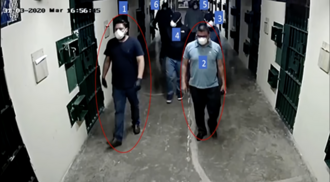 ](https://en.wikipedia.org/wiki/File:Osiris_Luna_Meza_%28March_2020%29.png)Video surveillance footage in a prison, reportedly of Osiris Luna (left, 1) during negotiations with gangs in March 2020[94].
In July 2020, the International Crisis Group (ICG) published an analysis saying that the reason for the decrease in homicides during Bukele's first year in office could have been "quiet, informal understandings" between the government and the gangs. The Salvadoran government denied the ICG's allegations, and the ICG stated that it had no evidence to support the claim.[95]
In September 2020, the Salvadoran digital newspaper El Faro accused Bukele's government of conducting secret negotiations with MS-13. According to the El Faro report, the government agreed to grant MS-13 more freedom in prison in exchange for a reduction in homicides it would commit and support for Nuevas Ideas during the 2021 legislative elections.[96] Bukele denied El Faro's allegations, posting photos on Twitter of gang members rounded up in cramped conditions from an April 2020 prison crackdown.[97]
On 8 December 2021, the United States Department of the Treasury accused Bukele's government of secretly negotiating with MS-13 and Barrio 18 to lower the country's homicide rate. The department stated that Bukele's government "provided financial incentives" to both gangs to ensure that they would reduce the country's homicide rate and support Nuevas Ideas in the election held earlier that year (similar to El Faro's allegations the year before)[98][99] and sanctioned Osiris Luna Meza (the general director of penal centers and vice-minister of justice) and Social Fabric Revitalization Unit chair Carlos Marroquín Chica for negotiating with the gangs.[94]
Bukele denied the department's accusations, saying that the United States sought "absolute submission" from El Salvador rather than cooperation.[99] The United States Department of Justice also accused Bukele's government of releasing gang leaders between 2019 and 2021 as a part of the negotiations, including Élmer "El Crook" Canales Rivera who was released in February 2021 despite having an active Interpol arrest warrant against him. Bukele has denied the department's accusations.[100][101]
In June 2025, ProPublica reported that U.S. extradition requests of MS-13 leaders considered potential witnesses had been blocked by Bukele's government. The outlet also reported that a U.S. multiagency law enforcement team, Joint Task Force Vulcan, had previously gathered evidence that United States Agency for International Development (USAID) funds to El Salvador had been laundered and used to pay key MS-13 leaders.[102]
Gang crackdown
From 25 to 27 March 2022, gangs in El Salvador committed 87 homicides;[103][104] 62 were committed on 26 March alone, the deadliest day in Salvadoran history since the end of the Salvadoran Civil War (1979–1992).[105] Florida International University research director José Miguel Cruz attributed the killings to a breakdown in a secret truce between the government and the gangs, a truce that Bukele denied making. Cruz believed that the killings were a message from the gangs to the government for more concessions as a part of the secret truce.[106]
| [
](https://en.wikipedia.org/wiki/File:Nayib_Bukele%27s_September_2024_Twitter_profile_picture_%28cropped%29.jpg "Avatar of Nayib Bukele") | Nayib Bukele @nayibbukele |
MESSAGE TO THE GANGS: We have 16,000 "homeboys" in our power. Aside from the 1,000 arrested these days. We seized everything they had, even their mattresses, we've rationed their food, and now they won't see the sun. STOP KILLING NOW or they will pay too.
28 March 2022[106][107][108]
On 27 March 2022, the Legislative Assembly declared a 30-day state of emergency, formally known as a "state of exception" ("régimen de excepción")[109] and sometimes known as the "war on gangs".[110] The state of emergency suspended constitutional rights that included freedom of assembly, freedom of association, the right to privacy in communication, the right to be informed of the reason for arrest, the right to remain silent, and the right to legal representation. The requirement for any arrested individual to see a judge within 72 hours of arrest was also suspended.[107]
The military was mobilized in neighborhoods controlled by gangs in an effort to reassert government control,[105] and made large-scale arrests of suspected gang members across the country.[107] In some instances, Bukele ordered security forces to blockade certain municipalities to capture all gang members within them. By October 2024, blockades were implemented twice in Apopa,[111][112] Cabañas,[113] Comasagua,[114] Nuevo Concepción,[115] San Marcos,[116] southern Chalatenango,[117] and Soyapango.[118].
 Soldiers in a truck in San Marcos during the October 2024 blockade of that city
 Bukele and government officials touring a cell block in the Terrorism Confinement Center, March 2022.
Bukele has threatened incarcerated gang members. At the beginning of the crackdown, he tweeted that the government had seized incarcerated gang members' belongings, removed their mattresses, and rationed their food.[106][107] Bukele also posted a video of prisoners sleeping on floors and complaining about a lack of food and sanitation.[119] He threatened to deprive them of food entirely in April 2022 if the gangs attempted to retaliate against the crackdown, citing rumors about revenge killings.[120]
After members of Barrio 18 killed three police officers in Santa Ana in June 2022, Bukele said at a press conference that the gangs were "going to pay dearly" for the "ambush" against the police.[121] The government began destroying gravestones belonging to deceased gang members in November 2022 to prevent them from becoming "shrines"[122] and Bukele compared the gravestone destructions to denazification in post-World War II Germany.[123] He warned Salvadoran parents to keep their children away from gangs, since they would lead to "prison or death".[119][124]
Shortly after the crackdown began, Bukele called for the construction of a new 20,000-inmate prison.[120] He announced the construction in July 2022 of the 40,000-inmate Terrorism Confinement Center (CECOT) in Tecoluca, that would be one of the world's largest prisons.[125] In February 2023, Bukele posted a video on Twitter of him and members of his cabinet touring the prison. It is staffed by 250 police officers and 600 soldiers, and covers 410 acres (170 ha).[126] Bukele posted a video on Twitter on 24 February 2023 of the transfer of the prison's first 2,000 prisoners,[127] and posted a similar video the following month of the transfer of 2,000 more prisoners.[128] By 11 June 2024, CECOT had at least 14,532 inmates.[129]
In July 2023, Bukele's government passed a law formalizing the judicial system's existing practice of mass trials by judge, allowing up to 900 people to be convicted in the same trial, without a jury.[130]
Liz Throssell, a spokeswoman for the Office of the United Nations High Commissioner for Human Rights, called the actions of El Salvador's security forces during the gang crackdown an "unnecessary and excessive use of force".[131] Human Rights Watch has stated that there was "mounting evidence" and "credible allegations" that Salvadoran authorities were committing human rights violations such as arbitrary arrests, enforced disappearances, false confessions, and deaths in police custody during the gang crackdown.[132][133] Amnesty International stated the following month that the Salvadoran government has committed "massive human rights violations", including torture, against prisoners.[134][135]
:{In June 2024, Bukele told Time that the security situation in El Salvador had become sustainable and that he and his government hoped to end the state of emergency "in the near future".[136] By 4 March 2025, the state of exception had been extended 36 times by the Legislative Assembly. By that same date, over 85,000 suspected gang members had been arrested,[137] 3,319 of whom were minors according to Human Rights Watch.[133]
The large-scale arrests increased El Salvador's prison population from 37,190 in 2020 to over 105,000 by December 2023. With 1.7 percent of its population in prison, El Salvador has the highest incarceration rate in the world.[138][139] By November 2024, more than 8,000 people had been released after the government determined that they were innocent.[140] According to the human rights organizations, at least 367 people had died in custody by March 2025.[141] A number of opinion polls between May 2022 and June 2023 indicated that 80 to 90 percent of Salvadorans approved of the gang crackdown and measures taken by the government against the gangs.[142]}:
Political crises
Main articles: 2020 Salvadoran political crisis and 2021 Salvadoran political crisis


The 2020 (top) and 2021 crises are known by the numeronyms "9F" and "1M", respectively.[143]: 77
:{:{In November 2019, Bukele began trying to secure a $109 million loan from the Central American Bank for Economic Integration to fund phase three of the Territorial Control Plan.[144] The legislature, which was controlled by ARENA and the FMLN, asked him to give them more time to evaluate the loan.[145] On 6 February 2020, Bukele invoked Article 167 of the country's constitution and called for an emergency meeting of the Legislative Assembly to approve the loan. He called for his supporters to rally around the Legislative Assembly during the emergency meeting that was scheduled for 9 February.[146]}:
Although Bukele ordered 40 soldiers into the Legislative Assembly's meeting room on the day of the meeting to coerce legislators into approving the loan,[147] a quorum was not reached and the loan was not approved.[148] Opposition politicians described the crisis as a "self-coup",[144][148] and it is known in El Salvador as "9F" or "El Bukelazo".[143]: 84 }:
In the 2021 legislative elections, Nuevas Ideas received a supermajority in the Legislative Assembly.[149] On 1 May 2021, Nuevas Ideas formed a coalition government with GANA, the National Coalition Party (PCN), and the Christian Democratic Party (PDC).[143]: 89 That day, the coalition voted to remove the five justices of the Supreme Court of Justice's constitutional court and Attorney General Raúl Melara.[150] The justices were replaced by five of Bukele's allies, and Melara was replaced by Rodolfo Delgado.[151] The purge, known in El Salvador as "1M",[143]: 89 was described by journalists and opposition politicians as a "self-coup" and a "power grab"[150][152][153] and was condemned by the United States.[153][154][155]
COVID-19 pandemic
Bukele issued an executive decree on 11 March 2020 imposing a "quarantine throughout the national territory" ("cuarentena en todo el territorio nacional"), shortly after World Health Organization (WHO) director-general Tedros Adhanom Ghebreyesus declared the COVID-19 outbreak a pandemic. The quarantine suspended all school activities for 21 days, prohibited foreigners from entering the country, and mandated a 30-day quarantine for everyone entering the country.[156] Bukele confirmed the first case of COVID-19 in El Salvador on 18 March 2020.[157] The country's first death from the disease was recorded on 31 March.[158] On 5 May 2023, the Pan American Health Organization declared the end of the pandemic.[159] According to the WHO, As of 27 September 2023, El Salvador had 201,807 confirmed cases of COVID-19 and 4,230 deaths from the disease by 2 June 2023; the WHO reported that 11,426,688 doses of the COVID-19 vaccine had been administered in El Salvador by that date.[160]
Entrance of Hospital El Salvador
On 21 March 2020, Bukele imposed a 30-day nationwide lockdown in an effort to combat the pandemic. During the lockdown, 4,236 people were arrested by the National Civil Police for violating the lockdown order; 70 were arrested before the lockdown order became public. The arrestees were quarantined in a "containment center". Human rights organizations such as Human Rights Watch criticized the arrests, citing instances of arbitrary arrests and abuse by police.[161] Amid April 2020 lockdowns in the country's prisons and published images of prisoners lined up in cramped positions, Human Rights Watch called the prisons' living conditions "inhumane" (particularly in light of the pandemic).[162]
On 27 May 2020, the United States donated 250 ventilators to El Salvador. During a press conference where Bukele received the ventilators, he said that he took hydroxychloroquine as prophylaxis and added that "most of the world's leaders use [hydroxychloroquine] as a prophylaxis".[163] Bukele inaugurated the Hospital El Salvador, the largest hospital in Latin America used exclusively for treating cases of COVID-19 at the site of the former International Center for Fairs and Conventions [es], on 22 June 2020. The hospital had a capacity of 400 beds, 105 intensive-care units, and 295 intermediate-care units staffed by 240 doctors.[164] In August 2020, the hospital's capacity was increased by 575 beds.[165] It began treating conditions other than COVID-19 by June 2022.[166] In April 2021, Bukele inaugurated a vaccination center at Hospital El Salvador to administer up to 10,000 doses of the COVID-19 vaccine per day;[167] the center closed in August 2022, as dose administrations diminished.[168]
Most of El Salvador's COVID-19 vaccines were donated by the United States and China.[169][170] On 13 May 2021, Bukele donated 34,000 doses of the COVID-19 vaccine to seven towns in Honduras after pleas from their mayors for vaccine doses.[171] El Salvador had received 1.9 million doses at the time, and Honduras had only received 59,000.[172] Gabriel Labrador, a journalist for El Faro, told El País that Bukele made the donation to Honduras to improve his public image in Central America.[171]
Economy
Adoption of bitcoin
See also: Bitcoin in El Salvador
[ ](https://en.wikipedia.org/wiki/File:Cajero_Bitcoin_El_Zonte,_El_Salvador.jpg)An Athena Bitcoin ATM in El Zonte
 Bukele and Mexican architect Fernando Romero with a model of the planned Bitcoin City airport
Bukele announced at the Bitcoin 2021 conference on 5 June 2021 that he would introduce a bill to the Legislative Assembly that would make bitcoin legal tender, saying that it would "generate jobs" and promote "financial inclusion" in the short term.[173] The Legislative Assembly approved the bill three days later.[174] Although the World Bank rejected a request from the Salvadoran government to assist it with the implementation of bitcoin as legal tender, citing concerns about transparency and the environmental effects of bitcoin mining,[175] Athena Bitcoin announced that it would invest $1 million to install 1,500 bitcoin ATMs. This would allow users to exchange U.S. dollars for bitcoin and vice versa.[176]
Bitcoin became legal tender on 7 September 2021 in El Salvador,[177] the first country to do so.[178] It became legal tender alongside the United States dollar, which had been adopted in 2001 and replaced the Salvadoran colón.[177] About 1,000 people marched in the streets of San Salvador to protest the country's adoption of bitcoin.[179]
The day before bitcoin became legal tender, Bukele announced that the Salvadoran government had bought its first 200 bitcoins.[180] Economist Steve Hanke stated that El Salvador had "the most distressed sovereign debt in the world" due to its adoption of bitcoin,[181] and other economists predicted that the country would likely default on its debt.[182] As the price of bitcoin rose to $44,000 in December 2023, Bukele announced that El Salvador's investment into bitcoin had broken even.[183] In March 2024, he stated that El Salvador had made a 50-percent profit from bitcoin. Bukele mocked news-media outlets on Twitter, saying that there were "literally thousands of articles" about El Salvador's bitcoin losses and the same outlets were now "totally silent".[184] By 19 January 2025, the Salvadoran government had 6,043 bitcoins worth $611.2 million.[185]
In November 2021, Bukele announced that he planned to build Bitcoin City in the southeastern region of La Unión at the base of the Conchagua volcano. The city would use geothermal energy to power bitcoin mining.[186] Ricardo Navarro, head of the Salvadoran Center of Appropriate Technology, criticized the plan, adding that it would result in an "environmental disaster".[187] Bukele published images of models of Bitcoin City and its planned airport on Twitter in May 2022, saying that the city would have "no income tax, zero property tax, no procurement tax, zero city tax, and zero CO2 emissions".[188] In December 2023, the Legislative Assembly passed a law that allowed individuals to purchase Salvadoran citizenship by donating bitcoins to El Salvador.[189]
On 18 December 2024, the International Monetary Fund (IMF) agreed to give El Salvador a $1.4 billion loan in exchange for the Salvadoran government making some concessions from the Bitcoin Law. Concessions included not requiring businesses to accept bitcoin as payment, not accepting bitcoin as tax payments, and reducing the number of bitcoins the government was purchasing.[190] The day after the loan was approved, Stacy Herbert, the director of the National Bitcoin Office, stated that El Salvador would continue to buy bitcoins at an "accelerated rate" ("ritmo acelerado")[191] and the government purchased 11 bitcoins then worth over $1 million in total.[192] On 29 January 2025, the Salvadoran government amended the Bitcoin Law to remove bitcoin's status as legal tender and currency but still allows its use as payment.[193]
In March 2025, The Economist wrote that El Salvador's bitcoin experiment had been a failure, bringing more costs than benefits to the El Salvador economy.[194]
Economic Plan
During Bukele's second inauguration, he stated that his second term would focus on improving the Salvadoran economy with "bitter medicine" ("medicina amarga").[195][196] In July 2024, Bukele threatened to mass-arrest vendors, importers, and distributors who engaged in price gouging.[195][197] Later that month, he announced the beginning of a six-phase Economic Plan ("Plan Económico"). Phase one, known as "Feeding" ("Alimentación"), involved the establishment of 30 food distribution centers and the removal of tariffs on certain agricultural imports for ten years.[195][198][199] Phase two, known as "Technology" ("Tecnología") involved the construction of data centers and technological parks in El Salvador. Bukele claimed that his Economic Plan would create 4,000 jobs.[195] Phase three, known as "Logistics" ("Logística"), involved the investment of US$1.6 billion into modernizing the ports of Acajutla and La Unión and the Turkish company Yılport Holdings operating the ports for 50 years.[200]
Bukele with Gisela Sánchez, the president of the [Central American Bank for Economic Integration
On 15 September 2024, Bukele stated that his 2025 government budget would not include "a single cent of debt for current spending" ("solo centavo de deuda para gasto corriente") and that his government would not take out foreign loans to pay for the budget.[201] On 16 October, El Salvador and J.P. Morgan & Co. agreed to restructure US$1.03 billion of the country's debt as a part of a debt-for-nature swap, which Bukele described as "reaffirm[ing] this government's commitment to economic growth".[202] In the agreement, El Salvador would allocate US$352 million in savings towards conserving the environment around the Lempa River.[203] On three occasions in 2024, Bukele offered to buy back billions of dollars worth of government bonds due by 2034.[204]
In November 2024, the Central American Bank for Economic Integration announced that it would give the Salvadoran government $646 million to finance infrastructure projects. Bukele stated that the bank's support would help El Salvador's "economic takeoff" ("despegue económico").[205] Later that month, Bukele wrote on X that he supported mining gold, describing it as "wealth that could transform El Salvador". He further described the country's metal mining ban as "absurd".[206] The Catholic Church, which supported the mining ban's implementation in 2017, called on Bukele to not repeal the ban citing environmental concerns.[207] The Legislative Assembly repealed the ban on 23 December 2024[208] and Bukele approved the law that same day.[209] In 2025, at least 2,500 street vendors were evicted from downtown San Salvador as part of Bukele's economic revitalization plan.[210]
Foreign policy
See also: List of international trips made by Nayib Bukele
Bukele stated in June 2019 that his government would no longer recognize Nicolás Maduro as the president of Venezuela, instead recognizing Juan Guaidó as Venezuela's legitimate president during Venezuela's presidential crisis. On 3 November of that year, he expelled Maduro-appointed Venezuelan diplomats from El Salvador.[211] Bukele considers Maduro to be a dictator.[212] Bukele rejected the results of the 2024 Venezuelan presidential election as a "fraud" ("fraude") and stated that he would not restore relations with Venezuela unless there were "real elections" ("elecciones de verdad").[213]
Bukele refused to recognize the presidency of Manuel Merino in Peru in November 2020, calling Merino's government "putschist" ("golpista").[214] He and the Legislative Assembly denounced the results of the 2021 Nicaraguan general election, that were seen by several governments as fraudulent.[215] El Salvador has abstained from resolutions critical of Nicaragua at the Organization of American States since 2022, with Bukele's government citing "non-interference" ("no injerencia") as justification.[216] In 2024, El Salvador was the only country to abstain on an OAS resolution to condemn Ecuador for raiding the Mexican embassy in Quito to arrest former Ecuadorian vice president Jorge Glas.[217]
In February 2022, Bukele accused United States president Joe Biden of "crying wolf" about a Russian invasion of Ukraine.[218] Bukele did not comment on the invasion when it began later that month, posting instead on Twitter about bitcoin and bonds.[219] Throughout 2022, El Salvador abstained from votes on United Nations resolutions condemning the Russian invasion of Ukraine.[220] Bukele condemned the 7 October attacks, describing Hamas as "savage beasts" who "do not represent the Palestinians", comparing the group to MS-13. He tweeted that "the best thing that could happen to the Palestinian people is for Hamas to completely disappear".[221]
In March 2024, Bukele offered to send a mission to Haiti to "fix" the country's gang war with United Nations Security Council support.[222] In October 2024, El Salvador agreed to provide soldiers to conduct street patrols and aerial surveillance for the Multinational Security Support Mission in Haiti,[223][224] and the first Salvadoran soldiers arrived in Port-au-Prince on 3 January 2025.[225]
Relations with the United States
See also: El Salvador–United States relations
[ ](https://en.wikipedia.org/wiki/File:Secretary_Rubio_Meets_with_El_Salvador_President_%2854304902427%29.jpg)Bukele and U.S. Secretary of State Marco Rubio in February 2025.
During Bukele's September 2019 meeting with Trump, Bukele called on Trump to promote legal migration in an effort to combat illegal immigration and to maintain the United States' temporary protected status (TPS) policy for Salvadorans living in the United States.[226] The following month, Bukele confirmed that the United States would continue TPS for Salvadorans.[227] In February 2021, Biden refused to meet Bukele when he arrived unannounced in Washington, D.C. to meet him.[228] Bukele did not attend the 9th Summit of the Americas in June 2022 due to frustration with the U.S. government's allegations of corruption and human rights abuses by his government.[229]
Some Democratic Party members have been critical of Bukele's government, and members of the Republican Party have supported him and his policies.[230] Bukele and Norma Torres, a member of the U.S. Congress representing California's 35th congressional district, engaged in an April 2021 argument on Twitter about illegal immigration at the United States' southern border.[231][232] Torres accused Bukele in November 2022 of interfering in that month's 35th congressional district election by endorsing Republican challenger Mike Cargile.[233] In January 2024, fourteen Democratic members of Congress sent a letter to Biden about Bukele's "authoritarian" actions.[234] Meanwhile, Republican congressmen such as Tom Cotton, Matt Gaetz, and Marco Rubio have praised Bukele's policies on crime.[235][236]
The second Trump administration considers Bukele to be an important ally in mitigating immigration to the U.S. from Central America.[237] In February 2025, Bukele offered Secretary of State Rubio to accept non-Salvadoran deportees from the United States, including convicted American prisoners "of U.S. citizenship and legal residents".[238] Rubio described the offer as the "most unprecedented and extraordinary migratory agreement anywhere in the world".[239][240] Bukele stated that these "dangerous American criminals" would be incarcerated in CECOT.[238] In March 2025, the United States deported 238 alleged members of the Venezuelan gang Tren de Aragua to El Salvador.[241] Bukele met Trump in the Oval Office in April 2025 where they discussed immigration. Both Trump and Bukele stated they could not unilaterally release Kilmar Abrego Garcia, a migrant deported due to an administrative error.[242]
Relations with China
See also: China–El Salvador relations
in November 2023.
In 2018, El Salvador cut diplomatic ties with Taiwan and recognized the People's Republic of China as China's legitimate government. This led to Bukele and the United States accusing China of interfering in Salvadoran and Latin American politics. Despite Bukele's criticism of China before becoming president, Vice President Félix Ulloa stated in May 2019 that Bukele's government would not restore diplomatic relations with Taiwan.[243] In December 2019, Bukele met Chinese president Xi Jinping in Beijing[244] and signed a "gigantic" infrastructure agreement with China for an unknown amount of money.[243] El Salvador and China have cooperated on infrastructure projects in El Salvador such as the National Library of El Salvador (completed in November 2023)[245] and the National Stadium of El Salvador (construction began in November 2023).[246]
In November 2022, Bukele announced that El Salvador and China had begun negotiations for a free trade agreement between the countries. China donated fertilizer and wheat flour to El Salvador and, according to a Salvadoran government official, offered to buy El Salvador's external bond debt. Bukele stated that a free trade agreement with China was "very important" because El Salvador had been "isolated from [the] potential" of China's economic strength.[247]
Alleged governmental corruption
See also: Corruption in El Salvador
Twenty of Bukele's governmental institutions were investigated by the office of the attorney general in November 2020 for corruption related to the COVID-19 pandemic,[248] but the investigations were halted after the attorney general was removed by the Legislative Assembly on 1 May 2021.[249] The United States has placed sanctions on several of Bukele's government officials, labeling them as corrupt. The officials include Javier Argueta (presidential advisor), Osiris Luna Meza (general director of penal centers), Carlos Marroquín Chica (chairman of the Social Fabric Reconstruction Unit), Martha Carolina Recinos (chief of the cabinet), Rogelio Rivas (former minister of justice), Ernesto Sanabria (press secretary), and Alejandro Zelaya (former minister of finance).[250][251][252] The U.S. also considered some of Bukele's Legislative Assembly allies corrupt, including Guillermo Gallegos and Christian Guevara.[250][253] Some of the individuals are included on the U.S. State Department's "Engel List" of Central American politicians and judges considered "corrupt and undemocratic".[254] Bukele called the sanctions and labels "absurd".[251] In May 2021, the United States diverted El Salvador funding from government institutions to civil society groups to combat perceived corruption in Bukele's government.[255]
On 11 November 2021, Bukele introduced the "Foreign Agents Law" to the Legislative Assembly with the goal of "prohibiting foreign interference" in Salvadoran political affairs.[215] According to Minister of the Interior Juan Carlos Bidegain, the law was meant to "guarantee the security, national sovereignty and social and political stability of the country".[215] Although Bukele stated that the law was modeled on the United States' Foreign Agents Registration Act (FARA), critics have compared it to Nicaraguan laws that institute press censorship by shutting down organizations and arresting journalists.[215] Human Rights Watch reported on 16 December 2021 that 91 Twitter accounts belonging to journalists, lawyers, and activists were blocked by Bukele and governmental institutions.[256] In October 2024, when investigative journalists published a report that found that Bukele, his three brothers, wife, and mother had purchased 34 properties valued at US$9 million during Bukele's first presidential term, Bukele referred to the journalists as "imbeciles" and denied accusations of corruption.[257]
Anti-corruption campaigns
Bukele established the International Commission Against Impunity in El Salvador [es] (CICIES) in September 2019, an anti-corruption commission to combat drug trafficking, corruption, and white-collar crimes. CICIES was operated by the Salvadoran government and the Organization of American States (OAS), and cooperated with the National Civil Police to form an anti-corruption unit.[258] Bukele dissolved CICIES in June 2021 after the OAS named Ernesto Muyshondt an anti-corruption advisor;[259] Ernesto Muyshondt was accused by the Salvadoran government of electoral fraud and illegal negotiation with gang members to vote for ARENA during the 2014 presidential election. He was arrested[260] and was scheduled to go on trial in April 2024, despite concerns about his health.[261]
On 1 June 2023, during a speech celebrating his fourth year in office, Bukele stated that his government would begin a "war against corruption" ("guerra contra la corrupción").[262] He announced that he would build a prison for individuals convicted of white-collar crimes that would be similar to the Terrorism Confinement Center.[263] Bukele stated that the police and military would arrest white-collar criminals like they capture gang members in the gang crackdown.[262] He added that Attorney General Rodolfo Delgado was in the process of raiding and confiscating assets worth up to $68 million from former Salvadoran president Alfredo Cristiani as part of the anti-corruption campaign.[264] Others charged during Bukele's war on corruption include deputies Erick García,[265] Lorena Peña[266] and Alberto Romero,[267] and national security advisor Alejandro Muyshondt.[268]
In 2022, the last full year before the war against corruption was announced, Transparency International's Corruption Perceptions Index gave El Salvador a score of 33 out of 100 and ranked it 116th out of 180 countries.[269] According to a February 2023 CID-Gallup opinion poll, only four percent of Salvadorans considered corruption the country's most pressing issue.[270]
Municipal and legislative reductions
[://en.wikipedia.org/wiki/File:Nayib_Bukele_with_a_legislative_proposal_%281_June_2023%29.jpg)Bukele holding a bill proposing the reduction of the number of municipalities from 262 to 44
In December 2022, Bukele tweeted that he believed that the country's 262 municipalities should be reduced to 50. He called it "absurd" ("absurdo") that El Salvador, around 8,100 square miles (21,000 km2) in size, had so many municipalities.[271] Some lawyers and politicians criticized Bukele's proposed reduction as an attempt to consolidate power by gerrymandering.[272][273]: 20 His allies supported the proposal, with some proposing a reduction in the number of Legislative Assembly seats.[274][275][276]
On 1 June 2023, during a speech commemorating his fourth year in office, Bukele announced that he would present two proposals to the Legislative Assembly. One sought to reduce the number of seats in the assembly from 84 to 60, and the other sought to reduce the number of municipalities from 262 to 44.[277] Bukele justified the legislative reduction by saying that the legislature had 60 seats before the signing of the Chapultepec Peace Accords in 1992 that ended the Salvadoran Civil War, and the accords' only accomplishment was the addition of 24 seats to the legislature.[278] About the municipal-reduction proposal, he stated that the 262 municipalities would retain their cultural identities and be classified as districts.[277] The Legislative Assembly approved the proposal for legislative reductions on 7 June 2023,[279] and approved the proposal for municipal reductions six days later.[280] Both reductions became effective on 1 May 2024.[281][282]
2024 re-election campaign
Further information: 2024 Salvadoran general election
On 3 September 2021, the Supreme Court of Justice ruled that the president can serve two consecutive terms in office. The ruling overturned a 2014 ruling that presidents had to wait ten years to be eligible to run for re-election. Constitutional lawyers criticized the ruling, saying that consecutive re-election violates El Salvador's constitution.[283][284] The 2021 ruling allowed Bukele to run for re-election in the 2024 presidential election. ARENA and the FMLN protested the court's ruling, with an ARENA spokesperson calling it a "precursor to a dictatorship" and an FMLN representative saying that the state is serving only one person: Bukele.[284] The ruling was also condemned by the United States government. Jean Elizabeth Manes, chargé d'affaires of the United States to El Salvador, called it "clearly contrary to the Salvadoran constitution".[284] According to Manes, the ruling was a direct result of the May 2021 legislative replacement of the Supreme Court justices.[285]
[vid]
On 15 September 2022, during a speech commemorating El Salvador's 201st anniversary of independence, Bukele announced that he would run for re-election in 2024. According to Bukele, "developed countries have re-election, and thanks to the new configuration of the democratic institution of our country, now El Salvador will too".[286][287][288] Constitutional lawyers criticized his announcement, saying that presidential re-election violates "at least" four articles of the El Salvador constitution.[289]
:{[
Bukele registered as a presidential pre-candidate on 26 June 2023 with Nuevas Ideas; Ulloa registered as Bukele's vice-presidential pre-candidate.[290] Nuevas Ideas nominated Bukele and Ulloa as their presidential and vice-presidential candidates on 9 July.[291][292] The party began registering Bukele and Ulloa's candidacies with the TSE on 26 October, the last day to do so.[293] On 3 November 2023, the TSE registered their candidacies[294] amidst opposition requests to reject Bukele's candidacy.[295]
On 30 November 2023, the Legislative Assembly granted Bukele and Ulloa leaves of absence to focus on their re-election campaign. The leave went into effect the following day and Bukele's presidential powers were suspended.[296] The Legislative Assembly named Claudia Rodríguez de Guevara, Bukele's presidential secretary, as the presidential designate; Rodríguez was the first woman in Salvadoran history to hold presidential power.[297] Her appointment was criticized by some lawyers and opposition politicians as unconstitutional.[298][299][300]
Including Bukele, there were six presidential candidates in the 2024 election.[301] His primary opponents were ARENA's Joel Sánchez, a businessman, and the FMLN's Manuel Flores, a former legislator.[302] Bukele led Sánchez and Flores by large margins in opinion polling before the election.[303][304] Bukele promised to maintain the gang crackdown, invest in infrastructure projects, and promote economic growth during his second term.[302] On 4 February 2024, he won re-election with 84.65 percent of the vote.[305] Bukele was the first Salvadoran president to be re-elected since Maximiliano Hernández Martínez in 1944.[306] Nuevas Ideas retained its Legislative Assembly supermajority and, with its allies, won 43 of the country's 44 municipalities.[307][308] Several news outlets described the election results as a "landslide victory" for Bukele and Nuevas Ideas,[309] and Bukele described his victory as "the record in the entire democratic history of the world".[310] The TSE granted Bukele his presidential credentials on 29 February[311] and his second term began on 1 June.[64]
Personal life
Family
[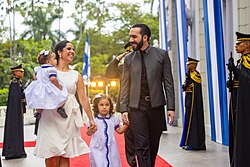 ](https://en.wikipedia.org/wiki/File:Nayib_Bukele_with_his_family,_2024.jpg)Bukele with his wife and their two daughters in 2024
Bukele began dating psychologist and ballet dancer Gabriela Rodríguez in 2004[312] and the two married on 6 December 2014.[4][10] The couple have two daughters. Their first was born in 2019[313] and their second in 2023.[314]
Wealth
According to the Salvadoran government's transparency website, Bukele's monthly presidential salary was $5,181 in July 2019. According to the website, he had a net worth of $2,548,967 at that time.[315] Bukele acquired most of his wealth through business ventures before entering politics.[316] Bukele owns a coffee farm. In July 2024, he began donating coffee beans grown on his farm to local businesses[317] and launched the Bean of Fire coffee brand.[318]
Religion
Bukele's religious beliefs were controversial during his 2019 presidential campaign, with rumors that he was a Christian, a Muslim, or an atheist.[319] The controversy began when pictures from 2011 of Bukele praying at a mosque with his father and brothers spread on social media.[320][321] Bukele dismissed the controversy as an attempt by the political right to exploit Islamophobia in the predominantly Catholic country.[319]
Although Bukele does not identify with any religion, he has stated that he believes in God and Jesus.[7][321] In a 2015 interview, Bukele said: "I am not a person who believes much in the liturgy of religions. However, I believe in God, in Jesus Christ. I believe in his word, I believe in his word revealed in the Holy Bible. And I know that God does not reject anyone because of their origins".[5] Before that year, some Salvadorans believed that he was a Muslim.[322]: 166 Bukele has referred to Bible verses,[319] God, and Saint Óscar Romero — the archbishop of San Salvador who was assassinated in 1980 — in some of his speeches,[322]: 166–172 and has called himself an "instrument of God" ("instrumento de Dios").[322]: 177 He met with Pope Francis in April 2015, saying that the pope told him that Rutilio Grande — a Jesuit priest who was assassinated in 1977 — would soon be beatified.[322]: 166
Political views
[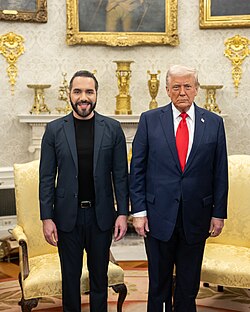 ](https://en.wikipedia.org/wiki/File:The_White_House_-_54452215186.jpg)Bukele with U.S. President Donald Trump (to whom Bukele and his governing style have been compared) in April 2025[
 ](https://en.wikipedia.org/wiki/File:Nayib_Bukele_with_Javier_Milei,_September_2024.jpg)Bukele with Argentine president Javier Milei (to whom Bukele and his policies have been compared) in September 2024
As mayor of Nuevo Cuscatlán, Bukele described himself as part of the "radical left"[323] because he wanted "radical changes" ("cambios radicales") for El Salvador;[324] he also stated that his family had always had significant connections with the Salvadoran political left. Bukele believed in social justice and the state obligation to guarantee Salvadorans the opportunity for "health, education, [and] productive infrastructure" ("salud, educación, [e] infraestructura productiva"). Some FMLN members criticized Bukele's work as a businessman, believing that it contradicted the "historic goal of the proletariat" ("papel histórico del proletariado"): eliminating capitalism.[10]
Since becoming president, Bukele has stated that he does not adhere to any specific political ideology. He has criticized the political left and right in El Salvador for dividing the country after the civil war.[325] In an interview with Time's Vera Bergengruen, Bukele stated that he does not consider himself to be left- or right-wing.[323] El Faro's editorial board has described Bukele as a "politician without an ideology" ("político sin ideología").[326] Despite Bukele's ideologic neutrality, some journalists and political analysts have described him as a populist,[327][328][329] a right-wing populist,[143]: 82 [330]: 5 [331] and a conservative.[332][333] Bukele himself has received support from conservatives abroad in both Latin America[334][335][336][337] and the United States,[335][338][339][340] particularly for his anti-crime policies, as well as criticism for democratic backsliding and consolidating power.[341] His political views and government policies have been referred to by some journalists as "Bukelism"[342][343][344] or the "Bukele method".[341][345][346]
Some Western journalists have compared Bukele to Trump, citing Bukele's style of governance, government policies, rhetoric, and criticism of the press as similar to Trump's.[327][347][348][349] In 2019, Foreign Policy's Melissa Vida referred to Bukele as "El Salvador's Trump"[350] and Jacobin's Hilary Goodfriend called him "the Donald Trump of Central America".[351] Bukele was one of the first world leaders to congratulate Trump after his victory in the 2024 United States presidential election.[352][353] The Economist has described Bukele as politically "hard right" and compared his policies and ideological views to Argentinian president Javier Milei, former Brazilian president Jair Bolsonaro, and former Chilean presidential candidate José Antonio Kast.[354]
Bukele is a critic of George Soros,[355] saying in May 2023 that "in all the countries of Latin America, there are outlets and 'journalists' paid by Soros" ("en todos los países de Latinoamérica hay medios y 'periodistas' pagados por Soros").[356] In February 2024, Bukele spoke at the American Conservative Political Action Conference (CPAC) and accused Soros of attempting to "dictate public politics and laws" ("dictar políticas públicas y leyes") in El Salvador.[357] Bukele also expressed opposition to globalism, saying that "it's already dead" in El Salvador.[354]
Social issues
In 2023, Celia Medrano described Bukele's positions on social issues as "flexible" ("flexibles") and a "liquid ideology" ("ideología líquida"). She explained that Bukele changes his positions to appease as many voters as possible and to gauge public opinion on issues such as same-sex marriage and abortion.[358]
:{Bukele stated in 2014 that he was an ally of the LGBT community, supported their civil rights, and opposed discrimination against LGBT individuals.[322]: 167 In August 2021, Bukele proposed constitutional reform to legalize same-sex marriage in El Salvador. The proposal would have changed text in the constitution that defined marriage as being between "a man and a woman" ("hombre y mujer") to defining marriage as between "spouses" ("cónyuges"), and would have prohibited discrimination based on sexual orientation.
The earliest Bukele's proposal could have gone into effect would have been 2027, since it would have to be approved by two consecutive sessions of the Legislative Assembly.[359] Bukele stated the following month that the proposed constitutional reform would not legalize same-sex marriage, posting on Facebook that the original text would remain intact.[360] In March 2024, Bukele stated that his government would remove "all traces" of "gender ideologies in schools and colleges".[361][362] In June 2024, Bukele fired 300 bureaucrats from the ministry of culture for promoting policies that were "incompatible" with his emphasis on "patriotic and family values".[363]}:
El Salvador has one of the world's strictest abortion laws, banning it in all circumstances with no exceptions.[364] In 2013, when a Salvadoran woman known as "Beatriz" was denied an abortion despite doctors saying that she would die in childbirth, Bukele called those who denied her an abortion "fanatics" ("fanáticos"). Bukele stated in October 2018 that he only supported abortion in cases where the mother's life was at risk, and expressed opposition to abortion on demand. Shortly after becoming president, he opposed abortion under any circumstances. In an interview with Puerto Rican rapper René Pérez, Bukele said that "someday, we are going to recognize that [abortion] is a great genocide" ("algún día, nos vamos a dar cuenta de que es un gran genocidio").[358] Bukele's August 2021 constitutional-reform proposal considered legalizing abortion in cases where the mother's life was at risk, adding that the proposal would have recognized the right to life for mother and child.[359] He changed his mind the following month, saying that abortion would not be decriminalized and recognizing the "RIGHT TO LIFE (from the moment of conception)" of the unborn. Bukele also ruled out euthanasia.[360]
Central American unity
| [
](https://en.wikipedia.org/wiki/File:Nayib_Bukele%27s_September_2024_Twitter_profile_picture_%28cropped%29.jpg "Avatar of Nayib Bukele") | Nayib Bukele @nayibbukele |
Spanish: Aunque por ahora suena a utopía, el sentido común debería apuntar a la unificación de Centroamérica en un solo país.
- * *
Although for now it sounds like a utopia, common sense should point to the unification of Central America into a single country.
27 January 2017[365]
Bukele is a proponent of Central American reunification, an ideology that calls for Costa Rica, El Salvador, Guatemala, Honduras, and Nicaragua to reestablish the Federal Republic of Central America, and has stated that Central America should be "one single nation" in some of his speeches.[171][366] In January 2024, he reaffirmed on Twitter that he believes that Central America should unite as a single country; each individual country is small and lacks natural resources, but a unified Central American population and biodiversity would help strengthen the region. In his tweet, Bukele conceded that he needed "the will of the peoples" ("la voluntad de los pueblos") of Central America to unite the region.[367]
Bukele was the president pro tempore of the Central American Integration System (SICA), an economic and political organization, from 5 June to 22 December 2019.[368][369][370] In February 2020, Bukele signed an agreement with the Guatemalan government to remove restrictions on border crossings between El Salvador and Guatemala and designate flights between the countries as "domestic" flights to promote tourism. The agreement gave Bukele's government the ability to build a port on the Caribbean Sea in Guatemalan territory, that would give El Salvador access to the Atlantic Ocean. He described the agreement as "the greatest step to the integration of Central America in the last 180 years" ("el mayor paso en la integración de Centroamérica en los últimos 180 años").[371]
According to Will Freeman of the Council on Foreign Relations, Bukele has styled himself as the "second coming of Francisco Morazán", a Honduran politician who was president of the Federal Republic of Central America in the 1820s and 1830s.[337] El Faro's Gabriel Labrador compared him to 18th-century military officer and Venezuela independence leader Simón Bolívar for wanting to form a "union of the [Central American] people".[171]
Emigration
In an interview with VICE News' Krishna Andavolu shortly after Bukele's inauguration, he said that he "share[s] the same concern President Trump [has with] immigration, but for different reasons [...] [Trump] doesn't want our people to go; I don't want our people to leave."[372] In a 2021 interview on Fox News' Tucker Carlson Tonight, Bukele attributed mass emigration from Central America to the United States to the region's "lack of economic opportunity" and "lack of security" and described the level of emigration to the United States as "immoral". He argued that emigration strained the United States and impeded domestic efforts to improve living conditions in El Salvador.[373]
Public image
Relationship with the press
There is a before and an after Nayib Bukele for El Salvador. (Hay un antes y un después de Nayib Bukele para El Salvador.)
Forbes Central America, 20 June 2024[374]
Bukele and a number of his government officials have attacked journalists and news outlets in speeches and on social media.[330]: 29–30 [375] He has dismissed critics of his government as spreading "fake news"[375] and accused them of being "mercenaries".[376] Bukele has also stated that journalism was once a "noble career that sought the truth" ("carrera noble que buscaba la verdad") that had supposedly become propaganda.[377] Journalists have been harassed and threatened online by Bukele's supporters. The El Salvador Journalists Association (APES) estimated that by November 2022, at least a dozen journalists had fled El Salvador since Bukele took office citing fears for their safety.[375] APES has also stated that journalists have experienced threats, harassment, doxxing, intimidation, surveillance, and criminal prosecution during Bukele's presidency.[378]
:{:{According to political scientists, El Salvador has experienced democratic backsliding under Bukele as he has dismantled democratic institutions, curtailed political and civil liberties, and attacked independent media and the political opposition.[379][380] Journalists, politicians, and political analysts have described Bukele as an autocrat,[354][339][381] an authoritarian,[382][383][384][385] a strongman,[83][323][334][339] a caudillo,[382][386][387] and a "millennial dictator".[325][388][389] }:
He has ironically referred to himself in his Twitter profile as the "Dictator of El Salvador",[390] "the coolest dictator in the world"[391][392] (although news outlets often render this as the "world's coolest dictator"),[328][345][393] the "Emperor of El Salvador",[394] the "CEO of El Salvador",[395] and the "Philosopher King".[328][396] Eduardo Escobar, a lawyer with Citizen Action, a non-governmental organization, stated that Bukele's use of his Twitter profile was part of his strategy to "ridicule the feelings of the public or the opposition".[390]}:
:{:{In November 2021, Bukele introduced a bill known as the "Foreign Agents Law" ("Ley de Agentes Extranjeros") to the Legislative Assembly with the goal of "prohibiting foreign interference" ("prohibir la injerencia extranjera") in Salvadoran political affairs. Although he stated that the law was modeled on the United States' Foreign Agents Registration Act, critics instead compared the Foreign Agents Law to Nicaraguan laws that exercise press censorship by shutting down organizations and arresting journalists.[215]}:
In April 2022, the Legislative Assembly passed a law that allowed courts to sentence journalists to 10 to 15 years' imprisonment for reproducing or transmitting messages from gangs at the beginning of the country's gang crackdown. The APES described the law as "a clear attempt at censorship of media".[397] According to a September 2024 Infobae report, leaked audio recordings made by Alejandro Muyshondt in August 2020 supposedly recorded him and Ernesto Castro, then Bukele's personal secretary, agreeing to spy on the newspapers El Diario de Hoy, El Faro, La Prensa Gráfica, and Revista Factum.[398]}:
A few weeks after El Faro alleged that Bukele's government had negotiated with gangs in 2020 to reduce the country's homicide rate, Bukele launched an investigation of El Faro for money laundering.[325] Although the office of the attorney general did not begin such an investigation, El Faro was subject to tax audits that Human Rights Watch's José Miguel Vivanco described as "selective and abusive". The audits were suspended in March 2021 after a Supreme Court order citing concerns about a risk to freedom of expression.[376] In 2022, Amnesty International stated that at least 22 Salvadoran journalists (most of whom worked for El Faro) had their phones tapped by the Salvadoran government using the Israeli Pegasus spyware.[397] El Faro moved its headquarters to San José, Costa Rica in April 2023, saying that it was trying to avoid "fabricated accusations" from Bukele's government.[399] In 2025, Bukele claimed that most independent journalists and media outlets were part of a supposed "global money laundering operation" ("operación mundial de lavado de dinero"), referring to the United States Agency for International Development (USAID).[400]
Hosting of international events
[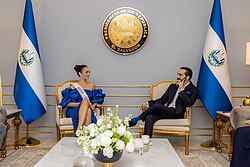 ](https://en.wikipedia.org/wiki/File:R%27Bonney_Nola_Gabriel_y_Nayib_Bukele_2_%28cropped%29.jpg)Bukele with Miss Universe 2022 R'Bonney Gabriel in October 2023.
During Bukele's presidency, El Salvador has hosted a number of international sporting events and one edition of the Miss Universe beauty pageant. Some experts have described El Salvador's hosting of such events as an attempt at sportswashing.[401][402]
Bukele has promoted surfing as part of El Salvador's tourism market. He designated part of El Salvador's Pacific coastline in the La Libertad Department as "Surf City",[403] where the 2021 and 2023 ISA World Surfing Games were hosted.[404][405] El Salvador also hosted the 2023 Central American and Caribbean Games. At the tournament's opening ceremony, Bukele rebuked critics by saying that he was "not a dictator" and told them to ask everyday Salvadorans what they thought about his "supposed dictatorship".[402]
In January 2023, Bukele announced that El Salvador would host the Miss Universe 2023 pageant; the last time El Salvador had hosted Miss Universe was in 1975.[406] At the pageant, Bukele said that Miss Universe had given El Salvador the opportunity to "show the world what we are capable of".[407] On the day of the pageant, 300 members of the Movement for Victims of the State of Emergency held a protest demanding the release of innocent victims of the country's gang crackdown and wanting "Miss Universe to see that Salvadorans are suffering". Some protestors wore sashes reading "Miss Political Prisoners", "Miss Persecution", and "Miss Mass Trials".[401][408]
Job approval and popularity
[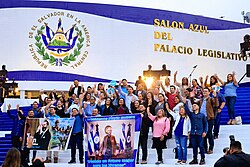 ](https://en.wikipedia.org/wiki/File:Supporters_of_Nayib_Bukele%27s_re-election_%28June_2023%29.jpg)A crowd of Bukele supporters in front of the Legislative Assembly's meeting room in 2023
Although protests against Bukele occurred in 2020 during the COVID-19 pandemic[409] and in 2023 about his re-election campaign and gang crackdown,[408][410][411] he has retained high job-approval ratings throughout his presidency. Bukele's approval rating has never gone below 75 percent, and has averaged in the 90s.[325][382][412] He is one of the most popular presidents in Salvadoran history,[413] and the Los Angeles Times' Kate Linthicum called him "one of the most popular leaders in the world".[325] The United States Institute of Peace's Mary Speck referred to Bukele as "Latin America's — and possibly the world's — most popular leader".[414] Risa Grais-Targow, a director at the Eurasia Group, described Bukele's approval rating as "sky-high" and "really unprecedented".[395]
In addition to Bukele's domestic popularity, he is also very popular among Salvadorans living in the United States and throughout Latin America.[337] Some Latin American state leaders and other politicians have sought to emulate his government policies.[334][337] In some countries, such as Colombia and Ecuador, opinion polls found Bukele more popular with their residents than domestic politicians. Steven Levitsky, a political scientist and the director of Harvard University's Latin American studies center, wrote that "everybody wants to be a Bukele" and compared his popularity across Latin America to that of former Venezuelan president Hugo Chávez.[337] Some political analysts consider Bukele's popularity a cult of personality.[337][415]
Honors and decorations
 Bukele receiving the National Order of Juan Mora Fernández [es] from Costa Rican president Rodrigo Chaves Robles
Beijing International Studies University awarded Bukele an honorary doctoral degree in December 2019.[416] In 2021, Time named Bukele as one of the world's 100 most influential people.[417]
---
an 5 25 cmn dr
an internationally acclaimed digital news outlet in El Salvador said Monday that the administration of Salvadoran President Nayib Bukele is preparing to arrest a number of its journalists following the publication of an interview with two former gang leaders who shed new light on a power-sharing agreement with the U.S.-backed leader and self-described "world's coolest dictator."
"A reliable source in El Salvador told El Faro that the Bukele-controlled Attorney General's Office is preparing at least seven arrest warrants for members of El Faro," the outlet reported. "The source reached out following the publication of an interview with two former leaders of the 18th Street Revolucionarios on Bukele's yearslong relationship to gangs."
"If carried out, the warrants are the first time in decades that prosecutors seek to press charges against individual journalists for their journalistic labors," El Faro added.
Bukele responded to the interview in a Friday evening post on the social media site X that read in part, "It's clear that a country at peace, without deaths, without extortion, without bloodshed, without corpses every day, without mothers mourning their children, is not profitable for human rights NGOs, nor for the globalist media, nor for the elites, nor for [George] Soros."
While the pact between Bukele and gang leaders is well-known in El Salvador, El Faro—which has long been a thorn in the president's side—was the first media outlet to air video of gangsters acknowledging the agreement.
As El Faro reported:
At the heart of the threat of arrests is irony: El Faro was only able to interview the two Revolucionarios because they escaped El Salvador with the complicity of Bukele. One, who goes by "Liro Man," recounts that he was taken to Guatemala, through a blind spot in the Salvadoran border, by Bukele gang negotiator Carlos Marroquín; the other, Carlos Cartagena, or "Charli," was arrested on a warrant in April 2022, early in the state of exception, but quickly released after the police received a call at the station and backed off.
Meanwhile, tens of thousands of Salvadorans were being rounded up without due process, on charges of belonging to gangs.
The video interview explains the dichotomy: For years, Salvadoran gang leaders cut covert deals with the entourage of Nayib Bukele. In their interview with El Faro, the two Revolucionarios say the FMLN party, to which the now-president belonged a decade ago, paid a quarter of a million dollars to the gangs during the 2014 campaign in exchange for vote coercion in gang-controlled communities, on behalf of Bukele for San Salvador mayor and Salvador Sánchez Cerén as president.
"This support, the sources say, was key to Bukele's ascent to power," El Faro noted. "'You're going to tell your mom and your wife's family that they have to vote for Nayib. If you don't do it, we'll kill them,' Liro Man says the gang members told their communities in that election. Of Bukele, he added, 'he knew he had to get to the gangs in order to get to where he is.'"
Part of the deal was a tacit "no body, no crime" policy under which gang leaders agreed to hide their victims' corpses as Bukele boasted of a historic reduction in homicides in a country once known as the world's murder capital.
"We've wanted to talk about this for a long time, for the simple reason that the government beats their chests and says, 'We're anti-gang, we don't want this scourge,'" Liro Man told El Faro. "But they forgot that they made a deal with us, and you were the first to get this out."
In an ironic twist, the Trump administration deported gang members from the U.S. to El Salvador's notorious Terrorism Confinement Center prison who faced federal indictments that could have resulted in their testifying in court about the pact with Bukele.
Responding to the possible arrest warrants for El Faro staffers, Argentinian journalist Eliezer Budasoff said on social media Sunday that "it's clear" that El Salvador's leader "wants to silence" the outlet "because they're shattering the myths of the Bukele administration, simply with more journalism."
The Bukele administration's attacks on El Faro include falsely accusing the outlet of money laundering and tax evasion, banning its reporters from press briefings, and surveilling its staffers with Pegasus spyware. El Faro has remained steadfast in the face of these and other actions.
"Every citizen must decide for themselves whether they want to be informed, or whether they prefer the blind loyalty this administration has demanded of its supporters since its first day in power," the outlet's editors wrote in 2022. "We don't have that choice. Our job is to report. We can't change the news, and we never will."
NOW READ:There's a 'deeper problem' behind Trump's plan to fire top generals: expert
---
NO LNX
A new low even for MAGA – but they're about to go lower
REUTERS/Rebecca Cook
Sabrina Haake, Raw Story May 05, 2025
Last week, Trump held a campaign-style rally on the campus of Macomb Community College in Warren, Michigan. To the delight of his MAGA fans, he trotted out the same personal grievances he’s been serving up since 2015.
Despite achieving fewer legislative accomplishments during his first 100 days than any president since the 1950s, Trump told his adoring crowd that he had “accomplished more in three months than most administrations accomplished in four years or eight years.”
If aiding the enemy, defying court orders, and taking a chainsaw to federal services are “accomplishments,” then Trump is accomplished indeed.
MAGA delights in Trump’s cruelty
After his usual braggadocio, Trump pivoted to video recordings of abject cruelty. Behind the podium, Trump displayed large screen videos of the inhumane treatment of helpless migrants he deported to El Salvador's notorious gulag, CECOT. He brayed, still without evidence, “The worst of the worst are being sent to a no-nonsense prison in El Salvador… watch this!”
“This” was a series of video clips showing hundreds of men he has imprisoned without due process, without a hearing, and without credible evidence that they committed any crime. “This” was a video showing men brutally bent over, having their heads shaved bare, and forcibly shoved into concentration camp-style cages that sleep 75 to 80. “This” was Trump priming his already violence-prone base into a bloodthirsty frenzy, as they exploded in raucous approval of his inhumanity, thundering, "USA! USA! USA!"
According to an affidavit from the Human Rights Watch, prisoners held in CECOT are denied communication with the outside, and only appear before courts in online hearings, often in groups of several hundred detainees at the same time. The Salvadoran government calls them “terrorists” who “will never leave” the prison.
El Salvador, governed by a man who controls the media and calls himself a “cool” dictator, denies human rights groups access to its prisons, and allows journalists to visit only under highly staged circumstances. In videos produced during these visits, prison authorities brag about men held in completely dark solitary confinement cells.
Trump’s stochastic violence against judges
Trump also used the rally to showcase his continued attack on judges, whom he called “communist radical left judges,” claiming they are trying to ‘seize his power.’ Nodding to the courts’ inability to enforce their own orders, Trump warned the world: “Nothing will stop me.”
Secretary of State Marco Rubio concurs. At least week’s cabinet meeting, to which Trump invited the media, each cabinet member tried to out-flatter the next person by praising Trump. Seated to Trump’s right, Rubio announced that questions regarding Kilmar Abrego Garcia, a Maryland man sent in error to El Salvador — specifically, what steps the White House was taking to facilitate his return — were off limits to the media. “I’ll never tell you that, and you know who else I’ll never tell?” Rubio jeered.
“A judge,” he answered himself, “because the conduct of our foreign policy belongs to the president of the United States.”
Due process is not a matter of foreign policy
Vice President J.D. Vance also describes the rule of law with sarcastic bombast. He has slammed critics, including federal judges, for “weeping over the lack of due process.”
The Fifth Amendment protects all persons, not just US citizens. It guarantees that no person shall “be deprived of life, liberty or property, without due process of law;” it does not say, ‘no citizens.’ Trump, Rubio, Attorney General Pam Bondi and Vance act as if they’ve never heard of it, despite its storied American history. Trying to assume the role of the courts in deciding what the law is, they keep declaring, falsely, that their abuse of immigrants is about “foreign policy.” It isn’t. It’s about the US Constitution, the lynchpin of democracy, without which we don’t have one.
After the Supreme Court ruled 9-0 that Trump must facilitate Garcia’s return from El Salvador, Trump took to social media to turn a legal block into a PR strategy. He wrote that he is “being stymied at every turn by even the U.S. Supreme Court…which seemingly doesn’t want me to send violent criminals and terrorists back to Venezuela… If we don’t get these criminals out of our Country, we are not going to have a Country any longer.”
Revealing his complete ignorance of how legal immigration works, he added, “We cannot give everyone a trial, because to do so would take, without exaggeration, 200 years. We would need hundreds of thousands of trials for the hundreds of thousands of Illegals we are sending out of the Country. Such a thing is not possible to do…MAGA!”
It’s as if, despite tanking last year’s border bill just so he could campaign on it, he’s never actually considered that processing immigrants requires paperwork.
VP Vance, who knows better, says it’s up to Trump—and himself— to decide what due process is, and what it requires. “To say the administration must observe “due process” is to beg the question: what process is due is a function of our resources, the public interest, the status of the accused, the proposed punishment, and so many other factors.” No. It isn’t. It’s not up to Vance and Trump’s discretion because the Fifth and 14th Amendments, and well established precedent, mapped out what due process requires — notice, a hearing, and an opportunity to be heard — decades ago.
Trump is a symptom, not a cause
It’s a sick disease of the mind, this urge to oppress others for power, but Trump didn’t invent it. Neither did Hitler, Mao Zedong, or Stalin. It’s been there since we stopped living in tune with the earth, and started living in our heads. It’s our collective fall from grace, a phenomenon worsened exponentially by social media.
Watching our experiment stumble brings deep personal anguish, like watching someone you love destroy themselves. You’d give your own life to help, but they have to save themselves.
A minority of Americans- 23%- approve of what Trump is doing and would loudly cheer “USA!!” at videos of human suffering. These are the same people who used to applaud public lynchings; before that, they salivated at public stonings, witch burnings and Caligula’s public displays of torture. It seems they will always be with us; the only positive is that there are far more of us than there are of them.
ALSO READ: Trump is a troll – but this 'ugly' selfie demands a damning response
Sabrina Haake is a 25+ year federal trial attorney specializing in 1st and 14th A defense. Her columns are or have been published in Alternet, Chicago Tribune, MSN, Out South Florida, Raw Story, Salon, Smart News, State Affairs, and Windy City Times. Her Substack, The Haake Take, is free.
---
---
mma
YouTube content creators have earned more than 200 million views on videos of their visits to El Salvador’s CECOT prison
Both the Trump and Bukele administrations have also used social media as propaganda celebrating the megaprison
Written by Jack Winstanley
Research contributions from Payton Armstrong
Published 04/24/25
Since 2024, at least five YouTube content creators have been granted access to El Salvador’s Terrorism Confinement Center, the megaprison to which the Trump administration began sending immigrants last month.
The resulting YouTube videos have been viewed over 200 million times, and at least one creator has appeared on Fox News four times to discuss what he saw while filming. He suggested during one appearance that “if the United States was smart, they would do something just like this as well.”
Both President Donald Trump’s administration and Salvadoran President Nayib Bukele’s government have used social media to push propaganda films celebrating the megaprison as well, despite concerns of potential human rights abuses at the site, and right-wing media have also praised the facility.
The Trump administration is deporting immigrants to El Salvador's CECOT prison without due process}:
- ### Bukele opened CECOT in 2023, earning praise from right-wing media figures
In early 2023, El Salvador President Nayib Bukele opened the Terrorism Confinement Center, or CECOT, as part of his campaign against criminal gangs operating within the country. Since then, experts have raised concerns about the prison’s harsh conditions and “massive and arbitrary deprivation of liberty,” including the extreme levels of isolation experienced by the prisoners. One visiting filmmaker called it a “tropical gulag” and an expert described it as “the Salvadoran version of going to Siberia.”
But right-wing media figures have celebrated the facility and suggested that the United States should create similar infrastructure within the country, praising Bukele’s authoritarianism (“This is my kind of authority, baby”) and suggesting that a megaprison would help with America’s “serious crime problem.”
- ### In March 2025, the Trump administration began deporting individuals to CECOT
During an official visit in February 2025, Secretary of State Marco Rubio said Bukele had offered to accept deportees from the U.S., including “dangerous criminals currently in custody and serving their sentence in the United States even though they're U.S. citizens or legal residents.” The following month, President Donald Trump invoked the Alien Enemies Act to send hundreds of immigrants to El Salvador to be imprisoned at CECOT.
Despite ongoing legal challenges to the administration’s use of the Alien Enemies Act to justify deporting individuals to El Salvador with little to no due process, Trump stated during a press briefing alongside Bukele that he is exploring detaining U.S. citizens and imprisoning them in El Salvador as well.
- ## YouTubers have earned millions of views on content after visiting CECOT
- 02/07/24
Mexican YouTuber Luisito Comunica posted a tour of the facility, thanking Bukele’s press secretary for granting him access
- In Mexican YouTuber Lusito Comunica’s video, which has been viewed over 56 million times, he says in Spanish that touring the facility “gives a certain feeling of empowerment to a simple citizen like me.” Comunica also spoke positively of the conditions within the facility, stating, “It is easy to suddenly be moved, to touch your heart, to say, 'Wow, what harsh abuse inside the prison.' But when you find out the inhumane atrocities they committed, it makes sense.” YouTube,[
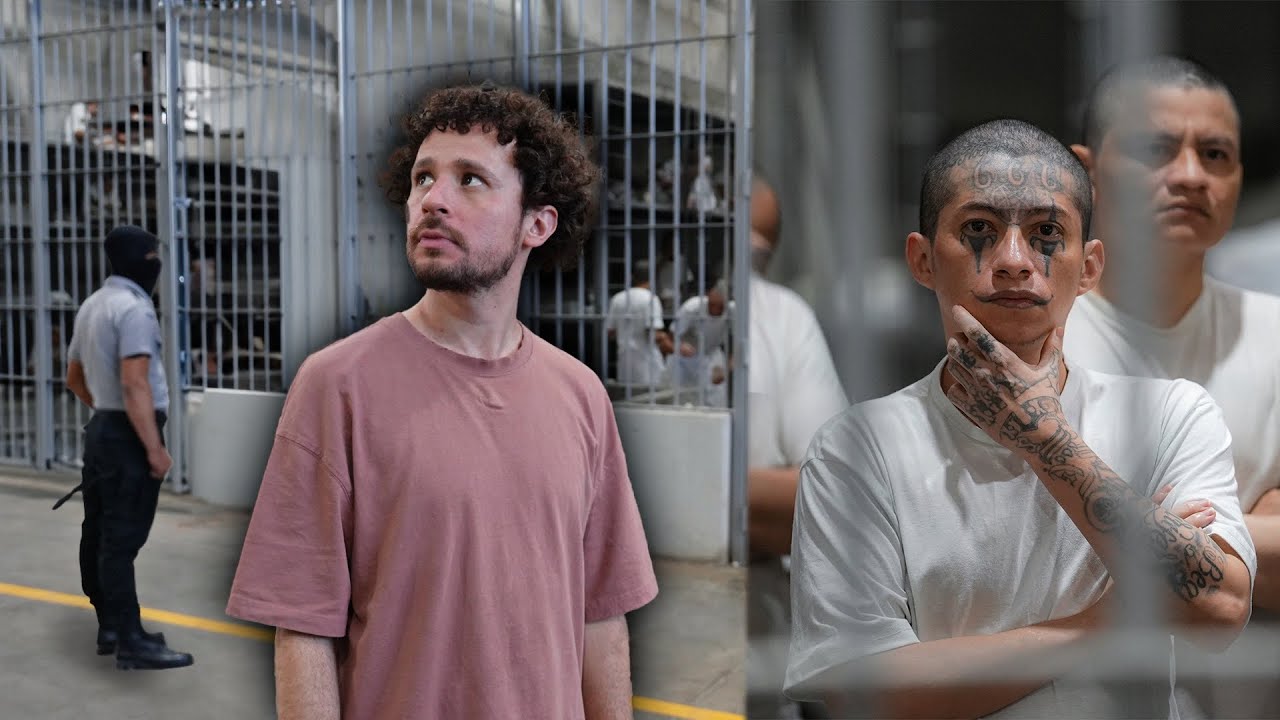 , accessed 4/23/25]
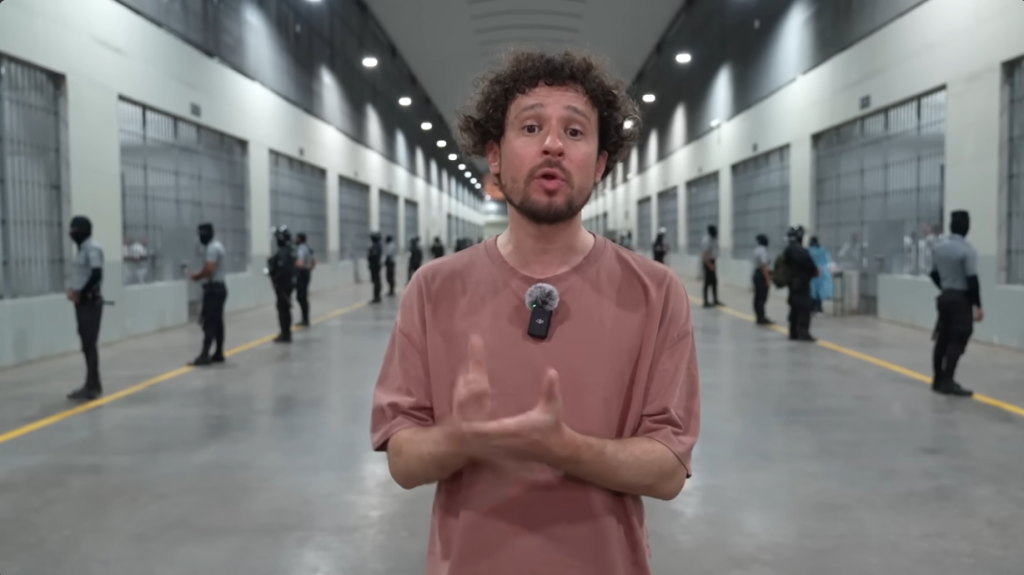
- 07/26/24
Right-leaning American YouTuber Nick Shirley posted a tour of CECOT and appeared on Fox News at least 4 times to discuss his visit
- Pro-Trump YouTuber Nick Shirley’s video, which features a tour of CECOT and Shirley interacting with a group of individuals imprisoned there, has earned over 5.7 million views. Prior to touring CECOT, Shirley had made videos criticizing the Biden administration’s immigration policy and focusing on illegal immigration into the U.S. YouTube,[
 , accessed 4/22/25;Reuters, 6/13/24]
- The following week, Fox News’ Jesse Watters hosted Shirley to discuss his tour, introducing him as an “investigative journalist” and showing portions of the YouTube video. Shirley told Watters that “if the United States was smart, they would do something just like this as well, to make sure that no criminal gets treated like a normal person.” Fox News, *Jesse Watters Primetime*, [8/2/24]
- Following the Trump administration’s decision to deport individuals to El Salvador, Shirley appeared on Fox at least another three times. On Fox & Friends Weekend, Shirley stated that he worked “for months and months” to get permission to tour the facility, and he ended his appearance by cheering, “Let’s go, El Salvador.” Fox News, The Ingraham Angle, [2/7/25; Fox News, Fox & Friends Weekend, 3/29/25; Fox Deportes, Fox Noticias, 3/28/25]
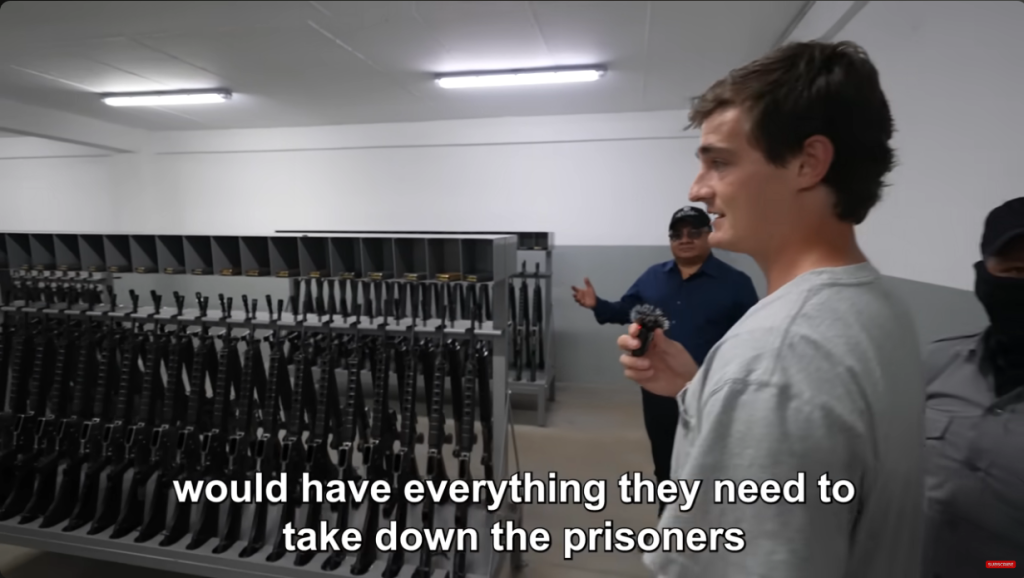
- 10/21/24
Greek UK-based YouTuber Timmy Karter posted his tour of CECOT, earning over 3.7 million views
- While discussing concerns over human rights violations at CECOT, U.K.-based YouTuber Karter remarked that it “sounds a bit hypocrisy, because — let’s be honest — U.S.A. is running Guantanamo.” Karter also argued that foreign media outlets should “criticize your own prisons first” before judging CECOT. YouTube,[
 , accessed 4/22/25]
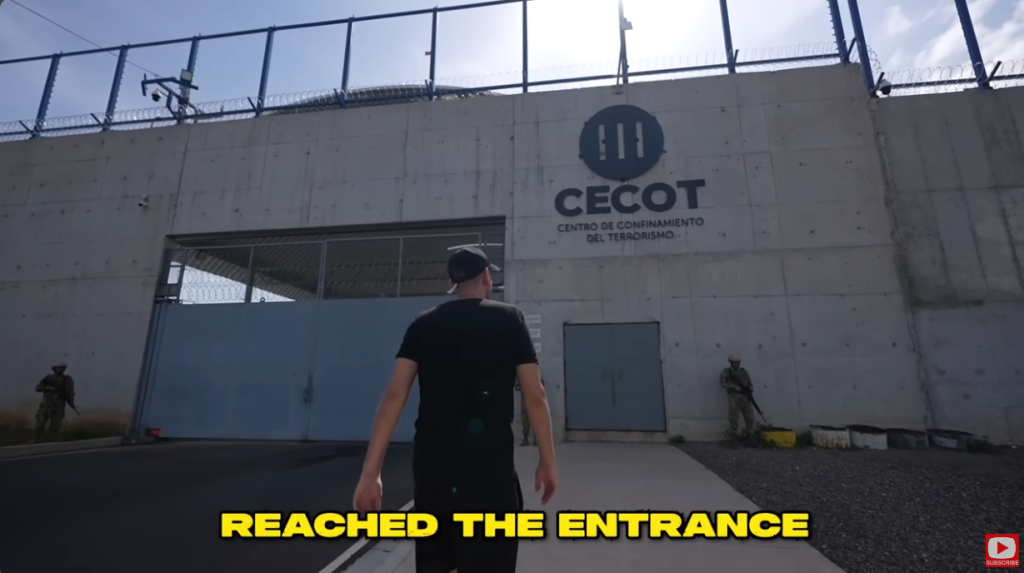
- 02/02/25
UAE-based YouTuber Joe Hattab posted a tour of CECOT, earning over 49 million views
- United Arab Emirates-based YouTuber Joe Hattab said in his video that the Salvadoran government “invited media outlets to broadcast the scene [at CECOT] to the entire world, serving as a deterrent to anyone who dares break the law.” The description for Hattab’s video celebrates the prison, noting, “Thanks to this prison the country of El Salvador is the safest country in the western hemisphere.” YouTube,[
 , accessed 4/22/25]
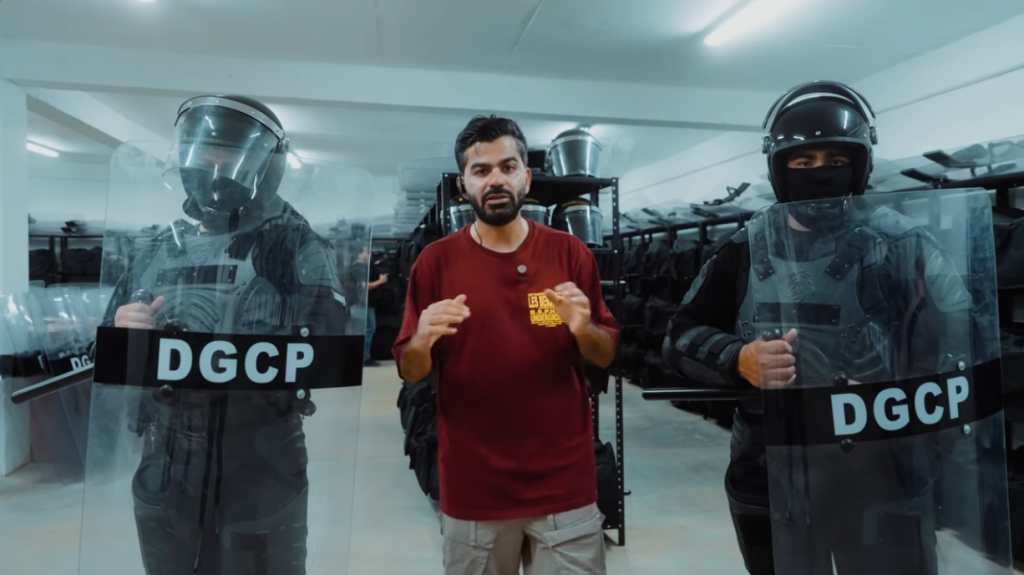
- 02/09/25
Turkish YouTuber Ruhi Cenat also posted a video tour, earning over 95 million views
- While approaching the facility, someone in the car with Turkish YouTuber Ruhi Cenat can be heard saying that they “have permission from the presidency” to visit the facility. YouTube,[
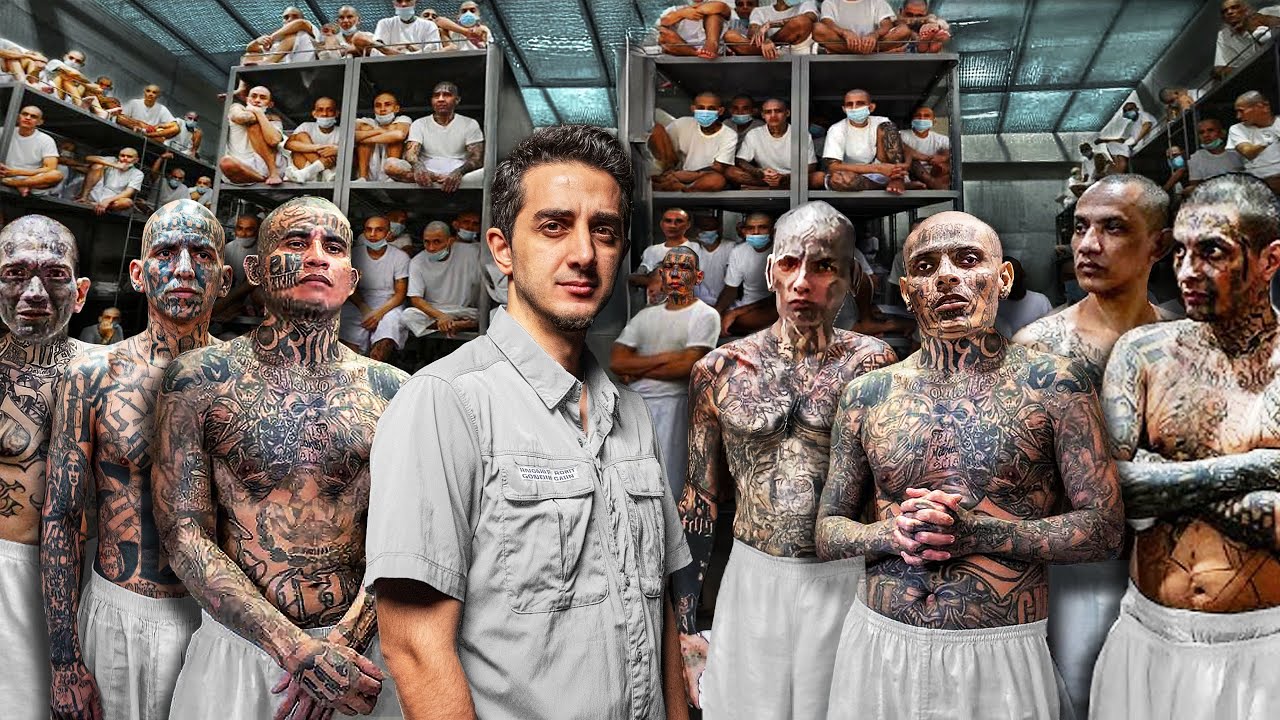 ; accessed 4/22/25]
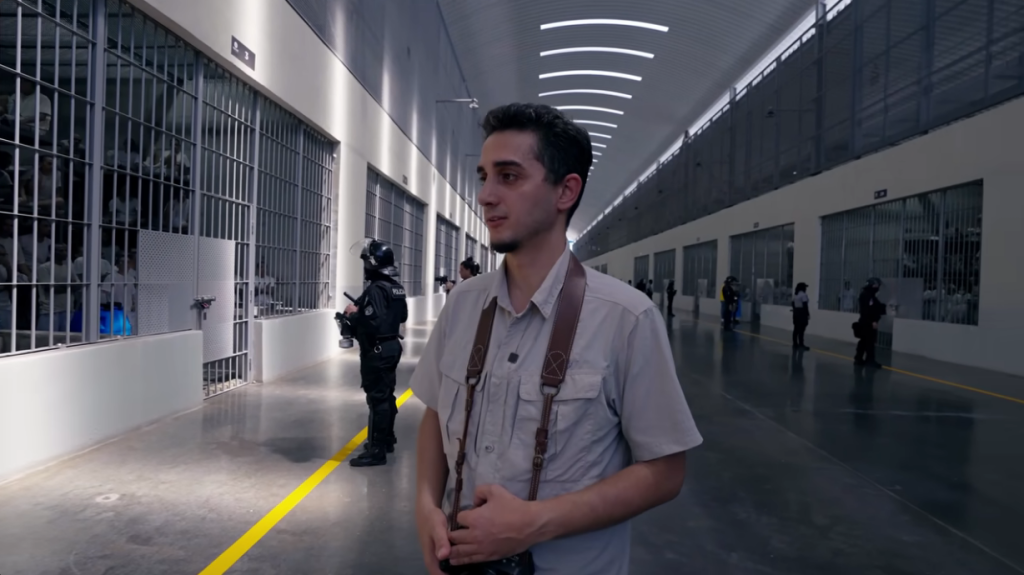
- ## The Trump and Bukele administrations have leveraged social media to promote CECOT
- ### In March, Secretary of Homeland Security Kristi Noem visited the megaprison and posted a video thanking Bukele
In the video, Homeland Security Secretary Kristi Noem called the facility “one of the tools in our tool kit that we will use if you commit crimes against the American people.”
While several GOP lawmakers have traveled to the megaprison, congressional Republicans and Salvadoran officials have denied requests from Democratic lawmakers to visit the facility.
- ### Bukele’s government has also made ample use of social media to promote CECOT and its wider crackdown on criminal gangs
Dramatically shot videos showing detainees being marched off planes by armed military and police units, having their heads shaved, and being hurried into cells have been posted to Bukele’s social media accounts in an effort to promote his “no-tolerance policy on crime,” according to The Washington Post.
After then-Rep. Matt Gaetz (R-FL) visited CECOT in July 2024, Bukele shared to social media a segment of Gaetz’s speech on the House floor in which he discussed his newly formed “El Salvador Caucus” and praised Bukele’s “visionary leadership.” Bukele’s account also shared a video of Gaetz’s visit to the prison in which Gaetz praised “the good ideas in El Salvador” and noted that “there is a lot more discipline in this prison than we see in a lot of the prisons in the United States.”
Bukele’s government has used a team of paid internet “trolls” and other allied social media accounts to push propaganda and attack dissent. One account, according to The Associated Press, has posted videos of supposed gang members committing violent crimes, followed by pro-Bukele messaging.
//
:{:{04/17/25}:
:{:{04/01/25}:
04/07/25
---
wh visit an 4 25
Backing up the Trump administration, the President of El Salvador, Nayib Bukele, says he has no intention or ability to return an unlawfully removed Maryland legal resident, Kilmar Abrego García, to the United States. Abrego García was wrongly deported to a notorious maximum security “mega-prison” for terrorists in El Salvador.
“How can I return him to the United States?” President Bukele said to reporters on Monday, during a meeting with President Donald Trump and his top officials in the Oval Office, as reported by The Washington Post. “I smuggle him into the United States? Of course I’m not going to do it.”
Last week, the U.S. Supreme Court in an apparent unanimous opinion ordered the Trump administration to “facilitate” the return of Abrego García to the United States.
Minutes before President Bukele’s remarks, White House Deputy Chief of Staff for Policy Stephen Miller, on-camera in the Oval Office, delivered what is being called an “outrageous misinterpretation” of the Supreme Court’s opinion, which was quickly condemned.
READ MORE: Trump Rages Against Critics, All But Silent on Alleged Terror Attack on Dem Governor
“I promise you, if he was your neighbor, you would move right away,” Miller, who was the architect of the first Trump administration’s child separation policy, told reporters.
“What was the ruling in the Supreme Court, Steve, was it nine to nothing?” President Trump interjected.
“Yes, it was a 9-0, in our favor,” Miller wrongly claimed. “against the district court ruling, saying that no district court has the power to compel the foreign policy function of the United States.”
“As Pam said,” Miller continued, referring to Attorney General Pam Bondi, “the ruling solely stated that if this individual—at El Salvador’s sole discretion—was sent back to our country, that we could deport him a second time.”
“No version of this legally ends up with him ever living here, because he is a citizen of El Salvador,” Miller claimed, before pointing reporters to Bukele.
“That is the president of El Salvador. Your questions about it per the court can only be directed to him,” said Miller.
Attorney Michael Kasdan responded to Miller’s remarks: “We have reached the point where the White House openly lies on television about what a unanimous Supreme Court ruling against them says. The stuff of dystopian novels.”
“This is a blatant lie. The Supreme Court ruled 9-0 AGAINST Trump,” wrote the progressive nonprofit People For the American Way.
READ MORE: ‘Apocalyptic’: Trump Plan Would Be ‘Science Demolition Derby’ Experts Warn
“This is deeply Orwellian. The Court ruled against the Trump administration 9-0,” observed the MeidasTouch Network.
Conservative legal activist and political commentator Ed Whelan, who clerked for U.S. Supreme Court Justice Antonin Scalia, weighed in.
“Outrageous misrepresentation of Supreme Court ruling,” Whelan declared, serving up a somewhat technical legal analysis. “The unanimous Court ruled that the district-court order ‘properly requires the Government to ‘facilitate’ Abrego Garcia’s release from custody in El Salvador and to ensure that his case is handled as it would have been had he not been improperly sent to El Salvador.’ Yes, the Court also stated that the “intended scope of the term ‘effectuate’ in the District Court’s order is, however, unclear, and may exceed the District Court’s authority,” and it told the district court to ‘clarify its directive, with due regard for the deference owed to the Executive Branch in the conduct of foreign affairs.’ But: (1) ‘due regard’ doesn’t mean that the district court couldn’t give any teeth to ‘effectuate’; (2) in any event, the district court dropped ‘effectuate’ from its revised order, so this is all irrelevant. Duty to ‘facilitate’ continues.”
Commenting on the video, immigration attorney Allen Orr Jr. Esq. wrote: “When you tell yourself the story you want to believe even when it is fiction.”
Watch the video below or at this link.
---
an 4 25
President Donald Trump's misrepresentation of the Supreme Court ruling on Kilmar Abrego Garcia — falsely claiming that the court ruled 9-0 in the administration's favor — has raised concerns among some analysts, who are calling it a "constitutional crisis."
During a press conference alongside El Salvador President Nayib Bukele in the Oval Office on Monday, Trump claimed that the Supreme Court had ruled 9–0 in his favor and that the ruling in the case meant that the U.S. government would have to provide a plane only if the Salvadoran president chose to return Abrego Garcia, a Maryland man wrongfully deported to an infamous Salvadoran prison.
“Of course I’m not going to do it,” Bukele said when asked by reporters if he would help return the man, adding that returning him would be akin to smuggling “a terrorist into the United States.”
ALSO READ:'I’m not asking for state secrets': Judge gives Trump ultimatum on wrongfully deported man
According to some political commentators, the president is openly defying the judiciary and some have warned that this development poses a risk to the credibility of the 2026 midterm elections.
David Frum, a writer at The Atlantic said in a post on the social platform X: "Trump defying a 9-0 Supreme Court decision is the reason I say 'if we still have free and fair elections in the United States' when I talk about 2026 midterms."
Editor in chief MeidasTouch Ron Filpkowski saidthis was "another court order that Trump is now openly defying."
"Republicans in Congress assured us repeatedly that Trump would never defy a court order. It is obvious that he simply doesn’t care though after the Supreme Court gave him immunity," he added.
ALSO READ:Supreme Court unanimously rules against Trump in case of wrongfully deported man
Author Hold Meyerson wrote in an article for the American Prospect that Garcia's case is "the first that presents Trump with the clear choice of obeying a Supreme Court order or flouting it."
"So far he's opting for the latter, bolstered by the administration's most powerful adviser," Meyerson added.
Democratic strategist Mike Nellis said he doesn't use that term lightly, "but Trump outright refusing the Supreme Court’s order to bring Kilmar Abrego Garcia is an *actual* constitutional crisis."
Political activist Don Winslow wrote, BREAKING RIGHT NOW! THEY ARE NOT GOING TO BRING ABREGO GARCIA HOME. This is Donald Trump defying the SupremeCourt."
---
mojo
The Real Reason El Salvador’s President Nayib Bukele Cozied Up to Trump
US and El Salvador Celebrate Their Refusal to Return Man Wrongly Deported to “Gulag”
---
note it always expands
an 4 25
Legal experts pounced President Donald Trump’s proposal of sending U.S. citizens convicted of crimes to international prisons.
The Washington Post reports Trump openly mulled the possibility of off-siting U.S. citizens to foreign prisons on Air Force One, saying “we have some horrible criminals, American grown, born.” He added that he’s “all for” sending them to prisons in El Salvador, where he has already detained some Venezuelan migrants to public outcry.
After protestors attacked Tesla dealerships, vehicles and charging stations over controversial figure and Trump adviser Elon Musk, Trump hoped protestors would “get 20 year jail sentences … in the prisons of El Salvador, which have become so recently famous for such lovely conditions!”
READ MORE:‘Beyond parody’: Fox News, Trump Cabinet slammed for ‘Dear Leader’ praise as market dives
Trump conceded on Sunday that, “I don’t know what the law says on that.”
The law doesn’t smile on it, according to University of California Professor and immigration scholar Davis Gabriel J. Chin.
Such a proposal is “the equivalent of sending political opponents to the Gulag in the Soviet Union era,” Chin told Washington Post reporters in an email.
The paper reports that U.S. citizen cannot legally be deported or denied entry to the United States. The suggestion “does not seem very realistic,” said Jean Reisz, an associate professor of law who co-directs the University of Southern California Gould School of Law Immigration Clinic, said Trump’s suggestion “does not seem very realistic.”
READ MORE:'Grinding to a halt': Stunning chart shows Trump's impact on Biden 'manufacturing boom'
Even U.S. citizens who have traveled overseas to fight with terrorist organizations against U.S. interests, such as the Islamic State must be allowed to return, said Reisz. The government can detain them and charge them with crimes and even incarcerate them upon conviction, but U.S. officials are not permitted to deny them reentry to the U.S.”
Read the full Washington Post article at this link (subscription required).
---
---
THOM 3 3 25
ISIS STYLE VIDEO, CONC CAMP // PVT PRISON
And they’re proud of it.
Secretary of State Marco Rubio, ridiculing the judge’s order to stop the illegal, no-due-process deportation flights to El Salvador, retweeted “Oopsie … Too late,” with a smirking emoji.
===
---
QUINN SLOBODIAN: Well, I think that, you know, the January 6 is apropos for a couple reasons. One is kind of silly but also meaningful, which is, if you look at the character that Musk uses when he plays the game Diablo IV, which he describes as giving him life lessons and allowing him to see the matrix, the guy kind of looks quite a bit like the QAnon shaman, so well known from January 6. So, January 6, in a way, kind of, I think, opened this new era in American politics where the kind of surreal, fringe, often online communities have sort of entered the world of sort of high politics and have scrambled the kind of coordinates of average rules of the game and the normal sort of protocols. I think that Musk is someone who is really a product of that kind of crossover effect, where building up a kind of huge online community, building up the sort of status as a global media influencer, has now the capacity to actually shatter existing coalitions, shatter existing standards of what normal politics is. And his connections now to people like Nigel Farage, until recently, Tommy Robinson, the AfD, Giorgia Meloni, these are signs of kind of a willingness to shatter existing traditional party systems, to embrace disruption kind of for its own sake, and to really harness especially the power of the internet to make possible things that had been previously impossible, so to make certain forms of speech possible, to make certain forms of mobilization possible, and to make things like, you know, the attempted coup d’état in January 6 something that could actually be followed through to its conclusion.
And I think that, you know, the kind of — the horizon of what the kind of politics in real life that someone like Musk is aiming at is broadcast by him frequently on his own Twitter account.
Most recently, for example, he celebrated Nayib Bukele, the leader in El Salvador, as having done something that has happened in El Salvador and will happen and must happen in the United States, which, in El Salvador, has been to imprison 2% of the adult population as an absolutely draconian way of cracking down on crime. So, this vision of sort of authoritarian strongman on politics, sort of gloves-off mass incarceration crackdowns, on the one hand, and then a deregulatory kind of unleashing of the free market, on the other hand, is — produced this kind of curious combination of, on the one hand, Elon Musk posting Milton Friedman memes all the time, on the other hand, scaremongering about the, quote-unquote, “genocidal rape tactics” of nonwhite immigrants in the U.K.
So, he’s produced this sort of surreal effect, I think, of sort of the strong state and the free market turning the sort of Thatcherist vision, grafting it onto all kinds of online aesthetics and kind of video game dynamics in ways that have really, I think, blindsided, for good reason, sort of mainstream, normal politicians, like Olaf Scholz, Keir Starmer, Biden-Harris, who don’t know how to deal with this kind of chaotic energy, which, unfortunately, has a huge amount of legitimacy behind it, not only his multimillion-dollar — or, multimillion number of followers on social media.
---
https://www.alternet.org/human-rights-activists-sound-the-alarm-as-el-salvador-battles-its-gang-crisis/
---
ggl 1 25
---
 USA Today
Trump loves populists and strongmen. Here's who he's invited to the inauguration
10 hours ago](https://www.usatoday.com/story/news/politics/2025/01/09/trump-right-wing-populists-inauguration/77551719007/)
Trump's Latin America policy will be shaped by an ...}:
:
Chatham House
https://www.chathamhouse.org › Topics › Regions](https://www.chathamhouse.org/2024/11/trumps-latin-america-policy-will-be-shaped-ideological-network-trumpista-strongmen)
Nov 19, 2024 — Also attending that event was right-wing president of El Salvador, Nayib Bukele. Trump has both praised and criticized Bukele, but his pick ...
[### Nayib Bukele and Donald Trump Discuss Shared Goals ...

News from El Salvador in English
https://elsalvadorinenglish.com › 2024/11/07 › nayib-b...](https://elsalvadorinenglish.com/2024/11/07/nayib-bukele-and-donald-trump-discuss-shared-goals-in-post-election-call/)
Nov 7, 2024 — President Nayib Bukele of El Salvador recently held a phone conversation with former US President Donald Trump, in which he congratulated Trump on his ...
[### Trump's foreign strategy rests on courting autocrats

Los Angeles Times
https://www.latimes.com › politics › story › trumps-fore...](https://www.latimes.com/politics/story/2024-08-26/trumps-foreign-policy-strategy-still-rests-heavily-on-courting-autocrats)
Aug 26, 2024 — President Trump meets with President Nayib Bukele of El Salvador during the United Nations General Assembly in September 2019 in New York. (Evan ...
[### Trump congratulates bitcoiners — El Salvador's Nayib ...

Fox Business
https://www.foxbusiness.com › markets › trump-congra...](https://www.foxbusiness.com/markets/trump-congratulates-bitcoiners-el-salvadors-nayib-bukele-takes-victory-lap-bitcoin-over-100k)
Dec 5, 2024 — President-elect Trump congratulates bitcoiners and El Salvador's President Nayib Bukele takes victory lap after bitcoin surpasses $100000.
[### Trump Shows His Contempt for Latin America

Bloomberg
https://www.bloomberg.com › opinion › articles › trump...](https://www.bloomberg.com/opinion/articles/2024-07-23/trump-s-digs-at-el-salvador-s-bukele-highlight-his-contempt-for-latin-america)
Jul 23, 2024 — His attacks against El Salvador's strongman president Nayib Bukele are a potent reminder of the rocky relations the region faces with the US ...
[### Nayib Bukele - X

x.com
https://x.com › nayibbukele › status](https://x.com/nayibbukele/status/1854049854818853021?lang=en)
Nov 6, 2024 — Congratulations to the President-Elect of the United States of America, @realDonaldTrump May God bless and guide you.
[### Nayib Bukele

X · nayibbukele
105.9K+ likes · 2 months ago](https://twitter.com/nayibbukele/status/1854574961433665648)
I congratulated him on his sweeping victory on Tuesday, and we discussed the strong mandate he received from the American people and the ...
[### Remarks by President Trump and President Bukele of El ...

National Archives (.gov)
https://trumpwhitehouse.archives.gov › remarks-preside...](https://trumpwhitehouse.archives.gov/briefings-statements/remarks-president-trump-president-bukele-el-salvador-bilateral-meeting-new-york-ny/)
Sep 25, 2019 — It's a great honor to be with the President of El Salvador. We've had a tremendous success because, two weeks ago, we signed a cooperation agreement.
[### AG pick Matt Gaetz has suggested El Salvador's brutal law ...

MSNBC News
https://www.msnbc.com › the-reidout › reidout-blog](https://www.msnbc.com/the-reidout/reidout-blog/matt-gaetz-nayib-bukele-state-violence-rcna180398)
Nov 15, 2024 — Salvadoran strongman Nayib Bukele is a hero to the right. As attorney general, Gaetz could bring Bukele's practice of widespread human rights ...
---
vox
Meet two of the hot speakers at this year’s Conservative Political Action Conference (CPAC): Presidents Nayib Bukele of El Salvador and Javier Milei of Argentina, two of Latin America’s most flamboyant right-wing populists.
CPAC started in 1974 as an annual gathering of conservatives; over the years it has turned into a days-long, livestreamed far-right spectacle. Policy is discussed and refined while movement luminaries like former President Donald Trump and House GOP Chair Elise Stefanik are given the opportunity to share their ideas with a receptive audience.
It might be a little sleepier than usual this year, but the conference still reveals where American conservatism is headed. And the two Latin American leaders’ presence underscores the right’s continued affinity for populist and even illiberal leadership — particularly when combined with modern personal brands built online.
They aren’t the first extremist leaders to speak at CPAC: Viktor Orbán of Hungary and Jair Bolsonaro of Brazil have featured in past years. Like Orbán and Bolsonaro, Bukele and Milei are staunch populists who have proposed radical solutions to serious problems in their countries.
The American right finds those radical proposals attractive, even if the policies likely couldn’t — or shouldn’t — be instituted in the US. Bukele has, seemingly, mitigated El Salvador’s serious gang violence problem through mass arrests and incarceration, while Milei’s economic policies are supposed to right Argentina’s inflation-plagued economy.
Trump, the presumptive Republican nominee for president, has praised both men; though he has yet to meet Milei, the former president enjoyed a friendly relationship with Bukele. Other conservative figures, including Rep. Chip Roy (R-TX) of the Freedom Caucus, have praised Milei’s push for “limited” government.
The two leaders are important voices at CPAC as conservatives work to draw in Latin American voters before the election in November; Bukele in particular is popular among Salvadorans living in the US. But their presence at the conference is about more than trying to win votes, Erica Frantz, a professor of political science at Michigan State University, told Vox — it’s about creating a particular type of international far-right ideology.
“Linking Milei and Bukele with the Trump movement is advantageous for all parties involved,” she said. “For Milei and Bukele, it gives them the opportunity to strengthen an alliance with the potential presidential candidate most likely to be sympathetic to their authoritarian ambitions.” For Trump and his supporters, “it is a chance to send a message to supporters that its style of politics is gaining steam outside US borders.”
Bukele and Milei were elected to tackle big issues
Bukele has had a long relationship with the pro-Trump right since his first presidential election in 2019. That relationship started online, among cryptocurrency enthusiasts. The ideology underlying cryptocurrency is decidedly libertarian, with many adherents calling for the abolition of treasuries and central banks.
Bukele’s profile rose when El Salvador began accepting bitcoin as legal tender, and he’s remained popular despite the damage it’s done to the country’s economy following the cryptocurrency crash of 2022. But the leader’s crypto fixation — which is affecting the country’s ability to secure international financing — is almost quaint in the face of his authoritarian turn, ostensibly to address the country’s serious crime problem.
Gangs controlled most aspects of life in the country, which was once known for having the highest murder rate in the world. With a campaign of mass arrests, Bukele has indeed tackled El Salvador’s crime problem. But that has come at a steep cost, as I explained last year:
Successive presidential administrations have taken different approaches — many have adopted the mano dura, or “iron hand” tack, instituting harsh crackdowns to mitigate the violence. But Bukele is on an entirely different level; his administration has imprisoned tens of thousands, many arbitrarily, repeatedly extended a state of emergency severely curtailing the rights of ordinary citizens, and attacked and even detained his critics in the press.
The country now instead boasts the highest incarceration rate in the world.
Despite the human rights violations, Bukele’s policies have been popular in El Salvador. Given the astounding level of violence that ordinary people have suffered under the gangs’ power — and the rapidity with which the violence decreased — it’s not ultimately that surprising that Bukele won a second term in office, despite the fact that he has dismantled parts of El Salvador’s democracy, manipulating institutions from the country’s Constitutional Courtto its legislature, to do so.
Though the policy appears to be working in the immediate term, critics argue it isn’t sustainable for two major reasons. The first is that Bukele has made no effort to build a long-term social or economic infrastructure as an alternative to gang violence. The second is that the sense of security people currently feel requires sacrificing other forms of security, such as the rule of law. “[Bukele’s] popularity is built on illegality and undemocratic actions,” Noah Bullock, the executive director of the human rights organization Cristosal, told Vox. “There is no historic precedent where the use of state violence has produced lasting peace.”
That didn’t stop Bukele from suggesting the US ought to learn from his policies during his CPAC speech on Thursday. “We can clearly see the signs of a declining society because our own hit rock bottom decades ago,” he told the cheering audience. He urged Americans to look at “big cities in decline like Baltimore, Portland, New York, just to name a few places where crime and drugs have become the daily norm.”
Milei has only been in office for a couple of months, so he’s had less time to implement his libertarian economic policies. And he might not be able to do that much; already in his brief tenure, the congress voted down his party’s omnibus bill, which included fiscal measures aimed at managing inflation as well as an attempt to secure emergency legislative powers for, potentially, his entire four-year term. Along with deregulation and privatization efforts, the omnibus bill hinted at Milei’s social agenda: It would have reduced prenatal parental leave for women and slashed environmental protections in favor of business interests.
Milei will speak at the conference Saturday, most likely about his efforts to privatize state enterprises and cut down on regulations — both topics with great appeal to CPAC’s audience.
US conservatives benefit from Bukele and Milei’s illiberal policies
Bukele and Milei were each granted a mandate by presenting extreme solutions to serious problems in their countries that have long frustrated citizens. But they have clear ideologies and proclivities toward illiberalism that emerge within those contexts, too.
“They are able to articulate a real problem in society and propose solutions,” Daniel Rothschild, executive director of the Mercatus Center at George Mason University, told Vox. When people are truly struggling, they respond to those policies, “even if they are illiberal.”
In his speech on Thursday evening, Bukele warned that the US was headed for the same kind of violent, gang-plagued system that defined El Salvador. But he, like Trump and other conservatives, exaggerates the problem the US faces. Trump and his allies have argued that cities (especially those in Democratic-controlled states) are full of violence, and they have also made a bogeyman out of the gang Mara Salvatrucha, or MS13, which has terrorized El Salvador along with Barrio 18.
It is true that MS13 actually started in the US and has had a presence here. It is also true that violent crime, including homicide, increased during the social upheaval of the pandemic, and that certain kinds of property crimes have increased. But violent crime is now at pre-pandemic levels and has trended downward overall since the 1990s. In other words, there’s simply no parallel to the violence and terror wrought by gang violence in El Salvador.
It’s not hard to see why Trump and others at CPAC would want to champion someone like Bukele. He exemplifies “tough on crime” rhetoric and, to their minds, proves that the only way to avoid the “American carnage” Trump warned of in his 2017 inauguration speech is to restrict human and civil rights and undo democratic norms and institutions.
Milei, despite having struggled to pass his policies, similarly embodies conservative ideals. His efforts to curb government spending and significantly reduce the size of the government echo the Republican party’s rhetoric of limited government and tighter belts — but the US isn’t dealing with 140 percent inflation or a57 percent poverty rate.
It’s still early in Milei’s tenure, but it is important to note that he and Bukele — like Trump — exemplifies what Frantz and others call a “personalist” leader. “The party that supports them is intricately linked to their persona rather than a clear policy platform,” Frantz explained.
Social media is an important tool in the personalist leader’s playbook that Milei, Bukele, and Trump have all used to their advantage — they don’t have to go through establishment channels that might soften their policies or their rhetoric.
That social media following has created a wave of “millennial authoritarianism,” as researcher Manuel Meléndez-Sánchez termed the phenomenon, which brands these leaders as iconoclasts who reject the “establishment.”
“With personalist parties,” Frantz said, “leaders pretty much have a free rein to behave as they please, and — particularly when their party gains majority legislative representation — the door is wide open for democracy to deteriorate.”
Even if Milei is struggling to pass his policies in Argentina, he’s still able to paint himself as a warrior in the fight against socialism, as he apparently will do in his CPAC speech. That will solidify his ideological link to US conservatives and show “a very clear picture” of how far-right politicians “learn from each other, how they are connected with each other, and they are sharing an agenda that, far from being local, is a global network,” Paula Avila-Guillen, a human rights lawyer and executive director of the Women’s Equality Center, told Vox.
Ultimately, US conservatives like Bukele and Milei because they are hardliners who are using extreme tactics to deal with society’s problems — and are willing to thumb their noses at institutions to get there. As Frantz told Vox, their presence at CPAC is “an effort to cue the conservative base to see authoritarian rhetoric as ‘normal’ and strongman rule as the only solution to society’s problems.” In other words, the message is that not only is there nothing to fear from Trump’s more anti-democratic tendencies, but there’s much to gain from them.
See More:
---
duck 4 25
YouTube
https://www.youtube.com › watch?v=Omt50rGZ4n8
FULL SPEECH: Nayib Bukele, President of El Salvador, Addresses CPAC in ...
President of El Salvador Nayib Bukele addresses CPAC 2024 in Washington, D.C. Stay up to date on Right Side Broadcasting Network coverage, go to rsbnetwork.c...
Created by:Right Side Broadcasting Network
96K views
24 min
News for cpac bukele
Wait, why did Trump take a jab at the "dictator" conservatives love last night?
motherjones.com
271d
Milei and Bolsonaro attend fascistic CPAC conference in Brazil
wsws.org
271d
El Salvador's president gets rock-star welcome at conservative gathering outside Washington
apnews.com
---
AP News
https://apnews.com › article › cpac-nayib-bukele-trump-conservative-dc454b92a57fad8907b376b6eacf5b7e
El Salvador's president gets rock-star welcome at conservative ...
NATIONAL HARBOR, Maryland (AP) — El Salvador's President Nayib Bukele received a rock-star welcome Thursday at a conservative gathering outside Washington as he urged people to "unapologetically fight" against what he called "dark forces.". At the annual Conservative Political Action Conference, Bukele told people to use El Salvador as a warning.
---
Vox
https://www.vox.com › 2024 › 2 › 24 › 24081448 › cpac-trump-republicans-bukele-milei
Why two of Latin America's most controversial leaders are at CPAC - Vox
Feb 24, 2024The two leaders are important voices at CPAC as conservatives work to draw in Latin American voters before the election in November; Bukele in particular is popular among Salvadorans living in the ...
Videos for cpac bukele
8:56
Why El Salvador's Bukele Is a Model for Trump's Inner Circle | WSJ
366K views
YouTube
1d
1:05
CPAC - President Nayib Bukele recalls the story of an...
0 views
1d
CPAC on Instagram: "At CPAC, President Nayib Bukele discussed the importance of the people deciding the direction of their nation without being told what to do by globalists. That is what helped him transform El Salvador into the safest nation in the western hemisphere. Now, he's helping President Trump make America safe again by housing dangerous illegal immigrant criminals in an El Salvador prison."
1.8K views
1d
CPAC on Instagram: "President Nayib Bukele recalls the story of an illegal immigrant who was arrested and released SIX TIMES by U.S. law enforcement. President Trump: "That was the liberal establishment, but they're not running things anymore in this country. We're now run by people with great common sense""
6.5K views
1d
CPAC on Instagram: "No one elected George Soros to impose his agenda on the people. But the people of El Salvador elected Nayib Bukele and Soros hit a brick wall there. In November, Americans elected Donald Trump, and now, Soros is hitting a brick wall here too."
6.8K views
1d
56:04
TRUMP & BUKELE: A BUDDING BROMANCE?
0 views
YouTube
1d
-
NPR
https://www.npr.org › 2024 › 02 › 23 › 1233577076 › el-salvador-president-nayib-bukele-receives-a-warm-welcome-at-cpac
El Salvador President Nayib Bukele receives a warm welcome at CPAC
Feb 23, 2024PERALTA: Indeed, says Cuellar, in that speech at CPAC, Bukele presented himself as the, quote, "evolution of the Trumpian formula," a president who got past the democratic guardrails to bring a ...
Author:Eyder Peralta
---
YouTube
https://www.youtube.com › watch?v=u0e_grWEcB0
JUST IN: El Salvador President Nayib Bukele Warns Of 'Dark ... - YouTube
At CPAC, El Salvador President Nayib Bukele decried "globalism" and warned about social and civilizational decline.Fuel your success with Forbes. Gain unlimi...
Created by:Forbes Breaking News
4M views
24 min
---
NBC News
https://www.nbcnews.com › news › latino › growing-alliance-republicans-latin-american-right-on-display-cpac-rcna139795
Republicans invite Latin America's Nayib Bukele, Javier Milei to CPAC
Feb 23, 2024El Salvador President Nayib Bukele and Argentine President Javier Milei will speak at the conservative conference this week, and CPAC has already held spinoffs in Brazil and Mexico.
---
cpac.org
https://www.cpac.org › post › conservative-leaders-flock-to-bukele-inauguration-in-el-salvador
Conservative Leaders Flock to Bukele Inauguration in El Salvador - CPAC
Jun 5, 2024CPAC joined a cohort of American conservative leaders that flocked to El Salvador to attend the inauguration of President Nayib Bukele for his second term. Donald Trump Jr, Kimberly Guilfoyle, Representative Matt Gaetz, Senator Mike Lee, reporter Sara Carter, and more conservative figures attended the inauguration and festivities. "It is quite brave of Nayib Bukele to welcome prominent ...
--
Los Angeles Times
https://www.latimes.com › world-nation › story › 2024-02-23 › la-na-pol-el-salvador-bukele-cpac
El Salvador president gets big welcome at U.S. conservative event - Los ...
Feb 23, 2024El Salvador's autocratic president gets rock-star welcome at pro-Trump CPAC event . ... Bukele said Thursday that it had taken 50 years; two wars; 250,000 deaths; the displacement of a third of ...
---
cpac.org
https://www.cpac.org › post › cpac-celebrates-inauguration-of-el-salvador-president-nayib-bukele
CPAC Celebrates Inauguration of El Salvador President Nayib Bukele
Jun 4, 2024El Salvador President Nayib Bukele was elected to a second term in February of this year and was sworn in just a few days ago on June 1. Matt and Mercedes Schlapp along with a CPAC delegation that included Elaine Beck, Veronica Birkenstock, former ambassador Ron Johnson, and more attended the inauguration festivities. "El Salvador has a great President in President Bukele.
---
La República
https://larepublica.pe › mundo › 2024 › 02 › 24 › que-es-el-cpac-evento-que-reune-a-milei-bukele-trump-y-otras-figuras-politicas-conferencia-de-accion-politica-conservadora-estados-unidos-2168496
¿Qué es el CPAC, evento que reúne a Milei, Bukele, Trump y otras ...
Feb 24, 2024Nayib Bukele, presidente de El Salvador, fue el primero de los líderes de Latinoamérica en hablar en el foro que inició el miércoles 21 y culminará este sábado 24. En su intervención ...
===
---
DUCK 4 25
Wikipedia, the free encyclopedia NO TALK?
The State of Exception is a right established in the Constitution of El Salvador. This legal framework enables the government to temporarily suspend certain constitutional rights in extraordinary circumstances. It empowers Salvadoran authorities to implement special measures when situations significantly disrupt public order or threaten national stability.
The State of Exception can be declared in various scenarios that compromise institutional normalcy, such as natural disasters, epidemics, or severe political or civil conflicts that hinder the regular functioning of institutions. Its application may cover the entire national territory or only the directly affected areas, with the aim of restoring order and ensuring citizen safety.
Background
On March 26, 2022, a total of 62 violent deaths were recorded, marking the highest number of homicides in a single day in three decades in El Salvador. In response to this crisis, President Nayib Bukele's administration requested the declaration of a 30-day State of Exception. This measure was justified by the significant increase in the national homicide rate and aimed to implement extraordinary actions to counteract the violence.[1][2][3][4]
I request the Legislative Assembly of El Salvador to decree a State of Exception today, in accordance with Article 29 of the Constitution of the Republic.
— Nayib Bukele on his X account
Implementation
On March 27, 2022, the Legislative Assembly of El Salvador approved a state of exception in accordance with Article 29 of the Constitution of the Republic.[5][6]
Art. 29.— State of Exception: In cases of war, invasion of territory, rebellion, sedition, catastrophe, epidemic, or other general calamity, or serious disturbances of public order, the guarantees established in Articles 5, 6 first paragraph, 7 first paragraph, and 24 of this Constitution may be suspended, except when it concerns meetings or associations for religious, cultural, economic, or sports purposes. Such suspension may affect all or part of the territory of the Republic and shall be enacted through a decree by the Legislative Branch or the Executive Branch, as applicable.
— Constitution of the Republic of El Salvador of 1983
This constitutional provision regulates the mechanisms through which the State can implement extraordinary measures in specific circumstances that warrant the temporary suspension of certain fundamental rights. The state of exception represents a legal instrument provided for within El Salvador’s legal framework for situations requiring specific state intervention.[7]
Art. 2.— A "State of Exception" is declared throughout the national territory, arising from the serious disturbances to public order caused by criminal groups that threaten the life, peace, and security of the Salvadoran population.
— Decree No. 333 - Legislative Assembly of the Republic of El Salvador.
As of December 17, 2024, the Legislative Assembly of El Salvador had approved the extension of the state of exception for the thirty-third time. The measure was supported by 57 votes out of the 60 deputies that make up the legislative body.[8]
The extension request submitted by the Council of Ministers highlighted that, since the implementation of the state of exception, more than 83,600 arrests have been made of individuals linked to gang criminal structures. At the same time, the presidency is evaluating the possibility of modifying some of the current restrictions, although the Minister of Security, Gustavo Villatoro, stated that the decision is still under analysis.[9]
Effects and Results
At the end of March 2022, Salvadoran security forces announced that they had arrested 576 gang members; since the declaration of the state of exception, more than 83,000 individuals linked to gang structures have been arrested, including gang leaders.[10]
As of December 9, 2024, the Bukele government has totaled 776 non-consecutive days without homicides.[11][12]
10 11 12
- Arias, Diana (6 December 2024). "Régimen de excepción seguirá garantizando la seguridad pública". El Salvador. Diario El Salvador.
- Infobae, Por Newsroom (2024-09-13). "El Gobierno de El Salvador anuncia que el país suma 700 días no consecutivos sin homicidios". infobae (in European Spanish). Retrieved 2024-12-09.
{{cite web}}:|first=has generic name (help) - "Diciembre sigue sin registrar homicidios en todo el país". Diario La Página (in Spanish). 2024-12-09. Retrieved 2024-12-09.
---

Wikipedia
https://en.wikipedia.org › wiki › State_of_Exception_in_El_Salvador
State of Exception in El Salvador - Wikipedia
The State of Exception is a right established in the Constitution of El Salvador.This legal framework enables the government to temporarily suspend certain constitutional rights in extraordinary circumstances. It empowers Salvadoran authorities to implement special measures when situations significantly disrupt public order or threaten national stability.
- elsalvadorinfo.net
Only include results for this siteHide site from these results
Share feedback about this site
El Salvador INFO
https://elsalvadorinfo.net › el-salvador-state-of-exception
El Salvador State of Exception, a security measure to fight gangs.
Mar 26, 2025El Salvador's State of Exception has been extended consecutively over 36 times in 30-day increments since March 2022—to maintain pressure on gangs. Supporters argue it has drastically reduced crime, making communities safer and boosting economic activity. They believe continued enforcement is necessary to prevent gangs from regaining power.
- elsalvadorinfo.net
El Salvador INFO
https://elsalvadorinfo.net › people-arrested-during-the-salvadoran-state-of-exception
Over 86,000 Arrested During El Salvador's State of Exception
Feb 19, 2025The number of people arrested in El Salvador in the context of the State of Exception security plan—implemented by the Nayib Bukele government to end gangs—amounts to more than 86,000, according to what the Minister of Defense of El Salvador, René Francis Merino Monroy, said on Tuesday, Feb. 18, 2025. He also stated that authorities have also seized 4,565 firearms, 10,451 vehicles, and ...
- elsalvadorinfo.net
El Salvador INFO
https://elsalvadorinfo.net › the-salvadoran-state-of-exception-gets-extended-for-another-30-days
El Salvador's State of Exception Anti-gang Security Measure Gets ...
Apr 2, 2025Homicide reduction. Based on the drastic homicide reduction, the Salvadoran Government supports maintaining the emergency security measure.El Salvador closed 2024 with 114 murders for a rate of 1.9 homicides per 100,000 inhabitants.. Furthermore, El Salvador ended 2022, 2023, and 2024 with fewer homicides than Costa Rica, the nation known as the safety standard in Central America.
- [
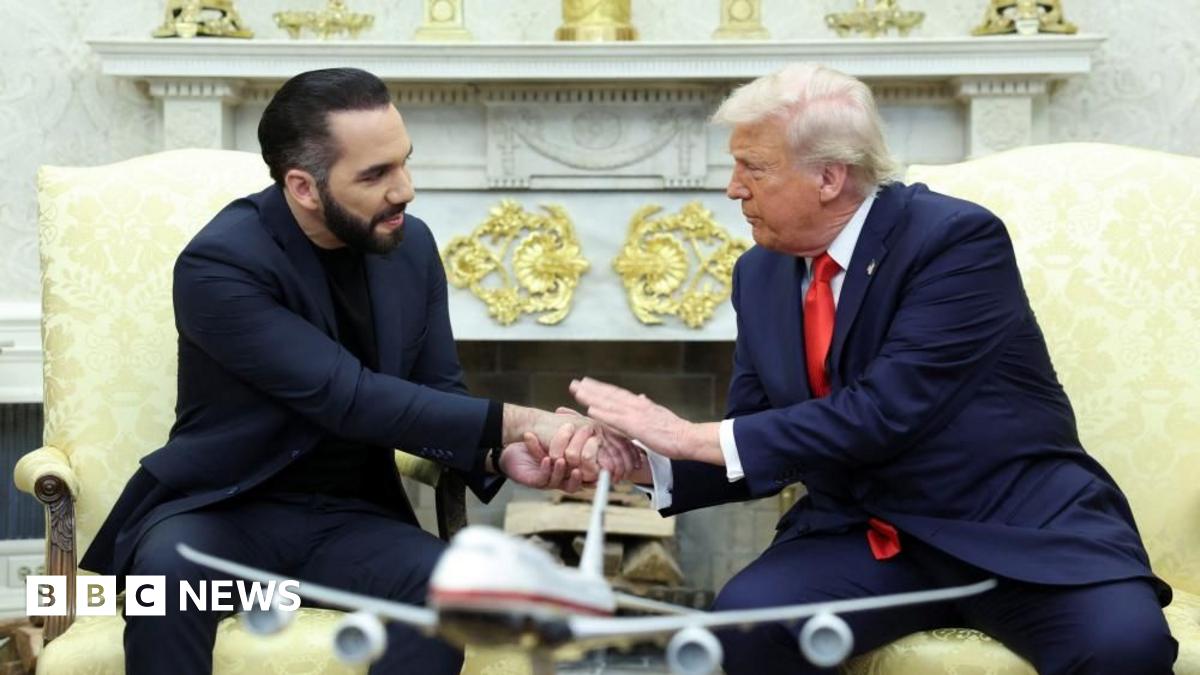
Bukele says at White House that El Salvador won't return mistakenly deported man
bbc.com
2d](https://www.bbc.com/news/live/cwy03j9vddlt)
- [
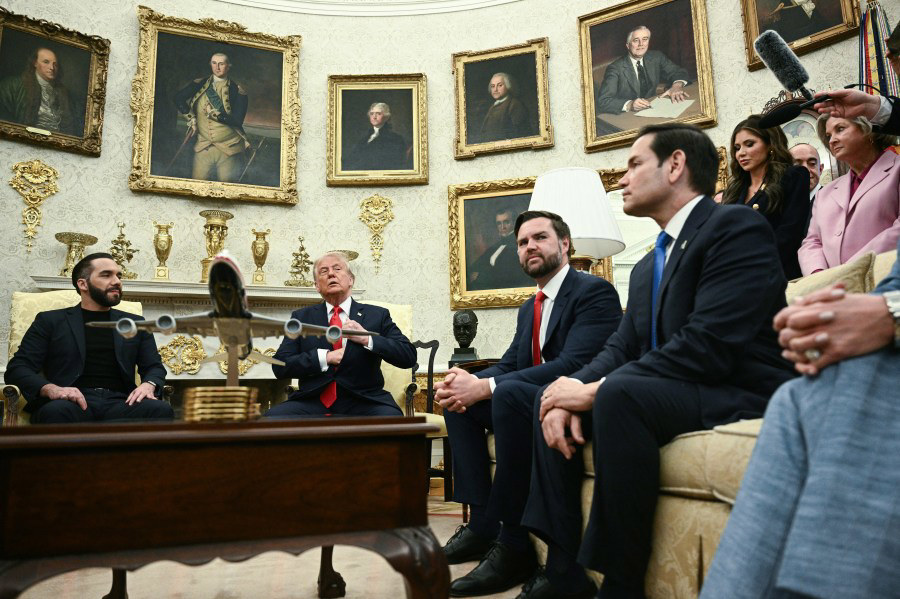
- [
El Salvador's Bukele says he won't return Abrego Garcia to US
msn.com
2d](https://www.msn.com/en-us/politics/government/el-salvador-s-bukele-says-he-won-t-return-abrego-garcia-to-us/ar-AA1CUwot)
- More News
Was this helpful?
- alianzaamericas.org
Alianza Americas
El Salvador's State of Exception, Now Extended 9 Times, Explained
El Salvador's Legislative Assembly recently extended its state of exception, first approved in April 2022, for an additional 30 days. The extension became effective December 18. Under El Salvador's Constitution, states of exception may be used to respond to extreme circumstances, including war or serious disturbances of public order.
- carnegieendowment.org
Carnegie Endowment for International Peace
El Salvador's "State of Exception" Makes Women Collateral Damage
May 4, 2023El Salvador will hold presidential elections in 2024, and most analysts predict that Bukele's Nuevas Ideas party will win by a landslide, defying the Salvadoran constitutional ban on reelection. Although it is unclear whether Bukele will maintain the current state of exception, his justice minister has declared that imprisoned gang members ...
- elsalvadorperspectives.com
elsalvadorperspectives.com
https://www.elsalvadorperspectives.com › 2025 › 03 › three-years-under-state-of-exception-in.html
Three years under the State of Exception in El Salvador
Mar 27, 2025March 27 is the three-year anniversary of the State of Exception in El Salvador. This suspension of constitutional due process protections as part of a war on gangs was adopted by the Salvadoran Legislative Assembly in the midst of a bloody weekend in March 2022 in which gangs murdered at least 87 people around the country. Under the State of ...
- apnews.com
AP News
El Salvador extends state of exception in gang crackdown
FILE - Heavily armed police guard the streets as part of a state of exception in downtown San Salvador, El Salvador, March 27, 2022. El Salvador's congress granted President Nayib Bukele late Tuesday, July 20, 2022 another 30-day extension of the state of exception that has suspended fundamental rights since a surge in gang killings in late ...
- elsalvadornow.org
](https://duckduckgo.com/?q=state%20of%20exemption%20el%20salvador+site:www.elsalvadornow.org&atb=v353-1)
elsalvadornow.org
New Legislature Approves Extension to State of Exception - El Salvador Now
May 10, 2024El Salvador Two Years Into the State of Exception", carried out by social and human rights organizations, indicates that from March 2022 to March 2024, 6,305 complaints of possible human rights violations were received. ... El Salvador a dos años del régimen de excepción", realizado por organizaciones sociales y de derechos humanos ...
- decodinghumanrights.substack.com
decodinghumanrights.substack.com
https://decodinghumanrights.substack.com › p › el-salvador-state-of-exception-and
El Salvador: State of exception and access to justice
Feb 15, 2025El Salvador: Report from the Government of El Salvador to the Inter-American Commission on Human Rights on the State of Exception Decree, April 26, 2022. The phenomenon of criminality is aggravated by multiple factors and it has strengthened progressively since the mid-1990s.
---
https://www.mediamatters.org/tucker-carlson/tucker-carlsons-embrace-foreign-authoritarian-leaders
In the past two years, Tucker Carlson has repeatedly hosted global leaders with authoritarian tendencies and embraced anti-democratic regimes on his Fox News and Fox Nation shows.
In interviews with Hungary’s president Victor Orbán, El Salvador’s president Nayib Bukele, Poland’s president Andrzej Duda, and most recently, Brazil’s president Jair Bolsonaro, Carlson has pitched softball questions, praised anti-democratic ideas, and allowed lies about some of the regimes to go unchallenged. Carlson has also repeatedly praised Russian President Vladimir Putin, excusing his regime’s aggression in Ukraine.
By promoting and celebrating anti-democracy leaders to his audience of over 3 million viewers, Carlson is whitewashing their authoritarian tendencies and inaccurately covering the implication of their policies. Reeling from the 2020 election and the January 6 insurrection, the majority of voters believe American democracy is already at risk. Carlson's embrace of authoritarian ideologies from around the world only further threatens its future.
no lnx many some vid
Russia
Fox News has a documented pattern of supporting Prime Minister Vladimir Putin’s Russia, and Tucker Carlson has clearly led this charge.
A month into the Russian invasion of Ukraine, Carlson praised Nigel Farage for saying, “Whatever we may think of him [Putin] as a human being,” he is “actually on our side.”
Video CitationFrom the March 30, 2022, edition of Fox News' Tucker Carlson Tonight
Media Matters has documented Carlson’s extensive history of pushing pro-Kremlin talking points on Tucker Carlson Tonight.
He has mocked criticism of the Russian president and downplayed the significance of his invasion of Ukraine. He also suggested the Biden administration backs Ukraine only because of Hunter Biden’s ties to the country and questioned the U.S.’s efforts to support Ukraine, asking, “Why do we care so much” about “Russia messing around in Ukraine or Estonia or Crimea or whatever?” and “Why wouldn’t we be friends with Russia?”
He even went so far as to throw a jab at his Fox News colleague Jennifer Griffin’s reporting on the region, accusing her of “lying” while not bothering “to do any reporting whatsoever.”
Putin leads an authoritarian state in which he cannot be prosecuted and officials in his government are protected under strict confidentiality laws. The country has cracked down on free internet access by limiting access to social media platforms, and critics of the Kremlin are labeled “foreign agents” and silenced. A Media Matters report from April 2022 found that Facebook videos featuring 5 pro-Russian segments from Carlson received more than 2 million views and nearly 200,000 interactions.
In 2019, Carlson asked on his show, “Why shouldn’t I root for Russia? Which I am,” in reference to the conflict with Ukraine. (Later in the show he claimed he was joking.)
Video CitationFrom the November 25, 2019 edition of Fox News' Tucker Carlson Tonight:
In return for his fealty, the Kremlin has praised Fox and Carlson, amplifying segments of Carlson’s show on its state-run social media accounts and state-run television. A leaked Kremlin memo distributed to Russian media outlets instructed broadcasters to use as many clips from Tucker Carlson as possible.
Brazil
In June, Carlson traveled to Brazil to film a new documentary for his “Tucker Carlson Originals” series. While there, he interviewed Brazilian president Jair Bolsonaro, who, since he assumed the presidency in 2019, has created a government in Brazil that is anti-LGBTQ, anti-Black, and anti-woman, once even stating he would rather see his son “die in an accident” than have a gay family member.
Despite international attention on Bolsonaro’s anti-democratic regime, Carlson hosted the Brazilian president for a friendly interview, during which they promoted a variety of false claims and conspiracy theories. Bolsonaro and Carlson embraced their similar ideologies, with Bolsonaro praising Carlson’s show and Carlson suggesting Brazil gets its own Fox News Channel.
Video CitationFrom the June 30, 2022, edition of Fox News' Tucker Carlson Tonight
Carlson and Bolsonaro pushed a number of other right-wing talking points.
Carlson cheered on Brazil’s pro-life and Christian ideology, and Carlson and Bolsonaro agreed “the left” in Brazil will be responsible for the downfall of the good, Christian-centric society. Carlson implied the same would happen in the United States.
Carlson falsely claimed Ukrainian President Volodymyr Zelensky “arms Nazis,” saying Bolsonaro is not like him.
Carlson claimed Bolsonaro is a “liberal” and has “done nothing to stop civil liberties in Brazil” although the president is known to arrest and investigate his critics under a vague national security law.
Carlson and Bolsonaro repeatedly called a man who attacked Bolsonaro in 2018 “leftist” and claimed the stabbing was politically motivated although a judge ruled the attacker was mentally ill after he told investigators he was “acting on the orders of God.”
Bolsonaro shared false claims that he did not need the COVID-19 vaccine because he had previously had the virus.
Bolsonaro also promoted both ivermectin and hydroxychloroquine as effective COVID-19 treatments.
Bolsonaro repeated the generally discounted theory that COVID-19 was started in a “laboratory on the other side of the world.”
Responding to a Carlson question about the expansion of gun ownership in Brazil, Bolsonaro claimed an increase in civilian gun ownership is what caused a “drop in the number of people who are killed by firearms in Brazil,” though the president though in reality states where civilian gun ownership increased the most did not see crime fall by any significant amount in comparison to states with less growth of gun ownership.
Dubbed “Trump of the tropics,” Bolsonaro campaigned on heavy military presence, after years of supporting Brazil’s military dictatorship, and violent policing. He had a plan to appoint military leaders to top government posts and following the election he did just that. Bolsonaro also claimed he would not accept the results of the election if he lost and has “threatened to destroy, jail or drive into exile his political opponents.”
During the 2020 municipal elections in Brazil, Bolsonaro spread narratives meant to discredit the country's democratic voting system after his party’s candidates lost. He has begun to push for restricting votes to paper ballots only for the 2022 election, echoing Trumpworld’s conspiracy theories about compromised electronic voting machines.
On his first day as president in 2019, Bolsonaro targeted Indigenous lands by preventing new lands from becoming demarcated for protection and has since dismantled the country’s environment ministry through cutting the budget, and overseen increased deforestation.
During the COVID-19 pandemic, Bolsonaro’s failed policies resulted in hundreds of thousands of avoidable deaths. Bolsonaro spread false narratives about the pandemic, refused to follow the World Health Organization’s recommendations, and even blocked local or state governments that attempted to follow prevention advice such as implementing mask mandates. Federal police have investigated multiple people who criticized the president’s COVID-19 response in public media.
Hungary
Carlson’s coverage of President Viktor Orbán and his governance in Hungary has garnered a flurry of mainstream media press attention in the American press. He has interviewed Orbán, filmed an antisemitic documentary targeting philanthropist George Soros, and spoken at a conference put on in Hungary by a right-wing organization tied to the Orbán government.
Carlson has shown his enthusiasm for authoritarian ideas and frequently connects Hungary’s move to the right as an example the U.S. should follow.
Carlson suggested the U.S. adopt Hungary’s nationalistic immigration policies while calling immigrants “chaos and filth and crime growing all around us.”
He hosted Hungary’s Foreign Minister Peter Szijjarto in an interview titled “Here's what America should learn from Hungary” in which they discussed Hungary’s extreme immigration policies.
Carlson suggested that without Orbán’s strict immigration policies, “there will be no more Hungarians” and claimed that “neoliberals” would rather “import a replacement population from the Third World,” once again pushing the fascist great replacement theory.
Carlson celebrated Orbán’s election victory in 2022, noting, “Orban described the victory as a win for sensible nationalism -- which it certainly is.”
Carlson claimed on his nightly show that calling Orbán a “facist” or “authoritarian” is “the greatest of all” lies. Orbán is widely known for minimizing democratic freedom in Hungary.
While in Hungary, Carlson claimed “left-wing NGOs” are vilifying Orbán for his facist policies and claimed it’s “insane” to consider Hungary less free than South Africa. He was referring the nongovernmental organization Freedom House’s 2022 list saying Hungary was “partly free” due to “antimigrant and anti-LGBT+ policies, as well as laws that hamper the operations of opposition groups, journalists, universities, and nongovernmental organizations (NGOs)” created by Orbán’s government.
Carlson has repeatedly promoted Orbán’s policy ideas and supported his political career while repeatedly pushing for similar change to come to the U.S. In an introduction to one his interviews with the Hungarian president, Carlson claimed the U.S. media frequently lies about Orbán and “how repressive Hungary is.” Carlson went on to imply Hungary is a more free nation than the U.S., saying people who “loudly and publicly attack Joe Biden’s policies” are “silenced” and “might very well have to hire armed bodyguards” and falsely claiming “opposition figures here [in Hungary] don’t worry that they’ll be hurt for their opinions.” Carlson commended Orbán’s conservative policies and bashed U.S. leaders who “vilified” him for them.
Video CitationFrom the August 5, 2021, edition of Fox News' Tucker Carlson Tonight
The admiration goes both ways. At the Conservative Political Action Conference in Hungary in May, Orbán described Carlson as a “friend” and told his audience that Carlson’s show should be “broadcasted day and night.”
Orbán recently gave a widely condemned speech during which he railed against “race mixing,” prompting one of his closest advisers to resign. He has downplayed Hungary’s involvement in the Holocaust and promoted antisemetic stereotypes as propaganda.
Orbán’s government has pushed far-right legislation, including banning LGBTQ representation in educational materials and media for kids and passing extreme anti-migrant legislation that goes against the European Union’s policies. Orbán has also undermined free and fair elections in Hungary and tightened his control over national media.
Mainstream media in the U.S. have closely covered Carlson and Orbán’s close relationship. The New York Times has published multiple articles drawing connections between Orbán and the political right in the U.S., and the relationship has inspired a number of think pieces by other media outlets.
El Salvador
Carlson has also interviewed Salvadoran President Nayib Bukele on his Fox News show. Carlson focused on Bukele’s promise to curb gang violence in the country by increasing police funding and military presence while also applauding Bukele’s conservative stances and pushing for similar policies in the U.S.
Bukele claimed his solution for MS-13 gang violence is to “give more funds to the police, apply tougher dynamics, get the criminals, and put them in jail” and compared El Salvador’s crime rates to those of popular Fox News target Chicago, saying under his new tactics, crime in the country has fallen below that of the city.
Carlson applauded Bukele’s efforts and called the supposed solution to crime rates “obvious.”
In the past, Carlson has repeatedly referenced MS-13 when fearmongering about supposed white replacement and immigration in the U.S.; most well-known was his claim that Biden would release gang members into U.S. neighborhoods. Carlson also defended Trump when he made comments about immigration from “shithole countries,” even suggesting that El Salvador was indeed a “shithole country” or it wouldn't need immigration protections.
Carlson focused his interview with Bukele on his response to gang violence in El Salvador, praising him for cracking down through police and military power. However, Bukele policies has resulted in human rights violations in many of El Salvador’s jails including torture and death of prisoners, according to Amnesty International.
According to the Journal of Democracy, Bukele’s measures to limit judiciary independence following his rise to power in 2019 were a “serious blow to Salvadoran democracy” and his actions include “classic authoritarian behavior.” He claimed electoral authorities and the media were part of a voting fraud conspiracy during the 2021 election despite his party winning a legislative supermajority. As a candidate, Bukele avoided public debates and press interviews during the campaign, which left many to believe he was “intolerant.”
Since his election, Bukele has used the country’s military to bully opposition into voting for his budget and disbanded an anti-corruption body. Bukele has used his supermajority power to consolidate his power, firing high level judges and the attorney general. After his attacks on the judicial system, the top court in the country announced sitting presidents will be able to run again, even though El Salvador’s constitution states otherwise.
Poland
Carlson also interviewed Poland’s President Andrzej Duda and claimed Duda is an example of leaders “who actually care about their people” and who “defended their populations against international interference.” The interview included staples of Carlson’s conversations with conservative foreign leaders including comparisons to the United States, promotion of conservative and Christian ideals, and blatant lies.
VideoCitationFrom the September 27, 2021, edition of Fox News' Tucker Carlson Tonight
Carlson started the interview by describing Duda’s efforts to stop the European Union from resettling refugees in Poland in 2015 as fighting back.
When asked about the power of technology companies in Poland, Duda stated the government has never introduced any kind of social media restrictions. Buth in 2021 the government planned to create a “Freedom of Expression Council” as a workaround to social media platforms’ power to ban accounts in the country, shortly after Twitter suspended Trump’s account. They ended the interview discussing the importance of pro-heterosexual family and Christian conservative ideals in government.
Video fileCitationFrom the September 27, 2021, edition of Fox News' Tucker Carlson Tonight
Duda has eroded judicial independence in Poland, forcing out sitting judges by establishing age limits and taking control over judicial appointments. An outspoken homophobe, Duda is known for his so-called “Christian values.” His administration has banned gay parents from adopting children, and under his regime “LGBT-free zones” have appeared across the country. Duda himself has called LGBTQ rights a “more destructive” ideology than communism.
His anti-abortion laws prevent abortion in almost all cases — recently, a bill was introduced to ban abortions for cases of fetal abnormalities — and they have rallied pro-abortion protestors and political opposition against the president. Duda’s government has also cracked down on the free press by introducing a new law that makes it impossible for media entities to be controlled by anyone outside the EU and has amended laws to allow the government to choose the heads of state-run media organizations.
With similar ideologies taking hold in the U.S., Fox News is giving Tucker Carlson free reign to embrace authoritarian leaders from around the world. Carlson has gone out of his way to promote false and conspiratorial narratives that have been repeatedly debunked while pushing these ideas onto his audience.
---