GINGRICH 2
---
tratr pending j6
see main for older
HEGSETH FUTURE BD MUSK LUCKEY
see vince haley staffer fake electors
aaf advancing
see bak
12/18 furies
bad format
yikes paleo-catholic opus dei
mfer, but evil still pending, technically?
wow, record for tags? is he a hub? just around a long time? chameleon?
got his own tag, not all implemented 5/14
Pension plan?
omg zamel psy-ops blackwater
use his career as "lens" into climate BS?
gopac language memo mechanism for control
big contribution is altering comity culture of house,
see polarization 2 am
---
BODY COUNT: office of sci and technol CBO. glass stegall?
Democrats lost control of Congress in 1994, and Newt Gingrich’s “Contract with America” heralded the new Republican majority’s deregulatory push
lang memo (luntz?)
Polariz ~ comity/civility: avoid DC infection
coup ~ wright politicized/ weaponized ethics investigation (wright 1st spker to resign, Newt 1st to be censured? used 501c3 GOPAC? for college course (he charged for it? videolink?] he claimed was non-partisan but clarence thomas spker; paid 300K fine, also lied about it; blamed lawyers and staff miscommunication].
---
---
root cause SYS DEGRAD SCOTUS CU an 1 26
gingrich lang memo--> POLARYSIS // CHECKS BALANCE SURRENDER
All of the dysfunction in Congress is coming from decisions that the U.S. Supreme Court ushered in, and it is completely changing the face of American government, a legal scholar explained.
Writing for The Atlantic on Tuesday, Stanford Law School fellow Duncan Hosie said that there are two key rulings that have resulted in the downfall of Congress.
"These dynamics share a root cause: the partisan polarization that has reshaped American politics over the past four decades," wrote Hosie. "But the connection is deeper and more complex than that. Whereas polarization weakened Congress, it emboldened the Court to dismantle laws and, in the process, undermine Congress’s ability to make laws at all, reinforcing Congress’s sclerosis."
The first began during the "Newt Gingrich revolution," he argued, with "rising partisanship and institutional upheaval."
Sorting members into "distant ideological camps and normalizing scorched-earth tactics" led to absolutist politics and made bipartisan politics for the greater good rare. Instead, ideological battles were launched with Supreme Court nominees with a litmus tests for partisan purity over reasonable interpretations of the law. Even justices below the High Court have become partisan as "Republican appointees began consolidating its authority at Congress’s expense."
Under Chief Justice John Roberts, Hosie said, the Court has canceled "congressional constitutionalism." Laws passed such as the Voting Rights Act, the Affordable Care Act, the Family and Medical Leave Act and campaign finance regulations have all be undermined by the Roberts cCurt.
The latter took a hit with a collection of decisions, such as Citizens United (2010), that "dismantled Congress’s two most significant efforts to regulate private money in public elections, eroding the safeguards that protect elections as conduits of public opinion," Hosie wrote.
There's a chance one case this year could make such issues even worse. The Roberts Court "dismantling" key laws "has left Congress more detached from its electorate, diminishing its claim and role as a representative authority."
Deregulating campaign finance laws has turned politics into such a huge undertaking that lawmakers and candidate spend more time trying to raise money than they do making direct contact with voters, conducting legislative oversight or fostering bipartisanship, the legal scholar said.
"Empiricalstudies confirm that reliance on large donors depresses participation in time-intensive legislative activities — things such as bill sponsorship, floor debate and committee work," Hosie wrote. "It simultaneously redirects lawmakers’ attention toward courting high-net-worth donors and away from talking to people in their districts."
The second issue is gerrymandering. Partisan legislatures draw maps that make congressional districts more one-sided. It then ensures that members of Congress appeal to the most extreme factions of their electorate.
Hosie called the court's ruling in "Rucho v. Common Cause (2019) [the most] entrenched electoral distortion in American politics. The Court has since doubled down. Last month, Justice Samuel Alito defended Texas’s gerrymandered maps on the grounds that they reflected 'partisan advantage pure and simple' — an unabashed apologia for a practice destructive to democracy."
Drawing congressional maps to craft "safe seats" means the ideologues win. That can "marginalize moderate voices," he explained. It reduces any incentive for compromise and accountability.
These rulings have ultimately reduced the power of Congress and expanded that of the judiciary branch that was meant to be equal under the Constitution. "Substantively, it has redefined what the Constitution forbids, preemptively removing entire policy domains from democratic deliberation before voters and lawmakers can even weigh in," Hosie closed.
---
-=-=
omfg
an 10 26
One of the forces behind President Donald Trump’s Iran paranoia was the fear that a single nuclear blast miles above America could knock out the power grid and plunge the country into darkness.
*The New York Times* reported on Wednesday that the political prominence of beliefs that Iran could knock out the U.S. with nothing more than an electromagnetic pulse (EMP).
Ironically, the report began by mentioning that during Trump's first term, he "signed an executive order directing federal agencies to defend the United States against an unusual type of nuclear strike that his advisers warned could shatter the power grid, wipe out critical infrastructure and lead to a national collapse."
The problem is that it's incredibly unlikely.
The report explains that the overwhelming scientific consensus is that Iran managing an EMP attack would be extraordinarily difficult to carry out. An EMP is a powerful burst of energy that is created when a nuclear weapon is detonated high in the atmosphere. In a normal nuclear strike an EMP likely wouldn't kill people the way an actual blast would. The real problem is that it would disable electricity, communications, transportation, banking, water systems and other U.S. infrastructure. In an era run by technology, it would collapse the U.S.
In 2019, President Trump signed an executive order directing federal agencies to strengthen U.S. resilience to EMPs after a New York "dairy entrepreneur" sounded the alarm that even a small nuke from Iran could trigger an EMP and collapse the U.S. Henry Schwartz has been on a mission to incite panic among top Republican officials and advisers in the U.S.
That's when conservatives like Frank Gaffney, Newt Gingrich, Mike Huckabee, John Bolton, Pete Hegseth, John Ratcliffe and JD Vance began panicking and promoting the warnings and advocating for military action against Iran’s nuclear program.
According to the experts who spoke with the Times, the freakout is being dramatically overstated.
To have a successful high-altitude EMP attack, Iran would likely need a hydrogen bomb, not a basic atomic weapon. They would also need the exact altitude, orientation, "precise alignment of its gamma rays" and unpredictable space-weather conditions.
According to Stephen M. Younger, a former Los Alamos physicist, even advanced nuclear states would struggle with this and the odds that it could take down the U.S. are worse than even a coin flip.
"In the vacuum of space, however, the gamma rays create no shock waves or mushroom cloud. Instead, they strike the planet’s upper atmosphere, producing a chain reaction that creates something akin to a super-strong radio transmitter," said the report. "The gamma rays hit air molecules and knock out electrons that spin around the Earth’s geomagnetic field lines, creating waves of electromagnetic energy so powerful they can fry circuits thousands of miles away."
Experts have certainly kept an eye on it, but it isn't as likely as Mr. Schwartz seems to believe. Still, his close relationship with Secretary of Defense Pete Hegseth suggests a Schwartz believer is at the top.
The report closes by making it clear that while nuclear proliferation should always be a concern and grid security is important, an Iranian EMP attack is not a credible near-term existential threat. Schwartz's EMP movement may be politically influential, but among the scientific community, reality reigns. It turns Schwartz's exaggerated campaign into a confrontation with Iran.
-=-=
-=-=
rww knows bs but trying to juice turnout?
09/23/2026
Newt Gingrich, the former right-wing Speaker of the House with a long and continuing legacy of promoting toxic partisanship and demonization of political opponents, has been trying to buck up Republicans in the face of disastrous polling about the upcoming midterms. Despite those polls, Gingrich is predicting a Republican win so crushing that it could lead to the annihilation of the Democratic Party.
In a July email to supporters of the National Republican Senatorial Committee, he predicted that the GOP would “pick up substantial seats in the House and several seats in the Senate.” That same month he went on Fox news to predict that voters would repudiate Democrats “in one of the most historic elections in our 250-year history.”
Polls have turned strongly against Trump and the GOP since then, but last week Gingrich repeated his prediction on Sean Hannity’s “Hang Out”:
I think the odds are much better than even that by Election Day we will win one of the most shocking off-year elections in American history, and election which could potentially rival Thomas Jefferson who created the Democratic-Republican Party and literally over a 12-year period annihilated the Federalist Party. The era of good feeling occurred because there were no Federalists left—it wasn’t because they said kumbaya and got together.
I think President Trump, despite all the weaknesses that you and I know well, is still, historically, an astonishing figure who intuits the American people, understands their values very deeply, and has the pure moral courage and the physical energy to move this country from a path that was literally going to kill the country.
Gingrich also told Hannity that House Speaker Mike Johnson should refuse to give committee assignments to elected representatives who, Gingrich claims, “hate America.”
This week, Gingrich repeated his predictions in a fundraising email for the National Republican Senatorial Committee.
Gingrich has been wrong before. In 2012, after failing in his own bid for the Republican presidential nomination, he predicted that Mitt Romney would crush Barack Obama and that Republicans would take control of the Senate. He was wrong on both counts. Back in 1998, he predicted that Republicans would pick up six to 30 seats, but they ended up losing five and he was ousted as Speaker.
Gingrich helped lead the modern Republican Party far to the right in the 1990s. For the past 20 years, he has been promoting what Right Wing Watch in 2016 called “the Christian Right’s revisionist history, beliefs about a divinely inspired American exceptionalism, anti-Obama conspiracy theories and diatribes about the supposed war on Christianity in the U.S.” That’s why some Christian nationalists energetically encouraged Trump to pick Gingrich as his running mate in 2016.
Trump appointed Gingrich’s former mistress and third wife, Callista Gingrich, U.S. Ambassador to the Holy See during his first term; she currently serves as U.S. Ambassador to Switzerland and Liechtenstein.
On the Watchlist
-=-=
AN 1 26 POST PRETTI
Gingrich calls on Trump admin to stop 'behaving like a mob'
mma
Fox contributor Newt Gingrich organizes MAGA attacks against Congressional Budget Office}:
05/21/25
AN 3 26
Katie Miller, the podcaster and wife of White House Senior Advisor Stephen Miller, has taken a sudden interest in solar energy. Many observers are wondering why, with the specter of paid shilling looming.
A confidential strategy memo obtained by Politico raises that possibility. There is a campaign underway by members of the renewable energy lobby group to “MAGA-fy solar power,” as the publication terms the bolstering trend.
The memo shows the American Clean Power Association launched the “American Energy First” campaign to engage former President Donald Trump counselor Kellyanne Conway and conservative influencers like Miller “to amplify the benefits of solar energy” and “note the harm that could result from reckless trade policy.”
The memo cites an American Energy First poll showing solar power is popular with Trump’s base.
“As part of the campaign, ACP is working with a series of conservative influencers to secure opinion media placements authored by conservative columnists, former Republican lawmakers,” the memo states.
Miller denies being paid for her posts. “I do not have a paid partnership” with the American Clean Power Association, she said in a statement to Politico.
It’s worth noting that Miller did work full-time for former boss Elon Musk during the early months of Trump’s second stint, and he has extensive investments in solar power and battery storage. She has been a staunch defender of Musk.
While there is speculation about Miller’s motives, many are heartened by her posts.
Renewable energy interest has waned in Trump 2.0, as Republicans ended President Joe Biden-era tax credits for renewables.
President Trump, who has called renewables "unreliable," also signed an executive order calling on the Interior Department to “end preferential treatment” for wind and solar, and the Energy Department dissolved its renewable division, nixing a number of projects in the pipeline.
That means things like the social media become more important.
“We have to try new creative things rather than let this administration drive the narrative with their baseless attacks on solar and wind,” one Senate staffer working on renewable energy issues told Puck.
That has manifested itself on several fronts, including polling favoring renewables among conservatives, and Newt Gingrich publishing an opinion piece in The Daily Caller calling solar a key piece of an “energy abundance” strategy.
The pro-renewables blitz may be working. Puck reports that there is a perceived “softening” in the Trump administration’s rhetoric on solar, while the Interior Department has slightly loosened its permitting process for solar projects.
Whatever the reason for the newfound embrace of solar, the interest in renewable power arrives at a time when oil is choked by the Iran war and domestic needs, particularly for artificial intelligence data centers, are both huge factors.
One renewable that won’t likely benefit, Puck wryly notes: “Trump’s hatred for wind turbines ruining his golf course views runs so deep.”
---
BOSSIE
MARCH 2022 BS
We Have The Power
About
If you do not have access: purchase here.
We've restricted our access to our own natural resources, and for 30 years, our policy has been to import more oil from foreign countries rather than access our own resources here at home. So, we've basically made it tougher to produce our own energy and easier to use energy from other people.
We Have The Power, hosted by Newt and Callista Gingrich is a groundbreaking new documentary by Citizens United Productions. The movie is inspired by the book "Drill Here, Drill Now," which was authored by Newt Gingrich and Vince Haley. Including interviews with energy experts and political leaders, We Have The Power provides in-depth analysis that you won't find anywhere else. We dive into the heart of the issues surrounding a myriad of energy solutions to help inform Americans about the possibilities that we have right here at home.
We need to get it right on energy. Too much is at stake for our nation to do otherwise. America's ready to stop talking and take action. Isn't it time Washington got ready as well?
Featuring:Newt Gingrich, Callista Gingrich, Michele Bachmann, Rob Bishop, John Boehner, Red Cavaney, Mike Conaway, Ralph DeSantis, Mary Fallin, Alex Flint, Adrian Herrera, Skip Horvath, Daniel Kish, Charles Krauthammer, Philip Moeller, Devin Nunes, Jason Perron, Mike Rogers, Ned Ross, Patrick Serfass, Bob Walker, James Woolsey,Robert Zubrin
2008 REGENERY
New York Times bestselling author, former Speaker of the House, and Fox News political analyst Newt Gingrich has a plan for slashing gas prices and reducing our long-term dependence on foreign oil.
Gingrich is famous for taking big, visionary ideas and boiling them down into practical solutions as demonstrated in this year's earlier release, Real Change, which was on the New York Times bestseller list for eleven weeks. His new book Drill Here, Drill Now, Pay Less does just that. Dealing not only with spiraling gas prices, but with the energy crisis as a whole, Gingrich shows how we can safely reap the benefits of America's own natural resources and technology in gas, oil, coal, wind, solar, biofuels and nuclear energy.
Gingrich argues that the pinch Americans are feeling at the pump is not a blip in the economy but a looming crisis--affecting not only the price of gas, but the price of food, the strength of our economy, and our national security.
To meet this crisis, Gingrich lays out a national strategy that will tap America's scientists, engineers, and entrepreneurs, and require Congress to unlock our oil reserves and remove all the impediments and disincentives that unnecessary government regulation has put in the way of American energy independence. The energy crisis is solvable, as Newt Gingrich's plan makes clear. His handbook, Drill Here, Drill Now, Pay Less is sure to become the talk of the presidential campaign season.
Source: Publisher
VID RWW
10/01/2025
by
Newt Gingrich claims that "Obama was a major factor in creating a much more racist and much more dangerous America."
Newt Gingrich Says Barack Obama Created A 'Much More Racist' America | People For
---
gibney dk money docu 2025
pal of schenck stealth lobby scotus?
paleo cath? leo? lAFFER MOORE kudlow?
---
pete
Gingrich’s strategy was quite simple: sully the Democrats however he could. To accomplish this he steered the right-wing culture war into the gutter. His first target was House Speaker Jim Wright, a WWII veteran from Texas who had distinguished himself from his southern colleagues by supporting both civil and voting rights. Gingrich led a tireless two-year campaign of unproven leaks, smears, and innuendos that exhausted Wright (and his wife) into resigning from the speakership without a single charge ever filed against either of them. Wright’s replacement, Oregon Democrat Tom Foley, was subjected to more of the same innuendo, with Gingrich personally spreading rumors that Foley was a child molester “who liked little boys[49].” Gingrich transmuted—changed in form, nature and substance—the speech of the political right from pointed
:{rhetoric to sheer vitriol, referring to past and present Democratic speakers of the House as ‘crooks,’ ‘traitors,’ and ‘thugs.’[50] His behavior was so at odds with the norms of civil discourse that at the Republican National Convention, Senator Bob Dole, an old-school Kansas Republican and combat-wounded vet, refused to shake Gingrich’s hand onstage. That was the reaction of a man of character.
Instead of being socially banished for his behavior, Gingrich was rewarded with the Speakership of the House. His election marked the beginning of the current Republican playbook of utilizing rumor, innuendo, and faux outrage—deception and deceit—to seize or hold onto power by any means. As an example: Gingrich and his followers corrupted a legislative courtesy known as “Special Orders.” By waiting until the House was cleared after the day’s work, under Special Orders members could give one-minute speeches
}:
before TV cameras on any topic they chose. Television audiences were unaware that the speakers were being videotaped in the empty House chamber, gesticulating and addressing an empty room, pretending they were addressing the Speaker of the House. One day in 1984, in the Special Orders period Gingrich, accused absent Democrats of being “blind to communism.” He challenged them onscreen “to come forward and refute” his claims, knowing there was no one there to respond to his accusations and that it would appear to the television audience as if the Democrats had been cowed by the truth. Tip O’Neill, the House Speaker at the time, confronted Gingrich in a fury: “You deliberately stood in that well before an empty House and challenged these people, when you knew they would not be there and you challenged their...
---
MMA
[## Newt Gingrich calls for Congress and Trump to “abolish” federal judges
06/04/25
https://www.mediamatters.org/fox-news/newt-gingrich-calls-congress-and-trump-abolish-federal-judges)
---
mma
Fox contributor Newt Gingrich organizes MAGA attacks against Congressional Budget Office
New CBO estimates show the GOP's “One, Big, Beautiful Bill” will add trillions to the debt, fund tax cuts for the rich on the backs of the poorest Americans
Written by Zachary Pleat
Published 05/21/25 5:09 PM EDT
Congressional reporter Mychael Schnell from The Hill revealed on May 19 that House Republicans were sharing talking points drafted by Fox News contributor Newt Gingrich in anticipation of the Congressional Budget Office’s scoring of the “One, Big, Beautiful Bill” tax cut extension promoted by President Donald Trump.
The CBO analysis released on May 20 shows that the Trump tax cuts will add trillions to the debt and redistribute money from the poorest Americans in the form of massive tax cuts for the wealthy. A May 20 column by Gingrich, the draft of which was apparently shared in advance with GOP lawmakers, called the CBO “one of President Trump’s most powerful opponents,” which has a “pro spending and anti tax cut bias” — criticisms which Gingrich has repeatedly aimed at the CBO during the second Trump administration. Multiple Fox personalities and GOP guests took up Gingrich’s charge against the CBO, a nonpartisan agency tasked with giving Congress an objective cost analysis of proposed legislation, with one Fox Business host uttering some of Gingrich’s exact words from his column.
:{:{MAGA supporters of Trump’s tax legislation also specifically criticized the accuracy of the CBO’s revenue projections of Trump’s 2017 Tax Cuts and Jobs Act, even though budget and tax experts point out that the CBO’s long-term revenue projections from the 2017 tax law were highly accurate. They also took issue with the CBO’s economic projections of 1.8% annual GDP growth through 2035 and baselessly claimed annual growth of 3% was more realistic.}:
(Republican politicians and right-wing media have frequently promised GDP growth in excess of 3% stemming from their policies, but annual economic growth never reached that point during the first Trump administration when many of the same tax policies were enacted.) Additionally, dozens of economic forecasters have revised their growth predictions under Trump downward.}:
The CBO predictions show massive debt accumulation, income losses among the poorest to give more tax cuts to the rich
- The CBO’s most recent cost estimate of the “One, Big, Beautiful Bill” shows that it will add at least $2.3 trillion to deficits through 2035.Additionally, the Committee for a Responsible Federal Budget added its own estimates from various versions of the bill and interest costs, finding that it would add nearly $3.1 trillion in deficits. Committee for a Responsible Federal Budget, [_{5/21/25}_]
- A distributional analysis of the bill from the CBO showed that it would reduce income for the poorest 10% of Americans by 4% by 2029, while increasing the incomes of the top 10%. Former Council of Economic Advisers Chairman Jason Furman commented, “I'm not sure I've ever seen such a brutal distributional analysis from CBO. This contrasts the Medicaid and SNAP cuts for the lowest decile with the tax cuts for the top decile.” Congressional Budget Office, [_{5/20/25}_; Twitter/X, 5/20/25]
- Other analyses show that the GOP tax bill will take money from the poor to give to the rich and strip millions of Medicaid coverage. Analyses from the Center on Budget and Policy Priorities, Institute on Taxation and Economic Policy, Penn Wharton Budget Model, and Yale’s Budget Lab all agree that the bill will reduce benefits and/or income for the poorest Americans while delivering most of its benefits to the richest. Media Matters, [_{5/20/25}_]
- ## Fox contributor Newt Gingrich has repeatedly attacked the CBO during the second Trump administration
- Gingrich’s column circulated by House Republicans: “Congressional Budget Office vs President Trump.” Gingrich called the CBO “one of President Donald J. Trump’s most powerful opponents” for his tax legislation, accusing it of having “a long history of opposition to conservative reforms.” He additionally said that the CBO “consistently underestimated the growth impact of the conservative tax cuts” and has a “pro-spending, anti-tax cut bias,” while further complaining about the CBO’s economic growth projections. Gingrich claimed: “With an honest CBO, the Make America Affordable Again Act would sail through Congress.” He concluded that “the CBO should be replaced.” Gingrich 360, [_{5/20/25}_]
- Gingrich: “Why the Congressional Budget Office should be replaced as it seeks to kill President Trump’s Big Beautiful Bill: the Make America Affordable Again Act.” Gingrich quoted Trump National Economic Council Director Kevin Hassett complaining about the CBO’s growth assumptions for GDP (even after the first quarter of the Trump administration ended in an economic contraction) and added: “With an honest CBO the bill would sail through Congress.” Twitter/X, [_{5/17/25}_]
- Gingrich complained that the CBO halved a GOP estimate of savings from banning Medicaid from covering gender-affirming treatments for minors. Twitter/X, [_{5/19/25}_]
- Gingrich on Fox Business: “Not counting the Democrats in Congress, there are three great centers of resistance: The fake news, the district judges, … and then the Congressional Budget Office. All three are bastions of left-wing thinking, all three are going to try to undermine the president.” Fox Business, *Mornings with Maria*, [_{4/29/25}_]
- Gingrich: “Now that the left lost the American people in the House, Senate and Presidency the last three centers defending the corrupt old order are fake news, fake Congressional Budget Office and unconstitutional district judges pretending to be presidents.” Gingrich added: “All 3 will fail.” Twitter/X, [_{4/28/25}_]
- ## Fox hosts and Republican guests took up Gingrich’s attacks on the CBO as his column was shared among the GOP
- Fox Business host Elizabeth MacDonald directly echoed Gingrich’s column, saying: “We don’t have an honest CBO. If we had one, this bill would sail through Congress.” MacDonald also said the CBO is “off the rails” for scoring the bill with “GDP growth of only 1.8%.” Council of Economic Advisers Chairman Stephen Miran agreed and also complained about the CBO’s prediction of growth. Fox Business, *The Evening Edit*, [_{5/19/25}_]
- Sen. Bill Hagerty (R-TN) onVarney & Co.criticized the CBO for projecting a revenue decrease from the 2017 Trump tax cuts. Hagerty said: “A lot of the projections, a lot of the prognosticators, are pointing to a growth in the deficit, revenue shortfalls, etc. I’ll take us back to 2017. If you think about what the Congressional Budget Office was saying, they were looking at a revenue decrease from President Trump's 2017 Tax Cuts and Jobs Act. What happened? We actually had a revenue increase.” In reality, multiple independent analyses of the 2017 TCJA show that actual federal revenue declined as a result of the tax cuts. Fox Business, *Varney & Co.*, [_{5/20/25}_; Tax Policy Center, January 2024; Center for American Progress, 4/30/24; Tax Foundation, 7/10/24; Chicago Booth Review, 12/18/24]
- Fox Business host Larry Kudlow and former Trump economic adviser Stephen Moore trashed CBO projections while discussing the GOP tax bill. Moore said: “The Congressional Budget Office does not take into account any of the growth estimates.” He added: “Why do they always make these mistakes? How long have you and I talked about this? For 35 years. The Congressional Budget Office has a cracked crystal ball, they make forecasts that don’t work, they were $1.5 trillion wrong on the 2017 bill.” Kudlow chimed in: “We’re going to bring in — Newt Gingrich is coming in, because he wants to end the CBO as it exists now, and that’s a really good idea, as you’ve been saying.” Fox Business, *Kudlow*, [_{5/19/25}_]
- Kudlow: “I want Trump to come down and maul … gang up on the Congressional Budget Office, the CBO. They are villainous.” Kudlow continued: “They are underestimating growth, they do it all the time. … The point is, they have a 1.8% growth rate. … They ought to have a 3% growth rate.” He added: “The CBO is stubbornly holding this back, and essentially, they are robbing this reconciliation process of over $4 trillion of revenues.” He later concluded: “Now, this is a killer. … There should be a campaign. They have been thwarting Republicans for all these years. This career staff’s all Democrat. Something’s got to be done about the” CBO. Fox contributor Katie Pavlich then joined in on the criticism. Fox Business, *Kudlow*, [_{5/19/25}_]
- Pavlich on the tax bill’s CBO score: “You should throw that out the window because it doesn’t calculate extra taxes that are paid once you get more of your money back and you put it back into the economy.” Fox News, *The Five*, [_{5/19/25}_]
- Former Trump National Economic Council chief economist Joe Lavorgna on Fox Business: “CBO’s forecasts have always been poor.”Fox Business, *Making Money*, [_{5/19/25}_]
- Kevin Hassett complained about the CBO’s GDP forecast on Fox Business. Hassett said: “Put it this way, Maria, right now the CBO’s projecting that we're going to have anemic growth, despite all of these big policy wins, of only about 1.8% in the long run. If you go to 3% growth, which I think is a lowball estimate given all the productivity we’re getting out of artificial intelligence, and then the boon from dereg and tax cuts, we get the 3% growth, then revenue goes up by about $4 trillion. That’s the cost of the tax bill that they’re talking about right now. Three percent growth and you're home free.” Fox Business, *Mornings with Maria*, [_{5/19/25}_]
- Fox & Friendsco-host Brian Kilmeade: “What they don’t take into account is — I think two-thirds of those that work for the CBO are Democrats.” Kilmeade then echoed others by complaining about the CBO’s GDP forecast for the legislation. Earlier on the program, Kilmeade dismissed the CBO’s estimate for how the bill would add to the national debt, referring to the office as “the CBO, the so-called nonpartisan, which seems to be partisan.” Fox News, *Fox & Friends*, [_{5/19/25}_, 5/19/25]
//
Fox’s Maria Bartiromo whips Republican support for devastating Medicaid cuts
05/20/25 5:58 PM EDT
05/01/25 11:18 AM EDT
05/02/25
---
In fact, Scaife's part in the Clinton chronicles represents the second time that he has been a secretive major player in efforts to profoundly alter the course of politics and public policy in America. In the 1970s, his money fueled the "New Right" movement that sought to replace the perceived "liberal establishment" in Washington and the media with a new, conservative order.
"The victories we're celebrating today didn't begin last Tuesday," Heritage Foundation president Edwin Feulner Jr. told a meeting of supporters in 1994 just after the Republican sweep of the House of Representatives. "They started more than 20 years ago when Dick Scaife had the vision to see the need for a conservative intellectual movement in America. These organizations built the intellectual case that was necessary before political leaders like Newt Gingrich could translate their ideas into practical political alternatives."
Gingrich, who was also at the meeting, hailed Scaife as "a good friend and ally for a very long time."
gopac
---
w hy We Need to Fight Disinformation About Climate Change
Core Pathways
http://corepathways.georgetown.edu › portfolio › clima...](http://corepathways.georgetown.edu/portfolio/climate-deniers-why-we-need-to-fight-disinformation-about-climate-change/)
Newt Gingrich, Donald Trump, Marc Morano, and Fred Singer are some of the most prominent climate deniers of this century.
---
---
Newt Gingrich spouts nonsense about dinosaurs and climate change | Grist
Newt Gingrich spouts nonsense about dinosaurs and climate change
We called a climate scientist for a response, and he confirmed: Yep, it's nonsense.
::
Ben Adler
Published
Jan 09, 2014
:{
It’s been pretty cold across the U.S. these past few days, and most people aren’t so into that. Naturally, some conservatives are keen to use the weather to cast doubt on climate change. Or, if they take themselves a little too seriously for that, they might cast doubt on climate change by coming up with other pseudo-scientific arguments, like that warmer weather was great for stegosauruses, so why worry.
Former House Speaker Newt Gingrich falls into the latter category. As a host of CNN’s Crossfire, Gingrich described himself as an “amateur paleontologist” and went on the following riff on Tuesday:
The age of the dinosaurs was dramatically warmer than this is right now and it didn’t cook the planet. In fact, life was fine. The number of people leaving Minnesota this evening to get to the Caribbean versus the number of people leaving the Caribbean to try to get to Minnesota would argue that slightly warmer wouldn’t be a crisis.
Gingrich is not, even by his own admission, a professional paleontologist, much less a climate scientist. So I called a real climate scientist, Ralph Keeling, director of the CO2 Program at the Scripps Institution of Oceanography at UC San Diego, and asked for an assessment of Gingrich’s comments. You’ll be shocked to discover that he doesn’t share Gingrich’s rosy outlook. Here’s what Keeling had to say, lightly edited for brevity and clarity:
Climate change is not about survival of life; it’s about survival of civilization. Sure, the planet has been warmer than anything we’re probably going to bring about, but that doesn’t mean it’s good.
It has to do with adaptation to a world that’s extremely different than the world today or anything civilization has experienced.
[Gingrich] has misrepresented the threat. It’s not that the Earth is going to go up in smoke, or melt down. Life will survive and humans will probably survive. The question is whether the pillars of our civilization will survive: the ability to grow food, the ability to live in peace with your neighbors. If you neighbors can’t live on their land any more because the climate is intolerable, you have a problem.
He’s assuming that the transition to a warmer world is harmless and it’s just like picking a flavor of ice cream in a store. You have to live with the transition.
We’re playing with unknowns that can have a powerful impact. There are always risks to dabbling with things you don’t understand fully. You don’t know with certainty that Minnesota will be X degrees warmer or crops will be able to grow here or there. Some people may end up with a climate they’re not unhappy with, but the disruptions will reverberate around the planet.
Out here in the West we’re already faced with water shortages, hot spells, loss of forests. We’re a wealthy nation so we may be able to deal with it, although whether we have the political will to deal with it is another question. But imagine if you’re living subsistence level, if you’re dependent on the rain to water your crops.
The prospect of a world so different we can hardly imagine it is daunting.
I considered calling Gingrich for a response to Keeling’s criticisms, but then I remembered that Gingrich has no idea what he’s talking about and thought better of it.
-----
mma
12/20/24 1:53 PM EST
12/20/24
Fox's Newt Gingrich: “Trump would be much better off to let the government close”
12/20/24
an 6 24
Hannity suggests Hunter Biden is connected to Chinese spy balloon
06/12/24
hannity: NEWT GINGRICH (GUEST): Kamala's hopeless because she's Kamala. I mean, anybody who watches her knows that the idea of her being president makes Biden look good, which is really hard nowadays.
So, you have to start with the idea that she's imprinted on the country permanently that she is a really shallow, uneducated and uneducable person, and that other than her weird laugh, there's no really significant part to her Now, I do think her efforts in the last month or two on abortion, running around the country on women's rights, she's actually stabilized and sounded semi-serious, but I think basically she's a huge drag on the ticket.
---
---
Fox News’ Newt Gingrich compares the Biden family to The Sopranos | Media Matters for America
---
---
https://www.mediamatters.org/fox-news/ten-months-rights-apocalyptic-rants-about-trump-documents-case
mma 6 23
no lnx vid twt
ten months of the right’s apocalyptic rants about the Trump documents case
WRITTEN BY MATT GERTZ
PUBLISHED 06/13/23 7:33 AM EDT
The federal criminal indictment against former President Donald Trump functions as a crushing repudiation of the apocalyptic rhetoric his right-wing media allies have deployed since August, when the FBI discovered a trove of highly classified documents while serving a search warrant at his Mar-a-Lago residence and resort. Their doomsaying and demagoguery, replete with warnings that the United States has become a lawless banana republic, has stoked the fury of an increasingly violent right-wing movement — and there’s little sign they plan to stop.
Fox News hosts cheered when Trump picked Bill Barr to become attorney general in December 2018 because they believed he could turn their conspiracy theories into federal investigations while protecting Trump and his allies from the law. In office he fulfilled that promise, shielding Trump from special counsel Robert Mueller’s probe, launching an inquiry into the origins of that investigation, and forestalling legal accountability for the then-president’s cronies.
But even Barr isn’t willing to make excuses for Trump’s conduct after Friday’s unsealing of the 37-count indictment. Prosecutors led by special counsel Jack Smith allege in the indictment that Trump had personally overseen the removal of government documents from the White House; knowingly retained highly classified documents, including ones containing information “regarding defense and weapons capabilities of both the United States and foreign countries” and about “United States nuclear programs”; kept boxes of such documents stored at times in unsecured locations including Mar-a-Lago’s ballroom and a bathroom; and conspired to prevent their return to government custody. Trump will be arraigned on Tuesday in a Miami, Florida, courtroom.
“I was shocked by the degree of sensitivity of these documents and how many there were, frankly,” Barr said on Fox News Sunday two days after the indictment's unsealing. “And so, the government's agenda was to get those -- protect those documents and get them out. And I think it was perfectly appropriate to do that. It was the right thing to do, and I think the counts under the Espionage Act that he willfully retained those documents are solid counts.”
Barr added of the indictment, “If even half of it is true, then he's toast. I mean, it's a pretty -- it's a very detailed indictment, and it's very, very damming. And this idea of presenting Trump as a victim here -- a victim of a witch hunt is ridiculous.”
“Witch hunt” would actually qualify as a fairly mild critique of the Trump documents investigation on the network where Barr offered his comments.
Fox propagandists, the carnival of Trump lackeys and lickspittles they’ve trotted out to comment, and the motley competitors angling for the network’s market share have spent the last 10 months bombarding their audience with unhinged attacks on the Trump documents probe. They’ve described the FBI and Justice Department as fascist shock troops targeting Trump at the whim of a tyrannical President Joe Biden, and warned that the legal action against the former president is merely the first step in terminating the American republic — and coming after his supporters.
After Mar-a-Lago search, Trumpists denounced the Justice Department and FBI …
Newt Gingrich, Fox contributor: “The FBI has been totally corrupted. Now, it could actually be called the American Stasi because its behavior is more like the German secret police than like the traditional FBI.” [Real America’s Voice, The Charlie Kirk Show, 8/9/22]
Laura Ingraham, Fox host: “We all see the Justice Department's leadership now for what it is. It's not the image of Lady Justice operating with a blindfold, but this is a Praetorian Guard that shields all of those who hold the real power in this town.” [Fox News, The Ingraham Angle, 8/8/22]
Victor David Hanson, conservative pundit: “This is something like the East German Stasi in the Cold War. It really is. It's an ideological investigative group that is hired out by the left for particular retrieval services.” [Fox News, The Ingraham Angle, 8/8/22]
Sean Davis, The Federalist co-founder: “After you impeach and remove [Attorney General Merrick] Garland, you need to eliminate the FBI in its entirety, root and branch, and salt the earth where it stood. It is a corrupt, criminal enterprise that exists to terrorize anyone and everyone deemed a political enemy of the current regime.” [Media Matters for America, 8/9/22]
Steve Bannon, right-wing streamer: “The FBI right now is the Gestapo.” [Fox News, Tucker Carlson Tonight, 8/8/22]
Bannon: “I do not think it's beyond this administrative state and their deep state apparatus to actually try to work on the assassination of President Trump. … I wouldn't put it past him to have planted stuff – that – this is a criminal. The FBI and the DOJ are essentially lawless criminal organizations.” [Infowars, The Alex Jones Show, 8/9/22]
Buck Sexton, talk radio host:“This is undermining our faith in the not only the peaceful transfer of power, but in the executive arm of the government under an opposition party. Not to act like the Stasi, not to act like the secret police that we've seen in totalitarian regimes.” [Fox News, Jesse Watters Primetime, 8/8/22]
… called the probe an attack on America that is destructive to the rule of law …
Sean Hannity, Fox host: “A dark day for our republic, the Department of Justice, the rule of law, what looks to be potentially a shocking overreach — we'll find out in due time — that will have serious ramifications potentially for many, many years to come. … DOJ is now being used as a weapon against Biden’s top political rival. That’s the former president of the United States of America, Donald Trump.” [Fox News, Hannity, 8/8/22]
Mark Levin, Fox News host: “This is the worst attack on this republic in modern history, period.” [Fox News, Hannity, 8/8/22]
Dan Bongino, then-Fox host: “This is some Third World bullshit right here. Let me say it again: Third World bullshit.” [Fox News, Jesse Watters Primetime, 8/8/22]
Sexton: “[I]t almost feels like a preemptive coup. We've heard so much about the insurrection and the coup, but this is preventing this is meant to prevent Donald Trump from being able to run again. ... This is the Rubicon being crossed. This is something we've never seen before.” [Fox News, Jesse Watters Primetime, 8/8/22]
Gingrich: “You really are now seeing the ugly face of a tyranny. And the left is so desperate, so frightened.” [Real America’s Voice, The Charlie Kirk Show, 8/9/22]
… warned that Trump’s supporters are next …
Tucker Carlson, then-Fox host:“These are acts of aggression and hostility aimed at Americans. No American president has ever done this. No American president has ever explicitly declared war on his own population. … And just in case you missed the theme here, they're hiring another 87,000 armed IRS agents just to make sure that you obey. Got it?” [Fox News, Tucker Carlson Tonight, 8/15/22]
Ingraham:“The real target of this investigation isn't Trump. The real target of this investigation is you or anyone who dares to call out and take on the rank corruption of the D.C. establishment.” [Fox News, The Ingraham Angle, 8/8/22]
Sexton: “They're sending a message now to President Trump and his supporters that they'll come for you if you stand against the machine.” [Fox News, Jesse Watters Primetime, 8/8/22]
Levin: “It's not just an attack on Donald Trump. It's an attack on everybody who supports him. It's an attack on anybody who dares to raise serious questions about Washington, D.C., and the establishment in both parties.” [Fox News, Hannity, 8/8/22]
Lara Trump, then-Fox contributor: “If this is what they're able to do to the former president of the United States, think about what they could do to you, to anybody in America.” [Fox News, Tucker Carlson Tonight, 8/8/22]
Gingrich: “If they can, if the FBI can send 30 agents to the home of a former president, they can do it to you, to me, to everybody listening to us today. This is a direct threat to freedom.” [Real America’s Voice, The Charlie Kirk Show, 8/9/22]
… and demanded action — sometimes even violence — in response.
Jesse Watters,Fox host: “I think there is going to be some more action you are going to see out on the streets from the base after they see this break tonight. ... There are just a lot of honest Americans that've had it with what this corrupt government and what the FBI has done.” [Fox News, Jesse Watters Primetime, 8/8/22]
Will Cain, Fox host: “A day after the FBI’s raid on former president Donald Trump we are starting to see what a permanent national split looks like. A divorce. Nobody wants to say it out loud, but it’s true. And this is not simply a break between Democrats and Republicans. No, that’s too simple. What we are seeing is a divide between people who are willing to use the power of the state to silence their opponent and those who are unwilling.” [Fox News, Tucker Carlson Tonight, 8/9/22]
Pete Santilli, radio host: “We will have to arm up and surround Mar-a-Lago to protect it, to protect life, liberty, and property if the governor fails and refuses to do that.” [The Pete Santilli Show, 8/9/22]
Fox News screengrabs
Screengrabs from Fox News coverage following the FBI's search of Mar-a-Lago.
The Trump indictment news brought more fever dreams of the end of U.S. democracy.
Hannity: “It is a dark day in America. … There is no equal justice. There is no equal application of our laws. … Our system of justice has now been weaponized beyond belief and this country is in serious trouble." [Fox News, Hannity, 6/8/23]
Stephen Miller, former Trump aide: “History will record today as the day that we ceased to be a democratic republic and we became a people ruled by an unelected government bureaucracy.” [Fox News, Fox News Tonight, 6/8/23]
Tim Pool, streamer: “The federal indictment by the Biden DOJ is direct election interference. It is subversion of the United States election. … I don’t see how the United States stands and continues to function when you’ve got the sitting president filing an indictment against his chief rival.” [Timcast, 6/8/23]
Matt Whitaker, former acting attorney general for Trump: “It's really a sad day … and it's the stuff of banana republics, quite frankly.” [Fox News, Fox News Tonight, 6/8/23]
Levin: “Let me say this. Today — what is today's date? June 8? June 8 is the day of insurrection, not January 6. … We have never seen anything like this in the United States. We saw it under Stalin. We have seen it in other autocracies, Marxist regimes, fascist regimes. The Third World. … You have crossed the Rubicon twice, which has never been done. And we will never forgive you. Never, ever!” [Fox News, Hannity, 6/8/23]
Bongino: “We live in the police state, Rob. The police state’s here. …The idea that you live in a constitutional republic — take it, wipe your rump with it, and flush it down the toilet bowl, cause that’s gone.” [NewsmaxTV, Rob Schmitt Tonight, 6/8/23]
Joe diGenova, Trumpist lawyer: “Think Panama, think banana republic. You are looking at a thug. He is not the president of the United States. He is a thug and Merrick Garland and Christopher Wray are complicit in the thuggery that led to this indictment today. This indictment today is an embarrassment to the rule of law in the United States, and I hope that the American people understand clearly and unequivocally that what happened today is an assault on the Constitution of the United States.” [NewsmaxTV, Rob Schmitt Tonight, 6/8/23]
Matt Walsh, Daily Wire podcaster: “I'm not sure where we go from there because that really is truly a collapse of the republic kind of situation. It just is. For all the talk of the attacks on our democracy, this would be an attack unlike anything we've seen yet. An actual attack on our democracy. And it's an attack on our democracy because it's an attempt to circumvent and subvert the will of the people heading into an election.” [The Daily Wire, The Matt Walsh Show, 6/8/23]
Trump’s March indictment by a New York grand jury over his alleged role in paying off an adult film actor to boost his 2016 presidential campaign and his subsequent arraignment brought a similar frenzy, with right-wing pundits warning that “there’s no coming back from this moment,” offering comparisons to authoritarian states, and calling for retribution. Indictments from the ongoing federal and Georgia probes related to Trump’s role in the January 6 insurrection would surely lead to more of the same.
The extreme rhetoric on Fox and other right-wing media bastions to the Trump documents probe is part of a violent, radical response that has law enforcement and experts on the far-right sounding the alarm and recalling the 2021 attack on the U.S. Capitol.
The New York Times reports:
The federal indictment of former President Donald J. Trump has unleashed a wave of calls by his supporters for violence and an uprising to defend him, disturbing observers and raising concerns of a dangerous atmosphere ahead of his court appearance in Miami on Tuesday.
…
The calls to action and threats have been amplified on right-wing media sites and have been met by supportive responses from social media users and cheers from crowds, who have become conditioned over several years by Mr. Trump and his allies to see any efforts to hold him accountable as assaults against him.
Experts on political violence warn that attacks against people or institutions become more likely when elected officials or prominent media figures are able to issue threats or calls for violence with impunity. The pro-Trump mob that attacked the Capitol on Jan. 6, 2021, was drawn to Washington in part by a post on Twitter from Mr. Trump weeks earlier, promising that it would be “wild.”
The Washington Post adds:
Federal and local authorities on Sunday ramped up security preparations ahead of Donald Trump’s first appearance in federal court on criminal charges here, monitoring online threats and potential gatherings of far-right extremists while marshaling more police officers to be on duty.
Escalating violent rhetoric in online forums, coupled with defiant statements from the former president and his political allies, have put law enforcement officials on alert for potential disruptions ahead of Trump’s court appearance.
…
Authorities were monitoring plans for pro-Trump rallies in Miami, including one outside the federal courthouse on Tuesday purportedly organized by a local chapter of the Proud Boys, a far-right extremist group, some leaders of which were found guilty of seditious conspiracy in the Jan. 6, 2021, attack on the U.S. Capitol.
There’s little indication that the Trumpist right will change course, even after the release of the damning indictment. Fox hosts are still rallying behind the former president, while his congressional allies plot to use their offices to aid his legal defense. They’ve all spent years defending Trump’s indefensible actions and training their supporters to reflexively ignore them.
Their efforts make it harder for Trump’s Republican opponents to dethrone him from his position at the head of the party and more difficult to walk the GOP — and the country — back from the abyss.
---
---
an 6 23
former House Speaker Newt Gingrich (R-GA), a close ally of former President Donald Trump, reportedly testified before special counsel Jack Smith's grand jury investigating the January 6 attack on the U.S. Capitol.
This comes after Gingrich was also targeted for testimony in the election interference probe going on in Georgia — and he further came under fire for appearing to advocate violence in response to the FBI's search for classified documents at Trump's Mar-a-Lago country club.
Speaking to CNN, correspondent Sara Murray outlined the role Gingrich may have played in the plot to undermine the 2020 election.
"A source tells me that former Speaker Newt Gingrich was testifying before the grand jury," said Murray. "He spent half a day in front of that jury, and of course those proceedings are behind closed doors. We don't know exactly what prosecutors asked him."
However, Murray noted, the House January 6 Committee turned their sights on Gingrich last year.
"According to documents the committee was able to uncover, they say Gingrich was allegedly in communication with senior advisers to Donald Trump about the television strategy around the 2020 election including, you know, ads that would push some of these false allegations of election fraud," said Murray. "The January 6th Committee also alleged that Gingrich may have played some sort of role in coordinating some of these slates of fake electors that we saw in a number of battleground states that Donald Trump lost, but of course wanted to continue to try to contest. One of the people that Gingrich was in touch with was Mark Meadows, which of course, we reported also, has testified recently before these grand juries as part of the ongoing special counsel probe."
"I think, you know, one of the things that's striking ... is of course we're waiting for a potential indictment in the classified documents case," said Murray. "It looks like that could be looming kind of at any point, and it seems clear that these two probes could be moving on different time lines. You know, it's relatively late in the game to see a big name like Newt Gingrich going in before a grand jury. We also learned in recent weeks, prosecutors have been interviewing new witnesses, and of course we reported yesterday that just a couple of weeks ago,Steve Bannon got a subpoena for testimony and documents."
Watch below...
---
kelli ward j6 depo:
:{:{...[plays video of electos mtg] nancy cottle] duly elected qualified... and sworm"}:
did you talk about lang contingent?] epoch time interv ant kern]}:
...y on my Fifth Amendment privilege.
On this same day, January 4th, did you participate in a call or a
18 videoconference organized by the Groundswell coalition?
I rely on my Fifth Amendment privilege.
:{:{This is a call that occurred on that day featuring speakers including yourself}:
andNewt Gingrich, as well as the executive directors of the House and Senate
conservative caucuses. Do you recall that?}:
I rely on my Fifth Amendment privilege.
The discussion during that call apparently focused on State legislatures
25 sending alternative slates of electors as the only remaining path forward
...ali alex rambo quote willing to give life for fight, are you?
was willing to give his life for this fight?
A I rely on my Fifth Amendment privilege.
---
j6 cleta ginrich dear pal offered to raise $ for atty?]
---
j6 ch 2
...2.2 The Plan Emerges
More than a month before the Presidential election, the media reported that the Trump Campaign was already developing a fallback plan that would focus on overturning certain election results at the State level. An article published on September 23, 2020, in The Atlantic explained, “[a]ccording to sources in the Republican Party at the State and national levels, the Trump Campaign is discussing contingency plans to bypass election results and appoint loyal electors in battleground States where Republicans hold the legislative majority.” 15 Ominously, the same reporting predicted, almost exactly, what would later come to pass: “With a justification based on claims of rampant fraud, Trump would ask State legislators to set aside the popular vote and exercise their power to choose a slate of electors directly.” 16
Numerous senior Trump Campaign advisors—including Campaign Manager William Stepien, Deputy Campaign Manager and Senior Counsel Justin Clark, and President Trump’s lead attorney Rudolph Giuliani—all told the Select Committee that there was, indeed, a State-focused “strategy” or “track” to challenge the outcome of the election, which included pressing State legislators to challenge results in key States and to appoint new electoral college electors.17
“You know, in the days after election day, later in that first week, bleeding into the second, as our numbers and data looked bleaker, internally we knew that,” Stepien told the Select Committee.18 “As the AP [Associated Press] called the race, I think some surrounding the President were looking for different avenues to pursue.” That’s when Stepien remembered the concept first coming up.19
Those around President Trump were pushing this idea, and pushing it hard.
Just two days after the election, President Trump’s son, Donald Trump, Jr., forwarded to White House Chief of Staff Mark Meadows a suggestion that “State Assemblies can step in and vote to put forward the electoral slate[,] Republicans control Pennsylvania, Wisconsin, Michigan, North Carolina, etc. we get Trump electors” and so “we either have a vote WE control and WE win OR it gets kicked to Congress 6 January . . .” 20 Chief of Staff Meadows responded: “Working on this for pa, ga and nc already.” 21
Within one week after the election, Meadows had also sent or received several other similar messages:
“The state legislature can take over the electoral process”—Mark Meadows’s text to Georgia State Senator Marty Harbin.22
“Agreed”—Mark Meadows’s text to a different sender, who suggested that the Trump Administration “should get that out there” if they were “seriously considering the state legislature strategy.” 23
“I will tell him”—Mark Meadows’s text to a sender who suggested President Trump “[s]tart building momentum for the state legislatures.” 24
“I love it”—Mark Meadows’s text to Representative Andy Biggs, who relayed what he acknowledged as a “highly controversial” idea to have “Republican legislature’s (sic)” “appoint a look doors (sic) [electors].” 25
“. . . Why can’t the states of GA NC PENN and other R controlled state houses declare this is BS (where conflicts and election not called that night) and just send their own electors… I wonder if POTUS knows this . . .”—former Secretary of Energy Rick Perry to Mark Meadows.26
Another White House official exploring such a plan less than a week after the election wasVince Haley, Deputy Assistant to the President for Policy, Strategy and Speechwriting. He suggested:
“. . . Imagine if every red state legislature slated zero electors. It would reveal that we are a red country. To do this we would have to jack this to the nth degree as a battle of tribes . . . .” 27
Haley pushed this strategy in several texts and emails, including to Assistant to the President and Director of Presidential Personnel Johnny McEntee,28 an individual Haley characterized as “a very trusted lieutenant” for President Trump, “a direct conveyor to Boss with ideas,” and “[a]t his side almost all the time.” 29
For Haley, however, purported election fraud was a way to justify President Trump-friendly legislatures changing the outcome of the election, but there were other reasons for doing so, too. Election fraud was “only one rationale for slating Trump electors,” Haley told McEntee, and “[w]e should baldly assert” that State legislators “have the constitutional right to substitute their judgment for a certified majority of their constituents” if that prevents socialism.30
Haley added, “[i]ndependent of the fraud—or really along with that argument—Harrisburg [Pennsylvania], Madison [Wisconsin], and Lansing [Michigan] do not have to sit idly by and submit themselves to rule by Beijing and Paris,” proposing that radio hosts “rally the grassroots to apply pressure to the weak kneed legislators in those states . . .” 31
McEntee replied “Yes!” and then: “Let’s find the contact info for all these people now.” 32 Hours later, Haley sent him names and—in most cases—cell phone numbers for top GOP legislators in six States, suggesting “. . . for POTUS to invite them down for a WH meeting . . .” 33 The President would later call several named in that message, including Rusty Bowers and Karen Fann in Arizona; Lee Chatfield and Mike Shirkey in Michigan; and Jake Corman in Pennsylvania.34
Others weighed in with the President about a State-focused plan, too. Some were already looking ahead to January 6th.
On November 8th, former Speaker of the House Newt Gingrich met President Trump at the White House.35 Two days later, he sent a follow-up note to the President’s executive assistant titled “please give to POTUS[,] newt.” 36 It suggested that “[t]he only way Trump loses is rigged system” and added that President Trump could encourage “GOP legislatures elect not to send in electors,” forcing a House vote by State delegations on January 6th that Gingrich expected President Trump would win.37 Meadows replied: “Thanks Speaker.” 38
Newsmax CEO Christopher Ruddy had President Trump’s ear and reportedly spoke with him by phone at least four times before December.39 He forwarded a memo to other close advisors of the President recommending that the Trump team persuade one or more Republican-led chambers in Arizona, Georgia, Michigan, Pennsylvania, Wisconsin, and even Minnesota to “pick a separate competitive State slate of Electors,” which the memo predicted might turn January 6th into “a cat-fight in Congress wherein VP Pence is Presiding.” 40
Attorney and conservative activist Cleta Mitchell was recruited by Mark Meadowsimmediately after the election to assist the Trump Campaign’s legal work.41 By November 5th, she emailed Dr. John Eastman of Chapman University,42 who would later play an outsized role pushing a theory about what Vice President Pence could or couldn’t do during the January 6th joint session of Congress that is detailed in Chapter 5 of this Report. In her email, Mitchell asked Eastman to write a memo justifying an idea that State legislators “reclaim” the power to pick electors and asked, rhetorically, “Am I crazy?” 43 Dr. Eastman wrote the memo, entitled “The Constitutional Authority of State Legislatures to Choose Electors,” and sent it along for sharing “widely.” 44
---
---
https://boingboing.net/2022/12/07/hannity-doesnt-know-where-gop-voters-got-the-idea-that-mail-in-ballots-are-bad-while-gingrich-threatens-to-abolish-tiktok.html
---
---
serial adulterers
https://www.alternet.org/2022/10/newt-gingrich-faces-deep-criticism-for-his-opinion-of-herschel-walker/
---
---
comm dr 10 22 an
Pennsylvania Lt. Gov. John Fetterman, the state's Democratic candidate for U.S. Senate, warned that Republican nominee Dr. Mehmet Oz is working with numerous people who pose "a direct threat to our American democracy" and demanded that he fire his staffers recently exposed as supporters of the January 6 insurrection.
"It really says a lot about Dr. Oz that he's hired people who want to quite literally overthrow American democracy," tweeted Fetterman on Monday. [twit code] lee Snover, a campaign coordinator for Oz, was among the Trump supporters who marched to the Capitol after the so-called "Stop the Steal" rally. She also participated in a Zoom call four days before the insurrection about the Trump campaign's plans for "decertifying" election results in swing states and called for state legislators to push then-Vice President Mike Pence to interfere with the counting of electoral votes. Political adviser Josh Bashline was also profiled byRolling Stone, which reported that he attended the "Stop the Steal" rally.
"Dr. Oz and his disgustingly radical campaign must fire these insurrectionist staffers immediately,"
In recent weeks, Fetterman has taken aim at Oz's claim that"local political leaders"should have a say in whether people can legally obtain abortion care and hislong history of promoting unproven and dangerous wellness products on TV, and demanded he disavow Trump's plans to sow doubt about the integrity of the Pennsylvania election on November 8.
"Whether it's with his abortion views on the debate stage or with his employment of multiple insurrectionists," said Calvello. "Oz's extremism is on full display in the campaign's final week."
A pollreleased by the New York Times/Siena College on Monday showed49% of likely Pennsylvania voters currently plan to support Fetterman while 44% are backing Oz.
---
---
J6 committee is humbly requesting dark triad exemplar Newt Gingrich to talk to them about how he worked with Jared Kushner and Stephen Miller to create television ads designed to incite people into supporting an illegal presidential coup. An email Gingrich sent to Kushner and Miller said, "The goal is to arouse the country's anger through new verifiable information the American people have never seen before … If we inform the American people in a way they find convincing and it arouses their anger, they will then bring pressure on legislators and governors."
The CNN news segment also reveals how Ginni Thomas, wife of Supreme Court Justice Clarence Thomas, went to great lengths to try to convince Wisconsin officials to appoint a fraudulent slate of electors to illegally cast ballots for Trump, who lost the election in that state. The J6 committee said it is considering subpoenaing her to testify.
Gingrich has yet to respond to the request. If Thomas is subpoenaed, get ready for a few hundred invocations of the fifth amendment, mixed in with a few dozen Marjorie Taylor Greene style I-don't-recalls.
---
dark triad is a psychological theory of personality, first published by Delroy L. Paulhus and Kevin M. Williams in 2002,[1] that describes three notably offensive, but non-pathological personality types: Machiavellianism, sub-clinical narcissistic personality disorder (narcissism), and sub-clinical anti-social personality disorder (psychopathy).[2][3][4][5] Each of these personality types are called dark because each is considered to contain malevolent qualities.[2][6][7][8]^
All three dark triad traits are conceptually distinct although empirical evidence shows them to be overlapping. They are associated with a callous–manipulative interpersonal style.[9]^
- Narcissism is characterized by grandiosity, pride, egotism, and a lack of empathy.[10]^
- Machiavellianism is characterized by manipulation and exploitation of others, an absence of morality, unemotional callousness, and a higher level of self-interest.[11]^
- Psychopathy is characterized by continuous antisocial behavior, impulsivity, selfishness, callous and unemotional traits (CU),[12] and remorselessness.[13]^
High scores in these traits have been found to statistically increase a person's likelihood to commit crimes, cause social distress, and create severe problems for organizations, especially if they are in leadership positions.[14] They also tend to be less compassionate, agreeable, empathetic, satisfied with their lives, and less likely to believe they and others are good.[15]^
A factor analysis found that among the big five personality traits, low agreeableness is the strongest correlate of the dark triad, while neuroticism and a lack of conscientiousness were associated with some of the dark triad members.[11] Agreeableness and the dark triad show correlated change over development.[16]^
---
an 9 22
Longtime Republican disruptor Newt Gingrich, Senior Advisor to then-President Donald Trump Jared Kushner, and longtime campaign advisor Jason Miller conducted an email discussion about posting ads falsely disputing the results of the 2020 election, according to a letter sent to Gingrich by the U.S. House Select Committee on the January 6 Attack.
“The goal is to arouse the country’s anger,” Gingrich said in one email, the Committee states in its letter which asks him to testify voluntarily and preserve all related documents.
The Committee says it also has evidence Gingrich was “involved in the fake elector scheme.”
Even in the hours after the violent but failed January 6 coup, the Committee says Gingrich “continued to push efforts to overturn te election results,” and emailed Mark Meadows at 10:42 PM.
Attorney and Professor of Law Anthony Michael Kreis says it “sounds like the January 6th Committee may have the goods on Newt Gingrich orchestrating part of a broader conspiring to solicit election fraud and/or commit unlawful interference with election administration under Georgia law.”
In its letter the Committee writes it “has obtained information indicating that you have knowledge about former President Donald J. Trump’s efforts to overturn the results of the 2020 presidential election, and we write to seek your voluntary cooperation.Some of the information that we have obtained includes email messages that you exchanged with senior advisors to President Trump and others, including Jared Kushner and Jason Miller, in which you provided detailed input into television advertisements that repeated and relied upon false claims about fraud in the 2020 election.”
“These advertising efforts were not designed to encourage voting for a particular candidate. Instead, these efforts attempted to cast doubt on the outcome of the election after voting had already taken place.,” the Committee’s letter to Gingrich reads. “They encouraged members of the public to contact their state officials and pressure them to challenge and overturn the results of the election. To that end, these advertisements were intentionally aired in the days leading up to December 14, 2020, the day electors from each state met to cast their votes for president and vice president,” the Committee adds.
“Among the numerous emails you exchanged regarding purported election fraud, you wrote on December 8, 2020, urging Donald Trump’s campaign to air advertisements promoting the false narrative that election workers had smuggled suitcases containing fake ballots at the State Farm Arena in Atlanta, Georgia.This email shows that you provided line edits to the scripts used to produce television advertisements andsuggested that the advertisements include a ‘call-to-action’ of pressuring state officials. You specifically pushed for national advertisements to include false allegations about what you called the ‘suitcase scandal.'”
---
mma 9 22
The House select committee investigating the January 6 insurrection sent a letter on Thursday to Fox contributor and former Speaker of the House Newt Gingrich seeking his testimony. The committee says he advised former President Donald Trump’s effort to subvert the 2020 election. Gingrich also frequently pushed conspiracy theories about what he described as a “stolen election” during his media appearances, according to a Media Matters review.
Gingrich’s role, the committee wrote, included providing Trump’s senior advisers Jared Kushner and Jason Miller with “detailed input into television advertisements that repeated and relied upon false claims of fraud.” Those ads ran in the days leading up to December 14, 2020, the day the Electoral College convened. In a December 8, 2020, email obtained by the committee, Gingrich wrote:
The goal is to arouse the country’s anger through new verifiable information the American people have never seen before[.] . . . If we inform the American people in a way they find convincing and it arouses their anger[,] they will then bring pressure on legislators and governors.
The letter further stated: “Information we have obtained also suggests you were involved in the fake elector scheme,” a Trumpist plot to create a dueling slate of electors pledged to the defeated president in states won by Joe Biden.
Gingrich similarly used his media appearances to “arouse the country’s anger” with false claims of voter fraud and to try to encourage Trump supporters to “bring pressure on legislators and governors.”
“I would say to every person in Georgia who favors Donald J. Trump: Go to the governor's mansion, physically. Go to the Capitol, physically,” Gingrich said during a November 18, 2020, interview on Fox host Sean Hannity’s nationally syndicated radio show. “Communicate that you're prepared to stand up for America and you're prepared to stand up for an honest election and that you are sick of politicians selling you out.”
On January 5, 2021 — less than 24 hours before a violent mob breached the U.S. Capitol in an attempt to overturn the election — Gingrich told Hannity’s radio audience that “Biden may at some place get sworn in. But I think for 40 or 45% of the American people, he will never be seen as a legitimate president, because the very process that put him there is so totally corrupted.”
He added, “I think this is the most dangerous assault on the very nature of America, certainly in our lifetime, and maybe since the previous Civil War.”
Gingrich joined Fox as a contributor in 1999 and is known for his demagogic commentary. In recent weeks, he has warned that “a cult of anti-white racism” is attempting to “impose itself on the country” and alleged that the FBI, which “could actually be called the American Stasi,” had “declared war on the American people” by executing a judge-approved search warrant at Trump’s Mar-a-Lago resort.A close Trump ally, he was considered for the vice president slot in 2016, and the pair were reportedly working together to craft a GOP platform for the 2022 midterm elections.
Gingrich made at least 24 appearances on Fox weekday programming between Election Day 2020 and January 6, 2021, according to Media Matters' internal database. Fox personalities constantly alleged during that period that the election had been rigged, often promoting conspiracy theories that have led to multiple lawsuits against the network.
The former speaker repeatedly argued that Democrats had used systemic voter fraud to steal several states from Trump.
- On November 4, 2020, the day after Election Day, Gingrich suggested that Democrats had “a setup to steal the presidency by the Democrats” and specifically may have stolen votes in Pennsylvania and Nevada, which Biden won. He urged Trump to get Senate Republicans to “open up investigations on all these different states” and to “be prepared to file suit in every single state.”
- That night, he claimed that Democrats “are breaking the law in every possible way. And the correct answer is fine, none of those votes count. If you are going to be corrupt and illegal, we don’t have to count your votes. That means automatically in Pennsylvania, in Michigan, in Wisconsin, in Georgia, that Trump will carry every single state by a surprising margin.” He added that Trump “either has to fight and protect America, or he has to surrender to corrupt forces.”
- The next night, Gingrich claimed that Democrats are “trying to steal the presidency, and we should not allow them to do that.” He described the situation as a “crisis” comparable to “Washington on Christmas Eve” and “Lincoln at Gettysburg,” and urged then-Attorney General Bill Barr to arrest election workers who he baselessly claimed “are breaking the law.”
- On November 8, 2020, the day after Fox and other news outlets called the election for Biden, Gingrich claimed Democrats stole “five or six states” in a “corrupt, stolen election.” He added that “these people are thieves” and cited a pollster to claim that “this clearly was a stolen election,” a remark Trump live-tweeted.
- On December 7, 2020, Gingrich said, “The objective fact isI believe Trump probably did actually carry Georgia,” adding that in Georgia’s Senate runoff elections, “Republicans simply have to turn out more votes than Stacey Abrams can steal.”
- He pushed several conspiracy theories in a second interview the same day, including one in which he suggested voting machinesmay have been “rigged” because results supposedly “went through Barcelona, Spain, to Frankfurt, Germany to be counted.”
Since the January 6 insurrection, Gingrich has continued to use his Fox platform to allege that elections Republicans lose are implicitly the result of fraud; that the 2020 election in particular was stolen; and that the goal of Democratic voting reform measures is to “steal elections on a grand scale.”
---
---
---
an 9 22 kirk swear
Bestselling author Malcolm Gladwell recently posted some thoughts on the subject of high school sports, of all things. High schools do a good job at elevating elite athletes, he wrote, to the detriment of students of more average ability, or who lack parents who could afford to pay for soccer or baseball camps starting at age six.
Gladwell, who is a lifelong, serious runner — and can run a mile at age 55 nearly as fast as I did when I was 15 and winning races on the track team — came up with a law he named after himself: In any sporting endeavor, elite achievement comes at the cost of mass participation.
We can easily expand Gladwell's Law to the whole of society. Don't many of us view life in America as a dispiriting continuation of the ruthless, often shallow competitions of high school? And our thinking about how we relate to so-called elites can be complicated by our culturally driven feelings of envy and shame.
At least arguably, America's national sport is not played with a ball. It's electoral politics, which has always had elements of ruthless competition but used to be a lot more "sporting" than it is now. At its best, politics is about knowledge, hard work, compromise, mutual respect and some acknowledgment of shared goals, even alongside vigorous disagreement. None of those qualities are evident in the churlish zero-sum gamethat the Republican Party, with its backs against the demographic wall, has played in recent years.
This sea-change goes back at least as far as 1994, when Newt Gingrich invited Rush Limbaugh to train the incoming Republican House majority on how best to despise your political opponents and push disinformation and conspiracy theories. It was either un-American or, sadly, quintessentially American at the time, and has since metastasized into the right's embrace of false narratives, ever-wilder conspiracy theories, and authoritarianism — which is epitomized by a certain orange-hued former president, but certainly not limited to him.
We see prissy, stuck-up, wholly self-interested Ivy Leaguers like Ted Cruz (Princeton; Harvard Law), Josh Hawley (Stanford; Yale Law), Ron DeSantis (Yale; Harvard Law) andmuch of Trump's inner circle playing good ol' boys, affecting down-home dialects, and decrying the "elites" on the left who supposedly dominate American business, politics and culture. This would be merely laughable if they weren't also insisting that religious liberty means that everyone must live by the retrograde religious dogma they pretend to believe.
The Trumpist cult and other far-right political organizations around the globe continue to profitably press their pseudo-populist game planof going after elites (often the "educated elites") to inflame and enrage the mind of the common citizen.
If we know something about the role of actual elites throughout history, we know that they have understood the power of anger and contempt in motivating the masses; while a helping hand may be quickly forgotten (or even resented), an insult, real or imagined, locks itself in memory.
When the phony Wharton grad who reluctantly departed from the White House in January 2021 said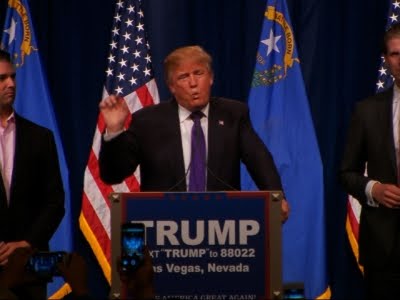 they were happy not to take that as an obvious insult. How, exactly, did he intend it? Both as contempt and affection. Any con man keeps a special place in his black-hole heart for people who cannot, or will not, see how he is hoodwinking them. None of us finds it easy to deal with the cognitive dissonance of realizing we may be wrong.
While Republican politicians have for decades praised and catered to the needs of oligarchs (as well as the merely wealthy who merely dream of being oligarchs), creating the greatest income disparity since the Roaring '20s, they have simultaneously encouraged working- and middle-class Americans to resent people who went to college and quite likely graduate school and have become specialists in various fields: historians, scientists, journalists, civil servants, elementary school teachers. Somehow, in this demented narrative, those professions are part of an administrative system that thwarts ordinary people's quest for freedom, liberty and the pursuit of happiness. (And some of them asked you and your kids to wear a mask during a global health crisis.)
The "elites" despised by the actual Republican elites like Cruz, Hawley and DeSantis are, of course, the people able to expose their grifting, their disinformation campaigns, their flouting of the rules, their contempt for the rule of law (at least as it applies to them) and their determination to retain power at any cost. They and their compatriots in propagandaTV andsocial media are bringing authoritarianism to America under a marketing label borrowed from Hungary: "illiberal democracy."
Today's Christian fascists don't ask what Jesus would do; they ask what Viktor Orbán would do. Anti-immigrant "Christians" get a kick out of seeing red-state governors troll the libs by using real human beings as pawns in a deliberately cruel media spectacle.
As these beliefs begin to spread in cult-like fashion, then teachers, judges, health experts, academics and even members of law enforcement — whom Republicans have always claimed to venerate — become objects of derision, even death threats.
In this classic divide-and-conquer move,[us vs them, polarization]the right has worked hard to get Americans to believe the worst possible things about elites, those conspiratorial, secular liberals who read books, believe that science and history should be based in research rather than political agendas and maintain a naive faith in democracy and the rule of law.
Such has been the power of this slow brainwashing that the right has gleefully separated brothers from sisters, children from parents, and friends from friends. The MSNBC–New York Times side regrets the loss of political comity; theFox–Wall Street Journal side [murdoch] cries for insurrection or civil war, or just shrugs at such threats.
All of this (or at least a lot of it) has been in service of aphony,shameless,sexually predatory,pathologically insecure,malignant narcissist who somehow (surprising even himself) was elected president, impeached twice and refused to concede defeat after losing by more than 7 million votes, inciting a violent, if amateurish, insurrection.
Meanwhile, there really are elites in America — you know, the people who went to school with Hawley and Cruz and DeSantis and can afford multiple residences, exotic vacations, well-tended stock portfolios and Washington lobbyists. Those elites are still pushing discredited Reagan-era "trickle-down" economics, working to destroy the last threadbare remnants of the social safety net and gleefully eroding democracy — all while laughing at how easy it was to convince the "people" to look somewhere else.
---
ref
https://www.salon.com/2021/02/19/from-newt-gingrich-to-donald-trump-rush-limbaughs-legacy-is-the-modern-gop/
no lnx twt
from Newt Gingrich to Donald Trump: Rush Limbaugh's legacy is the modern GOP
The right-wing cult Rush Limbaugh created was appropriated by Donald Trump — and lives on
By HEATHER DIGBY PARTON
Columnist
PUBLISHED FEBRUARY 19, 2021
Back in 2014, former Trump staffer Sam Nunberg was assigned to listen to talk radio all day and summarize the talking points for his boss as he assessed whether he was going to enter the presidential race. Trump had already learned the power of the right-wing media when he flirted with a run in 2012 by flogging the absurd "Birther" conspiracy theory and had decided that if he ran it would be as a Republican. But he didn't really know right-wing media. His experience with talk radio over the years had been with Howard Stern, whose show appealed to a different crowd. He was a TV guy and in those days he watched CNN as much as he watched Fox News.
So he got the notes and picked out the issues that appealed to him, like immigration and terrorism, and chose a few about which he was clueless but were crowd-pleasers like railing against "common core." He picked up some discrete stories that seemed to resonate with the GOP base such as the story of "Bowe Bergdahl, the dirty, rotten traitor" which also signaled his aggressive attitude toward military matters. And, of course, he added his own hobby horses like foreign trade which fit into this issue matrix perfectly since it was driven by the same xenophobia that drove the anti-immigrant fervor that was already at fever pitch on the right.
As it turned out, Trump was perfectly suited to become the first Republican nominee to run exclusively on the culture war issues that had animated conservative talk radio for the previous two decades. He may not have been a listener but he was a member of the tribe. And because he was naive about politics he had no sense that projecting the worst of hate radio was politically dangerous so he just put it all out there, unfiltered. I think most observers, including his GOP rivals, assumed that would be the kiss of death. Instead, it turned out to be massively popular among Republican voters.
They should have known, of course. The right had been primed for such a thing for years. And there is no one more responsible for that than Rush Limbaugh.
His radio show almost single-handedly created the culture war narrative that has come to define conservative politics. It's not that Limbaugh came up with every element on his own. There were plenty of racists, xenophobes, sexists, religious hypocrites and violent extremists long before he came along. But he found a way to synthesize their point of view into one over-arching worldview: coastal elites, Black people, immigrants, gays, feminazis and environmentalists are your enemy and they want to destroy America.
Seeing its organizing potential back in the early 90s, backbench congressman Newt Gingrich turned Limbaugh's narrative into a partisan weapon, launching a program designed to teach fledgling, right-wing politicians how to talk about themselves as heroic warriors for the American way and portray their political opponents as depraved savages bent on destroying everything Real Americans hold dear. When the Republicans won the House majority for the first time in decades in 1994, Limbaugh was made an honorary member of the freshman class. The new House Speaker said he couldn't have done it without him.
Gingrich was right. And there would have been no Donald Trump without Limbaugh either because there would have been no Trump base without him. Gingrich may have turned partisan, electoral politics into a blood sport but it was Rush Limbaugh who brought in the fans.
Limbaugh passed away this week and the right-wing encomiums to his decency and intellectual prowess are unsurprising but infuriating nonetheless. I don't think any single political figure other than Donald Trump has ever been this polarizing, so seeing these flowery tributes to his decency and fine character is hard to take. But if there's one thing the entire country, regardless of party or ideology, can agree upon it's that Rush Limbaugh is one of the most influential political figures of our time. His mean-spirited, crude "guy at the end of the bar" routine was the template for all of right-wing media and remains so today.
And for a time, the mainstream media was more than willing to accept him as one of their own. Back in 2002, the former Majority Leader Tom Daschle, D-SD, complained that Limbaugh had unleashed a torrent of invective against him, resulting in death threats to Daschle's family. The reaction from then Washington Post media critic Howard Kurtz was stunning:
Has Tom Daschle lost a couple of screws? Did the normally mild-mannered senator accuse Rush Limbaugh of inciting violence? He came pretty darn close. There were cameras there. You can watch the replay.
We can understand that Daschle is down, just having lost his majority leader's job and absorbed plenty of blame for this month's Democratic debacle. What we can't understand is how the South Dakotan can suggest that a mainstream conservative with a huge radio following is somehow whipping up wackos to threaten Daschle and his family.
Has the senator listened to Rush lately? Sure, he aggressively pokes fun at Democrats and lionizes Republicans, but mainly about policy. He's so mainstream that those right-wingers Tom Brokaw and Tim Russert had him on their Election Night coverage.
Limbaugh had indeed appeared on election night coverage, shocking anyone who knew what a depraved character assassin he was. The idea that he "poked fun" at Democrats "mainly about policy" was beyond absurd. After all, this was the man who shared insane conspiracy theories for years, like the one that claimed Vince Foster had been murdered in an apartment owned by Hillary Clinton. The mainstream media were finally forced to stop featuring Limbaugh after he made racist comments on ESPN, but that only made him more powerful in the GOP. Nicole Hemmer, author of "Messengers of the Right: Conservative Media and the Transformation of American Politics", observed:
As Limbaugh's political strength became evident, many Republican politicians felt they couldn't cross him, or run the risk of alienating his millions of listeners, Hemmer said. "Many of these listeners didn't care if Rush Limbaugh crossed the line (of propriety)," she said. "They cared more about loyalty to him than any kind of underlying set of principles."
As you can see, the cult Limbaugh created was simply appropriated by Donald Trump. The "Us vs Them" ethos fit him to a T. He saw no need to pander to anyone but his own voters and set about demonizing those who didn't vote for him, even to the point of threatening to withhold federal aid and favoring the states that voted for him. And he in turn has inspired a whole new generation of politicians to follow his example:[desantis?]
Rush Limbaugh's legacy will, unfortunately, live on in the Republican politicians who grew up listening to his derisive, contemptuous rhetoric and then watched as Donald Trump used it to wield power. He created a monster and we'll, unfortunately, be living with it for a long time to come.
By HEATHER DIGBY PARTON
Heather Digby Parton, also known as "Digby," is a contributing writer to Salon. She was the winner of the 2014 Hillman Prize for Opinion and Analysis Journalism.
MORE FROM HEATHER DIGBY PARTON
---
---
who broke am?
https://www.alternet.org/2022/08/how-radicals-and-extremists-are-poisoning-the-republican-brand-columnists/
Back in the early 1970s, President Richard Nixon famously complained that Republican candidates felt pressured to go arch-conservative in GOP primaries only to turn around and run as fast as they could to the center during the general election. Nixon was considered arch-conservative in his day, yet he hated conservative purity tests.
Looking back on Nixon’s comments in 2022, the ironic part is that Nixon and so many of the fellow conservatives he debated in GOP primaries during the 1960s and 1970s would be slammed as RINOs (Republicans In Name Only) by the MAGA Republicans of today.
Back in 1970 or 1975, Republicans didn’t fear they would be run out of the party if they criticized the far-right John Birch Society; William F. Buckley, in fact, was adamant about keeping the Bircher conspiracy theorists out of the pages of his National Review. But the Republican primaries of 2022 are full of MAGA candidates who insist that Senate Minority Leader Mitch McConnell and Rep. Liz Cheney of Wyoming aren't aligned with the Republican party.
Extremism within the GOP is the focus of two opinion columns published by the Washington Post in early August: one byDana Milbank and the other by conservative Henry Olsen. Milbank’s column is actually an excerpt from his new book, “The Destructionists: The Twenty-Five Year Crack-Up of the Republican Party,”which has an August 9 release date on Amazon. Many Never Trump conservatives and Blue Dog Democrats believe that the GOP took a very dark turn when Donald Trump ran for president in 2016, but as Milbank sees it, the GOP was overrun with extremists long before that.
Milbank argues that the GOP took a much nastier turn in 1994, when the combative Newt Gingrich replaced Bob Michel as GOP leader in the U.S. House of Representatives.
“Bob Michel, the unfailingly genial leader of the House Republican minority for the previous 14 years, had ushered Ronald Reagan’s agenda through the House,” Milbank recalls. “But he was being forced into retirement by a rising bomb thrower who threatened to oust Michel as GOP leader if he didn’t quit…. Newt Gingrich had almost nothing in common with the man he shoved aside. Michel was a portrait of civility and decency, a World War II combat veteran who knew that his political opponents were not his enemies and that politics was the art of compromise. Gingrich, by contrast, rose to prominence by forcing the resignation of a Democratic speaker of the House on what began as mostly false allegations, by smearing another Democratic speaker with personal innuendo, and by routinely thwarting Michel’s attempts to negotiate with Democrats…. The rise of Gingrich and his shock troops set the nation on a course toward the ruinous politics of today.”
Milbank continues, “Much has been made of the ensuing polarization in our politics, and it’s true that moderates are a vanishing breed. But the problem isn’t primarily polarization. The problem is that one of our two major political parties has ceased good-faith participation in the democratic process.Of course, there are instances of violence, disinformation, racism and corruption among Democrats and the political left, but the scale isn’t at all comparable.Only one party fomented a bloody insurrection and even after that voted in large numbers — 139 House Republicans, a two-thirds majority — to overturn the will of the voters in the 2020 election.”
READ MORE: [How Trump made Arizona’s gubernatorial race a vendetta against Doug Ducey
According to Milbank, other factors that “sped” the GOP’s “turn toward nihilism” included “the ascent of conservative talk radio, followed by the triumph of Fox News, followed by the advent of social media.”
“Combined, they created a media environment that allows Republican politicians and their voters to seal themselves in an echo chamber of ‘alternative facts,’”Milbank explains. “Globally, south-to-north migration has ignited nationalist movements around the world and created a new era of autocrats. The disappearance of the Greatest Generation, tempered by war, brought to power a new generation of culture warriors…. It is crucial to understand that Donald Trump didn’t create this noxious environment. He isn’t some hideous, orange Venus emerging from the half-shell. Rather, he is a brilliant opportunist; he saw the direction the Republican Party was taking and the appetites it was stoking.”
Meanwhile, Olsen, in his August 3 column, makes it clear that he would much rather see conservatives running the federal government than liberals. But he fears that the GOP’s “radicals” are undermining the party’s chances of enjoying a “potentially momentous midterm win” in 2022.....
---
---
curently advising on 2022 midterms
emience griese? anti-commie?
---
==
an 8 22
no lnx twt
Donald Trump peddles conspiracy theory about FBI 'planting' evidence
.
Igor Derysh and Salon August 10, 2022
President Donald Trump and his lawyers pushed a conspiracy theory that FBI agents may have "planted" incriminating evidence while executing a search warrant at his Mar-a-Lago residence.
FBI agents on Monday executed a warrant at Trump's Palm Beach home, meaning that a judge found enough probable cause to approve the search. Agents investigating presidential documents that Trump took with him to Mar-a-Lago, including classified materials, removed 12 boxes of items from Mar-a-Lago after Trump turned over 15 boxes of materials to the National Archives earlier this year, according to the Washington Post.Trump attorney Christina Bobb told the outlet that the search warrant indicated that the FBI is investigating possible violations of the Presidential Records Act and laws related to the handling of classified material. Trump has thus far refused to release his copy of the search warrant even though it could provide transparency on what agents were searching for.
Bobb said that she was not allowed to observe the search, as is common during such FBI operations. But Trump and his lawyers have seized on that fact to push a conspiracy theory that the FBI may have "planted" something without providing any evidence to support their claims.
"The FBI and others from the Federal Government would not let anyone, including my lawyers, be anywhere near the areas that were rummaged and otherwise looked at during the raid on Mar-a-Lago," Trump said on his Twitter knockoff Truth Social. "Everyone was asked to leave the premises, they wanted to be left alone, without any witnesses to see what they were doing[CCTV?] , taking or, hopefully not, 'planting.' Why did they STRONGLY insist on having nobody watching them, everybody out? Obama and Clinton were never 'raided,' despite big disputes!"
Bobb, a former TV host at the right-wing outlet OAN who joined Trump's legal team, made a similar claim on Monday, citing only the fact that she was not allowed to observe the search.
"There is no security that something wasn't planted," Bobb said in an interview, adding, "I'm not saying that's what they did."
"At this point, I don't necessarily think that they would even go to the extent of trying to plant information, I think they just make stuff up and come up with whatever they wantand that's the way that they will have to proceed in order to actually try to indict the president because they don't have anything," she said.
Fellow Trump attorney Alina Habba told Fox News that she was also "concerned that they may have planted something. You know, at this point, who knows? I don't trust the government and that's a very frightening thing as an American."
Trump's right-wing allies have parroted this evidence-free claim to their followers.
Sen. Rand Paul, R-Ky., cited his distrust of the government to suggest that the FBI "may put something" in the boxes they removed from Mar-a-Lago to "entrap" Trump.
"I think there is an extremely high probability that the FBI planted 'evidence' against President Trump," tweeted Rep. Marjorie Taylor Greene, R-Ga. "Otherwise WHY would they NOT allow his attorneys or anyone watch them while they conducted their unprecedented raid? They know the consequences of an empty handed power move."
Former House Speaker Newt Gingrich, R-Ga., and Trump ally Charlie Kirk, the founder of Turning Point USA, both discussed their belief that the FBI may have "planted evidence" on Kirk's show Monday.
Trump's defenders on Fox News have also echoed the claim.
"They could have easily negotiated the return of documents like that without guns and warrants. What the FBI is probably doing is planting evidence," Fox News host Jesse Watters said without any evidence. "We also have a hunch they doctored evidence to get the warrant."
Fox & Friends host Ainsley Earhardt suggested that FBI agents may have dumped "backpacks" full of incriminating evidence at Mar-a-Lago.
:{:{}:
}:
"His lawyer said they brought in backpacks, what was in those backpacks?" Earhardt said. "Did they bring those in to fill them up or did they have something in there?"
Agents raided Mar-a-Lago because they believed Trump did not turn over all classified information he had taken to his home, according to The Wall Street Journal. Trump's lawyers had been in discussions with federal officials about the records for months. Trump attorneys in June showed investigators a basement room where boxes of materials were being stored. The Justice Department directed Trump's team to secure the room, prompting them to add a padlock to the door. It's unclear what triggered Monday's raid.
Legal experts pushed back on the claims. Former federal prosecutor Elie Honig called the idea that FBI agents "may" have planted evidence "ridiculous."
"How would anybody even know at this point?" he questioned. "If you're going to fabricate some accusation, at least wait until you might plausibly have a basis for it."
Former federal prosecutor Richard Signorelli condemned Trump's attorneys for pushing the claim.
"These are baseless lies but unfortunately will be believed by deranged, ignorant MAGA cult members," he tweeted.
Defense attorney Ken White noted that forbidding anyone from observing their searches is standard practice.
"Law enforcement does not let anyone, including lawyers, observe what they're doing during searches," he wrote. "They typically remove everyone from the searched area. This has always been the case. This is the latest 'it's an outrage when the typical happens to me.'"
Former federal prosecutor Michael Stern suggested that TrumpWorld is trotting out the claim because the FBI may have found damaging evidence at his home.
"I have written hundreds of search warrants. Lawyers and people whose homes are being search[ed] are routinely not present during the search," he wrote. "That Trump is now talking about 'planted' evidence means he knows there is something damning they found."
---
---
deny deflect ctr attack accusation (impugn motives? honesty?)
6 22 aha-let
I have noticed that every gop reply to reporter (or any remark he takes as critical) auto mantra is create the premise that it is tainted b/c comes from dems / liberal media? eg cruz when cornered bbc uvalde (trepworten? ) I am sorry you don't like/hate am exceptionalism
gingrich memo? prez debate braking new that day about sex? scandal? would you like to address (the elephant in the rm) NO, but ....press attack
cohen origin?
---
---
bogeyman july 2009
https://www.nbcnews.com/id/wbna31750700
week before her Senate hearings, Republicans are floundering in their efforts to trip up Supreme Court nominee Sonia Sotomayor, unable to find an effective message about why she's not fit to serve.
Blame the tricky politics of opposing the woman who would be the first Hispanic justice, especially for a party struggling to broaden its base and whose chief spokesman on Sotomayor has a troubled history of racism allegations.
Add to that the mathematical impossibility of Republicans' rejecting President Barack Obama's first high court nominee, and it's a recipe for a weak-kneed response.
Conservative activists have noticed, and they're not happy.
"Too many Republicans and conservatives planned to lose instead of planning to win" the debate over Sotomayor, said Tom Fitton of Judicial Watch. His group has mounted strong opposition to the federal appeals court judge.
About half the Senate's Republicans are willing to raise serious questions about Sotomayor and there's "a sizable minority who — partly because she's Hispanic — just want this to go away," said Curt Levey of theCommittee for Justice.
Conservative groups have sought to convince Senate Republicans that they can benefit politically by strongly opposing Sotomayor. But many of their leaders complain the message isn't getting through.
During recent confrontations, some activists have told GOP senators, "Don't throw away yet another conservative agenda item when it's a successful one for you. Your base cares about this and you should, too," said former Rep. David McIntosh, R-Ind., who's advising some outside groups on Sotomayor's nomination. "It was kind of a blunt message."
There are good reasons for Republicans to be holding back, wondering what their best approach is to opposing a nominee who's broadly acknowledged to be qualified and whose past rulings make it difficult to pigeonhole her as a liberal crusader.
The GOP has just 40 votes in the Senate — well short of the majority they would need to defeat Sotomayor or to sustain a drawn-out effort to block a final vote to confirm her.
Even if they could stall Sotomayor's nomination, though, it's evident that many Republicans don't think it's politically prudent to take on a Hispanic woman, given the GOP's low standing in the polls and its efforts to appeal to women and minorities. Those groups traditionally have shunned the party.
The issue of race and ethnicity has proven a toxic one for the key Republican carrying the party message on Sotomayor: Alabama Sen. Jeff Sessions, the senior GOP member of the Senate Judiciary Committee, which begins hearings on Sotomayor on July 13....Sessions' own nomination for a federal judgeship in 1986 was scuttled by allegations that he made racist comments and targeted black civil rights leaders as a federal prosecutor in Alabama....denied those charges. But he did acknowledge making what he called some off-color "jokes," such as calling civil rights groups such as the National Association for the Advancement of Colored People "un-American."
Sessions has spoken in similar terms recently about a Puerto Rican legal advocacy group on whose board Sotomayor sat from 1980 until 1992.
"This is a group that has taken some very shocking positions with respect to terrorism," Sessions said of LatinoJustice PRLDEF, citing its defense in 1990 of Puerto Rican nationalists who 36 years earlier had wounded five lawmakers during an attack on the House while it was in session....Sessions said Thursday the group's stances on issues from capital punishment to race were "extreme." His staff raised concern about its ties with the community organizing group ACORN,which Republicans routinely describe as a radical organization.
Democrats said the GOP was grasping at straws.
It's not that Republicans aren't criticizing Sotomayor. Early on, they went out of their way to treat her gently, trying to distinguish themselves from party firebrands such as radio host Rush Limbaugh andformer House Speaker Newt Gingrich who called her a racist.
In recent days, GOP senators have faulted her for her stance on gun rights, her ruling against white firefighters who alleged reversed discrimination, and her participation in the Puerto Rican legal advocacy group. They've raised questions about her ability to be "colorblind."
Still, they've had to reach to score points against Sotomayor.
For instance, Republicans recently banded together to raise concerns about her position on gun rights. They held a news conference about an appeals court decision Sotomayor joined that said the Second Amendment's protection against curbs on bearing arms applies only to the federal government — not to states.
That was in line with Supreme Court precedent on the issue, Sessions acknowledged, and presumably in keeping with GOP views that judges should be restrained.
But Sen. John Cornyn, R-Texas, criticized Sotomayor for taking a "cramped and restricted view of a basic civil liberty." At the same time, Sen. Orrin Hatch, R-Utah, said Sotomayor had been too expansive in her ruling on the right to keep and bear arms. "I wish Judge Sotomayor had been similarly restrained on these issues" as other courts that ruled differently, he said.
The message was as clear as mud.
---
john s salon an 1/22
New Hampshire Gov. Chris Sununu, who recently bowed out of a much-anticipated U.S. Senate bid, revealed that he was "bothered" after conversations with dozens of Republican Senators, who apparently wanted him to be a "roadblock" until the GOP retakes the White House.Sununu told The Washington Examiner this month that he was initially "pretty close" to running, explaining: "I wasn't ready to make an announcement, but I was like, 'OK, this makes sense. I think I could be a voice nationally.'" But after chatting with "most" of the GOP Senate caucus, Sununu reportedly soured on the role once it became apparent that they wanted him to be a legislative mule.
"They were all, for the most part, content with the speed at which they weren't doing anything. It was very clear that we just have to hold the line for two years," he told the Examiner. "OK, so I'm just going to be a roadblock for two years. That's not what I do."
"It bothered me that they were OK with that," the governor added.
Sununu's comments come in the wake of an intense legislative standoff between Democrats and Republicans over voting rights, an issue which became the focus of President Biden's agenda after negotiations on the "Build Back Better Act" – the president's $2.2 trillion social safety net plan – fell apart.
On Wednesday, Senate Republicans successfully filibustered Biden's sweeping voting rights overhaul – known as the "Freedom to Vote: John R. Lewis Act" – which would standardize voting laws across all 50 states and clamp down on voter suppression. Not a single Republican backed the measure, even though the bill is supported by nearly 70% of Americans, according to a Navigator poll from November.
With Republicans having dashed Biden's hopes of passing the party's two signature pieces of legislation – the "Build Back Better Act" and the "Freedom to Vote: John R. Lewis Act" – Democrats now question whether their colleagues believe in anything other than mindless obstructionism.
During a press conference on Wednesday, Biden echoed the spirit of Sununu's remarks, asking reporters, "What are Republicans for? What are they for? Name me one thing they're for."
That same day, Senate Minority Leader Mitch McConnell, R-Ky., sidestepped questioning when asked to lay out GOP's official agenda. "That's a very good question," McConnell said. "And I'll let you know when we take it back."
According to a recent Axios report, the Kentucky Republican has privately told colleagues and donors that the Republicans have no legislative agenda and are more interested in picking apart Democrats'.
Meanwhile, the House GOP caucus appears to be adopting the opposite strategy, according to The Washington Post, with its leadership drumming up a "list of policy pledges" designed to buoy support for the party in 2022.
Among those helming this effort are House Speaker Kevin McCarthy, R-Calif., and House Whip Steve Scalise, R-La., both of whom ardently supported Donald Trump's election fraud conspiracy and voted to overturn the 2020 election.
Playing an advisory role to McCarthy is former Republican House Speaker Newt Gingrich, who crafted the "Contract with America," a legislative platform widely linked to the GOP's successful campaign to flip both chambers in 1994.
Gingrich told the Post that McCarthy doesn't believe an anti-Biden agenda is sufficient for 2022, saying, "We need a positive message."
"I think that's clearly what McCarthy wants to do and I've offered to look at stuff and offer advice," Gingrich added. "There's lots of people in the House working on it. It will be a widespread commitment."
While the exact details of McCarthy's agenda remain hazy, the broad contours of the plan are clear.
So-called "parental rights" are expected to be front and center as Republican state officials continue to decry the alleged instruction of "critical race theory" – whose prevalence appears to be vastly overstated. For remedy, McCarthy has already released an informal "Parents Bill of Rights," which includes such provisions as the "right to be heard" and the "right to know what's being taught in schools and see reading material."
The House Speaker is also expected to assemble seven "issue-specific task forces" that will tackle a variety of other policy objectives, such as countering China's economic prowess, combating the recent crime wave, securing the nation's borders, regulating Big Tech,cutting corporate taxes, bulldozing environmental regulations, and curtailing inflation.
The soaring cost of consumer goods has proven an evergreen source of whataboutism for Republicans, even as the year-end jobs numbers indicate that Biden has steered the economy through an unprecedented economic recovery since he took office. Fox News called inflation a "top weapon" for the GOP to wield against Democrats in the upcoming midterms.
Throughout 2021, the consumer prices index rose 6.8% – the highest increase it has seen since 1982.
But when it comes to actually tackling inflation, lawmakers have historically had to walk a tightrope, said Brian Riedl, who served as an aide to Sen. Rob Portman, R-Ohio.
"There is nothing that messages well, significantly reduces inflation and is painless," Riedl told the Post. "It's easier to criticize inflation than to map out an actual solution going forward, and that's the box Republicans are currently in."
---
---
pension plan
no lnx
Paul Ryan Is Poised to Earn Millions When He Retires Next Year
BY
BLOOMBERG
April 12, 2018
Paul Ryan will easily add to his already considerable net worth if he opts to stray from his native Wisconsin to join a corporate board or dabble in Washington power struggles when he retires next year as speaker of the U.S. House of Representatives.
“The kind of board that he would go after would probably pay between $250,000 and $300,000 a year and he could probably get three or four of them,” said Fred Foulkes, a professor of at Boston University’s Questrom School of Business. “There would be dozens that would like to have him, particularly companies that have part of their business in key relationships with certain parts of government.”...
Ryan, 48, who said he was retiring to be more than a “weekend dad,” could easily follow the path of previous congressional leaders, including Newt Gingrich and Richard Gephardt, who became corporate directors. Former Speaker John Boehner, his immediate predecessor, recently joined the advisory board for U.S. cannabis producer Acreage Holdings and is already serving on the board of Arizona Mining Inc. and the advisory board to JBS USA, the American arm of a Brazilian food giant. That’s in addition to being a senior strategic adviser at the law firm of Squire Patton Boggs LLP.
Ryan cannot jump right into lobbying, there’s a one-year cooling-off period for representatives, two for senators. But nothing bars him from joining boards.Since 1992, 44 percent of senators and 11 percent of representatives who’ve departed Capitol Hill have ended up in boardrooms, according to research from Harvard University and Boston University that was published before the 2016 election.
From Capitol to Capital
A Bloomberg analysis before that election showed that among directors who had previously served in Congress there were 31 Democrats and 33 Republicans, with the average pay more than $330,000.
Ryan will no longer be making his speaker’s salary of $223,500, but he will be eligible for a pension in a few years, and has an estimated net worth of slightly more than $6 million, according to a Center for Responsive Politics analysis of his 2016 financial filings. AshLee Strong, a Ryan spokeswoman, didn’t respond to an email seeking comment on her boss’ potential future employment.
Bloomberg Data: The Lucrative Road From Congress to Corporate Boards
When he accepted the speaker’s post in 2015, Ryan said he would do so only under certain conditions — including that he would reduce the amount of travel involved. He said he wanted to spend most weekends at home in Janesville, Wisconsin, where he and his wife, Janna, have three school-age children.
Ryan managed to spend most weekends sleeping in his brick home on a quiet street, although it meant his political team had to schedule fundraising and other events during the week.
“Basically, the guy is viewed as Mr. Middle America — he’s a capitalist who wants companies to do well — board service would make a lot of sense for him,” said Tom Flannery, who leads the global chief executive board services practice at Boyden, the executive recruiter. “It’s something he could do very well and still get to spend a lot of time with his family and hunting and fishing and whatever else he does.”
Corporations aren’t the only option. Since giving up the gavel in 1998, Gingrich has had more than a dozen books on the New York Times bestseller list and earned millions in consulting fees from health care, financial and other interests. When he ran for the Republican presidential nomination in 2012, he released his 2010 tax return, which showed adjusted gross income of $3.2 million.
Ryan would have no trouble finding work back in Washington, even if he chose to limit the time he spent in the capital, said Ivan Adler, principal at the McCormick Group Inc., an executive search firm. “A part-time Paul Ryan is better than full-time of lots of other people in Washington,” he said.
“He’s very well-connected to the business community and he’s a substance-based thinker on policy issues,” Adler said. That kind of experience will earn a premium. “He’s a million-dollars-plus easily, and people will be glad to pay it.”
Former New York congressman Thomas Reynolds, who entered the House in the same 1999 freshman class as Ryan and is now a lobbyist, said he believes Ryan’s immediate post-congressional aspirations will be different from that of his recent predecessors.
“At 48, I don’t see him going to work right away as a lobbyist, though he certainly is capable of that,” said Reynolds, a senior policy adviser at Holland & Knight LLP.
Rather, Reynolds said he expects Ryan to “keep his options open” for a re-entry into politics. And he said that could be as a highly paid speaker, or as a policy expert at a think-tank, and possibly serving on some corporate boards.
---
---
https://www.alternet.org/2021/05/newt-gingrich-trump/
ah
In 1994, when President Bill Clinton was serving his first term, then-House Minority Whip Newt Gingrich unveiled his Contract With America — a hard-right Republican legislative agenda that Gingrich's critics slammed as the Contract On America. Republicans recaptured the House in the 1994 midterms, and Gingrich became House speaker in January 1995.Now, in the Biden era, Gingrich is a major ally of former President Donald Trump — and according to Politico reporter Meridith McGraw, Gingrich and Trump are joining forces for a new version of the Contract With America for the 2022 midterms. But the 2022 version, McGraw reports, will have a much more Trumpian focus.
"With an eye toward winning back the House and Senate in the 2022 midterm elections, former President Donald Trump has begun crafting a policy agenda outlining a MAGA doctrine for the party," McGraw reports. "His template is the 1994 'Contract With America,' a legislative agenda released ahead of the midterm elections in the middle of President Bill Clinton's first term. And as a cherry on top, he's teaming up with its main architect — Gingrich — to do it."
McGraw adds that according to a Politico source, Trump recently met with Gingrich, former White House Chief of Staff Mark Meadows and Sen. Lindsey Graham of South Carolina at Trump's Mar-a-Lago resort in South Florida to "begin crafting the document." twt]
"The group is still just beginning to hammer out the details of what a Trumpified Contract might look like," McGraw explains. "But it is likely to take an 'America first' policy approach on everything from trade to immigration. The source described it as 'a policy priority for 2022 and beyond.' Its construction has been teased and talked about for weeks, but the fact that the principals are beginning to put it together underscores Trump's continued interest in trying to shape the Republican Party."
The 77-year-old Gingrich, however, told Politico that he doesn't expect the 2022 plan to be finalized "anytime soon." When Politico asked him to outline some policy priorities that it may include, the former House speaker responded, "It should be positive. School choice, teaching American history for real, abolishing the '1619 Project,' eliminating critical race theory and what the Texas legislature is doing. We should say, 'Bring it on.'"
Like Barack Obama, Clinton went down in history as a president who was decisively reelected but suffered a major setback at the midterms. 1996 was a great year for Clinton, who was reelected with 379 electoral votes compared to only 159 for Republican nominee Bob Dole. But Democrats suffered a major pounding in the 1994 midterms.
"The original 'Contract with America' was credited with helping Republicans gain their first majority in four decades after the party picked up 52 seats in 1994 in the House and nine seats in the Senate," McGraw recalls. "Republicans have used it as a template in elections since."
The Politico reporter continues, "In 2010, the so-called Republican 'Young Guns,' led by Reps. Eric Cantor, Paul Ryan and Kevin McCarthy, introduced a much longer version of Gingrich's contract with a 224-page publication outlining policy goals ahead of the midterm elections. And Graham, who was one of the Contract's signatories when he first ran for a House seat in 1994, has frequently advocated for Republicans to adopt Contract-style declarations to unify the party during election years."
FROM YOUR SITE ARTICLES
- Mike Pence gets skewered as Trump's 'chief bootlicker' and ... ›
- Noam Chomsky weighs in on impeachment, 2020 election and Syria ... ›
- Pence and Pompeo headline launch of think tank founded by ... ›
RELATED ARTICLES AROUND THE WEB
- How Newt Gingrich Destroyed American Politics - The Atlantic ›
- Newt Gingrich warns making Trump a martyr will divide America ... ›
- Trump is the 'most effective uprooter of liberalism': Newt Gingrich ... ›
---
HNN
https://www.alternet.org/2021/01/conservative-movement/
One of the challenges in trying to understand what has happened to a conservative movement that has clearly become detached from reality, is that for decades we've heard that someconservatives needed to be taken seriously as intellectuals. These chosen conservatives are often anointed as "serious" due their academic pedigree (usually Ivy Leaguers). But the equating of impressive degrees with intellectual seriousness has an especially bad track record for conservatives. Time and again when it comes to the integrity, honest analysis, and basic grasp of facts that are the basic standards of any "serious" scholar, they have failed.
Let's make a list of today's conservatives who currently get the "serious" designation by virtue of their elite education and for not being Louis Gohmert. In light of last week's conspiracy-driven, right-wing attack on Congress, Senators Josh Hawley and Ted Cruz stand out for their unrelenting intellectual dishonesty. Both Hawley (Yale, JD) and Cruz (Princeton BA, Harvard JD) took to the floor of the Senate just hours after right-wing collaborators had vandalized the Capitol and threatened their colleagues out of an unmoored conviction that the 2020 election had been stolen. Multiple recounts, election certifications, and dozens of court cases later, these two Ivy Leaguers shamelessly continued to raise "concerns" about the election's basic fairness. Yet, when Hawley lost his book contract on the dangers of "big tech" with Simon & Schuster over the weekend, the Washington Post's Fred Hiatt expressed a hesitant reservation at a publisher deciding it didn't like the author instead of the manuscript.Up until that point, Simon & Schuster "obviously believed" that Hawley's manuscript had "merit" and Hiatt assumes that it would have made "a useful contribution to public debate on a vital subject." Especially after Hawley's surreally dark turn last Wednesday night, why should we assume that a "useful contribution" was forthcoming from him on any debate? Hawley had led investigations into Google and Facebook, to be sure. But certainly part of the answer is that Hawley was seen a "serious" conservative. Ana Marie Cox's recent Washington Post article on Ted Cruz meanwhile stands out for her refreshing willingness to suggest that perhaps, just perhaps, Cruz, despite his reputation for smarts, is "devastatingly average." Mimi Swartz has also started to peel the protective cover of seriousness back. Cruz used "his pseudo-intellectualism and his Ivy League pedigree as a cudgel." And now, she adds, "Any decent soul might ask: If you are so smart, how come you are using that fancy education to subvert the Constitution you've purported to love? Shouldn't you have known better?" Assuming that an Ivy League degree translates into conservatives knowing better has been the problem all along. Swartz adds correctly that Cruz "did know better; he just didn't care." And because he was tabbed as a "serious" conservative, he didn't have to.
Senator Tom Cotton (Harvard BA, JD) stood out last Wednesday by not joining his fellow Ivy Leaguers in their objections on the Senate floor; but he'd already shown his flair for dangerous hyperbole and distortion last summer when the New York Times ran the Senator's opinion piece calling for the troops to march on Black Lives Matter protestors. Cotton cherry-picked the most extreme examples of unrest to malign the overwhelmingly peaceful protests happening on the streets. As any scholar will tell you, cherry-picking the evidence is both lazy and untrustworthy. Not a good look for someone posing as a "serious" conservative.
And one could go on. What really connects these elite-educated Senators is precisely their lack of seriousness intellectually. It's not new, however. Going back to the 1960s, alarmed that the conservative movement was falling into the grips of the delusional John Birch Society, William F. Buckley (Yale, BA) was anointed as that generation's "serious" conservative. While Buckley was public intellectual rather than an office-holder, his political influence was considerable and timely for the conservative movement. In particular, Buckley disavowed the Birchers, whose view of the world was rife with conspiracy theories and seething anti-communism. Some Birchers were convinced that Dwight Eisenhower himself was a communist plant, so the bar was pretty low here for a "serious" conservative to clear. The soft bigotry of low expectations, I guess. But Buckley also wrote in 1957 that the white South was right to oppose the civil rights movement because, he wrote, "for the time being, it is the advanced race." This was, he continued, "a fact . . . that cannot be hidden by ever-so-busy egalitarians and anthropologists." While over his long career Buckley did continue to reexamine the state of conservatism – indeed he had grave reservations about the war in Iraq – his entry intothe ranks of "serious" conservatism was by virtue of his patrician background and elite education. Once in, like the "serious" conservatives of today, he had permission to be either wildly wrong or occasionally right.
in between Buckley's heyday and the current crop of Ivy League-right wingers, we had the era of William Bennett and Newt Gingrich in the 1980s and 1990s. Bennett (Williams College BA, University of Texas PhD, Harvard JD) harrumphed his way to becoming the nation's high school principal, or officially, the Secretary of Education, under Ronald Reagan. In the early 1990s he published The Book of Virtues: A Treasure of Great Moral Stories. It started with a quote from Plato's Republic, and invoked Aristotle in the first paragraph, so you knew it was serious. The book included lessons on the importance of saying "please" and a Laura Richards poem, "In which we which learn to sit still." That this was heralded as an "important" book can only be attributed to the fact that Bennett had earned his stripes as a "serious" conservative. Newsweekpractically sighed with gratitude: "Maybe this is just what the country needs."
And then there was Newt Gingrich (PhD, Tulane). After having been denied tenure at West Georgia College, Gingrich eventually won a seat in the House of Representatives in 1978. He injected into the increasingly conservative Republican Party the slashing political style we all recognize now. Democrats were not simply the opponent, they were "radical" and "traitors." Pundits and columnists of the 1990s raised their collective eyebrow over Gingrich's style even as they soberly reminded their readers that Gingrich had a doctorate and had been a college professor. A 1995 New York Times profile noted that he compared himself to, "Washington, Lincoln, Roosevelt, Eisenhower, Churchill, and De Gaulle." But it also noted that while Gingrich "came to congress in 1979 as a 35 year-old history professor," he often used "hyperbole, absolutes and distortion to make his points, and he can be careless with facts and numbers." While perhaps these are just tools of the trade in politics, they make one unserious as a scholar. But Professor Gingrich has dined out for years now on his farcical reputation as a "serious" conservative.
Like Gingrich, today's elite-educated conservative politicians continue to get a pass when it comes to the basic ethical standards of real scholars, especially the moral obligation to be true to the evidence and facts. Ironically, toward the end of that long day of sedition last week, this principle was articulated poignantly by another conservative, one known more for his religion and wealth than his academic credentials. Mitt Romney (Harvard, JD/MBA), looking exhausted and shaken,pleaded with his fellow Republican senators, "The best way we can show respect for the voters who are upset is by telling them the truth." Sadly, Hawley, Cruz, Cotton, et al., will likely continue to spread lies to keep their conservative base shored up. Their seriousness lies in the danger of their politics, but they themselves are not "serious" conservatives.
---
---
Gingrich is blaming Trump's loss on George Soros.1120 mma
---
https://www.alternet.org/2020/11/more-and-more-republicans-are-piling-onto-conspiracy-theories-about-vote-counting/
kos
To read Donald Trump's Twitter feed, you'd think that counting votes is an inherently suspicious activity. As his campaign files lawsuits to try to stop votes from being counted in Michigan and Pennsylvania, Trump is frenetically trying to whip up his base against any vote-counting activity that might not help him—and a series of House Republicans are acting as his winged monkeys, throwing their weight into legitimizing Trump's efforts to delegitimize the basis of democracy.
Trump has promoted a Breitbart piece attacking Pennsylvania Attorney General Josh Shapiro, and announced, as if it was evidence of wrongdoing,"We are winning Pennsylvania big, but the PA Secretary of State just announced that there are 'Millions of ballots left to be counted.'" Four of Trump's tweets in the past 24 hours have gotten Twitter warning messages that "Some or all of the content shared in this Tweet is disputed and might be misleading about an election or other civic process."
He has help.
Rep. Paul Gosar bragged about having joined Trump supporters outside the site where ballots were being counted in Maricopa County. The aggressive group was apparently motivated by a conspiracy theory about votes being changed rather than counted, and it included far-right anti-immigration activists and threatened reporters.
Rep. Kevin Brady repeated Trump's lies about vote counting being conducted in secrecy, cloaking a lie as a call for transparency.That transparency already exists, however—though law enforcement in more than one city has had to defend vote-counting sites against mobs of Trump supporters trying to get inside to disrupt counting. Rep. Jim Banks tied together a Peter Strzok conspiracy theory with a reference to "the shady ballot counting happening in WI, MI and PA." You know, the ballot counting. Which Republicans insist must be shady, because it's not going their way.
The majority of the Pennsylvania state House tweeted that "The failure of Pennsylvania to have firm election results on Election Day is an openly partisan failure by Democrats from the Wolf administration to the PA Supreme Court." Except the failure of Pennsylvania to have firm election results on Election Day is a direct result of Republican legislators blocking election officials from counting or even processing mail ballots before Election Day!
Former House Speaker Newt Gingrich enthusiastically jumped on board with claims that "Wisconsin, Michigan and Pennsylvania are all being stolen by Democrats." Again, because votes are being counted.
That's the substance of Republican angst: Votes are being counted, and those votes may not go the way Republicans want them to go. That must be the result of conspiracy and cheating and outright theft by Democrats, they claim, with a big dose of rage that the votes of Black people are being counted at all.
Meanwhile, Joe Biden's message is simple: "Every vote must be counted."
---
---
1/12
https://www.rollingstone.com/politics/politics-news/how-wily-newt-pulled-the-contract-with-america-scam-200577/
Newton Leroy Gingrich is one wily mothertrucker. He’s calling his presidential platform this year a “21st Century Contract With America.” It’s a wingnutpalooza, naturally, endorsing such “timeless American values” as seeking to “establish English as the official language of government,” and reducing the corporate tax rate to 12.5 percent and the capital gains rate to zero; and featuring such “Day One Executive Orders” as the cancellation of all “immigration-related lawsuits against states” and a renewal of “President Ronald Reagan’s policy … to stop taxpayer dollars from being used to fund or promote abortions in foreign country.” (Critics call that the “global gag rule,” because it forbids any country receiving American aid from letting doctors even talk about family planning.)
The title, of course, refers to the Contract With America, which 367 Republican congressional candidates signed on the Capitol steps in September of 1994. When, two months later, the GOP took over Congress for the first time since 1952, making its architect, Newt Gingtrich, the Speaker of the House, all the world proclaimed that the electorate had just delivered a historic mandate for conservatism.
Well, not really. The Contract With America was a hustle from start to finish. It never really was about conservatism at all – practically the opposite. The fact that Newt can redeploy it to promote his right-of-Attila-the-Hun harpyish shrieking for 2012 just shows how effective the hustle – and the hustler – turned out to be.
Here’s what happened: Ross Perot. Specifically, the weirdo billionaire Texas populist won nearly nineteen percent of the popular vote in the 1992 presidential election – the most for a third-party candidate in 80 years – with an odd platform of fiscal conservatism and social liberalism, Immediately and instinctively, both parties began bidding for his constituency. The Democrats, however, had to punt: President Clinton had made passing the North American Free Trade agreement his obsession in 1993, but opposing it was Perot’s obsession.
In stepped the Republicans. The party’s Orwellian-in-Chief, messaging guru Frank Luntz, spoke at a Republican retreat a month after Clinton’s inauguration and described the Perot vote as “the GOP’s future.”Newt Gingrich, convinced, implored every Republican candidate and official to read Lunt’z presentation.
Other bigwigs demurred: Bob Dole, for instance, said Perot was nothing but a “walking sound bite,” and pointed out, “There are more new taxes in his program than in Clinton’s program.” Aye, there was the rub: Perot was no conservative.His quirky mix of policy prescriptions included huge hikes on gas and tobacco taxes and new taxes on social security and employee health insurance benefits; he was obsessed with the federal deficit, and dead serious about eliminating it. He was for less American involvement abroad, and abhorred the politicization of the kind of “social issues” around which the Republicans had organized their 1992 convention. (Their platform opened with a nearly-6,000-word section, 14 percent of the document, on “traditional family values,” and featured Pat Buchanan’s infamous speech declaring,”There is a religious war going on in this country. It is a cultural war”)
Perot, however, was pro-choice. Still, he was also a tribune of “reform” – his vehicle, remember, was called the Reform Party. That meant, in Perot’s terms, strict ethics rules for Congress and government officials; campaign finance and lobbying reforms, especially for former officeholders; cutbacks on executive and congressional staff; and – the jug-eared billionaire’s unique calling card – an insistence on term limits for politicians. And this, to cynical Republicans like Gingrich who had been indifferent if not hostile to any such notions before, was something they could work with.
An extraordinary but obscure political science monograph by Ronald Rapoport and Walter Stone, Three’s a Crowd: The Dynamics of Third Parties, Ross Perot, and Republican Resurgence, reconstructed through interviews, surveys, and documents how Gingrich devised a document micro-tailored to turn at least 70 percent of Perot voters, however fleetingly, into Republicans in time for November of 1994. “Republicans knew,” Stone and Rapoport write, “that the traditional Republican congressional campaign” – which is to say, conservatism – “would be insufficient to get this support.” This realization was the genesis of the Contract for America.
They would not call theirs a “platform”; extensive focus-grouping with Perotistas suggested they preferred something more like the “Checklist For All Candidates” that Perot included as an appendix to his book United We Stand,which Perot wanted candidates to sign as a binding contract. They would keep the word “Republican” out of it; Perot voters were all about their disgust with the two existing parties. In terms of content, their “contract” would pass over in silence the Perovian preferences no Republican could get behind (there was nothing, for example, on NAFTA or the General Agreement on Tariffs and Trade, another Perot bugaboo, nor on campaign finance reform).
Traditional Republican issues that did well with Perot supporters even if they weren’t really up the ally of Perot himself (tort reform; an anti-crime package, “stronger child-pornography laws”) were present but deemphasized. The headline-producing stuff was straight Perot: “first day” pledges to audit and restructure the House and Senate, to “require all laws that apply to the rest of the country to apply equally to Congress,” to press for a balanced budget amendment to the Constitution, and a “first-ever vote on term limits to replace career politicians with citizen legislators.” (Write the political scientists: “The term citizen legislatorswas selected based on focus groups with Perot supporters.)
There was one extremely Republican, and not very Perovian, provision: a call for tax increases to require a three-fifths vote of congress. (Maybe they’d negotiated that one in secret with Perot himself: Gingrich and allies had been meeting with him since the spring of 1993, in defiance of the old-line House Republican leadership that Gingrich was soon to unseat. Later, Perot endorsed the Republican slate.) Finally, and most important: “Gone was the 1992 Republican platform emphasis on family values …. This decision was contentious, but Gingrich fought hard for it. He declared categorically, ‘There will be no social issues’ – a decision made with Perot voters explicitly in mind.” The final product comprised 44 percent “reform” issues, almost identical to the 41 percent in Perot United We Standchecklist (they had made up only 14 percent of the 1992 Republican platform). Then, Contract in hand, the Republican Congressional Campaign Committee got to work identifying Perot voters in districts where he had done well in 1992, blitzing them with direct mail, phone calls, and door-knocking.
It worked. As Stone and Rapoport empirically demonstrate, fans of the guy who told voters “You’re the boss and I’m Ross” lined up to vote Republican. Gingrich became Speaker of the House. Promptly, Part B of the plan, which Stone and Rapoport don’t talk about, went into effect: in 1995, retroactively pronouncing the success of the what they now called the RepublicanContract With America as a straight-up electoral endorsement of conservatism – “the third leg of the conservative revolution in post-World War II America” that began with Barry Goldwater and the Heritage Foundation, which had been in on the planning all along. In 1995, Heritage staffer Jeffrey Gaynor claimed that “an extensive philosophical groundwork formed the intellectual foundation with of the Contract With America when it formally appeared in the fall of 1994.” Which is bullshit.
Meanwhile, the Christian Coalition claimed the Contract for America as a mandate for themselves. Ralph Reed, flanked Gingrich and other Congressmen who had helmed the Contract process, proclaimed: “We have finally gained what we have always sought: a place at the table, a sense of legitimacy and a voice in the conversation we call democracy.” Which was not bullshit. The Contract didearn the Christian right a place at the table, as they cynically knew it would – that was why, as Stone and Rapoport explain, “the Christian Coalition, recognizing the importance of the Perot constituency and knowing that a Republican House would be more supportive of its aims, praised an agenda that left out many of its most important issues.”
Gingrich and Co. were able to get away with it because the plain facts of what the Contract actually was (a strategic erasureof Republican conservatism) almost entirely escaped the political press – at the time, and ever since. A 1996 *New York*magazine article by Jacob Weisberg, for instance, about how “Ross Perot is back, in all his self-aggrandizing, wacky splendor,” observed as evidence of said wackiness, “One minute Perot is making an important point about the unwillingness of the major parties to deal with the Social Security time bomb.
The next he is off on a jag about how the Contract with America was actually his idea.” (Imagine!) A 2004 history of conservatism stated baldly that the Contract “epitomized antigovernment conservatism.” The narrative was set: the Contract, and its consequence – the new Republican congressional majority – proved America was indisputably (to take the title of that 2004 history) a “right nation.”This supposed truism underwrites the defensive rhetoric of, say, Barack Obama, who felt compelled to say in his State of the Union this week, quoting Abraham Lincoln, that “government should do for people only what they cannot do better by themselves, and no more.”
Newt tells us his humungous revision of his 1994 masterpiece (Part 1: Legislative Proposals is 8,238 words so far, compared to 849 words for the entire original) is “a work in progress which will be developed over the next year and finally unveiled in a completed form” on the eighteenth anniversary of the first Contract, on September 27, 2012. But you can sign it now nonetheless, sight unseen – your own preemptive Pledge of Allegiance to the Newt. That wily, wily mothertrucker.
Rick Perlstein is the author of Before the Storm: Barry Goldwater and the Unmaking of the American Consensus and Nixonland: The Rise of a President and the Fracturing of America.He writes a weekly column for RollingStone.com.
---
==
nyt no lnx
https://www.nytimes.com/2019/07/20/us/politics/china-red-scare-washington.html
A New Red Scare Is Reshaping Washington
[pix Steve Bannon, former adviser to President Trump, restarted the Committee on the Present Danger to warn against China’s rise. Mr. Bannon, seen here with a traditional bindi during an event hosted by the committee and the National Indian American Public Policy Institute, says the fight with China is “the defining event of our time.”Credit...Alex Garcia for The New York Times
By Ana Swanson
July 20, 2019
WASHINGTON — In a ballroom across from the Capitol building, an unlikely group of military hawks, populist crusaders, Chinese Muslim freedom fighters and followers of the Falun Gong has been meeting to warn anyone who will listen that China poses an existential threat to the United States that will not end until the Communist Party is overthrown.
If the warnings sound straight out of the Cold War, they are. The Committee on the Present Danger, a long-defunct group that campaigned against the dangers of the Soviet Union in the 1970s and 1980s, has recently been revived with the help of Stephen K. Bannon, the president’s former chief strategist, to warn against the dangers of China.
Once dismissed as xenophobes and fringe elements, the group’s members are finding their views increasingly embraced in President Trump’s Washington, where skepticism and mistrust of China have taken hold. Fear of China has spread across the government, from the White House to Congress to federal agencies, where Beijing’s rise is unquestioningly viewed as an economic and national security threat and the defining challenge of the 21st century.
“These are two systems that are incompatible,” Mr. Bannon said of the United States and China. “One side is going to win, and one side is going to lose.”
The United States and China have been locked in difficult trade negotiations for the past two years, with talks plagued by a series of missteps and misunderstandings. Mr. Trump has responded to the lack of progress by steadily ratcheting up American tariffs on Chinese goods and finding other ways to retaliate. China has responded in kind.
The two sides now appear far from any agreement that would resolve the administration’s concerns about China, including forcing American companies operating there to hand over valuable technology. Even if a deal is reached, the two sides are busy constructing broader economic barriers.
In addition to placing a 25 percent tariff on roughly half of the goods China exports, the United States has restricted the kinds of technologies that can be exported to China, tried to cut off some Chinese companies, like telecom giant Huawei, from purchasing American products and rolled out hurdles for Chinese investment in the United States.
American intelligence agencies have also ratcheted up efforts to combat Chinese espionage, particularly at universities and research institutions. Officials from the F.B.I. and the National Security Council have been dispatched to Ivy League universities to warn administrators to be vigilant against Chinese students who may be gathering technological secrets from their laboratories to pass to Beijing.
The administration paints the crackdown as necessary to protect the United States. But there are growing concerns that it is stoking a new red scare, fueling discrimination against students, scientists and companies with ties to China and risking the collapse of a fraught but deeply enmeshed trade relationship between the world’s two largest economies.
“I’m worried that some people are going to say, because of this fear, any policy is justifiable,” said Scott Kennedy, a China expert at the Center for Strategic and International Studies. “The climate of fear that is being created needs to help generate the conversation, not end the conversation.”
[Image Concern over China’s ambitions as an economic and military power has spread across Washington, fueling what some say could be a new Red Scare.
Anti-China sentiment has spread quickly, with Republicans and Democrats, labor union leaders, Fox News hosts and others warning that China’s efforts to build up its military and advanced industries threaten America’s global leadership, and that the United States should respond aggressively. Skepticism has seeped into nearly every aspect of China’s interaction with the United States, with officials questioning China’s presence on American stock markets, its construction of American subway cars and its purchase of social media networks.
Yet there is little agreement on what America can or should do. The United States has tried for decades to entice and cajole China to become a more open society, but the Communist Party has steadily tightened its grip over the Chinese people and the economy. American leaders now face a choice of whether to continue down a path of engagement that could leave the country vulnerable to economic and security threats — or embark on a path of disengagement that could weaken both economies and might one day even lead to war.
An increasing number of people in Washington now view the decoupling of the two economies as inevitable — including many of the members of the Committee on the Present Danger. At an inaugural meeting in April, Mr. Bannon, Senator Ted Cruz of Texas, Newt Gingrich, the former House speaker, and others issued paeans to Ronald Reagan — a former member of the group — and were met with standing ovations as they called for vigilance against China.
They praised Mr. Reagan’s Cold War victory over the Soviet Union and his doctrine of “peace through strength,” but there was also an air of inevitability that war might come, only this time with China.
Mr. Bannon was just off the plane from Rome, with a slight shadow of a mustache and his silver hair brushed back. Clad in a black button-down and long black suit jacket, he thumped the podium as he described China as a rising power and the United States as a declining power that would inevitably clash.
“This is the defining event of our time, and 100 years from now, this is what they’re going to remember us for,” he said.
The committee’s two earliest iterations, in the 1950s and again in the 1970s, called for an arms buildup to counter the Soviets. The second iteration, formed over a luncheon table at Washington’s Metropolitan Club in 1976, issued documents warning against Soviet expansionism, with titles like “Is America Becoming Number 2?”
The group reached the height of its influence during the Reagan administration, in which dozens of its members eventually held posts, including as the national security adviser and C.I.A. director. But as the Soviet threat faded, so did the committee.
The group was briefly active again starting in 2004, this time to warn against the threat of Islamic extremism. The committee’s vice chair, Frank Gaffney, is the founder of the Center for Security Policy, a think tank that argues that mosques and Muslims across America are engaged in a “stealth jihad” to “Islamize” the country by taking advantage of American pluralism and democracy....
---
https://www.dailypress.com/entertainment/books/vp-db-book-burning-down-the-house-zelizer-review-071220-20200712-lpuf77ms4vaktmh4a2wsqcmidi-story.html
To hear President Donald Trump use the term, “corruption” can do double duty as a hand grenade and a safe word — a ready-made epithet to yell out whenever he’s feeling the squeeze.
It’s a tried-and-true strategy in the frantic trajectory of American politics since the 1970s. As Julian Zelizer shows in his briskly entertaining new book, “Burning Down the House,” an ambitious and impatient Republican from Georgia by the name of Newton Leroy Gingrich long ago figured out that corruption was a useful charge for a young upstart to deploy against establishment politicians — a way of turning their vaunted experience against them. More political experience meant more connections with powerful constituents, which meant more of a chance that some of those connections smelled bad, or could be made to seem that way.[jiu jitsu?!]
Gingrich’s lasting innovation, Zelizer says, was to turn a rhetorical gambit into an actionable weapon. “Burning Down the House” looks at Gingrich before his lofty Contract With America and his down-and-dirty government shutdown, before he became President Bill Clinton’s archnemesis as a gleefully obstructionist speaker of the House.
So much that’s associated with the Republican Party under Trump — the rowdiness, the bare-knuckle name-calling, the white-knuckle clinging to power at all cost — dates to Gingrich’s ascent in the late ’80s. Gingrich went from being a junior member of Congress on the fringes of the minority party to the center of Republican leadership by destroying the long legislative career of Jim Wright, the Democratic speaker of the House. “We can date precisely the moment when our toxic political environment was born,” Zelizer declares. “Speaker Wright’s downfall in 1989.”
The statement sounds pat (“precisely”?), but Zelizer has immersed himself in the political life of Gingrich, who realized early on the boons of spinning a tidy narrative and amping up the drama. Having failed at an academic career as a historian, Gingrich liked to depict his entry into politics as the fulfillment of a higher calling that beckoned to him when he visited the World War I battlefield at Verdun as a teenager. “This will absorb my life,” he told a biographer, solemnly reflecting on his fateful decision to devote himself to public policy. “It was the most effective thing I could do to ensure that the U.S. would remain free.”
But the demands of actual policymaking were too slow and painstaking to hold a restless Gingrich’s attention for very long. He preferred the thrill of the fight, and fashioned himself into an egghead brawler, reminding everyone that he was a trained historian at one moment and railing against the infernal intellectual elites the next. During one tirade, he likened Wright to Mussolini. Gingrich later compared himself to Martin Luther confronting the Diet of Worms.
But as any politician knows, even the most grandiose words are just words.What Gingrich figured out was how to turn his animus into power by leveraging the institutions at hand. That might sound abstract and technical, but the results turned out to be brutal. Zelizer’s last book, “Fault Lines,” which he wrote with Kevin Kruse, a fellow historian at Princeton, traced the origins of our current political divisions to Watergate and President Richard Nixon’s resignation in 1974; in “Burning Down the House,” Zelizer shows how Gingrich was able to exploit the profound developments since Watergate — a mistrustful electorate, a generation of reporters hungry for stories that carried a whiff of political malfeasance, a set of well-meaning but manipulable good-government reforms — to his lasting advantage.
Gingrich turned C-SPAN, the relentlessly bland public network that was supposed to make Americans better informed about the nuts and bolts of policymaking, into an unlikely broadcaster of hammy theater. He and his allies would deliver a coordinated set of speeches attacking Democrats before a mostly empty chamber, knowing that C-SPAN’s cameras were rolling, and that anything outrageous would get picked up and amplified by mainstream outlets. Wright, the House majority leader, was irritated enough by the antics of “silly little Newt Gingrich” that he complained in his diary about the “shrill and shameless little demagogue.”
Wright’s dismissiveness was a harbinger of how blindsided he would be when “little” Gingrich eventually came for him. Wright had entered Congress in the Eisenhower era, long before Watergate, when legislating revolved more around chummy relationships than hard-and-fast rules. The Democrats had also controlled the House since 1954, more than enough time for a self-satisfied complacency to set in. After Wright became speaker in 1987, Gingrich dug up clippings about his connections to businessmen in his home state of Texas, including figures in the savings-and-loans industry, and paraded them around to reporters. A fishy book deal for a slender volume of Wright’s speeches and notes became a centerpiece of Gingrich’s charges when he filed a formal ethics complaint against Wright.
Never mind that Gingrich had his own fishy book-selling arrangement from a few years before, raising money from Republican donors in an attempt to “force a bestseller,” as Gingrich himself put it. Or that Wright’s behavior was decidedly gray, not the stark black and white that Gingrich made it out to be.
Gingrich, Zelizer writes, contorted the rules and mechanisms of reform to serve his own ends. After the public learned that Wright’s top adviser was a felon whose brother happened to be married to Wright’s daughter, voters were horrified, and House Democrats began to fear for their own political futures. Wright, a tough and effective arm-twisting legislator who saw the House as a counterweight to President Ronald Reagan and his “cruelly deranged” policies, decided to step down, saying that he expected his resignation to serve as a “total payment for the anger and hostility we feel toward each other.”
Zelizer writes about all of this with aplomb, teasing out the ironies and the themes, showing that what made Gingrich exceptional wasn’t so much his talent as his timing. He happened to seize power at a moment when a post-Watergate ecosystem paradoxically selected for politicians like him — legislatively useless, for the most part, but freakishly talented at political warfare and self-promotion, wielding idealism as a cudgel while never deigning to be idealistic themselves. You don’t have to be nostalgic for the old political era of smoke-filled backrooms to wonder if the public was better served by an arsonist bearing a blowtorch and a Cheshire cat grin
---
https://www.c-span.org/video/?473928-1/burning-house
JULY 8, 2020
Burning Down the House
Princeton University History Professor Julian Zelizerexplored the political ascendancy of former Speaker of the House Newt Gingrichand argued that his congressional leadership was the beginning of America’s hyper-partisan divide. This was a virtual author event hosted by the Strand Bookstore in New York City.
JULY 8, 2020
Burning Down the House
Princeton University History Professor Julian Zelizer explored the political ascendancy of former Speaker of the House Newt Gingrich and argued that his congressional leadership was the beginning of America’s hyper-partisan divide. This was a virtual author event hosted by the Strand Bookstore in New York City. close
00:00:02
HELLO ONCE AGAIN EVERYONE AND WELCOME TO OUR EVENT TONIGHT. I JUST SAW IN THE COMMENTS ALL THE DIFFERENT PLACES PEOPLE ARE WATCHING FROM P THANK YOU SO...
Show Full Text
00:03:08
EVERYBODY. SO WE'LL HAVE A LOCAL CHAT HERE AND PRETEND HUNDREDS OF PEOPLE ARE NOT LURKING IN THE BACKGROUND. IT'S GOOD TO SEE YOU. I JUST HEARD WE WORK...
Show Full Text
00:06:22
WOMAN WHO DOES THAT OF HORSES THROUGH THIS GROUP THAT HE IS THE RINGLEADER OF THE UPPER JUSTIN A STICK SOCIETY. TELLS ABOUT THAT. SO HE ORGANIZES PRETTY HE'S NOT REALLY AN ORGANIZER AND HE DOESN'T CARE ABOUT LEGISLATION PRETTY DOESN'T WANT TO BE ON COMMITTEES, I JUST WANT TO GET HIS MESSAGE OUT. BUT HE IS STRATEGIC ENOUGH TO ORGANIZE BASICALLY A CAUCUS OF LIKE-MINDED CONSERVATIVES WHO WERE THOUGHT TO BE A VISIONARY WILLING TO DO IT HEATED. LIKE SOMEONE NAMED BEN WEBER WAS ANOTHER FELLOW REPUBLICAN STOP LISTENING TO ALL THESE CARTS WERE CIVILITY AND BIPARTISANSHIP. WE HAVE A SMALL COHORT NUMBERS CHANGE OVER TIME IT STARTS WITH 12 PEOPLE AND IT WILL GROW. AND GINGRICH HAS THIS IDEA THAT HE'S GOING TO INTRODUCE THE PART OF THAT TEAM. AND IN SOME WAYS THEIR FOOT SOLDIERS BEFORE THE REAGAN REVOLUTION THEIR MOST AGGRESSIVE BUNCH AND THEY'RE TRYING TO SHAKE UP THEIR OWN PARTY AND SAY WE HAVE TO DO THINGS IN WAYS THAT ARE OUT OF THE WASHINGTON BOX IF WE ARE GOING TO WIN. SMITH AND HE SAID AS I TOO THINK STANDING IN, DEMOCRATS AND THE REPUBLICANS? Show Less Text
00:07:46
THAT'S RIGHT. MUCH OF THIS PERIOD THAT I WRITE ABOUT THE HOUSE MINORITY LEADER, THIS GUY NAMED BOB MICHAEL FROM ILLINOIS USING GET ALONG REPUBLICAN AND HAD BEEN THERE FOR A WHILE. JUST LIKE TO SHAKE THE VOTE BELIEVES IN WORKING WITH DEMOCRATS. IT STILL BELIEVES IN BIPARTISANSHIP AND GINGRICH HATES HIM AS MUCH IS TIP O'NEILL AND THEN SPEAKER JIM RIGHT. SO WHEN HE GETS AROUND THAT LEADERSHIP WENT TO THAT NEW MESSAGE OUT. THAT'S A BIG PART OF THE BOOK. THIS IS RAW BEFORE THE CONSERVATIVE MEDIA WORLD WE NOW EXIST FOR THERE IS CONSERVATIVE TALK RADIO AND IT'S EXPANDING DURING MY STORY, FOX NEWS DOES NOT EXIST YET. THERE IS NO INTERNET WEBSITE FELT HE USES THE MAIN STREAM MEDIA AS IT'S CALLED TODAY FOR NEWSPAPERS, CABLE TELEVISION AS ITS TOOL. WHEN THE STORIES HE TELLS IN THE BOOK WHICH I USED TO TELL FOR EVERYONE LISTENING EVERYBODY TAUGHT THIS CLASS AND WE WOULD TELL THE STORY LET'S ACTUALLY WANT TO TELL THE STORY IT'S PROBABLY A GOOD BOOK HERE.
I WAS IN 1984. HIS GROUP WAS A CONSERVATIVE OPPORTUNITY SOCIETY AVENUE ONES ALLOWED TO GO TO THE FRONT OF THE HOUSE THE CHAMBER AND MAKE A SPEECH THEY'RE CALLED ONE MINUTE SPEECHES, SPECIAL ORDER SPEECHES THEY'RE NOT RESERVED FOR PEOPLE WITH JUST POWER AND ANYONE CAN DO IT. SO HE STARTED GOING TO THE FLOOR HE MADE THE SPEECHES. STARTED TO SAY DEMOCRATS ARE WEAK ON DEFENSE DEMOCRATS DON'T SUPPORT REAGAN'S WAR AGAINST COMMUNISM AND WITH BOOKTV CAMERAS ROLLING WITH THIS NEWS STATION, C-SPAN COVERING THE PROCEEDINGS THE EVEN NAYS SPECIFIC DEMOCRATS LIKE EDDIE BOLIN OF MASSACHUSETTS AND SAID HOW TO RESPOND TO THIS? WHAT IS YOUR ANSWER?
THE CHAMBER WAS SILENCE IF YOU ARE WATCHING YOU SAW ON C-SPAN LOOK LIKE THE DEMOCRATS HAD NO RESPONSE. WHAT THE PEOPLE COULD SEE HIS NO ONE WAS IN THE CHAMBER BECAUSE THE RULES ONLY LET YOU PUT THE CAMERA ON THE SPEAKER. TIP O'NEILL GET SO MAD, SPEAKER OF THE HOUSE BURST IN, ORDERS THE CAMERAS TO PAN THE CHAMBER INTO SHOW THERE IS NO ONE THERE. AND IT DIDN'T AND IT'S AT TIMES AGAINST MRS. TIP O'NEILL THE RULES IS AN AUTOCRATIC PART OF THE CORRUPT DEMOCRATIC ESTABLISHMENT AND O'NEILL GETS EVEN ANGRIER. SINCE THE CLOSING SCENE IN HIS CAREER LIKE GINGRICH WAS DOING TO THE DEMOCRATS. I SAID THE SPEAKER SPOKE IMPROPERLY AND THAT'S AN EMBARRASSMENT. IN THIS STORY CULMINATES WITH THE MEDIA ANGLE MEETING ALL THREE NETWORKS COVERED IT. NBC, CBS, ABC ON THE NIGHTLY NEWS ALL HAD STORIES ABOUT GINGRICH, BUT THESE YOUNG MAVERICKS WERE DOING AND THAT WAS WHAT GINGRICH ULTIMATELY WANTED AND COULD NOT BE MORE PLEASED. MANY STORIES WERE USES THE INSTITUTION OF THE MEDIA WAS HIS OWN PARTY LEADER AND KIND OF SMEAR WITH THE DEMOCRATS ARE ABOUT. Show Less Text
00:11:27
SO YOU MENTIONED TIP O'NEILL WHICH IS OF COURSE LOOMS LARGE AS REAGAN SPARRING PARTNER IN THE 80s.I GUESS SOMEONE OF A MESS TO POLITICIANS WHO KIND OF GOT ALONG AFTER HOURS. GINGRICH -- HOW DISTINGUISHING PEOPLE AROUND THEM HAS A RELATIONSHIP THAT REAGAN AND O'NEILL HAD? Show Less Text
00:12:03
DIDN'T LIKE WHAT REAGAN WAS DOING TO THE COUNTRY'S MUCH TOO FAR TO THE RIGHT IN TERMS OF ECONOMIC AND SOCIAL POLICY. IT WAS TRUE THAT LEADERS IN BOTH PARTIES, THE BOB MICHAELS, TIP O'NEILL, DID BALANCE THE WITH THE NEEDS OF GOVERNANCE. THEY WERE ALWAYS MAKING THIS TRADE-OFF. THAT HELP THEM UNDERSTAND WHEN YOU GOING TOO FAR? THEY DIDN'T WANT TO GO SO FAR THAT WERE SIMPLY NECESSARY TO GOVERN GINGRICH SAID THROW THAT OUT THE WINDOW HE WOULD WRITE MEMOS TO OTHER ENOUGH WITH BIPARTISANSHIP ENOUGH WITH CIVILITY. ALL THAT MEANS IS GOING TO KEEP LOSING AND THE DEMOCRATS AGAIN KEEP HAVING THEIR POWER. YOU HAVE TO TEACH REPUBLICANS TO BE MORE AGGRESSIVE TO BE MORE CONFRONTATIONAL. STOP NEGOTIATING WITH THE REPUBLICAN. IT STARTS, AND THAT'S HOW PEOPLE TALK ABOUT HIM BUT WHAT HAPPENS IN THE 80s,GRADUALLY MORE AND MORE REPUBLICANS START LISTENING TO HIM.
AND THE MORE SUCCESS HE HAS WITH THESE TACTICS THE MORE INTRIGUED THEY ARE BY HIM BECAUSE THEY WANT TO HAVE POWER. ON THEY STARTED TO THINK ABOUT THAT TRADE-OFF THAT CAN BE COSTLY IN AMERICAN POLITICS DO I WANT POWER SO MUCH I ENTER INTO ALLIANCES OF PEOPLE I KNOW CAN MEET DANGERS TO THE INSTITUTION.
WITH THE RISE OF LEE ATWATER THE POLITICAL STRATEGIST AND 88? WHAT'S THEIR RELATIONSHIP LIKE CUSTOMER EXPECT A VERY IMPORTANT RELATIONSHIP. THEY DIRECTLY COME IN CONTEXT OF THE HEART OF THE BOOK BUT HOPE EVERYONE BUYS AND ENJOYS FROM THE STRAND, THE HEART OF THE BOOK REVOLVES AROUND GINGRICH AFTER THIS CAM SCAN INCIDENT AND THEIR OTHER CONFLICTS WITH THE DEMOCRATS IN 1987 TIP O'NEILL HAS RETIRED AND THERE IS A NEW SPEAKER IN TOWN. HE'S BEEN THE MAJORITY LEADER'S BEEN FROM TAXES PARTY WAS AN OLD-SCHOOL DEMOCRAT. AND YOU KNOW HE WAS A LIBERAL HE BELIEVES HE WAS DEFENDING AGAINST THE REAGAN REVOLUTION BUT RIGHT WAS A GOOD TARGET FOR GINGRICH. HE WANTED TO FOCUS ON THE SCENE THAT DEMOCRATS WERE CORRUPT ESTABLISHMENT.
THAT WAS THE THEME. THEIR STORIES ABOUT QUESTIONABLE RELATIONS AMONG PEOPLE IN THE DISTRICT, SOLD THIS BOOK THAT HE PUBLISHED WAS SPEECHES IN BULK TO GROUPS HE SPOKE TO. THERE ARE BIG ON STORIES THAT DID NOT SIT QUITE RIGHT. SO USES ALL OF THESE ANY WEBSITE WASHINGTON UP INTO A FRENZY. SAYING JIM RIGHT IS THE MOST CORRUPT SPEAKER EVER IN AMERICAN HISTORY. IT'S REALLY A SMALL STORY ABOUT MISBEHAVIOR, QUESTIONABLE BEHAVIOR. SO THAT'S THE HEART OF THE STORY. THEN IN 1988, THIS IS ANOTHER TIME THE PARTY ESTABLISHMENT SEES THE VALUE OF GINGRICH, WHO IS RUNNING FOR PRESIDENT, GEORGE H.W. BUSH, REAGAN'S VICE PRESIDENT. AND IN MAY, HIS APPOINTMENTS, MIKE DUKAKIS THE GOVERNOR OF MASSACHUSETTS IS ATTACKING BUSH AND SAYING PART OF THE REAGAN ADMINISTRATION, HAD SCANDAL AFTER SCANDAL AND BUSH WAS PART OF IT HE TOLD WITH THE SQUEEZE FACTOR.
HIS CAMPAIGN PERSON WITH LEE ATWATER. HE WAS PUTTING TOGETHER A PRETTY VICIOUS CAMPAIGN THAT PLAYED ON RACIAL BACKLASH WAS VERY MUCH A CHARACTER ASSASSINATION KIND OF CAMPAIGN. AND IN MAY WHEN BUSH IS STRUGGLING ANY COMMENCES BUSH TO TALK ABOUT JIM RIGHT ALL THE TIME. TO TAKE THIS STORY THAT IS REALLY BEEN ON THE FRINGES AND MAINSTREAM AND INTO THE CAMPAIGN. SO ATWATER CELL POLITICS JUST LIKE GINGRICH. AS A BLOODSPORT, CHARACTER IS ABOUT STORYTELLING. GINGRICH WAS A HISTORIAN AND WHAT HISTORIAN WAS ABOUT I THOUGHT POLITICS SHOULD BE RUN ACCORDINGLY BACK UP A LITTLE BIT BIT. I THINK FOR PEOPLE WHO DO NOT FOLLOW THE STORY, THE THOUGHT OF THE LATE '80s AS A HOUSE LEADER WHO IS A LIBERAL TEXAN DEMOCRAT'S GOING TO SEEMED LIKE AN ANACHRONISM. TALK A LITTLE BIT MORE ABOUT JIM RIGHT AND HOW HE CAME IN TO THIS. HE'S OLDER REPORTED 19202, ENGLISH BOARDING 1943 STUDIES OLDER.
HE WOULD SUBSCRIBE TO WITH THE NEW DEAL REPRESENTED. PRETTY MUCH ON BOARD WITH THE GREAT SOCIETY. HE DID HAVE SPOTTY MOMENTS ON CIVIL RIGHTS ISSUES. VOTED AGAINST THE CIVIL RIGHTS ACT OF 1964 BUT LATER APOLOGETIC ABOUT THIS. THOUGHT IT WAS ONE OF THE GREAT MISTAKES OF HIS CAREER. BUT BY 70s OR 80s HE'S PRETTY LIBERAL. BUT HE ACCEPTS MOST OF WHAT FDR AND LYNDON JOHNSON PUT TOGETHER. IT'S HARD TO IMAGINE A TEXAS DEMOCRAT LIKE THAT.
THAT'S WHO HE WAS. HE VERY MUCH SAW RONALD REAGAN AS A DANGER. THIS IS A COUNTERPOINT TO SOME OF THE MYTHOLOGY. HE THOUGHT REAGAN WAS PRETTY RIGHT WING PRETTY AND REALLY TAKING STEPS THAT WERE DANGERS TO THE FABRIC OF THE COUNTRY. AN OVERSEAS HE THOUGHT REAGAN SUPPORTED THE NICARAGUAN CONFLICT FOR EXAMPLE IS MISGUIDED. AND THERE WAS OPPORTUNITIES TO NEGOTIATE PEACE THAT HE ACTUALLY PURSUED ON HIS OWN THAT REAGAN DIDN'T CARE ABOUT HER HE WAS NOT SOMEONE WELL-LIKED, PERSONALLY. EVEN DEMOCRATS DID NOT LIKE HIM. HE WAS COLD. HE WAS REMOVED. THAT HURT HIM.
HE WAS OLD-SCHOOL, PRE-WATERGATE POLITICS. ANY HE DIDN'T THINK ABOUT SOME OF THE THINGS HE DID MIGHT WORK IN THE EYES OF THE MEDIA AND IN THE EYES OF WASHINGTON. HE WAS NOT CORRUPT. BUT HE OPERATED IN THAT AREA OF GRAY THAT MANY POLITICIANS DID WHICH COULD BE USED AGAINST THEM AND ACTUALLY WON. Show Less Text
00:18:59
OF COURSE THE IRONING OF NEWT GINGRICH OF ALL PEOPLE LOBBYING ETHICS CHARGES AGAINST SOMEONE IS NEWT GINGRICH OWN LIFE WAS SHOT WE SAY RIDDLED WITH SOME OF ITS OWN PROBLEMS. TALK ABOUT THAT. HOW DID GINGRICH'S OWN CHARACTERS SERVE HERE? SO HE HAD A LOT OF ISSUES AND THEY WERE PUBLIC THEY WERE WRITTEN ABOUT IN THE MEDIA. THERE ARE TWO STREAMS OF PROBLEMS AND BY THE TIMING IS AFTER JIM RIGHT, ARE KNOWN PROBLEMS ARE ONE HIS RELATIONSHIPS.
HE HAD FOR EXAMPLE A PRETTY DIFFICULT DIVORCE WITH HIS HIGH SCHOOL MATH TEACHER THERE IS A STORY ABOUT AN MOTHER JOAN THE 1984 WHICH WAS TRYING TO CAPTURE WHAT GINGRICH WAS LIKE PERSONALLY IN ONE OF THE STORIES THAT REALLY CAUGHT PEOPLE'S I WAS WHILE HIS WIFE WAS IN THE HOSPITAL FOR CANCER SURGERY HE CAME TO DISCUSS DIVORCE WITH HER. AND IN THE ARTICLE IT LEFT OUT THE PAPERS WHICH WAS NOT EXACTLY TRUE. HE ALSO WAS KNOWN TO BE SOMEONE WITH A ROVING EYE AND WHO HAD AN AFFAIR.
THIS WAS KNOWN IN WASHINGTON AND IT MATTERED AS PART OF THE NEW CONSERVATIVE MOVEMENT WITH A MAJORITY AS A STATE HE ALSO HAD ETHICS PROBLEMS. HALF THE TIME HE'S GOING AFTER SPEAKER RIGHT FOR THE CHARGE OF UNETHICALLY SELLING HIS BOOKS TO MAKE MONEY. HE HIMSELF WAS BEING CHARGED WITH HAVING A RAISE MONEY FROM INTEREST GROUPS TO PROMOTE A BOOK THAT HE WROTE. DURING THE PAPERS AT THE CLIMACTIC MOMENTS OF THE STORIES WERE SPRINGING JIM RIGHT DOWN. BUT HE DOESN'T CARE. IT IS A REMARKABLE PART OF HIS PSYCHOLOGY. WHEN THESE EMERGENT BULLDOZED RIGHT THROUGH THEM AND JUST SAYS IT'S DIFFERENT. AND HE WANTS TO KEEP MOVING FORWARD. WITH THE DEMOCRATS IT'S MUCH MORE DAMAGING. Show Less Text
00:21:07
BACK TO DEMOCRATIC CHARACTER ISSUES BY THINK ONE OF THE GREATEST GIFTS GINGRICH EVER GOT WAS FINALLY NOT HAVING A REPUBLICAN PRESIDENT IN OFFICE AND BEING ABLE TO RUN AGAINST BASICALLY A DEMOCRATIC PRESIDENT AND BILL CLINTON. SO HOW DID GINGRICH MAKE HAY OUT OF THE EARLY EAR YEARS OF THE CLOUDS AND PRESIDENT? Show Less Text
00:21:30
THAT'S A GOOD CONNECTION TO THE TWO DECADES. IN SOME WAYS JIM WRIGHT COMES FIRST AND BILL CLINTON COME SECOND PERIOD AND AGAIN, ONE OF THE MOST REMARKABLE PARTS AND TO REALIZE HOW CONSISTENT AND STRATEGIC GINGRICH WAS AND HOW HE WAS GOING TO ATTACK THE DEMOCRATS. HE REALLY DOESN'T FOCUS THAT MUCH ON LIBERAL VERSUS CONSERVATIVE ALL OF THE TIME. LEFT VERSUS RIGHT POST- WATERGATE AMERICAN OTHERS LOVE DISTRUSTING GOVERNMENT. A LOT OF ANGER IN THE ELECTORATE ELECTORATE. HE TURNS THE WATERGATE STORY AGAINST DEMOCRATS. HE MAKES THEM THE ESTABLISHMENT COMES BACK TO THE THEME BECAUSE HE THINK THAT WILL RESONATE HURT IT BE AS POPULOUS MESSAGE. AND WRIGHT THE FIRST TAKEDOWN.
WRIGHT IS THE EMBODIMENT OF EVERYTHING THAT HE'S BEEN SAYING HE DRAWS A PICTURE, CREATES A CHARACTER IN THEM BRINGS THEM DOWN. AND I THINK AFTER BILL CLINTON IS ELECTED HE VERY MUCH OR ATTEMPTS TO DO THE SAME WITH BILL CLINTON. HE MADE BILL CLINTON, THE EMBODIMENT NOT SO MUCH A CORRUPT DEMOCRATIC ESTABLISHMENT KIND OF A MORALLY CORRUPT ESTABLISHMENT OR A CULTURALLY TOO FAR LEFT ESTABLISHMENT. WHATEVER HE WANTED TO FOCUS ON A THINK HE THEN TRIED TO DID THE SAME. I AM SURE HIS EXPERIENCE WITH RIGHTS EMBOLDENED HIM TO SAY WE CAN MOVE FORWARD WITH AN IMPEACHMENT IT MIGHT VERY WELL WORK. Show Less Text
00:23:10
THE BIG MOVE FOR GINGRICH OF COURSE IS 1994. TALK ABOUT HOW THAT CAMPAIGN TAKE SHAPE. WAS IT REALLY A NATIONAL ELECTION? HOW BIG OF A ROLE DOES [contract for?) AMERICA PLAY? HOW IS GINGRICH GOING TO CHANGE? SO PLATE IS AN IMPORTANT ELECTION. ONE OF THE THINGS THAT GINGRICH DOES IS HE NATIONALIZES THE MIDTERM CAMPAIGNS VERY EFFECTIVELY. AND HE USES THE THINGS HE LEARNS IN THE 80s ABOUT WHY THE MEDIA IS USEFUL TO HIS ADVANTAGE. THE MOST FAMOUS ELEMENTS OF THAT CAMPAIGN FOR EVERYONE HE REMEMBERS THAT OR STUDIED IT WITH THE CONTRACT IN AMERICA, WHICH IS REALLY SOMETHING OF A MEDIA GIMMICK. IT WAS A SET OF PROMISES THAT REPUBLICANS WERE MAKING.
AND IF THEY WON THEN IT WOULD ENACT THEM, THAT WAS THE FIRST 100 DAYS SO TO SPEAK AS A LEGISLATIVE BODY. IT'S PUBLISHED AS A TEAR OUT SHEET AND RATERS ENCHANT READERS GUIDE MEANT TO BE PUT ON PEOPLE'S REFRIGERATORS BUT HE HAS A ON THE STEPS OF THE CAPITAL OF THE REPUBLICANS TALK ABOUT THE CONTRACT WITH AMERICA. SO STYLISTICALLY YOU SEE HIM CONTINUING TO PUT TOGETHER THIS CONSERVATIVE POLITICS WITH THE VERY MEDIA CENTERED FORM OF POLITICS WITH THE POLITICS THAT PLACED GREAT WEIGHT ON THE STORIES REPUBLICANS WERE GOING TO TELL ABOUT THEIR OPPONENTS. THE LANGUAGE THEY WERE GOING TO USE. AND IT IS SUCCESSFUL.
AND WHEN REPUBLICANS TAKE OVER AND 94 IT'S A BIG DEAL IN WASHINGTON.IT IS THE FIRST TIME SINCE 1954 WHEN EISENHOWER WAS IN OFFICE AT DEMOCRATS CONTROLLED BOTH CHAMBERS OF REPUBLICANS CONTROLLED BOTH CHAMBERS OF COMMERCE. IT'S ALMOST THE SECOND STEP OF THE REAGAN REVOLUTION. AND SO CONSERVATIVES THAT'S A BIG MOMENT. AND FINALLY, BACK WHEN GINGRICH COULD BRING ALL THE LITTLE TOOLS, ALL THE STRATEGIES COME ALL THE RHETORICAL WEAPONS HE HAD BEEN WORKING ON SINCE THE 80sINTO THE VERY TOP PLACES OF POLITICAL POWER, SPEAKER OF THE HOUSE. AND RELIGION LANGUAGE IN 1994 CAMPAIGN, AND OF COURSE THAT WHEN THE REALLY IMPORTANT THINGS THAT WE TALK ABOUT. TALK A LITTLE BIT ABOUT THE MEMO MEMO. WAS LANGUAGE A KEY MECHANISM OF CONTROL. HOW DOES THAT INFLUENCE NOT JUST 1994 BUT THE REPUBLICAN PARTY GOING FORWARD? SO IS REALLY FASCINATING MEMO TO SEE YOU CAN GOOGLE IT IF YOU AND LOOK AT YOURSELF.
GINGRICH'S LANGUISH IN THE 80s HAS BEEN PRETTY REMARKABLE BASICALLY ACCUSE THEM OF UNPATRIOTIC BEHAVIOR. HE MADE ME A CRIMINAL. DID NOT SAID THEN SHADY THINGS HE BASICALLY PRESENTED ME AS SOMEONE WHO SHOULD GO TO JAIL. HE REALLY BELIEVED IN USING BLISTERING LANGUAGE. ONE THING IS HOW TO SHAPE BY USING LANGUAGE LIKE THAT, THE MEDIA COULD NOT RESIST COVERING WHAT HE USED TO SAY. THE MEDIA LIKES MORE INDIANA JONES AND PHILHARMONIC. HE GAVE IN THE ADVENTURE AND THE THRILL. THIS CAME OUT IN 1990 GINGRICH CONTROLLED GOPAC'S WHICH HE TOOK OVER 1984.
IT WAS A DEFUNCT POLITICAL ACTION COMMITTEE AND HE REBUILT IT TO AUDIO CASSETTES TO REPUBLICAN TEACH THEM WHAT TO DO AND MEMOS. THIS MEmo 1990 WAS WRITTEN AND IS SAID TO BE A REPUBLICAN CANDIDATE SAID IF YOU WANT TO SPEAK LIKE NEWT, THESE ARE THE KIND OF WORDS YOU NEED TO USE WHEN YOU'RE TALKING ABOUT DEMOCRATS. SICK, TRADER, SLIME RADICAL, REALLY WORDS THAT EVEN TODAY YOU CAN KIND OF STEP BACK. BUT IT IS VERY IMPORTANT. NOT AS A BOMB THOR POLITICALLY. BUT AS TO TALK ABOUT YOUR OPPONENT AND LOOKING AT CERTAIN TWITTER FEED AND THE STYLE STILL RESONATES.
00:27:49
ALSO LEGITIMIZES GEORGE H.W. BUSH AS WELL. GIVEN BETWEEN GINGRICH MANIPULATIONS WITH THE MEDIA IN THE '90s WHEN LIMBAUGH IS AT HIS PEAK. FOX NEWS IS FORMED AND 96. WHAT IS GINGRICH'S RELATIONSHIP WITH THE CONSERVATIVE MEDIA? SO VERY CLOSE. WHEN IT'S FLOURISHING AND 87, 88, 89 AND GINGRICH RELIES ON WHAT THEY'RE SAYING ABOUT RICE FOR THE VERY TOUGH ON RICE. AND THEY AMPLIFY HIS MESSAGE WITH HIS PARTNERS TO EFFORT TO RAISE CONGRESSIONAL SALARIES. SO JIM WRIGHT IS IN THE MIDDLE OF THIS AND ALL OVER THE COUNTRY FOLKS ARE LASHING OUT AND IT HELPS GINGRICH IN THIS CAUSE. AND GINGRICH IN THOSE YEARS IS VERY TIED INTO CONSERVATIVE TOPPER.
IN THE 80s HE GUEST HOSTED ON ARADIO SHOWCALLED CONFRONTATION BUT IT WAS THE ORIGIN OF CROSSFIRE ON CNN. BUT THEN AS THE SPEAKER HE IS VERY CLOSE TO PEOPLE LIKE RUSH, LITERALLY THE COORDINATE MESSAGES FOR THE DAY. HE DEPENDS ON CONSERVATIVE TALK RADIO.
AND THEN FOX OF THE SPEAKERSHIP ESPECIALLY IN 1998 DURING HIS BATTLE AGAINST BILL CLINTON. BUT WHAT IS INTERESTING IS HE COMES FIRST. I THINK WE OFTEN THINK AS A CONSERVATIVE MEDIA AS THE ORIGINS OF THIS VERY SMASH MOUTH FORM OF A RHETORIC. BUT IN FACT I THINK ROGER AND SOME OF THE FOUNDERS WERE ALREADY LOOKING AT WHAT REPUBLICANS HAD DONE BEFORE THEY CAME ON THE SCENE AND MIMIC SOME OF THEM. THEY MIMICKED THAT MEMO AND HOW THEY BROADCAST THE NEWS.
00:30:03
TALK ABOUT WHAT HAPPENS WITH CLINTON'S IMPEACHMENT WHICH GINGRICH SEES AS FINALLY CAUGHT THE WHALE AND THE WAY IN WHICH -- IT BACKFIRES ON AHAB. TELL ABOUT GINGRICH'S OWN DOWNFALL. Show Less Text
00:30:24
IT'S A SHAKESPEAREAN STORY I GUESS AT SOME LEVEL. AND THAT HERE IS THE SPEAKER, HERE HE IS READING TOGETHER THESE TACTICS. AND NOW HE HAS A COHORT OF REPUBLICANS THAT'S MUCH GREATER THAN THAT CONGRESSIONAL OPPORTUNITY, THE CONSERVATIVE OPPORTUNITY SOCIETY. THE MAJORITY IS NOW BEHIND HIM. AND HE THANKS HE HAS THE PRESIDENT. HE GOES AFTER HIM AND WE KNOW WHAT THE IMPEACHMENT IS ABOUT. IT STEMS FROM THE AFFAIR THE PRESIDENT HAD WITH MONICA LEWINSKY, THEN HE PERJURED HIMSELF SPEAKING ABOUT IT.
BUT IN THE END IT WILL BRING HIM DOWN RATHER THAN BILL CLINTON. AND AT ONE LEVEL, A LOT OF THE POLITICS IN THE BATTLE IS EXPOSE THAT GINGRICH HAD A REALLY FIERCE TEMPER IT WAS NOT A PARTICULARLY LIKABLE PERSON. BUT ULTIMATELY IN 1998 IN THE MIDTERMS, RIGHT IN THE MIDDLE OF THE IMPEACHMENT, REPUBLICANS AREN'T HAPPY WITH GINGRICH BECAUSE OF THIS. AND JUST AS IMPORTANT HE IS YET IN ANOTHER ROMANCE, ANOTHER FARE AS REPUBLICANS ARE GOING AFTER BILL CLINTON FOR THE SAME SORT OF ISSUE. SO THE REPUBLICANS GET RID OF HIM. ON THE ONE HAND IT'S THE DOWNFALL PURRED AND THE OTHER HAND IT'S KIND OF FITTING. HE KIND OF SHOWED THAT LEADERS ARE NOT GOOD HAVE THEIR POWER VERY LONG LEADERS CAN BE BROUGHT DOWN. IT WAS ALMOST PREDICTABLE THAT AT SOME POINT HE WOULD HAVE THE SAME FATE. Show Less Text
00:31:59
SO HE STANDS IN KIND THE RANGE OF SPEAKER. WE TALK ABOUT O'NEILL, WE TALK ABOUT RIGHT, GINGRICH, THE ONES WHO COME AFTER HIM. WERE YOU RANK NEWT GINGRICH IN SAY THE POST-WORLD WAR II SPEAKERS? SO I DON'T THINK, AND SPEAKERS THAT PARTICULAR POSITION HE IS NOT ONE OF THE MOST INFLUENTIAL SPEAKERS. I THINK CERTAINLY IF YOU COMPARE HIM WITH DEMOCRATS LIKE SAM RAYBURN WHO WAS THE SPEAKER FOR THE LATE NEW DEAL THE EARLY 1960s. HE IS MUCH MORE CONSEQUENTIAL WITH LEGISLATION. NANCY PELOSI ALSO HAS BEEN MORE CONSEQUENTIAL. AND SO MUCH YOU CAN SAY JOHN WEINER TRANSFORM THE MAJOR CAUCUS WAS IMPORTANT CHECKING LIKE WHAT OBAMA WAS DOING.
I DON'T THINK THAT WAS HIS HIGH POINT. I THINK THE. BEFORE COMING SPEAKER IN SOME WAYS IS WHEN GINGRICH LEGACY IS SET PARTIES ALREADY TRANSFORMED THE PARTY IS POPULARIZING LEGITIMATED THE REPUBLICAN PARTISANSHIP. SPEAKERS KIND THE ICING ON THE CAKE OF WHAT HE HAD ALREADY DONE DONE. MOST IMPORTANT PART OF THE SPEAKERSHIP AS HE INSTITUTIONALIZES ALL OF THESE IDEAS AND LEGITIMATE. HIS BEING SPEAKER ITSELF WOULD PUT HIM AT A HIGH PLACE IN TERMS OF A RANKING.
BECAUSE A SIGNAL NOSE AND WAS ANOTHER REPUBLICAN PARTY TOWN AND GINGRICH WAS THE VOICE. THAT'S WHEN I SAY IS MORE INFLUENTIAL THAN THE BATTLE HE FOUGHT WITH CLINTON. SO HOMEWORK QUESTION THAT WILL OPEN IT TO THE Q&A. IF YOU HAVE A QUESTION PLEASE TYPE IT IN AND I WILL ASK JULIA FOR YOU. THIS MAY PRINT SOME OF THE EARLIER QUESTIONS I KNOW IT'S ON THE RUINS MINE. HIS WIFE IS THE AMBASSADOR -- INVESTOR TO THE VATICAN HE'S BEEN A SURROGATE FOR TRUMP ON FOX NEWS AND CONSERVATIVE RADIO. HOW MUCH OF A CONNECTION YOU SEE BETWEEN THAT?
I'M JUST REALLY THE RESULT OF WHAT HE DID? SO AND THINK THE LATTER. I THINK IT A BROAD LEVEL TRUMP IS FOUND ROOM IN THIS REPUBLICAN PARTY BECAUSE IT IS THE GINGRICH PARTY. I THOUGHT OF THE WAY TRUMP APPROACHES THE POLITICS, A LOT OF THE VERBAL RECORD THAT WE'VE SEEN FROM THIS PRESIDENT, WILLINGNESS TO TOTALLY BREAK INSTITUTION, BREAK PROCEDURES, THINGS THAT WERE NORMAL AND PRETTY AGGRESSIVELY ABNORMAL WAYS FOR THE COMES FROM A LOGIC OF A PARTY GINGRICH HELPED BUILD SPRAY THERE'S A LOT OF CONNECTION BETWEEN THEM. IN THIS WHOLE FOCUS YOU CONSUL HERE ABOUT THE PRESIDENT ON AN ESTABLISHMENT THAT'S OUT AGAINST CONSERVATIVISM AND HIM HIM IS SOMETHING GINGRICH REALLY CENTERED HIS RHETORIC ON. BUT THEN HIS PERSONAL CONNECTION SUCH AS HIS WIFE.
GINGRICH IS ONE OF THE FINAL POSSIBLE SELECTIONS FOR VICE PRESIDENT. WE START THE BOOK WITH THAT STORY WHERE HE'S BEING CONSIDERED, HE'S AN INDIANA MEETING WITH ALL OF THE TOP TRUMP PEOPLE. FAMILY MEMBERS AND ADVISORS. AND IN THE END GINGRICH GOES ON FOX TELEVISION WHILE HE IS STILL BEING CONSIDERED AND TELLS SHAWN HANNITY AND AN INTERVIEW HE SAYS I DON'T KNOW IF I'M GOING TO GET PICKED BECAUSE I'M A PIRATE, PRESIDENT TRUMP IS A PIRATE INTO PARTS ON A TICKET IT'S TOO MUCH. HE ALMOST SAYS TOO MUCH. THAT'S NOT HIS OWN INTEREST TO SAY. SO THERE'S THAT CONNECTION. KELLYANNE CONWAY, THIS I DIDN'T KNOW, WAS ONE OF GINGRICH'S TOP ADVISERS WHEN HE RAN FOR PRESIDENT IN 2012. SHE TRIED TO SELL GINGRICH IN THE SAME THEMED MESSAGES AS TRUMP. BUT GINGRICH WAS HARDER TO TRAIN AND STAY DISCIPLINED AND TRUMP TURNED OUT TO BE. SO THAT'S AMAZING. Show Less Text
00:36:44
RIGHT. NANCY SAID HE'S BEEN THE PRESIDENT. SPEAKING OF THE PRESENT TRY TO ARTICULATE WHY THIS PRESIDENT IS IMPORTANT IS WRITTEN FIVE BOOKS NOW ABOUT TRUMP. ABOUT UNDERSTANDING TRUMP, WIFE TRUMPS AMERICA'S GREAT FOR THE NATION. NOW A BOOK ABOUT WHY HIS REELECTION IS SO IMPORTANT TO OUR FUTURE. HE WAS JUST PRAISING THE MONUMENT SPEECH ON FOX. AS REALLY A MILESTONE SPEECH IN THE COUNTRY'S HISTORY. SO THE ARE VERY, VERY CLOSE AND I'M NOT SURPRISED AND I HOPE TO EXPLAIN WHY THIS CONNECTION IS SO TIGHT. SO GO TO THE QUESTION WE HAVE A BUNCH OF ROLLING INTO THE CHAT AND Q&A SO READ THEM OFF. THE FIRST ONE, HAS A QUESTION. IS IT SAFE TO SAY ROGER AILES GOT MUCH FROM THE ISSUES WE RECOGNIZE TODAY OR DOES THAT GIVE GINGRICH TO MUCH CREDIT?
SO THAT IS A VERY FAIR ARGUMENT. ROGER IS REPUBLICAN CONSULTANT IN THE 1980s BEFORE HE DOES FOX. SO HE'S WATCHING VERY CLOSELY IS VERY COGNIZANT OF THE KIND OF POLITICS WORKING FOR GINGRICH BREAD HE'S THERE THROUGH EVERYTHING I WRITE ABOUT. I THINK THIS IS VERY MUCH ON HIS MIND. THEY'RE INTERESTED IN BOTH USING INFORMATION THAT WOULD HELP THE GOP BUT ALSO PRODUCING CONSERVATIVE INFORMATION THAT WOULD ATTRACT VIEWERS. THAT IS IMPORTANT IN THE KIND OF LANGUAGE WAS FUNCTIONAL. I DON'T THINK THAT'S A STRETCH AT ALL. AGAIN IT'S INTERESTING SEQUENCE. BECAUSE THE POLITICIANS COME FIRST. NOW THEY WERE TOGETHER IN A CURRENT. Show Less Text
00:38:47
LEX QUESTION COMES FROM TWO DIFFERENT PEOPLE ASKING BASICALLY THE SAME QUESTION. PATTY BARNES AND STEVE, CAN YOU ADDRESS GINGRICH POLICIES POLITICS? WHAT...
Show Full Text
00:44:26
THAT LEADS TO ANOTHER QUESTION FROM AN ANONYMOUS ATTENDING BUT IT'S A GOOD QUESTION. GINGRICH THE PERSONAL POLITICIAN BREAK WE SPEAK ABOUT SOME OF THE...
Show Full Text
00:48:16
WAS SITTING CONTINUES FOR THIS ARE GREAT QUESTION FROM VANESSA. WHO DO YOU THINK THE REPUBLICANS ARE GROOMING TO BE THE NEXT GINGRICH AND/OR MACCONNELL? SO...
Show Full Text
00:49:52
WE HAVE TIME FOR ONE MORE I'M GOING TO PUT MY OWN QUESTION ON THE END OF THIS. I KNOW THE ANSWER TO THIS PLAY ONE SPRINGBOARD.
00:50:01
AND QUESTION FROM AN ATTENDEE'S DID YOU INTERVIEW NEWT GINGRICH OR SELF? MY QUESTION IS ARE YOU BRACING FOR NEWT GINGRICH'S RESPONSE TO THE BOOK?
00:50:14
THE FIRST QUESTION I DIDN'T. I TRIED MANY TIMES. EACH TIME I HAD A MEETING. IT WAS THROUGH SECRETARY THAT POSTPONE OR CANCEL PART AFTER SEVERAL YEARS I...
==
---
https://www.businessinsider.com/sean-hannity-trump-crazy-vaping-stelter-fox-news-book-2020-8
no lnx
'If you were hearing what I'm hearing, you'd be vaping too': Sean Hannity privately called Trump 'bats--- crazy,' according to a new book
Jake Lahut Aug 20, 2020, 7:37 AM
A new book details private conversations the Fox News host Sean Hannity had with friends in which he expressed dismay at what he was hearing from President Donald Trump.
"Early on in the Trump age, Hannity gained weight and vaped incessantly, which some members of his inner circle blamed on Trump-related stress," Brian Stelter, CNN's chief media correspondent, wrote in "Hoax: Donald Trump, Fox News, and the Dangerous Distortion of Truth," set to be published next week.
The book — an excerpt of which was published by Vanity Fair on Thursday — says Hannity told a colleague, "If you were hearing what I'm hearing, you'd be vaping too."
"I barely get a word in," Hannity told another confidant of his conversations with Trump, Stelter wrote.
Seeking an escape from President Donald Trump's rambling monologues over the phone early in his presidency, the Fox News opinion host Sean Hannity turned to vaping and stress-eating, a new book from CNN's Brian Stelter says.
Stelter said he spoke with more than 140 staffers at Fox News and 180 former employees and people "with direct ties to the network" for the book.
The book focuses on Trump's relationship with Hannity — "the president's 'shadow chief of staff,' as he was known around the White House," Stelter wrote.
The access Hannity enjoyed also came with some downsides, Stelter's sources said.
"Hannity counseled Trump at all hours of the day; one of his confidants said the president treated Hannity like Melania, a wife in a sexless marriage," he wrote. "Arguably, he treated Hannity better than Melania."
For all his pro-Trump coverage on his 9 p.m. show, Hannity, the longest-serving Fox News anchor, privately griped about the president, the book says.
"'Hannity would tell you, off-off-off the record, that Trump is a bats--- crazy person,' one of his associates said," Stelter wrote, adding that another friend told him, "Hannity has said to me more than once, 'he's crazy.'"
Hannity also told a colleague that on his calls with Trump, "I barely get a word in," the book says.
Trump, who often live-tweets Fox News programming, would also chat with Hannity as a fan.
"Trump was just like the rest of Hannity's viewers: He wanted more of Gregg Jarrett on the show, more of Dan Bongino, more of Newt Gingrich—the toadiest toads possible," Stelter wrote.
---
==
trms
https://www.msnbc.com/rachel-maddow-show/too-much-right-sees-conservative-base-marks-n1237637
the conservative group called We Build the Wall presented donors with a relatively straightforward idea: it would collect private donations and use the money to build barriers along the U.S./Mexico border. On the surface, the pitch was effective: the outfit raised $25 million for the venture, and donors were assured that every penny would go toward wall construction.
Below the surface, according to federal prosecutors, the operation was a scam. As part of a broad criminal indictment, which included charges against former White House strategist Steve Bannon, prosecutors alleged money was used to pay for "home renovations, payments towards a boat, a luxury S.U.V., a golf cart, jewelry, cosmetic surgery, personal tax payments and credit card debt."
As jarring as these accusations are, there's also a degree of familiarity to the circumstances. As the New York Times' Michelle Goldberg noted in her new column:
Bannon's arrest comes just two weeks after New York's attorney general sought to dissolve the National Rifle Association, claiming that its leadership "looted" it. On Thursday, Politico reported that Jerry Falwell Jr., recently suspended as president of Liberty University, has "repeatedly used a 164-foot yacht owned by NASCAR mogul Rick Hendrick for family vacations after the university committed to a lucrative sponsorship deal with Hendrick Motorsports."
The trifecta is neatly tied together with a common thread: the NRA, Jerry Falwell, and We Build The Wall each stand accused of, among other things, swindling unsuspecting conservatives who put their trust in powerful political voices on the right.
But if the allegations prove true, the perpetrators are hardly the first to try to fleece their own base. It was seven years ago when MSNBC's Chris Hayes wrote, "Much of movement conservatism is a con and the base are the marks."
The observation was true at the time, but it's even more important now.
As regular readers know, many prominent Republican voices -- Newt Gingrich, Mike Huckabee, et al. -- have created lucrative mailing lists used for highly dubious purposes. Similarly, the rise of the Tea Party in the Obama era led to the creation of "scam PAC**s" that targeted conservative donors, but existed "mostly to pad the pockets" of the consultants who ran them.
Donald Trump, not surprisingly, was similarly eager to separate those he perceived as fools from their money, running a fraudulent charitable foundation and creating a fraudulent "university," which was designed to do little more than rip off its "students."
If the latest criminal indictments are accurate, groups like the NRA and We Build The Wall also saw conservatives as suckers.
The Washington Post's Paul Waldman added yesterday, "Conservative operatives such as Bannon have always viewed the right's rank-and-file with utter contempt, as little more than a collection of fools to be taken advantage of."
Similarly, Amanda Carpenter, a conservative who's worked with GOP leaders such as Jim DeMint and Ted Cruz, delivered an important message to the right yesterday: "Conservatives should be very angry. You got used.
---
---
same covid weekend so reruns but shillenbeger repeated plus
https://www.c-span.org/video/?474100-1/defender-chief
also newt who has written 5 trump books?! // horowitz blitz
==
==
https://www.salon.com/2020/07/14/julian-zelizer-on-the-rise-and-fall-of-newt-gingrich-the-man-who-was-trump-before-trump/
Julian Zelizer on the rise and fall of Newt Gingrich: The man who was Trump before Trump
Princeton historian on the firebrand who remade the Republican Party — and paved the way for the rise of Trump
DEAN OBEIDALLAH
JULY 14, 2020
When I describe a Republican politician who rose the political ladder by smearing his political opponents with lies and attacking the system as corrupt, and who never expanded his core base while burning bridges with many of his onetime supporters, you might probably would assume I'm talking about Donald Trump. And you would be correct. Except there's another famous GOP politician cut from that same cloth who helped pave the way for Trump: former House Speaker Newt Gingrich.
As Princeton professor and CNN contributor Julian Zelizer lays out is his new book,:{"Burning Down the House::(style="background-color:#ffcc66ff"):}:Newt Gingrich, the Fall of a Speaker, and the Rise of the New Republican Party:{," Gingrich was Trump before Trump. Zelizer explained in his recent visit to "Salon Talks" tha}::{t Gingrich's "ruthless partisanship" and "political wrecking-ball" style helped usher in a new style of partisan politics. Before Gingrich, members of Congress in opposing parties were far more cordial with each other. Gingrich changed all that as the original "own the libs" conservative — who like Trump, he seemed to care more about garnering headlines and acquiring power (at any and all costs) than actually governing.}:
Gingrich led the GOP to a smashing victory in the 1994 midterm elections, gaining 54 seats in the House (and eight in the Senate) to win a congressional majority for the first time in 40 years. Gingrich's famous "Contract With America" was clearly a precursor to Trump's "Make America Great Again" agenda, but with a lot more legislative details.) Gingrich became speaker of the House in a major political realignment — but it all came crashing down just a few years later, when he was forced from power after the 1998 midterms, in large part because of Gingrich's scorched-earth style of politics as he championed the impeachment of Bill Clinton.
 or read a transcript of the conversation below, to hear more about how Trump benefited from Gingrich's groundwork and why liberals have largely failed to learn the tough lessons of this new era of intense partisanship, but are finally showing signs of change.
[vid]
Many will remember what happened with Speaker Newt Gingrich in the 1990s and his impact on partisanship in Congress. Your book gets into that and Newt's origin story. I had assumed Newt was from some kind of elite family because he's stuffy and arrogant, to be blunt, but it was interesting to learn that his childhood and upbringing was vastly different than that. His father left his mother while she was pregnant with Newt. Share a little bit about that.
Yes, he was raised really in difficult circumstances. His mother would remarry to someone who was very kind as a person, but not a very easy person to be raised by. He was cold and tough on his son — a kind of macho stepdad who didn't give a lot of love, even though he took good care of him. He also did not grow up wealthy. He was an Army brat. He grew up in kind of blue-collar surroundings, living in Harrisburg, Pennsylvania, for a good portion of his life during the summers and also settling in Georgia. Some of the conservative populism he promoted comes out of his own background and struggles.
You start the book with something that I did not recall that was much more recent. In 2016, Newt Gingrich almost became Donald Trump's running mate. He got very close. He was even interviewed by the Trump family.
As the Trump campaign started, Gingrich was one of the people in his inner circle. He was in his inner circle as an adviser, someone who Trump listened to, but he was also one of the people, in the final rounds, being considered for the vice presidency. In some ways, it became him or Mike Pence. I start the whole book with that story of him being considered, being in Indianapolis for a meeting with the Trump family and doing an interview on Fox News.
It was a great interview because Gingrich essentially gives a reason not to pick him. Saying that he's a pirate like Trump's a pirate, and two pirates on the ticket might be a little bit too much. Which is classic Gingrich — just saying what's on his mind, even if it hurts him. But it was important because I think the connection between them is at the heart of the book, with Gingrich's approach to partisanship and politics really being the foundation for what we see in the Trump White House.
Mike Pence has the unique ability to close his eyes and disappear in the middle of a storm of Trump literally yelling at people. Newt Gingrich is not like that. And with perhaps Newt on the ticket, Donald Trump wouldn't have won. Maybe the evangelicals don't come out when you have two deeply flawed men on social issues running together as a ticket.
Both their ego and their style don't necessarily complement each other. Newt Gingrich and Donald Trump have very large egos. This is something that even the closest advisers and friends of Newt Gingrich admit. Gingrich is also very much an in-your-face politician. That's at the heart of the book. He doesn't remain quiet. He likes to get out front and that's not what you necessarily want from a vice presidential pick. It would be triply hard with Donald Trump, who's constantly trying to get air time. Although in some ways it made sense, in retrospect it actually could have led to Trump's defeat.
You have a chapter titled "A Political Wrecking Ball." You've mentioned already that Gingrich laid the groundwork for Donald Trump to be a wrecking ball in 2016, both within the Republican Party internally and outside. There's one line you use about Gingrich's playbook, to the effect that everything could be turned to his advantage, and that if he's criticized for doing so, he cries foul. That's Trump. Without overstating things, if Barry Goldwater is a father of the modern-day conservative movement, then Newt Gingrich is the father of Trumpism.
I think it's not simply Trump, Gingrich helped invent the modern Republican political style. He came of age in an era where things were already becoming more partisan and the parties were more divided. Partisanship in the '70s and '80s was often seen as a good thing. That instead of bipartisan backroom compromises, we wanted politicians who stood for things. Gingrich then took it to a whole new level. He argued that in pursuit of partisan power, you can do almost anything. Any institution could be twisted and turned or it could be destroyed if it got in the way of what a Republican needed to do to win. The norms that were important to Washington so that legislators could interact with each other and that things didn't break down so badly that we essentially had a dysfunctional city — that didn't matter to him either.
He argued openly and repeatedly and in memos to colleagues, "We need an aggressive party that ignores all that stuff." He was willing to assassinate the character of his opponents.He was willing to take routine procedures and use them for his own political purposes. He was willing, and this is in the book, to take ethics reforms from the '70s meant to make Washington better and just use them to destroy his opponent. And that's Gingrich politics. And I think from Gingrich to the Tea Party to Donald Trump, there is a clear line. I do believe Gingrich was enormously important on that front.
Before Gingrich got to Congress, were Democrats and Republicans more cordial, more civil, to each other? Look where we are today. They barely talk to each other and it's become personal.
I do think before the 1980s there was more civility. I don't think that's just nostalgia. I do think members of both parties, generally, not everyone, but generally were committed to the job they had — to the idea that ultimately they were there to govern. And while they took firm positions — many Republicans opposed welfare programs, opposed civil rights, opposed any kind of federal intervention — in the end, they would work with Democrats on legislation, often compromising during the final vote.
Relations between members was far different. It was not as destructive as it was today. And there were just more boundaries to what you would do. Someone like Joe McCarthy from the 1950s, the famous senator who was a fierce anti-Communist, was ultimately pushed out. The party leaders said, "We can't have this as the face of our party. It's too destructive." And that mentality really was Washington until the 1970s. Gingrich just threw that out and introduced a new era where Republicans didn't have to worry about that. And you could have relations that were totally destroyed because that really wasn't his main concern. I think it's fair to say something happened in the '70s and '80s and he's a big part of it.
You write about Newt Gingrich attending Ronald Reagan's inauguration in 1980 and a quote from that speech, "Government is not the solution to our problem, government is the problem." When you hear that now, it seems so tone-deaf in the crisis we're living through today, both economically and health-wise with COVID-19. Do you think the GOP is going to have to shift away from this Reagan-esque philosophy?
Oh, we'll see. I think the quote you're talking about is at the heart of Republican politics since the 1980s. They're not always consistent. They certainly support military spending and Republicans allow the government to subsidize certain parts of the economy. But in general, this anti-government ethos is the guiding argument of what it means to be a Republican. It's part of why Gingrich could do what he does. I think Republicans can ultimately be more fierce than Democrats because they don't believe in government and they're not relying on it, whereas Democrats check themselves because they need government to function.
Does the pandemic undermine this argument once and for all? Meaning, is the crisis so severe and the need of government so clear that we move to a new philosophy in the GOP? I'm not sure. We've had other crises since the 1980s that revealed government was necessary, like the 2008 financial crash, where George W. Bush used a government bailout to save the economy. But the party keeps going back to this Reaganite philosophy. It's misplaced. I think it's just not accurate, but it still has a powerful hold on all Republicans.
You mentioned Joe McCarthy. Some have accuse Newt Gingrich of McCarthyism. As you point out in your book, Gingrich rose the ladder of power on the backs of carcasses, people he destroyed politically. What I was amazed by was that his only ideology seemed to be about acquisition of power, not focus on policy. Is that accurate?
Yeah, that is true. Before he's speaker of the House, he's not particularly interested in legislation. Members of Congress whose goal is to have a bill and to make policy, whether you're conservative or a liberal, he didn't care about that. And he was honest about it. He cared about partisan power. And everything he did revolved around that. And because of that philosophy, that's what allowed him to be very McCarthyite. One of the early stories I tell is in '83 and '84 where Gingrich would go on the floor of the House at the end of the day and make these one-minute speeches where he'd accuse Democrats of being weak on defense and failing to support Reagan's fight against communism in Central America.
He would ask individual Democrats to respond to the charge that they were essentially unpatriotic. What you couldn't see if you were watching C-SPAN was there was no one in the chamber. It was totally empty. Of course no one was going to answer, but it made the Democrats look like they were doing exactly what Gingrich said. A lot of Democrats said this was really low-ball politics, that it was Joe McCarthy again. The difference in my story is that Gingrich ends up in the leadership, as opposed to McCarthy, who was ultimately pushed out.
Now, at some point, there is a pivot to, at least on its face, policy, and that's with the Contract for America in 1994. And any fan of politics that rings a bell, Contract for America. Republicans were pushing this because they had not controlled the House for decades and they were getting a sense, maybe we could win the House. This is Bill Clinton's two years in, the economy's not doing great and here comes Contract for America.
What you started with is important to remember, Republicans were not in control of the House of Representatives since 1954. They were basically a permanent minority in Congress. And many Republicans thought that way. We're never going to have power. We're always going to be second fiddle to the Democrats. That was part of the appeal of Gingrich. He said, "That's not true." And he said, "We can fight in a way that will ultimately give us control back." And ultimately in '94, when he is leading the midterm campaigns, Bill Clinton is president, he nationalizes the campaign. He says, "Let's run it not as a bunch of local Republicans, but as a national party fighting for an agenda, just like a president does."
The "Contract With America" was actually for TV Guide. It's a pullout basically that you could put on your refrigerator with a 10-point plan promising what Republicans will do if they have power. A balanced budget amendment, term limits for members of Congress. It's kind of a hodgepodge of ideas, but the ideas didn't matter anyway, just like we're talking about with Gingrich. What mattered was having this symbolic piece of paper voters can put on their refrigerator and a promise of what they would do. And it worked. Many argue this kind of campaign tactic, very media-centered, was exactly what Republicans needed to do to finally win.
It was remarkable that you had Newt for years saying, "We can win the House." Finally it happens, they win in '94 and he becomes speaker in '95, third in line to be president. He gets his dream and then, within a few years, it completely unravels. Remind people again — this is like knowing the ending of the movie but not remembering exactly the details — what led to Newt Gingrich's collapse?
Well, it's the same thing throughout his career: He goes too far. It's in the nature of how he fights a battle. He will put everything on the table. He will go to places most people won't go and he uses the media to command constant attention. This is always the principle to what he does. All of that means it's easy for this to fall apart relatively quickly. And there were various moments before he's speaker where he goes too far and all the media attention he gets ultimately turns against him. And this was a big part of what happened as speaker. He introduces a new kind of speakership where he's on TV almost every day. He's challenging Bill Clinton for media attention, but ultimately stories emerged, such as when he was on the flight back from Yitzhak Rabin's funeral in Israel, he complained that Bill Clinton didn't come to the back of the plane and talk to him about a budget negotiation that was going on.
The media had a famous cover story, "Cry Baby," and it captured what he was about. He shuts down the federal government in '95 and '96 over this issue, and instead of turning in favor of Republicans for finally taking a stand, it made him look vindictive and petty and not capable of governing. Ultimately, he falls from power, but the other story is, his politics remains the way the Republican playbook is written. And that's a key part of the story that I want to tell: The Republican establishment, for the reasons you say, they were open to letting him in. They wanted to win and they were willing to embrace his style if that was the path to victory.
He probably was the biggest loser in the Bill Clinton impeachment, where he was leading the charge and then promising that in the midterms of 1998, Republicans be rewarded soundly with a lot of more seats. That didn't happen and he had to step down.
Two things happen during the midterms, which are right in the middle of the impeachment battle. Republicans don't do well in the House races, where traditionally these are midterms that you'd expect a Republican gain in seats. Because here you have a president being impeached. But they actually don't perform well and many Republicans blame Newt. The other part of it is the hypocrisy of Newt Gingrich, which is a part of the story that I tell.
He's often accusing people of doing exactly what he does. In the '80s, he's accusing the Democratic speaker, Jim Wright, of unethical behavior involving the sale of books, when he himself was unethically selling books, as would later be revealed. And in '98, he's leading a charge against the president revolving around his affair while he himself is having an affair. The combination of a poor performance in the midterms with everyone understanding that Gingrich is in the middle of the kind of relationship they were trying to tag the president with was devastating. They call for him to step down. In some ways that's very Gingrich-like, because Gingrich argued that no leader should be permanent. His whole career is about taking down people. Ultimately that's what they did to him.
I can't help thinking about the trajectory of Donald Trump. For years, he fought to become president, he talked about it for decades. Finally runs. Similar to Newt Gingrich, a scorched-earth campaign. He doesn't care who he destroys, even members of his own party, even former generals who served in his administration. Is it fair to say that Trump might be on that same trajectory of burnout?
Someone like Gingrich isn't a long-term player in many ways. Even though he's been around for a long time now, he's a burnout kind of politician because he puts so much heat and fire in his fights, and ultimately that's hard to sustain. Is Donald Trump in a similar situation? I don't know. Donald Trump has more of a foundation in some ways. He has an entire media apparatus with Fox News that wasn't there for much of a Gingrich's career. Even as speaker, it wasn't what it is today. Trump has a much more loyal Republican electoral base than Gingrich did. We've become more polarized and the Republican electorate is much more solid. It could be that he might be in a burnout mode, but it doesn't matter. The party is in a place where they will keep him in power. They will essentially say he's better than Biden and that works in his favor. It might not lead to the same fate, I guess I'm saying.
Republicans who like Trump are going to vote for him. But Trump used to tout his record, that everyone he endorsed for GOP congressional primaries won. Well he's lost three races in recent two weeks, including Mark Meadows' former seat in North Carolina. This 24-year-old insurgent, who will be 25 by the time he is sworn in, won the district. Does this show some weakening of Donald Trump's control of his base?
I think it's also a danger for him — meaning the burnout part. I think he can actually survive in the short term, but the one thing ultimately he can't survive is Republican leaders reaching the conclusion that they will lose their power because of him. They haven't reached that conclusion yet. But these primary fights, that's exactly what the signal is. Why doesn't he carry these tickets? Why can he put all of his energy into an endorsement — in Mark Meadows' case, for his chief of staff, former head of the Freedom Caucus, it's his seat and there's no control there. And that's where he's vulnerable because the Republican style of politics, there is no loyalty to person in this era. That is Gingrich in a nutshell. He wasn't loyal to anyone. What he was loyal to was power. So if these primaries start to suggest that Trump can't deliver. like Gingrich in '98, I do think more Republicans are willing to throw him off the ship. I think he understands that and we'll see how much they feel that. But I think it's definitely a red light for him.
The last part of your book is called "The Rise of a New Republican Party." I have to ask though, for every action, there's an equal and opposite reaction, famous Newton's Law. On some level, isn't Newt Gingrich what led to the rise of a new Democratic Party in which you have insurgency and hyper-partisanship, not just because of Newt but with the fuse Newt lit? Now we have two parties where there are more extremes. On some level, do you think Newt Gingrich set us on a trajectory to where we are today?
It's an important point. In the period my book focuses on, the Democrats don't really adjust. And part of the story I'm telling, it's not just about Gingrich. It's about the fact Democrats didn't get where this was all going. They thought things were going to return to normal. They thought ultimately the Republicans would contain the Gingrich-like elements of their party, and they didn't have to fight in a tougher fashion because this was not how things worked in Washington. My book argues they were wrong. Jim Wright, the first real victim of this style of politics, resigns in 1989, based on the assumption he says in his speech, "If I resign, I'm sacrificing myself, let's go back to normal." He didn't get that Gingrich wasn't going to stop and the Republicans weren't going to stop. And what's interesting, in the last few years, just from observing it, the Democrats seem to possibly be changing. Some recognition that the rules of partisanship are pretty tough and that you can't simply sit back and assume "normal" anymore.
Then, at the grassroots level, you're seeing a pretty phenomenal showing of new elements of the party who on policy are demanding very different directions on issues from criminal justice to immigration to climate change. And we'll see, but I think if they connect to party leaders, as we're seeing with some of these Democratic primaries, which are bringing in a younger generation, they might start to embrace new tactics that aren't Gingrich like, but they're certainly a response to understanding that's what the Republican Party is about. AOC is a great example, I think, of a Democrat who is like what you're saying, who sees the game and without becoming Gingrich-ian is trying to hit back hard through social media, through very powerful appearances on the Hill and through good old-fashioned primary work to try to make sure the party moves in the right direction.
---
12/19
no lnx doc
Trump Impeachment Trial Turns Spotlight On White House Lawyer Cipollone
December 23, 2019
Heard on All Things Considered
FRANCO ORDOÑEZ
5-Minute Listen
White House counsel Pat Cipollone typically works behind the scenes. That's about to change when he takes a central role in President Trump's Senate impeachment trial.
President Trump has often surrounded himself with lawyers whom he sees as being good on television. But Pat Cipollone, the attorney who will play a leading role in Trump's Senate impeachment trial defense, is better known for working behind the scenes.
Even as an architect of the White House's fight against impeachment, Cipollone has performed his most prominent work from behind his desk, writing strongly worded letters rebuffing congressional subpoenas and instructing other White House aides not to cooperate.
Trump has lauded him as "the strong, silent type." But that silence is expected to end with the Senate impeachment trial. Jay Sekulow, another one of Trump's attorneys in what he said would likely be a "multifaceted" legal team, said Cipollone is ready for the spotlight.
"He's a really great lawyer, but he also understands the political side of this — and especially an impeachment proceeding," Sekulow said in an interview. "You have dual issues: the legal issues and the political issues. And it's not every lawyer that gets both. And Pat clearly does."
Trump Impeachment Inquiry
The son of Italian immigrants, Cipollone grew up in the Bronx. He went to Covington Catholic High School in Kentucky and worked part time at a McDonald's.
He was valedictorian of his college class at Fordham University and then went to law school in Chicago on a full scholarship.
Melanie Sloan, a friend and law school classmate, said the University of Chicago was where Cipollone became immersed in conservative legal thought.
:{:{}:
}:
"My friends tended to be in the Progressive Law Students Association and were on the liberal side of the spectrum, and Pat and the crowd he hung out with were on the more conservative side of the spectrum, including people who are often now shortlisted for the Supreme Court in the Trump administration," said Sloan.
Sloan, who is now senior adviser to the liberal watchdog group American Oversight, told NPR she thinks "incredibly highly" of Cipollone. "He is a very warm, friendly person who would go out of his way for anybody, and I have the highest regard for him, despite how strongly I disagree with the positions the White House is taking on impeachment."
Other former classmates have a different view. Nearly two dozen signed a letter stating that his position on impeachment "distorts the law and the Constitution."
"We are sorry to see how your letter to the congressional leadership flouts the traditions of rigor and intellectual honesty that we learned together," wrote the members of the class of 1991 at the University of Chicago Law School.
Trump Administration Says It Won't Comply With Impeachment Inquiry]
Cipollone was managing editor for the law review. He worked closely with Eugene Scalia, son of conservative icon Justice Antonin Scalia. Eugene Scalia is now Trump's labor secretary.
Other friends of Cipollone went on to become prominent judges and have been touted as future candidates for the Supreme Court, including Allison Eid and Thomas Lee, who is the brother of Republican Sen. Mike Lee of Utah. Cipollone clerked for federal Judge Danny Boggs, known for giving new hires a famously difficult trivia exam. "Pat is a very smart, very competent lawyer and a great guy," Boggs told NPR.
Boggs' 64-question test for Cipollone included questions like "How many chromosome pairs are there in a human genome?" and "Give the number and popular name of any Beethoven symphony."
"That is in and of itself a badge of distinction among lawyers," said Mike Lee. "It's well known that you can't clerk for — you can't even interview for — Judge Boggs without passing with a pretty high score."
Lee told NPR that Cipollone's wide-ranging base of knowledge has served him well in his job as White House counsel.
His Catholic faith is another big influence in Cipollone's life and career.
"One of the many things I like about Pat is this: Faith is a big deal to him," said Bill Nettles, a former U.S. attorney for South Carolina in the Obama administration, who has worked with Cipollone.
"But I live in a part of the world where people routinely wear it on their sleeve. And Pat is not like that. ... He doesn't use it as a vehicle to judge other people," Nettles told NPR.
White House counsel Pat Cipollone (center) stands with acting Chief of Staff Mick Mulvaney (left) and spokesman Hogan Gidley at an event this year.]
Cipollone, 53, has 10 children. He is among a group of elite conservative Catholics who serve as close confidants to Trump — including Attorney General William Barr and Leonard Leo of the Federalist Society, who has helped Trump pick judges, including for the Supreme Court.
Cipollone, Barr and Leo have served on the board of directors of the Catholic Information Center, an organization for powerful Washington Catholics. The center is affiliated with the conservative Opus Dei movement.
:{:{}:
}:
John Allen, a veteran Vatican reporter and author of the book Opus Dei: An Objective Look Behind the Myths and Reality of the Most Controversial Force in the Catholic Church, called the Catholic Information Center a premier place for conservative Catholic movers and shakers in D.C.
"Cipollone is part of this broader sort of spectrum of conservative Catholic thought and activism that, in some way, is dedicated to the idea of trying to translate the kind of conservative reading of the Catholic Church's social agenda," Allen said in an interview.
The White House declined to make Cipollone available for an interview.
As Investigations Ramp Up, Trump Has Expanded White House Counsel's Office]
Before joining the administration, Cipollone was a partner at two prestigious law firms with a wide range of clients.
One very high-profile case was when his firm represented the woman known as "Jackie" who was featured in a 2014 article in Rolling Stone magazine. The article, about a gang rape at the University of Virginia, was later retracted and became the subject of lawsuits. But even then, Cipollone worked behind the scenes helping supervise the lawyers at his firm leading Jackie's defense.
Cipollone also worked a stint in the public sector. Early in his career, he joined the Justice Department working for Attorney General William Barr during George H.W. Bush's administration.
Like Barr, Cipollone has argued that the president wields broad executive powers. House Speaker Nancy Pelosi has described Cipollone's arguments as outrageous.
"That letter that came from the White House was a joke, beneath the dignity of the presidency of the United States, in defiance of our Constitution. Shame on them," Pelosi said this year.
Critics say Cipollone is twisting the law to serve the president's benefit. Kimberly Wehle was formerly an assistant U.S. attorney and associate independent counsel in the Whitewater investigation led by special prosecutor Ken Starr. She said impeachment can't be unconstitutional when several provisions in the Constitution say otherwise.
"He's serving the president at the expense of the Constitution, at the expense of his true client, the American people, because he's operating to create a mega-presidency that has more power than the other two branches," she said. "And that's dangerous."
Newt Gingrich, the former House speaker and an informal adviser to Trump, pushed back against that criticism and said Cipollone has been a stabilizing force in Trump's White House.
:{:{}:
}:
"You're in a fight over executive power," said Gingrich, who has also worked with Cipollone. "And I think in that sense that the Trump administration, across the board, sees itself as an active force for transformation."
Greta Pittenger, Will Chase, Barclay Walsh and Sarah Knight contributed to this report.
---
https://www.alternet.org/2020/01/bill-barr-warrior-for-theocracy-why-didnt-we-know-about-this/
==
https://www.washingtonpost.com/blogs/fact-checker/post/newt-gingrich-tries-to-re-write-history-of-his-ethics-scandal-fact-checker-biography/2011/12/14/gIQA4AOcwO_blog.html
no lnx
Democracy Dies in Darkness
Politics
Newt Gingrich tries to rewrite history of his ethics scandal (Fact Checker biography)
By Josh Hicks December 16, 2011
“It tells you how capriciously political [the House ethics] committee was that she was on it. It tells you how tainted the outcome was that she was on it.”
— Newt Gingrich, Dec. 5, 2011, talking to reporters about suggestions from House Minority Leader Nancy Pelosi that she could reveal secret information from a 1990s House ethics investigation of the current GOP front-runner.
“I think what it does is it reminds people who probably didn't know this that she was on the ethics committee, that it was a very partisan political committee, and that the way I was dealt with related more to the politics of the Democratic Party than the ethics.”
— Gingrich, Dec. 6, 2011, answering questions about Pelosi and the ethics investigation during interview with Greta Van Susteren on Fox News.
“The attrition effect on your members of that many ads and that many charges just gradually wore down people, and I gradually lost the ability to lead, because I was so battered by the process.”
— Gingrich, Dec. 7, 2011, during a meeting with the Republican Jewish Coalition.
Gingrich made these comments after Pelosi hinted that she could reveal damaging information about him “when the time’s right,” thanks to her involvement with a1990 ethics investigationof the now-surging GOP candidate — a case that led to thefirst congressional reprimand of a House speaker.
We don’t question that Democrats relished the chance to nail Gingrich for ethics violations, especially after he gave the same treatment to former Democratic House speaker Jim Wright in 1988. But justice can still run its course fairly and impartially when enemies have blown the whistle, even if they enjoy watching you squirm.
We examined the congressional ethics committee that reprimanded Gingrich to find out more about its makeup. Was the panel truly as partisan as the Republican front-runner suggests, or has this prolific alternative-history writer crafted yet another fiction?
THE FACTS
The congressional ethics panel that investigated Gingrich — when the GOP controlled the House — consisted of four Democrats and four Republicans, a perfectly bipartisan group that voted 7-1 to reprimand the then-speaker. Furthermore, the House voted 395 to 28 to support the committee’s decision, with backing from 196 Republicans.
No question about it, lawmakers didn’t vote along party lines in this matter.
However, Democrats did raise the issue first in 1994. The initial complaint came from former Democratic congressman Ben Jones, who had challenged Gingrich for his House seat that same year. (He also played auto mechanic Cooter Davenport in the hit TV series “The Dukes of Hazzard.”)
Jones prompted the investigation by alleging that Gingrich had used tax-deductible donations to finance the Renewing American Civilization project, a college course that promoted conservative ideals.
Congressional Democrats cried for an investigation, initiating a long list of charges against the speaker. Republicans pushed back, and the House ethics committee dismissed most of the charges.
:{:{}:
}:
But Gingrich couldn’t buck two of the allegations: one suggesting he had violated federal tax law and the other saying he attempted to mislead the congressional panel during its investigation.
None of the tax-based allegations should have caught the former speaker off-guard. His attorneys had warned him in 1990 that he should not finance his college courses with tax-exempt funds, as the Atlanta Journal-Constitution reported that year.
The bipartisan ethics committee ultimately agreed that GOPAC, a Gingrich-led political training organization, had joined with a nonprofit group to raise funds for the speaker’s college course, which essentially served as a conservative promotional machine.
The program’s fundraising literature suggested prominent thinkers from various backgrounds would help shape the course’s content. But the thinking wasn’t so varied.
:{:{}:
}:
One funding request from 1993 highlighted a list of potential contributors, almost all of them well-known conservatives such as Tennessee Sen. Lamar Alexander, Supreme Court Justice Clarence Thomas and journalist Robert Novak.
Gingrich’s course was open live to 150 people each year and through satellite uplink to many more. Participants didn’t have to be Kennesaw students. They could be students from other schools, and anyone at all “interested in better understanding the core principles of the American idea and how these principles can be applied to create a successful 21st century America.”
The House ethics committee said this about the situation in its final report:
“This was a coordinated effort to have the 501(c)(3) organization help in achieving a partisan, political goal. In both instances, the idea to develop the message and disseminate it for partisan, political use came first. The use of the 501 (c)(3) came second as a source of funding.”
Committee members also determined that Gingrich had tried to mislead the panel, which found no factual basis for “inaccurate statements” the former speaker made through his attorneys while trying to persuade the group to dismiss complaints against him.
Gingrich acknowledged the misstep and blamed his lawyers and staff, telling the panel that “the ball appears to have been dropped between my staff and my counsel regarding the investigation and verification of the responses submitted to the committee.”
The Republican icon also paid a $300,000 fineand admitted that he failed to keep partisan politics out of his class. The IRS eventually cleared Gingrich’s nonprofit of the allegations that it abused its tax-exempt status.
As for the older investigation of former House speaker Jim Wright, Gingrich filed ethics charges against the one-time Democratic leader in 1988, alleging he had benefited improperly from speaking engagements related to his book “Reflections of a Public Man.” Wright resigned before the committee made a determination in the case.
Many political experts blame that Gingrich-inspired investigation for politicizing the ethics process and fostering an excessively polarized environment that persists to this day in the nation’s capital.
THE PINOCCHIO TEST
Members of the ethics committee may have been divided and partisan in their political ideology, but the group decided almost unanimously that Gingrich had violated ethics standards. The same goes for Congress, which voted overwhelmingly to reprimand the former speaker.
Gingrich’s history with ethics investigations — both his own and that of Wright — serve as proof that those who live by the sword die by the sword. He has little room to complain about Democrats having brought charges against him, nor does he have any basis to suggest the panel made a partisan decision to reprimand him.
In fact, the only thing provably “partisan” in Gingrich’s case was the former speaker’s college course. The ethics committee used that exact word to describe it.
Gingrich earns four Pinocchios for suggesting the ethics committee acted in partisan fashion, and for trying to rewrite history by pretending he succumbed to Democratic attacks when he actually acknowledged wrongdoing.
FOUR PINOCCHIOS
Josh Hicks covered Maryland politics and government, focusing on the governor and state legislature. He left The Washington Post in March 2018. He previously anchored The Post’s Federal Eye blog, focusing on federal accountability and workforce issues.
---
bktv 9/8/19
https://www.c-span.org/video/?462768-1/american-carnage
JULY 18, 2019
American Carnage
Politico Magazine chief political correspondent Tim Alberta explored divisions in the Republican Party that led to the election of President Trump.
1016 debate newt losing by attacking other cands, so goes after media 2 nuke ["no" i don't want to address current scandal?], won NC primary when he was in single dig?
---
==
https://www.nytimes.com/1995/11/02/business/no-new-deal-for-banking-efforts-to-drop-depression-era-barriers-stall-again.html
All the big players had lined up behind the deregulation of America's financial markets, but on a cool, damp day in June, House Speaker Newt Gingrich had second thoughts.
The Clinton Administration, most Congressional Republicans and Democrats, the Federal Reserve, big banks, and many insurers and securities firms all sought to dismantle the Depression-era Glass-Steagall law that established walls between the banking and securities industries. But numerous House freshmen had been hearing from another faction -- insurance agents who feared such an overhaul would put them out of business. And the House freshmen had relayed their constituents' concerns to the Speaker.
At a closed-door meeting of five senior Republican Congressmen and three aides on June 12, Mr. Gingrich made his decision, according to participants in the meeting and memorandums from it. Overriding the objections of Jim Leach, a Republican from Iowa who is the chairman of the House Banking Committee, Mr. Gingrich ordered the insertion into the bill of a rider that would keep banks out of the insurance business indefinitely.
While it has only become clear in recent weeks that the drive to repeal Glass-Steagall is in jeopardy, that was the moment it ran off the rails.
A year into their "revolution," Republicans are being reminded that rewriting laws affecting their traditional business constituencies can be a lot harder than cutting welfare. This year's two biggest items on the corporate Congressional agenda -- the deregulation of banking and of telecommunications -- have both sunk into lobbying's equivalent of trench warfare. Instead of presenting a united face to a more sympathetic Republican Congress, many industries are sending lobbyists into long, fractious battles over arcane details.
The reason for adding the insurance rider to the Glass-Steagall repeal, Mr. Gingrich told big-bank chief executives in a recent closed-door meeting, was simple: Insurance agents can turn out more votes on the issue than bankers can.
"He was pretty matter-of-fact about it," said Tony Cluff, executive director of the Bankers Round Table, which organized the meeting. "There are a lot more insurance agents out there than there are bankers."
It wasn't supposed to be this way. Almost everybody agreed that Glass-Steagall was an anachronism in a global economy. Enacted in 1933 to prevent a recurrence of financial skulduggery that many believed touched off the Great Depression, the act is widely viewed today as a drag on the economy. Advocates for changing Glass-Steagall contend that it not only prevents the formation of American financial giants that could compete better on world markets, but also stifles competition at home.
Mr. Gingrich's about-face has not sunk the legislation, but it has further muddied the waters about what shape it will take and has called into question the assumption -- held until very recently by many lawmakers -- that some new law would be enacted in 1995.
"I'm still hopeful that we'll pull it off, but it's not looking good," said Representative Marge Roukema, a New Jersey Republican who heads the House Banking subcommittee on financial institutions.
The push to end many Glass-Steagall provisions is now on hold. Members of Congress and business leaders are casting around for ideas on what to do next. House leaders are nervous about bringing the reform bill to a vote, only to expose members to a lobbying crossfire from powerful and wealthy industries.
"Unfortunately, it is very controversial and we're not interested in any controversy that takes us off message and off stride for the rest of this year," Representative Tom DeLay of Texas, the deputy majority leader, said recently. "And if we have to pick amongst our friends and we have to work through this controversy, we'd rather do it next year."
What changed the outlook so drastically was grass-roots lobbying. Insurance agents were farther from the center of power in Washington than other interested groups, but they quickly gained the upper hand in the battle for Congressional hearts and minds late this spring.
The nation's half-million insurance agents are everywhere; they tend to be influential members of their local communities, and they have long been politically active in defense of their interests. When the House Banking Committee took up its bill in early May, lobbyists for the agents hovered in the hallways and successfully urged members to oppose an amendment that would have let banks merge with insurers.
Then, within hours after the committee approved the bill, the agents upped the ante, saying they were withdrawing their support until an amendment was added that would permanently bar banks from selling any insurance for which they did not already have regulatory approval.
The following weekend of May 13 and 14, 700 insurance agents arrived in Washington from towns across America and fanned through the Capitol. Meeting with virtually every member of Congress, they leaned especially hard on freshman Republicans, many of whom were small-business owners themselves. After returning home, the agents visited their representatives' local offices, delivering the same message: They needed protection from banks.
It was too stark a show of political muscle for Mr. Gingrich to ignore. The June 12 meeting in his second-floor conference room in the Capitol took place on a drizzly afternoon, but the Speaker was in sunny spirits. He had just held his first and only debate with President Clinton the previous day, at a New Hampshire center for older citizens, and while some fellow conservatives had accused him of being too conciliatory, he exulted about his performance.
But after chatting about that event, the participants -- Mr. Gingrich; Mr. Leach; Dick Armey, the majority leader from Texas; Gerald B. H.Solomon, the Rules Committee chairman from upstate New York, and Thomas J. Bliley Jr., the Commerce Committee chairman from Virginia -- turned to the issue of financial deregulation.
Mr. Gingrich got to the point: The bill would have to be amended to protect the insurance agents, or the House would never pass it.
Mr. Leach objected to the change, but did not fight hard. In the end, he agreed to it, so long as his committee could write the amendment.
With Mr. Gingrich's decision to favor one set of friends over another, the coalition to repeal Glass-Steagall began to spin apart. Though Mr. Leach later managed to shorten the moratorium on letting banks sell insurance from an indefinite ban to five years, bankers refused to go along with even that limit.
Their unhappiness boiled over two weeks ago. Top bankers from local trade groups in Texas and several other states told Washington lobbyists of the American Bankers Association that they could not accept the Glass-Steagall bill with the moratorium. Three days later, the association took the incongruous position of opposing the broad bill on financial deregulation it had long sought.
The effort to undo Glass-Steagall now faces serious obstacles.A bill pending in the Senate Banking Committee would allow banks to merge with securities firms, insurers or even industrial companies. A big bank like J. P. Morgan, for example, could rejoin Morgan Stanley, from which the act originally separated it. And, if it so chose, it could also merge with the Allstate Insurance Company and the Ford Motor Company. The House bill, the subject of most of the maneuvering this year, would let banks merge with securities firms but usually not with insurers or industrial companies.
Nobody in Congress or the Administration has been able to come up with a plan that satisfies all of the groups even some of the time.
"It's almost like a three-legged stool -- banking, securities and insurance -- and if you cut one leg off, the stool has a tendency to tip over," said Sam J. Baptista, the president of the Financial Services Council, a trade group here that favors broad financial deregulation.
There have even been divisions within the competing industries. For example, while large banks began the year as avid supporters, smaller banks joined insurance agents in opposing deregulation. They feared that the formation of giant financial conglomerates selling everything from certificates of deposit to stocks to insurance policies would drive them out of business.
But small banks ended up supporting the House bill, figuring that broader deregulation might otherwise pass. "There are far worse things out there," Kenneth A. Guenther, a lobbyist for small banks, said.
As the banking industry found out, sheer size and financial resources do not always translate into effective action. Political action committees linked to the American Bankers Association gave 57 percent more than the Independent Insurance Agents of America in the first half of this year, and three times as much in 1993 and 1994, according to the Center for Responsive Politics, a Washington group that tracks political donations.
While banks were split, insurance agents cast Glass-Steagall as a life-and-death question. Critics accuse the House Republican leaders of putting Mr. Leach in an impossible position by yielding to the agents' demands. "Given the kind of constraints that have been imposed on Chairman Leach from the outside, both from his leadership and from other chairmen, I don't know if there is any hope of getting financial modernization legislation moving," said John D. Hawke, the Treasury's Under Secretary for Domestic Finance.
Mr. Leach, though, is still pursuing a plan. Recently, he said that his next move was to separate the insurance provision from the rest of the bill and then try to attach the provision to other legislation, possibly a budget bill. The repeal, he said, of "Glass-Steagall without insurance is frankly in excellent shape."
With so many interest groups arguing, though, even some senior Republicans on the House Banking Committee say that members may find it hard to vote for repeal soon. "There is not a corresponding political benefit to doing any of this," said Representative Richard Baker, the Louisiana Republican who heads the House Banking subcommittee on securities. "There is only a negative."
KEY DATES
1933 many politicians blame the 1929 market crash and the ensuing depression on speculation by banks. The Glass-Steagall Act of 1933 bars banks from engaging in securities activities.
1960s-1970s Banks lobby Congress unsuccessfully for permission to reenter part of the municipal bond market.
1980s many new kinds of financial institutions compete to attract deposits, supply capital and sell investments. Bankers complain that thay are unfairly restrained by outdated rules. Regulators create a series of reforms for banks to trade securities, but Congress is slow to change the basic law.
1984 Senate passes a bill allowing banks to trade revenue bonds, mortgage-backed securities and commercial paper. Bill is defeated in House, partly because of insurance industry objections.
1988 Senate passes a bill allowing bank holding company affiliates to deal in all securities. The House Banking Committee bill also passes a bill, but not the full House.
1991 Bush Administration proposes a broad repeal, and House and Senate banking committees concur. Once again the full House defeats it, partly because of insurance industry opposition.
1995 The House Banking Committee again approves a broad repeal of Glass-Steagall, but retains a ban on bank mergers with insurance companies. A bill pending in Senate Banking Committee would allow banks to merge with securities firms, insurers and industrial companies. Efforts to settle the issue bog down.
==
https://www.alternet.org/2019/08/the-trump-administration-has-launched-more-than-100-attacks-on-science-in-unprecedented-assault/
no lnx
The Trump administration has launched more than 100 attacks on science in unprecedented assault
[px President Donald Trump holds up a jacket he was given by a guest, Tuesday, March 21, 2017, after signing the S-422 National Aeronautics and Space Administration Transition Authorization Act in the Oval Office. (Official White House Photo by Paul D. Williams)]
Written by Elliott Negin / Independent Media Institute August 19, 2019
On July 19, President Trump hosted Apollo 11 astronauts Buzz Aldrin and Michael Collins and their families, along with the family of their deceased colleague Neil Armstrong, at a White House event to commemorate the 50th anniversary of the first manned landing on the moon.
“Tomorrow will represent 50 years from the time we planted a beautiful American flag on the moon,” Trump said. “And that was an achievement, possibly one of the great, considered one of the great achievements ever.”
Trump’s fractured syntax notwithstanding, the Apollo program was indeed a stunning triumph of federal science, involving more than 34,000 National Aeronautics and Space Administration employees and 375,000 industry and university contractors. It was one of many spectacular achievements by federal and federally funded scientists over the last half-century, such as the creation of the internet, fiber optics and magnetic resonance imaging technology, not to mention the role those scientists played in providing the technical underpinning for health and environmental standards that save lives and protect critical ecosystems and wildlife habitats.
Trump’s lauding of the Apollo 11 mission rang a particularly discordant note given the lengths to which his administration has gone to destroy federal science by censoring scientific findings, gagging agency scientists and fostering a hostile working environment. Since taking office, the administration has launched more than 100 attacks on science, according to my organization, the Union of Concerned Scientists—more than the George W. Bush administration amassed over its two four-year terms.
Sidelining Science
Just a day before Trump’s Apollo photo op, for example, the Environmental Protection Agency (EPA) announced it would reject scientific evidence and the recommendation of its own staff scientists by not banning chlorpyrifos, the widely used agricultural pesticide shown to hamper childhood brain development. It was the agency’s second scientifically indefensible chemical-related decision of the year. In April, it overruled the advice of its own scientists who urged the agency to follow the example of 55 other countries in completely banning asbestos, a known carcinogen.
Today’s EPA offers a stark example of the Trump administration’s crusade to dismantle science-based agencies. Nearly 1,600 employees left the EPA during the first year and a half of the EPA administration, while only 400 were hired, according to data obtained by The Washington Post through a Freedom of Information Act request. Of 1,600 employees who left, at least 260 were scientists, 185 were “environmental protection specialists” and 106 were engineers. The total number of employees at the agency today—14,172—is the lowest in 30 years.
Besides chopping staff, the EPA has dramatically reduced the role of outside science advisers. Last fall, EPA Administrator Andrew Wheeler, a former coal industry lobbyist, disbanded a 20-member scientific advisory committee on particulate matter, failed to convene a similar panel on ozone, and packed a seven-member advisory committee on air quality standards with industry-friendly participants.
The EPA is not the only agency pushing scientists out the door. The same day the EPA made its chlorpyrifos announcement, the U.S. Department of Agriculture (USDA)announced that nearly two-thirds of 395 Washington, D.C.-based employees in its Economic Research Service, which provides analyses on a range of issues, and National Institute of Food and Agriculture, which oversees $1.7 billion in scientific funding, will quit rather than relocate to Kansas City.
The department’s dubious rationale for moving the Research Service and National Institute is placing researchers closer to farmers and cutting costs, but its ulterior motive is to hollow out their staffs, hindering their ability to carry out their missions. Mick Mulvaney, acting White House chief of staff, acknowledged as much during a speech he gave at an August 2 Republican fundraiser in South Carolina.
“You’ve heard about ‘drain the swamp.’ What you probably haven’t heard is what we are actually doing,” he said. “I don’t know if you saw the news the other day, but the USDA just tried to move, or did move, two offices out of Washington, D.C…. Guess what happened? More than half the people quit…. What a wonderful way to sort of streamline government, and do what we haven’t been able to do for a long time.”
Capitol Hill Science Defenders
Some members of Congress are fighting back. Late last month, for example, the House Select Committee on the Modernization of Congress—a temporary committee with an equal number of Democrats and Republicans—unanimously approved a recommendation to resurrect the Office of Technology Assessment, a congressional watchdog agency that then-House Speaker Newt Gingrich killed in the mid-1990s.
The select committee’s recommendation comes on the heels of a draft House spending bill for the 2020 fiscal year that includes $6 million to jumpstart the agency, which provided Congress with analyses on a range of topics, from acid rain to climate change to renewable energy, from 1972 to 1995.
Meanwhile, House Democrats and Republicans alike voiced their support for protecting federal science during a recent Science, Space and Technology Committee hearing on scientific integrity. Two dozen federal agencies have adopted scientific integrity policies since 2010, but they are inconsistent and difficult to enforce, so some members of Congress want to codify protections in a law.
“Allowing political power or special interests to manipulate or suppress federal science hurts, and hurts all of us,” said New York Rep. Paul Tonko at the July 17 hearing. “It leads to dirtier air, unsafe water, toxic products on our shelves, and chemicals in our homes and environment. And it has driven federal inaction in response to the growing climate crisis.”
Earlier this year, Tonko introduced the Scientific Integrity Act, which would guarantee federal scientists the right to share their findings with the public, ensure the accuracy of government science-related communications, and protect scientific research from political interference.
Federal science has taken an unprecedented beating during the Trump administration and remains a long way from its glory days half a century ago when it landed men on the moon. Tonko recognizes that protecting scientific integrity is a critical first step to rebuilding American scientific enterprise and that it deserves bipartisan support.
“Scientific integrity is a longstanding concern that transcends any one party or political administration,” Tonko said. “The abuses directed by this president and his top officials have brought a new urgency to the issue, but the fact remains whether a Democrat or Republican sits in the [House] speaker’s chair or the Oval Office, we need strong scientific integrity policies.”
Elliott Negin is a senior writer at the Union of Concerned Scientists.
This article first appeared on Truthout and was produced in partnership with Earth | Food | Life, a project of the Independent Media Institute.
==
---
https://www.alternet.org/2019/08/republicans-are-freaking-out-over-a-ny-times-project-on-history-of-slavery-in-the-us-evil-propaganda-machine/
no lnx
Republicans are freaking out over a NY Times project on history of slavery in the US: ‘Evil propaganda machine’
Written by Alex Henderson August 19, 2019
On Sunday, the New York Times unveiled its 1619 Project — an ambitious series of essays addressing the painful history of slavery in the United States and the contributions of African-Americans. And some far-right Republicans are throwing a temper tantrum, insisting that the series is nothing more than anti-American propaganda.The Times is calling its series the 1619 Project because it was in August 1619 — 400 years ago — that a ship containing enslaved Africans arrived at a port in Virginia, which was still a British colony at that point. Slavery existed in North America long before the U.S. Declaration of Independence was signed in 1776, and the Times series pinpoints August 1619 as a dark turning point in North American history.
Former House Speaker Newt Gingrich is among the far-right Republicans who is insisting that the 1619 Project has sinister anti-U.S. motives. On Sunday, Gingrich tweeted, “The NY Times 1619 Project should make its slogan ‘All the Propaganda we want to brainwash you with.’”
In a tweet promoting the 1619 Project, the New York Times’ Mara Gay announced that the publication planned to “publish essays demonstrating that nearly everything that has made America exceptional grew out of slavery.” And Gingrich responded, “This is simply a LIE. Pravda was never more dishonest than this effort to write a ‘left history.’”
President Donald Trump was equally buffoonish in his response to the 1619 Project, describing it as a “Racism Witch Hunt” coming from an “evil propaganda machine for the Democrat Party.” And the Washington Examiner’s Byron York, posted that a “question raised” by the “rollout of 1619 project” is: “should the public still view the Times as a news outlet? Or as something else?”
Mara Gay
?
@MaraGay
Today is the day to read The New York Times in print, as we observe the 400th anniversary of enslaved Africans arriving in Virginia-the moment America began. https://www.nytimes.com/interactive/2019/08/14/magazine/1619-america-slavery.html … #The1619Project
View image on Twitter
Newt Gingrich
?
@newtgingrich
Mara Gay (@MaraGay) Tweeted:
In the days and weeks to come, we will publish essays demonstrating that nearly everything that has made America exceptional grew out of slavery.”
This is simply a LIE.Pravda was never more dishonest than this effort to write a “left history”
:{:{}:
}:
Peter A. Shulman ??
@pashulman
You wrote a dissertation about colonialism in the Belgian Congo while never going there once and only discussed the perspective of the white colonizers. https://twitter.com/newtgingrich/status/1162981114383949826 …
Newt Gingrich
?
@newtgingrich
The NY Times 1619 Project should make its slogan “All the Propaganda we want to brainwash you with”.it is a repudiation of the original NY Times motto.
4,533
4:41 AM - Aug 18, 2019
Twitter Ads info and privacy
829 people are talking about this
Donald J. Trump
?
@realDonaldTrump
The Failing New York Times, in one of the most devastating portrayals of bad journalism in history, got caught by a leaker that they are shifting from their Phony Russian Collusion Narrative (the Mueller Report & his testimony were a total disaster), to a Racism Witch Hunt.....
But David Frum, a Never Trump conservative, didn’t attack the 1619 Project —instead, he mocked Trump on Twitter, posting that the president was upset because the series isn’t about him.
Peter A. Shuman, an associate history professor at Case Western Reserve, noted that Gingrich is hardly a credible source on the history of slavery — as he “wrote a dissertation about colonialism in the Belgian Congo while never going there once and only discussed the perspective of the white colonizers.”
David Frum
?
@davidfrum
Good morning America. I see many of you today talking about events tracing back 400 years. Stop that once! Return to talking about ME https://twitter.com/realDonaldTrump/status/1163063723952676864 …
==
https://www.alternet.org/2019/08/how-deregulation-led-to-the-opioid-epidemic
no lnx
The opioid abuse epidemic is one of the worst public-health crises in American history. According to the Centers for Disease Control and Prevention (CDC), between 1999 and 2017, almost 400,000 people died in the U.S. from an overdose of either prescription or illicit opioids. In 2017 alone, opioids, more than one-third involving prescriptions, killed more than 47,000 individuals. And today, on average 130 people die each day from opioid overdoses.
This article originally appeared on The American Prospect.
The root cause of most cases of opioid addiction, particularly prescription-initiated addiction, is pain, a devastating but sometimes overlooked symptom. As a recent American Industrial Hygiene Association paper argues, “the opioid crisis should be seen primarily as a pain crisis, much of which is related to work.” Addressing that crisis precipitated another: treatment regimes that relied heavily on opioids. Today there’s little awareness that almosttwo decades ago, conservative members of Congress, in a burst of anti-regulatory zeal, championed the fight to eliminate the very ergonomics standard that was designed to reduce the high incidence of a number of common workplace injuries.
The tale of that misguided effort begins with the Occupational Safety and Health Act, which was signed into law by President Richard Nixon in 1970, following decades of unregulated, preventable workplace deaths, injuries, and illnesses. Its goal was to “assure safe and healthful working conditions for working men and women” and included “authorizing enforcement of the standards developed under the Act.”
The act incorporated existing industry safety standards and adopted new ones to cover an array of workplace hazards, such as work-related musculoskeletal disorders (WMSDs). These disorders included a wide range of conditions like carpal tunnel syndrome, back pain, and tendonitis that are related to repetitive stress, or sustained or sudden exertions resulting from lifting, pushing, and pulling; carrying many or irregularly shaped objects; maintaining awkward or unnatural positions; or handling vibrating machinery and tools.
By the 1980s, labor health and safety activists recognized that alarming rates of disabling WMSDs were occurring in a wide variety of workplaces, including auto manufacturers, garment factories, office environments, and meatpacking and poultry plants. New modes of assembly line production exacerbated these long-standing problems. The need to implement an ergonomics standard, one that would require employers to systematically address the hazards that give rise to musculoskeletal injuries suffered by their workers, became even more urgent.
There were several false starts for the controversial provisions, but OSHA began working in earnest on the standard in 1993. However, the resulting proposals soon ran into trouble on Capitol Hill. The Democrats lost control of Congress in 1994, and Newt Gingrich’s “Contract with America” heralded the new Republican majority’s deregulatory push. Bemoaning the costs that an ergonomics standard would entail for the private sector, industry lobbyists derided OSHA’s ergonomic proposal as the poster child for government overregulation. The agency estimated that the new rule would require $4.5 billion in annual compliance costs, but would generate $9.1 billion in benefits every year in the first ten years, and prevent hundreds of thousands of musculoskeletal disorders each year.
Gingrich’s acolytes fought the development of the standard tooth and nail, despite a 1997 General Accounting Office report that found that “billions of dollars are spent by private sector employers on workers’ compensation claims associated with WMSDs,” and that “employers can reduce these costs and injuries and thereby improve employee health and morale, as well as productivity and product quality” by implementing effective ergonomics programs in their workplaces.
After a decade of research and heated political debate,OSHA finally prevailed. On November 14, 2000, during the final weeks of the Clinton administration, the agency issued its ergonomics regulation. It applied to more than six million worksites covering 102 million workers and required all general-industry employers (excluding the agriculture, maritime, and construction sectors) to establish an ergonomics program if triggered by reports of a worker’s WMSD or persistent evidence of WMSDs in the workplace.
The standard went into effect days before George W. Bush was inaugurated. But a few months later, Congress used the Congressional Review Act of 1996 to obliterate the regulation, the first and only time the act had been used to rescind an agency regulation (until President Trump began to make frequent use of it). Usually, if a new administration dislikes a regulation and wants it revised or revoked, it needs to engage in rulemaking all over again and must justify the desired changes. The ergonomics standard escaped this process. In his first legislative act as president, Bush signed the rescission resolution on March 20, 2001, taking the standard off the books and prohibiting OSHA from ever issuing a substantially similar one. A regulation designed to protect workers from debilitating workplace injuries—that frequently required painkilling treatment regimes—had been completely destroyed.
The Bush administration paid lip service to the value of ergonomics programs. Administration officials noted that employers who ignored obvious problems with WMSDs might be cited under OSHA’s “general duty” to provide a workplace reasonably free from recognized hazards. But, as a June 2004 memo to OSHA’s regional administrators made clear, any new guidelines for the prevention of WMSDs “are not new standards or regulations and do not create any new OSHA duties for employers” (emphasis in original). Today, no federal ergonomics regulation exists. (Some states run their own OSHA programs, with federal financial and technical assistance and oversight. They are required to provide worker protections at least as vigorous as federal OSHA regulations require. Of these states, only California has specific ergonomics regulations currently on the books.)
But the hazardous workplace conditions that give rise to musculoskeletal injuries, and the chronic pain that so often accompanies those injuries, haven’t gone away. According to the Bureau of Labor Statistics, musculoskeletal injuries are the most prevalent occupational injury in the United States today, totaling, in 2017, 32 percent of serious nonfatal occupational injuries and illnesses. The CDC, meanwhile, continues to claim that “together, employers, workers, and other parties with an understanding of ergonomics can design effective programs to prevent and minimize WMSDs.”
In 2017, there were344,970 cases of workplace musculoskeletal injuries involving days away from work.How many of those cases represent workers who are being treated or are self-medicating with opioids today? How many are addicted? And how many of their injuries could have been prevented with an effectively enforced standard designed to reduce the hazards that cause WMSDs, like the short-lived 2001 rule?
Today, the CDC points out that the best ways to prevent opioid overdose deaths include improving prescribing through revamped clinical-practice guidelines and treatment and preventing opioid use disorder. But there’s little discussion even now about preventing the workplace injuries that cause the pain that contribute to opioid use and abuse. Federally enforceable worker-informed ergonomics programs continue to be urgently needed in every workplace where these hazards exist. If only Congress and President Bush had understood that 18 years ago.
==
==
contract ON Am got rid of office of technol assessment: bktv
but also cut STAFFERS?!
---
619
Hegseth also wrote a June 25 FoxNews.com opinion piece defending for-profit colleges, writing: “I’ve met these veterans. I’ve met these college administrators. Nobody is being duped. In fact, to the contrary, these schools are improving the lives of veterans every day!” He additionally attacked Rep. Donna Shalala (D-FL) for introducing legislation seeking to end the 90/10 loophole and criticized Democratic presidential candidates for allegedly "targeting veterans’ educational choices." The piece did not mention Hegseth’s ties to CECU.
==
https://www.alternet.org/2019/04/how-congress-got-dumb-on-tech-and-how-it-can-get-smart/
Chuck Schumer, one of the most powerful people in Washington, uses a flip phone. The kind of phone with a tiny screen and real buttons, designed for making actual phone calls, not writing emails. But then, the Senate minority leader rarely emails, telling the New York Timesa few years ago that he sends about one every four months. In case manufacturers stop making his favorite flip phone, Schumer has stockpiled ten of them.
Schumer’s practically a techie compared to Lindsey Graham, though. The chair of the Senate Judiciary Committee told NBC’s Meet the Press in 2015, “I don’t email . . . I’ve never sent one.” The Luddite tendencies extend to other members of Congress. When Senator Richard Shelby needs to write to his staff, he favors handwritten notes. “I’ve been here a while; I’m a little older than y’all,” he told Politico, by way of justification. When Paul Ryan paid a visit in 2014 to Jim Sensenbrenner, who at the time was a senior member of the House Committee on Science, Space, and Technology, he found the congressman tapping out letters on an IBM Selectric II.
These old-fashioned habits may be charming coming from your grandparents, but your grandparents aren’t charged with legislating on cryptocurrency, regulating autonomous vehicles, or protecting consumers from data breaches. Members’ technical naïveté goes beyond their choice in phones and onto the floor of Congress. When experts testified before Congress last May about the promise of quantum computing—which could radically accelerate research into everything from pharmaceuticals to machine learning to carbon sequestration—Illinois Representative Adam Kinzinger admitted, half-jokingly, to the panel, “I can understand about 50 percent of the things you say.”
When Google CEO Sundar Pichai testified before Congress last December, Texas Representative Ted Poe attempted to grill him on how the company tracks users’ location. “I have an iPhone,” said Poe, who has since retired. “If I move from here and go over there and sit with my Democrat friends . . . does Google track my movement?” Increasingly exasperated at what seemed like Pichai’s evasions, Poe repeatedly asked, “Yes or no?” But, of course, Apple, not Google, manufactures iPhones, and whether or not the company was tracking Poe wasn’t a yes-or-no question. It would depend on which apps he had downloaded, whether his GPS was enabled, and so on. Nailing down how Google collects user data has important policy implications, but by bungling some basic facts about the technology Poe let Pichai off the hook.
This lack of tech savvy causes problems well beyond wrangling with the Facebooks and Googles of the world, for the simple reason that tech is baked into all policy areas. Regulators worry that software installed in medical devices could be hacked. Lawyers and activists are concerned about bias in the algorithms used to assess bail. Legislators who want to fight climate change need to know which renewable energy sources are ready for commercialization. But the dearth of expertise hamstrings Congress throughout the entire policy process—from deciding which issues to prioritize, to drafting bills, to exercising oversight.
Of course, nobody expects members of Congress to be experts on everything—that’s why they have staff. The problem is that congressional staffers don’t always know much more than their bosses. They, too, need advice from disinterested experts to walk them through the intricacies of technical issues—and for the most part, they’re not getting it. While a recent survey found that 81 percent of senior staffers thought that access to “high-quality, nonpartisan, policy expertise within the legislative branch” was “very important,” only 24 percent were “very satisfied” with the current situation.
This wasn’t always the case. From the 1970s through the mid-’90s, Congress had its own think tank to help it legislate on technical issues: the Office of Technology Assessment. But the OTA was killed off in 1995 by then House Speaker Newt Gingrich as part of his assault on government expertise. Ever since, Congress has struggled to navigate science and technology issues, with occasionally disastrous results.
The good news is that efforts to resurrect the agency are under way, with the newly Democratic-controlled House pushing to secure funding for it this year. Even some Republicans and conservative think tanks have warmed to the idea. Getting smart on tech is actually something this Congress could do. In the meantime, another government agency, the Government Accountability Office (GAO), is growing its tech team, too.
But the OTA, GAO, or any other three-letter government agency will only fix half the problem of Congress’s tech brain drain. The other half has to do with the overall congressional workforce. The Gingrich revolution not only wiped out the OTA; it also decimated congressional staff ranks, and their numbers have never fully recovered.That’s a major reason why Congress has become so dysfunctional. Staffers shape what information their bosses get, take meetings with interest groups, and participate in important negotiations. But congressional staff these days tend to be young, low-paid, and thinly spread—and those with technology backgrounds are as uncommon as, well, flip phones. To deal with an ever more technologically complex world, Congress needs a critical mass of staffers who bring science and tech experience to the table.
The idea that Congress should have its own dedicated corps of STEM nerds goes back to the 1960s....
---
http://web.csulb.edu/~astevens/posc424/files/gingrich.html
GINGRICH'S PLAN FOR POWER 10 YEARS IN THE MAKING
By THOMAS B. ROSENSTIEL,
December 19, 1994,
They said it couldn't be done anymore: In the era of video politics and the decline of political parties, no one would ever again be able to rule Congress with the efficiency and iron control of the old bosses like Lyndon B. Johnson and Sam Rayburn.
But Newt Gingrich, the incoming Speaker of the House, may be rewriting the rules of modern politicking. He has followed an extraordinary 10-year plan to personally recruit, train and help finance the election of an army of new Republicans remarkably loyal to him and his agenda.
In the last four years alone, about half of the Republicans newly elected to the House were recruits of Gingrich's so-called farm team. And nationwide, this network of Republican candidates running for all sorts of political offices has numbered 18,200.
The total number of Gingrich Republicans nationwide is impossible to measure. But some in Washington now consider his main recruiting arm, a GOP political action committee called GOPAC, to be more important than the Republican National Committee.
The "Newtonians," as they call themselves -- more suspicious Republicans call them "Newtoids" -- are the product of a network of groups and ideas dubbed "Newt World" by its initiates, tirelessly tended by Gingrich and a cadre of Republican strategists who see themselves at the vanguard of a revolution of cultural conservatism and economic change.
Among other strategies, they have used political action committees in a unique way: not to dole out campaign funds to whatever Republicans happened to file for office but to recruit and train candidates who are enthusiastic about Gingrich's populist Republican vision.
Headquarters supplied detailed manuals on campaigning to each candidate and conducted special conferences on campaign tactics around the country Each month, a package of video or audiotapes arrived with campaign do's and don'ts or messages to refine the vision. Word lists coached them on how to "talk like Newt," according to one document. And every Thursday, Gingrich himself was available for a personal briefing in scheduled telephone calls.
Today, many of these Republicans are not at all bashful about their bond to Gingrich or their plans to follow him. "I love Newt," said one. "He is why I went to kindergarten and why I was a geek in college and graduate school. I can't imagine a Republican world without him."
"In effect, he has become a national ward boss," said Steve Jost, a Democratic political consultant who managed two unsuccessful Georgia congressional campaigns to unseat Gingrich.
It remains to be seen how the team holds together once the centrifuge of a congressional session begins. Half a century ago, President Franklin D. Roosevelt also led a dedicated army of disciples in Congress, only to see many go their own way when times got tough.
But the Gingrich-led Republican team has already demonstrated that it is much more than a traditional political bloc. It has the seen-it-all political Establishment back on its heels, wondering what to expect next from the remarkable chemistry, cohesion and agenda the team has produced.
"Republicans had this Stockholm Syndrome," said Lisa Nelson, executive director of GOPAC. "They identified with their captors (the Democrats). What Newt effectively said is: 'Yes we can be the majority -- and here is how.' "
Much of this began in the early 1980s, when Gingrich, then a young backbencher in the House, began to seek out other conservatives who wanted to remake the Republican Party. Even then, Gingrich had a long-term strategy.
Vin Weber, a now-retired Minnesota congressman, recalls the day that Gingrich, whom he knew only casually, approached him on the House floor:
"Have you thought about what you're doing for the next 10 years?" Gingrich asked him.
They formed a cadre, Gingrich, Weber and Pennsylvania Rep. Robert S. Walker, bound by a vision that took Ronald Reagan's philosophy of lower taxes and deregulation and blended it with a notion of the 21st Century, heavily influenced by the pop futurist writings of Alvin Toffler and John Naisbitt.
"It involved the whole idea that there is a macro-political and macroeconomic revolution taking place, with the ebbing of the industrial economy in favor of some new-wave economy. . . . Sitting and talking about revolution. There was a lot of that," Walker said.
According to the concept, this technological and economic revolution would weaken elite structures, make the economy more international and make politics more grass-roots. But the people's chances of capitalizing on the revolution were being undercut by Democratic social programs that made people dependent and eroded their values and sense of responsibility. To be the party of the future, Republicans needed to bind themselves to the idea of sweeping change.
By 1983, they started meeting at least once a week in Gingrich's office to coordinate their actions on the House floor and muse over long-term strategy.
They quickly focused on the power of C-SPAN, the cable TV channel launched in 1979 that televised the actions of Congress, as a kind of political "Field of Dreams." They decided to take two little-known parts of the congressional rules -- "special orders" and "one minutes," during which members of Congress may talk about anything they choose -- and use them to espouse their vision. It didn't matter that they were speaking to an absolutely empty chamber of Congress. With cable TV systems proliferating, they could potentially reach millions of voters.
They once spent an entire night talking about school prayer.
But the C-SPAN appearances did not spontaneously move the nation. They needed to do more. "We needed to create a farm team" of new Republican candidates, Walker recalls.
In 1986, after a false start with a group called the Conservative Opportunity Society, Gingrich became chairman of GOPAC, a political action committee founded seven years earlier by Republican Gov. Pierre S. (Pete) Du Pont IV of Delaware.
Traditionally, politicians had tried to use PACs to build political loyalty by raising money and then distributing it to other candidates who had a chance of winning.
Du Pont had the idea that GOPAC should actually recruit political hopefuls with like ideas and then mold them into candidates. Gingrich built on that, enlisting a businessman in one place, a school board member in another, a party volunteer in another. Many were political neophytes ready to be shaped.
As Gingrich campaigned by car around Michigan with another aggressive young Republican, now the state's governor, John Engler, the two hit on the idea that candidates had a lot of time on their hands as they drove around their districts. If Gingrich could record tapes that detailed their revolutionary vision, give advice on how to run campaigns and frame issues, there might be a demand.
Before long, GOPAC was producing tapes every month. Gingrich aide Tony Blankley says GOPAC has sent out more than 70,000 tapes a year for several years, many of which feature Gingrich interviewing people who have run successful campaigns, nuts-and-bolts information and big-picture speeches by conservative leaders such as Gingrich or former British Prime Minister Margaret Thatcher.
Gingrich also began raising money around the country from conservative business leaders -- in some cases hundreds of thousands of dollars from one person -- with the special pitch that they were part of a movement to create a Republican House majority.
Gradually, headway was made. By the late 1980s, GOPAC was seeding legislatures and state parties with Gingrich's farm team.
The summer of 1989 saw a turning point. For 18 days, Gingrich retreated to a remote mountain camp -- without electricity or running water -- called North Pole Basin near Crested Butte, Colo. Aides and GOPAC contributors came in small groups for three days at a time to plan.
A new tactical agenda was created, including a plan to make the House bank scandal a major issue to hurt Democrats, a commitment to come up with plans to help the inner city in an effort to attract more moderates and a decision to endorse term limits as a way to appeal to angry voters.
Gingrich and his team also decided that they were ready to take GOPAC to the next level -- to train people to run for Congress.
The most famous GOPAC document is a memo by Gingrich called "Language, a Key Mechanism of Control," in which the then-House minority whip gave candidates a glossary of words, tested in focus groups, to sprinkle in their rhetoric and literature. For example, it advised characterizing Democrats with such words as "decay, sick, pathetic, stagnation, corrupt, waste, traitors."
Describe Republicans, in contrast, with "optimistic positive governing words," like "share, change, truth, moral, courage, family, peace, duty."
But GOPAC offered candidates much more. Gingrich also effectively gave his initiates what political consultants normally charge thousands of dollars a month to provide -- detailed guidance on how to organize an office and where to look for contributions.
At the center of this was a little-known political adviser named Joe Gaylord, who helped save Gingrich's career during two breathtakingly close reelection campaigns and who was once his chief of staff.
Gaylord wrote the manuals and designed the candidate classes. His approach, often less bureaucratic than the traditional Republican style, proved a winner: rely on volunteers, not paid professionals; keep repeating your message, and batter away relentlessly on "wedge" issues that tend to divide voters.
"Frankly, some Republican candidates make the mistake of worrying too much about what friends and neighbors and the so-called country club set might think if they 'go negative' and get aggressive," he warned.
GOPAC literature also teaches how to sound compassionate while being tough: Don't talk about supporting the death penalty, be "the defender of elderly people beaten up for their Social Security checks."
Invoke "shield" issues, themes that protect Republicans from being characterized by Democrats as heartless. Move in on "turf" issues, such as advocating positions on the environment or education, that are traditionally Democratic. "You drive Democrats nuts," Gingrich said in one GOPAC videotape.
And don't shy away from the news media. Even though most reporters are liberal, one manual says, "as a matter of practical politics, the bias among reporters that is more important is their bias for news," especially conflict and contrast.
In the 1994 election season, GOPAC held 37 courses around the country to drill candidates, GOPAC Executive Director Nelson said.
In addition to the classes, manuals and tapes, GOPAC arranged 30- to 45-minute conference calls with consultants four nights a week. And then there was the Thursday "Newt call."
With each election, the farm team racked up more winners. By 1992, 21 of the 47 Republicans elected to the House were GOPAC recruits, and nationwide the group had 8,600 candidates running for office, GOPAC documents show.
By 1994, the farm team was even larger, 9,600 candidates, an overall mailing list of nearly 20,000 and 33 new members of the House.
Trolling for converts, Gingrich also reached out to raise money for non-farm team Republicans -- 137 congressional candidates -- and he strong-armed other Republicans to do the same, making it clear that good committee assignments and leadership positions would depend on how hard they worked.
"Newt World" was now far-flung, from GOPAC to the National Republican Congressional Campaign Committee; the Friends of Newt Gingrich campaign committee; a weekly TV show on the conservative cable TV network, National Empowerment Television, and a think tank called the Progress and Freedom Foundation.
Its messages were coordinated with talk-show hosts such as Rush Limbaugh and with Christian Coalition groups.
"This was an army built on ideas," Blankley said.
The Gingrich package is spreading beyond candidates directly to the public. Beginning in 1993, Gingrich began teaching a college course called "Renewing American Civilization." Exactly how it was organized and financed is part of a House Ethics Committee investigation, but the concept is all part of the long-term strategy.
"The goal of this project is simple," Jeffrey A. Eisenach, director of the Progress and Freedom Foundation, wrote in a fund-raising letter. "To train, by April, 1996, 200,000-plus citizens into a model for replacing the welfare state and reforming our government."
Overall, about a quarter of House Republicans are farm team graduates, and more than half of the 231 House Republicans have listened to GOPAC tapes.
Among those who have not, virtually all acknowledge that it was Gingrich and his operation that led their party to a House majority -- which most of them thought was impossible.
When the congressional session opens Jan. 4, Gingrich and his allies will begin methodically introducing in the House their "contract with America" -- the 10 initial agenda items of their revolution.
There is strong opposition to some provisions, including among Senate Republicans. All of it, obviously, will not become law.
But no longer is anyone discounting the phenomenon that brought it forth and what this entity, if it remains intact, might be capable of doing.
Top
==
A hospital-board election in central California wasn’t exactly what Burstien had in mind when he set out to establish Psy-Group in the U.S. election market. In early 2016, as the Presidential race was heating up, he and Zamel both tried to pitch much bigger players. Being hired by one of the main campaigns initially seemed like a long shot for an obscure new company whose services sounded risky, if not illegal. Lawyers at firms in New York and Washington expressed curiosity about Psy-Group, but most were too cautious to sign contracts with the company.
The Trump campaign, however, presented an opportunity. Early in 2016, a Republican consultant with ties to the Israeli government put Psy-Group in touch with Rick Gates, a senior Trump campaign official. Eager to secure a potentially lucrative project, Burstien drew up plans for an intelligence and influence campaign to promote Trump and undermine his rivals, first in the Republican primary and then in the general election. In the proposal, dubbed Project Rome, which was first reported on by the Times, last October, Psy-Group used code names for the candidates: Trump was Lion, and Hillary Clinton was Forest. Psy-Group also hired the Washington law firm Covington & Burling to conduct a legal review of its work. Former Psy-Group officials said that the resulting memo gave a green light to begin offering the company’s services in the U.S. (A spokesperson for Covington & Burling said that the firm could not discuss its advice to clients.)
Zamel often operated independently of Burstien, and it’s unclear how closely the two coördinated, but both saw the Trump campaign as a potential client. Trump’s vocal support for Israel and his hard-line views on Iran appealed to Zamel, and he reached out to Trump’s inner circle. In early May, 2016, Zamel sent an e-mail to Gingrich, saying that he could provide the Trump campaign with powerful tools that would use social media to advance Trump’s chances. Zamel suggested a meeting in Washington to discuss the matter further. Gingrich forwarded the e-mail to Jared Kushner and asked if the campaign would be interested. Kushner checked with others on the campaign, including Brad Parscale,who ran Web operations. According to a person familiar with the exchange, Parscale told Kushner that they didn’t need Zamel’s help. (A 2016 campaign official said, “We didn’t use their services.”)
Also that spring, Zamel was introduced to George Nader, a Lebanese-American with ties to the Emirati leader Mohammed bin Zayed and other powerful figures in the Gulf. Born in 1959, Nader was almost twice Zamel’s age. Both men preferred to operate behind the scenes, but were consummate networkers who touted their connections to high-level political figures. Some viewed Nader as an influence peddler; others said that he had been intimately involved in high-stakes negotiations in the Middle East for decades. Martin Indyk, an adviser to Presidents Clinton and Obama on Middle Eastern affairs and now a distinguished fellow at the Council on Foreign Relations, said, “We used to joke that George was in the pay of at least three intelligence services—the Syrian, the Israeli, and the Iranian.”
In June, 2016, Nader was attending an international economic forum in St. Petersburg, Russia, when Zamel approached him and requested a meeting. According to a representative for Nader, Zamel told Nader that he was trying to raise money for a social-media campaign in support of Trump; he thought that Nader’s Gulf contacts might be interested in contributing financially. Nader listened to Zamel’s pitch but didn’t make any commitments, according to the Nader representative. (Zamel’s representatives denied that he spoke to Nader in St. Petersburg about trying to help Trump.)
Zamel had another opportunity to pitch his services in early August, 2016, when Erik Prince, the founder of the Blackwater security firm, helped arrange a meeting at Trump Tower among Zamel, Nader, and Donald Trump, Jr. (Prince, whose sister Betsy DeVos became Trump’s Education Secretary, was a major Trump donor and had access to members of his team.) In the meeting, Zamel told Trump, Jr., that he supported his father’s campaign, and talked about Psy-Group’s influence operations. (Zamel’s lawyer, Marc Mukasey, played down the encounter, insisting that Zamel made no formal proposals during the meeting.)
Burstien said that his talks with the Trump campaign went nowhere; a representative for Zamel denied that his client engaged in any activity having to do with the election. But, according to the Nader representative, shortly after the election Zamel bragged to Nader that he had conducted a secret campaign that had been influential in Trump’s victory. Zamel agreed to brief Nader on how the operation had worked. During that conversation, Zamel showed Nader several analytical reports, including one that described the role of avatars, bots, fake news, and unattributed Web sites in assisting Trump. Zamel told Nader, “Here’s the work that we did to help get Trump elected,” according to the Nader representative. Nader paid Zamel more than two million dollars, but never received copies of the reports, that person said.
A representative for Zamel denied that he told Nader that he or any of his operatives had intervened to help Trump during the 2016 election. If Nader came away with that impression, the representative said, he was mistaken. “Nader may have paid Zamel not knowing when, how, or why the report was created, but he wanted to use it to gain access and new business,” the representative said. “In fact, it used publicly available material to show how social media—in general—was used in connection with the campaign.”...nyer
==
---
aha: regulations are moderation, and so is any enforcement of them eg Russian sanctions. see rick perlstein on slow burn; bureaucrat --> jack bootedthugs goes from fringe to mainstream (newt lang memo helped? liddy head shot AFT].
---
https://www.propublica.org/article/how-the-irs-was-gutted
12/18
no lnx many grafs
In the summer of 2008, William Pfeil made a startling discovery: Hundreds of foreign companies that operated in the U.S. weren’t paying U.S. taxes, and his employer, the Internal Revenue Service, had no idea. Under U.S. law, companies that do business in the Gulf of Mexico owe the American government a piece of what they make drilling for oil there or helping those that do. But the vast majority of the foreign companies weren’t paying anything, and taxpaying American companies were upset, arguing that it unfairly allowed the foreign rivals to underbid for contracts.
Pfeil and the IRS started pursuing the non-U.S. entities. Ultimately, he figures he brought in more than $50 million in previously unpaid taxes over the course of about five years. It was an example of how the tax-collecting agency is supposed to work.
But then Congress began regularly reducing the IRS budget.After 43 years with the agency, Pfeil — who had hoped to reach his 50th anniversary — was angry about the “steady decrease in budget and resources” the agency had seen. He retired in 2013 at 68.
After Pfeil left, he heard that his program was being shut down. “I don’t blame the IRS,” Pfeil said. “I blame the Congress for not giving us the budget to do the job.”
The IRS Budget Has Declined
2010
2017
$14B
$12B
Note: 2018 dollars.
Source: IRS and Congress.gov
Had the billions in budget reductions occurred all at once, with tens of thousands of auditors, collectors and customer service representatives streaming out of government buildings in a single day, the collapse of the IRS might have gotten more attention. But there have been no mass layoffs or dramatic announcements. Instead, it’s taken eight years to bring the agency that funds the government this low. Over time, the IRS has slowly transformed, one employee departure at a time.
The result is a bureaucracy on life support and tens of billions in lost government revenue. ProPublica estimates a toll of at least $18 billion every year, but the true cost could easily run tens of billions of dollars higher.
The cuts are depleting the staff members who help ensure that taxpayers pay what they owe. As of last year, the IRS had 9,510 auditors. That’s down a third from 2010. The last time the IRS had fewer than 10,000 revenue agents was 1953, when the economy was a seventh of its current size. And the IRS is still shrinking. Almost a third of its remaining employees will be eligible to retire in the next year, and with morale plummeting, many of them will.
The IRS conducted 675,000 fewer audits in 2017 than it did in 2010, a drop in the audit rate of 42 percent. But even those stark numbers don’t tell the whole story, say current and former IRS employees: Auditors are stretched thin, and they’re often forced to limit their investigations and move on to the next audit as quickly as they can.
Without enough staff, the IRS has slashed even basic functions. It has drastically pulled back from pursuing people who don’t bother filing their tax returns. New investigations of “nonfilers,” as they’re called, dropped from 2.4 million in 2011 to 362,000 last year. According to the inspector general for the IRS, the reduction results in at least $3 billion in lost revenue each year. Meanwhile, collections from people who do file but don’t pay have plummeted. Tax obligations expire after 10 years if the IRS doesn’t pursue them. Such expirations were relatively infrequent before the budget cuts began. In 2010, $482 million in tax debts lapsed. By 2017, according to internal IRS collection reports, that figure had risen to $8.3 billion, 17 times as much as in 2010. The IRS’ ability to investigate criminals has atrophied as well.
Investigations of People Who Don’t File a Return Have Plunged
2010
2017
2.3M
360k
Note: Reflects new taxpayer delinquency investigations opened each fiscal year.
Source: IRS
Corporations and the wealthy are the biggest beneficiaries of the IRS’ decay. Most Americans’ interaction with the IRS is largely automated. But it takes specialized, well-trained personnel to audit a business or a billionaire or to unravel a tax scheme — and those employees are leaving in droves and taking their expertise with them. For the country’s largest corporations, the danger of being hit with a billion-dollar tax bill has greatly diminished. For the rich, who research shows evade taxes the most, the IRS has become less and less of a force to be feared.
[OMG]
The story has been different for poor taxpayers. The IRS oversees one of the government’s largest anti-poverty programs, the earned income tax credit, which provides cash to the working poor. Under continued pressure from Republicans, the IRS has long made a priority of auditing people who receive that money, and as the IRS has shrunk, those audits have consumed even more resources, accounting for 36 percent of audits last year. The credit’s recipients — whose annual income is typically less than $20,000 — are now examined at rates similar to those who make $500,000 to $1 million a year. Only people with incomes above $1 million are examined much more frequently.
Audits of the Rich Have Dropped Much Faster Than Audits of the Poor
2011
2017
1.2%
0.7%: Under 25K (bottom 36%)
2.7%
0.7%: 200K-500K
8%
2.5%: 500K+ (top 1%)
Note: The audit rate for taxpayers with income between $25,000 and $200,000 (the only group not included above) dropped from 0.81 percent in 2011 to 0.48 percent in 2017.
Source: ProPublica analysis of IRS data
We submitted a detailed list of questions to the IRS and asked about the budget cuts’ effects on the agency’s enforcement efforts. The agency replied with a brief statement. “The IRS has substantial resources to identify and audit noncompliant taxpayers and continues to deter those attempting to evade their legal obligations,” it said.
In ProPublica’s interviews with dozens of tax professionals and more than 50 former and current IRS employees — part of an ongoing series on the state of tax enforcement — many agency veterans wondered whether the damage of the past several years will ever be undone. And they had a greater worry: that the American public will inevitably realize how weak the IRS has become.
The effects of an explosion in tax cheating would be dire. The nation’s already soaring budget deficit would surge by hundreds of billions of dollars more, pushing it well past $1 trillion. Commissioners of the IRS, starting with President George W. Bush’s appointee, Douglas Shulman, have warned Congress about a crisis like this since the budget cuts began, in 2011. But after eight years, Republican lawmakers, who are chiefly responsible for the reductions, show no signs that they think the danger is urgent. By the time the danger becomes indisputable, immense harm will already have been done.
“In the last few years, it was really frustrating,” said Pam Reicks, a former manager at the IRS who, until she retired at the end of last year, oversaw a program to audit wealthy taxpayers with undeclared offshore bank accounts. “It’s like in the fall when you bob for apples,” she told us. “You’ve got a tub of apples and can’t use your hands to grab them. You can see all this abuse and fraud, and people not paying their taxes, but can’t use your hands to get it.”
The IRS has never been a popular cause on Capitol Hill. But Democrats and Republicans long shared a grudging consensus that the agency’s basic work of tax collection deserved protection.
That changed when the Republican Party came into power in 1994 and Newt Gingrich became the speaker of the House. The new majority’s main priority was tax cuts, and vilifying the IRS helped its case. Some conservatives favored a “fair tax,” a consumption tax based on purchases. Proponents said that this simplified approach to taxation would allow them to “abolish” the IRS.
The notion wasn’t a fringe position within the party. Former Sen. Richard Lugar of Indiana, a respected mainstream Republican, ran for president in 1996 on a platform of abolishing the IRS. A Republican congressman in 1998 introduced a bill to repeal the Internal Revenue Code by 2002. “Abolish the IRS” remains a potent talking point. Ted Cruz, the Republican senator from Texas, campaigned on the slogan when he ran for president in 2016.
Newt Gingrich, then speaker of the House, prepares to sign a petition in 1997 to abolish the current U.S. tax code. (Stephen Jaffe/AFP/Getty Images)]
In 1997 and 1998, the Republican-controlled Senate held a series of dramatic hearings on alleged abuses by the IRS. Agency employees testified behind black curtains with their voices disguised, like Mafia snitches, to protect their identity. The testimony depicted an organization run amok, with claims of biased examiners and lurid tales of agents in flak jackets storming establishments. One restaurant owner told of a raid to seize business records at the home of an employee, during which agents forced a teenage boy to the floor at gunpoint and made a group of teenage girls at a slumber party get dressed “under the watchful eyes of male agents.” A USA Today headline read: “Witnesses Accuse IRS Investigators of ‘Gestapo-like’ Raids.”
Congress followed the hearings with a sweeping overhaul of the agency, limiting the IRS’ collection powers and independence and giving taxpayers new protections. In the Senate, the reform bill passed 97–0, and President Bill Clinton signed it.
It was only afterward that the Government Accountability Office debunked the allegations of IRS abuses.“Generally, we found no corroborating evidence that the criminal investigations described at the hearing were retaliatory against the specific taxpayer,” the report stated. “In addition, we could not independently substantiate that IRS employees had vendettas against these taxpayers.”
By then it was too late. Reeling from the new law and the public attacks, IRS audits and collections tumbled to historic lows.
Recovery took years, but because the IRS wasn’t a locus of partisan warfare during the presidency of George W. Bush, it did happen. By 2010, under the administration of Barack Obama, the IRS’ budget hit its high point: $14 billion in today’s dollars, about $2.5 billion above where it is today. Collections rebounded.
[but...]
==
rww
Right-wing political operative Newt Gingrich is warning that the 2018 election results are proof that “the Left is waging—and winning—a linguistic war.” In a commentary first published at Fox and distributed via email over the weekend by Gingrich Productions, Gingrich wrote that “the linguistic war of condemnation, hatred, and intimidation being waged every day by the Left”is just part of what he claims as the problem.
“The efforts to steal the governorships of Georgia and Florida and the Senate seat in Florida are only the tip of the iceberg of illegality and hostility that the Left now practices routinely.”
Gingrich’s amped-up rhetoric about the “illegality” and “hostility” of “the Left” is evidence of his own long expertise in waging linguistic warfare. As People For the American Way President Michael Keegan wrote back in 2011 when Gingrich decided to run for president, “Gingrich is an enthusiastic participant in the right wing’s divisive and destructive McCarthyism, portraying his political opponents as enemies of America’s very existence.”
Indeed, before Gingrich was forced out of his position of speaker of the House, before he had repositioned himself as an advocate for “Rediscovering God in America,” and long before his former mistress and current wife was serving as Trump’s ambassador to the Vatican, Gingrich was responsible for bringing an especially toxic approach to partisan politics. More specifically, as RWW noted in 2012:
His entire political careerhas been based on destructive, vicious, negative attacks on his opponents. In the 1990s, his GOPAC produced “Language: A Key Mechanism of Control,”an infamous list of words that Gingrich said Republicans should use to smear and denigrate their opponents. Among the suggested words was “destructive,” along with “traitors,” “sick,” and “betray.” Gingrich perfected the kind of hyper-partisan politics of destruction that are currently making it harder to run the country, and harder to attract decent people to run for office. Obviously, decency hasn’t been a barrier for Newt’s own ambitions.
Gingrich’s recent piece aggressively promotes far-right smears against activists who challenge racism and white nationalism. “The Left claims and occupies more and more linguistic ground with each new fight,” he wrote:
Defense of the Founding Fathers becomes defense of white, racist, slaveowners.
Defense of American identity becomes an act of white male domination. …
Wanting to obey the law in counting votes becomes an effort to suppress votes and disenfranchise poor people, minorities, and immigrants.
And then things get really Orwellian—or perhaps Trumpian—with Gingrich attributing to Democrats and “liberal media” exactly the kind of behavior that right-wing activists and media are engaged in:
Every day, we are watching Democrats break and stretch the law for the sole purpose of winning, while they attack Republicans for wanting an honest count of legal voters.
Democrats and their liberal media allies know that if they repeat something often enough it begins to be accepted as truth.
However, the Left’s interest in winning the language war is only the first step toward legitimizing real threats and mob behavior.
Once they win the language fight, they can claim moral superiority. Once they have gained moral dominance, they can do anything to their opponents because they will be presumed right, and their opponents will be presumed wrong.
Gingrich doesn’t spell out the solution, but seems to be teeing things up for conservatives to turn to him for the answer: “Developing the conservative solution to the left’s linguistic war is a major step toward winning elections in 2020 – and preserving our society.”
And who better to turn to than Gingrich, Inc., right? While Gingrich has spent much of the past decade allied with dominionists and Christian-nation activists to promote his “Rediscovering God in America” books and video brand—and turning to them to promote his failed 2012 presidential bid—he has also never given up his core competence as a political smear artist. For example, at the Heritage Foundation in December 2016, Gingrich said the right should stop using the term “news media” and replace it “the propaganda media.” Before he rose to the speakership in 1996, he made a name for himself for calling Democrats “pro-communist” in late-night soliloquies he delivered from the House floor to an empty chamber, as he leveraged the new C-SPAN cable channel.
President Trump, of course, has been an ardent deployer of the “language as a weapon of control” strategy. Gingrich has praised Trump, saying that the president has “brought out into the open how truly anti-American much of the left is and how much it stands for a set of values that all of us, if you looked at it carefully, would find horrifying.”
And Gingrich has joined Trump’s efforts to discredit both the investigation of his 2016 campaign and his Democratic opponents.“Democratic dishonesty is a lot greater threat to freedom than some unproven Russian conspiracy,” Gingrich said earlier this month, adding, for good measure, “Democrats will end up stealing a lot more votes than Putin ever dreamed of taking.”
During the 2016 campaign,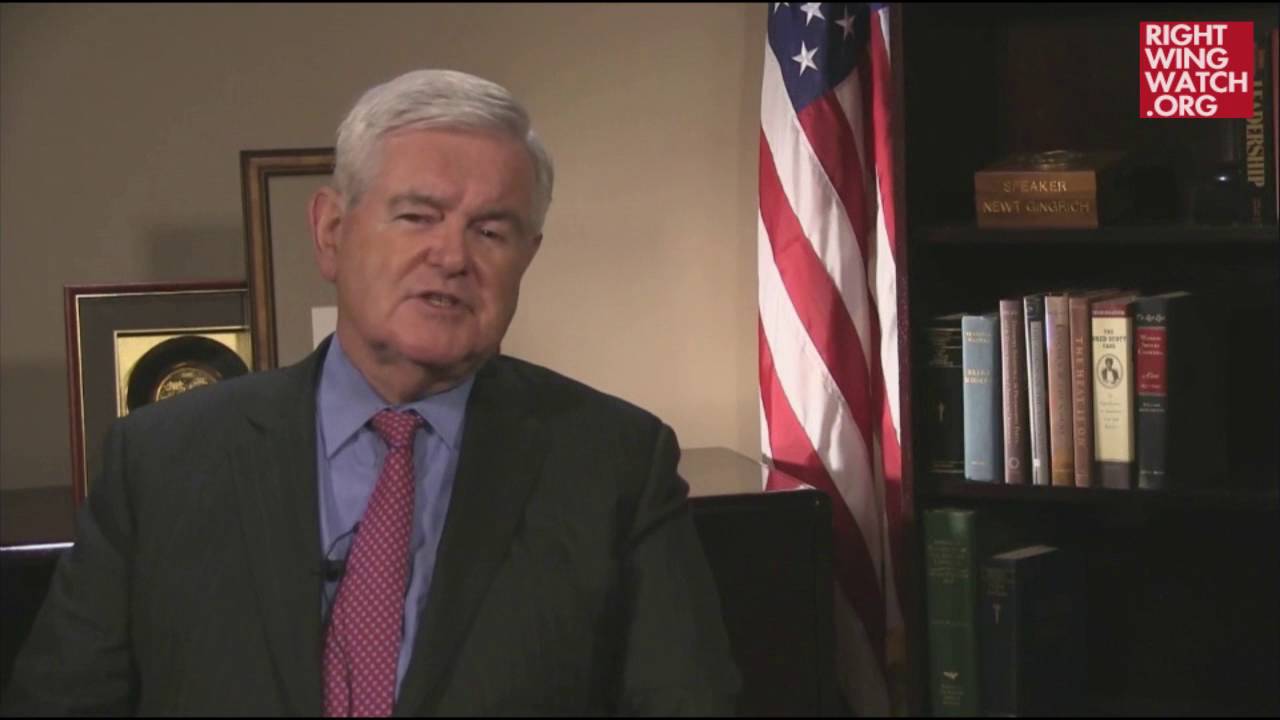 against “those who would impose a totalitarian secularism on us.” That was a recycled version of comments he made in 2011 atJohn Hagee’s Cornerstone Church, where he memorably said he was “convinced that if we do not decisively win the struggle over the nature of America, by the time [my grandchildren are] my age they will be in a secular atheist country, potentially one dominated by radical Islamists and with no understanding of what it once meant to be an American.”
Tags: Newt GingrichChurch-StateElection 2018Election 2020Republican Party
---
https://www.theatlantic.com/magazine/archive/2018/11/newt-gingrich-says-youre-welcome/570832/
gingrich is an important man, a man of refined tastes, accustomed to a certain lifestyle, and so when he visits the zoo, he does not merely stand with all the other patrons to look at the tortoises—he goes inside the tank.
On this particular afternoon in late March, the former speaker of the House can be found shuffling giddily around a damp, 90‑degree enclosure at the Philadelphia Zoo—a rumpled suit draped over his elephantine frame, plastic booties wrapped around his feet—as he tickles and strokes and paws at the giant shelled reptiles, declaring them “very cool.”
It’s a weird scene, and after a few minutes, onlookers begin to gather on the other side of the glass—craning their necks and snapping pictures with their phones and asking each other, Is that who I think it is? The attention would be enough to make a lesser man—say, a sweaty magazine writer who followed his subject into the tortoise tank for reasons that are now escaping him—grow self-conscious. But Gingrich, for whom all of this rather closely approximates a natural habitat, barely seems to notice.
A well-known animal fanatic, Gingrich was the one who suggested we meet at the Philadelphia Zoo. He used to come here as a kid, and has fond memories of family picnics on warm afternoons, gazing up at the giraffes and rhinos and dreaming of one day becoming a zookeeper. But we aren’t here just for the nostalgia.
“There is,” he explained soon after arriving, “a lot we can learn from the natural world.”
Since then, Gingrich has spent much of the day using zoo animals to teach me about politics and human affairs. In the reptile room, I learn that the evolutionary stability of the crocodile (“Ninety million years, and they haven’t changed much”) illustrates the folly of pursuing change for its own sake: “If you’re doing something right, keep doing it.”
Outside the lion pen, Gingrich treats me to a brief discourse on gender theory: “The male lion procreates, protects the pride, and sleeps. The females hunt, and as soon as they find something, the male knocks them over and takes the best portion. It’s the opposite of every American feminist vision of the world—but it’s a fact!”
But the most important lesson comes as we wander through Monkey Junction. Gingrich tells me about one of his favorite books, Chimpanzee Politics, in which the primatologist Frans de Waal documents the complex rivalries and coalitions that govern communities of chimps. De Waal’s thesis is that human politics, in all its brutality and ugliness, is “part of an evolutionary heritage we share with our close relatives”—and Gingrich clearly agrees.
For several minutes, he lectures me about the perils of failing to understand the animal kingdom. Disney, he says, has done us a disservice with whitewashed movies like The Lion King, in which friendly jungle cats get along with their zebra neighbors instead of attacking them and devouring their carcasses. And for all the famous feel-good photos of Jane Goodall interacting with chimps in the wild, he tells me, her later work showed that she was “horrified” to find her beloved creatures killing one another for sport, and feasting on baby chimps.
It is crucial, Gingrich says, that we humans see the animal kingdom from which we evolved for what it really is: “A very competitive, challenging world, at every level.”
As he pauses to catch his breath, I peer out over the sprawling primate reserve. Spider monkeys swing wildly from bar to bar on an elaborate jungle gym, while black-and-white lemurs leap and tumble over one another, and a hulking gorilla grunts in the distance.
At a loss for what to say, I start to mutter something about the viciousness of the animal world—but Gingrich cuts me off. “It’s not viciousness,” he corrects me, his voice suddenly stern. “It’s natural.”
There’s something about Newt Gingrich that seems to capture the spirit of America circa 2018. With his immense head and white mop of hair; his cold, boyish grin; and his high, raspy voice, he has the air of a late-empire Roman senator—a walking bundle of appetites and excesses and hubris and wit. In conversation, he toggles unnervingly between grandiose pronouncements about “Western civilization” and partisan cheap shots that seem tailored for cable news. It’s a combination of self-righteousness and smallness, of pomposity and pettiness, that personifies the decadence of this era.
In the clamorous story of Donald Trump’s Washington, it would be easy to mistake Gingrich for a minor character. A loyal Trump ally in 2016, Gingrich forwent a high-powered post in the administration and has instead spent the years since the election cashing in on his access—churning out books (three Trump hagiographies, one spy thriller), working the speaking circuit (where he commands as much as $75,000 per talkfor his insights on the president), and popping up on Fox News as a paid contributor. He spends much of his time in Rome, where his wife, Callista, serves as Trump’s ambassador to the Vatican and where, he likes to boast, “We have yet to find a bad restaurant.”
But few figures in modern history have done more than Gingrich to lay the groundwork for Trump’s rise. During his two decades in Congress, he pioneered a style of partisan combat—replete with name-calling, conspiracy theories, and strategic obstructionism—that poisoned America’s political culture and plunged Washington into permanent dysfunction. Gingrich’s career can perhaps be best understood as a grand exercise in devolution—an effort to strip American politics of the civilizing traits it had developed over time and return it to its most primal essence.
When I ask him how he views his legacy, Gingrich takes me on a tour of a Western world gripped by crisis. In Washington, chaos reigns as institutional authority crumbles. Throughout America, right-wing Trumpites and left-wing resisters are treating midterm races like calamitous fronts in a civil war that must be won at all costs. And in Europe, populist revolts are wreaking havoc in capitals across the Continent.
Twenty-five years after engineering the Republican Revolution, Gingrich can draw a direct line from his work in Congress to the upheaval now taking place around the globe. But as he surveys the wreckage of the modern political landscape, he is not regretful. He’s gleeful.
“The old order is dying,” he tells me. “Almost everywhere you have freedom, you have a very deep discontent that the system isn’t working.”
And that’s a good thing? I ask.
“It’s essential,” he says, “if you want Western civilization to survive.”
On june 24, 1978, Gingrich stood to address a gathering of College Republicansat a Holiday Inn near the Atlanta airport. It was a natural audience for him. At 35, he was more youthful-looking than the average congressional candidate, with fashionably robust sideburns and a cool-professor charisma that had made him one of the more popular faculty members at West Georgia College.
But Gingrich had not come to deliver an academic lecture to the young activists before him—he had come to foment revolution.
“One of the great problems we have in the Republican Party is that we don’t encourage you to be nasty,” he told the group. “We encourage you to be neat, obedient, and loyal, and faithful, and all those Boy Scout words, which would be great around the campfire but are lousy in politics.”
For their party to succeed, Gingrich went on, the next generation of Republicans would have to learn to “raise hell,” to stop being so “nice,” to realize that politics was, above all, a cutthroat “war for power”—and to start acting like it.
The speech received little attention at the time. Gingrich was, after all, an obscure, untenured professor whose political experience consisted of two failed congressional bids. But when, a few months later, he was finally elected to the House of Representatives on his third try, he went to Washington a man obsessed with becoming the kind of leader he had described that day in Atlanta.
The GOP was then at its lowest point in modern history. Scores of Republican lawmakers had been wiped out in the aftermath of Watergate, and those who’d survived seemed, to Gingrich, sadly resigned to a “permanent minority” mind-set. “It was like death,” he recalls of the mood in the caucus. “They were morally and psychologically shattered.”
But Gingrich had a plan.The way he saw it, Republicans would never be able to take back the House as long as they kept compromising with the Democrats out of some high-minded civic desire to keep congressional business humming along. His strategy was to blow up the bipartisan coalitions that were essential to legislating, and then seize on the resulting dysfunction to wage a populist crusade against the institution of Congress itself. “His idea,” says Norm Ornstein, a political scientist who knew Gingrich at the time, “was to build toward a national election where people were so disgusted by Washington and the way it was operating that they would throw the ins out and bring the outs in.”
Gingrich recruited a cadre of young bomb throwers—a group of 12 congressmen he christened the Conservative Opportunity Society—and together they stalked the halls of Capitol Hill, searching for trouble and TV cameras. Their emergence was not, at first, greeted with enthusiasm by the more moderate Republican leadership. They were too noisy, too brash, too hostile to the old guard’s cherished sense of decorum. They even looked different—sporting blow-dried pompadours while their more camera-shy elders smeared Brylcreem on their comb-overs.
Gingrich and his cohort showed little interest in legislating, a task that had heretofore been seen as the primary responsibility of elected legislators. Bob Livingston, a Louisiana Republican who had been elected to Congress a year before Gingrich, marveled at the way the hard-charging Georgian rose to prominence by ignoring the traditional path taken by new lawmakers. “My idea was to work within the committee structure, take care of my district, and just pay attention to the legislative process,” Livingston told me. “But Newt came in as a revolutionary.”
For revolutionary purposes, the House of Representatives was less a governing body than an arena for conflict and drama. And Gingrich found ways to put on a show. He recognized an opportunity in the newly installed C-span cameras, and begandelivering tirades against Democrats to an empty chamber, knowing that his remarks would be beamed to viewers across the country.
As his profile grew, Gingrich took aim at the moderates in his own party—calling Bob Dole the “tax collector for the welfare state”—and baited Democratic leaders with all manner of epithet and insult: pro-communist, un-American, tyrannical. In 1984, one of his floor speeches prompted a red-faced eruption from Speaker Tip O’Neill, who said of Gingrich’s attacks, “It’s the lowest thing that I’ve ever seen in my 32 years in Congress!” The episode landed them both on the nightly news, and Gingrich, knowing the score, declared victory. “I am now a famous person,” he gloated to The Washington Post. [sounds like bannon]
It’s hard to overstate just how radical these actions were at the time.Although Congress had been a volatile place during periods of American history—with fistfights and canings and representatives bellowing violent threats at one another—by the middle of the 20th century, lawmakers had largely coalesced around a stabilizing set of norms and traditions. Entrenched committee chairs may have dabbled in petty corruption, and Democratic leaders may have pushed around the Republican minority when they were in a pinch, but as a rule, comity reigned. “Most members still believed in the idea that the Framers had in mind,” says Thomas Mann, a scholar who studies Congress. “They believed in genuine deliberation and compromise … and they had institutional loyalty.”
This ethos was perhaps best embodied by Republican Minority Leader Bob Michel, an amiable World War II veteran known around Washington for his aversion to swearing—doggone it and by Jiminy were fixtures of his vocabulary—as well as his penchant for carpooling and golfing with Democratic colleagues. Michel was no liberal, but he believed that the best way to serve conservatism, and his country, was by working honestly with Democratic leaders—pulling legislation inch by inch to the right when he could, and protecting the good faith that made aisle-crossing possible.
Gingrich was unimpressed by Michel’s conciliatory approach. “He represented a culture which had been defeated consistently,” he recalls. More important, Gingrich intuited that the old dynamics that had produced public servants like Michel were crumbling. Tectonic shifts in American politics—particularly around issues of race and civil rights—had triggered an ideological sorting between the two parties. Liberal Republicans and conservative Democrats (two groups that had been well represented in Congress) were beginning to vanish, and with them, the cross-party partnerships that had fostered cooperation.
This polarization didn’t originate with Gingrich, but he took advantage of it, as he set out to circumvent the old power structures and build his own. Rather than letting the party bosses in Washington decide which candidates deserved institutional support, he took control of a group called gopac and used it to recruit and train an army of mini-Newts to run for office.
Gingrich hustled to keep his cause—and himself—in the press. “If you’re not in The Washington Post every day, you might as well not exist,” he told one reporter. His secret to capturing headlines was simple, he explained to supporters: “The No. 1 fact about the news media is they love fights … When you give them confrontations, you get attention; when you get attention, you can educate.” TRUMP
Effective as these tactics were in the short term, they had a corrosive effect on the way Congress operated. “Gradually, it went from legislating, to the weaponization of legislating, to the permanent campaign, to the permanent war,” Mann says. “It’s like he took a wrecking ball to the most powerful and influential legislature in the world.”
But Gingrich looks back with pride on the transformations he set in motion. “Noise became a proxy for status,” he tells me. And no one was noisier than Newt.
We are in the petting zoo, examining the goats, when Gingrich decides to tell me about the moment he first glimpsed his destiny as one of history’s great men.
It was 1958, and he was 15 years old. His family was visiting Verdun, a small city in northeastern France where 300,000 people had been killed during World War I. The battlefield was still scarred by cannon fire, and young Newt spent the day wandering around, taking in the details. He found a rusted helmet on the ground, saw the ossuary where the bones of dead soldiers were piled high. “I realized countries can die,” he says—and he decided it would be up to him to make sure that America didn’t.
This is an important scene in the Newt Gingrich creation myth, and he has turned to it repeatedly over the years to satisfy journalists and biographers searching for a “Rosebud” moment. But the rest of Gingrich’s childhood may be just as instructive. His mother struggled with manic depression, and spent much of her adult life in a fog of medication. His stepfather was a brooding, violent man who showed little affection for “Newtie,” the pudgy, flat-footed, bookish boy his wife had foisted upon him. Gingrich moved around a lot and had few friends his age; he spent more time alone in his room reading books about dinosaurs than he did playing with the neighborhood kids.
But this is not the stuff Gingrich likes to talk about. When asked, he describes his childhood as ordinary, even “idyllic,” allowing only glimpses of the full picture when you press him for details. Those family picnics at the zoo that he has been reminiscing about all day? They weren’t with his parents, it turns out, but his aunts, who were looking for ways to make their lonely nephew happy.
“People like me are what stand between us and Auschwitz,” Gingrich once told a reporter.
It was in Verdun that Gingrich found an identity, a sense of purpose. “I decided then that I basically had three jobs,” he tells me. “Figure out what we had to do to survive”—the we here being proponents of Western civilization, the threats being vague and unspecified—“figure out how to explain it so that the American people would give us permission, and figure out how to implement it once they gave us permission. That’s what I’ve done since August of ’58.”
The next year, Gingrich turned in a 180-page term paper about the balance of global power, and announced to his teacher that his family was moving to Georgia, where he planned to start a Republican Party in the then–heavily Democratic state and get himself elected to Congress.
Gingrich immersed himself in war histories and dystopian fiction and books about techno-futurism—and as the years went on, he became fixated on the idea that he was a world-historic hero. He has described himself as a “transformational figure” and “the most serious, systematic revolutionary of modern times.” To one reporter, he declared, “I want to shift the entire planet. And I’m doing it.” To another, he said, “People like me are what stand between us and Auschwitz.”
As Gingrich tells me about his epiphany in Verdun, a man in a baseball cap approaches us in full fanboy mode. “Newt Gingrich!” he exclaims. “Good to see you, man. I love you on Fox.”
“Thank you,” Gingrich replies. “Please keep watching.”
This has been happening all day—fans coming up to request selfies, or to shake his hand, or to thank him for his work in “draining the swamp.” It’s a reminder that to a certain swath of America, Gingrich is not some washed-up partisan hack; he’s a towering statesman, a visionary hero, the man he set out to be.
After the superfan leaves, I make a passing observation about how many admirers Gingrich has at the zoo.
“I think you’d be surprised,” he tells me, his voice dripping with condescension. “You get outside of Washington and New York and there are an amazing number of people like this who show up.”
By 1988, gingrich’s plan to conquer Congress via sabotage was well under way. As his national profile had risen, so too had his influence within the Republican caucus—his original quorum of 12 disciples having expanded to dozens of sharp-elbowed House conservatives who looked to him for guidance.
Gingrich encouraged them to go after their enemies with catchy, alliterative nicknames—“Daffy Dukakis,” “the loony left”—and schooled them in the art of partisan blood sport. Through gopac, he sent out cassette tapes and memos to Republican candidates across the country who wanted to “speak like Newt,” providing them with carefully honed attack lines and creating, quite literally, a new vocabulary for a generation of conservatives. One memo, titled “Language: A Key Mechanism of Control,” included a list of recommended words to use in describing Democrats: sick, pathetic, lie, anti-flag, traitors, radical, corrupt.
“People started asking, ‘Who’s the meanest, nastiest son of a bitch we can get to fight back?’ And, of course, that was Newt Gingrich.”
The goal was to reframe the boring policy debates in Washington as a national battle between good and evil,white hats versus black—a fight for the very soul of America. Through this prism, any news story could be turned into a wedge. Woody Allen had an affair with his partner’s adoptive daughter? “It fits the Democratic Party platform perfectly,” Gingrich declared. A deranged South Carolina woman murdered her two children? A symptom of a “sick” society, Gingrich intoned—and “the only way you can get change is to vote Republican.”
Gingrich was not above mining the darkest reaches of the right-wing fever swamps for material. When Vince Foster, a staffer in the Clinton White House, committed suicide, Gingrich publicly flirted with fringe conspiracy theories that suggested he had been assassinated. “He took these things that were confined to the margins of the conservative movement and mainstreamed them,” says David Brock, who worked as a conservative journalist at the time, covering the various Clinton scandals, before later becoming a Democratic operative. “What I think he saw was the potential for using them to throw sand in the gears of Clinton’s ability to govern.”
Despite his growing grassroots following, Gingrich remained unpopular among a certain contingent of congressional Republicans, who were scandalized by his tactics. But that started to change when Democrats elected Texas Congressman Jim Wright as speaker. Whereas Tip O’Neill had been known for working across party lines, Wright came off as gruff and power-hungry—and his efforts to sideline the Republican minority enraged even many of the GOP’s mild-mannered moderates. “People started asking, ‘Who’s the meanest, nastiest son of a bitch we can get to fight back?’ ” recalls Mickey Edwards, a Republican who was then representing Oklahoma in the House. “And, of course, that was Newt Gingrich.”
Gingrich unleashed a smear campaign aimed at taking Wright down. He reportedly circulated unsupported rumors about a scandal involving a teenage congressional page, and tried to tie Wright to shady foreign-lobbying practices. Finally, one allegation gained traction—that Wright had used $60,000 in book royalties to evade limits on outside income. Watergate, this was not. But it was enough to force Wright’s resignation, and hand Gingrich the scalp he so craved.
The episode cemented Gingrich’s status as the de facto leader of the GOP in Washington. Heading into the 1994 midterms, he rallied Republicans around the idea of turning Election Day into a national referendum. On September 27, more than 300 candidates gathered outside the Capitol to sign the “Contract With America,” a document of Gingrich’s creation that outlined 10 bills Republicans promised to pass if they took control of the House.
“Today, on these steps, we offer this contract as a first step towards renewing American civilization,” Gingrich proclaimed. MAGA
While candidates fanned out across the country to campaign on the contract, Gingrich and his fellow Republican leaders in Congress held fast to their strategy of gridlock. As Election Day approached, they maneuvered to block every piece of legislation they could—even those that might ordinarily have received bipartisan support, like a lobbying-reform bill—on the theory that voters would blame Democrats for the paralysis.
Pundits, aghast at the brazenness of the strategy, predicted backlash from voters—but few seemed to notice. Even some Republicans were surprised by what they were getting away with.Bill Kristol, then a GOP strategist, marveled at the success of his party’s “principled obstructionism.” An up-and-coming senator named Mitch McConnell was quoted crowing that opposing the Democrats’ agenda “gives gridlock a good name.” When the 103rd Congress adjourned in October, The Washington Post declared it “perhaps the worst Congress” in 50 years.
Yet Gingrich’s plan worked. By the time voters went to the polls, exit surveys revealed widespread frustration with Congress and a deep appetite for change. Republicans achieved one of the most sweeping electoral victories in modern American history. They picked up 54 seats in the House and seized state legislatures and governorships across the country; for the first time in 40 years, the GOP took control of both houses of Congress.
On election night, Republicans packed into a ballroom in the Atlanta suburbs, waving placards that read liberals, your time is up! and sporting rush limbaugh for president T‑shirts. The band played “Happy Days Are Here Again” and Gingrich—the next speaker of the House, the new philosopher-king of the Republican Party—took the stage to raucous cheers.
With victory in hand, Gingrich did his best to play the statesman, saying he would “reach out to every Democrat who wants to work with us” and promising to be “speaker of the House, not speaker of the Republican Party.”
But the true spirit of the Republican Revolution was best captured by the event’s emcee, a local talk-radio host in Atlanta who had hitched his star to the Newt wagon early on. Grinning out at the audience, he announced that a package had just arrived at the White House with some Tylenol in it.
President Clinton, joked Sean Hannity, was about to “feel the pain.”
The freshman republicans who entered Congress in January 1995 were lawmakers created in the image of Newt: young, confrontational, and determined to inflict radical change on Washington.
Gingrich encouraged this revolutionary zeal, quoting Thomas Paine—“We have it in our power to begin the world over again”—and working to instill a conviction among his followers that they were political gate-crashers, come to leave their dent on American history. What Gingrich didn’t tell them—or perhaps refused to believe himself—was that in Congress, history is seldom made without consensus-building and horse-trading. From the creation of interstate highways to the passage of civil-rights legislation, the most significant, lasting acts of Congress have been achieved by lawmakers who deftly maneuver through the legislative process and work with members of both parties.
On January 4, Speaker Gingrich gaveled Congress into session, and promptly got to work transforming America. Over the next 100 days, he and his fellow Republicans worked feverishly to pass bills with names that sounded like they’d come from Republican Mad Libs—the American Dream Restoration Act, the Taking Back Our Streets Act, the Fiscal Responsibility Act. But when the dust settled, America didn’t look all that different. Almost all of the House’s big-ticket bills got snuffed out in the Senate, or died by way of presidential veto.
Instead, the most enduring aspects of Gingrich’s speakership would be his tactical innovations. Determined to keep Republicans in power, Gingrich reoriented the congressional schedule around filling campaign war chests, shortening the official work week to three days so that members had time to dial for dollars. From 1994 to 1998, Republicans raised an unprecedented $1 billion, and ushered in a new era of money in politics.
Gingrich’s famous budget battles with Bill Clinton in 1995 gave way to another great partisan invention: the weaponized government shutdown.There had been federal funding lapses before, but they tended to be minor affairs that lasted only a day or two. Gingrich’s shutdown, by contrast, furloughed hundreds of thousands of government workers for several weeks at Christmastime, so Republicans could use their paychecks as a bartering chip in negotiations with the White House. The gambit was a bust—voters blamed the GOP for the crisis, and Gingrich was castigated in the press—but it ensured that the shutdown threat would loom over every congressional standoff from that point on.
There were real accomplishments during Gingrich’s speakership, too—a tax cut, a bipartisan health-care deal, even a balanced federal budget—and for a time, truly historic triumphs seemed within reach. Over the course of several secret meetings at the White House in thefall of 1997, Gingrich told me, he and Clinton sketched out plans for a center-right coalition that would undertake big, challenging projects such as a wholesale reform of Social Security.
But by then, the poisonous politics Gingrich had injected into Washington’s bloodstream had escaped his control. So when the stories started coming out in early 1998—the ones about the president and the intern, the cigar and the blue dress—and the party faithful were clamoring for Clinton’s head on a pike, and Gingrich’s acolytes in the House were stomping their feet and crying for blood … well, he knew what he had to do.
This is “the most systematic, deliberate obstruction-of-justice cover-up and effort to avoid the truth we have ever seen in American history!” Gingrich declared of the Monica Lewinsky scandal, pledging that he would keep banging the drum until Clinton was impeached. “I will never again, as long as I am speaker, make a speech without commenting on this topic.”
Never mind that Republicans had no real chance of getting the impeachment through the Senate. Removing the president wasn’t the point; this was an opportunity to humiliate the Democrats. Politics was a “war for power,” just as Gingrich had prophesied all those years ago—and he wasn’t about to give up the fight.
The rest is immortalized in the history books that line Gingrich’s library. The GOP’s impeachment crusade backfired with voters, Republicans lost seats in the House—and Gingrich was driven out of his job by the same bloodthirsty brigade he’d helped elect. “I’m willing to lead,” he sniffed on his way out the door, “but I’m not willing to preside over people who are cannibals.”
The great irony of Gingrich’s rise and reign is that, in the end, he did fundamentally transform America—just not in the ways he’d hoped. He thought he was enshrining a new era of conservative government. In fact, he was enshrining an attitude—angry, combative, tribal—that would infect politics for decades to come.
In the years since he left the House, Gingrich has only doubled down. When GOP leaders huddled at a Capitol Hill steak house on the night of President Barack Obama’s inauguration, Gingrich was there to advocate a strategy of complete obstruction. And when Senator Ted Cruz led a mob of Tea Party torchbearers in shutting down the government over Obamacare, Gingrich was there to argue that shutdowns are “a normal part of the constitutional process.”
Mickey Edwards, the Oklahoma Republican, who served in the House for 16 years, told me he believes Gingrich is responsible for turning Congress into a place where partisan allegiance is prized above all else. He noted that during Watergate, President Richard Nixon was forced to resign only because leaders of his own party broke ranks to hold him accountable—a dynamic Edwards views as impossible in the post-Gingrich era. “He created a situation where you now stand with your party at all costs and at all times, no matter what,” Edwards said. “Our whole system in America is based on the Madisonian idea of power checking power. Newt has been a big part of eroding that.”
But when I ask Gingrich what he thinks of the notion that he played a part in toxifying Washington, he bristles. “I took everything the Democrats had done brilliantly to dominate and taught Republicans how to do it,” he tells me. “Which made me a bad person because when Republicans dominate, it must be bad.” He adopts a singsong whine to imitate his critics in the political establishment: “ ‘Oh, the mean, nasty Republicans actually got to win, and we hate it, because we’re a Democratic city, our real estate’s based on big government, and the value of my house will go down if they balance the budget.’ That’s the heart of this.”
These days, Gingrich seems to be revising his legacy in real time—shifting the story away from the ideological sea change that his populist disruption was supposed to enable, and toward the act of populist disruption itself. He places his own rise to power and Trump’s in the same grand American narrative. There have been four great political “waves” in the past half century, he tells me: “Goldwater, Reagan, Gingrich, then Trump.” But when I press him to explain what connects those four “waves” philosophically, the best he can do is say they were all “anti-liberal.”
Political scientists who study our era of extreme polarization will tell you that the driving force behind American politics today is not actually partisanship, but negative partisanship—that is, hatred of the other team more than loyalty to one’s own. Gingrich’s speakership was both a symptom and an accelerant of that phenomenon.
On December 19, 1998, Gingrich cast his final vote as a congressman—a vote to impeach Bill Clinton for lying under oath about an affair. By the time it was revealed that the ex-speaker had been secretly carrying on an illicit relationship with a young congressional aide named Callista throughout his impeachment crusade, almost no one was surprised.* This was, after all, the same man who had famously been accused by his first wife (whom he’d met as a teenager, when she was his geometry teacher) of trying to discuss divorce terms when she was in the hospital recovering from tumor-removal surgery, the same man who had for a time reportedly restricted his extramarital dalliances to oral sex so that he could claim he’d never slept with another woman. (Gingrich declined to comment on these allegations.)
Detractors could call it hypocrisy if they wanted; Gingrich might not even argue. (“It doesn’t matter what I do,” he once rationalized, according to one of his ex-wives. “People need to hear what I have to say.”) But if he had taught America one lesson, it was that any sin could be absolved, any trespass forgiven, as long as you picked the right targets and swung at them hard enough.
When Gingrich’s personal life became an issue during his short-lived presidential campaign in 2012, he knew just who to swing at. Asked during a primary debate about an allegation that he’d requested an open marriage with his second wife, Gingrich took a deep breath, gathered all the righteous indignation he could muster, and let loose one of the most remarkable—and effective—non sequiturs in the history of campaign rhetoric: “I think the destructive, vicious, negative nature of much of the news media makes it harder to govern this country, harder to attract decent people to run for public office—and I am appalled that you would begin a presidential debate on a topic like that.”[boot max on boktv sez only theme that holds gop trump coalition together is hatred of media?]
The CNN moderator grew flustered, the audience erupted in a standing ovation, and a few days later, the voters of South Carolina delivered Gingrich a decisive victory in the Republican primary. /
AFTer a few hours at the zoo, Gingrich is ready for the next leg of our field trip, so we squeeze into the back of a black SUV and start driving across town toward the Academy of Natural Sciences, where there are some “really neat” dinosaur fossils he would like to show me.
One of the hard things about talking with Gingrich is that he weaves partisan attack lines into casual conversation so matter-of-factly—and so frequently—that after a while they begin to take on a white-noise quality. He will say something like “I mean, the party of socialism and anti-Semitism is probably not very desirable as a governing party,” and you won’t bother challenging him, or fact-checking him, or arching an eyebrow—in fact, you might not even notice. His smarter-than-thou persona seems so impenetrable, his mind so unchangeable, that after a while you just give up on anything approaching a regular human conversation.
But the zoo appears to have put Gingrich in high spirits, and for the first time all day, he seems relaxed, loose, even a little gossipy. Slurping from a McDonald’s cup as we ride through the streets of Philadelphia, he shares stray observations from the 2016 campaign trail—Trump really is a fast-food obsessive, Gingrich confides, but “I’m told they currently have him on a diet”—and tosses in a bit of Clinton concern-trolling for good measure.
“I’ve known Hillary since ’93. I think it would be extraordinarily hard to be married to Bill Clinton and lose twice,” he tells me. “It reinforces the whole sense that he was the real deal and she wasn’t.” Alas, he says, it’s been sad to see his old friend resort to bitter recriminations since her defeat. “The way she is handling it is self-destructive.”
It is difficult to identify any coherent set of ideas animating Gingrich’s support for the president.
When Trump first began thinking seriously about running for president, he turned to Gingrich for advice. The two men had known each other for years—the Gingriches were members of Trump’s golf club in Virginia—and one morning in January 2015 they found themselves in Des Moines, Iowa, for a conservative conference. Over breakfast at the downtown Marriott, Trump peppered Newt and Callista with questions about running for president—most pressingly, how much it would cost him to fund a campaign through the South Carolina primary. Gingrich estimated that it would take about $70 million or $80 million to be competitive.
As Gingrich tells it, Trump considered this and then replied, “Seventy to 80 million—that would be a yacht. This would be a lot more fun than a yacht!”
And so began the campaign that Gingrich would call “a watershed moment for America’s future.” Early on, Gingrich set himself apart from other prominent conservatives by talking up Trump’s candidacy on TV and defending him against attacks from the GOP establishment. “Newt watched the Trump phenomenon take hold and metastasize, and he saw the parallels” to his own rise, says Kellyanne Conway, a senior adviser to the president who worked with Gingrich in the 1990s. “He recognized the echoes of ‘You can’t do this, this is a joke, you’re unelectable, don’t even try, you should be bowing to the people who have credentials.’ Newt had heard that all before.” Trump’s response—to cast all his skeptics as part of the same corrupt class of insiders and crooks—borrowed from the strategy Gingrich had modeled, Conway told me: “Long before there was ‘Drain the swamp,’ there was Newt’s ‘Throw the bums out.’ ”
Once Trump clinched the nomination, he rewarded Gingrich by putting him on the vice-presidential short list. For a while it looked like it might really happen. Gingrich had the support of influential inner-circlers like Sean Hannity,who flew him out on a private jet to meet with Trump on the campaign trail. But alas, a Trump-Gingrich ticket was not to be. There were, it turned out, certain optical issues that would have proved difficult to spin. As Ed Rollins, who ran a pro-Trump super pac, put it at the time, “It’d be a ticket with six former wives, kind of like a Henry VIII thing.”
After Trump was elected, Gingrich’s name was floated for several high-profile administration posts. Eager to affirm his centrality in this hinge-of-history moment, he started publicly implying that he had turned down the job of secretary of state in favor of a sweeping, self-designed role with ambiguous responsibilities—“general planner,” he called it, or “senior planner,” or maybe “*chief* planner.”
In fact, according to a transition official, Gingrich had little interest in giving up his lucrative private-sector side hustles, and was never really in the running for a Cabinet position. Instead, he had two requests: that Trump’s team leak that he was being considered for high office, and that Callista, a lifelong Catholic, be named ambassador to the Holy See. (Gingrich disputes this account.)
The Vatican gig was widely coveted, and there was some concern that Callista’s public history of adultery would prompt the pope to reject her appointment. But the Gingriches were friendly with a number of American cardinals, and Callista’s nomination sailed through. In Washington, the appointment was seen as a testament to the self-parodic nature of the Trump era—but in Rome, the arrangement has worked surprisingly well. Robert Mickens, a longtime Vatican journalist, told me that Callista is generally viewed as the ceremonial face of the embassy, while Newt—who told me he talks to the White House 10 to 15 times a week—acts as the “shadow ambassador.”
“Donald Trump is the grizzly bear in The Revenant,” Gingrich once gushed. “If you get his attention, he will get awake ... He will walk over, bite your face off, and sit on you.”
Meanwhile, back in the States, Gingrich got to work marketing himself as the premier public intellectual of the Trump era. Ever since he was a young congressman, he had labored to cultivate a cerebral image, often schlepping piles of books into meetings on Capitol Hill. As an exercise in self-branding, at least, the effort seems to have worked: When I sent an email asking Paul Ryan what he thought of Gingrich, he responded with a pro forma statement describing the former speaker as an “ideas guy” twice in the space of six sentences.
Yet wading through Gingrich’s various books, articles, and think-tank speeches about Trump, it is difficult to identify any coherent set of “ideas” animating his support for the president. He is not a natural booster for the economic nationalism espoused by people like Steve Bannon, nor does he seem particularly smitten with the isolationism Trump championed on the stump.
Instead, Gingrich seems drawn to Trump the larger-than-life leader—virile and masculine, dynamic and strong, brimming with “total energy” as he mows down every enemy in his path. “Donald Trump is the grizzly bear in The Revenant,” Gingrich gushed during a December 2016 speech on “The Principles of Trumpism” at the Heritage Foundation. “If you get his attention, he will get awake … He will walk over, bite your face off, and sit on you.”
In Trump, Gingrich has found the apotheosis of the primate politics he has been practicing his entire life—nasty, vicious, and unconcerned with those pesky “Boy Scout words” as he fights in the Darwinian struggle that is American life today. “Trump’s America and the post-American society that the anti-Trump coalition represents are incapable of coexisting,” Gingrich writes in his most recent book. “One will simply defeat the other. There is no room for compromise. Trump has understood this perfectly since day one.”
For much of 2018, Gingrich has been channeling his energies toward shaping the GOP’s midterm strategy—writing messaging memos and fielding phone calls from candidates across the country. (During one early-morning meeting a couple of months after our zoo trip, our conversation is repeatedly interrupted by Gingrich’s cellphone blaring the ’70s disco song “Dancing Queen,” his chosen ringtone.) Gingrich tells me he’s advising party leaders to “stick to really big themes” in their midterm messaging, and then offers the following as examples: “Tax cuts lead to economic growth”; “We need work rather than welfare”; “MS-13 is really bad.”
He predicts that if Democrats win back the House, they will try to impeach Trump—but he is bullish about the president’s chances of survival.
“The problem the Democrats are gonna have is really simple,” he tells me. “Everything they’re gonna charge Trump with will be irrelevant to most Americans.” He says that most of the “explosive revelations” that have come out of the Russia investigation are unintelligible to the average person. “You’re driving your kids to soccer, you’re worried about your mom in the nursing home, and you’re thinking about your job, and you’re going, This is Washington crap.”
I ask Gingrich whether he, as someone who follows Washington crap rather closely and does not have kids to drive to soccer, worries at all about the mounting evidence of coordination between Russians and the Trump campaign.
Gingrich guffaws. “The idea that you would worry about what [Michael] Cohen said, or what some porn star may or may not have done before she was arrested by the Cincinnati police”—he is revving up now, and his voice is getting higher—“I mean, this whole thing is a parody! I tell everybody: We live in the age of the Kardashians. This is all Kardashian politics. Noise followed by noise followed by hysteria followed by more noise, creating big enough celebrity status so you can sell the hats with your name on it and become a millionaire.”
This sounds like it’s intended as a criticism of our political culture, but given his loyalty to Trump—arguably the world’s most successful practitioner of “Kardashian politics”—I can’t quite tell. When I point out the apparent dissonance, Gingrich is ready with a counter.
“If you want to see genius, look at the hat,” he tells me. “What does the hat say?”
“Make America great again?” I respond.
Gingrich nods triumphantly, as though he’s just achieved checkmate. “It doesn’tsay Donald Trump.”
A few hours after parting ways with Gingrich, I take my seat in a cavernous downtown-Philadelphia theater, where more than 2,000 people are waiting to hear him speak. The crowd of mostly white, mostly well-dressed attendees isn’t particularly partisan—the event is part of a lecture series that includes speakers like Gloria Steinem and Dave Barry—but at this moment of political upheaval, they seem eager to hear from a seasoned Washington insider.
Shortly after 8 o’clock, Gingrich takes the stage. “How many of you find what’s going on kind of confusing?” he asks. “Raise your hand.” Hundreds of hands go up, as laughter ripples across the theater. “Any of you who do not find this confusing,” he says, “are delusional.”
And yet, over the next 75 minutes, Gingrich doesn’t offer much clarity. Instead, he begins with a travelogue of his day at the zoo (“It was a wonderful break from that other zoo!”), and then lurches into a rambling story about the T. rex skull he used to display in his office when he was speaker. He reminisces about Timemaking him Man of the Year in 1995, and spends several minutes describing the technological advancements in private space travel, a favorite hobbyhorse of his. At one point, he pauses to lavish praise on the restaurant scene in Rome; at another, he simply starts listing impressive titles he has held over the course of his career.
From my seat in the balcony, I’m struck by how thoroughly Gingrich seems to be enjoying himself—not just onstage, but in the luxurious quasi-retirement he has carved out. He is dabbling in geopolitics, dining in fine Italian restaurants. When he feels like traveling, he crisscrosses the Atlantic in business class, opining on the issues of the day from bicontinental TV studios and giving speeches for $600 a minute. There is time for reading, and writing, and midday zoo trips—and even he will admit, “It’s a very fun life.” The world may be burning, but Newt Gingrich is enjoying the spoils.
As he nears the end of his remarks, Gingrich adopts a somber tone. “I will tell you,” he says, “I could never quite have imagined our political structure being as chaoticas it currently is … I could never quite have imagined the kind of political gridlock that we’ve gotten into.”
For a moment, it sounds almost as if Gingrich is on the brink of a confession—an acknowledgment of what he has wrought; an apology, perhaps, for setting us on this course. But it turns out he is just setting up an attack line aimed at congressional Democrats for opposing a Republican spending bill. I should have known. /
By the time Gingrich shuffles offstage, many in the audience seem to have lost patience with him. As we file out of the theater, I catch snippets of grumpy reviews: Waste of time … He didn’t even answer the questions … The last speaker was much better …One man grumbles, “I think that guy’s done more to fuck up our democracy than anyone.”
That may seem like an overly harsh assessment. But tomorrow morning, when these people turn on the news, they will see footage of a reckless president who ascended to the White House on the power of televised politics. In a few months, their airwaves will be polluted with nasty attack ads. They will read stories about partisan impeachment efforts, and looming government shutdowns, and lawmakers more adept at name-calling than passing legislation. And though he won’t be there to say it in person, Gingrich will be somewhere out in the world—at a trattoria along Via Veneto, or perched comfortably in a cable-news greenroom—thinking, You’re welcome.
coppins
---
new book the man who broke politics
How Newt Gingrich Destroyed American Politics - The Atlantic
https://www.theatlantic.com/magazine/archive/2018/11/newt-gingrich.../570832/
1.
How Newt Gingrich 'Broke Politics' : NPR
https://www.npr.org/2018/11/01/662965797/how-newt-gingrich-broke-politics
Nov 1, 2018 - Coppins explains how Gingrich set the stage for President Trump's rise, and how ... Coppins' new article is 'The Man Who Broke Politics.' Also ...
---
==
nb 1994 start date
http://www.people-press.org/interactives/political-polarization-1994-2017/
---
cf lang memo?
On *Fox & Friends*, Newt Gingrich advises Trump to keep fearmongering about torture, rape, and murder in his push for a border wall
---
2x? 2012 no lnx
https://www.thenation.com/article/how-newt-gingrich-crippled-congress/
How much Americans hate Congress has become cliché. Congress’s approval rating is at an all-time low, and it’s not hard to see why: the institution is broken. Plenty of structural forces have contributed to Congress’s dysfunction: the increasing flow of money in politics, the emergence of the 24/7 cable news cycle, the increasing polarization of the electorate. But perhaps no single person bears as much responsibility as Newt Gingrich.
“I spent 16 years building a majority in the House for the first time since 1954,” Gingrich said during NBC’s Florida GOP debate Monday night, referring to the Republican takeover of the House in 1994. Over those sixteen years of personal and partisan striving, Gingrich invented or perfected many of the things that Americans dislike most about Congress. “I think I am a transformational figure,” Gingrich said before the 1994 election. “I am trying to effect a change so large that the people who would be hurt by the change, the liberal Democratic machine” will fight it, Gingrich explained.
There is no greater pathology in today’s Congress than obstructionism, from Speaker John Boehner’s (R-OH) refusal to raise the debt ceiling in July to Majority Leader Eric Cantor (R-VA) taking disaster relief funds for Hurricane Irene hostage. Both parties have long used Congress’s procedural rules to promote legislation they favor, but Gingrich created something new. “There is the assumption—pioneered by Newt Gingrich himself, as early as the 1970s—that the minority wins when Congress accomplishes less,” Representative Steny Hoyer (D-MD), the number-two Democrat in the House, explained in a 2009 speech at the Center for American Progress Action Fund. “Gingrich’s proposition, and maybe accurately, was that as long as…our party cooperate[s] with Democrats and get[s] 20 or 30 percent of what we want and they get to say they solved the problem and had a bipartisan bill, there’s no incentive for the American people to change leadership,” Hoyer told the Washington Post after the speech. “To some degree, he was proven right in 1994.”
In many ways, the obstructionist minority that Hoyer faced two years ago was following a playbook written by Gingrich over a decade earlier. Gingrich, in fact, took the debt ceiling hostage fifteen years before Boehner did, demanding huge, partisan cuts. In that case, the GOP backed down after President Clinton vetoed their spending bills and Moody’s warned of a credit downgrade. When Boehner refused to raise the debt ceiling, the threat of default lowered the US’s credit rating and was resolved by an complicated process involving a “supercommittee” and a two-step raising of the debt limit over a year. And it was Gingrich who, in one of his first acts as Speaker, patented the practice of refusing to approve disaster relief funds if they weren’t offset with spending cuts. Gingrich even held out after the Oklahoma City bombing later that year, prompting the Philadelphia Daily News to write, “Even Newt Gingrich must lose a little sleep at the idea of making political hay out of the mini-civil war that struck Oklahoma City.”
Of course, Gingrich’s greatest act of obstructionist brinkmanship was the 1995 and 1996 government shutdowns. Thanks to his refusal to concede on spending on social services, the government closed for five days in 1995, longer than the previous eight government shutdowns, and for a whopping twenty-one days a year later—the longest shutdown in history. Thanks to Gingrich’s obstinacy, health and welfare services for veterans were curtailed, Social Security checks were delayed, tens of thousands of visa applications went unprocessed and “numerous sectors of the economy” we negatively impacted, according to the Congressional Research Service.
Then there’s perhaps the most universally reviled practice of Congress: earmarking. Spending on earmarks doubled during Gingrich’s reign as Speaker, rising from $7.8 billion in 1994 to $14.5 billion in 1997. “Speaker Gingrich set in motion the largest explosion of earmarks in the history of Congress,” said Tom Schatz of the conservative group Citizens Against Government Waste. The pork binge was part of a Machiavellian plot to use taxpayer dollars to help Republicans get reelected, as Gingrich himself laid out in a 1996 policy memo titled, “Proposed Principles for Analyzing Each Appropriations Bill.” The memo instructed the chairmen of House Appropriation subcommittees to ask themselves if there are “any Republican members” who “need a specific district item in the bill.” This apparently included Gingrich himself, as Cobb County, Georgia, which the Speaker represented, received more federal dollars per resident than any other suburban county in the country in 1995, except for Arlington, Virginia, home of the Pentagon and other federal agencies, and Brevard County, Florida, home to Cape Canaveral and the Kennedy Space Center.
This partisan earmarking has led Representative Jeff Flake (R-AZ), a longtime anti-earmark crusader who has endorsed Mitt Romney, to dub Gingrich “the father of contemporary earmarking. ” Senator John McCain (R-AZ) went even further on a Romney campaign conference call Wednesday, saying that Gingrich’s plan to “distribute these earmarks led directly to the Abramoff scandal, Congressman Bob Ney going to jail and the corruption that I saw with my own eyes.”
Meanwhile, Gingrich was busy creating the climate of nearly nihilistic partisanship that reigns today. In May of 1988, against the wishes of the more moderate GOP leadership, Gingrich brought ethics charges against then-Democratic Speaker Jim Wright relating to a book deal. “This was very much Newt’s initiative,” John Pitney, a professor at Claremont McKenna College who has studied Gingrich for years, told The Nation. Gingrich successfully forced Wright to resign “and that really, for the first time, kind of politicized the entire ethics process,” Larry Evans, a government professor at the College of William and Mary in Virginia, told NPR in December. Ten years later, Gingrich was brought down by a similarly politically charged ethics process, when he was fined $300,000 for flouting tax laws with a tax-exempt college class that Democrats charged was actually political propaganda.
Before Wright, Gingrich tussled with another Democratic speaker and made a name for himself by exploiting the media and the new medium of C-SPAN. Gingrich was sworn in to his first term just a few months before C-SPAN went on the air in 1979, and as an ambitious freshman, he quickly realized the network’s potential. He and a small cadre of young Republicans he led pilloried then-Democratic Speaker Tip O’Neill and other Democratic lawmakers nightly with personal attacks, no matter how unfair, like when he accused the Speaker of putting “communist propaganda” in the Speaker’s lobby.
O’Neill was so irritated by Gingrich’s speeches that he once ordered the House cameras to pan across the empty House chamber to expose that Gingrich was speaking to no one but the cameras, and called Gingrich’s exploits “the lowest thing that I’ve ever seen in my 32 years in Congress. Gingrich fired back that O’Neil was coming “all too close to resembling a McCarthyism of the Left.” The resulting the two-hour exchange, which was covered on every broadcast news outlet that night, made Gingrich into a national hero for conservatives and a villain to liberals.
It was the “moment that made Gingrich,” as Pitney wrote on his blog, and set the mold of punching up in the media that ambitious upstart firebrands like Representative Michele Bachmann (R-MN) would follow for years to come.”If you’re not in the Washington Post every day, you might as well not exist,” Gingrich told Newsweek in the late 80s.
With his newfound fame and a small army of fiery conservative lawmakers behind him—the so-called Conservative Opportunity Society Gingrich created formed in 1983—Gingrich set out to remake the GOP. He narrowly won an election to be House minority whip in 1989 over a more moderate Republican from Illinois and with this official position, he ventured to “build a much more aggressive, activist party,” as he put it. He beefed up the party’s fundraising and recruiting operations to get more Republicans elected and hired pollster Frank Luntz to manage the party’s messaging. Five years later, Gingrich led a wave of fifty-four new Republicans into the House and was elected Speaker.
Of course, Gingrich’s greatest act of punching up would have to wait until he was Speaker, when he exploited Congressional power to impeach President Clinton for having an affair while he himself was having an affair with his current wife Callista. When Univision correspondent Jorge Ramos asked Gingrich about this hypocrisy Wednesday, Gingrich replied, “No, I criticized President Clinton for lying under oath in front of a federal judge, committing perjury—which is a felony for which normal people go to jail.” But as Clinton’s overwhelming popularity today attests, Gingrich’s crusade lacked merit and was plainly political. “Their efforts have succeeded only in turning a serious constitutional process into a partisan process that demeaned both the House and the Senate and became a painful ordeal for the entire country,” Senator Ted Kennedy (D-MA) said at the time.
Just as important, but often overlooked today, is the way in which Gingrich centralized power in party leadership. Progressive Democrats, frustrated with Southern conservative Democrats’ controlling committee chairmanships, started this trend in 1970s, Pitney said, but Gingrich consolidated power in himself to an unprecedented degree by making it so the Speaker could appoint key committee chairmanships. This allowed him to tightly control the agenda and sideline dissident factions in his party in a way that every Speaker since has exploited. “There was a lot of heightened partisanship on both sides, but Gingrich was very vivid, was very much a part of this process” of polarization, Pitney told The Nation.
In another structural change that persists to this day, Gingrich shortened the Congressional workweek to three days in order to maximize fundraising opportunities and provide more contact with constituents. But this also cut down on the amount of time lawmakers spent together in Washington where they could make personal connections across the aisle.
All together, Gingrich’s emphasis on partisan warfare über alles sped the demise of the comity that is essential to the functioning of Congress. If the parties refuse to work together, little can be achieved without super-majorities. It was Gingrich who made winning, rather than good governance, the chief currency of success. Earlier this month, James Lardner laid out in this magazine a proposal to roll back much of Gingrich’s work and fix Congress—but now Gingrich is campaigning to takeover another branch of government. One can only imagine the damage he might inflict there
==
https://www.sourcewatch.org/index.php/Newt_Gingrich
"Following Newt's Money"
"I raised so much money over the years, from so many different people that ... I don't owe anyone."—Newt Gingrich, quoted by MotherJones.[16]^
"Far from owing no one, House Speaker Newt Gingrich has built his power base through a series of dubious transactions that look like political paybacks. At the center of Newt's political machine is GOPAC, which has raised and spent more than $8 million since 1991 while skirting the federal election laws governing PACs to avoid naming its donors."[16]^
In August 2010, Salon.com released their findings on who is funding Gingrich's primary political committee, a 527 group called American Solutions for Winning the Future. Salon found a significant chunk of the group's funding comes from oil and gas and coal companies, according to the its IRS filings. American Solutions has run national TV ads opposing cap-and-trade bills.[17]^
According to Salon, American Solutions has taken in over $20 million as of the 2010 election cycle. Here are some of the group's biggest funders:[17]^
- American Electric Power: CEO Michael Morris of the Ohio-based power company gave $100,000 in 2009. Along with electricity, the company operates the nation's largest power transmission network, operating over much of the East Coast and Midwest.
- Arch Coal: Based in St. Louis, Arch boasts it provides 16 percent of America's coal supply from 11 mining complexes around the country, making it the second largest coal producer in the country. It gave Gingrich $100,000.
- Devon Energy: An Oklahoma-based oil and gas production company that gave American Solutions $250,000.
- Plains Exploration and Production: A Houston-based oil and gas company that operates in the Gulf gave $100,000.
- Workforce Fairness Institute: A Washington, D.C.-based anti-union pressure group that gave $150,000 to Gingrich's organization this cycle. Its website says it is "funded by and advocates on behalf of business owners who enjoy good working relationships with their employees, and would like to maintain those good relationships without the unfair interference of government bureaucrats,union organizers and special interests." Mark McKinnon, longtime GOP operative and Bush aide, has been a spokesman for the institute.
- Hubbard Broadcasting: Stanley Hubbard, a billionaire GOP donor from Minnesota, gave Gingrich's group $100,000. He owns radio and TV stations in several states.
- Sheldon Adelson, the bingo parlor mogul, contributed $5 million to Gingrich's SuperPAC.[18]^
---
==
how dem die:
7 The Unraveling p. 145
fedsoc said no new justice min after scalia dead; mike lee, mitch mcc
(1st x since 1866) stole scotus seat and got away w/ it; divergence between way sys works and the way it should;
newt june 1978 CR pitched war; purpose of leader is to build a majority 147; cadre of loyalist, hijacked CSPAN, "corrupt? sick" shocked dems silent for years 148
GOPAC spread tactics; 2k audio tapes // Allay Khomeini ; anti-family, traitors "... min whip then spkr 1995, pulled pty to rt (vs resistance to him); and Gingrich Senators ~ compromise; new wave of polarization based on pop discontent, esp gop 149; pol as war" --> dom strategy ; enemy is immoral, a Mccarthy who succeeded"
1993 dole sez BC had no mandate, thus no honeymoon; filibusters and invest "scandals"
2 govt shutdowns 95=6; weaponized impeachment;
// delay. K street: if it's not illegal, do it;
B43 declared tex bi-part model, uniter vs divider --> 0
Rove said US so polarized, go hard rt to energize base [djt?]
dems ~, slowed down jud noms [Bork? 1987 RR]; 110th, last b41, record filib, 2x BC years 153; GOP quit "regular order' so no amendments --> no oversight of pres; 140 hrs on BC xmas list for $, but no subpoena b41 1st 6 years;
2003 state redistrict TX House majority leader delay; 2004 dems need 13 seats to win house; 47 legs fled to OK on buses 4 days; sen flew 1 mos, but caved; delay from DC to oversee reconciliation; dems lost 6 in TX
coulter "treason" bill ayers (hannity and colmes 61 shows 2008 campaign) 156
delay, steve king BO marxist; McC balked but "lipstick" Palin, palin' around with terrorists (domestic) BO not a real american, who sees the world as we do;
TP: BO a threat to democ; Broun dictator //AH, joni ; tancredo, newt, rudy g;
birther 2004 sen, 2008 pres, mike coffman co; djt 2011 as think of run;
not 1st, but unprecedented got beyond fringe and accept by high gop palin and TP
lock her up"
loss forbear b/c Cruz sez BO 0 respect rule of law, then block judge noms by all means;
young guns mccarthy ryan , cantor --> party of no; sen mcconn"1 term pres"
sen obstruct spike 2008 (holds used to be a couple days to prep) 385 filib = 70 yrs
dems nuke option (elim filib for noms except scotus) --> BO exec order/memo eg fed agy co2 (McConn said ignore regulatory order on co2 [cpp?]
debt limit as hostage
tom cotton 3/15 46 gop sen wrote letter to iran said pres no authority 165
cruz, mccain and bur said block hillary scotus noms 4 yrs;
polar: sep by race, religion, geogr "way of life" 167.
1960 cross marr 4-5%; 2010 33 dem 49 gop unhappy if; 70 dem 62% gop fear other pty;
60's both big tent; evangel slightly dem; 64 CR act, RMN so stra, RR coded dog whistles; gop went hard right, dems not hard left ; 60's big immigration start, asia lat am, proj non white maj 2044; Row swung evangels; 2000's married wht xian 80 -40%
Media: gop 2010 69% fox; talk radio; no compromise, attack any defector/enforce; trent lott warned, also Norquist and CFG no tax pledge [also climate] AFP Am Energy Alliance Koch 400m$; gop --> more vulnerable to pressure groups and donors 173;
hof paranoid style about response to threat (here demographic)
8 Trump Against the Guardrails p. 176
cf ggl doc 15 pp
==
http://www.alternet.org/right-wing/newt-gingrich-vies-become-joseph-goebbels-trump-administration
==
religious right’s professed insistence upon “family values” might appear at first blush to be at odds with the anything but saintly personal behavior of many of its leading proponents. Some of this may be due to the general inability of human beings to reflect on conflicting information: I have never ceased to be amazed at how facts manage to bounce off people’s consciousness like pebbles off armor plate. But there is another, uniquely religious aspect that also comes into play: the predilection of fundamentalist denominations to believe in practice, even if not entirely in theory, in the doctrine of “cheap grace,” a derisive term coined by the theologian Dietrich Bonhoeffer. By that he meant the inclination of some religious adherents to believe that once they had been “saved,” not only would all past sins be wiped away, but future ones, too—so one could pretty much behave as before. Cheap grace is a divine get- out-of-jail-free card. Hence the tendency of the religious base of the Republican Party to cut some slack for the peccadilloes of candidates who claim to have been washed in the blood of the Lamb and reborn to a new and more Christian life. The religious right is willing to overlook a politician’s individual foibles, no matter how poor an example he or she may make, if they publicly identify with fundamentalist values. In 2011 the Family Research Council, the fundamentalist lobbying organization, gave Representative Joe Walsh of Illinois an award for “unwavering support of the family.” Representative Walsh’s ex-wife might beg to differ, as she claims he owes her over one hundred thousand dollars in unpaid child support, a charge he denies.
Of course, the proper rituals must be observed before an erring politician can obtain absolution. In November 2011, at a forum sponsored by religious conservatives in Iowa, all of the GOP presidential candidates struck the expected notes of contrition and humility as they laid bare their souls before the assembled congregation (the event was held in a church). Most of them, including Cain, who was then still riding high, choked up when discussing some bleak midnight of their lives (he chose not to address the fresh sexual harassment charges against him, which surely would have qualified as a trying personal experience preying on his mind). Even the old reprobate Gingrich misted up over some contrived misdeed intended to distract attention from his well-known adventures in serial matrimony.
All of these gloomy obsequies of repentance having been observed, Gingrichgave a stirring example of why he is hands-down the best extemporaneous demagogue in contemporary America. Having purged his soul of all guilty transgressions, he turned his attention to the far graver sins bedeviling the American nation.
If we look at history from the mid-1960s, we’ve gone from a request for toleration to an imposition of intolerance. We’ve gone from a request to understand others to a determination to close down those who hold traditional values. I think that we need to be very aggressive and very direct. The degree to which the left is prepared to impose intolerance and to drive out of existence traditional religion is a mortal threat to our civilization and deserves to be taken head-on and described as what it is, which is the use of government to repress the American people against their own values.
That is as good an example as any of cheap grace as practiced by seasoned statesmen like Gingrich—a bid for redemption turned on its head to provide a forum for one of the Republican Party’s favorite pastimes: taking opportunistic swipes at the dreaded liberal bogeyman. How quickly one forgets one’s own moral lapses when one can consider the manifold harms inflicted on our nation by godless leftists!
- – - – - – - – - -
Some liberal writers have opined that the socioeconomic gulf separating the business wing of the GOP and the religious right make it an unstable coalition that could crack. I am not so sure. There is no basic disagreement on which direction the two factions want to take the country, merely how far it should go. The plutocrats would drag us back to the Gilded Age; the theocrats to the Salem witch trials. If anything, the two groups are increasingly beginning to resemble each other. Many televangelists have espoused what has come to be known as the prosperity gospel—the health-and- wealth/name-it-and-claim-it gospel of economic entitlement. If you are wealthy, it is a sign of God’s favor. If not, too bad! This rationale may explain why some poor voters will defend the prerogatives of billionaires. In any case, at the beginning of the 2012 presidential cycle, those consummate plutocrats the Koch brothers pumped money into Bachmann’s campaign, so one should probably not make too much of a potential plutocrat-theocrat split.
Most of the religious enthusiasts I observed during my tenure on the Hill seemed to have little reluctance to mix God and Mammon. Rick Santorum did not blink at legislative schemes to pay off his campaign contributors: In 2005 he introduced a bill to forbid the National Weather Service from providing weather forecasts for free that commercial forecasters—like AccuWeather, a Pennsylvania- based company which had contributed to his campaign—wanted to charge for. Tom DeLay’s purported concern about the dignity and sanctity of human life, touchingly on display during the controversy over whether Terri Schiavo’s husband had the right to tell doctors to remove her feeding tube after seeing her comatose for fifteen years, could always be qualified by strategic infusions of campaign cash. DeLay’s quashing of bills to prohibit serious labor abuses demonstrates that even religious virtue can be flexible when there are campaign donations involved.
One might imagine that the religious right’s agenda would be incompatible with the concerns for privacy and individual autonomy by those who consider themselves to belong to the libertarian wing of the Republican Party—the “don’t tread on me,” “live free or die” crowd that Grover Norquist once called the “leave me alone” conservatives. Given their profound distaste for an oppressive and intrusive federal government, one would think they might have trepidations about a religious movement determined to impose statutory controls on private behavior that libertarians nominally hold to be nobody’s business, and particularly not the government’s business.
Some more libertarian-leaning Republicans have in fact pushed back against the religious right. Former House majority leader Dick Armey expressed his profound distaste for the tactics of the religious right in 2006—from the safety of the sidelines—by blasting its leadership in unequivocal terms:
[James] Dobson and his gang of thugs are real nasty bullies. I pray devoutly every day, but being a Christian is no excuse for being stupid. There’s a high demagoguery coefficient to issues like prayer in schools. Demagoguery doesn’t work unless it’s dumb, shallow as water on a plate. These issues are easy for the intellectually lazy and can appeal to a large demographic. These issues become bigger than life, largely because they’re easy. There ain’t no thinking.
Armey had previously been an economics professor at several cow colleges in Texas, and when he came to Congress in 1985, libertarian economics was his forte. I do not recall religious issues motivating his political ideology; instead, economics was what gripped him, particularly the flat tax, which he tirelessly promoted. I believe his departure from Congress was impelled not only by the fact that he was not on the inside track to become Speaker, but also because of his disillusionment with the culture wars, as his passionate denunciation of Dobson suggests. But later, Barack Obama’s election and the rise of the Tea Party induced a miraculous change of heart in Armey, as no doubt did the need to raise money for his lobbying organization, known as FreedomWorks. By 2009, Armey had become a significant voice of the Tea Party. As such, he attempted to declare a truce between fiscal and social conservatives, who would thenceforth bury their squabbles and concentrate on dethroning the Kenyan usurper in the Oval Office. That meant soft-pedaling social issues that might alarm fiscally conservative but socially moderate voters, particularly women, who lived in the wealthier suburbs.
In September 2010 Armey took one step further in his reconciliation with the people he had called thugs and bullies when he announced that a GOP majority in Congress would again take up the abortion fight, which was only right and proper for those who held such a sincere moral conviction. When the Republicans duly won the House two months later, they did precisely that. State legislatures across the country followed suit: Ohio, Texas, and Virginia enacted the most severe abortion restrictions in any legislative session in memory. Suddenly Armey didn’t seem to have any problem with social issues preempting his economic agenda.
The Tea Party, which initially described itself as wholly concerned with debt, deficit, and federal overreach, gradually unmasked itself as being almost as theocratic as the activists from the religious right that Armey had denounced only a few years before. If anything, they were even slightly more disposed than the rest of the Republican Party to inject religious issues into the political realm. According to an academic study of the Tea Party, “[T]hey seek ‘deeply religious’ elected officials, approve of religious leaders’ engaging in politics and want religion brought into political debates.” The Tea Party faithful are not so much libertarian as authoritarian, the furthest thing from a “live free or die” constitutionalist.
Within the GOP libertarianism is a throwaway doctrine that is rhetorically useful in certain situations but often interferes with their core, more authoritarian, beliefs. When the two precepts collide, the authoritarian reflex prevails. In 2009 it was politically useful for the GOP to present the Tea Party as independent-leaning libertarians, when in reality the group was overwhelmingly Republican, with a high quotient of GOP activists and adherents of views common among the religious right. According to a 2010 Gallup poll, eight in ten Tea Party members identify themselves as Republicans. Another study found that over half identified as members of the religious right and 55 percent of Tea Partiers agree that “America has always been and is currently a Christian nation”—6 points more than even the percentage of self-described Christian conservatives who would agree to that. This religious orientation should have been evident from the brouhaha that erupted in mid- 2009 over the charge that the Obama administration’s new healthcare reform plan would set up “death panels.” While there was plenty to criticize about the health-care bill, the completely bogus charge garnered disproportionate attention. Republican political consultants immediately recognized that they had found a classic emotional issue that would resonate with the same people on the religious right who had been stirred up over the Terri Schiavo case. The Tea Party, a supposedly independent group of fiscal conservatives outraged by Obama’s profligate spending plans, fell prey to the hysteria Republican Party operatives whipped up over end-of- life counseling. This self-unmasking of the Tea Party may help explain why, after three years in existence, public support for the organization has been dropping precipitously.
Ayn Rand, an occasional darling of the Tea Party, has become a cult figure within the GOP in recent years. It is easy enough to see how her tough-guy, every-man-for-himself posturing would be a natural fit with the Wall Street bankers and the right-wing politicians they fund—notwithstanding the bankers’ fondness for government bailouts. But Rand’s philosophy found most of its adherents in the libertarian wing of the party, a group that overlaps with, but is certainly not identical to, the “business conservatives” who fund the bulk of the GOP’s activities. There has always been a strong strain of rugged individualism in America, and the GOP has cleverly managed to co-opt that spirit to its advantage. The problem is that Rand proclaimed at every opportunity that she was a militant atheist who felt nothing but contempt for Christianity as a religion of weaklings possessing a slave mentality. So how do Republican candidates manage to bamboozle what is perhaps the largest single bloc in their voting base, the religious fundamentalists, about this? Certainly the ignorance of many fundamentalist values voters about the wider world and the life of the mind goes some distance toward explaining the paradox: GOP candidates who enthuse over Rand at the same time as they thump their Bibles never have to explain this stark contradiction because most of their audience is blissfully unaware of who Ayn Rand was and what she advocated. But voters can to some extent be forgiven their ignorance, because politicians have grown so skillful at misdirecting them about their intentions.
This camouflaging of intentions is as much a strategy of the religious right and its leaders—James Dobson, Tony Perkins, Pat Robertson, and the rest—as it is of the GOP’s more secular political leaders in Washington. After the debacle of the Schiavo case and the electoral loss in 2008, the religious right pulled back and regrouped. They knew that the full-bore, “theoconservative” agenda would not sell with a majority of voters. This strategy accounts for Robertson, founder of the Christian Coalition (who famously said that God sent a hurricane to New Orleans to punish the sodomites), stating the following in October 2011: “Those people in the Republican primary have got to lay off of this stuff. They’re forcing their leaders, the front-runners, into positions that will mean they lose the general election.” I doubt he thought the candidates held positions that were too extreme, merely that they should keep quiet about those positions until they had won the election. Max Blumenthal, author of Republican Gomorrah, argues that this is a “lying for Jesus” strategy that fundamentalists often adopt when dealing with the snares of a wicked and Godless world. Since Satan is the father of lies, one can be forgiven for fighting lies with lies.
Hence the policies pursued for at least two decades by the religious right on the federal, state, and local levels. It usually starts at the school board, after some contrived uproar over sex education or liberal indoctrination. The stealthily fundamentalist school board candidates pledge to clean up the mess and “get back to basics.” After a few years they capture a majority on the board, and suddenly “Catcher in the Rye” is heaved out of the curriculum and science teachers are under pressure to teach the (imaginary) controversy about evolutionary biology. This was the path to greater glory of Michele Bachmann: Her first run for public office, barely a dozen years ago, was for a seat on the school board in Stillwater, Minnesota. Up until then she had drawn a taxpayer-funded salary for five years working as an attorney for the Internal Revenue Service, not, of course, because she was one of those lazy, good-for-nothing government bureaucrats that Republican candidates routinely denounce. She was secretly studying the ways of the government beast so as to defeat it later on.
Bachmann, Rick Perry, and numerous other serving representatives and senators have all had ties to Christian Dominionism, a doctrine proclaiming that Christians are destined to dominate American politics and establish a new imperium resembling theocratic government. According to one profile of Perry, adherents of Dominionism “believe Christians—certain Christians—are destined to not just take ‘dominion’ over government, but stealthily climb to the commanding heights of what they term the ‘Seven Mountains’ of society, including the media and the arts and entertainment world.” Note the qualifier: “stealthily.”
At the same religious forum where the GOP candidates confessed their sins, Bachmann went so far as to suggest that organized religion should keep its traditional legal privilege of tax exemption while being permitted to endorse political candidates from the pulpit. The fact that government prohibits express political advocacy is in her imagination muzzling preachers rather than just being a quid pro quo for tax-exempt status equivalent to that imposed on any 501(c)3 or 501(c)4 nonprofit organization. But for Bachmann and others of like mind, this is persecution of a kind that fuels their sense of victimhood and righteous indignation.
Reprinted by arrangement with Viking, a member of the Penguin Group (USA) Inc., from “The Party is Over” by Mike Lofgren
==
anti epa
https://insideclimatenews.org/news/17032017/epa-trump-budget-cuts-gina-mccarthy-mustafa-ali-carol-browner
---
https://www.opensecrets.org/news/2017/02/pro-trump-nonprofits-rev-up/
With a new set of politically active nonprofits promising to pour millions into ads supporting President Donald Trump’s agenda and cabinet nominees, an FEC decision last month provides a telling reminder of how these groups push the legal limits on their activity — and how difficult it is for regulators to do anything about it.
For the second time in as many months, the Federal Election Commission deadlocked along party lines on whether or not to pursue a politically active nonprofit for its political spending in a single 2016 race.
Conservative Solutions Project, a 501(c)(4) social welfare organization, was founded in 2014, about a year before Sen. Marco Rubio (R-Fla) announced his failed bid to become the Republican party’s nominee for president. In its filings with the IRS and other agencies, the group listed the same address as another similarly named group, Conservative Solutions PAC, a super PAC formed by Rubio allies to support his candidacy.
Though (c)(4) groups like CSP — funded mostly by wealthy donors whose identities are kept secret — aren’t supposed to have politics as their primary purpose, the rules on how much is too much are about as clear as the view through a pair of kaleidoscope binoculars. The IRS has never defined the limits that define “primary purpose,” nor has it ever laid out how to measure it — as a share of overall expenditures, for example, or employee time devoted to a cause. That leaves interpretation up the groups themselves and their most creative, top-dollar lawyers.
Of the more than 6,500 ads that ran in support of Rubio by the end of 2015, nearly 75 percent were paid for by this nominally apolitical nonprofit group, according to a December 2015 Wesleyan Media Project report produced in partnership with the Center for Responsive Politics. Yet, none of that ad spending was reported to the FEC because these ads — all of which targeted viewers in early primary states with positive messages about Rubio’s record and policies — were framed as educational “issue” ads, ostensibly aimed at influencing policy positions rather than the election. Such ads only have to be reported to the FEC if they run within 30 days of a primary election, or 60 days of a general election.
Between July and October of 2015, CSP spent at least $8 million on such ads.
The initial investigation by the FEC’s Office of General Counsel stemmed from a complaint filed by American Democracy Legal Fund, a liberal nonprofit headed by Democratic operative Brad Woodhouse, focusing on two of those ads. According to the complaint, the spots, which ran in September and October in Iowa, New Hampshire and South Carolina, amounted to “express advocacy” and, therefore, should have been reported to the FEC as independent expenditures within days of being aired.
The OGC disagreed with Woodhouse and the ADLF. The ads did indeed have the “look and feel of campaign speech,” the OGC said. And the campaign nature of the ad, “with Rubio orating about the greatness of America and the future leadership the country needs” lent itself to the perception that the ads were aimed at furthering Rubio’s campaign, a perception that was “bolstered by the fact that the ads aired in September and October 2015 in the early primary states.”
But the ads did not ultimately reach the threshold of express advocacy, in the OGC’s view. For one, they make no reference to Rubio’s candidacy — though viewers in those early primary states, where the candidates were racing from Elk’s Club to rec center to diner making stump speeches, would have known Rubio was running.
And if the ads didn’t make a reference to Rubio’s candidacy, they certainly didn’t call on viewers to support him in the primaries, which is express advocacy in its purest form.
The agency’s three Republican commissioners accepted the OGC’s recommendation to find no reason to believe CSP was in violation of the rules, while the two Democrats and one independent on the Commission voted to pursue an investigation.
And mirroring the FEC’s November deadlock in the Carolina Rising case, Democratic commissioners Ann Ravel and Ellen Weintraub provided a statement criticizing their agency’s failure “to enforce clear law on the registration of political committees.”
They contended that “no reasonable person could conclude that the ads were intended as anything other than advocacy on behalf of Rubio’s election.” And just as they did in November, they argued that factors beyond a narrow analysis of the ads’ content further support the idea that CSP was acting as a political committee.
Conservative Solutions viz (1)“The Commission has affirmed that the major purpose inquiry is a fact-intensive analysis that may consider a number of elements,” they say, citing a report by the Center for Responsive Politics showing the significant overlap of Rubio staff and consultants working with his campaign, his allied super PAC and CSP itself.
Since Rubio’s presidential aspirations were put on hold, CSP has done little aside from posting links to news articles on its website and social media accounts. It hasn’t run millions of dollars educating viewers around the country about Rubio’s, or anyone else’s, policies.
With the FEC’s investigation at an end, focus now shifts to the IRS, which also has regulatory oversight of politically active nonprofits. The watchdog group CREW filed a complaint against CSP with the IRS, but we may never know what comes of it, because decisions like that are private under IRS rules that protect taxpayer confidentiality.
Now as the Trump movement transitions from campaign to policy platform, at least two nondisclosing nonprofits have been formed to promote the administration’s agenda. America First Policies was founded this week by top campaign aids Brad Parscale, Rick Gates and Nick Ayers. The “grassroots group” will soon “go out there and help with the agenda, help the White House be successful,” Parscale told the AP.
Another group, Great America Alliance, was started by former House Speaker New Gingrich and former New York City Mayor Rudy Giuliani, both prominent campaign surrogates for Donald Trump and previous presidential candidates themselves. Two other Republican strategists, Ed Rollins and Eric Beach, will help run that new group. In 2016, Rollins and Breach ran a pro-Trump super PAC called Great America PAC that spent $23 million to boosting Trump.
Opting to transform a campaign apparatus into a nonprofit supporting the president’s agenda is not new. The Obama administration also turned its campaign into a (c)(4) called Organizing for Action. One big difference: OFA reluctantly disclosed its donors, allowing watchdogs like the Center for Responsive Politics and the Sunlight Foundation to report on the individuals and interests fueling the organization.
Neither of the two new pro-Trump groups have made any such commitment to transparency, which will encourage the arrival of big checks from those who may want to curry favor with the president but remain out of public view. Contributions from foreign governments are also possible, should the group’s leaders choose to allow it.
Meanwhile, Conservative Solutions Project will slip back into the darkness. It could fade away entirely or lay dormant until Rubio’s next potential foray in the presidential arena.
==