IP3
-=-=
RELATED? 8 26 GUK
What is the US-Saudi Arabia nuclear deal and why is it causing concern?
The US and Saudi Arabia have agreed a landmark deal that would use American technology and expertise to establish a civilian nuclear program in the Gulf country, a move that has caused alarm across the Middle East and through the corridors of power in Washington.
Much of the deal remains unclear, but concerns centre on whether Saudi Arabia would have the capability to enrich uranium domestically, and what that means for nuclear proliferation.
What is the nuclear deal that’s agreed?
The 30-year deal is designed to meet the “energy needs” of oil-rich Saudi Arabia, according to a statement from US energy secretary Chris Wright.
Under Crown Prince Mohammed bin Salman’s economic plan, Saudi Arabia aims to use nuclear power for some electricity generation, thereby boosting oil sales by freeing up more supplies for export. The deal would make American companies central in the development of the country’s nuclear infrastructure, while denying competitors like China and Russia a foothold in the country.
The deal is thought to be worth tens of billions of dollars, and is the continuation of a plan first conceived during the Biden administration. That deal would have seen the US agree to nuclear cooperation in exchange for Saudi Arabia establishing formal ties with Israel.
The prospect of normalisation between Israel and Riyadh has been derailed by the 7 October attack by Hamas, and the resulting years-long war in Gaza. The Trump administration has chosen to push the deal through without the wider agreement with Israel.
Will Saudi Arabia be able to enrich uranium on its soil?
The deal reportedly paves the way for the building of a uranium enrichment facility in Saudi Arabia, but this would be contingent on a joint US-Saudi study determining such a facility is necessary.
The study would run for two years, potentially leaving Donald Trump’s successor in the White House with the decision on whether to sign off on allowing domestic enrichment in Saudi Arabia.
Many countries with nuclear energy industries do not enrich uranium domestically – a process which could theoretically produce highly enriched uranium for a nuclear weapon. They instead rely on importing the fuel for reactors.
Part of the US justification for going through with the deal, is that Washington would have oversight of any enriched uranium and spent fuel from reactors, ensuring they could not be reused to make a bomb.
Why is it controversial?
Nuclear nonproliferation groups have warned for years that such a deal could set Saudi Arabia on the path to develop a nuclear weapon. Riyadh has in the past said it would need a nuclear weapon if its regional rival, Iran, acquired one.
The US is engaged in a war with Iran that is in part being fought to prevent Tehran from acquiring a nuclear bomb or enriching uranium to weapons-grade level.
US secretary of state Marco Rubio has dismissed concerns about the Saudi deal, saying the US is “not going to reach any agreement with any country in the world that leads to the risk of proliferation”.
The Trump administration’s nuclear cooperation agreement was signed alongside a separate “bilateral safeguards agreement” which it said would provide for adequate monitoring.
But experts have expressed alarm that Wednesday’s deal lacks the oversight and guardrails of previous nuclear agreements. Saudi Arabia will reportedly not be subject to the most rigorous monitoring from the UN nuclear watchdog, the International Atomic Energy Agency (IAEA).
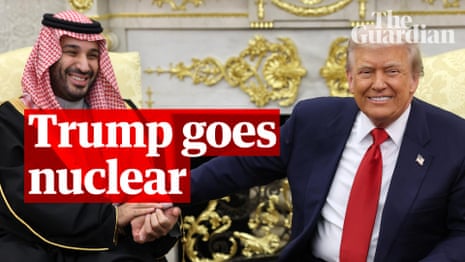
24:00
Trump gifts Saudi Arabia a nuclear win | Politics Weekly America
The IAEA’s “Additional Protocol” has been implemented by dozens of countries, and was one of the requirements of the Obama-era nuclear deal with Iran from which Trump withdrew in 2018. It involves inspection and verification to ensure that countries are using nuclear material solely for peaceful purposes.
When the US struck a similar deal with the United Arab Emirates, the UAE agreed not to seek enrichment or process spent atomic fuel, a measure that became known as the “gold standard” for nations wanting atomic power. The Saudi-US agreement reportedly does not include this gold standard.
Can this deal be blocked?
Opponents have long argued that providing Saudi Arabia with a domestic nuclear program will set off a race across the Middle East for other countries to pursue similar capabilities. Israel – which is known to have a secretive nuclear weapons program – has reportedly raised concerns that the deal could launch a regional arms race.
Democrats in Congress have expressed similar concerns. Senator Chris Murphy said the agreement would “set off a nuclear race in the region, further disincentivizing Iran from limiting its own program”.
However, Murphy and his colleagues in Congress will probably have difficulty blocking the deal. The deal is expected to be submitted to Congress for approval in the coming days, but to block the agreement, Congress would need to pass a joint resolution and have a two-thirds majority to override the president’s veto.
-=-=
bit talk 8 26 IP3 International - Wikipedia
IP3 International (International Peace, Power and Prosperity)[1] is a nuclear technology company formed in June 2016. One project involved a plan to transfer nuclear technology from the United States to Saudi Arabia.
History
During the 2016 U.S. presidential campaign of Donald Trump, and subsequently, Trump aides Michael Flynn and Jared Kushner were engaged in promoting IP3 International's plan to transfer nuclear technology from the US to Saudi Arabia, for use in a proposed joint US-Russian project, in possible violation of the Atomic Energy Act.[2][3][4][5][6] In January 2017, Derek Harvey, a retired Army intelligence officer, former staffer for David Petraeus, and then-staffer of the National Security Council under Michael Flynn, advocated for the IP3 nuclear sales plan. Harvey continued to speak with Michael Flynn "every night" even after Flynn resigned.[7]
In February 2019, United States House Committee on Oversight and Reform chairman Elijah E. Cummings released a report on the matter, based in part upon testimony from whistleblowers within White House.[6][8][9][10][11][7][12][13] The House Oversight Committee released a second interim staff report and supporting documents in July 2019, highlighting the "gold standard" of nuclear proliferation. It also reported lobbying by Flynn and Barrack and briefings to White House members including President Trump, Jared Kushner, Gary Cohn, Mike Pompeo, and Rick Perry.[14] ^[15] ^[16][17]
Personnel
Notable personnel include:
- Keith B. Alexander, cofounder and director, retired Army general, former director of the National Security Agency[18]
- Lars Buttler, director, founder of Trion Worlds gaming[19][18]
- James Cartwright, director, retired Marine Corps general, pardoned by President Obama after pleading guilty for leaking classified information[18]
- Jack Keane, cofounder and director, retired Army general[18]
- Robert McFarlane, cofounder and director, retired Marine Corps officer, pardoned by President George H.W. Bush after pleading guilty for involvement in the Iran-Contra affair[18]
- Eric T. Olson, director, retired Navy admiral, former Navy SEAL[18]
- Mike Rogers, director, former Republican congressional representative for Michigan[18]
- Frances Townsend, director, former Homeland Security Advisor, former Justice Department attorney[18]
- Alan Dunn, chief legal officer, twin brother of Congressman Neal Dunn and director of the failed 2018 US Expo Pavilion in Dubai, for which he was sued by the Attorney General of the District of Columbia.[20][18]
- Michael J. Wallace, director, former head of Constellation Energy, member of National Infrastructure Advisory Council, member of Center for Strategic and International Studies[21][22][18]
Michael Flynn has described himself as an advisor to IP3, which the company denies.[7][23] The company does acknowledge that it has a relationship with Flynn and some officials of the company were part of ACU Strategic Partners, but had differences with Russian partnership which was advocated by its managing partner, Alex Copson.[24][25]
See also
-=-=
dn House Democrats are accusing the Trump administration of moving toward transferring highly sensitive nuclear technology to Saudi Arabia in potential violation of U.S. law. Critics say the deal could endanger national security while enriching close allies of President Trump. Saudi Arabia is considering building as many as 16 nuclear power plants by 2030, but many critics fear the kingdom could use the technology to develop nuclear weapons and trigger a nuclear arms race in the Middle East. We speak with Democratic Congressmember Ro Khanna of California and Isaac Arnsdorf, a reporter with ProPublica. Arnsdorf first wrote about the intense and secretive lobbying effort to give nuclear technology to Saudi Arabia in 2017. His reporting was cited in the House report.
Transcript
This is a rush transcript. Copy may not be in its final form.
JUAN GONZÁLEZ: House Democrats are accusing the Trump administration of moving toward transferring highly sensitive nuclear technology to Saudi Arabia in potential violation of U.S. law. Critics say the deal could endanger national security while enriching close allies of President Trump. Saudi Arabia is considering building as many as 16 nuclear power plants by 2030, but many critics fear the kingdom could use the technology to develop nuclear weapons and trigger a nuclear arms race in the Middle East. During an interview with 60 Minutes last year, Saudi Crown Prince Mohammed bin Salman made clear that if Iran acquired nuclear weapons, Saudi Arabia would do the same.
CROWN PRINCE MOHAMMED BIN SALMAN: [translated] Saudi Arabia does not want to acquire any nuclear bomb. But without a doubt, if Iran developed a nuclear bomb, we will follow suit as soon as possible.
JUAN GONZÁLEZ: On Thursday, the House Oversight Committee issued an interim report on the proposed Saudi deal, after multiple whistleblowers came forward accusing several top White House advisers and Trump allies of attempting to push through the transfer of the nuclear technology despite legal and ethical warnings. At the center of the controversy is the company IP3, which was formed to help U.S. companies build nuclear plants in Saudi Arabia and elsewhere in the region, in what they dubbed a “Middle East Marshall Plan.” Former national security adviser Michael Flynn worked as an adviser for a subsidiary of the firm before entering the White House, and reportedly continued to advocate on behalf of the company once in office. IP3 was co-founded by former Reagan official Bud McFarlane, who pleaded guilty to participating in the Iran-Contra cover-up in 1988.
AMY GOODMAN: The House report also names several other high-ranking Trump officials and allies reportedly involved in the proposed Saudi deal, including Trump’s son-in-law, his adviser Jared Kushner; Energy Secretary Rick Perry; and Trump’s billionaire friend Tom Barrack, who served as chair of Trump’s inaugural committee. According to the report by the congressional committee, the White House may still be discussing the plan.
We’re joined now by two guests. In Washington, D.C., Democratic Congressmember Ro Khanna of Silicon Valley in California joins us. He serves on the House Oversight Committee. And here in New York, Isaac Arnsdorf is with us, a reporter with ProPublica. He first wrote about the intense and secretive lobbying effort to give nuclear technology to Saudi Arabia in 2017. His reporting was cited in the House report.
We welcome you both to Democracy Now! Congressmember Ro Khanna, let’s begin with you. What are you doing on the House Oversight Committee? What is the leadership doing there?
REP. RO KHANNA: Well, it’s a very serious matter. Here’s why people should care. The Saudis have been giving arms to al-Qaeda in Yemen. There’s reports of that. And the last thing we want to do as a country is to transfer nuclear secrets to Saudi Arabia, which could lead to proliferation and a threat to our security.
And as the journalist you have on has reported, there is a lot of financial conflict of interest here. Tom Barrack, who headed up the president’s inaugural committee to raise $100 million-plus, is also pushing for this deal and has financial interest in the deal. So the Oversight Committee is going to have an investigation to see what are the financial interests that are driving this administration to potentially sell nuclear secrets to the Saudis and what laws have been violated, because, as you know, they have to come to Congress, under the Atomic Energy Act, and offer certain guidelines, which they haven’t done.
JUAN GONZÁLEZ: And, Congressman, this attempt by the administration is still very much alive. There was a meeting February 12th, just last week, in the White House between President Trump and some nuclear power developers. What do you know about that meeting and what came out of there?
REP. RO KHANNA: Well, we need to find out more facts. That’s why we need an investigation. We need to know who was in that meeting, what was discussed, whether they followed the law that the Atomic Energy Act requires. I mean, even when we transfer nuclear technology to allies, such as India, when George Bush did that, it requires years of process. It requires the consultation of Congress. Here you’re talking about the potential sale of nuclear secrets to the Saudis, who aren’t an ally, who have engaged in the proliferation of weapons that are being used against our own troops, and there is no process for notification of Congress. And you have extensive reporting of people who gain—stand to gain billions of dollars from these investments.
AMY GOODMAN: So, Isaac Arnsdorf, the report of the House Oversight Committee cites your reporting. You did a piece yesterday. You did a piece last year. Explain first what the “Middle East Marshall Plan” is and then the financial interests of people like, well, Trump, a close confidant, spoke at the Republican National Convention, Tom Barrack, headed the inaugural committee, Michael Flynn and others.
ISAAC ARNSDORF: So, the “Middle East Marshall Plan” was this idea that bubbled up in this company that you mentioned, IP3, which was that they can strengthen economic and political ties between the U.S. and Saudi Arabia by having the U.S. companies export nuclear power technology to Saudi Arabia. And they started lobbying the Trump administration, and initially the Trump transition, about how this would fit with Trump’s ideas about his approach to the Middle East and make America great, restoring American jobs in American industry.
And Tom Barrack was very receptive to this idea, because he was promoting a similar kind of economic outreach to the region. He had a lot of ties with the leaders there. And thanks to the support of Tom Barrack and also General Flynn, who was involved in the project before he was in the White House, the project, the idea, gained a lot of traction in the early days of the administration.
AMY GOODMAN: And take it through to now.
ISAAC ARNSDORF: So, initially, in the first three months, as detailed by the whistleblowers who spoke to the House Oversight Committee, this was really something that was happening in kind of a—kind of being rushed through the National Security Council, and that wasn’t complying with the requirements of the Atomic Energy Act, that requires all kinds of review, because, obviously, the U.S. very tightly controls this technology, because it can be misused to build nuclear weapons.
More recently, the administration has been taking steps to go through that formal process and have negotiations with the Saudis about reaching a formal agreement to share nuclear power technology. If that were to happen, Congress would not have to actually ratify the treaty, but it would have 90 days to pass a joint resolution that could block it.
JUAN GONZÁLEZ: Well, you would think, though, with all the stuff that’s happened in relationship to Saudi Arabia—the murder of the journalist Jamal Khashoggi, the decision by Congress to cut off military aid to the war in Yemen—that there would be some reconsideration of the Trump administration of such a controversial move. What’s your sense of what the thinking is, going on here?
ISAAC ARNSDORF: Well, there was already a lot of bipartisan skepticism about the idea of sharing nuclear power technology, and calls to tell Congress more about what was happening in those negotiations, or even call off those negotiations. And you’ve certainly seen an escalation, since all the things that you mentioned, of members of both parties saying, “We need to put a pause on this. We need to get some more information.”
AMY GOODMAN: Let’s turn to Energy Secretary Rick Perry speaking last year at a meeting of the House Science, Space and Technology Committee. Energy Secretary Perry was asked to respond to concerns about nuclear proliferation in light of U.S. negotiations with Saudi Arabia on nuclear energy.
ENERGY SECRETARY RICK PERRY: That goes right to the point that we tried to make with the Saudi crown prince in our conversations with him and with his team, that not only will it send a powerful message if they go into an acceptable one, two, three, with additional protocols, but that we—that they do that, because if they don’t, the message that’s sent—if the Chinese or the Russians, which don’t require any of that, not only does it send the message—I think the wrong message—by the kingdom of Saudi Arabia, but it also sends the message to the United States that we’re no longer the leader in the world when it comes to civil nuclear power—Westinghouse, best reactor builder in the world. … The second point that we tried to really drive home to the crown prince was that if you want the best reactors in the world, you have to come to the United States, and you have to use Westinghouse.
AMY GOODMAN: Congressmember Ro Khanna, the significance of the testimony of Rick Perry, the energy secretary, and his involvement here?
REP. RO KHANNA: Well, I think it’s a worldview into how the Trump administration looks at the relationship with the Saudis. It’s all about money, whether it’s selling them arms sales or selling nuclear secrets. There’s no moral consideration. I mean, Tom Barrack, as recently as a week ago, was out there defending the Khashoggi murder and defending the Saudi regime’s murder of Khashoggi. He actually said, appallingly, that the United States has done worse, which I totally disagree with. But it gives you a sense of what’s driving this. It’s financial interests. It’s selling interests into the Saudis for money, and no concern for our security and no concern for the morality of the Saudis’ policies.
JUAN GONZÁLEZ: And, Isaac, in that clip, the energy secretary referred to the one, two, three. A lot of people are not familiar with that. Could you talk about the legal limitations on what the administration can do or can’t do in terms of transferring nuclear power technology?
ISAAC ARNSDORF: So, that refers to the section of the Atomic Energy Act that requires these negotiations and these agreements before sharing this technology. And what the secretary was describing there is really a very challenging policy problem, where the Saudis want nuclear power—maybe they have a legitimate interest in diversifying their economy from oil, but, as you heard the crown prince describe in the clip that you played, maybe they also want to keep up with their neighbor Iran, with potential military implications. So, the Saudis want nuclear power. They’re pursuing it. If the U.S. doesn’t help them get it, are they going to turn around and go to Russia or China? And then there are going to be even less security assurances than they would have with the U.S. So, that’s a very real policy problem that security experts struggle with.
But what you’re seeing with the Trump administration is that they are arriving at an answer to that policy problem that, based on what we’ve seen out of the House Oversight Committee, was, to a large extent, based on people with conflicts of interest promoting this for other reasons.
AMY GOODMAN: I also want to talk about Jared Kushner’s connection to this. The House report states, “In January 2018, Brookfield Business Partners, a subsidiary of Brookfield Asset Management, announced its plans to acquire Westinghouse Electric for $4.6 billion. Westinghouse Electric is the bankrupt nuclear services company that is part of IP3’s proposed consortium to build nuclear reactors in Saudi Arabia, and which stands to benefit from the Middle East Marshall Plan. In August 2018, Brookfield Asset Management purchased a partnership stake in 666 Fifth Avenue, a building owned by Jared Kushner’s family company.” Isaac?
ISAAC ARNSDORF: This is especially interesting given that Jared Kushner is on his way to the region very shortly. And there’s a lot of discussion in the House Oversight Committee’s report about materials being prepared for conversations between Kushner and the president, and obviously Jared Kushner has developed a very close relationship with MBS, the crown prince, and was reportedly described as “in his pocket.”
AMY GOODMAN: Ro Khanna, would you like to add to this?
REP. RO KHANNA: Well, I would just say we need transparency. But here is one thing that the president and the administration could do to show some distance from the Saudi regime, and that is to sign the War Powers Resolution that will stop U.S. support for the Saudi war crimes in Yemen. As you know, we passed it through the House; next week, the Senate is going to take it up. And I hope that the president will sign it and at least put some distance between U.S. policy with the Saudis. But we need to understand all of the financial interests that administration officials and their friends have with the Saudis and what’s driving our policy.
AMY GOODMAN: One last thing, Congressmember Ro Khanna. You’re a leader in the Congress around the issue of Yemen. Talk about the legislation that was just passed and how getting nuclear power to Saudi Arabia, which could conceivably be turned into nuclear weapons, plays into this picture of the worst humanitarian crisis in the world.
REP. RO KHANNA: Well, I appreciate your reporting on this. There are nearly 14 million Yemenis who face the potential of famine. That is because the Saudis have been bombing the port cities, and food and medicine isn’t being allowed in. It’s being inspected, and that’s leading to hyperinflation in Yemen. People don’t have food and medicine.
We passed in the House the War Powers Resolution that would stop the U.S. support for the Saudi bombing in Yemen. It’s expected to pass the Senate next week or in the next couple weeks. That will be the first time in the history of this country that the War Powers Resolution has ever passed, since 1973. And what that will do is make it unambiguously clear that the United States doesn’t support the Saudi bombing. As it is, since we passed the House resolution, we’ve seen a temporary ceasefire in the bombing campaign, and some hopeful signs that food and medicine will go in.
I think it would be the exact wrong message for us to be selling nuclear secrets to the Saudis, especially given the reporting that the Saudis are transferring some of these weapons to al-Qaeda in Yemen. And in terms of the point that Russia or China may supply the Saudis, the United States has prevented that type of action when we want to. We prevented it in Iran. We’re trying to prevent it in other countries. There’s no reason the United States should tolerate any sale of nuclear weapons to the Saudis.
AMY GOODMAN: Well, we’re going to leave it there but continue to follow this issue. Ro Khanna, Democratic congressmember from California, member of the House Oversight Committee, that’s going to be investigating this Saudi nuclear issue. Also with us, in New York, Isaac Arnsdorf, a reporter with ProPublica, who first wrote about the intense and secretive lobbying effort to give nuclear technology to Saudi Arabia in 2017, his reporting cited in the House report. And we’ll link to your latest report, “House Panel Probes Trump Advisers’ Push for Saudi Nuclear Deal.”
This is Democracy Now! When we come back, we’ll be joined by a man whose father possibly faces the death penalty in Saudi Arabia. He’s in prison
INDEP UK
==
FEB 2019
Senior Trump administration officials pushed a project to share nuclear power technology with Saudi Arabia over the objections of ethics officials, according to a congressional report, in a move that could have benefitted a company which has since provided financial relief to the family of Jared Kushner.
Citing whistleblowers within the US government, the report by the Democrat-led House oversight and reform committee alleges “abnormal acts” in the White House regarding the proposal to build dozens of nuclear reactors across the kingdom.
The committee on Tuesday opened an investigation into the allegations, which include concerns over whether White House officials in the early months of the Trump administration sought to work around national security procedures to push a Saudi deal that could have financially benefited close supporters of the US president.
According to the report, the nuclear effort was pushed by former national security adviser Michael Flynn, who was fired in early 2017 and is awaiting sentencing for lying to the FBI in the Russia investigation.
Derek Harvey, a National Security Council official brought in by Flynn, continued work on the proposal, which has remained under consideration by the Trump administration.
Relying on the whistleblower accounts, email communications and other documents, the committee’s report details how National Security Council and ethics officials repeatedly warned the actions of Flynn and a senior aide could run afoul of federal conflicts of interest law and statutes governing the transfer of nuclear technology to foreign powers.
The report also notes one of the power plant manufacturers that could benefit from such a deal includes Westinghouse Electric, a subsidiary of Brookfield Asset Management, a company which struck a deal in August to rescue the Kushner family’s 666 Fifth Avenue tower in Manhattan from massive debts.
Detailing the White House’s continued efforts to promote the deal, the report highlights how in May, energy secretary Rick Perry told a congressional committee he “tried to really drive home” to Saudi Arabia how “you have to use Westinghouse” for “the best reactors in the world”.
It also notes Mr Kushner, the president’s son-in-law and adviser, allegedly remains “directly involved” with those efforts, and that he would be travelling to Saudi Arabia in late February to “share elements of the economic plan” of a US peace proposal in the Middle East.
The White House and Mr Kushner did not immediately respond to a request for comment.
The report comes at a time when lawmakers are increasingly uneasy with the close relationship between the Trump administration and Saudi Arabia, which has raised alarms even among members of the president’s party in Congress.
Lawmakers from both parties have expressed concerns that Saudi Arabia could develop nuclear weapons if the US technology were transferred without proper safeguards.
Mr Trump has made the kingdom a centrepiece of his foreign policy in the Middle East as he tries to further isolate Iran. In the process, he has brushed off criticism over the killing of Washington Postcolumnist Jamal Khashoggi and the Saudis’ role in the war in Yemen.
Former White House ethics chief, Richard Painter: Donald Trump is 'mentally unwell'
Congressional investigators are also probing the role of Tom Barrack, a proponent of the nuclear proposal who ran Trump’s presidential inaugural committee, which is under separate investigation by federal prosecutors in New York. Rick Gates, a former Barrack employee and cooperator in Mr Mueller’s investigation, was also involved in advocating for the nuclear proposal.
A spokesman for Mr Barrack said in a statement he will cooperate with the House probe.
“Mr Barrack’s engagement in investment and business development throughout the Middle East for the purpose of better aligned Middle East and US objectives are well known, as are his more than four decades of respected relationships throughout the region,” the statement said, noting that Mr Barrack never joined the Trump administration.
Mr Harvey did not immediately return a request for comment.
According to the report, the whistleblowers came to the committee because they had concerns “about efforts inside the White House to rush the transfer of highly sensitive US nuclear technology to Saudi Arabia in potential violation of the Atomic Energy Act and without review by Congress as required by law — efforts that may be ongoing to this day”.
A 2017 article by the nonprofit news outlet ProPublica detailed some of the concerns raised inside the National Security Council about the nuclear proposal — known as the “Marshall Plan for the Middle East” — advocated by a company called IP3 International.
IP3 is led by a group of retired US military officers and national security officials, including retired rear admiral Michael Hewitt, retired Army general Jack Keane and former Reagan national security adviser Bud McFarlane.
IP3 and other proponents of nuclear power in the Middle East argue the US needs to be involved because otherwise it will lose out to Russia, China and others on billions of dollars in business. They also say that US involvement - and the limits on nuclear fuel that come with it - are essential to stem an arms race in the region.
“The only way to address concerns over development of weapons of mass destruction is for the US to participate in the introduction and secure operation of international nuclear power plants,” the company said in a statement on Tuesday. It also said it “looks forward to sharing what we know” with the House committee.
Up until the month before he joined the Trump administration, Flynn listed himself on public documents as an adviser to an iteration of Mr Hewitt’s company advocating for the nuclear power proposal.
Last year, IP3 told the Washington Post that Flynn was offered a role in the company but never formally came aboard. On Tuesday, the company said Flynn “was never an advisor to IP3 or its affiliate, he had no stake in the company and was never compensated or reimbursed for expenses by IP3”.
Still, according to the report, Flynn served as a conduit for IP3 inside the White House.
Just days after Mr Trump’s inauguration, the company sent Flynn a draft memo for the president’s signature that would have appointed Mr Barrack as a “special representative” in charge of carrying out the nuclear power proposal and called on the director of the CIA and the secretaries of state, energy, treasury and defense to lend him support.
The report also quotes former deputy national security adviser KT McFarland as saying Mr Trump personally told Mr Barrack he could lead the plan’s implementation.
The report also catalogs the actions of Mr Harvey, the Flynn confidant who was put in charge of the NSC’s Middle East and North African affairs.
According to the report, upon entering the White House in January 2017, Mr Harvey saw his mission as getting Mr Trump to adopt the nuclear proposal despite the objections of ethics and national security officials.
Even when HR McMaster, who replaced Flynn as national security adviser, and NSC lawyer John Eisenberg directed that work stop on the proposal because of concerns about its legality, Mr Harvey continued pursuing the proposal, according to the report.
Mr Harvey was fired from the NSC in July 2017. He then joined the staff of Republican congressman Devin Nunes of California, a Trump ally and the former Republican chairman of the House intelligence committee.
==