barrack, thomas jr
---
promote primary 2/9
MERRI OK
SEE PLUM AMB TURKEY
has gone to ground, but his and flynn names heavily interlinked? 1119
KUSHNER FLYNN NUKE PWR SALE TO SAUDI
MBS MBZ
MANAFORT STONE
RICK GATES COS RUSSIA VEKSELBERG
GEO GROUP BRIBE LEWANDOWSKI? HOMAN?
---
OMFG
...Now, Barrack has been no stranger to scandal. In the Reagan White House, he worked for Interior Secretary James Watt who actually retreated to Barrack’s ranch after he was forced to resign in disgrace. He probably also arranged to have someone buy Edwin Meese’s house at an inflated price which cost him a promised job at the Commerce Department. More recently, he’s been accused in Italy of conducting a $190 million tax avoidance scheme. But it’s his decision to pitch Manafort to Trump that has cast the biggest pall over his career, and his almost inexplicable and unshakeable mentorship of Rick Gates is a close second that casts some suspicion on innocent explanations for his role in Manafort’s hiring.
---
AMB TO TURKEY 12 24
---
wiki 3 26 not much talk, epst left out a yr?
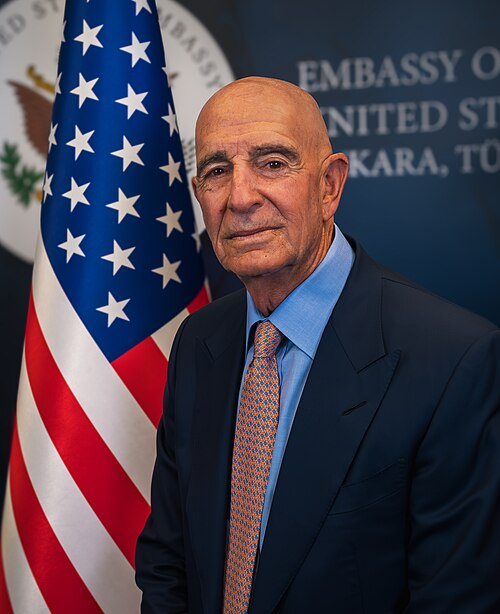
Thomas Joseph Barrack Jr. (born April 28, 1947)[1] is an American private equity real estate investor and the founder and retired chairman of Colony Capital, a publicly traded real estate investment trust.[2]
Barrack has for decades been a close friend of and fundraiser for U.S. President Donald Trump, representing him in television news appearances.[3] He was senior advisor to Trump's 2016 presidential campaign and served as the chairman of his Inaugural Committee.[4][5][6][7][8] In Trump's second administration, Barrack serves as the United States Ambassador to Turkey, United States Special Envoy for Syria and the United States Special Envoy for Iraq.[9]
Early life and education
Barrack's grandparents were Lebanese Christians who immigrated in 1900 to the United States from Zahlé.[10][11] Barrack was raised in Culver City, California, where his father was a grocer and his mother was a secretary.[12]
In 1969, Barrack earned a Bachelor of Arts degree from the University of Southern California (USC), where he participated on their varsity rugby team.[13][14] He then attended the USC Gould School of Law, where he was an editor of the Southern California Law Review, before receiving a Juris Doctor from the University of San Diego School of Law in 1972.[13][11][15]
Early career
Barrack's first job was at the law firm of Herbert W. Kalmbach, President Richard Nixon's personal lawyer.[16] In 1972, the firm sent him to Saudi Arabia, where he soon became the squash partner of a Saudi prince.[10][12] He then worked in the kingdom for the Fluor Corporation,[2] and worked for Saudi princes. Shortly after, he helped open diplomatic relations between Saudi Arabia and Haiti, then ruled by Jean-Claude Duvalier, at the request of investor Lonnie Dunn.[6][permanent ^dead ^link]
In 1982, Barrack served as deputy undersecretary of the United States Department of the Interior under James G. Watt in the Reagan administration.[5][8][10] The Secret Service would board its horses at Barrack's ranch when President Ronald Reagan was at his nearby Rancho del Cielo.[10] Watt made his resignation announcement at Barrack's ranch.[10] Barrack says he became disillusioned with government service after he was required to testify before a congressional committee due to a gift Barrack had paid to the purchaser of then-Attorney General Edwin Meese's house.[10]
Business career
In 1987, Barrack was later a principal with the Robert M. Bass Group.[5][7][8][10] In 1985, Barrack first dealt with Donald Trump when he sold Trump a one-fifth stake in the Alexander's department stores.[12] In 1988, Trump agreed to pay Barrack $410 million for total ownership of the Plaza Hotel.[12] He later lost both properties in bankruptcy.[12]
In 1990, Barrack founded Colony Capital, with initial investments by Bass and GE Capital, and later Eli Broad, Merrill Lynch, and Koo Chen-fu.[17] Barrack achieved 50% profits in his first two years by focusing on distressed properties, including the federal Resolution Trust Corporation.[10] He has invested some $200 million in Middle East real estate, $534 million in non-performing German real estate loans, and made a $24 million loan to photographer Annie Leibovitz.[11] He also owned Neverland Ranch which was once the home of mega superstar Michael Jackson.[11] Through Colony Capital, he runs a $25 billion portfolio of assets, from the Fairmont Raffles Hotels International hotel chain in Asia, the Aga Khan's former resort in Sardinia, Resorts International Holdings, One&Only Resorts, Atlantis, etc.[6]
Colony American Homes was criticized for treating tenants poorly during the Great Recession, raising rents, evicting people in large numbers and failing to maintain properties.[18][19]
Barrack has previously negotiated drilling rights with Mana Al Otaiba.[12] In 2009, Barrack negotiated with Otaiba's son, Ambassador Yousef Al Otaiba, the sale of a $41 million stake in the Raffles L'Ermitage hotel to the Abu Dhabi Investment Authority.[12]
In 2010, Barrack bought $70 million of Jared Kushner's debt on 666 Fifth Avenue.[12] Kushner later avoided bankruptcy when Barrack agreed to reduce his obligations after a request by Trump.[12]
As of September 2011, Barrack was the 833rd richest person in the world, and the 375th richest in the United States, with an estimated wealth of $1.1. billion USD.[11] However, he was no longer a billionaire in 2014.[20]
In 2012, Barrack sold the Paris Saint-Germain F.C. to the Qatar Investment Authority.[12][21] Barrack had to pay €22 million to settle tax charges related to the 2012 sale of his resort on Costa Smeralda to the Qatari sovereign wealth fund.
In 2010, Barrack partnered with the Qatar Investment authority to purchase the film production company Miramax for $660 million.[10] In 2016, Barrack sold Miramax to the Qatari beIN Media Group at a fourfold profit.[12] In October 2017, Barrack's Colony Capital agreed to invest in The Weinstein Company to keep it afloat in light of the sexual misconduct allegations against the company's co-founder, Harvey Weinstein.[22] The New York Times reported that the preliminary agreement with Weinstein fell apart and the acquisition broke down, in part because Colony Capital required the deal would not enrich Weinstein.[23]
Colony NorthStar merger
On June 3, 2016, Barrack's Colony Capital announced an all-stock three-way merger with two NorthStar affiliates to form Colony NorthStar, which would have managed $58 billion in assets and carried a pro-forma equity market capitalization of $7 billion and total capitalization of $17 billion.[24][25]
Management projected core FFO of $1.40–1.58 per share and targeted dividends of $1.08 per share for 2017,[26] but new FINRA rules requiring clearer REIT fee disclosures undermined the firm’s fundraising efforts by revealing fee levels that deterred prospective clients.[27][25]
On March 1, 2018, Colony NorthStar reported core FFO of $1.16 per share (22% below guidance), cut its dividend by 60%, and wrote down its Investment Management division by $375 million, causing the stock to fall 23% to $6.00.[25][26]
Other
In 2017, Barrack sold a $70 million stake in One California Plaza to the Abu Dhabi crown prince's investment fund.[12] During the first 18 months of the Trump administration, Colony NorthStar raised 24% of its $7 billion in investment from the United Arab Emirates (UAE) or Saudi Arabia.[12]
Barrack used Cayman Islands entities to invest pension fund money in distressed real estate and send money towards the Colony parent company, according to an organization chart that surfaced in the Paradise Papers documents leaked from the Appleby law firm[28]
Barrack is a trustee at the University of Southern California.[29] He has also served on the board of directors of Accor, Kerzner International, First Republic Bank, Continental Airlines, Korea First Bank, and Megaworld Properties & Holdings.[8][30][31] French president Nicolas Sarkozy awarded him France's Chevalier de la Légion d'honneur.[5]
Political activity
Barrack endorsed Donald Trump during the 2016 United States presidential election.[32] He was a major fundraiser for Trump's campaign through the "Rebuilding America Now" Super PAC, which raised $23 million.[10][33][34]
Barrack recommended that Trump hire Paul Manafort as his campaign manager. Barrack first met Manafort in the 1970s when they were both working for the Saudis and living in Beirut.[12] In 2007, Barrack had loaned Manafort $1.5 million to refinance a home in the Hamptons.[10]
On April 26, 2016, Barrack began an email correspondence with one of his business partners, UAE Ambassador Yousef Al Otaiba, reassuring him that Trump had investments in the UAE. "The emails were the beginning of Mr. Trump's improbable transformation from a candidate who campaigned against Muslims to a president celebrated in the royal courts of Riyadh and Abu Dhabi," according to New York Times writer David D. Kirkpatrick, who characterized this as a testament to Barrack's "unique place in the Trump world".[12] On May 26, Barrack wrote to Otaiba to introduce Jared Kushner, and the two met later that month.[12] On July 13, Barrack conveyed to Otaiba that Trump had removed from the Republican party platform the plank calling for the release of the 28 pages of redacted information from the 9/11 Commission Report.[12]
On July 21, Barrack spoke at the 2016 Republican National Convention.[35] In September 2016, Barrack helped set up a meeting between Trump and the Emir of Qatar in Trump Tower, although, as Kilpatrick noted, none of the investments brought in from the gulf by Barrack's firm in the two years following that meeting came from Qatar.[12] After Trump became president, Barrack continued to act as a middleman between him and Arab princes.[12]
Barrack served as chairman of the committee overseeing the 2017 Trump inauguration, for which he raised over $100 million, doubling the previous record.[10] Barrack hired Rick Gates, first to help run the inauguration and, following that, as a consultant for his company. Gates was fired from the latter position in October 2017, the day he was indicted.[12]
In a 2017 article in The Washington Post, Barrack commented on Trump's inflammatory rhetoric and proposals to ban immigrants from certain Muslim countries and put up a border wall with Mexico. "He's better than this," he said.[10] He denies a quote attributed to him in the 2018 book Fire and Fury, that Trump was "not only crazy" but "stupid".[36]
Barrack was interviewed during the Special Counsel investigation into Russian interference in the 2016 election, in particular regarding Paul Manafort, Rick Gates, Konstantin Kilimnik, the Trump campaign, the Trump transition team, and the financing of the Trump inauguration.[37][38]
Throughout the election campaign, transition period and inauguration process, Barrack is said to have had been in touch with people having ties in the ruling family of the United Arab Emirates, including Rashid al-Malik, a friend and business associate of Barrack and Yousef Al Otaiba, the UAE's ambassador to the US. According to a New York Times report published in July 2019, Barrack also exchanged emails with Malik, sharing with him a draft of Trump's energy policy speech to seek approval on the 'pro-gulf region language'. Malik, as per the emails, "circulated the draft among Emirati and Saudi officials" to seek further approval, followed by Barrack incorporating the language suggested by Malik in the draft sent to Paul Manafort, Trump's campaign chairman at the time.[39]
In 2021, Barrack denied involvement in Trump's pardon of Robert Zangrillo, a developer and investor who was charged in the 2019 college admissions bribery scandal for his alleged role in getting his daughter accepted into USC. The White House had listed Barrack as a supporter of the pardon.[40][41]
Barrack was allegedly directed by the UAE officials to meet former congressman Steve Stockman. Between February and March 15, 2017, the Emirates also asked Barrack to endorse the appointment of Stockman as the U.S. ambassador to the UAE. The Emirati plans were, however, interrupted after Stockman was arrested for stealing and using charity money for personal expenses.[42]
Indictment for foreign lobbying and acquittal
On July 20, 2021, Barrack and his business protege Matthew Grimes were indicted as an agent working at the direction of a foreign power, obstructing justice, and making false statements to law enforcement.[43][44][45] He was jailed for two days before being released on $250 million bond secured by $5 million in cash.[46] The indictment was broadened in May 2022 to include allegations that Barrack sought hundreds of millions of dollars in investments from the United Arab Emirates while illegally lobbying the Trump administration on its behalf.[47]
In July 2017, in an interview with a State Department investigator, which was conducted to determine whether or not Barrack would be a threat to national security as an ambassador, he failed to provide names of the four Emiratis, who on behalf of the UAE government assigned Barrack to influence the Trump campaign. Barrack only mentioned the names of Al Waleed bin Talal Al Saud, Nacho Figueras and Roberto Hernandez Ramirez.[48]
On November 4, 2022, Barrack and Matthew Grimes were both found not guilty.[49]
Trump administration
[ ](https://en.wikipedia.org/wiki/File:U.S._Senator_Jeanne_Shaheen,_U.S._Congressman_Joe_Wilson,_U.S._envoy_to_Syria_Tom_Barrack,_and_Syrian_President_Ahmed_al-Sharaa_%282025%29.jpg)Barrack, U.S. Congressman Joe Wilson, and U.S. Senator Jeanne Shaheen, met with Syrian President Ahmed al-Sharaa, August 2025
In December 2024, President Trump nominated Barrack as the new U.S. ambassador to Turkey.[50][51] The Senate confirmed him in a 60–36 vote on April 29, 2025.[52] He presented his credentials to Turkish President Recep Tayyip Erdoğan on May 14, 2025.[53] He was also selected by Trump as the new United States Special Envoy for Syria on May 23, 2025.[54] He later brokered the July 2025 ceasefire between Israel and Syria amid the Southern Syria clashes, urging Druze, Bedouin, and Sunni factions to disarm and promoting a unified Syrian identity with regional support from Turkey and Jordan.[55]
In August 2025, Barrack was heavily criticized in Lebanon after telling a group of journalists to "act civilized" and describing them as "animalistic" as they questioned him about the Trump Administration's plans for the south of the country, prompting outrage from the Lebanese media and journalists' union. The Lebanese presidency issued a statement expressing regret over the comments by "one of its guests".[56] The backlash caused Barrack to cancel a planned trip the following day to South Lebanon.[57] He later apologized over the remarks.[58]
In his capacity as the U.S. envoy to Syria, Barrack showed himself as "an outspoken advocate" of the Syrian president Ahmed al-Sharaa.[59] He oversaw the Israeli-Syrian security talks in Paris that opened the way for the Syrian transitional government to conduct the 2026 northeastern Syria offensive against the Kurdish-led Syrian Democratic Forces, a PKK-linked U.S. partner against ISIS during the civil war, and backed the terms of the two ceasefires offered by Sharaa to the SDF later in the month.[60][59]
Personal life
In 2014, Barrack married Rachelle Roxborough until they divorced in 2016. He has six children.[61]
His family is based in Los Angeles, California.[20] He also owns a 1,200-acre mountain ranch near Santa Barbara, California,[6][permanent ^dead ^link][11] as well as Happy Canyon Vineyards in the Happy Canyon of Santa Barbara AVA, and a tasting room in downtown Santa Barbara.[62] He is Roman Catholic.[12][63] In 2014, Barrack bought a house in Santa Monica for $21 million, which he later sold for $35 million, the highest price for a residence in that area.[64][65] In 2017, he purchased a $15.5 million home in Aspen, Colorado.[66]
Relationship to Jeffrey Epstein
According to the already published Epstein files, Tom Barrack networked and socialized with Jeffrey Epstein since at least the 1990s, and continued to communicate and meet with him for years following Epstein's 2008 conviction for soliciting a minor.[67] On 9 March 2016, Epstein emailed Barrack asking, "send photos of you and child. --make me smile".[68]
Awards and honors
- 2000, Golden Plate Award of the American Academy of Achievement[69]
- 2005, Lloyd Greif Center for Entrepreneurial Studies’ Entrepreneur of the Year Award[70]
- 2010, Chevalier de la Légion d’Honneur, an award bestowed by the French government for citizens and foreigners
See also
References
---
Ambassador and Trump confidant Tom Barrack kept ...

Facebook · CBS News
430+ reactions · 3 weeks ago](https://www.facebook.com/CBSNews/posts/exclusive-ambassador-and-trump-confidant-tom-barrack-kept-in-regular-contact-wit/1314681350523706/)
EXCLUSIVE: Ambassador and Trump confidant Tom Barrack kept in regular contact with Jeffrey Epstein for years, documents show.
---
DUCK 2 26 NOTE INFO A YR AGO
CBS News
https://www.cbsnews.com › news › tom-barrack-jeffrey-epstein-files
Trump insider Tom Barrack kept in regular contact with Jeffrey Epstein ...
Feb 14, 2026Tom Barrack, a top U.S. diplomat and longtime friend of President Trump, networked and socialized with Epstein for years, CBS News found.

The New Republic
https://newrepublic.com › post › 203137 › epstein-email-trump-ambassador-barrack-photos-child
Epstein Emailed Trump's Now Ambassador Asking for Photos of Child
Nov 13, 2025One of Jeffrey Epstein's newly released private emails implicates Tom Barrack, an old friend of President Trump and the current U.S. ambassador to Turkey. Barrack sent an email to Epstein on ...

National Day Today
Billionaire Financier Tom Barrack's Dark Ties to Jeffrey Epstein ...
5 days agoA new investigation reveals that Tom Barrack, a billionaire financier, longtime confidant of Donald Trump, and former U.S. ambassador to Turkey, had deep and sustained ties to convicted sex offender Jeffrey Epstein. Barrack's 544 mentions in Epstein's files show he was a trusted figure within Epstein's private ecosystem, exchanging family photos, coordinating media strategy, and attending ...
POLITICO
Barrack's close Epstein ties draw little fire - POLITICO
5 days agoU.S. Ambassador to Turkey and special envoy to Syria TOM BARRACK had a yearslong friendship with convicted sex offender JEFFREY EPSTEIN, but their ties have not generated the same firestorm as ...
---
FEB 2019
Senior Trump administration officials pushed a project to share nuclear power technology with Saudi Arabia over the objections of ethics officials, according to a congressional report, in a move that could have benefitted a company which has since provided financial relief to the family of Jared Kushner.
Citing whistleblowers within the US government, the report by the Democrat-led House oversight and reform committee alleges “abnormal acts” in the White House regarding the proposal to build dozens of nuclear reactors across the kingdom.
The committee on Tuesday opened an investigation into the allegations, which include concerns over whether White House officials in the early months of the Trump administration sought to work around national security procedures to push a Saudi deal that could have financially benefited close supporters of the US president.
According to the report, the nuclear effort was pushed by former national security adviser Michael Flynn, who was fired in early 2017 and is awaiting sentencing for lying to the FBI in the Russia investigation.
Derek Harvey, a National Security Council official brought in by Flynn, continued work on the proposal, which has remained under consideration by the Trump administration.
Relying on the whistleblower accounts, email communications and other documents, the committee’s report details how National Security Council and ethics officials repeatedly warned the actions of Flynn and a senior aide could run afoul of federal conflicts of interest law and statutes governing the transfer of nuclear technology to foreign powers.
The report also notes one of the power plant manufacturers that could benefit from such a deal includes Westinghouse Electric, a subsidiary of Brookfield Asset Management, a company which struck a deal in August to rescue the Kushner family’s 666 Fifth Avenue tower in Manhattan from massive debts.
Detailing the White House’s continued efforts to promote the deal, the report highlights how in May, energy secretary Rick Perry told a congressional committee he “tried to really drive home” to Saudi Arabia how “you have to use Westinghouse” for “the best reactors in the world”.
It also notes Mr Kushner, the president’s son-in-law and adviser, allegedly remains “directly involved” with those efforts, and that he would be travelling to Saudi Arabia in late February to “share elements of the economic plan” of a US peace proposal in the Middle East.
The White House and Mr Kushner did not immediately respond to a request for comment.
The report comes at a time when lawmakers are increasingly uneasy with the close relationship between the Trump administration and Saudi Arabia, which has raised alarms even among members of the president’s party in Congress.
Lawmakers from both parties have expressed concerns that Saudi Arabia could develop nuclear weapons if the US technology were transferred without proper safeguards.
Mr Trump has made the kingdom a centrepiece of his foreign policy in the Middle East as he tries to further isolate Iran. In the process, he has brushed off criticism over the killing of Washington Postcolumnist Jamal Khashoggi and the Saudis’ role in the war in Yemen.
Former White House ethics chief, Richard Painter: Donald Trump is 'mentally unwell'
Congressional investigators are also probing the role of Tom Barrack, a proponent of the nuclear proposal who ran Trump’s presidential inaugural committee, which is under separate investigation by federal prosecutors in New York. Rick Gates, a former Barrack employee and cooperator in Mr Mueller’s investigation, was also involved in advocating for the nuclear proposal.
A spokesman for Mr Barrack said in a statement he will cooperate with the House probe.
“Mr Barrack’s engagement in investment and business development throughout the Middle East for the purpose of better aligned Middle East and US objectives are well known, as are his more than four decades of respected relationships throughout the region,” the statement said, noting that Mr Barrack never joined the Trump administration.
Mr Harvey did not immediately return a request for comment.
According to the report, the whistleblowers came to the committee because they had concerns “about efforts inside the White House to rush the transfer of highly sensitive US nuclear technology to Saudi Arabia in potential violation of the Atomic Energy Act and without review by Congress as required by law — efforts that may be ongoing to this day”.
A 2017 article by the nonprofit news outlet ProPublica detailed some of the concerns raised inside the National Security Council about the nuclear proposal — known as the “Marshall Plan for the Middle East” — advocated by a company called IP3 International.
IP3 is led by a group of retired US military officers and national security officials, including retired rear admiral Michael Hewitt, retired Army general Jack Keane and former Reagan national security adviser Bud McFarlane.
IP3 and other proponents of nuclear power in the Middle East argue the US needs to be involved because otherwise it will lose out to Russia, China and others on billions of dollars in business. They also say that US involvement - and the limits on nuclear fuel that come with it - are essential to stem an arms race in the region.
“The only way to address concerns over development of weapons of mass destruction is for the US to participate in the introduction and secure operation of international nuclear power plants,” the company said in a statement on Tuesday. It also said it “looks forward to sharing what we know” with the House committee.
Up until the month before he joined the Trump administration, Flynn listed himself on public documents as an adviser to an iteration of Mr Hewitt’s company advocating for the nuclear power proposal.
Last year, IP3 told the Washington Post that Flynn was offered a role in the company but never formally came aboard. On Tuesday, the company said Flynn “was never an advisor to IP3 or its affiliate, he had no stake in the company and was never compensated or reimbursed for expenses by IP3”.
Still, according to the report, Flynn served as a conduit for IP3 inside the White House.
Just days after Mr Trump’s inauguration, the company sent Flynn a draft memo for the president’s signature that would have appointed Mr Barrack as a “special representative” in charge of carrying out the nuclear power proposal and called on the director of the CIA and the secretaries of state, energy, treasury and defense to lend him support.
The report also quotes former deputy national security adviser KT McFarland as saying Mr Trump personally told Mr Barrack he could lead the plan’s implementation.
The report also catalogs the actions of Mr Harvey, the Flynn confidant who was put in charge of the NSC’s Middle East and North African affairs.
According to the report, upon entering the White House in January 2017, Mr Harvey saw his mission as getting Mr Trump to adopt the nuclear proposal despite the objections of ethics and national security officials.
Even when HR McMaster, who replaced Flynn as national security adviser, and NSC lawyer John Eisenberg directed that work stop on the proposal because of concerns about its legality, Mr Harvey continued pursuing the proposal, according to the report.
Mr Harvey was fired from the NSC in July 2017. He then joined the staff of Republican congressman Devin Nunes of California, a Trump ally and the former Republican chairman of the House intelligence committee.
==
---
https://www.alternet.org/jeffrey-epstein-set-up-meetings-with-trump-allies-before-2016-election/
no lnx
Revealed: Jeffrey Epstein set up meetings with Trump allies before 2016 election
Alex Henderson August 30, 2023
Four years have passed since wealthy financier Jeffrey Epstein, facing federal sex trafficking charges involving minors, was found dead in a Manhattan jail cell. A medical examiner ruled that Epstein, on August 10, 2019, had died from suicide by hanging.
Epstein, who was 66 when he died, associated with a lot of famous people. According to the Wall Street Journal, Epstein set up meetings with some of Donald Trump's supporters before the 2016 presidential election.
Those supporters included Thomas Barrack and PayPal co-founder Peter Thiel (a major donor to MAGA Republicans), WSJ journalists Khadeeja Safdar and David Benoit (not to be confused with the jazz musician) report.
Another was the late Vitaly Churkin, who was Russia's ambassador to the United Nations at the time.
Forbes reporter Sara Dorn, in a separate article on Epstein, notes, "The New York Times reported in May that e-mails from Epstein's assistant show he planned to meet with Thiel at least three times in 2014, but the paper did not confirm whether the meetings occurred and Thiel declined to comment at the time."
READ MORE: Ethics defenders cheer as Trump 'Big Lie' allies charged in Michigan
Find the Wall Street Journal's full report at this link (subscription required) and Forbes' article here.
---
ANCA Ramps Up Calls on Trump to Fire Epstein-Ally, Armenian Genocide-Denier Amb. Tom Barrack
Epstein Files Document 540+ References to U.S. Turkey Envoy - including a Shocking Revelation that Former Turkish FM Davutoglu Enlisted Barrack and Epstein to Fight Armenian Genocide Recognition
February 19, 2026
WASHINGTON, DC – The Armenian National Committee of America (ANCA) is calling on President Trump to immediately fire U.S. Ambassador to Turkey Tom Barrack – an unapologetic denier of the Armenian Genocide – following revelations in the Department of Justice’s Epstein Files documenting his decade-long friendship with convicted sex trafficker Jeffrey Epstein.
The ANCA first calledfor his resignation last July, after he publicly dismissed the Armenian Genocide as an “old impression” at a State Department briefing in New York City. At that time, the ANCA joined the Hellenic American Leadership Council and American Friends of Kurdistan in calling for his recall.
“Tom Barrack called a convicted child sex trafficker his ‘role model’ — in writing,” said ANCA Executive Director Aram Hamparian. “He appears over 540 times in the Epstein Files. And before all of this came to light, he was already on record denying the Armenian Genocide on behalf of the Turkish government. President Trump needs to fire him now.”
Sen. Adam Schiff (D-CA) put the question bluntly, writing Monday night: “Is this really who we want representing our country.”
The DOJ’s Epstein Files document a warm and sustained personal relationship that continued for over a decade after Epstein’s 2008 conviction for sex crimes involving minors. In December 2012 — four years after Epstein’s conviction — Barrack emailed Epstein: “Not until you hire me as ur butler. How is my role model?” In March 2016, with Barrack serving as a senior Trump campaign fundraiser, Epstein emailed him: “Send photos of you and child — make me smile.”
The Epstein Files also expose a direct connection between Epstein’s network and efforts to suppress Armenian Genocide recognition in the United States. In a February 11, 2026 video posted to X, former Turkish Foreign Minister Ahmet Davutoglu admitted that his meeting with U.S. billionaire Thomas Pritzker — documented in the DOJ files — was specifically arranged to seek support “against the Armenian lobby” ahead of the 2015 Armenian Genocide centennial. DOJ records show Pritzker emailing Epstein about Davutoglu, describing him as a “Kissinger-type figure,” and arranging a meeting between the two. Pritzker has since resigned as Hyatt Hotels chair, citing his ties to Epstein and Ghislaine Maxwell.
The pattern is clear: genocide denial and the Epstein class are not separate stories. Barrack denied the Armenian Genocide on behalf of Ankara. Davutoglu used the Epstein network to fight Armenian Genocide recognition in Washington.
For Immediate Release
Media Contact: Elizabeth S. Chouldjian
Email / Tel: (202) 775-1918
Armenian National Committee of America
1711 N Street NW Washington, DC 20036
anca@anca.org | anca.org/facebook | @anca_dc
---
https://www.dallasnews.com/news/politics/2022/08/26/former-texas-rep-steve-stockmans-arrest-surfaces-as-feds-build-case-against-trump-ally/
paywall
no lnx
Politics
Former Texas Rep. Steve Stockman’s arrest surfaces as feds build case against Trump ally
Attorneys building a case against Barrack argue Stockman’s arrest is relevant.
U.S. Rep. Steve Stockman (standing) of Friendswood and musician Ted Nugent, a National Rifle...
U.S. Rep. Steve Stockman (standing) of Friendswood and musician Ted Nugent, a National Rifle Association board member at the time, spoke to a reporter before President Barack Obama's State of the Union address in February 2013.
By Emily Caldwell
Aug 26, 2022
WASHINGTON — The arrest timeline of former Houston-area Republican U.S. Rep. Steve Stockman, convicted in 2018 in a complex corruption scheme that involved misusing charitable funds, may be used as evidence by U.S. attorneys building a case against Trump allyTom Barrack.
Barrack, a private equity investor and close friend of former President Donald Trump, will go on trial with a business associate in September on charges of illegally lobbying Trump on behalf of the United Arab Emirates.
In a brief submitted before Barrack’s trial, attorneys said they intend to introduce evidence showing that Barrack and his associate were directed, by the UAE, to meet with and advocate for the appointment of Stockman to the position of U.S. ambassador to the UAE, but were unable to because of Stockman’s arrest on March 16, 2017.
The attorneys argued that Stockman’s “arrest is relevant because it explains why the Defendants were not able to fulfill this request, despite agreeing to do so.”
“Without this information, the jury may mistakenly conclude that the Defendants willingly refused to follow through on the UAE’s direction, when, in fact, circumstances beyond their control deprived them of the opportunity to do so,” the attorneys wrote.
Though Stockman’s name has been redacted from the public brief, text describing him as a former congressman and his arrest date are clearly visible, and Stockman had, in the weeks before his arrest, indicated he was highly interested in securing the UAE ambassador position.
The 74-year-old Barrack, who was chairman of Trump’s 2017 inaugural fund, and his associate Matthew Grimes, 27, were arrested in July.
Both men have pleaded not guilty to charges of secretly advancing the UAE’s interests, at the direction of senior UAE officials, by influencing Trump’s 2016 campaign foreign policy positions and U.S. government stances during the first half of Trump’s presidency.
In 2018, Stockman was convicted in federal court of masterminding a wide-ranging fraud scheme, using significant charitable donations from big-shot conservative donors to cover campaign debts and personal expenses. He was found guilty of all but one of the 24 counts brought against him, including fraud, money laundering and violating federal election law.
In late 2020, Trump commuted the remainder of Stockman’s 10-year prison sentence, prompting his release from the Federal Correctional Institution, a low-security facility in Beaumont. His family had been worried about his health after he contracted COVID-19 while incarcerated.
Emily Caldwell
Emily Caldwell. Emily Caldwell is covering politics in Washington for The Dallas Morning News. She is from College Station, Texas, and graduated from The University of Texas at Austin in 2021 with degrees in journalism and Latin American studies. She spent a number of years at The Daily Texan, UT's student newspaper, and was the editor-in-chief her senior year.
emily.caldwell@dallasnews.com
---
---
https://www.alternet.org/2021/07/tom-barrack/
---
https://www.alternet.org/2020/12/ivanka-trump-2649119014/
investigation testimony also i think barrack
---
---
trump inc pod 120
colony barrack baby doc duvalier; meese loan ok'd by inquiry; met manafort in beruit? lebanon; 47 checks for 1 mill$; target 50 riased 107
rick gates on campign, also inaug, also manafort co?
tom b big ambassador gala, basis for global lobbying effort, plan sez start DC office HQ tho never happnened?
ballroom booked by Congr prayer, force majeur, did not back down; ballroom booked 4 days 175K$ per day? planner email said bewarre IRS audit, went aheand anyway, Invanka in loop, owns 7%, bro and dad rest; thus emolument?
---
---
kpfa aaron glanz homewreckers
fundraiser
https://kpfa.org/episode/upfront-december-12-2019/
==
---
1119
invert yield curve;homewreckers book8 mil foreclosures; big % llc shell corps; // CDO; R wolff says banks can't deal with hit 1/2 of Gt Recession , get loans to cover loans; mnuchin etc wilbur recalled gov't baillout after S&L; mnu sez put 1.x billion but pain nothing for indybank and then got subsidies to foreclose?! // get car for free, put some bucks in then pocket total profit 11/8/19
==
==
new
steve mnu paid 0 for indy bank, and gov't guar lose no money, sold to buddy in same blg (bunch of pluto-crats ) soros, paulsen, wilbur, thomas barack?
extensive interview: https://kpfa.org/episode/letters-and-politics-october-23-2019/
https://kpfa.org/episode/upfront-october-21-2019/
aaron glantz homewreckers
---
==
https://www.bloomberg.com/news/features/2018-10-26/tom-barrack-got-trump-right-then-things-went-wrong
:{:{}:
}:
Bloomberg
Tom Barrack Got Trump Right, Then Things Went Wrong
The financier’s Colony Capital is struggling. His royal allies in the Middle East are boxed out. And his old friend Paul Manafort is behind bars.
:{:{By October 26, 2018, 1:00 AM PDT Updated on October 26, 2018,}:
For Fourth of July weekend 2015, Patrice de Colmont, the owner of Le Club 55 near St. Tropez, decorated his restaurant with U.S. and French flags. Among the wealthy Americans there nibbling crudités and sipping Domaines Ott was financier Tom Barrack, who’d brought employees from his investment firm, Colony Capital. Fellow titans stopped by his table to say hello, including Blackstone Group LP co-founder Stephen Schwarzman, former Citigroup Inc. Chairman Sandy Weill, and hedge fund manager Dan Loeb.
Barrack had invited his deputies to the French Riviera to lay the groundwork for the Los Angeles-based firm’s newest fund. Building on a history of dealmaking that included Fairmont Hotels; the Miramax film studio, co-founded by Harvey Weinstein; and Michael Jackson’s Neverland Ranch, Barrack aimed to raise $2.5 billion to buy distressed European real estate assets and generate returns greater than 15 percent, a confidential investor pitch obtained by Bloomberg Businessweek shows. The conversations that weekend bubbled with optimism.
A few weeks earlier, Donald Trump, one of Barrack’s oldest friends, had announced he was running for president. The two real estate investors met in the mid-1980s, and Barrack entertained the crowd with war stories of deals they’d done together. While the campaign was the butt of many jokes at Le Club 55, according to two people who were there, Barrack startled guests with a different take. He said he thought Trump’s brash, authentic style would take him to the White House—and that he’d make a better president than candidate. Even employees who’d spent decades helping their boss place counterintuitive bets called the prediction crazy.
For Barrack, the tanned, bald, charismatic son of a Lebanese-American grocer from California, Trump’s candidacy became an obsession. In the months that followed, he would devote himself to Trump’s campaign, all but disappearing from the company he’d founded in 1991 and built into one of the world’s highest-profile real estate investment firms. While Barrack’s fundraising and TV appearances have been well-documented, he also assisted in ways that haven’t been reported. According to people familiar with the matter, he allowed Colony’s New York office, kitty-corner from Trump Tower, to be used for sensitive transition-team meetings. As a favor to Paul Manafort, a longtime friend he’d helped install as head of Trump’s campaign, he hired a woman whose duties included scheduling his campaign appearances. And he suggested that an investor familiar with Colony donate to a super PAC led by an ally of Manafort’s.
Helping a fading reality-TV star with no political experience capture the White House might have led to a role in the administration or made Colony a magnet for money from around the world. But mixing business and politics hasn’t worked out for Colony’s 71-year-old executive chairman. Instead, he damaged relations with the Qatari royal family, his best business partner in the Middle East, by helping orchestrate a relationship between the White House and the Saudis. Meanwhile, Colony hemorrhaged talent, raised only half the debt fund’s target, and entered into an ill-fated merger. Its shares have fallen about 60 percent since Trump’s inauguration, even as U.S. market indexes have risen more than 20 percent.
This story about Barrack’s misadventures in politics is based on interviews with more than a dozen current and former Colony employees, lobbyists, business partners, and campaign officials, most of whom requested anonymity to speak about private dealings. Barrack declined to be interviewed for this story, but his representatives dispute parts of this account. They say he remained engaged with the company, didn’t expect anything in return for making introductions to Middle East leaders, and continues to have excellent relations with rulers of Gulf countries despite increased feuding among some royal families.
“Barrack as chairman is responsible for creating a macro vision and expanding the global brand,” said Owen Blicksilver, a spokesman for Barrack, in a statement. “Politics around the world is an integral part of developing a vision.”
To the extent that he holds political beliefs, Barrack believes in Trump. He experiences politics largely on an emotional level, according to people who know him. A lifelong Republican, he’s nevertheless given money to California Democratic Senator Dianne Feinstein, whose husband is a business partner. He briefly worked in the administration of President Ronald Reagan, whose Santa Barbara, Calif., ranch was near one of Barrack’s properties. Trump is just another rich friend, his rich friends say.
At first, Barrack’s campaign involvement was limited mainly to strategy calls with Trump. He’d long maintained a robust travel schedule, visiting company offices and attending investor meetings around the world while still finding time for polo and winemaking. Employees assumed he’d have no trouble balancing the campaign with everything else. Nevertheless, to his friends, it was clear he was becoming invested. “For anybody around him, you’d have to live inside a freezer not to realize he was getting more involved,” says Nacho Figueras, the Argentine model and professional polo star who frequently plays with Barrack.
By early 2016, Barrack’s agenda also included finalizing the sale of Colony’s stake in Miramax to the government of Qatar. The Gulf nation was already part owner of the Hollywood studio, having teamed up with Colony to buy it from Walt Disney Co. for $660 million in 2010. It was a typical deal for Barrack and Qatar. For years, when Colony bought an exotic asset—a French soccer team, a sprawling Sardinian resort—it was usually with Qatari backing. Those deals led to a friendship with Hamad bin Jassim bin Jaber Al Thani, better known as HBJ, who led Qatar from 2007 to 2013 and oversaw its wealth fund.
Barrack would do favors for the Qataris, including helping them wrest a controlling stake in London’s Claridge’s hotel from a pair of tenacious British billionaires; coordinating the construction of a 77,000-square-foot Bel Air mansion for HBJ, rumored to cost $100 million; and making political connections. With an estimated $335 billion under management, the Qatar Investment Authority is one of the shrewder funds in the Gulf, and its support for some of Barrack’s oddball purchases indicated to other investors that there was a method to his madness. After jointly holding assets for a few years, Qatari companies would buy out Colony for an impressive profit. The Miramax deal returned 350 percent, a person with knowledge of the transaction told Bloomberg when it closed in March 2016.
Things weren’t going as well in other corners of the Colony empire—by then shares of the company had fallen a third from a year earlier. The Trump campaign was a bright spot. On the last day of February, Barrack went public with his support for Trump, the first prominent Wall Street moneyman to do so, praising the candidate for his “mastery of financial, political, and economic intellectual complexity combined with his charm and emotional intelligence.” The next day was Super Tuesday, with primaries in 11 states. Trump won seven, cementing his status not just as one to take seriously, but as the one to beat.
How Trump’s and Barrack’s business histories yielded a friendship is something of a mystery. Their relationship began with Barrack helping to sell Trump two assets the latter couldn’t afford. The first was Alexander’s, a struggling department-store chain. In 1986, Barrack’s boss, Texas investor Robert Bass, sold Trump a 20 percent stake in the company, which Trump pledged as collateral for a bank loan and later had to forfeit to pay off the debt.
The following year, the Plaza Hotel was on the market. Barrack led negotiations for Bass and won the prize—then resold it to Trump, who coveted the landmark visible from his New York office. After months of bargaining, Barrack got Trump to pay about $400 million for the hotel, yielding Bass an estimated profit of more than $50 million in less than a year. Interest payments on the money Trump borrowed to finance the deal eclipsed the Plaza’s revenue, and by 1992 the hotel was forced into bankruptcy.
The two continued flirting with other investments. Colony considered refinancing a loan for Trump’s Manhattan West Side rail yards project but couldn’t make the numbers work. Barrack weighed buying a controlling stake in Trump’s casinos but acquired a competing Atlantic City venue instead, then hired a former Trump executive to run it. In 2012, when Trump won approval to convert Washington’s Old Post Office building into a hotel, Colony was initially named as the financier, until Deutsche Bank AG stepped in.
Still, the two remained friendly. Both have been married three times and have talked each other through divorces. They’ve been kind to each other in the business press, a venue of special importance to Trump.
The Plaza deal made Barrack’s career, launching him into the upper echelons of finance. But years later, when Barrack told the story of the transaction at the Republican National Convention in July 2016, he gave it a more self-deprecating cast. Glossing over the candidate’s financing difficulties and bankruptcies, he said Trump had “played me like a Steinway piano.”
Colony Capital's Trump Slump
Price change since Trump’s inauguration
A few months before the convention, with Trump’s campaign still hurtling toward the nomination and Barrack talking up the candidate on cable news, Saudi Arabia’s then-Deputy Crown Prince Mohammed bin Salman, better known as MBS, announced a bold plan to diversify the country’s assets in preparation for a post-oil world. State-owned Saudi Arabian Oil Co. would sell shares to the public and use the projected $2 trillion in proceeds to build up its sovereign wealth fund, he said in April 2016.
To find, buy, and manage the assets the country would be acquiring with the proceeds, it would need an army of financiers. Barrack, who’d played the same role for the Qataris, was one of many who wanted in, according to three people familiar with his thinking. As a young lawyer working for Richard Nixon’s personal attorney in the early 1970s, Barrack had been sent to Saudi Arabia to do work on behalf of engineering and construction company Fluor Corp., which in turn led to a friendship with a couple of Saudi princes. But the Saudi royal family is sprawling and fractious, and Barrack hadn’t done deals with the country’s sovereign fund. His principal connection was to Prince Alwaleed bin Talal, his partner in taking the Fairmont Raffles hotel chain private in 2006. But Alwaleed wasn’t close to MBS, and with the latter consolidating power in the kingdom, he’d be of little help to Barrack.
He eventually found his opportunity in Yousef Al Otaiba, ambassador to the U.S. from the United Arab Emirates and another longtime friend of Barrack’s. As the campaign heated up, Otaiba reached out to complain about Trump’s threat to ban Muslim immigrants around the same time as MBS’s announcement. In the byzantine world of Gulf royalty, Otaiba is a good friend to have. He’s aligned with Mohammed bin Zayed Al Nahyan, the crown prince of Abu Dhabi, the largest by area of the seven emirates that make up the U.A.E. The Abu Dhabi crown prince supported MBS’s rise and had counseled him that a closer relationship with the U.S. was possible through improved ties with Israel.
“Confusion about your friend Donald Trump is VERY high,” Otaiba wrote Barrack in one of several emails obtained by the New York Times. Barrack advised Otaiba not to pay much attention to rhetoric, mentioned Trump’s real estate projects in Dubai, and arranged a meeting with the president’s son-in-law, Jared Kushner, the published emails show. “Obviously I would like the meeting to be arranged by you and me rather than Blackstone,” he wrote in a separate email. (Barrack’s experience in the Middle East was a valuable resource to the Trump campaign and later the administration, said Blicksilver, Barrack’s spokesman. “The introduction to the leaders of the Arab world was not for political reasons but rather to form thoughtful points of view on the issues which had plagued the region for decades,” he added.)
Kushner was receptive to an alliance among Gulf countries, the U.S., and Israel, which he saw as a way to pressure Palestinians into accepting a peace deal. Barrack soon began talking up the Saudi line in public. “The United Arab Emirates and Saudi Arabia and Israel—in my opinion—will align as allies very quickly here, and the world could change for the better,” he told Bloomberg TV in May 2016. Barrack went even further toward aligning himself with Saudi Arabia later that year, calling the kingdom “our longest and strongest ally” and “reliable defenders of the West’s diverse interests in the region.”
At home in the Colony offices, the situation was considerably less auspicious. The company was in the middle of a merger with New York-based NorthStar, whose chief executive officer, David Hamamoto, shared Barrack’s laid-back demeanor.
NorthStar was a mess. It had almost quadrupled the assets it had under management in two years by buying real estate portfolios with little regard for quality, funded with floating-rate debt. When rates started rising in late 2015, NorthStar’s interest payments did, too. That wouldn’t have been a problem were it not for how NorthStar was structured. The firm was an externally managed trust that was required to pay a nonnegotiable annual management fee of $186 million to another publicly traded company, also run by Hamamoto, no matter how it performed. Much of that went to the executive, resulting in a $75 million payout in 2014 that made Hamamoto one of America’s best-paid business leaders. To cover its interest payments, NorthStar had to weigh selling assets, which would threaten its ability to generate enough profit to pay the fees. Shares were plunging, and ratings companies threatened to reduce both NorthStar firms to junk status.
Barrack first discussed the idea of combining the companies with Hamamoto at New York’s Ritz-Carlton in January 2016, seeing a classic distressed-debt scenario. Colony executives talked about becoming the next Blackstone. Hamamoto, who didn’t respond to calls and emails seeking comment, saw something else, former employees say: an exit strategy.
Once the outlines of the deal were agreed on in mid-2016, the companies began to merge their operations. NorthStar employees, not all of whom were enamored with Trump, were struck by Barrack’s absences—and by the regularity with which they were asked to keep up with his political pronouncements. It was standard practice at Colony for employees to receive an email anytime he was going on television, followed by a link to the video of the appearance. Now those clips featured Barrack talking up Trump. Several complaints to human resources yielded no changes, former employees say.
With Barrack’s attention elsewhere, negotiations fell largely to his deputy, Colony CEO Richard Saltzman. The companies were hopelessly complex, with multiple business lines and subsidiaries. One of NorthStar’s main investment areas was health-care properties, where Colony had little expertise. Valuing the companies proved a challenge, even though both firms routinely made just these kinds of assessments. In the end, Saltzman and Hamamoto agreed to the bankers’ equivalent of throwing their hands up in the air: a merger of equals that assumed the companies’ stock prices accurately reflected the value of their underlying assets.
As negotiations entered their final stages, the Trump campaign was reaching its zenith. In at least one instance, according to a person familiar with the encounter, when an investor asked how best to back Trump, Barrack suggested the Rebuilding America Now super PAC, headed by a family friend of Manafort’s, Laurance Gay. (There was nothing improper in the suggestion. But the group later drew scrutiny for continuing to pay Gay $35,000 a month long after the election.) And in addition to hiring a woman at Manafort’s request, he later retained longtime Manafort associate and campaign deputy Rick Gates as a consultant to the firm. (Gates was fired after being indicted for lying to officials earlier this year. He later pleaded guilty.)
The deal closed in January 2017. A few months later a wooden crate showed up on the desk of an assistant to Hamamoto containing a book of leather swatches for use in custom yachts. Some employees took it as a sign that he was planning to jump ship—and that they should as well. By November, Hamamoto had submitted his resignation. Other NorthStar executives sold shares and left.
At the time of the merger, the combined company had a market value of about $8 billion. Today, investors value it at less than $3 billion. Saltzman has blamed the decline on “more challenging industry conditions” and a failure to raise as much capital as hoped.
Blicksilver, Barrack’s spokesman, said that while results have been disappointing so far, “there is no reason to believe this was attributable to any missteps on Barrack’s part, nor that it will not ultimately be a successful combination.”
Trump’s inauguration marked the peak of Barrack’s influence. The president-elect named him chairman of the inaugural committee, and he raised a record $106.7 million—important to a man who likes to claim records. On the day Trump took the oath of office, Barrack was seated behind Trump’s brother Robert and in front of Sheldon Adelson, the Republican Party’s most generous donor. Sporting a blue scarf and matching tie, Barrack smiled broadly and snapped photos.
Even as he celebrated, however, some within Colony worried. Management reminded employees that the firm had achieved new prominence thanks to the political activities of its founder, but many found that, to the contrary, its association with the president was producing headwinds. Fundraising in Europe, where Trump was unpopular, had become more difficult, and a pickup in Israeli interest wasn’t enough to close the gap. The debt fund Barrack had been so optimistic about stalled out at $1.3 billion, about half of the original goal. Blicksilver said it was a strategic decision to stop at that level.
Barrack’s diplomatic efforts were backfiring, too. Trump made Saudi Arabia the first stop on his first overseas trip in May 2017, partly as a result of Barrack’s lobbying. But a month later, just as MBS was being named crown prince, he and other Gulf leaders announced a blockade of Qatar, which they said was a financial backer of terror groups. (Qatar has denied this allegation.) Barrack was blindsided, one friend says. Trump’s tweet in support of the maneuver was a blow to Barrack’s credibility with his Qatari investors.
After the blockade began, Barrack reached out to then-Secretary of State Rex Tillerson, who’d done business in Qatar as CEO of Exxon Mobil Corp., to help contain the fallout. But Kushner, who’d built a relationship with MBS and backed the blockade, had more influence with Trump, according to three people familiar with the matter. A spokesman for Kushner denies that he backed the blockade. In November, MBS detained Alwaleed, Barrack’s onetime Saudi investing partner, in the Riyadh Ritz-Carlton for three months in a crackdown targeting political rivals.
Former employees who worked with Barrack in the Middle East say he miscalculated. Being a Western dealmaker in Saudi Arabia was once a rare thing. Now the kingdom has relationships across Wall Street—including with Schwarzman’s Blackstone, with which it committed to invest $20 billion in 2017. Gulf royals, the former employees point out, tend not to like dealing with middlemen, which is what Barrack became when he helped secure access to the Trump administration. (Barrack never insisted on “being kept in the loop, being the middleman,” Blicksilver said.) In Kushner, MBS found his own princeling in the White House.
While the Qataris haven’t said a negative word about Barrack in public, and their U.S.-based representatives say they won’t, the royal family has looked to other administration officials for support and hired opposition researchers who are looking into Barrack’s dealings with Saudi Arabia and the U.A.E., according to three people familiar with the matter. Barrack still speaks with HBJ on a regular basis, Barrack’s friends say, and Blicksilver said his relationship with the Qatari royal family remains unchanged.
Barrack helped arrange an April 2018 meeting between Trump and Qatar’s new emir, 38-year-old Tamim bin Hamad Al Thani, to whom Barrack had sold the Paris Saint-Germain soccer club in 2012. For Qatar, it represented a welcome, if belated, softening of the president’s stance. A month later, Barrack flew to Doha to meet with Tamim and talk investments, according to one person familiar with the meeting. No deals have been announced. On the other side of the blockade, Abu Dhabi bought a $70 million stake in a Los Angeles office tower partly owned by Colony, and the firm teamed up with the Saudi wealth fund to buy assets from France’s Accor SA. But Colony had owned a stake in Accor for years, so it hardly counts as new business.
As for Saudi Arabia, there may not be many more deals on offer.In August the kingdom postponed the public offering for Aramco, raising questions about how much investment will be coming from the country. MBS has become a toxic figure, tarnished by the October death of Saudi journalist and royal family critic Jamal Khashoggi inside the Saudi Consulate in Istanbul. Saudi Arabia has denied MBS’s involvement; nevertheless, executives including Schwarzman and JPMorgan Chase & Co.’s Jamie Dimon, as well as the CEOs of Uber, Viacom, and HP, pulled out of this year’s Future Investment Initiative conference, held the last week of October. Barrack, who attended the first Future Investment Initiative conference in 2017, backed out a few days before the gathering. He made his move after Treasury Secretary Steven Mnuchin, with whom he’d been scheduled to appear on a panel, said he wouldn’t attend.
For all of the loyalty and largesse Barrack bestowed on Trump since the campaign began, the Colony founder has gotten little in return. Friends say he expressed interest in being named a presidential envoy to the Middle East, which would have given him a broad mandate to shape policy. Instead, he was handed the inaugural committee—a job he likened to being a wedding planner, according to two people who say they heard the remark.
Barrack’s ties to the campaign may come back to haunt him. Special counsel Robert Mueller’s investigation inched closer to Barrack’s orbit with Manafort’s and Gates’s guilty pleas. Sam Patten, another Manafort associate, admitted to helping a Ukrainian oligarch disguise a $50,000 contribution to the inaugural committee in exchange for tickets. Three people close to Barrack say the committee didn’t have the tools to vet donors and that Barrack had no way of knowing the provenance of the funds. Barrack, who submitted to an interview by Mueller’s staff, “did so voluntarily, without a proffer or other agreement,” according to Blicksilver. Barrack hasn’t been accused of wrongdoing.
While Barrack’s be-nice-to-all style might be out of vogue in the era of Trump and MBS, friends say not to count him out. Figueras, the polo player, sees no sign that Colony’s reversal of fortune is weighing on him. “He never complains about anything,” Figueras says, adding that Barrack has told him he’ll be spending more time in South America. Colony is negotiating a deal to obtain the Latin American business of the Abraaj Group, a failing Dubai-based investment firm. Barrack has also raised $4 billion for a new Colony fund to invest in digital infrastructure such as cell towers and data centers.
Late last year, Barrack started spending more time in Colony’s offices and fewer hours on TV. He’s looking for opportunities to sell assets while boosting the fund management business. His relationships with sovereign wealth funds will be key.
“I am 100 percent focused,” Barrack told investors in March. “I am still one of the largest personal shareholders in this company, it’s the majority of my personal net worth, it’s the dominant factor in my and my family’s pride, reputation, and future, and I don’t intend to leave it tainted or unattended.” —With Shannon Pettypiece, Heather Perlberg, and Mohammed Aly Sergie
(Adds comment from spokesman for Jared Kushner on Qatar blockade. A previous version of this story corrected the role of Hamad bin Jassim bin Jaber Al Thani, who led Qatar as prime minister but wasn't its ruler.)
Bloomberg
---
Disastrous Deal Staggers Trump Ally Thomas Barrack - Forbes
https://www.forbes.com › sites › forbesdigitalcovers › 2018/07/09 › disastr...
1.
Close friend of Trump investigated over alleged €170m tax ...
https://www.theguardian.com › world › may › close-friend-trump-thomas-...
1.
Who Is Behind Trump's Links to Arab Princes? A Billionaire ...
https://www.nytimes.com › world › middleeast › trump-tom-barrack-saudi
Jun 13, 2018 - The connections nurtured by the financier Tom Barrack look to have paid ... in connection with his work for Russian-backed interests in Ukraine.
Tom Barrack Got Trump Right, Then Things Went Wrong ...
https://www.bloomberg.com › news › features › tom-barrack-got-trump-ri...
1.
'He's better than this,' says Thomas Barrack, Trump's loyal ...
https://www.washingtonpost.com › politics › 2017/10/10
Oct 11, 2017 - Thomas J. Barrack Jr., executive chairman of Colony NorthStar, poses for a ..... Manafort resigned in August after reports of his ties to Ukraine's ...
---
https://www.alternet.org/2019/07/trumps-2016-america-first-energy-speech-was-edited-and-preapproved-by-saudi-arabia-and-uae/
no lnx
Trump’s 2016 ‘America First’ energy speech was edited and pre-approved by Saudi Arabia and UAE
President Donald Trump walks with Saudi Arabia’s Deputy Crown Prince, Mohammed bin Salman, along the West Colonnade of the White House, Tuesday, March 14, 2017. (Official White House Photo by Shealah Craighead)]
Written by Mark Sumner / Daily Kos July 30, 2019
During the 2016 campaign, Donald Trump was set to do a speech on energy in which he was going to start pitching the phrase “America First,” but before he went onstage to talk about his plans for American energy production, one of Trump’s advisers ran the speech past officials from the United Arab Emirates. And then copies were sent to Saudi Arabia. So it was America first—so long as the UAE and Saudis are okay with that. When he finally got around to sharing the speech with Americans, some of the language in Trump’s “America First” speech actually came from the UAE.
According to ABC News, it was Trump adviser Thomas Barrack who arranged to give representatives from the UAE a preview of the speech two weeks before Trump delivered it. An associate of Barrack’s provided the speech to both Saudi and UAE representatives, still before Trump had delivered it to Americans. Finally, Barrack worked with Trump campaign chair Paul Manafort to insert revisions made by the UAE into the speech that Trump actually delivered. Manafort wrote back to Barrack confirming that the final version of the speech included the language requested by the UAE.
Why is this coming to light now? Because investigators for theHouse Oversight Committee—the committee chaired by Rep. Elijah Cummings—have unearthed a trove of communications featuring Manafort, Barrack, and representatives from the UAE and Saudi Arabia. Though Trump’s attack on Rep. Cummings appears to have been tied to a Fox News hit piece, the idea of going after the Oversight Committee chair might very much have already been on Trump’s mind.
The recommended language from Barrack’s UAE contact at one point included suggesting that Trump directly mention Saudi Crown Prince Mohammad bin Salman, but that apparently didn’t mesh too well with the screw-the-world tone of the speech that included Trump’s declaration that he would withdraw from the Paris agreement. The final speech included a toned-down version of the text requested by the UAE that said that Trump wanted to “work with our Gulf allies to develop a positive energy relationship as part of our anti-terrorism strategy.”
Barrack seemed to realize that this communication between the Trump campaign and a foreign government over the future of U.S. energy policy was problematic at best. In an exchange with Manafort, he noted that the language he was proposing to add to the speech was “probably as close as I can get without crossing a lot of lines.” Whether he’s concerned about crossing U.S. law, or crossing Mohammed bin Salman, isn’t clear.
Investigators for the Oversight Committee have collected more than 60,000 documents showing “intermingling of private interests and public policy decisions” by Trump both before and after the election. Some of this information was released in a report on Monday, and follows similar information released by the House in February after whistleblowers discussed these connections between the Trump White House and foreign governments.
The request to mention Saudi Crown Prince Mohammad bin Salman, along with the crown prince of the Emirate of Abu Dhabi, Sheikh Mohammed bin Zayed Al Nahyan, is of great interest. At the time of Trump’s speech, Mohammed bin Salman was not the crown prince. He wouldn’t assume that position until an internal “mini-coup” in 2017, immediately following Trump’s visit to Saudi Arabia. Since then, Jared Kushner has made multiple trips to visit him, delivering to him classified information to use against his enemies. Trump has issued two vetoes of bills designed to halt arms sales used in Mohammed bin Salman’s expansive war in Yemen.
==
==
https://www.alternet.org/2019/07/trump-adviser-tom-barrack-pushed-for-saudi-nuclear-deal-and-planned-to-profit-from-it/
no lnx vid
President Donald Trump’s inauguration chairman, Tom Barrack, lobbied the new administration to share nuclear power technology with Saudi Arabia while, at the same time, making plans to team up with the Saudis to buy a company that would benefit from the policy change, according to documents obtained by a House committee.
During the campaign, Barrack advised Trump on the Middle East, where he has long-standing business relationships. As Trump clinched the Republican nomination in 2016, Barrack shared a draft of a policy speech with a businessman from the United Arab Emirates, according to text messages quoted in the committee’s report. The businessman then consulted with unspecified others and suggested adding a paragraph praising the powerful princes of Saudi Arabia and the UAE, the text messages show.
Barrack incorporated the suggested language and sent a new draft to campaign chairman Paul Manafort, according to the report. In an email, Barrack seemed to suggest he knew he was entering an ethical or legal gray area: “This is probably as close as I can get without crossing a lot of lines,” he said.
On the day of the speech, Manafort sent Barrack a final draft, saying, “It has the language you want.”
==
...Dealings with Saudis Raise Questions About Trump Administration Policy
The House Oversight Committee has opened an investigation. Rep. Elijah Cummings (D-Md.) already commented that the investigation is “crucial” for understanding the Trump Administration’s aims.
Flynn was allegedly involved in the following proposal, per NBC News:
The proposal, which involved enlisting the U.S. nuclear power industry to build nuclear plants across the Middle East, wasbacked by a group of retired generals who formed a firm called IP3. Flynn described himself in financial disclosure filings as an “advisor” to a subsidiary of IP3, IronBridge Group Inc., from June 2016 to December 2016 — at the same time he was serving as Trump’s national security adviser during the presidential campaign and the presidential transition, the report says.
Not only was Flynn told he might have violated the law, the Trump administration’s pursuit of this nuclear tech transfer, Cummings said, appears “ongoing.”
These goals may even raise new speculation about why President Donald Trump, for instance, responded the way he did in the aftermath of Saudi Arabian agents’ assassination of journalist and permanent U.S. resident Jamal Khashoggi.
Rick Gates Knew About This, Too
Flynn’s aide Derek Harvey reportedly had a conference call with Trump friend Tom Barrack and former Trump campaign deputy chairman Rick Gates. Gates, it should be noted, was also deputy chair of the Trump Inaugural Committee, which is also under investigation by federal prosecutors. If Gates knew about it Special Counsel Robert Mueller likely knew about it.
...
---
https://www.cnbc.com/2019/03/10/paul-manafort-lawyer-mysterious-payment-hidden-chapter-of-trump-2016-campaign.html
Recent court filings are shedding new light on a mysterious $125,000 payment to lawyers for Paul Manafort, paid by a firm that has not been identified until now.
- The firm is called Multi Media Services Corporation, and its silent owner is Tony Fabrizio, a longtime Manafort associate and the chief pollster on Trump’s 2016 presidential campaign.
- The route this money traveled, from its origin as a donation made to a pro-Trump political group, to its final destination in the bank account of Manafort’s attorney, offers a window into relationships Manafort built over decades. ...Recent court filings from special counsel Robert Mueller shed new light on a mysterious payment to lawyers for Paul Manafort, the onetime chairman of Donald Trump’s presidential campaign. The payment, for $125,000, was made in June 2017, halfway through Trump’s first year in office. But it wasn’t disclosed publicly until late last year, when prosecutors accused Manafort in court filings of repeatedly lying to them about where the money actually came from. Manafort was convicted in 2018 of tax evasion and bank fraud, and sentenced in Virginia on Thursday to 47 months in prison. He faces another sente... In the world of presidential campaign fundraising, where millions of dollars are often raised and spent in a matter of weeks, $125,000 can seem like a drop in the bucket.
But the route this money traveled, from its origin as a donation made to a pro-Trump political group, to its final destination in the bank account of Manafort’s attorney, offers a rare glimpse into the inner workings of relationships Manafort built over 40 years in Republican politics.
These relationships have drawn fresh scrutiny in recent weeks. Both Manafort and another key figure in this story, Republican pollster Tony Fabrizio, were among 81 individuals and entities that received formal document requests on Monday from the House Judiciary Committee, which is investigating a broad range of potential presidential misdeeds.
The path taken by this $125,000 also highlights the ways that Manafort took advantage of the Trump campaign’s underdeveloped leadership structure to install his allies in top positions across the Trump political landscape.
Nowhere was this more evident than in the murky, loosely regulated world of super PACs and other political “dark money” groups,which are permitted to raise unlimited amounts of money from donors as long as they don’t “coordinate” directly with campaigns, a legal standard that leaves plenty of room for interpretation. In this world, Manafort’s longtime associates could hold key positions, and oversee the raising and spending of huge sums of money, often with little to no direct oversight.
One of these positions was leading a pro-Trump super PAC that Manafort helped to establish in June 2016 calledRebuilding America Now.
To run the group, Manafort tapped an old friend, Connecticut-based lobbyist Laurance “Laury” Gay. A former official in President Ronald Reagan’s administration, Gay went on to work at Manafort’s lobbying firm in the late 1980s. He is also the godfather to one of Manafort’s daughters.
With Manafort’s blessing and Gay at its helm, Rebuilding America Now raised more than $24 million between June and December 2016, more than any other pro-Trump super PAC did during the entire election.
According to the transcript from a Feb. 4 hearing in Manafort’s trial, prosecutors believe that in 2017, Rebuilding America Now under Gay’s leadership also played a central role in what they describe as a “scheme” to provide Manafort with “a way of getting cash” out of his time as the unpaid chairman of Trump’s 2016 campaign.
The payment
Manafort’s decision to take a volunteer job at the top of Trump’s presidential campaign drew national attention to his lobbying career. By the summer of 2017, Manafort was the target of multiple investigations into his personal finances, campaign work and foreign lobbying.
Faced with mounting legal bills, Manafort reached out to Gay in June of that year and asked him to arrange a $125,000 payment to Manafort’s lawyers, according to both prosecutors and Manafort’s defense attorneys. Rather than give Manafort the money himself, however, Gay called someone else.
“At the request of Paul Manafort, Laury [Gay] asked that funds be forwarded to an entity designated by Mr. Manafort to assist with his legal expenses,” said Anthony J. Iacullo, a criminal defense attorney who represents Gay, in a recent interview with The New York Times.
It’s not clear why Manafort asked for this specific amount. In an emailed response to CNBC, Iacullo said Gay “has not been charged with any wrongdoing nor has he done anything that violates any federal or state laws.” He added that “out of an abundance of caution and respect for the process itself, we decline to comment any further at this time.”
CNBC attempted to reach Gay several times, but the phone at Gay’s Canaan, Connecticut-based consulting firm, Business Strategies & Insight, had been disconnected.
In order to get the $125,000, Gay reached out to someone else, whose name is redacted in court filings. Prosecutors described the person as having “a long relationship” with Manafort. Manafort’s defense attorneys said the person had “been a vendor on all these campaigns [Manafort has] used in the past.”
Crucially, in a January court filing the special counsel also noted that this person ran a firm that had been paid “approximately $19 million” by the super PAC that Gay was running in 2016.
There is only one firm that received anything near $19 million from Rebuilding America Now. And reports filed with the Federal Election Commission show that this firm received almost exactly $19 million, leaving little doubt about which firm it was that prosecutors were referring to.
It is a political ad-buying firm called Multi Media Services Corporation, or MMSC, based in Alexandria, Virginia.
At first glance, MMSC appears to be a small, two-man shop with no obvious ties to Manafort or anyone else with whom Manafort has “a long relationship.” Moreover, there are no signs that either of the principals at MMSC was ever “a vendor on all these campaigns [Manafort has] used in the past,” which is how Manafort’s lawyers described the person who ran this firm.
But there is more to MMSC than meets the eye. Interviews and corporate records unearthed by CNBC have revealed that MMSC has a silent owner: Tony Fabrizio, a longtime Manafort associate and the chief pollster on Trump’s 2016 presidential campaign.
Fabrizio’s dual role as: a) the owner of MMSC, which was the biggest vendor to the top pro-Trump super PAC, Rebuilding America Now, and b) the Trump campaign’s lead pollster, has not been reported until now.
As for the source of the $125,000, CNBC has also uncovered a compelling detail buried in one of the hundreds of exhibits that Mueller’s prosecutors have entered into the record in the case against Manafort in Washington.
This one appears to be a bank transfer record of the payment itself.
Under the heading “Debit Information” there is a line on the transfer record that reads “Account: MMSC SECONDARY - *7107* - Checking - $132,087.56.”
Again, MMSC is the acronym for Multi Media Services Corporation. Two political operatives who spoke to CNBC referred to the firm by its acronym.

CNBC tried repeatedly over several weeks to reach Fabrizio, but he did not respond to emails or phone messages left for him.
To be clear, at no point in any publicly available filings does Mueller suggest that Fabrizio or MMSC committed any crimes. On the contrary, details that appear to have been provided by Fabrizio are cited frequently as evidence of Manafort’s alleged misdeed: lying to prosecutors about the source of the $125,000.
Manafort’s lawyers deny that he lied. They told the court that he was merely confused or misremembered during each of the three interviews where he told the government three different stories about where the money came from.
Legal experts also told CNBC that there doesn’t seem to be anything wrong with what Fabrizio appears to have done, namely, use money from a firm he controls to make a payment on someone else’s behalf.
In addition to Fabrizio, Manafort and Gay, CNBC also reached out to former Rebuilding America Now political director Ken McKay, former general counsel Cleta Mitchell and finance director Christina Culver. None responded to emailed questions about the group or about their work for it.
The connection between Fabrizio, Manafort and the money sent to Manafort’s lawyers from MMSC is only the latest chapter in a relationship between the two men that dates back more than 20 years.
Fabrizio’s role
In 1996, Fabrizio and Manafort worked together on the failed presidential campaign of former Kansas Republican Sen. Bob Dole. Then, as in 2016, Manafort was initially brought on board to manage the delegates at the 1996 Republican National Convention, while Fabrizio worked as the Dole campaign’s pollster.
Since then, Fabrizio has also done work for some of Manafort’s most controversial clients. In 2012 and 2013, foreign lobbying records show that Manafort paid Fabrizio $278,000 for work Fabrizio did to help Manafort’s political clients in Ukraine.
Fabrizio’s role in Manafort’s Ukrainian lobbying wasn’t revealed until a year after Trump was elected,however, when Manafort was required to file a foreign agent registration form with the Justice Department. On it, he listed five separate payments to Fabrizio, as well as payments to various other subcontractors.
Three years after they worked together on the Ukraine job, Manafort hired Fabrizio again, in May 2016, this time to work for the Trump presidential campaign.
At the time, Fabrizio’s hiring was greeted with fanfare in Republican circles, where it was viewed as a sign that Trump’s chaotic, bare-bones primary operation was maturing into a national presidential campaign, one capable of taking on the massive machine backing Democrat Hillary Clinton.
Meanwhile, the fact that Trump had hired a pollster at all was newsworthy, coming, as it did, after months of the candidate insisting that political pollsters were a waste of money.
“One of Paul Manafort’s best decisions was hiring Republican pollster Tony Fabrizio to determine how to beat Hillary Clinton,” wrote Roger Stone, a longtime friend of Manafort’s, Trump’s and Fabrizio’s, in his 2017 book, “The Making of a President.”
“In the end, it was the pugnacious and bulldog-like Fabrizio who insisted that the Trump campaign had to expand the map into Wisconsin and Michigan, while doubling down on Pennsylvania,” Stone wrote.
Stone was arrested earlier this year on charges that included lying to Congress about his contacts in 2016 with Wikileaks, which published thousands of emails allegedly stolen from the Clinton campaign by Russian state hackers.
Two weeks after Manafort hired Fabrizio to poll for the campaign, Manafort and longtime Trump ally Tom Barrack set up the Rebuilding America Now super PAC so they could raise millions at a time from wealthy GOP donors to help Trump, who was reportedly growing tired of spending his own money to fund his campaign.
Five days after Rebuilding America Now was formed on June 2, campaign finance records show that it made its first payment to MMSC, Fabrizio’s ad-buying firm, for a $1 million ad buy. According to prosecutors, Rebuilding America Now hired MMSC “at Manafort’s suggestion.”
The rapid succession of these hirings — first Manafort to chair the campaign, then Fabrizio to poll for the campaign, then Gay to run Rebuilding America Now, then Fabrizio’s ad-buying firm to buy the airtime for Rebuilding America Now — offer a striking example of how Manafort turned his unpaid role on the Trump campaign into an opportunity to secure lucrative work for his longtime associates.
In hindsight, however, this work appears to have come at a high cost to those who did it.
- ....
---
barrack
https://www.propublica.org/article/trump-inc-podcast-who-was-behind-the-plan-to-give-saudi-arabia-nuclear-power
==
---
House Democrats are accusing the Trump administration of moving toward transferring highly sensitive nuclear technology to Saudi Arabia in potential violation of U.S. law. Critics say the deal could endanger national security while enriching close allies of President Trump. Saudi Arabia is considering building as many as 16 nuclear power plants by 2030, but many critics fear the kingdom could use the technology to develop nuclear weapons and trigger a nuclear arms race in the Middle East. We speak with Democratic Congressmember Ro Khanna of California and Isaac Arnsdorf, a reporter with ProPublica. Arnsdorf first wrote about the intense and secretive lobbying effort to give nuclear technology to Saudi Arabia in 2017. His reporting was cited in the House report.
JUAN GONZÁLEZ: House Democrats are accusing the Trump administration of moving toward transferring highly sensitive nuclear technology to Saudi Arabia in potential violation of U.S. law. Critics say the deal could endanger national security while enriching close allies of President Trump. Saudi Arabia is considering building as many as 16 nuclear power plants by 2030, but many critics fear the kingdom could use the technology to develop nuclear weapons and trigger a nuclear arms race in the Middle East. During an interview with 60 Minutes last year, Saudi Crown Prince Mohammed bin Salman made clear that if Iran acquired nuclear weapons, Saudi Arabia would do the same.
CROWN PRINCE MOHAMMED BIN SALMAN: [translated] Saudi Arabia does not want to acquire any nuclear bomb. But without a doubt, if Iran developed a nuclear bomb, we will follow suit as soon as possible.
JUAN GONZÁLEZ: On Thursday, the House Oversight Committee issued an interim report on the proposed Saudi deal, after multiple whistleblowers came forward accusing several top White House advisers and Trump allies of attempting to push through the transfer of the nuclear technology despite legal and ethical warnings. At the center of the controversy is the company IP3, which was formed to help U.S. companies build nuclear plants in Saudi Arabia and elsewhere in the region, in what they dubbed a “Middle East Marshall Plan.” Former national security adviser Michael Flynn worked as an adviser for a subsidiary of the firm before entering the White House, and reportedly continued to advocate on behalf of the company once in office. IP3 was co-founded by former Reagan official Bud McFarlane, who pleaded guilty to participating in the Iran-Contra cover-up in 1988.
AMY GOODMAN: The House report also names several other high-ranking Trump officials and allies reportedly involved in the proposed Saudi deal, including Trump’s son-in-law, his adviser Jared Kushner; Energy Secretary Rick Perry; and Trump’s billionaire friend Tom Barrack, who served as chair of Trump’s inaugural committee. According to the report by the congressional committee, the White House may still be discussing the plan.
We’re joined now by two guests. In Washington, D.C., Democratic Congressmember Ro Khanna of Silicon Valley in California joins us. He serves on the House Oversight Committee. And here in New York, Isaac Arnsdorf is with us, a reporter with ProPublica. He first wrote about the intense and secretive lobbying effort to give nuclear technology to Saudi Arabia in 2017. His reporting was cited in the House report.
We welcome you both to Democracy Now! Congressmember Ro Khanna, let’s begin with you. What are you doing on the House Oversight Committee? What is the leadership doing there?
REP. RO KHANNA: Well, it’s a very serious matter. Here’s why people should care. The Saudis have been giving arms to al-Qaeda in Yemen. There’s reports of that. And the last thing we want to do as a country is to transfer nuclear secrets to Saudi Arabia, which could lead to proliferation and a threat to our security.
And as the journalist you have on has reported, there is a lot of financial conflict of interest here. Tom Barrack, who headed up the president’s inaugural committee to raise $100 million-plus, is also pushing for this deal and has financial interest in the deal. So the Oversight Committee is going to have an investigation to see what are the financial interests that are driving this administration to potentially sell nuclear secrets to the Saudis and what laws have been violated, because, as you know, they have to come to Congress, under the Atomic Energy Act, and offer certain guidelines, which they haven’t done.
JUAN GONZÁLEZ: And, Congressman, this attempt by the administration is still very much alive. There was a meeting February 12th, just last week, in the White House between President Trump and some nuclear power developers. What do you know about that meeting and what came out of there?
REP. RO KHANNA: Well, we need to find out more facts. That’s why we need an investigation. We need to know who was in that meeting, what was discussed, whether they followed the law that the Atomic Energy Act requires. I mean, even when we transfer nuclear technology to allies, such as India, when George Bush did that, it requires years of process. It requires the consultation of Congress. Here you’re talking about the potential sale of nuclear secrets to the Saudis, who aren’t an ally, who have engaged in the proliferation of weapons that are being used against our own troops, and there is no process for notification of Congress. And you have extensive reporting of people who gain—stand to gain billions of dollars from these investments.
AMY GOODMAN: So, Isaac Arnsdorf, the report of the House Oversight Committee cites your reporting. You did a piece yesterday. You did a piece last year. Explain first what the “Middle East Marshall Plan” is and then the financial interests of people like, well, Trump, a close confidant, spoke at the Republican National Convention, Tom Barrack, headed the inaugural committee, Michael Flynn and others.
ISAAC ARNSDORF: So, the “Middle East Marshall Plan” was this idea that bubbled up in this company that you mentioned, IP3, which was that they can strengthen economic and political ties between the U.S. and Saudi Arabia by having the U.S. companies export nuclear power technology to Saudi Arabia. And they started lobbying the Trump administration, and initially the Trump transition, about how this would fit with Trump’s ideas about his approach to the Middle East and make America great, restoring American jobs in American industry.
And Tom Barrack was very receptive to this idea, because he was promoting a similar kind of economic outreach to the region. He had a lot of ties with the leaders there. And thanks to the support of Tom Barrack and also General Flynn, who was involved in the project before he was in the White House, the project, the idea, gained a lot of traction in the early days of the administration.
AMY GOODMAN: And take it through to now.
ISAAC ARNSDORF: So, initially, in the first three months, as detailed by the whistleblowers who spoke to the House Oversight Committee, this was really something that was happening in kind of a—kind of being rushed through the National Security Council, and that wasn’t complying with the requirements of the Atomic Energy Act, that requires all kinds of review, because, obviously, the U.S. very tightly controls this technology, because it can be misused to build nuclear weapons.
More recently, the administration has been taking steps to go through that formal process and have negotiations with the Saudis about reaching a formal agreement to share nuclear power technology. If that were to happen, Congress would not have to actually ratify the treaty, but it would have 90 days to pass a joint resolution that could block it.
JUAN GONZÁLEZ: Well, you would think, though, with all the stuff that’s happened in relationship to Saudi Arabia—the murder of the journalist Jamal Khashoggi, the decision by Congress to cut off military aid to the war in Yemen—that there would be some reconsideration of the Trump administration of such a controversial move. What’s your sense of what the thinking is, going on here?
ISAAC ARNSDORF: Well, there was already a lot of bipartisan skepticism about the idea of sharing nuclear power technology, and calls to tell Congress more about what was happening in those negotiations, or even call off those negotiations. And you’ve certainly seen an escalation, since all the things that you mentioned, of members of both parties saying, “We need to put a pause on this. We need to get some more information.”
AMY GOODMAN: Let’s turn to Energy Secretary Rick Perry speaking last year at a meeting of the House Science, Space and Technology Committee. Energy Secretary Perry was asked to respond to concerns about nuclear proliferation in light of U.S. negotiations with Saudi Arabia on nuclear energy.
ENERGY SECRETARY RICK PERRY: That goes right to the point that we tried to make with the Saudi crown prince in our conversations with him and with his team, that not only will it send a powerful message if they go into an acceptable one, two, three, with additional protocols, but that we—that they do that, because if they don’t, the message that’s sent—if the Chinese or the Russians, which don’t require any of that, not only does it send the message—I think the wrong message—by the kingdom of Saudi Arabia, but it also sends the message to the United States that we’re no longer the leader in the world when it comes to civil nuclear power—Westinghouse, best reactor builder in the world. … The second point that we tried to really drive home to the crown prince was that if you want the best reactors in the world, you have to come to the United States, and you have to use Westinghouse.
AMY GOODMAN: Congressmember Ro Khanna, the significance of the testimony of Rick Perry, the energy secretary, and his involvement here?
REP. RO KHANNA: Well, I think it’s a worldview into how the Trump administration looks at the relationship with the Saudis. It’s all about money, whether it’s selling them arms sales or selling nuclear secrets. There’s no moral consideration. I mean, Tom Barrack, as recently as a week ago, was out there defending the Khashoggi murder and defending the Saudi regime’s murder of Khashoggi. He actually said, appallingly, that the United States has done worse, which I totally disagree with. But it gives you a sense of what’s driving this. It’s financial interests. It’s selling interests into the Saudis for money, and no concern for our security and no concern for the morality of the Saudis’ policies.
JUAN GONZÁLEZ: And, Isaac, in that clip, the energy secretary referred to the one, two, three. A lot of people are not familiar with that. Could you talk about the legal limitations on what the administration can do or can’t do in terms of transferring nuclear power technology?
ISAAC ARNSDORF: So, that refers to the section of the Atomic Energy Act that requires these negotiations and these agreements before sharing this technology. And what the secretary was describing there is really a very challenging policy problem, where the Saudis want nuclear power—maybe they have a legitimate interest in diversifying their economy from oil, but, as you heard the crown prince describe in the clip that you played, maybe they also want to keep up with their neighbor Iran, with potential military implications. So, the Saudis want nuclear power. They’re pursuing it. If the U.S. doesn’t help them get it, are they going to turn around and go to Russia or China? And then there are going to be even less security assurances than they would have with the U.S. So, that’s a very real policy problem that security experts struggle with.
But what you’re seeing with the Trump administration is that they are arriving at an answer to that policy problem that, based on what we’ve seen out of the House Oversight Committee, was, to a large extent, based on people with conflicts of interest promoting this for other reasons.
AMY GOODMAN: I also want to talk about Jared Kushner’s connection to this. The House report states, “In January 2018, Brookfield Business Partners, a subsidiary of Brookfield Asset Management, announced its plans to acquire Westinghouse Electric for $4.6 billion. Westinghouse Electric is the bankrupt nuclear services company that is part of IP3’s proposed consortium to build nuclear reactors in Saudi Arabia, and which stands to benefit from the Middle East Marshall Plan. In August 2018, Brookfield Asset Management purchased a partnership stake in 666 Fifth Avenue, a building owned by Jared Kushner’s family company.” Isaac?
ISAAC ARNSDORF: This is especially interesting given that Jared Kushner is on his way to the region very shortly. And there’s a lot of discussion in the House Oversight Committee’s report about materials being prepared for conversations between Kushner and the president, and obviously Jared Kushner has developed a very close relationship with MBS, the crown prince, and was reportedly described as “in his pocket.”
AMY GOODMAN: Ro Khanna, would you like to add to this?
REP. RO KHANNA: Well, I would just say we need transparency. But here is one thing that the president and the administration could do to show some distance from the Saudi regime, and that is to sign the War Powers Resolution that will stop U.S. support for the Saudi war crimes in Yemen. As you know, we passed it through the House; next week, the Senate is going to take it up. And I hope that the president will sign it and at least put some distance between U.S. policy with the Saudis. But we need to understand all of the financial interests that administration officials and their friends have with the Saudis and what’s driving our policy.
AMY GOODMAN: One last thing, Congressmember Ro Khanna. You’re a leader in the Congress around the issue of Yemen. Talk about the legislation that was just passed and how getting nuclear power to Saudi Arabia, which could conceivably be turned into nuclear weapons, plays into this picture of the worst humanitarian crisis in the world.
REP. RO KHANNA: Well, I appreciate your reporting on this. There are nearly 14 million Yemenis who face the potential of famine. That is because the Saudis have been bombing the port cities, and food and medicine isn’t being allowed in. It’s being inspected, and that’s leading to hyperinflation in Yemen. People don’t have food and medicine.
We passed in the House the War Powers Resolution that would stop the U.S. support for the Saudi bombing in Yemen. It’s expected to pass the Senate next week or in the next couple weeks. That will be the first time in the history of this country that the War Powers Resolution has ever passed, since 1973. And what that will do is make it unambiguously clear that the United States doesn’t support the Saudi bombing. As it is, since we passed the House resolution, we’ve seen a temporary ceasefire in the bombing campaign, and some hopeful signs that food and medicine will go in.
I think it would be the exact wrong message for us to be selling nuclear secrets to the Saudis, especially given the reporting that the Saudis are transferring some of these weapons to al-Qaeda in Yemen. And in terms of the point that Russia or China may supply the Saudis, the United States has prevented that type of action when we want to. We prevented it in Iran. We’re trying to prevent it in other countries. There’s no reason the United States should tolerate any sale of nuclear weapons to the Saudis.
AMY GOODMAN: Well, we’re going to leave it there but continue to follow this issue. Ro Khanna, Democratic congressmember from California, member of the House Oversight Committee, that’s going to be investigating this Saudi nuclear issue. Also with us, in New York, Isaac Arnsdorf, a reporter with ProPublica, who first wrote about the intense and secretive lobbying effort to give nuclear technology to Saudi Arabia in 2017, his reporting cited in the House report. And we’ll link to your latest report, “House Panel Probes Trump Advisers’ Push for Saudi Nuclear Deal.”
This is Democracy Now! When we come back, we’ll be joined by a man whose father possibly faces the death penalty in Saudi Arabia. He’s in prison
==
House Democrats are accusing the Trump administration of moving toward transferring highly sensitive nuclear technology to Saudi Arabia in potential violation of U.S. law. Critics say the deal could endanger national security while enriching close allies of President Trump. Saudi Arabia is considering building as many as 16 nuclear power plants by 2030, but many critics fear the kingdom could use the technology to develop nuclear weapons and trigger a nuclear arms race in the Middle East. We speak with Democratic Congressmember Ro Khanna of California and Isaac Arnsdorf, a reporter with ProPublica. Arnsdorf first wrote about the intense and secretive lobbying effort to give nuclear technology to Saudi Arabia in 2017. His reporting was cited in the House report.
---
Transcript
This is a rush transcript. Copy may not be in its final form.
JUAN GONZÁLEZ: House Democrats are accusing the Trump administration of moving toward transferring highly sensitive nuclear technology to Saudi Arabia in potential violation of U.S. law. Critics say the deal could endanger national security while enriching close allies of President Trump. Saudi Arabia is considering building as many as 16 nuclear power plants by 2030, but many critics fear the kingdom could use the technology to develop nuclear weapons and trigger a nuclear arms race in the Middle East. During an interview with 60 Minutes last year, Saudi Crown Prince Mohammed bin Salman made clear that if Iran acquired nuclear weapons, Saudi Arabia would do the same.
CROWN PRINCE MOHAMMED BIN SALMAN: [translated] Saudi Arabia does not want to acquire any nuclear bomb. But without a doubt, if Iran developed a nuclear bomb, we will follow suit as soon as possible.
JUAN GONZÁLEZ: On Thursday, the House Oversight Committee issued an interim report on the proposed Saudi deal, after multiple whistleblowers came forward accusing several top White House advisers and Trump allies of attempting to push through the transfer of the nuclear technology despite legal and ethical warnings. At the center of the controversy is the company IP3, which was formed to help U.S. companies build nuclear plants in Saudi Arabia and elsewhere in the region, in what they dubbed a “Middle East Marshall Plan.” Former national security adviser Michael Flynn worked as an adviser for a subsidiary of the firm before entering the White House, and reportedly continued to advocate on behalf of the company once in office. IP3 was co-founded by former Reagan official Bud McFarlane, who pleaded guilty to participating in the Iran-Contra cover-up in 1988.
AMY GOODMAN: The House report also names several other high-ranking Trump officials and allies reportedly involved in the proposed Saudi deal, including Trump’s son-in-law, his adviser Jared Kushner; Energy Secretary Rick Perry; and Trump’s billionaire friend Tom Barrack, who served as chair of Trump’s inaugural committee. According to the report by the congressional committee, the White House may still be discussing the plan.
We’re joined now by two guests. In Washington, D.C., Democratic Congressmember Ro Khanna of Silicon Valley in California joins us. He serves on the House Oversight Committee. And here in New York, Isaac Arnsdorf is with us, a reporter with ProPublica. He first wrote about the intense and secretive lobbying effort to give nuclear technology to Saudi Arabia in 2017. His reporting was cited in the House report.
We welcome you both to Democracy Now! Congressmember Ro Khanna, let’s begin with you. What are you doing on the House Oversight Committee? What is the leadership doing there?
REP. RO KHANNA: Well, it’s a very serious matter. Here’s why people should care. The Saudis have been giving arms to al-Qaeda in Yemen. There’s reports of that. And the last thing we want to do as a country is to transfer nuclear secrets to Saudi Arabia, which could lead to proliferation and a threat to our security.
And as the journalist you have on has reported, there is a lot of financial conflict of interest here. Tom Barrack, who headed up the president’s inaugural committee to raise $100 million-plus, is also pushing for this deal and has financial interest in the deal. So the Oversight Committee is going to have an investigation to see what are the financial interests that are driving this administration to potentially sell nuclear secrets to the Saudis and what laws have been violated, because, as you know, they have to come to Congress, under the Atomic Energy Act, and offer certain guidelines, which they haven’t done.
JUAN GONZÁLEZ: And, Congressman, this attempt by the administration is still very much alive. There was a meeting February 12th, just last week, in the White House between President Trump and some nuclear power developers. What do you know about that meeting and what came out of there?
REP. RO KHANNA: Well, we need to find out more facts. That’s why we need an investigation. We need to know who was in that meeting, what was discussed, whether they followed the law that the Atomic Energy Act requires. I mean, even when we transfer nuclear technology to allies, such as India, when George Bush did that, it requires years of process. It requires the consultation of Congress. Here you’re talking about the potential sale of nuclear secrets to the Saudis, who aren’t an ally, who have engaged in the proliferation of weapons that are being used against our own troops, and there is no process for notification of Congress. And you have extensive reporting of people who gain—stand to gain billions of dollars from these investments.
AMY GOODMAN: So, Isaac Arnsdorf, the report of the House Oversight Committee cites your reporting. You did a piece yesterday. You did a piece last year. Explain first what the “Middle East Marshall Plan” is and then the financial interests of people like, well, Trump, a close confidant, spoke at the Republican National Convention, Tom Barrack, headed the inaugural committee, Michael Flynn and others.
ISAAC ARNSDORF: So, the “Middle East Marshall Plan” was this idea that bubbled up in this company that you mentioned, IP3, which was that they can strengthen economic and political ties between the U.S. and Saudi Arabia by having the U.S. companies export nuclear power technology to Saudi Arabia. And they started lobbying the Trump administration, and initially the Trump transition, about how this would fit with Trump’s ideas about his approach to the Middle East and make America great, restoring American jobs in American industry.
And Tom Barrack was very receptive to this idea, because he was promoting a similar kind of economic outreach to the region. He had a lot of ties with the leaders there. And thanks to the support of Tom Barrack and also General Flynn, who was involved in the project before he was in the White House, the project, the idea, gained a lot of traction in the early days of the administration.
AMY GOODMAN: And take it through to now.
ISAAC ARNSDORF: So, initially, in the first three months, as detailed by the whistleblowers who spoke to the House Oversight Committee, this was really something that was happening in kind of a—kind of being rushed through the National Security Council, and that wasn’t complying with the requirements of the Atomic Energy Act, that requires all kinds of review, because, obviously, the U.S. very tightly controls this technology, because it can be misused to build nuclear weapons.
More recently, the administration has been taking steps to go through that formal process and have negotiations with the Saudis about reaching a formal agreement to share nuclear power technology. If that were to happen, Congress would not have to actually ratify the treaty, but it would have 90 days to pass a joint resolution that could block it.
JUAN GONZÁLEZ: Well, you would think, though, with all the stuff that’s happened in relationship to Saudi Arabia—the murder of the journalist Jamal Khashoggi, the decision by Congress to cut off military aid to the war in Yemen—that there would be some reconsideration of the Trump administration of such a controversial move. What’s your sense of what the thinking is, going on here?
ISAAC ARNSDORF: Well, there was already a lot of bipartisan skepticism about the idea of sharing nuclear power technology, and calls to tell Congress more about what was happening in those negotiations, or even call off those negotiations. And you’ve certainly seen an escalation, since all the things that you mentioned, of members of both parties saying, “We need to put a pause on this. We need to get some more information.”
AMY GOODMAN: Let’s turn to Energy Secretary Rick Perry speaking last year at a meeting of the House Science, Space and Technology Committee. Energy Secretary Perry was asked to respond to concerns about nuclear proliferation in light of U.S. negotiations with Saudi Arabia on nuclear energy.
ENERGY SECRETARY RICK PERRY: That goes right to the point that we tried to make with the Saudi crown prince in our conversations with him and with his team, that not only will it send a powerful message if they go into an acceptable one, two, three, with additional protocols, but that we—that they do that, because if they don’t, the message that’s sent—if the Chinese or the Russians, which don’t require any of that, not only does it send the message—I think the wrong message—by the kingdom of Saudi Arabia, but it also sends the message to the United States that we’re no longer the leader in the world when it comes to civil nuclear power—Westinghouse, best reactor builder in the world. … The second point that we tried to really drive home to the crown prince was that if you want the best reactors in the world, you have to come to the United States, and you have to use Westinghouse.
AMY GOODMAN: Congressmember Ro Khanna, the significance of the testimony of Rick Perry, the energy secretary, and his involvement here?
REP. RO KHANNA: Well, I think it’s a worldview into how the Trump administration looks at the relationship with the Saudis. It’s all about money, whether it’s selling them arms sales or selling nuclear secrets. There’s no moral consideration. I mean, Tom Barrack, as recently as a week ago, was out there defending the Khashoggi murder and defending the Saudi regime’s murder of Khashoggi. He actually said, appallingly, that the United States has done worse, which I totally disagree with. But it gives you a sense of what’s driving this. It’s financial interests. It’s selling interests into the Saudis for money, and no concern for our security and no concern for the morality of the Saudis’ policies.
JUAN GONZÁLEZ: And, Isaac, in that clip, the energy secretary referred to the one, two, three. A lot of people are not familiar with that. Could you talk about the legal limitations on what the administration can do or can’t do in terms of transferring nuclear power technology?
ISAAC ARNSDORF: So, that refers to the section of the Atomic Energy Act that requires these negotiations and these agreements before sharing this technology. And what the secretary was describing there is really a very challenging policy problem, where the Saudis want nuclear power—maybe they have a legitimate interest in diversifying their economy from oil, but, as you heard the crown prince describe in the clip that you played, maybe they also want to keep up with their neighbor Iran, with potential military implications. So, the Saudis want nuclear power. They’re pursuing it. If the U.S. doesn’t help them get it, are they going to turn around and go to Russia or China? And then there are going to be even less security assurances than they would have with the U.S. So, that’s a very real policy problem that security experts struggle with.
But what you’re seeing with the Trump administration is that they are arriving at an answer to that policy problem that, based on what we’ve seen out of the House Oversight Committee, was, to a large extent, based on people with conflicts of interest promoting this for other reasons.
AMY GOODMAN: I also want to talk about Jared Kushner’s connection to this. The House report states, “In January 2018, Brookfield Business Partners, a subsidiary of Brookfield Asset Management, announced its plans to acquire Westinghouse Electric for $4.6 billion. Westinghouse Electric is the bankrupt nuclear services company that is part of IP3’s proposed consortium to build nuclear reactors in Saudi Arabia, and which stands to benefit from the Middle East Marshall Plan. In August 2018, Brookfield Asset Management purchased a partnership stake in 666 Fifth Avenue, a building owned by Jared Kushner’s family company.” Isaac?
ISAAC ARNSDORF: This is especially interesting given that Jared Kushner is on his way to the region very shortly. And there’s a lot of discussion in the House Oversight Committee’s report about materials being prepared for conversations between Kushner and the president, and obviously Jared Kushner has developed a very close relationship with MBS, the crown prince, and was reportedly described as “in his pocket.”
AMY GOODMAN: Ro Khanna, would you like to add to this?
REP. RO KHANNA: Well, I would just say we need transparency. But here is one thing that the president and the administration could do to show some distance from the Saudi regime, and that is to sign the War Powers Resolution that will stop U.S. support for the Saudi war crimes in Yemen. As you know, we passed it through the House; next week, the Senate is going to take it up. And I hope that the president will sign it and at least put some distance between U.S. policy with the Saudis. But we need to understand all of the financial interests that administration officials and their friends have with the Saudis and what’s driving our policy.
AMY GOODMAN: One last thing, Congressmember Ro Khanna. You’re a leader in the Congress around the issue of Yemen. Talk about the legislation that was just passed and how getting nuclear power to Saudi Arabia, which could conceivably be turned into nuclear weapons, plays into this picture of the worst humanitarian crisis in the world.
REP. RO KHANNA: Well, I appreciate your reporting on this. There are nearly 14 million Yemenis who face the potential of famine. That is because the Saudis have been bombing the port cities, and food and medicine isn’t being allowed in. It’s being inspected, and that’s leading to hyperinflation in Yemen. People don’t have food and medicine.
We passed in the House the War Powers Resolution that would stop the U.S. support for the Saudi bombing in Yemen. It’s expected to pass the Senate next week or in the next couple weeks. That will be the first time in the history of this country that the War Powers Resolution has ever passed, since 1973. And what that will do is make it unambiguously clear that the United States doesn’t support the Saudi bombing. As it is, since we passed the House resolution, we’ve seen a temporary ceasefire in the bombing campaign, and some hopeful signs that food and medicine will go in.
I think it would be the exact wrong message for us to be selling nuclear secrets to the Saudis, especially given the reporting that the Saudis are transferring some of these weapons to al-Qaeda in Yemen. And in terms of the point that Russia or China may supply the Saudis, the United States has prevented that type of action when we want to. We prevented it in Iran. We’re trying to prevent it in other countries. There’s no reason the United States should tolerate any sale of nuclear weapons to the Saudis.
AMY GOODMAN: Well, we’re going to leave it there but continue to follow this issue. Ro Khanna, Democratic congressmember from California, member of the House Oversight Committee, that’s going to be investigating this Saudi nuclear issue. Also with us, in New York, Isaac Arnsdorf, a reporter with ProPublica, who first wrote about the intense and secretive lobbying effort to give nuclear technology to Saudi Arabia in 2017, his reporting cited in the House report. And we’ll link to your latest report, “House Panel Probes Trump Advisers’ Push for Saudi Nuclear Deal.”
This is Democracy Now! When we come back, we’ll be joined by a man whose father possibly faces the death penalty in Saudi Arabia. He’s in prison
---
https://www.alternet.org/2019/02/prominent-trump-backer-americas-atrocities-are-equal-or-worse-to-what-saudi-arabia-did-to-khashoggi/
Tuesday, United Arab Emirates newspaper Gulf News reported that Tom Barrack, an ally of President Donald Trump, defended Saudi Arabia and Crown Prince Mohammed bin Salman for the murder of Washington Post journalist Jamal Khashoggi during a panel in Abu Dhabi, by trying to change the subject to how bad the United States is.
“Whatever happened in Saudi Arabia, the atrocities in America are equal, or worse,” said Barrack.“The atrocities in any … country are dictated by the rule of law. So for us to dictate what we think is the moral code there, when we have a young man and regime that is trying to push themselves into 2030, I think is a mistake.”
This sort of whataboutism is a favorite tactic of hostile regimes like those of Vladimir Putin in Russia: the logic being that all actions share a moral equivalency regardless of context, and any wrongdoing can be dismissed by pointing to the wrongdoing of others. The United States, being an imperialistic world power, has of course done unsavory things. But that should not inform how we react to the Saudi government murdering a journalist and dismembering him with a bone saw after he criticized the regime.
Moreover, we should question how seriously the prince — who allegedly ordered the killing — is committed to pushing his country into 2030 if he thinks there is room for state-sanctioned assassinations of reporters in 2030. Not to mention deliberately using child famine as a weapon of war in Yemen.
Barrack, a multimillionaire private equity real estate investor, was a former business partner and early backer of Trump who spoke in his favor at the 2016 Republican National Convention in Cleveland, Ohio.
Trump himself, who has long-standing real estate deals with the Saudi royal family, has been resistant to condemning the prince over Khashoggi’s murder. Despite the fact that the CIA determined the prince was responsible, Trump has said he stands with him, claiming there is “nothing definitive” to prove his involvement and “we may never know” the whole story. Even Senate Republicans have passed a resolution defying Trump to rebuke Saudi Arabia over Khashoggi.
---
https://www.alternet.org/2019/02/emails-reveal-melania-friend-who-planned-trump-inauguration-ripped-officials-over-sketchy-money-practices/
friend of Melania Trump’s who planned the president’s inauguration flagged multiple financial and conflict of interest issues when working on the events — and was ignored.
Vanity Fair‘s Emily Jane Fox reported Thursday that Stephanie Winston Wolkoff, a former Vogue staffer and New York City event planner, was brought on to plan Donald Trump’s inauguration just days after he was elected president. She had no idea what was in store for her.
According to people familiar with recordings made by former Trump “fixer” Michael Cohen, Wolkoff can be heard telling the president’s longtime attorney during conversations last summer that she had many concerns with the process that unfolded.
Those recordings, Cohen told the event planner, were later seized by the FBI — and led in part to the SDNY’s investigation into the inauguration that Wolkoff is now involved in.
Wolkoff, the report noted, eventually raised concerns about potential conflicts of interest that could stem from the Trump family businesses’ involvement in the planning — as well as those surrounding deputy inauguration chairman Rick Gates and Tom Barrack, the longtime Trump friend who served as the inaugural chair.
Gates, Fox wrote, “approached a couple individuals working on the inauguration and asked if they would be willing to be paid directly for their work by a donor, rather than by the inaugural committee.”
“They had received more donations than they’d initially anticipated, Gates told these people,” the report noted. “Skirting the usual payment route could allow the inaugural committee to avoid reporting the full amount raised from donors.”
Wolkoff reportedly raised concerns about the deputy chair with the First Lady, expressing her view that “he exacerbated a situation already fraught with potential conflicts of interest.”
She also questioned Gates and Barrack directly about budget issues, people familiar with the conversations told Vanity Fair — and found she was being left out of meetings soon after.
“Because part of her responsibilities included reviewing all budgets from her vendors and presenting them to other members of the inaugural committee, she studied the line items in order to be able to explain them,” Fox wrote. “At points, she could not justify the numbers coming in. After circulation of a quote from one of their largest event-production vendors, Hargrove LLC, Wolkoff was shocked that no one in the organization appeared willing to question the figures.”
In an email to Barrack and her staff on December 31, 2016, Wolkoff made her displeasure known.
“I am DISGUSTED by [Hargrove’s] lack of transparency and entitlement to [the Presidential Inaugural Committee’s] funding,” she wrote. “I can not approve any budget line items because I do not have a clue what these numbers represent!!”
She was particularly concerned about Barrack’s “chairman’s dinner,” which took up ample attention and money, the report noted. Along with Cohen, former RNC finance chairman Elliott Broidy and disgraced Trump national security adviser Michael Flynn, invitees included seven “foreign ministers” for Saudi Arabia, one from Qatar and one from the United Arab Emirates.
===
https://www.latimes.com/politics/la-na-pol-trump-barrack-inauguration-20170109-story.html
Thomas J. Barrack Jr. drew worldwide attention for bailing out Michael Jackson when the singer's Neverland Ranch was on the brink of foreclosure.
A couple years later, Barrack's purchase of Miramax studios with actor Rob Lowe and other partners vaulted him into the Hollywood elite. Barrack was chairman of Miramax for six years.
Now, Barrack's close friendship with Donald Trump has made him one of the most influential Californians in the inner circle of the president-elect. Trump put Barrack in charge of planning his Jan. 20 inauguration.
Barrack is the founder and executive chairman of Colony Capital Inc., a Los Angeles investment giant that manages more than $60 billion in assets, much of it for Arab clients.
As Trump prepares to take power, Barrack's long business history in the Mideast — and his deep knowledge of its politics and its cultures — makes him a significant player in shaping Trump's thinking on the region.
Over coffee at his Santa Monica mansion, Barrack said he declined a top role in Trump's administration, telling the president-elect he could serve him better as a friend with "no skin in the game.""That he's sitting at the table with Trump should make everybody very happy," said Lowe, one of Barrack's best friends. "I know it does me."
For now, that means overseeing preparations for next week's inaugural celebrations, a task Barrack described as "drinking out of 10 fire hoses."
"It's like putting on the Olympics in 60 days," he said.
Barrack (pronounced BEAR-ick) leads a group of wealthy Trump supporters who have raised more than $90 million, he said, for the galas and ceremonies in Washington. Among them are casino tycoons Sheldon Adelson and Steve Wynn.
Mark Burnett, producer of "The Apprentice," is working for Barrack on the inauguration night festivities. Trump's toxic image in liberal Hollywood has kept big stars off the program.
Barrack befriended Trump in the 1980s. They were haggling over the Plaza Hotel, a Manhattan trophy that Trump was buying from oil tycoon Robert Bass, then Barrack's boss. Trump was already a famous developer, so Barrack felt obliged to treat him with deference.
"We didn't have that intersection that two big dogs have when they get to a fire hydrant; I wasn't equal," Barrack recalled.
Barrack and Trump developed a close friendship through three decades of raising children, weathering divorces and maneuvering among the top echelons of global finance and real estate.
Barbara A. Res, who was Trump's chief of construction in the 1980s, recalled that Barrack was one of Trump's few genuine friends.
"I always felt sympathy for Donald, because it's very hard for him to have a friend," she said. "Everyone who surrounds him wants to have a piece of him."
The friendship gave Barrack a prominent role at the Republican National Convention in July. On the night Trump accepted the presidential nomination, Barrack was the last speaker before the candidate's daughter, Ivanka, took the stage.
He told the audience that Trump "played me like a Steinway piano" in the Plaza Hotel deal. Left unmentioned was that Barrack's boss got a good price, nearly $410 million, while Trump went so deep into debt — on that deal and others — that he soon lost the hotel in a bankruptcy settlement.
Barrack, a grandson of Lebanese Christian immigrants, grew up in Culver City. His father ran a grocery store; his mother was a secretary. In the family's small stucco house, his parents spoke English with Barrack and his sister, Arabic and French with the grandparents.
Live coverage of the transition » »
Barrack, impeccably fit at 69, has six children, ages 2 to 39. He works out daily and often surfs and plays polo around the world. He spends about a week a month at his neoclassical colonial home overlooking Santa Monica Canyon's Riviera Country Club.
"When I get him on the phone, he's as likely to be in Riyadh or Paris as he is to be in L.A.," said Lowe, who joked that Barrack lives on his private jet. "He uses that plane the way my kids use an Uber."
Barrack sees the jet as an essential tool for work.
"If somebody calls me on Sunday night and says I want to have breakfast with you in London at 8 o'clock in the morning, most of my competitors are too spoiled to do it — they'll send somebody," he said. "If I go, that's my competitive advantage. And I don't get jet lag."
Last year, Barrack took Lowe to the Mideast. In Lebanon, they visited three Syrian refugee camps. One of them was in Zahle, Barrack's ancestral village on his father's side. It was heartbreaking, Barrack said, to see thousands of children left homeless by the wreckage of war.
Trump has vowed to block Syrian refugees from entering the United States, saying countries in the Mideast must set up "safe zones" where they can live peacefully in the region. Barrack recalled telling Trump how challenging that would be.
"The president-elect has a very good vision of what needs to be done, but it's not that simple," he said.
Trump's critics, Barrack said, don't realize how "tender and inclusive" he will be. "I go to my friends and say, 'Get over it. He's going to be so much better than you think.'"
Barrack served on Trump's economic advisory council during the campaign. He also urged Trump to dial down the bombast, saying the volleys between him and Hillary Clinton were "disheartening."
At the same time, Barrack started a super PAC, Rebuilding America Now, which spent more than $17 million slamming Clinton over donations that her family foundation got from what the ads called "Wall Street insiders" and "misogynistic regimes." One of the spots accused her of looking the other way "on Saudi funding of terrorism."
Some of Barrack's friends and partners are dismayed by his embrace of Trump.
"I have absolutely no use for the president-elect, but that doesn't mean I can't like Tom," said Richard Blum, a Barrack investment partner who is married to Democratic Sen. Dianne Feinstein of California. "He's a very smart guy, and I hope Trump listens to him."
Barrack's big break came in the early 1970s, when he was an attorney at the firm of Herbert W. Kalmbach, President Nixon's personal lawyer. The firm dispatched Barrack to work on a project in Saudi Arabia, where he played squash with a man who turned out to be a prince.
Barrack left the practice and spent the next four years in Saudi Arabia as an advisor to the royal family. At the time, Saudi rulers were using oil riches to transform the primitive Bedouin nation into a modern society with a mammoth construction program.
With few options for entertainment, Barrack spent nearly every night conversing in Arabic with men in their majlis, salons where he recalls learning patience and cultural adaptability.
"You'd sit sharia style and talk for six or seven hours," he said.
Barrack's time in the Mideast led to top executive jobs in real estate and finance, with a brief stint as deputy undersecretary at the Interior Department under President Reagan.
In 1991, Barrack opened Colony Capital. It specialized in bets on distressed assets, starting with bundles of bad loans that it picked up at low cost from federal regulators in the aftermath of the savings and loan crisis.
Colony later capitalized on another U.S. lending debacle, the 2008 economic crash. Colony bought tens of thousands of single-family homes at foreclosure auctions in California, Nevada and other states, then made money by renting them out as housing markets recovered.
Barrack said Colony was careful to avoid tossing families from their homes, but critics fault the nature of the business, with tenants replacing homeowners.
"The only reason they're able to acquire those properties is because of the misfortunes of homeowners that went into foreclosure," said Charles Evans, a senior lawyer at Public Counsel, a Los Angeles nonprofit that provides free legal services to the poor.
Barrack, whose family spends summers at his medieval chateau on the French Riviera, has become a top corporate player in France, where Colony for a time owned the Paris-St. Germain soccer team. Colony has been a major investor in French hotel and retail chains.
In 2008, when Jackson was on the verge of losing his Neverland Ranch in Santa Ynez, near Barrack's Happy Canyon winery and polo fields, a mutual friend asked him to meet with the singer and review his finances.
Barrack said he told Jackson he could no longer spend $35 million a year when his income was $12 million.
"You either go back to work, and you make enough money to support your lifestyle, or you wind your lifestyle down to a level that you can live on four or five million dollars a year," he recalled saying to Jackson.
See the most-read stories this hour » »
Colony restructured Jackson's debt, keeping Neverland out of foreclosure as Jackson went back to work. Jackson started rehearsing for a comeback tour that would never occur; he died in 2009. Barrack also rescued other celebrities from financial ruin, but declined to name any, apart from the photographer Annie Leibovitz, whose lifeline from Barrack was widely known.
Barrack's biggest Hollywood play was Miramax. He and Lowe were on holiday on a boat in Sardinia when Barrack called Ron Tutor, the construction magnate, and asked about joining forces to buy the studio from Disney.
They believed that they could make money by minimizing future filmmaking and maximizing sales from the studio's film library to Netflix and other outlets. With partners from Qatar, the trio formed an investment group that bought Miramax for $610 million.
Barrack largely avoided the trappings of Hollywood. Others in his position, Lowe said, would have rushed to "make Leonardo DiCaprio's passion project about sub-Saharan Africa."
"Tom kept his eye on the ball," Lowe said.
Barrack said the group made a solid return last year when it sold the studio for an undisclosed amount to investors in Qatar.
Now, as Trump’s administration takes shape, Barrack is content to watch from afar. He wants to stay near his youngest children in California and to see through Colony’s merger with two real estate companies.
If Trump needs him on the inside, Barrack said, the timing might be better once his advisors settle into their new roles and “everybody learns to play more nicely in the sandbox.”
"I would do anything he asks," Barrack said.
michael.finnegan@latimes.com
==
no lnx
What Did Thomas Barrack Know, and When Did He Know It?
by Martin Longman October 31, 2017POLITICAL ANIMAL
Trump and Putin at G20 in Hamburg??????? ?/Flickr
Most of the media focus so far has been on the arrest of Paul Manafort and George Papadopoulos, with Rick Gates’s arrest getting much less attention. Within the administration, however, things are a bit different.
Some White House advisers are unhappy with Thomas J. Barrack Jr., Trump’s longtime friend and chair of his inauguration, whom they hold responsible for keeping Gates in the Trump orbit long after Manafort resigned as campaign chairman in August 2016, according to people familiar with the situation. Barrack has been Gates’s patron of late, steering political work to him and, until Monday, employing him as director of the Washington office of his real estate investment company.
Thomas J. Barrack Jr. is a key, and yet perhaps unwitting, character in the Trump-Russia story. To understand why, we’ll need to go back in time.
Forty years ago, in Beirut, Lebanon, Mr. Barrack became an acquaintance of Paul Manafort.It’s interesting to know how each of these men found their way there. For Barrack, it was a kind of homecoming. His grandparents had immigrated to the United States from a part of Syria that is now located in Lebanon. After getting undergraduate and law degrees from the University of Southern California, Barrack landed a job with President Nixon’s personal attorney Herbert K. Kalmbach. This was the first of Barrack’s unsavory connections, as Kalmbach would later be convicted and jailed for his work on Nixon’s Committee to Re-Elect the President.
Barrack next landed a job with the Flour Corporation, which sent him to Saudi Arabia. There he had a fortuitous experience that paved the way for his great financial success in life.
Barrack became a lawyer, and his ability to speak Arabic led to an assignment in 1972 to go to Saudi Arabia to work on a gas deal. Barrack played squash with a local Saudi. Soon the Saudi brought his brothers. It turned out they were all sons of the king of Saudi Arabia. Barrack spent many hours listening to the Arabs discuss their world, which he said gave him “great respect for the society and community.”
The princes, in turn, hired him, and he became, as he put it, the American representative of “the boys.”
So, Barrack was in Beirut forty years ago working for the Saudi Royal Family.
Paul Manafort got there by a different route. His grandfather also immigrated to the United States, settling in Connecticut. His father served as the mayor of New Britain from 1965 to 1971. Manafort got his undergraduate and law degrees from Georgetown University. He soon landed a job with the law firm of Vorys, Sater, Seymour and Pease in Washington, D.C., where he was assigned to work with a Saudi construction company.
A roommate at Barrack’s Beirut apartment introduced him to Manafort, who represented a firm doing business with a Saudi construction company. They became close friends and, four decades later, Barrack persuaded Trump to hire Manafort for his presidential campaign.
When they met, these two men were both quite a lot more connected than they might have seemed as young Americans living abroad. Barrack had worked for President Nixon’s attorney while Manafort had helped James Baker round up the delegates President Ford needed to fend off a primary challenge from Ronald Reagan.
The relationship they forged would become more important than either of them could have imagined at the time. Barrack went on to become a billionaire real estate developer who would befriend and mentor Donald Trump.When Trump needed to round up the delegates he needed to win the Republican nomination in the winter of 2016, Barrack would recommend the services of his old friend Manafort who had provided the same service to President Ford in 1976.
How precisely this came about could be the most important question that Bob Mueller needs to answer.
Here’s how the Washington Post described it in an October 10th profile of Barrack:
Barrack supported Trump’s campaign, and shortly after Trump lost the Iowa caucuses, he reconnected with his old friend Manafort, a longtime Republican consultant.
“I really need to get to” Trump, Manafort said, according to Barrack. He told Barrack he wanted to work as Trump’s convention manager, helping him navigate what they expected would be a contentious affair.
Barrack, who had long been friendly with Kushner, as well as Trump’s daughter Ivanka, said he wrote them an email urging Trump to hire Manafort.
The timeline there is almost uselessly vague, so let me clear it up. The Iowa caucuses took place on February 1st. A couple of weeks later, Barrack and Manafort had a meeting at the Montage hotel in Beverly Hills where they discussed a packet of memos Manafort had prepared to put forth his credentials to handle the delegate fight. On February 29th, Barrack forwarded the packet to Trump along with “an effusive cover letter” that “described Mr. Manafort in terms that Mr. Trump would like, calling him ‘the most experienced and lethal of managers’ and ‘a killer.’”
This must have seemed like a great idea to Barrack, as he could make two good friends happy at the same time. What he almost definitely didn’t then realize is that Manafort had an ulterior motive and was a desperate man.
It’s been known for some time that Manafort was deeply in debt when he approached Barrack about working for Donald Trump. Specifically, the New York Times reported in July thatManafort owed as much as $19 million to a Russian oligarch with mob connections named Oleg V. Deripaska.
When Barrack and Manafort made their pitch to Trump, Manafort wrote “I am not looking for a paid job,” and Barrack reiterated the point in his cover letter: “[Manafort] would do this in an unpaid capacity.” It wouldn’t become clear until later why a man who owes millions to a mobbed-up Putin connected Russian oligarch would be looking to work for free.
On March 28th, Trump hired Manafort without pay. Soon after, this happened:
On the evening of April 11, 2016, two weeks after Donald Trump hired the political consultant Paul Manafort to lead his campaign’s efforts to wrangle Republican delegates, Manafort emailed his old lieutenant Konstantin Kilimnik, who had worked for him for a decade in the Ukrainian capital, Kiev.
“I assume you have shown our friends my media coverage, right?” Manafort wrote.
“Absolutely,” Kilimnik responded a few hours later from Kiev. “Every article.”
“How do we use to get whole,” Manafort asks. “Has OVD operation seen?”
The initials OVD obviously stand for Oleg Vladimirovich Deripaska. What Manafort was hoping is that by landing his position with Trump, he could somehow free himself from the millions and millions of dollars of debt he owed to Deripaska.
By late summer, it became clear that Manifort was too close to Vladimir Putin and he was fired by the Trump campaign on August 19th. But Manafort’s partner Rick Gates stayed on and gained influence. On Election Night, Gates and Barrack hit it off and Barrack hired Gates to help him organize the inauguration. This is the point at which we have some right to question Barrack’s judgment.
He knew why Manafort had been fired and it must have been a source of some embarrassment since he had so enthusiastically recommended him. But he had no obvious reservations about working with Manafort’s partner. And Gates would run into quick problems after the inauguration. At first, he landed a job working for America First Policies, a non-profit set up to help push Trump’s agenda. But he was quickly forced out because of his association with Manafort. Nonetheless, Barrack continued to befriend him, hiring him to work for his real estate business and dragging him to meetings in the White House. By June, the Daily Beast was picking up on the grumbling about Barrack’s decision-making:
After leaving the Trump-boosting nonprofit America First Policies in March—as former FBI Director James Comey officially announced an investigation into alleged ties between the Trump campaign team and Russian officials—Gates is now working directly for Tom Barrack, according to eight sources in and around the Trump White House…
…And when Barrack stops by to meet Trump in the West Wing, he has brought Gates with him, according to multiple sources familiar with the meeting. Late last week, Barrack was again at the White House, with Gates in tow, two White House officials confirmed.
In fact, it wasn’t until Gates was arrested yesterday that Barrack broke his ties with him:
Rick Gates, charged today with multiple counts of money laundering, tax fraud and illegal foreign lobbying, was fired by real estate company Colony NorthStar Inc., where he had been a consultant to Executive Chairman Tom Barrack.
Now, Barrack has been no stranger to scandal. In the Reagan White House, he worked for Interior Secretary James Watt who actually retreated to Barrack’s ranch after he was forced to resign in disgrace. He probably also arranged to have someone buy Edwin Meese’s house at an inflated price which cost him a promised job at the Commerce Department. More recently, he’s been accused in Italy of conducting a $190 million tax avoidance scheme. But it’s his decision to pitch Manafort to Trump that has cast the biggest pall over his career, and his almost inexplicable and unshakeable mentorship of Rick Gates is a close second that casts some suspicion on innocent explanations for his role in Manafort’s hiring.
Was he really an unwitting participant? Has he been as naive as he’d like us to believe? Why did he stick with Gates even after he’d been badly burned by Manafort?
I hope Robert Mueller can provide us the answers to these questions.
And then I want to know why Trump was seething when he saw Gates and Manafort had been arrested. Shouldn’t he have been happy considering all the legal problems they’ve caused him?
Maybe the president wasn’t an innocent victim here, either.
Martin Longman
Martin Longman is the web editor for the Washington Monthly and the main blogger at Booman Tribune.
===
nyt no lnx
Who Is Behind Trump’s Links to Arab Princes? A Billionaire Friend
The financier Tom Barrack told the 2016 Republican National Convention that Donald J. Trump “played me like a Steinway piano” in the 1988 deal that began their friendship.CreditCreditShawn Thew/EPA, via Shutterstock
By David D. Kirkpatrick
June 13, 2018
The billionaire financier Tom Barrack was caught in a bind.
In April 2016, his close friend Donald J. Trump was about to clinch the Republican presidential nomination. But Mr. Trump’s outspoken hostility to Muslims — epitomized by his call for a ban on Muslim immigrants — was offending the Persian Gulf princes Mr. Barrack had depended on for decades as investors and buyers.
“Confusion about your friend Donald Trump is VERY high,” Ambassador Yousef al-Otaiba of the United Arab Emirates emailed back when Mr. Barrack tried to introduce the candidate, in a message not previously reported. Mr. Trump’s image, the ambassador warned, “has many people extremely worried.”
Not deterred, Mr. Barrack, a longtime friend who had done business with the ambassador, assured him that Mr. Trump understood the Persian Gulf perspective. “He also has joint ventures in the U.A.E.!” Mr. Barrack wrote in an email on April 26.
The emails were the beginning of Mr. Trump’s improbable transformation from a candidate who campaigned against Muslims to a president celebrated in the royal courts of Riyadh and Abu Dhabi as perhaps the best friend in the White House that their rulers have ever had. It is a shift that testifies not only to Mr. Trump’s special flexibility, but also to Mr. Barrack’s unique place in the Trump world, at once a fellow tycoon and a flattering courtier, a confidant and a power broker.
During the Trump campaign, Mr. Barrack was a top fund-raiser and trusted gatekeeper who opened communications with the Emiratis and Saudis, recommended that the candidate bring on Paul Manafort as campaign manager — and then tried to arrange a secret meeting between Mr. Manafort and the crown prince of Saudi Arabia. Mr. Barrack was later named chairman of Mr. Trump’s inaugural committee.
But Mr. Manafort has since been indicted by the special prosecutor investigating Russian meddling in the presidential election. The same inquiry is examining whether the Emiratis and Saudis helped sway the election in Mr. Trump’s favor — potentially in coordination with the Russians, according to people familiar with the matter. Investigators have also asked witnesses about specific contributions and expenses related to the inauguration, according to people familiar with those interviews.
Image
Mr. Trump in Riyadh, Saudi Arabia, in 2017, for an Arab summit meeting. “It all started with you and JK and I,” Mr. Barrack wrote in a congratulatory email to the Emirati ambassador about the meeting; the initials refer to Jared Kushner.CreditStephen Crowley/The New York Times]
A spokesman for Mr. Barrack said he has been advised he is not a target of the special prosecutor. Investigators interviewed him in December but asked questions almost exclusively about Mr. Manafort and his associate Rick Gates, said a person familiar with the questioning.
Mr. Barrack has steered clear of any formal role in the administration; he has said he rebuffed offers to become treasury secretary or ambassador to Mexico. (He sought a role as a special envoy for Middle East economic development, but the idea never gained traction in the White House.)
Instead, he has continued making money, as he has for decades, working with the same Persian Gulf contacts he introduced two years ago to Mr. Trump. Mr. Barrack’s company, known as Colony NorthStar since a merger last year, has raised more than $7 billion in investments since Mr. Trump won the nomination, and 24 percent of that money has come from the Persian Gulf — all from either the U.A.E. or Saudi Arabia, according to an executive familiar with the figures. Colony NorthStar has not disclosed the investors in its funds.
Mr. Barrack’s email correspondence with Ambassador Otaiba, which has not previously been reported, was provided to The New York Times by an anonymous group critical of Emirati foreign policy, and it illustrates the formative role Mr. Barrack played as a matchmaker between Mr. Trump and the Persian Gulf princes.
Mr. Barrack’s representatives did not dispute the authenticity of the emails. His spokesman said in a statement that Mr. Barrack “sees his business in the Middle East as a way to help political dialogue and understanding, not the other way around, and he does so through relationships that span as far back as the reign of even some of the grandfathers of the current regional rulers.”
But having the ear of the president, say other executives and former diplomats who work in the gulf, has only enhanced Mr. Barrack’s stature in the region.
“He is the only person I know who the president speaks to as a peer,” said Roger Stone, a veteran Republican operative who has known both men for decades. “Barrack is to Trump as Bebe Rebozo was to Nixon, which is the best friend,” Mr. Stone added, referring to the wealthy real-estate developer who is best remembered for his closeness to President Richard Nixon during his impeachment process.
Mr. Barrack’s closeness to Mr. Trump extends to the president’s family. By 2010, he had acquired $70 million of the debt owed by Mr. Trump’s son-in-law, Jared Kushner, on his troubled $1.8 billion purchase of a skyscraper at 666 Fifth Avenue in New York. After a call from Mr. Trump, Mr. Barrack was among a group of lenders who agreed to reduce Mr. Kushner’s obligations to keep him out of bankruptcy.
A month after his first outreach to Ambassador Otaiba, Mr. Barrack wrote again on May 26 to introduce Mr. Kushner, who was preparing for a role as a presidential envoy to the Middle East.
“You will love him and he agrees with our agenda!” Mr. Barrack promised in another email.
Image
Mr. Trump and Mr. Barrack, the chairman of his inaugural committee, during the president’s inauguration concert at the Lincoln Memorial.CreditKris Connor/REX, via Shutterstock
A Billionaire Buddy
Thomas J. Barrack Jr. and Donald J. Trump first met in the 1980s, and Mr. Barrack got the better of the encounters. He negotiated Mr. Trump into overpaying for two famous assets: a one-fifth stake in the New York department store chain Alexander’s in 1985, and the entire Plaza Hotel in 1988. Mr. Trump paid about $410 million for the Plaza and later lost both properties to creditors.
But Mr. Barrack nonetheless parlayed the deals into a lasting friendship, in part by flattering Mr. Trump about his skill as a negotiator.
“He played me like a Steinway piano,” Mr. Barrack recounted in a speech at the Republican convention.
At 71, Mr. Barrack is the same age as President Trump and shares his fondness for expensive trophies. He owns a 700-acre winery and polo ranch in the Santa Ynez Valley in California, sold a seven-bedroom mansion in Santa Monica last year for $38 million, and snapped up an Aspen ski resort for a reported $18 million just in time for the start of the season.
Yet people who know him well say he still tells new acquaintances that he is truly honored to meet them, cheerfully doling out superlatives like “first-class,” “amazing” and “brilliant.” He invariably tells the story of his own success as a parable about luck and perseverance, never about talent.
He grew up speaking Arabic as the son of Lebanese immigrants to Los Angeles; his mother worked as a secretary and his father ran a grocery store in Culver City. By 1972 he had earned a law degree from the University of Southern California and he interviewed for a job with Nixon’s personal lawyer, Herbert Kalmbach. As Mr. Barrack tells the story, he returned moments later to drop off a book about football that they had discussed, and his gesture won him a job over candidates with more prestigious degrees.
Dispatched to Saudi Arabia because of his Arabic skills, Mr. Barrack was enlisted as a squash partner for “a local Saudi,” he often says, and the Saudi turned out to be a son of the king and his first big break in business.
Image
Mr. Barrack, left, playing polo in the Hamptons in 2017. He owns a 700-acre winery and polo ranch in the Santa Ynez Valley in California.CreditRebecca Smeyne for The New York Times
In the decades to come, Mr. Barrack cultivated relationships across the region, once befriending an elderly Bedouin on a bus who turned out to be an executive of Aramco, the Saudi oil giant. Mr. Barrack invited his new Bedouin friend to stay with him in Newport Beach, Calif., while seeking a medical treatment, and the favor landed Mr. Barrack an assignment to help Aramco buy 375 Blue Bird school buses, the biggest deal in his life at the time.
His friends describe him as a concierge to the Persian Gulf royals, helping them buy American or European homes, looking after their children on visits to the West and vacationing with them at his home in the south of France. After his private equity firm bought a resort built by the Aga Khan on 35 miles of the Sardinian coast, Mr. Barrack, a Catholic, opened a halal restaurant to welcome gulf royals who came by in their yachts.
As a young lawyer, Mr. Barrack once negotiated drilling rights with Ambassador Otaiba’s father, who was then the Emirati oil minister. The emails show that Ambassador Otaiba later worked with Mr. Barrack to help seal a 2009 deal in which his private equity firm sold the L’Ermitage Raffles hotel in Beverly Hills to a joint venture half owned by an Abu Dhabi investment fund for $41 million. Three years later, Ambassador Otaiba invested $1 million in a fund that Mr. Barrack had set up to buy homes on the cheap after the real estate crash, according to the emails.
When Ambassador Otaiba worried about Mr. Trump’s proposed Muslim ban — “even someone as nonjudgmental as I am, had a problem with that statement” — Mr. Barrack wrote back that Mr. Trump was “the king of hyperbole.”
“We can turn him to prudence,” Mr. Barrack wrote in an email. “He needs a few really smart Arab minds to whom he can confer — u r at the top of that list!”
Image
Jared Kushner, right, during Mr. Trump’s meeting with Saudi Crown Prince Mohammed bin Salman in the Oval Office in March.CreditDoug Mills/The New York Times
A Shift In Policy
Mr. Barrack’s efforts began to pay off. Mr. Kushner met Ambassador Otaiba in May 2016. Soon after, Mr. Barrack and Ambassador Otaiba began working to arrange a secret meeting between Mr. Manafort, who became Mr. Trump’s campaign manager that June, and Deputy Crown Prince Mohammed bin Salman of Saudi Arabia,the dominant adviser to his father, King Salman.
Mr. Barrack had befriended Mr. Manafort in the 1970s, when they were both living in Beirut and working for Saudi interests. Early in 2016, when Mr. Trump faced the prospect of a contested nomination fight at the Republican convention, Mr. Barrack had recommended Mr. Manafort for the job of campaign manager. “The most experienced and lethal of managers” and “a killer,” Mr. Barrack called him in a letter to Mr. Trump.
Prince Mohammed was widely seen as an ambitious protégé of the Emirati rulers, and in an email to the Emirati ambassador, Mr. Barrack presented a Manafort meeting as a prelude to a meeting with Mr. Trump.
“I would like to align in Donald’s mind the connection between the U.A.E. and Saudi Arabia which we have already started with Jared,” Mr. Barrack wrote to Ambassador Otaiba on June 21, 2016. “I think it is important that you be the center pin!!”
Mr. Barrack had competition. The Saudi prince had tried to reach the Trump campaign through “a midlevel person” at the rival private equity giant Blackstone, Mr. Barrack wrote in a follow-up email. “Obviously I would like the meeting to be arranged by you and me rather than Blackstone,” Mr. Barrack told the ambassador.
Image
Yousef al-Otaiba, the Emirati ambassador to the United States, with theHouse speaker, Paul Ryan,center, in Abu Dhabi in January.CreditJon Gambrell/Associated Press
Mr. Barrack also pitched Mr. Manafort on the value of the Emirati connection.
“Paul is totally programmed on the closeness and alignment of the U.A.E.” and agreed to meet Prince Mohammed “because he is a friend of your boss and the U.A.E.,” Mr. Barrack wrote.
The emails show that the meeting was scheduled for June 24, and that Mr. Manafort sought to meet at the prince’s hotel to avoid the news media. But a spokesman for Mr. Barrack said that Mr. Manafort had canceled at the last minute for scheduling reasons.
Regardless, Mr. Barrack’s advocacy apparently proved effective. The day after the meeting was scheduled, Mr. Barrack forwarded to the ambassador a message from Mr. Manafort with a “clarification” that modulated Mr. Trump’s call for a Muslim ban.
A few weeks later, on July 13, Mr. Barrack informed Ambassador Otaiba that the Trump team had also removed a proposed Republican platform provision inserted to “embarrass” Saudi Arabia. The provision had called for the release of redacted pages about the kingdom in a report on the terrorist attacks of Sept. 11, 2001.
When Mr. Trump won in November, Ambassador Otaiba was eager to pull Mr. Barrack even closer. “We have a lot of things that we will have to do together. Together being the operative word,” he wrote in a note congratulating Mr. Barrack on Mr. Trump’s upset victory.
“Let’s do them together,” Mr. Barrack responded.
Later, Mr. Barrack attended a dinner party at Ambassador Otaiba’s home with other Arab ambassadors and former American officials (the chef was from the world-renowned Inn at Little Washington). Mr. Barrack offered to make introductions in the new administration. “Tell me who is high on your hit list.”
“Thanks to you, I’m in consistent contact with Jared and that has been extremely helpful, for both sides I think,” Ambassador Otaiba wrote Mr. Barrack.
They celebrated again in May 2017, when Mr. Trump made his first foreign trip as president, to Riyadh in Saudi Arabia for an Arab summit meeting.
“It all started with you and JK and I so congratulations on a great beginning,” Mr. Barrack wrote to Ambassador Otaiba, referring to Mr. Kushner by his initials.
Image
Paul Manafort, center, who became chairman of the Trump campaign after a recommendation from Mr. Barrack, has pleaded not guilty to charges of financial fraud and lying to federal investigators.CreditAl Drago for The New York Times
Things Go Sour — But Not For Barrack
Two weeks after the Riyadh meeting, Mr. Trump began to align himself firmly with the Saudis and Emiratis against their rivals around the region. When those two states imposed an embargo on their neighbor Qatar — home to a major United States air base — Mr. Trump broke with his own administration to throw his weight squarely behind the Saudis and Emiratis.
He quickly congratulated Prince Mohammed when he assumed the title of crown prince — and commended him again when he summarily detained about 200 businessmen and rivals in a consolidation of his power. This spring, Mr. Trump handed the Saudis and Emiratis an even greater victory by pulling out of the nuclear deal with their nemesis, Iran. In turn, the gulf monarchs have made only pro forma protests against Mr. Trump’s recognition of Jerusalem as the capital of Israel.
Yet many of the connections facilitated by Mr. Barrack have brought liabilities, too.
The linkages between Mr. Trump and the Saudis and Emiratis have come under new scrutiny. A few months after Mr. Barrack arranged the initial introductions, George Nader, a Lebanese American businessman and a top adviser to the de facto ruler of the U.A.E., met with the candidate’s son Donald Trump Jr. at the Trump headquarters in New York. In that Aug. 3, 2016, meeting, Mr. Nader reported that the rulers of both Saudi Arabia and the United Arab Emirates supported the Trump campaign and offered their assistance, according to people familiar with the discussion.
Such help would have violated campaign laws, and Mr. Nader is now cooperating with the special prosecutor, who is examining that meeting as well as a string of others that followed, according to people familiar the matter.
Mr. Manafort has pleaded not guilty to charges of financial fraud and lying to federal investigators in connection with his work for Russian-backed interests in Ukraine. Mr. Gates, whom Mr. Barrack hired to help run the inauguration and then as a Washington consultant, has pleaded guilty to making false statements to investigators and agreed to cooperate with the special prosecutor.
Mr. Kushner has also given testimony to the special prosecutor.
But Mr. Barrack’s business is still going strong,in part as a result of his continuing relations with the Saudis and Emiratis. When his company was looking for partners in its $400 million purchase last year of a landmark Los Angeles office tower, One California Plaza, it sold a $70 million stake to an Israeli insurance company. Another $70 million stake went to a state investment company controlled by the crown prince of Abu Dhabi, in the United Arab Emirates, according to a person familiar with the deal.
What is more, Mr. Barrack may profit more directly than ordinary shareholders or executives from the investments he helps bring in, because in some cases, according to Colony NorthStar filings, he earns the extra fees known as carried interest on profits from funds he raised — as if he were a partner in a private equity firm rather than merely a chairman of a publicly traded company.
Friends of Mr. Barrack argue that his long history of business in the Persian Gulf shows that the investments are unrelated to any White House connections.
Yet one thing has shifted.
Until recently, Mr. Barrack’s most prominent gulf customers were neither the Emiratis nor the Saudis — but their bitter rivals the Qataris, who bought the film studio Miramax and a Paris soccer team from him, among other marquee properties. During the campaign, Mr. Barrack reached out to the Qataris as well, helping set up a meeting between Mr. Trump and the emir of Qatar in Trump Tower in September 2016.
“Tom wanted Qatar to know he arranged it,” said a person involved in meeting, “and he wanted Trump to know he arranged it.”
But Mr. Trump’s stance on the dispute with Qatar appears to have cast a shadow over Mr. Barrack’s business there: None of the gulf investments that Mr. Barrack’s company has brought in since Mr. Trump’s nomination have come from Qatar.
“We still consider Tom a friend and partner,” said a senior Qatari official, speaking on the condition of anonymity to avoid angering the White House. “But with all the recent things that have happened we have suspicions about the level of his involvement in this crisis.”
Ben Protess, Maggie Haberman and Mark Mazzetti contributed reporting from Washington.
A version of this article appears in print on , on Page A1 of the New York edition with the headline: Arab Princes Embrace Trump, Set Up by Tycoon Matchmaker. Order Reprints | Today’s Paper | Subscribe
Related Coverage
Thomas Barrack’s Colony Capital Ends Bid for Weinstein Studio
Nov. 7, 2017
Image
In the Saudi Desert, World’s Business Leaders Follow the Money
Oct. 23, 2017
===
Trump's Russian Connection Starts Right Here
https://www.independent.com/news/2017/.../trumps-russian-connection-starts-right-he...
1.
Mueller Russia investigation: Trump inauguration money is a major ...
https://www.vox.com/2018/7/5/.../trump-inauguration-mueller-russians-rick-gates
1.
Disastrous Deal Staggers Trump Ally Thomas Barrack - Forbes
https://www.forbes.com/sites/.../disastrous-deal-staggers-trump-ally-thomas-barrack/
1.
Mueller team questions Trump friend Tom Barrack in Russia probe ...
https://www.chicagotribune.com/.../ct-trump-tom-barrack-russia-probe-20180505-stor...
1.
EXCLUSIVE: Special counsel probing donations with foreign ...
https://abcnews.go.com/Politics/exclusive-special-counsel-probing...trump/story?...
1.
Who Is Behind Trump's Links to Arab Princes? A Billionaire Friend ...
https://www.nytimes.com/2018/06/13/world/middleeast/trump-tom-barrack-saudi.html
Jun 13, 2018 - The connections nurtured by the financier Tom Barrack look to have paid off ... Mr.Barrack was later named chairman of Mr. Trump's inaugural committee. ... been indicted by the special prosecutor investigating Russian meddling in .... Thomas J. Barrack Jr. and Donald J. Trump first met in the 1980s, and ...
'He's better than this,' says Thomas Barrack, Trump's loyal whisperer ...
https://www.washingtonpost.com/...thomas-barrack-trumps.../067fc776-a215-11e7-8cfe...
Oct 11, 2017 - Tom Barrack: 'I have only amazing things to tell you about Donald' ... greet DonaldTrump, then the president-elect, before his inauguration at the ... Mueller III in a probe examining whether the campaign colluded with Russia.
Washington Monthly | What Did Thomas Barrack Know, and When Did ...
https://washingtonmonthly.com/.../what-did-thomas-barrack-know-and-when-did-he-...
1.
Who are Trump's friends? One is Thomas Barrack, a Californian who ...
https://www.latimes.com/.../la-na-pol-trump-barrack-inauguration-20170109-story.ht...
1.