NPR 2
===
6 23 distinct from PBS (formerly totenberg)
see // 2 target see 3 STATE MEDIA BS
===
---
Right-wing influencers shape nation and Trump’s understanding of Portland protests
By Erik Neumann (OPB)
:{Oct. 11, 2025
Social media personalities, conservative media outlets and the Trump administration itself are blending online content to serve the administration’s policies.
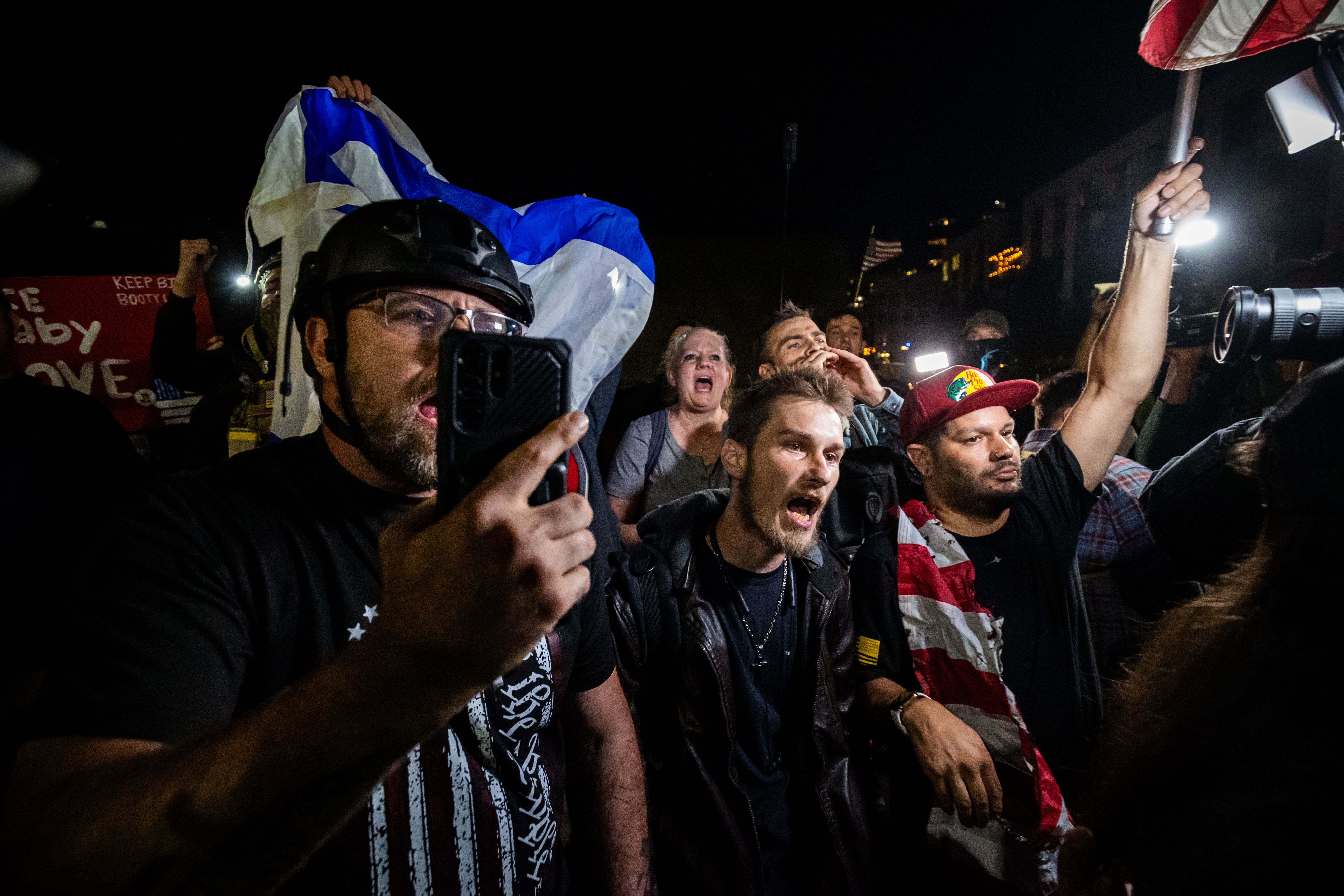
Trump supporters face off with protesters outside a U.S. Immigration and Customs Enforcement facility in Portland, Ore., Monday, Oct. 6, 2025.
Benny Johnson, a pro-Trump social media personality from Florida, announced to his followers on X that he had arrived.
“Yo, what’s up!” Johnson said Tuesday as he strolled into the airport. “We are on the ground in Portland, Oregon.”
Johnson was in town to meet with three other social media influencers and U.S. Secretary of Homeland Security Kristi Noem to tour the city’s U.S. Immigration and Customs Enforcement facility, where protests had been taking place since June.
“The Trump administration is here today. Follow along. The Trump administration ain’t gonna have any of this,” Johnson said. “This is going to be a rowdy day.”
From there, the influencers packed into SUVs and followed Noem, passing through police lines that had been established around the ICE facility and eventually behind its gates.
Standing on the building’s rooftop, Johnson and the other influencers filmed Noem for their millions of followers online. But the day was less than rowdy.
On the street below, around 20 reporters from local and national outlets stood behind yellow caution tape, along with a handful of protesters. It was a sunny fall day in Portland, far from the burning hellscape portrayed online.
Still, influencer Nick Sortor warned Noem that she wasn’t seeing the real story.
“This is absolutely nothing as to what it is at night though. It’s really bad at night,” Sortor said. “That sun goes down and it gets totally lawless.”
Social media personalities like those who joined Noem are increasingly shaping the public’s understanding of events in Portland, where the Trump administration has been trying to deploy the National Guard in recent weeks.
While partisan online posting about protests in the Northwest is nothing new, right-wing media influencers are now being welcomed into the federal government to promote its messages. This kind of media access shows a deepening alliance between the administration and an online world willing to misrepresent facts if it means furthering political goals.

U.S. Department of Homeland Security Secretary Kristi Noem stands on the roof of the U.S. Immigration and Customs Enforcement building in South Portland on Tuesday, Oct. 7, 2025.
*Eli Imadali / OPB
The influencers’ personal content is blended with interviews on Fox News, Newsmax and other outlets, and reposted by federal agencies at times. Sortor and another media personality on the ICE tour, Katie Daviscourt, appeared on a panel at the White House on Wednesday with President Trump, where clips were similarly repurposed and spun out to broader conservative media.
Local media like OPB and The Oregonian/OregonLive have not been given the same access to the ICE building when they requested it. In response to requests to tour the ICE building, DHS officials have asked OPB – a century-old media organization that has covered newsworthy events at the protests since their earliest days - to share links to OPB coverage of the protests before considering access.
‘Counter-protesters themselves’
The current Trump administration is working with these influencers to justify the president’s actions, according to A.J. Bauer, an assistant professor who studies media activism in the University of Alabama’s journalism department.
“The streamers are actually counter-protesters themselves who are going and documenting the protests that they disagree with. The government is actually working hand-in-glove with those folks in order to promote the government’s message,” Bauer said. “That is a new development.”
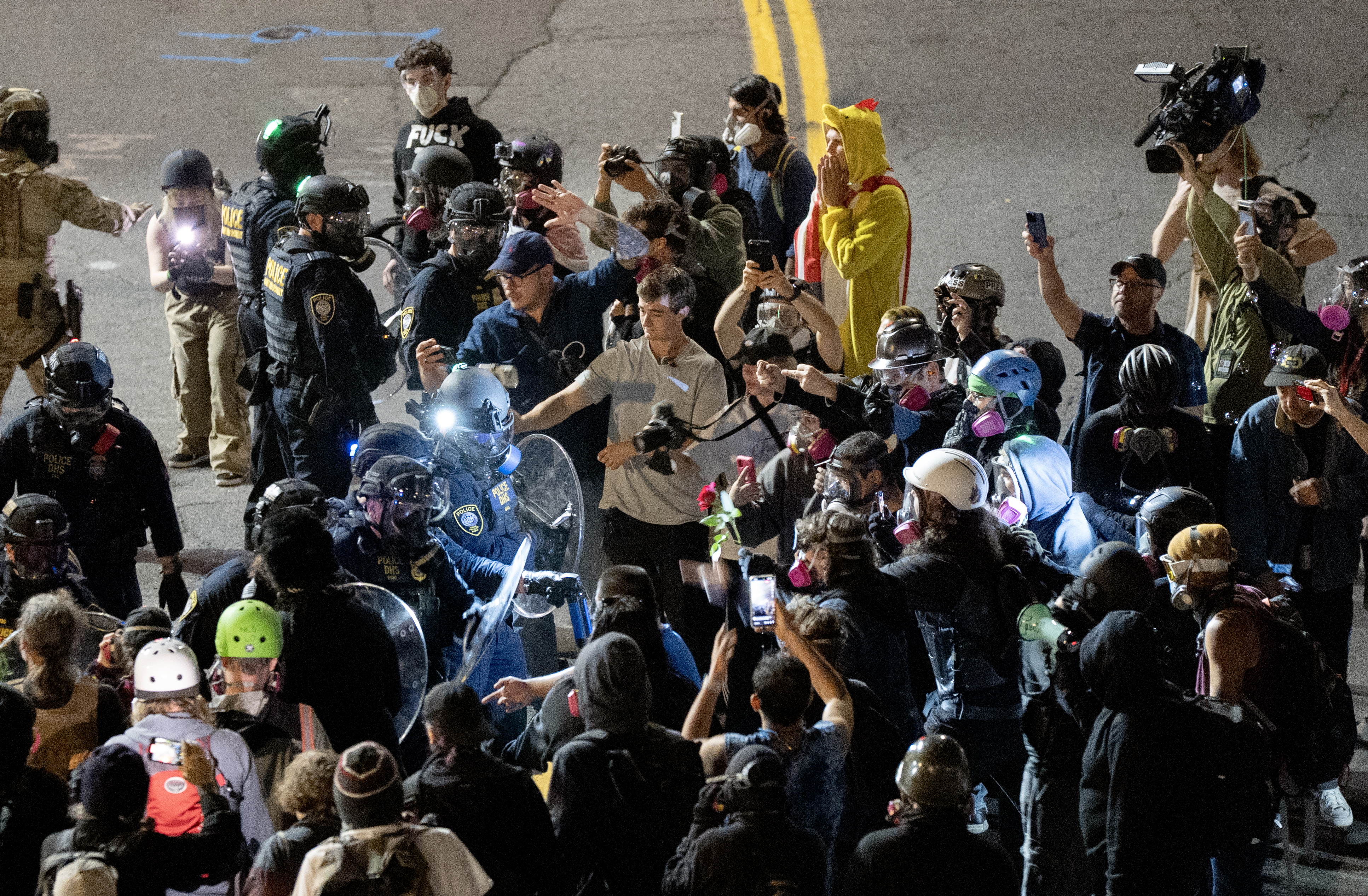
Masked-up federal agents confront the protesters outside the U.S. Immigration and Customs Enforcement facility in Portland, Ore., on Sept. 28, 2025.
*Kristyna Wentz-Graff / OPB
There are many examples over the years of mainstream journalists embedding with the government to cover major events, like during the Vietnam or Iraq wars. But those reporters were largely free to be critical of the government.
Bauer said right-wing influencers don’t follow the journalistic norms of balance, independence and not personally participating in stories. Instead, he said, they start out with an ideological vision of the world and then narrate what they see in a way that fits that vision.
“The consequences are that we have two competing visions of reality,” Bauer said.
There have been almost nightly protests outside of Portland’s ICE facility for months. Since June, the Portland Police Bureau has made at least 47 arrests, and federal officials have arrested dozens more, though not everyone has been charged with a crime.
Still, the protests span just one or two city blocks. Many nights, there are fewer than two dozen people. Dancing and whimsical costumes have been a frequent protest tactic since the Trump administration has expressed a desire to send in military troops to suppress the demonstrations.
Protesters recover after gas is deployed at the U.S. Immigration and Customs Enforcement facility, Portland, Ore., Oct. 4, 2025.
*Alejandro Figueroa / OPB
But these influencers tell a story that chaos is rampant. And now, they are having the biggest impact possible by shaping how President Trump views the protests. They repeated a vision of Portland to him at a White House roundtable on Wednesday that many residents wouldn’t recognize.
“The amazing thing is you look at Portland and you see fires all over the place. You see fights. I mean, violence, it’s so crazy,” Trump said during the televised round table. “And then you talk to the governor and she acts like everything is totally normal. It’s almost like, are you waking up from a dream or something?”
A history of clashes
Right wing presence at protests in Portland is not a new phenomenon.
During the president’s first term, counter-protesters were a regular presence in the Rose City when residents and left-aligned demonstrators took to the streets. Provocateurs like Joey Gibson would frequently show up at protests between 2015 and 2020 to film and engage in conflicts with what they described as antifa mobs.
At times, those provocations turned violent, with people being shoved, maimed and even killed as dueling political factions took to the streets.

Patriot Prayer leader Joey Gibson directs people back to the west side of the Willamette River during demonstrations in Portland, Ore., Saturday, Aug. 17, 2019.
*Bradley W. Parks / OPB
Those protests also launched the careers of streamers and media personalities who focused on the conflict with a particular political view, such as Andy Ngo, a former Portland resident who now edits for the Canadian conservative outlet the Post Millennial.
With around 1.7 million X followers, Ngo is an influential voice on the right who appeared at Wednesday’s roundtable with President Trump. He also helped pave the way for the people aligning with the Trump administration against the current Portland protests. That includes Daviscourt, who brands herself on X as an investigative reporter for the Post Millennial.
While activists like Gibson have appeared at the protests outside the ICE building in recent days, the content being produced by the streamers is not restrained to their own feeds and fans, as it largely was during the first Trump administration.
On Thursday, Ngo made a post to his X account warning of an impending attack on federal law enforcement.
“Antifa in Portland have been plastering flyers around the city urging people to try and crash the DHS helicopter flying over ICE,” Ngo wrote just before 9 p.m., sharing an image of a flyer with lasers pointing at a helicopter.
Around three hours later, DHS posted a similar version of the flyer to its X account.
“Antifa domestic terrorists WILL NOT overrun our cities,” the post stated.
Facts on the ground
Oregon Gov. Tina Kotek, Portland Mayor Keith Wilson and most other state officials have rejected the need for the Trump administration to send the National Guard to the city. But their views seem to have little influence on the White House’s stated plans and rhetoric.
Portland Mayor Keith Wilson speaks with Beaverton Mayor Lacey Beaty at a press conference Monday, Sept. 29 in Portland Ore. Wilson and 10 Oregon mayors spoke against President Trump's decision to deploy the National Guard in Portland.
*Saskia Hatvany / OPB
On a recent night outside the ICE facility, conservative podcaster Matt Tardio was live-streaming the Portland protests. Tardio said he’s trying to capture everything that’s going on, not just the clashes between protesters and police.
“I do know that I’ve caught some coming-up streamers or whatever they were, legitimately trying to start problems and having hidden cameramen off to the side trying to capture those problems starting so that they could have their viral clips,” Tardio said. “That’s messed up.”
Tardio, who is a veteran, agrees that the situation on the ground is being exaggerated online.
“I can’t tell you the amount of times I’ve said I don’t think the National Guard needs to come out here. I feel that the Portland Police Bureau can handle it,” he said.
But that hasn’t stopped other influencers from repeating the story about a war-ravaged city that gets amplified by Trump officials and repackaged across the media ecosystem.
---
---
an 7 25
Although Donald Trump vehemently denied knowing anything about Project 2025 during the 2024 presidential race, far-right Christian nationalist Russell Vought — a major architect of the Project 2025 agenda — now heads the U.S. Office of Management and Budget (OMB). Project 2025 called for federal government employees to be fired in huge numbers and replaced with an army of MAGA loyalists, and Vought has been pushing Project 2025's recommendations at OMB.
On Thursday morning, June 17, Vought attended a Christian Science Monitor breakfast — where, according to Politico's Katherine Tully-McManus, he openly expressed his disdain for bipartisanship.
Vought told reporters, "The appropriations process has to be less bipartisan…. There is no voter in the country that went to the polls and said, 'I'm voting for a bipartisan appropriations process.' That may be the view of something that appropriators want to maintain."
READ MORE: 'Didn’t you vote to pass this?' GOP rep stumps CNN host after blasting bill he voted for
The previous day, the U.S. Senate passed a rescissions package that includes major cuts to the Corporation for Public Broadcasting (CPB) as well as to foreign aid. And Vought is hoping that more cuts will be forthcoming.
Vought told reporters, "We are willing to send up additional rescissions. I think if this continues to pass, we're likely to send up another rescissions package that would come soon, and we'll be working on that to try to get that across the finish line. We're not there yet."
Politico's Nicholas Wu posted Tully-McManus' reporting on X, formerly Twitter. And Vought's comments against bipartisanship are generating a lot of discussion on the social media platform.
X user Roger Dodger posted, "That is one of the more obscene things I have heard. Just terrible."
READ MORE:'Who in the world would be stupid enough to believe that?' Morning Joe torches Trump
Another X user, Catherine H., sarcastically wrote, "Yeah, because why would you want a unified country?"
X user Scott Plante commented, "Not how democracies work, Russ."
Another X user, Biscuit Salad, wrote, "He is old, and any pretense that the two term president with a decade-long death grip on his party isn't 'the establishment' gets more hilarious every day."
7 25
pass 9b recission 2 gop defect? ! PBS
---
---
On Thursday, the Republican-controlled House of Representatives passed legislation that, if signed into law, would strip federal funding from NPR and PBS. One of the four Republicans who voted against it is now speaking out.
Most of the $9.4 billion rescissions package (legislation in which Congress claws back money that was previously appropriated) is targeting foreign aid through the U.S. Agency for International Development (USAID) and the African Development Foundation, with approximately $8 billion being cut from those agencies. However, the remainder of the money was allocated toward the two public broadcasting agencies that are partially funded by the Corporation for Public Broadcasting (CPB).
In a post to his website, Rep. Mark Amodei (R-Nev.) slammed the cuts to NPR and PBS, saying that his constituents depended on their local public broadcasting affiliates to get basic information. And he called on his colleagues to not rush to strip funding from the CPB before having a larger conversation about what the impact of those cuts would be.
READ MORE:'Monarchy': Federal judge compares Trump to 'King George'
"If we do not have time to think about it, we sure as hell have time to talk about it before October 1st when the impacts of these rescinded funds would start to be felt,” Amodei said, referring to the start of Fiscal Year 2026. "This is forward funding. So, before we trigger major consequences for our local public broadcasting stations throughout the West and other rural areas, we need more discussion—rather than railroading folks over the East Coast’s editorials and indiscretions."
"I agree we must make meaningful cuts to shrink our federal deficit; however, I would be doing a disservice to the thousands of rural constituents in my district if I did not fight to keep their access to the rest of the world and news on the air," he continued.
"Having the ability to discuss real impacts, beyond just the global perspective, is a healthy and necessary step," he added. "I’m sure we will be voting on this again before the cake is fully baked, so I look forward to working with my colleagues to improve and protect this infrastructure our rural communities rely on."
The rescissions package is Congress' first attempt to codify some of the cuts made by Tesla and SpaceX CEO Elon Musk's Department of Government Efficiency (DOGE) earlier this year. In addition to Rep. Amodei, Reps. Brian Fitzpatrick (R-Pa.), Nicole Malliotakis (R-N.Y.) and Michael Turner (R-Ohio) also voted no.
READ MORE:'Hushed the entire chamber': Democrat confronts GOP rep on House floor in 'shouting fight'
Click here to read Amodei's full statement.
---
an SN 5 25
in one way, this is the easiest column I’ve written.
It’s simple to celebrate public media in Kansas: public radio, educational television, veteran journalists, original reporting, local focus, innovative podcasts and more. For all that, I’m a long-time sustaining member of my local public radio station. And I have written many glowing columns about NPR journalism. Public media in Kansas is awesome.
In another way, this column is tricky. Defending anyone, let alone an institution, from fraudulent attacks is challenging. It’s proving a negative, when the negative is certifiably bonkers. And coming from the White House.
Here goes.
On Tuesday, National Public Radio and three public radio stations sued the Trump administration in response to the May 1 executive order that sought to strip public media of its funding in the United States.
The NPR lawsuit, filed in the District of Columbia, asserts that Trump’s executive order “violates the expressed will of Congress and the First Amendment’s bedrock guarantees of freedom of speech, freedom of the press, and freedom of association, and also threatens the existence of a public radio system that millions of Americans across the country rely on for vital news and information.”
The 43-page filing pokes holes in Trump’s executive order: a brazen attempt to extinguish public media throughout the country — and harm its audience in Kansas — based on a partisan grudge.
Under even brief inspection, Trump’s May 1 executive order and the press statements that accompanied it look inept.
They read like the half-baked political flailing of the first Trump administration when the rationale for his decisions was foolish and risible.
Just like many of the actions of the first Trump administration, there is a more principled and legal argument to be made here: Persuade Congress to defund public broadcasting because taxpayer money simply doesn’t belong in the media. The executive order only fleetingly expresses that viewpoint: “Government funding of news media in this environment is not only outdated and unnecessary but corrosive to the appearance of journalistic independence.”
More often, the White House falsely accuses public radio. It dishes out fake news about the real news.
If not opposed by a lawsuit like the one filed Tuesday, Trump’s executive order would wreck two valuable American institutions for petty and deceptive reasons: hot-button word choices, political innuendo and pet peeves.
What’s Trump’s best response for NPR’s regret at labeling someone as “illegal” in their reporting? Defund NPR.
What’s Trump’s best response to PBS’s documentary about a transgender teen? Defund PBS.
Forever a predatory real estate developer, Trump wants to tear down public media rather than putting money into improvements.
This week’s NPR lawsuit points us to documents that reveal Trump’s pettiness toward public media. First, consider “President Trump Finally Ends the Madness of NPR, PBS,” a press release published by the White House in conjunction with the executive order.
We find 24 bullet point examples of “trash that has passed for ‘news’ at NPR and PBS.” Many of the bullet points, stripped of context, completely misrepresent each instance of public media reporting.
One bullet point links to an NPR audio chat from 2022, headlined: “Which skin color emoji should you use? The answer can be more complex than you think.” During the discussion, the NPR host says, “These are not particularly easy questions for people to wrestle with.” The guest replies, “I completely agree with you that there is no clear-cut answer.”
How did the White House boil down this nuanced discussion of race? The press release says, “NPR assigned three reporters to investigate how the thumbs-up emoji is racist.”
NPR never used the word racist.
Summarizing the coverage in that way isn’t a political distortion. It’s a lie.
Here’s another White House claim from the same press release: “NPR routinely promotes the chemical and surgical mutilation of children as so-called ‘gender-affirming care’ without mentioning the irreversible damage caused by these procedures.” This bullet point links to a 2023 story from Florida by Melissa Block.
It’s a mind-bending stretch to see NPR as “promoting” medical care for trans kids in this journalism. The writer quotes experts — medical groups, plus an endocrinologist and a psychologist — as they each endorse the medical care.
Dear White House media critics, covering an issue is not to promote one side.
When the administration isn’t misrepresenting the work of public media, it nitpicks political language. In the press release’s final bullet point, the White House writes about the “PBS show Sesame Street partnered with CNN on a one-sided narrative to ‘address racism’ amid the Black Lives Matter riots.”
One-sided narrative? I wondered.
Clicking the link takes you to a cheerful image of Sesame Street characters with the title, “Coming Together: Standing Up to Racism.” What is the other side of racism that the White House wants represented here? Pro-racism?
The White House should be pressured to explain the “other side” of the debate that it is imagining, not Big Bird and PBS.
(The most likely true objection to this program? Sesame Street partnered with CNN, a network Trump would defund if he could.)
Taken as a whole, the list reads like a vendetta seeking a motive: Let’s destroy public media, but first we need a reason.*
Given the White House’s complaints about news coverage in their press release, it seems that the executive order is in fact retaliation. Or, consider how the NPR lawyers metaphorically put it:
“It is not always obvious when the government has acted with a retaliatory purpose in violation of the First Amendment. ‘But this wolf comes as a wolf.’ … The Order targets NPR and PBS expressly because, in the President’s view, their news and other content is not ‘fair, accurate, or unbiased.’ ”
And yet, there’s more. Multiplying the unfairness of the lawsuit and executive order is the fundamental fairness of NPR’s news coverage. As a journalism instructor at the University of Kansas, I use NPR resources in my classroom precisely because they are among the most trustworthy and unbiased.
It’s not just me who sees it this way. Say what you will of the charts that organize media organizations in terms of bias; NPR is one of the most centrist sources, regardless of which media critics you trust.
“Our people report straight down the line,” said NPR CEO Katherine Maher during an appearance on CBS. “I think that not only do they do that, they do that with a mission that very few other broadcast organizations have, which is a requirement to serve the entire public. That is the point of public broadcasting. We bring people together in those conversations.”
During the past few weeks, as public media has defended itself against these garbage attacks, Trump’s order has been characterized as a disproportionate attack on people who live in rural areas, including large swaths of Kansas.
The faces of this defense have been the CEOs of NPR and the Public Broadcasting System. Each has stressed how rural audiences will suffer.
On Tuesday, Maher released a statement that repeatedly stressed the NPR’s nationwide virtue of “serving all 50 states and territories” as a source for “tens of millions of Americans.”
“Without public dollars, NPR’s investment in rural reporting initiatives, collaborative regional newsrooms, and award-winning international coverage would all be at risk,” Maher wrote.
Lisa Rodriguez, interim director of content for KCUR, an affiliate station in Kansas City, appeared on the station’s “Up To Date” show to explain how small rural member stations rely on NPR.
“For KCUR, you depend on it for what you hear every day,” Rodriguez said. “But also at these smaller stations, you don’t have as rich a local journalism ecosystem. It is sometimes the only news that is reaching small communities.”
To call the White House’s arguments weak should not minimize their gravity. The consequences of the executive order would be catastrophic, especially to Kansans, if they hold up in court.
Through the rhetoric of this executive order and its press release, Trump relishes in playing the schoolyard bully once again. This time he is not so much name calling or picking on the vulnerable. With public media, he threatens to take his ball, go home and leave Kansans stranded.
Why? The bully doesn’t like the way the game is being played.
However, as the lawsuit makes clear, it is not his ball. And he has no right to take it.
NPR and its fellow plaintiffs seek their continuing independence in their lawsuit. They quote a legal precedent that interpreted NPR’s founding legislation as creating an “elaborate structure … to insulate (broadcasters) from government interference.”
Later, the suit continues, that while “Congress is not obligated to support independent public radio with federal funds,” the government cannot remove funding in a way that unconstitutionally infringes on free speech.
Unfortunately, our current Congress does not appear willing to reassert itself against Trump’s hallucinatory rhetoric and orders.
This week’s lawsuit and its path through the courts may be the only remedy to save public broadcasting in Kansas.
*Eric Thomas teaches visual journalism and photojournalism at the William Allen White School of Journalism and Mass Communication at the University of Kansas in Lawrence. Through its opinion section, Kansas Reflector works to amplify the voices of people who are affected by public policies or excluded from public debate. Find information, including how to submit your own commentary, here.
Kansas Reflector is part of States Newsroom, a nonprofit news network supported by grants and a coalition of donors as a 501c(3) public charity. Kansas Reflector maintains editorial independence. Contact Editor Sherman Smith for questions: info@kansasreflector.com.
===
an 5 25
'A clear violation of the Constitution': NPR sues Trump
---
AN 525
Some Americans who have vivid memories of Watergate — including former Watergate prosecutor Jill Wine-Banks and 1970s Washington Post reporters Bob Woodward and Carl Bernstein — aren't shy about saying that when it comes to attacking democracy and the rule of law, President Donald Trump is much worse than the late President Richard Nixon. Trump, according to those Watergate-era veterans, has crossed lines that Nixon wouldn't cross.
In an article published by National Public Radio (NPR) on May 12, reporter Scott Horsley describes a parallel between Trump and Nixon: a willingness to use the Internal Revenue Service (IRS) against political adversaries.
"From utilizing tax data to trace immigrants without legal status to threatening Harvard University's tax exemption, President Trump has been trying to use the IRS for his own political purposes, in ways that may seem unprecedented," Horsley explains. "But they're not. Former President Richard Nixon laid the groundwork more than four decades ago, when he tried to use the tax collector to punish his enemies and assist his friends….. Nixon was angry at universities for not cracking down on Vietnam War protesters; Trump has similarly complained about Harvard and other Ivy League schools not doing more to silence protests against the war in Gaza, amid an administration crackdown on antisemitism on college campuses."
Trump, according to Horsley, is "drawing on Nixon's old playbook, despite laws put in place after Watergate to prevent that kind of meddling by the White House."
Joseph Thorndike, director of the Tax History Project at Tax Analysts, told NPR, "One of the things that Nixon did consider was threatening the tax-exemptions of universities. And that sounds very familiar if you're reading the paper these days…. Nixon tried very hard to misuse the IRS. Congress certainly saw that as a danger afterwards."
Thorndike continued, "If the president is developing enemies lists and sending them to the IRS and essentially saying, 'I want you to audit all these people I don't like,' that's worrisome. And so, Congress was very interested in preventing that."
Oval Office recordings from 1971, Horsley notes, "reveal how Nixon sought to install a hand-picked enforcer at the IRS to do his political bidding."
READ MORE:'Deeply offensive': MSNBC host rips 'gold-plated' Trump for trivializing 'financial hardship'
Nixon, in 1971, said, "I want to be sure he's a ruthless son of a bitch, that he will do what he's told. That every income tax return I want to see, I see. That he'll go after our enemies and not go after our friends. It's as simple as that."
READ MORE:'Blatantly illegal': Two officials push back against new Trump plan
*Read the full NPR article at this link.
---
---
// take harvard tax status
an 525
U.S. President Donald **Trump on Thursday signed an executive order calling for an end to taxpayer funding for NPR and PBS, an escalation of his assault on the media that could shutter hundreds of local stations across the country.
The president's order, which he signed behind closed doors, echoes a section of Project 2025, a far-right agenda that called for stripping public funding from NPR, PBS, and other broadcasters on the grounds that they "do not even bother to run programming that would attract conservatives."
Trump's order instructs the Corporation for Public Broadcasting (CPB)—a private nonprofit corporation created and funded by Congress—to "cease direct funding to NPR and PBS, consistent with my administration's policy to ensure that federal funding does not support biased and partisan news coverage."
The executive order, which is expected to face legal challenges, also directs all federal agencies to "identify and terminate, to the maximum extent consistent with applicable law, any direct or indirect funding of NPR and PBS."
Trump's move was expected, and it came in the wake of reports that the administration intends to ask Congress to rescind previously approved funding for CPB, which is already engaged in a court fight with the president over his attempt to fire several of the organization's board members. The Associated Pressreported Thursday that the rescission request "has not yet been sent to Capitol Hill."
According to the organizations' estimates, federal funding accounts for roughly 1% of NPR's annual budget and 15% of PBS's yearly revenue.
In a letter to congressional leaders earlier this week, a coalition of civil society groups led by Reporters Without Borders (RSF) warned that, if enacted, Trump's proposed funding cuts for public broadcasting "will result in the shutdown of dozens, if not hundreds, of local, independent radio and television stations serving Americans in every corner of the country."
"As it stands, public media journalists are often the only reporters attending a school board meeting, or a local zoning hearing, or at the scene of a crime," the groups wrote. "They are the journalists most likely to hold local public officials accountable and expose
corruption. Faraway digital media outlets will not replicate this coverage, and the American public will lose out."
Trump's attack on public broadcasters is part of his administration's broader effort to undermine journalism in the United States and around the world.
RSF said in a report published Friday that Trump's "early moves in his second mandate to politicize the Federal Communications Commission (FCC), ban The Associated Press from the White House, or dismantle the U.S. Agency for Global Media, for example, have jeopardized the country's news outlets and indicate that he intends to follow through on his threats, setting up a potential crisis for American journalism."
"After a century of gradual expansion of press rights in the United States," the group said, "the country is experiencing its first significant and prolonged decline in press freedom in modern history, and Donald Trump's return to the presidency is greatly exacerbating the situation."
NOW READ:Trump's top spy chief blasted as her 'crazy' cash grab is exposed
---
---
texts Fox hosts sent during the Jan. 6 riot don't match how Fox covered it on air
:{December 15, 2021
Heard on All Things Considered
By
Fox hosts sent desperate messages during the Capitol riot, urging Trump to act. The messages are a stark contrast to the way Fox has covered the insurrection on air.
MARY LOUISE KELLY, HOST:
Fox News is in damage control mode.
(SOUNDBITE OF TV SHOW, "HANNITY")
SEAN HANNITY: Now, all riots, obviously, are bad - all of them. And on this program, we strongly condemn the violence on January 6, just like we condemned all of the violent riots from the summer of 2020.
KELLY: That is Fox News host Sean Hannity talking about text messages that he sent then-White House Chief of Staff Mark Meadows on January 6 as rioters were storming the U.S. Capitol. The messages were released earlier this week by the House committee investigating January 6. Over and over, they reveal Fox News hosts - Hannity, also Laura Ingraham and Brian Kilmeade - pleading with Meadows to get his boss, then-President Trump, to stop the attack. The messages also stand in stark contrast to the way Fox has covered the insurrection on-air this past year.
And I want to bring in two voices to examine that disconnect - NPR's Tom Dreisbach, who's been covering the attack and its aftermath. Hey, Tom.
TOM DREISBACH, BYLINE: Hey.
KELLY: And NPR's media correspondent David Folkenflik. Hey, David.
DAVID FOLKENFLIK, BYLINE: Hey, Mary Louise.
KELLY: David, you start and set the stage a bit further for us. What are some of the other text messages that have now come to light?
FOLKENFLIK: Well, they heard from Brian Kilmeade. He's one of the hosts of "Fox & Friends," an opinion show in the morning - very popular - and somebody in contact with the former president and his advisers. He texted on that day, please get him - meaning Trump - on TV destroying everything you have accomplished. Laura Ingraham wrote, Mark, the president needs to tell people in the Capitol to go home. This is hurting all of us. He is destroying his legacy. Interesting choice of words - all of us. Sean Hannity - simply - can he make a statement - meaning Trump - ask people to leave the Capitol? Of course, that didn't happen until many hours later. In fact, too late to have a meaningful effect on what was there.
Very different from the tenor of what you heard subsequent to that. Let's hear from Laura Ingraham - what she had to say on the show the night of the attack, suggesting to her audience of who really might be behind that siege of the Capitol.
(SOUNDBITE OF TV SHOW, "FOX NEWS")
LAURA INGRAHAM: Now, they were likely not all Trump supporters, and there are some reports that antifa sympathizers may have been sprinkled throughout the crowd. We'll have more on that later.
FOLKENFLIK: You know, I think what you heard was an incredible diminishment of how serious it was in terms of what Laura Ingraham and Sean Hannity had to say to viewers on their airwaves in front of millions of viewers and a kind of erasure of then-President Donald Trump as a player in all of this.
KELLY: And I want to bring in Tom on that in just a second. But David, one more to you. Now that these text messages are out there in public as of this week, how long before Fox hosts address this, took any of this on and covered it on-air?
FOLKENFLIK: Well, it took about 24 hours for Hannity and Ingraham to address it themselves. Amazingly, right after those texts were released, Hannity had Mark Meadows on the air with him on the show - didn't touch it.
KELLY: Yeah. And Tom Dreisbach, jump in here because I want to hear just a little bit more about how the - these months, between January 6 and now, just how big has the gap been between what Fox News hosts were saying on-air and what they were texting privately to top White House officials?
DREISBACH: Well, I think what the text messages revealed in many ways is how broadly the narrative around January 6 has shifted. In the moment that it was happening and immediately afterwards, the event was almost universally condemned on the right, including by President Trump. It's important to remember what Donald Trump himself said in taped remarks the day after, on January 7.
(SOUNDBITE OF ARCHIVED RECORDING)
DONALD TRUMP: To those who engaged in the acts of violence and destruction, you do not represent our country. And to those who broke the law, you will pay.
DREISBACH: That was January 7. Now and as soon as this summer, Trump was saying something completely different. He was describing the rioters who have been arrested and charged with crimes as political prisoners. And he says that January 6 was actually just a protest.
(SOUNDBITE OF ARCHIVED RECORDING)
TRUMP: I reverse it. The insurrection took place on November 3 - that was Election Day - and before and after. That was, to me, the insurrection. And the - January 6 was a protest.
KELLY: So what's going on with this evolution? Is this Fox coverage mirroring an evolution in what Trump and his loyalists have been saying or are they driving that evolution? Or do you think it's some of both?
DREISBACH: It's a little hard to say who's driving it. It's sort of a chicken-and-the-egg issue, who is in control of this narrative. But I would say that early on, the seeds of this counter-narrative were being planted. As you heard, Fox hosts like Laura Ingraham were arguing that leftists or antifa were actually causing the violence, even though rioters who were there that day say that is completely false. Then there was this narrative that the violence was being overblown in order to discredit Trump and his supporters.
Most recently, what we've seen is from folks like Tucker Carlson - Fox host - this argument that is largely based on conspiracy theories that federal agents must have been instigating the attack that day, causing a sort of false flag so they could launch a, quote, "war on terror" against Trump supporters. And at this point, I should say there's really no evidence to support any of those narratives
KELLY: Well, this prompts a wider question. David, is Fox News - should we be calling it Fox News? This is a TV channel. They track current events. Are they performing journalism?
FOLKENFLIK: Well, I think we can answer that question just by looking at what's happened in recent days. Fox News at no point is addressing the fact that, you know, these opinion journalists who are primetime stars are acting essentially as fully part of the Trump political circle. They're never addressing that. That's not - you know, you're still supposed to admit facts against your rooting interest as an opinion journalist. It's not happening here. The way to think about Fox News right now is as a highly profitable political operation to which some journalists are appended, some of them trying to do honest reporting.
KELLY: Well, and some journalists jumping ship, as we saw with Chris Wallace this week.
FOLKENFLIK: That's right. Wallace raised objections about Tucker Carlson's documentary that Tom alluded to about January 6 itself, that it was filled with lies and unfounded conspiracy theories. He objected to the CEO, Suzanne Scott, and got nowhere with it.
KELLY: And this brings me to my last question, which is all of this matters because a whole lot of people are watching and listening to what Fox broadcasts. Tom, you have spent the last year talking to people connected to the riot. How closely are they watching? How entrenched are these alternate narratives?
DREISBACH: Well, just today, PolitiFact declared that lies about the January 6 attack on the Capitol are the lie of the year. I think that's a recognition of just how entrenched these views have become. I talk to people who were at the riot, who have admitted to breaching the Capitol of their own will. And after the Tucker Carlson series aired on Fox, on Fox Nation, they started questioning their own experience not based on what they saw or did that day themselves, but based on what they saw on TV.
And we are seeing some of that playing out in the broader public. You look at polling, and a majority of Republicans think too much attention is being paid to the attack on the Capitol now. And the number of Republicans in the public who say it's important to prosecute the rioters is going down by about 20 points, according to Pew Research, over just the last several months.
KELLY: NPR investigative correspondent Tom Dreisbach and NPR media correspondent David Folkenflik. Thanks to both of you.
---
===
an 2 25
Jim Naureckasand FAIR February 01, 2025
“Can Trump’s Second Act Work for the Working Class While Giving Back to His Super Donors?” asks NPR.com (2/1/25). The answer, from NPR senior editor and correspondent Ron Elving, is a resounding—maybe!
Elving presents the politics of the second Trump administration as a perplexing paradox:
Today we are confronted with an alliance between those whom political scientists might call plutocrats and those who are increasingly labeled populists. The contrast is stark, but the symbiosis is unmistakable. And we all await the outcome as the populist in Trump tries to co-exist with his newfound ally Musk, the world’s richest man with abundant clout in the new administration.
After a meandering tour of US history from Andrew Jackson to William Jenning Bryan to Ross Perot, Elving concludes: “We may only be at the beginning of an era in which certain political figures can serve what are plausibly called populist causes by calling on the resources of the ultra-rich.” Huge, if true!
Elving’s evidence that Trump is a “populist”—or at least has a populist lurking inside him—is remarkably thin, however:
Trump has shown a certain affinity with, and owes a clear debt to, many of the little guys—what he called in 2017 “the forgotten men and women.”… With his small town, egalitarian rallies and appeals to “the forgotten man and woman,” he has revived the term populism in the political lexicon and gone further with it than anyone since Bryan’s heyday.
Trump “made a show of working a shift at a McDonald’s last fall,” Elving notes. And he “used his fame and Twitter account to popularize a fringe theory about then-President Obama being foreign born and thus ineligible to be president,” which “connected him to a hardcore of voters such as those who told pollsters they believed Obama was a Muslim.” Elving suggests that this is the sort of thing populists do.
But when it comes to offering examples of actual populist policies from the first Trump administration, Elving admits that there aren’t many to speak of:
If Trump’s rapid rise as a Washington outsider recalled those of 19th century populists, Trump’s actual performance as president was quite different. In fact it had more in common with the record of President William McKinley, the Ohio Republican who defeated Bryan in 1896 and again in 1900 while defending the gold standard and representing the interests of business and industry.
In fact, says Elving, “Trump in his first term pursued a relatively familiar list of Republican priorities,” with “his main legislative achievement” being “the passage of an enormous tax cut…that greatly benefited high-income earners and holders of wealth.” For genuine journalists, for whom politicians’ actions are more significant than their words, that would be the most meaningful predictor of what Trump is likely to do going forward.
But Trump’s second term, Elving suggests on the basis of nothing, could be quite different: “As Trump’s second term unfolds, the issues most likely to be vigorously pursued may be those where the interests of his populist base can be braided with those who sat in billionaire’s row on Inauguration Day.” Such as? “The renewal of the 2017 tax cuts is an area of commonality, as is the promise to shrink government.”
So—a restoration of the same tax cuts that “greatly benefited high-income earners and holders of wealth”? That how NPR thinks Trump in his second term “can serve what are plausibly called populist causes”?
All hail the unmistakable symbiosis!
{===}:
an 1 25
It seems absurd that Gov. Kristi Noem would harm the U.S. Department of Homeland Security just before she is expected to be confirmed as its leader.
But that is what she is doing with her ill-advised plan to destroy South Dakota Public Broadcasting.
Noem launched her surprise attack on SDPB in her Dec. 3 budget address, proposing to cut slightly more than $3.6 million of its $5.6 million in state funding.
“If it goes though as proposed,” said SeVern Ashes, SDPB’s director of engineering and operations, “there is not enough funding left to support the infrastructure, engineering salaries, buildings, power or service contracts for the equipment.”
It costs $4.8 million annually to “cover engineering expenses for the networks, studio engineering, and 24-7 coverage,” he said.
SDPB’s system is on 45 towers, and 17 of those co-host public safety communication equipment. The network is critical “to all emergency communication from the SD Division of Criminal Investigation on down to county-level emergency management systems such as ambulance, fire and local police departments such as Sioux Falls and Rapid City,” Ashes said.
Additionally, Verizon, T-Mobile and AT&T wireless systems lease space on SDPB towers.
One federal Homeland Security agency using the tower network for communications is U.S. Immigration and Customs Enforcement, Ashes said. The Federal Bureau of Investigation and the U.S Forest Service and Federal Aviation Administration also use the system, as does the Civil Air Patrol.
Fighting fires in the Black Hills will be difficult without radio communication. County sheriffs, the state Highway Patrol, city and tribal police departments and ambulance systems will all be seeking alternatives.
The potential loss of that emergency communication system is unacceptable to South Dakota Attorney General Marty Jackley.
“Law enforcement relies heavily on public broadcasting,” he said in a Monday interview. “We rely on it to a great degree for public safety from weather conditions to missing children and endangered individuals. I mean, that is who we go to for our Amber Alert.”
The public best understands the tower system as the way SDPB transmits its programming, which is the real target of Noem’s ire. Conservatives tend to dislike National Public Radio, which is only one part of SDPB’s programming and is funded by private donations and the federally funded Corporation for Public Broadcasting.
The state’s money primarily is used to maintain SDPB’s transmission system.
Ashes oversees seven SDPB-employed engineers, three in Rapid City, three in Sioux Falls and one in Pierre.
They maintain about 30% of South Dakota’s communication network, with the State Radio System under the Bureau of Information and Technology maintaining the rest.
Ashes said in addition to the towers, SDPB buildings house the state’s radio equipment as well as backup generators. Federal law requires 72 hours of backup power, but SDPB’s sites have seven days of capability.
The sharing of tower space with the State Radio System allows the two organizations to ensure coverage to about 98% of the state.
SDPB is the state’s connection to the federal Emergency Alert System, Ashes said. “We cover every county in the state. Any statewide alert system — Amber Alert, Blue Alert, endangered persons — those are activated out of our facilities in Vermillion.’’
If there is a national emergency, something involving the Homeland Security Department soon to be led by Noem, “Our infrastructure is taken over by the federal government for those alerts.”
If $3.6 million is cut and SDPB is unable to maintain the system, the state radio communications system likely would have to find money to maintain it, or SDPB’s portion goes dark.
At risk would be the state’s television and radio broadcast licenses. Incoming Gov. Larry Rhoden would have to be involved in relinquishing those vital assets.
Noem’s actions basically are those of a person showing malice against NPR, which explores ideas that differ with her worldview.
She never asked anyone at SDPB what might happen if they lost funding, and it’s clear Noem had no understanding of what would happen.
“The first thing we heard was when the governor made the speech,” said Ryan Howlett, CEO of Friends of South Dakota Public Broadcasting. “We weren’t asked about the implication of a cut.”
The bottom line, Howlett said, is that Noem’s proposed cut will “compromise the safety of about 1 million people.”
That’s something Jackley said is unacceptable. “That infrastructure is very significant and important.”
*EDITOR’S NOTE: Brad Johnson is married to a retired former employee of the nonprofit Friends of South Dakota Public Broadcasting.
GET THE MORNING HEADLINES. SUBSCRIBE
South Dakota Searchlight is part of States Newsroom, a nonprofit news network supported by grants and a coalition of donors as a 501c(3) public charity. South Dakota Searchlight maintains editorial independence. Contact Editor Seth Tupper for questions: info@southdakotasearchlight.com.
===
an 12 24
Oklahoma State Schools Superintendent Ryan Walters, a far-right Christian nationalist and MAGA Republican, has drawn scathing criticism from the American Civil Liberties Union (ACLU), Americans United for separation of Church and State, and others for trying to impose Christian fundamentalism on students in public schools. And Walters has been clashing with journalists as well, including reporters for KFOR-TV in Oklahoma City.
Walters excluded KFOR reporters from press conferences, and the station responded with a lawsuit.
But on Wednesday, December 11, KFOR reported that it had "won a legal battle" against Walters and his allies.
READ MORE:'The next recession starts here': Trump team weighs abolishing bank regulators
According to KOSU-FM (a National Public Radio-associated station in Oklahoma), "State Superintendent Ryan Walters and his press secretary Dan Isett have agreed to allow KFOR journalists into all of the Education Department's news conferences and meetings. The leaders have also agreed to pay attorney fees and damages of $17.91 — a symbolic amount, as 1791 was the year the First Amendment to the U.S. Constitution was ratified."
According to KFOR, Walters and Isett agreed to "add KFOR to" their "e-mail list for press releases."
KFOR noted, "Attorney fees have yet to be determined, but Ryan Walters and his attorneys did agree to pay them."
Charles Miller of the Institute for Free Speech said of the ruling, "This is a huge victory for journalism."
READ MORE: 'Chomping at the bit': Trump victory has red states feeling 'emboldened' to push far-right agendas
==
---
no lnx 11 24
alternet-
The end of left-leaning news?
'Maximum chaos and upset': Rachel Maddow describes nightmare election scenario
Thom Hartmann
November 23, 2024
Have you heard that Comcast is planning to sell MSNBC? Is Rupert Murdoch planning to buy it? Will America’s media landscape soon resemble those of Hungary and Russia?
Without the rightwing media juggernaut, Donald Trump probably wouldn’t be president next year and wouldn’t have won in 2016. That said, the progressive media landscape looks like it might be about to get a whole lot worse.
Comcast, which owns NBC and its subsidiaries CNBC and MSNBC (among other media outlets) announced this week that they’ll be spinning off MSNBC (among others) next year.
And the consequences are already showing up. It was reported this week that Rachel Maddow just took a substantial annual pay-cut because of the uncertain future of the network.
In part, this probably reflects a belt-tightening at Comcast, but is also an indication of how legacy media — which now includes cable properties — are taking a hit from newer digital media, from social media to podcasts to web-based networks and programs.
The principal analyst and VP of content for the market research company eMarketer, Paul Verna, told the AP that:
“The writing is on the wall that the cable TV business is a dwindling business,” and, the AP noted, is “predicting future consolidation of the networks or acquisitions through private equity.”
Private equity (like Bain Capital) and large media operation acquisitions have a long history of gutting media properties to increase their profitability; often this includes what a study by Stanford University researchers described as a trend to “substitute coverage of local politics for coverage of national politics, and use more conservative framing.”
Air America radio (for which I wrote the original business plan and which carried my program) was on the air in virtually every major market in the United States, having leased over 50 major, high-powered radio stations from Clear Channel.
My program regularly beat Rush Limbaugh in the ratings: When I was invited to the Obama White House following that election, one person associated with the campaign noted to me privately that they believed Air America had played a meaningful role in Obama’s 2008 election.
That same year, Mitt Romney’s private equity company, Bain Capital, acquired Clear Channel and, in 2009, began reclaiming their stations, replacing Air America content with mostly sports. By coincidence, around that same time it appears Romney decided he’d run against Obama in the next election.
As Air America lost station after station, its ability to earn revenue through selling advertising collapsed. By 2010, the entire network was bankrupt just in time for Romney to run for president.
Will the same thing happen to MSNBC? Stay tuned.
Similarly, Republicans in Congress are salivating over Elon Musk’s rhetorical war with NPR after the network stopped using Xitter when Musk labeled the news network as “state-affiliated” media.
As the headline on Fox Business notes:
“Elon Musk renews calls to defund NPR after clip of CEO resurfaces on X: 'Your tax dollars' are paying for this.’”
Musk, of course, will be in charge of identifying those parts of government or institutions funded by government which can be cut to help pay for Trump’s planned $4 trillion in tax cuts for billionaires.
While it won’t fit her proposed new role as UN Ambassador, Congresswoman Elise Stefanik, a top member of Republican House leadership, was unambiguous, posting to Xitter: “I will DEFUND NPR.”
This is nothing new: Republicans in the House voted this past July to remove all federal funding for NPR by 2026; Musk and Ramaswamy, working hand-in-glove with Marjorie Taylor Greene (who was just made chairperson of the new subcommittee charged with implementing their recommendations) could probably speed up that timeline.
While NPR goes to great lengths to avoid political bias in their news (the Corporation for Public Broadcasting even hired last month, “in response to right-wing criticism,” multiple editors specifically to spot and stamp out any progressive perspectives that may creep into their reporting), if they were crippled, it’s safe to assume the roughly 1,500 rightwing hate radio stations in the country stand more than ready and willing to pick up their radio audience.
Rightwing billionaires brought us Fox “News,” Sinclair, two other web- and cable-based rightwing TV channels, nationwide networks of hate radio (now also in Spanish), tens of millions of dollars in subsidies to rightwing podcast hosts, and the destruction of about half the nation’s local newspapers.
Not to mention an entire network of billionaire-funded hard-right phony “pink slime” newspapers that pop up around the country every election year.
There’s no equivalent politically-tilted media systems on the left; Democratic-leaning billionaires have stayed out of the media space ever since Romney’s company took down Air America.
The closest TV and radio counterparts we have are Free Speech TV (available on the web, Dish, Sling, Roku, AppleTV, and DirecTV) and the Progress Channel on SiriusXM (my daily program is carried on both).
In the print media space, Substack is growing (although they also carry hard-right content) and provides a solid community of progressive publications (like HartmannReport.com), but that’s a drop in a much larger ocean; even The Washington Post and The New York Times don’t come close to the strength of editorial bias found in the Murdoch family’s The New York Post or The Wall Street Journal.
Publications like The New Republic, Mother Jones, The Nation, and The Guardian provide solid progressive content, but all have funding bases that are trivial compared to conservative publications supported by rightwing billionaire networks. Ditto for websites like Raw Story, Common Dreams, Alternet, LA Progressive, Democratic Underground, and Daily Kos.
As my old friend and the former CEO/founder of Air America, Jon Sinton, noted on his excellent “reluctant” Substack newsletter:
“The left-wing silo is barren. A couple of old line newspapers and magazines. MSNBC and a handful of smallish digital platforms and shows. Pod Save America stands nearly alone as a left-leaning podcast with a large audience.
“By contrast, the right-wing silo is vast and deep. It houses YouTubians, TikTokkers, broadcasters on Fox, Newsmax, Sinclair TV stations, and talk radio stations; posters on social media; and narrowcasters on myriad podcasts.”
All, I would add, heavily supported by rightwing billionaires. As Politico reported in 2014, the Heritage Foundation used to give $1 million a year to Sean Hannity and $2 million a year to Rush Limbaugh alone.
A close acquaintance who was, for years, a mid-level rightwing talk show host told me how a dozen or more times a year he’d give a speech at a random high school and would receive a check for $20,000-$30,000 by a rightwing foundation as a “speaking fee” each time. It was their way of supporting conservative talk radio.
Again, there is literally nothing like that on the left. Not even close.
I’ve repeatedly called for progressive billionaires to jump into the media space, and perhaps the Musk/Trump assaults that are coming will provoke some to act. It may be wishful thinking, but if it does happen it can’t come too soon.
In the meantime, we all must support (and share with our friends) those outlets where we find useful news and information; if we fail to, America’s media landscape may soon mirror Hungary’s and Russia’s with every station and publication praising Dear Leader 24/7/365.
NOW READ: The America-attacking Trump is coming for our military — and then he's coming for us
---
===
fox staff agy
November 15, 2024, edition of WNYC's On the Media
MATT GERTZ (SENIOR FELLOW, MEDIA MATTERS): Donald Trump is using Fox News as a staffing agency.
BROOKE GLADSTONE (HOST): Matt Gertz is the senior fellow at the left-leaning Media Matters for America. He says it's worth revisiting all that we learned in the first term about Trump's relationship with his cable news channel of choice.
GERTZ: Fox & Friendshas, for a long time, been his favorite show. Pete Hegseth, the potentially incoming defense secretary, has been working as a co-host of Fox & Friends'weekend edition for the last several years.
GLADSTONE: What should we know about him and his career trajectory from Fox News contributor to secretary of defense nominee?
GERTZ: What Hegseth was able to do, after catching Trump's eye, was get Donald Trump to sign on to his own aims, which during Trump's first administration was securing executive clemency for several service members who had been accused or convicted of war crimes.
GLADSTONE: Yeah, the killing of civilians.
GERTZ: He put family members of various accused or convicted war criminals on the show to talk up how they had been persecuted.
...
GERTZ: This is how Trump gets his news. This is how his worldview is changed. It's one segment at a time.
GLADSTONE: He has a certain set of skills, certainly as a Fox News host, right? But secretary of defense needs a different set of skills.
GERTZ: Right. The set of skills that you need for being a Fox News host is understanding how to push the buttons of the MAGA faithful. And the way that Fox hosts traditionally do that is by making those viewers afraid, making those viewers angry.
GLADSTONE: Providing enemies?
GERTZ: Providing enemies. Obviously that is not the job of defense secretary. We're talking about a sprawling bureaucracy that employs nearly 3 million service members and civilian employees that has a budget of hundreds of billions of dollars. It's a serious job for serious people.
GLADSTONE: You've also noticed that this revolving door also works the other way. Several Trump staffers signed on with Fox News after Trump left office.
GERTZ: During or after his term, yes. Tom Homan was previously the head of ICE. After he retired from ICE in summer of 2018, he got a job at Fox News. He would denounce Democrats for standing against Trump's border policies. He would call for evermore draconian measures. He would say the things that Donald Trump wanted to hear.
...
GERTZ: Now he's gone through the revolving door; now he's coming back into the administration.
GLADSTONE: You have observed that the more often you go on Fox News, the more likely you are to clinch one of these top jobs in the Trump administration. One Fox frequent flyer was Congressman Matt Gaetz, just nominated attorney general.
GERTZ: We have counted at least 347 weekday Fox appearances that Gaetz did from August 2017 through Election Day of 2024. He's actually not the most frequent Fox guest to be taking a jump to the administration though. His Florida colleague, Rep. Michael Walz, who is Trump's pick for national security adviser, actually made at least 569 weekday Fox appearances, 176 since January 2023, which is the most of any member of Congress in that period.
GLADSTONE: Wow. The last nominee -- Tulsi Gabbard -- is a former Democrat-turned-MAGA Fox News contributor and more. Is that how she caught Trump's eye?
GERTZ: In Gabbard's case, she became a favorite of Tucker Carlson, the former Fox News star host. And as she underwent a sort of political transformation that brought her further and further onto the right, Fox was an opportunity for her to rebrand herself. Tulsi Gabbard is the pick for director of national intelligence. It's a position that oversees the 18 U.S. intelligence agencies. It's also responsible for the presidential daily brief, though that is somewhat less important in a Donald Trump administration, as Donald Trump rather famously ignores his daily briefing. He would take advice from Fox News hosts, either through their programs or he'd reach out to them directly. Those are the experts he wanted to hear from, not people with actual subject matter expertise.
mma
A comprehensive review of the revolving door between Fox and the Trump administration
07/22/19 1:43 PM EDT
- ### With “Border Czar” Tom Homan, Trump restarts the revolving door between Fox and his administration
11/12/24 11:03 AM EST
11/07/2
-----
Chevron owns this city's news site. Many stories aren't told
March 28, 2024
Heard on All Things Considered
Miranda Green
Chevron operates a major refinery in Richmond, Calif., a community with high childhood asthma rates. It also owns the city's dominant news site, putting its own spin on events, and runs similar websites in Texas and Ecuador.
Tracy J. Lee for NPR
NPR's David Folkenflik reported this story with Miranda Green ofFloodlight, a nonprofit newsroom that investigates the powerful interests stalling climate action.
RICHMOND, Calif. — Open flames shot upward from four smokestacks at the Chevron refinery on the western edge of Richmond, Calif. Soon, black smoke blanketed the sky.
News spread quickly that day last November, but by word of mouth, says Denny Khamphanthong, a 29-year-old Richmond resident. "We don't know the full story, but we know that you shouldn't breathe in the air or be outside for that matter," Khamphanthong says now. "It would be nice to have an actual news outlet that would actually go out there and figure it out themselves."
The city's primary local news source, The Richmond Standard, didn't cover the flare. Nor had it reported on a 2021 Chevron refinery pipeline rupture that dumped nearly 800 gallons of diesel fuel into San Francisco Bay.
Chevron is the city's largest employer, largest taxpayer and largest polluter. Yet when it comes to writing about Chevron, The Richmond Standard consistently toes the company line.
And there's a reason for that: Chevron owns The Richmond Standard.
"If you look at Chevron's website and you look at The Richmond Standard, a lot of the information is copy and paste," says Katt Ramos, a local climate activist. "They present a very skewed viewpoint that is bought and paid for by Chevron."
The site's very name evokes the history of Chevron, created when John D. Rockefeller's Standard Oil was broken up by federal trust-busters more than a century ago. The Richmond Standard prides itself on being the "number one source for local, community-driven news" about the city.
The city of Richmond exists in the shadow of the nearby Chevron refinery, which has been connected to poor air quality and health issues in the nearby community.
Brian L. Frank for NPR
Around town, in coffee shops, an architect's office, at a Mexican restaurant, even at a waterside National Park Service site, the Standard is recognized as the main source of news about the city. It carries stories about charity drives and street closings. New bars and art exhibits. Youth soccer events and local concerts and safety initiatives.
Decades ago, the city relied on the Richmond Independentand the San Francisco Chronicle to report on the community. And then a pattern familiar across the U.S. unfolded. The Chronicle pulled back. The Independent got folded into a newspaper in nearby Berkeley, which itself shut down in 1984. Papers in other East Bay cities shriveled up. Now the city's news landscape is dominated by its major corporate force.
Markets where news outlets shut down are often called news deserts. The Standard has created something of a news mirage: Stories are told — but with an agenda. Facts displeasing to Chevron are omitted; hard truths softened. The company is seeking to get its point of view across and to convey that it can be trusted.
On a recent February night, a city council meeting focused repeatedly on developments involving Chevron. Not a single journalist attended in person — other than those for NPR and Floodlight.
The same San Francisco public relations firm that operates the Standard for Chevron runs a similar site about developments in the Permian Basin in West Texas and New Mexico, where Chevron has major business interests. It also runs one of the company's sites in Ecuador, where the energy giant has fought back decades of litigation.
The Richmond Standard is a local news site funded by Chevron, which runs the large refinery in town.
Brian L. Frank for NPR
Chevron's bid to control the public discourse comes as efforts to combat climate change threaten the fossil fuel industry, especially in California. State regulators would effectively ban the sales of gas-powered cars by 2035. They released the world's first plan to achieve net-zero carbon pollution. Other states and countries have adopted similar goals.
In February, Chevron revealed that it was taking a loss of about $1.8 billion on assets mainly in California, because of a tougher regulatory climate in the state. Chevron's corporate headquarters is in San Ramon, about a 35-mile drive southeast of Richmond, though the company has moved the bulk of its workforce to Texas.
"The company saw a need to offer the community more news coverage of Richmond, which had been largely ignored by traditional media with the exception of crime stories," said Braden Reddall, a manager of external affairs at Chevron. "Most people in Richmond will tell you there is a lot more to the community than what is known and reported by traditional media outlets. It's a proud community, filled with interesting people who are doing interesting things."
Other outlets more than adequately cover Chevron, added Reddall, who earlier covered the company for the international news service Reuters.
Former schoolteacher Patricia Dornan says she reads The Richmond Standard but skips the stories about Chevron. "I don't read any of the articles about how wonderful their company is," she says.
Brian L. Frank for NPR
Lifelong Richmond resident Patricia Dornan says she cherry-picks which stories she reads in the Standard.
"If you understand that it's going to have a Chevron-Standard Oil point of view, it's fine because most of the stuff that they're putting out has nothing to do with them," says Dornan, a retired middle school teacher. "And so long as it doesn't have to do with Chevron, it's fine. I don't read any of the articles about how wonderful their company is."
Dornan volunteers at the Rosie the Riveter World War II Home Front National Historical Park. She tells visitors about the marvels of American manufacturing in a time of war and about the women welders of Richmond who were able to turn out warships in 51 days rather than two years.
Her grandmother moved to town in 1905 — just three years after the refinery first opened — and her family has been there ever since. One of the streets in town is named after her father. She says Richmond can't function without Chevron, but a true local news outlet would help hold it accountable to the community.
When she wants to know what Chevron is up to, Dornan says, "I usually ask my friends who are retirees from the refinery — what's going on?"
"Richmond deserves more news coverage"
When the Standard launched in 2014, it proclaimed: "Richmond deserves more news coverage."
"For the first time in more than 30 years, Richmond will have a community-driven daily news source dedicated to shining a light on the positive things that are going on in the community," the site announced.
Chevron presents the Standard as an investment in the Richmond community. The public relations firm operating the Standard wrote, "This site would tell the stories other outlets had lost the resources to tell."
But not all of the stories.
In the Southeast, power company money flows to news sites that attack their critics
She was an ABC News producer. She also was a corporate operative
A recent review found The Richmond Standard had published 434 stories that touch on its owner, Chevron, since the site's inception. Eight articles refer to flaring incidents. None cite oil spills. The majority of the stories that mention Chevron focus on profiles, awards ceremonies, community projects and celebrations it throws on such occasions as Black History and Hispanic Heritage months.
When Bay Area air pollution regulators secured landmark concessions from Chevron in February to settle a lawsuit, they called it a "decisive victory." The San Jose Mercury News headline cited "$20 million in fines for hundreds of air-quality violations."
The Richmond Standard was more reserved: "Chevron agreement with Air District called win for environment and energy."
The article did not clearly lay out the core of the litigation. The words "fine" and "penalty" did not appear. Careful readers might have been able to piece together what transpired: The news outlet described an agreement involving $20 million that "solidifies the future of energy production at the Richmond Refinery."
"There are a whole host of news outlets around the Bay Area that cover the refinery," said Reddall, the Chevron spokesperson. "The Standard seeks to fill in the gaps. From where I'm sitting, I don't think that it's a refinery that's not written about."
Richmond is a working-class city of 115,000 — nearly half of whom are Latino. Most of the people who work at the Chevron refinery live outside the city.
Brian L. Frank for NPR
A news mirage
Boundaries blur between city and corporation in this largely working-class city of 115,000 people, almost half of whom are Latino. The tech boom of nearby Silicon Valley and the opulence of neighboring Marin County feel like universes away.
The public high school's mascot is the Oilers. Streets are named Ammonia and Petrolite and Xylene. Chevron's network of pipes, low-lying cooling ponds and even sulfuric stench have become defining parts of the town's character. A nature park where tufted egrets and hummingbirds frolic abuts the nearly 3,000-acre refinery itself — an expansive preserve of smokestacks, pipelines and tanks.
Chevron, which recorded $21.3 billion in profits last year, has played an outsized role in Richmond for decades. It supplies the city with jobs — yet most Chevron employees live elsewhere. It pays roughly $50 million a year to Richmond — more than a sixth of the town's annual revenue.
The company's relationship with Richmond turned sour rather abruptly in 2012. An explosion at the refinery engulfed 19 employees in a cloud of light gas oil that had been partially vaporized, according to a federal investigation. The air pollution from the resulting industrial fire could be seen from miles away. In the ensuing days, 15,000 Bay Area residents went to medical centers for respiratory complications.
The Richmond High School mascot is the Oilers.
Brian L. Frank for NPR
State and local prosecutors charged Chevron with criminal negligence and other crimes;the company settled by pleading no contest to six charges, paying out roughly $10 million to affected local residents, agencies and hospitals. Chevron also paid $5 million directly to the city of Richmond to settle a separate civil lawsuit.
By the time of the incident, political sentiment in Richmond started to swing away from the company. As the months passed, progressives were threatening to take control of the city government. They promoted a future without the refinery — just as Chevron was seeking approval from city officials for a sweeping project to overhaul and modernize it.
As the 2014 election cycle dawned, Chevron took action to make sure its voice was heard. It promised a huge investment in scholarships and public health programs.
Chevron also spent $3 million to help propel pro-industry candidates. They all lost. "The election became a referendum on Chevron," said Tom Butt, at the time a city council member who won election as mayor.
Chevron also launched The Richmond Standard that year.
From the outset, the company disclosed its involvement. In small letters at the top of its homepage, the site reads "Funded by Chevron."
Tom Butt was elected mayor of Richmond in 2014. He says that election was a referendum on Chevron.
Brian L. Frank for NPR
In the aftermath of the election, the Standard published a 428-word statement from Chevron in its entirety that defended the company's actions and criticized the city's new leaders. "The question for Richmond is: Will local leaders recognize that business is integral to the city's success?" the Chevron statement read. "Or, will city leaders continue to oppose efforts to create growth, preferring instead to watch the business climate — and the prosperity that business helps generate — decline?"
"We should be outraged"
Katt Ramos, who helps lead Communities for a Better Environment's Richmond chapter, stages tours to demonstrate what she says is Chevron's destructive legacy. It also illustrates what happens when independent local news disappears.
She stops by Peres K-8 School in the Iron Triangle, a nickname derived from the three train tracks that intersect here. Older kids play soccer on a field with a coach while younger ones cavort on a playground. Beyond the school fence, the Chevron plant stands less than a mile away. A sign next to the school's entrance warns of a shallow hazardous liquid pipeline from another petroleum company, Phillips 66, a warning to not dig there.
"Nothing that is normalized about childhood is normalized in Richmond," Ramos says. Adults have to tell kids they can't play outdoors due to a high number of bad air days, she says.
"Nothing that is normalized about childhood is normalized in Richmond," says Katt Ramos, a local climate activist. She says the city's air pollution problems and residents' health issues are rarely covered in the news.
Brian L. Frank for NPR
Perhaps the best way of gauging the seriousness of such concerns is to look at child admissions to emergency rooms for asthma, says Anne Kelsey Lamb, who oversees asthma research for the Oakland-based Public Health Institute. Children in the ZIP code of the Iron Triangle — which includes the refinery as well as the neighborhoods surrounding the Peres school — are admitted for emergency care for asthma at triple the rate for California at large. (The institute provided an analysis of the most recent available state statistics at the request of NPR and Floodlight.)
Parceling out responsibility for air pollution is complicated, given Richmond's many highways and railroads, along with the refinery. The regional board that regulates air quality found that Chevron accounts for 63% of all particle pollution in Richmond and two neighboring towns.
These issues rarely get covered, Ramos says. She starts to weep gently when talking about the city's future.
"I think at best we should be outraged, you know?" she says. "Everyone should be concerned about the conditions that our community has to face."
The PR firm running the Standard
While Chevron owns the Standard, San Francisco-based Singer Associates runs it from across the bay. The consulting firm is known for handling PR crises. Founder Sam Singer is no stranger to Richmond; he grew up in Berkeley and briefly worked at the Richmond Independent and a sister paper before moving on.
Singer Associates has written that the news outlet came about after Chevron developed a "fractured relationship with many stakeholders including city government leaders." The site was part of an effort "to provide the company with greater freedom to operate by increasing awareness for the positive role it plays in Richmond," according to Singer's application for an industry award, as cited in a U.S. House Natural Resources Committee staff report.
A man fishes for leopard sharks in the waterways along Point Richmond that are a thoroughfare for petroleum and have been the site of several oil and chemical spills.
Brian L. Frank for NPR
Most Standard articles are written by Singer Associates employee Mike Aldax, a former reporter for the San Francisco Examiner and the Bay City News Service. (Aldax did not return messages seeking comment.) The site also hired two journalists who live in Richmond to write for the site.
"Our team has worked hard to build relationships with the community, which is why people trust us, and turn to us, to cover community stories," Singer wrote in an email for this story.
The pace of reporting ebbs and flows. Some featured videos on the Standard's homepage are several years old. The metabolism of fresh posts stepped up in early March, shortly after NPR and Floodlight first sent a series of queries about the Standard to Chevron and Singer for this story.
Chevron newsrooms begin in South America
In launching the Standard, Chevron followed a path the fossil fuel giant had first forged thousands of miles to the south.
Since 2009, Singer has run The Amazon Post in Ecuador at Chevron's direction. The English-language site emerged as Chevron confronted lengthy multibillion-dollar litigation seeking to hold it liable for the pollution from oil drilling there. (Chevron had acquired Texaco in 2001, which was responsible for the oil extraction.) Chevron's legal battle spread to other nations, including the U.S. and Brazil. The American attorney who led the suits against Chevron for Ecuadorian farmers and Indigenous peoples was a frequent target of the site. He was ultimately disbarred in New York for his actions in the case.
Flames flicker through the thick green trees of the Ecuadorian Amazon rainforest — where gas flares, oil wells and refineries darken the landscape and poison the environment — shown in Shushufindi, Ecuador, in 2023. The legacy there of Texaco, which Chevron acquired, has inspired lengthy legal battles in several countries.
Pedro Pardo/AFP via Getty Images
A subsequent Spanish-language site called Juicio Crudo (an allusion to crude oil) focusessquarely on a damning legal judgment against Chevron that a U.S. court later found to be fraudulent. It reprints text directly from Chevron's Spanish-language press releases.
By contrast, El Oriente, a Spanish-language digital outlet launched in 2019, presents itself as a news site aimed at audiences who reside in the Ecuadorian Amazon.
Until recently, it noted at the bottom of its page that it is "sponsored by Chevron." Days after NPR and Floodlight started posing questions about Chevron's sites, the affiliation was moved to the top, just beneath the site's name.
The sites link to one another. Chevron says those sites are managed separately, not by Singer.
In at least one instance, the controversies surrounding Chevron in Ecuador inspired fodder for the Standard back in Richmond.
In 2014, Richmond's then-mayor, Gayle McLaughlin, traveled to see Ecuador's environmental degradation at a time when her party was seeking to force Chevron to pay more to the city.
Shortly after she returned home, the Standard's Aldax reported: "The mayor's six-day trip to Ecuador was in support [of] the South American nation in its ongoing battle against Chevron, which it falsely blames for polluting the rain forest."
Aldax wrote that McLaughlin was late in filing $4,499 in expenses for the trip, which had been paid for by the Ecuadorian government. The article embedded a produced by The Amazon Post.
Gayle McLaughlin, then Richmond's mayor, speaks onstage during a 2014 event in Los Angeles.
Mike Windle/Getty Images
It was a rare instance of the Standard producing anything other than benign community news. She had to pay a $200 fine.
Today, McLaughlin calls her misstep minor. She tells NPR and Floodlight she believes the story was intended as a warning to Chevron's critics that it could embarrass them or just ignore them altogether.
Politicians say this Florida news site lets them buy coverage. Is your state next?
"The Richmond Standard will never, ever print anything that is critical of Chevron," McLaughlin says, "and it will never print anything that upholds the community's victories against Chevron. And we need to spread the word about those victories."
Expanding to Texas
Chevron launched its latest newsroom, called Permian Proud, in the Permian Basin in August 2022.
The site posts stories about West Texas and New Mexico. They are home to the nation's highest-producing oil fields, where Chevron has substantial drilling interests — and where local news has been hard hit. Permian Proud explained its mission this way: "We aim to complement the important work of existing local media by providing hyper-local news you won't find anywhere else."
Unlike California, Texas is a deeply red state with a broader base of support for the oil and gas industry. Even so, Chevron's future there is similarly deeply reliant on the goodwill of residents and regulators.
"Over the past year and a half, Permian Proud has put a spotlight on national spelling bee contestants, the local arts community, nonprofit organizations, community events, high school sports, industry accomplishments, and much more," Chevron spokesperson Catie Matthews wrote in a statement for this story. "Additionally, the platform has amplified coverage of local stories by other news outlets, and provided a digital arm to some of our rural communities and smaller nonprofit organizations who would otherwise not have one."
Permian Proud also promotes Chevron's perspective.
Many of the articles on the site are rewritten press releases. For example, Permian Proud's article "Chevron's Permian Basin operations to tap into more recycled water," is almost identical to Chevron's press release. The original text read, "By using recycled water in our fracking operations, we help preserve fresh water and groundwater in drought-prone areas." Permian Proud swapped "Chevron helps" for "we help."
Among the few listed bylines: Mike Aldax of Singer and The Richmond Standard.
Ramos says locals share news about Chevron by word of mouth because The Richmond Standard is "giving us the opposite of the truth."
Brian L. Frank for NPR
Relying on word of mouth
In the absence of independent local news sources, Richmond residents say they rely on each other for accurate information.
A husband-and-wife team started a small news site last year. A former mayor shares his thoughts about local politics in a newsletter. When school is in session, journalism students at the nearby University of California, Berkeley cover Richmond as part of their studies. A nonprofit group has held listening sessions about plans to extend a hyperlocal site to the area. And sometimes — when the news is big enough — San Francisco TV stations cross the bay to cover it.
But mostly, there's word of mouth. Activist Katt Ramos points to the February 2021 pipeline rupture. As Chevron publicly conceded, a resident spotted the tainted water long before Chevron or any news outlet alerted the community.
"A lot of our news is really from me, gathered by our local kind of independent folks that go around covering things for us," Ramos said. "Because we have to deal with publications like The Richmond Standard that are giving us the opposite of the truth."
*Felicia Alvarez, Maria Fernanda Bernal and Richard Tzul of the University of California at Berkeley's Graduate School of Journalism contributed to this report.
===
===
on the media pro pub
leo makes a big push to promote, many more cases state scotus than scotus, and former are pipeline to latter
very good, detailled pt 2 Part 1: Leonard Leo Throws a Party | On the Media | WNYC Studios
===
an 6 23
texas Republican Governor Greg Abbott signed legislation earlier this week that "poses serious health risks" to construction workers,Texas Public Radio (TPR) reports.
Per TPR, HB 2127 — known as the Texas Regulatory Consistency Act — "bars cities and counties from passing regulations that are stricter than state ones. It also overturns local rules such as ordinances in Austin and Dallas that mandate rest breaks for construction workers."
Republican State Rep. Dustin Burrows, who proposed the "Death Star Bill," insisted "the law is needed to end 'the current hodgepodge of onerous and burdensome regulations,'" but TPR notes "for construction workers in two of the state's fastest-growing cities, advocates say, it poses serious health risks."
READ MORE: Neither 'compassion' nor 'leadership': Greg Abbott blasted for calling shooting victims 'illegal immigrants'
Mario Ontiveros told TPR "he once saw a co-worker lose consciousness and fall from a ladder," and due to his previous "safety training," the Texas construction worker "was the only one on the job site who knew how to help — performing CPR and asking his co-worker basic questions to keep him conscious — until paramedics arrived, he said."
The Texas Tribune reports:
Texas is the state where the most workers die from high temperatures, government data shows. At least 42 workers died in Texas between 2011 and 2021 from environmental heat exposure, according to the U.S. Bureau of Labor Statistics. Workers’ unions claim this data doesn’t fully reflect the magnitude of the problem because heat-related deaths are often recorded under a different primary cause of injury.
Furthermore, according to TPR, "Research published in 2018 — eight years after Austin passed its rest-break ordinance — found that construction workers were 35% more likely to get a break because of the rule."
Daniela Hernandez, state legislative coordinator for Texas advocacy group Workers Defense Action Fund, said, "We know that workers do pass out and experience heat stress and different types of heat illnesses."
READ MORE: Gov. Greg Abbott leaves experts stunned as he injects politics into Texas' criminal justice system
Paul Puente, executive secretary of the Houston Gulf Coast Building and Construction Trades Council, said the "Death Star Bill" is expected to "strike down construction-worker protections in southeast Texas," and "negatively impact construction safety as a whole," even though "labor unions can still negotiate for rest breaks."
He emphasized "Science has already shown that individuals need to have time to take a break, collect their thoughts, and then return back to work to ensure a safe working environment," and "Without allotted rest breaks in extreme heat," he told TPR "workers can easily become fatigued, disoriented, dehydrated — effects that endanger their lives."
Calling the state "unsafe" for construction workers, Puente added, "when you're trying to encourage businesses to come to your state, this is not a good look."
TPR reports the law is set to go into effect Sept. 1.
READ MORE: 'Absolutely insane': Texas Governor Greg Abbott seeks pardon for man convicted of murdering BLM protester
Texas Public Radio's full report is available at this link. The Texas Tribune's report is here.
FROM YOUR SITE ARTICLES
'Bald-faced lie': Houston Chronicle torches Texas gov’s 'bankrupt conscience' and 'cowardice' after Uvalde mass shooting ›
Texas Democrat: Greg Abbott 'can’t explain away' allowing easy access to weapons ›
Greg Abbott implicates 'the government' in Saturday’s mass shooting ›
RELATED ARTICLES AROUND THE WEB
Greg Abbott tells state agencies to stop considering diversity in ... ›
Tesla's construction workers at Texas gigafactory allege labor ... ›
Texas governor calls on citizens to report parents of transgender ... ›
===
===
https://truthout.org/articles/the-not-so-independent-women-s-forum-was-born-in-defense-of-clarence-thomas-and-the-far-right/
hBO’s new film on demand, Confirmation, revisits the painful battle over the appointment of Clarence Thomas to the US Supreme Court in spite of the testimony of Anita Hill that he sexually harassed her.
Some pundits have attempted to the film, even though it has several scenes that portray Thomas and his wife Ginny as quiet, sympathetic figures and not as the outspoken right-wing political activists that they were and are.
One of the harshest critics of the film is a group that calls itself the “Independent Women’s Forum” (IWF).
IWF is hardly independent though, despite its name.
It is deeply imbedded in the right-wing political infrastructure.
In fact, IWF began as part of the coordinated effort to get Thomas confirmed so he could advance the right-wing’s legal agenda on the courts, in the face of deep fears by many that he would limit individual rights as a judge—fears later validated by his rulings and extreme dissents as a Justice.
As Jane Mayer and Jill Abramson wrote in their book Strange Justice: “the falsehoods and distortions involved in the selling of Clarence Thomas to the American people neither started nor ended with the treatment of Anita Hill’s accusations. From the beginning, the placement of Thomas on the high court was seen as a political end justifying almost any means.”
Central to the efforts to get Thomas confirmed were not only the attacks on Hill by GOP Senators but also press outreach used to discredit her that was orchestrated by a small group of powerful right-wing women.
That confirmation battle put one of the most reactionary judges in modern history on the Court, and it also led to the creation of IWF, an ultra reactionary women’s group opposing women’s rights in numerous ways.
IWF’s creators defended Thomas, despite the detailed evidence against him, and the organization they founded has defended him and continued to attack Hill since 1991.
The Thomas hearings also led to a backlash from voters to a US Senate that had 98 men and only two women as Senators.
In spite of a temporary majority supporting the confirmation of Thomas based on the incomplete information provided in the Senate hearings, American voters resoundingly rejected the idea of an all-white male Senate Judiciary Committee examining a woman’s testimony about sexual harassment.
The 1992 election that followed swept out President George H.W. Bush and swept in four women as new Senators and more women in other offices, making that election “the Year of the Woman.”
Today, 20 US Senators are women; and IWF leaders and alums have regularly attacked the most powerful woman elected Senator since the Thomas hearings, Hillary Clinton.
IWF — which has had close ties to the billionaire Koch Brothers, before they were infamous, and to other rightwing donors — has used its well-funded platform to secure numerous press appearances without much scrutiny of its record and sometimes because of its reactionary positions.
That’s in part because media outlets have defaulted to point-counterpoint “reporting” that gives equal weight both to facts IWF opposes and to outlier claims that are IWF’s stock in trade.
Part of the playbook was set as IWF came into being, as its founders deployed women in the press to counter a fellow woman whose testimony threatened their political agenda and ally.
Much of that claim boiled down to denying her experience as inauthentic and deceitful because Thomas had not sexually harassed them. It was a brutally effective tactic.
This is the story of IWF’s roots.
IWF: Born to Give a Woman’s Voice to Defending Clarence Thomas
On June 28, 1991, the first black man to serve on the US Supreme Court, Associate Justice Thurgood Marshall — an icon to the civil rights community — announced his retirement.
Ten days later, President Bush nominated Clarence Thomas, a 43-year old African American judge who had a controversial tenure as President Reagan’s Chairman of the Equal Opportunity Commission (EEOC), where he challenged core ideas about equal economic opportunity for women, such as equal pay andcomparable worth.
Although it was only 16 months before the next presidential election and even though the choice of a young right-winger like Thomas to fill the beloved Justice Marshall’s seat was a lightening rod for controversy, the Democratic-led Senate Judiciary Committee scheduled hearings on his nomination for September.
As the controversy over Thomas’ nomination grew, a small group of right-wing women began meeting for lunch to discuss the nomination at the offices ofTed Olson in the law firm of Gibson, Dunn & Crutcher.
One of the women at those lunch meetings was Barbara Kay Bracher, a lawyer who married Olson in 1996.
Following the Thomas confirmation, she would go on to staff investigations of the Clinton Administration as a congressional aide and to write a diatribe called “Hell to Pay: the Unfolding Story of Hillary Rodham Clinton,” which was published by the right-wing bookseller Regnery shortly before Olson perished on a plane in the 9/11 attacks on her way to a taping for Bill Maher’s “Politically Incorrect” TV show.
(Ted Olson became famous for taking theBush v. Gore case to the US Supreme Court, where Justice Clarence Thomas sided with him and four other GOP Justices in stopping the Florida recount in 2000, making Republican George W. Bush president despite Democrat Al Gore winning the popular vote. Bush then named Ted Olson Solicitor General of the United States.)
The driving force at those pro-Thomas strategy sessions in Olson’s office back in 1991 was Rosalie “Ricky” Silberman, who had worked with Thomas as Vice-Chair of the EEOC and was one of his confidantes.
Before that, Silberman had worked as the press secretary for GOP SenatorBob Packwood, who later resigned in 1995 in the wake allegations that he harassed and assaulted numerous women he worked with.
(Ricky Silberman was also married to Thomas’ mentor from Thomas’ brief time as a judge on the DC Circuit: Judge Laurence Silberman, a very political judge who among other things later tried to clear George W. Bush of culpability for lying about Iraq’s weapons and was later given the Presidential Medal of Freedom, by Bush.)
The third major figure in these lunches was Anita K. Blair, who was a lawyer who became General Counsel for IWF. President George W. Bush made her Deputy Assistant Secretary of the Navy, and in 2011 she was hired as Deputy Assistant Secretary of the Treasury Department on human resources in the Obama Administration.
In the later 1990s during the Republican effort to impeach Democratic President Bill Clinton, Blair claimed on behalf of IWF that:
“nothing ever did more to trivialize sexual harassment than the sorry spectacle surrounding Anita Hill … Given prime-time exposure on national television Hill told a bizarre, uncorroborated story about Thomas, her boss at two federal agencies. Hearing her belated complaints about off-color jokes allegedly told about 10 years before, millions of Americans wondered, ‘What on earth does this have to do with sexual harassment?’ Americans learned the answer from Hill and her supporters: ‘Sexual harassment isn’t about sex, it’s about power.’ The Anita Hill spectacle wasn’t about sexual harassment; it was about the exercise of pure partisan political power. The media circus surrounding Hill and Thomas was produced and directed by liberal operatives, includingfifth-columnistslike NPR’s Nina Totenberg.” [jewish?]
Those three right-wing politicos—Silberman, Olson, and Blair—formed an ad hoc committee called “Women for Judge Thomas,” which ultimately became a non-profit group dubbed the “Independent Women’s Forum.”
The Clarence Thomas Nomination Begins and IWF’s Founders Step Forward
But even before Anita Hill was in the picture — discovered by Senate Judiciary Committee staffers vetting the Bush nominee — allies of Thomas knew his controversial record as President Reagan’s chairman of the Equal Employment Opportunities Commission (EEOC) could play poorly with many women and others concerned about equality.
The Women for Judge Thomas committee began holding press conferences the month President Bush announced Thomas’ nomination to a lifetime position on the Court in July.
Thomas was in his early 40s and had never argued a case before the US Supreme Court, and he had only had 16 months of experience as a sitting judge on any court.
His selection was considered a tactical masterstroke by C. Boyden Gray,President Bush’s White House Counsel, who had been criticized for letting the first vacancy in Bush’s term go to New Hampshire Justice David Souter, who was considered by the far right to be not “conservative” or activist enough to deliver judicial votes to change the law in the ways they wanted.
By putting forward an African American with right-wing bona fides, at Gray’s urging the Bush White House sought to mute Democratic objections for fear of offending a major constituency over fighting a nominee with a rags-to-riches life story.
(Gray is the grandson and also the nephew of three presidents of R.J. Reynolds Tobacco. After President George H.W. Bush lost his bid for another term in the 1992 “Year of the Woman” election, Gray became chairman of David Koch’s Citizens for a Sound Economy, which would later officially join forces with IWF.)
But Thomas’ limited judicial experience and the hearings on his nomination deepened concerns of the Democrats on the Senate Judiciary Committee.
As the New York Times reported: “‘Judge Thomas lacks the experience and qualifications that a Supreme Court Justice ought to have,’ said Senator Patrick J. Leahy, Democrat of Vermont. ‘He fled from his record and he refused to answer legitimate questions.'”
Leahy also noted: “‘Nothing in Judge Thomas’s record or testimony suggests the level of professional distinction or constitutional grounding appropriate for a Supreme Court nominee. His legal and judicial experiences are limited. His speeches and writings have shown little in the way of analysis or scholarship.'”
So, when his nomination was considered, the Committee deadlocked 7-7 on his nomination but then voted to send the nomination to the full Senate for a vote without a recommendation for or against confirmation. Although the Democrats had a 57-43 majority, a number of Southern Democrats had already pledged to vote for Thomas to be confirmed.
Hill Comes Forward and IWF’s Founders Step Up to Counter Her in the Press
Before the Senate vote could be held, however,National Public Radio’s Nina Totenberg broke the story that the Senate investigation had uncovered allegations that Thomas had made unwanted advances toward some of his subordinates in his leadership positions in the Reagan Administration.
Totenberg received a tip that Professor Anita Hill, a conservative black law professor, had told the Senate that Thomas had made sexual comments to her when he was her supervisor when they both worked for the Reagan Administration.
This shocking development increased the volume of concern about confirming Thomas to a lifetime job on the highest court in the land, and the Senate Judiciary Committee scheduled another round of hearings to examine the allegations.
Under the guidance of Ricky Silberman, the Women for Judge Thomas Committee identified women who worked with Thomas who said they had not been sexually harassed by him and that he had behaved professionally toward them.
Meanwhile, the Senate Judiciary Committee’s investigators—including a Democrat named Ricki Seidman—identified another staffer who said she had been subject to sexual advances in the workplace by Thomas and also interviewed colleagues of Professor Hill, whom she confided in about the inappropriate things she said Thomas said.
As Steve Kornacki noted in Salon:
“Three Hill friends — Susan Hoerchner, Ellen Wells and John Carr — testified under oath that she had told them about Thomas’ conduct as it happened between 1981 and 1983. ‘Anita said that Clarence Thomas had repeatedly asked her out … that he wouldn’t seem to take ‘no’ for an answer,’ Hoerchner told senators. ‘The thing Anita told me that struck me particularly and that I remember almost verbatim was thatMr. Thomas had said to her, “You know, if you had witnesses, you’d have a perfect case against me.”‘”
On October 11, 1991, in nationally televised hearings, Hill testified in detail about things Thomas had said to her when she worked for him. While many observers were shocked by the graphic details, the Republicans on the Committee and other Thomas proxies strongly attacked Hill’s character and her decision to continue working for Thomas rather than file a legal complaint, despite her concerns that doing so would destroy her career and her future.
Hill had explained on NPR that her decision to testify was a difficult one, and was made on moral grounds because Thomas, as Chair of the EEOC, the agency that enforces federal workplace discrimination laws, had been “in charge of protecting rights of women and other groups in the workplace” but instead was “using his position of power for personal gain.”
Simply put, by sexually harassing her as she described, Thomas was alleged to be engaging in the kind of workplace discrimination that his agency was tasked with stopping.
Many women believed that such behavior demonstrated that Thomas was unfit for a position of power and a lifetime position on the nation’s highest court.
But the Senate’s hearing about her allegations morphed into an inquisition of her, much like how criminal defense attorneys attempt to discredit rape victims in order to prevent the conviction of their clients.
What people saw on TV was an all-white Senate Judiciary Committee filled with several men who impugned Hill’s character, doubted her intelligence, and attacked her motives — despite her conservative credentials — instead of treating her with respect and giving any credit to her eye-witness accounts of Thomas’ behavior. The attack on Hill was led by Republican Senators Arlen Specter, Orrin Hatch, and Alan Simpson on the Committee, and by Missouri’s John Danforth, Thomas’ champion in the Senate.
More than 20 million American households tuned in to watch Hill testify at hearings chaired by then-Senator Joe Biden, who is now Vice President.
As Politico noted last fall when Vice President Biden was considering running for president: “Biden’s done a lot over the past 24 years, including authoring the landmark Violence Against Women Act … But that hasn’t erased the memories of how Biden presided over those hearings … blamed for doing little to stop the attacks on Hill.”
He has also been criticized for opting not to call Angela Wright, an African American who worked in the press office at the EEOC, whose testimony would have echoed Hill’s charges of sexual harassment.
Wright had “detailed a pattern of harassing behavior, including an instance in which Thomas asked her what her bra size was.” Wright had also told her colleague, Rose Jourdain, at the time that Thomas made comments about “her figure, her body, her breasts, her legs, how she looked in certain suits and dresses.”
Wright’s statement was allowed to go into the official hearing record but she was not allowed to testify to help rebut Thomas’ denial.
In a letter to the Senate Judiciary Committee, another Thomas aide “Sukari Hardnett wrote that many black women at the agency felt they were ‘an object of special interest’ to their boss. ‘If you were young, black, female and reasonably attractive,’ her letter read, ‘you knew full well you were being inspected and auditioned as a female,'” as noted by Kornacke.
But the Senate and the country did not get to hear from these women.
When Mayer and Abrahamson conducted a full investigation for their book, rather than the rushed examination that occurred in the Senate, they also discovered that classmates of Thomas reported:
“that he often recounted sexually explicit films in lurid detail. Kaye Savage, a former colleague, reports that the walls of his bachelor apartment were covered with Playboy nude centerfolds. The owner of a video store near the EEOC [called Graffiti] said Thomas was a regular customer for pornographic movies.”
This evidence would have corroborated Hill's testimony and refuted Thomas’ denial, but none of this was part of the Senate’s hearings.
Years later, another woman “Lillian McEwen, who had dated Thomas in the 1980s and who was promoted by Thomas backers as something of an alibi during his confirmation hearings, spoke publicly about her relationship with him for the first time [in 2010]. Now retired, McEwen said that ‘Hill’s allegations that Thomas had pressed her for dates and made lurid sexual references rang familiar,’ as the [Washington] Post put it—as detailed by Kornacke in Salon.
Kornacke added: “McEwen said that Thomas had been ‘obsessed with porn’ and ‘would talk about what he had seen in magazines and films, if there was something worth noting.’ She also said that Thomas would tell her about the women he worked with — even commenting to her about one’s bra size. ‘He was always actively watching the women he worked with to see if they could be potential partners,’ McEwen told the Post. ‘It was a hobby of his.'”
That information was not known to the Senate at the time Clarence Thomas’ nomination was being considered, but none of that has changed IWF’s line of attack against Hill.
Thomas Fires Back
In response to Hill’s testimony, Thomas attacked the Senate for what he flamboyantly described as a “high-tech lynching” of an “uppity” black man who dared to be conservative.
He used the televised broadcast of the hearings to portray the Senate’s consideration of Hill’s allegations against him as racist and as promoting racial stereotypes—even though his accuser was also a conservative African American.
GOP senators like Arlen Specter were given wide leeway to attack Hill with incredibly derogatory and personal claims such as suggesting she had “fantasies about sexual interest in her” and that she “was having a problem being rejected by men she was attracted to.”
Hill took and passed a lie detector test, but Republican Senators smeared her further claiming she passed because she believed her “fantasies” about Thomas pursuing her.
Many women were disgusted by the way the Senate treated Hill and by the words and actions of Thomas, but not Silberman and her committee of Women for Judge Thomas, which held press conferences and other outreach buttressing the Republican attacks on Hill.
The IWF predecessor did so by pressing the claim that because he had not harassed the women they assembled he could not have harassed Hill and by arguing that she had “other” motives, which fueled the right-wing narrative that she had made up the allegations supposedly because she wanted to be with Thomas.
Meanwhile, the Judiciary Committee hearings ended by effectively giving Clarence Thomas the last word, as Hill did not testify again to rebut Thomas’ denial of her allegations.
Thomas Was Confirmed in One of the Closest Votes in History
Given how forcefully the GOP Senators sought to discredit Hill and the deployment of women in defense of Thomas, perhaps it should come as no surprise that the public remained divided over Thomas’ confirmation. Several polls indicated that a majority favored his confirmation, while the remainder were split between opposing and being undecided.
In a contest of he-said-she-said, it appeared that a majority of those polled believed Thomas, who had so evocatively taken umbrage at the allegations against him. Having other women, like Ricky Silberman, defend him certainly helped his case.
And, at the same time, the public was denied the chance to hear from another woman willing to testify that she had also been sexually harassed by Thomas.
Also lost in the hot-button national conversation was the message that no one is entitled to a lifelong job on the US Supreme Court.
So, on October 15, 1991, the Senate handed Thomas a lifetime job on the Court, with narrow 52-48 vote (with 11 Democrats joining 41 Republicans and 2 Republicans — Senator Jeffords (R-VT) and Senator Packwood (R-OR) — joining the Democrats).
Hill was home in Oklahoma, and Thomas, after he was confirmed for the lifetime post at the youthful age of 43, reportedly swore he would stay on the Court for 43 years to get his revenge on his enemies.
It was out of the ugliness of the Clarence Thomas nomination fight that the “Independent Women’s Forum” was born.
IWF Continued to Fight Hill Even After Thomas Was Confirmed
If the Republicans on the Senate Judiciary Committee had sought to incapacitate Anita Hill with an array of punches at her reputation, Ricky Silberman seemed determined to throw the knockout blow.
A year to the day after her senate testimony, Hill returned to Washington DC to recount her experience. At a conference at Georgetown Law, she spoke in academic terms while analyzing the structures that had colluded against her, and received a standing ovation for her bravery.
Across the city on that same day, Ricky Silberman held a counter-conference at the Federalist Society.
Speaking to that audience, Silberman accused Hill of being a liar, labeled the assembled group of academics at Georgetown “the extreminists,” and proclaimed that Hill’s “unsubstantiated charge of sexual harassment launched the mother of all gender wars.”
Later that year, in 1992, Silberman formally founded IWF with Barbara Bracher (Olson), Anita Blair and Lynn Cheney to fight that so-called “gender war.”
However neither Silberman nor IWF would let the Anita Hill testimony rest.
In 1993, David Brock published the book “The Real Anita Hill,” an alleged investigation into the “true motives” of Hill’s testimony.
Silberman helped Brock edit, assemble, and advertise the book, which by all accounts was an orchestrated hit piece.
Brock, who had repeatedly referred to Hill in the media as “a little bit nutty and a little bit slutty,” would later apologize for his actions, and label himself as a “witting cog in the Republican sleaze machine.” (Brock has disavowed his past as a political hit man for the right-wing and now leads groups challenging the right-wing and is also now aligned with Hillary Clinton.)
Silberman, who passed away in 2007, never apologized. The IWF tribute to her included a tribute from her memorial by Clarence Thomas.
Beyond Attacking Anita Hill, IWF Routinely Peddles Reactionary Claims
As documented by Barbara Spindel in Slate, five years after Hill’s testimony, IWF ran a cover-story in its 1996 “Women’s Quarterly” magazine where Elizabeth Larson, an IWF staffer, speculated that women were “spurred on by Anita Hill’s example” and now found “it more profitable to litigate than to work.”
In that article, Larson also suggested that women should simply “deal with” sexual harassment, a position the organization would advocate for in the 1990s time and again.
As detailed by researcher Lee Cokorinos in his book, “The Assault on Diversity: An Organized Challenge to Racial and Gender Justice,”IWF received substantial financial underwriting by right-wing funders like the Scaife Foundation and the John M. Olin Foundation to focus many of its efforts on Silberman’s “gender war.”
In the words of Anita Blair, who served as an IWF leader from 1992 until 2000, “it was in 1977 or 1978 that feminism should have declared victory and gone home… All that was needing to be done had been done.”
In keeping with this fictitious worldview, IWF opposed a host of women equality initiatives throughout the 1990s using misleading data and taking some extreme positions:
- when lobbying against the Senator Biden’s “Violence Against Women Act,” IWF claimed “wives instigate violence, including severe violence, against husbands more often than husbands do against wives.”
- IWF argued that gender integration of the Virginia Military Institute would cripple national defense,
- IWF asserted that the problem of sexual assault on college campuses was overblown, since it is “inherently incredible” that female college students “are unable to report assaults to authorities,”
- and much more, including assailing key Title IX protections for female athletes.
Like every GOP-aligned group in the 1990s, IWF also supported efforts to impeach President Clinton, reaching out to Kenneth Starr for legal assistance as early as 1994. Barbara Olson and other IWF-ers helped carry the torch against Bill and Hillary Clinton.
IWF also provided Republicans in Congress with women’s voices to testify against affirmative action, social safety net programs, and gun violence mitigation measures.
As a whole, IWF was focused on combatting a caricature of what it described as “radical feminism.” [strict fr vs nurture mo?]
Over the past 25 years since the Clarence Thomas hearings, IWF has given a female face and voice to opposing almost every mainstream and common sense protection for equality that’s been advanced — opposing equal pay, paid sick leave, increasing the minimum wage, and protecting women’s reproductive privacy and freedom, and much more —many of which Thomas has also sought to weaken or strike down from the Supreme Court.
Over the years, IWF has not lost its interest in attacking Hill, even though its latest spin is about its supposedly “family-friendly” policies that put Wall Street in the driver’s seat and would take away responsibilities from employers regarding maternity leave, despite overwhelming business support for expanding employer-paid maternity and family leave, as the Center for Media and Democracy recently documented in a story broken by Lydia DiPillis in The Washington Post.
IWF’s kind of outlier, free-market fundamentalist approach should come as no surprise since IWF and David Koch’s Americans for Prosperity have been close partners—even sharing space and leadership for a number of years—and because the Koch network of billionaires uses an array of vehicles to push an anti-government, anti-science, anti-worker agenda.
But the claim that IWF is merely a “right-leaning think tank,” given its legacy and extreme positions, ignores the history of a group that began with efforts to discredit Anita Hill and that continues to traffic in denial and disdain, despite the evidence that has mounted against so many of its claims.
---