PRIVACY 3 DATA GRAB
ESTB 5 26 NDS DOGEBAG AIRBNB
MERRI OK
SEE PALANTIR
NAT DESIGN STUDIO
TERROR BS FUSION
SITE OPEN SOURCE INTEL PVT OSINT FOR CORPS
-=-=
-=-=
BLOCKERS BK IRS ~ IMMIGRANT AT LEAST 50K --> DHS ICE
-=-=
boguslaw
10 26
https://www.wired.com › story › us-law-enforcement-warns-of-anti-tech-extremism
US Law Enforcement Warns of 'Anti-Tech Extremism' as AI ... - WIRED
May 26, 2026As Americans stew over the looming risk of job-stealing AI and data centers in their back yards, the feds are raising the alarm about a new category of threat, documents obtained by WIRED show.
no lnx
in the wake of attacks on CEOs, a nationwide protest movement targeting data centers, and increasing concerns about AI job replacement, federal intelligence agencies and domestic law enforcement are circulating reports with a new domestic target in mind: anti-technology extremists.
More than 1,000 pages of unpublished reports from the Department of Homeland Security, FBI, and fusion centers obtained by WIRED show a national shift taking place to surveil this new and worryingly broad category of people and activities deemed an emerging threat.
This new effort follows President Donald Trump's National Security Presidential Memo 7, which instructs the Department of Justice to target anyone holding “anti-American,” “anti-Christian,” and "anti-capitalism” beliefs. Earlier this month, Trump's counterterrorism czar, Sebastian Gorka, released a public counterterrorism strategy claiming that left-wing extremists are one of the three top counterterrorism priorities facing the United States.
Featured Video
Hundreds Of Millions Of iPhones Can Be Hacked With A New Tool Found In The Wild
Taken together, these Trump administration directives have commandeered the domestic surveillance apparatus to surveil and criminalize speech and assembly that challenges the ideology of the White House. A new focus on anti-technology extremism adds an unreported category to already public designations under a presidency that has heavily invested political and material capital in AI and data center proliferation.
Among the documents in the tranche obtained by WIRED is a New York Intelligence and Counterterrorism Bureau report that warns of widespread upheaval in response to AI adoption. Of particular note is a novel term for what the bureau purports to be an emerging extremism threat.
"The chaotic atmosphere that may result from emergent AI technology in the next five years may fuel large-scale protests that devolve into civil unrest and anti-tech violent extremist activity, especially in large urban areas such as New York City," the report reads. The term "anti-tech violent extremism" does not appear in any publicly available DHS or FBI domestic extremism reports or guides and represents a novel grouping of a wide range of ideologies under a single extremist category.
In the same Intelligence Bureau assessment, analysts also describe a novel threat emerging in the wake of the arrest and trial of Ziz Laota, an extreme rationalist who allegedly led a small cultlike group, three members of which have been charged with murder, tied to an obsessive ideology focused on the existential risk posed by AI.
While the Zizian ideology is extremist in nature, a less extreme version of the same fears surrounding the cataclysmic potential of AI are a common concern among AI alignment experts, machine learning engineers, and even frontier AI companies. Nonetheless, the Intelligence Bureau warns that "paranoid views regarding AI" may proliferate in the aftermath of the Zizians' trial, thanks to their "attempt to reason the belief that a godlike incarnation of AI is imminent," and belief that "humans must best use their time in the present to devote themselves to ensuring its compliance with human morality, or face existential consequences for failing to do so."
The NYPD intel assessment follows the department’s collaboration with the FBI last year to monitor the Signal chat of an activist group coordinating volunteers to monitor public hearings at immigration courts in New York. According to documents obtained by The Guardian, the FBI surveilled activists as part of a broader investigation into "anarchist violent extremist actors," one of the threat categories named in the new counter terrorism strategy.
Created in the wake of 9/11, 80 fusion centers now pockmark the country and serve as go-betweens for federal intelligence agencies and state and local law enforcement. In addition to concerns about portions of the American populace disturbed by the rapid proliferation of AI, these centers are also gathering and circulating “intelligence” about alleged threats to data centers.
A Western Pensylvania fusion center, for example, claimed that "adversarial actors, including state-sponsored entities, criminal groups, and extremists, such as homegrown violent extremists or environmental extremists, may target US data centers" and that "these actors could also exploit the strategic importance of data centers to the US economy, using them for activities like cryptocurrency mining or leveraging third-party entities, such as front companies, to gain access to US data and infrastructure."
A report from the Northern Virginia Regional Intelligence Center warned that AGAAVEs—anti-government, anti-authority violent extremists—influenced by government-related grievances and conspiracy theories, have engaged in pre-operational planning targeting data centers and other critical infrastructure facilities to disrupt government operations. But in the breakdown of Suspicious Activity Reporting indicators, the intelligence report lists activities that could easily be carried out by peaceful protesters, legal experts say.
"These intelligence reports are part of a long tradition of agencies identifying protest or even simply having strong opinions as precursors to violence," Spencer Reynolds, senior counsel at the NAACP Legal Defense Fund, tells WIRED. “Suspicious activity reports are incredibly unreliable, often about vague or innocent behavior, issued under permissive standards. These reports, often received in large volumes, allow officers to inject their own biases and see what they want to see in the facts.”
Among the vaguely defined activities flagged by the Northern Virginia intelligence center as suspicious are "expressed/implied threat," "observation/surveillance," "photography," "testing/probing of security," and "attempted intrusion."
“The FBI investigates individuals who commit or intend to commit violence and criminal activity that constitutes a federal crime or poses a threat to national security,” the FBI wrote in a statement to WIRED. “We have no additional comment.”
Meanwhile, the same intelligence center also circulated a report in March showing monitoring of constitutionally protected events and demonstrations related to critical views on technology. These events included multiple "Tesla Takedown" protests against Elon Musk’s ransacking of the US government and a “Break Up With Tech Rager" sponsored by Eject Elbit, an activist group organizing to halt investment in the Israeli weapon’s manufacturer Elbit.
In addition to intelligence analysts working inside fusion centers and federal law enforcement agencies, open source intelligence companies that contract with federal law enforcement agencies appear to be scouring the web for what they claim to be anti-technology sentiment as well. In January 2025, SITE Intelligence circulated bulletins to fusion centers alleging that conversations in a "neo-Luddite" Discord server had turned violent, with one user of the group called for violence against tech CEOs and power plants.
“SITE is a for-profit private intelligence firm that monitors social media for its law enforcement customers. It promises to do an incredibly difficult if not impossible job, consistently mining social media written by anonymous posters, full of in-jokes, slang, different languages, vagueness, and so on, to deliver credible information that can predict threats,” Reynolds says. “Instead, this type of activity tends to focus on people's views about things like policing, abortion, economic inequality, vaccines, or any other hot-button topic of the day.” (SITE told WIRED post-publication that its customers do not direct what it monitors.)
“By narrowing our OSINT focus exclusively to communities with a proven link to real-world harm, even trolling remarks have an informative value, demonstrating sentiment within a community toward a target, and our reports have shown a notable spike in online threats advocating for sabotage against data centers, which is a true cause for concern,” Rita Katz, founder of SITE, tells WIRED in an email.
The documents obtained by WIRED also show that fusion centers are currently keeping tabs on in-person assemblies. The Northern Virginia center generated a report about demonstrations at local civic events, including the Arlington County budget meeting and the Fairfax County School Board meeting. Across the country, town halls and budget committee meetings have been among the chief forums for local residents to express their dissent with data centers being built in their neighborhoods.
According to Data Center Watch, a project by AI security firm 10a Labs that tracks opposition to data centers, hundreds of organizations across 42 states have organized to block data center construction in their towns and counties. These efforts are often contentious. In California, Illinois, Indiana, New Jersey, Oklahoma, and Wisconsin, state and local police have removed or arrested speakers at town halls who criticize data centers, in one case before they were even allowed to speak.
Under US law, domestic terrorism is not a stand-alone crime that is brought to bear during trial. Instead, domestic terrorism laws allow for targeting and surveillance of extremists, with charges sometimes bearing terrorism enhancements and sometimes excluding them altogether. This has led to protesters and activists being surveilled under domestic extremism provisions while being charged with crimes like criminal trespass and vandalism.
The zeroing in on anti-tech activity by federal agencies is evident in an invitation to a lecture by extremism researcher Mauro Lubrano circulating in fusion centers across the country. Lubrano has emerged as one of the foremost experts on anti-technology extremism. He is the author of Stop the Machines: The Rise of Anti-Technology, which describes three main strains of a newly minted threat matrix: insurrectionary anarchists, eco-extremists, and ecofascists.
Lubrano's book identifies followers of “Unabomber” Ted Kaczynski, German anarchists, Mexican eco-extremists, and far-right fascists in the Terrorgram Collective as distinct but aligned components of an emerging tech extremism movement. In Lubrano’s analysis, these groups are united by the fact that they have all plotted or carried out acts of violence in furtherance of their ideological goals.
‘Nightmare Scenario’: Zero-Click Spyware Is Infecting Phones via Targeted Ads
By Matt Burgess
Lubrano said he was not surprised that his lecture turned up in a fusion center but cautioned that any anti-tech extremism framework must be exercised carefully. “I hope the warning I, along with other colleagues, raised is being acknowledged. While anti-technology violence is unacceptable, it should not be used as an excuse to securitize AI and emerging technologies, thereby silencing those who are critical of the current trajectory,” Lubrao tells WIRED.
But Spencer Reynolds says that, despite the real if limited threat posed by these groups, a category like “anti-tech extremism” could be drawn so broad as to ensnare peaceful data center protesters, AI skeptics, and anyone with a bone to pick with technology that permeates modern life.
“As people continue to organize for a better future, we're likely to see more surveillance and criminalization of this opposition, just as we have of Black Lives Matter, Occupy Wall Street, and environmental movements in recent decades,” Reynolds says.
A January 2025 DHS Office of Intelligence and Analysis report furthers this perspective by attempting to connect Luigi Mangione—the alleged assassin of UnitedHealth CEO Brian Thompson—with Kaczynski. “Law enforcement reports that the individual may have drawn inspiration from Ted Kaczynski (the Unabomber) and his anti-technology beliefs,” the report reads, without offering further evidence. It concludes with a warning alleging that executives “are at a heightened risk for targeted acts of violence or threats of violence” when they are “perceived as taking advantage of individuals of lesser means.”
But perhaps the clearest-cut example of how nonviolent critiques of technology can be swept up along with threats is found in an open-source report circulated by SITE Intelligence in April 2025. The report flags a video from the progressive nonprofit More Perfect Union on the destructive effects of a data center to nearby residents in Georgia. Nothing in the video advocated for violence against property or people. But thanks to fusion center targeting, the advocacy group is now circulating among US intelligence and law enforcement across the country as a potential threat vector.
-=-=
===
AN 10 26
A cadre of elite techies, financiers, and high-level Trump administration officials have spent a year quietly charting an extraordinary and rapid campaign to persuade Americans to use apps and other artificial intelligence-powered tools to manage their healthcare and medical records.
As that campaign has unfolded, administration officials have granted tech companies an unusual opportunity to nudge the nation’s health department toward a loosely regulated future for AI health apps in which the government reimburses them for services as it does medical professionals.
In February, federal health officials invited those businesses — including tech giants Microsoft, Anthropic, OpenAI, Apple, and Google — to a listening session on conversational AI products for patients, such as chatbots. Representatives from at least 35 industry organizations attended the meeting held by the Food and Drug Administration, which is responsible for regulating health apps as medical devices. Companies were prompted in advance to explain their AI products and how they access patients’ sensitive medical information.
But the meeting did not appear on the FDA’s public calendar or regulatory notices, nor was the public invited. Rather, the invitation for a select group to help shape federal policy governing AI in healthcare was extended in a chat room on the messaging service Slack.
“This is a great opportunity to support HHS’ goals and share your state-of-the-art understanding of safe Conversational AI development and monitoring to help FDA shape future guidance,” CMS senior policy adviser Morgan Taylor wrote in the Slack workspace.
The Centers for Medicare & Medicaid Services has not formally announced the chat room through federal regulatory channels, though CMS officials have talked about it at industry conferences. Legal experts said the chat room resembles a federal advisory panel, which would be required to operate in public view.
KFF Health News reviewed thousands of Slack messages, meeting transcripts, and video recordings that reveal how the Trump administration has granted the industry a direct line to top government officials — including former head of the Department of Government Efficiency Amy Gleason.
The conversation took place behind the scenes as federal health officials publicly worked to integrate AI and other technology into nearly every aspect of healthcare, a plan they’ve branded the “Health Technology Ecosystem.”
“We wanted to give industry a chance to play in the sandbox of government-supported healthcare,” CMS Administrator Mehmet Oz said in September at the public launch of an initiative that allows health apps to bill Medicare for AI services such as wearable device tracking. Last week, Health and Human Services Secretary Robert F. Kennedy Jr. delivered an enthusiastic endorsement of AI in healthcare, claiming it is “much better informed than any doctor in the country.”
Meanwhile, HHS staff even promised that a recently launched Medicare App Library would serve as a lucrative pipeline for those businesses to get new users. The library's webpage currently promotes only two dozen commercial apps to millions of American seniors and those with disabilities.
As Trump officials sell it, Americans will get easier access to their medical records so apps can swiftly provide health or wellness advice. In practice, however, so will the tech companies.
Doctors, meanwhile, are increasingly worried about how patients use and share their medical records with the nascent technology.
“Some of these tools just aren’t ready for primetime,” said John Whyte, CEO of the American Medical Association. “We don’t have enough data about them. We don’t understand how they work, how they’re using the information. There’s no liability if these tools get things wrong.”
CMS officials declined to answer several questions about the Slack workspace, including about its legality.
“CMS is focused on giving Medicare beneficiaries greater access to their health information and useful digital tools while promoting an open, interoperable healthcare system,” Gleason, now chief product officer for the newly created Office of Health Technology and Products at CMS, wrote in an emailed statement. “The Health Technology Ecosystem is an open, voluntary technical collaboration. CMS will continue working with patients, providers, payers, technology organizations, and other stakeholders to make health information more accessible and useful to the Americans it serves.”
The FDA did not respond to a request for comment.
The Conversation Begins
The behind-the-scenes effort to funnel more Americans to AI-powered health apps began in August 2025 in the Slack workspace.
“Welcome all!” Gleason wrote. “Please be sure to read the Code of Conduct and see the Channel list as well to help you find channels that are relevant to you.”
Gleason is best known for serving as the acting administrator of Elon Musk’s Department of Government Efficiency, as it gained access to millions of Americans’ sensitive personal and financial data, including at the Social Security Administration.
As her work with DOGE wound down last year, Gleason welcomed a variety of tech leaders, investors, and entrepreneurs to the chat room.
The Slack workspace’s participants include representatives from major digital wellness companies like Oura Health, AI companies like Palantir, and investment outfits like 8VC, a venture capital firm associated with Kennedy’s son Finn. While the Slack’s member count has ballooned to 1,700 over the past year, only a handful of patient advocates, doctors, and hospital representatives are in it.
The code of conduct Gleason shared on Slack in August 2025 documented that CMS had quietly established a technology working group.
The document also set ground rules for the Slack workspace, noting that the group does not constitute an “advisory committee,” nor would it be used “to obtain advice or recommendations for HHS, CMS, or any HHS/CMS officials.” The code also advises that federal employees “are prohibited from endorsing any product, service, or enterprise.”
Joseph Daval, a former FDA lawyer who is now a research specialist at Harvard Medical School, reviewed messages from the Slack workspace at the request of KFF Health News. He said the chat room in some ways resembles a federal advisory committee — an independent panel that can be formally stood up by an agency head, Congress, or the president to ensure agencies act in the best interest of the public rather than industry.
The law on advisory committees “was passed in part out of a concern about interest group capture, about anticompetitive capture of agency policymaking, about corruption,” he said.
Daval said the chat group looks like a committee, with members interacting with one another and building consensus on preferred courses of action.
If it were a formal advisory committee, though, Daval said, it would be subject to certain “membership requirements having to do with independence and fair balance.”
A ‘Sales Engine’
Over a series of video calls, CMS officials promised tech leaders participating in the Slack workspace that the agency would promote their health apps.
Jacob Shiff, the chief AI and technology officer at CMS’ Innovation Center, told industry representatives in a Zoom meeting in February that he hoped the agency’s work would be a “sales engine” for the health apps.
“We’re going to have a directory of all the organizations,” Shiff said in a video recording reviewed by KFF Health News. “The people on this call who hopefully will have amazing solutions that work will be the winners, and you have every incentive to obviously drive down your costs so you can be extremely profitable and scale. So hopefully we’re selling — or enabling you guys to thrive.”
A recording of the call had been publicly available through a Google Drive link but was made private the day after KFF Health News asked about comments made during the meeting.
CMS did not respond to queries about how the agency has decided which AI-powered health apps appear in the Medicare App Library or why federal employees have promised to promote the products.
Days before publicly launching the Medicare App Library, CMS officials promised AI tech leaders during an informal meeting that the new webpage would become an important distribution channel for health apps because Medicare enrollees would place trust in products listed on the CMS website.
“If medicare.gov is promoting it, for lack of a better word, then yeah, it would be an app that I would trust and explore,” CMS’ Taylor said during the April 7 meeting, channeling enrollees, according to a transcript of the call.
The Medicare App Library’s webpage encourages older and disabled Americans to manage health conditions such as obesity, cancer, or diabetes using two dozen AI-driven apps developed by some of the world’s largest corporations, including Microsoft and Google. Many of the apps promise in their product descriptions to give insight, perform analyses, or develop plans that will help patients lose weight or manage diabetes.
CMS officials have suggested to tech representatives during at least two meetings this year that those apps will be prioritized for a new agency program that reimburses companies for AI chatbot advice or wearable device tracking, according to video recordings.
CMS has not publicly divulged all the criteria it uses to decide which apps are listed in its library, but the webpage promotes apps still in their infancy.
Among them is Slothwise, a health app launched this year from a San Francisco apartment by a young, self-described biotech entrepreneur and triple citizen of Russia, Israel, and the U.S. The app says it “knows your whole health” by analyzing medical records and tracking health data for $9.99 a month. It has been reviewed on the Apple and Google app stores only a handful of times.
“I trusted slothwise with my health info because it was endorsed by medicare,” one reviewer wrote in a Google review in August. “Connecting info was smooth and I learned a lot about my health.”
In a statement, Slothwise CEO Sofia Sigal-Passeck did not answer questions about the size and medical expertise of her current team, nor about the availability of a doctor to consult with patients who use the app. The app, she said, is only “informational” at this time.
“I’ve spent years building at the intersection of AI and complex biological data,” Sigal-Passeck wrote in an email. “A small team is not the same thing as an inexperienced team. Slothwise is built by physicians, PhD researchers and engineers.”
‘No Regulation, No Rulemaking’
What’s often less clear — and buried deep in lengthy privacy policies — is that these apps are tapping into the intimate details of patients’ medical records to fuel their AI-driven analyses.
Tech vendors have lobbied the government to treat these apps, once they are vetted and authorized by a third-party organization, like a patient requesting records. That position gives apps sweeping access to pull sensitive health data from the national network through which providers electronically exchange medical records, called the Trusted Exchange Framework and Common Agreement, or TEFCA.
A small but influential group of those tech company executives directly made the case to federal health officials during a formal meeting in May, arguing that when health apps request medical records they should be treated as if they are standing “in the shoes” of a patient.
On Slack, tech vendors have lobbied for a “frictionless pathway” for verified users, after they’ve consented once, that allows the app to gain limitless access to patients’ medical records from the TEFCA network.
Ryan Howells, a healthcare management consultant who lobbies for a Washington, D.C.-based digital health tech organization called the CARIN Alliance, has spearheaded an effort for patients — vis-à-vis apps — to more easily access medical records. He has regularly noted in Slack that health apps accessing TEFCA must be vetted by a third-party organization — one of which he sits on the board of — and agree to a code of conduct, developed by the alliance he lobbies for.
“What more can you do to have trust in these apps?” he wrote in a March Slack message, responding to concerns about how much patient consent is needed for apps to access medical records on the network.
Kristen Valdes, the CEO of b.well, a company that also connects apps to the TEFCA network, made a similar argument.
“My opinion is that we need to stop protecting patients from themselves,” she wrote in the same message thread. “Full stop.”
Howells did not respond to an emailed list of questions from KFF Health News. In an interview, Valdes told KFF Health News that her comment reflected her frustration at the “paternalism” of the healthcare system, which she said has historically made it difficult for patients to access their records. Although, she said, “there are going to be good and bad apps.”
Other tech leaders worried in Slack about the approach.
One startup founder cautioned the group to think about the pitfalls of giving health apps broad leeway to pull medical records.
“We might all be good, honest actors here but security & privacy systems have to be designed around the presence of malicious actors – especially if we want this system to scale up to thousands of apps,” wrote Jason Kulatunga, who runs Fasten Health, a medical records management platform.
Gleason, the CMS official, has publicly championed the vision shared by Howells and Valdes. In her speeches, she frequently urges doctors to accept patient medical records directly from apps and calls on them to “Kill the Clipboard,” also the title of a 2025 white paper co-authored by Howells that urges doctors' offices to abandon paper records.
Last month, Gleason spoke to a crowd gathered at a swanky hotel in Washington for an event hosted by the MAHA Institute, a think tank that supports Secretary Kennedy’s agenda. She laid out her work with tech companies over the past year as she discussed the Trump administration’s efforts to make medical records more digitally accessible.
As she told it, more Americans can now download an app and access their medical records.
“Once you’ve verified your identity you can just click a simple button and say, I’d like my medical records into whatever app I choose,” Gleason said.
She continued: “That was all done just — no regulation, no rulemaking — just by challenging industry to work together.”
-=-=
RAW
REF 2 DOGE team uses AI to track hostility to Trump and Musk among government workers: report APR 2025 TRAVIS GETTY
Elon Musk's DOGE team has been using artificial intelligence to conduct surveillance on at least one federal agency's communications for signs of disloyalty to President Donald Trump and his agenda, according to two sources with knowledge of the situation.
Trump administration officials have told some U.S. government employees about the surveillance, the sources told Reuters.
Employees with the Department of Government Efficiency could also be in violation of federal record-keeping rules by communicating through the non-secure the Signal app, which can be set to automatically delete messages.
ALSO READ: 'I'm shocked': Chris Christie's telling Trump moment among revelations in new Russia files
“If they’re using Signal and not backing up every message to federal files, then they are acting unlawfully,” said Kathleen Clark, a government ethics expert at Washington University in St. Louis.
Nearly 20 people with knowledge of DOGE operations spoke to Reuters, and two sources said some managers at the Environmental Protection Agency were told by Trump appointees that Musk's team was using AI to monitor workers for criticism of Trump or his billionaire adviser.
“We have been told they are looking for anti-Trump or anti-Musk language,” said a third source familiar with the EPA.
Trump officials told EPA managers that Musk's team was looking for individuals whose work did not align with the administration's mission, the sources said.
“Be careful what you say, what you type and what you do,” a manager told employees, according to one of the sources.
The EPA confirmed, after publication of the Reuters report, that it was using AI "to better optimize agency functions and administrative efficiencies” but disputed that the tool was being used to make personnel decisions in concert with DOGE,” although agency officials did not directly address the AI surveillance issue.
"[It] sounds like an abuse of government power to suppress or deter speech that the president of the United States doesn’t like,” said Clark, the ethics expert.
DOGE staffers are also sidestepping standard vetting processes and chains of custody for official government documents by working simultaneously out of Google Docs, a source told Reuters, instead of circulating single copies of drafts, which the source said allowed the team to work quickly.
“There's multiple people in one Google Doc editing things simultaneously,” the source said.
-=-=
-=-=
OMFG
MAY 30 TRAVIS GETTY RAW Data firm is building 'detailed portraits of Americans' on Trump's order: report
The data analytics firm Palantir is building a master list of personal information on Americans that could give president Donald Trump immense surveillance power.
The president signed an executive order in March calling for the federal government to share data across various agencies, and while he hasn't publicly spoken about the effort since, officials have been putting the plan into place with the help of the publicly traded tech firm Palantir, which the government has paid at least $113 million since Trump took office, reported the *New York Times*.
"The push has put a key Palantir product called Foundry into at least four federal agencies, including [the Department of Homeland Security] and the Health and Human Services Department," the newspaper reported. "Widely adopting Foundry, which organizes and analyzes data, paves the way for Mr. Trump to easily merge information from different agencies, the government officials said. Creating detailed portraits of Americans based on government data is not just a pipe dream."
ALSO READ: 'I'm shocked': Chris Christie's telling Trump moment among revelations in new Russia files
"The Trump administration has already sought access to hundreds of data points on citizens and others through government databases, including their bank account numbers, the amount of their student debt, their medical claims and any disability status," the report added.
The company has received also new contracts from the Pentagon and is speaking to the Social Security Administration and the Internal Revenue Service about buying its technology, according to six government officials and knowledgable Palantir employees, and Democratic lawmakers have warned that Trump could use the personal information to target immigrants and punish his critics.
"Palantir’s selection as a chief vendor for the project was driven by Elon Musk’s Department of Government Efficiency, according to the government officials," the Times reported. "At least three DOGE members formerly worked at Palantir, while two others had worked at companies funded by Peter Thiel, an investor and a founder of Palantir."
"Some current and former Palantir employees have been unnerved by the work," the report added.
"The company risks becoming the face of Mr. Trump’s political agenda, four employees said, and could be vulnerable if data on Americans is breached or hacked. Several tried to distance the company from the efforts, saying any decisions about a merged database of personal information rest with Mr. Trump and not the firm."
Privacy advocates, student unions and labor rights organizations have challenged the company's data access in court, and 13 former employees signed a letter this month urging Palantir to end its work for Trump, saying that combining that private data poses a significant risk of misuse – and current employees expressed the same concerns to the Times.
"The goal of uniting data on Americans has been quietly discussed by Palantir engineers, employees said, adding that they were worried about collecting so much sensitive information in one place," the Times reported. "The company’s security practices are only as good as the people using them, they said. They characterized some DOGE employees as sloppy on security, such as not following protocols in how personal devices were used."
Linda Xia, a former Palantir engineer who signed the critical letter, said current employees are "raising questions internally" about their work for the Trump administration, while others have already left in protest, such as Brianna Katherine Martin, a former strategist who posted that she left over the data firm's work with ICE.
“For most of my time here, I found the way that Palantir grappled with the weight of our capabilities to be refreshing, transparent and conscionable,” Martin wrote. “This has changed for me over the past few months. For me, this is a red line I won’t redraw.”
-=-=
-=-=
Aaron Nev CHNL Aaron Nev
Is this the cure to internet surveillance?
Aug 6, 2026
Can we be anonymous online anymore? Or has the surveillance machine become too powerful?
Palantir has a nemesis and I accidentally found him
This is a follow up after my last video introducing Harry Halpin. Privacy tools mentioned: Nym mixnet: https://nym.com/ Tor: https://www.torproject.org/ Signal: https://signal.org/
Jul 9, 2026
At a privacy hackathon in London, I had an unplanned interview with Harry Halpin, the technologist, anarchist and philosopher that is building the technology to fight the surveillance machine (palantir and the rest of it). I didn't realise at the time, but this small 5 minute street conversation was a large part of what sent me down an 8 month rabbithole researching what the tech is doing to us - good, bad, extinction?
I run through that rabbithole. Harry's X: https://x.com/harryhalpin Nym mixnet: https://nym.com/ Anti-Palantir Manifesto: https://nym.com/blog/anti-palantir-ma... Harry's paper: https://dl.acm.org/doi/10.1145/341176...
Timecodes: 0:00 chaos can be a ladder 0:52 a stranger at a hackathon 1:47 who is Harry Halpin? 2:34 the ban: Australia, then the UK 4:53 total control 7:02 targeted by the state 9:05 the most infamous spycop in Britain 12:11 Bernard Stiegler 13:11 Pharmakon: the poison and the cure 15:04 the anti-Palantir manifesto 16:21 tech that could save us
---
MMA
“President mass surveillance”: Right-leaning media are calling out JD Vance’s ties to Palantir
Amid an emerging divide over mass surveillance, some right-leaning figures are openly uncomfortable with the Trump administration's close links to Palantir
Written by Noah VanDowe & Ben Van Bloem
Published 07/02/26
As the Trump administration expands its use of the tech company Palantir across multiple agencies and departments within the federal government, some right-leaning media figures are expressing anger and fear about a “surveillance state,” placing a particular focus on Vice President JD Vance’s close ties to the Silicon Valley data management company.
Warning of a future “President Palantir,” these right-leaning commentators have slammed Vance as a “pawn” of “the ultimate deep staters” like Palantir co-founders Peter Thiel and Alex Karp. They have also suggested that the goal of such tech companies is to make it so Americans cannot “live or do anything that feels human.” Other conservative figures have dismissed these concerns, arguing they will cause America to “lose” the artificial intelligence race to China.
Vance has deep ties to Palantir co-founder Peter Thiel, whose company the Trump administration tapped for administrative data collection
- Palantir makes software that searches through and organizes large datasets — and as a U.S. government contractor, that could include sensitive information about every American.Wired notes, “The software firm's work with Immigration and Customs Enforcement, the US Department of Defense, and the Israeli military has sparked numerous protests in multiple countries.” Wired, [8/11/25; Inc., 11/3/25]
- Trump chose Palantir to help “share data across agencies,” creating the possibility of a “master list of personal information on Americans that could give him untold surveillance power.” The apparent goal of the administration is to have Palantir compile a merged database that would include — but not be limited to — a person’s student debt, wages, bank account number, biometric data, and disability status. That information is currently siloed in different agencies, and experts warn that a merged database could be used by government actors to target political enemies, dissidents, and marginalized communities. The New York Times, [5/30/25, 4/9/25; The Guardian, 6/30/25]
- Palantir was co-founded by Peter Thiel, who hired Vance to his investment firm in 2017 and donated $15 million to a super PAC supporting the future vice president’s 2022 Ohio Senate campaign.As reported by CBS, “In 2019 Vance moved back to his native Ohio, where he started his own venture capitalist firm, heavily backed by Thiel and other elite tech investors. By then he was flirting with a potential run for elective office, and Thiel was encouraging him. … Thiel brought Vance to his very first meeting with Trump at Mar-a-Lago in February 2021, according to the New York Times.” CBS News, [7/16/24; Mother Jones, 7/23/25]
- As the Trump administration’s ties with Palantir deepened last year, right-wing figures and podcasters lashed out, suggesting the company is “spying on us” and serves as “the backbone infrastructure of the Mark of the Beast.” War Room host and former Trump strategist Steve Bannon called Palantir “the villain in the AI” space, while former Fox host Tucker Carlson warned that “the technology, not just Palantir but all the emerging technology … it could be used to enslave the population really easily.” Media Matters, [11/10/25]
- ## Right-leaning figures are lashing out against Palantir’s political activities and potential role in “state surveillance”
- OnThe Alex Jones Show, former Trump official Joe Kent suggested Palantir could be “waiting in the wings” to “drop in some kind of state surveillance.” Host Harrison Smith asked whether it is “dangerous to have Palantir, this, you know, AI technology sort of insinuating itself into ICE and the warfighting capabilities — are you suspicious of how this may be used in the future when another administration comes in, that we’re maybe building a very powerful, tyrannical technology?” Kent responded, “I am, and I feel that way about AI in general. And giving that central node, whether it's Palantir or somebody else, to the federal government, it's scary. I mean, it’s very dangerous.” Infowars, *The Alex Jones Show*, [3/30/26]
- Podcaster Joe Rogan on Palantir calling for universal national military service: “Why the fuck would a tech company be saying that? ... How about fuck you, you go.” Rogan continued, “None of these tech dorks that are running these companies, they're not doing it. Like, what are you talking about? Throwing meat into the machine, throwing people's children into these unnecessary wars. Fuck you.” Fortune, [4/20/26; YouTube, The Joe Rogan Experience, 5/14/26]
- On Stew Peters’ podcast, conspiracy theorist Jake Shields mentioned Palantir as part of a mechanism by Jewish people to force “us to live as slaves.”Shields said, “Look what they do in Palestine. That's a testing ground, I think, for all of us, through drones, Palantir, surveillance. I think, ultimately, what these people want is for us to live as slaves.” Southern Poverty Law Center, accessed [6/25/26, 4/11/25; Rumble, The Stew Peters Show, 5/8/26]
- Podcaster Theo Von warned that because of “Flock cameras or some company like this, Palantir, one of these companies is going to be owning all of this information,” and Americans will not “be able to live or do anything that feels human.”YouTube, *This Past Weekend w/ Theo Von*, [6/21/26]
- Von and guest John Kiriakou criticized data centers, with Kiriakou warning that the projects are “intel-related” and backed by “Palantir and Nvidia and Abraxas and all these big companies that either took CIA investments to get started as seed money, or are staffed by retired senior CIA officers — they’re not doing it for their health.”Kiriakou continued, “This new compound in Utah that NSA has built has enough memory storage space for every phone call, every email, and every text message from every American for the next 500 years.” YouTube, *This Past Weekend w/ Theo Von*, [6/5/26]
- ## Some commentators criticized Vance for being a “pawn of Palantir,” warning he will institute a “super surveillance state”
- Right-wing influencer Alex Stein suggested that future elections could be “fake” and he therefore “wouldn't be surprised if JD Vance wins, the Palantir president.” On the Gray Areapodcast, Stein mocked Vance’s potential supporters, saying, “You're going to have all these MAGA people like, oh, I'm so happy we have a digital currency. I'm so happy we have a social credit score so we can kick them Mexicans out of here, even though they're going to be the ones that shut off your car for not getting the vaccine.” Rumble, *Gray Area,* [1/26/26]
- On theNXR Podcast, white nationalist Nick Fuentes said, “If Vance is a pawn of Palantir and Anduril, which are defense contractors and intelligence contractors, wouldn't the deep state prefer Vance over Trump?” Fuentes: “And in particular, what will he do? Give them the federal contracts, give them favorable regulation, get their personnel inside the Department of War, inside the administration. And then eventually he'll be the president and have even more power.” Southern Poverty Law Center, accessed [6/25/26; NXR Podcast, 2/25/26, 2/25/26]
- Steve Bannon said that Vance is “a creation of” Thiel’s political efforts to make “a surveillance state.” Bannon continued, “They try to put a false front of patriotism and nationalism when they’re anything but — these guys are the ultimate deep staters. They provide the surveillance apparatus to take the deep state to a much darker place than it already is.” Real America’s Voice, *War Room*, [4/21/26]
- Fuentes complained that Vance is “totally unacceptable” as a presidential candidate because of “his connections with Palantir.” Rumble, *America First*, [5/7/26]
- Stew Peters: If Trump is impeached, Vance will “make Vice President Palantir body-snatcher turn into President Palantir body-snatcher and preside over the Alex Karp-Peter Thiel AI takeover of everything, along with, of course, the rest of the criminals in Big Tech.”Peters warned, “If you think that data centers right now are a problem, just imagine JD Vance becoming president.” Rumble, *The Stew Peters Show*, [5/7/26]
- Bannon suggested that “JD Vance, and Peter Thiel, and [Palantir CEO Alex] Karp, and all these guys are in bed with China and the Chinese Communist Party.” Real America’s Voice, *War Room*, [5/8/26]
- Peters: Vance is “going to be President Palantir because he is going to be president mass surveillance state, super surveillance state. That’s JD Vance. That’s why Peter Thiel has funded him, has created him.” Rumble, *The Stew Peters Show*, [5/14/26]
- Right-wing influencer Amrou Fudl, known online as Myron Gaines, said “JD Vance’s entire political career is astroturfed,” adding, “I don’t like these Palantir people.” Fudl continued, “I don't like Peter Thiel. … JD Vance throws me off, OK? And I also — I don’t like the other idiot that runs Palantir, right? This guy right here — the worst. Alex Karp. The worst.” Mediaite, [12/22/25; Kick, MyronGainesX, 5/7/26]
- Podcaster Tim Dillon criticized a clip of Vance discussing concerns about AI and mass surveillance, arguing the vice president is “sponsored by the tech CEOs and data centers.”Dillon said that the Trump administration wanted Palantir to “merge all of the databases that collect information on you — the federal government’s databases, whether it’s concerning health issues or criminal justice issues,” adding, “What the hell’s that? What would that be used for — birthday cards?” YouTube, *The Tim Dillon Show*, [6/20/26, 6/20/26]
- OnThe Joe Rogan Experience, Dillon said Vance and other figures in the Trump administration are engaging in “a little bit of gaslighting” over AI and mass surveillance: “It’s almost like China will enslave you. Let us do it first.”Dillon explained, “My worry is that in the guise of fighting China, we’re going to become China. So I would take the government a lot more seriously if they weren't, you know, potentially like, saying Palantir should merge all these different government databases so your health data and your criminal justice data and your tax data all merges. And who’s doing that? Palantir. … So when Vance comes out and he goes I'm worried about a credit score. It's like, OK. Hey, buddy. Me too. What the hell is this?” YouTube, *The Joe Rogan Experience*, [6/24/26]
- ## Other right-leaning media platformed defenses of Palantir and dismissed concerns about surveillance programs
- TheAll-In Podcasthosted Palantir CTO Shyam Sankar to “respond” to worries about “Palantir powering a surveillance state.” Sankar insisted, “We don't collect data. We don't have any data. It'd be like accusing Excel of being a surveillance tool.” The CEO of Palantir, Alex Karp, was similarly invited to participate in a summit run by the All-In Podcast last year. YouTube, *All-In Podcast*, [4/6/26, 9/9/25]
- Daily Wire host Ben Shapiro criticized the idea that “Palantir is the Antichrist,” arguing “we’ll just lose” the AI competition with China.Reading a post from Russian philosopher Alexander Dugin, Shapiro complained, “So Palantir is the Antichrist. And now, if you buy into this entire shtick, if you buy into the idea that AI as a technology must be destroyed, it won't be destroyed. We'll just lose. If you think that China is going to forgo AI, you're a fool. They're not.” The Daily Wire, *The Ben Shapiro Show,* [4/21/26]
- OnThe Rubin Report, Palantir co-founder Joe Lonsdale claimed, “If they'd had Palantir, it would have been very easy to stop 9/11. That was the whole point.” Forbes, accessed [6/25/26; YouTube, The Rubin Report, 5/9/26]
//
11/10/25 3:18 PM EST
06/24/26 4:02 PM EDT
07/02/26 10:05 AM EDT
---
---
AN 5 26
A small disclaimer on a website just exposed a secret project with no reporting, oversight, transparency or accountability under the thumb of President Donald Trump's office.
Audrey Henson, who researches and writes about the intersection of technology and power, found the disclaimer in the footer of a page on the TrumpRx website, which claims to offer access to drugs the government is trying to renegotiate prices for.
"In the footer of the page, beneath all of it, I found something I have never seen on a federal government website in my life. A byline. The government does not do this," explained Henson. "The IRS does not sign its work. The FBI does not. Social Security does not. No federal agency that has ever built a website has felt the need to take credit for it. In plain bold text, sitting directly above the privacy policy, it said: Designed and Engineered in D.C. by National Design Studio. So I clicked through."
What she said she found was "The National Design Studio," an "office" created by one of Trump's executive orders in Aug. 2025.
According to Joe Gebbia, co-founder of Airbnb, the goal was to redesign how Americans experience their government online. He reports directly to Trump's chief of staff, Susie Wiles.
"His position requires no Senate confirmation, which means he files no financial disclosures, which means the office he runs does not appear in any federal procurement database, which means, as far as the official record is concerned, it barely exists," wrote Henson. That, she said, is the point.
Staff is hired under Section 3161, which allows for temporary advisory bodies meant to be part-time advisors and volunteers. Their salary isn't public, and there is no inspector general to keep an eye on ethics. Henson called it essentially what DOGE was meant to be, the "department" that was promised would save $2 trillion by cutting "waste, fraud and abuse" in government. Gebbia was previously working for DOGE.
So, Henson compared the names from DOGE with those of the National Design Studio and found them remarkably similar. " The National Design Studio is not a successor to DOGE. It is DOGE with a better logo and a design philosophy," she said.
What she found in the code of the pages on TrumpRx is that each page is "making phone calls to servers all over the internet with dozens per second." One of those is "PostHog," a Silicon Valley analytics company that records what users do on a website and reports it back to those who own it. It's everything from following mouse movements to scrolls and clicks.
"I had not clicked anything. I had just opened the page, and it was already on the phone with PostHog telling them about me," Henson said. It includes your IP address and any other identifying information it can obtain. Henson said it's not something she expected to see on a government website.
So, she checked other government sites. Real Food, Trump Accounts and others are all part of the PostHog tracking and data collection.
"And on ndstudio.gov alone, running alongside PostHog, was something someone had built entirely by hand. Five hundred and forty lines of custom JavaScript with a name embedded directly in the code: AutoMonitor. What it appears to do is rewire the part of the browser that handles how a page talks to the outside world, so that every conversation the page has with any server gets copied and forwarded to a private backend with no public presence. The studio has the structural ability to keep a copy of every recording as it passes through their infrastructure. I cannot prove they are keeping one. The pipe is built that way on purpose, and that is the part that matters," Hensen explained.
The problem is that the government requires a number of things for websites, which include privacy disclosures, notices in the Federal Register and published contracts with outside vendors, she said. None of those exist on the 12 National Design Studio programs. Those laws were enacted after Watergate to protect Americans from secret government surveillance programs. Each missing piece at those 12 sites is a crime, resulting in 36 breaches of federal law. There is a privacy disclosure on the Trump Rx page, but Hensen said that some paragraphs contradict each other.
"A federal health website is lying to the people using it and cannot even keep the lie consistent," Hensen warned.
Then she went searching for more, finding at least 40 on top of the first 12. Some of the sites haven't been announced.
"I started reading the names. Sites that looked like they belonged to the State Department. To NASA. To the Department of Homeland Security. And then two that stopped me cold: a working preview of vote.gov, and something called fbi-kirk-tipline. I checked the public ownership records for every subdomain, and every single one traced back to the same place, the Executive Office of the President," she said.
The sites were built by the National Design Studio. Everything was built by the White House using the same Cloudflare account, which isn't normal for a federal agency either.
"The login screen for the gated preview sites read: loveisaskill.cloudflareaccess.com. Love is a skill is a phrase Gebbia has used publicly to describe Airbnb’s design philosophy," said Henson. To her, this indicates Gebbia owns these personally, not the government.
Akash Bobba, one of the people on DOGE, now controls one of the sites for an agency as well as emails and security configurations. It "means a White House staffer has full visibility into who applies for grants, who gets approved and who inside that agency is talking to whom," said Henson.
Henson also remembered an Oct. 2025 conference call in which Bobba was recorded saying that the group was building a federal voter registration system on vote.gov.
"Voters would register through a federal portal, their identities verified through Login.gov, their citizenship verified through DHS’s SAVE database, their registrations transmitted to the states," Henson continued. "A state election director asked him what data the federal government would retain. He said, on a recording, in an election year: I don’t know what they retain and what they are logging. The person presenting a federal voter registration system to state election directors did not know what data his own system kept on American voters."
She noted that there is a previous law that blocks the White House from overseeing voter registration, so it violates that law too.
A few weeks before Trump signed the executive order, essentially forcing small parts of the SAVE Act on the public, the security certificate appeared. The order mandates that within 90 days of the signing, they must have a federally created "list" of citizen-verified voters. That 90 days is up in a few weeks. The Justice Department told the judge overseeing lawsuits against the order that it was in the deliberation phase. The websites show that the claim doesn't match up with reality.
"The certificate is dated April 10. DOJ told a federal court the infrastructure does not exist. Both of those cannot be true," Henson said. "Either DOJ lied to a federal judge, or the studio is building a replacement for the country’s voter registration site without telling the agencies whose work it would replace. There is no third option."
She then went to the State Department website for passports. The White House owns that website now, too. On May 5, the first security certificate was issued. The new website has no official seal on it or a privacy notice. She said that, based on the staging environment, it looks to her like the government wants to require Americans "to upload their passport photo through a White House-controlled website, on the same Cloudflare account, by the same people, with no privacy notice on file. A passport photo is biometric quality. Linked to your identity through Login.gov. Collected through infrastructure the White House owns, sealed from public view."
She cautioned that it appears the site is being built this week.
---
REF DREY DOSS https://thedreydossier.substack.com/p/i-found-a-second-votegov-and-its
There is a moment in every investigation where the thing you have been looking for finds you instead. Mine found me on TrumpRx.
If you have not been to TrumpRx, it is a federal drug pricing website that looks like Wix and a Pinterest board threw up on each other. There is a gold three-dimensional eagle on the homepage clutching a ribbon in its talons that says TrumpRx. There are pills floating across the screen like a pharmaceutical screensaver. The tagline, and I am quoting directly from a website owned by the United States government, invites you to TrumpRx the price. It has the typography of a Brooklyn juice bar and the self-regard of someone who has never been told no. It is, in every conceivable aesthetic sense, a catastrophe. And while you are busy looking at the eagle, the website is busy looking at you. I wish I were being metaphorical.
In the footer of the page, beneath all of it, I found something I have never seen on a federal government website in my life. A byline. The government does not do this. The IRS does not sign its work. The FBI does not. Social Security does not. No federal agency that has ever built a website has felt the need to take credit for it. In plain bold text, sitting directly above the privacy policy, it said: Designed and Engineered in D.C. by National Design Studio. So I clicked through.
You should click through to the Rough Riders tier if you want to support the Drey Dossier’s Work!
The National Design Studio was created by executive order in August 2025. Its job, officially, is to redesign how Americans experience their government. Its leader is Joe Gebbia, cofounder of Airbnb, which is to say he is a man who looked at the American home and saw an untapped revenue stream. If anyone understands how to improve public spaces, it is the company that took residential ones and made sure the public could never afford them again. He reports directly to White House Chief of Staff Susie Wiles, which is a strange place to house a website design agency.:{:{ }:
A technology office that builds federal websites should answer to the General Services Administration, or at minimum to the agencies whose websites it is building. Instead it answers to the person who controls access to the President. His position requires no Senate confirmation, which means he files no financial disclosures, which means the office he runs does not appear in any federal procurement database, which means as far as the official record is concerned, it barely exists.}:
Which, as I was about to find out, was entirely the point.
The structure of the National Design Studio will be familiar to anyone who has been paying attention. Staff are hired under a federal authority called Section 3161, written for temporary advisory bodies, which means most of them are part-time advisors or volunteers. They do not appear on the White House salary report. They answer to no inspector general, because the Executive Office of the President does not have one. If that sounds familiar, it should, because it is exactly how DOGE was run.
Gebbia spent six months at DOGE before taking his current role. The senior staff at the National Design Studio, when you pull the bylines from their blog posts and run the names against court filings, come back from the same place, DOGE, the same DOGE currently named as defendant in multiple federal lawsuits for letting engineers without proper security clearance access Social Security data and Department of Homeland Security data, and for sharing sensitive federal information with outside parties. The National Design Studio is not a successor to DOGE. It is DOGE with a better logo and a design philosophy.
Now, back to TrumpRx looking at you.
Every webpage you load is making phone calls. Not to people, but to servers around the internet, dozens per second, all invisible to you. When I opened TrumpRx, I right-clicked the page, opened the browser’s built-in inspector, and started reading the list. Mixed in with the routine traffic was a name I recognized: PostHog. PostHog is a Silicon Valley analytics company whose entire business model is recording what visitors do on a website and reporting it back to whoever owns the site. Mouse movements, clicks, scrolls, keystrokes. I had not typed anything. I had not clicked anything. I had just opened the page, and it was already on the phone with PostHog telling them about me.
The recordings are not anonymized. IP addresses are not stripped. And the way it is configured, the data looks to your browser like it is going back to TrumpRx, but it is actually being forwarded behind the scenes to PostHog. That is a technique used to slip past ad blockers by disguising where the data is really going, and it is not something I expected to find on a federal health website. So I went and looked at the other sites the studio had built. Real Food, the federal food policy site. Trump Accounts, the children’s savings program. The studio’s own homepage, ndstudio.gov. All of them had the same vendor, the same setup, IP addresses not stripped, the same forwarding trick.:{:{ }:
And on ndstudio.gov alone, running alongside PostHog, was something someone had built entirely by hand. Five hundred and forty lines of custom JavaScript with a name embedded directly in the code: AutoMonitor. What it appears to do is rewire the part of the browser that handles how a page talks to the outside world, so that every conversation the page has with any server gets copied and forwarded to a private backend with no public presence. The studio has the structural ability to keep a copy of every recording as it passes through their infrastructure. I cannot prove they are keeping one. The pipe is built that way on purpose, and that is the part that matters.}:
:{:{When the federal government collects information about citizens, the law requires specific things first. Privacy disclosures. Notices in the Federal Register. Published contracts with outside vendors. I went looking for all of it across twelve National Design Studio programs and found none of it, not a single required document filed across any of the twelve. Every missing document is, by itself, a violation of federal law, and these are the laws Congress wrote after Watergate to make sure the federal government could not run secret surveillance programs on its own citizens.}:
The only document they did publish is a privacy policy on TrumpRx, and it contradicts itself two paragraphs apart. The first paragraph says PostHog records the pages users visit and the medications they view. Two paragraphs later, it says they do not collect health or medical information. A federal health website is lying to the people using it and cannot even keep the lie consistent.}:
I wanted to know whether there were more sites the studio had not announced. Here is something almost nobody outside of security research knows. Every website with a padlock in the address bar has a certificate, and there is a rule that every certificate issued anywhere in the world must be logged in a public ledger the moment it is created, no exceptions.:{:{ }:
The side effect of that rule is that every new website on the internet, even ones nobody has announced and even ones hidden behind a login, leaves a public fingerprint the moment it is built. There is a free search engine called crt.sh where anyone can look up those logs. I typed in the studio’s domain, and underneath the public sites I already knew about were roughly forty more, unannounced, with no links pointing to them from any public page. I started reading the names.
Sites that looked like they belonged to the State Department. To NASA. To the Department of Homeland Security. And then two that stopped me cold: a working preview of vote.gov, and something called fbi-kirk-tipline. I checked the public ownership records for every subdomain, and every single one traced back to the same place, the Executive Office of the President. The National Design Studio had built pre-launch versions of websites belonging to other federal agencies and registered all of it to the White House.}:
[ ](https://substackcdn.com/image/fetch/$s_!lYLT!,f_auto,q_auto:good,fl_progressive:steep/https%3A%2F%2Fsubstack-post-media.s3.amazonaws.com%2Fpublic%2Fimages%2F81e7e69c-001d-4876-9858-0eba0ccc380a_1706x1010.png)Top 30 .ndstudio.gov certificate searches
:{:{All of it ran through the same private Cloudflare account. Using Cloudflare is not unusual for a federal agency. Running forty federal websites through one personal account is another matter. The login screen for the gated preview sites read:}:
loveisaskill.cloudflareaccess.com. Love is a skill is a phrase Gebbia has used publicly to describe Airbnb’s design philosophy. It is the kind of name you give an account when it belongs to you personally, not when it belongs to the federal government, and federal infrastructure is supposed to be owned by the agency, not the person running it.}:
The people running this office are worth knowing about. In 2025, a federal judge ordered everyone at DOGE blocked from accessing personnel records at the Office of Personnel Management. Three people were granted exceptions and allowed to keep their access anyway. Greg Hogan was one of them. The administration argued he was essential to ongoing system work, the judge accepted it, and Hogan kept his access to federal personnel records while every other DOGE staffer was locked out.:{:{ }:
He has since moved from DOGE into the National Design Studio, where he was recently promoted to run Login.gov, the federal government’s sign-in system. If you have ever applied for a federal job, requested your Social Security records online, or filed for federal benefits, you have used it. It scans your biometrics. More than 150 million Americans have accounts. The man who survived the OPM injunction now runs the front door to your federal identity.}:
A second name from the original DOGE cohort, Akash Bobba, now serves as the official security contact for the US African Development Foundation, a small independent agency the administration tried to dissolve by executive order earlier this year. The dissolution got tied up in court, the agency technically survived, but most of its staff was cleared out. Bobba now holds the credentials controlling the agency’s website, its email, and its security configuration, which means a White House staffer has full visibility into who applies for grants, who gets approved, and who inside that agency is talking to whom.
[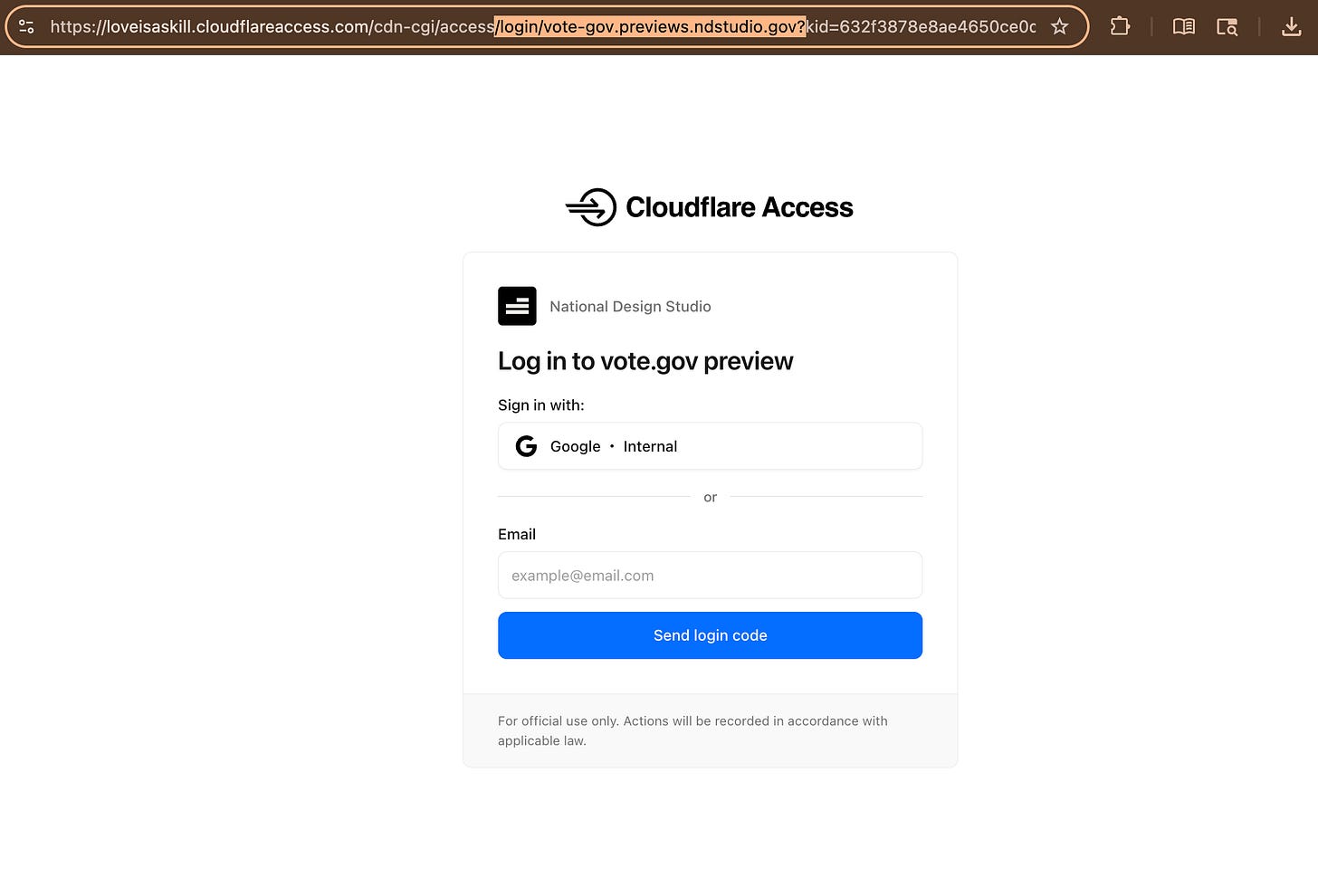 ](https://substackcdn.com/image/fetch/$s_!GbC3!,f_auto,q_auto:good,fl_progressive:steep/https%3A%2F%2Fsubstack-post-media.s3.amazonaws.com%2Fpublic%2Fimages%2F71e696eb-3f78-4e71-ac26-4885d5a0a173_2204x1498.png)loveisaskill.cloudflareaccess.com/cdn-cgi/access/login/vote-gov.previews.ndstudio.gov
:{:{In October 2025, Bobba got on a recorded conference call with state election directors from across the country and presented a federal voter registration system the studio was building. Voters would register through a federal portal, their identities verified through Login.gov, their citizenship verified through DHS’s SAVE database, their registrations transmitted to the states.}:
A state election director asked him what data the federal government would retain. He said, on a recording, in an election year: I don’t know what they retain and what they are logging. The person presenting a federal voter registration system to state election directors did not know what data his own system kept on American voters.}:
After Florida 2000, Congress passed a law creating the Election Assistance Commission specifically because both parties agreed that voter registration cannot live inside the White House of any sitting president. The sitting president should not have visibility into who is checking their registration in the weeks before an election that decides whether they keep their job. So Congress built a wall, and today vote.gov is registered to the Election Assistance Commission. As of this writing, that wall is still standing.
But in the certificate logs, underneath the studio’s unannounced sites, was a working preview of vote.gov, built inside the studio’s staging environment, behind the same Cloudflare login, isolated deliberately.:{:{ }:
The certificate appeared on April 10, 2026. Weeks before that certificate appeared, this administration signed an executive order requiring DHS, the Social Security Administration, and the SAVE program to construct a federal citizenship-verified voter list, with a deadline of ninety days from signing. That deadline is weeks away. When the order was challenged in federal court, the Department of Justice told the judge the agencies named had not yet begun preparation and were still in the deliberation phase.}:
[ ](https://substackcdn.com/image/fetch/$s_!a7qJ!,f_auto,q_auto:good,fl_progressive:steep/https%3A%2F%2Fsubstack-post-media.s3.amazonaws.com%2Fpublic%2Fimages%2F11db6ef4-8910-49e1-9da2-89f790d5e253_1712x1756.png)Additional websites from ndstudio.gov infrastructure…
The certificate is dated April 10. DOJ told a federal court the infrastructure does not exist. Both of those cannot be true. Either DOJ lied to a federal judge, or the studio is building a replacement for the country’s voter registration site without telling the agencies whose work it would replace. There is no third option.
While I was finishing this piece, I typed passports.gov directly into my browser, just to see what was there. A sign-in page came up: enter your email and we will send you a six-digit code. No State Department seal. No agency name. No privacy notice. Just a black button that says Send code. The owner of passports.gov is the Executive Office of the President, White House Office. The State Department does not own this domain. The security contact field is blank.:{:{ }:
The first certificate was issued May 5, three weeks ago. Based on what I can see in the staging environment, the next step will ask Americans to upload their passport photo through a White House-controlled website, on the same Cloudflare account, by the same people, with no privacy notice on file. A passport photo is biometric quality. Linked to your identity through Login.gov. Collected through infrastructure the White House owns, sealed from public view. They are building it this week.}:
Here is what the structure looks like from the outside. Section 3161 hides the staff so they do not appear on salary reports or file financial disclosures. The Executive Office of the President has no inspector general. There are zero required privacy disclosures filed across all twelve programs and no published contracts with any outside vendor. Forty federal websites run behind one personal Cloudflare account. And the Presidential Records Act seals everything for twelve years the day this administration ends, meaning until 2040, no one outside the White House can see who works there, what they collected, or where any of the data went.
What this office is doing is taking the parts of the federal government that touch you directly, your prescription, your voter registration, your passport, your federal login, out of the agencies that legally own them and rebuilding them on White House infrastructure. Vote.gov belongs to the Election Assistance Commission, and the studio built a copy. Passports belong to the State Department, and the studio is building a replacement this week. Login.gov belonged to GSA, and the studio’s guy runs it now.
Trump has said publicly that this infrastructure is for other presidents, and he is right about that. It is the one thing in this story I take him at his word on. The infrastructure outlasts him. Whoever wins in 2028 inherits the websites, the vendors, the data, and the hardware, sealed and waiting.
There is a gold three-dimensional eagle on the homepage of TrumpRx, clutching a ribbon in its talons. You are looking at the eagle. Something is being built underneath the government you think you have, on infrastructure you cannot see, by people who answer to no one, collecting everything.
I wish, still, that I were being metaphorical.
:{:{SOURCES CITED}:
NDS Infrastructure Map —my live working github map of every National Design Studio subdomain I have found, filterable by status, registrant, and parent domain. If you want to retrace this investigation or watch new subdomains appear in real time, start here.
The Front Door: NDS and Its Sites
National Design Studio (ndstudio.gov) — the office’s own homepage. The /work portfolio page lists every site they have built or are building, including TrumpRX, Real Food, Genesis Mission, Trump Accounts, Tech Force, Safe DC, Trump Card, and OPM Digital Retirements.
TrumpRx.gov — the federal drug pricing site. Footer links to ndstudio.gov via “National Design Studio.”
RealFood.gov — MAHA nutrition site. Same NDS footer credit.
TrumpAccounts.gov — children’s savings account program. Same NDS footer.
Genesis Mission (genesis.energy.gov) — the DOE/Oracle AI initiative. Oracle is listed as a partner on the homepage alongside NVIDIA, OpenAI for Government, IBM, Microsoft, AMD, AWS, and Google. Footer reads “DESIGNED IN D.C. BY THE NATIONAL DESIGN STUDIO.”
Passports.gov — currently a sign-in wall with no public footer credit, but the certificate transparency log ties it to the same infrastructure pattern (see below).
Executive Orders and Founding Documents
Executive Order 14338 — establishing the National Design Studio (August 21, 2025) — the order that created NDS, named Joe Gebbia chief design officer reporting to Chief of Staff Susie Wiles, and granted it broad authority to “design and redesign” federal digital services.
Genesis Mission executive order (November 24, 2025) — the order directing DOE to build the federal AI platform with Oracle as integration partner.
Personnel and Hiring Authority
Joe Gebbia named NDS chief design officer (Reuters) — Reuters’ reporting describing NDS as “a stripped-down successor to the controversial Department of Government Efficiency.”
Section 3161 of Title 5, U.S. Code — temporary organizations — the federal statute NDS is using to hire staff as advisors to a “temporary organization,” which bypasses normal civil service hiring, salary disclosure, and ethics review timelines.
Akash Bobba — DOGE engineer background (Wired) — original reporting on the DOGE engineering cohort, including Bobba.
dotgov-data registry (cisagov/dotgov-data on GitHub) — CISA’s authoritative repository for every federal .gov domain. The current-federal.csv file at this raw URL shows ndstudio.gov, passports.gov, realfood.gov, and trumprx.gov all registered to the Executive Office of the President, White House Office. The same file shows usadf.gov (United States African Development Foundation) listing akash@ndstudio.gov as its official security contact — meaning an independent federal agency’s cybersecurity point of contact is a personal-named mailbox at the White House design shop.
get.gov data page — the public landing page that links to the CISA registry files.
Certificate Transparency Logs*
crt.sh search for %.ndstudio.gov — 979 certificates on file as of May 26, 2026. Includes subdomains for fbi-kirk-tipline.previews, vote-gov.previews and vote-gov-ndstudio.previews, trump-accounts-splashpage.previews, board-of-peace-assets, war.previews, and dozens of other staging environments that are not publicly announced.
(crt.sh crashes all the time, hence my github repo at the top ^ )`}:
crt.sh search for passports.gov — 26 certificates showing the rollout timeline: original cert May 5, staging/auth/api subdomains spun up May 22, and nine new certs for photo.passports.gov and photos.passports.gov issued in a single hour on May 26.
Cloudflare Access login wall at loveisaskill.cloudflareaccess.com — the SSO portal that gates vote-gov.previews.ndstudio.gov. The URL resolves to a Cloudflare Access login wall and will request an email/authentication; you cannot bypass it without credentials, but its existence confirms the preview is hosted on White House-controlled infrastructure rather than the Election Assistance Commission’s systems.
The AutoMonitor Script
The AutoMonitor source file (cdn.infra.ndstudio.gov) — the 539-line JavaScript file that defines class AutoMonitor, generates a session ID on line 7, and posts telemetry to analytics.infra.ndstudio.gov/metrics on line 8. Deployed on ndstudio.gov and confirmed on genesis.energy.gov.
PostHog analytics on TrumpRx — TrumpRx privacy policy — TrumpRx’s own privacy policy confirms it uses PostHog for usage analytics while also stating it does not collect “health or medical information.” PostHog by default records full session replays, including keystrokes and mouse movement, unless explicitly disabled.
PostHog session recording documentation — PostHog’s own docs describing what session replay captures by default.
DOGE Lineage and Court Record*
American Federation of Teachers v. Bessent — the lawsuit challenging DOGE access to Treasury Department systems, including IRS taxpayer data. Court filings document the specific systems DOGE personnel were granted read/write access to.
Court ruling on DOGE Privacy Act violations (CourtListener docket) — full docket including the preliminary injunction findings.
FBI Utah Valley shooting page (fbi.gov/utahvalleyshooting) — the FBI’s official public intake page for Kirk shooting tips. Tips went through the existing 1-800-CALL-FBI line and tips.fbi.gov, generating over 11,000 tips in 48 hours.
Privacy Framework Documents That Should Exist And Do Not*
E-Government Act of 2002 — Privacy Impact Assessment requirement — the law requiring federal agencies to publish a PIA before deploying any system that collects personally identifiable information.
OMB Circular A-130 — federal information policy — the binding policy requiring System of Records Notices (SORNs) for any federal system maintaining personally identifiable records.
Federal Register SORN search — search for “National Design Studio” returns zero published SORNs as of May 26, 2026.
Iron Mountain and the Retirement Pipeline
Iron Mountain limestone mine retirement processing (Washington Post) — the original “sinkhole of bureaucracy” reporting on OPM’s paper-based retirement processing facility.
OPM Digital Retirements (retire.opm.gov) — the NDS-built replacement system listed in their portfolio. Linked from ndstudio.gov/work.
---