palantir 2
main broke? disambig
SEE PRIVACY
SEE DOGE --> ACTIV SUPPRESS
see surveillance FUSION? --> ANTIFA? GAI BS
SEE AI 3
SEE MASS DEPORT ICE
see activ suppress
SEE KARP AND LONSDALEUATX EXECUTE
CLAREMONT?
DISASTER CAP’L
SEE ANDURIL WEAPONS CONTRACTOR?
CONTRACTOR
neglected?
---
---
gmail 4 26 walij
The Tech Journalist Banned from Twitter for Criticizing Fascism, Palantir, and the Broligarchy
Palantir, Trump's techno-fascist surveillance company, just published a 22-part manifesto outlining its authoritarian agenda. The masks are off. It's time to purge America of these broligarchs.
Tech journalist Gil Duran is a longtime friend of The Left Hook who has spent years chronicling the fascist ideology of Silicon Valley broligarchs who have captured the White House and are now spending hundreds of millions to buy our elections.
His Twitter account was suspended on Monday.
Did he post Nazi conspiracy theories? Do a Sieg Heil? Mainstream dangerous anti-vaxx nonsense? Take money from Russia and and promote anti-American talking points?
Nope. All of that is kosher and normalized by Elon Musk and MAGA.
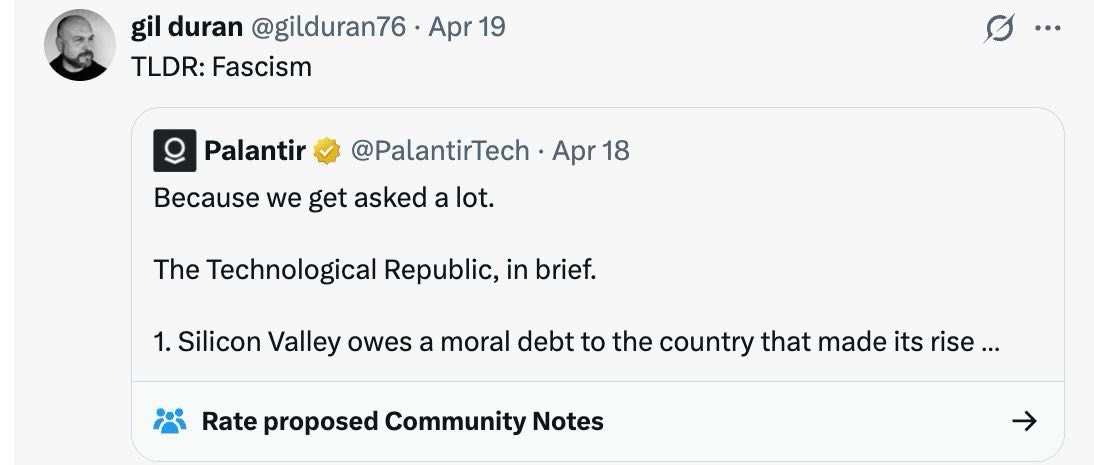 |
He did something far more controversial and extreme. He dared call out fascism. That’s it. That’s all he did.
It seems the free speech, anti-culture crowd is perfectly fine cancelling speech that it finds offensive and threatening. Free speech for me, none for thee. Safe spaces for me, none for thee. Civility for me, and cruelty for thee.
They advocate for a “hard power,” believe Silicon Valley should play a bigger role in “addressing crime,” laments a culture that promotes pluralism and inclusivity, celebrates certain civilizations (“Western”) as more advanced than “regressive” ones, and states national service should be a universal duty.
Basically, they want to turn the United States into apartheid Israel, a country that Palantir has proudly supported and helped during its ongoing occupation and genocide.
 |
 |
Palantir was co-founded by white nationalist billionaire and Epstein ally Peter Thiel, who in 2009, said, “I no longer believe that freedom and democracy are compatible.” He’s part of the South African Pay Pal mafia which includes Elon Musk and David Sacks, who is Trump’s Czar of AI and Crypto. Thiel also groomed the political career of JD Vance and hand delivered him to the White House.
These aspiring masters of the universe are unraveling publicly in real time as the masses grow wiser to their techno-fascist machinations. Instead of dialing back their dystopian sci-fi porn, they’re doubling down and using the Trump Administration to realize their apocalyptic end game. They’re also pouring hundreds of millions to purchase the upcoming 2026 and 2028 elections, buying up both Democratic and Republican elections.
It’s time to wake up, purge Palantir, and call out all elected officials who continue taking AI and Crypto money....
THE LEFT HOOK with Wajahat Ali https://substack.com/@thelefthook) and Gil Duran (https://substack.com/@gilduran)
Apr 21
---
mojo
...
Noem and her adviser Corey Lewandowski, who is working as a special government employee, have also reportedly involved themselves in DHS contracts awarded as part of the self-deportation program. In February, the department, on an expedited basis, doled out contracts to two GOP-connected firms to craft ads encouraging undocumented immigrants to self-deport, part of a $200million TV ad blitz featuring Noem. One of those firms is owned by a Louisiana-based political consultant who has previously worked with Lewandowski.
After Noem and Lewandowski visited a Palantir facility in March, “Lewandowski told officials at the Department of Homeland Security to give the firm additional work,” the Wall Street Journal reported. DHS expanded Palantir’s contract to assist the administration in tracking self-deportations. (Lewandowski denied he played a role.)
...
---
RWW
03/12/2026
by
- Michelle Goldberg @ The New York Times: I Went to Florida to See the 31-Year-Old Candidate Thrilling Gen Z. We’re in Trouble.
Last Tuesday, James Fishback, a 31-year-old running for governor in Florida, was speaking to a packed house at the Queens Harbour Yacht and Country Club in Jacksonville. Every one of the room’s almost 100 seats was taken, and people were standing several rows deep around the perimeter, with more listening from the lobby outside. The crowd was mostly male and very young; several attendees told me they were in high school. A few wore the “America First” baseball caps popular with followers of Nick Fuentes, the influential white nationalist troll.
- Aleja Hertzler-McCain @ The Roys Report: Over 100 Latino Christian leaders say Trump adviser Samuel Rodriguez’s reach is misrepresented
More than 100 Latino Christians leaders signed a statement saying Samuel Rodriguez, an evangelical adviser to President Donald Trump and a go-to voice for Hispanic evangelical perspectives, and news media have exaggerated the size of Rodriguez’s reach as president of the National Hispanic Christian Leadership Conference.
- Sam Adler-Bell @ New York Magazine: The Young Women Leaving the New Right
Defectors say the movement has dropped the pretense of protecting women and is now openly “cruel and fickle.”
- Malcolm Ferguson @ The New Republic: Palantir CEO Makes Shocking Confession on Disrupting Democratic Power
They’re saying the quiet part out loud now.
VID?
Palantir CEO Alex Karp thinks his AI technology will lessen the power of “highly educated, often female voters, who vote mostly Democrat” while increasing the power of working-class men.
“This technology disrupts humanities-trained—largely Democratic—voters, and makes their economic power less. And increases the economic power of vocationally trained, working-class, often male, working-class voters,” Karp said in a CNBC interview Thursday. “And so these disruptions are gonna disrupt every aspect of our society. And to make this work, we have to come to an agreement of what it is we’re going to do with the technology; how are we gonna explain to people who are likely gonna have less good, and less interesting jobs.”
This sounds like a direct, long-term pitch to the GOP from a CEO whose tech firm already has numerous government contracts and is deeply embedded in the Pentagon. Karp’s message is loud and clear: My technology will take political capital away from one of your greatest enemies—liberal women with degrees—and give one of your favorite demographics to patronize—working-class men—more political power to transfer to you. He’s aligning his technology with both GOP political strategy and the larger male-centered culture war that the right has been waging for the better part of a decade now. And how exactly would his technology only hurt Democrat women?
Karp also made a Patriot Act–era argument, justifying his admittedly “dangerous” technology by claiming that Palantir will allow us to “be American” in the future.
“These technologies are dangerous societally,” Karp continued. “The only justification you could possibly have would be that if we don’t do it, our adversaries will do it. And we will be subject to their rule of law.… Why is it that we’re absorbing the risk of disrupting the very fabric of our society, including the most powerful parts of our society, if it’s not because it’s about maintaining our ability to be American in the near term and long term?”
- Samuel Benson @ Politico: Furious MAGA allies lobby Trump to keep deporting migrants
The new Mass Deportation Coalition is pushing the White House to continue with its deportation operation — just as the White House tells GOP candidates to back away from that message.
- Steve Benen @ The Maddow Blog: In second week of the Iran war, the White House emphasizes ‘fun’ and meme videos
The president and his team have embraced a cavalier, anti-humanist attitude to matters of life and death.
---
1 26 404? MAIL
Palantir is working on a tool for ICE that populates a map with potential deportation targets, brings up a dossier on each person, and provides a “confidence score” on the person’s current address, 404 Media has learned. ICE is using it to find locations where lots of people it might detain could be based. The findings, based on internal ICE material obtained by 404 Media, public procurement records, and recent sworn testimony from an ICE official, show the clearest link yet between the technological infrastructure Palantir is building for ICE and the agency’s activities on the ground. The tool receives peoples’ addresses from the Department of Health and Human Services among a range of other sources, according to the material.
---
AN
COMM DR 12 25
Venture capitalist Joe Lonsdale, a co-founder of data platform company Palantir, is calling for the return of public hangings as part of a broader push to restore what he describes as “masculine leadership” to the US.
In a statement posted on X Friday, Lonsdale said that he supported changing the so-called “three strikes” anti-crime law to ensure that anyone who is convicted of three violent crimes gets publicly executed, rather than simply sent to prison for life.
“If I’m in charge later, we won’t just have a three strikes law,” he wrote. “We will quickly try and hang men after three violent crimes. And yes, we will do it in public to deter others.”
Lonsdale then added that “our society needs balance,” and said that “it’s time to bring back masculine leadership to protect our most vulnerable.”
Lonsdale’s views on public hangings being necessary to restore “masculine leadership” drew swift criticism.
Gil Durán, a journalist who documents the increasingly authoritarian politics of Silicon Valley in his newsletter “The Nerd Reich,” argued in a Saturday post that Lonsdale’s call for public hangings showed that US tech elites are “entering a more dangerous and desperate phase of radicalization.”
“For months, Peter Thiel guru Curtis Yarvin has been squawking about the need for more severe measures to cement Trump’s authoritarian rule,” Durán explained. “Peter Thiel is ranting about the Antichrist in a global tour. And now Lonsdale—a Thiel protégé—is fantasizing about a future in which he will have the power to unleash state violence at mass scale.”
Taulby Edmondson, an adjunct professor of history, religion, and culture at Virginia Tech, wrote in a post on Bluesky that the rhetoric Lonsdale uses to justify the return of public hangings has even darker intonations than calls for state-backed violence.
“A point of nuance here: ‘masculine leadership to protect our most vulnerable’ is how lynch mobs are described, not state-sanctioned executions,” he observed.
Theoretical physicist Sean Carroll argued that Lonsdale’s remarks were symbolic of a kind of performative masculinity that has infected US culture.
“Immaturity masquerading as strength is the defining personal characteristic of our age,” he wrote.
Tech entrepreneur Anil Dash warned Lonsdale that his call for public hangings could have unintended consequences for members of the Silicon Valley elite.
“Well, Joe, Mark Zuckerberg has sole control over Facebook, which directly enabled the Rohingya genocide,” he wrote. “So let’s have the conversation.”
And Columbia Journalism School professor Bill Grueskin noted that Lonsdale has been a major backer of the University of Austin, an unaccredited liberal arts college that has been pitched as an alternative to left-wing university education with the goal of preparing “thoughtful and ethical innovators, builders, leaders, public servants and citizens through open inquiry and civil discourse.”
---
---
meidas 5 min
55:50
well Trump married to immigrants I mean you know so that there is there is contradiction there of course but
55:55
without the technology that these people are supporting Trump with and providing and getting military contracts and
56:02
government contracts with Trump wouldn't be able to send bounty hunters out with
56:07
software on their phones with their kind of Amazon military costumes and round people up
56:13
yeah there's a role for the the tech industry Um, one of the interesting things that I'd been looking into was um
56:20
there was a project at the Claremont Institute, which is a Trump Allied think tank called the administrative state project. And that the um one of the
56:28
thinkers are on that project uh was co-writing opeds with the CTO of Palunteer. So it was all about thinking
56:36
around it was there there has been a lot of strategy and thinking um around how
56:42
the immigration how technology and tech advanced tech companies like Palunteer
56:48
will further the immigration enforcement push that we're seeing in America. So,
[pal contract under biden
---
WHY NOW? GUBMINT? MANOSPHERE ME TOO?
“We’re headed to a surveillance state”: Right-wing figures and podcasters are protesting the Trump administration’s relationship with Palantir
Palantir is coming under greater scrutiny even from Trump’s allies
Written by Noah Dowe & Ben Van Bloem
Published 11/10/25 MMA
The Trump administration’s deepening ties to data analysis firm Palantir has caused a surge in discontent in the conservative media sphere. Figures ranging from right-leaning podcasters like Theo Von and Tim Dillon to MAGA allies such as Steve Bannon and Tucker Carlson have warned Palantir’s “spy network” is a step toward a “police state.” Other figures on the far right, including white nationalist commentators Nick Fuentes and Stew Peters, have also railed against the tech company’s CEO and its ties to billionaire Trump-backer Peter Thiel.
The Trump administration is contracting Palantir to work with ICE
- Palantir makes software that searches through and organizes large datasets — and as a U.S. government contractor, that could include sensitive information about every American. Wired notes, “The software firm's work with Immigration and Customs Enforcement, the US Department of Defense, and the Israeli military has sparked numerous protests in multiple countries.” Wired, [8/11/25; Inc., 11/3/25]
- In May, Palantir made a $30 million deal with ICE to provide the agency with “near real-time visibility” into how migrants move in the United States.This comes at the same time that ICE is adopting more technology for surveillance, including facial recognition, to create biometric databases on populations of immigrants and people who interact with law enforcement. NPR, [5/5/25, Brookings Institution, 10/6/25]
- Trump chose Palantir to help “share data across agencies,” creating the possibility of a “master list of personal information on Americans that could give him untold surveillance power.”The apparent goal of the administration is to have Palantir compile a merged database that would include — but not be limited to — a person’s student debt, wages, bank account number, biometric data, and disability status. That information is currently siloed in different agencies, and experts warn that a merged database could be used by government actors to target political enemies, dissidents, and marginalized communities. The New York Times, [5/30/25, 4/9/25, The Guardian, 6/30/25]
- Palantir was co-founded by Peter Thiel, a longtime ally of President Donald Trump who supported his 2016 campaign and is also closely tied to Vice President JD Vance.Thiel hired Vance to his investment firm in 2017 and donated $15 million to a super PAC supporting the future vice president’s 2022 Ohio Senate campaign. CBS News, [7/16/24; Mother Jones, 7/23/25]
- The company and its CEO have also donated to the Trump inauguration fund and the construction fund for the ballroom replacing the East Wing of the White House.CEO Alex Karp donated $1 million to the inauguration, and Palantir is on a list of companies contributing to the estimated $300 million construction budget of the ballroom. Brennan Center, [7/1/25; Axios, 10/23/25]
- ## Right-wing figures and right-leaning podcasters have been critical of the Trump administration for working with Palantir, saying the collaboration “should scare everybody”
- Joe Rogan said that Palantir gathering “personal data of each American” is “kind of creepy.” YouTube, *The Joe Rogan Experience*, [9/9/25]
- War Roomhost Steve Bannon called Palantir “really the villain in the AI” space and expressed doubt that the company had actually “become MAGA, because then you see what they want to do.”Bannon later said convicted sex trafficker Ghislaine Maxwell’s case raises “big questions about Palantir and some of these other companies today about the surveillance technology — exactly who’s financing it, who owns it, who controls it, all of it.” Real America’s Voice, *War Room,* [6/30/25, 8/23/25]
- Podcaster Shawn Ryan told a guest on his show that people were worried that Palantir is “spying on us.”Guest Trae Stephens, a venture capitalist deeply involved in Palantir and other Thiel-related projects, defended the company and said that the “misconceptions around Palantir are crazy,” claiming that “a lot of the hysteria, like philosophically, is really troubling.” YouTube, *The Shawn Ryan Show*, [10/16/25]
- Infowarshost Harrison Smith said the administration’s work with Palantir was “probably the worst news I've heard all year, to be honest with you,” and described the company as “the backbone infrastructure of the Mark of the Beast.” InfoWars, *The American Journal*, [6/2/25]
- PBD Podcastresearcher Brandon Aceto said that Palantir is “a straight-up CIA contractor that harvests our data. It’s probably the biggest data center in the world, so that’s scary for a whole bunch of reasons.” YouTube, *PBD Podcast*, [6/3/25]
- PBD Podcastpanelist Vincent Oshana said Karp and his company “want to control everything.”Host Patrick Bet-David called Palantir’s history “very, very spooky.” YouTube, *PBD Podcast,*[6/10/25, 6/10/25]
- Timcast IRLpanelist Ian Crossland decried “the rise of Palantir and the spy network that’s being built,” claiming, “There’s going to be, like, spy tech everywhere.”Rumble, *Timcast IRL,*[9/13/25]
- Far-right figure Enrique Tarrio said he is “completely against” Palantir contracting for the government, calling it “the more advanced version of the Patriot Act.”According to Tarrio, “The Palantir thing I don't know enough about but I do think that just by what I'm seeing, it is something I am completely against because it's true. It's a second — it's the more advanced version of the Patriot Act.” Rumble, *Lords of War*, [6/4/25; Media Matters, 4/30/25]
- Tucker Carlson said “the technology, not just Palantir but all the emerging technology … it could be used to enslave the population really easily.” Carlson declared, “Every person should be concerned about the centralization of power and the use of technology to strip basic rights from citizens.” YouTube, *The Tucker Carlson Show,*[7/25/25]
- Right-wing political strategist Roger Stone criticized Palantir and claimed he told Vice President JD Vance that he does not “want Big Brother knowing everything about me.” Stone said, “I told him I did not like the idea of the federal government having a database on every American. I don't like Real ID. I don't like these stated plans of Palantir. I don't want Big Brother knowing everything about me, including my spending habits and everything about me, because I think it leads to a social credit score like they have in China.” BBC, [12/23/20, WABC, The Stone Zone, 10/2/25]
- Conservative commentators The Hodgetwins asked, “Why are Republicans giving Palantir all this power? Turning us into a damn police state.” Twitter/X, [6/4/25]
- Comedian and podcaster Tim Dillon has repeatedly questioned the administration’s relationship with Palantir, saying it “should scare everybody.”Dillon claimed, “If you don't have any reservations about Palantir taking everyone's information, I don't know. I can't — I don't know if I could trust you.” Dillon has also accused Palantir of “exporting technology all over the world for the purposes of death,” adding, “They are building this with Trump, with taxpayer money.” YouTube, *The Tim Dillon Show,* [6/7/25, 8/2/25, 8/16/25, 9/27/25]
- ## Some podcasters expressed specific distrust for Thiel and Karp
- Podcaster Theo Von said Palantir’s deal with the administration is “fucked” during an interview with Vice President JD Vance, called Peter Thiel a “dark lord,” and warned that “we’re headed to a surveillance state in America.”Von said, “This sounds crazy, dude. This sounds like we're only going to be human for, like, two more years. … They're going to have every — know everything about us. It makes you feel like you won't be a person anymore.” Von stated in a later episode “you won't be able to be a, like, hypothetically or on paper, illegal person in America in two years.” YouTube, *This Past Weekend w/ Theo Von,* [6/7/25, 7/23/25, 9/5/25]
- White nationalist commentator Nick Fuentes said that Palantir was “infiltrated from top to bottom by Israel” while criticizing Peter Thiel's connection to Vance. Fuentes said, “JD Vance, what do we know about him? He was mentored and groomed and basically a creation of Peter Thiel, the creator of Palantir, who is running Palantir with people like Alex Karp, infiltrated from top to bottom by Israel, and Trump picked him at the behest of Tucker and Musk.” Rumble, *America First with Nick Fuentes*, [9/19/25; Media Matters, 10/2/25]
- White nationalist podcaster Stew Peters called the Trump administration “a big joke,” claiming: “It's time to roll in Palantir and you know, put the final launching measures on this super surveillance state that our enemy wishes to deploy here in the United States — track, trace, and control.”Peters said, “JD Vance with his cryptic statement saying hey, you know, President Trump is in really good health but if tragedy strikes, I'm ready to lead. And then you see Peter Thiel right behind him smiling.” Rumble, *The Stew Peters Show,*[9/4/25; Media Matters, 3/13/23]
//
11/07/25 2:12 PM EST
10/21/25 3:52 PM EDT
10/17/25
---
reup w/ ICE right after 700 ppl raid in So.
819 capt
---
KARL LOSING HIS MIND?
---
---
BB 6 25
Four prominent tech executives, including Meta's CTO Andrew Bosworth, have joined a special U.S. Army Reserve unit where they'll serve as lieutenant colonels without completing basic training.
As reported in Steven Levy's Plaintext newsletter, the executives are part of "Detachment 201: the Executive Innovation Corps," a new military initiative designed to modernize the force. Joining Bosworth are Kevin Weil from OpenAI, Bob McGrew from Thinking Machines Lab, and Shyam Sankar from Palantir.
Unlike traditional reservists, these officers can work some of their required 120 annual hours remotely and won't be deployed to combat zones....
---
---
omfg
an 4 25
A whistleblower at the National Labor Relations Board reported an unusual spike in potentially sensitive data flowing out of the agency’s network in early March 2025 when staffers from the Department of Government Efficiency, which goes by DOGE, were granted access to the agency’s databases. On April 7, the Department of Homeland Security gained access to Internal Revenue Service tax data.
These seemingly unrelated events are examples of recent developments in the transformation of the structure and purpose of federal government data repositories. I am a researcher who studies the intersection of migration, data governance and digital technologies. I’m tracking how data that people provide to U.S. government agencies for public services such as tax filing, health care enrollment, unemployment assistance and education support is increasingly being redirected toward surveillance and law enforcement.
Originally collected to facilitate health care, eligibility for services and the administration of public services, this information is now shared across government agencies and with private companies, reshaping the infrastructure of public services into a mechanism of control. Once confined to separate bureaucracies, data now flows freely through a network of interagency agreements, outsourcing contracts and commercial partnerships built up in recent decades.
These data-sharing arrangements often take place outside public scrutiny, driven by national security justifications, fraud prevention initiatives and digital modernization efforts. The result is that the structure of government is quietly transforming into an integrated surveillance apparatus, capable of monitoring, predicting and flagging behavior at an unprecedented scale.
Executive orders signed by President Donald Trump aim to remove remaining institutional and legal barriers to completing this massive surveillance system.
DOGE and the private sector
Central to this transformation is DOGE, which is tasked via an executive order to “promote inter-operability between agency networks and systems, ensure data integrity, and facilitate responsible data collection and synchronization.” An additional executive order calls for the federal government to eliminate its information silos.
By building interoperable systems, DOGE can enable real-time, cross-agency access to sensitive information and create a centralized database on people within the U.S. These developments are framed as administrative streamlining but lay the groundwork for mass surveillance.
Key to this data repurposing are public-private partnerships. The DHS and other agencies have turned to third-party contractors and data brokers to bypass direct restrictions. These intermediaries also consolidate data from social media, utility companies, supermarkets and many other sources, enabling enforcement agencies to construct detailed digital profiles of people without explicit consent or judicial oversight.
Palantir, a private data firm and prominent federal contractor, supplies investigative platforms to agencies such as Immigration and Customs Enforcement, the Department of Defense, the Centers for Disease Control and Prevention and the Internal Revenue Service. These platforms aggregate data from various sources – driver’s license photos, social services, financial information, educational data – and present it in centralized dashboards designed for predictive policing and algorithmic profiling. These tools extend government reach in ways that challenge existing norms of privacy and consent.
The role of AI
Artificial intelligence has further accelerated this shift.
Predictive algorithms now scan vast amounts of data to generate risk scores, detect anomalies and flag potential threats.
These systems ingest data from school enrollment records, housing applications, utility usage and even social media, all made available through contracts with data brokers and tech companies. Because these systems rely on machine learning, their inner workings are often proprietary, unexplainable and beyond meaningful public accountability. Data privacy researcher Justin Sherman explains the astonishing amount of information data brokers have about you.
Sometimes the results are inaccurate, generated by AI hallucinations – responses AI systems produce that sound convincing but are incorrect, made up or irrelevant. Minor data discrepancies can lead to major consequences: job loss, denial of benefits and wrongful targeting in law enforcement operations. Once flagged, individuals rarely have a clear pathway to contest the system’s conclusions.
Digital profiling
Participation in civic life, applying for a loan, seeking disaster relief and requesting student aid now contribute to a person’s digital footprint. Government entities could later interpret that data in ways that allow them to deny access to assistance. Data collected under the banner of care could be mined for evidence to justify placing someone under surveillance. And with growing dependence on private contractors, the boundaries between public governance and corporate surveillance continue to erode.
Artificial intelligence, facial recognition systems and predictive profiling systems lack oversight. They also disproportionately affect low-income individuals, immigrants and people of color, who are more frequently flagged as risks.
Initially built for benefits verification or crisis response, these data systems now feed into broader surveillance networks. The implications are profound. What began as a system targeting noncitizens and fraud suspects could easily be generalized to everyone in the country.
Eyes on everyone
This is not merely a question of data privacy. It is a broader transformation in the logic of governance. Systems once designed for administration have become tools for tracking and predicting people’s behavior. In this new paradigm, oversight is sparse and accountability is minimal.
AI allows for the interpretation of behavioral patterns at scale without direct interrogation or verification. Inferences replace facts. Correlations replace testimony.
The risk extends to everyone. While these technologies are often first deployed at the margins of society – against migrants, welfare recipients or those deemed “high risk” – there’s little to limit their scope. As the infrastructure expands, so does its reach into the lives of all citizens.
With every form submitted, interaction logged and device used, a digital profile deepens, often out of sight. The infrastructure for pervasive surveillance is in place. What remains uncertain is how far it will be allowed to go.
Nicole M. Bennett, Ph.D. Candidate in Geography and Assistant Director at the Center for Refugee Studies, *Indiana University
This article is republished from The Conversation under a Creative Commons license. Read the original article.
---
---
IPO?
---
GUK
REF
The movement for corporate city states cannot believe its good luck. For years, it has been pushing the extreme notion that wealthy, tax-averse people should up and start their own high-tech fiefdoms, whether new countries on artificial islands in international waters (“seasteading”) or pro-business “freedom cities” such as Próspera, a glorified gated community combined with a wild west med spa on a Honduran island.
Yet despite backing from the heavy-hitter venture capitalists Peter Thiel and Marc Andreessen, their extreme libertarian dreams kept bogging down: it turns out most self-respecting rich people don’t actually want to live on floating oil rigs, even if it means lower taxes, and while Próspera might be nice for a holiday and some body “upgrades”, its extra-national status is currently beingchallenged in court.
Now, all of a sudden, this once-fringe network of corporate secessionists finds itself knocking on open doors at the dead center of global power.
The first sign that fortunes were shifting came in 2023, when a campaigning Donald Trump, seemingly out of nowhere, promised to hold a contest that would lead to the creation of 10 “freedom cities” on federal lands. The trial balloon barely registered at the time, lost in the daily deluge of outrageous claims. Since the new administration took office, however, would-be country starters have been on a lobbying blitz, determined to turn Trump’s pledge into reality.
“The energy in DC is absolutely electric,” Trey Goff, the chief of staff of Próspera, recently enthused after a trip to Capitol Hill. Legislation paving the way for a bevy of corporate city-states should be complete by the end of the year, he claims.
Inspired by the political philosopher Albert Hirschman, figures including Goff, Thiel and the investor and writer Balaji Srinivasan have been championing what they call “exit” – the principle that those with means have the right to walk away from the obligations of citizenship, especially taxes and burdensome regulation. Retooling and rebranding the old ambitions and privileges of empires, they dream of splintering governments and carving up the world into hyper-capitalist, democracy-free havens under the sole control of the supremely wealthy, protected by private mercenaries, serviced by AI robots and financed by cryptocurrencies.
Peter Thiel in Tokyo in 2019. Photograph: Kiyoshi Ota/Bloomberg via Getty Images
One might assume that it is contradictory for Trump, elected on a flag-waving “America first” platform, to lend credence to this vision of sovereign territories ruled over by billionaire god-kings. And much has been made of the colorful flame wars between the Maga mouth-piece Steve Bannon, a proud nationalist and populist, and the Trump-allied billionaires he has attacked as “technofeudalists” who “don’t give a flying fuck about the human being” – let alone the nation state. And conflicts inside Trump’s awkward, jerry-rigged coalition certainly exist, most recently reaching a boiling point over tariffs. Still, the underlying visions might not be as incompatible as they first appear.
The startup country contingent is clearly foreseeing a future marked by shocks, scarcity and collapse. Their high-tech private domains are essentially fortressed escape pods, designed for the select few to take advantage of every possible luxury and opportunity for human optimization, giving them and their children an edge in an increasingly barbarous future. To put it bluntly, the most powerful people in the world are preparing for the end of the world, an end they themselves are frenetically accelerating.
That is not so far away from the more mass-market vision of fortressed nations that has gripped the hard right globally, from Italy to Israel, Australia to the United States: in a time of ceaseless peril, openly supremacist movements in these countries are positioning their relatively wealthy states as armed bunkers. These bunkers are brutal in their determination to expel and imprison unwanted humans (even if that requires indefinite confinement in extra-national penal colonies from Manus Island to Guantánamo Bay) and equally ruthless in their willingness to violently claim the land and resources (water, energy, critical minerals) they deem necessary to weather the coming shocks.
Though it builds on enduring rightwing tendencies ... we simply have not faced such a powerful apocalyptic strain in government before
Interestingly, at a time when previously secular Silicon Valley elites are suddenly finding Jesus, it is noteworthy that both of these visions – the priority-pass corporate state and the mass-market bunker nation – share a great deal in common with the Christian fundamentalist interpretation of the biblical Rapture, when the faithful will supposedly be lifted up to a golden city in heaven, while the damned are left to endure an apocalyptic final battle down here on earth.
If we are to meet our critical moment in history, we need to reckon with the reality that we are not up against adversaries we have seen before. We are up against end times fascism.
Reflecting on his childhood under Mussolini, the novelist and philosopher Umberto Eco observed in a celebrated essay that fascism typically has an “Armageddon complex” – a fixation on vanquishing enemies in a grand final battle. But European fascism of the 1930s and 1940s also had a horizon: a vision for a future golden age after the bloodbath that, for its in-group, would be peaceful, pastoral and purified. Not today.
Alive to our era of genuine existential danger – from climate breakdown to nuclear war to sky-rocketing inequality and unregulated AI – but financially and ideologically committed to deepening those threats, contemporary far-right movements lack any credible vision for a hopeful future. The average voter is offered only remixes of a bygone past, alongside the sadistic pleasures of dominance over an ever-expanding assemblage of dehumanized others.
And so we have the Trump administration’s dedication to releasing its steady stream of real and AI-generated propaganda designed solely for these pornographic purposes. Footage of shackled immigrants being loaded on to deportation flights, set to the sounds of clanking chains and locking cuffs, which the official White House X account labeled “ASMR”, a reference to audio designed to calm the nervous system. Or the same account sharing news of the detention of Mahmoud Khalil, a US permanent resident who was active in Columbia University’s pro-Palestinian encampment, with the gloating words: “SHALOM, MAHMOUD.” Or any number of homeland security secretary Kristi Noem’s sadism-chic photo ops (atop a horse at the US-Mexican border, in front of a crowded prison cell in El Salvador, slinging a machine gun while arresting immigrants in Arizona …).
Kristi Noem speaks during a tour of an El Salvador prison in March. Photograph: Alex Brandon/AP
The governing ideology of the far right in our age of escalating disasters has become a monstrous, supremacist survivalism.
It is terrifying in its wickedness, yes. But it also opens up powerful possibilities for resistance. To bet against the future on this scale – to bank on your bunker – is to betray, on the most basic level, our duties to one another, to the children we love, and to every other life form with whom we share a planetary home. This is a belief system that is genocidal at its core and treasonous to the wonder and beauty of this world. We are convinced that the more people understand the extent to which the right has succumbed to the Armageddon complex, the more they will be willing to fight back, realizing that absolutely everything is now on the line.
Our opponents know full well that we are entering an age of emergency, but have responded by embracing lethal yet self-serving delusions. Having bought into various apartheid fantasies of bunkered safety, they are choosing to let the Earth burn. Our task is to build a wide and deep movement, as spiritual as it is political, strong enough to stop these unhinged traitors. A movement rooted in a steadfast commitment to one another, across our many differences and divides, and to this miraculous, singular planet.
Not so long ago, it was primarily religious fundamentalists who greeted signs of apocalypse with gleeful excitement about the long-awaited Rapture. Trump has handed critical posts to people who subscribe to that fiery orthodoxy, including several Christian Zionists who see Israel’s use of annihilatory violence to expand its territorial footprint not as illegal atrocities but as felicitous evidence that the Holy Land is getting closer to the conditions under which the Messiah will return, and the faithful will get their celestial kingdom.
Mike Huckabee, Trump’s newly confirmed ambassador to Israel, has strong ties to Christian Zionism, as does Pete Hegseth, his secretary of defense. Noem and Russell Vought, the Project 2025 architect who now leads the office of budget and management, are both staunch advocates for Christian nationalism. Even Thiel, who is gay and notorious for his party lifestyle, has been heard musing about the arrival of the antichrist of late (spoiler: he thinks it’s Greta Thunberg, more on that soon).
But you don’t need to be a biblical literalist, or even religious, to be an end times fascist. Today, plenty of powerful secular people have embraced a vision of the future that follows a nearly identical script, one in which the world as we know it collapses under its weight and a chosen few survive and thrive in various kinds of arks, bunkers and gated “freedom cities”. In a 2019 paper titled Left Behind: Future Fetishists, Prepping and the Abandonment of Earth, the communication scholars Sarah T Roberts and Mél Hogan described the longing for a secular Rapture: “In the accelerationist imaginary, the future is not about harm reduction, limits or restoration; rather it is a politics driving toward an endgame.”
Mike Huckabee touring Jewish settlements in East Jerusalem in 2008. Photograph: David Silverman/Getty Images
Elon Musk, who dramatically grew his fortune alongside Thiel at PayPal, embodies this implosive ethos. This is a person who looks up at the wonders of the night sky and apparently sees only opportunities to fill that inky unknown with his own space junk. Though he burnished his reputation warning about the dangers of the climate crisis and AI, he and his so-called “department of government efficiency” (Doge) henchmen now spend their days escalating those same risks (and many others) by slashing not only environmental regulations but entire regulatory agencies, with the apparent end goal of replacing federal workers with chatbots.
Who needs a functioning nation state when outer space – now reportedly Musk’s singular obsession – beckons? For Musk, Mars has become a secular ark, which he claims is key to the survival of human civilization, perhaps via uploaded consciousnesses to an artificial general intelligence. Kim Stanley Robinson, the author of the sci-fi Mars Trilogy that appears to have partially inspired Musk, is blunt about the dangers of the billionaire’s fantasies about colonizing Mars. It is, he says, “just a moral hazard that creates the illusion we can wreck Earth and still be okay. It’s totally not true.”
Much like religious end-timers who long to escape the corporeal realm, Musk’s drive for humanity to become “multiplanetary” is made possible by his inability to appreciate the multispecies splendor of our only home. Evidently uninterested in the vast bounty that surrounds him, or in ensuring Earth can continue buzzing with diversity, he instead deploys his vast fortune to bring about a future that would see a handful of people and robots eke out survival on two barren orbs (a radically depleted Earth and a terraformed Mars). Indeed, in a strange twist on the Old Testament tale, Musk and his fellow tech billionaires, having arrogated god-like powers to themselves, aren’t content to just build the arks. They appear to be doing their best to cause the flood. Today’s rightwing leaders and their rich allies are not just taking advantage of catastrophes, shock-doctrine and disaster-capitalism style, but simultaneously provoking and planning for them.
What of the Maga base, though? Not all are sufficiently faithful to earnestly believe in the Rapture, and most certainly don’t have the cash to buy a spot in a “freedom city” let alone on a rocket ship. Fear not. End times fascism offers the promise of many more affordable arks and bunkers, these ones well within reach for lower-level foot soldiers.
Listen to Steve Bannon’s daily podcast – which bills itself as Maga’s premier media outlet – and you will be barraged with a singular message: the world is going to hell, the infidels are breaching the barricades, and a final battle is coming. Be prepared. The prepper message becomes particularly pronounced when Bannon switches to hawking his advertisers’ products. Buy Birch Gold, Bannon tells his audience, because the over-leveraged US economy is going to crash and you can’t trust the banks. Stock up on ready-to-eat meals from My Patriot Supply. Sharpen your target practice using a laser-guided at-home system. The last thing you would want to do is depend on the government during a disaster, he reminds listeners (left unsaid: especially now that the Doge boys are selling off the government for parts).
End times fascism is a darkly festive fatalism – a final refuge for those who find it easier to celebrate destruction than imagine living without supremacy
Bannon doesn’t only urge his audience to make their own bunkers, of course. He also advances a vision of the United States as a bunker in its own right, one in which Ice agents stalk the streets, workplaces and campuses, disappearing those deemed enemies of US policy and interests. The bunkered nation lies at the heart of the Maga agenda, and of end times fascism. Inside its logic, the first job is to harden national borders and expunge all enemies, foreign and domestic. This ugly work is now well under way, with the Trump administration, enabled by the supreme court, having invoked the Alien Enemies Act to deport hundreds of Venezuelan immigrants to Cecot, the now infamous mega-prison in El Salvador. The facility, which shaves prisoners heads and packs up to 100 people into a single cell, stacked with bare bunks, operates under the civil liberties-destroying “state of exception” first declared over three years ago by the country’s crypto-loving, Christian Zionist prime minister, Nayib Bukele.
Bukele has offered to provide the same fee-for-service system for US citizens the administration would like to drop into a judicial black hole. “I love that,” Trump said recently, when asked about the proposal. No wonder: Cecot is the sick if logical corollary of the “freedom city” fantasy – a zone where everything is for sale and due process does not apply. We should expect much more of this sadism. In a chillingly candid statement, the acting Ice director, Todd Lyons, told the 2025 Border Security Expo that he wanted to see a more “business”-oriented approach to these deportations, “like [Amazon] Prime, but with human beings”.
If policing the boundaries of the bunkered nation is end times fascism’s job one, equally important is job two: for the US government to lay claim to whatever resources its protected citizens might need to get through the tough times ahead. Maybe it’s Panama’s canal. Or Greenland’s fast-melting shipping routes. Or Ukraine’s critical minerals. Or Canada’s fresh water. We should think of this less as old-school imperialism than super-sized prepping, at the level of the national state. Gone are the old colonial fig leaves of spreading democracy or God’s word – when Trump covetously scans the globe, he is stockpiling for civilizational collapse.
This bunker mentality also helps explain JD Vance’s controversial forays into Catholic theology. The vice-president, who owes his political career in no small part to the largess of the premier prepper Thiel, explained to Fox News that, according to the medieval Christian concept of ordo amoris (translated both as “order of love” and “order of charity”), love is not owed to those outside the bunker: “You love your family, and then you love your neighbor, and then you love your community, and then you love your fellow citizens in your own country. And then after that, you can focus and prioritize the rest of the world.” (Or not, as the Trump administration’s foreign policy would indicate.) In other words, we owe nothing to anyone outside our bunker.
Though it builds on enduring rightwing tendencies – justifying hateful exclusions is hardly new under the ethno-nationalist sun – we simply have not faced such a powerful apocalyptic strain in government before. The “end of history” swagger of the post-cold war era is rapidly being supplanted by a conviction we are in the actual end of times. Doge may wrap itself in the banner of economic “efficiency”, and Musk’s underlings may evoke memories of the young, US-trained “Chicago Boys” who designed the economic shock therapy for Augusto Pinochet’s dictatorial regime, but this is not simply the old marriage of neoliberalism and neoconservatism. It’s a new, money-worshiping millenarian mashup that says we need to smash the bureaucracy and replace humans with chatbots in order to cut “waste, fraud and abuse” – and, also, because the bureaucracy is where the Trump-resisting demons hide. This is where the tech bros merge with the TheoBros, a real group of hyper-patriarchal Christian supremacists with ties to Hegseth and others in the Trump administration.
Steve Bannon advances a vision of the United States as a bunker in its own right. Photograph: Chip Somodevilla/Getty Images
As fascism always does, today’s Armageddon complex crosses class lines, bonding billionaires to the Maga base. Thanks to decades of deepening economic stresses, alongside ceaseless and skillful messaging pitting workers against one another, a great many people understandably feel unable to protect themselves from the disintegration that surrounds them (no matter how many months of ready-to-eat meals they buy). But there are emotional compensations on offer: you can cheer the end of affirmative action and DEI, glorify mass deportation, enjoy the denial of gender-affirming care to trans people, villainize educators and health workers who think they know better than you, and applaud the demise of economic and environmental regulations as a way to own the libs. End times fascism is a darkly festive fatalism – a final refuge for those who find it easier to celebrate destruction than imagine living without supremacy.
It’s also a self-reinforcing downward spiral: Trump’s furious attacks on every structure designed to protect the public from diseases, dangerous foods and disasters – even to tell the public when disasters are headed their way – strengthen the case for prepperism at both the high and low ends, all while creating myriad new opportunities for privatization and profiteering by the oligarchs powering this rapid-fire unmaking of the social and regulatory state.
At the dawn of Trump’s first term, the New Yorker investigated a phenomenon that it described as “doomsday prep for the super-rich”. Back then, it was already clear that in Silicon Valley and on Wall Street, the more serious high-end survivalists were hedging against climate disruption and social collapse by buying space in custom-built underground bunkers and building escape homes on high ground in places like Hawaii (where Mark Zuckerberg has downplayed his 5,000 sq ft underground pad as a “little shelter”) and New Zealand (where Thiel purchased nearly 500 acres but found his plan to build a luxury survivalist compound rejected by local authorities in 2022 for being an eyesore).
This millenarianism is bound up with a suite of other Silicon Valley intellectual fads, all premised on an end-times-inflected belief that our planet is headed towards a cataclysm and it’s time to make some hard choices about which parts of humanity can be saved. Transhumanism is one such ideology, encompassing everything from minor human-machine “enhancements” to the quest to upload human intelligence into a still illusory artificial general intelligence. There is also effective altruism and longtermism, both of which skip over redistributive approaches to helping those in need in the here and now in favor of a cost-benefit approach to doing the most good in the long term.
Though they can appear benign at first glance, these ideas are shot through with dangerous racial, ableist and gender biases about which parts of humanity are worth enhancing and saving – and which could be sacrificed for the supposed good of the whole. They also share a marked lack of interest in urgently addressing the underlying drivers of collapse – a responsible and rational goal that a growing cohort of figures now actively shun. Instead of effective altruism the Mar-a-Lago regular Andreessen and others have embraced “effective accelerationism”, or the “deliberate propulsion of technological development” without guardrails.
Meanwhile, even darker philosophies are finding a wider audience, like the neoreactionary pro-monarchy rants of the coder Curtis Yarvin (another one of Thiel’s intellectual touchstones), or the “pro-natalism” movement’s obsession with dramatically increasing the number of “western” babies (a Musk fixation), as well as the exit guru Srinivasan’s vision of a “tech zionist” San Francisco where corporate loyalists and police join forces to politically cleanse the city of liberals to make way for their networked apartheid state.
Marc Andreessen and Balaji Srinivasan speak during a panel discussion about bitcoin in San Francisco in 2014. Photograph: Paul Chinn/San Francisco Chronicle via Getty Images
As the AI scholars Timnit Gebru and Émile P Torres have written, though the methods may be new, this “bundle” of ideological fads “are direct descendants of first-wave eugenics”, which also saw a small subset of humanity making decisions about which parts of the whole were worth continuing and which needed to be phased out, cleared out, or terminated. Until recently, few paid attention. Much like Próspera, where members can already experiment with human-machine mergers such as having their Tesla keys into their hands, these intellectual fads seemed to be the marginal hobby horses of a few Bay Area dilettantes with money and caution to burn. No longer.
Three recent material developments have accelerated end times fascism’s apocalyptic appeal. The first is the climate crisis. While some high-profile figures might still publicly deny or minimize the threat, global elites, whose ocean-front properties and datacenters are intensely vulnerable to rising temperatures and sea levels, are well-versed in the ramifying perils of an ever-heating world. The second is Covid-19: epidemiological models had long predicted the possibility of a pandemic devastating our globally networked world; the actual arrival of one was taken by many powerful people as a sign that we have officially arrived at what US military analysts forecasted as “the Age of Consequences”. No more predictions, it’s going down. The third factor is the rapid advancement and adoption of AI, a set of technologies that have long been associated with sci-fi terrors about machines turning on their makers with ruthless efficiency – fears expressed most forcefully by the same people who are developing these technologies. All of these existential crises are layered on top of escalating tensions between nuclear-armed powers.
None of this should be written off as paranoia. Many of us feel the imminence of breakdown so acutely that we cope by entertaining ourselves with various versions of life in a post-apocalyptic bunker, streaming Apple’s Silo or Hulu’s Paradise. As the UK analyst and editor Richard Seymour reminds us in his recent book, Disaster Nationalism: “The apocalypse is no mere fantasy. We are living in it, after all, from deadly viruses to soil erosion, from economic crisis to geopolitical chaos.”
The forces we are up against have made peace with mass death. They are treasonous to this world and its human and non-human inhabitants
Trump 2.0’s economic project is a Frankenstein’s monster of the industries driving all of these threats – fossil fuels, weapons and resource-ravenous cryptocurrency and AI. Everyone involved in these sectors knows that there is no way to build the artificial mirror world that AI promises to construct without sacrificing this world – these technologies consume too much energy, too many critical minerals, and too much water for the two to coexist in any kind of equilibrium. This month, the former Google executive Eric Schmidt admitted as much, Congress that AI’s “profound” energy needs are projected to triple in the next few years, with much of it coming from fossil fuels, because nuclear can’t come online fast enough. This planet-incinerating level of consumption is necessary, he explained, to enable an intelligence “higher” than humanity, a digital god rising from the ashes of our relinquished world.
And they are worried – just not about the actual threats they are unleashing. What keeps the leaders of these entangled industries up at night is the prospect of a civilizational wake-up call – of serious, internationally coordinated government efforts to rein in their rogue sectors before it’s too late. From the perspective of their ever-expanding bottom lines, the apocalypse is not collapse; it’s regulation.
The fact that their profits are predicated on planetary devastation helps explain why do-gooder discourse among the powerful is giving way to open expressions of disdain for the idea that we owe each other anything by right of our shared humanity. Silicon Valley is done with altruism, effective or otherwise. Meta’s Mark Zuckerberg pines for a culture that celebrates “aggression”. Alex Karp, Thiel’s business partner at the surveillance firm Palantir Technologies, the “losing” “self-flagellation” of those who question American superiority and the benefits of autonomous weapons systems (and, by association, the lucrative military contracts that have made Karp’s vast fortune). Musk informs Joe Rogan that empathy is “the fundamental weakness of western civilization” and he vents, after failing to purchase a supreme court election in Wisconsin: “It increasingly appears that humanity is a biological bootloader for digital superintelligence.” Meaning we humans are nothing but grist for Grok, the AI service he owns. (He did tell us he was “dark Maga” – and he’s not the only one.)
In arid and climate-stressed Spain, one of the groups calling for a moratorium on new datacenters calls itself Tu Nube Seca Mi Río – Spanish for “your cloud is drying my river”. The name is fitting, and not just for Spain.
An unspeakably dismal choice is being made before our eyes and without our consent: machines over humans, inanimate over animate, profits over all else. With stunning speed, the big tech megalomaniacs have quietly rolled back their net-zero pledges and lined up by Trump’s side, hellbent on sacrificing this world’s real and precious resources and creativity at the altar of a vampiric, virtual realm. This is the last great heist, and they are getting ready to ride out the storms they themselves are summoning – and they will try to defame and destroy anyone who gets in their way.
Consider Vance’s recent European sojourn, where the vice-president harangued world leaders for “handwringing about safety” in relation to job-destroying AI while demanding Nazi and fascist speech go uncurtailed online. At one point he made a telling aside, expecting a laugh that never came: “If American democracy can survive 10 years of Greta Thunberg’s scolding, you guys can survive a few months of Elon Musk.”
JD Vance speaks at the Munich Security Conference in February. Photograph: dts News Agency Germany/REX/Shutterstock
His comment echoed those made by his equally humorless patron Thiel. In recent interviews focused on the theological underpinnings of his far-right politics, the Christian billionaire has repeatedly compared the indefatigable young climate activist to the antichrist – a figure he warns was prophesied to come bearing a misleading message of “peace and safety”. “If Greta gets everyone on the planet to ride a bicycle, maybe that’s a way to solve climate change, but it has sort of this quality of going from the frying pan into the fire,” Thiel intoned.
Why Thunberg, why now? In part, it’s clearly the apocalyptic fear of regulation eating into their super-profits: accordingto Thiel, the science-based climate action Thunberg and others demand could only be enforced by a “totalitarian state”, which he claims is more dire a threat than climate breakdown (most distressingly, the taxes under such conditions would be “quite high”). There may also be something else about Thunberg that frightens them: her steadfast commitment to this planet and the many life forms who call it home – not to simulations of this world generated by AI, or to a hierarchy of those deserving of life and those who are not, nor to any of the various extra-planetary escape fantasies the end times fascists are selling.
She is committed to staying, while the end times fascists have, at least in their imaginings, already left this realm, ensconced in their opulent shelters or transcended to the digital ether, or to Mars.
Shortly after Trump’s re-election, one of us had the opportunity to Anohni, one of the few musicians who have attempted to make art that wraps its arms around the death drive that has gripped our world. Asked about what connects the willingness of powerful people to let the planet burn and the drive to deny bodily autonomy to women and to trans people like her, she responded by drawing on her Irish Catholic upbringing: it’s “a very long-held myth that we are enacting and embodying. This is the culmination of their Rapture. This is their escape from the voluptuous cycle of creation. This is their escape from Mother.”
How do we break this apocalyptic fever? First, we help each other face the depth of the depravity that has gripped the hard right in all of our countries. To move forward with focus, we must first understand this simple fact: we are up against an ideology that has given up not only on the premise and promise of liberal democracy but on the livability of our shared world – on its beauty, on its people, on our children, on other species. The forces we are up against have made peace with mass death. They are treasonous to this world and its human and non-human inhabitants.
Second, we counter their apocalyptic narratives with a far better story about how to survive the hard times ahead without leaving anyone behind. A story capable of draining end times fascism of its gothic power and galvanizing a movement ready to put it all on the line for our collective survival. A story not of end times, but of better times; not of separation and supremacy, but of interdependence and belonging; not of escaping, but staying put and staying faithful to the troubled earthly reality in which we are enmeshed and bound.
This basic sentiment, of course, is not new. It is central to Indigenous cosmologies, and it lies at the heart of animism. Go back far enough and every culture and faith has its own tradition of respecting the sanctity of here, and not searching for Zion in an elusive ever-distant promised land. In eastern Europe, before the fascist and Stalinist annihilations, the Jewish socialist Labor Bund organized around the yiddish concept of Doikayt, or “hereness”. Molly Crabapple, who has written a forthcoming book about this neglected history, defines Doikayt as the right to “fight for freedom and safety in the places where they lived, in defiance of everyone who wanted them dead” – and rather than be forced to flee to safety in Palestine or the United States. Perhaps what is needed is a modern-day universalization of that concept: a commitment to the right to the “hereness” of this particular ailing planet, to these frail bodies, to the right to live in dignity wherever on the planet we are, even when the inevitable shocks forces us to move. “Hereness” can be portable, free of nationalism, rooted in solidarity, respectful of indigenous rights and unbounded by borders.
Anti-Trump protesters march against the administration in New York in January. Photograph: Julius Constantine Motal/The Guardian
That future would require its own apocalypse, its own world-ending and revelation, though of a very different sort. Because as the scholar of policing Robyn Maynard has observed: “In order to make earthly planetary survival possible, some versions of this world need to end.”
We have reached a choice point, not about whether we are facing apocalypse but what form it will take. The activist sisters Adrienne Maree and Autumn Brown touched on this recently on their aptly named podcast, How to Survive the End of the World. In this moment, when end times fascism is waging war on every front, new alliances are essential. But instead of asking: “Do we all share the same worldview?” Adrienne urges us to ask: “Is your heart beating and do you plan to live? Then come this way and we will figure out the rest on the other side.”
To have a hope of combating the end times fascists, with their ever-constricting and asphyxiating concentric circles of “ordered love”, we will need to build an unruly open-hearted movement of the Earth-loving faithful: faithful to this planet, its people, its creatures and to the possibility of a livable future for us all. Faithful to here. Or, to quote Anohni again, this time referring to the goddess in which she now places her faith: “Have you stopped to consider that this might have been her best idea?”
---
---
1220
Food and Drug Administration awarded a $44.4 million contract to Palantir Technologies to develop an enterprise data management and analytics solution to support human drug reviews. The three-year contract will improve data-driven decision making specifically at the Center for Drug Evaluation and Research and the Oncology Center of Excellence.
---
oct 3 3, 2020
What you need to know about the “Google for spies”
If you know the name Palantir, you probably know that it’s associated with Peter Thiel, that it contracts with defense and law enforcement agencies, and that it works with data somehow, including data from surveillance systems. You might get that it’s named, creepily enough, after the magical “seeing-stones” in *Lord of the Rings*.
But what exactly it is that Palantir doeshas not always been clear from media coverage. That’s partly because the company has intentionally cultivated an air of secrecy and mystery around its work. But it’s also partly because the actual nature of its work is somewhat murky and hard to pin down, even once you know what it is.
On Thursday, Palantir went public in a direct listing, completing a transition from a shadowy Silicon Valley unicorn to one that must answer quarterly to investors and regulators. Its shares dipped just a bit from their initial price but left the company with a hefty valuation on the order of $20 billion, per the Wall Street Journal. That’s remarkable for a company that has just 125 customers.
Enterprise software companies tend to stay out of the spotlight; their products are not used, let alone beloved, by the masses, as are those of consumer software giants such as Google. But Palantir in particular is worth knowing about, because it embodies a vision of technology’s role in society that carries profound implications for all of us. And the Google comparison is more instructive than it might seem: Palantir is, in some ways, the yin to Google’s yang.
The Pattern
Palantir is a tech company built for our emerging dystopia.
- To understand what Palantir does, there’s no better starting point than this New Yorkmagazine profile by Sharon Weinberger, published on the day the company went public. Palantir’s promise, she notes, is “to ingest the mountains of data collected by soldiers and spies and police — fingerprints, signals intelligence, bank records, tips from confidential informants — and enable users to spot hidden relationships, uncover criminal and terrorist networks, and even anticipate future attacks.”
- In short, Palantir is “a sort of Google for spies,” although it now serves corporate and public health clients as well as soldiers and spooks. This is consistent with Palantir’s self-description, in its public filing, as a purveyor of software that “enables our customers to transform massive amounts of information into knowledge that reflects their world.”
- What makes Weinberger’s piece so valuable, however, is how it interrogates the margins between what Palantir promises and what it delivers. For Palantir to realize its vision at scale, it would have to largely automate the process of combining and converting vast, messy data sets into actionable insights about the world. That’s a very high bar for artificial intelligence, and Weinberger’s reporting suggests that Palantir isn’t particularly close to meeting it. Instead, like many of today’s ambitious automation tools, its platform requires what one intelligence-community source called “RFOP,” or “rooms full of people” working behind the curtain to clean, label, and interpret the data. Palantir also sends employees that it calls “forward-deployed**engineers” to work permanently onsite with clients, helping them tailor the platform to their needs. (You can learn more about the quotidian mechanics of the work by reading Quora posts from current and former Palantir employees.)
- More than any crystal-ball wizardry, Palantir has won over big clients such as the U.S. Army through white-glove customer service and consulting, plus a user interface much slicker and friendlier than the often-outdated systems it seeks to replace. It has been helped along the way by clever sales tactics, Thiel’s relationship with the Trump administration, and a willingness to lose piles of money in pursuit of future growth. (Palantir has never turned a profit.)
- As a business, then, Palantir is very different from Google. One provides free, heavily automated tools to the masses in exchange for data to power targeted ads. The other provides expensive, labor-intensive data modeling tools and data consulting services on an exclusive basis to a limited number of huge organizations, whose data it promises to keep private. (Palantir has struggled to tap the local law enforcement market, with a few notable exceptions, because it’s simply too expensive.) Palantir’s rift with Silicon Valley is not merely abstract; it’s actually relocating to Denver from Palo Alto.
- Palantir CEO Alex Karp defines his company’s values in opposition to Google’s. In Palantir’s S-1 filing, he took an implicit shot at Google for walking away from its Project Maven military contract in response to employee backlash, while continuing to invade its own users’ privacy. “Our software is used to target terrorists and to keep soldiers safe,” Karp wrote. “We have chosen sides.” At Davos in January, he acknowledged that Palantir has helped ICE find and deport immigrants (as Motherboard had previously uncovered), and defended the company’s government contracts. “The core mission of our company always was to make the West, especially America, the strongest in the world, the strongest it’s ever been, for the sake of global peace and prosperity,” he said in an interview there.
- That sort of muscular rhetoric, along with Thiel’s Trump ties and Palantir’s business model, would seem to belie Karp’s own claim to be politically progressive. (To the extent these men’s ideologies matter, by the way, it’s because Palantir’s governance structure as a public company keeps almost all the power in its founders’ hands In fact, Karp identified as neo-Marxist in his grad school days, when he earned a doctorate in “neoclassical social theory” at Germany’s Goethe University, home to the famous philosopher Jurgen Habermas.
- For a deeper dive into Karp’s philosophy, and an attempt to reconcile it with the politics of both Thiel and Palantir itself, you can read this fascinating critique of his dissertation by the historian and media theorist Moira Weigel, published in July in the journal boundary 2. (You could also try reading the dissertation itself, I suppose, provided you can read German and have a lot of time on your hands.) In Weigel’s reading, despite their ideological differences, both Karp and Thiel “regard the desire to commit violence as a constant, founding fact of human life.” And while Karp engages with critical theory, his account of aggression’s primary role in language, culture, and socialization is fundamentally analytical rather than normative. That is, he takes it as a given rather than a problem to be overcome.
- In a phone interview for this newsletter Friday, Weigel expanded on how Karp’s philosophy relates to his work with Palantir. “When you take up the tradition of what he calls neo-Marxism and take away the emancipatory impulse that animated it — that the point is to make society less violent— what you get is a very pessimistic view of modernity and society,” she said. That dark worldview helps to explain why Karp might regard the appropriate response as being to simply “choose a side,” as he put it in Palantir’s S-1 — and keep a vigilant watch on what the other side is up to.
- Here again, the contrasts with Google are striking. Google’s aesthetic is sunny and whimsical — think of its colorful logo, its doodles, its dessert-themed Android operating systems — and its products often reflect a worldview that is optimistic to a fault. Its tools promise to put the world’s information in everyone’s hands, for free; it speaks of information as empowering and democratizing, and implicitly assumes that people will use it for good. That’s a convenient assumption for Google’s business model, because a world in which information is unlikely to be abused is one in which people freely share their data, which can in turn be leveraged to show them relevant ads. If Palantir’s world is zero-sum, Google’s is win-win; Palantir runs on suspicion, Google on trust.
- Zoom out far enough, though, and Palantir and Google start to look like flipsides of the same coin. Ultimately, both promise to harness machine learning and computing power to bring together and organize disparate sources of information and make it searchable. The customers and revenue models are different, but the value proposition is the same — to allow people to quickly surface and synthesize information that would otherwise remain disjunct and obscure. (That’s one reason they so often compete for the same engineering talent; according to the New Yorkprofile, early Palantir employees wore t-shirts that said “Google is our backup job.”) And while each might point fingers at the other, surveillance is integral to both models. In one, the customers are doing the surveilling; in the other, the customers are the ones surveilled.
- Privacy theorists sometimes talk about “privacy through obscurity” — the idea that the average person’s everyday privacy resides not in a lack of available information about them, but in the difficulty of tracking it down. Your ISP might know what websites you visit; the DMV knows your license plate number; your next-door neighbor knows what time you leave the house each day; the local newspaper may have an old article about you somewhere in its archives. But as long as no single entity has ready access to all of that information, a semblance of privacy remains intact.
- To see how Palantir explodes that obscurity, consider its partnership with the Los Angeles Police Department. In a *BuzzFeed News*investigation this week, Caroline Haskins detailed how the company trained officers to use its tools to stitch together every piece of data they can get their hands on. “At great taxpayer expense, and without public oversight or regulation, Palantir helped the LAPD construct a vast database that indiscriminately lists the names, addresses, phone numbers, license plates, friendships, romances, jobs of Angelenos — the guilty, innocent, and those in between.”
- There are, of course, benefits and downsides to obscurity: It can empower activists to challenge governments, protect stalking victims from their stalkers — or enable criminals to evade detection. Google and Palantir think about those risks and tradeoffs very differently, with one insisting your data is safe in its hands, the other pledging to only track the bad guys on behalf of reputable clients. Yet by building tools to automate the integration of disparate data sources about people, both Google and Palantir are fundamentally anti-obscurity — and, by extension, anti-privacy. If neither has yet built anything quite like the all-seeing stone from Lord of the Rings, it isn’t for lack of trying.
- Google and Palantir aren’t the only companies automating the connection of informational dots, of course. The Softbank-backed startup Banjo AI — whose now-ousted founder was a former neo-Nazi — seeks to combine real-time data from various feeds, including surveillance video, to detect events such as emergencies as they happen. I wrote last week about how the surveillance tech built by Ring, Amazon’s home security subsidiary, empowers people to spy on each other. There’s a way of looking at today’s tech industry in which its business is essentially to eliminate society’s frictions: the obstacles to interaction, to information, to instantaneous fulfilment of desires. But the friction involved in tracking anyone you find suspicious, for any reason, is one we might be better off holding onto.
---
7/20 duck srch: palaNtir thiel cia dhs surveillance
---
https://www.salon.com/2020/07/08/palantir-data-mining-company-that-helped-ice-track-down-and-deport-immigrants-is-going-public/
no lnx
Palantir, data-mining company that helped ICE track down and deport immigrants, is going public
Founded with CIA money, Palantir is the paragon of surveillance capitalism — and is finally ready to cash in
MATTHEW ROZSA
JULY 8, 2020 9:24PM (UTC)
One of Silicon Valley's most despised companies is secretly going public.
Palantir Technologies, a Silicon Valley data-mining company appropriately named after the seeing stones used by Sauron for surveillance in "The Lord of the Rings," has secretly filed paperwork with the Securities and Exchange Commission (SEC) to go public. The company was co-founded in 2004 by Peter Thiel, a far-right libertarian and erstwhile Trump supporter who infamously expressed disdain for democracy and is linked to an anti-democracy, pro-monarchy political movement among Silicon Valley elites.
Appropriately given the firm's name, Palantir's offerings are mostly in the realm of surveillance, and it is often contracted by government law enforcement and intelligence agencies; it was initially funded by In-Q-Tel, the venture capital arm of the CIA. While its specific products are often secret due to the nature of the contractors, it is known that the company has sold tech to the military that mines social media networks for counter-intelligence purposes.
The data-mining company has not yet turned an annual profit and spent the last five years teasing the stock market with the prospect that it would start selling shares, according to The Wall Street Journal. When the company finally announced its plans on Monday, it disclosed few details and instead primarily focused on informing the public that it had sent the necessary draft registration papers to the Securities and Exchange Commission. People close to the matter say that the company is considering a cheaper way of going public known as direct listing, which would allow them to save on investment banking fees.
CEO Alex Karp told staff earlier in 2020 that the company is "cash-flow positive" and it has been privately valued as being worth as much as $20 billion. Its revenue in 2019 was, according to traditional accounting principles, less than $750 million.
Palantir's analytics have been credited with helping the United States government carry out the extrajudicial killing of Osama bin Laden in 2011. Notably, the company also helped Immigration and Customs Enforcement (ICE) upgrade its software so it could more effectively carry out President Donald Trump's crackdown on undocumented immigrants. This decision caused protesters to picket outside Karp's home and catalyzed on-campus campaigns to discourage recruitment.
One former employee summed up the concerns to The Washington Post by saying, "There's a version of the story where they are the good guys. Everyone wants to protect service members from IEDs. Everyone wants to prevent human trafficking. Not everyone can get behind working for ICE to help deport immigrants."
Palantir has also been criticized for its work with local police forces. Thanks to the company's Gotham software, law enforcement officials can learn a great deal about an individual's life without a warrant. The company helped pioneer so-called "predictive policing," a practice that claims to be able to predict and prevent criminal activity using statistical analysis, but which has been found in practice to compound existing racial biases and target people of color. Indeed, predictive policing in general has become very controversial, with research finding that one predictive policing vendor "targeted black neighborhoods at roughly twice the rate of white neighborhoods when trained on historical drug crime data from Oakland, California." This is in spite of the fact that illegal drug activity is believed to occur evenly across income and racial groups.
MATTHEW ROZSA
Matthew Rozsa is a staff writer for Salon. He holds an MA in History from Rutgers University-Newark and is ABD in his PhD program in History at Lehigh University. His work has appeared in Mic, Quartz and MSNBC.
---
https://crooksandliars.com/2020/04/meet-palantir-surveillance-company-founded
crooks no lnx
no vid
Politics 4/25/20
Meet Palantir: A Surveillance Company Founded By Trump Crony Thiel To Track COVID-19
As if we don’t have enough to worry about from Trump and the coronavirus already, there’s a data-mining company called Palantir, founded by gazillionaire crony Peter Thiel, digging up and providing information about us and COVID-19 to the federal government.
By NewsHound Ellen
Reporter Spencer Ackerman appeared on AM Joy today to expand on a frightening article in The Daily Beast about Thiel and Palantir’s involvement in the creation of a government coronavirus data platform.
A top donor to conservative causes and the first outside investor in Facebook, Thiel was, according to The Wall Street Journal, instrumental in pushing the social networking giant to allow politicians to lie in advertisements on the platform. It’s a policy that many outside observers believe will help the Trump campaign—which Thiel has again pledged to support.
Palantir, which Thiel helped found—and still retains a sizeable stake in — has watched its already-lucrative government business skyrocket in the Trump era.
Now, as Ackerman explained to host Joy Reid, Palantir is integrating data for the Department of Health and Human Services “from a staggering amount of data sets from around the country.”
ACKERMAN: Palantir isn’t saying anything on the record about this contract, Joy. What we’ve found is that Palantir is building the Department of Health and Human Services a platform to integrate data from a staggering amount of data sets from around the country. HHS says 187 data sets, basically things like supply chain management for hospitals, bed space in hospitals dealing with coronavirus, information as well on where new instances of the outbreak may be and their intensity. What we don't have a clear picture on is what access Palantir itself will have to that information.
Reid noted that Palantir has previously worked for HHS to detect Medicare fraud, for the FBI in criminal probes, the Department of Homeland Security to screen air travelers and to keep tabs on immigrants. Given Thiel’s stance against truth on Facebook, Reid pointed out, “This is not a guy who's on the side of the public.”
Ackerman agreed.
All of the data that we generate from nearly everything we do, particularly in an economic sphere these days, all of it being digital,
...ACKERMAN: Palantir is basically the weaponization of what Shoshana Zuboff at Harvard Business School calls surveillance capitalism
has a huge amount of implication for our privacy. And what that really means, it has a huge implication for our freedom.
Palantir has built, with CIA start-up money from its In-Q-Tel investment arm, a really incredible suite of tools that a variety of both law enforcement, intelligence, military, commercial and civilian government sector entities use to monitor a tremendous amount of what we do. The implications of this are really profound and they're only going to grow the more data we all generate.
…
Under Donald Trump, it's really been super-sized. They've gotten something like upwards of $800 million already in federal contracting money, and this one particular tool they're sending to HHS, this thing called Foundry, we found a contract for that basically a drop in the bucket for Palantir, $7.5 million, but now what we all have to find out is where that data actually goes and what happens to that data when they no longer need it. The history of surveillance over the past generation is that once you build these tools and the government has them, they don't want to give them up, and they migrate into being a permanent fixture of government life and activity.
That’s the same HHS, by the way, where the coronavirus response team is led by a former dog breeder and the spokesman is a racist conspiracy theorist.
What could go wrong?
---
---
https://www.vox.com/recode/2020/7/16/21323458/palantir-ipo-hhs-protect-peter-thiel-cia-intelligence
many linx
Everything you need to know about Palantir, the secretive company coming for all your data
How Palantir and Peter Thiel might lead the biggest tech IPO of the year.
By Sara Morrison Jul 16, 2020,
Donald Trump and Peter Thiel hold hands at a meeting in December 2016.]
Palantir co-founder Peter Thiel was an early supporter of Donald Trump and served on the president’s transition team. Drew Angerer/Getty Images
Open Sourced logo]
In the earlier days of the Covid-19 pandemic, many of the country’s public health departments, still reliant on fax machines, were woefully unprepared for the massive amounts of data they needed to process. Looking for a tidy private sector solution to a messy government problem, the Department of Health and Human Services (HHS) paid a shadowy Silicon Valley company with ties to the Trump administration to build something new. That company is called Palantir Technologies, and if you don’t know much about it, that’s by design.
Palantir specializes in data-gathering and analysis, most of which it does for government agencies. It has about $1.5 billion in federal government contracts alone, including, recently, with the Space Force and the Navy.
Now, as new Covid-19 case numbers break records daily, Palantir is trying to help organize the information with a new platform called HHS Protect, which will be run by another private company called TeleTracking. This partnership has effectively replaced the Centers for Disease Control and Prevention’s (CDC) National Healthcare Safety Network, per the Trump administration’s orders to hospitals to stop reporting their information to it. HHS Protect, which is not accessible to the general public, is now the only source for this information.
“Today, the CDC still has at least a week lag in reporting hospital data,” Michael Caputo, assistant secretary of the HHS for public affairs, told the New York Times. “America requires it in real time. The new, faster, and complete data system is what our nation needs to defeat the coronavirus.”
Palantir, the architect of this complete data system, isn’t a household name like its Palo Alto peers, but the 17-year-old company founded by Peter Thiel is one of the most valuable private companies in Silicon Valley. That anonymity is a feature, not a bug: Palantir does most of its work for the government, including national security and intelligence operations. In recent years, headlines about the company have stressed its access to everything about all of us, which privacy advocates have long criticized. Palantir’s data-mining software has been credited with killing Osama bin Laden (a claim that has never been confirmed) and blamed for tearing unauthorized immigrant families apart.
Now the notoriously secretive surveillance startup that the White House is entrusting with the nation’s coronavirus data is about to go public.
The Lord of the Rings-based solution to 9/11
Palantir was founded in 2003 by venture capitalist and Paypal co-founder Peter Thiel along with Joe Lonsdale, Stephen Cohen, Nathan Gettings, and Alex Karp, its eccentric CEO who has a law degree and a PhD in neoclassical social theory and keeps 20 identical pairs of swimming goggles in his office. The company’s name comes from J.R.R. Tolkien’s “palantíri,” which are magical orbs that let their possessors see anything happening in the world at any time. The name fits, too, as Palantir’s vision has always been tocreate software that can mine and analyze large and disparate data sets, putting them all in one place and finding connections between them.
The company came together not long after 9/11, when Palantir was pitched as a tool that could have identified and stopped the hijackers and would prevent similar attacks from happening in the future. Sure enough, by 2011, Bloomberg Businessweek was calling Palantir “an indispensable tool employed by the US intelligence community in the war on terrorism.” The magazine added, “Palantir technology essentially solves the Sept. 11 intelligence problem.”
Indeed, the CIA was one of Palantir’s earliest investors through its venture capital arm, In-Q-Tel (yes, the CIA has a venture capital arm). It was Palantir’s only customer for years as the company refined and improved its technology, according to Forbes. By 2010, Palantir’s customers were mostly government agencies, though there were some private companies in the mix. Having managed to quietly work its way toward a $1 billion valuation, it was then one of the most valuable startups in Silicon Valley. By 2015, Palantir was valued at $20 billion.
“I think it’s worth keeping in mind that Palantir sees itself not alongside Uber, Twitter, and Netflix, but alongside Raytheon, Lockheed Martin, and Booz Allen,” said the Intercept’s Sam Biddle, who has covered Palantir for years. “Palantir wants to be a defense contractor, not a Silicon Valley unicorn.”
Palantir has grown into a company with roughly 2,500 employees, most of them engineers who write the software that collects data, and embedded analysts who work on site with Palantir’s customers to make sense of it. Company culture has been described as cult-like, big on T-shirts and Care Bears, and “more Google than Lockheed.” Employees are called “Palantirians.”
People in Palantir T-shirts wage a game of tug-o-war.
Team-building at Palantir is serious business. C Flanigan/Getty Images]
One of Palantir’s product demonstrations, as described in Bloomberg Businessweek’s 2011 article, presents a fictional example of the software’s capabilities: A terrorist leaves a trail of data across Florida, including one-way plane tickets, condo rentals, bank withdrawals, phone calls to Syria, and security camera footage from Walt Disney World. Taken separately, these details don’t add up to much, but Palantir’s software ties together thousands of databases across various agencies and helps clients see connections across them. In this case, actions that are innocuous on their own are much more suspicious when combined, and the CIA could identify and stop a terrorist’s plan to attack a theme park.
Again, that was a hypothetical product demonstration, but Palantir’s technology has been credited with saving its financial institution customers hundreds of millions of dollars, being used to detect Chinese spyware on the Dalai Lama’s computer, thwarting Pakistani suicide bombers, and unraveling Bernie Madoff’s Ponzi scheme. Its customers have included the CDC, police departments in America and abroad, and large corporations like JPMorgan and Home Depot. Palantir even sued the US Army in 2016 to force it to consider using its intelligence software after the Army chose to go with its own. Palantir won the suit, and then it won an $800 million contract.
Despite its high valuation and lucrative contracts, however, Palantir has yet to make a profit.
“A monstrous government snoop”
Palantir’s work, the government agencies that contract it, and the relative lack of details about the company’s inner workings mean it’s often seen as secretive, all-knowing, and even malevolent. Seven years after touting Palantir’s terrorism-fighting abilities, Bloomberg Businessweek ran a feature on the company with the headline “Palantir Knows Everything About You.” In a book with the phrase “destroying democracy” in the title, Robert Scheer called Palantir a “monstrous government snoop, mining our most intimate data.” The company’s software has been criticized for its dragnet ways, pulling in records about millions of innocent people so it can catch a few possible criminals.
“Palantir’s data-mining software is used to analyze vast amounts of personal data held by the federal government to make determinations that affect people’s lives with little to no oversight,” said Jeramie D. Scott, senior counsel for the Electronic Privacy Information Center (EPIC), which successfully sued Immigration and Customs Enforcement (ICE) to get records on its work with Palantir. “Palantir analyzes databases containing telephone numbers, email addresses, financial data, call transaction records, and social media information. ... The documents EPIC obtained showed that ICE’s Palantir-based databases could analyze call records and GPS data as well as conduct social network analysis of the information linking different individuals.”
The company suffered one of its first rounds of bad press in 2011 when a hacker discovered it was part of a proposal to Bank of America to sabotage Wikileaks. In response, Palantir issued a public apology, created a “Council of Advisors on Privacy and Civil Liberties,” and suspended — but did not fire — the engineer responsible.
The post-9/11 world that Palantir was born into in 2003 then changed considerably in 2013 when leaks from Edward Snowden revealed that the National Security Agency used the directive of protecting the country at all costs in order to mass-collect the phone records of millions of Americans, leading to widespread outcry and some reforms. Palantir denied working with the NSA on that particular project but has worked with the agency on others, according to an internal video that was leaked to BuzzFeed News.
Palantir’s work with various police departments across the country has also brought renewed scrutiny to the company, especially in light of recent protests against police brutality.Palantir’s software powers the Los Angeles Police Department’s predictive crime program, called Operation LASER, which tries to identify and target potential criminals for increased surveillance. The program ended in 2019 amid doubts that predictive policing was an effective crime deterrent, as well as criticism from civil rights organizations that it unfairly targeted minority communities.It’s hard to get exact numbers on how many police departments Palantir has contracts with, but New Orleans’s and New York’s police departments are known customers, and Palantir boasts on its website of its work with the Salt Lake City Police Department.
Palantir declined Recode’s request for comment, but the company has said its technology is built with protections for privacy and civil liberties. While the company’s software obviously collects and works with data for its clients,the company says it doesn’t collect or use any of that data for itself.
Palantir CEO Alexander Karp at Sun Valley in 2015.]
Palantir’s less-than-great public image has come with some consequences. In the past few years, nonprofits have dropped Palantir as a corporate sponsor, and students regularly protest Palantir-related campus events and recruiting sessions. In an op-ed for the Washington Post, Karp noted that a “small group” of protesters regularly assembles outside Palantir’s offices, and he’s said that his own home is the site of near-daily protests. He has a personal security guard at all times. The Investor Alliance for Human Rights criticized Palantir’s work with the government and ICE, saying it was “failing to fulfill its human rights responsibilities” and noting that its use of personal data came with “legal risks” and could be in violation of state laws.
That reputation has followed Palantir even as its technology seems to be doing some good during the Covid-19 pandemic. The company is providing its services at almost no cost to the United Kingdom’s National Health Service (NHS), but headlines focused on how much patient data the company was getting access to in order to do that work and what it would do with it. The NHS has also provided patient data to other companies, including Microsoft and Amazon.
Stateside, there’s HHS Protect— another example of Palantir’s expansion into how the government collects and manages data and whom it trusts to do it (and, it seems, whom it does not). A spokesperson for HHS told NBC News last month that ICE would not have access to HHS Protect and that all information in it was de-identified anyway. But some politicians have still expressed their concerns about if and how patients’ personal health information will be protected, and that it won’t be shared with other federal agencies. They’ve specifically cited Palantir’s work on the project as one of their issues.
“Our concerns that HHS Protect could be misused in this way are compounded by the fact that Palantir has a history of contracting with ICE, including two active awards worth over $38 million in total,” they said in a June letter to HHS Secretary Alex Azar.
Palantir’s Peter Thiel problem
Palantir is also controversial because its co-founder and board chair, Peter Thiel, is controversial. Thiel, who was one of Facebook’s first outside investors and maintains a position on its board of directors, has seen his share of criticism over the years, but the libertarian billionaire really came into the public eye in 2016 when he revealed himself as the money behind Hulk Hogan’s privacy lawsuit against Gawker (which would ultimately kill the site) and an early Trump supporter.
As most of liberal Silicon Valley’s big names publicly came out against Trump, Thiel was one of relatively few public figures who supported his candidacy. After speaking at the Republican National Convention, he gave the Trump campaign $1.25 million, and when Trump won the election, New York magazine said he was “poised to become a national villain.” Thiel has been rewarded for his support: He was chosen to be a member of the president’s transition team; in the early days of the Trump presidency, Politico dubbed Thiel “Donald Trump’s ‘shadow president’ in Silicon Valley”; and Thiel’s chief of staff and protégé, Michael Kratsios, served as the White House’s chief technology officer from 2017 until this month, when he was named acting undersecretary for research and engineering at the Department of Defense. Thiel’s Trump support is said to have changed going into the 2020 election, however, and he hasn’t donated to Trump’s campaign since October 2018.
Due, in part, to Thiel’s Trump links, the company has faced a new round of scrutiny. Its contract with ICE caused numerous civil rights organizations to blame Palantir for helping the agency find and deport unauthorized immigrants. While other companies were ending their relationships with certain government agencies over purported ethical concerns, Palantir renewed its ICE contract in 2019 despite reported opposition even from its own employees, some of whom left the company over it. Palantir’s CEO, on the other hand, has said it’s not his company’s place to decide how its software is used.
“For a while, it suited Palantir to paint itself as this lean and mean ‘secretive” startup,’” said Biddle, who used to work at Gawker. “Now that they’re established and have clearly weathered popular outrage over their work with ICE and a lifetime association with Peter Thiel, it’s time to cash in.”
The company that would never go public is about to go public
Karp famously and repeatedly said that he would never take his company public, believing that staying private gave Palantir an edge its public company competitors didn’t have.
“The minute companies go public, they are less competitive,” Karp said in 2014. “You need a lot of creative, wacky people that maybe Wall Street won’t understand. They might say the wrong thing all the way through an interview. … You really want your people to be focused on solving the problem.”
But Karp has seemed more amenable to the idea in the last few years. When Palantir added its first female board member in June, a public filing seemed all but certain — according to California law, public companies must have at least one female board member. Palantir filed its initial paperwork with the SEC on July 6 in a confidential filing that allowed it to avoid revealing much about its inner workings to the public. Twitter, Uber, and Spotify, among other startup giants, have done the same thing. There’s no timeline for when the company might actually go public.
Despite Palantir’s enormous valuation, the company has reportedly never made a profit and “struggled to live up to” its “hot startup image,” as the Wall Street Journal said in 2018. Bloomberg reported last year that Palantir’s valuation had plummeted to half, maybe even a quarter, of its 2015 peak, as investors wrote down the value of their holdings and the company offered discounted shares to employees to boost morale. Big corporate clients such as Coca-Cola, American Express, Hershey, Nasdaq, Home Depot, and JPMorgan have dropped the service, as has the NSA,according to BuzzFeed News.
But 2020 has been mostly good to Palantir, if to no one else. The company says it’s on track to make $1 billion in 2020 and turn a profit for the first time. It has that $800 million contract with the Army and is said to beincreasing its corporate customer base with its “Foundry” product, which requires significantly less time, money, and employees to set up than the company’s custom-built solutions. Meanwhile, as evidenced by its recent work with HHS, the pandemic has increased worldwide demand for its software. Investors and employees alike have been itching for a return on their investment for years, and now might be the best time to make their wishes come true.
“The market right now is crazy,” Ashu Garg, a partner at venture capital firm Foundation Capital, told Recode. “There’s a junk rally for tech stocks in the public markets, and most tech stocks are very richly valued without a lot of discrimination around quality.”
Going public will mean Palantir’s opaque business practices will have to be more transparent, and the company may not be able to simply wave off public outcry over its work as it has in the past. But experts and advocates seem to doubt much will really change on either of those fronts.
“Going public might make some additional information public, but it does not guarantee oversight or accountability,” Scott said.
Garg doesn’t think Palantir’s work with agencies like ICE and the resulting bad publicity will be too much of a detriment in the market, given how interwoven that work is and has always been with the company’s business model — not the case for, say, the Facebooks and Ubers and Zooms of the world.
“Palantir’s core business, and probably its most profitable business, is its government business — especially work for three-letter agencies and the Department of Defense,” Garg said. “I don’t think that’s going to change.”
What remains to be seen, then, is if Palantir’s ability to marry 21st-century Silicon Valley disruption to 20th-century defense contracting will live up to its valuation when it hits the stock market. At a time when Big Tech companies are trying to make their data collection practices more transparent and say they’ll give consumers more control over them (and are facing increased pressure from lawmakers to do so), Palantir has been able to keep much of its work with our data secret. A successful IPO will only give it more reasons and opportunities to do so.
Open Sourced is made possible by Omidyar Network. All Open Sourced content is editorially independent and produced by our journalists.
---
omg
https://theintercept.com/2020/06/26/biden-adviser-avril-haines-palantir/
in THE RUN-UP to the 2020 election, former Vice President Joe Biden’s campaign is putting together a foreign policy team for a potential future administration. Among those described as being part of the team is Avril Haines, former deputy director of the CIA during the Obama administration. According to an NBC News report from last week, Haines has been tapped to work advising on policy, as well as lead the national security and foreign policy team.
In addition to her past national security work and impressive presence in the D.C. think tank world, Haines has in the past described herself as a former consultant for the controversial data-mining firm Palantir. Haines’s biography page at the Brookings Institute, where she is listed as a nonresident senior fellow, boasted of this affiliation until at least last week, when it suddenly no longer appeared on the page.
The nature of the consulting work that Haines did for Palantir is not clear. As of press time, requests for comment to her, the Biden campaign, Palantir, and Brookings were not answered. Prior to being removed from the Brookings page, the connection to the data-mining company was listed alongside a long list of other affiliations that were similarly pared down.
the affiliation — and its apparent disappearance — raises questions for a campaign that has posed itself as the antithesis to President Donald Trump’s far-right governance. Co-founded by a far-right, Trump-supporting tech billionaire, Palantir, whose business has benefited from a slew of government contracts, has been accused of aiding in the Trump administration’s immigration detention programs in the U.S. and helping the Trump administration build out its surveillance state.
“Palantir’s information technology systems have given the Trump administration the ability to carry out mass deportations that have been tearing apart and terrorizing our immigrant communities,” said Yasmine Taeb, senior policy counsel at Demand Progress, a group that marshals support for causes ranging from human rights to transparency.
Haines’s biography on the Brookings site was captured by the Wayback Machine, which archives websites, on May 9. At that time, the page showed the Palantir affiliation. A printout of the Google cache of the page as recorded on June 20 — the same day that Biden’s campaign announced Haines as an adviser — shows the affiliation. By June 25, the Google cache shows the Palantir affiliation has disappeared; it is not clear when between those dates the listing was removed.
Related
Peter Thiel’s Palantir Was Used to Bust Relatives of Migrant Children, New Documents Show
The ties to the Trump administration aren’t the only aspect of Palantir’s history that raises questions. The company has also been accused in the past of plotting to intimidate journalists involved in reporting documents released by WikiLeaks. And Palantir has also provided services to police — another move that appears to put the company out of step with the current political moment. The company also aided the National Security Agency by creating the tools to facilitate worldwide spying.
The firm’s co-founder, Peter Thiel, is a billionaire libertarian financier with close links to the Republican Party. A rare, prominent Silicon Valley supporter of Trump’s 2016 presidential bid, Thiel spoke at the Republican National Convention that year. He has emerged as a generous contributor to a variety of right-wing causes across the country. In 2020, however, the Daily Beast reported that Thiel has been privately grumbling about Trump’s handling of the coronavirus crisis and has so far withheld public or financial support for the president’s reelection campaign. Thiel’s political giving in this cycle has been limited to supporting Kris Kobach, a Kansas politician, Trump ally, and immigration hard-liner who is running for the U.S. Senate.
In recent months, the Biden campaign seems to have capitalized from Trump’s collapsing national popularity. Polls across the country, including in key battleground states, show Biden taking impressive leads over the incumbent. As his campaign gains relative momentum, the composition and affiliations of his transition team is looking more like an early indicator of how he would govern once in office.
==
https://boingboing.net/2019/07/12/leaked-palantir-gotham.html
The official user manual for Palantir's 'Gotham' software has been obtained by VICE NEWS Motherboardvia public records request. Some of the contents are now online, and they show just how much information the government can quickly access about any one of us, at any time.
“The guide doesn’t just show how Gotham works. It also shows how police are instructed to use the software,” writes Caroline Haskins.
“This guide seems to be specifically made by Palantir for the California law enforcement because it includes examples specific to California.”
---
Screengrabs below.
From the report in VICE NEWS by Caroline Haskins:
Palantir is one of the most significant and secretive companies in big data analysis. The company acts as an information management service for Immigrations and Customs Enforcement, corporations like JP Morgan and Airbus, and dozens of other local, state, and federal agencies. It’s been described by scholars as a “secondary surveillance network,” since it extensively catalogs and maps interpersonal relationships between individuals, even those who aren't suspected of a crime.
Palantir software is instrumental to the operations of ICE, which is planning one of the largest-ever targeted immigration enforcement raids this weekend on thousands of undocumented families. Activists argue raids of this scale would be impossible without software like Palantir. But few people outside the company and its customers know how its software works or what its specific capabilities and user interfaces are.
Through a public record request, Motherboard has obtained a user manual that gives unprecedented insight into Palantir Gotham (Palantir’s other services, Palantir Foundry, is an enterprise data platform), which is used by law enforcement agencies like the Northern California Regional Intelligence Center. The NCRIC serves around 300 communities in northern California and is what is known as a"fusion center," a Department of Homeland Security intelligence center that aggregates and investigates information from state, local, and federal agencies, as well as some private entities, into large databases that can be searched using software like Palantir.
Read the full story here:
Revealed: This Is Palantir’s Top-Secret User Manual for Cops [VICE, all manual screengrabs courtesy of VICE]
==
biz insider
https://www.businessinsider.com/amazon-employees-letter-protest-palantir-ice-camps-2019-7
- Monday, Amazon Web Services employees circulated an internal letter demanding that Amazon stop working with big data company Palantir and that it take a stand against Immigration and Customs Enforcement (ICE).
- On Thursday, immigration rights protesters blocked traffic and interrupted an AWS conference in New York City because ofAWS's ties with ICE.
- Palantir runs its software on Amazon's cloud, and has about $50 million in contracts with ICE.
- A year ago, Amazon faced similar pressure from employees over its sales of facial recognition services to law enforcement, as well as its dealings with Palantir.
- Visit Business Insider's homepage for more stories.
On Monday, a group of Amazon employees sent out an internal email calling on Amazon to stop working with the big data company Palantir, which works with federal agency Immigration and Customs Enforcement (ICE).
This email, sent to employee mailing lists within Amazon Web Services, demanded that Palantir be removed from Amazon's cloud for violating its terms of service. It also called on Amazon to take a stand against ICE by making a statement establishing its position against immigration raids, deportations, and camps for migrants at the border.
ICE is preparing to begin nationwide raids of undocumented families on Sunday, the New York Times reported. This operation had previously been postponed.
"The world is watching the abuses in ICE's concentration camps unfold. We know that our company should, and can, do better," the letter said.
Amazon did not immediately respond to a request for comment.
Palantir, a prominent data analysis startup that counts several government agencies as customers, has about $50 million in contracts with ICE, which reports indicate entails providing software to gather data on undocumented immigrants' employment information, phone records, immigration history, and similar information. Its software is hosted in the AWS cloud.
The letter alleges that this is a violation of the AWS terms of service, which states that "[a]ny activities that are illegal, that violate the rights of others, or that may be harmful to others, our operations or reputation" may be grounds to "suspend or terminate" use of our services.
The letter said that Palantir enables ICE to "violate the rights of others," and working with the company is "harmful to our reputation."
The employees say in the letter that their protest is in the spirit of similar action at companies including Wayfair, Microsoft, and Salesforce, where workers have protested their employers' ties to ICE and US Customs and Border Protection (CBP).
"Workers across industries continue to resist having their labor used to power these abuses and Amazonians are proud to stand with them. Employees at Wayfair have walked out in protest of their company's contract with ICE, while Microsoft and Salesforce employees are organizing to stop their companies' respective border contracts. The time to act is now," the letter said.
"When members of Congress visited a facility recently, they learned that detained women were 'told by agents to drink from the toilets' if they wanted water. This is a horrifying violation of human rights — and it's powered by AWS," the letter said, alluding to Rep. Alexandria Ocasio-Cortez's reports from her tour of a CBP facility in Texas.
A person familiar with the matter tells Business Insider that the letter has sparked fierce debates on the employee mailing lists.
Meanwhile, on Thursday, protesters blocked traffic at an AWS Summit event in New York City and interrupted Amazon CTO Werner Vogels' talk, demanding that the cloud platform cut ties with ICE, ABC7NY reported.
The last letter
The origins of this week's letter date back to June 2018, when a group of Amazon employees sent a letter to Amazon CEO Jeff Bezos and AWS CEO Andy Jassy demanding that the company stop providing its Rekognition facial recognition software to police, and that it stop its dealings with Palantir.
That original letter was signed by 500 employees, according to the new letter circulated this week.
This new letter claims that Jassy responded to these concerns at an all-hands meeting, saying that Amazon had no intention of making changes to its Rekognition business. According to the letter, Jassy later said: "Just because tech could be be misused doesn't mean we should ban it and condemn it."
Just May, protesters demonstrated at Amazon's shareholder meeting over the treatment of its employees and environmental issues.
Read the full letter below:
In June 2018, a group of concerned Amazonians sent a letter to Jeff Bezos and Andy Jassy, demanding that AWS:
- Cease sales of surveillance technology to law enforcement and government agencies
- Stop providing infrastructure to Palantir and any other Amazon partners who enable ICE, and
- Implement strong transparency accountability measures for the sale and user of our services.
Since then, the company has shied away at every opportunity from acknowledging this letter signed by more than 500 employees. When confronted on these questions at a company all hands, Andy Jassy said "we feel really great and really strongly about the value that Amazon Rekognition is providing our custom res of all sizes and types of industries in law enforcement, and out of law enforcement." More recently, he added that "just because tech could be be misused doesn't mean we should ban it and condemn it," comparing Rekognition to a knife: "you could use a knife in a surreptitious way." As Amazonians, we are told to take Ownership for our work, meaning we "never say 'that's not my job.'" Passing the buck on responsibility for the effects of our work is not Ownership.
Our demands have become even more urgent given recent news. The US government has been detaining people, including young children, in concentration camps under horrific conditions. Reports have described extreme overcrowding (one facility was holding 900 people, in a space designed for only 125), freezing temperatures (facilities are regularly referred to as "hieleras" or "iceboxes"), and cruelty from guards at these detention centers. When members of Congress visited a facility recently, they learned that detained women were "told by agents to drink from the toilets" if they wanted water. This is a horrifying violation of human rights -- and it's powered by AWS.
Palantir, which runs on AWS services, provides the technical infrastructure used by ICE to collect and process information about people targeted for deportation. A 2016 court disclosure revealed that Enforcement and Removal Operations (ERO), the primary deportation arm of ICE, uses Palantir's systems to gather information for its cases.
The AWS Acceptable Use Policy states that "[a]ny activities that are illegal, that violate the rights of others, or that may be harmful to others, our operations or reputation" may be grounds to "suspend or terminate" use of our services.
Palantir directly enables ICE to "violate the rights of others" by powering the deportation processes that are rounding up immigrants and putting them in concentration camps. Additionally, hosting Palantir is "harmful to our reputation" because it hurts customer trust and leads to negative publicity. By continuing to host Palantir despite clear documentation of ongoing rights abuses that result from their products, AWS is choosing not to enforce its Terms of Service.
AWS has already kicked other customers off the platform for similar violations. WikiLeaks was kicked off for potentially "putting innocent pe eople in jeopardy." If WikiLeaks crossed a line by posting leaked documents (because AWS felt they might contribute to harm), Palantir has certainly crossed that line by directly collaborating with an agency that is demonstrably putting vulnerable people in jeopardy.
Workers across industries continue to resist having their labor used to power these abuses and Amazonians are proud to stand with them. Employees at Wayfair have walked out in protest of their company's contract with ICE, while Microsoft and Salesforce employees are organizing to stop their companies' respective border contracts. The time to act is now.
We demand that Palantir be removed from AWS for its violation of our terms of service. We call on Amazon to take a public stand against these human rights violations and make a statement establishing their position against the ICE camps, mass raids, and deportations.
The world is watching the abuses in ICE's concentration camps unfold. We know that our company should, and can, do better.
Join us in calling for a stop to our collaboration with ICE by signing onto the We Won't Build It Letter.
==
---
https://www.aljazeera.com/ajimpact/amazon-role-immigration-crackdown-190716194004183.html
What is Amazon's role in the US immigration crackdown?
Activists blast tech giant's business offering cloud services to ICE, the US government agency conducting raids.
by Ben Piven • Short Answer
16 Jul 2019
Immigration activists rallied this week in eight cities - including at the New York City residence of Amazon CEO Jeff Bezos, delivering 270,000 petitions to demand that the company cut ties with United States immigration authorities.
As Amazon began its two-day annual shopping holiday on Monday, the country was emerging from a tense night of expected raids in urban areas to round up undocumented immigrants across the nation.
How does Amazon support US immigration enforcement?
Activist group Mijente - which is calling for Amazon to "stop powering ICE" - says the cloud-computing behemoth has contracts with the Department of Homeland Security (DHS). US authorities manage their immigration caseload with Palantir software that facilitates tracking down would-be deportees. Amazon Web Services hosts these databases, while Palantir provides the computer programmes to organise the data. So, Amazon effectively enables Immigrations and Customs Enforcement (ICE) to detain and deport.
"Amazon and Palantir have secured a role as the backbone for the federal government's immigration and law enforcement dragnet, allowing them to pursue multibillion-dollar government contracts in various agencies at every single level of law enforcement," says the petition on Mijente's website.
What is ICE?
ICE is a federal law enforcement agency within DHS that is responsible for managing the federal immigration system. It combats the illegal movement of people and goods and has a division focused solely on deportation: Enforcement and Removal Operations.
What did Trump order ICE to do?
On July 12, US President Donald Trump said that a nationwide wave of raids would happen over the weekend. The arrests were slated to take place in 10 metropolitan areas and net 2,000 migrant parents and children. The goal was to enforce deportation orders against people ineligible to remain in the US, mainly Central Americans who - during the last year - have arrived in significant numbers.
Did the raids succeed?
Publicity around the plans largely stymied ICE raids on Sunday, although Trump on Monday described them as "very successful". Lawyers and advocates assisting immigrants said scattered raids resulted in few actual arrests. However, the government's crackdown is not over. ICE said more arrests will occur later in the week. This is an apparent change of DHS tactics to carry out smaller apprehensions over several days.
The Guardian first reported that Amazon is hoping to broaden its DHS partnership to host biometric data for a federal database. This collaboration was the main focus of a rally on Monday in downtown Seattle at the company headquarters, among the handful taking place nationally to coincide with Prime Day. At that gathering, Jennifer Lee of the American Civil Liberties Union said Amazon was pitching its Rekognition facial identification technology that could result in "deportations without due process" and cause immigrant communities to live in fear. But publicly available procurement data indicate that ICE does not yet have a contract in place with Amazon for facial recognition services, an ICE spokesperson told Al Jazeera.[odd wording?]
What is the role of AI technology?
What does the company say?
A spokesperson for Amazon Web Services told Al Jazeera: "Companies and government organizations need to use existing and new technology responsibly and lawfully. There is clearly a need for more clarity from governments on what is acceptable use of AI and ramifications for its misuse, and we've provided a proposed legislative framework for this."
"We remain eager for the government to provide this additional clarity and legislation," continued the statement, "and will continue to offer our ideas and specific suggestions".
What do activists think?
In the protest outside Bezos's luxury apartment building in Manhattan on Monday, Anshu Khadka, an activist with Desis Rising Up and Moving, shouted that "there's no doorman there" when ICE comes to immigrant homes and workplaces to detain people and deport family members.
Last week, activists disrupted the Amazon Web Services Summit in New York, playing recordings of immigrant families being split up as Amazon Chief Technology Officer Werner Vogels was giving a keynote speech. New York Communities for Change and Make the Road NY were among the groups demonstrating. Some activists are boycotting everything Amazon, which includes Prime Video, Whole Foods, Kindle, and many other popular services.
Data analytics firm Palantir, based in Palo Alto, California, is best described as a mix between Google and the CIA. It receives taxpayer dollars to provide the algorithms for many government agencies, whether related to counterterrorism or immigration enforcement. But activists recently have drawn attention to how the tech firm sells "mission-critical" tools that ICE uses to populate profiles and plan raids. Palantir's ICE contract is worth over $51m, according to the federal government. Palantir did not respond to Al Jazeera's request for comment.What is Palantir's role?
How does ICE operate?
An ICE spokesperson said that the agency's "Fugitive Operations teams target and arrest criminal aliens and other individuals who are in violation of our nation's immigration laws for the safety and security of our communities". The spokesperson added that 90 percent of those arrested by ICE last year "had either a criminal conviction(s), pending criminal charge(s), were an ICE fugitive, or illegally reentered the country after previously being removed". The ICE statement also said such individuals are "subject to immigration arrest, detention and - if found removable by final order - removal from the United States".
Why are activists calling to abolish ICE?
Some members of the US Congress, including Representatives Alexandria Ocasio-Cortez of New York and Pramila Jayapal of Washington state, have proposed that ICE be disbanded. They say a more humane immigration system would be better than Trump's zero-tolerance policy of criminally prosecuting people who entered the US irregularly or without documents.
The US Border Patrol, which secures American borders, is a unit of Customs and Border Protection - a separate, sister agency of ICE that operates many of the detention centres along the southern border.
---
https://www.wired.com/story/palantir-surveillance-apple-watch-security-roundup/
Secret Palantir User Manual Sheds Light on How ICE and Law Enforcement Track Families
Few Silicon Valley companies are more secretive than surveillance software provider Palantir, cofounded by Peter Thiel. Exactly what the company does, how it makes so much much money, and what it’s working on next is often shrouded in mystery. What is known is that Palantir’s surveillance software has become a backbone of US law enforcement, particularly:{Immigration and Customs Enforcement, which since 2014 has reportedly had contracts ranging from $41 million to $51 million per year with Palantir for access to the company’s tracking database and management software. }:
Now, through a Freedom of Information Act request, Vice has gotten its hands on one of Palantir’s secret user manuals for law enforcement. The manual shows that with just the name of a person, law enforcement can use Palantir’s software to map that target's family relationships, get their Social Security number, address, phone number, height, weight, and eye color. Add a license plate number, and Palantir’s system can often allow law enforcement to track where people have been during any period of time. Though much of this kind of information is available to law enforcement via separate means, Vice reports that Palantir’s system “aggregates and synthesizes” it in such a way as to give “law enforcement nearly omniscient knowledge over any suspect they decide to surveil.” As ICE prepares massive raids of immigrant families this weekend, the revealed Palantir system sheds light on how the government tracks and finds people to arrest and deport.
==
Amazon employees urge CEO Jeff Bezos to stop working with Palantir ...
https://reclaimthenet.org/amazon-palantir-aws-ice-immigrants/
1.
Palantir Manual Shows How Law Enforcement Tracks Families | WIRED
https://www.wired.com/story/palantir-surveillance-apple-watch-security-roundup/
1.
Report: Amazon, Palantir play "key" role in immigration enforcement ...
https://www.axios.com/amazon-palantir-ice-dhs-immigration-1540252984-b1139c3d-...
1.
https://www.theinvestigativefund.org/investigation/2018/02/27/palantir-secretly-use-new-orleans-test-predictive-policing/
In? May and June 2013, when New Orleans’ murder rate was the sixth-highest in the United States, the Orleans Parish district attorney handed down two landmark racketeering indictments against dozens of men accused of membership in two violent Central City drug trafficking gangs, 3NG and the 110ers. Members of both gangs stood accused of committing 25 murders as well as several attempted killings and armed robberies.
Subsequent investigations by the Bureau of Alcohol, Tobacco, Firearms and Explosives, the Federal Bureau of Investigation, and local agencies produced further RICO indictments, including that of a 22-year-old man named Evans “Easy” Lewis, a member of a gang called the 39ers who was accused of participating in a drug distribution ring and several murders.
According to Ronal Serpas, the department’s chief at the time, one of the tools used by the New Orleans Police Department to identify members of gangs like 3NG and the 39ers came from the Silicon Valley company Palantir. The company provided software to a secretive NOPD program that traced people’s ties to other gang members, outlined criminal histories, analyzed social media, and predicted the likelihood that individuals would commit violence or become a victim. As part of the discovery process in Lewis’ trial, the government turned over more than 60,000 pages of documents detailing evidence gathered against him from confidential informants, ballistics, and other sources — but they made no mention of the NOPD’s partnership with Palantir, according to a source familiar with the 39ers trial.
KEY FINDINGS
- ### Palantir's software traced people’s ties to other gang members, outlined criminal histories, analyzed social media, and predicted the likelihood that individuals would commit violence or become a victim.
- ### Neither the residents of New Orleans nor key city council members were aware of Palantir’s level of access.
- ### Data on individuals came from information scraped from social media as well as NOPD criminal databases and the department’s repository of field interview cards.
- ### Palantir used its work with the NOPD to solicit large contracts with other American cities.
The program began in 2012 as a partnership between New Orleans Police and Palantir Technologies, a data-mining firm founded with seed money from the CIA’s venture capital firm. According to interviews and documents obtained by The Verge, the initiative was essentially a predictive policing program, similar to the“heat list” in Chicago that purports to predict which people are likely drivers or victims of violence.
The partnership has been extended three times, with the third extension scheduled to expire on February 21st, 2018. The city of New Orleans and Palantir have not responded to questions about the program’s current status.
Predictive policing technology has proven highly controversial wherever it is implemented, but in New Orleans, the program escaped public notice, partly because Palantir established it as a philanthropic relationship with the city through Mayor Mitch Landrieu’s signature NOLA For Life program. Thanks to its philanthropic status, as well as New Orleans’ “strong mayor” model of government, the agreement never passed through a public procurement process.
In fact, key city council members and attorneys contacted by The Verge had no idea that the city had any sort of relationship with Palantir, nor were they aware that Palantir used its program in New Orleans to market its services to another law enforcement agency for a multimillion-dollar contract.
- “No one in New Orleans even knows about this, to my knowledge."
Even James Carville, the political operative instrumental in bringing about Palantir’s collaboration with NOPD, said that the program was not public knowledge. “No one in New Orleans even knows about this, to my knowledge,” Carville said.
More than half a decade after the partnership with New Orleans began, Palantir has patented at least onecrime-forecasting systemand has sold similar software to foreign intelligence services for predicting the likelihood of individuals to commit terrorism.
NEWS
- ###
Two weeks after Ali Winston’s investigation, Mayor Landrieu’s press office said that his office would not renew its pro bono contract with Palantir.
- ###
A New Orleans judge granted a request to issue subpoenas to Mayor Landrieu and others for records on Palantir’s software.
Even within the law enforcement community, there are concerns about the potential civil liberties implications of the sort of individualized prediction Palantir developed in New Orleans, and whether it’s appropriate for the American criminal justice system.
“They’re creating a target list, but we’re not going after Al Qaeda in Syria,” said a former law enforcement official who has observed Palantir’s work first-hand as well as the company’s sales pitches for predictive policing. The former official spoke on condition of anonymity to freely discuss their concerns with data mining and predictive policing. “Palantir is a great example of an absolutely ridiculous amount of money spent on a tech tool that may have some application,” the former official said. “However, it’s not the right tool for local and state law enforcement.”
Six years ago, one of the world’s most secretive and powerful tech firms developed a contentious intelligence product in a city that has served as a neoliberal laboratory for everything from charter schools to radical housing reform since Hurricane Katrina. Because the program was never public, important questions about its basic functioning, risk for bias, and overall propriety were never answered.
Co-founded in 2004 by Alexander Karp and Peter Thiel (the company’s single largest shareholder), Palantir Technologies’ rapid ascent to becoming one of the highest-valued private Silicon Valley companies has been driven by lucrative contracts with the Pentagon and United States intelligence services, as well as foreign security services. In recent years, Palantir has sought to expand its data fusion and analysis business to the private sector, with mixed success.
Prediction is not new territory for Palantir. Since at least 2009, Palantir was used by the Pentagon to predict the location of improvised explosive devices in Afghanistan and Iraq — a wartime risk-assessment program absent the civil liberties concerns that come with individualized predictive policing. Its commercial software platform, Metropolis, also reportedly uses predictive analytics to help businesses develop consumer markets and streamline investments. But before 2012 with the New Orleans program, there is no publicly available record that Palantir had ventured into predictive policing.
Interest and investment in predictive policing technology accelerated after 2009 when the National Institute of Justice began issuing grants for pilot projects in crime forecasting. Those grants underpin some of the best-known — and most scrutinized — predictive policing efforts in Chicago and Los Angeles. Programs vary, and the algorithms are often proprietary, but they all aim to ingest vast stores of data — geography, criminal records, the weather, social media histories — and make predictions about individuals or places likely to be involved in a crime. In the following years, many startup firms have struggled to monetize the crime-fighting method — most notably PredPol, a California startup whose contract awards have foundered after an initial blitz of publicity in the early 2010s.
As more departments and companies began experimenting with predictive policing, government-funded research cast doubts on its efficacy, and independent academics found it can have a disparate impact on poor communities of color. A 2016 study reverse-engineered PredPol’s algorithm and found that it replicated “systemic bias” against over-policed communities of color and that historical crime data did not accurately predict future criminal activity. One of the researchers, a Michigan State PhD candidate named William Isaac, had not previously heard of New Orleans’ partnership with Palantir, but he recognized the data-mapping model at the heart of the program. “I think the data they’re using, there are serious questions about its predictive power. We’ve seen very little about its ability to forecast violent crime,” Isaac said.
According to interviews and documents obtained by The Verge, Palantir first approached New Orleans in 2012 through a well-known intermediary: James Carville, the Democratic Party power broker and architect of Bill Clinton’s successful 1992 presidential campaign. Carville is a paid adviser of Palantir whose involvement with the data-mining company dates back at least to 2011.
In an interview, Carville told The Verge that he was the impetus for the collaboration between Palantir and New Orleans. “I am the sole driver of that project. It was entirely my idea,” said Carville, adding that he and Palantir CEO Alex Karp flew down to New Orleans to meet with Mayor Landrieu. “To me, it was a case of morality. Young people were shooting each other, and the public wasn’t as involved as they should have been.”
The documents outlining Palantir’s relationship with New Orleans describe the company’s role as “pro bono” and philanthropic. In 2015, Palantir mentioned its work in New Orleans in its annual philanthropic report, characterizing the effort as collaborative “network analysis” for law enforcement and other city stakeholders.
Carville’s remarks on a Bay Area public radio station four years ago elucidate how Palantir’s relationship with the city came about. In a January 2014 appearance on KQED’s Forum talk show, Carville and his wife Mary Matalin touted Palantir’s work in New Orleans as a major driver in the city’s two-year decline in the murder rate.
“The CEO of a company called Palantir – the CEO, a guy named Alex Karp — said that they wanted to do some charitable work, and what’d I think? I said, we have a really horrific crime rate in New Orleans,” Carville told KQED Forum’s host Michael Krasny, without mentioning his professional relationship to Palantir. “And so he came down and met with our mayor… they both had the same reaction as to the utter immorality of young people killing other young people and society not doing anything about it. And we were able to, at no cost to the city, start integrating data and predict and intervene as to where these conflicts were going to be arising. We’ve seen probably a third of a reduction in our murder rate since this project started.”
- “Unless you’re the cousin of some drug dealer that went bad, you’re going to be okay.”
Matalin, who is also a political consultant, made it clear to Krasny that the prediction work being done with NOPD by the Palo Alto firm was both a prototype and potentially could sweep up innocent people.
“We’re kind of a prototype,” said Matalin. “Unless you’re the cousin of some drug dealer that went bad, you’re going to be okay.”
Ronal Serpas, the New Orleans chief of Police from 2010 through August 2014, recalled his initial contact with Palantir’s staff during a meeting initiated by Mayor Landrieu’s office. “They came over and discussed the kind of work they do in theaters of war, the kind of work they do in other parts of the world,” Serpas said during an interview in his office at Loyola University. “My impression was Palantir was also interested in trying to develop products that could do some predicting of crime.”
The relationship between New Orleans and Palantir was finalized on February 23rd, 2012, when Mayor Landrieu signed anagreementgranting New Orleans free access to the firm’s public sector data integration platform. Licenses and tech support for Palantir’s law enforcement platform can run to millions of dollars annually, according to an audit of the Los Angeles County Sheriff’s Department.
In January 2013, New Orleans would also allow Palantir to use its law enforcement account for LexisNexis’ Accurint product, which is comprised of millions of searchable public records, court filings, licenses, addresses, phone numbers, and social media data. The firm also got free access to city criminal and non-criminal data in order to train its software for crime forecasting. Neither the residents of New Orleans nor key city council members whose job it is to oversee the use of municipal data were aware of Palantir’s access to reams of their data.
Palantir has a history of secrecy, and New Orleans is not the only instance of the company conducting business with government agencies through associated nonprofits, avoiding the public procurement process.
Palantir provides data analysis and integration for the Los Angeles Police Department, but the arrangement was made through the LA Police Foundation rather than the LAPD itself. In New York, the firm’s contract was not disclosed by the city comptroller for security reasons (NYPD does this with surveillance equipment contracts), and it was never brought to the city council for approval. Palantir’s work with NYPD only became public when documents about its tumultuous relationship with the country’s largest police force were leaked to BuzzFeed reporter William Alden.
In New Orleans, according to extensive reporting by The Verge, Mayor Landrieu’s office, the city attorney, and the NOPD appear to be the only entities aware of the firm’s work in the city. Key members of the city council were not aware of Palantir’s work in New Orleans until approached by The Verge.
The Palantir partnership would have likely received more scrutiny from the city council had it been itemized in a budget, but the council’s approval isn’t required for such a program. The structure of city government in New Orleans is predicated on a “strong mayor” model where the council does not have approval authority over contracts or policies for the city police department.
Cities around the country have recently begun to grapple with the question of if and how municipalities should regulate data sharing and privacy. Some cities like Seattle and Oakland have passed legislation establishing committees to craft guidelines and conduct oversight, while others like New York are discussing what role city councils should play regarding privacy in the digital age.
Several civil and criminal attorneys who are heavily involved with the New Orleans’ criminal justice system were also unaware of any predictive policing efforts by the NOPD. Multiple criminal attorneys had never seen Palantir analytic products as part of any discovery materials turned over to them in the course of trial cases, although such analysis would typically be required to be given to defense counsel if it had been used as part of an NOPD investigation.
Jason Williams, the president of the New Orleans city council and a former defense attorney, reviewed documentation of Palantir’s collaboration with NOPD at the request of The Verge. Williams said he had never heard of the company’s involvement with NOPD.
“I don’t think there’s anyone in the council that would say they were aware that this had even occurred because this was not part and parcel to any of our budget allocations or our oversight,” Williams said in an interview during a council meeting.
Williams, who also served as a criminal court judge before his election to the city council in 2014, said that he wasn’t necessarily opposed to using data-driven methods to help at-risk New Orleanians.
“My primary concern would be how this was used in my city. If it was used to identify marginalized people that are at risk of being harmed, to stop them from being harmed, I’m going to have a whole different appreciation of that than I’m gonna have if this system was used nefariously.”
Councilwoman Susan Guidry, who chairs the council’s criminal justice committee and has been in office since 2010, was also unaware of New Orleans’ partnership with Palantir and NOPD’s crime-forecasting work. When shown NOPD documentation of the program, Guidry told The Verge she had never encountered it before.
- “It’s especially disturbing that this level of intrusive research into the lives of ordinary residents is kept virtually a secret.”
The Verge shared documentation of the program with a group of New Orleans civil rights attorneys. None were previously aware of NOPD’s prediction work — though one had heard rumors that Palantir was collaborating with NOPD — and they were troubled by the secrecy that surrounded the program.
“It’s especially disturbing that this level of intrusive research into the lives of ordinary residents is kept virtually a secret,” said Jim Craig, the director of the Louisiana office of the Roderick and Solange MacArthur Justice Center. Craig, who reviewed documentation of the program at The Verge’s request, compared the predictive policing effort to signals intelligence work. “It’s almost as if New Orleans were contracting its own version of the NSA to conduct 24/7 surveillance of the lives of its people,” Craig said. Authorities, he believes, have kept the program under wraps because it would elicit widespread outrage. “Right now, people are outraged about traffic cameras and have no idea this data-mining project is going on,” Craig said. “The South is still a place where people very much value their privacy.”
Nicholas Corsaro and Robin Engel are two University of Cincinnati professors who conducted a recent evaluation of the New Orleans’ violence reduction strategy that Palantir was used for, and helped design an NOPD gang database that the Palantir forecasting model draws on. Both Engel and Corsaro were unaware of New Orleans’ predictive policing efforts, its involvement with Palantir, or even the fact that the database they designed was feeding into the program. “Trying to predict who is going to do what based on last year’s data is just horseshit,” Corsaro said in an interview.
Palantir did sometimes publicly refer to its work in New Orleans. However, none of Palantir’s public presentations about the program that The Verge was able to identify went into detail about individualized crime forecasting, scraping of social media data, or the use of social network analysis for crime prediction. Instead, the companyrepresented its work in New Orleans as “developing a better understanding of violent crime propensity and designing targeted interventions to protect the city’s most vulnerable populations.”
In a public speaking appearance where he touted the efficacy of their work in New Orleans, Courtney Bowman, a Palantir civil liberties engineer heavily involved with the company’s work with NOPD, acknowledged that excessive secrecy could deepen the rift between law enforcement and over-policed communities. During a May 6th, 2016 presentation at the UC Berkeley School of Information’s DataEdge conference, Bowman said, “These sorts of programs only work if the community is comfortable with the degree to which this type of information is being applied and if they’re aware of how the information is being used.”
The city of New Orleans and Palantir both declined requests for comment about how their partnership was formed, and what sort of input other elected officials and the public had into the data-mining firm’s predictive policing efforts.
Ronal Serpas, who ran NOPD when the partnership with Palantir began, said that he believed the city council and public at large should have been informed about the police department’s decision to engage in predictive policing with Palantir. The role of local legislatures and governing bodies in overseeing the sharing of government data is far from settled, but Serpas believes that agreements with firms like Palantir warrant greater scrutiny.
“It is, to me, something that certainly requires a view, requires a look,” Serpas said.
GARRET BEARD AND ALEX CASTRO/THE VERGE
Though neither Palantir staff nor current New Orleans officials would talk about the day-to-day functioning of the crime-forecasting initiative, documents obtained by The Verge, external studies, and the recollections of former Chief Serpas offer a portrait of how the predictive policing beta test has functioned over the past six years.
Palantir’s prediction model in New Orleans used an intelligence technique called social network analysis (or SNA) to draw connections between people, places, cars, weapons, addresses, social media posts, and other indicia in previously siloed databases. Think of the analysis as a practical version of a Mark Lombardi painting that highlights connections between people, places, and events. After entering a query term — like a partial license plate, nickname, address, phone number, or social media handle or post — NOPD’s analyst would review the information scraped by Palantir’s software and determine which individuals are at the greatest risk of either committing violence or becoming a victim, based on their connection to known victims or assailants.
The data on individuals came from information scraped from social media as well as NOPD criminal databases for ballistics, gangs, probation and parole information, jailhouse phone calls, calls for service, the central case management system (i.e., every case NOPD had on record), and the department’s repository of field interview cards. The latter database represents every documented encounter NOPD has with citizens, even those that don’t result in arrests. In 2010, The Times-Picayune revealed that Chief Serpas had mandatedthat the collection of field interview cards be used as a measure of officer and district performance, resulting in over 70,000 field interview cards filled out in 2011 and 2012. The practice resembled NYPD’s “stop and frisk” program and was instituted with the express purpose of gathering as much intelligence on New Orleanians as possible, regardless of whether or not they committed a crime.
NOPD then used the list of potential victims and perpetrators of violence generated by Palantir to target individuals for the city’s CeaseFire program. CeaseFire is a form of the decades-old carrot-and-stick strategy developed by David Kennedy, a professor at John Jay College in New York. In the program, law enforcement informs potential offenders with criminal records that they know of their past actions and will prosecute them to the fullest extent if they re-offend. If the subjects choose to cooperate, they are “called in” to a required meeting as part of their conditions of probation and parole and are offered job training, education, potential job placement, and health services. In New Orleans, the CeaseFire program is run under the broader umbrella of NOLA For Life, which is Mayor Landrieu’s pet project that he has funded through millions of dollars from private donors.
According to Serpas, the person who initially ran New Orleans’ social network analysis from 2013 through 2015 was Jeff Asher, a former intelligence agent who joined NOPD from the CIA. If someone had been shot, Serpas explained, Asher would use Palantir’s software to find people associated with them through field interviews or social media data. “This data analysis brings up names and connections between people on FIs [field interview cards], on traffic stops, on victims of reports, reporting victims of crimes together, whatever the case may be. That kind of information is valuable for anybody who’s doing an investigation,” Serpas said.
According to Palantir’s own documentation, Asher and his colleagues ran social network analyses of every victim of a fatal or non-fatal shooting in New Orleans from 2011 through 2013. Through this technique, which Asher dubbed “The NOLA Model,” the city devised a list of roughly 3,900 people who were at the highest risk of being involved in gun violence because of their connection to a previous shooter or victim. “We can identify 30-40% of shooting victims,” Asher claimed at Palantir’s 2014 internal conference. Asher declined repeated requests for an interview.
Theoretically, Asher’s approach is substantially influenced by the research of Andrew Papachristos, a Yale professor who tracked violence as if it were a communicable disease spreading through networks of association. However, since his work was cited as the academic underpinning for crime-forecasting models employed by PredPol and the Chicago Police Department, Papachristos has sought to distance his research from those methods.
Once NOPD generated its list of likely shooters and victims, the police department and social service providers — for the “carrot” side of NOLA For Life — would select people who were either incarcerated or on court supervision for a “call-in meeting.”
Mayor Landrieu’s office touted the program frequently, referring to it as an essential part of New Orleans’ criminal justice policy. Palantir also claimed credit: “we’re helping to break the cycle of violence” in New Orleans, read a passage in the company’s 2015 Philanthropy Engineering report. But its actual impact is unclear.
Of the 308 people who participated in call-ins from October 2012 through March 2017, seven completed vocational training, nine completed “paid work experience,” none finished a high school diploma or GED course, and 32 were employed at one time or another through referrals. Fifty participants were detained following their call-in, and two have since died.
By contrast, law enforcement vigorously pursued its end of the program. From November 2012, when the new Multi-Agency Gang Unit was founded, through March 2014, racketeering indictments escalated: 83 alleged gang members in eight gangs were indicted in the 16-month period, according to an internal Palantir presentation.
- “As long as they’re not putting resources into the hoods, nothing will change. You’re just putting on Band-Aids.”
Call-ins declined precipitously after the first few years. According to city records, eight group call-ins took place from 2012 to 2014, but only three took place in the following three years. Robert Goodman, a New Orleans native who became a community activist after completing a prison sentence for murder, worked as a “responder” for the city’s CeaseFire program until August 2016, discouraging people from engaging in retaliatory violence. Over time, Goodman noticed more of an emphasis on the “stick” component of the program and more control over the non-punitive aspects of the program by city hall that he believes undermined the intervention work. “It’s supposed to be ran by people like us instead of the city trying to dictate to us how this thing should look,” he said. “As long as they’re not putting resources into the hoods, nothing will change. You’re just putting on Band-Aids.”
After the first two years of Palantir’s involvement with NOPD, the city saw a marked drop in murders and gun violence, but it wasshort-lived. Even former NOPD Chief Serpas believes that the preventative effect of calling in dozens of at-risk individuals — and indicting dozens of them — began to diminish.
“When we ended up with nearly nine or 10 indictments with close to 100 defendants for federal or state RICO violations of killing people in the community, I think we got a lot of people’s attention in that criminal environment,” Serpas said, referring to the racketeering indictments. “But over time, it must’ve wore off because before I left in August of ‘14, we could see that things were starting to slide”
Nick Corsaro, the University of Cincinnati professor who helped build NOPD’s gang database, also worked on an evaluation of New Orleans’ CeaseFire strategy. He found that New Orleans’ overall decline in homicides coincided with the city’s implementation of CeaseFire program, but the Central City neighborhoods targeted by the program “did not have statistically significant declines that corresponded with November 2012 onset date.”
Put plainly, the study did not confirm claims by Palantir and city officials that data-driven interventions were behind the temporary drop-off in violent crime.
Though the call-ins dropped off, emails obtained by The Vergeindicate that the NOPD continued to use Palantir for law enforcement. Palantir declined repeated requests for comment, but the emails also show that the company was aware of the potential risks posed by predictive policing algorithms, and the negative publicity that comes with them. On May 23rd, 2016, Palantir civil liberties engineer Courtney Bowman responded to a request by NOPD crime analyst Zach Donnini about whether Palantir could help generate numerical rankings for individuals’ risk for committing or becoming the victim of a shooting.
“I have some serious concerns about instituting a ranking or numeric scoring approach,” Bowman wrote. “It’s exactly this facet of Chicago’s “heat” list model that has exposed CPD to a great deal of public scrutiny,” the email reads, linking to two articles critiquing Chicago’s predictive policing approach.
“The looming concern is that an opaque scoring algorithm substitutes the veneer of quantitative certainty for more holistic, qualitative judgement and human culpability,” Bowman wrote. “One of the lasting virtues of the SNA work we’ve done to date is that we’ve kept human analysts in the loop to ensure that networks are being explored and analyzed in a way that passes the straight-face test.”
GARRET BEARD AND ALEX CASTRO/THE VERGE
Regardless of the sustainability of New Orleans’ murder reduction, Palantir used its work with the NOPD to solicit large contracts with other American cities. Later, the company won lucrative contracts for predictive programs with foreign governments.
According to emails obtained by The Verge, Palantir marketing staff first contacted the Chicago Police Department in late 2013 about the possibility of selling a predictive policing package based on the firm’s New Orleans work, eventually settling on a $3 million price tag. Through a series of federal grants awarded to CPD beginning in 2009, Chicago Police and academics at the Illinois Institute of Technology had already created their own crime-forecasting program that assigned a risk score to individuals based on criminal data and social media histories.
On August 19th, 2014, Katie Laidlaw, a marketing executive at Palantir, emailed Chicago Police commander Jonathan Lewin. “I would like to follow-up on connecting with Superintendent McCarthy, specifically to frame potential Palantir engagement around our proven outcomes in supporting homicide reduction in New Orleans,” Laidlaw wrote.
The emails also show that Chicago Police hoped to receive grant money from the Department of Homeland Security to fund the Palantir software acquisition. However, the Chicago Police Department never piloted or purchased Palantir’s software.
Commander Lewin, who is in charge of Chicago’s “heat list” model of predictive policing and who was on the receiving end of Katie Laidlaw’s sales pitch for Palantir, said in an interview that he was aware of Palantir’s work with other law enforcement agencies but never approved either a test run or purchase of Palantir software.
Though Palantir did not succeed in selling its New Orleans-tested tools to Chicago Police, the data-mining company has successfully sold forecasting products to foreign security services.
In 2016, the Danish national police and intelligence services signed an 84-month contract with Palantir — reported in the Danish press to have been worth between $14.8 and $41.4 million — for a predictive technology package meant to identify potential terrorists. According to procurement documents, the program uses law enforcement data like license plate reader records, CCTV video, and police reports to make predictions about individuals’ likelihood to commit terrorism. Denmark’s national legislature had to pass an exemption to the European Union’s data protection regulations in order to purchase Palantir’s software.
- “I’m not surprised to find out that people are being detained abroad using that information.”
Prior to the 2016 contract with Denmark, Palantir Technologies’ reported work with law enforcement never mentioned forecasting or prediction capabilities.
Last year, the liberal Israeli newspaper Haaretzreported that Israel’s security services used analytics systems that scraped social media and other data to predict potential “lone-wolf” attackers from Palestinian communities in the West Bank, and that Palantir was one of only two technology companies to provide predictive intelligence systems to Israeli security organizations. The New Orleans project is the first reported instance of Palantir using social media data as a part of the company’s social network analysis.
“I’m not surprised to find out that people are being detained abroad using that information,” said New Orleans council president Jason Williams, pointing out the differences between the legal systems of Israel and the United States. “My concern is, the use of technology to get around the Constitution — that is not something that I would want to see in the United States.”
Around the country, cities like New York are weighing legislation about how to oversee the algorithms government agencies use to make decisions. These debates have yet to begin in New Orleans, where the city’s intractable crime rate takes up much of the oxygen in public discourse. However, the secrecy of Palantir’s relationship with NOPD raises red flags to outside observers and prompts questions about how the company’s algorithms are being used.
William Isaac, the Michigan State researcher who has analyzed predictive policing systems for bias, said he has long had suspicions that Palantir engaged in some sort of individual forecasting program. “They had only publicly acknowledged the extent to which their technology is data deconfliction and visualization,” Isaac said.
After being walked through the documentation of Palantir’s New Orleans project, Isaac said the program was remarkably similar to Chicago’s individual “heat list” model, which a RAND Corporation study found had no impact on violent crime and was overwhelmingly composed of young African-American and Latino men with extensive law enforcement contact.
“If you’re trying to predict anything, you need to have some representation across the universe that you’re trying to predict. If you’re trying to predict crime, you need to have positive and negative examples for every possible offense,” Isaac said. Police departments tend to have good data about communities where they are present but little data about communities where they do not patrol as vigorously — which tend to be affluent and white.
“The same flaws that were in the Chicago predictive program are going to be amplified in New Orleans’ data set,” Isaac said.
The secrecy surrounding the NOPD program also raises questions about whether defendants have been given evidence they have a right to view. Sarah St. Vincent, a researcher at Human Rights Watch, recently published an 18-month investigation into parallel construction, or the practice of law enforcement concealing evidence gathered from surveillance activity. In an interview, St. Vincent said that law enforcement withholding intelligence gathering or analysis like New Orleans’ predictive policing work effectively kneecaps the checks and balances of the criminal justice system. At the Cato Institute’s 2017 Surveillance Conference in December, St. Vincent raised concerns about why information garnered from predictive policing systems was not appearing in criminal indictments or complaints.
“It’s the role of the judge to evaluate whether what the government did in this case was legal,” St. Vincent said of the New Orleans program. “I do think defense attorneys would be right to be concerned about the use of programs that might be inaccurate, discriminatory, or drawing from unconstitutional data.”
If Palantir’s partnership with New Orleans had been public, the issues of legality, transparency, and propriety could have been hashed out in a public forum during an informed discussion with legislators, law enforcement, the company, and the public. For six years, that never happened.
Correction: The article previously stated incorrectly that Palantir was the world’s fifth most valuable company. It is among the highest-valued private companies in Silicon Valley.
This article was reported in partnership with The Verge. Click hereto read more on technology and science on their website.