BROLIGARCHY
---
primary YIKES 3 26 DENIAL BC OF AI RACE
MERRI OK
see PLUTO 4
SEE ABUNDANCE TECHnO FASC
SEE DEREG TO MAX AI AUTONOMOUS WEAPONS SURVEIL PRIVACY
DENIAL BC AI NEEDS MAX ELECTRICAL POWER COAL NUKE PEDDLE AS AGW SOLUTION MAGICAL THINKING
PRIVATIZATION gUBMINT LIBTARD PROSPERA NETWORK STATE
JD VANCE THIEL MUSK
PALANTIR LONSDALE ANDURIL
ALTMAN BROCKMAN AI
CAB HAS PVT EQUITY HEDGE GUYS?
SEE DARK ENLIGHTENMENT NEO-REACTIONARY NATCON?
SEE CADWALLADR
---
tech broliarchy called out in Biden farewell // Ike MIC
SEE JRNL FAIL 4 WAPO BEZOS LAT MUSK XITTER 2024 ELECTION ZUCK
// CORP BAD ACTOR
-----
tools lil sis
mapping-the-billionaire-winners-of-the-2024-election
December 12, 2024
Author(s): Derek Seidman
Issues: Billionaires, Money in Politics
This is the first in a new series of LittleSis posts mapping out billionaire power in current U.S. politics, including the new Trump administration. To see the latest posts in this LittleSis series, sign up for our newsletter and follow us onX,Bluesky,Facebook, and[Instagram
no charts
It’s nothing new that, in 2024, billionaires once again plowed massive amounts of cash into the presidential and congressional elections. Dozens upon dozens of billionaires backed Trump and Harris with huge donations. According to one study, billionaire families spent a mind-boggling $2 billionon the recents elections.
That said, the sheer amount of cash flowing from just a tiny handful of billionaire donors — with $994 million from the top ten contributors alone, measured beforefinal-quarter contributions of 2024 were even disclosed — is astronomical. Moreover, the crassness of Trump’s open embrace of the ultra-wealthy feels shocking even by the standards of U.S. billionaire rule. Trump’s transition is refusing to disclose donors, and Trump’s authoritarian style and total disdain for any ethics around conflicts of interests, will give billionaires even more unchecked power.
The extent of directbillionaire influence within the administration is seen in the very make-up of Trump’s transition team and top appointees, whose ranks include multiple billionaires. Two of those billionaires — Linda McMahon and Howard Lutnick — are co-chairing Trump’s transition team, and thus overseeing the set-up of his incoming administration. Trump has further nominated McMahon for Education secretary and Lutnick for Commerce Secretary. Meanwhile, billionaire Scott Bessent is set to become Treasury Secretary, meaning two billionaires — Lutnick and Bessant — will occupy core positions overseeing financial and economic policy.
Trump has also appointed two billionaires, Vivek Ramaswamy and Elon Musk, as co-chairs of the new Department of Government Efficiency, which is tasked with advising the administration on government cuts and austerity. Musk, of course, is the wealthiest person alive, and Musk, Lutnick, and McMahon are known to be especially close with Trump.
All told, according to a November 2024 Americans for Tax Fairness report, “the combined wealth of President-elect Trump’s wealthiest nominees and transition team officials,” amounts to $313 billion — and this number has since climbed well over $400 billion with Elon Musk’s net worth skyrocketing. As former labor secretary Robert Reich has said, Trump’s regime “will be a billionaires’ ball.”
This post looks at some of the billionaires and billionaire groups — Wall Street elites to crypto tycoons, fossil fuel barons to Elon Musk — that are set to benefit from the incoming Trump administration.
Wall Street Billionaires
A host of powerful Wall Street billionaires lined up behind Trump as major donors and fundraisers toward his reelection and as donors to his GOP allies.
These Wall Street billionaires, concentrated in private equity and hedge funds, included Stephen Schwarzman of Blackstone (worth $53.8 billion), Ken Griffin of Citadel (worth$47 billion), Paul Singer of Elliott Management (worth $6.2 billion), John Paulson of Paulson & Co. (worth $3.8 billion), and Nelson Peltz of Trian Partners (worth $1.7 billion).
Two Wall Street billionaires — Howard Lutnick and Scott Bessant — are also set to become Commerce Secretary and Treasury Secretary, respectively. Other financial billionaires, like JPMorgan CEO Jamie Dimon, have reportedly been serving as a “sounding board” for Trump.
All told, according to Sludge, “[d]onors from the securities and investment industry contributed a total of $193.8 million to the Trump campaign and outside spending groups supporting him, more than any other industry,” as of September 22, 2024.
Wall Street’s support for Trump has not been entirely smooth. Some billionaires like Schwarzman, Peltz, Griffin and others had previously disavowed Trump, especially after the January 6, 2021 capitol insurrection, before crawling back.
Moreover, there are tensions between Wall Street and Trump over issues like tariffs (which Wall Street opposes) and mass deportations (which Wall Street also opposes, but for purely economic reasons, not any humanitarian grounds). Overall, the financial industry is not a fan of the volatility and unpredictability that can come with a Trump regime.
But all this is rivalled — and indeed, for most Wall Street barons, outweighed — by the enormous potential to enrich themselves under Trump.
Trump has promised to reduce the corporate tax rate and to weaken regulatory bodies like the Securities and Exchange Commission (SEC) and Consumer Financial Protection Bureau (CFPB), and Wall Street is salivating over a potential mergers and acquisitions boom under Trump.
There’s also the potential for Wall Street to cash in on the privatization of public assets. For example, Trump backers John Paulson and Bill Ackman are big investors in the federal government’s housing finance companies, Freddie Mac and Fannie Mae, which, theNew York Times reports, could be privatized under Trump and deliver huge windfalls to investors.
One private equity executive, commenting before the election, summed up Wall Street’s perspective on Trump: “We’ll get richer if he wins.”
To be sure, many Wall Street barons, from Michael Bloomberg to Jonathan Gray, backed Kamala Harris. But they will not be hurting under the new Trump administration (Gray, in fact, is President and Chief Operating Officer of Blackstone, where he’s second-in-line to the Trump-backing Schwarzman).
*Crypto Billionaires
The 2024 election cycle signaled the clear emergence of the crypto elite as a major political player. Prominent crypto billionaires — such as Cameron and Tyler Winklevoss (worth $2.7 billion each), Coinbase’s Brian Armstrong (worth $13.7 billion), investor Marc Andreessen (worth $1.9 billion), Ripple Labs’ Brad Garlinghouse, and others — plowed millions towards pro-crypto PACs while crypto billionaires donated and fundraised for Trump.
All told, a triad of crypto-led PACs — Fairshake, Project Progress, and Defend American Jobs — spent more than $265.5 million dollars during the 2024 election cycle, according to the Lever,who declared that “the cryptocurrency industry is perhaps the biggest winner of the 2024 election cycle.”
The crypto industry has been volatile and faced fines, with growing calls, including from the Biden administration, for stronger regulation. Many crypto billionaires backed Trump, who courted the industry and said he’d be the first “crypto president,” betting that he’d stem these regulatory calls and also replace current SEC head Gary Gensler.
It appears the Trump-backing crypto barons will now get their wish, with top Trump cabinet appointees and power players who are very friendly to the industry. Howard Lutnick, the billionaire Trump ally who Trump nominated as Commerce Secretary, is deeply pro-crypto and personally tied to the industry. Trump also tapped pro-crypto billionaire Scott Bessent as Treasury Secretary, who one crypto executive called the “perfect pick” who will be “most pro-innovation, pro-crypto Treasury [secretary] we’ve ever seen.”
Many crypto leaders want the Commodity Futures Trading Commission (CFTC), rather than the more powerful SEC, to supervise the industry, and Trump has signaled support for this. Trump has also nominated the crypto-allied Paul Atkins to head the SEC, fulfilling the crypto billionaire bloc’s wish to ditch Gary Gensler, who it sees as an ardent foe.
The denizens of Trump World are adamantly pro-crypto, with numerous figures — JD Vance, Howard Lutnick, Elon Musk, Robert Kennedy Jr., Pete Hegseth, Tulsi Gabbard, and others — tied to or invested in the industry. Trump’s own media company, Trump Media and Technology Group, which operates Truth Social, and which Trump has a 53% stake in that he says he’ll retain, is in talks to buy Bakkt, a cryptocurrency trading venue, while the Trump family has a newly-created crypto project called World Liberty Financial. The former CEO of Bakkt is Kelly Loeffler, who Trump has nominated to head the Small Business Administration, and Loeffler’s husband still runs Bakkt’s parent company.
Crypto saw a major downturn in 2022, and one of its shining stars, Sam Bankman-Fried, was arrested on fraud charges and subsequently found guilty and sentenced to 25 years in prison. But the industry’s started to bounce back, with Bitcoin hitting record highs and surging more after Trump’s victory. The industry and its billionaires have also attained cultural cachet in the Trumpian conservative universe as edgy, rule-breaking, and futuristic.
Another tech and crypto billionaire investor, David Sacks, publicly flipped toward supporting Trump during the election and helped line up Silicon Valley donors behind him with a fundraiser Sacks’ personally hosted. Now, Trump has named Sacks his artificial intelligence and cryptocurrency czar.
All told, crypto’s massive backing of Trump is reaping major rewards for industry billionaires, who will have pro-crypto regulators and close access to the administration, and who are set to see their wealth bloom even higher.
The rise of an aggressive, anti-regulatory pro-Trump donor bloc deeply overlaps with a split in Silicon Valley that turned some tech billionaires toward Trump. The Guardianestimates that the tech industry spent at least $394.1 million on the election, with the bulk of that coming from Elon Musk.
Tech’s Trump backers are already getting one top demand from their wishlist: Trump is replacing Federal Trade Commission chair Lina Khan, a tough regulator of AI and corporate mergers, with a more industry-friendly chair.
But to be sure, Kamala Harris and the Democrats had their own massive bench of Silicon Valley billionaire donors, including Reid Hoffman, Eric Schmidt, Bill Gates, Sheryl Sandberg, Ben Horwitz, and Laurene Powell Jobs. And while they wanted Harris to win, as Hoffman made clear in a somewhat conciliatory post-election Financial Times op-ed, his ilk will try to find a way to do just fine under a Trump administration.
*Elon Musk
Among Trump’s billionaire backers, Elon Musk is in a class of his own. Musk is worth over $433 billion. He is, by far, the world’s richest person. He owns and runs a constellation of influential, omnipresent corporations, including X (formerly Twitter), Tesla, and SpaceX. Few people in the world are more famous — or more powerful and wealthy — than Elon Musk.
When Musk endorsed Trump and threw himself into Trump’s election, it represented more than a mere endorsement. Musk is fusing the vast business operation, influence machine, and popular following that runs through him with the MAGA movement and Trump himself. Through this, he stands to benefit financially, but also attain higher heights of influence for his reactionary conspiracy-peddling and hyper-libertarian ideology. In short, Musk is fomenting true oligarchic power.
Musk spent at least $264 million to reelect Trump, according to investigative news outlet Sludge. He plowed the money into his very own America PAC, which focused on new voter turnout for Trump in swing states. Musk oversaw the PAC’s day-to-day operations. He even offered a $1 million daily giveaway to voters (for this, he’s being sued for fraud) and workers for America PAC have complained of horrible treatment.
Musk has now emerged as a close confidant of Trump and his family. And with Trump’s reelection, Musk stands to benefit as much as anyone. Since Trump was elected, Musk’s net worth has skyrocketed by around $130 billion.
There are several ways that Musk stands to benefit from the Trump administration. Musk oversees a truly massive business empire of electric vehicles, space satellites and space rockets, social media, artificial intelligence, and more. All these business interests are deeply impacted by government regulations and government contracts.
Though Musk pushes a hard libertarian ideology, he benefits from vast government subsidies. “Mr. Musk’s rocket company, SpaceX, effectively dictates NASA’s rocket launch schedule,” notes the New York Times. “The Defense Department relies on him to get most of its satellites to orbit. His companies were promised $3 billion across nearly 100 different contracts last year with 17 federal agencies.”
The New York Timesalso notes Musk’s “numerous and adversarial” entanglements with federal regulators. “His companies have been targeted in at least 20 recent investigations or reviews, including over the safety of his Tesla cars and the environmental damage caused by his rockets,” they write.
As the premier Trump insider, Musk will now have direct influence within, and allies overseeing, the government agencies — from the Securities and Exchange Commission (SEC) and the Federal Communications Commission (FCC) to Office of Management and Budget (OMB) and the Consumer Financial Protection Bureau (CFPB, which Musk wants to “delete”) — that carry out regulation, oversee investigations, and reward government contracts.
All this, of course, poses enormous conflicts of interest, with Musk openly influencing the very government entities that impact his own business operations and wealth.
Musk’s influence and cultural cachet also stand to grow further. His social media platform, X, which Musk dominates as a user and content shaper, will likely deepen as basic communications and media infrastructure for the MAGA movement.
Moreover, Trump has appointed Musk to head up the new Department of Government Efficiency (DOGE) with billionaire Vivek Ramaswamy. It’s an advisory body, not an official government agency, and it remains to be seen how much power and influence DOGE will actually have. It could be a lever for implementing hyper-austerity, or it could be a plaything for two libertarian billionaire bros. But the precedent of awarding a huge donor, and the world’s wealthiest person, with their own “department,” is ominous.
It’s worth noting that while Musk also has discrete interests tied to specific companies, his vast business empire gives him a larger, generalized power and set of interests located at the very heart of U.S. capitalism and its future. Space technology, electric vehicles, AI, social media: this is all at the center of research and development and hardening geopolitical rivalries. Like Amazon and Jeff Bezos, Musk business operations dominate, and are even synonymous with, the very infrastructure that billions of people and governments worldwide depend on.
*Fossil Fuel Billionaires
Trump rode to reelection promising to “drill, baby drill” and achieve U.S. “energy dominance” in the world. He sought $1 billion from the fossil fuel industry in exchange for advancing its interests. While the $1 billion mark fell short, Trump was strongly backed by oil and gas billionaires, and the fossil fuel industry will benefit from an ultra-friendly administration.
The industry gave more than $75 million to Trump and his allies in 2024, with $15 million of this coming from three oil billionaires who own private companies: Harold Hamm (Continental Resources), Kelcy Warren (Energy Transfer) and Jeffery Hildebrand (Hilcorp Energy).
Other billionaire fossil fuel donors included George Bishop of GeoSouthern Energy and coal magnate Joseph Craft III, as well as fossil fuel-tied “mine operators, shipbuilders, engineering firms, hedge funds and little-known oil producers,” said theNew York Times.
Trump has promised to ramp up fossil fuel production in the U.S., reapprove the Keystone XL oil pipeline, pull the U.S. out of the Paris Agreement, reauthorize oil drilling in Alaska’s Arctic National Wildlife Refuge in Alaska, and weaken EPA regulations, among other things.
Trump has signaled his clear intention to follow through with these promises by making industry-friendly appointments tied to top energy and environment positions. These include fracking executive (and drinker of fracking fluid) Chris Wright as Energy Secretary, Lee Zeldin as Environmental Protection Agency head, and Doug Burgum as Interior Secretary.
Wright is a fossil fuel zealot who, as Energy Secretary, will run the department with huge influence over U.S. energy, environmental and nuclear policies. The American Petroleum Institute, the industry group for Big Oil, praised the appointment of Wright and congratulated Trump on his victory.
Lee Zeldin is a Chair of America First Policy Institute (AFPI), a policy group backed by Christian Nationalist oil baron Tim Dunn, a major Trump donor who has publicly stated he wants to end the classification of CO2 as a pollutant.
But Doug Burgum, who served as governor of the fracking powerhouse state of North Dakota and has deep ties to the fossil fuel industry, stands to be the major player directing Trump’s energy policy. As Interior Secretary, he’ll oversee hundreds of millions of acres of federal land that oil companies are itching to drill on. But even more, he’ll be coordinating the administration’s “energy dominance” agenda as Trump’s “energy czar,” heading up Trump’s National Energy Council and occupying a seat on the National Security Council.
All told, oil billionaires like Hamm stand to benefit greatly from a new Trump administration that promises to be a close ally of fossil fuel interests, even if this means intensifying the climate chaos that’s destabilizing the world and causing massive human dislocation and suffering.
*Potential Fractures in Billionaire Rule?
There are other billionaire and corporate blocs set to benefit from Trump’s rule, such as private prison and detention companies like CoreCivic and GEO (who Trump Attorney General nominee Pam Biondi lobbied for). And there are a slew of massive individual billionaire donors, from the railroad heir magnate Timothy Mellon to ultra-right shipping barrons Richard and Elizabeth Uihlein, who gave enormous sums to Trump and other Republicans.
While we face daunting challenges in a period of intensified direct billionaire rule, it’s also worth remembering that there is potential for fissures within the billionaire class. Trump’s cabinet contains blocs that are in tension with each other: neocons versus isolationists, austerity backers who also want vast government subsidies for corporate elites, and people who want to calm markets versus people who want to impose tariffs or just seek political revenge. Trump is notoriously capricious and volatile and is quick to turn on those who were once insiders.
And of course, there’s the fundamental conflict between Trump’s mere rhetoric of populism and his true agenda of billionaire rule that will further immiserate the working class. This will be a challenging period for progressive forces, but the left should seek to monitor and, to the extent possible, exploit divisions among billionaires.
Note: Maps in this post may be updated as new information comes along
This is the first in a new series of LittleSis posts mapping out billionaire power in current U.S. politics, including the new Trump administration. To see the latest posts in this LittleSis series, sign up for our newsletter and follow us on X, Bluesky, Facebook, and Instagram.
---
---
AN 10 26 TOKEN GIRL? DOKU MUSK, MOVIE SORKIN ZUCK AND ---
'You Can See Everything’: An honest look at the lies that built tech empires
-=-=
an tc 9 26 bk rev
“A moment of reckoning has arrived for the West,” reads a recent recruitment ad for Palantir, a Silicon Valley firm that increasingly provides data-driven “intelligence” for intelligence, police and military agencies – as well as blue-chip corporations and non-profits. “On the factory floor, in the operating room, across the battlefield,” the ad intones, “we build to dominate.”
How do we make sense of this convergence between advanced technologies and unapologetic violence, between “rational” AI and a primordial view of the world that seems to revert to a language of blood and soil, friends and enemies, “us” and “them”? In op-eds, talk shows, and political analyses, a single word has risen to prominence: fascism.
As a term, “fascism” is highly provocative, but seemingly untimely. It conjures up powerful images of jackbooted throngs of followers repeating chants and salutes, visions of black-lettered and blood-red banners. Yet these images are typically associated with political orders from a century ago in interwar Europe, a dusty relic from a previous age where “evil” was identified and annihilated.
So what is fascism in the present? How can it help explain contemporary technological, social and political dynamics? Two recent books attempt to diagnose these conditions: End Times Fascism And the Fight for the Living World by writer Naomi Klein and filmmaker Astra Taylor, and The Nerd Reich: Silicon Valley Fascism and the War on Democracy by journalist Gil Durán.
End times fascism
For Klein and Taylor, what we see now is not a repetition but an evolution. Fascist ideologies have been injected into a broader apocalyptic vision.
“End times fascism is a fascism embedded in an understanding that something immense is ending, and it responds to this discomfiting truth with unabashed cruelty,” they write.
ALT RT IN EUR ACCEPTS AGW BUT SAYS THUS WE MUST BUNKER~ DARK HORDES?
In this vision, it is taken for granted that our economic, institutional and environmental systems are collapsing. Financial inequality is surging, with unaffordable houses and skyrocketing cost-of-living. Ecologies are crumbling, with earth systems hitting planetary limits. And that’s just a few of these stacked crises.
But an apocalyptic mindset, grounded in fundamentalist religion, stresses that crisis is not to be fixed, but fast tracked. Dysfunction and disorder are necessary to arrive at something more glorious, the labour pains to a great rebirth. Here, apocalyptic religion and political fascism agree: the current world is corrupt and cannot be saved; it must be burned to the ground and remade from scratch – or escaped altogether, for a greater paradise.
For its proponents, the end times are here — and only by embracing and accelerating this winner-takes-all transition will the chosen elite assure they can survive and even thrive.
Klein and Taylor follow this thread across three core sections.
Messianic Dreams traces the birth and rise of the Zionist dream, through to its present vision of genocidal reset in Gaza – where the glorious next stage of one society is built on the ashes of another. The authors explain these moves are not just about “righteous revenge” or “national security”, but have a distinct cosmological goal: to “move us all significantly closer to the prophesied end of times.”
Escape to the Cloud unpacks big tech’s fervent faith in AI superintelligence and the double-edged utopia or dystopia it would usher in. Here, claims of existential risk resulting from “the singularity” – where AI becomes sentient and human/machine norms break down – are essentially self-serving, directing investment and attention to tech development. They prop up the power of the already powerful.
(These claims of existential risk, which have been around for a long time, have been big news recently, with warnings from everyone from the UN High Commissioner for Human Rights to former AI staff and the “Godfather of AI”.)
And Prepper Nation steps through the push to bunker the United States against future threats and deport the alien others who are corrupting its purity. Here, elites ride out the apocalypse by establishing their own tech infrastructures, ethnostates, finance streams, and even their own (literal) bunkers.
For Klein and Taylor, fighting end times fascism starts with fighting its core premise that the world is doomed: a sinking ship beyond saving. They locate hope in embracing “hereness” and “staying”, rather than leaving. Their plea is to embrace our broken reality and engage in the slow, messy work of improving it – rather than abandoning it (and democracy) to a scorched earth authoritarian order.
Zohran Mamdani – the progressive mayor of New York City, who pulled off a remarkable grassroots campaign and embraces the city’s diverse foods, festivals and communities – is held up as a champion of this “here and now” mentality.
End Times Fascism is a thoughtful and engaging read that deftly weaves journalism into a cohesive premise about our current political condition.
The authors deserve particular praise for making careful distinctions between the distorted versions of Judeo–Christianity weaponised by fascist entrepreneurs – a blend of Holy war and culture war fought by the Chosen – and mainstream understandings of doctrine.
Indeed, as the book explains, it was longstanding Christian injunctions to love thy neighbour – including the migrant – that partially motivated Minnesota’s antifascist pushback to ICE deportations. Churches and faith organisations took part in protests, set up community kitchens and offered aid. Far-right fundamentalists, by contrast, cherry-pick the Bible passages they like, while ignoring core injunctions to “act justly, walk humbly, and love mercy” (Micah 6:8): to embrace the stranger, rather than expel them as Other.
Yet if the book represents the best of popular journalism, it also comes with its limitations. Klein and Taylor are resolutely focused on people, places and events, rather than attempting to unpack their ideologies in a more systemic way. The result is that end times fascism becomes linked to the actions of egotistical and powerful men, from politicians to tech titans. US President Donald Trump in particular is the common thread, appearing over and over again throughout.
So when Klein and Taylor suggest, at the end of the book, that end times fascism is not about Trump, and will continue when these men disappear, their claim runs against the book’s premise. Place powerful elites to one side, and end times fascism becomes difficult to envision. What does it look like when it moves off the front page and out of elite hands in everyday contexts?
Nerd Reich
In Nerd Reich, reporter Gil Durán, a longtime San Francisco resident, looks to Silicon Valley. He focuses on how “the world’s richest men are building a new political order.” Durán’s primary antagonist is Peter Thiel (who also appears in End Times Fascism), the billionaire co-founder of PayPal and Palantir: “a man fusing business, politics and religion into one terrifying bundle of power”.
For Durán and others, Thiel is the lynchpin for a new breed of Silicon Valley-driven fascism, whether concretely (through donations) or ideologically (through his books and speeches). Thiel has increasingly moved beyond the tech world to offer political diagnoses and future visions that find sympathetic ears in elite circles.
Where do these ideas come from? Durán suggests they can be traced back to the Sovereign Individual, a 1997 book of future predictions based on the transition to the information age, by former Times (UK) editor William Rees-Mogg and financial advisor James Dale Davidson. Strangely, Durán never really carries out a close reading of this book he regards as an ur-text. Instead, he chooses to highlight some key claims and its general reception.
Durán’s circle of rich fascists ranges from technologists to politicians. It includes well-known figures like Elon Musk, Vice President JD Vance and OpenAI CEO Sam Altman. But it also features lesser-known figures, like cryptocurrency entrepreneur Balaji Srinivasan, who wants Silicon Valley to carry out an “ultimate exit” from the US altogether, and venture capitalist Marc Andreessen, who elevates the acceleration of “techno-capital” and denigrates democracy.
Each of them, in their own way, has leveraged wealth from the finance and tech industry to grab political and social influence and push forward their vision of society and the state.
What exactly is fascist about these individuals and their ideas? For Durán, tech fascism “bundles powerful technologies” like AI, crypto and social media “towards authoritarian goals” that benefit a “small, interconnected group of oligarchs”. They wish to privatise what is public and “eliminate democracy”, he writes.
And yet the book lacks a deeper or more systemic unpacking of tech fascism. What are its core values? How do these technologies actually carry out authoritarian goals? And what might this mean beyond power games in a US bubble?
The closest we get to answers is two breezy paragraphs on page 240. They tell us tech fascism “updates this ideology for the AI age” by controlling “reality through algorithms” and launching the “next generation of killer robot drones”. And it’s all driven by a venture capital system that has “run out of unicorns and must now hunt Antichrists to meet its unquenchable thirst for acceleration”.
The strength and weakness of Nerd Reich, then, rests on its journalistic approach. Drawing on a decade of newsroom experience, Durán weaves in insider knowledge of Silicon Valley.
He provides a play-by-play of San Francisco City Council election manipulation, for instance, where a flood of Big Tech money aimed to flip local politics from progressive to conservative. And he serves it all up with visceral language — like “an image dripping in fascist cosplay” — that leaves no doubt as to how he views these men and their manoeuvrings.
The downside of this approach is that chapters fragment into dozens of “human interest” style vignettes, with only a gossamer-thin thread to connect them.
The reader wades through a whirlwind tour of names, dates and places. Garry Tan, CEO of venture capital incubator Y Combinator. Sam Bankman-Fried and his fraudulent FTX cryptocurrency exchange. Michelle Stephens and her Acts 17 organisation, which hosts events hoping to bridge technology and Christianity. Bryan Johnson, who believes he can live forever via products like his own bespoke “snake oil” elixir.
And Curtis Yarvin, the political blogger whose illiberal ideas have found traction in Washington.
In each case, we get titbits without a deeper throughline. How exactly does a long backstory on Yarvin — including his love life and use of psychedelics — shed light on his increasingly influential ideas about remaking the state as a startup? The reader must draw their own conclusions.
Technofascism and everyday people
In both these books, the lens could be described as the Big Man – the powerful politician, swaggering tech founder, or deep-pocketed venture capitalist who can leverage their immense resources to transform their visions into fascistic realities. This cast of strong antagonists lends itself to strong storytelling — concrete people who can be pointed to and called out.
But this focus on unsavoury elites leaves some key questions unanswered. Where did these fascist energies originate? How have they been updated? What are the grievances and desires at the heart of this ideology? And how are these values packaged, narrated and circulated in ways that make them compelling to everyday people?
Today, we are surrounded by platforms, models and algorithms that hold up a vision of reason and rationality. Yet politically, we see a return to myth, bigotry and barbarism. These twin forces are not a paradox but a program. Technofascism leverages advanced technology to bolster authoritarian ideals and regressive values that carve up the world along bloodlines, gender lines and borderlines.
But how do these twin forces prop each other up? What role does the “techno” in technofascism play? I see three core functions.
Technology augments, providing a practical outworking of fascist visions by operationalising difference and domination. Palantir’s data-driven deportation partnership with Immigration and Customs Enforcement (ICE) is a perfect recent example of transforming fascist ideals into a concrete program of platforms, software and servers that can be leased and run.
Secondly, technology alienates. It creates a vacuum of meaning that is filled by powerful mythologies that address grievances and reimpose order on the world. Meta-narratives like the Great Replacement Theory, suggesting non-white immigrants are replacing white populations, translate complex crises into tangible figures. Anti-immigration marches in Australia were a recent troubling example. They transformed a complex set of pressures — from rising costs of living to climate anxieties — into a powerful myth with a single scapegoat: the migrant.
Finally, technology manipulates. It creates environments that leverage desire while cultivating fascist ideologies over time. Manosphere influencers translate misogyny, insecurity and xenophobia into viral packages of content. Ex-radicals describe a pipeline effect where media played a key role in nudging them towards more right-wing stances. Eventually, they arrived at violent, dehumanising visions that can only be described as fascist.
Together, these books shed light on the fascistic energies that increasingly seem to permeate our present moment. This is not a problem for other places and times, but one that confronts us here and now.
As one scholar stressed after three decades of researching authoritarian personalities: “I study normal folks, not Nazis.” Grasping the core logic of this fascist phenomenon is the first step in combating and countering it.
Luke Munn, Research Fellow, Digital Cultures & Societies, The University of Queensland
This article is republished from The Conversation under a Creative Commons license. Read the original article.
-=-=
-=-=
FORTUNE MAG
Six of California’s 214 billionaires have been widely reported to have left the state in time to avoid a proposed 5% wealth tax—but that small cohort would have collectively generated $27 billion in tax revenue, roughly a fourth of the initiative’s projected $100 billion haul.
Recommended Video
Last November, panic erupted over the announcement of a proposed billionaire’s tax in California. The tax would levy a one-time 5% tax on the net worth of California residents with assets worth at least $1 billion. California’s progressive governor, Gavin Newsom, emerged as the measure’s biggest opponent and vowed to stop the tax to “protect” the state’s tech industry and overall economy.
Before the Jan. 1, 2026, cutoff proposed in the initiative, Google cofounders Larry Page and Sergey Brin, and venture capitalist Peter Thiel, left California for Miami. Car loan magnate and L.A. native Don Hankey left the state for Las Vegas. Former Uber CEO Travis Kalanick recently announced he had left California for Texas in December. Director Steven Spielberg became a New York City resident on New Year’s Day, according to the Los Angeles Times, although his representative said the Jaws director had long planned to move to be closer to family.
The tally of departed billionaires likely understates the extent of the flight. Meta CEO Mark Zuckerberg has also reportedly left the state, but not before the Jan. 1 deadline. Venture capitalist David Sacks, whose net worth has been reported to range from $250 million to $2 billion, also left the state as his company Craft Ventures moved to Austin. Zuckerberg would take another roughly $10 billion of tax revenue with him.
If the state were to tax Page’s $260 billion net worth at 5%, it would rake in $13 billion in tax revenue. Brin’s taxes would bring in about $12 billion. While Thiel, Kalanick, and Hankey may not rank among the top five richest men in the world, together they would have generated $1.775 billion.
The loss of a fourth of the proposed tax revenue is a major hit to the initiative, which intends to use the funds toward health care, education, and food assistance.
Billionaires are backing a fight
Billionaires in and outside of California are working to fight the tax, which has been a harbinger for more wealth taxes across the country.
Brin donated $20 million to a group called Building a Better California that is giving out $15 to people who sign their three countermeasures. The group’s proposals would prevent retroactive taxes and narrow the definition of California residency to fight against the 2026 Billionaire Tax Act’s application to anyone who lived in the state as of Jan. 1, 2026.
Two billionaire-backed political action committees, Stop the Squeeze and Golden State Promise, have launched to stop the proposal.
Chicago-based venture capitalist Daniel Tierney donated $200,000 to Stop the Squeeze, and crypto billionaire Chris Larsen is backing Golden State Promise, the *New York Times* reported.
Since the California initiative was announced, other states have proposed higher taxes on their high-earning residents. In January, Rhode Island Gov. Dan McKee backed a 3% tax increase on millionaires. Last week, Washington, which is one of nine states without an income tax, passed a 9.9% tax on personal income above $1 million per year.
“We’ve got more millionaires and billionaires than we’ve ever had, and they’re paying, effectively, a 4% tax rate,” Rep. Brianna Thomas, of Seattle, a Democrat who supported the measure, previously told Fortune. “Meanwhile, you got working folks paying 11% of their income, and the lowest-income people paying 14%. Isn’t it unfair for those who have the most, to pay the least, and those who have the least to pay, the most, proportionally?”
-=-=
---
PROTO ABUNDANCE ? CONTEXT INTERCEPT SAM BIDDLE NOV 2024
tech-industry-trump-military-contracts
Donald Trump pitched himself to voters as a supposed anti-interventionist candidate of peace. But when he reenters the White House in January, at his side will be a phalanx of pro-military Silicon Valley investors, inventors, and executives eager to build the most sophisticated weapons the world has ever known.
During his last term, the U.S. tech sector tiptoed skittishly around Trump; longtime right-winger Peter Thiel stood as an outlier in his full-throated support of MAGA politics as other investors and executives largely winced and smiled politely. Back then, Silicon Valley still offered the public peaceful mission statements of improving the human condition, connecting people, and organizing information. Technology was supposed to help, never harm. No more: People like Thiel, Palmer Luckey, Trae Stephens, and Marc Andreessen make up a new vanguard of powerful tech figures who have unapologetically merged right-wing politics with a determination to furnish a MAGA-dominated United States with a constant flow of newer, better arms and surveillance tools.
Trump’s election marks an epochal victory not just for the right, but also for a growing conservative counterrevolution in American tech.
These men (as they tend to be) hold much in common beyond their support of Republican candidates: They share the belief that China represents an existential threat to the United States (an increasingly bipartisan belief, to be sure) and must be dominated technologically and militarily at all costs. They are united in their aversion, if not open hostility, to arguments that the pace of invention must be balanced against any moral consideration beyond winning. And they all stand to profit greatly from this new tech-driven arms race.
Trump’s election marks an epochal victory not just for the right, but also for a growing conservative counterrevolution in American tech that has successfully rebranded military contracting as the proud national duty of the American engineer, not a taboo to be dodged and hidden. Meta’s recent announcement that its Llama large language model can now be used by defense customers means that Apple is the last of the “Big Five” American tech firms — Amazon, Apple, Google, Microsoft, and Meta — not engaged in military or intelligence contracting.
Elon Musk has drawn the lion’s share of media scrutiny (and Trump world credit) for throwing his fortune and digital influence behind the campaign. Over the years, the world’s richest man has become an enormously successful defense contractor via SpaceX, which has reaped billions selling access to rockets that the Pentagon hopes will someday rapidly ferry troops into battle. SpaceX’s Starlink satellite internet has also become an indispensable American military tool, and the company is working on a constellation of bespoke spy satellites for U.S. intelligence agency use.
But Musk is just one part of a broader wave of militarists who will have Trump’s ear on policy matters.
After election day, Musk replied to a celebratory tweet from Palmer Luckey, a founder of Anduril, a $14 billion startup that got its start selling migrant-detecting surveillance towers for the southern border and now manufactures a growing line of lethal drones and missiles. “Very important to open DoD/Intel to entrepreneurial companies like yours,” Musk wrote. Anduril’s rise is inseparable from Trumpism: Luckey founded the firm in 2017 after he was fired by Meta for contributing to a pro-Trump organization. He has been outspoken in his support for Trump as both candidate and president, fundraising for him in both 2020 and 2024.
Big Tech historically worked hard to be viewed by the public as inhabiting the center-left, if not being apolitical altogether. But even that is changing. While Luckey was fired for merely supporting Trump’s first campaign, his former boss (and former liberal) Mark Zuckerberg publicly characterized Trump surviving the June assassination attempt as “bad ass” and quickly congratulated the president-elect on a “decisive victory.” Zuckerberg added that he is “looking forward to working with you and your administration.”
:{To some extent, none of this is new: Silicon Valley’s origin is one of militarism. The American computer and software economy was nurtured from birth by the explosive growth and endless money of the Cold War arms race and its insatiable appetite for private sector R&D. :{And despite the popular trope of liberal Google executives, the tech industry has always harbored a strong anti-labor, pro-business instinct that dovetails neatly with conservative politics}:.
It would also be a mistake to think that Silicon Valley was ever truly in lockstep with progressive values. A 2014 political ad by Americans for a Conservative Direction, a defunct effort by Facebook to court the Republican Party, that “it’s wrong to have millions of people living in America illegally” and urged lawmakers to “secure our borders so this never happens again.” The notion of the Democrat-friendly wing of Big Tech as dovish is equally wrong: Former Google chair and longtime liberal donor Eric Schmidt is a leading China hawk and defense tech investor. Similarly, the Democratic Party itself hasn’t meaningfully distanced itself from militarism in recent history. The current wave of startups designing smaller, cheaper military drones follows the Obama administration’s eager mass adoption of the technology, and firms like Anduril and Palantir have thrived under Joe Biden.}:
What has changed is which views the tech industry is now comfortable expressing out loud.
:{:{A year after Luckey’s ouster from the virtual reality subsidiary he founded, Google became embroiled in what grew into an industry-wide upheaval over military contracting. After it was reported that the company sought to win Project Maven, a lucrative drone-targeting contract, employees who had come to the internet titan to work on consumer products like Search, Maps, and Gmail found themselves disturbed by the thought of contributing to a system that could kill people. Waves of protests pushed Google to abandon the Pentagon with its tail between its legs.}:
Even Fei-Fei Li, then Google Cloud’s chief artificial intelligence and machine learning scientist, described the contract as a source of shame in internal emails obtained by the New York Times. “Weaponized AI is probably one of the most sensitized topics of AI — if not THE most. This is red meat to the media to find all ways to damage Google,” she wrote. “I don’t know what would happen if the media starts picking up a theme that Google is secretly building AI weapons or AI technologies to enable weapons for the Defense industry.”}:
It’s an exchange that reads deeply quaint today. The notion that the country’s talented engineers should build weapons is becoming fully mainstreamed. “Societies have always needed a warrior class that is enthused and excited about enacting violence on others in pursuit of good aims,” Luckey explained in an on-campus talk about his company’s contributions to the Ukrainian war effort with Pepperdine University President Jim Gash. “You need people like me who are sick in that way and who don’t lose any sleep making tools of violence in order to preserve freedom.”
This “warrior class” mentality traces its genealogy to Peter Thiel, whose disciples, like Luckey, spread the gospel of a conservative-led arms race against China. “Everything that we’re doing, what the [Department of Defense] is doing, is preparing for a conflict with a great power like China in the Pacific,” Luckey told Bloomberg TV in a 2023 interview. At the Reagan National Defense Forum in 2019, Thiel, a lifelong techno-libertarian and Trump’s first major backer in tech, rejected the “ethical framing” of the question of whether to build weapons.” When it’s a choice between the U.S. and China, it is always the ethical decision to work with the U.S. government,” he said. Though Sinophobia is increasingly standard across party affiliations, it’s particularly frothing in the venture-backed warrior class. In 2019, Thiel claimed that Google had been “infiltrated by Chinese intelligence” and two years later suggested that bitcoin is “a Chinese financial weapon against the U.S.”
Related
Tech Billionaires Love Trump Now — Because He’s One of Them](https://theintercept.com/2024/08/07/silicon-valley-tech-billionaires-president-trump/)
Thiel often embodies the self-contradiction of Trumpist foreign policy, decrying the use of taxpayer money on “faraway wars” while boosting companies that design weapons for exactly that. Like Trump, Thiel is a vocal opponent of Bush- and Obama-era adventurism in the Middle East as a source of nothing but regional chaos — though Thiel has remained silent on Trump’s large expansion of the Obama administration’s drone program and his assassination of Iranian Maj. Gen. Qassim Suleimani. In July, asked about the Israeli use of AI in the ongoing slaughter in Gaza, Thiel responded, “I defer to Israel.”
Thiel’s gravitational pull is felt across the whole of tech’s realignment toward militarism. Vice President-elect JD Vance worked at Mithril, another of Thiel’s investment firms, and used $15 million from his former boss to fund the 2022 Senate win that secured his national political bona fides. Vance would later go on to invest in Anduril. Founders Fund, Thiel’s main venture capital firm, has seeded the tech sector with influential figures friendly to both Trumpism and the Pentagon. Before, an investor or CEO who publicly embraced right-wing ideology and products designed to kill risked becoming an industry pariah. Today, he can be a CNBC guest.
An earlier adopter of MAGA, Thiel was also investing in and creating military- and intelligence-oriented companies before it was cool. He co-founded Palantir, which got its start helping facilitate spy agency and deportation raids by Immigration and Customs Enforcement. Now part of the S&P 500, the company helps target military strikes for Ukraine and in January sealed a “strategic partnership for battle tech” with the Israeli Ministry of Defense, according to a press release.
Before, a tech investor or CEO who publicly embraced right-wing ideology and products designed to kill risked becoming an industry pariah. Today, he can be a CNBC guest.
The ripple effect of Palantir’s success has helped popularize defense tech and solidify its union with the American right. Thiel’s Palantir co-founder Joe Lonsdale, also an Anduril investor, is reportedly helping Trump staff his new administration. Former Palantir employee and Anduril executive chair Trae Stephens joined the Trump transition team in 2016 and has suggested he would serve a second administration. As a member of the U.S.–China Economic and Security Review Commission, Thiel ally Jacob Helberg has been instrumental in whipping up anti-China fervor on Capitol Hill, helping push legislation to ban TikTok, and arguing for military adoption of AI technologies like those sold by his employer, Palantir, which markets itself as a bulwark against Chinese aggression. Although Palantir CEO Alex Karp is a self-described Democrat who said he planned to vote against Trump, he has derided progressivism as a “thin pagan religion” of wokeness, suggested pro-Palestine college protesters leave for North Korea, and continually advocating for an American arms buildup.
“Trump has surrounded himself with ‘techno-optimists’ — people who believe technology is the answer to every problem,” Brianna Rosen, a strategy and policy fellow at the University of Oxford and alumnus of the Obama National Security Council, told The Intercept. “Key members of his inner circle — leading tech executives — describe themselves in this way. The risk of techno-optimism in the military domain is that it focuses on how technology saves lives, rather than the real risks associated with military AI, such as the accelerated pace of targeting.”
The worldview of this corner of the tech industry is loud, if not always consistent. Foreign entanglements are bad, but the United States must be on perpetual war-footing against China. China itself is dangerous in part because it’s rapidly weaponizing AI, a current that threatens global stability, so the United States should do the very same, even harder, absent regulatory meddling.
Stephens’s 2022 admonition that “the business of war is the business of deterrence” argues that “peaceful outcomes are only achievable if we maintain our technological advantage in weapons systems” — an argument that overlooks the fact that the U.S. military’s overwhelming technological superiority failed to keep it out of Korea, Vietnam, Iraq, or Afghanistan. In a recent interview with Wired, Stephens both criticized the revolving door between the federal government and Anduril competitors like Boeing while also stating that “it’s important that people come out of private industry to work on civil service projects, and I hope at some point I’ll have the opportunity to go back in and serve the government and American people.”
William Fitzgerald, the founder of The Worker Agency, a communications and advocacy firm that has helped tech workers organize against military contracts, said this square is easily circled by right-wing tech hawks, whose pitch is centered on the glacial incompetence of the Department of Defense and blue-chip contractors like Lockheed and Raytheon. “Peter Thiel’s whole thing is to privatize the state,” Fitzgerald explained. Despite all of the rhetoric about avoiding foreign entanglements, a high-tech arms race is conducive to different kinds of wars, not fewer of them. “This alignment fits this narrative that we can do cheaper wars,” he said. “We won’t lose the men over there because we’ll have these drones.”
In this view, the opposition of Thiel and his ilk isn’t so much to forever wars, then, but rather whose hardware is being purchased forever.
The new conservative tech establishment seems in full agreement about the need for an era of techno-militarism. Marc Andreessen and Ben Horowitz, the namesakes of one of Silicon Valley’s most storied and successful venture capital firms, poured millions into Trump’s reelection and have pushed hard to reorient the American tech sector toward fighting wars. In a “Techno-Optimist Manifesto” published last October, Andreessen wrote of defense contracting as a moral imperative. “We believe America and her allies should be strong and not weak. We believe national strength of liberal democracies flows from economic strength (financial power), cultural strength (soft power), and military strength (hard power). Economic, cultural, and military strength flow from technological strength.” The firm knows full well what it’s evoking through a naked embrace of strength as society’s greatest virtue: Listed among the “Patron Saints of Techno-Optimism” is Filippo Tommaso Marinetti, co-author of the 1919 Fascist Manifesto.
The venture capitalists’ document offers a clear rebuttal of employees’ moral qualms that pushed Google to ditch Project Maven. The manifesto dismisses basic notions of “ethics,” “safety,” and “social responsibility” as a “demoralization campaign” of “zombie ideas, many derived from Communism” pushed by “the enemy.” This is rhetoric that matches a brand Trump has worked to cultivate: aspirationally hypermasculine, unapologetically jingoistic, and horrified by an America whose potential to dominate the planet is imperiled by meddling foreigners and scolding woke co-workers.
“There’s a lot more volatility in the world, [and] there is more of a revolt against what some would deem ‘woke culture,’” said Michael Dempsey, managing partner at the New York-based venture capital firm Compound. “It’s just more in the zeitgeist now that companies shouldn’t be so heavily influenced by personal politics. Obviously that is the tech industry talking out of both sides of their mouth because we saw in this past election a bunch of people get very political and make donations from their firms.”
“It’s just more in the zeitgeist now that companies shouldn’t be so heavily influenced by personal politics. Obviously that is the tech industry talking out of both sides of their mouth.”
Despite skewing young (by national security standards), many in this rightward, pro-military orbit are cultural and religious traditionalists infused with the libertarian preferences of the Zynternet, a wildly popular online content scene that’s melded apolitical internet bro culture and a general aversion to anything considered vaguely “woke.” A recent Vanity Fair profile of the El Segundo tech scene, a hotbed of the burgeoning “military Zyndustrial complex” commonly known as “the Gundo,” described the city as “California’s freedom-loving, Bible-thumping hub of hard tech.” It paints a vivid scene of young engineers who eschewed the progressive dystopia of San Francisco they read about on Twitter and instead flocked to build “nuclear reactors and military weaponry designed to fight China” beneath “an American flag the size of a dumpster” and “a life-size poster of Jesus Christ smiling benevolently onto a bench press below.”
The American right’s hold over online culture in the form of podcasts, streamers, and other youth-friendly media has been central to both retaking Washington and bulldozing post-Maven sentiment, according to William Fitzgerald of Worker Agency. “I gotta hand it to the VCs, they’re really good at comms,” said Fitzgerald, who himself is former Google employee who helped leak critical information about the company’s involvement in Project Maven. “They’re really making sure that these Gundo bros are wrapping the American flag around them. It’s been fascinating to see them from 2019 to 2024 completely changing the culture among young tech workers.”
A wave of layoffs and firings of employees engaged in anti-military protests have been a boon for defense evangelists, Fitzgerald added. “The workers have been told to shut up, or they get fired.”
This rhetoric has been matched by a massive push by Andreessen Horowitz (already an Anduril investor) behind the fund’s “American Dynamism” portfolio, a collection of companies that leans heavily into new startups hoping to be the next Raytheon. These investments include ABL Space Systems, already contracting with the Air Force,; Epirus, which makes microwave directed-energy weapons; and Shield AI, which works on autonomous military drones. Following the election, David Ulevitch, who leads the fund’s American Dynamism team, retweeted a celebratory video montage interspersed with men firing flamethrowers, machine guns, jets, Hulk Hogan, and a fist-pumping post-assassination attempt Trump.
Even the appearance of more money and interest in defense tech could have a knock-on effect for startup founders hoping to chase what’s trendy. Dempsey said he expects investors and founder to “pattern-match to companies like Anduril and to a lesser extent SpaceX, believing that their outcomes will be the same.” The increased political and cultural friendliness toward weapons startups also coincides with high interest rates and growing interest in hardware companies, Dempsey explained, as software companies have lost their luster following years of growth driven by little more than cheap venture capital.
There’s every reason to believe a Trump-controlled Washington will give the tech industry, increasingly invested in militarized AI, what it wants. In July, the Washington Post reported the Trump-aligned America First Policy Institute was working on a proposal to “Make America First in AI” by undoing regulatory burdens and encouraging military applications. Trump has already indicated he’ll reverse the Biden administration’s executive order on AI safety, which mandated safety testing and risk-based self-reporting by companies. Michael Kratsios, chief technology officer during the first Trump administration and managing director of Air Force contractor Scale AI, is reportedly advising Trump’s transition team on policy matters.
“‘Make America First in AI’ means the United States will move quickly, regardless of the costs, to maintain its competitive edge over China,” Brianna Rosen, the Oxford fellow, explained. “That translates into greater investment and fewer restrictions on military AI. Industry already leads AI development and deployment in the defense and intelligence sectors; that role has now been cemented.”
The mutual embrace of MAGA conservatism and weapons tech seems to already be paying off. After dumping $200 million into the Trump campaign’s terminal phase, Musk was quick to cash his chips in: On Thursday, the New York Times reported that he petitioned Trump SpaceX executives into positions at the Department of Defense before the election had even begun. Musk will also co-lead a nebulous new office dedicated to slashing federal spending. Rep. Matt Gaetz, brother-in-law to Luckey, now stands to be the country’s next attorney general. In a post-election interview with Bloomberg, Luckey shared that he is already advising the Trump transition team and endorses the current candidates for defense secretary. “We did well under Trump, and we did better under Biden,” he said of Anduril. “I think we will do even better now.”
---
---
6 26
"How to Think About AI": Cory Doctorow on Big Tech, Understanding AI, Labor Automation & More
accountability sink = scapegoat patsy
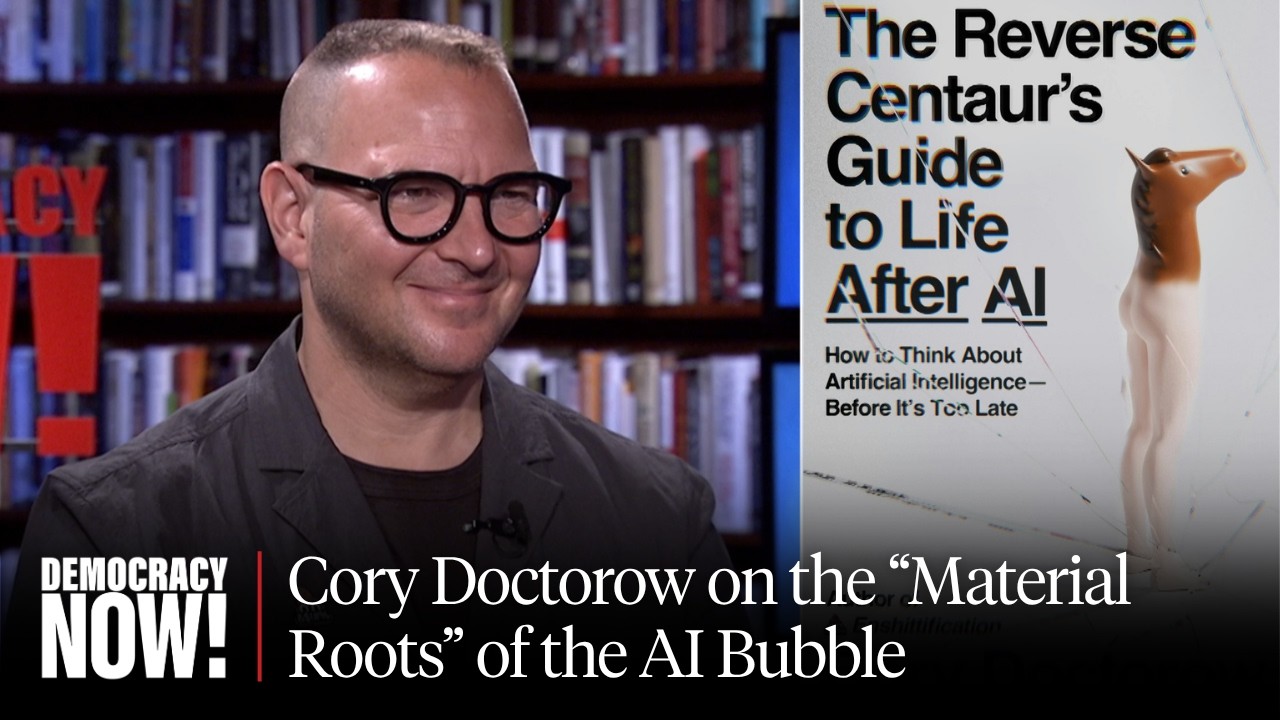
Jun 25, 2026 Latest Shows
Democracy Now! speaks with science fiction author, activist and journalist Cory Doctorow about AI and his latest book, "The Reverse Centaur's Guide to Life After AI: How to Think About Artificial Intelligence — Before It's Too Late." Doctorow comments on AI's "bad unit economics" and the connection between automation and labor. "When labor drives automation, it's usually in service to making the product better, and when capital drives automation, it's usually in service to making more of the product," says Doctorow.
---
---
6 26 WIRED THIEL SECRET CONF MUSK
SUPERBABIES CRISPR MUSK // THIEL
---
AN 6 26
President Donald Trump is closely aligned with Silicon Valley oligarchs, from directly receiving their largesse in campaign donations to aggressively pushing their AI technology on Americans. Yet a recent report in The Hill reveals that, despite these ties, some of those same oligarchs feel awkward about their relationship with the president.
“While several tech leaders are making their relations — both good and bad — with the president public, [OpenAI CEO Sam] Altman has largely kept quiet about the president and the extent of his relationship with him,” reported The Hill's Miranda Nazzaro on Sunday. “It comes as OpenAI prepares an initial public offering, and Altman faces his own blowback from the anti-AI movement.”
Similarly X CEO Elon Musk, despite relying on Trump for government contracts, had a public falling out with the president after clashing over spending bills and blame for political failures. Eventually the two reconciled, with each walking back their negative statements about the other, and Nazzaro noted that “in the largest and latest sign of reconciliation, Musk was one of two executives aboard Air Force One with Trump for the China state visit earlier this month."
Dario Amodei, a founder of Anthropic, wound up on Trump’s bad side when he refused to allow his AI to break ethical codes in its work with Secretary of Defense Pete Hegseth and his Pentagon. Amodei even later said, in a memo leaked by the Trump administration, that he believed Trump had targeted him because Anthropic neither donated to his campaign nor engaged in “dictator-style” praise of Trump, as did many of his competitors. Amodei later apologized to investors for his split with Trump and has since reconciled with the president, remaining in the loop on AI policy.
Amazon founder Jeff Bezos started out as anti-Trump, particularly through his leadership of The Washington Post during his first term, but later revealed himself as pro-Trump when he killed an op-ed supporting Democratic presidential nominee Kamala Harris in the 2024 presidential election. Bezos has subsequently gone out of his way to praise Trump, earlier this month describing Trump’s second term as “more mature, more disciplined version of himself than he was in his first term.”
He later told CNBC’s “Squawk Box” that “Trump has lots of good ideas. He’s been right about a lot of things. You have to give him credit where credit is due.”
Nazzaro also talks about Meta CEO Mark Zuckerberg and Nvidia CEO Jensen Huang, both of whom have also cultivated ties with Trump to advance their business interests. By contrast venture capitalist David Sacks is one of Trump's closest AI advisers, and is widely regarded as pushing Trump to support the AI CEOs agenda.
Indeed, as protests against AI have surged, Trump has worked toward making it illegal to protest the development of AI.
“In the wake of attacks on CEOs, a nationwide protest movement targeting data centers, and increasing concerns about AI job replacement, federal intelligence agencies and domestic law enforcement are circulating reports with a new domestic target in mind: anti-technology extremists,” wrote Wired's Daniel Boguslaw on Sunday. “More than 1,000 pages of unpublished reports from the Department of Homeland Security, FBI, and fusion centers obtained by WIRED show a national shift taking place to surveil this new and worryingly broad category of people and activities deemed an emerging threat.”
Despite the attempts to suppress anti-AI sentiment, AI proponents like former Google CEO Eric Schmidt, real estate executive Gloria Caulfield and music executive Scott Borchetta were roundly booed when they promoted AI during college commencement speeches. Semafor recently reported that anti-AI sentiment in America is overwhelming, suggesting that the college students’ hostility mirrors that of the American public at large.
“Polls show that 70% of Americans think AI is moving too fast, over 50% have negative views of it, and just 18% of young people say they feel hopeful about it,” Semafor reported. “Partly, they are turned off by AI’s upending of the job market. ‘Every other day, a new AI agent is being released in the market,’ said Vaishali Hireraddi, 23, a University of California, Davis, graduate student who’s applied to 500 jobs so far. ‘What am I doing with my life?’”
---
---
primary YIKES 3 26 DENIAL BC OF AI RACE CONTRACTORS // MERGER
ggl 3 26
Climate Deniers Expected More Resistance to Trump’s Fossil Fuel Blitz - DeSmog
*published in partnership with The Guardian.
As Donald Trump assaults the legal foundation of America’s ability to regulate global warming emissions, climate deniers have been privately celebrating what they claim is the “silent” acquiescence of billionaires, Democrats, climate activists and even reporters to the president’s aggressive pro-fossil fuel agenda.
“In my 26 years of being focused on climate, I’ve never seen anything like this. Trump is gutting everything they ever stood for,” Marc Morano, a long-time climate denier, said in January at the “World Prosperity Forum,” a five-day event in Zurich, Switzerland, billed as a right-wing alternative to the World Economic Forum in Davos.
The event’s sponsor was The Heartland Institute, a conservative think tank that has been at the forefront of spreading climate disinformation for decades, and was also a contributor to Project 2025, the policy blueprint for President Trump’s second administration.
“Billionaires are silent. Democrats in Congress have been silent. Climate activists. There has been no push-back on this,” Morano said — and he may have a point, according to some experts who research the climate denial movement.
“The Trump administration just marched in and destroyed the crown jewel of climate science in the United States,” said Robert Brulle, a professor of environment and society at Brown University, referring to the Trump administration’s dismantling of the country’s premier climate research center, the National Center for Atmospheric Research, in December.
“And nothing happened. There wasn’t even a whimper. I never thought I’d ever say this: Marc Morano is correct.”
Last month, the Trump administration repealed the 2009 “endangerment finding” establishing that greenhouse gas pollution endangers public health. It was a determination that undergirded the federal government’s authority to limit climate-heating pollution from automobiles and power plants.
Elimination of the endangerment finding had long been a core goal of the climate denial movement.
Its repeal is just the latest in a long line of President Trump’s climate-related destruction. Since taking office in January 2025, his administration has significantly curtailed the country’s weather forecasting organizations and climate science research facilities, published reports denying established climate science, and made deep cuts to funding for climate-related energy and community projects.
Under the leadership of Trump appointee Chris Wright, the Department of Energy last year all but banned its key renewable energy department from using terminology like “climate change,” “green,” and “sustainability.”
”Trump overturned Biden’s climate agenda at breakneck speed,” Morano said at the Heartland Institute’s Zurich forum.
Instead of pushing back on this blitz, many Democratic Party representatives have retreated from talking directly about climate change across social media, podcasts, speeches, and in Congress. The party is now embroiled in a debate about whether affordability is a better message than climate action, despite polling suggesting that 63 percent of the American public believes the president and Congress should prioritize clean energy.
This trend hasn’t gone without resistance in the party, however. “Anyone who cares about what fossil fuel pollution is doing to Earth’s natural systems needs to ignore these so-called ‘climate hushers’ — people who think Dems should stop talking about climate,” Sen. Sheldon Whitehouse (D-RI) posted on social media in January.
Genevieve Guenther, a climate communications expert and founding director of the advocacy group End Climate Silence, largely agrees. “The Democrats’ climate hushing is politically foolish,” she said in an email. “It only benefits the Trump regime’s agenda.”
At the Heartland Institute event, Morano expressed delighted “shock” over the “flips on climate” of tech moguls Jeff Bezos and Bill Gates, the founders of Amazon and Microsoft respectively, whose companies have abandoned once-ambitious climate promises as they confront the skyrocketing energy demands of their AI businesses.
Gates, whose foundation has donated millions of dollars to a think tank run by climate crisis denier Bjorn Lomborg, published a controversial memo in October arguing that climate change “will not lead to humanity’s demise” and advocating for ending climate funding in favor of direct humanitarian aid.
Microsoft and Amazon, which have donated large sums to Trump, have both recently embraced fossil-fuel powered AI data centers alongside Trump energy officials and fossil fuel industry players.
In early February, Bezos, who is also the owner of the Washington Post, slashed at least 14 reporters from the venerated paper’s climate desk. Just weeks later, the Post published an editorial board opinion, “EPA is right to reverse Obama overreach,” praising Trump’s repeal of the endangerment finding.
Morano noted that overall, journalists have been reporting less aggressively about Trump’s fossil fuel agenda. “When you have Lee Zeldin, the EPA chief, calling climate a cult, a scam, religion, he doesn’t even get push-back from reporters,” Morano said.
During Trump’s first term, by contrast, environmental officials like Scott Pruitt, who led the Environmental Protection Agency from February 2017 to July 2018, “would have to be very careful on climate,” Morano said. Otherwise “they would be beaten and browed by the media.”
The growing “climate hush” is not limited to the U.S. — a hushed silence about climate change has expanded across the globe.
At Davos in January, world leaders across business and government talked noticeably less about addressing climate change than in previous years.
Why? “In today’s deeply polarizing U.S. political stance, climate discussion has come to feel so radioactive that many leaders would rather avoid it,” Anjali Chaudhry, a business sustainability researcher at Dominican University, wrote about the silence in Forbes.
Even Canadian Prime Minister Mark Carney, who once served as a United Nations Secretary-General Special Envoy on Climate Action and Finance, limited his mentions of climate change at Davos to a quiet reference to the COP climate summit and a simple “Canadians remain committed to sustainability.”
Despite all this quiet, the vast majority of people worldwide, 89 percent, support climate action, even if they underestimate how much others care — a misperception that has added fuel to a “spiral of science.”
What can be done to counteract the trend towards silence? “In this time of ‘climate hushing,’ having conversations about climate change is more important than ever,” Katherine Hayhoe, a climate scientist and climate communications expert, advised in her influential blog.
For environmental sociologist Brulle, addressing the growing hush around climate must go beyond talking.
“I think the climate movement in the United States has failed. It has flat failed, and that means we need to rebuild this movement in a completely different manner,” he said.
Environmentalist Bill McKibben is more optimistic. “I think [the Trump administration] is whistling past the graveyard of their fossil-fueled dreams,” he said in an email. “The real story of the last year is how politicians, movements, entire nations are moving fast towards clean energy. They’re not all doing it in the name of ‘climate,’ but we’re making faster climate progress than we have at any point in the last 40 years.”
McKibben added a caveat: “Fast enough? Of course not. The deniers have delayed change and that continues. But it’s going far faster than they want it to — hence their resort to political gamesmanship.”
---
---
5 26
---
ANHEGS
COMM DR 12 25
Venture capitalist Joe Lonsdale, a co-founder of data platform company Palantir, is calling for the return of public hangings as part of a broader push to restore what he describes as “masculine leadership” to the US.
In a statement posted on X Friday, Lonsdale said that he supported changing the so-called “three strikes” anti-crime law to ensure that anyone who is convicted of three violent crimes gets publicly executed, rather than simply sent to prison for life.
“If I’m in charge later, we won’t just have a three strikes law,” he wrote. “We will quickly try and hang men after three violent crimes. And yes, we will do it in public to deter others.”
Lonsdale then added that “our society needs balance,” and said that “it’s time to bring back masculine leadership to protect our most vulnerable.”
Lonsdale’s views on public hangings being necessary to restore “masculine leadership” drew swift criticism.
Gil Durán, a journalist who documents the increasingly authoritarian politics of Silicon Valley in his newsletter “The Nerd Reich,” argued in a Saturday post that Lonsdale’s call for public hangings showed that US tech elites are “entering a more dangerous and desperate phase of radicalization.”
“For months, Peter Thiel guru Curtis Yarvin has been squawking about the need for more severe measures to cement Trump’s authoritarian rule,” Durán explained. “Peter Thiel is ranting about the Antichrist in a global tour. And now Lonsdale—a Thiel protégé—is fantasizing about a future in which he will have the power to unleash state violence at mass scale.”
Taulby Edmondson, an adjunct professor of history, religion, and culture at Virginia Tech, wrote in a post on Bluesky that the rhetoric Lonsdale uses to justify the return of public hangings has even darker intonations than calls for state-backed violence.
“A point of nuance here: ‘masculine leadership to protect our most vulnerable’ is how lynch mobs are described, not state-sanctioned executions,” he observed.
Theoretical physicist Sean Carroll argued that Lonsdale’s remarks were symbolic of a kind of performative masculinity that has infected US culture.
“Immaturity masquerading as strength is the defining personal characteristic of our age,” he wrote.
Tech entrepreneur Anil Dash warned Lonsdale that his call for public hangings could have unintended consequences for members of the Silicon Valley elite.
“Well, Joe, Mark Zuckerberg has sole control over Facebook, which directly enabled the Rohingya genocide,” he wrote. “So let’s have the conversation.”
And Columbia Journalism School professor Bill Grueskin noted that Lonsdale has been a major backer of the University of Austin, an unaccredited liberal arts college that has been pitched as an alternative to left-wing university education with the goal of preparing “thoughtful and ethical innovators, builders, leaders, public servants and citizens through open inquiry and civil discourse.”
---
---
an 12 25
MAGA billionaires are about to juice up on performance-enhancing drugs and compete in sporting events in a new competition known as the Enhanced Games, aka the “Steroid Olympics”, according to Bloomberg's Chris Bryant.
The billionaire-backers of the games, Bryant writes, are doing this "as part of their plan to take their events-slash-telemedicine company publicvia a special-purpose acquisition company."
"That makes me even warier," he adds.
The Enhanced Games, scheduled to take place in Las Vegas in May, is understandably a controversial, proposed international multi-sport event where athletes will be permitted to use performance-enhancing substances (PEDs) under medical supervision. The event is designed to challenge the traditional Olympic movement by advocating for athlete autonomy, fair pay, and scientific advancement in sports.
"Instead of toiling away for years for fleeting and poorly compensated Olympic glory, Enhanced Games athletes can take testosterone, anabolic steroids, human growth hormone and other performance-enhancing compounds to win a share of $25 million in potential prize money," Bryant says.
"Incentivizing competitors to pharmaceutically push their bodies to the limit for our enjoyment feels unethical," he adds.
The events organizers claim to be empowering athletes — literally, telling Bryant in a statement, "All enhancement protocols will be based on substances already approved by the US Food and Drug Administration."
Athletes will also need to pass a medical screening to ensure they enter the competition “healthy and safe," Bryant explains.
"More than 60 percent of Enhanced’s social-media audience is aged 18 to 34 and almost all male. Steroid abuse is rife among this group," he writes.
The investors in this startup include what Bryant calls "a blend of Silicon Valley’s libertarian, longevity and self-optimization obsessions and MAGA’s transactional and anti-establishment credentials."
" Until now it’s been bankrolled by a who’s who of cashed up libertarians: Executive Chairman Christian Angermayer, who’s also chairman of psychedelic-drug company Atai Beckley NV and founder of Enhanced’s biggest shareholder, Apeiron Investment Group; venture capitalist Peter Thiel; and the Winklevoss twins. Donald Trump Jnr is also involved via venture firm 1789 Capital, where he’s a partner," he writes.
So far, only about a dozen have signed up for the games, Bryant says, including British swimmer Ben Proud, who won silver at the Paris Olympics and track athlete Fred Kerley, a two-time Olympics medalist over 100 meters.
"The organizers aren’t only relying on creating a sporting spectacle. The bulk of future revenues is expected to come from selling over-the-counter supplements and prescription hormones to US consumers," Bryant says.
And while the steroids promise to pump up the athletes, the startup's bottom line may be deflated.
"Enhanced could end up with a deflating share price and just $40 million to fund its controversial business plan, setting back its ambitions to make us superhuman. Fans of sporting fair play won’t shed many tears," Bryant notes.
---
---

The New Republic
https://newrepublic.com › article › 183971 › jd-vance-weird-terrifying-techno-authoritarian-ideas
Where J.D. Vance Gets His Weird, Terrifying Techno-Authoritarian Ideas
Jul 22, 2024Gil Duran is a San Francisco journalist who previously served as editorial page editor of The Sacramento Bee and The San Francisco Examiner.
Share feedback about this site

The Verge
Why tech billionaires want a dictatorship | The Verge
TodayWhy tech billionaires want a 'corporate dictatorship' Guest host Jon Fortt and The Nerd Reich author Gil Duran discuss dark enlightenment and the rise of tech authoritarianism.
---
NERD REICH?
What Is Silicon Valley's 'Nerd Reich,' and Is It Taking Over the US Government? | KQED
Sixty percent of surveyed American adults said they had an unfavorable view of Elon Musk — the billionaire Tesla CEO, who has been intimately involved with the federal government for months through his leadership of the unofficial Department of Government Efficiency.
Since the inauguration of President Donald Trump, Musk’s DOGE has slashed large swaths of federal jobs and cut funding to programs as varied as the U.S. Agency for International Development to energy-saving initiatives for low-income families. And this March poll of 1,000 people by the Marquette Law School is just one indicator that some Americans are tired of wealthy tech figures being involved in the nation’s politics.
“We’re learning a big lesson here, which is that we can have democracy or we can have billionaires, but we can’t have both,” San Francisco journalist Gil Duran said.
KQED Forum’s Mina Kim spoke to Duran, who formerly worked for California politicians like Jerry Brown and Kamala Harris, about the “Silicon Valley tech billionaire politics” that are the focus of hisnewsletter, The Nerd Reich — and what he thinks tech elites might want next.
*This interview has been edited for brevity and clarity.
Before DOGE, there was RAGE
Gil Duran: Curtis Yarvin is a San Francisco software programmer who, in the early 2000s, started blogging under the name “Mencius Moldbug.” And in his blog posts — very internet troll stuff — he laid out these ideas for replacing democracy with tech-controlled dictatorships.
He specifically focused on San Francisco, which he said in his corporate tech dictatorship would be renamed “Frisk Corp.” In Frisk Corp, you would have to swipe in with RFIDchips and be under total surveillance, and give up all of your freedom in exchange for security.
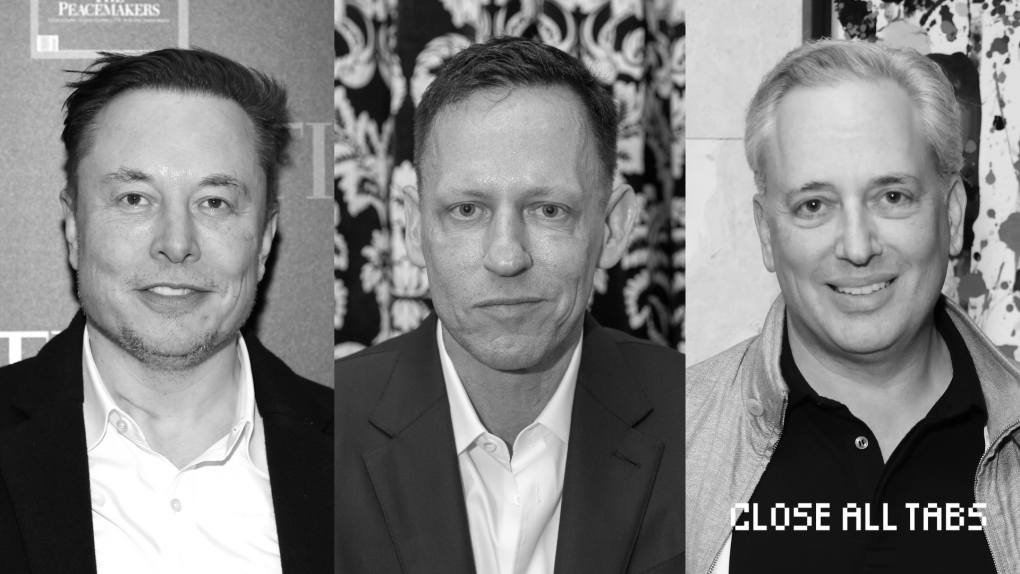
The Broligarchy Pt 1: Chronicles of the PayPal Mafia
The important thing to understand about Curtis Yarvin is that he became a favorite thinker of Peter Thiel, the PayPal Mafia billionairewho founded Palantir and got even richer off of government surveillance. Some people call him Peter Thiel’s house philosopher.
In 2012, [Yarvin] gave a speech in which he said that the government needed to be reformed with something he called RAGE — Retire All Government Employees. And that entailed taking over the federal government, purging the bureaucracy of anybody who’s a Democrat or who believes in democracy, and replacing all federal employees with people who would answer to a CEO-dictator-type of person. Very much mirroring what Elon Musk is doing with DOGE at this current time.
If it weren’t for these billionaires, [Yarvin would] be just an anonymous internet troll. The whole reason this has gone national is because of JD Vance. [And] to understand JD Vance, you have to understand that he is largely a creation of Peter Thiel. At every step of JD’s career, Peter Thiel has been there, funding him.

Predicting the ‘cognitive elite’
Yarvin is largely deriving his ideas from other places.
To really understand this, you have to go back to a 1997 book called The Sovereign Individual, which basically was one of these dark, apocalyptic-style books, and it predicted that in the 21st century, the information age would undermine the existing economy and existing nation-states. Thatthe Information Agewould kill lots of jobs and result in a lot of violence and chaos, and also lead to the rise of a so-called “cognitive elite”: people who are able to become wealthy off of technology and don’t need traditional jobs to survive.
It would be their mission to escape from existing countries using something called cyber currency — basically crypto, which would allow them to evade taxation and evade government authority, and create their own nations that they would rule over in this post-democracy order brought about by the information age.
These ideas sound crazy when you first hear them. They sounded very unhinged to me, and I didn’t pay attention to them at first.
However, you have to understand that these are very wealthy men with very strange and scary ideas. And they seriously believe in them.
[
The GOP vs. the ‘broligarchs’?
I think Trump has, for the most, part right now, been bought off. Trump’s in it for the money — and these guys have plenty of it.
He may not have the ideology, but as long as Elon and these guys are going to spend billions of dollars and create all of these business opportunities for his family, I think he’s all in.
There is a problem, though, because this is becoming very unpopular very quickly. The polls are diving. Elon Musk is becoming one of the most despised men in the country. He’s threatening Social Security. He’s firing veterans. You’ve got Republicans showing up to town halls to yell at their absentee representatives in early 2025.
This is a political disaster in many ways, so I think there will be some political tension between the Republican establishment and these “tech-broligarchs” — because they’re breaking all the rules of politics and don’t really seem to care about the future. And in politics, you’ve really got to care about the next election and the election after. That’s the name of the game.
Silicon Valley’s ‘right wing strain’
I compare it to: this tech authoritarianism is the parasite and MAGA is the host.
[Tech leaders] saw an opportunity, right? It’s a very opportunistic play — and an opportunity to go as far as they can with a candidate who has been able to openly violate the law, and not pay any political consequence for it.
How J.D. Vance Went from Never Trumper to MAGA Warrior
This is not an ideology where the world is a better place for the majority of people. It’s a place where the world is a place for tech billionaires. You don’t make the world a better place by getting rid of Social Security, which is crucial to the survival of millions of Americans.
Malcolm Harris’s [book]*Palo Alto* talks about the right-wing strain through Silicon Valley. There was this idea during the nineties and part of the eighties and 2000s that tech was kind of fun: was going to make our life cool, all these nice products, connecting us, allowing us to buy stuff online.
And for a long time, it seemed nonthreatening. Remember, Google had the “Don’t be evil” slogan and they were kind of paddling around in their Crocs, building playgrounds for their employees and bespoke lunches and free kombucha on tap. There was the harmless vibe that seemed to be from Silicon Valley.
But I think there has always been a certain anti-government lean to a lot of the Silicon Valley movement — this idea that “we’re going to create structures outside of government.” The idea of getting out of authoritarian society, evading bad governments in the future: there were times when these ideas seemed like something people on the left could be into.
However, what’s happened is: these guys became super rich. And as they’ve become super super superrich, they’ve gone far, far, far to the right — and they’re pulling others now with them.
‘Freedom cities’ and governance by tech
All the way back in 2013, [Balaji Srinivasan, chief technology officer of cryptocurrency exchange Coinbase] gave a speech at Y Combinatorin which he basically called for Silicon Valley to secede from the United States and to go start their own country and take all of their wealth and all of the brain power.
He continue[d] to develop these ideas over the next decade, and in 2022, released a book called The Network State — how to start a new country. This book lays out all the reasons why American democracy is an outdated system and why it needs to be replaced by new tech forms of governance. And there are two ways to do that: one is to leave the country by a territory and create your own sovereign state or city. You can do that within a country or by leaving a country. And the other way is to take over existing governments and convert them into tech-controlled governments.
This Tech-Backed Company Tried to Disrupt California’s Housing Crisis. It Couldn’t
My interest in this ideology started with SF politics — this effort by tech bros to take over City Hall, but also by the California Forever Project.
It wasn’t until I read a book by a historian named Quinn Slobodian called, Crack Up Capitalism: Market Radicals and the Dream of a World Without Democracy, that I understood the idea there … for wealthy people to find a way to exit society and create their own sort of utopian countries that they control.
In 2024, Trump had a plan for something he calls the so-called “freedom cities,” which are these 10 new charter cities that would be built on federal land all around the United States. The newspapers have mentioned that Trump plans to “build freedom cities,” but no one has explained what that means: where the idea comes from or why we need them.
I think the “freedom cities” are really anti-freedom cities — a very Orwellian name for what would essentially be a corporate-controlled city.

How does this all end?
A lot of people stayed home [and didn’t vote in the 2024 election.] And I think this is going to wake [Americans] up to the fact that you can’t stay home. We have to realize that there is a group of people who are avidly working against the public good and against the welfare and well-being of the majority.
I don’t think these [tech] guys have fully thought this out. I don’t think they realize — having been in politics myself — what it’s gonna feel like when you see that the majority of people are against you. I do think this ends with tens of millions of Americans taking to the streets on a regular basis to stand against what is an increasingly authoritarian regime in Washington. And I think that it also ends with a bunch of billionaires getting on planes to Moscow at midnight.
I think it’s important to understand it, to learn about it, and to tell others about it … Word of mouth is very important. People listen to their peers, to their friends, to their family members. That’s where a lot of people get their main political knowledge from.
---
---
BB 6 25
Four prominent tech executives, including Meta's CTO Andrew Bosworth, have joined a special U.S. Army Reserve unit where they'll serve as lieutenant colonels without completing basic training.
As reported in Steven Levy's Plaintext newsletter, the executives are part of "Detachment 201: the Executive Innovation Corps," a new military initiative designed to modernize the force. Joining Bosworth are Kevin Weil from OpenAI, Bob McGrew from Thinking Machines Lab, and Shyam Sankar from Palantir.
Unlike traditional reservists, these officers can work some of their required 120 annual hours remotely and won't be deployed to combat zones....
---
AN 6 25
Former chairman Zia Yusuf has rejoined Reform after quitting days previously. Yusuf had said he no longer wanted to work to get the party into government when new MP Sarah Pochin called for a ban on burqas in the UK. However, he seems to have had a change of heart and will return, ostensibly to lead the party’s “department of government efficiency”.
Donald Trump and Elon Musk’s bromance, however, is on much rockier ground. There’s no sign of the world’s richest man reconciling with the US president, his former employer.
These spats, at first glance, might seem like little more than, put politely, teething problems in (relatively) new political operations. Or, a little less politely, the unedifying spectacle of people in or seeking power being completely unable to act like adults.
However, it also points to something more akin to a canary in the coalmine for radical right parties around the world. Their increasing reliance on an ultra-wealthy donor class presents an ideological puzzle that may not be solvable.
Reform currently operates on what has been described as vibes alone. That is to say, there’s very little meaningful common ground between the people who vote for Reform and the party elite. The only continuity is their sense of anger at the current political system.
This, as we are seeing in election after election, is an incredibly powerful (and compelling) force. The problem is, of course, that you can’t oppose forever. You often end up having to actually do something. All boxers, Mike Tyson will be glad to tell you, have a plan – until they get punched in the face.
And what makes them such a powerful force at the moment, is precisely that which may cause challenges further down the line. At least for me, given it’s my bread and butter research-wise, I see this when I follow the money.
And I’m increasingly asked a lot of questions about the kind of people who are either giving money to Reform – or who Reform are courting (and at the moment it is decidedly the latter which is the case).
My position is that they very broadly fit into three categories. First are disaffected traditional Conservatives who are increasingly seeing a party – in the words of Farage – “worth investing in”. In the donations figures released on June 10, these are represented by bussinessmen Bassim Haidar and Mohammed Amersi.
Then you have a Silicon Valley-reared tech-bro libertarian. This group already runs on a “move fast and break things” philosophy so the idea of an insurgent party which proclaims, on entering parliament, that “the fox is in the henhouse” naturally appeals.
The final pot of money is filled via small donations, ballooning membership and a whole chunk of votes from a disaffected white working-class population to whom the language of economic and cultural grievances resonates.
There are some places where the interests of these groups align – most notably a distaste for government interference and red tape (though not necessarily a smaller state in terms spending on public services). They also share a sense that progressive politics, broadly defined, ought to be pegged back a bit (but with an emphasis on a bit).
They differ on a great deal else, to the extent that you can only really please two out of the three, but never everybody. And, unfortunately, without all three the project starts collapsing. This is what we have been seeing in the fractious relationships between Trump and Musk and Farage and Yusuf.
Two out of three ain’t bad – but it’s not enough
Yusuf (and Musk) are very much representative of the new tech-bro class. And, when Yusuf called questions about banning the burqa “dumb” he was speaking at both an ideological and organisational level.
At the ideological level it is, frankly, a bit rich for his blood, because “philosophically I am always a bit uneasy about banning things which, for example, would be unconstitutional in the United States”.
Organisationally, it pushes Reform much closer to what journalist Fraser Nelson calls “a tactic more akin to the old BNP”. Indeed, Reform started “just asking questions” about burqas at the same time as it started twisting footage to claim that Anas Sarwar, leader of Scottish Labour, wants to prioritise the needs of Pakistanis.
This kind of dog-whistle politics appeals to some, but puts off a lot more, including, I think, some of the (saner) tech-bro right.
Indeed, Ian Ward at Politico perceptively notes that if we want to explain the current Musk-Trump meltdown we should look back to Christmas 2024, when cracks first started appearing over immigration policy.
The tech-bro right are, generally speaking, much less hardline on the flow of people than the Maga-populist right (think Steve Bannon and Tommy Robinson). In fact, they are pro-high skilled immigration as it tends to benefit them and their business interests.
Tech-bros also like the idea of moving fast and breaking things in theory. But when things start moving fast and actually breaking in practice (or Tesla stocks start to plummet), they tend to get a bit freaked out.
In other words, it’s not just that they don’t like government, they don’t like governing and the inevitable compromise that comes with it. When they say move fast and break things, I get the sense what they really mean is “leave me alone so I can make billions in peace”.
This, of course, is quite appealing to traditional hedge-fund conservatives, but is also the politics that literally built the economic grievances that much of the white-working class support for the populist radical right is, in turn, built on.
Two out of three ain’t bad, but you do need all three. So, don’t be surprised if despite Farage’s seemingly genuine affection for Yusuf, it all falls apart again before long.
Ultimately, Reform will need to decide how they are going to spin these plates. The good news is that it might well be that they can, indeed, get by on vibes alone until the next general election. The bad news, unfortunately, is that winning an election is the easy bit. Just ask Boris Johnson and Keir Starmer. After all, everyone has a plan.
Sam Power, Lecturer in Politics, *University of Bristol
This article is republished from The Conversation under a Creative Commons license. Read the original article.
---
AN 6 25
During his 2024 campaign, Donald Trump not only rallied his hardcore base of 2016 and 2020 — he led a MAGA coalition that ranged from Christian nationalists to tech bros to the Manosphere. And he also reached out to independents, some of whom voted for centrist Democrat Joe Biden in 2020 but voted for Trump in 2024 because of their worries about inflation.
That game plan didn't give Trump the "landslide" victory that he claimed it did: Trump defeated Democratic presidential nominee Kamala Harris by roughly 1.5 percent in the popular vote, which is a narrow victory — not a landslide. But it was enough to get him past the finish line.
Four and one-half months into his second presidency, however, a MAGA feud has erupted between Trump and Tesla/SpaceX/X.com leader Elon Musk over the president's "big, beautiful bill." After Musk called the bill a "disgusting abomination," Trump attacked him during a Thursday, June 5 press conference with visiting German Chancellor Friedrich Merz.
READ MORE: 'The dumbest civil war ever': Right-wing billionaire bro feud goes kaboom
The U.S. president told reporters, "I am very disappointed in Elon. I've helped Elon a lot…. Elon and I had a great relationship. I don't know if we will anymore."
In an article published the following day, Salon's Amanda Marcotte argues that the feud between Trump and Musk underscores the divisions between "techbro fascists" and other parts of the MAGA coalition.
"As (Musk) and Trump snipe at each other publicly," Marcotte writes, "the efforts to pretend this is a friendly disagreement are falling apart. Even if Musk fails in his efforts to kill Trump's bill, this battle is exposing a deeper truth that (White House adviser Stephen) Miller can't hide with his lies about Trump winning in a 'landslide': The MAGA coalition is fragile and some of the differences are starting to tear at the seams less than half a year into the second Trump term. Trump's slim win in 2024 was no doubt due in large part to Musk, and not just the eye-popping quarter-billion-plus Musk spent to push the old man's orange carcass over the finish line."
Marcotte continues, "It's because Musk and other influential figures, especially those associated with Silicon Valley or who pretend to be former liberals, were able to convince a chunk of more secular, largely male voters to throw their lot in with the Christian nationalist base that is the backbone of the MAGA movement. But while these two groups joined together based on a shared animosity towards racial minorities and women, it was always a far more uneasy alliance than Musk or Trump wanted to admit. And now, it's getting shakier as two narcissistic billionaires are at odds."
READ MORE:Revealed: The 'Big Beautiful Bill' contains an ugly favor for one of Florida’s top industries
The Salon journalist emphasizes that the "trouble within fascist paradise" has been "brewing for reasons that run deeper than Musk and Trump's competing egos or Silicon Valley's dependency on government funding."
"The atheistic world of pseudo-intellectualism that Musk and his minions come from," according to Marcotte, "was always going to have friction with the Christian nationalists who actually run the MAGA-ified Republican Party…. This budget fight exposes how delusional that attitude always was. It's not about religion, per se, but the culture clash between the Musk fanboys and the Christian nationalist debate is driving much of this. Musk and his acolytes envision a technofascism that sucks all the money out of social services and puts it into the tech industry, even as it pursues goals typically disliked by the Christian right, such as clean energy production."
Marcotte continues, "Meanwhile, the Christian Right wing of the party, while happy to pass huge cuts to Medicaid and Obamacare, is largely leaving untouched Social Security or Medicare, which their working-class and aging base depends on. The tech bro fascists may hate the liberals they live next door to, but at the end of the day, they're still part of the urban, atheistic, educated class that the MAGA movement demonizes. That difference was not going to be papered over forever."
READ MORE:'He. Is. Lying.' Republican blasted for spinning Medicaid cuts as 'transitioning
*Amanda Marcotte's full Salon article is available at this link.
---
---
NO LNX AN
Dark Enlightenment: How a radical ideology is fueling the movement to gut our government
Thom Hartmann March 21, 2025
The future of American democracy isn’t being dismantled by accident; it’s being systematically replaced to prepare the way for something entirely new.
A radical ideology known as the Dark Enlightenment is fueling a billionaire-led movement to gut our government, erase democratic norms, and install a technocratic elite in their place.
Trump and Musk aren’t just tearing down institutions—they’re laying the groundwork for an experimental new kind of authoritarian rule.
Americans are baffled by the brutal, relentless attack on the institutions of America that they’ve launched.
Why would they destroy our reputation around the world by shutting down USAID? What’s wrong with the federal government helping poor school districts or giving college students Pell Grants? Why gut billions in scientific research that’s kept America at the forefront of the world and saved literally hundreds of millions of lives?
Paul Krugman recommends a psychiatrist weigh in; Dr. Bandy X. Lee (a frequent guest on my program) points that out, noting, “How exactly this plays out is, as I have said, a spiritual question.” Three New York Times writers even had a lengthy back-and-forth on the topic, under the title: “Is Destruction the Point?”
— Some speculate that Musk and Trump are both tight with Putin and they’re destroying our government at his direction, helping achieve the goal he’s had since his KGB days to destroy America from within.
— Others think it’s just a way of crippling government programs like Social Security, Medicaid, and the Post Office so they can now be profitably taken over by private industry.
— Democratic politicians tell us Musk and Trump are just trying to cut government spending to pay for the $4 trillion in tax cuts for billionaires that Mike Johnson will be introducing in the House in the next few weeks.
They’re all wrong.
The simple answer is that these people intend to replace the 240+ year “American Experiment” with a brand new governance “experiment” of their own. One that was largely developed in computer rooms around San Francisco.
There’s an actual ideology behind all this, and it isn’t the old-fashioned Ayn Rand libertarianism that was such a rage during the Reagan era.
This hot new experimental ideology, enthusiastically embraced by Silicon Valley billionaires and their “tech bros” dismantling our government, is called the Dark Enlightenment or the neo-reactionary movement (NRx).
And it’s not entirely new; they believe they have proof that it works it can be found way over on the other side of the planet. I’ve been there, in fact, and it does seem to be working just fine…if you don’t care about freedom.
Back in 1994 I published a book proposing that ADHD wasn’t a brain disease or disorder but, instead, a form of brain wiring that would be highly adaptive during humanity’s long hunter-gatherer period but can present a struggle for people in today’s factory-like school systems. TIME Magazine did a cover story about it, including an article featuring my book, and suddenly I was in demand literally around the world.
One of the countries I visited during the book tour that ensued (the book’s available in more than a dozen languages) was Singapore. A parents’ group had reached out to my publisher and set up an opportunity for me to talk about my theory and ways schools could be reinvented to work for both “normal” and ADHD kids.
I gave the speech and laid out a series of suggestions, and during the Q&A that followed, one of the parents asked how to best convince schools to adopt some of my ideas. I suggested they should “become politically active,” a standard answer in most every other country I’d visited (and here in America). Little did I realize the significance of that phrase.
When I got back to my hotel, an internationally famous five-star tower with a beautiful atrium, my room had been torn apart. The mattress and box springs were on the floor, as were the contents of my suitcase. Every drawer was pulled open. My toiletries kit was all over the bathroom floor.
I called hotel security to report what I thought was a break-in or robbery, although I couldn’t immediately see that anything was missing. The head of security showed up in my room five minutes later with the hotel manager. They looked around the room with neither shock nor alarm.
The manager explained, with a hint (but only a hint) of apology in his voice, “The police were here,” as if that explained everything.
“They did this?” I asked, as I recall.
He nodded and said, “Presumably.”
“Why?” I demanded.
Both men shrugged. The head of security asked me if I’d engaged in anything illegal while in Singapore, particularly bringing illegal drugs into the country, and I indignantly denied even the possibility. They shrugged their shoulders again and offered to send a maid up to help make put the room back together.
The next morning, I had breakfast with some of the parents I’d met the afternoon before and told them what happened. They explained, in a whisper, that I never should have mentioned “politics” in my speech.
“It is not allowed here,” as I recall one telling me.
Singapore has come a ways from the mid-1990s, but is still an authoritarian state. As Robin Kaiser-Schatzlein wrote for Mother Jones:
“During his reign, [Lee Kuan Yew, aka LKY, Singapore’s former leader] successfully fused pro-corporate libertarian economics and state socialism, creating a distinctly conservative mishmash of social and political control.
“Singapore has banned all kinds of free speech; intervened in marriages and family planning; encouraged eugenics; caned people for minor crimes; created an ethnically homogeneous ruling class; treated the migrant worker population as second-class citizens; and, famously, banned chewing gum.
“This is LKY’s model: economic development above all else—even human rights. A ‘soft’ authoritarianism, as Fareed Zakaria has called it. ‘The exuberance of democracy,’ LKY explained, ‘leads to indiscipline and disorderly conduct, which are inimical to development.’” (emphasis added)
According to the philosopher-king of the Dark Enlightenment movement, the guy who woke up JD Vance and the billionaires who support him, Singapore is their explicit model for America’s future.
As Kaiser-Schatzlein writes about Curtis Yarvin and the other Dark Enlightenment thinkers who have inspired Musk, Theil, Vance, et al:
“For a new breed of right-wing thinkers, politicians, and activists, LKY’s approach to government is appealing. Curtis Yarvin, Silicon Valley’s resident neo-monarchist, compares LKY to FDR—both good examples, he says, of a unilateral leader.
“And Nick Land, an accelerationist philosopher, calls LKY an ‘autocratic enabler of freedom.’
“To them, LKY is the paradigm of an illiberal ruler who created a paradise for his subjects: a freedom without rights, a prosperity without disorder.”
Sure, Republicans are going to gut government spending to pay for tax cuts for the billionaires who own them. And they definitely want big Wall Street banks to run Social Security just like George W. Bush handed more than half of Medicare (so far) over to giant for-profit insurance companies. After all, both industries represent such big campaign donors.
But this goes way beyond merely making billionaires richer or giving corporations more power over our lives. The audacious experiment Musk has embarked on — which Trump probably doesn’t even understand — involves the fundamental transformation of America from a nation ruled by its own people into one where decisions are made by a very specific elite group of self-selected “genius” white male technocrats.
And once AI reaches the ability to think with the intelligence of a genius-level human — Artificial General Intelligence or AGI — some of these guys believe that most of the decision-makers and agencies of the federal government can simply be replaced by banks of computers, deciding who gets what, when, and why.
All it’ll take is a monarchical leader who, like KLY, brooks no dissent.
Trump could be that leader — or at least the useful-idiot-frontman for the technocrats like Vance and Musk who are really running things — and the gutting of federal agencies opens up a space to replace them (and their workers) with AGI-based computer systems.
Rana Foorahar explains it in The Financial Times:
“The philosophy argues that democracy inherently leads to social decline, because of the development of deep state bureaucracies that are unable to control oligarchic forces, and that societies should be run like corporations, with a kind of CEO Monarch in charge.
“As Yarvin has said, ‘If Americans want to change their government, they need to get rid of dictator phobia . . . One way of dealing with that is . . . hire two executives and make sure they work together and there is really no other solution . . . ’”
And they’re much further along in the process of both gutting government and seizing total control of our political system to implement this experiment than most Americans realize.
— A new site that lays out exactly how they’re progressing toward their goal of kneecapping the federal bureaucracy is project2025.observer; according to the site, they’re about 40 percent of the way there, although the courts may set them back temporarily.
— And the project for billionaires to take complete control of our elected officials (and thus our government, at all levels) is also nearly complete: Fully 18 percent of all spending on the 2024 elections was done by just 150 billionaire families who represent a mere .00000045 percent of the American population.
The Dark Enlightenment has little use for democracy; openly disdains notions of equality as proposed in the Declaration of Independence and our Constitution (viewing them as unnatural and counterproductive); and rejects what they call “Whig historiography,” which assumes history inevitably progresses toward greater liberty and enlightenment.
Instead, like Julius Evola, Thomas Carlyle, and Oswald Spengler, they argue that “classical” societal structures that ruled the world for millennia (like feudalism, monarchy, or cameralism) are superior to democracy and, completely ignoring the history of the development of modern democracy, should — with a high-tech AGI twist — replace today’s democratic “experiment.”
(Ironically, a large portion of the infrastructure that this movement is using was financed by fossil fuel billionaires who simply wanted to avoid paying income taxes and to have their oil companies deregulated so they could make more pollution and thus more profit. Similar to the people who funded the rise of Hitler — including Fritz Thyssen who wrote the book I Paid Hitler after WWII as an apology — many are now surprised, and some even frightened, by the turn of things.)
They are pushing forward with the “move fast and break things”slogan of the Tech industry that Mark Zuckerberg popularized. And they are having breathtaking success, between that strategy and the billions of dollars they are easily able to spend to seize the political power to fulfill their vision. They call themselves “Masters of the Universe” without a trace of irony.
Some high-profile observers of American politics are alert to this takeover-in-progress that most of our media has completely missed. Former Labor Secretary Robert Reich, for example, recently wrote for his Substack newsletter:
“Behind Vance and Musk is a libertarian community of rich crypto bros, tech executives, back-to-the-landers, and disaffected far-right intellectuals.
“Curtis Yarvin comes as close as anyone as being their intellectual godfather. He has written that political power in the United States is held by a liberal amalgam of universities and the mainstream media whose commitment to equality and justice is eroding America’s social order.
“In Yarvin’s view, democratic governments are inefficient and wasteful. They should be replaced with sovereign joint-stock corporations whose major ‘shareholders’ select an executive with total power, who serves at their pleasure.
“Yarvin refers to the city-state of Singapore as an example of a successful authoritarian regime.”
He notes that these tech-bro “oligarchs of the techno-state” want to replace “inefficient” democracy with “an authoritarian regime replete with technologies they control.”
Rachel Maddow has similarly featured stories about Yarvin and others like him on her program, albeit infrequently. The New Yorker has written about the movement, as have multiple other publications.
Lefty intellectuals and progressive thought leaders are suddenly waking up to the Dark Enlightenment experiment that, like a glacier finally reaching the sea, has been slowly consuming the GOP as it moves along and is now — with hundreds of millions from Elon Musk buying the White House for Trump — suddenly cleaving off massive icebergs of damaged governmental institutions.
But a much wider understanding of what’s really animating Trump’s and Musk’s experimental destruction of our government is needed.
If Americans don’t wake up to the Dark Enlightenment’s creeping grip on the people who control our democracy, we may soon find ourselves living in a country where elections are meaningless, the government serves only the ultra-rich, and freedom exists in name only.
Pass it along…and get into the streets!
NOW READ: Here's why Trump supporters can't see through his lies
---
mta 2 25 email
The actions of the Department of Government Efficiency (DOGE), headed up by billionaire Elon Musk, has been among the most controversial of any following its creations by executive order. Exposing and resisting several major actions of DOGE are important. These include the multiple conflicts of interest between Musk and DOGE’s agency targets; efforts to gut agencies (e.g, USAID, the Consumer Financial Protection Bureau, Education Department and EPA), and cutting federal spending of DEI programs, National Institute of Health biomedical research and federal workers. On the horizon are eliminating scores of so-called “inefficient” federal regulations that hinder corporations.
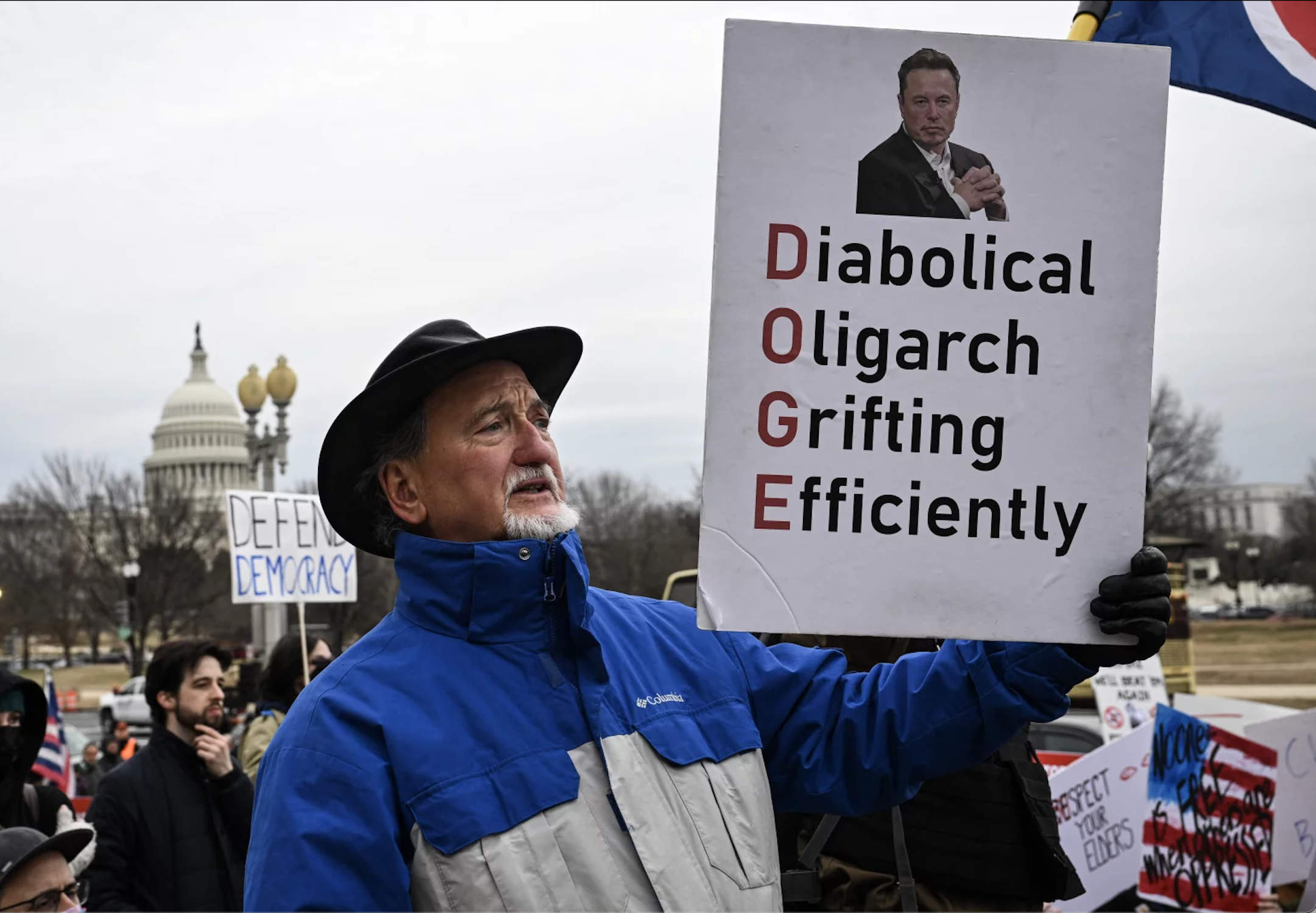
People protest against President Trump and Elon Musk's Department of Government Efficiency (DOGE) near the U.S. Capitol in Washington, D.C., on Feb. 5, 2025. Drew Angerer/AFP
At the root of DOGE’s mission, however, is to not simply reduce government size or even loot public spending (i.e. Musk has received billions in federal subsidies for Tesla, as well as tens of billions more in government contracts and programs). The ultimate goal of Musk/DOGE and reactionary right technocrats accomplices is the replacement of “democratic” government with a corporate state.
Access to the Treasury Department’s system that pays the nation’s bills is not only a concern about personal information and the potential to cut payments to people and entities. Of greater concern is what Mike Brock lays out in excruciating detail in The Plot Against America.
“Inside the newly created Department of Government Efficiency (DOGE), teams of young tech operatives are systematically dismantling democratic institutions and replacing them with proprietary artificial intelligence systems. Civil servants who raise legal objections are being removed. Government databases are being migrated to private servers. Decision-making power is being transferred from elected officials and career bureaucrats to algorithms controlled by a small network of Silicon Valley elites…
“DOGE is not about efficiency. It is about erasure. Democracy is being deleted in slow motion, replaced by proprietary technology and AI models. It is a coup, executed not with guns, but with backend migrations and database wipes.”
Brock goes on to explain the 16-year backstory, beginning with the 2008 financial crisis that led to not only massive financial hardship, but a significant loss of faith in financial and governmental institutions. Techno-libertarian ideologues began shifting their analysis that the ultimate problem was government regulation rather than democracy itself was unstable and inefficient. The solution was a technologically “rational” system, based on artificial intelligence, with governance privatized/corporatized. He explains the roles played by the Tea Party, Zero Hedge, InfoWars/Alex Jones, Steve Bannon and Silicon Valley in creating an anti-democratic alternative culture.
Techno-libertarian ideology gave way to “neoreactionary” ideology, which included the concept of “exiting” or opting out entirely of existing political structures.
“The pipeline from techno-libertarianism to neoreaction often follows a predictable path: It begins with a libertarian critique of government inefficiency and overreach. This evolves into a broader skepticism of all democratic institutions, seen as slow and irrational compared to the speed and logic of technology. Eventually, this leads to the conclusion that democracy itself is an outdated system, incompatible with rapid technological progress. The final step is embracing the idea that democracy should be replaced entirely with more ‘efficient’ forms of governance, often modeled on corporate structures or technological systems…
“This is precisely where libertarianism morphs into neoreaction. Instead of advocating for a constitutional republic with minimal government, this new strain of thought pushes for a private, post-democratic order, where those with the most resources and technological control dictate the rules. In this vision, power doesn’t rest with the people – it belongs to the most competent ‘executives’ running society like a CEO would run a company…
The rise of cryptocurrencies assumed a critical role in this evolution. Musk has been a huge influencer of cryptos, including Dogecoin. Trump’s executive order creating DOGE was a nod to Musk’s support of the meme coin.
Brock explains the connection of cryptocurrencies to this attempted anti-democratic techno-takeover: “What started as a tool for financial freedom became…the foundation for entirely new forms of governance outside traditional state structures. This transformation – from seeing crypto as a means of individual empowerment within existing systems to viewing it as a way to build entirely new political entities – mirrors the broader shift from techno-libertarianism to neo-reaction in Silicon Valley.”
People like Silicon Valley billionaire and J.D. Vance financial backer Peter Thiel “began to see cryptocurrency not just as a new financial instrument, but as a tool for fundamentally restructuring society…
“When Musk gains control of Treasury payment systems, or Trump declares he won't enforce laws he dislikes, they're implementing ideas incubated in the crypto world. The notion that code can replace democratic institutions, that technical competence should override democratic negotiation, and that private power should supersede public authority – these ideas moved from crypto theory to political practice…
“First, remove career officials who might resist on legal or constitutional grounds. Then, install private technical infrastructure that makes oversight impossible. The goal isn’t just to change who runs government agencies – it’s to fundamentally transform how power operates, shifting it from democratic institutions to technical systems controlled by a small elite…
“[T]hese thinkers argued that democracy was inefficient. Then, they created technological tools – cryptocurrency, blockchain governance, and AI-driven decision-making – to bypass democratic institutions entirely. Now, they’re no longer experimenting. They are seizing control of government infrastructure itself, reprogramming it in real-time to function according to their vision.
“This is why focusing solely on the technical aspects of what's happening inside agencies misses the deeper transformation underway. Every unauthorized server, every AI model, every removed civil servant represents another step in converting democratic governance into…a system where society is run like a corporation, with clear ownership and control rather than democratic deliberation. The infrastructure being built isn't meant to serve democratic ends – it's meant to make democracy itself obsolete…
“What’s happening inside the Department of Government Efficiency is the final phase of this plan. The old democratic institutions, weakened by years of deliberate destabilization, are being replaced in real-time by proprietary AI systems controlled not by elected officials, but by the same network of Silicon Valley operatives who engineered the crisis in the first place.”
===
---
an ah 1 25
During Joe Biden's presidency, many right-wing media pundits accused Silicon Valley and the tech industry of having a bias against Donald Trump, Republicans and the MAGA movement.
But Elon Musk, owner of X (formerly Twitter), was a major donor to Trump's 2024 campaign. And after Trump won the election, some tech CEOs who had been critical of him in the past — including Facebook's Mark Zuckerberg and Amazon's Jeff Bezos — reached out to him. Zuckerberg and Bezos both attended Trump's inauguration on January 20.
In an article published by The Guardian on January 29, reporter Becca Lewis emphasizes that Silicon Valley's reputation for liberalism is "often undeserved."
READ MORE:'Dangerous precedent': Bill criminalizing local votes draws outrage – even from Republicans
"An influential Silicon Valley publication runs a cover story lamenting the 'pussification' of tech," Lewis writes. "A major tech CEO lambasts a Black civil rights leader's calls for diversifying the tech workforce. Technologists rage against the 'PC police.' No, this isn't Silicon Valley in the age of MAGA. It's the tech industry of the 1990s, when observers first raised concerns about the right-wing bend of Silicon Valley and the potential for 'technofascism.'"
Lewis continues, "Despite the industry's often undeserved reputation for liberalism, its reactionary foundations were baked in almost from the beginning. As Silicon Valley enters a second Trump Administration, the gendered roots of its original reactionary movement offer insight into today's rightward turn."
The term "technofascism," Lewis notes, was used by journalist Michael Malone back in the 1990s.
At the time, many techies were arguing that technology and the internet would have a liberating effect. But Malone wrote, "Forget digital utopia. We could be headed for technofascism." And another writer, Paulina Borsook, believed that the tech industry had a patriarchal outlook that was "a little reminiscent of the early celebrants of Eurofascism from the 1930s."
READ MORE:'An unthinkable attempt to erase the facts': GOP blocks resolution condemning Trump action
"Their voices were largely drowned out by the techno-enthusiasts of the time," Lewis explains, "but Malone and Borsook were pointing to a vision of Silicon Valley built around a reverence for unlimited male power — and a major pushback when that power was challenged. At the root of this reactionary thinking was a writer and public intellectual named George Gilder."
Lewis adds, "Gilder was one of Silicon Valley's most vocal evangelists, as well as a popular 'futurist' who forecasted coming technological trends…. Gilder was also a longtime social conservative who brought his politics to Silicon Valley."
Now, according to Lewis, the "Silicon Valley titans of 2025 are following the same blueprint" that Malone and Borsook warned about during the 1990s.
"Last week," Lewis observes, "Mark Zuckerberg announced that Meta was ending its DEI programs and changing its platform policies to allow more discriminatory and harassing posts…. Elon Musk has reshaped Twitter into X, a platform in large part operating as a response to claims of a 'woke mind virus' — the newest iteration of 'political correctness.'"
---
an 1 25
In his farewell address, outgoing US President Joe Biden warned “an oligarchy is taking shape in America of extreme wealth, power and influence that literally threatens our entire democracy”.
The comment suggests that, under Donald Trump’s second term as president, it will be billionaires rather than the people who shape public policy.
There is certainly some evidence Biden’s ominous caution should be taken seriously. The world’s richest man and the owner of X, Elon Musk, has been a vocal supporter of the Republican candidate. Other billionaire tech moguls to visit Trump at his Mar-a-Lago mansion after his 2024 election victory include Meta’s Mark Zuckerberg, Amazon’s Jeff Bezos, Apple’s Tim Cook and Google chief executive Sundar Pichai.
There is nothing unusual about business leaders wanting the ear of an incoming president. What has concerned Biden and others is that so many of Trump’s influential backers also own media platforms and have the ability to sway public opinion.
Should these new tech titans be thought of as oligarchs?
What is an oligarchy?
Like many of the academic and scientific categories we still use today, oligarchy was originally defined by the Greek philosopher Aristotle.
In The Politics, he argued people are “political animals”, social by nature, and instinctively want to live in a community. He studied different governments of the ancient world and concluded there were six essential types.
A state could be ruled by a single leader, a small group of elites, or through mass participation of the people. If the leadership acted in the common advantage (koinê sumpheron), he termed these constitutions to be monarchy, aristocracy or polity, respectively.
If the constitutions became corrupt and the leadership acted only to advance their own self-interest, he labelled them tyranny, oligarchy and democracy.
[
So for Aristotle, an oligarchy is a corrupt form of government. It is when power is in the hands of a small group of elites who advance their own interests rather than the common good.
In Aristotelian terms, democracy is also a corrupt form of government in which the majority uses its power to abuse minorities. While the term democracy has been rehabilitated and is usually seen as a positive, the word oligarchy has retained its negative connotations.
When the United States was created, the founding fathers looked back to Aristotle, Polybius, Cicero and other ancient thinkers to try and create the best kind of constitution.
Following the Aristotelian tradition, they tried to design a mixed constitution where neither the one, the few nor the many could dominate the others. The president has great power. But their power is kept in check by Congress and the judiciary, which is in turn kept in check by the media and, ultimately, the people through regular elections.
Modern oligarchies
In modern politics, the term oligarch is most often used in a Russian context. After the collapse of the Soviet Union in 1991, opportunistic tycoons made enormous fortunes from buying up state assets such as energy companies and financial institutions, which also brought them significant political influence as a result.
Since Vladimir Putin became president in 2000, however, Russia has become increasingly authoritarian. While there is still an oligarchic class, their power has been reined in. They must not challenge Putin’s power or vision for the state.
Although China is ostensibly a communist state, the Gini index (the measure of social inequality) has blown out in recent years as a small group of elites become increasingly wealthy.
Despite the state’s official commitment to socialist principles, political scientist Ming Xia has argued China is now transitioning into a modern oligarchy.
What about the United States and Australia?
Despite Biden’s warning of a potential oligarchy, political scientists Martin Gilens and Benjamin Page argued back in 2014 the US already was one.
The US has the essential features of a liberal democracy (fair and regular elections, freedom of speech, and an independent press). But Gilens and Page worried large businesses and a small group of affluent citizens had a disproportionate influence on policy.
In Australia also, it could be argued an oligarchy is either emerging or has already taken hold.
Australia has a similar-sized economy to Russia and a growing list of billionaires who appear to have significant influence over government policy.
The power of the Murdoch family and their media empire is well-documented. We have also seen increased political activity from other billionaires including Gina Rinehart, Andrew Forrest and Clive Palmer – who went as far as to start his own political party.
There is no question billionaires in the US and Australia have enormous power and influence. But that in itself does not make an oligarchy.
In Aristotelian terms, the defining feature of an oligarchy is the ruling elite blatantly use their status for their own personal gain rather than the public good.
This is a moral judgement, and one that is increasingly hard to make when so many of the ultra-wealthy own traditional news media and social media platforms that can shape public opinion.
Nevertheless, any shift towards oligarchy should be a cause of alarm to all who value the long democratic tradition in both the US and Australia.
Whether it is a symptom of Trumpism, as Biden suggests, or part of a longer trend, strengthening our democratic institutions and curtailing the disinformation and misinformation that are all too prevalent on social media, is part of the solution.
Benjamin T. Jones, Senior Lecturer in History, CQUniversity Australia
This article is republished from The Conversation under a Creative Commons license. Read the original article.
===
an ah 1 25
During his second inauguration on Monday, January 20, President Donald Trump was surrounded by a who's-who of billionaire tech CEOs — including Meta's Mark Zuckerberg, Amazon's Jeff Bezos, and X's Elon Musk. Zuckerberg and Bezos were critical of Trump in the past, but they made a concerted effort to reach out to him after he won the 2024 election. And Musk, now the richest man in the world, is among Trump's top allies.
Trump critics have been using the word "oligarchy" to describe Trump's alliance with top tech CEOs. But Salon's Amanda Marcotte, in a blistering article published the day after Trump's inauguration, isn't sure the word "oligarchy" applies — as the inauguration, she argues, felt more like a gathering of scammers and grifters.
"The farcical nature of the inauguration was a fitting reminder that everything about the MAGA movement is a scam," Marcotte writes. "The weekend before the inauguration, Trump cashed in on his cultists' faith with a grift so obvious it would make Jim Bakker blush: releasing meme coins named after himself and his wife. Judd Legum of Popular Info summed up the move with, 'Trump has turned the inauguration itself into a brazen grift, launching a meme coin hours before being sworn in.'"
READ MORE:Trump Inauguration dubbed 'a coronation of our country's descent into oligarchy'
Marcotte continues, "Big words like 'oligarchy' are being thrown around in the face of the tech billionaire's row at the inauguration, but that may be giving them too much credit. What attracts these vultures is the stench of scam that exudes from Trump. There was once a time when Silicon Valley made money by creating useful products people wanted, but that time has passed. We're now in the era where the entire internet looks like an e-mail to your grandmother from a purported Nigerian prince who will marry her in exchange for her Social Security checks."
The Salon journalist notes that the Biden Administration had a history of "waging war on corporate scammers, suing them for junk fees," but laments that "those efforts will be killed or canceled with Trump's return."
"Above all else," Marcotte warns, "Trump is here to be the handmaiden for a whole new era of scamminess. However miserable your consumer experience was before, wait until these already-wealthy vampires snake their hands further into your pockets…. There was once a time when the conservative argument behind 'capitalism works' would be something about free markets and competition creating prosperity for all."
Marcotte continues, "Now, the mask is fully off, and we see what this slogan really means: rich people get all the money, and the rest of us can suck eggs — if you can even find them anymore at the supermarket."
READ MORE:'Operation Aurora': Denver suburb on edge as Trump takes office
===
judd 11/24
Forty-six months ago, an angry mob violently attacked the United States Capitol in an effort to overturn the results of the election. In response, corporate CEOs condemned President Donald Trump for inciting the violence and undermining the law.
"The shocking events of the last 24 hours clearly demonstrate that President Donald Trump intends to use his remaining time in office to undermine the peaceful and lawful transition of power to his elected successor, Joe Biden," Meta CEO Mark Zuckerberg wrote on January 7, 2021. "His decision to use his platform to condone rather than condemn the actions of his supporters at the Capitol building has rightly disturbed people in the US and around the world."
Initially, while denying any personal responsibility and calling the rioters "very special," Trump described January 6 as a "heinous attack" on the country. He said that "demonstrators who infiltrated the Capitol have defiled the seat of American democracy." Trump also pledged that "those who broke the law… will pay."
In the years that followed, Trump statements about the attack only became more disturbing.
In the course of his 2024 campaign, Trump lionized the January 6 rioters. At an October 2024 campaign event, Trump described the attack on the United States Capitol as "a day of love" and claimed that there was "nothing done wrong at all." His only criticism was of former Vice President Mike Pence for not preventing Biden's victory from being certified. He has promised to pardon many of the January 6 rioters on his first day back in the White House, claiming that they are "wrongfully imprisoned."
So, how did Zuckerberg respond to Trump's victory last Tuesday? Zuckerberg offered his enthusiastic congratulations, suggested that Trump's election heralded an era of "great opportunities," and expressed his excitement about working with Trump and his administration.

Does Zuckerberg send this kind of congratulatory message after every election? No. Popular Information found that Zuckerberg offered no congratulatory message at all to Biden after his 2020 victory.
Meta did not respond to a request for comment.
Popular Information is an independent newsletter dedicated to accountability journalism since 2018. It is made possible by readers who upgrade to a paid subscription.
Subscribed
In January 2021, Zuckerberg presented his criticism of as a principled stance. But, at the time, it also had the political benefit of aligning himself with the incoming presidential administration.
But now the political dynamic has flipped. Trump won a second term in office with the help of Elon Musk, one of Zuckerberg's primary business competitors in the fields of social media and artificial intelligence. So Zuckerberg has conveniently forgotten about his criticisms of Trump and given Trump what he values the most — a public display of adulation and deference.
Zuckerberg was one of several CEOs to cravenly cast aside their previous positions and lavish Trump with praise last week.
Apple CEO Tim Cook
Apple CEO Tim Cook described January 6, 2021 as a "sad and shameful chapter in our nation’s history," adding that "[i]t’s especially when they are challenged that our ideals matter most."
During an interview with CBS News a few days later, Cook said that Trump needed to be held accountable for inciting a riot. "I think no one is above the law. I mean, that's the great thing about our country, we're a rule of law country. I think everyone that had a part in it needs to be held accountable," Cook said. "I don't think we should let it go."
Last Tuesday, Cook let it go, offering a cheerful public congratulations to Trump.

Cook did congratulate Biden on the day of his inauguration, expressing support for his "immediate actions on climate change [and] immigration," which Trump will undoubtedly reverse.
Google CEO Sundar Pichai
On January 6, 2021, Google CEO Sundar Pichai drafted a memo to his employees that was made public. "The scenes from Washington D.C. today are shocking and scary for all of us," Pichai wrote. "Holding free and safe elections and resolving our differences peacefully are foundational to the functioning of democracy. The United States has a long and proud history of doing this. The lawlessness and violence occurring on Capitol Hill today is the antithesis of democracy and we strongly condemn it."
Less than four years later, Pichai has gotten over his shock and congratulated Trump on a "decisive" victory, including an image of an electoral college map. Pichai suggested that Trump's victory would usher in a "golden age of American innovation" that would "bring benefits to everyone."

Musk, who competes with Google in the fields of self-driving cars and artificial intelligence, responded, "cool."
Pichai did not publicly congratulate Biden after his victory in 2020. He did post that he supported Biden's views on the Paris Climate Accords and immigration reform — two areas where Trump holds starkly opposing positions.
Former Amazon CEO Jeff Bezos
In 2021, while Jeff Bezos served as CEO, Amazon released a statement calling the January 6 attack an "unacceptable attempt to undermine a legitimate democratic process." The company said it had "suspended contributions to any Member of Congress who voted to override the results of the US Presidential election" and would "discuss our concerns directly with those Members we have previously supported and will evaluate their responses as we consider future PAC contributions."
Bezos stepped down as CEO of Amazon later that year, but continues to be its largest shareholder. He is also the owner of the Washington Post. As Election Day 2024 approached, the paper's editorial board drafted an endorsement of Harris. But Bezos intervened and spiked the endorsement. The paper announced it would no longer endorse in presidential races. "I will… not allow this paper to stay on autopilot and fade into irrelevance," Bezos wrote in a column defending his decision.
Bezos insisted the decision had nothing to do with his extensive business interests with a potential Trump administration — including billions in contracts for Blue Origin, his space exploration company, which competes directly with Musk.
But after Trump won, Bezos did not hesitate to post an effusive congratulatory note on X, publicly praising Trump for "an extraordinary political comeback and decisive victory."

Bezos also congratulated Biden in 2020, writing on Instagram that Biden's win showed that "empathy, and decency are not characteristics of a bygone era."
Microsoft CEO Satya Nadella
After January 6, 2021, Microsoft, under the leadership of CEO Satya Nadella, announced that it would "suspend contributions… to all members of Congress who voted to object to the certification of electors" and "for state officials and organizations who supported such objections or suggested the election should be overturned." Of course, Trump was the most prominent official who suggested the election should be overturned.
Nadella also reposted a statement from Microsoft President Brad Smith saying that it was critical to "speak up for our Constitution and its values."
After Trump's victory last week, however, Nadella publicly congratulated Trump, suggesting Trump could create "new growth and opportunity for the United States and the world."
---
Trump Inauguration dubbed 'a coronation of our country's descent into oligarchy'
https://www.alternet.org/trump-oligarchs/?utm_source=push_notifications)
an 1 25 common dr
Donald Trump was sworn in Monday as the 47th president of the United States with some of the richest people on the planet standing close behind him on the inaugural platform—a symbol of what observers described as the nation's slide toward oligarchy.
Tesla CEO Elon Musk, Amazon founder Jeff Bezos, Meta CEO Mark Zuckerberg, and Google CEO Sundar Pichai were granted "prime seats" at the event, positioned in front of many lawmakers and Trump Cabinet nominees. Amazon, Google, and Meta each donated $1 million to the president's inaugural fund, and Musk—the world's richest man—spent over $250 million backing the billionaire president's bid for a second White House term.
Tim Cook, Apple's billionaire CEO and a donor to the inauguration, was also in attendance at Monday's event, which was financedby Wall Street banks, tech giants, the pharmaceutical lobby, fossil fuel companies, crypto firms, and other corporate interests.
"Donald Trump's inauguration today is a coronation of our country's descent into oligarchy: billionaires and corporations spending hundreds of millions of dollars lining the pockets of another billionaire—now president—to usher in a presidency governed for and by the wealthy elite," Justice Democrats, a group that works to elect progressives to Congress, wrote in an email to supporters after Trump was sworn in.
"They're buying influence," the group continued. "And they can expect a massive return on their investment. Crypto is already seeing one with Trump promising an executive order handout to the Wall Street-backed Big Tech corporations on Day 1. Banks and developers are already winning out as Trump and Republicans put conditions on aid to desperate Americans who have lost their homes and need immediate disaster relief in California. This administration will be a boon for the already wealthy few and will be crushing to everyday people struggling to get by."
Nabil Ahmed, economic and racial justice director at Oxfam America, described a photo of Zuckerberg, Bezos, Pichai, and Musk standing together on the inaugural platform as "a defining photo for the new Gilded Age."
Trump's inauguration, Ahmed added, "makes clearer than ever the triumph of oligarchy—one that isn't incidental but intrinsic to the politics and policies that we're seeing set out."
Tesla and SpaceX CEO Elon Musk cheers as U.S. President Donald Trump speaks after being sworn in on January 20, 2025. (Photo: Saul Loeb/Pool/AFP via Getty Images)
Trump's second administration, which could be staffed by at least 13 billionaires, is expected to bring a fresh push for large-scale deregulation and another round of tax cuts for the rich and large corporations—a giveaway that's expected to be funded in part by cuts to Medicaid, federal nutrition assistance, and other key programs.
"Today marks the beginning of an administration dominated by billionaires and corporate interests," Americans for Tax Fairness (ATF) executive director David Kass said in a statement. "Unsurprisingly, a billionaire president and his top adviser—the wealthiest person on Earth—will prioritize passing $5 trillion in new tax cuts benefiting themselves and their wealthy allies, all at the expense of everyday Americans."
"Let's be clear: The next four years will be a tremendous challenge," said Kass. "We are committed to fighting back against a second Trump Tax Scam because the first one helped to double billionaire wealth and exploded the deficit. ATF and its coalition members will stand on the frontlines pushing back against these deeply harmful measures and fighting for a tax code and economy that works for everyone, not just the wealthy few."
Trump's return to the White House comes days after former President Joe Biden, in his farewell address to the nation, belatedly warned of the threat posed by "an oligarchy... of extreme wealth, power, and influence."
According to an Oxfam report released Monday, the world's billionaires saw their wealth surge by $2 trillion last year as progress against global poverty remained stagnant. The United States has more billionaires than any other country, and its campaign finance laws allow the ultrawealthy to pump unlimited sums into elections.
"With the inauguration of President Donald Trump and the installation of his team of billionaires, we must prepare for an administration that's set to pour fuel on already extraordinary inequality," Abby Maxman, president and CEO of Oxfam America, said Monday. "Our country and the world today are extremely unequal; for too long, big corporations and an ultrawealthy few have rigged the system in their own favor, at the expense of ordinary families."
"The Trump-Musk inequality agenda is not the only threat we are facing around the world, as leaders seek to divide us and conflict and climate change increase the number, severity, and duration of humanitarian crises," Maxman added. "But together, we can and must continue our fight against inequality here in the United States and globally."
---
SILVER OR LEAD!
MMA 1 25
January 16, 2025, edition of MSNBC's Deadline: White House
NICOLLE WALLACE (HOST): Angelo, to follow up on Carol's point, I mean, Trump isn't the variable, right, in demanding loyalty and money. The tech giants are. Let me just put up again Amazon in 2017, $57,000 in donations in 2021, $276,000. In 2025, a million. Google in '17, $285,000 Google in '21, $337,000 -- seems to be the going price for Trump in 2025, $1 million. Meta or Facebook, Mark Zuckerberg's company in 2017, $0 in 2021, $0. But Mark has had a change of heart. Along with abandoning fact checking. He's parting with 1 million buckaroos. Microsoft has also doubled their contributions to presidential inaugurations from '17 and 2021, forking over $1 million to the Trump inauguration in 2025.
ANGELO CARUSONE (MEDIA MATTERS PRESIDENT): Yeah, I mean, look, this is just the cost of entry, right? I mean, and one of the things that Trump made very clear is that, you know, it cut both ways. On the one hand, he'd be willing to leverage government power to make people's lives and companies lives more difficult to punish, to retaliate. On the other hand, he's open for business. It's transactional. I mean, this was something he said during the campaign when he sort of shouted out into the void that if, you know, the fossil fuel industry, put a bunch of money into some super PACS to help him, that the second he got into office, he would deregulate and eliminate a bunch of provisions that were undermining their financial bottom line. And he's always made it very clear that he's transactional.
And that's the part where when you overlay that with what President Biden said, the warning becomes very stark. Because where here, they're not just giving some money to go along, to get along, to avoid, you know, any kind of retaliation. It's much more insidious than that. And scary. What they each want is something out of it. And what they're going to get out of it isn't just more money, it's going to be more power. Part of the way these oligarchical systems work is that once the oligarchs sort of have power, you know, the people in power, they extract -- they use that power to prop up the government or the individual in power. And as a result, they get more power and more money as a result. It's a feedback loop that feeds on to it.
So, Mark Zuckerberg isn't just going to avoid the worst consequences. In addition to giving Trump money, what we are now going to see as a landscape not just where he is laissez-faire, but where he starts to slowly tip the scales in favor of the dominant narrative, in favor of Trump's narrative. The same way that Trump works the refs in newsrooms is the way now that he's going to work it in these technology companies, which increasingly have enormous amount of influence over the story that we tell ourselves every single day. So on the one hand, they'll get richer and more powerful. They'll use that power to prop up the government in place, and at the same time, they'll be polluting the very conversation that individuals get day to day, which is the one thing we need to inoculate ourselves to both preserve, strengthen and enhance our democracy moving forward.
...
:{:{WALLACE: Let me apologize in advance, Angelo, for the little dotted lines in my brain. But that refrain brought me straight back to the all out war between Elon Musk and Steve Bannon. For the heart and soul of the MAGA movement, because it seems that what Steve Bannon's political antenna detects is -- goes beyond personal hatred for Elon Musk and the issue they're fighting about, which is the H-1B visas. But the words he uses to attack Elon Musk are about pure evil. And they seem to include some sort of threat or warning to Trump that this handing over of the entire movement, which I find dark and sinister and, and brutal and anti-democratic and autocratic, I appreciate why the country moves in terms of the pendulum. I don't agree with any of it, but I have tried to understand it and study it.}:
And as a student of it, my sense is that Bannon views himself of the keeper of the concerns and pain and grievances of the working class, and that perhaps there's some warning he's trying to offer the whole movement in his very public fight with Elon Musk. And it and it doesn't seem too far distance from this warning from President Biden about what a complete capitulation of the government and the power and the benefits of our society to the ultra wealthy, what has happened in terms of pendulum swings in the past.}:
CARUSONE: I think that's a good point. And, you know, Steve Bannon is a bona fide populist. He's not someone, you know, when you look at populist movements, currently and historically, you know, you sort of have these bona fide populist movements, whether they come from the right or the left, they are genuinely about giving power back to people in some way and upending the status quo. But then a lot of times, you also have these moments where sort of the right-wing, or the extreme, sort of co-opts populism for its own self-interest. And it's not really a populist movement. It just has the veneer of that. And that's what it uses to sort of catapult itself into power. And then they don't end up following through on any of their real populist sort of ideals.
And that's what Bannon is picking up on, is that he -- that, you know, from his perspective, Musk's interests are about Musk's power, that it's not actually a populist movement, that he's not sort of sincere in his efforts for free speech, as reflected in the fact that he's censored a whole bunch of conservatives that criticized him, took away their ability to monetize their platform, and also that Bannon is deeply concerned about America's posture vis a vis the CCP, and is concerned about the entanglements that Musk has there.
And I think your point about sort of that contrast is significant because that battle is playing out right now. And in a weird way, there's strange bedfellows here. I think that Bannon, you know, I don't agree with him on just about anything. But the two things I do agree with him on are one, that we are involved in a massive information war. He knows that. And that's what he considers himself a part of. And that the second part of this is that there's a bunch of really rich, entrenched interests, you know, burgeoning wannabe oligarchs or current oligarchs that are going to use Trump's sort of instincts to be transactional, to make deals and to sort of just go along here with those power bases, to sort of enrich themselves in a way that you can never come back from. And so for somebody like Bannon, who's been working as a transformative figure himself, this is a moment of transformation. And he's about to lose it to the very powers that he's been fighting all this time for. But instead of them coming from the left, they're going to be from the right now.
---
AN 1 25
In what was billed as his “farewell address,” President Biden yesterday warned America that the nation is succumbing to an “oligarchy” of the ultra-wealthy, and the “dangerous concentration of power” they pose to democratic ideals:
“Today, an oligarchy is taking shape in America of extreme wealth, power and influence that literally threatens our entire democracy, our basic rights and freedoms and a fair shot for everyone to get ahead.”
He’s right, of course.
Fascism startswith the Trump derriere-kissing we’re now witnessing by the wealthiest people in America, who own the biggest megaphones and thereby determine what information Americans get. What they get back from Trump is raw power to do whatever they want.
Elon Musk — the richest person in the world— controls X, which under his leadership has become a cesspool of lies and bigotry.
Musk has posted or replied to more than 80 posts about the Los Angeles fires, many of which downplayed the role of climate change — placing blame instead on individual female firefighters of color and lesbian firefighters, including posting their names and faces.
He boosted an hour-long propaganda video by right-wing conspiracy theorist Alex Jones that claimed the fires were “part of a larger globalist plot” to cause the collapse of the United States; Musk replied simply, “True.”
He repeatedly amplified claims that the Los Angeles Fire Department’s investments in diversity, equity, and inclusion (DEI) programs cost lives by wasting money that could have been spent on disaster response, suggesting that the destruction could have been mitigated if more white men had been retained.
Musk has made it clear that his platform’s main role during the upcoming Trump regime will be to back whatever Trump chooses to do and criticize Trump’s critics with more lies and bigotry.
Jeff Bezos — the second-richest person in America — owns Amazon. His Prime Video just announced it will spend a whopping $40 million for a documentary about Melania Trump, for which she is an executive producer, and stream it on Amazon Prime.
What else will Amazon promote or censor, to curry favor with Trump?
Bezos also owns The Washington Post. Just before the election, he killed a Post endorsement of Kamala Harris. Earlier this month, a Postcartoonist quit after the newspaper spiked a cartoon showing Bezos and Facebook’s Mark Zuckerberg kneeling before Trump.
Mark Zuckerberg — the third-richest person in America —owns Facebook, Instagram, and Threads. He’s sucking up to Trump by ridding his platforms of content moderation so that they, too, can amplify Trump’s lies and bigotry.
Announcing the end of fact-checking on his platforms, Zuckerberg says he thinks it will “take another ten years” of fact-free operation before Meta is “back to the place that it maybe could have been if I hadn’t messed that up in the first place.”
Zuckerberg says the deciding factor was the “cultural tipping point” of Trump’s election.
Not only will Zuckerberg fire most of the 40,000 fact-checkers who have screened his platforms’ posts for accuracy, but he will be moving the few who remain from California to Texas, “where there’s less concern about the bias of our teams.”
So Texas workers will be less “biased” than California workers? As Dan Evon of the nonprofit News Literacy Project notes, the move “provides an air of legitimacy to a popular disinformation narrative: that fact-checking is politically biased.”
Training materials for Meta’s remaining trust and safety workers include examples of speech that Zuckerberg now wants permitted:
“Immigrants are grubby, filthy pieces of shit.”
“Gays are freaks.”
“Look at that tranny (beneath photo of 17 year old girl).”
Trump praised the move, saying “I think they’ve come a long way.”
A reporter asked Trump if his threats to put Zuckerberg in prison caused the change in policy. “Probably,” Trump responded. Perhaps the Federal Trade Commission’s lawsuit against Meta played a role as well?
Zuckerberg has also promoted prominent Republican Joel Kaplan to be Meta’s chief global affairs officer and put Dana White, CEO of Ultimate Fighting Championship and a close friend of Trump, on its board.
My friends, none of this has anything to do with freedom of speech. It has everything to do with the power of money.
The three richest Americans want to decide what the rest of us will know about the coming Trump regime.
Concentrated wealth is the enemy of democracy. As the great jurist Louis Brandeis is reputed to have said, “America has a choice. We can either have great wealth in the hands of a few, or we can have a democracy. But we cannot have both.”
As we slouch into the darkness of Trump II, America needs people and institutions that speak truth to power, not align themselves with it.
When we the people regain power, three reforms are critically necessary to begin to tame the oligarchy:
- X, Amazon, Meta, and other giant tech media platforms must either be busted up or treated as public utilities, responsible to the public.
- Hugely wealthy individuals must not be permitted to own critical media.
- Large accumulations of individual wealth must be taxed.
My friends, we will prevail.
an 1 25
During the United States' 2024 presidential race, Democratic nominee and Vice President Kamala Harris laid out a variety of reasons why she believed that Republican Donald Trump's policies would be terrible for working-class Americans if he won — from health care to tax policy to tariffs. But right-wing media outlets repeatedly attacked Harris as an "elitist," praising Trump as the "populist" in the race — which, in the end, President-elect Trump narrowly won.
Salon's Amanda Marcotte examines the MAGA movement's "populism" in a scathing article published on January 16, arguing that Trump and MAGA's alliance with billionaire tech bros exposes their "populism" as an "illusion."
"Trump's Diet Coke addiction has long been used by the grifter-in-chief to sell his fans on the big lie of his career: that, beneath all the private jets and over-the-top gilded decor, he's a 'regular' guy just like them," Marcotte observes. "He, too, houses the sugar-free caffeinated beverages as a vague gesture towards 'health' in between housing vegetable-free greasy meals of cheap hamburgers and sugary desserts. He must be an ordinary, salt-of-the-earth man! After all, he drinks a product found at every common supermarket."
READ MORE: Torture? Shoot protesters? Greenland? Questions Hegseth refused to answer
Marcotte adds, "Never mind that Trump would never sully himself by entering a grocery store. He pays people to do that for him.
Trump, the Salon journalist laments, is able to "trick" MAGA voters "into thinking the rich former reality TV star is one of them."
"On Tuesday, (January 14)," Marcotte observes, "NBC News reported that tech billionaires Elon Musk, Jeff Bezos, and Mark Zuckerberg will all have prominent seats on the platform at Trump's inauguration. The symbolism is unmistakable."
Marcotte continues, "Those seats are usually reserved for family members, former presidents, and prominent politicians. Giving those seats to billionaires signals loudly that this is a new era of oligarchy, without even an attempt to feign allegiance to pre-Trump notions of government for and by the people. President Joe Biden was alarmed enough to make this issue the focal point of his final speech in office."
READ MORE:Why this Trump nominee is 'a pleasant surprise' for Dems
During a recent appearance on the New Republic's "Daily Blast" podcast, economist and former New York Times columnist Paul Krugman was vehemently critical of Trump's "extremely regressive economic program" — warning that "working-class voters are going to face higher prices and upper-income voters are going to benefit from tax cuts."
"Sure, you may never be able to retire or own a home," Marcotte laments, " but it seems the r-word is coming back into fashion! I'd call that a bad trade-off."
READ MORE:Economist Paul Krugman explains why Trump voters are being 'brutally scammed'
===
---
an 12 24
tesla has big plant in china, thus he wants more investment
pres musk govt shutdn // kid cancer
'Unfathomable': Firefighters slam spending bill after Trump 'scuttled' 9/11 first-responders fund
---
an 1 25
Yesterday, Mark Zuckerberg, CEO of Meta (Facebook, Instagram, and Threads), announced he was effectively ending efforts to curtail lies on his platforms. Here’s what you need to know and what it means. Today’s Office Hours question is the significance of this change.
Zuckerberg said the new protocol, soon to begin in the United States, is similar to the one used by X, called Community Notes. But Community Notes has proven to be no protocol at all. Musk put out vicious lies targeting Kamala Harris and obsequious lies favoring Trump during the recent presidential campaign, without any Community Notes warning readers they were lies.
Meta’s trust and safety and content moderation teams will be relocated to Texas from California, in order to “help remove the concern that biased employees are overly censoring content,” Zuckerberg added — thereby endorsing the rightwing view that Californians are somehow less trustworthy than Texans.
Make no mistake. This is all about currying favor with Trump before he takes over on January 20. Trump has long railed against Zuckerberg, claiming Meta’s fact-checking is unfair to conservatives.
It’s also about dealing with Elon Musk, who’s busily positioning X to be a right-wing megaphone. Zuckerberg doesn’t want to be outflanked on the right.
Meta executives told Trump officials about the change before they announced it to the public. Meta’s announcement coincided with an appearance by Joel Kaplan, Meta’s newly installed global policy chief, on “Fox & Friends” — a favorite show of Trump that’s popular with conservatives. Kaplan told the hosts that there had been “too much political bias” in the fact-checking program, again confirming rightwing talking points.
Kaplan, not incidentally, is a former Republican lobbyist with close ties in the Trump administration. His recent promotion is viewed as another attempt to curry favor with Trump.
Meta also added Dana White to its board. White is the C.E.O. of Ultimate Fighting Championship and a staunch Trump ally.
}:
---
TPM 12 24
Mark Zuckerberg’s Meta donates $1 million to Trump’s inaugural fund
KOS
Meta, the parent company of Facebook, Instagram, and Threads led by CEO Mark Zuckerberg, hasdonated $1 million to Donald Trump’s inauguration committee.
The news of the seven-figure donation comes just a few weeks after Zuckerbergwent to Trump’s Mar-a-Lago estate for a private dinner with the president-elect. A spokesperson for Meta told the BBC at the time, “Mark was grateful for the invitation to join President Trump for dinner and the opportunity to meet with members of his team about the incoming administration.”
Earlier in the year, Zuckerbergpraised Trump as a “badass” for pumping his fist after Trump was shot at during a July 13 campaign rally in Butler, Pennsylvania.
Zuckerberg is one of the most influential technology and media executives on Earth and isworth over $219 billion as of Thursday morning, ranking as the fourth-richest person in the world. In the past, conservatives have derisively labeled his political donations as “Zuck bucks,” though they surely have a different take on the CEO’s latest contribution.
Early in 2024, Metaannounced it would limit the reach of political content on Threads and Instagram, meaning millions of people would simply not see information relating to the ongoing election. A subsequent investigation by The Washington Postfound that the suppression of content across Meta’s platforms, including Facebook, meant that posts incidentally mentioning voting were hidden from millions of users.
Meta’s actions occurred at the same time that Trumpbacker and megadonor Elon Musk opened the floodgates on X, formerly known as Twitter,to amplify right-wing content, including content from neo-Nazis and Republicans.
Before this election cycle, there was more friction between Zuckerberg and Trump. Immediately after Trump incited the Jan. 6, 2021, attack on the U.S. Capitol,he was suspended from Meta’s platforms, though this ban was lifted two years later. Earlier this year, Trumpthreatened that Zuckerberg could “spend the rest of his life in prison” if Meta platforms continued to limit the spread of right-wing misinformation and other falsehoods, such as election denialism.
But now that Trump is headed back to the White House, it appears that all is forgiven.
The budding alliance between Trump and Zuckerberg echoes the praiseTrump received from Amazon head and Washington Post owner Jeff Bezos. “Big congratulations to our 45th and now 47th President on an extraordinary political comeback and decisive victory,” Bezos wrote on X following Trump’s victory.
Bezos’ congratulations came a few weeks after he prevented the Post from publishing an editorial endorsing Vice President Kamala Harris’ candidacy.
Trump now has three of the leading tech and media titans in his camp—Zuckerberg, Bezos, and Musk—and he isn’t even president yet.
===
---