RFK2 3 maha
---
SEE MAHA 2 FOR FAITHFUL/DEFECTOR EG KELLY RYERSON SP TRIFECTA
merri ok
SEE DOGE CUTS FDA ~ EXPERT SCIENCE
SEE AI PRIVACY // DR OZ
LONSDALE?
SEE GLYPHOSATE FAIL XO DEFENSE PROD ACT?! BECK Acc
pfas forever vs red dye
KID KILLER? whooping cough
SEE FAIL RAW MILK, VAX SCHED
LOOMER ATTACKS?
XIAN?
---
CASEY MEANS SIS SENATE 2 26
--=
===
AN 10 26
A cadre of elite techies, financiers, and high-level Trump administration officials have spent a year quietly charting an extraordinary and rapid campaign to persuade Americans to use apps and other artificial intelligence-powered tools to manage their healthcare and medical records.
As that campaign has unfolded, administration officials have granted tech companies an unusual opportunity to nudge the nation’s health department toward a loosely regulated future for AI health apps in which the government reimburses them for services as it does medical professionals.
In February, federal health officials invited those businesses — including tech giants Microsoft, Anthropic, OpenAI, Apple, and Google — to a listening session on conversational AI products for patients, such as chatbots. Representatives from at least 35 industry organizations attended the meeting held by the Food and Drug Administration, which is responsible for regulating health apps as medical devices. Companies were prompted in advance to explain their AI products and how they access patients’ sensitive medical information.
But the meeting did not appear on the FDA’s public calendar or regulatory notices, nor was the public invited. Rather, the invitation for a select group to help shape federal policy governing AI in healthcare was extended in a chat room on the messaging service Slack.
“This is a great opportunity to support HHS’ goals and share your state-of-the-art understanding of safe Conversational AI development and monitoring to help FDA shape future guidance,” CMS senior policy adviser Morgan Taylor wrote in the Slack workspace.
The Centers for Medicare & Medicaid Services has not formally announced the chat room through federal regulatory channels, though CMS officials have talked about it at industry conferences. Legal experts said the chat room resembles a federal advisory panel, which would be required to operate in public view.
KFF Health News reviewed thousands of Slack messages, meeting transcripts, and video recordings that reveal how the Trump administration has granted the industry a direct line to top government officials — including former head of the Department of Government Efficiency Amy Gleason.
The conversation took place behind the scenes as federal health officials publicly worked to integrate AI and other technology into nearly every aspect of healthcare, a plan they’ve branded the “Health Technology Ecosystem.”
“We wanted to give industry a chance to play in the sandbox of government-supported healthcare,” CMS Administrator Mehmet Oz said in September at the public launch of an initiative that allows health apps to bill Medicare for AI services such as wearable device tracking. Last week, Health and Human Services Secretary Robert F. Kennedy Jr. delivered an enthusiastic endorsement of AI in healthcare, claiming it is “much better informed than any doctor in the country.”
Meanwhile, HHS staff even promised that a recently launched Medicare App Library would serve as a lucrative pipeline for those businesses to get new users. The library's webpage currently promotes only two dozen commercial apps to millions of American seniors and those with disabilities.
As Trump officials sell it, Americans will get easier access to their medical records so apps can swiftly provide health or wellness advice. In practice, however, so will the tech companies.
Doctors, meanwhile, are increasingly worried about how patients use and share their medical records with the nascent technology.
“Some of these tools just aren’t ready for primetime,” said John Whyte, CEO of the American Medical Association. “We don’t have enough data about them. We don’t understand how they work, how they’re using the information. There’s no liability if these tools get things wrong.”
CMS officials declined to answer several questions about the Slack workspace, including about its legality.
“CMS is focused on giving Medicare beneficiaries greater access to their health information and useful digital tools while promoting an open, interoperable healthcare system,” Gleason, now chief product officer for the newly created Office of Health Technology and Products at CMS, wrote in an emailed statement. “The Health Technology Ecosystem is an open, voluntary technical collaboration. CMS will continue working with patients, providers, payers, technology organizations, and other stakeholders to make health information more accessible and useful to the Americans it serves.”
The FDA did not respond to a request for comment.
The Conversation Begins
The behind-the-scenes effort to funnel more Americans to AI-powered health apps began in August 2025 in the Slack workspace.
“Welcome all!” Gleason wrote. “Please be sure to read the Code of Conduct and see the Channel list as well to help you find channels that are relevant to you.”
Gleason is best known for serving as the acting administrator of Elon Musk’s Department of Government Efficiency, as it gained access to millions of Americans’ sensitive personal and financial data, including at the Social Security Administration.
As her work with DOGE wound down last year, Gleason welcomed a variety of tech leaders, investors, and entrepreneurs to the chat room.
The Slack workspace’s participants include representatives from major digital wellness companies like Oura Health, AI companies like Palantir, and investment outfits like 8VC, a venture capital firm associated with Kennedy’s son Finn. While the Slack’s member count has ballooned to 1,700 over the past year, only a handful of patient advocates, doctors, and hospital representatives are in it.
The code of conduct Gleason shared on Slack in August 2025 documented that CMS had quietly established a technology working group.
The document also set ground rules for the Slack workspace, noting that the group does not constitute an “advisory committee,” nor would it be used “to obtain advice or recommendations for HHS, CMS, or any HHS/CMS officials.” The code also advises that federal employees “are prohibited from endorsing any product, service, or enterprise.”
Joseph Daval, a former FDA lawyer who is now a research specialist at Harvard Medical School, reviewed messages from the Slack workspace at the request of KFF Health News. He said the chat room in some ways resembles a federal advisory committee — an independent panel that can be formally stood up by an agency head, Congress, or the president to ensure agencies act in the best interest of the public rather than industry.
The law on advisory committees “was passed in part out of a concern about interest group capture, about anticompetitive capture of agency policymaking, about corruption,” he said.
Daval said the chat group looks like a committee, with members interacting with one another and building consensus on preferred courses of action.
If it were a formal advisory committee, though, Daval said, it would be subject to certain “membership requirements having to do with independence and fair balance.”
A ‘Sales Engine’
Over a series of video calls, CMS officials promised tech leaders participating in the Slack workspace that the agency would promote their health apps.
Jacob Shiff, the chief AI and technology officer at CMS’ Innovation Center, told industry representatives in a Zoom meeting in February that he hoped the agency’s work would be a “sales engine” for the health apps.
“We’re going to have a directory of all the organizations,” Shiff said in a video recording reviewed by KFF Health News. “The people on this call who hopefully will have amazing solutions that work will be the winners, and you have every incentive to obviously drive down your costs so you can be extremely profitable and scale. So hopefully we’re selling — or enabling you guys to thrive.”
A recording of the call had been publicly available through a Google Drive link but was made private the day after KFF Health News asked about comments made during the meeting.
CMS did not respond to queries about how the agency has decided which AI-powered health apps appear in the Medicare App Library or why federal employees have promised to promote the products.
Days before publicly launching the Medicare App Library, CMS officials promised AI tech leaders during an informal meeting that the new webpage would become an important distribution channel for health apps because Medicare enrollees would place trust in products listed on the CMS website.
“If medicare.gov is promoting it, for lack of a better word, then yeah, it would be an app that I would trust and explore,” CMS’ Taylor said during the April 7 meeting, channeling enrollees, according to a transcript of the call.
The Medicare App Library’s webpage encourages older and disabled Americans to manage health conditions such as obesity, cancer, or diabetes using two dozen AI-driven apps developed by some of the world’s largest corporations, including Microsoft and Google. Many of the apps promise in their product descriptions to give insight, perform analyses, or develop plans that will help patients lose weight or manage diabetes.
CMS officials have suggested to tech representatives during at least two meetings this year that those apps will be prioritized for a new agency program that reimburses companies for AI chatbot advice or wearable device tracking, according to video recordings.
CMS has not publicly divulged all the criteria it uses to decide which apps are listed in its library, but the webpage promotes apps still in their infancy.
Among them is Slothwise, a health app launched this year from a San Francisco apartment by a young, self-described biotech entrepreneur and triple citizen of Russia, Israel, and the U.S. The app says it “knows your whole health” by analyzing medical records and tracking health data for $9.99 a month. It has been reviewed on the Apple and Google app stores only a handful of times.
“I trusted slothwise with my health info because it was endorsed by medicare,” one reviewer wrote in a Google review in August. “Connecting info was smooth and I learned a lot about my health.”
In a statement, Slothwise CEO Sofia Sigal-Passeck did not answer questions about the size and medical expertise of her current team, nor about the availability of a doctor to consult with patients who use the app. The app, she said, is only “informational” at this time.
“I’ve spent years building at the intersection of AI and complex biological data,” Sigal-Passeck wrote in an email. “A small team is not the same thing as an inexperienced team. Slothwise is built by physicians, PhD researchers and engineers.”
‘No Regulation, No Rulemaking’
What’s often less clear — and buried deep in lengthy privacy policies — is that these apps are tapping into the intimate details of patients’ medical records to fuel their AI-driven analyses.
Tech vendors have lobbied the government to treat these apps, once they are vetted and authorized by a third-party organization, like a patient requesting records. That position gives apps sweeping access to pull sensitive health data from the national network through which providers electronically exchange medical records, called the Trusted Exchange Framework and Common Agreement, or TEFCA.
A small but influential group of those tech company executives directly made the case to federal health officials during a formal meeting in May, arguing that when health apps request medical records they should be treated as if they are standing “in the shoes” of a patient.
On Slack, tech vendors have lobbied for a “frictionless pathway” for verified users, after they’ve consented once, that allows the app to gain limitless access to patients’ medical records from the TEFCA network.
Ryan Howells, a healthcare management consultant who lobbies for a Washington, D.C.-based digital health tech organization called the CARIN Alliance, has spearheaded an effort for patients — vis-à-vis apps — to more easily access medical records. He has regularly noted in Slack that health apps accessing TEFCA must be vetted by a third-party organization — one of which he sits on the board of — and agree to a code of conduct, developed by the alliance he lobbies for.
“What more can you do to have trust in these apps?” he wrote in a March Slack message, responding to concerns about how much patient consent is needed for apps to access medical records on the network.
Kristen Valdes, the CEO of b.well, a company that also connects apps to the TEFCA network, made a similar argument.
“My opinion is that we need to stop protecting patients from themselves,” she wrote in the same message thread. “Full stop.”
Howells did not respond to an emailed list of questions from KFF Health News. In an interview, Valdes told KFF Health News that her comment reflected her frustration at the “paternalism” of the healthcare system, which she said has historically made it difficult for patients to access their records. Although, she said, “there are going to be good and bad apps.”
Other tech leaders worried in Slack about the approach.
One startup founder cautioned the group to think about the pitfalls of giving health apps broad leeway to pull medical records.
“We might all be good, honest actors here but security & privacy systems have to be designed around the presence of malicious actors – especially if we want this system to scale up to thousands of apps,” wrote Jason Kulatunga, who runs Fasten Health, a medical records management platform.
Gleason, the CMS official, has publicly championed the vision shared by Howells and Valdes. In her speeches, she frequently urges doctors to accept patient medical records directly from apps and calls on them to “Kill the Clipboard,” also the title of a 2025 white paper co-authored by Howells that urges doctors' offices to abandon paper records.
Last month, Gleason spoke to a crowd gathered at a swanky hotel in Washington for an event hosted by the MAHA Institute, a think tank that supports Secretary Kennedy’s agenda. She laid out her work with tech companies over the past year as she discussed the Trump administration’s efforts to make medical records more digitally accessible.
As she told it, more Americans can now download an app and access their medical records.
“Once you’ve verified your identity you can just click a simple button and say, I’d like my medical records into whatever app I choose,” Gleason said.
She continued: “That was all done just — no regulation, no rulemaking — just by challenging industry to work together.”
-=-=

Ars Technica
Taylor Farms' connections to Trump admin spurs probe into
Aug 14, 2026Warren's letter noted other donations to Trump-aligned entities from Taylor Farms and said the contributions totaled into the millions.
As Americans cook their vegetables to at least 158°F to kill a diarrheal parasite that has sickened over 24,000 people and killed two this summer, one US Senator is turning up the heat on Health Secretary Robert F. Kenney Jr. over the government’s “calamitous response” to the record outbreak.
In a letter sent Thursday, Elizabeth Warren (D-Mass.) called the federal response to the Cyclospora outbreak “botched” and “marred by missteps.” She pointedly questioned whether corruption and incompetence within the Trump administration and its clear ties to Taylor Farms—the mammoth produce distributer that sold Mexican-grown iceberg lettuce linked to the outbreak—played a role in the federal government’s failures.
“[P]olitical contributions and direct White House lobbying from Taylor Farms… raise urgent questions about the role this influence-peddling may have played in loosening federal food safety oversight and hampering the federal government’s response to the outbreak,” Warren wrote in the letter.
As Ars Technica has previously reported, Taylor Farms made a $1 million donation to a Trump-backing super PAC, MAGA, Inc, in March 2025. That donation came just days after the Food and Drug Administration announced it was delaying implementing a food traceability rule that would have made it easier to trace and respond to outbreaks, like the Cyclospora outbreak.
Warren’s letter noted other donations to Trump-aligned entities from Taylor Farms and said the contributions totaled into the millions. She further pointed out that Taylor Farms has hired former Trump White House official Trent Morse to lobby on behalf of the company. Morse reportedly brokered a direct call between Taylor Farms and the White House after the FDA had linked the company’s lettuce to the outbreak. In the call, Taylor Farms allegedly made an “urgent plea” to delay a recall of the tainted lettuce.
Clear delay
Warren also noted a significant lingering question about the federal government’s response. Local media outlets reported that Taco Bell restaurants in Michigan and nearby states began pulling iceberg lettuce from their menus as early as July 7. Notices at the restaurant said they were unable to sell the produce “due to a nationwide recall.” But at the time, no recall had been reported by federal agencies.
On July 14, the Centers for Disease Control and Prevention reported the outbreak as being from an “unknown source.” The CDC and the FDA did not identify lettuce at certain Taco Bell locations as a source until July 17. The same day, Taylor Farms issued a recall, and the FDA published the recall notice on July 18. The recall notice did not include details or clear information about how much lettuce was being recalled or where it had been shipped. An FDA report identified this week found that Taco Bell’s parent company received just 2.5 percent of the tainted lettuce, with the rest going elsewhere. Walmart received 46 percent of the recalled cases.
Warren’s letter also questioned confusion about the FDA reporting that Taylor Farms’ lettuce had tested positive for Cyclospora, only to retract the claim the next day, calling it a false positive. Taylor Farms then claimed the FDA had apologized to it, which the FDA quickly denied.
Warren posed a series of questions to Kennedy, including whether Taylor Farms or a Trump political appointee pressed the FDA to reevaluate the test result, leading to the retraction. She is also seeking transcripts, summaries, and notes from communications between federal agencies and Taylor Farms.
“[T]he specter of corruption—and quid pro quo politics—casts a darker shadow” over the outbreak response than simply dangerously bad food safety policies from the Trump administration, Warren wrote.
In a statement to The Hill, a Taylor Farms spokesperson said that the company “acts in the interest of science and consumer health, not politics. We categorically reject suggestions that we attempted to receive or received favorable regulatory treatment due to political contributions or other improper influence. Any such allegations are false.”
A Health Department spokesperson told the outlet that the federal government’s investigations into the outbreak “were not impacted by staffing changes or reductions in force. Political contributions or relationships have no bearing on FDA or CDC outbreak investigations.”
Beth Mole Senior Health Reporter
Beth is Ars Technica’s Senior Health Reporter. Beth has a Ph.D. in microbiology from the University of North Carolina at Chapel Hill and attended the Science Communication program at the University of California, Santa Cruz. She specializes in covering infectious diseases, public health, and microbes.
===
---
audio phone call get lib 3rd part 4% drop iut as i did, not want to get subpoenand
seder 6 26
---
wonkette
So far this year in the United States, there have been, that we know of, 3,659 measles cases — nearly 1,400 more than there were last year, so it’s definitely a great time to hold a summit all about MAHA’s “accomplishments, its regulatory reform agenda and its priorities for the year ahead,” no?
The summit will take place today, largely sponsored by the very AI companies that have recently confessed to believing AI will likely kill us all before RFK Jr. can prove that seed oil will. It will also feature a number of rather interesting speakers and hosts, including JD Vance, Brooke Rollins, Lee Zeldin, Calley Means, Kyle Diamantas, several health insurance and AI executives, convicted rapist Mike Tyson, and soon-to-be-convicted rapist and noted healthy-living icon Russell Brand.
And, of course, Cheryl Hines. Because she’s got nowhere else to go.
Let’s go down the list and chat about some of the participants, shall we?
MAHA Holdings
To open the summit, the leaders of a group called MAHA Holdings — including RFK Jr.’s son Finn — whose entire raison d'être appears to be putting together summits like these. According to an article from the Consumer Federation of America about last year’s summit, “neither Kennedy nor MAHA Holdings CEO Alex Hardy, who spoke after him, explained what MAHA Holdings is, its organizational structure, ownership, revenue model, etc.”
Not at all shady!
Dr. Patrick Carroll, Chief Medical Officer, Hims & Hers
Dr. Carroll is speaking on the “Democratizing Care” panel, which is interesting given the fact that it is currently being investigated by the FTC for “democratizing” patient information to third party vendors, despite telling consumers their information will stay private. They’re also being investigated for some shady billing practices, as the FTC alleges that “Hims does not give most consumers a consultation with a provider. Instead, by submitting their intake form, most consumers will unknowingly be charged for and subscribed to a prescription treatment without having a chance to review or approve it.” Been there, actually! Not fun!
Matt Mazzeo, Co-Founder, Noho Labs
Peptides. It’s peptides.
Dr. Eric Berg, DC, Founder & CEO, Dr. Berg Nutritionals
You know, when I saw the DC — meaning our dude is a chiropractor and not a medical doctor — I just got a feeling and Googled “Dr. Eric Berg snake oil.” I thought I might find some criticism, which I did. I did not think I would find not just one but two videos of this man actually promoting literal snake oil, including this one where he attempts to claim that psychiatry is the real quackery, not snake oil salesmanship, while spelling psychiatry wrong.
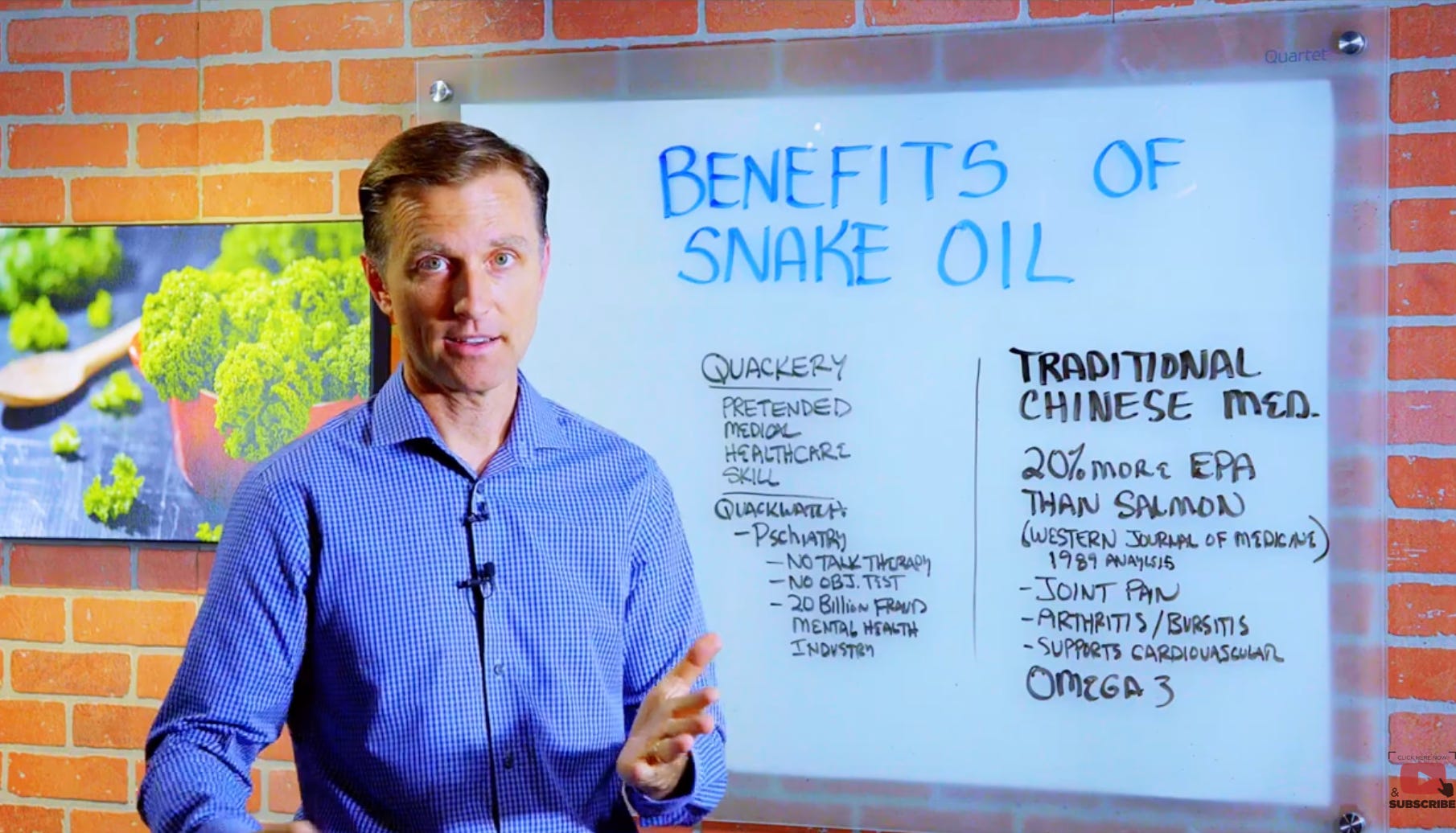
I am dead now.
Wyatt Decker, Chief Physician, Value-Based Care, UnitedHealth
Guess what panel the guy from United Health is on. Go on, guess? Did you guess the “Affordability First” panel? You probably did not. But maybe you should have, because, hey! You don’t have to pay a copay if their AI system denies your desperately needed surgery entirely and you can’t afford to pay for it yourself. See how that works? It’s like they’re doing you a favor.
Syed Mohiuddin, Head of Healthcare, Anthropic
Not terribly surprising, given that AI companies heavily supported this hoedown, but also kind of gross considering that following medical advice from AI has killed people.
Mehmet Oz/Russell Brand
Yes, it’s the collaboration you maybe would have expected had you given more thought to it, but definitely never wanted — Dr. Oz and Russell Brand, who is currently facing rape charges coming from alleged assaults on six women in the UK, chatting about the “reform” Oz is doing at the Centers for Medicare & Medicaid Services.
Bryan Johnson, Founder, Blueprint
That would be the creepy, plastic looking guy who plans to live forever despite having recently been diagnosed with autoimmune gastritis.
Mike Tyson
Tyson, who was convicted of raping an 18-year-old girl in 1992, is there, along with two sports guys I’ve never heard of (UFC guy Michael Chandler and baseball guy Noah Syndergaard) to discuss the concept of the MAHA athlete, which I am just going to hope doesn’t involve eating human ears.
Michael Boes, Chief MAHA Officer, Steak ‘n Shake
Yes, Steak ‘n Shake has an official Chief MAHA Officer, and it is former HHS advisor Michael Boes. He is reportedly there to talk about how they got rid of seed oils and now fry their fries in beef tallow, which in MAHA-world makes them super healthy. So you can eat your double-steakburger double-cheese combo with fries and a Patriot milkshake (confetti-cake flavored with a statue of liberty and a flag on top!) and feel like you’re just doing something really good for your body.
Jonathan Neman, Co-Founder & CEO, Sweetgreen
Honestly, I find this to be the most confusing speaker of all. Because Sweetgreen is a salad restaurant, and what kind of salad company wants to be associated with RFK Jr. right now? Like, you think “RFK Jr. and salad,” you immediately think “explosive diarrhea.” Not to mention the fact that someone recently found a dead mouse in a jar of pepperoncini peppers, which is especially horrifying for me, a person who has been known to eat a jar of pepperoncini peppers every once in a while.
Cheryl Hines
Right before the very end of this day of horrors, AI, and snake oil, Cheryl Hines is scheduled to come out with “An Exciting Announcement!” What could it be? More measles? More food recalls? What a tantalizing and potentially gastrointestinally horrific mystery.
The whole thing will end with a “fireside chat” between JD Vance and RFK Jr., which may or may not involve a real fire, made with real beef tallow.
-=-=
September 29, 2026 EpochTV Live
MAHA Summit 2026 Features VP Vance and Health Secretary Kennedy
MAHA Summit 2026 is held on Sept. 29 in Washington, D.C., featuring Vice President JD Vance and Health and Human Services Secretary Robert F. Kennedy Jr.
Agenda:
9:00 to 9:10 a.m.: OPENING REMARKS (Brief Remarks)
- Alex Hardy, CEO, MAHA Holdings
- Finn Kennedy, board member, MAHA Holdings
- Tony Lyons, co-founder and president, MAHA Action
9:10 to 9:40 a.m.: PSYCHEDELIC MEDICINE, THE NEXT FRONTIER
- Rob Barrow, CEO, Definium Therapeutics
- Michael Halstead, CEO, Helus Pharma
- Kabir Nath, CEO, Compass Pathways
- Moderated by Matt Zorn, deputy general counsel, HHS
9:40 to 10:10 a.m.: DEMOCRATIZING CARE
- Patrick Carroll, chief medical officer, Hims & Hers
- Geoff Cook, CEO, Noom
- Matt Mazzeo, co-founder, Noho Labs
- Moderated by Evan Miller, founder and CEO, GameDay Men’s Health
10:10 to 10:40 a.m.: PREVENTION, EARLIER DETECTION, AND A NEW FUTURE FOR CANCER
- Eric Berg, founder and CEO, Dr. Berg Nutritionals
- Josh Ofman, CEO, GRAIL
- Moderated by Zach Lahn, regenerative farmer
10:40 to 11:10 a.m.: AFFORDABILITY FIRST
- Wyatt Decker, chief physician, value-based care, UnitedHealth
- Catherine Gaffigan, president, health solutions, Elevance
- Mike Tuffin, president and CEO, AHIP
- Moderated by Alec Aramanda, principal deputy director, CMS
11:10 to 11:40 a.m.: RECOVERY FIRST
- Ricky Bloomfield, chief medical officer, Oura
- Ana Montero, co-founder and CEO, Atlas
- Carlos Nunez, chief medical officer, ResMed
- Moderated by Sairam Parthasarathy, director, Center for Sleep, Circadian, and Neuroscience Research, University of Arizona
11:40 a.m. to 12:25 p.m.: LUNCH
12:25 to 12:55 p.m.: AI AND HEALTHCARE
- Virgílio “V” Bento, founder and CEO, Sword Health
- Syed Mohiuddin, head of healthcare, Anthropic
- Nick Perry, co-founder and CEO, Candid Health
- Moderated by Annie Lamont, co-founder, Oak HC/FT
12:55 to 1:25 p.m.: PREVENTION AT SCALE
- Eduardo Conrado, president and CEO, Ascension
- Warner Thomas, president and CEO, Sutter Health
- Eugene Woods, CEO, Advocate Health
- Moderated by Adam Boehler, managing partner, Rubicon Founders
1:25 to 1:55 p.m.: SECURING AMERICA’S FOOD SUPPLY AND ENVIRONMENTAL INNOVATION (Fireside Chat)
- David Friedberg, CEO, Ohalo Genetics
- Brooke Rollins, secretary, USDA
1:55 to 2:25 p.m.: REFORM AT CMS
- Chris Klomp, chief counselor, HHS
- Mehmet Oz, administrator, CMS
- Moderated by Russell Brand, comedian and broadcaster
2:25 to 2:55 p.m.: THE GREAT LONGEVITY DEBATE
- Alex Colville, co-founder and general partner, age1
- Bryan Johnson, founder, Blueprint
- Max Marchione, co-founder and CEO, Superpower
- Moderated by Aidan Dewar, co-founder and CEO, Nourish
2:55 to 3:25 p.m.: BUILDING THE AI HEALTH STACK
- Ed Baker, chief product officer, Whoop
- Maayan Cohen, co-founder and CEO, Hello Heart
- Felipe Millon, head of government go-to-market, OpenAI
- Moderated by Omar Lateef, president and CEO, Rush University System
3:25 to 3:55 p.m.: MODERNIZING MAHA REGULATION
- Kyle Diamantas, acting commissioner, FDA
- Calley Means, senior advisor at HHS
- Lee Zeldin, administrator, Environmental Protection Agency
- Moderated by Tony Lyons, co-founder and president, MAHA Action
3:55 to 4:25 p.m.: THE MAHA ATHLETE
- Michael Chandler, three-time Bellator champion, UFC
- Noah Syndergaard, former MLB All-Star pitcher
- Mike Tyson, undisputed heavyweight champion
- Moderated by Gary Brecka, founder, The Ultimate Human
4:25 to 4:55 p.m.: REAL FOOD AT SCALE
- Michael Boes, chief MAHA officer, Steak ’n Shake
- Scott Morris, senior vice president, private brands, Walmart U.S.
- Jonathan Neman, co-founder and CEO, Sweetgreen
- Moderated by Stefanie Spear, principal deputy chief of staff, HHS
4:55 to 5:00 p.m.: EXCITING ANNOUNCEMENT
- Cheryl Hines, actress and author
5:00 to 5:30 p.m.: IN CONVERSATION: VICE PRESIDENT JD VANCE AND SECRETARY KENNEDY (Fireside Chat)
- Vice President JD Vance
- Robert F. Kennedy Jr., secretary, HHS
-=-=
MMA
MAHA Summit entrenches a divide between administration-aligned advocates and popular influencers
Some grassroots activists and popular influencers were notably absent from the event headlined by Robert F. Kennedy Jr. and JD Vance
Written by Alyssa Tirrell
Published 10/02/26
What does this week’s MAHA Summit tell us about the state of the movement?
Earlier this week, the MAHA Center hosted the second annual MAHA Summit, described by the organizers as a convention of “senior health leaders across technology, business, and government working to make Americans healthier.” The summit's apparent cooperation with industry figures and the Trump administration seemed to drive further an existing wedge within the MAHA coalition, putting administration-aligned advocates at odds with some grassroots activists and popular influencers. As one activist put it, “I don’t recognize this version of MAHA.”
The MAHA Center — the nonprofit arm of a triad of organizations, including MAHA Action and the MAHA PAC, all tied to Health and Human Services Secretary Robert F. Kennedy Jr. — describes MAHA as “a nationwide movement focused on reversing the chronic disease epidemic in America through advocacy, grassroots activism, and policy reform.”
Nonetheless, several prominent grassroots advocates and MAHA influencers were absent from the lineup — including Turning Point USA’s Alex Clark, Moms Across America’s Zen Honeycutt, and Kelly Ryerson, known online as Glyphosate Girl. Instead, the panels primarily featured Trump administration officials and industry representatives — from health tech, insurance, and agriculture — many of whom delivered sales or policy pitches.
In recent months, elected Republicans have faced backlash from MAHA advocates for apparently siding with industry interests on priorities like glyphosate and agricultural legislation. An invitation to participate in the summit could have been an olive branch to MAHA influencers — but if they received invites, it appears those influencers declined.
A panel on reform at the Centers for Medicare & Medicaid Services did feature podcaster Russell Brand as a moderator — a bizarre choice, not least because Brand has faced charges for numerous counts of rape and sexual assault. In his introductory remarks, Chief Executive Officer of MAHA Holdings Alex Hardy told the audience, “You'll hear from Russell Brand and Dr. [Mehmat] Oz. One's a heart surgeon, and one's a heart throb. We'll let you decide which is which.”
Some issues of recent MAHA activism featured lightly if at all during the panels. There were no dedicated panels for vaccine reform, glyphosate, and data centers — all of which have propelled MAHA advocacy in recent months and some of which would require a brush with industries that were represented among the summit’s speakers.
AI innovation was particularly emphasized throughout the summit, but the MAHA backlash against data centers was only mentioned in passing, when CMS Deputy Administrator Dan Brillman said, “The 58% that don’t use it, hate it. They hate data centers. We need more people using AI to better their health.” At the end of the event, RFK Jr. further promoted AI, telling the audience that it could “free us from medical tyranny” of experts.
Kelly Ryerson and Alex Clark also suggested that the MAHA Summit was not geared toward the women who made the movement a major political force. Ahead of the event, Ryerson told the Washington Examiner, “The MAHA Summit lineup does not reflect the issues that birthed the original MAHA movement and drove voters, especially women, to show up and vote for this coalition,” adding, “I don’t recognize this version of MAHA.” Similarly, NBC reported that Clark did not attend the summit. “Where are the original women who started the movement?” Clark asked.
Of the nearly 60 speakers who featured on the agenda, only 7 were women — one of whom was RFK Jr.’s wife Cheryl Hines, who appeared for just 5 minutes to announce future MAHA events.
Women have played a critical role in the movement — the introductory remarks of the event even paid lip service to “MAHA moms.” So it’s notable that the women of MAHA were largely excluded or chose not to participate in the summit. Their absence suggests that the MAHA coalition is now facing a familiar political question: Is compromise with prevailing power players a sign that the movement is succeeding or failing?
Is the summit just the tip of the iceberg?
The MAHA Summit highlighted an existing fracture in the foundation of the MAHA coalition. In recent months, MAHA Action and popular influencers have taken opposing lines on at least two issues related to the Trump administration.
One such example followed from the EPA announcement this past May that it would drop limits on some PFAS in drinking water. Ryerson, Clark, and MAHA activist Alexandra Muñoz expressed frustration with the move, while MAHA Action praised EPA efforts.
Before the rule was announced, Clark and Muñoz urged the EPA to change course. Clark wrote, “Don't weaken PFAS regulation!!!” and Muñoz posted, “Don't allow more PFAS in our drinking water!!!!”
In response to the change, Clark again expressed her frustration with the move, writing, “We are running one of the largest uncontrolled chemical experiments in human history from an alleged ‘MAHA EPA.’”
Ryerson seemed to agree with Clark and Muñoz, writing, “Yesterday, as predicted, the EPA announced they will be removing limits on certain PFAS in tap water.” Her post also included a quote she had given to The New York Times, strongly advising the EPA “not to move forward on deregulating PFAS if they want to win the November midterms.”
According to the New York Times, EPA Administrator Lee Zeldin “sought to counter that anger by appearing Monday with Robert F. Kennedy Jr., the health and human services secretary who spearheaded the MAHA movement, and announcing nearly $1 billion to help states address the contaminants in drinking water.”
MAHA Action backed Zeldin's spin, praising the administration's move. The account wrote, “The EPA is putting $1 billion toward cleaning PFAS from America’s drinking water. After decades of contamination, communities are finally getting help to confront the ‘forever chemicals’ poisoning their water.”
In a separate joint post with MAHA Action President Tony Lyons, MAHA Action wrote that Zeldin and the EPA were “declaring war on forever chemicals.”
A similar dynamic ensued following the announcement of Heidi Overton's nomination for FDA commissioner late last month. Again MAHA Action fell in line with the administration, while Clark, Ryerson, and Muñoz criticized the move.
MAHA Action and Lyons, along with the account MAHA Mommas, praised Overton's nomination, writing, “Secretary Kennedy has given his full endorsement of President Trump’s pick for the next FDA Commissioner, Dr. Heidi Overton.” The post added, “Kennedy is making clear that under Overton, the FDA will answer to science and the American people, not the status quo.”
Clark pushed back, writing, “This is who wrote the glyphosate executive order by the way,” seemingly referring to a February executive order aimed at boosting glyphosate production. Clark’s post was shared by Muñoz. (White House officials disputed the claim that Overton wrote the order, saying it was authored by Trump’s national security advisory team.)
Ryerson again seemed to agree with Clark and Muñoz, writing of the nomination, “Very sad day for MAHA."
The divide hasn’t escaped Lyons, it seems. Earlier this fall, he discussed the MAHA coalition’s role in driving GOP midterm results with Rumble’s Flyover Conservative, saying, “I think the strategy has to be to look at the coalition that worked in the fall of 2024, where we got a few million people to switch parties and to recognize that, like I said before, the party that they thought represented them really didn't.”
Lyons added, “On the more activist side of the MAHA movement — activists are never happy, they're not meant to be happy, the idea for activism is that you can always do better.”
//
MAHA advocates are rallying against GOP “traitors” who passed the farm bill
09/17/26
04/28/26
03/30/26
-=-=
-=-=
AN 9 26
Food fight: 'Colossal' parasite outbreak is colliding with Trump’s promises
-=-=
-=-=
RWW
- Paige Winfield Cunningham @ The Washington Sun: RFK Jr. Headlines Anti-Vaccine Group’s Conference, Discusses Chemtrails
The health secretary told Children’s Health Defense that it has a “strong and steadfast friend at the White House” in President Donald Trump.
-=-=
8 26 YT
5 YRS AGO RFK TO PA SAID NO AUTISM, CHICKEN SOUP VIT A
2 KIA BABY SPLEEN BUT THAT IS STMP // COVID DIED W/ VS DIED OF BS
-=-=
-=-=
mma
MAHA advocates are rallying against GOP “traitors” who passed the farm bill
Moms Across America founder Zen Honeycutt: “If the Republicans lose the midterm elections … this will be one of the reasons why”
Written by Alyssa Tirrell
Published 09/17/26
This week, the Senate Agriculture Committee passed the farm bill, a policy package that has repeatedly faced opposition from the “Make America Healthy Again” movement.
While the farm bill was being considered, MAHA advocates urged their followers to contact senators to vote “no,” arguing that the bill's language would fail to hold pesticide manufacturers accountable. Following the bill’s passage, advocates expressed frustration with Republican senators, highlighting tensions between a key faction of President Donald Trump's base and the broader GOP prior to the midterms.
This week: MAHA vs. the farm bill
As the Senate Agriculture Committee reconsidered the farm bill, MAHA advocates asked their followers to call senators and urge them not to pass a package that would delay pesticide reviews and cut funding for regenerative agriculture, a pesticide-free farming method.
Several major MAHA accounts, including Moms Across America, Kelly Ryerson (known online as Glyphosate Girl) and Courtney Swan, joined in a September 14 post on Instagram urging their followers to contact five Republican senators — Alabama’s Tommy Tuberville, Iowa’s Joni Ernst, Kansas’ Roger Marshall, North Dakota’s John Hoeven, and West Virginia’s Jim Justice — and tell them to vote “no” on the farm bill.
MAHA activist Alexandra Munoz shared the post and commented, “This bill must be stopped! Don’t let them deregulate pesticides more!” The post was further shared in an Instagram story by MAHA podcaster Alex Clark, and the MAHA Mom Coalition included the call to action in a series of posts critical of the bill.
Zen Honeycutt, founder of Moms Across America, posted a video Tuesday morning encouraging her audience to call their senators to vote “no” on the bill. In an additional video posted the following day, Honeycutt elaborated, “We just want to let them know we will be watching their vote.”
She added, “If the Republicans lose the midterm elections and they are voting — doing things like this, like voting party lines instead of listening to their constituents — this will be one of the reasons why."
On Wednesday, the farm bill passed the Senate Agriculture Committee in a vote along party lines. The stalemate was broken by Sen. Mitch McConnell (R-KY), who has been privately dealing with health issues since at least June and reportedly returned to the Senate in part to break the deadlock.
MAHA advocates responded by expressing frustration, particularly with Republican senators.
Vani Hari (known online as the Food Babe), Munoz, Ryerson, and Swan shared a post condemning the passage of the farm bill. Hari wrote, “What happened with the Farm Bill today is absolutely insulting to the American people. Congress had an opportunity to demand MORE accountability for the chemicals being sprayed on our food.” The caption included a “Traitor list” naming a dozen Republican senators.
Ryerson also separately posted an image of McConnell returning to the Senate with the caption, “Ailing Sen McConnell dragged in from medical leave to VOTE TO DEFUND REGEN AG and POSTPONE GLYPHOSATE REVIEW.”
In a new video, Honeycutt said, “We're very disappointed. I’m going to read the Republicans who voted for the farm bill, which is not what their constituents want.” She also claimed that McConnell “did not have the wherewithal, he was not in mental or physical fitness to be able to do that vote, that should absolutely not be allowed.”
She then read a list of Republican senators who voted to pass the bill, adding, “Folks, the Republicans need to hear from you.”
Recap: MAHA vs. glyphosate
This spring, the herbicide ingredient glyphosate became a particular rallying point for MAHA advocates as the Supreme Court prepared to hear a case that would shield Bayer, the manufacturer of the glyphosate-based Roundup, from liability. As CNBC reported, “The Environmental Protection Agency does not classify glyphosate as a carcinogen and does not require labels to disclose cancer risk, but the World Health Organization’s International Agency for Research on Cancer in 2015 said the chemical is ‘probably carcinogenic to humans.’”
The issue was further charged in March after the Trump administration, which had signed an executive order promoting glyphosate production in February, wrote an amicus brief to the Supreme Court in support of Bayer.
In response, MAHA advocates organized “The People vs. Poison” rally in D.C. on April 27. The protest prompted the House of Representatives to remove language from the farm bill that MAHA figures said would also have shielded pesticide manufacturers from liability. The bill passed the House without the pesticide protections just a few days later, and MAHA celebrated the win.
The victory was short-lived, however. In late June, the Supreme Court decided in favor of Bayer, finding that “that the company can't be sued in state courts because federal regulations have found a cancer link unlikely and do not require a warning label.”
Then, in early August, Senate Republicans voted down a Democrat-led amendment to the farm bill that would have allowed injured parties to file suit against pesticide companies. The legislation then stalled in committee, according to The Hill, thanks primarily to Democratic members who oppose a “provision in the bill that would require states to help cover the cost of Supplemental Nutrition Assistance Program (SNAP) funding.”
//
MAHA moms are taking on data centers
06/10/26
MAHA and wellness advocates sound the alarm after the primary defeat of Rep. Thomas Massie
05/21/26
MAHA is outraged over Supreme Court ruling that shields Monsanto owner Bayer from cancer liability
06/26/26
-=-=
-=-=
MMA
On MAHA Media Hub, guest claims that if people “eat vitamin A foods, take daily cod liver oil, keep your kids well nourished, you will weather measles just fine”
MAHA Action President Tony Lyons: “We're trying to prevent a single measles death. So does that mean we should be willing to have autism rates that go from one in 10,000 to one in 30 or, you know, something like that?”
Written by Media Matters Staff
Published 08/27/26 1
Video
From the August 26, 2026, edition of MAHA Action's MAHA Media Hub, streamed on YouTube
BOB SEARS (GUEST): I know people are concerned about measles and — because there's been a clear comeback over the last couple years. And I like to just maybe make sure everyone understands why there's been a comeback and what you can do about it and why you can be educated about it, but you don't have to live in fear of measles.
So first of all, why the comeback? The main reason why is that the vaccine we use wears off too soon. It might protect kids, some kids from catching measles while they're young, but it wears off by the time you're a teenager, and most adults are walking around without measles immunity. So we can actually never really get rid of measles from our country because it's just it's — you know, it's trying to regain a foothold, and we might be seeing more cases because people don't trust the measles MMR vaccine as much anymore. So that might be why some of these communities are having measles outbreaks.
But the truth is it's not spreading because people are not vaccinating. It's because we can't eliminate this infection from our society. We just don't have a vaccine that gives you lifelong immunity, like catching the disease, that gives you lifelong immunity.
So do you need to fear measles? My feeling is no. If you look at the fatality rate in healthy kids who are well nourished and who get enough vitamin A in their diet, the fatality rate of measles is about one for every 93,000 children. That's a very low fatality rate. Now when you look at all children in our country, you know, well nourished, undernourished, the fatality rate might be about one in 10,000. That's a number we've known about for a very long time.
Why does the CDC say the fatality rate is one in 500 or one in 1,000? That's what the old CDC used to say to scare people. That's only hospitalized kids. Kids who show up in the ER very sick from measles or if you're hospitalized, the fatality rate could be about one in 1,000 of those cases. But for everybody, the good news is if you have a healthy child and you're getting vitamin A in your diet, the fatality rate is about one in 93,000. So that's what I tell people to do. Eat vitamin A foods, take daily cod liver oil, keep your kids well nourished, you will weather measles just fine.
I think people don't trust the vaccine anymore, Tony. The MMR vaccine, which protects, or "protects" against measles, it's one of the vaccines with the most possible side effects and some of the most severe side effects. People just don't trust it anymore. So parents are now raising their kids without that vaccine. And you know what? Measles might be here to stay. It might become more a part of our society. We can be on the lookout for it. Stay home if you have a fever and a cough and red eyes. And then if you get the rash, stay home, you know? Maybe you don't want to spread it to everyone in your school. Now we're back to COVID days, right?
But recognize it, stay home if you catch it, but don't fear it and be well nourished so you're ready for it. And most importantly, if you catch measles, take high dose vitamin A. The CDC has always been very clear that high dose vitamin A reduces the risk of your measles infection. It reduces complications. The measles page on my website tells you all of this information, tells you how much vitamin A to take daily as a prevention, how to high dose vitamin A if you catch measles, what that protocol is.
So you know what? Education is important, knowledge, not fear, and, you know, we'll get through this. And if we have to accept measles as a sort of a regular part of a society now moving forward, then we have to be ready for it.
TONY LYONS (MAHA ACTION PRESIDENT): Yeah. Bob, those are great, great points. I mean, you know, with most of these things in in the last, you know, 30, 40 years, we've always been fed just one side of the story. So we're trying to prevent a single measles death. So does that mean we should be willing to have autism rates that go from one in 10,000 to one in 30 or, you know, something like that?
Or should we be able — you know, should we be fighting certain things while ignoring other things, while watching every child in the country have, you know, some kind of allergy now, versus 20, 30 years ago, where you could have a whole school where there was virtually no children who had an allergy to anything or virtually — you know, practically no obesity, no childhood cancers. So all of these kinds of things, they're a part of this story, right?
SEARS: Exactly. And I think the old CDC focused way too heavily on disease prevention. If we could prevent an infection no matter what the cost to everyone in society, let's prevent it. Whereas I think wise people today, they look more at long term health, healthy living, healthy outcomes. And if we have to catch some infections along the way, yet live a healthier, longer, happier life while we're doing that, that's what I think is an important or more important aspect of health. And that's what I would love the CDC to focus on is long term well-being, not infection prevention.
LYONS: Right. Great, great, great points.
//
06/23/26
01/23/26
RFK Jr., measles, and the dangerous legacy of Fox News’ COVID-19 coverage
03/12/25
-=-=
-=-=
====
CNN
MAHA’s money man has built a political machine. Will it matter for midterms?
By
Sarah Owermohle
Feb 3, 2026
A sixth-generation farmer running for Iowa governor, Zach Lahn is the first MAHA-endorsed candidate of the 2026 election cycle.
Running on a platform that includes taking on “Big Agriculture” and “Big Pharma,” his visibility in a crowded field received a boost in publicity when he appeared in December on a popular weekly teleconference hosted by MAHA Action, a lobby group that has become the chief political arm of the movement.
Introducing Lahn, MAHA Action’s leader Tony Lyons declared: “This race is a national problem. It’s a national race, and it’s critical for the MAHA movement. And victory here will demonstrate that we can rebuild, you know, values that will make this country healthy.”
Over the first year of the Trump presidency, “Make America Healthy Again” advocates have issued a warning: Politicians ignore MAHA’s demands at their peril. The deep-pocketed financiers who fueled the movement’s rise have been building the machinery to take MAHA from grassroots outsiders to entrenched power players in Washington and around the country.
The most influential among these is Lyons, a long-time supporter of Health and Human Services Secretary Robert F. Kennedy Jr. who has poured millions into building the political movement, first as a backer of Kennedy’s 2024 presidential run, and now as one of the key architects of MAHA’s political influence.
“We need to fight, fight, fight, and we need to keep making progress,” Lyons, whose company Skyhorse has made a name publishing the works of controversial figures, including RFK Jr., said when he introduced Lahn. “Make no mistake, this is going to be this is a real battle, and it’s endless.”
There is a lot to boast about, Lyons and MAHA leaders say: A whittled-down childhood vaccine schedule, new dietary guidelines with a reversed food pyramid, and plans to remove food artificial dyes from foods.
But there is skepticism that the movement has the momentum — and coherence — to make a difference for the Republicans running with the backing of the MAHA label.
The Trump coalition of voters, including MAHA advocates, tends to include “folks who are otherwise not voting, or not as closely attached to the political process, until sufficiently aggrieved,” said Thomas Miller, a senior fellow on health policy at the conservative think tank American Enterprise Institute.
“That’s harder to do in a 2026 election” because of less voter turnout during midterms, he said.
A midterm election can be a particular problem when you are the party in power, noted Miller. “Unfortunately for the folks who are running on the Republican side, they’re the incumbents now, as opposed to the other folks who were being demonized before.”
Making MAHA a DC staple
The political arm of the MAHA movement has steadily built its influence in Washington and state capitals over the past year.
The scope and depth of its reach could be seen on a cold morning in Washington, DC, last November, when the line to get into what used to be the Trump International Hotel — now the gilded Waldorf Astoria — snaked around the block.
Attending the inaugural “Make America Healthy Again Summit” that day put on by Lyons were Vice President JD Vance; Ultimate Fighting Champion boss Dana White; comedian Russell Brand, who is fighting rape and sexual assault charges; longevity and alternative medicine-obsessed tech multimillionaire Bryan Johnson; and ex-NASCAR driver Danica Patrick.
Kennedy headlined the event, which featured a series of corporate-themed panels interspersed with pop-culture discussions and reflections on how to “Make American Biotechnology Accelerate.”
Health food advocates, tech entrepreneurs and lobbyists waited, at times, for more than an hour to get in.
A week earlier, a separate conference in Austin, Texas, drew a distinctly different MAHA crowd. That gathering, organized by the Children’s Health Defense, the anti-vaccine nonprofit Kennedy founded before he entered politics, featured another longtime Kennedy associate and donor Mark Gorton, founder of the software firm LimeWire who encouraged people “to be more boldly anti-vax.”
Lyons, Gorton and a cadre of long-time Kennedy backers have been with the health secretary since the beginning, helping to propel the otherwise grassroots-based MAHA movement with their power, influence and funds.
When Kennedy entered the presidential race as a dark horse candidate in 2024, Gorton and Lyons were early donors and organizers. Gorton, a vaccine skeptic and critic of Covid-19 shutdown measures, gave $1 million to the Kennedy war chest through American Values, a political action committee he co-founded with Lyons. American Values ultimately raised more than $50 million.
After Kennedy endorsed Trump and the Republican secured a second term, Lyons founded the MAHA Action PAC, which has launched six-figure ad campaigns touting Trump and Kennedy’s work, holds weekly virtual events for supporters, and curries high-profile endorsers such as those who graced the Waldorf Astoria event.
On the state level, MAHA Action has built a website tracking legislation they urge followers to support (tougher food labels, allowing raw milk sales, health care price transparency) and those they should write lawmakers to oppose (a California bill that would shift authority over vaccine recommendations from Kennedy’s reshaped federal advisory group to the state health department).
At the start of last year, when Lyons renamed American Values PAC to become MAHA-focused, the lobby had war chest of $7.7 million. It spent $3.8 million of those funds in the first half of the year, according to federal financial disclosures, much of which went to X Corp., the Elon Musk-owned successor to Twitter; Merit Stream Media, a platform owned by Dr. Phil, who has supported MAHA agenda points; and Gavin de Becker Associates, a security firm led by Kennedy’s longtime security adviser.
The PAC’s full-year financial disclosures are expected in February.
Much of the money so far has gone to online streaming, and streaming often. For the MAHA-aligned part of the Trump administration, this has created a platform for reaching the movement. Health officials regularly appear on MAHA video calls to tout wins on food and pharmaceuticals and remind voters to keep engaging.
“We as a group, this Make America Healthy Again movement, are in a position to basically determine the outcome of the midterms,” Robert Malone, a Kennedy-appointed vaccine adviser and an early pioneer of the messenger RNA technology eventually used in Covid-19 vaccines, said during a November MAHA Action call.
“The question is: will members of the House and the Senate recognize the importance of our movement, our agenda, our initiatives, the force of the interest in this, by key constituencies,” he said.
Does it translate to votes? And does it matter?
But as Kennedy and his cohort score wins in Washington, there is growing concern that vaccine policy changes could alienate average Americans ahead of the midterms.
Most voters have extreme confidence in the childhood vaccine schedule, according to Pew Research polling from November, before HHS narrowed the recommended vaccinations for most children.
December polling from Tony Fabrizio, longtime GOP strategist and 2024 pollster for Trump, show similar trends: More than 70% of voters say the benefits of common vaccinations outweigh the risks, including 6 in 10 MAHA voters, according to his polling firm FabrizioWard.
While the MAHA agenda — food policy, particularly — is widely popular across party lines, vaccine skepticism is not, including among MAHA voters, according to pollsters.
But it’s unclear if health issues such as food or chemical safety will weigh heavily on voters’ minds this year.
“Voters are sending a loud message that their biggest concern is the economy and prices,” said Doug Heye, a GOP strategist and former RNC communications director. “Other issues just have not been registering.”
Regardless of the movement’s sway in the midterms, the MAHA industrial complex is continuing to make product endorsements, sell supplements, and put out bestselling books.
While Skyhorse does not make its sales and profits public, it has touted being one of the fastest-growing independent publishers in the country, with more than 100 bestsellers to its name. Those same authors often appear in the weekly MAHA Action streaming installments.
Several of Skyhorse’s top sellers came from Kennedy, who stands to make millions more from the publishing house. The health secretary last year reported that he is owed between $2 million and $4 million for two upcoming books, “Unsettled Science” and “A Defense for Israel,” and made $450,000 from Skyhorse for consulting on book ideas and writing forewords for authors.
Kennedy is contracted for a third book with Skyhorse that he will not write or promote while serving in government, according to his financial disclosures. But his wife, Cheryl Hines, received a $600,000 advance for her November 2025 memoir, according to those documents.
Last month, Kennedy himself made a surprise appearance on a MAHA Action call, roughly an hour after standing with Trump in the Oval Office as the president signed a bill reintroducing whole milk in schools.
Following some remarks from Kennedy on the signing, Lyons told him:
“There are 7,000 influencers watching this show, and I just want you to know that they all love you, that millions of MAHA moms, you know, have your back, are fighting for you.”
“They recognize that you’ve risked everything to fight for them,” he said.
===
-=-=
putin ~ son conor mercenary?
raw
Putin's has set his sights on a member of Donald Trump's Cabinet — by going after his kid.
A Moscow court has ordered the arrest of Conor Kennedy, the son of Health and Human Services Secretary Robert F. Kennedy Jr., branding him a "mercenary" for a stint spent fighting alongside Ukrainian forces, according to the Russian state media outlet TASS.
TASS also reported that the 32-year-old has been added to an international wanted list. The Daily Beast reported on the development.
ALSO READ: 'God's money': White House enrages with vow that public cash belongs to evangelicals
If he was arrested, Conor Kennedy would face between seven and 10 years in a Russian prison, according to the report.
But since the case was built in absentia, the warrant carries more symbolism than teeth as he isn't likely to be extradited.
Why Moscow decided to act now — nearly four years after Kennedy first went public about his time in Ukraine — was not explained.
Back in October 2022, Kennedy used Instagram to describe why he'd signed up to fight for Ukraine. He said he was profoundly affected by what he witnessed on the ground and was prepared to die there. He said he'd kept his identity quiet from most people to spare his family worry and avoid special treatment, and he praised the international volunteers he served alongside as genuine freedom fighters from all walks of life.
He fought in the Kharkiv region as part of Ukraine's International Legion, though he didn't say publicly how long his deployment lasted.
Conor is RFK Jr.'s third child and his oldest with ex-wife Mary Richardson.
-=-=
an 8 26
At the core of Robert F. Kennedy Jr.'s rise as a political celebrity is the enduring American reverence for his family. Decades ago, during his career as an environmental advocate, that lingering aura inspired admiration and even hope.
Yet the longer Bobby Jr. remains in the corrupting orbit of this regime and its maximum leader, the more he has come to reflect the degraded values and morals of the Trump family rather than his own.
Flawed as the legendary Kennedys were, nobody has ever thought of Jack, Robert or Teddy as low-rent grifters seeking to scam the government or the public for personal gain. Quite the opposite, since they devoted their political careers to protecting the American people from crooks like Roy Cohn -- the Trump lawyer and moral mentor who was twice indicted when Robert F. Kennedy Sr. was attorney general.
On the current record, it is clear that RFK Jr. has long since abandoned the illustrious example of his forebears and embraced instead the grabbing-with-both-hands ethic of his new political family. During the past year alone, Bobby has abandoned all the environmental and public health principles that supposedly animated his career for the past 40 years, strictly to enrich and promote himself and his dear leader Donald Trump (a man his father and uncles assuredly would have scorned).
Consider just one of the many abuses of power perpetrated by Bobby for his own personal and political gain. As disclosed earlier this summer in The New York Times, he went out of his way to protect the distribution of Kratom, a highly toxic, mind-bending drug, mostly sold in gas stations and convenience marts, that has been linked to thousands of deaths. Exercising his authority as Health and Human Services secretary in the fall of 2025, he called the governor of Ohio in an effort to stop a state ban on the dangerous substance. Among the Kratom producers who benefited from this action -- the opposite of what any public health official should have done -- was a man formerly known as Jerry Cash, who had served time in prison for embezzlement and later changed his surname to Ross.
As Jerry Ross, the Kratom mogul poured $162,000 into the defunct RFK Jr. 2024 presidential committee after Trump named Bobby as health secretary. And several months later, after Food and Drug Administration granted additional favors to boost kratom, Ross wrote another million-dollar check to Kennedy's MAHA PAC.
Like Trump, Kennedy has profited from blatant conflicts of interest while refusing to divest himself of those deals and arrangements. He still stands to profit from his consulting contract with a Los Angeles personal injury law firm that is suing vaccine makers such as Merck. When he was confirmed, Sen. Elizabeth Warren and others objected, noting that at HHS he could use his power to increase his legal bonanza (which has brought him millions of dollars over the past few years).
And like Trump, Kennedy banks big money from his "patriotic" sloganeering, by personally licensing "Make American Healthy Again" as a brand - while he uses government resources to promote that brand. When Dr. Anthony Fauci came under fire in a Senate hearing in July, Kennedy used the opportunity to promote his scurrilous book attacking the former federal science official -- despite his previous pledge not to run that particular sleazy grift.
How much longer Kennedy will be able to exploit the naivete of the "MAHA Moms" who form his political base remains to be seen. Many of them have grown restive as he repeatedly sells out their ideals to back Trump's pay-for-play arrangements with pesticide producers, tobacco firms and other industries whose depredations he swore to fight. For the MAHA movement, a bitter realization is coming: They followed a leader named and packaged as a Kennedy, but underneath he was just another shoddy Trump.
-=-=
-=-=
RWW
- Molly Olmstead @ Slate: The FDA Just Handed Looksmaxxers a Big, Strange Victory
RFK Jr.’s MAHA movement is finding plenty in common with the bros who are obsessed with peptides.
gmail 7 26 zeteo pt 2
Leading virologist Dr. Angela Rasmussen dives into what the evidence actually shows about the origins of the Covid pandemic. Spoiler alert: It's not what Trump, RFK Jr. and Gabbard are telling you
...as Tulsi Gabbard departed her role as the director of national intelligence, she released what she characterized as a bombshell reveal that former National Institute of Allergy and Infectious Diseases (NIAID) Director Anthony Fauci lied to Congress about masterminding virology research that created SARS-CoV-2, which leaked from a lab and caused the COVID-19 pandemic.
Senator Rand Paul (R-KY), chair of the Homeland Security and Governmental Affairs Committee (HSGAC), has done the same, releasing a trove of similarly uninformative documents this week, which mostly show some of my co-authors joking around, discussing politics, and changing their minds when faced with evidence (full disclosure: they mention me in the context of complimenting my Twitter game). Paul claims this is evidence that they conspired with Fauci to help him cover up the truth about the lab leak by writing a paper for a scientific journal.
These documents are not proof of anything besides showing that, yet again, efforts across multiple intelligence agencies and the Senate HSGAC failed to uncover any hard evidence that a “lab leak” occurred. That’s because the sole piece of evidence supporting that version of events is that the pandemic began in Wuhan, where there is a lab that studies coronaviruses. There was also a market, where live animals were sold.
This is the second part of a two-part series. In Part 1, I examined how disinformation about the “lab leak” is being weaponized to attack science and persecute scientists, including Fauci, furthering the advancement of authoritarianism and erosion of democracy in America. Part 2 discusses what the evidence actually shows about the origin of the pandemic – and none of it indicates that it started in a lab.
What Evidence?...
CONTEXT IOWA SWING STATE 2ND CANCER RATE
an 7 26
Ahead of the pivotal 2026 midterm elections, Politico reports that a consistently red state is being pushed away from Republicans, all because of a longstanding environmental crisis resulting in cancer-causing water.
Once considered a swing state, in the last several election cycles, Iowa has emerged as a solid red state, breaking for President Donald Trump in all three of his races. Despite that trend, there remains a hope among Democrats, backed up by recent polling data, that they might be able to pull off wins in the state this November, given how toxic Trump and the Republican Party are becoming with voters. This is especially true in Iowa, where the president's economic agenda has caused major pains for the state's many farmers.
On top of all that, Politico on Sunday released a report revealing that a long-term ecological crisis is also triggering a "political reckoning" in the Hawkeye State, and it could end up being a disaster for Republicans.
Chris Jones, the Democratic nominee for Iowa's secretary of agriculture, told Politico that his "decade as a research engineer, monitoring the state’s rivers and streams," led him to pursue public office, to address the alarming things he discovered about the state's rivers and lakes. As the report explained, "Iowa’s lakes and ponds are often murky and fetid from algae blooms fed by fertilizer runoff, a byproduct of the state’s vast agricultural industry’s reliance on farming chemicals."
"Iowa has a long-simmering water problem that has finally begun to boil over — and it’s changing Iowa politics," Politico explained. "People are angry and worried about the quality of the state’s water, the health risks it poses and its increasingly undeniable tie to the state’s signature industry: agriculture."
It continued: "In recent years, Iowa’s cancer rate has climbed significantly above the U.S. average. It now stands as the nation’s second highest, and Iowa is one of only three states where the rate is rising. The situation has put a spotlight on nitrates, which are linked to a growing body of science to kidney, brain and ovarian cancer. Nitrates are a key component in the deluge of chemical pesticides and fertilizers used by the state’s farmers, some of which washes off farm fields and into waterways. A second culprit is glyphosate, the active ingredient in Roundup, the world’s most common weedkiller, which the International Agency for Research on Cancer declared 'probably carcinogenic' in 2015, an assessment rejected by the U.S. Environmental Protection Agency."
While candidates on both sides have long been wary of tackling issues stemming from Iowa's all-important farming industry, things are different this year. Voters are "steaming mad" about the impact these chemicals are having, and as a result, candidates from both parties have taken aim at the industry, and found success doing so. In a development that is "scrambling" the common understanding of Iowa's politics, "some of those winning candidates are Democrats."
"In the Republican primary for governor, a businessman, farmer and political operative named Zach Lahn shocked the political establishment by edging out Trump-endorsed Rep. Randy Feenstra for the nomination," Politico explained. "Lahn won, in part, by openly acknowledging the state’s water crisis and connecting the dots between agriculture and cancer. Lahn was also the first candidate for statewide office endorsed by MAHA Action, the main PAC supporting Robert F. Kennedy Jr.’s Make America Healthy Again movement. MAHA voters supported Kennedy and President Donald Trump in the 2024 presidential elections, but have since rebelled against some of their moves, especially the Trump administration’s open support for glyphosate."
It continued: "As for the Democrats, they have their best shot in a decade or more of winning statewide offices in November’s election. Democrat Josh Turek is neck-and-neck in recent polling with Republican Ashley Hinson in the open race for U.S. Senate. And Lahn’s Democratic opponent, Rob Sand, bested him by one percentage point, within the margin of error, in recent polling in the governor’s race."
---
an 7 26 grist
On a 200-acre farm and cattle ranch in Bandera, Texas, Mollie Engelhart grows organic produce, sells raw milk, and writes a daily column about the power of regenerative agriculture. She’s a farmer and a Make America Healthy Again mom who doesn’t like being called a MAHA mom. She prefers to think of herself as “MAHA-aligned.”
In May, Engelhart opened her ranch to a couple hundred pro-MAHA politicians, activists, and leaders for a two-day MAHA farming retreat. Department of Health and Human Services Secretary Robert F. Kennedy Jr., was there. Engelhart’s brother, Ryland, is one of the more well-known figureheads of the movement.
*This story was originally published by Grist. Sign up for Grist's weekly newsletter here.
Her biggest issue with the MAHA label is what she considers the “blue team or red team” politicization of it. Like many MAHA-aligned supporters, she voted for President Donald Trump in the last election largely because of RFK Jr.’s endorsement and their joint promise to clean up America’s chemical-laden food system. Back then, she had faith Trump would make good on that promise. But in the last year and half, that faith has frayed.
“I think that one hundred percent the MAHA movement is very disappointed and disenchanted, and I am not the only one,” said Engelhart. “MAHA voters are homeless.”
MAHA’s disenchantment with the Trump administration has much to do with its open support of Bayer, the manufacturer of the popular pesticide Roundup, which just won a Supreme Court case over the claim that the company failed to adequately warn users about the cancer risk of its weedkiller. First, the administration urged the Supreme Court to take up the case. Then, in February, the president signed an executive order that classified glyphosate-based herbicides like Roundup key to national security and called for increased domestic production of the chemical. In March, it was reported that top officials at the Environmental Protection Agency met with Bayer CEO to discuss “litigation” issues. The following month, the administration sent a lawyer to argue on behalf of the chemical company in a Supreme Court hearing.
Tens of thousands of plaintiffs had sued Bayer, alleging that the active ingredient in Roundup has caused cancer and other health issues and that the company failed to follow state laws when it did not include a warning about cancer risk on its label. But now, the court’s ruling means that states cannot mandate more information on the product’s label than required by federal law, and any such claims against Bayer will have limited pathways of legal recourse.
Just hours after the decision was released, Trump signed an executive order framed as boosting regenerative agriculture and American farm resilience. (Broadly speaking, the term “regenerative agriculture” refers to farming methodologies that boost soil health and its potential for carbon capture, though there is no federal standard or definition like there is for “organic,” leaving it open to interpretation — and, in some cases, greenwashing.) The contradictions between the two actions have sparked a new barrage of criticisms from MAHA voters. “It does seem a little schizophrenic,” said Engelhart. “None of us can be a one-issue voter anymore…I don’t think that anybody is just going to blindly go and vote for one party or another,” she added.
That sentiment is already showing up in the data, though the picture is far from clear-cut. Polling results from last October found that roughly 74 percent of MAHA-supporters identified as Republicans, with 59 percent also identifying as Make America Great Again supporters — the president’s most loyal base. Meanwhile, a POLITICO poll conducted this spring revealed that 47 percent of self-identified MAHA respondents who voted for Trump believe the administration has not done enough to “Make America Healthy Again.” And a Kaiser Family Foundation poll found that 28 percent of MAHA voters somewhat or strongly disapprove of the way the administration is handling food and vaccine policy, which may affect turnout in the midterm elections that could decide control of Congress. Limiting pesticide use, however, remains one of the movement’s defining causes, with 94 percent of MAHA adherents in favor of reducing exposure to harmful chemicals.
South Dakota farmer Jonathan Lundgren was at the White House on the day that the Supreme Court ruling was announced. Days earlier, he’d been invited to the Rose Garden for a dinner recognizing farmers and was asked to join Trump in the Oval Office for the signing of the regenerative agriculture executive order. Lundgren raises bees, sheep, and poultry, and grows flowers and apples on a 50-acre regenerative farm in Estelline, South Dakota. Like Engelhart, he shirks the political implication of identifying as MAHA, but considers himself aligned with the pro-regenerative agriculture and anti-pesticide faction of the movement.
“They needed some farmer faces to kind of give the whole thing a spin,” he said. Lundgren called the executive order “meaningful,” though it’s not lost on him that it doesn’t introduce new funding or regulations.
Experts say it doesn’t do much at all. “It may sound great, but fundamentally, there’s nothing really new or substantive or meaningful in the EO that I can see that actually changes the equation for how the administration treats regenerative agriculture,” said Mike Lavender, policy director at the National Sustainable Agriculture Coalition.
Inside the Oval Office meeting, Lundgren watched on as Kennedy’s team swiftly mobilized to try to soften the MAHA backlash to the Supreme Court ruling with the president’s executive order, which culminated in an explosive argument between a Department of Health and Human Services official and a top farming lobbyist who was concerned that the order would imply that there are safety issues in the U.S. food supply. Lundgren himself stopped using Roundup about eight years ago when he noticed that agrochemicals were “causing more problems than they were solving” on his farm. But he can’t escape the downwind effects of nearby farms that spray it. Right now, he’s watching scores of bees slow down before outright dying, and his orchard’s leaves cup from herbicide drift. Then there’s the human toll.
“We’re sick this time of year, and it’s a direct result of all of these pesticides being applied. My family is sick. That ain’t right,” Lundgren told Grist. His daughter is grappling with asthma and allergy flare-ups while his farm staff battles recurring headaches and fatigue. “It’s so intense that we call it in my community ‘The Spray Flu.’”
He says these dual actions by the administration, as well as the EPA’s recent approval of yet another batch of pesticides that contain PFAS, often called “forever chemicals,” have changed how he plans to vote in the midterms.
“We’re in a weird state right now that has never really happened before, where food safety and the health of our children is weighing very heavily on American politics,” said Lundgren. “This is far broader than the farming community. I think that this is consumers; I think this is parents; I think this is society at-large.”
Others argue that, despite the administration’s recent pro-regenerative ag messaging, Trump’s track record of anti-climate and pro-chemical policies has not helped the movement to clean up the food system, but hindered it.
Kelly Ryerson, a leading MAHA mom and co-founder of the farming organization American Regeneration, agrees that, when taken together, the ruling and the order reveal a disconnect. “It’s inconsistent, to say the least,” said Ryerson. “If Trump is going to be doing things like the Supreme Court situation, it’s certainly not what anyone voted for…it’ll be really hard to come back from this now.”
For Ryerson, a registered independent who voted for Trump, the two actions have shifted how she plans to approach the midterms. “I don’t care if they’re a Republican or Democrat, I’m going to support the candidate that wants to decrease toxic exposures,” she said.
This article originally appeared in Grist at https://grist.org/food-and-agriculture/trump-tried-to-appease-mahas-fury-over-roundup-it-backfired/.
Grist is a nonprofit, independent media organization dedicated to reporting on climate change.
---
ref 12/25
how-trumps-big-ag-bailout-is-alienating-his-maha-base
At a White House roundtable last Monday, president Donald Trump, alongside Agriculture Secretary Brooke Rollins and a handful of other leaders in the government, announced a $12 billion farm aid program intended to offset the economic blowback that U.S. farmers have faced this year as a result of the president’s volatile trade policies.
But there’s a catch: only major commodity farming operations — such as those that grow corn, cotton, peanuts, rice, wheat, and soybeans — will be eligible for more than 92 percent of the money, which is scheduled to begin flowing in February. Just $1 billion of the bailout has been set aside for farmers who produce other crops; when those payments will be made available has not yet been announced.
The move is par for the course from the administration, which has allocated a near-record total of $40 billion in farm subsidies this year, with at least two-thirds of those payments having gone to commodity farms. But Trump’s latest billion-dollar bailout does much more than funnel even more cash into Big Ag, which accounts for a significant share of the roughly 10 percent of total greenhouse gas emissions released by agricultural activities nationwide. The corporate handout is also adding kindling to a feud brewing within factions of the right wing in American politics.
During the president’s 2024 re-election campaign, Trump and Robert F. Kennedy, Jr. both repeatedly promised to reign in the widespread use of dangerous pesticides and industry influence within the federal government. This messaging struck a chord with everyone from mom influencers to chiropractors and vaccine skeptics — all eager for an administration that would do away with all the corporate-fueled toxicity in the air we breathe, water we drink, and food we eat. Voters rallied around the need to clean it all up, and quickly.
After taking office, the administration changed course. Its new Environmental Protection Agency administrator Lee Zeldin has initiated a series of actions that have softened regulations on the chemical industry, including on products that have agricultural applications. In March, Zeldin promoted Nancy Beck to help lead the agency’s chemicals office. Beck previously worked as a lobbyist for the chemical industry, and as an EPA official during the first Trump administration, she fought against rigorous chemical regulations and became known for championing industry interests.
Read Next
2025: The year the US gave up on climate, and the world gave up on us
Over the course of the year, the agency has sought to approve five pesticides containing PFAS, or “forever chemicals,” for farm use on commodity crops such as canola, corn, soybeans, and wheat. Using a very narrow definition of PFAS, which excludes chemicals with single fluorinated carbons, the agency contends that these five pesticides are not technically “forever chemicals” — even though under the international intergovernmental definition, they are.
The EPA is mandated to assess the cumulative risks of all chemicals that are classified as PFAS, which persist in the environment for incredibly long times and have been linked to a variety of harmful human health conditions. So the agency’s narrowed definition may have grave implications and has alarmed environmentalists and public health experts alike. A Grist review of the Office of Chemical Safety and Pollution Prevention proposed assessment documents confirmed that the agency plans to forgo the certain compound risk assessments, which measure how the substances interact with other pesticides, in its review process for all five of the proposed pesticides. Two of those five chemicals, cyclobutrifluram and isocycloseram, have already been green-lit for use in agricultural production — and neither were tested using the cumulative risk approach.
In response to Grist’s request for comment, an EPA spokesperson denied that forgoing the cumulative risk assessments in the agency’s evaluation process is cause for concern. The spokesperson noted that Zeldin “corrected the record on the fake news from Democrats and their media allies” and underscored that the registrations of the five newly proposed pesticides are all in “full compliance” with federal law.
“The administrator made clear that protecting American families remains the top priority — ensuring that EVERY approved pesticide undergoes thorough gold-standard scientific safety evaluations and poses no health risks when used as directed, with NO exceptions. Period,” the spokesperson wrote in an email. “The Trump EPA has not approved any pesticides containing PFAS. This is basic chemistry. And it’s not just us saying this — in fact, it was the Biden EPA that officially ruled single fluorinated compounds are NOT PFAS or ‘forever chemicals.’”
While the EPA’s actions adhere to federal review mandates, a former staffer in the office of pesticide programs, who asked to remain anonymous, said that there is still cause for concern about whether the agency’s newfound priorities increase the risks posed to long-term environmental and human health. According to the former employee, Zeldin’s agency is streamlining new approval applications at the expense of reevaluating older pesticides that have been recently found to be linked to health complications but are still being widely commercially distributed. And if the EPA doesn’t conduct cumulative risk assessments on the proposed pesticides, the former staffer warned that the agency will have a limited understanding of how the chemicals might interact with ones that are already in use.
Other major pesticide-related changes at EPA this year include changes to how companies report PFAS chemical use, the alteration of endangered species protections to enable the use of some pesticides in agricultural applications, and the proposed reinstatement of pesticides, such as dicamba, that were previously vacated by different federal courts. Though it’s been used as a common weed killer for over half a century in the U.S., the chemical has become more widespread on soybean and cotton farms in the last decade, and has been linked to some cancers and ecosystem degradation.
Read Next
Trump’s latest USDA cuts undermine his plan to ‘Make America Healthy Again’
While many industry farm groups have voiced their support for the EPA’s approach to pesticide regulation, another bloc of the nation’s conservative movement finds it in direct contradiction with their interests: the Make America Healthy Again coalition.
In May, to much fanfare, a team led by Kennedy released the first MAHA report. But to the dismay of MAHA supporters anticipating a crackdown on pesticides, the document fell short of the campaign’s strong language. The following month, Zeldin hired another former lobbyist to a lead regulatory position. Kyle Kunkler, a former American Soybean Board lobbyist who fought pesticide restrictions, was brought in to take charge of pesticide policy — one of four prominent industry insiders hired by the EPA under Zeldin’s stewardship.
Then, the highly anticipated follow-up to the report, intended to lay out a strategy on how to accomplish its goals, was released in September. That document didn’t mention pesticides at all — a “gift to Big Ag” that fed the MAHA movement’s growing discontent.
The MAHA discord over Big Ag’s influence on policy was further heightened when, in November, the EPA started rapidly finalizing the approval of several of the newly proposed PFAS pesticides, pushing tensions to their breaking point. Behind the scenes, an effort by some congressional Republicans to limit corporate lawsuits on pesticides came just before the Trump administration urged the Supreme Court, earlier this month, to take up a pesticide manufacturer’s appeal in a landmark case that would block thousands of lawsuits brought by cancer patients who allege the weed killer Roundup is to blame.
“Obviously the people at EPA are entrenched in this industrial agricultural system in the beginning, right? Like, that’s pretty clear with what happened with dicamba,” said J.W. Glass, an EPA policy analyst at the conservation nonprofit Center for Biological Diversity. “What’s dicamba used primarily on? Modified soy. What’s atrazine primarily used on? Corn and soy. The issue is, when you even call into question pesticides that industrial agriculture is so reliant on, it provokes such a vicious response … It is almost like a golden goose that cannot be touched.”
But that hasn’t dampened the mounting frustrations from a bloc of the MAHA movement. Nearly three weeks ago, a group of MAHA leaders and activists launched a campaign to publicly urge Trump to fire Zeldin. “Rather than supporting your initiative to ‘Make America Healthy Again,’ which millions of Republicans and independents alike embraced, Administrator Zeldin has prioritized the interests of chemical corporations over the well-being of American families and children,” the group stated in the petition that’s racked up more than 8,000 signatures. “These chemicals, now being released into our food and water supplies, pose serious threats to both present and future generations.”
“I think there’s been a large misconception in the Republican Party, thinking that the constituents don’t really care about these issues,” Kelly Ryerson, one of the organizers of the petition, told Grist. “A key part” of the MAHA agenda, Ryerson continued, “is removing corporate interests from our regulators.”
“If anything, the EPA is significantly worse off in this administration than it was during the Biden administration,” she added. “And that is something that really frustrates tons and tons of voters that came along with this promise.”
The coalition’s ire, however, seems to be only aimed at Zeldin (who recently teased his own forthcoming MAHA agenda). Ryerson has nothing but praise for other leaders in the administration — Kennedy, Rollins, and the president himself. Last Wednesday, Kennedy and Rollins announced a pilot program that will direct $700 million toward supporting regenerative agriculture, which Ryerson cited as one example of the administration’s commitment to cleaning up the nation’s food system.
All the while, the administration’s support for industrial farms, which are the major users of toxic pesticides, has far outweighed its support for farms that practice more planet-friendly methods. Ryerson freely admits this; she said that factory farming “has dominated agriculture, and we all know it’s a really inconvenient fact, but we all know that it’s killed our soil.” Still, she said, the problem lies with the EPA.
“The MAHA movement,” Ryerson continued, “we would love to see a complete overhaul of our ag system that is just spending this ridiculously obscene amount of money on subsidies for products that aren’t even really food for us at all.”
And yet, Trump shows no signs of abandoning his billion-dollar farm bailout playbook — propping up the very pesticide-sustaining system that MAHA is rallying against.
---
Next Story
The EPA website got the basics of climate science right. Until last week.
---
MMA
MAHA ACTIVIST ZEN HONEYCUTT: TRUMP “HAS NOT DONE A SINGLE THING TO REDUCE OUR CHILDREN'S EXPOSURE TO PESTICIDES. IN FACT, HE'S MADE IT WORSE.”
07/07/26
07/01/26 MMA
MMA As MAHA activists fumed over the Supreme Court’s decision to shield Monsanto owner Bayer, right-wing cable news networks appeared to avoid the topic
Though the cancer liability case and the herbicide glyphosate have received significant attention from Trump supporters, Fox ignored it, and Newsmax barely discussed it
Written by Ilana Berger & Harrison Ray
Published 06/30/26
While MAHA decried the Supreme Court’s recent Monsanto Co. v. Durnell decision, Fox networks completely ignored the ruling, and Newsmax barely touched it, dedicating only 3 minutes of coverage to the decision.
The scant coverage on right-wing cable networks is notable given the immediate wave of backlash to the decision that came from the MAHA coalition, which Donald Trump successfully courted during the 2024 campaign cycle with promises that “we’re going to get toxic chemicals out of our environment, and we’re going to get them out of our food supply.” Prominent figures in the MAHA movement, which became a key component of Trump’s voting base, called the Supreme Court’s decision a “betrayal of the American people” and expressed outrage with the administration for orchestrating the outcome of the case.
- In a 7-2 June 25 decision, the justices “agreed to shield Monsanto from liability over its popular weed killer, Roundup, dealing a victory to the company's new owner as it struggles to resolve thousands of costly lawsuits from people who claim the key ingredient caused their cancer,” wrote NPR.
Media coverage framed the ruling as a victory for the agrochemical industry and the Trump administration, which carried out a multipronged effort to shield Monsanto-owner Bayer from accountability for the harms allegedly caused by its controversial product. President Donald Trump issued an executive order in February declaring glyphosate, the active ingredient in Roundup, critical to national security, and in March, U.S. Solicitor General D. John Sauer filed an amicus brief urging the Supreme Court to rule in favor of Bayer.
According to the environmental advocacy group EarthJustice, the Monsanto v. Durnell ruling could allow companies to “escape liability simply because the EPA approved their labels at some point in the past, even if the company concealed how harmful their pesticides were to people.”
Despite widespread condemnation from MAHA advocates, many of whom have supported Trump in the past, major right-wing news networks largely ignored the ruling. From June 25, 2026, when the U.S. Supreme Court released its Monsanto v. Durnell decision, through June 29, 2026, Fox Business Network and Fox News Channel both failed to mention the ruling even once. Meanwhile, Newsmax gave the ruling only about 3 minutes of coverage across 2 segments and 1 mention in a segment about a different court case.
In one segment on the June 25 episode of Bianca Across the Nation, host Bianca de la Garza noted that the case had received “a lot of attention" from the MAHA movement and questioned whether the decision would be “letting people who believe they were sick be blocked altogether from making claims?"
- Video file
Citation
From the June 25, 2026, edition of Newsmax's Bianca Across The Nation
- Following Trump’s February executive order and in the leadup to the case, some in right-wing media joined the chorus of voices criticizing Trump’s actions to protect glyphosate producers, going so far as to declare that he is “committing political suicide.” Turning Point USA-affiliated MAHA podcaster Alex Clark told The New York Times in April that MAHA voters “feel like the Republicans lied to them, and they’re not planning on voting.”
Some other media figures have defended Trump’s characterization of glyphosate as essential to the United States’ national security and food systems. Health and Human Services Secretary Robert F. Kennedy Jr., the figure at the helm of the so-called Make America Healthy Again movement, also defended the administration's actions around glyphosate in March on The Joe Rogan Experience.
Methodology}:
AN 6 26
---
07/02/26 MMA
---
07/01/26 MMA
---
MMA As MAHA activists fumed over the Supreme Court’s decision to shield Monsanto owner Bayer, right-wing cable news networks appeared to avoid the topic
Though the cancer liability case and the herbicide glyphosate have received significant attention from Trump supporters, Fox ignored it, and Newsmax barely discussed it
Written by Ilana Berger & Harrison Ray
Published 06/30/26
While MAHA decried the Supreme Court’s recent Monsanto Co. v. Durnell decision, Fox networks completely ignored the ruling, and Newsmax barely touched it, dedicating only 3 minutes of coverage to the decision.
The scant coverage on right-wing cable networks is notable given the immediate wave of backlash to the decision that came from the MAHA coalition, which Donald Trump successfully courted during the 2024 campaign cycle with promises that “we’re going to get toxic chemicals out of our environment, and we’re going to get them out of our food supply.” Prominent figures in the MAHA movement, which became a key component of Trump’s voting base, called the Supreme Court’s decision a “betrayal of the American people” and expressed outrage with the administration for orchestrating the outcome of the case.
- In a 7-2 June 25 decision, the justices “agreed to shield Monsanto from liability over its popular weed killer, Roundup, dealing a victory to the company's new owner as it struggles to resolve thousands of costly lawsuits from people who claim the key ingredient caused their cancer,” wrote NPR.
Media coverage framed the ruling as a victory for the agrochemical industry and the Trump administration, which carried out a multipronged effort to shield Monsanto-owner Bayer from accountability for the harms allegedly caused by its controversial product. President Donald Trump issued an executive order in February declaring glyphosate, the active ingredient in Roundup, critical to national security, and in March, U.S. Solicitor General D. John Sauer filed an amicus brief urging the Supreme Court to rule in favor of Bayer.
According to the environmental advocacy group EarthJustice, the Monsanto v. Durnell ruling could allow companies to “escape liability simply because the EPA approved their labels at some point in the past, even if the company concealed how harmful their pesticides were to people.”
Despite widespread condemnation from MAHA advocates, many of whom have supported Trump in the past, major right-wing news networks largely ignored the ruling. From June 25, 2026, when the U.S. Supreme Court released its Monsanto v. Durnell decision, through June 29, 2026, Fox Business Network and Fox News Channel both failed to mention the ruling even once. Meanwhile, Newsmax gave the ruling only about 3 minutes of coverage across 2 segments and 1 mention in a segment about a different court case.
In one segment on the June 25 episode of Bianca Across the Nation, host Bianca de la Garza noted that the case had received “a lot of attention" from the MAHA movement and questioned whether the decision would be “letting people who believe they were sick be blocked altogether from making claims?"
- Video file
Citation
From the June 25, 2026, edition of Newsmax's Bianca Across The Nation
- Following Trump’s February executive order and in the leadup to the case, some in right-wing media joined the chorus of voices criticizing Trump’s actions to protect glyphosate producers, going so far as to declare that he is “committing political suicide.” Turning Point USA-affiliated MAHA podcaster Alex Clark told The New York Times in April that MAHA voters “feel like the Republicans lied to them, and they’re not planning on voting.”
Some other media figures have defended Trump’s characterization of glyphosate as essential to the United States’ national security and food systems. Health and Human Services Secretary Robert F. Kennedy Jr., the figure at the helm of the so-called Make America Healthy Again movement, also defended the administration's actions around glyphosate in March on The Joe Rogan Experience.
Methodology}:
---
lonsdale fda fuckery?
---
an 6 26
Former First Lady Michelle Obama is excluding actress Cheryl Hines, who is married to Health and Human Services (HHS) Secretary Robert F. Kennedy Jr., from a new HBO sketch comedy series celebrating the United States' 250th anniversary. And according to SILive, Hines is really angry about it.
Obama, journalist Tom Wrobleski reports on SI Live, made it clear that she doesn't want Hines to have anything to do with "Life, Larry and the Pursuit of Unhappiness: An Almost History of America" — which Michelle Obama is producing with former President Barack Obama and stars comedian Larry David, well-known his work on the popular sitcom "Seinfeld" (which he created) and HBO's "Curb Your Enthusiasm." The show is marking
An insider on the program told the UK-based Daily Mail that Michelle Obama was adamant about excluding Hines, declaring, "We cannot and will not have that woman on this show. She is not one of us."
Wrobleski reports, "The ban stings hard because Hines played David's wife for a dozen years on the wildly successful HBO program 'Curb Your Enthusiasm.' The insider said that Hollywood fears the clout of the Obamas and that Michelle Obama 'can be a b– – on wheels when she wants."
According to an insider, Hines, "felt terribly hurt and emotionally injured" by Michelle Obama's decision.
"Cheryl's dream was to work with Larry again and be part of the cast of the new show," the insider said. "She firmly believed that the staunch anti-Trumper could put aside his negative political views about MAGA and Kennedy. But banning Cheryl was a command from Michelle that Larry could not go against — even if he had wanted to, for old time's sake — and mend their past close ties."
The insider added, "He always respected her as an actress. But Michelle's the boss. And you don't cross the boss, especially a powerful anti-MAGA force like Michelle."
Like Michelle Obama, David is an outspoken critic of President Donald Trump. The former first lady, however, is not disdainful of conservatives in general; she has often spoke highly of former President George W. Bush, making it clear that despite their political differences, she considers him a "delightful" man and really likes him as a person.
Although MAGA Republican and conspiracy theorist RFK Jr. is a member of the Kennedy family and a former Democrat — his father was Robert F. Kennedy Sr., and President John F. Kennedy was his uncle — he is drawing a great deal of criticism from Democrats because of his controversial views on medicine, including a strong opposition to time-tested vaccines.
---
btc 6 26
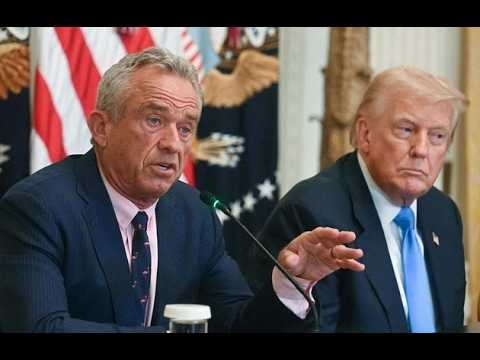
---
RWW 6 26
MULT VIDS
06/25/2026
by
Last week, right-wing broadcaster Mary Walter interviewed psychiatrist Carole Lieberman about her effort to convince the American Psychiatric Association to classify "Trump Derangement Syndrome" as an official illness and add it to the organization's Diagnostic and Statistical Manual of Mental Disorders.
"I put together a classification for mild, moderate, and severe TDS and I'm going to be bringing it into, walking it—literally walking it in—to the American Psychiatric Association very soon," Lieberman announced.
"Each level has approximately 8 to 10 symptoms and you have to have certain number in each category to be able to qualify," she explained. "For example, a mild case would include people who throw shoes at the television set when Trump comes on, or have a meltdown when they hear a song that is associated with Trump, like YMCA. The moderates—and there are many more symptoms, I can't really get into all of them—but for moderates, TDS has taken over more of their lives. And for severe, it's even at a higher level."
Lieberman claimed that people like Rosie O'Donnell, Mary Trump, Jimmy Kimmel, "would-be assassins," and "people who attack Teslas because of Elon Musk" would be classified as having "severe TDS" and therefore require psychotherapy so they can "work on the problems in them that make them hate Trump."
"For men, it has to do with men who have low self-esteem and they are envious of Trump because Trump has the stereotypically all the things that a man—an alpha male—would and should have," Lieberman said. "He has a great education, Ivy League education. He was successful before he became president. He's become president two times. He has a gorgeous wife. He has a wonderful family. All of these things that these men who have low self-esteem either don't have or don't have enough of or don't feel like they'll ever have. So somehow Trump is to blame for their not having these things."
"The women who have TDS are women who have problems with men, starting with the pussy hats," she continued. "So you would work with them to help them; Trump would be the man, like the worst man, the man that they would imagine it would be worse to be married to, because he's an alpha male and because that's what they can't deal with. So you would work with them to try to get them to not have so much hatred towards men, perhaps have good relationships with men. And so you're really not working on the [hatred toward Trump] because if you get into a conversation about like, 'Why do you hate Trump?' They tell you, 'Well, he does this, and this, and this.' It's not about that. Whatever they would say, whatever executive orders they might say, or whatever political thing or sociological thing, whatever they would say that he did that is bad; it's not really about that. It's about their feelings towards him as a man."

On Tuesday, Walter appeared on "The Todd Starnes Show" where, in addition to declaring that liberals are "usually ugly," she claimed that Lieberman is also working to convince Department of Health and Human Services Secretary Robert Kennedy Jr. to make TDS a "diagnosable mental illness."
"[Lieberman] is actually helping with classifying TDS as an official diagnosable disease," Walter stated. "HHS Secretary Kennedy is working on doing this to make it a diagnosable mental illness."
"These people are mentally ill," Walter continued. "What do we do with these people? Can we fill up some empty malls in Jersey with them? Like instead of insane asylums, we get like a little mental health hospital going on and we just fill up the old Claire's and the old Bed, Bath and Beyonds and we put beds in there and we house people who are infected with the woke mind virus."
"I love this idea," replied Starnes. "Honestly, because these people, they need to be in some sort of a hospital, some sort of a home. They need professional help is what they need."
"Yes, 100 percent. Exactly," Walter agreed. "That's what Secretary Kennedy is trying to do. They're looking into doing this. And this woman [Lieberman] actually helped form the three levels of TDS and what the signs and symptoms are, what it constitutes. It's all very scientific. We joke about it, but it's actually really scientific."
---
an 5 26
---
---
How to get a Trump pardon: Forget the DOJ, call “Bobby” and other influencers
A Reuters investigation found nearly all the clemency decisions made by President Trump during his current term flouted longstanding Justice Department guidelines. In place of traditional rules, the White House relies on a network of influential advocates espousing pardons based on partisan, personal criteria.
By Marisa Taylor, Chris Prentice, Kaylee Kang and Allison Martell
June 11, 20263:50 AM PDTUpdated June 11, 2026
WASHINGTON - Days before granting him a pardon in March of last year, President Donald Trump phoned Trevor Milton, an electric-vehicle entrepreneur and Republican donor who was convicted of defrauding investors of more than $660 million.
The president, according to previously unreported details of the conversation reviewed by Reuters, told Milton that high-profile advisors convinced Trump that Milton had been unfairly prosecuted by the Justice Department of President Joe Biden. Among those who put in a good word, Trump said, was U.S. health secretary Robert F. Kennedy Jr.
Milton’s treatment was unjust, Trump said, and similar to his own targeting by federal investigators around the same time. “You had a lot of support,” Trump told Milton. “Bobby Kennedy. You have to call Bobby and thank him.”
In an emailed statement, Milton didn’t answer questions from Reuters about the exchange with the president or any support he received from Kennedy or others. The Department of Health and Human Services, where Kennedy is serving as secretary, didn’t respond to requests for comment on this report.
Trump’s reference to “Bobby” is emblematic of how the president has upended the pardon process in his second administration, discarding over a century of protocol overseen by the Justice Department, or DOJ. Today, winning a pardon or other grant of presidential clemency routinely hinges upon an informal and highly personalized network of influencers and advocates appealing to Trump himself, according to a Reuters analysis of pardon, lobbying, and electoral records, as well as interviews with over 80 people familiar with clemency decisions during the president’s current term.
Pardon applicants once had to comply with longstanding DOJ guidelines, such as a five-year wait after conviction or demonstrated remorse for their crimes. Reuters’ analysis shows that under Trump, clemency now is far more dependent upon access to his inner circle. That access, Reuters found, is enhanced when an applicant can craft a narrative that resonates with the president’s own sense of victimization, a sentiment he has regularly expressed since being indicted twice by federal prosecutors during his four years outside the White House.
Reuters reviewed thousands of records to document a cast of characters involved in pardons or commutations granted by Trump since he returned to the presidency. Using public databases and artificial intelligence to help search, compile and analyze the records, reporters identified many of the recipients, their advocates and Trump administration insiders involved in clemency for more than 1,700 people since January 2025. The review found:
- 96% of Trump’s second-term clemency grants have gone to recipients who didn’t fulfill longstanding DOJ guidelines for such requests. Past presidents on occasion have sidestepped those rules before. But fewer than 1% of those who received clemency during the Biden administration and just 14% of recipients in Trump’s first presidency failed to meet the guidelines.
- Reuters identified 290 advocates, or influencers, who publicly or privately helped secure clemency for 197 recipients. Because some of the advocates worked on behalf of multiple candidates, their efforts at times overlapped, representing 624 different acts of influence. Among the influencers, 73 helped secure more than one pardon or sentence commutation. Brett Tolman, a former U.S. attorney now in private practice in Utah, has been involved in at least 12 pardons or commutations. Roger Stone, a veteran political consultant and longtime Trump confidant, had a hand in at least five.
- Of the influencers identified by Reuters, at least 110 are known Trump allies. Eleven of those received clemency themselves from Trump during his first term. High-profile advocates and pardon recipients include Stone and Angela Stanton King, a conservative author and campaign advisor to Kennedy before he ditched his 2024 run for the presidency and backed Trump.
- Six people familiar with recent clemency acts said intermediaries with proven access to Trump’s entourage can charge as much as $2 million for their services. Reuters, however, couldn’t establish how much each advisor it identified had charged for help with a given pardon.
Stone and Stanton King each acknowledged to Reuters their role in advocating for pardon recipients. Stone said he received no money for his services; Stanton King declined to say how much she was paid. Tolman, the Utah attorney, didn’t respond to requests for comment.
“The constitutional authority to issue pardons and commutations rests solely with the president,” Abigail Jackson, a White House spokesperson, wrote in a statement. “The White House has a rigorous pardon review process which includes the White House counsel, the Department of Justice, and ultimately the president.”
The statement didn’t answer Reuters’ questions about the president’s call with Milton or the role of Kennedy or other specific administration officials in clemency decisions.
In a separate statement, a DOJ spokesperson wrote that it plays “a key role in assisting the president with exercising his constitutional authority.” The department continues “to make recommendations to the president that are consistent, unbiased, and uphold the rule of law. There has been no departure from this long-standing process.”
Trump’s new pardon protocols, and the privileged access that has come to define them, have sparked coverage in the media and uproar among legal experts, traditionalists at the DOJ, and victims of some of the pardoned offenders. Even some of Trump’s top aides, including Chief of Staff Susie Wiles, have pressed for a pause in clemency ahead of the midterm elections, fearing further criticism could harm Republican chances, according to three people familiar with discussions over the matter.
A White House official who declined to be identified disputed the assertion that Wiles has argued for a slowdown in pardons.
The Reuters review is the first to measure the scale of the influencer network and identify the repeat roles that some of these advocates are playing. Because most of the advocacy isn’t officially reported to government regulators, the news agency was unable to identify every single person involved in each act of clemency.
Roger Stone, a Trump confidant and pardon recipient himself during the president's first administration, is one of the high-profile influencers who has helped clemency seekers during the current term. REUTERS/Ken Cedeno
Reuters was also unable to determine the total amount of money, including attorney or consulting fees, involved in securing these high-profile influencers. Insiders say the value they provide is clear: “I have access, I have relationships,” Stanton King, the author and former Kennedy advisor, told Reuters. “Because of that, I’m in the perfect position to be able to advocate and make sure that someone’s name or application isn’t just sitting over somewhere in a pile getting dusty.”
In this new landscape, personal access to Trump or his confidants is more effective than traditional methods of wooing an administration. Reuters found only two successful pardon recipients who disclosed hiring registered lobbyists, a conventional path for courting influence, to work on their behalf, paying a combined $2.7 million. Another 26 people, lobbying records show, spent a total of nearly $1.9 million on lobbyists to no avail.
In her statement, the White House spokesperson wrote that “anyone spending money to lobby for pardons is foolishly wasting their money.”
Lobbyists must disclose in federal filings their persuasion efforts and what they do for the money. The hush-hush of informal influence is more difficult to track. One influencer, who asked not to be identified, has helped several clemency recipients through access to Trump’s confidants. The tactic “is a little bit like Game of Thrones – who’s in power, who’s important,” the person said. “We’ll say to a client, ‘tell us anybody you know in the political world. It could be your best friend’s cousin from elementary school.’”
That influencer was one of several who told Reuters their advocacy has included outreach to Trump family members including Donald Trump Jr., the president’s eldest son. The person declined to elaborate on those contacts. In a statement, Andy Surabian, a spokesperson for Trump Jr., said: “Don has not advocated for any pardons for anyone during his father’s second term.”
Some pardon recipients and their advocates have gained favor by making political donations or with help from well-funded partisans or political organizations. Although criticized by some ethics experts as a possible quid pro quo, it’s not a crime for a president to grant clemency to benefactors of their campaign or party, unless an explicit agreement to sell forgiveness exists.
According to Federal Election Commission records, 10 of the recipients, influencers and companies they ran – including Milton, the EV entrepreneur – donated a total of more than $10 million to Trump-related political coffers, both before and after clemency decisions. Others, including a Florida man convicted of stealing fishing gear used to trap sharks for research, benefitted when political interest groups espoused their causes.
Compared with the past, “there’s nothing other than money, praise, partisanship and relationships that dictates who gets pardons,” said Ty Cobb, a White House counsel during the first Trump administration who is now a private attorney in South Carolina.
Clemency Connections
Roger Stone
Political Consultant
Juan Orlando Hernandez
Former President of Honduras
Scott Howard Jenkins
Former Sheriff
Michele Fiore
Former Las Vegas City Councilwoman
Michael McMahon
Former NYPD Officer
Rod Blagojevich
Former Governor of Illinois
Stone’s advocacy has helped at least five people, including a former Virginia sheriff convicted of taking bribes, receive clemency from President Trump during his current term. Photos: REUTERS/Ricardo Arduengo, Andy Buchanan, Screenshot/Culpeper County Sheriff’s Office via Wayback Machine, Screenshot/City of Las Vegas via Wayback Machine, Brendan McDermid, Vincent Alban
“CREATE A STORY”
The pardon power, meant to correct injustices and allow for mercy from outside the judicial system, is entrusted to the president by the U.S. Constitution. It is broad in reach. Presidents can pardon, or forgive, any federal criminal conviction. They can commute sentences to shorter terms.
To formalize the process, and minimize any corruption associated with it, the DOJ began overseeing pardon recommendations in the late 19th century. Most presidents since have followed the department’s guidelines, but there have been exceptions.
Bill Clinton in 2001 notoriously pardoned Marc Rich, a billionaire commodities trader who fled the United States rather than face charges including tax evasion, after Rich’s associates made donations and advocated on his behalf. Joe Biden, just before leaving office, broke a public vow by pardoning his troubled son Hunter, who had recently been convicted on federal gun and tax charges.
Both former presidents have defended their clemency actions.
Starting his first day back in office, Trump outdid them all. He immediately granted clemency to the estimated 1,500 people who stormed the U.S. Capitol in 2021, none of whom would have qualified under DOJ guidelines. More than 200 other pardons and commutations have followed, including at least two pardons initiated by the White House before recipients had even sought one.
Can you create a story that is similar to what members of this administration, including the president, have gone through?
Sam Mangel, clemency consultant
Most of those subsequent recipients have employed what several people involved in the actions described as a “hybrid” process. The approach entails some combination of personal appeals, influential intermediaries, political donations, and a narrative of victimization by Biden-era prosecutors. It has enabled those who get the right access to leapfrog a line of other applicants. Liz Oyer, a former DOJ pardon attorney during the Biden administration and early in Trump’s current term, calculates the current backlog at about 20,000 applications.
Sam Mangel, a Florida clemency consultant, said he has worked on behalf of 10 successful recipients during this Trump term and is currently pressing for about 20 others. He described the process this way: “Can you create a story that is similar to what members of this administration, including the president, have gone through? Then, can you somehow get it into the hands of the White House counsel?”
Mangel declined to name his clients, but said he usually charges tens of thousands of dollars to advise them.
Milton, founder of Nikola, a failed electric vehicle manufacturer based in Arizona, was convicted in October 2022 of defrauding investors by promoting a business venture for products that didn’t work. Among other evidence cited by federal prosecutors, he famously filmed a promotional video of a truck rolling down a hill – but gravity, not electricity, was propelling it. When Trump re-entered the White House, Milton was out on bail, appealing his conviction and four-year prison sentence, and heavily courting the new president and his allies.
Trump last year pardoned Trevor Milton, shown here on his YouTube channel, following his conviction for defrauding investors in Nikola, a failed EV manufacturer, of more than $660 million. Screen capture via YouTube
In 2024, electoral records show, Milton contributed at least $1.84 million to campaigns supporting both Trump and Kennedy ahead of the presidential election. Reuters couldn’t ascertain when or where Milton and Kennedy may have first crossed paths. But Trump in his phone call to Milton in early 2025 made clear that Kennedy was a strong advocate.
Trump also spoke fondly about his own personal meeting with Milton and his family at an undisclosed place and time before the pardon. According to previously unreported details of the conversation, Trump said: “You made a great impression – your father, you and your wife.”
The president said he identified with Milton’s plight. “When I met you I said, ‘This man didn’t do anything wrong,’” Trump told Milton. He disparaged the federal prosecutors on the case. “I heard the scum that was after you was the same scum that was after everybody.”
After being pardoned, Milton expressed little of the remorse traditionally required of recipients. According to the DOJ guidelines: “A petitioner should be genuinely desirous of forgiveness rather than vindication.” In a social media post the day of his pardon, Milton wrote he was one of many Americans “railroaded by the government.” He added that “trust and confidence in the Justice Department has eroded to nothing.”
Milton, in a social media post the day of his pardon, showed little of the remorse traditionally required by Justice Department guidelines from recipients of pardons. Screenshot via X.com
In his statement to Reuters, Milton blamed a plot among the media, financial markets and federal prosecutors to “burn my company to the ground.” He said he was targeted because of his longstanding support for Trump. He offered no substantiation of those claims. “They came after me, my family, and everything I had built because of it.”
That sense of grievance is widely voiced among the president’s populist supporters. It’s a throughline for much of Trump’s mercy – from the Capitol riot clemency to the pardons he granted shortly thereafter for 24 activists convicted of interfering with abortion clinics. Then there was the pardon last November for Troy Lake, a truck shop owner in Wyoming.
Sentenced in 2024 to just over a year in prison, Lake had pled guilty to altering emissions controls on at least 344 diesel trucks. The tampering was a violation of the Clean Air Act, an environmental law long derided by conservatives. Lake’s sentence caused outcry among critics including Cynthia Lummis, a Republican senator from Wyoming. Last year, citing Lake’s case, Lummis sought to amend the act, arguing that Democrats and environmental regulators “wage war on rural America.”
Meanwhile, two military veterans, friends of Lake’s, petitioned Lee Zeldin, a retired Army Reserve lieutenant colonel and Trump’s administrator of the Environmental Protection Agency. “Please reach out to the President,” they wrote in an August email reviewed by Reuters, “to request a pardon, clemency, or commutation.”
EPA spokespeople didn’t respond to requests for comment.
Holly Lake, Troy’s wife, said Zeldin’s intervention proved crucial. “That’s when we started getting some movement,” she said in an interview. The movement included a phone call from Sean Hayes, a White House attorney, to discuss a pardon. Hayes is a central figure in any pardon process, according to several people familiar with the administration’s clemency efforts.
Lee Zeldin, administrator of the Environmental Protection Agency, and Robert F. Kennedy Jr., secretary of the Department of Health and Human Services, are among administration officials who have advocated for pardon recipients. The two cabinet members spoke earlier this year at a Washington event. REUTERS/Evelyn Hockstein
Reuters was unable to reach Hayes outside official White House channels for comment.
In addition to discussing her husband’s pardon, Holly Lake said, Hayes asked the couple whether they knew of other cases in which defendants had been targeted by overzealous prosecutors. They have since advocated for others prosecuted on similar charges involving emissions devices. In January, the DOJ said it would stop prosecuting such cases.
Lake, who served seven months of a yearlong sentence, told Reuters the president believes that regulatory agencies have gone too far. “They’re going rogue,” he said. “In his second term, he really realized how much is wrong out there.”
Some politically influential organizations have worked to bring cases to the White House’s attention. After Trump’s November 2024 election, the Cato Institute and the Reason Foundation, libertarian organizations dedicated to limiting the role of government, both highlighted the case of John R. Moore, Jr., a Florida boater and diver. Moore was convicted in 2022 of stealing fishing gear used to catch sharks by a company licensed to do so for research.
Moore and a colleague were fined and sentenced to probation for theft in federal waters. The men thought they were freeing the sharks from illegal capture, Moore told Reuters.
After the two libertarian organizations published opinion pieces criticizing the convictions, Jim Jordan, a Republican congressman from Ohio and Trump ally, highlighted the case in a May 2025 hearing of the U.S. House Judiciary Committee. Also at the hearing were a Cato researcher and Tolman, the former U.S. attorney who has been involved in at least 12 pardons. Michael Fox, the Cato researcher, told Reuters that Tolman, while not part of Moore’s defense team, helped draw attention to the case.
“I had no idea that anyone was working on my behalf,” Moore said in a telephone interview. “I’m still surprised that my case resonated.”
After the hearing, Hayes, the White House counsel, called Marc Seitles, Moore’s attorney, to discuss a pardon that Trump ultimately announced weeks later. “I was shocked,” Seitles said in an interview, noting he hadn’t even requested a pardon yet. “He asked, ‘Can you tell us the facts and circumstances of the case?’ And of course I took full advantage of that.”
As with Lake, the Wyoming truck mechanic, Seitles said Hayes asked if he knew of other cases of prosecutorial excess. Seitles said he has since made recommendations for others.
“PUT A KIND WORD IN”
Among the most effective advocates, Reuters’ review shows, are Trump associates who themselves have received clemency. The official the White House has dubbed its “pardon czar,” responsible for organizing clemency efforts, is Alice Marie Johnson. She was pardoned by Trump during his first term after serving more than two decades in prison on a conviction related to a cocaine conspiracy and money laundering. When Trump announced her appointment last year, he described her as “an inspiration” and told her “to find people just like you,” perceived to have been victimized by the courts.
Last year Trump appointed Alice Marie Johnson, a pardon recipient during his first term, as his "pardon czar," telling her to find others who had been unfairly treated by the courts. The two appeared here at a White House event in February. REUTERS/Kevin Lamarque
Another top advocate is Stone, the political consultant. At the end of his first administration, Trump pardoned Stone, who had been convicted in 2019 for obstructing a Congressional investigation regarding the 2016 presidential election. Stone’s connections have proven valuable for clemency seekers. Not only does he enjoy access to the White House, Stone also hosts a radio show on prominent conservative broadcasters, where he has championed some of the recipients’ causes.
In a text message exchange, Stone said he is motivated by justice, not remuneration. “I have not received a single penny,” he told Reuters. “I was moved by either prosecutorial overreach or misconduct, judicial bias, or political weaponization.” Reuters was unable to confirm his assertion.
Trump last year posted online about his pardon of Jenkins, the former Virginia sheriff convicted of accepting bribes. Jenkins, Trump wrote, was a victim of "Radical Left 'monsters.'" Screenshot via TruthSocial.com
One beneficiary is Scott Howard Jenkins, a former county sheriff in Virginia. Jenkins was convicted by a federal jury in December 2024 of accepting over $75,000 in bribes from area businesspeople in exchange for appointing them deputies. Despite vocal opposition from Virginia public officials, Stone was among several advocates who urged the administration to pardon Jenkins, an outspoken Trump supporter.
In May 2025, as Jenkins prepared to surrender for a 10-year prison sentence, Trump pardoned him. In a post online, the president said Jenkins had been “persecuted by the Radical Left ‘monsters.’” Jenkins appeared on the day of the pardon on Stone’s show. “All of you who have put a kind word in and did the work you did to communicate with the White House,” Jenkins said, “I’m forever indebted.”
Absent from Trump’s clemency: three others who cooperated with the Federal Bureau of Investigation and pled guilty to paying Jenkins the bribes. Stone, by text message, said he didn’t speak up for the others because he found their testimony flawed and characteristic of the “politically motivated” trial.
In one case, prominent connections enabled a longtime Democratic operative to receive clemency. Carlos Watson and Ozy Media, his California-based media company, along with co-conspirators were found in 2024 to have defrauded investors of more than $60 million by lying about business deals with Google and Oprah Winfrey. Watson, who is African American, argued at his sentencing that prosecutors unfairly targeted him because of his race, that his conviction was “a modern lynching.”
Watson didn’t respond to Reuters’ requests for comment.
An attorney for Carlos Watson, a media entrepreneur convicted of defrauding investors, reached out to influential contacts who helped secure clemency from Trump last year. Watson is pictured here in 2023. REUTERS/David Dee Delgado
With Trump’s return to office, Watson’s attorney, Arthur Aidala, turned to friends in high places, according to three people familiar with the process. Based in the president’s native city of New York, Aidala had represented figures including Rudy Giuliani, the former New York mayor and Trump attorney, and Steve Bannon, the populist ideologue and White House strategist during the first Trump administration. Both men, accused separately of federal crimes, are themselves among Trump’s pardon recipients.
The people familiar with the process told Reuters that Bannon knew Watson before his conviction and spoke to his family about the clemency bid. Bannon told them they could use him as a reference, these people said.
Bannon in a telephone call confirmed the interaction, but declined to elaborate. Neither Aidala nor Giuliani responded to requests for comment.
Related Content
Also involved: Stanton King , the former Kennedy advisor and conservative author based in Atlanta. She received a Trump pardon in 2020, years after serving a sentence related to car thefts. Stanton King told Reuters she became a “serious advocate” for Watson after someone “inside the same circles” asked for her help.
“I was one of many advocates,” she wrote in an email.
Some longtime acquaintances of the president said they have adapted to Trump’s new avenues for clemency. Peter Ticktin, a South Florida lawyer, has known Trump since 1961 and represented him in an unsuccessful lawsuit against Hillary Clinton in 2022. Ticktin said he visited the president at Mar-a-Lago, his Florida resort, earlier this year, carrying a list of a dozen petitioners who have enlisted him to help seek pardons.
When he mentioned the list to Trump, Ticktin said, the president advised him to use an untraditional path and hand it to nearby Secret Service agents guarding the U.S. leader. “That’s the protocol,” Ticktin said he was told, for security reasons. The White House didn’t address questions about the Secret Service’s role or approaches from pardon seekers to the president at Mar-a-Lago.
“All I wanted,” Ticktin added, was to “ask that these people be looked at as soon as possible.”
Similar requests are pending from Mangel, the Florida consultant who advises clients to “create a story” that will resonate with the president. One of the many new candidates Mangel is considering advocating for is himself.
Convicted of insurance fraud violations a decade ago, Mangel served nearly two years in federal prison and then rebuilt his life advising defendants. Although his crime and sentence are behind him, Mangel says a pardon would allow him to travel abroad more easily.
“In our society, there will always be avenues to try to accomplish something in a more expeditious way,” he said of clemency under Trump. “Life is not fair.”
How Reuters documented the cast of influencers transforming the pardon process under Trump
Reuters set out to build a dataset that described relationships between pardon and clemency recipients, their advocates, and members of the Trump administration. Our starting point was the list of pardons and clemency actions on the Justice Department website. But that information isn’t always complete: The recipients of Trump’s mass pardon of January 6 rioters were not individually listed by name.
Reporters prepared notes based on their reporting and research. Data reporters used computer code to prompt an AI system to convert that text to data describing people, organizations and their relationships and interactions.
We also used AI to search each recipient online and return more data in the same format. We added public data from federal lobbying disclosures, converted to the same format.
The exercise produced 650 relationships for reporters to review. Each involved a pardon recipient, a possible advocate and notes on what the advocate may have done to make pardon or clemency more likely.
Reporters worked through this list, verifying every relationship with dozens of interviews or public records, and adding more relationships. We conducted further analysis of political contribution data and lobbying records. This vetted and expanded data is the basis of our finding: We identified 290 influencers who advocated 624 times in 197 successful bids for clemency.
Our count is incomplete, and more likely to capture actions that generate public records, like registered lobbying and campaign contributions. It undoubtedly misses some of the backchannel conversations that our reporting shows are so important to Trump’s pardon process.
The Reuters Inside Track newsletter is your essential guide during the World Cup. Sign up here.
Additional reporting by Ned Parker and Lawrence Delevingne. Design: John Emerson. Edited by Paulo Prada and Jaimi Dowdell
---
---
AN 5 26
A top spokesman for the Department of Health and Human Services is the latest Trump official to quit the administration in response to a new policy push that is poised to expose children to higher risks of lung disease and cancer.
On Wednesday, the New York Times reported that Rich Danker, the chief spokesman for HHS Secretary Robert F. Kennedy Jr., had submitted a letter to President Donald Trump announcing his resignation. He specifically cited the administration's recent pivot to supporting new rules that would "allow major tobacco companies to begin selling flavored vapes that appeal to children." Danker is the second high-profile departure this decision has caused, coming just one day after the resignation of Food and Drug Administration head Marty Makary.
In the letter, which the Times obtained a copy of, Danker took pains to stress that he was not directly blaming the president for this new vape policy, and praised him for supposedly having "twice restored our prosperity and national security against all odds," and citing various unnamed "senior HHS officials" as being behind it. Nevertheless, he "warned" Trump about the dangers to children that this new policy would create.
"Senior H.H.S. officials in the immediate office of the secretary have in recent months sought U.S. Food and Drug Administration marketing approval of e-cigarette flavors that would appeal to children and expose them to nicotine addiction, lung damage and higher risk of cancer," Danker wrote.
The new policy from HHS, posted last week, claimed that it will aim to "remove illicit e-cigarettes from the market," while allowing those that "already crossed hurdles toward agency approval" to be sold. Makary reportedly resigned after his attempts to overrule the flavored vapes policy were overruled. Despite Danker opting not to pin any blame on Trump, the Times reported that he "was personally involved advancing it."
"Mr. Danker’s resignation comes at a particularly fraught time for the Department of Health and Human Services," the Times explained. "With Dr. Makary’s resignation on Tuesday, the department now has three major vacancies. The positions of surgeon general and director of the Centers for Disease Control and Prevention are also unfilled. As the assistant secretary for public affairs for the Department of Health and Human Services, Mr. Danker was responsible for coordinating the department’s outward communications. He was in Los Angeles on Wednesday, where Mr. Kennedy is speaking at a conference on the possible link between diet and cancer."
The resignation is also the latest sign of the deteriorating relationship between Trump and Kennedy's "Make America Healthy Again" movement, which has been credited with helping him get reelected in 2024. Since returning to the White House, Trump has disappointed MAHA adherents with his lack of progress on implementing anti-vaccine policies that they favor, as well as his support for loosening regulations on pesticides. Sources within the administration are reportedly unconcerned about losing MAHA support, viewing their influence as insignificant.
---
AN 5 26
Nobel laureate Paul Krugman calls right-wing politics “deadly” — and predicts that “MAGA Will Kill Many Americans,” by the thousands, driven by greed and willful ignorance.
Krugman goes one step further, arguing outright that this is not by accident:
“Does MAGA want to see thousands of Americans die prematurely from smoking and refusal to get vaccinated? Yes,” he writes.
He argues that the right’s decades-long opposition to health care is driven by greed, especially from “wealthy donors unwilling to pay taxes to help others in need.”
Krugman points to Tuesday’s decision by Trump’s FDA to allow blueberry and mango-flavored vapes, which critics warn will increase use among the young.
Why?
“Trump is reportedly hoping that support for vaping will win back support from young men,” Krugman writes — a constituency the president has been losing during his second term in office.
There’s also the recent decision, again by Trump’s FDA, to block the release of studies finding the COVID-19 and shingles vaccines safe, with side effects rare.
“Beyond this,” he continues, “right-wing politics in America often goes hand in hand with hostility to science in general and medical science in particular. The deadly linkage between reactionary politics and rejection of science was obvious during the Covid pandemic.”
Krugman also implicates greed in the anti-vaccine movement, saying that “quack medicine is big business.”
“Right-wing radio and social media have long relied on peddlers of snake oil for a large part of their revenue. So much of the attack on medical science can be seen as financially motivated,” he writes.
Ideological willful ignorance plays a part as well — driven by the alliance between oligarchs and white Christian nationalism, the latter of which is “deeply hostile to Enlightenment values, modern science very much included.”
To prove his point, Krugman points to the widely-reported resurgence of measles, that was seen as eliminated from the United States decades ago, thanks to vaccines. Now, many parents are choosing to forego vaccinating their children against this highly contagious and potentially deadly disease.
He adds to that the refusal of many red states to expand Medicaid, a program largely paid for by the federal government under the Affordable Care Act.
The data bear him out. Life expectancy in “Trump-leaning” states trails blue states significantly.
There’s “a strong, clear negative correlation between Trump-leaning orientation and low life expectancy at the state level,” Krugman writes. “Deep red states like Alabama and West Virginia have life expectancy comparable to, say, Kazakhstan.”
---
---
mma
SHAWN RYAN CRITICIZES HHS SEC RFK JR OVER IMMUNITY FOR PESTICIDE COMPANIES: "HOW THE FUCK IS THAT MAKING AMERICA HEALTHY AGAIN?"
05/04/26
https://www.mediamatters.org/robert-f-kennedy-rfk-jr/shawn-ryan-criticizes-hhs-sec-rfk-jr-over-immunity-pesticide-companies-how)
---
new rep The New Republic
For an uncomfortably long time on Monday, two lawmakers shouted at one another about climate change in a House Appropriations subcommittee hearing about the Trump administration’s proposed budget for the Environmental Protection Agency. One was EPA Administrator Lee Zeldin. The other was 83-year-old Congresswoman Rosa DeLauro, a Democrat from Connecticut. The spat did what Zeldin seemingly hoped it would: generate a viral moment for his boss and his boss’s base. It also helpfully distracted attention away from the ostensible purpose of the hearing: to discuss why Zeldin and the Trump administration want to cut in half the budget of the agency charged with protecting the country’s air and water.
It makes sense that Zeldin was eager to evade substantive questions about an EPA tenure spent giving generous giveaways to polluters, dismantling independent research, and hemorrhaging staff. He also didn’t talk too much about the White House’s plan to slash the EPA’s budget down to just $4.2 billion. Zeldin’s record, that is, has already earned the ire of Make American Healthy Again activists. This is an especially volatile week to court more of it. The Supreme Court and Congress are both hearing arguments this week about glyphosate—the active ingredient in the weedkiller Roundup, produced by the German chemicals giant Bayer AG. Several scientific studies have linked glyphosate to cancer, and it’s accordingly one of the MAHA movement’s least favorite substances.
No doubt Zeldin would rather be seen going toe-to-toe with an octogenarian than being confronted with the fact that his agency got a personal thank-you from Bayer for its work on glyphosate. Unfortunately for Zeldin, that confrontation was captured on camera too.
It would be easy for that to get lost in the news this week, or even in the flurry of glyphosate-related news. The Supreme Court is hearing oral argument in a case that could grant Bayer blanket immunity from being sued over glyphosate, and let the company off the hook for tens of thousands of dollars’ worth of lawsuits that claim Roundup caused non-Hodgkin lymphoma. The House is also due to take up this year’s Farm Bill, which currently includes a provision that would likewise bar states and courts from penalizing or holding “liable any entity for failing to comply with requirements that would require labeling or packaging that is in addition to or different from the labeling or packaging approved by the Administrator of the Environmental Protection Agency.”
:{:{Glyphosate has become an understandable cause célèbre for MAHA, and its advocates are rallying in Washington this week. For months now, they’ve been railing against Zeldin and other Republicans for awarding top positions and regulatory concessions to some of the country’s biggest polluters. At the end of March, some three dozen MAHA leaders sent a tensely worded letter to Zeldin chastising the EPA for continuing to “approve, expand, and normalize chemical exposures that directly undermine that goal, driven by the chemical industry lobbyists who occupy senior leadership positions at the agency.”}:
The group went on to state several specific demands to enact a “real MAHA agenda” at the EPA, largely focused on controlling harmful pesticides and microplastics. Even if MAHA’s beliefs and electoral potency remain up for debate, Republicans are certainly responsive to their concerns. This week’s dispute over glyphosate could spark the biggest showdown yet in an emerging MAGA-MAHA split.}:
The Trump administration has enthusiastically supported Bayer’s case not just for legal immunity but to produce and distribute even more glyphosate and phosphorous—two Bayer-made products. Trump signed an executive order in February invoking the Korean War–era Defense Production Act to deem their manufacturing “critical to the national defense.” The order also protects companies that make glyphosate and phosphorus from lawsuits related to materials or products produced in accordance with the act, i.e., glyphosate and phosphorous. Trump’s Justice Department has enthusiastically supported Bayer in its case before the Supreme Court—and received a crucial assist from Zeldin’s EPA.
Asked about this issue on Tuesday afternoon, Zeldin was considerably more subdued than he was when bickering with DeLauro. In her line of questioning, toward the end of the hearing, New York Congresswoman Alexandria Ocasio-Cortez drilled Zeldin over his agency’s communications with Bayer.
“Administrator Zeldin,” she asked, “have you ever participated in a meeting with Bayer where you discussed the legal or litigation issues that the company was facing?” Zeldin stated that he had only had a “brief meet and greet, and that topic did not come up.”
Again, Ocasio-Cortez asked whether the EPA had discussed the issue with Bayer. Zeldin doubled down. “I’m telling you 100 percent absolutely. Maybe there was some brainstorming that was done beforehand of potential topics, but that topic was not brought up.”
:{:{She then presented an internal EPA email from last June, obtained by the Center for Biological Diversity via the Freedom of Information Act. The email shows Zeldin’s senior adviser for agriculture and rural affairs—Henry Turner Bridgforth—discussing his conversation with Bayer in advance of the company’s June 17 meeting with senior agency officials. “After talking with Bayer’s team,” Bridgforth tells some of Zeldin’s top aides, including EPA general counsel Sean Donahue, “they are going to bring up some legal/judicial issues.”}:
Among the list of “Discussion Topics” included in Bridgforth’s subsequent memo was “Glyphosate: Bayer will want an update on EPA reg review, as well as give some updates of their own.” Another discussion item is “Supreme Court Action: Bayer will give an update to the Administrator on where they stand in litigation and labeling options.” The final discussion included in the memo is “Thanks: Bayer will provide a small thanks for updating the glyphosate web page and work on MAHA.”}:
The Center for Biological Diversity noted back in March, the EPA only updated its glyphosate web page once during that time, in May 2025. The change reflected the agency’s decision to withdraw its 2022 letter stating that California could require language on pesticide labels for products containing glyphosate—warning of cancer risk—so long as those labels also stated that the EPA did not agree with that conclusion. The Biden administration’s stance revised a Trump 1.0-era crackdown targeting California’s decision to label glyphosate as “probably carcinogenic to humans,” in line with the findings of the World Health Organization’s International Agency on the Research for Cancer, or IARC.
:{:{As Ocasio-Cortez pointed out while questioning Zeldin, Bayer’s argument to the Supreme Court relies heavily on the fact that—because these sorts of state-level warnings are now prohibited—the federal government’s assessment that Roundup is safe should insulate it from lawsuits over its failure to disclose that product’s cancer risk.}:
Essentially, Bayer is arguing that glyphosate is legally safe because the EPA said it was in 2020. And because disclosures about those risks no longer exist, Bayer argues that it can’t be sued for having failed to disclose cancer risks under state laws nullified by the EPA. Trump’s solicitor general filed a brief last December supporting Bayer’s position that federal law preempts states from adding warnings on pesticide labels beyond those established by the EPA. The solicitor general filed another in March further stating its support for that position. That second brief is supported by EPA general counsel Sean Donahue, who Bridgforth requested to attend the meeting with Bayer.}:
In response to Ocasio-Cortez’s questioning, Zeldin stumbled over a few words about an ongoing EPA assessment of glyphosate before being asked to respond in writing. The EPA has until October 1 to complete its review of glyphosate, which theoretically could conclude that it causes cancer. By that time, as Bayer is certainly aware, Congress already may have passed the Farm Bill’s protections for glyphosate and SCOTUS may have decided to grant Bayer blanket legal immunity.
If gripes about glyphosate were coming just from environmentalists (or cancer patients), then Zeldin might have an easier time brushing them off. But Republicans seem genuinely alarmed by the prospect that the MAHA base that was on their side when it came to vaccines could turn against the party’s deregulatory agenda. MAHA leaders’ letter to Zeldin from March spelled out several demands, largely focused on controlling harmful pesticides and microplastics: conducting an emergency review of pesticides banned elsewhere, closing loopholes for pesticides registration, shutting the “revolving door” between the EPA and polluting industries, protecting people from microplastics in drinking water, and enacting “a moratorium on permitting for new plastic production facilities and expansions of existing facilities.”
To meet these demands would undoubtedly enrage petrochemical companies and lobbyists that have been loyal Republican donors. In the 2024 election cycle, nearly 70 percent of campaign contributions from the American Chemistry Council, an industry lobby group, went to Republicans. Counting only contributions to political action committees, or PACs, that cycle, the split is even more dramatic: 77 percent of the ACC’s PAC donations went to Republican-aligned PACs.
This tension has yielded some awkward posturing from Zeldin and other officials eager to keep both MAHA and polluters happy. The EPA, for instance, recently broadcast plans to allegedly “unmake” plastic waste by supporting questionable technology known as “advanced recycling,” which uses chemicals to break down certain types of plastics. Typically, that happens through a process called pyrolysis. Petrochemical producers and lobby groups have advertised these expensive, polluting methods as preferable alternatives to policies that might actually force them to limit the production of plastics—a vanishingly small percentage of which (less than 10 percent) has ever been recycled. As ProPublica has reported, no more than 10 percent of plastics produced using pyrolysis are actually recycled.
Such oil-intensive processes have been found to release carcinogens, such as benzene and dioxins, into the atmosphere. Advanced recycling facilities have traditionally been regulated as incinerators under the Clean Air Act. Undergirding the EPA’s promotion of advanced recycling is a change long pushed by the American Chemistry Council that would instead regulate advanced recycling facilities as “manufacturing.” The change would mean that those facilities would have to account for fewer pollutants. And as the Natural Resources Defense Council’s John Walke told ABC News, the process by which the EPA is going about this could amount to an “immediate deregulation” of these facilities, “leaving a gap where no federal emissions standards would apply.”
Earlier this month, Zeldin and Kennedy announced “landmark, coordinated actions to address microplastics contamination.” In reality, they placed microplastics on a list of substances (the Contaminate Candidate List) that might eventually be considered contaminants, and then might at some point be regulated. Often, however, substances that end up on this list are never regulated. “This is the first step in a process that almost always leads to not regulating,” Suzanne Novak—a senior attorney and director of drinking water advocacy at Earthjustice—told Inside Climate News.
The alliance between MAHA types and the GOP has always been strange. Why did MAHA think its priorities could be defended by a party that has never exactly been shy about its loyalty to the corporate polluters? Whether or not MAHA supporters break up with the party—and whether or not those votes actually end up mattering—Lee Zeldin’s EPA has given them plenty to be angry about.
Kate Aronoff is a staff writer at The New Republic. She is the author of Overheated: How Capitalism Broke the Planet—and How We Fight Back and co-author of A Planet to Win: Why We Need a Green New Deal. Kate is also a fellow at the Roosevelt Institute, and serves in Dissent’s editorial board.
Read More:
Climate, Lee Zeldin, Environmental Protection Agency, MAHA, Glyphosate, Supreme Court
---
===
AN 5 26
President Donald Trump’s choice to lead America’s Food and Drug Administration (FDA) is Dr. Marty Makary, a surgeon who gained international attention during the COVID-19 pandemic for his opposition to vaccine mandates. On paper, Makary seems like a great choice for the job, but a conservative newspaper is reporting “soap opera”-level drama associated with his tenure.
“Has any Trump administration official caused more political headaches for the president than Marty Makary?” wrote Allysia Finley of The Wall Street Journal on Sunday. “His Food and Drug Administration has turned into a soap opera, with real lives hanging in the balance.”
To illustrate this point, Finley described how "in public interviews, [Makary] boasts about accelerating access to gene therapies and rare-disease drugs, even as he and his deputies block them." Describing Makary as “slicker than a pharmaceutical salesman,” the Journal reporter observed that “my sources say that patience with Dr. Makary is wearing thin among Republicans in Congress and White House officials."
Since taking office, Makary has rejected rare-disease and cancer drugs, a gene therapy for Huntington’s Disease and various other medicines that had demonstrably improved or even saved lives. He has also been accused of allowing conflicts of interest to override his detached clinical judgment.
“Members of Congress are also investigating whistleblower complaints of retaliation by agency leadership against FDA staff who have recommended approvals of drugs with which Dr. Makary and his left-hand man, Vinay Prasad, disagreed,” Finley reported. “Dr. Prasad is a Bernie Sanders acolyte whom the commissioner tapped to lead the FDA’s biologics and gene-therapy division.”
Finley also quoted a Republican, Sen. Ron Johnson of Wisconsin, as saying that “the stories are so outrageous. It just appears that they're looking for excuses to say no." Johnson also reported rumors that the FDA has kept a “blacklist” of companies that “make too much noise.”
Finely concluded, "It's time for Mr. Trump to pull the plug on the Makary show."
Although not mentioned in her editorial, the FDA is also under fire for seeming to pull back from its responsibilities to protect food. Under Makary’s tenure, the FDA announced it would no longer engage in routine food inspections, describing that job as superfluous and instead arguing federal inspectors should offload all of those responsibilities to local authorities.
"There's so much work to go around. And us duplicating their work just doesn't make sense," a former FDA official explained to CBS News at the time.
The FDA has also been criticized for incorrectly saying that COVID vaccines have caused child deaths, a policy that Dr. Celine Grounder of KFF Health News denounced for allegedly endangering the public.
“What is unfolding inside the FDA is not a narrow dispute over covid vaccines,” Grounder argued. “It is an attempt, according to critics and vaccine scientists, to rewrite the rules governing the entire U.S. vaccine system — how risks are weighed, how benefits are proved, and how quickly lifesaving shots reach the public.”
Grounder concluded, “Former agency leaders warn that if these changes take hold, the consequences could be lasting: fewer vaccines, slower updates, weakened public trust, and more preventable outbreaks.”
---
---
an 4 26
This Monday, April 27, the U.S. Supreme Court is hearing oral arguments in Monsanto Company v. Durnell. At issue in the case, according to SCOTUSblog, is "whether the Federal Insecticide, Fungicide, and Rodenticide Act preempts a label-based failure-to-warn claim where" the Environmental Protection Agency (EPA) "has not required the warning."
The Monsanto in Monsanto Company v. Durnell is the Bayer-owned company Monsanto.
Carey Gillam, author of the 2018 book, "Whitewash: The Story of a Weed Killer, Cancer and the Corruption of Science," examines the case in an article published by The Guardian on April 27.
"The case centers on glyphosate, a weedkilling chemical used in the popular Roundup brand and numerous other herbicide products," Gillam explains. "The chemical has been scientifically linked to cancer in multiple studies, and was classified a probable human carcinogen by an arm of the World Health Organization in 2015. Monsanto, the company that introduced glyphosate to the world in the 1970s and is now a part of the German conglomerate Bayer, has spent the last decade fighting more than 100,000 lawsuits claiming it failed to warn customers of cancer risks."
Gillam continues, "While maintaining that its products don't cause cancer, Monsanto is asking the Supreme Court to rule that under the Federal Insecticide, Fungicide, and Rodenticide Act (FIFRA), it cannot be held liable for failing to warn of a cancer risk if the Environmental Protection Agency (EPA) has not found such a risk exists and not required such a warning. The EPA's position is that glyphosate is 'unlikely' to be carcinogenic."
Gillam notes that Bayer believes a ruling favorable to Monsanto in the case will put an end to the lawsuits, while Jim Jones — who served in the EPA under former President Barack Obama — filed an amicus brief against Monsanto.
Environmentalist Vani Hari agrees with Jones' position.
Hari told The Guardian, "The Trump administration should know that siding with Bayer over American families is a losing position. People expect leadership that puts their health first, not policies that protect corporations from being held responsible."
---
---
MAHA
Vanie Deva Hari (a.k.a. The Food Babe) (born 1979) is blogger, former banking executive and food and Democratic party political activist who publishes the food blog “Food Babe” from her home in Charlotte, North Carolina.
---
MMA
---
ZEN HONEYCUT
We Uncovered A Conspiracy To Poison Your Food
Fundraiser
More Perfect Union
3.31M subscribers
527,745 views Mar 20, 2026
Four former chemical lobbyists control America’s pesticide regulations, letting pesticide companies pump the country full of toxins. For every 1 meeting with an environmental group, the EPA met 25x with corporate interests. We revealed the corporate lobby poisoning America:
---
---
mma
Backlash from MAHA influencers and right-leaning podcasters over glyphosate is loud, but they still stop short of breaking with Trump
Despite calling the policy an “F-you to the MAHA movement,” influencers are maintaining alignment with Trump and RFK Jr.
Special ProgramsClimate & Energy
Written by Evlondo Cooper
Research contributions from Ilana Berger, Noah Dowe & Alex Kaplan
Published 03/30/26
Backlash from “Make America Healthy Again” influencers and right-leaning podcasters over the Trump administration’s February 18 executive order boosting domestic glyphosate production — the herbicide used in Roundup and widely identified by scientists as a carcinogen — has been loud and, at times, profane. But even when the policy is described as a betrayal, criticism is rarely directed at President Donald Trump or Health and Human Services Secretary Robert F. Kennedy Jr., instead being redirected in ways that preserve alignment with the administration.
During the March 23 episode of *The Shawn Ryan Show*, right-leaning podcast host Shawn Ryan expressed deep frustration with the executive order, saying, “Thank you, Trump. Thank you, RFK. Good fucking job. Way to fucking stick to your constituents.”
“Every fucking thing that came out of these guys' mouth is a fucking lie,” Ryan continued. “It makes me think, what is the fucking point of voting?”
He reiterated his frustration during the March 26 episode, questioning the administration's national security rationale for the order.
Ryan's anger stands out because he directly assigns responsibility to Trump and Kennedy for the administration's actions on glyphosate. But across the Make America Healthy Again movement, backlash to the order has largely followed a different pattern: Among right-leaning influencers and podcasters, criticism is severe, but responsibility is redirected away from Trump and Kennedy.
This dynamic isn’t new. MAHA influencers have repeatedly expressed outrage over the administration’s pesticide policy while failing to hold Trump or Kennedy accountable. Moms Across America founder Zen Honeycutt called the order “an egregious offense” and “a betrayal,” while adding that “Bobby is not in charge of Trump.” Food activist Vani Hari described “a level of anger and frustration like I’ve never witnessed before,” but noted, “Secretary Kennedy has done everything he said he’s going to do.” In February, podcaster Joe Rogan complained about glyphosate’s harms without directly referencing the administration's role in expanding its use.
The pattern became especially clear across multiple shows more recently. During the March 19 episode of *Critically Thinking with Dr. T and Dr. P*, Honeycutt said Trump’s glyphosate executive order “made me sick to my stomach,” called it “outrageous,” and said it was “an F-you to the MAHA movement.” But even as she condemned the policy, Honeycutt framed it as the product of pressure on Trump rather than a decision he owns. She pointed to chemical companies and people in his orbit, suggested he had been influenced or coerced, and ultimately returned to a message about consumer pressure and farmers choosing not to use glyphosate.
aha // DEEP STATE BS?
The same pattern reappeared on Rogan’s podcast that week. During the March 19 episode of *The Joe Rogan Experience*, Rogan acknowledged that “Trump passed an executive order” blocking efforts to restrict glyphosate use, but did not directly criticize him. Instead, he returned to familiar warnings about glyphosate, suggesting long-term exposure “can’t be good.”
During a March 20 appearance on *American Thought Leaders*, actor and MAHA supporter Rob Schneider criticized the administration’s move on glyphosate more directly. He said he was “very much angry” about the policy and accused the administration of giving Bayer protection for a “known cancer-causing agent.” But Schneider did not treat that anger as reason to break with Trump. Instead, he pointed to “captured agencies,” corporate influence, and a political system shaped by corporate power, while also describing himself as “a big fan of this administration.”
Across most of these examples, the criticism is severe, but responsibility is displaced, preserving alignment despite direct policy conflict. The policy can be described as dangerous — or even a “betrayal” — but the decision is attributed to external pressure, institutional capture, or surrounding actors rather than Trump himself.
The result is a movement willing to call the policy a betrayal without fully treating it as one
//
03/26/26 2:23 PM EDT
03/23/26 5:00 PM EDT
03/16/2
---
---
huh? mma
3 26
---
SUED FOR FIRING VAX EXPERTS
1K MEASLES N CARO? BRING IN EXPERT NOT CDC? 2 26
---
AN 3 26
Raw milk sold by RFK Jr. supporter emerges as possible source of e. coli outbreak - Alternet.org
---
mma vid]
March 4, 2026, edition of MAHA Action's MAHA Media Hub, streamed on YouTube
TONY LYONS (MAHA ACTION PRESIDENT): Secretary Kennedy, as always, has our back. He has everyone's back and the administration is putting hundreds of millions of dollars towards digging us out of the glyphosate hole. But we have to remember that our voices transcend policies. We also have to remember that there are going to be setbacks, but that we have the opportunity to reverse 50 years of corruption in the next three years if we can stick together and stay focused. Secretary Kennedy said it best when he told the Austin audience, “I recognize that it would give me actual real power to make these kinds of changes, to push for these kinds of changes. For the last year, President Trump has let me go up against big pharma, big food, big insurance, big hospitals, and all of those other untouchables.” So we're moving forward, but these are very tough battles. And we, as the MAHA movement, won't ever give up.
Now we have to take the fight to the Supreme Court. Justices will soon hear arguments in Monsanto vs. Durnell. John Durnell is the man who developed non-Hodgkin's lymphoma after using Roundup for 20 years. And this has been true of so many others. And a jury of his peers found Monsanto liable.
So it's vital that we make our voices heard to the court. If Bayer Monsanto gets their way, state regulators will be prohibited from putting accurate warning labels on products like glyphosate, while people like John Durnell will effectively be prohibited from seeking justice before a jury in state courts, even when they face a terminal illness like he does. So MAHA can never support liability shields, not for pesticides, not for vaccines, and not for any other product. But we're always open to dialogue and debate to engaging with all stakeholders to get the job done and to come up with better answers.
So in this case, though, making matters worse, and more complicated, the Department of Justice filed a brief in support of Monsanto. But this is why MAHA is here. This is why we exist, to raise awareness when mistakes are made. And this is one such mistake. The brief does not match the long-held views of both Secretary Kennedy or President Trump. And our job then is to help this incredible administration not be swayed by the same corrupt forces that got us here in the first place. This is just going to be — it's going to be a constant battle, but one that I think that MAHA and the Trump administration can win together.
//
:{:{10/09/25}:
:{:{12/10/25}:
01/23/26
---}:
---
2 26
EXERCISE VID WITH KID ROCK COLD PUNGE // HEGS AND ----
rfk glypho
1:01
or suppressed in many instances uh
1:03
studies about um Roundup. You know, one
1:07
of the biggest problems with Roundup in
1:09
my um perspective was
1:12
you're creating a monoulture
1:15
um
1:17
because of the way that the seeds if
1:21
they intermingle with anything else. I
1:22
mean, the way Roundup works is uh
1:25
Monsanto creates seeds for crops that
1:28
are resistant to Roundup so that you can
1:31
pour as much Roundup as you want on it.
1:33
Now, of course, one of the other
1:35
problems with when you feel like I can
1:38
go to town on this uh this uh pest this
1:41
uh herbicide is that it ends up rolling
1:43
into like washing into water areas and
1:48
uh it's a problem. But um here is Robert
1:52
Kennedy back in 2017.
1:56
His neck was significantly smaller than
1:58
it is now.
1:59
He looks he looks like pretty human. Uh
2:02
uh this is before his TRT
2:06
um and uh talking about his lawsuit
2:10
against Monsanto. We bring this up only
2017 VANDANNA SHIVA?!
3:46
And if you read all of these documents
3:48
that we've gotten from Monsanto and see
3:52
all the sneaky stuff that they do, one
3:55
of the most fearful things for them is
3:58
that somebody is going to do testing on
4:01
Roundup because even in their most
4:04
private emails to each other, they're
4:06
talking about
4:08
nobody's ever tested this and we know
4:10
that the formulation is much much more
4:13
toxic than the glyphosate.
4:16
Because the formulation has all these
4:18
surfactants in it and adgivants in it
4:20
that are intended to allow the
4:22
glyphosate
4:24
to slip through the bark of the plant
4:27
and through the coating of the plant.
4:29
And they allow also those same chemicals
4:33
also enable that molecule to to
4:36
penetrate the bloodb brain barrier and
4:38
get into the human system. And they're
4:40
toxic themselves.
4:42
And the synergistic toxicity is
4:44
something they've been able to keep the
4:46
regulatory agencies from ever looking at
4:49
that. The only thing they ever test is
4:51
pure glyphosate.
4:54
Nobody ever gets to test Roundup. And of
4:57
course, Roundup has many different
5:00
formulations, but they're all much more
5:03
toxic than glyphosate.
...
7:01
that's where RFK is quite useful.
7:03
I will also say that I'm pretty sure
7:06
those food die bans came right at the
7:08
end of the Biden administration.
7:10
Interesting. So um
7:13
the uh the six this is from Washington
7:16
Post to in October. The six leading
7:18
states for corn production Iowa,
7:19
Nebraska, Illinois, Minnesota, Indiana,
7:21
and Kansas had the same cancer frequency
7:22
as the rest of the nation for young
7:23
adults and the overall population when
7:25
state level tracking began in 1999. In
7:27
2000s, it began to verge. And since
7:29
2015, the states have had a
7:30
significantly higher cancer rate among
7:32
those ages 15 to 49. You have a
7:34
situation where kids have multiple
7:36
people from their graduating class that
7:38
have cancer in their 20s. And you look
7:40
at the uh all those people that show up
7:41
to this sort of event with RFK there.
---
MMA
Rogan complains about glyphosate, then gives the administration a pass by ignoring Trump's recent executive order boosting the herbicide ingredient
Rogan attacked critics of Health Secretary Robert F. Kennedy Jr., who has voiced his support for the order
Special ProgramsClimate & Energy
Written by Ilana Berger
Published 02/25/26
Joe Rogan and a podcast guest recently praised Health and Human Services Secretary Robert F Kennedy Jr. just after complaining about the harms of glyphosate, the controversial herbicide that was recently bolstered in an executive order that Kennedy supported to the ire of the Make America Healthy Again community.
During the February 20 episode of his podcast, Rogan and his guest Matt McCusker, comedian and podcast host, suggested that glyphosate, the active ingredient in the herbicide Roundup, is responsible for rising rates of gluten intolerance. The two then touted some of Kennedy’s actions as health secretary so far.
Video
Citation
From the February 20, 2026, edition of The Joe Rogan Experience
They did not mention Kennedy’s support for a recent executive order that would protect domestic production of glyphosate and give it some immunity under the Defense Production Act that could shield its parent company from being sued for certain damages. George Kimbrell, legal director at the Center for Food Safety, told The New Lede that the order “is a transparent attempt to influence the Supreme Court to grant glyphosate-maker Monsanto/Bayer and other pesticide behemoths immunity from liability for the harms caused by their products.” McCusker mentioned that he could not have wheat due to an allergy, and Rogan replied, “A lot of people don't think it's actually the gluten. They think it's actually how they finish the crops with glyphosate, which kind of makes sense because, like, why are all these gluten intolerant — nobody heard about those in the ‘70s. There was no one gluten intolerant.”
Evidence directly linking glyphosate to gluten intolerance, which causes a sensitivity to a protein that’s found in some types of grains, or celiac disease, which causes an autoimmune response to gluten, is limited and hotly disputed by the scientific community. But the World Health Organization's International Agency for Research on Cancer has labeled the ingredient as a Group 2a carcinogen. A long-term, peer-reviewed study with contributions from research institutions in the U.S. and Europe reinforced the IARC’s findings in 2025.
Eliminating the agriculture industry’s dependence on glyphosate has been a goal of environmental organizations, as well as several groups and influencers who with the MAHA movement, which is closely associated with Kennedy. Kennedy himself is a long-time critic of glyphosate, and his promise to “ban that practice” during his presidential campaign helped build a voter base that would later throw their support behind the Trump administration.
But Kennedy is now facing backlash for reversing course and supporting a White House executive order that calls glyphosate a “cornerstone of this Nation’s agricultural productivity and rural economy.” Using the National Defense Production Act, Trump is allowing Roundup maker Bayer to prioritize production of the herbicide “over performance of any other contracts or orders” because it is “central to American economic and national security.”
Kennedy said that the order “puts America first where it matters most – our defense readiness and our food supply.” He also wrote on social media: “I support President Trump’s Executive Order to bring agricultural chemical production back to the United States and end our near-total reliance on adversarial nations.”
Rogan and McCusker didn’t mention this important development that has sparked MAHA outrage, even though Rogan has praised the movement and platformed its leaders. Instead, they attacked Kennedy’s critics, saying that “they’d rather commit suicide, they’d rather poison themselves, than admit that he’s right” about some of his other initiatives like changing the food pyramid and attempting to ban Red Dye 40.
Many allege they have already been poisoned by the herbicide Kennedy is now defending. Monsanto, which was acquired by Bayer in 2018, has faced hundreds of thousands of lawsuits from people who say that long-term exposure to glyphosate “caused them to develop non‑Hodgkin lymphoma (NHL) and other serious illnesses,” according to the law firm Wisner and Baum, which represented cancer patients in some of these lawsuits.
The recent executive order is consistent with the Trump administration’s efforts to ease regulations on chemicals and maintain the support of the industry, which has significant influence in the Environmental Protection Agency’s Office of Chemical Safety and Pollution Prevention. In December, MAHA influencers spearheaded a petition calling for Trump to oust EPA Secretary Lee Zeldin after the agency approved pesticides that contain several different pesticides that are classified by many as PFAS, or cancer-linked “forever chemicals.”
---
an 12 25
President Donald Trump continues to suffer low approval ratings in poll after poll. An NPR/PBS/Marist poll released in late December, for example, finds his approval at only 36 percent.
Nonetheless, Trump is still popular among his hardcore MAGA base, which views him as someone who isn't afraid to tackle elites on his behalf. But in an in-depth opinion column/essay published on December 23, the New York Times' Thomas B. Edsall lays out some reasons why Trump's policies will hurt his MAGA base more than anyone.
"The Trump Administration (has) adopted policies condemning a sizable group of its core MAGA supporters — miners, firemen, manufacturing workers — to slow deaths from diseases that cut off their ability to breathe," Edsall explains. "President Trump’s attacks on the regulation of toxic chemicals in the air and water, on strong vaccination policies, on rules restricting power plant pollution are part and parcel of what amounts to a killing spree cloaked as deregulation."
Trump's "deregulation policies," Edsall warns, will lead to "rising numbers of preventable deaths in the United States from increased rates of respiratory disease, illnesses of the unvaccinated and elevated exposure to toxic chemicals and lethal pollutants emanating from coal-powered plants."
According to Harvard University economics professor David M. Cutler, Trump's Big, Beautiful Bill Act of 2025 "will lead to less insurance coverage and consequently health losses."
Cutler told Edsall, "The most recent estimates are 10 million uninsured. The (Affordable Care Act) subsidies, if not extended, are projected to reduce insurance coverage by another four million."
Harvard professor Benjamin Sommers, who focuses on health care economics, told Edsall, "The Trump Administration is aggressively rolling back decades of progress in expanding health insurance and improving prevention through vaccination, which will lead to financial strain, barriers to care, and preventable deaths for many Americans."
According to the Times, the Trump Administration's MAHA (Make American Healthy Again) agenda is a "pipe dream" that will only cause major suffering among MAGA voters.
"One thing stands out in Trump's loosening of regulations of toxic chemicals, his anti-vaccination policies and his health care cuts," Edsall laments. "He is inflicting a disproportionate share of the worst kind of harms on the families of the men and women who love him the most: white working-class voters, especially those living in the industrial Midwest and Appalachia."
*Thomas B. Edsall's full column/essay for The New York Times is available at this link (subscription required).
---
---
slate 10 25
The event made room for MAHA, the Make America Healthy Again movement led by Robert F. Kennedy Jr., the secretary of Health and Human Services. Descovich interviewed Dr. Joseph Ladapo, the Florida surgeon general who is working to eliminate all vaccine mandates for the state’s schoolchildren.
---
an 12 25
President Donald Trump continues to suffer low approval ratings in poll after poll. An NPR/PBS/Marist poll released in late December, for example, finds his approval at only 36 percent.
Nonetheless, Trump is still popular among his hardcore MAGA base, which views him as someone who isn't afraid to tackle elites on his behalf. But in an in-depth opinion column/essay published on December 23, the New York Times' Thomas B. Edsall lays out some reasons why Trump's policies will hurt his MAGA base more than anyone.
"The Trump Administration (has) adopted policies condemning a sizable group of its core MAGA supporters — miners, firemen, manufacturing workers — to slow deaths from diseases that cut off their ability to breathe," Edsall explains. "President Trump’s attacks on the regulation of toxic chemicals in the air and water, on strong vaccination policies, on rules restricting power plant pollution are part and parcel of what amounts to a killing spree cloaked as deregulation."
Trump's "deregulation policies," Edsall warns, will lead to "rising numbers of preventable deaths in the United States from increased rates of respiratory disease, illnesses of the unvaccinated and elevated exposure to toxic chemicals and lethal pollutants emanating from coal-powered plants."
According to Harvard University economics professor David M. Cutler, Trump's Big, Beautiful Bill Act of 2025 "will lead to less insurance coverage and consequently health losses."
Cutler told Edsall, "The most recent estimates are 10 million uninsured. The (Affordable Care Act) subsidies, if not extended, are projected to reduce insurance coverage by another four million."
Harvard professor Benjamin Sommers, who focuses on health care economics, told Edsall, "The Trump Administration is aggressively rolling back decades of progress in expanding health insurance and improving prevention through vaccination, which will lead to financial strain, barriers to care, and preventable deaths for many Americans."
According to the Times, the Trump Administration's MAHA (Make American Healthy Again) agenda is a "pipe dream" that will only cause major suffering among MAGA voters.
"One thing stands out in Trump's loosening of regulations of toxic chemicals, his anti-vaccination policies and his health care cuts," Edsall laments. "He is inflicting a disproportionate share of the worst kind of harms on the families of the men and women who love him the most: white working-class voters, especially those living in the industrial Midwest and Appalachia."
*Thomas B. Edsall's full column/essay for The New York Times is available at this link (subscription required).
---
MMA
Maria Bartiromo omits MAHA calls for EPA Secretary Lee Zeldin’s resignation in interview on the agency’s action on forever chemicals
Special ProgramsClimate & Energy
Written by Ilana Berger
Published 12/10/25
In a December 8 Fox Business segment, host Maria Bartiromo asked EPA Secretary Lee Zeldin about the agency's recent approval of a number of “forever chemical” pesticides but ignored a petition from major “Make America Healthy Again” influencers over the move, citing only concerns from “environmental advocates” that she said the EPA has fact-checked “as misinformation.”
Just a few days earlier, The New York Times reported on a petition spearheaded by MAHA influencers calling for President Donald Trump to oust Zeldin, but Bartiromo did not mention the petition or specify who is involved.
Since Zeldin’s appointment, the EPA has approved pesticides that contain several different pesticides that are classified by many as PFAS, or cancer-linked “forever chemicals,” a move that the petition authors say “has prioritized the interests of chemical corporations over the well-being of American families and children.”
Video
Citation
From the December 8, 2025, edition of Fox Business' Mornings with Maria
The petition represents a boiling point in the ongoing tensions between MAHA champion Health and Human Services Secretary Robert F. Kennedy Jr., members of the movement, and other parts of the Trump administration.
Bartiromo said during the segment, “Environmental advocates and critics are calling these forever chemicals” and warning of “long-term risks like reproductive issues and liver toxicity.” She added, “The EPA fact-checking that as misinformation. … What can you tell us?”
Not only did Bartiromo fail to mention the MAHA component of those “environmental advocates” — a broad public health effort that helped Trump win the election — but she also referred to a November 26 “fact check” on the EPA’s website claiming to debunk “false claims that agency recently approved ‘Forever Chemical’ Pesticides” with PFAS. However, the most widely accepted definition, from the Organisation for Economic Co-operation and Development, which was developed by an international group of scientists, does classify these recently approved substances as PFAS. According to the Natural Resources Defense Council, a similar definition is “already in use in 23 states.”
Zeldin defended the agency, saying, “It’s not forever chemicals. It’s actually better and safer than what it is replacing.” Zeldin continued, “There are some people, though, whenever they see something on the internet, they just take it at its word.”
Earlier in the interview, Bartiromo brought up Michigan Gov. Gretchen Whitmer, saying she’s “leading a charge with six other Democrat governors, urging the EPA to monitor and collect data on microplastics in drinking water by adding them to the unregulated contaminants list under the Safe Drinking Water Act.”
Again, she avoided mentioning MAHA, even though Kennedy has called attention to the issue, and a September strategy report from the “MAHA Commission to President Donald J. Trump” highlighted the need to evaluate “the risks and exposures of microplastics and synthetics, including in common products such as textiles.”
Zeldin dodged the question about microplastics, saying, “This isn’t a new issue,” and then praised an ExxonMobile refinery for “innovation with plastic recycling,” saying it’s “taking a plastic and they are getting it right down to its original raw chemical compound.”
Zeldin was describing chemical recycling, a process that experts say is not an effective way to reduce plastic pollution. The facility he praised, in Baytown, Texas, has faced strong opposition from Texas residents. Environmental groups also sued Exxon for repeated violations of federal air pollution limits at the facility, leading to a $14.25 million civil penalty.
“You’ve been doing a great job there running the EPA,” Bartiromo concluded.
---
~ DAGEN M
---
GGL 12 25 RFK FDA
AP News
A dozen former FDA leaders lambaste claims by the agency’s current vaccine chief
19 hours ago
Herald-Banner
A dozen former FDA leaders lambaste claims by the agency's current vaccine chief
9 hours ago
National Review
A Bad Omen for Vaccine Development at the FDA
3 days ago
Also in the news
Axios
Scoop: Kennedy gets personally involved in FDA personnel drama
1 hour ago
Bloomberg.com
Exiting FDA Official Raised Concerns in Meeting With RFK Jr.
21 hours ago
More news
Former F.D.A. Commissioners Sound Alarm on Plan to ...
The New York Times
https://www.nytimes.com › 2025/12/03 › health › fda-c...
5 hours ago — The Health and Human Services Department is overseen by Robert F. Kennedy Jr., who has repeatedly criticized the Covid shots as deadly despite ...
Missing: RFK | Show results with: RFK
FDA Honored to Welcome HHS Secretary Robert F. ...
Food and Drug Administration (.gov)
https://www.fda.gov › news-events › press-announcements
Apr 11, 2025 — The US Food and Drug Administration today welcomed HHS Secretary Robert F. Kennedy, Jr. to its headquarters in Silver Spring, Maryland.
How a talk with RFK Jr. kicked off the FDA's gene therapy ...
Fierce Biotech
https://www.fiercebiotech.com › biotech › how-healthy...
Nov 20, 2025 — In June, Hunt was invited to participate in a gene therapy roundtable hosted by the FDA, where RFK Jr. asked the assembled scientists and ...
A dozen former FDA leaders lambaste claims by current ...
NBC News
https://www.nbcnews.com › health › health-news › for...
22 hours ago — The FDA's planned vaccine changes come at a time when Health Secretary Robert F. Kennedy Jr. — who helped lead the anti-vaccine movement for ...
Videos
RFK Jr. targets FDA's 'self-certify' food additive program ...
YouTube · NewsNation
Mar 13, 2025
YouTube · NewsNation
2:58
Robert F. Kennedy Jr. criticizes the food industry for adding controversial additives and calls for stricter regulations on food additives.
RFK Jr.'s FDA Secret Reviews (User's Edge for Achieving the ...
AWS
3 hours ago
AWS
RFK Jr.'s FDA Secret New Client Reviews (User's Edge for ...
AWS
10 hours ago
AWS
Feedback
View all
Exiting FDA Official Raised Concerns in Meeting With RFK Jr.
Bloomberg.com
https://www.bloomberg.com › news › articles › departin...
21 hours ago — Richard Pazdur met with Health Secretary Robert F. Kennedy Jr. after retiring from a key job within the Food and Drug Administration and raised ...
People also ask
Who ran the FDA under Trump?
Did the FDA just revoke 52 food standards?
Why is RFK Jr. so twitchy?
Is the COVID vaccine still FDA approved?
Feedback
RFK's cuts to FDA are a threat to public health and safety
Center for Science in the Public Interest
https://www.cspi.org › statement › rfks-cuts-fda-are-thr...
Apr 1, 2025 — FDA staff began to learn on Tuesday of cuts across the agency, which are sweeping and threaten federal outbreak prevention and chemical safety efforts.
WATCH: RFK Jr. says FDA will remove long-standing ...
PBS
https://www.pbs.org › newshour › politics › watch-rfk-j...
Nov 10, 2025 — The long-standing FDA warning advised doctors that hormone therapy can increase the risk of blood clots, heart problems and other health issues, ...
HHS Secretary Kennedy Directs FDA to Explore ...
Department of Health and Human Services (HHS) (.gov)
https://www.hhs.gov › press-room › revising-gras-pathway
Mar 10, 2025 — HHS Secretary Robert F. Kennedy Jr. is directing the acting FDA commissioner to take steps to explore potential rulemaking to revise its Substances Generally ...
---
---
MMA
On War Room, RFK Jr. ally claims “there’s no doubt that vaccines cause autism”
Written by Helena Hind
Published 11/20/25
An ally of Department of Health and Human Services Secretary Robert F. Kennedy Jr. claimed, “There's no doubt that vaccines cause autism,” on Steve Bannon’s War Room podcast following news that the CDC had quietly updated its website with several statements that cast doubt on vaccine safety, including an assertion that “studies have not ruled out the possibility that infant vaccines cause autism.”
The person who formerly led the agency’s center responsible for respiratory viruses and immunizations called out “the weaponization of the CDC voice by validating false claims"; indeed, numerous studies spanning decades of research have repeatedly debunked the supposed links between autism and vaccines.
Mary Holland is the CEO of Children’s Health Defense, theanti-vaccine nonprofit founded by Kennedy, and reportedly worked closely with Kennedy while he was head of CHD. Since Kennedy joined the Trump administration, Holland has consistently praised his autism and vaccine-related actions at HHS. Holland joined Bannon on Thursday to celebrate the CDC’s overnight reversal on vaccines and claim that “about eighty percent of the cases of autism are likely from vaccines.”
Video file
Video
From the November 20, 2025, edition of Real America's Voice's War Room
STEVE BANNON (HOST): Mary Holland, it's air pollution. Easily refuted, ma'am. Your thoughts.
MARY HOLLAND (GUEST): This is such a — you know, it's a great, great clip of sort of what the mainstream is going to try to do. So, literally, for thirty years, literally hundreds of thousands of parents around the world have been reporting that their children drastically regress developmentally immediately after vaccines. And for, you know, thirty years, parents have been gaslit because of pressure from pharma and the government, because they've been pushing these shots and they're very lucrative. And, so, it is so wonderful that we now see the start of HHS and CDC telling the truth.
And, so, they haven't said, Steve, vaccines cause autism. They obviously think they need to have more science behind that to be able to say that. But what they are saying is that there's no science behind the claim 'vaccines do not cause autism' that the CDC's been making for decades and that they are now doing rigorous investigation of what are the causes of autism and that there are plausible biological mechanisms by which vaccines might be causing autism.
Between you and me, there's no doubt that vaccines cause autism, and we believe some of the recent studies show that about eighty percent of the cases of autism are likely from vaccines. That's not accepted yet, but that's what most of the recent study that we think is really valuable is showing.
Former CDC leaders have condemned the agency’s revisions, per The Washington Post:
The revisions show that the “CDC cannot currently be trusted as a scientific voice,” said Demetre Daskalakis, who formerly led the agency’s center responsible for respiratory viruses and immunizations. He was one of three senior leaders who resigned in August because of what they said was the politicization of science at the agency. “The weaponization of the CDC voice by validating false claims on official websites confirms what we have been saying,” he said.
…
“My question is how language that misrepresents decades of research ended up on a CDC website,” said Debra Houry, the CDC’s former chief medical officer who also resigned in August. “Public health communication must be accurate, evidence-based and free from political distortion. Anything less erodes trust and puts lives at risk.”
And numerous studies spanning decades of research have repeatedly examined and subsequently debunked the supposed links between autism and vaccines. As Matthew Herper wrote for STAT: “Scientists have responded to each of these arguments with many separate studies that both examined the mechanisms by which vaccines could allegedly cause autism and the broader question of whether children were more likely to develop autism if they had received vaccines. Again and again, the answer has been that they don’t.”
A statement from the Autism Science Foundation reaffirmed the evidence:
The science is clear that vaccines do not cause autism. No environmental factor has been better studied as a potential cause of autism than vaccines. This includes vaccine ingredients as well as the body’s response to vaccines. All this research has determined that there is no link between autism and vaccines. This is consistent across multiple studies, repeated in different countries around the world, with different individuals, at different ages including infancy, and using different model systems.
---
---
vax 4700 word Rolling stone
also in Salon, retracted
SIRHAN
jfk mayor cia tucker chls cabell dallas gubmint
covid no mask soc med
fauci 2 mos chANGE MASK
JUDY MIK GUB PWR CONTROL OBEY
US LEAD WORLD IN KIA; MASS GRAVES
OWS 2 YRS TO ONE 3 MILL KIA IF 2 YRS; 40 M DOSES BY END OF MONTH
CRIMNAL TO MAKE KIDS TAKE
99.8% YOUR IMMUNE SYS; 5X MORE LIKELY TO DIE OF HEART ATTACK;
FIGHT FOR FREEDOM
BIDEN ~ MISINFO, TOP SPREADER
INSTA YT FB DEPLAT RUN PREZ TO GET ACCTS BACK? INSTA DID
DEEP STATE TAKEDOWN
ABC INTERVIEW TOOK OUT BAD INFO COVID; CASEY MEANS POD; NO FACTCHECK; CIA WORK FOR INUSTRY CAR AND MILITARY; WIFI RADIATION --> CANCER; AIDS CAUSED BY POPPERS; SEX DYSPHORIA CHEMS ENDOCRINE, ATRAZINE; ASHK JEWS AND CHINESE; NIH FUNDED STUDY; FAM FOTO WH; POLLS TANK, ASSASS; CONSENSUS BACK TRUMP; RFK JFK LOOKIBG DM PROUD, I AM PROUD; MAHA BUILT A NEW WING ON MAGA; FOOD BABE; GET CHEM OUT OF OUR FOOD; REBRAND , NOT IN HIS PREZ CAMPAIGN; CAROLINE ~ NOM, LTR TO SEN; dcd hin etc lied; crim orgs capt by big pharma; mass poisoning; fired 20k 1/4 of workers; jewels in crown of public health; revenge on those who called him a crank; dr peter marks fired; rev? bigtree? pal supports hacking; lynn redwood chdef specl advisor corp capture of fed agy; thimerosol info debunked ; bigtree
Del Matthew Bigtree is an American television and film producer who is the CEO of the anti-vaccination group Informed Consent Action Network. He produced the film Vaxxed: From Cover-Up to Catastrophe, based on the discredited opinions of Andrew Wakefield, and alleges an unsubstantiated connection between vaccines and autism. Wikipedia
malaise at cdc
pbs 10 25
https://video.kqed.org/video/the-rise-of-rfk-jr-ulnu0y/
The Rise of RFK Jr.
Season 2025 Episode 12 | 1h 54m 23sVideo has Closed Captions|CC
The dramatic and controversial rise of Robert F. Kennedy Jr. How the scion of a storied dynasty endured tragedy and scandal, broke with the Democratic Party and his family, stoked conspiracy theories, and is reshaping government and public health.
10/21/2025
casey means called rfk and hooked w tucker to trump after 2nd shootingFFF
---
---
an 11 25
Imprisoned fraudster has become 'a perfect martyr' for the MAHA movement: analysis
---
SEE MERCURY EPA CUTS ON PFAS heated 10 25
...Most of the planned cuts would hit the U.S. Geological Survey, the Bureau of Land Management, the National Park Service’s regional offices and Interior’s main headquarters, according to the filing.
The Interior Department manages national parks, wildlife refuges and other public lands. It oversees environmental and wildlife conservation, fulfills trust obligations to Alaska Natives and Native American tribes and conducts scientific research on endangered species, water resources and natural hazards like flooding and wildfires so officials can better respond to them.
Those research positions would be especially hard hit by the planned layoffs, including projects focused on the Great Lakes ecosystems and the USGS Columbia Environmental Research Center in Missouri, where scientists study toxic contaminants such as PFAS, a class of chemicals Trump’s health and human services secretary, Robert F. Kennedy Jr., has pledged to address.
...
---
---
GMAIL 10 25
NO LNX MANY
In this issue:
Record breaking climate disasters in 2025 ⬇️
Big Oil’s predicted “catastrophic events” are coming true in Jamaica ⬇️
A major win in French court ⬇️
Let’s get into it.
Here's the Latest
Americans are spending more than ever on climate disasters. Of the $20 trillion in GDP growth the U.S. has seen since 2000, $7.7 trillion — or about 36% — stems from spending to recover from or prepare for climate disasters. No wonder Big Oil is scared of paying its fair share.
Climate disasters during the first half of 2025 were the costliest on record, new data shows. Fourteen different weather disasters battered the U.S. in the first six months of the year, racking up $101 billion in damages — and taxpayers are being left to foot the bill.
“We’ve got extremely lucky we’ve not had any bigger disasters than we’ve already had this year. We are basically sitting ducks for when the next major disaster hits.”
Emergency management expert Samantha Montano
Hurricane Melissa is barreling toward Jamaica, bringing an estimated 40 inches of rain and the threat of “catastrophic” flooding. Sound familiar? That’s because Exxon warned in 1982 that if the use of fossil fuels was not reduced, it could cause “potentially catastrophic” climate events.
Voters want to hold Big Oil accountable
Across the U.S., voters of all stripes — and political ideologies — support holding fossil fuel companies accountable for climate change costs. When people hear more about Big Oil’s decades-long deception and the actual dollar costs of climate change, support often increases.
CCI’s polling has found that more than two-thirds of nationwide voters support suing oil companies to pay for climate damages.
READ THE POLLS
Dig Deeper
Big Oil is not a partner in the energy transition, new research shows
Big Oil companies are contributing minuscule amounts of renewable energy to the global market, a new study found — contradicting industry claims that fossil fuel companies are partners in climate solutions. The research comes at a time when fossil fuel companies such as ExxonMobil, BP, Shell, and Chevron are facing a growing number of lawsuits that argue the companies are deceiving the public about their role in the climate crisis through false or misleading advertising and other means.
The study, published in Nature Sustainability, found that, despite years of advertising to the contrary, the largest 250 oil and gas companies own just 1.42% of global renewable energy capacity in operation, more than half of which can be attributed to renewable energy operations that the fossil fuel companies acquired.
Of the Big Oil companies headquartered in North America and Europe — including ExxonMobil, Shell, BP, and Chevron — renewable energy makes up less than half a percent of each company’s energy generation.
READ THE BLOG
On The Record
TAP INTO THE CLIMATE ACCOUNTABILITY CONVERSATION
Imagine how much more progress could have been made to secure cheaper and cleaner energy if these giant polluters had not fought so hard to keep us hooked on their dirty products. Now the local costs of fossil-fueled climate change are falling on our residents while the corporations that imposed them on us pay nothing."
Maryland Senator Pamela Beidle in the Baltimore Sun.
Legal Action Against Big Oil
French oil giant TotalEnergies is misleading consumers with claims about its "net-zero ambitions" and role in the energy transition, a Paris court ruled this month. The ruling is the first of its kind.
ExxonMobil sued the state of California last week over new laws that would require the oil giant to disclose its greenhouse gas emissions and climate-related financial risks. “They’re scared they won’t be able to greenwash anymore,” California Senator Scott Wiener said about the suit. California already has two ongoing lawsuits that seek to hold Exxon accountable for deceiving the public about climate change and plastic recycling.
More than 60 survivors of Super Typhoon Odette are suing Shell in UK court, demanding the fossil fuel major pay for the damages the climate-charged disaster caused in the Philippines. The lawsuit is the first civil claim to directly link polluters to deaths and personal injuries that have already happened in the global south.
ICYMI
(IN CASE YOU MISSED IT)
🥤 Big Soda wants to turn MAGA against MAHA — and Big Oil’s fingerprints are all over it.
🤨 A Los Angeles Times investigation into how Exxon went "from embracing the science of climate change to publicly questioning it" was published 10 years ago last week. Evidence unearthed in that piece has been cited in a growing number of lawsuits against the oil giant.
🔎 READ: Trump and Republicans Join Big Oil’s All-Out Push to Shut Down Climate Liability Efforts
Check out this post ⬇️
You may have heard that the pesticide industry is seeking a liability shield from Congress — but did you know that the fossil fuel industry is also seeking legal immunity from Congress? Big Oil is fighting tooth and nail to escape a growing number of lawsuits that could make them pay for lying about the climate and health harms of their polluting products.
CCI’s President Richard Wiles explains why every American should oppose efforts to put these powerful industries above the law.
WATCH HERE
Who is cheerleading for Big Oil?
John Yoo thinks that communities shouldn’t have the right to sue Big Oil for lying about the safety of their products.
The law professor has also been accused of war crimes and been investigated for violations of domestic and international law. 🙄
WATCH HERE
Until next time 👋,
Isabella Garcia
Communications Strategist, Center for Climate Integrity
---
---
omfg
:FOIA records reveal EPA leaders frequent meetings with industry lobbyists - The New Lede
https://www.thenewlede.org/2025/09/epa-industry-influence/#:~:text=EPA%20defends%20meetings,.%E2%80%9D%20%E2%80%93%20Carolyn%20Holran%2C%20EPA~)
Top regulatory officials met with agricultural and chemical industry representatives dozens of times in the first few months after President Donald Trump took office in January, government records show — meetings that were followed by a series of regulatory rollbacks and a downplaying of pesticide concerns by the administration’s “Make America Healthy Again” (MAHA) Commission.
From February to mid-May, Environmental Protection Agency (EPA) leaders accepted meetings with representatives from at least 50 industry associations and companies, including agricultural and chemical giants such as Bayer, Corteva, BASF, Dow and the agrichemical lobbying group CropLife America, as well as the American Soybean Association, the National Cotton Council and others.
The meetings also included energy giants like ExxonMobil, Phillips 66, and companies working in plastics or chemical production such as Occidental Chemical Corporation. Some scheduled meetings involved representatives from multiple companies and their legal counsel or lobbyists.
Notably, the industry meetings involved formerindustry insiders who now are in top positions at the EPA: Nancy Beck, formerly an executive at the American Chemistry Council who is now the EPA’s principal deputy assistant administrator in theOffice of Chemical Safety and Pollution Prevention, and Lynn Ann Dekleva, who previously worked at DuPont and as a lobbyist at the American Chemistry Council and is now the deputy assistant administrator of the same EPA office.
See the scheduled meetings here:
April (continued) and May Calendars
Beck worked in the first Trump administration’s EPA as well,leading efforts to remove or water down chemical regulations.
Beck’s meetings with agricultural interests included a March meeting regarding the pesticide dicamba with then-lobbyist Kyle Kunkler. In June, Kunkler joined the EPA to work alongside Dekleva and Beck.
The EPA records, obtained through a Freedom of Information Act request, show meetings with environmental and health groups were nearly absent from Beck and Dekleva’s calendars, other than meetings with the American Dental Association and the Physicians Committee for Responsible Medicine.
The records cover January through early May and only show invited attendees, not meeting minutes or issues discussed.
A MAHA makeover
Critics of the agrichemical industry said corporate influence in regulatory matters was underscored earlier this month when the Trump administration’s “Make America Healthy Again” (MAHA) Commission released its long-anticipatedreport on how to address chronic disease and clean up the food supply.
The final version was significantly more friendly to the agricultural industry thana May MAHA report that cited the health risks posed by the widely used farm chemicals glyphosate and atrazine. The September report took aim at synthetic dyes and junk food, among other things, but deleted references to glyphosate and atrazine and made no mention of pesticide exposure routes or risks.
Robert F. Kennedy Jr., Trump’s Secretary of Health and Human Services, has long railed against certain farm chemicals, calling them “poison,” but in a press conference discussing the September MAHA report,Kennedy evaded questions about the omission of pesticide dangers in the report.
Critics say the changes and omissions were seemingly in direct response to lobbying from major agricultural groups, as some sections in the report used policy languagesought by CropLife.
Additionally, the MayMAHA report blamed industry influence in the federal government for Americans’ high exposure to toxic chemicals, citing data that in 2023, about 60% of chemical-sector lobbyists had previously held federal posts.
However, the final report released this month eliminated language from the first report criticizing corporate influence over research, regulators and lawmakers as factors contributing to chronic health problems in the US.
The FOIA records show that on April 11, Beck was invited to attend weekly MAHA meetings, “to align on policy priorities and plans,” according to the meeting descriptions.
Agricultural organizationspraised the September report and the MAHA Commission’s “vision,” welcoming the report’s “strong emphasis on aligning agriculture, nutrition, and environmental sustainability to promote a healthier future for America’s children.”
But environmental health advocates had the opposite view.
“When Croplife praises the report, we know something’s wrong,” said Emily Marquez, senior scientist with the Pesticide Action & Agroecology Network (PAN).
EPA defends meetings
...Most companies did not respond to requests to comment about the meetings. A Bayer spokesman said in a statement that the company regularly meets with the EPA and other federal agencies as part of the regulatory process.
“Some of these meetings are required by law. Such interactions are not limited to registrant companies and many other groups including NGOs similarly interface with regulatory agencies,” Bayer said.
EPA spokeswoman Carolyn Holran said that questions about the number of meetings with industry groups and potential industry influence over policymaking were insulting to Beck and Dekleva.
“As EPA officials, Dr. Beck and Dr. Dekleva meet with a wide variety of stakeholders on issues within EPA’s Office of Chemical Safety and Pollution Prevention jurisdictions,” Holran said. “[They] remain committed to being led by the science and the law — unlike Biden EPA appointees with major ethical issues that were beholden to radical groups — as they work to Power the Great American Comeback.”
“As EPA officials, Dr. Beck and Dr. Dekleva meet with a wide variety of stakeholders on issues within EPA’s Office of Chemical Safety and Pollution Prevention jurisdictions.” – Carolyn Holran, EPA
The records show that on at least one occasion, Beck did skip a meeting with her former employer, the American Chemistry Council.
“I’m recused so will skip this one. Enjoy!” she wrote on March 14 to Travis Voyles, the EPA’s associate deputy administrator, who was meeting with Ryan Jackson, vice president of federal affairs with the council. That same day she had a meeting with the chemical company Balchem.
Tracey Woodruff, director of the Program on Reproductive Health and the Environment at the University of California, San Francisco, said she wasn’t surprised about Beck’s meeting schedule over the first few months. “We’re seeing unfettered industry access to all the decision-making around things like toxic chemicals and pesticides. It’s beyond anything we’ve already seen.”
In January, Woodruff and others affiliated with UCSF launched the Center to End Corporate Harm, to develop strategies to “counter the destructive influence of polluters and poisoners.”
While the calendars do not detail what was discussed in these meetings, since Trump took office, the EPA has rolled back multiple environmental regulations that industry has long railed against, includingdropping drinking water limits on four types of per- and polyfluoroalkyl (PFAS),walking back a proposal to limit water pollution from meat and poultry plants,delaying stricter emissions rules at steel and coke plants, planning toeliminate its science research arm,rescinding the basis for greenhouse gas regulations,easing regulations on farmers using insecticides, amongdozens of other planned rollbacks.
Author
Brian Bienkowski is the Managing Editor at The New Lede. He is a veteran reporter and editor, and has been awarded both local and national awards for his health and environmental reporting. He is a member of the Society of Environmental Journalists.
---
---
YT
TUCKER CARLSON HAS NEVER BEEN AVERSE to appearing alongside idiosyncratic oddball figures. But Carlson’s recent decision to hang out with a wannabe pundit named Elizabeth Lane struck even fellow travelers in MAGA media as confusing.
Lane, a native of the former Soviet republic of Georgia, has made no secret of her fondness for Vladimir Putin. Until recently, she had a small presence online, with fewer than 1,000 followers each on YouTube and X. Yet in early October she secured a sitdown interview with Carlson in his Maine cabin. As soon as a preview of it went up on X, others on the right began asking: Why?
“How did she secure an interview with someone as big as Tucker Carlson?” RedState blogger “Bonchie” asked.
...
The —which saw Lane asking the former Fox News host such newsworthy questions as “What is love for Tucker Carlson?”—did its job: Lane’s following on X is now up to roughly 20,000 people. And while her previous YouTube videos struggled to crack 1,000 views, the Carlson interview has passed a quarter million.
It was, undoubtedly, a boon for Unifyd TV, a burgeoning new right-wing streaming platform where Lane is the most prominent host and chief operating officer.1
Unifyd pitches itself as a place for “groundbreaking” shows and “powerful investigative content” that, at first blush, appears to be supported by subscription fees ($11.99 per month or $95.88 per year). But that may not actually be its primary funding source.
According to court records, millions of dollars have come in to Unifyd from sales and promotion of a device called the “Light System”—or, if you take prefer the nomenclature of the other side of a bitter lawsuit over its origins, the “EESystem”—whose supporters claim it can cure nearly every ailment, from tumors to autism.
The devices have been compared to a real-life version of medbeds, the mythical medical tanning beds some conspiracy theorists believe will fix anything that’s wrong with you (which from President Trump). The system includes a screen, identical to a computer monitor, running on what looks like a form of the BASIC programming language and flashing symbols of different colors. Those symbols, proponents say, are sending out waves of healing power to anyone who sits in front of one of the screens.
Join
Because the promise of these devices is so massive (a person’s health and well-being is basically the whole ball game this side of eternity), the money around them is vast. A twelve-unit system goes for $54,200, according to court filings, on top of a one-time $125,000 licensing fee. More than 800 centers across the world have the machines installed, according to an internal report filed in court and reviewed by The Bulwark for one company that makes the devices. Total revenue for that company is approaching $100 million after just a few years of selling the machines.
[ ](https://substackcdn.com/image/fetch/$s_!ltvP!,f_auto,q_auto:good,fl_progressive:steep/https%3A%2F%2Fsubstack-post-media.s3.amazonaws.com%2Fpublic%2Fimages%2F6a5bcc4e-264b-4f2e-b15c-755bb9f1bcec_2048x983.png)Robert F. Kennedy Jr., then a presidential candidate, with Jason Shurka in front of EESystem devices in 2024. (Screenshot via Unifyd TV)
But the “Light System” is more than just a machine. It is a key component to a conspiracy theory that a shadowy, benevolent cabal—made up of thousands of people, some essentially immortal and others non-human—is on a mission to elevate human consciousness through things like mass adoption of meditation and veganism, and further, that they’re doing so to accelerate our species’s progress on the way to contact with alien races.
Buckle up: Here’s how this aliens-walk-among-us conspiracy theory and these mystical medical devices are supporting this new right-wing media venture.
...
---