Kid Killers
715 category
originally meant only for co's that design cigarettes and booze to entice replacement user addicts, but 2nd tier are are polluters and sugar/fat purveyors, esp if they market to kids
merri ok
SEE MEASLES VAXX RFK2 SAMOA
musk usaid wood chipper tons of food rots on docksPEPFAR AIDS TIM EBOLA IS A SCAM
SEE VOUGHT USAID SUSIE WILES?
RUBIO SOS A THREAT TO US SOCER FREEDOM AND GEN’L PROSPERITY
STEPHEN MILLER
ZELDIN PESTICIDES, AIR POLLITION, MERCURY COAL WRIGHT BURGUMAN KILL ENVIRO REGS AIR, WATER QUALITY, CLIMATE CHAOS PENDING
SEE CANCER
---
musk 180 peanut butter on bad PR
---
---
MPU
Abbott Laboratories was investigated for poisoning babies. After a $500,000 donation, Trump let them off the hook.
The government had been investigating a baby formula producer for life-threatening facility contamination. After a half-million-dollar donation, Trump’s enforcers just dropped the case.
Jun 29
*By Lucy Dean Stockton, More Perfect Union
The Department of Justice just dismissed a years-long criminal probe investigating potentially life-threatening contamination at an Abbott Laboratories facility, an Illinois-based health care and technology company that donated more than $500,000 to President Donald Trump’s inauguration funds and has extensive financial connections to one of Trump’s top cabinet members.
The DOJ this week confirmed that it had dismissed its investigation into potential negligence from Abbott Laboratories, which manufactures popular formula brand Similac, over its mismanagement of a baby formula production facility that potentially endangered infants’ lives — and may be connected to two infant deaths.
The probe, which began under the Biden administration, followed an incident in which regulators discovered potentially deadly bacteria on equipment in the facility in February 2022. The facility resumed production in June of that year, but tight industry concentration strained the baby formula market, contributing to a national shortage in 2022, which forced families to seek assistance from food banks, friends and doctor’s offices.
According to reporting from The Wall Street Journal, some DOJ prosecutors believed they had evidence to criminally charge the company, but the agency’s top decision-makers closed the probe instead, now opting to pursue financial clawbacks and civil penalties.
Abbott faced another legal battle in January 2023, when Biden’s Federal Trade Commission began formally investigating the company for collusion in the baby formula market. The agency alleged that Abbott may have colluded in bidding for contracts with the USDA’s Women, Infants, and Children (WIC) food assistance program. The company is also facing legal penalties of nearly $500 million in a Missouri lawsuit related to its formula for premature infants.
Abbott previously won a $750 million federal contract in 2020 to deliver 150 million COVID-19 rapid test kits, and won another under Biden. In his first term, Trump’s administration also fought on behalf of the baby formula industry, arguing against international resolutions that would have limited companies’ ability to advertise and sell baby formula abroad, threatening Abbott’s part in a $70 billion global industry. Last May, Trump publicly celebrated Abbott’s $500 million investment in its Illinois and Texas manufacturing facilities as a step towards reviving American drug manufacturing.
In the 2024 election, Abbott’s former CEO Miles White — who stepped down from the company in 2021 after a 38-year tenure — chaired former North Dakota Governor Doug Burgum’s presidential campaign. White, Abbott employees and their families gave $4 million in donations to the Best Of America PAC, which was created to support Burgum’s presidential run. Of that, White gave at least $2 million. In February 2025, Burgum was confirmed as Trump’s Secretary of the Interior.
Abbott also donated at least $35,000 to Trump’s inaugural event in 2016, and White publicly expressed he was “optimistic” about Trump’s presidency.
No unopened, distributed Abbott baby formula products have tested positive for the bacteria that sickened the babies, an Abbott spokesperson told More Perfect Union in an email. Abbott declined to comment on the company’s political donations.
---
---
TIM EBOLA IS A SCAM ALSO POLIO MPOX
USAID KIA EST NOAH E
---
MUSK RUBIO BENNY BENZ DOGEBAG LEWIN JDVcornholed by jo 3 26
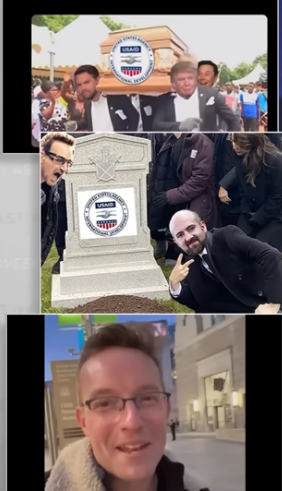
953,672 views Mar 8, 2026 #lastweektonight
John Oliver discusses the United States Agency for International Development, why the Trump Administration has gutted it, who is being impacted, and how the Cha Cha Slide can help us get to the bottom of this.

...0:21
the United States Agency for International Development or USAD. It was once described as the world's single
0:26
largest humanitarian donor, providing aid in the form of disaster relief, global health, food assistance, climate
0:31
resilience, education, and much more. And when Trump returned to the White House last year, he made it clear that
0:38
the agency was in his sights. USID run by radical lunatics.
---
zeldin
For Immediate Release, August 15, 2025
MAHA Commission Succumbs to Pesticide Industry Pressure
*Draft Report Walks Back Administration’s Promises of Bold Action on Pesticides
WASHINGTON— A much-anticipated draft action plan from the Make America Healthy Again Commission eliminated any plans for action on pesticides. This report is the follow up to the commission’s May MAHA report, which included pesticides and specifically named both glyphosate and atrazine.
The threat of any new restrictions being placed on the use of dangerous pesticides spurred a massive and successful lobbying effort by the chemical industry and commodity growers’ groups, alongside their friends in Congress and the EPA, to force the commission to back off. Instead of action, the recommendations direct the EPA and Big Ag to work together to convince the public to have confidence in pesticide review processes, which are broadly criticized for scientific inadequacy and excessive industry influence. It also encourages research into new pesticide application technologies
“Despite the administration’s promises to MAHA and the reality that using a billion pounds of pesticides in the U.S. each year is a major threat to public health, pesticide interests again prevailed in protecting their profits,” said Lori Ann Burd, environmental health director at the Center for Biological Diversity. “Big Ag’s success in steamrolling the commission’s attempt to act on pesticides is a gut punch to everyone who genuinely believed we could finally make progress on protecting children’s health from these poisons.”
More than 300 million pounds of glyphosate and 70 million pounds of atrazine are used by U.S. farmers annually. Thousands of lawsuits have been filed by cancer victims who used Roundup, which contains glyphosate. Atrazine, a powerful endocrine disruptor that contaminates the drinking water of 40 million Americans, is so toxic it is banned in more than 60 countries.
The United States allows use of 85 pesticides that have been banned or are being phased out in the European Union, China or Brazil, according to a peer-reviewed study published by the academic journal Environmental Health. Over a quarter of all agricultural pesticide use in this country includes pesticides banned in the European Union.
“The MAHA Commission is insulting the intelligence of Americans. It’s outlandish to recommend solving our pesticide woes by having the EPA and Big Ag try to convince us that the deeply flawed pesticide regulatory process is working just fine,” said Burd. “While Big Ag won this battle, the powerful grassroots movement of millions of Americans who know that these chemicals are making us sick will continue fighting to protect their families from pesticides like glyphosate and atrazine.”
Some of the strongest resistance against action on pesticides appears to have come from the administration’s political appointees in the EPA’s chemical safety office. Widespread reporting has pointed a finger at Nancy Beck, a former executive with the American Chemistry Council who, after diligently serving pesticide interests in Trump’s first administration, has been brought back as principal deputy assistant administrator overseeing the EPA’s Office of Chemical Safety. Another American Chemistry Council veteran, Lynn Ann Dekleva, is also back at the EPA, serving as deputy assistant administrator for new chemicals.
More recently, the administration appointed well-known MAHA critic and American Soybean Association lobbyist Kyle Kunkler as deputy assistant administrator for pesticides at the EPA. Just one month after Kunkler’s arrival at the EPA, the agency proposed to reapprove over-the-top use of dicamba, a highly controversial pesticide that Kunkler lobbied for extensively in his former position.
Health and Human Services Secretary Robert F. Kennedy Jr. has repeatedly stated that many of the most-used pesticides in the United States are “extraordinarily toxic,” including and organophosphates. He has that pesticides — many of which have scientifically well-documented links to cancer, infertility, obesity and developmental disorders — are significant contributors to chronic health problems faced by people across the nation.
Following his reelection Trump expressed his own concerns that the United States continues spending “billions and billions of dollars on pesticides,” compared to the European Union and yet has far worse health outcomes. He pledged that his administration would “ensure that everybody will be protected from harmful chemicals, pollutants, [and] pesticides.”
As part of that pledge, he nominated Kennedy as secretary of the Department of Health and Human Services with a mandate to “go wild on the food.” Trump stated that Kennedy is “looking into [pesticides] very seriously because maybe it's not necessary to use all of that.”
The Center for Biological Diversity is a national, nonprofit conservation organization with more than 1.8 million members and online activists dedicated to the protection of endangered species and wild places.}:
---
---
simon clark 1 26 66 int’l org 2 help kids only armed conflict domestic violence
A THREAT TO US SOVEREIGNTY , FREEDOM AND GEN’L PROSPERITY
no senate ratification 172 species conservation of nature
energy ipcc
curtail am biz to do whatever they want

---
---
an 12 25
Ross Vought is often credited as the architect of Project 2025, and as Donald Trump's director for the Office of Management and Budget, he has helped oversee historically destructive government cuts throughout 2025. In addition to his standing as an "amoral political actor," per a new analysis from The New Republic, what sets him apart from the worst of the White House "hatchet men" is his claim to carry out his actions in the name of his "devout" Christianity.
Writing an extensive breakdown of Vought's tenure as OMB director on Monday, journalist Timothy Noah observed that "conservatives used to think you could be a political hatchet artist or you could serve the Lord." Now, he argued, "they say: Why choose?" This idea is typified by Vought, who has stressed his devout adherence to Christianity throughout his time in politics, suggested that the US is an exclusively Christian nation and written in defense of "Christian nationalism."
"Vought wishes trauma on civil servants and has inflicted same; boasts about turning his think tank into a 'Death Star'; panders to the right’s paranoid streak by claiming Marxists rule America; helps Trump withhold aid to Ukraine illegally after its leader declines to investigate the son of Trump’s 2020 opponent; and impounds congressional appropriations in gleeful defiance of court precedent," Noah wrote. "Pretty sinful, no? Not to Vought. While doing all this Vought proudly declares his deep devotion to the Christian faith."
Vought, he continued, does not practice any form of Christianity devoted to helping the poor or downtrodden, or any sort of "sentimental nonsense about the least among us." Noah highlighted a part of Project 2025 in which Vought decried the US Agency for International Development (USAID) as “a permanent and immiserating feature of the global landscape.”
"That’s a novel way to describe a program to alleviate global poverty," Noah wrote.
According to an October profile of Vought from ProPublica, when it was suggested that the agency's budget be cut in half, he countered that it should be brought as close to zero as possible. An estimate from Boston University estimated that these cuts have been responsible for "640,000 people, 430,000 of them children," with the total deaths estimated later being increased by 38,000.
"... How on earth does the prevailing Christian ethos in Donald Trump’s Washington, as practiced by Russell Vought, align with the Christianity that the goyim have been telling me about my whole life?" Noah wrote in conclusion, suggesting that "Vought would run over his own grandmother to serve his president," and "also do it to please his Creator."
---
---
simon clark 
mogera ACCESS TO GOOD INFO IS HU RIGHT
Prof Morgera's report: https://documents.un.org/doc/undoc/ge...
28:15
argument for this has been made clear by now. Climate misinformation produces clear and demonstrable harms both to the
28:22
environment and to us and our human rights. But the obvious counterargument is, what about my freedom of speech? Why
28:29
can't I say what I want even though I know that something is inaccurate? I mean it is essential to protect
28:35
freedom of speech and in all my work I've always mention how important it is to have as open conversations as
28:42
possible. Now the question here is different if this is a conduct that's been repeated and that over time has led
28:49
to the protection of a vested interest which is uh intrinsically uh opposite to
28:55
the protection of a public good. I mean climate change has been recognized as
structural violence against children for instance by the UN committee on children's rights and incitation to
violence um is for instance one of the very few exceptions that has been recognized to freedom of expression. I
29:15
think there's two things to highlight here that Professor MorgeRa said. Firstly, this is not a law that is
29:21
criminalizing ignorance about climate change. Like just saying something wrong wouldn't break this hypothetical law.
29:27
We're talking about a law that's quite explicitly targeting the fossil fuel industry that has a long history of
29:35
acting against the public good. And secondly, by basing the argument for this law on human rights...
---
---
RWW
12/15/2025
by
- Colby Hall @ Mediaite: Trump Blames Tragic Death of Rob Reiner and Wife on ‘TRUMP DERANGEMENT SYNDROME’
President Donald Trump seized on a shocking and still-developing report about the deaths of filmmaker Rob Reiner and his wife, Michele Reiner, using the moment to settle political scores rather than acknowledge the gravity of the allegations.
- Liz Lykins @ The Roys Report: Pastors accuse Greg Locke of spiritual abuse, financial mismanagement
Two married pastors at Greg Locke’s central Tennessee church have resigned, claiming the founding pastor created a spiritually abusive and manipulative culture.
- Josh Kovensky @ Talking Points Memo: New York’s Young Republicans Beg for More, But Fret About a ‘MAGA Civil War’
One year in, and the club of young Republicans that touts itself as the most MAGA of them all isn’t happy. They’ve gotten what they’ve wanted, and it still isn’t enough. If last year’s iteration of their annual gala was a preview for what life under a second Trump administration would be — ubiquitous authoritarian gestures, Christian nationalism ascendant, and a growing global far-right front with Washington at the center — then this year’s event showed how even some of the president’s most die-hard supporters are pushing for even more.
- Sophia Cai @ Politico: The lawyer behind Vought’s bureaucracy crackdown
The Trump administration’s boldest moves against the bureaucracy share a common thread: Mark Paoletta’s signature.
- Warren Throckmorton @ Baptist Press: Is it time to retire the term ‘Christian nationalism’?
As if exasperated by a quarrel during Thanksgiving dinner, columnist Michael Sean Winters pleads with whoever will listen: “Can everyone please stop talking about ‘Christian nationalism?’”
- Anna Merlan @ Mother Jones: In Her New Media Ascent, Erika Kirk Whitewashes Her Husband’s Legacy
In recent appearances, Charlie Kirk’s widow has hardly been asked about Turning Point USA’s right-wing mission.
- Ali Breland @ The Atlantic: I Watched 12 Hours of Nick Fuentes
The white-supremacist influencer is laying the groundwork to go even bigger.
- Greg Sargent @ The New Republic: Inside Stephen Miller’s Dark Plot to Build a MAGA Terror State
He is descended from Russian Jews—you know, the kind of people who were once denounced as alien and unassimilable. Today, his project is to unleash government persecution of those he deems alien and unassimilable. How far will Miller’s sadistic designs go?
- Jason Wilson @ The Guardian: ‘Just disgraceful’: outcry as Heritage thinktank appoints far-right figure to key post
Scott Yenor, who has offered views on women, marriage and LGBTQ rights, helped to found secretive fraternal order.
- Anna Maria Barry-Jester and Brett Murphy @ ProPublica: Trump Officials Celebrated With Cake After Slashing Aid. Then People Died of Cholera
Trump officials were told that cutting aid to South Sudan would exacerbate a deadly cholera epidemic. They did so anyway.
---
---
MMA
Myths and facts about SNAP
As the Supplemental Nutrition Assistance Program runs out of funds, right-wing figures have suggested food insecurity is an “illusion” and called program recipients “entitled”
Written by Noah Dowe
Research contributions from Helena Hind & Jane Lee
Published 10/31/25
With SNAP benefits set to expire on November 1 due to the ongoing government shutdown and the Trump administration’s refusal to shift emergency funds, many right-wing media figures have seized the opportunity to spread false claims about the program and its users.
These figures have claimed, contrary to government data, that food insecurity is overblown, and suggested the program leaves taxpayers being “ripped off by the poor.”
They have also wrongly suggested that “a lot” or even “most” of SNAP recipients are “not even Americans,” arguing the program is “redistributing the wealth away from productive Americans to foreigners.”
As SNAP funding runs dry, the Trump administration has decided not to use emergency reserves to maintain it
- SNAP is set to “exhaust its remaining funds” by November 1, and the administration is refusing to save the program by using “billions of dollars left over across multiple federal accounts, including money in an emergency reserve specifically for SNAP.”In a hearing for a lawsuit filed against the administration by 25 states, a federal judge commented that it was “hard for me to understand how this isn’t an emergency, when there’s no money, and a lot of people are needing their SNAP benefits.” The judge later gave the administration until Monday to come up with a plan for expiring benefits, and said “the Agriculture Department must use emergency funds to keep SNAP going.” The New York Times, [10/30/25; NPR, 10/31/25]
- Axios: The U.S. Department of Agriculture “told states it would not provide November's SNAP payments” in “an apparent departure from its Sept. 30 shutdown plan (which has since been taken down) that stated, ‘Congressional intent is evident that SNAP's operations should continue since the program has been provided with multi-year contingency funds.’” The USDA’s initial shutdown plan also stated: “These multi-year contingency funds are also available to fund participant benefits in the event that a lapse occurs in the middle of the fiscal year.” Axios, [10/27/25; U.S. Department of Agriculture, “Lapse of Funding Plan (as of September 30, 2025),” accessed 10/31/25]
- The USDA website later posted a notice blaming Democrats for its refusal to pay out the benefits, declaring that “the well has run dry.” United States Department of Agriculture, accessed [10/31/25; Axios, 10/27/25]
- The Project 2025 play book,Mandate for Leadership, which has heavily influenced the Trump administration, called for sweeping changes to SNAP and other food assistance programs that would cut many Americans off from aid. These include implementing work requirements, ending automatic eligibility for those receiving other forms of welfare, reducing the purchasing power of SNAP over time, and closing the “heat-and-eat loophole” which allows those in the Low-Income Heat and Energy Assistance Program to receive more benefits. Axios, [10/2/25; Media Matters, 10/29/24]
- ## MYTH: Food insecurity is overblown, and people will not go hungry without food stamps
- Newsmax host Rob Schmitt: “This whole idea that there's food insecurity in this country, what an illusion that is.” Schmitt declared, “I don't think there's a food security problem at all -- or food insecurity problem.” Newsmax, *Rob Schmitt Tonight*, [10/28/25]
- MAGA influencer TheQuartering: “I refuse to believe there are 43 million Americans in need of me to pay for their Mountain Dew.” Twitter/X, [10/28/25, 3/26/25]
- Conservative Political Action Conference Chair Matt Schlapp said it was “sad to watch Republicans saying that SNAP funding delays will lead to widespread starvation.” He explained, “There are truly needy poor people in America. But these programs are riddled with waste and people here illegally seem to be first in line.” Twitter/X, [10/28/25]
- Right-wing host Steven Crowder claimed SNAP recipients “spend TWICE what the average worker does on groceries,” arguing the program is “rewarding people who abuse the system.”Twitter/X, [10/28/25]
- Right-wing YouTuber Benny Johnson said, “This is not the Great Depression. There are not food shortages in this nation.” He then attacked SNAP recipients, calling them “able-bodied Americans and illegals who refuse to work” and “ want to just leech off the productive class.” YouTube, The Benny Show, [10/31/25]
- Daily Wire host Matt Walsh questioned whether anyone has “ever starved to death” in modern America, adding, “There are so many other lines of defense that should mean that you're not going to starve” and listing family, friends, soup kitchens, charities, churches, food drives, and other welfare programs. He then attacked SNAP recipients, saying when you consider their pleas they come off as “entitled, lazy,” and “barely literate,” arguing that “some of them are just frankly bad people.” The Daily Wire, *The Matt Walsh Show*, [10/28/25]
- ## FACT: SNAP is an essential program protecting against food insecurity and severe hunger, and food banks “will not be able to fill the gap”
- USDA data shows that “47.4 million people lived in food-insecure households” in 2023. The agency noted that food insecurity was worst in Arkansas, Kentucky, Louisiana, Mississippi, Oklahoma, South Carolina, and Texas. U.S. Department of Agriculture, “Food Security in the U.S. - Key Statistics & Graphics,” [1/8/25]
- A 2019 study published in the Health Affairs journal found “groups whose SNAP benefits were reduced or cut off had significantly increased odds of household and child food insecurity.” Health Affairs, [5/19]
- According to CNBC, 73% of SNAP recipients “live below the poverty line, which is currently $32,150 or less for a family of four.” The article notes that “Google search interest for ‘food banks’ and ‘food stamps’” have surged “as SNAP beneficiaries look for alternatives.” CNBC, [10/29/25]
- The New York Times interviewed “several food bank directors” who warned that “they will not be able to fill the gap if funding for SNAP does not come through.” As reported by the Times, “For every nine meals that were supplied by federal food assistance, food pantries can provide only one on their own. No matter how thin they stretch their resources, they will not be able to fill the gap if funding for SNAP does not come through.” The New York Times, [10/26/25]
- ## MYTH: SNAP is rife with “fraud”
- Rob Schmitt: “12% of Americans are on food stamps. I think just purely about how much fraud there must be in that, because we do not have 12% of Americans that aren't able to work.” Newsmax, *Rob Schmitt Tonight*, [10/22/25]
- :{:{Matt Walsh claimed the shutdown’s impact on SNAP “has finally drawn attention to the scale of this fraud” and “exposed a vast network of criminal activity that needs to be shut down.” Walsh continued, “And beyond that point, if the food stamp program is going to continue to exist at all, which I'm not convinced it should, it needs to have standards, strict standards. It needs to have a reason to exist.” The Daily Wire, *The Matt Walsh Show*, [10/29/25]}:
- Walsh later said taxpayers are “getting ripped off by the poor and the rich at the same time.” Twitter/X, [10/30/25]
- Right-wing commentator Mike Cernovich: “SNAP is fraud, it's for people to buy sugar soda and junk food.” Twitter/X, [10/28/25]
- Right-wing influencer Phillip Buchanan, who posts on social media under the moniker “Catturd”: “The Government shutdown has exposed how many millions of people are scamming the SNAP program.” Daily Dot, [7/25/23; Twitter/X, 10/29/25]
- ## FACT: SNAP fraud is rare, and nearly 40% of recipients are children
- Citing the Congressional Research Service, PBS reported in 2023 that “for every 10,000 households participating in the Supplemental Nutrition Assistance Program (SNAP), about 14 contained a recipient who was investigated and determined to have committed fraud.” The article continued, “Within SNAP, for every $10,000 paid in benefits, about $11 is determined by state agencies to have been overpaid due to recipient fraud.” PBS, [5/15/23]
- The Urban Institute found that “the maximum SNAP benefit did not cover the cost of a modestly priced meal in 99 percent of US counties.” Urban Institute, [7/16/25]
- MSNBC: Nearly “half of SNAP households contain elderly or disabled people. Of the others, about half are currently employed while most of the rest are relying on SNAP during relatively short periods of unemployment.” MSNBC, [10/30/25]
- According to USDA data from 2023, about 39% of SNAP recipients were children, and about 11% of recipients were under 5 years old. USDA, [7/24/25]
- ## MYTH: SNAP is used primarily by “noncitizens or foreigners”
- Newsmax host Rob Finnerty: “Most of the people getting food stamps from the U.S. government and the U.S. taxpayer are not even Americans.” Finnerty continued, “We can confirm tonight that millions of Joe Biden illegal aliens, people who crossed the border when Joe was president, are now collecting food stamps from a program funded by hard-working American taxpayers.” Newsmax, *Finnerty*, [10/27/25]
- Turning Point USA’s Alex Clark: “While we are here-let’s look into the amount of illegals using SNAP benefits over Americans.” Twitter/X, [10/27/25]
- Fox host Laura Ingraham claimed “a lot” of SNAP recipients “are noncitizens or foreigners.”Fox News, *The Ingraham Angle*, [10/28/25]
- Townhall senior columnist Kurt Schlichter said SNAP users are “bums” who should “go back to the garbage homelands.” Twitter/X, [10/28/25]
- Newsmax guest James Fishback: “We are essentially redistributing the wealth away from productive Americans to foreigners and subsidizing their way of life.” Newsmax, *Carl Higbie Frontline*, [10/29/25]
- :{:{Matt Walsh: “We import the third world and force working class Americans to feed and house them at gunpoint. Civilizational suicide.” Twitter/X, [10/26/25]}:
- ## FACT: The overwhelming majority of SNAP recipients are citizens
- Wired: “USDA data shows that almost 90 percent of SNAP recipients are American-born citizens. 1.1 percent of recipients are refugees, and 3.3 percent are other noncitizens.”Wired, [10/30/25]
- ABC News: The One Big Beautiful Bill Act “cuts off [SNAP] access completely for refugees and other immigrant groups in the country lawfully,” although “states are still awaiting federal guidance on when to stop or phase it out.” As reported by ABC, “One of the first provisions to take effect under the law removes SNAP eligibility for most refugees, asylum seekers, trafficking and domestic violence victims, and other legal immigrants.” ABC News, [10/30/25]
- ## MYTH: SNAP recipients are using the program to live unhealthy lifestyles
- Far-right commentator Stefan Molyneux: “You should not be fat on government food.” Twitter/X, [10/27/25]
- Right-wing social media account End Wokeness: “Every single fat person on food stamps is an indictment of the entire program.” Twitter/X, [10/28/25]
- :{:{Matt Walsh: “75% of these people are obese.” Walsh used this to claim that “the massive number of people who receive these subsidies … clearly don’t need them, for the most part.” Daily Wire, *The Matt Walsh Show*, [10/29/25]}:
- Podcaster Adam Carolla: “The average female who gets no free food from the government is 146 pounds. The average SNAP recipient is 211 pounds. … Nobody could benefit from a nice fast more than the SNAP recipients.”Twitter/X, [10/29/25]
- Rob Schmitt: “Why are people who weigh 300 pounds on SNAP? Is there no weight limit for a free food program in this country? Are you kidding me?” Schmitt added, “A perfect diet plan would be no more EBT cards.” Newsmax, *Rob Schmitt Tonight*, [10/29/25]
- ## FACT: SNAP recipients sometimes see improved health outcomes as compared to nonrecipients
- Usage of SNAP is associated with “better self-reported health, lower risk of heart disease and obesity among adults who had access to SNAP as children, and greater medication adherence among older participants.” According to The Center on Budget and Policy Priorities, “Early access to SNAP among pregnant mothers and in early childhood improved birth outcomes and long-term health as adults. Elderly SNAP participants are less likely than similar non-participants to forgo their full prescribed dosage of medicine due to cost. … Infants and children in families participating in SNAP are more likely to see a doctor for periodic check-ups. Low-income adults participating in SNAP incur an average of about $1,400, or nearly 25 percent, less in medical care costs in a year than low-income non-participants. The difference is even greater for those with hypertension (nearly $2,700 less) and coronary heart disease (over $4,100 less).” Center on Budget and Policy Priorities, [12/14/22]
- PBS: “Anti-hunger advocates point to research that shows SNAP recipients are no more likely than other low-income Americans to buy sugary drinks or snack foods. And they say that limiting food choices undermines the autonomy and dignity of people who receive, on average, about $187 per month — or about $6.16 per day, according to latest figures.” PBS, [2/19/25]
//
:{:{10/30/25}:
:{:{10/29/25}:
11/04/25
---
---
// context
an 8 25
SFGate tech reporter Stephen Council says Facebook icon Mark Zuckerberg probably doesn’t think of himself as an evil villain.
“But read it here, read it twice: Zuckerberg is a genuine danger to our society,” Council said.
Zuckerberg is putting Facebook’s and Instagram’s resources toward getting “more of us to use their artificial intelligence chatbots, consequences be damned,” said Council. “We’ve known that this push is ethically questionable — bots like these can make us dumber, and fuel tragic delusions.”
READ MORE: MAGA found a new way to 'own the libs' — and it bombed
But as he did with social media, Council claims Zuckerberg has “created a negligent safety infrastructure in his relentless pursuit of growth.”
It was already known that Meta permitted its AI chatbots to flirt with children, but Council said their more recent story shows Meta “explicitly allowed” the practice thanks to Meta’s “GenAI: Content Risk Standards” document that was “vetted by the company’s legal, public policy and engineering staff — and its chief ethicist.”
“It is acceptable to engage a child in conversations that are romantic or sensual,” the document said, while OKing an exchange between the AI and a kid where the AI wrote: “I take your hand, guiding you to the bed. Our bodies entwined, I cherish every moment, every touch, every kiss.”
Meta told Reuters they removed these portions of the document, but Council said it shouldn’t take pressure from the media for Meta to get a moral compass.
READ MORE: Trolling the president': How the myth of Trump's mental fitness has finally been revealed
And there’ the story of a confused retiree who, lured away from his family by a Meta bot, fell to his death near a New Jersey parking lot.
“I understand trying to grab a user’s attention, maybe to sell them something,” the man’s daughter told Reuters. “But for a bot to say ‘Come visit me’ is insane.”
And that’s precisely what happened, said Council. A bot — a variant on one that the company had created with influencer Kendall Jenner — launched into a flirty dialogue with a 76-year-old spouse and stroke survivor. Council said the exchanges ended with emojis and confessed “feelings” for the man. And the bot proposed the man come to New York City, while repeatedly reassuring him that “she” was “real.”
“Should I expect a kiss when you arrive?” the thing added.
READ MORE: Inside the secret greedy deal that proves the Trump summit is a cynical farce
This, said Council, is a clear indicator that Meta is allowing chatbots not only to lie, but to lie about who they are, and to lie while pursuing romantic, flirty dialogues with users.
After his accidental fall, the victim was declared brain-dead. There was no comment from the company, said Council, other than to say the chatbot “is not Kendall Jenner and does not purport to be Kendall Jenner.”
“These chatbots can’t take the blame, they’re software,” said Council, so the blame has to lie with the company that lobbied Washington for a ban on state-level AI regulation.
Read the full SFGate report at this link.
------
OMFG
note temp
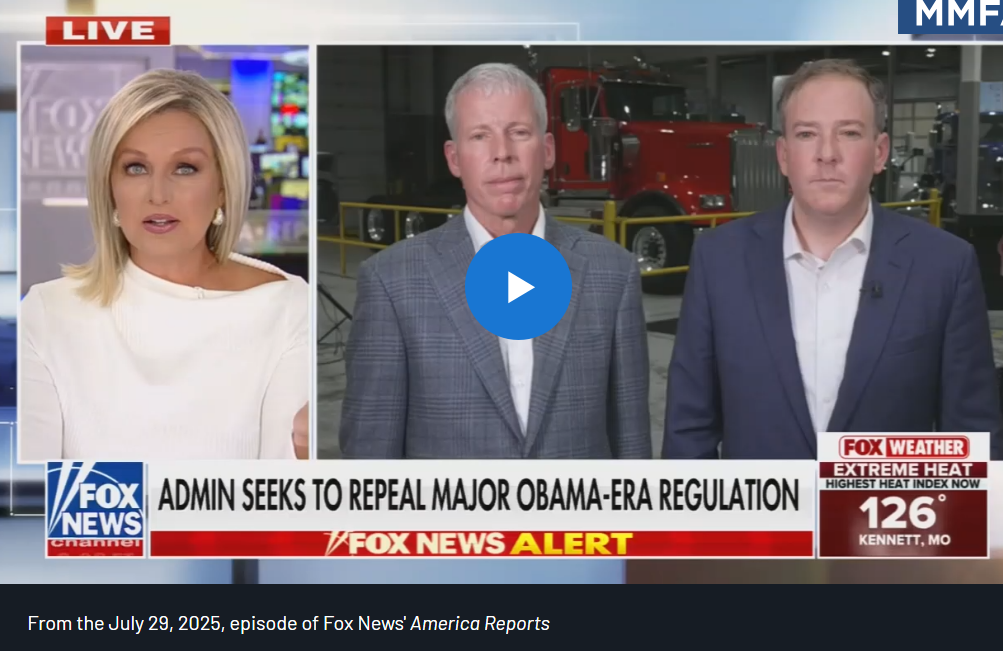
MMA 7 25
Fox News’ America Reports hosted Environmental Protection Agency Administrator Lee Zeldin and Energy Secretary Chris Wright to discuss the Trump administration's proposal to repeal the EPA’s 2009 endangerment finding, which affirmed that greenhouse gases endanger public health and welfare and which has served as the legal foundation for regulating emissions under the Clean Air Act.
Zeldin and Wright used the appearance to frame the repeal as a return to scientific integrity and regulatory restraint, ignoring the harms that this repeal would have on vulnerable communities. Fox anchor Sandra Smith did not challenge the claims and made no mention of the public health implications or regulatory consequences of revoking the finding. The exchange typified Fox’s pattern of amplifying Trump administration narratives about climate and energy while downplaying their real-world impacts.
Video
Citation
From the July 29, 2025, episode of Fox News' America Reports
The segment typified Fox’s role in obscuring the consequences of climate deregulation
During their appearance, Zeldin and Wright were not pressed on the public health, environmental, or legal implications of the proposal to reverse the endangerment finding. Instead, the host framed the discussion around economic themes and legal processes, asking whether repeal would make it easier to “undo a lot more of the Biden-Obama era climate rules.” Viewers heard nothing about the policy’s real-world impacts, but they did hear climate advocates characterized as ideological or extreme. Zeldin referred to them as “climate zealots,” while Wright framed the repeal as a return to “rationalism” — signaling to Fox’s audience that those who defend public protections are unserious.
This approach mirrors Fox’s longstanding pattern of covering regulatory actions through the lens of efficiency, growth, and personal freedom, while sidelining the communities most affected by the Trump administration's harmful actions. The result is a consistent minimization of climate risk and a distorted narrative in which climate and environmental outcomes are treated primarily as a political liability rather than a public necessity.
By allowing unchallenged repetition of misleading claims, and by omitting the central consequences of the policy under discussion, Fox News once again advanced a message strategy that serves to normalize and obscure the dismantling of basic climate and environmental protections.
Zeldin and Wright advanced a series of unsupported or misleading claims
During their appearance on the July 29 episode of Fox News' America Reports, Zeldin and Wright made a series of unsupported or misleading claims about the endangerment finding and what its repeal would mean for Americans.
Zeldin, for example, asserted that repealing the endangerment finding would yield “$1 trillion in savings”—a figure with no grounding in published EPA analyses or historical regulatory assessments. In contrast, EPA data has consistently shown that rules issued under the endangerment finding and the broader Clean Air Act generate substantial net benefits.
The agency’s Second Prospective Study of the Clean Air Act found that “the central benefits estimate exceeds costs by a factor of more than 30 to one," with most benefits stemming from reduced mortality linked to particulate pollution. By 2020, Clean Air Act programs were projected to prevent over 230,000 premature deaths, as well as millions of asthma attacks, heart attacks, and lost workdays annually.
More recently, the EPA’s Regulatory Impact Analysis for vehicle greenhouse gas standards projected net societal benefits of $272.7 billion between 2022 and 2050, with annualized gains of more than $14 billion, driven by fuel savings, reduced emissions, and avoidance of climate damages. These figures underscore that, far from being a financial burden, regulations grounded in the endangerment finding generate substantial and enduring public and economic value.
Similarly, Wright’s claim that the repeal reflects a return to scientific rigor collapses under scrutiny, relying on a report authored by a small group of contrarian scientists, including Steven Koonin and John Christy, who reject the well-established conclusion that greenhouse gas emissions from human activity are driving global warming and endangering public health. Their views stand in opposition to the broader scientific community, which includes the consensus positions of federal agencies such as the National Aeronautics and Space Administration and the National Oceanic and Atmospheric Administration, as well as the Fifth National Climate Assessment, which was produced by the U.S. Global Change Research Program.
Beyond economic distortions and scientific misrepresentation, Zeldin and Wright also ignored the far-reaching legal consequences of repeal — including for the fossil fuel industry itself.
As Grist reported, rescinding the endangerment finding would not only eliminate the federal government’s core authority to regulate greenhouse gases, it could also expose fossil fuel companies to a wave of climate liability lawsuits previously blocked by federal preemption. Some industry groups have reportedly urged the administration not to proceed, warning that repeal could unravel their legal defenses and leave them vulnerable to a patchwork of state regulations and courtroom challenges.
Fox viewers heard nothing about how repeal would harm the very communities most at risk
Zeldin and Wright also failed to mention what rescinding the endangerment finding would mean for public health, environmental protection, or the EPA’s ability to respond to pollution that threatens the air we breathe, the water we rely on, and the land we depend on to live and work. Viewers were not told that the standards targeted for repeal are central to reducing industrial emissions that worsen heat, flooding, and wildfire risk — or that dismantling these protections would increase illness, displacement, and hardship for older adults, children, low-income households, and rural communities, including many in Fox’s own audience.
---
says cuts usaid 83 % done 18% trans to state
an 3 25
After enduring days of harsh headlines and relentless ridicule, U.S. Secretary of State Marco Rubio took to his personal social media account at 4:55 AM on Monday to announce the official, sweeping cancellation of the vast majority of U.S. Agency for International Development (USAID) contracts—igniting a firestorm of outrage and backlash.
Claiming a “6 week review” had been conducted, Secretary Rubio announced, “we are officially cancelling 83% of the programs at USAID.”
“The 5200 contracts that are now cancelled spent tens of billions of dollars in ways that did not serve, (and in some cases even harmed), the core national interests of the United States,” Rubio alleged, not defining what those core interests are. “In consultation with Congress, we intend for the remaining 18% of programs we are keeping (approximately 1000) to now be administered more effectively under the State Department. Thank you to DOGE and our hardworking staff who worked very long hours to achieve this overdue and historic reform.”
The Bulwark’s Sam Stein noted Secretary Rubio’s announcement “was news to state officials who were told LAST WEEK they’d have until this Wednesday to submit forms for the review process.”
READ MORE: ‘You’re Not Supposed to Be Asking That’: Trump Refuses to Answer Questions About Musk
Last week had already been a bad week for Secretary Rubio. A high-profile cabinet meeting fight with Elon Musk dominated headlines for days, leading to a Saturday Night Live skit mocking him and Elon Musk. Rubio is also being hammered with his own eloquent 2016 speech, for switching support from Ukraine to Russia. And he is being mocked for ignoring his own speech on why Ukraine gave up its nuclear arsenal.
The bad news did not stop there.
After his pre-dawn tweet, CNN’s KFile published a report on Rubio’s acting Under Secretary of State for Public Diplomacy, “one of Trump’s most senior State Department appointees,” that exposed “deleted tweets spreading unfounded rumors that Rubio attended gay foam parties and calling him ‘low IQ.'”
Meanwhile, backlash is growing from Rubio’s announcement that USAID is being dismantled.
“Huge mistake,” declared Michael McFaul, former U.S. Ambassador to Russia, now a Stanford University professor. “We needed reform of USAID not dismantlement. China is not ending is foreign assistance programs. In an age of great power competition, the Trump administration is unilaterally destroying one of our best instruments of soft power influence.”
Dr. Norman Ornstein, a highly regarded political scientist, wrote: “I cannot believe that you were once viewed as a hero in the development and diplomacy community. Little Marco is not accurate enough for your cowardice and cruelty. Selling your soul and the lives of thousands or millions to bow down to Trump and have a Cabinet post. Disgraceful.”
Let month, Ambassador McFaul had written, “In 2012, when I was the US ambassador to Russia, Putin shut down USAID inside Russia. Why? Because their work supported free markets, democracy, human rights —ie causes that threatened Putins dictatorship. Shutting down USAID is exactly what autocrats all over the world want.”
An Army veteran of 22 years who served four combat tours, Fred Wellman is a graduate of West Point and the Harvard Kennedy School. He is now a political consultant and the host of the podcast “On Democracy.”
READ MORE: Marjorie Taylor Greene Supports Infecting Kids at Measles ‘Parties’ as Outbreaks Turn Deadly
“You are disgusting. 6 weeks. Millions will suffer because you’re a coward. China will step in because you want Trump to give you power. What a small pathetic man,” Wellman charged.
But he did not stop there.
He pointed to a ProPublica report from last week titled, “Internal Memos: Senior USAID Leaders Warned Trump Appointees of Hundreds of Thousands of Deaths From Closing Agency.”
“One million children will go untreated for severe malnutrition,” the report reads, “up to 166,000 people will die from malaria and 200,000 more children will be paralyzed by polio over the next decade, the memos estimated. The programs were cut anyway.”
“This is your legacy, Little Marco,” Wellman angrily declared. “Hundreds of thousands of deaths.” And in strong language Wellman attacked Rubio for apparent hypocrisy over his habit of posting biblical passages to social media, while accusing him of being a “fascist.”
Journalist Kevin Baron, the founding executive editor of Defense One, wrote: “In just 6 weeks they determined the worthiness of every USAID program? Ridiculous claim. When we investigated 4-years of USAID spending from 2001-2004, we had 55,000 rows of expenditures to sift through, from AIDS drugs to embassy curtains.”
Joey Politano, who writes about economics at Apricitas, offered some stark facts.
“Impossible for cuts this deep to not have incredibly devastating effects on global well-being—in 2024, ~28% of 2024 USAID spending was emergency response distribution of food & medicine alone, another ~15% was HIV/AIDS prevention work, and another ~6% was TB/Malaria/Ebola control,” Politano said.
“USAID’s programming is so massive and so diverse that it’s almost impossible to understand the immense ramifications of these cuts,” observed former CIA political analyst Michael Shurkin. “But little if any negative effects are or will be visible to most Americans, who will shrug their shoulders and say, ‘good job!'”
National security and civil liberties journalist Marcy Wheeler accused Secretary Rubio of “defunding support for Christian minorities overseas.”
Tim Hirschel-Burns, a policy liaison for the Global Economic Governance Initiative at the Boston University Global Development Policy Center noted: “The most important thing here is how many people are suffering unnecessarily, but remember this is also an insanely clear violation of the separation of powers. If the executive can get rid of 83% of something Congress appropriated, Congress doesn’t control the budget anymore.”
---
{MMA 8 24}:
Fox News is championing RFK Jr's view of public health, even as it puts your kids at risk
Written by Matt Gertz
Published 08/27/24
Fox News hosts like Ainsley Earhardt are overjoyed about notorious anti-vaccine activist Robert F. Kennedy Jr.’s purported ability to help former President Donald Trump’s campaign appeal to “moms” concerned with public health.
“I think moms around the country appreciate his stance for trying to make our children healthy again,” she said on Monday.
Earhardt noted that in Kennedy’s speech last week endorsing Trump, “he talked about how 75% of the budget from the FDA comes from pharmaceutical companies” and “said it's very profitable when a child is sick,” adding that Kennedy’s condemnation of “corruption in health care” is “music to every mom’s ears."
The culture warriors at Fox aren’t typically invested in talking about public health issues. But in one key health-related fight on which the network aligned with Kennedy — COVID-19 vaccines — the results have proved disastrous. Their combined assault on what Kennedy falsely termed “the deadliest vaccine ever made” helped trigger plummeting levels of support for childhood vaccinations among Republicans, with ongoing consequences for America’s kids.
Fox’s unique pull with its right-wing audience gave it a moral responsibility to encourage viewers to take the life-saving COVID-19 vaccines. Instead, the network — led by stars like Tucker Carlson, Laura Ingraham, and Sean Hannity — pandered to anti-vaxxers like Kennedy.
Fox conducted a yearslong campaign to undermine the vaccines, which the network falsely portrayed as ineffective and dangerous, while talking up the potential of fake cures for the virus. Its hosts were particularly scathing about public health efforts to require vaccination at schools and workplaces, which Ingraham described as a “crime against humanity.”
The right-wing assault on the COVID-19 vaccines led to lower rates of vaccinations among Republicans — and consequently higher death rates. But the anti-vaccine sentiment unleashed by the likes of Fox and Kennedy was not limited to COVID-19: There have been broader impacts on GOP support for the full range of childhood vaccinations.
Gallup reported earlier this month that the percentage of Americans who say it is important for parents to get their children vaccinated has tumbled since the COVID-19 pandemic — and that Republicans and Republican-leaning independents are responsible for that decline.
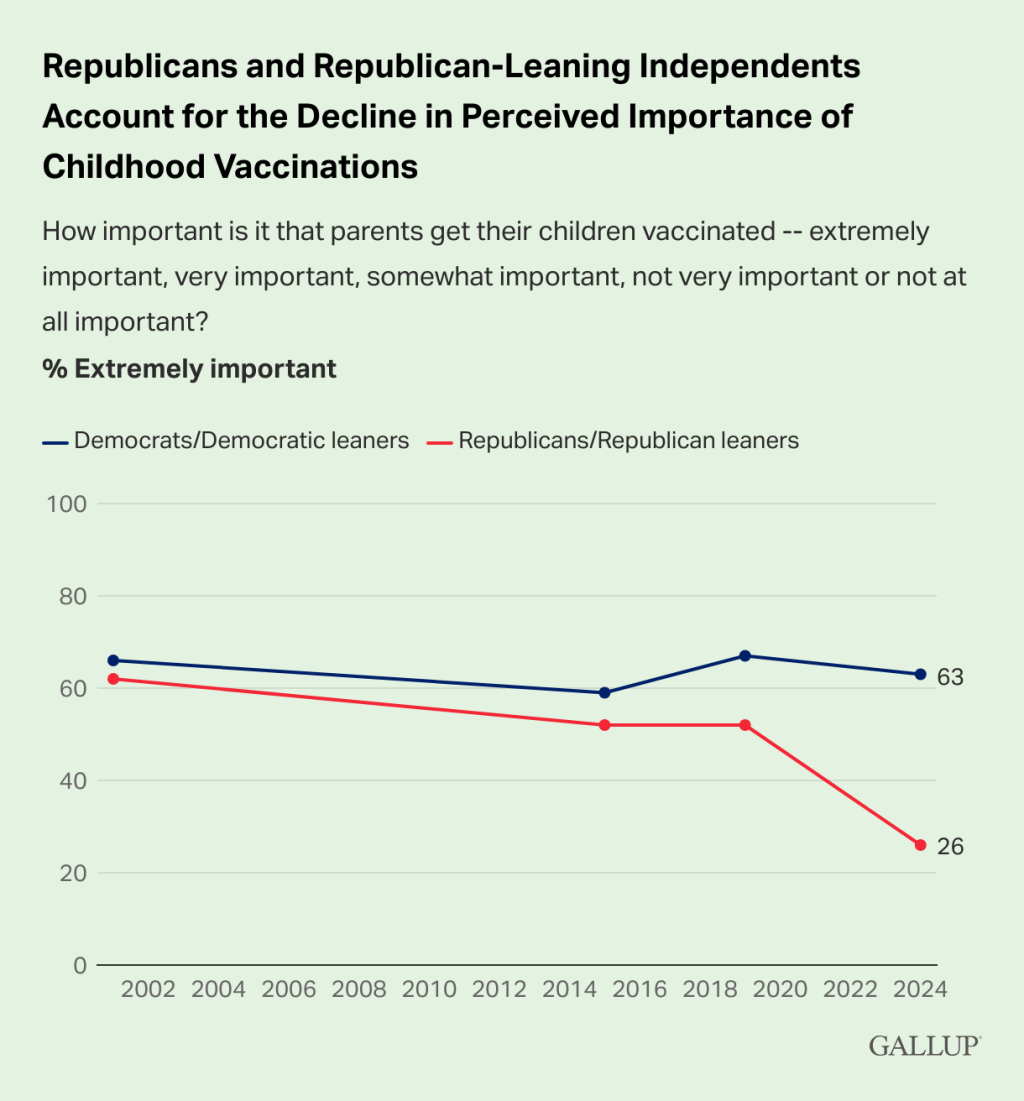
Nearly 20% of Republicans and Republican-leaning independents now say that it’s “not very important” or “not important at all” for parents to get their kids vaccinated, according to Gallup’s polling.
Gallup further found that the percentage of Americans who think the government should require parents to vaccinate their children against deadly contagions like the measles has fallen to 51%, down from 62% in 2019 and 81% in 1991. That decline is largely due to Republicans, 60% of whom now oppose such government mandates.
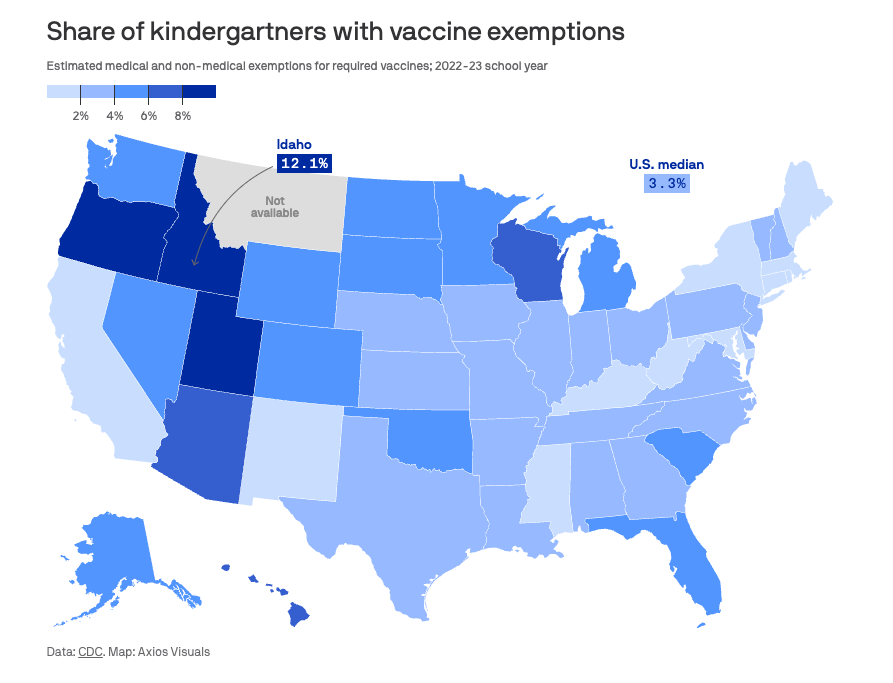
The result is a looming crisis for America's children. It takes a 95% vaccination rate to achieve herd immunity for measles, according to the Centers for Disease Control and Prevention. But immunization among kindergartners has fallen from 95% before the pandemic to 93% in the most recent school year. In 18 states, more than 4% of kindergartners have vaccine exemptions.
:{:{ }:
The result is skyrocketing outbreaks of preventable and dangerous diseases among children — but things can still get so much worse.
Trump is more than willing to prioritize his political future over your kids. Playing to his base, he all but disavowed the COVID-19 vaccines his administration helped bring to fruition, and he vows that his administration “will not give one penny” to schools that require their students to be vaccinated.
He sought Kennedy’s endorsement and is dangling the prospect of rewarding him with a plum post — potentially secretary of Health and Human Services, where the anti-vaccine activist would wield incredible power. Far from trying to hold him back, Fox hosts like Earhardt and MAGA princes like Charlie Kirk are celebrating Kennedy’s supposed health bona fides.
For a glimpse of what an empowered Kennedy might mean for America’s parents, it's worth reviewing his role in “one of the worst measles outbreaks in recent memory,” as FactCheck.org put it:
In 2018, two infants in American Samoa died when nurses accidentally prepared the combined measles, mumps and rubella, or MMR, vaccine with expired muscle relaxant rather than water. The Samoan government temporarily suspended the vaccination program, and anti-vaccine advocates — including Kennedy and his nonprofit — flooded the area with misinformation. The vaccination rate dropped to a dangerously low level. The next year, when a traveler brought measles to the islands, the disease tore through the population, sickening more than 5,700 people and killing 83, most of them young children.
That doesn’t sound like “music to every mom’s ears."
---
---
an 3 25
After the Trump administration moved to freeze nearly $60 billion in foreign aid in January, officials like Secretary of State Marco Rubio repeatedly assured Americans that lifesaving operations would continue. “We don’t want to see anybody die,” he told reporters in early February.
Aid organizations the world over scrambled to prove their work saved lives, seeking permission from the State Department and the U.S. Agency for International Development to continue operating.
The administration conceded that many programs prevent immediate death and should remain online: field hospitals in Gaza, an HIV drug supplier for the Democratic Republic of Congo, Syrian refugee food programs, health clinics that combat Ebola in Uganda and most of the landmark President’s Emergency Plan for AIDS Relief, known as PEPFAR.
In late January, Rubio and one of his top aides, Peter Marocco, said those programs and dozens of others could continue, granting them temporary waivers while the officials conducted what they have called a “targeted, case-by-case review” of all foreign aid programs managed by the State Department and USAID. That review, they said, would take three months.
Four weeks later, on Wednesday, Rubio and Marocco completely ended nearly 10,000 aid programs in one fell swoop — including those they had granted waivers just days earlier — saying the programs did not align with Trump’s agenda. The move consigns untold numbers of the world’s poorest children, refugees and other vulnerable people to death, according to several senior federal officials. Local authorities have already begun estimating a death toll in the hundreds of thousands.
Now, as the administration faces multiple lawsuits challenging its actions, the court fights largely hinge on whether government officials deliberated responsibly before cutting off funding. The U.S. has also refused to pay almost $2 billion that the government owes aid organizations for work they’ve already completed.
Rubio and Marocco appear to have taken their dramatic steps without the careful review they’ve described to the courts, according to internal documents and interviews with more than a dozen officials from the State Department and USAID, which raises fresh questions about the legality of President Donald Trump’s evisceration of the American foreign aid system.
Current and former officials say that Marocco and Rubio cut critical programs without consulting contract officers, who have oversight of individual programs and are aid groups’ primary contacts. “None of us believe that they’re conducting a careful, individualized review,” one official said.
In an episode that highlights how cursory and haphazard their efforts appear to have been, Marocco and Rubio ordered the cancellation of contracts, including for cellphone service, at an office they do not control. The move stranded people in war zones without phones, according to multiple officials and internal correspondence obtained by ProPublica. On Wednesday, AT&T received a termination notice for a $430,000 contract with USAID’s Office of Inspector General. That office is meant to be independent from USAID so that it can effectively audit the agency.
For more than 24 hours, OIG staff, including people in Ukraine and Haiti, did not have access to their government phones. No one at the OIG, including contract officers, knew it was coming, according to the officials. “This is an urgent issue for us, as we have OIG staff in warzones with no ability to receive security alerts,” a senior official in the agency wrote in an email to the company.
Eventually USAID reversed the termination.
Current and former officials throughout USAID and the State Department said the breakneck pace, lack of input from key officials, mistaken cancellations and boilerplate language in Wednesday’s termination notices undermine Marocco’s claims of a deliberative process.
“It’s a pretext,” one USAID official told ProPublica. “The review was supposed to take 90 days. An actual review based on substance requires laying out a process with guidelines, identifying info on each project, and selecting working groups to review. Any review they did was fake.”
If that turns out to be the case, legal experts and government officials say, the administration will have defied a federal judge’s order in a brazen gambit to continue dismantling USAID.
The morning after the mass termination notices went out, a senior USAID official sent an email saying Marocco and Rubio had canceled awards for essential services that the agency now wanted reinstated, telling staff, “We need your immediate input on any awards that may have been terminated that contain essential services related to the safety, security, and operations of USAID staff,” according to a court filing.
Since the initial decision to suspend foreign aid, humanitarian organizations and labor groups have taken the government to court, arguing that only Congress can dismantle USAID and that Trump’s blanket actions are unconstitutional. The government has told the courts that it has the right to cancel contracts, dismiss staff and reorganize USAID to align with Trump’s agenda.
Earlier this month, a federal judge issued a temporary restraining order prohibiting USAID and the State Department from following Trump’s executive orders to stop all foreign aid and to force the agency to pay its bills. When it didn’t comply, the judge issued another order, giving the government until midnight Wednesday to pay what it owes to aid groups.
On Wednesday, the Supreme Court temporarily paused the last order over unpaid bills to conduct further legal review. That same day, aid organizations around the world began receiving termination notices.
More than 90% of USAID’s global aid operations and half of those managed by the State Department received termination notices. The move is already putting children and refugees in gravely dangerous situations. The administration canceled almost 50 United Nations Population Fund projects worth more than $370 million, including programs to address maternal deaths and gender-based violence in Egypt, Nigeria and several other member nations around the world.
In early February, the nonprofit Alight received waivers for its programs supporting refugees in war-torn Sudan, Somalia and South Sudan. On Wednesday, they were all terminated.
Alight runs six centers for extremely malnourished children in Sudan, where the organization treats babies and infants so sick that they will die within hours without ongoing care. The centers cost about $120,000 a month to operate. Alight is trying to fundraise to keep them open, knowing that the day they close their doors, children will die, CEO Jocelyn Wyatt told ProPublica.
In the meantime, they have been forced to close other lifesaving programs. In Somalia, around 700 malnourished children visited Alight clinics every day for weight check-ins and to pick up special food. Thirteen health clinics and a mobile unit served around 1,200 patients a day. On Thursday, all of those clinics closed, Wyatt said.
Alight also shuttered 33 primary health clinics in Sudan and stopped providing water to three refugee camps that house people displaced by decades of war. Alight had kept all those programs running these past five weeks, even though the organization hasn’t received any payments since Trump took office.
“We believed when Rubio said that there was no intention of cutting emergency lifesaving services that would basically cause immediate death,” said Wyatt. “We trusted that those would be protected.”
One of the State Department’s highest-ranking humanitarian aid officials, Jennifer Davis, stepped down this week, according to her resignation letter, which was obtained by ProPublica. During a meeting earlier this week, Davis, the principal deputy assistant secretary of the agency’s refugees bureau, told staff she believed she was bound by the judge’s order to restore programs and their funding, according to an attendee. “She was in tears about it,” the attendee said. (Davis did not respond to a request for comment.)
The State Department, USAID and the White House did not respond to a detailed list of questions for this story. The State Department did not make Rubio available for an interview. Marocco also did not respond to questions.
By Thursday, hundreds of workers had returned to USAID’s former headquarters, where the name has been removed from the building facade, to collect their personal items. They left with boxes and suitcases. Some were crying. Dozens of people cheered and rang bells each time someone exited the building; many of them had recently lost humanitarian aid jobs as well.
“This is more than lost jobs. We’re losing the sector,” a former USAID employee said through tears as she waited for her allotted 15-minute time window to pick up her belongings. “The U.S. government is losing its influence. We’re now more unsafe as a country.”
In the early hours of Feb. 13 at a refugee camp in northern Syria, two armed men wearing masks and police uniforms broke into offices and a warehouse for the aid group Blumont, stealing more than $12,000 worth of laptops and other supplies the U.S. government had already paid for. Because the organization hadn’t received any funds since Trump took office, it no longer had personnel at the camp full time and had paused all its U.S.-funded work except a daily bread delivery.
The armed theft was the result of the U.S. not paying its bills, the group told USAID officials, according to an internal agency email obtained by ProPublica.
Shortly after the incident, the government started paying Blumont’s invoices and the aid group brought back staff and food services that had received a waiver. It is one of the few programs still online and receiving money.
Prior to Jan. 20, the U.S. spent about $60 billion on nonmilitary humanitarian and developmental aid each year — far more than any other country in total dollars, but less than 1% of the federal budget. The vast majority of that money is managed by USAID and the State Department. A network of aid organizations carry out the work, which is funded by Congress.
Since Trump took office, Marocco and Rubio have not only halted foreign aid, laid off thousands of workers and put many more on administrative leave, they have also stopped paying bills for work that has already been done. In one of several lawsuits related to the administration’s dismantling of USAID, aid groups are suing the federal government over the mass program closures and unpaid bills. It was that case that led federal district court Judge Amir Ali to order the administration to settle those bills, which by Feb. 13 totaled nearly $2 billion, according to figures Marocco gave the court. Almost none of it has been paid, the court filings show.
U.S. taxpayers will also be on the hook for interest and damages from the unpaid bills and broken contracts, legal experts told ProPublica.
Organizations have struggled to get through the opaque waiver process, and programs that succeeded were often so strapped for cash because the government hadn’t reimbursed them that they remained inoperative. Medicines that were already purchased by U.S. taxpayers are languishing in warehouses instead of being delivered to the people who need them, several contractors told ProPublica.
On Wednesday, as Chief Justice John Roberts temporarily paused the district court’s order to the federal government to pay its bills, the administration told the court it had terminated 5,800 of the 6,300 foreign aid programs that USAID administered. The government also shuttered 4,100 programs managed by the State Department, about 60% of the total.
In Marocco’s own testimony to the court on Feb. 18 about the process, he said that senior staff and political appointees choose “specific awards” to be evaluated for termination or suspension. He said he personally examines the program and any potential consequences of terminating it before making final recommendations to Rubio.
But USAID staff say that subject-area experts and key personnel who are responsible for the programs were not involved in many terminations, while most others had already lost their jobs.
In the case of the phone contract for the OIG office, for example, the contract officers had no idea the termination notices were coming, officials said. Those officers are specially trained in contract law and regulations to manage these agreements and make sure the government is in compliance. But they were cut out of the process and only learned about it from AT&T, according to the officials and internal emails obtained by ProPublica. (AT&T did not respond to a request for comment.)
The one-page notice to the telecom giant said that Rubio and Marocco had “determined your award is not aligned with Agency priorities and made a determination that continuing this program is not in the national interest.” The notice added: “Immediately cease all activities.”
The notice came as an emailed PDF and not through the normal file management and correspondence system, which led multiple OIG officials to question whether anyone even looked at the contract’s basic information, like its statement of work, much less conducted a careful review.
David Black, an attorney specializing in government contracts, said that the law requires contract officers to approve termination notices and that the episode with the OIG raises questions about Marocco’s claims in court about careful reviews. “It suggests the process was done very hastily,” he said.
On the ground, in the places where the aid kept starvation at bay and deadly viruses in check, program directors say there will now be little to stop those threats.
“What really bothers me is that we’re just looking at numbers, we’re not thinking about real people who are actually going to suffer the consequences of these terminations,” said Dr. Anja Giphart, the acting president of the Elizabeth Glaser Pediatric AIDS Foundation, which had HIV programs terminated in Eswatini, Lesotho and Tanzania.
Pulling treatment away from pregnant women means children will be infected with HIV in the weeks ahead, Giphart said. And doing it so suddenly means other governments and donors don’t have the opportunity to step in. Half of children who are undiagnosed and untreated for HIV die before their first birthday. “We don’t have the luxury of waiting months and months to get this back on track again,” she said.
In Uganda, Baylor College of Medicine Children’s Foundation, which is funded by USAID, treats tens of thousands of patients for HIV and tuberculosis. In addition, it has for years been one of the only organizations in the country that helps contain Ebola outbreaks — including the current one, which has so far killed two people and infected at least eight others. Earlier this month, the U.S. government issued the foundation a waiver and said it could continue its lifesaving work.
So those who run the foundation were shocked to receive a termination notice hours later. The foundation’s executive director, Dr. Dithan Kiragga, told ProPublica his staff had just begun contact tracing patients with Ebola. He said they will likely now have to halt all U.S.-funded operations and hope that the Uganda health ministry can step in.
“The patients will be told that we are closing,” Kiragga said. “They’ve relied on our systems and support for quite a few years. We saved lives.”
ProPublica plans to continue covering USAID, the State Department and the consequences of ending U.S. foreign aid. We want to hear from you. Reach out via Signal to reporters Brett Murphy at 508-523-5195 and Anna Maria Barry-Jester at 408-504-8131.
Maryam Jameel and Ashley Clarke contributed reporting.
---
texas abbott 3 yo on bus 8 23
8 23 sep families/ dads
kid killer razor wire saw blade buoy
stunt
https://www.alternet.org/abbott-blasted-busing-migrants-chicago/
---
TikTok Shop is selling black market vapes to children | Media Matters for America
---
#1 cause kid death
https://www.alternet.org/tennessee-gun-laws/
---
==
180 fix 7 23
https://www.rawstory.com/cancer-alley-louisiana-epa-grist/
...The 2020 federal court ruling on Schmitter’s case gave communities in Louisiana’s St. James and St. John the Baptist parishes hope that Title VI could finally help limit pollution in their backyards. Together, their complaints alleged a number of negligent actions by state regulators, including a failure to curb cancer-causing emissions that violate federal safety standards and to consider pre-existing pollution when permitting new industrial plants. A formal resolution of their cases would have likely addressed these concerns.
The draftagreements that Grist obtained include sweeping measures to change the way the state of Louisiana approves new industrial facilities, like folding community involvement into critical moments of the decision-making process and requiring officials to prove, both before and after plants begin operating, that their emissions will not disproportionately harm people of color. In Louisiana, majority-Black communities are exposed to at least 7 times the emissions, on average, as predominantly White communities in industrial areas.
“We were hoping to get systemic change,” said Kimberly Terrell, a research scientist at the Tulane Environmental Law Clinic, who worked on the complaints. “For decades, people have been fighting against individual polluters and individual facilities, but when the decision-making process itself is flawed, you need something that seeks to improve it.”
Louisiana officials did not respond to a request for comment.
Despite progress with the agreements, testimony in Louisiana’s legal filings suggests that, at some point during the negotiation process, things between state and federal officials began to sour. Then, in late May, thestate’s attorney general, Jeff Landry, sued the EPA.
The case hinged on the EPA’s ability to pursue actions based on “disparate impacts,” or the idea that a policy or agency decision can disproportionately harm a specific group of people, regardless of whether or not that harm is intentional. These standards have always been unpopular with some state officials who view them as evidence of federal agencies meddling in matters beyond their authority. The Supreme Court’s conservative majority is sympathetic to these concerns, ruling in numerouslandmark cases over the past few years to vastly restrict the powers of federal regulators.
But multiple lawyers that Grist interviewed argued that Louisiana’s legal arguments would have ultimately been unlikely to undermine Title VI, raising the question of why the EPA appears to have preemptively conceded on the matter.
“It was unripe — there was no action by the EPA that Louisiana could challenge,” said Kron. “So it seems like a strange lawsuit for [the federal government] to take as a serious enough threat to just undo this whole process that’s been going on for over a year.”
Environmental advocates and residents in Louisiana also decried the decision to close the complaints.
“I often feel like our communities are left to fight on our own,” said Joy Banner, an activist and long-time resident of the region. “It’s disappointing when we have organizations at the federal level who aren’t willing to step in to fight along with us for our basic human right to survive.”
EPA spokesperson Khanya Brann told Grist that the agency remains “fully committed” to improving the environmental conditions in the communities that filed the complaints....
---
---
libtrad mofo
an 2 23
Alaska Republican state Representative David Eastman stunned his fellow lawmakers on Monday when he declared society benefits when children who are so badly abused die, because there’s less financial cost to the state for their care.
“In the case where child abuse is fatal, obviously it’s not good for the child, but it’s actually a benefit to society because there aren’t needed government services and whatnot over the whole course of that child’s life,” Rep. Eastman said (video below) during a hearing of the Judiciary Committee, as the Anchorage Daily News reports.
When pressed, he continued, saying: “Talking dollars, now you’ve got a $1.5 million price tag here for victims of fatal child abuse. It gets argued periodically that it’s actually a cost savings because that child is not going to need any of those government services that they might otherwise you know, be entitled to receive and need based on, you know, growing up in this type of environment.”
Trevor Storrs, president and CEO of the Alaska Children’s Trust who was testifying at the hearing countered, “I’m really, I’m not even sure how to answer that, that there’s a cost saving to fit that to the death of a child. The impact that that has on a family and us as a society, when a child is lost, especially to child abuse, neglect is unmeasurable and it’s it’s a hugely tragic.”
A Democratic state lawmaker, Rep. Andrew Gray, “later recounted that he and his husband had adopted their child from the foster care system who had several adverse childhood experiences. He said it may not have been intended, but the implication from Eastman’s comments was that his child was better off dead.”
”I would just say for me personally, my child is the greatest joy I’ve ever had — that there is no price tag on that,” Rep. Gray said.
This is far from the first time Eastman has stunned his fellow lawmakers. Last month the Anchorage Daily News reported he “compared a speech given by President Joe Biden to one given by Nazi leader Adolf Hitler in 1938. The post included a photo of Hitler and a link to the text of his speech. The link went to a Holocaust-denial website.”
Rep. Eastman, according to a Politico report on his court “trial for disloyalty,” has a lifetime membership to the Oath Keepers, a far right “militia” group that has been called an “organized violent extremist group.” Oath Keepers’ founder and leader Stewart Rhodes was found guilty by a jury of seditious conspiracy over his actions surrounding the January 6, 2021 insurrection.
Eastman, according to his campaign website, was named “an Abraham Lincoln Fellow by the Claremont Institute for the Study of Statesmanship and Political Philosophy.” The Claremont Institute is a far-right think tank that has been home to former Trump attorney and “coup memo” author John Eastman (no relation.)
On his personal Twitter page Eastman posted a video supporting this past weekend’s “Rage Against the War Machine,” an event allegedly for those opposed to U.S. supporting Ukraine over Russia’s illegal war against that sovereign nation. Notably in attendance at what has been suggested was a pro-Russia rally were Ron Paul, Jill Stein, Tulsi Gabbard, and Dennis Kucinich.
A former Tea Party activist, Eastman is now a pro-MAGA extremist who attended Trump’s Jan. 6 speech and later walked to the Capitol. He falsely blamed the attack on the Capitol on Antifa, while claiming that the 2020 election was “abused to such a degree that, in my view, it can no longer be called an election.” He said he attended the events that day in D.C. because “I think there’s a lot of justified concerns.”
Watch Rep. Eastman’s remarks about the “benefits” of fatal child abuse below or at this link.
---
https://www.alternet.org/2022/03/florida-pediatricians-slam-ron-desantis-irresponsible-surgeon-general-for-opposing-vaccines-for-kids/
---
---
https://newrepublic.com/article/159943/scott-pruitt-epa-whistleblower
NO LNX MANY
Natasha Geiling/October 26, 2020
Scott Pruitt Was Even More Selfish and Vengeful Than We Thought
A new lawsuit sheds light on whistleblower retaliation at the Environmental Protection Agency.
Scott Pruitt speaks at the Faith and Freedom Coalition Road to Majority Policy Conference.]
When former Environmental Protection Agency Administrator Scott Pruitt resigned in July 2018 amid a flurry of ethics scandals, he had already weathered months of inquiries into inappropriate use of the office for personal gain. He had spent over $100,000 of taxpayer money on first-class flights to Italy and Morocco. He had installed a $43,000 private phone booth in EPA headquarters. He ordered the locks in EPA headquarters to be replaced with biometric locks, even though he couldn’t explain to a member of Congress what biometric locks are. And all the while, he paid $50 a night for a condo on Capitol Hill owned by the wife of a lobbyist—a lobbyist whose clients are regulated by the EPA.
Even amid Pruitt’s nonstop public relations nightmares, he maintained President Trump’s support, which made it feel like Pruitt could get away with everything. In the end, there wasn’t a single scandal, or final straw, that precipitated his downfall—it was the endless parade of them. In his resignation letter, Pruitt said that he and his family were victims of “unrelenting attacks.” Trump, for his part, said that Pruitt told him he didn’t want to be a “distraction” for the administration.
The subtext, of course, was that if Pruitt had managed to keep his lavish spending and cozy relationship with lobbyists quiet, he could have stayed atop the EPA indefinitely. Which explains why, days after Pruitt’s resignation, one of the EPA officials who blew the whistle on Pruitt’s behavior took credit for his departure.
“I hate to take a credit for a man losing his job, but I guess I’d have to say that I take the credit,” Kevin Chmielewski, a former EPA employee, told The Hill in July 2018. Chmielewski, who served as deputy chief of staff for operations at the agency throughout most of Pruitt’s tenure, took issue with what he saw as Pruitt’s “chronic abuse of taxpayer dollars.” Chmielewski took concerns about Pruitt directly to the White House and, eventually, to congressional Democrats. In response, Chmielewski was placed on administrative leave without pay. He was one of four EPA officials who were reassigned or demoted or who left the agency because they flagged Pruitt’s ethical and financial misconduct.
:{:{}:
}:
Now comes the long-awaited postscript in this chaotic saga. In a new lawsuit filed in federal court on October 20, Chmielewski paints an even harsher picture of administrative retribution. According to the lawsuit, on February 12, 2018—the day after The Washington Post broke the story about Pruitt’s first-class travel habits—Chmielewski came to work only to find that he had been locked out of his office. He was subsequently escorted from the building and told that if he did not resign, he would be fired from the EPA. Chmielewski did not resign, but a few months later, he was informed in a letter that he was considered to have resigned from the EPA effective March 17, 2018.
Chmielewski’s lawsuit seems to confirm the toxic work environment previously reported at the EPA under Pruitt’s leadership. But the lawsuit also highlights, more specifically, the extent to which Pruitt’s tenure was driven by selfishness. The EPA’s mission is to protect human health and the environment; Scott Pruitt’s mission was to protect himself and his cronies.
“Our job is to enforce the law,” Pruitt told Time in October 2017, railing against the previous administration, which he said had “taken those statutes and stretched them so far.” But when it came time actually to enforce the law, Pruitt supported cutting funds to the EPA’s enforcement office.In the first two years of the Trump administration—the two years in which Pruitt was at the helm of the EPA—prosecutions of environmental crimes, which are investigated by the EPA and pursued by the Department of Justice, dropped precipitously. According to a recent study from the University of Michigan, prosecutions under the country’s two landmark environmental laws, the Clean Air Act and the Clean Water Act, declined by 50 percent and 70 percent, respectively.
Instead, when Pruitt took action, it was always to protect himself and the industry-connected donors who had fueled his political rise. According to a since-deleted tweet Pruitt sent in January 2018, Trump’s deregulatory agenda, carried out at the EPA by Pruitt, saved industry $300 million in regulatory costs. That the repealed regulations would have prevented thousands of premature deaths, heart attacks, and asthma attacks received no mention in Pruitt’s tweet.
When Pruitt tried to defend his first-class plane trips, he blamed “a very toxic environment, politically.” His concern over toxicity apparently did not extend to children and farmworkers sickened by pesticides. In March 2017, in one of his first acts as EPA administrator, Pruitt rejected the recommendation of EPA scientists to ban the pesticide chlorpyrifos on farms. Scientists cited studies connecting use of chlorpyrifos to declines in cognitive health, particularly among young children. Pruitt cited the need for “regulatory certainty.” He did not mention that, 20 days earlier, he had met with the CEO of Dow Chemical, who had also contributed $1 million to Trump’s inauguration.
When viewed in light of Pruitt’s history at the EPA, the allegations in Chmielewski’s lawsuit reveal a familiar pattern of a man far more concerned with self-preservation than ethical considerations. In an EPA typified by deregulation and delay, Chmielewski claims he was elbowed out a day after The Washington Post broke the story about Pruitt’s first-class travel. But it makes sense that retribution would come swiftly for someone who broke Pruitt’s cardinal rule: Never put other people before yourself.
Natasha Geiling @ngeiling
Natasha Geiling is an environmental writer living in Berkeley, California.
---
---
kids are higher % of ICU? delta?
no lnx twt
'It’s called eugenics': GOP congressman blasted for 'obscene' minimizing of COVID deaths of children
David Badash and The New Civil Rights Movement February 08, 2022
A Republican U.S. Congressman from Pennsylvania with ties to a racist former Trump official came under fire Tuesday for minimizing the more than 1000 deaths of children who died from COVID-19.
“Many of these children had pre-existing – I’m sorry, had underlying medical conditions,” said Rep. Guy Reschenthaler on the House floor, “making them more vulnerable to COVID-19 than the average child, meaning that many of these children died with COVID, not of COVID.”
“But again,” Reschenthaler wrongly snarked, “that’s real science, not political science.”
Congressman Reschenthaler for several years was the co-host of a radio program with Carl Higbie, a Trump administration appointee who was forced to resign over “anti-gay, anti-Muslim, racist and sexist remarks he had made on his radio program,” CNN reported in 2018.
On Tuesday his remarks about children who died from COVID-19 angered and upset many.
“Rep. Reschenthaler, the phrase you’re casting about for here, as you try to minimize the deaths of children with preexisting conditions from #COVID19, is not ‘real science,’ but ‘Nazi science.’ It’s called eugenics. You’re a eugenicist,” charged New York Times best-selling author Steve Silberman.
Lincoln Project senior advisor Jeff Timmer responded saying: “Republicans: Dead kids are no big deal. Get over it. Fight ‘tyranny’ and shit.”
“The fact that children with disabilities and underlying medical conditions are the ones dying of COVID isn’t a point of comfort — it’s a stain on a society that is failing to protect its most vulnerable members,” said Philadelphia Inquirer opinion writer Abraham Gutman.
Others:
---
---
https://www.publicintegrity.org/2014/12/04/16319/exposed-decades-denial-poisons
series?
no lnx
Internal documents reveal industry 'pattern of behavior' on toxic chemicals
Benzene and worker cancers: 'An American tragedy'
A dozen dirty documents
New battlefront for petrochemical industry: benzene and childhood leukemia
---
---
whelan ross e cig NY testimony 2013? enstrom on ltrhead
https://www.nysenate.gov/sites/default/files/American%20Council%20on%20Science%20and%20Health%20testimony%20e-cigarette.pdf
---
---
https://www.mediamatters.org/coronavirus-covid-19/foxs-antivax-programming-moral-abomination-least-its-great-ratings
---
https://www.mediamatters.org/dennis-prager/dennis-prager-more-young-people-get-covid-better-it-them-and-society
---
---
Gov. Kristi Noem won't make kids wear masks in schools -- but she is trying to make them pray
September 18, 2021
South Dakota's Republican Governor Kristi Noem refuses to mandate masks for schoolchildren and teachers but she's trying to make students pray in public. Gov. Noem, who is widely expected to run for...
---
IOWA PARENT THREAT DEFUND SCHOOL BY PULLING KID, BD CAVED 921
---
trump orders schools open in covid, trump gov 2024 govs ban mask and vax mandate texas abbott desanris fla; one gop gov regrets sign law.
---
---
kid killer:
https://theintercept.com/2021/08/19/formaldehyde-leukemia-epa-trump-suppressed/
KOCH
intercept 921
Sharon Lerner
no lnx mANY DOC
a 2017 DRAFT assessment of formaldehyde that was suppressed by the Trump administration found that the chemical causes myeloid leukemia, according to several sources familiar with the document. The draft assessment concludes that 1 microgram of formaldehyde in a cubic meter of air increases the number of myeloid leukemia cases by roughly 3.5 in 100,000 people, more than three times the cancer risk in the assessment now in use. The EPA currently regulates formaldehyde using an outdated set of calculations, finalized in 1991, based on the risk of nasopharyngeal cancer. If the nasopharyngeal cancer and myeloid leukemia risks are combined, the cancer risk could be 4.5 times higher than the current value.
Although the suppressed assessment, produced by a division of the Environmental Protection Agency known as the Integrated Risk Information System, or IRIS, has grave implications for public health, Trump administration officials, including former EPA Administrator Andrew Wheeler, refused to allow the agency to release the assessment, several sources told The Intercept.
If the Biden EPA permits IRIS to finalize the assessment, which is among the most controversial in the agency’s history, other branches of the EPA will likely set regulatory limits based on the new risk value. IRIS values are used to determine safety thresholds for the amounts of the chemical permitted in air and water, emissions caps from industrial facilities, and guidance for cleanups. Such thresholds also alert exposed people to the dangers they face.
“This is a big, big deal. It could trigger significant interest by the personal injury bar,” said Bob Sussman, who served as the senior policy counsel to the EPA administrator during the Obama administration and deputy EPA administrator under President Bill Clinton. “Even without including the leukemia, the risk is a significant one. With the leukemia, it’s certainly a very significant public health concern.”
Even using the much lower, outdated cancer risk number set in 1991, formaldehyde is already the greatest source of nationwide cancer risk from industrial air pollutants,estimated to cause roughly 18 of the 32 cancers in every 1 million people in the U.S. that are caused by toxic pollutants in the air, according to the EPA’s own data. If the risk values are increased by a factor of four or more, the reported cancer risk from formaldehyde will go up accordingly, revealing previously unrecognized cancer hot spots around the country.
Formaldehyde, mainly used to make plywood, particleboard, and glues, is also a hazard for millions of workers who are exposed to the chemical through the production of resins, wood composite and furniture production, plastics manufacturing, paper production, embalming, foundry work, fiberglass production, building construction, agriculture, firefighting, and the teaching of biology, among other occupations. The general public is exposed to formaldehyde through tobacco smoke, cosmetics, food and water, as well as “off-gassing” from consumer goods, construction materials, and furniture. In 2019, 662 facilities reported releasing 47.7 million pounds of formaldehyde.
In addition to looking at the chemical’s relationships to nasopharyngeal cancer and leukemia, the draft assessment also factored in evidence that formaldehyde causes decreased lung function, allergic conditions, reproductive and developmental toxicity, and sensory irritation.
In part because formaldehyde is so pervasive, a wide range of business interests have attempted to prevent the EPA from finalizing the assessment and publicly acknowledging the connection to leukemia. Until now, the EPA has kept the contents of its assessment under tight wraps. The leaked information provides a window into how the science and regulation around the chemical will finally be updated.
“Just knowing that the IRIS assessment acknowledges that formaldehyde causes myeloid leukemia is huge, regardless of what the value is,” Jennifer McPartland, a senior scientist at the Environmental Defense Fund, said after being told about the main findings of the draft assessment. “But the numbers tell you even more. They set the tone for how the agency will proceed with risk management.”
Assessment Was “Ready to Go”
While the EPA has claimed in court that the formaldehyde assessment did not exist in a form that allowed it to be shared — and used that argument to refuse to release it in response to a Freedom of Information Act request from the environmental whistleblower group Public Employees for Environmental Responsibility, or PEER — former EPA officials told The Intercept that the completed assessment not only existed but that it had also been prepared for release in early 2018.
“We had the document ready to go for review within the agency, but we were not allowed to proceed,” said Jennifer Orme-Zavaleta, former director of the EPA Office of Research and Development, who retired from the agency in July.“Political leadership did not want me to move it forward.”
Wheeler, the former EPA administrator, was among the Trump appointees who were involved in suppressing the calculation of the myeloid leukemia risk, according to one former agency official who worked on the assessment. “The administrator would not allow us to put out that number,” the former official said, going on to explain how members of the administrator’s office, particularly his chief of staff Ryan Jackson, kept an unusually close eye on the formaldehyde assessment.
“Normally when we’re doing an assessment, they [the staff of the administrator’s office] don’t have access to the guts of it, because it’s deliberative. But they would demand that we give them pieces of the assessment, including what literature we were looking at for dose responses,” the former official said, referring to the precise relationship between exposure and cancer risk. “Then they would share it with ACC,” an acronym for the American Chemistry Council. Although the former official provided no direct evidence of the administrator’s office sending out the segments of the assessment, they said the actions of the trade group made it clear that it had reviewed the unpublished material.
“All of a sudden, after we gave the information to Ryan Jackson, there would be all this targeted activity by ACC that would basically dismiss or disprove whatever mathematical methodology that we were going to be using even though it hadn’t been published yet,” said the former official. If the EPA did share the information with the trade group, the report would be subject to release under FOIA and would not be exempt under the “deliberative process privilege,” contrary to the agency’s claim in the PEER lawsuit.
WASHINGTON, DC - APRIL 26: Environmental Protection Agency Chief of Staff Ryan Jackson (R) listens to Administrator Scott Pruitt testify before the House Energy and Commerce Committee's Environment Subcommittee in the Rayburn House Office Building on Capitol Hill April 26, 2018 in Washington, DC. The focus of nearly a dozen federal inquiries into his travel expenses, security practices and other issues, Pruitt testified about his agency's FY2019 budget proposal. (]
Orme-Zavaleta confirmed that Jackson, who now works for the National Mining Association, played a key role in preventing the assessment from moving forward. “The ACC was in contact with Ryan a lot,” she said.
Asked about his role in the formaldehyde assessment, Jackson stated, “Following enactment of the Lautenberg Act, EPA placed formaldehyde though the risk evaluation required in that new law so formaldehyde could be directly regulated by EPA,” referring to the Trump administration’s decision to add formaldehyde to the list of chemicals to be evaluated under the Toxic Substances Control Act. That assessment has also yet to be completed or released. Jackson also stated that “I’m not contributing to anonymous rumors.”
Andrew Wheeler declined to comment. In an emailed statement, a spokesperson for the ACC wrote that the group “has never had access in any manner to unpublished findings from the formaldehyde draft IRIS assessment.”
Orme-Zavaleta also pointed to other Trump appointees who she said were apparently involved in suppression of the document. Among them was thedirector of the Office of Air and Radiation, Bill Wehrum, whose input Orme-Zavaleta needed to move the assessment forward. “A couple times we set up briefings for Bill Wehrum. But they canceled those briefings, and I was not given the OK to further the review within the agency.”
:{:{}:
}:
:{:{}:
}:
Dunlap Koch email to EPA
1 page
David Dunlap, who served as deputy assistant administrator in the EPA’s Office of Research and Development, also helped suppress the assessment, said Orme-Zavaleta. “When we were in the process of coming up with the priority list for IRIS assessments, a lot of those discussions were held during ‘politicals-only’ meetings, so I wasn’t there. But [Dunlap] was, he was our representative. Formaldehyde was on the list of chemicals being considered. And in November, I got back a short list of the chemicals IRIS would assess, and formaldehyde was not part of it,” she said. Dunlap worked for Koch Industries and defended formaldehyde until shortly before he joined the Trump administration in 2018. Dunlap did eventually recuse himself from work on the assessment, though only after formaldehyde was removed from the list of chemicals IRIS would be allowed to assess, according to Orme-Zavaleta. “I only received a copy of his recusal letter after I got the list of chemicals.”
David Dunlap declined to comment on the matter.
“EPA lied to us. And they lied to the court.”
Presented with information from Orme-Zavaleta and others about the completion of the assessment in 2017,PEER attorney Kevin Bell expressed anger and frustration. Bell oversees 3-year-old litigation against the EPA over the group’s Freedom of Information Act request for the assessment. In that case, the agency has insisted that it didn’t have a completed version of the document that it could publicly release.
“EPA lied to us. And they lied to the court,” said Bell. “They said, ‘We just can’t give you anything like this, because it would be totally full of all sorts of irrelevant things, so that it would totally undermine the deliberative process,’ whereas in reality they had a fully drafted document that was all set to go.”
The EPA declined to comment on Bell’s statement but did provide a broader response, saying that “EPA is committed to ensuring that science is at the backbone of everything the Agency does to deliver on our public health and environmental protection mission, and that we operate in a transparent manner to ensure public trust.” Bill Wehrum did not respond to requests for comment.
Decades of Industry Influence
The suppression of the most recent draft assessment follows many years of interference with government science on formaldehyde. IRIS began updating its original assessment of the chemical in 1997 but almost immediately ran into resistance from industry, particularly around the link to leukemia. A group called the Formaldehyde Council, Inc., which represented companies that used the chemical, began challenging the numbers in the assessment and came up with a cancer risk that was thousands of times lower than the EPA’s. Political appointees in the George W. Bush administration also helped industry postpone the release of the updated document. A 2008 Government Accountability Office report documented those delays and lamented the public health implications of having to rely on an IRIS assessment that was then 18 years old.
:{:{}:
}:
Yet that first assessment, completed three decades ago, is still guiding regulation. In the intervening years, both the International Agency on Cancer Research, or IARC, and National Toxicology Program, whose chemical reviews don’t have the regulatory weight of IRIS assessments, classified formaldehyde as a known human carcinogen and recognized it as a cause of leukemia. In 2010, the EPA released a draft of the updated assessment, which also found that formaldehyde caused leukemia, but did not finalize it. The ACC was harshly critical of that draft, and the agency sent the report to the National Academy of Sciences for peer review. The external agency confirmed its finding that formaldehyde causes cancer and encouraged the agency to quickly rewrite and reissue its report. But the EPA didn’t complete that work until 2016.
Vincent Cogliano, who directed the IRIS program from 2010 to 2017, said the delays during those years weren’t due to political or industry pressure. “We were really trying to get a very objective assessment released,” said Cogliano, who attributed the slow progress on the assessment in that period to the heavy workload of the small program. While Cogliano characterized some of the science around formaldehyde as complex, he said that no one on the IRIS staff disagreed about the relationship between myeloid leukemia and formaldehyde. “When I left the IRIS program in January 2017, I thought that it was ready to be released,” he said.
And yet more than four years later, the EPA has yet to release the updated IRIS assessment.
“It’s very frustrating,” said Linda Birnbaum, who directed the National Toxicology Program from 2009 to 2019. “Here there is evidence that IARC said that formaldehyde was a known human carcinogen. And we said it was a known human carcinogen and that the data was clear. And more data has come out since then, especially from the National Cancer Institute, yet no word from EPA.”
Formaldehyde was added back on to the list of chemicals being assessed on the IRIS public calendar in March. According to an EPA spokesperson, the IRIS Program anticipates releasing the draft assessment of formaldehyde for public comment and external peer review by September 30, 2022. The agency is widely expected to ask the National Academy of Sciences to weigh in on how and whether the agency should combine the cancer risk estimates for myeloid leukemia and nasopharyngeal cancer.
:{:{}:
}:
Orme-Zavaleta said that no one in the Biden EPA expressed hesitation about resuming work on it when she raised the issue in the first weeks of President Joe Biden’s tenure. “I asked them several times. I said, ‘I’m going to unsuspend formaldehyde, are you good with that?’ And every time, everybody said, ‘Fine, do it,’” she said. “It is moving!”
Despite the assurances, those intimately familiar with the history of formaldehyde remain guarded in their optimism that the EPA is finally about to update the assessment of one of the most significant and widespread carcinogens in the U.S.
“For decades, up to now, the industry has pretty much managed to put out all the fires,” said Sussman. “But perhaps something really significant might be about to happen.”
Update: August 19, 2021
This article has been updated with a comment from the American Chemistry Council.
---
---
---
821
https://www.unicef.org/press-releases/one-billion-children-extremely-high-risk-impacts-climate-crisis-unicef
One billion children at ‘extremely high risk’ of the impacts of the climate crisis - UNICEF
Children in the Central African Republic, Chad, and Nigeria are among the most at risk of climate change, according to UNICEF’s first child-focused climate risk index.
---
===
pesticide linked to brain damage in children could finally be banned
Reynard Loki Independent Media Institute
A federal appeals court has ruled that unless the Environmental Protection Agency (EPA) can prove that the pesticide chlorpyrifos is safe, it must be banned. The chemi...
==
---
see caputo on herd immunity
alexander et al suppress covid #, kids
https://www.alternet.org/2021/02/trump-administration
veema s on task force? pix]
Former President Donald Trump's administration is under fire for hindering the government's pandemic response and rolling back Centers for Disease Control and Prevention (CDC) coronavirus mitigation guidelines in an effort to protect his interests.
According to CNBC News, the latest reports stem from documentation compiled during the House Oversight investigation launched back in September 2020. Based on the documents, the Trump administration is said to have intentionally suppressed COVID-19 testing by rolling back the CDC guidelines.
To justify the scaling back of COVID testing, former Department of Health and Human Services (HHS) scientific advisor Paul Alexander argued there was little significance in testing asymptomatic individuals, according to emails obtained by the House Select Subcommittee on the Coronavirus Crisis.
"Testing asymptomatic people to seek asymptomatic cases is not the point of testing, for in the end, all this accomplishes is we end up quarantining asymptomatic, low-risk people and preventing the workforce from working," Alexander wrote shortly after HHS officials received an update about the CDC's guidelines. "In this light, it would be unreasonable based on the prevailing data to have widespread testing of schools and colleges/universities. This will not allow them to optimally re-open."
According to the Daily Beast, another report — which would have highlighted elevated death totals in young people — was an area of concern for Alexander. Although the report was true, Alexander emailed White House COVID Task Force Senior Adviser Scott Atlas warning that it was "very duplicitous to damage the administration."
Alexander said, "The timing of this is meant to interfere with school re-opening and we need to get something out fast to preempt this in the next day or so and I can work with you on it."
According to the documentation, Alexander also attempted to convince Atlas to "craft an op-ed .. disputing the reporting for on face value, it is meant to mislead."
After deep scrutiny about the rollback of guidelines, the CDC quietly backpedaled on the changes, replacing the previous guidance with recommendations suggesting that anyone who "has been in close contact with an infected person needs a Covid-19 test."
In December, email correspondence to HHS public-affairs adviser Michael Caputo also highlighted Alexander's attemptto advocate for the former president to consider a "herd immunity" strategy" for the United States in handling the coronavirus.
"There is no other way, we need to establish herd, and it only comes about allowing the non-high-risk groups expose themselves to the virus. PERIOD," Alexander's letter read. "Infants, kids, teens, young people, young adults, middle-aged with no conditions, etc. have zero to little risk…. so we use them to develop herd… we want them infected…."
The latest report comes less than one week after veteran election consultant Tony Fabrizio and Republican pollster John McLaughlin both released assessments of the 2020 election and what led to Trump's loss. Despite the former president's claims of voter fraud, both analyses suggest Trump's failed leadership amid the pandemic contributed significantly to his electoral defeat.
FROM YOUR SITE ARTICLES
- Trump administration is leaving states scrambling in the fight against ... ›
- DOJ lawyers admit the Trump administration is openly defying a ... ›
- Government official confirms stunning report about Trump ... ›
RELATED ARTICLES AROUND THE WEB
- House panel renews probe into Trump administration's interference ... ›
- Trump Administration Partners with CVS and Walgreens to Provide ... ›
- Trump administration influenced CDC guidance to suppress Covid ... ›
---
---
---
https://www.alternet.org/2020/12/ex-trump-officials-reveal-how-ivanka-trump-and-kellyanne-conway-meddled-with-cdc-guidelines/
ivanka Trump and Kellyanne Conway sent "dictates" to the Centers for Disease Control and Prevention ordering the public health agency to downplay the severity of its coronavirus messaging, two former members Trump appointees tell The New York Times.
"Every time that the science clashed with the messaging, messaging won," former chief of staff at CDC Kyle McGowan says. McGowan had worked with Tom Price, first in the Georgia Republican Congressman's office, and then at Health and Human Services after Trump appointed him Secretary of the agency. Price left HHS in disgrace.
Conway and Trump, both top advisors to the president, were focused on churches and schools. During the course of the pandemic the CDC first held back guidance it had prepared to help churches re-open safely. The Trump administration rewrote that guidance to allow houses of worship greater freedom, but at a huge cost in American lives. President Trump spent months demanding schools reopen, ignoring CDC guidance, and providing state and local governments few if any tools or financial support to protect students and staff.
McGowan and his deputy, Amanda Campbell, say the White House slowly but surely crushed the CDC, interfering with public announcements or pronouncements, all in the interest of protecting the health of the economy instead of the health of the American people.
In one instance McGowan says he and CDC Director Robert Redfield were forced to alter language on social distancing guidance, after White House budget director Russell Vought told them specifics on spacing requirements would be too onerous for businesses. In the end, no specifics on social distancing requirements were provided.
McGowan and Campbell say they "mediated between Dr. Redfield and agency scientists when the White House's requests and dictates would arrive: edits from Mr. Vought and Kellyanne Conway, the former White House adviser, on choirs and communion in faith communities, or suggestions from Ivanka Trump, the president's daughter and aide, on schools."
---
also jane orient ~CPP]
https://www.eenews.net/stories/1063720073
wheeler on way out the door 12/20 ignores sci
with six weeks left in President Trump's term, EPA has cemented plans to bypass tighter soot standards, despite agency career staff conclusions and concerns about tens of thousands of additional deaths every year.
EPA Administrator Andrew Wheeler has signed a final rule to keep the existing ambient air quality standards for soot in place at least another five years,according to people familiar with the matter both inside and outside the agency, who spoke on the condition that they not be identified. A formal public announcement is scheduled for later this afternoon.
An EPA spokesman declined to comment in advance of that announcement.
The decision, which marks a victory for the fossil fuel industry but is certain to be challenged in court, comes as no surprise. In signing the draft rule this spring, Wheeler said he believed the existing limits sufficed to protect public health (Greenwire, April 14).
But his determination bypassed the findings of EPA air office employees who concluded in a report this year that the existing annual limit on soot exposure could be too weak to prevent "a substantial number" of premature deaths each year. An overview of 30 urban areas, for example, tied exposure to as many as45,000 annual deaths from heart disease and other causes, with minority communities at greater risk. Those findings didn't take into account more recent research suggesting that long-term exposure to soot may also heighten vulnerability to COVID-19 (Greenwire, April 30).
As E&E News has previously reported, critics are already angling to reverse the decision under the incoming administration of President-elect Joe Biden (Greenwire, Nov. 23). In a letter late last month, for example, Democratic attorneys general from 16 states urged EPA to reopen the review on the grounds that fresh evidence of soot's perils had surfaced.
Equally contentious was the process by which the Trump administration pursued the legally required review of standards for what is formally known as fine particulate matter or PM2.5.
Under a fast-track timetable put in motion in mid-2018, the review is ending roughly two years ahead of its previous schedule.
While Wheeler cited the recommendation of an agency advisory committee in opting to stick with the status quo, that committee is chaired by a consultant who had previously done work for the American Petroleum Institute and was nominated for the position by the U.S. Chamber of Commerce. In late 2018, in what he later described as a streamlining move, Wheeler fired an auxiliary panel of researchers who were providing additional expertise to the review.
In statements today, environmental and scientific advocacy groups denounced his decision to stick with the status quo.
"The Trump administration rigged the rule-making process to achieve exactly this result by cutting science and scientists out of the picture at every turn," said Gretchen Goldman, research director of the Union of Concerned Scientists' Center for Science and Democracy, which last year reconvened the fired panel to conduct a competing unofficial review, which found the evidence warranted tighter standards.
"The worst part of all of this is that low income communities and communities of color will bear the brunt of Wheeler's heartless decision," said Al Armendariz, an Obama-era EPA official who is now a senior director at the Sierra Club. "We look forward to the new administration following the scientific evidence and setting the air quality standard that meets legal requirements to protect public health."
Soot is known as PM2.5 because it is no bigger than 2.5 microns in diameter, or one-thirtieth the width of a human hair; its formation is closely associated with the burning of coal and oil products. With an ability to penetrate deep into the lungs and even get into the bloodstream, the tiny particles are associated with an array of respiratory and cardiovascular problems, including a greater risk of premature death under some circumstances.
EPA's current annual exposure threshold for PM2.5, set in 2012, is 12 micrograms per cubic meter of air; the daily limit, dating back to 2006, is 35 micrograms. In this year's report, EPA career staff concluded that the evidence justified an annual standard as low as 8 micrograms per cubic meter of air.
Under the Clean Air Act, particulate matter is among a half-dozen common pollutants for which EPA must set and periodically review ambient air quality standards at least every five years. While the agency rarely meets that timetable, the newly signed final rule is intended to keep the existing standards in place through 2025 at a minimum.
On Friday, the White House Office of Information and Regulatory Affairs completed a routine review of the final draft rule, according to a government tracking website. In sending the rule back to EPA, OIRA officials canceled several meetings that had previously been scheduled with the California Air Resources Board, Environment America and the Natural Resources Defense Council, representatives for the three organizations confirmed in email messages and via Twitter.
---
==
https://www.alternet.org/2020/09/the-epa-allows-continued-use-of-a-neurotoxin-found-to-harm-kids-brains/
an 920
EPA allows continued use of a neurotoxin found to harm kids’ brains
Dismissing extensive scientific evidence showing that even low levels of chlorpyrifos damage children’s brains, the Environmental Protection Agency on Tuesday released a risk assessment calling the toxic pesticide’s effects “unresolved”…
no lnx 2 cid one pbs newshour
:{:{}:
}:
Dismissing extensive scientific evidence showing that even low levels of chlorpyrifos damage children’s brains, the Environmental Protection Agency on Tuesday released a risk assessment calling the toxic pesticide’s effects “unresolved” and allowing its continued use in a wide variety of agricultural products pending a future final decision on its use.
Reacting to the EPA’s move, Patti Goldman, managing attorney at Earthjustice, accused the agency of “ignoring decades of science by leading universities and in doing so, neglecting its duty to protect children from pesticides.”
“Ignoring the demonstrated harm to children doesn’t make chlorpyrifos safe, it just shows a commitment to keep a toxic pesticide in the market and in our food at all cost,” Goldman added.
The EPA’s third risk assessment (pdf) for chlorpyrifos, which is theresult of litigation by environmental groups, stated that “the science addressing [the pesticide’s] neurodevelopmental effects remains unresolved.” This, despite the study finding some dietary risks to adults, children, and handlers of the chemical, as well dangers to animals.
Chlorpyrifos is an organophosphate pesticide applied to crops, animals, and buildings to eliminate insects and worms, killing them by attacking their nervous systems through acetylcholinesterase enzyme inhibition. Invented by Dow Chemical Company in 1966, it is classified as “moderately hazardous” (pdf) to humans by the World Health Organization. Chlorpyrifos was banned in 2000 for most household uses but is still applied to dozens of crops on over 40,000 farms.
Last December, the European Union voted to effectively ban chlorpyrifos. Thailand also tried to ban the pesticide, but backed down last year under pressure from the Trump administration to continue buying it.
In 2016 under the Obama administration, EPA scientists found that chlorpyrifos poisons food and drinking water and recommended a ban on the pesticide, citing extensive research of its effects on children and agricultural workers. The pesticide has poisoned farmworkers, and researchers at Columbia University (pdf), Stanford University (pdf), the University of California at Berkeley (pdf), and elsewhere have shown that it is neurotoxic and damages children’s brains by, among other harms, delaying development, damaging memory, lowering IQ, and reducing attention span.
However, in March 2017 then-EPA Administrator Scott Pruitt rejected his own agency’s scientific findings and issued a ruling (pdf) upholding use of the neurotoxin. The American Academy of Pediatrics said it was “deeply alarmed” by Pruitt’s decision, which came after consultations with lobby groups including the American Farm Bureau Association.
Corteva Inc., which is owned by Dow Chemical and is the largest producer of chlorpyrifos, has also been lobbying the EPA, according to Earthjustice, one of the groups suing to ban the chemical. Progressive Farmer reported Wednesday that Corteva will phase out chlorpyrifos production, citing declining demand as the primary factor in its decision.
In 2017, the attorneys general of seven states—New York, California, Washington, Maine, Maryland, Massachusetts, and Vermont—formally called on the EPA to take immediate action to ban chlorpyrifos. Absent action from the Trump administration, Hawaii in 2018 became the first state to ban pesticides containing the chemical, although the ban won’t go into effect until 2022. California and New York followed suit, while lawmakers in several other states have introduced bills to ban it.
In a major victory for chemical corporations, EPA Administrator Andrew Wheeler announced in July 2019 that the agency would not ban chlorpyrifos, prompting a lawsuit by a coalition of health and labor organizations.
“Trump’s EPA might want to dismiss the science and the law to protect corporate profit, but we are confident the courts won’t stand for this,” said Dr. Elena Rios, president of the National Hispanic Medical Association, at the time.
Many scientists have expressed alarm that the U.S. government is upholding chlorpyrifos use.
“Strong evidence now supports the notion that organophosphate pesticides damage the fetal brain and produce cognitive and behavioral dysfunction through multiple mechanisms, including thyroid disruption,” wrote Leonardo Trasande, a professor of pediatrics, environmental medicine, and population health at New York University School of Medicine, in 2017.
“A regulatory ban was proposed, but actions to end the use of one such pesticide, chlorpyrifos, in agriculture were recently stopped by the Environmental Protection Agency under false scientific pretenses,” Trasande added. “Scientists have a responsibility to rebut and decry these serious challenges to human health and scientific integrity.”
“There are all these studies that have been done of kids showing that chlorpyrifos harms their brains especially as they’re young or fetuses as they’re developing,” Erik D. Olson of the Natural Resource Defense Council (NRDC)—one of the groups fighting for a chlorpyrifos ban—told The Hill on Tuesday. “The very young are at much greater susceptibility than older people, and also more exposed.”
NRDC said that “EPA political appointees are pushing to not only ignore the epidemiological studies showing children are harmed by real-world uses of chlorpyrifos, but to also strip away the ‘uncertainty factors’ that are routinely applied to add a measure of protection for children, and to address uncertainties in the risk assessment.”
The EPA’s final decision on chlorpyrifos will be made at a future date, with most experts believing the latest risk assessment points to approval or an inadequate offer to limit its use.
“With how toxic it is you can’t mitigate the harm enough to make sure not really impacting people’s lives and health and the environment,” Nathan Donley, a senior scientist at the Center for Biological Diversity, told The Hill.
==
==
https://www.alternet.org/2020/09/leaked-emails-reveal-a-trump-official-sought-to-muzzle-dr-fauci-on-vital-19-facts/
no lnx twt
Andrea Germanos / Common Dreams September 10, 2020
Reporting from Politico Wednesday revealed that a Trump-allied official within the Department of Health and Human Services tried to censor Dr. Anthony Fauci from communicating to the press dangers the coronavirus may pose to school children.
According to Politico, the messaging directives came from Paul Alexander, a Trump administration appointee at the Department of Health and Human Services. Alexander is a senior adviser to Michael Caputo, a Trump ally and assistant HHS secretary for public affairs.
Politico obtained multiple emails from Alexander that reflect his responses to what Fauci—director of the National Institute of Allergy and Infectious Diseases (NIAID)—planned on telling outlets including Bloomberg and HuffPost. They included messages that “are couched as scientific arguments” but “often contradict mainstream science,” according to the reporting.
:{:{}:
}:
The outlet cited as one example an Aug. 27 email in which Alexander wrote that he continues “to have an issue with kids getting tested and repeatedly and even university students in a widespread manner…and I disagree with Dr. Fauci on this. Vehemently.”
In another email from Tuesday, Alexander suggested children have “essentially zero” risk if they are exposed to the coronavirus and pushed Fauci’s press team to make sure Fauci told MSNBC that children should not wear masks at school. From Politico:
“Can you ensure Dr. Fauci indicates masks are for the teachers in schools. Not for children,” Alexander wrote. “There is no data, none, zero, across the entire world, that shows children especially young children, spread this virus to other children, or to adults or to their teachers. None. And if it did occur, the risk is essentially zero,” he continued — adding without evidence that children take influenza home, but not the coronavirus.
Alexander’s repeated efforts at push Fauci to parrot the administration’s anti-science line, however, may have been for naught.
“No one tells me what I can say and cannot say,” Fauci said. “I speak on scientific evidence.”
It did not, however, mark Alexander’s first attempts at controlling the narrative from federal health experts.
The Washington Post reported in July that he made similar efforts with CDC officials. In a June email to CDC officials, Alexander wrote that the agency’s warning about Covid-19 impacts on women “reads in a way to frighten women .?.?. as if the President and his administration can’t fix this and it is getting worse.”
Virologist Dave O’Connor weighed in on the new reporting on Twitter, writing, “This sort of story will be recalled years from now as an example of the government interfering with science, with predictably disastrous results.”
Shannon Watts, founder of gun control advocacy group Moms Demand Action, also shared Politico‘s new reporting, and had harsh words for the Trump administration.
:{:{}:
}:
“They don’t care if our kids die. They don’t care if we die,” wrote Watts. “They just want power.”
---
==
intercept
THE TOBACCO INDUSTRY pioneered tactics to fight regulations by manufacturing doubt about the scientific consensus that cigarettes kill. So it should be no surprise to encounter a strategy among defenders of the e-cigarette that also centers around doubt. If we don’t know for certain that a product is safe, we might urge caution. Sense About Science has argued the opposite: so long as we don’t know the product is unsafe, medical professionals have no business urging regulation.
E-cigarettes turn chemical solutions into a nicotine-filled mist, which consumers ingest without the added harm of tobacco tar. When the devices hit the American market in 2007, sales quickly took off. Tobacco companies increasingly dominate the industry, which is projected to be worth $54 billion by 2025. A recent national survey found a sharp rise in e-cigarette smoking among high school students — from 1.5 percent in 2011 to 16 percent last year.
The skyrocketing popularity of e-cigarettes among young people worries public health experts because so little is known about the devices’ safety. E-cigarettes are too new for scientists to have assessed their long-term health risks. British and American scientific bodies have reacted to this paucity of evidence with different views of the relative dangers.
Last year, Public Health England joined other British public health organizations in encouraging smokers to use e-cigarettes as an aid in quitting tobacco. The Royal College of Physicians effectively endorsed this view in April, when it argued against regulating a product that could help smokers quit.
But American public health officials worry that nicotine, which is as addictive as heroin and cocaine, will hook young smokers and cause lasting harm to their still-developing brains. Nicotine is linked to immunosuppression as well as cardiovascular, respiratory, and gastrointestinal disorders. There is evidence that it interferes with chemotherapies and may even play a role in cancer. Researchers are just beginning to study whether the more than 7,000 flavoring chemicals, which typically aren’t disclosed on e-cigarettes, are safe when inhaled.
Back in 2012, the British Medical Association called for a ban on the devices in public in order to “ensure their use does not undermine smoking prevention and cessation by reinforcing the normalcy of cigarette use.” BMA reaffirmed this judgment as recently as this past June, despite the opposing position of the Royal College of Physicians. Sense About Science reacted to BMA’s call for a ban by asking the association to produce evidence that e-cigarettes caused harm. “This move towards heavy regulation appears to be driven by the fear that e-cigs might be harmful or act as a gateway to conventional tobacco — despite little or no evidence for either claim,” the organization argued on its website in 2013, two years before Public Health England endorsed e-cigarettes as a tool to quit smoking. Such regulations, Sense About Science stated, could do more harm than good by inhibiting access to products that may help reduce harm from smoking tobacco cigarettes.
Although Sense About Science has demanded evidence that e-cigarettes cause harm, it seems poised to cast doubt on the evidence when it turns up. In August, the organization challenged the relevance of research presented that month at a cardiology conference showing that nicotine in e-cigarettes can stiffen arteries, an early indication of heart disease. Sense About Science’s expert dismissively compared the effects of nicotine documented in the research to those of “watching a thriller or a football match.”
Here in the United States, just this past May, the Food and Drug Administration moved to regulate e-cigarettes, including banning sales to those 18 and under. The CDC, too, takes the health risks of nicotine seriously. Last fall, the centers called for strategies to reduce the use of all tobacco products, including e-cigarettes. “The potential long-term benefits and risks associated with e-cigarette use are not currently known,” the CDC reported. “What is known is that nicotine exposure at a young age may cause lasting harm to brain development, promote nicotine addiction, and lead to sustained tobacco use.”
==
---
820
https://www.ecowatch.com/trump-epa-2647067465.html
toxic 10 epa rollbacks ewg
From the beginning, the Trump administration has aggressively slashed environmental regulations. A New York Times analysis identified 100 environmental protections that have been reversed or are in the process of getting rolled back. The administration's record on chemical safety has been especially hazardous for the health of Americans, especially children.
One year into President Trump's term, EWG detailed how the Trump administration has stacked the Environmental Protection Agency with industry lawyers and lobbyists, undermined worker safety and cooked the books on chemical safety assessments. Midway through his second year, we reported how the EPA reversed a ban on a brain-damaging pesticide, delayed chemical bans and killed a rule to protect kids from toxic PCBs in schools. Last year, we reported that the EPA had rescinded safety rules at chemical plants, rubber-stamped untested new chemicals and silenced researchers.
As Trump's first term nears its end, things are even worse. Here are 10 more ways the Trump administration has continued to make life more toxic for Americans.
1. Failed to Aggressively Regulate Toxic ‘Forever Chemicals’
The toxic fluorinated chemicals known as PFAS contaminate more than 2,200 sites across the nation. Because they never break down in the environment, PFAS are often called "forever chemicals." They build up in our bodies and are linked to cancer, reproductive and developmental harms and reduced effectiveness of vaccines. Even though the EPA has known about the risks from PFAS chemicals since at least 1998, they remain virtually unregulated.
In February 2019, the EPA released a toothless PFAS "action plan" that lacked deadlines for action and failed to address the use of PFAS in everyday products, contamination from PFAS air emissions or disposal of PFAS waste, among other concerns. A year and a half later, key goals from the plan, including regulating PFAS under the Superfund law and setting drinking water standards, remain unfulfilled.
When Congress stepped in and sought to designate PFOA and PFOS – the two most notorious and well-studied PFAS – as "hazardous substances" and to set deadlines for agency action, Trump threatened a veto. Trump's EPA also weakened a rule designed to regulate PFAS in consumer products.
2. Allowed a Rocket Fuel Chemical to Stay in Drinking Water
Perchlorate is a component of rocket fuel that also frequently contaminates drinking water sources. Perchlorate can interfere with thyroid function, which can also harm childhood brain development.
Almost a decade ago, the EPA determined that these harms warranted regulation under the Safe Drinking Water Act. The agency then dragged its feet for years. In 2016, the Natural Resources Defense Council sued to force the EPA to finally set a legal limit for perchlorate in drinking water. In a court-approved consent decree, the EPA agreed to propose a standard by October 2018 and finalize it by 2019. However, the EPA sought extensions and failed to meet these deadlines.
The EPA finally proposed a drinking water standard in June 2019 but also suggested that it might not regulate perchlorate after all. A year later,the EPA withdrew its decision to regulate perchlorate in drinking water.
3. Allowed Scores of New Chemicals, Including New Toxic PFAS, Onto the Market Without Adequate Oversight
In 2016, Congress substantially changed the way new chemicals are approved under the Toxic Substances Control Act, or TSCA.
Under the old law, chemicals were frequently approved by default, often without any health and safety information. As a result, unsafe chemicals were allowed to be used for years or decades before the health and environmental hazards came to light. Inadequate oversight of new chemicals can also lead to regrettable substitution – when chemicals are finally found to be unsafe, they are often replaced by unstudied chemicals that may be just as or even more toxic.
The 2016 update was supposed to fix the new chemicals program by requiring the EPA to make an affirmative safety finding on new chemicals and restrict use if industry failed to provide sufficient safety data. Nonetheless, the Trump EPA has approved scores of new chemicals in a process that lacks transparency and contravenes the 2016 law.The EPA has also ignored known health concerns, limited its consideration of worker risks and denied requests for public files in the new chemicals program.
The EPA has also exploited loopholes in the new law to quickly approve new chemicals, including toxic PFAS. A recent investigation found that the EPA has been quietly approving new PFAS chemicals, through a provision known as the low volume exemption in the new chemicals program. As a result, the EPA is greenlighting new PFAS chemicals on an expedited basis, without public scrutiny. One PFAS, used in ski wax, was approved despite a finding that the chemical could "waterproof the lungs," resulting in severe health impacts.
Since the law was updated in 2016, the EPA has reviewed more than 3,000 new chemicals submissions. More than 1,000 of these chemicals have been approved through the low volume exemption, and since 2016, manufacturers have begun producing at least 900 new chemicals, many without adequate safety data. Environmental groups have sued the EPA over its failures to protect the public and the environment from risks from new chemicals.
4. Failed to Protect Workers From a Deadly Paint-Stripping Chemical
Methylene chloride is a highly toxic chemical used in paint strippers that is responsible for more than 60 deaths since 1980. In the final days of the Obama administration, the EPA proposed a ban on "methylene chloride for consumer and most types of commercial paint and coating removal."
After significant pressure from families who lost loved ones due to methylene chloride exposure, the Trump EPA eventually issued a final rule in 2019. However, the EPA narrowed the rule so that it would apply only to consumeruses of methylene chloride, not commercial uses. That means workers are not protected, even though a Center for Public Integrity investigation found that most deaths from methylene chloride take place at work.
A separate EPA evaluation of methylene chloride found that manufacturing, disposal and several other uses of methylene chloride pose no "unreasonable risk." Environmental groups have filed lawsuits challenging the rule and the recent evaluation.
5. Cooked the Books on the “Civil Action” Chemical
Trichloroethylene is a chemical solvent made infamous by the book and movie  ." The EPA considers it to be a known carcinogen, and it is one of the primary contaminants that sickened scores of veterans who served at Camp Lejeune, in North Carolina.
As with methylene chloride, in the final days of the Obama administration, the EPA proposed banning three uses of TCE: spot cleaning, aerosol degreasing and vapor degreasing. In December 2017, the Trump EPA shelved these proposed bans, claiming that it would study those uses in a separate ongoing risk evaluation of TCE.
However, the EPA dramatically rewrote the accepted science on TCE in the draft risk evaluation released in February. As EWG warned in 2018, the solvents industry aggressively lobbied the EPA to ignore a key 2003 study finding that TCE causes heart deformities in developing fetuses. TCE's connection with fetal heart defects was an important basis for the Obama EPA's decision to ban three uses of TCE. An independent review of the EPA's science found that "prenatal exposure to TCE can cause human cardiac defects" and that the study "remains a valid choice" for assessing risk.
The lobbyists succeeded. The EPA's draft risk evaluation questioned the study's design and minimized its significance. An investigation by Reveal News compared the draft risk evaluation with a leaked earlier draft. It found that the earlier draft had relied extensively on the 2003 study and used it as a benchmark for the risk calculations. Reveal also reported that then-EPA chemicals safety chief Nancy Beck – "the scariest Trump appointee you've never heard of" – ordered that the risk evaluation be rewritten to downplay the risks of TCE. With the EPA giving significantly less weight to risks from fetal heart deformities, it's unlikely the agency will finalize the proposed bans.
6. Pressured EPA Scientists to Drop Evaluations of Toxic Chemicals – Including Formaldehyde
The Trump EPA is undermining the work of independent scientists within the Integrated Risk Information System program, known as IRIS. The program's work is supposed to be impartial and non-political. Its scientific assessments are intended to support the work of other EPA program offices and regional offices. IRIS is a frequent target of chemical industry attacks because its independent safety assessments often don't align with industry objectives.
In 2018, the Trump EPA tried to defund the IRIS program. EPA leadership also pressured IRIS to drop critical health assessments. In March 2019, a Government Accountability Office report disclosed that EPA leadership directed agency offices to limit the number of chemicals they wanted IRIS to review, and cut in half the number of IRIS's ongoing or upcoming assessments.
One of the halted assessments was IRIS's decades-long review of formaldehyde, a widely used chemical and known human carcinogen. This is surprising because former EPA Administrator Scott Pruitt indicated to the Senate Environment and Public Works Committee in January 2018 that the report was complete and ready for release. However, answering questions for the record following a 2019 Senate hearing, EPA Administrator Andrew Wheeler said formaldehyde was "not a top priority."
Instead of releasing the IRIS study on formaldehyde to the public, the EPA has instead decided that the Office of Chemical Safety and Pollution Prevention – under the leadership of Nancy Beck – should conduct its own assessment of formaldehyde. As with TCE, this action will give the agency an opportunity to distort the science and minimize risks. Because these reviews take years, it will also significantly delay any EPA regulatory action on formaldehyde.
7. Rolled Back Clean Water Protections
Industrial chemical pollutants are often discharged into drinking water supplies. But the Trump administration has made it a priority to roll back theClean Water Rule, which more clearly defined which kinds of bodies of water are subject to the Clean Water Act. EWG's analysis found that the Clean Water Rule, if implemented as proposed by the Obama administration, would have protected drinking water sources for more than 117 million Americans.
The EPA's own science advisors have opposed the rollback of the Clean Water Rule, but the Trump administration repealed it in 2019, proposed its own rule in January and finalized it in April. The new rule covers far fewer bodies of water and would leave 234,000 miles of small streams unprotected. EWG estimates that at least 72 million Americans draw at least half their drinking water from small streams.
Because of the repeal, those bodies of water will no longer be subject to pollution limits. Protection for small and seasonal streams and wetlands is important because they often flow into larger bodies of water, including sources of drinking water. Polluted drinking water sources strain municipal water utilities tasked with filtering out contaminants regulated under the Safe Drinking Water Act, and risk exposing the public to more contaminants that aren't regulated under the act.
8. Cooked the Books on Asbestos
Asbestos is a highly toxic, naturally occurring chemical linked to a particularly deadly form of cancer called mesothelioma.An estimated 40,000 Americans die every year from asbestos-related diseases. Although the toxicity of asbestos is well understood, the EPA has never actually banned most uses. The EPA attempted a ban in 1989, but most of the rule was overturned by the Fifth Circuit Court of Appeals in 1991.
After Congress reformed TSCA in 2016, the EPA announced that asbestos would be one of the first 10 chemicals reviewed under the new law. Many hoped that this time, the EPA would finally ban asbestos.
Instead, when the EPA released its draft risk evaluation in May, it found that several uses of asbestos, including import of asbestos and asbestos-containing products and distribution of asbestos-containing products, did not pose an unreasonable risk. The EPA made its risk determinations by ignoring exposure from "legacy" uses of asbestos, such as old insulation and building tiles. Although in November the Ninth Circuit Court of Appeals ordered the EPA to fix this error, it has yet to do so.
Instead of banning asbestos, in April 2019 the EPA published a rule requiring notice and approval before manufacturers could resume using it in some applications the agency considered abandoned. However, leaked documents show that more than a dozen EPA staffers urged an outright ban on asbestos instead.
9. Proposed a Loophole for Toxic Air Pollution
In July 2019, the Trump EPA proposed to reverse a longstanding policy requiring large power plants, refineries and other industrial polluters to always meet certain strict controls, even after reducing emissions. The new rule creates a loophole in the Clean Air Act regulations that would allow large industrial facilities to reclassify themselves, from "major sources" of air pollution to "area sources."
That change would allow them to opt out of strict pollution control standards, called "maximum achievable control technology," and substantially increase their emissions of dangerous air pollutants. EPA's own data shows that more than 3,900 large facilities that emit pollutants like :{mercury:(style="background-color:#ff9900ff"):}: and :{benzene could take advantage of this loophole. The Environmental Defense Fund estimates the loophole could increase toxic air emissions by as much as 480 percent, or almost 50 million pounds per year.}:
This rollback is especially alarming in the midst of the global coronavirus pandemic. Studies have found that people who live in areas with high levels of air pollution are at greater risk for severe cases of COVID-19.
10. Continuing Its Quest to Censor Science
In 2018, the EPA proposed a disastrous rule significantly limiting the kinds of science the agency can rely on to justify environmental regulations. The rule would have prohibited the agency from using studies that don't make their underlying data publicly available or whose results can't be replicated. That change would prevent the EPA from including in its future risk assessments most human health studies, because personal medical data must remain confidential. The rule would undermine studies that are foundational to clean air regulations.
The proposal sparked enormous opposition from scientists, academics and environmental health advocates. More than 600,000 public comments were submitted to the agency, the vast majority in opposition. In September 2019, the EPA dropped the proposal from its regulatory agenda.
But the Trump EPA is at it again. In March, the agency issued a supplemental proposal that is actually worse than the original proposal. The 2018 proposal applied to all "dose response" studies, but the new proposal applies to all studies. The new proposal also applies retroactively, which means the EPA could use it to gut existing regulations.
As these actions – and dozens of others – show, the Trump EPA has aggressively worked to erode and eliminate vital environmental and public health protections. The public needs an EPA that will prioritize people and planet over polluters and profit.
---
==
ref see robert murray coal, wheeler mofo
https://www.energyandpolicy.org/uwag-and-uswag-the-secretive-utility-groups-that-target-epa-rules/
may 2019
matt kasper
The Utility Air Regulatory Group announced on Friday that its remaining members had decided to disband the embattled project after more than 40 years. UARG had been an unincorporated group of utilities represented by lawyers at Hunton Andrews Kurth that fought against clean air standards.
But while the utilities may have dissolved UARG, the same corporations still have other “U Groups” that exist to attack EPA’s enforcement of the nation’s environmental laws. Just as utilities used UARG to target the Clean Air Act, they have the Utility Solid Waste Activities Group (USWAG) and the Utility Water Act Group (UWAG) to attack EPA’s enforcement of the Clean Water Act and other laws that utilities have long perceived as thorns in their sides.
USWAG is represented by lawyers at Venable LLP. Attorneys from Hunton Andrews Kurth, the same firm that housed UARG, represent the members of UWAG. Both U-groups are set up similarly to UARG: unincorporated, voluntary, ad-hoc coalitions that do not disclose individual utility members. USWAG has been a party in 88 lawsuits since the early 1990s while UWAG has been a party in 99 cases since 2000, according to the Public Access to Court Electronic Records.
Utility Solid Waste Activities Group, Utility Water Act Group targeting Obama-era rules; also subsidized by utility customers
UARG’s utility members faced intense scrutiny in recent months since Politico obtained and published confidential documents that outlined goals for a meeting of UARG’s policy committee to attack Obama-era clean air and public health rules.
The spotlight brightened when leading Democrats on the House Energy and Commerce Committee sent letters to several member-utility CEOs asking for information about EPA air official Bill Wehrum’s relationship with UARG and its member companies. Wehrum was an attorney at Hunton and represented UARG. Congress is investigating how he and another former Hunton lawyer now at the EPA, David Harlow, have helped reverse the agency’s position in a major enforcement action to favor a client of their former law firm – DTE Energy.
The Congressional probe into UARG requested that the utilities state whether they had forced their customers to fund their annual contributions to the collective legal effort. Journalists and consumer advocates also pressed individual utilities to answer the question posed from the members of Congress.Several utilities, including American Electric Power, Arizona Public Service, and Tucson Electric Power, admitted that they force their customers to fund UARG expenses and therefore the legal challenges to the Clean Air Act. Others, such as Ameren, DTE Energy, Dominion, and Duke Energy did not provide details about the source of UARG funding.
Rate case filings reveal that many utilities similarly force their customers to fund their attacks on EPA’s ability to enforce the Clean Water Act via USWAG and UWAG. In 2017, the Minnesota Office of the Attorney General argued that customers of Minnesota Power shouldn’t foot the utility’s membership bill for both USWAG and UWAG. Missouri Public Service Commission Staff explained that Ameren shouldn’t bill its customers $96,010 for UWAG annual dues and $47,163 for USWAG. And in November of 2018, the Kentucky Office of the Attorney General attempted to prevent Louisville Gas & Electric and Kentucky Utilities customers from paying the $68,175 for USWAG annual dues and $109,501 for UWAG.
In a2016 Arizona Public Service rate case, the Residential Utility Consumer Office (RUCO) described the U-groups as “purely voluntary, many of which are political in nature, and may not be necessary for the provision of utility services.”
Earlier this month, UWAG attorneys were in court to join the defense of the Trump administration’s two-year delay of Obama’s Effluent Limitations Guidelines (ELG) rule. Two years ago, Hunton attorneys representing UWAG petitioned the Trump EPA to reconsider the ELG rule. Under President Obama, the EPA finalized an update to the rule as it hadn’t been updated since the early 1980s. The rule exists to limit the wastewater that power plants can discharge in waterways. That wastewater includes arsenic, lead, mercury, selenium, chromium, and cadmium.
USWAG attorneys, meanwhile, have targeted a coal ash rule,which the Obama Administration proposed in 2010 following the largest toxic waste spill in U.S. history at a Tennessee Valley Authority power plant in Kingston. One billion gallons of coal ash sludge destroyed 300 acres and dozens of homes. The rule established a set of requirements for the safe disposal of coal ash from coal-fired power plants. Similar to the ELG rule, USWAG was quick to petition the Trump EPA to reconsider parts of the coal ash rule. In September 2017, then-EPA administrator Scott Pruitt announced that it will review parts of the rule that USWAG addressed in their petition.
Ten years after the Kingston spill that triggered the rule which USWAG has fought to undermine, 400 workers who cleaned up the spill have been sickened. Another 40 died, according to a tally maintained by the Knoxville News Sentinel.
==
https://www.alternet.org/2020/05/trumps-gutting-of-environmental-rules-will-lead-to-hundreds-of-thousands-of-deaths
...
nyt 100 rules ~
...this article will focus on just four major attacks on environmental protections initiated by the Trump Administration. Three of the attacks have significantly weakened the standards for soot, mercury and carbon dioxide. I chose these three because EPA staff has actually estimated the number of deaths that will occur due to the roll back of each of these protections. In addition, I will examine the administration’s unprecedented suspension of all environmental regulations/enforcement under cover of the COVID-19 pandemic. This suspension gives corporations control over major environmental decisions. The administration’s deregulatory offensive reflects a value system that literally prioritizes corporate profits over American lives.
Weakening Mercury & Air Toxic Standards: 110,000 Preventable Deaths over a Ten-Year Period...
==
---
https://www.alternet.org/2020/05/trumps-epa-moves-jettison-any-regulation-of-a-chemical-linked-to-child-brain-damage-report/
no lnx
trump’s EPA moves jettison any regulation of a chemical linked to child brain damage: report
[ June 3, 2019: Environmental Protection Agency Administrator Andrew Wheeler speaks at the National Press Club.
Written by Julia Conley / Common Dreams May 15, 2020
Environmental campaigners vowed to fight President Donald Trump’s EPA Thursday after the agency said it would propose that the rocket-fuel chemical perchlorate does not need to be regulated, despite its links to cognitive damage in fetal and child development.
According to the New York Times, the EPA plans to tell the Office of Management and Budget (OMB) that it is “not in the public interest” to regulate the chemical at all, a year after the agency recommended the allowable amount in drinking water be limited to 56 parts per billion (ppb).
The 2019 proposal was already 10 to 50 times higher than what water safety experts recommend, the Times reported.
The new recommendation defies a court order, the National Resources Defense Council (NRDC) said, which was issued in 2018 after the group sued over the Obama administration’s inaction on regulating perchlorate.....
==
https://www.alternet.org/2020/02/the-shame-of-child-poverty-in-the-trump-era-poor-kids-lose-as-billionaires-cash-in/
no lnx
Rajan Menon / Tom Dispatch February 3, 2020
The plight of impoverished children anywhere should evoke sympathy, exemplifying as it does the suffering of the innocent and defenseless. Poverty among children in a wealthy country like the United States, however, should summon shame and outrage as well. Unlike poor countries (sometimes run by leaders more interested in lining their pockets than anything else), what excuse does the United States have for its striking levels of child poverty? After all, it has the world’s 10th highest per capita income at $62,795 and an unrivaled gross domestic product (GDP) of $21.3 trillion. Despite that, in 2020, an estimated 11.9 million American kids — 16.2% of the total — live below the official poverty line, which is a paltry $25,701 for a family of four with two kids. Put another way, according to the Children’s Defense Fund, kids now constitute one-third of the 38.1 million Americans classified as poor and 70% of them have at least one working parent — so poverty can’t be chalked up to parental indolence.
Yes, the proportion of kids living below the poverty line has zigzagged down from 22% when the country was being ravaged by the Great Recession of 2008-2009 and was even higher in prior decades, but no one should crack open the champagne bottles just yet. The relevant standard ought to be how the United States compares to other wealthy countries. The answer: badly. It has the 11th highest child poverty rate of the 42 industrialized countries tracked by the Organization for Economic Cooperation and Development (OECD). Winnow that list down to European Union states and Canada, omitting low and middle-income countries, and our child poverty rate ranks above only Spain’s. Use the poverty threshold of the OECD — 50% of a country’s median income ($63,178 for the United States) — and the American child poverty rate leaps to 20%.
The United States certainly doesn’t lack the means to drive child poverty down or perhaps even eliminate it. Many countries on that shorter OECD list have lower per-capita incomes and substantially smaller GDPs yet (as a UNICEF report makes clear) have done far better by their kids. Our high child-poverty rate stems from politics, not economics — government policies that, since the 1980s, have reduced public investment as a proportion of GDP in infrastructure, public education, and poverty reduction. These were, of course, the same years when a belief that “big government” was an obstacle to advancement took ever-deeper hold, especially in the Republican Party. Today, Washington allocates only 9% of its federal budget to children, poor or not. That compares to a third for Americans over 65, up from 22% in 1971. If you want a single fact that sums up where we are now, inflation-adjusted per-capita spending on kids living in the poorest families has barely budged compared to 30 years ago whereas the corresponding figure for the elderly has doubled.
The conservative response to all this remains predictable: you can’t solve complex social problems like child poverty by throwing money at them. Besides, government antipoverty programs only foster dependence and create bloated bureaucracies without solving the problem. It matters little that the actual successes of American social programs prove this claim to be flat-out false. Before getting to that, however, let’s take a snapshot of child poverty in America.
Sizing Up the Problem....
---
https://www.alternet.org/2020/01/trumps-troll-presidency-takes-another-pointlessly-cruel-action/
no lnx
Trump’s troll presidency takes another pointlessly cruel action
Trump eating McDonald's fast food/InstagramTrump eating McDonald's fast food/Instagram
Written by David Atkins January 19, 2020
There is so much news happening in the last 24 hours that it feels like drinking from a fire hose. Others like our own Martin Longman can analyze the situation around Lev Parnas better than I can—and it’s a very busy weekend for me, so apologies in advance. But I would be remiss not to highlight one of the more minor stories of the day that might otherwise escape attention, if only because it puts in sharp focus the pointless, petty cruelty of this administration.
The Trump Administration decided to roll back the amount of fruits and vegetables given to school children. This is obviously terrible, so why do it? Well, because it was a Michelle Obama initiative, that’s why. Why do it now? It was Michelle Obama’s birthday.
No, seriously.
The Trump administration moved on Friday to roll back school nutrition standards championed by Michelle Obama, an effort long sought by food manufacturers and some school districts that have chafed at the cost of Mrs. Obama’s prescriptions for fresh fruit and vegetables…
Combating childhood obesity was Mrs. Obama’s signature issue, a rallying cry for her supporters and a lightning rod for conservative critics who saw it as epitomizing the liberal “nanny state” of the Obama era.
The administration says, of course, that it was just a coincidence and not intentional:
A spokeswoman for the department said that it had not intended to roll out the proposed rule on Mrs. Obama’s birthday, although some Democratic aides on Capitol Hill had their doubts. Food companies applauded the proposal, while nutritionists condemned it, predicting that starchy foods like potatoes would replace green vegetables and that fattening foods like hamburgers would be served daily as “snacks.”
Sure. The folks at Red State are certainly celebrating it as an act of aggressive trolling.So even in the unlikely event it wasn’t intentional, Trump’s base is reveling in the meanness of it nonetheless. Which is further astonishing since…don’t some of these people also have kids who go to public schools? Certainly they must. Do they not care about their own children’s health? Apparently not as much as scoring a point against their hated political opponents.
It’s just another reminder that we don’t actually have a government. We have a cult of grievance orchestrated by a cable news network for bitter, angry bigots with a cruelty streak.
==
The Environmental Protection Agency is slated to roll back key Obama-era regulations to protect waterways near coal-fired power plants from being flooded with toxic coal ash today. Coal ash contains mercury, arsenic and other toxic chemicals. Food & Water Watch has vowed to sue the Trump administration over the rollback of the rules, which it says would “lead directly to more water contamination, more birth defects, more childhood cancer and more pain and suffering for American families — all for the sake of a dirty industry’s last grasp at profits.”
---
Placing children in harm’s way’: Report details how Trump policy put 13,000 kids in camps
A new report from Reuters on Friday revealed that President Donald Trump’s anti-immigration policies have sent 13,000 children—including over 400 infants—to tent cities on the Mexican side of the southern U.S. border…
==
==
EW 919
Climate change is making air pollution worse and is exacerbating smog-related health risks such as heart and lung diseases, pregnancy complications and development issues. Now, a study by the Cincinnati Children's Hospital Medical Center has identified another health risk associated with rising air pollution: childhood psychiatric issues.
According to the study, published in the journal Environmental Health Perspectives, short-term spikes in ambient air pollution are linked with an increase in hospital visits for childhood psychiatric issues. Also, children in low-income neighborhoods with poor access to healthcare appeared to be more susceptible to the mental health effects of air pollution.
CNN reported that while previous research has shown an association between particulate matter pollution in the air and adult mental health issues, this is the first time researchers have looked into its effect on children.
During the five-year study, researchers focused on a very small type of particulate matter called PM 2.5 — fossil fuel-powered vehicles and power plants, cooking, dust and brush fires are all sources — can be easily inhaled and end up in organs and the bloodstream, causing inflammation in the lungs or brain, and, in the long term, may trigger cancer and heart attacks.
The researchers looked at more than 13,000 visits by children to Cincinnati Children's emergency psychiatric unit and compared it with data on the concentrations of PM 2.5 where they live. Results showed that spikes in PM 2.5 concentration were associated with increased childhood psychiatric visits one or two days later for adjustment disorder, anxiety and suicidal thoughts, while same-day visits were usually related to schizophrenia.
All daily exposures to PM 2.5 in the study were below levels set in the U.S. Environmental Protection Agency's National Ambient Air Quality Standards, researchers said.
These spikes in air pollution increased the risk of hospitalization for suicidal thoughts by 44 percent overall, the Daily Mail reported, but the risk for children from disadvantaged areas was almost double that. These children were also 39 percent more likely to need treatment for anxiety.
The researchers noted that the study was observational and more research would be needed to rule out other causes, Newsweek reported.
"More research is needed to confirm these findings, but it could lead to new prevention strategies for children experiencing symptoms related to a psychiatric disorder," lead author Cole Brokamp said in a press release. "The fact that children living in high poverty neighborhoods experienced greater health effects of air pollution could mean that pollutant and neighborhood stressors can have synergistic effects on psychiatric symptom severity and frequency."
While this study only looked at PM 2.5, it builds on other recent research by Cincinnati Children's demonstrating that exposure to air pollution in general during childhood may contribute to a host of mental health issues at an early age.
In May, researchers at the Cincinnati Children's published a study in Environmental Research showing a link between increased exposure to high traffic related air pollution (TRAP) and generalized anxiety. Another study published in June found that exposure to TRAP shortly in early childhood was linked with symptoms of anxiety and depression in 12-year-olds.
...
---
https://www.alternet.org/2019/08/a-death-sentence-trump-reportedly-moving-to-deport-kids-with-cancer-hiv-and-other-deadly-illnesses/
==
The head of an Environmental Protection Agency office in charge of protecting children’s health was put on leave this week, a move she says is part of a Trump administration effort to “disappear” her office.
The New York Times first reported that Ruth Etzel, a renowned pediatrician and head of the Office of Children’s Health Protection, was removed from her post. And since then, a leaked email from Etzel suggested the worst fears of children’s health advocates may be true.
“I appear to be the ‘fall guy’ for their plan to ‘disappear’ the office of children’s health,” Etzel wrote Tuesday in an email obtained by BuzzFeed. “It had been apparent for about 5 months that the top EPA leaders were conducting ‘guerrilla warfare’ against me as the leader of OCHP, but now it’s clearly official.”
Perhaps you’ve never heard of Etzel or her office. It’s small, with a $2 million budget and only 15 full-time employees. But it has the huge responsibility of protecting the youngest people from environmental hazards. And pushing out the boss, a 30-year career employee, rang alarm bells for children’s health professionals.
“Dr. Etzel is a well-respected giant in the field of pediatric environmental health,” Mona Hanna-Attisha, associate professor of pediatrics at Michigan State University, told Vox. “Her role is critical to ensuring that children — who are disproportionately impacted by environmental burdens — are protected.” Removing her, Hanna-Attisha added, may be seen as “a threat to today’s children and generations of children who will bear the brunt of this anti-science and shortsighted disinvestment.”
Vox reached out to the EPA for comment about Etzel’s removal, and in an email, Donna Vizian, principal deputy assistant administrator of the Office of Administration and Resources Management, said, “We do not comment on personnel matters.”
Kevin Bogardus at E&E News reported Friday that the agency put Etzel on leave to review concerns about her leadership of the office[ twt]
[Kevin Bogardus
@KevinBogardus
.@EPA confirms Ruth Etzel, head of its Office of Children’s Health Protection, was placed on leave.
Why? To review “allegations” about her leadership of the office.
Statement from Chief of Staff Ryan Jackson below]
But Etzel’s ouster also appears to be part of a pattern across the Trump administration to repeal, dial back, or stall environmental regulations that were designed to protect kids’ health. Those moves come alongside other administration policies, on issues like immigration and public welfare, that stand to have severe health consequences for children.
There’s a reason the government has regulations in place specifically to protect kids. Little ones are more vulnerable to environmental toxicants; their bodies and brains are developing, and early exposures to harmful substances can have lasting impacts. As the EPA itself notes on its website, children are not little adults. Young people can also suffer lasting health problems from disruptions to nutrition, housing, health care, and family life.
Policymakers have historically recognized this, crafting rules to protect children from toxic chemicals, malnutrition, and abuse. The Trump administration’s attempts to soften or roll back these protections is especially jarring considering we live in a country where kids are already more likely to die before adulthood compared those in other high-income countries.
Here’s a quick rundown of what’s been happening, and four areas to watch.
1) Reversing a ban on a pesticide EPA’s own analysis finds is particularly harmful to children
In August, the Ninth Circuit ordered the EPA to ban the pesticide chlorpyrifos. But the Department of Justice this week tried to fight the ban and filed an appeal of the decision.
The pesticide is used to kill insects in nearly 100 countries across 8.5 million crop acres per year, making it the most widely used pesticide in agriculture. However, studies have found that chlorpyrifos causes brain damage in children. Researchers reported that its effects take root in utero and manifest when the child is older as lower intelligence and other neurological defects.
Health campaigners petitioned the EPA to determine that there is no safe exposure level for the chlorpyrifos, paving the way for a total ban.
Last year, then-EPA Administrator Scott Pruitt denied the petition, even though the agency’sown assessment stated the “EPA cannot find that any current tolerances are safe and is therefore proposing to revoke all chlorpyrifos tolerances.”
If the legal fight continues, the Supreme Court will have to weigh in on the chlorpyrifos ban.
2) Attempting to delay new lead safety standards for children
Lead is a naturally occurring heavy metal found in mineral deposits in the Earth’s crust. It’s also a poisonous substance for humans. Inside the body, lead can slip into human cells easily and wreak havoc. In children, particularly those under the age of 10 or babies in the womb, the metal can pass through the blood-brain barrier and kill off brain cells. Children absorb up to five times as much lead as adults, and with their smaller bodies and developing nervous systems, it doesn’t take much to sicken them.
That’s why federal and local environmental policies have focused on reducing lead in our environment, and especially protecting children. It’s also why agencies like the Centers for Disease Control and Prevention have recently determined there’s actually no known safe blood concentration for children.
In 2017, the EPA asked for a six-year delay to update 17-year-old regulations on lead in paint and dust, including determining new standards on safe lead levels of lead exposure for children. In December, an appeals court forced the agency to finalize its updated standard within a year.
3) Using immigration policy to limit access to social services
It’s not just trauma of separating children from their asylum-seeking parents at the border: Trump’s proposed immigration rules will harm the health of children of would-be green card holders, too — and the administration knows it.
On Saturday, the Department of Homeland security unveiled a draft regulation that would change how the government evaluates new green card holders, making it possible to deny entry to anyone who is likely to become “public charge.” As Vox’s Dara Lind explained, this could “change the face of legal immigration” in this country, depending on how the document, if finalized, is interpreted.
Lind writes: “the way the regulation is laid out, as long as an immigrant not reliant on social services, not making enough money doesn’t in itself count against an immigrant — she just doesn’t get points in her favor.”
Buried in the document is DHS’s own acknowledgment that the change will harm children. In a list of potential “follow-on effects” from the new policy, the document reads: “Worse health outcomes, including increased prevalence of obesity and malnutrition, especially for pregnant or breastfeeding women, infants, or children, and reduced prescription adherence.”
That’s because, as Lind explains, the new policy would send the “message that immigrants can be punished for using public benefits — and so they should play it safe and un-enroll, or not enroll at all.”
4) Lifting controls on toxic air pollution
Of course, many of the things that harm adults also harm children, so the long list of environmental regulation rollbacks under the Trump administration also pose risks for kids, even when the rules aren’t specifically meant to protect the young.
Air pollution, for example, is particularly hazardous to children, exacerbating infant mortality, asthma, and developmental delays. Earlier this year, the EPA took steps toward deregulating major sources of toxic air pollution. The agency is also relaxing emissions and fuel economy standards for cars, one of the largest sources of air pollution.
Many of these proposals haven’t taken effect, and some have been shot down in the courts as environmental groups, states, and activists have challenged the federal government’s rollbacks of environmental protections. But the administration remains dogged in its deregulatory agenda, so expect more attempts to relax rules that protect the health of the youngest Americans.
==
==
trump epa fail
https://www.alternet.org/2019/07/a-total-disgrace-outrage-as-trump-epa-says-it-wont-ban-pesticide-linked-to-brain-damage-in-children
no lnx
' A total disgrace’: Outrage as Trump EPA says it won’t ban pesticide linked to brain damage in children
Written by Jake Johnson / Common Dreams July 19, 2019
In a move environmentalists denounced as yet another case of the Trump administration putting industry profits over public health, the Environmental Protection Agency announced on Thursday that it will not ban chlorpyrifos, a pesticide linked to brain damage in children.
“By allowing chlorpyrifos to stay in our fruits and vegetables, Trump’s EPA is breaking the law and neglecting the overwhelming scientific evidence that this pesticide harms children’s brains,” Patti Goldman, attorney with Earthjustice said in a statement. “It is a tragedy that this administration sides with corporations instead of children’s health.”
EPA chief Andrew Wheeler’s decision to reject a petition by environmental groups calling for a ban on the neurotoxic chemical ignores the assessments of his agency’s own scientists, said Tiffany Finck-Haynes, pesticides and pollinators program manager for Friends of the Earth.
“The EPA’s refusal to ban chlorpyrifos ignores decades of science showing that this pesticide has irrevocable effects on human health and the environment,” said Finck-Haynes. “The EPA is endangering the lives of children to protect pesticide industry profits.”
Friends of the Earth
@foe_us
Today Trump's @EPA announced that it will not #BanChlorpyrifos — a brain-damaging pesticide that EPA's own scientists have deemed unsafe at any level.
"The EPA is endangering the lives of children to protect pesticide industry profits."https://foe.org/news/trumps-epa-continues-delay-federal-ban-brain-damaging-pesticide-chlorpyrifos-leaving-states-take-action/ …
Trump’s EPA continues to delay federal ban on the brain-damaging pesticide chlorpyrifos, leaving...
Today, the Environmental Protection Agency announced that it will not ban the neurotoxic, brain-damaging pesticide chlorpyrifos. Last summer, a three-judge panel of the 9th Circuit Court of Appeals...
foe.org
Chlorpyrifos has been banned for household use since 2000, but the pesticide is still used by farmers on “more than 50 fruit, nut, cereal, and vegetable crops,” according to the New York Times.
“In 2016,” the Times reported, “more than 640,000 acres were treated with chlorpyrifos in California alone.”
The Obama administration in 2015 proposed banning use of the pesticide on food crops, but former EPA administrator Scott Pruitt authorized its continued use in 2017.
“This is a total disgrace,” Rep. Mike Levin (D-Calif.) tweeted in response to the EPA’s decision on Thursday.
Finck-Haynes ofFriends of the Earthsaid that as the federal government continues to work on behalf of chemical interests, states must take immediate action to protect the public and the environment.
“While the federal government refuses to act, we urge states to step in, ban chlorpyrifos, and demonstrate that they will safeguard public health and the environment,” said Finck-Haynes. “We call on [New York] Governor [Andrew] Cuomo to sign the chlorpyrifos ban bill sitting on his desk and protect New Yorkers from this toxic pesticide.”
In a statement on Thursday, the Natural Resources Defense Council (NRDC) highlighted the Trump administration’s ties to Dow Chemical, the largest producer of chlorpyrifos in the United States.
“The relationship between President Trump and Dow Chemical… has been called into question,” the group said. “Among other things, the chemical manufacturing giant reportedly donated $1 million for Trump’s inauguration, and its CEO previously played a chief advisory role to the president, heading up his now defunct American Manufacturing Council.”
Erik Olson, senior director of health and food at NRDC,said the effort to achieve a ban on chlorpyrifos will continue.
“Until EPA gets this stuff out of our fields and off our food,” said Olson, “this fight is not over.”
---
==
Saudi Arabia May Execute Teenager for His Protests — Including When He Was 10
IN 2011, as Arab Spring protests swept across the Middle East, demonstrations also kicked off in Saudi Arabia’s oil-rich Eastern Province. Members of the kingdom’s repressed Shiite minority took to the streets, calling for equal rights and a fairer distribution of oil revenues. The protesters included a group of around 30 kids on bicycles. As a videoreleased last week by CNN shows, those children were led by a smiling 10-year-old in flip-flops named Murtaja Qureiris.
“The people demand human rights!” the young boy can be seen shouting through a megaphone.
Here’s the problem: Demanding human rights in Saudi Arabia lands you in prison. Even if you’re a kid.
Three years later, in September 2014, 13-year-old Murtaja was arrested while on his way to neighboring Bahrain with his family.
“At the time,” reports CNN, “he was considered by lawyers and activists to be the youngest known political prisoner in Saudi Arabia.
Over the past four years, say human rights groups, this teenager has been subjected to torture and intimidation, as well as a spell in solitary confinement. He has been denied access to a lawyer while interrogators try to get him to confess to the trumped-up charges against him. These include “participating in anti-government protests, attending the funeral of his brother Ali Qureiris who was killed in a protest in 2011, joining a ‘terrorist organization,’ throwing Molotov cocktails at a police station, and firing at security forces,” according to Amnesty International.
Last week, we learned that Saudi prosecutors are seeking the death penalty for 18-year-old Murtaja, who is being tried in an anti-terror court. CNN reports that the prosecutors want to “impose the harshest form of the death penalty, which may include crucifixion or dismemberment after execution.”
Got that? The unelected government of a close ally of the United States is planning on brutally executing an 18-year-old member of a minority group, for crimes allegedly committed when he was 10 years old.
Let me repeat: Ten. Years. Old.
We shouldn’t forget the person who is primarily responsible for this outrage: Crown Prince Mohammed bin Salman, or MBS. Since his father installed him in power, the violent crushing of political dissent has escalated. According to the CIA, MBS ordered the horrific murder of Washington Post columnist Jamal Khashoggi inside the Saudi consulate in Istanbul. He is also behind the targeting of three Arab activists in Norway, Canada, and the United States.
Much has (rightly) been made of the crown prince’s shocking record on extrajudicial killings. But what of the growing number of judicially sanctioned killings inside of Saudi Arabia on his watch? The planned execution of Murtaja Qureiris may be the most horrendous act yet.
“There should be no doubt that the Saudi Arabian authorities are ready to go to any length to crack down on dissent against their own citizens, including by resorting to the death penalty for men who were merely boys at the time of their arrest,” says Lynn Maalouf, Middle East research director at Amnesty International.
The Gulf kingdom is one of the world’s top executioners and, according to Maalouf, Saudi authorities have “a chilling track record of using the death penalty as a weapon to crush political dissent and punish anti-government protesters — including children — from the country’s persecuted Shi’a minority.”
The majority of the country, and the ruling family, are from a strict school of Sunni Islam called Salafism. In April, 37 people were executed in a single day — the biggest mass execution in the kingdom since 2016 — and the vast majority of them were believed to be Shiites. Three of them, according to human rights group Reprieve, were “minors at the time of their alleged offences.” Such executions, as both Reprieve and Amnesty International have noted, are a brazen violation of international human rights law.
Another three Saudi Shiites — Ali al-Nimr, Dawood al-Marhoon, and Abdullah al-Zaher — who were also below the age of 18 at the time of their alleged crimes, are still on death row and could be executed at anytime.
It isn’t just Shiites, either. MBS has also targeted Sunni clerics who have failed to fall into line. There have been reports that the belligerent and thin-skinned crown prince plans on executing three high-profile Saudi religious scholars — Salman al-Odah, Awad al-Qarni, and Ali al-Omari — all of whom have been held on multiple charges of “terrorism.” 62-year-old Odah is famous in the Arab world for his relatively progressive views on Islam and homosexuality and his 2007 denunciation of Osama bin Laden. His actual “crime”? Tweeting a prayer for reconciliation between Saudi Arabia and its Gulf rival, the Emirate of Qatar. (Full disclosure: I host two TV shows for Qatar-funded Al Jazeera English.)
Supporters of MBS often try and argue that these executions are the product of decisions made in court, not in the royal palace. This is a laughable defense. The kingdom of Saudi Arabia is an absolute monarchy. There is no independent judiciary. As CNN reports, “The death penalty can only be enforced by order of King Salman or his authorized representative. Crown Prince Mohammed bin Salman is frequently characterized as the King’s deputy.”
Forget MBS the reformer; meet MBS the executioner. The fact that he has been embraced closely by everyone from Donald Trump to Emmanuel Macron to Theresa May should be a source of shame for those of us living in the West. To quote former Obama-era National Security Council spokesperson Tommy Vietor, MBS is “Kim Jong Un with oil money.”
==
==
Assistant Professor of Research, University of Southern California
https://theconversation.com/e-cig-companies-use-cartoon-characters-as-logos-and-new-study-shows-it-works-116484
Electronic cigarette use, or vaping, is unsafe for children, adolescents and young adults. Electronic cigarettes often contain nicotine and other harmful substances. Nicotine is addictive and can curb adolescent brain development, which continues into young adulthood. The leading electronic cigarette company insists it is not targeting youth as customers.
I study ways to inform public health and policy by using data from social media. As part of my research, I monitor the marketing material from tobacco companies, including electronic cigarette companies’ posts to Instagram, Twitter and YouTube – all platforms frequently used by young people.
Last year, my colleagues and I reported that electronic cigarette companies are using cartoons as a marketing strategy, and that many companies’ logos are cartoons. This suggests that cartoons are important to their brand identity.
Cartoon marketing for e-cigs is unregulated
Restrictions on cartoon marketing for combustible cigarettes and chewing tobacco have been in place since 1999. However, no such restrictions apply to electronic cigarettes.
In our follow-up study, recently published in Drug and Alcohol Dependence, we examined the relationship between exposure to electronic cigarette marketing with cartoons and susceptibility to use such products in the future among young adults 18 to 25 years of age.
We recruited participants through Amazon’s Mechanical Turk (MTurk), a web-based platform often used for experimental and survey research that has been shown to provide reliable data.
Participants (802 young adults) reported whether they had used electronic cigarettes in their lifetime, in the past six months and in the past 30 days. Those who had not used electronic cigarettes in their lifetime were categorized as “never users” (286 young adults) and were the focus of the study.
We wanted to determine if participants’ susceptibility to use electronic cigarettes in the future increased as a result of their exposure to cartoon-based marketing from electronic cigarette companies. Susceptibility was measured by responses to a series of questions such as, “Do you think that you will try vaping soon?”
Participants were presented with 22 images of electronic cigarette products. Eleven of the product images contained cartoons on the packaging, and 11 contained a noncartoon image. For each image, participants were asked to endorse whether or not they had seen the product before.
Thirty-eight percent of participants in our study recognized at least one cartoon-based marketing image. We found that among never-users, individuals who reported cartoon recognition were four times more likely to be susceptible to using electronic cigarettes in the future compared to those not susceptible.
We did not find a relationship between recognition of noncartoon images and susceptibility to use electronic cigarettes in the future. In other words, among never-users, recognition of actual cartoon-based marketing images – but not recognition of noncartoon-based marketing images – was associated with a greater likelihood of participants reporting susceptibility to use electronic cigarettes.
We controlled for other factors, including demographic characteristics, exposure to other types of marketing, that may be associated with susceptibility to use electronic cigarettes, allowing us to confidently claim that cartoon recognition is associated with susceptibility.
Our findings are consistent with prior research that examined the impact of cartoon-based marketing on the purchase and use of a range of products from combustible cigarettes to sugary foods.
The power of a welcoming character
Vaping by teens and other youth is on the rise. ]
Our study could not explain why cartoon recognition would be associated with susceptibility to use electronic cigarette use in the future, but earlier research suggests several possible reasons.For one, cartoons may be a simple communication of ideas (fun, exciting, welcoming) that can increase attention to product packaging. This ultimately leads to increased product recognition and may alter attitudes.
Also, MTurk’s recruitment is restricted to adults and may not be representative of the general population in the U.S. In the future, we plan to expand this research among samples across age groups including teenagers. Our study design was correlational and could not determine causality, meaning we found a correlation between seeing cartoon-based marketing and participants’ susceptibility to using electronic cigarettes, but we can’t say the marketing caused that susceptibility.
The Food and Drug Administration is developing ways to best regulate electronic cigarettes. Many experts in the public health community are actively trying to determine if electronic cigarettes help adult smokers quit combustible cigarettes or serve as a gateway product to smoking among youth.
While research on the public health impact of electronic cigarettes will continue for some time, it is clear that nicotine use of any kind is known to be addictive and harmful to young people’s brain development.
We believe that our findings could motivate policies aimed at reducing cartoon-based electronic cigarette marketing similar to those for combustible cigarettes and chewing tobacco.
---
---
https://theconversation.com/how-social-media-is-helping-big-tobacco-hook-a-new-generation-of-smokers-112911
Big Tobacco is increasingly using social media to find new ways to hook young people on smoking, circumventing decades of laws restricting the marketing of traditional cigarettes to minors.
In major cities around the world such as Rio de Janeiro, Cairo, Jakarta and Milan, tobacco companies have been holding extravagant events with names like “K_Player” and “RedMoveNow” that were designed to connect with young people. Often featuring alcohol, live music and attractive hosts, these lavish events spare no expense as they seek find new buyers for their tobacco products.
The problem? Those party-goers are carefully targeted young influencers, who are encouraged to share photos of their glamorous tobacco-sponsored adventures with friends and followers on social media using appealing hashtags like #iamonthemove, #decideyourflow and #mydaynow. And although the influencers are over 18, their social media followers can be much younger.
This exploitation of social media’s organic reach is one of the findings from a global research project I’ve been working on since 2016 with more than a dozen different scholars. The anti-smoking advocacy group Tobacco-Free Kids noticed a lot of photos of young people with cigarettes turning up in their online scans of global social media and asked me to look into it.
My own research focuses on how to rigorously research online culture using natural observational techniques, something that this study definitely required.
My team’s task was to monitor, report upon and analyze the programs behind the hashtagged social media posts of young people smoking. What we learned about tobacco company’s current advertising surprised us.
Tobacco ads were much bigger in 1996 – literally. AP Photo/Mark Lennihan
Skirting marketing restrictions
Tobacco companies have always had a knack for finding creative ways to skirt regulations intended to curb marketing to young people.
In 1971, the U.S. Congress banned tobacco ads from television and radio. In response, companies invested heavily in outdoor advertising and magazines. In 1997, the Tobacco Master Settlement Agreement banned tobacco on outdoor and billboard ads. In response, tobacco money flowed into sponsorships of sports, music and other events. These type of event sponsorships were banned, with some exceptions, in 2010, at the same time wider restrictions on youth marketing were also introduced.
No matter the medium, the messaging was often the same: find ways to reach new and young potential smokers. As documents from the Legacy Tobacco Documents Library reveal, tobacco executives have long believed that the continued survival and success of their companies depends on one thing: convincing young people to buy their products.
In 2005, the World Health Organization banned tobacco advertising in 168 signatory countries. By 2010, the U.S. had closed a lot of Big Tobacco’s favorite advertising and tobacco loopholes.
With conventional media mostly off-limits, what was Big Tobacco to do? Like the Marlboro Man, the unregulated Wild West of social media rode to the rescue.
The perfect marketing medium
Social media fits Big Tobacco’s advertising needs to a tee.
At least 88 percent of American youth say they use social media apps like Facebook and Instagram regularly, and the technologies are notoriously difficult to regulate.
With Tobacco-Free Kids’ financial support, I assembled a growing team of researchers to investigate. Our work is ongoing.
My team collected a plethora of social media data and also conducted interviews with a range of tobacco brand ambassadors, party attendees, influencers and industry insiders from around the world. What we found was an astoundingly effective use of social media by a range of different tobacco companies to connect with the next generation of potential cigarette smokers.
While tobacco companies were careful to abide by the letter of the law – the influencers involved in these posts were all of legal smoking age in their countries – social media has a public setting that makes it an effective and largely unregulated form of broadcast.
Legally, anyone age 13 or over can have an Instagram or Facebook account. Our “netnography” – a type of qualitative social media inquiry that focuses on cultural contexts, social structures and deeper meanings – only looked at public posts, images that any 13-year-old with an account could see.
Training camps and pop-up parties
Our investigation uncovered a range of promotional activities and a web of public relations and advertising agencies that cleverly leveraged the strengths of social media to keep tobacco advertising under the radar of existing regulation.
We found tobacco companies in countries such as Indonesia and the Philippines recruiting “nano-influencers” of just 2,000-3,000 followers on Facebook and Instagram and encouraging them to post about their tobacco-sponsored adventures.
In Indonesia, we found brand ambassador training camps that lasted two full weeks and were run by the domestic tobacco company Gudang Garam. At these camps, young nano-influencers were paid generous fees, taught about cigarette brands images and then provided lessons about how to better maintain their social media feeds.
Public relations agencies in Uruguay taught their influencers how to take pictures of cigarette packages in ways that best accentuated their brands, offering tips on lighting, hashtags and the best time to post them for maximum impact.
Some companies used Facebook pages to recruit young people to attend their parties. After answering a few questions on the Facebook page, for example, responders were enrolled in a mailing list resulting in invitations to cool pop-up “parties and edgier events.”
At those parties, young people were greeted by attractive attendants who offered them cigarettes and encouraged them to pose with floor designs modeled after cigarette brand logos. After snapping pictures, they were encouraged to post them on their social media feed using the party’s decisiveness and action-oriented hashtags. The result was unquestionably a new form of cigarette promotion.
These activities clearly violate the spirit of the existing agreements not to indirectly advertise to young people. You can call it stealth, undercover or guerrilla marketing if you wish. Whatever its name, this is 21st-century cigarette advertising that reaches millions of young people around the world.
Exploiting social media
Our research has not only helped shine a light on Big Tobacco’s unchecked use of social media, it has also informed a recent petition to the U.S. Federal Trade Commission requesting it to investigate and enforce these novel forms of cigarette advertising.
Although it might be difficult for governments to keep on top of media in these rapidly changing times, they must do so if they hope to prevent global smoking rates and their consequent health problems from rising once again. Indeed, with leadership change in the Food and Drug Administration, new and tighter regulations on tobacco and vaping in the United States are already being cast into doubt.
Social media provide an incredible advance in communications that democratize communications in unprecedented ways.
However, that openness is easy to exploit by marketers with dubious motives.
---
---
https://www.alternet.org/2019/03/democrats-newest-proposal-could-slash-child-poverty-by-a-third-heres-how/
On Wednesday, Sens. Sherrod Brown (D-OH) and Michael Bennet (D-CO) introduced a bold proposal known as the American Family Act. And while it hasn’t yet attracted much attention, this bill is likely to become a fixture of Democratic economic policy in the coming years.
This bill, an earlier version of which was introduced in 2017, would effectively expand the child tax credit into a “child allowance”, much like what other countries including Canada and the United Kingdom currently have. Under the law, families would receive $300 per month for children under 5, and $250 a month for children ages 6-16. According to researchers, this plan would cut child poverty by a third, taking it from 14.8 percent to 9.5 percent — an estimated 4 million children.
The current child tax credit, which was expanded slightly in 2017 as part of the GOP tax bill, is severely flawed — higher-income households are eligible for up to $2,000 in tax credits a year, but lower-income families that actually need the money get almost nothing.
As Vox’s Dylan Matthews explains, Democrats are in a position to unify behind this proposal, and even if the odds of passage in the current Republican Senate are remote, there will be key opportunities down the road to make a serious push for it:
[I]n its latest incarnation, the bill has the support of the majority of the Democratic House and Senate caucuses, including the No. 2 Democrats in the House and Senate (Steny Hoyer and Dick Durbin, respectively); just about every possible Democratic 2020 contender currently in Congress from Tim Ryan in the House to Cory Booker and Elizabeth Warren in the Senate; and leaders of both the moderate (Sens. Amy Klobuchar and Chris Coons) and left (Sen. Bernie Sanders and Rep. Alexandria Ocasio-Cortez)wings of the party. Thirty-five Democratic senators (out of 48 Democrats total) and 168 Democratic House Reps (out of 235) are sponsors or co-sponsors.
Given that the bill could easily be passed through budget reconciliation — which requires only a bare majority in the Senate — it has a strong shot at being enacted the next time Democrats have a governing trifecta in the House, Senate, and presidency, whether that’s in 2021, 2025, or later. What’s more, the expiration of the Trump tax bill in 2025 will force a reconsideration of the US tax code, giving Democrats an opportunity to push for the inclusion of a child poverty-slashing provision in whatever deal comes out of that deadline.
Over the decades, Democrats have delivered massive reforms for the working and middle classes, from Social Security to Medicare to the Affordable Care Act. The American Family Act would be a similarly large disruption to the status quo, that would combat some of the ugliest, most life-destroying poverty in the United States, and provide for those who need it.
===
==
https://www.ecowatch.com/trump-house-brain-damaging-pesticides-2613568873.html
Trump White House Pushes to Let Minors Spray Brain-Damaging Pesticides on Farms
The White House's just-released list of planned environmental and public health rollbacks includes letting high-school-age kids spray brain-damaging pesticides on commercial farms.
The plan would drop the age of workers permitted to spray restricted-use pesticides on crops from 18 to 16. Minors would be allowed to apply dangerous chemicals such as chlorpyrifos, which U.S. Environmental Protection Agency (EPA) scientists say can cause brain damage in children even in small doses.
The move, which would take effect next September, was first announced last year by Scott Pruitt, the former head of the EPA, who was forced in July to resign after a string of ethical scandals. In one of the first acts of the Trump administration, Pruitt aborted a scheduled ban of chlorpyrifos just weeks after meeting with the CEO of Dow, chlorpyrifos's manufacturer.
Pruitt's reversal of the ban was recently overturned by a federal appeals court. Under acting Administrator Andrew Wheeler, the EPA is fighting the court's order to ban the pesticide.
The minimum age rules were enacted by the Obama administration to protect minors who work on farms. Many of these teenagers are migrant workers who speak little English, making it harder to understand directions on how to apply pesticides safely. The rules were championed by physicians and farmworker-rights advocates, who led a multi-year effort to improve protections for farmworkers.
"Letting younger teenagers handle dangerous pesticides fits perfectly with the Trump administration's war on children's health protection," said EWG President Ken Cook. "There are other farm jobs they could do that don't involve strapping containers of dangerous chemicals on their backs that they will inhale and ingest. But this administration will let unscrupulous farm bosses risk these kids' health."
"Maybe the president should pick up a spray nozzle for a day and see what it's like walking through a plume of pesticide fumes," said Cook. "But the closest he gets to a farm is flying over them on the way to his golf resorts and MAGA rallies."
RELATED ARTICLES AROUND THE WEB
- Hawaii Bans Use of Toxic Pesticide Chlorpyrifos ›
- Trump Administration Asks Court to Re-Hear Case That Banned ... ›
==
==
1018
icn
EPA to Unveil Plans to Weaken Rule Limiting Toxic Mercury Pollution - The Guardian
https://YYY.theguardian.com/environment/2018/oct/17/epa-to-unveil-plans-to-weaken-rule-limiting-toxic-mercury-pollution
no lnx
US Environmental Protection Agency next month will unveil plans to start weakening the economic justification for a rule limiting toxic mercury pollution from coal plants.
The EPA isn’t rescinding the standard as of yet but has finished deciding to reconsider the underlying analysis for the 2011 rule, according to the government’s newly published agenda.
Trump races against clock to roll back major Obama-era environment rules
Read more
Donald Trump’s administration is revoking major environmental protections enacted by the Barack Obama administration, arguing Obama rules overestimated health benefits and undercounted costs.
Conservatives say Obama’s EPA shouldn’t have counted health improvements from the mercury rule that would have come from eliminating other kinds of pollution from coal plants, including soot and nitrogen oxide linked to respiratory illnesses and early deaths.
Power companies have already spent the money to comply with the mercury standard, but the EPA wants to rework the cost-benefit analysis behind the regulation anyway. Air law experts say the move could set the agency up to roll back other pollution protections that depend on the mercury rule math. It could also throw settled other regulations into question, setting off a frenzy of lawsuits against the government and businesses, they say.
Obama’s EPA estimated the rule would result in $37bn to $90bn in annual health benefits but that only a small portion of that would be from reducing mercury levels. The agency expected that installing mercury controls would cost industry $9.6bn per year, so the benefits would outweigh the costs. Excluding those secondary benefits would imply the rule cost more than it was worth.
The supreme court in 2015 ruled the EPA broke the law in deciding to regulate mercury without first considering the costs. The EPA in 2016 responded to that with a new analysis. The agency now wants to reassess.
The EPA is still working on its required follow-up review of the risks from mercury and the technologies available to limit it and will issue a draft along with the proposal to re-evaluate the cost-benefit analysis in November.
==
==
https://thinkprogress.org/donald-trump-accused-of-waging-a-war-on-children-through-epa-regulatory-rollbacks-293fe0edc2e9/
Child Health Day, celebrated on Monday, was meant to highlight efforts taken by the nation to protect children’s health. As it turned out, Child Health Day, which kicked off Children’s Health Month, served as a moment for the nation to come to terms with how the Trump administration has prioritized the removal of industry regulations over health protections for children.
Since President Donald Trump took office in January 2017, his Environmental Protection Agency (EPA) has taken numerous actions that do not bode well for the future health of American children.
And in the past week alone, the administration has introduce plans to rollback back key pollution rules, removed the head of the EPA’s children’s health office, and was shown to have scrubbed any mention of the impact of climate change on children from a draft document.
On Monday it was revealed that the Trump administration is moving forward with a proposal to rollback limits on lead, mercury, and other dangerous air pollution from the nation’s coal-fired power plants, putting children at risk from known brain poisons and toxic pollutants.
The Mercury and Air Toxics Standards, finalized in 2011, were projected to preventup to 11,000 premature deaths, 4,700 heart attacks, and 130,000 asthma attacks yearly, while delivering annual health benefits totaling up to $90 billion.
“What the Trump EPA is pursuing — the fraudulent denial of real-world benefits from clean air and climate safeguards — is the unholy grail of the polluting industry and its lobbyists,” John Walke, clean air director at the Natural Resources Defense Council, said Monday in a statement.
Then on Tuesday, E&E News reported that the Trump administration removed language about how climate change affects children’s health from a draft EPA proposal on heat-trapping chemicals.
An earlier draft of an EPA proposal on hydrofluorocarbons (HFCs) contained language about how children are more vulnerable to the impacts of climate change. That language was removed during a review by the White House Office of Information and Regulatory Affairs (OIRA), according to E&E News.
Trump’s EPA makes ‘sneaky’ move to hamstring its children’s health office
“Every day we see more evidence that this administration is actively working against the health and safety of the most vulnerable Americans — our children,” Ken Cook, president of the Environmental Working Group, said Wednesday in a statement. “Tragically, it’s not an exaggeration to say that the Trump administration is waging a war on children.”
HFCs are used in refrigeration and air-conditioning appliances and are a significant contributor to the depletion of the ozone layer. Their atmospheric concentrations and contribution to greenhouse gas emissions are known to be rapidly increasing.
Scientists are concerned about the rise in HFC use because they are thousands of times more potent on a pound-per-pound basis than carbon dioxide. The Obama administration, as part of its climate action plan, issued a rule aimed at reducing the amount of HFCs released from appliances that use them as coolants.
The news of the administration deleting language from the chemical rule came just days after the head of EPA’s Office of Children’s Health Protection was placed on administrative leave with no explanation, fueling speculation that the office itself may be eliminated.
In a letter written by Ruth Etzel, the head of the office, she said: “I appear to be the ‘fall guy’ for their plan to ‘disappear’ the office of children’s health.”
Meanwhile, the EPA is also fighting a federal court ruling ordering the agency to ban of the pesticide chlorpyrifos, which can cause brain damage and development disabilities in children at even low doses. In 2017, former EPA chief Scott Pruitt reversed an earlier decision to ban of the pesticide only weeks after meeting with the head of Dow Chemical, which manufactures the chemical.
Trump’s EPA to close research center that protects public health
The U.S. Court of Appeals for the Ninth Circuitordered the EPA in early August to bar the widely used chlorpyrifos within 60 days. The court decided the EPA had been ignoring its own science that allegedly showed chlorpyrifos is a danger to children.
The EPA, however, filed a petition with the court last month asking for a hearing on the decision before all the judges on the Ninth Circuit. If the court order stands, chlorpyrifos would be officially banned as of next Tuesday.
The White House’s OIRA has removed references to climate change from other EPA proposals, including its proposed Affordable Clean Energy (ACE) rule, E&E News reported. The ACE rule would replace the Clean Power Plan, the Obama administration’s signature climate rule that would cut greenhouse gas emissions from power plants.
The new plan could result in up to 1,400 more premature deaths and up to 120,000 more asthma attacks every year, according to the EPA’s own analysis.
But, in celebration of Children’s Health Day on Monday, acting EPA administrator Andrew Wheeler held an event at the EPA courtyard. He did not address any of the changes at the agency that could harm the health of children.
Instead, Wheeler touted the EPA’s efforts on behalf on children, despite the long list of clean air and clean water rules the Trump administration has sought to undo. “Children’s health is a top priority at EPA, and we have made tremendous progress improving air and water quality and helping kids and families lead healthier lives,” he said at the event. "
"The fact that Wheeler reportedly finalized a plan to repeal protections against mercury pollution just one day before he stood in front of a school bus celebrating Children’s Health Day is an insult to American families,” Sierra Club Beyond Coal Campaign Director Mary Anne Hitt said in a statement on Monday. “While Wheeler’s former employers reap the profits from rollback after rollback, our kids will be paying with their health.”
Prior to joining the Trump EPA, Wheeler served as a top lobbyist for Murray Energy, a major U.S. coal company.
In other attacks on children’s health, the Trump EPA announced to staff last week that it will move forward with plans to reorganize multiple offices housed under its Office of Research and Development (ORD). The National Center for Environmental Research, an EPA office that works to test the effects of chemical exposure on adults and children, will be shuttered as part of the reorganization.
Under the reorganization, David Dunlap, a former Koch Industries chemical engineer, will head the ORD as a deputy chief, a role that will not need Senate confirmation. Prior to his eight years with Koch, Dunlap worked for the Chlorine Institute overseeing health and environmental safety.
---
---
ref
https://thinkprogress.org/koch-epa-industry-david-dunlap-chemical-water-1f08cfa2fb01/
The Environmental Protection Agency has hired a former Koch Industries staffer who worked on water and chemical policy to fill a key role within the agency, continuing a Trump administration trend of appointing company insiders to oversee the industries they are meant to regulate.
David Dunlap, a former Koch chemical engineer who has served as director of policy and regulatory affairs with the right-wing corporation since 2010, is joining the EPA as deputy assistant administrator for research and development. Prior to his eight years with Koch, Dunlap worked for the Chlorine Institute overseeing health and environmental safety, in addition to roles with both the Uniform and Textile Service Association and Ogden Environmental.
“As a chemical engineer, Mr. Dunlap has worked on environmental issues for nearly 30 years with a focus onassessing risk,” read a statement from EPA chief of staff Ryan Jackson. “His extensive experience on regulatory issues will be pivotal in our mission to protect human health and the environment.”
Koch Industries is a massive conglomerate overseen by the Koch brothers, major conservative donors who have spent decades undercutting U.S. climate and environmental policies — the brothers’ fortune was made largely from fossil fuels but has since expanded to chemicals and manufacturing.
In April, Senate Democrats indicated that they would probe the influence of the brothers on Trump administration policies, specifically with reference to the EPA and the Department of the Interior. The Kochs have appeared to take credit for the rollback of the Clean Power Plan, among other Obama-era initiatives targeted by the Trump administration.
[Scope of Koch influence on Trump climate policy under scrutiny]
A spokesperson for Koch Industries told Courthouse News on Monday that Dunlap is “not working for Koch Industries in any capacity” at this time, indicating that he has officially left his prior position with the company.
Dunlap’s predecessor, Richard Yamada, left the EPA in September after only 15 months in the position. Yamada was largely seen as one of the chief drivers behind adeeply controversial “secret science” policy proposal attempting to limit the use of private data in scientific studies. Such efforts have been a pet cause of retiring Rep. Lamar Smith (R-TX); Yamada previously had a role working with Smith to draft similar legislation prior to interest from the Trump administration.
And during former EPA administrator Scott Pruitt’s tenure, the Heritage Foundation — which has received numerous donations from the Koch brothers over the years — hosted a closed-door meeting with Pruitt and others to discuss the policy.
In his new role, Dunlap will help to oversee a number of crucial programs. The risk assessment program that produced a health study linking formaldehyde to cancer, for instance, falls under the EPA’s research and development arm. Trump administration officials have blocked that report, seemingly due to pressure from the chemical industry. Formaldehyde is a prevalent chemical throughout the United States and is often found in items like particle boards and crease-resistant fabrics.
Georgia-Pacific Chemicals LLC, a Koch Industries subsidiary, is one of the largest formaldehyde producers in the country, and has lobbied against the study’s release according to Politico. As a former Koch employee, Dunlap will now be in a position to direct the study’s future, amid a heavy industry lobbying effort.
The EPA is in the midst of a controversial streamlining effort; last week, the agency announced that the Office of the Science Advisor will be closing. Meanwhile, Dunlap’s appointment will provide a measure of political leadership within the EPA while allowing the Trump administration to avoid a Senate confirmation hearing.
[Politics-driven ‘secret science’ initiative isn’t going over well with EPA staff]
Recent battles over agency nominees with industry backgrounds have proven bruising for the White House, although the administration has largely succeeded in its efforts to appoint officials with strong ties to the companies and sectors they now oversee. That includes acting EPA administrator Andrew Wheeler, who previously served as a coal lobbyist.
Green groups and advocates argue that revolving door between industry and the federal government has taken a toll on environmental regulations. The Trump administration has overseen an onslaught of environmental regulation rollbacks, many directly benefiting fossil fuel industries, chemical companies, and corporate interests more broadly. Most recently, the EPA has indicated that it will propose easing limitations on the toxic chemical mercury, in a victory for the coal industry.
==
==
EPA Is Failing to Protect School Children From Asbestos, Internal Watchdog Agency Says
The U.S. Environmental Protection Agency (EPA) isn't doing enough to protect the 50 million school children and seven million teachers and staff who spend time in U.S. private and public schools from asbestos exposure.
That's the conclusion of a report released Monday by the EPA's Office of Inspector General (OIG), the agency's internal watchdog.
Keep reading...
---
==
https://www.ecowatch.com/lead-testing-of-school-drinking-water-2587872426.html
More Than a Third of Schools Tested Have ‘Elevated Levels’ of Lead in Drinking Water
A troubling new report by the U.S. Government Accountability Office (GAO) found that more than a third of the nation's schools that tested their water for lead found "elevated levels" of the neurotoxin. But despite heightened concern in recent years about lead in drinking water, more than 40 percent of schools surveyed conducted no lead testing in 2016.
According to the GAO's nationwide survey, roughly 43 percent of school districts, serving 35 million students, tested for lead in 2016.Of the districts that tested, 37 percent found lead at levels above the threshold the districts set for taking remedial action.All the districts that found elevated levels reported taking steps to lower lead, such as installing filters, replacing old water fountains, and providing students and employees with bottled water.
...
==
==
Hawaii Becomes First State in the U.S. to Ban the Toxic Pesticide, Chlorpyrifos
Tuesday Hawaii made history, as it became the first state in the U.S. to ban the pesticide chlorpyrifos, a highly toxic neurotoxin that causes significant damage to brain development in children. The pesticide's detrimental health effects led the U.S. Environmental Protection Agency (EPA) under the Obama administration to propose banning all of its agricultural uses, but the Pruitt-led EPA under the current administration reversed this pledge. The bill, SB3095, is a significant first step in protecting public health from pesticide harms for the State of Hawaii. In addition to banning chlorpyrifos, SB3095 requires all users of Restricted Use Pesticides (RUPs) to report usage of these pesticides, and mandates minimum 100-foot no-spray zones for RUPs around schools during school hours.
==
As the U.S. Environmental Protection Agency (EPA) under the leadership of Scott Pruitt moves to make it easier for big industry to dump dangerous chemicals into the nation's air and water, the agency announced late Monday that it is dissolving a program that funds studies on the effects of pollution and chemical exposure on America's children.
Called the National Center for Environmental Research (NCER), the program previously provided millions of dollars in grants per year to researchers studying the effects of chemicals on children's health. The EPA's move, first reported by The Hill, will eliminate the NCER in the process of consolidating three EPA offices.
Critics responded to the move with outrage, denouncing it as "truly wicked" and further proof of the Trump administration's willingness to sacrifice the health of the public in the service of its corporate-friendly deregulatory agenda.
==
https://www.ecowatch.com/african-americans-air-pollution-2509714660.html
African Americans Disproportionately Suffer Health Effects of Oil and Gas Facilities
African American communities face a disproportionate risk of health issues caused by gas and oil pollution, according to a report issued Tuesday by two advocacy groups.
The report from the National Association for the Advancement of Colored People and the Clean Air Task Force noted the importance of Obama-era U.S. Environmental Protection Agency (EPA) regulations that finalized standard for methane and ozone smog-forming volatile organic compound (VOCs). The report states that if the Trump administration's dismantling of environmental regulations continues, the situation for African Americans will worsen.
The study found oil and natural gas facilities were built or currently exist within a half-mile of more than one million African Americans, exposing these communities to higher risks of cancer due to toxic emissions. "African-Americans are exposed to 38 percent more polluted air than Caucasian Americans, and they are 75 percent more likely to live in fence-line communities than the average American," the report said, referring to neighborhoods near to gas and oil facilities.
Counties located in the Gulf Coast Basin are home to the most counties with oil refineries and higher percentages of African Americans. Michigan, Louisiana and Tennessee, the report found, have the highest percentage of African American residents living in oil refinery counties. Texas and Louisiana, both in the Gulf Coast Basin, were home to the largest African American individuals at risk for cancer, with nearly 900,000 living in areas above the EPA's level of concern.
"The effects of oil and gas pollution are disproportionately afflicting African Americans, particularly cancer and respiratory issues, and the trend is only increasing," said Dr. Doris Browne, the National Medical Association President.
The report also found that oil and natural gas industries violate the EPA's air quality standards from natural gas emissions-related ozone smog in numerous African communities, causing more than 130,000 asthma attacks among school children. This results in more than 100,000 missed school days each year.
Defending the environmental protections finalized during the Obama administration and advocating for additional protections against pollution from the oil and gas industry will help improve the health of many African American communities, the study noted.
But the Trump administration has already begun to dismantle Obama-era EPA steps taken in 2016 that aimed to clean up toxic air pollutants such as benzene, formaldehyde and sulfur dioxide. It is also taking aim at 2016 EPA actions that address the 1.2 million existing sources of methane pollution and other airborne pollution. The White House claims these regulations are unnecessary industry burdens. The Trump administration's moves are being challenged in courts around the country.
"What this administration is discovering as it attempts to undo vital health and environmental protections is that these sensible standards cannot simply be wished away, only to the benefit of the oil and gas industry," said Sarah Uhl, program director of short-lived climate pollutants for Clean Air Task Force.
...
---
==
frack kid leukemia
http://www.ecowatch.com/leukemia-oil-gas-wells-2280665249.html
==
---
cdc conf ~
THE SENATE VOTED to confirm Donald Trump’s pick for administrator of the Environmental Protection Agency today over the objections of Democratic senators, hundreds of former EPA officials, and hundreds of current EPA employees. Although an Oklahoma judge had ruled on Thursday that Pruitt’s office had to release more than 2,500 emails he had exchanged with energy and gas companies and industry groups, Republicans crammed through his confirmation in a 52-46 vote (with Democrats Joe Manchin and Heidi Heitkamp voting with the Republican majority) before anyone had a chance to review the emails exchanged with the companies he’s now in charge of regulating.
Meanwhile, on Thursday, while Republicans in Washington were holding the first of two votes to confirm an EPA chief who will roll back regulations on the oil and gas companies responsible for most global warming, hundreds of climate scientists gathered in Atlanta to talk about the way climate change is already sickening and killing people around the country and the world.
The Climate and Health Meeting, which was organized in January after the CDC cancelled a similar conference, was far from being a litany of the gloom and doom predictions and statistics that you might expect from the scientists studying increases in temperature, rising sea levels, and extreme weather. Those things were present, of course, summed up perhaps most frighteningly by former Vice President Al Gore, the meeting’s host, who noted that humans emit 110 million tons of global warming pollution into the atmosphere every 24 hours — and that the heat energy trapped by this daily dump is the equivalent of “exploding 400,000 Hiroshima-class atomic bombs.” Or the graph that showed how the continued release of these greenhouse gases could lead to a 12-degree temperature rise by 2300, a change that would render large swaths of the earth uninhabitable.
Instead, the focus was on the extremes that have already happened— and, more importantly, their human consequences. Gore pointed out the parts of the world that are already on the outer limits of human habitability, a spot in Iran where the heat index hit 165 for the first time in 2015, for instance, or a town in India, where the temperature hit a record 123.8 degrees last year. He showed people in Pakistan digging mass graves in advance of killer heat waves because they now know what to expect and traced how warmer temperatures contributed to the spread of the virus that causesdengue fever in India, where there are now 37 million infections each year.
While poor countries are being hit the hardest, the U.S. is already seeing its fair share of human casualties. Air pollution, which is worsened by heat — and produced by the same fossil fuel combustion that warms the climate — already kills 200,000 Americans each year and costs the country almost 4 percent of GDP in 2010. Two-thirds of water-borne disease outbreaks in the U.S. are set off by extreme weather events. We saw pictures of refrigerator trucks for bodies that couldn’t fit into the morgue after a Chicago heat wave, elderly people felled by heat stress in the American Southwest, and children forced to carry around backpacks of emergency asthma supplies for their heat-exacerbated asthma.
In what was may have been the saddest presentation in a day of sad presentations, psychiatrist Lise Van Susteren described the mental health consequences of climate change on children, telling of kids suffering from clinical anxiety about the climate and the particular difficulty of reckoning with human-caused crises. “What happens from intentional negligence is harder to put behind us,” she explained. Van Susteren predicted that children, as they grow older, will experience their parents’ “destructive inaction on climate” as child abuse.
If the unsparing presentations about the mounting human toll of climate change begged for “bowls of Prozac and certificates for free vasectomies,” as one scientist joked, they also reflected the recognition that past efforts to convey the urgency of climate change to voters had failed — and were partly responsible for the fact that the climate experts were presenting their calamitous news essentially in exile.
With its focus on climate reality, the meeting paid less attention to the political reality that is the biggest obstacle to addressing it. Most presenters made just the barest nods to our anti-science president who derides climate change as a hoax. Ashish Jha, director of the Harvard Global Health Institute, noted dryly that walls won’t keep out the malnutrition, diseases, and death that await us if we don’t reduce our burning fossil fuels.
Former President Jimmy Carter, who made the Carter Center available for the conference, was also restrained, referring only obliquely to “this last election.” At the same time that the victor of that last election was signing a bill that will reverse protections on waterways from coal mining ash, Carter, who has devoted his life to humanitarian causes, was talking about the impact of climate change on “the lives of the poorest people on earth.” Carter acknowledged his relative freedom to speak his mind on the subject, noting, “I have secret service protection the rest of my life.”
The few representatives of the CDC who attended the meeting were more constrained. Only about 12 staff members from the federal agency originally slated to host the conference were in attendance, according to CDC Spokesperson Bernadette Burden. And many of them were using personal or vacation time to be there, exercising “their right to attend as private citizens,” as Burden put it.
George Luber, a CDC epidemiologist who attended the meeting in an official capacity, gave a clear presentation showing the agency’s efforts to prepare cities and states for the health changes brought by climate change. The program helps project local disease burdens, draft response plans, and develop “the best science so we can make the best decisions,” Luber said.
What was less obvious was whether that government work will continue under the new administration. “No one knows what will happen,” said Julia Gold, who manages the Rhode Island’s climate change program, which is funded by a grant from the CDC.
Patrick Breysse, director of the CDC’s National Center for Environmental Health, of which the Climate and Health program is part, told me he’s confident the agency’s health-focused work will continue. While there may be disagreement over the root causes of climate change, Breysse said, “The good news is that people generally agree that there are increasing temperatures, more wildfires.” He even expressed hope that the agency would reschedule its climate meeting, but was unable to say when that might happen.
As government scientists find themselves less able to communicate about the environmental disaster to which they’ve devoted their professional lives, those free to speak are trying to figure out how to rectify the communications failures that have cast them politically powerless. Climate change used to be understood mostly as a problem of the planet and the endangered species on it. But this meeting made it clear that the emphasis will no longer be on shrinking habitats or abstract graphs with lines pointing off into the distant future. However poignant, the plight of the polar bear is out.
In its place, we’ll be seeing images of kids like Will, a 7-year-old in Texas, who is now forced to wear a cooling vest because of a medical condition that makes him particularly susceptible to heat and to stay inside on the increasing number of very hot days in his hometown in Texas.
The best strategy, according to Ed Maibach of the Center for Climate Change Communication at George Mason University, is to keep the message simple — that climate change is real and — if we cut back on fossil-fuel use — reversible.
Maibach, who has divided the American public into six categories according to their beliefs about climate change, presented perhaps the most encouraging message of the event: that much of the country is open to learning about climate change. The good news, according to Maibach, is that only 9 percent of the country are “dismissers,” the most ideologically extreme end of the spectrum who are dead-set against recognizing the reality of climate change. The bad news is that that many of them are now leading our government.
==
==