Philippines PI
==
bongbong elected 4 22
duterte trump invite to US 4/17; see authoritarian, corruption, rule of law
trump 20 lomsdale free zone 6 26 mpu
shillenberger?
---
mpu 6 26 mpu
Peter Thiel's Plan To Replace Democracy (And Profit Off What Comes Next)
milton grandson 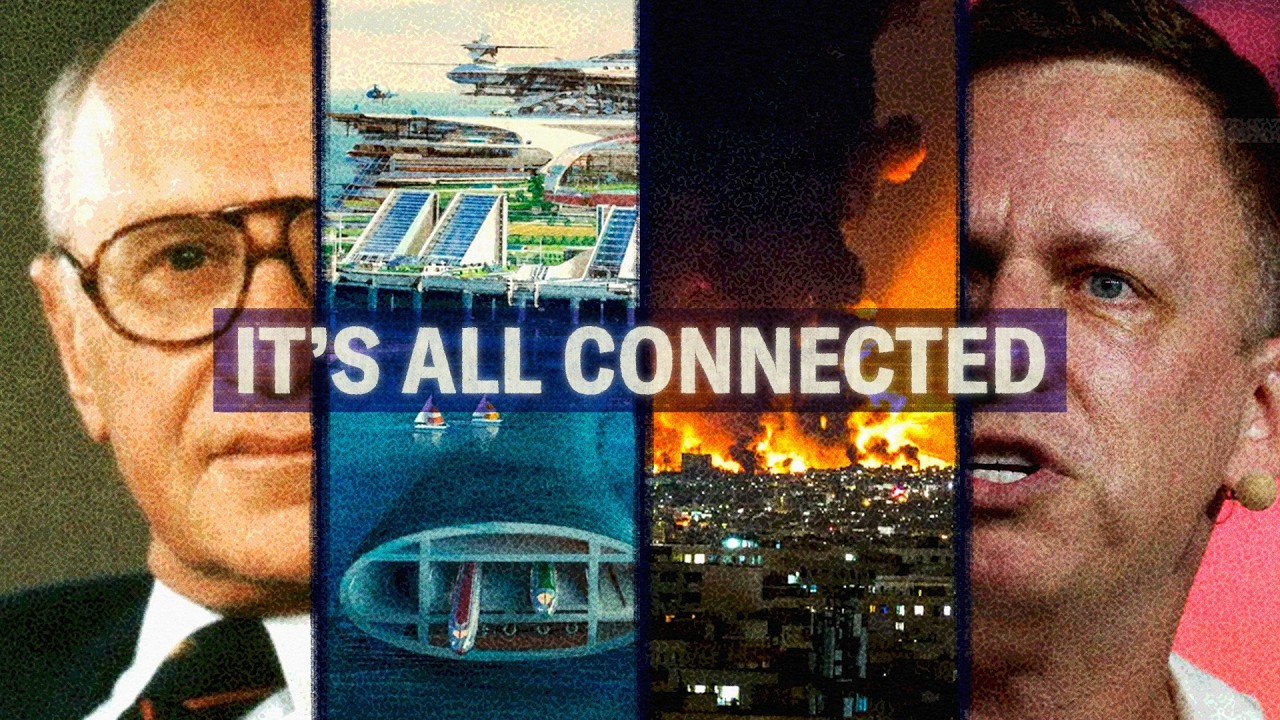
lonsdale
gil duran: 9
In 1997, there was a book that came out called “The Sovereign Individual.”
3:03
It argued that in the 21st century, two technologies would result basically in the overthrow of democracy
3:11
and the demise of nations like the United States.
3:14
Cyber currency, which we would call crypto today.
3:17
And the other one was advanced automation that would create a world without jobs,
3:21
and that wealthy individuals who were savvy investors could profit from this coming doom
3:27
and prepare for it by making the right investments.
3:30
This book had a major impact on Peter Thiel.
3:33
And of course, it influenced the people Thiel was paying.
3:37
Joe Lansdale got to work.
3:39
He started a nonprofit, California Common Sense , allegedly dedicated to transparency and government
3:44
spending, so that voters could make a difference if they found things they were unhappy with.
3:48
On the surface, that sounds great, but two founders of that nonprofit started a for-profit:
3:53
OpenGOV.
3:54
OpenGOV is a software service for government agencies to manage data.
3:57
The idea of replacing democratic processes in the hands of all of us
GHIS MAXWELL!
4:29
But the think tanks would herald a few successful versions of their privatization plan.
4:34
Like Sandy Springs, Georgia, famously the first city in America
4:38
to privatize nearly all government services.
4:41
It was the darling of the libertarian press.
4:43
Everything for-profit, nothing public.
4:46
And a consulting firm making a little cash off the taxpayers at every juncture.
4:49
Those extra taxes for corporate profit started adding up, though.
4:54
Eventually, Sandy Springs unprivatized
4:56
saving taxpayers millions of dollars a year.
4:59
There were also nascent communities focused on Christian values
5:03
that the network state media heralds.
5:05
Battle Ground, Washington,
5:06
where a data center billionaire is buying up all the property to own the town,
5:11
the mayor is on his payroll,
5:12
and Highland Rim, a series of developments in Appalachia
5:16
run by the investment firm New Founding.
5:18
And that's not even including the California Forever Project,
5:21
a proposed tech city in Solano County
5:24
funded by Marc Andreessen, Reid Hoffman, Sam Altman and other billionaires.
5:29
But what if this was never really about these little mini governments?
5:33
Here's Peter Thiel saying the quiet part out loud in 2010.
5:37
[Thiel] Technology is this incredible alternative to politics.
...
7:13
You could pass laws, know, Cicero's in 15 states, we're getting dozens of laws passed.
7:17
And then we're going to teach people that and go to the national level.
7:20
[Gil] Riling people up is definitely part of their game plan.
7:22
That's what we saw in the San Francisco recalls.
7:24
San Francisco had a spike in crime during the pandemic,
7:28
but so did almost every big city in the United States.
7:30
Only in San Francisco,
7:32
which has extremely low crime rates compared to most cities in red states,
7:37
did they create this massive panic using social media and doom influencers
7:43
to convince everybody that everything was worse than it ever been.
7:47
And as Lonsdale got into nonprofits and think tanks,
7:49
Patri Friedman – remember him?
7:51
Milton Friedman's grandson?
7:53
Started his own VC firm with backing from Peter Thiel
7:56
called Pronomos Capital, existing entirely for investing in privatized governments.
8:01
In Honduras, Pronomos invested in the first government
8:04
run entirely by a for-profit corporation: Prospera.
8:08
[Gil] Prospera is this little enclave on the island of Roatan in Honduras
8:13
That claims to be its own little charter city
8:16
that was funded by American venture capitalists and has been touted
8:20
as the flagship project of the network state movement.
...
lonsdale
8:24
But the real flagship project is something bigger:
8:27
the entire United States government.
8:30
It shows in policy.
8:32
Remember the whole thing about taking over Greenland?
8:35
That idea emerged and was celebrated by the people we've been talking about.
8:38
I think having a frontier is very healthy.
8:40
I think part of America being great is that it's is growing and creating more wealth for everyone.
8:44
If the people in Greenland want to be part of us, if we can use those resources
8:48
better and make sure Russia and China don't get advantages in the Arctic.
8:51
The Freedom City as a name didn't really gain momentum,
8:54
but the idea is there, and the influence in the administration is clear.
8:58
Joe Lansdale helped staff up the Trump administration
9:01
and just recently accompanied administration officials to the Philippines
9:04
to christen a new regulatory zone.
9:07
Just last week, we signed a historic deal with the Philippines, 4000 acres
9:11
right next to Subic Bay, where we're going to build a
9:14
first-of-its-kind, AI-native industrial park.
9:17
I was there for a day in the Philippines with everyone.
9:20
They’re, they’re excited, what you guys are doing.
9:22
That sounds a lot like a startup city....
9:37
that this stuff could travel to the White House.
9:42
[Gil] In September 2024, there was a conference at Fort Mason
9:46
in San Francisco called Reboot 2024,
9:49
and its website announced that we are now in a new reality.
9:53
And that Silicon Valley was waking up and about to become this powerful force in politics.
9:58
And the guest speaker was Kevin Roberts of the Heritage Foundation
10:02
who was the guy who had shepherded Project 2025.
10:05
So here you had tech VCs in San Francisco...
kishner
10:20
for maritime prosperity zones,
10:23
districts on American soil with fewer regulations
10:26
for corporations to build ships and reinvigorate the industrial base.
10:30
Then there's the New American Industrial Alliance,
10:33
a tech industry interest group pushing for unrestricted data center growth.
10:37
They were listed as co-sponsors of the Blueprint for America,
10:41
lobbying for prosperity zones on American soil.
10:44
A plan to sell federal and public land to private companies
10:48
to build low regulation, low tax havens for progress.
10:52
Their co-sponsor on the Blueprint was the company behind Prospera in Honduras,
10:56
whose lobbying disclosures show they spent hundreds of thousands of dollars
11:00
pushing for prosperity zones.
11:02
But they also spent big on begging the American government for handouts of your money.
11:08
They've lobbied on refunding the US International Development Financial Corporation,
11:12
a government organization run by Epstein associate Ben Black
11:15
that uses tax dollars to invest in American companies abroad.
11:20
That's privatized foreign aid.
11:22
And they might finally get their way.
11:24
Black went to Honduras and promised investment in real estate and technology there,
11:28
including an investment in La Ceiba, which is slated to be absorbed by Prospera.
11:34
But it's more than just government handouts.
11:37
It's war crimes.
11:38
So we did a master plan.
11:39
And we've developed ways to redevelop Gaza.
11:41
Gaza is President Trump's and saying has amazing potential.
11:44
And this is for the people of Gaza.
11:45
We've developed it into zones.
11:47
[Gil] It was sort of insane to see it all come together in this way.
...11:55
there's always the idea of a new city that they're proposing.
11:59
And it's not clear why we need these new cities.
12:01
You know, Gaza should be rebuilt for for the Palestinians.
12:05
But these guys see it as an opportunity to take the land.
12:09
And so that shows you the degree to which this thinking is starting to imbue everything that they do.
12:15
[Sean] Look at how the people in this fringe movement
12:18
reacted to other invasions.
12:20
In 2019, Mark Lutter, leader of a Peter Thiel funded new city think tank, said that
12:25
overthrowing the Venezuelan government would be an opportunity for these projects.
12:30
And when the invasion did happen, Lutter suggested America
12:33
establish a Florida or Texas style government there.
12:36
He cites America paying for a wholesale development plan after regime change.
12:41
Which is exactly what we're doing in Iran today,
12:44
to the tune of $300 billion.
12:47
Palmer Luckey, Lonsdale and Thiel associate, and founder of AI defense contractor Anduril,
12:52
pictured here in cosplay,
12:54
suggested a privatized city on Guantanamo Bay in Cuba,
12:57
which President Trump also threatened with invasion.
13:01
Again, nobody wants this.
13:02
They know that.
13:03
That's why they hate populism.
13:05
That's why they hate democratic representation
13:07
despite all of this being couched in freedom.
13:10
What they're asking for is to exit entirely from any government structure.
13:14
But that's just not how it works,
13:16
especially when most of these guys are government contractors, and are still wanting
13:20
to have the benefits of our society without having the responsibilities of our society.
13:26
These are people who don't like being told “no.”
13:28
They're angry at the pushback against data centers, that we don't want AI to take over everything,
gil
13:33
that no one supports annihilating a civilization to replace it with one they can profit from.
13:38
People need to understand that the billionaires have become radicalized against democracy,
13:42
and they're in the process of using everything they have to try to destroy it.
13:45
And that's the battle of our moment.
13:47
That's the battle of our time.
...
13:49
It's not too late to push back.
13:51
Public response to data centers works.
13:53
Many of the governance as a service startups are starting their work
13:56
in towns and states where you can still have a voice to stop them.
14:01
The billionaire class wants to turn your home into their playland,
14:05
completely change how everything is run to funnel more wealth to themselves,
14:09
create chaos,
14:11
and then when everything is all f*cked up,
14:13
walk away with their winnings to their own private enclaves,
14:16
all under the guise of fixing a broken government.
14:20
A government that they broke.
14:21
And yeah, sure, the government is broken,
14:24
but it's not because of democracy or lack of corporate privatization.
14:28
It's because of corporate power.
14:30
We need more democracy and less corporate control.
---
---
Facebook Used the Philippines to Test Free Internet. Then a Dictator Was Elected
NO LNX
Facebook Used the Philippines to Test Free Internet. Then a Dictator Was Elected.
By Jake Swearingen
Sept. 4, 2018
A pool of blood remains at the gutter where an alleged drug user was killed by unidentified assailants in Manila, Philippines. Photo: Ezra Acayan/NurPhoto via Getty Images
In 2013, Facebook hit upon an idea to grow its user base: It would subsidize internet access to Facebook on mobile devices in countries where cellular data was pricey, physical internet infrastructure was poor, and the smartphone revolution meant many leapfrogged from having no internet access at all to using their smartphone as their only source to the web. It found the perfect country to test this out on, in the 100 million citizens of the Philippines, calling it “Free Facebook.”
If the idea sounds familiar, it’s because Facebook attempted to do a version of this in many more countries with its “Internet.org” plan, hoping to get basic internet access to billions of people living without it — access that would come thanks to subsidies from Facebook. Internet.org was largely a failure, thanks to pushback by local governments, telecom companies, and human-rights organizations. Meanwhile, Free Facebook remains wildly successful in the Philippines. As outlined by BuzzFeed News reporter Davey Alba, the company serves as the de facto ISP for many Filipinos:
Thanks to a social media–hungry populace and heavy subsidies that keep Facebook free to use on mobile phones, Facebook has completely saturated the country. And because using other data, like accessing a news website via a mobile web browser, is precious and expensive, for most Filipinos the only way online is through Facebook.
Roughly 69 million Filipinos have access to the internet today, of those nearly 100 percent have a Facebook account. In the U.S. and Canada, for comparison, 87 percent of people with internet access use Facebook. (Zuckerberg, when told by the CEO of Filipino website Rappler in April of 2017 that 97 of the population with internet access was on Facebook, reportedly asked, “What about the other 3 percent?”)
Two years after the launch of Free Facebook, Rodrigo Duterte mounted a presidential bid, casting himself as the tough-on-crime, anti-elite Everyman ready to bring back jobs and order. Posts about Duterte, full of memes, propaganda, and outright libel (one opponent, now in prison on a dubious drug charge, saw a fake sex tape circulate on Facebook with her in it) did extremely well on Facebook, as nearly any inflammatory content does. When Duterte said he would dump the bodies of executed drug dealers “into Manila Bay, and fatten all the fish there,” the post immediately went “viral, viral, viral,” bragged one of his two social-media directors.
:{:{He won handily, and his rule has been brutal. At least 12,000 people have been killed during Duterte’s crackdown on drugs, and hundreds of thousands of Filipinos have been jailed, many of them opponents of Duterte himself.}:
Meanwhile, his social-media team has actively worked to bring in social-media influencers to prop up Duterte’s regime (think Filipino versions of social-media creatures like Mike Cernovich, Laura Loomer, or Jack Posobiec) working closely with the Duterte administration — sometimes directly on the government payroll — to spread fake stories such as a deposed Supreme Court justice was caught attempting to flee the country. Meanwhile, news sources seen as unfriendly to the Duterte campaign have increasingly come under fire, including banning all reporters from an outlet from the presidential palace.}:
Look: Absent Facebook, Duterte almost assuredly would have assumed power and began his dictatorial rule over the Philippines. But Facebook’s News Feed algorithm, attenuated to surface anything that attracts attention, amplifies dictators and demagogues like Duterte. In one egregious example, a fake sex tape spread quickly through Facebook of one of Duterte’s opponents having sex with her chauffeur. “De Lima is not only screwing her driver, she is also screwing the nation,” quipped Duterte.
Facebook says it’s working to police the content in the Philippines better. “We know we were too idealistic about the nature of these connections and didn’t focus enough on preventing abuse or thinking through all the ways people could use the tools on the platform to do harm,” said a Facebook spokesperson to BuzzFeed News. “In the Philippines, this includes the roll-out of third-party fact-checking, better detection of bad content, improved enforcement of our policies, and deeper support for the country’s digital literacy efforts.” (Ironically, many of Facebook’s content moderators who would end up doing this work live in the Philippines.)
:{:{There’s a peculiar callousness in Facebook using entire countries as testing environments. Last year, the company wanted to know what happen if it split the News Feed into two separate streams: one only populated by posts created by friends, and one only for posts created by media publishers. Instead of testing this on a small percentage of American users, it simply flipped the switch in six countries: Bolivia, Slovakia, Sri Lanka, Serbia, Guatemala, and Cambodia. Media organizations suddenly saw their websites’ traffic plummet, fake news stories flourished, and Facebook shut down the experiment within weeks , apologizing in a post that the company “received feedback that we made it harder for people in the test countries to access important information.”}:
About 66 million people — roughly the population of Texas, Florida, and New York combined — live in those six countries. Each country has its own particular news ecosystems, cultural norms, and political challenges. For Facebook, the countries represented a handy way to try out some A/B testing. To be very cynical about it, it also probably affected Facebook’s decision that those six countries bring in significantly less advertising dollars than Texas, Florida, and New York.}:
In the Philippines, its Free Facebook program has become so successful that it’s hard to imagine how Facebook and the Philippines could ever untwine themselves from each other. (Indeed, the company partnered with Duterte’s government to build an undersea cable connecting the Philippines to the U.S. and Asian countries.) And even after Duterte leaves office, whenever that may be, the Philippines will still be a country where one website’s algorithm determines what 97 percent of internet users look at.
There are, of course, no parallels to be drawn between the Philippines and the United States.
Correction: An earlier version of this story cited that 97 percent of Filipinos with Internet access have a Facebook account. According to the data from WeAreSocial, that number is actually 100 percent; 97 percent of Filipinos with internet access were on Facebook in April 2017. The post has been updated to reflect that.
SourcesHow Duterte Used Facebook To Fuel the Philippine Drug War [Buzzfeed]
---
DN 1 25
...NERMEEN SHAIKH: And, Maria, could you say, specifically, I mean, in a place like the Philippines, there’s — almost 90% of the population in the Philippines is on Facebook. And how is Facebook used, not only in terms of posting information, but also as a means of communication, and the way in which misinformation has spread on Facebook in the past, not only, of course, in Myanmar, which is the example that you cited, but also in the Philippines and elsewhere?
MARIA RESSA: I mean, very specifically, our past president, Rodrigo Duterte, used the design of what was an advertising and marketing platform of Facebook to do information operations. I was getting an average of 90 — nine, zero — hate messages per hour, free speech used to stifle free speech. But beyond that, these networks of information warfare, networks of disinformation literally changed our history in front of our eyes, setting the stage for the election of Ferdinand Marcos Jr., the only son of our dictator who was in power for 21 years, Ferdinand Marcos. You’ll remember Imelda Marcos and her shoes. Her son, Ferdinand Marcos Jr., won overwhelmingly in our presidential elections, because, literally, Filipinos were taught in information operations — YouTube, Meta and Facebook — that Marcos was not a dictator, in 1986 ousted in people power; instead, he was the greatest leader the Philippines has ever known.
AMY GOODMAN: In 2021, the Rohingya refugees actually sued Facebook’s parent company Meta over its failure to stop violent hate speech on its platform, which contributed to the bloody military crackdown of the Rohingya Muslim community by the military in 2017 in Burma, also known as Myanmar. Law firms in the U.S. and U.K. launched the legal effort on behalf of the Rohingya around the world, including in Bangladeshi refugee camps. Plaintiffs demanded over $150 billion in damages. The U.N. found as many as 10,000 Rohingya were killed by Burmese forces during the 2017 genocide, though some estimates put the death toll at twice that. Over another 730,000 people were forced to flee the country. I just want to go to a quick video, part of a video, produced by Amnesty, featuring a survivor of the Rohingya genocide.
SAWYEDDOLLAH: My name is Sawyeddollah. I am from Myanmar, but now I am living in Bangladesh, Cox’s Bazar, as a forcibly displaced Myanmar national. [translated] I personally experienced that online hate speech turned into offline hate for us. There were many different things on Facebook against us, which turned the people of Myanmar against us. I saw many different anti-Rohingya posts on Facebook. For example, I still remember a post that said, “The birth rate of these Bengali [Rohingya] people is very high. If it remains continuously like this, we will become their slaves. Now they are our slaves. Let’s go for action.” I knew about the option of reporting hate speech to Facebook. I already reported some hate speech to Facebook, but it only said, “Thank you for reporting. This post doesn’t go against our community standards.”
AMY GOODMAN: I wanted to bring Siva Vaidhyanathan into this conversation, author of Antisocial Media: How Facebook Disconnects Us and Undermines Democracy, a professor at the University of Virginia. And I wanted to go to this issue of hate and how deadly it can be, whether we’re talking about Burma, Myanmar, or whether we’re talking about the United States. I mean, you have, just giving a bunch of examples, roughly seven in 10 lesbian, gay, bisexual adults have encountered any harassment online. Fully 51% have been targeted for more severe forms of online abuse. You have roughly about a third of women under 35 may have been sexually harassed online. You have — a study of 51 countries reveals 38% of women had personally experienced online harassment. Professor Vaidhyanathan, if you can talk about the connection to hate and how that connects to, well, your headline of your Guardian piece, “Mark Zuckerberg has gone full Maga”?
SIVA VAIDHYANATHAN: Right. Well, let’s be clear about this change. And I’m really thrilled that you’ve started this conversation by going beyond the United States. What Mark Zuckerberg announced the other day clearly only applies to the United States in terms of its specificity. In the United States, since 2017, Meta has been trying to at least appear that it’s taking content moderation seriously. And let’s remember, the proper phrase to describe what we’re talking about is “content moderation.” Fact-checking was never part of the formula. It’s not about facts. It’s about protecting users. It’s about protecting people from things like harassment, for protecting groups of people from campaigns and movements, people like citizens of my town, Charlottesville, Virginia, who encountered a flood of violent right-wingers in the summer of 2017 through a movement that was largely organized through Facebook. So, the idea here — and why Zuckerberg has appeared before Congress multiple times swearing that he’s doing a good job — has all been about the United States.
...
https://insideclimatenews.org/news/15052022/philippines-fossil-fuels-climate-liability
icn 5 22 nick k
when Typhoon Haiyan struck the Philippines in 2013, it made a direct hit on the hometown of Yeb Saño’s family. Saño,the country’s chief climate negotiator at the time, had to attend the United Nations climate change conference in Poland only days after the storm passed. As he addressed the other delegates, his brother was helping collect the dead.
“My brother remembered exactly how many bodies he picked up with his own hands,” Saño said. “Seventy-three dead bodies exactly.”
Haiyan ultimately killed more than 6,000 people in the Philippines and damaged more than 1 million homes, uprooting lives with devastation from which the country still hasn’t recovered. While the storm may have been an act of nature, Saño and others were convinced that humans, ultimately, were responsible.
In 2015, working with Greenpeace Southeast Asia, Saño sought to hold those people accountable, petitioning the Philippines’ Commission on Human Rights to declare the world’s largest fossil fuel companies “accountable for either impairing, infringing, abusing or violating human rights” because of their contribution to climate change.
earlier this month, the commission issued its conclusions. Saño felt vindicated. In a damning and lucidly-written report, the commission found that the world’s largest fossil fuel companies had “engaged in willful obfuscation and obstruction to prevent meaningful climate action.” The companies continue to deny climate science and try to slow a transition away from fossil fuels, the report said, driven “not by ignorance, but by greed.”
As the first national human rights body to weigh in on fossil fuel companies’ role in driving climate change, the commission determined that corporations have obligations under human rights law and can be held liable if they neglect them. While the commission has no power to compel companies or governments to act on its findings, legal experts said its report carries broad implications for other cases.
“This is a milestone for the narrative that climate impacts result in the infringement of human rights,” said Saño, now the executive director of Greenpeace Southeast Asia. “So this report means a lot to Filipinos who confront the adverse effects of the climate crisis. This means a lot for the pursuit of climate justice.”
Some of the companies named in the petition, which included Chevron, ExxonMobil and other major producers, sought to have it dismissed, the report said, arguing that the commission had no jurisdiction beyond its borders and that the topic reached outside its traditional realm of political and civil rights. But the commission rejected these appeals, determining that it had a mandate “to test boundaries and create new paths; to be bold and creative, instead of timid and docile.”
Some experts said the report’s impacts extend beyond the Philippines, increasing the legal risks that fossil fuel companies are facing from a raft of lawsuits around the world. Despite the commission’s lack of enforcement powers, legal experts said its findings provide new strength and evidence for cases that have already been filed and will help people file new challenges in courts and human rights commissions elsewhere.
“I think corporations, their boards, their leaders should really start taking this potential liability seriously,” said John Knox, an expert in international and human rights law at Wake Forest Law who testified to the Philippines commission. “This is the harbinger of much more to come.”
The commission’s multi-year inquiry and its final report are part of a growing effort globally to reframe climate change as a threat to human rights. Last year, the United Nations Human Rights Council created a new special rapporteur on human rights in the context of climate change. Aside from better recognizing the impacts of warming on people’s health and well-being—now evident around the world in the form of more extreme weather—advocates of this framing say it provides a solid base for holding governments and corporations accountable if they fail to cut greenhouse gas emissions.
Saño said he has been in touch with colleagues in other parts of Asia, Africa, Latin America and Europe about the report’s findings.
“Many of them were just waiting for this to be completed,” he said, “and now that we have seen the culmination of the Philippines case it provides a lot of energy into those other possibilities.”
A Roadmap to Document Harm
The Philippines is one of the most climate-vulnerable countries in the world, an archipelago south of Taiwan that is hit by an average of 20 cyclones each year, according to the commission’s report. The country has also contributed only a tiny portion of the greenhouse gases that humans have pumped into the atmosphere over the last century-and-a-half. The pairing of the Philippines’ vulnerability with its relative lack of culpability makes it a powerful venue for an inquiry into climate change and human rights.
In 12 public hearings and many hours of testimony, the commission gathered an exhaustive catalog of evidence about the science of climate change and its impacts, and fossil fuel companies’ efforts to sow doubt about that science as they lobbied against government attempts in the United States and other countries to reduce dependence on coal, oil and gas.
The petition by Greenpeace drew on the research of Richard Heede, who leads the Climate Accountability Institute and has published studies linking specific levels of greenhouse gas emissions to specific companies, the so-called “carbon majors.” According to Heede’s research, Saudi Aramco, the state-owned oil company of Saudi Arabia, is responsible for more emissions than any other company, with Chevron and Exxon close behind.
Carroll Muffett, president of the Center for International Environmental Law, which filed an amicus brief in support of the petitioners, said the new report was perhaps the most comprehensive compendium of all the research that has been published on fossil fuel companies’ role in driving emissions.
But what stood out, Muffett said, is that the report tied those greenhouse gas emissions to immediate threats to specific human rights of Filipinos, including their rights to life, health, food security and sanitation.
“Through every one of those rights, the commission pulls out witness testimony that says this was the lived experience of this,” Muffett said. “It is very much a roadmap to show how you document human rights impacts of climate change not only on entire nations, but on individuals and the communities who are being harmed, and that is, I think, extremely important.”
One chieftain from the southern Philippines testified that her people have been unable to practice traditional rituals based on seasonal rhythms because erratic weather has disrupted the once-predictable patterns. A rice farmer reported decreased harvests as a result of extreme heat.
One storm survivor told of losing three children, a son-in-law and four grandchildren to Typhoon Sendong in 2011. Veronica Cabe, one of the petitioners, spoke about the destabilizing effects of having her home destroyed by a storm.
“We felt displaced, we didn’t have our own space,” she told the commission. “We were forced to live with friends who were willing to share their homes with us. We were separated from each other.”
The commission held several hearings in New York and London, and traveled to the Netherlands, too, in a mostly-failed attempt to have some of the 47 fossil fuel companies named in the petition testify or meet with the commissioners.
The report focuses in particular on arguments made by theAmerican Petroleum Institute, the American coal industry and others, beginning in the 1990s, against efforts to limit emissions from fossil fuels, despite those organizations’ knowledge of the dangers of failing to do so.
In the report, the commission cites international human rights laws and standards to say that corporations, in addition to states, have obligations to protect human rights. It points to the continued financing of politicians who oppose climate action as evidence that fossil fuel companies are still working to deflect needed action. And it adds that financial institutions that fund fossil fuel production share in the responsibility and, potentially, liability for continuing to drive emissions higher.
Scott Lauermann, a petroleum institute spokesman, said, “At a time of rising energy costs and geopolitical volatility around the world, it’s more apparent than ever that we must both reduce emissions and ensure access to affordable, reliable energy for U.S. consumers, and that’s exactly what our industry has been focused on for decades” He added, “Any suggestion to the contrary is false.”
Creighton Welch, a spokesman for Chevron, said, “Chevron intends to be a leader in efficient and lower-carbon production of traditional energy—in high demand today and for years to come—while growing the lower-carbon businesses that will be a bigger part of the future.”
Todd Spitler, an Exxon spokesman, said the company was “developing comprehensive roadmaps to reduce greenhouse gas emissions from our operated assets around the world and in support of society’s net-zero ambitions,” including investments in low-carbon technologies such ascarbon capture and storage, hydrogen and biofuels. He added, “Our commitment to emissions reduction isn’t new; we have supported the Paris Agreement from its inception and made consistent progress on short- and medium-term emissions-reduction plans.”
A spokesperson for Saudi Aramco declined to comment.
The report was the first to be issued by a national human rights commission, and experts said it was only the second official finding to tie fossil fuel companies’ actions and responsibilities directly to the human rights impacts of climate change. Last year, a Dutch court ordered Shell to reduce its emissions in a ruling that drew in part on human rights laws.
Muffett and others said the report will add to a growing list of rulings and evidence laying the groundwork for holding specific companies liable for their role in fueling warming.
“What the commission is saying is there are adequate bases here for seeking to hold these companies liable,” Muffett said. “And I think that’s really significant because this report provides a pretty clear roadmap to human rights bodies and courts around the world, to then take up cases to do precisely that.”
In the report, the commission acknowledged that it had no enforcement powers, and instead was providing recommendations to companies and governments for how they could meet their obligations to protect human rights with respect to climate change. For companies, chief among those was halting the exploration of new oil and gas fields and contributing to a climate fund for mitigation and adaptation. The report said states must enact policies to make sure companies take these steps, and to penalize those that don’t.
Saño said he hopes the report would have immediate impacts in the Philippines, where the son of the former dictator Ferdinand Marcos Sr. was just elected president on Monday. He said successive governments have failed to address injustices in the country, including the concentration of power in a small elite, that exacerbate the impacts of climate change. The new government has an obligation to better protect its citizens from the storms that hit its coastlines every year, Saño said, and “this really paves the way for a lot of change, we hope.”
https://www.bbc.com/news/science-environment-58508001
no lnx pix
Record number of environmental activists murdered
By Claire Marshall
BBC Environment & Rural Affairs Correspondent
Published 13 September
image captionSouth African environmental activist Fikile Ntshangase was shot dead in her own home
A record number of activists working to protect the environment and land rights were murdered last year, according to a report by a campaign group.
227 people were killed around the world in 2020, the highest number recorded for a second consecutive year, the report from Global Witness said.
Almost a third of the murders were reportedly linked to resource exploitation - logging, mining, large-scale agribusiness, hydroelectric dams and other infrastructure.
The report called the victims "environmental defenders" killed for protecting natural resources that need to be preserved, including forests, water supplies and oceans.
Since the Paris Agreement on climate change was signed in 2015, the organisation says on average four activists have been killed each week.
It said this "shocking figure" was likely to be an underestimate because of growing restrictions on journalists and other civic freedoms.
Logging was the industry linked to the most murders with 23 cases - with attacks in Brazil, Nicaragua, Peru and the Philippines.
Indigenous peoples, most often on the frontline of climate change, accounted for a further one third of cases. Colombia had the highest recorded attacks, with 65 people killed last year.
'Unbearably heavy burden'
A senior campaigner for Global Witness, Chris Madden, called on governments to "get serious about protecting defenders." He said companies must start "putting people and planet before profit' or he warned that "both climate breakdown and the killings" would continue.
"This dataset is another stark reminder that fighting the climate crisis carries an unbearably heavy burden for some, who risk their lives to save the forests, rivers and biospheres that are essential to counteract unsustainable global warming. This must stop''.
The organisation called on governments to formally recognise the human right to a safe, healthy and sustainable environment, and ensure commitments made at November's UN climate change conference, COP26, integrate human rights protections.
In response, COP26 president Alok Sharma told the BBC he had "prioritised meeting people on the front line of climate change," to ensure the voices of all are heard."
'Shot dead in her living room'
Those murdered includedSouth African Fikile Ntshangase, 65, who was involved in a legal dispute over the extension of an opencast mine operated by Tendele Coal near Somkhele in KwaZulu-Natal province. She was shot dead in her own living room.
Her daughter, Malungelo Xhakaza, 31, said her "mother's struggle lives on." She said: "To this day no arrests have been made in the investigation into my mother's murder. There has been no accountability. It seems to me that someone wants this mine expansion and the extraction to go ahead, no matter the cost."
Petmin Limited, which owns the Somkhele mine through its subsidiary Tendele Coal Mining, told Global Witness that it "acknowledges community tensions may have been a factor in Fikile's death." The company said it "strongly condemns any form of violence or intimidation" and has offered full co-operation with the police.
Óscar Eyraud Adams
image captionÓscar Eyraud was killed in his home in Mexico in 2020
The killings also included Óscar Eyraud Adams, who was murdered in Mexico in September 2020. He was working to help the indigenous Kumiai community in Baja California have better access to water.
Global Witness said activists still under threat included communities in Guapinol in Honduras, where dozens of people have been protesting against an iron oxide mining concession that was granted by the central government in a protected area. Campaigners believe the Guapinol river, a vital water source, is threatened. The organisation says "many community members remain incarcerated."
==
an 921 no lnx twt
Climate inaction leaves majority of young people believing humanity is 'doomed'
Julia Conley and Common Dreams September 15, 2021
Amidst a sharp increase in deadly wildfires and flooding, increasingly violent storms, and extreme heat, new research published Tuesday found that refusal by governments to act on the climate emergency is causing a widespread sense of hopelessness and eco-anxiety in teenagers and young adults worldwide.
The global advocacy group Avaaz joined researchers at the University of Bath in the United Kingdom and five other universities to survey 10,000 young people between the ages of 16 and 25—the first large-scale eco-anxiety survey of its kind—and discovered that majorities of the respondents were fearful for the lives and livelihoods of their families and the future of the planet.
As Luisa Neubauer, a 25-year-old leader of the global Fridays for Future movement in Germany, told the Thomson Reuters Foundation, while the climate extremes caused by the planetary emergency are frightening, inaction by world leaders "is too much to handle, too much to accept."
"Government is pushing us in front of a bus,"Neubauer told the outlet.
The mental health professionals who conducted the study spoke with young people in 10 countries including Nigeria, the Philippines, India, the U.K., and the U.S., finding that respondents in both wealthy countries and the Global South are facing "feelings of anger, fear, and powerlessness" as the climate crisis directly causes at least one famine, deadly flash flooding, and wildfires in multiple regions.
Nearly half of respondents said their worries about the climate crisis negatively affect their daily life and their ability to function, and more than half told the experts they feel humanity is "doomed."
Four in 10 said they would hesitate to have children in the future due to the state of the planet, while three-quarters of respondents described their futures as "frightening."
Avaaz reported that one of the most "shocking" findings was how respondents described their feelings about government inaction, including more than half who said they feel policymakers "are betraying them."
"If this isn't a wake up call for world leaders, what is?" asked Avaaz.
Young people in the cyclone-ravages Philippines andBrazil, where deforestation—driven by President Jair Bolsonaro's government—has become increasingly destructive in recent years, showed the most anxiety of the countries surveyed. More than nine in 10 respondents said they were frightened about the future. Caroline Hickman, lead author of the study, which was published in The Lancet on Tuesday, cautioned adults against telling young people it is up to them to save the future of the planet. "Thinking the way to cure eco-anxiety is eco-action isn't right," Hickman told Thomson Reuters, adding that what will solve the climate crisis is decisive action by world governments.
The survey "shows eco-anxiety is not just for environmental destruction alone, but inextricably linked to government inaction on climate change. The young feel abandoned and betrayed by governments," Hickman told the BBC. "Governments need to listen to the science and not pathologize young people who feel anxious."
The survey results were released less than two months ahead of the 2021 United Nations Climate Change Conference (COP 26), where policymakers will meet in Glasgow to discuss commitments to phase out fossil fuel subsidies, provide climate mitigation support for frontline communities across the globe, and rapidly transition to an emissions-free energy system.
Young people are "doing everything we can" to push for climate action, Neubauer told Thomson Reuters, "but that won't be enough."
"We won't fix it" through the Fridays for Future movement, she added. "We need everyone there." no lnx
https://amti.csis.org/dutertes-pivot-to-russia/
by RICHARD JAVAD HEYDARIAN | OCTOBER 17, 2019
While Philippine President Rodrigo Duterte’s controversial China policy has understandably attracted considerable attention, few have taken his strategic pivot to Russia seriously enough. Instead, even some senior Filipino officials view burgeoning ties with Moscow as nothing but a reflection of Duterte’s personal fascination with Russia and his famed “bromance” with Vladimir Putin.
But reaching out to Moscow carries potentially huge geostrategic implications. In the spirit of his so-called “independent foreign policy,” Duterte has single-handedly shattered the profound stigma surrounding defense cooperation with Russia, with far reaching consequences. The Philippines is now seriously exploring large-scale purchases of advanced Russian military hardware as well as offshore energy investments to strengthen its hand in the South China Sea amid Beijing’s rising assertiveness.
Strategic Diversification
To put things into perspective, Duterte is the only Filipino leader in recent memory to have visited Russia for an official mission. Throughout the Cold War, the Philippines, host to the United States’ largest overseas naval and air bases, largely shunned relations with Moscow. Thereafter, post-Soviet Russia had minimal strategic presence in Southeast Asia, reduced at best to an afterthought among Filipino leaders who actively prioritized bilateral relations with the United States and China.
An element of personal diplomacy and ideological alignment has driven this surprising turn in the historically lukewarm Philippine-Russia relationship. As an authoritarian-leaning populist, Duterte has repeatedly praised Putin, calling the Russian leader his “favorite hero” and citing his supposed personal decisiveness, iron-fist rule, and brazen defiance of the West. Outraged by international criticism of his brutal drug war, the Filipino leader is naturally drawn to the Russian notion of “sovereign democracy” (*suverennaya demokratiya*), which emphasizes national insulation from external, especially Western, influence.
But beyond the personal dynamics, there is a deeper strategic argument for Duterte’s pivot to Russia. As the Filipino leader made it clear during his high-profile speech at the annual meeting of the Valdai Discussion Club in Sochi, with Putin and several Asian leaders in attendance, his goal is not to ditch the long-standing alliance with the United States, nor is he against liberal democratic values per se. Instead, he seeks to amend an “oversight of [huge] strategic proportion” in the Philippines’ traditional foreign policy, which relegated Russia to “the margins.” He clarified that he is primarily interested in “expand[ing] the horizon of Philippine diplomacy by deepening our engagement” with like-minded nations and non-western powers. In short, this is less about Putin and more about the need for the Philippines to find new partners.
Duterte’s recent five-day visit to Russia was not his first. In early-2017, the Filipino leader had to cut short his state visit to Moscow following the siege of Marawi by Islamic State-affiliated groups in the southern Philippines. Despite the disruption, the Philippine delegation, which included top defense and national security officials, signed a number of key agreements with the Eurasian power, including an Agreement on Defense Cooperation.
The upshot was the rapid emaciation of the U.S.-trained Philippine defense establishment’s stigma against cooperation with Russia. As the battle of Marawi raged on, Russia seized on the opportunity to become a key source of counter-terrorism assistance. With a defense agreement in place, Moscow offered direct military assistance, including assault rifles and armored vehicles, in addition to intelligence on foreign IS fighters operating in the region.
Russia’s South China Sea Foray
Counter-terrorism cooperation quickly became a springboard for closer defense relations that have the potential to strengthen the Philippines’ position in the South China Sea. In recent years, Russian warships have made regular port calls in Manila as both sides began discussing joint naval exercises in Philippine waters, especially the country’s porous borders with Malaysia and Indonesia, which have served as entry points for transnational terrorists.
The Philippines is now set to acquire 16 Mi-17 medium-lift helicopters (worth $14.7 million), a symbolic purchase that may pave the way for more advanced and large-scale acquisitions. Amid a multi-billion-dollar military modernization program, with a focus on developing maritime security capabilities, the Philippine military is actively seeking alternative and more affordable arms suppliers.
According to Defense Secretary Delfin Lorenzana, the Southeast Asian country is currently exploring the purchase of attack helicopters, multi-role fighter jets, and warships from Russia. He even hinted at a potential purchase of Kilo-class submarines, which could be deployed for defense of Philippine interests in the South China Sea. Like Vietnam and Malaysia, the Philippines is carefully examining large-scale purchases of (relatively affordable) advanced Russian weaponry to help keep external threats, particularly China, at bay.
Recognizing the vast potential in bilateral defense cooperation, Moscow recently deployed its first ever defense attaché to Manila, with one Russian diplomat boasting, “What we can assure you, if you are going to procure military equipment, for us, we are going to give you brand new ones and not second hand.” It was a thinly veiled reference to Duterte’s constant criticism of the United States for supposedly giving its Southeast Asian ally mostly hand-me-down military equipment.
During the Philippine-Russia Business Forum this month, Duterte also invited top Russian companies to invest in the country, particularly in the energy and infrastructure sector. He has reportedly sought offshore energy investments from Russian oil giant Rosneft.
The details are yet to be fully disclosed, but the two sides are likely exploring the possibility of Russian offshore investments in the Philippines’ exclusive economic zone in the South China Sea. After all, major Russian companies including Rosneft as well as Gazprom and Zarubezhneft are active in Vietnamese offshore oil and gas projects in the area.
The Philippines could take a page out of Vietnam’s playbook by leveraging Russian military technology and energy investments to ward off Chinese aggression in its waters. Despite its close relations with Beijing, Moscow has shown remarkable interest in expanding its strategic footprint in Southeast Asia, especially among China’s rivals in the South China Sea. Burgeoning Philippine-Russian relations represent, to use the tired Chinese diplomatic lexicon, a potential “win-win” cooperation for both sides.
About Richard Javad Heydarian
Richard Javad Heydarian is an Asia-based academic, currently a Research Fellow at National Chengchi University (Taiwan), and author of, among other works, The Rise of Duterte: A Populist Revolt against Elite Democracy and The Indo-Pacific: Trump, China, and the New Struggle for Global Mastery.
==
==
420 shoot troublemakers
Japan’s Shinzo Abe to Declare Emergency; Filipino Police Kills Man Who Flouted Coronavirus Rules
==
220 an
no lnx
Nations are rejecting the president’s foreign policy puffery as autocrats ditch Trump and embrace China
Written by Washington Monthly February 18, 2020
Venezuela is a bipolar nation in the eyes of the world. More than 50 countries recognize the government of interim President Juan Guaidó. The rest of the world — most significantly Russia and China — continue to support and strengthen the grip of President Nicolás Maduro.
It’s bad enough that the Trump administration has been all bark and no bite, trying to flip the failed Latin American state’s leadership with tough rhetoric and State of the Union ovations. What’s worse is that America under its current leadership has shown that there are neither significant consequences nor consequential actions that can be taken when a foreign country snubs Washington in favor of Moscow or Beijing.
The latest nation to reject President Trump’s foreign policy puffery? The former American colony and current conflict-ridden country of the Philippines.
Flattery is not foreign policy, and Trump’s fan-boy attitude towards Rodrigo Duterte has not convinced the populist Filipino leader that Manila’s future and his personal power are assured by remaining allied with the United States. Instead, he has chosen to throw in his lot with Xi Jinping and the promise posed by China as a regionally rising economic superpower.
This is not only bad news for America’s strategic rebalancing in the Pacific and for regional security. It is really bad news for those other Southeast Asian nations looking around their neighborhood and trying to figure out how to balance their economic and security interests against their long-standing American trading and security alliance partners.Any way you look at this, Duterte’s move is big. On Tuesday, Duterte let the United States know that he was dumping the 69-year-old treaty alliance that allowed American forces to remain and train in the Philippines.
It’s not just the carrot of Chinese capital that has attracted Duterte to Beijing. The Philippine president feels insulted and justifies turning away from the United States by saying “America is very rude” to Filipino friends accused of human-rights violations.
Human rights, however, have never been a priority for the Trump administration. POTUS arrived in the White House ready and willing to toss democratic principles, values, norms and rules in the dumpster.
Duterte has it all wrong.
Trump is a true ally who embraces Duterte’s autocratic rhetoric. Trump envies Duterte’s dictatorial style and tough-guy approach to law enforcement and politics. Trump entered office encouraging American law enforcement to use extrajudicial measures —whether slamming perps heads into cop-car roofs or encouraging the illegal actions of Arizona Sheriff Joe Arpaio. The latest outrage is Trump’s admiration for summary death penalties for drug dealers.
Duterte has encouraged vigilantism by everyone from civilians to police to government forces. His approach has been to give a pass to anyone who kills a suspected drug user or dealer. He flaunts his own tough-guy credentials by bragging about personally killing criminals. He waves around guns to prove his seriousness and reinforce his power.
Trump has tried to court Duterte’s loyalty to — and love for — America. POTUS practices a populism aligning his personal leadership style with Duterte’s. Despite the anti-charm offensive, and regardless of the two countries’ clearly shared interests, the Philippine leader just bet his country’s future on the People’s Republic of China.
In effect, long-standing military relations have just been reversed, and America has been told to go home.
The U.S.-Philippine relationship has never really been smooth. Duterte still harbors resentment for a 1906 Moro massacre so fierce and unjust that it drew the attention of Samuel Clemens—Mark Twain. Volcanoes and tightening American budgets in the 1990s shut down Clark Air Base. Entire Filipino communities that relied on employment and business from U.S. bases suddenly were out of luck.
The two countries’ relationship survived the Marcos regime and the destructive Mt. Pinatubo volcano. In fact, the Yellow Revolution that overthrew full-fledged dictator Ferdinand Marcos brought to power an Aquino family boasting deep American training and credentials. Corazon Aquino felt both grateful and indebted to the United States for supporting the overthrow of the Marcos regime and the successful transition to a civilian-led and functional electoral democracy.
The bad news? Philippine’s successor democracy gave voters the conditions to sweep into office the tough-talking populist politician Duterte in 2016.
Philippine democracy is now threatened, in part, because China is happy to support reliable autocratic leaders and because Trump’s feckless and personality-driven foreign policy toward Asia has alienated and pushed away Manila. The Trump administration’s foreign policy lacks strategic coherence. Instead, it favors super-summitry and presidential high-fives.
From Manila to Caracas, rightist and leftist leaders calculate which allies will serve them best and where to place their bets. Throwing off perceived post-colonial American shackles for neo-colonial Chinese chains is a bad choice. Unfortunately for the West and democracy, both Venezuela and the Philippines have wagered against Trump’s America.
cf report (dl)
https://www.globalwitness.org/en/campaigns/environmental-activists/defending-philippines/
...In 2018, 30 land and environmental defenders were killed in the Philippines, making it the country with the highest number of such killings in the world. As our new investigation shows, despite his election promises, Duterte’s administration is leaving defenders at the mercy of corporate greed.
Mining, agribusiness, logging and coal plants are driving attacks against environmental activists – with household brands such as Del Monte Philippines and Dole Philippines, and Filipino giants like San Miguel Corporation linked to local partners accused of attacks and murders of protestors.
Download the full investigation, Defending the Philippines (PDF, 5.2MB)
Upon becoming President of the Philippines, Rodrigo Duterte promised to safeguard the country’s rural and indigenous communities, tackle corruption, and protect the environment. Yet our research shows how Duterte has categorically failed to keep these promises, allowing business to continue as usual. And in the Philippines, this means business at all costs. Our report documents a trashing of indigenous rights, endemic corruption, and continued environmental damage – all with impunity
Furthermore, we show how internationally recognised firms including Del Monte Philippines, San Miguel Corporation, Standard Chartered, Dole Philippines, and the World Bank are connected to attacks against defenders through their business activities in the Philippines.
KEY FINDINGS
Violence against land and environmental defenders in the Philippines is a systemic problem, spanning many different regions of the country and many different industries, including:
- Coal - On the first day of Duterte’s presidency, grandmother Gloria Capitan was killed after opposing coal-storage facilities and a San Miguel Corporation-owned coal power plant, backed by Standard Chartered and the World Bank, which was polluting her community in Bataan.
- Agribusiness - Renato Anglao was murdered after he protested the grabbing of indigenous land in Bukidnon, until 2019 used by a local landowner and Mayor to produce fruit for Del Monte Philippines. This follows our recent revelations that another major agribusiness company, Dole Philippines, subleased land to grow bananas from a notorious gun dealer accused of using fraud and coercion to gain rights to indigenous land.
- Logging – The tourist boom in Palawan is fuelling violence, with Ruben Arzaga killed when apprehending illegal loggers felling trees to furnish boutique hotels. He was the twelfth member of a local environmental group to be murdered in less than two decades.
- Mining – A farmers’ association leader, Jimmy Saypan, was murdered by hitmen following protests against the illegal activities of gold and silver mining company AgPet. The company is financed – again – by beer and manufacturing giant San Miguel.
In none of these cases has justice been done.
RECOMMENDATIONS
Duterte’s government must comply with international law and take action to prevent abuses of land rights and of the environment, protect defenders at risk, and hold the perpetrators of intimidation and violence to account.
Those doing business in the Philippines must also recognise their role in facilitating violence – whether through proactive strategies, turning a blind eye, or simply negligence – and clean up their acts or be held accountable.
Consumers can play a part too – by demanding that the fruit they buy or the hotel they stay in isn’t associated with bloodshed, and by demanding that their government take a stand to enable those defending their land and our environment to do so without fearing for their lives.
FIND OUT MORE
Ben Leather,Campaigner, Land and Environmental Rights Defenders
bleather@globalwitness.org
44 (0)7841 337 034
no lnx
https://time.com/5638438/global-witness-environmental-activists-murdered/
Across the world calls to protect the planet are growing louder, yet standing up against the deleterious effects of mining, logging and agribusiness continues to be fatal, U.K.-based watchdog Global Witness said in a new report Tuesday.
By sheer number, the Philippines was found to be the deadliest country for environmental defenders in 2018, with 30 environmentalists murdered. But around the globe, more than three defenders were killed each week of last year, the group’s latest report Enemies of the State? says.
“These are ordinary people trying to protect their homes and livelihoods, and standing up for the health of our planet,” Global Witness said in a release.
While the total last year, 164 deaths, represents a drop from the 2017 peak of 201, the group notes that non-lethal means of quashing dissent are also rampant.
“Countless more people were threatened, arrested or thrown in jail for daring to oppose the governments or companies seeking to profit from their land,” it said. It is common for businesses and authorities to “use courts and legal systems to silence those who threaten their interests,” the report notes.
The report calls renewed international attention to the bloodshed that has occurred under President Rodrigo Duterte’s watch. Soon after coming to power in 2016, Duterte declared a deadly crackdown on drugs and his administration has been mired in accusations of human rights abuses and violence. In 2017, Global Witness said 48 environmental defenders were killed on the archipelagic nation, the highest ever recorded in an Asian country. In both 2017 and 2018, a large number of those deaths were linked to agribusiness.
[pix PI protest]
globally, mining was responsible for the largest number of killings—43 deaths—while conflicts over water projects surged at 17 deaths.
Across sectors, demand for consumer products—from food to jewelry to mobile phones—drives the persecution, the report says.
Global Witness warned that despite a dip in total deaths, the overall climate for environmental activists does not look to be improving. “Signs are worrying that the situation for environmental and land defenders will worsen,” it says. For example, Brazil’s strongman leader Jair Bolsonaro has pledged to open indigenous reserves for commercial development and in the U.S., President Donald Trump has sought to open more land to oil and gas companies.
And in the U.K., anti-fracking activists were targeted with terrorism related charges carrying potential life sentences, charges far more serious than are usually brought against protesters.
"This is a phenomenon seen around the world: land and environmental defenders are declared terrorists, locked up or hit with paralyzing legal attacks, for defending their rights, or simply for living on lands that are coveted by others,” Victoria Tauli-Corpuz, U.N. Special Rapporteur on the rights of indigenous peoples, said in a statement.
Companies and governments must act to stop land and resource conflicts, the report says.
“As we hurtle towards climate breakdown, it has never been more important to stand with those who are trying to defend their land and our planet against the reckless destruction being meted out by the rich and powerful,” Alice Harrison, a senior campaigner at Global Witness, said.
==
https://www.desmogblog.com/2019/12/09/carbon-majors-climate-liable-human-rights-violations-philippines-commission
isab ws. Originally published on Climate Liability News.
The world’s biggest polluters could be held legally liable for their contributions to climate change, a major national inquiry into the links between climate and human rights has concluded.
The Philippines’ Commission on Human Rights announced its conclusion on Monday following a nearly ...
https://www.alternet.org/2019/08/exclusive-disinformation-is-catalyzing-the-global-spread-of-authoritarianism/
no lnx
Disinformation is catalyzing the spread of authoritarianism worldwide
This article was paid for with reader donations to Alternet 2020.
Written by Joshua Holland August 31, 2019
There’s a segment of the American left that believes we’re in no position to be outraged over Russia’s multifaceted campaign to swing the 2016 election to Trump because the U.S. has meddled in its share of elections in other countries. Setting aside the fact that this is a prime example of the tu quoque fallacy, it ignores the specific context of that intervention. The Kremlin didn’t help elect a generic Republican who is sympathetic to their interests–they worked on behalf of a clownish and corrupt narcissist who has no clue whatsoever about how to govern and has emboldened an ethno-nationalist movement that’s ripping the country apart.
But that argument also fails to grasp that this isn’t just about us. As I wrote for The Nation in 2017, long before Trump descended on that gaudy golden escalator to announce his candidacy with a rant about Mexico sending us their rapists, Russia had honed its tactics in Estonia, followed soon after by attempts, with varying degrees of success, to disrupt the domestic politics of Georgia, Kyrgyzstan, Kazakhstan, Finland, Bosnia and Macedonia.
While those efforts were on behalf of politicians and parties that were seen as advancing the Kremlin’s interests, and weren’t strictly ideological, in most cases they resulted in support for far-right ethno-nationalists.
More recently, Russia appears to have assisted the Yes campaign leading up to the UK’s Brexit referendum and is alleged to have offered financial and other assistance to a whole string of far-right, anti-immigrant parties across Western Europe.
But just as this isn’t about the U.S. alone, it also isn’t about Russia. As The New York Times reported earlier this year, researchers have “discovered numerous copycats, particularly on the far right. Those groups often echo Kremlin talking points, making it difficult to discern the lines between Russian propaganda, far-right disinformation and genuine political debate.”
Last month, The Washington Post reported that, “as reporters, propaganda experts, and government officials ponder where the next plot to manipulate an election using social media will emerge, one country on the map appears to be blinking red: the Philippines.”
If that comes as a surprise, consider that Filipinos spend on average 10 hours a day online, that almost everyone older than 13 uses social media, and that Facebook is accessible on smartphones without paying data charges. The Philippines is a place where troll armies duke it out across the country and where an increasingly sophisticated web of public relations firms and social media contractors is emerging.
The disinformation industry in the country got a jump start when President Rodrigo Duterte employed a so-called keyboard army of paid trolls and supportive volunteers to help pave his way to an election victory in 2016....
AN 419
...“People often point to the London Metropolitan Police, who were formed in the 1820s by Sir Robert Peel,” Vitale said. “They are held up as this liberal ideal of a dispassionate, politically neutral police with the support of the citizenry. But this really misreads the history. Peel is sent to manage the British occupation of Ireland. He’s confronted with a dilemma. Historically, peasant uprisings, rural outrages were dealt with by either the local militia or the British military. In the wake of the Napoleonic Wars, in the need for soldiers in other parts of the British Empire, he is having more and more difficulty managing these disorders. In addition, when he does call out the militia, they often open fire on the crowd and kill lots of people, creating martyrs and inflaming further unrest. He said, ‘I need a force that can manage these outrages without inflaming passions further.’ He developed the Peace Preservation Force, which was the first attempt to create a hybrid military-civilian force that can try to win over the population by embedding itself in the local communities, taking on some crime control functions, but its primary purpose was always to manage the occupation. He then exports that model to London as the industrial working classes are flooding the city, dealing with poverty, cycles of boom and bust in the economy, and that becomes [its] primary mission.”
“The creation of the very first state police force in the United States was the Pennsylvania State Police in 1905,” Vitale said. “For the same reasons. It was modeled similarly onU.S. occupation forces in the Philippines. There was a back and forth with personnel and ideas. What happened was local police were unable to manage the coal strikes and iron strikes. … They needed a force that was more adherent to the interest of capital. … Interestingly, for these small-town police forces in a coal mining town there was sometimes sympathy. They wouldn’t open fire on the strikers. So, the state police force was created to be that strong arm for the law. Again, the direct connection between colonialism and the domestic management of workers. … It’s a two-way exchange. As we’re developing ideas throughout our own colonial undertakings, bringing those ideas home, and then refining them and shipping them back to our partners around the world who are often despotic regimes with close economic relationships to the United States. There’s a very sad history here of the U.S. exporting basically models of policing that morphs into death squads and horrible human rights abuses.”
...
==
==
3/19
==
==
https://theconversation.com/how-social-media-is-helping-big-tobacco-hook-a-new-generation-of-smokers-112911
Big Tobacco is increasingly using social media to find new ways to hook young people on smoking, circumventing decades of laws restricting the marketing of traditional cigarettes to minors.
In major cities around the world such as Rio de Janeiro, Cairo, Jakarta and Milan, tobacco companies have been holding extravagant events with names like “K_Player” and “RedMoveNow” that were designed to connect with young people. Often featuring alcohol, live music and attractive hosts, these lavish events spare no expense as they seek find new buyers for their tobacco products.
The problem? Those party-goers are carefully targeted young influencers, who are encouraged to share photos of their glamorous tobacco-sponsored adventures with friends and followers on social media using appealing hashtags like #iamonthemove, #decideyourflow and #mydaynow. And although the influencers are over 18, their social media followers can be much younger.
This exploitation of social media’s organic reach is one of the findings from a global research project I’ve been working on since 2016 with more than a dozen different scholars. The anti-smoking advocacy group Tobacco-Free Kids noticed a lot of photos of young people with cigarettes turning up in their online scans of global social media and asked me to look into it.
My own research focuses on how to rigorously research online culture using natural observational techniques, something that this study definitely required.
My team’s task was to monitor, report upon and analyze the programs behind the hashtagged social media posts of young people smoking. What we learned about tobacco company’s current advertising surprised us.
Tobacco ads were much bigger in 1996 – literally. AP Photo/Mark Lennihan
Skirting marketing restrictions
Tobacco companies have always had a knack for finding creative ways to skirt regulations intended to curb marketing to young people.
In 1971, the U.S. Congress banned tobacco ads from television and radio. In response, companies invested heavily in outdoor advertising and magazines. In 1997, the Tobacco Master Settlement Agreement banned tobacco on outdoor and billboard ads. In response, tobacco money flowed into sponsorships of sports, music and other events. These type of event sponsorships were banned, with some exceptions, in 2010, at the same time wider restrictions on youth marketing were also introduced.
No matter the medium, the messaging was often the same: find ways to reach new and young potential smokers. As documents from the Legacy Tobacco Documents Library reveal, tobacco executives have long believed that the continued survival and success of their companies depends on one thing: convincing young people to buy their products.
In 2005, the World Health Organization banned tobacco advertising in 168 signatory countries. By 2010, the U.S. had closed a lot of Big Tobacco’s favorite advertising and tobacco loopholes.
With conventional media mostly off-limits, what was Big Tobacco to do? Like the Marlboro Man, the unregulated Wild West of social media rode to the rescue.
The perfect marketing medium
Social media fits Big Tobacco’s advertising needs to a tee.
At least 88 percent of American youth say they use social media apps like Facebook and Instagram regularly, and the technologies are notoriously difficult to regulate.
With Tobacco-Free Kids’ financial support, I assembled a growing team of researchers to investigate. Our work is ongoing.
My team collected a plethora of social media data and also conducted interviews with a range of tobacco brand ambassadors, party attendees, influencers and industry insiders from around the world. What we found was an astoundingly effective use of social media by a range of different tobacco companies to connect with the next generation of potential cigarette smokers.
While tobacco companies were careful to abide by the letter of the law – the influencers involved in these posts were all of legal smoking age in their countries – social media has a public setting that makes it an effective and largely unregulated form of broadcast.
Legally, anyone age 13 or over can have an Instagram or Facebook account. Our “netnography” – a type of qualitative social media inquiry that focuses on cultural contexts, social structures and deeper meanings – only looked at public posts, images that any 13-year-old with an account could see.
Training camps and pop-up parties
Our investigation uncovered a range of promotional activities and a web of public relations and advertising agencies that cleverly leveraged the strengths of social media to keep tobacco advertising under the radar of existing regulation.
We found tobacco companies in countries such as Indonesia and the Philippinesrecruiting “nano-influencers” of just 2,000-3,000 followers on Facebook and Instagram and encouraging them to post about their tobacco-sponsored adventures.
In Indonesia, we found brand ambassador training camps that lasted two full weeks and were run by the domestic tobacco company Gudang Garam. At these camps, young nano-influencers were paid generous fees, taught about cigarette brands images and then provided lessons about how to better maintain their social media feeds.
Public relations agencies in Uruguay taught their influencers how to take pictures of cigarette packages in ways that best accentuated their brands, offering tips on lighting, hashtags and the best time to post them for maximum impact.
Some companies used Facebook pages to recruit young people to attend their parties. After answering a few questions on the Facebook page, for example, responders were enrolled in a mailing list resulting in invitations to cool pop-up “parties and edgier events.”
At those parties, young people were greeted by attractive attendants who offered them cigarettes and encouraged them to pose with floor designs modeled after cigarette brand logos. After snapping pictures, they were encouraged to post them on their social media feed using the party’s decisiveness and action-oriented hashtags. The result was unquestionably a new form of cigarette promotion.
These activities clearly violate the spirit of the existing agreements not to indirectly advertise to young people. You can call it stealth, undercover or guerrilla marketing if you wish. Whatever its name, this is 21st-century cigarette advertising that reaches millions of young people around the world.
Exploiting social media
Our research has not only helped shine a light on Big Tobacco’s unchecked use of social media, it has also informed a recent petition to the U.S. Federal Trade Commission requesting it to investigate and enforce these novel forms of cigarette advertising.
Although it might be difficult for governments to keep on top of media in these rapidly changing times, they must do so if they hope to prevent global smoking rates and their consequent health problems from rising once again. Indeed, with leadership change in the Food and Drug Administration, new and tighter regulations on tobacco and vaping in the United States are already being cast into doubt.
Social media provide an incredible advance in communications that democratize communications in unprecedented ways.
However, that openness is easy to exploit by marketers with dubious motives.
==
...
ThePhilippines recorded the highest number of killings ever seen in an Asian country, Global Witness said.
The combination of bountiful natural resources, a large indigenous population and high levels of corruption, as well as the residue of colonial-era land disputes, provide fertile ground for violence against activists in the island nation, the report said.
"The Philippines has traditionally been the worst-hit country in Asia but there's a clear worsening of the situation under President [Rodrigo] Duterte," said Ben Leather, a senior campaigner at Global Witness and the author of the report.
"His aggressively anti-human rights discourse and his use of martial law, which has put the army into areas which are resource-rich, have meant that a bad situation in the Philippines has got drastically worse under his rule," Leather told Al Jazeera.
In December 2017, more than 200 people were forced to flee a village near the southern town of Lake Sebu, after the military killed eight people and wounded five others in a dispute over the expansion of a coffee plantation, according to an investigation by human rights groups.
In his annual State of the Nation address on Monday, Rodrigo Duterte, who has come under heavy criticism over his human rights record and deadly anti-drug crackdown, hit back at critics, claiming his tactics were justified as they were saving lives.
"Your concern is human rights, mine is human lives," he said.
Culture of impunity
According to Global Witness, violence against activists is made possible due to impunity and corruption.
The report states that 92 percent of those responsible for these killings are never brought to justice.
919 supertyphoon 28 coal plants, 28 more coming, CA PP $ kpfa
https://YYY.theguardian.com/environment/2015/sep/02/california-pension-funds-divest-coal
no lnx guard uk
California passes bill forcing biggest pension funds to divest from coal
Bill targets state public employees’ and teachers’ pension plans
Governor Jerry Brown expected to sign bill into law
Anita Chabria in Sacramento
Wed 2 Sep 2015 18.48 EDT Last modified on Wed 14 Feb 2018 12.35 EST
‘Coal is the fuel of the past and it’s no longer a wise investment for our pensioners,’ said the California assemblyman who presented the bill. Photograph: Chris Ratcliffe/Bloomberg/Getty Images
California lawmakers passed a bill on Wednesday requiring the state’s two largest pension plans to divest their holdings in thermal coal as part of a push this legislative session to address climate change.
The rise and rise of the fossil fuel divestment movement
Read more
“Coal is the fuel of the past and it’s no longer a wise investment for our pensioners,” said assemblyman Rob Bonta, who presented the bill before the assembly, in a statement. “I’m pleased that my colleagues agree: it’s time to move on from this dirty energy source.”
SB 185, also called “Investing with Values and Responsibility”, passed the state assembly by a vote of 43-27, mostly along party lines with some Democrats abstaining. It will now head to the governor’s desk to be signed into law – Governor Jerry Brown has expressed strong support for the climate change package and will probably formalize the bill in coming days.
The measure calls for the California Public Employees’ Retirement System (CalPERS) and the California State Teachers’ Retirement System (CalSTRS) to begin a divestment process in any holdings of thermal coal, and to complete that divestment within 18 months of the law being applied to a particular pension system.
CalPERS and CalSTRS are the largest public pension funds in the US. CalPERS has about $292bn in assets and CalSTRS has $191bn in assets. CalPERS currently holds stock in about 30 coal companies, mostly in index funds, with a value of about $167m, according to legislative information on the bill.
CalSTRS has “approximately a $40m holding” in coal, according to a statement provided by Ricardo Duran, media relations spokesman for the plan.
CalSTRS has already begun examining the divestment issue, and expects that it will take four to eight months to complete that analysis.
“Any effort to remove thermal coal from the portfolio must first meet the board’s standard of fiduciary care,” the statement read. “CalSTRS’ first priority is, and always has been, safeguarding the financial futures of our members and their families, and to make decisions solely in the interest of our members and their beneficiaries.”
Thermal coal is used to produce electrical power throughout the United States, but in California, natural gas is more commonly used. However, “coal plants are the nation’s top source of carbon dioxide (CO2) emissions, the primary cause of global warming”, according to legislative information on the bill.
“Coal is losing value quickly and investing in coal is a losing proposition for our retirees; it’s a nuisance to public health; and it’s inconsistent with our values as a state on the forefront of efforts to address global climate change,” the senate president pro tempore, Kevin de León, said in a statement. “California’s utilities are phasing out coal, and it’s time our pension funds did the same.”
==
1983 Yellow Revo (cell phone?) aquino over marcos
https://en.wikipedia.org/wiki/People_Power_Revolution
==
Uber has older info
https://webbrain.com/brainpage/brain/6950F840-FB80-FCB0-D505-8AB1FA685F08
rw populist wave:
Turkey, Erdogan’s harsh repression of ethnic and political enemies has essentially sunk his bid for entry into the European Union, plunged him into an unwinnable war with Kurdish rebels, and complicated his alliance with the United States against Islamic fundamentalism -- all potential barriers to his successful bid for unchecked power.
In Indonesia, Prabowo Subianto failed in his critical first step: building a domestic base large enough to sweep him into the presidency, in part because his call for order resonated so discordantly with a public still capable of remembering his earlier bid for power through eerie violence that roiled Jakarta with hundreds of rapes, fires, and deaths.
Without the popular support generated by his local spectacle of violence, President Duterte’s de facto abrogation of his country’s claims to the South China Sea’s rich fishing grounds and oil reserves in his bid for Chinese support risks a popular backlash, a military coup, or both. For the time being, however, Duterte’s deft juxtaposition of international maneuvering and local bloodletting has made him a successful Philippine strongman with, as yet, few apparent checks on his power.
While the essential weakness of the Philippine military limits Duterte’s outlets for his populist violence to the police killings of poor street drug dealers, Donald Trump faces no such restraints. Should Congress and the courts check the virulence of his domestic attacks on Muslims, Mexicans, or other imagined enemies and should his presidency run into further setbacks like the recent repeal-Obamacare humiliation, he could readily resort to violent military adventures not only in Iraq, Syria, Yemen, Afghanistan, and Libya, but even in Iran, not to speak of North Korea, in a bid to recover his populist aura of overweening power. In this way, unlike any other potential populist politician on the planet, he holds the fate of countless millions in his much-discussed hands.
If populism’s need for what scholar Michael Lee calls an “apocalyptic confrontation” and a “mythic battle” proves accurate, it might, in the end, lead the Trump administration’s “systemic revolutionaries” far beyond even their most extreme rhetoric into an endlessly escalating cycle of violence against foreign enemies, using whatever weapons are available, whether drones, special operations forces, fighter bombers, naval armadas, or even nuclear weapons.
Alfred W. McCoy,
http://www.globalpossibilities.org/landmark-human-rights-case-against-worlds-biggest-fossil-fuel-firms-pushes-on/
Landmark Human Rights Case Against World’s Biggest Fossil Fuel Firms Pushes On
Dec 29, 2016 by Casey Coates Danson
Environment
This is the first-ever human rights violations case due to climate injustice alleged against carbon majors.
By Ping Manongdo / Eco-Business
December 24, 2016
:{The Philippines Commission on Human Rights has announced that it is moving forward with the next steps in the world’s first-ever case against major fossil fuel companies for alleged human rights abuses.
The commission is to take to task oil giants such as Chevron, ExxonMobil, BP, Shell, Total, BHP Billiton, Suncor and ConocoPhillips for their alleged role in causing death and financial loss on a massive scale as a result of climate-induced disasters in the archipelago.}:
A month after concluding the first phase of their investigation, which looked at scientific evidence linking climate change and fossil fuel operations, CHR commissioner Roberto Eugenio T. Cadiz, who leads the national investigative body for the case, said they are now ready to push forward with public hearings, beginning in April 2017.
Typhoon Haiyan (Yolanda) devastation. Many houses were wiped out by container vans that were pushed by the typhoon from a nearby port in Tacloban, Leyte, Philippines. Image: Asian Development Bank, CC BY-NC-ND 2.0
Cadiz said they have secured responses from 20 out of the 47 fossil fuel companies involved in the case as of December 8.
The responses were either sent to CHR directly or to the Business and Human Rights Resource Center (BHRRC), a New York-based advocacy group that tracks the human rights policies and performance of businesses.
In a letter addressed to BHRRC, American company ConocoPhillips, which claims to be the world’s largest independent oil and natural gas exploration and production company, said they challenged the jurisdiction of the legal proceedings arguing that their company does not have operations in the Philippines.
“We operate responsibly and take climate change issues seriously; managing greenhouse gas emissions in our operations and integrating climate-change related activities and goals into our business planning,” Sabrina Watkins, ConocoPhillips’ head of sustainable development, said in the statement.
Repsol, a global energy producer based in Madrid, confirmed in a letter sent to BHRRC on November 8, that they sent a reply to the CHR but are unable to disclose details due to the confidentiality rules of the government body.
Russian company Lukoil for their part said that they have now developed and are implementing what they call a Biodiversity Protection Program focused on “undoing harm” to marine resources and “reclaiming oil contaminated land.”
The company further said that it has been aiming to prevent water pollution by using “zero pollution” technology in its off-shore operations since 1997. With this technology, not a single item of waste will pass into the water, the company said in a statement.
The CHR said the petitioners would be ready with a consolidated response by February 14, 2017.
“As petitioners, we will continue to advocate for our demands, including an authoritative finding by the CHR that fossil fuel companies must respect human rights and outline steps that would shift their existing business practices away from further contributions to climate change and prevent human rights impacts,” said Rose Trajano, secretary general of the Philippine Alliance of Human Rights Advocates, one of the petitioning organisations.
“As long as companies and governments fail to act on climate change, every day is human rights day. Today, we got much closer to our aspiration of holding those most responsible for the climate crisis accountable, in order to prevent further harm,” said Yeb Sano, executive director, Greenpeace Southeast Asia.
The petition was filed by typhoon victims, backed by 14 civil society and non-government organisations including Greenpeace Southeast Asia, on September 15 last year.
They demand that the 47 fossil fuel companies explain how the human rights violations resulting from climate change will be “eliminated, remedied, and prevented.”
An archipelago of more than 7,000 islands, the Philippines is one of the countries in the world that is most vulnerable to climate impacts. In 2013, it was devastated by Typhoon Haiyan, locally known as Yolanda, one of the most powerful storms that has ever made landfall, which killed more than 6,000 people and displaced more than half a million.
In October this year, the country’s northern region was hit by Typhoon Haima, locally known as Lawin, a Category 5 typhoon.
The petitioners argue that climate injustice is a violation of human rights.
“The reality of climate change and how it affects human rights has been put in the spotlight, and ultimately, when people stand together and rise above adversity, justice will prevail,” Sano said.
Ping Manongdo is a correspondent based in Baguio City, Philippines. She has supported publicly listed companies as well as SMEs based in Singapore with their digital media content strategies for six years. Before that, she was a news reporter for one of the biggest media organizations in the Philippines, and wrote stories on military conflict, environmental disasters, and the plight of marginalized communities in her country.
==
==
ash carter pivot
http://www.alternet.org/economy/defense-department-ruining-america-big-budgets-militarization-and-real-story-behind-our-asia
==
round the globe, people’s access to water is being threatened every day by one of the most powerful institutions on the globe—the World Bank. Under the guise of development, the World Bank and its investment arm, the International Finance Corporation, invest hundreds of millions in water privatization schemes that reduce access to water, increase costs and have a devastating impact on people. What’s worse is that the IFC often positions itself to profit from these projects, creating an irreconcilable conflict of interest.
But one congresswoman just took a stand against this threat that could mean the beginning of the end of the World Bank’s harmful water-for-profit pursuits. In a letter, Representative Gwen Moore (D-WI) demanded the World Bank cease all promotion and financing of these projects pending an external review and congressional hearings on conflicts of interest. Because Moore is the ranking member of a subcommittee with direct World Bank oversight, it has no choice but to listen.
The letter, addressed to World Bank President Jim Yong Kim, describes the failure of a World Bank-backed water privatization project in Manila, Philippines—the “success story” the IFC uses in marketing around the world—as the foundation of her concern. In Manila, the IFC advised the government to contract with two private corporations to manage the city’s water system, which it did in 1997 in a concession deal that favored one corporation, Manila Water Company, with less debt and better infrastructure. The IFC subsequently took part ownership in MWC only.
Since taking over, MWC has raised rates nearly 850 percent, and has even brought the Manila regulator—and the Philippines Department of Finance—into arbitration in an attempt to hike the cost of water even higher.
As part owner of MWC, the IFC is now in direct opposition to the government’s efforts to keep water affordable for its people. And while the IFC has stood by MWC, it has made $43 million from its initial investment.
Regrettably, these shady dealings aren’t unique to Manila. Recently, as adviser to the government in Kigali, Rwanda, the IFC awarded a 27-year public-private partnership contract to a subsidiary of Metito—in which IFC also has an ownership stake. As if that weren’t enough, it also approved a $14 million loan to the corporation as part of the deal.
These deals create a perverse incentive for the World Bank to try to squeeze money out of the very people it’s supposed to be helping.
Thanks to organizing and powerful leaders like Moore, the World Bank’s course could be changing. In the face of campaigning and public scrutiny, the IFC divested its ownership stake in global water privatizer Veolia in 2014. And in Lagos, Nigeria, a popular movement against a proposed privatization project has brought the World Bank to its knees, forcing it to drop its goal of securing a private sector contract for the water system in that city.
Moore’s intervention wasn’t only inspired by the struggles for water outside of the United States. People in her home state of Wisconsin successfully blocked a bill that would have fast-tracked water privatization by removing a public-vote requirement. Just last month, Moore traveled to Flint to hear firsthand from families affected by the lead contamination caused by corrupt management of that city.
The situation in Flint, Moore says, "demands swift and effective action from federal, state, and local stakeholders.” But as Moore explains, “It also begs of us in positions of influence to take a broader look at the world around us to help identify similar problems.”
Globally, access to water is threatened when those in power treat water as a business, not a public right. The IFC openly markets such an approach to water delivery, using various buzzwords like privatization, “public-private partnerships” and “full-cost recovery.” But, regardless of how they spin it, the results are the same: people lose.
Rep. Gwen Moore’s bold stance this week will likely compel others to take action and demand answers. Ultimately, given that the lives and well-being of millions around the world are at stake, there is no other option. If we are to ensure that everyone has access to water, the World Bank must not only address this conflict of interest, it must abandon its blind pursuit of water privatization and other models that undermine democratic control.
Jesse Bragg is the Media Director at Corporate Accountability International.
==
podcast backstory hist of farmers; beet farmers lobby to get tariff from PI cane, but US, so got them indep!
SWEET TALK
A HISTORY OF SUGAR
http://backstoryradio.org/shows/sweet-talk/
http://backstoryradio.org/shows/green-acres-2/ hist of US farming
THE ANTI-IMPERIALIST FARMER
Historian Kathleen Mapes (SUNY Sweet Tyranny) talks with Ed and Brian about the anti-imperialist stance of America’s sugar beet farmers at the turn of the 20th Century – one that rested less on idealism than the prominent sugar industries of those new colonial possessions. 1898 span war PI, cuba, and _, so lobby for tariff, but prices fall, bottomed at gt depression, so stop PI import: wanted since 1890, hearings , US beet is future, vs coolie, racist; but guest workers started in ww1, so Mx workers in MI; PI part of US; so lobbied for independence; early 30's PI indep in 10 yrs, restricted imports; wapo editorial "Fake independence" restrict immigration; had priv trade status, s indep risky, so PI legis rejected in 33, but approcved next year hoping for better trade term negot later;
Caleb Valdez:
Corazon "Cory" Aquino. She was the eleventh president of the Philippines, known as a revolutionary (her election came at a time of political/social unrest and dissatisfaction with the current government. She became the face of People Power in the Philippines, and her name was the one the crowds chanted during EDSA [a peaceful protest/uprising in which millions of Filipinos rallied around the government buildings/camp that military rebels had seized, effectively blocking out any physical intervention from Marcos's government]), and for restoring a democratic government after Marcos' dictatorship. (Sadly, she did not succeed in clearing out the widespread corruption in the political system).
These are the people I have chosen (for now) from her network:
Benigno "Ninoy" Aquino, Jr. (Cory's husband, the foremost leader of the political parties in opposition toward Marcos. Arrested and imprisoned during the martial law period as a political threat. He and his family allowed to move to the US in 1980, and upon his return to the PI in 1983, right as he stepped onto the airport runway, he was shot in the head and killed, allegedly under the orders of high-ranking military officials at the time [allegedly under the orders of Marcos himself, but that's probably just conspiracy theories]. This is what flung Cory into the political arena, with many calling for her to take up her husband's mantle and run for president in the 1986 elections.)
Ferdinand Marcos (10th president of the PI from 1965 to 1986, known for widespread corruption, cronyism, and embezzlement during his two terms extended by the declaration of martial law in 1972 and lasting until 1981, under which he revamped the constitution, heavily censored the media, and imprisoned/tortured those labeled as potential political threats. Surprisingly (or unsurprisingly), there are those who claim he was one of the greatest Filipino presidents, better than Aquino and her successors. Deep-seeded ethnic pride may play a part in this, as it does in a lot of Filipino culture [he was Ilocano, and much of his support came from Ilocanos, like my grandmother who is staunchly pro-Marcos to this day]).
Jaime Sin (Cardinal of the Catholic Church in the PI, which was/is highly influential in Filipino culture and politics. That's why his support for Cory, who the media portrayed as pious and highly religious, meant so much for her politically. If God stood behind her, who would dare stand in her way but the "evil" Marcos, was the message that many people understood from this. It was also at Cardinal Sin's prompting that Salvador Laurel decided to run with Cory as her VP, and his call for action was one of the catalysts of the EDSA movement.)
Juan Ponce Enrile (Marcos's Defense Minister, responsible for executing the military's actions and decisions during martial law. Yet, as Marcos's power began to erode near the end of his presidency, he, along with Fidel Ramos and other military officials, began planning a coup de tat, which they executed, resulting in failure, on Feb. 1986. This failed coup led to the call for the support of the people to protect them, the EDSA movement. He was retained as Defense Minister under Cory's administration, but his relationship with the administration remained tenuous, with rumors, which he dismissed as false, that he might stage another coup. Throughout Marcos's and Aquino's terms, he was involved with dissenting factions in the military, characterized as feeling as if the military did not have enough power or say in federal goings on.)
Fidel Ramos (Marcos's Chief of Staff of Armed Forces. He was an integral part in the planning and execution of the failed coup in 1986. He retained his same position under Cory's presidency, in which he was seen as having key responsibility in deflecting numerous coup attempts during her term. I guess Cory saw the value in keeping the influential military leader around, and eventually backed him in his successful run for president after her term came to an end.)
Salvador Laurel (The leader of and potential presidential candidate for the UNIDOS [a 12 party alliance, that, along with the PDP-LABAN party which Cory initially ran under, made up the head of opposition against the Marcos administration] during the 1986 elections, a friend and contemporary of Benigno, Cory's husband. At first, when Cory had announced she would answer the peoples' call to her an run for president, Laurel refused prompts from the media and some party officials to yield to her, since they felt she had a better chance of winning than he did. But, after discussions with Cardinal Sin, he accepted Cory's campaign's invitation to run as her vice president, lending even more political legitimacy to the inexperienced Cory as a viable candidate.)
==
http://www.interaksyon.com/article/74643/video--after-emotional-speech-on-typhoon-yolanda-ph-rep-to-un-climate-talks-has-world-on-its-feet
In the aftermath of Super Typhoon Yolanda (international codename: Haiyan) Philippine climate change representative Naderev "Yeb" Sano pleaded at a new round of global talks to cut Earth-warming greenhouse gases, to take immediate, drastic action.
--
http://www.theecologist.org/News/news_analysis/2724616/the_philippines_are_squandering_their_moral_authority_on_climate_change.html
1/15
Yeb Sano, Philippines climate negotiator at the COP19 Warsaw climate talks, spoke for the entire poor and climate vulnerable world as his country was ravaged by Typhoon Haiyan in 2013. But he was mysteriously absent from Lima in 2014 - signalling a major national policy reversal in which the Philippines are giving everything away - and receiving nothing in return.
==
http://carbonmajors.org/download-the-study/
A few weeks ago the first ever human rights legal action seeking the accountability of the 50 big polluters was launched. Filed by Filipino typhoon survivors and several environmental organizations, it demands that the Philippines Human Rights Commission (CHR) investigate and acknowledge the complicity of 50 investor-owned fossil fuel companies in causing extreme weather events....
The top 50 investor-owned polluters under public scrutiny are taken from a list of 90 entitieswho, according to a report by Rick Heede, are responsible for 63 percent of the carbon dioxide and methane emitted between 1751 and 2010.
Coalitions of affected communities are developing jurisprudence that recognizes impacts of climate change as a breach of human rights. If successful, this recognition will lay the foundations for what is really required: attribution and action.
The petition was submitted on behalf of Greenpeace Southeast Asia, the Philippine Rural Reconstruction Movement and other local NGOs, with the support of the International Trade Union Confederation, Amnesty International, NGO legal expertsand thousands of individuals. The broad coalition was put together because success in fighting climate change will only occur when organizations and individuals join hands across the globe to demand climate justice.
--
Rather than attribute emissions to nations, the study aggregates historical emissions according to carbon producing entities themselves. Heede concludes that nearly two-thirds of carbon dioxide emitted since the 1750s can be traced to the 90 largest fossil fuel and cement producers, most of which still operate. online
The research attributes 63 percent of the carbon dioxide and methane emitted between 1751 and 2010 to just 90 entities. Fifty are investor-owned companies such as Chevron, Peabody, Shell, and BHP Billiton. Thirty-one are state-owned companies such as Saudi Aramco and Statoil, and nine are government-run industries in countries such as China, Poland, and the former Soviet Union. The research also classified the 90 entities according to type of fossil fuel extracted and marketed.
There are 56 oil and natural gas companies, and 37 coal producers. In addition, the CO2 emissions from seven cement manufacturers are included.
Top 20 investor- and state-owned entities and attributed CO2 & CH4 emissions 2010
| Entity | 2010 EmissionsMtCO2e | Cumulative 1854-2010MtCO2e | Percent of Global1751-2010 |
|---|---|---|---|
| 423 | 51,096 | 3.52% |
| 655 | 46,672 | 3.22% |
| 1,550 | 46,033 | 3.17% |
| 554 | 35,837 | 2.47% |
| 1,371 | 32,136 | 2.22% |
| 478 | 30,751 | 2.12% |
| 867 | 29,084 | 2.01% |
| 602 | 20,025 | 1.38% |
| 359 | 16,866 | 1.16% |
| 485 | 16,157 | 1.11% |
| 830 | 15,493 | 1.07% |
| 519 | 12,432 | 0.86% |
| 398 | 11,911 | 0.82% |
| 614 | 10,564 | 0.73% |
| 323 | 10,503 | 0.73% |
| 387 | 9,672 | 0.67% |
| 386 | 9,263 | 0.64% |
| 160 | 9,096 | 0.63% |
| 320 | 7,606 | 0.52% |
| 242 | 7,242 | 0.50% |
| Top 20 IOCs & SOEs | 11,523 | 428,439 | 29.54% |
| Top 40 IOCs & SOEs | 546,767 | 37.70% | |
| All 81 IOCs & SOEs | 18,524 | 602,491 | 41.54% |
| Total 90 Carbon Majors | 27,946 | 914,251 | 63.04% |
| Total Global Emissions | 36,026 | 1,450,332 | 100.00% |
==
==
twain on massacre: http://hereandnow.wbur.org/2014/02/18/mark-twain-autobiography
http://en.wikipedia.org/wiki/Moro_Rebellion
freepers:
**How General Pershing dealt with Islamic Terrorists**
Various ^| 10-7-01 | Vendyl Jones
Posted on 10/7/2001 7:14:26 PM by **GuillermoX**
THE WISDOM OF KNOWING YOUR ENEMY
"In the years preceding World War I, General Pershing was commander of the American forces in the Philippines. The small Moslem community on the island nation began to wreak havoc against the Philippine government and American forces. The American troops captured a large group of these terrorists. During the interrogation by the Military Court, the fanatics were heard to repeatedly shout, 'Allah Achbar! Allah Achbar! Jihad! The Philippines are the lands of Islam!'
"Pershing ordered the Amalekites executed one by one in the presence of the whole group. (The author is referring to the prophecy in the Bible that the Amalekites would be a very vicious and war‑like people down through history.) Moslems will not eat pork believing that no one could enter Paradise if there is even the smallest amount of swine flesh in their bodies. Knowing this, the General first ordered the firing squad to shoot large hogs. After they skinned the swine, the executioners rolled their bullets in pork fat and passed fat through the barrels of their rifles while the condemned watched. As each condemned terrorist was executed, his corpse was wrapped in hog's skin and buried on the spot. The entrails of the swine were dumped over the corpse before the grave was covered. Three of the convicted Amalekites were released to take the news back to their Islamic Communities. That ended the Islamic Jihad in the Philippines. Terrorist incidents from Islamic Fundamentalists were unheard of until a decade ago when the U.S. State Department recognized the PLO as legitimate 'Freedom Fighters' " (Vendyl Jones, RESEARCHER [Arlington, Texas: Vendyl Jones Research Institutes, January 2001]: 20).
TOPICS: Miscellaneous; News/Current Events
KEYWORDS: mohammedanism121901
I wonder if this is true or urban legend...
1 posted on 10/7/2001 7:14:26 PM by GuillermoX
[Post Reply | Private Reply | View Replies]
To: GuillermoX
There have been numerous posts on FR that advocated this type of activity. (grease ammunition in pig fat, bury terrorists in pig poop, wrap terrorists head in bacon before they are buried)
The Koran also states that one will enter Paradise in the same physical form that one leaves this earth.
Hence, one should shoot them in the knees, cut off their ears, cut off their nose, remove their tounge, pluck out their eyeballs, castrate them - and THEN shoot them in the head with a pig lubricated bullet.
2 posted on 10/7/2001 7:22:04 PM by PokeyJoe
[Post Reply | Private Reply | To 1 | View Replies]