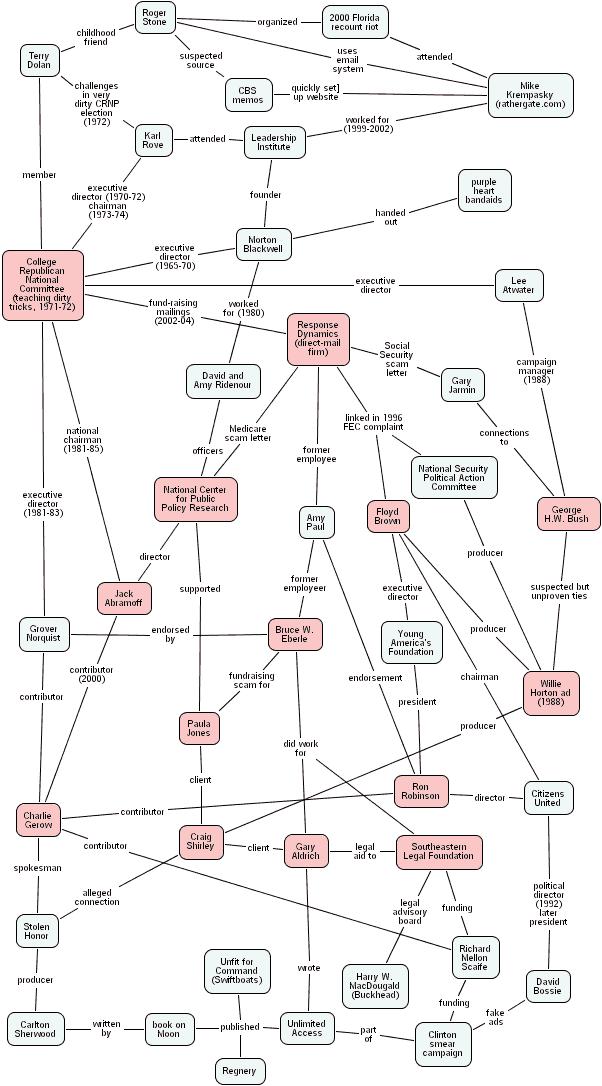
Brooks Bros Riot
---
BBR is a generic category of legal and electoral hardball/dirty tricks/voter suppression in 2000 election.
See also 2000 tag and plum
no merri
html justice prevailing
bak 2 22
---
gop only recycles when it comes to dirty tricks
---
Thomas Pyle AEA/IER Trump: Brooks Brothers Riot (DeLay --> Koch Industries lobbyist)
---
https://www.tallahassee.com/story/opinion/2019/02/03/ion-sancho-roger-stones-dirty-tricks-helped-sway-2000-florida-recount/2742713002/
Through IRS filings made belatedly by the Bush campaign, some $13.8 million was spent in its “stop the recount” efforts. These same documents show the Brooks Brothers rioters were Republican staffers from Washington, D.C., flown in and out of Florida on private jets by companies such as Enron and Halliburton, and given free hotel rooms. Many were personally recruited by House majority whip Tom Delay and given their marching orders on those walkie-talkies commanded by Stone.
---
https://www.alternet.org/2021/06/paul-gosar/
raw reed
Messages leaked to the Washington Post implicate Rep. Paul Gosar (R-AZ) in a plot to create a so-called "Brooks Brothers Riot" in his home state to block President Joe Biden's victory.
Woodrow Johnston, the vice president of political consultancy McShane LLC, told an undercover liberal activist posing as a Trump supporter that Gosar wanted to use the far-right Proud Boys gang to disrupt the certification of the 2020 election in Arizona.
"We might need to do the same here in Nevada," Johnston added in his message.
The protests that Johnston organized remained peaceful and did not actually disrupt vote counting.
Even so, Johnston's boss, Rory McShane, distanced his consulting firm from efforts to organize protests against certifying the election.
"I was unaware of these texts, but I know Mr. Johnston was not working on behalf of any client or organization," he said. "Our management team has met with Mr. Johnston. I'm confident he sees the error of what he did."
Gosar's office claimed that the Trump-loving Arizona congressman was not in contact with Johnston and denied coordinating any election-related protests.
The original "Brooks Brothers Riot," which took place in Florida more than two decades ago, was organized by Republican campaign operatives who successfully disrupted the vote recount in the Miami-Dade County election office after the 2000 presidential election.
FROM YOUR SITE ARTICLES
- 'You've lost your mind': GOP Rep. repurposes MLK tribute — in ... ›
- A GOP congressman just tweeted a white nationalist slogan in a ... ›
- Marjorie Taylor Greene and Paul Gosar launch 'America First ... ›
RELATED ARTICLES AROUND THE WEB
- Rep. Paul Gosar thinks Capitol rioters are the victims here? ›
- Six Siblings of a Republican Congressman Endorse His Opponent ... ›
---
---
https://www.tallahassee.com/story/opinion/2019/02/03/ion-sancho-roger-stones-dirty-tricks-helped-sway-2000-florida-recount/2742713002/
no lnx
Ion Sancho: Roger Stone's dirty tricks helped sway the 2000 Florida recount | Opinion
Ion Sancho Guest columnist
Leon County Supervisor of Elections Ion Sancho invited a group of local school children to attend the testing of voting equipment in 2010.
When 8-year-old Roger Stone’s classroom held a mock presidential election between Richard Nixon and John Kennedy in 1960, Roger told his classmates in the lunch line that Nixon wanted them to go to school on Saturday. Nixon had said no such thing, and Roger’s candidate, Kennedy, won the election by a landslide. It was Stone’s first dirty trick.
Stone has plied his stock-in-trade, the dirty trick (a harmless sounding term for lies and deceit) for over five decades, so it was no surprise five counts of his seven count recent indictment concerned making false statements. The two remaining counts reflected threats of physical intimidation, a tactic Stone would employ in the infamous Florida 2000 recount.
The 2000 Florida recount is the capstone of Stone’s career. He was not a supporter of candidate George Bush — at the time he was helping Donald Trump’s campaign for the New York Reform Party nomination for president— and became involved only when contacted by Margaret Tutwiler, at the request of recount head James Baker III, giving rise to one Stone's proudest moments, and the title of a current Netflix biography, “Get Me Roger Stone.”
On Nov. 21, 2000, the Florida Supreme Court had ruled that the recounts set forth under Florida law, Chapter 102.166(4)(d) F.S., could be extended until Nov. 26. The Republican strategy was to shut the recount down entirely.
In the words of Stone, “The idea we were putting out there was that this was a left-wing power grab by Gore, the same way Fidel Castro did it in Cuba.”
The fact that the Gore campaign was following Florida’s law on recounts was completely ignored.
Dade County, Florida’s largest county and home to the largest number of Democratic voters, began the recount on Nov. 22. But when election staff arrived, they found thousands of people, mostly Bush supporters, protesting the recount outside. Radio Mambi, a vehemently anti-Castro outlet, was broadcasting live at the scene, asking listeners to join the protest.
A Bush command center had been set up in a Winnebago across the street, and Stone, armed with walkie-talkies, claimed to be in communication with demonstrators in the building outside the 18th floor Supervisor of Elections Office.
There, a dozen or more well-dressed young white protesters were yelling and pounding on the doors in what came to be known as the Brooks Brothers Riot.Their actions intimidated the workers in the office. Fearing for their lives, the Dade County Canvassing Board stopped its manual recount.
These ballots, and those of Palm Beach, were sent to the Leon County Supervisor of Elections Office in a slow moving yellow rental truck convoy for counting – a process eventually blocked by the U.S. Supreme Court in the 5-4 decision known as Bush v. Gore.
Through IRS filings made belatedly by the Bush campaign, some $13.8 million was spent in its “stop the recount” efforts. These same documents show the Brooks Brothers rioters were Republican staffers from Washington, D.C., flown in and out of Florida on private jets by companies such as Enron and Halliburton, and given free hotel rooms. Many were personally recruited by House majority whip Tom Delay and given their marching orders on those walkie-talkies commanded by Stone.
Their actions succeeded in preventing the legal and court-ordered procedures, which might have provided an accurate result for the election. Lies, physical intimidation — the darker arts of political persuasion employed by Stone and his cronies — had proven successful. For the first time in U.S. history, a state had been barred from completing its presidential election.
Reflecting on Stone’s recent indictments, I’m reminded of the wise words of the Scottish sage Robert Louis Stevenson: “Everybody, soon or late, sits down to a banquet of consequences.”
Ion Sancho was the Leon County Supervisor of Elections during the 2000 recount and appointed by the Florida Supreme Court as the technical adviser to Judge Terry Lewis. This account is an excerpt from his upcoming book about the Florida 2000 recount.
==

trms, paid by B-C comm sez IRS
==
tbtimes 2018 recount
...Soon the several dozen protesters were banging on the glass door of the elections office demanding to be let in. Many were paid Republican operatives, flown in by the party, later identified in a photo by the Washington Post.Quinn is not in the picture.
"They were banging on the glass with clip boards. We were afraid the whole thing could collapse," said South Florida attorney Joe Geller, who had walked in from the elevator in the middle of the chaos. "They were chanting, 'Let us in, let us in.' "
Geller, a Democrat and now a state representative, asked for a sample ballot he planned to use to demonstrate a flaw in the machine tabulation system only to be almost immediately swarmed by protesters accusing him of stealing a ballot.
"Then I was surrounded by all of these pushing, shouting, shoving, kicking, elbowing people," Geller remembers. He eventually got away with the help of a police officer who intervened. The protest had a lasting effect.
"People were nervous and frightened and upset," said Geller, who saw the canvassing board huddled after the protesters left the building.
Later that night, Miami-Dade elections officials called off the rest of the recount process.
"Violence, fear and physical intimidation literally shut down the counting of votes," Geller said.
...
==
video
11/18 playbook recycled
https://www.msnbc.com/the-beat-with-ari-melber/watch/gop-tactics-in-fl-recount-protests-lawsuits-false-fraud-claims-1369825859811
==
11/18 update (just saw some old footage, ppl paid and one tall blonde duane gibson guy clearly a crisis actor
==
https://www.alternet.org/election-03918/republican-operative-goons-are-trying-pull-another-brooks-brothers-riot-floridas
However, this time, it appears the angry Republican supporters of President Trump and Florida Gov. Rick Scott, who only leads by a shrinking sliver as absentee ballots keep getting processed—15,000 votes out of 8 million cast across the state—and is facing a recount, could not get anywhere near the ongoing ballot review inside the Broward County Election Center, which, like election offices across the country, has hardened security protocols following Russian hacking attempts of the 2016 election.
Nonetheless, an eyewitness to the demonstration described a scene of partisan vitriol aimed at Brenda Snipes, the Broward County Supervisor of Elections—who has been sued by Scott and is the subject of a Scott-ordered state investigation—because her populous county has been slow to report its counts; as well as the revelation that its apparently poor ballot design led to 30,000 people not voting in the Senate race.
“When I drove up to the Broward County Election Center, I saw all these rental trucks parked bumper to bumper and circling the front door,” said John Brakey, a nationally known election transparency activist who was monitoring how the county is using digital images of every ballot to verify the vote count. “I didn’t know what was going on. I saw people demonstrating. I assumed it must be Democrats.”
Brakey said there was one four-foot-wide gap between the parked trucks where people could enter and exit.
“When I walked through and got in front, I noticed that everybody had Trump signs, Trump buttons, Scott signs, Trump hats—it turned out it was a Republican bunch of protesters,” he said, adding that he started taking pictures and videos. Those photos show signs that said, “Don’t STEAL our election,” “FAKE VOTES don’t count,” “Supervisor of Corruption,” “Sneaky Snipes,” and the Hillary Clinton-like chants of “Lock her up!” and “Put her in jail.”
“I’m an American. I believe in the American way. What this does is it makes us look like a Banana Republic,” protester Bill Wheelen said in a Miami Herald video. “If their guy wins, it’s fine. If our guy wins, they do this. This has happened over and over again in Broward. You know what, I love Rick Scott. He should have fired her in 2012.”
“The police were there. It was a stalemate,” Brakey said, who watched for a while and then went inside the election center building to get away from the broiling temperatures. When he went outside, he thought the police might remove everyone, so he left through the only opening between the trucks to leave. “It looked like everybody could get caged by the police—and the only way out was through the exit or under the trucks. I went away.”
Why a Slow Count andTilt AwayFrom the GOP
There is an explanation for why the county’s vote count is slow—as well as why late-breaking additions to the vote total in Florida tend to boost Democrats—which Wheelen noted. But it is not because Snipes, who runs for her office as the county’s election director, is a Democrat. (Former GOP Gov. Jeb Bush first appointed her to office.)
Simply put, some large Florida counties are late in reporting their totals because the high-speed scanners used do not read every ballot. As a result, a small percent of the ballots—which have been mailed in from voters and must be counted—end up being duplicated manually, an elaborate and labor-intensive process. In Pima County, Arizona, where Brakey lives, the county uses a similar system as Broward County for this process. During its early voting this fall, Pima County’s official report said that 9,501 ballots, equal to 3.6 percent of the 263,327 ballots cast, had to be “duplicated,” because they couldn’t be read by ES&S scanners.
In other words, Wheelen is correct that there is a structural issue behind the slow processing of Broward’s vote. But it is not caused by partisan election administration; it is caused by the technology used. However, the reason that these late-counted absentee ballots tend to favor Democrats is the counties with longest delays tend to be the most populous counties—which is where Florida’s greatest concentration of Democrats live.
But those shouting “lock her up” are not about to stop and think about what is really causing the vote counting delays and incremental shifts favoring Democrats. In any event, the vote counting continues, to be followed by a recount under state law.
This article was produced by Voting Booth, a project of the Independent Media Institute.
lady in red?
https://www.rollcall.com/news/-200577-1.html
Elizabeth Brotherton
@ebrotherton
Heard on the Hill: Stay Classy, Capitol HillHeard on the Hill: Nothing but a Good Time Heard on the Hill: A Sign of the Times
When newlywed Layna McConkey Peltierheaded to Miami in fall 2000, she expected to stay for three days.
She wound up staying three weeks and became a part of history.
Peltier was among those photographed in a moment dubbed the “Brooks Brothers riot.” The Nov. 19 incident happened during the 2000 presidential recount, whenseveral dozen sharply dressed people, many of them GOP aides, protested a decision by the local election board to move the recount into a small, closed-off area. Dozens were involved, but it lives on for a handful of the protesters captured in a famous Reuters photo. So where are they now?
Kevin Smith is communications director to presumptive Speaker John Boehner (R-Ohio).
Garry Malphrus, then a top Senate Judiciary Committee staffer, is a board member with the Board of Immigration Appeals. National Republican Congressional Committee aide Rory Cooper is at the Heritage Foundation; House staffer Duane Gibson is a consultant for the Livingston Group.
Tom Pyle, a former staffer for ex-Rep. Tom DeLay (R-Texas), serves in a non-partisan role as president of the Institute for Energy Research. That’s not the only change. “I have less hair and my clothes have shrunk,” he jokes.
Matt Schlappbecame President George W. Bush’s political director and is now a principal at Cove Strategies. Then a Bush campaign aide, he didn’t intend on getting photographed, explaining he “was in the photo as more of an attempt to make sure everyone stayed within the bounds.”
“I can understand why it still lives on because it really did capture a unique American political moment,” he says.
For Peltier, the recount came weeks after her wedding. She missed the first Thanksgiving with her husband but has no regrets. “Republicans or Democrats, no one’s vote should not be counted,” she says.
Peltier later worked as a lobbyist, and these days lives in Minnesota with her family.
“I hated to leave, but ... I had three kids in three years. That had become a full-time job,” she says. “These three little people are pretty cool.”
==
Bush Recount Troops Land Plum D.C. Jobs
Many of president's appointees fought Gore's bid to take Florida, White House
by Carol Rosenberg, July 14, 2002
John Bolton, undersecretary of state for arms control, caused a stir in May by accusing the Cuban government of transferring bioweapons technology to rogue nations. Nineteen months ago, he caused a different stir -- bursting into a Tallahassee library on behalf of the Bush-Cheney campaign to stop a recount of Miami-Dade County ballots.
Matt Schlapp, a former congressional aide, is currently White House special assistant to the president and deputy director of political affairs. In November 2000, he was part of the supposedly spontaneous window-pounding protest at Miami-Dade County Hall that brought to an end the first recount of Miami-Dade ballots.
Sue Cobb, a Coral Gables developer, today is the U.S. ambassador to Jamaica. Twenty months ago, the generous Republican donor volunteered her legal skills to the Bush-Cheney campaign -- working as part of the legal team that contested recounts in Miami-Dade.
Although they now serve President George W. Bush in sharply different roles, the three share a common experience. They are among more than 50 political appointees found by The Herald to have served as troops in the frantic Florida recount battle that followed the Nov. 7, 2000 election.
Political patronage has long been a reward for campaign loyalty. But the distribution of plum jobs to those who worked in Florida after the 2000 election suggests that service became a kind of political merit badge that carried a special benefit.
''Work on the recount is the indispensable connection for work at the Bush administration,'' said Jeffrey Toobin, author of Too Close to Call: The 36-Day Battle to Decide the 2000 Election.
Just how many Bush appointees actually served the Bush-Cheney campaign here is not clear. The White House declined to provide a list of who in the administration actually worked for the campaign in Florida. Florida lawyer Barry Richard, a Democrat who was hired by the Bush campaign to fight its legal battle over the recount, said there were 192 lawyers of record on various court cases around the state.
To identify the appointees, The Herald conducted dozens of interviews and studied White House nominations and government staff directories --then matched names to news accounts, photo captions and several books about the episode. In addition, some appointees included their recount roles in news releases, or accounts in university and law journals.
LAWYERS IN KEY ROLES
White House says Bush tapped `bright minds'
Most were lawyers who worked all-nighters in Tallahassee and across South Florida as ballot observers and political operatives as well as litigators and behind-the-scenes writers of legal briefs.
White House officials defended the appointments, noting that many appointees take big pay cuts when they move into government jobs. Appointees with Florida service to the Bush-Cheney recount effort make from $52,300 a year to 166,700 for Attorney General John Ashcroft, who also passed through Tallahassee during the recount.
''The finest legal minds in the country were brought in on both sides,'' said White House spokeswoman Jeanie Mamo. ``It's only logical that an administration would tap some of those same bright minds to hold legal positions throughout the administration.''
Mamo, a former Capitol Hill press secretary who now earns $62,760, was among those who came to Florida for the recount. Already with the Bush-Cheney campaign, she worked as part of the GOP's media team. Other GOP press aides who went from the Florida recount to the White House include Nicolle Devenish, Tucker Eskew, Ken Lisaius and Scott McClellan.
Several of the people who served as political operatives and attorneys said there was no explicit quid pro quo in their decision to come to Florida to do battle with the forces of Democratic candidates Al Gore and Joe Lieberman. But they also acknowledged that the service helped them draw the attention of the Bush team.
Lawyer R. Ted Cruz, a Bush-Cheney campaign worker and former clerk to U.S. Chief Justice William Rehnquist, arrived in Tallahassee for the first time in his life within 24 hours of the election to work on briefs. He became part of an early inner circle that included more nationally prominent Republican lawyers such as George J. Terwilliger III and Benjamin L. Ginsberg, who had been an outside counsel to the campaign.
''It did give an opportunity for lawyers who had been supporting Bush to shine, to demonstrate what they were capable of,'' Cruz said. ``On a day-to-day basis, a campaign does not deal with senior constitutional litigators that often. It was an opportunity for the senior people on the campaign to see firsthand the abilities of these lawyers.''
Today, Cruz is director of policy and planning at the Federal Trade Commission, earning $138,200. Earlier, he did a stint as a Bush administration lawyer at the Justice Department, working on the transition to Ashcroft from former Attorney General Janet Reno.
WORKING `BY INSTINCT'
Diplomat says he received no assurance of a reward
Bolton, the U.S. diplomat now responsible for arms control issues, said no payoff was promised for his decision to join the post-election fray. He had worked for the first Bush administration and, finding himself in South Korea on election night, contacted former Secretary of State James Baker in Texas to see how he might lend a hand. The reply: Go to Florida.
''I think, frankly, most of the people who did it just went down there by instinct,'' Bolton said. He said he received no legal fees, although the campaign paid his hotel bills and other expenses.
Bolton was part of the legal team and a ballot observer in Palm Beach County. Then he rushed to Tallahassee as the recount battle reached higher courts. It was his role, on Saturday, Dec. 9, 2000, to burst into a library where workers were recounting Miami-Dade ballots andrelay news of the U.S. Supreme Court's stay in the on-again, off-again presidential recount.
''I'm with the Bush-Cheney team, and I'm here to stop the count,'' he was quoted as saying in news reports at the time.
The Florida fraternity included major figures in the Bush administration, notably Theodore Olson, the current solicitor general, who worked on the case in both Tallahassee and Miami, then argued candidate Bush's case before the U.S. Supreme Court, and Robert Zoellick, now the U.S. trade representative, who served as a virtual chief of staff to Baker, Bush's main Florida strategist.
TEAM WAS VERSATILE
Roles included researching, writing and demonstrating
But there are many whose roles in Florida went largely unremarked on at the time:
Five lawyers who did research and wrote briefs to fight Florida court challenges are now deputies in the White House counsel's office.
Three senior strategists in Tallahassee now hold $130,000-a-year jobs as general counsels to Cabinet departments: David D. Aufhauser, now at Treasury, supervised a unit of lawyers that ran Bush's military and overseas ballot campaign; Alex M. Azar, now at Health and Human Services, was part of the so-called ''revolving brain trust'' that tackled different legal theories in Tallahassee; and Kirk Van Tine, now at Transportation, came from Baker's Texas law firm, Baker Botts,to run a war room of bright young lawyers who cranked out various motions.
Three members of the window-pounding crowd that on Thanksgiving Eve helped persuade the Miami-Dade County canvassing board to abandon the recount are now members of the White House staff: Matt Schlapp, now a special assistant to the president; Garry Malphrus, deputy director of the president's Domestic Policy Council; and Joel Kaplan, also a special assistant to the president.
Schlapp and Malphrus, both of whom declined to talk to The Herald, were first identified in 2000 in The Washington Post as part of the Miami-Dade demonstration. Kaplan described his role in a lecture at the Harvard University Institute of Politics, calling the demonstration the ''Brooks Brothers Protest,'' a reference to the way the demonstrators were dressed.
Former Texas Transportation System Chairman David Laney left his Austin law firm to serve as a ballot recount observer in Volusia County. Bush appointed him recently to Amtrak's seven-member board of directors. The directorship is a federal post touted by Laney's firm as a ''leadership role in the transportation arena.'' It has no salary but pays a per diem and travel expenses.
Kevin Martin, now a $130,000-a-year commissioner at the Federal Communications Commission, was one of the first national Bush-Cheney people to arrive in Miami from Washington, on Nov. 8. He had been a deputy general counsel for the Bush campaign and before that worked for Ken Starr, the independent counsel in the Monica Lewinsky affair.
New York lawyer Brad Blakeman, who helped organize protests in South Florida and appeared in one Associated Press dispatch at the time as a ''Broward County GOP volunteer,'' today is director of White House scheduling.
Associate Deputy Attorney General Stuart A. Levey represented Bush-Cheney in Martin County. He was with Baker's Texas law firm at the time.
Boca Raton developer Ned L. Siegel, long a generous donor to the GOP, has been nominated by Bush to serve as a director of the Overseas Private Investment Corp. During the recount crisis, he sued Palm Beach County Supervisor of Elections Theresa LePore in a bid to stop the manual recount of the troubled butterfly ballots on constitutional grounds.
Private lawyer Marcos Jimenez joined the Bush-Cheney legal team in Florida and is now awaiting confirmation as U.S. attorney for Florida's Southern District. His brother, Frank, took two weeks of unpaid leave from his job as acting general counsel to Gov. Jeb Bush, the president's brother, to assist the Bush-Cheney campaign in the recount battle. He was recently tapped to becomechief of staff for U.S. Housing Secretary Mel Martinez of Orlando.
Miami lawyer Mark Wallace, who fought on behalf of the GOP in Palm Beach County during the butterfly ballot brouhaha, is today acting general counsel at the Federal Emergency Management Agency, run byJoe Allbaugh,the Bush-Cheney campaign manager.
DEMOCRAT AMONG THEM
He takes 'less cynical' view of the Bush appointments
Many of the lawyers who worked in Florida are members of The Federalist Society, a network of legal conservatives who, in a string of telephone calls, summoned former Supreme Court clerks and other experts to Florida.
Barry Richard, the Democrat from the Greenberg Traurig law firm who was hired for the recount by the Bush-Cheney campaign, said he is not surprised that the path to posts in the Bush administration wound through Florida.
''The less cynical way and probably more legitimate way to see this is that the reason these people are around [Bush] is because he thought they were good at what they did,'' Richard said.
``Almost all the individuals who went into the administration --maybe all of them -- were involved in the Bush campaign during the campaign itself and were also longtime participants with the Republican Party. And I think that probably their involvement with the administration was not related to their participation in the litigation itself but their connection to the Bush team.''
As for his own role in the recount, Richard said no one ever suggested that his work would win him a Bush administration post.
''Nobody offered me anything,'' he said, ``and I never expressed any interest in anything.''
Carol Rosenberg: mailto:crosenberg@herald.com
Source: http://www.miami.com/mld/miami/news/nation/3656186.htm
==
trms town hall alum http://www.nbcnews.com/id/26315908/vp/32337799#32337799
Miami 'Riot' Squad: Where Are They Now?
By Al Kamen
Monday, January 24, 2005; Page A13
As we begin the second Bush administration, let's take a moment to reflect upon one of the most historic episodes of the 2000 battle for the White House -- the now-legendary "Brooks Brothers Riot" at the Miami-Dade County polling headquarters.
This was when dozens of "local protesters," actually mostly Republican House aides from Washington, chanted "Stop the fraud!" and "Let us in!" when the local election board tried to move the re-counting from an open conference room to a smaller space.
With help from their GOP colleagues and others, we identified some of these Republican heroes of yore in a photo of the event
Some of those pictured have gone on to other things, including stints at the White House. For example, Matt Schlapp, No. 6, a former House aide and then a Bush campaign aide, has risen to be White House political director. Garry Malphrus, No. 2 in the photo, a former staff director of the Senate Judiciary subcommittee on criminal justice, is now deputy director of the White House Domestic Policy Council. And Rory Cooper, No. 3, who was at the National Republican Congressional Committee, later worked at the White House Homeland Security Council and was seen last week working for the Presidential Inaugural Committee.
Here's what some of the others went on to do:
No. 1. Tom Pyle, who had worked for Rep. Tom DeLay (R-Tex.), went private sector a few months later, getting a job as director of federal affairs for Koch Industries.
No. 7. Roger Morse, another House aide, moved on to the law and lobbying firm Preston Gates Ellis & Rouvelas Meeds. "I was also privileged to lead a team of Republicans to Florida to help in the recount fight," he told a legal trade magazine in a 2003 interview.
No. 8. Duane Gibson, an aide on the House Resources Committee, was a solo lobbyist and formerly with the Greenberg Traurig lobby operation. He is now with the Livingston Group as a consultant.
No. 9. Chuck Royal was and still is a legislative assistant to Sen. Jim DeMint(R-S.C.), a former House member.
No. 10. Layna McConkey Peltier, who had been a Senate and House aide and was at Steelman Health Strategies during the effort, is now at Capital Health Group.
| 2001- | Capitol Health Group Revolving Door Personnel: (5) | Lobbyist |  Firm lobbying profile |
|---|---|---|---|
| 1992-1994 | Lightfoot, Jim Revolving Door Personnel: (6) | Legislative Assistant |  Member profile |
People for Lightfoot Cmte Revolving Door Personnel: (1) | |||
Steelman Health Strategies Revolving Door Personnel: (5) | Lobbyist | Firm lobbying profile | |
American Indian Higher Educ Consortium Revolving Door Personnel: (2) | Client lobbying |
(We couldn't find No. 4, Kevin Smith, a former GOP House aide who later worked with Voter.com, or No. 5, Steven Brophy, a former GOP Senate aide and then at consulting firm KPMG. If you know what they are doing these days, please e-mail shackelford@washpost.comso we can update our records.)
Sources say the "rioters" proudly note their participation on résumés and in interviews. But while the original hardy band of demonstrators numbered barely a couple of dozen, the numbers apparently have grown with the legend.
==
9:00 a.m. and after, November 22, 2000: Florida County Halts Manual Recounts; Election Board Proceedings Disrupted by ‘Brooks Brothers Riot’
 A photograph of the Republican operatives mobbing the Miami-Dade elections offices. Those identified in the photograph include Thomas Pyle, Garry Malphrus, Rory Cooper, Kevin Smith, Steven Brady, Matt Schlapp, Roger Morse, Duane Gibson, Chuck Royal, and Layna McConkey. [Source: Pensito Review]Miami-Dade County election officials vote unanimously to halt the county’s manual recount of presidential ballots (see November 7, 2000and Before 10:00 a.m. November 19, 2000), saying the county does not have enough time to complete its recount by the November 26 deadline. Instead, they vote to recount only 10,750 “undervotes,” ballots that don’t clearly indicate a presidential choice. The decision costs Democratic candidate Al Gore a 157-vote gain from the halted recount process.
That evening, a Florida State appeals court denies a motion by Democrats to force Miami-Dade County to restart the manual recount.[US NEWS AND WORLD REPORT, 12/13/2000; PITTSBURGH POST-GAZETTE, 12/17/2000; LEIP, 2008]
Opposing Beliefs - The next day, the Florida Supreme Court will also refuse to order Miami-Dade to restart the recount(see 2:45 p.m. November 23, 2000). Press reports say that the decision “dramatically reverse[s] the chances of Al Gore gathering enough votes to defeat George W. Bush.” Gore’s senior campaign advisor William Daley calls the recounts “mandatory” and calls for “the rule of law” to be upheld.
For his part, Bush says: “I believe Secretary Cheney and I won the vote in Florida (see After 3:30 a.m. November 8, 2000). And I believe some are determined to keep counting in an effort to change the legitimate result.” In light of the Miami-Dade decision, the Bush campaign’s chief legal advisor James Baker invites the Republican-controlled Florida Legislature to unilaterally declare Bush the victor, saying, “One should not now be surprised if the Florida legislature seeks to affirm the original rules.”
Agitators Disrupt Recount Proceedings - The recount proceedings are disrupted and ultimately ended by a mob of Republicans, some local and some bussed and flown in from Washington by the Bush campaign. The agitators are protesting outside the Miami-Dade County election offices, shouting and attempting to interfere with the proceedings of the canvassing board. Republicans have accused a Democratic lawyer of stealing a ballot. [GUARDIAN, 11/23/2000; GUARDIAN, 11/25/2000]
Rioters Made Up of Republican Staffers, Others - Democrats accuse Republican protesters of intimidating the Miami-Dade County officials into stopping the recount. Democratic vice-presidential candidate Joe Lieberman says the demonstrations in Miami have been orchestrated by Republicans “to intimidate and to prevent a simple count of votes from going forward.” Six Democratic members of the US Congress demand the Justice Department investigate the claims, saying that civil rights have been violated in “a shocking case of undermining the right to vote through intimidation and threats of violence.” Jenny Backus, a spokeswoman for the Democratic National Committee (DNC), says, “The Republicans are out of control,” and accuses them of using paid agitators to “create mob rule in Miami.” [GUARDIAN, 11/25/2000]
Later investigations show that the “spontaneous protests” by Republican protesters were far more orchestrated and violent than generally reported by the press at the time. Investigative journalist Robert Parry will write that the protests, called the “Brooks Brothers Riot” because of the wealthy, “preppie” makeup of the “protesters,” helped stop the recount, “and showed how far Bush’s supporters were ready to go to put their man in the White House.” He will write that the protests should be more accurately termed a riot. At least six of the rioters were paid by the Bush recount committee, payments documented in Bush committee records only released to the IRS in July 2002 (see July 15, 2002).
Twelve Republican staffers will later be identified in photographs of the rioters. The six who can be confirmed as being paid are: Bush staffer Matt Schlapp from Austin, Texas; Thomas Pyle, a staff aide to House Majority Whip Tom DeLay (R-TX); DeLay fundraiser Michael Murphy; Garry Malphrus, House majority chief counsel to the House Judiciary Subcommittee on Criminal Justice; Charles Royal, a legislative aide to Representative Jim DeMint (R-SC); and former Republican House staffer Kevin Smith. Another Republican is identified as Doug Heye, a staffer for Representative Richard Pombo (R-CA). At least three of the rioters—Schlapp, Malphrus, and Joel Kaplan—will later join the Bush White House. Many of the rioters were brought in on planes and buses from Washington as early as mid-November, with promises of expenses payments.
[
APRIL 02, 2012
Doug Heye to Team Cantor as Deputy Chief of Staff
Politico's Jake Sherman scoops that veteran Republican operativeDoug Heye is joining Majority Leader Eric Cantor’s press office as deputy chief of staff.
Heye, who was most recently an adviser to the Iowa Republican party, fills the spot of Brad Dayspring, who left the Virginia Republican’s office and joined the YG Action Network super PAC. Heye will be responsible for overseeing the Cantor press operation, which has four other staffers.
It’s a return to Capitol Hill for widely respected Heye, who previously worked for former Rep. Richard Pombo (R-CA) and Sen. Richard Burr (R-NC).
Heye is a native of North Carolina and a graduate of the University of North Carolina at Chapel Hill. (Politico)
God Speed!]
On November 18, 2000, the Bush campaign told activists, “We now need to send reinforcements” to rush to Florida. “The campaign will pay airfare and hotel expenses for people willing to go.” Many of the respondents are low-level Republican staffers from Congress. “These reinforcements… added an angrier tone to the dueling street protests already underway between supporters of Bush and Gore,” Parry will write. Quoting ABC reporter Jake Tapper, Parry will write, “The new wave of Republican activists injected ‘venom and volatility into an already edgy situation.’”
Signifying the tone, before the Miami riot, Brad Blakeman, Bush’s campaign director of advance travel logistics, screamed down a CNN correspondent attempting to interview a Democratic Congressman: “This is the new Republican Party, sir! We’re not going to take it anymore!” [CONSORTIUM NEWS, 11/27/2000; CONSORTIUM NEWS, 8/5/2002; VANITY FAIR, 10/2004]
Some of the local protesters are summoned to the Miami-Dade electoral offices by angry broadcasts overradio stations with largely Cuban-American audiences; over these radio stations, listeners hear Bush campaign lawyer Roger Stone, coordinating the radio response, say that the recounts intend to disenfranchise Hispanic voters. Republican operatives coordinate the protests by shouting orders through megaphones. [CONSORTIUM NEWS, 11/24/2000; CENTER FOR AMERICAN PROGRESS, 12/9/2010]Cuban-Americans voted heavily for Bush in the November 7 election. [TAPPER, 3/2001]
Details of the Riot; Staffers Assaulted and Beaten - After learning that the Miami-Dade County canvassing board was beginning to examine 10,750 disputed ballots that had not previously been counted,US Representative John Sweeney (R-NY) issues the order to “Shut it down!” (Sweeney is coordinating his efforts with a local Cuban congressman who himself is coordinating the Cuban-American mob response.)
Brendan Quinn, the executive director of the New York Republican Party, tells some two dozen Republican operatives outside the Miami-Dade County election offices to storm the room on the 19th floor where the canvassing board is meeting. Tapper later writes: “Emotional and angry, they immediately make their way outside the larger room in which the tabulating room is contained.
The mass of ‘angry voters’ on the 19th floor swells to maybe 80 people,” including many of the Republican activists from outside Florida, and joined by local protesters. As news organizations videotape the scene, the protesters reach the board offices and begin shouting slogans such as “Stop the count! Stop the fraud!” “Three Blind Mice!” and “Fraud, fraud, fraud!” and banging on doors and walls. The protesters also shout that a thousand potentially violent Cuban-Americans are on the way.
Official observers and reporters are unable to force their way through the shouting crowd of Republican operatives and their cohorts. Miami-Dade spokesman Mayco Villafena is physically assaulted, being pushed and shoved by an unknown number of assailants. Security officials, badly outmanned, fear the confrontation will swell into a full-scale riot. Miami-Dade elections supervisor David Leahy orders the recounts stopped, saying, “Until the demonstration stops, nobody can do anything.” (Although board members will later insist that they were not intimidated into stopping, the recounts will never begin again. Leahy will later say: “This was perceived as not being an open and fair process. That weighed heavy on our minds.”) Meanwhile, unaware of the rioting, county Democratic chairman Joe Geller stops at another office in search of a sample ballot. He wants to prove his theory that some voters had intended to vote for Gore, but instead marked an adjoining number indicating no choice. He finds one and leaves the office.
Some of the rioters spot Geller with the sample ballot, and one shouts, “This guy’s got a ballot!” Tapper will later write: “The masses swarm around him, yelling, getting in his face, pushing him, grabbing him. ‘Arrest him!’ they cry. ‘Arrest him!’ With the help of a diminutive DNC [Democratic National Committee] aide, Luis Rosero, and the political director of the Miami Gore campaign, Joe Fraga, Geller manages to wrench himself into the elevator.”
Rosero stays behind to attempt to talk with a reporter, and instead is kicked and punched by rioters. A woman shoves Rosero into a much larger man in what Tapper will later theorize was an attempt to start a fight between Rosero and the other person. In the building lobby, some 50 Republican protesters and activists swarm Geller, surrounding him. Police escort Geller back to the 19th floor in both an attempt to save him from harm and to ascertain what is happening.The crowd attempts to pull Geller away from the police.Some of the protesters even accost 73-year-old Representative Carrie Meek (D-FL). Democratic operatives decide to leave the area completely. When the mob learns that the recounts have been terminated, they break forth in lusty cheers.
After-Party - After the riots, the Bush campaign pays $35,501.52 for a celebration at Fort Lauderdale’s Hyatt Regency, where the rioters and campaign officials party, enjoy free food and drink, receive congratulatory calls from Bush and Dick Cheney, and are serenaded by Las Vegas croonerWayne Newton, singing “Danke Schoen,” German for “thank you very much.” Other expenses at the party include lighting, sound system, and evencostumes.
Media Reportage- Bush and his campaign officials say little publicly about the riot. Some press outlets report the details behind the riots. The Washington Post later reports that “even as the Bush campaign and the Republicans portray themselves as above the fray,” national Republicans actually had joined in and helped finance the riot. The Wall Street Journal tells readers that Bush offered personal words of encouragement to the rioters after the melee, writing, “The night’s highlight was a conference call from Mr. Bush and running mate Dick Cheney, which included joking reference by both running mates to the incident in Miami, two [Republican] staffers in attendance say.”
The Journal also observes that the riot was led by national Republican operatives “on all expense-paid trips, courtesy of the Bush campaign.” And, the Journal will note, the rioters went on to attempt to disrupt the recounts in Broward County, but failed there to stop the proceedings. The Journal will write that “behind the rowdy rallies in South Florida this past weekend was a well-organized effort by Republican operatives to entice supporters to South Florida,” withDeLay’s Capitol Hill office taking charge of the recruitment.
No similar effort was made by the Gore campaign, the Journal will note: “This has allowed the Republicans to quickly gain the upper hand, protest-wise.” And the Journal will write that the Bush campaign worked to keep its distance from the riots: “Staffers who joined the effort say there has been an air of mystery to the operation. ‘To tell you the truth, nobody knows who is calling the shots,’ says one aide. Many nights, often very late, a memo is slipped underneath the hotel-room doors outlining coming events.” But soon, media reports begin echoing Bush campaign talking points, which call the “protests” “fitting, proper,” and the fault of the canvassing board: “The board made a series of bad decisions and the reaction to it was inevitable and well justified.”
The Bush campaign says the mob attack on the elections office was justified because civil rights leader Jesse Jackson had led peaceful, non-violent protests in favor of the recounts in Miami the day before. The campaign also insists that the protests were spontaneous and made up entirely of local citizens.
On November 26, Governor Marc Racicot (R-MT), a Bush campaign spokesman, will tell NBC viewers: “Clearly there are Americans on both sides of these issues reflecting very strong viewpoints. But to suggest that somehow this was a threatening situation, in my view, is hyperbolic rhetoric.”
Effect of the Riot - According to Parry, the riot, broadcast live on CNN and other networks, “marked a turning point in the recount battle. At the time, Bush clung to a lead that had dwindled to several hundred votes and Gore was pressing for recounts (see November 20-21, 2000).
The riot in Miami and the prospects of spreading violence were among the arguments later cited by defenders of the 5-to-4 US Supreme Court ruling (see 9:54 p.m. December 12, 2000)… that stopped a statewide Florida recount and handed Bush the presidency.
Backed by the $13.8 million war chest, the Bush operation made clear in Miami and in other protests that it was ready to kick up plenty of political dust if it didn’t get its way.” In the hours after the riot, conservative pundits led by Rush Limbaugh will engage in orchestrated assaults on the recount process as fraudulent and an attempt by the Gore campaign to “invent” votes. No one is ever charged with any criminal behaviors as a result of the riot.
:{:(style="background-color:#ffff66;"):}:[:{CONSORTIUM NEWS:(style="background-color:#ffff66;"):}:, 11/24/2000; WASHINGTON POST, 11/27/2000; VILLAGE VOICE, 12/19/2000; CONSORTIUM NEWS, 8/5/2002; VANITY FAIR, 10/2004; CENTER FOR AMERICAN PROGRESS, 12/9/2010]
Entity Tags: County of Miami-Dade (Florida), Tom DeLay, Charles Royal, Rush Limbaugh,Roger Stone, Robert Parry, Richard Pombo, Wall Street Journal, Washington Post,Wayne Newton, William Daley, Albert Arnold (“Al”) Gore, Jr., Brad Blakeman, Brendan Quinn, CNN, Carrie Meek, Richard (“Dick”) Cheney, William Michael (“Bill”) Daley,County of Broward (Florida), Michael Murphy, Thomas Pyle, Matt Schlapp, George W. Bush presidential campaign 2000, David Leahy, Democratic National Committee, Doug Heye, Florida Supreme Court, Mayco Villafena, George W. Bush, Garry Malphrus, James A. Baker, Jake Tapper, Jim DeMint, Kevin Smith, Luis Rosero, Marc Racicot, Jenny Backus, Joseph Lieberman, Joe Geller, Joe Fraga, Joel Kaplan, John J. Sweeney
Timeline Tags: 2000 Elections, Civil Liberties
==
see holy cow 2000
one of big 3 rory cooper
http://en.wikipedia.org/wiki/Brooks_Brothers_riot
fla 2000
THU NOV 20, 2008 AT 02:59 PM PST
Miami "Riot" Organizer Regrets Helping Bush
byDanK Is BackFollow
Email 43 Comments / 43 New
Remember the so-called "Brooks Brothers riot" in Miami during the 2000 election recount?
The Brooks Brothers Riot – carried live on CNN and other networks – marked a turning point in the recount battle. At the time, Bush clung to a lead that had dwindled to several hundred votes and Gore was pressing for recounts. The riot in Miami and the prospects of spreading violence were among the arguments later cited by defenders of the 5-to-4 U.S. Supreme Court ruling on Dec. 12, 2000, that stopped a statewide Florida recount and handed Bush the presidency. Robert Perry in The Consortium, 5 Aug 2002
One of the organizers of that "riot" now regrets he did so:
Consultant Roger Stone, the notorious political hitman who helped George W. Bush prevail in the 2000 Florida recount, tells The Daily Beast that he wishes he hadn’t. Benjamin Sarlin, The Daily Beast
First, some more details from Perry:
On Nov. 22, 2000, after learning that the Miami canvassing board was starting an examination of 10,750 disputed ballots that had previously not been counted, Rep. John Sweeney, a New York Republican, called on Republican troops to "shut it down," according to Down and Dirty. Brendan Quinn, executive director of the New York GOP, told about two dozen Republican operatives to storm the room on the 19th floor where the canvassing board was meeting, Tapper reported. ...
The canvassing board suddenly reversed its decision and canceled the recount. "Until the demonstration stops, nobody can do anything," said David Leahy, Miami’s supervisor of elections, although the canvassing board members would later insist that they were not intimidated into stopping the recount.
(It was called the "Brooks Brothers riot" because many of the participants were dressed in Brooks Brothers clothing - typical for young Republicans in DC; for "outraged local Florida voters," not so much.)
I remember to this day watching the news stories about that demonstration. The thing that still haunts me, even now, is the looks of hatred on the faces of the people trying to storm the doors, as well as the fear on the faces of those charged with carrying out the job of properly counting the vote.
And what was Roger Stone's role in all this?
Stone’s knowledge of the peculiar world of Miami led to what may be his most enduring political legacy—his role in the resolution of the 2000 Presidential election. ...
After our lunch, Stone summoned his chauffeur-driven Jaguar—he owned four Jaguars at the time—to take us downtown, so that he could walk me through the events that concluded the Miami recount. ... On the Republican side, according to Stone, "The whole idea behind what they were doing was that there had already been one recount of the votes, so we didn’t want another. The idea was to shut it down, stop the recount here in Miami." The New Yorker 2 Jun 2008
(The New Yorker article notes that others who were there dispute the importance of Stone's role.)
If the name "Stone" rings a recent bell, think of the now former governor of New York, Elliot Spitzer; it was Roger Stone who alerted the FBI to Spitzer's "hooker habit." He also had a role in last June's accusation that Michele Obama had used the "whitey" word, and claimed to have the tape.
So now he has regrets about what he did. About his tactics? No...
Stone [does not] regret dirty politicking. Stone still offers his services as a no-holds-barred strategist to domestic and foreign politicians alike, and claims his client list is full. [Daily Beast]
What he regrets, interestingly, is what Bush did with the office Stone helped get for him:
"When I look at thosedouble-page New York Times spreads of all the individual pictures of people who have been killed [in Iraq], I got to think, 'Maybe there wouldn't have been a war if I hadn't gone to Miami-Dade.Maybe there hadn't have been, in my view, an unjustified war if Bush hadn't become president.' It's very disturbing to me." [Brackets in original. This is Sarlin, quoting Stone from the interview.]
Stone subverted the democratic process with that riot in a way that badly damaged our political system, and contributed to the anti-democratic attitude that still pervades the GOP. That riot, along with the Supreme Court's judicial coup engineered in concert with it, came very close to ending the Great Experiment in Democracy (and would have, if Obama had not won), and gave Bush license to think he could trash the Constitution. But Stone regrets none of that, only that Bush did things with that power Stone helped steal for him that he, Stone, does not approve of
Is half a confession better than none? Yes, but only if it leads to a full confession. What Stone and the rest of the Lee Atwater disciples will not see (or at least not admit) is that, in playing their dirty tricks, they allowed Bush and others in the GOP to avoid having to debate the issues, to be forced to spell out their real plans, to have the kind of election the American system was designed for: a competition for the best policy for the nation. The American people never got the chance, either in 2000 or 2004, to hear what Bush's real policies were, nor to render judgment on them, and that is because Stone and the others engineered those elections that way.
Stone objects to those policies now, and regrets the politics that allowed them to be fulfilled. But he does not regret the principle of "no holds barred" behind those politics, only this one particular outcome. And it is the principle that it is the problem.
ORIGINALLY POSTED TO DANK IS BACK ON THU NOV 20, 2008 AT 02:59 PM PST.
Rory Cooper, a former staffer for the National Republican Congressional Committee; inaug comm, WH liason to HUD sec mel martinez, homeland before to direct a NASA div
namebase?
http://www.nndb.com/group/920/000095635/
Business4-Feb-1937 Billionaire
Government28-Apr-1930 US Secretary of State, 1989-92
Governmentc. 1962 Republican National Lawyers Association
AttorneMar-1941 Represented Gore in Bush v. GoreJohn BoltonGovernment20-Nov-1948 US Ambassador to the UN, 2005-06
Governmentc. 1970 Republican strategist
Government1958 Iraq Inspector General
Diplomat1936 US Ambassador to Austria, 2001-05
Government27-Oct-192518-Mar-2011 US Secretary of State, 1993-97
Government8-Aug-1948 White House Chief of Staff, 2011-12
Attorney1-Sep-1938 Lawyer, represented Klaus von Bulow
Activist4-Jul-1949 McGuireWoods Consulting
Government16-May-1953 Would-be Deputy US Attorney General
Politician1-Aug-1962 RNC Chairman, 2003-05
Attorneyc. 1956 Barnes & Thornburg
Politician5-Apr-1957 Congresswoman from Florida, 2003-07
Activist20-Jul-1951 Founder, Judicial Watch
Activistc. 1974 Co-Founder of RedState.com
Governmentc. 1955 Butterfly ballot mastermind
Government11-Sep-1940 US Solicitor General, 2001-04
Business1952 The Siegel Group
Government1952 Campaign consultant, GOP dirty trickster
Politician9-Aug-1955 Congressman from New York, 1999-2007
Attorney5-Jun-1950 Deputy US Attorney General, 1991-93
Attorney25-Jul-1951 Video game decency barrator
Attorney10-Oct-1941 Harvard Law Professor
Government11-Mar-1959 FEC Commissioner
Governmentc. 1972
long analysis:
VANITY FAIR
October 2004
THE PATH TO FLORIDA
As the Florida recount ate away at George W. Bush’s margin of victory (1,784 votes . . . 327 . . . 154 . . .), the machinery of political power sprang to life. In Washington, stunned U.S. Supreme Court clerks watched justice become partisan, while in Florida, tens of thousands of citizens—thousands of them African-American—found themselves disenfranchised by misleading, faulty, and uncounted ballots, or inexplicably purged from the roll
http://makethemaccountable.com/articles/The_Path_To_Florida.htm
...
On Friday, November 10, three of Gore’s four target counties—Miami-Dade, Broward, and Palm Beach—which all used punch-card voting machines, started to weigh whether to conduct manual recounts of, at first, 1 percent of their ballots, and then, if the results were dramatic, the other 99 percent.
At issue were “undervotes,” meaning blank or incompletely filled-out ballots. While totally blank ballots could hardly be counted, what about, in the case of the punch-card machines, ballots where the puncher, or stylus, hadn’t quite gone through?
In those counties using optiscan machines, manual recounts also had to consider “overvotes,” where voters appeared to have cast more than one vote in a contest. (In 2000, a majority of Florida’s counties—41 of 67—had optiscans. A voter filled in ovals next to his candidates of choice on a paper ballot and then fed it into the optiscan, which looked rather like a street-corner mailbox. The ballot was then recorded electronically.)
No one would dispute that some overvotes had to be put aside—when, for example, a voter had filled in the ovals next to Bush’s name as well as Gore’s. But some voters had filled in the Gore oval and then written “Al Gore” next to it. Should those ballots be nixed? For that matter, a stray pencil mark on an otherwise properly filled-in ballot would cause the ballot to be rejected as an overvote by an optiscan voting machine. Shouldn’t these all be examined, since the gold standard of Florida election law was voter intent? There were, in all, 175,000 overvotes and undervotes.
Harris and Stipanovich couldn’t tell the four target counties how to do their l percent recounts—at least, not directly. But they could, and did, send a young, strawberry-blonde lawyer named Kerey Carpenter to offer help to Palm Beach County’s three-person canvassing board. According to the board’s chairman, Judge Charles Burton, Carpenter mentioned she was a lawyer, but not that she was working for Katherine Harris.
At one point, when the recount had produced 50 new Gore votes, Burton, after talking to Carpenter, declared the counting would have to start again with a more stringent standard—the punched-out paper chad had to be hanging by one or two of its four corners. By this stricter standard, Gore’s vote gain dropped to half a dozen. Carpenter also encouraged Burton to seek a formal opinion from Harris as to what grounds would justify going to a full manual recount. Burton happily complied.
That Monday, November 13, Harris supplied the opinion. No manual recount should take place unless the voting machines in question were broken. Within hours, a judge overruled her, declaring the recounts could proceed as planned. Harris countered by saying she would stop the clock on recounts the next day, November 14, at 5 P.M.—before Palm Beach and Miami-Dade had even decided whether to recount, and before Broward had finished the recount it had embarked upon. (Only Volusia, far smaller than the other three counties, was due to finish its recount by November 14, in time to be counted on Harris’s schedule.)
Circuit-court judge Terry Lewis, then 48, a widely respected jurist who in his leisure time played pickup basketball and wrote legal thrillers, rendered a fairly gentle ruling on Harris’s decision to certify those results. She could do this, he suggested, but only if she came up with a sensible reason. So Harris asked the remaining three Gore-targeted counties to explain why they wished to continue their recounts. Palm Beach cited the discrepancies between the results of its limited manual recount and its machine recount. Broward told of its large voter turnout and accompanying logistical problems. Miami-Dade argued that the votes it had recounted so far would provide a different total result. As soon as she received the responses, Harris rejected them all. On Friday, November 17, with the last of the absentee ballots ostensibly in, Harris announced that she would certify the election by the next morning. The Florida Supreme Court intervened this time, declaring she could not do that, and deciding, with a weekend to think about it, that the three target counties could take until Sunday, November 26, to finish counting—or, if Harris so deigned, until Monday, November 27.
James Baker, the Bush team’s consigliere,issued a public threat after the Florida Supreme Court’s maddening decision. If necessary, he implied, Florida’s leading Republican legislator, incoming House Speaker Tom Feeney, would take matters into his own hands. What Feeney proposed, on Tuesday, November 21, was to vote in a slate of electors pledged to George W. Bush—no matter what. Since both the state House and Senate were Republican-dominated, he could pass a bill to do that.
In Miami-Dade that week, a manual recount of undervotes began to produce a striking number of new votes for Gore. There, as in Palm Beach and Broward, fractious Democratic and Republican lawyers were challenging every vote the canvassing board decided. In Miami-Dade, Kendall Coffey, tall and gaunt, was the Democrats’ eyes and ears. As the Gore votes accumulated, he recalls, “panic buttons were being pushed.”
On Wednesday, November 22, the canvassing board made an ill-fated decision to move the counting up from the 18th floor of the Clark Center, where a large number of partisan observers had been able to view it, to the more cloistered 19th floor. Angry shouts rang out, and so began the “Brooks Brothers riot.”
Several dozen people, ostensibly local citizens, began banging on the doors and windows of the room where the tallying was taking place, shouting, “Stop the count! Stop the fraud!” They tried to force themselves into the room and accosted the county Democratic Party chairman, accusing him of stealing a ballot. A subsequent report by The Washington Postwould note that most of the rioters were Republican operatives, many of them congressional staffers.
Elections supervisor David Leahy would say that the decision to stop counting undervotes had nothing to do with the protest, only with the realization that the job could not be completed by the Florida Supreme Court’s deadline of November 26. Yet the board had seemed confident, earlier, that it could meet the deadline, and the decision to stop counting occurred within hours of the protest.
For all the tumult in Miami-Dade, both sides had realized that the presidency might well be determined not by hanging chads or overvotes but by absentee ballots. Republicans seethed with rumors of ballots by the bagful coming in from Israel—all, presumably, from Jewish Democrats. Democrats envisioned thousands of ballots coming in from military bases abroad—all, presumably, from Bush fans in uniform.
Katherine Harris sowed confusion by issuing her own modification of the Florida law that specified absentee ballots could be accepted up to10 days after a general election—in this case November 17—as long as they were sent from abroad and postmarked by Election Day. “They are not required,” Harris declared, “to be postmarked on or prior” to Election Day. Apparently, Stipanovich had decided there were more Bush votes than Gore votes to be harvested among the absentees, especially in the military.
Mark Herron, a Gore-team lawyer in Tallahassee, inadvertently made matters worse for his own side. On November 15, he sent out a long memo on rules governing absentee ballots to the Democratic lawyers positioned at each of the 67 county canvassing boards. A copy of the memo somehow found its way to a Republican law firm across the street from Herron’s office. Next thing he knew, the Republicans were quoting his careful recitation of Florida election law to support their claim that Democrats wanted to disenfranchise brave Americans in uniform.
Panicked, the Gore team put Joe Lieberman on the Sunday television talk shows to declare that the Democrats would never do that, and that he, for one, thought the most liberal standard should be applied to all incoming absentee ballots. Herron was appalled when he heard that: he knew that the western Panhandle counties were thick with U.S. military bases. By letting any post-election absentee votes count, including those with late—or no—postmarks, the presidency might well be lost.
For Pat Hollarn, the elections supervisor of Okaloosa County, the next days brought a kind of bedlam she couldn’t believe. A deep-green Panhandle county, Okaloosa has no fewer than six military bases, including Eglin and Hurlburt Air Force bases and an Army Ranger camp. And so the county’s four-story government building, nestled within a highway strip of stores such as Mr. Cheap Butts, became ground zero for the lawyers on both sides assigned to the fight over absentee ballots.
Both parties were pushy, obnoxious, and sometimes almost hysterical. The Bush lawyers argued passionately that the rules should be eased and all absentee ballots included. “I told them not only no but hell no,” says Hollarn, a centrist Republican, who prides herself on being a nonpartisan supervisor. (At the same time, in the more Democratic counties, Bush lawyers were arguing just as passionately that rules should be strictly adhered to and any questionable ballots put aside.)
In Santa Rosa County, next to Okaloosa, elections supervisor Doug Wilkes did his best to restrain the vying partisans as they fought over some 20 late absentee ballots. He held the line on postmarks until a Florida Supreme Court ruling said absentee ballots should not be rejected for minor “hypertechnical” reasons. Then he gave up. “I said, Hey! If the Supreme Court tells me I’m supposed to take this if it has a minor technical problem, and I can’t read this smudge [of a postmark], and it may have been dated [before the election], then O.K., I feel now that I can say we’re going to count Seaman Jones’s ballot.”
In all, the Republicans gained a net increase of 123 votes from this last-minute push.
II.
The day before Thanksgiving, the Bush campaign turned to the United States Supreme Court. Claiming that the situation in Florida had degenerated into a “circus,” it asked the high court to stop everything, and cited two highly technical federal issues for it to consider. The first, based on an obscure law from 1887, prohibited states from changing the rules after the date of that election. The second, a jurisdictional issue, was that by stepping into the case the Florida Supreme Court had usurped the Florida legislature’s exclusive powers to set the procedures for selecting electors, as provided for by Article II of the United States Constitution. The Bush lawyers claimed, too, that the selective recounts violated constitutional guarantees of due process and equal protection—meaning the different criteria for recounting the ballots did not give equal rights to all voters.
Bush’s petition for certiorari—that is, for the Court to take the case—went initially to Justice Anthony Kennedy, whose task it was to consider all emergency motions from Florida, Georgia, and Alabama. For Kennedy, then 64, a man known to relish the pomp and circumstance of the Supreme Court and his own, often crucial role in close cases, weighing such a momentous matter must have been glorious indeed. Batting aside a Thanksgiving Day plea from the Gore campaign to pass on the case, Kennedy urged his colleagues to take it on, suggesting that the Court was absolutely the essential arbiter of such weighty matters. He conceded, though, that Bush faced an uphill struggle on the law.
When Kennedy’s memo circulated, one flabbergasted clerk had to track down Justice John Paul Stevens on the golf course in Florida and read it to him over the phone. Under the Court’s rules, Kennedy needed only three votes beside his own for the Court to hear the matter. Quickly, the four others who make up the Court’s conservative block signed on: Chief Justice William Rehnquist, along with Justices Antonin Scalia, Clarence Thomas, and Sandra Day O’Connor.
In an unsigned order the day after Thanksgiving, the Court agreed to consider the two more technical arguments, spurning the equal-protection claim, and set down an extraordinarily expedited calendar. Normally, arguments are scheduled many months in advance. Now briefs were due the following Tuesday, with oral arguments set for December 1—only a week away. Clerks and justices scotched their vacations and stuck close to the Court; Scalia’s clerks ended up having Thanksgiving dinner together. The clerks for the liberal justices watched the events unfold with dismay. To them, the only hopeful sign was Kennedy’s skepticism about Bush’s chances. “We changed our minds every five minutes about whether the fix was in,” one clerk remembers.
As was customary, the Court did not detail how many justices had voted to hear the case, or who they were, and Gore’s lawyers didn’t really want to know. At that point, they felt a certain faith in the institution and in the law: it was inconceivable to them that the Court would intercede, much less decide the presidency by a vote of five to four. But the liberal clerks were more pessimistic. Why, they asked, would a majority of the Court agree to consider the Florida ruling unless they wanted it overturned and the recount shut down?[[2]](http://makethemaccountable.com/articles/The_Path_To_Florida.htm#_ftn2)
Certainly, that was what the justices who’d opposed taking the case believed. Convinced the majority would reverse the Florida court, they began drafting a dissent even before the case was argued in court. It was long—about 30 pages—and elaborate, written principally by Justice Stevens, then 80, the most senior of the would-be dissenters and, largely by default, the Court’s most liberal member, even though a Republican, President Gerald R. Ford, had appointed him. With the assistance of Justices Stephen Breyer, David Souter, and Ruth Bader Ginsburg, Stevens laid out why the Court should never have accepted the case.
Meanwhile, events in Florida took their own course. On Sunday, November 26, the Palm Beach canvassing board sent an urgent request to Katherine Harris, saying that in order to complete its manual recount it needed two additional hours beyond the five P.M. deadline she had chosen to enforce, rather than the Monday deadline the Florida Supreme Court had offered her as an option. Harris conferred with Stipanovich and answered no. As a result the county’s entire recount effort was deemed null and void. That afternoon Harris certified the election, claiming that Bush had won by 537 votes, a total that appeared to include Bush’s net gain in absentee ballots, but none of the recounted votes from Palm Beach or Miami-Dade. Gore’s lawyers promptly contested the certification.
At the Supreme Court, the liberal clerks handicapped the case pretty much as the Gore camp did. At issue, as they often were in crucial cases, were Justices Kennedy and O’Connor. But were both really in play? At a dinner on November 29, attended by clerks from several chambers, anO’Connorclerk said that O’Connor was determined to overturn the Florida decision and was merely looking for the grounds. O’Connor was known to decide cases on gut feelings and facts rather than grand theories, then stick doggedly with whatever she decided. In this instance, one clerk recalls, “she thought the Florida court was trying to steal the election and that they had to stop it.” Blithely ignorant of what view she actually held, the Gore campaign acted as if she were up for grabs.In fact, the case would come down to Kennedy.
At this point, the clerks had been at the Court only two months, but, for many of them, Justice Kennedy, appointed by President Reagan after the Senate had spurned the arch-conservative Robert Bork, was already a figure of ridicule and scorn. It was not a matter of his generally conservative politics—despite Clarence Thomas’s public image of smoldering rage, most of the liberal clerks had found him quite personable. But Kennedy, they felt, was pompous and grandiloquent. His inner office was filled with the trappings of power—an elaborate chandelier and a carpet with a giant red star—and his writing, too, was loaded with grandstanding flourishes. The clerks saw his public persona—the very public way in which he boasted of often agonizing over decisions—as a kind of shtick, a very conspicuous attempt to exude fairness and appear moderate, even when he’d already made up his mind.
Conservatives, however, were not always happy with Kennedy, either. They had never forgiven him for his votes to uphold abortion and gay rights, and doubted both his intelligence and his commitment to the cause. Convinced he’d strayed on abortion under the pernicious influence of a liberal law clerk—a former student of the notoriously liberal Laurence Tribe of Harvard Law School, who was representing Gore in this case—they took steps to prevent any reoccurrences.
Applicants for Kennedy clerkships were now screened by a panel of right-wing stalwarts. “The premise is that he can’t think by himself, and that he can be manipulated by someone in his second year of law school,” one liberal clerk explains. In 2000, as in most years, that system surrounded Kennedy with true believers, all belonging to the Federalist Society, the farm team of the legal right. “He had four very conservative, Federalist Society white guys, and if you look at the portraits of law clerks on his wall, that’s true 9 times out of 10,” another liberal law clerk recalls. “They were by far the least diverse group of clerks.”
For all their philosophical differences, the nine justices had learned to live together; they have, after all, served together since 1994. For their clerks, though, a chasm ran through the Court even before Bushv. Gore.The conservative clerks read different newspapers, went to different movies, ate different kinds of food. Their hair was shorter, their suits more solemn and sincere. Far more of them were white men, screened rigorously for political reliability. Apart from a few group activities —the basketball games in the Court’s top-floor gymnasium, the aerobics and yoga classes Justice O’Connor had arranged—the two groups rarely interacted. Rather than sit with the conservatives in the same lunchroom, the liberals dined outside, in the area reserved for staff.
It was unusual, then, for a conservative clerk to visit the chambers of a justice on the other side. But that is what Kevin Martin, a clerk for Scalia, did on November 30 when he stopped by Stevens’s chambers. Martin had gone to Columbia Law School with a Stevens clerk named Anne Voigts; he thought that connection could help him to bridge the political divide and to explain that the conservative justices had legitimate constitutional concerns about the recount. But to two of Voigts’s co-clerks, Eduardo Penalver and Andrew Siegel, Martin was on a reconnaissance mission, trying to learn which grounds for reversing the Florida court Stevens would consider the most palatable. They felt they were being manipulated, and things quickly turned nasty. “Fuck off!” Martin finally told them before storming out of the room. (O’Connor clerks paid similar exploratory visits to various chambers, but those ended more amicably.)
n December 1, lawyers for the two sides argued their cases before the Court. Laurence Tribe, an experienced and highly respected Supreme Court advocate, seemed flat that day and off his game; the justices appeared to chafe under what they considered his condescending professorial style. Bush’s lawyer, Theodore Olson, who later became solicitor general in John Ashcroft’s Justice Department, was more impressive, but then again, he was playing to a friendlier audience. Rehnquist and Scalia hinted that they favored the claim that the Florida Supreme Court had encroached upon the Florida legislature’s exclusive turf. Both O’Connor and Kennedy also voiced irritation with the Florida court. It did not augur well for Gore.
Once the arguments were over, the justices met for their usual conference. At the poles were Stevens and Scalia—the one wanting to butt out of the case altogether and let the political process unfold, the other wanting to overturn the Florida Supreme Court and, effectively, to call the election for Bush. But neither had the votes. Eager to step back from a constitutional abyss, convinced the matter could be resolved in Florida, the Court punted. Rehnquist began drafting a ruling simply asking the Florida Supreme Court to clarify its decision: whether it had based its ruling on the state constitution, which the Bush team had said was improper, or had acted under state statute, which was arguably permissible.
...
http://www.politicalfriendster.com/showPerson.php?id=3134&name=Brooks-Brothers-Riot-Squad
| No. 1. Tom Pyle, who had worked for Rep. Tom DeLay (R-Tex.), went private sector a few months later, getting a job as director of federal affairs for Koch Industries. |
the Bush campaign poured $13.8 million into winning the post-election battle for Florida's 25 electoral college votes, roughly four times what the Gore campaign spent, according to documents released yesterday. paid enron and Hailib for jets
http://en.wikipedia.org/wiki/Brooks_Brothers_riot
Wa Post retro http://www.washingtonpost.com/wp-dyn/articles/A31074-2005Jan23.htmlNo. 1.Tom Pyle, who had worked for Rep. Tom DeLay(R-Tex.), went private sector a few months later, getting a job as director of federal affairs for Koch Industries.
"Brooks Brothers riot" or "Brooks Brothers mob" is the sarcastic designation for the incident in which a set of Republican congressional staffers converged on Miami-Dade County in Florida in November 2000, posing as a random group of outraged citizens that had spontaneously assembled to prevent the court-ordered manual count. Brooks Brothers is the oldest surviving clothier in the country, selling the conservative, upscale clothing favored by the staffers.
The count was never restarted, despite an official margin for Bush of only 537 votes. Votes already given to Gore as a result of the hand count were discarded.
Participants included:
- Todd A. Boulanger "handles as many as eight client accounts" at Cassidy & Associates Inc., including Jack Abramoff's "former client, the Chitimacha Tribe of Louisiana," James V. Grimaldi wrote in the June 26, 2005, Washington Post.
- Boulanger was a member of "Team Abramoff", the "more than a dozen lobbyists who were members of ... the tight-knit group who worked under Abramoff when he was at the lobbying helm of the Washington office of Greenberg Traurig LLP and, before that, Preston Gates Ellis & Rouvelas Meeds LLP," Grimaldi said.
- Duane R. Gibson also connected to Abramoff
- Tony Rudy
- Roger J. Stone, Jr. (credited with organizing the effort)
Stone's 30th birthday party was given at the "21" Club by Roy Cohn.[9]^(http://www.sourcewatch.org/index.php?title=Roger_J._Stone,_Jr.#cite_note-jhnyt-8)
With partners Charlie Black and Paul Manafort, he formed Black, Manafort, and Stone[11]^(http://www.sourcewatch.org/index.php?title=Roger_J._Stone,_Jr.#cite_note-10)[12]^(http://www.sourcewatch.org/index.php?title=Roger_J._Stone,_Jr.#cite_note-11), a political consulting firm, described as "instrumental in the success of Ronald Reagan's 1984 campaign." Lee Atwater later joined the firm.
According to Time magazine, in the 1988 George H. W. Bush presidential campaign, Stone was involved with the Willie Horton advertisements targeted against Democratic opponent Michael Dukakis.[13]^(http://www.sourcewatch.org/index.php?title=Roger_J._Stone,_Jr.#cite_note-time-12) The Horton ad is credited by some with contributing to the defeat of Dukakis by portraying him as soft on crime. Stone has said that he urged Lee Atwater not to include Horton in the ad.[7]^(http://www.sourcewatch.org/index.php?title=Roger_J._Stone,_Jr.#cite_note-autogenerated1-6)
Life and career, 1993-2003
Roger and his wife Ann Stone divorced in 1991, shortly after they helped start Republicans for Choice.
In 1995, Stone was the president of Republican Senator Arlen Specter's campaign for the 1996 Republican Presidential nomination [14]^(http://www.sourcewatch.org/index.php?title=Roger_J._Stone,_Jr.#cite_note-13). Specter withdrew early in the campaign season with less than 2% support.
Stone was for many years alobbyist for Donald Trump on behalf of his casino business[15]^(http://www.sourcewatch.org/index.php?title=Roger_J._Stone,_Jr.#cite_note-14) and was also involved in opposing expanded casino gambling in New York State, a position that brought him into conflict with Governor George Pataki.[16]^(http://www.sourcewatch.org/index.php?title=Roger_J._Stone,_Jr.#cite_note-tomasky-15)
- Young Republicans, Old Tricks by Robert Novak & Rowland Evans "The Washington Post" April 27, 1977.
- The Dirty Trickster by Jeffrey Toobin The New Yorker June 2, 2008
- John Sweeney link to Abramoff
- Shawn Vasell link to Abramoff
see
Greenberg Traurig, LLP is a Miami-based 1,350-lawyer full-service international law firm "with the fourth-largest number of lawyers in the United States and eighth-largest worldwide."...
"In 1998, Greenberg Traurig was named one of the top lobbying firms in the nation by Fortune magazine. The Firm was ranked No. 40 among the nation's top lobbying firms having 'the most power and access in the business.'" [5]
Bush-Greenberg Traurig Connections
...
. Bush still owes Greenberg firm nearly one million dollars for work done by dozens of lawyers and paralegals--leaving some to question why a Republican candidate would hire a Democratic lawyer from a Democratic firm ...
- "Bush Florida 2000 recount committee still owes lobbyist's former firm $314k. White House directs queries to RNC," The Raw Story, May 5, 2005:
"Greenberg Traurig has yet to receive more than $314,000 in legal fees charged to a Bush committee during the 2000 Florida recount ... As a corporation, Greenberg’s unpaid tab represents a massive in-kind campaign contribution, far larger than anything that went unreported by DeLay. But it appears to be legal: corporations are allowed to donate any amount to the nebulous type of committee employed during the recount. It would, however, violate the committee's self-imposed $5,000 contribution limit from individual donors. ... Greenberg’s leadership has apparently declined to press the issue. Jill Perry, Greenberg’s director of marketing and public affairs, declined to comment," according to The Raw Story's John Byrne, May 5, 2005.
...On behalf of Diebold, in 2004 alone, Greenberg Traurig lobbied:http://www.sourcewatch.org/index.php?title=Greenberg_Traurig
http://www.sourcewatch.org/index.php?title=Brooks_Brothers_riot
Today is the 5th anniversary of the "Brooks Brothers" riot in Miami, which stopped the vote countin Dade County.
Remember this famous picturein Al Kamen's column of these Republican "outside agitators"?
Now, think Abramoff. Lay. Enron. Halliburton.
They all chipped in to help pay for the recount. Which in this case means helping to pay for these punks to cross state lines to intimidate public officials to stop a vote count, eat Thanksgiving turkey, and groove on the cosmic stylings ofWayne Newton.
:{The Bushies set a max of $5K per donor. And Jack Abramoffchipped in to the recount. So did Ken Lay. On the same day.
Enron & Halliburton loaned their corporate jets.}:
And check out this very interesting Raw Storypiece, with lots of interesting Abramoff tidbits, Scalia son hirings, unpaid legal bills, DeLay/Bush connections, a Blunt family marriage, and a great quote from Michael Scanlon about lacking a "bat phone" to Bush.
Get out your shovels, boys and girls. There's a lot of dirt here to dig up...
2000 Florida Recount
"Four of Abramoff’s colleagues—all of whom have left Greenberg in the wake of investigations surrounding Abramoff’s activities—were foot soldiers in the Florida recount. Two of them bragged of their recount work on their official online Greenberg biographies, which have since been removed," John Byrne reported in the May 5, 2005, Raw Story.
"Shawn Vasell noted that he was a 'team leader' in Broward and Duval counties in his bio; Duane Gibson was photographed in the acclaimed Brooks Brothers riot of Republican operatives outside the Miami-Dade County polling headquarters; Todd Boulanger boasted of being on the Broward and Duval recount team in his profile. Also on the ground was former DeLay deputy chief of staff Tony Rudy," Byrne wrote.
Newsweek reported in the December 4, 2000, issue"on how the 'spontaneous' demonstrations in Florida were led by senior Republican 'operatives.' They were summoned from all over by e-mail from the Bush campaign, provided with plane tickets and hotel rooms. These election 'observers' were handed placards to wave, T shirts to wear (SORE-LOSERMAN) and led in chants.
... One of the shock troops was Duane Gibson, who had his trip to Miami paid for by the Bush team and is an aide to Alaska GOP Congressman Don Young. He told Newsweek he was angered by what he saw outside the canvassing board's ballot-counting room. 'I thought, My gosh, they're taking those ballots to a closed area and they're not going to let us see them.' He insisted the angry demonstrations were 'spontaneous.'"
More on the Abramoff Connection
"Also, registered as a lobbyist for the [Missouri] Highway Commission was Abramoff deputy Duane Gibson, who aided Abramoff's Greenberg-funded efforts to stop the 2000 Florida recount and assisted in unreported fundraising events at Abramoff's DC restaurants held on behalf of GOP luminaries including DeLay, Blunt, and [Eric] Cantor." [2]
Duane Gibson worked on the Agua Caliente Band of the Cahuilla Master Plan for their Tribal elections in 2002, in order to help get candidates Candace C. Patencio and Virginia Siva elected to the Tribal Board. Gibson was working for Jack Abramoff and with Michael Scanlon on this project. (p.53)
Fundraising with Abramoff
salon http://www.salon.com/2000/11/28/miami_8/
On the surface, it looked like the good people of Miami at their worst again. Last week’s melee at the county offices here — followed by the local canvassing board’s abrupt cancellation of a hand recount — had all the trademarks of Miami’s notorious tantrum politics. Screaming, shoving, fist-waving, intimidation, ties to Elian Gonzalez and even hints of good ol’ Cuban-American political corruption.
But the fact is that the fracas at Miami’s recount headquarters was engineered and carried out by Republican Party operatives imported from the heartland, far from South Florida. They might have reminded viewers of Elian’s Army — and might even have taken lessons from the Cubans — but, by all accounts, the city’s strident conservative exile community was very much in the minority. As one observer put it: “There were no guayaberas. This crowd looked tweedy. They were from out of town.”
Indeed, all on-the-scene reports coming out now indicate that the Miami protest was carried out by rent-a-rioters flown in by the Republican Party. GOP spokespeople have said that at least 750 Republican activists have been sent into South Florida from around the country to oppose the recount, with the party picking up the tab for a number of them. And last Wednesday, when a gaggle of protesters sprang into action in Miami, those efforts seem to have paid off.
The halt of the Miami-Dade County hand count, where 10,750 ballots remain uncounted — more than enough to flip the outcome of the Florida election or further buttress George W. Bush’s lead in the state — dealt a devastating blow to Al Gore’s presidential campaign. The vice president’s attorneys are arguing that intimidation influenced the canvassing board’s decision to stop the hand recount and that it should be resumed.
The incident — the ugliest single set piece of the Election 2000 epic and possibly the most decisive one — was set in motion by one imported GOP operative: Rep. John Sweeney, R-N.Y., who from an office in that same county building has led the Miami fight against the recount.
But Sweeney wasn’t alone. According to the Miami Herald, he had a few helpers, including Elizabeth Ross, a staffer for Senate Majority Leader Trent Lott, R-Miss., and Thomas Pyle, an aide to House Majority Whip Tom DeLay, R-Texas.
London Sunday Times correspondent Tom Rhodes, who was present during the protest, says he overheard one GOP protester on a cellphone in the midst of that political mosh pit bragging that he had tipped off Bush campaign strategist Karl Rove about the rally. “I just told Rove,” Rhodes overheard. As with the presence of Ross and Pyle, the call demonstrated that these weren’t just protesters lured off the streets by the party, but connected, dyed-in-the-wool party operatives
Wednesday’s upheaval came suddenly and unexpectedly. With the Sunday deadline mandated by the Florida State Supreme Court fast approaching, the three-person canvassing board decided to scrap a total recount and tally only contested ballots. The board also announced it would move its operation to a smaller room closer to the computerized ballot-scanning machines in order to speed up the count. Despite the fact that observers and pool media could still be admitted, the GOP’s Miami team, which had been decrying possible corruption in the count all along as Gore picked up another 157 votes, decided it was time to act.
On hearing of the decision to move the vote tally, Sweeney uttered a three-word order to his troops: “Shut it down.” Those words were reported by Paul Gigot, who was in the room with GOP operatives, in his Wall Street Journal column Friday.
Within minutes, some two dozen GOP recount observers and other Bush supporters had begun pounding on the doors and windows of the county elections tallying room on the 19th floor of the building. They demanded to be admitted and chanted, “Stop the count. Stop the fraud.” Television cameras showed the protesters trying to force their way into the room.
According to Gigot, who was with Republican leaders at the protest, the GOP forces also threatened to unleash the vociferous Cuban-American community on the recount workers. “One thousand local Cuban Republicans were on the way,” they said. But they never seemed to materialize.
“There were two or three loud Cubans but most of the people I talked to were white, mostly men, from Oklahoma, Texas, mostly Southern states,” says Sunday Times correspondent Rhodes. “They were talking on cellphones, probably to people nearby, telling them to get in there right away and bring as many people as they could.”
One of the main targets of the demonstrators was Democratic County Chairman Joe Geller. Geller, who had gone to the elections office to request an unused sample ballot, was mobbed by the protesters as he left those offices. They accused him of stealing a ballot.
“I requested it, which I’m entitled to do,” says Geller. “It was clearly marked ‘sample ballot for use by Democratic Party.’ The whole transaction was out in the open and all very calmly done. This Republican observer — a woman with blond hair, a suit and clipboard — was watching the whole thing. But the moment I started to walk away, she sicced the crowd on me. She said I was stealing a ballot and they surrounded me. It was all orchestrated,” he alleges.
Television cameras captured those frantic scenes and broadcast them to a riveted global audience.
“Suddenly, I was surrounded by a screaming, shoving, insane crowd, shouting that I had done something I hadn’t done,” Geller says. “People grabbing at me and my clothes and there was almost no security. I couldn’t believe those people weren’t arrested.”
Geller was unhurt, but he raised the question of the lack of security in County Hall andcriticized Democratic Cuban-American Mayor Alex Penelas, who basically broke with the party after the Elian affair and did not campaign for Gore in the city. In fact, some two weeks before the election, he led a trade delegation from the county to Spain, and did not return until just before the balloting took place. Penelas has said publicly that he chose to “stay above the fray.” A spokesman for the mayor said Monday that he had done everything possible to facilitate the recount.
But rumors abound in Miami that Penelas may soon switch parties.
Geller, who himself wants to gain support for his party in the exile community, mentions more than once that there were few Cubans in the rowdy crowd.
“This was not a Miami moment. It was outsiders, Hitler youth, sent in by the Republicans to intimidate the election officials,” he says.
Only a few hours after the protest, the board members did exactly what that mob was asking: They halted the count. The move left the indelible impression on many in Miami, especially Democrats, that they had caved to the protesters.
But members of the commission deny such charged allegations. David Leahy, the county’s supervisor of elections and a member of the canvassing board, denies that the protest had any effect on the decision to end the recount.
“At no moment was I intimidated,” he said earlier this week in a televised interview. The denial came after the New York Times story reported that the protests had been a factor in the board’s decision to end the recount.
The board has maintained that the state Supreme Court deadline, not GOP pressure, drove the canvassing board’s decision to abandon the count. But the Democratic Party says the protests did cause the halt, and the Gore team has made the alleged intimidation a major prong in its legal strategy.
The board is composed of Leahy and two county judges, Lawrence King and Myriam Lehr. King is a registered Democrat and the other two are independents. They are all appointees.
King and Lehr are both clients of controversial political consultant Armando Gutierrez, who was spokesman for Lazaro and Marisleysis Gonzalez during the Elian telenovela earlier this year. Successful candidates for Miami-Dade County and circuit court judgeships routinely turn to Gutierrez for help. In exchange for his $15,000 consulting fee, Gutierrez assures the support of the Cuban community, which means the judges will almost certainly run unopposed. According to the Miami Herald, as of mid-October Gutierrez had collected $351,750 in consulting fees for representing those judges in this election cycle alone, including King and Lehr.
Tony Alfieri, a professor of law at the University of Miami and a commentator on legal ethics, said Monday there were no allegations of corruption against the judges, but he decried the way in which they had been pulled into the political process and how that created “the appearance of corruption. And that appearance affects not only this election result, but public participation in the process.”
In a telephone interview, Gutierrez says he was in Toronto the day of the protest and didn’t play a role in it. “Those judges don’t run again for six years,” he said. “I won’t see them until then.”
For many, the melee at County Hall was a vivid reminder of the rhubarbs outside the Miami home of Elian last spring. As with almost everything in Miami these days, it’s not hard to find symbolic connections between the election recount, Elian and also to the political climate of the 1990s, which was rife with corruption.
consortiumnews.com
Bush's Conspiracy to Riot
By Robert Parry
August 5, 2002
More than three decades apart, two political riots influenced the outcome of U.S. presidential elections. In 1968, protests at the Democratic National Convention in Chicago hurt Democrat Hubert Humphrey and helped Republican Richard Nixon eke out a victory. On Nov. 22, 2000, the so-called “Brooks Brothers Riot” of Republican activists helped stop a vote recount in Miami -- and showed how far George W. Bush’s supporters were ready to go to put their man in the White House.
But the government reaction to the two events was dramatically different. The clashes between police and Vietnam War protesters in 1968 led the Nixon administration to charge seven anti-war radicals with “conspiring to cross state lines with the intent to incite a riot.” The defendants, who became known as the Chicago Seven, were later acquitted of conspiracy charges, in part, because the protests were loosely organized and because solid documentary evidence was lacking.
After the Miami “Brooks Brothers Riot” – named after the 'protesters’ preppie clothing – no government action was taken beyond the police rescuing several Democrats who were surrounded and roughed up by the rioters. While no legal charges were filed against the Republicans, newly released documents show that at least a half dozen of the publicly identified rioters were paid by Bush’s recount committee.
The payments to the Republican activists are documented in hundreds of pages of Bush committee records – released grudgingly to the Internal Revenue Service last month, 19 months after the 36-day recount battle ended. Overall, the records provide a road map of how the Bush recount team brought its operatives across state lines to stop then-Vice President Al Gore’s recount efforts.
The records show that the Bush committee spent a total of $13.8 million to frustrate the recount of Florida’s votes and secure the state's crucial electoral votes for Bush. By contrast, the Gore recount operation spent $3.2 million, about one quarter of the Bush total. Bush spent more just on lawyers – $4.4 million – than Gore did on his entire effort.
Extended Deadline
The new evidence was submitted by the Bush recount committee to the IRS under an extended deadline for disclosures of soft-money spending by so-called “527 committees,” which are not directly related to a candidate’s campaign. Bush lawyers had argued that they were not obligated legally to disclose how they had raised and spent their money.
The Bush committee finally reversed itself and filed the records on July 15. The records were released to the public on the IRS Web site in late July. Gore's committee submitted its records in line with the original IRS deadlines.
The documents show that the Bush organization put on the payroll about 250 staffers, spent about $1.2 million to fly operatives to Florida and elsewhere, and paid for hotel bills adding up to about $1 million. To add flexibility to the travel arrangements, a fleet of corporate jets was assembled, including planes owned by Enron Corp., then run by Bush backer Kenneth Lay, and Halliburton Co., where Dick Cheney had served as chairman and chief executive officer.
Only a handful of the Brooks Brothers rioters were publicly identified, some through photographs published in the Washington Post. Jake Tapper’s book on the recount battle, Down and Dirty, provides a list of 12 Republican operatives who took part in the Miami riot. Half of those individuals received payments from the Bush recount committee, according to the IRS records.
The Miami protesters who were paid by Bush recount committee were: Matt Schlapp, a Bush staffer who was based in Austin and received $4,276.09; Thomas Pyle, a staff aide to House Majority Whip Tom DeLay, $456; Michael Murphy, a DeLay fund-raiser, $935.12; Garry Malphrus, House majority chief counsel to the House Judiciary subcommittee on criminal justice, $330; Charles Royal, a legislative aide to Rep. Jim DeMint, R-S.C. $391.80; and Kevin Smith, a former GOP House staffer, $373.23.
Three of the Miami protesters are now members of Bush’s White House staff, the Miami Herald reported last month. They include Schlapp, who is now a special assistant to the president; Malphrus, who is now deputy director of the president’s Domestic Policy Council; and Joel Kaplan, another special assistant to the president. [See Miami Herald, July 14, 2002]
The Bush committee records show, too, that Bush’s operation paid for the hotel where the Republican protesters celebrated after the Miami riot at a Thanksgiving Day party. At the party, the activists received thank-you phone calls from Bush and Cheney, and were serenaded by crooner Wayne Newton, singing “Danke Schoen,” German for thank-you very much. [Wall Street Journal, Nov. 27, 2000; Consortiumnews.com's "W's Triumph of the Will"]
The IRS records show that the Bush recount committee paid $35,501.52 to the Hyatt Regency Pier 66 in Fort Lauderdale, Fla., where the party was held.
The House of Masquerades
A number of miscellaneous expenses, reported by the Bush recount committee, also appear to have gone for party items, such as lighting, sound systems and even costumes. Garrett Sound and Lighting in Fort Lauderdale was paid $5,902; Beach Sound Inc. in North Miami was paid $3,500; and the House of Masquerades, a costume shop in Miami, had three payments totaling $640.92, according to the Bush records.
The Brooks Brothers Riot – carried live on CNN and other networks – marked a turning point in the recount battle. At the time, Bush clung to a lead that had dwindled to several hundred votes and Gore was pressing for recounts. The riot in Miami and the prospects of spreading violence were among the arguments later cited by defenders of the 5-to-4 U.S. Supreme Court ruling on Dec. 12, 2000, that stopped a statewide Florida recount and handed Bush the presidency.
Backed by the $13.8 million war chest, the Bush operation made clear in Miami and in other protests that it was ready to kick up plenty of political dust if it didnÂ’t get its way.
A later unofficial recount by news organizations found that if all legally cast ballots in Florida had been counted – regardless of which kinds of chads were accepted, whether punched-through, hanging or dimpled – Gore would have won Florida and thus the presidency. Gore also won the national popular vote, defeating Bush by more than a half million votes, making Bush the first popular-vote loser in more than a century to be installed in the White House. [Consortiumnews.com's "So Bush Did Steal the White House"]
Across State Lines
The evidence also is clear that the Bush campaign organized the transportation of Republican activists across state lines into Florida. As early as mid-November, the Bush campaign called on activists to rush to Florida and promised to pay their expenses. “We now need to send reinforcements,” the Bush campaign said in an appeal to Republicans on Nov. 18, 2000. “The campaign will pay airfare and hotel expenses for people willing to go.” [See Tapper’s Down and Dirty.]
These reinforcements – many of them Republican staffers from Capitol Hill – added an angrier tone to the dueling street protests already underway between supporters of Bush and Gore. The new wave of Republican activists injected “venom and volatility into an already edgy situation,” wrote Tapper.
“This is the new Republican Party, sir!” Brad Blakeman, Bush’s campaign director of advance travel logistics, bellowed into a bullhorn to disrupt a CNN correspondent interviewing a Democratic congressman. “We’re not going to take it anymore!”
Around the country, the conservative media apparatus, led by talk show host Rush Limbaugh and pro-Bush pundits, rallied the faithful with charges that a hand recount was fraudulent and amounted to "inventing" votes.
Bush himself did nothing to temper the inflammatory rhetoric. Nor did he urge his supporters to respect the legally sanctioned vote counting.
Instead, Bush's recount representative, James Baker, and Bush himself denounced the Florida Supreme Court, which had ordered that recount results be included in the official vote tallies. Bush accused the court of abusing its powers in a bid to "usurp" the authority of the legislature.
The Battle of Miami
On Nov. 22, 2000, after learning that the Miami canvassing board was starting an examination of 10,750 disputed ballots that had previously not been counted, Rep. John Sweeney, a New York Republican, called on Republican troops to “shut it down,” according to Down and Dirty. Brendan Quinn, executive director of the New York GOP, told about two dozen Republican operatives to storm the room on the 19th floor where the canvassing board was meeting, Tapper reported.
“Emotional and angry, they immediately make their way outside the larger room in which the tabulating room is contained,” Tapper wrote. “The mass of ‘angry voters’ on the 19th floor swells to maybe 80 people,” including many of the Republican activists from outside Florida.
News cameras captured the chaotic scene outside the canvassing board's offices. The protesters shouted slogans and banged on the doors and walls. The unruly protest prevented official observers and members of the press from reaching the room. Miami-Dade county spokesman Mayco Villafana was pushed and shoved. Security officials feared the confrontation was spinning out of control.
The canvassing board suddenly reversed its decision and canceled the recount. “Until the demonstration stops, nobody can do anything,” said David Leahy, MiamiÂ’s supervisor of elections, although the canvassing board members would later insist that they were not intimidated into stopping the recount. [Down and Dirty]
A Sample Ballot
While the siege of the canvassing board office was underway, county Democratic chairman Joe Geller stopped at another office seeking a sample ballot. He wanted to demonstrate his theory that some voters had intended to vote for Gore but instead marked an adjoining number that represented no candidate.
As Geller took the ballot marked “sample,” one of the Republican activists began shouting, “This guy’s got a ballot!”
In Down and Dirty, Tapper writes: “The masses swarm around him, yelling, getting in his face, pushing him, grabbing him. ‘Arrest him!’ they cry. ‘Arrest him!’ With the help of a diminutive DNC aide, Luis Rosero, and the political director of the Miami Gore campaign, Joe Fraga, Geller manages to wrench himself into the elevator.
“Rosero, who stays back to talk to the press, gets kicked, punched. A woman pushes him into a much larger guy, seemingly trying to instigate a fight. In the lobby of the building, a group of 50 or so Republicans are crushed around Geller, surrounding him. …
“The cops escort Geller back to the 19th floor, so the elections officials can see whatÂ’s going on, investigate the charges. Of course, it turns out that all Geller had was a sample ballot. The crowd is pulling at the cops, pulling at Geller. ItÂ’s insanity! Some even get in the face of 73-year-old Rep. Carrie Meek. Democratic operatives decide to pull out of the area altogether.” [TapperÂ’s Down and Dirty]
Despite the use of intimidation to influence actions by election officials, Bush and his top aides remained publicly silent about these disruptive tactics. The Washington Post reported that "even as the Bush campaign and the Republicans portray themselves as above the fray," national Republicans actually had joined in and helped finance the raucous protests. [Washington Post, Nov. 27, 2000]
The Wall Street Journal added more details, including the fact that Bush offered personal words of encouragement to the rioters in a conference call to a Bush campaign-sponsored celebration on the night of Thanksgiving Day, one day after the canvassing board assault.
"The night's highlight was a conference call from Mr. Bush and running mate Dick Cheney, which included joking reference by both running mates to the incident in Miami, two [Republican] staffers in attendance say," according to the Journal. [Nov. 27, 2000]
The Journal also reported that the assault on the canvassing board was led by national Republican operatives "on all expense-paid trips, courtesy of the Bush campaign." After their success in Dade, the rioters moved on to Broward, where the protests remained unruly but failed to stop that count.
The Journal noted that "behind the rowdy rallies in South Florida this past weekend was a well-organized effort by Republican operatives to entice supporters to South Florida," with DeLay's Capitol Hill office taking charge of the recruitment.
About 200 Republican congressional staffers signed on, the Journal reported. They were put up at hotels, given $30 a day for food and "an invitation to an exclusive Thanksgiving Day party in Fort Lauderdale," the article said.
Upper Hand
The Journal said there was no evidence of a similar Democratic strategy to fly in national party operatives. "This has allowed the Republicans to quickly gain the upper hand, protest-wise," the Journal said.
The Bush campaign also worked to conceal its hand. "Staffers who joined the effort say there has been an air of mystery to the operation. 'To tell you the truth, nobody knows who is calling the shots,' says one aide. Many nights, often very late, a memo is slipped underneath the hotel-room doors outlining coming events," the Journal reported.
On Nov. 25, the Bush campaign issued “talking points” to justify the Miami protest, calling it “fitting, proper” and blaming the canvassing board for the disruptions. “The board made a series of bad decisions and the reaction to it was inevitable and well justified,” the Bush campaign said. [Down and Dirty]
Still, other recounts in Broward County whittled down Bush's lead. Gore was gaining slowly in Palm Beach's recount, despite constant challenges from Republican observers.
To boost Bush's margin back up, Republican Secretary of State Harris allowed Nassau County to throw out its recounted figures that had helped Gore. Then, excluding a partial recount in Palm Beach and with Miami shut down, Harris certified Bush the winner by 537 votes.
Bush partisans cheered their victory and began demanding that Bush be called the president-elect. Soon afterwards, Bush appeared on national television to announce himself the winner and to call on Gore to concede defeat.
"Now," Bush said, "we must live up to our principles. We must show our commitment to the common good, which is bigger than any person or any party."
Changed Course
To many Gore supporters, the aborted recount in Miami changed the course of the Florida events, preventing Gore from narrowing Bush’s small lead or possibly edging ahead.
The Brooks Brothers Riot also represented an escalation of tactics, demonstrating the potential for spiraling political violence if the recount battle dragged on. The Republicans were putting down a marker that they were prepared to do what was necessary to win, regardless of what the voters had wanted.
After the Florida Supreme Court ordered a statewide recount to determine who won the state and thus the presidency, Bush sent his lawyers to the U.S. Supreme Court where five Republican justices decided on Dec. 9, 2000, to stop the counting of votes. Then, on Dec. 12, the same five Republicans blocked a resumption. The disruptions in November had played out the clock so a slim majority on the U.S. Supreme Court could effectively award the White House to Bush.
Unlike the Chicago Seven case three decades earlier, no one faced charges for disrupting the Miami recount.
In the Chicago Seven case, the jury acquitted all defendants of conspiracy charges, though finding five defendants – David Dellinger, Tom Hayden, Rennie Davis, Abbie Hoffman and Jerry Rubin – individually guilty of inciting a riot, charges that later were reversed on appeal. Separate government investigations also faulted the Chicago police for using excessive violence to quell the 1968 protests.
Ironically, the kind of documentary evidence that might have proved valuable in tying up the loose ends of the Chicago Seven conspiracy is present in the new filings that the Bush recount committee made to the IRS. The evidence is clear that the Bush committee organized the movement of protesters across state lines, paid for their lodging, moved them into a position for the riot, and then defended their actions.
After the incident, Bush personally thanked some of the participants at a celebration paid for by Bush’s organization. Since taking office, Bush has further rewarded some of the participants with high-level government jobs.
But the biggest reason for the very different government reactions to the Chicago Seven case and the Brooks Brothers Riot is obvious: the ultimate beneficiary of the Miami riot is now president of the United States.
Back to Front http://www.consortiumnews.com/Print/080502a.html
==
Like everything else about Bush v. Gore, the Brooks Brothers Riot provokes wide disagreements about its significance. The name comes from the well-heeled and somewhat clone-like look of the participants, as if instead of fatigues and helmets this army was issued business suits for uniforms, suits that identify their users’ ranks as surely as shoulder stripes: mid-level lieutenants and captains that commanded others who were expected to follow orders as easily as they obeyed the demands of their superiors.
As Miami-Dade election officials worked their way through the laborious task of recounting ballots, this group of Republican activists, angry that the recount was not proceeding as they wanted, forced their way into the room and confronted the vote counters, who in response finally ceased their task.
The key to understanding the riot lies in IRS documents of the Bush Cheney Recount Fund. Pages of mundane expenses detail payments to Einstein’s Bagels, Best Buy, Cort Furniture Rental, and AT&T. Airline expenses provide some idea of the magnitude of the effort, ranging from $101,000 to Delta and $64,000 to American to several thousand for Northwest and US Air. The name of Enron appears several times in the list of expenditures–they made corporate jets available to the effort.
There are also payments to Garrett Sound and Lighting, Beach Sound Inc., and theHouse of Masquerades that allegedly paid for a party for the rioters. Then as you slowly work your way down the columns names jump out: Schlapp for $2,070, Pyle for $456, and Malprus for $180.
The crowd was under the direction of Republican activists including Elizabeth Ross, a staff member for Senator Trent Lott,and the already-mentioned Thomas Pyle. The rioters had been recruited from operatives reportedly flown to Miami specifically for the event.
==
March 2001: Author Publishes Book on 2000 Election, Concludes ‘We Will Never Know Who Won Florida’

 The cover of Jake Tapper’s book ‘Down and Dirty.’ [Source: OpenLibrary (.org)]Salon reporter Jake Tapper publishes his book on the 2000 presidential elections, titled Down and Dirty: The Plot to Steal the Presidency. In it, Tapper observes that the proof of the resiliency of American democracy comes in the fact that George W. Bush ascended to the presidency in a peaceful manner. The events in Florida that determined the Bush “victory,” from the initial dispute over who won the popular vote (see Early Morning, November 8, 2000 and Mid-Morning, November 8, 2000) to the Supreme Court’s decision to award the presidency to Bush (see 9:54 p.m. December 12, 2000), “brought out the ugliest side of every party in American politics,” Tapper writes.
“Democrats were capricious, whiny, wimpy, and astoundingly incompetent. Republicans were cruel, presumptuous, indifferent, and disingenuous. Both were hypocritical—appallingly so at times. Both sides lied. Over and over and over. Far too many members of the media were sloppy, lazy, and out of touch. Hired-gun lawyers pursued their task of victory, not justice. The American electoral system was proven to be full of giant holes.” Democratic candidate Al Gore, Tapper writes, came across as “cold,” “ruthless,” duplicitous, and astonishingly out of touch with the electorate. Republican candidate Bush “was a brilliant schmoozer and deft liar” with the “intellectual inquisitiveness of your average fern,” betraying his fundamental ignorance about American government again and again during the campaign. “Both candidates were wanting,” Tapper writes. Of the actual results, Tapper observes: “We will never know who would have won Florida had all the ballots been hand-counted by their respective canvassing boards. Adding to the confusion were thousands of trashed or miscast ballots—including Palm Beach County’s infamous “butterfly ballot” (see November 9, 2000). We will never know who, therefore, truly was the choice of the most Floridians and who, therefore, really earned the state’s critical electoral votes and therefore the presidency.” [TAPPER, 3/2001]
Entity Tags: County of Palm Beach (Florida), Albert Arnold (“Al”) Gore, Jr., Jake Tapper,US Supreme Court, George W. Bush
Timeline Tags: 2000 Elections
==
Everybody knows about the staffers and lobbyists who flooded Florida to block the vote. The Brooks Brothers Riot is just one example of their work.
But do you know about the group that Sean Hannity calls Delta Force of the GOP?
That would be Irish-American Republicans, a group who brags about their involvement in the Florida recount, the 2004 vote in Ohio and is preparing a new round of dirty tricks for 2008. Here is a sample of their "achievements":
For Election night 2000, several of the "Irish for Bush/Cheney" leadership: Grant Lally, Jeffrey Cleary and Judith Hard, were invited to join then-Governor George Bush, at his Election Night victory rally in Austin Texas. It turned into a long, rainy night in Austin.
Following the election, the Bush Campaign summoned the Irish American Republicans to take the lead in protecting President-Elect Bush's victory in Florida, against the Gore campaign operatives' relentless efforts to steal the election.
The IAR Leaders Grant Lally, Justin Driscoll, Brian McCarthy, Jeffrey Cleary, Brendan Quinn, Kenneth Curley, Judy Hard, Josh Toas, Robert Farley, Rick Nelson, Bruce Tague, Duane Gibson, and Congressman John Sweeney (R-NY), and many others, all flew to Florida at the request of the Bush/Cheney Campaign, to take the lead in the Recount efforts.
Dubbed the "Wild Geese of Miami," the Irish Republicans successfully fought-off the attempted theft of the Presidency. Grant Lally served as the GOP Floor Manager of the Miami Recount, battling to protect the integrity of the ballots.
Congessman John Sweeney served as overall Bush political director for the south Florida recounts, a role for which President Bush awarded him the knickname "Congessman Kick-Ass."
The Irish American Republicans played a vital role in the peaceful protest that the media dubbed the "Brooks Brothers' Riot," successfully demanding that the media have access to the secret "overcount" ballot recount that the Miami-Dade Canvassing Board proposed to hold behind closed doors. IAR Chairman Brian McCarthy was particularly featured on the cover of Newsweek, defending our right to open government. [snip]
The Irish American Republicans "Ohio Wild Geese" Win Key Battleground in 2004 for President Bush.
With the 2004 Presidential election too close to call, the RNC and Bush/Cheney 2004 summoned the Irish American Republicans save the day in the key battleground state of Ohio. IAR Board member Brendan Quinn was given overall command of the critical Cleveland area; and Irish Republicans from across the country flew to Ohio, to take critical leadership roles. [snip]
The IAR trained over 2000 GOP poll watchers, the front line of Republican anti-fraud efforts in Ohio.
The Irish American Republicans are proud of our members who played a critical role in helping to win Ohio in 2004, and ensuring that President George Bush and Vice President Dick Cheney were returned for a second term.
And there is more. The Chairman of the Irish American Republicans, Brian McCarthy, wrote about his Florida recount activities for the National Review:
Thirty or so of the observers took the elevator to the 19th floor, followed by several members of the media, to ask for an explanation for why we were being locked out of the ballot counting. Of our group, almost half were women, several were attorneys, one a vascular surgeon and some were congressional staff members. Single shouts turned into unified chants: "Let us see the ballots!" "Let the media in!" "Let us in!" "Stop the fraud!" "No justice, no peace!" (Where's Al Sharpton when you need him?) Some sat on the floor, others stood as we all protested, oblivious to the rolling cameras. Municipal employees watched us through the glass partition, many smiling, as we demanded to see the ballots.
Our group and the media crowded into the T-shaped lobby of the 19th floor with little space to move about. Yet, as Democrat attorneys and election officials walked in and out of the two doors at opposite ends, they were allowed unimpeded access to the elevators. There was no rioting, punching, kicking, or thuggery, as alleged by the New York Times, Joseph Lieberman, David Bonior, and Paul Begala. According to Jerold Nadler's keen olfactory senses, a "whiff of fascism" was in the air. Al Gore has since called it "organized intimidation." Speaking of fascism, six Democrat House Representatives have written a letter to Janet Reno's Justice Department requesting an investigation into our expression of free speech under the Racketeering, Influence and Corrupt Organization Act (RICO).
There were no complaints to the police, arrests made, or injuries reported. Vocal? Yes. Violent? No. For about 45 minutes we yelled, laughed, clapped and reveled in our defense of due process and liberty. With hoarse voices, we met outside the building to continue our protest and were joined by many local Bush-Cheney supporters with homemade signs in hand. Then came the news that the board had reversed itself and decided to discontinue the hand counts in Miami-Dade. Our protest turned into a celebration of justice prevailing in one of the battles in this weeks-long political war started by Al Gore and Joseph Lieberman.
This is the new Republican party.
And it is a Republican Party shaped by, among others, John Mica of Florida. Take a look at the "Honorary" members on the Board of the Irish American Republicans:
Gov. George E. Pataki
Honorary Chairman
Sen. John McCain
Honorary Chairman
Rep James Walsh
Honorary Co-Chair
Rep. John Sweeney
Honorary Co-Chair
Lt Gov Kerry Healey
Honorary Co-Chair
Rep. Peter King
Honorary Co-Chair
Rep. Tom Feeney
Honorary Co-Chair
Rep. John Mica
Honorary Co-Chair
Mike Krempasky?