A Sun 🌞
Any theory of stellar structure must first be able to explain the Sun before explaining other stars. Understanding the Sun helps in understanding a significant number of other types of stars.
The Sun’s spectral type places it in the mid-range of main sequence stars.
Basic Structure:
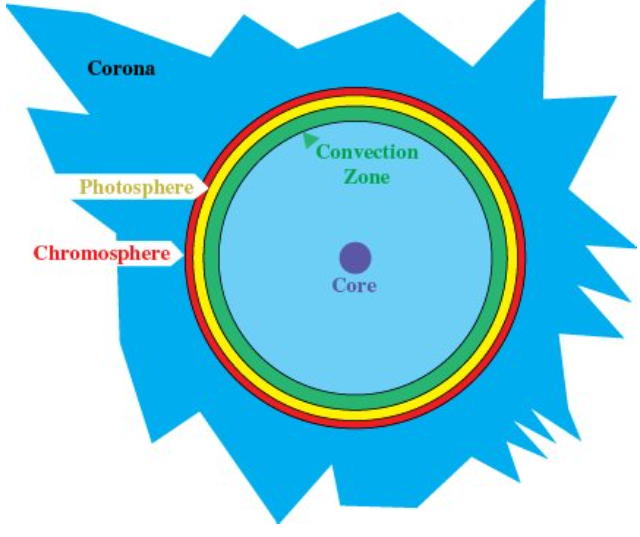
the Core
at the center, responsible for energy generation.
The outer layers
consist of the photosphere, emitting most visible light, the chromosphere above it, visible briefly during total solar eclipses, and the faint corona, extending into space and visible mainly during total eclipses. Beyond the corona, the solar wind, a stream of particles, extends into interplanetary space.
The photosphere
Elements of radiation transport theory
The chromosphere
The corona
Solar Wind
Solar activity
Sunspots
Photographs of the Sun show a pattern of darker areas. As with the granulation, the dark areas are not really dark, but not as bright as the surrounding areas. These sunspots that they have a darker inner region, the umbra, surrounded by a lighter region, the penumbra.
Sunspots exhibit a cyclic variation in their numbers, forming a pattern known as the sunspot cycle, with noticeable peaks in activity. This cycle is reflected in butterfly diagrams, which show the changing latitude of sunspots throughout an 11-year cycle. The Maunder minimum, a historical period characterized by a lack of sunspots, has been investigated, revealing extended periods without aurorae, weak coronae during solar eclipses, and possible correlations with tree growth rings. Tree rings provide insight into past solar activity, suggesting that similar periods of reduced solar activity might have occurred in the past. Sunspots are associated with higher magnetic fields on the Sun, originating from the motion of charged particles. These magnetic fields form closed loops, creating a magnetic dipole pattern.
The magnetic field strength B is defined such that the magnetic force on a charge q, moving with velocity v:
\[\vec F=q\vec v \times \vec B\]
Other Activity
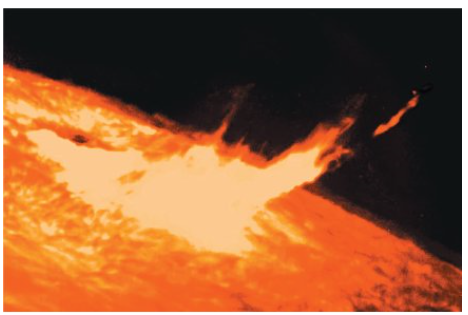
The solar flare
A flare involves a large ejection of particles. Flares develop very quickly, and thier temperatures in flares are high. They also give off strong Hα emission, and flares are seen when the Sun is photographed through an Hα filter. Flares have been detected to give off energy in all parts of the electromagnetic spectrum. The cause of flares appear to be related to strong magnetic fields and the flow of particles along field lines.
Plages
Plages are bright regions around sunspots. They show up in Hα images of the Sun. They remain after sunspots disappear. Plages are apparently chromospheric brightening caused by strong magnetic fields.
Filaments
Filaments are dark bands near sunspot regions. Filaments appear to be boundaries between regions of opposite magnetic polarity. When filaments are projected into space at the limb of the Sun, they appear as prominences.
Solar Wind
Solar Neutrinos
Our solar model accurately predicts the Sun's radius and temperature, but certain aspects cannot be directly verified. Most information about the Sun comes from observing photons emitted in the solar atmosphere, not directly from nuclear reactions in the core. Photons from the core take gigantic time to reach the surface and are not directly observable. Neutrinos, created in core nuclear reactions, offer a potential direct observation opportunity. These particles escape the Sun at the speed of light and reach Earth in minutes. Predicting the neutrino emission rate using stellar models could serve as a direct test for the solar model. However, detecting neutrinos is challenging due to their elusive nature, especially those with low energy produced in the initial proton–proton chain reaction.
There is, however, a source of higher energy neutrinos. Once \(^3He\) is formed, most of it reacts to form \(^4He\) . However, in a small fraction of cases, the following reaction can take place:
\[^3He+^4He\rightarrow \ ^7Be+\gamma\]
Then \(^7Be\) captures a proton:
\[^7Be+\ ^1H\rightarrow \ ^8Be+\gamma\]
Then beta decays, emitting a neutrino in the process:
\[^8Be\rightarrow \ ^8Be+e^++\nu\]
The \(^8Be\) then breaks apart into two alpha particles:
\[^8Be+\rightarrow \ ^4He+\ ^4He\]
The neutrino produced in beta decay has sufficient energy for potential detection. Chlorine-37 can be used as a detector for this neutrino, as it can absorb the neutrino when struck with sufficiently high energy.
\[^{37}Cl+\nu \rightarrow \ ^{37}Ar+\ e^-\]
The experiment takes place underground in a mine to shield from cosmic rays and natural radioactivity.
The decay is used to measure the neutrino interaction rate. Over 20 years, the observed solar neutrino flux is about one-third of the predicted value, posing the solar neutrino problem. Possible explanations include experimental inaccuracies, errors in solar model inputs (e.g., nuclear reaction rates, opacities), or variations in the Sun's energy generation cycle.
Neutrino oscillations, where neutrinos change identities in transit, are suggested as a potential explanation. Electron neutrinos from the Sun might transform into different types before reaching Earth, connected to the idea of neutrinos having a small, non-zero mass. Ongoing experiments are investigating these possibilities.
Two new types of solar neutrino experiments are underway. One uses gallium as a detector, focusing on the \(^8B\) neutrino, which comes from a less significant branch in the Sun's nuclear reaction chain. The possibility of a small calculation error being magnified for this minor branch is considered. Another reaction producing detectable neutrinos, the p–e–p reaction, is explored. Although not as crucial as the proton–proton chain, it is more significant than the \(^8B\) branch, providing an alternative avenue for studying solar neutrinos.
\[^1H+e^-\ ^1H\rightarrow \ ^2H+\nu\]
Two sets of ongoing solar neutrino experiments are addressing the solar neutrino problem. The first set focuses on the rare p–e–p reaction, challenging due to the difficulty of bringing three particles together simultaneously. Neutrinos resulting from this reaction have lower energy than \(^8B\)decay neutrinos but higher than p–p neutrinos. Gallium is used as a detector in the experiments. The observing rates about half of predicted values.
The second set involves larger versions of traditional detectors using water, with each reaction producing a small light flash detected by photomultipliers.
The primary solution to the solar neutrino problem suggests that neutrinos play a key role. If neutrinos possess a very small mass and can change identities, theoretical and experimental results may align. There are some evidences that support neutrino oscillations. The analysis suggests a substantial chance for solar neutrinos to change identity during their journey to detectors. The next significant test involves directly detecting p–p neutrinos, the most abundant and lowest-energy type.