PTSD
Return to Mental Emotional Health Menu
See also: Complex PTSD (CPTSD) / Developmental Trauma Disorder , Trauma & Emotional Recovery , Veterans Mental Health , Anxiety Disorders
VIDEOS

Why Do Some People Get PTSD While Others Do Not?
What is the difference between PTSD and complex PTSD?
The psychology of post-traumatic stress disorder - Joelle Rabow Maletis
Amazing New Treatment Option For PTSD- [SGB injection
PTSD RECOVERY SECRETS: Expert How-To Video with Jon Kelly
The New Revolution in Hacking Traumatic Brain Injury and PTSD - Dr. Mark Gordon & Andrew Marr
Brian and Natalie Vines: Advice from a Veteran and Caregiver on What Helps with TBI and PTSD
What Makes Some People More Sensitive to PTSD?
PTSD and service dogs: Beneath the surface
Hacking PTSD With Gratitude – Dr. James Gordon
Robert Shulman, MD: The Efficacy of Cognitive Processing Therapy for Veterans and Other Populations
MDMA Assisted Therapy for PTSD
Trauma Expert on Using MDMA to Treat PTSD
Post-Tramatic Stress Disorder & Veterans Correctional Housing
Post Traumatic Stress & Music: The Healing Power of Song
PTSD and Veteran Response Teams
Innovative Approaches by Law Enforcement to Assist PTSD-Afflicted Veterans in Crisis
Innovative Approaches by Law Enforcement to Assist PTSD-Afflicted Veterans in Crisis
-
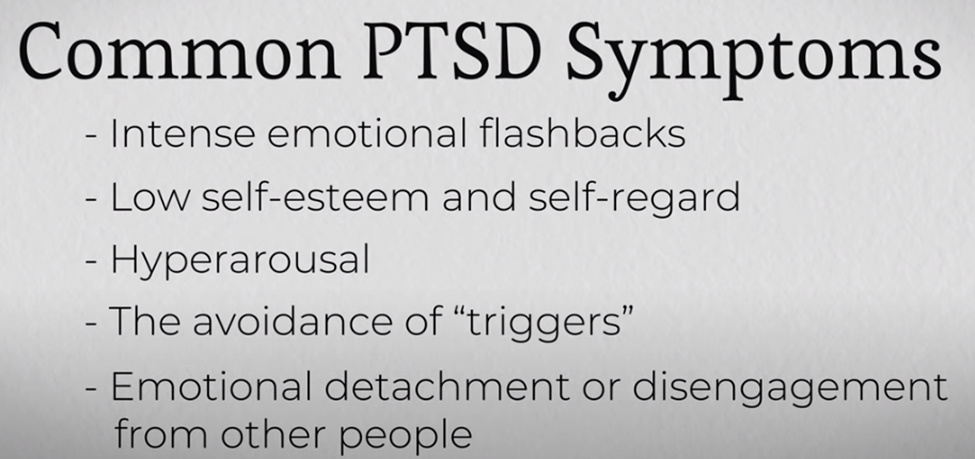
Routine PTSD Screen:
In your life, have you ever had any experience that was so frightening, horrible or upsetting that, in the past month:
- Have had nightmares about it or thought about it when you did not want to?
- Tried hard not to think about it or went out of your way to avoid situations that reminded you of it?
- Were constantly on guard, watchful, or easily startled?
- Felt numb or detached from others, activities or your surroundings?
Score of 3 or higher: obtain additional information
The Trauma Center
The Trauma Center is a program of Justice Resource Institute (JRI), a large nonprofit organization dedicated to social justice by offering hope and promise of fulfillment to children, adults, and families who are at risk of not receiving effective services essential to their safety, progress, and/or survival.
The Trauma Center provides comprehensive services to traumatized children and adults and their families at the main office in Brookline, Massachusetts.
At this Web site you will find a wealth of information – on our clinical services, on our training, consultation and education programs, and on our research and theories. Whether you are in therapy or a therapist, a student or a scholar, a lawyer or a judge, a representative of the media, you can learn a great deal here.
Organizations Helping PTSD Veterans
Articles/Studies
- Brain Tissue Analysis Yields Clues to Causes of PTSD
- How a hidden brain circuit fuels fibromyalgia, migraines, and PTSD. Neural circuits link pain emotion. What if your brain is the reason some pain feels unbearable? Scientists at the Salk Institute have discovered a hidden brain circuit that gives pain its emotional punch—essentially transforming ordinary discomfort into lasting misery. This breakthrough sheds light on why some people suffer more intensely than others from conditions like fibromyalgia, migraines, and PTSD.
- Anxiety and PTSD linked to increased myelin in brain's gray matter (https://www.sciencedaily.com/releases/2022/01/220107084437.htm)
- Mayo Clinic Overview of PTSD
- These overlooked brain cells may control fear and PTSD. Astrocytes, once thought to be mere brain “support cells,” are now revealed to be key players in fear memory. Researchers found they actively help form, recall, and weaken fear responses by interacting with neurons in real time. Changing astrocyte activity directly altered how strong fear memories became. This breakthrough could lead to entirely new treatments for anxiety-related disorders.
- Mental Health, the Brain, and PTSD
- What's in a name? Researchers track PTSD's many identities during war (https://www.sciencedaily.com/releases/2018/04/180420170556.htm)
- The Responses to Script-Driven Imagery Scale (RSDI): Assessment of State Posttraumatic Symptoms for Psychobiological and Treatment Research
- Nurture trumps nature in determining severity of PTSD symptoms
- Phenomenology and Psychological Assessment of Complex Posttraumatic States
- Dissociative symptomatology in Posttraumatic Stress Disorder and Disorders of Extreme Stress
- Dissociation and the Fragmentary Nature of Traumatic Memories: Overview and Exploratory Study
- Exploring the Nature of Traumatic Memory: Combining Clinical Knowledge with Laboratory Methods.
- The Body Keeps the Score: Memory and the Emerging Psychobiology of Post Traumatic Stress.
- Preliminary Evidence of Parasympathetic Influence on Basal Heart Rate in Posttraumatic Stress Disorder
- Patients with post-traumatic stress disorder respond differently to certain sounds, research finds (https://www.sciencedaily.com/releases/2017/11/171130093952.htm)
- Neuroinflammatory pathways in anxiety, posttraumatic stress, and obsessive compulsive disorders
- Junk DNA may rein in memories tied to fear A piece of “junk DNA” could be the key to extinguishing fear-related memories for people struggling with post-traumatic stress disorder and phobia, according to a new study. Researchers discovered the new gene while investigating how the genome responds to traumatic experiences . “It’s like harnessing the power of the Hubble Telescope to peer into the unknown of the brain.”
Risk Factors
One of the risk factors for developing PTSD is having prior trauma exposure. A big difference in who develops PTSD and who doesn’t is repeated trauma exposure throughout one’s life. This is seen in military settings with people who grew up with childhood abuse in the home or had a particularly adverse childhood, this primes them to experience combat, military deployments, later traumas in a way that predisposes them to develop PTSD.
There are certain kinds of traumas that are more likely to result in PTSD than others. For example, combat where others are trying to kill you has a different meaning than being in a flood or house fire. Other people trying to kill you results in a very different kind of mindset.
There is a genetic factor and it can run in families, like depression.
- Expression of certain genes may affect vulnerability to post-traumatic stress disorder
- The gut-brain axis and the microbiome in anxiety disorders, post-traumatic stress disorder and obsessive-compulsive disorder.
- Child victims of violence have higher levels of PTSD as adults
- Neural Correlates of Reexperiencing, Avoidance, and Dissociation in PTSD: Symptom Dimensions and Emotion Dysregulation in Responses to Script-Driven Trauma Imagery
- How chronic early-life stress raises PTSD vulnerability
- Post-traumatic stress may be associated with methylation of DNA via epigenetic modifications.
- Pregnant women with PTSD have higher levels of stress hormone cortisol
- Soldiers with PTSD more 'tuned' to angry faces because of over-connected brain circuits
- The consequences of stress experiences are transgenerational, with parental stress exposure impacting stress reactivity and PTSD risk in subsequent generations.
- Drinking to forget could make PTSD worse
- Disaster-related prenatal maternal stress influences birth outcomes, including lower head circumference.
- First molecular genetic evidence of PTSD heritability discovered
- AIDS-Like Syndrome & COVID PTSD
Protective Factors / Buffers
These are things that mitigate the effects of trauma. The degree of social support you have, the degree you feel close to other people, acts as a buffer and is one of the biggest protective factors against PTSD. Knowing you have a zone of safety. One study discovered that if you have normal to high levels of cortisol in your system at the time of trauma, you may not develop PTSD, those with low cortisol were likely to get it (study done in N.Y.C. collapse of Twin Towers/ 9/11)
Treatment
- Retrieving, Assessing, and Classifying Traumatic Memories: A Preliminary Report on Three Case Studies of a New Standardized Method
- THC medication made PTSD nightmares disappear for more than a third of patients.THC relieves PTSD nightmares.A prescription form of THC helped many people with PTSD escape recurring trauma-related nightmares, with more than one-third reporting that the nightmares disappeared completely after ten weeks. The results could point toward a long-awaited treatment for one of PTSD’s most distressing and stubborn symptoms.
- Review of potential psychedelic treatments for PTSD.
- The Assessment and Treatment of Complex PTSD
- How To Heal Post-Traumatic Stress Disorder Naturally
- Clinical Implications of Neuroscience Research in PTSD
- The Body Can Change the Score: Empirical Support for Somatic Regulation in the Treatment of Traumatized Adolescents
- In Terror's Grip: Healing the Ravages of Trauma.
- A Review of PTSD and Current Treatment Strategies. (2021)
- Yoga vs cognitive processing therapy for military sexual trauma-related posttraumatic stress disorder.
- **Exercise** can be an effective addition to PTSD treatment.
- **Meditation** for posttraumatic stress: Systematic review and meta-analysis.
- **Meditation** for posttraumatic stress: Systematic review and meta-analysis.
- **Art therapy** helps veterans with PTSD: An effective, non-chemical treatment
- Treat PTSD in adults and children with **natural remedies**, homeopathy and herbs
- The Anti-Inflammatory Effects of **Blueberries** in an Animal Model of Post-Traumatic Stress Disorder (PTSD)
- **Gastrodin** is effective in the treatment of PTSD-induced memory impairment, fear abnormalities, and affective disorders.
- Case control study: **hyperbaric oxygen** treatment of mild traumatic brain injury persistent post-concussion syndrome and post-traumatic stress disorder
- **Korean Red Ginseng** prevents posttraumatic stress disorder-triggered depression-like behaviors.
- **EMDR** and the Treatment of Complex PTSD: A Review
- A Randomized Clinical Trial of Eye Movement Desensitization and Reprocession (**EMDR**), Fluoxetine, and Pill Placebo in the Treatment of Posttraumatic Stress Disorder: Treatment Effects and Long-Term Maintence
- **Yohimbine** facilitated acoustic startle in combat veterans with post-traumatic stress disorder.
- Augmenting treatment efficiency in exposure therapy for PTSD: a randomized double-blind placebo-controlled trial of **yohimbine HCl**.
- **Equine Facilitated Therapy** for Complex Trauma (EFT-CT)
- Effects of **Essential Oil** on Fear Memory and the Immune Response: A Potential Alternative Therapy for Post Traumatic Stress Disorder (PSTD)
- A Randomized Controlled Study of **Neurofeedback** for Chronic PTSD
- A Pilot Study of **Neurofeedback** for Chronic PTSD
- Effectiveness of an Extended **Yoga** Treatment for Women with Chronic Posttraumatic Stress Disorder
- Claiming Peaceful Embodiment Through **Yoga** in the Aftermath of Trauma
- Trauma-Sensitive **Yoga** as an Adjunct Mental Health Treatment in Group Therapy for Survivors of Domestic Violence: A Feasibility Study
- Yoga** as an Adjunctive Treatment for Posttraumatic Stress Disorder: A Randomized Controlled Trial
- **Yoga** for Adult Women with Chronic PTSD: A Long-Term Follow-Up Study
- The integration of **yoga breathing techniques in cognitive behavioural therapy** for post-traumatic stress disorder.
- The anti-PTSD-like activities of **paeoniflorin** were associated with the modulation of HPA axis and 5-HT system activation.
- **Acupoint stimulation** is effective for earthquake-caused post-traumatic stress disorder patients.
- **Electric patch** holds promise for treating PTSD
- **Acupuncture** has therapeutic value in the treatment of post-traumatic stress disorders.
- **Acupuncture** was associated with a significantly greater improvement in depression, pain, and physical and mental health functioning.
- **Biofeedback** has therapeutic value for pain management in traumatized refugees.
- **Hyperbaric oxygen** therapy may have therapeutic value in the treatment of brain trauma and post-traumatic stress disorder.
- The use of **hyperbaric oxygen** for veterans with PTSD: basic physiology and current available clinical data.
- **Oleuropein** might be a potential useful therapeutic intervention for PTSD.
- These results indicate that **gastrodin** possesses anxiolytic effect and may be an effective herbal preparation for the treatment of PTSD.
- **Mindfulness** intervention has therapeutic value for child abuse survivors.
- Survivors of torture and refugee trauma respond positively to **qigong and tai chi.**
- **Tibetan Buddhism** is an important coping mechanism among Tibetan torture survivors.
- **Yoga breath-based interventions** may help relieve psychological distress associated with post-traumatic stress disorder and depression.
- These results are consistent with recent literature indicating that **yoga** may have potential as a PTSD therapy in a veteran or military population.
- **Yoga** reduces feelings of sadness and may prevent anxiety in subjects with post-traumatic stress disorder.
- Yoga** may be an effective adjunctive treatment for PTSD.
- Yoga** Trumps Talk Therapy for Healing PTSD from Military Sexual Trauma
- **Yoga** may be an effective intervention for PTSD in addition to standard treatments.
- A diet enriched with **curcumin** is capable of impairing fear memory consolidation and reconsolidation processes in animals.
- **Psilocybin** facilitates extinction of the classically conditioned fear response in mice.
- From Hofmann to the Haight Ashbury, and into the future: the past and potential of **lysergic acid diethlyamide**.
- Targeting the **endocannabinoid **system represents an attractive and novel approach to the treatment of anxiety-related disorders.
- Current evidence indicates **CBD** has considerable potential as a treatment for multiple anxiety disorders.
- **Cannabidiol** as a Therapeutic Alternative for Post-traumatic Stress Disorder: From Bench Research to Confirmation in Human Trials
- **Cannabidiol oil** could be used as a safe treatment for reducing anxiety and improving sleep in posttraumatic stress disorders.
- Cannabidiol** modulates fear memory formation through Interactions with serotonergic transmission.
- **THC and CBD** could be therapeutic in mitigating a dysfunctional aversive memory through reconsolidation disruption in PTSD patients.
- Cannabinoids** administered shortly after exposure to a traumatic event were found to prevent the development of PTSD-like phenotype.
- MDMA**-assisted psychotherapy for treatment of posttraumatic stress disorder.
- Luteolin** reduces fear, anxiety, and depression in rats with post-traumatic stress disorder.
- Amelioration by **Withania somnifera** of neurobehavioural and immunological markers in time dependent sensitization induced post traumatic stress disorder.