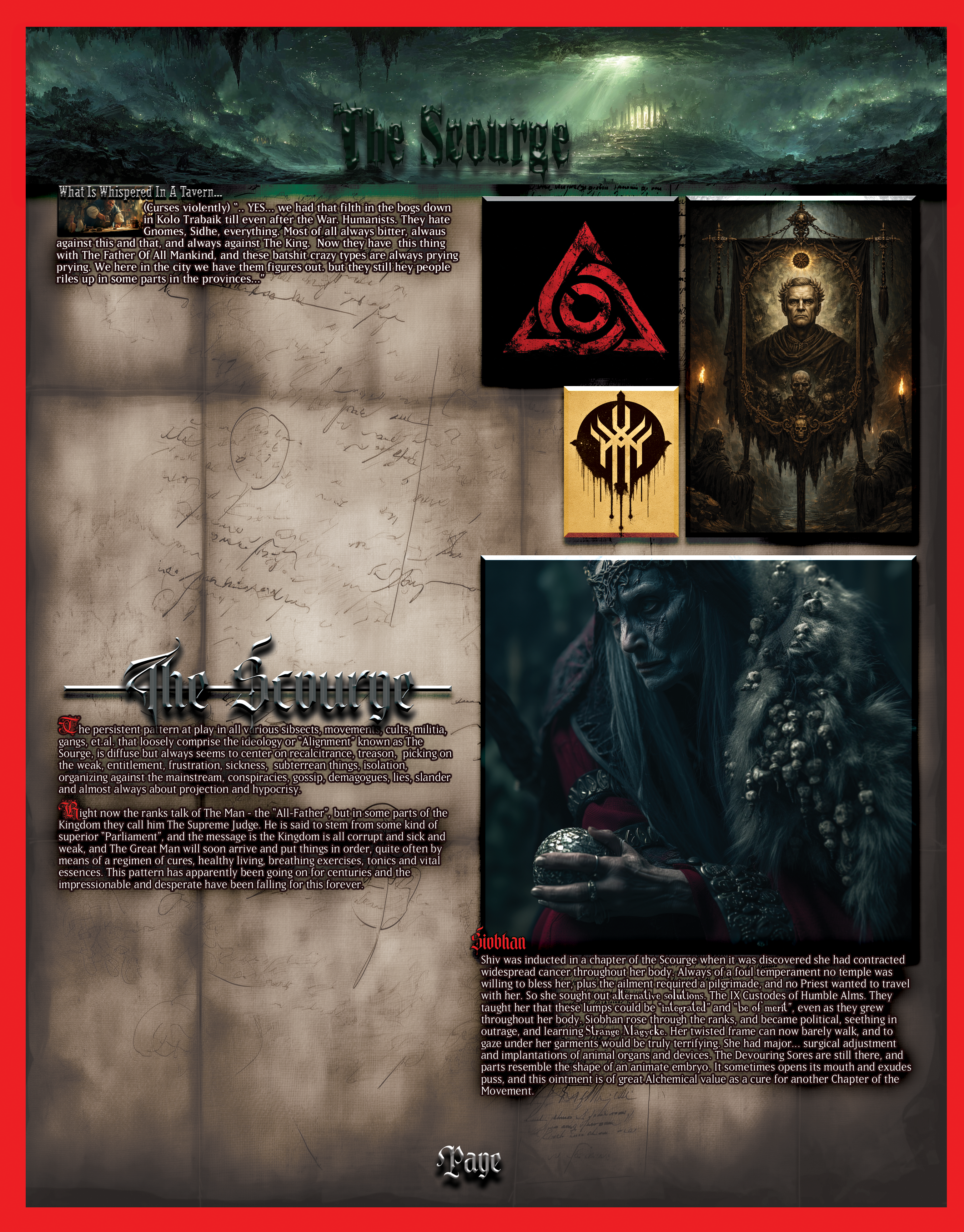
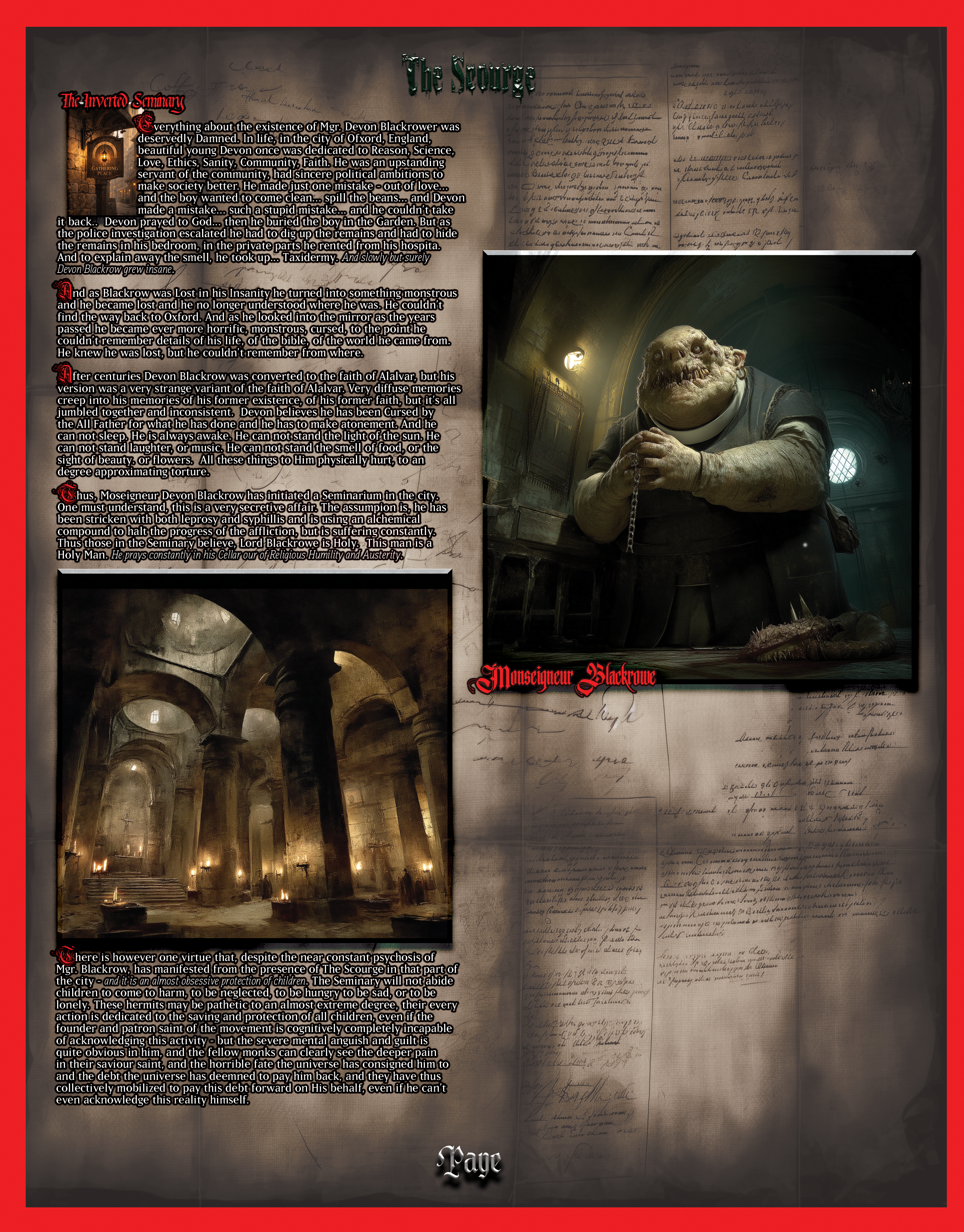
The Scourge Alignment
Among the many currents that move beneath the surface of the Kingdom, few are as persistent—or as misunderstood—as the tendency commonly called The Scourge. It is not a guild in the ordinary sense, nor a singular cult, nor even a unified political party. Rather, it is a pattern of thought and association that has appeared and reappeared throughout the Kingdom’s history, sometimes as a reformist movement, sometimes as a curative fellowship, sometimes as a civic league concerned with the dignity and endurance of humankind. Its adherents deny the name “Scourge,” which they regard as slander coined by their detractors; they are more likely to describe themselves as Humanists, Preservationists, or advocates for Mortal Continuance. Whatever the title adopted in a given decade, the central concern remains remarkably consistent: humanity must not be made secondary in its own realm.
The Kingdom, as all know, is ancient and layered. Its present stability rests upon institutions that long predate most living citizens, and upon accords between human and non-human powers that are older still. For some, these arrangements represent wisdom earned through catastrophe. For others, they are compromises that calcified into permanent hierarchy. The Scourge arises most often where this second interpretation takes root. Its sympathizers argue that humanity has grown accustomed to deferral—deferral to immortal counsel, to inherited systems, to ancient bloodlines and long-lived races whose perspective is measured in centuries rather than in mortal spans. In taverns and lecture halls alike, one may hear the murmur that human vitality, ingenuity, and suffering have been made subordinate to an order that does not truly share them.
At its gentlest, this alignment expresses itself as advocacy for human self-determination. It funds clinics in districts where official care is sparse. It sponsors lectures on physical discipline, breathwork, and the preservation of vigor. It organizes debating societies devoted to the question of republican governance, arguing that authority should be answerable to the living rather than sanctified by lineage. Its members are often disciplined, sober in dress, and suspicious of ornament. They speak of responsibility, of restoring balance, of refusing to romanticize decline. Many who have lost faith in distant institutions find such rhetoric bracing. The Scourge does not promise transcendence; it promises relevance.
Yet there is a harder edge beneath the civic language. The Scourge holds that decay is not merely natural but often engineered—through neglect, through indulgence, through systems that reward passivity. Where others accept mortality as a sacred boundary, the Scourge regards it as a problem to be confronted. It invests in alchemical research, in the refinement of tonics and restorative regimens, in the systematic study of ailments that temples declare inscrutable or fated. Its practitioners cultivate resilience with almost monastic severity. They distrust easy miracles and disdain dependency. In their view, to surrender to decline without contest is a failure of will as much as of flesh.
This attitude naturally brings the Scourge into tension with established authorities. The Crown tolerates many currents of dissent so long as they do not fracture the peace, yet the Scourge’s critique of inherited legitimacy cuts close to bone. Where others praise the continuity embodied by the King and the ancient houses, the Scourge asks whether continuity has become stagnation. Where others celebrate harmony between peoples, it asks whether harmony has concealed imbalance. Such questions are not treason in themselves, but when asked persistently and with organizational backing, they unsettle. The Scourge is careful in public to frame its ambitions as reform rather than rupture. Privately, its sympathizers debate the shape of a future less beholden to traditions they consider burdensome.
It would be inaccurate to describe the Scourge as uniformly cruel, though its detractors often do. Its clinics treat those whom no temple would bless. Its fellowships welcome the embittered, the overlooked, and the chronically ill. Its rhetoric of human dignity can be genuinely stirring. At the same time, its doctrine of usefulness is exacting. The Scourge believes that vitality should be cultivated, not squandered. It regards complacency with open contempt. Those who cannot or will not strive are pitied, but rarely centered. To walk the Scourge’s path is to accept scrutiny—of one’s habits, one’s discipline, one’s willingness to endure unpleasant truths.
Rumors swirl around certain chapters of the movement, particularly in provincial regions where oversight is light. Stories circulate of experimental regimens, of controversial alchemical procedures, of debates that stray beyond the bounds of polite philosophy. The Scourge dismisses many such accounts as exaggeration or political sabotage. Its official spokespeople emphasize transparency, insisting that human betterment inevitably attracts envy and fear. Still, the persistence of these whispers contributes to the aura that clings to the alignment: part civic league, part shadowed fraternity, always more coordinated than it first appears.
In social terms, adherents of the Scourge often carry themselves with restrained intensity. They are seldom flamboyant. They value order in dress and in speech. They prefer measured argument to spectacle, though when provoked they can display startling ferocity in defense of their principles. Their gatherings are structured, their discussions disciplined. Symbols associated with the movement tend toward stark geometry and restrained heraldry, invoking endurance rather than ecstasy. To encounter them is not to feel the heat of fanaticism so much as the chill of unwavering conviction.
For players, the Scourge represents an alignment grounded in grievance, resilience, and reformist ambition. It is suited to characters who believe that humanity has conceded too much to tradition or to long-lived powers; to those who see mortality not as a sacred limit but as a frontier; to those willing to trade comfort for endurance. A Scourge-aligned character need not be villainous. They may be physicians frustrated with institutional lethargy, scholars convinced that ancient pacts no longer serve the living, or civic organizers determined to place mortal voices at the center of governance. What binds them is not cruelty but recalcitrance—a refusal to accept that “this is how it has always been” is an answer.
At its best, the Scourge channels human tenacity into disciplined reform. At its worst, it hardens into suspicion and corrosive resentment. In either case, it is a force the Kingdom cannot ignore. It speaks to a fear shared by many mortals: that they will age, struggle, and die while others remain serenely above consequence. Whether the Scourge offers remedy or merely another form of bondage is a question that each adherent—and each table—must answer in play.