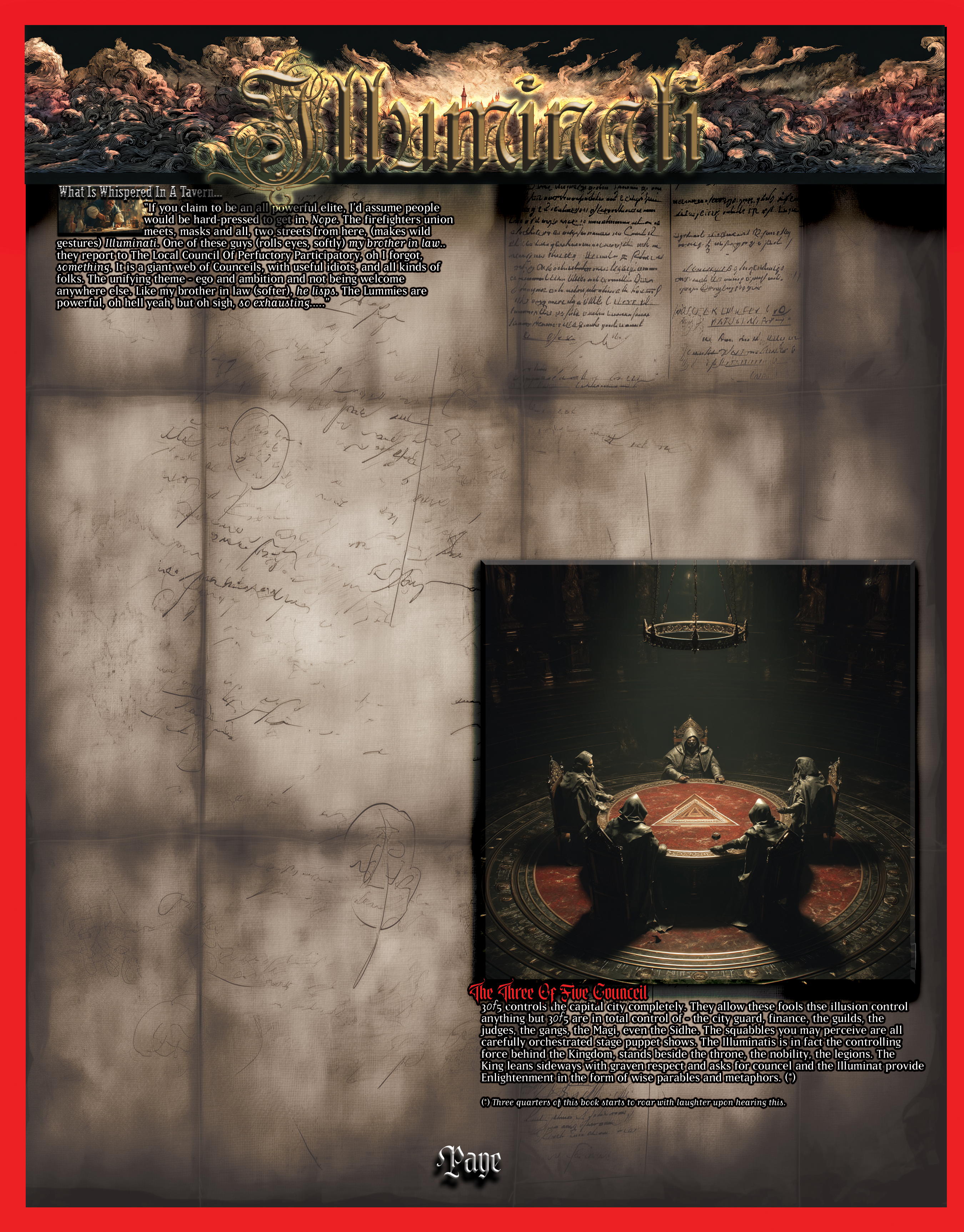
The Illuminati Alignment
There are those who inherit power, those who seize it, those who pray for it, and those who labor in its shadow believing they understand it better than anyone else ever could. The Illuminati Alignment does not belong to kings, nor to councils, nor to the grand cathedrals of doctrine or banners of conquest. It belongs to those who are certain that beneath every throne sits a mechanism, and that mechanisms can be studied, diagrammed, influenced, and, if one is clever enough, quietly redirected. They are not united by creed, nor blood, nor uniform, but by a shared conviction that the visible order of the Kingdom is only the surface of something deeper, subtler, and more navigable than the masses suppose.
To walk this alignment is to believe that influence precedes authority and that narrative precedes law. The Illuminati-aligned individual does not mistake spectacle for power, nor ceremony for sovereignty. They study patterns in the grain of institutions, listen for hesitation in the voice of a magistrate, observe which rival houses never openly quarrel, and note which decrees are enforced with passion and which are allowed to fade. They are attentive to omissions as much as proclamations, to absences as much as presence, because to them the Kingdom is not a monolith but a tapestry of incentives, fears, ambitions, and private bargains constantly in motion.
It would be a grave error to assume that all who gather in salons, councils, private lodges, academic cloisters, or advisory chambers are of this alignment. Many pass through such circles for reasons of prestige, curiosity, or necessity, yet remain anchored elsewhere in spirit. The Illuminati Alignment is not defined by membership in any single institution but by disposition: a habit of mind that sees the world as negotiable, interpretable, and susceptible to careful leverage. Some who carry this disposition never set foot in grand halls at all, content instead to cultivate influence through correspondence, patronage, or patient accumulation of obligation. Others drift among formal bodies, serving on committees, drafting memoranda, offering counsel, and quietly mapping the unseen arteries through which decisions truly flow.
Those aligned in this manner are often accused of cynicism, yet they would describe themselves as realists. They do not assume that virtue governs outcomes, nor that chaos reigns unchecked; they believe instead that outcomes are shaped by incentives and that chaos is often curated. They are rarely satisfied with first explanations. A famine is not merely a crop failure but a distribution failure; a rebellion is not merely anger but mismanaged loyalty; a religious schism is not merely heresy but a failure of narrative stewardship. Whether their interpretations are correct is a matter for history, but their instinct is always to look behind the proclamation toward the machinery that enabled it.
The social temperament of the Illuminati-aligned individual can vary widely. Some are charming conversationalists who collect confidences with effortless grace, while others are austere analysts who speak only when their observations have ripened into certainty. Some pursue careers with relentless calculation, climbing through bureaucracies and advisory roles with an eye for proximity to decision-makers, while others cultivate reputations as indispensable intermediaries, valued for their capacity to translate between factions that otherwise mistrust one another. What unites them is not style but orientation: a preference for influence over applause and for position over visibility.
This alignment does not promise companionship. Indeed, it often complicates it. When one habitually examines motives and anticipates reactions, spontaneity becomes difficult to sustain. Trust is approached as a variable rather than a given, and sincerity is weighed against probability. Friends may feel studied, rivals may feel categorized, and even allies may sense that they are part of a broader calculus. Yet it would be unjust to portray the Illuminati-aligned as incapable of loyalty or affection. Many are fiercely protective of chosen associates, not because sentiment alone compels them, but because they understand the long-term value of durable bonds. Their loyalty is seldom loud, but it is often enduring.
In matters of governance, the Illuminati Alignment excels not in issuing commands but in shaping the conditions under which commands become inevitable. They draft frameworks, suggest amendments, circulate proposals in subtle sequence, and introduce ideas in ways that allow others to claim authorship. To them, success is not always the moment of decree but the quiet realization that events unfolded as anticipated. They are attentive to timing, to optics, to the sequence in which truths are revealed, and to the manner in which opposition can be redirected rather than crushed. Where some alignments favor confrontation or proclamation, the Illuminati prefer calibration.
It must be understood that this alignment does not equate to omniscience. Miscalculation is always possible, and overconfidence in pattern recognition can lead to grievous error. The Kingdom is vast, and no single perspective can encompass all its currents. Those who lean too heavily on analysis may find themselves trapped in self-constructed webs of interpretation, mistaking coincidence for design or underestimating the capacity of other alignments to act from conviction rather than incentive. The wise among them temper foresight with humility, recognizing that influence, while potent, is never absolute.
For players considering this alignment, it offers a distinct mode of engagement with the world. It rewards attentiveness, patience, and an appetite for complexity. It invites characters to operate between factions rather than at the head of them, to gather information before committing to action, and to perceive that power often resides in overlooked corridors rather than on gilded thrones. It does not demand secrecy as spectacle, nor conspiracy as theatrics; rather, it encourages a steady awareness that systems are composed of people, and people can be persuaded, guided, or outmaneuvered.
In the Kingdom’s grand tapestry of alignments, the Illuminati stand neither at the center nor at the margins, but along the threads that connect one to the other. They are present where policy is drafted, where alliances are brokered, where narratives are shaped, and where ambitions seek discreet assistance. They are rarely celebrated in song, seldom honored in public ritual, and often misunderstood by those who prefer clearer categories of hero and villain. Yet their influence, when exercised with skill, can alter the course of events without ever raising a banner.
To walk this path is to accept that visibility is optional, that recognition is uncertain, and that understanding may never be reciprocated. It is to believe that the Kingdom is intelligible, even when it appears chaotic, and that thoughtful intervention can bend outcomes without announcing itself. Whether one pursues this orientation for the sake of stability, ambition, curiosity, or conviction is a matter of character. The alignment does not dictate motive; it shapes method.