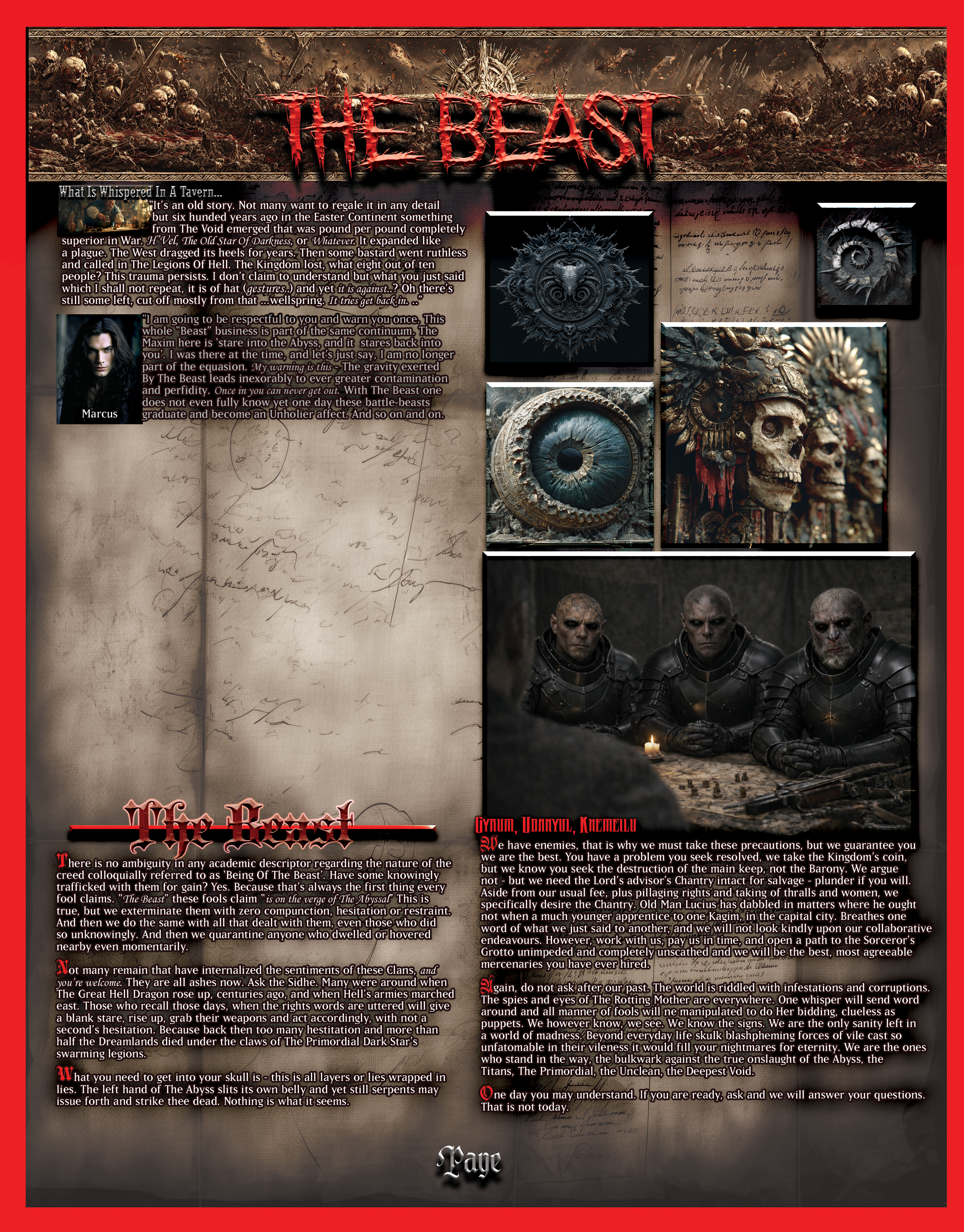
The Beast Alignment
There are Alignments that promise glory, and there are Alignments that promise belonging, and there are Alignments that promise revelation, but The Beast promises none of these things and yet offers something far more intoxicating to those who understand its language. It does not ask you to believe in destiny, nor does it flatter you with prophecy, nor does it seduce you with the illusion that you are chosen. The Beast is an answer to a question that most civilizations are too polite to ask aloud: what would remain of a people if all optional weakness were pared away and only what serves victory were allowed to endure. It is not a cult, though it has been called one by those who misunderstand its structure, and it is not a horde, though it has been mistaken for one by those who meet it only at the edge of a battlefield. It is an Alignment of discipline, of narrowing, of deliberate transformation toward a singular end.
To stand within The Beast is to accept that power is not a birthright but a refinement process. It does not grant you fangs or claws in some theatrical display of savagery, and it does not demand that you howl at the moon or brandish trophies to prove your loyalty. Instead, it invites you into a hierarchy where every instinct is examined, every hesitation weighed, and every impulse that does not contribute to cohesion and dominance is gradually diminished. The Beast does not hate weakness in the way a tyrant might; it simply does not allocate resources to preserve it. Those who join quickly learn that sentiment, indecision, and ornamental pride are inefficiencies that must either be repurposed or surrendered. What replaces them is not mindless brutality, but a clarity that feels at first like cold water poured over the mind and later like a second skeleton beneath the first.
Outsiders often speak of The Beast in the language of fear, as if it were a contagion or a creeping blight that steals identity from its adherents, and there is some truth in the metaphor, though not in the accusation. The Beast does not steal identity; it compresses it. You do not become someone else so much as you become less diffuse, less divided, less inclined to wander into unnecessary complexity. Where others debate ethics in circles, you will find yourself calculating outcomes. Where others cling to old alliances out of nostalgia, you will evaluate whether those alliances strengthen the chain or weaken it. Where others see insult, you will see leverage; where others see chaos, you will see vectors. This narrowing is not without cost, and it is not disguised as anything other than what it is. The Beast does not promise comfort. It promises efficacy.
Those who negotiate with The Beast speak of a particular stillness that surrounds its envoys. They are not loud, not ostentatious, not eager to impress. They sit, they listen, they assess, and when they speak it is in terms of logistics, obligations, and outcomes. The Beast values clarity in contract as much as clarity in combat, because it understands that dominance is as much a matter of structure as of force. Its adherents are trained to perceive infiltration where others see coincidence, to anticipate betrayal not because they are paranoid but because they are thorough, and to integrate all dependents into a hierarchy that minimizes fracture. Nothing is left ambiguous if it can be defined, and nothing is left undefined if it can later become a liability. In this way, The Beast becomes less an army and more an organism, its members operating as distributed nodes of a shared calculus.
This does not mean that The Beast lacks culture or aesthetic, though its expressions of both are always subordinate to function. Armor is maintained because it must perform, not because it must dazzle. Symbols are used because they reinforce cohesion, not because they flatter the eye. Even ceremony, when it exists, serves as reinforcement of hierarchy and expectation rather than indulgence in spectacle. There is beauty in such austerity, but it is the beauty of a well-engineered structure rather than a gilded throne. Those who seek romance or theatrical villainy within its ranks will find themselves disappointed, for The Beast has little patience for self-mythologizing. It prefers results to legends.
For players who choose this Alignment, the appeal lies not in chaos but in control. You will find that your character’s growth reflects the philosophy of refinement rather than explosion. Improvements will feel deliberate, layered, and purposeful. Abilities that enhance reaction speed, battlefield awareness, endurance, and command presence will interlock like pieces of a machine, reinforcing one another rather than branching outward into decorative variety. You will gain access to structures that reward loyalty upward and responsibility downward, because The Beast insists that strength must be organized to be meaningful. You will be expected to uphold contracts, to anticipate threats, and to maintain discipline even when others around you falter.
Yet the Beast is not blind to the wider world. It understands that it operates within a landscape of other Alignments, other ideologies, other ambitions, and it engages them not with contempt but with calculation. It does not seek annihilation for its own sake, though it will pursue decisive action when necessary. It recognizes that negotiation is sometimes a more efficient route to dominance than attrition, and that authority established through competence can be more enduring than authority seized through spectacle. In this, The Beast differs from the caricature its enemies paint of it. It is not mindless aggression; it is directed intent.
The cost of this path is subtle and cumulative. Social freedoms narrow not because they are explicitly forbidden, but because they cease to serve your trajectory. You may find that your tolerance for indecision diminishes, that your patience for disorganization thins, and that your respect for strength becomes increasingly tied to performance rather than promise. These changes are not imposed overnight, nor are they hidden. They are the natural consequence of choosing to align with a philosophy that prioritizes survival and supremacy over comfort and approval. The Beast will not apologize for this, nor will it pretend that the trade is trivial. It assumes that those who join do so with open eyes.
Ultimately, The Beast is less about what you become and more about what you choose to relinquish. It is an Alignment for those who are willing to accept that clarity can be harsher than illusion, and that structure can feel constraining even as it empowers. It does not promise that you will be loved, or celebrated, or even understood. It promises that you will be effective, and that in moments when others falter, you will not. For some, that promise is too severe, too uncompromising, too stripped of romance. For others, it is the only honest offer on the table.
To join The Beast is to enter a covenant of refinement, to step into a hierarchy that sharpens rather than coddles, and to accept that power, once defined so clearly, leaves little room for retreat into ambiguity. It is not a path for everyone, and it does not pretend to be. It is a path for those who would rather stand in disciplined certainty than drift in ornamental freedom, and who understand that dominance, when properly structured, is not noise but silence held under tension.