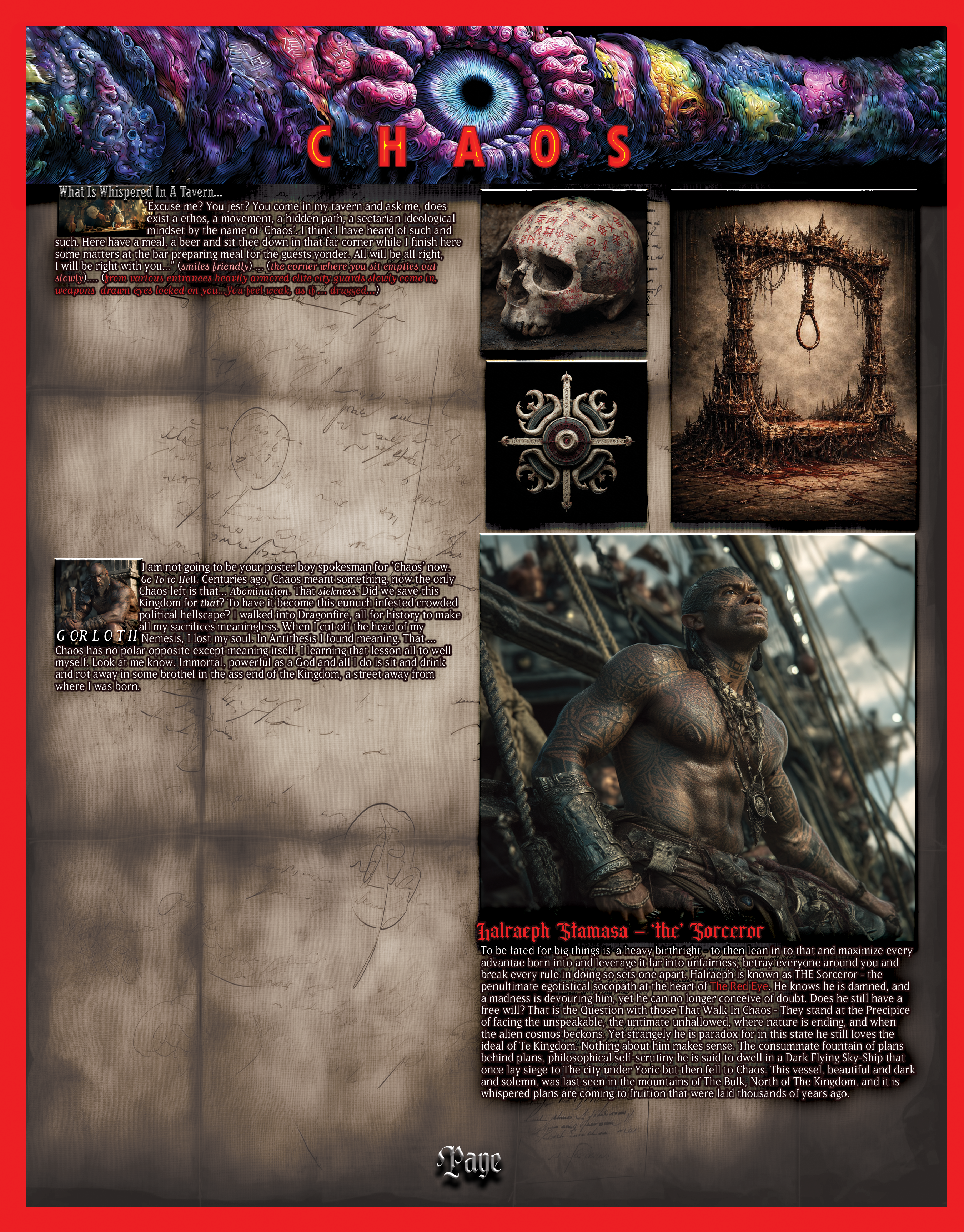
The Chaos Alignment
There are those who still speak of Chaos as though it were a tantrum given metaphysical authority, as though it were merely the breaking of laws, the toppling of statues, the indulgence of appetite. Such people tend to remember old wars, loud rebellions, and the theatrics of villains who mistook cruelty for depth. They are not entirely wrong, but they are not correct either. Chaos is older than outrage and subtler than defiance. It does not exist to shatter for the pleasure of noise, nor does it thrive upon disorder for its own sake. It is not the opposite of structure. It is the refusal to allow structure to forget why it exists.
In every generation the Kingdom produces guardians of its walls, keepers of its codes, and preservers of its traditions. These are necessary, and Chaos does not deny their necessity. But stone accumulates moss, and rituals accumulate emptiness, and laws accumulate exemptions that quietly hollow them from within. Chaos arises where vitality has begun to thin. It asks a question no one else wishes to ask: does this thing still live, or are we merely pretending it does? Where others see continuity, Chaos tests for pulse. Where others insist upon reverence, Chaos measures consequence. It is not impressed by titles, nor by inherited sanctity, nor by the repetition of old victories. It is impressed only by what survives contact with reality.
Those who align themselves with Chaos do not all resemble one another, and this is the first misunderstanding outsiders carry. Some are scholars who dismantle dogma not to mock it but to see if anything within it can still withstand scrutiny. Some are generals who break sacred rules of engagement in order to prevent a war from calcifying into ritual slaughter. Some are sorcerers who have seen too far into the machinery of power to believe that obedience alone sustains a realm. There are even magistrates who quietly bend procedure to preserve justice when law would otherwise devour it. Chaos does not demand theatrics. It demands lucidity.
It would be comforting to believe that Chaos is merely the province of rebels and malcontents, but history suggests otherwise. The Kingdom has endured precisely because it has, at crucial moments, permitted certain hands to operate without clean gloves. Entire eras have turned upon decisions that violated custom yet preserved survival. The city of Sanctuary did not rebuild itself through purity; it rebuilt because someone was willing to discard forms that had ceased to function. The mountains of the Bulk still stand not because every commander obeyed precedent, but because one or two refused to allow precedent to dictate defeat. These are not stories sung loudly, yet they circulate in whispers among those who recognize them.
Chaos is often accused of disloyalty. The accusation misunderstands the nature of allegiance. Loyalty to a corpse is necromancy; loyalty to a living thing requires change. A tree that never sheds leaves will suffocate itself. A realm that never questions its own myths will one day discover those myths no longer protect it. Chaos does not worship change for its novelty. It insists upon adaptation as proof of life. To the timid, this looks like betrayal. To the attentive, it is stewardship under harsher light.
This Alignment does not offer comfort. It offers responsibility without applause. Those who walk its path must accept that they will be misunderstood by those who prefer clarity over accuracy. Chaos-aligned figures are frequently described as dangerous, and the description is not entirely false. They are dangerous to complacency, dangerous to institutions that survive only by inertia, dangerous to hierarchies that confuse longevity with legitimacy. They are also dangerous to themselves, for there is no external absolution for the choices they make. There is no guarantee that the structure they stress will hold. There is no assurance that the fire they set will remain contained. Chaos demands discernment, and discernment is a blade that cuts both ways.
It is important to distinguish Chaos from predation. There are those who cloak appetite in the language of liberation, who mistake cruelty for courage and opportunism for clarity. Such individuals often claim kinship with Chaos because they reject constraint. Yet Chaos is not defined by rejection; it is defined by evaluation. To discard without testing is vandalism. To destroy without understanding is waste. True Chaos studies a system before it challenges it, learns its load-bearing beams before applying pressure. It does not tear down merely to watch collapse. It seeks to discover what cannot endure, and in doing so reveals what can.
Players who choose this Alignment should understand that it does not promise spectacle. It promises perspective. You will often stand at angles others avoid. You may find yourself defending institutions you privately critique, or critiquing institutions you publicly serve. You will be asked to decide whether an old oath remains binding when the conditions that gave it meaning have shifted. You may be required to preserve a symbol today so that it can be transformed tomorrow. Chaos is not a tantrum against Order; it is a refusal to allow Order to fossilize.
Within the Kingdom, Chaos-aligned actors are rarely centralized. They do not march beneath a single banner nor gather in obvious conclaves. Their presence is more akin to a current that runs beneath the visible river. At times they surface in decisive moments; at other times they remain unseen, content to let the realm believe its continuity was effortless. They value results over recognition and vitality over applause. Their measure of success is not how loudly they are praised but whether the Kingdom remains capable of surprise, growth, and renewal.
To stand with Chaos is to accept that stability is not the same as health. It is to acknowledge that sometimes preservation requires incision. It is to love a realm enough to risk being called its enemy when you refuse to let it decay. This path is not for those who crave moral simplicity. It is for those who understand that survival demands evolution, and that evolution demands pressure. If you seek a banner under which every action is clearly justified and every outcome neatly affirmed, you will not find it here. If, however, you are willing to ask whether what stands still is still alive, you may find in Chaos not anarchy, but the most exacting form of care.