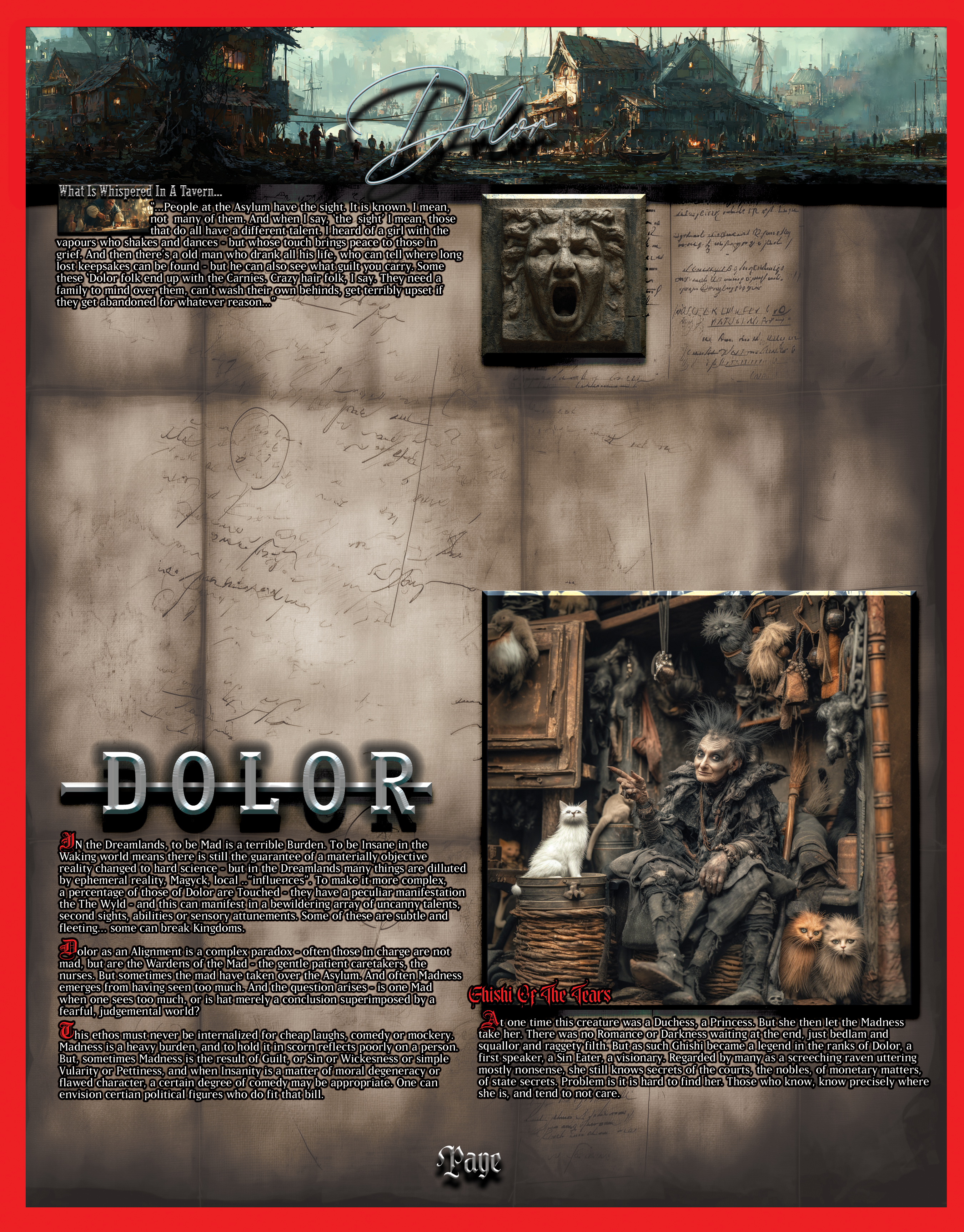
The Dolor Alignment
There are places in every city that polite maps do not name. They exist in the margins between candlelight and damp brick, in the upper windows of decaying estates where curtains never fully open, in the quiet wards at the edge of institutions where the air smells faintly of tinctures and something older. Dolor is the alignment of those places and of those who inhabit them without spectacle. It is not the alignment of rage, nor of conquest, nor even of madness itself, though it is often mistaken for all three. Dolor concerns itself with what lingers after calamity has exhausted its theatrics and after heroes have left. It is the alignment of endurance in the presence of spoilage, of memory when memory is unwelcome, and of proximity to suffering that neither yields glory nor promises redemption.
To outsiders, Dolor often appears theatrical, even gothic in silhouette. The archetypes cling easily: the pale noble in a shuttered manor, the asylum keeper who knows too much, the devoted assistant to a visionary whose brilliance has curdled into obsession, the pauper touched by whispers others cannot hear. Such figures are easy to romanticize or to mock. Yet Dolor is not invested in drama for its own sake. Its adherents are rarely the center of the spectacle; more often they are the ones sweeping its residue from the floor long after the audience has dispersed. If they resemble the inhabitants of decaying castles or fog-drenched madhouses, it is because they dwell where consequence accumulates. Dolor does not seek the storm; it abides in the aftermath.
At its core, Dolor is concerned with suffering that has ceased to be instructive. Many philosophies claim that pain refines, that loss ennobles, that adversity produces wisdom as iron produces sparks. Dolor does not deny that such transformations occur, but it is skeptical of their universality. There exists a category of suffering that spills without ceremony, as wasteful as wine poured into a gutter. It stains. It rots. It lingers in the air. Those aligned with Dolor do not rush to reinterpret such waste as hidden blessing. They do not insist that every wound conceals a lesson. Instead, they recognize that some harm remains simply harm, and they develop the capacity to stand in its presence without flinching away into myth.
This does not make Dolor merciful by default, nor cruel by necessity. It makes it attentive. Dolor-aligned individuals often find themselves in roles that others avoid: caretakers of the unstable, custodians of the disgraced, companions to those who have drifted beyond easy recovery. They are drawn, by temperament or by history, to thresholds where the world frays. They may be scholars of forbidden subjects, wardens of the disturbed, chroniclers of catastrophe, or simply those who stayed too long beside someone unraveling. They do not claim authority over what they witness. They do not claim immunity, either. To stand near such forces is to risk contamination, and Dolor does not pretend otherwise.
In some lands, Dolor manifests in institutions: crumbling sanatoria that nonetheless maintain meticulous records, cloisters dedicated to contemplation of mortality, households that harbor the touched and the outcast with quiet pragmatism. In other regions, it appears in solitary figures who drift at the periphery of society, tolerated because they are useful and left alone because they are unsettling. They are not prophets in the grand sense, nor saints of obvious virtue. If they possess insight, it is the insight of long exposure. If they command respect, it is often reluctant. Dolor does not promise triumph. It offers steadiness where steadiness is unglamorous and necessary.
It is important to understand that Dolor is not synonymous with insanity. Madness may intersect with it, but they are not identical. The mad are those whose internal compass no longer corresponds reliably with shared reality. Dolor concerns those who recognize the distortion and choose to remain near it, whether out of duty, curiosity, loyalty, guilt, or stubborn refusal to abandon what others have cast aside. In this sense, Dolor can coexist with other alignments, even those considered Damned or fallen. An individual may be both corrupt and wounded, both degraded and perceptive, both destructive and strangely illuminated. Dolor does not erase such contradictions; it holds them in uneasy balance.
Those aligned with Dolor are often misunderstood. To some, they seem morbid, even complicit in decay. To others, they appear austere and humorless. Yet within Dolor there can exist a dry wit, a brittle clarity born of having seen too much to indulge in pretense. Joy, when it appears, is not exuberant but deliberate. Affection, when offered, is cautious and weighty. Dolor does not forbid beauty, but it rarely trusts it at first glance. Beauty has a habit of spoiling. Dolor prefers what has already endured a test.
From a player’s perspective, to align with Dolor is to accept a particular relationship with consequence. You are not the knight charging the breach, nor the zealot proclaiming destiny. You are the one who remains when the breach collapses, who catalogues the cost, who tends to what survives in altered form. You may attempt to reduce suffering and fail. You may discover that some causes are lost long before you arrive. Dolor does not require optimism. It requires stamina. It requires the willingness to confront waste without insisting that it be transmuted into narrative comfort.
In the broader cosmology of the Dreamlands and beyond, Dolor occupies a threshold position. Where other alignments strive, conquer, illuminate, corrupt, or exalt, Dolor witnesses. It recognizes that proximity to the Beyond can fracture the mind, that revelation can curdle into obsession, that devotion can decay into fanaticism. Yet it does not immediately turn away. It lingers long enough to understand the shape of the fracture. It may even learn to navigate it. In doing so, it becomes both indispensable and unsettling, for few wish to be reminded that collapse leaves residue.
To choose Dolor is not to choose despair. It is to choose lucidity without adornment. It is to acknowledge that not all damage can be reversed, that not all love can be preserved, that not all suffering ennobles. It is also to refuse the lie that what is broken must be denied or disguised. Dolor stands in the quiet rooms of the world and keeps watch. It does not promise salvation. It promises presence, and in certain stories, that is the more difficult vow.