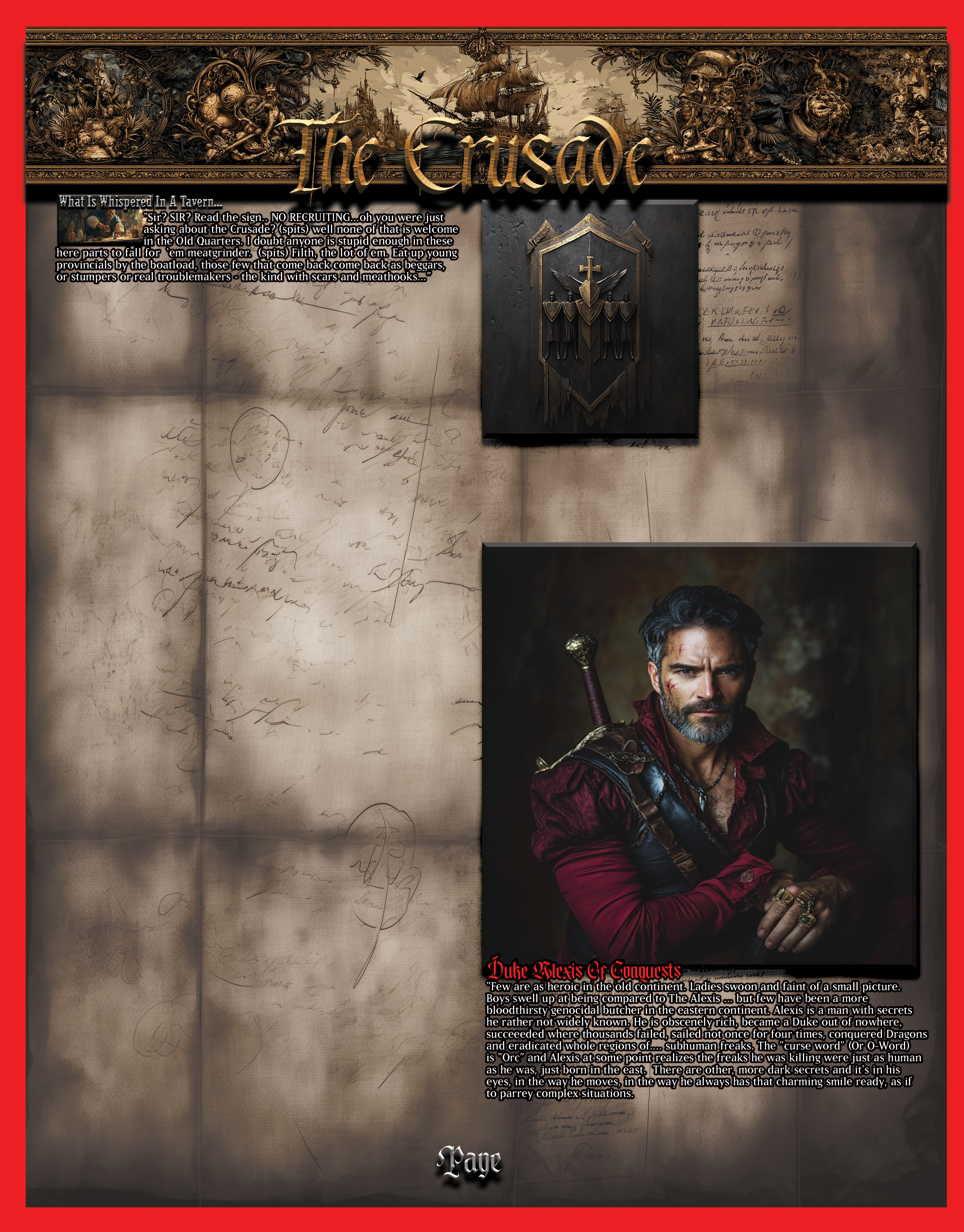
The Crusade Alignment
An Alignment of Method, Mandate, and Measured Flame
There are those who wage war for glory, those who wage it for land, and those who wage it for vengeance. The Crusade wages war for continuity. It is not born of frenzy, nor of bloodlust, nor of the shrill cry of the zealot. It is born of ledgers, councils, deliberation, and the quiet agreement that some burdens must be carried forward at any cost. Where others see monsters, the Crusade sees obligations. Where others see catastrophe, it sees inefficiency. It does not march because it hates, but because it has calculated that not marching would be worse.
To understand the Crusade, one must first abandon the notion that it is driven by passion. It is not. Passion burns too hot and too briefly. The Crusade is sustained by doctrine shaped over generations, by traditions so old they no longer remember their own beginnings. Its banners are not symbols of rage, but of authorization. When a Crusade is declared, it is not a riot; it is an operation. Armies assemble with purpose, siege engines are constructed with foresight, supply lines extend with deliberate precision, and commanders speak not of heroics but of yield, cost, and acceptable loss. Every campaign is weighed before it is waged, and once begun, it is pursued with unwavering resolve.
The Crusade does not recruit with tavern speeches or romantic promises of adventure. It does not need to. Those who join understand that they enter into something larger than themselves, something that will mark them visibly and invisibly for the rest of their lives. Service under the Crusade is rarely clean and never easy. Scars are common. Burns more so. Many return diminished in limb but magnified in purpose, carrying proof that they stood where others could not. The Crusade does not hide these costs; it incorporates them. The maimed are not discarded. They are remembered, recorded, and folded into the machinery that sustains the next campaign.
It is often said by those who misunderstand it that the Crusade believes itself righteous. This is imprecise. The Crusade believes itself necessary. Righteousness implies moral fervor, an emotional conviction that good must triumph over evil. Necessity is colder and far more enduring. The Crusade’s adversaries are not always framed as wicked. They are framed as inevitable. As hazards. As sources of instability that must be addressed before they metastasize. This language unsettles those who prefer clearer lines between villain and hero, but the Crusade has little patience for theatrics. It speaks in terms of preservation and outcome, not virtue and sin.
There are those who lead the Crusade who embody its ethos with unsettling grace. They are rarely the loudest voices in the room. They do not froth at the mouth when speaking of threats or dangers. They speak calmly, often even warmly, about measures and responses. Their composure is not feigned. It is cultivated. They have long ago accepted that difficult acts will be required, and that someone must bear the responsibility of authorizing them. Such leaders are admired, sometimes adored, because they project stability in a world of fire and fracture. They appear unshaken because they have trained themselves to see the long arc of consequence rather than the immediate blaze.
The Crusade’s relationship with sacrifice is complex. It does not glorify death for its own sake, yet it does not shrink from it. Loss is not a tragedy to be avoided at any price; it is a variable to be managed. This outlook can appear monstrous to those outside its ranks, and perhaps at times it is. Yet within the Crusade, this willingness to endure and to demand endurance is considered a mark of maturity. It is the acceptance that preservation sometimes demands payment. Whether that payment is justified is a question the Crusade answers through continuity itself. If the realm endures, the price was warranted. If it does not, then the failure lies not in the demand but in the execution.
It is important to understand that the Crusade is not without internal tension. Within its ranks there are debates about proportionality, about the acceptable scale of force, about how far necessity may be stretched before it becomes cruelty. These debates are rarely public, but they are real. The Crusade survives not because it is monolithic, but because it contains within itself a controlled argument about its own limits. That argument is never allowed to paralyze action, yet neither is it entirely silenced. The machinery must move, but it must also remember why it moves.
To outsiders, the Crusade can seem indistinguishable from conquest. Its armies travel far, its banners plant themselves in foreign soil, its presence reshapes landscapes. Yet conquest seeks expansion for its own sake, whereas the Crusade claims a narrower aim. It seeks to remove what it deems destabilizing and then withdraw, leaving behind order that aligns with its broader continuity. Whether it succeeds in that withdrawal, or whether it leaves deeper imprints than intended, is a matter for historians and critics. The Crusade itself measures success in cycles, not in headlines.
Those who choose this Alignment as players should understand that they step into a role defined less by explosive emotion and more by sustained resolve. A Crusade character is not necessarily cruel, nor blindly obedient, nor humorless. They may be charismatic, reflective, even compassionate in private life. What defines them is their acceptance of the premise that some conflicts cannot be negotiated away, and that if action must be taken, it should be taken thoroughly and without hesitation. They will often be the ones arguing for preparation when others argue for optimism, and for follow-through when others grow weary.
To walk the path of the Crusade is to carry the weight of authorization. It is to make decisions that will be judged not only by contemporaries but by generations yet to come. It is to understand that method can be more terrifying than fury, and that calm determination can alter the course of history more profoundly than righteous outrage. Whether the Crusade preserves the realm or corrodes it from within depends on those who wield its mandate. The Alignment offers power, structure, and purpose, but it demands clarity of will and a willingness to live with consequence.
In the end, the Crusade endures not because it shouts the loudest, but because it plans the longest. It is the fire that is banked rather than wild, the blade that is honed rather than swung blindly, the campaign that is charted before it is launched. It asks its adherents to believe not in triumph, but in continuation. And in a world where survival is never guaranteed, that belief can be as compelling as any promise of glory.