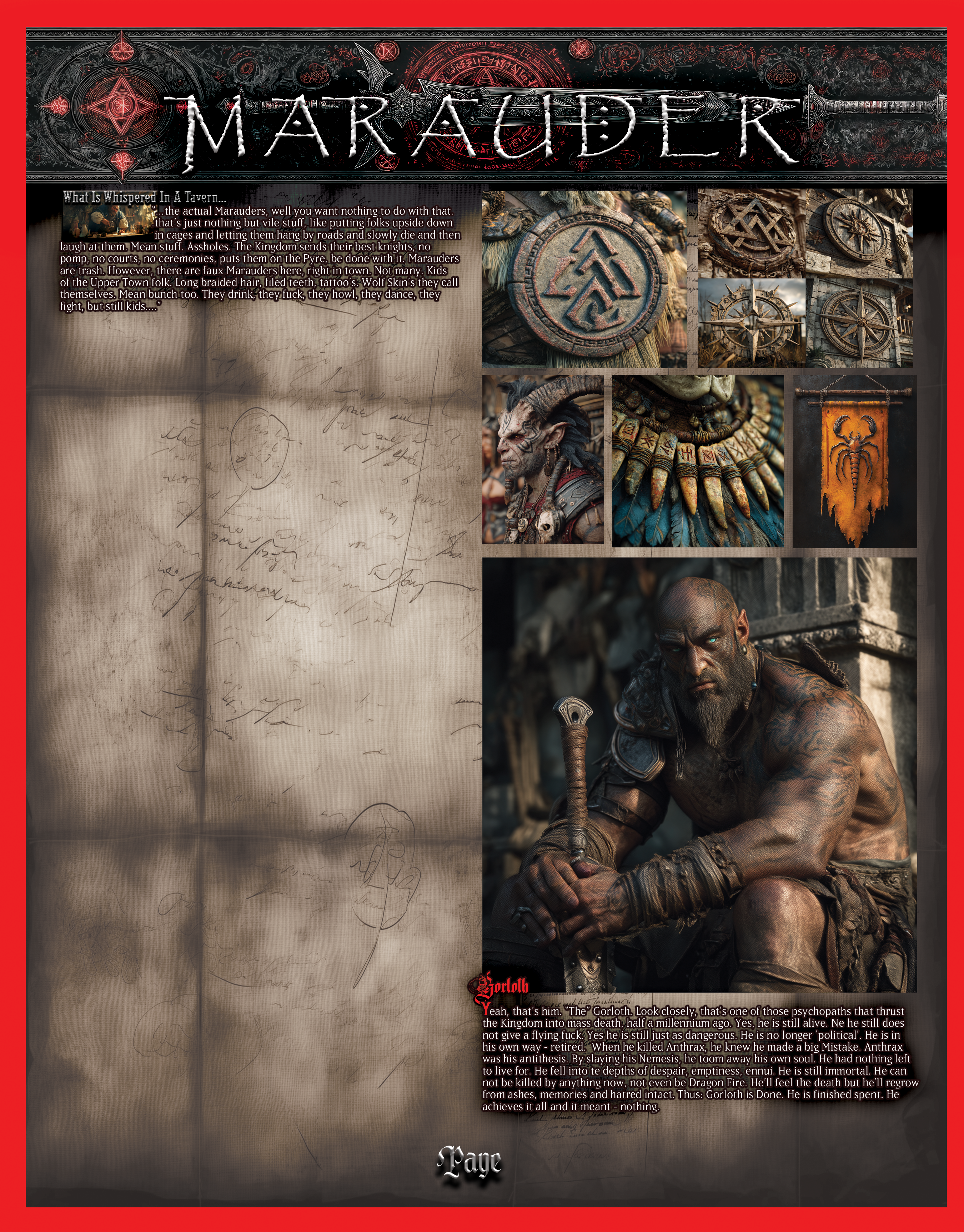
The Marauder Alignment
In every tavern of the Kingdom, if you wait long enough and speak little enough, someone will lean in and tell you that the Marauders are monsters. They will speak of villages put to the torch, of iron cages hung along the high roads as warnings, of raids that come like a storm and leave nothing but ash and bone. They will insist there are no courts among them, no mercy, no appeals, only the law of strength and the simple arithmetic of survival. They will say that when the King sends his best knights north or east or into the broken hills, it is always in answer to a Marauder banner rising somewhere beyond the fields. This is the common version, the version safe to repeat, the version that reassures the listener that there are lines in the world and that someone, somewhere, is holding them.
Yet that is not the whole of it, and even those who condemn the Marauders cannot quite prevent their voices from shifting when they speak the word. There is a quality to it that does not belong entirely to fear. There is memory there, and envy, and something that resembles reluctant admiration. The ships of the northern coasts were not built by cowards. The horse clans of the eastern steppe did not cross continents by accident. The old songs of siege and storm still stir blood that has never seen a battlefield. The Marauder, for all the condemnation poured upon them, represents a mode of being that is stark, coherent, and unadorned. They are not confused about what they value. They do not apologize for their appetites. They do not ask permission to exist.
To call Marauder an alignment is to misunderstand it slightly. It is not a creed with written articles, nor a priesthood with codified rites. It is a posture toward the world, an answer to the question of constraint. Where others ask what is allowed, the Marauder asks what can be taken and what can be held. Where others negotiate legitimacy, the Marauder tests it. This does not mean they are mindless brutes, nor that they lack structure. Many of the most formidable Marauder hosts operate under strict codes of loyalty and retribution, and betrayal among them is punished with a severity that makes foreign laws look indulgent. Strength is not merely muscle or steel; it is endurance, memory, and the willingness to bear consequence without complaint.
It is true that Marauder bands have razed cities and toppled regimes, and it is equally true that some of the Kingdom’s greatest roads were first cut by those very raiders to move their spoils more efficiently. History rarely records the same hand twice, but the hand that destroys and the hand that builds are not always different hands. In some eras the Marauders appear as conquerors who settle, in others as mercenaries hired to defend the very lands they once pillaged. The alignment does not demand perpetual war; it demands intensity and the refusal of imposed limits. Violence is one expression of that refusal, but it is not the only one.
Within the capital itself there are whispers of a different manifestation. The sons and daughters of the Upper Town adopt the hair, the scars, the talismans of bone and iron, and they call themselves Wolves or Sons of the Pyre. They gather in cellars and warehouses, drink hard spirits, dance until dawn, and test one another in ritualized contests of endurance and dominance. Most of them have never seen a battlefield and would blanch at the sight of a real siege engine, yet something in the aesthetic draws them. The Kingdom’s order can be suffocating in its polish, its manners, its endless negotiations over propriety. The Marauder image offers a relief from that suffocation, a promise of a life lived without constant apology. Some dismiss this as childish rebellion, and often it is, but even playacting can open doors best left closed.
For there is a current that runs deeper than costume. In certain hidden chambers beneath the city, in spaces governed by strict consent and coded signals rather than open war, practitioners speak of a tangible resonance when boundaries are tested and power is exchanged deliberately. No blood is spilled, no villages burned, yet the atmosphere thickens, and participants emerge altered, sharpened, as if they have brushed against an older fire. Scholars of the Arcane dismiss such accounts as psychosomatic exaggeration, but the frequency of the reports suggests that Marauder energy responds not solely to slaughter but to intensity, risk, and embodied assertion. In this sense, the alignment is less about cruelty and more about the rejection of inertia.
Players who choose Marauder should understand that admiration and condemnation travel together. A Marauder-aligned character will rarely be welcomed without suspicion, and any display of strength will be read by some as a threat. At the same time, there will always be those who look upon such a character with a complicated respect. The farmer who curses the raider may still tell his grandchildren stories of the unstoppable warlord who defied three kingdoms. The merchant who decries lawlessness may secretly hire a Marauder escort when crossing dangerous passes. This duality is not hypocrisy; it is the natural response to power that does not pretend to be gentle.
Marauder does not require cruelty for its own sake, nor does it forbid loyalty, love, or even mercy. What it rejects is submission to structures that cannot justify themselves under pressure. A Marauder-aligned player might be a conqueror seeking territory, a mercenary captain bound by a personal code stricter than any royal charter, an urban rebel testing the edges of a stagnant society, or a quiet individual who channels the alignment’s force into arenas far removed from open battle. The common thread is a willingness to confront limits directly and to accept the cost of doing so.
It must also be said that Marauder glory is often brief. Many who live by its principles burn bright and fall hard, and those who survive long enough to see their enemies defeated sometimes discover that victory brings a strange emptiness. When the struggle that defined them ends, they must either find a new horizon to test or confront a stillness they never cultivated the skills to endure. Legends are written about such figures, and distance softens their edges, but proximity reveals the toll that constant intensity exacts. To walk this path is to trade comfort for clarity, and not all who admire it from afar would accept that bargain if offered honestly.
In the Kingdom’s grand narratives, the Marauder is cast as antagonist, invader, or necessary evil. In private conversations, in late-night tavern debates and whispered confessions, the picture grows more complicated. There is an acknowledgment, seldom voiced publicly, that without the pressure of those who refuse constraint, institutions calcify and courage dwindles. The Marauder alignment embodies that pressure. It is the storm at the border, the drumbeat in the distance, the challenge issued without diplomatic niceties. It is neither wholly villain nor secret hero, but a force that tests the strength of whatever it encounters.
To choose Marauder is to step into that storm willingly. It is to accept that you will be misunderstood, sometimes feared, sometimes admired, often both at once. It is to live with intensity as a constant companion and to measure your worth not by approval but by resilience. The Kingdom will not thank you for it, and history may distort your deeds beyond recognition, but in the moment of decision, when lines are drawn and hesitation proves fatal, there is a clarity in the Marauder stance that few other alignments can claim. Whether that clarity liberates or consumes you is a question only play can answer.