The Covenant Alignment

An Introduction for Those Who Sit at the Table
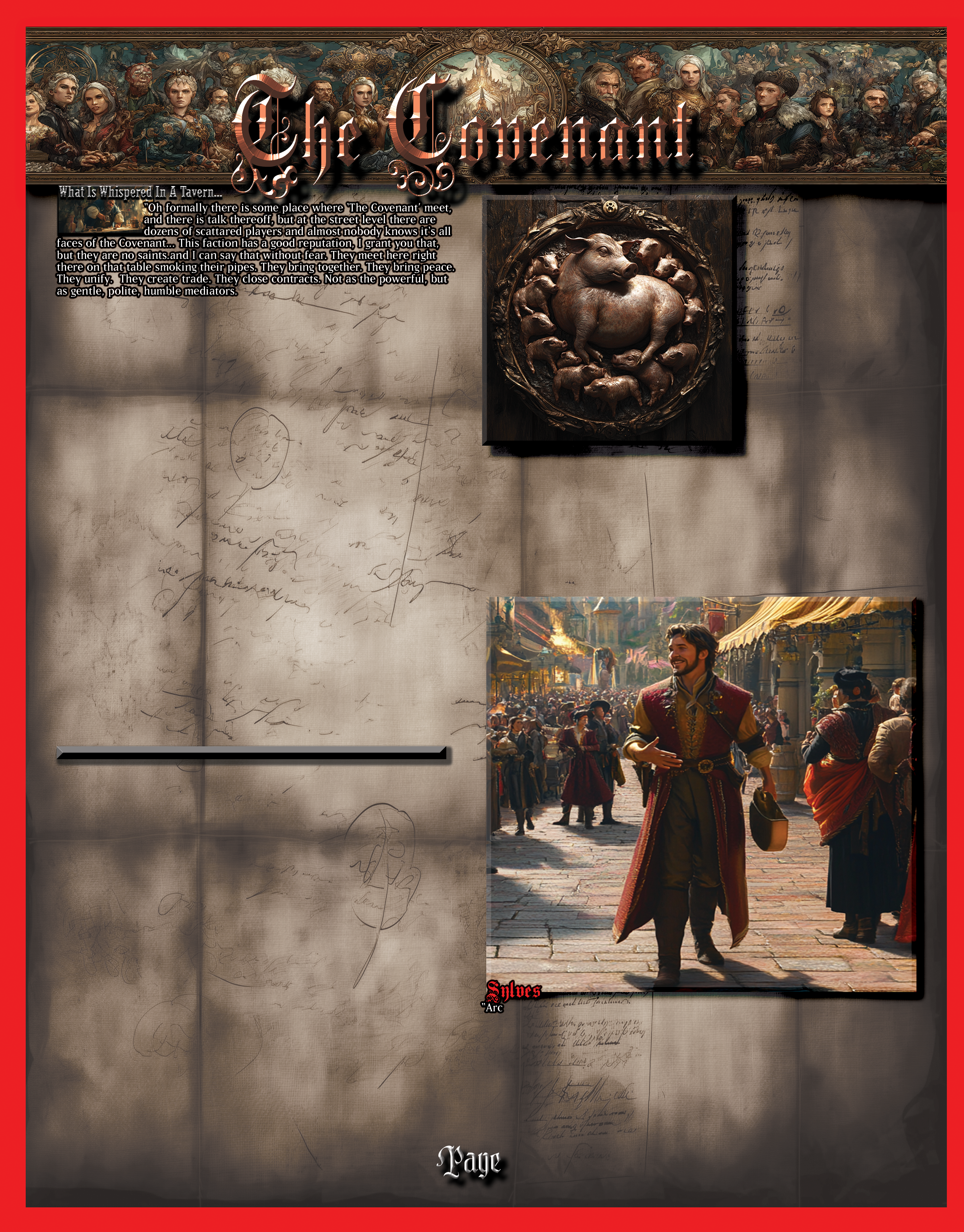
There are cities that belong to kings, cities that belong to gods, and cities that belong to memory. Yet in every city worth the name—whether carved in marble, raised from timber, or grown from stubborn stone—you will find a quieter belonging. It is not marked on any map, nor proclaimed from balconies, nor etched in banners above the gate. It is found instead at a long table near a hearth, in the shaded gallery above a market square, in the back room of a counting house where ink dries slowly and voices remain level. There, without ceremony and without spectacle, the Covenant is present.
The Covenant is not a throne, nor an army, nor a church. It does not command legions, nor summon lightning, nor declare revelations. It convenes. It listens. It remembers. Where others conquer, it coordinates. Where others preach, it records. Where others burn, it binds. Its strength is not in the force of its will but in the durability of its word.
To those who have never encountered it directly, the Covenant appears almost disappointingly modest. Its members do not dress in uniform splendor, nor carry sigils large enough to frighten a peasant child. They are merchants and mediators, archivists and navigators, magistrates and factors. They are the individuals who know the tides, the tariffs, the family feuds that have simmered for three generations and the exact phrasing of the treaty signed in a winter no one now remembers. They are the ones who can tell you who owes what, and why, and to whom the obligation truly flows.
And yet, when tempers rise and swords are nearly drawn, it is the Covenant’s chair that is sought. When trade falters and caravans hesitate at the border, it is the Covenant’s seal that restores confidence. When two proud houses would rather bleed than yield, it is the Covenant’s table at which they sit—grudgingly, perhaps, but they sit. Not because the Covenant compels them by force, but because the alternative is chaos, and chaos is bad for everyone.
The Covenant understands something fundamental: peace is not an ideal; it is an arrangement. Prosperity is not a blessing; it is an ecosystem. Stability is not declared; it is maintained. To maintain such things requires patience beyond heroism and discipline beyond passion. It requires the capacity to hear both sides of a grievance without flinching, to weigh the cost of pride against the cost of delay, and to craft a resolution that all parties can survive.
In every port, the Covenant ensures that ships may dock without fear of sudden confiscation. In every market, it ensures that coin remains coin and that weight and measure retain meaning. In every court, it ensures that precedent matters. It does not insist that rulers be virtuous; it insists that they be predictable. It does not demand that merchants be saints; it demands that they be accountable. It does not promise utopia; it promises continuity.
There are those who mistake this for weakness. They see no banners on the field and assume there is no power. They hear no proclamations and assume there is no authority. They misjudge the Covenant’s courtesy for compliance, its moderation for mediocrity. Such observers often discover, too late, that influence need not shout to endure.
The Covenant’s greatest asset is trust, and trust is a currency more fragile than gold and more resilient than steel. It is accumulated slowly, lost swiftly, and guarded carefully. Members of the Covenant speak plainly, draft precisely, and avoid promises they cannot enforce. Their word, once given, binds not through fear but through reputation. To betray a Covenant agreement is to find doors closing quietly, routes becoming inconvenient, partners suddenly unavailable. No edict announces such shifts; they simply occur, and the wise learn to heed them.
Unlike factions that pursue glory, the Covenant pursues balance. It recognizes that extremes—of wealth, of power, of ideology—generate instability. Its art lies in smoothing the sharp edges without dulling the blade entirely. A realm too rigid fractures; a realm too permissive dissolves. The Covenant seeks the middle tension that holds.
This does not make its members saints. They are pragmatic. They understand that compromise often leaves all parties dissatisfied in equal measure. They are willing to accept imperfection in exchange for durability. They are comfortable with complexity and resistant to grand narratives that simplify what is inherently intricate. Where others demand purity, the Covenant demands feasibility.
It is also a fellowship of memory. Records are kept not merely to tally coin but to preserve context. The Covenant recalls which promises were broken, which alliances were sincere, which reforms failed and why. It treats history not as a tale to inspire but as data to inform. In this way, it avoids repeating mistakes not through moral superiority but through documentation.
To walk the path of the Covenant is to embrace a certain temperament. One must cultivate patience in the face of provocation, restraint in the face of opportunity, and clarity in the face of ambiguity. One must be comfortable operating in the open yet rarely at the center of attention. The Covenant does not seek heroes; it seeks stewards.
Players who align with the Covenant find themselves positioned at intersections. They are brokers between rivals, translators between cultures, stabilizers amid upheaval. Their influence often manifests not in dramatic confrontation but in the quiet prevention of disaster. They may never be celebrated in song, but the cities they serve will stand longer for their efforts.
Above all, the Covenant believes that cooperation, however imperfect, is preferable to fragmentation. It holds that systems—legal, commercial, diplomatic—are fragile achievements that require guardianship. It accepts that progress is incremental and that revolutions, though sometimes necessary, carry costs measured not only in blood but in trust.
In taverns and council chambers alike, when disputes escalate and stakes rise, there is a moment when someone says, “Let us call the Covenant.” That sentence is not an appeal to authority alone; it is an acknowledgment of shared interest. It is a recognition that survival often depends not on triumph but on agreement.
The Covenant will not dazzle you with miracles. It will not promise destiny. It offers instead a seat at the table, a ledger open for scrutiny, and a hand extended in negotiation. Those who join it do so not to dominate the world, but to keep it functioning.
And in a world of shifting allegiances, clashing ambitions, and fragile empires, that may be the greatest power of all.