Winthrop, John
Full Name: John Winthrop Jr.
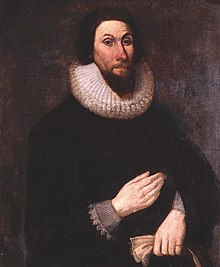
Achievements: Scientist, and colonial governor of Connecticut.
Born: February 12, 1606; Groton Manor, Edwardstone, Suffolk, England
Died: April 5, 1676; Boston, Massachusetts Bay Colony, Massachusetts (Aged 71)
Field & Discipline: Science; Politics; Natural Scientist
Education: Bury St. Edmunds' Grammar School (1617-22); Trinity College, Dublin (1622-24); Inns of Court, 1625-27
Life & Times:
John Winthrop was born in 1606 at Groton Manor in Edwardstone, Suffolk, England, the son of John Winthrop, a wealthy Puritan lawyer and landowner, and the heiress Mary Forth. He was educated at the Free Grammar School of Bury St. Edmunds, and then in 1622 went to Trinity College, Dublin, where he graduated in 1624. Winthrop then studied law at the Inner Temple in London from 1625 to 1627, and it was during these years that he began his alchemical experiments.
In late 1627, Winthrop joined a naval expedition to attack La Rochelle on the French coast, and the following year began a 15-month tour of Europe. He emigrated to America in 1631.
In America Winthrop joined his father, who had been elected as first governor of the Massachusetts Bay Colony, and became a member of the Boston Church. Until his father's death in 1649, Winthrop remained closely connected with the government of Massachusetts Bay, serving as a magistrate and from 1632 in the colony's Court of Assistants.
In 1634, Winthrop returned to England on family and government business, and while there he contracted with a group of English investors to settle a town at the mouth of the Connecticut River. He then spent the next ten years to establishing the town of Saybrook on the Connecticut River.
It was during this period that he began to develop his skills as an amateur physician, and prepared scientific experiments, read scientific papers, and began an extensive correspondence with other investigators. One of his first experiments concerned the production of salt, and in 1636, he first tried (unsuccessfully) to evaporate salt from seawater. Over the following years, Winthrop prospected for minerals, tried to set up an ironworks at Saugus (1641) and a graphite mine at Tantiusque (now Sturbridge).
In 1641 Winthrop went to England to raise financial support for the ironworks, and while he in London regularly met with a group of scientists and intellectuals including [met] Boyle*, Sir Kenelm Digby, [met] Hartlib* and [met] Komensky* (whom, it is said, he unsuccessfully offered the post of president of the newly-founded Harvard College). Winthrop House at Harvard University is named in honor of John Winthrop and of his descendant also called John, who briefly served as President of Harvard
He returned to America in 1642 with many new books on religion, natural history, physics, mathematics, medicine, alchemy and law for his library (by far the best scientific library in the colonies). On his return to Massachusetts he also opened ironworks at Lynn and Braintree.
In 1646, with the aid of a large land grant from the Massachusetts and Connecticut legislatures, Winthrop was instrumental in the founding of New London, Connecticut. He remained in Connecticut for the rest of his life, although he continued to be re-elected to the Massachusetts Court of Assistants until 1649. A few years later he was also involved in the settlement of Fisher's Island in Long Island Sound. By the mid-1640’s he had become a well-known physician.
Winthrop became magistrate of Connecticut in 1651, and in 1657 was elected as governor, and returned to that office continuously until his death. In 1660, with the restoration of the Stuart monarchy in England, Winthrop was chosen to go to England to obtain a royal charter recognizing the existence of Connecticut.
In London in 1661, with the help of Hartlib and others, Winthrop successfully obtained from [got charter from] Charles II* a charter for the colony, by which the Connecticut River settlements and the independent New Haven colony were joined to make up what is now Connecticut.
It was during this visit to England that Winthrop was in 1662 admitted to the group - which included [fellow RS member with] Wilkins*, [fellow RS member with] Wallis*, [fellow RS member with] Hooke* and [fellow RS member with] Wren* - soon to be chartered as the [member of] Royal Society*. In 1663 he was elected a fellow - the first to be resident in North America. He became a regular correspondent - particularly with the Society's secretary, [corresponded with] Oldenburg*, and in the 1670’s with [corresponded with] Newton*.
During the 1650’s Winthrop had also developed an interest in astronomy, and from 1660 he operated a ten-foot refractor, probably the first large telescope in the American colonies. In one of the papers he delivered to the Royal Society in 1663 he anticipated the discovery of a fifth satellite of Jupiter, although the astronomical instruments of the time were not powerful enough to prove him right.
In the early 1670’s he presided over changes in the colonies’ political procedures andrevisions of their law code. Noted for his moderation in the treatment of Quakers and other free churchmen, Winthrop was governor in 1675, and was chosen a commissioner of the United Colonies of New England. He died the following year, at Boston, where he had gone to attend meetings of the New England Confederation.
Assessment: Winthrop is still widely recognized as one of the founders of American industrial chemistry.
Oneliner: John Winthrop, governor of colonial Connecticut
Language: English
Father: John Winthrop (1588-1649)
Mother: Mary Forth (d. 1615)
Siblings: Henry (1608-30); Forth (1609-30); Mary (1612-43). Half-siblings: Stephan (1619-58); Adam (1620-52); Deane (1623-1704); Samuel (1627-74)
Spouse: 1) Martha Fones (married 1631, d. 1634); 2) Elizabeth Reade (married 1635)
Children: by Reade: Six including John (1638-1707); Wait-Still (1642-1717)
Bibliography:
- American National Biography.
- Black, Robert C., The Younger John Winthrop, London & New York, 1966.