Isherwood C
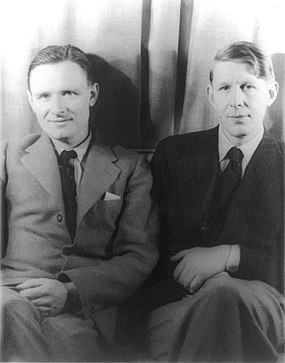
(Isherwood left, with Auden)
ACHIEVEMENTS: Wrote popular novels chronicling life in Weimar Berlin and became an outspoken advocate of the gay rights movement.
NICKNAME/ALIAS: None.
DATE AND PLACE OF BIRTH: 26th August, 1904 in Cheshire, England
DATE/PLACE OF DEATH/AGE AT DEATH: 4th January, 1986 in Santa Monica, California. Aged 81.
DISCIPLINE: Writing
FIELD: Novels, Plays, Autobiography
LIFE AND TIMES:
Christopher was born in 1904 to a financially comfortable middle-class couple in Cheshire, England. From an early age he displayed a vivid and active imagination, and was often reprimanded for his ceaseless storytelling. At the age of 10 he was sent away to St. Edmund’s preparatory school, in Surrey. A year later his father died fighting in the trenches near Ypres, France during World War I.
This event had great significance for him both in terms of his relationship to his mother (he developed a strong jealousy of his father over the strength of his mother’s grief) and in his relationship to war, as would later become evident to him later in his life.
At St. Edmund’s in 1918, Christopher first met his life-long friend and confidant, W. H. Auden*, the future poet. A year later he entered Repton, a major English private school. At first he was an indifferent student, though he did excel in his English classes. Eventually he came under the care of a gifted history teacher and befriended two other students, Hector Wintle and Edward Upward, both of whom became novelist themselves.
His inspired study of history earned him a scholarship to Corpus Christi College, Cambridge, where he rejoined his friend Upward. They soon became disillusioned with the history program offered, as well as the social life of Cambridge and England as a whole. They spent much of their time writing surrealistic fantasies of a Gothic nature to each other, set in an imaginary world they called Mortmere. Their inattention to their studies soon led to their dismissal from Cambridge.
Christopher then spent a couple of years working in London before making the first significant move of his life. In 1929 he traveled to Berlin to visit his friend Auden and ended up staying for four years.
He found the relaxed social atmosphere of Berlin very appealing and the lives of the ordinary people of the city interesting to study. It was his experience in Berlin that lead to the writing of his most popular novels: Mr. Norris Changes Trains(1935) andGood-bye to Berlin (1939). The two novels have been described as “documentary” novels for the way they simply report events rather than creating or dramatizing them. Those novels helped to widen his circle of literary associates, including his idol E. M. Forster* as well as Somerset Maugham. But it was with Auden that he collaborated most.
During the mid-1930s they wrote a series of three plays together. Although none of the plays were very successful, the writing and working together helped both of them to hone their personal styles. In 1938 they traveled to China to chronicle the Japanese invasion of that country, and then passed through America on their way home. In 1939, with the threat of war looming, Christopher and Auden decided to emigrate to the United States. It was on the boat ride to America that Christopher was able to clarify his strong belief in pacifism.
Soon after arriving in America, Christopher moved permanently to Hollywood on an invitation from the philosopher Gerald Heard. There he met Aldous Huxley* and, perhaps more important, the Hindu monk Swami Prabhavananda, who had helped to found the Vedanta Society of Southern California. Christopher soon adopted the Society’s beliefs and practices, and this spiritual viewpoint was to color his writings for the rest of his life.
Almost all of Isherwood’s writings are strongly autobiographical, whether set out as novels or more conventional biography. In his writings he explored the inner workings of his life, the influences of his friends, his sexuality and his spirituality.
During these years he continued to write novels and autobiography, as well as a number of books introducing Vedanta to people who were unfamiliar with the philosophy. A life-long fascination with movies lead him to screenwriting.
It was through this work that he came to know and befriend a number of Hollywood stars of the time, including Charles Laughton and Greta Garbo, as well as the composer Stravinsky* and the writers Tennessee Williams and Gore Vidal. It was also through these associations that his earlier works were successfully translated, though not by him, first to the stage and then the movie screen.
I Am A Camera and then Cabaret became popular plays and successful movies, especially Cabaret. His ability to find and express both the humor and struggles of everyday life – sometimes ordinary and sometimes quite extraordinary – is the skill that made him both a significant and popular author of the 20th century. The fact that he found that humor and those struggles in his own life gave him a readily available context or foundation for his writings.
ASSESSMENT: An important chronicler of some of the more important movements of the 20th century.
EXTRA CONNECTIONS: He was a friend of British poet Stephen Spender*
Isherwood's mother, Kathleen, was, through her own mother, a member of the wealthy Greene brewing family of Greene King, and Isherwood was a cousin of the novelist Graham Greene, who was also related to the brewing family.
While living in Hollywood, California, Isherwood befriended Truman Capote, an up-and-coming young writer who would be influenced by Isherwood's Berlin Stories, most specifically in the traces of the story "Sally Bowles" that surface in Capote's famed novella *Breakfast at Tiffany's.
Cabaret is a 1972 American musical period drama film directed by Bob Fosse and written for the screen by Jay Presson Allen. It stars Liza Minnelli, daughter of Judy Garland and Vincente Minnelli. Set in Berlin during the Weimar Republic in 1931,[3] under the presence of the growing Nazi Party, the film is an adaptation of the 1966 Broadway musical Cabaret by Kander and Ebb,[4] which was based on Christopher Isherwood's semi-autobiographical novel The Berlin Stories (1945) as well as John Van Druten's 1951 play I Am a Camera, which was itself adapted from Isherwood's novel.
ONELINER: Christopher Isherwood, 20th-century gay writer
BIBLIOGRAPHY:
Finney, Brian, Christopher Isherwood: A Critical Biography. Oxford University Press, New York. 1979. 289pp.
Summers, Claude J., Christopher Isherwood. Frederick Ungar Publishing Co., New York. 1980. 182pp.
LANGUAGE: English
PARENTS: Father, Francis Edward; Mother, Kathleen Machell-Smith
SIBLINGS: Brother, Richard
SPOUSE: None.
CHILDREN: None.
EDUCATION: Corpus Christi College, Cambridge and King’s College, London
MAJOR WORK:
Novels:
Mr. Norris Changes Trains (1935)
Good-bye To Berlin (1939)
Down There On A Visit (1962)
A Meeting by the River (1967)
Autobiography:
Lions and Shadows (1938)
Kathleen and Frank (1972)
Christopher and His Kind (1976)
Others:
Bhagavad Gita (translation, 1944)
The Essentials of the Vedanta (1969)
Adapted From His Works:
I Am A Camera (play, 1952; film,1955)
Cabaret (play, 1966; film, 1972)
Translations
- Charles Baudelaire, Intimate Journals (1930; revised edition 1947)
- *Bhagavad Gita – The Song of God* (with Swami Prabhavananda, 1944)
- Shankara's Crest-Jewel of Discrimination (with Swami Prabhavananda, 1947)
- How to Know God: The Yoga Aphorisms of Patanjali (with Swami Prabhavananda, 1953)
Work on Vedanta and the West
Vedanta and the West (originally titled Voice of India from 1938–1940) was the official publication of the Vedanta Society of Southern California. It offered essays by many of the leading intellectuals of the time and had contributions from Aldous Huxley, Gerald Heard, Alan Watts, J. Krishnamurti, W. Somerset Maugham, and many others.