Cobden R
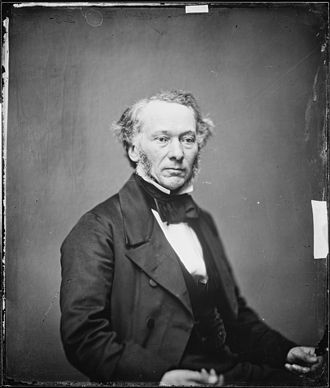
ACHIEVEMENT(S): Free Trade
DATE/PLACE OF BIRTH: 3 June 1804, near Midhurst, Sussex, England
DATE/PLACE/AGE AT DEATH: 2 April 1865, in London, England. Aged 60
DISCIPLINE: Politics
FIELD: Politician
EDUCATION: Elementary School, Midhurst; Bowes Hall, Yorkshire, 1814-19
MAJOR WORK: '1793 and 1853, in Three Letters' (1853)
LIFE AND TIMES:
By 1834 Cobden's calico printing business was successful enough to allow him regularly to travel abroad, and during the next five years he visited France, Italy, Portugal, Spain, Switzerland, the United States, Egypt, Greece and Russia. During this time, always a man of immense energy and curiosity, he also began to devote more time to private study and to his growing interest in social issues and current affairs.
The first sign of these developing concerns came with the publication of his first pamphlet, 'England, Ireland and America' (1835) defending free trade and a non-interventionist foreign policy.
In 1837, Cobden, now a well-known radical, stood as Member of Parliament for Stockport, but failed to be elected. In 1838 Cobden was one of the first men to be democratically elected as a Manchester alderman, and also began his high-profile campaigns for national educational reform and the introduction of Rowland Hill's* postal service.
In March 1839, Cobden and his friends John Bright and George Wilson oversaw the establishment of a new centralized body now called the Anti-Corn Law League, its primary concern being the repeal of the Corn Laws (1815 and 1828) which prevented the import of foreign wheat free of duty unless the domestic price at a required level, protecting the profits of British landowners.
In 1841, after much public speaking, Cobden was elected as M.P. for Stockport. As the leader of the Free Trade Movement* (opposed by such as O’Connor*), he immediately became a prominent figure in British politics, devoting most of his energies to the repeal of the Corn Laws, which he maintained were economically disastrous and morally wrong, frequently confronting the Tory Prime Minister, Peel*, in debate in the House of Commons.
Meanwhile he also built up the Anti-Corn Law League to become the most efficient and successful of all 19th-century British pressure groups. The economic depression of 1839-1842 increased membership of the League.
By 1845 the League, with support from rich industrialists such as Samuel Courtauld as well as some landowners and a large section of the middle- and working-classes, was the wealthiest and best organised political group in Britain.
The failure of the Irish potato crop in 1845 and the mass starvation that followed forced Sir Robert Peel and his Tory government to reconsider the Corn Laws. In June 1846, a new Corn Law was passed that reduced the duty on oats, barley and wheat to the insignificant sum of one shilling per quarter. The repeal inaugurated the era of free trade under which Britain achieved a new prosperity.
Cobden was now for a time a national hero, but he had both financially supported the campaign and neglected his business, and he was now deeply in debt. His supporters raised £80,000 by public subscription (as a reward for his efforts) with which he bought shares in the Illinois Central Railroad (at one point run by McClellan*) and bought his family home of Dunford Farm, where he remained with his wife and five daughters for the rest of his life.
As a prominent politician during the 1840s and 1850s, Cobden supported many domestic reforms:- abolition of newspaper tax, parliamentary reform, and free universal elementary education. He also pushed for disarmament, international arbitration, and reform of maritime law. In 1853 he published one of his most powerful pamphlets, '1793 and 1853, in Three Letters' (1853), which advised his contemporaries to avoid "past errors" and keep out of war with France. During the next three years, he argued eloquently that Britain should be friendly with Russia, even after the Crimean War* had begun, and was often bitterly attacked for his opinions during the war.
In 1859 he was recruited by Gladstone*, the Chancellor of the Exchequer, to negotiate a new trade agreement with France. As a result, after much hard work by Cobden, in 1860 Britain and France signed the Anglo-French Commercial Treaty, which committed Britain to free trade, reduced French tariffs to reasonable rates, and induced the chief European governments to break down long-standing trade barriers.
A great admirer of American democracy and the American people, Cobden was greatly upset by the outbreak of the American Civil War in 1861and feared that the British government might intervene on the side of the Confederacy. He remained a staunch supporter of the North throughout the war, but unfortunately did not live to see the Union victory.
During his last few months he supported his old rival Disraeli* in support of the Reform Act, which was finally passed in 1867.
ASSESSMENT: A great reformer.
EXTRA CONNECTIONS: McKay*s flying clippers brought corn to UK.
Some of his ideas were influenced by Adam Smith
He knew Monkton Milnes *
Daughter Ellen married Sickert*
Was pro-Russian over the Crimean War*
Was a friend of Bigelow*
In his opposition to the Opium Wars, Cobden argued that just as "in the slave trade we [the British] had surpassed in guilt the world, so in foreign wars we have the most aggressive, quarelsome, warlike and bloody nation under the sun."
When the American Civil War threatened to break out in the United States, Cobden was deeply distressed, but after the conflict became inevitable his sympathies were wholly with the Union because the Confederacy was fighting for slavery.[22] Nonetheless, his great anxiety was that the British nation should not be committed to any unworthy course during the progress of that struggle. When relations with the United States were becoming critical and menacing as a consequence of depredations committed against the United States by aid to the Confederacy from blockade runners and Confederate commerce raiders issuing from British ports respectively, actions that would lead to the post-war Alabama Claims, he brought the question before the House of Commons in a series of speeches of rare clearness and force.
In the 1980s, Margaret Thatcher in the UK (under the influence of Enoch Powell via Keith Joseph) and Ronald Reagan in the U.S. led a revival of laissez-faire that, as of 2006, holds some sway in mainstream economic thinking. This was utterly (though briefly) disproved in the US by the Covid pandemic.
ONELINER: Richard Cobden, leader of Free Trade Movement
BIBLIOGRAPHY:
EB, DNB
Hinde, Wendy, Richard Cobden: A Victorian Outsider, New Haven & London: Yale University Press, 1987.
LANGUAGE: English
PARENTS: William Cobden (1775-1833) and Millicent Amber (1775-1825)
SIBLINGS: 10 siblings: Frederick (1799-1858), Emma (1800-35), Millicent
(1802-39), Jane (1806-30), Charles (b. 1808), Priscilla (b. 1809), Miles
(1812-30), Henry (b. 1813), Mary (b. 1815) and Sarah (b. 1817)
SPOUSE: Catharine Anne Williams (1815-77), married 1840
CHILDREN: Richard Brookes (1841-56), Kate (1844-1916), Ellen Millicent
(1848-1914; married Walter Sickert), Emma Jane (1851-1949), Julia Sarah Anne
(1853-1926) and Lucy Elizabeth Margaret (1861-91)