Smith, Adam
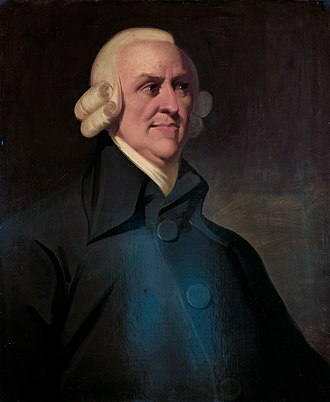
Achievements: Major influence in early economics
Born: Baptised June 5, 1723; Kirkcaldy, Scotland
Died: July 17, 1790 Edinburgh, Scotland (Aged 67)
Field & Discipline: Economics; Politics; Philosophy; History
Education: Burgh School; Kirkcaldy Grammar School; Glasgow University; Oxford University
Major Work: “The Wealth of Nations” (1776)
Life & Times:
Around 1740 Smith began reading the work of some of the philosophical sceptics, including that of [a pal of] Hume*, who later became a close friend. In 1746, he went back to Kirkcaldy and Henry Home, later Lord Kames, sponsored a course of public lectures that Smith delivered in Edinburgh. Essentially, the intention of the lectures was to direct and instruct educated Scots, who might feel that their standard of English was poor in matters of language and good taste.
The lectures were a great success, mainly due to the superior standard of English that Smith used and they continued even after he left Edinburgh in 1751. In that year, Smith was elected to the Senate of the University of Glasgow and given the Chair of Logic and Rhetoric.
In 1752, he was transferred to the Chair of Moral Philosophy, which he held for twelve years. During this time, he worked closely with other faculty members including his friends [a pal of] Cullen *and [a pal of] Black, and among his students was [taught] Boswell*. He also worked with [worked with] Watt*, whom he recommended for the job of university instrument-maker.
In his lectures on ethics, Smith considered how mankind formed judgements to help choose the right course of action. Demonstrating the influence of Hume, he maintained that emotions took precedence over reason when it came to moral decision making.
Smith expanded his philosophy in his major work, ‘The Theory of Moral Sentiments’, published in 1759. This was a popular book, with five further editions appearing by 1790, and the politician, Charles Townsend was so impressed by it that he gave Smith the job of tutor to his stepson, the young Duke of Buccleuch.
Smith resigned from the university in 1764 and went to France with his new pupil, spending eighteen months in Bordeaux. On a trip to Geneva he and the Duke visited [visited] Voltaire* then, late in 1765, they went to live in Paris.
Smith already had a reputation in Paris and he had the chance to meet many of the great literary and scientific figures of the period. These included [met] Helvetius](https://app.thebrain.com/brain/f3e16344-7cd9-4fa3-ae1d-59876e128474/f7e33e44-4302-5350-8c31-0dfbca7dc10c), [met] [D’Holbach*, [met] Diderot*, [met] d’Alembert*, [met] Buffon* ( the French economists, [met] Turgot* and [met] Necker](https://app.thebrain.com/brain/f3e16344-7cd9-4fa3-ae1d-59876e128474/4297037c-e14b-5328-a01a-4164b7230dc1)*, both of whom attracted Smith’s interest, as did as the economist [met] [Quesnay*).
In 1766, he returned to England and his tutoring job ended. Over the next six months, he worked on a new book in London, before going home in 1767, to Kirkcaldy, where he stayed for the next six years, finishing his magnum opus: ‘The Wealth of Nations’.
He went back to London in 1773, where he was a member of [club member with] Dr Johnson’s *‘Club’ and, in May of that year, he became a Fellow of the [elected to] Royal Society FRS*. He was still interested in science and was curious about the work of some of the Society’s members, attending a course of [attended lectures of] William Hunter’s* lectures on anatomy. He was also on friendly terms with [a pal of] Banks.
In March 1776, ‘The Wealth of Nations’ was published in two volumes and, due to its popularity and in spite of its uncompromising intellectualism, four further editions appeared during Smith’s lifetime. His writing style, which was comprehensive but easy to follow, bringing the subject of economics into the reach of most people’s understanding, was the reason for its great popularity.
Smith presented his information with fluency, wit and power, making ‘The Wealth of Nations’ a masterpiece in its field. It defined the range of ‘classic’ economics, until well into the nineteenth century, when [work related to] Alfred Marshall* revised his ideas.
Smith believed that economic prosperity was achieved through the division of labor and he attacked government restrictions and economic privilege, depicting them as obstacles to wealth. He had a very realistic view of the Establishment and said ‘there is no art which one government sooner learns of another, than that of draining money from the pockets of the people’.
Smith’s arguments were highly attractive to the rising class of industrialists and capitalists and ‘The Wealth of Nations’ had an impact not only tax reforms, but also free trade and the spread of popular education.
In 1778, Smith moved to Edinburgh and was given the job of Commissioner of Customs and of the Salt Duties for Scotland. [knew] Gibbon* remarked on the irony of an advocate of free trade benefiting from its regulation, but Smith used his experiences at the Customs House to make extensive additions to new editions of his ‘Wealth of Nations’.
Smith entertained his friends on Sunday evenings and attended the weekly meetings of the Oyster Club, which he had founded with his good friends Joseph Black and [a pal of] James Hutton* and William Cullen..
When he knew that he was dying, Smith insisted that his unpublished work must be destroyed and, eventually, Hutton did this.
Extra Connections: Met [met] Shelburne*.
[club member with] Burke* was a fellow member of The Club
Influenced (among many!) [influenced] Peel*, [influenced] Ricardo* and [influenced] Jeremey Bentham*.
[work related to] Alexander Hamilton*
[prefigured by] Beccaria* anticipated some of his ideas
He was a friend of [a pal of] John Playfair*
Assessment: Adam Smith’s major work ‘The Wealth of Nations’ has proved to be a landmark in the field of economics.
Oneliner: Adam Smith, author of Wealth of Nations
Bibliography:
- Ross, Ian Simpson, The Life of Adam Smith, Clarendon Press, Oxford, 1995.
Language: English
Father: Adam Smith
Mother: Margaret Douglas
Siblings: Hugh Smith (half brother)
Spouse: None
Children: None