Wayne, Gen. Mad Anthony
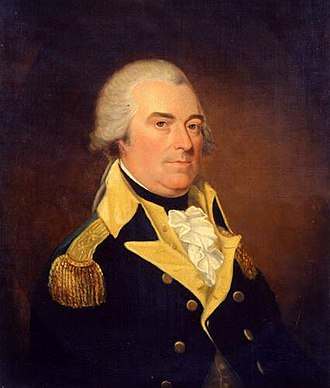
Anthony Wayne (January 1, 1745 – December 15, 1796) was a United States Army officer, statesman, and member of the United States House of Representatives. Wayne adopted a military career at the outset of the American Revolutionary War, where his military exploits and fiery personality quickly earned him promotion to brigadier general and the sobriquet Mad Anthony. He later served as General in Chief of the Army and commanded the Legion of the United States.
Wayne was born in Chester County, Pennsylvania, and worked as a tanner and surveyor after attending the College of Philadelphia. He was elected to the Pennsylvania General Assembly and helped raise a Pennsylvania militia unit in 1775. During the Revolutionary War, he served in the Invasion of Quebec, the Philadelphia campaign, and the Yorktown campaign. Although his reputation suffered after defeat in the Battle of Paoli, he won wide praise for his leadership in the 1779 Battle of Stony Point where he was awarded the Congressional Gold Medal.[2] After being promoted to major general in 1783, he retired from the Continental Army soon after. Anthony Wayne was a member of the Society of the Cincinnati of the state of Georgia.[3] In 1780, he was elected to the American Philosophical Society.[4]
After the war, Wayne held a brief career in congress and private business. Following St. Clair's defeat, Wayne was recalled by President Washington from civilian life to command of U.S. forces in the Northwest Indian War, where he defeated the British-backed Northwestern Confederacy, an alliance of several Native American tribes. Leading up to the war, Wayne oversaw a major change and reorganization of the entire United States Army. Following the 1794 Battle of Fallen Timbers, he later negotiated the Treaty of Greenville which ended the war and their alliance with the British.[5]
Wayne's legacy is controversial. In recent years, his legacy is contested, due to his ownership of slaves, as well as his use of tactics under George Washington's policies against Native Americans during the Northwest Indian War.[6][7][5]
Contents
- 1 Early life
- 2 American Revolution
- 3 Political career
- 4 Northwest Indian War
- 5 Legacy
- 6 Notes
- 7 References
- 8 External links
Early life
Wayne was one of five children born to Isaac Wayne and Elizabeth Iddings Wayne in Easttown Township, near present-day Paoli, Chester County, Pennsylvania. His father had emigrated from Ireland, and was part of a Protestant Anglo-Irish family. Wayne was born on January 1, 1745, on his family's Waynesborough estate.[1] He was educated as a surveyor at his uncle's private academy in Philadelphia, as well as at theCollege of Philadelphia (now the University of Pennsylvania), where he was in the class of 1765, although he did not earn a degree. In 1766 he was sent by Benjamin Franklin and some associates to work for a year surveying land they owned in Nova Scotia and assisting with starting settlements there. In 1767 he returned to work in his father's tannery, while continuing work as a surveyor. He became a prominent figure in Chester County and served in the Pennsylvania legislature from 1774–1780. He married Mary Penrose in 1766 and they had two children. Their daughter Margretta was born in 1770 and their son Isaac Wayne, future U.S. Representative from Pennsylvania, was born in 1772.[2]...
Wayne was an avid reader and often quoted Caesar and Shakespeare at length while serving in the military.[16] In 1767, he returned to work in his father's tannery while continuing work as a surveyor. At the time, Wayne owned a 40-year-old male slave named Toby, who was registered in Chester County as a "slave for life."[17]
...
American Revolution
At the onset of the war in 1775, Wayne raised a militia unit and, in 1776, became colonel of the 4th Pennsylvania Regiment. He and his regiment were part of the Continental Army's unsuccessful invasion of Canada where he was sent to aid Benedict Arnold, during which he commanded a successful rear-guard action at the Battle of Trois-Rivières, and then led the distressed forces on Lake Champlain at Fort Ticonderoga and Mount Independence. His service resulted in a promotion to brigadier general on February 21, 1777
...
Regarding tactics, Wayne discarded the conventional line warfare, once stating "the only good lines are those nature made", instead focusing on maneuver warfare and strict discipline.[10] He and his regiment were part of the Continental Army's unsuccessful invasion of Canada where he was sent to aid Benedict Arnold. Wayne commanded a successful rear-guard action at the Battle of Trois-Rivières and then led the forces on Lake Champlain at Fort Ticonderoga and Mount Independence. His service led to his promotion to brigadier general on February 21, 1777. Some historians claim Wayne's nickname "Mad Anthony" came from his bold military tactics from the Battle of Green Spring in Virginia, which his men barely escaped an outnumbered British force with a bold bayonet charge. Others claim it was from his quick temper and what historians label "off-color language," specifically during an incident when he severely punished a skilled informant for being drunk.[20][21][22]
On September 11, 1777, Wayne commanded the Pennsylvania Line at the Battle of Brandywine, where they held off General Wilhelm von Knyphausen in order to protect the American right flank. The two forces fought for three hours until the American line withdrew and Wayne was ordered to retreat.[23] He was then ordered to harass the British rear in order to slow General William Howe's advance towards Pennsylvania. Wayne's camp was attacked on the night of September 20–21 in the Battle of Paoli. General Charles Grey had ordered his men to remove their flints and attack with bayonets in order to keep their assault secret.[24] The battle earned Grey the sobriquet of "General Flint", but Wayne's own reputation was tarnished by the significant American losses, and he demanded a formal inquiry in order to clear his name.
On October 4, 1777, Wayne again led his forces against the British in the Battle of Germantown. His soldiers pushed ahead of other units, and the British "pushed on with their Bayonets—and took Ample Vengeance" as they retreated, according to Wayne's report.[25] Wayne and General John Sullivan advanced too rapidly and became entrapped when they were two miles (3.2 km) ahead of other American units. They retreated as Howe arrived to re-form the British line. Wayne was again ordered to hold off the British and cover the rear of the retreating body.
After winter quarters at Valley Forge, Wayne led the attack at the 1778 Battle of Monmouth, where his forces were abandoned by General Charles Lee and were pinned down by a numerically superior British force. Wayne held out until relieved by reinforcements sent by General George Washington. He then re-formed his troops and continued to fight.[26] The body of British Lt. Colonel Henry Monckton was discovered by the 1st Pennsylvania Regiment, and a legend grew that he had died fighting Wayne.[27]
Wayne also set an example for coping with adversity during military operations. On October 1778, Wayne wrote of the brutal cold and lack of appropriate supplies, "During the very severe storm from Christmas to New Year's, whilst our people lay without any cover except their old tents, and when the drifting of snow prevented the green wood from taking fire."[28] Through these tough conditions, Wayne wrote that he sought to keep his soldiers, "well and comfortable."[28]
In July 1779, Washington named Wayne to command the Corps of Light Infantry, a temporary unit of four regiments of light infantry companies drawn from all the regiments in the main army. His successful attack on British positions in the Battle of Stony Point was the highlight of his Revolutionary War service. On July 16, 1779, he replicated the bold attack used against him at Paoli and personally led a nighttime bayonet attack lasting 30 minutes. His three columns of about 1,500 light infantry stormed and captured British fortifications at Stony Point, a cliff-side redoubt commanding the southern Hudson River. The battle ended with around 550 prisoners taken, with fewer than 100 casualties for Wayne's forces. Wayne was wounded during the attack when an enemy musket ball gashed his scalp. The success of this operation provided a small boost to the morale of the army, which had suffered a series of military defeats, and the Continental Congress awarded him a medal for the victory.[21]
On July 21, 1780, Washington sent Wayne with two Pennsylvania brigades and four cannons to destroy a blockhouse at Bulls Ferry opposite New York City in the Battle of Bull's Ferry. Wayne's troops were unable to capture the position, suffering 64 casualties while inflicting 21 casualties on the Loyalist defenders.[29]
 A letter from Anthony Wayne to Israel Shreve, 1780.
On January 1, 1781, Wayne served as commanding officer of the Pennsylvania Line of the Continental Army when pay and condition concerns led to the Pennsylvania Line Mutiny, one of the most serious of the war. He successfully resolved the mutiny by dismissing about half the line. He returned the Pennsylvania Line to full strength by May 1781. This delayed his departure to Virginia, however, where he had been sent to assist General Lafayette against British forces operating there. The line's departure was delayed once more when the men complained about being paid in the nearly worthless Continental currency.[30]
On July 4, General Charles Cornwallis departed Williamsburg for Jamestown, planning to cross the James River en route to Portsmouth. Lafayette believed he could stage an attack on Cornwallis' rear guard during the crossing. Cornwallis anticipated Lafayette's plan and laid an elaborate trap. Wayne led a small scouting force of 500 in 1781 at the Battle of Green Spring to determine the location of Cornwallis, and they fell into the trap; only a bold bayonet charge against the numerically overwhelming British enabled his forces to retreat. The action reinforced the perception among contemporaries that justified the moniker "Mad" to describe Wayne.[31] During the Yorktown campaign, Wayne was shot in the leg; the lead musket ball was never removed from his leg.[32]
After the British under Cornwallis surrendered at Yorktown, Wayne went farther south and disbanded the British alliance with Native American tribes in Georgia.[33] With the goal of establishing peace between settlers and Native Americans, Wayne captured Creek troops early in his time in Georgia, releasing them in order to establish goodwill between the Creek people and the United States.[34] After various skirmishes with Native Americans, Wayne became angered and disenchanted with establishing alliances with Native Americans and in one instance, executed thirty Creek people he captured in July 1783.[34] He then negotiated peace treaties with both the Creeks and the Cherokees during a bout with malaria, for which Georgia purchased a rice plantation for 4,000 guineas and rewarded it to him.[10][33] Wayne would suffer from complications related to malaria for the remainder of his life.[10]
Civilian life
 Statue of Wayne at Valley Forge, facing toward his home in nearby Paoli, Pennsylvania
Pennsylvania
In 1783, Wayne returned to Pennsylvania and was celebrated as a hero, deciding to enter politics with other conservative friends at the time.[19] Initially a supporter of democracy, Wayne later aligned more with Federalist Party and George Washington after the Revolutionary War and joined that party. Like most federalists, he favored centralization, federalism, modernization, and protectionism.[35][36] He went on to support Republicanism because Wayne ultimately believed that the United States should have a strong centrally-controlled government, stronger banks, manufacturing, and a standing army and navy.
Eventually Wayne presented himself as a candidate for the Pennsylvania Council of Censors and on election day in October 1783, he gathered troops and approached electoral judges, demanding that they be allowed to vote.[19] He used his position to protect aristocrats.[19] On October 10, 1783, he was promoted to major general. Wayne was elected to serve in the Pennsylvania General Assembly for two years.[19]
Wayne was a member and took an active part of the Constitutional Convention.[37]
Georgia
Plantation and slaves
Main article: Slavery in the United States
After the war, Wayne spent time living between Pennsylvania and Georgia. He had a brief career in private business running his tanner business in Pennsylvania and two rice plantations in Georgia.[38]
Wayne's view on slavery was the same as most of the American planters at the time. He owned enslaved African Americans after the war. In 1786, he obtained them through the confiscated plantations, Richmond and Kew with a total area of 1,134 acres (459 hectares). He purchased 47 slaves from Adam Tunno, Samuel Potts, and others. He hired a plantation overseer to manage the plantation and direct the actions of his slaves.[11] A record shows 9 boys, 12 girls, 11 women, and 15 men – from Adam Tunno for 3,300 pounds, paying 990 pounds initially and then 2,310 pounds over a five-year period.[11][39] Letters by Wayne from the time express concern about the economic efficiency of finding and managing slaves.[40] Wayne also had a personal slave named "Caesar" that he named after his favorite historical figure, Julius Caesar.[41][42]
The plantations, were confiscated and officially given to Wayne in 1786 along with loans from Dutch bankers for repairs.[11][39][43][44] Wayne quickly fell into debt running the plantations. He is also documented neglecting his business, frequently attending out of state political events, social parties, time with former soldiers, time in Pennsylvania, or traveling. His plantations were ultimately unsuccessful because of neglect and acquiring a large amount of debt. He later begged various acquaintances to assist him with making payments before selling the plantations.[39][45][46][47]
Congressman
 18th-century print of Wayne
He was a delegate to the state convention that ratified the United States Constitution in 1788 and lost an election to the Senate that same year.[19] In late 1790, he was elected into the 2nd United States Congress as a representative of Georgia's 1st congressional district.[19][48] During his brief political career, he would remain loyal to George Washington with support. While in Congress, Wayne promoted the increased militarization of the United States and warned against future attacks from the British. He supported an act of 5,000 troops entering to secure ceded land in the Northwest Territory.[19]
Wayne's opponent James Jackson accused Wayne's campaign manager Judge Thomas Gibbons of electoral fraud.[19][49][50] A House committee determined that electoral fraud had been committed in the 1790 election and Local magistrates would later be implicated and not Wayne himself.[19][51] A special election was held on July 9, 1792. Wayne attempted to run again, however was disqualified due to failing residency qualifications. John Milledge eventually filled Wayne's vacant seat.[52][53][54][46][55][53]
During his time in Georgia, his wife abandoned him after rumors of a relationship between Wayne and General Nathanael Greene's wife Catherine spread.[56] As a civilian, Wayne ultimately found himself bankrupt, abandoned by his wife, and later removed from office.
Later military career
Main article: Northwest Indian War
The Northwest Indian War had been a disaster for the United States, as the British refused to leave the ceded land and continued their influence in Native American politics. Four years after the start of the British-supported Native American military campaign, the Constitution of the United States went into effect; George Washington was sworn in as president, which made him the commander-in-chief of U.S. military forces. Accordingly, Washington directed the United States Army to enforce U.S. sovereignty over the territory. The U.S. Army, consisting mostly of untrained recruits and volunteer militiamen, suffered a series of major defeats.
The British also sought to make the Ohio River the border with the United States and Native Americans to slow their progress.[10] Many Native Americans in the Northwest Territory had sided with the British in the Revolutionary War, but the British had ceded any sovereignty over the land to the United States in the Treaty of Paris of 1783. The British were known for persuading Native Americans to fight for them and continued to do so.[57] Although the British were reluctant to directly engage the United States, historian Reginald Horsman writes of their involvement in organizing Native American support, "The Indian Department at Detroit had done all within its power to bolster northwestern Indian resistance to American expansion. The agents had acted as organizers, advisers, and suppliers of the Indians, and they had made it possible for an Indian army to face Wayne."[58]
...
President George Washington recalled Wayne from civilian life in order to lead an expedition in the Northwest Indian War, which up to that point had been a disaster for the United States. Many American Indians in the Northwest Territory had sided with the British in the Revolutionary War. In the Treaty of Paris that had ended the conflict, the British had ceded this land to the United States. The Indians, however, had not been consulted, and resisted annexation of the area by the United States. The Western Indian Confederacy achieved major victories over U.S. forces in 1790 and 1791 under the leadership of Blue Jacket of the Shawnees and Little Turtle of the Miamis. They were encouraged and supplied by the British, who had refused to evacuate British fortifications in the region as called for in the Treaty of Paris...
Wayne's promise of land and treaty were left vulnerable after his death. A Spanish spy Wilkinson would take command of his army. Citizens eventually continued to settle beyond the borders and the state of Ohio later entered into the Union in 1803. The treaty is recognized as the turning point that provided the geographical and imaginative base for manifest destiny. The Miami people later said that fewer than one hundred adults survived twenty years after the treaty.[65][86][87] After Wayne's death, settlers would continue pushing natives further westward.
Betrayal by Wilkinson
When picking a general to lead the Legion of the United States, President Washington considered a few options, most notably Wayne and James Wilkinson.[88] When thinking of his choices, Washington found Wayne to be, "more active and enterprising than Judicious and cautious," and Wilkinson to be lacking experience, "as he was but a short time in the Service."[70] Throughout the campaign, Wayne's second in command, General James Wilkinson, secretly tried to undermine him. Wilkinson wrote anonymous negative letters to local newspapers about Wayne and spent years writing negative letters to politicians in Washington, D.C. Wayne was unaware as Wilkinson was recorded as being extremely polite to Wayne in person. Wilkinson was also a Spanish spy at the time and even served as an officer.[89] In December 1794, Wilkinson secretly instructed suppliers to delay rations and send just enough to keep the army alive in hopes of preventing progress.[36] Secretary of War Henry Knox eventually alerted Wayne about Wilkinson, and Wayne began an investigation. Eventually, Spanish couriers carrying payments for Wilkinson were intercepted. Wayne's suspicions were confirmed, and he attempted to court-martial Wilkinson for his treachery. However, Wayne developed a stomach ulcer and died on December 15, 1796; there was no court-martial. Instead Wilkinson began his first tenure as Senior Officer of the Army, which lasted for about a year and a half. He continued to pass on intelligence to the Spanish in return for large sums in gold.[90]
Death and legacy
 Wayne's grave at St. David's Episcopal Church which contains his bones
Wayne died during a return trip to Pennsylvania from a military post in Detroit. It has been speculated but never proven that Wilkinson had him assassinated. Wilkinson is documented secretly undermining him throughout his later career, benefited from his death, and would replace him as commander after his death.[91][92] Wayne was buried at Fort Presque Isle, where the modern Wayne Blockhouse stands. His son, Isaac Wayne, disinterred the body in 1809 and had the corpse boiled to remove the remaining flesh from the bones.[93] He then placed the bones into two saddlebags and relocated them to the family plot in the graveyard of St. David's Episcopal Church in Wayne, Pennsylvania.[94] The other remains were reburied but were rediscovered in 1878, giving Wayne two known grave sites.[93][95][96]
President Theodore Roosevelt later praised Wayne as America's best fighting general. Henry Cabot Lodge mentions with the exception of Washington, and perhaps Greene, that he was the best general the Americans developed in the contest.[97]
In later years Wayne's reputation has been scrutinized. Along with various Founding Fathers, he has been condemned for holding enslaved human beings and for his tactics under Washington's policies during the Northwest Indian War. Shortly after the Northwest Indian War, Wayne died and his treaty was not enforced, which helped pave the way for the future westward expansion of the United States and ethnic cleansing of Native Americans in the Ohio Valley.[98][81][5][5]
Some recent historians disagree on his military performance as a strategist. His skills as a military leader received mixed views by his contemporaries, some whom he had personality clashes with.[99][100] ^[101][102] Historian and author of the Unlikely General Mary Stockwell highlighted his decisive military victories while shedding light on his many personal flaws, being a spendthrift, womanizer, and heavy drinker.[103][99][104][105]"[13][100] Some considered him impulsive, bad-tempered, an aggressive as a military leader with a fiery personality who advocated the tactics of Julius Caesar and Maurice de Saxe.[10][55][99][100][106]
Several of Wayne's uniforms, ranks, tactics and military legions exist today in the US Army. His legions were renamed regiments. One of them is now known as the Third Regiment of Infantry which is best known for its role in the changing-of-the-guard ceremony at the Tomb of the Unknown Soldier at the Arlington National Cemetery.[107][71]
http://en.wikipedia.org/wiki/Anthony_Wayne
.